Response of Beech (Fagus sylvatica L.) Trees to Competition—New Insights from Using Fractal Analysis



Abstract
1. Introduction
2. Materials and Methods
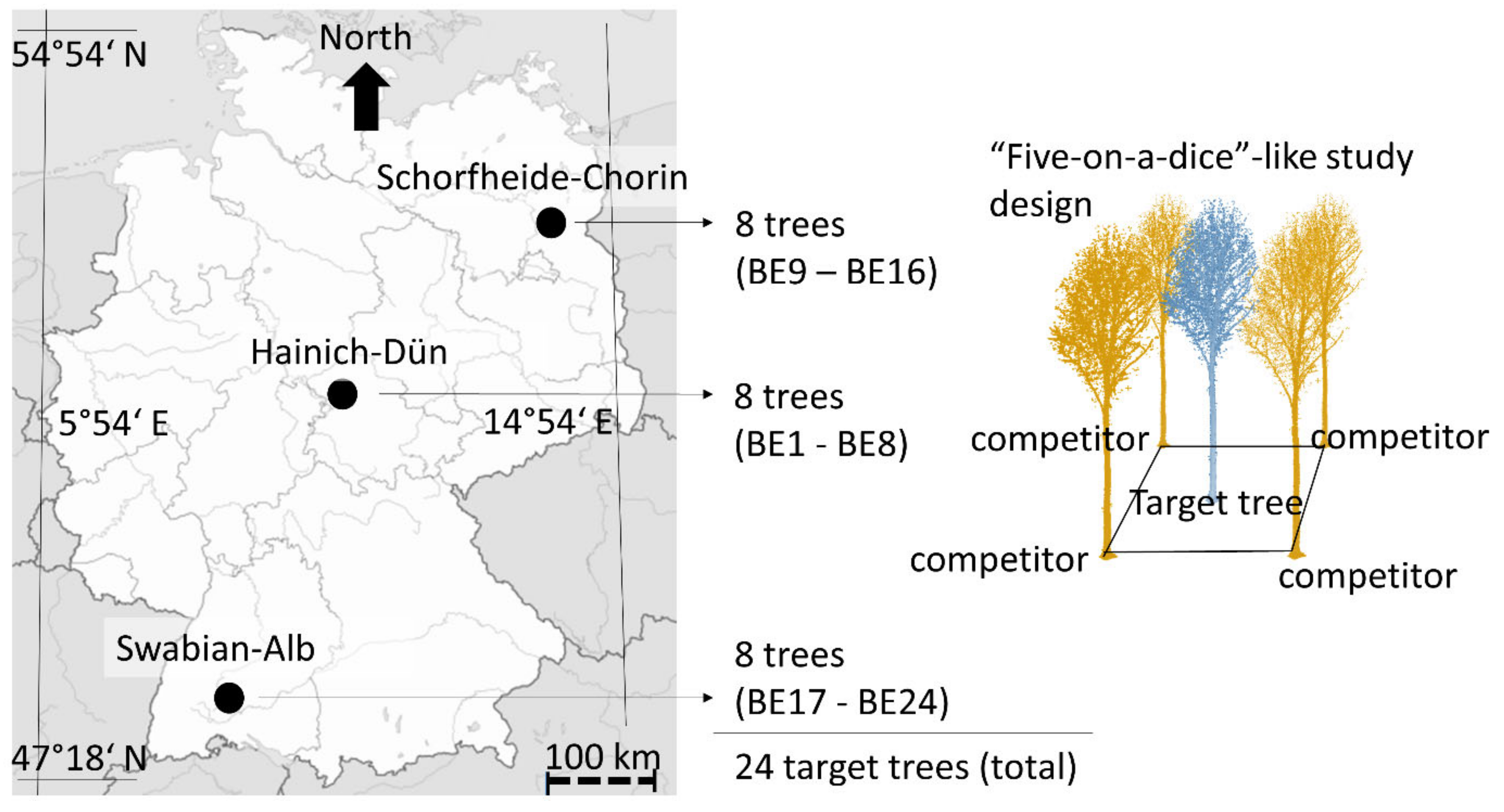
2.1. Study Sites and Objects
2.2. Laser Scanning
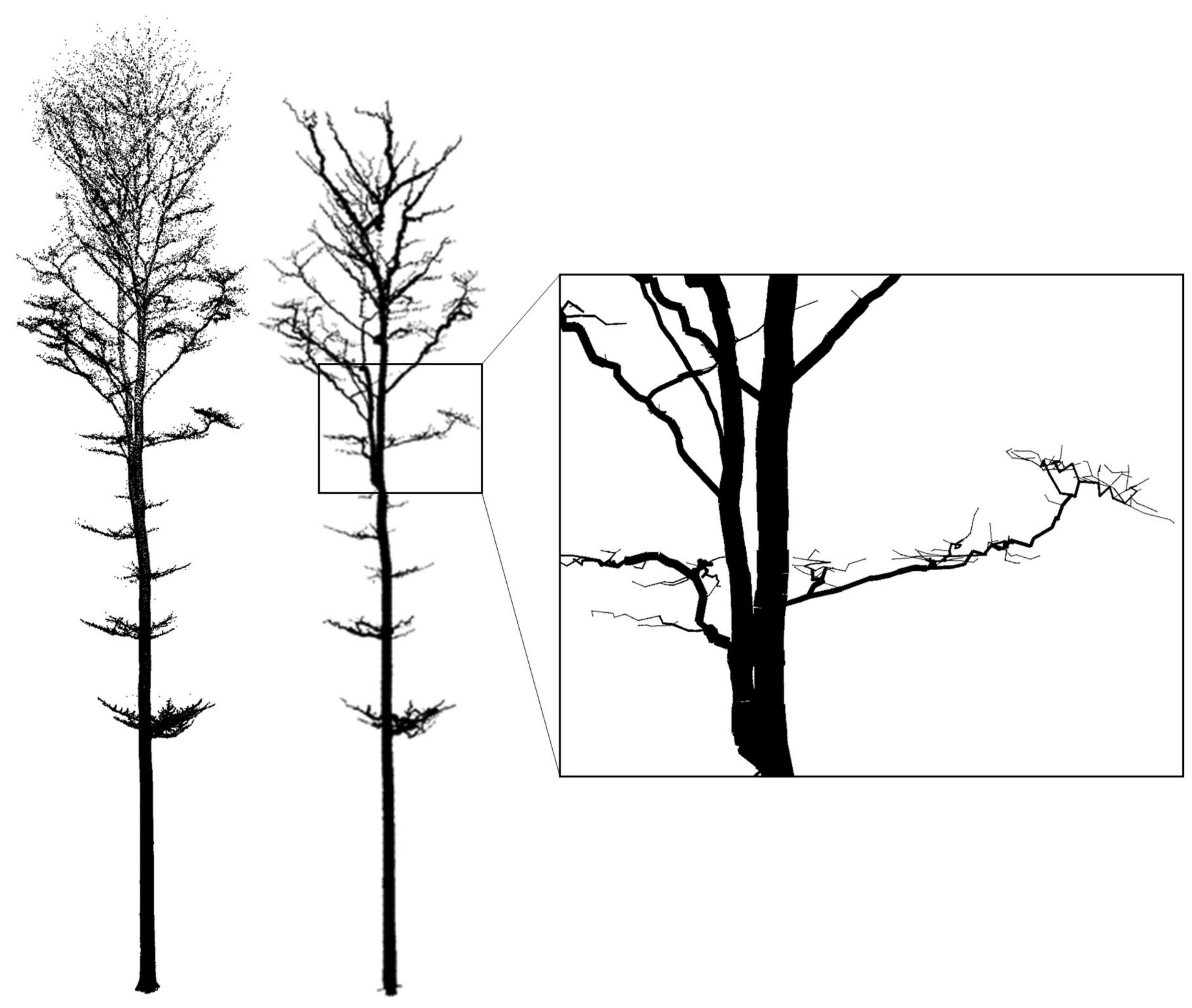
2.3. Point Cloud Processing and Quantitative Structure Models
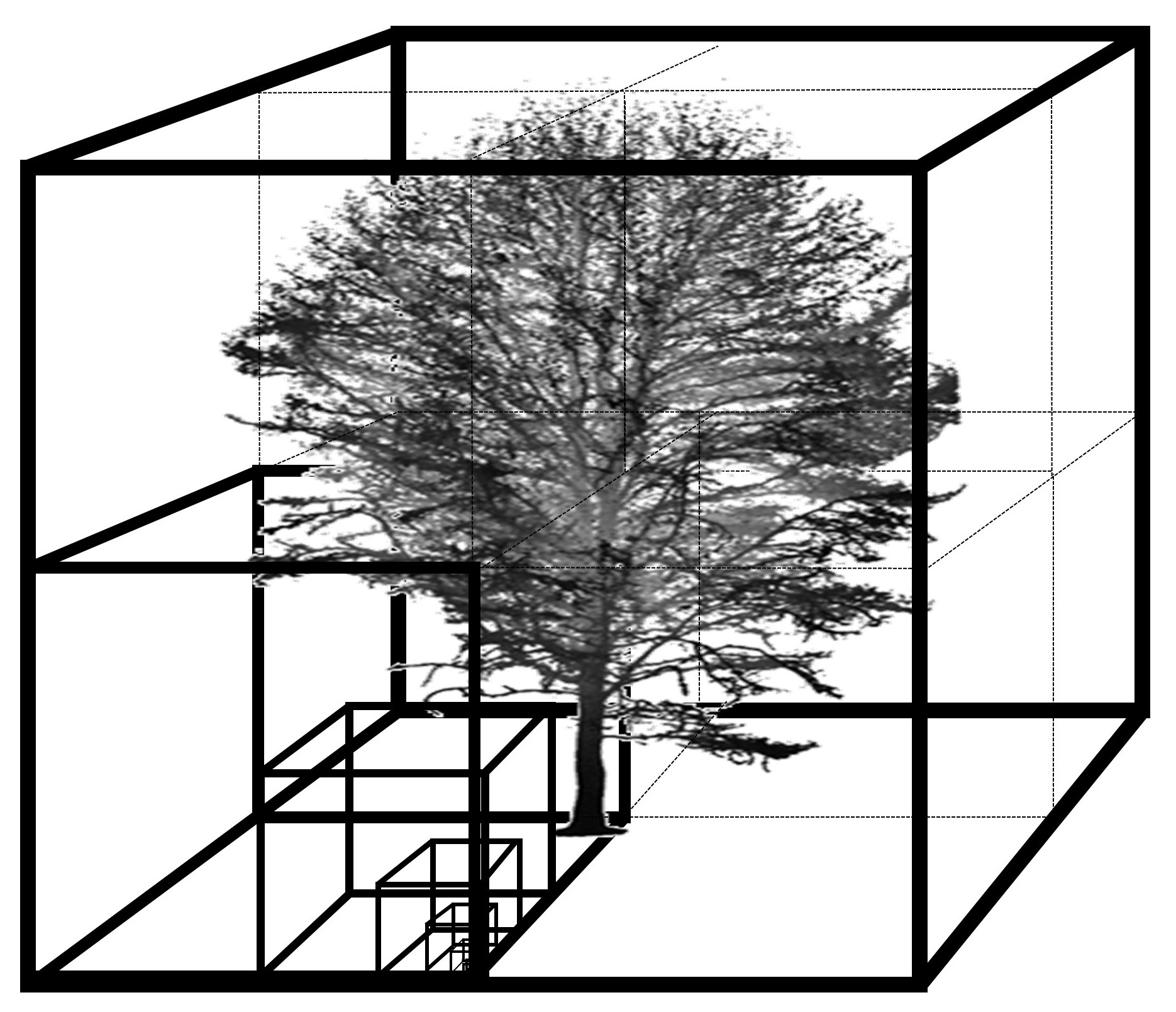
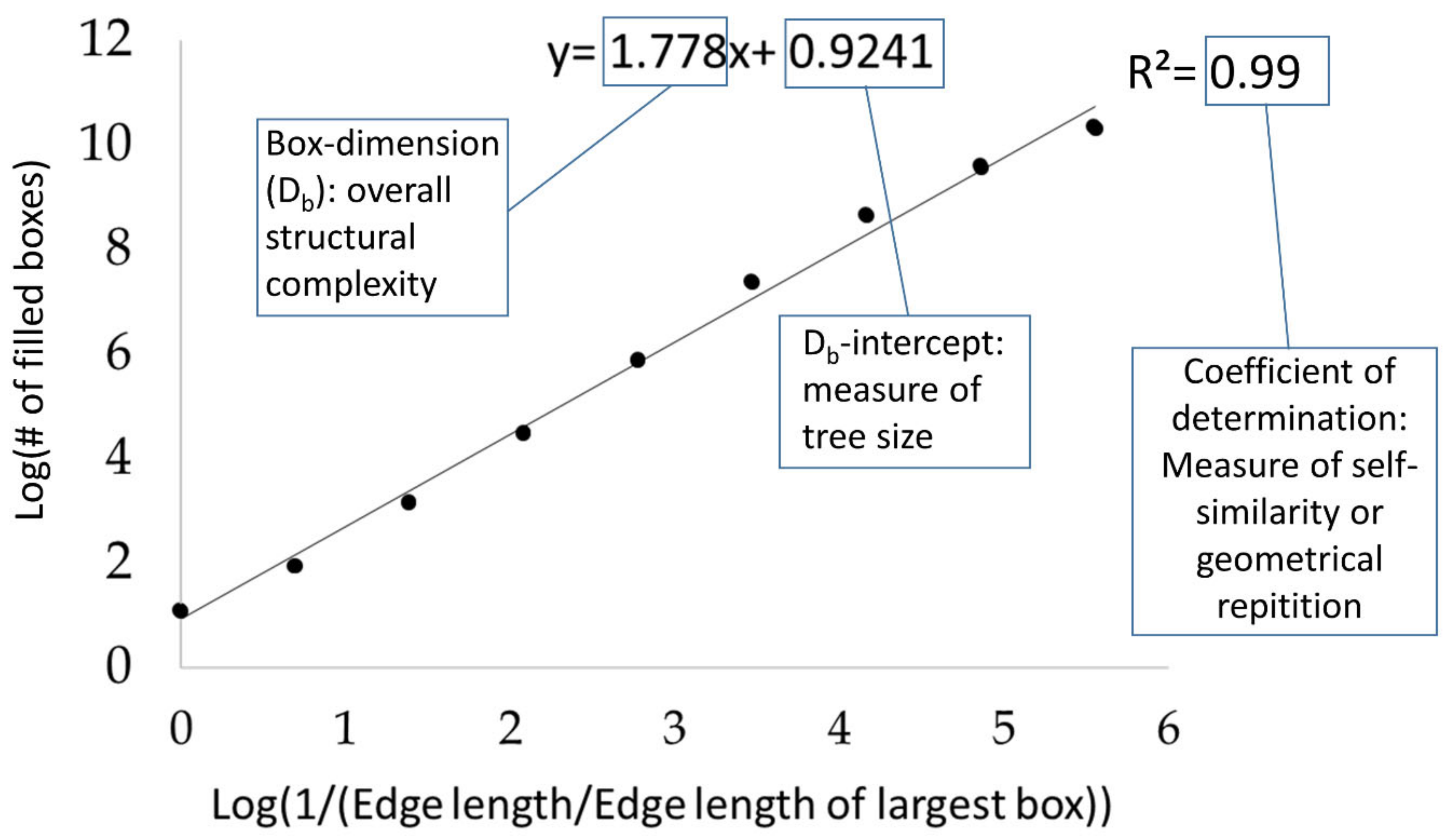
2.4. Box-dimension, Intercept and Self-Similarity
2.5. Calculation of Competitive Pressure
2.6. Statistical Analysis
3. Results
4. Discussion
5. Conclusions
Author Contributions
Funding
Acknowledgments
Conflicts of Interest
References
- Von Lüpke, B.; Ammer, C.; Braciamacchie, M.; Brunner, A.; Ceitel, J.; Collet, C.; Deuleuze, C.; Di Placido, J.; Huss, J.; Jankovic, J.; et al. Silvicultural strategies for conversion. In Norway Spruce Conversion—Options and Consequences; European Forest Institute Research Report 18; Spiecker, H., Hansen, J., Klimo, E., Skovsgaard, J.P., Sterba, H., von Teuffel, K., Eds.; Brill: Leiden, The Netherlands; Boston, MA, USA, 2004; pp. 121–164. [Google Scholar]
- Filipescu, C.N.; Comeau, P.G. Competitive interactions between aspen and white spruce vary with stand age in boreal mixed woods. For. Ecol. Manag. 2007, 247, 175–184. [Google Scholar] [CrossRef] [Scilit]
- Ammer, C.; Bickel, E.; Kolling, C. Converting Norway spruce stands with beech-a review of arguments and techniques. Aust. J. For. Sci. 2008, 125, 3–26. [Google Scholar]
- Knoke, T.; Ammer, C.; Stimm, B.; Mosandl, R. Admixing broadleaved to coniferous tree species: a review on yield, ecological stability and economics. Eur. J. For. Res. 2008, 127, 89–101. [Google Scholar] [CrossRef] [Scilit]
- Juchheim, J.; Ammer, C.; Schall, P.; Seidel, D. Canopy space filling rather than conventional measures of structural diversity explains productivity of beech stands. For. Ecol. Manag. 2017, 395, 19–26. [Google Scholar] [CrossRef] [Scilit]
- Shi, H.; Zhang, L. Local analysis of tree competition and growth. For. Sci. 2003, 49, 938–955. [Google Scholar] [CrossRef] [Scilit]
- Ledermann, T. Evaluating the performance of semi-distance-independent competition indices in predicting the basal area growth of individual trees. Can. J. For. Res. 2010, 40, 796–805. [Google Scholar] [CrossRef] [Scilit]
- Ammer, C. Konkurrenzsteuerung–Anmerkungen zu einer Kernaufgabe des Waldbaus beim Aufbau vielfältiger Wälder. Eberswalder Forstl. Schriftenreihe 2008, 36, 21–26. [Google Scholar]
- Canham, C.D.; LePage, P.T.; Coates, K.D. A neighborhood analysis of canopy tree competition: effects of shading versus crowding. Can. J. For. Res. 2004, 34, 778–787. [Google Scholar] [CrossRef] [Scilit]
- Zhao, D.; Borders, B.; Wilson, M.; Rathbun, S.L. Modeling neighborhood effects on the growth and survival of individual trees in a natural temperate species rich-forest. Ecol. Model. 2006, 196, 90–102. [Google Scholar] [CrossRef] [Scilit]
- Pretzsch, H.; Schütze, G. Transgressive overyielding in mixed compared with pure stands of Norway spruce and European beech in Central Europe: evidence on stand level and explanation on individual tree level. Eur. J. For. Res. 2009, 128, 183–204. [Google Scholar] [CrossRef] [Scilit]
- Munro, D.D. Forest Growth Models-A Prognosis. In Growth Models for Tree and Stand Simulation, Proceedings of the Congress IUFRO S4.01-4, September 1974 Stockholm, Sweden; Fries, J., Ed.; Department of Forest Yield Research, Royal College of Forestry: Stockholm, Sweden, 1974; Volume 30, pp. 1–21. [Google Scholar]
- Biging, G.S.; Dobbertin, M. Evaluation of competition indices in individual tree growth models. For. Sci. 1995, 41, 360–377. [Google Scholar] [CrossRef] [Scilit]
- Porté, A.; Bartelink, H. Modelling mixed forest growth: a review of models for forest management. Ecol. Model. 2002, 150, 141–188. [Google Scholar] [CrossRef] [Scilit]
- Tomé, M.; Burkhart, H.E. Distance-dependent competition measures for predicting growth of individual trees. For. Sci. 1989, 35, 816–831. [Google Scholar] [CrossRef] [Scilit]
- Bachmann, M. Indizes zur Erfassung der Konkurrenz von Einzelbäumen: Methodische Untersuchung in Bergmischwäldern; Forstliche Forschungsberichte München 171; Schriftenreihe der Forstwissenschaftlichen Fakultät der Universität München und der Bayerischen Landesanstalt für Wald und Forstwirtschaft: München, Germany, 1998. [Google Scholar]
- Metz, J.; Seidel, D.; Scheffer, D.; Schulze, E.D.; Ammer, C. Crown modeling by terrestrial laser scanning as an approach to assess the effect of aboveground intra-and interspecific competition on tree growth. For. Ecol. Manag. 2013, 310, 275–288. [Google Scholar] [CrossRef] [Scilit]
- Seidel, D.; Hoffmann, N.; Ehbrecht, M.; Juchheim, J.; Ammer, C. How neighborhood affects tree diameter increment–New insights from terrestrial laser scanning and some methodical considerations. For. Ecol. Manag. 2015, 336, 119–128. [Google Scholar] [CrossRef] [Scilit]
- Seidel, D.; Schall, P.; Gille, M.; Ammer, C. Relationship between tree growth and physical dimensions of Fagus sylvatica crowns assessed from terrestrial laser scanning. IForest 2015, 8, 735–742. [Google Scholar] [CrossRef] [Scilit]
- Olivier, M.D.; Robert, S.; Fournier, R.A. Response of sugar maple (Acer saccharum, Marsh.) tree crown structure to competition in pure versus mixed stands. For. Ecol. Manag. 2016, 374, 20–32. [Google Scholar] [CrossRef] [Scilit]
- Seidel, D. A holistic approach to determine tree structural complexity based on laser scanning data and fractal analysis. Ecol. Evol. 2018, 8, 128–134. [Google Scholar] [CrossRef] [Scilit]
- Yu, X.; Liang, X.; Hyyppä, J.; Kankare, V.; Vastaranta, M.; Holopainen, M. Stem biomass estimation based on stem reconstruction from terrestrial laser scanning point clouds. Remote Sens. Lett. 2013, 4, 344–353. [Google Scholar] [CrossRef] [Scilit]
- Astrup, R.; Ducey, M.J.; Granhus, A.; Ritter, T.; von Lüpke, N. Approaches for estimating stand-level volume using terrestrial laser scanning in a single-scan mode. Can. J. For. Res. 2014, 44, 666–676. [Google Scholar] [CrossRef] [Scilit]
- Newnham, G.J.; Armston, J.D.; Calders, K.; Disney, M.I.; Lovell, J.L.; Schaaf, C.B.; Strahler, A.H.; Danson, F.M. Terrestrial laser scanning for plot-scale forest measurement. Curr. Forest. Rep. 2015, 1, 239–251. [Google Scholar] [CrossRef] [Scilit]
- Seidel, D.; Leuschner, C.; Müller, A.; Krause, B. Crown plasticity in mixed forests—Quantifying asymmetry as a measure of competition using terrestrial laser scanning. For. Ecol. Manag. 2011, 261, 2123–2132. [Google Scholar] [CrossRef] [Scilit]
- Liang, X.; Hyyppä, J.; Kaartinen, H.; Lehtomäki, M.; Pyörälä, J.; Pfeifer, N.; Holopainen, M.; Brolly, G.; Francesco, P.; Hackenberg, J.; et al. International benchmarking of terrestrial laser scanning approaches for forest inventories. ISPRS J. Photogramm. Remote Sens. 2018, 144, 137–179. [Google Scholar] [CrossRef] [Scilit]
- Bayer, D.; Seifert, S.; Pretzsch, H. Structural crown properties of Norway spruce (Picea abies [L.] Karst.) and European beech (Fagus sylvatica [L.]) in mixed versus pure stands revealed by terrestrial laser scanning. Trees 2013, 27, 1035–1047. [Google Scholar] [CrossRef] [Scilit]
- Juchheim, J.; Annighöfer, P.; Ammer, C.; Calders, K.; Raumonen, P.; Seidel, D. How management intensity and neighborhood composition affect the structure of beech (Fagus sylvatica L.) trees. Trees 2017, 31, 1723–1735. [Google Scholar] [CrossRef] [Scilit]
- Mandelbrot, B.B. The Fractal Geometry of Nature; W.H. Freeman Company: New York, NY, USA, 1977; p. 468. [Google Scholar]
- Prusinkiewicz, P.; Runions, A. Computational models of plant development and form. New Phytol. 2012, 193, 549–569. [Google Scholar] [CrossRef] [Scilit]
- Seidel, D.; Ehbrecht, M.; Dorji, Y.; Jambay, J.; Ammer, C.; Annighöfer, P.J. Identifying architectural characteristics that determine tree structural complexity. Trees 2019, 33, 911–919. [Google Scholar] [CrossRef] [Scilit]
- Fischer, M.; Bossdorf, O.; Gockel, S.; Hansel, F.; Hemp, A.; Hessenmoller, D.; Korte, G.; Nieschulze, J.; Pfeiffer, S.; Prati, D.; et al. Implementing large-scale and long-term functional biodiversity research: The Biodiversity Exploratories. Basic Appl. Ecol. 2010, 11, 473–485. [Google Scholar] [CrossRef] [Scilit]
- Piboule, A.; Krebs, M.; Esclatine, L.; Hervé, J.-C. Computree: a collaborative platform for use of terrestrial lidar in dendrometry. In Proceedings of the International IUFRO Conference MeMoWood, Nancy, France, 1–4 October 2013. [Google Scholar]
- Sarkar, N.; Chaudhuri, B.B. An efficient differential box-counting approach to compute fractal dimension of image. IEEE T. Syst. Man Cyb. 1994, 24, 115–120. [Google Scholar] [CrossRef] [Scilit]
- R Core Team. R: A Language and Environment for Statistical Computing; R Foundation for Statistical Computing: Vienna, Austria, 2013; p. 201. [Google Scholar]
- Wood, S.N. Generalized Additive Models: An Introduction with R, 2nd ed.; Taylor Francis: New York, NY, USA, 2017; p. 476. [Google Scholar] [CrossRef] [Scilit]
- Schröter, M.; Härdtle, W.; Oheimb, G. Crown plasticity and neighborhood interactions of European beech (Fagus sylvatica L.) in an old-growth forest. Eur. J. For. Res. 2012, 131, 787–798. [Google Scholar] [CrossRef] [Scilit]
- Valladares, F.; Gianoli, E.; Gómez, J.M. Ecological limits to plant phenotypic plasticity. New Phytol. 2007, 176, 749–763. [Google Scholar] [CrossRef] [Scilit] [PubMed]
- Maguire, D.A.; Bennett, W.S. Patterns in vertical distribution of foliage in young coastal Douglas-fir. Can. J. For. Res. 1996, 26, 1991–2005. [Google Scholar] [CrossRef] [Scilit]
- Jucker, T.; Bouriaud, O.; Coomes, D.A. Crown plasticity enables trees to optimize canopy packing in mixed-species forests. Funct. Ecol. 2015, 29, 1078–1086. [Google Scholar] [CrossRef] [Scilit]
- Seidel, D.; Annighöfer, P.; Stiers, M.; Zemp, C.D.; Burkardt, K.; Ehbrecht, M.; Ammer, C. How a measure of tree structural complexity relates to architectural benefit-to-cost ratio, light availability, and growth of trees. Ecol. Evol. 2019, 9, 7134–7142. [Google Scholar] [CrossRef] [Scilit]
- Oliver, C.D.; Larson, B.C. Forest Stand Dynamics: Updated Edition; John Wiley and Sons: New York, NY, USA, 1996; p. 520. [Google Scholar]
- Henning, J.G.; Radtke, P.J. Ground-based laser imaging for assessing three dimensional forest canopy structure. Photogramm. Eng. Remote Sens. 2006, 72, 1349–1358. [Google Scholar] [CrossRef] [Scilit]
- Bazzaz, F.A. Plant Species Diversity in Old-Field Successional Ecosystems in Southern Illinois. Ecology 1975, 56, 485–488. [Google Scholar] [CrossRef] [Scilit]
- Tews, J.; Brose, U.; Grimm, V.; Tielbörger, K.; Wichmann, M.C.; Schwager, M.; Jeltsch, F. Animal species diversity driven by habitat heterogeneity/diversity: the importance of keystone structures. J. Biogeogr. 2004, 31, 79–92. [Google Scholar] [CrossRef] [Scilit]


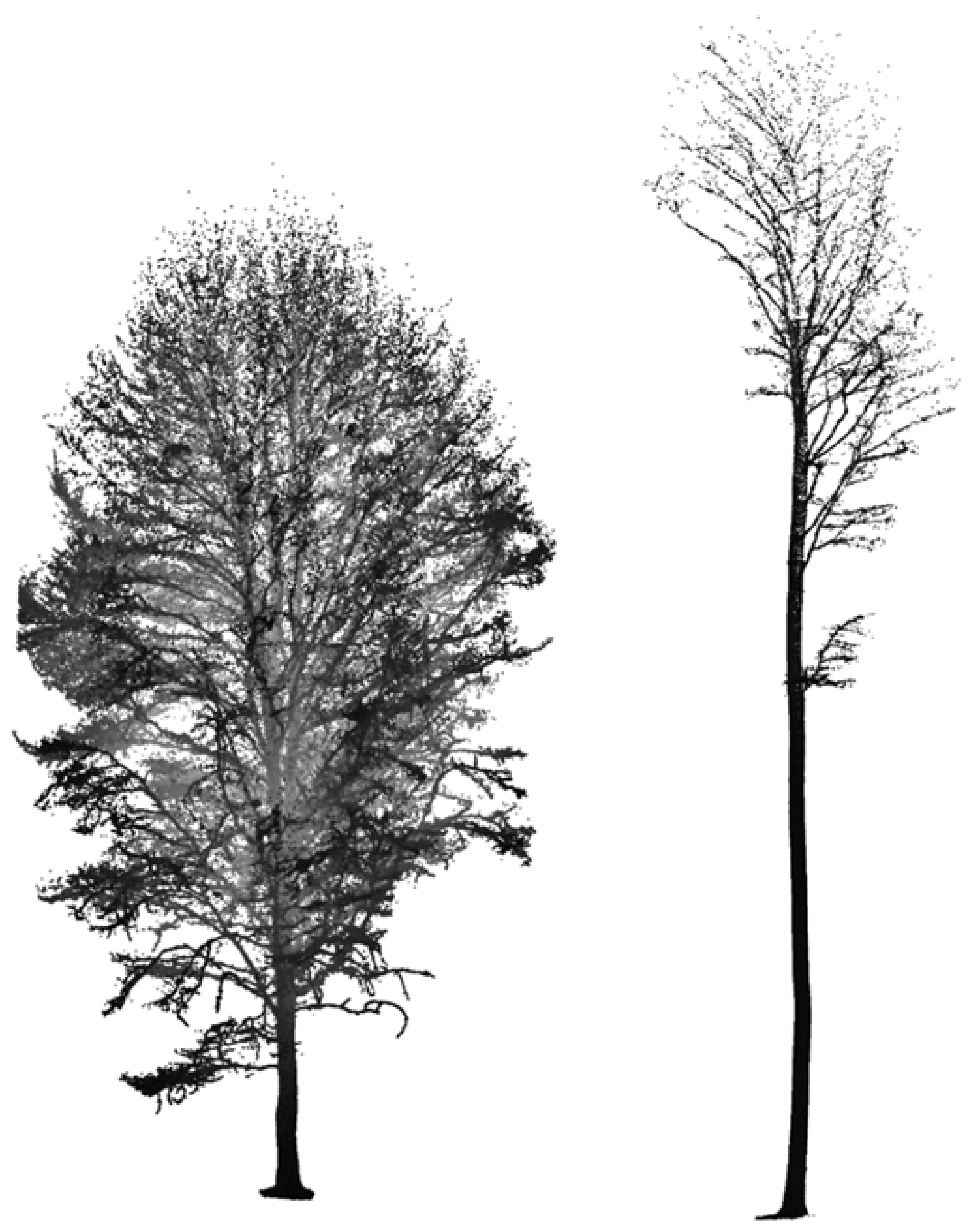
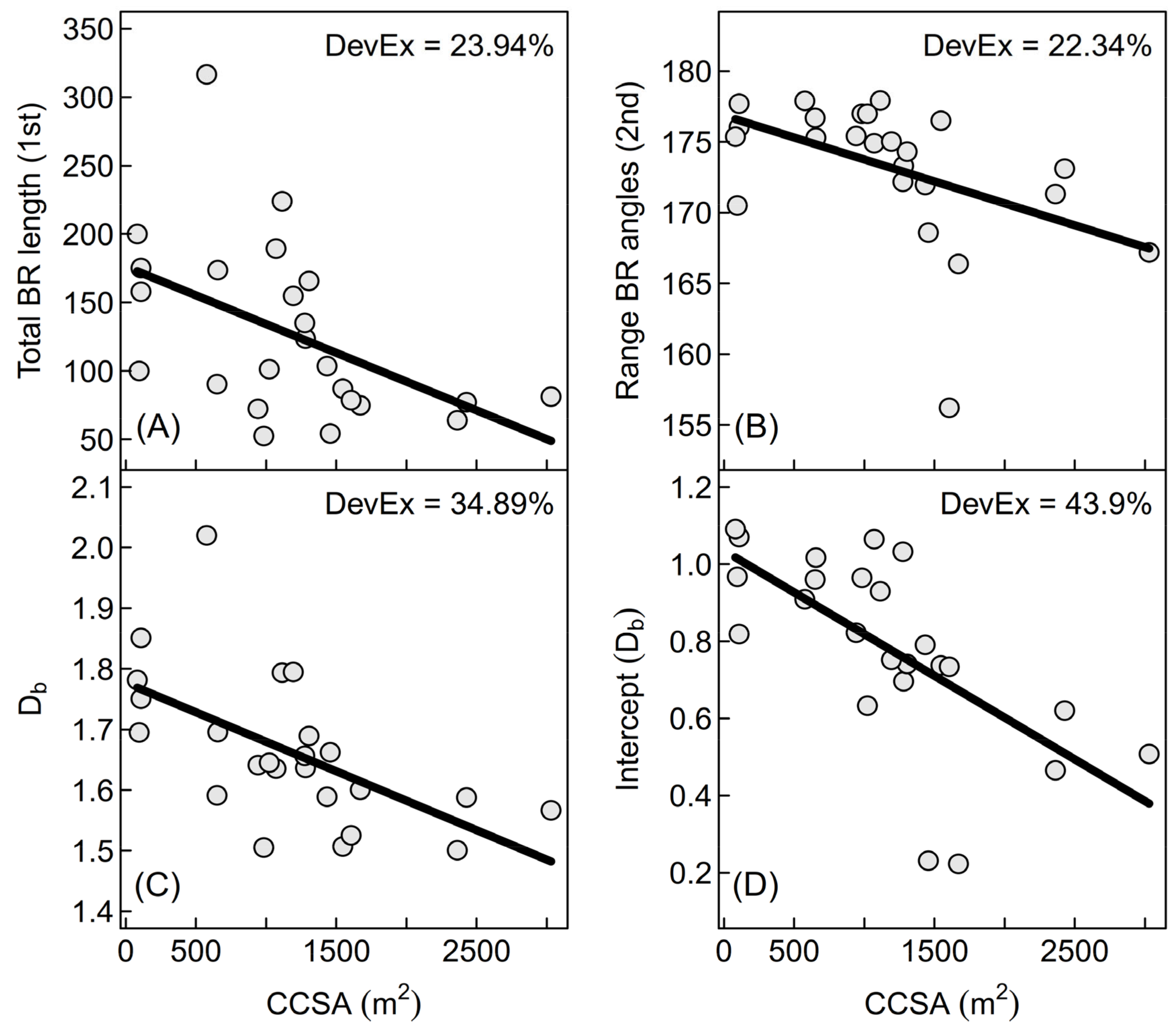
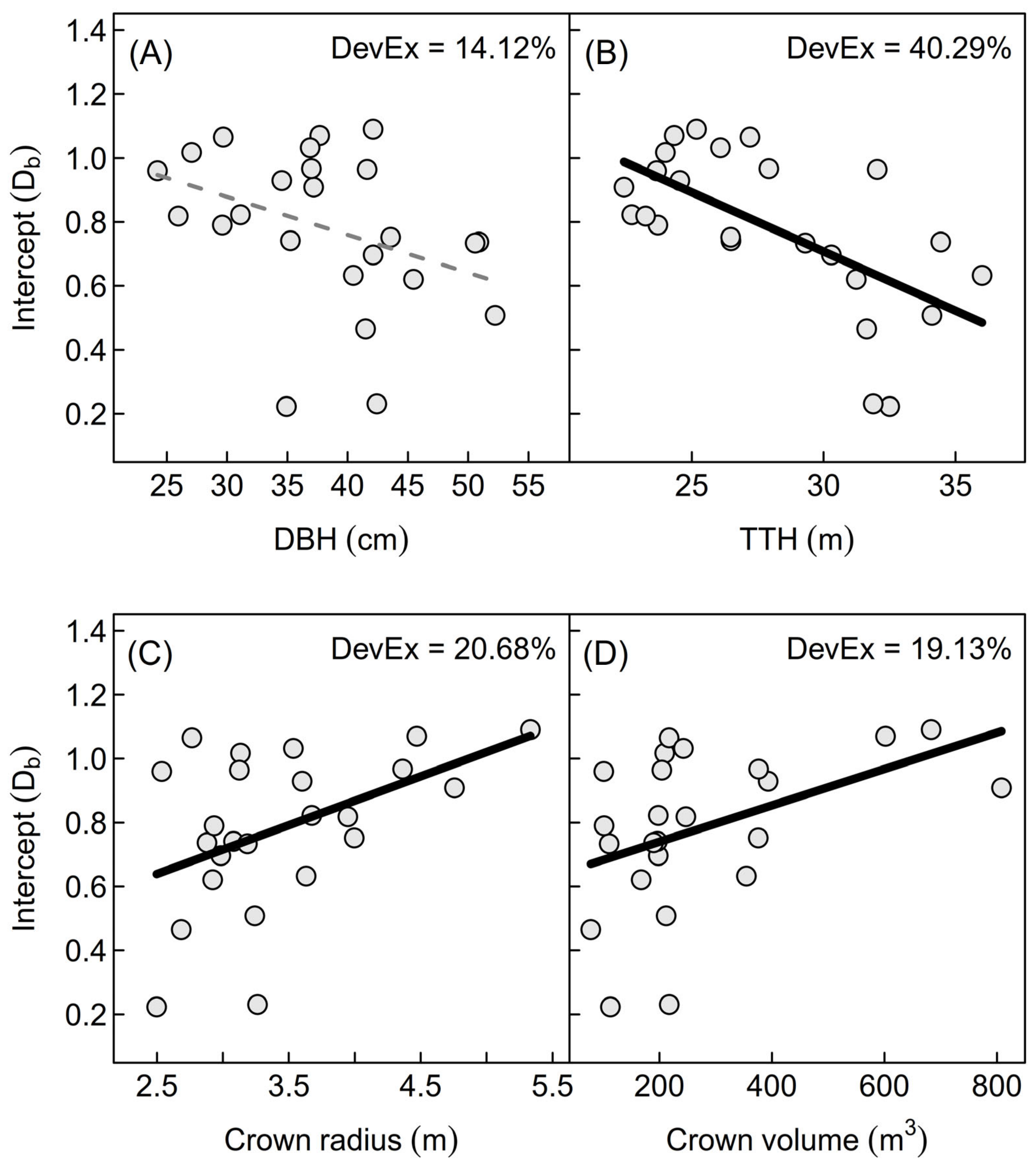

| Target Tree ID | Exploratory | Height (m) | DBH (cm) | Competing Species |
|---|---|---|---|---|
| BE 1 | HAI | 32.03 | 41.60 | ash |
| BE 2 | HAI | 31.24 | 45.50 | beech |
| BE 3 | HAI | 34.44 | 50.40 | beech |
| BE 4 | HAI | 31.63 | 41.60 | beech |
| BE 5 | HAI | 31.88 | 42.70 | beech |
| BE 6 | HAI | 22.72 | 31.30 | maple, ash |
| BE 7 | HAI | 29.30 | 51.50 | maple, lime, oak, hornbeam |
| BE 8 | HAI | 23.72 | 30.30 | ash |
| BE 9 | SCH | 27.92 | 37.20 | pine |
| BE10 | SCH | 23.25 | 26.20 | pine |
| BE11 | SCH | 25.18 | 42.30 | pine |
| BE12 | SCH | 36.01 | 40.00 | beech |
| BE13 | SCH | 34.11 | 50.10 | beech |
| BE14 | SCH | 24.33 | 37.30 | pine |
| BE15 | SCH | 26.47 | 43.30 | beech |
| BE16 | SCH | 26.09 | 37.00 | beech |
| BE17 | ALB | 27.21 | 30.00 | beech |
| BE18 | ALB | 32.51 | 34.70 | beech |
| BE19 | ALB | 30.29 | 42.00 | beech |
| BE20 | ALB | 23.67 | 22.10 | spruce |
| BE21 | ALB | 22.43 | 37.70 | spruce |
| BE22 | ALB | 24.55 | 35.20 | spruce |
| BE23 | ALB | 26.49 | 34.70 | beech |
| BE24 | ALB | 24.00 | 27.30 | spruce |
| Architectural Attribute | rho | p-value |
|---|---|---|
| Branch volume 1st order | −0.26 | 0.227 |
| Branch volume 2nd order | −0.20 | 0.355 |
| Branch volume 3rd order | −0.25 | 0.237 |
| Total branch length 1st order | −0.53 | 0.007 |
| Mean branch length 1st order | −0.52 | 0.009 |
| Mean branch angle 1st order | 0.11 | 0.624 |
| Mean branch angle 2nd order | −0.07 | 0.755 |
| Mean branch angle 3rd order | −0.22 | 0.291 |
| Range of branch angles 1st order | −0.21 | 0.323 |
| Range of branch angles 2nd order | −0.62 | 0.002 |
| Range of branch angles 3rd order | −0.28 | 0.179 |
| Db (box dimension) | −0.65 | 0.006 |
| Intercept of Db-regression | −0.78 | <0.001 |
| Self-similarity | 0.31 | 0.142 |
© 2019 by the authors. Licensee MDPI, Basel, Switzerland. This article is an open access article distributed under the terms and conditions of the Creative Commons Attribution (CC BY) license (http://creativecommons.org/licenses/by/4.0/).
Share and Cite
Dorji, Y.; Annighöfer, P.; Ammer, C.; Seidel, D. Response of Beech (Fagus sylvatica L.) Trees to Competition—New Insights from Using Fractal Analysis. Remote Sens. 2019, 11, 2656. https://doi.org/10.3390/rs11222656
Dorji Y, Annighöfer P, Ammer C, Seidel D. Response of Beech (Fagus sylvatica L.) Trees to Competition—New Insights from Using Fractal Analysis. Remote Sensing. 2019; 11(22):2656. https://doi.org/10.3390/rs11222656
Chicago/Turabian StyleDorji, Yonten, Peter Annighöfer, Christian Ammer, and Dominik Seidel. 2019. "Response of Beech (Fagus sylvatica L.) Trees to Competition—New Insights from Using Fractal Analysis" Remote Sensing 11, no. 22: 2656. https://doi.org/10.3390/rs11222656
APA StyleDorji, Y., Annighöfer, P., Ammer, C., & Seidel, D. (2019). Response of Beech (Fagus sylvatica L.) Trees to Competition—New Insights from Using Fractal Analysis. Remote Sensing, 11(22), 2656. https://doi.org/10.3390/rs11222656