Specific Features of Parks and Their Impact on Regulation and Cultural Ecosystem Services Provision in Warsaw, Poland
Abstract
:
1. Introduction
2. Materials and Methods
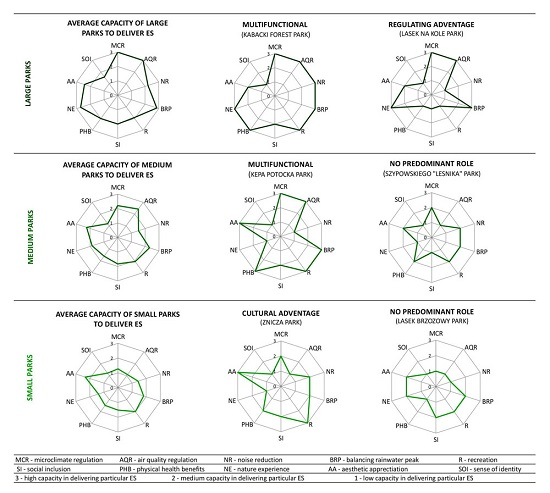
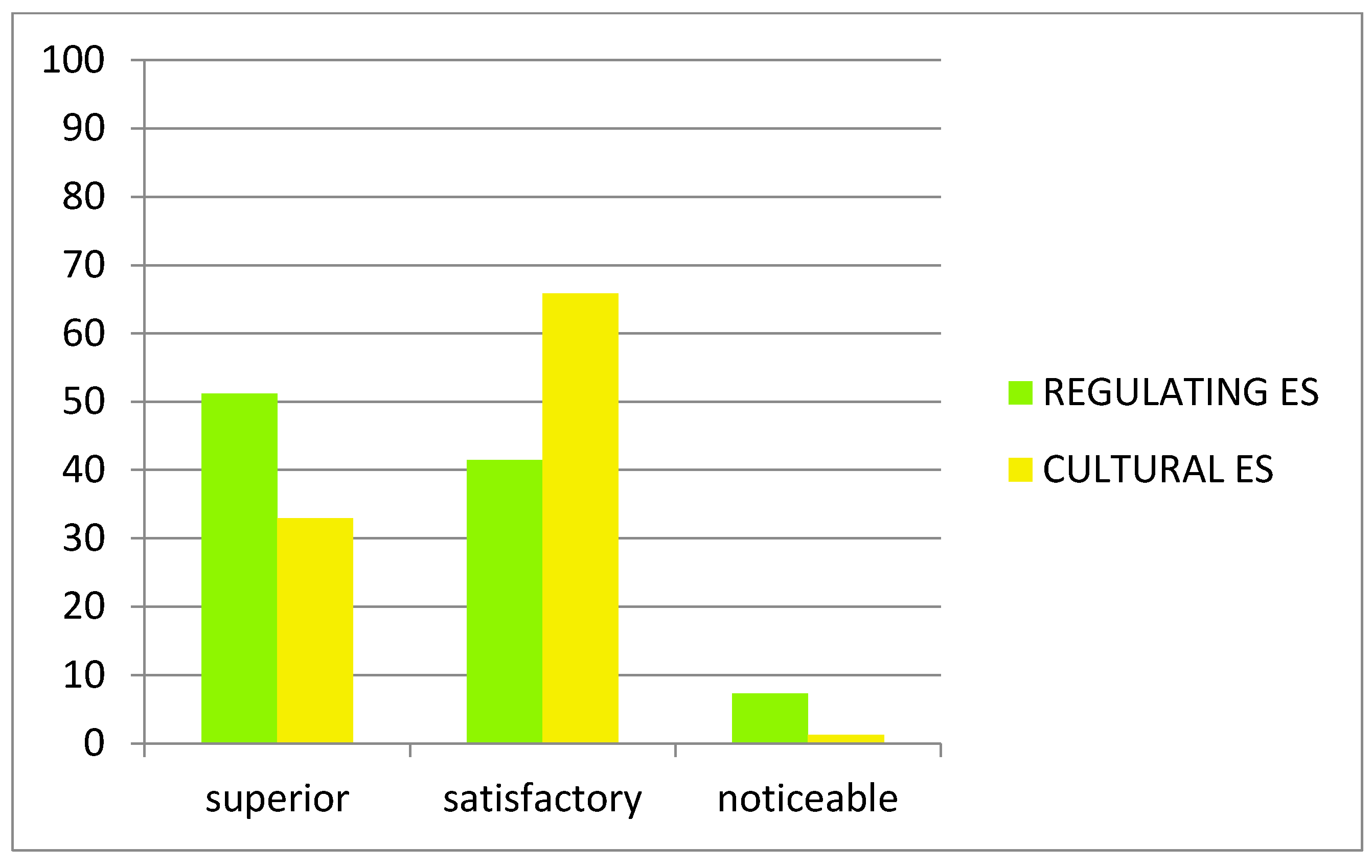
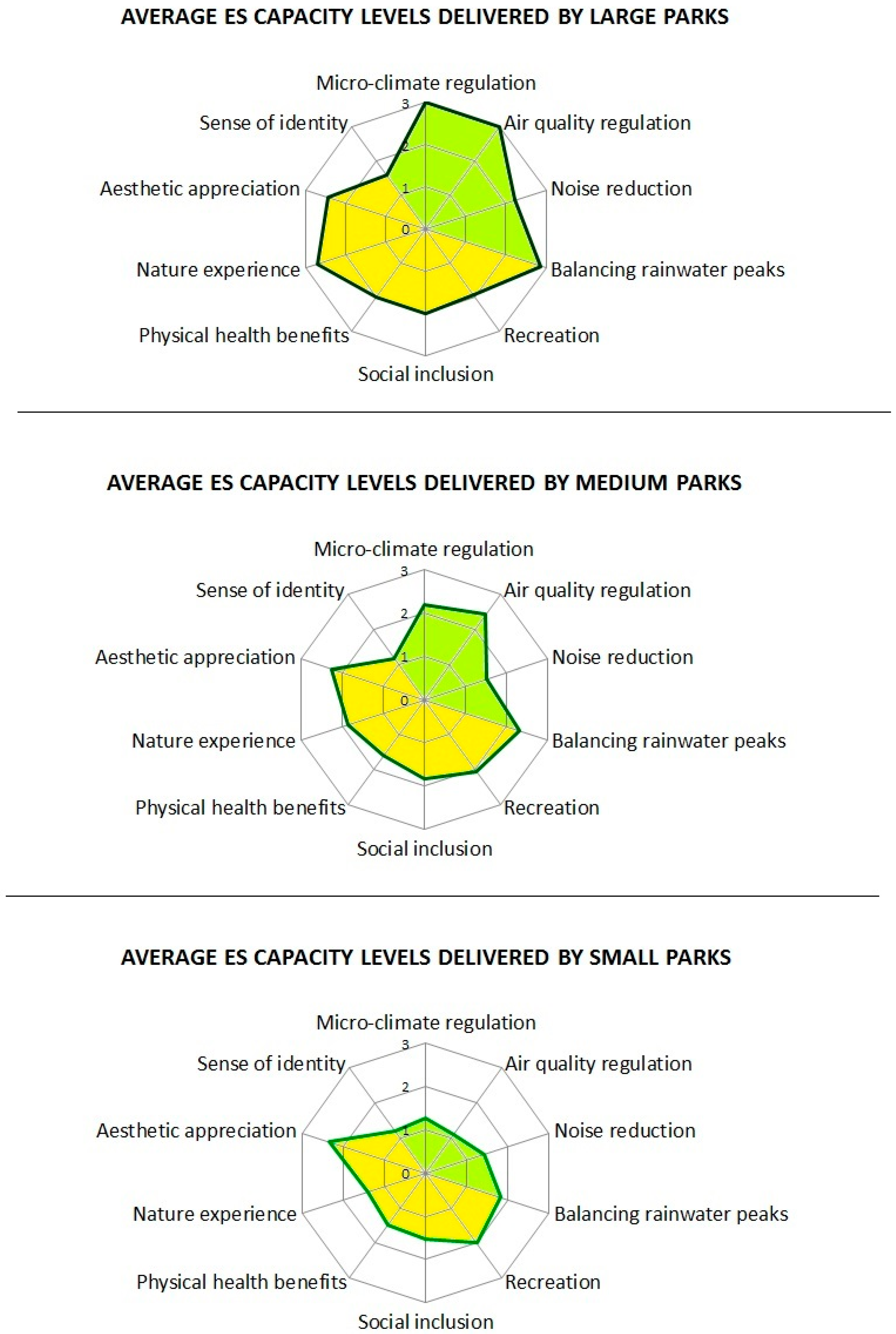
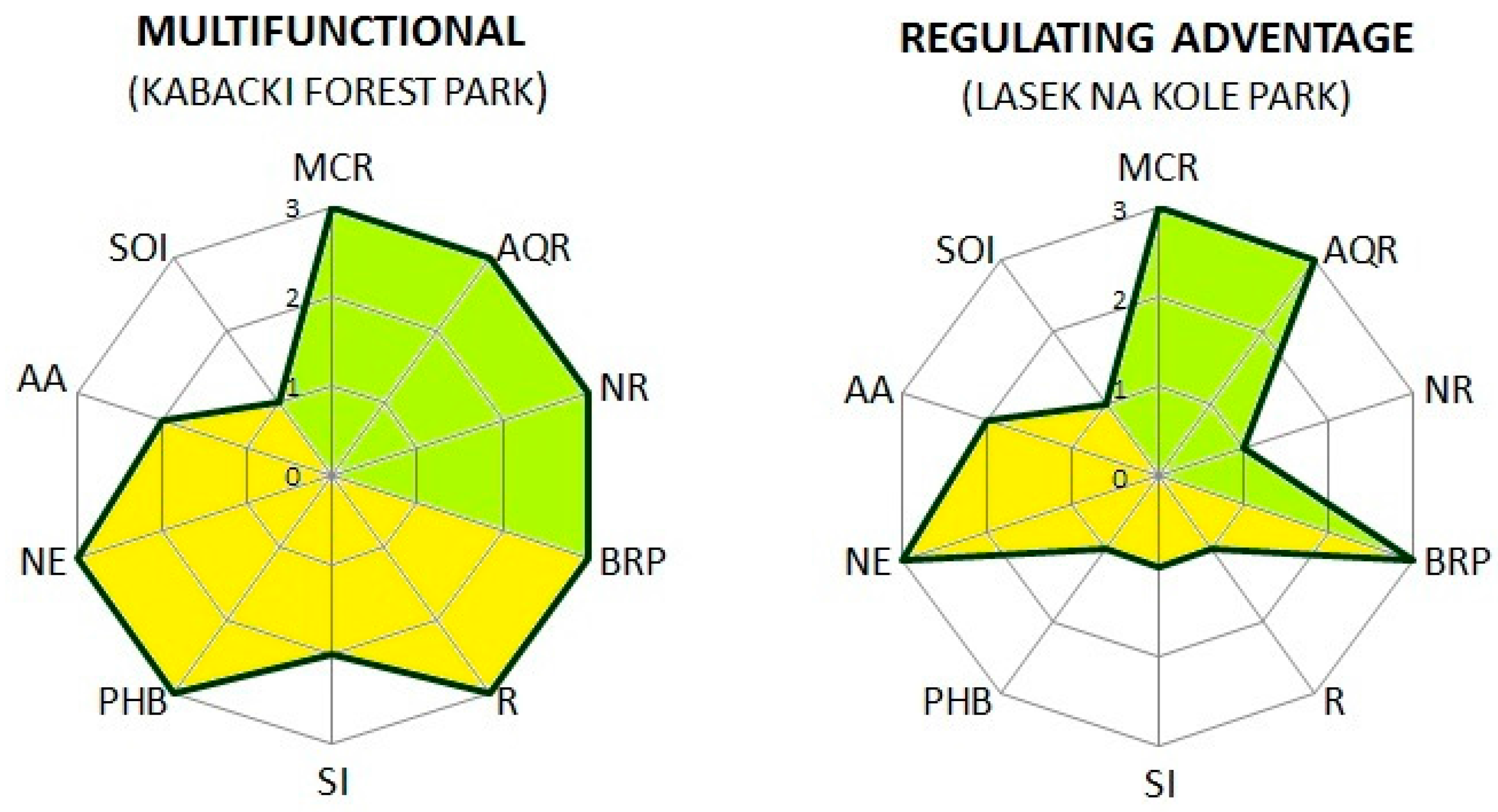
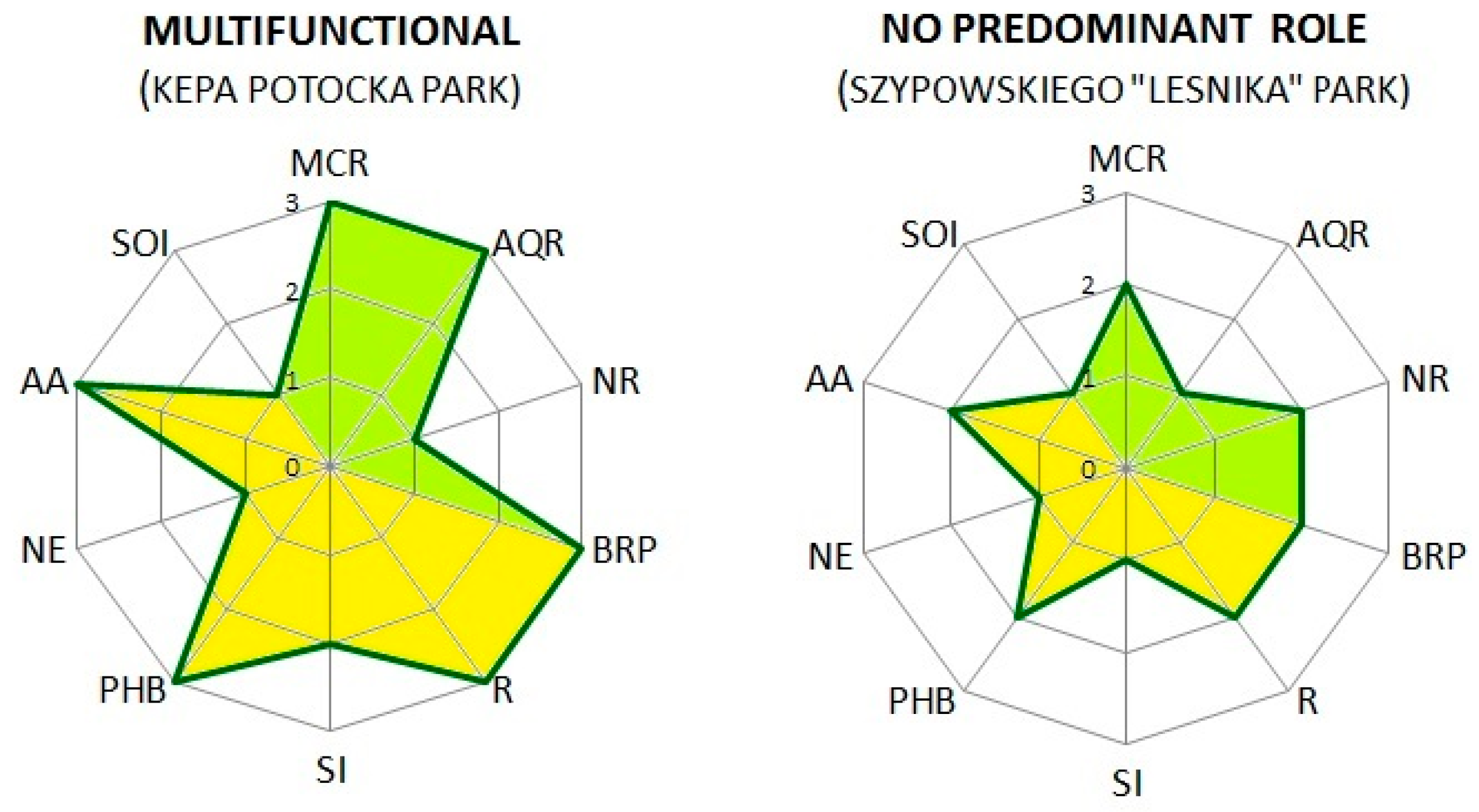
- Multifunctional (if capacity level for providing both regulating and cultural ecosystem services is superior);
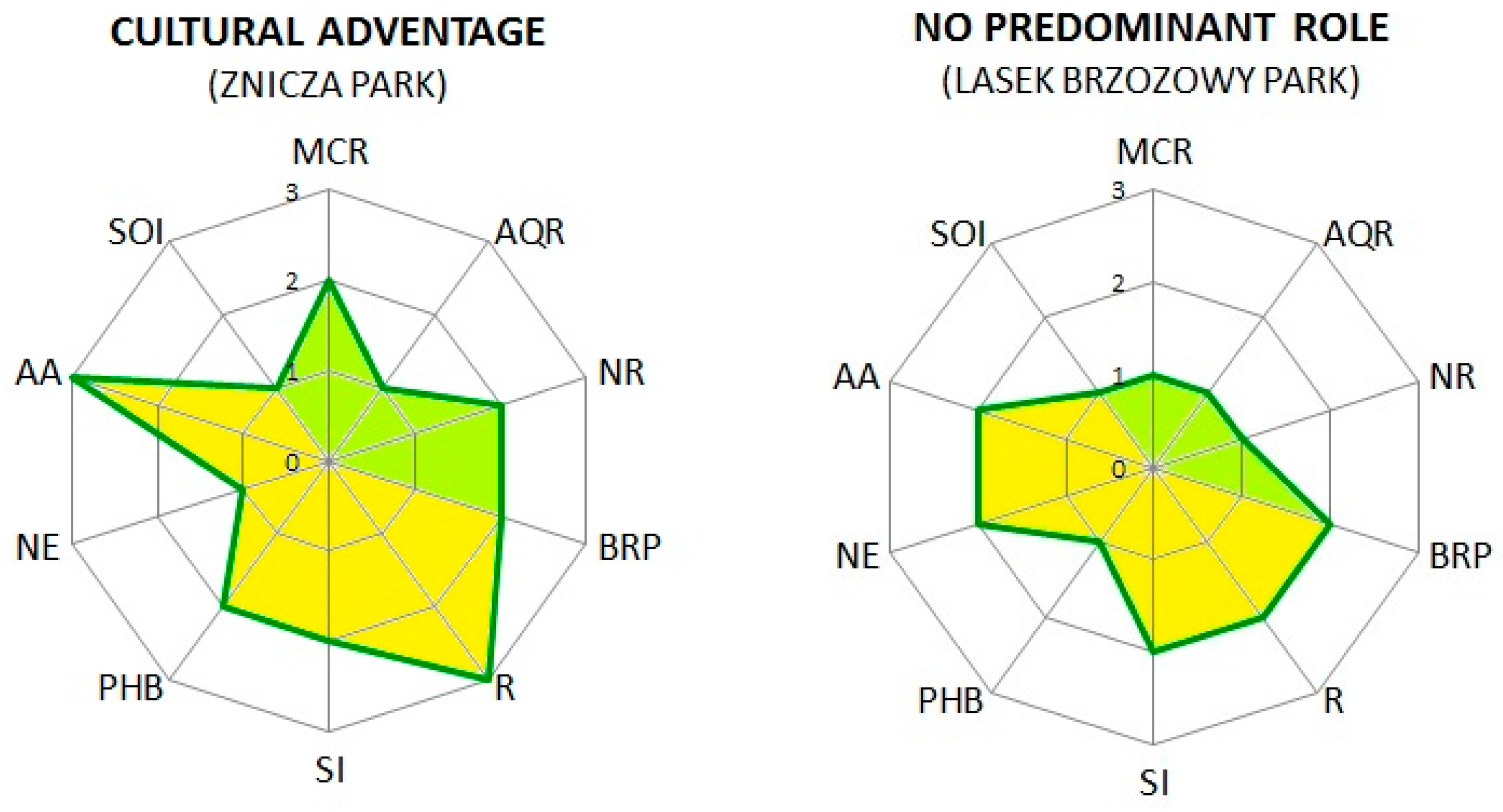
- Regulating advantage (if capacity level for providing the regulating ecosystem services is superior, and for the cultural services, is satisfactory or noticeable);
- Cultural advantage (if capacity level for providing the cultural ecosystem services is superior, and for regulating services, is satisfactory or noticeable);
- No predominant function (if capacity level for providing both regulating and cultural ecosystem services is satisfactory or noticeable).
3. Results
4. Discussion
5. Conclusions
Acknowledgments
Author Contributions
Conflicts of Interest
References
- Bolund, P.; Hunhammar, S. Ecosystem services in urban areas. Ecol. Econ. 1999, 29, 293–301. [Google Scholar] [CrossRef]
- Breuste, J.; Qureshi, S.; Li, J. Scaling down the ecosystem services at local level for urban parks of three megacities. Hercynia-Ökologie Umw. Mitteleur. 2013, 46, 1–20. [Google Scholar]
- Taylor-Lovell, S.; Taylor, R.J. Supplying urban ecosystem services through multifunctional green infrastructure in the United States. Landsc. Ecol. 2013, 28, 1447–1463. [Google Scholar] [CrossRef]
- The Economics of Ecosystems and Biodiversity (TEEB). Mainstreaming the Economics of Nature a Synthesis of the Approach. Conclusions and Recommendations of TEEB; Progress Press: Valletta, Malta, 2010; p. 36. [Google Scholar]
- Li, F.; Ye, Y.P.; Song, B.W.; Wang, R.S.; Tao, Y. Assessing the changes in land use and ecosystem services in Changzhou municipality, Peoples’ Republic of China, 1991–2006. Ecol. Indic. 2014, 42, 95–103. [Google Scholar] [CrossRef]
- European Commission. Building a Green Infrastructure for Europe; Publications Office of the European Union: Luxembourg, 2013. [Google Scholar] [CrossRef]
- Bezak, P.; Lyytimaki, J. Complexity of Urban ecosystem services in the context of global change. Ecologia 2011, 30, 22–35. [Google Scholar] [CrossRef]
- Gómez-Baggethun, E.; Barton, D.N. Classifying and valuing ecosystem services for urban planning. Ecol. Econ. 2013, 86, 235–245. [Google Scholar] [CrossRef]
- Boyd, J.; Banzhaf, S. What are ecosystem services? The need for standardized environmental accounting units. Ecol. Econ. 2007, 63, 616–626. [Google Scholar] [CrossRef]
- Burkhard, B.; Kroll, F.; Müller, F.; Windhorst, W. Landscapes’ capacities to provide ecosystem services—A concept for land-cover based assessments. Landsc. Online 2009, 15, 1–22. [Google Scholar] [CrossRef]
- Niemelä, J.; Saarela, S.-R.; Soderman, T.; Kopperoinen, L.; Yli-Pelkonen, V.; Väre, S.; Kotze, D.J. Using the ecosystem services approach for better planning and conservation of urban green spaces: A Finland case study. Biodivers. Conserv. 2010, 19, 3225–3243. [Google Scholar] [CrossRef]
- Valles-Planells, M.; Galina, F.; van Eetvelde, V. A classification of landscape services to support local landscape planning. Ecol. Soc. 2014, 19. [Google Scholar] [CrossRef]
- Kazmierczak, A. The contribution of local parks to neighbourhood social ties. Landsc. Urban Plan. 2013, 109, 31–44. [Google Scholar] [CrossRef]
- Larson, L.R.; Keith, S.J.; Fernandez, M.; Hallo, J.C.; Shafer, C.S.; Jennings, V. Ecosystem services and urban greenways: What’s the public’s perspective? Ecosyst. Serv. 2016, 22, 111–116. [Google Scholar] [CrossRef]
- Tyrväinen, L.; Pauleit, S.; Seeland, K.; de Vries, S. Benefits and uses of urban forests and trees. In Urban Forests and Trees—A Reference Book; Konijnendijk, C.C., Nilsson, K., Randrup, T.B., Schipperijn, J., Eds.; Springer: Berlin, Germany, 2005; pp. 81–114. [Google Scholar]
- Jennings, V.; Larson, L.; Yun, J. Advancing sustainability through urban green space: Cultural ecosystem services, equity, and social determinants of health. Int. J. Environ. Res. Public Health 2016, 13, 196. [Google Scholar] [CrossRef] [PubMed]
- Tratalos, J.; Fuller, R.A.; Warren, P.H.; Davies, R.G.; Gaston, K.J. Urban form, biodiversity potential and ecosystem services. Landsc. Urban Plan. 2007, 83, 308–317. [Google Scholar] [CrossRef]
- Chiesura, A. The role of urban parks for the sustainable city. Landsc. Urban Plan. 2004, 68, 129–138. [Google Scholar] [CrossRef]
- Ginn, F.; Francis, R.A. Urban greening and sustaining urban natures in London. In Sustainable London? The Future of a Global City; Imrie, R., Lees, L., Eds.; Policy Press: Bristol, UK, 2014; pp. 283–302. [Google Scholar]
- Ibes, D.C. Integrating Ecosystem Services into Urban Park Planning & Design. Cities Environ. 2016, 9, 1–39. [Google Scholar]
- Wurster, D.; Artmann, M. Development of a Concept for Non-monetary Assessment of Urban Ecosystem Services at the Site Level. Ambio 2014, 43, 454–465. [Google Scholar] [CrossRef] [PubMed]
- Bastian, O.; Haase, D.; Grunewald, K. Ecosystem properties, potentials and services—The EPPS conceptual framework and an urban application example. Ecol. Indic. 2012, 21, 7–16. [Google Scholar] [CrossRef]
- Lehmann, I.; Mathey, J.; Rößler, S.; Bräuer, A.; Goldberg, V. Urban vegetation structure types as a methodological approach for identifying ecosystem services—Application to the analysis of micro-climatic effects. Ecol. Indic. 2014, 42, 58–72. [Google Scholar] [CrossRef]
- Verhagen, W.; van Teeffelen, A.J.A.; Compagnucci, A.B.; Poggio, P.; Gimona, A.; Verburg, P.H. Effects of landscape configuration on mapping ecosystem service capacity: A review of evidence and a case study in Scotland. Landsc. Ecol. 2016, 31, 1457–1479. [Google Scholar] [CrossRef]
- Hansen, R.; Pauleit, S. From Multifunctionality to Multiple Ecosystem Services? A Conceptual Framework for Multifunctionality in Green Infrastructure Planning for Urban Areas. Ambio 2014, 43, 516–529. [Google Scholar] [CrossRef] [PubMed]
- Szulczewska, B.; Giedych, R.; Maksymiuk, G. Can we face the challenge: How to implement a theoretical concept of green infrastructure into planning practice? Warsaw case study. Landsc. Res. 2016. [Google Scholar] [CrossRef]
- Hansen, R.; Frantzeskaki, N.; McPhearson, T.; Rall, E.; Kabisch, N.; Kaczorowska, A.; Kain, J.-H.; Artmann, M.; Pauleit, S. The uptake of the ecosystem services concept in planning discourses of European and American cities. Ecosyst. Serv. 2015, 12, 228–246. [Google Scholar] [CrossRef]
- Szulczewska, B.; Maksymiuk, G.; Gadomski, K.; Giedych, R.; Kosmala, M.; Łukaszkiewicz, J.; Szumański, M.; Wolski, P. Warsaw Public Parks Assessment; Department of Landscape Architecture WULS: Warsaw, Poland, 2011. (In Polish) [Google Scholar]
- Warsaw Architecture and Spatial Planning Department. Warsaw Spatial Policy, 3rd ed.; Warsaw Municipality: Warsaw, Poland, 2014. (In Polish) [Google Scholar]
- Warsaw Architecture and Spatial Planning Department. Warsaw Environmental Study; Warsaw Municipality: Warsaw, Poland, 2006. (In Polish) [Google Scholar]
- The Common International Classification of Ecosystem Services (CICES). Towards a Common International Classification of Ecosystem Services (CICES) for Integrated Environmental and Economic Accounting, CICES V4-3 s; European Environment Agency: Copenhagen, Denmark, 2013. [Google Scholar]
- Villamagna, A.M.; Angermeier, P.L.; Bennett, E.M. Capacity, pressure, demand, and flow: A conceptual framework for analyzing ecosystem service provision and delivery. Ecol. Complex. 2013, 15, 114–121. [Google Scholar] [CrossRef]
- Bagstad, K.J.; Semmens, D.J.; Waage, S.; Winthrop, R. A comparative assessment of decision-support tools for ecosystem services quantification and valuation. Ecosyst. Serv. 2013, 5, e27–e39. [Google Scholar] [CrossRef]
- Daniel, T.C.; Muhar, A.; Arnberger, A.; Aznar, O.; Boyd, J.W.; Chan, K.M.A.; Costanza, R.; Elmqvist, T.; Flint, C.G.; Gobster, P.H.; et al. Contributing of cultural services to the ecosystem services agenda. Proc. Natl. Acad. Sci. USA 2012, 109, 8812–8819. [Google Scholar] [CrossRef] [PubMed]
- Chan, K.M.A.; Guerry, A.D.; Balvanera, P.; Klain, S.; Satterfield, T.; Basurto, X.; Bostrom, A.; Chuenpagdee, R.; Gould, R.; Halpern, B.S.; et al. Where are cultural and social in ecosystem services? A framework for constructive engagement. BioScience 2012, 62, 744–756. [Google Scholar]
- Maes, J.; Liquete, C.; Teller, A.; Erhard, M.; Paracchini, M.L.; Barredo, J.I.; Grizzetti, B.; Cardoso, A.; Somma, F.; Petersen, J.-E.; et al. An indicator framework for assessing ecosystem services in support of the EU Biodiversity Strategy to 2020. Ecosyst. Serv. 2016, 17, 14–23. [Google Scholar] [CrossRef]
- Bennett, E.M.; Peterson, G.D.; Gordon, L.J. Understanding relationships among multiple ecosystem services. Ecol. Lett. 2009, 12, 1394–1404. [Google Scholar] [CrossRef] [PubMed]
- Burkhard, B.; Kandziora, M.; Hou, Y.; Müller, F. Ecosystem Service Potentials, Flows and Demands—Concepts for Spatial Localisation, Indication and Quantification. Landsc. Online 2014, 34, 1–32. [Google Scholar] [CrossRef]
- Martín-López, B.; Gómez-Baggethun, E.; González, J.A.; Lomas, P.L.; Montes, C. The assessment of ecosystem services provided by biodiversity: Re-thinking concepts and research needs. In Handbook of Nature Conservation; Aronoff, J.B., Ed.; Nova Science Publishers: New York, NY, USA, 2009; pp. 261–282. [Google Scholar]
- Baur, J.W.R.; Tynon, J.F.; Ries, P.; Rosenberger, R.S. Urban Parks and Attitudes about Ecosystem Services: Does Park Use Matter? J. Park Recreat. Adm. 2014, 32, 19–34. [Google Scholar]
- Sandifer, P.A.; Sutton-Grier, A.E.; Ward, B.P. Exploring connections among nature, biodiversity, ecosystem services, and human health and well-being: Opportunities to enhance health and biodiversity conservation. Ecosyst. Serv. 2015, 12, 1–15. [Google Scholar] [CrossRef]
- Burkhard, B.; Kroll, F.; Nedkov, S.; Müller, F. Mapping supply, demand and budgets of ecosystem services. Ecol. Indic. 2012, 21, 17–29. [Google Scholar] [CrossRef]


| Type of ES | Key References |
|---|---|
| Regulating Services | |
| Microclimate regulation | Bolund and Hunhammar [1], Breuste et al. [2], Burkhard et.al. [10], Gómez-Baggethun and Barton [8], Niemelä et al. [11], TEEB [4]. |
| Air quality regulation | Bolund and Hunhammar [1], Burkhard et al. [10], Gómez-Baggethun and Barton [8], Niemelä et al. [11], Breuste et al. [2]. |
| Noise reduction | Bolund and Hunhammar [1], Gómez-Baggethun and Barton [8], Niemelä et al. [11], Valles-Planells [12]. |
| Water peak balancing | Bolund and Hunhammar [1], Niemelä et al. [11], Breuste et al. [2]. |
| Flood control | Gómez-Baggethun and Barton [8], TEEB [4]. |
| Erosion control | Burkhard et al. [10]. |
| Cultural Services | |
| Recreation | Bolund and Hunhammar [1], Breuste et al. [2], Gómez-Baggethun and Barton [8], Niemelä et al. [11], TEEB [4], Valles-Planells [12]. |
| Social inclusion | Kazmierczak [13], Larson [14]. |
| Psycho-physical health benefits | Niemelä et al. [11], TEEB [4], Valles-Planells [12]. |
| Nature experiences | Breuste et al. [2], Niemelä et al. [11], Valles-Planells [12]. |
| Aesthetic appreciation | TEEB [ 4], Valles-Planells [12]. |
| Sense of place and identity | TEEB [ 4], Valles-Planells [12]. |
| Cognitive development | Gómez-Baggethun and Barton [8], Valles-Planells [12]. |
| The Common International Classification of Ecosystem Services | Surveyed Regulating ES of Urban Parks | |||
|---|---|---|---|---|
| Section | Division | Group | Class | |
| Regulation & Maintenance | Mediation of waste, toxics and other nuisances | Mediation by biota | Bio-remediation by micro-organisms, algae, plants, and animals | |
| Filtration/sequestration/storage/accumulation by micro-organisms, algae, plants, and animals | ||||
| Mediation by ecosystems | Filtration/sequestration/storage/accumulation by ecosystems |  | ||
| Dilution by atmosphere, freshwater and marine ecosystems | ||||
| Mediation of smell/noise/visual impacts |  | |||
| Mediation of flows | Mass flows | Mass stabilisation and control of erosion rates | ||
| Buffering and attenuation of mass flows | ||||
| Liquid flows | Hydrological cycle and water flow maintenance |  | ||
| Flood protection | ||||
| Gaseous/air flows | Storm protection | |||
| Ventilation and transpiration | ||||
| Maintenance of physical, chemical, biological conditions | Lifecycle maintenance, habitat and gene pool protection | Pollination and seed dispersal | ||
| Maintaining nursery populations and habitats | ||||
| Pest and disease control | Pest control | |||
| Disease control | ||||
| Soil formation and composition | Weathering processes | |||
| Decomposition and fixing processes | ||||
| Water conditions | Chemical condition of freshwaters | |||
| Chemical condition of salt waters | ||||
| Atmospheric composition and climate regulation | Global climate regulation by reduction of greenhouse gas concentrations | |||
| Micro and regional climate regulation |  | |||
| The Common International Classification of Ecosystem Services | Surveyed of Urban Parks | |||
|---|---|---|---|---|
| Section | Division | Group | Class | |
| Cultural | Physical and intellectual interactions with biota, ecosystems, and land-/seascapes (environmental settings) | Physical and experiential interactions | Experiential use of plants, animals and land-/seascapes in different environmental settings | |
| Physical use of land-/seascapes in different environmental settings |  | |||
| Intellectual and representative interactions | Scientific | |||
| Educational | ||||
| Heritage, cultural |  | |||
| Entertainment | ||||
| Aesthetic |  | |||
| Spiritual, symbolic and other interactions with biota, ecosystems, and land-/seascapes (environmental settings) | Spiritual and/or emblematic | Symbolic | ||
| Sacred and/or religious | ||||
| Other cultural outputs | Existence |  | ||
| Bequest | ||||
| Total | Large Parks | Medium Parks | Small Parks | |
|---|---|---|---|---|
| Number of surveyed parks | 82 | 14 | 35 | 33 |
| Mean area (ha) | 33.92 | 158.21 | 12.88 | 3.52 |
| Standard deviation | 110.78 | 237.00 | 6.83 | 0.97 |
| Range (ha) | 2.05–902.68 | 30.11–902.68 | 5.06–29.5 | 2.05–4.92 |
| The Scope of Evaluation Related to Warsaw Parks in Existing Documents | Data Retrieved from Document | Name of Document | |
|---|---|---|---|
| REGULATING SERVICES | |||
| Micro-climate regulation | Influence on local climate conditions | • Park size | WPPA |
| • Area shape | WPPA | ||
| • Vegetation structure | WPPA | ||
| • Water bodies | WPPA | ||
| Air quality regulation | Importance to air regeneration | • Park size | WPPA |
| • Vegetation cover | WPPA | ||
| • Vegetation structure | WPPA | ||
| Noise reduction | Noise level reduction | • Noise level within a park | WSP |
| Balancing rain water peaks | Outflow reduction | • Park size | WPPA |
| • Hydrological processes | WES | ||
| • Drainage system | WSP | ||
| • Vegetation cover | WPPA | ||
| • Vegetation structure | WPPA | ||
| CULTURAL SERVICES | |||
| Recreation | Recreation quality | • Recreational facilities | WPPA |
| • Conflicts between users | WPPA | ||
| • Accessibility | WPPA | ||
| Social inclusion | Fostering social inclusion | • Mass events facilities | WPPA |
| • Accessibility for disabled people | WPPA | ||
| • Educational facilities | WPPA | ||
| Physical health benefits | Fostering active recreation | • Sport and active recreation facilities | WPPA |
| Nature experience | Nature functioning and preservation of nature heritage | • Naturalness of vegetation | WPPA |
| • Habitats for wild fauna | WPPA | ||
| • Legal protection | WSP | ||
| Aesthetic appreciation | Aesthetic value | • Spatial structure | WPPA |
| • Maintenance | WPPA | ||
| • Character of park equipment | WPPA | ||
| Sense of identity | Preservation of cultural heritage | • Historical value | WPPA |
| • Iconic objects | WPPA | ||
| • Legal protection | WSP | ||
| ES | Park Characteristics (Based on Data Retrieved from Surveyed Documents) | Capacity Level | |||
|---|---|---|---|---|---|
| Low | Medium | High | |||
| Microclimate regulation | Shape | Fragmented | X 1,2 | X 2 | |
| Compact | X 1 | X 2,3 | |||
| Vegetation structure | Dominance of low vegetation and groups of shrubs and single trees | X 1,2 | X 2 | ||
| Dominance of high vegetation with diverse vertical layers | X 1 | X 2,3 | |||
| Water bodies | No water bodies | X 1,2 | |||
| Presence of waterbodies | X 1,2 | X 2,3 | |||
| Air quality regulation | Vegetation structure | Dominance of low vegetation and groups of shrubs and single trees | X 1,2 | X 2 | |
| Dominance of high vegetation with diverse vertical layers | X 1 | X 2,3 | |||
| Vegetation cover | Less than 60% | X 1,2 | |||
| 60–70% | X 2 | ||||
| Over 70% | X 1 | X 2,3 | |||
| Noise reduction | Noise level | A noise level within all park exceeding 60 dB | X | ||
| A noise level within all park varies from 50 to 60 dB | X | ||||
| A noise level does not exceed 50 dB in more than 50% of park | X | ||||
| Balancing rain water peaks | Hydrological processes | Dominance of infiltration | X 1,2 | ||
| Dominance of infiltration and interception | X 1,2 | ||||
| Dominance of infiltration and interception, water retention | X 2,3 | ||||
| Drainage system | Water partially drained to the sewage system | X 1,2 | |||
| Vegetation cover | Less than 60% | X 1,2 | X 2 | ||
| 60–70% | |||||
| Over 70% | X 1 | X 2,3 | |||
| Vegetation structure | Dominance of low vegetation, groups of shrubs, and single trees | X 1,2 | |||
| Dominance of high vegetation with diverse vertical layers | X 1,2 | X 2,3 | |||
| ES | Park Characteristics (Based on Data Retrieved from Surveyed Documents) | Capacity Level | |||
|---|---|---|---|---|---|
| Low | Medium | High | |||
| Recreation | Recreational facilities | Limited number of recreational facilities | X | ||
| Large number of recreational facilities | X | X | |||
| Unique recreational facilities at the district scale | X | ||||
| Unique recreational facilities at the city scale | X | ||||
| Conflicts between users | Potential conflict of recreational usage | X | |||
| No potential conflicts between users | X | ||||
| Accessibility | Limited access | X | X | ||
| Free access | X | ||||
| Social inclusion | Accessibility for disabled people | A limited accessibility for disabled people | X | ||
| Full accessibility for disabled people | X | X | |||
| Educational facilities | Limited educational facilities | X | |||
| Park adapted to the educational function | X | ||||
| Mass events facilities | Park adapted to the mass events | X | |||
| Physical health benefits | Active recreation facilities | Limited number of active recreational facilities | X | ||
| Large number of active recreational facilities | X | X | |||
| Sport facilities | Limited number of sport facilities | X | |||
| Large number of sport facilities | X | ||||
| Dominance of participatory sport facilities | X | ||||
| Nature experience | Vegetation character | Dominance of ornamental plants | X | ||
| Dominance of native vegetation | X | X | |||
| Fostering biodiversity | Habitats for rare wild fauna | X | |||
| Legal protection | Nature reserves | X | |||
| Aesthetic appreciation | Spatial structure | Unclear spatial structure | X | ||
| Clear spatial structure | X | X | |||
| Equipment | Individual character | X | |||
| Innovative design solution | X | ||||
| Standard equipment | X | ||||
| Equipment in poor condition | X | ||||
| Maintenance | Well maintained | X | |||
| Poorly maintained | X | X | |||
| Sense of identity | Historical value | Low historical value | X | ||
| High historical value | X | X | |||
| Image of place | Iconic objects | X | |||
| Legal protection | Objects listed in monument register | X | |||
| Multifunctional | Regulating Advantage | Cultural Advantage | No Predominant Role | |||||
|---|---|---|---|---|---|---|---|---|
| (A) | (B) | (A) | (B) | (A) | (B) | (A) | (B) | |
| Large parks | 71.43 | 12.2 | 28.57 | 4.9 | 0 | 0 | 0 | 0 |
| Medium parks | 31.43 | 13.4 | 48.57 | 20.7 | 2.86 | 1.2 | 17.14 | 7.3 |
| Small parks | 0 | 0 | 0 | 0 | 15.15 | 6.1 | 84.85 | 34.2 |
| All parks | 25.6 | 25.6 | 7.3 | 41.5 | ||||
| Regression Coefficient (B) | Standard Error for B | Standardized Regression Coefficient | p Value | |
|---|---|---|---|---|
| Dependent Variable: SUMMARY REGULATING ES SCORE R2 = 0.528 | ||||
| Intercept | 7.911 | 0.669 | ||
| Park size | 0.007 | 0.002 | 0.347 | <0.001 * |
| Compact shape | 0.886 | 0.400 | 0.188 | 0.030 * |
| Dominance of high vegetation with a diverse vertical layers | 0.875 | 0.407 | 0.188 | 0.035 * |
| Presence of water bodies | 1.342 | 0.400 | 0.293 | 0.001 * |
| A noise level within the entire park exceeding 60 dB | −1.199 | 0.392 | −0.261 | 0.003 * |
| Domination of infiltration | −1.577 | 0.497 | −0.266 | 0.002 * |
| Rainwater partially drained to the sewage system | −0.668 | 0.569 | −0.095 | 0.244 |
| Dependent Variable: SUMMARY CULTURAL ES SCORE R2 = 0.638 | ||||
| Intercept | 4.947 | 1.488 | ||
| Large number of recreational facilities | 2.031 | 0.456 | 0.409 | <0.001 * |
| Free access | 1.681 | 1.078 | 0.126 | 0.128 |
| Mass events facilities | 0.992 | 0.516 | 0.159 | 0.058 |
| Educational facilities | 0.216 | 0.512 | 0.041 | 0.668 |
| Dominance of native vegetation | 1.581 | 1.035 | 0.294 | 0.131 |
| Dominance of ornamental plants | 0.666 | 0.978 | 0.118 | 0.495 |
| Habitats for rare wild fauna | 1.562 | 0.583 | 0.277 | 0.009 * |
| Equipment in a poor condition | −0.394 | 0.747 | −0.046 | 0.612 |
| Well-maintained | 0.793 | 0.590 | 0.116 | 0.185 |
| Individual character of equipment | 0.506 | 0.461 | 0.103 | 0.269 |
| Innovative design solutions | 1.027 | 0.992 | 0.084 | 0.344 |
| Historical value | −0.022 | 0.574 | −0.024 | 0.809 |
| Iconic objects | 0.962 | 0.712 | 0.125 | 0.188 |
| Parks listed in monument register | 1.240 | 0.661 | 0.219 | 0.037 * |
| Coeff. of Regression (B) (vs. No-Predominant Role) | |||||
|---|---|---|---|---|---|
| Cultural Advantage | Multifunctional | Regulating Advantage | Chi-Square Statistics | p Value | |
| Intercept | −5886.7 | −2023.3 | −341.7 | ||
| Park size | −12.5 | 149.9 | 150.2 | 109.3 | <0.001 |
| Compact shape | −2460.6 | −142.9 | 195.2 | 49.2 | <0.001 |
| Presence of water bodies | 307.7 | −14.9 | 656.0 | 17.0 | 0.001 |
| A noise level within all park exceeds 60 dB | 233.0 | 10.2 | 336.7 | 10.9 | 0.012 |
| Domination of infiltration | 2468.1 | 199.7 | 216.9 | 51.2 | <0.001 |
| Rainwater partially drained to the sewage system | 114.9 | −1067.6 | −386.1 | 27.0 | <0.001 |
| Large number of recreational facilities | 2802.8 | 655.8 | −351.7 | 68.3 | <0.001 |
| Free access | −7.3 | −108.4 | −1126.2 | 26.8 | <0.001 |
| Educational facilities | 328.9 | −138.1 | −465.4 | 10.7 | 0.013 |
| Dominance of native vegetation | 969.7 | −69.3 | 278.9 | 46.6 | <0.001 |
| Habitats for rare wild fauna | −912.3 | 262.8 | −765.5 | 29.0 | <0.001 |
| Well maintained | 149.0 | −56.0 | −401.2 | 19.9 | <0.001 |
| Individual character of equipment | 2661.5 | 730.1 | 387.7 | 58.9 | <0.001 |
| Innovative design solutions | 2463.3 | 1479.0 | −266.7 | 24.0 | <0.001 |
© 2017 by the authors. Licensee MDPI, Basel, Switzerland. This article is an open access article distributed under the terms and conditions of the Creative Commons Attribution (CC BY) license (http://creativecommons.org/licenses/by/4.0/).
Share and Cite
Giedych, R.; Maksymiuk, G. Specific Features of Parks and Their Impact on Regulation and Cultural Ecosystem Services Provision in Warsaw, Poland. Sustainability 2017, 9, 792. https://doi.org/10.3390/su9050792
Giedych R, Maksymiuk G. Specific Features of Parks and Their Impact on Regulation and Cultural Ecosystem Services Provision in Warsaw, Poland. Sustainability. 2017; 9(5):792. https://doi.org/10.3390/su9050792
Chicago/Turabian StyleGiedych, Renata, and Gabriela Maksymiuk. 2017. "Specific Features of Parks and Their Impact on Regulation and Cultural Ecosystem Services Provision in Warsaw, Poland" Sustainability 9, no. 5: 792. https://doi.org/10.3390/su9050792
APA StyleGiedych, R., & Maksymiuk, G. (2017). Specific Features of Parks and Their Impact on Regulation and Cultural Ecosystem Services Provision in Warsaw, Poland. Sustainability, 9(5), 792. https://doi.org/10.3390/su9050792