


Mapping Interests by Stakeholders’ Subjectivities toward Ecotourism Resources: The Case of Seocheon-Gun, Korea

Abstract
:1. Introduction
2. Materials and Methods
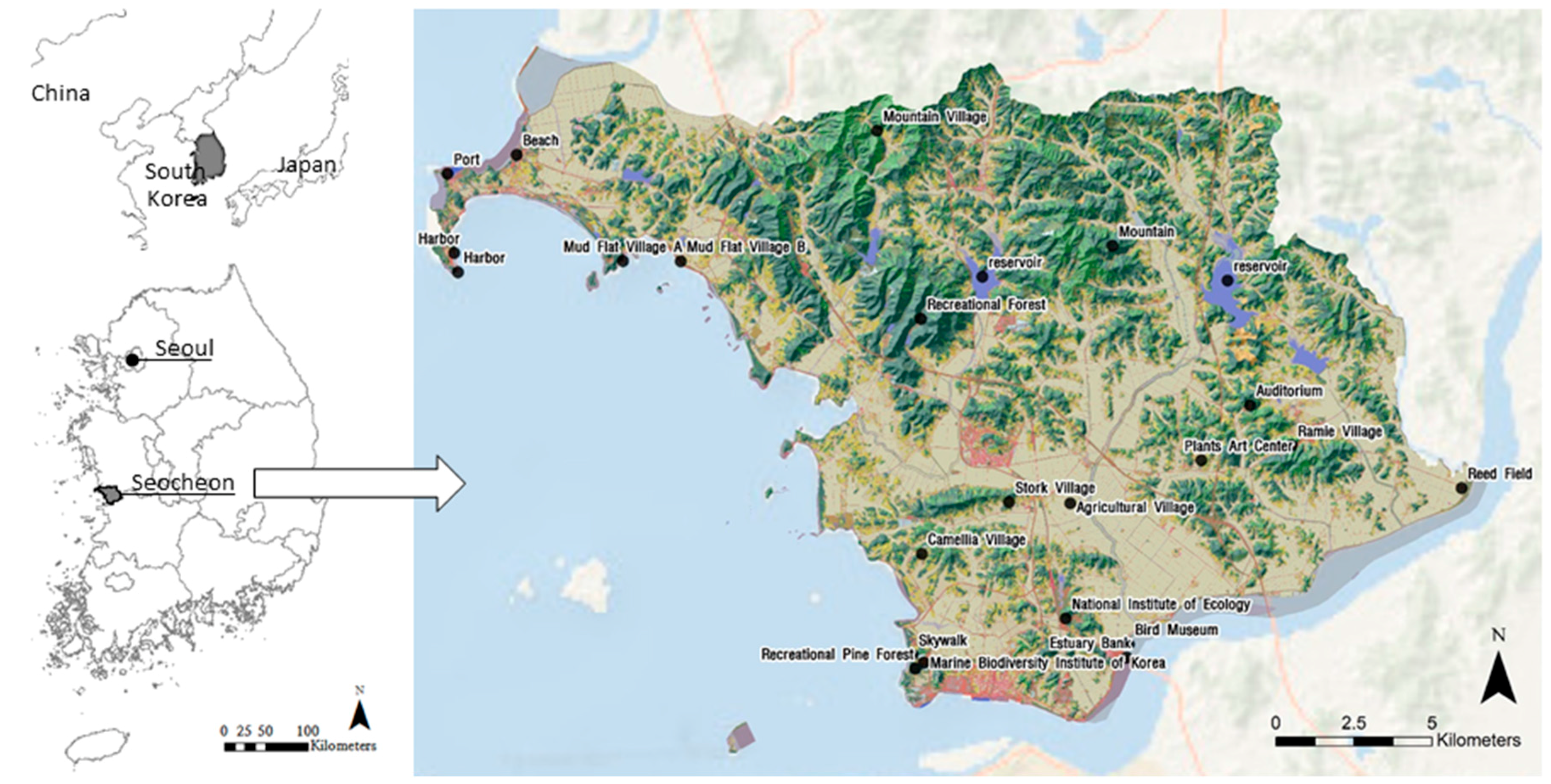
2.1. Study Area
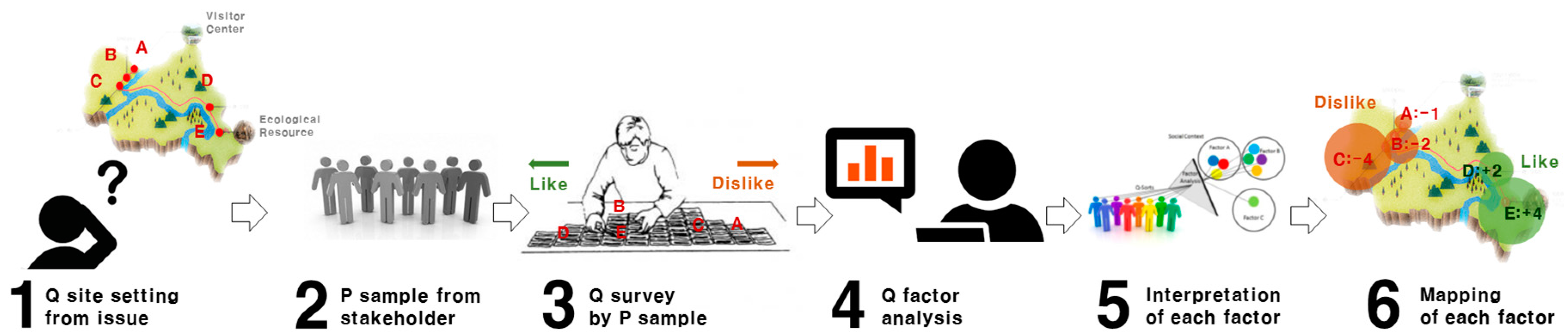
2.2. Q methodology and a Geographic Information System (GIS)
- (1)
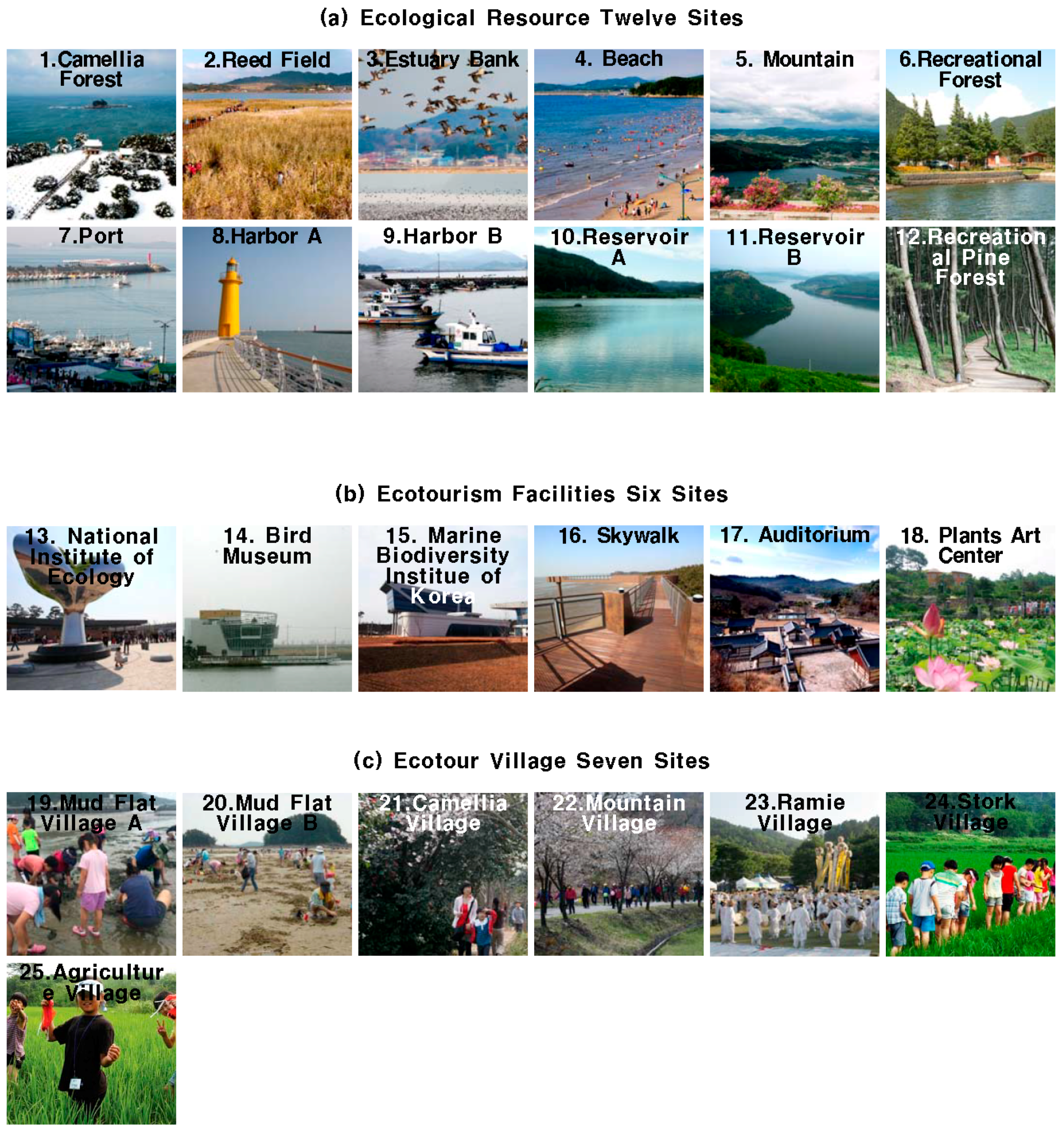
- Select spaces that were the main issues at an ecotour site.
- (2)
- Select the main stakeholders involved in the spaces.
- (3)
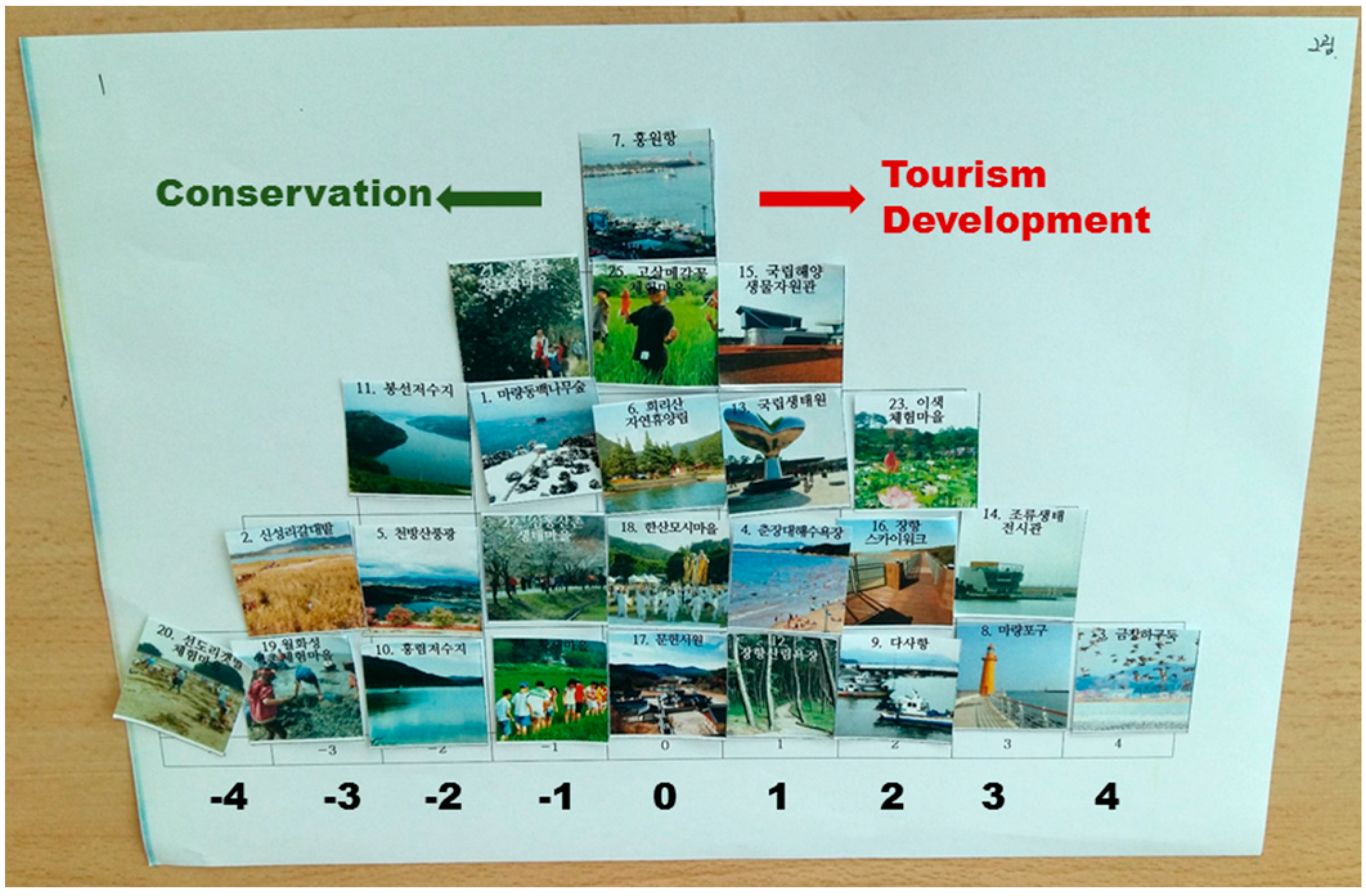
- Survey preferences regarding whether the spaces are relevant to ecotourism development.
- (4)
- Perform Q factor analysis based on the survey.
- (5)
- Interpret the characteristics of each factor (stakeholder cluster).
- (6)
- Map the cluster-specific preferences for ecotourism.
3. Q Analysis
4. Results
4.1. Factor 1: Focus on Large-Scale Ecotourism Resources and Facilities
4.2. Factor 2: Focus on Mud-Flat Ecotour Villages
4.3. Factor 3: Focus on Inland Local Ecotour Villages
4.4. Factor 4: Focus on Local Traditional Villages
5. Discussion
5.1. Stakeholder Position: Comparison of Factors
5.2. Collaboration Way: Means and Variances of Space Preferences
6. Conclusions
Acknowledgments
Author Contributions
Conflicts of Interest
References
- Tsaur, S.-H.; Lin, Y.-C.; Lin, J.-H. Evaluating ecotourism sustainability from the integrated perspective of resource, community and tourism. Tour. Manag. 2006, 27, 640–653. [Google Scholar] [CrossRef]
- Wall, G. FORUM: Is ecotourism sustainable? Environ. Manag. 1997, 21, 483–491. [Google Scholar] [CrossRef]
- Albritton, R.; Stein, T.V. Integrating social and natural resource information to improve planning for motorized recreation. Appl. Geogr. 2011, 31, 85–97. [Google Scholar] [CrossRef]
- Tomczyk, A.M.; Ewertowski, M. Planning of recreational trails in protected areas: Application of regression tree analysis and geographic information systems. Appl. Geogr. 2013, 40, 129–139. [Google Scholar] [CrossRef]
- Lee, J.-H.; Son, Y.-H. Stakeholder subjectives toward ecotourism development using Q methodology: The case of Maha ecotourism site in Pyeongchang, Korea. Asia Pac. J. Tour. Res. 2016, 21, 931–951. [Google Scholar] [CrossRef]
- Bunruamkaew, K.; Murayam, Y. Site suitability evaluation for ecotourism using GIS & AHP: A case study of Surat Thani province, Thailand. Procedia Soc. Behav. Sci. 2011, 21, 269–278. [Google Scholar]
- Nahuelhual, L.; Carmona, A.; Lozada, P.; Jaramillo, A.; Aguayo, M. Mapping recreation and ecotourism as a cultural ecosystem service: An application at the local level in Southern Chile. Appl. Geogr. 2013, 40, 71–82. [Google Scholar] [CrossRef]
- Berkes, F. Sacred Ecology, 3rd ed.; Routledge: New York, NY, USA, 2012; pp. 139–159. [Google Scholar]
- Kerstetter, D.; Bricker, K. Exploring Fijian’s sense of place after exposure to tourism development. J. Sustain. Tour. 2009, 17, 691–708. [Google Scholar] [CrossRef]
- Maynard, C.M. Accessing the environment: Delivering ecological and societal benefits through knowledge integration—The case of water management. Appl. Geogr. 2015, 58, 94–104. [Google Scholar] [CrossRef]
- Fagerholm, N.; Käyhkö, N.; Ndumbaro, F.; Khamis, M. Community stakeholders’ knowledge in landscape assessments—Mapping indicators for landscape services. Ecol. Indic. 2012, 18, 421–433. [Google Scholar] [CrossRef]
- Sherrouse, B.C.; Clement, J.M.; Semmens, D.J. A GIS application for assessing, mapping, and quantifying the social values of ecosystem services. Appl. Geogr. 2011, 31, 748–760. [Google Scholar] [CrossRef]
- Watts, S.; Stenner, P. Doing Q methodology: Theory, method and interpretation. Qual. Res. Psychol. 2005, 2, 67–91. [Google Scholar] [CrossRef]
- Hunter, W.C. Understanding resident subjectivities toward tourism using Q method: Orchid Island, Taiwan. J. Sustain. Tour. 2013, 21, 331–354. [Google Scholar] [CrossRef]
- Rodriguez-Piñeros, S.; Focht, W.; Lewis, D.K.; Montgomery, D. Incorporating values into community-scale sustainable forest management plans: An application of Q methodology. Small Scale For. 2012, 11, 167–183. [Google Scholar] [CrossRef]
- Rodríguez-Piñeros, S.; Mayett-Moreno, Y. Forest owners’ perceptions of ecotourism: Integrating community values and forest conservation. Ambio 2015, 44, 99–109. [Google Scholar] [CrossRef] [PubMed]
- Brown, S.R. Q methodology and qualitative research. Qual. Health Res. 1996, 6, 561–567. [Google Scholar] [CrossRef]
- Hawthorne, T.; Krygier, J.; Kwan, M.-P. Mapping ambivalence: Exploring the geographies of community change and rails-to-trails development using photo-based Q method and PPGIS. Geoforum 2008, 39, 1058–1078. [Google Scholar] [CrossRef]
- Forrester, J.; Cook, B.; Bracken, L.; Cinderby, S.; Donaldson, A. Combining participatory mapping with Q-methodology to map stakeholder perceptions of complex environmental problems. Appl. Geogr. 2015, 56, 199–208. [Google Scholar] [CrossRef]
- O’Leary, K.; Wobbrock, J.O.; Riskin, E.A. Q-Methodology as a Research and Design Tool for HCI. In Proceedings of the SIGCHI Conference on Human Factors in Computing Systems, Paris, France, 27 April–2 May 2013; pp. 1941–1950.
- Pike, K.; Wright, P.; Wink, B.; Fletcher, S. The assessment of cultural ecosystem services in the marine environment using Q methodology. J. Coast. Conserv. 2015, 19, 667–675. [Google Scholar] [CrossRef]
- Navrátil, J.; Pícha, K.; Knotek, J.; Kučera, T.; Navrátilová, J.; Rajchard, J. Comparison of attractiveness of tourist sites for ecotourism and mass tourism: The case of waters in mountainous protected areas. Tourismos 2013, 8, 35–51. [Google Scholar]
- Arnegger, J.; Woltering, M.; Job, H. Toward a product-based typology for nature-based tourism: A conceptual framework. J. Sustain. Tour. 2010, 18, 915–928. [Google Scholar] [CrossRef]
- Simpson, S.; Brown, G.; Peterson, A.; Johnstone, R. Stakeholder perspectives for coastal ecosystem services and influences on value integration in policy. Ocean. Coast. Manag. 2016, 126, 9–21. [Google Scholar] [CrossRef]
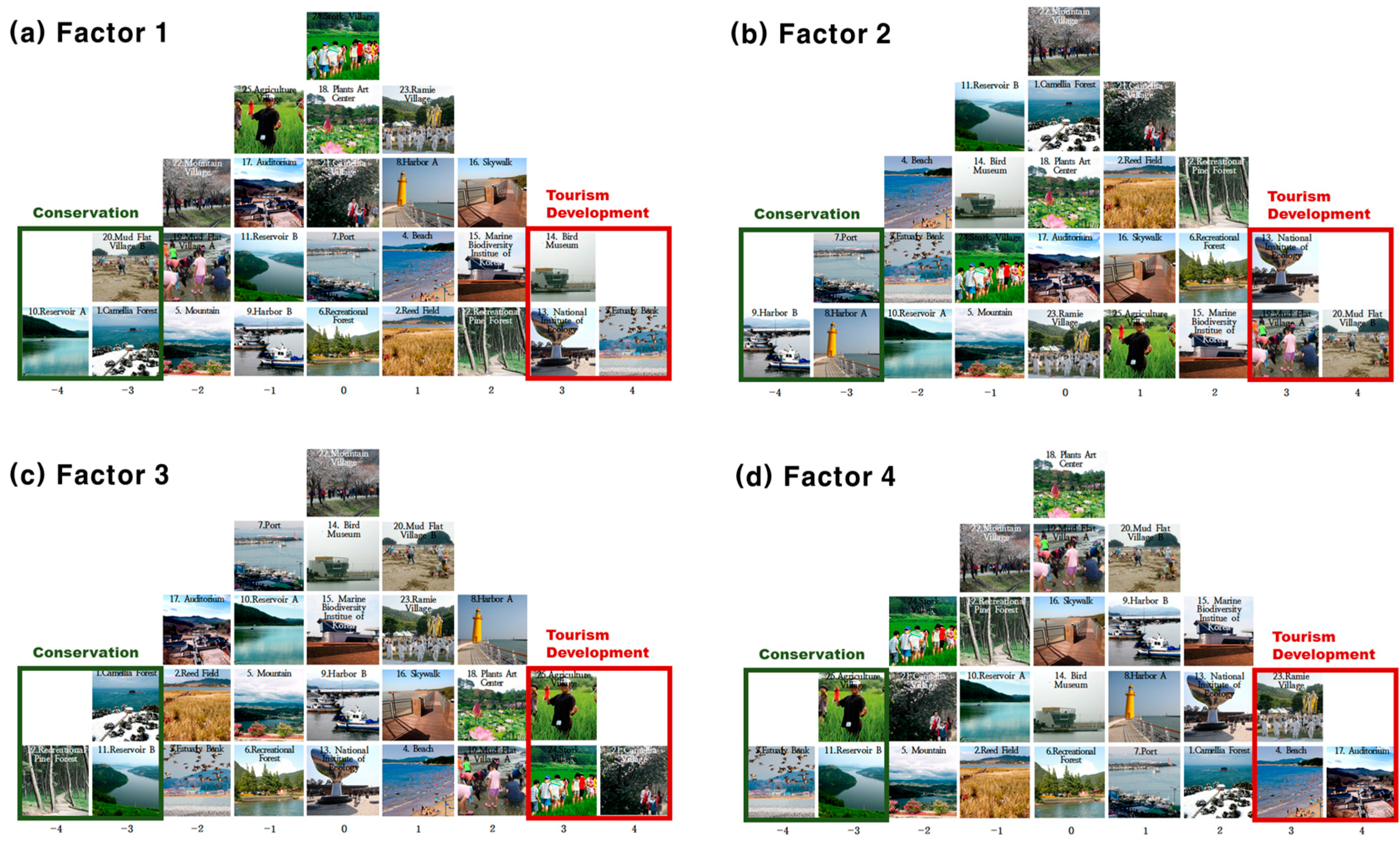

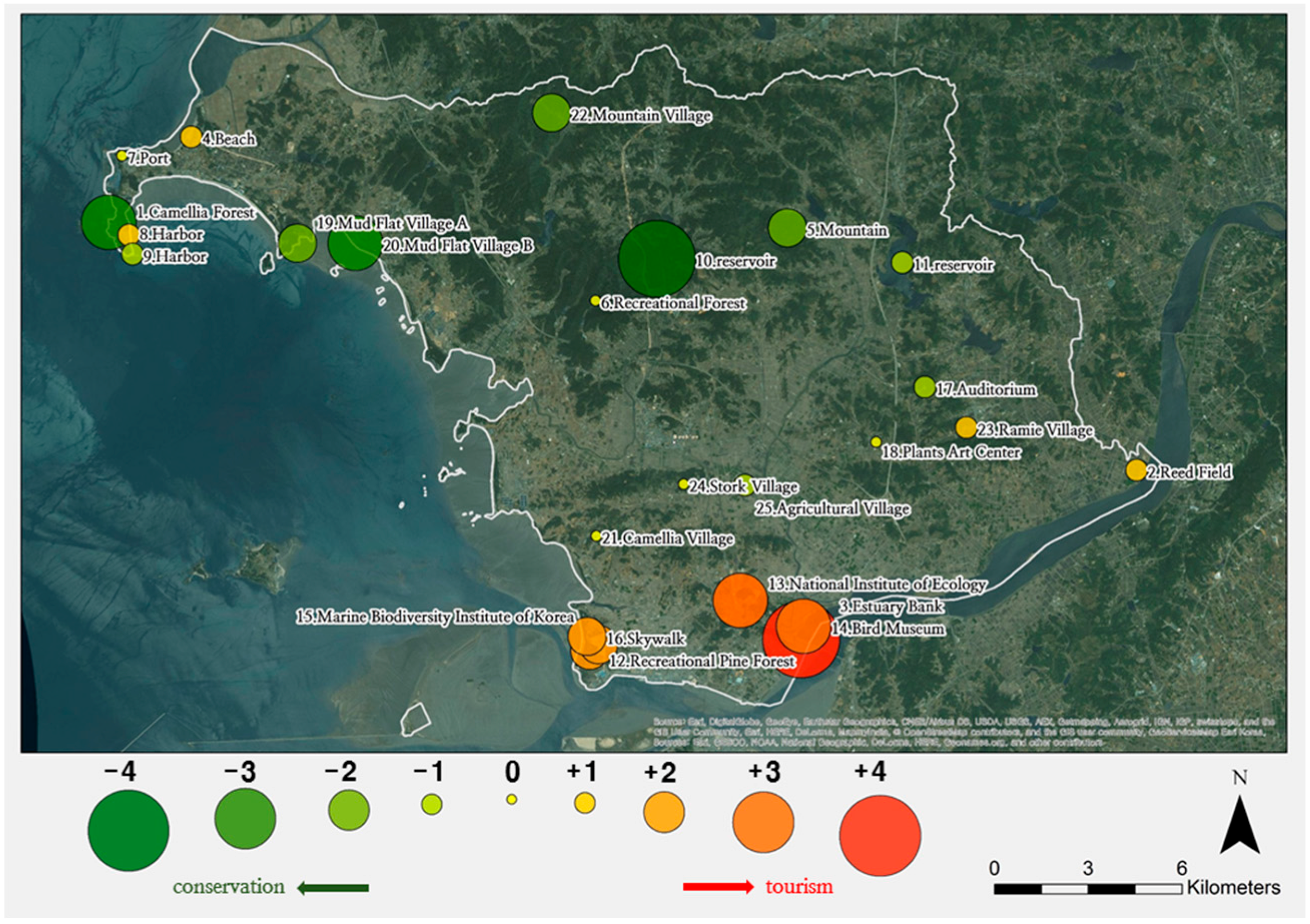
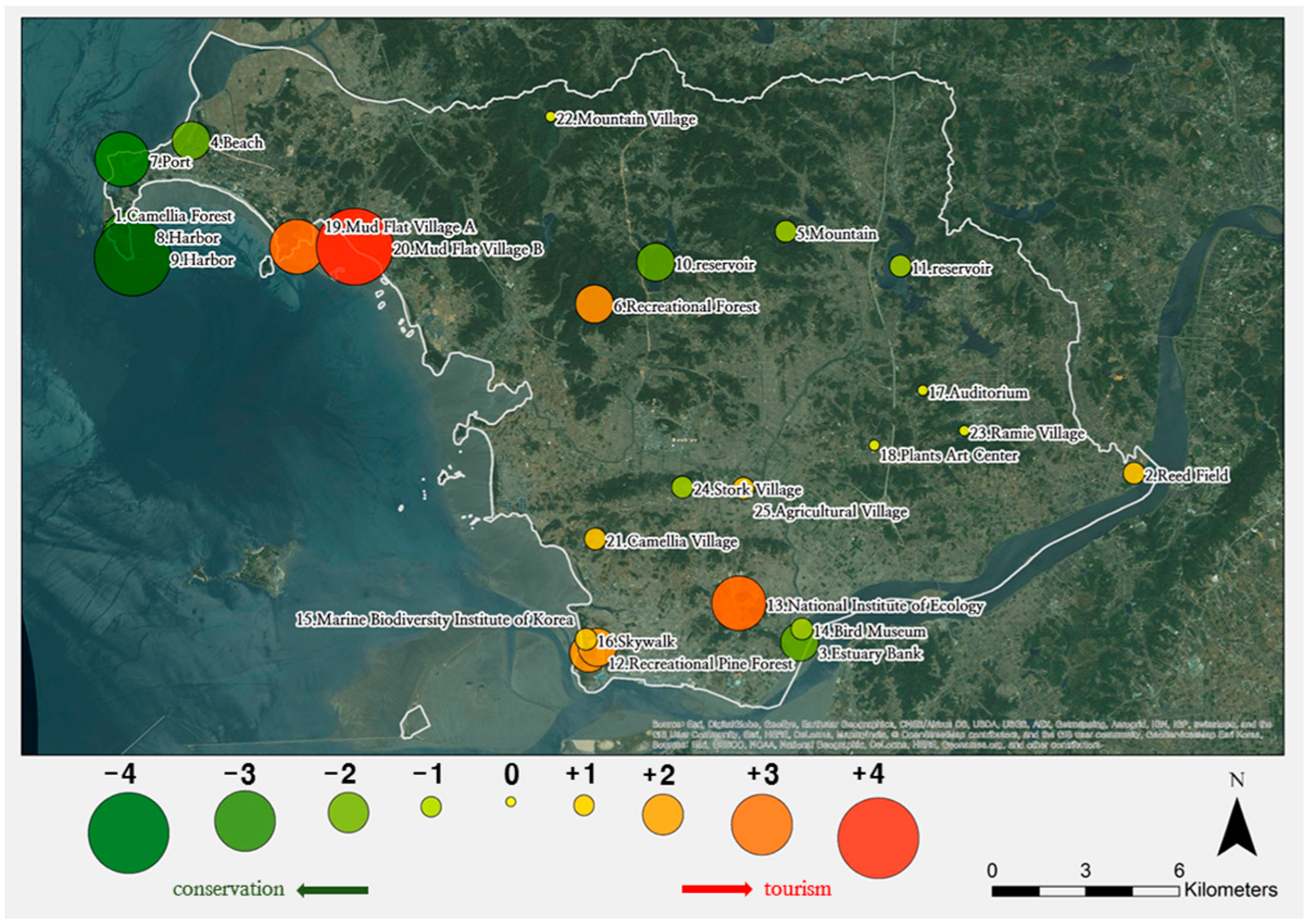
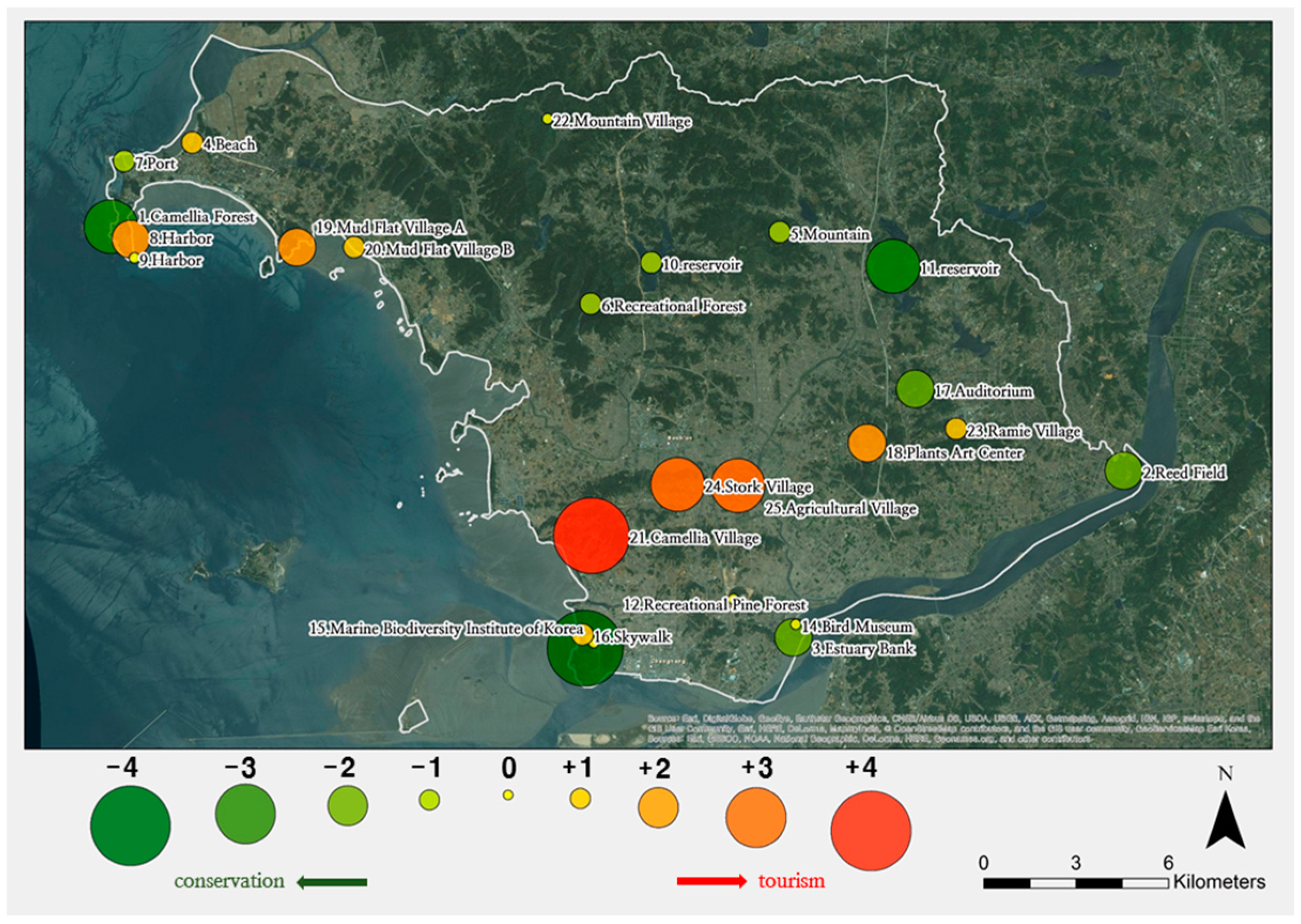
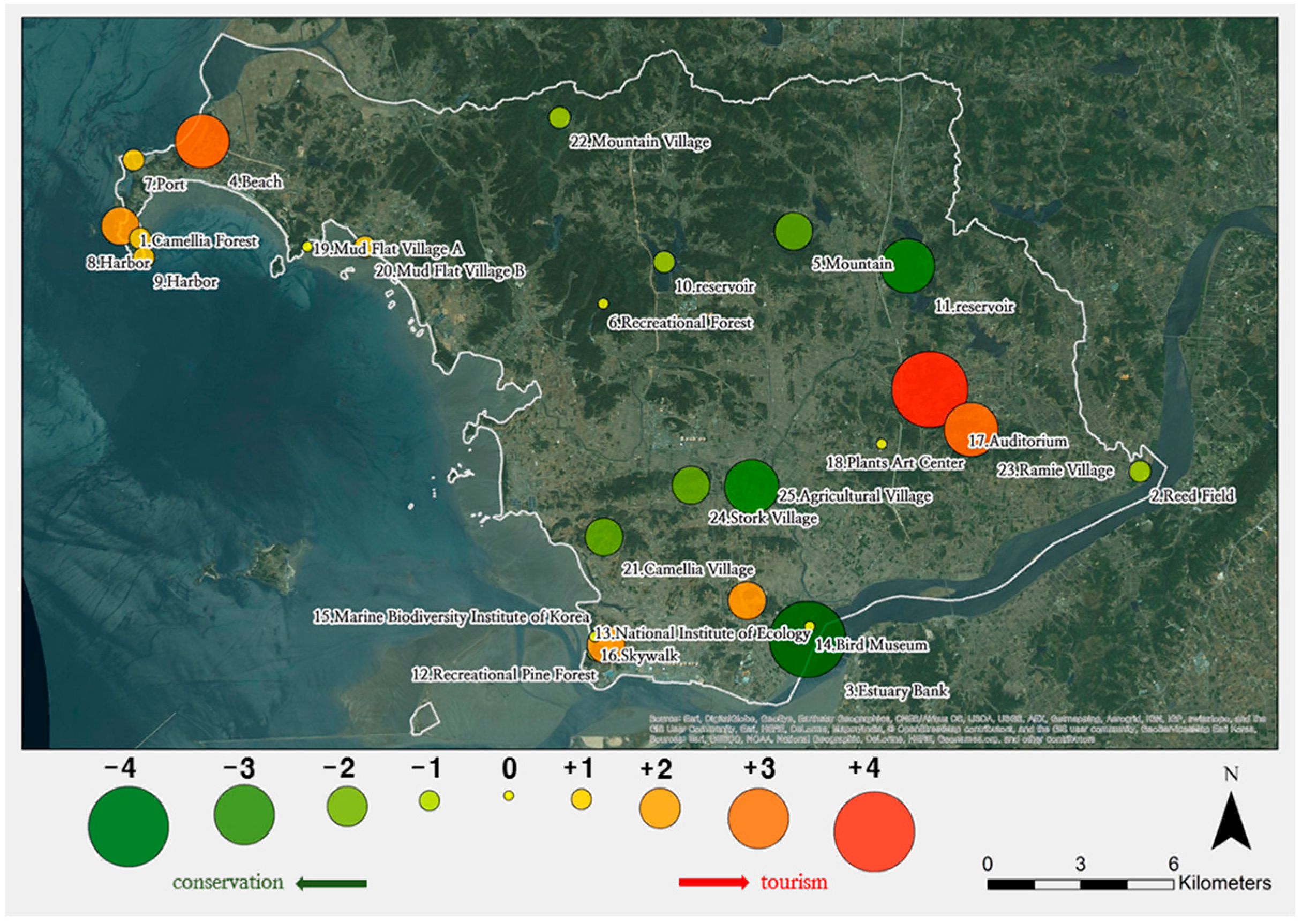
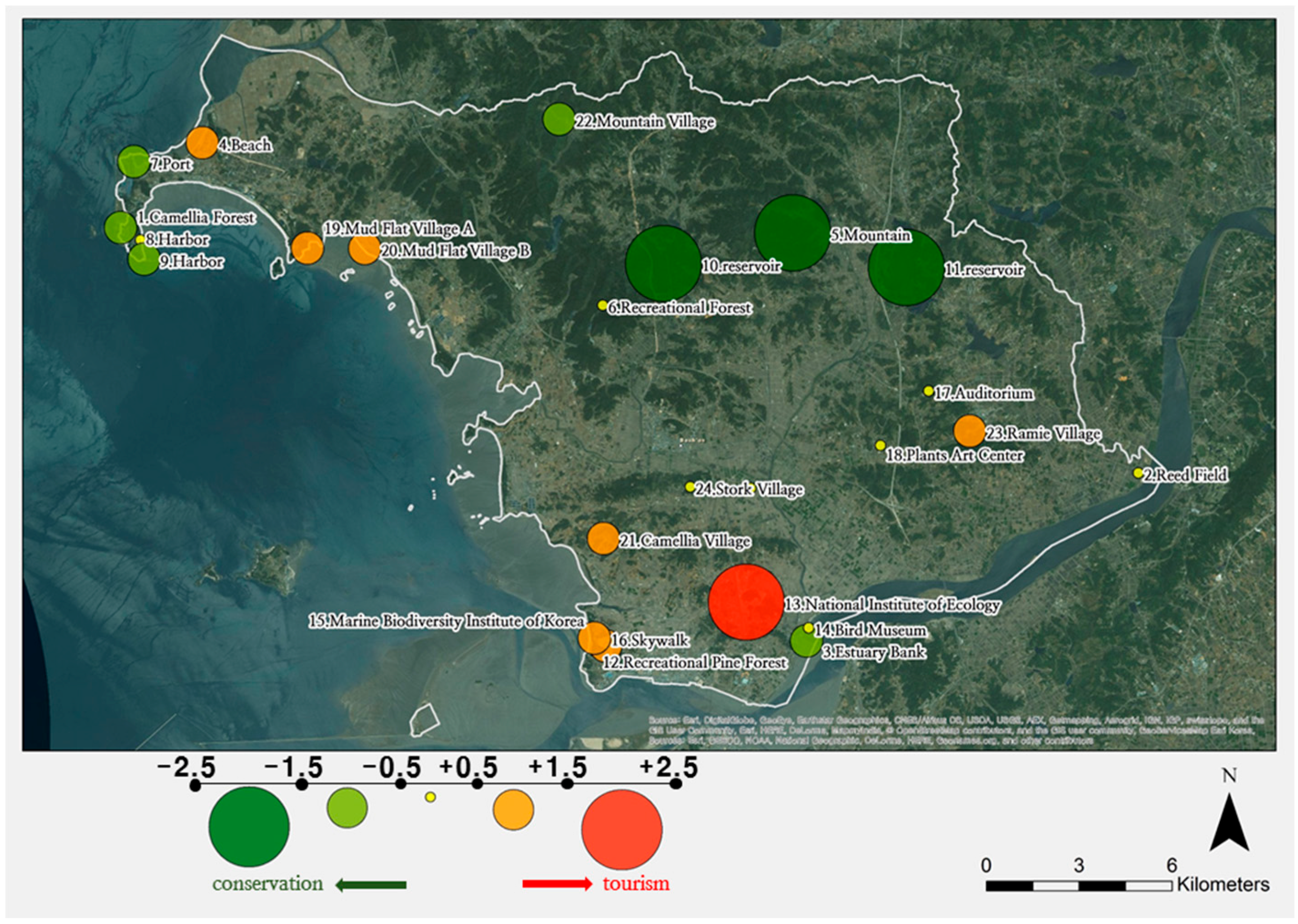
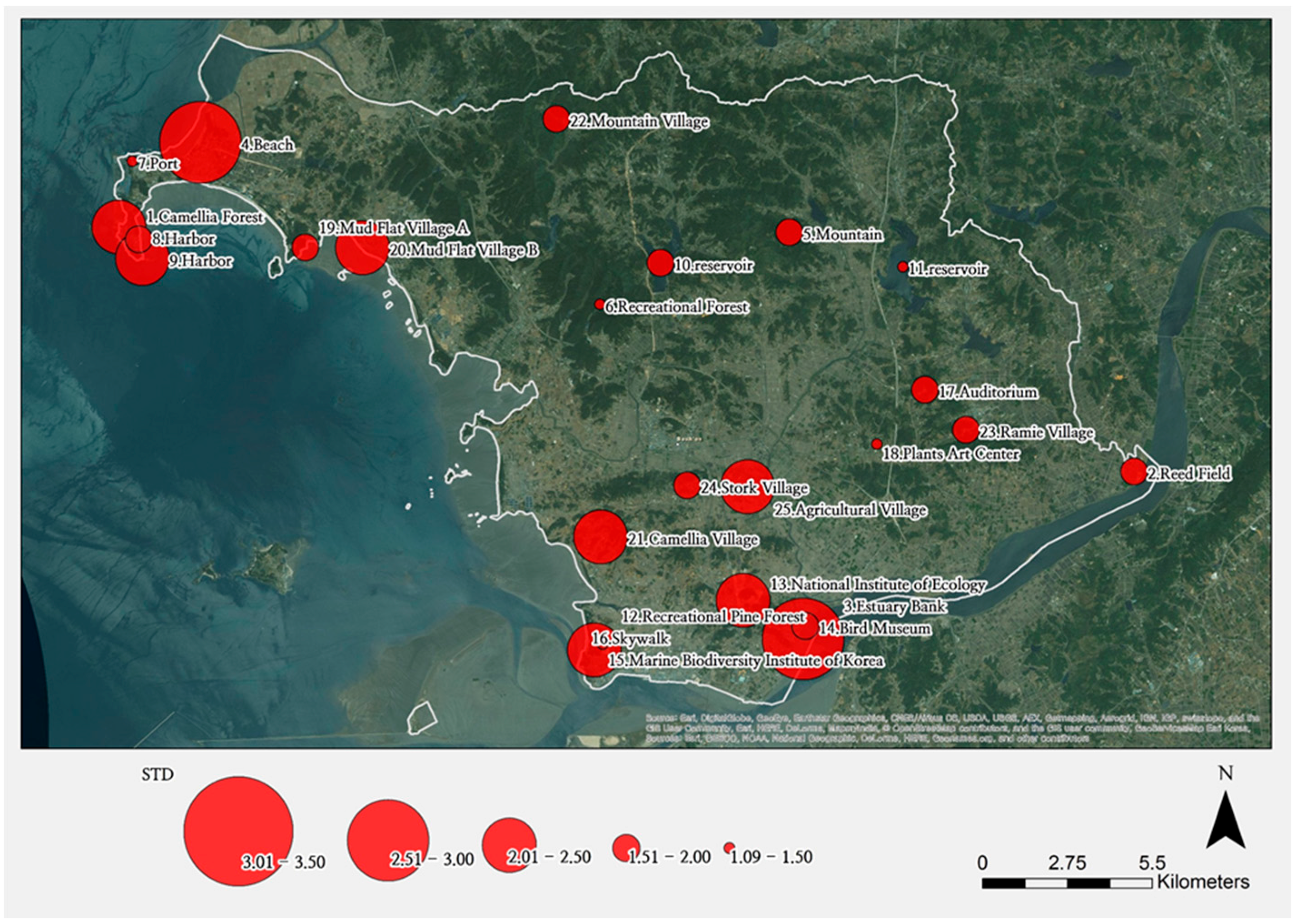

| No. | Division | Detailed Information | No. of People |
|---|---|---|---|
| 1 | Official | Ministry of Environment | 1 |
| Tour. Team in Local Government | 6 | ||
| Bird Ecology Museum | 2 | ||
| Tour. Information Centre | 1 | ||
| 2 | Environmental NGO | Sustainable Development Committee | 2 |
| 3 | Resident | Mud-Flat Experience Village | 3 |
| Camellia Flow Village | 3 | ||
| 4 | Institute | National Institute of Ecology (Exhibition Facility) | 5 |
| National Marine Biodiversity Institute of Korea (Exhibition Facility) | 3 | ||
| 5 | Interpreter | Interpreter in Bird Ecology Museum | 4 |
| 6 | Merchant | Pension Operator, Personal Museum Operator | 3 |
| Overall | 33 | ||
| No. of Factors | 1 | 2 | 3 | 4 | 5 | 6 | 7 | 8 | 9 |
|---|---|---|---|---|---|---|---|---|---|
| Eigen Values | 8.175 | 5.029 | 3.600 | 3.029 | 2.308 | 1.625 | 1.428 | 1.347 | 1.061 |
| % of Variance | 24.774 | 15.240 | 10.908 | 9.179 | 6.994 | 4.924 | 4.328 | 4.081 | 3.215 |
| Cumulative % | 24.774 | 40.014 | 50.923 | 60.102 | 67.096 | 72.020 | 76.348 | 80.429 | 83.644 |
| Total Stakeholders | 14 | 21 | 26 | 27 | 28 | 25 | 29 | 27 | 27 |
| P Sample | Factor | ||||||||
|---|---|---|---|---|---|---|---|---|---|
| P Sample | Sex | Age | Education | Residence | Duration of Residence | 1 | 2 | 3 | 4 |
| Institute | F | 40s | Graduate School | Seocheon | 2–5 years | 0.857 * | −0.059 | 0.174 | 0.171 |
| Interpreter | M | 60s | High School | Seocheon | Over 10 years | 0.782 * | −0.426 | −0.065 | 0.078 |
| Interpreter | F | 60s | High School | Seocheon | Over 10 years | 0.765 * | −0.522 | −0.033 | 0.049 |
| Interpreter | F | 60s | High School | Seocheon | Over 10 years | 0.723 * | −0.417 | −0.195 | −0.131 |
| NGO | F | 40s | High School | Seocheon | Over 10 years | 0.718 * | −0.120 | 0.167 | 0.020 |
| Institute | M | 40s | Univ. | Other City | Less than 1 year | 0.697 * | 0.185 | 0.046 | −0.333 |
| Official | F | 30s | Graduate School | Seocheon | 5–10 years | 0.684 * | 0.271 | −0.244 | 0.332 |
| Official | F | 40s | High School | Seocheon | Over 10 years | 0.642 * | 0.250 | −0.137 | −0.176 |
| Institute | F | 20s | Univ. | Seocheon | Over 10 years | 0.626 * | 0.153 | 0.085 | −0.096 |
| Resident | F | 30s | High School | Seocheon | Over 10 years | 0.602 * | 0.408 | −0.244 | −0.063 |
| Merchant | M | 60s | High School | Seocheon | Over 10 years | 0.590 * | −0.133 | −0.147 | 0.485 |
| Institute | M | 40s | Graduate School | Seocheon | 2–4 years | 0.538 * | −0.185 | 0.134 | 0.333 |
| Official | F | 30s | Univ. | Seocheon | 2–4 years | 0.533 * | −0.134 | 0.386 | −0.277 |
| Interpreter | F | 60s | High School | Seocheon | Over 10 years | 0.481 * | −0.138 | 0.376 | 0.071 |
| Merchant | F | 40s | Graduate School | Seocheon | Over 10 years | 0.454 * | 0.386 | −0.165 | −0.246 |
| Interpreter | M | 60s | High School | Seocheon | 5–10 years | 0.430 | 0.145 | 0.018 | 0.341 |
| Official | M | 40s | Univ. | Seocheon | Over 10 years | −0.103 | 0.810 * | 0.276 | −0.087 |
| Merchant | M | 30s | Univ. | Seocheon | Over 10 years | 0.087 | 0.769 * | −0.190 | 0.266 |
| Resident | F | 60s | Middle School | Seocheon | Over 10 years | −0.251 | −0.666 | 0.068 | 0.280 |
| Institute | M | 30s | Graduate School | Other City | Less than 1 year | 0.047 | 0.637 * | −0.297 | 0.366 |
| Resident | F | 40s | College | Seocheon | Over 10 years | 0.036 | 0.605 * | 0.598 | −0.318 |
| Official | F | 30s | Univ. | Seocheon | 2–4 years | 0.264 | 0.568 * | 0.267 | 0.520 |
| Official | M | 30s | College | Seocheon | Over 10 years | −0.511 | 0.541 * | 0.380 | 0.288 |
| NGO | M | 40s | College | Seocheon | Over 10 years | 0.260 | −0.292 | 0.704 * | 0.293 |
| Official | M | 40s | High School | Seocheon | 5–10 years | −0.446 | 0.044 | 0.631 * | −0.040 |
| Resident | F | 50s | High School | Seocheon | 5–10 years | 0.430 | −0.110 | 0.527 * | −0.131 |
| Institute | M | 40s | High School | Seocheon | Over 10 years | 0.367 | 0.026 | 0.506 * | −0.056 |
| Official | M | 20s | Univ. | Seocheon | 1–2 years | 0.103 | 0.379 | 0.448 * | 0.304 |
| Official | M | 50s | Univ. | Seocheon | 5–10 years | 0.083 | −0.141 | 0.431 | −0.415 |
| Institute | M | 30s | Middle School | Other City | Less than 1 year | 0.367 | 0.221 | −0.392 | −0.208 |
| Resident | M | 50s | Graduate School | Seocheon | Over 10 years | 0.315 | 0.260 | −0.161 | 0.580 * |
| Institute | M | 30s | High School | Other City | 2–4 years | 0.451 | 0.461 | 0.148 | −0.574 |
| Institute | F | 30s | Univ. | Other City | 2–4 years | 0.294 | 0.307 | −0.445 | −0.527 |
| Stakeholder | Factor | |||
|---|---|---|---|---|
| 1 | 2 | 3 | 4 | |
| Interpreter | 4 (−1) | |||
| Merchant | 2 | 1 | ||
| National Institute | 4 | 1 | 1 (−1) | (−2) |
| NGO | 1 | 1 | ||
| Official | 3 | 3 | 2 (−1) | |
| Resident | 1 | 1 (−1) | 1 | 1 |
| Sum | 15 (−1) | 6 (−1) | 5 (−2) | 1 (−2) |
| No. | Category | Name | Factor | Mean | STD 1 | |||
|---|---|---|---|---|---|---|---|---|
| 1 | 2 | 3 | 4 | |||||
| 1 | Ecological Resource | Camellia Forest | −3 | 0 | −3 | 2 | −1 | 2.45 |
| 2 | Reed Field | 1 | 1 | −2 | −1 | −0.25 | 1.81 | |
| 3 | Estuary Bank | 4 | −2 | −2 | −4 | −1 | 2.5 | |
| 4 | Beach | 1 | −2 | 1 | 3 | 0.75 | 2.8 | |
| 5 | Mountain | −2 | −1 | −1 | −2 | −1.5 | 1.85 | |
| 6 | Recreational Forest | 0 | 2 | −1 | 0 | 0.25 | 1.3 | |
| 7 | Port | 0 | −3 | −1 | 1 | −0.75 | 1.49 | |
| 8 | Harbour | 1 | −3 | 2 | 1 | 0.25 | 1.91 | |
| 9 | Harbour | −1 | −4 | 0 | 1 | −1 | 2.13 | |
| 10 | Reservoir | −4 | −2 | −1 | −1 | −2 | 1.77 | |
| 11 | Reservoir | −1 | −1 | −3 | −3 | −2 | 1.2 | |
| 12 | Recreational Pine Forest | 2 | 2 | −4 | −1 | −0.25 | 2.23 | |
| 13 | Ecotourism Facility | National Institute of Ecology | 3 | 3 | 0 | 2 | 2 | 2.42 |
| 14 | Bird Museum | 3 | −1 | 0 | 0 | 0.5 | 1.67 | |
| 15 | Marine Biodiversity Institute of Korea | 2 | 2 | 0 | 2 | 1.5 | 1.41 | |
| 16 | Skywalk | 2 | 1 | 1 | 0 | 1 | 0.89 | |
| 17 | Auditorium | −1 | 0 | −2 | 4 | 0.25 | 1.85 | |
| 18 | Plants Art Centre | 0 | 0 | 2 | 0 | 0.5 | 1.98 | |
| 19 | Ecotour Village | Mud-Flat Village A | −2 | 3 | 2 | 0 | 0.75 | 1.69 |
| 20 | Mud-Flat Village B | −3 | 4 | 1 | 1 | 0.75 | 2.38 | |
| 21 | Camellia Village | 0 | 1 | 4 | −2 | 0.75 | 2.49 | |
| 22 | Mountain Village | −2 | 0 | 0 | −1 | −0.75 | 1.93 | |
| 23 | Ramie Village | 1 | 0 | 1 | 3 | 1.25 | 1.13 | |
| 24 | Stork Village | 0 | −1 | 3 | −2 | 0 | 1.58 | |
| 25 | Agricultural Village | −1 | 1 | 3 | −3 | 0 | 2.2 | |
© 2017 by the authors; licensee MDPI, Basel, Switzerland. This article is an open access article distributed under the terms and conditions of the Creative Commons Attribution (CC-BY) license (http://creativecommons.org/licenses/by/4.0/).
Share and Cite
Lee, J.-h.; Kim, S.-h.; Kwon, H.-s. Mapping Interests by Stakeholders’ Subjectivities toward Ecotourism Resources: The Case of Seocheon-Gun, Korea. Sustainability 2017, 9, 93. https://doi.org/10.3390/su9010093
Lee J-h, Kim S-h, Kwon H-s. Mapping Interests by Stakeholders’ Subjectivities toward Ecotourism Resources: The Case of Seocheon-Gun, Korea. Sustainability. 2017; 9(1):93. https://doi.org/10.3390/su9010093
Chicago/Turabian StyleLee, Jae-hyuck, Sung-hoon Kim, and Hyuk-soo Kwon. 2017. "Mapping Interests by Stakeholders’ Subjectivities toward Ecotourism Resources: The Case of Seocheon-Gun, Korea" Sustainability 9, no. 1: 93. https://doi.org/10.3390/su9010093
APA StyleLee, J.-h., Kim, S.-h., & Kwon, H.-s. (2017). Mapping Interests by Stakeholders’ Subjectivities toward Ecotourism Resources: The Case of Seocheon-Gun, Korea. Sustainability, 9(1), 93. https://doi.org/10.3390/su9010093

