Abstract
The study implements the consequential life cycle assessment (CLCA) to provide a market based perspective on how overall environmental impact will change when shifting glass fibres to flax fibres as reinforcements in composite fabrication. With certain assumptions, the marginal flax fibre supply is identified to be a combination of Chinese flax fibre (70%) and French flax fibre (30%). Due to inferior cultivars and coal-fired electricity in Chinese flax cultivation, the CLCA study reveals that flax mat-PP has 0.8–2 times higher environmental impact values than the glass mat-PP in most environmental impact categories over the production and end-of-life (EoL) phases. For purpose of providing potential trajectories of marginal flax fibre supply, additional scenarios: the “all French fibre”, and “all Chinese fibre” are evaluated formulating the lower and upper boundaries in terms of environmental impact change, respectively. A “the attributional fibre supply mix” scenario is supplied as well. All of these scenarios are useful for policy analysis.
1. Introduction
Due to global environmental concerns on greenhouse gas emissions and non-renewable resource depletion, there is an apparent trend to promote application of materials from renewable sources to replace conventional materials relying on fossil based fuel energy. A good example on this paradigm shift is the application of natural fibre replacing glass fibre for fibre reinforced polymer composites (FRPs) production [1]. Production of glass fibre requires significant amount of energy to melt silica and other raw materials for glass filament formation [2]. On the other hand, the natural fibre in this context refers to those plant fibres including flax, hemp, ramie, jute, and coir fibres extracted from agro-products. These plant fibres are thought to embody renewable solar energy. In addition, they absorb atmospheric carbon dioxides during cultivation and release through incineration at disposal, contributing to a neutral carbon cycle [1]. Thus, replacing glass fibre with natural fibre may result in lowering demand for fossil fuel based energy. Industrial application of plant fibre based composite (PFRP) is particularly welcomed in automotive industry since plant fibres are lighter than glass fibres, and thus contribute to lightweight design of vehicles [3]. In fact, over 95% of PFRPs produced in the EU are used for automotive components [3]. Among these plant fibres, flax fibre is the most widely used plant fibre for composite reinforcement due to its exceptional mechanical properties [3]. The wide availability, low cost, low density, high specific properties and eco-friendly image of flax fibres have portrayed them as prospective substitutes for the traditional glass fibre reinforcements [3,4]. Over the last decade (2002–2012), the amount of flax fibre in automotive application is doubled from 9000 t [5] to 15,200 t [3] in Europe representing an average 5.4% annual growth rate.
On the other hand, the direct competition between flax fibre and glass fibre triggered a series of studies to compare the environmental impact between two types of fibres, and derived FRPs [6,7,8,9,10,11]. These studies adopted the life cycle assessment (LCA) approach to calculate the quantitative information on environmental impact. Their results have confirmed that flax fibres help in achieving impact reduction in multiple impact categories, depending on the impact assessment method: i.e., the CML (Centrum Milieukunde Leiden) 2001 baseline, or EDIP (Environmental Development Industrial Product) methods. However, doubts of impact reduction still exist in the cases of eutrophication, ecotoxicity, and agricultural land occupation. The two former impact categories are caused by nutrients in fertilisers and pesticide emissions in flax cultivation.
However, it should be noted that the LCA studies are all structured on attributional perspective (ALCA). These ALCA studies provide direct environmental impact associated with flax cultivation and fibre extraction for a pre-defined geographical area [12]. Thus far, little is known yet on the environmental effects induced by the scenario of replacing glass fibres with flax fibre in composite reinforcement use. Though comparative ALCA studies can help to position the relative environmental impact performances for two competitive designs, real-life effects are more complex due to the different cultivation sites, global trade, and availability of flax. Modelling the real-life environmental effects of using more flax fibre essentially needs to analyse the global market of flax fibre to capture the resultant environmental impact change.
To meet this purpose, the tool of consequential life cycle assessment (CLCA) can be applied [13]. The idea and rational behind the CLCA are better elaborated by comparing to the ALCA approach (Table 1). The ALCA analyses the environmental effect of a system limited to a single complete life cycle, i.e., from cradle to grave. Co-products are treated using allocation methods, such as mass or economic allocation. The data applied in an ALCA generally represent the average status of current or recent technology. The environmental effect according to the ALCA provides a clear, static and complete insight into the environmental profiles of specific products.
Table 1.
Comparison between two life cycle assessment (LCA) approaches [13].
| Characteristic | Type of LCA | |
|---|---|---|
| Attributional perspective (ALCA) | Consequential life cycle assessment (CLCA) | |
| Perspective | Retrospective | Prospective |
| System boundary | Completeness | Affected processes |
| (Co-)products accounting | Partitioning | System enlargement |
| Choice of data | Average | Marginal (at least in part) |
However, CLCA addresses environmental impact changes that result from marginal production, use, and disposal changes. The system boundary only covers the parts affected by the marginal production. Moreover, CLCA may not be confined to a single system because it eliminates the allocation by enlarging the system boundaries to include additional life cycles and products that are influenced by physical flows in the respective system. Instead of using averaged data, CLCA is built on marginal data. Such marginal data should reflect the specific situation of a change over the current status.
The choice of LCA approaches should be associated with the goal of a LCA study [14]. Compared to ALCA, it is argued that CLCA is more relevant to policy makers by analysing improvement possibilities of a paradigm shift [12,13,14]. It is an insightful tool to capture the real effect induced by such change. Therefore, in this study, a CLCA study on the proposed flax fibre reinforced composite is implemented to provide a clear understanding of the marginal environmental effects if additional biobased sources are used.
2. Materials and Methods
2.1. Goal and Scope Definition
The presented CLCA focuses on the marginal environmental impact changes due to a shift from glass fibres to flax fibres for composite reinforcement from a macro-economic perspective. Worldwide, flax is widely cultivated in France and in China [15]. After being harvested from field, flax straws are subject to two additional fibre extraction processes, i.e., scutching and hackling [11]. Scutching of flax straw yields multiple products, e.g., long flax fibres, short flax fibres (flax tows), shives, flakes, and seeds. Afterwards, the scutched long fibres are hackled to further remove the woody particles. Two products are generated from hackling: hackled fibres (slivers) and hackled tows [11]. The flax fibre in this study refers the hackled flax fibre. Flax fibre can be converted into mat and compression moulded into flax mat reinforced polymer composite. Polypropylene is selected as the polymeric matrix due to its wide applicability. Conventional GMT (glass fibre mat reinforced polypropylene (PP)) is chosen for the baseline product to reveal the environmental impact changes. The functional units for both composites are interior car panels with equal stiffness serving a 200,000 km driving distance. The Ashby method is applied for functional equivalence design [16].
The flax mat-PP alternative design is selected with the same volume fraction of the reinforcement content with glass mat-PP. With an equal bending stiffness criterion, the flax mat-PP alternative design can be calculated. According to the Ashby method, if the length (l) and width (b) are both specified, leaving thickness the free variable, the mass of a panel structure (Mpanel) can be calculated by the following equation using the criteria of equal stiffness Ashby [16]:
where C is the edge constraint constant; (F/δ) represents the panel stiffness; ρ is the material density; and E is the material flexural modulus. Therefore, the index, ρ/E1/3, which contains only the intrinsic material properties and is proportional to the mass of the panel structure, can be used as an indicator. A material with a lower value of ρ/E1/3 results in a more lightweight design of the panel, given that the conditions and objective are met. According to the equation, the functional equivalent designs of flax mat-PP and glass mat-PP can be calculated (Table 2).
Table 2.
Functionally equivalent design for flax mat reinforced polypropylene (PP) composite.
| Wt (%) | Vol (%) | Flexural Modulus (GPa) | Density g cm−3 | Thickness Ratio | Equivalent Mass (kg) | |
|---|---|---|---|---|---|---|
| Flax mat/PP | 28 | 20 | 5.4 | 1.06 | 0.89 | 7.8 |
| Glass mat/PP | 40 | 20 | 6 | 1.29 | 1 | 9.0 |
2.2. Market Based System Delimitation
In a CLCA study, the most important task is to identify the marginal technology or process in face of a change in demand, i.e., what is actually affected according to the marginal demand? For this purpose, a “market-oriented” approach should be implemented [17,18]. Following this protocol, this section firstly attempts to determine a global marginal supply of flax fibre when an additional demand for composite use is initiated. Co-products: flax tow, shive, and seeds, are entirely handled through system expansion, and thus avoided products associated with these co-products need to be identified. Other involved parameters including land use change (LUC) and important background electricity mix are analyzed in terms of marginal effects as well. After compression moulded into composite, in the use phase the consequence of using flax mat-PP replacing glass mat-PP is that mass reduction (see Table 2) can induce fuel saving, which can be very significant depending on automotive lifetime. Finally, the perspective disposal scenario of composite materials is determined. The whole set of analysis yield a delimited system boundary for the CLCA.
2.2.1. Marginal Suppliers of Flax Fibres
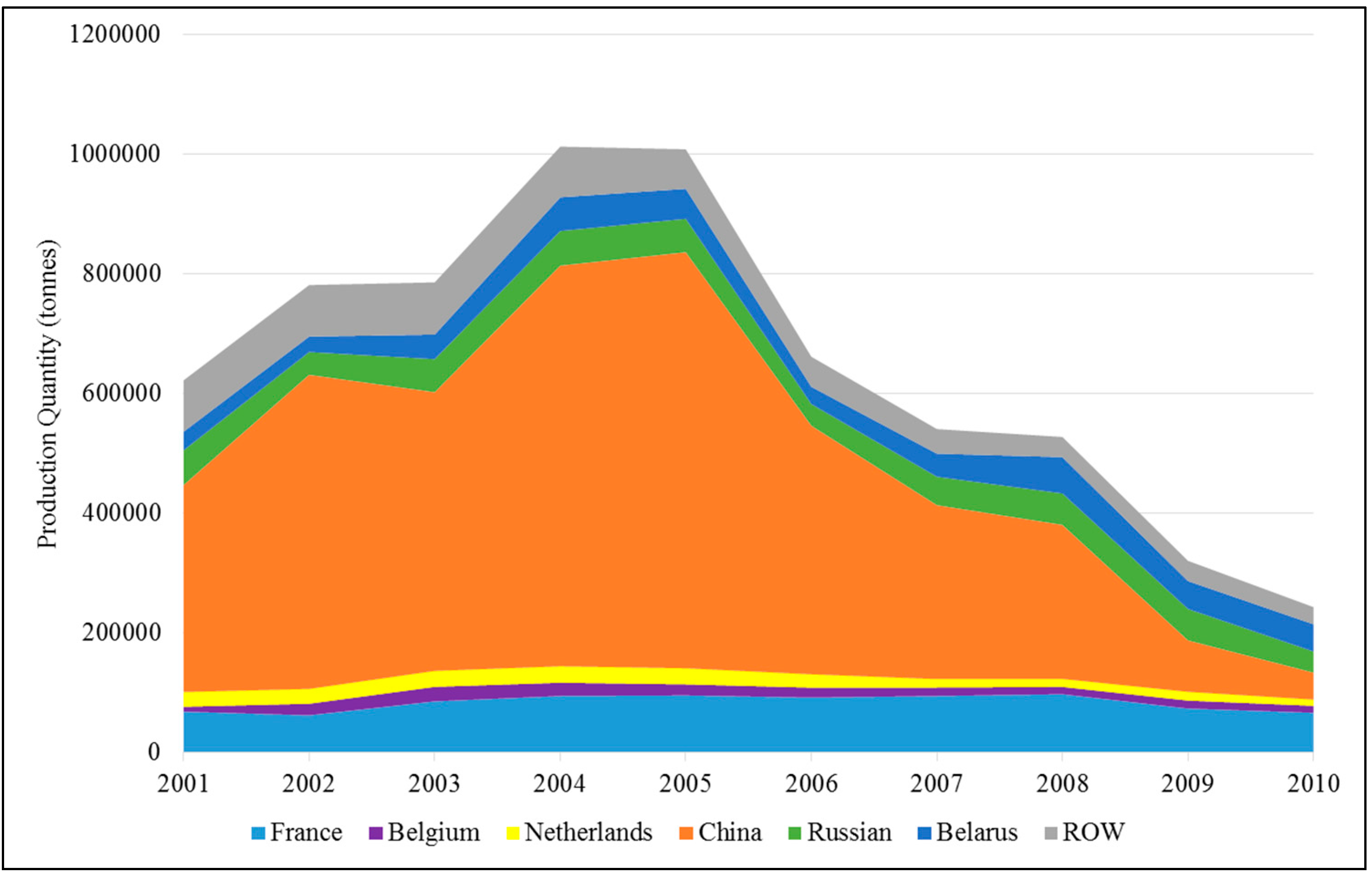
Currently, the market volume for flax fibres (including hackled fibres and tows) is rapidly decreasing. According to FAOSTAT (Food and Agriculture Organization Statistics) database [15], the global production capacity has decreased from a peak of 1,000,000 t in 2004 to approximately 300,000 t in 2010 (Figure 1). A large decrease in production capacity in the flax market is observed in China, which is primarily caused by (1) the increase in manmade fibres (e.g., polyester fibres) and (2) imports from Europe (France and Belgium). The quality of Chinese flax fibres is slightly less than the French fibres. Imported flax fibres account for more than 50% of the market share in China. Moreover, more than 80% of the flax fibres produced in France and Belgium are exported to China [19]. The marginal supplier of flax fibres must identify the relative share of each flax fibre source that is affected by a marginal demand.
Figure 1.
Global flax fibres market of production trend (data compiled from FAOSTAT [15]).
Weidema illustrated a stepwise guideline to determine marginal effects based on various market situations [18]. Following this protocol, the marginal flax supplier could be determined though the following manners:
- (1)
- Assuming that the studied marginal demand, i.e., the marginal demand of flax fibres to be used in an automotive application in Europe, could affect the global flax market rather than a specific European market.
- (2)
- Assuming that production of flax fibre is not restricted or production can be altered in face of a change in demand.
- (3)
- Assuming that the overall trend of market volume will continue in the coming years.
- (4)
- Assuming that the new demand is relatively small compared to current market capacity.
Due to the large trading among major producers, the first assumption may be realistic due to intense global trade of flax fibre between China and Europe. However, it is worth noting that if external policies, e.g., subsidizing, lobbying, and intensive advertisement, are applied to promote the use of a specific flax fibre source in the future, then this assumption may became invalid. The second assumption is considered to be valid in a long-term perspective (longer than one year) since farmers should be able to adjust their cultivation areas in response to a change in demand. The third assumption may be subject to scepticism. It is also possible that after years of landslide shrinkage the overall market volume will be stabilized in the future. However, judging from the current market volume trend, it may still need several years to reach a plateau. The fourth assumption is essential to conduct the CLCA since it implies that some critical parameters including the direction of the trend in market volume, production costs of the products and technologies involved are maintained [18]. This assumption should be authentic from market analysis. Even though the growth rate of flax fibre in automotive application reaches 5.2% annually over a decade (2002–2012), the total market of flax fibre in automotive is only 15,200 t in 2012. Thus, yearly marginal demand is around 1000 t, representing less than 1% of total market capacity of flax fibre.
Since the assumptions are acceptable based on current market situation, the stepwise guideline concludes that the least competitive suppliers are most sensitive to a change in demand. In a shrinking market, the authors argue that less competitive suppliers lose more market shares and therefore must cut the production capacity and/or gradually exit the market. Therefore, these suppliers are able to react more quickly to a change in demand. In particular, assuming that a demand increase occurs, these suppliers have the spare capacity and/or expertise that can be readily re-ignited. Otherwise, the less competitive suppliers must decrease the production lines or even be phased out. Among the flax fibre suppliers, it is justifiable to say that the French flax fibre suppliers are more competitive due to higher yields, fully mechanised cultivation, and an efficient retting process while the Chinese flax fibre suppliers should be least competitive seen by the tremendous decline in production. Following the guideline leads to the conclusion that the Chinese flax fibre suppliers represent the main marginal suppliers.
The quantitative information on the consequential flax supply mix ratio can be further determined. Based on FAOSTAT database [15], the total production capacity decreased by approximately 765,000 t from 2005 to 2010. Moreover, 84% of this decrease was associated with a reduction in the Chinese flax fibre supply, 9% was due to the decrease in France, and 6% was due to the decrease in the rest of the world. These fractions comprise a historical mix for the marginal flax supply over the period 2005–2010. The marginal supply combination of flax fibres can be similarly calculated based on the differences between current/recent production capacities and forecasted/planned production capacities during a specified time period. To simplify the analysis, two representative flax fibre production sources are singled out, i.e., the Chinese and French suppliers while flax fibre productions in Russia and Belarus are relatively stable and therefore left out from the consequential mix analysis. Under the assumption that the current market trend will be maintained, the future flax fibre production capacities can be extrapolated according to the available statistical data via a simple regression analysis from the historical data. Since the production of the marginal supply combination suggests that by starting from the current flax fibre production statues, 70% is assumed to be from Chinese flax fibres and 30% is assumed to be from French flax fibres for per unit additional change in demand and including both negative and positive directions (Table 3).
Table 3.
Consequential mix of the global flax fibre supply (retrieved from FAOSTAT [15]).
| Country | Year 2010 (t) | Year 2015 (t) | Change (t) | Consequential Supply Mix |
|---|---|---|---|---|
| China | 44,942 | 26,315 | 18,627 | 70% |
| France | 66,970 | 59,155 | 7815 | 30% |
In this study, the consequential supply mix is considered to be the most likely scenario based on current market information, and thus, used as the baseline scenario to run the CLCA calculation and subsequent discussion. However, it should be noted that the presented consequential supply mix heavily relies on the four assumptions. Alternative supply mix scenarios are possible if any of the assumptions become invalid in future.
- (1)
- If external policies are enforced to promote the use of the French fibre source such as subsidizing, lobbying, etc., these approaches can create extra incentives for consumers (i.e., European automotive manufactures) selecting the flax tensile products with the France fibre source. In this case, the flax market cannot be considered as frictionless, and the first assumption is violated. Therefore, it is beneficial to analyse the “all French fibre” marginal supply as another consequential scenario. The marginal supply mix should be shifted to the French fibre source accordingly.
- (2)
- If market volume trend becomes stabilized, the third assumption is rendered invalid. In this case, a possible scenario is that the relative shares between French fibre (60%) and Chinese flax fibre sources (40%) are maintained. Thus, in this situation, the marginal supply mix reflects current situation, which is called attributional mix.
- (3)
- Similarly, the opposite scenario, the “all Chinese fibre” is included as well. This scenario may become realistic if Chinese farmers are can obtain a substantial subsidy for flax cultivation. Combined with the all French flax fibre scenario, they help with revealing boundaries of all potential marginal supply trajectories.
Thus, in addition to the consequential supply mix, three alternative scenarios are incorporated in this study as well to provide policy implication (Table 4).
Table 4.
Consequential mix of the global flax fibre supply (retrieved from FAOSTAT [15]).
| Supply Mix | Position | Application Criteria | Share (Chinese/French) |
|---|---|---|---|
| Consequential supply mix | Baseline | Four assumptions are met | 70%/30% |
| Attributional supply mix | Alternative | Overall market becomes stabilized. | 40%/60% |
| All French fibre supply mix | External policies promoting uses of French fibre in automotive | 0%/100% | |
| All Chinese fibre supply mix | Substantial subsidy is provided to Chinese flax cultivators | 100%/0% |
2.2.2. Co-Products Accounting
In CLCA analysis, system expansion is always implemented when coproducts are encountered [20]. Flax fibre seeds, excluding parts for regenerative uses, are extracted using oil extraction techniques. Therefore, the seeds can be deemed as the linseeds [21]. The linseed is assumed to be cultivated in Canada, as it is he global leader in linseed production [15]. Flax tows, including both hackled tows and scutched tows, are traditionally used to produce coarse flax fabric tissue or multi-fibres materials blended with cotton. Currently, triggered by growing environmental problems, such as global warming and fossil fuel depletion, flax tows are used in technical applications, such as geo-textiles, composite reinforcements, and insulation materials. These functions coincide with jute fibre, which is an abundantly produced natural fibre.. The jute fibre is therefore assumed to be the avoided product. Flax shives are the main by-product of fibre extraction. Unfortunately, no high-value application area is found for flax shivers. In Asia and Europe, flax shives can be used to produce particleboard, which displaces industrial wood chips. Therefore, the system boundary is expanded to include linseed cultivation, jute fibre production, and industrial wood chip as substituted products. The environmental effects of flax fibres can be obtained by subtracting the effects of these equivalent products.
2.2.3. Land Use Change
This analysis follows a stepwise guideline documented in Milà i Canals et al. [22] to account for the environmental impact associated with the land use change (LUC). If the studied crop experiences rapid expansion in both cultivated and harvested areas, e.g., sugarcane cultivation in Brazil for ethanol synthesis, the LUC should be attributed to the environmental effect of crop cultivation. However, if the cropping system is mature or experiencing a decline in cultivation areas, no LUC needs to be considered. Since flax cultivation areas have been shrinking over the past few years, the LUC is omitted [22].
2.2.4. Other Involved Inputs
Glass fibre supplier: The average glass fibre (filament fibre) production in Europe remained below 0.6 Mt in the 1990s and early 2000s. However, the production exhibited a strong upward trend and surpassed 0.8 Mt in recent years [23]. According to the stepwise guideline, since the displaced amount of glass fibre in automotive is far below the total market capacity, in an increasing market the reduced demand of glass fibre, triggered by more flax fibre application, should be reacted to by competitive suppliers in Europe. The LCI from the Ecoinvent database on glass fibre is applied. These data are average but do not differ from the marginal data since the Ecoinvent dataset represent the Best-Available-Technology (BAT) for glass fibre production in Europe [24].
Fertiliser: Nutrients (NPK) can be applied in different formats. A change in fertiliser demand is expected to affect the most widely used fertiliser types [25]. For flax cultivation in France, the straight fertilisers, i.e., ammonia nitrate (AN), triple super phosphate (TSP), and potassium chloride (MOP), are modelled as marginal fertilisers based on French fertiliser market shares [26]. Moreover, urea, mono ammonium phosphate (MAP) and MOP are chosen for linseed cultivation in Canada and flax cultivation in China [27].
Electricity mix, France and China: Electricity generation is largely a national market. As shown in Table 5, from a consequential perspective, the electricity generation mix should be based on the relative share of the specific source increment over the total electricity generation increment in a given period. The current electricity mix (for 2009) is obtained from the International Energy Agency (IEA) database [28]. The forecasted electricity generation mixes for China and France are derived from the World Energy Outlook 2010 report [29] and the Réseau de Transport d'Electricité 2011 report [30], respectively. Therefore, the consequential mix of electricity generation is calculated based on relative shares of changes in different energy types.
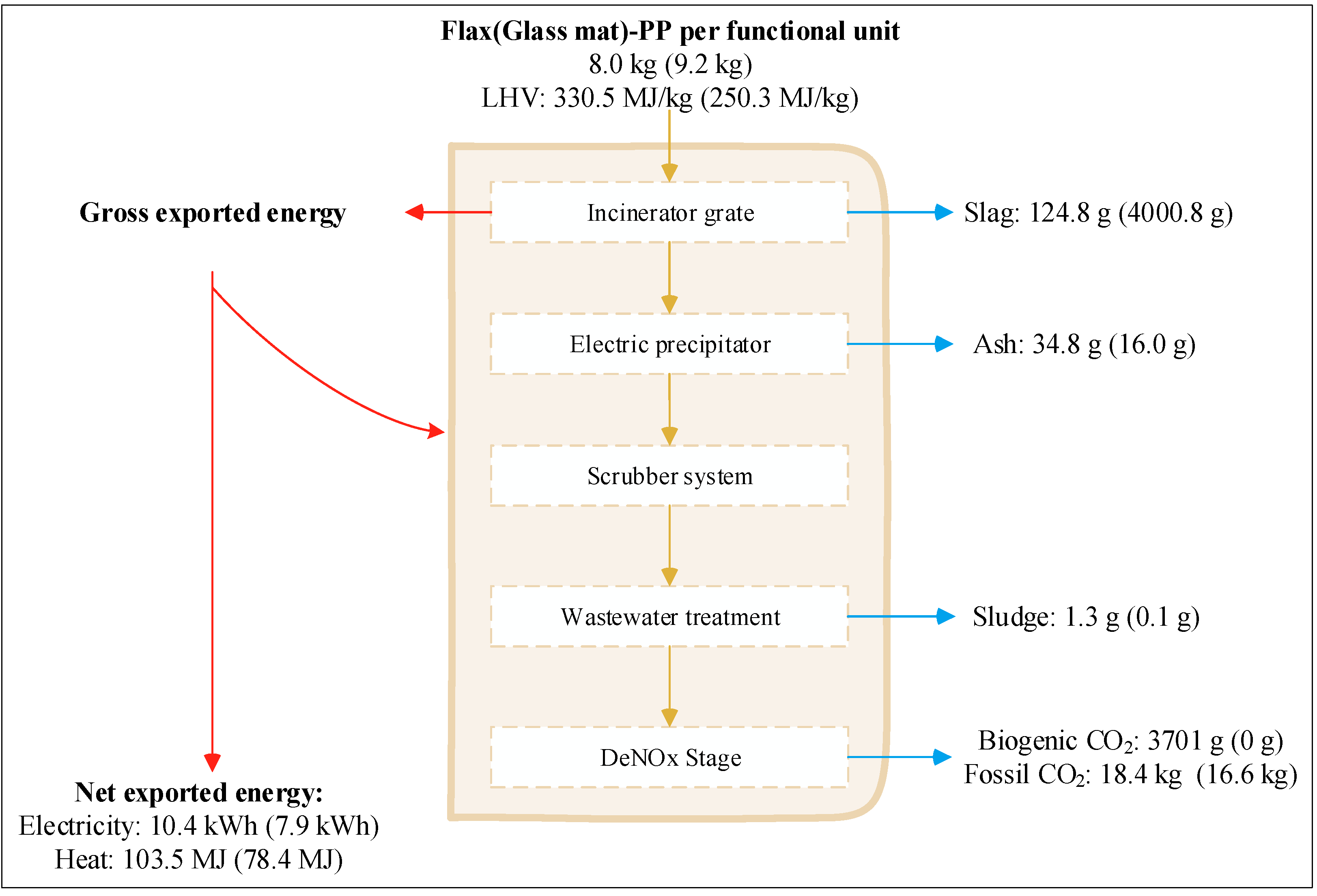
Incineration with energy recovery: Incineration with energy recovery is a logical scenario for composite disposal. Three primary waste incineration systems are available: incineration with only electricity generation, only heat generation, and CHP (coproduction of heat and power). An accurate consequential mix of incineration technologies requires a scenario expectation of the relative share in expanded capacity for the specific technology over the total increase in incinerated waste during a future period (e.g., 2013–2020). Unfortunately, such information cannot be found in the literature. However, the Confederation of European Waste-to-Energy Plants (CEWEP) reports provide an indication that CHP plants are the mainstream technology and that their popularity will continue to increase compared to heat only and electricity only plants [31]. The CHP plants represented 45.4% of the total surveyed waste incineration plants in the period 2001–2004, increasing to 58.6% in 2007–2010. In contrast, electricity-only and heat-only incineration plants decreased from 28.9% to 26.4% and 25.8% to 15.0%, respectively [32]. Based on this information, it is assumed that CHP will be the sole marginal technology for flax mat-PP composite incineration.
Table 5.
Consequential electricity production mix and transmission loss.
| France | China | |||||||
|---|---|---|---|---|---|---|---|---|
| 2009 | 2020 | Δ | Change% | 2009 | 2020 | Δ | Change% | |
| Nuclear | 410 | 430 | 20 | 27 | 70 | 475 | 405 | 12 |
| Coal | 29 | 11 | − | − | 2913 | 5037 | 2124 | 61 |
| Gas | 21 | 31 | 10 | 13 | 51 | 320 | 269 | 8 |
| Oil | 6 | 1 | − | − | 17 | 32 | 15 | 0.4 |
| Biomass | 6 | 9 | 3 | 3 | 2 | 23 | 21 | 0.6 |
| Hydro | 62 | 69 | 7 | 10 | 616 | 1068 | 452 | 13 |
| Wind | 8 | 36 | 28 | 37 | 27 | 209 | 182 | 5 |
| Solar | 0 | 8 | 8 | 11 | 0 | 15 | 15 | 0.4 |
| Transmission loss | 11.2% | 23.6% | ||||||
3. Results and Discussion
3.1. Determination of the System Boundary
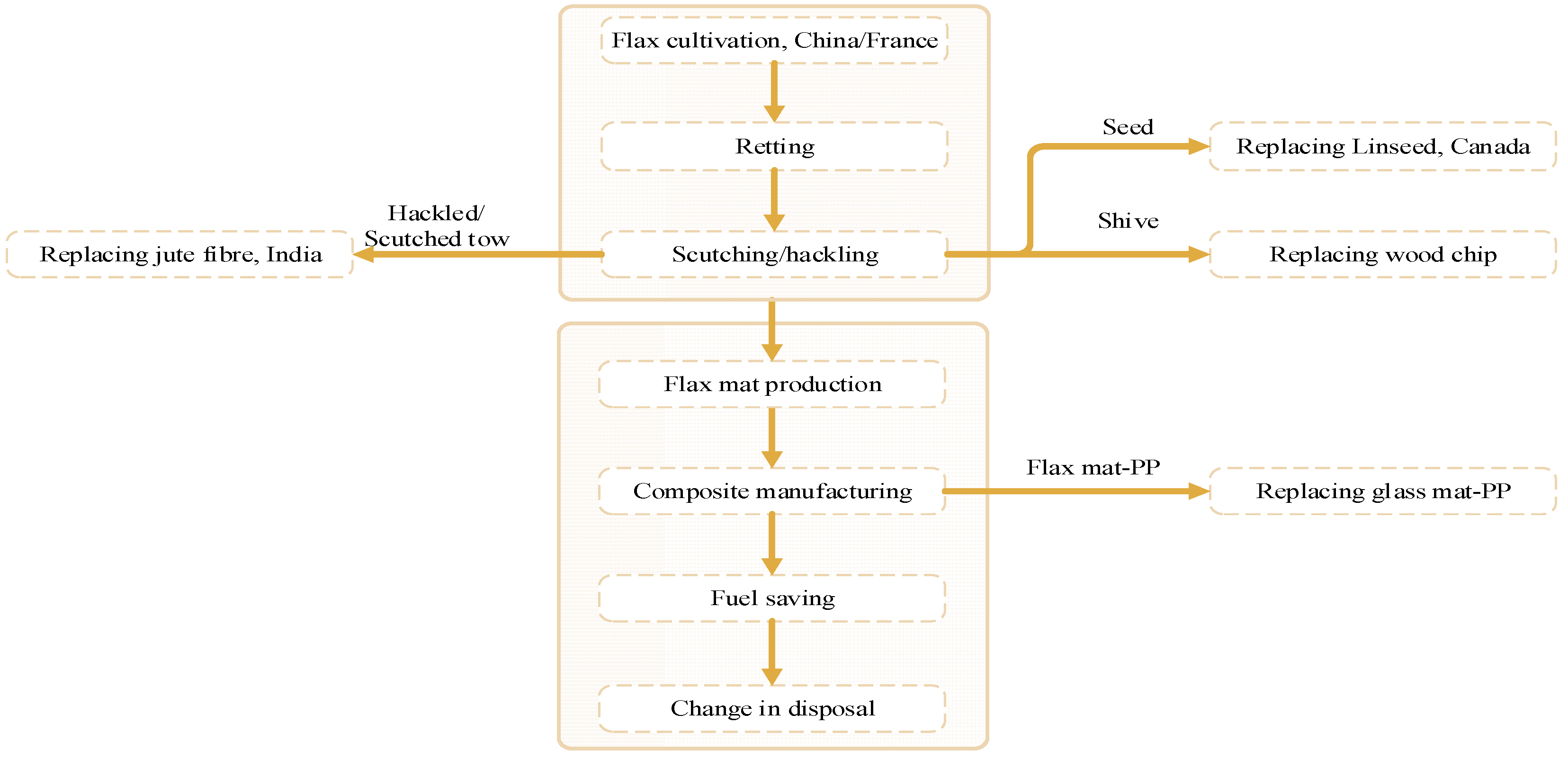
Figure 2 summarises the delimited system boundary for the CLCA study including French/Chinese flax fibre cultivation, avoided products due to co-production of flax tow, shive and seeds. The flax mat-PP composite is used in automotive applications to replace glass mat-PP. The geographical scope includes France and China for flax fibre production. The flax fibres are assumed to be transported to Europe where flax mat are manufactured. Then, these mats are incorporated into the composite reinforcement use. In the use phase, the CLCA deals with fuel saving when using flax mat-PP instead of glass mat-PP. The disposal scenarios for both components are incineration with energy recovery. The CLCA captures changes including emissions, the amount of energy recovered, etc.
Figure 2.
System boundary of flax mat-PP composite in the CLCA.
3.2. Life Cycle Inventory Analysis
The inventory data covers crop cultivation, mat and composite manufacturing, energy saving during the use phase, and incineration with electricity and heat recovery.
Flax cultivation and fibre production in France/China: Detailed LCI information for French fibre production is comprehensively documented in [11,26]. The Chinese flax cultivation and fibre production can be found in the supporting information (SI) of this paper.
Linseed cultivation: The LCI for linseed cultivation reflects the situation in three major producing provinces in Canada. A modified IPCC method is applied to simulate the field emissions in Canada. Detailed information on LCI of linseed cultivation is provided in the SI.
Jute cultivation: Jute fibre production in India is readily available in the Ecoinvent database. Jute sticks are co-generated with jute fibres in ripping. In the Ecoinvent dataset, jute sticks are partitioned out of the system boundary by economic allocation. To maintain the uniformity in the applied methodology of system expansion, the Ecoinvent data are modified accordingly. Jute sticks are a wood substitute for energy that farmers use for cooking or as fencing or thatching material [32,33]. Thus jute sticks are modelled to displace fuel wood in the jute fibre LCA for system expansion.
Industrial wood for particleboard: wood chips from industrial softwood residues are the most important source in particleboard manufacturing [34]. The Ecoinvent dataset “industrial residue wood, mix, softwood, and plant/RER U” data are applied [34]. Only the conversion process from wood residues to chips are considered in this dataset.
Composite fabrication: Le Duigou et al. [11] documented the LCA of the flax mat manufacturing from hackled long fibre. The long fibres are first cut into a uniform length and then fabricated into a randomly oriented mat. Glass mat data were obtained from Stiller [35], where a detailed energy profile for glass fibre tissue fabrication is documented. The material efficiency for mat production can reach a very high level; no material loss was assumed in Le Duigou et al. [11] for flax mat manufacturing. The compression moulding manufacturing technique can be employed to produce flax or glass mat reinforced polymer and the energy consumption for compression moulding is 11.4 MJ per kg composite product [36]. The material loss during compression moulding process is 2.5%. Waste composite materials are disposed by incineration [37].
Use phase: The fuel savings in the use phase, which is incurred by weight reduction when shifting from glass mat/PP composite to flax mat/PP, is associated with the CLCA study. The fuel reduction coefficient for a gasoline car under the New European Driving Cycle (NEDC) regulations is 0.33 litre fuel saving per 100 kg weight reduction per 100 km driving distance [38]. Considering the 1.2kg mass reduction triggered by using flax mat-PP and the overall 200,000 km driving distance, the fuel savings for replacing glass mat-PP with flax mat-PP is calculated to be 4.6 litre petrol.
Incineration with energy recovery: The disposal scenario, i.e., incineration with energy recovery by CHP technology, is modelled based on the methodology documented in Doka (2003) [39] (Figure 3). Total mass of the two types of components include 2.5% material loss from the compression mounding process. The lower heating values (LHV) applied here are 48.9 MJ/kg for PP, 20 MJ/kg for flax fibres, and −1.7 MJ/kg for glass fibres [37]. The negative LHV value of glass fibre denotes that glass fibre is an inert material and served as burden during incineration. The transfer coefficients for specific elements are used to calculated end outlets including slag, sludge, ash, and airborne emissions (see Figure 4). Since PP and flax fibre are mainly composed of carbon, oxygen, and hydrogen elements. Only CO2 emissions, including both the biogenic carbon and fossil carbon, are calculated. Trace elements are omitted from the inventory. As shown in Figure 3, part of the recovered energy are internally utilised to sustain the waste incineration system [39]. The average net recovery efficiency for electricity and heat are 11.3% and 31.3%, respectively [39]. These data are averages and are assumed not to differ from the marginal data.
Background LCIs: The Ecoinvent database is used to support the inventory modelling. Consequential electricity mixes are also modelled according to the Ecoinvent data by selecting corresponding electricity generation pathways. Other involved energy carriers, including natural gas, diesel, fuel oil, are sourced from the Ecoinvent database.
Figure 3.
Schematic flow of incineration with energy recovery for flax/glass mat-PP composites.
3.3. Life Cycle Impact Assessment Analysis
The evaluated impact categories are based on ReCiPe method (ReCiPe Midpoint (H)). The assessment is implemented in Simapro® software version 7.2.4. The carbon accounting principle in the cradle-to-grave life cycle assessment is that all biogenic carbon is considered to be global warming potential (GWP) neutral. The consequential supply mix ratio (70% Chinese flax fibre source and 30% French fibre source) is applied as the baseline scenario. Subsequently, the three alternative supply mix scenarios are evaluated and compared to the baseline results to provide implications for policy making.
3.3.1. Midpoint Environmental Impact Results
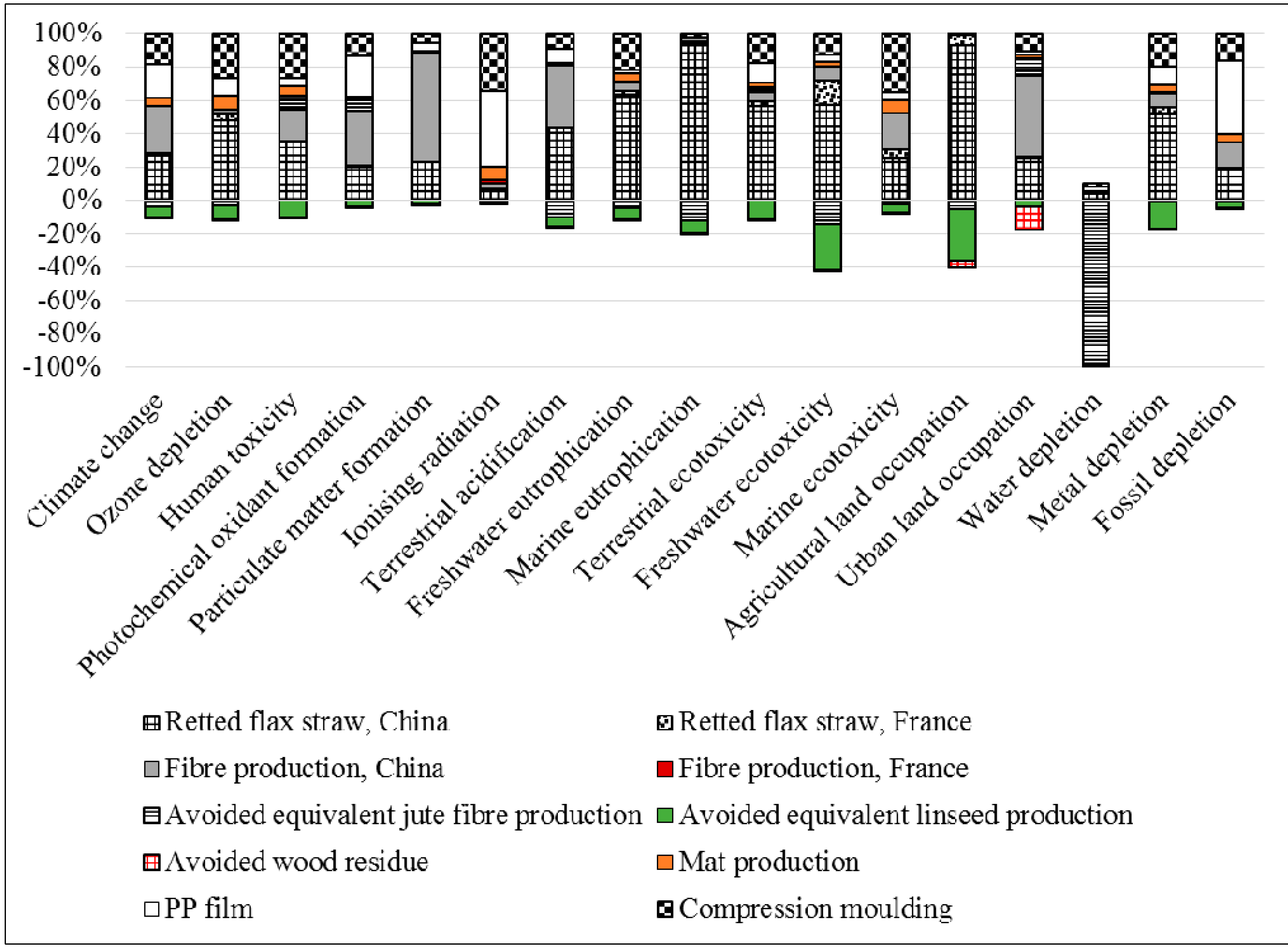
The environmental midpoint results for marginal flax mat-PP composite production of are shown in Figure 4.
The retted flax straw production in China is found to be the most influential factor (average of 40%) on the environmental impact of marginal flax mat-PP composite production compared to a much smaller 2.7% fraction for retted flax straw production in France. Due to inferior flax cultivars applied in Chinese flax cultivation, the unretted flax straw yield in China (Heilongjiang province) remains around 3750 kg ha–1, which is half the yield in France. Moreover, Chinese flax straw contains only 11% fibre content, and the hackling efficiency is 45% [40]. Both of these values are much lower than those of France flax fibre and fibre extraction, which are 22% and 60%, respectively. Besides, warm-water retting, which is the most common technology used in China, increases the environmental burden compared to dew retting in France because more energy is required to dry the flax straw after retting. In addition, particularly high burden intensity of Chinese flax fibre production is recorded in the categories of particulate matter formation and terrestrial acidification categories due to coal-fired electricity generation in China (Table 5).
The extruded PP film has an average environmental burden share of 13.4% among these impact categories. A particularly high share is observed in fossil depletion (~50%), which is because PP is conventionally derived from crude oil. The mat manufacturing process causes negligible environmental impacts in most categories. The last step in composite fabrication, i.e., compression moulding, is more noticeable than the mat manufacturing process in terms of the environmental burden. The environmental impact of the two manufacturing processes reflects their electricity consumption levels.
Another important finding is that a net negative impact value is recorded for water depletion in flax mat-PP production. The equivalent jute fibre production involves irrigation during the cultivation stage. Given that jute fibres are displaced by a co-product from flax fibre production, i.e., flax tows, a significant reduction in water is realised.
Figure 4.
Midpoint results for the marginal production of per kg flax mat-PP composites using consequential LCA.
3.3.2. Comparison between Flax Mat-PP and Glass Mat-PP in the Production and end-of-life (EoL) Stages
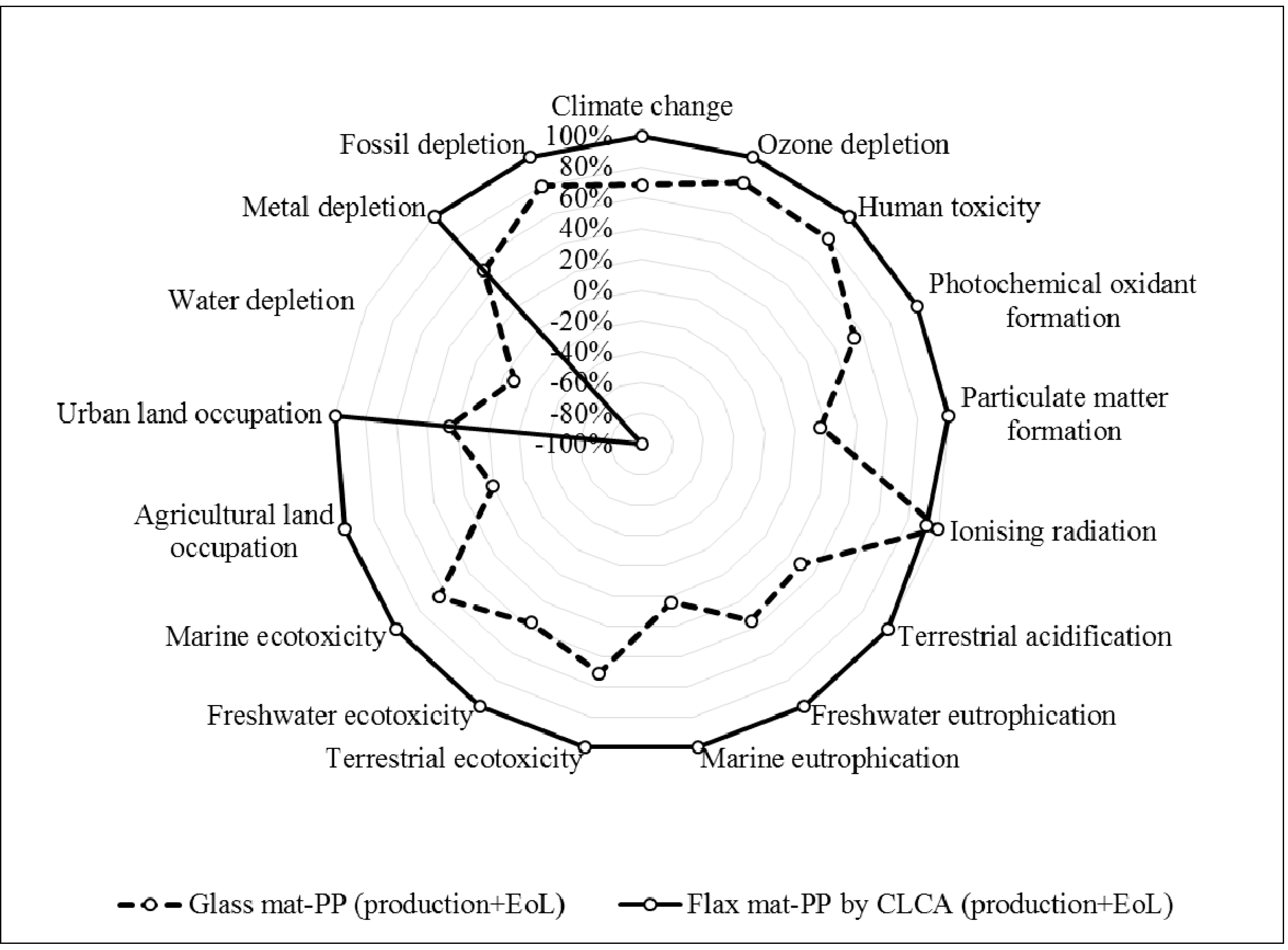
The effect from the combined production and EoL stages is separately evaluated because it can represent the environmental profile of applications where no significant energy or materials are invested during the use phase (Figure 5).
Figure 5.
Environmental impact comparison between flax mat-PP and glass mat-PP during production and end-of-life (EoL) phases.
The most pronounced finding from the comparison is that in most impact categories, including climate change and fossil depletion, the flax mat-PP impact values are larger than the glass mat-PP values using the CLCA approach. The high impact of flax fibre production relative to glass fibre production is related to the following:
- (1)
- Inferior flax cultivars produce lower flax fibre yield efficiencies in China. In France, a cultivated flax hectare produces approximately 1000 kg hackled long flax fibres. On the same basis, only 150 kg of hackled flax long fibres are obtained in China.
- (2)
- The Chinese electricity mix depends heavily on coal (Table 5). Moreover, coal-fired electricity is particularly detrimental to the environment in terms of terrestrial acidification and particulate matter formation.
3.3.3. Life Cycle Environmental Impact Changes
Environmental impact changes are assessed using the difference in impact values between flax mat/PP and glass mat/PP for each life cycle stage (Table 6). The use phase contributes most to the impact reduction. The EoL stage constituents a much smaller fraction of the impact reduction. Moreover, the production phase incurs positive environmental impact changes in most impact categories because the primary component of the marginal flax supply mix, i.e., Chinese flax fibre production, is environmentally burdensome. In 10 of the 17 impact categories, net positive values are obtained for a full life cycle. It indicates that, when shifting to flax mat-PP, the large impact increase in the production stage overrides the impact reduction in both the use and EoL stages.
Table 6.
Impact changes induced by flax mat-PP replacing glass mat-PP.
| Unit | Production | Use | End-of-life (EoL) | Total | |
|---|---|---|---|---|---|
| Climate change | kg CO2 eq | 23.8 | −22.5 | −1.6 | −0.4 |
| Ozone depletion | mg CFC−11 eq | 0.7 | −3.1 | −0.3 | −2.7 |
| Human toxicity | kg 1,4−DB eq | 4.7 | −0.9 | −1.0 | 2.8 |
| Photochemical oxidant formation | g NMVOC | 95.2 | −109.4 | −4.5 | −18.7 |
| Particulate matter formation | g PM19 eq | 214.2 | −22.6 | −2.2 | 189.5 |
| Ionising radiation | g U235 eq | −177.7 | −508.7 | −1053.2 | −1739.6 |
| Terrestrial acidification | g SO2 eq | 299.3 | −65.6 | −6.8 | 226.8 |
| Freshwater eutrophication | g P eq | 22.4 | −0.6 | −1.4 | 20.3 |
| Marine eutrophication | g N eq | 121.0 | −2.7 | −0.4 | 117.9 |
| Terrestrial ecotoxicity | g 1,4−DB eq | 3.4 | −3.2 | −0.2 | 0.1 |
| Freshwater ecotoxicity | g 1,4−DB eq | 366.6 | −20.3 | −20.2 | 326.2 |
| Marine ecotoxicity | g 1,4−DB eq | 121.1 | −33.5 | −20.6 | 67.1 |
| Agricultural land occupation | m2a | 72.3 | 0.0 | 0.0 | 72.2 |
| Urban land occupation | m2a | 0.2 | 0.0 | 0.0 | 0.2 |
| Water depletion | litre | −3428.4 | −27.4 | −11.1 | −3466.9 |
| Metal depletion | g Fe eq | 786.0 | −102.8 | −64.2 | 619.0 |
| Fossil depletion | kg oil eq | 5.1 | −7.7 | −1.0 | −3.6 |
3.3.4. Implication for Policy Making
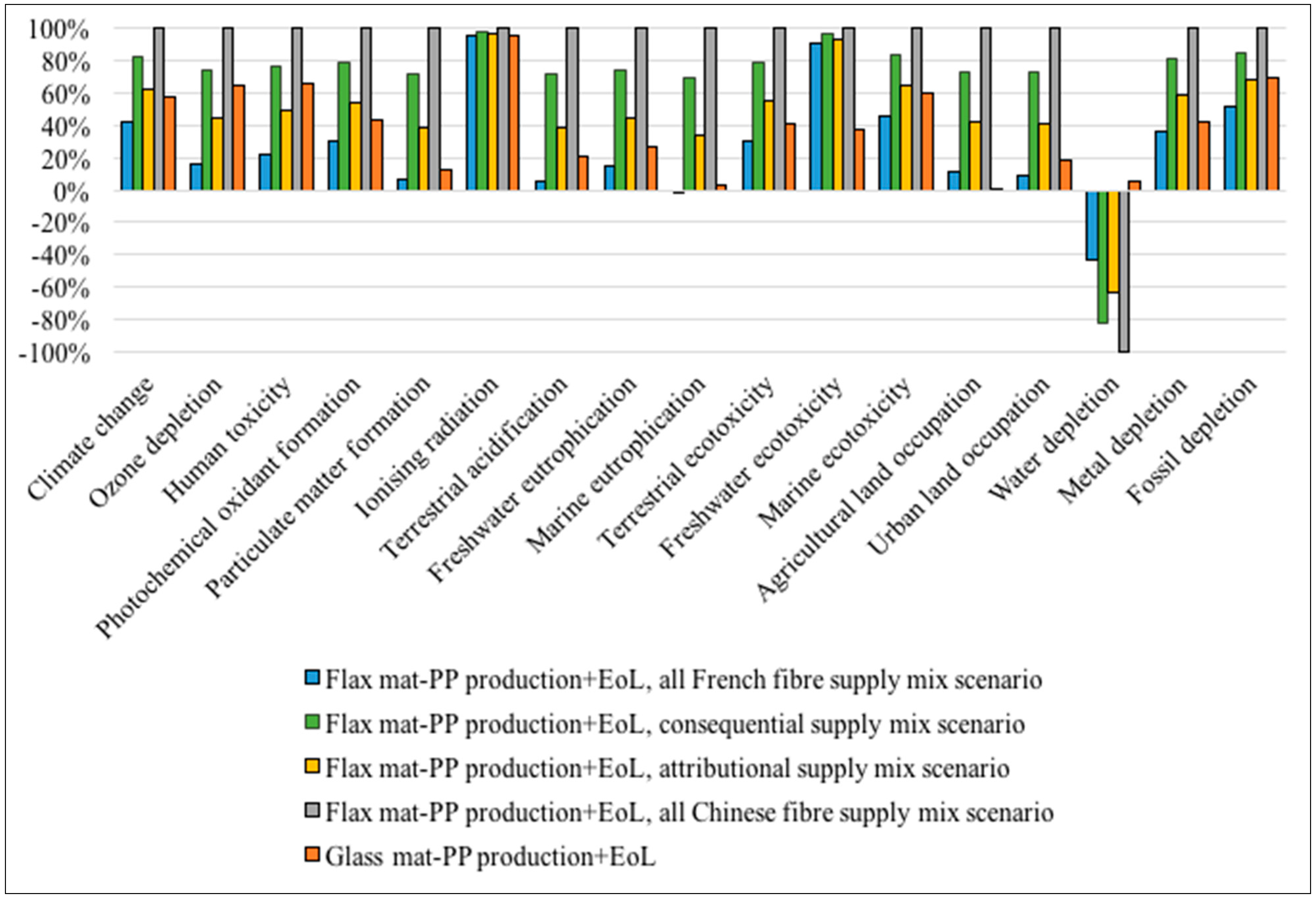
In general, together with the consequential mix evaluated before, the four scenarios constituent a set of “what-if” analysis, which provides insights under the assumptions used and indications for policy making in terms of the environmental impact.
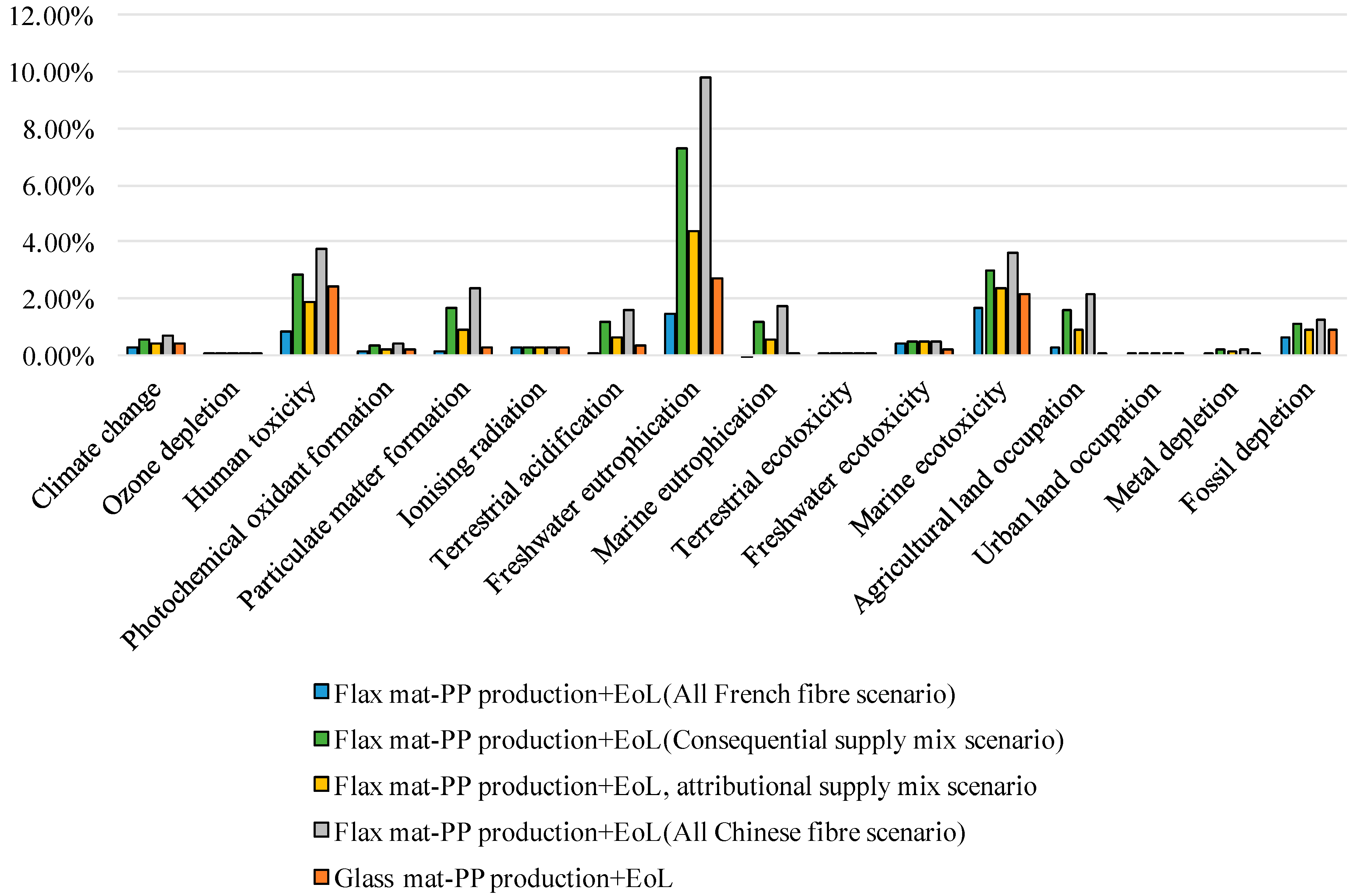
If switching from the already applied consequential marginal supply mix to “all French fibre supply mix” scenario, significant reductions are achieved in most impact categories. The “all French flax fibre” scenario largely represents the situation of a pure ALCA study. Thus smaller environmental impact values are obtained compared to glass mat-PP under such marginal supply scenario (Figure 6). On the contrary, the “all Chinese fibre supply mix” scenario proposes significant increases in multiple categories in reference to the “all French fibre” scenario (100% French flax fibre source). In most impact categories, the “all Chinese fibre” scenario (100% Chinese flax fibre source) leads to 2–4 times higher impact values including categories of climate change, photochemical oxidant formation, human toxicity, freshwater eutrophication, terrestrial ecotoxicity, marine ecotoxicity, metal depletion and fossil depletion. In some extreme cases of terrestrial acidification, particulate matter formation, agricultural land occupation and urban land occupation impact categories, 8–16 times higher impact values are recorded following the “all Chinese fibre” scenario.
Figure 6.
Environmental impact comparison for flax mat-PP with different scenarios of marginal flax fibre supply over production and EoL phases.
Within the upper and lower boundaries of environmental impact from the “all Chinese fibre” scenario and “all French fibre” scenario, respectively, the additional “attributional supply mix” scenario shows global reductions among impact categories in reference to the presented “consequential supply mix” scenario. In this situation, it can be found that the environmental impact profile of flax mat-PP becomes comparable to the profile of glass mat-PP. Hence, the attributional share, which is 60% French flax fibre and 40% Chinese flax fibre, can be used as a break-even criterion.
After normalisation, for scenarios incorporated with Chinese fibre source, the freshwater eutrophication impact category is found to be the most significant category followed by human toxicity, particulate matter formation, marine toxicity, and terrestrial acidification. The high level of significance in freshwater eutrophication is believed to be induced by a phosphorus fertiliser application against a very low yield of retted flax straw. The coal-fired electricity leads to burdens in other mentioned impact categories (Figure 7).
Figure 7.
Normalised environmental impact profiles of flax mat-PP with different marginal flax fibre supply scenarios over production and EoL phases.
3.4. Sensitivity Analysis
3.4.1. Impact Comparison between Attributional and Consequential LCAs
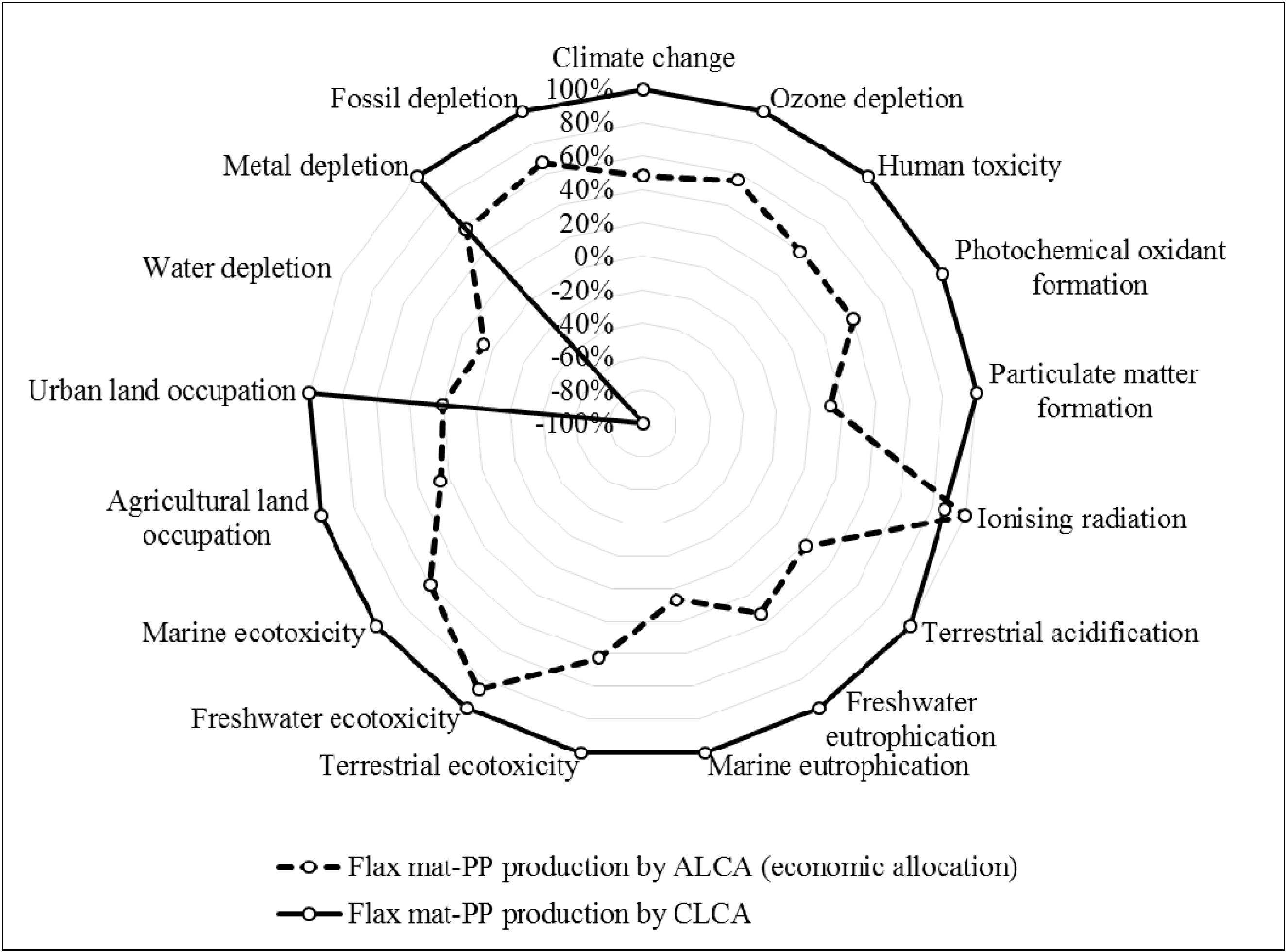
It is beneficial to compare the flax mat-PP results obtained from both attributional and consequential perspectives (Figure 8). To conduct ALCA, geographical boundary of flax cultivation should be France due to the fact that European automotive manufactures are most active in promoting natural fibres. Co-products are treated via economic allocation [11]. Electricity mix is based on current share of French electricity generation. The LCIs for rest processes including mat production and composite fabrication are the same as those in the consequential life cycle study. Detailed LCI for flax cultivation in France and subsequent fibre production can be referred to references 11 and 26.
The CLCA predicts higher impacts in nearly all categories. In most impact categories, the impacts predicted using ALCA remain at 30%–60% of the CLCA values. Compared to the flax fibre production supply mix in the CLCA, the system boundary is confined to flax cultivation and fibre extraction in France in the ALCA approach. The lower flax mat-PP environmental effect in the ALCA is explained by the fact that the French flax fibre production incurs much less environmental burden than does the Chinese flax fibre production.
Figure 8.
Environmental impact comparison of flax mat-PP production between CLCA and ALCA.
3.4.2. Sensitivity to Equivalent Product
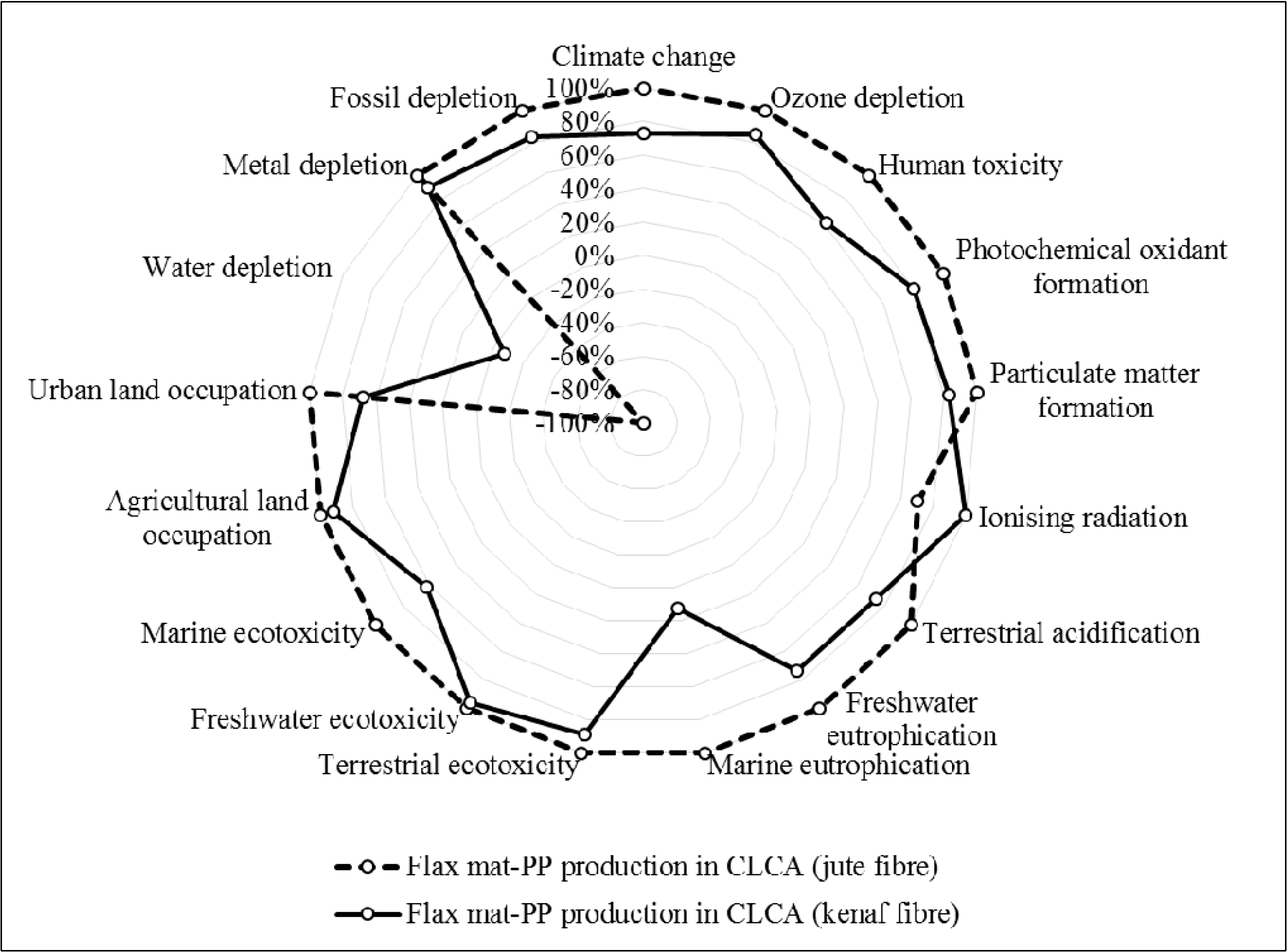
The identification of avoided equivalent products may bear uncertainties. In particular, the equivalent jute fibre production in India is displaced by co-product, i.e., flax tow, from flax fibre extraction processes in both France and China. The sensitivity analysis assesses another scenario, i.e., kenaf fibre in China, which is equivalent to flax tows in China because kenaf fibre is a close substitute for flax fibres in producing coarse fabrics, baggings, ropes and blended fabrics with cotton [41]. China is a major global kenaf fibre producer, accounting for 40% of the total production; most kenaf fibres are consumed within China [42]. Detailed information on kenaf fibre production is provided in the SI. The identification of the equivalent Canadian linseed cultivation is less uncertain.
Figure 9.
Sensitivity to equivalent product of flax tow.
Comparing the two types of avoided equivalent products, i.e., jute and kenaf fibres, the marginal flax mat-PP production environmental impact exhibits only a small change when flax tows are displaced by alternative suppliers in the sensitivity analysis (Figure 9).
3.4.3. Sensitivity to Glass Mat Production
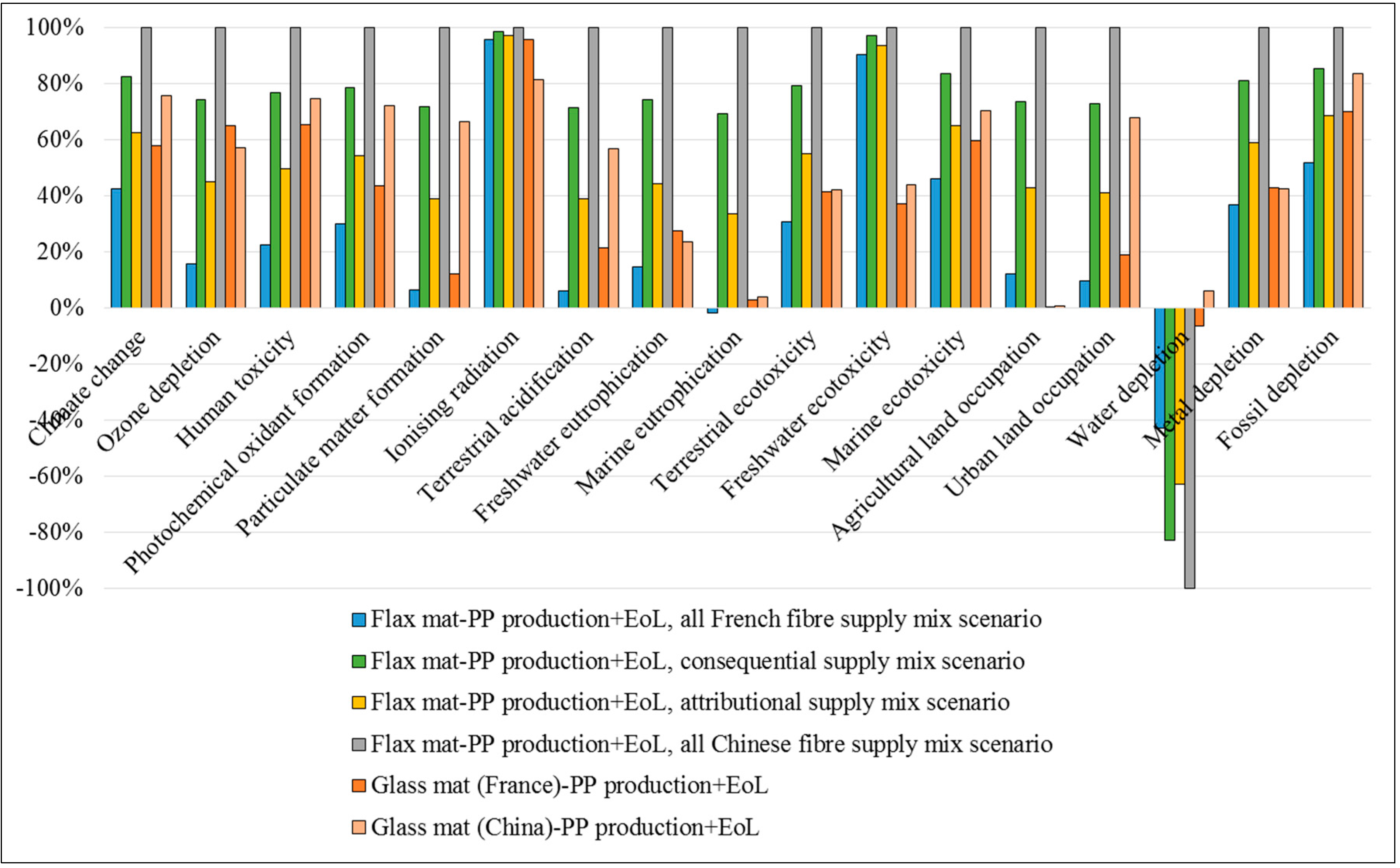
The main body of the study only deals with glass fibre and glass fibre mat produced in Europe. In the sensitivity analysis, an evolutionary perspective is taken to examine the environmental impact comparison for glass fibre mat produced in China. The comparison is useful to judge whether environmental benefit can be achieved if using flax mat-PP to replace glass mat-PP for automotive components in China. It should be noted that in this case the flax mat-PP composite is still assumed to be produced in Europe and transported to China. This assumption is reasonable because natural fibre reinforced composite is widely produced in Europe.
Figure 10 clearly shows that when produced in China, environmental impact of glass mat-PP adds 10%–30% shares of environmental impact over multiple impact categories including climate change, fossil depletion, human toxicity, freshwater ecotoxicity, marine ecotoxicity and photochemical oxidant formation. Some exceptional increases of environmental impact can be found in categories of particulate matter formation and terrestrial acidification, which are quite reasonable due to coal-fired electricity generation in China. Considerable decrease in the impact category of ionising radiation is achieved. This reduction should be ascribed to larger share of nuclear energy for electricity generation in Europe.
Figure 10.
Sensitivity to glass mat production site.
4. Conclusions
This analysis presents a CLCA study on environmental impact changes due to flax mat-PP composite replacing glass mat-PP for automotive usage. A marginal demand for flax mat in composite reinforcement induces a global marginal supply mix of flax fibres from China and France that propagates to Indian jute fibre and Canadian linseed cultivation by system expansion.
The midpoint impact characterisation results show that under the selected functional unit framework, if only the production and EoL phases are considered, the impact comparison for marginal production favours glass mat-PP over flax mat-PP primarily due to the less efficient technologies used in flax cultivation and fibre processing in China. Another important aspect is that electricity generation in China depends largely on coal, which causes a large burden in most impact categories. For the life cycle impact results, the analysis reveals that shifting from glass mat-PP to flax mat-PP induces positive impact reductions in most impact categories due to large increases in environmental burden during the production phase.
Furthermore, this study evaluates alternative scenarios including the all French flax fibre and all Chinese flax fibre supplies, which can be regarded as the lower and upper boundaries for all potential marginal flax supply trajectories, and the attributional supply mix in between. These scenarios, together with the aforementioned consequential supply mix, reflect different global consequences of flax fibre supply in response to the scope of policies and market trend. The scenarios incur greatly deviated impact results in most categories in the case of flax mat-PP over production and EoL phases. Compared to the glass mat-PP, the all French flax fibre supply results in lower impact results except for the freshwater ecotoxicity and agricultural land occupation categories. On the contrary, the environmental profiles of flax mat-PP derived from the consequential supply mix and the all Chinese supply scenarios present environmental burdens well above the levels of the glass mat-PP. The attributional supply mix scenario, on the other hand, can be regarded as a break-even line for the relative shares between the Chinese flax fibre and French flax fibre in terms of comparing environmental impacts.
Acknowledgments
The authors would like to thank the three reviewers for their constructive comments on this article.
Author Contributions
Yelin Deng proposed the idea and conducted consequential life cycle assessment. Yajun Tian provided guidance, discussion, and reviewed the results.
Conflicts of Interest
The authors declare no conflict of interest.
References
- Wambua, P.; Ivens, J.; Verpoest, I. Natural fibres: Can they replace glass in fibre reinforced plastics? Compos. Sci. Tech. 2003, 63, 1259–1264. [Google Scholar] [CrossRef]
- Duflou, J.R.; Deng, Y.L.; Van Acker, K.; Dewulf, W. Do fiber-reinforced polymer composites provide environmentally benign alternatives? A life-cycle-assessment-based study. MRS Bull. 2012, 37, 374–382. [Google Scholar] [CrossRef]
- Shah, D. Developing plant fibre composites for structural applications by optimising composite parameters: A critical review. J. Mater. Sci. 2013, 48, 6083–6107. [Google Scholar] [CrossRef]
- Yan, L.; Chouw, N.; Jayaraman, K. Flax fibre and its composites–A review. Compos. B. 2014, 56, 296–317. [Google Scholar] [CrossRef]
- Kaup, M.; Karus, M.; Ortmann, S. The Use of Natural Fibres in Composite Materials in the German and Austrian Automotive Industry; Nova Institut GmbH: Hürth, Germany, 2002. [Google Scholar]
- Rajendran, S.; Scelsi, L.; Hodzic, A.; Soutis, C.; Al-Maadeed, M.A. Environmental impact assessment of composites containing recycled plastics. Resour. Conserv. Recycl. 2012, 60, 131–139. [Google Scholar] [CrossRef]
- Le Duigou, A.; Deux, J.M.; Davies, P.; Baley, C. Plla/flax mat/balsa bio-sandwich-environmental impact and simplified life cycle analysis. Appl. Compos. Mater. 2012, 19, 363–378. [Google Scholar] [CrossRef]
- Dissanayake, N.P.J.; Summerscales, J.; Grove, S.M.; Singh, M.M. Life cycle impact assessment of flax fibre for the reinforcement of composites. J. Biobased Mater. Bioenerg. 2009, 3, 245–248. [Google Scholar] [CrossRef]
- Le Duigou, A.; Baley, C. Coupled micromechanical analysis and life cycle assessment as an integrated tool for natural fibre composites development. J. Clean Prod. 2014, 83, 61–69. [Google Scholar] [CrossRef]
- Deng, Y.; van Acker, K.; Dewulf, W.; Duflou, J.R. Environmental assessment of printed circuit boards from biobased materials. In Glocalized Solutions for Sustainability in Manufacturing; Springer Berlin Heidelberg: Berlin, Germany, 2011; pp. 605–610. [Google Scholar]
- Le Duigou, A.; Davies, P.; Baley, C. Environmental impact analysis of the production of flax fibres to be used as composite material reinforcement. J. Biobased Mater. Bioenerg. 2011, 5, 153–165. [Google Scholar] [CrossRef]
- Finnveden, G.; Hauschild, M.Z.; Ekvall, T.; Guinee, J.; Heijungs, R.; Hellweg, S.; Koehler, A.; Pennington, D.; Suh, S. Recent developments in life cycle assessment. J. Environ. Manag. 2009, 91, 1–21. [Google Scholar] [CrossRef] [PubMed]
- Tillman, A.-M. Significance of decision-making for lca methodology. Environ. Impact. Assess. Rev. 2000, 20, 113–123. [Google Scholar] [CrossRef]
- Pawelzik, P.; Carus, M.; Hotchkiss, J.; Narayan, R.; Selke, S.; Wellisch, M.; Weiss, M.; Wicke, B.; Patel, M.K. Critical aspects in the life cycle assessment (lca) of bio-based materials—reviewing methodologies and deriving recommendations. Resour. Conserv. Recy. 2013, 73, 211–228. [Google Scholar] [CrossRef]
- FAO database. Available online: http://faostat.fao.org/site/567/default.aspx#ancor (accessed on 15 August 2015).
- Ashby, M.F. Materials Selection in Mechanical Design; Butterworth-Heinemann: Oxford, MA, USA, 2005. [Google Scholar]
- Dalgaard, R.; Schmidt, J.; Halberg, N.; Christensen, P.; Thrane, M.; Pengue, W. Lca of soybean meal. Int. J. LCA 2008, 13, 240–254. [Google Scholar] [CrossRef]
- Weidema, B.P. Market information in life cycle assessment. Available online: http://www.norlca.org/resources/780.pdf (accessed on 15 August 2015).
- Mackiewicz-Talarczyk, M.; Barriga-Bedoya, J.; Mankowski, J.; Pniewska, I. Global flax market situation. In Proceedings of 2008 International Conference on Flax & Other Bast Plants, Saskatoon, SK, Canada, 21–24 July 2008; pp. 970–978.
- Weidema, B. Avoiding co-product allocation in life-cycle assessment. J. Ind. Ecol. 2000, 4, 11–33. [Google Scholar] [CrossRef]
- Falisse, A. Interactive European Network for Industrial Crops and Their Application; Gembloux Agricultural University: Gembloux, Belgium, 2003. [Google Scholar]
- Milà i Canals, L.; Rigarlsford, G.; Sim, S. Land use impact assessment of margarine. Int. J. LCA 2013, 18, 1265–1277. [Google Scholar] [CrossRef]
- Schmitz, A.; Kamiński, J.; Maria Scalet, B.; Soria, A. Energy consumption and CO2 emissions of the european glass industry. Energy Policy 2011, 39, 142–155. [Google Scholar] [CrossRef]
- Best available techniques (BAT) reference document for the manufacture of glass. Available online: http://bookshop.europa.eu/en/best-available-techniques-bat-reference-document-for-the-manufacture-of-glass-pbLFNA25786/ (accessed on 15 August 2015).
- Schmidt, J.H. Life assessment of rapeseed oil and palm oil. Ph.D. Thesis, Aalborg University, Aalborg, Denmark, 2007. [Google Scholar]
- Analyse de cycle de vie comparée d’une chemise en lin et d’une chemise en coton. Available online: http://www.mastersoflinen.com/img/outilsPdfs/Rapport_ACV.pdf (accessed on 15 August 2015).
- Canadian farm fuel and fertilizer: Prices and expenses. Available online: http://www.agr.gc.ca/eng/industry-markets-and-trade/statistics-and-market-information/by-product-sector/crops/crops-market-information-canadian-industry/market-outlook-report/canadian-farm-fuel-and-fertilizerprices-and-expenses-march-2012/?id=1378845446435 (accessed on 15 August 2015).
- IEA database. Available online: http://www.iea.org/statistics/ (accessed on 15 August 2015).
- Birol, F. World Energy Outlook 2010; International Energy Agency: Paris, France, 2010. [Google Scholar]
- Generation adequacy report-on the electricity supply-demand balance in France 2011. Available online: http://www.rte-france.com (accessed on 15 August 2015).
- Results of specific data for energy, efficiency rates and coefficents, plant efficiency factors and NCB of 97 European W-t-E plants and determination of the main energy results. Available online: http://www.cewep.eu/media/www.cewep.eu/org/med_463/250_11_07_06_CEWP-Report_Final_Version.pdf (accessed on 15 August 2015).
- Tripathi, A.K.; Bhatt, V. Changing Environmental Ideologies; APH Publishing: New Del, India, 1992. [Google Scholar]
- Ahmed, Z.; Banu, H.; Akhter, F.; Izumori, K. A simple method for d-xylose extraction from jute stick and rice husk. Online J. Biol. Sci. 2001, 1, 1001–1004. [Google Scholar]
- Werner, F.; Althaus, H.; Künniger, T.; Richter, K.; Jungbluth, N. Life Cycle Inventories of Wood as Fuel and Construction Material; Ecoinvent report No.9; Swiss Centre for Life Cycle Inventories: Dübendorf, Swizerland, 2007. [Google Scholar]
- Stiller, H. Material Intensity of Advanced Composite Materials; Wuppertal Institue für Klima: Wuppertal, Germany, 1999. [Google Scholar]
- European benchmarking survey of energy consumption and adsorption of best practice. Available online: https://ec.europa.eu/energy/intelligent/projects/en/projects/recipe (accessed on 15 August 2015).
- Duflou, J.R.; Yelin, D.; van Acker, K.; Dewulf, W. Comparative impact assessment for flax fibre versus conventional glass fibre reinforced composites: Are bio-based reinforcement materials the way to go? CIRP Ann-Manuf. Techn. 2014, 63, 45–48. [Google Scholar] [CrossRef]
- Koffler, C.; Rohde-Brandenburger, K. On the calculation of fuel savings through lightweight design in automotive life cycle assessments. Int. J. LCA 2010, 15, 128–135. [Google Scholar] [CrossRef]
- Doka, G. Life Cycle Inventories of Waste Treatment Services; Ecoinvent report No.13; Swiss Centre for Life Cycle Inventories: Dübendorf, Swizerland, 2003. [Google Scholar]
- Wei, Y.; Kong, J.; Zhang, Y.; Lv, H.; Yu, J. Domestic and oversea production of flax: current situation, trend, and policy. Xinjiang Agric. Sci. 2007, 44, 70–75. [Google Scholar]
- Li, N.; Bai, Y. Charateriscs, planting status, and scope of applicatios of jute/kenef fibre. Guangxi Textile Sci. Tech. 2007, 36, 48–51. [Google Scholar]
- Althaus, J.; Dinkel, F.; Stettler, C.; Werner, F. Life Cycle Inventories of Renewable Materials; Ecoinvent report No.21; Swiss Centre for Life Cycle Inventories: Dübendorf, Switzerland, 2007. [Google Scholar]
© 2015 by the authors; licensee MDPI, Basel, Switzerland. This article is an open access article distributed under the terms and conditions of the Creative Commons Attribution license (http://creativecommons.org/licenses/by/4.0/).