Article

Incorporating Renewable Energy Science in Regional Landscape Design: Results from a Competition in The Netherlands
by
Renée M. De Waal
1,*,
Sven Stremke
1,†,
Anton Van Hoorn
2,†,
Ingrid Duchhart
1,† and
Adri Van den Brink
1,†
1
Landscape Architecture Group, Wageningen University, P.O. Box 47, 6700 AA Wageningen, The Netherlands
2
PBL Netherlands Environmental Assessment Agency, P.O. Box 30314, 2500 GH Den Haag, The Netherlands
*
Author to whom correspondence should be addressed.
These authors contributed equally to this work.
Sustainability 2015, 7(5), 4806-4828; https://doi.org/10.3390/su7054806
Submission received: 30 January 2015 / Revised: 10 April 2015 / Accepted: 15 April 2015 / Published: 23 April 2015
(This article belongs to the Special Issue Landscape and Sustainability)

Abstract

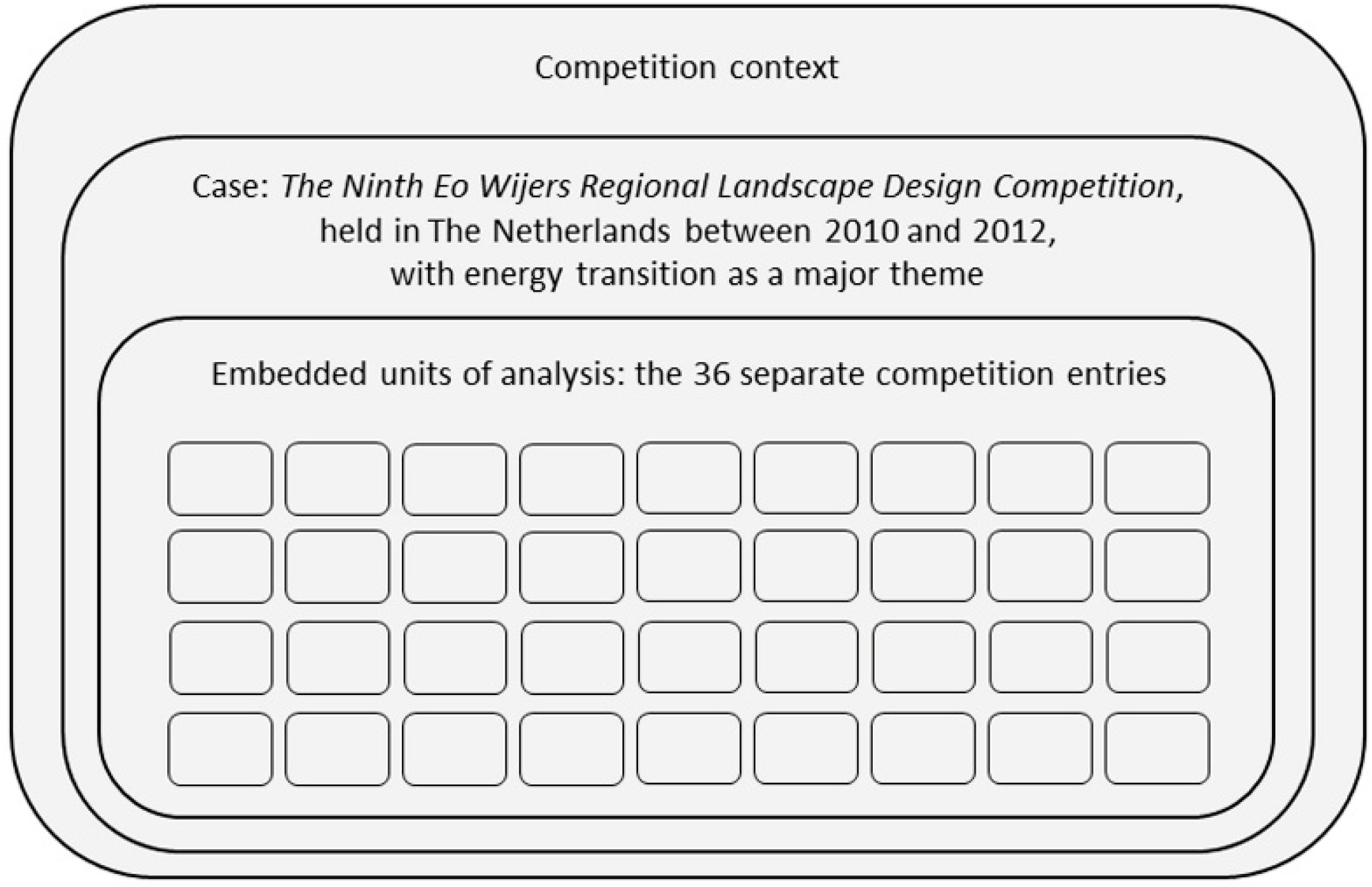
Energy transition is expected to make an important contribution to sustainable development. Although it is argued that landscape design could foster energy transition, there is scant empirical research on how practitioners approach this new challenge. The research question central to this study is: To what extent and how is renewable energy science incorporated in regional landscape design? To address this knowledge gap, a case study of a regional landscape design competition in the Netherlands, held from 2010–2012, is presented. Its focus was on integral, strategic landscape transformation with energy transition as a major theme. Content analysis of the 36 competition entries was supplemented and triangulated with a survey among the entrants, observation of the process and a study of the competition documents and website. Results indicated insufficient use of key-strategies elaborated by renewable energy science. If landscape design wants to adopt a supportive role towards energy transition, a well-informed and evidence-based approach is highly recommended. Nevertheless, promising strategies for addressing the complex process of ensuring sustainable energy transition also emerged. They include the careful cultivation of public support by developing inclusive and bottom-up processes, and balancing energy-conscious interventions with other land uses and interests.
Keywords: energy transition; sustainable energy; renewable energy; design competition; landscape architecture; planning; energy-conscious planning and design; renewable energy; strategic landscape design; evidence based design energy transition; sustainable energy; renewable energy; design competition; landscape architecture; planning; energy-conscious planning and design; renewable energy; strategic landscape design; evidence based design