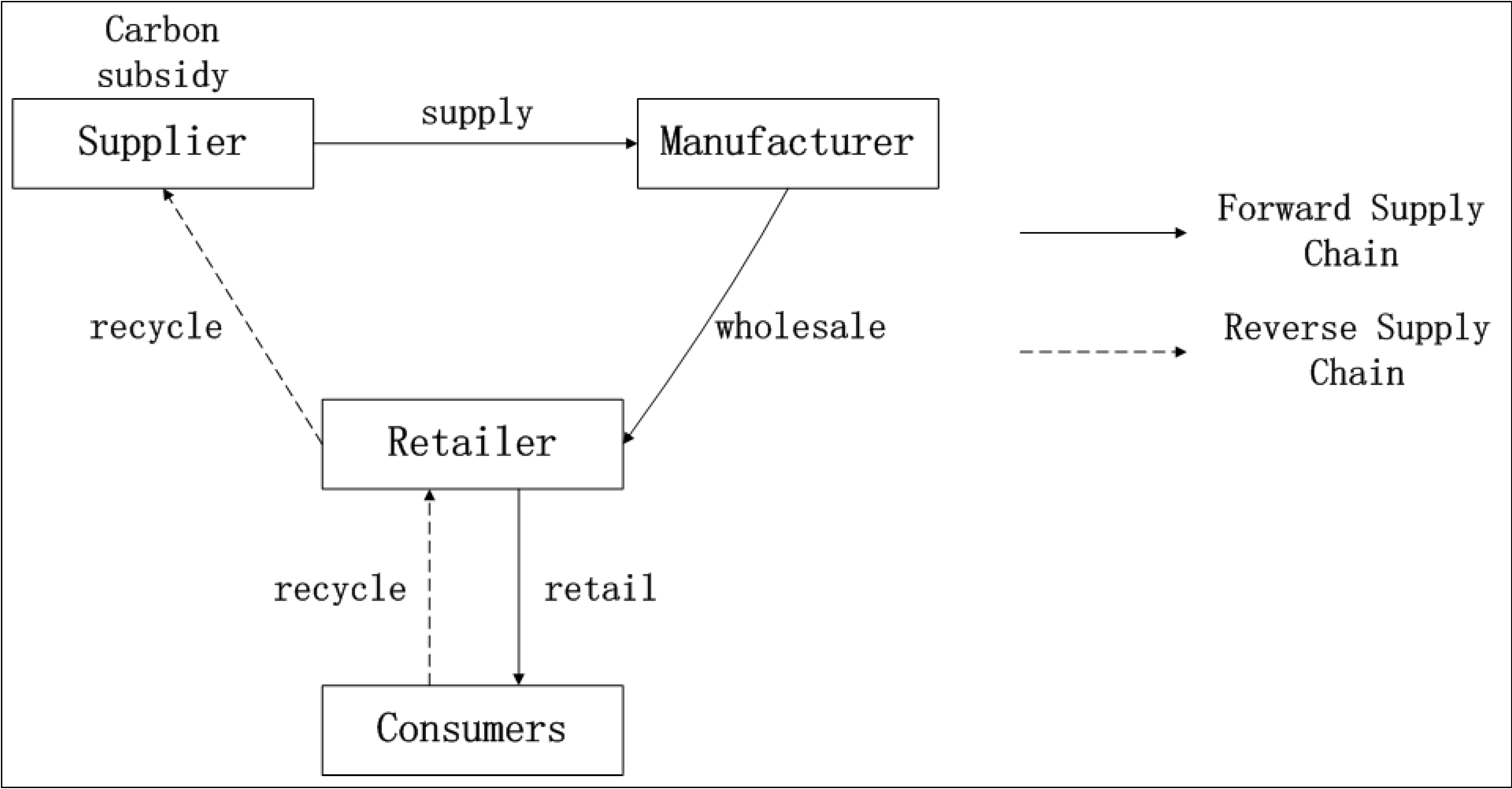
The Carbon Subsidy Analysis in Remanufacturing Closed-Loop Supply Chain


Abstract
:1. Introduction
2. Model Assumption and Notations

- Assumption 1. D(pr) = α − β pr, where both α and β are positive constants subject to α > β pr.
- Assumption 2. The RCLSC model is analyzed in a single-period framework.
- Assumption 3. The information among supply chain members is symmetric.
- Assumption 4. For the convenience of calculation, this paper only considers carbon emission produced in the process of producing raw materials from nature, disposal of waste products, and manufacturing the final product. In addition, it is assumed that Es > Em.
- Assumption 5. A unit waste product can be transformed to the amount of raw materials, which is needed to produce unit new product.
3. The Optimal Profits and Carbon Emission under Different Scenarios
3.1. Forward Supply Chain


 , we have:


 , we have:


 , we have:


 , the corresponding carbon emission quantities of the supplier and the manufacturer are given by:
 ,
,
 ,
,

 . The corresponding profits of the supplier, the manufacturer, the retailer, and the whole supply chain are , , , and
  , respectively. The corresponding carbon emission quantities of the supplier, the manufacturer, the whole supply chain are given by , , and
  , respectively.
3.2. Remanufacturing Closed-Loop Supply Chain
 +
+  )D(pr) ,
−
)D(pr) ,
−  )D(pr) .


 D(pr)
D(pr)
 , the optimal carbon emission quantities of the supplier and the manufacturer are given by:


 . The corresponding profits of the supplier, the manufacturer, the retailer, and the whole supply chain are , , , and
  , respectively. The corresponding carbon emission quantities of the supplier, the manufacturer, the whole supply chain are given by
  ,
,  , and
, and  , respectively.
3.3. Remanufacturing Closed-Loop Supply Chain with Carbon Subsidy
+ )D(pr) + s (es − )D(pr)
− )D(pr)


 D(pr)
D(pr)
 , the corresponding carbon emission quantities of the supplier and the manufacturer are given by:


 , , , and
  , respectively. The corresponding carbon emission quantities of the supplier, the manufacturer, the whole supply chain are
  ,
,  , and
, and  , respectively.
3.4. Selection between the Three Scenarios
- (i)
- If
![]() −
− ![]() ≤ cs, every agent of the supply chain will prefer the remanufacturing closed-loop supply chain to the forward supply chain since they can obtain more profit.
≤ cs, every agent of the supply chain will prefer the remanufacturing closed-loop supply chain to the forward supply chain since they can obtain more profit. - (ii)
- If 2
![]() ≤ s(es −
≤ s(es − ![]() ), every agent of the supply chain will prefer the remanufacturing closed-loop supply chain with the carbon subsidy to the remanufacturing closed-loop supply chain since they can obtain more profit.
), every agent of the supply chain will prefer the remanufacturing closed-loop supply chain with the carbon subsidy to the remanufacturing closed-loop supply chain since they can obtain more profit. - (iii)
- If
![]() +
+ ![]() ≤ cs + s(es −
≤ cs + s(es − ![]() ), every agent of the supply chain will prefer the remanufacturing closed-loop supply chain with carbon subsidy to the forward supply chain since they can obtain more profit.
), every agent of the supply chain will prefer the remanufacturing closed-loop supply chain with carbon subsidy to the forward supply chain since they can obtain more profit.
−  > cs, the government should provide the carbon subsidy to encourage the supplier to select the remanufacturing technology. If and only if
  , the subsidy can increase the profits of agents of the supply chain and deduce the carbon emission of the whole supply chain simultaneously.
4. Numerical Examples
= $30; Cm = $50; α = 500; β = 1; es = 40kg; = 20kg; em = 30kg. In the first scenario,  = $18385.9 and
  = 3587.5kg. To compare with the first scenario, we consider the second scenario. Given the actual situation, should satisfy < At the same time, the recycling price should be higher than $0. Then, the range of suitable recycling price is ($0, $502.8). We reflect the profit change of the whole supply chain, of two scenarios, in Figure 2.
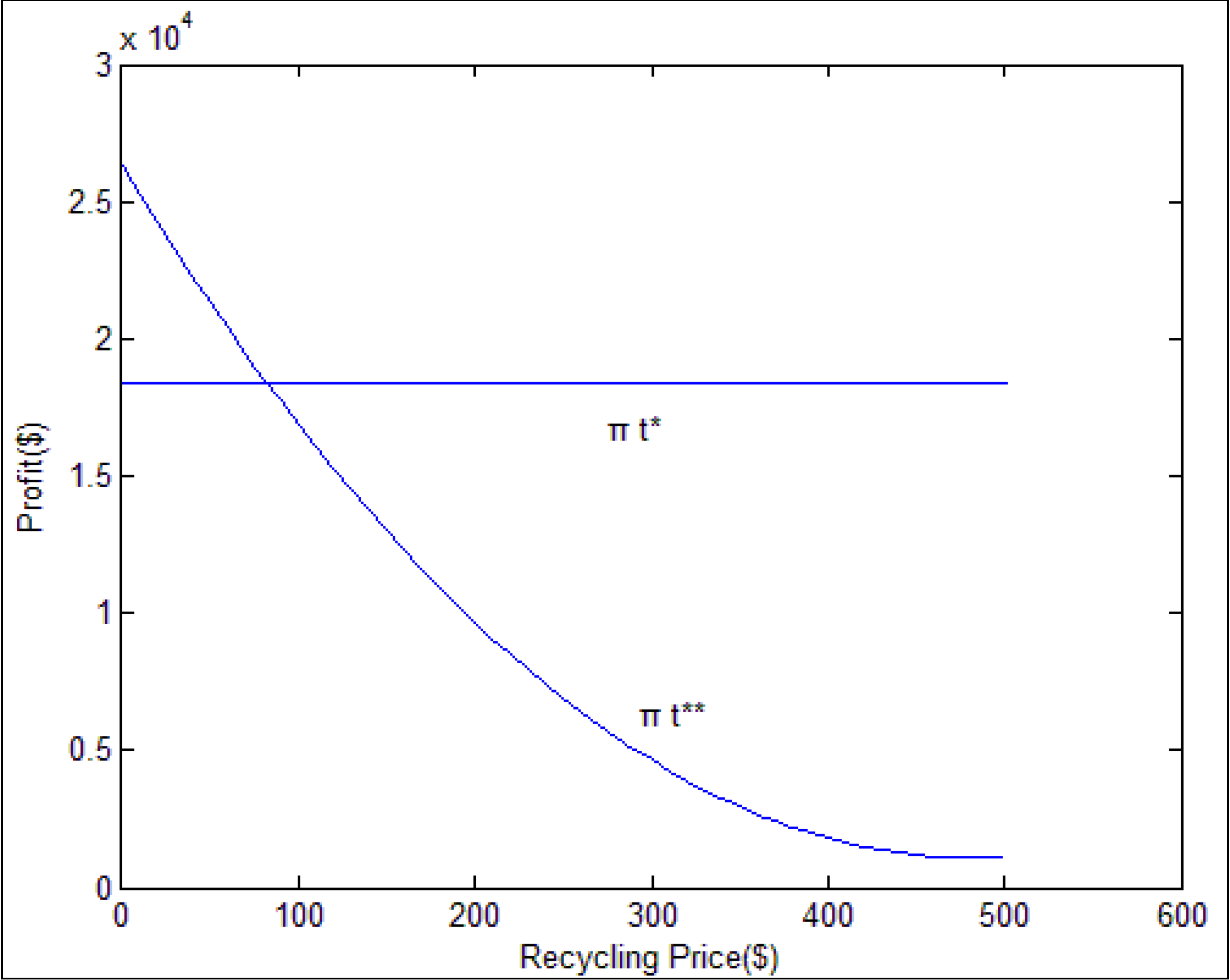 = $68.8 As the figure shows,
  when ∈ ($68.8, $502.8). Under this condition, we reflect the carbon emission quantities of the whole supply chain in Figure 3.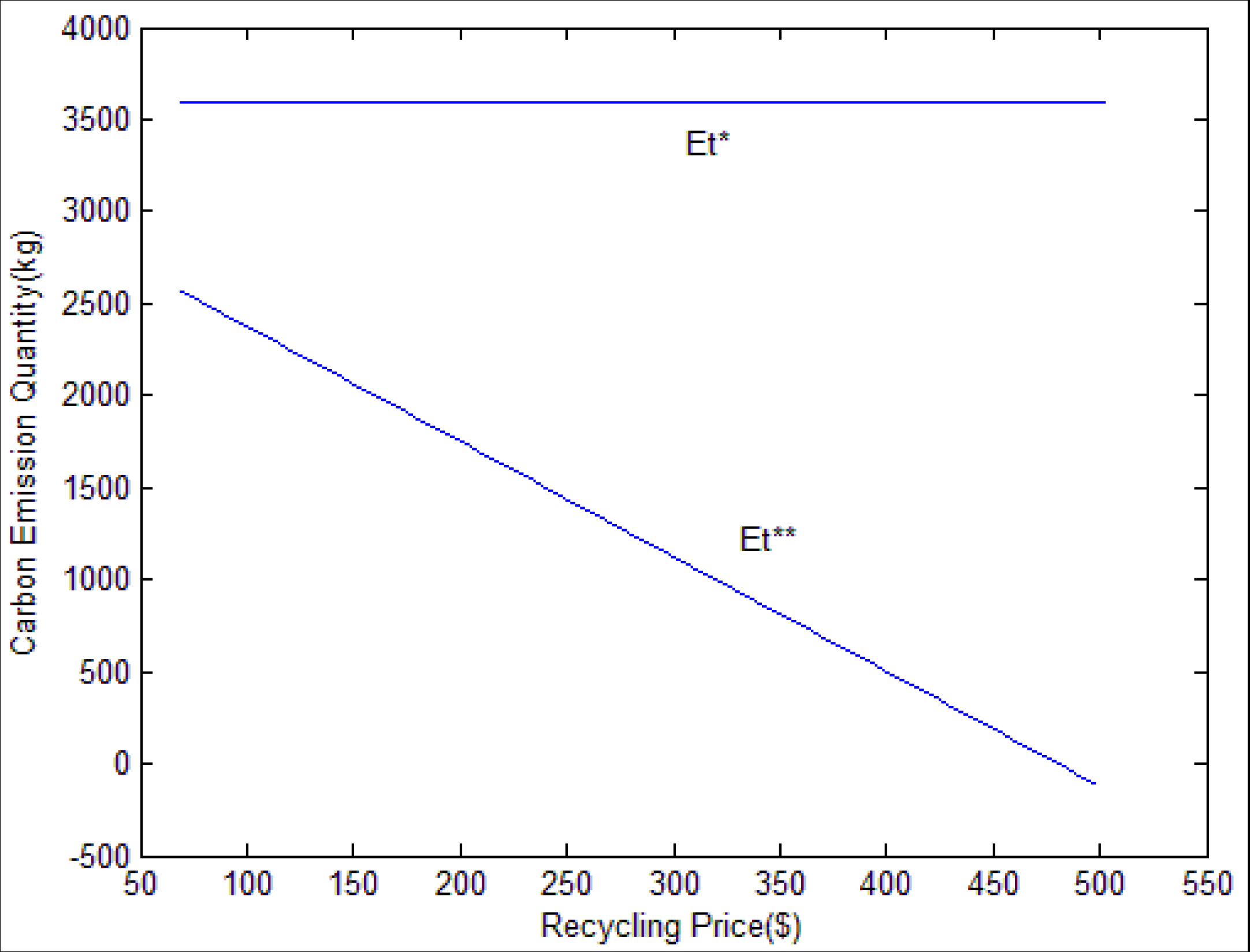
 when ∈ ($68.8, $502.8). In order to reduce carbon emission of the whole supply chain more, and make profit higher, the government needs to implement the carbon subsidy strategy. The ultimate objective is to reduce the carbon emission quantity of a whole supply chain on the basis of increasing profit. = $480. On the base of that, we investigate the impact of the subsidy to the supplier in terms of profit. The results are reflected in Figure 4.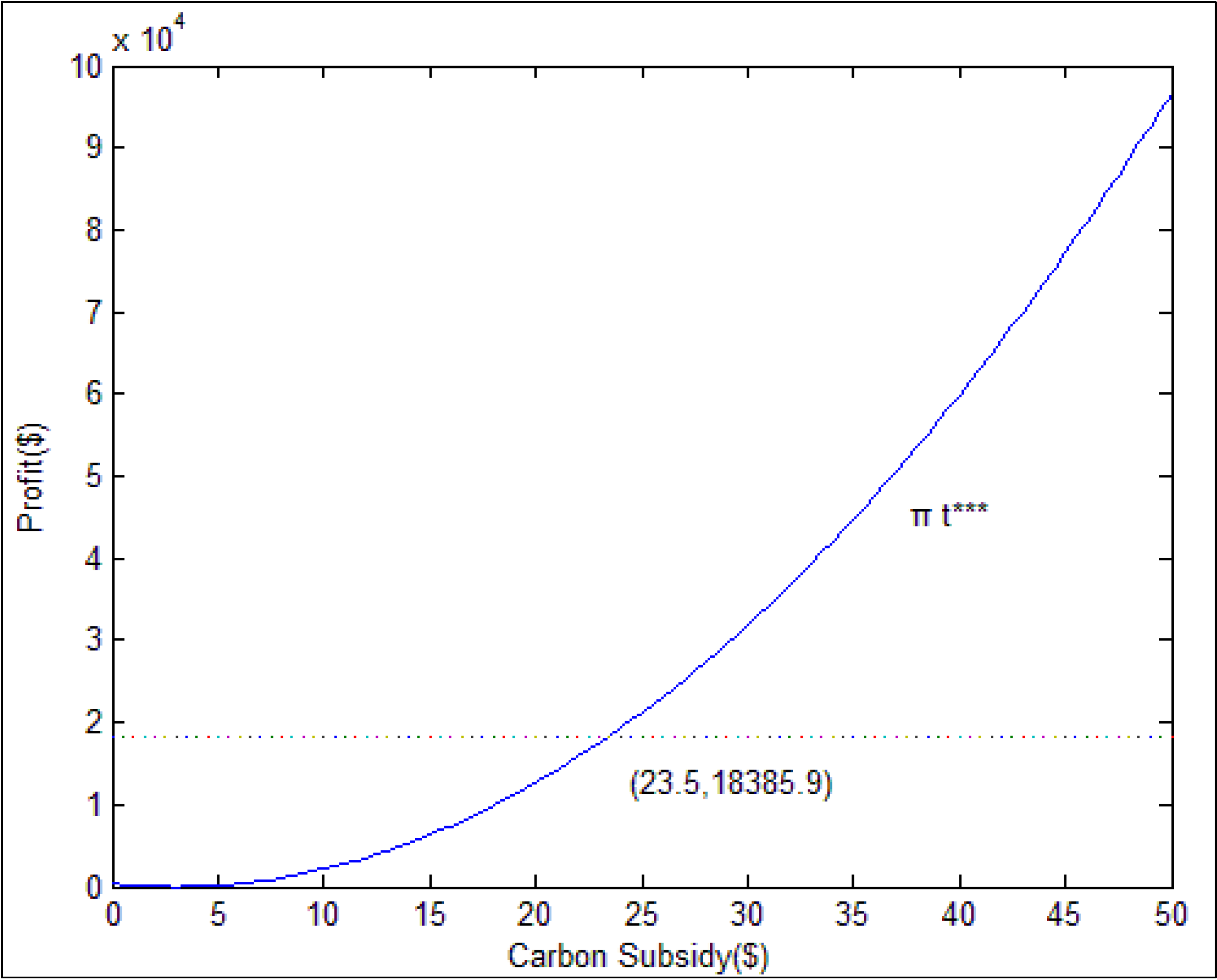
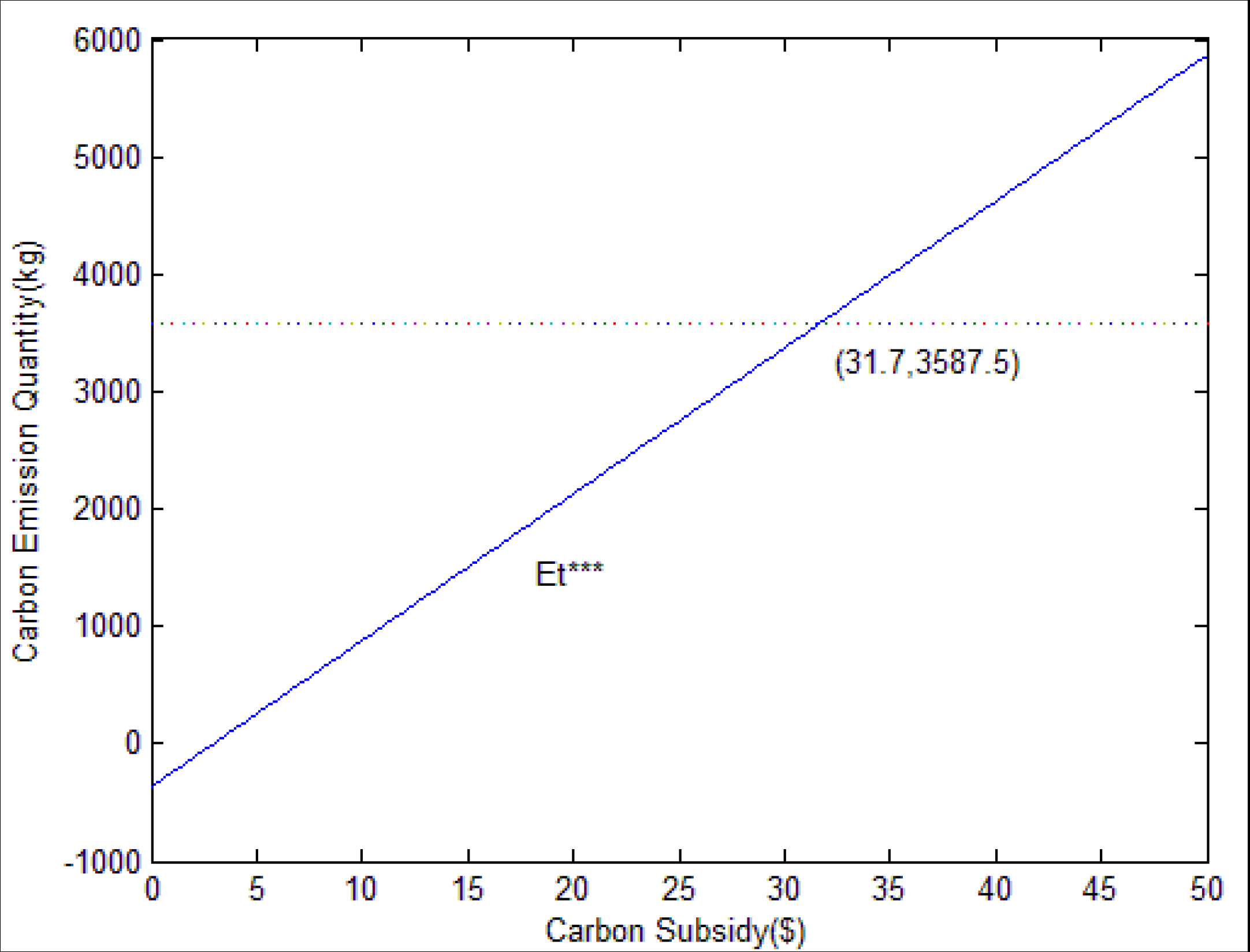
 when s ≥ $31.7. If we want the carbon emission quantity of RCLSC to be less than that of a forward supply chain, s should satisfy s < $31.7. In RCLSC, the reasonable range of a carbon subsidy is s ∈ ($23.5, $31.7). At this time, the profit of RCLSC is greater than that of a forward supply chain. Additionally, the carbon emission quantity of RCLSC is less than that of a forward supply chain.
5. Conclusions
Abbreviation
| Cs | unit cost of producing raw materials from nature; |
| | unit cost of disposing waste products; |
| Cm | unit cost of manufacturing final product; |
| ps | sale price of raw materials for manufacturing unit product that is determined by the supplier; |
| pm | wholesale price of unit product determined by the manufacturer; |
| pr | retail price of unit product determined by the retailer, pr > pm > ps > 0; |
| D(pr) | customer demand depends on pr; |
| | unit recycling price when the retailer recycles the waste products from consumers; |
| | unit recycling price when the supplier recycles the waste products from retailer; |
| s | unit carbon subsidy that government provides to the supplier according to the carbon emission quantity reduced in the process of manufacturing raw materials; |
| es | carbon emission quantity produced by the supplier in the process of producing raw materials from nature that meet the demand of manufacturing unit product; |
| | carbon emission quantity produced by the supplier in the process of acquiring raw materials from waste products that meets the demand of manufacturing unit product; |
| em | carbon emission quantity produced by the manufacturer in the process of manufacturing unit product; |
| πs, πm, πr and πt | profit of the supplier, the manufacturer, the retailer, and the whole supply chain, respectively; |
| Es, Em and Et | carbon emission quantity of the supplier, the manufacturer, and the whole supply chain, respectively. |
Acknowledgments
Author Contributions
Conflicts of Interest
References
- Li, J.; Xu, F.; Hua, G.W. On low-carbon supply chain management. In Proceedings of the 13th International Conference on Enterprise Information Systems; Beijing, China: 8 June 2011.
- Jo van Nunen, A.E.E.; Zuidwijk, R.A. E-enabled closed-loop supply chains. Calif. Manag. Rev. 2004, 46, 40–54. [Google Scholar]
- Guide, V.D.R., Jr.; van Wassenhove, L.N. Closed-loop supply chains: An introduction to the feature issue (Part1). Prod. Oper. Manag. 2006, 15, 345–350. [Google Scholar]
- Guide, V.D.R., Jr.; van Wassenhove, L.N. The evolution of closed-loop supply chain research. Oper. Res. 2009, 57, 10–18. [Google Scholar] [CrossRef]
- Savaskan, R.C.; Bhattacharya, S.; van Wassenhove, L.N. Closed-loop supply chain models with product remanufacturing. Manag. Sci. 2004, 50, 239–252. [Google Scholar] [CrossRef]
- Savaskan, R.C.; van Wassenhove, L.N. Reverse channel design: the case of competing retailers. Manag. Sci. 2006, 52, 1–14. [Google Scholar] [CrossRef]
- Paksoy, T.; Bektaş, T.; Özceylan, E. Operational and environmental performance measures in a multi-product closed-loop supply chain. Transport. Res. E-Log. 2011, 47, 532–546. [Google Scholar] [CrossRef]
- Thierry, M.C.; Saloman, M.; van Nunen, J.; van Wassenhove, L. Strategic issues in product recovery management. Calif. Manag. Rev. 1995, 37, 114–135. [Google Scholar] [CrossRef]
- Qiu, R.Z.; Huang, X.Y. The progress of studies on structure of the closed-loop supply chain. Manag. Rev. 2007, 19, 49–55. [Google Scholar]
- Choi, T.M.; Li, Y.J.; Xu, L. Channel leadership, performance and coordination in closed loop supply chains. Int. J. Prod. Econ. 2013, 146, 371–380. [Google Scholar] [CrossRef]
- Ramezani, M.; Bashiri, M.; Tavakkoli-Moghaddam, R. A robust design for a closed-loop supply chain network under an uncertain environment. Int. J. Adv. Manuf. Tech. 2013, 66, 825–843. [Google Scholar] [CrossRef]
- Zhang, J.; Liu, X.; Tu, Y.L. A capacitated production planning problem for closed-loop supply chain with remanufacturing. Int. J. Adv. Manuf. Tech. 2011, 54, 757–766. [Google Scholar] [CrossRef]
- Ferrer, G.; Swaminathan, J.M. Managing new and remanufactured products. Manag. Sci. 2006, 52, 15–26. [Google Scholar] [CrossRef]
- Majumder, P.; Groenevelt, H. Competition in manufacturing. Prod. Oper. Manag. 2001, 10, 125–141. [Google Scholar] [CrossRef]
- Mitra, S.; Webster, S. Competition in remanufacturing and the effects of government subsidies. Int. J. Prod. Econ. 2008, 111, 287–298. [Google Scholar] [CrossRef]
- Yi, Y.Y. Closed-loop supply chain game models with product remanufacturing. Syst. Eng. Theor. Pract. 2009, 29, 28–35. [Google Scholar] [CrossRef]
- Guan, Q.L.; Zhou, G.G.; Cao, J. Government constrained decision making model in recycling and remanufacturing closed-loop supply chain. Ind. Eng. J. 2009, 12, 40–44. [Google Scholar]
- Wang, W.B.; Da, Q.L. The decision-making model of the electronic product manufacturer about collection and remanufacturing based on premium and penalty mechanism. Chin. J. Manag. Sci. 2008, 16, 57–63. [Google Scholar]
- Wang, W.B.; Da, Q.L.; Hu, T.B.; Yang, G.F. Remanufacturing closed-loop supply chain network equilibrium model based on allowance and penalty. Oper. Res. Manag. Sci. 2010, 19, 65–72. [Google Scholar]
- Hua, G.W.; Cheng, T.C.E.; Wang, S.Y. Managing carbon footprints in inventory management. Int. J. Prod. Econ. 2011, 132, 178–185. [Google Scholar] [CrossRef]
- Choi, T.M. Multi-period risk minimization purchasing models for fashion products with interest rate, budget, and profit target considerations. Ann. Oper. Res. 2013. [Google Scholar] [CrossRef]
- Choi, T.M. Local sourcing and fashion quick response system: The impacts of carbon footprint tax. Transport. Res. E-Log. 2013, 55, 43–54. [Google Scholar] [CrossRef]
- Choi, T.M. Optimal apparel supplier selection with forecast updates under carbon emission taxation scheme. Comput. Oper. Res. 2013, 40, 2646–2655. [Google Scholar] [CrossRef]
- Chen, X.; Simchi-Levi, D. Pricing and inventory management. In The Oxford Handbook of Pricing Management; Philips, R., Ozalp, O., Eds.; Oxford University Press: Oxford, UK, 2012; pp. 784–822. [Google Scholar]
© 2014 by the authors; licensee MDPI, Basel, Switzerland. This article is an open access article distributed under the terms and conditions of the Creative Commons Attribution license (http://creativecommons.org/licenses/by/3.0/).
Share and Cite
Li, J.; Du, W.; Yang, F.; Hua, G. The Carbon Subsidy Analysis in Remanufacturing Closed-Loop Supply Chain. Sustainability 2014, 6, 3861-3877. https://doi.org/10.3390/su6063861
Li J, Du W, Yang F, Hua G. The Carbon Subsidy Analysis in Remanufacturing Closed-Loop Supply Chain. Sustainability. 2014; 6(6):3861-3877. https://doi.org/10.3390/su6063861
Chicago/Turabian StyleLi, Jian, Weihao Du, Fengmei Yang, and Guowei Hua. 2014. "The Carbon Subsidy Analysis in Remanufacturing Closed-Loop Supply Chain" Sustainability 6, no. 6: 3861-3877. https://doi.org/10.3390/su6063861
APA StyleLi, J., Du, W., Yang, F., & Hua, G. (2014). The Carbon Subsidy Analysis in Remanufacturing Closed-Loop Supply Chain. Sustainability, 6(6), 3861-3877. https://doi.org/10.3390/su6063861