Fluoride Enrichment and Health Risks in the Aksu River Basin Oasis: Implications for Soil–Groundwater Systems


Abstract
1. Introduction
2. Materials and Methods
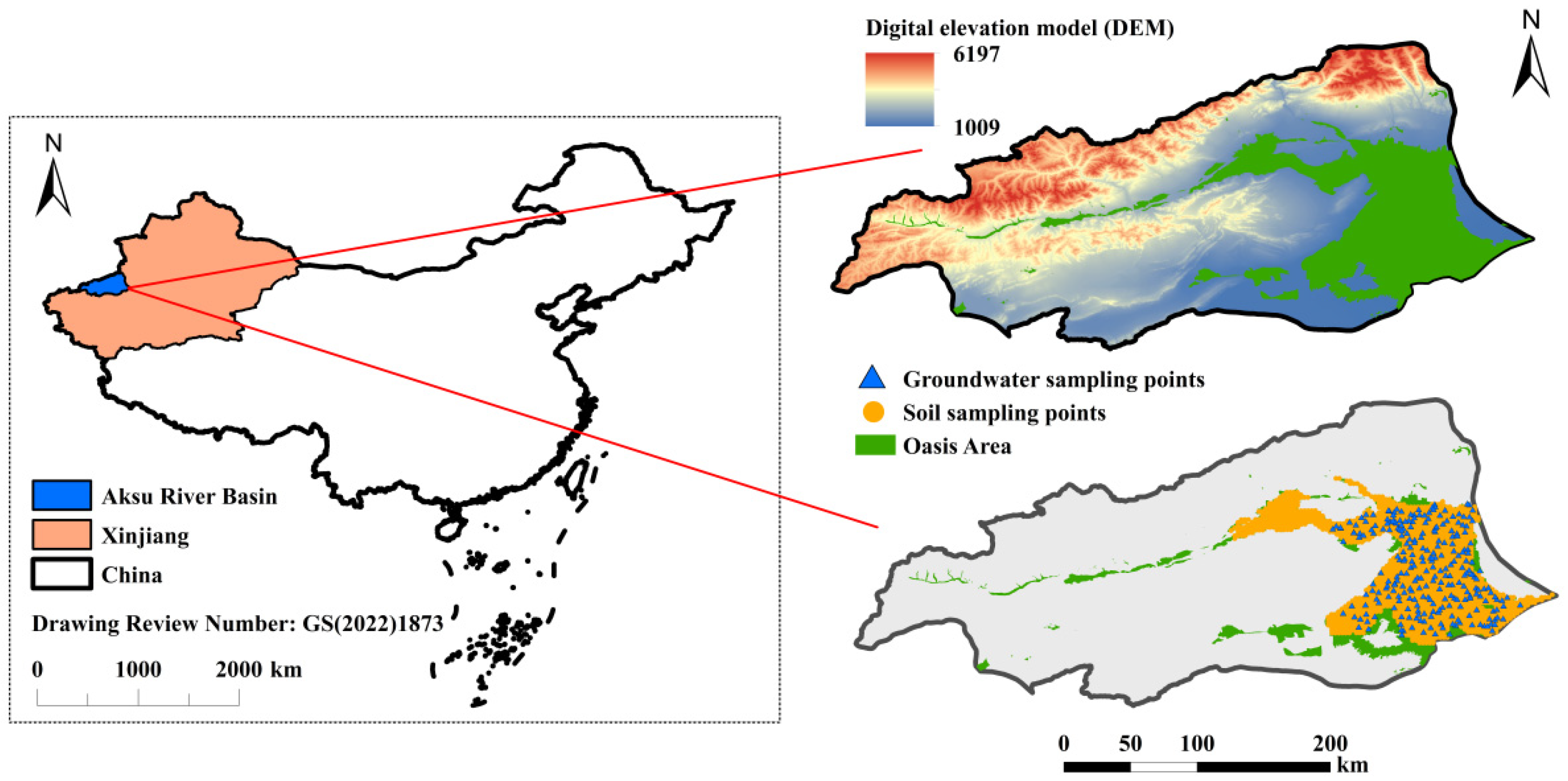
2.1. Study Area and Environmental Setting
2.2. Sampling and Laboratory Analysis
2.3. Spatial Interpolation and Hotspot Analysis
2.4. Health and Ecological Risk Assessment
2.4.1. Geo-Accumulation Index Evaluation
2.4.2. Potential Ecological Risk Index Evaluation
2.4.3. Human Health Risk Assessment
2.5. Driving Factor Analysis
3. Results
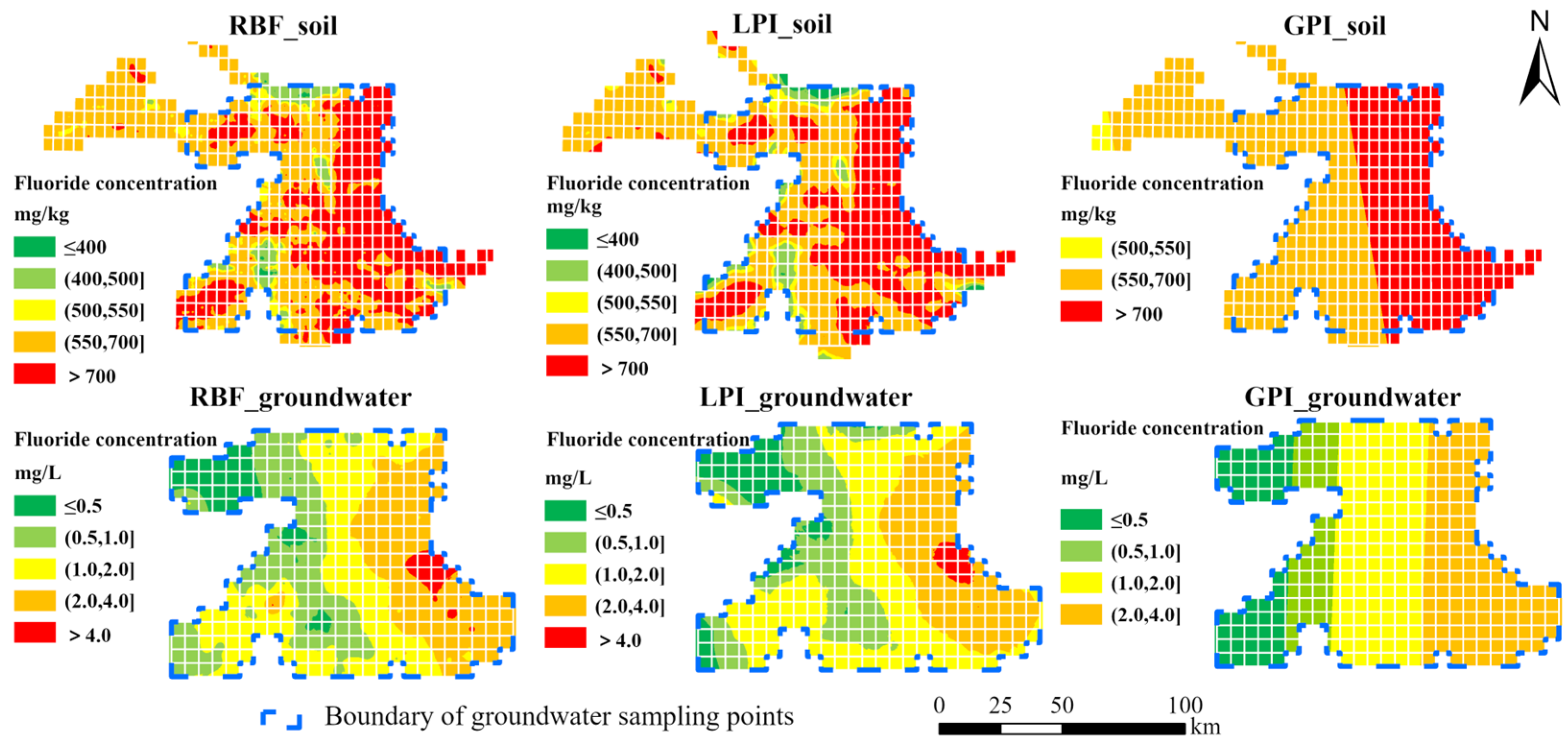
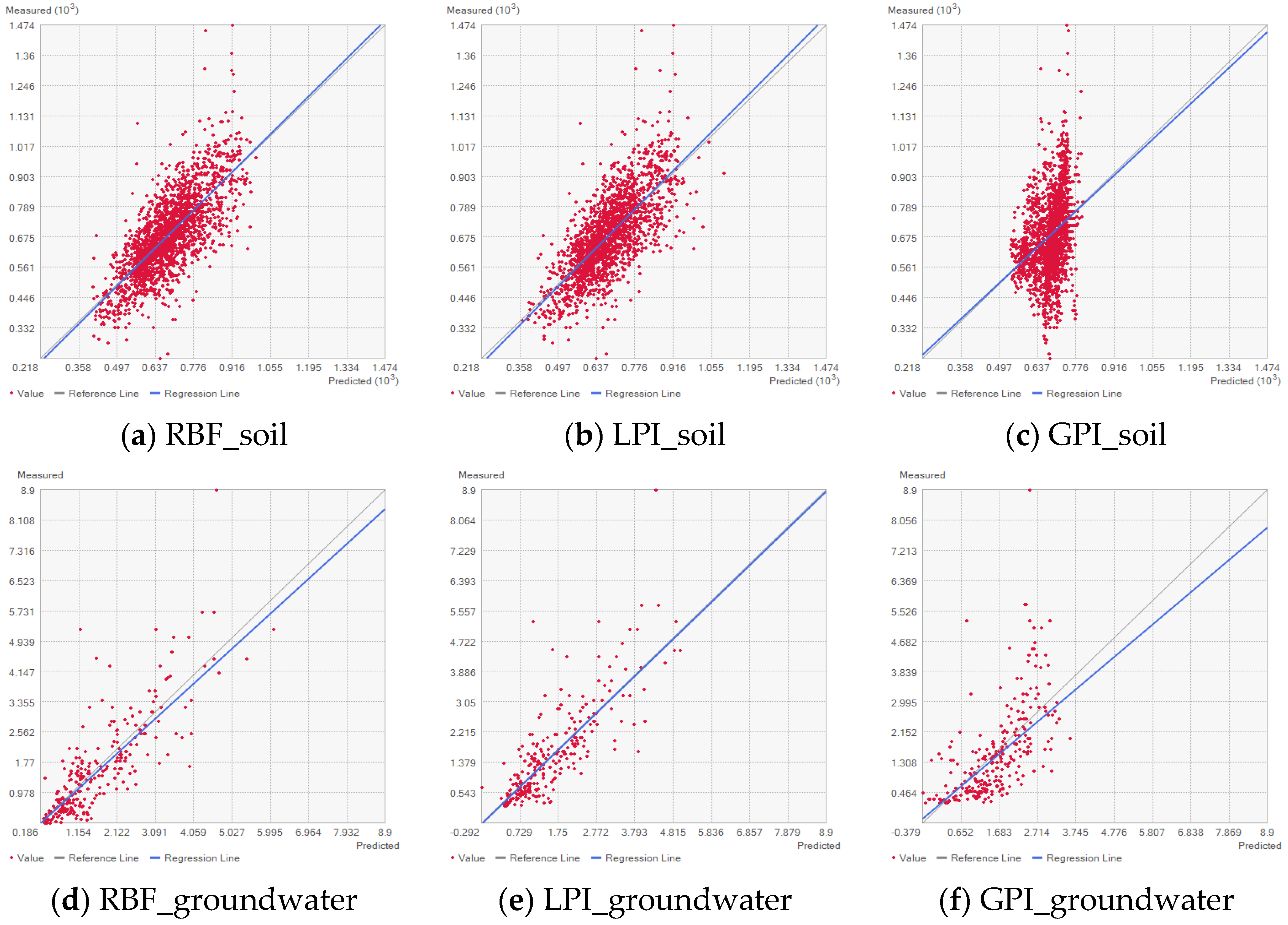
3.1. Accuracy Evaluation and Spatial Distribution Patterns
3.2. Ecological and Health Risk Assessment
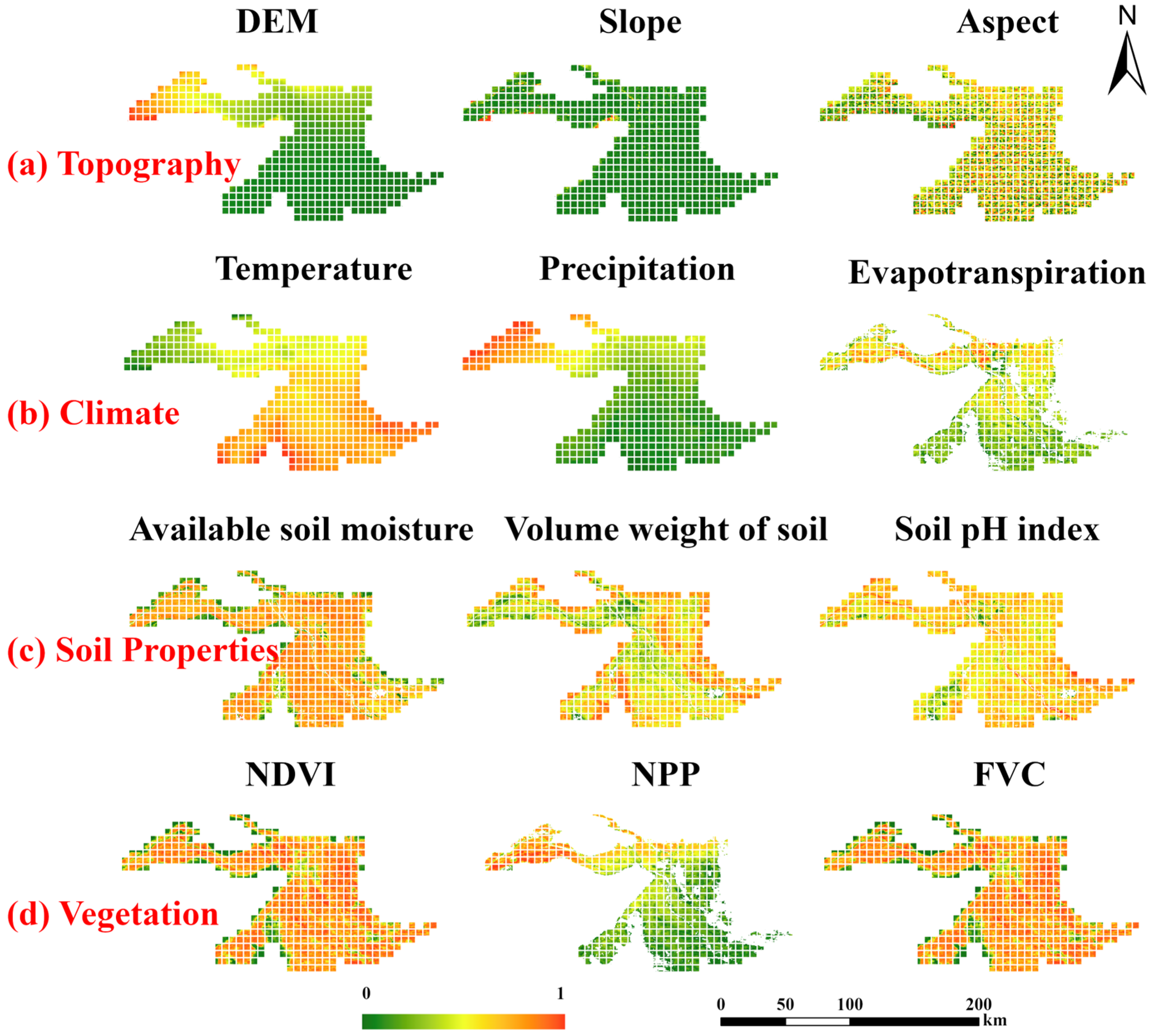
3.3. Key Drivers of Fluoride Enrichment
4. Discussion
4.1. Mechanisms Controlling Fluoride Spatial Distribution
4.2. Environmental and Public Health Implications
4.3. Limitations and Future Research Directions
5. Conclusions
- (1)
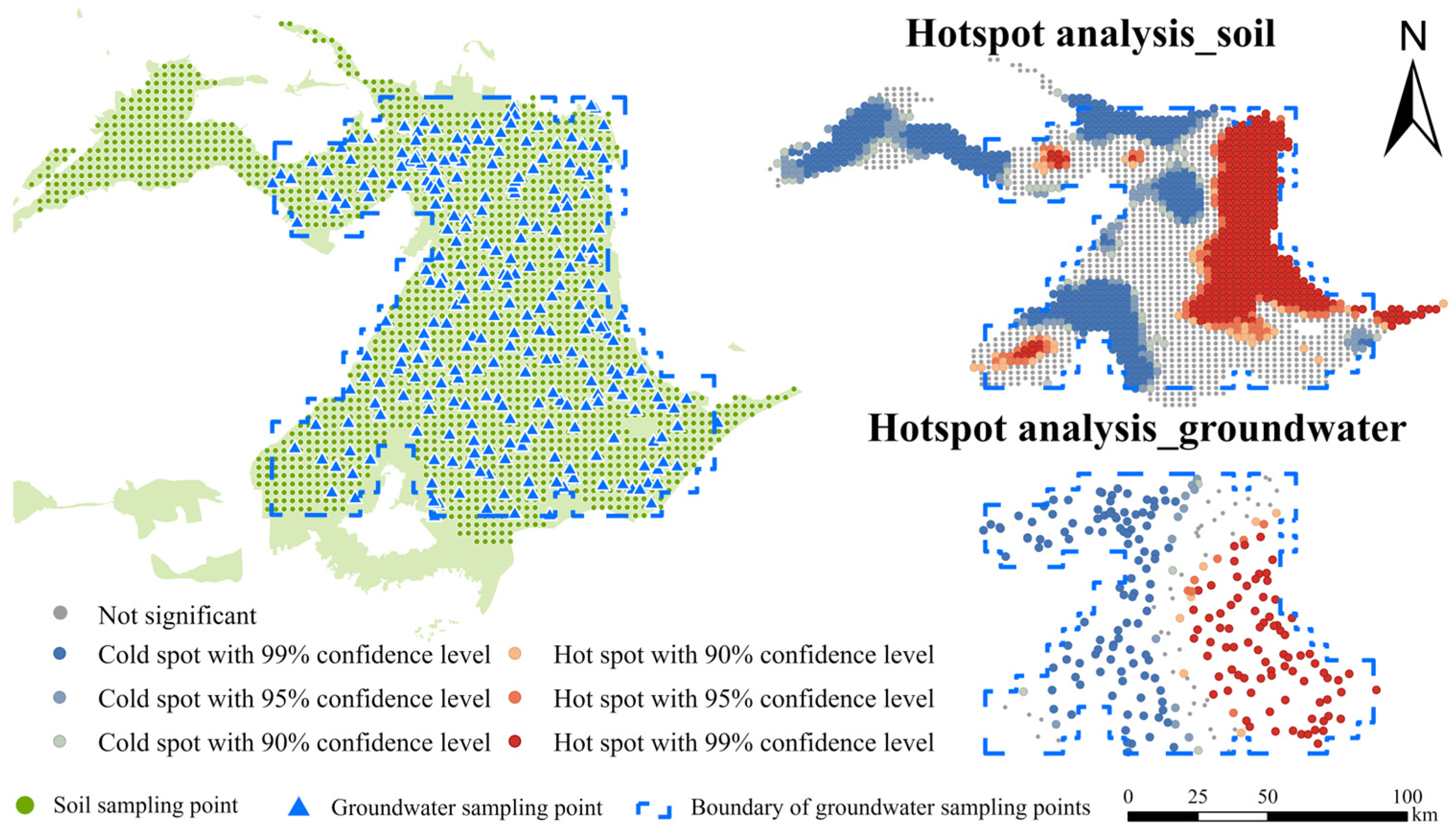
- Spatially, soil fluoride exhibits significant enrichment in the eastern basin, while groundwater fluoride shows a west-to-east concentration gradient. These patterns are governed by distinct dominant mechanisms: soil fluoride follows an “evaporation–concentration–alkaline activation” pathway, whereas groundwater fluoride is driven by a “convergence–concentration–evaporation-enrichment” mechanism.
- (2)
- Regarding health risks, groundwater fluoride poses a clear non-carcinogenic health risk to children via drinking water exposure (HQ mean = 1.83, far exceeding the safety threshold of 1), while the risk to adults is lower (HQ mean = 0.85). This makes groundwater the primary health concern in the study area. While overall soil fluoride risks are manageable, ecological risks stemming from regional high background levels warrant attention.
- (3)
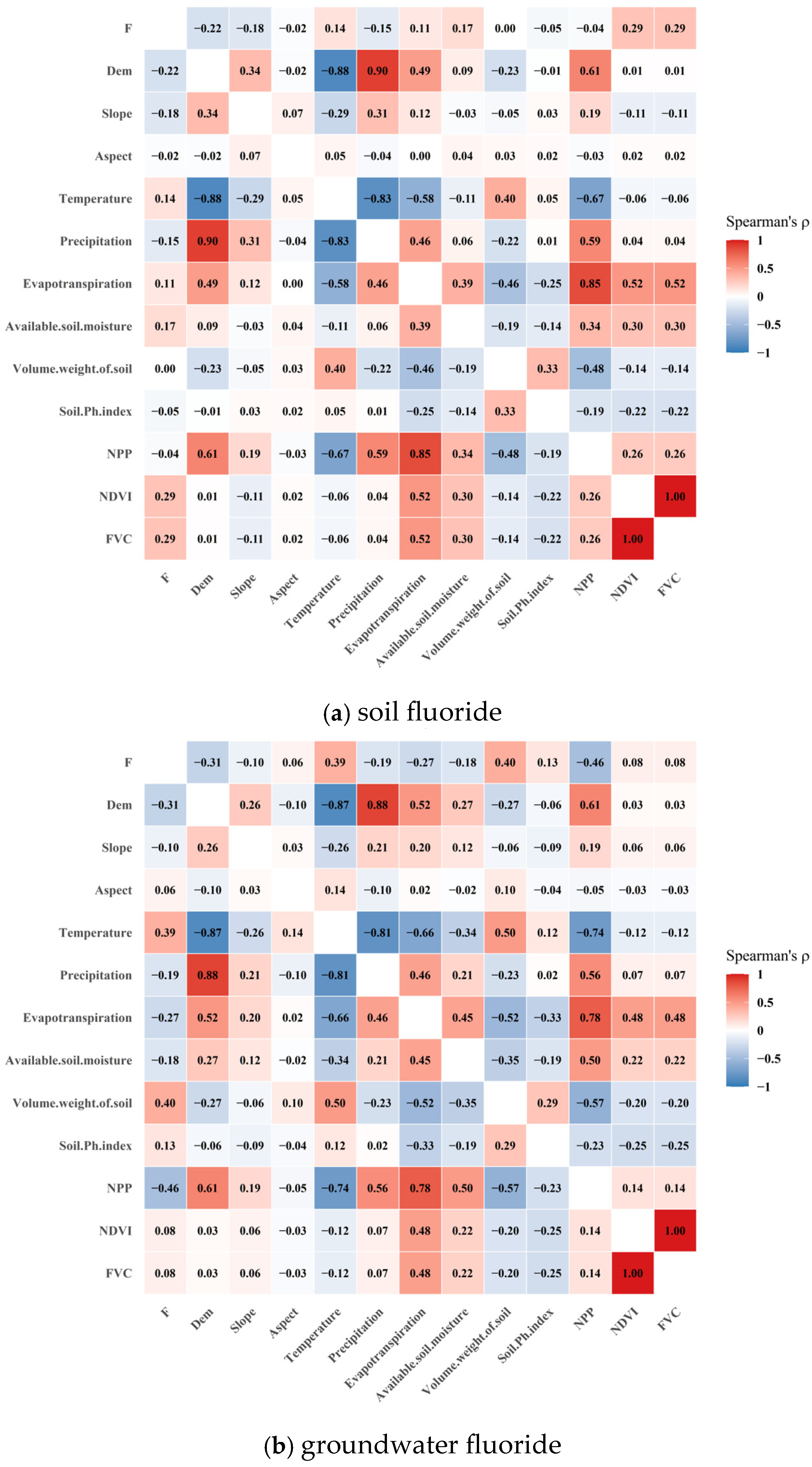
- Spatially, soil fluoride exhibits significant enrichment in the eastern basin, while groundwater fluoride shows a west-to-east concentration gradient. These patterns are governed by distinct dominant mechanisms: soil fluoride follows an “evaporation–concentration–alkaline activation” pathway, as evidenced by significant positive correlations with evapotranspiration and soil pH. Groundwater fluoride is driven by a “convergence–concentration–evaporation–enrichment” mechanism, with significant positive correlations with evapotranspiration and air temperature and a negative correlation with elevation.
Author Contributions
Funding
Institutional Review Board Statement
Informed Consent Statement
Data Availability Statement
Conflicts of Interest
References
- Li, J.; Dai, J.; Yang, L.; Wang, H. Enrichment Mechanism and Probabilistic Health Risk Assessment of High-Fluoride Groundwater in Gaomi City, China. Environ. Geochem. Health 2025, 47, 26. [Google Scholar] [CrossRef] [PubMed]
- Mohammadpour, A.; Abbasi, F.; Reza Gili, M.; Kazemi, A.; Bell, M.L. Evaluation of Concentration and Characterization of Potential Toxic Elements and Fluorine in Ambient Air Dust from Iran’s Industrial Capital: A Health Risk Assessment Using Monte Carlo Simulation. Int. J. Appl. Earth Obs. Geoinf. 2024, 132, 103998. [Google Scholar] [CrossRef]
- Wang, T.; Zhao, W.; Wang, Z.; Zhou, Z.; Yang, J.; Xu, F.; Xue, J.; Li, G. Occurrence, Main Source and Health Risks of Fluorine in Mine Water. Expo. Health 2025, 17, 279–292. [Google Scholar] [CrossRef]
- Iqbal, J.; Su, C.; Wang, M.; Abbas, H.; Baloch, M.Y.J.; Ghani, J.; Ullah, Z.; Huq, M.E. Groundwater Fluoride and Nitrate Contamination and Associated Human Health Risk Assessment in South Punjab, Pakistan. Environ. Sci. Pollut. Res. 2023, 30, 61606–61625. [Google Scholar] [CrossRef]
- Podgorski, J.; Berg, M. Global Analysis and Prediction of Fluoride in Groundwater. Nat. Commun. 2022, 13, 4232. [Google Scholar] [CrossRef]
- Zeng, Y.; Lu, H.; Zhou, J.; Zhou, Y.; Sun, Y.; Ma, C. Enrichment Mechanism and Health Risk Assessment of Fluoride in Groundwater in the Oasis Zone of the Tarim Basin in Xinjiang, China. Expo. Health 2024, 16, 263–278. [Google Scholar] [CrossRef]
- Yang, J.; Wang, J.; Xu, H.; Xu, Z.; Zhang, Y.; Chen, J. Fluoride and Nitrogen Contamination and Potential Health Risks in the Groundwater of a Typical Agricultural Region. J. Water Health 2024, 22, 2331–2345. [Google Scholar] [CrossRef]
- Chae, C.; Park, S.; Yoon, S.-G.; An, J. Effect of Origin on Chemical Extractability of Fluorine in Soil and Its Consequence on Human Health Risk. KSCE J. Civ. Eng. 2024, 28, 4825–4831. [Google Scholar] [CrossRef]
- Yu, F.; Jiang, L.; Li, Z. Distribution, Enrichment Mechanisms, and Health Risk Assessment of High-Fluorine Groundwater in the Yudong Plain, Henan Province, China. Environ. Sci. Pollut. Res. 2023, 30, 63549–63564. [Google Scholar] [CrossRef] [PubMed]
- Fu, A.; Li, W.; Chen, Y.; Wang, Y.; Hao, H.; Li, Y.; Sun, F.; Zhou, H.; Zhu, C.; Hao, X. The Effects of Ecological Rehabilitation Projects on the Resilience of an Extremely Drought-Prone Desert Riparian Forest Ecosystem in the Tarim River Basin, Xinjiang, China. Sci. Rep. 2021, 11, 18485. [Google Scholar] [CrossRef] [PubMed]
- Wang, Y.; Shi, F.; Zhao, C.; Zhou, X. Identifying Groundwater Resilience Zones in an Arid Inland Basin Using GIS-Based Dempster-Shafer Theory. J. Hydrol. Reg. Stud. 2022, 44, 101232. [Google Scholar] [CrossRef]
- Cheng, Y.; Zhang, X.; Song, W. Ecological Risk Assessment of Land Use Change in the Tarim River Basin, Xinjiang, China. Land 2024, 13, 561. [Google Scholar] [CrossRef]
- Yang, R.; Mu, Z.; Li, Z.; Qiu, X.; Liu, J. A Health-Service-Risk Framework for Evaluating Ecological Carrying Capacity in Arid Inland River Basins: A Case Study of the Tarim River Basin. Ecol. Indic. 2025, 173, 113427. [Google Scholar] [CrossRef]
- DZ/T 0295-2016; Specification of Land Quality Geochemical Assessment. Ministry of Land and Resources of the People’s Republic of China: Beijing, China, 2016.
- HJ/T 166-2004; Technical Specification for Soil Environmental Monitoring. State Environmental Protection Administration: Beijing, China, 2004.
- HJ 164-2020; Technical Specifications for Environmental Monitoring of Groundwater. Ministry of Ecological Environment: Beijing, China, 2020.
- Leal-Villaseca, F.; Cripps, E.; Jessell, M.; Lindsay, M. Interpreting Deepkriging for Spatial Interpolation in Geostatistics. Comput. Geosci. 2025, 196, 105833. [Google Scholar] [CrossRef]
- Raza, I.; Khalid, P.; Ehsan, M.I.; Ahmad, Q.A.; Khurram, S.; Zainab, R.; Farooq, S. Geospatial Interpolation and Hydro-Geochemical Characterization of Alluvial Aquifers in the Thal Desert, Punjab, Pakistan. PLoS ONE 2024, 19, e0307025. [Google Scholar] [CrossRef] [PubMed]
- Tayyab, M.; Aslam, R.A.; Farooq, U.; Ali, S.; Khan, S.N.; Iqbal, M.; Khan, M.I.; Saddique, N. Comparative Study of Geospatial Techniques for Interpolating Groundwater Quality Data in Agricultural Areas of Punjab, Pakistan. Water 2023, 16, 139. [Google Scholar] [CrossRef]
- Liu, W.; Ma, L.; Smanov, Z.; Samarkhanov, K.; Abuduwaili, J. Clarifying Soil Texture and Salinity Using Local Spatial Statistics (Getis-Ord Gi* and Moran’s I) in Kazakh–Uzbekistan Border Area, Central Asia. Agronomy 2022, 12, 332. [Google Scholar] [CrossRef]
- Kola, E.; Munyai, C.; Munyai, L.F.; Mpopetsi, P.; Dondofema, F.; Dalu, T. Enrichment and Geo-Accumulation of Trace and Heavy Metals in Surface Sediments along Urbanised Austral Wetlands. J. Freshw. Ecol. 2025, 40, 2509572. [Google Scholar] [CrossRef]
- Ansoar-Rodríguez, Y.; Bertrand, L.; Colombo, C.V.; Rimondino, G.N.; Rivetti, N.; Bistoni, M.D.L.A.; Amé, M.V. Microplastic Distribution and Potential Ecological Risk Index in a South American Sparsely Urbanized River Basin: Focus on Abiotic Matrices and the Native Fish Jenynsia lineata. J. Hazard. Mater. Adv. 2025, 18, 100685. [Google Scholar] [CrossRef]
- Ejaz, U.; Khan, S.M.; Shah, S.F.A.; Khalid, N.; Jehangir, S.; Rizvi, Z.F.; Svenning, J.-C. Integrative Data-Driven Analytics for Assessing Ecological and Human Health Risks of Soil Heavy Metal Contamination. J. Hazard. Mater. Adv. 2025, 17, 100596. [Google Scholar] [CrossRef]
- Tsogtbaatar, U.; Huo, L.; Jiao, L.; Dalantai, S.; An, Y.; Batsaikhan, B.; Jugnee, U.; Natsagdorj, B.; Batsaikhan, T.; Munkhchuluun, B. Ecological Risk Evaluation of Heavy Metals Based on Hyperspectral: A Case Study of Rice Paddy Soil in Xiangtan County, China. Environ. Monit. Assess. 2025, 197, 376. [Google Scholar] [CrossRef]
- Yao, H.; Zhao, D.; Wang, W.; Liu, Z.; Zhou, H. Occurrence and Risk Assessment of Perfluoroalkyl Substances in the River Basin around Fluorine Industry Parks, China. Environ. Pollut. Bioavailab. 2023, 35, 2218569. [Google Scholar] [CrossRef]
- GB/T 14848-2017; Standard for Groundwater Quality. Ministry of Natural Resources: Beijing, China, 2017.
- Ma, Y.; Sun, Y.; Wang, J.; Liu, Y.; Guo, M.; Hu, C.; Shui, B. Analysis of Heavy Metal Sources and Potential Ecological Risk Assessment of Mangroves in Aojiang Estuary. Ecol. Indic. 2025, 173, 113343. [Google Scholar] [CrossRef]
- Li, L.; Ma, L.; Pan, Z.; Xu, J.; Chen, F.; Yang, C.; Yin, Y. Spatial Distribution and Health Risk Assessment of Fluoride in Groundwater in the Oasis of the Hotan River Basin in Xinjiang, China. Sci. Rep. 2025, 15, 11630. [Google Scholar] [CrossRef]
- Till, C.; Grandjean, P.; Martinez-Mier, E.A.; Hu, H.; Lanphear, B. Health Risks and Benefits of Fluoride Exposure During Pregnancy and Infancy. Annu. Rev. Public Health 2025, 46, 253–274. [Google Scholar] [CrossRef]
- Amorello, D.; Barreca, S.; Pensato, F.; Orecchio, S. Potentiometric Analysis of Fluoride in Commonly Consumed Beverages: Method Development, Evaluation, and Risk Assessment. J. Food Compos. Anal. 2025, 137, 106836. [Google Scholar] [CrossRef]
- Tschimpke, M. On the Exact Region Determined by Spearman’s ρ and Blest’s Measure of Rank Correlation ν for Bivariate Extreme-Value Copulas. J. Multivar. Anal. 2025, 205, 105377. [Google Scholar] [CrossRef]
- Boonupara, T.; Udomkun, P.; Kajitvichyanukul, P. Quantitative Analysis of Atrazine Impact on UAV-Derived Multispectral Indices and Correlated Plant Pigment Alterations: A Heatmap Approach. Agronomy 2024, 14, 814. [Google Scholar] [CrossRef]
- GB 5749-2022; Standards for Drinking Water Quality. National Center for Disease Control: Beijing, China, 2022.
- Wehr, J.B.; Dalzell, S.A.; Menzies, N.W. Predicting and Modelling Availability of Fluoride in Soil from Sorption Properties. Soil Use Manag. 2023, 39, 521–534. [Google Scholar] [CrossRef]
- Arab, N.; Derakhshani, R.; Sayadi, M.H. Approaches for the Efficient Removal of Fluoride from Groundwater: A Comprehensive Review. Toxics 2024, 12, 306. [Google Scholar] [CrossRef]
- Shaji, E.; Sarath, K.V.; Santosh, M.; Krishnaprasad, P.K.; Arya, B.K.; Babu, M.S. Fluoride Contamination in Groundwater: A Global Review of the Status, Processes, Challenges, and Remedial Measures. Geosci. Front. 2024, 15, 101734. [Google Scholar] [CrossRef]



| Grade | Geo-Accumulation Index (Igeo) | Pollution Level | Potential Ecological Risk Index | Risk Level |
|---|---|---|---|---|
| 1 | Igeo < 0 | No pollution | ER < 1 | Low |
| 2 | 0 < Igeo < 1 | No to moderate pollution | 1 < ER < 2 | Medium |
| 3 | 1 < Igeo < 2 | Moderate pollution | 2 < ER < 4 | High |
| 4 | 2 < Igeo < 3 | Moderate to heavy pollution | 4 < ER < 8 | Very High |
| 5 | 3 < Igeo < 4 | Heavy pollution | ER > 8 | Extremely High |
| 6 | 4 < Igeo < 5 | Heavy to severe pollution | ||
| 7 | Igeo > 5 | Severe pollution |
| Symbol | Parameter Name | Unit | Adult Reference Value | Child Reference Value |
|---|---|---|---|---|
| Ci | Fluoride content | mg·kg−1 | Actual measured | Actual measured |
| IRsoil | Daily soil ingestion rate | mg·d−1 | 100 | 200 |
| IRair | Daily air respiration volume | m3·d−1 | 14.5 | 7.5 |
| IRwater | Daily water intake | L·d−1 | 2 | 1 |
| ED | Exposure duration | a | 24 | 6 |
| EF | Exposure frequency | d·a−1 | 350 | 350 |
| BW | Average body weight | kg | 61.8 | 19.2 |
| AT | Average exposure time | d | 2190 | 2190 |
| SAE | Exposed skin surface area | cm2 | 5700 | 2800 |
| SL | Soil adhesion coefficient on skin surface | mg·(cm2·d)−1 | 0.07 | 0.2 |
| PM10 | Airborne respirable particulate matter concentration | mg·m−3 | 0.1197 | 0.1197 |
| fspi | Proportion of soil-derived particulate matter in indoor air | - | 0.8 | 0.8 |
| fspo | Proportion of soil-derived particulate matter in outdoor air | - | 0.5 | 0.5 |
| EFO | Outdoor exposure frequency (respiratory inhalation) | d·a−1 | 87.5 | 87.5 |
| EFI | Indoor exposure frequency (inhalation) | d·a−1 | 262.5 | 262.5 |
| PIAF | Retention fraction of inhaled soil particles in the body | - | 0.75 | 0.75 |
| SAF | Reference dose allocation factor for soil exposure | - | 0.5 | 0.5 |
| ABSO | Absorption efficiency factor for oral intake | - | 1 | 1 |
| ABSd | Skin absorption factor | - | 0.01 | 0.01 |
| RfDo | Reference dose for oral intake | mg·(kg·d)−1 | 0.04 | 0.04 |
| RfDd | Reference dose for skin contact | mg·(kg·d)−1 | 0.04 | 0.04 |
| RfDi | Reference dose for inhalation | mg·(kg·d)−1 | 0.003 | 0.005 |
| RfDw | Reference dose for drinking water intake | mg·(L·d)−1 | 0.06 | 0.06 |
| Factor Category | Specific Factor | Variable Description | Expected Mechanism of Influence |
|---|---|---|---|
| Topography | DEM | Elevation (m) | Influences material transport and energy allocation, indirectly controlling hydrological processes and chemical weathering intensity. |
| Slope | Slope gradient (°) | Affects surface runoff and solute transport; gentle slopes favor fluoride accumulation. | |
| Aspect | Slope aspect | Indirectly regulates evapotranspiration and soil moisture conditions via light exposure and temperature. | |
| Climate | Temperature | Air temperature (°C) | Influences the intensity of evaporative concentration, with high temperatures typically promoting fluoride enrichment. |
| Precipitation | Precipitation (mm) | Affects fluoride concentration through leaching and dilution; expected negative correlation. | |
| Evapotranspiration | Evapotranspiration (mm) | Intense transpiration concentrates fluoride in shallow soil water and groundwater, promoting fluoride enrichment (positively correlated). | |
| Soil Properties | Available soil moisture | Soil available water content | Influences water movement and ion solubility, with complex relationships. |
| Volume weight of soil | Soil bulk density (g/cm3) | Reflects soil compaction and porosity, affecting water movement and solute migration. | |
| Soil pH index | Soil pH | Alkaline conditions (high pH) typically promote fluoride desorption from minerals, increasing its reactivity (positive correlation). | |
| Vegetation Index | NPP | Net primary productivity (g C/m2) | Characterizes vegetation growth status; biological activity may influence local fluoride biogeochemical cycling. |
| NDVI | Normalized difference vegetation index | Reflects vegetation cover, potentially linked to processes, such as groundwater depth and soil salinization. | |
| FVC | Vegetation cover (%) | Indirectly indicates ecological environment conditions. |
| Indicator | Fluoride in Soil | Fluoride in Groundwater | ||||
|---|---|---|---|---|---|---|
| Concentration | Geo-Accumulation Index (Igeo) | Potential Ecological Risk Index | Concentration | Geo-Accumulation Index (Igeo) | Potential Ecological Risk Index | |
| Maximum | 1474 mg/kg | 1.01 | 3.02 | 8.90 mg/L | 2.57 | 8.90 |
| Minimum | 218 mg/kg | −1.75 | 0.45 | 0.19 mg/L | −2.98 | 0.19 |
| Average | 683 mg/kg | −0.13 | 1.40 | 1.60 mg/L | −0.33 | 1.60 |
| Indicator | Exposure Routes | Children | Adults | ||||
|---|---|---|---|---|---|---|---|
| Maximum | Minimum | Average | Maximum | Minimum | Average | ||
| Fluoride in soil | Oral ingestion | 0.74 | 0.11 | 0.34 | 0.46 | 0.07 | 0.21 |
| Dermal contact | 0.02 | 0.00 | 0.01 | 0.02 | 0.00 | 0.01 | |
| Inhalation | 0.01 | 0.00 | 0.01 | 0.06 | 0.01 | 0.03 | |
| Hazard Index (sum) | 0.77 | 0.11 | 0.36 | 0.54 | 0.08 | 0.25 | |
| Fluoride in groundwater | Oral ingestion | 10.16 | 0.21 | 1.83 | 4.74 | 0.10 | 0.85 |
Disclaimer/Publisher’s Note: The statements, opinions and data contained in all publications are solely those of the individual author(s) and contributor(s) and not of MDPI and/or the editor(s). MDPI and/or the editor(s) disclaim responsibility for any injury to people or property resulting from any ideas, methods, instructions or products referred to in the content. |
© 2026 by the authors. Licensee MDPI, Basel, Switzerland. This article is an open access article distributed under the terms and conditions of the Creative Commons Attribution (CC BY) license.
Share and Cite
Xu, Q.; Yang, J.; Jin, M.; Duan, X.; Guo, P. Fluoride Enrichment and Health Risks in the Aksu River Basin Oasis: Implications for Soil–Groundwater Systems. Sustainability 2026, 18, 4606. https://doi.org/10.3390/su18094606
Xu Q, Yang J, Jin M, Duan X, Guo P. Fluoride Enrichment and Health Risks in the Aksu River Basin Oasis: Implications for Soil–Groundwater Systems. Sustainability. 2026; 18(9):4606. https://doi.org/10.3390/su18094606
Chicago/Turabian StyleXu, Quan, Jianjun Yang, Mengting Jin, Xingxing Duan, and Peng Guo. 2026. "Fluoride Enrichment and Health Risks in the Aksu River Basin Oasis: Implications for Soil–Groundwater Systems" Sustainability 18, no. 9: 4606. https://doi.org/10.3390/su18094606
APA StyleXu, Q., Yang, J., Jin, M., Duan, X., & Guo, P. (2026). Fluoride Enrichment and Health Risks in the Aksu River Basin Oasis: Implications for Soil–Groundwater Systems. Sustainability, 18(9), 4606. https://doi.org/10.3390/su18094606