1. Introduction
Amid the global surge toward the twin transition [
1], driving green innovation has evolved from a compliance-driven task into a strategic pillar of sustainable competitive advantage [
2]. While digital tools excel at optimizing resource allocation and reducing information asymmetry [
3], they do not inherently ignite the psychological commitment required for green initiatives. This creates a critical yet overlooked paradox: as technology reshapes the workplace, how do employees, the primary agents of innovation, develop the endogenous intention to pursue green goals in an increasingly digitalized economy?
Extant research highlights leaders as strategic architects of green innovation [
4]. This view neglects the roles of employees as active agents [
5] who engage in sensemaking regarding leader motivations. This issue is critical in green transformation; because green innovation is long-term and value-driven [
6], employees’ proactive attitudes become a decisive factor in sustaining environmental initiative over time [
7]. According to Social Information Processing (SIP) theory, individuals do not merely react to their environment, but act based on their interpretation of social cues. In this context, a leader’s prosocial motivation serves as a pivotal cue for employees to define organizational values [
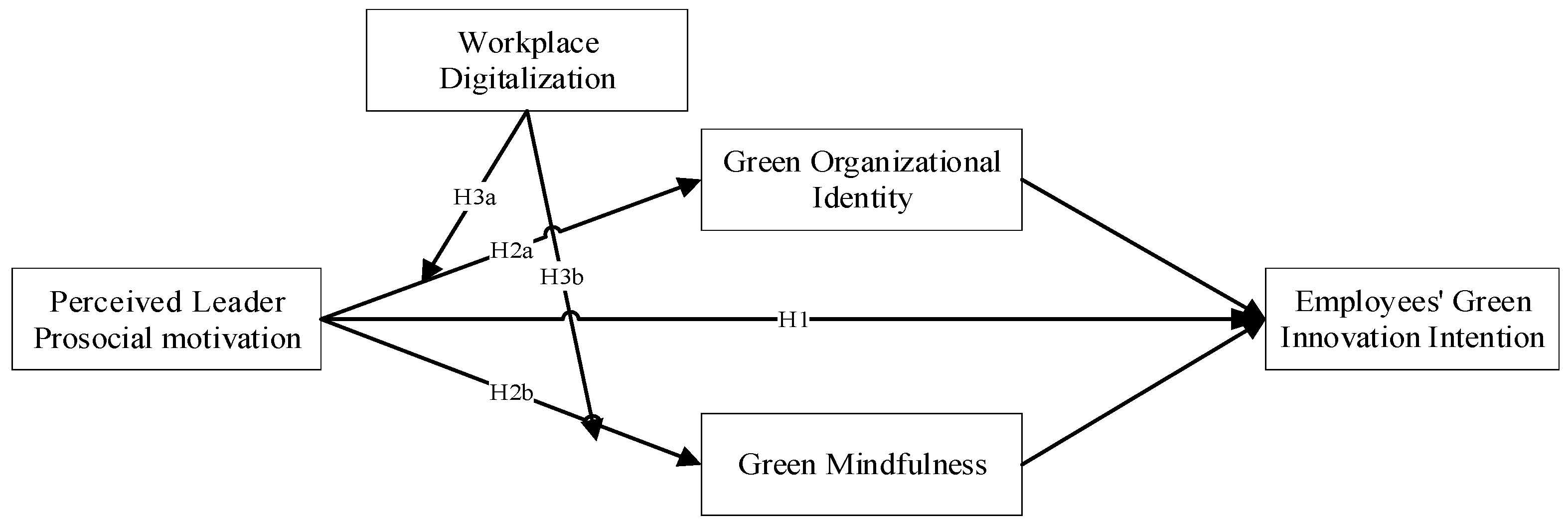
8]. However, the psychological mechanism through which leader motivative signals are perceived and internalized into green innovation intentions remains under-explored. To address these questions, we draw on SIP theory to develop a micro-level, dual-path model. This model explains how perceived leader prosocial motivation serves as a critical social cue that triggers employee psychological reactions. Specifically, we propose that this motivation drives green innovation intentions by strengthening two distinct pathways: the affective path of belonging–green organizational identity and the cognitive path of awareness–green mindfulness.
As digital technologies become deeply embedded in the workplace [
9], leader–follower interactions are increasingly shifting toward digitalization. SIP theory posits that the construction of social information is contingent on the delivery medium and the surrounding context [
10,
11]. Consequently, this shift not only reshapes information transmission but also significantly alters employee attention and cognitive processing boundaries [
12,
13]. While prior research emphasizes the empowering role of digitalization, it often overlooks its dark side, such as information overload and communication fragmentation [
14]. These factors may lead to signal attenuation [
9]. Drawing on the SIP theory, this study introduces workplace digitalization as a critical boundary condition. We investigate how workplace digitalization shapes the way employees interpret and construct perceived leader motivation, specifically, whether such embedding facilitates or disrupts the processing of social cues in the workplace. In summary, this study seeks to address two pivotal questions: (1) How and through what mechanisms does perceived leader prosocial motivation drive employees’ green innovation intention? (2) To what extent does workplace digitalization moderate this process?
We test our conceptual model using a mixed-methods design in the Chinese context. Study 1 utilized a scenario-based experiment (N = 184) to manipulate leader motivation and workplace digitalization, establishing initial internal validity. Study 2 followed with a two-wave field survey (N = 428) across diverse industries to capture how workplace digitalization shapes behavioral decisions in real-world office environments. This integrated approach allows for a rigorous analysis of the micro-behavioral trade-offs within the digital transformation of Chinese enterprises.
Our research offers three primary contributions: First, by uncovering the affective and cognitive indirect effects between perceived leader prosocial motivation and employees’ green innovation intentions, we extend micro-foundational research on the interlinkages between leader motivation and green innovation. This clarifies the process-mechanism through which abstract leader values are internalized by employees. Second, by identifying the disruptive digital overload effect, we challenge the optimistic narrative that digitalization and sustainability are inherently synergistic. This provides a critical trade-off perspective to the twin transition literature, highlighting the potential dark side of technological embedding. Third, we extend SIP theory to the digitalized workplace. Our findings deepen the understanding of how digital contexts reshape the interpretation of social cues and interpersonal dynamics between leaders and employees.
2. Theoretical Background
2.1. Social Information Processing Theory
SIP theory posits that individuals’ attitudes, beliefs, and behaviors are not mere passive reflections of innate needs or objective environments. Instead, they result from the perception, interpretation, and sensemaking of critical social cues within the workplace [
11]. Building on Bhave et al.’s [
15] conceptualization of SIP in organizational settings, individual information processing follows a logical chain: “Social Environment–Psychological Processing–Behavioral Attitude.” In it, the social environment comprises both social influences and social context; the former provides information describing work environment characteristics, while the latter serves as the situational backdrop for information transmission.
As leaders serve as a primary source of information within organizations, SIP theory has attracted significant scholarly attention in research on leader–follower dynamics. At the individual level, SIP explains how environmental cues help employees interpret their workplace and shape their subsequent attitudes. For instance, Lau and Liden [
16] demonstrated that a leader’s trust in a specific subordinate acts as a potent signal that shapes peer attitudes. This transmission process extends to the collective level, where leaders function as architects of shared meaning. Boekhorst [
17] further theorized that leaders catalyze team climate by providing specific behavioral cues. Consequently, SIP offers a robust lens for examining how employees make sense of leader-provided information to form their behavioral intentions.
Applying this framework to green innovation, we examine the leader–follower interaction through a sensemaking lens. When employees perceive leader prosocial motivation, they engage in cognitive appraisal and psychological feedback to construct a subjective understanding of such motivation as the primary social influence factor. This process facilitates the internalization of the organization’s strategic vision into individual behavioral intentions. Crucially, this informational processing does not occur in a vacuum; it is deeply embedded in the workplace context and shaped by its specific characteristics.
2.2. Workplace Digitalization
Workplace digitalization refers to the integration of digital technologies to reconfigure systems, processes, role structures, and work patterns [
18]. Rather than merely applying technology, it represents a systemic overhaul that intertwines technology with organizational structures and interpersonal dynamics. Consequently, workplace digitalization is best conceptualized as a critical context that shapes and constrains micro-organizational behaviors [
19].
Extant research predominantly highlights the dividends of digitalization for organizational competitiveness, focusing on two dimensions: resource provision and relational enablement. From a technical perspective, digital tools expand employees’ functional boundaries and accelerate decision-making in complex tasks [
20]. As a strategic resource [
21], digitalization fosters employee competence and organizational identity by streamlining processes and heightening transparency [
22]. Regarding micro-interactions, Natu and Aparicio [
23] note that digitalization drastically reduces the marginal cost of knowledge transfer, facilitating the frequency of leader–follower interactions. Such heightened interaction density enhances the signaling efficiency of leaders’ motivation cues. More importantly, digital platforms function as a high-visibility, low-resistance medium for leader–follower communication. In it, leaders’ motivational signals enable codification into consistent information streams, facilitating more precise perception and decoding by employees. For instance, Hooi and Chan [
19] found that digital contexts can amplify the effects of transformational leadership by making vision communication more real-time and transparent, ultimately driving employee engagement.
However, the radical reshaping of organizational models through digitalization also introduces significant downsides [
24,
25] that remain insufficiently examined. While digitalization lowers transaction costs, the resulting workflow reengineering imposes taxing adaptability requirements on employees and may even trigger identity threats regarding technological replacement [
26]. Furthermore, from a Person–Environment (P-E) fit perspective, the hyper-connectivity of workplace digitalization often blurs the boundary between work and life [
24], inducing information overload [
27] and technostress [
22]. These misalignments risk undermining, or even neutralizing, the very efficiency dividends that digitalization was intended to deliver.
While scholars have begun to acknowledge the multifaceted impact of workplace digitalization, existing research predominantly treats it as a contextual backdrop rather than exploring its role in restructuring micro-interactional logics. Particularly, how digitalization shapes employees’ information processing of leader motives remains under-theorized. Our study addresses this gap by examining the deep-seated influence of digital technologies on these relational dynamics.
3. Hypothesis Development
3.1. Leader Prosocial Motivation and Employee Green Innovation Intention
Prosocial motivation, a leadership trait prioritizing collective well-being and distributive justice [
28], fosters a climate of shared responsibility. As pivotal social referents, leaders provide essential behavioral guidance through their value orientations. Given that prosocial motivation is a known catalyst for extra-role behaviors [
29], its influence is particularly relevant to green innovation intention. We define this intention as an individual’s conscious propensity to mitigate environmental burdens [
30], a discretionary effort that extends beyond formal job requirements [
31]. Consequently, such voluntary green initiatives are highly susceptible to the prosocial values and strategic cues signaled by leaders [
7].
Strong leader prosocial motivation signals an organizational commitment to social and environmental responsibility [
32]. Through sensemaking, employees internalize the green transition as a broader social mission [
33], which significantly bolsters their psychological propensity for green innovation. Furthermore, green innovation is distinct from conventional innovation due to its substantial upfront costs and delayed financial returns [
34], making organizational resources an indispensable foundation [
35]. Leaders with high prosocial motivation prioritize social and environmental performance, thereby allocating significant resources to environmental management and green technology. Employees interpret such resource allocation as a potent supportive signal, indicating that the organization will share the costs and risks of green initiatives [
36]. This perception of support mitigates individual uncertainty and sparks a proactive intention to innovate.
Thus, we propose the following:
Hypothesis 1. Perceived leader prosocial motivation is positively related to employee green innovation intention.
3.2. Mediating Role of Employee Affective Reactions and Cognitive Inference
According to SIP theory, individuals continuously scan and interpret salient cues from their working environment [
11]. When employees perceive a leader’s actions as driven by altruistic motives—such as a sustained commitment to social welfare and environmental sustainability—they adopt a lens of collective and environmental responsibility to interpret organizational strategy. These social cues do more than trigger affective reactions; they actively shape how employees judge the organization’s core values.
Regarding the affective reaction pathway, employees develop emotional alignment with green strategic goals based on leader signals. Prosocial leaders transmit positive affective signals that foster affective identification with organizational values. This process cultivates green organizational identity, a shared sense of mission rooted in environmental stewardship [
37]. Specifically, leader altruism clarifies the organization’s environmental mission and heightens employee awareness. By advocating for social responsibility, these leaders align the firm with societal expectations, thereby enhancing corporate legitimacy and fostering employee pride [
38]. Since individuals identify with groups that enhance their self-worth [
39], integrating social and environmental responsibility into strategy encourages employees to incorporate the organization into their self-concept. Social Identity Theory suggests that an individual’s identification and its affective basis significantly drive behavior [
40]. Specifically, green organizational identity integrates environmental legitimacy into the organization’s core cognitive structure [
37], prompting employees to proactively advance the firm’s environmental interests [
41]. Consequently, a stronger green identity heightens intrinsic motivation, ultimately bolstering employees’ intentions to engage in green innovation.
Regarding the cognitive inference pathway, employees attend to the strategic salience of pro-environment initiatives as leader prosocial motivation reflects organizational priorities [
42]. This psychological state, characterized by focused attention and high awareness of environmental knowledge, constitutes green mindfulness [
43,
44]. Specifically, when leaders prioritize environmental responsibility in resource allocation, they reinforce the cognitive salience of ecological issues for employees. In addition, prosocial leaders prompt employees to reframe sustainability as organizational goals. Finally, perceiving this organizational commitment encourages employees to proactively seek and integrate environmental information. Consequently, strong leader prosocial motivation cultivates higher levels of green mindfulness among employees. As a positive psychological resource, green mindfulness drives employees to overcome cognitive inertia while sharpening their environmental sensitivity and cognitive flexibility. This mindset empowers them to proactively seek novel solutions to the challenges of green transformation [
45]. Consequently, employees with higher green mindfulness are more likely to generate and implement pro-environmental ideas, thereby strengthening their intentions to innovate for the environment.
Thus, we propose the following:
Hypothesis 2. Green organizational identity (2a) and green mindfulness (2b) mediate the positive relationship between perceived leader prosocial motivation and employee green innovation intention.
3.3. Moderating Role of Workplace Digitalization
As a critical contextual factor, workplace digitalization shapes how employees attend to and interpret leader motivational signals. By enhancing transparency and facilitating frequent, real-time communication, digitalization increases information availability [
46]. Consequently, leaders’ behaviors and value expressions become more readily accessible to the workforce.
Drawing on SIP theory, information processing efficacy depends not only on cue quantity but also on the recipient’s attentional resources and cognitive processing capacity. Ophir et al. [
47] note that digital multitasking reduces processing depth. Highly digitalized workplaces often impose a heavy cognitive load, as employees must navigate constant information streams and engage in multitasking. This heightened cognitive load diminishes the depth of information processing and fragments employee attention [
48], thereby dulling their sensitivity to pivotal social cues. Fundamentally, complex digital environments consume cognitive resources, crowding out the attention necessary for deciphering leader behavioral signals. Moreover, digitization can trigger technostress [
49,
50] and resistance to change [
51]. These psychological burdens further deplete cognitive resources, thereby impairing employees’ ability to effectively interpret their social environment [
52,
53]. Crucially, an over-reliance on technology can obstruct the transmission of implicit cues—such as moral passion and value resonance—essential for collaborative synergy [
22]. In summary, although workplace digitalization enhances the visibility of leadership signals, the cognitive strain it imposes likely outweighs its informational benefits. Consequently, we propose that workplace digitalization attenuates the positive relationship between perceived leader prosocial motivation and both green organizational identity and green mindfulness.
Thus, we propose the following:
Hypothesis 3. Workplace digitalization negatively moderates the positive influence of perceived leader prosocial motivation on (3a) green organizational identity and (3b) green mindfulness, such that these effects are weaker under conditions of high rather than low workplace digitalization.
3.4. Moderated Mediating Effect
Building on the above framework, we further develop a moderated mediation model [
54]. We propose that leader prosocial motivation indirectly enhances green innovation intention by fostering green organizational identity and green mindfulness; however, the strength of this indirect effect is contingent upon the level of workplace digitalization. Drawing on SIP theory, the extent to which social information is processed and translated into behavioral outcomes is fundamentally shaped by environmental context [
15].
In low-digitalization workplaces, employees encounter less information overload and cognitive clutter [
55], allowing them to allocate greater cognitive resources to decoding social signals [
12]. Consequently, they can more effectively internalize leader prosocial motivation, which strengthens their green identity and mindfulness, thereby driving green innovation intentions. We therefore posit that the indirect influence of leader prosocial motivation on green innovation intention—via the dual pathways of identification and awareness—is more pronounced in less digitalized environments.
Thus, we propose the following:
Hypothesis 4. Workplace digitalization moderates the indirect effects of perceived leader prosocial motivation on employee green innovation intention through both green organizational identity (4a) and green mindfulness (4b), such that these indirect effects are weaker when workplace digitalization is high rather than low.
We graphically illustrate our research model in
Figure 1.
4. Methods and Results
To ensure both the rigor and generalizability of our findings, we employed a multi-method, multi-study design. Study 1 utilizes a scenario-based experiment (N = 184) to establish internal validity. By isolating the core effects of leader prosocial motivation and manipulating workplace digitalization, we sought to determine the causal nature of the hypothesized relationships while controlling for unobserved organizational noise. However, to compensate for the limited ecological validity of laboratory settings, Study 2 employs a two-wave field survey (N = 428) across diverse industries. This time-lagged design allows us to validate the full theoretical model—including the affective and cognitive mediation paths—within the complexities of real-world organizational life. This integrated approach ensures a robust chain of evidence by balancing experimental precision with field-based external validity.
4.1. Study 1
4.1.1. Participants and Procedure
We initially recruited 225 second-year business undergraduates majoring in Human Resource Management (HRM) at a comprehensive university in Nanjing in China. We chose this specific sample for two reasons. First, they had completed core HRM courses, providing them with a theoretical understanding of organizational leadership. Second, and more importantly, per the university’s curriculum requirements, all participants had already completed at least six months of off-campus internship experience. This ensured that participants possessed sufficiently developed workplace schemas to accurately interpret and respond to the experimental manipulations [
56]. Each participant received ¥5 upon completing the experiment. After excluding invalid or incomplete responses, we obtained 184 valid responses (an 82% response rate). The participants were 35.9% male, with a mean age of 22.5 years (
SD = 0.78).
To test the moderating role of workplace digitalization, we employed a 2 (leader prosocial motivation: high vs. low) × 2 (workplace digitalization: high vs. low) factorial design. The experimental vignettes were developed by adapting established manipulations [
57,
58] and validated scales. We further contextualized these materials to fit the Chinese organizational environment and specific employee settings.
The experiment was conducted in May 2024 during a controlled lab session. Upon arrival, participants were randomly assigned to one of four conditions, with 46 individuals in each group. First, participants read a study overview and provided informed consent. After that, they read a brief vignette designed to manipulate their perceptions of leader prosocial motivation and workplace digitalization (Appendix Experimental Scenarios and Manipulations (English Version) for English). The scenario descriptions were based on the work of Babic et al. [
59] and Houwelingen and Stoelhorst [
60]. We then asked them to answer four questions related to leader prosocial motivation [
28] (α = 0.882), including the sample item, “I feel that my leader enjoys doing work that has a positive impact on others”. Next, we asked participants to answer four questions related to workplace digitalization [
61,
62] (α = 0.814), including the sample item, ”Using digital tools and technologies to accomplish organizational tasks is common practice at our company”. Respondents then answered six questions about their green organization identity [
37] (α = 0.850) and six questions about green mindfulness [
43] (α = 0.939). Leader prosocial motivation, workplace digitalization, green organizational identity, and green mindfulness were measured on a five-point Likert scale. Finally, participants provided demographic details. The session lasted approximately 15 to 20 min.
4.1.2. Manipulation Check
The manipulations of leader prosocial motivation and workplace digitalization were successful. Participants in the high leader prosocial motivation condition (M = 3.25, SD = 0.32) reported higher scores than those in the low motivation condition (M = 2.72, SD = 0.29; t (184) = 11.60, p < 0.001, Cohen’s d = 1.71). Similarly, participants in the high workplace digitalization condition (M = 2.77, SD = 0.41) reported lower scores than those in the low digitalization condition (M = 3.25, SD = 0.42; t (184) = −7.72, p < 0.001, Cohen’s d = −1.14).
4.1.3. Results
Table 1 shows the descriptive statistics and variable correlations. The highest correlation was between leader prosocial motivation and green mindfulness (
r = 0.259;
p < 0.01), indicating that multicollinearity was not a serious threat.
Table 2 shows the moderating effects of workplace digitalization. As depicted in Model 2 (
Table 2), workplace digitalization significantly negatively moderated the relationship between leader prosocial motivation and employee green organizational identity (
β = −0.667;
SE = 0.281;
p < 0.05), supporting Hypothesis 3a. According to
Table A1,
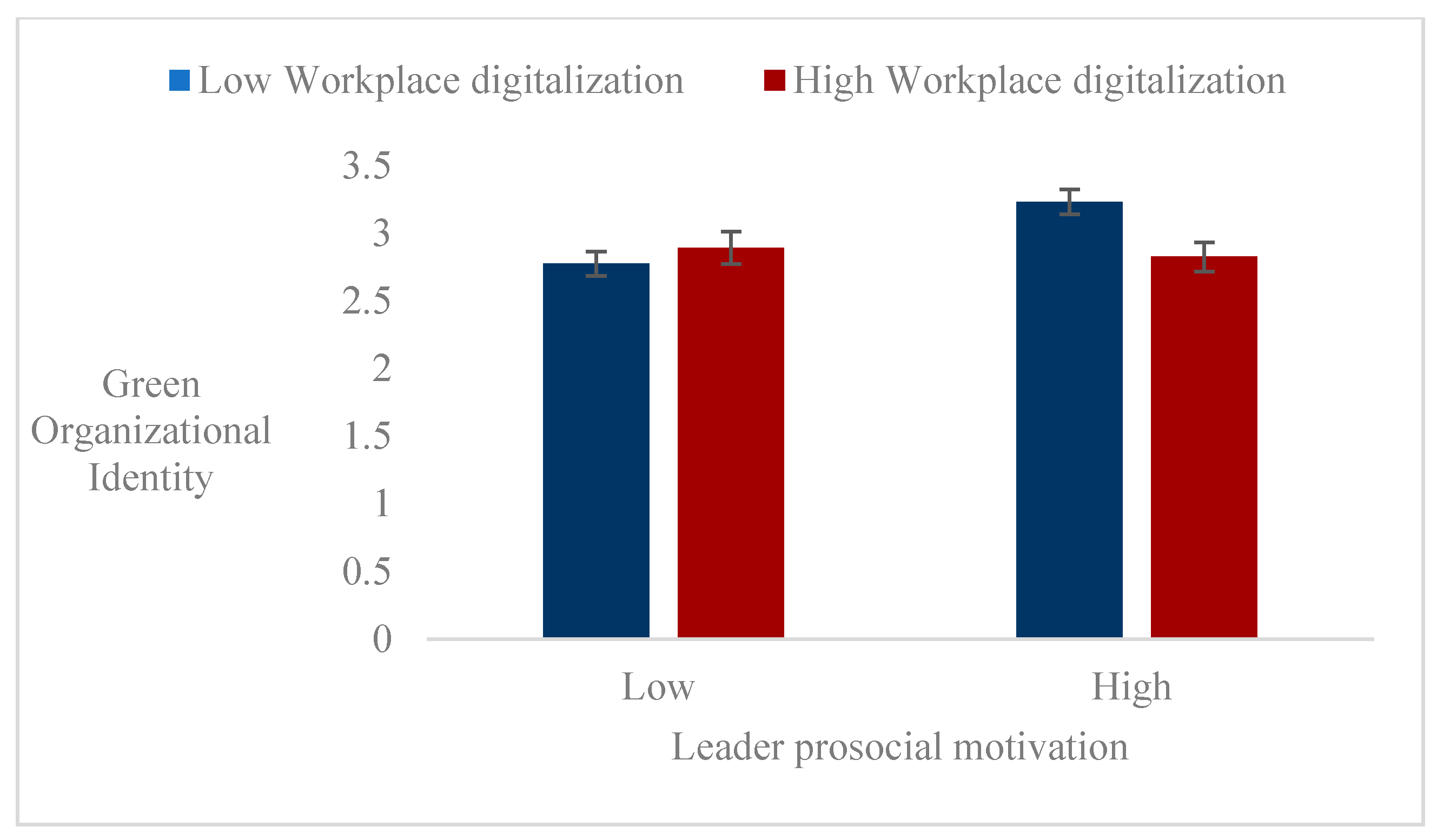
Figure 2 plots the interaction, showing that when workplace digitalization was low, employees in the leader prosocial motivation condition reported significantly higher green organizational identification (
M = 3.232;
SD = 0.636) than those in the control condition (
M = 2.775;
SD = 0.613;
t (92) = 3.506;
p < 0.001; Cohen’s
d = 0.731). However, when digitalization was high, the difference between the experimental group (
M = 2.826;
SD = 0.733) and the control group (
M = 2.891;
SD = 0.817) was non-significant (
t (92) = 0.403;
p = 0.698; Cohen’s
d = 0.084). These results provide empirical support for Hypothesis 3a.
As depicted in Model 4 (
Table 2), workplace digitalization significantly negatively moderated the relationship between leader prosocial motivation and employee green mindfulness (
β = −0.782;
SE = 0.221;
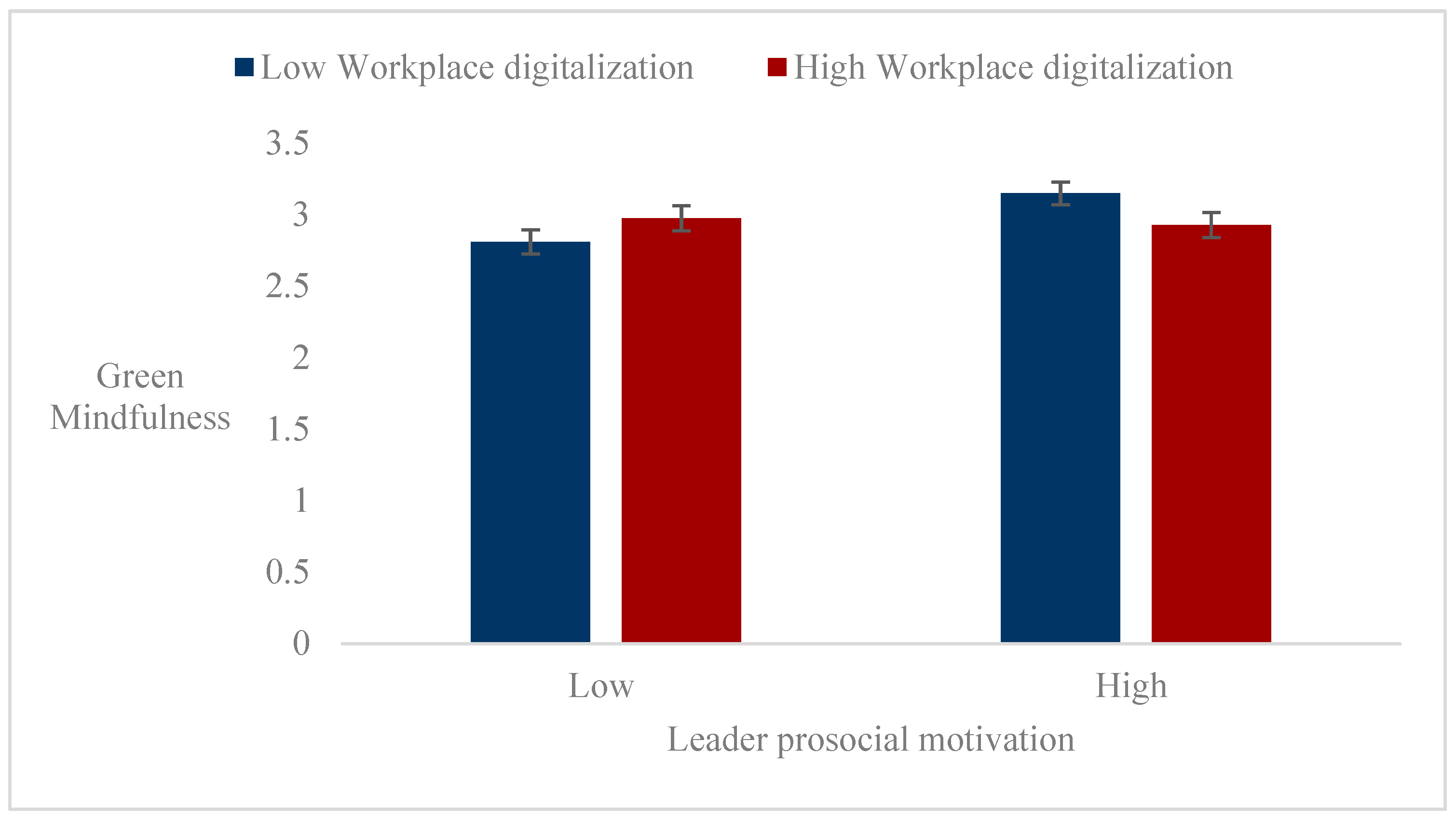
p < 0.001), supporting Hypothesis 3b. According to
Table A1,
Figure 3 plots the interaction, showing that when workplace digitalization was low, employees in the leader prosocial motivation condition reported significantly higher green mindfulness (
M = 3.150;
SD = 0.537) than those in the control condition (
M = 2.809;
SD = 0.568;
t (92) = 2.955;
p < 0.005; Cohen’s
d = 0.616). However, when digitalization was high, the difference between the experimental group (
M = 2.928;
SD = 0.591) and the control group (
M = 2.976;
SD = 0.593) was non-significant (
t (92) = 0.392;
p = 0.696; Cohen’s
d = 0.082). These results provide empirical support for Hypothesis 3b.
4.2. Study 2
4.2.1. Participants and Sample
Data were collected from full-time employees across diverse industries in China, including manufacturing, high-tech, and services. Leveraging the professional alumni network of the second author’s university, we recruited 40 alumni serving as mid-level managers or HR professionals to act as research coordinators. Their endorsement helped overcome organizational concerns regarding data confidentiality and ensured a higher degree of participant commitment. With their help, we ensured the high-quality retrieval of matched dyads. The final usable sample consisted of 428 employees who successfully completed both waves of the survey.
4.2.2. Research Design
We employed a two-wave, time-lagged design with a two-week interval to establish the temporal precedence of our hypothesized relationships. This design is particularly robust for capturing the psychological transition from perceiving leader motives (Time 1) to forming innovation intentions (Time 2).
4.2.3. Measures
As in a previous study, we utilized well-established scales to measure perceived leader prosocial motivation [
28] using five items (α = 0.911), green innovation intention using four items [
63] (α = 0.930), green organizational identity using six items [
37] (α = 0.920), green mindfulness using six items [
43] (α = 0.921), and workplace digitalization using four items [
61,
62] (α = 0.879). Following Tierney and Farmer [
64], we included theoretically relevant variables, particularly considering employee age [
65], gender [
66], education [
67], employment years [
64], and internal role models using three items [
68] (α = 0.891) for green innovation as control variables. All items were rated on a five-point Likert scale.
4.2.4. Data Collection Procedure
The data collection followed a rigorous three-stage process. First, we conducted a briefing with the 40 coordinators to explain the study’s academic purpose and ensure their commitment to the longitudinal procedure.
At Time 1 (T1), the coordinators distributed 500 surveys, including both online and paper-based questionnaires. Respondents were informed of the strict confidentiality and anonymity of their data. They reported demographic information and evaluated leader prosocial motivation, workplace digitalization, green organizational identity, and green mindfulness. To facilitate matching without compromising privacy, respondents generated a unique identification code, which comprised the last four digits of their mobile number and their surname.
At Time 2 (T2), two weeks later, the same 40 coordinators redistributed the follow-up survey specifically to the original participants. Respondents re-entered their identification codes and rated their green innovation intention.
After data collection, the research team performed ex post matching based on the identification codes. We applied a stringent filtering process: online responses were excluded if completion time fell outside the 8 to 12 min range. After removing mismatched codes and incomplete surveys, we obtained 428 valid matched responses (effective response rate of 85.8%). Within the sample, 47% of participants were male, and the average age range was 31–40 years. The industries were primarily manufacturing (26.4%), the internet (25.9%), and education and training (20.1%).
4.2.5. Data Analysis
Statistical analysis was performed using SPSS 27.0 for descriptive statistics and reliability analysis, Amos 28.0 for confirmatory factor analysis (CFA) and Stata 17.0 for regression analysis. We utilized bootstrapping methods with 5000 resamples to test the mediation and moderated mediation effects.
Common Method Bias
Given that the data for Study 2 were collected through a single-source, self-reported survey, we acknowledge the inherent risk of common method variance (CMV) and the broader limitations of a same-source perceptual architecture. To assess the potential for statistical bias, we first performed Harman’s single-factor test, which showed that the first factor accounted for only 26.12% of the total variance, which is well below the 40% threshold. Second, we used the unmeasured latent method construct (ULMC) technique. We added a common method factor to our four-factor measurement model and compared the changes in model fit. The results showed that the model with the method factor fit the data well (χ2/df = 1.05, CFI = 0.999, TLI = 0.998, GFI = 0.942, AGFI = 0.926, NFI = 0.970, RMSEA = 0.011). While these procedural checks suggest that a single statistical method factor does not dominate the data structure, we remain cautious in our interpretation. These statistical results do not fully eliminate the possibility that the observed coherence of the model is partially inflated by the respondents’ consistency motifs or the shared perceptual frame. Consequently, rather than claiming CMV is “not a threat,” we recognize this same-source design as a fundamental boundary condition of our study, which may lead to an overestimation of the relationships among the perceptual constructs.
Confirmatory Factor Analysis
To test the validity of our measures in Study 2, we used confirmatory factor analysis (CFA) utilizing Amos 28.0. As depicted in
Table 3, the hypothesized five-factor model provided a significantly better fit to the data than all tested alternative models. These results indicate that our constructs have strong discriminant validity and are empirically distinct.
Descriptive Results
Table 4 shows the descriptive statistics and variable correlations. The highest correlation was between employees’ green organizational identity and green innovation intention (
r = 0.599;
p < 0.01), indicating that multicollinearity was not a serious threat.
Regression Results
Table 5 presents the regression results for the main effect, with significant results in the expected direction for Hypothesis 1 (Model 2:
β = 0.105;
p < 0.05).
Bootstrapping corrects the skewed distribution of samples by sampling with replacement and provides the most accurate CI estimation. We bootstrapped 5000 samples to obtain 95% bias-corrected CIs for the mediation effect of anxiety. Results shown in
Table 6 suggest that the indirect effect of leader prosocial motivation on employee green innovation intention through employee green organizational identity and green mindfulness is significantly positive (green organizational identity: ab = 0.065; 95% CI = [0.027, 0.110]; green mindfulness: ab = 0.110; 95% CI = [0.057, 0.164]). Thus, the results support Hypothesis 2a and 2b.
Table 5 also shows the moderating effects of workplace digitalization. As depicted in Model 4 and Model 6 (
Table 5), workplace digitalization significantly positively moderated the relationship between leader prosocial motivation and green organizational identity (
b = −0.083;
p < 0.05) and green mindfulness (
b = −0.065;
p < 0.05), supporting Hypothesis 3a and 3b.
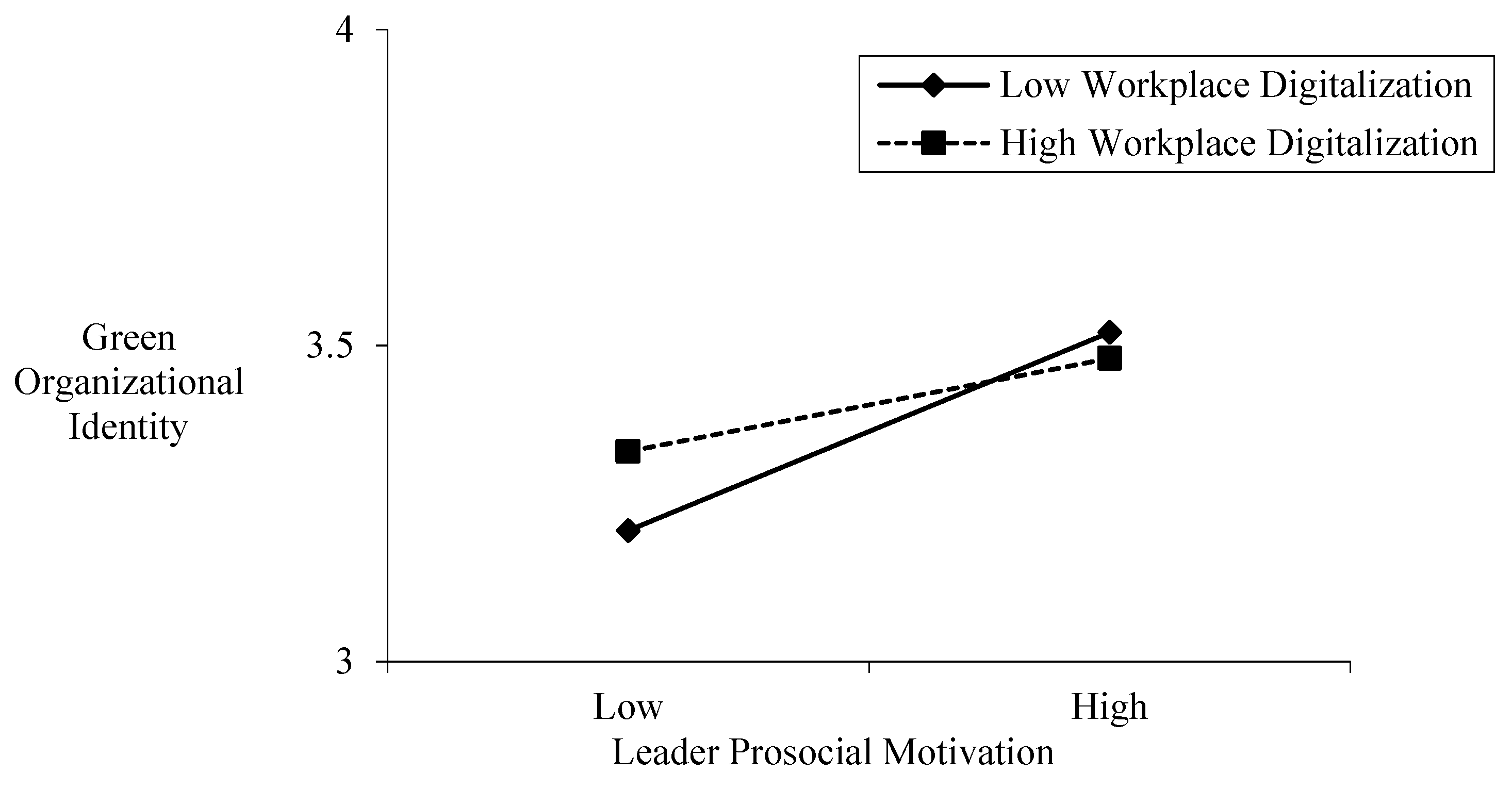
Figure 4 plots the moderating role of workplace digitalization within the “affective reaction” pathway. As workplace digitalization increases, the positive influence of leader prosocial motivation on employee green organizational identity gradually weakens. Specifically, simple slope analyses reveal that the positive slope for high workplace digitalization is significantly flatter and less pronounced compared to that for low workplace digitalization.
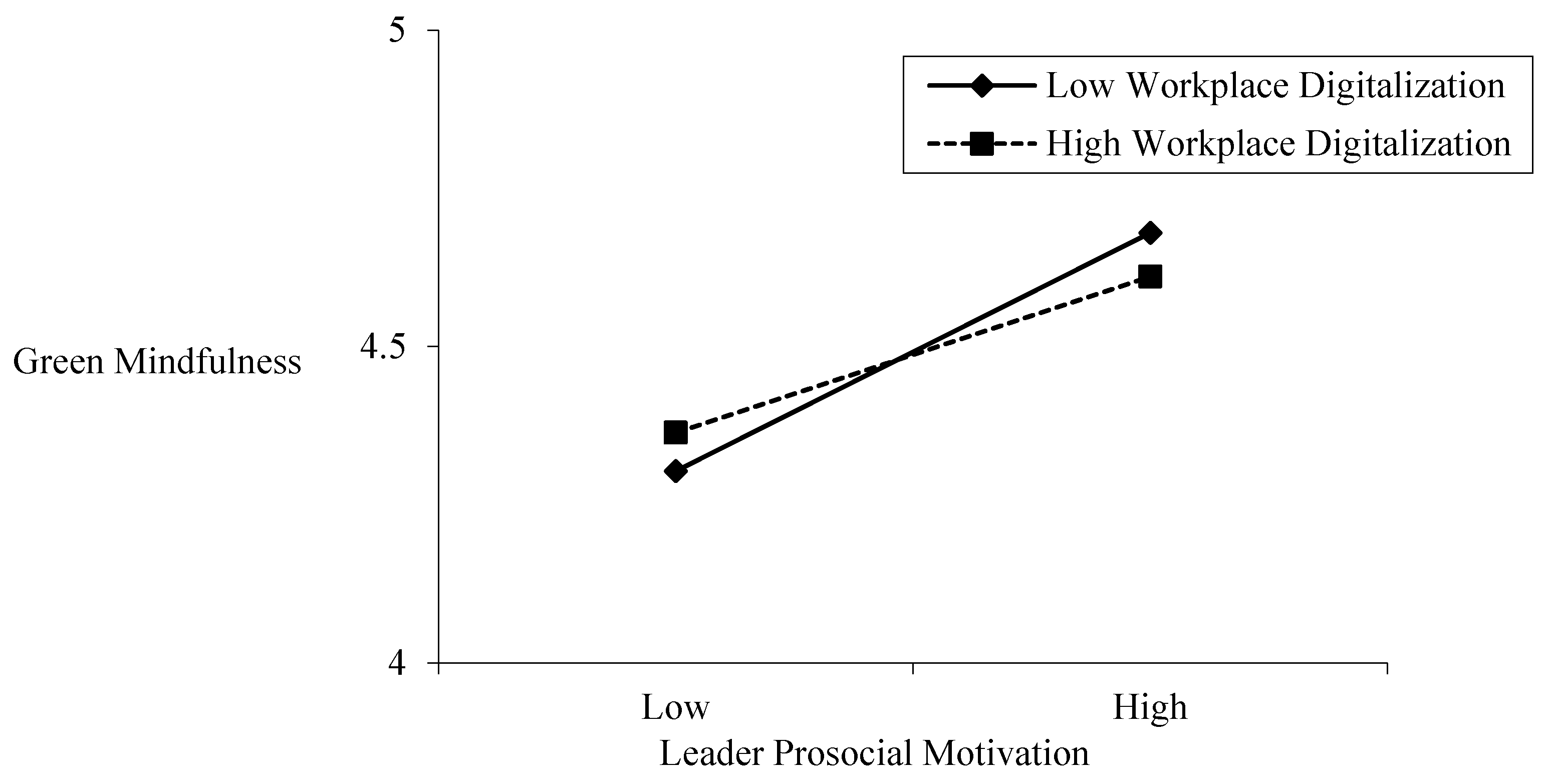
Similarly,
Figure 5 plots the moderating role of workplace digitalization within the “cognitive inference” pathway. As workplace digitalization increases, the positive influence of leader prosocial motivation on employee green mindfulness gradually weakens. Specifically, simple slope analyses reveal that the positive slope for high workplace digitalization is significantly flatter and less pronounced compared to that for low workplace digitalization.
To test the moderated mediation effect of workplace digitalization, we followed Edwards and Lambert (2007) [
69] by calculating the indirect effects at one standard deviation above and below the mean of mediating variable. As shown in
Table 7 Monte Carlo simulation results indicated that when workplace digitalization was low, the indirect effect of leader prosocial motivation on green innovation intention via green organizational identification was significant and positive (
b = 0.116; 95% CI = [0.059, 0.178]). However, this indirect effect became non-significant when digitalization was high (
b = 0.018; 95% CI = [−0.045, 0.083]). The difference between these two levels was significant (
b = −0.036; 95% CI = [−0.068, −0.005]), providing support for Hypothesis 4a. We observed a similar pattern for the second mediation path. When workplace digitalization was low, the indirect effect via green mindfulness was significant and positive (
b = 0.166; 95% CI = [0.094, 0.253]). However, this indirect effect became non-significant when digitalization was high (
b = 0.060; 95% CI = [−0.023, 0.132]). The difference between these two levels was significant (
b = −0.039; 95% CI = [−0.083, −0.005]), providing support for Hypothesis 4b.
5. Robustness Checks
We performed some robustness checks to corroborate our results. First, to examine potential reverse causality, we compared model fit between the hypothesized moderated mediation model and a plausible reverse-causality model using the Akaike (AIC, Akaike information criterion) and Bayesian (BIC, Bayesian information criterion) information criteria [
70]. This information criterion approach is increasingly used in management research to test the presence of reverse causal relationships in mediation models [
71]. The hypothesized model (AIC = 5605.707, BIC = 5650.357) exhibits lower information criterion values than the reverse-causality model (AIC = 5634.906, BIC = 5679.557), indicating superior fit. Therefore, we do not find support for the possibility of reverse causality. The results support the model shown in
Figure 1.
Further, we conducted supplementary analyses excluding all control variables [
72] to enhance the reliability and transparency of our findings.
Table A2 shows the moderating effect of workplace digitalization on the impact of leader prosocial motivation on employee green organizational identity (
β = −0.087,
p < 0.05) and green mindfulness (
β = −0.072,
p < 0.05).
Moreover, as shown in
Table A3, when the level of workplace digitalization is low, the conditional indirect effects remain significant through employee green organizational identity (
b = 0.118; 95% CI = [0.061, 0.181]) and through employee green mindfulness (
b = 0.174; 95% CI = [0.099, 0.253]). Thus, we find no substantive differences between the results obtained and those reported above.
6. Discussion
The current study develops and validates an integrated model explaining the relationship between perceived leader prosocial motivation and employees’ green innovation intention. Moving beyond a simple summary of results, we interpret our findings considering existing theories and the evolving twin transition narrative.
First, our findings demonstrate that the relationship between perceived leader prosocial motivation and employees’ green innovation intention is manifested through dual indirect effects of green organizational identity and green mindfulness. This aligns with the core tenets of SIP theory, suggesting that employees’ intentions are products of sensemaking based on social cues provided by leaders [
11]. Unlike previous research that predominantly focused on visible leadership styles, this study delves into the latent motives of leaders. We argue that motive-based signals are more nuanced and require deeper psychological internalization than behavioral scripts. By showcasing these micro-foundations, we extend the SIP paradigm by illustrating how social influence factors intersect with specific emotional and cognitive schemas in the context of sustainability.
Furthermore, we reveal the paradox of the twin transition through workplace digitalization. Our results reveal that high digitalization attenuates the positive influence of leader prosocial motivation. This finding challenges the prevailing narrative regarding the inherently empowering role of digitalization in sustainable development. We justify this crowding-out effect through the lenses of information overload and signal fidelity. While digital tools enhance transactional transparency, they often lead to depersonalized interactions. In highly digitized environments, the subtle, value-laden signals of a leader’s prosocial motivation are often drowned out by a relentless flow of digital tasks. This signal attrition suggests that digitization diminishes the quality of information processing, thereby hindering employees’ ability to attend to and internalize ethical cues. This nuanced perspective provides a necessary corrective to the overly optimistic view of digitalization.
7. Theoretical Contributions
Our research provides at least three important theoretical contributions on green innovation, leadership influence, and digital work contexts.
First, this study deepens the micro-foundations of leadership in the green innovation literature by shifting the focus from explicit leadership styles to implicit leadership motives. While prior research emphasizes visible behaviors, such as transformational leadership, it often overlooks the sensemaking process through which employees interpret a leader’s underlying reason. By framing leader prosocial motivation as a subtle social cue, we reveal that its interpretation positively associates with employees’ affective and cognitive actions, specifically green organizational identity and green mindfulness. This offers a more nuanced explanation of how an organization’s sustainable vision associates with individual intentions.
Second, we extend the boundary conditions of SIP theory by identifying the signaling friction created by digital transformation. While traditional SIP theory perspectives predominantly view digital technology as an enabler of information efficiency [
73], we argue that excessive digital integration acts as a situational constraint on the effective transmission of social cues. Our findings demonstrate that high workplace digitalization induces information overload and cognitive strain, thereby impairing employees’ capacity to capture and internalize social signals emitted by leadership. Unlike existing research that primarily focuses on subjective resistance to digital transformation, our study highlights the objective cognitive barriers inherent in digital environments. By clarifying these complex boundary effects, we offer a novel theoretical explanation for the obstacles to leader–follower communication in the twin transition era.
Furthermore, we enrich the burgeoning literature on the twin transition by offering critical theoretical insights into the interplay between digitalization and sustainability. While the prevailing discourse celebrates the synergy between digital and green transformations, it often overlooks the potential tensions within micro-level interactions. Our study offers a critical counter-perspective. We demonstrate that the technical enabling of digitalization may come at the cost of psychological crowding-out for human-centered drivers of innovation. From an information processing perspective, we challenge the linear assumption of digital empowerment, suggesting that digitalization and sustainability may follow a paradoxical rather than purely synergistic relationship. This provides a crucial theoretical warning for organizations to balance technological intensity with the preservation of social–emotional cues.
8. Practical Implications
By focusing on the micro-dynamics of leader–follower interactions, our findings offer several actionable insights for managers navigating the dual challenges of digitalization and sustainability. From our study, we can conclude that fostering employees’ green innovation intention requires leaders to transcend mere compliance—viewing sustainability merely as a passive response to external pressures. Overlooking this mechanism may cause employees to adopt a passivity toward green initiatives, thereby impeding green innovation intentions.
To address this, our study suggests possible solutions. The most obvious is that leaders function as pivotal information sources [
16], translating abstract green goals into perceptible social signals. For instance, by integrating sustainability narratives into daily interactions and publicly prioritizing environmental long-termism, leaders clarify green innovation as a shared organizational value. These actions allow leaders to transmit clear and consistent value signals, effectively mobilizing employees’ green innovative intentions.
Because internalizing leader prosocial motivation is a complex psychological process [
74], it is also important to prioritize the micro-foundations of how employees process social information. Our results show the importance of green organizational identity and green mindfulness as affective and cognitive mechanisms, respectively. To activate these pathways, organizations are encouraged to implement targeted interventions. For instance, launching green narrative programs, such as encouraging leaders to share environmental success stories driven by prosocial goals, imbues the green transformation with moral significance, strengthening employees’ identification with environmental objectives. Additionally, leaders can institutionalize regular green reflective sessions to guide employees in consciously processing complex green innovation signals, thereby ensuring that prosocial goals are translated into mindful action.
Furthermore, within the context of the two transitions, the strategic configuration of the digitalization workplace is necessary. While digital tools enhance transmission efficiency and transparency, our findings caution leaders against the cognitive strain and communication fragmentation caused by digital overload. Existing studies on digitization transformation also advocate for the judicious utilization of digitalization technology [
75], such as adopting a hybrid communication mode combining the immediacy of digital tools with the depth of face-to-face interactions when leaders communicate green values. By balancing these communication modalities, leaders can minimize digital distractions, enabling employees to attend to and internalize pro-environmental signals more effectively.
9. Limitations and Future Research
Like all studies, our work has limitations that future work will hopefully address. First, the generalizability of our findings may be constrained by the characteristics of our samples. Study 1 relied on a scenario-based experiment with undergraduates majoring in Human Resource Management. Despite having professional knowledge and internship experience, they may lack the deep-seated psychological contracts typical of long-tenured employees. Furthermore, as digital natives, their perceptions of workplace digitalization likely differ from those of more senior employees. Although Study 2 replicated these results using a diverse sample of full-time workers, future research should employ longitudinal designs or field experiments across various career stages and industries to further enhance ecological validity.
Second, our research is subject to certain methodological limitations. While Study 2 employed a multi-wave design to mitigate Common Method Bias (CMB), the reliance on single-source, self-reported data remains a constraint. Furthermore, although the time-lagged approach helps separate key constructs, measuring certain independent variables and mediators concurrently limits our ability to definitively establish temporal precedence. Given that our variables are psychological constructs embedded within the green transformation context, their high conceptual proximity may manifest as cognitive synergy at the individual level. Consequently, our results should be interpreted as evidence of significant associations and psychological consistency rather than a confirmed causal chain. Future research should integrate multi-source data—such as supervisor ratings or objective archival records. Additionally, adopting longitudinal panel design with at least three waves would help establish more robust evidence of causality.
Finally, the cultural context of our study introduces specific boundary conditions. Our empirical focus on China—a culture characterized by high power distance and collectivism—may have amplified the signaling effect of leader prosocial motivation. In high power distance environments, employees are typically more sensitive to leader-driven signals, which may magnify the impact of prosocial motivations compared to Western cultures. Additionally, collectivism may facilitate the internalization of leader motivations into green organizational identity and green mindfulness. Future research should conduct cross-cultural comparisons to exam how these cultural dimensions moderate the paths from perceived leader motivation to green innovation intention. Such efforts would help develop a more universal and globally applicable theory of organizational green transformation.
Author Contributions
Conceptualization: Y.S., H.Z. and X.Z. Methodology: Y.S. and Y.J. Investigation: Y.S., X.Z., and Y.J. Writing—original draft: Y.S., Y.J., and H.Z. Writing—review and editing: all authors. Funding acquisition: Y.S., H.Z., and X.Z. All authors have read and agreed to the published version of the manuscript.
Funding
This research was funded by the National Natural Science Foundation of China (Grant No. 71672084), the Postgraduate Research and Practice Innovation Foundation of Jiangsu Province (Grant No. KYCX20_0398), and the Youth Program of Jiangsu Provincial Natural Science Foundation (Grant No. BK20230365).
Institutional Review Board Statement
The research content focused entirely on workplace behaviors, psychological perceptions, and organizational management dynamics, without involving any issues in the field of life sciences. Based on this, this research does not fall within the scope of application as stipulated in the “Ethical Review Measures for Life Sciences and Medical Research Involving Humans” jointly issued by the National Health Commission of China, the Ministry of Education, and the Ministry of Science and Technology (Document No. 4 of 2023 issued by the National Health Commission of China). Which meets the conditions for exemption from formal ethical review.
Informed Consent Statement
Informed consent was obtained from all subjects involved in the study.
Data Availability Statement
The datasets used and/or analyzed during the current study are available from the corresponding author on reasonable request.
Conflicts of Interest
The authors declare no conflicts of interest.
Appendix A. Experimental Procedures
Experimental Scenarios and Manipulations (English Version)
Please imagine that you are a full-time employee at this company. The following description reflects your actual work environment and the daily behavior of your immediate supervisor, Manager Zhang. Please put yourself in this role and carefully consider what it would be like to work in this situation.
Low Digitalization: You work at “Traditional-Tech,” a company that primarily relies on face-to-face meetings and paper-based documentation for its daily operations. You perform your tasks at a fixed workstation, and your use of digital tools is limited to basic emails and simple word processing. Coordination with colleagues often requires physical presence, and the organizational workflow is manually driven, with few automated systems.
High Digitalization: You work at “Digital-Tech,” a company that has fully embraced digital transformation. The firm is equipped with advanced tools, including augmented reality (AR), information visualization systems, and AI-driven cloud solutions. You have total flexibility to choose your work location-whether at home or in a hub-as all processes are integrated and automated. Collaboration occurs through real-time digital platforms, and human-machine interaction is a core part of your daily routine.
Following the context description, participants read a memo from their direct supervisor, Manager Zhang, regarding a new “Green Innovation Project.”
High Prosocial Motivation: In the project kick-off, Manager Zhang emphasized: “I am personally committed to this green project because it is an opportunity for us to protect our community’s environment and support the well-being of our clients. My primary goal is to ensure we leave a positive impact on society and the planet, even if it requires extra effort beyond our standard KPIs. I believe our work should serve the common good.”
Low Prosocial Motivation: In the project kick-off, Manager Zhang emphasized: “I am pushing this green project because the headquarters is now heavily weighing environmental metrics in our year-end performance reviews. My primary goal is to ensure this project boosts our department’s ranking and secures my own promotion and our team’s bonuses. We must succeed in this to show the company we are compliant and competitive in the current market.”
Appendix B
Table A1.
Results of the independent t-test in Study 1.
Table A1.
Results of the independent t-test in Study 1.
| Variables | High Workplace Digitalization | Low Workplace Digitalization |
|---|
| Leader Prosocial Motivation | Green Organizational Identity | Green Mindfulness | Green Organizational Identity | Green Mindfulness |
| Low | High | Low | High | Low | High | Low | High |
| Mean | 2.891 | 2.826 | 2.976 | 2.928 | 2.775 | 3.232 | 2.809 | 3.150 |
| N | 46 | 46 | 46 | 46 | 46 | 46 | 46 | 46 |
| SE | 0.817 | 0.733 | 0.593 | 0.591 | 0.613 | 0.636 | 0.568 | 0.537 |
| b | 0.035 | 0.149 | 0.049 | 0.290 |
| t | 0.403 | 0.392 | −3.506 | −2.955 |
| p | 0.698 | 0.696 | <0.001 | 0.004 |
| Cohen’s d | 0.084 | 0.082 | −0.731 | −0.616 |
Table A2.
Regression result without control variables in Study 2.
Table A2.
Regression result without control variables in Study 2.
| Variables | Green Innovation Intention | Green Organizational Identity | Green Mindfulness |
|---|
| Model 1 | Model 2 | Model 3 |
|---|
| Leader Prosocial Motivation | 0.109 * (2.268) | 0.154 ** (3.215) | 0.190 ** (4.004) |
| Workplace Digitalization | | 0.047 (0.992) | −0.006 (−0.130) |
Leader Prosocial Motivation
* Workplace Digitalization | | −0.087 * (−2.475) | −0.072 * (−2.085) |
| Constant | 2.676 *** (16.904) | 3.030 *** (46.279) | 3.017 *** (46.571) |
| R2 | 0.012 | 0.042 | 0.047 |
| Adjust R2 | 0.010 | 0.035 | 0.040 |
| F | 5.143 | 6.165 | 6.985 |
Table A3.
Bootstrapped indirect effect results of moderated mediation effect without control variables.
Table A3.
Bootstrapped indirect effect results of moderated mediation effect without control variables.
| Effects | (a) Employee Green Organizational Identity | (b) Employee Green Mindfulness |
|---|
| b | se | 95% CI | b | se | 95% CI |
|---|
| Indirect Effect | 0.070 *** | 0.023 | [0.026, 0.116] | 0.116 *** | 0.028 | [0.061, 0.171] |
| Conditional Indirect Effect (Moderating Variable: Workplace Digitalization) |
| Low | 0.118 *** | 0.030 | [0.061, 0.181] | 0.174 *** | 0.039 | [0.099, 0.253] |
| High | 0.015 | 0.033 | [−0.049, 0.079] | 0.054 | 0.040 | [−0.023, 0.132] |
| Difference (Low-High) | −0.038 * | 0.016 | [−0.070, −0.007] | −0.043 * | 0.020 | [−0.083, −0.005] |
References
- Tabares, S.; Parida, V.; Chirumalla, K. Twin transition in industrial organizations: Conceptualization, implementation framework, and research agenda. Technol. Forecast. Soc. 2025, 213, 123995. [Google Scholar] [CrossRef]
- Luo, S.; Yimamu, N.; Li, Y.; Wu, H.; Irfan, M.; Hao, Y. Digitalization and sustainable development: How could digital economy development improve green innovation in China? Bus. Strategy Environ. 2023, 32, 1847–1871. [Google Scholar] [CrossRef]
- Hao, X.; Li, Y.; Ren, S.; Wu, H.; Hao, Y. The role of digitalization on green economic growth: Does industrial structure optimization and green innovation matter? J. Environ. Manag. 2023, 325, 116504. [Google Scholar] [CrossRef] [PubMed]
- Li, W.; Bhutto, T.A.; Xuhui, W.; Maitlo, Q.; Zafar, A.U.; Bhutto, N.A. Unlocking employees’ green creativity: The effects of green transformational leadership, green intrinsic, and extrinsic motivation. J. Clean. Prod. 2020, 255, 120229. [Google Scholar] [CrossRef]
- Robertson, J.L.; Barling, J. Greening organizations through leaders’ influence on employees’ pro-environmental behaviors. J. Organ. Behav. 2013, 34, 176–194. [Google Scholar] [CrossRef]
- Chen, Y.-S.; Lai, S.-B.; Wen, C.-T. The influence of green innovation performance on corporate advantage in Taiwan. J. Bus. Ethics 2006, 67, 331–339. [Google Scholar] [CrossRef]
- Cai, W.; Yang, C.; Bossink, B.A.; Fu, J. Linking leaders’ voluntary workplace green behavior and team green innovation: The mediation role of team green efficacy. Sustainability 2020, 12, 3404. [Google Scholar] [CrossRef]
- Faraz, N.A.; Ahmed, F.; Ying, M.; Mehmood, S.A. The interplay of green servant leadership, self-efficacy, and intrinsic motivation in predicting employees’ pro-environmental behavior. Corp. Soc. Responsib. Environ. Manag. 2021, 28, 1171–1184. [Google Scholar] [CrossRef]
- Daft, R.L.; Lengel, R.H. Organizational information requirements, media richness and structural design. Manag. Sci. 1986, 32, 554–571. [Google Scholar] [CrossRef]
- Weick, K.E.; Sutcliffe, K.M.; Obstfeld, D. Organizing and the process of sensemaking. Organ. Sci. 2005, 16, 409–421. [Google Scholar] [CrossRef]
- Salancik, G.R.; Pfeffer, J. A social information processing approach to job attitudes and task design. Adm. Sci. Q. 1978, 23, 224–253. [Google Scholar] [CrossRef]
- Ocasio, W. Towards an attention-based view of the firm. Strateg. Manag. J. 1997, 18, 187–206. [Google Scholar] [CrossRef]
- Leonardi, P.M. When flexible routines meet flexible technologies: Affordance, constraint, and the imbrication of human and material agencies. MIS Q. 2011, 35, 147–167. [Google Scholar] [CrossRef]
- Yan, P. ‘Fed with the Wrong Stuff’: Information overload and the everyday use of the Internet in rural and urban China. Int. Commun. Gaz. 2021, 83, 404–427. [Google Scholar] [CrossRef]
- Bhave, D.P.; Kramer, A.; Glomb, T.M. Work–family conflict in work groups: Social information processing, support, and demographic dissimilarity. J. Appl. Psychol. 2010, 95, 145. [Google Scholar] [CrossRef] [PubMed]
- Lau, D.; Liden, R. Antecedents of coworker trust: Leaders’ blessings. J. Appl. Psychol. 2008, 93, 1130–1138. [Google Scholar] [CrossRef]
- Boekhorst, J.A. The role of authentic leadership in fostering workplace inclusion: A social information processing perspective. Hum. Resour. Manag. 2015, 54, 241–264. [Google Scholar] [CrossRef]
- Chan, A.J.; Hooi, L.W.; Ngui, K.S. Do digital literacies matter in employee engagement in digitalised workplace? J. Asia Bus. Stud. 2021, 15, 523–540. [Google Scholar] [CrossRef]
- Hooi, L.W.; Chan, A.J. Does workplace digitalization matter in linking transformational leadership and innovative culture to employee engagement? J. Organ. Change Manag. 2023, 36, 197–216. [Google Scholar] [CrossRef]
- Chatterjee, S.; Chaudhuri, R.; Vrontis, D.; Giovando, G. Digital workplace and organization performance: Moderating role of digital leadership capability. J. Innov. Knowl. 2023, 8, 100334. [Google Scholar] [CrossRef]
- Bakker, A. Strategic and proactive approaches to work engagement. Organ. Dyn. 2017, 46, 67–75. [Google Scholar] [CrossRef]
- Deng, C.; Li, H.; Wang, Y.; Zhu, R. The double-edged sword in the digitalization of human resource management: Person-environment fit perspective. J. Bus. Res. 2024, 180, 114738. [Google Scholar] [CrossRef]
- Natu, S.; Aparicio, M. Analyzing knowledge sharing behaviors in virtual teams: Practical evidence from digitalized workplaces. J. Innov. Knowl. 2022, 7, 100248. [Google Scholar] [CrossRef]
- Marsh, E.; Vallejos, E.P.; Spence, A. The digital workplace and its dark side: An integrative review. Comput. Hum. Behav. 2022, 128, 107118. [Google Scholar] [CrossRef]
- Chi, M.; Xu, Y.; Wu, Y. Must workplace digitalization facilitate employees’ innovation behavior? Hum. Resour. Dev. China 2025, 42, 25–48. (In Chinese) [Google Scholar]
- Stich, J.-F.; Tarafdar, M.; Cooper, C.L. Electronic communication in the workplace: Boon or bane? J. Organ. Eff. People Perform. 2018, 5, 98–106. [Google Scholar] [CrossRef]
- Orhan, M.A.; Castellano, S.; Khelladi, I.; Marinelli, L.; Monge, F. Technology distraction at work. Impacts on self-regulation and work engagement. J. Bus. Res. 2021, 126, 341–349. [Google Scholar] [CrossRef]
- Grant, A.M.; Sumanth, J.J. Mission possible? The performance of prosocially motivated employees depends on manager trustworthiness. J. Appl. Psychol. 2009, 94, 927. [Google Scholar] [CrossRef]
- Aydinli, A.; Bender, M.; Chasiotis, A.; Cemalcilar, Z.; Van de Vijver, F.J. When does self-reported prosocial motivation predict helping? The moderating role of implicit prosocial motivation. Motiv. Emot. 2014, 38, 645–658. [Google Scholar] [CrossRef]
- Kim, A.; Kim, Y.; Han, K.; Jackson, S.E.; Ployhart, R.E. Multilevel influences on voluntary workplace green behavior: Individual differences, leader behavior, and coworker advocacy. J. Manag. 2017, 43, 1335–1358. [Google Scholar] [CrossRef]
- García-Machado, J.J.; Martínez-Ávila, M. Environmental performance and green culture: The mediating effect of green innovation. An application to the automotive industry. Sustainability 2019, 11, 4874. [Google Scholar] [CrossRef]
- Shao, B.; Cardona, P.; Ng, I.; Trau, R.N.C. Are prosocially motivated employees more committed to their organization? The roles of supervisors’ prosocial motivation and perceived corporate social responsibility. Asia Pac. J. Manag. 2017, 34, 951–974. [Google Scholar] [CrossRef]
- Aguinis, H.; Glavas, A. On corporate social responsibility, sensemaking, and the search for meaningfulness through work. J. Manag. 2019, 45, 1057–1086. [Google Scholar] [CrossRef]
- Rezende, L.d.A.; Bansi, A.C.; Alves, M.F.R.; Galina, S.V.R. Take your time: Examining when green innovation affects financial performance in multinationals. J. Clean. Prod. 2019, 233, 993–1003. [Google Scholar] [CrossRef]
- Amrutha, V.; Geetha, S. Linking organizational green training and voluntary workplace green behavior: Mediating role of green supporting climate and employees’ green satisfaction. J. Clean. Prod. 2021, 290, 125876. [Google Scholar] [CrossRef]
- Saeed, B.B.; Afsar, B.; Hafeez, S.; Khan, I.; Tahir, M.; Afridi, M.A. Promoting employee’s proenvironmental behavior through green human resource management practices. Corp. Soc. Responsib. Environ. Manag. 2019, 26, 424–438. [Google Scholar] [CrossRef]
- Chen, Y.S. Green organizational identity: Sources and consequence. Manag. Decis. 2011, 49, 384–404. [Google Scholar] [CrossRef]
- Song, W.; Ren, S.; Yu, J. Bridging the gap between corporate social responsibility and new green product success: The role of green organizational identity. Bus. Strategy Environ. 2019, 28, 88–97. [Google Scholar] [CrossRef]
- Moriano, J.A.; Molero, F.; Topa, G.; Lévy Mangin, J.-P. The influence of transformational leadership and organizational identification on intrapreneurship. Int. Entrep. Manag. J. 2014, 10, 103–119. [Google Scholar] [CrossRef]
- Mael, F.; Ashforth, B.E. Alumni and their alma mater: A partial test of the reformulated model of organizational identification. J. Organ. Behav. 1992, 13, 103–123. [Google Scholar] [CrossRef]
- Chang, C.H.; Chen, Y.S. Green organizational identity and green innovation. Manag. Decis. 2013, 51, 1056–1070. [Google Scholar] [CrossRef]
- Barbaro, N.; Pickett, S.M. Mindfully green: Examining the effect of connectedness to nature on the relationship between mindfulness and engagement in pro-environmental behavior. Personal. Individ. Differ. 2016, 93, 137–142. [Google Scholar] [CrossRef]
- Chen, Y.-S.; Chang, C.-H.; Lin, Y.-H. Green transformational leadership and green performance: The mediation effects of green mindfulness and green self-efficacy. Sustainability 2014, 6, 6604–6621. [Google Scholar] [CrossRef]
- Srivastava, S.; Pathak, D.; Soni, S.; Dixit, A. Does green transformational leadership reinforce green creativity? The mediating roles of green organizational culture and green mindfulness. J. Organ. Change Manag. 2024, 37, 619–640. [Google Scholar] [CrossRef]
- Fiol, C.M.; O’Connor, E.J. Waking up! Mindfulness in the face of bandwagons. Acad. Manag. Rev. 2003, 28, 54–70. [Google Scholar] [CrossRef]
- Sedighi, M.; Hashemi, N. Navigating the digital landscape: Communication visibility and entrepreneurial opportunity identification. J. Entrep. Emerg. Econ. 2024, 17, 701–724. [Google Scholar] [CrossRef]
- Ophir, E.; Nass, C.; Wagner, A.D. Cognitive control in media multitaskers. Proc. Natl. Acad. Sci. USA 2009, 106, 15583–15587. [Google Scholar] [CrossRef]
- Dery, K.; Kolb, D.; MacCormick, J. Working with connective flow: How smartphone use is evolving in practice. Eur. J. Inf. Syst. 2014, 23, 558–570. [Google Scholar] [CrossRef]
- Rademaker, T.; Klingenberg, I.; Süß, S. Leadership and technostress: A systematic literature review. Manag. Rev. Q. 2025, 75, 429–494. [Google Scholar] [CrossRef]
- Khan, M.K.; Farwa, U.E.; Zulfiqar, S.; Li, S.; Haq, I.U. The plight of digitalization: Technostress and accountants’ professional identity. Int. J. Account. Inf. Syst. 2025, 56, 100755. [Google Scholar] [CrossRef]
- Trittin-Ulbrich, H.; Scherer, A.G.; Munro, I.; Whelan, G. Exploring the dark and unexpected sides of digitalization: Toward a critical agenda. Organization 2021, 28, 8–25. [Google Scholar] [CrossRef]
- Valtonen, A.; Holopainen, M. Mitigating employee resistance and achieving well-being in digital transformation. Inf. Technol. People 2025, 38, 42–72. [Google Scholar] [CrossRef]
- Schneider, P.; Sting, F.J. Employees’ perspectives on digitalization-induced change: Exploring frames of industry 4.0. Acad. Manag. Discov. 2020, 6, 406–435. [Google Scholar] [CrossRef]
- Kristopher, J.; Rucker, D.D.; Hayes, A.F. Addressing moderated mediation hypotheses: Theory, methods, and prescriptions. Multivar. Behav. Res. 2007, 42, 185–227. [Google Scholar] [CrossRef]
- Venz, L.; Boettcher, K. Leading in times of crisis: How perceived COVID-19-related work intensification links to daily e-mail demands and leader outcomes. Appl. Psychol.-Int. Rev. 2022, 71, 912–934. [Google Scholar] [CrossRef]
- Highhouse, S. Designing experiments that generalize. Organ. Res. Methods 2009, 12, 554–566. [Google Scholar] [CrossRef]
- Shen, P.; Li, J.; Wan, D. “Moving people by affection” or “convincing people by reasoning”? Research on the influence of chatbots’ role on customers’ emotional attachment. Nankai Bus. Rev. 2025, 28, 27–39. (In Chinese) [Google Scholar]
- Hubner, S.; Baum, M.; Frese, M. Contagion of entrepreneurial passion: Effects on employee outcomes. Entrep. Theory Pract. 2020, 44, 1112–1140. [Google Scholar] [CrossRef]
- Babic, K.; Černe, M.; Connelly, C.; Dysvik, A.; Skerlavaj, M. Are we in this together? Knowledge hiding in teams, collective prosocial motivation and leader-member exchange. J. Knowl. Manag. 2019, 23, 1502–1522. [Google Scholar] [CrossRef]
- van Houwelingen, G.; Stoelhorst, J. Digital is different: Digitalization undermines stakeholder relations because it impedes firm anthropomorphization. Acad. Manag. Discov. 2023, 9, 297–319. [Google Scholar] [CrossRef]
- Palumbo, R. Does digitizing involve desensitizing? Strategic insights into the side effects of workplace digitization. Public Manag. Rev. 2022, 24, 975–1000. [Google Scholar] [CrossRef]
- Li, L.; Ye, F.; Zhan, Y.; Kumar, A.; Schiavone, F.; Li, Y. Unraveling the performance puzzle of digitalization: Evidence from manufacturing firms. J. Bus. Res. 2022, 149, 54–64. [Google Scholar] [CrossRef]
- Choi, J.N. Individual and contextual dynamics of innovation-use behavior in organizations. Hum. Perform. 2004, 17, 397–414. [Google Scholar] [CrossRef]
- Tierney, P.; Farmer, S.M. Creative self-efficacy: Its potential antecedents and relationship to creative performance. Acad. Manag. J. 2002, 45, 1137–1148. [Google Scholar] [CrossRef]
- Sheng, J.; Ding, R.; Yang, H. Corporate green innovation in an aging population: Evidence from Chinese listed companies. Technol. Forecast. Soc. 2024, 202, 123307. [Google Scholar] [CrossRef]
- Javed, M.; Wang, F.; Usman, M.; Ali Gull, A.; Uz Zaman, Q. Female CEOs and green innovation. J. Bus. Res. 2023, 157, 113515. [Google Scholar] [CrossRef]
- He, K.; Chen, W.; Zhang, L. Senior management’s academic experience and corporate green innovation. Technol. Forecast. Soc. 2021, 166, 120664. [Google Scholar] [CrossRef]
- Van Auken, H.; Fry, F.L.; Stephens, P. The influence of role models on entrepreneurial intentions. J. Dev. Entrep. 2006, 11, 157–167. [Google Scholar] [CrossRef]
- Edwards, J.R.; Lambert, L.S. Methods for integrating moderation and mediation: A general analytical framework using moderated path analysis. Psychol. Methods 2007, 12, 1–22. [Google Scholar] [CrossRef]
- Kline, R.B. Principles and Practice of Structural Equation Modeling; Guilford Publications: New York, NY, USA, 2023. [Google Scholar]
- Caniëls, M.C.J.; Hatak, I.; Kuijpers, K.J.C.; de Weerd-Nederhof, P.C. Trait resilience instigates innovative behaviour at work? A cross-lagged study. Creat. Innov. Manag. 2022, 31, 274–293. [Google Scholar] [CrossRef]
- Bernerth, J.B.; Aguinis, H. A critical review and best-practice recommendations for control variable usage. Pers. Psychol. 2016, 69, 229–283. [Google Scholar] [CrossRef]
- Yin, S.; Chen, Q.; Sun, J. Digital infrastructure, information transfer and spatial allocation of capital. Reform 2025, 02, 88–104. (In Chinese) [Google Scholar]
- Eva, N.; Newman, A.; Zhou, A.J.; Zhou, S.S. The relationship between ethical leadership and employees’ internal and external community citizenship behaviors: The mediating role of prosocial motivation. Pers. Rev. 2020, 49, 636–652. [Google Scholar] [CrossRef]
- Pick, J.B.; Nishida, T. Digital divides in the world and its regions: A spatial and multivariate analysis of technological utilization. Technol. Forecast. Soc. 2015, 91, 1–17. [Google Scholar] [CrossRef]
| Disclaimer/Publisher’s Note: The statements, opinions and data contained in all publications are solely those of the individual author(s) and contributor(s) and not of MDPI and/or the editor(s). MDPI and/or the editor(s) disclaim responsibility for any injury to people or property resulting from any ideas, methods, instructions or products referred to in the content. |