Coordinating Industrial Restructuring and Population Dynamics for Sustainable Land–Sea Coupled Development: An Agent-Based Optimization Framework

Abstract
1. Introduction
2. Materials and Methods
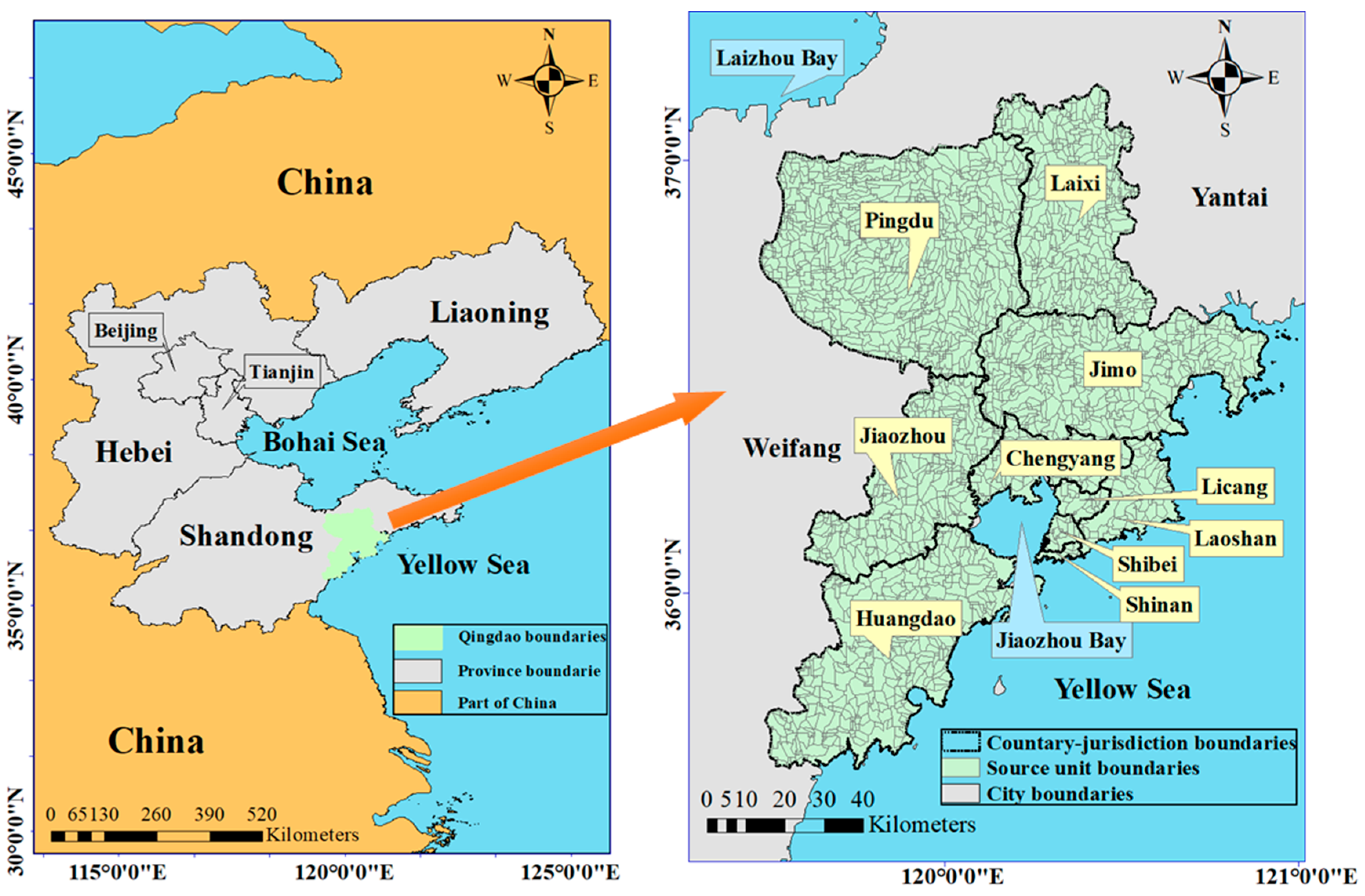
2.1. Study Area
2.2. Data Sources
2.3. Method
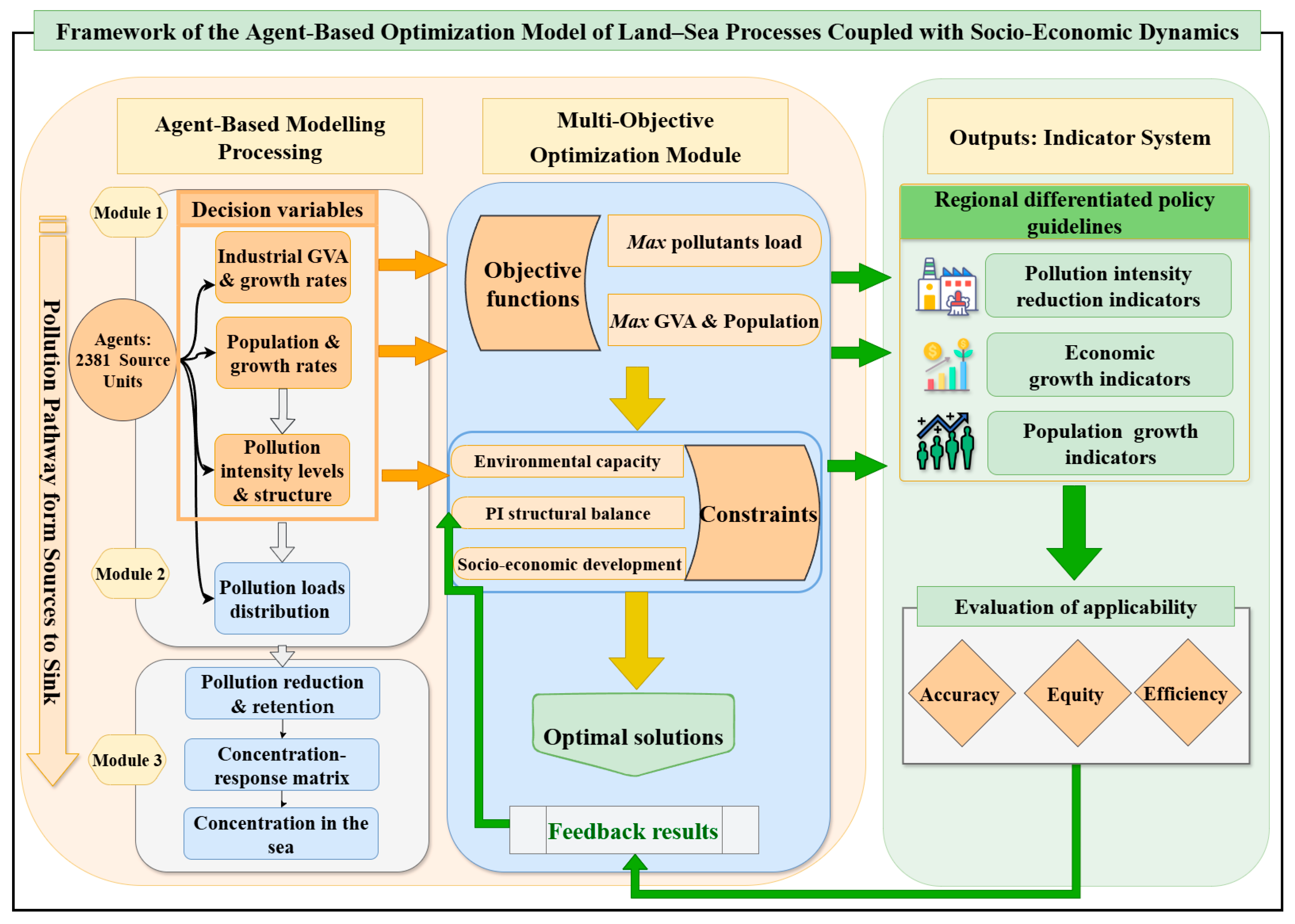
2.3.1. Framework of ABO-LSED
- (1)
- Purpose
- (2)
- Entities, state variables, and scales
- (3)
- Process overview
- (4)
- Sub-models
2.3.2. Mathematical Formulation of the ABO-LSED Model
- (1)
- Land–sea coupling framework
- (2)
- Linking socio-economic variables to pollution loads
- (3)
- Formulation of the PI structure of emission sources
- (4)
- Construction of integrated indicators
- (5)
- Optimization implementation
- 1.
- Objective function
- 2.
- Constraints
- (i)
- PI structure of pollution sources
- (ii)
- Coefficient interval of industrial PI
- (iii)
- Growth rate interval of economy and population
- (iv)
- TMAL interval of pollution discharged by industrial and domestic sources
2.3.3. Assessment of Applicability
2.3.4. Model Evaluation and Robustness Assessment
Validation Scope and Strategy
Sensitivity Analysis
3. Results
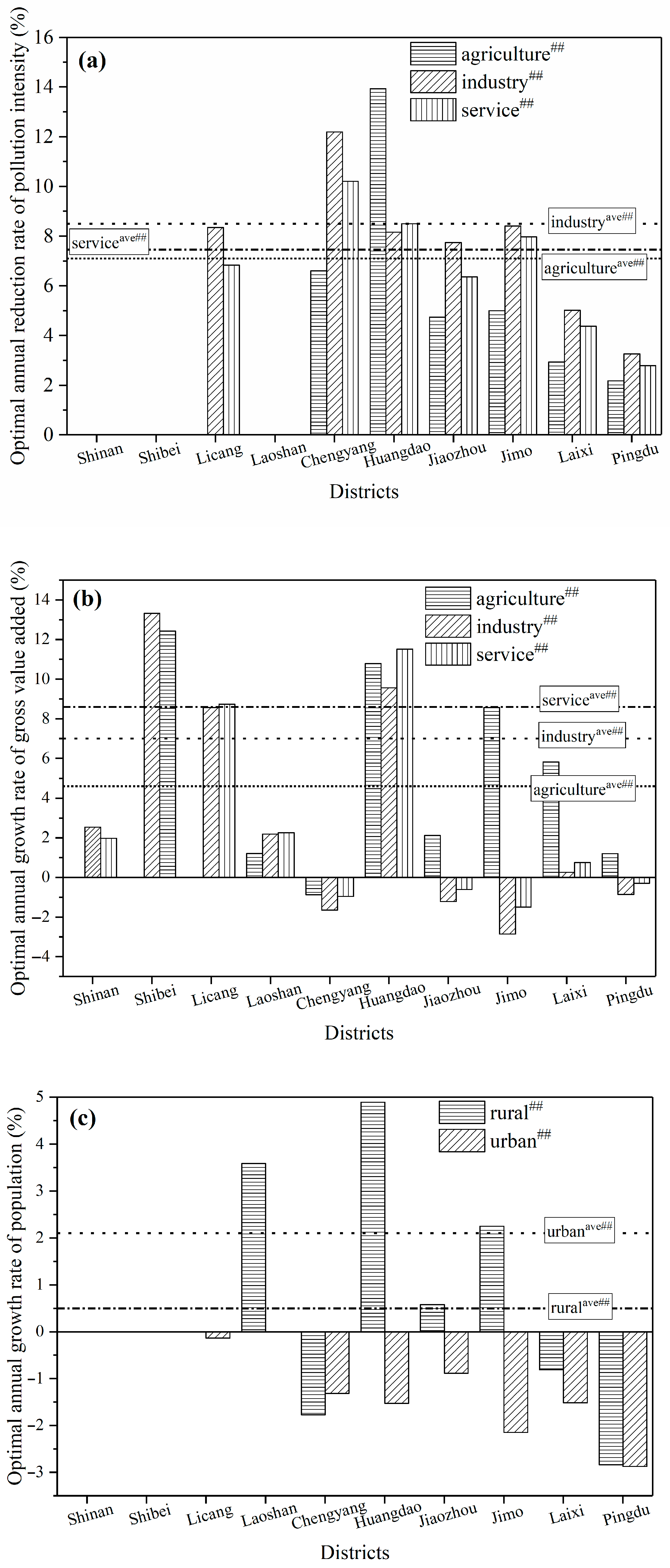
3.1. Regional Differentiated PI Reduction Indicators
3.2. Regional Differentiated Industrial GVA Indicators
3.3. Regional Differentiated Urban and Rural Population Indicators
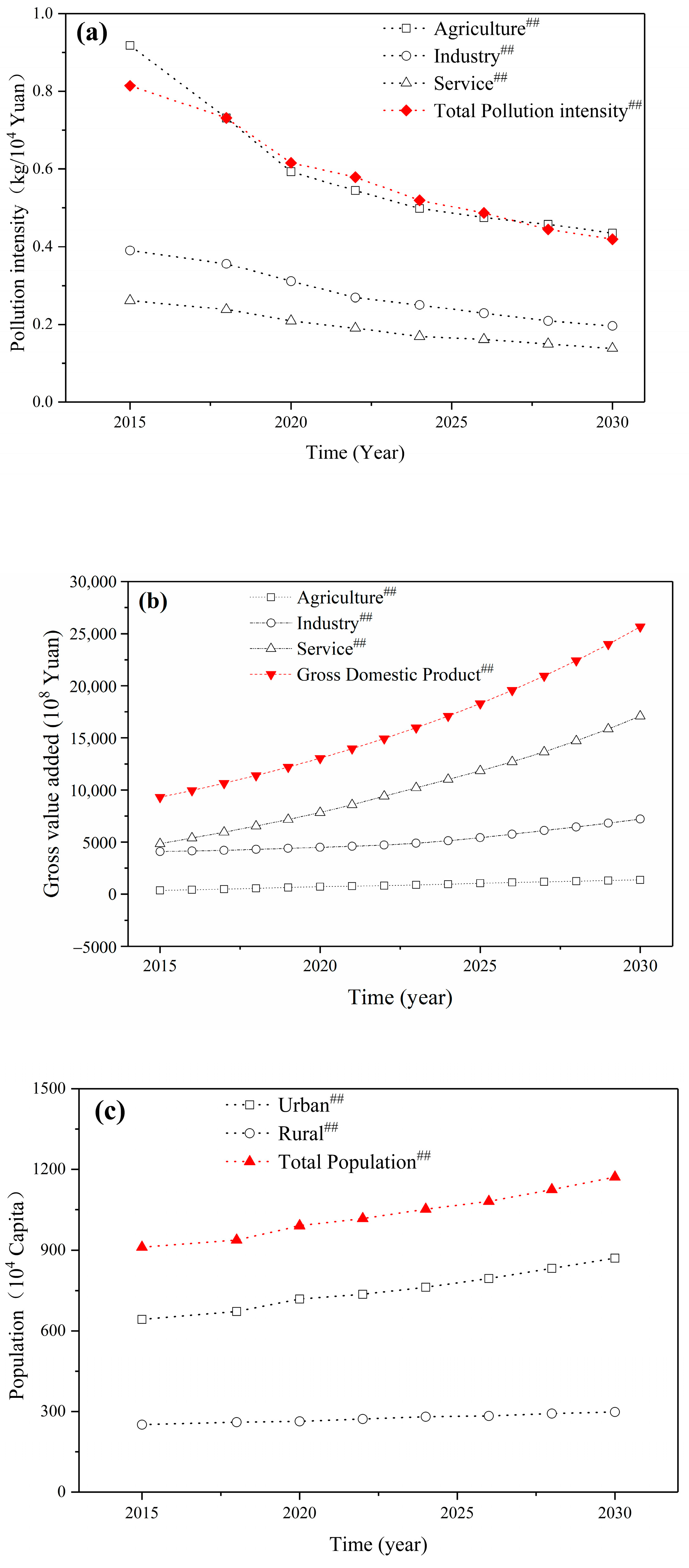
3.4. Applicability of the Integrated Indicators
3.5. Sensitivity Analysis of Constraint Settings
4. Discussion
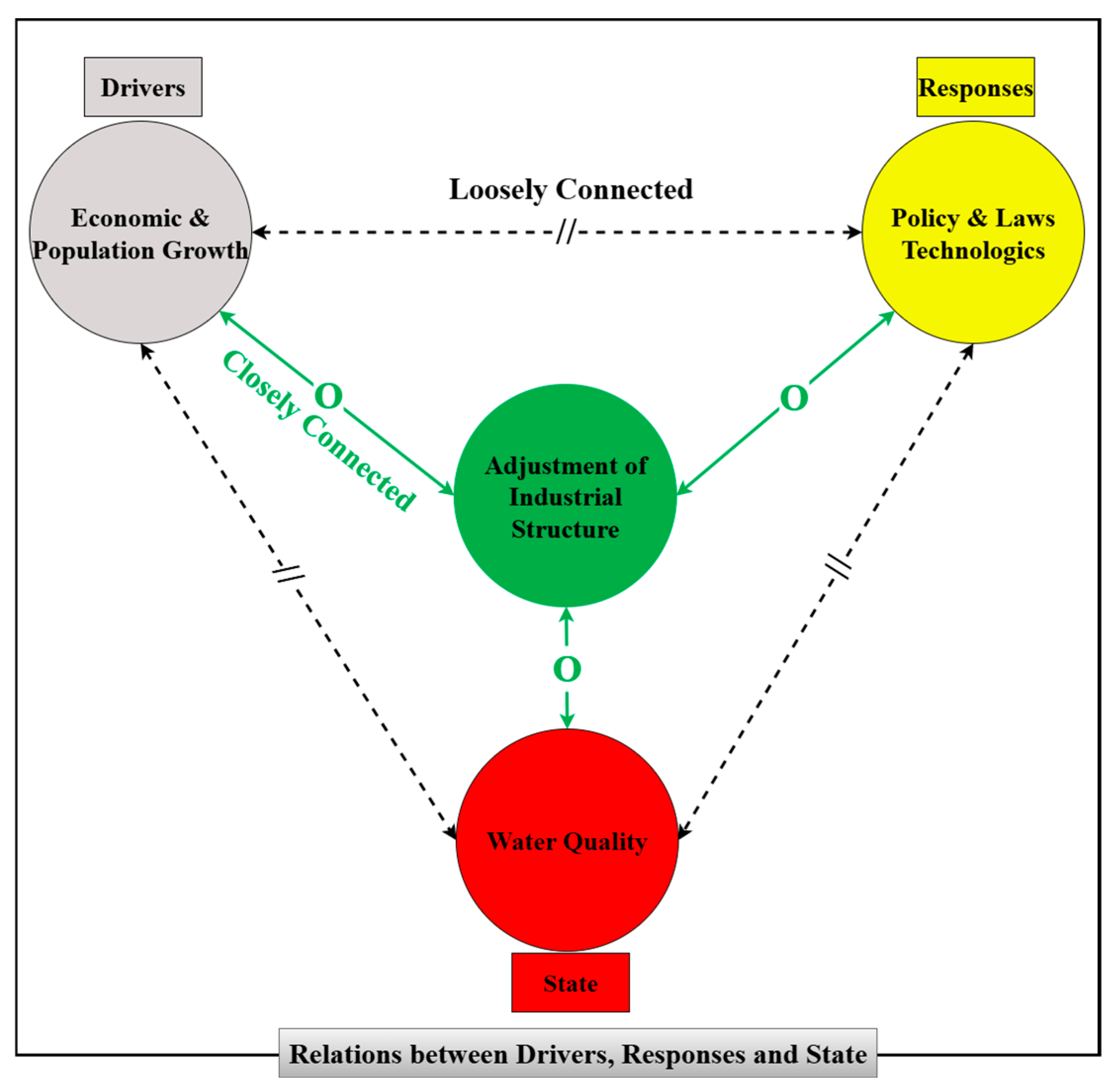
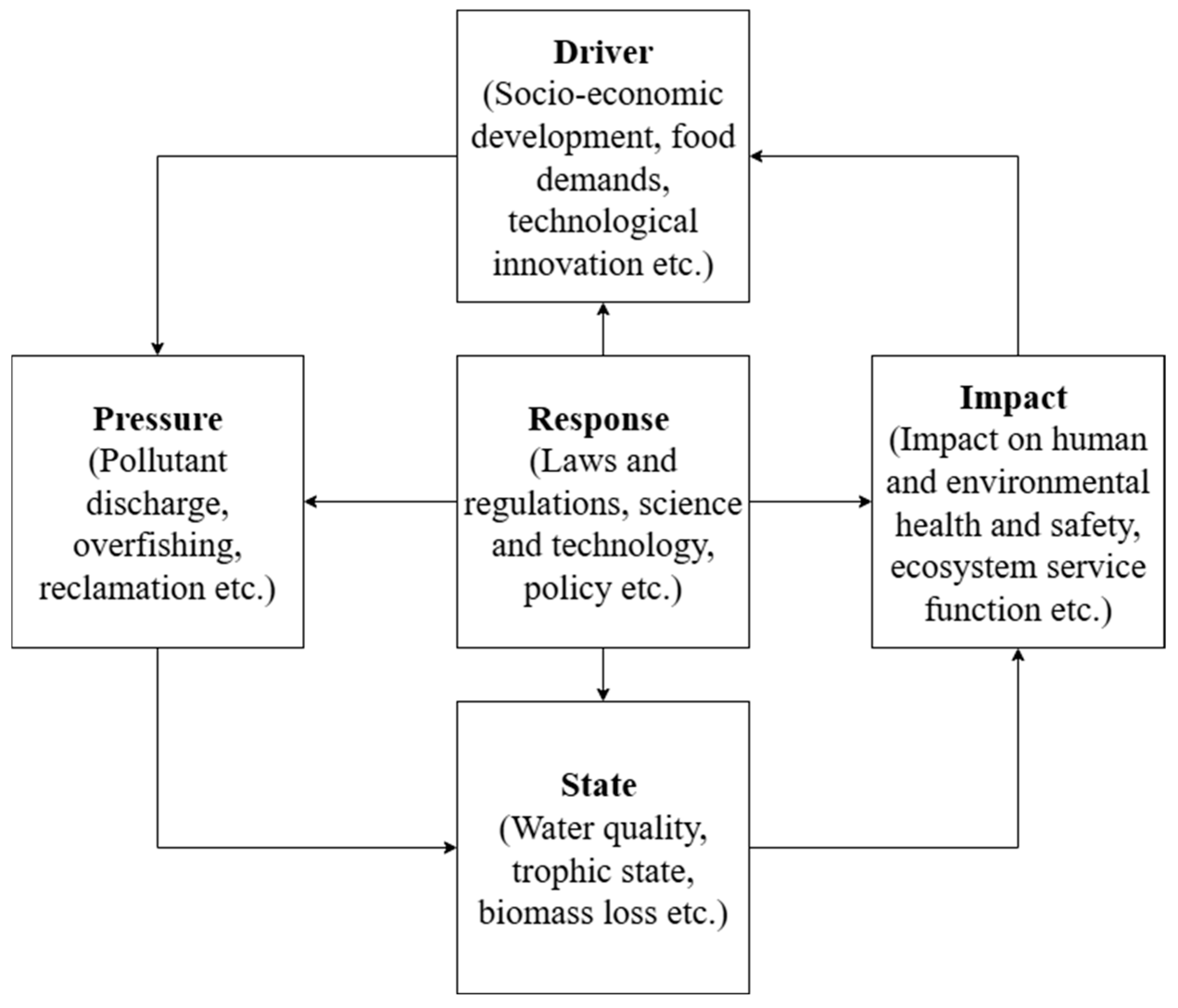
4.1. Coordinating Development Drivers and Regulatory Responses Under Integrated Environmental and Growth Constraints
4.2. Spatial Heterogeneity and Policy-Operational Implications
4.3. Historical Consistency and Feasibility of Regional Differentiated Indicators
4.4. Policy Implications of the Indicator System
4.5. Uncertainty and Broader Applicability
5. Conclusions
Author Contributions
Funding
Institutional Review Board Statement
Informed Consent Statement
Data Availability Statement
Acknowledgments
Conflicts of Interest
Abbreviations
| ABO-LSED | Agent-Based Optimization Model of Land–Sea Processes Coupled with Socio-Economic Dynamics |
| IIs | Integrated indicators |
| TMDLs | Total maximum daily loads |
| USEPA | The United States environmental protection agency |
| EC | The European commission |
| MSFD | Marine strategy framework directive |
| EKC | Environment Kuznets curve |
| DPSIR | Drivers, Pressure, State, Impact, Response |
| DIN | Dissolved inorganic nitrogen |
| PI | Pollution intensity |
| ABM | Agent-based model |
| TMAL | Total maximum allocated load |
| TN | Total nitrogen |
| MSTS | Municipal sewage treatment system |
| GDP | Gross domestic product |
| GVA | Gross value added for economic sector |
| CNY | Chinese Yuan |
| OSFA | One-size-fits-all |
| RD | Relative division |
Appendix A

| Districts | AGR-A (%) | AGR-A (%) | AGR-A (%) | AGR-P (%) | AGR-P (%) | |||||
|---|---|---|---|---|---|---|---|---|---|---|
| Agriculture | Industry | Service | Rural | Urban | ||||||
| HD | OS | HD | OS | HD | OS | HD | OS | HD | OS | |
| Shinan | 0.00 | 0.00 | 8.32 | 2.54 | 11.18 | 11.18 | 0.00 | 0.00 | 0.55 | 0.00 |
| Shibei | 0.00 | 0.00 | 21.63 | 13.33 | 14.95 | 14.95 | 0.00 | 0.00 | 0.56 | 0.00 |
| Licang | 0.00 | 0.00 | 3.42 | 8.56 | 16.47 | 16.47 | 0.00 | 0.00 | 1.49 | −0.14 |
| Laosahn | 7.79 | 1.21 | 7.76 | 2.18 | 13.89 | 7.31 | −1.12 | 3.59 | 4.45 | 0.00 |
| Chengyang | −5.75 | −0.88 | 3.99 | −1.65 | 11.13 | 16.00 | −1.81 | −1.77 | 3.22 | −1.32 |
| Huangdao | 10.00 | 10.79 | 11.05 | 9.56 | 17.45 | 18.24 | −3.29 | 4.89 | 6.01 | −1.53 |
| Jiaozhou | 5.76 | 2.12 | 8.38 | −1.21 | 13.93 | 10.29 | −2.03 | 0.58 | 7.85 | −0.88 |
| Jimo | 7.67 | 8.57 | 12.44 | −2.85 | 13.70 | 14.59 | −2.34 | 2.25 | 11.24 | −2.15 |
| Laixi | 6.33 | 5.82 | 6.56 | 0.26 | 9.09 | 8.58 | −0.50 | −0.81 | 5.29 | −1.51 |
| Pingdu | 5.46 | 1.20 | 8.07 | −0.86 | 10.22 | −0.29 | −0.36 | −2.84 | 6.36 | −2.87 |
| Associated Formulation | Symbols | Definition |
|---|---|---|
| Land–sea coupling framework | i | Index of wastewater outlet |
| j | Index of source unit | |
| Emission load from land to sea | ||
| Pollution generated from source unit | ||
| Pollution reduction by MSTS | ||
| Pollution reduction by soil/river-retention | ||
| Linking socio-economic variables to pollution loads | m | Industrial sources |
| n | Domestic sources | |
| k | Pollution intensity level | |
| GVA of economic sectors | ||
| Population size | ||
| PI of pollution sources | ||
| Population–income regression coefficient (103 CNY/person) | ||
| t | Number of years since the base year | |
| BY | Base year (2015) | |
| Annual growth rates of the economic sectors | ||
| Annual growth rates of population | ||
| Formulation of the PI structure of emission sources | Environmental Gini coefficient, representing the PI structure in this study | |
| Cumulative proportions of sectoral GVA and residents’ income at the PI level of k to their sum across all PI levels | ||
| Cumulative proportions of pollution loads from industrial sources and domestic sources at the PI level of k to their sum across all PI levels | ||
| Construction of integrated indicators | Projected GDP growth rate across Qindao in the year | |
| Projected population growth rate across Qindao in the year | ||
| Proportion of sectoral GVA in year across the agricultural, industry, and service sectors | ||
| Annual growth rate of sectoral GVA in year across the agricultural, industry, and service sectors | ||
| Proportion of population in year across the urban and rural area | ||
| Annual growth rate of population in year across the urban and rural area | ||
| * | Optimal results of the optimization model | |
| High-pressure districts | ||
| Low-pressure districts | ||
| High-pressure source units | ||
| Low-pressure source units | ||
| Type of indicators, including PI reduction, GVA, population growth | ||
| The change value of indicators | ||
| The change rate of indicators | ||
| Additional industrial land | ||
| The GVA indicator | ||
| The industrial GVA per unit area | ||
| Additional residential land | ||
| The population indicator | ||
| Mean population density, defined as the number of individuals per unit area | ||
| Optimization implementation | Permissible range of variation for graded PI, which is generally set to 1 | |
| DL | Lower limits | |
| UL | Upper limits |
References
- Maure, E.R.; Terauchi, G.; Ishizaka, J.; Clinton, N.; DeWitt, M. Globally consistent assessment of coastal eutrophication. Nat. Commun. 2021, 12, 6142. [Google Scholar] [CrossRef]
- Halpern, B.S.; McLeod, K.L.; Rosenberg, A.A.; Crowder, L.B. Managing for cumulative impacts in ecosystem-based management through ocean zoning. Ocean Coast. Manag. 2008, 51, 203–211. [Google Scholar] [CrossRef]
- United States Environmental Protection Agency (USEPA). Water Quality Inventory 1997; United States Environmental Protection Agency: Washington, DC, USA, 1997.
- European Parliament; Council of the European Union. Directive 2008/56/EC of the European Parliament and of the Council of 17 June 2008 Establishing a Framework for Community Action in the Field of Marine Environmental Policy (Marine Strategy Framework Directive) (Text with EEA Relevance). Off. J. Eur. Union 2008, L 164, 19–40. [Google Scholar]
- Kataoka, Y. Water quality management in Japan: Recent developments and challenges for integration. Environ. Policy Gov. 2011, 21, 338–350. [Google Scholar] [CrossRef]
- United States Environmental Protection Agency (USEPA). National Pollutant Discharge Elimination System (NPDES). Available online: https://www.epa.gov/npdes (accessed on 14 April 2026).
- Cui, D.; Chen, X.; Xue, Y.; Li, R.; Zeng, W. An integrated approach to investigate the relationship of coupling coordination between social economy and water environment on urban scale—A case study of Kunming. J. Environ. Manag. 2019, 234, 189–199. [Google Scholar] [CrossRef]
- Bak, M.P.; Kroeze, C.; Janssen, A.B.G.; Strokal, M. Modelling future coastal water pollution: Impacts of point sources, socio-economic developments & multiple pollutants. Environ. Res. Lett. 2024, 19, 064028. [Google Scholar] [CrossRef]
- Kanan, A.H.; Giupponi, C. Coastal socio-ecological systems adapting to climate change: A global overview. Sustainability 2024, 16, 10000. [Google Scholar] [CrossRef]
- European Environment Agency (EEA). Environmental Indicators: Typology and Overview; Technical Report No. 25/1999; European Environment Agency: Copenhagen, Denmark, 1999.
- Grossman, G.M.; Krueger, A.B. Economic growth and the environment. Q. J. Econ. 1995, 110, 353–377. [Google Scholar] [CrossRef]
- Liu, N.; Liu, C.; Xia, Y.; Da, B. Examining the coordination between urbanization and eco-environment using coupling and spatial analyses: A case study in China. Ecol. Indic. 2018, 93, 1163–1175. [Google Scholar] [CrossRef]
- Cai, M.; Liu, Y.; Chen, K.; Huang, D.; Yang, S. Quantitative analysis of anthropogenic influences on coastal water—A new perspective. Ecol. Indic. 2016, 67, 673–683. [Google Scholar] [CrossRef]
- Wang, Z.B.; Bu, C.; Li, H.M.; Wei, W.D. Seawater environmental Kuznets curve: Evidence from seawater quality in China’s coastal waters. J. Clean. Prod. 2019, 219, 925–935. [Google Scholar] [CrossRef]
- Xue, R.; Gu, R.; Ong, T. How does coupling coordination between industrial structure optimization and ecosystem services dynamically affect carbon emissions in the Yellow River Basin? J. Clean. Prod. 2025, 517, 145872. [Google Scholar] [CrossRef]
- Malmir, M.; Javadi, S.; Moridi, A.; Neshat, A.; Razdar, B. A new combined framework for sustainable development using the DPSIR approach and numerical modeling. Geosci. Front. 2021, 12, 101169. [Google Scholar] [CrossRef]
- Guo, H.C.; Liu, L.; Huang, G.H.; Fuller, G.A.; Zou, R.; Yin, Y.Y. A system dynamics approach for regional environmental planning and management: A study for the Lake Erhai Basin. J. Environ. Manag. 2001, 61, 93–111. [Google Scholar] [CrossRef]
- Xiao, X.; Peng, Y.; Li, S. China’s optimal industrial structure: The theoretical model and Quantitative calculation. China Econ. Q. 2013, 12, 135–162. [Google Scholar] [CrossRef]
- Li, Y.; Zhang, Z.; Shi, M. What should be the future industrial structure of the Beijing-Tianjin-Hebei city region under water resource constraint? An inter-city input-output analysis. J. Clean. Prod. 2019, 239, 118117. [Google Scholar] [CrossRef]
- Walsh, S.J.; Mena, C.F. Interactions of social, terrestrial, and marine sub-systems in the Galapagos Islands, Ecuador. Proc. Natl. Acad. Sci. USA 2016, 113, 14536–14543. [Google Scholar] [CrossRef]
- Yandamuri, S.R.M.; Srinivasan, K.; Bhallamudi, S.M. Multiobjective optimal waste load allocation models for rivers using Nondominated Sorting Genetic Algorithm-II. J. Water Resour. Plan. Manag. 2006, 132, 133–143. [Google Scholar] [CrossRef]
- Beaussier, T.; Caurla, S.; Bellon-Maurel, V.; Loiseau, E. Coupling economic models and environmental assessment methods to support regional policies: A critical review. J. Clean. Prod. 2019, 216, 408–421. [Google Scholar] [CrossRef]
- Li, N.; Yang, H.; Wang, L.C.; Huang, X.J.; Zeng, C.F.; Wu, H.; Ma, X.X.; Song, X.T.; Wei, Y.N. Optimization of industry structure based on water environmental carrying capacity under uncertainty of the Huai River Basin within Shandong Province, China. J. Clean. Prod. 2016, 112, 4594–4604. [Google Scholar] [CrossRef]
- Ahlvik, L.; Ekholm, P.; Hyytiainen, K.; Pitkanen, H. An economic-ecological model to evaluate impacts of nutrient abatement in the Baltic Sea. Environ. Model. Softw. 2014, 55, 164–175. [Google Scholar] [CrossRef]
- Desmit, X.; Thieu, V.; Billen, G.; Campuzano, F.; Duliere, V.; Garnier, J.; Lassaletta, L.; Menesguen, A.; Neves, R.; Pinto, L.; et al. Reducing marine eutrophication may require a paradigmatic change. Sci. Total Environ. 2018, 635, 1444–1466. [Google Scholar] [CrossRef] [PubMed]
- Linker, L.C.; Batiuk, R.A.; Shenk, G.W.; Cerco, C.F. Development Of the Chesapeake Bay Watershed Total Maximum Daily Load Allocation. J. Am. Water Resour. Assoc. 2013, 49, 986–1006. [Google Scholar] [CrossRef]
- Roebeling, P.C.; Van Grieken, M.E.; Webster, A.J.; Biggs, J.; Thorburn, P. Cost-effective water quality improvement in linked terrestrial and marine ecosystems: A spatial environmental–economic modelling approach. Mar. Freshw. Res. 2009, 60, 1150–1158. [Google Scholar] [CrossRef]
- Kamali, A.; Niksokhan, M.H. Multi-objective optimization for sustainable groundwater management by developing of coupled quantity-quality simulation-optimization model. J. Hydroinformatics 2017, 19, 973–992. [Google Scholar] [CrossRef]
- Rong, Q.Q.; Cai, Y.P.; Su, M.R.; Yue, W.C.; Dang, Z.; Yang, Z.F. Identification of the optimal agricultural structure and population size in a reservoir watershed based on the water ecological carrying capacity under uncertainty. J. Clean. Prod. 2019, 234, 340–352. [Google Scholar] [CrossRef]
- Walsh, S.J.; Mena, C.F. Perspectives for the Study of the Galapagos Islands: Complex Systems and Human–Environment Interactions. In Science and Conservation in the Galapagos Islands: Frameworks & Perspectives; Walsh, S.J., Mena, C.F., Eds.; Springer: New York, NY, USA, 2013; pp. 49–67. [Google Scholar]
- Hyytiäinen, K.; Ahlvik, L.; Ahtiainen, H.; Artell, J.; Huhtala, A.; Dahlbo, K. Policy goals for improved water quality in the Baltic Sea: When do the benefits outweigh the costs? Environ. Resour. Econ. 2015, 61, 217–241. [Google Scholar] [CrossRef]
- Rodriguez, H.G.; Popp, J.; Maringanti, C.; Chaubey, I. Selection and placement of best management practices used to reduce water quality degradation in Lincoln Lake watershed. Water Resour. Res. 2011, 47, W01507. [Google Scholar] [CrossRef]
- Dellink, R.; Brouwer, R.; Linderhof, V.; Stone, K. Bio-economic modeling of water quality improvements using a dynamic applied general equilibrium approach. Ecol. Econ. 2011, 71, 63–79. [Google Scholar] [CrossRef]
- Zhang, W.; Wang, J.; Zhang, B.; Bi, J.; Jiang, H. Can China comply with its 12th five-year plan on industrial emissions control: A structural decomposition analysis. Environ. Sci. Technol. 2015, 49, 4816–4824. [Google Scholar] [CrossRef]
- Xue, Z.; Chen, Z.; Lin, Q.; Huang, A. Quantifying the Synergy Between Industrial Structure Optimization, Ecological Environment Management, and Socio-Economic Development. Buildings 2025, 15, 2469. [Google Scholar] [CrossRef]
- Wang, J.; Wu, Y.; Lei, Y.; Ye, W.; Song, X. A Framework Design of Reform on Emission Permit System for China. Environ. Prot. 2016, 44, 10–16. [Google Scholar] [CrossRef]
- Wang, Y.; Song, D.; Li, K.; Su, Y.; Liang, S.; Li, Y.; Wang, X. Calculation of city total maximum allocated load of total nitrogen for jurisdictions in Qingdao, China: A water quality-based modeling approach. Sci. Total Environ. 2019, 652, 455–470. [Google Scholar] [CrossRef]
- Liang, S.; Wang, S.; Zhang, Y.; Li, K.; Li, Y.; Yang, Y.; Wang, X. Development of an Environmental Access Benchmark System of COD and TN Pollution Generation Intensity Coefficients for Industrial Classes of China. Period. Ocean. Univ. China 2020, 50, 44–53. [Google Scholar] [CrossRef]
- Wang, S.; Li, K.; Liang, S.; Zhang, P.; Lin, G.; Wang, X. An integrated method for the control factor identification of resources and environmental carrying capacity in coastal zones: A case study in Qingdao, China. Ocean. Coast. Manag. 2017, 142, 90–97. [Google Scholar] [CrossRef]
- Guan, Q.; Chen, J.; Guan, C.; Li, H.; Zhou, X.; Meng, T. The responses of ecosystem services in coastal cities to urbanization in 30 years: A case study of Qingdao City, China. Ocean. Coast. Manag. 2024, 258, 107415. [Google Scholar] [CrossRef]
- Yue, L.; Gao, H.; Liu, M.; Tao, Z.; Chen, X. The relationships between environment and economy of Qingdao City by using water quality parameters in Jiaozhou Bay. Mar. Environ. Sci. 2016, 35, 106–112. [Google Scholar] [CrossRef]
- Wang, X.; Yao, W.; Luo, Q.; Yun, J. Spatial relationship between ecosystem health and urbanization in coastal mountain city, Qingdao, China. Ecol. Inform. 2024, 79, 102458. [Google Scholar] [CrossRef]
- Su, Y.; Li, K.; Liang, S.; Lu, S.; Wang, Y.; Dai, A.; Li, Y.; Ding, D.; Wang, X. Improved simulation–optimization approach for identifying critical and developable pollution source regions and critical migration processes for pollutant load allocation. Sci. Total Environ. 2019, 646, 1336–1348. [Google Scholar] [CrossRef]
- The First National Pollution Source Census Data Compilation Committee. The First National Pollution Source Census Data Compilation Committee Pollution Source Census Data Corpus; China Environmental Science Press: Beijing, China, 2011.
- Qingdao Bureau of Statistics. Qingdao Statistical Yearbook 2021; China Statistics Press: Beijing, China, 2021.
- Su, Y.; Wang, X.; Li, K.; Liang, S.; Qian, G.; Jin, H.; Dai, A. Estimation methods and monitoring network issues in the quantitative estimation of land-based COD and TN loads entering the sea: A case study in Qingdao City, China. Environ. Sci. Pollut. Res. 2014, 21, 10067–10082. [Google Scholar] [CrossRef]
- Xin, M. Distribution Characteristics of Biogenic Elements in the Yellow Sea and Comparison of Properties Between the Southern and Northern Yellow Sea Cold Water Masses First Oceanographic Institute; Ministry of Natural Resources: Qingdao, China, 2011.
- Qingdao Municipal Bureau of Ecology and Environment. Qingdao Environmental Status Bulletin 2017; Qingdao Municipal Bureau of Ecology and Environment: Qingdao, China, 2017.
- Qingdao Municipal Marine Development Bureau. Qingdao Marine Environmental Bulletin 2016; Qingdao Municipal Marine Development Bureau: Qingdao, China, 2016.
- Li, K.; He, J.; Li, J.; Guo, Q.; Liang, S.; Li, Y.; Wang, X. Linking water quality with the total pollutant load control management for nitrogen in Jiaozhou Bay, China. Ecol. Indic. 2018, 85, 57–66. [Google Scholar] [CrossRef]
- Lu, D. The Quantitative Linkages Between the Compositions of Land-based TDN and DIN Concentration in JZB and Study on Methods of the ”Differential Reduction Plans”; Ocean University of China: Qingdao, China, 2016. [Google Scholar]
- Qiu, Z. Modeling the Influence of River Inflow on Jiaozhou Bay Water Quality Based on FVCOM; Ocean University of China: Qingdao, China, 2010. [Google Scholar]
- Wang, X.; Li, K. Marine Environmental Capacity of Pollutants in Bohai Sea; Science Press: Beijing, China, 2006. [Google Scholar]
- Grimm, V.; Berger, U.; DeAngelis, D.L.; Polhill, J.G.; Giske, J.; Railsback, S.F. The ODD protocol: A review and first update. Ecol. Model. 2010, 221, 2760–2768. [Google Scholar] [CrossRef]
- Liu, P.; Liu, X.; Yang, H. Evaluation of the marine economic development quality in Qingdao based on entropy and grey relational analysis. Mar. Econ. Manag. 2019, 2, 29–38. [Google Scholar] [CrossRef]
- Zhang, Y. Study on the Calculation of the Classification Pollution Intensity for the Land-Based Pollutants COD and Nitrogen in Qingdao City; Ocean University of China: Qingdao, China, 2015. [Google Scholar]
- Su, Y.; Li, K.; Yang, B.; Liang, S.; Wang, X.; Bao, X.; Jiang, W.; Li, Y. Improving land-based total nitrogen load allocation using a variable response matrix-based simulation–optimization approach: A case study. Ecol. Indic. 2018, 91, 575–588. [Google Scholar] [CrossRef]
- Sun, T.; Zhang, H.W.; Wang, Y.A.; Meng, X.M.; Wang, C.W. The application of environmental Gini coefficient (EGC) in allocating wastewater discharge permit: The case study of watershed total mass control in Tianjin, China. Resour. Conserv. Recy 2010, 54, 601–608. [Google Scholar] [CrossRef]
- Li, X.; Lu, C.; Wang, H.; Feng, M.; Lou, F.; Zhang, B.; Li, S. Research on the Potential Growth of the Chineses Economy in the Next 15 Years and the Main Goals and Indicators of Economic and Social Development during the 14th Five-Year Plan Period. China Ind. Econ. 2020, 4, 5–22. [Google Scholar] [CrossRef]
- Su, Y. Calculation of Land-Based Pollutant Allocated Capacity of Shandong Province; Ocean University of China: Qingdao, China, 2014. [Google Scholar]
- Shandong Provincial Oceanic and Fishery Department. Yellow Sea Ecological Red Line Demarcation Scheme in Shandong Province (2016–2020); Shandong Provincial Oceanic and Fishery Department: Jinan, China, 2016.
- Issa-Zadeh, S.B.; Esteban, M.D.; López-Gutiérrez, J.-S.; Garay-Rondero, C.L. Unveiling the Sensitivity Analysis of Port Carbon Footprint via Power Alternative Scenarios: A Deep Dive into the Valencia Port Case Study. J. Mar. Sci. Eng. 2024, 12, 1290. [Google Scholar] [CrossRef]
- International Bank for Reconstruction and Development. World Development Indicators. Available online: https://databank.worldbank.org/indicator/NY.GDP.MKTP.CD/1ff4a498/Popular-Indicators (accessed on 20 November 2021).
- Ling, J.; Jin, Y. Balancing Industrialization with Pollution: Evidence from the Marine Ecological Civilization Demonstration Zone Program in China. Sustainability 2025, 17, 6352. [Google Scholar] [CrossRef]
- Chen, Z.; Kahn, M.E.; Liu, Y.; Wang, Z. The consequences of spatially differentiated water pollution regulation in China. J. Environ. Econ. Manag. 2018, 88, 468–485. [Google Scholar] [CrossRef]
- He, Y.; Zheng, H. How does environmental regulation affect industrial structure upgrading? Evidence from prefecture-level cities in China. J. Environ. Manag. 2023, 331, 117267. [Google Scholar] [CrossRef]
- Wang, L.; Wang, Z.; Ma, Y. Heterogeneous environmental regulation and industrial structure upgrading: Evidence from China. Environ. Sci. Pollut. Res. 2022, 29, 13369–13385. [Google Scholar] [CrossRef]
- Yang, Y.; Liang, S.; Li, K.; Liu, Y.; Lv, H.; Li, Y.; Wang, X. Administrative responsibility and land-sea synergistic regulating indicators for nutrient pollution: Linking terrigenous emission to water quality target in Laizhou Bay, China. Ecol. Indic. 2022, 139, 108884. [Google Scholar] [CrossRef]
- Ministry of Housing and Urban-Rural Development of the People’s Republic of China. China Urban and Rural Construction Statistical Yearbook; China Planning Press: Beijing, China, 2017.
- Yang, M.; Zhang, X.; Qin, C.; Meng, F.; Long, J.; Dong, X.; Liu, Y. Enhancing water quality in urban areas: A spatiotemporal optimization framework for green-gray infrastructure. Water Res. 2025, 272, 122921. [Google Scholar] [CrossRef] [PubMed]
- Gari, S.R.; Newton, A.; Icely, J.D. A review of the application and evolution of the DPSIR framework with an emphasis on coastal social-ecological systems. Ocean. Coast. Manag. 2015, 103, 63–77. [Google Scholar] [CrossRef]
- Zhao, L.; Li, L.; Wu, Y. Research on the coupling coordination of a sea–land system based on an integrated approach and new evaluation index system: A case study in Hainan Province, China. Sustainability 2017, 9, 859. [Google Scholar] [CrossRef]
- Gao, J.; An, T.; Shen, J.; Zhang, K.; Yin, Y.; Zhao, R.; He, G.; Hynes, S.; Jattak, Z.U. Development of a land-sea coordination degree index for coastal regions of China. Ocean Coast. Manag. 2022, 230, 106370. [Google Scholar] [CrossRef]
- Zhao, Y.; Li, Y.; Wang, X. The land-sea system dynamics model with shared socioeconomic pathways can identify the gaps in achieving Sustainable Development Goal 14. Resour. Conserv. Recycl. 2022, 181, 106257. [Google Scholar] [CrossRef]
- Yan, J.; Xue, Y.; Wu, H.; Li, D.; Mohsin, M. Evaluation of sustainable development of the Bohai Sea Rim based on integrated land–sea management: A multi-system coupling and coordination study at coastal, provincial, and city level. Front. Mar. Sci. 2023, 10, 1235783. [Google Scholar] [CrossRef]
- Aghaie, V.; Afshar, A.; Alizadeh, H. Socio-hydrological agent-based modelling for analysing the impacts of supply enhancement strategies on the cap-and-trade scheme. Hydrol. Sci. J. 2021, 66, 555–564. [Google Scholar] [CrossRef]
- Bourceret, A.; Amblard, L.; Mathias, J.-D. Adapting the governance of social–ecological systems to behavioural dynamics: An agent-based model for water quality management using the theory of planned behaviour. Ecol. Econ. 2022, 194, 107338. [Google Scholar] [CrossRef]
- United States Environmental Protection Agency (USEPA). EPA 841-B-08-002; Handbook for Developing Watershed Plans to Restore and Protect Our Waters. Office of Water, Nonpoint Source Control Branch, United States Environmental Protection Agency: Washington, DC, USA, 2008.
- Shortle, J. Water Quality Trading in Agriculture; OECD Publishing: Paris, France, 2012. [Google Scholar]
- Organisation for Economic Co-Operation and Development (OECD). Green Growth Indicators 2017; OECD Green Growth Studies; OECD Publishing: Paris, France, 2017. [Google Scholar] [CrossRef]
- United States Environmental Protection Agency (USEPA). Chesapeake Bay Total Maximum Daily Load for Nitrogen, Phosphorus and Sediment; U.S. Environmental Protection Agency Region 3: Philadelphia, PA, USA, 2010.
- United States Environmental Protection Agency (USEPA). Evaluation of Pennsylvania’s Phase III Watershed Implementation Plan (WIP); U.S. Environmental Protection Agency: Washington, DC, USA, 2019.
- Boddiford, A.N.; Kaufman, D.E.; Skipper, D.E.; Uhan, N.A. Approximating a linear multiplicative objective in watershed management optimization. Eur. J. Oper. Res. 2023, 305, 547–561. [Google Scholar] [CrossRef]



| Parameter | Description | Unit | Basis | Range/Value |
|---|---|---|---|---|
| PI levels | Discrete pollution intensity levels classified into 7 categories and 13 sub-levels, defining emission intensity per unit GDP | kg/(104 CNY) | Benchmark system from previous study [38] | 7 categories, 13 sub-levels |
| TMAL of TN pollution generated from source unit | Total maximum allocated load of TN pollution generated from source unit | ton/km2/a | Previous study [37] | Fixed value |
| Environmental Gini coefficient (Gn) | Equity threshold constraining the PI structure | – | Assumed constraint | ≤0.4 |
| GDP growth intervals | Allowable growth intervals for sectoral GVA | % | Optimization setting (based on statistical data) | ±50% around the 7.9% |
| Population growth intervals | Allowable growth intervals for urban and rural population | % | Optimization setting (based on statistical data) | ±10% around the 2% |
| TMAL fluctuation | Allowable variation range of pollutant-load constraints under uncertainty | % | Optimization setting (based on literature [37]) | ±20% |
| Indicator | Baseline (Historical or Base Year) | Optimized Scenario | Change |
|---|---|---|---|
| Permissible PI levels (Agri–Ind–Serv) | V, IV, and IV (base year) | IV, III, and III | Reduced |
| Avg. GDP growth (%) | ~7.9 (historical trajectory) | ~7 | Maintained |
| Avg. Population growth (%) | ~2 (historical trajectory) | ~2 | Maintained |
| Urbanization rate (%) | 71 (base year) | 74 | Increased |
| Industrial structure (Agri:Ind:Serv) | 4:44:52 (base year) | 5:28:67 | Service-oriented shift |
| Time to meet DIN target (years) | ~26 | ~13 | Reduced by ~50% |
| Scenario | Constraint Adjustment | PI Reduction Rate (%) | GDP Growth Rate (%) | Population Growth Rate (%) | Spatial Allocation Pattern |
|---|---|---|---|---|---|
| S0 | Baseline | 0 | 0 | 0 | Reference pattern |
| S1 | PI range relaxed (+10%) | +1.4% | +1.3% | ~0 | Similar |
| S2 | PI range tightened (−10%) | −2.1% | −1.4% | −1.2% | Similar |
| S3 | TMAL relaxed (+20%) | −7.0% | +2.8% | +2.5% | Slightly more balanced |
| S4 | TMAL tightened (−20%) | +9.3% | −2.0% | −1.7% | Stronger shift to low-pressure sectors |
| S5 | Growth bounds relaxed (+20%) | +2.1% | +3.3% | +2.7% | Similar |
| S6 | Growth bounds tightened (−20%) | −1.4% | −4.7% | −3.8% | Slightly constrained |
Disclaimer/Publisher’s Note: The statements, opinions and data contained in all publications are solely those of the individual author(s) and contributor(s) and not of MDPI and/or the editor(s). MDPI and/or the editor(s) disclaim responsibility for any injury to people or property resulting from any ideas, methods, instructions or products referred to in the content. |
© 2026 by the authors. Licensee MDPI, Basel, Switzerland. This article is an open access article distributed under the terms and conditions of the Creative Commons Attribution (CC BY) license.
Share and Cite
Liu, C.; Wang, Y.; Wang, P.; Liang, S.; Yang, Y.; Su, Y.; Li, K.; Li, Y.; Wang, X. Coordinating Industrial Restructuring and Population Dynamics for Sustainable Land–Sea Coupled Development: An Agent-Based Optimization Framework. Sustainability 2026, 18, 4554. https://doi.org/10.3390/su18094554
Liu C, Wang Y, Wang P, Liang S, Yang Y, Su Y, Li K, Li Y, Wang X. Coordinating Industrial Restructuring and Population Dynamics for Sustainable Land–Sea Coupled Development: An Agent-Based Optimization Framework. Sustainability. 2026; 18(9):4554. https://doi.org/10.3390/su18094554
Chicago/Turabian StyleLiu, Cheng, Yan Wang, Ping Wang, Shengkang Liang, Yanqun Yang, Ying Su, Keqiang Li, Yanbin Li, and Xiulin Wang. 2026. "Coordinating Industrial Restructuring and Population Dynamics for Sustainable Land–Sea Coupled Development: An Agent-Based Optimization Framework" Sustainability 18, no. 9: 4554. https://doi.org/10.3390/su18094554
APA StyleLiu, C., Wang, Y., Wang, P., Liang, S., Yang, Y., Su, Y., Li, K., Li, Y., & Wang, X. (2026). Coordinating Industrial Restructuring and Population Dynamics for Sustainable Land–Sea Coupled Development: An Agent-Based Optimization Framework. Sustainability, 18(9), 4554. https://doi.org/10.3390/su18094554