1. Introduction
Sustainable tourism is widely presented as a transition challenge. It requires reorienting tourism development so that environmental integrity, social well-being, and long-term economic viability are pursued together, rather than treated as add-ons [
1,
2,
3]. In practice, however, “sustainability” remains contested because it spans multiple scales (destinations, firms, communities), stakeholders, and value systems. Progress therefore depends on negotiating priorities and trade-offs over time, rather than adopting a single best practice [
4].
Tourism higher education is important in this transition because graduates shape the sector’s future workforce, entrepreneurial activity, and civic capacity. Within Education for Sustainable Development (ESD), universities are expected to develop competencies for sustainability-oriented action, including systems thinking, anticipatory and normative competence, and interpersonal competence [
5,
6,
7,
8,
9]. At the same time, tourism education scholars continue to question whether sustainability is adequately integrated into tourism curricula and whether pedagogies have shifted from predominantly vocational models to more critical, action-oriented forms of education that support citizenship and change agency [
10,
11]. Recent reviews also highlight both experimentation and unevenness in tourism higher education teaching practices, including sustainability-focused approaches and the extent to which they are embedded across programmes [
12,
13].
Pedagogically, this competency agenda implies learning designs that go beyond knowledge transmission and instead support action under real constraints, for example, through problem- and project-based learning [
14,
15]. Evidence from sustainability education suggests that the defining features of project-based learning—real-world connection, student autonomy, and collaboration—can contribute to learners’ perceived development of key sustainability competencies when challenges around support, independence, and team processes are actively managed [
16].
In tourism programmes, ideation and innovation projects are common vehicles for this type of learning because they require students to translate broad sustainability goals into concrete service, product, operational, or destination-level interventions. Entrepreneurship education suggests that ideation tasks can foster initiative and opportunity recognition [
17,
18], while sustainability-oriented entrepreneurship frames innovation and entrepreneurial action as mechanisms for addressing environmental and social problems [
19,
20,
21]. However, ideation tasks do not automatically produce a sustainability framing. What students consider relevant and feasible reflects curricular signals, assessment criteria, and the examples and content they encounter [
10,
22].
These learning designs often rely on student collaboration. Sustainable tourism issues involve multiple stakeholders, and collaboration has long been a cornerstone of destination planning and governance [
23,
24]. In educational contexts, teamwork can facilitate perspective integration and shared learning, but it is also susceptible to unequal contributions and conditional participation. Classic evidence on social loafing demonstrates how diffusion of responsibility and perceived unfairness can reduce motivation in groups [
25], while research on psychological safety highlights that teams learn and create more effectively when members perceive it is safe to take interpersonal risks [
26]. In contemporary higher education, where virtual or hybrid teamwork is common, recent studies also emphasise the measurement and cultivation of psychological safety in student project teams as a practical concern for course design [
27,
28].
A further practical challenge is that student cohorts differ in how they experience and prioritise fundamental resources such as time and money. Research on time versus money salience and scarcity mindsets suggests that perceived constraints can influence decision priorities, social orientation, and willingness to invest in collective tasks [
29,
30,
31]. Yet, tourism education research rarely connects this resource-based heterogeneity to collaboration readiness in sustainability-focused project work. Data-driven segmentation offers a useful approach to describe patterned heterogeneity and to design learning activities that better align with learner profiles [
32].
This study addresses this gap by examining whether empirically derived time–money behavioural segments are linked to outcomes relevant for sustainability-oriented tourism education: (i) whether students articulate an actionable tourism-related idea, (ii) whether sustainability framing is spontaneously present in the idea description, and (iii) whether students are willing to collaborate on developing ideas with peers or instead express “not-yes” positions (conditional or negative willingness), including the conditions they attach to collaboration. We analyse an anonymised dataset of questionnaire responses from tourism courses in Slovenia (N = 597; 2019–2025) and combine text-based clustering of open-ended time–money responses with coding of open-ended ideation and collaboration responses. Given that all responses come from a single Slovenian higher education institution, the findings are interpreted as context-specific evidence about one educational setting rather than as directly generalisable to all tourism programmes or national contexts. The analysis is also cross-sectional: although responses were collected over several course iterations, the study does not follow the same students over time or evaluate the effects of specific educational interventions. The results therefore indicate associations rather than causal relationships.
Conceptually, the three outcomes examined in this study are related but not equally proximal to students’ time–money orientations. We expect time–money segments to relate most directly to collaboration readiness, as collaboration requires students to commit scarce time, coordinate with others, accept dependence on peers, and tolerate interpersonal and performance risk in team processes. In contrast, articulating a tourism-related idea is a lower-threshold response that may depend more on whether students can identify any concrete opportunity or problem, while spontaneous sustainability framing is likely to depend more strongly on curricular importance, examples, and assessment cues that make sustainability visible as a design criterion. We therefore examine ideation, sustainability framing, and collaboration readiness together, but with the expectation that time–money heterogeneity will be reflected most clearly in collaboration reservations, rather than equally across all three outcomes.
Accordingly, the study is guided by three research questions:
RQ1 (Ideation and sustainability framing): What evidence do students provide of idea generation, and to what extent do they frame their ideas in terms of sustainability without explicit prompting?
RQ2 (Collaboration readiness): How willing are students to collaborate on idea development, and what conditions do they attach to collaboration when their willingness is not an unqualified “yes”?
RQ3 (Behavioural segmentation and collaboration reservations): Are empirically derived time–money behavioural segments associated with collaboration reservations (conditional or no versus yes)?
To find answers to these questions, the remainder of the paper is structured as follows:
Section 2 reviews theory on sustainable tourism education, ideation, collaboration, and resource constraints.
Section 3 details the study context, coding, clustering, and analyses.
Section 4 presents results for RQ1–RQ3 and
Section 5 and
Section 6 discuss implications, limitations, and conclusions for sustainability-oriented tourism education.
Through the following sections, this paper contributes to sustainability-oriented tourism education and project-based learning design in four ways. First, it links behavioural time–money segments to collaboration readiness in idea development, showing that these segments differentiate collaboration reservations more than they differentiate ideation or sustainability framing. Second, it integrates quantitative segment profiles with qualitative evidence on the “conditions of collaboration” students articulate when willingness is conditional, including topic match, perceived team quality, and workload distribution safeguards. Third, it shows how understanding time–money heterogeneity can strengthen educators’ pedagogical content knowledge by revealing where collaborative sustainability tasks may require different forms of scaffolding, grouping, and support [
33,
34]. Fourth, it translates these insights into actionable design principles for course scaffolding and team formation that align sustainability-oriented learning goals with the practical realities of student resources and team risk perceptions.
2. Theory
This section reviews literature motivating the examination of sustainability-oriented tourism education through the interconnected lenses of ideation and collaboration readiness under perceived resource constraints. We integrate (i) Education for Sustainable Development (ESD) and competence-oriented pedagogy in tourism higher education, (ii) ideation and sustainability-oriented innovation as learning processes, (iii) collaboration and team-learning theory, and (iv) research on time–money orientations, scarcity, and segmentation.
2.1. Sustainable Tourism Education as Competence Building
Sustainable tourism is often described as a complex, multi-actor challenge in which environmental, social, and economic objectives must be pursued simultaneously under real constraints. Transitions research emphasises that such change depends on evolving capabilities, norms, and coordination among actors embedded in socio-technical systems [
35,
36]. In tourism, these coordination demands are frequently discussed from governance and collaboration perspectives: destinations rely on networks of public, private, and community actors whose interdependence makes collective action both necessary and challenging [
24,
37,
38].
Within tourism higher education, the sustainability mandate has prompted calls for pedagogical reform that supports both professional practice and broader citizenship and change agency. Sustainable tourism pedagogy argues that tourism programmes must move beyond treating sustainability as a discrete topic and instead foster critical, action-oriented learning that equips graduates to navigate contested values and complex systems [
10,
11]. Recent syntheses of tourism teaching practices similarly highlight diversity in pedagogical approaches and ongoing gaps in how sustainability and transformative learning are operationalised across contexts and regions [
12,
13].
Education for Sustainable Development (ESD) provides a widely used framework for how higher education can contribute to sustainability transitions by cultivating knowledge and action-oriented competencies [
6]. Competence frameworks emphasise systems thinking, anticipatory, normative, strategic, and interpersonal competence [
7], and higher education research identifies future-oriented competences as essential outcomes of sustainability teaching [
8]. A key implication is that sustainability education must design learning experiences that enable learners to work with trade-offs and implement feasible interventions with others, rather than merely describe sustainability conceptually [
9]. Empirical work on ESD course design suggests that what is taught (and what students value) varies substantially, reinforcing the importance of being explicit about the curricular content and learning activities expected to cultivate competence and motivation for action [
22].
Problem- and project-based approaches are often proposed to operationalise these aims because they require students to integrate perspectives, negotiate goals, and iterate solutions in realistic contexts [
14,
15]. Recent evidence from sustainability programmes shows that project-based learning can support students’ perceived competence development, but also that competence gains depend on how educators manage the pedagogical challenges of autonomy, support, and teamwork over time [
16].
This pedagogical challenge can also be understood through the lenses of pedagogical content knowledge and signature pedagogies. Pedagogical content knowledge emphasises that effective teaching depends on mastery of subject matter and on understanding how particular learners encounter content, where they struggle, and how concepts should be represented and scaffolded for them [
33]. Signature pedagogies extend this logic by focusing on the recurring forms of teaching and learning through which students are initiated into the habits of thinking, performing, and acting in a field awaiting them after graduation [
34]. In sustainability-oriented tourism education, collaborative ideation can be seen as a pedagogical approach that goes beyond the delivery format, serving as a way to practise the interdependence, judgement, and trade-off reasoning required in sustainable tourism practice.
2.2. Ideation, Entrepreneurship Education, and Sustainability-Oriented Innovation
In sustainability-oriented tourism education, student ideation is important as it bridges general principles (“be sustainable”) and actionable proposals (“what should be changed, by whom, and how?”). Entrepreneurship education frames ideation and venture-related tasks as pathways to develop initiative, opportunity recognition, and iterative learning [
17,
18]. Sustainability-oriented entrepreneurship extends this by positioning entrepreneurial action and innovation as mechanisms to address environmental degradation and social challenges, including those arising from institutional and market imperfections [
19,
20,
21].
Several complementary perspectives help interpret student ideation as a learning process under uncertainty and constraints. Effectuation theory characterises innovation under uncertainty as shaped by available means, relationships, and iterative commitment rather than linear prediction [
39]. Creativity research emphasises the role of social and contextual conditions in idea generation [
40]. Open innovation highlights the value of drawing from diverse knowledge sources and collaboration networks to expand the pool of ideas and improve solution quality [
41]. For classifying early-stage sustainability-relevant ideas, conceptual tools such as sustainable business model archetypes provide a useful lens for describing the type of sustainability logic present [
42].
However, tourism education research also suggests that sustainability is not always foregrounded in students’ thinking unless it is made visible through course design, examples, and assessment criteria [
10]. This aligns with arguments in sustainable tourism pedagogy that students need structured opportunities to practise translating contested sustainability concepts into concrete, context-specific decisions and trade-offs [
11].
2.3. Collaboration Readiness and the Conditions for Effective Teamwork
If ideation is a pathway to sustainability-relevant learning, collaboration readiness is a critical enabling condition. Collaboration theory defines collaboration as joint problem-solving among interdependent actors, with outcomes depending on shared problem definitions, governance arrangements, and trust-building processes [
23,
43]. Collaborative governance models highlight the importance of initial conditions, facilitative leadership, and iterative trust and commitment building [
44,
45]. In tourism, collaboration is central to community planning and destination development because no single actor can address systemic challenges alone [
24].
Educational research reinforces that collaboration does not occur simply because students are assigned to groups. Collaborative learning focuses on the shared construction of meaning rather than parallel work [
46], and sociocultural perspectives view learning as participation in social practices [
47,
48,
49]. Cooperative learning traditions identify structured conditions—positive interdependence, individual accountability, and explicit social skills—as key to effective group outcomes [
50,
51].
At the team level, classic and contemporary research explains why students may be willing to collaborate only under certain conditions. Social loafing research shows that diffusion of responsibility and unequal effort can reduce motivation in groups [
25]. Psychological safety links team learning to norms that reduce interpersonal risk and enable constructive conflict [
26]. In higher education team projects, psychological safety has become a practical design concern, including in virtual or interdisciplinary student teams where communication cues and trust-building may be more fragile [
27]. Evidence from problem-based learning contexts similarly suggests that students’ perceptions of psychological safety relate to collaborative functioning and well-being, implying that scaffolding and team processes may be especially important during transitions into university-level teamwork [
28].
Team effectiveness research further emphasises that performance depends on task design, clear norms, enabling structures, and coaching—conditions educators can influence [
52]. Teamwork frameworks stress that coordination and communication are learned processes requiring time and practice [
53,
54]. Together, these perspectives motivate examining whether students agree to collaborate and what safeguards or conditions they attach to collaboration when they are uncertain or reluctant.
2.4. Time–Money Orientations, Scarcity, and Segmentation
Tourism decisions and participation in learning projects are inherently shaped by constraints and trade-offs, with time and money as fundamental resources. Psychological research indicates that time and money can trigger different mindsets: time tends to evoke social connection and an experiential orientation, while money evokes exchange value and cost [
29,
30]. In collective tasks, incentives are also influenced by how benefits are shared while costs are borne individually [
55]. Scarcity theory highlights how constraints can narrow attention and increase sensitivity to perceived costs, which may influence how learners assess the burden and risk of group processes [
31].
These dynamics suggest that collaboration readiness may follow identifiable patterns rather than being purely idiosyncratic. Tourism research has long used data-driven segmentation to identify meaningful heterogeneity and support targeted design choices [
32]. Motivation research similarly cautions that engagement depends on how learners interpret autonomy, competence, relatedness, and purpose, and that poorly aligned extrinsic incentives can undermine intrinsic motivation [
56,
57,
58].
2.5. Research Gap and Conceptual Rationale
Although ESD and tourism education literature emphasise collaboration and action-oriented learning, empirical work rarely connects within-cohort heterogeneity in perceived time and money constraints to the specific decisions students make when entering ideation tasks. Conceptually, the focal outcomes in this study are not expected to respond to time–money orientations in the same way. Articulating an idea may depend primarily on whether a student can identify any tourism-related opportunity, problem, or intervention worth describing. Similarly, whether sustainability appears spontaneously in that idea is likely to be strongly shaped by curricular signals, examples, and assessment criteria that make sustainability salient [
10,
22].
By contrast, willingness to collaborate is more directly tied to how students perceive the costs and risks of collective work. Collaboration requires scheduling, coordination, reliance on peers, and some tolerance for uncertainty about effort, fairness, and interpersonal dynamics. For this reason, time–money orientations are conceptually relevant not as deterministic causes of behaviour, but as indicators of how students may perceive scarcity, trade-offs, and the burden of shared work [
29,
30,
31,
55]. Students who perceive stronger constraints, or who are more sensitive to the costs of coordination, may be more likely to express conditional or negative willingness unless safeguards are present. Accordingly, this study expects time–money segmentation to differentiate collaboration readiness more clearly than ideation or spontaneous sustainability framing, while still examining all three outcomes as related dimensions of sustainability-oriented tourism learning.
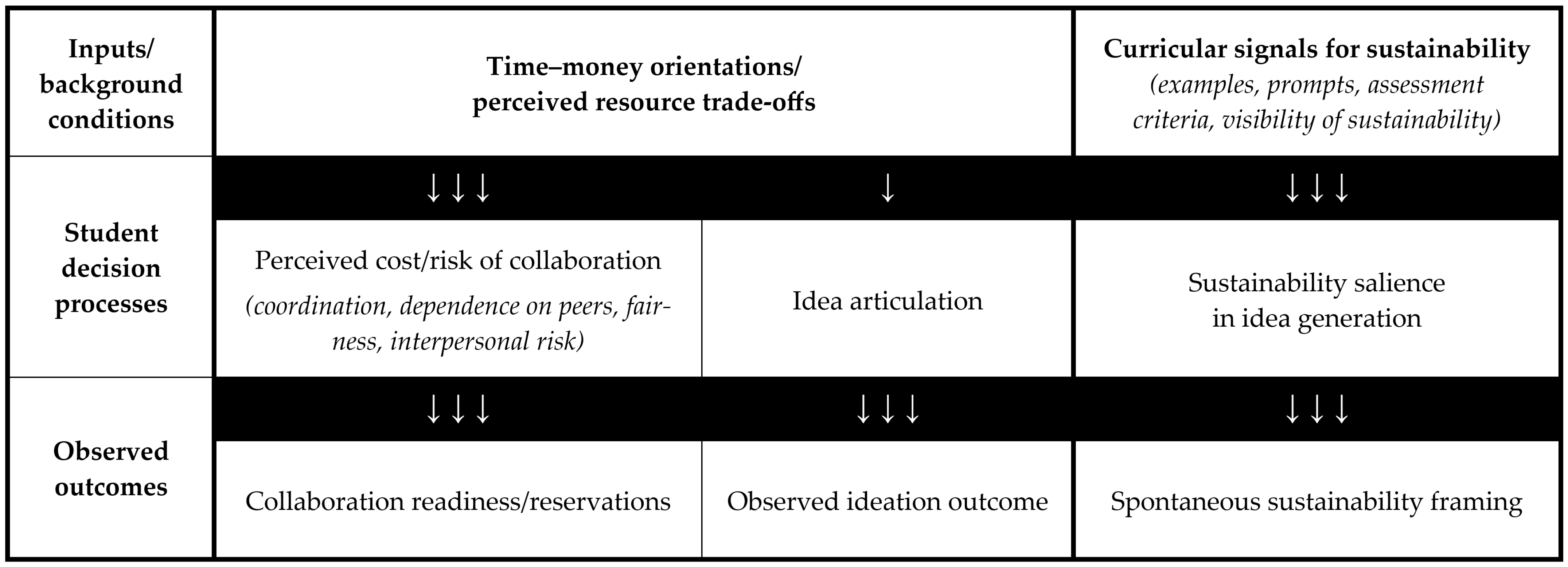
Figure 1 shows the conceptual model underlying the study, summarising the rationale for expecting time–money heterogeneity to relate most clearly to collaboration reservations, while ideation and spontaneous sustainability framing are expected to depend more strongly on task demands and curricular visibility.
Framed in this way, the value of segmentation is both pedagogical and descriptive. It can inform educators’ pedagogical content knowledge by indicating where collaborative sustainability tasks may require different forms of scaffolding, sequencing, or team formation support for different learners [
33,
34]. It also addresses the signature pedagogical challenge of tourism sustainability education, focusing on which sustainability concepts are taught and how students are asked to practise collaboration, judgement, and coordinated action under realistic constraints.
3. Materials and Methods
We analysed an anonymised dataset of questionnaire responses collected from tourism students at a Slovenian higher education institution. The instrument included open-ended prompts on perceived time and money use compared to peers (Q1–Q4), tourism idea generation (Q6), and interest in collaborating with peers on idea development (Q8).
The dataset comprises N = 597 responses collected between February 2019 and June 2025. Responses were produced as part of course activities preceding collaborative innovation tasks in modules related to tourism innovation and digitalisation. The export includes free-text answers to Q1–Q4, Q6 and Q8, as well as contextual variables (course unit, group number, gender, region). No direct personal identifiers are included. Results are reported in aggregate to minimise the risk of re-identification. Because the questionnaire responses are self-reported, they capture students’ perceived time and money use and stated collaboration attitudes rather than directly observed behaviour. All respondents were enrolled at the same Slovenian institution, so the dataset captures variation within a single organisational and curricular context: this improves contextual coherence but limits the external generalisability of the findings. Analytically, the dataset is treated as a pooled cross-sectional sample rather than a longitudinal panel. Therefore, we do not model temporal change across cohorts or estimate the impact of any pedagogical intervention.
The open-ended questions analysed in this study were translated as follows (original questionnaire in Slovene):
Q1. If you compare different types of spending your money, what do you think you spend more on than your peers on average?
Q2. In which areas do you think you spend less money than your peers on average?
Q3. If you compare different types of spending your time, what activities do you think you spend more time on than your peers on average?
Q4. What activities do you think you spend less time on than your peers on average?
Q6. Are you considering developing any tourism-related idea? If so, what kind of idea is it? (You may describe it briefly or in detail.)
Q8. Are you interested in collaborating with other students in developing ideas?
Primary outcomes were derived from coded open-ended responses. All coding was implemented as deterministic, rule-based text classification. For ideation (Q6), we coded whether a respondent articulated an actionable tourism-related idea (idea_present = 1) versus no idea or insufficient detail (0). Responses consisting only of yes/no tokens, non-substantive placeholders, explicit non-ideation, uncertainty without details, or vague statements such as “I have an idea” without any description were coded as 0. Sustainability framing was coded as sust_explicitness: explicit when the response contained explicit sustainability language, implicit when it referenced environmental, social, or cultural sustainability without naming it (e.g., environment-friendly practices, emissions or waste reduction, accessibility, heritage conservation, local products), and none otherwise. We report sust_any = 1 for explicit/implicit and 0 otherwise.
This coding captures only whether a respondent articulated an idea clearly enough to be counted as present. It does not assess the quality, feasibility, or innovativeness of the proposed idea, so idea_present should be interpreted as a threshold indicator of ideation occurrence rather than as a measure of idea merit. This operationalisation was intentionally conservative: short responses were coded as idea_present = 1 only when they named a concrete tourism-related intervention clearly enough to be reproducibly distinguished from a vague affirmation. As a result, some brief responses may still have reflected a genuine idea, but if they did not describe the intervention sufficiently, they were treated as idea_present = 0 to avoid over-interpreting minimal text.
Collaboration readiness was coded from Q8 into three categories: yes (unqualified willingness to collaborate), conditional (willingness dependent on explicit conditions or uncertainty markers), and no (explicit refusal). For respondents with Q8_not_yes = 1, we additionally tagged non-mutually exclusive condition themes from Q8 text: topic match (interest or idea fit), team quality (concerns about effort, competence, fairness, or trust), time constraints (availability/workload), and money constraints (costs/funding). Multiple tags could be assigned to a single response.
The coding rules for Q6 and Q8 were developed iteratively through repeated readings of the original Slovene responses, with the aim of translating recurrent response patterns into explicit, reproducible deterministic criteria before the final full-sample analysis. Once the rule set was finalised, we reviewed a purposive validation subsample of 60 responses selected to stress-test coding boundaries, including sustainability-positive Q6 responses and short, vague, uncertain, or condition-laden answers in Q6 and Q8. This check assessed face validity and boundary consistency by verifying that the implemented rules matched the intended categories and by identifying where classification was most sensitive. Ambiguous cases were handled conservatively: brief affirmations without a describable tourism-related intervention were not coded as idea_present = 1; sustainability was coded only when explicit sustainability language or interpretable environmental, social, or cultural content was present; and Q8 responses were coded as conditional whenever willingness depended on explicit conditions or uncertainty markers rather than an unqualified yes. This procedure is treated as a transparency-oriented validation of the deterministic rule set rather than as an independent intercoder reliability exercise. The complete coding scheme and illustrative boundary examples are provided in
Table A1 in
Appendix A.
To derive time–money behavioural segments from Q1–Q4, we split each answer into individual words (i.e., tokenised it) after normalisation and prefixed tokens with the prompt direction (money-more, money-less, time-more, time-less). We vectorised the prefixed tokens using TF-IDF and applied non-negative matrix factorisation (NMF) to obtain respondent-level topic weights. We used NMF instead of probabilistic topic models such as LDA because our data consisted of short survey responses converted into a sparse TF-IDF matrix with non-negative values. In this context, NMF is a practical method for extracting additive themes that are often easy to interpret. It also produces a theme-score profile for each respondent, which can then be used for clustering.
Topic weights were row-normalised to topic proportions and clustered using k-means. We examined adjacent solutions and retained k = 7 as the primary segmentation, using k = 8 as a sensitivity check. In the reproduced analysis, k = 7 yielded inertia = 419.10, while k = 8 yielded inertia = 397.83. As inertia is expected to decrease with increasing k, this reduction was not considered sufficient reason to prefer the more granular solution. Instead, the choice of k was guided by parsimony, interpretability of segment profiles, usable segment sizes, and robustness of the substantive segment–collaboration association across adjacent solutions. On this basis, k = 7 was retained as the primary, more parsimonious profiling solution, and k = 8 was used to verify that the segment–collaboration pattern remained materially similar with a modest increase in granularity. We therefore treat the segmentation as an exploratory, interpretable profiling procedure rather than as recovery of a single “true” latent partition.
Segment headlines reported in the
Section 4 summarise the most prominent prefixed tokens in each segment. These segment headlines are intended solely as concise descriptive labels based on the most prominent tokens in each cluster. They do not imply that all respondents within a segment share the same behaviour pattern, and they necessarily simplify the richer mixtures of activities and trade-offs represented in the underlying topic-weight profiles.
Segment profiles and outcome rates are reported for k = 7 (
Table 1), with Wilson 95% confidence intervals for segment-level Q8_not_yes proportions. Associations between segment membership and binary outcomes (Q8_not_yes, idea_present, sust_any) were tested with Pearson’s chi-square test. Cramér’s V is reported as an effect size. For the primary segment × Q8_not_yes association, we additionally computed a Monte-Carlo permutation
p-value (B = 20,000) by randomly redistributing the observed number of “not-yes” responses across segments while holding segment sizes fixed. Robustness to segmentation granularity was assessed by repeating the segment × Q8_not_yes test for k = 8. All analyses were conducted in Python 3.11.14 (Python Software Foundation, Wilmington, DE, USA).
4. Results
Results are organised around the research questions. First, we report baseline distributions for ideation, sustainability framing, and collaboration readiness (RQ1–RQ2). Next, we present segment profiles and association tests linking time–money segments to collaboration reservations (RQ3,
Table 1,
Table 2 and
Table 3). Finally, we summarise the conditions attached to “not-yes” collaboration positions to contextualise the quantitative association (
Table 4).
The analysis includes N = 597 respondents. Collaboration readiness (Q8) was coded as collaboration willingness (yes/conditional/no) and summarised as collaboration reservations (not-yes; Q8_not_yes). Most respondents expressed an unqualified willingness to collaborate (yes: 414/597, 69.3%), while 79/597 (13.2%) expressed conditional willingness and 104/597 (17.4%) expressed unwillingness. Overall, Q8_not_yes = 183/597 (30.7%).
Ideation and sustainability framing were derived from Q6 responses. An actionable idea was coded as idea_present = 1 for 319/597 responses (53.4%). Sustainability framing was uncommon: sust_any = 1 for 45/597 responses (7.5%), comprising 10 explicit and 35 implicit mentions. Segment-level rates for these outcomes are reported in
Table 1, including Wilson 95% confidence intervals for the collaboration-reservation rate. Because sustainability-coded responses are infrequent, these figures should be considered evidence of a low-prevalence outcome rather than a strong basis for detailed subgroup claims.
Substantively, this low prevalence suggests that sustainability was not a default consideration for most respondents when describing tourism ideas without explicit prompting. As only 45 of 597 responses were coded as containing explicit or implicit sustainability elements, the sustainability-framing analysis has limited statistical power. Therefore, the non-significant segment × sust_any result should not be interpreted as strong evidence that segments do not differ in sustainability framing. Instead, the present dataset is better suited to detecting only comparatively large differences between segments in sustainability framing.
Collaboration-reservation rates, also presented in
Table 1, vary across segments. The lowest rate occurs in segment 6 (Travel spending; less TV/series/films; sport/nature & work time), at 20.0% (16/80; 95% CI 12.7–30.0). The highest rate is in segment 3 (Gaming/computers & reading; less nightlife/social media), at 52.9% (27/51; 95% CI 39.5–65.9). In contrast, differences in ideation and sustainability framing are less pronounced: idea_present ranges from 38.9% (segment 7) to 62.7% (segment 3), and sust_any ranges from 2.8% (segment 7) to 11.2% (segment 6).
Associations between segment membership and outcomes are presented in
Table 2.
Segment membership (k = 7) is statistically associated with collaboration reservations (Q8_not_yes): χ2(6) = 16.683, p = 0.01052, Cramér’s V = 0.167 (N = 597). A permutation test (B = 20,000) yields p = 0.01065; expected counts were not sparse (minimum expected count = 10.116; no cells with expected count < 5). Although this association is statistically reliable, its magnitude is modest (Cramér’s V = 0.167), so the result should be interpreted as evidence of patterned, but not strong, differentiation between segments. Time–money segmentation therefore appears relevant for understanding collaboration reservations, but it should be seen as one contributing factor among others rather than as a dominant explanation of students’ collaboration positions. More specifically, this effect size indicates limited leverage: segment membership alone should not be treated as a strong stand-alone predictor of students’ collaboration positions, and it is unlikely to account for more than a modest share of the observed variation in collaboration reservations.
For the Q6-coded outcomes, there is no statistically significant association between segment membership and idea_present (χ2(6) = 7.481, p = 0.27861, Cramér’s V = 0.112) or sust_any (χ2(6) = 3.483, p = 0.74621, Cramér’s V = 0.076). For sust_any, expected counts are sparse (minimum expected count = 2.487; 4 cells with expected count < 5). Accordingly, the segment × sust_any result is treated as tentative and primarily descriptive, and we avoid drawing strong inferential conclusions from this non-significant test alone.
To assess robustness to the number of behavioural segments, we repeated the primary association test using the k = 8 solution (
Table 3). The k = 8 test yields χ
2(7) = 17.037,
p = 0.01716, with Cramér’s V = 0.169 (N = 597). A permutation test (B = 20,000) yields
p = 0.01595; expected counts were not sparse (minimum expected count = 10.422; no cells with expected count < 5). Thus, evidence for a segmentation–collaboration link is robust to modest changes in segmentation granularity, with similar effect sizes across k.
Regarding conditions attached to “not-yes” collaboration positions,
Table 4 summarises the condition themes stated by respondents whose collaboration position is not an unqualified “yes” (183; 30.7% of N = 597), reported as within-segment percentages among not-yes respondents. Across all not-yes responses, topic match is the most frequently mentioned condition theme (50/183, 27.3%), followed by team quality (12/183, 6.6%). Time constraints (3/183, 1.6%) and money-related conditions (1/183, 0.5%) are infrequent. As multiple conditions can be mentioned in a single response, theme percentages are not mutually exclusive.
5. Discussion
This study links time–money use patterns with ideation and collaboration readiness in tourism education, and discusses implications for embedding sustainability framing in tourism curricula. Conceptually, we treat collaboration readiness as a design constraint of project-based learning (PBL): even when students can generate ideas, teams may not form or function well unless the course creates conditions that reduce interpersonal and coordination risk [
15,
16]. In pedagogical terms, the findings contribute evidence about student responses and insight into how sustainability framing is made visible and scaffolded in learning tasks. If collaborative ideation is part of the signature pedagogy of sustainability-oriented tourism education, then student heterogeneity matters because it shapes how the same task design is experienced, and therefore how educators should scaffold participation, grouping, and support [
33,
34].
Across the cohort, ideation was relatively common but sustainability framing was not. Just over half of respondents articulated an actionable tourism-related idea (319/597; 53.4%), yet only 45/597 (7.5%) included explicit or implicit sustainability language when describing their idea. In ESD terms, this suggests that sustainability is not reliably used as an explicit design criterion unless it is made visible through curricular signals, exemplars, and assessment criteria [
6,
10,
22]. This aligns with tourism education reviews that have documented the uneven integration of sustainability-focused teaching practices across programmes and courses [
12,
13].
This pattern can also be understood as a sustainability value-action gap in tourism education: sustainability may be endorsed at the level of programme intentions, course rhetoric, or general student values, yet it does not automatically become a spontaneous criterion when learners generate concrete tourism ideas. Research on sustainable tourism pedagogy has similarly identified a gap between sustainability theory and pedagogical practice, while recent curriculum-focused analysis argues that sustainability is still not systematically embedded across tourism education. The low rate of spontaneous sustainability framing in the present study is consistent with this broader pattern and reinforces the need to translate sustainability from a stated aspiration into explicit prompts, criteria, and repeated design practice within the curriculum [
11,
59].
Collaboration readiness was high on average but heterogeneous. While 414/597 respondents (69.3%) expressed unqualified willingness to collaborate, 79/597 (13.2%) were willing only under conditions and 104/597 (17.4%) were unwilling (Q8_not_yes = 183/597; 30.7%). The most common stated safeguards were topic match (50/183; 27.3%) and perceived team quality (12/183; 6.6%). These themes map closely onto established explanations for why group work fails: social loafing and fairness concerns [
25] and the need for structured interdependence and accountability [
50,
51]. Importantly, the “team quality” theme can also be interpreted through psychological safety—students are more willing to engage when the interpersonal risks of speaking up, disagreeing, or being evaluated by peers feel manageable [
26,
27,
28].
Time–money behavioural segments distinguished collaboration reservations more clearly than idea presence and sustainability framing. In the primary k = 7 solution, collaboration-reservation rates ranged from 20.0% to 52.9% across segments, and the association with Q8_not_yes was statistically significant (χ
2(6) = 16.683,
p = 0.01052; permutation
p = 0.01065; V = 0.167). The k = 8 sensitivity analysis produced a comparable effect size and a similarly significant association (χ
2(7) = 17.037,
p = 0.01716; permutation
p = 0.01595; V = 0.169). By contrast, segment differences in idea_present and sust_any were not statistically significant. This pattern is consistent with the conceptual rationale developed in
Section 2.5: time–money orientations should matter most when students must decide whether to invest scarce time and trust in a coordinated group process. Articulating an idea is a lower-commitment response, whereas spontaneous sustainability framing depends more directly on whether sustainability has been made visible through task cues, examples, and assessment design. The findings therefore suggest a differentiated relationship rather than a general segment effect across all outcomes. At the same time, this pattern should be interpreted cautiously. The effect sizes for the collaboration association are modest in both the primary and sensitivity solutions (V = 0.167 and V = 0.169), which suggests that segmentation captures only part of the variation in collaboration readiness. Substantively, the findings support a bounded interpretation: time–money profiles can help identify where collaboration reservations are more likely, but they do not imply sharply separated or deterministic student types.
This limited effect size also has an important interpretive implication. Even if segmentation helps identify where collaboration reservations are somewhat more likely, much of the variation in students’ collaboration positions must still reflect factors not captured by the time–money profiles alone, such as prior teamwork experiences, task interpretation, topic interest, or perceived interpersonal risk. The value of segmentation is therefore selective rather than exhaustive: it helps illuminate one patterned source of variation, but it does not provide a comprehensive explanation of collaboration readiness.
The segment pattern also invites a cautious behavioural interpretation. The comparatively high reservation rate in segment 3 (gaming/computers/reading; less nightlife/social media) may not reflect time scarcity alone. This profile is also compatible with a preference for more self-paced or individually controlled activity and, therefore, with greater sensitivity to the coordination costs and dependence on others that collaboration entails. In that sense, stronger reservations in this segment are consistent both with scarcity and collective-action arguments, which emphasise that the time costs of group work are often borne individually [
31,
55], and with psychological-safety and team-quality concerns: students may be more willing to collaborate only when they trust that the topic is worth the effort, that peers will contribute reliably, and that the team will meet their expectations of worthwhile or high-quality teamwork [
25,
26,
27,
28]. By contrast, the comparatively low reservation rate in segment 6 may indicate a profile more open to outward-facing, activity-based engagement, but these contrasts should be read as tentative interpretations of segment tendencies rather than as evidence of fixed collaboration dispositions.
In this context, the null segment findings for idea_present and especially sust_any also require careful interpretation. For idea_present, the absence of a significant association is consistent with the argument that naming a tourism-related idea is a relatively low-threshold task that may not depend strongly on time–money orientations. For sustainability framing, however, the null result should not be over-read as evidence that behavioural segments are unrelated to sustainability thinking more broadly. Given the small number of sustainability-positive responses, the analysis is better interpreted as showing that spontaneous sustainability framing was rare across the cohort and that the present dataset offers limited leverage for detecting fine-grained subgroup differences in that outcome.
Relatedly, the ideation result should be interpreted narrowly. As idea_present records whether a respondent produced a codable idea, not whether that idea was strong, feasible, or innovative, the present analysis addresses the occurrence of ideation rather than the substantive quality of students’ creative output.
Based on these findings, the following pedagogical implications should be considered on two levels. At the level of findings, the data support three specific observations: spontaneous sustainability framing was uncommon, collaboration reservations varied across segments, and students with collaboration reservations most often referred to topic match and perceived team quality. The more specific teaching suggestions that follow are broader, evidence-informed recommendations derived from these observed patterns and the supporting pedagogy and teamwork literature. They are not interventions directly tested in the present study.
The implications for sustainability-oriented tourism education stem from two related constraints: (i) sustainability framing does not reliably develop without support, and (ii) collaboration is not guaranteed, even among cohorts familiar with group work. In practice, this requires educators to allocate curricular space—time, assessment weighting, and structured opportunities—for students to translate broad sustainability commitments into explicit criteria and trade-off reasoning [
6,
7,
11]. One practical approach is a staged ideation workflow: initial idea generation, use of an explicit sustainability rubric (covering environmental, social, and economic dimensions, as well as trade-offs), and a scheduled “sustainability pass” revision step before teams commit to a final project direction.
From these patterns, several evidence-informed implications for PBL and teamwork design follow. As the main issues in not-yes responses relate to topic fit and team quality, course design should minimise early ambiguity and interpersonal risk. Topic-first matching—such as short pitches, interest mapping, or facilitated grouping—directly addresses the topic-match concern and can also enhance perceived autonomy and relevance. At the same time, team-quality safeguards can be incorporated through lightweight but explicit structures: team charters, role rotation, milestone-based accountability, and structured peer feedback. These approaches align with cooperative learning principles [
50,
51] and with psychological safety research, which highlights that norms and facilitation influence whether students are willing to take risks in teams [
26,
27].
In a large class, this “topic-first” principle can be implemented through a two-stage matching process. Before teams are formed, students can complete a short preference form indicating the tourism problem or project theme they most want to work on, the type of contribution they feel able to make, and any major constraints or collaboration conditions. Instructors can then run a brief “project market” in which ideas are pitched and students rank their preferred topics. Teams are then assembled around shared topic interests, while also balancing team size and avoiding obviously fragile compositions. The present data do not support a definitive claim that students from the same time–money segment should be grouped together. A more defensible use of segmentation is diagnostic: segments can help instructors anticipate where additional scaffolding or check-ins may be needed, while team composition should still be driven primarily by topic alignment and by maintaining workable diversity of roles, perspectives, and availability within each group [
26,
27,
50,
51,
52].
The segmentation results suggest further refinement: scaffolding may need to be proportionate rather than uniform. If specific time–money profiles show higher collaboration reservations, instructors can allocate more facilitation (such as more check-ins, clearer workload partitioning, or more explicit contribution tracking) without treating segments as fixed traits or labelling students. Used carefully, segmentation can serve as a diagnostic tool to improve course fit and fairness, consistent with tourism’s long-standing use of data-driven segmentation to describe heterogeneity and support targeted design choices [
32].
The study’s limitations should be considered when interpreting the findings, as they indicate directions for future research. Coding and segmentation were designed for transparency and reproducibility, but they simplify nuanced responses and may misclassify ambiguous text. In particular, deterministic rule-based coding cannot fully preserve contextual meaning, mixed intent, or semantically subtle distinctions in short open-ended responses, so some borderline answers may be placed into analytically useful but simplified categories rather than fully capturing the nuance of students’ wording.
The data are cross-sectional and drawn from a single educational context, so replication across programmes and institutions is necessary. Future work should test interventions that explicitly target psychological safety and curriculum-space constraints—such as staged team formation, topic-first matching, team charters, and time-boxed collaboration sprints—and evaluate outcomes using both idea quality and sustainability integration, as well as validated measures of team psychological safety and collaboration processes [
26,
28].
More specifically, all responses come from a single Slovenian higher education institution. Institutional culture, curriculum design, cohort composition, and national context may all influence how students describe time–money trade-offs, ideation, and collaboration. The findings should therefore be considered analytically informative but context-bound, and replication across programmes, institutions, and countries is needed before broader generalisations can be made. For the same reason, the observed relationships should be interpreted as correlational. Longitudinal, repeated-measures, or intervention-based studies are needed to test whether changes in course design actually alter collaboration readiness, ideation, or sustainability framing over time. Similarly, the idea_present threshold may underestimate brief but genuine ideas, because concise responses that implied an intervention but did not describe it clearly enough for reproducible classification were coded conservatively as no actionable idea. A related limitation concerns interpretation of the segment labels themselves. As the labels are shorthand summaries derived from dominant tokens, they are useful for communication but may understate within-segment heterogeneity and overlap between profiles. They should therefore be read as heuristic descriptors of tendencies rather than as exhaustive or sharply bounded behavioural types.
These limitations should therefore deserve particular emphasis. First, the evidence comes from a single institutional setting and may reflect local curriculum, cohort, and organisational conditions. Second, the analysis relies on self-reported open-ended responses, which may capture perceptions and social-desirability effects rather than stable behaviour. In particular, students may describe their time–money behaviour or willingness to collaboration in ways that reflect perceptual bias or socially desirable self-presentation, so these measures should be interpreted as reported perceptions and attitudes rather than direct behavioural observations. Third, deterministic rule-based coding improves transparency but necessarily compresses nuanced responses into simplified categories. Fourth, the low frequency of sustainability-related responses means that sustainability-specific comparisons remain tentative and should be interpreted cautiously. A related limitation is that the study does not evaluate the quality, feasibility, or innovativeness of the ideas themselves. Future research should consequently combine threshold-based ideation coding with rubric-based or expert evaluation, so that idea generation can be distinguished from the quality of what is generated.
In addition, the small number of sustainability-positive cases (45/597) limits the precision of sustainability-specific subgroup comparisons and reduces the study’s ability to detect anything other than relatively large differences between segments. Future research should therefore use larger samples or tasks that elicit sustainability reasoning more directly if the aim is to test segment differences in sustainability framing with greater statistical power.
Relatedly, the segment × sust_any cross-tabulation contains sparse expected cell counts, which reduces the robustness of the chi-square approximation for that outcome. Therefore, we consider the segment × sust_any result tentative and primarily descriptive, and avoid drawing strong inferential conclusions from this non-significant test alone. Future studies should include more sustainability-positive cases or use inferential methods better suited to sparse tables if sustainability-specific subgroup comparisons are a primary objective.
6. Conclusions
We analysed open-ended questionnaire data from tourism students (N = 597; 2019–2025) to examine ideation, spontaneous sustainability framing, collaboration readiness, and time–money behavioural segmentation. Deterministic coding of Q6 and Q8 was combined with a clustering-based segmentation of Q1–Q4 to link behavioural profiles to collaboration reservations.
Because the evidence comes from one Slovenian institution, these conclusions are best understood as context-specific rather than universally generalisable across tourism higher education settings. Given the cross-sectional design, these conclusions speak to associations observed in the dataset rather than to causal effects of time–money orientations or pedagogical conditions. Overall, the study is best read as exploratory and context-bound, with its sustainability-related inferences especially tentative because they rest on relatively few positive cases.
Just over half of respondents described an actionable tourism-related idea (319/597; 53.4%), but only 45/597 (7.5%) mentioned sustainability explicitly or implicitly when describing their idea. Most students were unconditionally willing to collaborate (414/597; 69.3%), yet 183/597 (30.7%) expressed conditional willingness or unwillingness. Behavioural segments significantly differentiated collaboration reservations, while segment differences in ideation and sustainability framing were not significant. This segmentation effect should nevertheless be understood as modest rather than strong, and therefore as an analytically useful signal for course design rather than as high-explanatory-power evidence.
When students attached conditions to collaboration, these most often concerned topic alignment and perceived team quality. Capacity-related constraints (time, money) were mentioned infrequently. In practical terms, this suggests that course design should (i) match students by shared topic interests before locking in teams, (ii) scaffold team quality through clear roles and accountability mechanisms, and (iii) make sustainability requirements explicit and actionable early in ideation through prompts, rubrics, and iterative “sustainability check” steps. In this sense, behavioural segmentation is best treated as a diagnostic aid for improving course fit and fairness, not as a means of fixing students into labels.
These proposed course-design measures should therefore be understood as evidence-informed implications derived from the observed response patterns, not as pedagogical effects directly evaluated in this dataset. Future work should test whether these supports increase willingness to collaborate and improve the clarity of sustainability integration in student-generated tourism innovation ideas across various institutions and teaching formats.