Article

Assessing Ecological Vulnerability in the Northern Guangdong Mountains Using Deep Learning

1
Chengdu Center, China Geological Survey (Geosciences Innovation Center of Southwest China), Chengdu 610218, China
2
107 Geology Team, Chongqing Bureau of Geology and Mineral Development, Chongqing 401120, China
3
Guangdong Geological Survey Institute, Guangzhou 500075, China
*
Authors to whom correspondence should be addressed.
Sustainability 2026, 18(9), 4472; https://doi.org/10.3390/su18094472
Submission received: 7 March 2026 / Revised: 21 April 2026 / Accepted: 23 April 2026 / Published: 1 May 2026
(This article belongs to the Topic Water-Soil Pollution Control and Environmental Management)

Abstract

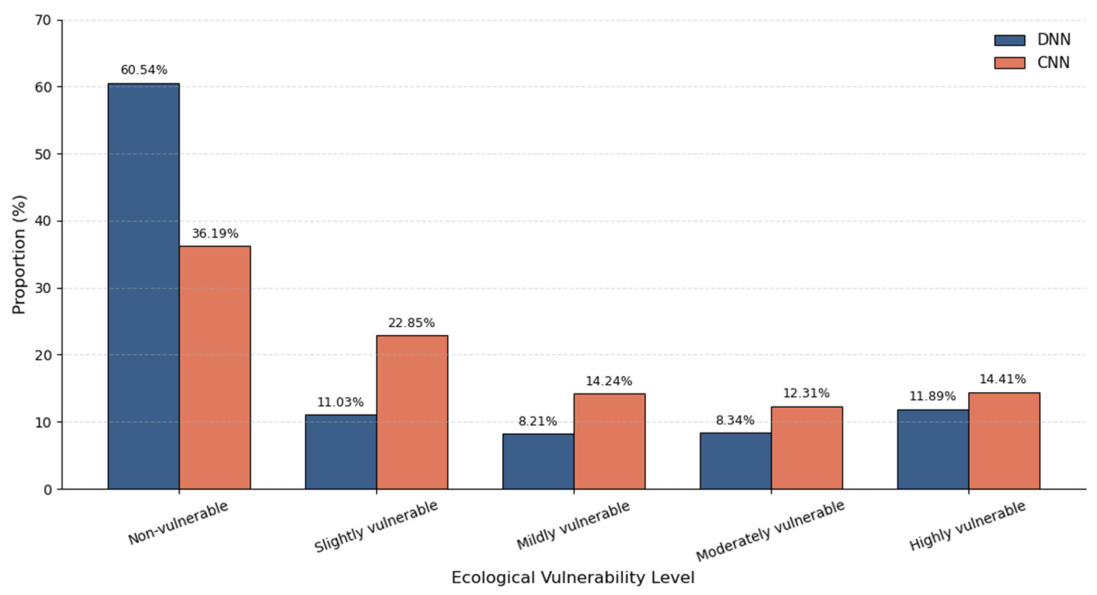
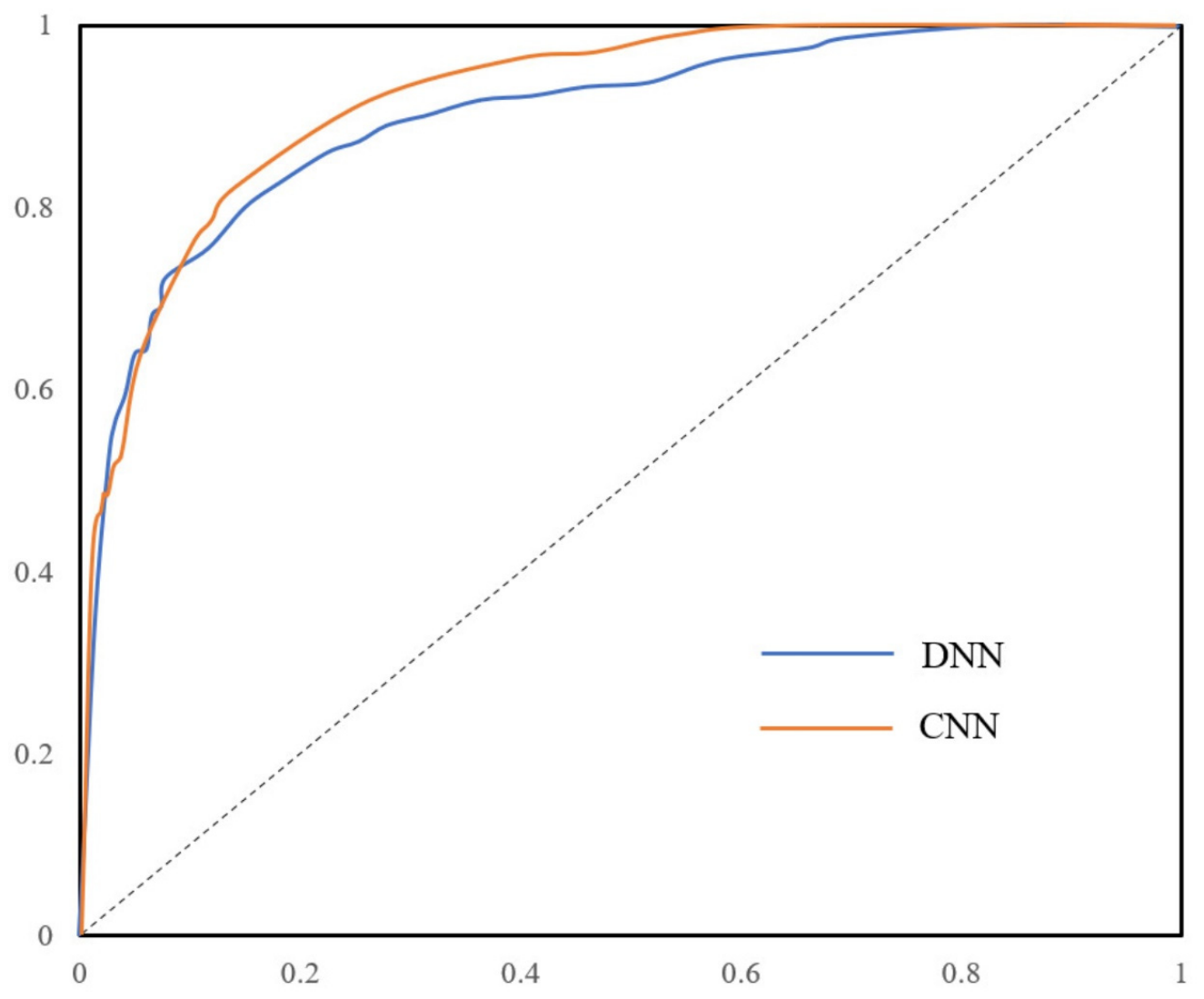
Ecological vulnerability assessment serves as a prerequisite for ecological governance, yet evaluating large-scale ecological vulnerability remains challenging. To address this challenge, this study integrates geological elements into ecological vulnerability assessment, taking Ruyuan Area in the Northern Guangdong Mountains, China, as a case study. The area faces ecological hazards such as land desertification and soil erosion, indicating severe governance challenges. This study selected 14 ecological vulnerability factors and constructed assessment models based on Deep Neural Networks (DNNs) and Convolutional Neural Networks (CNNs). A total of 800 ecological vulnerability sampling points were obtained by combining field survey data with remote sensing imagery. The models were trained using binary vulnerability labels. The resulting continuous probability outputs were then classified into five vulnerability levels using the natural breaks method to generate the final ecological vulnerability map. It should be noted that the multi-level vulnerability map represents graded probability-based differentiation rather than supervised multi-class prediction. Model performance was validated using three metrics: Area Under Receiver Operating Characteristic Curve (AUC–ROC), Mean Absolute Error (MAE), and Root Mean Square Error (RMSE). The CNN (AUC = 0.916) model outperformed the DNN model (AUC = 0.895). According to the CNN-based classification results, non-vulnerable, slightly vulnerable, mildly vulnerable, moderately vulnerable, and highly vulnerable areas accounted for 36.19%, 22.85%, 14.24%, 12.31%, and 14.41% of the total area, respectively. High ecological vulnerability zones were concentrated in Daqiao, Luoyang, Dabu, and parts of Rucheng towns, with soil parent material and vegetation coverage identified as the main contributing factors, among which parent material was the most important. This finding underscores the notable impact of geological factors on local ecological vulnerability. Based on these results, nine ecological–geological subareas were delineated, and targeted ecological protection and restoration recommendations were proposed. This study, employing machine learning techniques, constructed an ecological vulnerability assessment model incorporating geological elements, thereby providing scientific support for targeted ecological governance in the study area.

1. Introduction

The ecological environment forms the foundation of life on Earth and encompasses the interactions between biotic and abiotic components [1,2]. With the intensification of human activities, ecological systems worldwide are facing increasing pressure [3,4,5]. Consequently, ecological vulnerability assessment has become an important topic in global environmental change and sustainable development research [6,7,8,9,10].
In ecological vulnerability research, natural climatic factors such as precipitation and temperature are commonly regarded as key driving forces. Nevertheless, even in adjacent regions with similar climatic conditions, significant differences in ecological environments may still exist [11,12,13]. In such cases, the influence of geological conditions requires further attention [14,15,16]. Different geological settings shape terrain, soil properties, and eco-hydrological processes, thereby altering ecological factors such as heat, moisture, and nutrient availability. These changes subsequently affect plant distribution patterns, ecosystem productivity, and the evolution of ecological landscapes [17,18,19]. Previous studies have demonstrated that lithology, geomorphology, and soil thickness in karst regions are strongly associated with rocky desertification and soil erosion, thereby increasing ecological sensitivity and limiting ecosystem resilience [20]. The Northern Guangdong Mountains (NGM) are an important part of the Nanling Mountains and serve as a critical ecological barrier in southern China [21]. The presence of unique landforms, including Danxia and karst landscapes, results in pronounced spatial heterogeneity of ecological environments and leads to high costs for ecological restoration and management. Ruyuan Area, located in the central part of the NGM, contains both Danxia and karst landforms and is therefore representative of the regional geological and ecological characteristics. At the same time, Ruyuan Area faces prominent ecological problems such as land degradation and soil erosion. Consequently, studies on ecological vulnerability in Ruyuan Area can provide valuable scientific guidance for ecological management and restoration in both the county itself and the NGM.
Ecological vulnerability is defined as the sensitivity of the Earth’s surface system to environmental disturbances and the lack of capacity to recover after such disturbances occur [22,23,24]. This concept emphasizes the instability of ecosystems when facing natural or anthropogenic disturbances and highlights the importance of ecosystem resilience as an inherent property of the ecosystem itself [25]. For a long time, ecological vulnerability assessment has been a primary approach in the study of ecological problems [26,27]. In recent years, ecological vulnerability assessment has increasingly incorporated spatial analysis techniques based on GIS and remote sensing, enabling multi-scale and spatially explicit evaluation. Traditional methods, such as index-based models, principal component analysis, and analytic hierarchy process (AHP), have been widely applied to construct composite vulnerability indices. More recently, machine learning approaches have been introduced to capture nonlinear relationships among multiple environmental factors and to improve assessment accuracy, particularly in complex mountainous regions. Field-based investigations of ecological vulnerability can provide direct and intuitive information on ecological conditions. However, such methods are limited in their ability to achieve large-scale spatial assessments from point-based observations and generally lack temporal dynamics. The development of remote sensing technology has effectively addressed these limitations. Sensors onboard remote sensing satellites enable the acquisition of long-term, real-time, large-scale, and high-resolution imagery, which can be used to map ecological vulnerability and to identify key system variables influencing ecological vulnerability [28]. In recent years, advances in computer technology have further promoted the application of machine learning models. Owing to their strong capability in nonlinear data fitting, these models can provide more detailed and accurate assessment results [29,30,31]. In deep learning frameworks, different architectures offer distinct mechanisms for modeling environmental data. Deep neural networks (DNNs) establish nonlinear mappings between multiple input variables and target outputs, which is suitable for integrating heterogeneous ecological and geological factors. Convolutional neural networks (CNNs) further incorporate convolution operations to extract spatial patterns from raster data. Considering the spatial heterogeneity of mountainous regions, evaluating both architectures allows a more comprehensive examination of their applicability in ecological vulnerability assessment.
Ecological vulnerability assessment models can generally be classified into two main categories. (1) Models that incorporate external pressures, including the exposure–sensitivity–adaptability model (VSD model) [32] and the pressure (P)-state (S)-response (R) model [33]. (2) Models that focus on the internal attributes of ecosystems, such as the resource–environment–society–economy framework [34] and the climate–land–biology–environment framework. By integrating the advantages of these existing models, this study selected 14 factors from three categories for individual analysis and ultimately constructed an ecological vulnerability assessment model for this study.
Although ecological vulnerability has been widely investigated, several limitations remain. First, many existing studies emphasize climatic, land-use, or socio-economic factors, while geological conditions are often incorporated indirectly despite their fundamental role in shaping terrain, soil properties, and long-term ecosystem stability. Second, traditional index-based and linear weighting methods may have limited ability to capture complex nonlinear relationships among multiple environmental variables. Third, comparatively few studies have systematically evaluated the applicability of different deep learning architectures in ecologically and geologically complex mountainous regions. Addressing these gaps is essential for improving the scientific robustness of vulnerability assessment.
This study aims to address the above issues in ecological vulnerability assessment in the NGM. Specifically, the objectives are to:
(1)
Integrate geological factors into a deep learning-based vulnerability assessment framework;
(2)
Apply and compare DNN and CNN models for ecological vulnerability modeling;
(3)
Quantify the relative importance of selected vulnerability factors;
(4)
Delineate ecological–geological zones to support regional management.
Through achieving these objectives, this study establishes an integrated ecological vulnerability assessment framework incorporating geological factors and deep learning approaches in the NGM, thereby providing a scientific basis for ecological management and policy formulation in the region.

2. Materials and Methods

2.1. Study Area

The Northern Guangdong Mountains (NGM) are located in the eastern section of the Nanling Mountains and preserve an intact subtropical evergreen broad-leaved forest ecosystem, with rich ecological and geological diversity [35]. Ruyuan Area is situated in the central part of the NGM, extending from 112°52′ E to 113°28′ E and from 24°28′ N to 25°09′ N, with a total area of approximately 2299 km2. The Ruyuan area has experienced multiple tectonic cycles throughout its geological history, resulting in a complex geological structure with well-developed folds and faults. The nearly north–south-trending and north–east-trending structural lines are interconnected, forming an important boundary of major tectonic zoning. Lithologically, the area includes carbonate rocks, terrigenous clastic rocks, and intermediate acidic magmatic rocks, which contribute to the development of karst and Danxia landforms. Elevation varies significantly across the region, leading to pronounced topographic heterogeneity.
The complex tectonic background and lithological variability of the Ruyuan Area directly influence several ecological vulnerability factors considered in this study. For example, variations in parent material derived from carbonate, clastic, and magmatic rocks affect soil formation, nutrient availability, and water retention capacity. Structural features such as folds and faults are reflected in fracture density and geological hazard susceptibility. In addition, karst and Danxia landforms are closely associated with rocky desertification and soil erosion processes. These geological characteristics therefore provide the physical basis for selecting geological factors in the subsequent vulnerability modelling.
In recent years, intensified human activities, including urban expansion, infrastructure construction, and resource exploitation, have increased ecological pressure in parts of the region [36]. Environmental problems such as unreasonable development planning, excessive resource exploitation, and industrial and agricultural pollution have gradually emerged, further exacerbating existing land desertification and soil erosion [37]. Therefore, there is an urgent need to obtain up-to-date and comprehensive ecological vulnerability mapping data to support future ecological restoration and conservation efforts [38,39,40].

2.2. Methodology

This study aims to investigate the influence of geological factors on ecological vulnerability assessment and to evaluate the performance of deep learning models in this process. This study follows a framework that includes field investigation, indicator selection, vulnerability assessment, comparative analysis, and zoning recommendations. The specific steps are as follows:
  • Conduct field investigations in the study area and, in combination with literature data and remote sensing imagery, identify the inventory of ecologically vulnerable areas.
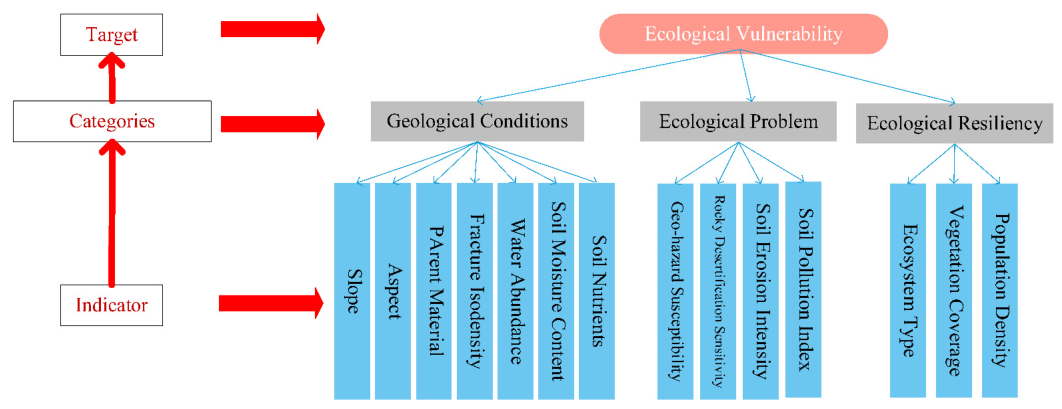
  • Collect geological, ecological, climatic, and socio-economic data extensively. Based on data analysis and field investigation results, fourteen ecological vulnerability indicators were selected from three aspects: geological conditions, ecological problems, and ecosystem resilience.
  • Apply two deep learning approaches, namely deep neural networks (DNN) and convolutional neural networks (CNN), and optimize their configurations using hyperparameter tuning to obtain ecological vulnerability assessment results.
  • Use the random forest (RF) method to analyze the weight contribution of each factor within the models.
  • Evaluate model performance using the receiver operating characteristic (ROC) curve, area under the curve (AUC), mean absolute error (MAE), and root mean square error (RMSE).
  • Based on the results of the optimal model, divide the study area into nine ecological vulnerability zones and propose targeted restoration and conservation recommendations.

2.3. Dataset Preparation

2.3.1. Field Data Collection

This study has conducted ecological–geological field investigations in Ruyuan Area since July 2022 by an expert team in ecological geology from the Chengdu Center of the China Geological Survey. BeiDou positioning devices were used on site to determine sampling locations, followed by profile measurements and the collection and measurement of soil parent material and rock samples. These field data were obtained for the screening of evaluation factors.
Based on the field data, ecological–geological vulnerable points and surrounding remote sensing imagery were further integrated to assess the current ecological environmental conditions at each location and to determine the vulnerability of ecological–geological points. The vulnerability classification of the sample points was independently conducted by two experts based on field observations and remote sensing interpretation. Inconsistent or ambiguous samples were excluded from the final dataset to improve classification reliability. Ultimately, 400 ecological–geological high-vulnerability points and 400 ecological–geological low-vulnerability points were identified. The selection of the 800 sample points followed the principle of spatial representativeness. The samples were distributed to ensure spatial uniformity and typical representation of different ecological conditions, while maintaining relative independence between points.

2.3.2. Basis for the Selection of Vulnerability Influencing Factors

The key to ecological vulnerability assessment lies in selecting factors that can reflect the current state of ecosystems and are sensitive to environmental changes [41,42]; however, no unified international standard has yet been established. Based on a comprehensive analysis of meteorological, hydrological, topographic, geological, human activity data, and field investigation results in Ruyuan Area, the study area exhibits favorable water, light, and thermal conditions with relatively small spatial variability. Water resources are abundant, and meteorological and hydrological conditions can fully meet the requirements of ecosystem and vegetation growth, thus exerting a limited controlling effect on ecological–geological vulnerability.
Therefore, this study selected ecological vulnerability evaluation factors from three aspects: geological conditions, ecological problems, and ecosystem resilience, with the aim of more systematically and scientifically revealing the essential characteristics of ecological–geological vulnerability in the study area.

2.3.3. Preparation of Vulnerability Influencing Factors

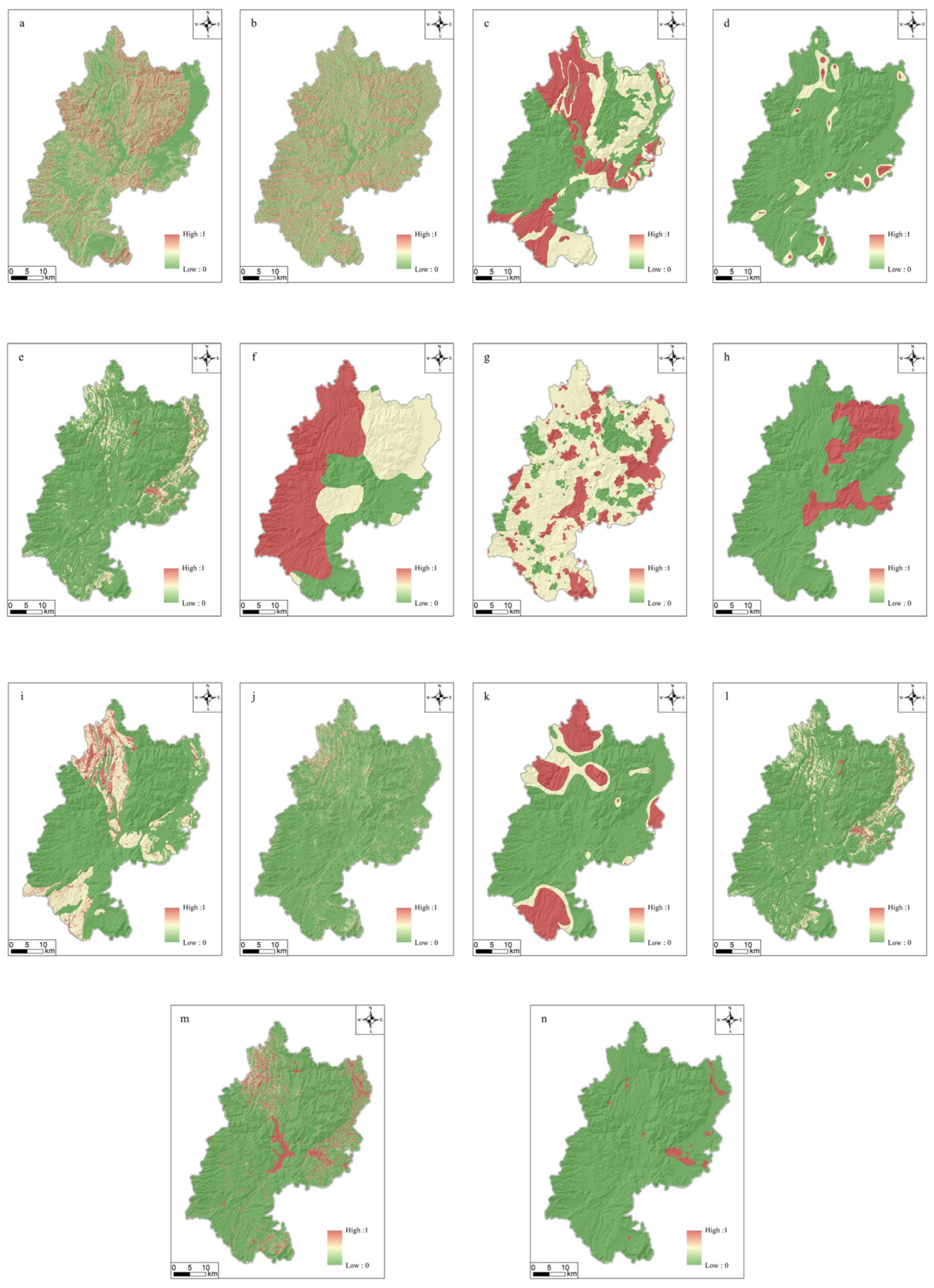
This study selected a total of 14 ecological vulnerability influencing factors for model construction. These factors include: Slope (a), Aspect (b), Parent Material (c), Fracture Isodensity (d), Water Abundance (e), Soil Moisture Content (f), Soil Nutrients (g), Geological Hazard Susceptibility (h), Rocky Desertification Susceptibility (i), Soil Erosion Intensity (j), Soil Pollution Index (k), Ecosystem Type (l), Vegetation Coverage (m), and Population Density (n) (Figure 1). The data sources for these factors are listed in Table 1.
Based on field investigation results, relevant literature, existing standards, and regional characteristics, the above indicators were quantified and classified. The classification thresholds were determined with reference to established standards where available; otherwise, natural break classification and data distribution characteristics were used to define category boundaries. Standardized scores were then assigned according to a unified criterion. The specific details are shown in Table 2:

2.3.4. Data Preprocessing

The raster data of the 14 selected factors were clipped to a consistent spatial extent, unified to the CGCS2000 coordinate system, and resampled to a spatial resolution of 30 m. Subsequently, the GDAL (version 3.8.4) tool was used to normalize the raster data of each factor to ensure consistency in model training. Finally, the 14 raster layers were merged into a single multi-channel raster dataset with 14 bands (Figure 2).
Using the 800 ecological–geological vulnerability points collected from field investigations as centers, the integrated 14-channel raster dataset was clipped to generate raster samples with a size of 8 × 8. Different patch sizes were tested in preliminary experiments, and the 8 × 8 size was selected as it provided a better balance between spatial context and model complexity. Dataset labels were assigned, and the samples were then randomly divided into a training set and a testing set at a ratio of 7:3 for subsequent model training and evaluation.

2.4. Deep Learning Models and Methods Used in This Study

2.4.1. Deep Neural Network (DNN)

A deep neural network (DNN) can effectively characterize nonlinear relationships in complex systems through multilayer nonlinear mapping and parallel computing mechanisms [44]. Among them, the multilayer perceptron neural network (MLP NN) is one of the most widely used DNN architectures. Its basic structure consists of an input layer, hidden layers, and an output layer [45]. The output results of the network model are jointly influenced by the network topology, the form of the activation function, and the connection weights between neurons.
During model operation, the input layer receives multiple ecological vulnerability influencing factors, which are weighted by weights (W) and biases (B) and then transmitted to the hidden layers, propagating layer by layer to the output layer. By comparing the model prediction results with the true labels, the output error is calculated, and the network parameters are updated using the backpropagation algorithm. This process continuously optimizes model performance and improves prediction accuracy.
In this study, the Rectified Linear Unit (ReLU) function was selected as the activation function of the network, and its expression is shown in Equation (1) [46]. The ReLU function introduces nonlinearity by mapping the neuron input signal to a piecewise linear output, effectively enhancing the model’s capacity to capture complex data relationships [47]. Compared with traditional sigmoid-type activation functions, ReLU alleviates the vanishing gradient problem and improves convergence efficiency during training. In this context, x represents the input signal of a neuron.
ReLU(x) = max(0,x)
During the model training stage, the cross-entropy loss function was adopted to measure the difference between the model outputs and the true labels [48]. The calculation formula is shown below (Equation (2)), where N is the number of samples, C is the number of classes, y i , c is the true label (0 or 1), and p i , c is the predicted probability obtained after the Softmax function.
L = 1 N i = 1 N c = 1 C y i , c log p i , c

2.4.2. Convolutional Neural Network (CNN)

The convolutional neural network (Convolutional Neural Network, CNN) is one of the most widely used machine learning models in the field of computer vision and exhibits strong capabilities in image feature extraction and representation [49]. In recent years, CNNs have been extensively applied in classification and prediction studies in Earth sciences, ecology, and related fields [50].
CNNs are based on fully connected neural networks and introduce convolutional layers, pooling layers, and activation layers after the input layer to perform hierarchical feature extraction on input data. The final output mapping is completed through fully connected layers. Compared with traditional neural networks, CNNs effectively reduce the number of model parameters and improve feature learning efficiency through convolution operations, pooling operations, and weight-sharing mechanisms [51,52,53].
Specifically, convolutional layers perform local perception and feature extraction on input data using different convolution kernels, achieving feature mapping and dimensionality reduction. Pooling layers are used to retain key information and reduce the size of feature maps, thereby enhancing computational efficiency and generalization ability. Activation layers introduce nonlinear transformations to improve the model’s ability to represent complex patterns [54,55,56]. Studies by Sharanya Shetty et al., have demonstrated that CNN models exhibit good applicability and predictive performance in sustainability-related disciplines, validating their effectiveness in complex system modeling [57].

2.4.3. Hyperparameter Optimization

Machine learning models generally have two types of parameters: training parameters and hyperparameters. Training parameters are learned during the training process, whereas the values of hyperparameters must be specified before learning begins [58,59,60]. For example, the hyperparameters of neural networks typically define the network architecture, including the number and types of layers and the number and types of nodes.
For a given dataset, the objective is to identify the optimal combination of hyperparameter values within a reasonable time. This process is referred to as hyperparameter optimization [61]. Formally, the goal of hyperparameter optimization is to find the hyperparameters of a given model that yield the best performance measured on a validation dataset. This optimization process can be expressed as Equation (3):
x * = a r g m i n x X f x
In this context, f(x) represents the objective function to be minimized as evaluated on the validation dataset (e.g., RMSE or error rate); x* denotes the set of hyperparameters that yields the lowest score, where X denotes the predefined hyperparameter search space. In simple terms, hyperparameter optimization aims to identify the model hyperparameters that produce the best performance on the validation dataset.

2.4.4. Random Forest Weight Evaluation

The random forest (RF) algorithm was first proposed by Breiman et al. [62], and is a machine learning method based on the concept of ensemble learning. It achieves classification and prediction by constructing and integrating multiple decision trees. This algorithm exhibits strong robustness and generalization ability when dealing with high-dimensional, nonlinear, and structurally imbalanced data [63].
The final prediction of the random forest classifier is obtained through majority voting among all decision trees, which can be expressed as Equation (4):
y ^ x = mode T 1 x , T 2 x , , T K x
where K denotes the number of trees, T k ( x ) is the prediction of the k -th decision tree, and the final class is determined by majority voting.
In this study, the random forest algorithm was employed to analyze the relationships between each ecological–geological vulnerability factor and the output results of the deep learning models on the testing dataset. The relative importance scores of each factor were calculated and normalized to quantify the contribution of different influencing factors to the prediction results of the deep learning models.

2.5. From Binary Training to Continuous Multi-Level Vulnerability Mapping

In this study, the deep learning models were trained using binary labels (high vulnerability = 1; low vulnerability = 0) derived from field investigations. Although the supervision scheme was binary, the network output is not a discrete label but a posterior probability:
P V = 1 X
where X represents the 14 ecological–geological factors. After the final fully connected layer, the Softmax function transforms model outputs into continuous probability values ranging from 0 to 1.
Therefore, the prediction result represents a continuous vulnerability intensity surface rather than a strict binary classification map. The probability value reflects the relative likelihood that a pixel belongs to the high-vulnerability class under given environmental conditions. Such probabilistic outputs are widely interpreted in risk modelling, ecological susceptibility mapping, and environmental hazard assessment as continuous risk or intensity indices.
To generate a hierarchical ecological vulnerability map, the continuous probability surface was further classified into five levels using the Jenks natural breaks method. This method minimizes intra-class variance while maximizing inter-class variance, thereby identifying statistically meaningful groupings inherent in the data distribution. Compared with equal-interval or quantile classification, the natural breaks method reduces subjectivity in threshold selection and better reflects intrinsic data structure.
To ensure that the probability surface supports multi-level differentiation beyond the original binary labels, additional statistical analyses were conducted on the predicted probability distributions (see Section 3.3). These analyses evaluate distribution shape, variance, skewness, and inter-class separability to verify that the model captures gradual transitions in ecological vulnerability intensity rather than merely producing polarized binary outputs.

3. Results

3.1. Key Model Training Parameters

To ensure reproducibility, the key parameters used in model training are described in detail below. All models were implemented using PyTorch (version 2.1.2).
In the DNN model, each input sample consisted of an 8 × 8 × 14 raster patch. Prior to entering the fully connected layers, the input tensor was flattened into a one-dimensional vector of size 896 (8 × 8 × 14).
The network comprised a five-layer architecture, including three fully connected layers interleaved with two ReLU activation functions. The numbers of neurons in the fully connected layers were 128, 32, and 16, respectively. The final output layer contained two neurons corresponding to the binary classes (high vulnerability and low vulnerability), and a Softmax function was applied to obtain posterior class probabilities. The total number of trainable parameters in the DNN model was approximately 120,000.
The cross-entropy loss function (CrossEntropyLoss in PyTorch) was used as the optimization objective. Model parameters were optimized using the Adam optimizer. The training hyperparameters were determined through grid search-based optimization. The final batch size was set to 512, and the initial learning rate was 0.01. No learning rate scheduler was applied during training.
The maximum number of training epochs was set to 500. To prevent overfitting, an early stopping strategy was adopted. Specifically, training was terminated and the model was saved when the validation loss failed to decrease by more than 0.001 for 10 consecutive epochs (patience = 10).
The training strategy of the CNN model was generally consistent with that of the DNN model; however, convolutional operations were introduced to extract spatial features from the 8 × 8 × 14 input patches.
The CNN architecture consisted of two convolutional layers followed by fully connected layers:
Convolutional layer 1: 32 filters, kernel size 2 × 2, stride = 1, padding = 0, followed by ReLU activation.
Convolutional layer 2: 64 filters, kernel size 2 × 2, stride = 1, padding = 0, followed by ReLU activation.
No batch normalization layers were incorporated in this study.
After convolution, the feature maps were flattened and passed through fully connected layers with 64 and 16 neurons, respectively, both followed by ReLU activation. A Dropout layer (rate = 0.2) was inserted after the first fully connected layer to mitigate overfitting. The final output layer contained two neurons, and the Softmax function was applied to generate class probabilities. The total number of trainable parameters in the CNN model was approximately 100,000.
During preliminary experiments, although the training loss decreased to a relatively low value, the validation loss remained comparatively high, indicating overfitting. Therefore, Dropout and L2 regularization were introduced into the CNN model. The L2 regularization coefficient (weight decay) was set to 0.01.
The CNN training hyperparameters were also determined using grid search-based optimization. The final batch size was 256, and the learning rate was set to 0.0001. The maximum number of training epochs was set to 500. The Adam optimizer was used for parameter updates. An early stopping strategy identical to that of the DNN model was applied (patience = 10; minimum validation loss decrease threshold = 0.001).
During training, both training and validation loss curves were continuously monitored to assess convergence behavior, and stable convergence patterns were observed for both models without significant divergence between training and validation losses.
In this study, model training was conducted using PyTorch (version 2.1.2) on a system equipped with an AMD Ryzen 5800H CPU and an NVIDIA RTX 3060 GPU. The programming language used was Python (version 3.8), and PyCharm 2020.1.2 (Community Edition). served as the development environment.

3.2. Ecological Vulnerability Assessment Map

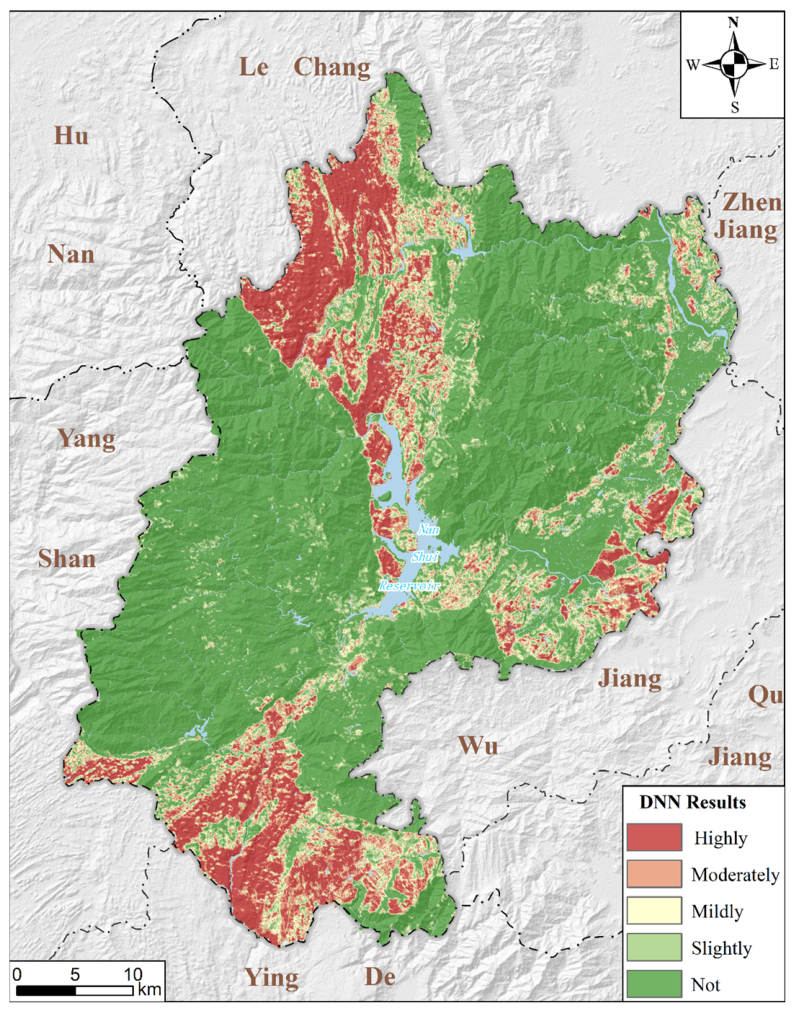
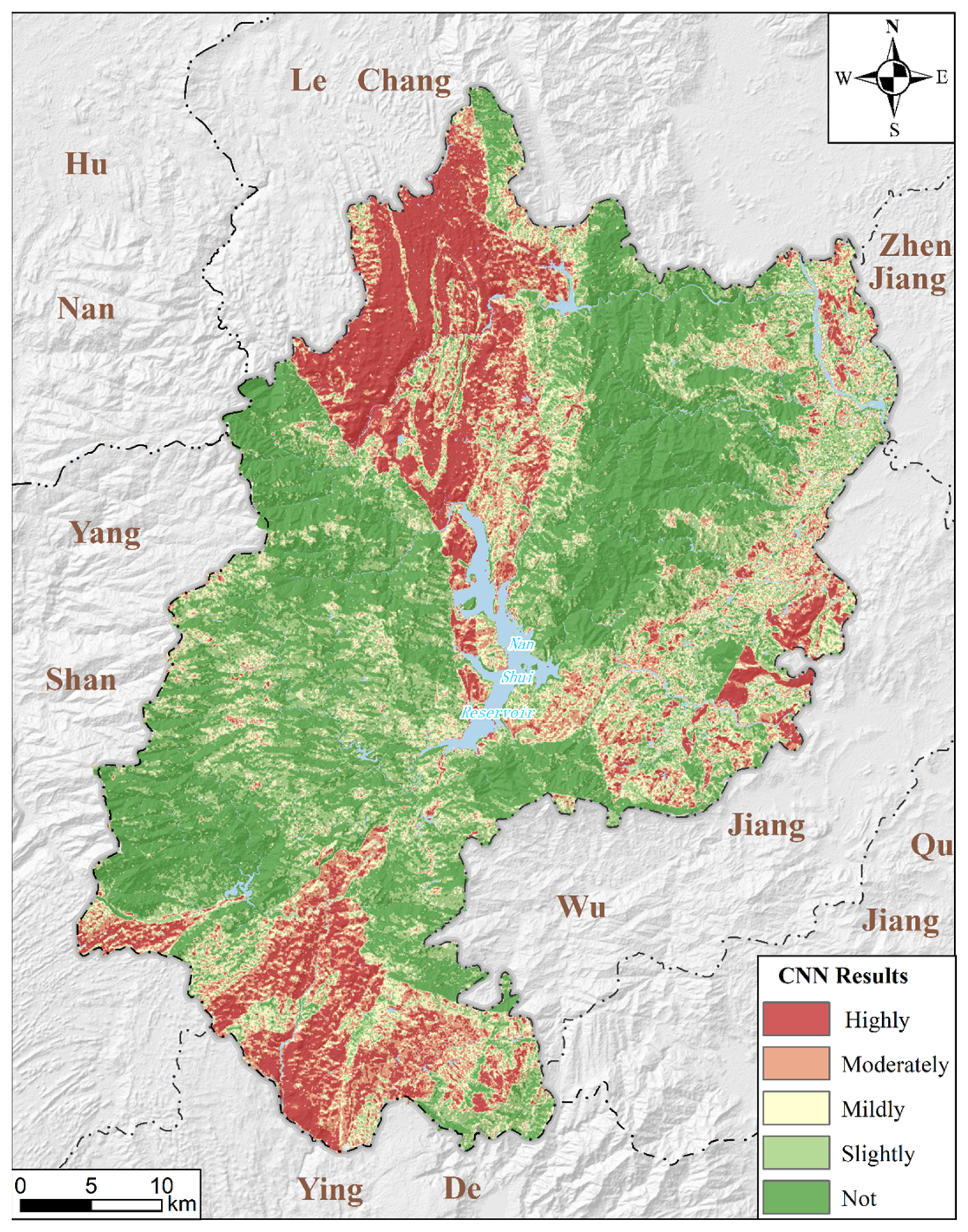
After sample learning, the model outputs were converted into probability distributions using the Softmax function. The results were then classified into five categories using the natural breaks (Jenks) method. The natural breaks determines class boundaries based on the intrinsic distribution characteristics of the data, thereby maximizing the distinction between different classes according to data variation patterns [64,65,66,67].
According to the classification results, probability values ranging from 0 to 21.5% were classified as non-vulnerable areas; values between 21.5% and 43.6% as slightly vulnerable areas; values between 43.6% and 64.8% as mildly vulnerable areas; values between 64.8% and 82.6% as moderately vulnerable areas; and values between 82.6% and 100% as highly vulnerable areas. The percentage values represent the relative degree of ecological–geological vulnerability after normalization. The assessment results are shown in Figure 3 and Figure 4.
To quantitatively evaluate the spatial consistency between the DNN and CNN models, a pixel-wise Pearson correlation analysis was conducted on the probability outputs. The correlation coefficient reached r = 0.83 (p < 0.001), indicating a strong positive spatial relationship between the two models at the regional scale.
Based on the ecological vulnerability assessment maps and the statistical results (Figure 5), both models exhibit similar large-scale spatial patterns. Areas classified as moderately or highly vulnerable are primarily concentrated in Daqiao Town, Luoyang Town, and Dabu Town, with limited distributions in the southeastern and northeastern parts of Rucheng Town.
However, differences become evident when comparing the proportions of each vulnerability level. The most significant discrepancy occurs in the non-vulnerable category, where the DNN model classifies 60.54% of the study area as non-vulnerable, whereas the CNN model identifies 36.19%, resulting in a difference of 24.35%. In contrast, the CNN model assigns higher proportions to the slightly vulnerable (22.85% vs. 11.03%) and mildly vulnerable (14.24% vs. 8.21%) categories. Differences in the moderately vulnerable and highly vulnerable classes are comparatively smaller, at 3.97% and 2.52%, respectively.
These results indicate that while the two models demonstrate strong overall spatial agreement (r = 0.83), the DNN-based assessment exhibits a more polarized distribution pattern, with a stronger concentration in extreme categories. In contrast, the CNN-based results show a more balanced distribution across intermediate levels, suggesting that the CNN model is more sensitive to subtle spatial variations and produces smoother transitions between vulnerability classes.
To further examine the spatial characteristics of the predicted vulnerability surface, a Global Moran’s I analysis was conducted using ArcGIS 10.7 (Spatial Statistics Tools). The CNN-based probability raster was converted into point features and analyzed under an inverse distance spatial relationship model with row standardization. The calculated Moran’s I value was 0.948 (z = 5782.60, p < 0.001), indicating statistically significant positive spatial autocorrelation across the study area. This result suggests that the vulnerability surface exhibits a structured spatial pattern rather than a random distribution. Such spatial autocorrelation is consistent with the intrinsic continuity of ecological–geological variables in mountainous environments and reflects the spatial organization of terrain, lithology, vegetation, and human disturbance factors.

3.3. Statistical Characteristics of the Predicted Probability Distributions

To assess whether the binary-trained models support multi-level differentiation, the predicted probability histograms were analyzed.
For the DNN model, predicted probabilities ranged from 0.0 to 1.0, with a mean of 0.7398 and a standard deviation of 0.3074. The skewness coefficient was −1.130, indicating a left-skewed distribution.
For the CNN model, predicted probabilities ranged from 0.0067 to 0.9922, with a mean of 0.6329 and a standard deviation of 0.2905. The skewness coefficient was −0.694, suggesting a more balanced distribution compared with the DNN model.
The relatively large standard deviations (≈0.29–0.31) indicate substantial dispersion across the [0, 1] interval. The probability histograms exhibit continuous distributions rather than strictly bimodal patterns, suggesting that the models capture gradual transitions of ecological vulnerability intensity rather than producing polarized binary outputs.
After classification using the Jenks natural breaks method, the five vulnerability levels show clear monotonic increases in mean probability values from non-vulnerable to highly vulnerable classes. Inter-class variance exceeds intra-class variance, confirming effective hierarchical separation of the continuous probability surface.
These results support the interpretation of the predicted probability as a continuous vulnerability intensity index suitable for multi-level ecological vulnerability mapping.

3.4. Model Validation

The values of True Positive (TP), False Positive (FP), False Negative (FN), and True Negative (TN) were calculated for both models. ROC curves were plotted, and accuracy (ACC) and precision (PPV) were computed. In addition, MAE and RMSE were calculated on the testing dataset after model training to evaluate prediction error. The results are summarized in Table 3. The models were developed under a binary classification framework in which vulnerable samples were labeled as 1 and non-vulnerable samples as 0. Accordingly, ACC, PPV, MAE, RMSE, and AUC reflect the ability of the models to distinguish between these two conditions. The subsequent five-level ecological vulnerability classification was generated from the continuous probability outputs using the natural breaks method, providing a graded representation of vulnerability intensity based on the binary prediction results.
In terms of classification performance, the CNN model achieved slightly higher accuracy (ACC) and precision (PPV) than the DNN model. The overall accuracies of both models exceeded 90%, indicating satisfactory training and prediction performance. The training dataset consisted of 400 vulnerable and 400 non-vulnerable samples, ensuring a balanced class structure during model learning. Among them, the evaluation results of the CNN model were more accurate than those of the DNN model.
With respect to error metrics, the MAE and RMSE values of the CNN model were also lower than those of the DNN model, indicating smaller prediction errors and better generalization performance on the testing dataset. Analysis of the ROC curves further shows that the CNN model achieved a larger area under the ROC curve (AUC), suggesting superior classifier performance compared with the DNN model (Figure 6). Given the spatial continuity of raster-based ecological data, training samples were selected to ensure spatial representativeness across different geomorphological and land-use units. This strategy supports the regional generalization capability of the models.
Finally, based on the error analysis results, all evaluation metrics of both models fall within a range indicating excellent performance, while the CNN model outperforms the DNN model in terms of both classification accuracy and error rates. The probability outputs further reveal differences in prediction characteristics. The DNN model exhibited a higher mean probability (0.7398) and stronger negative skewness (−1.13), indicating a more polarized distribution toward high-confidence predictions. In contrast, the CNN model showed a lower mean (0.6329) and milder skewness (−0.69), reflecting smoother probability transitions. Probability values approaching 0 or 1 correspond to stronger confidence, whereas intermediate values indicate transitional vulnerability conditions. Combined with the vulnerability classification results, the convolution kernels of the CNN model demonstrate a stronger capability in capturing data details than the DNN model. For example, in areas with no or low vulnerability (such as dense mountainous forests) where localized zones of higher vulnerability caused by human disturbances exist, the CNN model can identify these features more accurately, whereas the DNN model shows limitations in this respect.
To further support the above findings and ensure the rigor of the experiments, field verification was conducted in Ruyuan Area after the completion of model training and evaluation. It was observed that within large areas classified as non-vulnerable or slightly vulnerable, localized zones of damage existed due to activities such as forest logging and hillside excavation, these human-induced disturbances resulted in higher local vulnerability levels.

3.5. Factor Importance Analysis Based on the Random Forest Algorithm

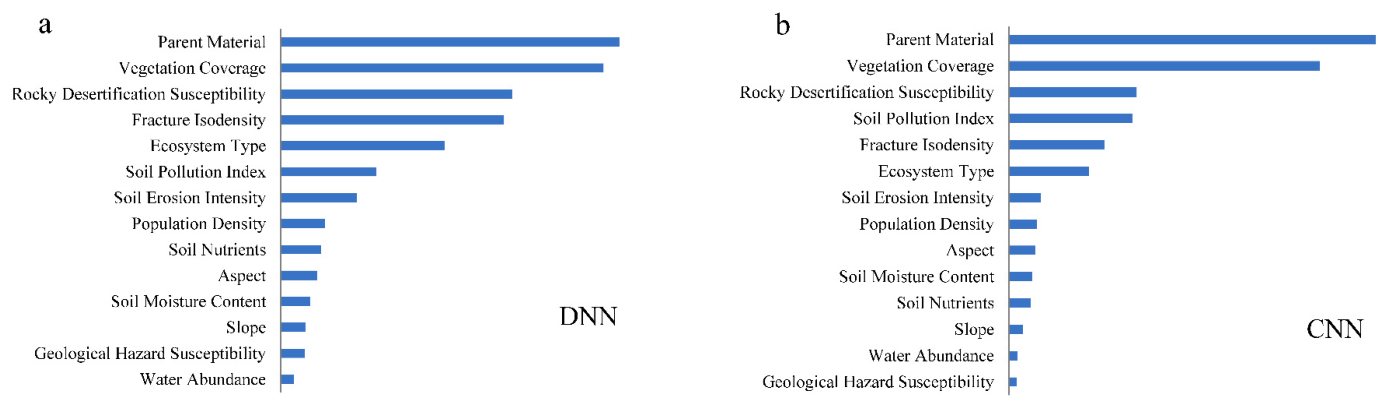
The random forest algorithm was applied to calculate the weights of 14 indicators, and the results are shown in the Figure 7. Overall, although some differences exist in the weight distributions between the DNN and CNN models, parent material and vegetation coverage consistently rank as the top two factors in both models, with relative importance significantly higher than those of other indicators. These two factors therefore represent the primary constraints on ecological–geological vulnerability in Ruyuan Area.
Previous studies have demonstrated that lithology, geomorphology, and soil thickness in karst regions are strongly associated with rocky desertification and soil erosion, thereby increasing ecological sensitivity and limiting ecosystem resilience. These environmental factors are often intrinsically coupled in karst landscapes, and their interactions jointly influence ecological–geological vulnerability. Therefore, the importance values derived from the Random Forest model should be interpreted as relative contributions within the modeling framework rather than strictly independent causal effects.
This result is also clearly reflected in the vulnerability assessment maps. In the final evaluation maps generated by both the DNN and CNN models, a relatively large anomalous area with high ecological–geological vulnerability appears in the eastern part of Rucheng Town. Field verification revealed that this area corresponds to the county seat of Ruyuan Area and the adjacent northeastern hillside regions. Although the hillside areas outside the urban zone are covered by well-grown planted forests and were initially identified as non-vulnerable points during the preliminary determination of ecological–geological vulnerability, the parent material in this area consists of carbonate colluvial deposits, which are associated with the highest level of vulnerability.
Therefore, in combination with the factor importance results, it is inferred that although vegetation around the county seat appears well developed due to human influence, the underlying natural conditions indicate a relatively high level of ecological–geological vulnerability.

4. Discussion

4.1. Analysis of Model Differences

This study explored the feasibility of applying two deep learning models, DNN and CNN, to ecological vulnerability assessment in the NGM. Although the overall spatial patterns of the results are comparable, certain differences exist between the outputs of the two models. The underlying reasons can be summarized as follows.
(1) The ground-truth labels in the dataset were divided into only two categories, as no unified standard for grading ecological–geological vulnerability points has yet been established. Constructing the initial dataset using a binary classification scheme helps minimize subjective labeling uncertainty and ensures clearer separation between stable and clearly disturbed sites. Although the models were trained on binary labels, the Softmax outputs represent posterior probabilities rather than discrete class assignments, thereby forming a continuous vulnerability intensity surface. The subsequent five-level classification therefore reflects a relative gradient of vulnerability rather than a directly supervised multi-class prediction. Nevertheless, the absence of intermediate labeled samples may limit the model’s ability to explicitly learn subtle transitions between vulnerability levels. Future studies incorporating multi-level ground observations would allow more refined supervised classification and reduce potential polarization effects.
(2) Despite the satisfactory performance of both models, several methodological constraints should be acknowledged. First, although the field survey covered representative geomorphological units, the total number of labeled samples remains limited relative to the full spatial extent, and ecological vulnerability is inherently dynamic. The present dataset represents a static temporal snapshot and may not fully capture seasonal or long-term variability. Second, vulnerability outcomes may be sensitive to the selected factor system. While the 14 indicators were chosen based on regional geological and ecological characteristics, alternative or additional variables—such as detailed hydrological dynamics or land-use change trajectories—could influence model behavior. Therefore, factor selection should be adapted to regional environmental conditions rather than directly replicated across different areas. Thirdly, regularization strategies, including dropout, L2 regularization, and early stopping, were applied to reduce overfitting risk. Validation results indicate stable convergence; however, deep learning models inherently possess high representational capacity, and overfitting cannot be entirely excluded, particularly when spatial autocorrelation exists among samples. Future studies could adopt spatial cross-validation strategies and expanded sample sizes to further test model generalization capacity.
(3) From a methodological perspective, inherent architectural differences between the DNN and CNN models also contribute to the observed discrepancies. Unlike a single-layer perceptron that is limited to linear binary classification, a deep neural network (DNN) consists of multiple hidden layers that enable nonlinear feature representation [68]. In this study, hidden layers with ReLU activation functions were introduced to enhance the model’s ability to capture complex nonlinear relationships among ecological and geological factors. However, as a fully connected architecture, the DNN does not explicitly exploit spatial neighborhood structures within raster data. Consequently, the DNN model tends to produce more polarized probability outputs compared with the CNN model.
Moreover, although the DNN model takes 8 × 8 raster patches as input, the data are flattened into one-dimensional vectors before entering the fully connected layers. As a result, the model does not explicitly capture spatial neighborhood relationships. Consequently, the DNN has a limited ability to model local spatial patterns compared with the CNN architecture. This limitation further contributes to the polarization of the classification results.
In contrast, the CNN model employs convolution kernels during data input and processing, enabling effective extraction of image features. Convolution kernels are typically larger than 1 × 1, allowing the model to simultaneously capture the characteristics of both target pixels and their neighboring pixels. Larger kernels provide a broader receptive field; however, excessively large kernels may introduce noise from irrelevant pixels, reduce classification accuracy, and significantly increase computational costs [69]. Therefore, the kernel size must be set within a reasonable range. By capturing spatial context and local neighborhood features of ecological–geological vulnerability points, the CNN model is better able to identify vulnerability characteristics at finer levels.
Overall, both deep learning models performed well in ecological vulnerability assessment, and their evaluation results exhibit similar large-scale spatial patterns. Due to the binary classification nature of the DNN model, its results tend to divide the study area into vulnerable and non-vulnerable regions. In contrast, the CNN model enables further refinement and more detailed grading of vulnerability levels.
Deep learning has been increasingly applied in sustainability-related research [70,71,72]. In ecological vulnerability modeling, the irregular spatial distribution of vulnerability often limits the applicability of traditional methods at large spatial scales. The strong nonlinear fitting capability and high-volume data processing capacity of deep learning models provide an effective solution to this challenge. At present, global ecological sustainability issues are becoming increasingly severe. Within the study area, ecological problems such as land desertification and soil erosion occur frequently. While these issues can partly be attributed to climatic and environmental changes, geological factors also play a critical role [73].
The random forest results indicate that parent material is the most influential factor affecting ecological–geological vulnerability. As the ultimate product of geological processes, parent material in Ruyuan Area reflects the combined effects of complex karst and Danxia landforms, which influence soil formation and subsequently affect the local ecological environment. Vegetation coverage, ranking second, is also widely recognized as a key indicator for evaluating regional ecological conditions. Overall, the ecological vulnerability assessment model developed for Ruyuan Area is effective and reliable, and its results are consistent with field survey observations. However, due to the region-specific characteristics of the study area, the model cannot yet be directly generalized to other regions. Differences in lithology, geomorphology, climate, and human disturbance intensity across regions may substantially influence vulnerability drivers and model performance. Therefore, although the trained model parameters are region-dependent, the integrated methodological framework can be transferred to other regions through appropriate recalibration of factor systems and training datasets. Further research is required to improve the model’s generalizability. From a regional perspective, the CNN results show that 26.72% of the study area is classified as moderately to highly vulnerable, while over one-third remains relatively stable. This pattern indicates overall ecological stability in the Northern Guangdong Mountains, with localized high-vulnerability zones mainly associated with specific lithological and geomorphological conditions. Given that the study area is representative of karst and Danxia mountainous regions in southern China, the framework proposed in this study may provide a useful reference for ecological vulnerability assessment in similar geologically complex areas.

4.2. Ecological–Geological Zoning Map

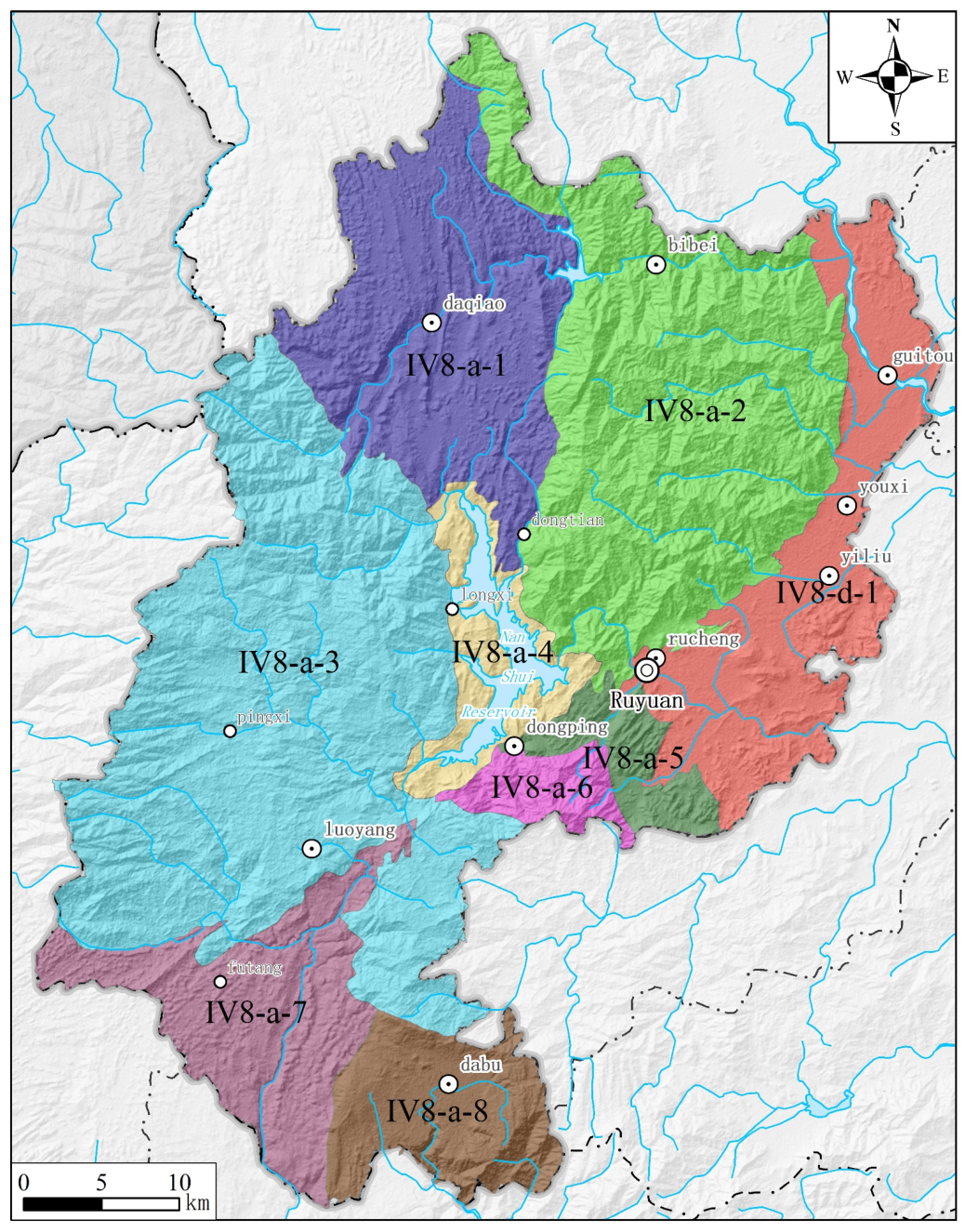
To enhance the practical value of this study and facilitate ecological management and policy formulation by local authorities, an ecological–geological zoning scheme suitable for Ruyuan Area was proposed based on the ecological–geological vulnerability assessment results of the CNN model, in combination with differences in geological structure, ecological conditions, and climatic characteristics within the county. Ecological–geological zoning boundaries were delineated to focus on region-specific ecological–geological issues and ecological characteristics. As a result, Ruyuan Area was divided into nine ecological–geological subzones (Figure 8). The detailed ecological zoning table can be found in Supplementary Material Table S1.

4.3. Ecological–Geological Zoning Protection Recommendations

(1) Daqiao Karst Mountainous Agroforestry Ecological–Geological Subzone (IV8–a–1)
This subzone covers an area of 322.54 km2 and is mainly located in Daqiao Town, with partial extensions into Dongping Town and Bibei Town. The primary ecological–geological problems include localized rocky desertification and severe soil erosion. The dominant ecosystem service functions are soil and water conservation and biodiversity protection.
It is recommended to strengthen afforestation and implement integrated control measures for rocky desertification and soil erosion, optimize forest structure, enhance water conservation capacity, and restore mountainous forest ecosystems. Under strict protection conditions, characteristic industries such as oil tea can be developed. Logging should be strictly prohibited on steep slopes, while planned forestry development may be permitted on gentle slopes. In carbonate rock slope areas, shrubs, vines, and other suitable vegetation types should be preferentially selected.
(2) Dayao Mountains Metamorphic–Clastic Rock Mountainous Forestry Ecological–Geological Subzone (IV8–a–2)
This subzone covers an area of 500.60 km2 and is mainly distributed in Bibei Town and Youxi Town. Frequent geological hazards represent the primary ecological–geological problem. The dominant ecosystem service functions include biodiversity conservation, water conservation, and cultural landscape protection.
It is recommended to prioritize the conservation of subtropical evergreen coniferous and broad-leaved forest ecosystems, strengthen forest fire prevention and pest control, and enhance water conservation and ecological security. Under protection-oriented management, the moderate development of Yao ethnic cultural and traditional medicinal industries is encouraged.
(3) Dongshan Intermediate–Acidic Rock Mountainous Forestry Ecological–Geological Subzone (IV8–a–3)
This subzone covers an area of 687.77 km2 and is mainly distributed in Luoyang Town. The major ecological–geological problems include localized geological hazards, soil erosion, and ecological damage caused by mineral exploitation. The dominant ecosystem service functions are biodiversity protection, water conservation, and soil and water conservation.
It is recommended to strictly control logging on steep slopes, rationally develop forestry resources on low and gentle slopes, accelerate ecological restoration of mining areas, strengthen gully erosion control, and promote the development of understory economies under strict protection conditions.
(4) Nan Shui Reservoir Mountainous–Hilly Water Conservation Ecological–Geological Subzone (IV8–a–4)
This subzone covers an area of 106.86 km2 and is mainly distributed in and around the Nan Shui Reservoir. The main ecological–geological issues include ecological disturbances surrounding the water source area and potential risks to the water environment. The dominant ecosystem service functions are drinking water source protection, water conservation, and ecological landscape maintenance.
It is recommended to designate this area as an important ecological function zone, strengthen ecological protection and management measures, strictly control agricultural non-point and point–source pollution, enhance forest vegetation protection and ecological restoration, and ensure the safety of reservoir water quality.
(5) Dongping East Carbonate Rock Mountainous Forestry Ecological–Geological Subzone (IV8–a–5)
This subzone covers an area of 54.58 km2 and involves Dongping Town and Rucheng Town. The main ecological–geological problems include localized rocky desertification and soil erosion. The dominant ecosystem service functions are soil and water conservation and water conservation.
It is recommended to strengthen afforestation efforts, improve forest structure, and enhance regional soil and water conservation and water conservation capacity.
(6) Dongping South Clastic Rock Mountainous Agroforestry Ecological–Geological Subzone (IV8–a–6)
This subzone covers an area of 42.23 km2 and involves Dongping Town and Rucheng Town. Frequent localized geological hazards constitute the primary ecological–geological problem. The dominant ecosystem service functions are water conservation and biodiversity protection.
It is recommended to conserve subtropical evergreen coniferous and broad-leaved forest ecosystems, strengthen forest disaster prevention and control, and develop understory breeding and planting industries under protection-oriented management.
(7) Datang River Karst Mountainous Agroforestry Ecological–Geological Subzone (IV8–a–7)
This subzone covers an area of 193.37 km2 and involves Luoyang Town and Dabu Town. The main ecological–geological problems include frequent geological hazards, severe rocky desertification, and soil erosion. The dominant ecosystem service functions are soil and water conservation, water conservation, biodiversity protection, and geological environment protection.
It is recommended to prioritize ecological restoration and soil erosion control, strengthen geological environment protection, and develop characteristic understory industries under protection-oriented management. In carbonate rock slope areas, low-stature trees, shrubs, and vines should be adopted for vegetation restoration.
(8) Dabu Clastic Rock Mountainous Agroforestry Ecological–Geological Subzone (IV8–a–8)
This subzone covers an area of 127.24 km2 and is located within Dabu Town. The primary ecological–geological problems include geological hazards, rocky desertification, and soil erosion. The dominant ecosystem service functions are biodiversity protection, water conservation, and landscape conservation.
It is recommended to strengthen the protection and management of forest ecosystems, maintain soil and water conservation functions, and promote the rational development of understory economies and ecotourism under protection-oriented management.
(9) Wujiang River Valley Plain–Hilly Urban Agricultural Ecological–Geological Subzone (IV8–d–1)
This subzone covers an area of 264.88 km2 and is distributed in Rucheng Town, Yiliu Town, Youxi Town, and Guitou Town. The main ecological–geological problems include habitat degradation and agricultural non-point source pollution caused by high-intensity human activities. The dominant ecosystem service function is industrial and agricultural production.
It is recommended to strengthen industrial pollution control and wastewater treatment infrastructure, enhance supervision of atmospheric and non-point source pollution, promote urban ecological landscape construction, and increase the proportion of circular economy practices and clean industries.

5. Conclusions

Ecological vulnerability assessment plays a crucial role in ecological environmental protection and management [74]. Based on long-term field survey data and remote sensing data, this study selected 14 ecological vulnerability factors and employed two deep learning models to construct an ecological vulnerability assessment framework applicable to the NGM. In line with the stated objectives, geological factors were integrated into the modelling process, the performance of DNN and CNN models was compared, the relative importance of vulnerability factors was quantified, and ecological–geological subzones were delineated.
The results indicate that both models are capable of distinguishing vulnerable and non-vulnerable conditions, with the CNN model demonstrating relatively better classification performance. It should be noted that the models were trained using binary vulnerability labels, and the final five-level vulnerability map was derived from continuous probability outputs. Therefore, the mapped classes represent a graded probability-based differentiation rather than directly supervised multi-class prediction.
The ecological problems in Ruyuan Area exhibit pronounced spatial heterogeneity. In combination with the nine ecological–geological subzones delineated in this study, the results can provide scientific reference for ecological protection and restoration planning in the region.

Supplementary Materials

The following supporting information can be downloaded at: https://www.mdpi.com/article/10.3390/su18094472/s1, Table S1: Statistical Table of Ecological Zoning in the Ruyuan Area.

Author Contributions

Conceptualization, W.T. and J.Z.; Methodology, W.T. and H.L.; Software, W.T. and W.G.; Validation, W.T. and W.G.; Formal analysis, W.T. and H.L.; Investigation, H.C., Z.Y., Y.G. and J.Z.; Resources, Z.L.; Data curation, W.G.; Writing—original draft, W.T. and Z.Y.; Writing—review & editing, H.C. and H.L.; Visualization, W.T. and W.G.; Supervision, H.L. and J.Z.; Project administration, Z.Y. and Y.G.; Funding acquisition, J.Z. and H.C. All authors have read and agreed to the published version of the manuscript.

Funding

This study was funded by the China Geological Survey, Project Nos. DD202607102303, DD20221776 and DD20230247, and by the Guangdong Provincial Geological Survey, the Chongqing Bureau of Geology and Mineral Development, and the Development and Urban Geology Special Program, Project Nos. 2021-3, 2022-14, and 2022-21.

Institutional Review Board Statement

Not applicable.

Informed Consent Statement

Not applicable.

Data Availability Statement

The ecological–geological survey raw data used in this study are archived at the Southwest Geological Archive (Chengdu, China) and are available from the corresponding author upon reasonable request.

Acknowledgments

Acknowledgments are extended to Junyi Wu from Wuhan University.

Conflicts of Interest

The authors declare no conflicts of interest.

References

  1. Delgado-Baquerizo, M.; Reich, P.B.; Trivedi, C.; Eldridge, D.J.; Abades, S.; Alfaro, F.D.; Bastida, F.; Berhe, A.A.; Cutler, N.A.; Gallardo, A. Multiple elements of soil biodiversity drive ecosystem functions across biomes. Nat. Ecol. Evol. 2020, 4, 210–220. [Google Scholar] [CrossRef] [PubMed]
  2. Shi, T.; Yang, S.; Zhang, W.; Zhou, Q. Coupling coordination degree measurement and spatiotemporal heterogeneity between economic development and ecological environment—Empirical evidence from tropical and subtropical regions of China. J. Clean. Prod. 2020, 244, 118739. [Google Scholar] [CrossRef]
  3. Zhao, Y.B.; Ni, Z.Y.; Ouyang, Y.; Chen, X.Y.; Wang, D.; Liu, J.J.; Liu, H. Research progress of eco-geological environment carrying capacity. Sediment. Geol. Tethyan Geol. 2022, 42, 529–541. [Google Scholar]
  4. Amundson, R.; Berhe, A.A.; Hopmans, J.W.; Olson, C.; Sztein, A.E.; Sparks, D.L. Soil and human security in the 21st century. Science 2015, 348, 1261071. [Google Scholar] [CrossRef]
  5. Liu, H.; Yu, H.; Song, W.J.; Li, T.; Wu, J.Y.; Chen, H.; Zhang, J.H.; Xiao, Q.L. Chemical Weathering Intensity, Element Migration, and Soil Formation Environment of the Maoniushan Granite-Soil Profile, Xichang, SW China. Minerals 2026, 16, 293. [Google Scholar] [CrossRef]
  6. Yi, Z.W.; Liu, H.; Tian, Z.W.; Liu, H.; Zhang, J.Z.; Wu, Z.K.; Su, Y.; Luo, H.; Chen, H. Assessment of Eco-Geological Vulnerability Using Multiple Machine Learning Models: A Case Study of the Three Gorges Reservoir Area, China. Sustainability 2026, 18, 1758. [Google Scholar] [CrossRef]
  7. Zou, Y.; Li, Z. Regional ecological effect of intensive development zones in Jiangxi Province. J. East China Univ. Technol. Nat. Sci. 2019, 42, 412–417. [Google Scholar]
  8. Turner, B.L.; Kasperson, R.E.; Matson, P.A.; McCarthy, J.J.; Corell, R.W.; Christensen, L.; Eckley, N.; Kasperson, J.X.; Luers, A.; Martello, M.L. A framework for vulnerability analysis in sustainability science. Proc. Natl. Acad. Sci. USA 2003, 100, 8074–8079. [Google Scholar] [CrossRef]
  9. Zhang, X.; Zheng, Y.; Yang, Y.; Ren, H.; Liu, J. Spatiotemporal evolution of ecological vulnerability on the Loess Plateau. Ecol. Indic. 2025, 170, 113060. [Google Scholar] [CrossRef]
  10. Li, W.Y.; Chen, X.Y.; Yi, J.; Zhong, B.; Li, T. Ecological quality assessment in Ganjiang new district based on remote sensing ecological index. J. East China Univ. Technol. Nat. Sci. 2020, 43, 83–89. [Google Scholar]
  11. Liu, H.; Huang, H.X.; Yuan, O.; Li, W.; Zhang, J.; Zhang, T. Soil’s geologic investigation in Daliangshan, Xichang, Sichuan. Sediment. Geol. Tethyan Geol. 2020, 40, 91–105. [Google Scholar]
  12. Sun, J.; Che, M.; Yang, F.; Zhang, C.; Yin, S.; Wei, C. Temporal and spatial variability of landscape ecological risk in the Yangtze River Midstream Urban Agglomeration in the context of climate change. Hum. Ecol. Risk Assess. Int. J. 2025, 31, 165–194. [Google Scholar] [CrossRef]
  13. Fang, Z.; Zhang, Y.F.; Ding, M.H. Ecological changes analysis based on RSEI in the national ecological civilization experimental area (Jiangxi): A case study of Fuzhou city. J. East China Inst. Technol. Nat. Sci. Ed. 2020, 43, 271–279. [Google Scholar]
  14. Ouyang, Y.; Liu, H.; Zhang, J.H.; Tang, F.W.; Zhang, T.J.; Huang, Y.; Huang, H.X.; Li, F.; Chen, M.H.; Song, W.J. Exploration Techniques and Methods of the Eco–Geological Survey in Mountainous Region, Southwest China. Northwestern Geol. 2023, 56, 218–242. [Google Scholar] [CrossRef]
  15. Ran, Y.; Zhao, X.; Ye, X.; Wang, X.; Pu, J.; Huang, P.; Zhou, Y.; Tao, J.; Wu, B.; Dong, W. A framework for territorial spatial ecological restoration zoning integrating “Carbon neutrality” and “Human–geology–ecology”: Theory and application. Sustain. Cities Soc. 2024, 115, 105824. [Google Scholar] [CrossRef]
  16. Zhang, T.J.; Liu, H.; Ouyang, Y.; Huang, H.X.; Zhang, J.H.; Li, F.; Xiao, Q.L.; Zeng, J.; Hou, Q.; Wen, D.K.; et al. A preliminary discussion on the physical and chemical characteristics and main controlling factors of soil and parent material in the middle and high mountain area—Take Xichang as an example. Sediment. Geol. Tethyan Geol. 2020, 40, 106–114. [Google Scholar]
  17. Zhang, D.; Chen, X.; Pang, X.; Guo, J.G.; Ren, G.G.; Luo, J.; Hua, G.H. Ecogeochemical characteristics and source analysis of heavy metal elements in Southern Yudu, Jiangxi Province. J. East China Univ. Technol. Nat. Sci. 2024, 47, 45–54. [Google Scholar]
  18. Zhang, Z.; Tyc, J.; Hensel, M. An Ecogeomorphological Approach to Land–Use Planning and Natural Hazard Risk Mitigation: A Literature Review. Land 2025, 14, 1911. [Google Scholar] [CrossRef]
  19. Huang, Z.X.; Li, M.G.; Feng, Z.B.; Chen, N.N.; Liu, Y. Ecological environment change in Dongxiang District based on remote sensing ecological index. J. East China Univ. Technol. Nat. Sci. 2022, 45, 60–66. [Google Scholar]
  20. Wu, J.; Liu, H.; Li, T.; Ou-Yang, Y.; Zhang, J.-H.; Zhang, T.-J.; Huang, Y.; Gao, W.-L.; Shao, L. Evaluating the Ecological Vulnerability of Chongqing Using Deep Learning. Environ. Sci. Pollut. Res. 2023, 30, 86365–86379. [Google Scholar] [CrossRef]
  21. Zhang, X.Y.; Li, L.; Pei, N.C.; Gao, B.T.; Hao, Z.Z.; Zou, J.Y.; Cui, K.; Wang, L. Construction of Evaluation Index System for Damage of Forest Ecological Services and Functions in Guangdong Province Using the Analytic Hierarchy Process (AHP). For. Grassl. Resour. Res. 2025, 4, 112. [Google Scholar] [CrossRef]
  22. IPCC. Climate Change 2022: Impacts, Adaptation and Vulnerability; Cambridge University Press: Cambridge, UK; New York, NY, USA, 2022; Available online: https://www.ipcc.ch/report/ar6/wg2/ (accessed on 1 March 2026).
  23. Xu, D.; Wang, Y.; Wang, J. A review of social–ecological system vulnerability in desertified regions: Assessment, simulation, and sustainable management. Sci. Total Environ. 2024, 931, 172604. [Google Scholar] [CrossRef]
  24. Abdenour, A.; Sinan, M.; Lekhlif, B. Toward Sustainable Wetland Management: A Literature Review of Global Wetland Vulnerability Assessment Techniques in the Context of Rising Pressures. Sustainability 2025, 17, 7962. [Google Scholar] [CrossRef]
  25. Wang, S.; Wu, Y.; Li, M.; Li, W. Ecological vulnerability assessment and control factor analysis based on vegetation productivity in Yinshanbeilu of Inner Mongolia. Geomat. Nat. Hazards Risk 2026, 17, 2605509. [Google Scholar] [CrossRef]
  26. Janzen, S.; Narvaez, L.; Ortiz-Vargas, A.; O’Connor, J.; Walz, Y.; Sebesvari, Z. Ecosystem and disaster risk: A review of ecological indicators in the context of disaster risk assessments and discussion of their usefulness to inform ecosystem health. Nat.-Based Solut. 2025, 8, 100260. [Google Scholar] [CrossRef]
  27. Gao, J.; Jiao, K.; Wu, S. Quantitative assessment of ecosystem vulnerability to climate change: Methodology and application in China. Environ. Res. Lett. 2018, 13, 094016. [Google Scholar] [CrossRef]
  28. Zhang, X.; Wang, S.; Liu, K.; Huang, X.; Shi, J.; Li, X. Projecting response of ecological vulnerability to future climate change and human policies in the Yellow River Basin, China. Remote Sens. 2024, 16, 3410. [Google Scholar] [CrossRef]
  29. Nkinahamira, F.; Feng, A.; Zhang, L.; Rong, H.; Ndagijimana, P.; Guo, D.; Cui, B.; Zhang, H. Machine learning approaches for monitoring environmental metal pollutants: Recent advances in source apportionment, detection, quantification, and risk assessment. TrAC Trends Anal. Chem. 2024, 180, 117980. [Google Scholar] [CrossRef]
  30. Espíndola, R.P.; Picanço, M.M.; de Andrade, L.P.; Ebecken, N.F.F. Applications of Machine Learning Methods in Sustainable Forest Management. Climate 2025, 13, 159. [Google Scholar] [CrossRef]
  31. Abdullah, S.; Barua, D. Combining Geographical Information System (GIS) and machine learning to monitor and predict vegetation vulnerability: An Empirical Study on Nijhum Dwip, Bangladesh. Ecol. Eng. 2022, 178, 106577. [Google Scholar] [CrossRef]
  32. Yu, R.; Liang, L.; Su, X.; Cheng, J. A driver based framework for vulnerability assessment of the poverty stricken areas of Funiu Mountain, China. Ecol. Indic. 2020, 113, 106209. [Google Scholar] [CrossRef]
  33. Chen, W. A multi-scale assessment of ecosystem health based on the Pressure–State–Response framework: A case in the Middle Reaches of the Yangtze River Urban Agglomerations, China. Environ. Sci. Pollut. Res. 2022, 29, 29202–29219. [Google Scholar] [CrossRef]
  34. Raufirad, V.; Heidari, Q.; Hunter, R.; Ghorbani, J. Relationship between socioeconomic vulnerability and ecological sustainability: The case of Aran–V–Bidgol’s rangelands, Iran. Ecol. Indic. 2018, 85, 613–623. [Google Scholar] [CrossRef]
  35. Zhou, T.; Zhou, R.Q.; Zhao, W.S.; Guo, J.Q.; Chen, Z.X.; Chen, F.; Peng, S.L. Ecosystem Biodiversity and Spatial Location of Mountain Danxiashan in Shaoguan, Guangdong. J. Sun Yat-Sen. Univ. 2024, 63, 104–113. [Google Scholar] [CrossRef]
  36. Zhang, Y.Y.; Lu, R.W.; Tang, B.; Lin, L. Study on the Vulnerability of Ecological–Economic System and Obstacles in the Poor Areas of Northern Guangdong: Taking 8 Counties of Shaoguan City as an Example. Ecol. Econ. 2021, 37, 213–220. [Google Scholar]
  37. Liu, Y.; Wang, L.; Lu, Y.; Zou, Q.; Yang, L.; He, Y.; Gao, W.; Li, Q. Identification and optimization methods for delineating ecological red lines in Sichuan Province of southwest China. Ecol. Indic. 2023, 146, 109786. [Google Scholar] [CrossRef]
  38. Song, S.; Wang, S.; Gong, Y.; Yu, Y. The past and future dynamics of ecological resilience and its spatial response analysis to natural and anthropogenic factors in Southwest China with typical Karst. Sci. Rep. 2024, 14, 19166. [Google Scholar] [CrossRef] [PubMed]
  39. Arrogante-Funes, F.; Mouillot, F.; Moreira, B.; Aguado, I.; Chuvieco, E. Mapping and assessment of ecological vulnerability to wildfires in Europe. Fire Ecol. 2024, 20, 98. [Google Scholar] [CrossRef]
  40. Li, Y.; Xie, W.; Sui, K.; Zhang, D.; Wan, Q. Revealing various change characteristics and drivers of ecological vulnerability in the Luan river basin based on the SRP model. Sci. Rep. 2025, 15, 33021. [Google Scholar] [CrossRef]
  41. Wang, Y.; Xue, Z.-C.; Yang, Y.; Ren, W.; Ju, A.-Q. The impact of ecological vulnerability on ecosystem service value and threshold identification: A case study of the Zhangjiakou–Chengde area, China. Front. Environ. Sci. 2025, 13, 1583841. [Google Scholar] [CrossRef]
  42. Lv, H.; Wu, S.; Hou, Z. Evaluation, Spatial Analysis and Prediction of Ecological Vulnerability in Chongqing Municipality Based on GIS and Principal Component Analysis (PCA). Pol. J. Environ. Stud. 2025, 34, 8143–8156. [Google Scholar] [CrossRef]
  43. SL 190–2007; Soil Erosion Classification and Grading Standard. Ministry of Water Resources of the People’s Republic of China: Beijing, China, 2008.
  44. Fan, J.; Ma, C.; Zhong, Y. A selective overview of deep learning. Stat. Sci. A Rev. J. Inst. Math. Stat. 2020, 36, 264. [Google Scholar] [CrossRef]
  45. Liu, R.; Li, Y.; Tao, L.; Liang, D.; Zheng, H.-T. Are we ready for a new paradigm shift? a survey on visual deep mlp. Patterns 2022, 3, 100520. [Google Scholar] [CrossRef] [PubMed]
  46. Oh, J.; Kim, S.; Lee, C.; Cha, J.-H.; Yang, S.Y.; Im, S.G.; Park, C.; Jang, B.C.; Choi, S.-Y. Preventing Vanishing Gradient Problem of Hardware Neuromorphic System by Implementing Imidazole-Based Memristive ReLU Activation Neuron. Adv. Mater. 2023, 35, 2300023. [Google Scholar] [CrossRef]
  47. Fu, Q. Dynamic Research on Youth Thought, Behavior, and Growth Law Based on Deep Learning Algorithm. Int. J. Data Warehous. Min. (IJDWM) 2023, 19, 1–19. [Google Scholar] [CrossRef]
  48. Li, X.; Zhai, M.; Zheng, L.; Zhou, L.; Xie, X.; Zhao, W.; Zhang, W. Efficient residual network using hyperspectral images for corn variety identification. Front. Plant Sci. 2024, 15, 1376915. [Google Scholar] [CrossRef]
  49. Raj, R.; Kos, A. An extensive study of convolutional neural networks: Applications in computer vision for improved robotics perceptions. Sensors 2025, 25, 1033. [Google Scholar] [CrossRef]
  50. Ding, A.; Zhang, Q.; Zhou, X.; Dai, B. Automatic recognition of landslide based on CNN and texture change detection. In Proceedings of the 2016 31st Youth Academic Annual Conference of Chinese Association of Automation (YAC), Wuhan, China, 11–13 November 2016; IEEE: Piscataway, NJ, USA, 2016; pp. 444–448. [Google Scholar] [CrossRef]
  51. Li, Z.; Liu, F.; Yang, W.; Peng, S.; Zhou, J. A survey of convolutional neural networks: Analysis, applications, and prospects. IEEE Trans. Neural Netw. Learn. Syst. 2022, 33, 6999–7019. [Google Scholar] [CrossRef]
  52. Gu, J.; Wang, Z.; Kuen, J.; Ma, L.; Shahroudy, A.; Shuai, B.; Liu, T.; Wang, X.; Wang, G.; Cai, J.; et al. Recent advances in convolutional neural networks. Pattern Recognit. 2018, 77, 354–377. [Google Scholar] [CrossRef]
  53. Khan, A.; Sohail, A.; Zahoora, U.; Qureshi, A.S. A survey of the recent architectures of deep convolutional neural networks. Artif. Intell. Rev. 2020, 53, 5455–5516. [Google Scholar] [CrossRef]
  54. Heenaye-Mamode Khan, M.; Reesaul, P.; Auzine, M.M.; Taylor, A. Detection of Alzheimer’s disease using pre–trained deep learning models through transfer learning: A review. Artif. Intell. Rev. 2024, 57, 275. [Google Scholar] [CrossRef]
  55. Zhong, J.; Meng, Y.; Liu, Z. Multichannel sandstone thin sections identification based on improved deeplab v3 plus neural network. ACS Omega 2024, 9, 28611–28625. [Google Scholar] [CrossRef] [PubMed]
  56. Younesi, A.; Ansari, M.; Fazli, M.; Ejlali, A.; Shafique, M.; Henkel, J. A comprehensive survey of convolutions in deep learning: Applications, challenges, and future trends. IEEE Access 2024, 12, 41180–41218. [Google Scholar] [CrossRef]
  57. Shetty, S.; Kallianpur, S.; Fernandes, R.; Rodrigues, A.P.; Padmanabha, V. ECO–HYBRID: Sustainable Waste Classification Using Transfer Learning with Hybrid and Enhanced CNN Models. Sustainability 2025, 17, 8761. [Google Scholar] [CrossRef]
  58. Kundroo, M.; Kim, T. Demystifying impact of key hyper–parameters in federated learning: A case study on CIFAR–10 and FashionMNIST. IEEE Access 2024, 12, 120570–120583. [Google Scholar] [CrossRef]
  59. Lenau, A.; Dimiduk, D.; Niezgoda, S.R. Importance of hyper–parameter optimization during training of physics–informed deep learning networks. Integr. Mater. Manuf. Innov. 2025, 14, 115–135. [Google Scholar] [CrossRef]
  60. Aftab, M.; Ahmad, T.; Adeel, S.; Bhatti, S.H.; Irfan, M. Hyper–parameter tuning through innovative designing to avoid over–fitting in machine learning modelling: A case study of small data sets. J. Stat. Comput. Simul. 2025, 95, 1595–1609. [Google Scholar] [CrossRef]
  61. Franceschi, L.; Donini, M.; Perrone, V.; Klein, A.; Archambeau, C.; Seeger, M.; Pontil, M.; Frasconi, P. Hyperparameter optimization in machine learning. Found. Trends Mach. Learn. 2025, 18, 975–1109. [Google Scholar] [CrossRef]
  62. Breiman, L. Random forests. Mach. Learn. 2001, 45, 5–32. [Google Scholar] [CrossRef]
  63. Cheng, Y.; Chen, Q.; Yu, Y.; Xia, Y. Landslide Hazard Assessment in Minjiang River Basin Based on GIS and Random Forest Algorithm. In Proceedings of the International Conference on Algorithms, Software Engineering, and Network Security, Nanchang, China, 29–31 March 2024; Association for Computing Machinery: New York, NY, USA, 2024; pp. 249–253. [Google Scholar] [CrossRef]
  64. Liu, P.; Zhang, H.; Eom, K.B. Active deep learning for classification of hyperspectral images. IEEE J. Sel. Top. Appl. Earth Obs. Remote Sens. 2017, 10, 712–724. [Google Scholar] [CrossRef]
  65. Chen, W.; Xie, X.; Wang, J.; Pradhan, B.; Hong, H.; Bui, D.T.; Duan, Z.; Ma, J. A comparative study of logistic model tree, random forest, and classification and regression tree models for spatial prediction of landslide susceptibility. Catena 2017, 151, 147–160. [Google Scholar] [CrossRef]
  66. Ke, C.; He, S.; Qin, Y. Comparison of natural breaks method and frequency ratio dividing attribute intervals for landslide susceptibility mapping. Bull. Eng. Geol. Environ. 2023, 82, 384. [Google Scholar] [CrossRef]
  67. Fariza, A.; Abhimata, N.P.; Hasim, J.A.N. Earthquake disaster risk map in east Java, Indonesia, using analytical hierarchy process—Natural break classification. In Proceedings of the 2016 International Conference on Knowledge Creation and Intelligent Computing (KCIC), Manado, Indonesia, 15–17 November 2016; IEEE: Piscataway, NJ, USA, 2016; pp. 141–147. [Google Scholar] [CrossRef]
  68. Ghods, A.; Cook, D.J. A survey of deep network techniques all classifiers can adopt. Data Min. Knowl. Discov. 2021, 35, 46–87. [Google Scholar] [CrossRef] [PubMed]
  69. Teng, Q.; Tang, Y.; Hu, G. Large receptive field attention: An innovation in decomposing large–kernel convolution for sensor–based activity recognition. IEEE Sens. J. 2024, 24, 13488–13499. [Google Scholar] [CrossRef]
  70. Arun, M. Investigation of a deep learning–based waste recovery framework for sustainability and a clean environment using IoT. Sustain. Food Technol. 2025, 3, 599–611. [Google Scholar] [CrossRef]
  71. Afaq, Y.; Akram, S.V. Integration of deep learning with edge computing on progression of societal innovation in smart city infrastructure: A sustainability perspective. Sustain. Futures 2025, 9, 100761. [Google Scholar] [CrossRef]
  72. Liu, S.; Xiang, Y.; Zhou, H. A deep learning–based approach for high–dimensional industrial steam consumption prediction to enhance sustainability management. Sustainability 2024, 16, 9631. [Google Scholar] [CrossRef]
  73. Jones, D.; Faheem, M. Geology ecology and landscapes. Geol. Ecol. Landsc. 2022, 6, 148–149. [Google Scholar] [CrossRef]
  74. Xu, M.; Cao, C.; Zhong, S.; Yang, X.; Bashir, B.; Wang, K.; Guo, H.; Gao, X.; Li, J.; Yang, Y. Ecological vulnerability assessment and spatial–temporal variations analysis in typical ecologically vulnerable areas of China. Front. Ecol. Evol. 2024, 12, 1406444. [Google Scholar] [CrossRef]
Figure 1. Overview of the selection process for the 14 factors. The fourteen factors, as shown in the gray boxes in the figure, are classified into three categories: geological conditions, ecological problems, and ecosystem resilience.
Sustainability 18 04472 g001
Figure 2. Ecological vulnerability evaluation factors. (a) Normalized value of slope. (b) Normalized value of aspect. (c) Normalized value of parent material. (d) Normalized value of fracture density. (e) Normalized value of aquifer water abundance. (f) Normalized value of soil moisture content. (g) Normalized value of soil nutrients (integrated geochemical grade). (h) Normalized value of geological hazard susceptibility. (i) Normalized value of rocky desertification sensitivity. (j) Normalized value of soil erosion intensity. (k) Normalized value of soil pollution index. (l) Normalized value of ecosystem type. (m) Normalized value of vegetation coverage (%). (n) Normalized value of population density (persons/km2).
Sustainability 18 04472 g002
Figure 3. DNN Model ecological vulnerability assessment map.
Sustainability 18 04472 g003
Figure 4. CNN Model ecological vulnerability assessment map.
Sustainability 18 04472 g004
Figure 5. Proportion Statistical Chart of Ecological Vulnerability Levels Based on DNN and CNN Models.
Sustainability 18 04472 g005
Figure 6. ROC curves of the DNN and CNN models.
Sustainability 18 04472 g006
Figure 7. Distribution of Random Forest Weights for the DNN and CNN Models. (a) DNN model; (b) CNN model.
Sustainability 18 04472 g007
Figure 8. Ecological–geological zoning map of Ruyuan Area. IV8–a–1—Daqiao karst mountainous agroforestry ecological–geological subzone; IV8–a–2—Dayao Mountains metamorphic–clastic rock mountainous forestry ecological–geological subzone; IV8–a–3—Dongshan intermediate–acidic rock mountainous forestry ecological–geological subzone; IV8–a–4—Nan Shui Reservoir mountainous–hilly water conservation ecological–geological subzone; IV8–a–5—Dongping East carbonate rock mountainous forestry ecological–geological subzone; IV8–a–6—Dongping South clastic rock mountainous agroforestry ecological–geological subzone; IV8–a–7—Datang River karst mountainous agroforestry ecological–geological subzone; IV8–a–8—Dabu clastic rock mountainous agroforestry ecological–geological subzone; IV8–d–1—Wujiang River valley plain–hilly urban agricultural ecological–geological subzone.
Sustainability 18 04472 g008
Table 1. Data Names and Sources Table.
Data NameData Source
Administrative boundary map of Ruyuan AreaNatural Resources Bureau of Ruyuan Area
Land use status map of Ruyuan AreaNatural Resources Bureau of Ruyuan Area
DEM data of Ruyuan AreaGeospatial Data Cloud (http://www.gscloud.cn), GDEM V2, 30 m resolution
Geological map of Ruyuan AreaChina Geological Survey, 1:250,000 geological map (public edition)
Hydrogeological map of Ruyuan AreaChina Geological Survey, 1:200,000 hydrogeological map (public edition)
Geological disaster susceptibility zoning map of Ruyuan AreaSurvey data from the Third Geological Team of Guangdong Geological Bureau (2016)
Soil type map of Ruyuan AreaNational Soil Survey Office of China (1995)
Soil moisture content data of Ruyuan AreaNational Tibetan Plateau Data Center, remote sensing-based global surface soil moisture ten-day dataset (RSSSM, 2003–2020)
Soil fertility data of Ruyuan AreaGuangdong Geological Survey Institute (2021)
Soil pollution index data of Ruyuan AreaGuangdong Geological Survey Institute (2021)
Rocky desertification susceptibility assessment map of Ruyuan AreaChina Geological Survey (2021)
Soil erosion intensity data of Ruyuan AreaExtracted according to the soil erosion classification and grading standard SL 190–2007 [43]
Ecosystem type data of Ruyuan AreaChina Geological Survey (2021)
Vegetation coverage data of Ruyuan AreaChina Geological Survey (2021)
Population density data of Ruyuan AreaWorldPop (https://www.worldpop.org)
Table 2. Display of the Quantitative Classification of Each Indicator.
Evaluation IndicatorClass 1Class 2Class 3Class 4Class 5
Slope<8°8–15°15–25°25–35°>35°
AspectFlatSouth-facingSoutheast- and southwest-facingEast-, west-, northeast-, and northwest-facingNorth-facing
Parent MaterialQuaternary alluvial–proluvial depositsSinian felsic metamorphic colluvial deposits, Cambrian felsic metamorphic colluvial deposits, Jurassic acidic rock colluvial deposits, Cretaceous acidic rock colluvial depositsEarly Jurassic terrigenous clastic rock colluvial deposits, Late Triassic terrigenous clastic rock colluvial deposits, Early–Middle Devonian terrigenous clastic rock colluvial deposits, Early Carboniferous carbonaceous mudstone colluvial deposits, Middle Devonian–Early Carboniferous argillaceous rock colluvial depositsLate Permian argillaceous rock colluvial deposits, Middle–Late Devonian carbonate rock colluvial depositsEarly Carboniferous–Middle Permian carbonate rock colluvial deposits, Early Carboniferous carbonate rock colluvial deposits
Fracture Density<2020–4040–6060–80>80
Aquifer Water AbundanceExtremely abundantAbundantModeratePoorExtremely poor
Soil Moisture Content13.16–14.5612.23–13.1611.29–12.2310.57–11.2910.17–10.57
Soil Nutrients
(Integrated Geochemical Grade)
Abundant (≥4.5)Relatively abundant (3.5–4.5)Moderate (2.5–3.5)Relatively deficient (1.5–2.5)Deficient (≤1.5)
Geological Hazard SusceptibilityVery lowLowModerateHighVery high
Rocky Desertification SensitivityInsensitiveSlightly sensitiveModerately sensitiveHighly sensitiveExtremely sensitive
Soil Erosion IntensitySlightSlight–moderateModerateStrongExtremely strong
Soil Pollution IndexClean (Pi ≤ 1)Relatively clean
(1 < Pi ≤ 2)
Slight pollution
(2 < Pi ≤ 3)
Moderate pollution
(3 < Pi ≤ 5)
Severe pollution (Pi > 5)
Ecosystem TypeForest ecosystemWater and wetland ecosystemGrassland and cropland ecosystemsSettlement ecosystemDesert ecosystem and other ecosystems
Vegetation Coverage (%)High (>60%)Moderate (45–60%)Moderately low (30–45%)Low (10–30%)Bare land (<10%)
Population Density
(persons/km2)
Uninhabited (<1)Extremely sparse (1–100)Sparse (100–500)Moderate (500–1000)Dense (>1000)
Class Value (C)13579
Classification Standard (S)1.0–2.02.0–4.04.0–6.06.0–8.0>8.0
Table 3. Model Validation Parameters.
Training ModelAccuracy (ACC)Precision (PPV)Average MAEAverage RMSE
DNN Model0.9040.8940.09580.2096
CNN Model0.9270.9170.08330.1887
Disclaimer/Publisher’s Note: The statements, opinions and data contained in all publications are solely those of the individual author(s) and contributor(s) and not of MDPI and/or the editor(s). MDPI and/or the editor(s) disclaim responsibility for any injury to people or property resulting from any ideas, methods, instructions or products referred to in the content.