1. Introduction
Global tourism has seen a fundamental structural transformation in recent decades, moving from a discretionary consumption activity into a strategic instrument of national economic diversification. In terms of raw numbers, international tourist arrivals reached 1.3 billion in 2023 [
1], 88% of pre-pandemic 2019 arrival levels. According to the World Travel & Tourism Council (WTTC), tourism’s total contribution to global Gross Domestic Product (GDP) reached USD 9.9 trillion in 2023 [
2], surpassing pre-pandemic GDP contribution levels even as arrival volumes had not yet fully recovered. Economies such as Spain (14.6% total tourism-GDP share in 2023), Thailand (18.4%), Singapore (11.2%), and the UAE (11.5%) [
2,
3], where each country demonstrates deliberate state prioritisation of tourism within comprehensive national development frameworks, show that sustained tourism investment and institutional alignment can produce sustainable and long-lasting structural transformation.
The Kingdom of Saudi Arabia (KSA) presents a theoretically significant and empirically underexplored case. As the world’s largest crude oil exporter, the KSA derives approximately 42% of government revenues and 30% of GDP from hydrocarbons [
4,
5], exposing it to structural vulnerabilities tied to oil price volatility and long-run decarbonisation trends. The “Dutch Disease” literature [
6,
7] posits that hydrocarbon-dependent economies may face resource allocation distortions that attenuate the capacity of non-oil sectors, including tourism, to generate growth and structural transformation. Whether tourism professionals perceive structural pathways consistent with TLGH predictions within this institutional context is therefore a theoretically important question.
Vision 2030, launched in April 2016, formally designates tourism as a cornerstone of non-oil GDP growth for the KSA [
8]. Vision 2030 is Saudi Arabia’s comprehensive national transformation programme, which targets reducing hydrocarbon dependency by developing non-oil sectors—with tourism, entertainment, and manufacturing designated as primary growth engines—alongside wide-ranging social, regulatory, and investment reforms. Flagship gigaprojects—such as The Red Sea Project (USD 28 billion), Qiddiya Entertainment City (USD 7.8 billion), Diriyah Cultural District (USD 20 billion), and EXPO 2030 Riyadh—collectively target 150 million annual visitors and 1 million net new tourism jobs by 2030 [
9]. The 2019 e-visa introduction represented a pivotal regulatory inflection point in the tourism sector, producing a statistically significant increase in tourism receipts and inbound arrivals and unlocking competitive access to global leisure and cultural tourism markets [
10].
Despite the scale of these ambitions, the academic literature on Saudi tourism-led growth exhibits four critical gaps. First, no study has applied the TLGH within a Gulf Cooperation Council (GCC) hydrocarbon economy using a structural design capable of testing mediated pathways simultaneously. Second, existing research is overly reliant on urban convenience samples concentrated in the major cities of Riyadh and Jeddah, meaning there is a lack of knowledge of what is happening across the KSA’s geographically heterogeneous administrative regions. Third, sustainability governance has not been empirically integrated within a structural TLGH test in any GCC context. Finally, no study has integrated exploratory econometric time-series analysis with structural survey modelling and qualitative executive insights within a unified mixed-methods TLGH framework in the Vision 2030 period.
This study addresses these gaps through an integrated mixed-methods design with five specific objectives that correspond directly to the identified gaps: (1) [Gaps 1 and 2] to examine whether tourism-sector professionals’ perceptions of structural pathways between tourism development, megaproject investment, employment, sustainability governance, and economic diversification are directionally consistent with TLGH predictions, using SEM with a geographically stratified five-region sample (
N = 612) that explicitly transcends the urban concentration bias; (2) [Gap 3] to develop and validate the SGS-6 for GCC megaproject contexts, addressing the sustainability governance measurement lacuna; (3) [Gap 4] to contextualise SEM pathway interpretations through semi-structured executive interviews (
n = 24) that explain the mechanisms underlying quantitative structural paths; (4) [Gap 4] to provide supplementary macroeconomic context via an exploratory Autoregressive Distributed Lag (ARDL) analysis (
T = 9, 2015–2023;
Section 3.4); and (5) [Gap 1] to propose the TLGH-GCC Framework extending standard TLGH with institutional acceleration, Dutch Disease boundary conditions, and sustainability governance as a direct structural determinant of diversification efficiency. A methodological note on the perceptual approach is warranted. Rather than relying exclusively on aggregate macroeconomic data—which, as Alhowaish [
11] and Naseem [
10] demonstrate, yields inconclusive TLGH evidence in GCC time-series contexts—this study employs professional perceptions as the primary evidence base. This is justified on three grounds: first, in nascent tourism economies, professionals’ perceptions of structural pathways anticipate economic outcomes before they are statistically detectable in aggregate data [
12]; second, mixed-methods research recognises actors’ shared beliefs and professional experiences as legitimate sources of evidence on emerging structural pathways [
13]; and third, stakeholder-level perceptions of value-creation pathways exhibit predictive validity with respect to sectoral outcomes in contexts of structural transformation [
14].
5. Discussion
5.1. Theoretical Contributions to the TLGH Literature
This study makes four theoretical contributions to the TLGH literature. First, it provides the most geographically comprehensive and methodologically integrative examination of TLGH-consistent professional observations to date in a GCC hydrocarbon-based economy, combining five-region stratified SEM (
N = 612) with executive interview triangulation (
n = 24). Second, the institutional acceleration mechanism is established as a theoretically novel TLGH boundary condition. Third, sustainability governance is shown to be a statistically significant structural determinant of diversification efficiency, contradicting the TLGH’s implicit sustainability neutrality assumption. Fourth, the study demonstrates the measurement sensitivity of sustainability governance operationalisation: H4 was supported using the validated six-item SGS-6 scale, while prior studies employing three-item scales reported non-significant H4 associations [
42,
72]. These contributions notwithstanding, a number of critical and contrasting perspectives in the literature warrant acknowledgement to contextualise the study’s findings appropriately. Ioannides and Gyimóthy [
73] argue that the COVID-19 pandemic exposed fundamental structural fragilities in tourism-dependent development models, challenging the assumption that tourism constitutes a reliable long-run growth engine—a caution directly relevant to Saudi Arabia’s ambitious 2030 diversification targets. The enclave critique [
33] raises questions as to whether megaproject-led tourism investment generates genuine structural diversification or merely substitutes one form of enclave dependency—hydrocarbons—with another—capital-intensive tourism infrastructure with limited backward linkages. Furthermore, GCC-specific econometric evidence from Alhowaish [
11] and Naseem [
10] found no support for the TLGH in the KSA using time-series approaches, a finding that cautions against over-interpreting perceptual pathway support from sector professionals as evidence of actual macroeconomic causation. These critical perspectives collectively reinforce the importance of interpreting the present study’s findings as perceptual and institutional evidence rather than definitive macroeconomic proof of tourism-led growth in the KSA. The heterogeneous GCC econometric findings [
10,
11] and the perceptual TLGH support observed here are not contradictory but reflect different analytical levels operating on different timescales. Econometric TLGH testing requires sufficient macroeconomic time-series to detect cointegration—a threshold the KSA has not reached since structural tourism diversification under Vision 2030 commenced only from 2019. Professional perceptions capture institutionalised beliefs about structural pathways as transformation unfolds, before macroeconomic signatures become statistically detectable. This temporal gap is consistent with the TLGH-GCC Framework’s institutional acceleration mechanism: state-directed investment compresses developmental timelines, but macroeconomic manifestation of perceptually evident pathways necessarily lags professional anticipation thereof. Critically, the qualitative findings (
Section 4.7) serve an explanatory function within the sequential explanatory design, not merely a confirmatory one. Theme 1 (Institutional Acceleration) explains the exceptional magnitude of H2 (β = 0.63): the state’s dual role as developer and regulator removes market-friction delays that moderate employment multipliers in market-led economies, explaining why this path exceeds comparable TLGH coefficients in non-GCC contexts. Theme 2 (Saudisation as Structural Constraint) explains the H3 boundary condition: the positive employment–diversification association (β = 0.52) is institutionally qualified by a decoupling between employment quantity targets and competence development, creating a gap between perceived structural pathways and realised human capital spillovers that aggregate data cannot capture. Theme 3 (Sustainability Governance as Strategic Risk) provides a mechanism-level explanation for H4 (β = −0.31): governance deficits are experienced by practitioners not as regulatory overhead but as direct investment risk factors suppressing the long-run planning confidence required for genuine structural diversification—extending Bramwell and Lane’s [
42] framework beyond its original regulatory framing.
5.2. Comparative Contextualisation
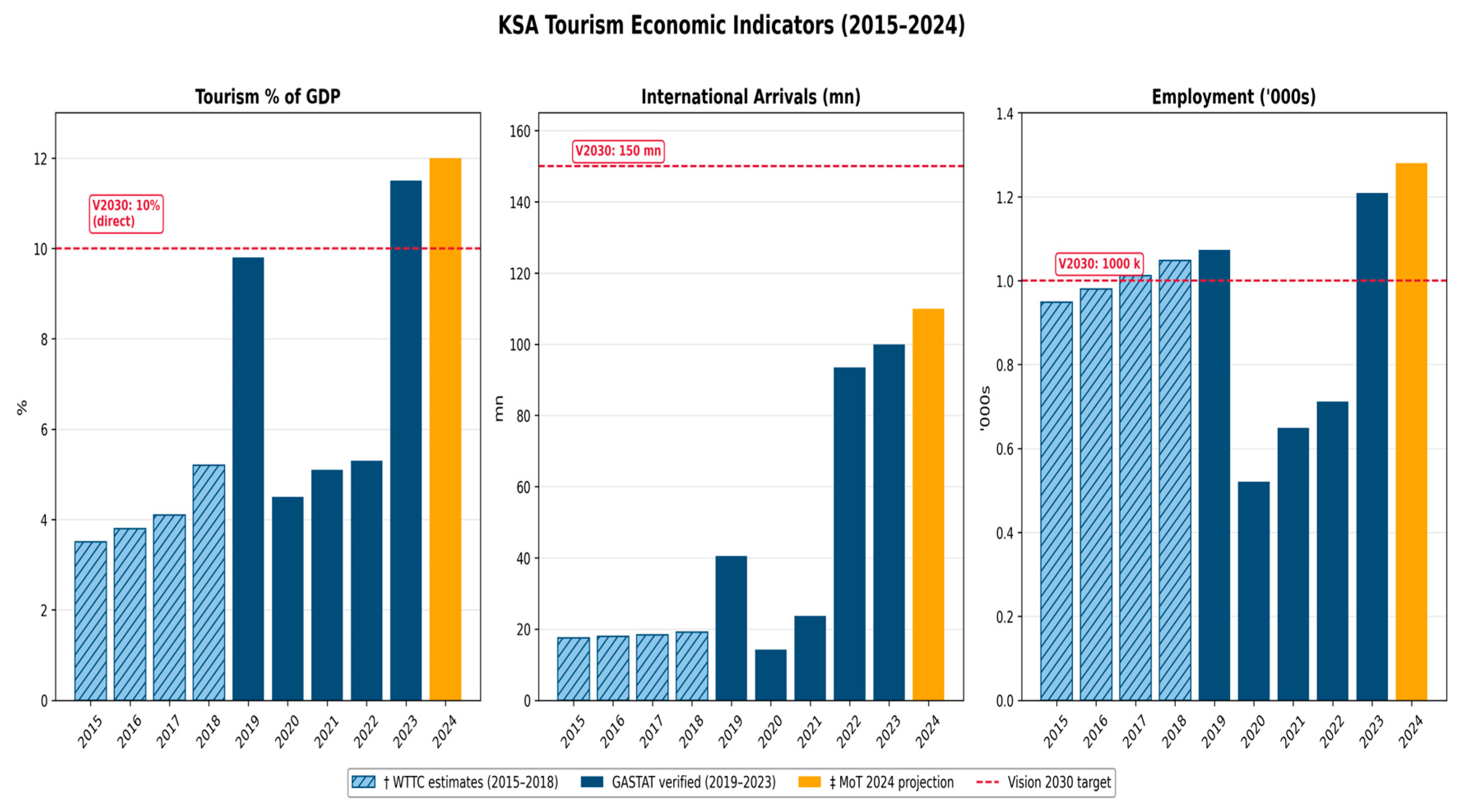
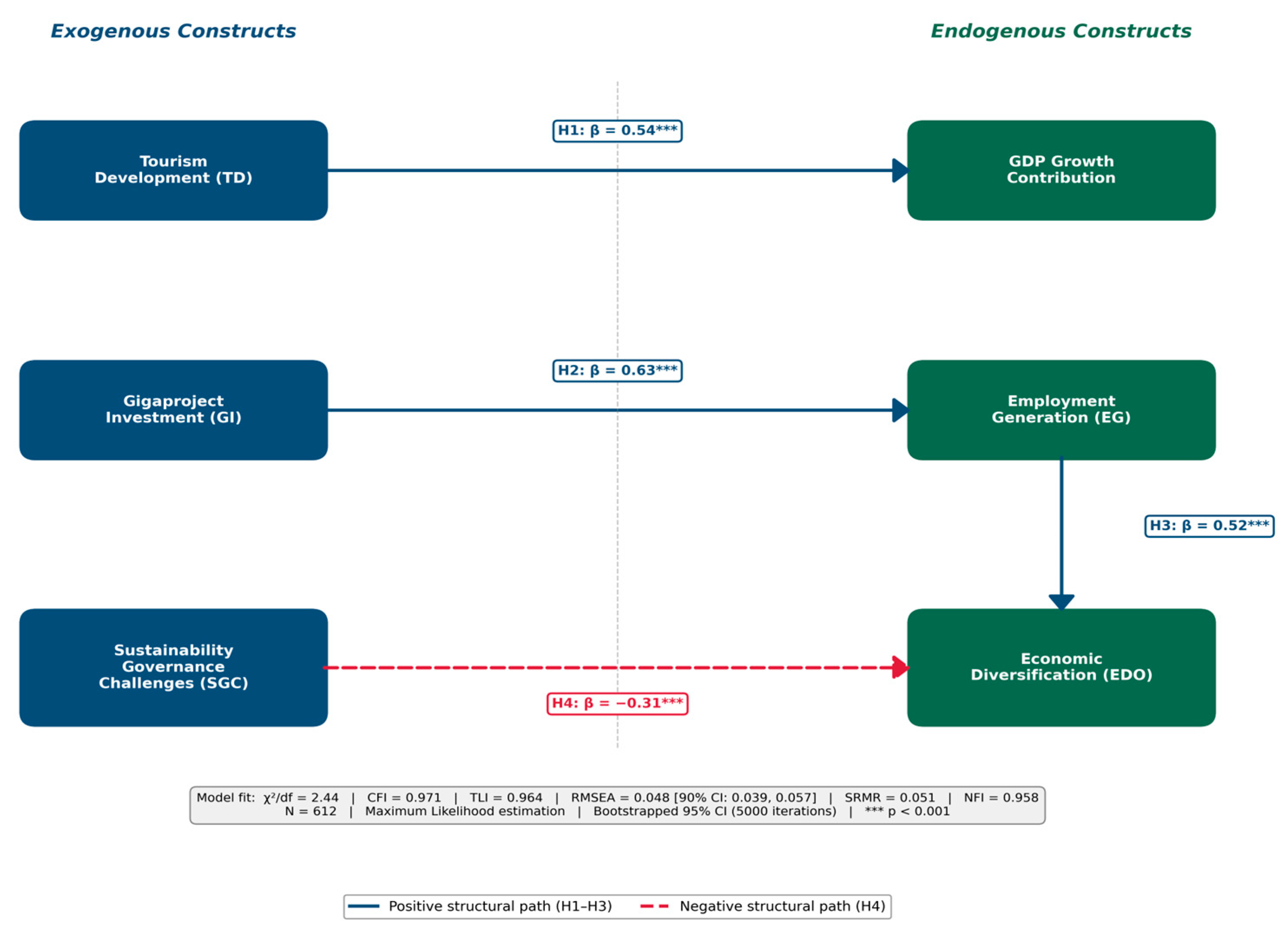
The H1 SEM path coefficient (β = 0.54) points to a strong positive perceptual association between tourism development and GDP contribution as seen by Saudi tourism professionals. The H2 coefficient (β = 0.63) is the strongest path in the model, consistent with Growth Pole Theory [
34] and reinforcing the institutional acceleration theme. Notably, the KSA’s total tourism contribution of 11.5% of GDP in 2023 surpasses the Vision 2030 target of 10%. However, this comparison requires methodological qualification as the 11.5% figure represents total tourism contribution (direct, indirect, and induced effects per WTTC methodology), whereas the Vision 2030 target of 10% refers to direct tourism contribution only [
8,
9].
The H3 path coefficient (β = 0.52,
p < 0.001, 95% CI [0.35, 0.69]) indicates a strong positive perceptual association between tourism-induced employment growth and economic diversification. This finding warrants additional theoretical substantiation. The mechanism linking employment generation to structural diversification operates through two complementary channels identified in the TLGH and structural transformation literatures. First, tourism employment generates occupational spillovers: as a labour-intensive, multi-sector industry, tourism stimulates demand in upstream supply chains encompassing food production, construction, logistics, financial services, and retail, thereby broadening the productive base of the economy beyond direct hospitality activity [
17,
18]. Second, human capital accumulation in the tourism workforce—particularly in service, language, digital, and managerial competencies—enhances worker transferability across non-oil sectors, contributing to the structural re-composition of employment that is central to Vision 2030’s diversification agenda [
9]. The qualification raised by executive interviewees (Theme 2)—that Saudisation numerical targets have not yet translated into sustainable competence development—represents a critical boundary condition on this pathway and provides an important corrective to an uncritical reading of the H3 coefficient. The H3 path should accordingly be interpreted as reflecting the perceptual association between employment quantity and diversification outcomes as perceived by tourism-sector professionals, rather than as evidence of realised human capital-driven diversification. This qualification is consistent with the epistemological framing established in
Section 3.1.
The H4 path (β = −0.31,
p < 0.001, 95% CI [−0.48, −0.14]) confirms a significant negative predictive association between sustainability governance challenges and diversification efficiency. This finding is theoretically grounded in Pulido-Fernández et al. [
37], cross-national evidence that tourism development unaccompanied by integrated sustainability governance generates environmental externalities that erode long-run growth potential. In the GCC megaproject context, sustainability governance challenges operate through two specific mechanisms. First, environmental degradation risks—most acutely, coral reef ecosystem damage at The Red Sea Project, water resource over-extraction, and coastal habitat disruption—pose perceived risks to the ecological asset base upon which high-value nature and cultural tourism is predicated [
38,
41]. If these assets are degraded, the tourism sector’s capacity to sustain long-term economic diversification may be correspondingly reduced. Second, governance deficits in environmental monitoring, third-party auditing, and community engagement mechanisms—the six dimensions captured by the SGS-6—create institutional uncertainty that suppresses investor confidence and complicates the long-run planning horizons required for genuine structural diversification [
42]. The H4 finding therefore extends the TLGH by demonstrating that sustainability governance quality functions not merely as an ethical constraint but as a structural determinant of diversification efficiency—a relationship that standard TLGH formulations do not explicitly theorise.
5.3. Policy Implications
Six targeted policy implications emerge from this study, each aligned with specific Vision 2030 implementation priorities. First, the H1 finding (β = 0.54) supports Vision 2030’s GDP diversification targets but requires methodological consistency in measurement. The Ministry of Tourism and GASTAT should adopt a unified accounting standard distinguishing direct from total tourism GDP contribution to prevent target misinterpretation—the verified 11.5% (2023) reflects total contribution, while the Vision 2030 target of 10% refers to direct contribution only. Second, the H2 finding (β = 0.63, the model’s strongest path) suggests that gigaproject investment exhibits the strongest perceptual association with employment generation among the pathways tested. The Ministry of Investment should formalise regional gigaproject employment allocation quotas aligned with Vision 2030’s regional development agenda, prioritising the northwestern heritage corridor and Eastern Province, where multi-group SEM results indicate the strongest employment multiplier perceptions. Third, the H3 qualitative qualification reveals that Saudisation’s numerical targets are institutionally decoupled from competence development. Vision 2030’s Human Capability Development Program should establish sector-specific tourism competency frameworks covering hospitality service quality, foreign language proficiency, and digital tourism management, with progress tracked at the gigaproject level. Fourth, the H4 finding (β = −0.31) provides a quantitative business case for mandatory Environmental and Social Impact Governance (ESIG) integration in gigaproject frameworks. The Saudi Green Initiative’s project-level implementation should be strengthened with independent third-party auditing at The Red Sea Project and other coastal megaprojects, addressing the SGS-6 scale’s lowest-scoring governance dimensions. Fifth, the multi-group finding that the Eastern Province exhibits a significantly stronger H4 negative path (β = −0.41) signals that sustainability governance deficits are perceived as especially damaging to diversification in this region. Targeted ESIG investment in the Eastern Province would serve the dual goals of tourism development and structural transformation from hydrocarbon dependency. Sixth, Vision 2030’s e-visa liberalisation produced a verified step-change in arrivals from 2019 and should be complemented by destination management organisation (DMO) capacity-building in the three underrepresented regions of this study—Madinah, Eastern Province, and the north-western heritage area—to convert arrival growth into lasting diversification benefits.
5.4. Limitations of the Study
The study has eight notable limitations. First, the cross-sectional SEM design cannot establish temporal causality, pointing to a need for more longitudinal panel studies. Second, T = 9 verified annual observations for the ARDL analysis falls substantially below the minimum T = 30; all ARDL results are accordingly treated as exploratory. Third, the multi-group SEM regional comparison should be interpreted with caution for the Madinah (n = 89) and northwestern heritage (n = 88) groups. Fourth, the SGS-6 sustainability governance scale requires cross-context validation beyond the Saudi megaproject context. Fifth, occupational-tier disaggregation within the tourism-employment aggregate would enable more explicit modelling of the quality dimension of H3. Sixth, the sample composition introduces a structural confirmation bias as all 612 respondents have a professional stake in tourism-related development—whether as tourism operators, government administrators, megaproject developers, academics, or finance professionals—and may be institutionally predisposed toward positive perceptions of the sector’s growth contribution. Seventh, the pilot EFA used n = 45 for a 42-item pool (ratio 1.07:1, below the 5:1 minimum). Finally, the SGS-6 consists entirely of negatively worded items, raising the issue of acquiescence bias.
Several directions for future research follow from this study’s findings and limitations. First, longitudinal panel surveys tracking tourism professionals’ perceptions across the Vision 2030 implementation timeline would establish whether perceptual TLGH pathways strengthen as macroeconomic structural transformation becomes statistically detectable. Second, replication of the TLGH-GCC Framework and SGS-6 instrument in other GCC hydrocarbon economies—particularly the UAE, Qatar, and Oman, which are at varying stages of tourism-led diversification—would establish cross-national generalisability. Third, future research should incorporate external stakeholder groups, including environmental regulators, local community representatives, and international investors, to triangulate against the sector-insider optimism bias identified as a limitation here. Fourth, as GASTAT national accounts data accumulate to T ≥ 30 verified annual observations post-2030, formal time-series ARDL cointegration testing of the TLGH in the KSA will become methodologically feasible and should be conducted to complement the perceptual evidence presented here. Fifth, future iterations of the SGS-6 should incorporate positively worded items and undergo cross-context validation in non-GCC megaproject settings.
6. Conclusions
This study is the most geographically comprehensive and methodologically integrative examination of TLGH-consistent perceptions among tourism-sector professionals in a GCC hydrocarbon economy to date. Drawing on five-region stratified SEM (N = 612), supplementary ARDL contextual analysis (2015–2023, T = 9), and executive interviews (n = 24), all four TLGH-GCC Framework hypotheses were supported. Tourism development positively predicts GDP growth (H1: β = 0.54); gigaproject investment positively predicts employment generation (H2: β = 0.63); employment growth positively predicts economic diversification (H3: β = 0.52); and sustainability governance challenges negatively predict diversification efficiency (H4: β = −0.31). All structural paths represent perceptual associations directionally consistent with TLGH predictions, not evidence of macroeconomic causation. Saudi Arabia’s verified tourism GDP trajectory over the years 2015–2023—from 3.5% to 11.5%—combined with the institutional acceleration mechanism identified through executive interviews, locates the study’s contribution within a broader theoretical narrative of how state-directed investment can compress the developmental timelines that more market-led economies require decades to traverse.
As Saudi Arabia accelerates its post-oil economic transformation at a scale unprecedented in the TLGH literature, empirically grounded evidence on the structural mechanics of tourism-led diversification becomes indispensable for policy design, investment allocation, and governance architecture. The TLGH-GCC Framework proposed here provides a theoretically coherent and empirically validated foundation for this ongoing scholarly and policy agenda.


_Li.png)