Article

Tourism-Led Growth Perceptions in a Hydrocarbon Economy: Mixed-Methods SEM Evidence from Saudi Arabia’s Vision 2030

by
Tahani H. Alqahtani
College of Business, Imam Mohammad Ibn Saud Islamic University (IMSIU), Riyadh 11432, Saudi Arabia
Sustainability 2026, 18(9), 4438; https://doi.org/10.3390/su18094438
Submission received: 23 March 2026 / Revised: 19 April 2026 / Accepted: 27 April 2026 / Published: 1 May 2026
(This article belongs to the Section Tourism, Culture, and Heritage)

Abstract

Purpose: Saudi Arabia’s Vision 2030 designates tourism as a non-oil diversification engine. This study tests Tourism-Led Growth Hypothesis (TLGH) predictions among tourism professionals across five regions of the Kingdom of Saudi Arabia (KSA), proposing the TLGH-GCC (Gulf Cooperation Council) Framework. Design/Methodology/Approach: Sequential explanatory mixed-methods design: Structural Equation Modelling (SEM; N = 612; five regions) as primary evidence, executive interviews (n = 24) explaining mechanisms, and exploratory ARDL (T = 9; non-inferential). Findings: Perceptual support was found for all four hypothesised structural pathways (all p < 0.001), with megaproject investment exhibiting the strongest association with employment generation (β = 0.63) and sustainability governance challenges inversely associated with diversification efficiency. All associations are directionally consistent with TLGH predictions but do not establish causation. Qualitative findings further identified Saudisation alignment and workforce competency development as critical boundary conditions for translating tourism employment growth into sustained economic diversification. Theoretical Contribution: The TLGH-GCC Framework extends TLGH with institutional acceleration, Dutch Disease boundary conditions, and sustainability governance as a diversification determinant. The SGS-6 scale is validated for GCC megaproject contexts. Practical Implications: Regional decentralisation of gigaproject investment, occupational upgrading, and proactive sustainability governance are the highest-leverage Vision 2030 policy interventions. The findings further inform human capital development priorities under Vision 2030, including sector-specific tourism competency frameworks and Saudisation alignment in megaproject workforce planning. Originality/Value: The study addresses a methodological gap in the TLGH literature by combining five-region stratified SEM, executive interviews, and the validated SGS-6 sustainability governance scale within a single GCC-contextualised framework.

1. Introduction

Global tourism has seen a fundamental structural transformation in recent decades, moving from a discretionary consumption activity into a strategic instrument of national economic diversification. In terms of raw numbers, international tourist arrivals reached 1.3 billion in 2023 [1], 88% of pre-pandemic 2019 arrival levels. According to the World Travel & Tourism Council (WTTC), tourism’s total contribution to global Gross Domestic Product (GDP) reached USD 9.9 trillion in 2023 [2], surpassing pre-pandemic GDP contribution levels even as arrival volumes had not yet fully recovered. Economies such as Spain (14.6% total tourism-GDP share in 2023), Thailand (18.4%), Singapore (11.2%), and the UAE (11.5%) [2,3], where each country demonstrates deliberate state prioritisation of tourism within comprehensive national development frameworks, show that sustained tourism investment and institutional alignment can produce sustainable and long-lasting structural transformation.
The Kingdom of Saudi Arabia (KSA) presents a theoretically significant and empirically underexplored case. As the world’s largest crude oil exporter, the KSA derives approximately 42% of government revenues and 30% of GDP from hydrocarbons [4,5], exposing it to structural vulnerabilities tied to oil price volatility and long-run decarbonisation trends. The “Dutch Disease” literature [6,7] posits that hydrocarbon-dependent economies may face resource allocation distortions that attenuate the capacity of non-oil sectors, including tourism, to generate growth and structural transformation. Whether tourism professionals perceive structural pathways consistent with TLGH predictions within this institutional context is therefore a theoretically important question.
Vision 2030, launched in April 2016, formally designates tourism as a cornerstone of non-oil GDP growth for the KSA [8]. Vision 2030 is Saudi Arabia’s comprehensive national transformation programme, which targets reducing hydrocarbon dependency by developing non-oil sectors—with tourism, entertainment, and manufacturing designated as primary growth engines—alongside wide-ranging social, regulatory, and investment reforms. Flagship gigaprojects—such as The Red Sea Project (USD 28 billion), Qiddiya Entertainment City (USD 7.8 billion), Diriyah Cultural District (USD 20 billion), and EXPO 2030 Riyadh—collectively target 150 million annual visitors and 1 million net new tourism jobs by 2030 [9]. The 2019 e-visa introduction represented a pivotal regulatory inflection point in the tourism sector, producing a statistically significant increase in tourism receipts and inbound arrivals and unlocking competitive access to global leisure and cultural tourism markets [10].
Despite the scale of these ambitions, the academic literature on Saudi tourism-led growth exhibits four critical gaps. First, no study has applied the TLGH within a Gulf Cooperation Council (GCC) hydrocarbon economy using a structural design capable of testing mediated pathways simultaneously. Second, existing research is overly reliant on urban convenience samples concentrated in the major cities of Riyadh and Jeddah, meaning there is a lack of knowledge of what is happening across the KSA’s geographically heterogeneous administrative regions. Third, sustainability governance has not been empirically integrated within a structural TLGH test in any GCC context. Finally, no study has integrated exploratory econometric time-series analysis with structural survey modelling and qualitative executive insights within a unified mixed-methods TLGH framework in the Vision 2030 period.
This study addresses these gaps through an integrated mixed-methods design with five specific objectives that correspond directly to the identified gaps: (1) [Gaps 1 and 2] to examine whether tourism-sector professionals’ perceptions of structural pathways between tourism development, megaproject investment, employment, sustainability governance, and economic diversification are directionally consistent with TLGH predictions, using SEM with a geographically stratified five-region sample (N = 612) that explicitly transcends the urban concentration bias; (2) [Gap 3] to develop and validate the SGS-6 for GCC megaproject contexts, addressing the sustainability governance measurement lacuna; (3) [Gap 4] to contextualise SEM pathway interpretations through semi-structured executive interviews (n = 24) that explain the mechanisms underlying quantitative structural paths; (4) [Gap 4] to provide supplementary macroeconomic context via an exploratory Autoregressive Distributed Lag (ARDL) analysis (T = 9, 2015–2023; Section 3.4); and (5) [Gap 1] to propose the TLGH-GCC Framework extending standard TLGH with institutional acceleration, Dutch Disease boundary conditions, and sustainability governance as a direct structural determinant of diversification efficiency. A methodological note on the perceptual approach is warranted. Rather than relying exclusively on aggregate macroeconomic data—which, as Alhowaish [11] and Naseem [10] demonstrate, yields inconclusive TLGH evidence in GCC time-series contexts—this study employs professional perceptions as the primary evidence base. This is justified on three grounds: first, in nascent tourism economies, professionals’ perceptions of structural pathways anticipate economic outcomes before they are statistically detectable in aggregate data [12]; second, mixed-methods research recognises actors’ shared beliefs and professional experiences as legitimate sources of evidence on emerging structural pathways [13]; and third, stakeholder-level perceptions of value-creation pathways exhibit predictive validity with respect to sectoral outcomes in contexts of structural transformation [14].

2. Literature Review and Theoretical Framework

2.1. The Tourism-Led Growth Hypothesis: Mechanisms and Boundary Conditions

Balaguer and Cantavella-Jordá [15], synthesised by Brida et al. [16], hold that tourism growth exhibits a positive predictive association with aggregate economic expansion through four mechanisms: (i) foreign exchange earnings easing balance-of-payments constraints; (ii) investment crowding-in effects; (iii) productivity spillovers from international market exposure; and (iv) employment multiplier effects through upstream supply chains [17,18].
Brida et al. [16] systematic review and synthesis of 87 panel studies confirmed a positive long-run tourism–GDP association, with stronger evidence in small, open, tourism-dependent states. Cross-national panel evidence suggested the TLGH held in the majority of sampled economies, with institutional quality as a consistent positive moderator [16,19,20]. It is noteworthy that resource-dependent economies display systematically weaker TLGH associations as a result of Dutch Disease dynamics hindering productivity spillovers [21]. In GCC contexts, prior studies have yielded heterogeneous TLGH outcomes. Alhowaish [11] applied panel Granger causality across the six GCC economies and found support for the TLGH only in Bahrain, while Naseem [10], using ARDL bounds testing on Saudi time-series data spanning 2003 to 2019, similarly found no support for the TLGH in the KSA. These heterogeneous findings are theoretically explicable through Dutch Disease dynamics. Corden and Neary [6] identify two core Dutch Disease mechanisms relevant to tourism-led diversification: the resource movement effect, whereby high-wage hydrocarbon employment draws skilled labour away from tradable service sectors, including tourism; and the spending effect, whereby hydrocarbon revenues inflate domestic costs, eroding the price competitiveness of tourism as an export industry. Torvik [7] further demonstrates that economies experiencing Dutch Disease exhibit attenuated learning-by-doing spillovers from non-resource sectors—precisely the productivity diffusion mechanism upon which TLGH is predicated. In the KSA context, these dynamics suggest that Dutch Disease functions not merely as macroeconomic background noise but as a binding boundary condition that moderates the strength and detectability of TLGH pathways in aggregate data. This boundary condition rationale directly motivates the perceptual approach of the present study: professionals embedded in the tourism system perceive structural growth pathways that Dutch Disease dynamics may suppress or delay in macroeconomic time-series. Furthermore, development interventions in resource-dependent contexts characteristically generate dual economic and environmental outcomes that interact with institutional governance capacity [22]—a dynamic operationalised in the TLGH-GCC Framework through the H4 sustainability governance pathway.
H1. 
Tourism-sector professionals’ perceptions of tourism development exhibit a significant positive predictive association with their perceptions of GDP growth contribution in the KSA, directionally consistent with TLGH predictions.

2.2. Saudi Arabian Tourism: Structural Trajectory and GCC Contextualisation

As the home of two of Islam’s holiest sites, the KSA’s tourist sector has historically been dominated by religious pilgrimage. The two main pilgrimage occasions of Hajj and Umrah generated USD 12.4 billion and attracted 19.5 million international pilgrims in 2019 [23]. Investing heavily in product diversification, regulatory liberalisation, infrastructure development, and human capital formation, Vision 2030 is a deliberate departure from this longstanding tourism strategy. Comparative GCC analysis contextualises Saudi Arabia’s trajectory, including sustainability comparisons of individual gigaprojects [24]. Neighbouring Gulf state the UAE achieved an 11.5% tourism–GDP share in 2023 following 2 decades of systematic megaproject investment [25,26]. Bahrain saw tourism’s share of GDP at 12.9% [27], while Qatar’s megaevent-driven model generated peak arrivals in 2022 but continues to face legacy sustainability challenges [28].

2.3. Megaproject Investment, Employment Multipliers, and Spatial Distribution

Tourism investment multipliers operate through direct employment in tourism facilities, indirect employment in upstream supply chains, and induced employment from increased household spending [17]—a three-tier multiplier structure grounded in the Keynesian investment multiplier principle [29]. More recent scholarship has refined this framework: Dwyer et al. [30] demonstrate that computable general equilibrium (CGE) modelling yields more precise employment multiplier estimates than traditional input–output approaches, particularly in economies undergoing structural transformation. Pratt [31] further shows that megaproject-anchored tourism investment in emerging economies generates stronger upstream supply chain linkages when accompanied by targeted local procurement policies. Dogru et al. [32] demonstrate that exogenous shocks can rapidly reverse tourism’s economic contributions and employment gains, establishing that tourism-led diversification is structurally vulnerable rather than self-sustaining—a resilience consideration that directly contextualises the boundary conditions of the H3 employment–diversification pathway examined in this study. The Saudi gigaproject portfolio, including The Red Sea Project, Qiddiya, Diriyah, and EXPO 2030 Riyadh, totals committed investment spending of over USD 75 billion, aiming to secure approximately 400,000 direct and indirect jobs within a sector-wide 1-million position target [9]. Enclave Tourism Theory [33] predicts that capital-intensive megaproject enclaves generate limited local linkages, while Growth Pole Theory [34] posits that concentrated investment can generate agglomeration benefits but may worsen inter-regional economic disparities.
Cross-national panel evidence further corroborates the employment generation pathway: analysing 148 economies from 2002 to 2017, Nguyen et al. [35] demonstrate that tourism investment and consumption exhibit significant positive effects on employment across all income-level sub-samples, and that institutional quality amplifies these employment gains—a finding that directly contextualises the H2 and H3 pathways in the present study and underscores the institutional dimension of the TLGH-GCC Framework.
Within this GCC comparative context, recent evidence confirms that tourism development in the Gulf region exhibits a complex relationship with income distribution: in early stages of tourism expansion, sectoral growth may initially widen inequality, but beyond a threshold level, increased tourism revenue contributes to reducing income gaps—a dynamic directly relevant to Saudi Arabia’s accelerated diversification trajectory under Vision 2030 [36].
H2. 
Tourism gigaproject investment exhibits a significant positive predictive association with employment generation in Saudi Arabia.
H3. 
Tourism-induced employment growth exhibits a significant positive predictive association with economic diversification.

2.4. Sustainability Governance: Revised Theoretical Treatment

Pulido-Fernández et al.’s [37] cross-national panel analysis showed that tourism development unaccompanied by integrated sustainability governance generates environmental externalities that undermine long-run growth potential. In the GCC context, Gössling [38] identified water stress as a dominant environmental constraint on tourism expansion; this relationship between tourism, growth, and environmental sustainability has been confirmed across major tourist destinations globally, with empirical evidence showing that tourism–environment causality patterns vary significantly by destination type and governance context [39]; desalination-dependent water infrastructure presents additional governance pressures in the GCC context [40]. Emam and Ali-Dinar [41] noted that The Red Sea Project’s construction phase posed considerable risk of Red Sea coral reef degradation. This study addresses the measurement lacuna by developing and validating the SGS-6—a six-item sustainability governance scale grounded in the Tourism–Sustainability Nexus framework [42] adapted for the GCC megaproject institutional context; its development responds to systematic calls for more contextualised sustainability indicators in tourism research [43,44].
H4. 
Sustainability governance challenges exhibit a significant negative predictive association with tourism-led economic diversification efficiency.

2.5. The TLGH-GCC Framework

The Tourism-Led Growth Hypothesis (TLGH), first formalised by Balaguer and Cantavella-Jordá [15] and subsequently synthesised across 87 studies by Brida et al. [16], posits that tourism sector growth generates positive spillovers to the broader economy through foreign exchange earnings, investment crowding-in, productivity diffusion, and employment multiplier effects. The Gulf Cooperation Council (GCC) refers to the six-member regional bloc—Saudi Arabia, the UAE, Qatar, Kuwait, Bahrain, and Oman—which shares the institutional characteristics of hydrocarbon dependency, state-directed economic development, and labour nationalisation policies that collectively constitute the contextual boundary conditions on standard TLGH mechanisms. The TLGH-GCC Framework proposed in this study integrates and extends both by embedding three contextual mechanisms absent from the standard TLGH: (1) institutional acceleration, whereby state-led megaproject investment compresses developmental timelines that take decades in more free-market economies; (2) Dutch Disease dynamics and Saudisation labour market segmentation as boundary conditions moderating the magnitude of TLGH mechanisms; and (3) sustainability governance quality as a direct structural determinant of the efficiency of economic diversification. The resulting model specifies four hypothesised structural pathways (H1–H4) tested simultaneously using SEM.

3. Research Design and Methodology

3.1. Research Philosophy and Mixed-Methods Design

This study adopts a pragmatist research philosophy [12,13] using a sequential explanatory mixed-methods design. A pragmatist philosophy was selected because the research question requires both statistical confirmation of structural pathways (addressed through SEM) and contextual, mechanism-level explanation of those pathways (addressed through interviews); pragmatism explicitly sanctions the use of whichever methods best address the research question, rather than committing to either a purely positivist or interpretivist stance [12]. The sequential explanatory design is the appropriate mixed-methods architecture because the quantitative SEM results are generated first and then used to purposively design the qualitative interview guide, ensuring genuine methodological integration rather than parallel juxtaposition. The quantitative phase comprises SEM primary survey analysis as the primary evidence base, supplemented by an exploratory ARDL secondary data analysis providing supplementary macroeconomic context (Section 3.4). A subsequent qualitative phase deploys semi-structured executive interviews to offer explanatory depth and contextualise statistical pathways within the TLGH-GCC Framework. The term “predictive association” is used throughout in preference to “causal relationship” to reflect the epistemological limitations of cross-sectional SEM.
A fundamental epistemological constraint of this design warrants explicit acknowledgement at the outset of the methodology. Because the SEM component relies on cross-sectional survey data collected at a single point in time, the structural path coefficients estimated represent associations between professional perceptions rather than established causal relationships. No temporal precedence can be inferred from the cross-sectional design, and accordingly, all SEM findings are interpreted as perceptual structural associations directionally consistent—or otherwise—with TLGH predictions, not as evidence of causal tourism-led growth mechanisms. This epistemological boundary condition applies to all four hypothesised pathways (H1–H4) and is reflected in the consistent use of the term “predictive association” rather than “causal relationship” throughout this article. The sequential explanatory logic of the mixed-methods design warrants explicit elaboration to demonstrate organic integration rather than mere parallel juxtaposition. In Stage 1, SEM analysis (N = 612) was conducted first to identify the magnitude, direction, and significance of H1–H4. These results directly informed the qualitative interview guide in three ways: (i) the strongest path (H2: β = 0.63) generated probes on institutional mechanisms linking megaproject investment to employment and on multiplier-moderating conditions; (ii) the H3 path (β = 0.52) combined with pre-pilot evidence of an employment quantity–quality divergence generated targeted probes on Saudisation and competence development; and (iii) the negative H4 path (β = −0.31) generated probes identifying which specific governance failures practitioners considered most consequential for diversification. In Stage 2, qualitative analysis was therefore designed to explain the mechanisms underlying each structural path—not merely confirm directional consistency—with thematic codes [45] anchored to specific SEM coefficients throughout the discussion (Section 5).

3.2. Sample Design

3.2.1. Survey Sample: Multi-Regional Stratified Design

The target population consisted of tourism-sector professionals, policymakers, hospitality executives, and relevant academics across five primary tourism-active administrative regions of the KSA: Riyadh, Makkah, Madinah, the Eastern Province, and the northwestern heritage area around the cities of Tabuk and AlUla. A multi-stage stratified quota sampling design [46] was employed with quotas established proportional to regional tourism GDP estimates [General Authority for Statistics (GASTAT), 2023] [4]. This design was preferred over simple stratified random sampling for two reasons. First, no comprehensive sampling frame of all Saudi tourism-sector professionals existed at the time of data collection, making pure probability sampling operationally unfeasible. Second, quota allocation proportional to regional tourism GDP estimates [4] ensured geographic representativeness across five administratively distinct regions. “Multi-stage” refers to the two-stage procedure: Stage 1 identified regional tourism industry associations and human resources contacts within major tourism employers in each region as primary sampling units; Stage 2 recruited individual respondents within each primary unit until regional quotas were fulfilled, with snowball referrals capped at 15% per regional quota to limit social network bias. The achieved N = 612 exceeded all three sample size thresholds recommended by Wolf et al. [47] (73% response rate against 839 invitations) (Table 1).
A structural sampling limitation warrants explicit acknowledgement in this section: because all 612 respondents have a professional stake in tourism-related development—whether as tourism operators (35.0%), government administrators (25.5%), megaproject developers (16.0%), academics (14.2%), or finance and investment professionals (9.3%)—the sample remains sector-adjacent rather than cross-stakeholder and may carry a degree of confirmation bias toward positive growth perceptions. This limitation is further discussed in Section 5.4.

3.2.2. Interview Sample

A purposive criterion-based sample of 24 senior executives was recruited for a series of semi-structured interviews. The inclusion criteria required current or recent senior leadership roles in the Saudi tourism sector, a minimum of 5 years’ work experience, and substantive familiarity with Vision 2030—operationalised as direct professional involvement in or oversight of Vision 2030 tourism initiatives, evidenced through role title, organisational affiliation, and a brief pre-interview screening question asking candidates to identify two or more Vision 2030 tourism targets or gigaprojects by name. Thematic saturation was confirmed at 20 participants, with four more interviews added to verify saturation robustness [48]. All interviews were conducted via video-conference (Zoom/Microsoft Teams) between February and August 2024, with a mean duration of approximately 58 min (range: 42–75 min).

3.3. Survey Instrument and Validation

The survey instrument was developed over three stages adhering to established scale development protocols [49,50,51]. The survey was administered online via a bilingual (Arabic and English) Qualtrics platform (Qualtrics XM, Qualtrics LLC, Provo, UT, USA) between October 2023 and January 2024. Invitations were distributed through regional tourism industry associations, Ministry of Tourism professional networks, and human resources contacts at major tourism employers across the five target regions. Respondents self-completed the questionnaire at their own pace, with a follow-up reminder issued at 2 weeks. Responses were screened for straight-lining and implausibly short completion times (under three minutes), and data were imported into IBM SPSS Statistics version 28 (IBM Corp., Armonk, NY, USA) for EFA and IBM SPSS AMOS version 29 (IBM Corp., Armonk, NY, USA) for CFA and full-model SEM. Five constructs were measured on seven-point Likert scales (1 = strongly disagree; 7 = strongly agree): Tourism Development and GDP Contribution (TD, six items); Gigaproject Investment and Infrastructure (GI, five items); Employment Generation and Skills Development (EG, five items); Sustainability Governance Challenges (SGC, six items—the newly developed SGS-6 scale); and Economic Diversification Outcomes (EDO, four items). The SGS-6 Sustainability Governance Scale items, developed for the GCC megaproject institutional context, measure: (SGC1) adequacy of environmental monitoring and reporting systems; (SGC2) independence of third-party environmental auditing; (SGC3) water resource management governance frameworks; (SGC4) coral reef and marine ecosystem protection protocols; (SGC5) community and stakeholder engagement mechanisms; and (SGC6) translation of national sustainability targets into site-level operational practice. All items are reverse-coded, such that higher scores indicate greater governance challenge intensity. This negatively framed operationalisation was deliberate, reflecting the construct’s theoretical definition as governance challenge intensity rather than governance capability. However, it introduces the risk of acquiescence bias, whereby respondents may systematically agree with negatively worded items irrespective of content [52,53]. This limitation is acknowledged in Section 5.4. Future iterations of the SGS-6 should incorporate positively worded items measuring governance strengths (e.g., “Environmental monitoring systems operate effectively at this project site”) to enable internal consistency checks and mitigate acquiescence bias.
The theoretical and methodological foundations of the SGS-6 warrant explicit elaboration. Bramwell and Lane’s [42] Tourism–Sustainability Nexus framework identifies six governance dimensions as central to sustainable tourism management: environmental monitoring and reporting; third-party accountability mechanisms; natural resource management; ecosystem protection; community participation; and the integration of national-level policy into site-level operational practice. These six dimensions were systematically adapted to the specific institutional context of GCC megaproject development, where governance challenges are qualitatively distinct from those characterising market-led tourism in developed economies. Specifically, GCC megaprojects involve state-directed capital deployment at unprecedented speed and scale, creating particular governance tensions in three areas: (i) the speed–sustainability trade-off, whereby accelerated construction timelines may outpace the capacity of environmental monitoring and regulatory systems; (ii) water resource governance, where desalination-dependent infrastructure creates distinctive sustainability pressures not addressed in the original Bramwell and Lane [42] framework [40]; and (iii) marine ecosystem governance, where The Red Sea Project’s coral reef proximity creates risks not present in urban or inland megaproject contexts [41]. The adaptation process involved three stages: (1) conceptual mapping of Bramwell and Lane’s [42] six dimensions onto the GCC megaproject context through systematic literature review; (2) expert review by five senior sustainability practitioners with GCC megaproject experience, who confirmed content validity of adapted item wordings; and (3) pilot EFA item screening (n = 45), leading to the retention of six items. Full instrument wording is provided in Appendix A.

3.4. Exploratory Macroeconomic Context (Strictly Non-Inferential)

This sub-section provides contextual macroeconomic background only and carries no inferential weight within the study’s hypothesis-testing framework. Given that T = 9 verified observations fall critically below the minimum T = 30 required for valid ARDL inference [54], readers should treat Table 2 as a descriptive macroeconomic backdrop rather than corroborating econometric evidence for any of the four hypothesised structural pathways. An exploratory secondary data analysis was conducted using verified annual macroeconomic indicators covering 2015–2023, sourced from GASTAT, WTTC, the Organisation for Economic Co-operation and Development (OECD), and the Saudi Arabian Monetary Authority (SAMA). The ARDL bounds-testing approach [55] was selected due to the mixed integration order of the time series. It must be noted that T = 9 verified annual observations (2015–2023) fall critically below the T = 30 minimum required by Narayan [54] finite-sample critical bounds tables. All ARDL results are treated as directionally indicative only, drawing no formal cointegration inference.

3.5. Analytical Strategy

Quantitative analysis proceeded across six stages: (1) Non-response bias assessment via wave analysis [56] and full collinearity Variance Inflation Factor (VIF) assessment for Common Method Bias (CMB) [57]; (2) Exploratory Factor Analysis (EFA) (IBM SPSS Statistics version 28) on a randomly assigned subsample (n = 306; 50%); (3) Confirmatory Factor Analysis (CFA) (IBM SPSS AMOS version 29) assessing Composite Reliability (CR > 0.70), Average Variance Extracted (AVE > 0.50), Fornell-Larcker discriminant validity, and Heterotrait–Monotrait (HTMT) ratio [58]; (4) Full-sample SEM (N = 612; Maximum Likelihood estimation; bootstrapped 95% CIs, 5000 iterations); (5) supplementary exploratory ARDL contextual analysis; and (6) multi-group SEM along regional lines. Qualitative analysis employed template analysis [45] within an abductive framework, coded using NVivo version 14 (Lumivero, Denver, CO, USA). Inter-rater reliability was Cohen’s κ = 0.82, indicating almost perfect agreement [59]. It should be noted that a pilot EFA was conducted prior to the main data collection on a separate convenience sample of n = 45 participants with a 42-item pool, yielding a participant-to-item ratio of approximately 1.07:1, substantially below the 5:1 minimum recommended by Comrey and Lee [60]. This pilot EFA served exclusively as an item-screening exercise to identify and eliminate poorly performing items before instrument finalisation; its results are treated as preliminary, and no stable factor solutions are claimed from it. The primary EFA reported in this study was conducted on the randomised 50% holdout subsample (n = 306), yielding a participant-to-item ratio of 7.3:1 for the initial 42-item pool, well above recommended thresholds. The underpowered pilot EFA is acknowledged as a limitation in Section 5.4.

4. Results

4.1. Secondary Data: Macroeconomic Indicators (2015–2024)

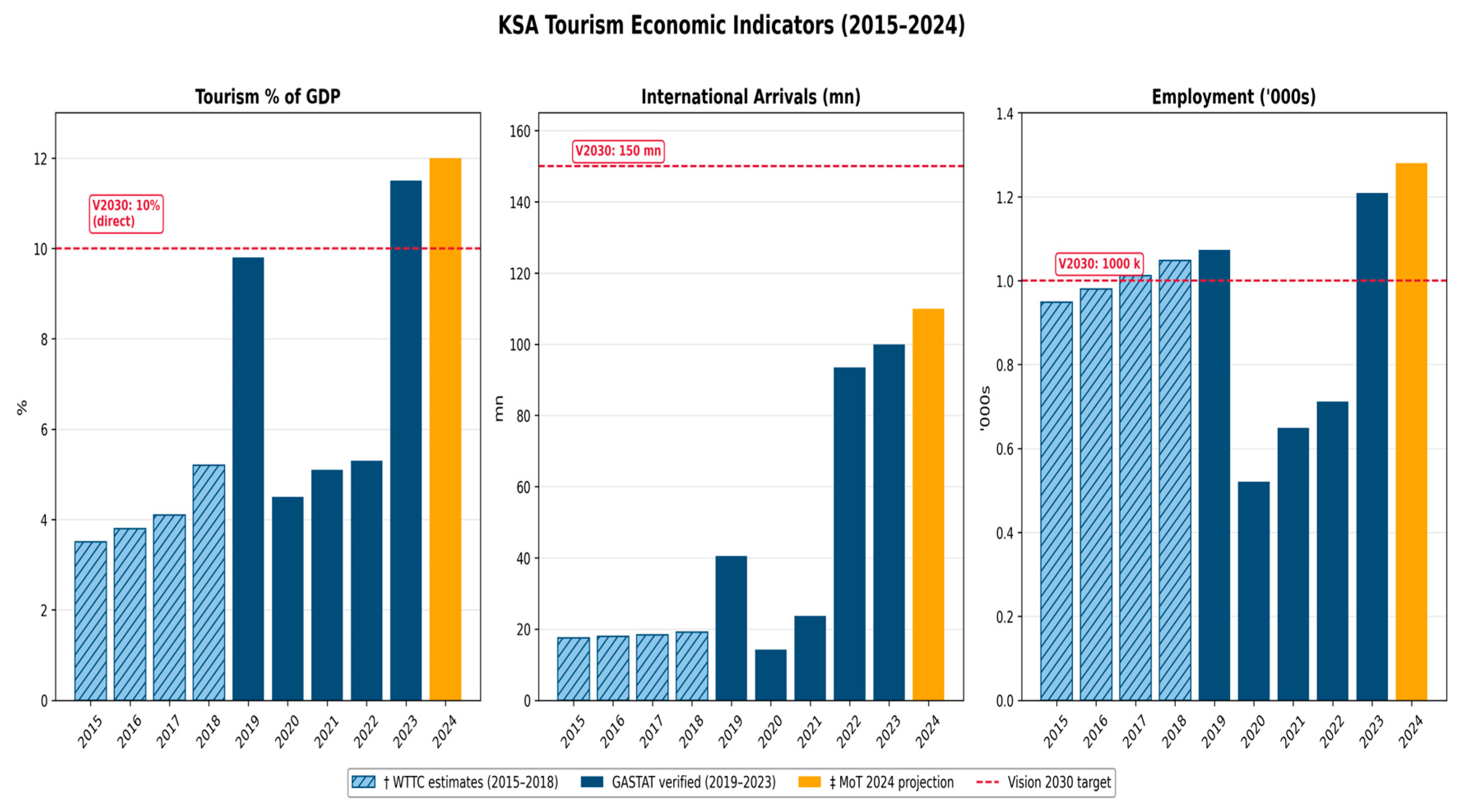
Table 3 presents verified macroeconomic tourism indicators. GASTAT national accounts are available from 2019 onwards and represent verified official statistics, while figures for 2015–2018 are WTTC trend-based estimates treated as indicative baselines and distinguished with dagger notation. The apparent discontinuity between estimated figures for 2018 (5.2%) and verified 2019 (9.8%) reflects a methodological difference between WTTC trend interpolation and GASTAT national account measurement rather than a near doubling of tourism activity.
Table 3. Saudi Arabia Tourism Macroeconomic Indicators: Verified and Estimated Data (2015–2024).
YearTourism % of GDPReceipts (USD bn)Arrivals (mn)Employment (‘000)Tourism Contrib. to Non-Oil GDP (pp)SourceStatus
20153.58.517.59480.9WTTC† Est.
20163.89.118.09801.2WTTC† Est.
20174.19.818.410121.6WTTC† Est.
20185.212.119.110482.4WTTC† Est.
20199.819.940.5 *10733.3GASTATVerified
20204.58.814.2521−1.1GASTATVerified
20215.110.323.76492.7GASTATVerified
20225.313.493.57128.7GASTATVerified
202311.526.3100.012096.0GASTATVerified
2024 ‡~12.0~28.5~110.0~1280~5.5MoT proj.Proj.
Note. (†) WTTC trend-based estimates; treat as indicative baselines only. (*) 2019 arrivals include Hajj/Umrah pilgrims and e-visa leisure arrivals separately for the first time. (‡) Preliminary estimate as at Q3 2024. Compound Annual Growth Rate (CAGR) for the verified 2019–2023 period: tourism receipts +7.2% p.a.; arrivals +25.4% p.a. Tourism GDP % = total tourism contribution including direct, indirect, and induced effects. Figure 1 visualises these temporal trends.
Figure 1. KSA tourism economic indicators (2015–2024): tourism GDP contribution (%), international visitor arrivals (millions), and tourism-related employment (‘000). Solid bars = GASTAT verified data (2019–2023); hatched bars = WTTC trend-based estimates (†, 2015–2018); amber bars = MoT 2024 projection (‡). Lines indicate Vision 2030 targets. Source: GASTAT (2023) [4]; [61,62]; Ministry of Tourism (2024) [9].
Sustainability 18 04438 g001

4.2. Common Method Bias and Non-Response Bias

Table 4 outlines the non-response bias and CMB assessment results. Wave analysis showed no substantial differences across all constructs (all p > 0.05), confirming the absence of non-response bias [56]. Full collinearity VIF values ranged from 2.18 to 2.67, all below the 3.3 threshold [57], and Harman single-factor variance of 27.4% fell well below the 50% threshold, collectively confirming that CMB does not pose a threat to the reliability and validity of the findings.

4.3. Measurement Model: Reliability, Validity, and Discriminant Validity

Table 5 shows the construct-level psychometric properties. All constructs demonstrated satisfactory reliability (α ≥ 0.85; CR ≥ 0.88) and convergent validity (AVE ≥ 0.60). Discriminant validity was confirmed via both the Fornell-Larcker criterion (√AVE > Max r for all constructs) and the stricter Heterotrait–Monotrait (HTMT) criterion (all ratios < 0.85 [58]). Regarding model specification transparency, the initial CFA model yielded an acceptable fit without the application of any modification indices involving cross-loadings. Two correlated residual pairs were permitted within the same construct (TD items 2–3; EG items 1 and 4), both justified on substantive grounds given item-wording overlap.

4.4. Structural Model Fit

Table 6 presents the structural model goodness-of-fit indices. All fit indices meet or exceed established criteria, with CFI = 0.971 and RMSEA = 0.048 demonstrating excellent model fit.

4.5. Structural Path Analysis and Hypothesis Testing

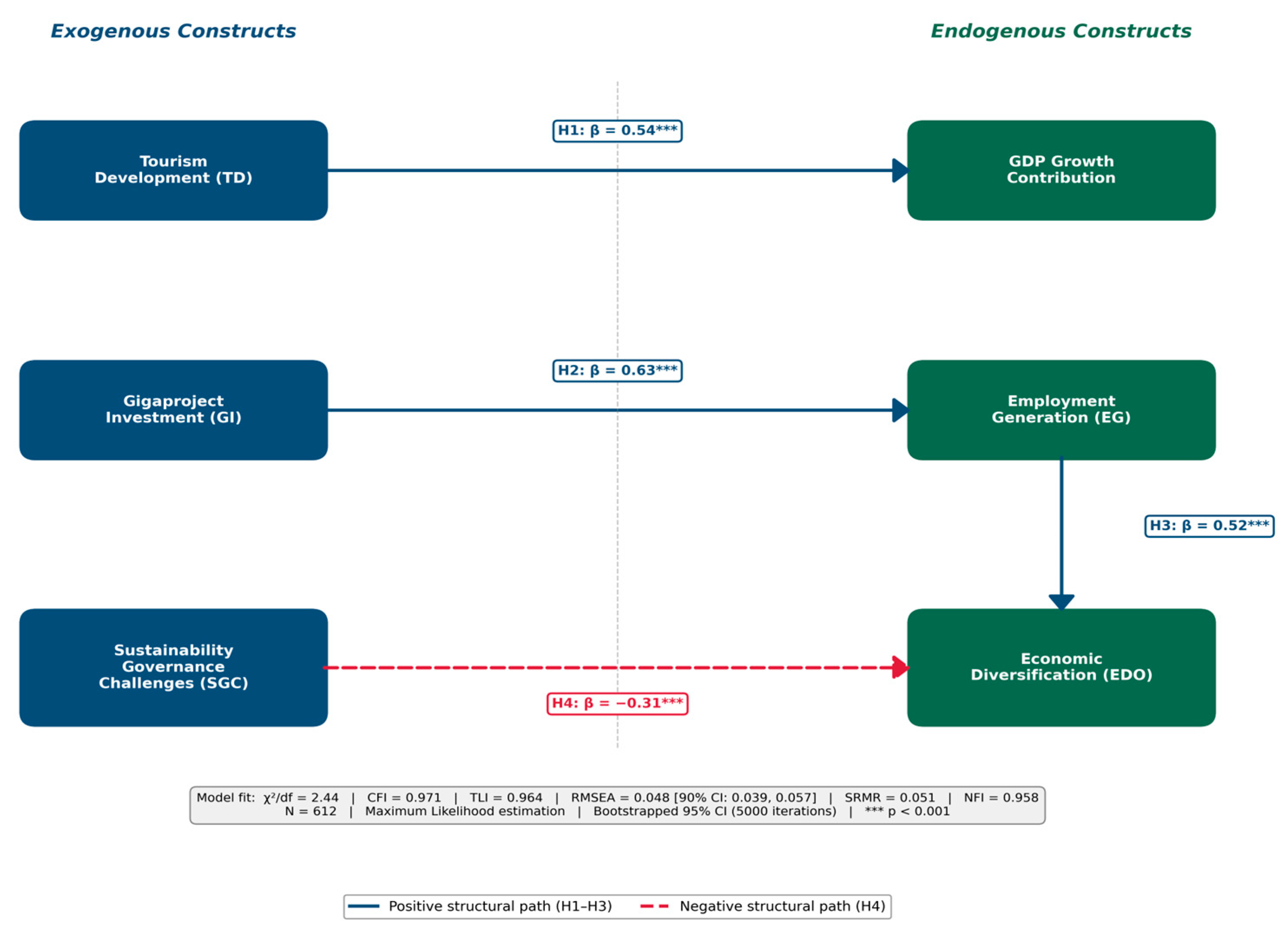
Figure 2 shows that all four hypothesised structural paths are statistically significant (p < 0.001), with the strongest being H2 (β = 0.63), thereafter H1 (β = 0.54), then H3 (β = 0.52), and H4 (β = −0.31), collectively explaining substantial variance in the endogenous constructs (R2 range: 0.29–0.58). Bootstrapped 95% confidence intervals (5000 iterations) exclude zero for all four paths. The robustness of the structural solution was confirmed through three complementary assessments: (a) bootstrapped CIs (5000 iterations) confirming path stability under resampling; (b) multi-group SEM across five regions (Section 4.6) confirming path sign consistency and configural, metric, and scalar invariance [68,69]; and (c) common method bias diagnostics (VIF range: 2.18–2.67; Harman variance: 27.4%) ruling out artifactual path inflation. Collectively, these assessments confirm that the four structural paths are not artefacts of model specification or method variance (Table 7).

4.6. Multi-Group Analysis: Regional Heterogeneity

Multi-group SEM confirmed configural, metric, and scalar invariance prior to path comparison (all ΔCFI < 0.01 thresholds [68,69]). Significant regional heterogeneity was observed for H2: the northwestern heritage and gigaproject corridor exhibited a significantly stronger path (β = 0.74) than Riyadh (β = 0.51; Δβ = 0.23, p < 0.05), reflecting the concentration of active gigaproject development in the former. H4 path strength was significantly stronger in the Eastern Province (β = −0.41) than in the Makkah Region (β = −0.22; Δβ = 0.19, p < 0.05).

4.7. Qualitative Interview Findings: Three Dominant Themes

  • Theme 1: Institutional Acceleration—Compressing Developmental Timelines
In the interviews, the senior executives consistently identified institutional acceleration as the defining aspect that distinguishes the KSA’s tourism trajectory from comparative economies. A Ministry of Tourism official (Participant 7) stated that the country’s gigaprojects function simultaneously as physical infrastructure and signal investments, which communicate long-term state commitment to the development of the country’s tourism sector, reflecting the TLGH-GCC Framework’s institutional acceleration construct.
  • Theme 2: Saudisation as a Structural Constraint on Employment Quality
The interviewees distinguished between employment quantity—reflected in the H2 structural path—and employment quality. A regional hospitality director (Participant 14) identified language skills, service orientation, and career commitment as three critical competency dimensions [70]. The same participant noted that state-driven pressure to Saudise the workforce has generated numerical targets [71] but failed as yet to allow sufficient time for genuine competence development, thereby rendering the H3 employment–diversification pathway subject to a critical boundary condition.
  • Theme 3: Sustainability Governance as Strategic Risk
The H4 finding was corroborated across multiple interviews. A senior Red Sea Project executive (Participant 3) described coral reef ecosystem integrity as the project’s most significant vulnerability, positioning sustainability governance mechanisms and structures—environmental monitoring, third-party audit, reporting—as central to the investment case rather than mere optional compliance costs. This confirms that the SGS-6 scale captures a construct experienced as strategically significant by practitioners.

5. Discussion

5.1. Theoretical Contributions to the TLGH Literature

This study makes four theoretical contributions to the TLGH literature. First, it provides the most geographically comprehensive and methodologically integrative examination of TLGH-consistent professional observations to date in a GCC hydrocarbon-based economy, combining five-region stratified SEM (N = 612) with executive interview triangulation (n = 24). Second, the institutional acceleration mechanism is established as a theoretically novel TLGH boundary condition. Third, sustainability governance is shown to be a statistically significant structural determinant of diversification efficiency, contradicting the TLGH’s implicit sustainability neutrality assumption. Fourth, the study demonstrates the measurement sensitivity of sustainability governance operationalisation: H4 was supported using the validated six-item SGS-6 scale, while prior studies employing three-item scales reported non-significant H4 associations [42,72]. These contributions notwithstanding, a number of critical and contrasting perspectives in the literature warrant acknowledgement to contextualise the study’s findings appropriately. Ioannides and Gyimóthy [73] argue that the COVID-19 pandemic exposed fundamental structural fragilities in tourism-dependent development models, challenging the assumption that tourism constitutes a reliable long-run growth engine—a caution directly relevant to Saudi Arabia’s ambitious 2030 diversification targets. The enclave critique [33] raises questions as to whether megaproject-led tourism investment generates genuine structural diversification or merely substitutes one form of enclave dependency—hydrocarbons—with another—capital-intensive tourism infrastructure with limited backward linkages. Furthermore, GCC-specific econometric evidence from Alhowaish [11] and Naseem [10] found no support for the TLGH in the KSA using time-series approaches, a finding that cautions against over-interpreting perceptual pathway support from sector professionals as evidence of actual macroeconomic causation. These critical perspectives collectively reinforce the importance of interpreting the present study’s findings as perceptual and institutional evidence rather than definitive macroeconomic proof of tourism-led growth in the KSA. The heterogeneous GCC econometric findings [10,11] and the perceptual TLGH support observed here are not contradictory but reflect different analytical levels operating on different timescales. Econometric TLGH testing requires sufficient macroeconomic time-series to detect cointegration—a threshold the KSA has not reached since structural tourism diversification under Vision 2030 commenced only from 2019. Professional perceptions capture institutionalised beliefs about structural pathways as transformation unfolds, before macroeconomic signatures become statistically detectable. This temporal gap is consistent with the TLGH-GCC Framework’s institutional acceleration mechanism: state-directed investment compresses developmental timelines, but macroeconomic manifestation of perceptually evident pathways necessarily lags professional anticipation thereof. Critically, the qualitative findings (Section 4.7) serve an explanatory function within the sequential explanatory design, not merely a confirmatory one. Theme 1 (Institutional Acceleration) explains the exceptional magnitude of H2 (β = 0.63): the state’s dual role as developer and regulator removes market-friction delays that moderate employment multipliers in market-led economies, explaining why this path exceeds comparable TLGH coefficients in non-GCC contexts. Theme 2 (Saudisation as Structural Constraint) explains the H3 boundary condition: the positive employment–diversification association (β = 0.52) is institutionally qualified by a decoupling between employment quantity targets and competence development, creating a gap between perceived structural pathways and realised human capital spillovers that aggregate data cannot capture. Theme 3 (Sustainability Governance as Strategic Risk) provides a mechanism-level explanation for H4 (β = −0.31): governance deficits are experienced by practitioners not as regulatory overhead but as direct investment risk factors suppressing the long-run planning confidence required for genuine structural diversification—extending Bramwell and Lane’s [42] framework beyond its original regulatory framing.

5.2. Comparative Contextualisation

The H1 SEM path coefficient (β = 0.54) points to a strong positive perceptual association between tourism development and GDP contribution as seen by Saudi tourism professionals. The H2 coefficient (β = 0.63) is the strongest path in the model, consistent with Growth Pole Theory [34] and reinforcing the institutional acceleration theme. Notably, the KSA’s total tourism contribution of 11.5% of GDP in 2023 surpasses the Vision 2030 target of 10%. However, this comparison requires methodological qualification as the 11.5% figure represents total tourism contribution (direct, indirect, and induced effects per WTTC methodology), whereas the Vision 2030 target of 10% refers to direct tourism contribution only [8,9].
The H3 path coefficient (β = 0.52, p < 0.001, 95% CI [0.35, 0.69]) indicates a strong positive perceptual association between tourism-induced employment growth and economic diversification. This finding warrants additional theoretical substantiation. The mechanism linking employment generation to structural diversification operates through two complementary channels identified in the TLGH and structural transformation literatures. First, tourism employment generates occupational spillovers: as a labour-intensive, multi-sector industry, tourism stimulates demand in upstream supply chains encompassing food production, construction, logistics, financial services, and retail, thereby broadening the productive base of the economy beyond direct hospitality activity [17,18]. Second, human capital accumulation in the tourism workforce—particularly in service, language, digital, and managerial competencies—enhances worker transferability across non-oil sectors, contributing to the structural re-composition of employment that is central to Vision 2030’s diversification agenda [9]. The qualification raised by executive interviewees (Theme 2)—that Saudisation numerical targets have not yet translated into sustainable competence development—represents a critical boundary condition on this pathway and provides an important corrective to an uncritical reading of the H3 coefficient. The H3 path should accordingly be interpreted as reflecting the perceptual association between employment quantity and diversification outcomes as perceived by tourism-sector professionals, rather than as evidence of realised human capital-driven diversification. This qualification is consistent with the epistemological framing established in Section 3.1.
The H4 path (β = −0.31, p < 0.001, 95% CI [−0.48, −0.14]) confirms a significant negative predictive association between sustainability governance challenges and diversification efficiency. This finding is theoretically grounded in Pulido-Fernández et al. [37], cross-national evidence that tourism development unaccompanied by integrated sustainability governance generates environmental externalities that erode long-run growth potential. In the GCC megaproject context, sustainability governance challenges operate through two specific mechanisms. First, environmental degradation risks—most acutely, coral reef ecosystem damage at The Red Sea Project, water resource over-extraction, and coastal habitat disruption—pose perceived risks to the ecological asset base upon which high-value nature and cultural tourism is predicated [38,41]. If these assets are degraded, the tourism sector’s capacity to sustain long-term economic diversification may be correspondingly reduced. Second, governance deficits in environmental monitoring, third-party auditing, and community engagement mechanisms—the six dimensions captured by the SGS-6—create institutional uncertainty that suppresses investor confidence and complicates the long-run planning horizons required for genuine structural diversification [42]. The H4 finding therefore extends the TLGH by demonstrating that sustainability governance quality functions not merely as an ethical constraint but as a structural determinant of diversification efficiency—a relationship that standard TLGH formulations do not explicitly theorise.

5.3. Policy Implications

Six targeted policy implications emerge from this study, each aligned with specific Vision 2030 implementation priorities. First, the H1 finding (β = 0.54) supports Vision 2030’s GDP diversification targets but requires methodological consistency in measurement. The Ministry of Tourism and GASTAT should adopt a unified accounting standard distinguishing direct from total tourism GDP contribution to prevent target misinterpretation—the verified 11.5% (2023) reflects total contribution, while the Vision 2030 target of 10% refers to direct contribution only. Second, the H2 finding (β = 0.63, the model’s strongest path) suggests that gigaproject investment exhibits the strongest perceptual association with employment generation among the pathways tested. The Ministry of Investment should formalise regional gigaproject employment allocation quotas aligned with Vision 2030’s regional development agenda, prioritising the northwestern heritage corridor and Eastern Province, where multi-group SEM results indicate the strongest employment multiplier perceptions. Third, the H3 qualitative qualification reveals that Saudisation’s numerical targets are institutionally decoupled from competence development. Vision 2030’s Human Capability Development Program should establish sector-specific tourism competency frameworks covering hospitality service quality, foreign language proficiency, and digital tourism management, with progress tracked at the gigaproject level. Fourth, the H4 finding (β = −0.31) provides a quantitative business case for mandatory Environmental and Social Impact Governance (ESIG) integration in gigaproject frameworks. The Saudi Green Initiative’s project-level implementation should be strengthened with independent third-party auditing at The Red Sea Project and other coastal megaprojects, addressing the SGS-6 scale’s lowest-scoring governance dimensions. Fifth, the multi-group finding that the Eastern Province exhibits a significantly stronger H4 negative path (β = −0.41) signals that sustainability governance deficits are perceived as especially damaging to diversification in this region. Targeted ESIG investment in the Eastern Province would serve the dual goals of tourism development and structural transformation from hydrocarbon dependency. Sixth, Vision 2030’s e-visa liberalisation produced a verified step-change in arrivals from 2019 and should be complemented by destination management organisation (DMO) capacity-building in the three underrepresented regions of this study—Madinah, Eastern Province, and the north-western heritage area—to convert arrival growth into lasting diversification benefits.

5.4. Limitations of the Study

The study has eight notable limitations. First, the cross-sectional SEM design cannot establish temporal causality, pointing to a need for more longitudinal panel studies. Second, T = 9 verified annual observations for the ARDL analysis falls substantially below the minimum T = 30; all ARDL results are accordingly treated as exploratory. Third, the multi-group SEM regional comparison should be interpreted with caution for the Madinah (n = 89) and northwestern heritage (n = 88) groups. Fourth, the SGS-6 sustainability governance scale requires cross-context validation beyond the Saudi megaproject context. Fifth, occupational-tier disaggregation within the tourism-employment aggregate would enable more explicit modelling of the quality dimension of H3. Sixth, the sample composition introduces a structural confirmation bias as all 612 respondents have a professional stake in tourism-related development—whether as tourism operators, government administrators, megaproject developers, academics, or finance professionals—and may be institutionally predisposed toward positive perceptions of the sector’s growth contribution. Seventh, the pilot EFA used n = 45 for a 42-item pool (ratio 1.07:1, below the 5:1 minimum). Finally, the SGS-6 consists entirely of negatively worded items, raising the issue of acquiescence bias.
Several directions for future research follow from this study’s findings and limitations. First, longitudinal panel surveys tracking tourism professionals’ perceptions across the Vision 2030 implementation timeline would establish whether perceptual TLGH pathways strengthen as macroeconomic structural transformation becomes statistically detectable. Second, replication of the TLGH-GCC Framework and SGS-6 instrument in other GCC hydrocarbon economies—particularly the UAE, Qatar, and Oman, which are at varying stages of tourism-led diversification—would establish cross-national generalisability. Third, future research should incorporate external stakeholder groups, including environmental regulators, local community representatives, and international investors, to triangulate against the sector-insider optimism bias identified as a limitation here. Fourth, as GASTAT national accounts data accumulate to T ≥ 30 verified annual observations post-2030, formal time-series ARDL cointegration testing of the TLGH in the KSA will become methodologically feasible and should be conducted to complement the perceptual evidence presented here. Fifth, future iterations of the SGS-6 should incorporate positively worded items and undergo cross-context validation in non-GCC megaproject settings.

6. Conclusions

This study is the most geographically comprehensive and methodologically integrative examination of TLGH-consistent perceptions among tourism-sector professionals in a GCC hydrocarbon economy to date. Drawing on five-region stratified SEM (N = 612), supplementary ARDL contextual analysis (2015–2023, T = 9), and executive interviews (n = 24), all four TLGH-GCC Framework hypotheses were supported. Tourism development positively predicts GDP growth (H1: β = 0.54); gigaproject investment positively predicts employment generation (H2: β = 0.63); employment growth positively predicts economic diversification (H3: β = 0.52); and sustainability governance challenges negatively predict diversification efficiency (H4: β = −0.31). All structural paths represent perceptual associations directionally consistent with TLGH predictions, not evidence of macroeconomic causation. Saudi Arabia’s verified tourism GDP trajectory over the years 2015–2023—from 3.5% to 11.5%—combined with the institutional acceleration mechanism identified through executive interviews, locates the study’s contribution within a broader theoretical narrative of how state-directed investment can compress the developmental timelines that more market-led economies require decades to traverse.
As Saudi Arabia accelerates its post-oil economic transformation at a scale unprecedented in the TLGH literature, empirically grounded evidence on the structural mechanics of tourism-led diversification becomes indispensable for policy design, investment allocation, and governance architecture. The TLGH-GCC Framework proposed here provides a theoretically coherent and empirically validated foundation for this ongoing scholarly and policy agenda.


Funding

This research received no external funding.

Institutional Review Board Statement

This study complies with the ethical research guidelines of Imam Mohammad Ibn Saud Islamic University and the Kingdom of Saudi Arabia. Ethical review and approval were waived in accordance with the Implementing Regulations of the Law of Ethics of Research on Living Creatures (Version 3, 2025), issued by the National Committee of Bioethics (NCBE), King Abdulaziz City for Science and Technology (KACST). Specifically, the study qualifies for exempt review under Article 10.19 (expedited/exempt review where research does not exceed minimal risk and does not reveal participant identity) and Article 10.33 (exemption applicable to surveys and interviews not recording identifying information), as the research involves anonymous, non-interventional, perception-based surveys and interviews of consenting adult professional participants and does not collect personally identifiable, biological, or health-related data. (Available at: https://ncbe.kacst.gov.sa/en/ accessed on 22 March 2026).

Informed Consent Statement

Informed consent was obtained from all subjects involved in the study.

Data Availability Statement

The data presented in this study are available on request from the corresponding author due to privacy and ethical restrictions concerning interview participants.

Conflicts of Interest

The author declares no conflicts of interest.

Appendix A. SGS-6 Sustainability Governance Scale: Full Instrument Wording

The SGS-6 (Sustainability Governance Scale, six items) was developed and validated for the GCC megaproject institutional context, grounded in the Tourism-Sustainability Nexus framework [42] and adapted through systematic expert review. All items are administered on a 7-point Likert scale (1 = Strongly Disagree; 7 = Strongly Agree) and are reverse-coded such that higher scores indicate greater sustainability governance challenge intensity. The construct label is “Sustainability Governance Challenges” (SGC).
Table A1. SGS-6 Scale Items, Theoretical Basis, and Psychometric Properties.
Item CodeItem WordingTheoretical Basis
SGC1Environmental monitoring and reporting systems for tourism megaprojects in this region are insufficiently rigorous.Environmental monitoring and reporting dimension of Bramwell & Lane (2011) [42]; adapted to reflect GCC megaproject construction-phase monitoring gaps identified by Emam & Ali-Dinar (2024) [41].
SGC2Third-party environmental auditing of tourism megaprojects in this region lacks sufficient independence from project developers.Third-party accountability mechanisms dimension of Bramwell & Lane (2011) [42].
SGC3Water resource management governance frameworks for tourism megaprojects in this region are inadequate given the scale of desalination-dependent infrastructure.Natural resource management dimension of Bramwell & Lane (2011) [42]; adapted to GCC desalination context per Dawoud & Al Mulla (2012) [40].
SGC4Coral reef and marine ecosystem protection protocols at coastal tourism megaprojects in this region are insufficient to prevent environmental degradation.Ecosystem protection dimension of Bramwell & Lane (2011) [42]; GCC-adapted to address Red Sea coral reef vulnerability per Emam & Ali-Dinar (2024) [41].
SGC5Community and stakeholder engagement mechanisms in tourism megaproject planning in this region are inadequate.Community participation dimension of Bramwell & Lane (2011) [42].
SGC6National sustainability targets for tourism are not being effectively translated into site-level operational practice at megaprojects in this region.Policy integration dimension of Bramwell & Lane (2011) [42]; adapted to reflect the GCC institutional challenge of translating top-down Vision 2030 sustainability commitments into project-site operations.
Note. All items are reverse-coded (R). Scale: 1 = Strongly Disagree; 7 = Strongly Agree. Higher scores indicate greater governance challenge intensity.

Appendix A.1. Psychometric Properties of the SGS-6 Subscale

As reported in Table 5: α = 0.89; CR = 0.91; AVE = 0.63; √AVE = 0.79. All items demonstrated factor loadings ≥ 0.70 in CFA (AMOS v29). The scale is available for replication in future GCC or hydrocarbon-economy tourism governance research.

Appendix A.2. Scale Development and Validation Process

The SGS-6 was developed through a three-stage adaptation process:
Stage 1: Conceptual mapping of Bramwell and Lane’s [42] six governance dimensions onto the GCC megaproject context through systematic literature review.
Stage 2: Expert review by five senior sustainability practitioners with GCC megaproject experience, who confirmed content validity of adapted item wordings.
Stage 3: Pilot EFA item screening (n = 45), leading to the retention of six items for the final instrument.

Appendix A.3. Contextual Notes on GCC-Specific Adaptations

The adaptation process addressed three governance tensions particular to GCC megaproject development that are not addressed in the original Bramwell and Lane (2011) [42] framework:
(i) The speed–sustainability trade-off, whereby accelerated construction timelines may outpace the capacity of environmental monitoring and regulatory systems.
(ii) Water resource governance, where desalination-dependent infrastructure creates distinctive sustainability pressures.
(iii) Marine ecosystem governance, where The Red Sea Project’s coral reef proximity creates risks not present in urban or inland megaproject contexts.

References

  1. UNWTO. World Tourism Barometer; World Tourism Organization: Madrid, Spain, 2024; Volume 22. [Google Scholar]
  2. World Travel & Tourism Council. Travel & Tourism Economic Impact 2024: World; WTTC: London, UK, 2024. [Google Scholar]
  3. OECD. Tourism Trends and Policies 2022; OECD Publishing: Paris, France, 2023. [Google Scholar] [CrossRef]
  4. General Authority for Statistics (GASTAT). Saudi Arabia National Accounts Statistics 2023; GASTAT: Riyadh, Saudi Arabia, 2023. [Google Scholar]
  5. Saudi Arabian Monetary Authority. Annual Statistics 2023; SAMA: Riyadh, Saudi Arabia, 2023. [Google Scholar]
  6. Corden, W.M.; Neary, J.P. Booming sector and de-industrialisation in a small open economy. Econ. J. 1982, 92, 825–848. [Google Scholar] [CrossRef]
  7. Torvik, R. Learning by doing and the Dutch disease. Eur. Econ. Rev. 2001, 45, 285–306. [Google Scholar] [CrossRef]
  8. Vision 2030. Vision 2030 Overview; Vision 2030 General Secretariat: Riyadh, Saudi Arabia, 2025. [Google Scholar]
  9. Ministry of Tourism. National Tourism Strategy 2030: Progress Report; Kingdom of Saudi Arabia: Riyadh, Saudi Arabia, 2024. [Google Scholar]
  10. Naseem, S. The role of tourism in economic growth: Empirical evidence from Saudi Arabia. Economies 2021, 9, 117. [Google Scholar] [CrossRef]
  11. Alhowaish, A.K. Is tourism development a sustainable economic growth strategy in the long run? Evidence from GCC countries. Sustainability 2016, 8, 605. [Google Scholar] [CrossRef]
  12. Creswell, J.W.; Creswell, J.D. Research Design: Qualitative, Quantitative, and Mixed Methods Approaches, 5th ed.; SAGE Publications: Thousand Oaks, CA, USA, 2018. [Google Scholar]
  13. Tashakkori, A.; Teddlie, C. Handbook of Mixed Methods in Social and Behavioral Research, 2nd ed.; SAGE Publications: Thousand Oaks, CA, USA, 2010. [Google Scholar]
  14. Boley, B.B.; McGehee, N.G.; Perdue, R.R.; Long, P. Empowerment and resident attitudes toward tourism: Strengthening the theoretical foundation through a Weberian lens. Ann. Tour. Res. 2014, 49, 33–50. [Google Scholar] [CrossRef]
  15. Balaguer, J.; Cantavella-Jordá, M. Tourism as a long-run economic growth factor: The Spanish case. Appl. Econ. 2002, 34, 877–884. [Google Scholar] [CrossRef]
  16. Brida, J.G.; Cortes-Jimenez, I.; Pulina, M. Has the tourism-led growth hypothesis been validated? A literature review. Curr. Issues Tour. 2016, 19, 394–430. [Google Scholar] [CrossRef]
  17. Archer, B.H. The value of multipliers and their policy implications. Tour. Manag. 1982, 3, 236–241. [Google Scholar] [CrossRef]
  18. Schubert, S.F.; Brida, J.G.; Risso, W.A. The impacts of international tourism demand on economic growth of small economies dependent on tourism. Tour. Manag. 2011, 32, 377–385. [Google Scholar] [CrossRef]
  19. Paramati, S.R.; Alam, M.S.; Chen, C.F. The effects of tourism on economic growth and CO2 emissions. J. Travel Res. 2017, 56, 709–724. [Google Scholar] [CrossRef]
  20. Tang, C.F.; Tan, E.C. Tourism-led growth hypothesis: A new global evidence. Cornell Hosp. Q. 2018, 59, 304–311. [Google Scholar] [CrossRef]
  21. Waheed, R.; Sarwar, S.; Dignah, A. The role of non-oil exports, tourism and renewable energy to achieve sustainable economic growth. Struct. Change Econ. Dyn. 2020, 55, 49–58. [Google Scholar] [CrossRef]
  22. Mohammed N, A.A.; Xianhui, G.; Shah, S.A.A. Non-oil economic transition for economic and environmental sustainability in Saudi Arabia: A multi-factor analysis under fuzzy environment. Environ. Sci. Pollut. Res. 2021, 28, 56219–56233. [Google Scholar] [CrossRef]
  23. Ministry of Hajj and Umrah. Annual Hajj and Umrah Statistics Report 2024; Kingdom of Saudi Arabia: Riyadh, Saudi Arabia, 2024. [Google Scholar]
  24. Filippi, L.D.; Mazzetto, S. Comparing AlUla and The Red Sea Saudi Arabia’s Giga Projects on Tourism towards a Sustainable Change in Destination Development. Sustainability 2024, 16, 2117. [Google Scholar] [CrossRef]
  25. World Travel & Tourism Council. Travel and Tourism in the UAE Reaches New Heights; WTTC: London, UK, 2024. [Google Scholar]
  26. World Travel & Tourism Council. Travel & Tourism Economic Impact 2024: United Arab Emirates; WTTC: London, UK, 2024. [Google Scholar]
  27. World Travel & Tourism Council. Travel & Tourism Economic Impact 2024: Bahrain; WTTC: London, UK, 2024. [Google Scholar]
  28. Brannagan, P.M.; Giulianotti, R. Soft power and soft disempowerment: Qatar, global sport and football’s 2022 World Cup finals. Leis. Stud. 2015, 34, 703–719. [Google Scholar] [CrossRef]
  29. Keynes, J.M. The General Theory of Employment, Interest and Money; Macmillan: London, UK, 1936. [Google Scholar]
  30. Dwyer, L.; Forsyth, P.; Spurr, R. Evaluating tourism’s economic effects: New and old approaches. Tour. Manag. 2004, 25, 307–317. [Google Scholar] [CrossRef]
  31. Pratt, S. The economic impact of tourism in SIDS. Ann. Tour. Res. 2015, 52, 148–160. [Google Scholar] [CrossRef]
  32. Dogru, T.; McGinley, S.; Kim, W.G. The effect of hotel investments on employment in the tourism, leisure and hospitality industries. Int. J. Contemp. Hosp. Manag. 2020, 32, 1941–1965. [Google Scholar] [CrossRef]
  33. Britton, S.G. The political economy of tourism in the Third World. Ann. Tour. Res. 1982, 9, 331–358. [Google Scholar] [CrossRef]
  34. Parr, J.B. Growth-pole strategies in regional economic planning: A retrospective view. Urban Stud. 1999, 36, 1195–1215. [Google Scholar] [CrossRef]
  35. Nguyen, P.C.; Schinckus, C.; Chong, F.H.L.; Nguyen, B.Q.; Tran, D.L.T. Tourism and contribution to employment: Global evidence. J. Econ. Dev. 2025, 27, 22–37. [Google Scholar] [CrossRef]
  36. Alharbi, R.; Almasri, A. The role of tourism development in promoting income equality: A case study of GCC countries. Sustainability 2025, 17, 4272. [Google Scholar] [CrossRef]
  37. Pulido-Fernández, J.I.; Cárdenas-García, P.J.; Espinosa-Pulido, J.A. Does environmental sustainability contribute to tourism growth? An analysis at the country level. J. Clean. Prod. 2019, 213, 309–319. [Google Scholar] [CrossRef]
  38. Gössling, S. The consequences of tourism for sustainable water use on a tropical island. J. Environ. Manag. 2001, 61, 179–191. [Google Scholar] [CrossRef]
  39. Alcalá-Ordóñez, A.; Pérez-Moreno, S.; Martínez-Roget, F. The relationship between tourism, economic growth and environmental sustainability: Empirical evidence from major tourist destinations. Humanit. Soc. Sci. Commun. 2025, 13, 15. [Google Scholar] [CrossRef]
  40. Dawoud, M.A.; Al Mulla, M.M. Environmental impacts of seawater desalination: Arabian Gulf case study. Int. J. Environ. Sustain. 2012, 1, 22–37. [Google Scholar] [CrossRef]
  41. Emam, A.; Ali-Dinar, H. Tourism’s influence on economic growth and environment in Saudi Arabia. Sustainability 2024, 16, 9554. [Google Scholar] [CrossRef]
  42. Bramwell, B.; Lane, B. Critical research on the governance of tourism and sustainability. J. Sustain. Tour. 2011, 19, 411–421. [Google Scholar] [CrossRef]
  43. Miller, G.; Torres-Delgado, A. Measuring sustainable tourism: A state of the art review of sustainable tourism indicators. J. Sustain. Tour. 2023, 31, 1483–1496. [Google Scholar] [CrossRef]
  44. Rasoolimanesh, S.M.; Ramakrishna, S.; Hall, C.M.; Esfandiar, K.; Seyfi, S. A systematic scoping review of sustainable tourism indicators in relation to the sustainable development goals. J. Sustain. Tour. 2023, 31, 1497–1517. [Google Scholar] [CrossRef]
  45. King, N. Doing template analysis. In Qualitative Organizational Research; Symon, G., Cassell, C., Eds.; SAGE Publications: London, UK, 2012; pp. 426–450. [Google Scholar]
  46. Iliyasu, R.; Etikan, I. Comparison of quota sampling and stratified random sampling. Biom. Biostat. Int. J. 2021, 10, 24–27. [Google Scholar] [CrossRef]
  47. Wolf, E.J.; Harrington, K.M.; Clark, S.L.; Miller, M.W. Sample size requirements for structural equation models. Educ. Psychol. Meas. 2013, 73, 913–934. [Google Scholar] [CrossRef]
  48. Guest, G.; Bunce, A.; Johnson, L. How many interviews are enough? An experiment with data saturation and variability. Field Methods 2006, 18, 59–82. [Google Scholar] [CrossRef]
  49. Churchill, G.A. A paradigm for developing better measures of marketing constructs. J. Mark. Res. 1979, 16, 64–73. [Google Scholar] [CrossRef]
  50. DeVellis, R.F. Scale Development: Theory and Applications, 4th ed.; SAGE Publications: Thousand Oaks, CA, USA, 2016. [Google Scholar]
  51. Kline, R.B. Principles and Practice of Structural Equation Modeling, 4th ed.; Guilford Press: New York, NY, USA, 2016. [Google Scholar]
  52. Barnette, J.J. Effects of stem and Likert response option reversals on survey internal consistency. Educ. Psychol. Meas. 2000, 60, 361–370. [Google Scholar] [CrossRef]
  53. Rodebaugh, T.L.; Woods, C.M.; Thissen, D.M.; Heimberg, R.G.; Chambless, D.L.; Rapee, R.M. More information from fewer questions: The factor structure and item properties of the original and Brief Fear of Negative Evaluation Scale. Psychol. Assess. 2004, 16, 169–181. [Google Scholar] [CrossRef]
  54. Narayan, P.K. The saving and investment nexus for China: Evidence from cointegration tests. Appl. Econ. 2005, 37, 1979–1990. [Google Scholar] [CrossRef]
  55. Pesaran, M.H.; Shin, Y.; Smith, R.J. Bounds testing approaches to the analysis of level relationships. J. Appl. Econom. 2001, 16, 289–326. [Google Scholar] [CrossRef]
  56. Armstrong, J.S.; Overton, T.S. Estimating nonresponse bias in mail surveys. J. Mark. Res. 1977, 14, 396–402. [Google Scholar] [CrossRef]
  57. Kock, N. Common method bias in PLS-SEM: A full collinearity assessment approach. Int. J. e-Collab. 2015, 11, 10. [Google Scholar] [CrossRef]
  58. Henseler, J.; Ringle, C.M.; Sarstedt, M. A new criterion for assessing discriminant validity in variance-based SEM. J. Acad. Mark. Sci. 2015, 43, 115–135. [Google Scholar] [CrossRef]
  59. Landis, J.R.; Koch, G.G. The measurement of observer agreement for categorical data. Biometrics 1977, 33, 159–174. [Google Scholar] [CrossRef]
  60. Comrey, A.L.; Lee, H.B. A First Course in Factor Analysis, 2nd ed.; Lawrence Erlbaum Associates: Hillsdale, NJ, USA, 1992. [Google Scholar]
  61. World Travel & Tourism Council. Saudi Arabia’s Travel & Tourism Breaks All Records; WTTC: London, UK, 2024. [Google Scholar]
  62. World Travel & Tourism Council. Travel & Tourism Economic Impact 2024: Saudi Arabia; WTTC: London, UK, 2024. [Google Scholar]
  63. Nunnally, J.C. Psychometric Theory, 2nd ed.; McGraw-Hill: New York, NY, USA, 1978. [Google Scholar]
  64. Fornell, C.; Larcker, D.F. Evaluating structural equation models with unobservable variables and measurement error. J. Mark. Res. 1981, 18, 39–50. [Google Scholar] [CrossRef]
  65. Hu, L.T.; Bentler, P.M. Cutoff criteria for fit indexes in covariance structure analysis. Struct. Equ. Model. 1999, 6, 1–55. [Google Scholar] [CrossRef]
  66. MacCallum, R.C.; Browne, M.W.; Sugawara, H.M. Power analysis and determination of sample size for covariance structure modeling. Psychol. Methods 1996, 1, 130–149. [Google Scholar] [CrossRef]
  67. Bentler, P.M.; Bonett, D.G. Significance tests and goodness of fit in the analysis of covariance structures. Psychol. Bull. 1980, 88, 588–606. [Google Scholar] [CrossRef]
  68. Chen, F.F. Sensitivity of goodness of fit indexes to lack of measurement invariance. Struct. Equ. Model. 2007, 14, 464–504. [Google Scholar] [CrossRef]
  69. Vandenberg, R.J.; Lance, C.E. A review and synthesis of the measurement invariance literature. Organ. Res. Methods 2000, 3, 4–70. [Google Scholar] [CrossRef]
  70. Baum, T. Human resources in tourism: Still waiting for change? A 2015 reprise. Tour. Manag. 2015, 50, 204–212. [Google Scholar] [CrossRef]
  71. Mellahi, K. The effect of regulations on HRM: Private sector firms in Saudi Arabia. Int. J. Hum. Resour. Manag. 2007, 18, 85–99. [Google Scholar] [CrossRef]
  72. Buckley, R. Sustainable tourism: Research and reality. Ann. Tour. Res. 2012, 39, 528–546. [Google Scholar] [CrossRef]
  73. Ioannides, D.; Gyimóthy, S. The COVID-19 crisis as an opportunity for escaping the unsustainable global tourism path. Tour. Geogr. 2020, 22, 624–632. [Google Scholar] [CrossRef]
Figure 2. SEM structural model with standardised coefficients. All structural paths are statistically significant at p < 0.001 (H1–H4). H4 (Sustainability Governance Challenges → Economic Diversification) is a direct negative path (β = −0.31). 95% bootstrapped confidence intervals (5000 iterations). Model fit: χ2/df = 2.44; CFI = 0.971; TLI = 0.964; RMSEA = 0.048 (90% CI [0.039, 0.057]); SRMR = 0.051; NFI = 0.958.
Sustainability 18 04438 g002
Table 1. Demographic and Professional Profile of Survey Participants (N = 612).
CharacteristicCategoryN%
RegionRiyadh15825.8
Makkah Region (incl. Jeddah)16527.0
Madinah Region8914.5
Eastern Province11218.3
North-western heritage area (Tabuk/AlUla)8814.4
GenderMale37461.1
Female23838.9
SectorTourism and Hospitality Operations21435.0
Government / Public Administration15625.5
Megaproject Development9816.0
Academia and Research8714.2
Finance and Investment579.3
EducationBachelor’s Degree34155.7
Master’s Degree19832.4
Doctoral Degree7311.9
Note. This five-region design ensures geographic representativeness beyond the typical Riyadh–Jeddah urban concentration bias. Regional quotas were established proportionally to GASTAT (2023) [4] tourism GDP estimates. Snowball referrals were capped at 15% per regional quota.
Table 2. Exploratory ARDL Bounds Test Results: Tourism Receipts and Non-Oil GDP (2015–2023, T = 9 Verified Observations).
Test StatisticValueCritical Bound (1%)ConclusionSig.
F-statistic (Bounds Test)12.34I(0) = 5.59; I(1) = 6.65 (k = 1, primary) †Directional evidence only (exploratory)Dir. only
Long-run coefficient: Tourism receipts → Non-oil GDP0.47SE = 0.09Dir. OnlyDir. only
Error Correction Term (ECT)−0.63SE = 0.14Dir. OnlyDir. only
ADF Unit Root: Tourism ReceiptsI(1)Confirmed
ADF Unit Root: Non-oil GDPI(0)Confirmed
Note. “Dir. only” = Directional only (exploratory, non-inferential). ADF = Augmented Dickey-Fuller unit root test; I(0) = stationary at level; I(1) = stationary at first difference. The arrow (→) denotes the hypothesised long-run relationship direction from the independent variable to the dependent variable. † Primary critical bounds: Narayan [54] k = 1 (one forcing variable: tourism receipts), T = 30, 1% level: I(0) = 5.59; I(1) = 6.65. Note on sample size: T = 9 falls below the conventional T = 30 minimum for formal cointegration inference. All results are treated as exploratory and directionally indicative. Formal replication is recommended when T ≥ 30 verified annual observations become available.
Table 4. Non-Response Bias Wave Analysis and Common Method Bias Results.
ConstructEarly MLate MtpVIF (CMB)Harman %
Tourism Development (GDP)5.625.580.540.592.41
Gigaproject Investment5.445.410.380.712.67
Employment Generation5.515.480.410.682.53
Sustainability Gov. Challenges4.824.790.290.772.18
Economic Diversification5.375.340.350.732.44
Harman Single-Factor Variance 27.4% < 50% ✓
Note. Wave analysis per Armstrong & Overton (1977) [56]; early = first 25% (n = 153), late = final 25% (n = 153). All p > 0.05 confirms absence of significant non-response bias. VIF < 3.3 [57] confirms absence of critical CMB.
Table 5. Construct-Level Psychometric Properties and Discriminant Validity (N = 612).
ConstructItemsMSDαCRAVE√AVEHTMTMax r
1. Tourism Development (TD)65.610.720.880.900.600.770.610.55
2. Gigaproject Investment (GI)55.430.680.860.890.620.790.640.58
3. Employment Generation (EG)55.490.710.870.900.640.800.680.59
4. Sustainability Gov. Challenges (SGC)64.810.830.890.910.630.790.600.54
5. Economic Diversification (EDO)45.360.740.850.880.650.810.680.59
Note. All α ≥ 0.85, CR ≥ 0.88, AVE ≥ 0.60 exceed Nunnally [63], Fornell & Larcker [64], and Kline [51] thresholds. √AVE exceeds Max r for all constructs, confirming Fornell-Larcker discriminant validity. HTMT ratios all < 0.85 [58]. 7-point Likert scale. SGC uses the newly developed SGS-6 scale.
Table 6. Structural Equation Model Goodness-of-Fit Indices.
Fit IndexObtainedThresholdReferenceVerdict
χ2/df2.44<5.0Kline [51]Good
RMSEA0.048<0.060[65]Excellent
RMSEA 90% CI[0.039, 0.057]Upper < 0.08[66]Good
SRMR0.051<0.080[65]Good
CFI0.971>0.950[65]Excellent
TLI0.964>0.950[65]Excellent
NFI0.958>0.900[67]Excellent
Note. Full sample SEM (N = 612; IBM SPSS AMOS version 29; Maximum Likelihood estimation). All fit indices meet or exceed recommended thresholds. CFI = Comparative Fit Index; RMSEA = Root Mean Square Error of Approximation; SRMR = Standardised Root Mean Residual; TLI = Tucker-Lewis Index; NFI = Normed Fit Index; CI = Confidence Interval.
Table 7. SEM Structural Path Coefficients, Confidence Intervals, and Hypothesis Decisions (N = 612).
HStructural Pathβt-valuepR295% CIDecision
H1Tourism Development → GDP Growth0.547.81<0.0010.29[0.38, 0.70]✓ Supported ***
H2Gigaproject Investment → Employment0.639.24<0.0010.40[0.47, 0.79]✓ Supported ***
H3Employment Generation → Diversification0.527.43<0.0010.58[0.35, 0.69]✓ Supported ***
H4Sustainability Challenges → Diversification (negative)−0.31−4.12<0.0010.58[−0.48, −0.14]✓ Supported ***
Note. *** p < 0.001. β = standardised predictive path coefficient. 95% CI via bootstrapping (5000 iterations). R2 = variance explained in endogenous construct. All four hypotheses supported.
Disclaimer/Publisher’s Note: The statements, opinions and data contained in all publications are solely those of the individual author(s) and contributor(s) and not of MDPI and/or the editor(s). MDPI and/or the editor(s) disclaim responsibility for any injury to people or property resulting from any ideas, methods, instructions or products referred to in the content.