Article

Robust and Fair Collaborative Energy Management for Sustainable Multi-Park Integrated Energy Systems with Shared Energy Storage

1
School of Electrical and Information Engineering, Changsha University of Science and Technology, Changsha 410114, China
2
College of Electrical and Information Engineering, Hunan University, Changsha 410082, China
*
Author to whom correspondence should be addressed.
Sustainability 2026, 18(9), 4422; https://doi.org/10.3390/su18094422
Submission received: 26 March 2026 / Revised: 22 April 2026 / Accepted: 28 April 2026 / Published: 30 April 2026

Abstract

The sustainable collaborative operation of multi-park integrated energy systems (MPIESs) with shared energy storage (SES) provides a significant pathway for low-carbon transition, renewable energy utilization, and energy efficiency improvement, thereby supporting regional energy sustainability. However, realizing this potential faces challenges, including source-load uncertainty, conflicts of interest among multiple entities, and the need for privacy-preserving distributed coordination. To address these issues, this paper proposes a distributed robust energy management strategy for MPIESs with SES, which is decomposed into two sub-problems. In the first sub-problem, a robust optimization model incorporating the SES leasing mechanism is established to handle the uncertainties of photovoltaic (PV) generation and loads. In the second sub-problem, a cooperative game model based on Nash bargaining theory is constructed to fairly allocate the cooperative surplus among participating parks. The alternating direction method of multipliers (ADMM) is employed to solve the overall model in a distributed manner, and enabling collaborative scheduling with limited information exchange. Case studies indicate that the proposed strategy reduces the total system operating cost by 17.57% compared to the independent operation mode. The benefit allocation mechanism achieves Pareto improvement and effectively mitigates the uneven distribution of cooperative surplus among parks. Furthermore, the distributed algorithm converges within 13 iterations in the test case, demonstrating good computational tractability. Consequently, the results verify the effectiveness of the proposed framework in balancing economy, fairness, and robustness, thereby promoting the low-carbon and sustainable operation of regional integrated energy systems.

1. Introduction

1.1. Background and Literature Review

With the continuous advancement of the carbon peaking and carbon neutrality strategic goals, establishing a sustainable, secure, and high-efficiency energy infrastructure has emerged as the pivotal focus of the worldwide energy revolution [1]. The park-level integrated energy system (PIES) serves as an important physical carrier of the energy internet. It realizes the coupling and cascading utilization of multi-energy flows, including electricity, heat, gas, and hydrogen. Consequently, PIES plays a key role in promoting the consumption of distributed renewable energy and improving energy utilization efficiency [2]. However, a single park is often constrained by its geographical location and functional positioning. Due to the spatiotemporal mismatch between resource endowments and load characteristics, it is difficult for a single park to achieve energy self-sufficiency and supply–demand balance [3]. For example, the source-load fluctuation caused by the high penetration of renewable energy exposes a single system to significant peak regulation pressure and energy curtailment risks [4]. In this context, breaking physical barriers to interconnect adjacent parks into a multi-park integrated energy system (MPIES) has become an effective solution. This approach achieves spatiotemporal mutual assistance of electric energy and resource sharing through tie-lines. Therefore, it effectively smooths source-load fluctuations and enhances the overall economy and power supply reliability of the system [5]. From a sustainability perspective, MPIES not only improves energy efficiency and renewable energy accommodation, but also provides an important organizational basis for regional low-carbon energy collaboration and long-term resource sharing.
Existing research has achieved fruitful results regarding the physical architecture and flexible operation technologies of MPIES. References [6,7,8] explore operation strategies for parks with hydrogen energy storage. By refining the modeling of the thermal–electric–hydrogen coupling characteristics of electrolyzers (EL), fuel cells, and hydrogen tanks, these studies effectively improve the park’s ability to consume volatile renewable energy. However, although the aforementioned technologies possess significant theoretical advantages, their practical application still faces several important limitations. First, regarding the energy storage configuration mode, the majority of existing studies remain limited to the traditional self-construction, self-management, and self-use mode for a single park [9,10,11]. This mode requires the park to bear high initial investment costs and operation and maintenance pressures. Furthermore, due to the limitations of single-park load characteristics, energy storage equipment often remains idle during off-peak periods, which results in low asset utilization. Therefore, introducing shared energy storage (SES) or cloud energy storage business models to lower operational barriers through leasing services is a critical economic issue that requires urgent resolution. Second, in terms of flexibility mining, existing research mostly focuses on the internal regulation of a single park. Consequently, these studies overlook the potential to further release source-load flexibility through multi-park interconnection [12,13,14]. Parks with different functional positionings, such as photovoltaic (PV)-dominated, wind-dominated, and load-dominated types, possess natural complementarity in spatiotemporal distribution. Establishing an effective interconnection mechanism significantly reduces the system’s dependence on the external grid and enhances the overall energy self-sufficiency rate. Nevertheless, most of these studies focus primarily on physical coordination or resource complementarity, while paying insufficient attention to how shared storage services, uncertainty management, and inter-park cooperation incentives should be jointly designed in practical operation.
Regarding the operation mechanisms and optimization methods of multi-park systems, designing fair interaction mechanisms and ensuring the safety of scheduling strategies are key challenges. To address the interactive games among multiple stakeholders, references [15,16] primarily employ non-cooperative games, such as the Stackelberg game, to resolve competitive trading issues between parks. Non-cooperative games characterize the self-interested behavior of entities. However, in multi-park collaborative scenarios, excessive competition often compromises the overall system benefits and makes it difficult to achieve Pareto optimality. Furthermore, these methods lack fair compensation mechanisms for parks with different resource endowments, such as pure load parks versus wind power parks. Consequently, this limitation hinders the maintenance of long-term cooperative alliances. In contrast, the cooperative game mechanism based on Nash Bargaining balances individual rationality with collective rationality. It allocates benefits according to the marginal contribution of each entity to the system, such as providing clean energy or consumption capacity. Therefore, it serves as an ideal solution for resolving conflicts of interest among multiple entities. Specifically, Zhang et al. [17] applied generalized Nash bargaining to the joint planning of community-SES, utilizing a contribution rate index to quantify the bargaining power of large-scale prosumers. Focusing on the joint optimization of capacity and operation, Wang et al. [18] established an asymmetric bargaining framework for interconnected energy hubs to determine fair transaction energy quantities. In the context of multi-energy coupling, Li et al. [19] utilized generalized Nash bargaining to coordinate cross-regional electricity–heat–hydrogen sharing, effectively decoupling alliance benefit maximization from distribution equilibrium. Similarly, Xuanyue et al. [20] adopted a general Nash bargaining approach for peer-to-peer multi-energy trading among interconnected microgrids, taking into account demand response factors. Furthermore, extending to larger spatial scales, Luo et al. [21] proposed a bi-level Nash game model to optimize electricity and heat sharing in cross-border integrated energy systems. These studies provide useful insights into cooperative benefit allocation, yet most of them focus on bargaining design after collaboration is formed, rather than explaining how fairness mechanisms can be embedded into a robust and distributed operational framework for heterogeneous parks. In addition, most existing scheduling strategies rely on deterministic forecast data [22,23]. Consequently, they overlook the stochastic nature of renewable energy output. With the introduction of flexible resources like cloud ESS, ignoring source-load uncertainty leads to potential failures in energy storage charging/discharging plans or power imbalances during actual operation. Therefore, introducing Robust Optimization methods to handle prediction errors possesses significant engineering value [24,25,26]. This approach balances economic benefits with system robustness and safety. Meanwhile, as multiple parks are operated by different stakeholders, distributed coordination with limited information exchange is increasingly important in practical applications. Although distributed methods such as ADMM can reduce information disclosure and improve coordination scalability, the existing literature rarely integrates privacy-preserving distributed scheduling, SES-enabled resource sharing, robust uncertainty handling, and fair benefit allocation into one unified MPIES framework. This missing integration weakens the practical applicability and long-term sustainability of collaborative multi-park operation.

1.2. Research Gaps

In summary, although existing research (as shown in Table 1) lays a solid foundation for multi-park system optimization, several limitations remain. More importantly, prior studies have generally addressed SES, uncertainty management, distributed coordination, and benefit allocation in a fragmented manner, rather than solving them simultaneously within one collaborative operational framework.
(1) Rigid constraints on energy storage configuration modes: Most studies view storage as fixed assets of a single park. They lack discussion on the business model regarding the separation of ownership and usage rights. This closed mindset limits the spatiotemporal reuse potential of storage resources among parks. Consequently, it leads to a dual dilemma of resource redundancy and low asset utilization. Therefore, the operational value of SES leasing and cross-park flexible resource sharing has not been fully exploited.
(2) Lack of integrated robust and distributed collaborative operation under uncertainty: Existing scheduling strategies often isolate flexibility mining from uncertainty risk management. However, after introducing external resources like SES, source-load prediction errors amplify along physical tie-lines. If deterministic optimization methods are used, this easily causes system-level power imbalances or risks of reserve violations. Moreover, although distributed optimization methods can reduce direct information exchange among multiple parks, existing studies rarely incorporate uncertainty handling, distributed coordination, and privacy-preserving operation into a unified collaborative scheduling framework. This weakens the practical applicability of MPIES operation in multi-stakeholder scenarios.
(3) Insufficient fairness and sustainability of benefit allocation mechanisms: When dealing with multi-entity interactions, mainstream non-cooperative game models focus on individual competition. It is difficult to quantify the collaborative surplus contribution of heterogeneous parks (such as source-side and load-side). The lack of a fair compensation mechanism considering marginal contributions results in a lack of long-term motivation for resource-disadvantaged parks to participate in the interconnection. As a result, the long-term stability and sustainability of the cooperative alliance cannot be effectively guaranteed.
Therefore, the essential unresolved issue lies not in a single methodological deficiency, but in the absence of an integrated framework that simultaneously supports SES-enabled resource sharing, robust operation under source-load uncertainty, privacy-preserving distributed coordination, and fair benefit allocation for heterogeneous parks in MPIES.

1.3. Contributions

In conclusion, this paper addresses the aforementioned gaps by proposing a distributed energy management strategy decomposed into two sub-problems for MPIES. This framework constructs a collaborative operation architecture based on SES leasing to unlock the spatiotemporal potential of storage resources through the separation of ownership and usage rights. Furthermore, it incorporates a robust optimization model based on uncertainty sets to manage source-load stochasticity, ensuring operational safety under worst-case scenarios. Additionally, a cooperative game mechanism based on Nash Bargaining is integrated to quantify marginal contributions and ensure fair surplus distribution, thereby balancing economic efficiency, system robustness, and allocation fairness. Compared with existing studies, the main novelty of this work lies not only in the application of these individual techniques, but also in their coordinated integration into a unified collaborative framework for sustainable MPIES operation. The main contributions are summarized as follows:
(1) A collaborative architecture for multi-park interconnection considering SES leasing is constructed. This paper breaks the limitations of the traditional self-construction and self-use mode. It designs an MPIES operation framework based on SES leasing services. By decoupling investment and usage, the framework utilizes the spatiotemporal complementarity of multi-park loads to realize on-demand leasing and cross-regional reuse of storage resources. This approach reduces the initial investment threshold for each park. Furthermore, it significantly improves system asset utilization and flexibility. In this way, the proposed architecture directly addresses the rigid storage configuration mode in existing studies and supports more sustainable cross-park resource sharing.
(2) A distributed energy management strategy decomposed into two sub-problems is proposed. Addressing the stochastic fluctuation characteristics of renewable energy and loads, a robust optimization model based on uncertainty sets is established in the first sub-problem. A robust adjustment coefficient is introduced to ensure the feasibility and safety of the scheduling plan under the worst-case scenario while pursuing economic efficiency. Additionally, the ADMM is adopted for a distributed solution. This achieves physical layer collaboration among parks while protecting privacy. Therefore, this contribution not only improves operational robustness under uncertainty, but also responds to the practical need for distributed and privacy-preserving coordination in multi-park systems.
(3) A benefit allocation mechanism based on the Nash Bargaining cooperative game is proposed. Instead of relying solely on traditional non-cooperative competitive interaction, the Nash Bargaining approach is adopted to model the multi-party interaction. This mechanism performs a secondary distribution of benefits commensurate with the specific marginal impact of every park on the cooperative alliance. Through a surplus sharing scheme that balances individual rationality and collective fairness, the mechanism achieves Pareto improvement under the multi-park interconnection mode. Accordingly, it enhances the fairness and long-term stability of heterogeneous park cooperation, thereby strengthening the sustainability of the alliance.

2. Distributed Optimization Modeling of MPIES Considering SES

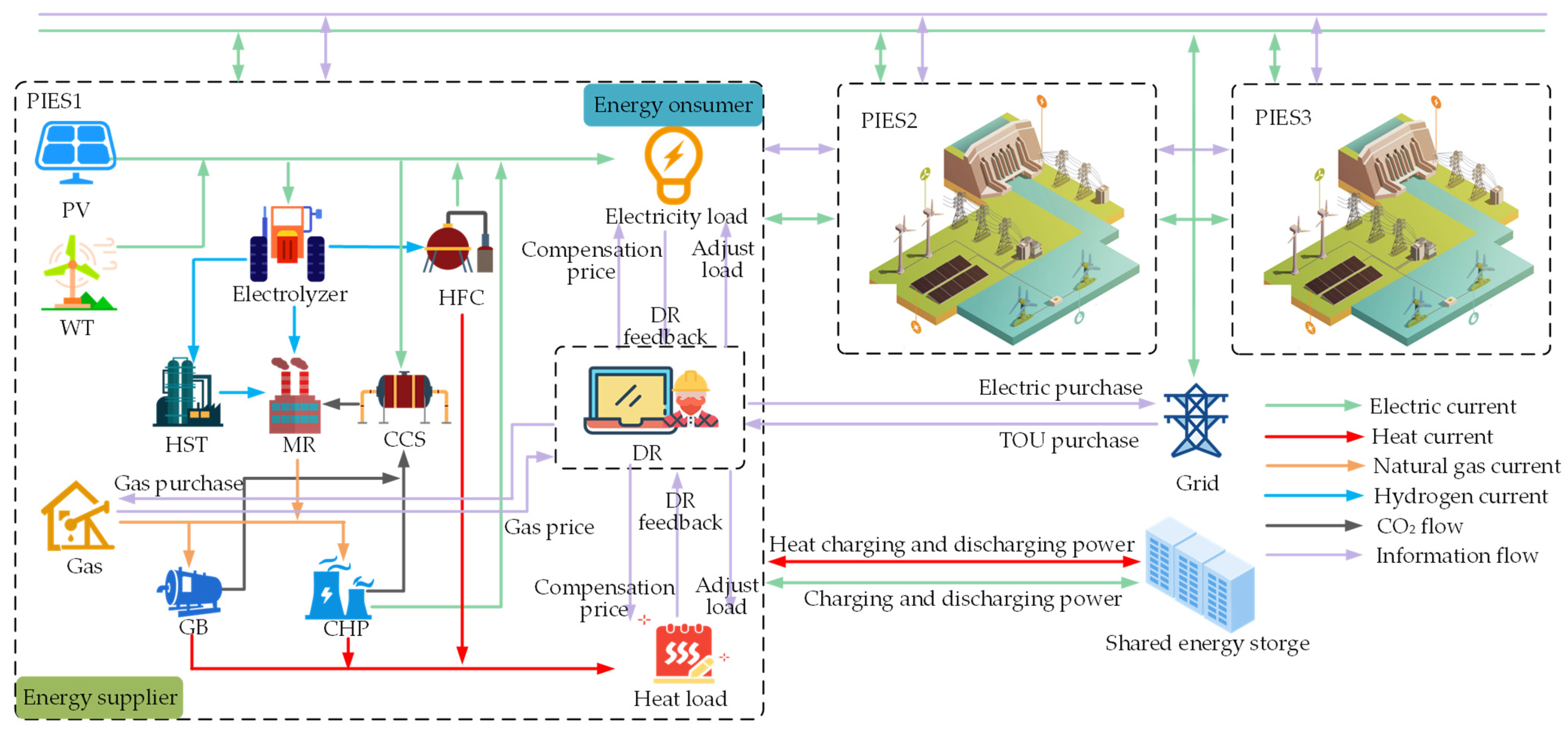
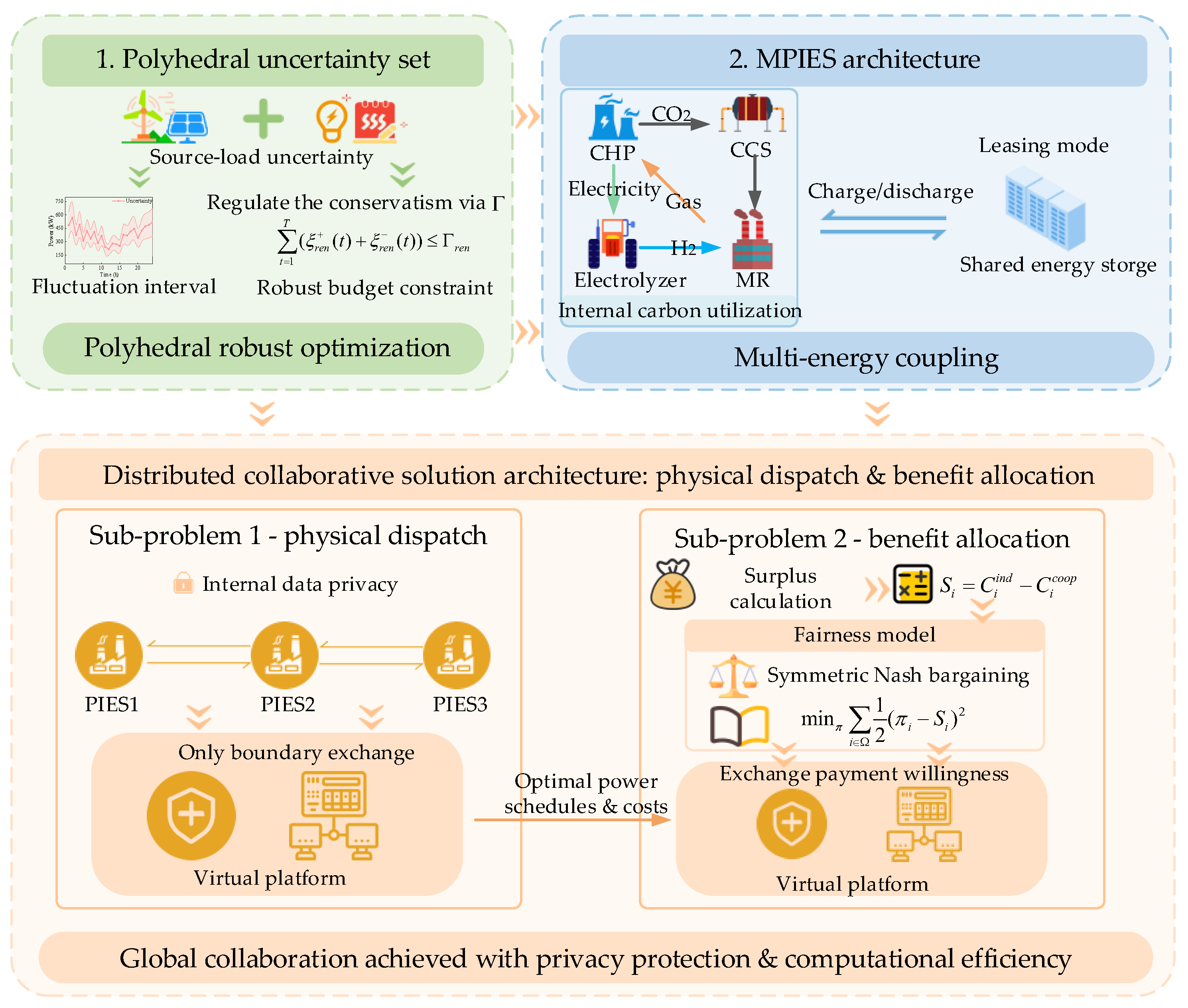
The overall framework of the proposed distributed energy management strategy considering operational robustness is illustrated in Figure 1. Based on this framework, the detailed physical structure of the MPIES considering SES is depicted in Figure 2. Internally, each PIES integrates wind and PV power generation, a hydrogen-based combined heat and power (H-CHP) system, a Carbon Capture and Storage coupled with Power-to-Gas (CCS-P2G) cycle, and integrated demand response (IDR) resources. Consequently, these components realize the deep coupling of multi-energy flows, including electricity, heat, gas, hydrogen, and carbon. Regarding external interactions, each park obtains energy supply from the public grid. Furthermore, parks utilize tie-lines to achieve mutual electric energy assistance among themselves. Additionally, they SES based on a leasing mechanism to reduce the costs associated with independent storage configuration.

2.1. Hydrogen-Based Combined Heat and Power and P2G Model

The H-CHP system effectively consumes curtailed wind and PV power through the synergistic integration of diverse energy vectors, including electricity, heat, hydrogen, and natural gas. Building upon the traditional H-CHP, this paper introduces CCS and methanation (MR) processes. Consequently, a low-carbon oriented source-load cooperative conversion model is constructed [27].
(1) Electro–thermal conversion model of alkaline EL
The EL serves as the core hub for converting electric energy into hydrogen energy. Significant thermal effects accompany its operation process. Considering the electro–thermal coupling characteristics of the EL, this paper models it as two processes: hydrogen production and heat generation. The corresponding mathematical formulation is presented below:
P E L , e ( t ) = v H 2 ( t ) H H V H 2 + Q E L , h ( t ) η E L = v H 2 ( t ) H H V H 2 P E L , e ( t )
(2) HFC model
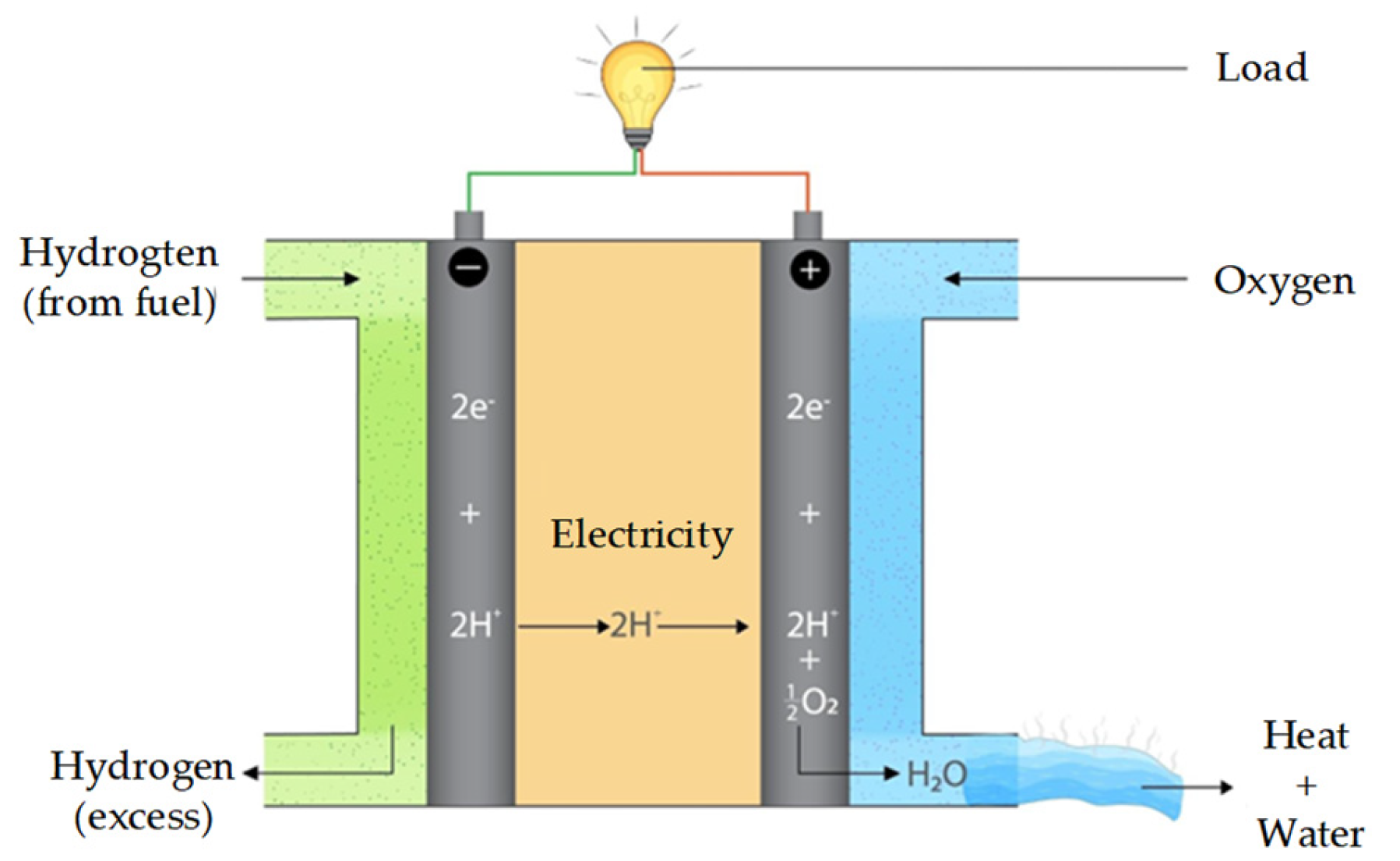
The electrochemical reaction principle and energy flow of the HFC model are illustrated in Figure 3. The HFC utilizes stored hydrogen to conduct electrochemical reactions. Simultaneously, it generates electrical and thermal energy. Consequently, the cascading utilization of hydrogen energy into electricity and heat is realized.
The energy balance relationship is described as follows:
v H 2 F C ( t ) H H V H 2 = P F C , e ( t ) + Q F C , h ( t ) η F C = P F C , e ( t ) v H 2 F C ( t ) H H V H 2
(3) Capacity state model of HST
The HST functions as an energy buffer connecting the EL, fuel cell, and MR. It maintains the mass balance within the system by storing and releasing hydrogen. Consequently, the state equation describing its capacity evolution is expressed as follows:
S H ( t ) = S H ( t 1 ) + Δ t η H , c h P E L , H ( t ) P H , d i s ( t ) η H , d i s S H min S H ( t ) S H max S H ( 0 ) = S H ( T )
(4) Cooperative model of CCS-P2G and MR.
To further reduce carbon emissions in the park and achieve the resource utilization of carbon, this paper constructs a coupled model of CCS and P2G. The MR utilizes hydrogen and carbon dioxide captured by the CCS system to generate natural gas via the Sabatier reaction. Consequently, this process realizes the closed-loop flow of electricity–gas–carbon.
P M R , g ( t ) = η M R P M R , H ( t ) M C O 2 c c s ( t ) = λ c g P M R , g ( t ) P C C S , e ( t ) = ω c c s M C O 2 c c s ( t ) P C C S min P C C S , e ( t ) P C C S max

2.2. Gas-Fired CHP and Boiler Model

The gas turbine and the CHP unit utilizes natural gas as fuel to simultaneously produce electricity and heat. Its energy conversion mechanism, along with the corresponding operational limits, is formulated below.
P i , e c h p ( t ) = η c h p e P i , g c h p ( t ) κ min c h p P i , e c h p ( t ) Q i , h c h p ( t ) κ max c h p P i , e c h p ( t ) P min c h p P i , g c h p ( t ) P max c h p Δ P d o w n c h p P i , g c h p ( t ) P i , g c h p ( t 1 ) Δ P u p c h p
The gas boiler (GB) acts as a supplementary heat source, transforming the energy stored in natural gas into heat for supply:
Q i , h g b ( t ) = η g b P i , g g b ( t ) 0 P i , g g b ( t ) P max g b

2.3. SES Leasing and Operation Model

The SES-related variables introduced in this subsection are intended to describe the economic interface between the shared storage platform and the participating parks. In the present study, the SES leasing price is treated as an exogenous economic input representing the equivalent annualized usage cost of shared storage capacity and time-shifting services. This treatment allows the current work to focus on operation-level collaboration and benefit allocation, while more detailed rent-formation and contractual mechanisms are discussed separately as part of the research boundary.
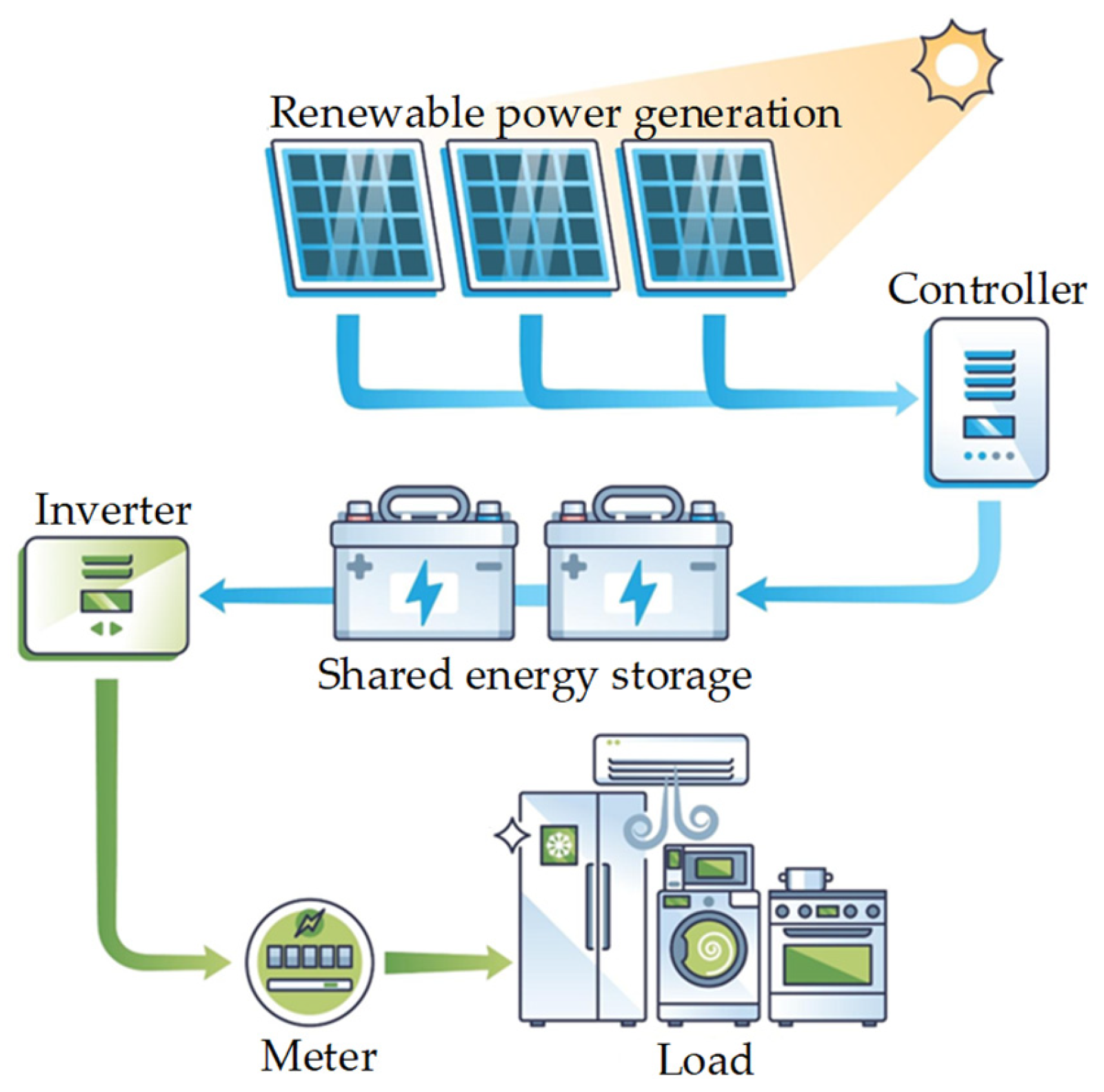
To mitigate the high initial investment costs associated with energy storage configuration in parks and improve the utilization rate of storage resources, this paper introduces an SES mechanism based on a leasing service model. Under this mode, each park is not required to construct self-owned physical storage stations. Instead, parks lease storage capacity and power quotas from SES operators according to their source-load fluctuation demands [28]. The operational architecture of the SES is illustrated in Figure 4.
The operating cost of SES primarily consists of capacity leasing fees and power leasing fees. The objective function is as follows:
C C E S , i = 1 365 λ c a p E E i max + λ p o w E P i max + λ c a p H H i max + λ p o w H Φ i max
During the operation process, the energy storage leased by the park must satisfy specific operational limits. These include power constraints, state of capacity constraints, and the mutual exclusion constraint for charging and discharging states. Taking electrical energy storage as an example, the constraint conditions are described as follows:
0 P i , c h c e s ( t ) μ i , c h c e s ( t ) P i max 0 P i , d i s c e s ( t ) μ i , d i s c e s ( t ) P i max μ i , c h c e s ( t ) + μ i , d i s c e s ( t ) 1 S i c e s ( t ) = ( 1 σ ) S i c e s ( t 1 ) + η c h P i , c h c e s ( t ) P i , d i s c e s ( t ) η d i s Δ t α min E i max S i c e s ( t ) α max E i max
Similarly, the operational constraints of the shared thermal storage (STS) system are described as follows:
0 H i , c h c e s ( t ) μ i , c h h ( t ) Φ i max 0 H i , d i s c e s ( t ) μ i , d i s h ( t ) Φ i max μ i , c h h ( t ) + μ i , d i s h ( t ) 1 S i , h c e s ( t ) = ( 1 σ h ) S i , h c e s ( t 1 ) + η c h h H i , c h c e s ( t ) H i , d i s c e s ( t ) η d i s h Δ t

2.4. Ladder-Type Carbon Trading Mechanism Model

To respond to low-carbon emission reduction policies and guide parks in reducing carbon emissions, this paper introduces a ladder-type carbon trading mechanism into the model. The mechanism implements ladder-type pricing based on the difference between the carbon emission quota and the actual emission volume. Specifically, higher emission levels correspond to higher unit carbon prices.
(1) Carbon emission quota model
The carbon emission quotas of the PIES primarily derive from electricity purchasing and the heat/power generation processes of CHP and GB. The quota calculation equation is expressed as follows:
E I E S , i q u o t a = δ e b u y t = 1 T P i , b u y ( t ) + δ h c h p t = 1 T Q i , h c h p ( t ) + Q i , h g b ( t ) + δ e c h p t = 1 T P i , e c h p ( t )
(2) Actual carbon emission model
The actual carbon emission calculation accounts for indirect emissions generated by electricity purchasing. It also considers direct emissions caused by natural gas combustion. Furthermore, the model subtracts the amount of carbon dioxide captured by the CCS system:
E I E S , i a c t = μ e g r i d t = 1 T P i , b u y ( t ) + μ g g a s t = 1 T P i , g s u m ( t ) η g h t = 1 T M i , C O 2 c c s ( t )
(3) Calculation of ladder-type carbon trading costs
The net emission volume participating in the carbon market is defined as
E i n e t = E I E S , i a c t E I E S , i q u o t a
The model employs a piecewise linear function to calculate carbon trading costs. Specifically, the net emission volume is divided into V intervals [29]:
C i C O 2 = v = 1 V λ v p r i c e L i , v
E i n e t = v = 1 5 L i , v 0 L i , v d l e n g t h , v = 1 , 2 , 3 , 4 L i , v 0 , v = 5 λ v p r i c e = λ b a s e ( 1 + α ( v 1 ) )

2.5. Source-Load Uncertainty Set and Robust Optimization Model

This subsection characterizes the uncertainty of renewable generation and load forecasting through a budgeted uncertainty set. The associated variables are introduced to represent bounded source-load deviations around forecast values, while the budget parameter controls the conservatism level of the robust scheduling model. From an operational perspective, this mechanism reflects the trade-off between economic efficiency and robustness against unfavorable realizations of uncertainty.
To address the uncertainty arising from renewable energy output (WT/PV) and load forecasting errors, this paper adopts a polyhedral uncertainty set considering robust budgets. This set characterizes the fluctuation ranges of the uncertain parameters. Furthermore, budget parameters are introduced to regulate the degree of conservatism. In this study, the source-load fluctuation interval is set to ±20% of the forecasted values, so as to represent a moderate but practically relevant level of forecasting deviation in day-ahead scheduling. This setting is intended to cover typical fluctuations in renewable generation and electric load without making the optimization problem excessively conservative. Similar application studies have also adopted ±20% of forecasted electrical load as the uncertainty bound in robust scheduling problems [30]. Meanwhile, recent integrated energy system studies have shown that the design of uncertainty sets and uncertainty budgets directly affects model conservatism, and that properly designed uncertainty sets can reduce over-conservatism and make the optimization results closer to actual operating conditions [31].
(1) Definition of uncertainty set
It is assumed that the renewable energy output P ˜ r e n and the electrical load P ˜ l o a d fluctuate around their predicted values. Consequently, the uncertainty set U is defined as follows:
U = P ˜ r e n ( t ) = P r e n p r e ( t ) + ξ r e n + ( t ) P ^ r e n + ( t ) ξ r e n ( t ) P ^ r e n ( t ) t = 1 T ( ξ r e n + ( t ) + ξ r e n ( t ) ) Γ r e n 0 ξ r e n + ( t ) , ξ r e n ( t ) 1
Γ r e n represents the robust budget parameter with a value range of [ 0 , T ] . When Γ r e n = 0 , the model degenerates into a deterministic optimization problem that disregards any fluctuations. Conversely, when Γ r e n = T , the model assumes that worst-case fluctuations occur at all time steps. Consequently, the solution becomes the most conservative. By adjusting the value of Γ r e n , decision-makers can achieve a trade-off between economic efficiency and system security. In this study, Γ r e n = 6 is adopted as a representative moderately conservative setting for the 24 h scheduling horizon. This means that the equivalent of six periods are allowed to experience adverse renewable-output deviations, rather than assuming that the worst-case fluctuation occurs throughout the whole horizon. It should be emphasized that Γ r e n = 6 is not interpreted as the theoretically unique optimal value, but as a representative setting that provides a reasonable robustness margin for the studied case. As further discussed in Section 5.5, the operating cost increases significantly when the uncertainty budget rises from 0 to 2 and then becomes nearly stable for larger values. Therefore, selecting Γ r e n = 6 within this plateau region allows the model to provide a relatively stronger robustness margin without causing noticeable additional economic loss.
(2) Robust counterpart transformation based on duality theory
To handle the worst-case scenario within the uncertainty set U , we transform the constraints containing uncertainty into deterministic constraints. We take the renewable energy output constraint as an example. The scheduled value P r e n ( t ) must satisfy the constraint of the actual available output P ˜ r e n ( t ) :
P r e n ( t ) P ˜ r e n ( t ) , ξ U
By substituting the uncertainty set Equation (15), the aforementioned constraint is equivalent to requiring that P r e n ( t ) holds even under the worst-case fluctuation deviation:
P r e n ( t ) + max ξ U t = 1 T ξ r e n ( t ) P ^ r e n ( t ) ξ r e n + ( t ) P ^ r e n + ( t ) P r e n p r e ( t )
The equation above contains a sub-problem that maximizes uncertainty damage. According to the Strong Duality Theory of linear programming, this maximization sub-problem can be transformed into its dual minimization problem:
max ξ t = 1 T ξ r e n ( t ) P ^ r e n ( t ) s . t . t = 1 T ξ r e n ( t ) Γ r e n : U r e n 0 ξ r e n ( t ) 1 : q r e n ( t )
We introduce the global dual variable U r e n corresponding to the robust budget constraint. Additionally, we introduce the dual variables q r e n ( t ) corresponding to the fluctuation boundary constraint. Consequently, the upper bound of the objective function for the maximization problem is equivalent to the lower bound of the objective function for its dual problem:
max ( Deviation ) min Γ r e n U r e n + t = 1 T q r e n ( t )
By substituting the dual objective function into the original constraint and employing the auxiliary variable y r e n ( t ) to linearize the absolute value terms, the deterministic linear constraint set derived from the robust counterpart transformation is obtained as follows:
P r e n ( t ) + Γ r e n U r e n + q r e n ( t ) P r e n p r e ( t ) + P ^ r e n ( t ) U r e n + q r e n ( t ) P ^ r e n ( t ) y r e n ( t ) y r e n ( t ) 1 , U r e n 0 , q r e n ( t ) 0

2.6. IDR Model

To further exploit the interaction potential between the source and load sides, the model introduces an IDR mechanism. Specifically, this mechanism comprises Cuttable Load and Transferable Load.
(1) Cuttable load (electricity/heat)
Users actively reduce non-essential loads based on price signals or incentive mechanisms.
0 P i , c u t ( t ) λ c u t E P i , l o a d ( t ) 0 H i , c u t ( t ) λ c u t H H i , l o a d ( t )
(2) Transferable load (electricity)
This mechanism allows for the shifting of partial electrical loads from peak periods to valley periods. However, the constraint ensuring that the total electricity consumption remains unchanged within the cycle must be satisfied. The equation is described as follows:
ε P i , l o a d ( t ) P i , t r a n ( t ) ε P i , l o a d ( t ) t = 1 T P i , t r a n ( t ) = 0

2.7. Multi-Energy Power Flow Balance Constraints

Based on the energy hub concept, each park must simultaneously satisfy the real-time supply–demand balance of four energy types: electricity, heat, gas, and hydrogen.
(1) Electrical power balance
P i , b u y ( t ) P i , s e l l ( t ) + P i , r e n ( t ) + P i , C H P e ( t ) + P i , H F C e ( t ) P i , C C S ( t ) + j Ω i P i j ( t ) = P i , l o a d ( t ) P i , c u t ( t ) + P i , t r a n ( t ) + P i , E L ( t ) + P i , c h c e s ( t ) P i , d i s c e s ( t )
(2) Thermal power balance
Q i , C H P h ( t ) + Q i , H F C h ( t ) + Q i , G B h ( t ) + H i , d i s c e s ( t ) H i , c h c e s ( t ) = H i , l o a d ( t ) H i , c u t ( t )
(3) Natural gas power balance
P i , g a s b u y ( t ) + P i , M R g ( t ) = P i , C H P g ( t ) + P i , G B g ( t )
(4) Hydrogen power balance
P i , E L H ( t ) + P i , d i s H 2 ( t ) = P i , M R H ( t ) + P i , H F C H ( t ) + P i , c h H 2 ( t )

2.8. Objective Function for Total Operational Cost of the Park

Each park aims to minimize its own operational cost. The total cost C i comprises grid interaction costs, natural gas fuel costs, and costs related to cloud energy storage and hydrogen storage. Furthermore, it includes DR compensation costs and carbon trading costs.
min C i = C i g r i d + C i f u e l + C i E S S + C i D R + C i C O 2
The calculation of each cost component is presented as follows:
(1) Grid interaction cost:
C i g r i d = t = 1 T c b u y e ( t ) P i , b u y ( t ) c s e l l e ( t ) P i , s e l l ( t )
(2) Natural gas fuel cost:
C i f u e l = t = 1 T c g a s P i , g a s b u y ( t )
(3) Total cost of energy storage systems:
C i E S S = C C E S , i r e n t + t = 1 T ω H 2 o p P i , c h H 2 ( t ) + P i , d i s H 2 ( t )
(4) IDR cost:
C i D R = t = 1 T c c u t e P i , c u t ( t ) + c c u t h H i , c u t ( t ) + c t r a n e P i , t r a n ( t )

3. ADMM-Based Distributed Collaborative Solution Strategy

To address the source-load uncertainty and multi-agent privacy protection requirements in the MPIES, a distributed collaborative optimization algorithm decomposed into two sub-problems is proposed. The first sub-problem solves the optimal power interaction scheme at the physical layer. Subsequently, the second sub-problem performs economic benefit settlement based on cooperative Nash bargaining theory, so as to fairly allocate the cooperative surplus among parks.

3.1. Physical Layer Robust Collaborative Solution Algorithm

In the first sub-problem, each park aims to minimize its own operational cost. Simultaneously, the tie-line power coupling constraint i Ω P i j , t = 0 must be satisfied.
The Lagrange multiplier λ i j , t and the penalty factor ρ are introduced. Consequently, the augmented Lagrangian function for the k -th iteration is constructed as follows:
L i D R O = C i o p ( x i ) + j Ω i t = 1 T λ i j , t k P i j , t k + P j i , t k + ρ k 2 P i j , t k + P j i , t k 2 2
The specific iterative steps of the algorithm are described as follows:
(1) Local sub-problem solution
Each park acts as an independent entity to solve the problem in parallel. It updates its own decision variables based on the interaction power P j i k from neighboring parks in the previous round:
x i k + 1 , P i j k + 1 = arg min x i , P i j L i D R O ( x i , P i j , P j i k , λ i j k , ρ k )
(2) Dual variable update
The dispatch center updates the Lagrange multipliers based on the boundary variables P i j k + 1 reported by each park:
λ i j , t k + 1 = λ i j , t k + ρ k P i j , t k + 1 + P j i , t k + 1
(3) Adaptive penalty factor strategy
To balance the primal residual r k and the dual residual s k of the algorithm, this paper adopts a variable step-size strategy to dynamically adjust ρ . This approach improves convergence speed and reduces sensitivity to initial parameters.
The residuals for the k -th iteration are defined as follows:
r k = P i j k + 1 + P j i k + 1 2 s k = ρ k ( P i j k + 1 P i j k ) 2
The update rule for the penalty factor ρ k + 1 is
ρ k + 1 = τ incr ρ k , if    r k > μ s k ρ k / τ decr , if    s k > μ r k ρ k , otherwise
Here, μ represents the residual balance threshold. Additionally, τ i n c r and τ d e c r denote the step size increase and decrease coefficients, respectively. In the Case study of this paper, the parameters are set as μ = 10 and τ i n c r = τ d e c r = 2 .
(4) Convergence criterion
The iteration terminates when both the primal residual and the dual residual satisfy the convergence precision ε 1 :
max { r k , s k } ε 1

3.2. Distributed Benefit Allocation Strategy Based on Nash Bargaining

The variables introduced in this subsection are used to distinguish physical cooperative surplus from its subsequent financial redistribution. Specifically, the cooperative surplus reflects the cost reduction created by physical interconnection and joint operation, while the payment variables represent the redistribution mechanism used to balance the final net benefits among participating parks. Therefore, the reformulation from the original Nash-product maximization to an equivalent convex optimization problem is not only a mathematical simplification, but also a way to obtain a tractable and interpretable fair-allocation model.
After the optimal physical interaction power P i j * is determined, the second sub-problem aims to resolve interest conflicts among parks through an economic compensation mechanism. This paper constructs a multi-park benefit allocation model based on the Nash Bargaining theory within cooperative game theory.
(1) Definition of Cooperative Surplus
First, we quantify the economic contribution of each park to the coalition. Let C i i n d and C i c o o p denote the operational costs of the park i determined under the independent mode (islanded) and the interconnected cooperative mode (sub-problem 1 result), respectively. The cooperative surplus S i obtained by the park i is defined as the cost savings achieved purely through physical interconnection:
S i = C i i n d C i c o o p
This value S i represents the theoretical maximum benefit park i gains before any financial redistribution.
(2) Convex Transformation of the Nash Bargaining model
The standard symmetric Nash Bargaining solution aims to maximize the product of utility increments (Nash Product). Under the assumption of transferable utility, satisfying the axioms of Pareto optimality, symmetry, and fairness is equivalent to finding a payment scheme that equalizes the final net revenue of all participants. Similar treatments have been reported in the literature, where generalized/cooperative Nash bargaining models are first reformulated through equivalent transformation and then decomposed into benefit-maximization and benefit-distribution subproblems for tractable solution [19,31]. For park i , let S i = C i i n d C i c o o p denote the cooperative surplus obtained from physical interconnection. If π i represents the payment assigned by the virtual platform, then the final net benefit of park i after redistribution is U i = S i π i . Under the symmetric Nash bargaining framework, the original bargaining objective can be written as maximizing the Nash product i Ω U i , which is equivalent to maximizing i Ω ln ( U i ) due to the monotonicity of the logarithm. Meanwhile, under the budget-balance constraint i Ω π i = 0 , the total final net benefit satisfies i Ω U i = i Ω S i , i.e., the total benefit is fixed. Since i Ω U i is fixed, the symmetric Nash bargaining solution is achieved when the final net benefits are as balanced as possible among all participating parks. Therefore, the problem can be equivalently reformulated as minimizing the dispersion of U i , which leads to the following convex Quadratic Programming (QP)model. The objective is to minimize the dispersion of the final net benefits among participating parks. The optimization model is formulated as follows:
min π i Ω 1 2 ( π i S i ) 2 s . t . i Ω π i = 0 π i S i
In the optimization model (39), the first constraint i Ω π i = 0 represents the global budget balance enforced by the platform, ensuring no capital flows out of the system. The second constraint π i S i guarantees individual rationality, meaning a park’s payment cannot exceed its cooperative surplus. This convex formulation naturally drives the solution towards π i = S i S ¯ (where S ¯ is the average surplus), ensuring that the final net benefit ( S i π i ) is equalized across all parks. Remark: To ensure numerical stability during the iterative process, the cost parameters ( S i ) are pre-conditioned by a scaling factor (e.g., η = 10 4 ) before solving, mapping the values from the magnitude of 10 4 to 10 0 .
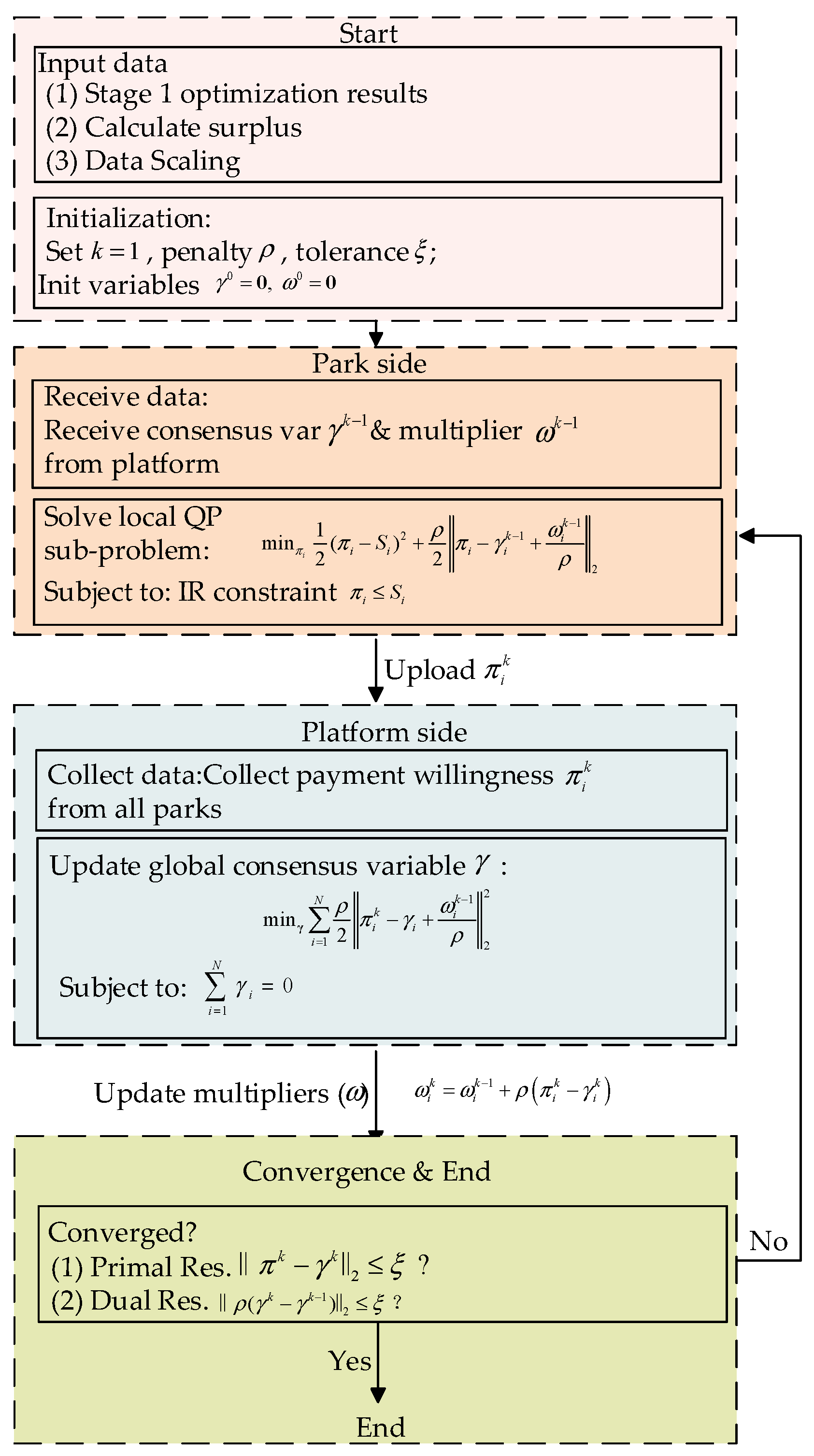
(3) Distributed solution based on consensus ADMM
To solve the proposed QP model in a distributed manner while protecting privacy, the Consensus ADMM algorithm is employed. A trading platform acts as a coordinator to maintain the global consensus variable γ i . The problem is decomposed into local sub-problems for each park and a global coordination problem for the platform.
(1) Park-side Update
Each park i solves a local QP sub-problem to update its payment willingness π i . The objective is to minimize the deviation from its surplus S i while tracking the global consensus variable. The update rule for the ( k + 1 ) -th iteration is
π i k + 1 = arg min π i 1 2 ( π i S i ) 2 + ρ 2 π i γ i k + ω i k ρ 2 2 s . t . π i S i
This corresponds to the local solver in the proposed framework, where ρ is the penalty factor and ω i is the dual multiplier.
(2) Platform-side Update
The trading platform collects the payment willingness π i k + 1 from all parks and updates the global consensus variable γ to satisfy the system-level balance constraint:
γ k + 1 = arg min γ i Ω ρ 2 π i k + 1 γ i + ω i k ρ 2 2 s . t . i Ω γ i = 0
(3) Dual Update
Finally, the dual multipliers are updated locally by each agent:
ω i k + 1 = ω i k + ρ ( π i k + 1 γ i k + 1 )
The specific implementation process and information exchange flow are illustrated in Figure 5.

4. Case Study Analysis

4.1. Parameter Settings

This paper selects an IES containing three typical parks for simulation analysis. The system adopts a time-of-use electricity pricing mechanism. Specifically, the electricity purchasing prices are set as follows: 1.05 ¥/kWh during the valley period (00:00–07:00), 1.30 ¥/kWh during the flat period (07:00–10:00, 15:00–18:00, 21:00–24:00), and 1.50 ¥/kWh during the peak period (10:00–15:00, 18:00–21:00). Conversely, the electricity selling prices are adjusted to 0.48 ¥/kWh, 0.68 ¥/kWh, and 0.88 ¥/kWh for the valley, flat, and peak periods, respectively.
The model incorporates both electrical and thermal SES services. The capacity leasing price for shared electricity storage is 110 ¥/(kWh·year), while the power leasing price is 37 ¥/(kW·year). Similarly, the capacity and power leasing prices for shared thermal storage are set at 30 ¥/(kWh·year) and 10 ¥/(kW·year), respectively. For daily optimal operation, the aforementioned annual costs are converted into daily operational costs. Furthermore, the natural gas purchasing price is fixed at 0.35 ¥/kWh. Regarding the carbon trading mechanism, a ladder-type carbon tax model is applied. The base carbon price is set at 0.25 ¥/kg. Furthermore, the price growth rate α is 25%, and the interval length L is 2000 kg.
In this work, the SES leasing price is treated as an exogenous economic parameter to represent the equivalent annualized usage cost of shared storage capacity and time-shifting services. This simplification allows the present study to focus on the operation-level collaborative scheduling and benefit-allocation mechanism among multiple parks. Related studies on shared energy storage and multi-agent coordination have mainly focused on operational optimization and cooperative interaction under given pricing or economic settings [4,17]. Nevertheless, we acknowledge that the practical formation of SES leasing rates may depend on market-based pricing, the bargaining power of the storage provider, contractual structures, and regulatory arrangements. These issues are important for real-world deployment but are beyond the scope of the current operational optimization model. A dedicated discussion of these limitations and the corresponding future research directions is provided in Section 7 [5,12,13]. The present study assumes a given institutional setting for cooperation, while the detailed legal, regulatory, and governance mechanisms are left for future investigation.
Regarding the distributed solution algorithm parameters, the convergence precision threshold ξ for both the first- sub-problem robust energy management and the second sub-problem benefit allocation is set to 10 4 . In the first sub-problem, the initial penalty factor ρ is set to 10 4 . To accelerate convergence, a variable step-size strategy is adopted with step-size adjustment coefficients τ i n c r = τ d e c r = 2 and a residual balance threshold μ = 10 . In the second sub-problem, to ensure numerical stability for the quadratic programming problem, the penalty factor is set to 1.0 , and the cost data is pre-processed with a scaling factor η = 10 4 . For the robust optimization parameter settings, the prediction error fluctuation range for renewable energy output and electrical loads is set to ± 20 % of their predicted values. To balance system robustness and economy, the robust budget parameter is set to Γ = 6 , implying that the system can accommodate worst-case fluctuations for a cumulative duration of 6 h within the dispatch period.

4.2. Park Characteristics and Equipment Configuration

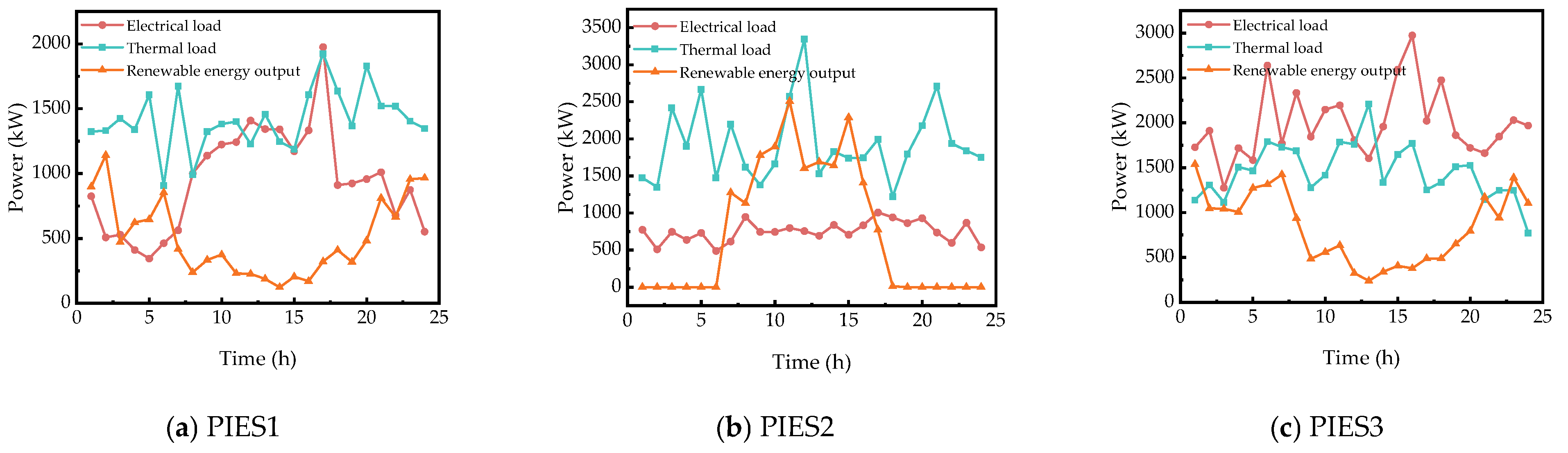
As shown in Figure 6, the three parks possess distinct source-load characteristics and equipment configurations based on differences in their geographical locations and functional positioning.
Park 1: This park represents a typical commercial office area equipped with a wind–solar hybrid system. It maintains renewable energy output throughout the day, and the peak load is approximately 2000 kW. Internally, it is configured with a 600 kW CHP unit and a 500 kW EL. This configuration focuses on smoothing renewable energy fluctuations and facilitating carbon capture.
Park 2: This park serves as a typical industrial processing zone featuring a large-scale photovoltaic power generation system. It exhibits a distinct daytime output peak. However, its own load remains relatively stable and low. Consequently, it acts as the primary power supply source for the system during the daytime. To ensure the supply stability of high industrial heat loads, the park is equipped with an 800 kW CHP unit and a 1200 kW gas boiler.
Park 3: This park is a typical residential living area. It exhibits a dual peak load characteristic in the morning and evening, with a peak load reaching 3000 kW. It belongs to a typical receiving-end park. Although distributed wind power is configured, a significant power gap persists. Therefore, an 800 kW high-capacity EL is installed. This device utilizes potential valley electricity prices or system surplus energy for hydrogen production and storage.

5. Simulation Result Analysis

5.1. Multi-Park Source-Load Complementarity and Electrical Energy Interaction Characteristics

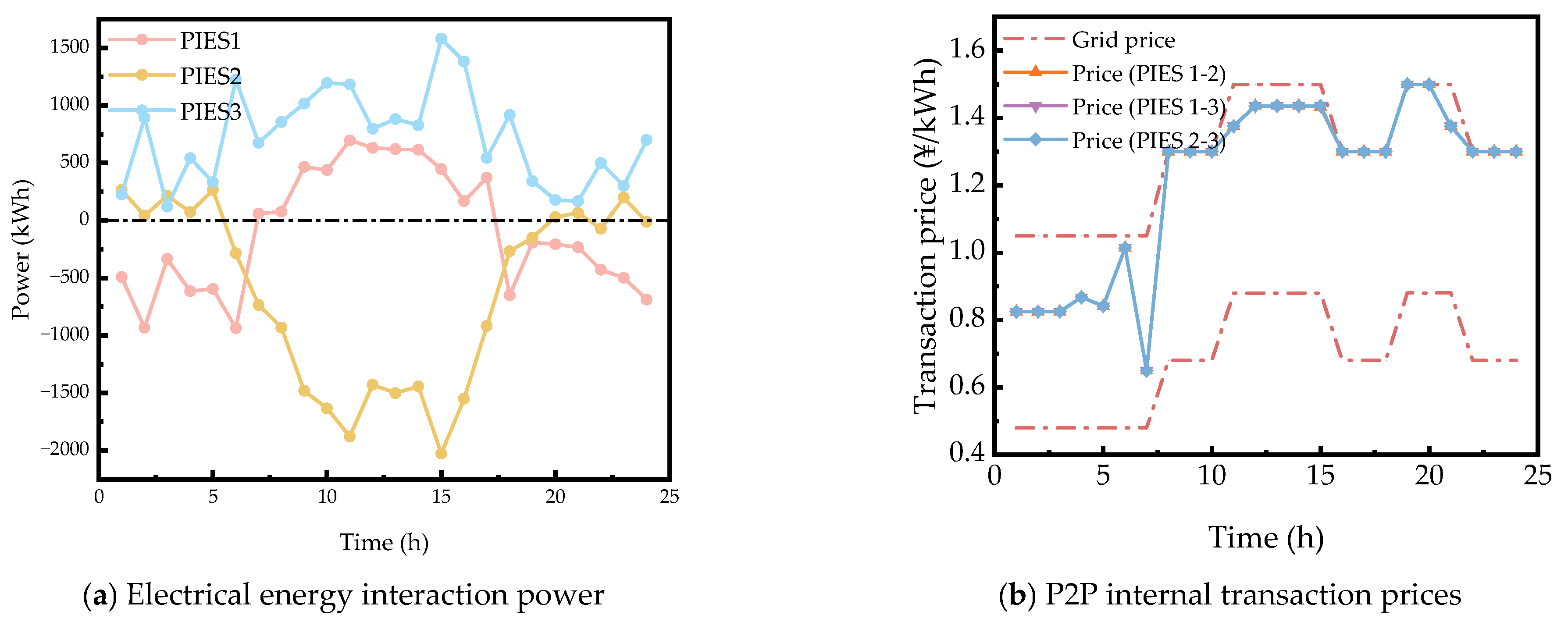
The distributed ADMM is adopted to address the formulated optimization problem. Consequently, the parks achieve spatiotemporal mutual aid of electrical energy while preserving privacy. Figure 7 displays the electrical energy interaction power curves and transaction prices for each park under the optimal dispatching strategy.
The simulation results indicate that the three parks exhibit significant complementarity and peak-shaving effects, attributed to their heterogeneous source-load characteristics. Specifically, during the night period of 00:00–08:00, when the system electricity price is in the valley interval, the parks initiate peer-to-peer energy sharing. According to Figure 7a, PIES 3 acts as the primary power receiver due to its high base load. During this time, PIES 2 maintains a high level of CHP output and, after satisfying its own demand, transmits substantial surplus electrical energy to PIES 3. This mechanism effectively optimizes the energy structure of the multi-park system, allowing PIES 3 to procure power at a rate more favorable than buying directly from the utility grid.
During the daytime period of 10:00–15:00, the main grid electricity price rises to the peak interval. At this time, the PV output of PIES 2 reaches its peak, resulting in a typical bell-shaped output curve. In particular, PIES 2, as a park with a large-scale PV configuration, generates massive surplus power, reaching an export peak of approximately 2000 kW around noon. Consequently, its role as a power exporter is further strengthened during the day. This mechanism effectively promotes the local consumption of renewable energy through peer-to-peer electricity trading, preventing potential energy curtailment. As shown in Figure 7a, PIES 1 also shifts from a receiving state to an exporting state during this period. Both parks prioritize transmitting surplus PV energy to PIES 3, where load demand remains high. This daytime support strategy significantly alleviates the power purchasing pressure on PIES 3 during high-price periods and reduces the overall peak demand from the upper-level grid.
Correspondingly, Figure 7b illustrates the internal P2P transaction prices derived from the Nash bargaining mechanism. A notable phenomenon observed is that the clearing prices for all trading pairs, namely PIES 1–2, PIES 1–3, and PIES 2–3, are identical and converge to the upper bound of the price interval, which is the grid purchase price, during most periods such as 08:00 to 22:00. This phenomenon validates the No-Arbitrage Equilibrium of the proposed market mechanism. Due to the high net load demand shown in Figure 7a, the internal market behaves as a seller’s market where buyers compete for scarce low-cost electricity, driving the transaction price up to their opportunity cost, specifically the grid purchase price. Furthermore, the strictly overlapping curves demonstrate that the ADMM algorithm successfully converged to the global optimum, eliminating any spatial arbitrage space while ensuring individual rationality for all participants.
From the perspective of load-side response and all-day balance, PIES 3 remains in a power-receiving state for most of the day because its load demand consistently exceeds its local renewable energy generation. Through the multi-park interconnection mechanism, PIES 3 successfully distributes its power purchasing demand to periods when neighboring parks have surplus renewable energy or high-efficiency CHP output. Simulation data indicate that PIES 3 significantly reduces its direct electricity purchases from the main grid. This fully demonstrates that the multi-park interconnection mechanism effectively smooths the load fluctuations in a single park and enhances the overall energy self-sufficiency rate of the system under robust operation conditions.

5.2. SES Leasing and Operation Strategy

Figure 8 illustrates the optimal charging and discharging power curves for each park based on the SES leasing mode during a typical dispatch cycle under robust operation conditions. It is observed that the leasing behaviors of the parks exhibit significant temporal heterogeneity. This phenomenon is driven by the distinct source-load characteristics and the need to manage operational risks associated with uncertainties.
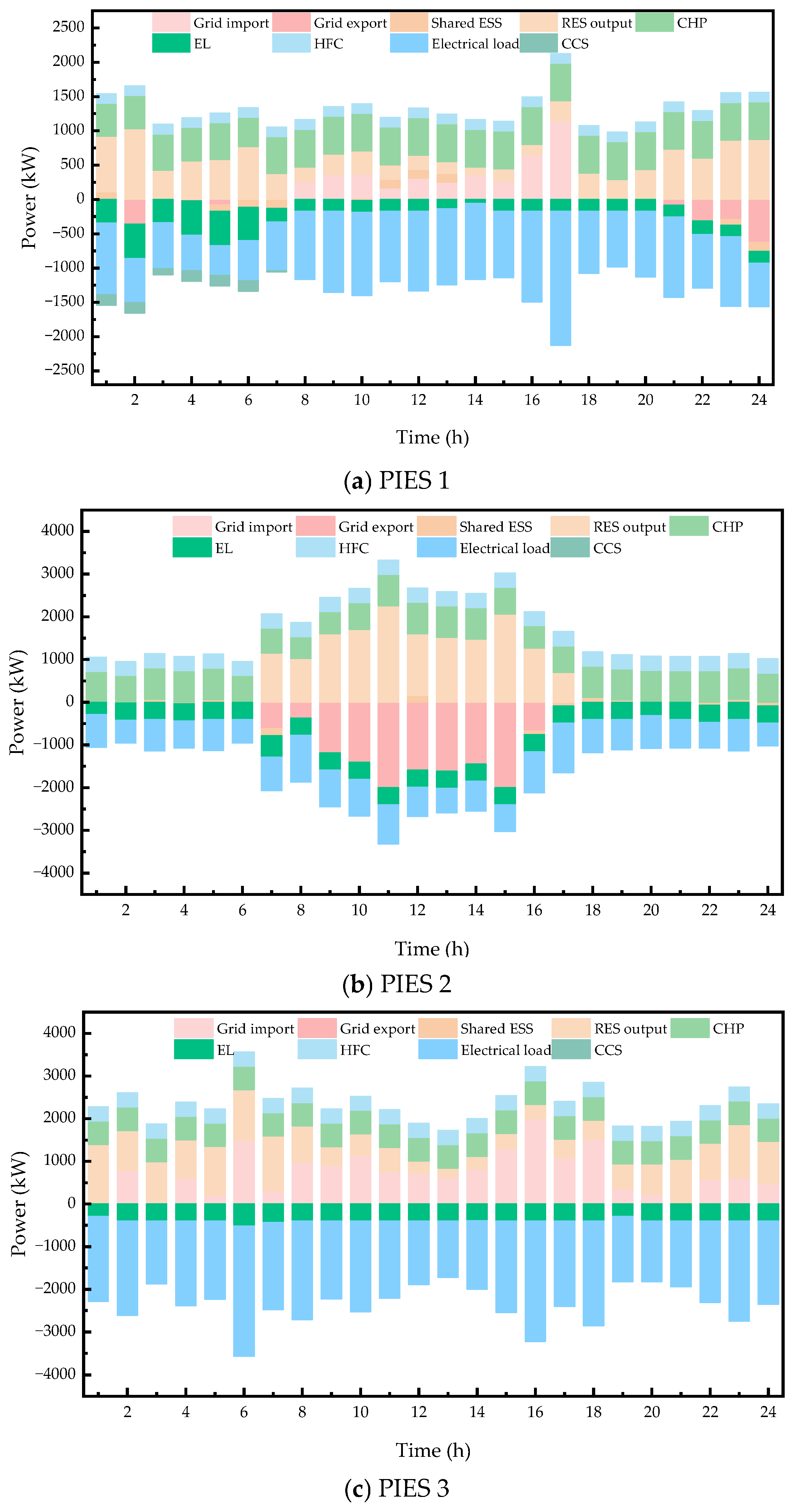
For the PV-dominated park, PIES 2, the operation of SES does not follow a simple charge-during-day pattern. During the noon period 10:00–15:00, when RES output is at its peak, PIES 2 actually performs large-scale grid export rather than primarily charging the SES. The Shared ESS shows relatively small activity during the day, with minor charging occurring around hour 12. This indicates that under robust conditions, surplus PV is prioritized for grid sale or local consumption, while SES is used conservatively.
In contrast, for PIES 1, the Shared ESS plays a more active role in smoothing the net load. It performs charging during the early morning 01:00–02:00, and around 12:00, while discharging during peak load hours, such as hour 24, helping to mitigate the pressure on the grid.
For the load-dominated park, IES 3, the utilization of SES is minimal, with almost no observable storage output throughout the dispatch cycle. This indicates that under the current robust optimization conditions, leasing shared storage is not the primary flexibility resource for this specific park. Instead, PIES 3 relies heavily on Grid Import and CHP units to satisfy its substantial electrical load, which exhibits significant peaks at 06:00 and 16:00. This operational reliance underscores the park’s dependence on stable base-load supply and thermal–electric coupling rather than short-term energy storage buffering to manage its high demand profile.
The operational complementarity between the three parks demonstrates the spatiotemporal multiplexing effect of SES. The leasing mechanism allows these heterogeneous users to share storage capacity, enhancing the overall utilization rate and reducing individual investment pressure.
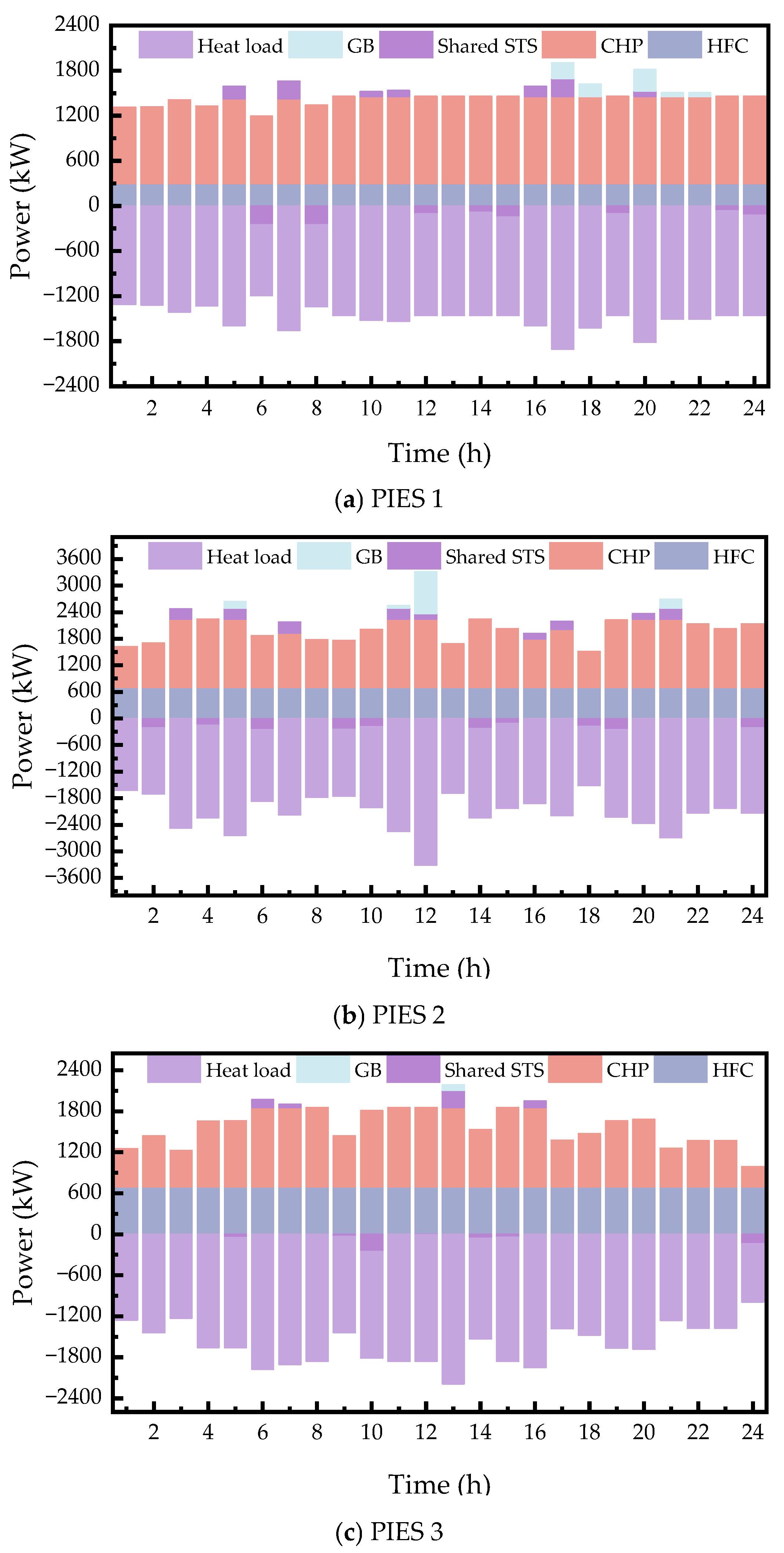
Furthermore, the leasing of Shared STS plays a pivotal role in unlocking the operational flexibility of CHP units to cope with source-load uncertainties, as illustrated in Figure 9. For PIES 1 and PIES 2, which face fluctuating thermal load demands, the Shared STS actively performs charging and discharging cycles. Specifically, in PIES 2, the STS stores surplus heat during periods of low thermal demand and releases thermal energy during peak periods. This operation effectively achieves peak shaving for the thermal load and decouples the “heat-led” constraint of CHP units, allowing them to adjust electric output more flexibly to support the robust power balance.
In contrast, the thermal balance of PIES 3 is primarily maintained by the stable output of the CHP and HFC units, with the Shared STS showing minimal participation. This suggests that the thermal flexibility requirements are non-uniformly distributed across the parks. In summary, these complementary operational modes fully validate the spatiotemporal multiplexing effect of the proposed leasing mechanism. By dynamically sharing storage assets among heterogeneous users in a time-division manner, the overall utilization rate of assets is maximized while individual investment costs are minimized.

5.3. Convergence Performance of Distributed Algorithm

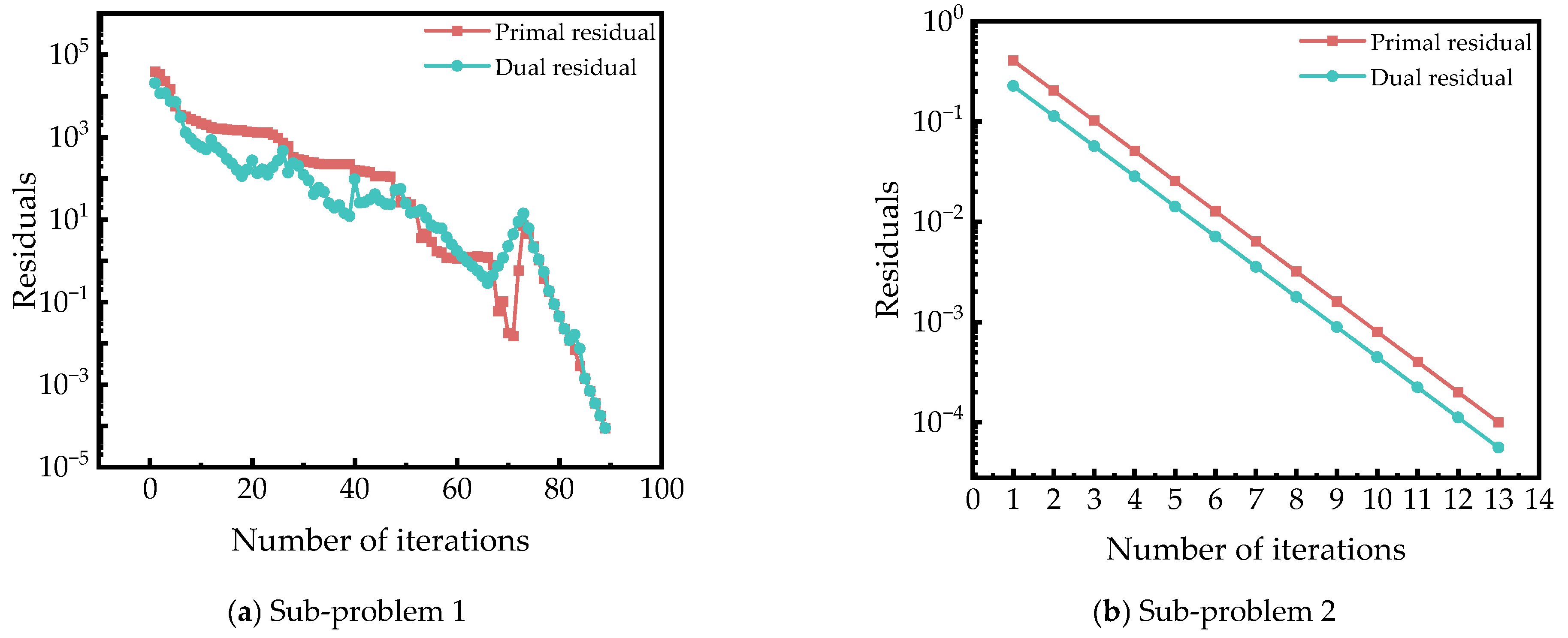
The iterative evolution of both primal and dual residuals is plotted in Figure 10 to demonstrate the convergence behavior of the proposed distributed strategy. The residuals are plotted on a semi-logarithmic scale to clearly illustrate their magnitude of decline. As shown in Figure 10a, the first sub-problem (robust energy management) achieves convergence after approximately 89 iterations. During the initial iterations, the residuals exhibit certain fluctuations. This is attributed to the high dimensionality and strong coupling of physical constraints, such as the ladder-type carbon trading mechanism and shared storage leasing states. However, driven by the adaptive penalty parameter mechanism, the algorithm overcomes local oscillations and stabilizes rapidly. Both primal and dual residuals drop below the convergence threshold of 10 4 after the 89th iteration. It is noteworthy that the primal residual here represents the power imbalance of the tie-lines in kW. Thus, a magnitude of 10 4 implies that the maximum power mismatch is strictly controlled within the milliwatt level, ensuring high-precision physical feasibility.
In sharp contrast, Figure 10b indicates that the second sub-problem (benefit allocation) requires only 13 iterations to converge. Its residuals demonstrate a strictly monotonic linear downward trend, dropping rapidly from 10 0 to 10 14 . Here, the residual corresponds to the deviation in payment consensus (unit: ¥), indicating that the allocation discrepancy is negligible. This superior convergence efficiency is attributed to the mathematical properties of the second sub-problem model. Specifically, this problem is modeled as a convex quadratic programming problem with simple linear coupling constraints, possessing excellent convexity after the proper scaling of cost data. In summary, these results validate the computational decoupling effect of the proposed hierarchical framework. By isolating the complex nonlinear physical dispatch (first sub-problem) from the lightweight economic game (second sub-problem), the total computational overhead of the system is significantly minimized. This proves that the ADMM-based strategy is highly suitable for online dispatching scenarios in multi-park systems, balancing solution precision with computational speed.

5.4. Analysis of System Economic Benefits and Benefit Allocation

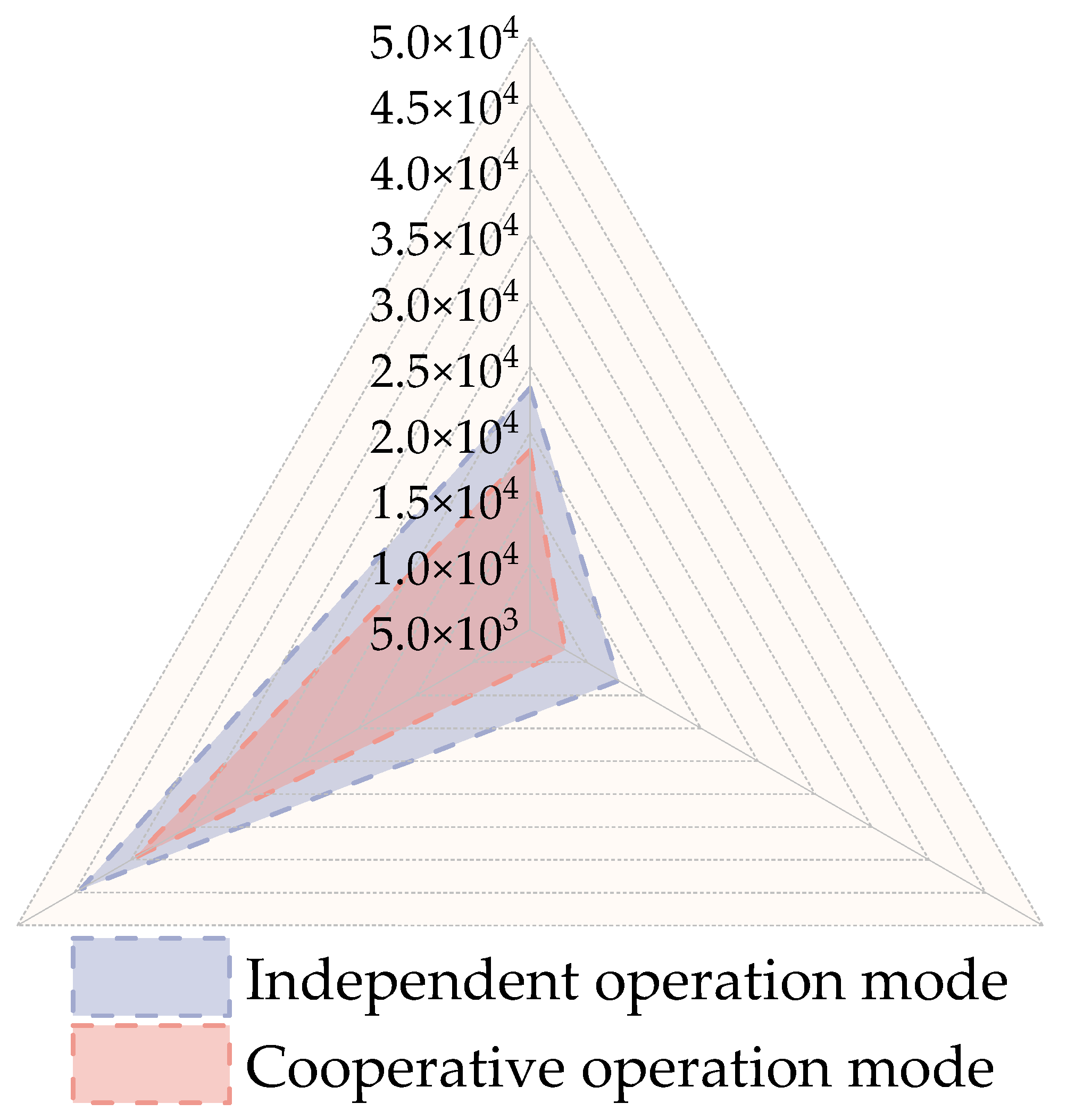
Table 2 and Table 3 detail the operational cost components under both independent operation and interconnected modes. Meanwhile, Figure 11 visualizes the comparison of the park-level operating costs under the independent and cooperative operation modes. First, the physical interconnection of multiple parks significantly enhances economic efficiency from the perspective of overall system benefits. By utilizing the spatiotemporal complementarity of source-load characteristics and the energy time-shifting capability of SES, the total operational cost is reduced. Specifically, it drops from 80,509.17 ¥ in the islanded mode to 66,358.17 ¥ in the interconnected mode. This represents a significant reduction of 17.57%. This indicates that resource sharing effectively reduces the system’s dependence on the external grid. Furthermore, it improves energy utilization efficiency. However, Table 2 reveals a significant disparity in the distribution of cooperation benefits. While all parks achieve cost reductions through physical coupling, PIES 2 secures the largest cost savings. Its operational cost drops sharply from 12,772.19 ¥ to 4326.17 ¥. This phenomenon arises because PIES 2, equipped with large-scale PV, effectively monetizes its surplus energy and utilizes shared storage to mitigate robust risks, thereby gaining a disproportionately large share of the cooperation surplus. In contrast, PIES 1 and PIES 3 achieve relatively smaller savings of approximately 2872 ¥ and 2832 ¥, respectively.
In the absence of a reasonable compensation mechanism, this uneven distribution of benefits may inevitably affect the fairness of the coalition. To address this, Table 3 presents the benefit allocation results based on the Nash bargaining solution. Different from the cost compensation logic, the mechanism here acts as a surplus sharing regulator. Through the interactive payment mechanism, PIES 2 acts as a payer, contributing 3728.57 ¥ to the pool. Correspondingly, PIES 1 and PIES 3 receive compensations of 1844.41 ¥ and 1884.16 ¥, respectively. Consequently, as shown in the net revenue column of Table 3, the final net benefits for the three parks are nearly equalized at about 4717 ¥. The slight residual difference is due to the numerical tolerance of the distributed iterative solution and does not affect the overall budget-balance consistency. This result is consistent with the fairness-oriented nature of the Nash bargaining solution by finding the minimum norm solution relative to the disagreement point. As visually depicted in the radar chart in Figure 11, the polygon representing the cooperative operating cost is entirely contained within the polygon of the independent operation cost. This geometric inclusion relationship demonstrates that the cooperative operating costs of all parks are lower than their islanded costs. Moreover, all participating parks maintain final costs lower than their independent-operation costs, indicating Pareto improvement in the tested case while balancing individual rationality and collective fairness.

5.5. Impact of Robust Conservatism on System Economics

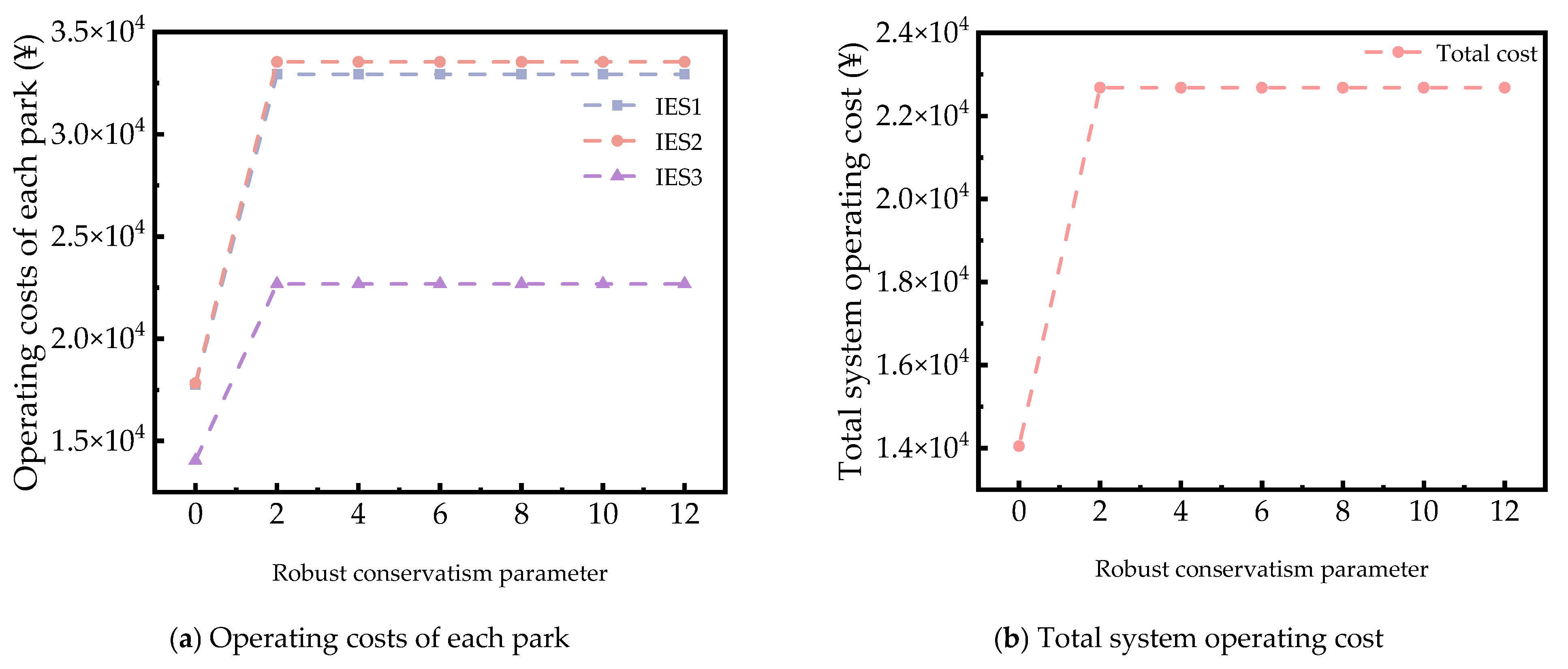
Figure 12 depicts how the robust budget parameter Γ influences the economic efficiency of the MPIES. The parameter Γ regulates the conservatism of the system by controlling the cumulative duration of worst-case fluctuations that the dispatch strategy must accommodate.
As Γ increases from 0 to 2, the total system cost exhibits a sharp step-change increase, rising from the deterministic baseline to a robust operational level. This significant cost surge represents the security premium that the system must pay to mitigate risks. Under the deterministic mode ( Γ = 0 ), the system operates based on predicted values with zero reserved margin. However, even a small increase in the robust budget ( Γ = 2 ) forces the system to mobilize more expensive resources—such as increasing grid power purchases, ramping up gas turbines, and reserving energy storage capacity—to ensure power supply reliability under the assumed 20% source-load uncertainty.
Interestingly, the cost curve enters a distinct plateau phase when Γ 2 , where the operational cost remains constant despite further increases in the uncertainty budget. This phenomenon, termed the robust saturation effect, reveals that the system’s worst-case scenarios are dominated by a few critical bottleneck periods (e.g., peak load hours or moments of minimal renewable output). Once the robust budget covers these critical moments (captured at Γ = 2 ), allocating additional budget to non-critical periods does not further deteriorate the worst-case objective function, as the system has sufficient flexibility to handle fluctuations during off-peak times without incurring extra costs.

6. Conclusions

This paper proposes a distributed energy management strategy decomposed into two sub-problems for the collaborative operation of MPIES. This strategy considers SES and benefit allocation. The principal conclusions drawn from this investigation are summarized below:
(1) A robust optimization model based on uncertainty sets is constructed to address source-load uncertainty and high storage investment costs. Renewable energy and load fluctuations are handled by introducing box uncertainty sets. Furthermore, the spatiotemporal multiplexing of storage assets is achieved through the SES leasing mechanism. The case study shows that this model utilizes multi-energy complementarity effectively. Consequently, the total system cost decreases by 17.57% compared with the independent operation mode. This approach reduces the initial investment pressure on individual parks while improving system economy and robustness.
(2) A distributed collaborative solution strategy decomposed into two sub-problems based on ADMM is proposed to satisfy privacy protection and computational decoupling. A architecture of physical dispatch-benefit allocation is designed for this purpose. The alternating direction method of multipliers is employed to solve the proposed model in a distributed manner. This method requires only the exchange of boundary coupling variables among parks. Therefore, coordinated distributed optimization is achieved while internal operational data privacy is better preserved. Convergence analysis indicates that the benefit allocation algorithm converges within only 13 iterations. This result demonstrates good computational efficiency and potential for online application.
(3) A benefit allocation mechanism based on Nash bargaining is established to resolve uneven surplus distribution. A fair interactive payment scheme is determined by transforming the Nash product maximization into a convex optimization problem. This mechanism effectively redistributes the excess cooperative surplus from the energy-exporting park (IES 2) to others. The radar chart indicates that this mechanism achieves Pareto improvement in the tested case. All participating parks maintain final costs lower than their independent operation costs. Thus, the stability and long-term viability of the multi-park cooperation alliance are ensured.

7. Future Work

Although the proposed framework demonstrates the effectiveness of robust collaborative scheduling and Nash-bargaining-based benefit allocation for multi-park integrated energy systems, several issues still deserve further investigation. The main future research directions are summarized as follows.
(1) Improvement in practical market and institutional mechanisms.
In the present study, the SES leasing price is treated as an exogenous economic parameter, and the current model mainly focuses on operation-level collaborative scheduling and benefit allocation. However, in practical deployment, the formation of SES leasing rates may depend on market-based pricing rules, the bargaining power of the storage provider, contractual structures, and platform-clearing mechanisms. Meanwhile, legal mechanisms for agreement formation, regulatory approval procedures, data ownership rules, commercial-information protection protocols, and dispute-resolution mechanisms are also important for the long-term stability of multi-party cooperation. Therefore, future work will further integrate SES pricing formation, contractual design, regulatory constraints, and governance-related mechanisms into a more deployment-oriented framework.
(2) Large-scale extension and heterogeneous participant analysis.
The present manuscript mainly validates a representative three-park case. Although the mathematical structure of the proposed model is extensible to a larger number of parks, systematic numerical validation for large-scale park clusters has not yet been carried out. In addition, the current case study does not yet provide a dedicated analysis of how benefit distribution evolves when participants become strongly asymmetric in resource endowments, flexibility characteristics, or bargaining positions. Future work will therefore focus on extending the framework to larger park clusters, developing scalable coordination or reduction strategies, and investigating fairness and stability of benefit allocation under strongly heterogeneous participant settings.
(3) Strengthening data-driven support and integrated modeling depth.
Some parameters and uncertainty settings in the present work are introduced in a representative and operationally meaningful manner, but their calibration can be further strengthened with richer empirical evidence. Moreover, in real applications, operational optimization is closely coupled with market supervision, information-sharing protocols, and privacy-preserving coordination mechanisms. Future work will therefore incorporate more detailed operational and market data for parameter identification and robustness analysis, while further promoting the integration of operational scheduling, market interaction, and information-governance mechanisms, so as to improve the practical applicability, interpretability, and scalability of the proposed framework.

Author Contributions

Conceptualization, J.P. and X.H.; methodology, J.P.; software, J.P.; validation, Y.P., J.P. and Z.Y.; formal analysis, J.P. and S.C.; investigation, J.P.; resources, J.P.; data curation, J.P.; writing—original draft preparation, J.P.; writing—review and editing, J.P.; visualization, J.P.; supervision, J.P.; project administration, J.P. and J.Z.; funding acquisition, Y.P. All authors have read and agreed to the published version of the manuscript.

Funding

This research was funded by Hunan Provincial Natural Science Foundation of China (No. 2026JJ90102) and Hunan Provincial Department of Education Excellent Youth Foundation Project (No. 23B0321).

Institutional Review Board Statement

Not applicable.

Informed Consent Statement

Not applicable.

Data Availability Statement

The original contributions presented in the study are included in the article, further inquiries can be directed to the corresponding author.

Conflicts of Interest

The authors declare no conflicts of interest.

Nomenclature

Indices and sets
h i Index for heat network pipelines
i , j , l Indices for individual parks, agents, or grid nodes
k Index for iteration counts in the ADMM algorithm
t Index for time intervals
u , v Indices for gas network nodes or intervals in the ladder-type carbon trading model
Ω Set of all parks in the integrated energy system
Ω i Set of parks interconnected with park i
Parameters
c b u y e ( t ) / c s e l l e ( t ) Grid electricity purchase and sale prices
c c u t e / c c u t h Unit compensation prices for electrical and thermal load shedding
c g a s Unit purchasing price of natural gas
c t r a n e Unit compensation price for electrical load transfer
d l e n g t h Length of each step in the ladder-type carbon trading mechanism
H H V H 2 Higher heating value of hydrogen
K m i n c h p / K m a x c h p Lower and upper limits of the heat-to-electric ratio for CHP units
α Price growth coefficient for ladder-type carbon trading
α m i n / α m a x Lower and upper limits for energy storage capacity coefficients
δ e b u y / δ h c h p / δ e c h p Carbon quota coefficients for grid purchase, heat production, and power production
ε 1 Convergence precision threshold for the ADMM algorithm
η c h / η d i s Charging and discharging efficiencies of storage systems
η c h p e / η g b Electrical efficiency of CHP and thermal efficiency of gas boilers
η E L / η F C / η M R Energy conversion efficiencies for the electrolyzer, fuel cell, and methanation reactor
η Scaling factor for benefit allocation data
λ c a p E / λ p o w E Unit capacity and power leasing prices for shared electrical storage
λ c a p H / λ p o w H Unit capacity and power leasing prices for shared thermal storage
λ c g CO2 mass coefficient required to produce unit power of natural gas
λ c u t E / λ c u t H Maximum reduction ratio coefficients for electric and thermal loads
μ Residual balance threshold for adaptive ADMM
μ e g r i d / μ g g a s Carbon emission intensity coefficients for the grid and natural gas
ρ Penalty factor used in the augmented Lagrangian function
σ Self-discharge rate of energy storage systems
τ i n c r / τ d e c r Step size increase and decrease coefficients for adaptive penalty updates
ω c c s Unit electricity consumption coefficient for carbon capture
ω H 2 o p Unit operation and maintenance cost for hydrogen storage
Variables
C C E S , i r e n t Daily leasing cost of shared energy storage for park i
C i Total operational cost for park i
C i C O 2 Ladder-type carbon trading cost
C i D R Demand response compensation cost
C i E S S Total cost of energy storage systems
C i f u e l Natural gas fuel cost
C i g r i d Cost of power exchange with the grid
C i o p ( x i ) Local operational cost after considering robust constraints
C i i n d Operational cost of park i under independent operation mode
C i c o o p Operational cost of park i under cooperative operation mode
E I E S , i a c t / E I E S , i q u o t a Actual total carbon emissions and free carbon quota
E i m a x / P i m a x Leased shared electrical storage capacity and power limit
H i , c h c e s / H i , d i s c e s Charging and discharging power of leased thermal storage
H i , c u t ( t ) Thermal load shedding amount
H i m a x / Φ i m a x Leased shared thermal storage capacity and power limit
L i , v Carbon emission length within the v -th interval
L i D R O Augmented Lagrangian function for the robust optimization process
M i , C O 2 c c s ( t ) Amount of CO2 captured by the CCS system
P C C S , e ( t ) Power consumption of the carbon capture system
P F C , e ( t ) / Q F C , h ( t ) Output electric and thermal power of fuel cells
P i , b u y ( t ) / P i , s e l l ( t ) Purchased and sold electric power from/to the grid
P i , c h H 2 ( t ) / P i , d i s H 2 ( t ) Hydrogen storage charging and discharging power
P i , c h c e s ( t ) / P i , d i s c e s ( t ) Charging and discharging power of leased electrical storage
P i , c u t ( t ) Electrical load shedding amount
P i , e c h p / Q i , h c h p Output electric and thermal power of CHP units
P i , g c h p / P i , g g b Natural gas power consumed by CHP units and gas boilers
P i , g a s b u y ( t ) Natural gas power equivalent purchased by park i
P i , l o a d ( t ) / H i , l o a d ( t ) Electrical and thermal load demand of the park
P i , t r a n ( t ) Electrical load transfer amount
P i j , t Power transmitted from park i to park j via tie-lines
P M R , g ( t ) / P M R , H ( t ) Generated natural gas and input hydrogen power of the methanation reactor
P ˜ r e n ( t ) / P ˜ l o a d ( t ) Uncertain renewable output and electrical load variables
q r e n ( t ) / q l o a d ( t ) Dual variables for the uncertainty fluctuation boundary constraints
Q E L , h ( t ) / P E L , e ( t ) Output thermal power and consumed electric power of the electrolyzer
Q i , h g b Thermal power output of gas boilers
r k / s k Primal and dual residuals in the k -th iteration
S i Cooperative surplus of park i
S H ( t ) / S i c e s ( t ) State of capacity for hydrogen and leased electrical storage
U i Final allocated cost for park i after Nash bargaining
U r e n / U l o a d Global dual variable for the robust budget constraint.
v H 2 ( t ) Hydrogen production or consumption rate
y r e n ( t ) / y l o a d ( t ) Auxiliary variables for linearizing the robust counterpart constraints
Γ r e n / Γ l o a d Robust budget parameters for the uncertainty sets
γ i Global consensus variable in the benefit allocation process
ϵ Maximum transfer ratio coefficient for electrical loads
λ i j , t Lagrange multiplier for the power coupling constraint
π i Interactive payment amount (positive for payment, negative for revenue)
ω i k Dual multiplier for the consensus ADMM process
Abbreviations
ADMMAlternating direction method of multipliers
CCSCarbon capture and storage
SESshared energy storage
CHPCombined heat and power
IDRIntegrated demand response
ELElectrolyzer
ESSEnergy storage system
GBGas boiler
HFCHydrogen fuel cell
HSTHydrogen storage tank
MPIESMulti-park integrated energy system
MRMethanation reactor
NBSNash bargaining solution
P2GPower-to-gas
PIESPark-level integrated energy system
PVPhotovoltaic
STSShared thermal storage
WTWind turbine

References

  1. Fan, S.; Xu, G.; Chen, Z.; Xing, H.; Gao, Y.; Ai, Q. Carbon-embedded energy coordination strategy in park-level integrated energy system considering time-varying carbon emission measurement. J. Clean. Prod. 2024, 434, 139967. [Google Scholar] [CrossRef] [Scilit]
  2. Wang, M.; Zheng, J.H.; Li, Z.; Wu, Q.H. Multi-attribute decision analysis for optimal design of park-level integrated energy systems based on load characteristics. Energy 2022, 254, 124379. [Google Scholar] [CrossRef] [Scilit]
  3. Ma, L.; Xie, L.; Ye, J.; Bian, Y. Two-stage dispatching strategy for park-level integrated energy systems based on a master-slave-cooperative hybrid game model. Renew. Energy 2024, 232, 120971. [Google Scholar] [CrossRef] [Scilit]
  4. Chen, J.; Li, K.; Wang, H.; Zhao, D.; Jiang, C.; Zhang, C. Distributed parallel optimal operation for shared energy storage system-multiple park integrated energy system based on ADMM. Energy 2025, 317, 134677. [Google Scholar] [CrossRef] [Scilit]
  5. Chen, J.; Tang, Z.; Huang, Y.; Qiao, A.; Liu, J. Asymmetric Nash bargaining-based cooperative energy trading of multi-park integrated energy system under carbon trading mechanism. Electr. Power Syst. Res. 2024, 228, 110033. [Google Scholar] [CrossRef] [Scilit]
  6. Yan, N.; Zhao, Z.; Li, X.; Yang, J. Multi-time scales low-carbon economic dispatch of integrated energy system considering hydrogen and electricity complementary energy storage. J. Energy Storage 2024, 104, 114514. [Google Scholar] [CrossRef] [Scilit]
  7. Xu, X.; Wang, B.; Shi, M.; Li, G.; Zhang, Y.; Wang, Q.; Liu, D. Research on hydrogen storage system configuration and optimization in regional integrated energy systems considering electric-gas-heat-hydrogen integrated demand response. Int. J. Hydrogen Energy 2025, 135, 86–103. [Google Scholar] [CrossRef] [Scilit]
  8. Fan, W.; Ju, L.; Tan, Z.; Li, X.; Zhang, A.; Li, X.; Wang, Y. Two-stage distributionally robust optimization model of integrated energy system group considering energy sharing and carbon transfer. Appl. Energy 2023, 331, 120426. [Google Scholar] [CrossRef] [Scilit]
  9. Huang, X.; Zhong, J.; Zhao, J.; Cao, Y.; Zeng, Z.; Feng, C. Risk-averse scheduling of integrated energy systems: Green-carbon market coordination with flexible resources. Energy 2026, 344, 139614. [Google Scholar] [CrossRef] [Scilit]
  10. Li, X.; Deng, J.; Liu, J. Energy–carbon–green certificates management strategy for integrated energy system using carbon–green certificates double-direction interaction. Renew. Energy 2025, 238, 121937. [Google Scholar] [CrossRef] [Scilit]
  11. Cheng, Y.; Zhang, N.; Zhang, B.; Kang, C.; Xi, W.; Feng, M. Low-Carbon Operation of Multiple Energy Systems Based on Energy-Carbon Integrated Prices. IEEE Trans. Smart Grid 2020, 11, 1307–1318. [Google Scholar] [CrossRef] [Scilit]
  12. Wang, K.; Wang, C.; Yao, W.; Zhang, Z.; Liu, C.; Dong, X.; Yang, M.; Wang, Y. Embedding P2P transaction into demand response exchange: A cooperative demand response management framework for IES. Appl. Energy 2024, 367, 123319. [Google Scholar] [CrossRef] [Scilit]
  13. Yao, W.; Wang, C.; Yang, M.; Wang, K.; Dong, X.; Zhang, Z. A tri-layer decision-making framework for IES considering the interaction of integrated demand response and multi-energy market clearing. Appl. Energy 2023, 342, 121196. [Google Scholar] [CrossRef] [Scilit]
  14. Li, P.; Wang, Z.; Wang, J.; Yang, W.; Guo, T.; Yin, Y. Two-stage optimal operation of integrated energy system considering multiple uncertainties and integrated demand response. Energy 2021, 225, 120256. [Google Scholar] [CrossRef] [Scilit]
  15. Wang, L.; Ma, Y.; Wang, S.; Dong, W.; Ni, L.; Liu, Z. Master-slave game-based optimal scheduling strategy for integrated energy systems with carbon capture considerations. Energy Rep. 2025, 13, 780–788. [Google Scholar] [CrossRef] [Scilit]
  16. Li, P.; Wang, Z.; Yang, W.; Liu, H.; Yin, Y.; Wang, J.; Guo, T. Hierarchically partitioned coordinated operation of distributed integrated energy system based on a master-slave game. Energy 2021, 214, 119006. [Google Scholar] [CrossRef] [Scilit]
  17. Zhang, T.; Chen, C.; Ma, L.; Chen, T.; Wei, Y.; Lin, Z.; Srinivasan, D. Multi-Step Clustering and Generalized Nash Bargaining-Based Planning Strategy of Community-Shared Energy Storage for Large-Scale Prosumers. IEEE Trans. Sustain. Energy 2024, 15, 1013–1027. [Google Scholar] [CrossRef] [Scilit]
  18. Wang, H.; Li, K.; Zhang, C.; Chen, J. Capacity and operation joint optimization for integrated energy system based on Nash bargaining game. Energy 2024, 305, 132032. [Google Scholar] [CrossRef] [Scilit]
  19. Li, J.; Chen, H.; Qi, Y.; Wang, Y.; Lei, J. Collaborative optimization for cross-regional integrated energy systems producing electricity-heat-hydrogen based on generalized Nash bargaining. Energy 2025, 333, 137444. [Google Scholar]
  20. Xuanyue, S.; Wang, X.; Wu, X.; Wang, Y.; Song, Z.; Wang, B.; Ma, Z. Peer-to-peer multi-energy distributed trading for interconnected microgrids: A general Nash bargaining approach. Int. J. Electr. Power Energy Syst. 2022, 138, 107892. [Google Scholar] [CrossRef] [Scilit]
  21. Luo, Z.; Dai, X.; Liu, D.; Li, J.; Wang, H.; Liang, J.; Zhang, Y.; Zheng, L. Bi-level electricity and heat sharing strategy for cross-border integrated energy system based on Nash game. Appl. Therm. Eng. 2025, 258, 124704. [Google Scholar] [CrossRef] [Scilit]
  22. Cui, M.; Ji, X.; Xu, C. Low-carbon economic dispatch of integrated energy system based on oxygen-driven synergistic hydrogen production utilizing coal and electricity. Energy 2025, 335, 138200. [Google Scholar] [CrossRef] [Scilit]
  23. Liu, X. Method research for low-carbon economic operation of multi-district integrated energy system considering P2P trading and CET-GCT interaction mechanism. Energy Rep. 2025, 14, 4810–4824. [Google Scholar] [CrossRef] [Scilit]
  24. Li, F.; Wang, D.; Guo, H.; Liu, Z.; Zhang, J.; Lin, Z. Two-stage Distributionally robust optimization for hydrogen-IES participation in energy-carbon trading-frequency regulation ancillary services market. Energy 2025, 328, 136404. [Google Scholar] [CrossRef] [Scilit]
  25. Wang, Q.; Xiao, Y.; Tan, H.; Mohamed, M.A. Day-Ahead scheduling of rural integrated energy systems based on distributionally robust optimization theory. Appl. Therm. Eng. 2024, 246, 123001. [Google Scholar] [CrossRef] [Scilit]
  26. Yang, X.; Chen, Z.; Huang, X.; Li, R.; Xu, S.; Yang, C. Robust capacity optimization methods for integrated energy systems considering demand response and thermal comfort. Energy 2021, 221, 119727. [Google Scholar] [CrossRef] [Scilit]
  27. Yang, M.; Wang, J.; Zhou, Y.; Han, G.; Kang, J. Optimal configuration of integrated energy system based on multiple energy storage considering source-load uncertainties under different risk tendencies. J. Energy Storage 2025, 109, 115220. [Google Scholar] [CrossRef] [Scilit]
  28. Han, X.; Li, J.; Zhang, Z. Dynamic game optimization control for shared energy storage in multiple application scenarios considering energy storage economy. Appl. Energy 2023, 350, 121801. [Google Scholar] [CrossRef] [Scilit]
  29. Zhu, G.; Gao, Y.; Liu, H. Optimal scheduling of an integrated energy system considering carbon trading mechanism and multi-energy supply uncertainties in a real-time price environment. Sustain. Energy Grids Netw. 2024, 38, 101351. [Google Scholar] [CrossRef] [Scilit]
  30. Choi, S.-H.; Hussain, A.; Kim, H.-M. Adaptive Robust Optimization-Based Optimal Operation of Microgrids Considering Uncertainties in Arrival and Departure Times of Electric Vehicles. Energies 2018, 11, 2646. [Google Scholar] [CrossRef] [Scilit]
  31. Gao, J.; Shao, Z.; Chen, F.; Lak, M. Robust optimization for integrated energy systems based on multi-energy trading. Energy 2024, 308, 132302. [Google Scholar] [CrossRef] [Scilit]
Figure 1. The overall framework of the proposed distributed energy management strategy considering operational robustness.
Sustainability 18 04422 g001
Figure 2. General framework of the MPIES considering SES and hydrogen–carbon coupling.
Sustainability 18 04422 g002
Figure 3. Schematic diagram of the electro–thermal conversion principle of HFC.
Sustainability 18 04422 g003
Figure 4. Operational architecture of SES.
Sustainability 18 04422 g004
Figure 5. Solution process of the ADMM algorithm.
Sustainability 18 04422 g005
Figure 6. Multi-energy load profiles of each park.
Sustainability 18 04422 g006
Figure 7. Electrical energy interaction results among the parks under the optimal dispatch strategy.
Sustainability 18 04422 g007
Figure 8. Optimal dispatch results of shared electrical energy storage for each park.
Sustainability 18 04422 g008
Figure 9. Optimal dispatch results of shared thermal energy storage for each park.
Sustainability 18 04422 g009
Figure 10. Convergence performance of the distributed solution strategy decomposed into two sub-problems.
Sustainability 18 04422 g010
Figure 11. Comparison of operating costs for each park under independent and cooperative operation modes.
Sustainability 18 04422 g011
Figure 12. Sensitivity analysis of operational cost with respect to robust budget parameter Γ .
Sustainability 18 04422 g012
Table 1. Comparison of related works.
Ref.SESUncertaintiesDistributedBenefit Allocation
[1,2,7,10]
[3] Stackelberg game + Cooperative game
[4,5] Asymmetric Nash bargaining model
[6,8,9,14,22,24]
[11] Bi-level equilibrium model
[12] Nash bargaining
[13] Cooperative game
[15] Stackelberg game
[16] Hierarchical Stackelberg game
[17] Generalized Nash bargaining
[18] Asymmetric Nash bargaining
[19] Generalized Nash bargaining
[20] Generalized Nash bargaining
[21] Nash game
[23] Non-cooperative game
ProposedNash bargaining
Table 2. Comparison of costs between independent operation and interconnected operation.
ParkIslanded Cost (¥)Cooperative Cost (¥)Variation (¥)
PIES 123,344.0820,471.71−2872.37
PIES 212,772.194326.17−8446.02
PIES 344,392.9041,560.29−2832.61
Total80,509.1766,358.17−14,151.00
Table 3. Benefit allocation results based on Nash bargaining.
ParkInterconnected Cost (¥)Interactive Payment (¥)Final Cost (¥)Net Revenue (¥)
PIES 120,471.71−1844.4118,627.304716.77
PIES 24326.173728.578054.744717.45
PIES 341,560.29−1884.1639,676.134716.77
Total66,358.17066,358.1714,151.00
Disclaimer/Publisher’s Note: The statements, opinions and data contained in all publications are solely those of the individual author(s) and contributor(s) and not of MDPI and/or the editor(s). MDPI and/or the editor(s) disclaim responsibility for any injury to people or property resulting from any ideas, methods, instructions or products referred to in the content.