1. Introduction
As cities around the world adopt AI technologies to enhance sustainability governance, digital mapping platforms are becoming central to how urban environments are visualised, interpreted, and governed [
1,
2,
3]. These tools are used to visualise real-time data on carbon emissions, biodiversity, and land use, often functioning as core components of smart-city infrastructures and environmental monitoring systems [
4].
In Manchester, AI-based dashboards have been integrated into local policy instruments to monitor emissions, track green infrastructure, and inform planning decisions [
5]. Despite their technical value, the pedagogical dimensions of these platforms, particularly in shaping how citizens engage with environmental knowledge, remains insufficiently examined and theorised [
6,
7,
8].
This paper responds to these gaps by reframing AI-based mapping tools not merely as technical artefacts, but as socio-educational interfaces that influence how sustainability challenges are perceived, experienced, and navigated in everyday urban life [
9]. As data systems become increasingly embedded in daily governance, they influence public understanding of complex ecological systems, risk imaginaries, and projected urban futures [
10]. These platforms also reflect broader forms of data colonialism, where access to digital representations and decision-making power is unequally distributed among urban populations [
11]. However, their capacity to support critical, participatory, and reflective learning remains uneven and under-theorised. This research takes a sociotechnical approach [
12,
13], drawing on critical data and digital education studies, to highlight the need to examine who is empowered to read, interpret, and act upon algorithmically mediated knowledge, and how this, in turn, shapes imaginaries of urban transformations [
14].
As algorithmic systems increasingly shape urban governance, there is an urgent need to reimagine education as a site for cultivating collective data awareness and ecological responsibility. By focusing on the Green Walk in Manchester as a site of informal environmental learning, this research brings attention to the sensory, affective, and situated processes through which citizens engage with digital environmental data. Informal learning environments such as city walks can foster ecological awareness through spatially situated and rich forms of learning [
15]. In doing so, it aims to bridge the disconnect between urban data infrastructures and public environmental literacy, and to advocate for more inclusive and situated approaches to learning with AI in dynamic urban contexts.
Given the exploratory nature of this research focus, this study adopts a pilot approach based on a small sample, to generate in-depth, context-specific insights rather than statistically generalisable findings. The study therefore focuses on understanding situated learning processes and participant experiences within a specific urban context.
3. Theoretical Underpinning
This study is theorised within the contexts of epistemic Justice and situated sustainability learning. The integration of AI into sustainability learning surfaces contested questions of algorithmic authority and epistemic justice. Williamson’s [
28] critical EdTech framework reveals how AI-mediated infrastructures embed normative assumptions about desirable urban futures, subtly shaping sustainability discourses and marginalising alternative narratives. Similarly, Knox [
29] shows that dashboards do not merely represent reality but performatively co-produce urban imaginaries.
This performativity is not epistemically neutral: as Jasanoff [
30] argues, algorithmic infrastructures operate as “sites of knowledge politics” where technocratic logics are privileged while situated, relational, and indigenous epistemologies are rendered invisible. In sustainability education, this authority directly shapes how learners come to “know” their urban ecologies: dashboards often stabilise official narratives about carbon targets or biodiversity priorities while obscuring alternative, community-driven perspectives.
Building on Fricker’s [
22] notion of epistemic injustice, these platforms risk excluding situated, local, and indigenous knowledges from sustainability discourse. Veldhuis, Lo, Kenny and Antle [
31] argue that cultivating critical AI literacy is essential for resisting such exclusions, enabling learners to interrogate and contest the epistemic authority of dashboards. Allen and Kendeou’s [
32] framework operationalises this literacy through six interlinked dimensions, knowledge, evaluation, collaboration, context, autonomy, and ethics, offering a scaffold for enabling “smart citizens” capable of reconfiguring algorithmic outputs into locally meaningful action.
For example, Manchester’s environmental dashboards define biodiversity priorities algorithmically, yet local initiatives such as Green Walks reveal alternative sensory and narrative understandings of the same sites. This dissonance illustrates why learners require critical literacy to navigate competing epistemic claims. In Manchester, where AI dashboards influence decisions on emissions, biodiversity, and land use, such literacy is not optional; it is central to empowering learners to shape both the meaning and implications of sustainability data.
3.1. Towards Multimodal Ecological Literacy
This study positions AI-enhanced mapping as a contested epistemic arena where algorithmic authority, embodied experience, and ecological narratives intersect. By foregrounding how learners integrate dashboards with sensory, narrative, and place-based engagements, it contributes to emerging debates on multimodal ecological literacy and epistemic justice [
22,
24]. Building on these debates, this study proposes the notion of a “counter-mapping pedagogy” that integrates algorithmic outputs with affective, sensory, and participatory engagements to co-produce situated ecological literacy.
For instance, integrating emissions data with embodied observations during Green Walks enables learners to contest algorithmic classifications and co-construct locally meaningful ecological narratives. This framework foregrounds learners as active negotiators of meaning rather than passive consumers of data, positioning AI-enhanced mapping as a pedagogical catalyst for participatory, situated, and action-oriented sustainability learning.
3.2. Towards Situated Sustainability Learning
Informal sustainability education has increasingly been recognised as essential for fostering ecological literacy beyond classroom-based contexts [
24,
33]. Unlike formal curricula, informal learning leverages everyday environments and participatory practices to situate sustainability knowledge within lived experiences [
34]. Within this context, AI-enhanced urban mapping platforms create novel opportunities for engaging citizens with local ecological processes by embedding environmental data into sensory, affective, and place-based interactions.
The preceding sections have illustrated how AI-enhanced urban mapping platforms function as epistemic infrastructures, mediating the ways in which environmental phenomena are perceived, narrated, and acted upon. While such platforms promise new opportunities for ecological literacy, they also expose significant tensions between algorithmic authority, embodied knowledge, and emotional engagement. The literature suggests that these tensions are particularly pronounced when dashboards translate complex environmental processes into abstract outputs that detach data from sensory, affective, and cultural contexts [
9,
28].
Despite growing research on AI-driven sustainability dashboards, there remains limited attention to how learners negotiate meaning across multiple modes of knowing, combining algorithmic indicators with sensory, narrative, and place-based engagements. Existing frameworks in environmental education tend to privilege either cognitive knowledge transfer or behavioural change, often neglecting the intermediate processes through which learners reconcile diverse epistemic claims [
24]. As a result, there is insufficient theorisation of pedagogical strategies that can bridge algorithmic representations with lived, embodied ecological experiences.
Situated learning frameworks offer a useful lens to address this gap by emphasising that knowledge acquisition is inseparable from the contexts, practices, and interactions in which it is produced [
35]. In the context of AI-enhanced mapping, this perspective highlights the importance of designing learning environments where algorithmic representations are embedded within embodied, participatory, and narrative practices. Such integration aligns with emerging calls for multimodal ecological literacy, where learners develop agency by navigating across data-driven, sensory, and affective modes of understanding [
22,
24].
Beyond sustainability education, counter-mapping has long been used to challenge dominant spatial narratives and reclaim marginalised knowledges [
36,
37]. Situating AI dashboards within this lineage highlights their potential not only as tools for visualising environmental data but also as mediators of contested ecological imaginaries. This perspective expands their pedagogical potential by positioning learners as co-producers of meaning rather than passive recipients of algorithmic outputs.
Taken together, these insights suggest the need for pedagogical approaches that integrate algorithmic outputs with sensory, affective, and place-based engagements to foster situated sustainability learning. By conceptualising AI-enhanced mapping as a pedagogical catalyst rather than a technological endpoint, this study explores how participatory city walks and multimodal engagements can enable learners to critically interrogate data, co-construct ecological narratives, and develop actionable agency. This framing also aligns AI mapping with broader agendas in informal sustainability education, positioning participatory mapping as a pathway for cultivating situated, multimodal ecological literacy.
5. Methodology
The overarching research question guiding this study is: How can AI-based urban mapping tools be integrated into informal city-walk activities to support participants’ sustainability literacy and foster deeper forms of civic engagement? This study adopts a qualitative case study design within an interpretivist paradigm. The choice reflects the study’s aim to understand how participants construct meanings through their interactions with AI-based urban mapping tools during a city-walk activity. Rather than measuring predefined learning outcomes, the study seeks to capture embodied, situated experiences and the evolving processes of conceptual understanding. Within this paradigm, knowledge is treated as co-constructed through embodied encounters with urban spaces, mediated by AI-generated representations, making the integration of mapping tools theoretically coherent. Such an interpretive approach recognises that sustainability literacy is socially constructed and best examined through participants’ engagements within authentic urban environments [
39,
40]. This methodological choice also aligns with emerging debates on the role of AI-enhanced mapping in shaping place-based learning. Recent studies suggest that AI-generated spatial representations can expand participants’ awareness of environmental challenges, but they also risk privileging algorithmic logics over local experience [
14,
41]. This tension underscores the need for qualitative designs capable of capturing how meanings are actively negotiated between data-driven insights and embodied encounters.
Alternative designs were considered but set aside. A quantitative survey could have provided breadth in assessing sustainability knowledge, yet it would fail to reveal how meanings emerge through participants’ sensory encounters with AI-generated information. Similarly, controlled experimental designs were rejected because they would restrict authentic, situated engagements and risk imposing researcher-defined variables that contradict the interpretivist commitment to meaning-making as emergent and context-specific [
40]. A mixed-methods design was also excluded, given the exploratory nature of this pilot study and its small sample size (
n = 6), which requires prioritising depth over generalisation [
42]. The relatively small sample size reflects the exploratory and qualitative nature of this pilot study. Rather than aiming for statistical generalisation, the study seeks to generate in-depth, context-specific insights into participants’ experiences and meaning-making processes. This approach is consistent with qualitative research traditions, which prioritise depth over breadth [
43], and purposive sampling strategies that focus on information-rich cases rather than representativeness [
44]. Moreover, existing research suggests that data saturation in qualitative studies can often be achieved with relatively small sizes [
45]. In line with case study methodology, the aim here is analytical insight rather than statistical inference [
39].
The pilot city-walk in Manchester serves as a bounded case study to investigate how participants engage with AI-enhanced spatial data within a policy-driven urban context. Manchester was deliberately chosen because its 2038 Zero-Carbon Strategy positions the city as a testbed for sustainable innovation. Crucially, Manchester represents a space where multiple stakeholders, including policymakers, citizens, and technological systems, co-produce environmental meanings, offering a fertile ground to explore digital mediation in collective sustainability learning.
This methodological alignment reflects and reinforces the theoretical foundations of the research, which draw on place-based learning and embodied cognition frameworks. The design ensures that data collection captures the sensory, affective, and cognitive dimensions of participants’ interactions with both urban spaces and AI-generated information. By situating AI mapping within authentic city environments, the study positions these tools not only as information systems but also as catalysts for transformative learning. As a pilot study with a small sample size (n = 6), the findings should be interpreted with caution. Rather than aiming for statistical generalisation, this study prioritises depth of qualitative insight and seeks to provide an exploratory understanding of emerging patterns. The transferability of the findings is therefore limited and context-dependent, while still providing a basis for future research on AI-enhanced sustainability education.
The tool used in this study was a researcher-developed prototype based on QGIS 3.34 LTR (QGIS Development Team) and Google Earth Engine JavaScript API (Google LLC, Mountain View, CA, USA; accessed in 2025), which integrated multiple spatial datasets into a digital visualisation interface for the purposes of the city-walk activity. These datasets were processed using QGIS to extract key environmental indicators, including vegetation coverage, land use, and impermeable surface distribution, based on long-term spatial data from sources including Urban Atlas and Copernicus. These data layers were then incorporated into a digital mapping interface to support the design of the Green Walk and to provide participants with visualised environmental information during the activity. Rather than functioning as a fully autonomous AI system, the tool operates as a data-driven visualisation platform that enables participants to engage with and interpret spatial information in a situated learning context.
5.1. Data Collection Strategies
This study adopted a multi-method data collection strategy designed to capture the complex, situated, and embodied ways in which participants engaged with AI-enhanced urban mapping tools during the pilot city-walk. Guided by an interpretivist paradigm, the strategy was theory-driven, combining semi-structured interviews, participatory observation, and the collection of digital artefacts generated during the activity. This triangulation approach [
46] enhances the depth and validity of findings by integrating complementary perspectives on participants’ learning processes and interactions. This integration is essential not only for methodological triangulation but also for tracing how participants actively translate algorithmic spatial outputs into embodied and situated understandings, thereby capturing a more complete ecology of learning.
Semi-structured interviews were employed to explore participants’ evolving conceptualisations of sustainability and their interpretations of AI-generated spatial information. Unlike fully structured surveys, which tend to reduce learning to measurable outputs, this method allows participants to narrate personal experiences, articulate meaning-making processes, and reflect on unexpected insights [
40]. The conversational format also supports an emergent understanding of sustainability, where concepts are co-constructed between researcher and participant [
47]. Questions were organised around three thematic areas: (1) perceptions of AI-based mapping tools, (2) embodied experiences of urban sustainability during the walk, and (3) reflections on the broader relevance of such tools to informal learning contexts.
Participant observation was essential for capturing the embodied and sensory dimensions of the city-walk. Within an interpretivist framework, knowledge is not simply verbalised but emerges from situated practices of “being-in-the-world” [
48]. The researcher walked alongside participants, observing how they interacted with physical sites, responded to AI-generated prompts, and engaged in dialogue with peers. Attention was given to gestures, rhythms of movement, and sensory triggers such as sound, smell, and spatial texture, all of which shape how sustainability is experienced and understood [
49]. These observations complement interview data by grounding participants’ conceptual narratives in the materiality of urban space. Field notes were recorded during and immediately after the walk to document key interactions, behaviours, and contextual observations.
Digital artefacts generated during the walk, including annotated AI-based maps, screenshots, and participants’ drawn reflections, were collected as tangible representations of meaning-making. These artefacts are treated not merely as illustrative outputs but as mediators of learning in themselves [
50]. In digital sustainability education, such artefacts are increasingly recognised as hybrid mediators that link embodied place-based practices with distributed algorithmic representations [
51,
52]. Capturing these materials thus provides insight into how participants reconfigure spatial knowledge through the interplay of sensory experience and digital augmentation. By visualising how participants negotiated tensions between embodied perception and algorithmic representation, these artefacts offer critical insight into the hybrid epistemologies that emerge in AI-mediated urban learning.
Bringing these data sources together enables methodological triangulation [
46], enhancing credibility and offering a more holistic understanding of participants’ experiences. Interviews reveal interpretive narratives, observation captures embodied practices, and digital artefacts expose creative meaning-making. The goal of the study is not statistical generalisation but the generation of rich, situated insights [
39] into how AI-based mapping tools may act as catalysts for informal sustainability education. By emphasising how algorithmic and embodied ways of knowing converge and diverge, the data collection strategy lays the foundation for critically examining the epistemic stakes of AI-mediated sustainability learning.
5.2. Participants and Sampling
Six participants were recruited through a purposive sampling strategy to ensure diversity in age, educational background, and familiarity with sustainability issues. Purposive sampling is widely used in qualitative research to identify information-rich cases that can offer deep insight into the research question [
44]. They ranged from 20 to 35 years old and included both university students and local residents of Manchester. This age range reflects the practical focus of the study on participants able to engage independently with digital mapping tools in a field-based setting; however, it also limits the inclusion of younger learners and therefore constrains the pedagogical scope of the findings. An invitation poster summarising the study’s aims, eligibility criteria (e.g., aged 18–40, basic digital map proficiency, and interest in environmental issues), and ethical assurances was distributed via email, student forums, and social media. This multi-channel approach broadened recruitment outreach and ensured alignment with the study’s pedagogical emphasis on place-based, informal learning. Interested individuals were provided with detailed information sheets and consent forms in accordance with the University of Manchester’s research ethics guidelines.
A summary of participant demographics and characteristics is presented in
Table 1 below. This purposeful heterogeneity was designed to capture a range of perspectives on how individuals engage with AI-enhanced mapping tools and interpret sustainability-related spatial information. The small sample size reflects the nature of the study, prioritising depth of insight over statistical generalizability [
40]. This composition also enables the study to examine how different forms of prior knowledge, digital literacy, and sustainability awareness mediate participants’ meaning-making, allowing for a nuanced understanding of how AI tools function across diverse learning contexts. To ensure anonymity, all participants are referred to using pseudonyms, and demographic data were collected solely to contextualise the findings.
5.3. Data Gathering Procedure
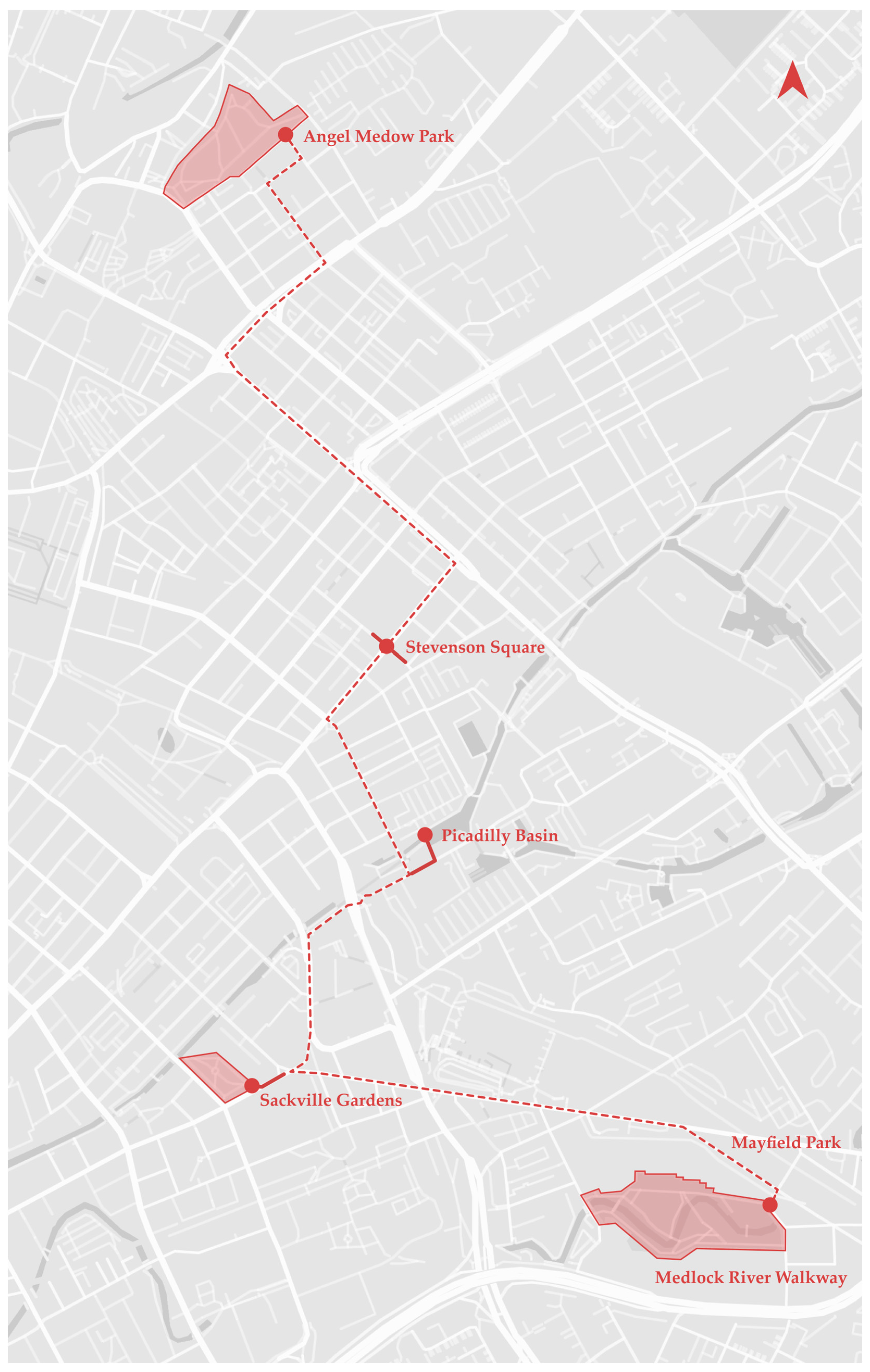
The activity involved a 90-min guided city-walk across six ecological and infrastructural nodes in central Manchester (See
Figure 1). The duration was designed to allow participants sufficient time to engage with multiple sites, interact with the mapping tool, and reflect on their embodied and interpretive experiences in a non-rushed manner. These nodes were deliberately selected to represent diverse sustainability challenges, including biodiversity loss, green space connectivity, and land-use transitions, ensuring alignment with the study’s focus on embodied and situated sustainability learning. By curating these sites as learning “nodes,” the activity foregrounded how embodied encounters with urban spaces intersect with algorithmic representations, making the walk itself a site of negotiated meaning between human perception and digital augmentation.
At the outset, participants were introduced to an AI-enhanced mapping tool that provided real-time visualisations of spatial data, including vegetation indices, land-use patterns, and green connectivity. Rather than functioning solely as an informational system, the tool served as a mediator of sensory engagement, linking abstract spatial representations with participants’ embodied experiences of the urban environment.
The city-walk activity was organised into three stages:
Orientation: Participants were briefed on the aims of the activity, ethical considerations, and technical instructions for using the mapping tool.
Engagement: Following a predefined route, participants navigated six ecological and infrastructural sites, integrating AI-generated insights with in-situ observations of sustainability challenges. Non-intrusive observations, field notes, and photographs were collected to document embodied learning behaviours.
Reflection: Upon completion, semi-structured interviews (~30 min each) were conducted to elicit participants’ reflections on the walk, focusing on how AI-mediated spatial information influenced their conceptual understanding and engagement with urban sustainability issues. All interviews were audio-recorded with participants’ consent and conducted immediately after the city-walk to capture fresh reflections. An interview guide was used to ensure consistency across participants while allowing flexibility for emergent themes.
5.4. Researcher Positionality
This research is situated within the researchers’ interdisciplinary background in architecture, urban planning, sustainability, and education. In addition to participatory mapping projects in both the UK and China, the researchers have also explored the educational applications of AI through previous academic and project-based work. These experiences inform a critical awareness of how digital infrastructure mediate informal learning environments and citizen engagement in sustainability contexts. While efforts have been made to maintain analytical distance, reflexive strategies such as ongoing positionality reflection and peer debriefing have been incorporated to enhance the credibility of the findings and minimise potential bias
5.5. Ethics and Data Management
The study received ethical approval from the host university Research Ethics Committee. All participants provided informed consent and were reminded of their right to withdraw at any stage without consequence.
To safeguard privacy, all personal identifiers were removed during transcription and analysis. Audio recordings and photographs were securely stored during data collection and permanently deleted after anonymisation. Only anonymised transcripts, coded field notes, and non-identifiable materials were retained for analysis.
5.6. Data Analysis
The data were analysed using reflexive thematic analysis [
53], selected for its capacity to explore how embodied experiences, AI-mediated representations, and conceptual understandings intersect in situated learning contexts. The analysis followed a multi-step process, including familiarisation with the data, inductive coding, iterative refinement of codes, and the development of themes.
All interviews were transcribed verbatim and imported into NVivo to support systematic organisation and coding. Initial codes were generated inductively to capture key dimensions of participants’ meaning-making, including sensory immersion, spatial awareness, and reflections on sustainability. Subsequently, these inductive codes were iteratively connected to theoretical constructs from embodied cognition and place-based learning, allowing the analysis to move beyond description toward explanatory insights. These codes were iteratively compared with observational notes and digital artefacts (annotated maps, screenshots, drawn reflections) to ensure coherence and complementarity across modalities. Through this multimodal integration, the analysis illuminated how embodied experiences, AI-generated representations, and participants’ conceptual understandings interacted throughout the city-walk. By juxtaposing embodied data with algorithmic outputs, the analysis was able to trace where AI enhanced sensory awareness and where it introduced dissonance or epistemic tension.
The construction of themes was also explicitly informed by embodied cognition and place-based learning frameworks. For example, participants’ navigation of ecological nodes while integrating AI-generated data was interpreted as embodied sense-making, where sensorial engagement became central to conceptualising sustainability. Likewise, reflections that connected specific urban sites to broader environmental issues were examined through a place-based learning lens, illustrating how localised encounters foster situated understandings of global challenges. Interestingly, while place-based learning frameworks typically emphasise locality, some participants reported that AI-enhanced maps expanded their awareness beyond immediate sites, suggesting that embodied learning is increasingly mediated by distributed, data-driven representations. This resonates with Gallagher’s [
54] argument that embodied cognition in digitally mediated environments produces hybrid epistemologies, where local sensory experience and global algorithmic knowledge intersect to generate novel forms of situated understanding. This insight challenges traditional assumptions in place-based pedagogy, extending existing frameworks to account for hybrid epistemologies that blend local embodiment with networked spatial imaginaries.
To make the interpretive process explicit, a systematic data-to-theory mapping was conducted (see
Table 2), demonstrating how raw excerpts were distilled into initial codes, integrated into broader themes, and aligned with theoretical lenses. This explicit traceability strengthens analytic rigour and ensures that theoretical claims are grounded in empirical patterns.
Additionally, to enhance analytic credibility and trustworthiness, several strategies were adopted. Triangulation across interviews, observations, and digital artefacts facilitated a richer and more robust interpretation by revealing patterns that might remain invisible within a single data source [
46]. An audit trail documented coding decisions and theme development, ensuring methodological transparency. In addition, reflexive memos were used to critically interrogate the researcher’s positionality and acknowledge the situated nature of interpretation [
59]. This reflexive practice was especially crucial given the dual role of AI tools as both mediators and constructors of knowledge, raising questions about whose epistemologies are privileged.
To guide the analysis, three analytical dimensions were identified: algorithmic authority, embodied knowledge, and ecological narratives. These analytical dimensions informed the interpretation of participants’ responses, particularly in identifying tensions between data-driven representations, sensory engagement, and narrative meaning-making across interviews, observations, and digital artefacts.
5.7. Findings
5.7.1. Sensory Engagement and Situated Learning
Participants reported that AI-enhanced mapping tools appeared to deepen their sensory immersion during the city-walks, contributing to a richer connection to place and sustainability concepts. Many described how the integration of algorithmic data with embodied exploration created an expanded environmental awareness. As P3 reflected, “Before, I only noticed the trees and rivers. But when I saw the AI map showing carbon data, I suddenly understood why this area matters.” This resonates with embodied cognition frameworks, where knowledge is constructed through sensorimotor engagement with the environment [
60,
61]. Participants’ direct encounters with ecological nodes, mediated by AI-generated representations, illustrate how sensory experiences are closely linked to conceptual meaning-making.
Furthermore, findings suggest that AI-enhanced maps appeared to reconfigure participants’ spatial awareness beyond immediate locality. While place-based learning frameworks traditionally emphasise the situated nature of knowledge [
55], participants reported cultivating an extended ecological imagination by linking local sites to broader environmental dynamics. P6 explained: “Seeing flood-risk projections made me think about how this links with Manchester’s whole drainage system, not just here.” This suggests that participants began to relate local observations to broader environmental systems.
However, the findings also expose subtle tensions between embodied and algorithmic knowledge. While most participants valued AI-generated data for making “invisible” processes visible, several instances revealed a tendency to privilege algorithmic authority when discrepancies arose. For example, one participant noted: “The map says the area has high biodiversity, but honestly, walking here, it feels empty.” (P2) Here, AI tools did not merely mediate participants’ learning; they were often perceived as epistemic authorities, influencing what was perceived as environmentally significant [
62]. This reliance suggests that algorithmic assumptions may become normalised in participants’ interpretations, where invisible design choices within mapping technologies redefine what counts as sustainability knowledge. This highlights how participants negotiated between different sources of information when interpreting environmental conditions.
In sum, the findings highlight how participants’ embodied experiences and interactions with data visualisations were interconnected during the citywalks. Participants’ accounts suggest that sensory engagement, digital representations, and sustainability concepts were experienced together rather than as separate elements. These observations point to the importance of examining how data visualisation tools shape participants’ understanding of environmental information within situated learning contexts.
5.7.2. Negotiating Between AI Representations and Embodied Knowledge
However, the sensory immersion described in the previous section was not free from algorithmic influence. While AI-enhanced mapping tools expanded participants’ ecological awareness, they simultaneously introduced new dynamics of epistemic authority that influenced how sustainability knowledge was interpreted.
Participants generally welcomed the use of AI-enhanced mapping tools, but the findings revealed an undercurrent of algorithmic authority that appeared to shape how information was interpreted and prioritised. Many participants described the digital outputs as “more trustworthy” or “scientific,” often deferring to algorithmic conclusions even when these conflicted with embodied or observational knowledge. As P5 commented, “I know what I feel on site, but the AI map must be more accurate.” This pattern reflects what Beer [
62] describes; algorithmic outputs can operate as authoritative narratives that reframe perception and action.
This epistemic authority became especially evident when participants encountered uncertainty. Rather than trusting their own sensory impressions, participants tended to adopt AI-generated visualisations as epistemic anchors. In doing so, this suggests that participants tended to adopt a data-centric logic that privileges what is measurable over what is experiential. This points to potential limitations in the diversity of knowledge perspectives engaged in sustainability education. As Couldry and Hepp [
63] warn, digital infrastructures often embed normative assumptions about what constitutes valid knowledge, thereby shaping how individuals come to understand complex socio-environmental issues. Recent studies further highlight that AI-powered mapping tools often mediate environmental learning through black-boxed visualisations, which can inadvertently obscure the underlying uncertainty of ecological models [
27,
64].
Although most participants tended to trust algorithmic outputs, some offered critical counter-narratives. As P5 argued, “The map says this is low-risk, but when I stand here after heavy rain, I can see the water rising.” These moments of resistance reflect an active negotiation between embodied knowledge and algorithmic claims, suggesting that learners are not passive recipients but can resist algorithmic framings when direct experience contradicts digital representations. This aligns with Knox [
29], who argues that “algorithmic authority is never absolute but is constantly reinterpreted within situated practices.”
Interestingly, this trust in AI systems was not unconditional. While P3 challenged the map’s low-risk label based on direct observation, P4 highlighted another dimension of friction: the opacity of algorithmic outputs. As P4 remarked, “The colours are strong, but I don’t know why this is high-risk. There’s no explanation.” Such moments suggest the limits of AI-enhanced representations and emphasise the need for transparency, interpretability, and human mediation in educational contexts. Without these elements, learners risk becoming passive recipients of algorithmic knowledge rather than active co-constructors of understanding.
Such moments of friction highlight the importance of transparency, interpretability, and human mediation in AI-based educational tools. Without these safeguards, learners may become passive consumers of data rather than critical co-constructors of sustainability understanding. As Kitchin [
65] emphasises, cultivating critical algorithmic literacy is central to enabling individuals to interrogate the assumptions embedded in digital systems and to reclaim agency in shaping sustainability narratives.
In this sense, the findings highlight how AI tools played an active role in shaping participants’ interpretations of environmental information during the activity. Participants’ accounts suggest that interactions with digital representations influenced how environmental conditions were perceived, particularly in situations of uncertainty or ambiguity. These observations point to the importance of examining how participants engage with, question, and interpret AI-generated information within informal learning contexts.
5.7.3. Emotional Dissonance and the Limits of Reflection
While previous sections explored how AI-enhanced mapping tools facilitated sensory immersion and shaped epistemic authority, the findings suggest a more affective layer of participants’ responses, one marked by emotional dissonance. Despite gaining new insights from data-driven representations, some participants expressed discomfort, paralysis, or disconnection, suggesting that increased information alone did not necessarily translate into meaningful reflection or action.
Several participants reported a sense of overwhelm when confronted with large-scale environmental risks visualised through the AI maps. As P2 described, “I saw the red areas on the flood map, and it made me anxious, but I didn’t know what I could do about it.” Similarly, P5 commented, “It’s like knowing too much but still feeling powerless.” These affective reactions can be understood in relation to what Pedwell [
66] terms “affective stalling”, a state in which emotional responses do not lead to transformation but become blocked or looped. This echoes findings in climate education literature that highlight the risk of “eco-anxiety” in digital learning environments lacking supportive framing [
67,
68]. The tools may succeed in generating awareness, but fail to support users in processing emotions or translating them into agency.
This emotional dissonance was particularly evident in the gap between collective scale and personal relevance. While the AI-enhanced maps visualised system-level patterns (e.g., flood risk, pollution zones, biodiversity loss), participants struggled to relate these abstractions to their everyday lives. As P1 reflected, “It’s interesting, but I’m not sure what it means for me as just one person walking around.” This illustrates a tension between macro-level data and micro-level identity, a disjuncture that may limit how participants relate environmental knowledge to their own experiences. Notably, participants who engaged in follow-up group discussions or facilitator-led debriefs showed greater capacity to contextualise these emotions, suggesting the potential value of socially mediated reflection.
Moreover, findings suggest that reflective prompts embedded in the mapping app or facilitated during the walk were not always sufficient to resolve this tension. While some participants appreciated being asked to “think about how this place makes you feel,” others found such reflection too abstract or disconnected from the overwhelming visual data. This suggests a potential gap in how reflection is supported: without affective scaffolding or dialogic support, emotional responses may remain fragmented rather than integrated into critical understanding or sustained motivation. This is particularly important given that affect-driven disengagement can hinder long-term environmental learning, especially in tech-mediated contexts [
67,
68].
In this context, reflection appeared to be limited when it was experienced as disembodied or detached from participants’ immediate contexts. Rather than leading directly to engagement or action, increased awareness was often accompanied by feelings of uncertainty or emotional overload, particularly when participants lacked opportunities for interaction or discussion. Taken together, these findings emphasise the need to consider how emotional responses are experienced and negotiated within AI-mediated learning environments.
5.7.4. From Reflection to Action: Tracing Behavioural Shifts
Building on the affective tensions discussed above, this section explores a critical paradox: while AI-enhanced mapping tools successfully elicited reflective responses among participants, these moments of insight did not consistently translate into tangible behavioural shifts. This suggests that the gap may reflect not only motivational factors but also epistemic and structural tensions that constrain the enactment of agency within informal sustainability education.
Several participants expressed a desire to act, yet described a sense of inertia when attempting to move from awareness to engagement. As P6 reflected, “I wanted to do something afterwards, but I didn’t know what would even make a difference.” P3 added, “It all felt too abstract… I needed someone to guide me.” These statements suggest that AI-mediated reflection, in the absence of socially scaffolded meaning-making or clear pathways to action, may risk becoming inert. Rather than a lack of interest, participants often faced a crisis of translation, between affective insight and structural possibility.
This gap reflects what Kollmuss and Agyeman [
69] describe as the value-action gap, but it also raises questions about the extent to which reflective tools alone can empower learners. Recent research in environmental pedagogy emphasises that transformative agency must be relational, situated, and supported by enabling conditions [
67]. In this context, AI technologies may inadvertently reinforce what Hargreaves [
70] critiques as “individualised responsibility traps,” where users are invited to internalise system-wide failures as personal shortcomings. Rather than cultivating distributed responsibility, such framings risk obscuring the need for structural transformation and collective mobilisation.
As Verlie [
68] argues, emotional mobilisation must be accompanied by “activation infrastructures” that connect feeling to collective orientation. Yet in this study, such infrastructures were largely absent. This lack of embedded mechanisms for peer dialogue, guided co-reflection, or locally grounded action opportunities suggests a potential limitation in current AI-mediated learning designs: they may generate epistemic disruption, but fail to sustain pedagogical scaffolding that supports learners beyond the moment of encounter. P6 captured this disjunction: “It gave me things to think about, but nothing to act on.”
Furthermore, while some participants engaged in isolated sustainability efforts (e.g., recycling, walking more), such micro-actions may be absorbed into what Shove [
71] critiques as the “ABC” model of behaviour change, emphasising Attitude, Behaviour, and Choice while neglecting material systems, infrastructures, and political economy. The findings here can be read in relation to broader critiques in critical pedagogy [
72], which warn against de-politicised models of behavioural change that sidestep questions of power, governance, and institutional responsibility. Without a shift in how educational tools frame agency, not as individual burden but as situated possibility, learners may reproduce depoliticised, atomised engagements that fail to address the structural drivers of unsustainability.
Ultimately, the findings highlight the challenges participants faced in translating reflective insight into sustained forms of action. Participants’ accounts suggest that agency was often experienced as uncertain or constrained, particularly in the absence of clear pathways, social support, or contextual relevance. Taken together, these observations emphasise the importance of examining how action is enabled, interpreted, and negotiated within AI-mediated sustainability learning contexts.
5.7.5. Inclusion and Differentiated Engagement
While previous sections have explored how AI-enhanced mapping tools fostered embodied learning, epistemic negotiation, and emotional tension, they also revealed significant disparities in how participants engaged with these tools. Despite the universal availability of the digital maps, engagement was far from equal. Some participants navigated the data-rich layers fluently and integrated the information into reflective insights, while others remained largely peripheral, struggling with interface design, language comprehension, or cognitive overload. This challenges the assumption that access alone guarantees inclusion.
Several participants reported difficulties understanding map features or relating abstract data to their own experiences. For example, P4 explained, “I didn’t really get what the colours meant. I just followed the group.” Similarly, P6 noted, “Some parts were too fast. I needed more time to understand what I was looking at.” These reflections point toward differentiated learning speeds, sensory processing, and prior literacy levels that influence how knowledge is received and interpreted. The tools’ design appeared to assume a relatively uniform capacity for data interpretation, thereby privileging certain learners while marginalising others. This resonates with Gutiérrez and Rogoff’s [
73] notion of “repertoires of practice,” where learners bring culturally and historically shaped ways of engaging with information, often unrecognised by dominant pedagogical tools.
Such disparities suggest potential structural asymmetries in educational inclusion. While the tools aimed to democratise environmental knowledge, they may reflect dynamics similar to what Bourdieu [
74] describes as symbolic violence: the imposition of dominant ways of knowing as neutral or natural. This aligns with critiques of data-driven pedagogy as a form of “visual epistemology” [
16], where the authority of visualised data can obscure the pluralism of lived environmental knowledges. Participants who could not decode the visual language of the map, or whose ways of learning diverged from algorithmic logic, were left without meaningful footholds. As Freire [
75] reminds us, true inclusion is not about making everyone access the same content, but ensuring that content meets people where they are, culturally, cognitively, and affectively.
Moreover, some participants simply withdrew from active participation. Their disengagement was not due to lack of interest, but rather an accumulation of minor exclusions: too little time to explore, too much reliance on abstract symbols, too few moments for dialogic sense-making and opportunities where learners could collectively interpret, question, or personalise the map content. These micro-barriers can be understood in relation to what Selwyn [
27] critiques as the ‘inclusion-by-design’ fallacy, where the provision of access masks deeper pedagogical exclusions. In addition, such barriers also raise questions about algorithmic normativity, what Ratto [
76] calls the “politics of infrastructure,” where seemingly neutral design decisions shape who can meaningfully participate in digital learning, often in ways that are implicit, unaccountable, and culturally coded.
Taken together, these findings highlight variations in how participants were able to engage with AI-enhanced mapping tools. Participants’ accounts suggest that differences in prior knowledge, interpretive skills, and interaction pace shaped how meaningfully individuals could engage with the activity. These observations point to the importance of examining how access, participation, and engagement are experienced differently within AI-mediated learning environments.
5.7.6. Tool Design Feedback and Pedagogical Implications
While previous sections have illuminated conceptual, emotional, and inclusion-related dynamics, participants’ reflections also surfaced critical insights regarding the design and pedagogical performance of the AI-enhanced mapping tools. These tools, while visually sophisticated and data-rich, were often perceived as cognitively demanding and pedagogically ambiguous, lacking the scaffolding, responsiveness, and interpretive cues typically associated with effective educational usability [
23,
77]. Participants described a lack of clarity regarding how to interact with the layers, interpret the data, or extract meaningful insights. This feedback suggests a fundamental tension between technological complexity and educational usability.
Some participants explicitly noted a sense of uncertainty or passivity when engaging with the interface. As P5 commented, “It looked professional, but I didn’t know what to do with it. I kept clicking but nothing changed.” Such responses suggest a gap in pedagogical scaffolding and instructional clarity. The assumption that users would intuitively understand or explore the tool freely neglects what Luckin [
23] calls the “ecology of resources”, the distributed and contingent forms of support that shape learning trajectories and may overlook the diverse digital literacies and cognitive entry points learners bring to the task, thereby reinforcing hidden hierarchies of participation [
78]. Without clear prompts, feedback loops, or guidance, even sophisticated tools may fail to function as effective learning environments.
Moreover, the tools appeared to privilege a linear, data-driven epistemology, where understanding was expected to emerge from visual decoding and spatial comparison. However, several participants expressed a desire for more dialogic, exploratory, or affective modes of engagement. P2 suggested, “It would be better if the map talked back, like if you clicked a place and got a story, or a voice.” This aligns with Laurillard’s [
77] model of interactive dialogue in digital learning, where tools are not merely visualisation platforms but sites of pedagogical exchange. The current design, by limiting multimodal feedback, such as audio, narrative, or interactive annotations, and offering few opportunities for dialogic interaction, may have constrained the generative potential of the learning experience and rendered the learner a passive observer.
These observations point toward a deeper issue in the pedagogy of AI-enhanced tools: the absence of what Puentedura [
79] terms “transformational use”, the idea that technology should not merely replicate traditional information delivery, but reconfigure the learning experience itself. In contrast, the current design replicated traditional, linear modes of transmission without reconfiguring the experience through dialogic, multimodal, or participatory strategies, which may fall short of transformational use. Its failure to offer timely, personalised, or participatory feedback limited learners’ agency and reflexivity.
Critically, this raises broader questions about what kind of pedagogical values are encoded in AI-based learning tools. As Selwyn [
27] argues, digital education is never neutral; it reflects particular assumptions about learners, knowledge, and outcomes. In privileging data literacy over narrative exploration, and visual logic over multimodal interpretation, the current design may risk narrowing the range of interpretive possibilities of sustainability education. These tendencies also reflect a tension between the system design logics and the complexity of sustainability education, where uncertainty, plurality, and contested values are central [
80,
81].
Across participants’ accounts, difficulties in navigating and interpreting AI-enhanced mapping tools emerged as a recurring theme. These challenges were often linked to specific design features, including interface complexity, limited guidance, and restricted interactivity, which shaped how effectively the tools supported learning. Rather than functioning as intuitive learning aids, the tools required additional effort from participants to make sense of the information, highlighting the role of design in mediating engagement and interpretation within AI-mediated learning environments.
5.8. From Cognitive Decoding to Situated, Multimodal Meaning-Making
Building on the findings presented in
Section 5.7.1,
Section 5.7.2,
Section 5.7.3,
Section 5.7.4,
Section 5.7.5 and
Section 5.7.6, AI-enhanced mapping tools can be understood less as neutral intermediaries and more as contested epistemic arenas where sensory experience, algorithmic authority, cultural knowledges, and pedagogical intentions dynamically intersect. While these tools expanded access to spatialised environmental data, the findings suggest that their educational value is contingent rather than automatic. Visualising complex ecologies did not necessarily translate into situated meaning-making or inclusive engagement, highlighting the limits of data-driven learning when detached from embodied and contextual experience.
Generative learning, therefore, does not arise from visual decoding alone but emerges when participants integrate sensory cues, embodied exploration, and dialogic reflection into their engagements. As demonstrated in
Section 5.7.1, learning appeared to be more effective when multimodal strategies supported participants’ sense-making processes rather than relying exclusively on visual-data interpretation.
However, privileging visual epistemologies risks reducing socio-environmental complexity to static artefacts detached from lived experience. Drawing on Laurillard’s [
77] dialogic model and Luckin’s [
23] “ecology of resources,” AI-enhanced environments can be understood as systems that mediate across multiple sensory, cultural, and narrative registers to enable situated meaning-making. Haraway’s [
19] concept of situated knowledges further reinforces this perspective by emphasising that knowledge is partial, embodied, and socio-politically embedded, rather than neutral or universal.
Within this framing, multimodality functions not as a technical enhancement but as a pedagogical necessity. By enabling learners to negotiate meaning across sensory, cultural, and algorithmic domains, AI-enhanced environments can support more distributed processes of knowing in which understanding emerges from the interaction between human perception, technological mediation, and situated cultural contexts.
These patterns point towards a shift to more distributed forms of ecological knowing, in which local experiences are continuously reframed through broader environmental imaginaries mediated by digital representations. In this sense, AI-enhanced mapping tools contribute to a hybrid form of situated–networked sustainability learning, where embodied engagements are both supported and shaped by algorithmic representations.
Taken together, these insights suggest a shift from viewing AI-enhanced mapping tools as information delivery systems towards understanding them as environments that shape how knowledge is produced, interpreted, and negotiated. Rather than assuming that access to data alone generates learning, this perspective foregrounds the importance of interaction, interpretation, and contextual engagement in mediating how knowledge is constructed in AI-enhanced environments.
5.9. From Algorithmic Authority to Epistemic Plurality
AI-enhanced mapping tools often encode a singular epistemic framework, positioning algorithmic visualisations as neutral and self-evident. However, the findings suggest that participants’ embodied encounters frequently conflicted with these representations, revealing tensions between algorithmic outputs and lived experience.
This tension resonates with Jasanoff’s [
16] critique of visual epistemology, where the authority of visualised data risks silencing alternative, situated ways of knowing. Similarly, Haraway’s [
19] notion of situated knowledges reminds us that environmental understanding is always partial, relational, and socio-politically embedded rather than universal or detached.
Participants’ narratives foregrounded plural epistemic registers, including cultural, affective, and experiential, that resisted the singularity encoded in data infrastructures. As Kitchin [
82] observes, such infrastructures are never neutral but are shaped by institutional priorities and political choices about what counts as legitimate knowledge.
In this sense, AI-enhanced mapping tools can be understood as sites where different forms of knowledge are negotiated rather than simply transmitted. Rather than functioning as transparent representations of environmental reality, these tools shape how environmental conditions are interpreted, prioritised, and acted upon.
These insights extend place-based learning frameworks by indicating that AI-mediated representations do not simply enhance local learning but contribute to reshaping epistemic boundaries. As Kitchin and Dodge [
20] argue, digital maps are not passive mirrors of reality but active constructions that foreground certain narratives while marginalising others. Such epistemic dependence challenges the neutrality often attributed to digital tools and underscores the political nature of sustainability knowledge production, raising questions about whose values and priorities are embedded in AI-mediated representations [
63]. In this sense, AI tools in informal sustainability education can be understood not merely as representational devices but as epistemic agents that shape what is seen, known, and acted upon.
These dynamics suggest a shift from algorithmic authority towards epistemic plurality, where knowledge is not fixed within technological systems but emerges through the interaction between algorithmic representations, embodied experience, and contextual interpretation. This highlights the importance of recognising how different forms of knowledge coexist, interact, and at times conflict within AI-mediated sustainability learning environments.
5.10. From Static Platforms to Pedagogical Co-Agency
Participants frequently described the platforms as “static information portals” offering limited dialogic interaction or responsive feedback. Such designs positioned learners as passive recipients rather than active collaborators, constraining both agency and reflexivity. This passivity reflects not only technical limitations but also the pedagogical scripts [
27] embedded within platform design, assumptions about how knowledge is delivered and what roles learners should occupy.
Following Puentedura’s [
79] framework on transformational use, the pedagogical promise of AI-enhanced tools lies not in replicating delivery models but in reconfiguring learning relations. This study conceptualises this shift as pedagogical co-agency, which refers to the shared and distributed capacity of learners to interpret, question, and shape knowledge in interaction with both technological systems and social contexts.
These findings point to the need for pedagogical frameworks that critically engage with algorithmic authority. Rather than treating data as neutral, educational approaches should support learners in interrogating the assumptions, biases, and limitations embedded in AI-generated representations, fostering critical ecological literacy and interpretive agency.
The findings also suggest that affective dimensions of learning need to be more explicitly addressed. As Sterling [
24] and Illeris [
83] argue, transformative learning requires the integration of cognitive, emotional, and social processes. In AI-mediated environments, this implies creating opportunities for reflection, emotional articulation, and collective sense-making, rather than relying solely on information exposure.
These insights further point to the importance of relational agency in sustainability learning [
84]. Learners are not isolated actors but are embedded within socio-technical and ecological systems. Pedagogical designs should therefore support collaborative engagement and shared meaning-making, enabling participants to situate their actions within broader networks of responsibility and change.
In addition, the findings highlight the need to rethink inclusion in AI-enhanced learning environments. Access to digital tools does not guarantee meaningful participation. Instead, educators and designers must attend to diverse interpretive capacities, learning rhythms, and cultural contexts. This requires not only technical refinement but also a commitment to design justice [
85], ensuring that multiple ways of knowing and engaging are recognised and supported.
Taken together, these implications suggest that the value of AI-enhanced sustainability education lies not in technological sophistication alone, but in its capacity to support critical, situated, and inclusive forms of learning through pedagogical co-agency. In doing so, the study contributes to existing debates in transformative learning [
86].
6. Discussion
The discussion explores how digital mapping can be reimagined not only as a tool of representation, but as a dynamic site of epistemic negotiation, critical reflection, and co-agency. Given the small-scale and context-specific nature of this pilot study, the following discussion should be interpreted with caution. Rather than aiming for statistically generalisability, the findings offer exploratory and situated insights, and their transferability to other contexts remain limited. This discussion draws on three interrelated analytical dimensions: algorithmic authority, embodied knowledge, and ecological narratives. These dimensions are informed by existing scholarship on AI governance, embodied and place-based learning, and environmental meaning-making, and are used here as analytical lenses to interpret participants’ experiences.
6.1. Reframing the Promise and Limits of Smart Maps
AI-enhanced mapping tools have often been celebrated for their ability to visualise complex environmental data and foster public engagement with sustainability issues. However, findings from this study suggest a deeper paradox: while these platforms appear to democratise access to information, they also redraw epistemic boundaries, privileging algorithmic outputs while marginalising sensory, affective, and situated ways of knowing.
Participants’ interactions with the tools indicated not merely usability differences but also epistemic tensions: tensions emerged over whose knowledge counts, how meaning is co-constructed, and which forms of agency learners could exercise when confronted with conflicting representations. As
Section 5.7.2 illustrated, several participants deferred to algorithmic outputs even when these contradicted their own embodied observations, while others resisted visual authority by mobilising place-based literacies.
This study therefore suggests that AI-enhanced maps can be understood not as neutral mediators but as contested epistemic arenas where technological design, pedagogical intentions, and socio-cultural knowledge intersect and sometimes collide. Such collisions give rise to what this paper terms this process “epistemic choreography”, defined as the dynamic process through which learners navigate, negotiate, and reconcile algorithmic representations, embodied experiences, and situated interpretations in making sense of environmental knowledge. This reframing foregrounds the politics of knowledge embedded in design, shifting the discussion from what maps can show to how they actively shape epistemic possibilities.
As highlighted in
Section 5.7.3, the exclusion of participants’ sensory and affective responses from the platform’s epistemic frame constrained, rather than expanded, opportunities for meaning-making. To move beyond deterministic narratives of “technology as progress,” this paper proposes a central question: how might AI-enhanced tools evolve from mediating algorithmic control towards enabling epistemic co-agency?
6.1.1. Rethinking the Promise: Redistributing Epistemic Agency
Conventional narratives often equate the promise of AI-enhanced mapping with the assumption that more data leads to better learning. However, this study challenges this assumption by suggesting that data abundance does not necessarily equate to epistemic empowerment. Findings suggest that participants’ more productive engagements emerged not only when they decoded visual information, but when they integrated multiple modalities: embodied sensing, affective responses, collective dialogue, and narrative reflection.
Rather than functioning as neutral data portals, AI-enhanced maps can serve as epistemic mediators, enabling learners to negotiate meaning across algorithmic outputs, sensory experience, and cultural narratives. However, current designs rarely fulfil this potential, as their privileging of visual authority often reduces multimodal engagement to a peripheral layer rather than embedding it as central to learning.
This resonates with Laurillard’s [
77] conversational framework, which conceptualises learning as iterative meaning-making rather than unidirectional transmission, and Luckin’s [
23] ecology of resources, which highlights that learners’ agency emerges from mobilising diverse human and non-human resources. Haraway’s [
19] notion of situated knowledges deepens this argument, rejecting the “god’s-eye” neutrality implicit in many AI systems and emphasising that knowledge is always partial, embodied, and socio-politically embedded.
This study offers insights that can be related to Haraway’s argument by showing that emotional and sensory dissonances, absent from most algorithmic epistemologies, are crucial yet overlooked dimensions of environmental literacy. In this sense, AI-enhanced maps do not merely deliver information but orchestrate cross-modal encounters, connecting algorithmic representations with embodied sensing and cultural narratives. These “orchestrated epistemic entanglements” position learners within a dynamic interplay of data, sensing, and narrative, reshaping how knowledge is co-produced. This echoes Ingold’s [
48] distinction between “wayfaring” and “transport”: learning unfolds not through linear transfer but through entangled movements of sensing, interpreting, and co-creating meaning.
Therefore, the promise of AI-enhanced maps lies less in technological sophistication than in their capacity to facilitate epistemic plurality by connecting algorithmic representations with embodied experiences and culturally grounded narratives. When designed to foreground such connections, these tools reposition learners from passive recipients of data towards co-constructors of environmental knowledge, but only when learners’ situated, embodied, and cultural knowledges are actively integrated into the platform’s epistemic design.
6.1.2. Confronting the Limits: Epistemic Tensions and Design Politics
Despite their potential, AI-enhanced mapping tools in this study often reproduced hidden epistemic hierarchies rather than dismantling them. Participants’ embodied encounters with biodiversity, for instance, frequently conflicted with the algorithmic outputs, exposing the gap between local ways of knowing and institutionalised data representations.
This experiential conflict reflects what Bourdieu [
74] terms symbolic violence, where dominant epistemologies are naturalised as universal truths, marginalising situated and experiential forms of understanding. It also resonates with Fricker’s [
22] concept of epistemic injustice, whereby learners’ place-based literacies are systematically excluded from recognition.
The findings here suggest that algorithmic authority risks reproducing these injustices within sustainability education, privileging pre-processed representations over learners’ situated engagements with place. Moreover, when algorithmic representations are taken as objective truths, they risk disciplining learners’ epistemic agency, aligning them with institutional logics rather than enabling critical engagement.
Such dynamics reveal how seemingly neutral AI systems can inadvertently reinforce the very epistemic hierarchies sustainability education seeks to challenge. As Noble [
87] noted, algorithmic systems often reproduce and amplify existing social biases under the guise of neutrality. Importantly, these exclusions are not accidental but deeply embedded within the governance logics and political economy of educational technologies.
As Williamson [
6] and Knox [
29] argue, AI-driven platforms operate within governance logics that privilege optimisation, quantification, and scalability. By prioritising data-driven representations, these platforms construct visuality as the primary pathway to “truth,” inadvertently silencing alternative sensory, affective, and narrative registers of meaning-making.
Findings revealed uneven epistemic effects: participants with stronger ecological literacy were more likely to challenge algorithmic outputs, while others deferred to visual authority. These divergences highlight how AI platforms can amplify epistemic inequities within learning groups, shaping who feels entitled to critique and whose voices remain marginalised.
As Jasanoff [
16] notes, visualisation often carries an aura of objectivity, creating what she calls “technologies of trust.” Participants’ suggestions for integrating narrative cues, oral histories, and emotional triggers therefore illustrate a latent demand for multimodal epistemic inclusivity that the current design failed to accommodate. This aligns with broader debates on multimodal literacies in environmental education [
88], which argue that diverse representational resources are crucial for learners to navigate complex socio-ecological contexts.
Following Costanza-Chock’s [
85] design justice framework, these findings reveal how technological platforms inevitably encode values and assumptions about whose knowledge matters, who participates, and what counts as legitimate action. By privileging data-driven representations over embodied and affective engagement, AI-enhanced tools risk reproducing educational hierarchies, the very exclusions identified in
Section 5.7.5.
From a pedagogical perspective, this underscores the need for what Luckin [
23] terms pedagogical co-agency, where learners are empowered to mobilise multiple epistemic resources rather than being confined to predefined algorithmic outputs.
6.1.3. Towards Epistemic Justice and Transformative Design
To move beyond these constraints, AI-enhanced environments must embrace epistemic plurality as a core pedagogical principle. Rather than seeking universal solutions, future designs should make visible the negotiations between algorithmic authority, embodied knowledge, and socio-cultural context. Such a shift fosters epistemic justice by valuing diverse literacies and affective modes of knowing, positioning learners as critical co-authors of sustainability narratives.
The tensions outlined above call for a reframing of what “smartness” means within sustainability education. AI-enhanced mapping tools, as evidenced in this study, sit at a paradoxical juncture: they democratise access to environmental data while simultaneously reinscribing epistemic exclusions.
Their promise lies not in computational sophistication but in their capacity to mediate plural encounters between sensory experience, algorithmic representation, and situated cultural knowledges. Yet, as findings revealed, current designs often privilege visual epistemologies and institutional logics, inadvertently silencing other embodied, narrative, and affective ways of knowing.
Rather than equating smartness with efficiency, data richness, or automation, this study aligns with critical scholars who advocate for a shift towards epistemic justice [
22] and pedagogical co-agency [
23]. As Selwyn [
27] cautions, dominant narratives of educational technology often lean towards solutionism, assuming that innovation alone guarantees better learning. Here, smartness is reconceptualised not as computational power but as the ability to hold open contested spaces of meaning-making, where diverse literacies, identities, and temporalities can coexist.
Reframing smart maps as epistemic interfaces positions them not as endpoints of automated knowledge delivery but as sites of negotiation where algorithmic, embodied, and cultural knowledges co-produce sustainability understandings. Designing for such co-agency learning ecologies invites a radical pedagogical shift: from visual decoding towards dialogic, multimodal, and participatory knowledge-making.
By theorising AI-enhanced mapping tools as contested epistemic arenas, this study offers insights that contribute to debates in critical EdTech and sustainability education, highlighting the need to balance technological affordances with ethical commitments to inclusivity and justice. Smart maps, when reconceptualised in this way, become not endpoints of automated knowledge delivery but generative sites for situated and potential transformative forms of learning. Cultivating adaptive, participatory learning ecologies that connect algorithmic insights with place-based and transformative pedagogies offers a pathway towards deeper ecological literacy and collective agency.
6.2. From Awareness to Action: Navigating the Reflective-Action Gap
While the previous section explored how differentiated access shapes who can engage with AI-enhanced sustainability tools, this section turns to a subtler but equally critical issue: why heightened awareness and emotional resonance, though being widely celebrated in digital education, often fail to catalyse meaningful, sustained action in informal sustainability learning.
The growing integration of AI-based urban mapping tools into informal sustainability education invites a reconsideration of what constitutes meaningful learning in the first place. As Illeris [
83] notes, meaningful learning involves not only cognitive understanding but also emotional engagement and social embeddedness, which are dimensions often truncated in technologically mediated environments. While participants in this study demonstrated heightened awareness and emotional engagement with environmental data, this engagement frequently failed to lead to sustained behavioural change. Rather than a lack of motivation, what appeared to emerge can be described a form of reflective illusion, where cognitive and affective stimulation substitute takes the place of deeper pedagogical activation. One participant observed, “I saw all these graphs and maps, but I didn’t really know what I was supposed to do with them” (P3). Sterling’s [
24] notion of the “reflective–action paradox” and Pedwell’s [
66] concept of “affective stalling” offer critical insights into this phenomenon, yet both fall short of addressing how technological learning environments structurally perpetuate such gaps. In this regard, Verlie’s [
68] idea of epistemic inertia proves particularly relevant, as it highlights the disconnect between knowing and doing that is not rooted in individual failure, but in the absence of scaffolding mechanisms. Awareness, in some cases, appeared to remain aesthetic rather than actionable, being emotionally resonant but not necessarily leading to sustained engagement. To respond to this problem, this study proposes what might be understood as “activation infrastructures”, a composite of socio-emotional, material, and pedagogical supports that enable learners to navigate affective overload, situate their knowledge within systems of action, and co-develop pathways for change.
Such inertia does not appear to be incidental but may be related to broader structural conditions within dominant paradigms of behavioural change. As Shove [
71] critiques, the ABC model, which refers to Attitude, Behaviour, Choice, reduces transformation to an individualised sequence and obscures the social–material conditions that shape agency. These dominant framings not only individualise responsibility but also depoliticise the structural barriers that inhibit collective action. Participants in this study did not lack environmental concern or digital fluency. Rather, they lacked the activation infrastructures required to make sense of complexity and sustain engagement. As one participant reflected, “We got excited during the walk, but once it ended, there was nothing—no next step, no one to follow up.” (P4) In the absence of such structures, AI-generated awareness risks becoming what Hargreaves [
70] calls an “individualised responsibility trap,” in which the moral burden of change is displaced onto isolated learners. From a pedagogical standpoint, this may be pedagogically limiting and raises potential ethical concerns. It reinforces the neoliberal logic of responsibilisation while erasing the institutional absences and collective capacities that meaningfully enable change.
These findings suggest that transformative sustainability learning may not be sufficiently supported by digital literacy or emotional resonance alone. Rather, it must cultivate what Verlie [
68] calls relational agency, a collective capacity to negotiate meaning, responsibility, and action within situated ecologies of practice. Wals and Dillon [
89] argue that learning emerges not from internal cognition but from dialogic encounters that enable learners to locate themselves within broader socio-environmental systems.
In this light, the failure of AI tools to prompt action is not merely a technical design flaw, but a symptom of a deeper epistemological divide: one that separates data legibility from participatory legibility. Informal sustainability education must therefore reorient from a pedagogy of information delivery to one of situated co-agency. This calls not for more compelling visualisations, but for pedagogical designs that embed technological reflection within affective, social, and institutional infrastructures. These structures must support not only understanding but also mobilisation, through feedback, storytelling, and participatory design. The following section explores how such co-agency might be realised through informal learning ecologies and design practices.
6.3. From Legibility to Recognition: Epistemic Justice in Algorithmic Learning
Building on the previous analyses, this section shifts attention from issues of access and interpretation to more foundational epistemological concerns. While algorithmic mapping technologies reproduce existing socio-spatial asymmetries and shape what becomes legible within sustainability discourses, a deeper question arises regarding whose knowledge is recognised, and which epistemologies are rendered structurally invisible?
These tensions can be interpreted through the lens of epistemic justice, particularly Fricker’s [
22] distinction between testimonial and hermeneutical injustice. Testimonial injustice arises when individuals are dismissed as knowers, while hermeneutical injustice occurs when social structures prevent individuals from making sense of their experiences. In this study, several participants described a disconnect between what AI maps prioritised and what they considered environmentally meaningful in their localities. Their inability to articulate these perceptions using dominant terminologies such as “green infrastructure” or “carbon hotspots” reveals a misalignment between lived experience and algorithmic representation. As one participant noted, “I didn’t see my area on the map, but I know how the trees change every season here. It’s not nothing.” (P1)
Such misalignment underscores how algorithmic legibility relies on selective classification schemas that privilege metrics like air quality or surface temperature while rendering other dimensions unintelligible. As Butler [
90] argues, recognition is not merely about visibility but about being intelligible within normative frames. In this context, participants from peri-urban or historically marginalised neighbourhoods often described their spaces as “data voids”, symbolically absent from environmental imaginaries. The absence of local landmarks or ecological references within the mapping interface contributed to a perceived loss of epistemic presence, marked by a sense of not being acknowledged as holders of situated environmental knowledge.
Epistemic exclusion also appeared to be evident through gendered and embodied dynamics. Feminist and decolonial scholars have long highlighted how dominant knowledge systems marginalize affective and experiential modes of knowing [
19]. In this study, younger female participants in particular expressed reluctance to voice insights that did not align with the perceived scientific rationality of the interface. One explained, “I wanted to say the air smelled different, but I thought it wouldn’t count.” (P5) These moments reflect not simply an absence of inclusion but the internalisation of epistemic hierarchies that structure which forms of knowledge are seen as legitimate.
Addressing such layered injustices necessitates more than expanding access or refining user interfaces. It demands a pedagogical orientation rooted in design justice [
85] and participatory co-production of knowledge. Pedagogical strategies may include mapping tasks that validate sensory data, annotation features that support narrative interpretation, and co-design workshops where learners actively shape the representational logic of the tools. As Wals and Dillon [
89] emphasise, transformative learning emerges when diverse epistemologies are not merely added but engaged dialogically to reframe dominant assumptions.
In sum, algorithmic learning environments must be critically evaluated not only for what they visualise, but for how they structure epistemic authority and participation. Attending to whose knowledge is rendered legible, how it is mediated, and what pedagogical infrastructures support recognition is essential to moving beyond symbolic inclusion. Shifting toward epistemic co-agency may enable AI-enhanced tools to function as instruments of shared environmental understanding and transformative engagement.
6.4. From Smart Tools to Smart Pedagogies: Toward Co-Agency in Sustainability Education
As previous sections have demonstrated, algorithmic mapping technologies, while offering powerful tools for visualising environmental data, often reproduce epistemic hierarchies and limit the ways in which learners engage with sustainability knowledge. This section suggests a need for pedagogical reorientation from using AI maps as tools for individual interpretation to framing them as infrastructures for collective sense-making and co-agency.
The notion of co-agency signals a departure from models that treat learners as passive recipients or even active users of technology. Instead, it positions them as epistemic collaborators who participate in shaping what counts as valid knowledge and how it is represented [
23,
91]. This reconceptualisation points toward pedagogies that not only teach data literacy but also foreground the sociotechnical framing of knowledge itself. It also resonates with calls for critical digital education that interrogates algorithmic authority and supports learners in navigating the asymmetries embedded in smart technologies [
6,
27].
Three pedagogical strategies are particularly relevant in this reimagining. First, co-design mapping tasks can enable learners to challenge the classificatory logics of AI interfaces by inserting local, sensory, and narrative data into environmental representations. Rather than simply interpreting pre-existing layers, learners become authors of new layers, foregrounding plural epistemologies and situated priorities. Second, reflexive annotation features that allow users to question, comment on, or contest what is visible or absent can destabilise the presumed neutrality of algorithmic visualisations. Finally, dialogic data workshops that foster critical conversations between learners, designers, and communities can serve as spaces where the politics of data selection, omission, and interpretation are collectively examined.
These pedagogical innovations shift the role of AI from a smart solution to a learning ecology, a space where epistemic diversity, critical reflexivity, and political agency are cultivated. As Wals and Dillon [
89] argue, transformative sustainability learning requires dialogic encounters across knowledge systems, not merely additive content delivery. By treating AI maps as dynamic infrastructures for negotiation rather than fixed representations, educators can scaffold practices of epistemic justice, wherein learners are not only seen and heard but also empowered to reshape the terms of intelligibility itself.
A meaningful integration of AI into sustainability education demands more than technical inclusion or interface improvement. It requires a paradigmatic shift toward co-agency, where learners are positioned not simply as data consumers but as co-constructors of environmental meaning and action. In this way, algorithmic tools may move towards becoming not only instruments of abstraction, but also resources that can support more situated and potentially transformative forms of ecological learning.
7. Conclusions
This study explored how AI-enhanced urban mapping tools may be integrated into informal sustainability learning, focusing on how participants interpreted, experienced, and responded to these representations in practice. As algorithmic systems increasingly shape how environmental issues are visualised and communicated, the study examined both the pedagogical potential and the limitations of AI-enhanced mapping within an urban learning context. Rather than treating such tools as neutral infrastructures, it considered how they actively mediate encounters between environmental data, embodied experience, and situated interpretation.
The findings suggest that participants’ engagement with AI-enhanced mapping tools involved tensions between algorithmic representations and embodied, affective, and localised ways of knowing. While the tools appeared to support heightened awareness of environmental issues, this did not always translate into sustained engagement or action. Participants’ accounts also indicated uneven patterns of inclusion, differing levels of trust in algorithmic outputs, and varying capacities to interpret and respond to data-rich interfaces. Taken together, these findings point to the importance of understanding AI-enhanced learning as a situated, negotiated, and context-dependent process, rather than a straightforward outcome of access to information.
These findings can be interpreted in relation to wider debates in critical educational technology and sustainability pedagogy. In particular, they resonate with discussions of situated knowledges [
19], and epistemic injustice [
22], while also offering more tentative insights that may be relation to broader frameworks such as transformative learning [
86], and relational agency [
84]. Rather than advancing definitive theoretical claims, this study provides exploratory insights into how AI-enhanced learning environments may begin to reconfigure relationships between knowledge, participation, interpretation, and action.
Several limitations should be acknowledged. This was a small-scale pilot study conducted in a specific urban context, involving a limited number of participants and short-term engagement. The findings are therefore not intended to be statistically generalisable and should be interpreted as exploratory and context-specific. In addition, while the study captured participants’ immediate sensory, emotional, and interpretive responses, it was less able to account for longer-term behavioural change or broader institutional dynamics shaping the implementation of AI in educational settings.
Future research could build on these exploratory insights in several ways. Longitudinal studies may help clarify how engagement with AI-enhanced tools develops over time and whether initial reflection leads to more sustained forms of action. Comparative research across cultural and geographic contexts could further examine how AI-mediated systems interact with diverse place-based literacies and epistemic traditions. Further work is also needed to explore how institutional, infrastructural, and policy conditions shape the educational use of AI-enhanced tools in both formal and informal settings.
Overall, this study suggests that learning with AI-enhanced mapping tools is not simply a matter of accessing data, but of negotiating meaning through embodied, affective, and situated forms of engagement, which could be a process that remains partial, contingent, and open to interpretation. The educational value of such tools may therefore lie less in technological sophistication than in how they are designed to support participation, interpretation, and shared sense-making. In this regard, AI-enhanced sustainability education may be most meaningful when it remains attentive to context, plurality, and the diverse ways in which environmental knowledge is experienced, interpreted, and understood.