Article

The Impact of Artificial Intelligence on Marketing Strategies and Business Sustainability

Business Administration Department, Faculty of Economics and Administrative Sciences, Near East University, 99138 Nicosia/TRNC, Mersin 10, Turkey
*
Author to whom correspondence should be addressed.
Sustainability 2026, 18(9), 4319; https://doi.org/10.3390/su18094319
Submission received: 24 February 2026 / Revised: 17 April 2026 / Accepted: 20 April 2026 / Published: 27 April 2026
(This article belongs to the Section Economic and Business Aspects of Sustainability)

Abstract

Artificial intelligence has become one of the major driving forces for business change in the modern business world. This study focuses on the link between marketing strategies, such as social media marketing and content marketing, and business sustainability, and on the role of artificial intelligence as a mediator for SMEs in Nablus. This research used a survey design based on 373 employees working for SMEs mainly based in Nablus. This research used exploratory and confirmatory factor analyses to validate the measurement model, and structural equation modeling and SPSS v.25 PROCESS macro analysis to verify the proposed relationships. This research found that marketing strategies positively link to business sustainability; the strongest direct link was found for content marketing. Artificial intelligence also significantly mediated the relationships between social media marketing and content marketing and business sustainability. This research highlights the importance of incorporating artificial intelligence into marketing strategies to improve the effectiveness of marketing strategies and support decisions for enhancing business sustainability for SMEs in emerging economies.

1. Introduction

In the present era of rapid technological advancements and globalization, Artificial intelligence (AI) has become the leading force in different domains of society, transforming the way organizations function [1,2]. AI has been recognized as a technology with the potential to change the way businesses operate and the way value is created [3]. Both academia and practitioners recognize AI as a key driver of future development in society and the economy [4,5]. Even though AI has proved its potential to increase productivity in various industries, marketing has been identified as the function of business that has been impacted the most by AI [6,7]. The survey conducted by McKinsey & Company on AI use cases in 19 different industries with more than 400 use cases identified that the highest potential value creation from AI implementation lies in marketing and sales [8].
To situate this study within the broader socioeconomic context of Palestine, it is important to recognize the central role of SMEs in the local economy. According to the Palestinian Central Bureau of Statistics (PCBS), approximately 99% of enterprises are SMEs, employing around 82% of the workforce, underscoring their critical contribution to employment and economic activity [9]. Digital technology adoption among these firms is gradually increasing, with a substantial proportion using computerized systems in operations and some integrating ICT into their business processes [10]. However, the Palestinian economy has faced significant challenges in recent years, with press reports indicating contractions in economic output and increases in unemployment, reflecting the dynamic and often volatile operating environment for SMEs. These statistics provide critical context for understanding the conditions under which SMEs are adopting AI and digital marketing strategies.
However, with the changing environment and increasing level of competition, organizations are being forced to adopt a data-driven approach to decision-making to sustain their competitive advantage [11]. The changing environment and increasing level of competition require organizations to make swift strategic decisions to cope with the challenges of changing consumer behavior and digital competition. In this regard, many organizations are adopting advanced technologies like AI to enhance their productivity and decision-making to sustain their competitive advantage [12]. The emergence of a large amount of data and the limitations of resources require organizations to adopt AI to cope with the challenges of changing environmental dynamics. The adoption of AI by many organizations is also driven by the aim of emulating digital leaders [13]. By incorporating AI into strategic decision-making processes and aligning it with organizational objectives, many organizations aim to attain long-term success and sustain their competitive advantage [11,14]. In today’s changing environment, organizational flexibility has also emerged as a key determinant of success for organizations [15].
The integration of artificial intelligence in marketing has profoundly affected the formulation, implementation, and assessment of marketing strategies, signifying a new era of innovation and strategic growth in marketing [16,17]. AI-based marketing strategies, such as social media marketing and content marketing, are increasingly used for improving marketing effectiveness [18]. Social media platforms, for instance, create a huge volume of consumer information, which can be analyzed using AI technologies to identify consumer behavior, factors influencing consumer behavior, and consumer response to marketing content [5]. With such information, marketing strategies can be optimized, marketing campaigns can be automated, brand sentiment can be monitored in real-time, and marketing communication can be personalized [19]. As a result, marketing effectiveness can be enhanced, digital presence can be strengthened, interactions with consumers can be improved, and innovative marketing practices, such as influencer marketing, can be explored.
Despite the rising trend in AI-based marketing, a comprehensive understanding of AI integration in marketing practices in diverse organizational settings is still lacking [2]. The existing body of research has primarily focused on specific AI-based marketing practices, such as AI-based advertising or consumer engagement, which often fails to consider organizational implications, offering little information on how AI can be used for organizational success [5,20]. Although AI-based marketing is rising in marketing practices, its contribution to organizational sustainability is still lacking a comprehensive understanding [21]. Although previous studies have identified AI as a factor contributing to marketing effectiveness, research focusing on AI integration with sustainability is fragmented, resulting in a lack of understanding of AI integration in marketing with organizational sustainability [22]. Previous research on AI and sustainability is mostly fragmented and focused on these two concepts as separate fields of inquiry, rather than examining the influence of AI adoption on business sustainability (BS), particularly in times of organizational change [23,24].
Sustainability in the business context refers to the ability of organizations to operate and create value over the long term while balancing economic performance, environmental responsibility, and social well-being. The concept is commonly conceptualized through the triple bottom line framework, which emphasizes that sustainable organizations should simultaneously pursue economic viability, environmental protection, and social equity [25]. From a strategic perspective, BS involves maintaining long-term competitiveness and operational continuity while managing economic, environmental, and social risks and opportunities [26]. BS is typically conceptualized through three interrelated dimensions: economic, environmental, and social sustainability. Economic sustainability refers to the ability of firms to maintain long-term financial performance and operational continuity, while environmental and social sustainability address ecological responsibility and societal well-being. Although all three dimensions are important for sustainable development, the present study focuses primarily on the economic dimension of BS, as financial stability and long-term competitiveness represent critical challenges for SMEs operating in emerging economies. In emerging and resource-constrained environments, these challenges are further intensified by contextual factors such as infrastructural limitations and operational disruptions, which may directly influence both the adoption of AI technologies and their perceived effectiveness. Accordingly, the findings of this study should be interpreted in light of these contextual conditions.
As sustainability is integrated into organizational strategies, there is an increasing necessity for research on how AI contributes to sustainable business outcomes [27,28]. Without further empirical research, businesses run the danger of not leveraging the full potential of AI in advancing sustainability outcomes. Furthermore, businesses have been known to face difficulties in adopting AI technologies due to organizational issues, including skill deficiencies, difficulties in implementation, and technology readiness [29], which further emphasizes the necessity of better guidance on leveraging AI adoption for BS [30]. Furthermore, research on the influence of AI on digital marketing strategies, including social media and content marketing, is also lacking, and how AI affects digital marketing strategies is not well understood [31]. As such, the general implications of AI adoption in digital marketing strategies on BS have also not been well explored [32,33]. This is also compounded by the increasing gap between businesses’ interest in AI and its adoption in digital marketing strategies [34,35].
In this sense, this research aims to fill the aforementioned gaps by combining artificial intelligence, marketing strategies, and BS in a single empirical framework, focusing on small and medium-sized enterprises (SMEs) in an emerging economy context. As such, this research explores the relationships between marketing strategies such as social media marketing and content marketing and BS, as well as the role of artificial intelligence as a potential mediator in these relationships. Thus, this research makes a significant contribution to the literature by shedding light on the strategic role of artificial intelligence as a potential mediator that translates marketing strategies into BS. Furthermore, this research has practical implications for business managers who aim to leverage artificial intelligence in their marketing and BS strategies to enhance the long-term competitiveness of their organizations. This study contributes to the existing literature in several ways. First, it integrates artificial intelligence, marketing strategies, and business sustainability within a unified empirical framework, providing a more comprehensive understanding of how digital technologies support organizational sustainability. Second, the study examines the mediating role of artificial intelligence in translating marketing strategies—specifically social media marketing and content marketing—into sustainable business outcomes. Third, the research provides empirical evidence from SMEs operating in an emerging economy context, thereby extending prior research on AI-driven marketing, which has predominantly focused on firms in developed economies.

2. Literature Review

The contemporary business environment is undergoing significant transition as Industry 4.0 technologies, particularly AI, become more deeply embedded in organizational processes [36,37]. This technological growth is influencing a wide range of industries and fields of practice [36], allowing brands for automated personalization, behavioral analysis, and accurate prediction of consumer needs [38]. Acknowledging that artificial intelligence is now a significant factor influencing digital marketing strategies is an ideal spot to start. Today, internet platforms play an important role in demonstrating and advertising firms’ goods to particular consumers [38,39]. Despite being a relatively new scholarly topic, digital marketing has grown at a rapid rate and is already acknowledged as a central emphasis in contemporary marketing research [38,40]. As technological abilities advance, organizations rely more heavily on AI tools to improve their marketing processes and boost their competitive position in digital marketplaces.

2.1. Marketing Strategies and Business Sustainability

Marketing strategies play a crucial role in maintaining business success by enabling organizations to cope with changing markets, reinforce their competitive advantage, and attain sustainable business results [41,42]. Marketing-capable organizations are able to successfully utilize their resources and market understanding to create value for their customers through marketing strategies that are aligned with customer needs. Marketing capabilities also help organizations successfully implement digital technologies without disrupting their strategic direction. The digital revolution has increased the strategic importance of marketing for organizations because they are increasingly utilizing digital marketing to engage with their customers and gain a competitive advantage [43]. Organizations use digital marketing strategies like social media marketing and content marketing to increase their visibility, enhance their customer relationships, and utilize their resources effectively. Empirical research has proved that organizations that adopt digital marketing innovations are able to attain sustainable business success through increased market penetration, conversion rates, and customer loyalty [44]. Marketing strategy can be best described as an ongoing and dynamic process that enables firms to achieve long-term goals [45]. Previous literature has shown that an effective marketing strategy has a positive impact on the performance and competitiveness of firms [46,47]. In this regard, the contribution of marketing strategies to organizational sustainability is direct through enhanced customer engagement and market position [48].
In recent years, AI applications such as chatbots, recommendation systems, predictive analytics, and automated content generation have become increasingly common in digital marketing. AI-powered chatbots enable companies to provide real-time customer support, streamline interactions, and enhance engagement by automating conversational responses and reducing response times [49]. Predictive analytics tools leverage machine learning to analyze large volumes of consumer data, anticipate future behaviors, and optimize marketing strategies for improved targeting and campaign performance [50]. Similarly, AI-driven recommendation systems personalize product or content suggestions based on individual preferences and browsing histories, improving customer experience and increasing conversion rates [51]. Additionally, advances in generative AI and automated content creation technologies are enabling firms to produce tailored marketing materials—such as social media posts and advertising copy—more efficiently and at scale, thereby supporting more dynamic and responsive digital marketing efforts [52]. These developments illustrate how a suite of AI applications is reshaping the scope and effectiveness of contemporary marketing strategies.
AI-enabled marketing strategies may also contribute to environmental sustainability. Digital marketing platforms supported by artificial intelligence enable organizations to design highly targeted campaigns, reducing reliance on traditional mass advertising methods such as printed promotional materials and physical marketing campaigns. By improving audience targeting and optimizing marketing communication, AI technologies can reduce unnecessary resource consumption and minimize marketing-related waste. Consequently, AI-supported digital marketing practices may indirectly support the environmental pillar of sustainability while enhancing marketing efficiency.
Today, social media marketing (SMM) is considered an integral part of the broader marketing strategies that impact communication, advertising, and customer relationship management [53,54]. For SMEs, especially in emerging economies, social media marketing is considered an important tool for enhancing competitiveness. Generally, social media acts as a platform for interactive communication that enables firms to engage customers through one-way promotion, two-way interaction, or a combination of both [55]. Previous literature has shown that an effective social media marketing strategy enhances customer engagement, relationships, and market position, which are important for sustainable business practices [44,56]. In this regard, social media adoption by SMEs has been shown to enhance brand recognition, customer trust, and long-term performance [44].
On the other hand, content marketing has developed as a new form of marketing strategy focused on the creation and dissemination of valuable, relevant, and consistent content for the purpose of attracting and retaining customers [57,58]. Unlike other forms of marketing characterized by disruptions from advertisements, content marketing focuses on the creation of meaningful information for the purpose of building relationships with consumers [59]. Empirical research indicates that content marketing improves brand trust, loyalty, and engagement while reducing consumer fatigue from advertisements [58]. To small and medium-sized enterprises (SMEs), digital content marketing acts as a powerful tool for sustainable growth since it helps businesses articulate their value propositions and establish continuous interaction with customers [56,60]. Therefore, the following hypothesis can be developed:
H1: 
There is a positive relationship between marketing strategies and business sustainability.
H1a: 
There is a positive relationship between social media marketing and business sustainability.
H1b: 
There is a positive relationship between content marketing and business sustainability.

2.2. Marketing Strategies and Artificial Intelligence

AI is an integral component of modern marketing strategies, moving beyond mere automation and into decision-making and strategic planning [7]. Such technologies analyze large amounts of data to facilitate precise targeting, personalization, and optimal utilization [61,62]. Programmatic advertising, predictive analytics, and automated content distribution are examples of how AI helps improve and increase the malleability of marketing strategies [63]. It helps businesses predict market trends and become more flexible in their strategies.
SMM is one of the most prominent forms of modern data-driven marketing strategies that provide businesses with enormous amounts of real-time user-generated data, including likes, shares, comments, click-through rates, and sentiments [61]. The management and analysis of such continuous and unstructured data make it impossible for businesses to rely on traditional analysis techniques, prompting them to seek better alternatives through AI technologies [64]. AI-based technologies and tools, including sentiment analysis, social listening, chatbots, and advertising optimization, enable businesses to effectively analyze and extract meaningful insights from social media interactions and become better positioned to address customer concerns and interests [65].
For small and medium-sized enterprises (SMEs), particularly in emerging economies, AI helps businesses make optimal utilization of social media platforms through efficient customer engagement and interaction [63,66]. According to prior research, businesses with higher social media engagement tend to make better utilization of AI-based analytics for precise targeting and better campaign performance [63]. Social media marketing is not only benefiting from AI technologies but also driving businesses toward embracing AI through its complex and dynamic nature.
CM is primarily concerned with the creation and distribution of valuable, pertinent, and consistent content to entice and retain customers in the long term. However, for this to be successful, it is vital to continually monitor performance, segment audiences, and optimize content on various digital platforms. To this end, AI plays a vital role in these processes by allowing for the creation of content, recommendations, predictions, and performance evaluation [4]. AI-assisted content tools help firms better communicate their messages, optimize the timing of content creation and distribution, and better understand consumer behavior and preferences. For small and medium-sized enterprises (SMEs) with limited resources, AI tools provide solutions to increase the effectiveness of content marketing while reducing costs [61,67]. According to empirical research, organizations that possess a strong orientation towards content marketing are more likely to use AI tools to address content complexity and make better strategic decisions [67,68]. Thus, content marketing creates a huge demand for AI tools, which further strengthens the connection between content marketing and artificial intelligence adoption. Based on this discussion, the following hypothesis is proposed:
H2: 
There is a positive relationship between Marketing strategies and artificial intelligence.
H2a: 
There is a positive relationship between social media marketing and artificial intelligence.
H2b: 
There is a positive relationship between Content marketing and artificial intelligence.

2.3. The Mediating Role of Artificial Intelligence Between Marketing Strategies and Business Sustainability

AI plays a vital mediating role in bridging the gap between marketing strategies and sustainable business performance. Artificial intelligence improves the efficiency of marketing strategies through automation, prediction, and customization of content, enabling businesses to achieve optimal utilization and minimize wastage [7]. Such efficiency is vital in creating sustainable business performance.
AI improves the relationship between strategic marketing and sustainable business through its ability to connect marketing strategies with data-driven insights [69]. AI-based marketing strategies do not only improve short-term performance but also contribute significantly to BS through its ability to ensure adaptability and resilience [7]. Although SMM and CM have been identified as vital contributors to BS, their success is largely dependent on businesses’ ability to harness AI. AI acts as a mediating variable that bridges the gap between digital marketing and sustainable performance [4]. In SMM, AI contributes significantly to sustainable performance through its ability to analyze user-generated data, identify user behavior, and provide real-time responses [69]. AI-based SMM enables businesses to improve customer satisfaction and brand loyalty through optimal utilization of social media platforms and minimization of wastage. Such sustainable performance is vital in creating customer loyalty and improving business performance [70,71]. Without AI, social media marketing may not achieve optimal performance and sustainability due to information overload and inefficient decision-making.
In a similar vein, AI acts as a mediator for the content marketing and sustainability linkage by improving the content’s relevance, consistency, and performance measurement. This improvement enables firms to create content that meets customers’ interests and expectations. This improvement, in turn, promotes trust and the formation of long-term relationships with customers, which are key aspects of sustainability. In the context of SMEs, AI makes content marketing more cost-effective and easier to implement. This improvement, in turn, enhances the sustainability benefits of content marketing [61,72,73].
In aggregate, AI reinforces the content marketing and sustainability linkage by improving decision-making and automation. This improvement enables firms to achieve sustainability through social media and content marketing. In this regard, AI acts as a mediator that transforms social media and content marketing into sustainability. Based on the theoretical argument presented above, the following hypotheses are proposed:
H3: 
Artificial intelligence mediates the relationship between marketing strategies and business sustainability.
H3a: 
Artificial intelligence mediates the relationship between social media marketing and business sustainability.
H3b: 
Artificial intelligence mediates the relationship between content marketing and business sustainability.

2.4. Artificial Intelligence and Business Sustainability

AI plays a vital role in BS through its contributions to productivity, quality of decision-making, and innovation [74]. For instance, analytics enabled by AI help organizations to make predictions about consumer behavior and adapt to changes in the business environment.
Empirical research has established that organizations that use AI to inform their marketing strategies exhibit better customer relationships, business risk management, and business strategy [72]. This makes AI a fundamental factor in BS. AI is increasingly playing a pivotal role in ensuring BS by enhancing business efficiency, quality of decision-making, and adaptability [74]. For instance, AI enables organizations to make better predictions about business environments through data analytics. This makes AI a fundamental factor in BS.
In the context of business strategy and marketing strategy, AI plays a vital role by enabling organizations to make better predictions about consumer behavior and business environments [72]. This makes AI a fundamental factor in BS. According to empirical research conducted on AI and BS, organizations that use AI to inform their business strategies exhibit better BS compared to those that do not use AI [72].
For small and medium-sized enterprises (SMEs), AI plays a vital role by helping to offset business constraints [74]. AI enables organizations to make better predictions about consumer behavior and business environments through analytics and data analysis. This makes AI a fundamental factor in BS. Based on the above theories and empirical research on AI and BS, the following hypothesis is proposed:
H4: 
There is a positive relationship between Artificial intelligence and business sustainability.
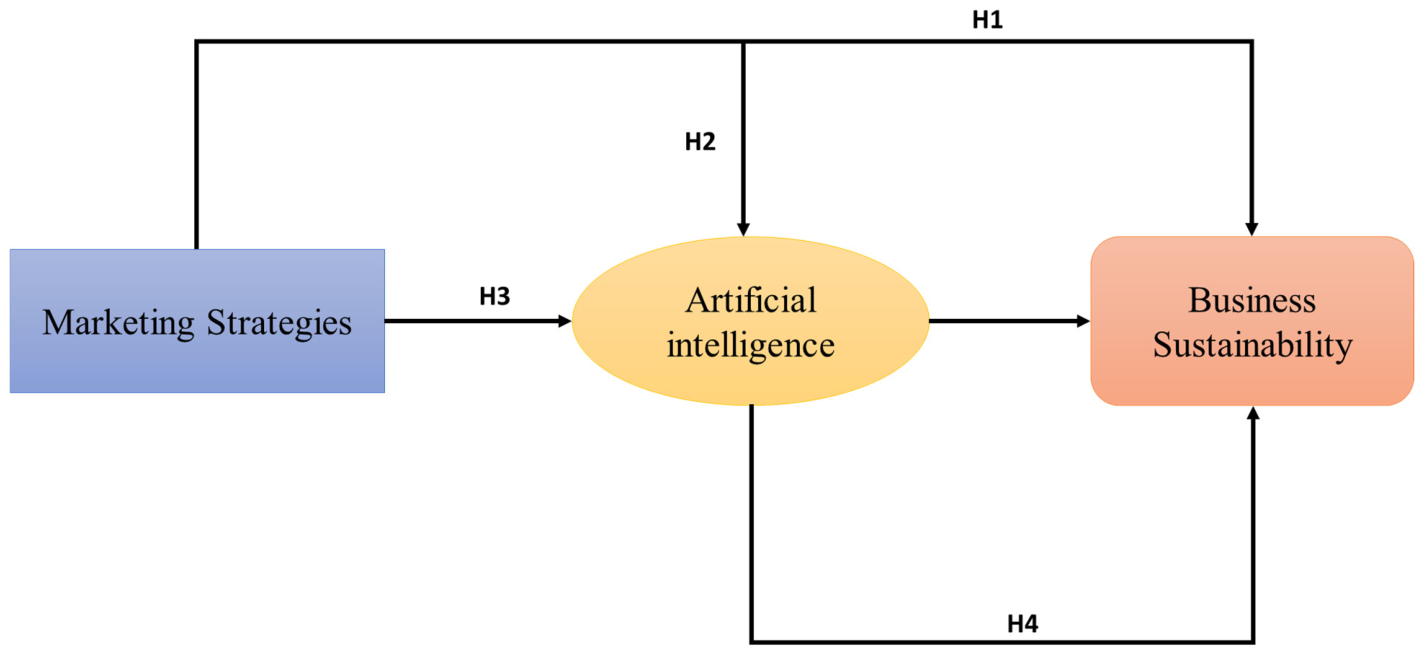
To visually represent these relationships, a conceptual model is introduced, theorizes how Marketing strategies directly and indirectly associate business sustainability through AI. This model integrates insights from the existing literature, aligning theoretical frameworks with empirical findings. The diagram in Figure 1 illustrates the relationship between marketing strategies, AI, and business sustainability through the four key hypotheses.

3. Methodology

The study aims to examine the role of AI in the mediation of MS and BS in the corporate environment of Nablus. The section provides an overview of the study design, population, sampling, data collection methods, and analysis.

3.1. Study Design

The empirical design aims to test the proposed theoretical relationships using SPSS v 25, Process macro v 4.3 and AMOS v 24, allowing the study to provide empirical substantiation for the theoretical relationships between marketing strategies, artificial intelligence, and business sustainability. A survey was conducted to collect the required data from employees of different organizations in Nablus. The survey was conducted from June 2025 to August 2025. The study design was adopted for its ability to collect large amounts of data from a large population in a single study, thus allowing the testing of the relationships.

3.2. Population and Sampling

The population of this study consists of employees working in small and medium-sized enterprises (SMEs) operating in the Nablus governorate. According to reports based on data from the Palestinian Central Bureau of Statistics (PCBS), Nablus hosts approximately 15,987 economic establishments, the majority of which are micro and small enterprises. SMEs are estimated to represent roughly 10% of these establishments, indicating that more than 1500 SMEs operate in the governorate across sectors such as trade, services, and manufacturing. These enterprises play a central role in employment generation and local economic activity, making them an appropriate context for examining the role of artificial intelligence in marketing strategies and business sustainability. In the Palestinian context, enterprises are commonly classified according to the number of employees, including micro enterprises (1–4 employees), small enterprises (5–19 employees), and medium enterprises (20–49 employees) [75,76,77]. SMEs therefore constitute a significant component of economic activity and employment in the region. The study employed a convenience sampling design. Convenience sampling was adopted for its ability to allow the study to collect large amounts of data from a diverse population of companies in the region. The study was able to collect the required information from employees of different levels in the companies, ranging from HR managers to operational managers. The study was limited in terms of the generalization of the findings. However, the study was appropriate for the purpose of the study since it aimed to collect information from employees working in the different companies in the region. The employees are the only people who have the necessary information about the marketing strategies of the companies. The minimum required sample size for this study was calculated using the widely applied sample size formula proposed by [78], which suggested an ideal sample size of 384 respondents for large populations. To ensure an adequate number of responses, 400 questionnaires were distributed to employees working in SMEs in the Nablus governorate. After the data collection process, 373 valid questionnaires were returned and retained for the final analysis, while the remaining questionnaires were excluded due to incomplete responses. The final sample therefore consisted of 373 respondents, representing a response rate of approximately 93%, which is considered acceptable for survey-based research.

3.3. Study Instruments

This study relies on self-reported survey data collected from SME employees and managers. The use of perceptual measures is consistent with prior research in this field, particularly in contexts where access to objective financial data is limited. In the case of Palestinian SMEs, obtaining reliable financial records is often constrained by confidentiality concerns and inconsistent reporting practices. Therefore, subjective assessments were considered an appropriate and feasible approach for capturing organizational performance and AI adoption. Furthermore, the survey items were adapted from established and validated scales in the literature to enhance the reliability and validity of the measurements. A questionnaire based on theoretical constructs and existing measurement data was used in the study. To measure the opinions of the study’s participants on MS, AI, and BS, a five-point Likert scale ranging from 1, or “strongly disagree,” to 5, or “strongly agree,” was utilized. The middle value of the scale is neutral and balanced, which makes the results more accurate. The questionnaire was sent to the study’s participants through direct and online methods, depending on their accessibility. Direct methods were used for bank personnel, who might not be easily reached through online means.
As mentioned in Table 1, the questionnaire asked the study’s participants to provide information on five demographic variables, including gender, age, position, experience, and educational attainment. The sample size of the study consisted of 373 participants, mostly males, or 70.5%, while female participants accounted for 29.5%. According to the study, the majority of the participants, or 31.9%, were aged between 30–34, followed by 23.1%, or those aged 35–39, and 22%, or those aged 25–29. Only 6.2% were over 50 years old. According to the study, the majority, or 88.5%, of the study’s participants held an undergraduate degree, while 11.5% held a postgraduate qualification. According to the study, the majority, or 34%, of the study’s participants had 5–9 years of professional experience, followed by 24.4%, or those with 10–14 years, and 20.9%, or those with 1–4 years. Only a few participants had less than one year or more than 20 years of professional experience. According to the study, the majority, or 60.9%, of the study’s participants were non-manager staff, followed by general managers, or 37%. According to the study, the majority, or 46.9%, of the study’s participants came from the Marketing sector.
Cronbach’s alpha values were 0.790 for the eight MS items created by [79] 0.855 for the seven items of SMM created by [79], 0.752 for the six items of CM created by [79], 0.931 for the seven items of AI created by [79], and 0.915 for the eight items of BS created by [80]. Cronbach’s alpha for the 36 total components was 0.744. According to [81], for a study to be recognized as valid, its Cronbach’s alpha needs to be at least 0.7. This demonstrates the reliability of every variable employed in this study.

3.4. Data Analysis Procedures

After completion of data collection, the responses were processed and prepared for analysis. Missing values were handled by mean imputation or excluded when applicable. Descriptive statistics were used for summarizing sample demographics and response distribution. Data analysis methods used for this study included SPSS v25 for descriptive statistics and initial correlations, AMOS v24 for confirmatory factor analysis (CFA) and SEM, and PROCESS macro v4.3 [82] for analyzing indirect effects in accordance with proposed mediation models. Before analyzing structural relationships, the measurement model was tested for convergent validity, discriminant validity, and reliability. Evaluation was done based on factors like factor loadings, average variance extracted (AVE), and composite reliability (CR).

4. Results

4.1. Factor Analysis

It is possible to identify relationships between the measured variables and reduce their dimensionality using exploratory factor analysis (EFA) [83]. Factors were extracted using principal components analysis (PCA), and Promax rotation using Kaiser normalization was applied. As suggested in [81], only those items were retained that had loadings of at least 0.4 on one factor. Bartlett’s Test of Sphericity was significant at p < 0.05, and the Kaiser-Meyer-Olkin measure was 0.788, which is sufficient for factor analysis [84].
Before analyzing the data, we checked for potential biases. Using Harman’s single-factor test in SPSS v25 [85,86], an exploratory factor analysis of all measurement items showed that the first factor accounted for only 19.78% of the total variance, well below the 50% threshold, indicating that common method bias is unlikely to affect the results. Exploratory Factor Analysis (EFA) using Principal Component Analysis with Promax rotation identified five distinct factors, which together accounted for 65.85% of the total variance. The first factor explained 24.06% of the variance, followed by 12.94%, 11.17%, 9.79%, and 7.89% for Factors 2 to 5, respectively. All items loaded strongly on their respective constructs, with loading values ranging from 0.574 to 0.947. Items with low or cross-loadings were removed to ensure construct validity. The results of the exploratory factor analysis are shown in Table 2.

4.2. Confirmatory Factor Analysis

To validate the measurement set, confirmatory factor analysis was carried out to ensure the unidimensionality of the identified constructs. This was done by confirming the measurement set, which is a single latent dimension. The results were generated by utilizing AMOS software, version 24. Convergent validity was carried out to ensure the validity of the study. According to the literature, factor loadings can be used to test the convergent validity of the study, as suggested by [81,87]. Additionally, it is recommended by the same authors that the value of composite reliability should be 0.6 or higher, and the average variance extracted should be 0.5 or higher to ensure the validity of the study, as suggested by [87]. Table 3 shows the results obtained for the CFA, confirming the validity of the identified constructs, which are also reliable.
Furthermore, the study utilized the AMOS software, version 24, to test the model fitness, as demonstrated in Table 4, according to the standards set by [88], There are six model fitness indicators, which are the Chi-square value divided by the number of freedom degrees, the comparative fitness index, the normed fitness index, the incremental fitness index, the root mean square error approximation, and the standardized root mean square residual. For this study, the value of CMIN/DF was 2.402, which is within the required benchmark, as suggested by [89]. Additionally, the CFI, the NFI, and the IFI were 0.954, 0.924, and 0.957, respectively, which is close to 0.9, according to the standards set by [90,91,92]. The value of the root means square error approximation was 0.059, while the value of the standardized root mean square residual was 0.072, which is within the benchmark requirements.
To verify construct validity, the authors also performed a discriminant validity test. Statistical tests were created to determine whether the correlation between two constructs is statistically substantially smaller than unity to evaluate discriminant validity, according to [93]. The discriminant validity test is summarized in Table 5.

4.3. Hypothesis Testing

Table 6 presents the results of the hypothesis testing carried out in this study. The findings show that MS had a significant positive effect on BS (H1: R2 = 0.323, F = 177.008, p = 0.000, β = 0.387). Social Media Marketing (SMM) also significantly contributed to BS (H1a: R2 = 0.256, F = 127.567, p = 0.000, β = 0.206), while Content Marketing (CM) exhibited a particularly strong influence (H1b: R2 = 0.656, F = 706.212, p = 0.000, β = 0.953). In addition, MS showed a significant impact on Artificial Intelligence (AI) (H2: R2 = 0.457, F = 312.299, p = 0.000, β = 0.305). It should be noted that AI adoption is measured at an aggregate level and does not distinguish between specific applications (e.g., chatbots, predictive analytics, or automation tools). Consequently, the findings reflect overall patterns of AI usage rather than the effects of individual technologies. SMM (H2a: R2 = 0.402, F = 249.206, p = 0.000, β = 0.171) and CM (H2b: R2 = 0.580, F = 512.358, p = 0.000, β = 0.593) also demonstrate significant effects on AI. The mediation results further revealed that MS positively influenced BS through AI (H3: R2 = 0.5928, F = 269.295, p = 0.000, β = 1.066), with similar indirect effects observed for both SMM (H3a: R2 = 0.5888, F = 264.944, p = 0.000, β = 1.128) and CM (H3b: R2 = 0.7094, F = 451.565, p = 0.000, β = 0.5411). Additionally, AI itself had a strong and significant direct effect on BS (H4: R2 = 0.588, F = 529.923, p = 0.000, β = 1.160). Overall, these findings support all proposed hypotheses, highlighting robust predictive relationships among MS, SMM, CM, AI, and BS in line with the criteria specified in [94].

5. Discussion

This section interprets the empirical findings in light of the proposed hypotheses and existing literature, focusing on the relationships among marketing strategies, artificial intelligence (AI), and business sustainability (BS) in SMEs. The results presented in Table 6 provide comprehensive support for all hypotheses (H1–H4), highlighting significant direct and indirect effects among the studied variables. In particular, the findings emphasize the differential roles of social media marketing (SMM) and content marketing (CM), as well as the critical mediating and direct contributions of AI in enhancing sustainability outcomes.
The findings should be interpreted with caution, as they reflect perceived rather than objectively measured organizational outcomes. While the results suggest a positive association between AI adoption and firm performance, the absence of objective performance data limits the ability to draw strong causal conclusions. Therefore, the results are better understood as indicative of perceived benefits rather than definitive evidence of performance improvements.
The findings support H1, indicating that marketing strategies have a significant positive effect on business sustainability (β = 0.387, R2 = 0.323, p < 0.001). Both SMM (β = 0.206, R2 = 0.256) and CM (β = 0.953, R2 = 0.656) demonstrate significant positive relationships with BS, with CM exhibiting a substantially stronger impact. These results indicate that while SMM contributes to customer engagement and brand visibility, CM plays a more critical role in driving long-term sustainability through value creation, trust building, and high-quality information. The higher explanatory power of CM suggests that SMEs benefit more from strategies emphasizing credibility and knowledge sharing rather than short-term promotional activities [95,96]. To strengthen this relationship, SMEs should prioritize the development of high-quality, consistent, and customer-oriented content that addresses customer needs and reduces uncertainty. Social media should be strategically used as a distribution channel for valuable content rather than as a standalone marketing approach. Firms are encouraged to adopt long-term content strategies focused on education, storytelling, and relationship building to enhance customer loyalty and sustainability outcomes.
Consistent with H2, the results show that marketing strategies significantly influence AI adoption (β = 0.305, R2 = 0.457, p < 0.001). CM (β = 0.593, R2 = 0.580) has a stronger effect on AI adoption than SMM (β = 0.171, R2 = 0.402), suggesting that content-driven strategies are more likely to motivate firms to implement AI technologies. Content marketing often requires advanced tools for personalization, analytics, and performance optimization, which explains the stronger effect. The relatively high explanatory power underscores the role of marketing orientation in shaping technological readiness in SMEs [43,97]. To enhance AI adoption, firms should invest in digital infrastructure and build internal capabilities in data analytics and AI applications. Training employees and integrating AI tools into marketing processes—such as customer segmentation, predictive analytics, and automated content delivery—can significantly improve effectiveness. Aligning marketing strategies with technological innovation allows SMEs to transition from traditional practices to more data-driven and intelligent systems.
The analysis further confirms H3, demonstrating that AI significantly mediates the relationship between marketing strategies and business sustainability (β = 1.066, R2 = 0.5928, p < 0.001). The mediation effect is evident for both SMM (β = 1.128, R2 = 0.5888) and CM (β = 0.5411, R2 = 0.7094), indicating that AI enhances the effectiveness of marketing strategies in achieving sustainability outcomes. Notably, the stronger mediation effect observed for SMM indicates that AI is particularly important in enhancing strategies that have a relatively weaker direct impact on sustainability. This highlights AI’s role as a value-enhancing mechanism that improves targeting, efficiency, and responsiveness in marketing activities [7]. To maximize this mediating effect, firms should integrate AI technologies into marketing processes strategically, using tools for customer insights, personalization, and campaign optimization. Ensuring alignment between AI capabilities and marketing objectives is essential to translate technological investments into sustainable business value.
Evidence also supports H4, confirming that AI has a strong and significant direct effect on business sustainability (β = 1.160, R2 = 0.588, p < 0.001). This indicates that AI is not only a mediating mechanism but also an independent driver of sustainability. By enabling better decision-making, operational efficiency, and enhanced customer engagement, AI contributes directly to long-term business performance and resilience. The relatively high explanatory power emphasizes the strategic importance of AI in contemporary business environments [98,99]. To fully leverage these benefits, SMEs should adopt a comprehensive approach that integrates AI into core business functions rather than limiting its use to isolated applications. Investments in data infrastructure, automation technologies, and AI-driven decision-support systems are essential. Furthermore, firms should develop long-term AI strategies aligned with sustainability objectives to ensure continuous improvement and sustained competitive advantage.
Overall, the findings suggest that achieving sustainability in SMEs requires the strategic integration of marketing capabilities with AI technologies. AI-enabled content marketing emerges as the most effective pathway for enhancing long-term business sustainability, combining value creation, customer trust, and data-driven efficiency.
This study focuses specifically on the economic dimension of sustainability, given its critical importance for SME survival and competitiveness in emerging and resource-constrained environments. While environmental and social dimensions are also relevant, they are beyond the scope of the present analysis and are not empirically examined.

5.1. Theoretical Implication

This research has a number of theoretical implications for the digital marketing, AI, and BS literatures. First, the current research contributes to the theoretical development of these fields by validating a unified conceptual model of marketing strategies, social media marketing, content marketing, and AI, and by exploring these constructs simultaneously. This is particularly relevant in response to recent calls for the development of more integrative models of digital marketing and technology, which can account for the combined and interactive effects of these constructs on BS. The study responds to growing suggestions in the literature that digital marketing research should adopt more interdisciplinary and holistic approaches [16].
The current research also contributes to the theoretical development of the marketing and technology adoption literature by revealing the mediating role of AI in enhancing the sustainability benefits of marketing strategies. The study makes a significant theoretical contribution by showing that, rather than being merely a technological device that marketers use, artificial intelligence (AI) actually serves a strategic mediating function that increases the overall value of marketing activities. The research found that, indeed, the value of AI stems from its association with significant marketing activities, with content marketing being a key mediator, thereby supporting technology adoption theory and technology value creation theory.
The research also makes a significant contribution to the burgeoning research on digital economies by exploring the role of AI within the Palestinian context, a context that has been somewhat neglected within digital marketing and AI research. The research found that, even within a resource-constrained environment, AI could play a pivotal role in enhancing the overall value of marketing strategies, providing sustainability, and extending the external validity of existing theory, which has been developed and tested within a developed economy context.

5.2. Practical Implications

From a practical perspective, the research provides several explicit implications that could help organizations enhance long-run sustainability, particularly within a digital marketing context. The results suggest that, rather than focusing on raising the overall level of marketing activity, organizations could enhance sustainability by focusing on content marketing, particularly by providing high-quality content that has real value to consumers. This is consistent with earlier studies showing that high-quality and meaningful content helps build customer engagement, fosters trust, and supports long-term relationships with customers [100].
Furthermore, the importance of AI also points to the importance of including AI-based solutions in marketing strategies. Organizations can capitalize on this in various ways to improve the efficiency and effectiveness of their marketing strategies, which is particularly important for small and medium-sized enterprises (SMEs) in Nablus, considering their financial and operational constraints in managing their scarce resources. By employing various marketing strategies that include AI-based solutions, SMEs in Nablus would be able to improve the efficiency and effectiveness of their marketing strategies, hence increasing their sustainability.

5.3. Managerial Implications

The results also have various implications for managers and decision-makers. Managers should ensure that they align their marketing strategies with other digital marketing and digital transformation strategies. Sustainability is achieved through successful integration and not through successful strategies. Managers should also ensure that they promote interdepartmental collaboration and interaction among various departments, including the marketing, information technology, and data analytics departments, to realize the full potential of various marketing strategies that include AI-based solutions.
Managers should also invest in human capital and promote an organizational culture that is innovative and supports experimentation and implementation of various marketing strategies that include AI-based solutions.
Managers, particularly those in SMEs in Nablus, are encouraged to invest in appropriate technological infrastructure. Customer relationship management systems are necessary to incorporate marketing strategies incorporating AI solutions. Technological infrastructure is the foundation on which to base digital marketing strategies to ensure long-run viability and competitive advantage. These recommendations are consistent with prior research on digital transformation, which highlights that successfully leveraging digital technologies depends on aligning strategies, developing organizational capabilities, and promoting collaboration across different functions [101].

6. Conclusions

This study aimed to examine the relationships between marketing strategies—including social media marketing and content marketing—and BS, with AI acting as a mediator. The findings indicate that marketing strategies are positively associated with BS, highlighting the relevance of digital marketing approaches for enhancing sustainable business performance in organizations. Among the strategies considered, content marketing emerged as the most influential factor associated with BS, suggesting that organizations seeking sustainable outcomes may benefit from prioritizing content-driven marketing initiatives.
The study also finds that AI plays a supportive mediating role in the relationship between marketing strategies and BS. Specifically, the strategic integration of AI can enhance the effectiveness of marketing strategies, improve decision-making, and ultimately strengthen sustainability outcomes. These results contribute to the literature by emphasizing the significance of AI in marketing practices, particularly within the context of SMEs in the emerging economy of Nablus.
From a practical standpoint, SMEs can leverage AI-driven marketing strategies to maximize their sustainability impact. By aligning content and social media marketing efforts with AI technologies, firms may achieve greater efficiency, effectiveness, and long-term sustainable performance.

7. Limitations and Future Studies

Despite its contributions, this study has several limitations that warrant consideration. First, the research focuses exclusively on SMEs in Nablus, providing valuable context-specific insights but potentially limiting the generalizability of the findings to other regions, cities, or countries with different economic, technological, or AI adoption environments. Future research should test the robustness of these findings across diverse contexts. Second, the study employs a cross-sectional design with data collected at a single point in time, which constrains understanding of the dynamic effects of AI adoption and marketing strategies on business sustainability (BS). Longitudinal studies are recommended to capture these relationships over time, particularly in rapidly evolving technological environments. Third, this research primarily examines the economic dimension of BS. Future studies could extend this work to incorporate environmental and social sustainability outcomes, as well as their integration within corporate governance frameworks, in order to provide a more comprehensive understanding of sustainable business practices. Fourth, the study relies on self-reported survey data, which may introduce perceptual bias, social desirability effects, and potential overestimation of AI’s effectiveness. To address this limitation, future research should incorporate multi-source and objective measures, such as financial performance indicators, operational metrics, and managerial or customer perspectives, to validate findings and enhance the robustness of results. Finally, while this study considers AI at a general level, it does not differentiate among specific AI applications (e.g., predictive analytics, chatbots, or automated content generation), which may have varying effects on marketing strategies and business sustainability. Future research is encouraged to examine which AI tools are most prevalent and effective in enhancing sustainable business performance. Addressing these limitations—particularly by incorporating environmental and social dimensions, governance contexts, and more granular AI measurement—would strengthen the evidence on the interplay between AI, marketing strategies, and business sustainability, and provide more actionable insights for SMEs navigating digital transformation in emerging economies.

Author Contributions

Conceptualization, O.T. and L.T.; methodology, O.T. and L.T.; data collection, O.T.; analysis, O.T. and L.T.; writing—original draft preparation, O.T.; writing—review and editing, O.T. and L.T.; supervision, L.T. All authors have read and agreed to the published version of the manuscript.

Funding

This research received no external funding.

Institutional Review Board Statement

This study the impact of AI on marketing strategies and business sustainability was conducted in accordance with the Declaration of Helsinki and approved by the ethics committee of Near East University (NEU/SS/2025/2024, 3 December 2025).

Informed Consent Statement

Informed consent was obtained from all subjects involved in the study.

Data Availability Statement

The original contributions presented in the study are included in the article; further inquiries can be directed to the corresponding author.

Acknowledgments

This work is based on the first author’s doctoral dissertation, titled “The impact of AI on Marketing strategies and business sustainability “The planned submission date is June 2026. The dissertation supervisor is the second author of this work.

Conflicts of Interest

The authors declare no conflicts of interest.

References

  1. Daugherty, P.R.; Wilson, H.J. Human + Machine: Reimagining Work in the Age of AI; Harvard Business Press: Boston, MA, USA, 2018. [Google Scholar]
  2. Supriadi, A. The Impact of Artificial Intelligence (AI) on Marketing Strategy. Manag. Stud. Bus. J. (Product.) 2024, 1, 146–153. [Google Scholar] [CrossRef]
  3. Noble, S.M.; Mende, M. The future of artificial intelligence and robotics in the retail and service sector: Sketching the field of consumer-robot experiences. J. Acad. Mark. Sci. 2023, 51, 747–756. [Google Scholar] [CrossRef]
  4. Haleem, A.; Javaid, M.; Qadri, M.A.; Singh, R.P.; Suman, R. Artificial intelligence (AI) applications for marketing: A literature-based study. Int. J. Intell. Netw. 2022, 3, 119–132. [Google Scholar] [CrossRef]
  5. Verma, S.; Sharma, R.; Deb, S.; Maitra, D. Artificial intelligence in marketing: Systematic review and future research direction. Int. J. Inf. Manag. Data Insights 2021, 1, 100002. [Google Scholar] [CrossRef]
  6. Kumar, V.; Ashraf, A.R.; Nadeem, W. AI-powered marketing: What, where, and how? Int. J. Inf. Manag. 2024, 77, 102783. [Google Scholar] [CrossRef]
  7. Davenport, T.; Guha, A.; Grewal, D.; Bressgott, T. How artificial intelligence will change the future of marketing. J. Acad. Mark. Sci. 2020, 48, 24–42. [Google Scholar] [CrossRef]
  8. Chui, M.; Manyika, J.; Miremadi, M.; Henke, N.; Chung, R.; Nel, P.; Malhotra, S. Notes from the AI Frontier: Applications and Value of Deep Learning. 2018. Available online: https://www.mckinsey.com/featured-insights/artificial-intelligence/notes-from-the-ai-frontier-applications-and-value-of-deep-learning (accessed on 18 February 2026).
  9. Salah, O.H.; Yusof, Z.M.; Mohamed, H. The determinant factors for the adoption of CRM in the Palestinian SMEs: The moderating effect of firm size. PLoS ONE 2021, 16, e0243355. [Google Scholar] [CrossRef] [PubMed]
  10. Mujahed, H.M.H.; Ahmed, E.M.; Samikon, S.A. Palestinian small and medium enterprises digital technology adoption intention. J. Open Innov. Technol. Mark. Complex. 2024, 10, 100426. [Google Scholar] [CrossRef]
  11. Balcioglu, Y.S.; Celik, A.A.; Altindag, E. Artificial intelligence integration in sustainable business practices: A text mining analysis of USA firms. Sustainability 2024, 16, 6334. [Google Scholar] [CrossRef]
  12. Akhtar, P.; Frynas, J.G.; Mellahi, K.; Ullah, S. Big data-savvy teams’ skills, big data-driven actions and business performance. Br. J. Manag. 2019, 30, 252–271. [Google Scholar] [CrossRef]
  13. Zaki, M. Digital transformation: Harnessing digital technologies for the next generation of services. J. Serv. Mark. 2019, 33, 429–435. [Google Scholar] [CrossRef]
  14. Bhattacharya, P. Guarding the intelligent enterprise: Securing artificial intelligence in making business decisions. In Proceedings of the 6th International Conference on Information Management (ICIM); IEEE: New York, NY, USA, 2020; pp. 235–238. [Google Scholar]
  15. Pappas, I.O.; Mikalef, P.; Giannakos, M.N.; Krogstie, J.; Lekakos, G. Big data and business analytics ecosystems: Paving the way towards digital transformation and sustainable societies. Inf. Syst. e-Bus. Manag. 2018, 16, 479–491. [Google Scholar] [CrossRef]
  16. Chintalapati, S.; Pandey, S.K. Artificial intelligence in marketing: A systematic literature review. Int. J. Mark. Res. 2022, 64, 38–68. [Google Scholar] [CrossRef]
  17. Ziakis, C.; Vlachopoulou, M. Artificial intelligence in digital marketing: Insights from a comprehensive review. Information 2023, 14, 664. [Google Scholar] [CrossRef]
  18. Wilson, G.; Johnson, O.; Brown, W. The impact of artificial intelligence on digital marketing strategies. J. Digit. Mark. 2024, 15, 112–128. [Google Scholar]
  19. Gentsch, P. AI in Marketing, Sales and Service: How Marketers Without a Data Science Degree Can Use AI, Big Data and Bots; Springer: Berlin/Heidelberg, Germany, 2018. [Google Scholar]
  20. Jarek, K.; Mazurek, G. Marketing and artificial intelligence. Cent. Eur. Bus. Rev. 2019, 8, 46–55. [Google Scholar] [CrossRef]
  21. Sipola, J.; Saunila, M.; Ukko, J. Adopting artificial intelligence in sustainable business. J. Clean. Prod. 2023, 426, 139197. [Google Scholar] [CrossRef]
  22. Li, J.; Jin, X. The impact of artificial intelligence adoption intensity on corporate sustainability performance: The moderated mediation effect of organizational change. Sustainability 2024, 16, 9350. [Google Scholar] [CrossRef]
  23. Awwad, A.S.; Ababneh, O.M.A.; Karasneh, M. The mediating impact of IT capabilities on the association between dynamic capabilities and organizational agility: The case of the Jordanian IT sector. Glob. J. Flex. Syst. Manag. 2022, 23, 315–330. [Google Scholar] [CrossRef]
  24. Yu, J.; Moon, T. Impact of digital strategic orientation on organizational performance through digital competence. Sustainability 2021, 13, 9766. [Google Scholar] [CrossRef]
  25. Elkington, J.; Rowlands, I.H. Cannibals with forks: The triple bottom line of 21st century business. Altern. J. 1999, 25, 42. [Google Scholar] [CrossRef]
  26. Dyllick, T.; Hockerts, K. Beyond the business case for corporate sustainability. Bus. Strategy Environ. 2002, 11, 130–141. [Google Scholar] [CrossRef]
  27. Ayoubi, H.; Tabaa, Y. Artificial intelligence in green management and the rise of digital lean for sustainable efficiency. E3S Web Conf. 2023, 412, 01053. [Google Scholar] [CrossRef]
  28. Rohde, F.; Wagner, J.; Meyer, A.; Reinhard, P.; Voss, M.; Petschow, U. Broadening the perspective for sustainable AI: Comprehensive sustainability criteria and indicators for AI systems. arXiv 2023, arXiv:2306.13686. [Google Scholar] [CrossRef]
  29. Mikalef, P.; Gupta, M. Artificial intelligence capability: Conceptualization, measurement calibration, and empirical study on its impact on organizational creativity and firm performance. Inf. Manag. 2021, 58, 103434. [Google Scholar] [CrossRef]
  30. Canhoto, A.I.; Clear, F. Artificial intelligence and machine learning as business tools: A framework for diagnosing value destruction potential. Bus. Horiz. 2020, 63, 183–193. [Google Scholar] [CrossRef]
  31. Tauheed, J.; Shabbir, A.; Pervez, M.S. Exploring the role of artificial intelligence in digital marketing strategies. J. Bus. Commun. Technol. 2024, 3, 54–65. [Google Scholar] [CrossRef]
  32. Haenlein, M.; Kaplan, A. A brief history of artificial intelligence: On the past, present, and future of artificial intelligence. Calif. Manag. Rev. 2019, 61, 5–14. [Google Scholar] [CrossRef]
  33. Han, R.; Lam, H.K.; Zhan, Y.; Wang, Y.; Dwivedi, Y.K.; Tan, H.K. Artificial intelligence in business-to-business marketing: A bibliometric analysis of current research status, development and future directions. Ind. Manag. Data Syst. 2021, 121, 2467–2497. [Google Scholar] [CrossRef]
  34. Polisetty, A.; Chakraborty, D.; Sowmya, G.; Kar, A.K.; Pahari, S. What determines AI adoption in companies? Mixed-method evidence. J. Comput. Inf. Syst. 2023, 64, 370–387. [Google Scholar] [CrossRef]
  35. Alwadain, A.; Fati, S.M.; Ali, K.; Ali, R.F. From theory to practice: An integrated TTF-UTAUT study on electric vehicle adoption behavior. PLoS ONE 2024, 19, e0297890. [Google Scholar] [CrossRef]
  36. Islam, A.; Islam, M.A.; Dal Mas, F.; Fijalkowska, J.; Rahman, M.; Massaro, M. Configuring AI-guided sustainable competitive advantage for SMEs through business model innovation: A systematic literature review approach. J. Eng. Technol. Manag. 2025, 78, 101921. [Google Scholar] [CrossRef]
  37. Mariyana, A.L.D.; Annaufal, A.I.; Roostika, R. The impact of artificial intelligence on small and medium enterprises in Yogyakarta. In Digital Technology and Changing Roles in Managerial and Financial Accounting: Theoretical Knowledge and Practical Application; Emerald Publishing Limited: Bradford, UK, 2024; pp. 347–354. [Google Scholar] [CrossRef]
  38. Acatrinei, C.; Apostol, I.G.; Barbu, L.N.; Orzan, M.C. Artificial intelligence in digital marketing: Enhancing consumer engagement and supporting sustainable behavior through social and mobile networks. Sustainability 2025, 17, 6638. [Google Scholar] [CrossRef]
  39. Mkwizu, K.H. Digital marketing and tourism: Opportunities for Africa. Int. Hosp. Rev. 2020, 34, 5–12. [Google Scholar] [CrossRef]
  40. Sundqvist, B.; Ohanisian, J. Utilization of AI in digital marketing: An empirical study of artificial intelligence and the impact of effectiveness, ethics and regulations. In Managing Customer-Centric Strategies in the Digital Landscape; IGI Global: Hershey, PA, USA, 2023. [Google Scholar]
  41. Demirag, F. The impact of AI-supported marketing capabilities and analytics on SMEs’ customer agility and marketing performance. Int. J. Soc. Sci. Educ. Res. 2024, 11, 1–14. [Google Scholar] [CrossRef]
  42. Shukla, A.; Varshney, J.; Raj, A. Examining the linkage between managerial ties and firm performance: The mediating role of marketing capabilities and moderation role of industry—A meta-analytic approach. Ind. Mark. Manag. 2024, 119, 122–134. [Google Scholar] [CrossRef]
  43. Gündüzyeli, B. Artificial Intelligence in Digital Marketing Within the Framework of Sustainable Management. Sustainability 2024, 16, 10511. [Google Scholar] [CrossRef]
  44. Raji, M.A.; Olodo, H.B.; Oke, T.T.; Addy, W.A.; Ofodile, O.C.; Oyewole, A.T. Digital marketing in tourism: A review of practices in the USA and Africa. Int. J. Appl. Res. Soc. Sci. 2024, 6, 393–408. [Google Scholar] [CrossRef]
  45. Daniel, C.O. Effects of marketing strategies on organizational performance. Int. J. Bus. Mark. Manag. 2018, 3, 1–9. [Google Scholar]
  46. Joensuu-Salo, S.; Sorama, K.; Viljamaa, A.; Varamäki, E. Firm performance among internationalized SMEs: The interplay of market orientation, marketing capability and digitalization. Adm. Sci. 2018, 8, 31. [Google Scholar] [CrossRef]
  47. Yuan, X.N.; Shin, S.M.; He, X.; Kim, S.Y. Innovation capability, marketing capability and firm performance: A two-nation study of China and Korea. Asian Bus. Manag. 2016, 15, 32–56. [Google Scholar] [CrossRef]
  48. Purnama, S.; Baedowi, H.; Putrasetia, Y.J. Creative industry development strategy for home culinary businesses. Startupreneur Bus. Digit. (SABDA J.) 2023, 2, 126–135. [Google Scholar] [CrossRef]
  49. Koswara, A. Exploring How AI-Powered Chatbots Enhance Data-Driven Marketing Communication and Customer Engagement. South Sight J. Media Soc. Inq. 2025, 1, 25–37. [Google Scholar] [CrossRef]
  50. Khamoushi, E. AI in Food Marketing from Personalized Recommendations to Predictive Analytics: Comparing Traditional Advertising Techniques with AI-Driven Strategies. arXiv 2024, arXiv:2410.01815. [Google Scholar] [CrossRef]
  51. Dave, T.; Mariyankari, P. Chatbots, Recommendation Engines, and Beyond: Mapping the AI Toolkit in Contemporary Digital Marketing. AEIDA J. Multidiscip. Stud. 2024, 1, 25–31. [Google Scholar]
  52. Kshetri, N.; Dwivedi, Y.K.; Davenport, T.H.; Panteli, N. Generative artificial intelligence in marketing: Applications, opportunities, challenges, and research agenda. Int. J. Inf. Manag. 2024, 75, 102716. [Google Scholar] [CrossRef]
  53. Sivarajah, U.; Irani, Z.; Gupta, S.; Mahroof, K.J. Role of big data and social media analytics for business-to-business sustainability: A participatory web context. Ind. Mark. Manag. 2020, 86, 163–179. [Google Scholar] [CrossRef]
  54. Patma, T.S.; Wardana, L.W.; Wibowo, A.; Narmaditya, B.S.; Akbarina, F. The impact of social media marketing for Indonesian SMEs sustainability: Lesson from Covid-19 pandemic. Cogent Bus. Manag. 2021, 8, 1953679. [Google Scholar] [CrossRef]
  55. Jung, S.U.; Shegai, V. The impact of digital marketing innovation on firm performance: Mediation by marketing capability and moderation by firm size. Sustainability 2023, 15, 5711. [Google Scholar] [CrossRef]
  56. Sharabati, A.A.A.; Ali, A.A.A.; Allahham, M.I.; Hussein, A.A.; Alheet, A.F.; Mohammad, A.S. The impact of digital marketing on the performance of SMEs: An analytical study in light of modern digital transformations. Sustainability 2024, 16, 8667. [Google Scholar] [CrossRef]
  57. Lopes, A.R.; Casais, B. Digital content marketing: Conceptual review and recommendations for practitioners. Acad. Strateg. Manag. J. 2022, 21, 1–17. [Google Scholar]
  58. Lou, C.; Xie, Q. Something social, something entertaining? How digital content marketing augments consumer experience and brand loyalty. Int. J. Advert. 2021, 40, 376–402. [Google Scholar] [CrossRef]
  59. Prawira, L.H.A.P.; Ummah, A.F.; Aditiya, M.R.; Nugroho, D.W. Knowledge management: Efforts to create an excellent digital creative industry. Startupreneur Bus. Digit. (SABDA J.) 2023, 2, 172–181. [Google Scholar] [CrossRef]
  60. Al-Khasawneh, M.; Sharabati, A.A.A.; Al-Haddad, S.; Tbakhi, R.; Abusaimeh, H. The adoption of TikTok application using TAM model. Int. J. Data Netw. Sci. 2022, 6, 1389–1402. [Google Scholar] [CrossRef]
  61. Huang, M.-H.; Rust, R.T. A strategic framework for artificial intelligence in marketing. J. Acad. Mark. Sci. 2021, 49, 30–50. [Google Scholar] [CrossRef]
  62. Allioui, H.; Mourdi, Y. Unleashing the potential of AI: Investigating cutting-edge technologies that are transforming businesses. Int. J. Comput. Eng. Data Sci. 2023, 3, 1–12. [Google Scholar]
  63. Potwora, M.; Vdovichena, O.; Semchuk, D.; Lipych, L.; Saienko, V. The use of artificial intelligence in marketing strategies: Automation, personalization and forecasting. J. Manag. World 2024, 2, 41–49. [Google Scholar] [CrossRef]
  64. Basri, W. Examining the impact of artificial intelligence (AI)-assisted social media marketing on the performance of small and medium enterprises: Toward effective business management in the Saudi Arabian context. Int. J. Comput. Intell. Syst. 2020, 13, 142–152. [Google Scholar] [CrossRef]
  65. Benabdelouahed, R.; Dakouan, C. The use of artificial intelligence in social media: Opportunities and perspectives. Expert J. Mark. 2020, 8, 82–87. [Google Scholar]
  66. Campbell, C.; Farrell, J.R. More than meets the eye: The functional components underlying influencer marketing. Bus. Horiz. 2020, 63, 469–479. [Google Scholar] [CrossRef]
  67. Korsunova, K. Artificial intelligence in content marketing: Shaping the future of digital strategy. J. Strateg. Econ. Res. 2024, 1, 78–84. [Google Scholar]
  68. Kose, U.; Sert, S. Improving content marketing processes with the approaches by artificial intelligence. arXiv 2017, arXiv:1704.02114. [Google Scholar] [CrossRef]
  69. Rubab, S.A. Impact of AI on Business Growth; Forman Christian College (A Chartered University): Lahore, Pakistan, 2021. [Google Scholar]
  70. Manoharan, A. Enhancing audience engagement through AI-powered social media automation. World J. Adv. Eng. Technol. Sci. 2024, 11, 150–157. [Google Scholar] [CrossRef]
  71. Rani, V.S.; Sundaram, N. Collaborative social media marketing in small scale business using artificial intelligence. ECS Trans. 2022, 107, 5175. [Google Scholar] [CrossRef]
  72. Mtengwa, E.; Muchenje, C.; Maregere, L.L.; Masengu, R. Driving business sustainability through effective marketing leveraging on artificial intelligence. In AI and Machine Learning Applications in Supply Chains and Marketing; IGI Global: Hershey, PA, USA, 2025; pp. 117–148. [Google Scholar]
  73. Bala, M.; Verma, D. A critical review of digital marketing. Int. J. Manag. IT Eng. 2018, 8, 321–339. [Google Scholar]
  74. Amin, K. The impact of artificial intelligence on marketing strategies: Navigating the future of intelligent marketing. J. Soc. Sci. Arch. 2023, 1, 80–90. [Google Scholar] [CrossRef]
  75. PCBS. Projected Mid -Year Population for Nablus Governorate by Locality 2017–2026. Available online: https://www.pcbs.gov.ps/statisticsIndicatorsTables.aspx?lang=en&table_id=698 (accessed on 18 February 2026).
  76. Data Catalog/Search. Available online: https://www.pcbs.gov.ps/PCBS-Metadata-en-v5.2/index.php/catalog/?page=1&from=2022&to=2025&ps=15 (accessed on 18 February 2026).
  77. West Bank and Gaza-Economic Surveys Series. 2019. Available online: https://www.pcbs.gov.ps/PCBS-Metadata-en-v5.2/index.php/catalog/694/related-materials (accessed on 18 February 2026).
  78. Krejcie, R.V.; Morgan, D.W. Determining sample size for research activities. Educ. Psychol. Meas. 1970, 30, 607–610. [Google Scholar] [CrossRef]
  79. Yusup, M.; Wijono, S.; Manongga, D.; Sembiring, I.; Prasetyo, S.Y.J.; Wellen, T.E. Systematic Literature Review: The Role of Artificial Intelligence in Digital Marketing. J. Sensi Strateg. Educ. Inf. Syst. 2024, 10, 56–66. [Google Scholar] [CrossRef]
  80. Farid, F.; Mandala Putra, S.; Bachri, S.; Sutomo, M. Digital Marketing and Sustainable Marketing to Create Competitive Advantage in SMEs: The Moderating Effect of Value Co-creation. J. Manaj. Bisnis 2023, 16, 249–280. [Google Scholar] [CrossRef]
  81. Hair, J.F.; Black, W.C.; Babin, B.J.; Anderson, R.E. Multivariate Data Analysis, 7th ed.; Pearson Education Limited: Harlow, UK, 2014. [Google Scholar]
  82. Hayes, A.F. Introduction to Mediation, Moderation, and Conditional Process Analysis, 3rd ed.; A Regression-Based Approach; Guilford Publications: New York, NY, USA, 2022. [Google Scholar]
  83. Hinkin, T.R. A brief tutorial on the development of measures for use in survey questionnaires. Organ. Res. Methods 1998, 2, 104–121. [Google Scholar] [CrossRef]
  84. Kaiser, H.F. An Index of Factorial Simplicity. Psychometrika 1974, 39, 31–36. [Google Scholar] [CrossRef]
  85. Harman, H.H. Modern Factor Analysis; University of Chicago Press: Chicago, IL, USA, 1976. [Google Scholar]
  86. Podsakoff, P.M.; MacKenzie, S.B.; Lee, J.-Y.; Podsakoff, N.P. Common method biases in behavioral research: A critical review of the literature and recommended remedies. J. Appl. Psychol. 2003, 88, 879–903. [Google Scholar] [CrossRef]
  87. Awang, Z. SEM Structural Equation Modeling Using AMOS Graphic; Universiti Teknologi MARA Publication Centre (UPENA): Shah Alam, Malaysia, 2012. [Google Scholar]
  88. Kaynak, H. The Relationship between Total Quality Management Practices and their Effects on Firm Performance. J. Oper. Manag. 2003, 21, 405–435. [Google Scholar] [CrossRef]
  89. Bagozzi, R.P.; Yi, Y. On the Evaluation of Structural Equation Models. J. Acad. Mark. Sci. 1988, 16, 74–94. [Google Scholar] [CrossRef]
  90. Bentler, P.M.; Bonett, D.G. Significance tests and goodness of fit in the analysis of covariance structures. Psychol. Bull. 1980, 88, 588–606. [Google Scholar] [CrossRef]
  91. Byrne, B.M. A Primer of LISREL: Basic Applications and Programming for Confirmatory Factor Analytic Models; Springer: New York, NY, USA, 1989. [Google Scholar]
  92. Hu, L.; Bentler, P.M. Fit Indices in Covariance Structure Modeling: Sensitivity to Underparameterized Model Misspecification. Psychol. Methods 1998, 3, 424–453. [Google Scholar] [CrossRef]
  93. Fornell, C. Structural equation models with unobservable variables and measurement error: Algebra and statistics. J. Mark. Res. 1981, 18, 382–388. [Google Scholar] [CrossRef]
  94. Moore, D.S.; Notz, W.I.; Fligner, M.A. The Basic Practice of Statistics, 6th ed.; W. H. Freeman and Company: New York, NY, USA, 2013. [Google Scholar]
  95. Noer, M.Y.; Chan, A.; Tresna, P.W.; Purbasari, R. Digital marketing and sustainable innovation in SMEs through bibliometric and systematic review. Cogent Bus. Manag. 2025, 12, 2548953. [Google Scholar] [CrossRef]
  96. Liadeli, G.; Sotgiu, F.; Verlegh, P.W.J. A Meta-Analysis of the Effects of Brands’ Owned Social Media on Social Media Engagement and Sales. J. Mark. 2023, 87, 406–427. [Google Scholar] [CrossRef]
  97. Borah, P.S.; Iqbal, S.; Akhtar, S. Linking social media usage and SME’s sustainable performance: The role of digital leadership and innovation capabilities. Technol. Soc. 2022, 68, 101900. [Google Scholar] [CrossRef]
  98. Fatemi, A.; Glaum, M.; Kaiser, S. ESG performance and firm value: The moderating role of disclosure. Glob. Financ. J. 2018, 38, 45–64. [Google Scholar] [CrossRef]
  99. Mick, M.M.A.P.; Kovaleski, J.L.; Mick, R.L.; Chiroli, D.M.d.G. Developing a sustainable digital transformation roadmap for SMEs: Integrating digital maturity and strategic alignment. Sustainability 2024, 16, 8745. [Google Scholar] [CrossRef]
  100. Hollebeek, L.D.; Macky, K. Digital Content Marketing’s Role in Fostering Consumer Engagement, Trust, and Value: Framework, Fundamental Propositions, and Implications. J. Interact. Mark. 2019, 45, 27–41. [Google Scholar] [CrossRef]
  101. Verhoef, P.C.; Broekhuizen, T.; Bart, Y.; Bhattacharya, A.; Dong, J.Q.; Fabian, N.; Haenlein, M. Digital transformation: A multidisciplinary reflection and research agenda. J. Bus. Res. 2021, 122, 889–901. [Google Scholar] [CrossRef]
Figure 1. Conceptual Framework.
Sustainability 18 04319 g001
Table 1. Demographic characteristics of participants.
FrequencyPercent
Gender
ValidMales26370.5
Females11029.5
Total373100.0
Age
ValidFrom 25–298222.0
From 30–3411931.9
From 35–398623.1
From 40–44359.4
From 45–49287.5
More than 50 s236.2
Total373100.0
Educational Level
ValidUndergraduate33088.5
Postgraduate or above4311.5
Total373100.0
Years of Experience
ValidLess than 1 year10.3
From 1–4 years7820.9
From 5–9 years12734.0
From 10–14 years9124.4
From 15–19 years3910.5
From 20–24 years51.3
25 or More years328.6
Total373100.0
Position
ValidOwner Manager82.1
General Manager13837.0
Non-Managerial22760.9
Total373100.0
Industry
ValidTravel & Hospitality5514.7
Entertainment246.4
Technology6718.0
Healthcare236.2
Finance297.8
Marketing17546.9
Total373100.0
Table 2. Exploratory factor analysis results.
ItemFactor Loading% of Variance ExplainedInitial EigenvalueCronbach’s Alpha
Factor 1: Business Sustainability (BS)
BS10.66624.06%6.9780.915
BS20.813
BS30.729
BS40.761
BS50.888
BS60.803
BS70.873
BS80.794
Factor 2: Artificial Intelligence (AI)
AI10.90612.94%3.7510.931
AI20.742
AI30.882
AI40.887
AI50.752
AI60.888
AI70.769
Factor 3: Content Marketing (CM)
CM10.67611.17%3.240.752
CM20.639
CM30.738
CM40.69
CM50.574
CM60.685
Factor 4: Marketing Strategies (MS)
MS10.7719.79%2.8380.834
MS30.847
MS40.786
MS70.839
Factor 5: Social Media Marketing (SMM)
SMM30.9047.89%2.2880.926
SMM40.947
SMM60.841
SMM70.927
Table 3. Confirmatory factor analysis results.
ConstructItemsFactor LoadingCRAVE
BS (Factor 1)80.666–0.8880.9310.63
AI (Factor 2)70.742–0.9060.9410.70
CM (Factor 3)60.639–0.8560.8630.52
MS (Factor 4)40.771–0.8470.8850.66
SMM (Factor 5)40.841–0.9470.9480.82
Note: MS: Marketing Strategies, SMM: Social Media Marketing, CM: Content Marketing, AI: Artificial Intelligence, BS: Business Sustainability.
Table 4. Fit indicators for the CFA model.
ModelCMINDFpCMIN/DFCFINFIIFIRMSEASRMR
838.2713490.0002.4020.9540.9240.9570.0590.072
Table 5. The discriminant validity test.
MSSMMCMAIBS
MS0.9110.906 **0.763 **0.676 **0.568 **
SMM0.906 **0.9080.645 **0.634 **0.506 **
CM0.763 **0.645 **0.8690.762 **0.810 **
AI0.676 **0.634 **0.762 **0.8350.767 **
BS0.568 **0.506 **0.810 **0.767 **0.893
** Correlation is significant at the 0.01 level (2-tailed). Note: MS: Marketing Strategies, SMM: Social Media Marketing, CM: Content Marketing, AI: Artificial Intelligence, BS: Business Sustainability.
Table 6. Results of hypothesis testing.
LinkageR2F Testp-ValueΒ
Coefficient
Hypothesis Acceptance
H1MS–BS0.323177.0080.0000.387Accepted
H1aSMM–BS0.256127.5670.0000.206Accepted
H1bCM–BS0.656706.2120.0000.953Accepted
H2MS–AI0.457312.2990.0000.305Accepted
H2aSMM–AI0.402249.2060.0000.171Accepted
H2bCM–AI0.580512.3580.0000.593Accepted
H3MS–AI–BS0.5928269.2950.0001.066Accepted
H3aSMM–AI–BS0.5888264.9440.0001.128Accepted
H3bCM–AI–BS0.7094451.5650.0000.5411Accepted
H4AI–BS0.588529.9230.0001.160Accepted
Note: MS: Marketing Strategies, SMM: Social Media Marketing, CM: Content Marketing, AI: Artificial Intelligence, BS: Business Sustainability.
Disclaimer/Publisher’s Note: The statements, opinions and data contained in all publications are solely those of the individual author(s) and contributor(s) and not of MDPI and/or the editor(s). MDPI and/or the editor(s) disclaim responsibility for any injury to people or property resulting from any ideas, methods, instructions or products referred to in the content.