Article

The Influence of Trust, Sustainability Attitudes, and Perceived Retail Access on Purchase Intention in Local Shops: An Extended Theory of Planned Behaviour Approach

Faculty of Agriculture, University of Zagreb, Svetošimunska Cesta 25, 10000 Zagreb, Croatia
*
Author to whom correspondence should be addressed.
Sustainability 2026, 18(9), 4311; https://doi.org/10.3390/su18094311
Submission received: 26 March 2026 / Revised: 21 April 2026 / Accepted: 22 April 2026 / Published: 27 April 2026
(This article belongs to the Section Economic and Business Aspects of Sustainability)

Abstract

Buying local food can support local economies, but the factors that drive these purchases in specific retail settings, such as local shops, are still not well understood. Research that considers sustainability alongside factors such as trust and perceived retail access remains limited. This study examines how dimensions of sustainability, trust, and perceived retail access influence purchase intention, using the Theory of Planned Behaviour (TPB). Data were collected via an online survey in Međimurje County, Croatia (n = 303), and analysed using partial least squares structural equation modelling (PLS-SEM), which explained 55% of the variance in purchase intention. The results show that, in addition to attitude, subjective norm, and perceived behavioural control, only the environmental dimension of sustainability significantly influences purchase intention. These findings suggest that consumer decision-making in local shops is more strongly shaped by internal evaluations and perceived environmental benefits than by trust or access. The study provides channel-specific evidence from an intermediated short food supply chain (SFSC) format and shows that the relevance of extended TPB predictors varies across retail contexts.

1. Introduction

Short food supply chains (SFSCs) are increasingly promoted in European rural development policy as an alternative to longer, more complex food supply chains. Within the EU policy framework, SFSCs are defined as supply chains with a limited number of economic operators and close geographical and social relations among producers, processors and consumers [1]. Implementing provisions further clarify that eligible SFSCs involve no more than one intermediary between the farmer and the consumer, thereby setting an explicit boundary between direct and intermediated short chains [2].
This issue is particularly evident in intermediated SFSCs, such as local shops, where the retail setting replaces much of the direct producer–consumer interaction. Recent reviews highlight that we still lack evidence on how intermediaries and governance arrangements shape consumer outcomes in intermediate SFSCs [3]. At the same time, factors such as trust, transparency, and convenience can influence consumer decisions. However, their importance may vary across retail formats [4,5,6]. Studies of regional and SFSC outlet participation show that consumer behaviour varies across retail formats, reflecting heterogeneous consumer preferences, motivations, and socio-demographic characteristics [7,8]. This heterogeneity highlights the importance of analysing specific outlet types rather than treating SFSC participation as a uniform behaviour.
From a behavioural perspective, the Theory of Planned Behaviour (TPB) is widely used to explain purchase intention, but it often needs to be extended to capture context-specific factors. A recent scoping review shows that extended TPB models are frequently used in sustainable food consumption and that the contribution of additional predictors depends on the setting and cultural context [9,10]. In SFSC-related contexts, extensions that incorporate perceived sustainability, trust and purchasing context variables have been shown to improve explanatory power beyond the core TPB predictors [11].
Importantly, sustainability perceptions in SFSCs are multi-dimensional and should not be reduced to environmental aspects alone. Multi-pillar frameworks emphasise environmental, economic, social, cultural, and governance-related dimensions, which may differ in salience depending on their visibility at the point of purchase and how well they are communicated [12,13]. Empirical work also shows that sustainability concerns can be operationalised as a multi-dimensional construct in SFSC research, but their effects may differ across contexts and outcomes [13].
Existing research on SFSCs emphasises the need to further investigate different retail formats and their role in shaping consumer behaviour, as current knowledge remains fragmented across channels and contexts [4].
Against this background, the present study develops and tests an extended TPB model for a channel-specific SFSC context: purchasing local food from local shops in Međimurje County, Croatia. By integrating trust, perceived retail access, and multidimensional sustainability attitudes into a TPB framework, the study clarifies which factors most strongly shape purchase intention in an intermediated SFSC outlet. This is also relevant to the Croatian context, where previous research has identified heterogeneous consumer segments, motives, and perceived barriers to local food purchasing [14].

2. Theoretical Framework and Hypotheses

The Theory of Planned Behaviour (TPB) explains behaviour primarily through behavioural intention and perceived behavioural control, with intention shaped by attitude, subjective norm, and perceived behavioural control [15,16,17]. However, research consistently shows an intention–behaviour gap: even strong intentions may not translate into action when situational constraints intervene [18,19]. In sustainable food contexts, constraints such as limited availability, convenience, and the effort required to purchase can hinder the realisation of positive intentions [5,19]. For this reason, the TPB framework is often extended with context-specific variables to better capture the realities of purchasing in specific market settings, as empirical studies confirm that such extensions improve explanatory power and better reflect real-world purchasing conditions [11].
This study focuses on local shops as intermediated SFSC outlets, where consumers typically rely on retail signals rather than direct interaction with producers. Previous research shows that consumer motives and decision-making can differ across SFSC outlet types [3,4,5,6,13,14,20,21,22]. Building on TPB, the present model therefore integrates trust, perceived retail access, and multidimensional sustainability attitudes as additional predictors of purchase intention in local shops.
Trust is particularly relevant in food markets because many product characteristics are credence attributes that consumers cannot fully verify at the point of purchase [23]. In intermediated SFSC contexts, trust may apply not only to producers but also to retailers and intermediaries, origin information, and the reliability of the channel itself [5,17,18,19]. Empirical evidence shows that higher trust is associated with a stronger willingness to buy through SFSCs, although its importance may vary depending on the level of intermediation and the degree of direct contact with producers [3,24]. In a local shop setting, trust is therefore expected to support purchase intention.
Sustainability perceptions in SFSCs are multidimensional and should not be reduced to environmental benefits alone. Environmental sustainability concerns reduced transport distances, resource use, and environmentally preferable production practices; economic sustainability concerns local income stability and regional value creation; social sustainability concerns community wellbeing, relationships, and perceived fairness; cultural sustainability concerns the preservation of local food traditions and regional identity; and governance sustainability concerns transparency, accountability, and institutional organisation within the food system [12,13]. Prior research suggests that these dimensions may remain less visible unless they are clearly communicated through labelling or retailer–producer signalling, as the visibility of sustainability attributes strongly influences consumer perception at the point of purchase [13,25].
For this reason, we treat sustainability as a set of distinct motivations rather than a single ‘catch-all’ factor [12,13].
Perceived retail access is consumers’ evaluation of how easy it is to obtain local food from local shops, taking into account outlet location, opening hours, and the availability of suitable retail options [15]. It is conceptually related to, but distinct from, perceived behavioural control. While perceived behavioural control reflects consumers’ perceived ability and resources to perform the behaviour, perceived retail access reflects characteristics of the retail environment itself [11,15]. Research shows that outlet convenience and travel time can influence participation in SFSCs, making perceived retail access a relevant predictor of purchase intention [5].
Building on TPB, we model the baseline effects of attitude (ATT), subjective norm (SN), and perceived behavioural control (PBC) on purchase intention (IN). We further extend the baseline model by incorporating outlet-specific predictors that capture sustainability perceptions, trust, and perceived retail access in local shops. Although the effects of ATT, SN, and PBC are well established in prior research [7,8,24,26,27], we include them as formal hypotheses to validate the baseline model in this specific retail context.
H1. 
Attitude (ATT) positively affects purchase intention (IN) in local shops.
H2. 
Subjective norm (SN) positively affects purchase intention (IN) in local shops.
H3. 
Perceived behavioural control (PBC) positively affects purchase intention (IN) in local shops.
H4a. 
Perceived environmental sustainability (END) positively affects purchase intention (IN) in local shops.
H4b. 
Perceived economic sustainability (ECD) positively affects purchase intention (IN) in local shops.
H4c. 
Perceived social sustainability (SD) positively affects purchase intention (IN) in local shops.
H4d. 
Perceived cultural sustainability (CD) positively affects purchase intention (IN) in local shops.
H4e. 
Perceived governance sustainability (GD) positively affects purchase intention (IN) in local shops.
H5. 
Trust in local food in local shops (TR) positively affects purchase intention (IN).
H6. 
Perceived retail access to local food in local shops (AV) positively affects purchase intention (IN).

3. Materials and Methods

3.1. Data Collection and Sample

First, qualitative research was conducted through interviews. Ten respondents from Međimurje County were selected using convenience sampling. The primary inclusion criterion was prior experience of buying local food, ensuring that all participants had direct experience of the behaviour under study [28,29,30]. Ten to fifteen respondents were considered sufficient, as they were expected to provide the breadth needed to uncover key themes [29]. An interview guide covering purchasing local food, criteria for choosing such food, purchase motives, trust and attitudes towards sustainability, and purchase intention was used. The guide included questions such as: “How do you define local food?”, “What motivates you to buy local food?”, and “What are the main barriers to purchasing local food?” After several interviews, similar themes, categories, and response patterns began to recur, indicating that data saturation had been achieved, a crucial aspect of qualitative research [31]. The conversations were transcribed and analysed using thematic analysis [32]. The qualitative findings were used to refine the questionnaire wording and to justify the inclusion of outlet-specific predictors in the extended TPB model. Participants most frequently linked local food to freshness, quality, and support for local producers, which informed the attitudinal component (ATT). Reported barriers (e.g., limited assortment, time constraints, and perceived inconvenience) informed perceived retail access (AV) and feasibility perceptions captured by PBC. Finally, recurrent doubts about the credibility of origin information and producer claims informed the trust construct (TR). Sustainability-related themes that emerged (especially environmental concerns) supported modelling sustainability as a multidimensional antecedent (END, ECD, SD, CD, GD).
The quantitative phase was divided into two parts. First, a pilot online survey with 60 respondents was conducted to evaluate the clarity of the questionnaire, assess the preliminary reliability of the scales, and test the feasibility of the measurement model. The pilot data were also used to estimate the minimum required sample size using Soper’s a priori calculator [17]. This calculation considered key parameters, including the expected effect size (calculated using explained variance, R2), statistical power (0.80), model complexity (number of observed and latent variables), and a probability level of 0.05. The questionnaire items were based on previously validated scales and adapted to the context of local food and local shops [16,24]. The results indicated that at least 270 respondents were needed for the main research [17]. Based on the pilot results, several items were revised to enhance clarity, validity, and reliability before the final survey was launched. The main survey used an online questionnaire distributed via Facebook community groups, email lists, and personal and professional networks in Međimurje County, Croatia. As participation was voluntary and the survey link was openly shared, the final dataset constitutes a self-selected, non-probability convenience sample (n = 303). Eligibility criteria required respondents to (i) be 18 years or older, (ii) have purchased local food at least once, and (iii) be familiar with buying local food in local shops. Data quality was ensured through two attention/control questions, and respondents who failed at least one control question were excluded from the final dataset. Given the sampling approach, findings should be interpreted as context-specific, and external validity/generalisability to the wider population of consumers is limited.

3.2. Questionnaire

At the beginning of the questionnaire, respondents were given clear definitions of local food, local shops, and SFSCs to ensure a common understanding of key concepts. Throughout the questionnaire, respondents were reminded of these definitions, particularly before the sections on local shops, to maintain consistent interpretation.
The questionnaire included questions on respondents’ sociodemographic characteristics, their local food purchasing behaviour, and statements related to the TPB constructs. It also included statements regarding confidence in buying local food, perceived retail access to local food in local shops, and sustainability attitudes across five dimensions: environmental, economic, social, cultural, and governance.
The items for the core TPB constructs, trust, and perceived retail access were adapted from earlier studies by Giampietri et al. (2018) and Phuong et al. (2022) [16,24].
The construct measuring attitudes towards buying local food from local shops was further refined based on the results of the qualitative interviews conducted in the first phase of the research.
Sustainability attitudes were measured using a set of items adapted from Wang et al. (2022) [33] covering five dimensions of sustainability: environmental, economic, social, cultural, and governance.
All items were slightly modified to ensure their relevance to the specific context of local food purchasing in local shops (see Appendix A).
All construct items were rated on a five-point Likert scale, ranging from 1 (strongly disagree) to 5 (strongly agree).

3.3. Statistical Approach

The collected data were analysed descriptively using SPSS 21 software. Structural equation modelling (SEM) was used to test the research model, and SmartPLS was employed. SEM analysis was conducted in two steps.
First, the measurement model was tested. Statements with factor loadings of 0.7 or higher were deemed suitable for further analysis [18,19]. Constructs with Cronbach’s alpha and Rho coefficients of 0.7 or higher were considered to have sufficient internal and composite reliability [18,19]. Additionally, constructs with average variance extracted (AVE) values of 0.5 or higher and heterotrait–monotrait (HTMT) values below 0.85 were considered to have satisfactory convergent and discriminant validity [23].
In the second step, the variance inflation factor (VIF) of all statements was checked. Values below 5 indicated a satisfactory level of collinearity among the model’s statements [18,19].
The influence of the independent variables on the dependent variable was then tested, and the percentage of variance explained by the independent variables was considered. The structural model was further evaluated by examining path coefficients, their statistical significance, and the explained variance (R2) of purchase intention.
To reduce the potential for common method bias, several procedural remedies were implemented, including ensuring respondent anonymity, providing clear instructions, and separating measurement blocks within the questionnaire. In addition, Harman’s single-factor test did not indicate the presence of a dominant single factor. Therefore, common method bias does not appear to be a major concern in this study, although it cannot be completely ruled out.

4. Results

4.1. Sample Description

About two-thirds of the respondents are women. The largest proportion of respondents are aged 40 to 49 (33.2%), followed by those aged 30 to 39 (28.9%). About 55% of respondents have a university education, and 71% assessed their household’s economic status as average. About two-thirds of respondents are employed by others, while only 11% are self-employed. The largest proportion of respondents live in households with 4 to 5 members, and about 59% live in an urban area of Međimurje County (Table 1).

4.2. Purchasing Behaviour Regarding Local Food

About a third of respondents stated that local food accounted for 11% to 30% of food purchased for their household in the past month. For 22% of respondents, this share was between 6% and 10%, and 20.5% stated that local food accounted for up to 5% of their purchases. For 16.8% of respondents, local food accounted for 31% to 50% of their monthly purchases. About 9% of respondents stated that local food accounted for more than 50% of their monthly food purchases.
A similar share of respondents buy local food at the city market (56.8%) and in a local shop (54.5%). A total of 47.5% of respondents buy directly from producers, and 62% also buy from supermarkets. Only about 6% of respondents buy local food online.
The largest share of respondents claim they buy local fruit and vegetables (70.3%), locally produced honey (55.4%), various oils (50.5%), and meat (48.8%). A slightly smaller share buys locally produced milk and dairy products (40.9%), bakery products (32.7%), and processed local products (21.1%).

4.3. SEM—Measurement Model

The analysis of the measurement model showed that one statement each for perceived behavioural control (PBC 4) and perceived retail access to local food in local shops (AV 3) had factor loadings below 0.7. Therefore, these two statements were excluded from further analysis, and the measurement model was retested. Subsequent testing showed that statements for all constructs had factor loadings above 0.7 (Table 2). All constructs demonstrate good reliability, as Cronbach’s alpha and Rho values are above 0.7. The AVE values for all constructs exceed the 0.5 threshold, confirming the model’s convergent validity (Table 2). In addition, discriminant validity for all constructs was confirmed, as HTMT values among all constructs are below 0.85 (Table 3).

4.4. SEM—Structural Model

Variance inflation factor results indicate that there is no significant collinearity between the model statements, as all values are below 5 (Appendix B).
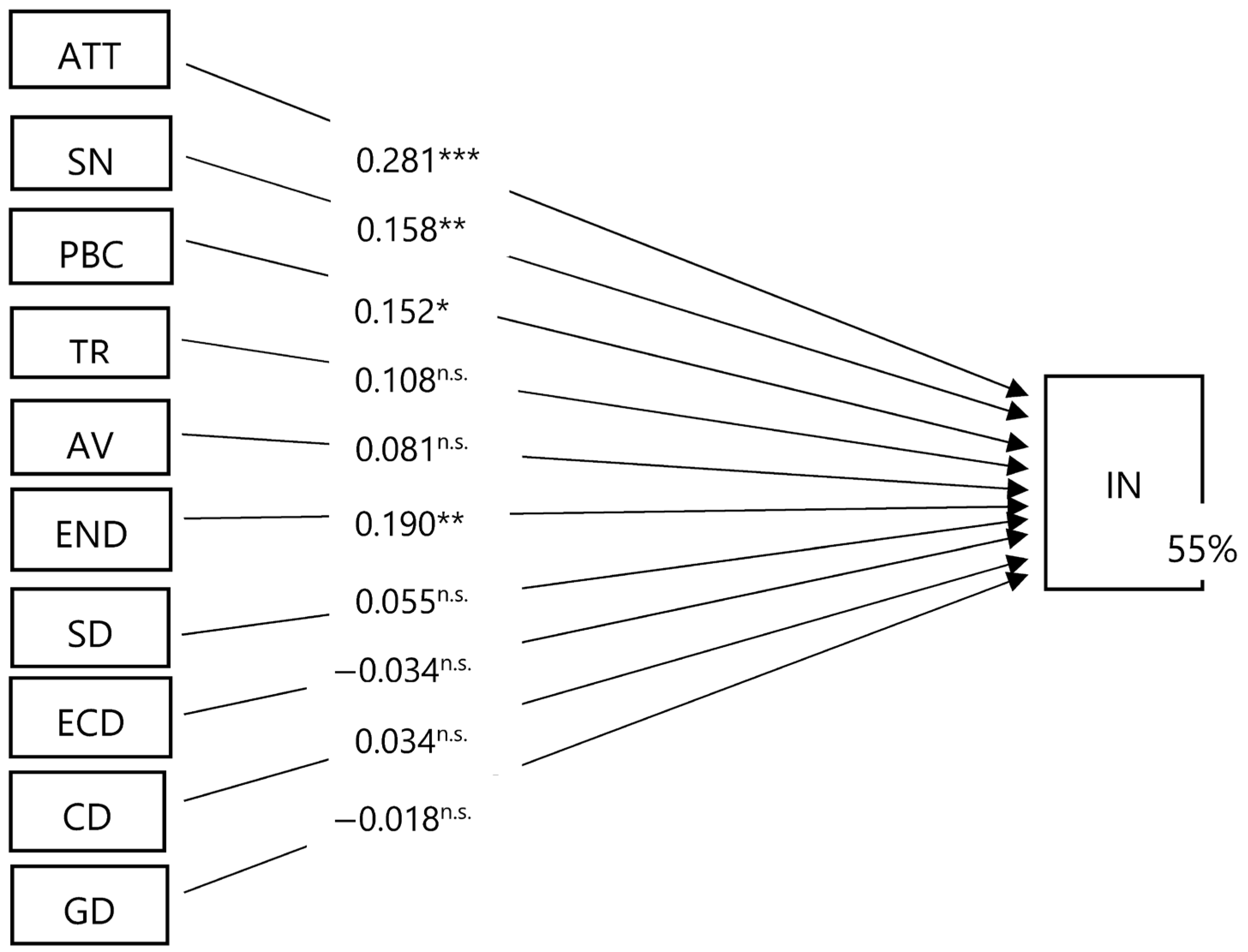
The structural model shows that purchase intention is influenced by attitude, subjective norm, perceived behavioural control, and the environmental dimension of sustainability (Figure 1). A more positive attitude towards buying local food from local shops was associated with a stronger purchase intention (β = 0.281; p < 0.001). Higher perceived expectations from important others were associated with a stronger intention to buy local food (β = 0.158; p < 0.01). A higher perceived level of control over buying local food was also associated with a stronger intention to purchase it (β = 0.152; p < 0.05). Furthermore, the more respondents believed that buying local food has a positive impact on the environment, the stronger their intention to buy local food (β = 0.190; p < 0.01). Of the five sustainability dimensions, only the environmental dimension showed a significant positive effect on purchase intention. The economic, social, cultural, and governance dimensions were not significant. Accordingly, H4a was supported, whereas H4b, H4c, H4d, and H4e were not supported. In addition, the results showed that H5 and H6 were not supported, indicating that trust and perceived retail access did not have a statistically significant effect on purchase intention. The model explained 55% of the variance in purchase intention (R2 = 0.55).

5. Discussion

The results confirm that the TPB is suitable for explaining purchase intention for local food in local shops. All three core TPB variables were significant, indicating that consumers’ attitudes, social influence, and perceived ease of purchase remain central drivers in this context. Among them, attitude had the strongest effect (β = 0.281), suggesting that consumers who perceive buying local food as beneficial and worthwhile are more likely to intend to purchase it. This is consistent with previous studies, which consistently identify attitude as a central predictor of purchase intention in sustainable food contexts [7,11,20]. Moreover, research on alternative food markets suggests that consumer choices are shaped by a combination of behavioural and contextual factors, including purchasing patterns, perceived value, and individual motivations, which further reinforces the importance of attitudinal drivers in such settings [34].
The significance of the subjective norm shows that buying local food is shaped by social expectations, particularly those of family and friends [15,24]. Similarly, perceived behavioural control had a positive effect, suggesting that practical considerations—such as time, convenience, and perceived feasibility—remain important. This finding aligns with previous studies showing that even when attitudes are favourable, consumers are more likely to form purchase intentions when the behaviour is perceived as manageable in everyday life [7,11]. This is consistent with studies showing that extending the TPB with contextual variables improves its explanatory power in food purchasing contexts [35]. Among the additional variables, only the environmental dimension of sustainability showed a significant positive effect on purchase intention. This shows that consumers primarily associate local food with environmental benefits, such as shorter transport distances and a lower environmental footprint. Previous research further suggests that consumer satisfaction and perceived value in SFSCs can influence purchasing decisions, although these effects depend on the specific retail context and the visibility of product attributes at the point of purchase [25]. In contrast, the economic, social, cultural, and governance dimensions were not significant. This suggests that although consumers may be aware of broader sustainability issues, these factors do not directly influence purchase intention. While earlier studies have found that different dimensions of sustainability can shape participation in SFSCs [13], these results indicate that their influence is not equally strong in the context of local shops.
Environmental benefits are often easier to recognise in-store, whereas cultural and governance aspects tend to remain abstract unless actively communicated [12,13]. This helps explain why previous studies report mixed results across different SFSC contexts [13]. One possible explanation is that environmental cues are easier for consumers to recognise at the point of purchase [3,25,26].
Notably, trust was not a significant predictor. This contrasts with studies where trust plays a key role, especially in direct-sales formats characterised by strong producer–consumer interaction. In local shops, trust may function more as a background condition than as a key driver of purchase intention [4,24]. This may reflect the more standardised retail environment of local shops, where institutional signals and retail structures partially substitute for direct producer–consumer interaction, reducing the relative importance of trust as a differentiating factor [3,4,24].
A similar pattern was observed for perceived retail access. Previous studies highlight accessibility and convenience as important determinants of SFSC participation [5]. However, in this study, perceived retail access was not significant. This may reflect the structural characteristics of local shops, which typically provide stable locations, regular opening hours, and consistent product availability, thereby reducing perceived retail access as a limiting factor compared to other SFSC formats [5]. As a result, access may function more as a background condition than as a key determinant of purchase intention.
Overall, purchase intention in local shops appears to be primarily driven by internal evaluations, particularly attitudes and perceived environmental value, while contextual factors such as trust and retail access play a more limited role. This supports the argument that local shops represent a distinct, still under-researched SFSC format in which consumer decision-making differs from that in direct-sales channels. Prior studies also indicate that retailer choice, preference for direct purchasing, and higher-order motivations vary across SFSC channels, reinforcing the need for channel-specific analyses rather than generalised models of consumer behaviour [3,5,6,14,36,37,38]. This is consistent with studies showing that higher-level motivations, such as values and mindful consumption, play an important role in shaping consumer decisions in short food supply chains [14]. Therefore, these results should be interpreted as context-specific and should not be generalised to all types of SFSCs.
This study has several limitations that should be considered when interpreting the findings. First, the quantitative data were collected via an open online questionnaire disseminated through social media and personal networks, yielding a self-selected, non-probability sample; therefore, the results should be interpreted with caution regarding external validity. Second, the sample included only respondents who had purchased local food at least once in the previous six months, potentially underestimating the perceived importance of certain barriers, such as access. Third, the study is cross-sectional and relies on self-reported measures, focusing on purchase intention rather than actual behaviour. Future work could test these relationships with behavioural data (e.g., purchase logs) or field experiments, rather than relying only on self-reported intentions. Finally, the study is limited to a single regional context, which supports contextual depth but limits generalisability. Future studies should compare multiple regions and different SFSC outlet types (direct and intermediated) to identify which determinants are robust and which are channel-specific [3,4,5,14].

6. Conclusions

This study shows that purchase intention for local food in local shops can be explained by an extended TPB model, with attitude, subjective norm, and perceived behavioural control remaining key predictors. Among the additional variables, only the environmental sustainability dimension contributed positively to purchase intention, whereas trust, perceived retail access, and the economic, social, cultural, and governance dimensions were not significant. Prior SFSC research using a multi-dimensional sustainability framework reports positive effects on SFSC participation and purchase intention across several sustainability pillars. In contrast, the present findings show that only the environmental dimension is significant in the context of local shops. This may suggest that certain sustainability dimensions, such as cultural and governance aspects, may require stronger in-store communication or may be more relevant in direct-sales formats where producer–consumer interaction is more visible.
These findings suggest that purchase intention in a local shop setting is driven primarily by internal evaluations (especially attitudes) and by environmental benefits that consumers can readily recognise at the point of purchase. The study contributes to the literature by providing channel-specific evidence from an intermediated SFSC format and by demonstrating that the relevance of behavioural and contextual predictors varies across retail settings. These findings highlight the importance of developing differentiated, outlet-specific models for analysing consumer behaviour in SFSCs [3,4,6].
From a practical perspective, the results suggest that local shop managers can strengthen demand by making environmental value more visible in-store (e.g., consistent origin labelling, short shelf messages on transport distance or production practices, and clear differentiation of local products on shelves). For policymakers, improving the visibility and recognition of local food in retail environments may be more effective than focusing solely on availability. This could be achieved by supporting verified local labelling schemes, co-financing in-store promotion, and encouraging cooperation between local producers and retailers to stabilise assortment and continuity.
The study is limited by its cross-sectional design, self-selected online sample from a single region, and focus on purchase intention rather than observed behaviour. Future research should compare multiple regions and SFSC outlet formats (direct vs. intermediated) and use behavioural or longitudinal designs to test when trust and access become significant determinants in real-world conditions [5,11].

Author Contributions

Conceptualization, V.H. and M.C.; methodology, I.F.; software, I.F.; validation, V.H., I.F., and M.C.; formal analysis, I.F.; investigation, V.H.; data curation, V.H.; writing—original draft preparation, V.H.; writing—review and editing, V.H., I.F., and M.C.; visualization, V.H.; supervision, M.C.; project administration, V.H. All authors have read and agreed to the published version of the manuscript.

Funding

This research received no external funding.

Institutional Review Board Statement

The study was conducted in accordance with the Declaration of Helsinki and approved by the Ethics Committee of the Faculty of Agriculture, University of Zagreb (No. 010, 14 January 2026).

Informed Consent Statement

Informed consent was obtained from all subjects involved in the study.

Data Availability Statement

The data presented in this study are available on request from the corresponding author due to privacy and ethical restrictions.

Conflicts of Interest

The authors declare no conflicts of interest.

Appendix A

Table A1. Constructs and statements of the tested model.
ConstructsStatementsMean (sd.)
Attitudes towards
buying local food from local shops (ATT)
Buying local food from local shops seems like a good decision to me. (ATT 1)4.22 (0.72)
Buying local food from local shops is beneficial for me. (ATT 2)4.13 (0.72)
Buying local food from local shops positively affects my shopping satisfaction. (ATT 3)4.12 (0.73)
I enjoy buying local food from local shops. (ATT 4)3.96 (0.84)
Subjective norm (SN)People who are important to me think I should buy local food from local shops. (SN 1)3.49 (0.91)
People who are important to me support my buying local food from local shops. (SN 2)3.77 (0.85)
I feel that people who are important to me expect me to buy local food from local shops. (SN 3)3.23 (1.00)
Perceived behavioural control (PBC)For me, buying local food in local shops is easy. (PBC 1)3.97 (0.83)
I have enough time to buy local food in local shops. (PBC 2)3.67 (0.97)
I have the necessary opportunities to buy local food in local shops (e.g., location, transport). (PBC 3)3.90 (0.82)
The price of local products in local shops is acceptable to me. (PBC 4)3.43 (0.88)
Trust in buying local food from local shops (TR)I trust that local producers in local shops offer quality, safe products. (TR 1)4.08 (0.79)
I trust the information about product origin provided by local shops. (TR 2)3.98 (0.77)
Local food supply channels, such as local shops, are reliable and transparent. (TR 3)3.84 (0.79)
Perceived retail access to local food in local shops (AV)The range of local food in local shops is sufficiently wide in Međimurje County. (AV 1)3.10 (1.01)
Local shops offering local food are conveniently located. (AV 2)3.33 (0.90)
The opening hours of local shops are satisfactory. (AV 3)3.41 (0.90)
There are enough local shops offering local food in my area. (AV 4)3.10 (1.06)
The environmental
dimension of
sustainability (END)
Buying local food from local shops helps reduce greenhouse gas emissions. (END 1)3.68 (0.87)
Buying local food from local shops supports more sustainable management of natural resources. (END 2)3.89 (0.81)
Buying local food from local shops encourages more environmentally friendly production methods. (END 3)3.87 (0.82)
Buying local food from local shops shortens food transport, reducing pressure on the environment. (END 4)4.16 (0.76)
The economic
dimension of
sustainability (ECD)
Buying local food from local shops contributes to the stability of local producers‘ incomes. (ECD 1)4.25 (0.70)
Buying local food from local shops has a significant impact on the local economy. (ECD 2)4.17 (0.76)
Buying local food from local shops reduces the region’s dependence on imported products. (ECD 3)4.22 (0.87)
The social dimension of sustainability (SD)Buying local food in local shops strengthens relationships and trust between buyers and producers. (SD 1)4.10 (0.76)
Buying local food in local shops contributes to higher quality nutrition in the community. (SD 2)4.13 (0.74)
Buying local food in local shops fosters a sense of community belonging. (SD 3)4.06 (0.82)
The cultural dimension of sustainability (CD)Buying local food from local shops helps preserve traditional gastronomic practices (CD 1)4.14 (0.77)
Buying local food from local shops contributes to preserving cultural heritage. (CD 2)3.97 (0.89)
Local products from local shops enhance the recognition of the region beyond its borders. (CD 3)4.19 (0.77)
Governance dimension (GD)Buying local food from local shops means participating in a system under appropriate institutional supervision. (GD 1)3.58 (0.74)
Buying local food from local shops supports an organised local food system. (GD 2)3.99 (0.67)
Buying local food from local shops contributes to a more transparent supply chain. (GD 3)3.93 (0.74)
Buying local food from local shops supports a system with clear accountability for the quality and origin of the product. (GD 4)3.96 (0.74)
Intention to buy local food (IN) I intend to buy local food from local shops in the next month. (IN 1)3.99 (0.77)
I plan to buy local food from local shops more regularly than I have so far. (IN 2)3.39 (0.80)
I am willing to buy local food from local shops in the next month. (IN 3)3.92 (0.75)
I will try to buy local food from local shops more often in the next month. (IN 4)3.48 (0.82)
Note: A 5-point Likert scale was used to measure level of agreement with statements.

Appendix B

Table A2. Collinearity (variance inflation factor).
ItemVariance Inflation Factor (VIF)
ATT 13.565
ATT 23.902
ATT 32.988
ATT 42.206
SN 12.669
SN 22.198
SN 31.734
PBC 11.836
PBC 21.745
PBC 31.918
TR 12.262
TR 23.014
TR 32.820
AV 12.050
AV 21.755
AV 42.101
END 12.640
END 23.994
END 32.243
END 41.620
ECD 12.372
ECD 22.470
ECD 31.798
SD 12.429
SD 22.238
SD 32.038
CD 12.168
CD 22.490
CD 31.931
GD 11.511
GD 21.805
GD 32.132
GD 42.063
IN 12.201
IN 22.543
IN 32.440
IN 42.647

References

  1. European Parliament and Council of the European Union. Regulation (EU) No 1305/2013 of 17 December 2013 on support for rural development by the European Agricultural Fund for Rural Development (EAFRD) and repealing Council Regulation (EC) No 1698/2005. Off. J. Eur. Union 2013, L 347, 487–548. Available online: https://eur-lex.europa.eu/eli/reg/2013/1305/oj/eng (accessed on 9 March 2026).
  2. European Commission. Commission Delegated Regulation (EU) No 807/2014 of 11 March 2014 supplementing Regulation (EU) No 1305/2013 on support for rural development by the EAFRD and introducing transitional provisions. Off. J. Eur. Union 2014, L 227, 1–17. Available online: https://eur-lex.europa.eu/eli/reg/2014/807/oj (accessed on 10 March 2026).
  3. Kneafsey, M.; Venn, L.; Schmutz, U.; Balázs, B.; Trenchard, L.; Eyden-Wood, T.; Bos, E.; Sutton, G.; Blackett, M. Short Food Supply Chains and Local Food Systems in the EU: A State of Play of Their Socio-Economic Characteristics; Publications Office of the European Union: Luxembourg, 2013. [Google Scholar] [CrossRef]
  4. Herzig, J.; Zander, K. Determinants of consumer behaviour in short food supply chains: A systematic literature review. Agric. Food Econ. 2025, 13, 21. [Google Scholar] [CrossRef]
  5. Horvath, C.; Koning, M.; Raton, G.; Combes, F. Short food supply chains: The influence of outlet and accessibility on farmer and consumer preferences. Food Policy 2024, 129, 102763. [Google Scholar] [CrossRef]
  6. Printezis, I.; Grebitus, C. Marketing Channels for Local Food. Ecol. Econ. 2018, 152, 161–171. [Google Scholar] [CrossRef]
  7. Csordás, A.; Lengyel, P.; Füzesi, I. Who Prefers Regional Products? Sustainability 2022, 14, 8990. [Google Scholar] [CrossRef]
  8. Bavorova, M.; Unay-Gailhard, I.; Lehberger, M. Who buys from farmers’ markets and farm shops: The case of Germany. Int. J. Consum. Stud. 2016, 40, 107–114. [Google Scholar] [CrossRef]
  9. Randall, T.; Cousins, A.L.; Neilson, L.; Price, M.; Hardman, C.A.; Wilkinson, L.L. Sustainable food consumption across Western and Non-Western cultures: A scoping review considering the theory of planned behaviour. Food Qual. Prefer. 2024, 114, 105086. [Google Scholar] [CrossRef]
  10. Sadeli, A.H.; Perdana, T.; Deliana, Y.; Onggo, B.S.S. Consumers’ purchase behaviour in short food supply chains using social commerce in Indonesia. J. Clean. Prod. 2023, 386, 135812. [Google Scholar] [CrossRef]
  11. Ajzen, I. The Theory of Planned Behaviour. Organ. Behav. Hum. Decis. Process. 1991, 50, 179–211. [Google Scholar] [CrossRef]
  12. Ajzen, I. The theory of planned behaviour: Frequently asked questions. Hum. Behav. Emerg. Technol. 2020, 2, 314–324. [Google Scholar] [CrossRef]
  13. Ajzen, I. Perceived behavioural control, self-efficacy, locus of control, and the theory of planned behaviour. J. Appl. Soc. Psychol. 2002, 32, 665–683. [Google Scholar] [CrossRef]
  14. Mesić, Ž.; Petljak, K.; Borović, D.; Tomić, M. Segmentation of local food consumers based on altruistic motives and perceived purchasing barriers: A Croatian study. Econ. Res. 2021, 34, 221–242. [Google Scholar] [CrossRef]
  15. Penchansky, R.; Thomas, J.W. The concept of access: Definition and relationship to consumer satisfaction. Med. Care 1981, 19, 127–140. [Google Scholar] [CrossRef]
  16. Phuong, N.V.; Nga, B.T.; Schröter, I.; Mergenthaler, M. Intention to purchase local food of Vietnamese consumers in the COVID-19 pandemic context: An application of the theory of planned behavior. J. ISSAAS 2022, 28, 12–24. [Google Scholar]
  17. Soper, D.S. A-Priori Sample Size Calculator for Structural Equation Models. Available online: https://www.danielsoper.com/statcalc/calculator.aspx?id=89 (accessed on 15 March 2026).
  18. Hair, J.F.; Ringle, C.M.; Sarstedt, M. PLS-SEM: Indeed a Silver Bullet. J. Mark. Theory Pract. 2011, 19, 139–152. [Google Scholar] [CrossRef]
  19. Hair, J.F.; Hult, G.T.M.; Ringle, C.M.; Sarstedt, M. A Primer on Partial Least Squares Structural Equation Modeling (PLS-SEM), 2nd ed.; Sage: Thousand Oaks, CA, USA, 2017. [Google Scholar]
  20. Sheeran, P. Intention–behaviour relations: A conceptual and empirical review. Eur. Rev. Soc. Psychol. 2002, 12, 1–36. [Google Scholar] [CrossRef]
  21. Darby, M.R.; Karni, E. Free competition and the optimal amount of fraud. J. Law Econ. 1973, 16, 67–88. [Google Scholar] [CrossRef]
  22. Mayer, R.C.; Davis, J.H.; Schoorman, F.D. An Integrative Model of Organizational Trust. Acad. Manag. Rev. 1995, 20, 709–734. [Google Scholar] [CrossRef]
  23. Henseler, J.; Ringle, C.M.; Sarstedt, M. A new criterion for assessing discriminant validity. J. Acad. Mark. Sci. 2015, 43, 115–135. [Google Scholar] [CrossRef]
  24. Giampietri, E.; Verneau, F.; Del Giudice, T.; Carfora, V.; Finco, A. A theory of planned behaviour perspective for investigating the role of trust in consumer purchasing decisions related to short food supply chains. Food Qual. Prefer. 2018, 64, 160–166. [Google Scholar] [CrossRef]
  25. Tiganis, A.; Grigoroudis, E.; Chrysochou, P. Customer satisfaction in SFSCs. Food Qual. Prefer. 2023, 104, 104750. [Google Scholar] [CrossRef]
  26. Morgan, R.M.; Hunt, S.D. The commitment-trust theory of relationship marketing. J. Mark. 1994, 58, 20–38. [Google Scholar] [CrossRef]
  27. Food and Agriculture Organization of the United Nations (FAO). Sustainability Assessment of Food and Agriculture Systems (SAFA) Guidelines; FAO: Rome, Italy, 2014; Available online: https://openknowledge.fao.org/handle/20.500.14283/i4113e (accessed on 14 March 2026).
  28. Patton, M.Q. Qualitative Research & Evaluation Methods, 4th ed.; Sage: Thousand Oaks, CA, USA, 2015. [Google Scholar]
  29. Creswell, J.W.; Poth, C.N. Qualitative Inquiry and Research Design, 4th ed.; Sage: Thousand Oaks, CA, USA, 2016. [Google Scholar]
  30. Ahmad, M.; Wilkins, S. Purposive sampling in qualitative research. Qual. Quant. 2025, 59, 1461–1479. [Google Scholar] [CrossRef]
  31. Guest, G.; Bunce, A.; Johnson, L. How Many Interviews Are Enough? Field Methods 2006, 18, 59–82. [Google Scholar] [CrossRef]
  32. Braun, V.; Clarke, V. Using thematic analysis in psychology. Qual. Res. Psychol. 2006, 3, 77–101. [Google Scholar] [CrossRef]
  33. Wang, M.; Kumar, V.; Ruan, X.; Saad, M.; Garza-Reyes, J.A.; Kumar, A. Sustainability concerns on consumers’ attitude towards short food supply chains. Oper. Manag. Res. 2022, 15, 76–92. [Google Scholar] [CrossRef]
  34. Cicatiello, C. Alternative food shoppers and the “quantity dilemma”. Agric. Food Econ. 2020, 8, 15. [Google Scholar] [CrossRef]
  35. Vermeir, I.; Verbeke, W. Sustainable food consumption: Exploring the consumer attitude–behavioural intention gap. J. Agric. Environ. Ethics 2006, 19, 169–194. [Google Scholar] [CrossRef]
  36. Cicia, G.; Furno, M.; Del Giudice, T. Do consumers’ values affect retailer choice? Agric. Food Econ. 2021, 9, 3. [Google Scholar] [CrossRef]
  37. González-Azcárate, M.; Cruz, J.L.; Bardají, I. Why buying directly from producers is valuable. Sustain. Prod. Consum. 2021, 26, 911–920. [Google Scholar] [CrossRef]
  38. Benos, T.; Burkert, M.; Hüttl-Maack, V.; Petropoulou, E. Mindful consumption and SFSCs. Sustain. Prod. Consum. 2022, 33, 520–530. [Google Scholar] [CrossRef]
Figure 1. Tested model. Note: AV—perceived retail access to local food in local shops; SD—the social dimension of sustainability; ECD—the economic dimension of sustainability; CD—the cultural dimension of sustainability; END—the environmental dimension of sustainability; PBC—perceived behavioural control; TR—trust in buying local food from local shops; ATT—attitudes towards buying local food from local shops; SN—subjective norm; GD—governance dimension of sustainability; IN—intention to buy local food; β coefficients and significance level is presented; p < 0.001 ***, p < 0.01 **, p < 0.05 *; n.s.—not significant; predictors explained 55% of variance in intention to buy local food.
Sustainability 18 04311 g001
Table 1. Description of the sample.
Respondents’ CharacteristicsCategories%
GenderFemale65.7
Male34.3
Age20–29 years13.8
30–39 years28.9
40–49 years33.2
50–59 years15.3
60+ years9.4
EducationPrimary school0.3
Secondary school 37.3
Bachelor/Master54.8
Mr.sc./Dr.sc.7.6
Perceived economic status of the householdVery low0.7
Low2.6
Medium71.0
High24.4
Very high1.3
EmploymentEmployed75.6
Self-employed10.9
Unemployed2.6
Retired7.6
Student2.6
Other0.7
Number of household
members
13.3
2–344.2
4–547.8
6–74.7
Place of livingUrban58.7
Rural41.3
Note: n = 303.
Table 2. Constructs’ reliability and validity.
ConstructItemsConstruct
Loadings
Cronbach
Alpha (C α)
Composite ReliabilityAverage Variance Extracted (AVE)
(Rho a)(Rho c)
Attitudes towards
buying local food from local shops (ATT)
ATT 10.9080.9130.9140.9390.794
ATT 20.912
ATT 30.897
ATT 40.846
Subjective norm (SN)SN 10.9130.8410.8630.9040.758
SN 20.893
SN 30.803
Perceived behavioural control (PBC)PBC 10.8780.8190.8320.8920.733
PBC 20.839
PBC 30.850
PBC 4-
Trust in buying local food from local shops (TR)TR 10.8930.8900.8910.9320.819
TR 20.915
TR 30.907
Perceived retail access to local food in local shops (AV)AV 10.8960.8340.8600.8990.749
AV 20.847
AV 3-
AV 40.852
The environmental
dimension of
sustainability (END)
END 10.8580.8710.8440.9120.723
END 20.929
END 30.856
END 40.759
The economic dimension of sustainability (ECD)ECD 10.8730.8530.8630.9100.771
ECD 20.891
ECD 30.871
The social dimension of sustainability (SD)SD 10.8970.8620.8650.9160.784
SD 20.894
SD 30.866
The cultural dimension of sustainability (CD)CD 10.8740.8550.8610.9120.775
CD 20.891
CD 30.876
Governance dimension of sustainability (GD)GD 10.7390.8310.8410.8880.665
GD 20.822
GD 30.843
GD 40.852
Intention to buy local food (IN)IN 10.8460.8470.8710.8950.680
IN 20.780
IN 30.876
IN 40.793
Table 3. Discriminant validity (HTMT).
AVSDECDCDINENDPBCTRATTSN
SD0.174
ECD0.1420.795
CD0.1930.8200.680
IN0.3500.6060.5000.509
END0.1280.7400.7400.6160.581
PBC0.6480.4400.3500.3410.5720.386
TR0.3320.7230.6200.6050.6310.5830.639
ATT0.2110.6910.5990.5390.7200.5730.5160.688
SN0.2750.4620.3310.4510.5970.3280.4200.4280.684
GD0.2540.8080.6920.7580.5520.6600.4260.6820.6030.448
Note: AV—perceived retail access to local food in local shops; SD—the social dimension of sustainability; ECD—the economic dimension of sustainability; CD—the cultural dimension of sustainability; IN—intention to buy local food; END—the environmental dimension of sustainability; PBC—perceived behavioural control; TR—trust in buying local food from local shops; ATT—attitudes towards buying local food from local shops; SN—subjective norm; GD—governance dimension of sustainability.
Disclaimer/Publisher’s Note: The statements, opinions and data contained in all publications are solely those of the individual author(s) and contributor(s) and not of MDPI and/or the editor(s). MDPI and/or the editor(s) disclaim responsibility for any injury to people or property resulting from any ideas, methods, instructions or products referred to in the content.