Systematic Review

Configuring the Attribute Set for Circular Resource Management: Integrating Energy Efficiency and Sustainable Resilience Through Cluster Analysis


by
Roxana-Mariana Nechita
1,2,3,
Corina-Ionela Dumitrescu
4,*,
Cătălin-George Alexe
3,
Dana-Corina Deselnicu
3,*,
Iuliana Grecu
3,5 and
Nicoleta Niculescu
4
1
Department of Biomedical Mechatronics and Robotics, National Institute of Research and Development in Mechatronics and Measurement Technique, 021631 Bucharest, Romania
2
Doctoral School of Entrepreneurship, Engineering, and Business Management, Faculty of Entrepreneurship, Business Engineering and Management, National University of Science and Technology POLITEHNICA Bucharest, 060042 Bucharest, Romania
3
Department of Entrepreneurship and Management, Faculty of Entrepreneurship Business Engineering and Management, National University of Science and Technology POLITEHNICA Bucharest, 060042 Bucharest, Romania
4
Department of Economics, Faculty of Entrepreneurship Business Engineering and Management, National University of Science and Technology POLITEHNICA Bucharest, 060042 Bucharest, Romania
5
Best Paint Distribution SRL, 051929 Bucharest, Romania
*
Authors to whom correspondence should be addressed.
Sustainability 2026, 18(9), 4176; https://doi.org/10.3390/su18094176
Submission received: 20 March 2026 / Revised: 20 April 2026 / Accepted: 20 April 2026 / Published: 22 April 2026
(This article belongs to the Special Issue The Nexus of Energy Efficiency, Sustainability and Resilience)

Abstract

This study addresses the increasing need to structure knowledge in the field of circular resource management, with a focus on energy efficiency and sustainable resilience. Previous studies have examined various taxonomies for the circular economy, yet a clear gap remains in understanding how energy efficiency and resilience serve as the main pillars for operational stability. This study is designed as a bibliometric analysis based on a selection of relevant scientific articles. The identified factors were extracted based on their frequency of occurrence in the literature and processed using statistical clustering techniques to group them into coherent categories. The results show that the field is defined by a set of interconnected factors that can be structured into distinct clusters, reflecting key dimensions such as operational performance, environmental impact, and system resilience. Specifically, the analysis demonstrates how energy-related attributes and resilience attributes act as stabilizing factors within closed-loop systems. Based on these findings, this study proposes a structured framework that organizes the identified factors into a clear configuration. This framework provides a reference point for researchers who aim to develop models in this area and for practitioners involved in the design and optimization of circular systems. This study contributes by offering a structured view of the field and by supporting the development of consistent analytical and decision-making approaches grounded in the necessity of balancing resource recovery with system stability.

1. Introduction

The transition toward circular resource management has become a central concern in the context of increasing pressure on natural resources and the need to reduce environmental impact [1]. Industrial and economic systems are required to improve the way resources are used, recovered, and reintegrated into production processes, while maintaining stable levels of performance [2,3]. This context has led to a growing body of research focused on energy efficiency, sustainable operations, and system resilience, which are now considered key elements in the design of modern supply chains and production systems [4]. However, the theoretical link between these elements is often assumed rather than demonstrated. In circular systems, the recovery of materials often requires additional energy inputs, creating a trade-off that necessitates a clear understanding of energy efficiency. Similarly, the move from linear to circular flows introduces new risks, making sustainable resilience a requirement for long-term viability.
At the same time, the development of circular approaches has introduced a higher level of complexity in the analysis and management of resource flows [5,6]. Circular systems involve multiple processes, including collection, recycling, remanufacturing, and redistribution [7], which are interconnected and influenced by both internal and external factors [8]. These systems operate under conditions of uncertainty related to market dynamics, regulatory changes, and technological development. As a result, the identification and evaluation of relevant factors become essential for understanding system behavior and for supporting decision-making processes [9,10]. From a theoretical perspective, these systems exhibit path dependence, where early decisions regarding infrastructure and material selection constrain future recovery options. Understanding the underlying mechanisms of these dependencies is vital for creating effective management models.
Despite the increasing number of studies in this field, the existing literature presents a fragmented perspective [6,9,11,12]. Many contributions focus on specific components of circular systems, such as reverse logistics, energy consumption, or cost optimization, without integrating these elements into a unified structure. A significant knowledge gap exists regarding how digital transformation and environmental practices translate into tangible social or operational benefits. Furthermore, while many studies list factors, they often fail to explain the interaction between operational factors and system-level outcomes. This situation leads to variations in the selection of factors and in the way they are defined and measured [13]. As a consequence, the comparability of results across studies is limited, and the development of consistent analytical models becomes difficult.
The problem is particularly evident in the case of closed-loop supply chains, where the interaction between environmental, economic, and operational factors plays a critical role [14,15,16,17]. These systems are implemented in various sectors, including manufacturing, energy, and waste management, and involve multiple stakeholders such as producers, suppliers, regulators, and consumers [18]. Each stakeholder is affected by decisions related to resource use, cost allocation, and environmental performance [19,20]. In this context, the absence of a structured set of factors creates challenges in both research and practice. The integration of digital technologies, such as the Internet of Things (IoT), has been proposed as a way to enhance service quality and efficiency, yet these factors are rarely categorized within broader circular management frameworks.
The impact of this issue extends to the design and optimization of circular systems. Without a clear understanding of the relationships between factors, decision-makers may rely on incomplete or inconsistent information [21,22,23]. This can lead to inefficient allocation of resources, increased operational costs, and limited improvements in environmental performance [24]. From a research perspective, the lack of structure reduces the ability to build models that can be applied across different contexts and limits the accumulation of knowledge in the field. The existing literature often relies on review papers rather than primary empirical data, which can obscure the practical importance of specific factors.
Given these limitations, there is a clear need to organize the existing knowledge in a way that allows for a better understanding of the factors that define circular resource management. A structured approach can support the identification of key dimensions, clarify the relationships between factors, and provide a common reference for future studies. In this context, bibliometric analysis offers a suitable method for examining the literature in a systematic manner and for identifying patterns based on the frequency and distribution of factors.
The present study aims to address this need by identifying and structuring the main factors associated with circular resource management, with a focus on energy efficiency and sustainable resilience. The choice of these two dimensions is justified by their role as the primary constraints on circularity: energy consumption determines the environmental viability of recovery, while resilience ensures the system can withstand disruptions in supply and demand. The research is based on a selection of relevant scientific articles, from which the factors are extracted according to their frequency of occurrence. This approach allows for the identification of the most relevant elements that are consistently addressed in the literature. By organizing these factors through cluster analysis, this study seeks to move beyond a simple list of factors toward a scholarly explanation of how these factors interact within circular systems.

2. Materials and Methods

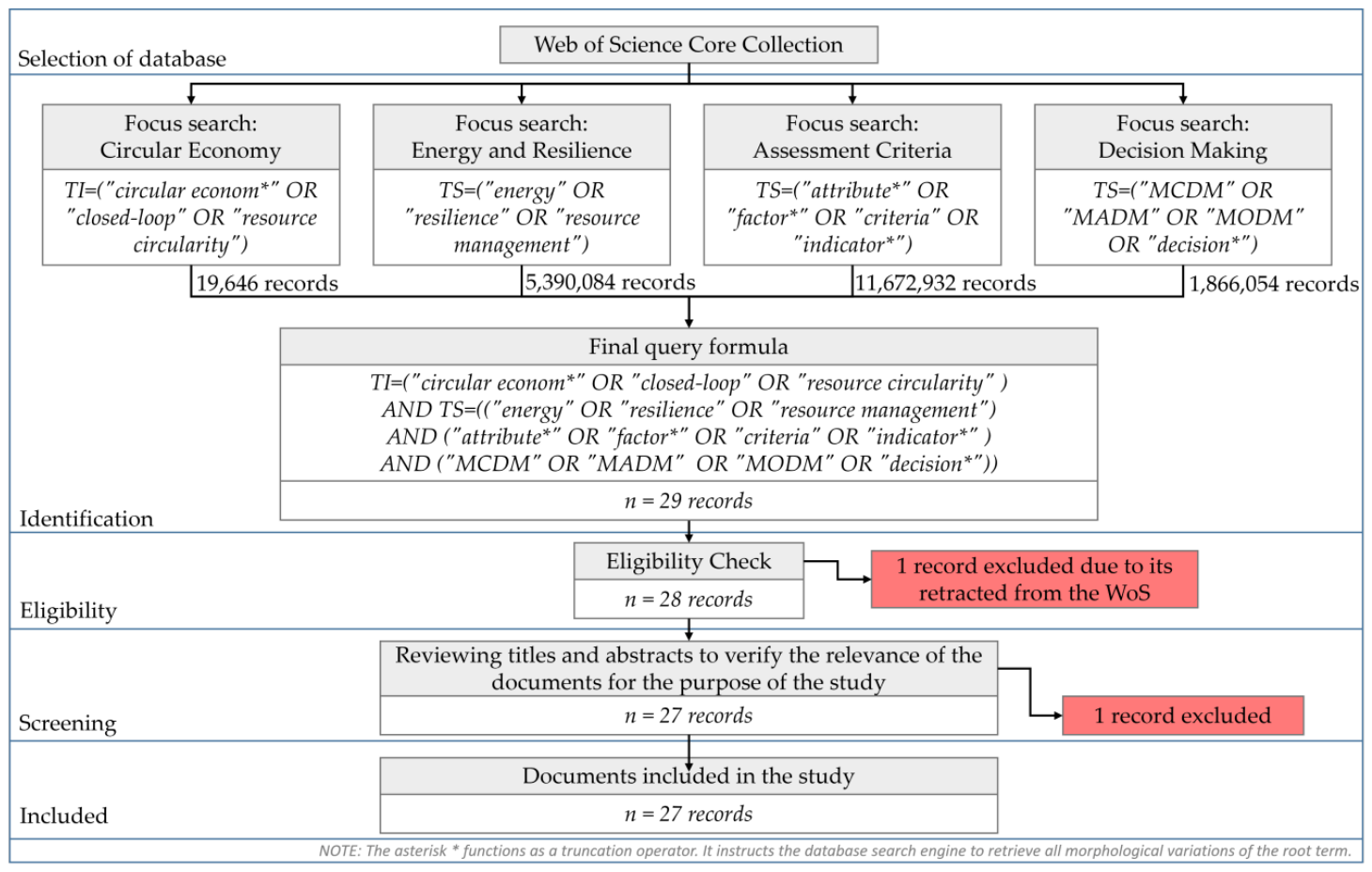
This study follows a structured bibliometric methodology designed to identify and organize the main factors associated with circular resource management, with a focus on energy efficiency and sustainable resilience. The research process is based on a clearly defined workflow, presented in Figure 1 (PRISMA workflow), which includes the stages of identification, screening, eligibility, and inclusion. The methodology follows the PRISMA 2020 guidelines; the complete checklist is provided in the Supplementary Materials.
The data collection was conducted using the Web of Science Core Collection (WoS) database. The choice to use a single database is intentional. WoS was selected because it contains high-quality journals with standardized metadata. This consistency is necessary for a bibliometric analysis that relies on the precise extraction of factors. Using a single, high-standard source reduces the risk of duplicate records and ensures that the analyzed factors come from peer-reviewed studies with similar reporting standards. The use of this database ensures the inclusion of validated scientific contributions and supports the reproducibility of the research process.
The search strategy was developed in several steps, starting from broad queries and progressing toward a refined search string. The initial queries were constructed to capture the main dimensions of the research topic. The first query targeted the general domain of circular systems:
T I = ( c i r c u l a r   e c o n o m *   O R   c l o s e d l o o p   O R   r e s o u r c e   c i r c u l a r i t y )
This query returned 19,646 results. The use of title-based searching ( T I ) was a choice to ensure high relevance in the initial stage. This approach selects studies where circularity is the primary focus. The inclusion of multiple synonymous expressions broadens coverage and reduces the risk of omitting relevant studies due to terminological variation.
The second query focused on key thematic dimensions related to the study:
T S = ( e n e r g y   O R   r e s i l i e n c e   O R   r e s o u r c e   m a n a g e m e n t )
This query returned 5,390,084 results. The use of topic-based searching ( T S ) allows for a broader inclusion of studies where these concepts may appear in the title, abstract, or keywords. These terms were selected to capture the core sustainability dimensions of circular systems, including energy efficiency, system robustness, and resource optimization.
The third query targeted the identification of factors:
T S = ( a t t r i b u t e *   O R   f a c t o r *   O R   c r i t e r i a   O R   i n d i c a t o r * )
This query returned 11,672,932 results. The inclusion of wildcard operators (e.g., “*”) ensures coverage of multiple word forms (e.g., factor, factors, factorial), thereby increasing retrieval sensitivity. This query is essential for identifying studies that explicitly define and use measurable variables within analytical or decision-making frameworks.
The fourth query focused on decision-making approaches:
T S = ( M C D M   O R   M A D M   O R   M O D M   O R   d e c i s i o n * )
This query returned 1,866,054 results. These terms were selected to capture studies employing structured decision-support methodologies, which are particularly relevant for evaluating trade-offs and prioritizing factors in complex systems. The inclusion of both specific acronyms (MCDM, MADM, MODM) and the broader term “decision*” ensures a balance between precision and inclusiveness.
These four components were combined into a final search formula, designed to capture studies that integrate all relevant dimensions:
T I = ( circular   econom *   O R   closed   loop   O R   resource   circularity )   A N D   T S = ( ( e n e r g y   O R   r e s i l i e n c e   O R   r e s o u r c e   m a n a g e m e n t )     A N D   ( attribute *   O R   factor *   O R   criteria   O R   indicator * )   A N D   ( M C D M   O R   M A D M   O R   M O D M   O R   d e c i s i o n * ) )
The application of the complete search formula resulted in a total of 29 articles. The inclusion criteria for the selection of articles in this systematic review were strictly defined to ensure the quality and relevance of the corpus. The following points were established as inclusion criteria:
  • Articles focusing on circular resource management, with a particular emphasis on energy efficiency and sustainable resilience;
  • Articles explicitly discussing the factors that influence the design, performance, and sustainability of circular systems and closed-loop supply chains;
  • Articles currently indexed in the WoS Core Collection (1 retracted article was removed).
Conversely, the following were established as exclusion criteria:
  • Publications that were not peer-reviewed (e.g., editorial material, book reviews, or the gray literature) to ensure the inclusion of validated scientific contributions only;
  • Articles that were not directly relevant to the intersection of circularity, energy, and resilience (1 article was removed);
The final sample reached 27 articles. This specific sample size is a result of the high selectivity of the search string. Although the individual components of the query formula return millions of results, the combination of these four distinct dimensions via the AND operator reveals a significant gap. The high volume of records for separate topics like energy efficiency or decision making shows that these areas are well-studied individually. However, the intersection of all four dimensions remains insufficient in current research. The small final sample proves that the nexus between circular resource management, energy efficiency, resilience, and structured decision making is a rare focus in the literature.
Each article included in the final dataset was assigned a unique identifier, labeled alphabetically from A to AA. This coding system was used to facilitate the organization of the data and the traceability of the extracted information throughout the analysis.
The next stage of the methodology involved the extraction of factors from the selected articles. The analysis focused on identifying factors that influence the design, performance, and sustainability of circular systems. The extracted factors include operational factors (such as cost and process efficiency), environmental factors (such as emissions and resource use), economic factors (such as profitability and investment), and system-related factors (such as resilience, flexibility, and supply chain configuration). The extraction process was carried out through a detailed reading of each article. Specific attention was given to alternatives and criteria used in modeling and decision-making contexts. To ensure that the identified factors are directly related to the research goal, each attribute was mapped against the dimensions of energy efficiency and sustainable resilience. This initial mapping results in a diffuse system of factors that requires a preliminary structure.
For each article, the identified factors were recorded and standardized to ensure consistency across the dataset. Similar terms referring to the same concept were grouped under a common label. This standardization process followed a formal coding protocol to ensure that different terms for the same physical or economic phenomenon were treated as a single attribute. For example, “parallel supply chain structure” and “serial supply chain structure” were consolidated into a single factor to avoid data fragmentation: “Supply chain structure”. Similarly, terms such as “product return system” and “reverse flow management” were grouped under “Reverse logistics”, while expressions like “energy use” and “energy demand” were standardized as “Energy consumption”. This approach focuses on the existence of the factor without reference to its valence. By providing multiple examples of term consolidation, the study increases methodological transparency and allows future researchers to replicate the standardization logic without ambiguity.
The current study provides a pre-structured framework that serves as a necessary base for future analysis. This framework must be examined within multi-criteria decision-making (MCDM) processes to achieve a precise definition of the system. The list of factors identified in this stage can be used to analyze the internal dynamics of the system. For instance, methods such as Decision Making Trial and Evaluation Laboratory (DEMATEL) can clarify the causal relationships between attributes. Subsequently, the results from such analyses can serve as input for system delimitation methods. A relevant example is the Cross-Impact Matrix Multiplication Applied to Classification (MICMAC), which has the capacity to identify and visualize autonomous or inactive factors. Therefore, the identification of factors must be performed in a broad manner first, as done in this research, and then refined through specific MCDM tools to filter and delimit the system.
In parallel, the number of distinct factors addressed in each article was documented in order to capture the level of detail and coverage of each study. Following the extraction process, a binary factor–article matrix was constructed. In this matrix, rows represent the identified factors and columns correspond to the analyzed articles. Each cell takes the value of 1 if the factor is present in the article and 0 otherwise. This binary approach is used to focus on the presence of factors across the literature. It treats each mention with equal importance to identify common trends in the field. This structure allows for the analysis of co-occurrence patterns between factors.
To measure the association between pairs of factors, the ϕ coefficient was used. This coefficient is suitable for binary data and reflects the strength of association based on co-occurrence. For each pair of factors, a 2 × 2 contingency table was constructed, including the number of articles where both factors are present, where only one factor is present, and where neither factor is present. The coefficient is calculated using the following formula:
ϕ = a d b c ( a + b ) ( b + c ) ( a + c ) ( b + d )
where
  • a represents the number of articles in which both factors are present;
  • b represents the number of articles in which the first factor is present and the second is absent;
  • c represents the number of articles in which the second factor is present and the first is absent;
  • d represents the number of articles in which neither factor is present.
The resulting association matrix was used as input for the clustering analysis.
The clustering process organizes factors based on their co-occurrence patterns identified within the analyzed literature. This approach groups factors that frequently appear together in research models, reflecting their functional interdependence.
The association matrix constructed using the φ coefficient served as the basis for grouping the factors into thematic clusters [19,25]. Due to the relatively small number of factors (46) and the interpretive nature of the analysis, clustering was performed through a hybrid qualitative-quantitative approach. Specifically, factors were grouped based on:
  • Strong positive φ coefficients (typically > 0.40), indicating frequent co-occurrence in the literature;
  • Conceptual and thematic similarity derived from the circular resource management domain;
  • Negative correlations, used to delineate boundaries between distinct clusters.
This process resulted in five coherent clusters that reflect the main dimensions of the field.
The overall methodology ensures a transparent and replicable process, from data collection to factor structuring, and provides a consistent basis for the development of a factor-based framework in circular resource management.

3. Results

The application of the selection and screening process resulted in a final dataset of 27 scientific articles, which were considered suitable for inclusion in the analysis. To ensure consistency and traceability throughout the study, each article was assigned a unique identifier, labeled alphabetically from A to AA. This coding system facilitates cross-referencing between the analyzed studies and the extracted factors. The complete list of selected articles, together with their bibliographic references and the number of addressed factors, is presented in Table 1.
The selected studies cover a range of applications related to circular resource management and closed-loop supply chains. The articles address different sectors, including energy systems, manufacturing, agriculture, and waste management. In addition, the studies employ various decision-making approaches and modeling techniques, which reflect the diversity of methods used in the field. The decision to focus on a final sample of 27 articles is justified by the hyper-selectivity of the search string. While general bibliometric studies often use larger datasets, this research aimed at a specific nexus between circularity, energy, and resilience. This ensures that the clustering process is based on high-quality, relevant data rather than a large volume of loosely related publications.
The number of factors addressed in each article varies, indicating differences in the level of detail and scope of the analyses. Some studies focus on a limited set of factors, while others include a broader range of factors that capture multiple dimensions of circular systems. This variation supports the need for a structured approach to organize the identified factors.
The identification of factors represents a central step in structuring the analytical framework associated with circular resource management. These factors were extracted based on their explicit use in modeling, evaluation, or decision-making contexts within each study. The selection process followed a consistent and systematic screening procedure, in which each article was thoroughly examined to identify factors that influence system design, operational performance, or strategic planning. Only those factors that were clearly defined and repeatedly used within the analytical models were retained.
To ensure reliability and minimize subjectivity, the factor extraction and standardization were performed independently by two co-authors and subsequently validated through discussion until full consensus was reached among all authors. This rigorous multi-author validation process guarantees that the resulting set of 46 factors accurately reflects the actual structure of the research field rather than isolated or context-specific factors.
The present study intentionally provides a diffuse (pre-structured) set of attributes that serves as a necessary foundation for subsequent analyses. A clear delimitation of the system boundaries and the identification of active, passive, or autonomous factors will be achieved in future research by applying multi-criteria decision-making (MCDM) tools such as DEMATEL and MICMAC, which will allow for a deeper understanding of the internal dynamics and causal relationships within the circular resource management system. The complete list of factors, along with their distribution across the 27 analyzed articles, is presented in Table 2.
The results indicate that several factors appear consistently across the majority of the analyzed studies, suggesting the existence of a common conceptual foundation within the literature. For instance, supply chain structure (F1) is present in all 27 articles, highlighting its fundamental role in the design and analysis of closed-loop systems. Other highly recurrent factors include reverse logistics (F2), operating cost (F3), lifecycle integration (F4), and profitability (F5), which collectively emphasize the operational and economic dimensions of circular systems.
Environmental considerations are also strongly represented. Factors such as carbon footprint (F6), recycling efficiency (F7), resource recovery (F8), and circular material usage (F9) appear frequently across the dataset, underlining the importance of sustainability and environmental performance in contemporary research. Their widespread inclusion demonstrates that circular supply chain design is increasingly aligned with decarbonization and resource efficiency objectives.
In addition to these dominant themes, several factors capture system performance and external influences, including energy consumption (F11), market uncertainty (F12), and waste management (F13). These elements reflect the interaction between internal system dynamics and external constraints, suggesting that circular systems are analyzed not only as technical configurations but also as adaptive structures operating in uncertain environments. Recent research suggests that the integration of operational and environmental performance is no longer optional. The presence of energy consumption (F11) alongside economic factors proves that modern circular models must balance physical constraints with financial viability.
A broader set of factors appears with lower frequency, such as digitalization (F20), system flexibility (F22), transport optimization (F21), and social impact (F28). These factors represent emerging research directions and indicate a gradual expansion of the field toward more integrated and socio-technical perspectives. The inclusion of digitalization (F20) is supported by evidence that digital success in operations is often driven by IoT adoption. These technologies improve service quality and allow for better tracking of resources in a closed loop. Similarly, the social impact factor (F28) connects environmental practices with social well-being, showing that circular systems have benefits that extend beyond pure material recovery.
Beyond these, the analysis also captures a range of less frequently addressed and highly context-dependent factors (F29–F46). These include aspects such as supply chain agility (F29), product quality (F30), circular design (F31), emission taxation (F32), service capacity (F33), solar potential (F34), supplier reliability (F35), economic loss (F36), government support (F37), grid proximity (F38), coordination level (F39), inventory capacity (F40), biodiversity impact (F41), multi-energy integration (F42), land suitability (F43), fleet sizing (F44), workplace safety (F45), and collection competition (F46).
Although these factors appear less frequently across the analyzed studies, they provide important insights into specific applications, emerging technologies, and niche research directions. Their presence highlights the increasing diversification of the field and the growing relevance of context-specific factors in the design and evaluation of circular systems.
It is important to emphasize that the frequency of occurrence does not directly reflect the intrinsic importance of a factor. Instead, it indicates the degree of attention it has received within the analyzed body of literature. Frequently occurring factors correspond to well-established research themes, whereas less frequent ones may signal emerging topics, specialized applications, or underexplored areas with significant potential for future investigation.
The correlation structure of the identified factors provides deeper insight into the way elements associated with circular resource management, energy efficiency, and sustainable resilience interact within the literature. The correlation structure of the identified factors was determined using the ϕ coefficient to build an association matrix (see Appendix A). This coefficient was chosen because it is suitable for binary data (0/1) used to record the presence of factors. Although some matrices in the field are sparse, this method allows for a clear visualization of how energy efficiency and resilience connect with more traditional operational factors. The results clearly show that the factors are not independent; rather, they form interconnected patterns that reveal recurring thematic structures.
A first key observation is the presence of moderate to strong positive correlations among several groups of factors. For example, F2 (reverse logistics) exhibits strong associations with F7 (recycling efficiency) (0.59), F8 (resource recovery) (0.59), and F9 (circular material usage) (0.50). This indicates that these factors frequently co-occur within the same studies and likely represent complementary dimensions of circular system implementation. Similarly, F4 (lifecycle integration) shows positive correlations with F7 (0.48) and F9 (0.54), suggesting a shared conceptual space related to system integration and resource flow optimization.
At the same time, the analysis reveals several strong negative correlations, highlighting the existence of conceptual divergences within the field. A notable example is the relationship between F9 and F18 (facility location) (−0.78), suggesting that these factors are rarely addressed together and may correspond to different analytical priorities or modeling perspectives. Another example is the negative correlation between F10 (process efficiency) and F12 (market uncertainty) (−0.62), indicating a distinction between performance-oriented and uncertainty-driven approaches. These contrasting relationships support the interpretation that the literature is structured around multiple, partially competing paradigms. Some studies emphasize operational optimization and efficiency, while others focus on uncertainty, policy constraints, or strategic decision-making.
Another important finding is the presence of bridging factors that connect different thematic areas. For instance, F15 (regulatory pressure) exhibits both positive correlations with F17 (market dynamics) (0.61) and negative correlations with F3 (operating cost) (−0.54) and F11 (energy consumption) (−0.50). This dual behavior suggests that F15 plays a transitional role, linking policy-related considerations with both economic and operational dimensions.
Similarly, F26 (consumer perception) shows strong positive correlations with F15 (0.64) and F17 (0.51), while maintaining negative associations with F11 (−0.52). This pattern indicates that consumer-related aspects contribute to bridging strategic and applied perspectives within circular systems.
The analysis also highlights the existence of nearly identical or highly overlapping factors. For example, F7 (recycling efficiency) and F8 (resource recovery) exhibit perfect correlation (1.00), indicating conceptual redundancy. Comparable relationships are observed for other factor pairs, such as F42 and F43, suggesting that certain factors may be grouped or consolidated in future analyses to improve model parsimony.
Based on the co-occurrence patterns and correlation intensities, the identified factors were organized into thematic groups that reflect the main structural areas of the field (Table 3). The grouping process considered both strong positive associations, which indicate that factors frequently appear together in the same research models, and negative correlations, which define the boundaries between different perspectives. This approach allows for the transformation of a diffuse set of alternatives into a pre-structured framework.
This complete allocation ensures that all identified factors are integrated into a coherent analytical framework. The clusters simultaneously reflect internal consistency (through positive correlations) and conceptual differentiation (through negative correlations). As a result, the proposed structure provides a robust and interpretable representation of the field, which can support further applications, including multi-criteria decision-making, system optimization, and policy development in circular supply chains.

4. Discussion

The results obtained in this study indicate that the literature on circular resource management and closed-loop supply chains is structured around a relatively stable and coherent set of interdependent dimensions. A consistent recurrence of specific factors can be observed, together with their tendency to evolve jointly and form conceptual groupings that reflect how researchers approach the design and evaluation of circular systems. This pattern points to the presence of an implicit consensus regarding the key building blocks of circular models, while variations across studies reflect differences in methodological choices and application focus. The identified structure reveals a clear path dependence in how circular systems are conceptualized. Early research established a focus on cost and basic material recovery, and subsequent studies have built upon this foundation by adding layers of complexity, such as energy integration and digital monitoring. This evolutionary process explains why certain operational factors remain dominant while newer dimensions, such as sustainable resilience, are still being integrated into the core analytical models.
A first important observation concerns the dominant role of system configuration and operational logic. The high recurrence of structural and process-related alternatives indicates that circular systems are primarily understood as engineered networks in which the organization of flows, processes, and recovery mechanisms plays a decisive role. This interpretation is strongly supported by Govindan et al. [53], who argue that the effectiveness of closed-loop supply chains depends fundamentally on how forward and reverse flows are integrated within the same system. Their work highlights that structural decisions are strategic choices that determine the balance between cost efficiency and environmental performance. In this sense, the results of the present study reinforce the idea that system design represents the backbone of circular resource management, acting as a framework within which all other decisions are embedded.
At the same time, the results reveal a strong interconnection between operational efficiency and environmental performance, suggesting that these dimensions are increasingly analyzed as mutually reinforcing components of the same system. Zhou et al. [54] demonstrate that improvements in recycling processes and resource recovery mechanisms directly contribute to emission reductions, particularly when lifecycle considerations are integrated into system design. This aligns closely with the patterns observed in the present analysis, where environmental indicators are consistently associated with operational factors. Similarly, Quariguasi Frota Neto et al. [31] emphasize that the transition from linear to circular systems requires a fundamental rethinking of how waste is perceived, shifting from a disposal problem to a resource opportunity. Their findings support the interpretation that environmental performance in circular systems is largely driven by the efficiency of operational processes, which positions environmental performance as an outcome of process design rather than an external constraint.
This connection is further clarified by recent empirical evidence showing how environmental practices are translated into broader social and operational benefits. In this regard, the study by Saqib et al. [55] offers a valuable perspective by using environmental psychology theory to explain the link between green building practices and community well-being. The authors use partial least squares structural equation modeling on a dataset of 585 observations to prove that technical dimensions like energy efficiency, water efficiency, and sustainable materials are direct predictors of social well-being. Their research highlights that managing waste and improving indoor environmental quality are not merely engineering tasks. Instead, these practices significantly increase occupant satisfaction and health. This suggests that the outcomes of circular resource management must be evaluated through the lens of human benefits, as material savings alone do not capture the full value of a sustainable system.
Economic considerations remain deeply embedded within this structure, confirming that circularity is closely connected with financial viability. The persistence of cost-related alternatives across the analyzed studies reflects the continued importance of economic feasibility as a determining factor in decision-making. Taleizadeh et al. [56] show that even in sustainability-oriented models, cost minimization and profitability objectives retain a central role, often shaping the selection of technologies and operational strategies. This suggests that the adoption of circular practices is still conditioned by their ability to generate economic value. At the same time, Soleimani et al. [34] point out that incorporating environmental criteria into optimization models often leads to trade-offs, where improvements in emission performance may increase operational costs. This tension between economic and environmental objectives is also reflected in the present results, where these dimensions appear closely linked, indicating that they are evaluated simultaneously rather than independently.
Another relevant aspect emerging from the analysis is the increasing importance of external influences, particularly those related to regulatory frameworks and market dynamics. Circular systems are embedded within broader economic and institutional environments that shape their behavior. Ivanov [57] highlights that modern supply chains are exposed to multiple sources of uncertainty, including disruptions, policy changes, and demand fluctuations, which require adaptive and resilient configurations. The connection between these external pressures and the core themes of energy efficiency and sustainable resilience is fundamental. Energy efficiency acts as a buffer against volatile energy markets and regulatory carbon constraints, while sustainable resilience provides the capacity to maintain circular flows during disruptions. These two dimensions are not isolated factors. They function as the integrating framework that allows a system to remain operational and environmentally compliant under changing policy conditions. This perspective helps explain why factors related to uncertainty and regulation appear as integrative elements within the identified structure. In a similar vein, Yu et al. [58] demonstrate that policy instruments such as carbon taxation have a direct impact on production, pricing, and recovery decisions. Their findings indicate that regulatory pressure constrains system behavior and simultaneously stimulates innovation and the adoption of circular practices.
The role of market-related factors further illustrates the complexity of circular systems. Bressanelli et al. [59] argue that consumer perception and demand for sustainable products significantly influence the implementation of circular strategies. Their research shows that companies are more likely to invest in circular solutions when there is clear market acceptance, suggesting that demand-side dynamics play a critical role in shaping supply-side decisions. This interaction between market expectations and operational design is also reflected in the present results, where such factors appear as connecting elements between different dimensions. It indicates that circular systems must be understood as technical, economic, and socio-economic systems influenced by behavioral factors.
Technological development represents another layer that contributes to the evolution of the field. Although technological factors appear with varying frequency across studies, they play a crucial role in enabling integration and coordination across the system. Abid et al. [60] show that digital technologies, such as blockchain and IoT, enhance transparency, traceability, and synchronization in supply chains. Their findings suggest that digitalization facilitates the management of complex circular flows, particularly in systems where multiple stakeholders are involved. This supports the interpretation that technology acts as an enabler that connects operational, economic, and strategic dimensions, even if it is not always explicitly modeled in all studies.
A critical aspect identified in the recent literature is the role of transformative management capacity (TMC) in the success of these initiatives. Saqib et al. [55] emphasize that the adoption of green technologies is insufficient without an organizational capacity to manage change and adapt internal processes. Their findings show that TMC acts as a significant mediator between sustainable practices and system-level outcomes. This capacity for transformation ensures that technical innovations lead to actual improvements in social well-being. In a similar way, the integration of digital technologies such as the IoT in logistics and manufacturing, as proposed by Saqib and Berg [61], provides the necessary support for real-time monitoring. This digital approach allows for superior coordination between supply chain partners, ensuring a level of transparency that was missing in traditional circular models. Digitalization is an instrument that validates the ability of the system to deliver performance and quality under environmental constraints.
An additional dimension that emerges from the results is the growing attention given to resilience and adaptability. Circular systems are increasingly analyzed in dynamic contexts, where uncertainty and disruption are inherent characteristics. Ivanov [57] emphasizes that resilient supply chains are designed to maintain functionality under adverse conditions, which requires flexibility and the ability to reconfigure operations. This perspective reflects a shift away from static optimization approaches toward more adaptive frameworks. The presence of such considerations in the literature indicates that circular systems are viewed as evolving structures that respond to changing conditions.
Beyond the core dimensions, the results also highlight the existence of a set of less frequently addressed factors that point toward emerging research directions. Recent studies indicate a growing interest in integrating energy systems, spatial considerations, and broader sustainability aspects into circular models. For example, research on multi-energy systems and renewable integration shows that circular supply chains are increasingly linked with energy transition processes [62]. At the same time, aspects such as biodiversity impact or social sustainability are beginning to receive attention, although they remain relatively underexplored. This uneven distribution of attention across topics is also reported in recent analyses, which suggest that the field is expanding while still developing conceptual coherence in certain areas [63]. These observations indicate that the core structure of the field remains relatively stable, while its boundaries continue to evolve.
The originality of the present study lies in its focus on providing a structured interpretation of the relationships between factors based on co-occurrence and correlation patterns. Traditional approaches typically treat factors independently or classify them into predefined categories. The present analysis captures the natural interactions emerging from the literature and presents them in a relational structure. Through this perspective, the results provide a more realistic representation of the field, supporting a deeper understanding of the connections between operational, economic, and environmental dimensions. In addition, this study explicitly incorporates emerging dimensions such as digitalization and social well-being into the analytical framework, highlighting their role as integrative elements that extend circular resource management beyond purely technical and environmental considerations. The integration of frequently occurring factors together with emerging ones supports the consolidation of existing knowledge and highlights new research directions, thereby strengthening the conceptual contribution of the study.
However, the results should be interpreted within the context of several limitations. The final sample size of 27 articles is a result of the high selectivity of the search criteria, which focused specifically on the intersection of circularity, energy, and resilience. While this ensures the relevance of the data, it also means the statistical patterns should be viewed as an initial structuring of a specialized niche rather than an exhaustive map of the entire circular economy field. First, the analysis relies on a single database, which may influence the diversity and representativeness of the selected studies. While this choice ensures a high level of publication quality, some relevant contributions may remain outside the dataset. Second, the findings depend on the methodology used for factor identification and grouping, and different analytical approaches could lead to alternative structures. Furthermore, the binary factor–article matrix used in this study captures only the presence or absence of factors, without accounting for their relative importance or intensity within individual studies. This lack of weighting means that all factors are treated equally, regardless of their actual influence in the analyzed models, which may limit the depth of the co-occurrence analysis. In addition, the proposed framework has not been empirically validated in a specific application context, which limits the generalizability of the conclusions. These aspects highlight the need for future research to expand the analysis by incorporating multiple data sources and by testing the identified relationships in practical settings.
Overall, the findings show that the literature on circular resource management is characterized by convergence and diversification. A stable core of concepts defines the field, while emerging directions reflect its adaptation to new challenges. This dual structure indicates an ongoing maturation process, in which the integration of multiple perspectives becomes essential for the development of coherent and relevant analytical models.

5. Conclusions

This study examined the configuration of attribute sets within the field of circular resource management, focusing on the connection between energy efficiency and sustainable resilience. The selection process, based on the PRISMA methodology, resulted in a final group of 27 peer-reviewed articles. From these sources, 46 distinct factors were identified and organized into five clusters through the application of correlation analysis and the ϕ coefficient. The size of this dataset reflects the hyperselectivity of the search criteria, which was necessary to isolate studies that specifically integrate circularity with both energy and resilience dimensions. This focused approach ensures that the identified factors are relevant to the specialized scope of the research, even if the sample size is smaller than in general bibliometric reviews.
The results show that many existing studies use unsystematic methods for selecting evaluation criteria. This research addresses this problem by providing a structured framework of 46 factors. This set of data provides a mandatory foundation for the development of future decision-making models. This framework moves beyond the fragmented nature of the previous literature by explaining the path dependence of circular systems. It shows how traditional operational factors have evolved to include social and technological dimensions, such as those identified in recent studies on transformative management capacity and digital integration. Instead of selecting factors based on subjective preferences or random choices, researchers can now utilize these identified clusters to ensure that all relevant dimensions of the circular economy are represented in their models.
The analysis of the clusters showed clear dependencies between certain factors, such as recycling efficiency and resource recovery. These correlations suggest that some factors can be grouped together to simplify the structure of future questionnaires or mathematical models. The results also prove that resilience and energy efficiency function as the integrating framework for circular resource management. These two pillars are not merely individual factors. They determine the capacity of the system to maintain functionality and environmental quality under external pressures. The 46 identified factors are directly connected to these pillars, providing the technical and social indicators needed to measure system performance.
The main contribution of this work is the creation of an organized environment for data pre-processing. By using this attribute set, the academic community can reach a higher level of uniformity in terminology. The proposed framework bridges the gap between theoretical circular economy principles and tangible system-level outcomes. It incorporates recent evidence showing that green practices lead to social well-being and that digital tools like IoT are necessary for service quality. More importantly, the explicit integration of digitalization and social well-being as distinct dimensions within the factor structure represents a key contribution, as it reflects the transition toward socio-technical circular systems in which technological capabilities and human-centered outcomes are jointly evaluated. Although the use of 46 factors in a single MCDM matrix is difficult to manage, this list serves as a foundation from which specific indicators can be extracted depending on the industrial context. This study offers a solution for the transition from ad hoc factor selection to a method based on evidence from the literature.
Regarding future research directions, this analysis identifies several paths for investigation. The 46 factors provide a standardized starting point for researchers who currently select factors through non-systematic reviews. Future studies should use this framework to avoid the random selection of criteria. This ensures that any chosen subset of factors remains representative of the five identified clusters. Such an approach allows for better comparison between different studies and industries. Furthermore, there is a clear need for empirical validation through case studies and expert surveys to test the weight of these factors in diverse operational settings.
The results suggest that integrating MCDM tools is the mandatory next step to refine these findings. While this study identifies a broad set of 46 factors, their individual influence on the system is not equal. Methods such as the DEMATEL can be used to calculate the specific intensity of relationships between these factors. This process allows for the separation of factors into a cause group and an effect group, showing which factors drive the system and which are outcomes. Similarly, the MICMAC provides a way to categorize these factors based on their driving power and dependence. By applying these tools, the initial list of 46 factors is filtered into core components, which are essential for system stability, active components, which stimulate change, and inactive components, which have little impact on circular outcomes. This systematic filtering process ensures a precise definition of system boundaries and reduces the complexity of circular resource management models.

Supplementary Materials

The following supporting information can be downloaded at: https://www.mdpi.com/article/10.3390/su18094176/s1, Table S1: PRISMA_2020_checklist.

Author Contributions

Conceptualization, R.-M.N., C.-I.D., C.-G.A., D.-C.D., I.G. and N.N.; methodology, R.-M.N., C.-I.D., C.-G.A., D.-C.D., I.G. and N.N.; software, R.-M.N., C.-G.A. and D.-C.D.; validation, C.-I.D., D.-C.D. and N.N.; formal analysis, R.-M.N., C.-I.D. and N.N.; investigation, R.-M.N.; resources, C.-I.D. and D.-C.D.; data curation, C.-I.D., I.G. and N.N.; writing—original draft preparation, R.-M.N., C.-I.D., C.-G.A., D.-C.D. and I.G.; writing—review and editing, R.-M.N., C.-I.D., C.-G.A., D.-C.D. and I.G.; visualization, R.-M.N.; supervision, C.-I.D. and D.-C.D.; project administration, D.-C.D.; funding acquisition, C.-I.D. All authors have read and agreed to the published version of the manuscript.

Funding

This research was funded by the National University of Science and Technology POLITEHNICA Bucharest through the PubArt program.

Institutional Review Board Statement

Not applicable.

Informed Consent Statement

Not applicable.

Data Availability Statement

The data that support the findings of this study are available from the corresponding author upon reasonable request.

Acknowledgments

This work has been supported by: (1) CERMISO Center—Project Contract no.159/2017, Program POC-A.1-A.1.1.1.1-F; (2) Research Program Nucleu within the National Research Development and Innovation Plan 2022–2027, carried out with the support of MCID, project no. PN 23 43 05 03; (3) Support Center for International RDI Projects in Mechatronics and Cyber-Mix-Mechatronics, Contract no. 323/22.09.2020, project co-financed by the European Regional Development Fund through the Competitiveness Operational Program (POC) and the national budget; and (4) ERASMUS-EDU-2023-EUR-UNIV, Project 101124676—EELISA, funded by the European Union, https://eelisa.eu/ (accessed on 15 April 2026). The authors also acknowledge the use of DeepL version: Translate and DeepL version: Write—AI-powered edits for the translation of the manuscript from Romanian to English. The authors meticulously reviewed and edited the content to ensure accuracy and take full responsibility for the final manuscript. Views and opinions expressed are those of the author(s) only and do not necessarily reflect those of the European Union or the European Education and Culture Executive Agency (EACEA). Neither the European Union nor EACEA can be held responsible for them.

Conflicts of Interest

Author Iuliana Grecu was employed by the company Best Paint Distribution SRL. The remaining authors declare that the research was conducted in the absence of any commercial or financial relationships that could be construed as a potential conflict of interest.

Appendix A

This appendix presents the complete pairwise association matrix based on the φ coefficient, calculated from the binary factor–article matrix (Table 2 in the main text). The matrix shows the strength and direction of association between each pair of the 46 factors across the 27 analyzed articles (Table A1, Table A2 and Table A3).
The φ coefficient was computed using the standard formula for binary data (Formula (6)).
The matrix is symmetric, with values on the diagonal equal to 1.00. Values above the diagonal are omitted (indicated by “–”) for clarity and to avoid redundancy.
Table A1. φ Coefficient matrix: factors F1 to F15.
SymbolF1F2F3F4F5F6F7F8F9F10F11F12F13F14F15
F11
F20.351
F30.420.481
F40.510.520.451
F50.480.410.520.471
F60.390.550.380.420.351
F70.450.590.290.480.320.5111
F80.450.590.290.480.320.5111
F90.380.50.220.540.250.450.620.621
F100.290.310.410.350.380.280.350.350.31
F110.220.180.150.20.160.250.210.210.180.121
F120.310.250.120.180.220.30.160.160.12–0.620.141
F130.250.380.250.280.20.350.420.420.350.220.190.151
F140.280.290.480.250.350.220.180.180.150.30.160.180.21
F150.190.22–0.540.210.180.280.250.250.20.15–0.50.250.220.141
Table A2. φ Coefficient matrix: factors F16 to F30.
SymbolF16F17F18F19F20F21F22F23F24F25F26F27F28F29F30
F161
F170.151
F180.140.121
F190.080.080.091
F200.110.070.160.11
F210.090.110.080.140.091
F220.120.060.110.080.120.11
F230.070.220.070.120.080.150.141
F240.10.090.150.070.140.120.090.111
F250.090.10.10.110.110.180.070.130.161
F260.080.140.130.060.180.090.080.10.150.081
F270.150.050.080.090.10.110.130.090.10.090.071
F280.090.080.140.070.130.080.110.120.080.10.150.141
F290.10.160.060.150.090.070.160.080.120.070.120.080.091
F300.130.070.120.220.080.10.090.070.060.090.060.120.080.11
Table A3. φ Coefficient matrix: factors F31 to F46.
SymbolF31F32F33F34F35F36F37F38F39F40F41F42F43F44F45F46
F311
F320.091
F330.080.11
F340.070.080.091
F350.1100.060.051
F360.060.150001
F370.0500.080.10.0901
F380000.130001
F39000000001
F400.0800.110000001
F4100000000001
F420000.220000.150001
F430000.15000000001
F4400000000000001
F45000000000000001
F460000000000000001

References

  1. Hernandez Marquina, M.V.; Le Dain, M.-A.; Zwolinski, P.; Joly, I. Sustainable Performance of Circular Supply Chains: A Literature Review. Procedia CIRP 2022, 105, 607–612. [Google Scholar] [CrossRef]
  2. Gaustad, G.; Krystofik, M.; Bustamante, M.; Badami, K. Circular Economy Strategies for Mitigating Critical Material Supply Issues. Resour. Conserv. Recycl. 2018, 135, 24–33. [Google Scholar] [CrossRef]
  3. Pehlken, A.; Davila, R.M.F.; Dawel, L.; Meyer, O. Digital Twins: Enhancing Circular Economy through Digital Tools. Procedia CIRP 2024, 122, 563–568. [Google Scholar] [CrossRef]
  4. Ying, J.; Li-Jun, Z. Study on Green Supply Chain Management Based on Circular Economy. Phys. Procedia 2012, 25, 1682–1688. [Google Scholar] [CrossRef]
  5. Baratsas, S.G.; Pistikopoulos, E.N.; Avraamidou, S. A Quantitative and Holistic Circular Economy Assessment Framework at the Micro Level. Comput. Chem. Eng. 2022, 160, 107697. [Google Scholar] [CrossRef]
  6. Santiago, B.; Scavarda, L.F.; Caiado, R.; Jardim, R. Circular Sustainable Supply Chain Management Framework from the Perspective of Triple Bottom Line. Procedia Comput. Sci. 2023, 221, 673–680. [Google Scholar] [CrossRef]
  7. Cristoiu, C.; Ivan, M.; Ghionea, I.G.; Pupăză, C. The Importance of Embedding a General Forward Kinematic Model for Industrial Robots with Serial Architecture in Order to Compensate for Positioning Errors. Mathematics 2023, 11, 2306. [Google Scholar] [CrossRef]
  8. Tălîngă, A.-M.; Hadar, A.; Drăgoi, M.-V.; Nisipeanu, I.; Ali, H.A.; Suciu, C.P. YOLO-v8 in Capturing Imperfections Generated by Changing 3D Printer Parameters. UPB Sci. Bull. Ser. C. Electr. Eng. 2024, 86, 253–266. [Google Scholar]
  9. Ardakani, M.A.; Naeini, M.K. An Integrated Dynamic Model to Locate a Competitive Closed-Loop Supply Chain Facility under Conditions of Uncertainty: A Case Study of the Auto Parts Industry. RAIRO-Oper. Res. 2022, 56, 3581–3609. [Google Scholar] [CrossRef]
  10. Drăgoi, M.-V.; Afram, R.M.; Alzubaidi, A.A.A.M.H.; Jiga, G.G.; Ali, H.A.; Puiu, R.-A.; Petrea, G.; Hank, A. Comparative Analysis of Interpolation and Extrapolation Methods in Regression Models. UPB Sci. Bull. Ser. C. Electr. Eng. 2026, 88, 145–160. [Google Scholar]
  11. Marzolla, R.A.; Zancul, E. Upgradable Products for Circularity: A Bibliometric Analysis. Procedia CIRP 2024, 128, 615–620. [Google Scholar] [CrossRef]
  12. Grecu, I.; Nechita, R.-M.; Stochioiu, F.-P.-G.; Ulerich, O.; Dumitrescu, C.-I.; Cristoiu, C. A Decision-Oriented Framework for Sustainable Supply Chain Redesign: A DEMATEL-Based Approach. Logistics 2025, 9, 90. [Google Scholar] [CrossRef]
  13. Reis, W.F.; Barreto, C.G.; Capelari, M.G.M. Circular Economy and Solid Waste Management: Connections from a Bibliometric Analysis. Sustainability 2023, 15, 15715. [Google Scholar] [CrossRef]
  14. Ramanathan, U.; He, Q.; Subramanian, N.; Gunasekaran, A.; Sarpong, D. Collaborative Closed-Loop Supply Chain Framework for Sustainable Manufacturing: Evidence from the Indian Packaging Industry. Technol. Forecast. Soc. Change 2023, 191, 122489. [Google Scholar] [CrossRef]
  15. Jiao, Z.; Ran, L.; Zhang, Y.; Li, Z.; Zhang, W. Data-Driven Approaches to Integrated Closed-Loop Sustainable Supply Chain Design under Multi-Uncertainties. J. Clean. Prod. 2018, 185, 105–127. [Google Scholar] [CrossRef]
  16. Qian, X.; Shen, L.; Wang, Y.; Lin, J.; Jin, Z.; Ge, Y.-E.; George Haddad, S.S. Stability Analysis of Maritime Logistics Alliance Based on Blockchain. Transp. Policy 2025, 163, 219–231. [Google Scholar] [CrossRef]
  17. Cremene, M.; Riveill, M.; Rarau, A.; Miron, C.; Benta, I.; Todica, V. Adaptation Mechanism Based on Service-Context Distance for Ubiquitous Computing. Int. J. Comput. Commun. Control 2012, 7, 53–60. [Google Scholar] [CrossRef]
  18. Drăgoi, M.-V.; Hadăr, A.; Goga, N.; Baciu, F.; Ștefan, A.; Grigore, L.Ș.; Gorgoteanu, D.; Molder, C.; Oncioiu, I. Contributions to the Dynamic Regime Behavior of a Bionic Leg Prosthesis. Biomimetics 2023, 8, 414. [Google Scholar] [CrossRef] [PubMed]
  19. Alexe, C.-M.; Nechita, R.-M. A Theoretical Framework for Multi-Attribute Decision-Making Methods in the Intelligent Leading and Allocation of Human Resources in Research and Development Projects. Sustainability 2025, 17, 7535. [Google Scholar] [CrossRef]
  20. McAlister, M.M.; Murali, P.S.; Zhang, Q.; Wells, E.C.; Mohebbi, S. Improving and Quantifying Organizational Resilience for Sustainable Management of Critical Infrastructures: A Multi-Level System Dynamics Approach. Int. J. Disaster Risk Reduct. 2024, 115, 105079. [Google Scholar] [CrossRef]
  21. Chrisandina, N.J.; Vedant, S.; Iakovou, E.; Pistikopoulos, E.N.; El-Halwagi, M.M. Metrics and Methods for Resilience-Aware Design of Process Systems: Advances and Challenges. Curr. Opin. Chem. Eng. 2024, 43, 100984. [Google Scholar] [CrossRef]
  22. Sindhwani, R.; Chakraborty, S.; Behl, A.; Pereira, V. Building Resilience to Handle Disruptions in Critical Environmental and Energy Sectors: Implications for Cleaner Production in the Oil and Gas Industry. J. Clean. Prod. 2022, 365, 132692. [Google Scholar] [CrossRef]
  23. Haddad, S.S.; El-Desouky, Z.I.; Ahmed, A.S.; Negi, S. The Impact of COVID-19 on the Pharmaceutical Supply Chain in Egypt: The Case of Pharco Group. In Cases on International Business Logistics in the Middle East; IGI Global Scientific Publishing: Hershey, PA, USA, 2023; pp. 92–109. [Google Scholar]
  24. Bajenaru, V.-D.; Istriteanu, S.-E. Waste from Dismantling of End-of-Life Vehicles. In Proceedings of the International Conference on Reliable Systems Engineering (ICoRSE)—2024; Cioboată, D.D., Ed.; Springer Nature: Cham, Switzerland, 2024; pp. 152–164. [Google Scholar]
  25. Nechita, R.-M.; Deselnicu, D.-C.; Simion, P.C.; Ichimov, M.A.M. Structuring a Factor-Based Framework for Student Retention: A Systematic Review and Clustering for MCDM Applications. Front. Educ. 2026, 11, 1737408. [Google Scholar] [CrossRef]
  26. Mohammed, F.; Anjomshoae, A.; Banomyong, R.; Azadnia, A.H. A Stochastic Risk-Averse Model for Designing Resilient-Sustainable Closed-Loop Supply Chain Considering Emission Schemes. J. Ind. Prod. Eng. 2025, 42, 587–611. [Google Scholar] [CrossRef]
  27. Shenabi, H.; Sahraeian, R. Decision-Making Approach to Design a Sustainable Photovoltaic Closed-Loop Supply Chain Considering Market Share for Electric Vehicle Energy. Sustainability 2024, 16, 5763. [Google Scholar] [CrossRef]
  28. Amoozad Mahdiraji, H.; Yaftiyan, F.; Garza-Reyes, J.A.; Razavi Hajiagha, S.H.; Kazancoglu, Y. Decarbonised Closed-Loop Supply Chains Resilience: Examining the Impact of COVID-19 toward Risk Mitigation by a Fuzzy Multi-Layer Decision-Making Framework. Ann. Oper. Res. 2024, 359, 79–123. [Google Scholar] [CrossRef]
  29. Jalali, G.; Tavakkoli-Moghaddam, R.; Ghomi-Avili, M.; Jabbarzadeh, A. A Network Design Model for a Resilient Closed-Loop Supply Chain with Lateral Transshipment. Int. J. Eng. 2017, 30, 374–383. [Google Scholar] [CrossRef]
  30. Ishizaka, A.; Khan, S.A.; Kheybari, S.; Zaman, S.I. Supplier Selection in Closed Loop Pharma Supply Chain: A Novel BWM–GAIA Framework. Ann. Oper. Res. 2023, 324, 13–36. [Google Scholar] [CrossRef]
  31. Quariguasi Frota Neto, J.; Walther, G.; Bloemhof, J.; van Nunen, J.A.E.E.; Spengler, T. From Closed-Loop to Sustainable Supply Chains: The WEEE Case. Int. J. Prod. Res. 2010, 48, 4463–4481. [Google Scholar] [CrossRef]
  32. Kadeer, A.; Wang, X.; He, H.; Dai, L. Complexity Analysis of a Closed-Loop Supply Chain for Power Battery Recycling under Government Subsidies. PLoS ONE 2025, 20, e0322888. [Google Scholar] [CrossRef]
  33. Soufali, A.; Bashiri, M. A Comprehensive Closed Loop Supply Chain Model; Environmental, Technology and Energy Concerns. In Proceedings of the 2016 IEEE International Conference on Industrial Engineering and Engineering Management (IEEM), Bali, Indonesia, 4–7 December 2016; pp. 1498–1502. [Google Scholar]
  34. Soleimani, H.; Chhetri, P.; Fathollahi-Fard, A.M.; Mirzapour Al-e-Hashem, S.M.J.; Shahparvari, S. Sustainable Closed-Loop Supply Chain with Energy Efficiency: Lagrangian Relaxation, Reformulations and Heuristics. Ann. Oper. Res. 2022, 318, 531–556. [Google Scholar] [CrossRef]
  35. Yu, H.; Wang, S. Blockchain-Enabled Closed-Loop Supply Chain Optimization for Power Battery Recycling and Cascading Utilization. Sustainability 2025, 17, 4192. [Google Scholar] [CrossRef]
  36. Baghizadeh, K.; Pahl, J.; Hu, G. Closed-Loop Supply Chain Design with Sustainability Aspects and Network Resilience under Uncertainty: Modelling and Application. Math. Probl. Eng. 2021, 2021, 9951220. [Google Scholar] [CrossRef]
  37. Guo, S.; Wang, C.; Ma, Z.; Zhang, Y.; Qin, Z.; Yan, J.; Qiao, Y. Geographic Information System-Based Closed-Loop Co-Optimization of Site-Capacity-Operation for Multi-Energy Complementary Bases. Energy 2026, 347, 140398. [Google Scholar] [CrossRef]
  38. Ahmad Jauhari, W. Sustainable Inventory Management for a Closed-Loop Supply Chain with Energy Usage, Imperfect Production, and Green Investment. Clean. Logist. Supply Chain. 2022, 4, 100055. [Google Scholar] [CrossRef]
  39. Zhang, J.; Chen, H.; Lu, W.; Feng, K. Exploring the Influencing Factors of Closed-Loop Supply Chain Low-Carbon Transformation for LED Lighting Enterprises Using Fuzzy AHP-DEMATEL–VIKOR Methodology. Light Eng. 2024, 32, 90–105. [Google Scholar] [CrossRef]
  40. Bhattacharyya, S.; Sarkar, S.; Sarkar, B.D.; Manatkar, R. Risk Modeling Framework for Strategic and Operational Intervention to Enhance the Effectiveness of a Closed-Loop Supply Chain. IEEE Trans. Eng. Manag. 2024, 71, 7015–7028. [Google Scholar] [CrossRef]
  41. Gholipour, A.; Sadegheih, A.; Mostafaeipour, A.; Fakhrzad, M.B. Designing an Optimal Multi-Objective Model for a Sustainable Closed-Loop Supply Chain: A Case Study of Pomegranate in Iran. Environ. Dev. Sustain. 2024, 26, 3993–4027. [Google Scholar] [CrossRef]
  42. Saeedi, M.; Parhazeh, S.; Tavakkoli-Moghaddam, R.; Khalili-Fard, A. Designing a Two-Stage Model for a Sustainable Closed-Loop Electric Vehicle Battery Supply Chain Network: A Scenario-Based Stochastic Programming Approach. Comput. Ind. Eng. 2024, 190, 110036. [Google Scholar] [CrossRef]
  43. Zhang, S.; Deng, W.; Zhang, Y.; Jing, Z.; Guo, N.; Yu, J.; Wang, B.; Liao, M. A Multi-Agent Closed-Loop Decision-Making Framework for Joint Forecasting and Bidding in Electricity Spot Markets. Energies 2025, 18, 6486. [Google Scholar] [CrossRef]
  44. Chen, Y.-W.; Wang, L.-C.; Wang, A.; Chen, T.-L. A Particle Swarm Approach for Optimizing a Multi-Stage Closed Loop Supply Chain for the Solar Cell Industry. Robot. Comput. Integr. Manuf. 2017, 43, 111–123. [Google Scholar] [CrossRef]
  45. Ferraro, S.; Baffa, F.; Cantini, A.; Leoni, L.; De Carlo, F.; Campatelli, G. Exploring Remanufacturing Conveniency: An Economic and Energetic Assessment for a Closed-Loop Supply Chain of a Mechanical Component. J. Clean. Prod. 2024, 458, 142504. [Google Scholar] [CrossRef]
  46. Mohtashami, Z.; Aghsami, A.; Jolai, F. A Green Closed Loop Supply Chain Design Using Queuing System for Reducing Environmental Impact and Energy Consumption. J. Clean. Prod. 2020, 242, 118452. [Google Scholar] [CrossRef]
  47. Wang, E.; Attard, S.; Linton, A.; McGlinchey, M.; Xiang, W.; Philippa, B.; Everingham, Y. Development of a Closed-Loop Irrigation System for Sugarcane Farms Using the Internet of Things. Comput. Electron. Agric. 2020, 172, 105376. [Google Scholar] [CrossRef]
  48. Yin, J.; Yang, Y.; Cao, H.; Zhang, Z. Greenhouse Environmental Monitoring and Closed-Loop Control with Crop Growth Model Based on Wireless Sensors Network. Trans. Inst. Meas. Control 2015, 37, 50–62. [Google Scholar] [CrossRef]
  49. Karakoyun, F.; Kiritsis, D. Closed-Loop Lifecycle Management of Automotive Components: Holistic Life Cycle Approach as Decision Support System. Matériaux Tech. 2014, 102, 606. [Google Scholar] [CrossRef]
  50. Xu, D.; Li, Y.; Dai, A.; Zhao, S.; Song, W. Closed-Loop Optimal Control of Greenhouse Cultivation Based on Two-Time-Scale Decomposition: A Simulation Study in Lhasa. Agronomy 2023, 13, 102. [Google Scholar] [CrossRef]
  51. Yin, J.; Fang, Y.; Zhang, H.; Wang, T.; Cai, S. Pricing and Coordinating the Lease-Oriented Closed-Loop Supply Chain for Construction Machinery in the Era of Carbon Tax. Buildings 2023, 13, 2145. [Google Scholar] [CrossRef]
  52. Long, Z.; Guo, B.; Chu, J. Dynamic Equilibrium Mechanism of the Closed-Loop Electric Vehicle Industry Chain Based on Super-Network Model. J. Oper. Res. Soc. 2024, 75, 1837–1854. [Google Scholar] [CrossRef]
  53. Govindan, K.; Soleimani, H.; Kannan, D. Reverse Logistics and Closed-Loop Supply Chain: A Comprehensive Review to Explore the Future. Eur. J. Oper. Res. 2015, 240, 603–626. [Google Scholar] [CrossRef]
  54. Zhou, F.; Chen, T.; Lim, M.K. Strategic Low-Carbon Technology Supervision in the Closed-Loop Supply Chain: An Evolutionary Game Approach. J. Clean. Prod. 2024, 450, 141609. [Google Scholar] [CrossRef]
  55. Saqib, Z.A.; Ikram, M.; Berg, D. Converting Green into Good: Pathways from Green Building Practices to Social Well-Being. J. Environ. Manag. 2026, 399, 128621. [Google Scholar] [CrossRef] [PubMed]
  56. Taleizadeh, A.A.; Shahriari, M.; Sana, S.S. Pricing and Coordination Strategies in a Dual Channel Supply Chain with Green Production under Cap and Trade Regulation. Sustainability 2021, 13, 12232. [Google Scholar] [CrossRef]
  57. Ivanov, D. Viable Supply Chain Model: Integrating Agility, Resilience and Sustainability Perspectives—Lessons from and Thinking beyond the COVID-19 Pandemic. Ann. Oper. Res. 2022, 319, 1411–1431. [Google Scholar] [CrossRef]
  58. Yu, Z.; Lin, Y.; Wang, Y.; Goh, M. Closed-Loop Supply Chain Coalitional Cooperation and Coordination under Differentiated Carbon Tax Regulation. J. Clean. Prod. 2023, 392, 136239. [Google Scholar] [CrossRef]
  59. Bressanelli, G.; Saccani, N.; Perona, M. Investigating Business Potential and Users’ Acceptance of Circular Economy: A Survey and an Evaluation Model. Sustainability 2022, 14, 609. [Google Scholar] [CrossRef]
  60. Abid, I.; Fuad, S.M.Z.A.; Chowdhury, M.J.M.; Chowdhury, M.S.; Ferdous, M.S. A Systematic Literature Review on the Use of Blockchain Technology in Transition to a Circular Economy. arXiv 2024, arXiv:2408.11664. [Google Scholar] [CrossRef]
  61. Saqib, Z.A.; Berg, D. Driving Service Quality to Digital Success in Operations through IoT Adoption: Insights from Manufacturing and Logistics Services. Bus. Process Manag. J. 2026, 1–25. [Google Scholar] [CrossRef]
  62. Seljak, T.; Baleta, J.; Mikulčić, H. Integration of Energy Systems, Circular Economy and Efficiency Measures. Clean. Chem. Eng. 2023, 5, 100088. [Google Scholar] [CrossRef]
  63. Copara, M.; Pilamunga, A.; Ibarra, F.; Oyaque-Mora, S.-M.; Morales-Urrutia, D.; Córdova, P. A Systematic Review and Bibliometric Analysis for the Design of a Traceable and Sustainable Model for WEEE Information Management in Ecuador Based on the Circular Economy. Sustainability 2025, 17, 6402. [Google Scholar] [CrossRef]
Figure 1. PRISMA workflow.
Sustainability 18 04176 g001
Table 1. Overview of the selected articles and the number of addressed factors.
SymbolTitle of the ArticleReferenceNo. Addressed Factors
A“A stochastic risk-averse model for designing resilient-sustainable closed-loop supply chain considering emission schemes”(Mohammed et al., 2025) [26]19
B“Decision-Making Approach to Design a Sustainable Photovoltaic Closed-Loop Supply Chain Considering Market Share for Electric Vehicle Energy”(Shenabi and Sahraeian, 2024) [27]19
C“Decarbonised closed-loop supply chains resilience: examining the impact of COVID-19 toward risk mitigation by a fuzzy multi-layer decision-making framework”(Amoozad Mahdiraji et al., 2024) [28]18
D“A Network Design Model for a Resilient Closed-loop Supply Chain with Lateral Transshipment”(Jalali et al., 2017) [29]13
E“Supplier selection in closed loop pharma supply chain: a novel BWM-GAIA framework”(Ishizaka et al., 2023) [30]13
F“From closed-loop to sustainable supply chains: the WEEE case”(Quariguasi Frota Neto et al., 2010) [31]16
G“Complexity analysis of a closed-loop supply chain for power battery recycling under government subsidies”(Kadeer et al., 2025) [32]15
H“A Comprehensive Closed Loop Supply Chain Model; Environmental, Technology and Energy Concerns”(Soufali and Bashiri, 2016) [33]17
I“Sustainable closed-loop supply chain with energy efficiency: Lagrangian relaxation, reformulations and heuristics”(Soleimani et al., 2022) [34]14
J“Blockchain-Enabled Closed-Loop Supply Chain Optimization for Power Battery Recycling and Cascading Utilization”(Yu and Wang, 2025) [35]14
K“Closed-Loop Supply Chain Design with Sustainability Aspects and Network Resilience under Uncertainty: Modelling and Application”(Baghizadeh, Pahl and Hu, 2021) [36]16
L“Geographic information system-based closed-loop co-optimization of site-capacity-operation for multi-energy complementary bases”(Guo et al., 2026) [37]15
M“Sustainable inventory management for a closed-loop supply chain with energy usage, imperfect production, and green investment”(Ahmad Jauhari, 2022) [38]17
N“Exploring the Influencing Factors of Closed-Loop Supply Chain Low-Carbon Transformation for LED Lighting Enterprises Using Fuzzy AHP-DEMATEL–VIKOR Methodology”(Zhang, J. et al., 2024) [39]14
O“Risk Modeling Framework for Strategic and Operational Intervention to Enhance the Effectiveness of a Closed-Loop Supply Chain”(Bhattacharyya et al., 2024) [40]14
P“Designing an optimal multi-objective model for a sustainable closed-loop supply chain: a case study of pomegranate in Iran”(Gholipour et al., 2024) [41]15
Q“Designing a two-stage model for a sustainable closed-loop electric vehicle battery supply chain network: A scenario-based stochastic programming approach”(Saeedi et al., 2024) [42]13
R“A Multi-Agent Closed-Loop Decision-Making Framework for Joint Forecasting and Bidding in Electricity Spot Markets”(Zhang, S. et al., 2025) [43]14
S“A particle swarm approach for optimizing a multi-stage closed loop supply chain for the solar cell industry”(Chen et al., 2017) [44]15
T“Exploring remanufacturing conveniency: An economic and energetic assessment for a closed-loop supply chain of a mechanical component”(Ferraro et al., 2024) [45]16
U“A green closed loop supply chain design using queuing system for reducing environmental impact and energy consumption”(Mohtashami, Aghsami and Jolai, 2020) [46]11
V“Development of a closed-loop irrigation system for sugarcane farms using the Internet of Things”(Wang et al., 2020) [47]13
W“Greenhouse environmental monitoring and closed-loop control with crop growth model based on wireless sensors network”(Yin et al., 2015) [48]11
X“Closed-loop lifecycle management of automotive components: holistic life cycle approach as decision support system”(Karakoyun and Kiritsis, 2014) [49]15
Y“Closed-Loop Optimal Control of Greenhouse Cultivation Based on Two-Time-Scale Decomposition: A Simulation Study in Lhasa”(Xu et al., 2023) [50]12
Z“Pricing and Coordinating the Lease-Oriented Closed-Loop Supply Chain for Construction Machinery in the Era of Carbon Tax”(Yin et al., 2023) [51]14
AA“Dynamic equilibrium mechanism of the closed-loop electric vehicle industry chain based on super-network model”(Long, Guo and Chu, 2024) [52]13
Table 2. Identified factors and their distribution across the analyzed articles.
SymbolFactorsABCDEFGHIJKLMNOPQRSTUVWXYZAANo. of
Appearances
F1Supply chain structureXXXXXXXXXXXXXXXXXXXXXXXXXXX27
F2Reverse logisticsXXXXXXXXXXX XXXXXXXXX X XX23
F3Operating costXX X XXXX XXX X X XXXX XXXX20
F4Lifecycle integration XX XXXXXXXX XXXXXXX X XX20
F5ProfitabilityXX XXXXX XXXXX XXXX XXX19
F6Carbon footprintXXX XXX XXXX XXXXX XXX X18
F7Recycling efficiencyX XXXXXXX XXXXX XX X XX18
F8Resource recoveryX XXXXXXX XXXXX XX X XX18
F9Circular material usage X XXXX X XXXX XXX X XX16
F10Process efficiency X XX XXXX X XXX XXXXX16
F11Energy consumption XX X XX XX X XXXX X 13
F12Market uncertaintyXXXX X XXX XXXX 13
F13Waste managementX X XXXX XXX XXX 12
F14Investment costXX X X X XX X X X X 11
F15Regulatory pressureX X XXX X X X X XX11
F16Resource consumption XX X X X XX XX X 10
F17Market dynamicsXXX X X XXX X X10
F18Facility locationXX X X XX X X 8
F19Time performance XX X XXX X 7
F20Digitalization X X X XXXX 7
F21Transport optimizationX XX X X X 6
F22System flexibility X X XXXX 6
F23Disruption resilienceXXXX X X 6
F24Data transparency X X X XXX 6
F25Operational emissionsX X X X X X 6
F26Consumer perception X X X X XX6
F27Storage capacityX X X X X 5
F28Social impact X X X X X 5
F29Supply chain agility X X XXX 5
F30Product quality X X X X X 5
F31Circular design XX X X X 5
F32Emission taxationX X X X 4
F33Service capacity X X X X 4
F34Solar potential X X X X 4
F35Supplier reliability X X X 3
F36Economic lossX X X 3
F37Government support X X X 3
F38Grid proximity X X 2
F39Coordination level X X 2
F40Inventory capacity X X 2
F41Biodiversity impact XX 2
F42Multi-energy integration X X 2
F43Land suitability X X 2
F44Fleet sizing X X 2
F45Workplace safety X 1
F46Collection competition X 1
Note: The symbol "X" denotes the presence of the specific factor within the corresponding analyzed document.
Table 3. Cluster structure of factors based on correlation and co-occurrence analysis.
ClusterDescriptionFactorsKey Correlation Patterns
C1Operational and implementation dimensions of circular resource managementF1, F2, F4, F5, F7, F8, F9, F13, F31Strong positive links (e.g., F2F7 = 0.59; F4–F9 = 0.54)
C2Technological performance and efficiency-related aspectsF3, F6, F10, F12, F14, F16, F30Internal contrasts (e.g., F10–F12 = −0.62) indicating sub-structure
C3Integrative and transitional factors linking systems and strategiesF15, F17, F21, F25, F26, F32Strong positive links (F15–F17 = 0.61; F15–F26 = 0.64)
C4Policy, structural, and constraint-oriented dimensionsF11, F18, F19, F20, F22, F23, F24, F27, F28, F29Strong negative relations with C1 (e.g., F9–F18 = −0.78)
C5Emerging and context-dependent factorsF33, F34, F35, F36, F37, F38, F39, F40, F41, F42, F43, F44, F45, F46Mixed correlations, moderate intensity, indicating fragmented research directions
Disclaimer/Publisher’s Note: The statements, opinions and data contained in all publications are solely those of the individual author(s) and contributor(s) and not of MDPI and/or the editor(s). MDPI and/or the editor(s) disclaim responsibility for any injury to people or property resulting from any ideas, methods, instructions or products referred to in the content.