1. Introduction
Currently, environmental pollution and excessive carbon emissions are the primary obstacles to global ecological security and economic and social sustainability. Not only have they triggered a series of ecological crises, such as frequent extreme weather events and a sharp decline in biodiversity [
1], but they also pose a serious threat to the very foundations of human production and daily life [
2]. It is urgent to advance coordinated pollution and carbon emission reduction. Energy-related activities in China account for more than 85% of total carbon dioxide emissions. While energy enterprises—such as those in the power, petroleum, and chemical industries—form the backbone of the national economy, they are also the primary sources of pollution and carbon emissions. The high levels of pollution and carbon emissions resulting from traditional energy production and consumption patterns fail to meet the demands of high-quality development in today’s era. Energy enterprises must urgently overcome development bottlenecks through technological transformation to promote synergies in pollution reduction and carbon emission reduction [
3]. Energy enterprises’ technology transformation can drive the implementation of low-carbon technologies, thereby achieving coordinated pollution and carbon reduction management [
4]. Currently, energy enterprises are navigating the most challenging phase of their transformation from traditional fossil fuels to clean, low-carbon energy sources. Unlike other sectors, such as manufacturing, the energy sector’s transition is characterized by significantly higher costs, longer timelines, and greater risks. For instance, at the Ningxia Power Company of the State Energy Group, SO
2 emissions amount to approximately 1455.32 tons per year, and NOx emissions to approximately 2079.00 tons per year. The company has invested approximately 10.7085 billion yuan in environmental protection funds for technological upgrades. However, due to insufficient technological maturity, high operating costs, and an underdeveloped market mechanism, the direct economic returns from these upgrades have been insufficient to cover the costs. Consequently, the enterprise’s pollution reduction and carbon emission reduction achievements have failed to translate into market reputation and financing advantages, creating a transformation dilemma characterized by “high investment, low returns, and weak reputation.” This instance reflects the deep-seated contradictions underlying the transformation of energy enterprises: simple policy constraints and economic incentives are no longer sufficient to support the long-term development of these companies [
5]. As a soft governance tool, the reputation-based incentive mechanism offers new logic and pathways for enterprises to make decisions on pollution and carbon emissions reduction.
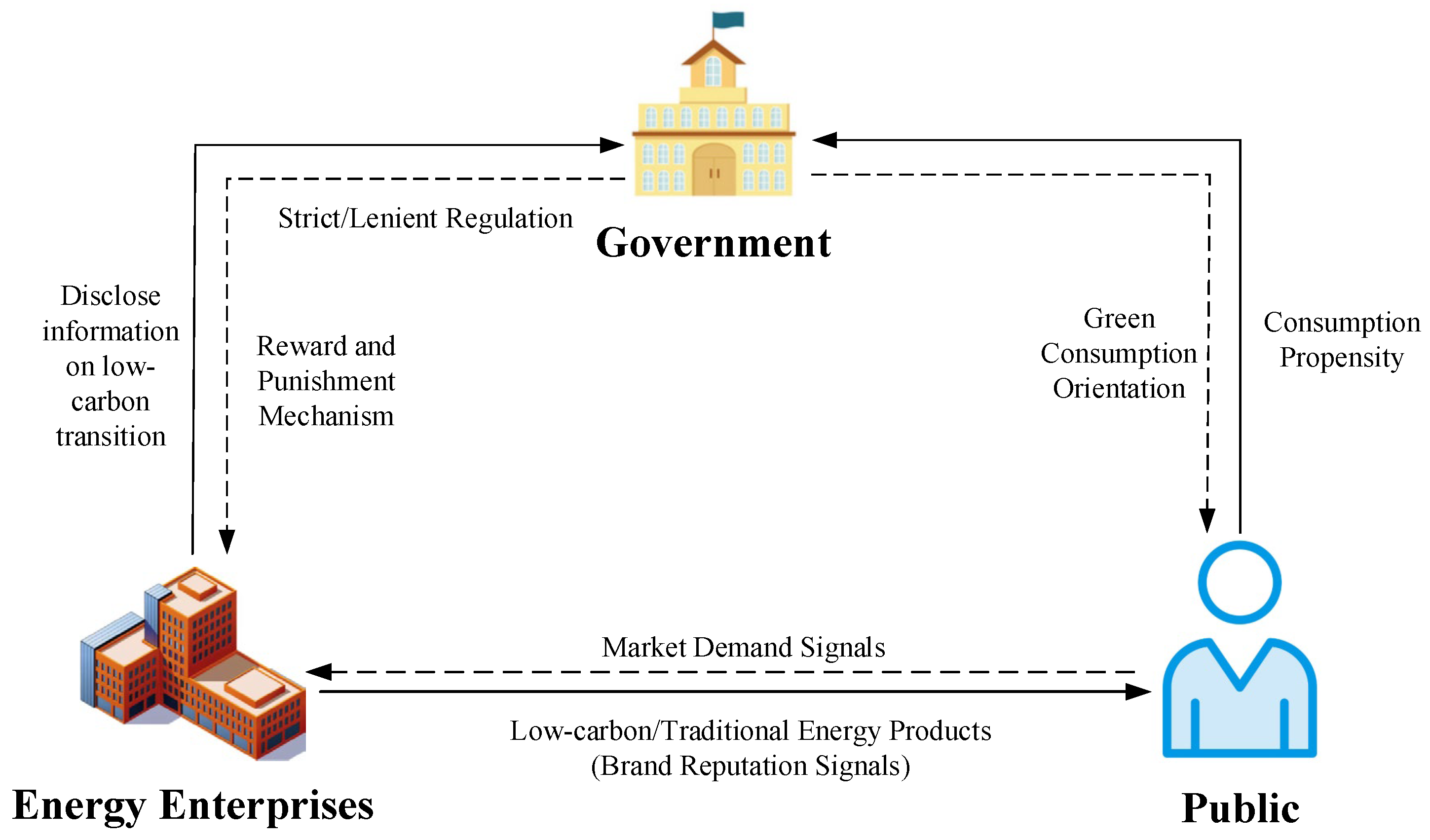
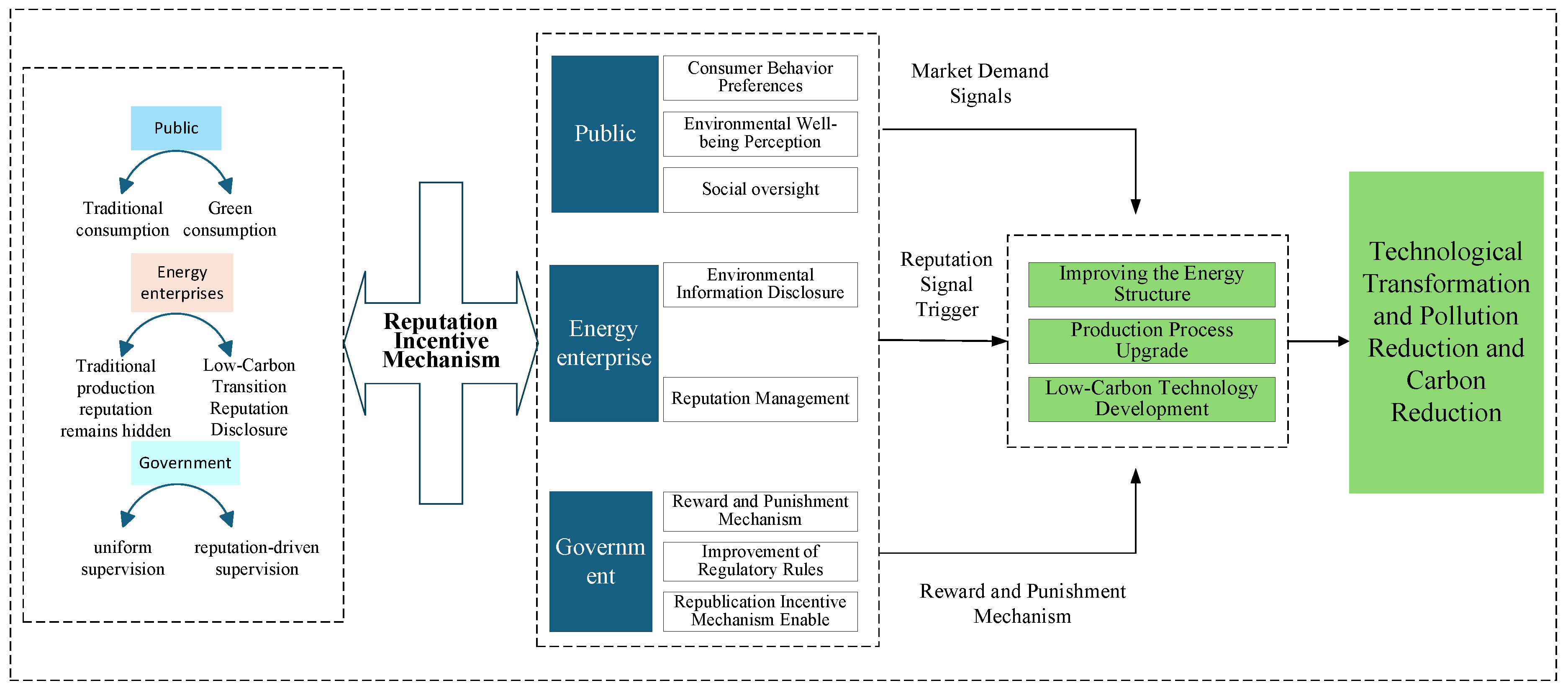
As an informal institution, the reputation incentive mechanism transforms social evaluations and market signals into core enterprise assets, thereby guiding energy companies to optimize their energy mix and invest in low-carbon technology R&D [
6]. Compared to other industries, the energy sector faces greater pressure from public scrutiny. Feedback from the public and the government significantly influences corporate decision-making, and reputational incentives have a unique ability to drive change. By leveraging the strong reputation built through technological transformation, enterprises can enhance their market competitiveness, reduce financing costs, and secure preferential policies. Together, these factors create a stable external foundation and internal momentum for implementing pollution and carbon reduction initiatives [
7]. At the same time, the spillover effects of reputational incentives will also encourage the government to optimize its green governance models and enhance the effectiveness of policy implementation. In turn, this will further strengthen the synergistic effects of technological transformation and pollution and carbon reduction. Combining formal regulations with informal reputational incentives can encourage energy enterprises to shift from passive compliance to proactive innovation [
8], ensuring that the outcomes of technological transformation are fully translated into tangible reductions in pollution and carbon emissions, thereby achieving synergistic benefits.
Unlike existing research on evolutionary games in environmental governance, the innovations of this paper are primarily reflected in the following three aspects: (1) Overcoming the limitation that existing research has largely focused on formal institutions—such as government subsidies—which struggle to impose sustained behavioral constraints, this paper pioneers the incorporation of the reputation incentive mechanism as a core variable into a three-party evolutionary game model involving “energy enterprises, the public, and the government.” We systematically investigate the pathways through which this mechanism influences energy enterprises’ technological transformation and decisions on pollution and carbon emissions reduction. (2) Through numerical simulation, systematically investigate the independent mechanisms and boundary conditions by which reputation gains and losses influence firms’ technological transformation decisions. Also identify the threshold effects of key parameters—such as costs and subsidies—on system convergence. (3) By focusing on the synergistic relationship between reputational incentives and formal policy instruments, this paper reveals the underlying logic by which the integration of informal institutions and formal regulations drives the deep decarbonization of energy enterprises. These findings offer a novel theoretical framework for improving the green governance system.
4. Evolutionary Stable Strategy Analysis
Setting
, eight equilibrium points can be obtained, namely (0,0,0), (0,1,0), (0,0,1), (0,1,1), (1,0,0), (1,1,0), (1,0,1), (1,1,1). By combining with the replicator dynamic equation of the game entities, the Jacobian matrix J can be calculated. The equilibrium points and their corresponding eigenvalues are shown in
Table 2.
Situation 1: When , and , , the game system reaches a stable state at the equilibrium point E4(0,1,1). That is, the strategy choices of the game subjects converge to a balanced state of “energy enterprises concealing their traditional production reputation, the public having a preference for green energy products, and the government enabling regulatory reputation”.
At this point, , indicating that despite facing multiple pressures such as fines, carbon allowance purchases, and reputational damage, and despite enjoying incentives like subsidies, reputational gains, and carbon trading, the total cost of voluntary transformation for enterprises still exceeds the sum of all external incentives and avoidance costs. The reason lies in the prohibitively high costs of green technologies or initial investments. Consequently, even under a scenario combining government penalties and market incentives, energy enterprises find transformation uneconomical. Thus, they opt for “traditional production reputation concealment”. indicates that when the additional cost borne by the public for purchasing green energy products is less than the sum of the potential loss of social reputation from choosing traditional energy products and the personal reputation gains from supporting green consumption, opting for green consumption becomes more advantageous in terms of individual utility. This mechanism reveals that in a socially conscious environment, green preferences in consumption behavior are driven not only by environmental benefits but also by strong influences from social norms and personal reputation. indicates that when enterprises are reluctant to transform while the public demands greener solutions, the government adopts a “reputation-driven supervision” strategy. Although this approach entails higher regulatory costs, the fines imposed on non-compliant enterprises and the potential reduction in environmental damage (or increased environmental benefits) from strengthened oversight sufficiently cover and exceed these additional costs. The government plays a pivotal role in correcting market failures and responding to public expectations. Through mandatory penalties and information disclosure, it seeks to exert pressure on enterprises while safeguarding public environmental rights.
Situation 2: When and , the game system reaches a stable equilibrium at the point E6(1,1,0). This means the players’ strategy choices converge to a balanced state characterized by: “energy enterprises disclosing their low-carbon transition reputation, the public preferring green energy products, and the government implementing non-discriminatory regulation”.
At this point, , indicating that when the sum of the reputation premium gains and carbon trading revenues obtained by enterprises through transformation exceeds the net costs (including penalties, carbon credit purchase costs, etc.) incurred compared to maintaining the status quo, the expected net benefit of transformation is positive. Under this mechanism, market incentives are sufficiently strong to cover transformation costs, driving energy enterprises to voluntarily adopt a “low-carbon transformation reputation disclosure” strategy even without direct government intervention through additional subsidies or penalties. , identical to Situation 1. This indicates that the public’s motivation for green consumption primarily stems from a robust social reputation mechanism, with their behavioral choices relatively independent of the actual pace of corporate transformation. Even when enterprises have not transformed, the public tends to choose green products to gain reputational benefits, avoid reputational losses, or obtain environmental welfare. This may reflect consumer choices under information asymmetry (where enterprises “conceal their reputation”) or indicate that public demand for green products possesses a degree of rigidity or ethical attributes.
5. Simulation Analysis
5.1. Initial Assignment
The effectiveness of the evolutionary game model involving energy enterprises, the public, and the government is validated through numerical simulation. Specifically, MATLAB 2016 simulation software is employed to model the influence patterns of key parameters on the system’s evolutionary stable strategies. In the parameter assignment section, this paper conducts an in-depth analysis of the financial reports of leading energy companies such as PetroChina and examines the annual intensity of investment in green technology upgrades. We also study the combined effects of the brand premium achieved by green products in the market and the resulting reduction in financing costs. By integrating available data on government policy subsidies, tax breaks, and administrative penalties during the transformation process of China’s energy enterprises, we estimate the relevant parameters. In addition, this paper draws on the parameter assignment logic presented by Cui B Q et al. [
36] and Ning J et al. [
37]. To ensure consistency in the conclusions, this paper applies simplifications such as scaling to the parameters. The specific values do not represent actual amounts but rather the relative magnitudes of the parameters. The initial willingness of all three parties is set at 0.5, with specific values shown in
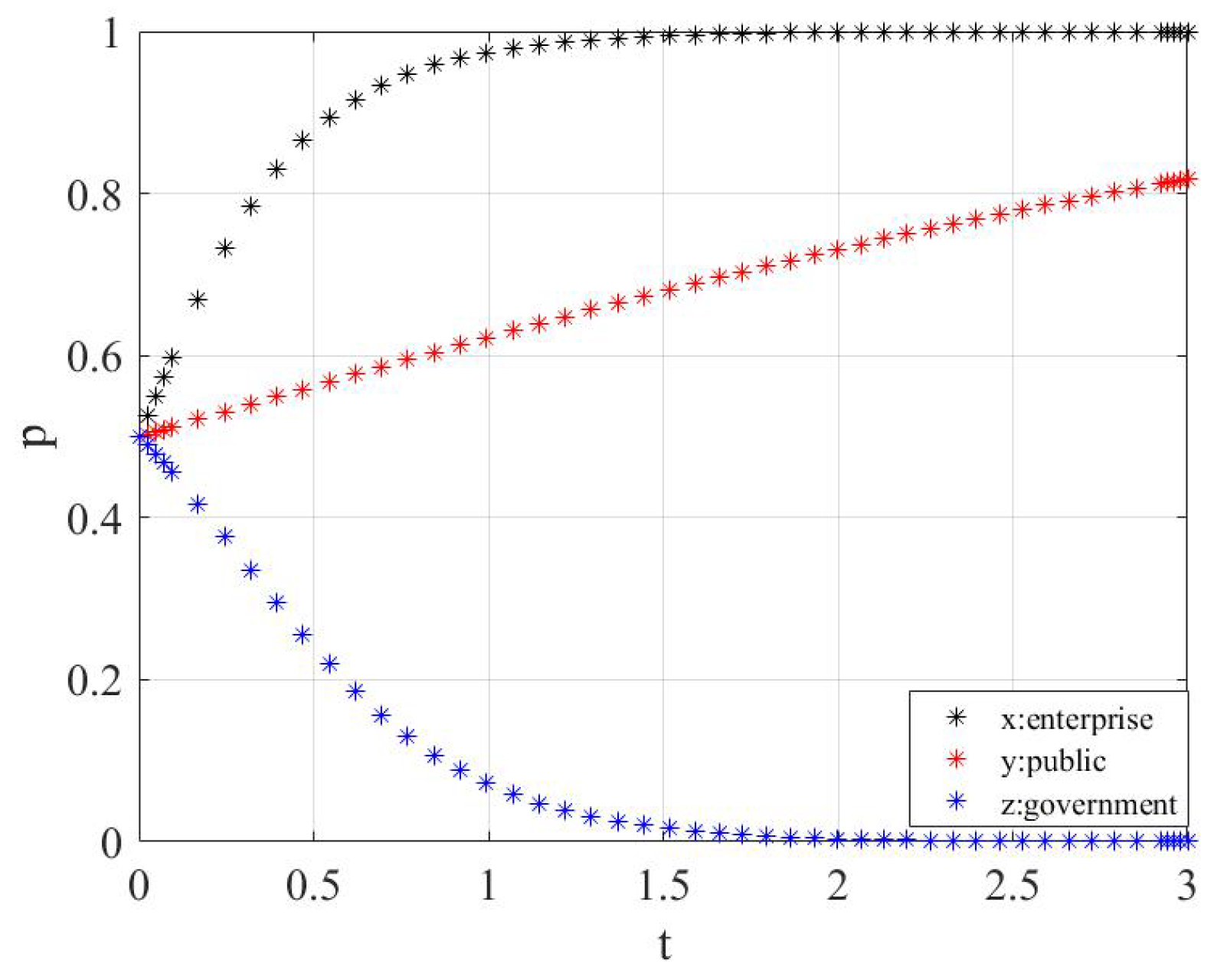
Table 3. Based on this, we conduct a parameter sensitivity analysis to validate the effectiveness of the evolutionary stability analysis. The initial evolutionary simulation result is shown in
Figure 3.
Under the initial assignment, the game system converges toward the
stable point, as shown in
Figure 3. This equilibrium corresponds to the following stable strategy combination: energy enterprises opt for low-carbon transition reputation disclosure, the public chooses green energy product preference, and the government selects non-discriminatory regulation. This equilibrium outcome reveals that, under the current parameter conditions, the reputation incentive mechanisms at both market and societal levels have already formed effective self-governance, propelling the system toward autonomous evolution toward a green and low-carbon direction.
5.2. Cost Sensitivity Analysis of All Parties
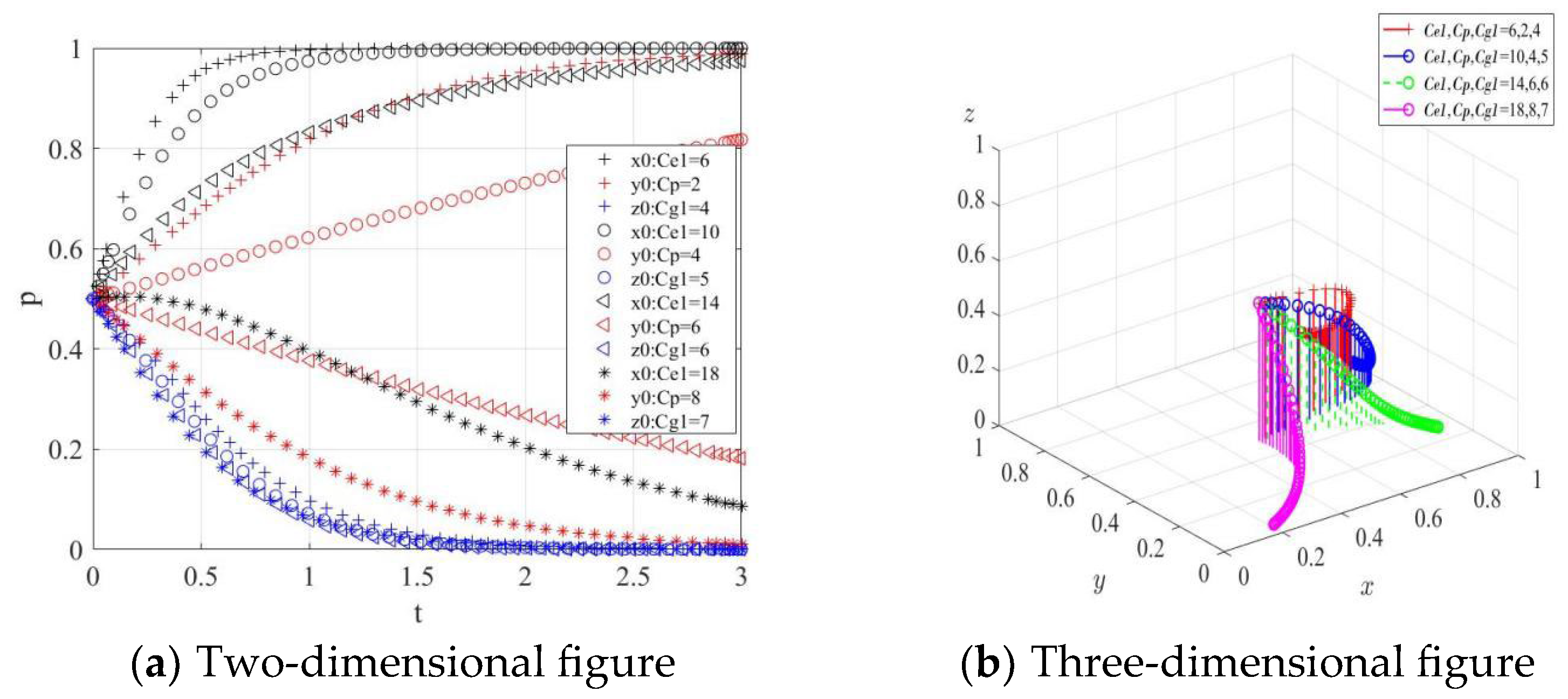
The rising costs of low-carbon transition for energy enterprises and public green consumption exert a significant inhibitory effect on system evolution, as shown in
Figure 4. When the transition cost
, enterprises tend to actively pursue transition. As costs rise, their willingness to transition gradually diminishes. If costs become too high, such as
, enterprises revert to traditional production strategies, and the system shifts from (1,1,0) to (0,1,0). As far as the public is concerned, when cost
, they tend to opt for green consumption. As costs rise, their willingness to consume decreases. When
, the public switches to conventional consumption. If
and
, the system will fall into a low-level equilibrium at (0,0,0), meaning that enterprises will not transform, the public will not consume, and the government will exercise weak regulation. Under such circumstances, the reputation incentive mechanism tends to fail.
The fundamental cause of systems deviating from their ideal equilibrium due to rising costs lies in the imbalance of incentive structures among key stakeholders. Transformational costs consist directly of sunk costs and incremental investments associated with a shift from “traditional production” to “low-carbon transformation.” When these costs exceed the total incentives derived from reputation premiums, carbon trading revenues, subsidies, and the avoidance of fines, companies face a decision-making dilemma where transformation becomes uneconomical. Even when facing the risk of reputational damage, they will still choose to maintain the status quo. For the general public, consumption patterns shift when the additional cost of purchasing a product exceeds the reputational and environmental benefits gained from supporting environmental protection. When both enterprises and the public face high costs, the marginal benefits of the government’s “reputation-based regulation” as a third-party decline, because even with stricter regulation, it is difficult to alter the cost–benefit structure for enterprises and the public in the short term, causing the system to slide toward a low-level equilibrium. This mechanism demonstrates that the government can substantially reduce the initial costs of corporate transition through measures such as subsidies for green technology R&D, tax incentives, and carbon revenue rebates. By implementing initiatives such as consumer subsidies, green credits, and carbon benefits, the government can lower the actual costs borne by the public, while simultaneously strengthening environmental awareness campaigns to enhance the public’s perception of the reputational benefits.
5.3. Benefit Sensitivity Analysis for All Parties
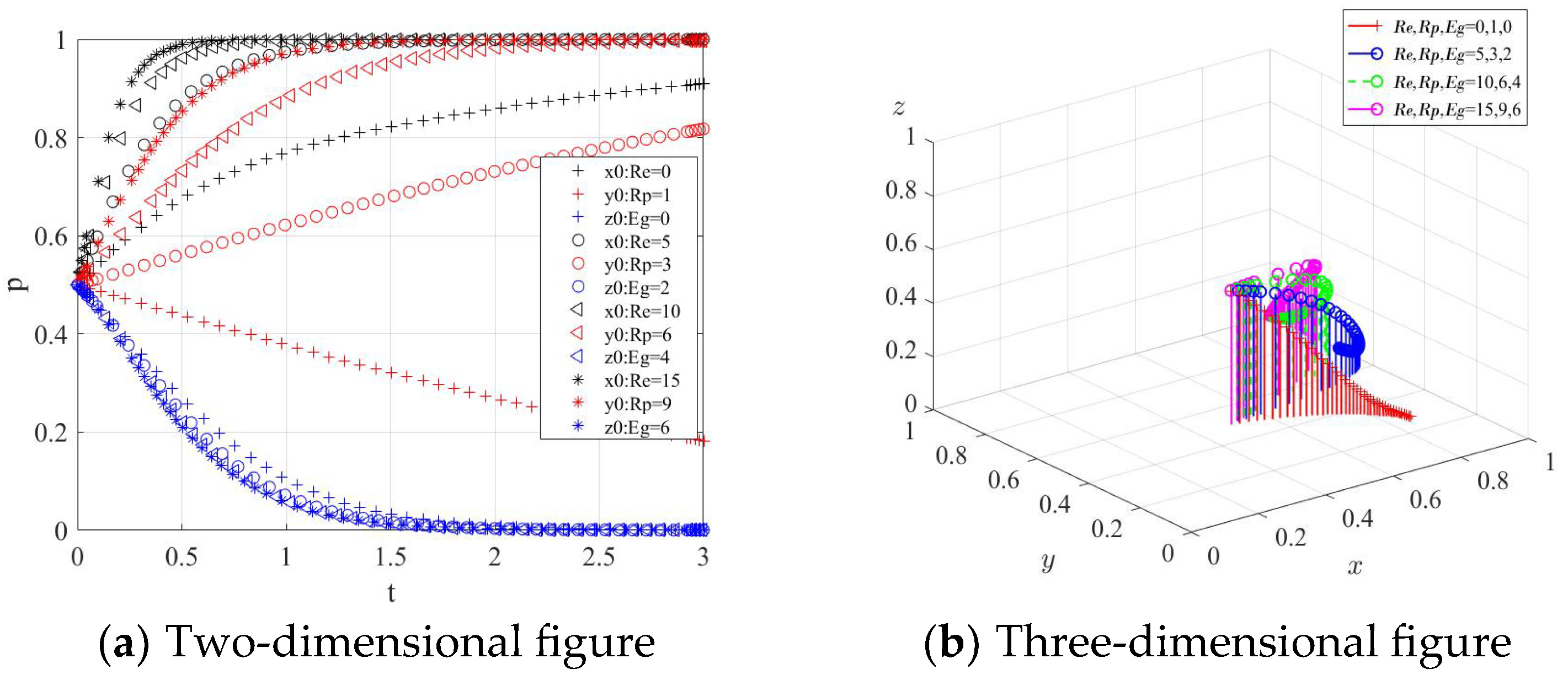
The magnitude of reputation gains significantly influences the strategic evolution of various agents, as shown in
Figure 5. When enterprises’ reputation return
, their willingness to transform converges at the slowest rate. When
, the pace of transformation accelerates significantly. Public behavior is equally sensitive to reputational gains. When
, the public tends to choose traditional products. When
, the public’s willingness to choose green products increases significantly and converges more rapidly. When government environmental revenue E varies between 0 and 6, there is no significant change in the convergence trend of government regulatory strategies. This indicates that regulatory behavior is driven primarily by cost structure.
Reputational gains can effectively influence the strategic choices of enterprises and the public because reputational signals, through social evaluation and market feedback, directly increase the net benefits of adopting green behaviors. For enterprises, reputational gains reflect the market’s premium on green products and, more importantly, indicate the level of recognition the market and consumers have for the enterprise. When these gains are sufficient to cover the marginal costs of transition, the enterprise’s strategic focus shifts from being “compliance-driven” to “value-driven,” thereby accelerating the convergence toward a transition strategy. For the general public, reputation gains reflect the positive reinforcement that social norms provide for green consumption behaviors. In a social environment with strong environmental awareness, choosing green products not only yields environmental benefits but also signals an individual’s commitment to environmental responsibility and social identity. The value of this signal translates into psychological utility and social capital for the individual. When this benefit exceeds the additional costs of green consumption, the public will develop a stable preference for green choices. Therefore, policies could further strengthen the transparent disclosure of corporate environmental information and establish a system of personal carbon credits and social recognition linked to consumer behavior. This would systematically enhance the efficiency of reputation value transmission and the intensity of incentives. Ultimately, it would encourage enterprises and the public to develop stable green behavioral patterns within a shorter timeframe.
5.4. Sensitivity Analysis of Energy Enterprise and Public Reputation Losses
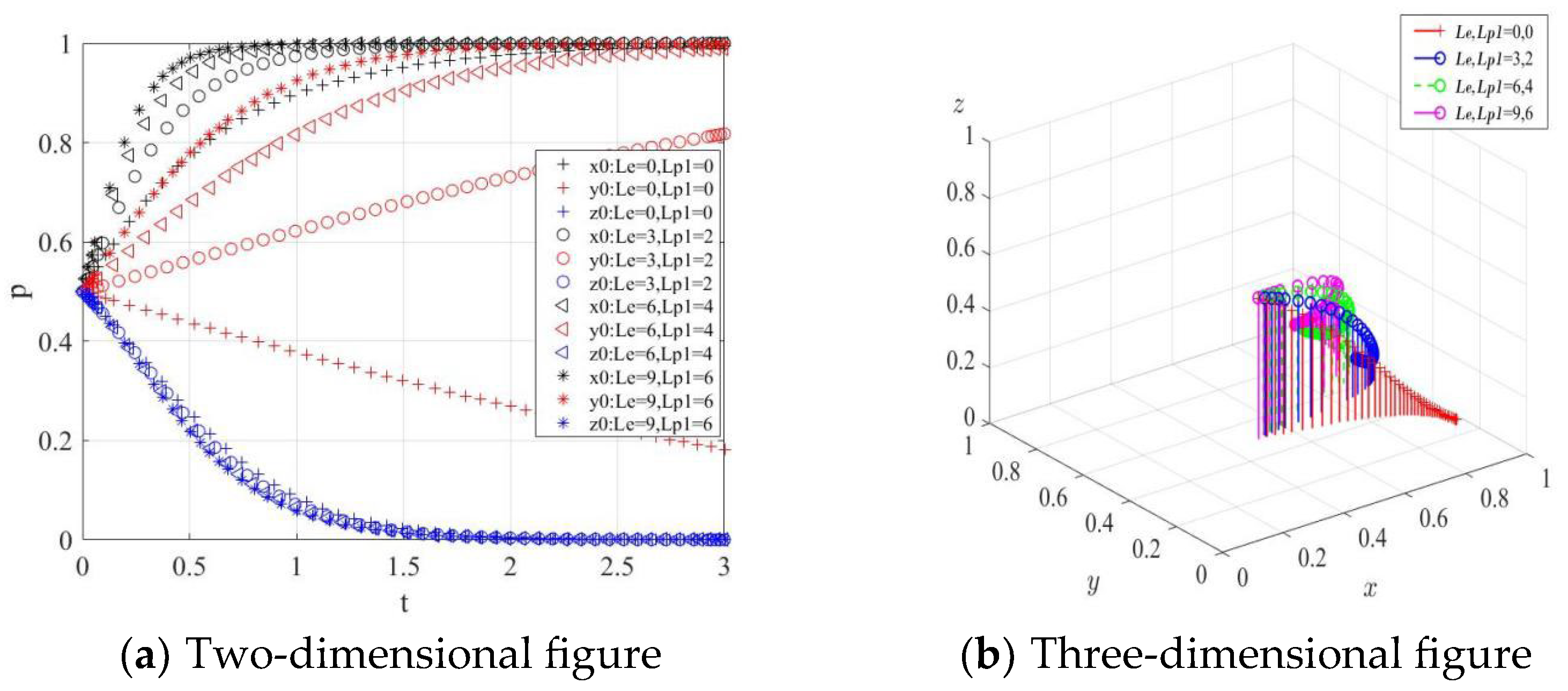
The magnitude of reputational losses significantly influences the strategic evolution paths of energy enterprises and the public, as shown in
Figure 6. When there is no reputational loss—that is, when
and
—the public lacks incentives to purchase green products, and enterprises’ willingness to transition converges more slowly. When reputational damage reaches a certain level—that is, when
and
—the public, under reputational pressure, shifts toward green consumption, and the rate of convergence accelerates. Consequently, the willingness of enterprises to transform also converges at an accelerated pace.
Reputational loss effectively alters the cost–benefit structure of actors’ behavior by creating social pressure and market constraints. For the public, reputational loss manifests as social pressure resulting from choosing non-green products. When this loss is significant enough, the public will opt for green consumption out of a desire to “avoid loss,” even if green products are more expensive. The negative utility associated with the loss often outweighs the positive utility derived from equivalent gains, making the driving force of reputational loss on public behavior even stronger than that of reputational gains. For enterprises, reputational losses reflect the market penalties they face as a result of poor environmental performance, including consumer boycotts, investor divestment, and rising financing costs. When these losses exceed the marginal cost of transitioning, enterprises will incorporate reputational risk management into their strategic decision-making, thereby accelerating the pace of transition. These findings indicate that social scrutiny and public opinion can serve as significant drivers of the green transition. Therefore, policy design should focus on establishing transparent and timely channels for environmental information disclosure and public oversight, while appropriately increasing the social pressure on high-emission and high-pollution enterprises. By leveraging the disincentive effect of reputational damage, we can simultaneously stimulate the motivation of energy enterprises to transform and the public’s willingness to make green choices.
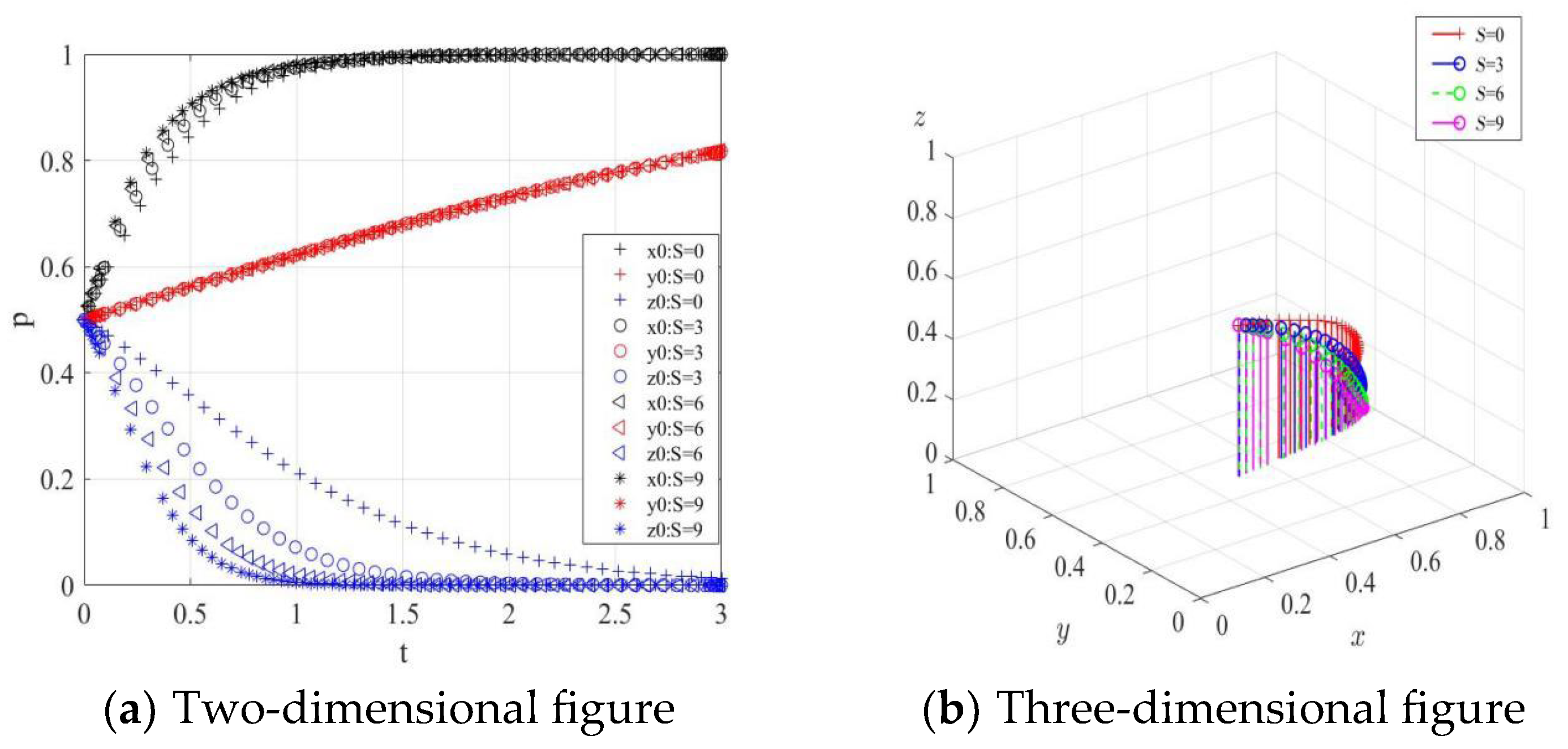
5.5. Subsidy Sensitivity Analysis for All Parties
Government subsidies have a significant impact on the low-carbon transformation behavior of energy enterprises, as shown in
Figure 7. In the absence of subsidies—that is, when
—enterprises may still choose to restructure, but their strategies converge more slowly. When
, enterprises’ willingness to restructure increases significantly, and the rate of convergence accelerates accordingly. When
, the marginal improvement in enterprise convergence slows, while the government’s willingness to adopt “reputation-based regulation” gradually declines, and the rate of convergence accelerates as this strategy is abandoned. This reflects the fact that high subsidies may exacerbate the government’s fiscal and regulatory burdens and lead to enterprise subsidy dependency.
This phenomenon reveals the complex interplay between subsidy policies and reputational incentive mechanisms. From enterprises’ perspective, subsidies directly reduce the net cost of transition and, to some extent, serve as a substitute for reputational incentives. When subsidies are sufficiently high, enterprises will still choose to transition based on economic rationality, even if the reputational benefits are limited. However, from the government’s perspective, increasing subsidy amounts means higher fiscal expenditures. Under budget constraints, large subsidies would divert resources away from regulatory efforts aimed at enhancing the industry’s reputation. At the same time, when the government relies too heavily on subsidies, it may encourage dependency or moral hazard among enterprises. Enterprises may focus solely on obtaining subsidies while neglecting substantive emissions reductions, thereby increasing the risk of “greenwashing.” Therefore, policy design should focus on striking a balance between incentives and constraints, promote the establishment of a subsidy mechanism that is dynamically adjusted and tied to specific conditions, and reduce excessive reliance on direct subsidies. This will facilitate the coordinated development of sustainable government regulation and enterprise transformation driven by internal factors.
5.6. Discussion
The results of the sensitivity simulation analysis on government subsidies confirm that moderate subsidies do indeed accelerate the convergence of enterprise transformation strategies. However, when subsidies exceed a certain threshold, they can induce dependency among enterprises. Furthermore, a sensitivity analysis of reputation gains and losses confirms that these factors can independently moderate an enterprise’s cost–benefit structure—separate from formal regulatory instruments—thereby driving enterprises from “passive compliance” toward “proactive innovation.” This finding aligns with the conclusions of Guo J et al. [
24] regarding the constraining effects of reputation losses, while extending the analysis to include the incentivizing effects of reputation gains. The findings distinguish between the dual effects of reputational gains and losses, clarify the threshold at which these factors influence decision-makers, and go beyond the qualitative conclusion of “whether they are effective” [
38]. Additionally, the study found that reputational losses exert a stronger driving force on the public than reputational gains, thereby providing empirical evidence for the application of “loss aversion” theory in environmental governance [
31]. Furthermore, simulation results indicate that government subsidies and reputational incentives can complement and reinforce one another, thereby promoting sustainable government regulation and endogenously driven enterprise transformation.
6. Conclusions and Implications
6.1. Conclusions
This paper constructs and solves an evolutionary game model involving energy enterprises, the public, and the government, combined with numerical simulation analysis, to draw the following core conclusions:
First, the reputation incentive mechanism significantly drives energy enterprises’ technological transformation decisions, influencing strategic choices through the dual effects of reputation gains and losses. Reputation gains and losses effectively regulate enterprises’ cost–benefit structures through market signals and social evaluations, thereby serving as crucial complements to traditional administrative and economic tools.
Second, the strategic choices of all three parties exhibit characteristics of dynamic interdependence and co-evolution. Whether the system reaches the ideal equilibrium of “enterprises transformation, public participation, and government enabling” depends on the relative magnitudes and coupling relationships among key parameters such as transformation costs, subsidy levels, and reputational incentives.
Third, government subsidies provide short-term incentives for energy enterprises’ transformation but impose long-term constraints. While increasing subsidy levels can accelerate the convergence of enterprise transformation strategies, it simultaneously weakens the government’s willingness to implement “reputation-empowered regulation.” This could increase fiscal burdens and trigger moral hazard issues among enterprises. Relying solely on subsidies is insufficient for achieving sustainable governance; synergistic mechanisms such as reputation incentives must be integrated.
6.2. Implications
6.2.1. Theoretical Implications
The primary theoretical implications of this paper lie in expanding and deepening our understanding of the mechanisms through which informal institutions function in multi-stakeholder environmental governance. At the same time, by focusing on the context of technological transformation in energy enterprises, the paper contributes to refining our theoretical understanding of this phenomenon.
First, this paper demonstrates that reputational incentives can drive technological transformation in energy enterprises by altering their cost–benefit structures. This mechanism operates through the dual effects of reputational gains and losses, thereby addressing the limitations of existing research, which has largely focused on policy regulations and economic subsidies [
39].
Second, through dynamic simulation, the paper identified the thresholds and conditions under which key variables—such as reputation gains and losses—take effect. It also revealed the dynamic interdependence and co-evolutionary characteristics of the strategies employed by the three parties, thereby advancing the field from qualitative descriptions toward quantitative and scenario-based analysis [
38].
Third, this paper reveals the dynamic transmission pathways of reputation incentives within the complex “government–business–public” system. It deepens our theoretical understanding of the synergistic effects between informal institutions and formal regulations from the perspectives of strategic interaction and equilibrium stability [
40].
6.2.2. Practical Implications
Based on the research results and considering the mechanisms underlying reputation incentives, this paper offers the following practical implications:
First, establish a reputation-based rating system focused on the effectiveness of corporate transformation, classifying companies according to key indicators such as carbon intensity and the proportion of renewable energy. Outstanding enterprises should be granted preferential policies, such as tax breaks, in addition to existing subsidies. Enterprises failing to meet standards should have their eligibility for preferential policies revoked and face increased inspection frequency. This approach will adjust the cost–benefit structure of enterprises, making reputation incentives a long-term mechanism that independently drives deep transformation.
Second, optimize the coordinated governance of subsidy and reputation mechanisms. In the early stages of the transition, use subsidies to lower the barriers to entry. In the middle and later stages, gradually shift to a governance model primarily based on reputation incentives. Achieve “short-term coordination and long-term complementarity” between these two types of policies, thereby avoiding excessive subsidies that undermine the effectiveness of the reputation mechanism.
Third, implement targeted measures to reduce the costs of R&D and retrofitting for low-carbon technologies in enterprises. Additionally, the government should streamline channels for public oversight, lower the barriers to public participation, and strengthen the deterrent effect of reputational damage. This will help the system converge steadily toward a state of synergistic equilibrium characterized by “enterprises proactively transforming, the public actively participating, and the government exercising appropriate oversight.”.