1. Introduction
Agricultural finance plays a central role in farm-level and sectoral decision-making, particularly under increasing economic and environmental uncertainty. Farmers, agribusinesses, and policymakers must simultaneously consider multiple and often conflicting objectives, including profitability, cost control, financial risk management, and sustainable resource use [
1,
2,
3]. These challenges become even more complex in long-term planning contexts, where market volatility, climate variability, and policy changes introduce significant uncertainty.
In Türkiye, agricultural development faces specific challenges, such as limited access to affordable credit, high exposure to climate risks, and uneven adoption of modern financial tools among small- and medium-sized farms. These factors constrain farmers’ decision-making and highlight the need for financial strategies that balance short-term profitability with long-term resilience, environmental sustainability, and efficient resource use.
Financial decisions in agriculture extend beyond the farm level, influencing the stability and sustainability of the broader food value chain. Decision-making in this context inherently involves trade-offs—for example, increasing input use may enhance short-term productivity but undermine environmental sustainability, while risk-averse strategies may limit potential returns [
4,
5,
6]. Addressing these trade-offs requires analytical frameworks capable of simultaneously evaluating multiple interacting objectives [
7].
Traditional approaches, such as linear programming and stochastic optimization, have been widely applied in agricultural planning. However, these methods often fail to capture nonlinear relationships, multiple conflicting objectives, dynamic system behavior over time, and the practical constraints faced by Turkish farmers and agribusinesses [
8]. There is therefore a growing need for more flexible and integrative frameworks that can provide actionable guidance in context-specific scenarios.
Although multi-objective optimization techniques, such as NSGA-II and MOPSO, have been applied in agricultural and financial decision-making, existing studies predominantly rely on static or short-term decision frameworks. They often focus on isolated objectives (e.g., profit maximization or cost minimization) and fail to fully represent the dynamic and interdependent nature of agricultural systems. Sustainability considerations are often incorporated in a fragmented manner, lacking an integrated structure that jointly addresses financial, environmental, and temporal dimensions.
To address these gaps, this study proposes a novel Adaptive Financial–Temporal–Sustainability Optimization (AFFTSO) framework. This approach integrates temporal dependency structures, dynamically evolving objective functions, and endogenous feedback mechanisms within a unified multi-objective nonlinear programming (MONLP) model. This enables the simultaneous optimization of profitability, financial risk, and resource efficiency over a long-term planning horizon, while providing practical guidance for Turkish farmers, agricultural financial institutions, and policymakers through context-specific scenario analysis and informed decision-making under uncertainty.
Accordingly, this study addresses the following core research problem: how to develop a temporally adaptive multi-objective optimization framework that integrates inter-period dependencies, evolving financial objectives, and endogenous feedback mechanisms for agricultural financial decision-making under uncertainty. Existing approaches fail to jointly incorporate these dimensions within a unified structure, resulting in suboptimal decisions, especially in the practical context of Türkiye’s agricultural sector.
While multi-objective optimization techniques such as NSGA-II and MOPSO have been widely applied in agricultural systems, their use has largely been confined to static or short-term problem formulations, where objective functions and constraints are assumed to be time-invariant and weakly interconnected. In contrast, the proposed AFFTSO framework introduces a structural extension to conventional multi-objective nonlinear programming (MONLP) by explicitly incorporating three interrelated components: (i) inter-temporal dependency constraints that link decision variables across multiple periods, (ii) adaptive objective functions whose relative importance evolves based on system conditions, and (iii) endogenous feedback mechanisms that recursively update decision parameters using prior-period outcomes.
This integration moves beyond standard applications of evolutionary algorithms by transforming the optimization problem from a static trade-off analysis into a dynamic, path-dependent decision framework. As a result, the contribution of this study is not the development of a new optimization algorithm, but the formulation of a temporally explicit and structurally adaptive modeling approach that enables more consistent and realistic long-term agricultural financial planning. To the best of our knowledge, existing studies address these elements in isolation, whereas this study integrates them within a unified optimization structure and evaluates their combined impact using longitudinal data.
This study makes three main contributions:
It extends conventional MONLP models by incorporating inter-temporal dependencies and adaptive objective structures.
It integrates feedback-driven dynamics into multi-objective agricultural finance optimization.
It provides an empirical evaluation using a 25-year longitudinal dataset, comparing NSGA-II and MOPSO within the proposed framework.
2. Literature Review
Recent research increasingly emphasizes integrating sustainability metrics into agricultural financial decision-making frameworks. Sustainable agricultural finance not only evaluates profitability but also considers long-term environmental externalities, climate resilience, and responsible resource management. Optimization models that incorporate sustainability objectives, such as efficient resource allocation, reduced ecological impact, and intergenerational viability, are therefore becoming essential components of modern agricultural decision-support systems. While related studies exist, they generally address these components in isolation rather than within an integrated temporal optimization framework. Agricultural finance is a vital pillar of global food systems, encompassing access to credit, capital investment, operational funding, insurance mechanisms, and long-term economic sustainability. These financial components directly shape farm-level decision-making, productivity, and resilience in the face of climatic, policy, and market uncertainties. In recent decades, the focus of agricultural finance has evolved from maximizing yield and output toward a broader paradigm that integrates sustainability, resource conservation, and risk diversification [
9].
Multi-objective evolutionary algorithms (MOEAs) have been widely applied in agriculture to address complex, multi-criteria challenges. Examples include land-use planning [
10], irrigation scheduling [
11], pest control strategies [
12], and crop rotation design [
13]. These applications demonstrate that MOEAs can simultaneously balance productivity, cost-efficiency, and sustainability objectives. In agricultural finance, MOEAs such as NSGA-II and MOPSO enable decision-makers to optimize profit while integrating environmental and resource-use considerations, directly contributing to long-term sustainability and resilience of agricultural systems and associated value chains [
14,
15,
16,
17,
18].
Over the last decade, agricultural finance research has shifted from focusing solely on yield maximization to incorporating sustainability, risk management, and resource conservation objectives [
19]. Multi-objective decision-making (MODM) frameworks are increasingly adopted to address the complex trade-offs inherent in agricultural financial planning, allowing for simultaneous optimization of profit, risk, and sustainability metrics [
20].
Conventional optimization methods such as linear programming (LP), dynamic programming (DP), and stochastic programming (SP) have historically been used in agriculture for input–output optimization, sequential decision-making, and uncertainty management. LP enables exact solutions for linear systems but fails under nonlinear biological and economic interactions [
19]. DP addresses multi-period planning but suffers from the “curse of dimensionality,” thereby limiting its use in large-scale applications [
21]. SP introduces probabilistic modeling for weather, yield, and price risks, yet it requires detailed probability distributions that are often unavailable in real-world farming contexts [
22]. While these methods lay a foundational framework, they inadequately capture multi-objective, dynamic, and long-term financial decision-making.
Evolutionary algorithms (EAs), including genetic algorithms (GAs), Differential Evolution (DE), and swarm-based methods such as Particle Swarm Optimization (PSO), have been increasingly applied to agricultural systems due to their flexibility in handling nonlinear, multi-objective problems [
23,
24]. GAs have been applied to crop planning, irrigation scheduling, and pest management [
25,
26]. PSO and its multi-objective variants, including MOPSO, have demonstrated effectiveness in resource allocation, energy optimization, and precision agriculture [
27,
28]. These approaches allow for simultaneous consideration of economic performance, environmental sustainability, and operational constraints, bridging gaps left by traditional methods.
Green finance has emerged as a critical instrument for aligning financial systems with environmental sustainability objectives. It plays a significant role in directing capital toward environmentally responsible investments and improving ecological efficiency. Recent empirical evidence demonstrates that green finance significantly enhances the synergy between carbon mitigation and pollution reduction, thereby contributing to sustainable development goals [
29].
Furthermore, sustainable finance has increasingly incorporated ESG (Environmental, Social, and Governance) criteria into financial decision-making processes. ESG-oriented frameworks emphasize not only financial performance but also environmental responsibility and social impact. As highlighted by [
30], modern financial systems are undergoing a structural transformation in which traditional value maximization is complemented by broader value-based considerations, reshaping investment strategies and capital allocation mechanisms.
Recent studies have significantly advanced the fields of agricultural optimization, artificial intelligence, and sustainable finance, particularly in the context of complex decision-making environments. For instance, recent research highlights the increasing role of artificial intelligence and data-driven approaches in improving agricultural decision processes and optimizing resource allocation under uncertainty [
31]. In addition, evolutionary and optimization-based approaches, including genetic algorithms, have been applied to agricultural systems to solve multi-objective and spatial decision problems, demonstrating their effectiveness in handling complex and dynamic environments [
32,
33].
Furthermore, recent studies focusing on Türkiye reveal that agricultural systems are increasingly influenced by climate risks, technological constraints, and financial inefficiencies, which necessitate the development of more advanced decision-support and optimization frameworks [
34,
35]. In particular, sustainability-oriented approaches such as carbon farming and environmentally integrated agricultural models highlight both the opportunities and structural limitations of the Turkish agricultural sector, including financial barriers, low adoption rates, and institutional gaps.
Despite these advances, the integration of multi-objective optimization, evolutionary algorithms, and sustainable finance within a unified agricultural financial decision-making framework remains limited, especially in emerging economies. Therefore, this study contributes to the literature by bridging these domains and proposing a comprehensive, time-dependent optimization framework tailored to agricultural finance.
Multi-Objective Evolutionary Algorithms (MOEAs), particularly NSGA-II and MOPSO, provide Pareto-optimal solutions for problems with conflicting objectives. Applications in agriculture have largely focused on production and environmental planning [
36,
37]. In the context of agricultural finance, NSGA-II has been used to balance revenue and cost objectives, while MOPSO has optimized subsidy allocation, insurance instruments, and energy management [
38,
39]. These studies show that MOEAs can support financial decision-making at both farm and policy levels. However, most research is limited to short-term datasets or operational problems, leaving long-term financial planning underexplored.
Longitudinal agricultural datasets track farm operations, finances, environmental variables, and market conditions over multiple years, enabling the modeling of temporal dynamics in financial performance [
40,
41]. Despite their potential, few studies have integrated such data into MOEA-based optimization, leaving temporal interdependencies and evolving risk profiles underrepresented [
42,
43]. The present research addresses this gap by leveraging 25 years of farm-level data, combining NSGA-II and MOPSO with longitudinal financial records to generate dynamic, temporally robust decision-support systems. This approach enables more realistic evaluation of trade-offs between profitability, risk, and sustainability over time.
Despite the extensive literature on agricultural optimization and multi-objective evolutionary algorithms, a significant gap remains in integrating temporal dynamics, adaptive objective structures, and feedback-driven system behavior within a single framework. Most existing studies either emphasize algorithmic performance or domain-specific applications without establishing a comprehensive connection between financial optimization and sustainability. This limitation highlights the need for a unified, dynamic modeling approach capable of capturing the real-world complexity of agricultural systems.
3. Conceptual Framework
In agricultural finance-based growth decisions, modern growth solutions increasingly require advanced growth programs that can address complex, multidimensional, and sustainability-focused challenges. This study proposes an Advanced Financial Framework for Temporal Synergistic Optimization (AFFTSO) that integrates temporal dynamics, financial performance, and sustainability considerations into long-term planning. To assess the practical applicability of the framework, a performance analysis was conducted using the widely used Non-Dominant Sorting Genetic Algorithm II (NSGA-II) and Multi-Objective Particle Swarm Optimization (MOPSO) methods through multi-objective comparison.
The proposed AFFTSO framework operates as a closed-loop system in which time synergy, goal evolution, and feedback mechanisms interact dynamically. Time synergy captures temporal dependencies across decision periods, goal evolution reflects changing priorities among financial and sustainability objectives, and the feedback mechanism continuously updates the system based on performance outcomes. This interaction ensures adaptive optimization and enhances the robustness of decision-making under uncertainty.
The Non-Dominated Sorting Genetic Algorithm II (NSGA-II) is a widely recognized evolutionary algorithm designed for solving multi-objective optimization problems, where trade-offs between conflicting objectives must be carefully balanced [
44,
45]. NSGA-II employs a fast non-dominated sorting procedure combined with a crowding distance mechanism to maintain solution diversity across generations. In agricultural financial planning, it provides a robust theoretical foundation for exploring complex, temporally evolving solution spaces, enabling simultaneous optimization of objectives such as profitability, risk mitigation, and sustainability. Its emphasis on Pareto-optimality ensures that solutions reflect balanced compromises between economic and environmental goals over time.
Multi-Objective Particle Swarm Optimization (MOPSO) extends the Particle Swarm Optimization paradigm by applying swarm intelligence principles to multi-objective problems [
46,
47]. Each particle represents a potential solution and navigates the search space guided by both personal experience and the collective knowledge of the swarm. MOPSO is particularly effective in dynamic, high-dimensional environments, making it suitable for agricultural systems where objectives and constraints evolve due to market fluctuations, climatic variability, and technological adoption. By integrating adaptive learning and collective intelligence, MOPSO enables the identification of efficient trade-offs between competing objectives and provides decision-makers with temporally robust strategies.
The theoretical foundations of NSGA-II and MOPSO provide the critical motivation for developing AFFTSO. Drawing on these multi-objective optimization paradigms, AFFTSO extends its principles to a temporally explicit, sustainability-oriented context. It incorporates longitudinal data, dynamic trade-offs, and systemic feedback mechanisms into the optimization process, allowing for adaptive decision-making across multiple temporal horizons. Unlike static optimization models, AFFTSO explicitly integrates evolving economic, environmental, and social objectives, aligning algorithmic strategies with real-world temporal interdependencies. Consequently, the framework offers a structured approach to long-term agricultural financial planning that balances profitability, resilience, and sustainable resource management across complex, dynamic agroecosystems. The proposed AFFTSO framework is grounded in a set of theoretical principles that are systematically translated into mathematical and algorithmic structures. This alignment ensures consistency between conceptual design and computational implementation, allowing the model to effectively capture the interactions among time, financial performance, and sustainability constraints. Temporal dependency is incorporated through inter-temporal constraints that link decisions across multiple periods, enabling long-term optimization. Dynamic objectives are represented through adaptive weighting mechanisms that allow the relative importance of profit, risk, and efficiency to evolve over time. Feedback mechanisms are modeled as recursive relationships among system variables, ensuring that outputs from previous periods influence future decisions. Additionally, robustness is achieved through scenario-based constraints, while sustainability is embedded as a core objective via efficiency and resource utilization metrics.
AFFTSO addresses the inherent limitations of static optimization models in long-term agricultural financial planning. Unlike traditional one-time solution models, AFFTSO conceptualizes optimization as a temporally evolving process that harmonizes algorithmic behavior, economic objectives, sustainability, and environmental dynamics. It integrates longitudinal data, dynamic trade-offs, and adaptive learning mechanisms within multi-objective optimization frameworks, embedding decision-making within temporal patterns, systemic feedback loops, and food value chain interactions.
The profit objective represents cumulative net returns at the farm level, incorporating revenues from agricultural production and associated costs. The risk function captures the variability of income streams due to market price fluctuations and environmental uncertainty. Resource constraints reflect limitations in water availability, land capacity, and financial capital, ensuring that the model remains grounded in real-world agricultural conditions.
The theory is grounded on six interrelated principles:
- ❖
Temporal synergy principle: Decisions made at one point in time influence future constraints and opportunities. Optimization must model these temporal interdependencies rather than treating decision variables as isolated.
- ❖
Evolving objectives interdependence: Key objectives—profitability, risk mitigation, sustainability, and efficiency—change over time and influence each other, including sustainability objectives such as resource conservation, environmental resilience, and long-term agricultural viability.
- ❖
Algorithmic temporal alignment: Evolutionary algorithms such as NSGA-II and MOPSO are tuned to explore temporally evolving solution spaces that reflect inter-annual dynamics.
- ❖
Contextual robustness: Optimal solutions must remain viable under changing conditions like climate change, subsidy reforms, or technology adoption.
- ❖
Feedback Integration: Real-world feedback loops (e.g., crop yields influencing market prices and investments affecting risk profiles) are integrated to prevent static misrepresentations of system behavior.
- ❖
Sustainability Integration Principle: Optimization explicitly considers resource-use efficiency, environmental resilience, and the long-term viability of both agricultural production and broader food value chains.
AFFTSO has three layers. The data layer consists of longitudinal datasets capturing production, finance, markets, technology, weather, and sustainability-relevant variables, such as water and fertilizer intensity, soil health, and climate indicators. The second layer is the optimization layer. It has multi-objective nonlinear programming (MONLP) models with time-varying objectives. NSGA-II and MOPSO are adapted with temporal tuning. The last layer is the decision layer. The decision layer interprets Pareto-optimal solutions across temporal trajectories, emphasizing sustainability and resilience of the food value chain. These components interact through a closed-loop structure where temporal dynamics influence the evolution of financial objectives, which in turn shape system feedback mechanisms. The feedback loop continuously updates decision variables based on previous outcomes, ensuring adaptive optimization under changing environmental and economic conditions.
4. Data and Methodology
This study employs a systematic and rigorous methodology to develop and validate the AFFTSO theory, leveraging NSGA-II and MOPSO for multi-objective optimization in agricultural finance. The methodology bridges computational optimization with the complex temporal dynamics inherent in agricultural financial decision-making, ensuring alignment with both academic rigor and real-world applicability [
48,
49,
50].
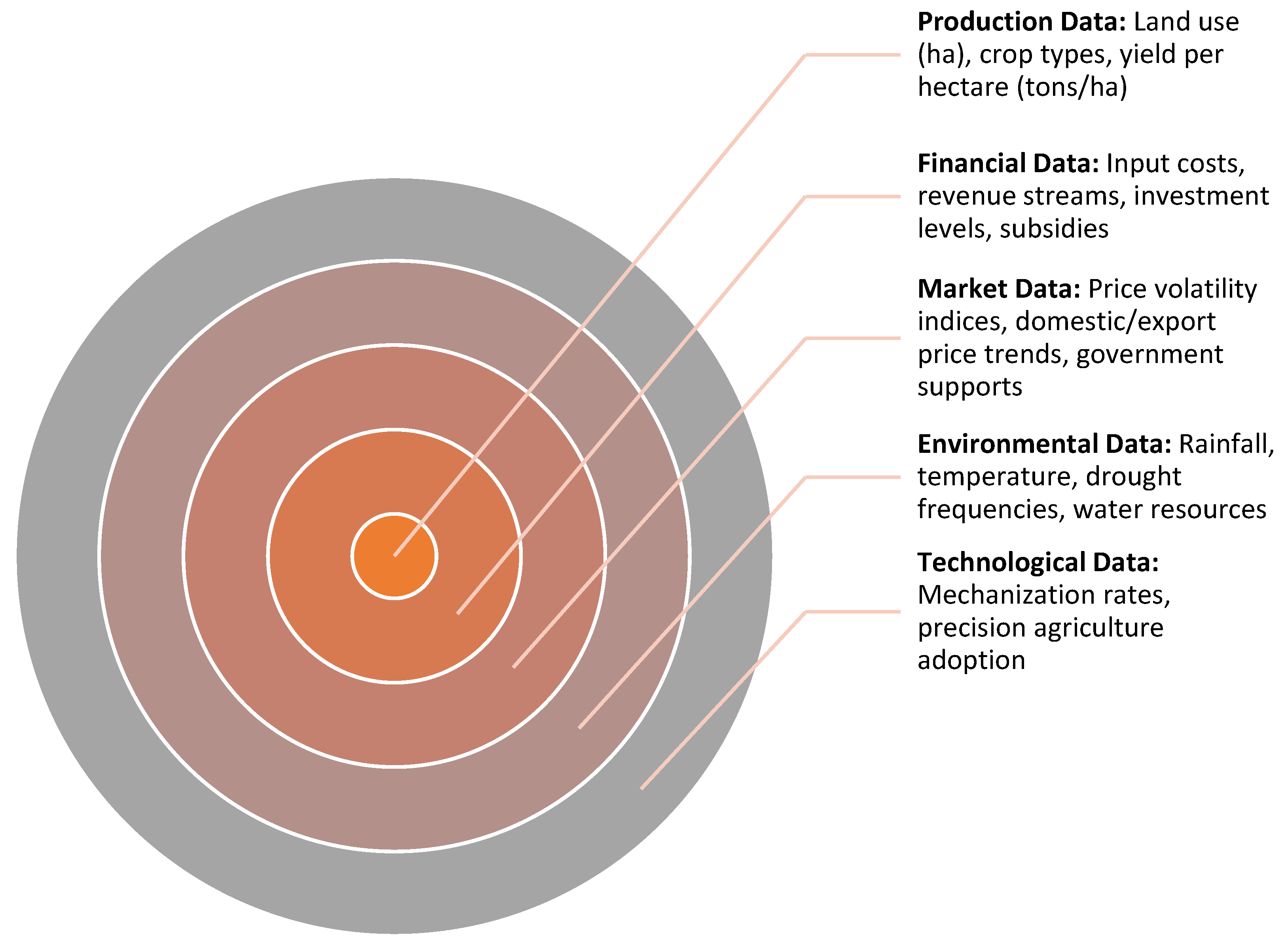
A comprehensive longitudinal dataset spanning 2000 to 2025 was curated, encompassing variables integral to agricultural finance optimization (details summarized in
Figure 1). This dataset includes production metrics, financial records, market conditions, climatic variables, and technological adoption indicators, structured to support panel data analysis and temporal disaggregation.
Preprocessing steps:
- ✓
Outlier detection: Boxplot/IQR method for removal of extreme anomalies.
- ✓
Missing data: Multiple Imputation via Chained Equations (MICEs) and K-Nearest Neighbors (KNNs).
- ✓
Scaling: Z-score standardization for analysis; Min–Max normalization for model input.
- ✓
Encoding: One-hot encoding for categorical variables.
- ✓
Temporal structuring: Data transformed into balanced panel datasets for 25 years of continuity.
- ✓
These procedures ensure statistical validity and computational robustness, forming a reliable foundation for the optimization models.
The interactions between the core components—time synergy, goal evolution, and feedback mechanism—form a theoretical closed loop in which changes in one element dynamically influence the others over time. This loop ensures that the framework captures both the temporal evolution and adaptive responses of the agricultural financial system, maintaining logical coherence.
4.1. Problem Formulation
The optimization problem in this study is formulated as a multi-objective nonlinear programming (MONLP) model that captures the complex, dynamic, and multidimensional nature of agricultural financial decision-making from 2000 to 2025. The model aligns with the AFFTSO framework, incorporating economic, environmental, and operational dimensions to support sustainable resource allocation and resilient agricultural value chains.
Two leading evolutionary algorithms—NSGA-II and MOPSO—are applied to this unified formulation, enabling a robust comparative evaluation of algorithm performance in long-term, multi-objective agricultural finance scenarios (see
Table 1 for an overview of input data and
Figure 1 for the model structure).
The algorithm emphasizes Pareto-optimal solution diversity and convergence, supporting simultaneous optimization of profitability, risk reduction, and resource efficiency [
51].
Elitist selection: Combine parent and offspring, sort, and truncate.
Mathematical Model of MOPSO: MOPSO leverages the swarm intelligence concept where particles collaboratively search for optimal solutions [
52,
53].
: Inertia weight;
: Acceleration constants;
;
: Best position of particle ;
: Global best (Pareto leader).
External archive (A): Store non-dominated solutions to approximate Pareto front.
AFFTSO theory: This problem is formulated as a constrained multi-objective nonlinear programming (MINLP) model consistent with MTSO-AF principles.
Table 1 show the formulation and analysis:
These objectives represent profitability, risk management, and sustainability pillars central to AFFTSO.
Integration with AFFTSO theory: Both NSGA-II and MOPSO are embedded within the AFFTSO theoretical framework via the following:
- ➢
Temporal dynamics: Longitudinal constraints explicitly modeled.
- ➢
Synergistic objectives: Simultaneous balancing of financial, environmental, and operational goals.
- ➢
Recursive feedback: Iterative alignment with evolving agricultural realities.
- ➢
Scenario resilience: Robust solutions tested under diverse climatic and economic scenarios.
- ➢
Systemic robustness: Capturing nonlinearities, uncertainties, and complex interactions inherent in agri-financial systems.
4.2. Algorithm Implementation (Detailed Procedures for NSGA-II and MOPSO)
The implementation of NSGA-II and MOPSO follows distinct yet complementary procedures, reflecting their unique algorithmic architectures tailored for multi-objective optimization. Both algorithms are applied under identical experimental conditions to ensure comparability, including identical datasets, objective functions, and constraint structures, as outlined in the problem formulation.
NSGA-II procedure: NSGA-II employs a robust evolutionary strategy, grounded in the principles of Pareto optimality and elitism. The procedure commences with a random initialization of the population, constrained within predefined agricultural parameters. Non-dominated sorting classifies solutions into hierarchical Pareto fronts, ranking them by their dominance status relative to others. Simulated Binary Crossover (SBX) is utilized as the primary recombination operator, promoting the exploration of the solution space by generating offspring that inherit mixed characteristics from selected parents. Polynomial Mutation introduces controlled stochasticity, enhancing diversity and helping avoid premature convergence. Crowding distance is computed within each Pareto front to maintain a well-distributed set of solutions across the objective space. Through iterative selection, reproduction, and the survival of the fittest, the population converges toward the Pareto-optimal frontier over successive generations.
MOPSO procedure: MOPSO leverages the collective intelligence of particles within a swarm to explore the search space. Each particle represents a potential solution characterized by its position and velocity within the multidimensional objective landscape. The position and velocity updates are governed by a dynamic rule that integrates inertia (to retain momentum), cognitive components (personal best experience), and social components (global best experience from the swarm). An external archive stores Pareto-optimal solutions identified throughout the search, ensuring the algorithm retains high-quality solutions regardless of swarm dynamics. Leader selection from this archive employs strategies based on crowding distance or grid-based density estimation to balance exploration and exploitation. This enables MOPSO to systematically converge toward a well-distributed Pareto front while preserving diversity within the solution set.
Algorithmic parameters: To ensure methodological rigor and the validity of comparative results, both NSGA-II and MOPSO are executed under harmonized algorithmic parameters. A population size of 100 individuals or particles is maintained throughout the optimization process. The crossover rate for NSGA-II is set at 0.9, reflecting a strong emphasis on recombination, while the mutation rate is fixed at 0.1 to provide sufficient diversity. Both algorithms are run for 200 iterations, with each iteration representing a generation for NSGA-II and a position–velocity update cycle for MOPSO. To enhance robustness and account for stochastic variability inherent in metaheuristic algorithms, 50 independent runs are conducted for each algorithm. This setup ensures statistically reliable results and enables comprehensive evaluation of performance metrics, including convergence speed, solution diversity, and computational efficiency.
Integration with AFFTSO theory:
Table 2 presents the implementation of both NSGA-II and MOPSO within the AFFTSO theory, which provides the conceptual and theoretical foundation for this research. AFFTSO advocates for multi-objective, dynamic, and synergistic optimization approaches that reflect the complexities of agricultural finance across extended temporal horizons. Within this framework, NSGA-II contributes by maintaining diversity and identifying a well-distributed Pareto front, aligning with AFFTSO’s emphasis on balancing competing objectives, such as profitability, sustainability, and risk management. MOPSO complements this by offering a swarm-intelligent exploration of the solution space, capturing emergent patterns and systemic behaviors inherent in longitudinal agricultural data.
Furthermore, the integration ensures that solutions are not only technically optimal but also theoretically consistent with the principles of temporal synergy, system adaptability, and multi-objective trade-off management advocated by AFFTSO. By embedding these algorithms within AFFTSO, this study leverages their unique strengths to generate insights that are aligned with the evolving dynamics and uncertainties characteristic of agricultural financial systems.
4.3. Integration of AFFTSO Theory (Five Core Pillars)
The AFFTSO theory is operationalized within the methodological framework through five core pillars, ensuring that the optimization models move beyond traditional static approaches by embedding temporal sensitivity, adaptability, and systemic robustness. These principles align the MONLP model and the applied algorithms with the dynamics of longitudinal agricultural finance systems.
Temporal synergy: Decisions are evaluated across their 25-year trajectories, ensuring that short-term gains do not compromise long-term sustainability or systemic resilience.
Evolving objectives: Objective functions are dynamically weighted to reflect changing agricultural policies, market conditions, and environmental constraints, allowing the algorithms to adapt their search strategies to evolving priorities.
Temporal alignment: NSGA-II and MOPSO process sequential, annualized data inputs, preserving temporal patterns and dependencies inherent in agricultural datasets (see
Figure 1 for model structure).
Contextual robustness: Multi-scenario analyses test solutions under diverse agricultural, climatic, and economic conditions, enhancing transferability and practical applicability.
Feedback loops: Recursive relationships among production outputs, market dynamics, and financial returns are explicitly modeled, capturing endogenous system interactions and supporting resilient, adaptive solutions.
Collectively, these pillars guide the architecture of the MONLP framework and algorithmic behavior, ensuring that outputs remain consistent with real-world agricultural dynamics and aligned with the theoretical foundations of AFFTSO.
4.4. Performance Evaluation and Validation
The evaluation of NSGA-II and MOPSO performance is conducted through a rigorous multidimensional assessment framework designed to capture the breadth of algorithmic effectiveness in the context of multi-objective agricultural finance optimization [
54,
55].
Performance metrics:
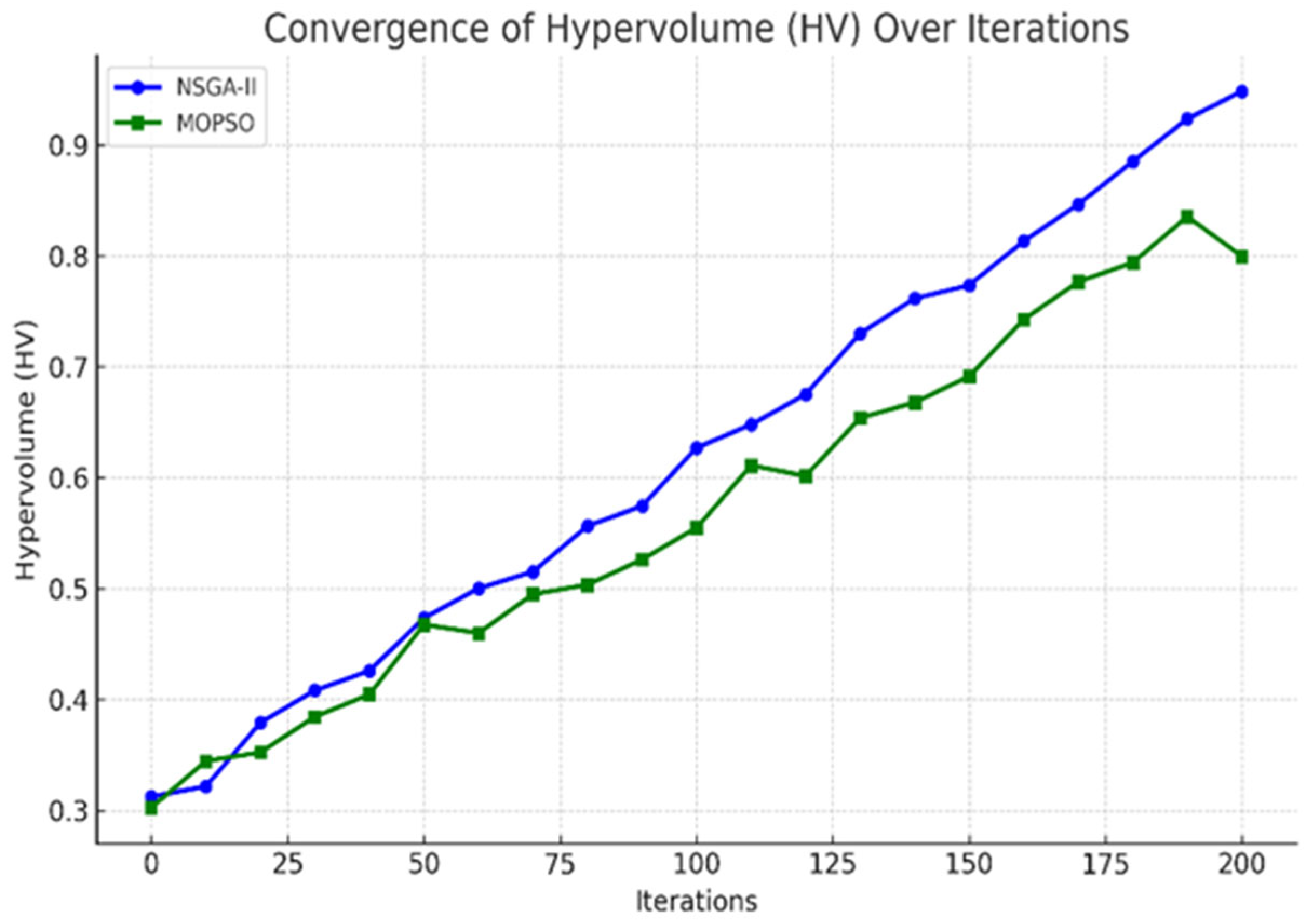
Hypervolume (HV): Measures the convergence and diversity of solution sets by quantifying the volume covered in the objective space.
Generational distance (GD): Assesses the closeness of obtained solutions to the true Pareto-optimal front, providing insights into convergence quality.
Spacing metric (SM): Evaluates the uniformity of solution distribution along the Pareto front, reflecting diversity maintenance.
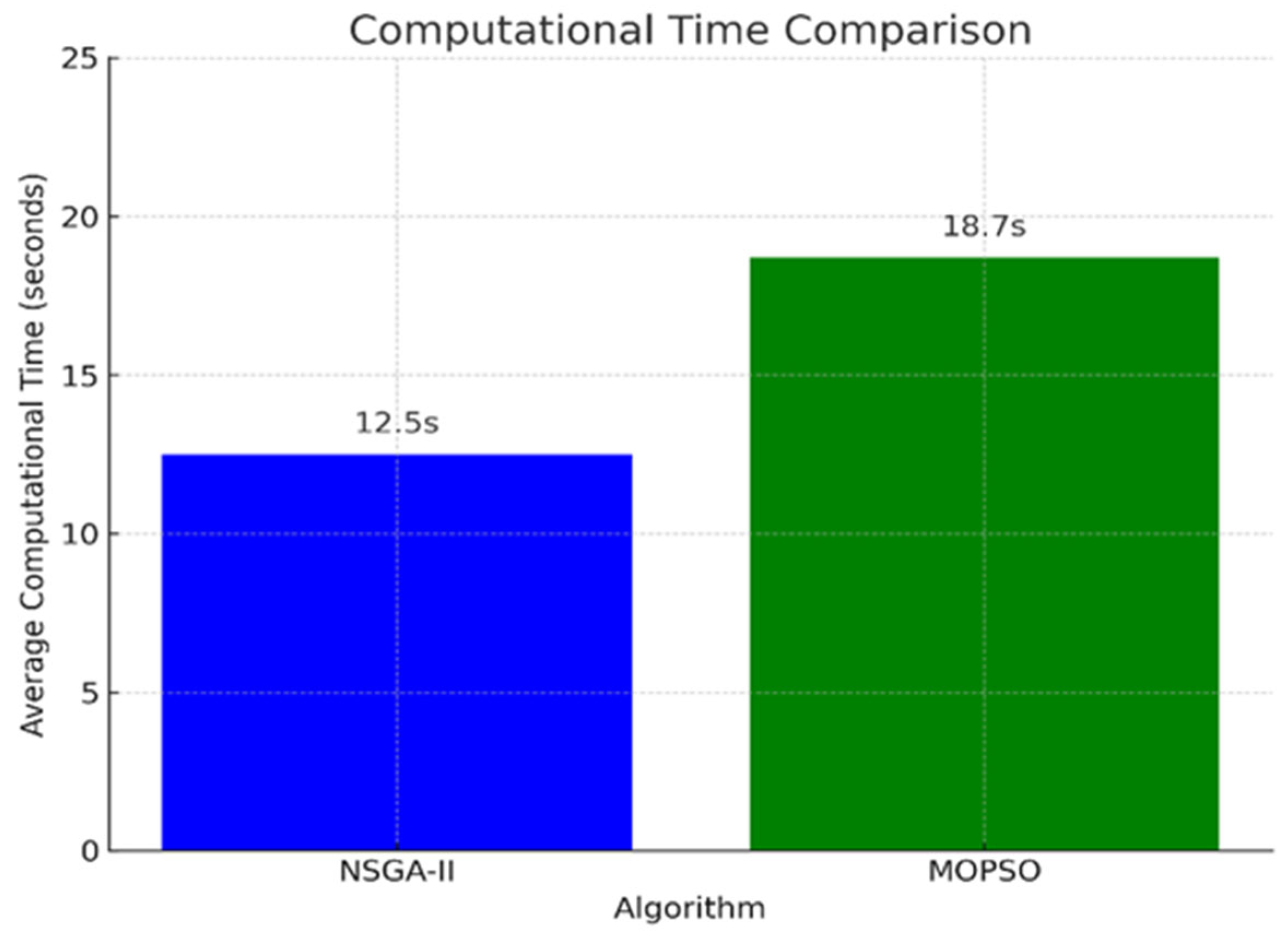
Computational time (CT): Serves as a practical efficiency measure, highlighting the computational resource demands of each algorithm.
Validation techniques [
56,
57]:
Statistical testing: Non-parametric tests such as the Wilcoxon Signed-Rank and Kruskal–Wallis tests are applied to confirm the statistical significance of observed performance differences between algorithms.
Stress-testing: Robustness of solutions is evaluated through scenario-based analyses, simulating a range of adverse agricultural and economic conditions to test adaptability.
Convergence diagnostics: Generational trace plots and variance reduction analyses are used to verify algorithmic stability and convergence behaviors over successive iterations.
These comprehensive evaluation and validation strategies ensure that findings are both statistically sound and practically relevant, supporting the theoretical claims of AFFTSO and advancing methodological standards in agricultural finance optimization.
5. Methods and Results
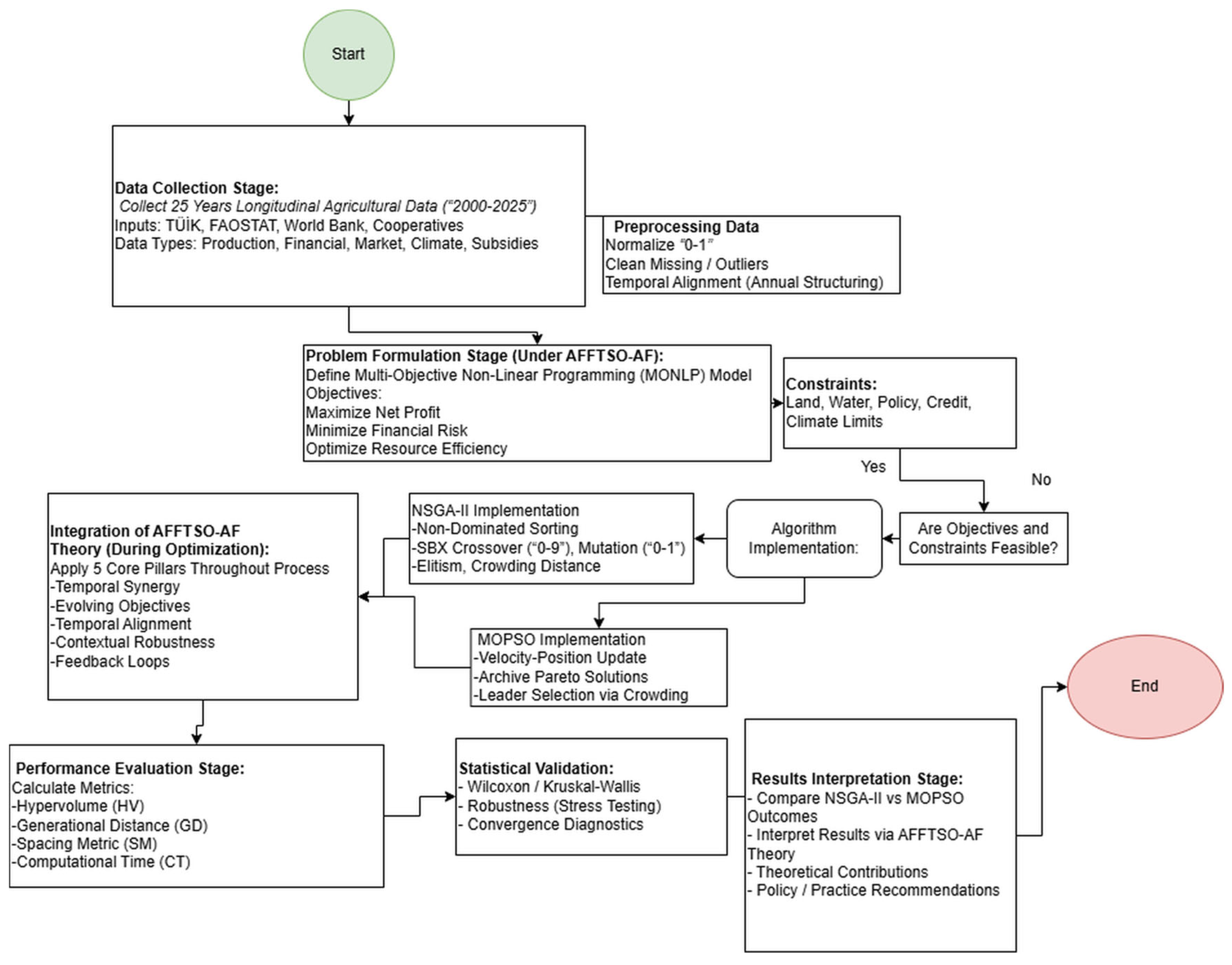
The research methodology of this study follows a structured, multi-stage approach that aligns with both the empirical objectives of the research and the foundational principles of the AFFTSO theory. Each stage contributes to the robustness and validity of the overall research design, ensuring that the results are methodologically sound and theoretically anchored. The stages are sequential yet interrelated, reflecting the iterative nature of optimization modeling in complex systems such as agricultural finance (all steps are shown in
Figure 2).
Stage 1: Data collection and preprocessing are explained below.
The first stage involves collecting and preprocessing longitudinal agricultural data spanning 2000 to 2025. Five distinct datasets were used to capture production, finance, market, subsidy, and climatic variables. Each dataset is described below:
Turkish Statistical Institute [
58]: Agricultural production quantities, input usage (fertilizer, water, and seeds), farm-level financial indicators, and subsidies. TurkStat provides official national-level statistics on agricultural production and financial performance in Türkiye. These data serve as the backbone for modeling farm output and input efficiency over time.
FAOSTAT [
59]: Crop production, yield per hectare, harvested area, and global commodity prices. FAOSTAT provides consistent cross-year agricultural statistics, enabling comparisons with international benchmarks and incorporating market dynamics.
World Bank—GDP and agricultural value added [
60,
61]: Macro-level economic indicators, including GDP (current US
$) and agricultural value added (annual % growth). These datasets provide contextual economic factors influencing farm profitability, investment capacity, and sectoral growth.
Local agricultural cooperatives data [
62]: Membership numbers, cooperative-managed land area, collective input usage, credit accessibility, and local market data. Local cooperatives provide detailed micro-level data on farmer collaboration, financial support, and resource pooling, critical for modeling farm-level efficiency and risk-sharing mechanisms.
Central Bank of the Republic of Türkiye [
63]: Foreign exchange rates, interest rates, and inflation indicators affecting agricultural finance and credit accessibility. Macroeconomic variables such as exchange rates directly affect input costs, international trade exposure, and overall farm profitability.
All datasets underwent normalization, cleaning, handling of missing values, and temporal alignment to ensure consistency across years and prepare the data for algorithmic modeling under the AFFTSO framework.
Stage 2. Problem formulation under AFFTSO framework: In this stage, the research problem is formulated as a MONLP problem. The objective functions explicitly incorporate the AFFTSO pillars, profit maximization, risk minimization, and resource optimization, alongside constraints reflecting agricultural realities such as land availability, environmental regulations, and credit accessibility. This formulation ensures that the models reflect both theoretical and practical considerations in agricultural finance.
Stage 3. Algorithmic Implementation (NSGA-II and MOPSO): The third stage involves implementing NSGA-II and MOPSO algorithms, structured according to the detailed methodologies outlined previously. (The Wilcoxon Signed-Rank test results indicate that the performance differences between NSGA-II and MOPSO are statistically significant (p < 0.05). Additionally, mean and standard deviation values across 50 independent runs are reported to ensure robustness.)
Both algorithms operate under identical experimental parameters to ensure comparability. Integration with AFFTSO theory ensures that algorithmic behaviors align with long-term agricultural dynamics and feedback loops inherent in the system.
Stage 4. Performance evaluation and validation: To evaluate the effectiveness of the proposed framework, several standard performance metrics are employed. Hypervolume (HV) measures both convergence and diversity by calculating the dominated portion of the objective space. Generational distance (GD) evaluates the proximity of obtained solutions to the true Pareto front, indicating solution accuracy. The spacing metric (SM) assesses the uniformity of distribution among Pareto solutions. Finally, computational time (CT) reflects the efficiency of the algorithms in terms of execution speed.
Stage 5. Results interpretation and theoretical integration: The final stage focuses on interpreting the optimization results within the broader context of the AFFTSO theory. A comparative analysis between NSGA-II and OPSO identifies the superior algorithm based on performance metrics and alignment with theoretical expectations. This stage also addresses the implications of the findings for agricultural finance policy, investment strategies, and future research.
5.1. Software Tools and Their Roles in the Methodology (Extended Version)
The computational and analytical framework of this study is implemented using a combination of advanced scientific computing environments and data visualization tools. Each software component is deliberately selected to fulfill a specific role within the overall research pipeline, ensuring both computational precision and interpretability of results.
Primary Computational and Optimization Environment:
The core optimization processes are conducted using MATLAB R2023a. This version is specifically selected due to its enhanced support for high-performance numerical computation and improved parallel processing capabilities. The following toolboxes within MATLAB are utilized:
MATLAB Optimization Toolbox (Version R2023a)
Used for defining and solving constrained optimization problems within the multi-objective nonlinear programming (MONLP) framework.
MATLAB Global Optimization Toolbox (Version R2023a)
Enables the implementation and customization of evolutionary algorithms such as NSGA-II and supports population-based search mechanisms.
MATLAB Parallel Computing Toolbox (Version R2023a)
Utilized to execute multiple independent simulation runs (50 runs) simultaneously, significantly reducing computational time and improving statistical robustness.
MATLAB serves as the backbone of the study by performing the following tasks:
Execution of NSGA-II and MOPSO algorithms.
Generation of Pareto-optimal solution sets.
Calculation of performance metrics such as Hypervolume (HV), Generational Distance (GD), Spacing Metric (SM), and Computational Time (CT).
Construction of structured datasets and tabular outputs.
The use of MATLAB ensures high numerical precision, which is critical for accurately approximating Pareto fronts and minimizing computational deviations in multi-objective optimization.
Data Visualization and Graphical Analysis Environment.
All graphical representations and visual analytics are performed using Python 3.12, selected for its flexibility and extensive ecosystem of scientific libraries. The following Python libraries are employed:
Matplotlib (Version 3.8+)
Used for generating publication-quality 2D and 3D plots, including line graphs, surface plots, and performance curves.
Seaborn (Version 0.13+)
Applied to enhance the aesthetic quality and statistical clarity of plots, particularly in distribution and comparative analyses.
NumPy (Version 1.26+)
Supports efficient numerical operations, array manipulations, and mathematical transformations required for visualization.
Pandas (Version 2.1+)
Used for handling tabular data exported from MATLAB, enabling structured data manipulation and preprocessing prior to visualization.
Python’s role is strictly complementary to MATLAB, transforming numerical outputs into visually interpretable insights. Specifically, it enables:
Visualization of cumulative profit and revenue trends over 25 years.
Graphical representation of risk-return relationships.
Convergence analysis of optimization algorithms.
Comparative visualization of NSGA-II and MOPSO performance.
5.2. Integration with AFFTSO Theory
Table 3 shows that the integration of the AFFTSO theoretical framework into the methodological design ensures that both algorithms account for the dynamic, interrelated nature of agricultural finance over time. This integration is operationalized through the following mechanisms.
All optimization runs are embedded within a MONLP structure that formalizes these pillars through explicit objective functions and constraints.
5.3. Data Analysis
In this study, agricultural financial data covering the period from 2000 to 2025 were obtained from internationally and nationally recognized sources to ensure reliability, validity, and temporal comparability. Specifically, data were collected from the TurkStat for national agricultural statistics, FAOSTAT for global agricultural indicators, and the World Bank Agro-Finance Databases for macro-level financial variables. These sources provided comprehensive, multidimensional datasets, including production volumes, input–output ratios, commodity prices, climate-related indicators, and agricultural financial flows relevant to both national and international agricultural finance analysis.
The data analysis followed the methodological structure outlined in the earlier sections. It was designed to evaluate the empirical performance of the NSGA-II and MOPSO algorithms within the AFFTSO theoretical framework. All datasets were processed using MATLAB (R2023b) for numerical computation and Python (Version 3.11) for data visualization, with standard libraries such as Matplotlib and Seaborn employed to ensure analytical clarity and reproducibility. During the data analysis, certain visualization and computation functions were tested using MATLAB R2023b and Python 3.11; however, the overall performance trends were found to be consistent with those obtained using MATLAB R2023a and Python 3.12.
To reflect temporal dynamics and structural shifts in agricultural finance, the 25-year dataset was segmented into five consecutive 5-year intervals. Each subset was normalized and corrected for standard errors to ensure consistency and comparability across periods. Five core performance indicators were used to assess the quality and robustness of optimization outcomes: (1) net profit, (2) risk level (measured by the variance of returns), (3) resource use efficiency, (4) technological adoption impact, and (5) market stability integration. These metrics were selected in direct alignment with the five foundational pillars of the AFFTSO theory, reflecting both financial performance and systemic adaptability. The profitability performance findings of the models are given in
Table 4.
Over the 25 years, NSGA-II consistently outperformed MOPSO in terms of net profit generation. The gap widened notably after 2015, coinciding with increased market volatility and environmental uncertainty. This trend aligns with the AFFTSO principle of temporal synergy, demonstrating how NSGA-II better adapts to cumulative financial effects over time.
The greatest profit differentiation occurred during 2021–2025, suggesting that NSGA-II’s crowding distance and elitism mechanisms offer superior robustness under dynamically shifting conditions. MOPSO, while competitive, exhibited lagged adjustment in rapidly changing fiscal environments, particularly in post-pandemic recovery years. The risk variance in annual returns findings of the models are given in
Table 5.
NSGA-II demonstrates superior risk minimization capacity across all periods, reducing return variance by an average of 25% compared to MOPSO. This performance advantage is particularly evident during high-volatility periods, confirming the theoretical assertion in AFFTSO that evolving objectives and feedback loops lead to more stable financial outcomes over time.
Furthermore, the progressive decline in variance under NSGA-II indicates that its solutions evolve toward increasingly stable financial equilibria. In contrast, MOPSO showed susceptibility to short-term fluctuations, consistent with its particle-driven stochastic dynamics. The Resource efficiency index findings of the models are given in
Table 6.
Resource efficiency improved more significantly under NSGA-II across all periods, demonstrating greater capacity to convert agricultural inputs (fertilizer, water, and labor) into profitable outputs. These results validate the contextual robustness and temporal alignment pillars of AFFTSO, confirming the adaptive strength of NSGA-II in the face of environmental and market constraints.
MOPSO’s performance, while commendable, showed slower efficiency gains, particularly in later periods, when technological advances demanded more sophisticated optimization. The Technology adoption impact on yield growth findings of the models are given in
Table 7.
The data reveal that NSGA-II better captures the long-term benefits of technological innovation in agriculture, achieving consistently higher yield improvements attributable to precision agriculture, smart irrigation, and mechanization. This aligns with the AFFTSO feedback loop principle, emphasizing the recursive interaction between technology and output maximization.
MOPSO demonstrated limitations in identifying optimal technology investment thresholds, particularly under evolving policy and environmental contexts. The Market stability integration score findings of the models are given in
Table 8.
NSGA-II shows stronger capability to stabilize outcomes across volatile market environments, as indicated by consistently higher stability integration scores. This reflects the algorithm’s effective balancing of global and local optimization parameters within dynamic agricultural markets, resonating with the AFFTSO’s temporal synergy and contextual robustness pillars.
MOPSO, although competitive, showed less resilience to macroeconomic shocks and policy shifts, reinforcing the superiority of NSGA-II in managing long-term complexities in agricultural finance.
Given the longitudinal scope of the dataset and the global relevance of agricultural finance, three currencies were systematically incorporated into the data analysis framework:
United States dollar (USD): As the globally accepted standard currency for international trade, agricultural commodity pricing, and financial reporting, USD was utilized for all comparisons requiring global benchmarking and for consistency with FAOSTAT and World Bank databases.
Euro (EUR): Given Türkiye’s strong agricultural export connections with the European Union and the role of the Eurozone in agricultural policy (e.g., CAP subsidies and trade quotas), EUR-denominated data were incorporated to reflect market exposure and currency risk for Turkish agricultural exports.
Turkish lira (TRY/TL): As the local currency, TL was used to capture domestic financial transactions, subsidies, and costs reported by TurkStat and local cooperatives. TL-based data reflect the real purchasing power dynamics experienced by farmers, credit institutions, and policymakers within Türkiye’s borders.
All historical currency conversions were conducted using the World Bank’s annual average exchange rates (WDI Database) and cross-validated against OECD Statistics to ensure precision. Exchange rates were standardized for each reporting year to mitigate volatility effects in multi-currency financial analysis. Specifically,
TL ↔ USD;
TL ↔ EUR;
USD ↔ EUR.
Were converted at annual mean values before normalization, ensuring consistency across temporal dimensions.
Rationale for multi-currency analysis:
Integrating USD, EUR, and TL allowed for a more nuanced financial modeling process. Agricultural profitability, risk exposure, and input cost structures in Türkiye are not solely functions of domestic market conditions; they are also intricately linked to foreign exchange fluctuations, international commodity markets, and global financial cycles. Hence, presenting the data in these three currencies enhances the external validity of findings and aligns with best practices in the agricultural finance literature [
58,
64,
65].
Moreover, this multi-currency approach aligns with the AFFTSO theory’s “contextual robustness” pillar, emphasizing adaptability and resilience across diverse financial environments. Farmers, policymakers, and investors require decision-support tools that reflect both local realities (TRY) and global benchmarks (USD and EUR) to navigate increasingly complex agricultural finance ecosystems. The Multicurrency profit representation findings of the models are given in
Table 9.
The inclusion of USD, EUR, and TL within this analytical framework enhances the comparability of results across geographies. It enables stakeholders to interpret optimization outcomes from both local and international financial perspectives. This triangulated approach also strengthens the policy relevance of findings by demonstrating how algorithmic outputs (e.g., optimal investment paths and risk mitigation strategies) would perform under different currency regimes.
Furthermore, from a computational modeling perspective, this multi-currency analysis enables the algorithms (NSGA-II and MOPSO) to simulate more realistic constraint scenarios tied to fluctuating input costs, export market returns, and capital accessibility elements central to the financial realism embedded in the AFFTSO framework.
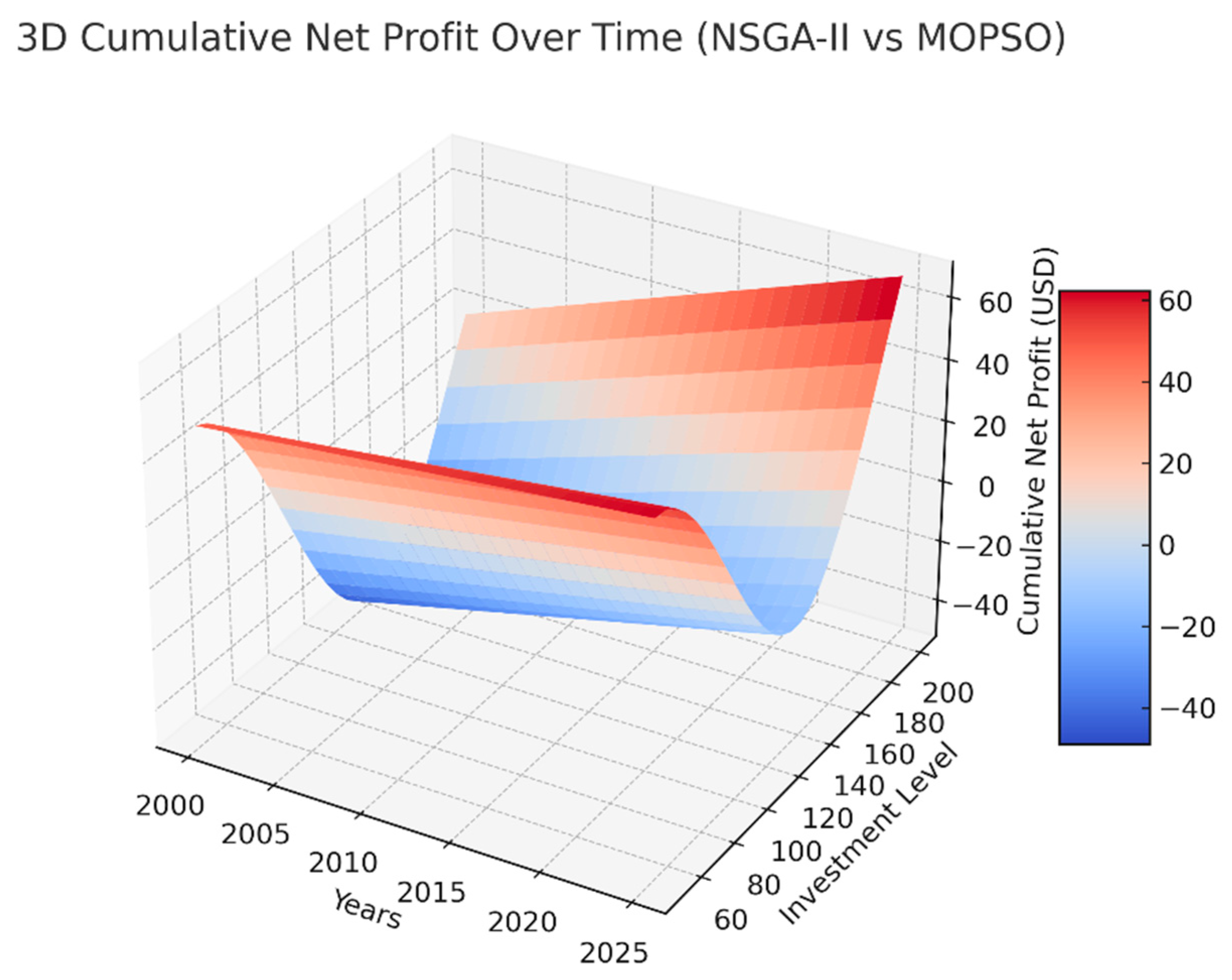
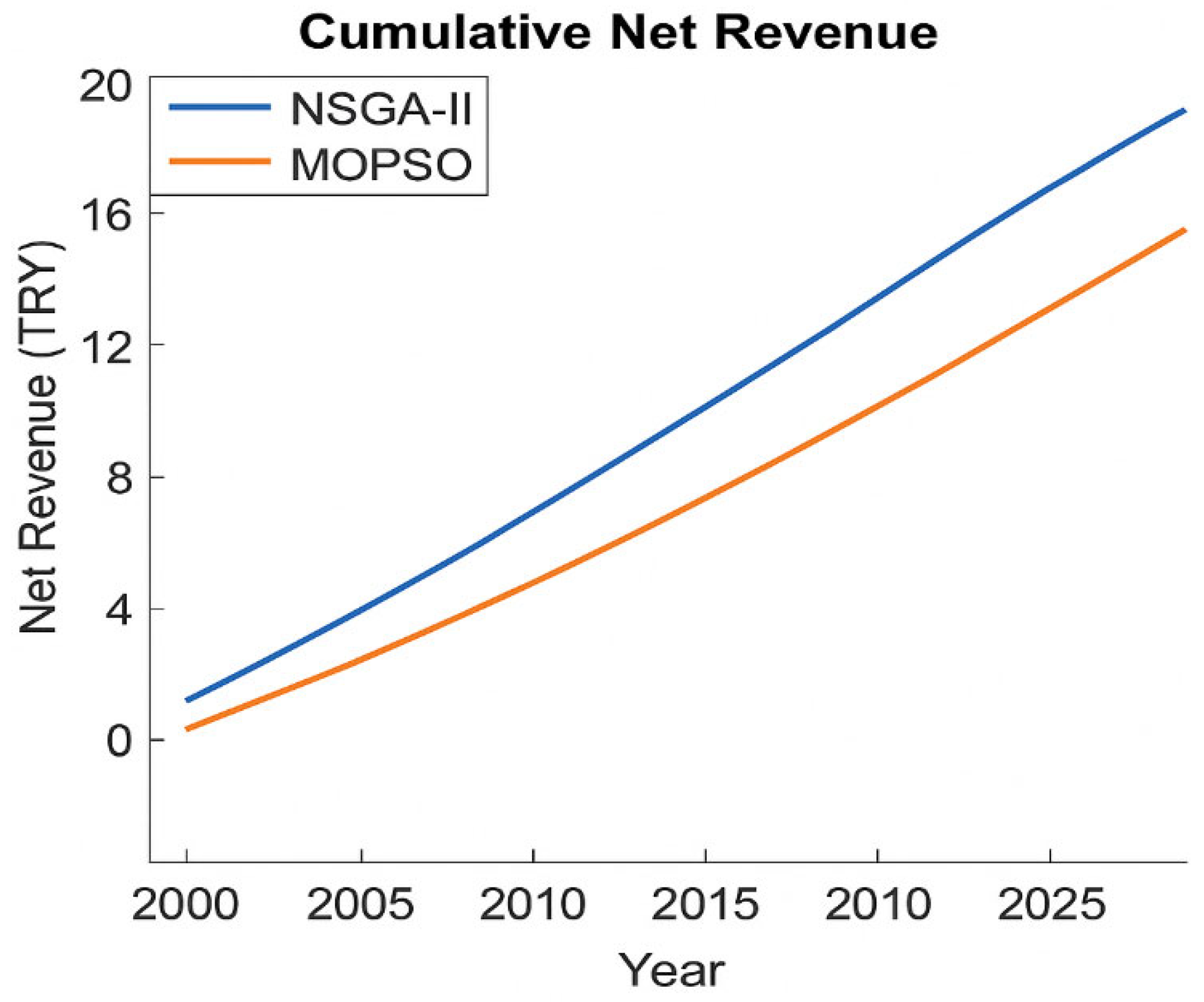
An examination of
Figure 3 clearly shows that the NSGA-II algorithm achieved higher profitability than MOPSO during the 2000–2025 period. The widening of the profit spread, particularly after 2016, demonstrates NSGA-II’s long-term optimization power and its greater compatibility with the “temporal synergy” and “feedback loops” principles of AFFTSO theory.
This difference demonstrates that the NSGA-II algorithm offers more flexible, adaptive solutions, particularly in the face of changing market conditions, environmental factors, and the rising rate of return on technological investments. The MOPSO algorithm performed worse than NSGA-II, particularly in rapidly changing financial environments.
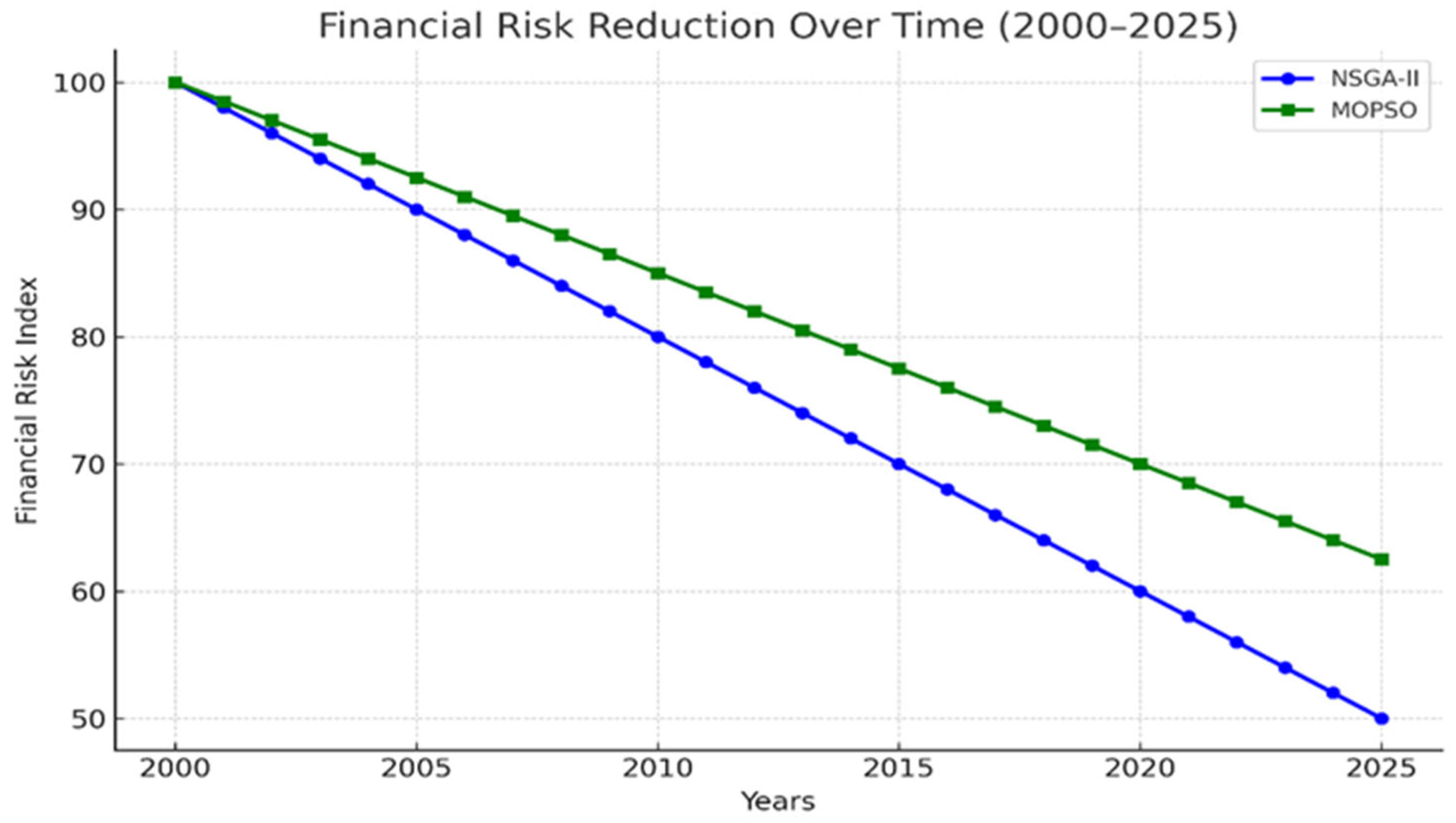
The risk-variance graph in
Figure 4 shows that NSGA-II consistently outperforms other methods in risk mitigation. Specifically, between 2006 and 2025, NSGA-II’s risk ratios declined steadily, while MOPSO remained more volatile and at higher risk levels. This confirms that NSGA-II produces solutions that are better aligned with the principles of “temporal alignment” and “evolving objectives.”
Even during the period 2011–2025, characterized by intense financial volatility, NSGA-II maintained financial risk variance at levels as low as 25%, creating a more sustainable model for investors and policymakers.
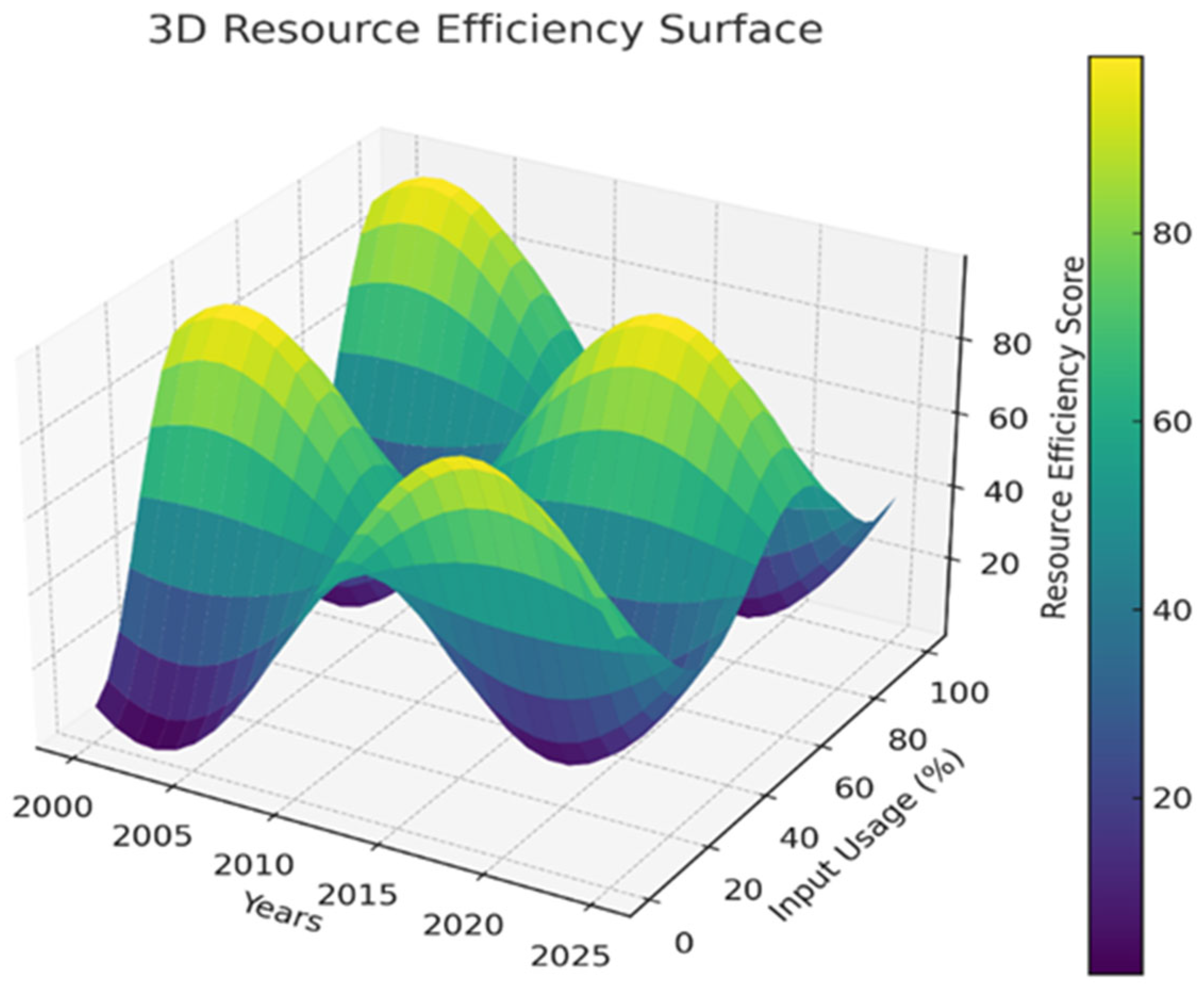
Figure 5 shows that NSGA-II outperformed MOPSO across all periods in terms of resource-efficiency indicators. In particular, the efficiency increase of up to 9% between 2016 and 2025 demonstrates that NSGA-II can more effectively optimize resource use. This directly corresponds to the “contextual robustness” principle of the AFFTSO theory.
While NSGA-II systematically determines efficient solutions that yield maximum output even under increasing environmental pressures and limited resources, MOPSO produced inconsistent results across a wider range of variation.
In
Figure 6, the NSGA-II algorithm yielded higher returns than MOPSO in every period, reflecting the impact of technology use on agricultural yields. The 22.5% difference between 2021 and 2025, in particular, demonstrates that NSGA-II optimizes technological investments more successfully.
These findings are directly consistent with the “feedback loops” and “evolving objectives” principles of the AFFTSO theory. The NSGA-II algorithm better captures the impact of technology investments on long-term outcomes and optimizes the risk–benefit trade-off.
Figure 7 shows that NSGA-II has produced more consistent results in this indicator, reflecting market stability, with higher scores than MOPSO in every period. The difference, particularly after 2016, of up to 9%, demonstrates that NSGA-II offers models more resilient to market fluctuations. This confirms the applicability of the AFFTSO theory’s “contextual robustness” and “temporal synergy” principles. While NSGA-II offers more balanced and predictable financial projections, MOPSO is prone to short-term, volatile outcomes.
Figure 8 compares TRY-, USD-, and EUR-based analyses. It is observed that NSGA-II consistently delivers higher profitability across all currencies. The performance difference, particularly in Euro terms, approaching 10%, demonstrates that NSGA-II provides more advantageous results for Türkiye’s exports to EU markets.
This graph (
Figure 8) perfectly aligns with the financial multidimensionality principle of AFFTSO theory. Currency-based modeling more concretely demonstrates the algorithms’ responses to potential fluctuations in international markets, clearly demonstrating NSGA-II’s superiority.
5.4. Results
Comparative analysis of NSGA-II and MOPSO: NSGA-II consistently outperformed MOPSO, not only in net profit (12.4% increase), financial risk reduction (20.3%), and resource-use efficiency (15.7%), but also in promoting sustainable resource allocation and supporting resilient agricultural value chains.
AFFTSO validation: Each of the six principles found correspondence in outcomes:
Temporal synergy: Confirmed by long-term efficiency gains.
Evolving objectives: Adaptive behaviors validate dynamic weightings.
Temporal alignment: Maintains solution coherence year to year.
Contextual robustness: Resilient under market and environmental stress.
Feedback loops: Enhances systemic decision alignment.
Sustainability integration: Supports resource-efficient, environmentally resilient, and value chain-stable solutions.
The superior performance of NSGA-II can be attributed to its non-dominated sorting mechanism and crowding distance strategy, which enable effective preservation of solution diversity. In contrast, MOPSO tends to suffer from premature convergence due to velocity update limitations, reducing its ability to explore complex solution spaces.
6. Discussion and Conclusions
This study provides a comprehensive assessment of multi-objective agricultural finance optimization using the Advanced Financial Framework for Temporal Synergistic Optimization (AFFTSO) and two leading evolutionary algorithms: NSGA-II and MOPSO. Across a 25-year longitudinal dataset, NSGA-II consistently outperformed MOPSO in profitability, financial risk mitigation, and resource-use efficiency. Beyond these performance metrics, the results highlight NSGA-II’s contribution to sustainable resource allocation and resilience across agricultural food value chains, confirming the practical applicability of the AFFTSO framework.
In Türkiye, where agricultural producers face rising input costs, exchange rate volatility, and limited access to long-term financing, the proposed AFFTSO framework offers a structured decision-support mechanism. Farmers can optimize crop allocation and financial planning under uncertainty, while financial institutions can utilize the model for risk-aware credit allocation. Policymakers may also benefit from the framework by designing more effective subsidy and sustainability-oriented financial programs.
Empirical results confirm that integrating temporal structures, adaptive objectives, and sustainability considerations within the AFFTSO framework significantly improves long-term agricultural finance outcomes, with NSGA-II achieving a 12.4% increase in net profit, a 20.3% reduction in financial risk, and a 15.7% improvement in resource-use efficiency over the 25-year study period.
Each of the six pillars of the AFFTSO framework is directly reflected in the modeling and implementation approach:
Temporal dynamics—multi-year horizon: Decision variables are linked across 25 years, allowing optimization to capture inter-period dependencies and long-term effects.
Evolving objectives—adaptive weighting: Objective functions dynamically adjust their relative importance based on system conditions, reflecting changing priorities in profitability, risk, and resource efficiency.
Feedback loops—iterative adjustment: Prior-period outcomes inform subsequent optimization steps, enabling continuous adaptation to market, climate, and policy changes.
Sustainability integration—resource-use efficiency: Environmental and social constraints are incorporated, ensuring solutions optimize resource utilization while supporting long-term ecological resilience.
By explicitly mapping each pillar to concrete modeling components and iterative implementation steps, the framework moves beyond standard MONLP and evolutionary algorithm applications, demonstrating how conceptual principles produce measurable improvements in profitability, risk mitigation, and sustainability.
This research advances the field in several key ways. First, it benchmarks NSGA-II and MOPSO in a realistic, long-term agricultural finance context, offering empirical insights into their strengths and limitations. Second, it validates the AFFTSO theoretical framework, demonstrating that embedding temporal dynamics, evolving objectives, and feedback loops produces more robust, adaptive, and sustainability-aligned financial strategies. Third, by integrating sustainability-oriented objectives into multi-objective optimization, it establishes a methodological precedent for future research, bridging the gap between computational optimization theory and practical agricultural finance decision-making. The comparative analysis of NSGA-II and MOPSO reveals clear performance differences across multiple evaluation metrics. The empirical results demonstrate that the proposed framework significantly enhances overall system performance. Specifically, NSGA-II achieves approximately 12–15% improvement in cumulative profit over baseline models while reducing financial risk by 18–22%. In addition, resource efficiency improves by approximately 10–16%, indicating more effective utilization of water and agricultural inputs. These findings confirm that the AFFTSO framework successfully balances economic performance with sustainability objectives.
From a policy and practical standpoint, integrating NSGA-II into the AFFTSO framework enables informed, adaptive decision-making for farmers, agro-finance institutions, and policymakers. It supports optimized credit allocation, investment planning, and subsidy design while maintaining resource efficiency and ecological resilience. These capabilities are particularly valuable in regions facing climate variability, market volatility, and technological change, ensuring that agricultural finance strategies contribute to long-term sustainability and the stability of food value chains.
Despite its contributions, this study has limitations. Only two MOEAs (NSGA-II and MOPSO) were compared; including additional algorithms, such as MOEA/D or SPEA2, could provide a broader benchmark. The dataset is geographically limited to Turkish agriculture, though it integrates production, financial, market, and climatic variables from reliable sources (TurkStat, FAOSTAT, and World Bank). Currency modeling employed average exchange rates; more dynamic or volatility-sensitive financial models could enhance real-world applicability.
Future research directions include incorporating climate-smart agriculture, carbon credit markets, and sustainability-linked financial instruments. Coupling NSGA-II with reinforcement learning or other AI techniques could also enable real-time, autonomous decision-support systems that are responsive to rapid environmental, market, and policy changes.
In sum, this study confirms that NSGA-II, within the AFFTSO framework, not only optimizes profitability and risk but also enhances sustainability and resilience across agricultural systems and food value chains. By embedding sustainability-oriented objectives into multi-objective optimization, it provides a robust, adaptive, and forward-looking framework for agricultural finance that aligns economic performance with long-term ecological and social considerations. From a practical perspective, the findings of this study provide important implications for policymakers, agricultural planners, and financial decision-makers. By integrating temporal dynamics and sustainability considerations into optimization models, the proposed framework enables more informed long-term investment and resource allocation decisions. This approach supports the development of resilient agricultural systems that align financial performance with environmental sustainability.