Review

Recent Advances in Sustainable Biopolymer-Based Nanocomposites for Heavy Metal Removal from Water

by
Jair Idrobo Gutierrèz
1,
Bladimir Andrés Dita Ávila
1,
Leonardo Nunez Argumedo
1,
Jaime Rubiano Camargo
1,
Fernanda Luz de Freitas
2,
Débora Pez Jaeschke
2,
Marssele Martins Crispim
2,
Anelise Christ Ribeiro
2,
Eliezer Quadro Oreste
2 and
Janaína Oliveira Gonçalves
1,*
1
Department of Civil and Environmental, Universidad de la Costa, Calle 58 #55-66, Barranquilla 080002, Atlántico, Colombia
2
Industrial Technology Laboratory, School of Chemistry and Food, Federal University of Rio Grande, Rio Grande 96203-900, Brazil
*
Author to whom correspondence should be addressed.
Sustainability 2026, 18(8), 3827; https://doi.org/10.3390/su18083827
Submission received: 14 March 2026 / Revised: 26 March 2026 / Accepted: 31 March 2026 / Published: 13 April 2026

Abstract

The search for new technologies for the removal of heavy metals has intensified due to the increasing contamination of aquatic environments. In this context, biopolymer-based nanocomposites have stood out in the synthesis of new adsorbent materials. These nanocomposites are considered promising due to their abundance, low toxicity, versatility, and high affinity for metal ions. Therefore, this work presents a comprehensive discussion on the development, properties, and performance of biopolymer-based nanocomposites applied to the removal of heavy metals from aqueous systems. Biopolymers such as chitosan, cellulose, alginate, lignin, and pectin are highlighted due to their functional groups and the possibility of chemical modification and/or incorporation of nanoparticles to improve adsorption capacity. In addition, the main mechanisms involved in the metal adsorption process, such as ion exchange, electrostatic attraction, complexation, and chelation, are discussed together with the most commonly used isotherm and kinetic models to describe adsorption behavior. Furthermore, the potential for reuse of these materials is also described in order to evaluate their stability. Finally, possible processes related to nanoparticle leaching, bioaccumulation, and potential ecological risks are also discussed.

1. Introduction

Heavy metal contamination is a global, persistent, and cumulative problem because these elements are non-biodegradable, can bioaccumulate, and reach humans and ecosystems through multiple pathways (industrial effluents, mining activities, improper waste disposal, and geogenic sources, particularly in aquifers). Even at low concentrations, the public health burden can be substantial: a recent analysis estimated that, in 2019, exposure to lead (Pb) was associated with 5,545,000 adult deaths from cardiovascular disease and a loss of 765 million IQ points in children under 5 years of age, with ~90% of the burden concentrated in low- and middle-income countries. For arsenic (As), widely cited estimates indicate that ≥140 million people in 50 countries may consume water exceeding the WHO provisional guideline value (10 µg L−1) [1], underscoring the urgency of developing effective technologies for removing metallic contaminants from water [2,3].
Although a wide range of conventional and advanced approaches for heavy metal removal is available, including sedimentation, ion exchange, chemical precipitation, coagulation, electrochemical methods, solvent extraction, adsorption, and membrane-based processes, many of these methods still face significant barriers to broad and robust implementation. These limitations include high costs, operational complexity, reduced efficiency under specific conditions and/or complex matrices, intensive chemical consumption, and the potential generation of secondary pollutants, which collectively constrain their performance in real-world applications [4]. In addition, membrane- and polymer-based processes often experience performance decline due to fouling/biofouling and pore blockage/clogging, requiring frequent cleaning or regeneration and increasing the overall operational burden of treatment systems [5].
The growth of nanoadsorbents for the remediation of contaminated waters has been driven by the search for materials with higher surface area, more active sites, and tunable functionalities, enabling increased adsorption capacity and selectivity toward different metal species. The recent literature indicates a consistent shift toward nanostructured materials as a central pillar of adsorption technologies, associated with superior performance arising from optimized surface properties and pore architecture [6]. However, the rapid advancement of these materials also underscores the need to address sustainability, reusability/regeneration, and minimizing secondary pollution, particularly when there is a risk of particulate-phase release throughout the adsorbent life cycle.
In this scenario, there has been rapid development of biopolymer-based nanocomposites, which combine the renewability/biocompatibility of the polymer matrix with the advantages of nanoscale reinforcements such as metal oxides, nanoclays, graphene/GO, and CNTs, resulting in enhanced properties and increasing applications in water treatment [7]. Biopolymers such as chitosan, alginate, and cellulose stand out as sustainable matrices because they are generally non-toxic and biodegradable, and they also offer functional groups and processing versatility (e.g., beads, hydrogels, and membranes). These features can facilitate the immobilization/anchoring of active phases, improve reusability/regeneration, and reduce the likelihood of particulate-component release at the end of the process [6,7].
Despite the significant progress achieved in the development of adsorbents and nano(bio)materials for heavy metal removal, many previous review studies still present the literature in a fragmented manner, often focusing on specific material classes or isolated performance metrics. As a result, it becomes difficult to clearly understand how material architecture and functionalization influence adsorption mechanisms, selectivity, stability, and reusability under practical operating conditions. Recent studies also indicate that comparative analyses remain limited, particularly regarding validation in real water matrices, the presence of competing ions, and regeneration performance, which are essential aspects for predicting the behavior of these materials in complex environments [8].
In addition, although adsorption technologies are widely recognized as promising for water treatment, important gaps remain in the evaluation of sustainability aspects, especially regarding the management of spent adsorbents and the potential environmental risks associated with their disposal and, in parallel, the lack of a critical sustainability assessment that accounts for disposal and management of spent sorbents as well as potential environmental risks [9]. In this context, approaches such as life cycle assessment have been increasingly suggested to better understand the environmental implications associated with the development and application of these materials [10].
This work aims to provide a comprehensive review on the use of biopolymer-based nanocomposites for the removal of heavy metals from aqueous systems. The study analyzes the main biopolymers used in the preparation of these materials, together with strategic modifications using nanoparticles and the mechanisms involved in the adsorption process. In addition, the performance of the adsorbents is evaluated, including aspects related to regeneration and material stability, as well as possible environmental implications associated with the use of nanomaterials. Thus, this review seeks to understand the potential of these systems as sustainable alternatives for the treatment of water contaminated by heavy metals.

2. Methodology

The search was conducted in Scopus, Web of Science, and ScienceDirect (2021–2026), using “biopolymer” AND “adsorption” AND “heavy metal” AND “water”, identifying 2772 records (2381 WOS, 288 Scopus, 103 ScienceDirect). After duplicate removal (n = 134), 2638 records were screened by title/abstract (2488 excluded), and 150 full-texts were assessed, excluding 50 due to scope criteria (e.g., not biopolymer-based, no quantitative data), resulting in 100 studies included in the qualitative synthesis. Inclusion criteria focused on experimental studies with quantitative adsorption data in aqueous media; detailed exclusions are listed in Supplementary Materials. Full details of the PRISMA process (Figure S1) are provided in Supplementary Materials for greater conciseness.

2.1. Biopolymeric Matrices

The design and properties of biopolymer-based nanocomposites depend intrinsically on the chemical characteristics of the polymeric matrices employed [11]. Biopolymeric matrices, due to their inherent biodegradability, biocompatibility, and wide availability, emerge as promising alternatives to traditional synthetic polymers in materials science [12]. The suitability of these macromolecules for nanocomposite synthesis is directly related to their chemical structure, the functional groups present along the polymeric chain, and the possibility of functionalization. These factors largely determine the interfacial interactions established between the biopolymeric matrix and the incorporated nanoreinforcements [13].

2.1.1. Chitosan

Chitosan is a linear cationic biopolymer derived from the partial deacetylation of chitin, composed of D-glucosamine units and a residual fraction of N-acetyl-D-glucosamine linked by β-(1,4) glycosidic bonds [14,15]. The resulting product is defined as chitosan when the degree of deacetylation (DD) exceeds 75%, although commercial values are commonly in the range of 75–95% [15]. The DD constitutes a first-order structural variable in nanocomposite design, as it governs the singular cationic nature of the molecule in moderately acidic media (with a pKa around 6.5), a fact arising from the protonation of its primary amine groups located at carbon C-2 of each deacetylated unit [16]. From a reactive standpoint, the simultaneous presence of these amine groups (-NH2), combined with primary hydroxyl groups (-OH) at carbon C-6 and secondary ones at C-3, endows this biopolymer with an exceptional chemical functionalization capacity ([13]. The literature indicates that the decreasing order of reactivity in the chitosan structure is C2-NH2 > C6-OH > C3-OH [17]. Such availability of active sites allows technically highly relevant modifications, such as alkylation, nitrogen quaternization, Schiff base formation via condensation, and crosslinking with bifunctional reagents such as glutaraldehyde and epichlorohydrin [18]. The high amine reactivity is fundamental to nanocomposite design, as it provides strong covalent anchoring for inorganic matrices and plays an expressive role in the chelation of metal ions [19].

2.1.2. Cellulose

Cellulose, being the most abundant natural homopolymer on the planet, consists of rigid linear chains of β-D-glucopyranose units connected by β-(1→4) glycosidic bonds [20]. The three-dimensional structure of this polymer exhibits alternating regions of high crystallinity and amorphous domains, stabilized by an extensive network of intra- and intermolecular hydrogen bonds, resulting in its insolubility in water and common organic solvents [21]. From a functional standpoint, each anhydroglucose unit contains a primary hydroxyl group at carbon C-6 and two secondary hydroxyl groups at carbons C-2 and C-3 [22].
In the context of nanocomposites, it is essential to distinguish the main nanostructured forms derived from cellulose—namely, cellulose nanocrystals (CNC) and cellulose nanofibers (CNF)—as each morphology presents distinct crystallinity, surface area, and surface reactivity, with direct implications for the design of composite systems [23,24]. CNCs are rigid rod-shaped particles with high crystallinity and a Young’s modulus of up to 150 GPa, preferentially obtained by acid hydrolysis with H2SO4, a process that introduces sulfate groups on the surface, conferring colloidal stability by electrostatic repulsion [24]. CNFs, in turn, are composed of crystalline and amorphous regions, exhibit higher aspect ratios and network-forming capacity, and are preferentially obtained by TEMPO (2,2,6,6-tetramethylpiperidine-1-oxyl) radical-mediated oxidation followed by mechanical treatment [23]. This process selectively introduces carboxylate groups (-COO) at position C-6, converting primary hydroxyl groups, which overcomes dispersibility problems and increases surface affinity with nanoparticles [21,25]. In addition to TEMPO oxidation, the abundance of hydroxyl groups on the cellulose surface constitutes a platform for esterification, etherification, and sulfonation, broadening the versatility of this matrix in functional nanocomposites [26].

2.1.3. Alginate

Alginate is an anionic biopolymer primarily extracted from brown algae (Phaeophyceae), whose chemical architecture consists of a linear block copolymer of α-L-guluronic acid (G blocks) and β-D-mannuronic acid (M blocks) connected by (1→4) glycosidic bonds [20]. The distribution of these blocks can occur in homogeneous arrangements (poly-G or poly-M) or heterogeneous ones (alternating MG), and the relative proportion of G and M blocks directly influences the thermomechanical properties of the matrix: G-block-rich chains exhibit a more rigid molecular structure, while M-block-rich chains display greater conformational flexibility [27]. The main functional groups present in alginate include carboxylate (-COO) and hydroxyl groups, whose negative charge density confers on the polysaccharide a high capacity to form polyelectrolyte complexes with oppositely charged biopolymers, such as chitosan [28].
The functionalization capacity of alginate is directly related to its ability to form networks through reversible ionic crosslinking in the presence of divalent or trivalent cations, with Ca2+ being the most widely investigated. This process is generally explained by the model known as the “egg-box,” in which the structural organization of guluronic acid residues plays a central role. In this configuration, the diaxial orientation of these residues favors the formation of cavities along the helical structure of G-block-rich chains, enabling the coordination of Ca2+ ions and promoting the approximation of adjacent chains. As a result, dimers initially form, and subsequently, more extensive multimeric structures develop within the polymeric network [29,30].
Investigations based on isothermal titration calorimetry and viscosimetry indicate that the formation of these structures occurs sequentially, involving three main stages. In the first, monocomplexation occurs, characterized by the interaction of Ca2+ ions with isolated guluronic acid units. Subsequently, dimerization begins, in which monocomplexes associate to form egg-box-type dimers, a process observed from a Ca/G ratio close to 0.25. Finally, multimerization occurs, marked by the lateral association of these dimers and the formation of larger aggregates, a phenomenon that becomes more evident when the Ca/G ratio exceeds approximately 0.55 [27,31].
The extent of this process also depends on the structural composition of the alginate. Samples with a higher proportion of guluronic blocks tend to exhibit more intense multimerization even at lower Ca/G ratios, behavior observed in studies using atomic force microscopy and viscosimetry in dilute solution [27]. Furthermore, X-ray diffraction analyses indicate that the helical organization in junction zones may vary according to gel formation conditions. In particular, the conformation can alternate between 2/1 and 3/1-type arrangements depending on the gelation rate, suggesting that the classical egg-box model may present structural variations associated with system conditions [32,33]

2.1.4. Lignin

Unlike structural polysaccharides, lignin is an amorphous and highly branched polyphenolic polymer that acts as a structural agent in plant cell walls [31]. Its chemical structure is heterogeneous, consisting of a network of phenylpropanoid monomeric units derived from three precursor monolignols; namely, p-coumaryl alcohol, coniferyl alcohol, and sinapyl alcohol which give rise, respectively, to the p-hydroxyphenyl (H), guaiacyl (G), and syringyl (S) units, interconnected predominantly by β-O-4 ether bonds and carbon-carbon bonds (β-5, β-β, 5-5) [34].
The relative composition of S, G, and H units varies significantly depending on the plant species and tissue analyzed, with direct implications for reactivity, solubility, and the choice of functionalization routes in nanocomposite design. Conifers (softwoods) present predominantly G-type lignin (80–90%), with a high density of condensed C–C bonds (β-5 and 5-5), resulting in a more rigid structure with greater resistance to chemical modification. Hardwoods contain a mixture of G (25–50%) and S (50–70%) units, with the higher proportion of S units favoring β-O-4 bonds and conferring greater reactivity [35]. Grasses contain all three types of units, with proportions of S (25–50%), G (25–50%), and H (10–25%), as well as additional cross-links with p-coumarates and ferulates. This compositional variability governs both the accessibility of phenolic hydroxyl groups (main functionalization sites) and susceptibility to chemical modification routes [35].
The functional groups inherent to lignin include phenolic and aliphatic hydroxyls, methoxyl groups, and, to a lesser extent, carboxyl and aldehyde groups [28]. In its native form, lignin exhibits adsorptive limitations arising from its hydrophobic nature and the steric hindrance of its three-dimensional phenolic network, which reduces direct accessibility to ionic contaminants [31]. To reveal lignin’s potential in nanocomposites, chemical modifications such as amination, sulfonation, copolymerization, and introduction of dithiocarbamate groups are employed to increase specific surface area and coordination site density, making the matrix suitable for the design of heavy metal removal and mechanical reinforcement systems [36].

2.1.5. Pectin

Pectin is an anionic plant-derived polysaccharide whose macromolecular structure encompasses three main domains: homogalacturonan (HG), rhamnogalacturonan I (RG-I), and rhamnogalacturonan II (RG-II) [33,37]. The HG domain, being the most abundant structure, representing approximately 65% of the structure, consists of linear chains of α-D-galacturonic acid residues interconnected by α-(1,4) bonds, partially methyl-esterified at C-6 and, in some cases, acetylated at O-2 and/or O-3. The RG-I domain (20–35%) exhibits a branched structure with neutral side chains of arabinans, galactans, and arabinogalactans attached to rhamnose residues at position O-4, which play an active role in the rheology and gelation properties of pectin: studies have demonstrated that arabinan chains facilitate the aggregation of pectin chains through hydrogen bonds and van der Waals interactions with the HG domain and galactan chains, strengthening the three-dimensional gel network [25].
The chemical reactivity of this matrix is intrinsically linked to its carboxyl (–COOH) and methoxyl (-OCH3) functional groups, with physical properties being strongly dependent on the degree of esterification (DE). Pectins with DE < 50% (low methoxylation degree, LMP) possess a high density of free carboxylate groups that readily interact with divalent cations such as Ca2+, by a mechanism analogous to that of alginate. However, molecular modeling studies demonstrate that, despite the structural analogy with polyguluronic acid, the junction zone of pectate presents a distinct geometry from the classical egg-box model of alginate, with two consecutive chelation sites per repeating unit that confer a favorable entropic contribution to chain association [29,30]. Pectins with DE >50% (high methoxylation degree, HMP), in turn, gel by a distinct mechanism dependent on low pH (<3.6) and high sugar concentration (>55%), conditions that reduce water activity and promote hydrophobic interactions between methylester groups and hydrogen bridges between chains [26]. This structural complexity, encompassing the degree of esterification, the distribution, and branching of neutral side chains in the RG-I region, constitutes a fundamental control parameter in the design of pectic matrices for functional nanocomposites.
The structural and functional diversity observed in biopolymeric matrices demonstrates that the choice of organic matrix is a central element in the development of nanocomposites aimed at environmental remediation [28,38]. Each biopolymer presents its own macromolecular architecture, with different functional groups, charge distribution, and levels of steric accessibility. These characteristics directly influence both interactions with contaminants and the possibilities for matrix modification [15,28,39]. In practice, this means that the performance of these materials rarely depends solely on the biopolymer itself. In many cases, their properties can be significantly expanded through nanoreinforcement strategies or structural modifications that increase surface area, polymeric network stability, or active site density. The incorporation of inorganic nanomaterials and other materials engineering approaches has therefore been one of the main ways to explore and expand the potential of these matrices in adsorption and environmental remediation applications [15,39].

2.2. Nanoreinforcement Strategies

2.2.1. Metal Oxides

The incorporation of metal oxides into biopolymer matrices, such as chitosan, alginate, cellulose, lignin, and pectin, has been widely investigated in the recent scientific literature due to the synergy between the structural properties of natural polymers and the high surface reactivity of inorganic nanomaterials [40]. These biocomposites present significant potential in environmental remediation engineering, particularly in the removal of toxic metal ions and organic pollutants from aqueous effluents through adsorption and magnetic separation processes [41]. The conceptual development of these materials is substantially based on the need to stabilize inorganic nanoparticles that, due to their high surface energy, have a high tendency toward thermodynamic agglomeration and instability under physicochemical variations in the dispersing medium [42].
Within the scope of anionic polysaccharides, alginate and pectin have been progressively explored due to the high density of functional groups capable of interacting with metal cations [43]. Contemporary studies demonstrate that pectin or alginate hydrogels and biocomposites functionalized with iron oxides or Fe/Mn mixed oxides show high efficiency in heavy metal removal, since the polymeric matrix provides a three-dimensional network capable of immobilizing inorganic particles, mitigating their premature leaching [44]. Despite the intrinsic advantages of the inorganic phase, the molecular architecture of the polymeric matrix plays a fundamental role in the final thermodynamic performance of the material. The current literature discourages broad generalizations about the absolute adsorption capacity of these systems, since the colloidal stability of nanoparticles and ion exchange efficiency are strictly dependent on experimental variables, most notably pH, ionic strength, and the presence of competing ions in the treated effluent [42].
Within the scope of biopolymers with cationic character, chitosan stands out natively due to the presence of a high density of primary amino and hydroxyl groups, which prominently act as coordination sites (Lewis bases) for metal ions and as stabilizing matrices for nanoparticle growth [15]. In this interfacial context, innovations have been reported in the design of nanocomposites based on the association of zinc oxide (ZnO) with chitosan, to combine the processability and insolubility of the organic macromolecule with the high photocatalytic and adsorptive reactivity of the metal oxide [45]. The electronic and structural synergy between chitosan’s functional groups and ZnO nanoparticles directly contributes to enhancing the density of surface active sites, governing contaminant capture essentially through chemisorption mechanisms and electrostatic interactions [45].
In structural contrast, cellulose exhibits notable crystallinity and high mechanical stability, but shows limiting surface chemical reactivity compared to biopolymers with active primary amines [21]. Consequently, the design of cellulosic biocomposites frequently requires oxidative or grafting chemical modifications as a preliminary step to introduce sufficient reactive groups for the nucleation and stabilization of metallic nanoparticles. The functionalization process creates highly directed anionic anchoring points for electrostatic attraction and homogeneous immobilization of particles, such as functionalized magnetite or titanium dioxide (TiO2), consolidating robust architectures for magnetic extraction of metals such as lead or degradation of dyes in complex aqueous matrices [42].
Another widely explored approach involves the incorporation of magnetic nanoparticles into fibrillar biopolymers, allowing adsorbent recovery by magnetic separation after the treatment process [46]. Cellulose nanocomposites containing ultrafine iron oxide nanoparticles have been synthesized by simplified in situ deposition routes, in which particle size control plays a fundamental role in increasing contact area and improving contaminant diffusion to the material’s active sites [47]. The presence of magnetic properties in these systems represents a significant operational advantage, as it facilitates adsorbent recovery and reuse, reducing additional solid–liquid separation steps [21].
In general, the integrated analysis of these studies demonstrates that the choice of biopolymer matrix exerts a direct influence on adsorption mechanisms and on the structural stability of nanocomposites [48]. Anionic polysaccharides, such as alginate and pectin, favor ion exchange mechanisms with metal cations due to the abundance of carboxylate groups, while cationic biopolymers, such as chitosan, show high chelation capacity through amino groups [49]. In contrast, structural substrates such as cellulose frequently require additional chemical functionalization steps to introduce reactive sites capable of stabilizing metallic nanoparticles [50]. Furthermore, the incorporation of oxides with photocatalytic or semiconducting properties, such as ZnO and TiO2, has broadened the application scope of these materials, enabling the development of hybrid systems capable of combining metal adsorption with organic contaminant degradation [25].

2.2.2. Magnetization

The functionalization of biopolymeric matrices, such as chitosan, alginate, cellulose, lignin, and pectin, through the incorporation of magnetic nanomaterials has been widely explored as a strategy for environmental remediation applications [51]. In general, this approach involves the anchoring of magnetic nanoparticles, mainly iron oxides such as magnetite (Fe3O4) or zero-valent iron (nZVI). The main objective is to circumvent a recurring problem in conventional nanoadsorbents: the difficulty of separating the material from the liquid phase after the adsorption process [52]. The presence of a magnetic core enables rapid adsorbent recovery by applying an external magnetic field. This process facilitates solid–liquid separation, reduces secondary waste generation, and can simplify subsequent material regeneration steps [53].
In the case of cationic or structurally robust biopolymers, different hybrid architectures have been proposed to improve material stability and increase the number of active sites. Sayed et al. [52], developed a core–shell composite (RSNC-CS-Fe3O4) combining nanocellulose obtained from rice straw, crosslinked chitosan, and magnetite nanoparticles. The material showed good performance in the simultaneous removal of heavy metals, such as Pb2+ and Cd2+, as well as the biocide glutaraldehyde, commonly found in petroleum industry production waters. Another recurring strategy involves chemically modifying chitosan before magnetization. The authors synthesized a magnetic Schiff base derived from chitosan (m-CS-Sch) using microwave irradiation. The introduction of imine groups (>C=N–) increased the polymer’s thermal stability and added electron donor sites capable of interacting with metal ions such as Pb(II), Hg(II), and Cu(II). In the case of cellulose, surface reactivity is usually more limited compared to chitosan. Therefore, several studies indicate the need for prior modifications to expand the number of active sites. The authors showed that treatments such as amination or time-mediated oxidation can introduce additional carboxylate groups on the cellulose surface, creating more stable anchoring points for magnetite and favoring the removal of contaminants such as Cr(VI) and Pb(II).
Among anionic polysaccharides, the stabilization of magnetic nanoparticles is usually associated with the presence of carboxylate and hydroxyl groups. Wang et al. [54] developed magnetic nanospheres based on sodium alginate polyelectrolytes, reporting good performance in lead removal from aqueous solution. Pectin has also been explored in this context as a coating and stabilization agent. Namasivayam et al. [43] used pectin extracted from banana peels to stabilize zero-valent iron nanoparticles (nZVI), forming a nanocomposite capable of simultaneously removing chromium and lead from bimetallic mixture solutions. The authors highlight that the polymeric coating reduces nanoparticle agglomeration and decreases premature oxidation. Additionally, the material showed bactericidal activity against aquatic pathogens, suggesting multifunctional potential for water treatment.
Lignin, in turn, represents an interesting alternative among phenolic origin biopolymers, although its natural affinity for transition metals is relatively limited. To circumvent this limitation, Zhang et al. [55] developed a magnetic resin based on lignin previously modified with polyethyleneimine. The introduction of this amine-rich polymer significantly increased coordination site density, resulting in a magnetically recoverable adsorbent with high capacity for Pb(II).
From a kinetic standpoint, many of these magnetic nanocomposites exhibit similar behavior during adsorption. In several studies, experimental data are well described by the pseudo-second-order kinetic model, while equilibrium is typically fitted to the Langmuir isotherm model, suggesting the formation of an adsorbate monolayer on relatively homogeneous active sites [52,56,57].
In the domain of anionic polysaccharides, notably alginate, the immobilization of magnetic nanoparticles has been widely investigated in the literature for the formulation of nano- and microstructured adsorbents with optimized thermomechanical stability. The design of nanospheres or hydrogels composed of sodium or calcium alginate, frequently associated with iron oxide nanoparticles previously functionalized or grafted with other polymers, has demonstrated high thermodynamic capacity in the extraction of toxic metal ions, with emphasis on lead (Pb2+) and cadmium (Cd2+) [58]. The physicochemical mechanism governing this affinity is based on a complex synergy of electrostatic interactions, chelation, and ion exchange, promoted primarily at the interface between the intrinsic carboxylate groups of the anionic matrix and the reactive sites introduced in the magnetic core [54]. In strict accordance with the thermodynamic precepts of chemical adsorption, the kinetic behavior of most of these systems optimally aligns with the pseudo-second-order model, while the isothermal equilibrium fits the Langmuir model, indicating that the saturation process occurs in a monolayer on surfaces with relatively uniform energy distribution [55].
The recent scientific literature provides evidence that the introduction of additional structural phases into the biopolymeric matrix drastically alters the physical chemistry and intrinsic mechanisms of the sorption process [28,59]. As an analytical counterpoint, alginate-based magnetic composites impregnated with materials of high intrinsic surface area, such as activated carbon, biochar, or carbon nanotubes, present a marked mechanistic deviation relative to systems formed exclusively by polysaccharides and simple metal oxides [60]. Equilibrium assays focused on ionic capture by these multicomponent hybrid matrices revealed, in several cases, superior fits to isotherm models oriented toward surface heterogeneity, such as Freundlich and Temkin, statistically outperforming the classical Langmuir model [28]. This fundamental discrepancy elucidates that the incorporation of the carbonaceous phase confers a pronounced heterogeneity of active sites and activation energy gradients at the solid–liquid interface, inducing adsorption prone to multilayer formation and guided by the synergistic contribution of diffusion in physical pores and surface inorganic reactivity [28]. However, it is important to avoid direct extrapolations to industrial-scale applications.
In an integrated manner, the methodological evaluation of these technologies attests that the incorporation of magnetic nano-oxides (such as Fe3O4 and maghemite) consolidates a dual operational solution for environmental engineering: it ensures the essential recoverability of the spent material from the liquid phase through external magnetic field application and simultaneously expands the density of coordination sites that potentiate chemisorption of pollutants [26,61]. However, abstaining from speculative extrapolations regarding direct industrial-scale application, current data determine that cyclic stability and prevention against oxidative leaching strictly depend on the chemical integrity established at the interface between the inorganic core and the organic coating [31]. The prior chemical modification of these nanoparticles with coupling agents acts as a non-negotiable structural vector to ensure robust inter-surface adhesion with alginate chains, constituting a mandatory criterion to mitigate acid dissolution and magnetization loss when the biosorbent faces the severe hydrodynamic stresses and extreme pH variations imposed during multiple elution processes in authentic effluents [31].

2.2.3. Surface Functionalization

Surface functionalization of biopolymeric matrices, such as cellulose, chitosan, and lignin, constitutes a widely employed strategy in materials engineering aimed at environmental remediation [38,62]. This approach seeks to overcome the intrinsic limitations of these biopolymers, such as low density of specific binding sites and limited stability under extreme aqueous conditions [52]. Surface chemical modification exploits the high reactivity of hydroxyl and amino groups present in the polymeric chains, allowing the introduction of new chemical functions through oxidation, amination, quaternization, or grafting reactions [63]. These structural transformations alter the balance of surface charges, polarity, and hydrophilicity of the material, modulating its affinity for different contaminants and broadening the spectrum of applications in adsorption processes [21,63].
Various functionalization strategies have been proposed to increase the heavy metal capture capacity of cellulose derivatives [26]. In systems based on highly oxidized cellulose nanofibers, the introduction of multiple carboxylic groups through sequential oxidative routes has been shown to significantly increase the density of anionic sites available for complexation of metal ions, such as copper and lead [42]. In these materials, the presence of carboxylate groups favors ion exchange interactions and coordination complex formation with metal cations in solution [21,64].
Among strategies to increase interfacial positive charge, quaternization of biopolymers has received significant attention in the specialized literature. Cellulose nanofibrils modified with trimethylammonium groups, for example, exhibit a high density of permanent charges, which favors intense electrostatic interactions with anionic species in solution. These materials frequently exhibit extremely rapid adsorption kinetics, since the cationic sites remain available and fully dissociated regardless of pH oscillations in the medium [65]. In parallel, more complex hybrid modifications involving multiple chemical functionalities have also been explored to broaden the adsorptive versatility of biopolymers. Bifunctionalized chitosan derivatives simultaneously containing quaternary groups and chelating ligands based on EDTA represent a synthetic archetype of this approach. In these zwitterionic systems, the simultaneous presence of positively charged groups and complexing groups means that adsorption behavior is strictly dependent on solution pH. Under more acidic conditions (below pH 4.8), positive charges predominate in the matrix, favoring the adsorption of anionic species; at higher pH, chelating groups become preferential sites and can act decisively in the complexation of metal cations, broadening the spectrum of contaminants potentially removed from multicomponent matrices [66].
In addition to conventional polysaccharides, aromatic derivatives of plant biomass, notably lignin, have also been explored as primary platforms for advanced chemical functionalization [28]. Lignin presents an amorphous and aromatic macromolecular structure rich in phenolic and aliphatic groups, which can be rigorously modified by grafting or copolymerization reactions to introduce new coordination sites [36]. In frontier investigations, the incorporation of polyfunctional amines (such as diethylenetriamine) followed by the introduction of dithiocarbamate groups has been used to produce structured nanodevices (the so-called “nano-traps”) with high thermodynamic affinity for heavy metals [36]. The simultaneous presence of different types of ligands such as amines, imines, and sulfur-containing groups enables the formation of stable coordination compounds with a wide variety of metal ions. According to the thermodynamic principles of Hard and Soft Acids and Bases (HSAB) theory, sulfur-containing groups operate as soft bases and tend to exhibit greater kinetic affinity for metals considered soft acids, such as silver (Ag+) and mercury (Hg2+), while nitrogen groups act as intermediate (borderline) bases and can interact more efficiently with metals of homologous character, such as lead (Pb2+) and copper (Cu2+) [36]. This architectural diversity of functional sites significantly expands the selectivity and chemisorption capacity of these materials compared to lignin in its native, unmodified state [28,36].

2.2.4. Crosslinking

The crosslinking of biopolymeric matrices, such as chitosan, cellulose, and alginate, constitutes an indispensable methodological step in biosorbent engineering, aimed at overcoming the structural instability and excessive solubility of these materials in aqueous media with extreme pH [14]. The establishment of covalent bonds or strong ionic interactions between polymeric chains generates an insoluble three-dimensional network that preserves the mechanical integrity of the adsorbent [26]. However, the use of conventional crosslinking agents, such as glutaraldehyde, imposes an intrinsic thermodynamic limitation: the crosslinking reaction consumes primary functional groups (such as chitosan amines), reducing the density of active sites available for interaction with pollutants and consequently decreasing overall adsorptive capacity [14,64]. Additionally, compounds such as glutaraldehyde present recognized toxicity, which drives the search for alternative crosslinking strategies [14].
To solve the consumption of active sites in chitosan, Cheng and collaborators developed an adsorbent in which the biopolymeric matrix was crosslinked using tetrafluoroterephthalonitrile (TFT). The relevance of this study lies in the finding that the amino functional groups of chitosan remained unchanged during the crosslinking reaction, ensuring that chemisorption capacity was not impaired [67]. In addition to preserving reactive sites for Cr (VI) and U(VI) ion capture, TFT insertion promoted an increase in porosity and conferred superior thermal stability to the composite, withstanding temperatures up to 250 °C [14,67].
The structural modification of macromolecular matrices through crosslinking reactions constitutes a determining physicochemical step for the optimization of biopolymers derived from plant biomass applied to water remediation [68]. The introduction of inter- and intramolecular covalent bridges reduces excessive hydrophilicity and stabilizes the polymeric network against dissolution in effluents under extreme pH conditions [69]. In a representative investigation of the state of the art, Ge and collaborators prepared a composite hydrogel using cellulose as the primary polymeric backbone, onto which polyethyleneimine (PEI) was grafted, employing epichlorohydrin as the crosslinking agent [70]. Morphological analysis indicated that PEI incorporation into the crosslinked cellulose chains significantly reduced pore size in the matrix by filling interparticle spaces, a phenomenon that conferred mechanical stability and resistance to deformation significantly superior to those observed in pure cellulose hydrogel. The thermodynamic efficacy of this model is based on the principle that epichlorohydrin acts as a robust covalent bridge, allowing the stabilized PEI to provide a high density of free amine sites for the highly efficient capture of Cu(II) ions. The viability of epichlorohydrin as a versatile crosslinker is corroborated by additional studies that employ it in the stabilization of macromolecular hybrids, attesting its capacity to form insoluble three-dimensional networks favorable to chemisorption of heavy metals [70,71].
Within the scope of anionic polysaccharides, alginate has been widely explored in the development of multicomponent adsorptive systems and double-network hydrogels for the removal of ionic contaminants [57]. Zhu and researchers synthesized a composite hydrogel based on kaolin and sodium alginate grafted with poly(acrylic acid-co-2-acrylamido-2-methyl-1-propanesulfonic acid), adopting N,N′-methylenebisacrylamide (MBA) as the crosslinking agent [72]. The formation of these complex and intercalated polymer networks was aimed at the simultaneous and selective sorption of heavy metal cations, notably lead, cadmium, and zinc ions [73]. In a complementary manner, crosslinked architectures based on alginate show high structural resilience and optimized adsorptive capacity when hybridized with inorganic fillers [74].
The critical and comparative analysis of these and other related methodologies elucidates that the rational selection of the crosslinking agent fundamentally dictates the final architecture and synthesis mechanism of the hybridized matrix [28]. The use of N,N′-methylenebisacrylamide, as conducted by Zhu and collaborators, is intrinsic to free radical-mediated graft copolymerization processes with vinylic monomers, favoring the formation of intricate three-dimensional networks prone to multicomponent interactions [72]. However, it is imperative to emphasize that the use of conventional dialdehyde crosslinking agents faces growing environmental and toxicological restrictions [52]. The current literature widely documents the intrinsic toxicity concerns of glutaraldehyde. It evidences a methodological transition toward the search for “green” crosslinking strategies, based on less harmful compounds, such as citric acid, or on double-network physical interactions that entirely dispense with highly hazardous chemical reagents [15].

2.3. Structure–Property Relationships

The performance of biopolymer-based nanocomposites in environmental remediation is strongly governed by the relationship between their structural characteristics and physicochemical properties. Parameters such as specific surface area, porous structure, and thermomechanical stability directly influence the adsorption capacity of these materials, as well as mass transfer kinetics and their operational durability over successive treatment cycles [31]. In biopolymeric systems derived from precursors such as chitosan, cellulose, alginate, lignin, and pectin, the rigorous manipulation of these structural characteristics is frequently achieved through chemical crosslinking reactions, interfacial functionalization, or hybridization with inorganic nanomaterials [38,40]. These synthetic strategies aim to increase the stereochemical accessibility of active sites, mitigate pollutant diffusion resistances, and improve the mechanical and chemical resilience of the adsorbent matrix under the severe conditions of effluents [14].
Specific surface area is one of the most important structural parameters in adsorption processes, as it is directly related to the number of active sites available at the solid–liquid interface [75]. In their native state, many biopolymers exhibit relatively low surface areas and limited reactivity due to their intrinsically compact structure and low physical porosity [36]. However, morphological transformation at the nanometric scale, as well as the incorporation of inorganic nanoparticles for the formation of nanostructured architectures, can significantly increase the available contact area [57]. For example, lignin-derived nanodevices have been reported with surface areas (23.7 m2 g−1) substantially larger than the unmodified lignin biomacromolecule (1.8 m2 g−1), a phenomenon that amplifies contact frequency at the interface and contributes decisively to maximizing chemisorption of heavy metal ions, notably Pb(II) and Cu(II) [36]. Similarly, alginate polyelectrolyte-based magnetic nanocomposites have presented surface areas exceeding 100 m2 g−1, intensely favoring complexation between carboxylate and amine groups and dissolved contaminants [31].
However, the current literature warns that a mere increase in surface area does not always directly translate into better adsorptive performance [76]. In multicomponent systems, chemical functionalization and polymer grafting can partially block physical pores or reduce measured surface area (BET analysis), while simultaneously introducing new functional groups that exponentially increase the material’s chemical affinity for certain pollutants. This paradigm was evidenced in the synthesis of lignin-grafted carbon nanotubes, where the incorporation of the organic macromolecule reduced the composite’s surface area, but the contribution of oxygen-rich sites ensured a significant increase in lead capture capacity compared to the original higher-porosity material [77]. Thus, data categorically indicate that adsorption efficiency is governed not only by physical surface area, but above all by the synergistic balance with the chemical nature, binding energy, and spatial distribution of active sites available in the polymeric network [31,76].
Porosity is another fundamental structural parameter that controls the thermodynamic and kinetic adsorption behavior of biopolymer-based nanocomposites [78]. Pore size distribution and total pore volume strictly determine the accessibility of contaminants to internal active sites and influence the limiting resistance to intraparticle diffusion [56]. In many biopolymer-derived adsorbents, mesoporous (2–50 nm) and macroporous (>50 nm) structures are particularly advantageous, as they facilitate the diffusion of hydrated ions and bulky organic molecules in aqueous solutions [79]. In cellulose- and chitosan-based composites, for example, the incorporation of inorganic nanoparticles, such as magnetite or silica, frequently leads to the formation of mesoporous networks that improve both chemical adsorption capacity and diffusion efficiency [80,81]. Furthermore, the porous architecture of these materials can be rationally adjusted by different processing strategies, including the use of porogens, templating approaches with soluble nanoparticles, or freeze-drying techniques, which generate aerogels and highly interconnected porous structures [80,81]. These interconnected networks exponentially increase fluid permeability and broaden physical accessibility to internal active sites [81].
Structural stability represents another critical factor that determines the practical applicability and scalability of biopolymer-based adsorbents in real wastewater treatment systems [14]. Although natural polymers present undeniable advantages such as biodegradability, biocompatibility, and abundance of reactive functional groups, many of them have limited mechanical strength and can be highly susceptible to severe swelling, dissolution, or structural collapse when subjected to extreme pH conditions [14]. Chitosan and alginate, for example, can exhibit a high degree of swelling in aqueous media and marked dissolution in strongly acidic environments when not adequately stabilized. To overcome these thermodynamic limitations, crosslinking reactions are widely employed to form insoluble three-dimensional polymeric networks, endowed with greater mechanical integrity and chemical resistance over time [14].
The use of crosslinking agents or covalent modification strategies directly contributes to eliminating solubility and improving the structural stability of the adsorbent during successive adsorption and desorption cycles [82]. Furthermore, the incorporation of rigid inorganic phases, such as magnetite, silica, or hydroxyapatite nanoparticles, acts as reinforcement in the amorphous polymeric matrix, decisively increasing overall mechanical strength and reducing structural deformations under the intense hydrodynamic stresses of effluents [83]. These multicomponent hybrid structures prove particularly advantageous and robust in continuous treatment systems, in which adsorbents are invariably subjected to constant flow conditions, mechanical stress, and repeated adsorption–desorption cycles.

3. Biopolymeric Matrices

Adsorption is a surface phenomenon characterized by the retention of atoms or molecules from a liquid or gaseous phase at the interface of a solid. In this process, the solid material acts as the adsorbent, while the retained species (such as a metal dissolved in water) is referred to as the adsorbate. The interaction between the adsorbate and the adsorbent can occur through two main mechanisms: physical adsorption (physisorption) and chemical adsorption (chemisorption) [84,85].
Physisorption is based on weak intermolecular forces, such as van der Waals interactions, and is generally associated with low energy values and a reversible character. It is an exothermic process, with adsorption enthalpies ranging from 20 to 40 kJ/mol. In addition, physisorption can be influenced by the adsorbent surface area and temperature, with adsorption favored by larger surface areas and lower temperatures. In contrast, chemisorption involves the formation of stronger chemical bonds between the surface and the adsorbed species, resulting in more stable, and in many cases, irreversible interactions. The bonds formed during chemisorption yield higher enthalpy values than those of physisorption, typically ranging from 200 to 400 kJ mol−1. Furthermore, the efficiency of chemisorption can also be strongly affected by the surface area of the adsorbent and temperature [85].
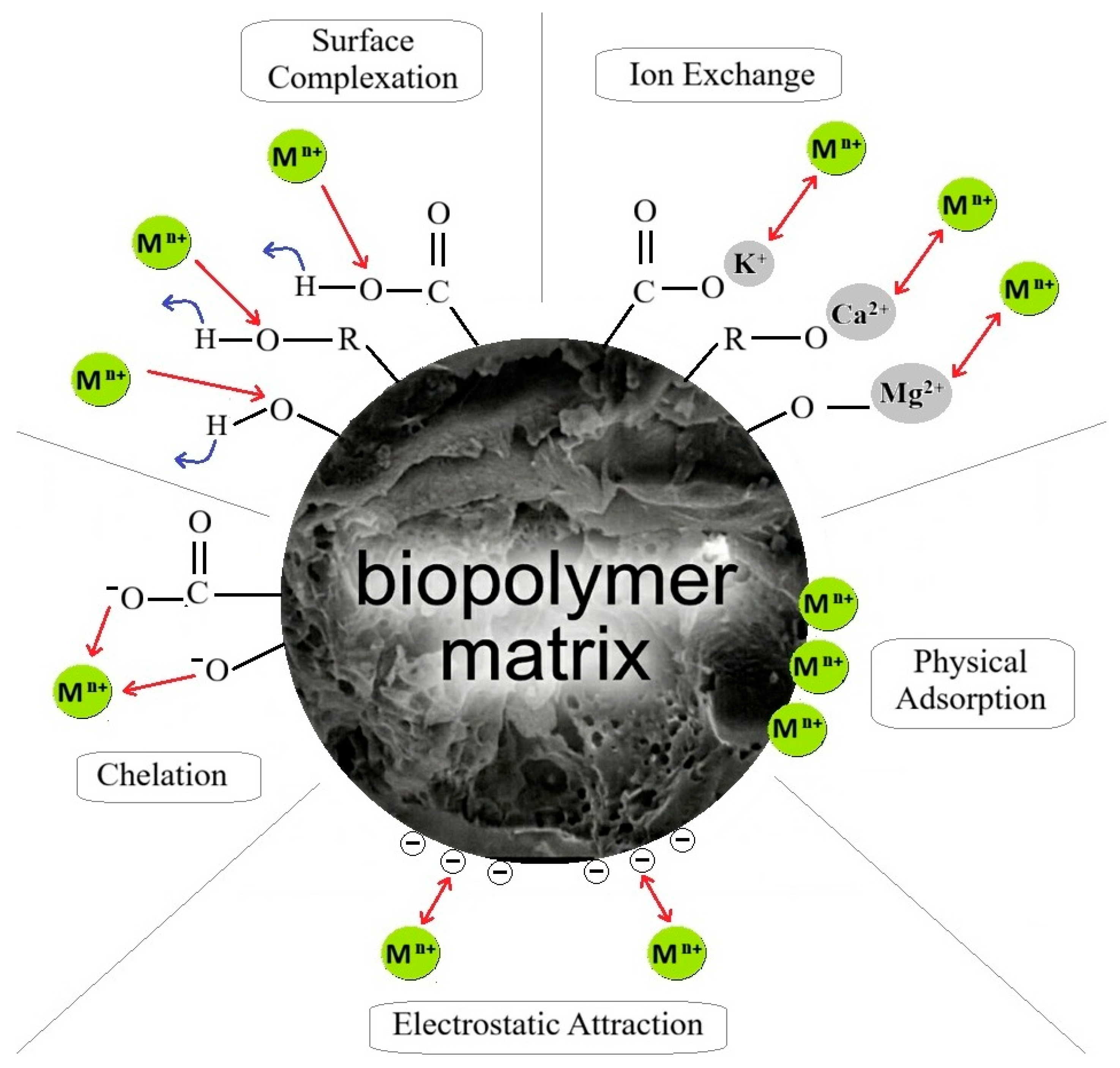
This molecular interaction between adsorbate and adsorbent can occur through different mechanisms, including electrostatic interaction, complexation, chelation, and ion Exchange [86]. These mechanisms will be discussed in more detail below and outlined in Figure 1.
These mechanisms can be investigated using various characterization techniques, which not only determine the composition of adsorbent materials but also identify the functional groups present on their surfaces. Such groups play a fundamental role in adsorption processes, as they are directly involved in interactions with the adsorbed species. Among the most commonly used chemical characterization techniques for this type of material are ultraviolet–visible spectroscopy (UV–Vis), Fourier transform infrared spectroscopy (FTIR), Raman spectroscopy, X-ray photoelectron spectroscopy (XPS), energy-dispersive X-ray spectroscopy (EDX), and zeta potential analysis [87].

3.1. Electrostatic Attraction

Electrostatic attraction is characterized as a physical interaction, occurring through a simple attraction between oppositely charged ions, without the formation of chemical bonds. The factor that determines which ions will be attracted by the adsorbent is its surface charge, which is intrinsically dependent on the pH of the medium [86,88]. This was evidenced in the study by Esmat et al. [89], in which the removal efficiency of Fe3+ and Cu2+ ions by alginate nanoparticles improved as the pH increased from 2 to 6.5. This behavior is attributed to the conversion of carboxylic groups into carboxylate anions, causing the alginate surface to become negatively charged and thereby increasing the electrostatic attraction between the adsorbent and the adsorbate.
An increase in pH also enhanced the adsorption of Cu2+, Pb2+, and Cd2+ by a composite prepared from a natural plant extract modified with chitosan, according to the study by Du et al. [90]. Similarly, Daochalermwong et al. [91] investigated the adsorption of Pb2+ and Cd2+ onto cellulose modified with carboxymethyl and ethylenediaminetetraacetic acid groups at different pH values. The authors observed that at low pH, H+ ions competed with metal ions for interaction with carboxyl and carboxylate groups. As the pH increased, functional groups such as -OH and -COOH became deprotonated, thereby favoring metal binding through these groups.

3.2. Surface Complexation

Complexometric adsorption is a mechanism in which metal ions form coordinated complexes with functional groups present on the adsorbent surface [86,92]. These functional groups, such as amine (-NH2), hydroxyl (-OH), and carboxyl (-COOH), donate electron pairs to metal ions, thus forming a stable coordination bond, characterizing a type of chemical interaction stronger than that compared to electrostatic attraction [86,93].
In the study conducted by Liu et al. [94], a novel porous EDTA–chitosan/alginate composite adsorbent was developed for the simultaneous removal of Pb2+ and methylene blue from wastewater. According to the authors, a possible mechanism involves the complexation of the adsorbate on the surface of the adsorbent. The study by Tang et al. [95] describes the preparation of a new adsorbent based on polyethylenimine- and carboxymethyl cellulose co-modified magnetic bentonite for the adsorption of Pb2+ and Cd2+. The authors reported that -NH2, -COOH, and -OH groups present in the adsorbent provided complexation sites for the adsorbates. In the work of Zhong et al. [96], an adsorbent prepared from Salix psammophila microcrystalline cellulose/Salix psammophila nanofiber aerogel spheres was used. This adsorbent contains carboxyl, hydroxyl, and methoxy groups, which provide effective complexation sites for metal adsorption. In this study, the authors also reported that pH had a significant effect on the adsorption performance of the material. In general, at pH values below 4, protonation of functional groups reduces complexation, whereas under neutral to alkaline conditions (between 5 and 9), deprotonation favors metal–ligand binding [86].
The complexation process can be used both to remove metals from aqueous matrices and to mobilize them, depending on the characteristics of the complexing agent and the solution conditions [86]. Thus, in biopolymer-based nanocomposites, complexation not only contributes to greater stability of metal retention, but also increases the selectivity of the material, especially when there is chemical functionalization directed towards groups with greater affinity for certain metal ions.

3.3. Chelation

Chelation adsorption is characterized by the metal ion being surrounded by multiple functional groups of the adsorbent, forming a highly stable cyclic [86]. This makes chelates more stable compared to complexes, due to the binding of metal ions at multiple sites [97]. Adsorbents containing functional groups such as RCOO, OH, SO2−, and NH3+ are commonly classified as good chelating agents for metal ions [97].
In the study by Hamza et al. [98], a chitosan- and alginate-based biopolymeric composite was developed and applied for the adsorption of Cd2+ and Pb2+ from contaminated water. The authors demonstrated that the presence of alginate carboxylic groups combined with the amino and hydroxyl groups of chitosan contributed to strong interactions with metal ions, including chelation, thereby promoting multidentate coordination and high adsorption capacity under controlled pH conditions [98]. In the study by Zhang et al. [99], a novel biosorbent was prepared by grafting polyethyleneimine onto carboxylated microcrystalline cellulose and applied to the adsorption of Cd2+ and Pb2+. The authors reported that the material exhibited enhanced adsorption capacity due to the introduction of -NH2 and -COOH groups onto the cellulose surface, leading to the formation of chelating complexes with the adsorbates [99]. Similarly, in the work of Sun et al. [100], a new adsorbent based on attapulgite, Fe3O4, chitosan, glutaraldehyde, and ethylenediaminetetraacetic acid (EDTA) was developed, which showed high adsorption capacity for Cu2+, Pb2+, and Ni2+ through a chelation mechanism.

3.4. Ion Exchange

Ion exchange is a mechanism in which metal ions bound to the surface of the adsorbent are exchanged for metal ions in the solution (adsorbates) [101]. Metal ions dissolved in contaminated water interact with functional groups on the material’s surface, promoting the exchange for less desirable ions. This is a reversible phenomenon that depends on binding interactions between ionic species and surface active sites. The system’s equilibrium is influenced by factors such as ionic concentration, material selectivity, and solution pH [86]. This mechanism is basically facilitated by the functional groups -OH, -COOH, -SO3H, and -PO3H2 present in the adsorbent, occurring in two ways: as proton–metal ion exchange or metal ion–metal ion exchange [4].
The study by Kenawy et al. [102] employed a melamine-grafted chitosan–montmorillonite nanocomposite for the adsorption of Fe3+. According to the authors, the ions of this element were adsorbed through the substitution of cations present in the interlayers of the adsorbent material. In the study by Zhang et al. [103], novel cationic polymer-modified magnetic chitosan beads were synthesized for the adsorption of Cr4+, which occurred via an ion-exchange mechanism. Moreno-Rivas et al. [104] evaluated chitosan- and alginate-based films for the adsorption of Cd2+ and Pb2+. According to the authors, one of the mechanisms involved is ion exchange, which may occur through the replacement of ions present in the adsorbent. In the study by Chen et al. [105], a sodium alginate-based magnetic hydrogel microsphere adsorbent was developed and applied for the removal of dyes and metal ions through an ion-exchange mechanism.

3.5. Factors That Influence Adsorption

The efficiency of metal adsorption by biopolymer-based nanocomposites is influenced by several factors, such as solution pH, temperature, contact time, initial metal concentration, adsorbent dosage, and ionic strength of the medium. These factors directly influence the adsorption capacity, the mechanisms involved, and the practical applicability of the materials.

3.5.1. pH

The pH factor directly influences adsorption through the protonation and deprotonation of surface groups. Biopolymers such as cellulose, chitosan, lignin, and alginate contain functional groups including hydroxyl (-OH), amine (-NH2), and carboxyl (-COOH), which directly participate in metal ion binding through electrostatic interactions, ion exchange, and complexation. Therefore, adsorption performance is strongly dependent on pH due to changes in surface charge and the availability of active sites [86,106].
At pH values lower than the point of zero charge (pHpzc), the surface of the adsorbent tends to exhibit a positive charge, reducing the adsorption of metal cations due to electrostatic repulsion and competition with H+ ions. At pH values higher than the pHpzc, deprotonation of functional groups occurs, generating negatively charged sites that favor electrostatic attraction and complex formation with metal ions [85].

3.5.2. Temperature

Temperature is a determining factor in adsorption, affecting both the rate at which the process occurs and the position of the established equilibrium. From a thermodynamic perspective, adsorption may exhibit an endothermic character (being favored by an increase in temperature) or an exothermic character (being disfavored by a temperature increase), depending on the specific characteristics of the adsorbent–adsorbate system. In general, physisorption processes tend to release energy and are therefore typically exothermic, whereas chemisorption may require energy for the formation of chemical bonds and, in many cases, exhibits an endothermic nature [86]
The adsorption of divalent metals onto modified cellulose often shows an endothermic character, indicating that increasing the temperature can enhance adsorption capacity [4]. However, in some cases, after reaching an optimal temperature, adsorption capacity may decrease, suggesting that the predominantly exothermic nature of the process has shifted toward equilibrium control [86]. This aspect highlights that generalizations are not appropriate, as each system exhibits its own behavior. Therefore, determining the ideal temperature is essential to achieve maximum efficiency in heavy metal removal under specific adsorption conditions.

3.5.3. Contact Time

Contact time directly influences the kinetics of the process and the maximum adsorption capacity of metals by the adsorbent [86]. In general, the efficiency in removing metal ions tends to increase as the contact time increases, until it reaches a point where there is no longer a significant increase in the adsorptive capacity of the material. This behavior is related to the fact that, in the initial stages of the process, there is a large availability of active sites on the surface of the adsorbent, favoring the fixation of contaminants. As time progresses, these sites are progressively filled, leading the system to reach adsorption equilibrium after a certain period [107].

3.5.4. Adsorbate Concentration

The initial concentration of metals in the solution is a relevant parameter in evaluating adsorptive performance. In general, higher concentrations favor an increase in the total amount of metal retained until the material reaches its maximum adsorption capacity. However, this variable also interferes with the kinetics and overall efficiency of the process, as very high levels can promote rapid occupation of the active sites, leading to premature saturation of the adsorbent and, if the system is not properly adjusted, to a reduction in removal efficiency [86,108].

3.5.5. Adsorbent Dosage

Increasing the adsorbent dosage generally improves removal efficiency because it increases the total number of available active sites. However, excessive use can lead to particle aggregation and overlapping of active sites, reducing the effective surface area and decreasing the adsorption capacity per unit mass [107]. To ensure satisfactory performance combined with economic viability, it is essential to establish the ideal amount of adsorbent to be used. Defining this dosage allows for achieving a proper balance in the adsorption process, preventing excessive use of material and, consequently, wasting resources [108].

3.5.6. Interfering Ions

The presence of competing ionic species in solution, such as Na+, Ca2+, and Mg2+, as well as anions such as Cl and SO42−, can negatively affect the removal performance of the target metals. Among these interfering species, divalent cations tend to exert a more significant impact compared to monovalent ones due to their higher electric charge, which intensifies competition for the available active sites on the adsorbent surface [86,107]. Such interference is common in wastewater samples that contain different types of salts, such as calcium carbonate, magnesium chloride, magnesium sulfate, sodium carbonate, among others [107].

3.6. Kinetic Models of Adsorption

Kinetic evaluation is essential to elucidate the mechanisms that control the adsorption of metal ions by biopolymer-based nanocomposites, since it allows determining the rate of removal of adsorbates from the liquid phase, the time required for the system to reach equilibrium, and the possible limiting steps associated with mass transfer. Kinetic studies generally consider variables such as contact time, initial adsorbate concentration, and temperature, parameters that directly influence the dynamics of the process. To describe the kinetic behavior, pseudo-first-order, pseudo-second-order, and intraparticle diffusion models are widely used, which allow interpreting the adsorption rate, how equilibrium is established, and the predominance of physical or chemical interactions in the system [84,109,110,111].
The pseudo-first-order kinetic model assumes that the adsorption process occurs at specific sites on the adsorbent surface, without significant interaction between the species already adsorbed. In this context, the rate of occupation of active sites is considered to be directly proportional to the number of sites still available over time [4,84]. This model is often associated with physisorption mechanisms and can be described by Equation (1).
ln q e q t = l n   q e k 1 t
The pseudo-second-order kinetic model considers that the rate-limiting step of adsorption is associated with chemical interactions between the adsorbate and the active sites of the adsorbent, and is therefore frequently related to chemisorption mechanisms. In this model, it is assumed that the rate of occupation of adsorption sites depends on the square of the number of available sites, reflecting a greater influence of chemical interactions in controlling the rate of the process [4,84]. This model is described by the following Equation (2).
t q t = 1 k 2   q e 2 + t q e
where qₑ is the amount of adsorbate adsorbed at equilibrium; qₜ is the amount of adsorbate adsorbed at time t; k1 is the rate constant of pseudo-first-order adsorption; and k2 is the rate constant of pseudo-second-order adsorption.
In addition to the pseudo-first-order and pseudo-second-order models, another widely used model is the intraparticle diffusion model, which explains the physical mechanisms of mass transport within the adsorbent [110]. This model is described by Equation (3):
q t = k i d   t 1 / 2 + C i
where kid is the intraparticle diffusion constant; and Ci is the boundary layer thickness.
In a recent study, Hassan et al. [112] investigated the adsorption of metals such as Cd, Cu, Pb, Zn, Cr, and Ni using a chitosan/CaCO3 nanoparticle bionanocomposite. The results were remarkably efficient, achieving removal percentages between 94.8% and 99.0% for the tested metals. Kinetic analysis revealed that the adsorption of these metal ions predominantly followed a pseudo-second-order mechanism, suggesting that the process is controlled by chemisorption. In the study by Shokri et al. [113], a biopolymer-based adsorptive membrane was used for the simultaneous adsorption of Pb and As. According to the authors, the pseudo-second-order kinetic model provided the best fit for Pb adsorption data, indicating a chemisorption process. However, for As, adsorption was better described by a pseudo-first-order kinetic model, suggesting control by physical adsorption. In the work conducted by Khan et al. [114], the pseudo-second-order model also showed the best fit for Cd2+ adsorption using an adsorbent based on maleated hydroxyethyl cellulose. Similarly, in the study by Hamad and Ibrahim [115], a nanocomposite containing chitosan was employed for the adsorption of Cd2+ and Cu2+ ions. Kinetic modeling was extensively investigated using pseudo-first-order, pseudo-second-order, and intraparticle diffusion models. According to the authors, the pseudo-second-order kinetic model provided the best fit to the experimental data for the metal ions.

3.7. Isotherm Models

Adsorption isotherms are widely used to describe the interaction between adsorbent and adsorbate under equilibrium conditions at a constant temperature. From these analyses, it is possible to obtain relevant information about the heterogeneity and distribution of active sites on the material’s surface, as well as to estimate its maximum adsorption capacity, which is an important parameter for comparing the performance of different adsorbents. Among the various mathematical models proposed, the Langmuir and Freundlich isotherms stand out as the most frequently applied and, in many cases, present the best experimental adsorption fits [101,116]. Equations (4) and (5) describe these models, respectively.
q e = q m a x   K l   C e 1 + K l   C e
q e = K f   C e 1 / n
where qₑ is the amount of adsorbate adsorbed at equilibrium; qₘₐₓ is the maximum adsorption capacity; Kₗ is the Langmuir constant; Cₑ is the equilibrium concentration of the adsorbate in the aqueous medium; Kf is the Freundlich constant; and n is the heterogeneity factor.
The Langmuir adsorption isotherm describes the adsorption of metal ions onto adsorbents as a monolayer process, assuming that adsorption occurs at specific homogeneous sites [117]. Based on the Langmuir isotherm model described in Equation (4), an increase in the Kₗ parameter with rising temperature indicates greater affinity between the adsorbate and the adsorbent, suggesting the predominance of chemisorption interactions and an endothermic nature of the adsorption process. However, when the value of Kₗ decreases with increasing temperature, a physisorption mechanism predominates, indicating an exothermic process [101].
The Freundlich adsorption isotherm considers both monolayer and multilayer adsorption, reflecting the possibility of both chemisorption and physisorption interactions. This model assumes a non-uniform distribution of adsorption energies, which is characteristic of heterogeneous surfaces and systems with non-ideal behavior. In this context, the energy associated with active sites decreases exponentially as surface coverage increases [118]. Based on the Freundlich isotherm model described in Equation (5), the parameter n is fundamental for interpreting the adsorption behavior of the system. n values between 1 and 10 indicate a favorable adsorption process and are related to the intensity of interaction between the adsorbate and the adsorbent surface. In this sense, the higher the value of n, the stronger these interactions tend to be. On the other hand, when n assumes values lower than 1, the adsorption process becomes less significant, indicating low affinity between the involved species [101].
The comparison between the Langmuir and Freundlich isotherms has been employed as a way to test distinct hypotheses regarding the nature of the adsorbent surface and the mode of site occupancy. In the study by Hassan et al. [119], the authors fitted the data to both isotherms and observed a better fit to the Langmuir model, interpreting this result as evidence of monolayer formation at the active sites of the adsorbent, which contained alginate in its composition. Similarly, Majigsuren et al. [120] applied both Langmuir and Freundlich models and reported that the adsorption process of Cr3+/Cr4+ was more consistent with the Langmuir model (higher regression coefficients), leading to the conclusion that monolayer adsorption was the dominant mechanism. In this study, the authors used a chitosan–clay composite as the metal adsorbent. Shokri et al. [113] evaluated adsorption equilibrium using Langmuir and Freundlich models and reported that Freundlich better described Pb2+ adsorption, attributing this behavior to adsorption on a heterogeneous surface, whereas arsenic correlated better with the Langmuir model, suggesting more homogeneous sites for this adsorbate. In this study, the authors used adsorptive membranes based on polylactic acid and hydroxyapatite for metal removal. Segneanu et al. [121] indicated that both models can provide satisfactory descriptions for Cr4+ adsorption onto the evaluated adsorbent (κ-carrageenan- and chitosan-based composites). The authors highlighted that a slightly higher R2 value for the Freundlich model compared to Langmuir may indicate a process more compatible with multilayer adsorption and/or irregular/heterogeneous surfaces. In the study by Hassan et al. [112], both Langmuir and Freundlich models were also evaluated and, according to the authors, the adsorbents showed a better fit to the Langmuir model. This was interpreted as the absence of interactions between adsorbed molecules and the fixation of metal ions via monolayer adsorption on homogeneous sites. In this study, the authors used a nanocomposite based on chitosan and CaCO3 nanoparticles as the adsorbent for metal removal.
These results support the practice of reporting Langmuir and Freundlich models in parallel and justify selecting the predominant model not only based on fitting metrics but also on the coherence between the model assumptions, the heterogeneity of the material, and the specific behavior of each ion.

4. Comparative Performance, Regeneration and Stability

This section provides a critical and comparative analysis of the adsorption performance, regeneration behavior, and structural stability of biopolymer-based nanocomposites applied to heavy metal removal. The discussion integrates performance metrics (qₘₐₓ and removal efficiency), operational conditions, regeneration strategies, and durability aspects to identify trends, limitations, and structure–performance relationships across different material systems.

4.1. Comparative Adsorption Performance

The adsorption performance of biopolymer-based nanocomposites is governed by the synergistic interaction between the polymeric matrix and the incorporated nanophase. The integration of functional biopolymers—such as chitosan, alginate, and cellulose—with inorganic nanoparticles (e.g., Fe3O4, SiO2, ZnO, TiO2, Ag, or mixed metal oxides) increases surface reactivity, functional group accessibility, and mechanical robustness. This hybrid architecture typically enhances the density of active binding sites while improving stability under aqueous conditions.
However, despite the growing number of reported systems, adsorption capacity (qₘₐₓ) and removal efficiency vary widely across studies. This variability does not necessarily reflect intrinsic material superiority, but rather differences in experimental design. Parameters such as pH, initial metal concentration, adsorbent dosage, temperature, ionic strength, and contact time strongly influence adsorption equilibrium and kinetics [16]. Therefore, meaningful comparison requires contextual interpretation rather than direct numerical juxtaposition.
Clear contrasts emerge when examining the representative systems summarized in Table 1. For instance, the bimetallic chitosan nanocomposite (CS–Fe/AgNPs) investigated by van der Horst et al. [122] exhibited relatively low maximum adsorption capacities, under optimized conditions: 2.01 mg g−1 for Pb(II), 1.73 mg g−1 for Cd(II), and 1.81 mg g−1 for Ni(II). These values suggest limited accessibility of active sites or possible nanoparticle shielding effects within the polymeric network.
In contrast, the magnetic hydrogel composed of chitosan/alginate/Fe3O4@SiO2 developed by Facchi et al. [58] demonstrated markedly superior performance, reaching 245.28 mg g−1 for Pb(II), with 99.04% removal in real battery effluent. The enhanced performance can be attributed to the combined effects of dual biopolymer functionality (amine and carboxyl groups), high swelling capacity of the hydrogel network, and improved dispersion of magnetic nanoparticles coated with silica, which increases surface stability and prevents aggregation.
Similarly, the nanostructured aerogel based on nanofibrillated cellulose, alginate, and polyglutamic acid reported by Syeda et al. [125] achieved high adsorption capacities in its spherical configuration, reaching 101.8 mg g−1 for Pb(II), 59.3 mg g−1 for Cu(II), and 100.6 mg g−1 for Zn(II), with removal efficiencies above 98%. The highly porous aerogel architecture and the presence of multiple ionizable groups significantly enhanced mass transfer and metal–ligand interactions. Magnetic nanocomposites incorporating Fe3O4 combined with graphene oxide and chitosan also showed competitive performance, achieving 63.45 mg g−1 for Pb(II). Although lower than hydrogel or aerogel systems, these materials offer an operational advantage due to rapid magnetic separation, which simplifies post-treatment recovery.
The initial metal concentration reported in Table 1 spans a wide range (from approximately 1 to 500 mg L−1), which influences the adsorption capacity. Higher initial concentrations increase the driving force for mass transfer, often resulting in higher qₘₐₓ values, although they may not reflect performance under environmentally relevant conditions. Consequently, materials evaluated at elevated concentrations may appear more efficient, highlighting the need for cautious interpretation. Contact time also varies substantially among studies, ranging from a few minutes to several hours. Systems requiring shorter equilibrium times (e.g., <100 min) indicate faster adsorption kinetics and are more attractive for practical applications. Regarding regeneration cycles, most systems maintain stable adsorption performance over 3–8 cycles, suggesting good short-term stability. However, long-term durability beyond this range remains insufficiently explored, reinforcing the need for more comprehensive lifecycle assessments.
A broader comparison across materials reveals three important trends: (i) Pb(II) is adsorbed with higher capacity compared to Cd(II) and Ni(II), likely due to its larger ionic radius, lower hydration energy, and stronger affinity toward amine and carboxyl functional groups; (ii) hydrogel and aerogel architectures generally outperform dense nanoparticle systems, highlighting the importance of porosity and diffusion pathways in maximizing active site accessibility; (iii) magnetic functionalization improves operational feasibility rather than intrinsic adsorption capacity, emphasizing the distinction between performance metrics and process applicability.
The influence of pH also emerges clearly from Table 1. Most optimal adsorption occurs between pH 4 and 6, where functional groups are sufficiently deprotonated to enable coordination while avoiding metal hydroxide precipitation. Systems operating effectively across broader pH ranges (e.g., ferric oxides–polymer composites, pH 3–9) indicate enhanced structural stability and buffering capacity. Moreover, the isotherm model fitting reported in Table 1 shows a predominance of the Langmuir model, suggesting monolayer adsorption onto relatively homogeneous active sites. However, the occasional fitting to Freundlich or dual models indicates surface heterogeneity, particularly in highly porous or multi-component architectures.
Overall, adsorption capacities reported in the literature range from <5 mg g−1 in compact bimetallic systems to >200 mg g−1 in highly porous hydrogel or aerogel matrices. This wide interval underscores the decisive role of structural design, functional group density, and morphology. Consequently, future comparative studies should normalize experimental conditions and report comprehensive isotherm and kinetic parameters to enable more reliable cross-study evaluation.

4.2. Regeneration and Reusability

Regeneration and reusability are decisive parameters for assessing the practical applicability, economic feasibility, and environmental sustainability of biopolymer-based nanocomposites in heavy metal removal [40,131]. While high adsorption capacities are frequently reported, long-term operational stability depends on the material’s ability to maintain performance over repeated adsorption–desorption cycles without structural degradation or significant loss of active sites.

4.2.1. Regeneration Mechanisms

Regeneration generally involves desorption of adsorbed heavy metals through proton competition, ion exchange, or chelation mechanisms. The adsorption–desorption–regeneration process is schematically illustrated in Figure 2. Adsorption of heavy metals onto biopolymer-based nanocomposites primarily occurs through mechanisms such as ion exchange, electrostatic attraction, chelation, and complexation, facilitated by functional groups (e.g., carboxyl, amine, hydroxyl) present on the biopolymer matrix or incorporated nanoparticles [133,134,135]. After adsorption, the nanocomposites can be regenerated by desorbing the heavy metals, often using suitable eluents or changes in pH, allowing the material to be reused in multiple cycles [127,136]. Dilute mineral acids (typically 0.01–0.1 M HCl or HNO3) are widely employed to protonate functional groups (e.g., -NH2, -COOH, -OH), weakening metal–ligand interactions and facilitating desorption. The acid provides a high concentration of H+ ions, which compete with metal ions for binding sites on the adsorbent, leading to desorption of the metals. Alternatively, chelating agents such as Na2EDTA promote complexation with metal ions, promoting their desorption from the adsorbent surface [127]. EDTA is commonly used at concentrations around 0.01–0.2 M for effective regeneration [137]. Mild washing or pH adjustment has also been applied in systems where adsorption occurs primarily via electrostatic interactions [128,131].
In addition, physical methods such as washing or filtration are used to remove residual metal ions from the adsorbent surface after chemical treatment. These steps help in cleaning the adsorbent and preparing it for subsequent cycles [138]. In some cases, after chemical and physical treatments, drying and activation steps are performed to restore the adsorbent’s properties, ensuring it is ready for reuse [136]. Moreover, in cases where regeneration is not pursued, biopolymer-based adsorbents can be biodegraded after use. However, this approach does not allow for recovery or reuse of the adsorbent [138].
Magnetic nanocomposites offer an additional advantage, as magnetic recovery enables rapid separation from treated water through the application of an external magnetic field, minimizing material loss and simplifying regeneration procedures. This process is more energy-efficient, faster, and simpler to operate compared to traditional recovery methods such as sedimentation, centrifugation, or filtration, and can be easily integrated into water treatment systems. Magnetic separation is also non-invasive, as the magnetic field can penetrate materials like glass or plastic without direct contact, reducing the risk of secondary contamination. Furthermore, this method is not sensitive to pH, temperature, or ionic concentration, allowing operation under a wide range of conditions [139,140,141].

4.2.2. Regeneration Performance of Biopolymer-Based Nanocomposites

The regeneration performance of representative biopolymer-based nanocomposites reported in the literature is summarized in Table 2. The comparison highlights the diversity of regeneration strategies, number of reuse cycles, and retained efficiencies. Although most materials maintain high performance (>85%) over 4–6 cycles, extended durability tests remain limited. Additionally, incomplete reporting of desorption efficiency and nanoparticle leaching hinders a comprehensive assessment of long-term stability. For instance, chitosan/magnetite nanoparticles regenerated with 0.1 M HCl maintained approximately 90% Pb(II) removal efficiency after four cycles. Similarly, ZnO–banana peel composites preserved 96% efficiency under comparable conditions. Fe3O4–chitosan monolithic filters demonstrated more than 97% Cu2+ removal after five cycles, highlighting the benefit of immobilized architectures in preserving structural integrity.
As shown in Table 2, acid-based regeneration (0.05–0.1 M HCl or HNO3) remains the most commonly applied strategy due to its effectiveness and simplicity. However, repeated acid-based regeneration can progressively compromise the structural integrity of biopolymer matrices. In chitosan-based systems, for instance, acidic conditions may promote partial hydrolysis of polysaccharide chains, resulting in reduced mechanical stability and gradual loss of adsorption capacity. Additional structural alterations, including swelling, partial dissolution, and depletion or inaccessibility of functional groups, may occur, particularly in non-crosslinked or poorly stabilized adsorbents. Consequently, regeneration efficiency often declines over successive cycles [144]. The selection and concentration of desorbing agents, especially chelating agents, must therefore be carefully optimized to achieve effective metal removal while minimizing structural damage and preserving long-term adsorbent performance [137].
Notably, most studies evaluate fewer than six regeneration cycles, which limits conclusions regarding long-term operational durability. Moreover, performance is often tested in synthetic aqueous solutions rather than real wastewater matrices, where competing ions and organic matter may significantly reduce regeneration efficiency. Furthermore, quantitative analysis of nanoparticle leaching, structural degradation, and metal recovery efficiency is seldom reported. These gaps highlight the need for standardized regeneration protocols and extended cycling studies under realistic wastewater conditions.

4.2.3. Factors Affecting Structural Stability

The structural stability of biopolymer-based nanocomposites results from a complex interface between composition, molecular organization, processing conditions, and operational stresses imposed during adsorption–desorption cycles. Rather than being governed by a single parameter, long-term mechanical integrity and functional durability depend on how these variables are balanced within the material design. These factors and their respective impacts on structural durability are summarized in Table 3 and discussed in detail below.
Material composition constitutes the primary determinant of stability. The intrinsic properties of the biopolymer matrix, such as molecular weight, chain flexibility, hydrophilicity, and functional group density, directly affect mechanical resistance, swelling behavior, and susceptibility to hydrolytic degradation. Chitosan, alginate, cellulose, and starch matrices exhibit distinct structural responses under acidic or aqueous environments due to differences in glycosidic linkage stability and ionizable groups [145,146,147]. The incorporation of nanofillers introduces an additional reinforcing phase whose effectiveness depends strongly on its physicochemical characteristics. Parameters such as particle size, aspect ratio, surface area, chemical functionality, and loading concentration dictate the extent of reinforcement and thermal stabilization [146,147]. High-aspect-ratio nanofillers, including cellulose nanocrystals and carbon nanotubes, promote efficient stress transfer mechanisms across the matrix–filler interface, leading to enhanced tensile strength and modulus [148]. Similarly, rigid inorganic nanofillers such as metal oxides, nanoclays, and mesoporous silica nanoparticles restrict polymer chain mobility and delay thermal degradation by acting as physical barriers and heat-resistant domains [148].
However, the mere presence of nanofillers does not guarantee improved stability. Their dispersion within the polymer matrix is a decisive factor. Homogeneous distribution maximizes interfacial contact area and ensures efficient load transfer, thereby improving mechanical strength, thermal resistance, and dimensional stability. In contrast, aggregation or agglomeration creates stress concentration points and microstructural defects that compromise mechanical integrity and reduce the expected reinforcement effect. Poor dispersion may also decrease effective surface area available for interaction with the polymer chains, limiting improvements in barrier properties [149,150].
Table 3. Factors influencing the structural stability of materials.
FactorEffect on Structural StabilityRef.
Nanofiller type and dispersionWell-dispersed nanofillers improve mechanical, thermal, and barrier properties; aggregation reduces reinforcement benefit.[151,152,153]
Interfacial interactionsStrong bonding (H-bonding, electrostatic) enhances load transfer, barrier performance.[150,154,155]
Degree of crystallinityIncreased crystallinity generally increases mechanical strength and thermal stability.[156,157,158]
Cross-linking densityIncreased cross-linking enhances rigidity and swelling resistance but may reduce pore accessibility.[155,159,160]
Processing methodAffects morphology, filler dispersion, and mechanical integrity.[158,161]
Water absorption/barrierReduced water uptake improves dimensional stability.[150,152,162]
Regeneration conditionsAcid/EDTA can damage polymer; stabilizing strategies mitigate degradation.[155,163,164]
Interfacial interactions between the biopolymer matrix and nanofillers further define structural performance. Hydrogen bonding, electrostatic interactions, ester linkages, and van der Waals forces facilitate stress transfer and restrict chain mobility. Strong interfacial bonding improves dimensional stability and reduces the likelihood of filler pull-out under mechanical stress. Surface functionalization strategies, such as silanization, polymer grafting, or core–shell structuring, are commonly employed to enhance compatibility and prevent nanoparticle aggregation [130,165]. In silicate-based systems, including nanoclays and mesoporous silica nanoparticles, the formation of an intercalated or exfoliated morphology generates tortuous diffusion pathways that significantly reduce water permeability and improve barrier performance [142,166].
The supramolecular organization of the polymer network also plays a critical role. The degree of crystallinity influences both mechanical rigidity and thermal resistance. Increased crystallinity generally enhances structural stability by promoting tighter chain packing and reduced segmental mobility. Nevertheless, excessive crystallinity may decrease flexibility and limit diffusion within porous adsorbent structures. Crosslinking density exerts a similarly dual effect. Higher crosslinking increases network rigidity, thermal stability, and resistance to swelling, thereby improving structural durability in aqueous systems. However, excessive crosslinking can reduce pore accessibility and hinder active site availability, ultimately compromising adsorption efficiency.
Processing methods further modulate structural stability by affecting morphology, porosity, and filler distribution. Techniques such as solution casting, freeze-drying, electrospinning, in situ polymerization, and additive manufacturing influence the spatial organization of nanofillers and the mechanical robustness of the final structure [158]. Embedding nanoparticles within rigid matrices, monolithic filters, or three-dimensional scaffolds improves resistance to hydrodynamic stress and mechanical abrasion during operation. Under dynamic conditions, such as agitation, magnetic separation, or continuous-flow treatment, mechanical integrity becomes a decisive factor for reusability [166].
Water absorption and barrier properties are equally important in determining dimensional stability. Hydrophilic biopolymers are prone to swelling in aqueous environments, which may weaken the matrix and accelerate structural degradation. The incorporation of appropriately dispersed nanofillers reduces moisture permeability by creating tortuous diffusion pathways, thereby limiting water uptake and improving mechanical retention [162]. This barrier effect contributes directly to enhanced structural stability, particularly in long-term adsorption applications.
Repeated regeneration cycles introduce additional chemical and mechanical stresses that progressively affect structural integrity. Exposure to acidic desorbing agents may induce hydrolysis of glycosidic linkages, especially in chitosan-based matrices, leading to chain scission, swelling, and partial dissolution [163,164]. These phenomena reduce mechanical strength and gradually diminish active site availability [155]. To counteract such degradation, strategies including silica coating, biochar incorporation, and controlled chemical crosslinking have been adopted to enhance resistance against acid-mediated attack and prevent nanoparticle aggregation.

4.2.4. Critical Assessment and Research Gap

While biopolymer-based nanocomposites demonstrate promising reusability, several challenges remain. There is a lack of standardized protocols for regeneration testing, making cross-study comparison difficult. Long-term durability beyond 10–20 cycles is seldom assessed, and few studies evaluate structural integrity using post-cycle characterization techniques such as SEM, FTIR, or magnetic property analysis. Moreover, limited attention has been given to metal recovery efficiency, economic feasibility, and life-cycle assessment. For large-scale implementation, future research should focus on continuous-flow systems, real wastewater testing, environmentally benign regeneration agents, and systematic evaluation of nanoparticle leaching. Overall, regeneration studies confirm the potential of biopolymer-based nanocomposites for sustainable wastewater treatment; however, comprehensive long-term and application-oriented investigations are still required to validate their industrial viability.
Beyond material performance, environmental and operational considerations must also be addressed. Although acid- and EDTA-based regeneration strategies are widely adopted due to their high desorption efficiency, they may generate secondary waste streams that require additional treatment. EDTA, in particular, is persistent in aquatic environments and may pose ecological risks if not properly managed. Therefore, the sustainability of regeneration protocols should be evaluated not only in terms of retained adsorption capacity but also considering chemical consumption, secondary pollution, and overall environmental impact.

5. Sustainability, Limitations and Environmental Risks

Aspects related to the bioaccumulation of heavy metals in aquatic environments represent one of the most critical issues associated with the presence of these contaminants in aquatic and marine ecosystems. Unlike many organic pollutants, heavy metals are non-biodegradable and exhibit a strong capacity for bioaccumulation. In addition, their mobility can increase when present in the nanoscale range. Consequently, these nanoparticles may accumulate in biological tissues and, in some cases, cross cellular membranes, interfering with essential physiological processes such as growth, development, reproduction, and cellular respiration [167].
Before 2015, approximately 20% of wastewater worldwide received inadequate treatment, highlighting the magnitude of the global water contamination problem. In many countries lacking appropriate infrastructure or treatment technologies, wastewater continues to be discharged directly into natural water bodies without basic decontamination processes. Studies have shown that some of the most difficult contaminants to remove from wastewater are those present at the nanoscale, typically between 1 and 100 nm, due to their high stability in aqueous media and large surface area, which hinder removal by conventional treatment processes [168,169].
Therefore, one of the main concerns involves what occurs after the application of the adsorbent, particularly during regeneration and at the final stage following contaminant capture. In some cases, nanoparticles may not be sufficiently anchored or stabilized within the polymeric matrix, which can favor their detachment. Factors such as system agitation, pH variations during post-treatment stages, and multiple adsorption–desorption cycles may intensify this process, increasing the risk of nanoparticle release into the aquatic environment, with concentrations reported in the literature ranging from µg L−1 to mg L−1 levels, depending on the type of nanomaterial and operational conditions [168].
Several studies have proposed strategies to improve the structural stability of nanoparticles within polymeric matrices. For instance, Ng et al. [170] reported that the incorporation of polyvinyl alcohol as a binding agent can enhance the interaction between graphene oxide and the polymer matrix through hydrogen bonding between functional groups. Similarly, crosslinking agents such as glutaraldehyde have been widely used to promote stronger chemical interactions between polymer chains and active components, forming more stable structures that reduce the likelihood of nanoparticle detachment [171].
In addition, nature-inspired adhesion strategies have also been investigated to improve nanoparticle immobilization in polymeric materials. Adhesive systems inspired by mussels mimic the strong bonding mechanisms found in aquatic organisms, promoting robust interactions between nanoparticles and polymer surfaces and thereby increasing the structural stability of the adsorbent material [172,173].
Direct evidence of nanoparticle leaching has also been reported in the literature. Kajau et al. [174] investigated the leaching of CuO nanoparticles incorporated into polyethersulfone ultrafiltration membranes and observed detectable nanoparticle release after 840 h of exposure. Their results demonstrated that nanoparticle detachment may occur during prolonged operation or maintenance processes, potentially leading to secondary contamination of treated water. The authors also emphasized that this phenomenon is not limited to CuO nanoparticles but may also occur with other commonly used nanomaterials, such as ZnO and TiO2, due to their similar physicochemical properties. Analytical techniques such as ICP-MS are widely used to quantify this release, while methods such as DLS and EDS help to identify and characterize nanoparticles in the aqueous medium.
Therefore, these results show that although nanocomposites present very promising performance in the removal of contaminants, further studies are still necessary to evaluate their long-term stability in aqueous solutions. From an ecotoxicological perspective, studies indicate that concentrations in the range of 0.1–10 mg L−1 may cause effects such as oxidative stress, cellular damage, and growth inhibition in aquatic organisms.

Practical Limitations and Real-World Challenges

Nanoparticles applied in the removal of emerging contaminants stand out due to their high selectivity and removal efficiency. However, their large-scale application still represents a challenge, mainly due to the required adsorbent dosage, external conditions, and the preservation of material performance after reuse. In real systems, conditions are more complex, and in many cases, adjusting parameters such as pH can become costly and impractical, directly affecting the adsorption capacity and removal efficiency of the material.
In addition, the presence of other contaminants, which are commonly found in real effluents, can lead to competition for active sites in the adsorbent, making it more difficult to remove a specific target contaminant. Another important aspect is the possibility of reuse, which is essential for practical applications. However, maintaining the stability and integrity of the material after the use of eluents and successive adsorption–desorption cycles remains a challenge. It is worth noting that this limitation is not exclusive to nanocomposites, but is also observed in most green adsorbents.
Another critical point is to ensure that nanoparticles do not detach into the aqueous medium. Therefore, it is essential to guarantee that nanocomposites are well immobilized within the polymeric matrix to avoid secondary contamination. Regarding scalability, many studies report efficient synthesis routes at the laboratory scale; however, large-scale production is not always straightforward, especially when multiple functionalization or modification steps and nanoparticle incorporation are involved. These processes may increase complexity, cost, and reproducibility challenges. In this context, future studies should focus not only on adsorption capacity and reusability, but on understanding how these materials behave under real conditions. It becomes important to understand their stability over time, the possibility of nanoparticle release in aqueous media, and how they perform in more real systems.

6. Conclusions

Biopolymer-based nanocomposites have shown promising potential for the removal of heavy metals from aqueous systems, mainly due to the presence of functional groups capable of interacting with metal ions and the possibility of structural modification. The explored studies indicated that more functionalized materials, especially those modified with nanoparticles or crosslinking strategies, tend to present higher adsorption capacities, with values reaching around 245 mg g−1 for Pb2+ removal, reinforcing the relevance of material design in adsorption performance. In addition, better results were generally observed in the pH range between 4 and 6, where functional groups remain available for interaction with metal precipitation and most systems exhibit a moderately endothermic behavior.
The regeneration of adsorbents has received increasing attention, where desorption processes using diluted acidic solutions or complexing agents facilitate the reuse of adsorbent materials, which maintain satisfactory performance after several adsorption–desorption cycles. However, some aspects still require further investigation, particularly regarding post-treatment processes and the potential leaching of nanoparticles. The presence of multiple contaminants in real systems can significantly affect performance due to competition for active sites, while structural stability and the risk of nanoparticle leaching remain critical concerns that may compromise both efficiency and environmental safety.
Therefore, additional studies are necessary for the development of greener crosslinking strategies to improve structural stability, as well as for the evaluation of adsorption performance in multicomponent systems, which better represent real wastewater conditions. In addition, factors such as long-term stability, regeneration efficiency, and possible nanoparticle release should be carefully assessed to ensure the safe and effective application of these materials.
Overall, the materials discussed in this review present significant potential for application in the removal of contaminants from aqueous media, contributing to the development of more efficient and environmentally safe strategies for water treatment. However, the evaluation of these materials beyond laboratory scale is still limited in most studies, highlighting the importance of this aspect, since real conditions differ from controlled batch experiments. In this sense, aspects such as stability over repeated use and reuse cycles, confirmation of the absence of secondary contamination, and the overall feasibility of the developed adsorbents should be further investigated. Addressing these points will help strengthen the existing findings and support the practical application of these materials.

Supplementary Materials

The following supporting information can be downloaded at: https://www.mdpi.com/article/10.3390/su18083827/s1. Figure S1: PRISMA 2020 flow diagram of the identification, screening, eligibility assessment, and inclusion process for studies published in 2021–2026. Color code: Blue boxes represent the stages of identification, screening, and eligibility; Red boxes indicate excluded records and reports.

Author Contributions

Conceptualization, J.O.G. and A.C.R.; Methodology, J.O.G., A.C.R., J.I.G., B.A.D.Á., L.N.A., J.R.C., M.M.C. and F.L.d.F.; Validation, J.O.G., A.C.R. and E.Q.O.; Formal analysis, J.O.G., A.C.R., D.P.J. and E.Q.O.; Investigation, J.I.G., B.A.D.Á., L.N.A., J.R.C., M.M.C. and F.L.d.F.; Resources, J.O.G., A.C.R. and E.Q.O.; Data curation, J.I.G., B.A.D.Á., L.N.A., J.R.C., M.M.C. and F.L.d.F.; Writing—original draft preparation, J.I.G., B.A.D.Á., L.N.A., J.R.C., M.M.C. and F.L.d.F.; Writing—review and editing, J.O.G., A.C.R., D.P.J. and E.Q.O.; Visualization, M.M.C., J.I.G. and B.A.D.Á.; Supervision, J.O.G. and A.C.R.; Project administration, J.O.G. and A.C.R.; Funding acquisition, J.O.G. and A.C.R. All authors have read and agreed to the published version of the manuscript.

Funding

This research received no external funding.

Institutional Review Board Statement

Not applicable.

Informed Consent Statement

Not applicable.

Data Availability Statement

No new data were created or analyzed in this study.

Acknowledgments

The authors would like to thank the Coordenação de Aperfeiçoamento de Pessoal de Nível Superior (CAPES)/Brazil—Finance Code 001, the Conselho Nacional de Desenvolvimento Científico e Tecnológico (CNPq)/Brazil, the Fundação de Amparo à Pesquisa do Estado do RS (FAPERGS)/Brazil, the Secretaria de Desenvolvimento, Ciência e Tecnologia/RS/Brazil.

Conflicts of Interest

The authors declare no conflicts of interest.

References

  1. Larsen, B.; Sánchez-Triana, E. Global Health Burden and Cost of Lead Exposure in Children and Adults: A Health Impact and Economic Modelling Analysis. Lancet Planet. Health 2023, 7, e831–e840. [Google Scholar] [CrossRef] [PubMed]
  2. United Nations Office for Disaster Risk Reduction (UNDRR); I.S.C. (ISC). UNDRR–ISC Hazard Information Profiles—2025 Update: CH0101 Arsenic United Nations Office for Disaster Risk Reduction; International Science Council: Paris, France, 2025. [Google Scholar]
  3. UN-Water. Summary Progress Update 2021: SDG 6—Water and Sanitation for All; UN-Water: New York, NY, USA, 2021. [Google Scholar]
  4. Kaur, J.; Sengupta, P.; Mukhopadhyay, S. Critical Review of Bioadsorption on Modified Cellulose and Removal of Divalent Heavy Metals (Cd, Pb, and Cu). Ind. Eng. Chem. Res. 2022, 61, 1921–1954. [Google Scholar] [CrossRef]
  5. Mohanrasu, K.; Manivannan, A.C.; Rengarajan, H.J.R.; Kandaiah, R.; Ravindran, A.; Panneerselvan, L.; Palanisami, T.; Sathish, C.I. Eco-Friendly Biopolymers and Composites: A Sustainable Development of Adsorbents for the Removal of Pollutants from Wastewater. npj Mater. Sustain. 2025, 3, 13. [Google Scholar] [CrossRef]
  6. Hari Lakshmi, S.; Devasena, T.; Singh, R.P.; Soudagar, M.E.M.; Suresh, A.; Giri Prasad, R.; Selvaraj, B.; Subramanian, K.; Kudamba, A.; Ahmed, M.Z.; et al. Enhanced Remediation of Heavy Metals and Dyes from Industrial Runoff Using Nanostructured Cubebinol-Chitosan Composite Beads. Appl. Water Sci. 2025, 15, 256. [Google Scholar] [CrossRef]
  7. Kolya, H.; Kang, C.-W. Next-Generation Water Treatment: Exploring the Potential of Biopolymer-Based Nanocomposites in Adsorption and Membrane Filtration. Polymers 2023, 15, 3421. [Google Scholar] [CrossRef]
  8. Al-Heety, L.F.D.; Hassan, O.M.; Hassan, K.T. Comparative Structural and Functional Insights into Cellulose, Starch, and Chitosan-Based Hydrogels for Heavy Metal Removal from Wastewater. Polym. Bull. 2026, 83, 188. [Google Scholar] [CrossRef]
  9. Qasem, N.A.A.; Mohammed, R.H.; Lawal, D.U. Removal of Heavy Metal Ions from Wastewater: A Comprehensive and Critical Review. npj Clean Water 2021, 4, 36. [Google Scholar] [CrossRef]
  10. Sabando-Fraile, C.; Corral-Bobadilla, M.; Lostado-Lorza, R.; Somovilla-Gomez, F. Multiresponse Performance Evaluation and Life Cycle Assessment for the Optimal Elimination of Pb (II) from Industrial Wastewater by Adsorption Using Vine Shoot Activated Carbon. Sustainability 2023, 15, 11007. [Google Scholar] [CrossRef]
  11. Aaliya, B.; Sunooj, K.V.; Lackner, M. Biopolymer Composites: A Review. Int. J. Biobased Plast. 2021, 3, 40–84. [Google Scholar] [CrossRef]
  12. Biswas, M.C.; Jony, B.; Nandy, P.K.; Chowdhury, R.A.; Halder, S.; Kumar, D.; Ramakrishna, S.; Hassan, M.; Ahsan, M.A.; Hoque, M.E.; et al. Recent Advancement of Biopolymers and Their Potential Biomedical Applications. J. Polym. Environ. 2022, 30, 51–74. [Google Scholar] [CrossRef]
  13. Aranaz, I.; Alcántara, A.R.; Civera, M.C.; Arias, C.; Elorza, B.; Caballero, A.H.; Acosta, N. Chitosan: An Overview of Its Properties and Applications. Polymers 2021, 13, 3256. [Google Scholar] [CrossRef]
  14. Kowanga, D.K.; Nyairo, W.N. A Review on Decontamination of Aqueous Systems Using Chitosan-Derived Adsorbents. Discov. Environ. 2025, 3, 237. [Google Scholar] [CrossRef]
  15. El-Araby, A.; Janati, W.; Ullah, R.; Ercisli, S.; Errachidi, F. Chitosan, Chitosan Derivatives, and Chitosan-Based Nanocomposites: Eco-Friendly Materials for Advanced Applications (a Review). Front. Chem. 2023, 11, 1327426. [Google Scholar] [CrossRef]
  16. Gonçalves, J.O.; de Farias, B.S.; Rios, E.C.; Jaeschke, D.P.; Ribeiro, A.C.; da Silva, M.D.; Vieira, M.L.G.; Carvalho, V.V.d.L.; Cadaval, T.R.S., Jr.; Pinto, L.A.d.A. Advances in Chitosan-Based Materials for Application in Catalysis and Adsorption of Emerging Contaminants. Sustainability 2024, 16, 8321. [Google Scholar] [CrossRef]
  17. Casadidio, C.; Peregrina, D.V.; Gigliobianco, M.R.; Deng, S.; Censi, R.; Di Martino, P. Chitin and Chitosans: Characteristics, Eco-Friendly Processes, and Applications in Cosmetic Science. Mar. Drugs 2019, 17, 369. [Google Scholar] [CrossRef] [PubMed]
  18. Andreica, B.I.; Cheng, X.; Marin, L. Quaternary Ammonium Salts of Chitosan. A Critical Overview on the Synthesis and Properties Generated by Quaternization. Eur. Polym. J. 2020, 139, 110016. [Google Scholar] [CrossRef]
  19. Wan Ngah, W.S.; Teong, L.C.; Hanafiah, M.A.K.M. Adsorption of Dyes and Heavy Metal Ions by Chitosan Composites: A Review. Carbohydr. Polym. 2011, 83, 1446–1456. [Google Scholar] [CrossRef]
  20. Castro-Dominguez, B.; Gröls, J.R.; Alkandari, S.; Perge, L.; Sierra-Avila, C.; Ramirez, H.Z.; de Lima Fontes, M.; Yamada, C.; Lazarini, S.C.; Silva, J.M.; et al. Biopolymers and Biocomposites: A Comprehensive Review of Feedstocks, Functionalities, and Advanced Manufacturing Techniques for Sustainable Applications. Biotechnol. Sustain. Mater. 2025, 2, 8. [Google Scholar] [CrossRef]
  21. Sharma, R.; Raghav, S.; Sharma, K.S.; Kumar, D. Thermodynamics and Kinetics of Biosorption of Aqueous Co(II) Ions on Pectin Bead-Based Teabag. Chem. Eng. Sci. 2023, 276, 118835. [Google Scholar] [CrossRef]
  22. Abdelhamid, H.N.; Mathew, A.P. Cellulose-Based Materials for Water Remediation: Adsorption, Catalysis, and Antifouling. Front. Chem. Eng. 2021, 3, 790314. [Google Scholar] [CrossRef]
  23. Camargos, C.H.M.; Rezende, C.A. Structure-Property Relationships of Cellulose Nanocrystals and Nanofibrils: Implications for the Design and Performance of Nanocomposites and All-Nanocellulose Systems. ACS Appl. Nano Mater. 2021, 4, 10505–10518. [Google Scholar] [CrossRef]
  24. Kurniawan, T.W.; Sulistyarti, H.; Rumhayati, B.; Sabarudin, A. Cellulose Nanocrystals (CNCs) and Cellulose Nanofibers (CNFs) as Adsorbents of Heavy Metal Ions. J. Chem. 2023, 2023, 5037027. [Google Scholar] [CrossRef]
  25. Zhang, X.; Li, B.; Han, X.; Wang, N. Preparation, Characterization and Application of CS@PDA@Fe3O4 Nanocomposite as a New Magnetic Nano-Adsorber for the Removal of Metals and Dyes in Wastewater. RSC Adv. 2021, 11, 23679–23685. [Google Scholar] [CrossRef]
  26. Zhang, W.; Ou, J.; Wang, B.; Wang, H.; He, Q.; Song, J.; Zhang, H.; Tang, M.; Zhou, L.; Gao, Y.; et al. Efficient Heavy Metal Removal from Water by Alginate-Based Porous Nanocomposite Hydrogels: The Enhanced Removal Mechanism and Influencing Factor Insight. J. Hazard. Mater. 2021, 418, 126358. [Google Scholar] [CrossRef]
  27. Fang, Y.; Al-Assaf, S.; Phillips, G.O.; Nishinari, K.; Funami, T.; Williams, P.A.; Li, A. Multiple Steps and Critical Behaviors of the Binding of Calcium to Alginate. J. Phys. Chem. B 2007, 111, 2456–2462. [Google Scholar] [CrossRef] [PubMed]
  28. Fouda-Mbanga, B.G.; Prabakaran, E.; Pillay, K. Carbohydrate Biopolymers, Lignin Based Adsorbents for Removal of Heavy Metals (Cd2+, Pb2+, Zn2+) from Wastewater, Regeneration and Reuse for Spent Adsorbents Including Latent Fingerprint Detection: A Review. Biotechnol. Rep. 2021, 30, e00609. [Google Scholar] [CrossRef]
  29. Zueva, O.S.; Khair, T.; Kazantseva, M.A.; Latypova, L.; Zuev, Y.F. Ions-Induced Alginate Gelation According to Elemental Analysis and a Combinatorial Approach. Int. J. Mol. Sci. 2023, 24, 16201. [Google Scholar] [CrossRef]
  30. Braccini, I.; Pérez, S. Molecular Basis of C2+-Induced Gelation in Alginates and Pectins: The Egg-Box Model Revisited. Biomacromolecules 2001, 2, 1089–1096. [Google Scholar] [CrossRef]
  31. Wang, X.; Tarahomi, M.; Sheibani, R.; Xia, C.; Wang, W. Progresses in Lignin, Cellulose, Starch, Chitosan, Chitin, Alginate, and Gum/Carbon Nanotube (Nano)Composites for Environmental Applications: A Review. Int. J. Biol. Macromol. 2023, 241, 124472. [Google Scholar] [CrossRef]
  32. Li, L.; Fang, Y.; Vreeker, R.; Appelqvist, I.; Mendes, E. Reexamining the Egg-Box Model in Calcium—Alginate Gels with X-Ray Diffraction. Biomacromolecules 2007, 8, 464–468. [Google Scholar] [CrossRef]
  33. Cao, L.; Lu, W.; Mata, A.; Nishinari, K.; Fang, Y. Egg-Box Model-Based Gelation of Alginate and Pectin: A Review. Carbohydr. Polym. 2020, 242, 116389. [Google Scholar] [CrossRef] [PubMed]
  34. Balk, M.; Sofia, P.; Neffe, A.T.; Tirelli, N. Lignin, the Lignification Process, and Advanced, Lignin-Based Materials. Int. J. Mol. Sci. 2023, 24, 11668. [Google Scholar] [CrossRef] [PubMed]
  35. Ruwoldt, J.; Blindheim, F.H.; Chinga-Carrasco, G. Functional Surfaces, Films, and Coatings with Lignin—A Critical Review. RSC Adv. 2023, 13, 12529–12553. [Google Scholar] [CrossRef]
  36. Xiao, D.; Ding, W.; Zhang, J.; Ge, Y.; Wu, Z.; Li, Z. Fabrication of a Versatile Lignin-Based Nano-Trap for Heavy Metal Ion Capture and Bacterial Inhibition. Chem. Eng. J. 2019, 358, 310–320. [Google Scholar] [CrossRef]
  37. Gawkowska, D.; Cybulska, J.; Zdunek, A. Structure-Related Gelling of Pectins and Linking with Other Natural Compounds: A Review. Polymers 2018, 10, 762. [Google Scholar] [CrossRef]
  38. Alipoori, S.; Rouhi, H.; Linn, E.; Stumpfl, H.; Mokarizadeh, H.; Esfahani, M.R.; Koh, A.; Weinman, S.T.; Wujcik, E.K. Polymer-Based Devices and Remediation Strategies for Emerging Contaminants in Water. ACS Appl. Polym. Mater. 2021, 3, 549–577. [Google Scholar] [CrossRef]
  39. Matei, E.; Predescu, A.M.; Râpă, M.; Țurcanu, A.A.; Mateș, I.; Constantin, N.; Predescu, C. Natural Polymers and Their Nanocomposites Used for Environmental Applications. Nanomaterials 2022, 12, 1707. [Google Scholar] [CrossRef]
  40. Doyo, A.N.; Kumar, R.; Barakat, M.A. Recent Advances in Cellulose, Chitosan, and Alginate Based Biopolymeric Composites for Adsorption of Heavy Metals from Wastewater. J. Taiwan Inst. Chem. Eng. 2023, 151, 105095. [Google Scholar] [CrossRef]
  41. Hussain, M.; Riaz, A.; Zeb, H.; Ali, A.; Mujahid, R.; Ahmad, F.; Zafar, M.S. Paving the Path to Water Security: The Role of Advanced Adsorbents in Wastewater Treatment. J. Water Process Eng. 2025, 71, 107333. [Google Scholar] [CrossRef]
  42. Badamasi, H.; Habibu, S.; Adamu, Y.A.; Mohammed, S.E. Biopolymer-Stabilized Metal/Metal Oxide Nanocomposites for Efficient and Sustainable Removal of Methylene Blue Dye and 4-Nitrophenol from Aqueous Systems through the Catalytic Reduction Process: A Comprehensive Review. Next Mater. 2026, 11, 101787. [Google Scholar] [CrossRef]
  43. Namasivayam, S.K.R.; Samrat, K.; R. S., A.B.; Kavisri, M.; Kennedy, J.F.; Moovendhan, M. Meivelu Moovendhan Pectin-Nano Zero Valent Iron Nanocomposites for Efficient Heavy Metal Removal and Bactericidal Action against Waterborne Pathogens—Innovative Green Solution towards Environmental Sustainability. Int. J. Biol. Macromol. 2024, 277, 133990. [Google Scholar] [CrossRef]
  44. Alqarni, L.S.; Algethami, J.S.; EL Kaim Billah, R.; Alorabi, A.Q.; Alnaam, Y.A.; Algethami, F.K.; Bahsis, L.; Jawad, A.H.; Wasilewska, M.; López-Maldonado, E.A. A Novel Chitosan-Alginate@Fe/Mn Mixed Oxide Nanocomposite for Highly Efficient Removal of Cr (VI) from Wastewater: Experiment and Adsorption Mechanism. Int. J. Biol. Macromol. 2024, 263, 129989. [Google Scholar] [CrossRef]
  45. Singh, S.; Das, S.; Srivastava, S. Comparative Study for Removal of Toxic Hexavalent Chromium by Zinc Oxide Nanoparticles, Chitosan, Chitin and Zinc-Chitosan Nano-Biocomposite. Environ. Technol. Innov. 2023, 32, 103310. [Google Scholar] [CrossRef]
  46. Jiang, N.; Hu, Y.; Cheng, Y. TEMPO-Oxidized Nanocellulose Films Modified by Tea Saponin Derived from Camellia Oleifera: Physicochemical, Mechanical, and Antibacterial Properties. Polymers 2024, 16, 1016. [Google Scholar] [CrossRef]
  47. Xiong, R.; Wang, Y.; Zhang, X.; Lu, C. Facile Synthesis of Magnetic Nanocomposites of Cellulose@ultrasmall Iron Oxide Nanoparticles for Water Treatment. RSC Adv. 2014, 4, 22632–22641. [Google Scholar] [CrossRef]
  48. Anwer, A.H.; Ahtesham, A.; Shoeb, M.; Mashkoor, F.; Ansari, M.Z.; Zhu, S.; Jeong, C. State-of-the-Art Advances in Nanocomposite and Bio-Nanocomposite Polymeric Materials: A Comprehensive Review. Adv. Colloid Interface Sci. 2023, 318, 102955. [Google Scholar] [CrossRef] [PubMed]
  49. Zhang, Q.H.; Xu, N.; Jiang, Z.N.; Liu, H.F.; Zhang, G.A. Chitosan Derivatives as Promising Green Corrosion Inhibitors for Carbon Steel in Acidic Environment: Inhibition Performance and Interfacial Adsorption Mechanism. J. Colloid Interface Sci. 2023, 640, 1052–1067. [Google Scholar] [CrossRef]
  50. Isogai, A. Development of Completely Dispersed Cellulose Nanofibers. Proc. Jpn. Acad. Ser. B Phys. Biol. Sci. 2018, 94, 161. [Google Scholar] [CrossRef] [PubMed]
  51. Anju, A.B.; Gopal, K.S.; Panchami, P.S.; Vijayaraghavan, R. A Simple and User-Friendly Protocol for Chitosan Nanoparticle Synthesis. Discov. Nano 2025, 20, 211. [Google Scholar] [CrossRef]
  52. Sayed, W.E.; Kandile, N.G.; Mohamed, N.Y.; Mohamed, H.M. Functionalization of Sustainable Magnetic Chitosan Schiff Base Nanocomposite for High Efficiency Removal of Toxic Metals from Aqueous Solutions. Int. J. Biol. Macromol. 2025, 329, 147674. [Google Scholar] [CrossRef]
  53. Karnwal, A.; Malik, T. Nano-Revolution in Heavy Metal Removal: Engineered Nanomaterials for Cleaner Water. Front. Environ. Sci. 2024, 12, 1393694. [Google Scholar] [CrossRef]
  54. Wang, J.; Guo, M.; Luo, Y.; Shao, D.; Ge, S.; Cai, L.; Xia, C.; Lam, S.S. Production of Magnetic Sodium Alginate Polyelectrolyte Nanospheres for Lead Ions Removal from Wastewater. J. Environ. Manag. 2021, 289, 112506. [Google Scholar] [CrossRef] [PubMed]
  55. Zhang, X.; Li, Y.; Hou, Y. Preparation of Magnetic Polyethylenimine Lignin and Its Adsorption of Pb(II). Int. J. Biol. Macromol. 2019, 141, 1102–1110. [Google Scholar] [CrossRef] [PubMed]
  56. El-Sawaf, A.K.; Nassar, A.A.; Abu-Rayyan, A.; El Tohamy, A.R.; Taha, A.; Mubarak, M.F. Rice Straw Nanocellulose-Chitosan Crosslinked Magnetic Core–Shell Composite for Heavy Metal and Biocide Glutaraldehyde Removal from Produced Water from Oil and Gas Fields. Cellulose 2025, 1–25. [Google Scholar] [CrossRef]
  57. Wang, Y.; Zhou, R.; Wang, C.; Zhou, G.; Hua, C.; Cao, Y.; Song, Z. Novel Environmental-Friendly Nano-Composite Magnetic Attapulgite Functionalized by Chitosan and EDTA for Cadmium (II) Removal. J. Alloys Compd. 2020, 817, 153286. [Google Scholar] [CrossRef]
  58. Mittal, A.; Ahmad, R.; Hasan, I. Poly (Methyl Methacrylate)-Grafted Alginate/Fe3O4 Nanocomposite: Synthesis and Its Application for the Removal of Heavy Metal Ions. Desalination Water Treat. 2016, 57, 19820–19833. [Google Scholar] [CrossRef]
  59. Djebri, N.; Boutahala, M.; Chelali, N.E.; Boukhalfa, N.; Zeroual, L. Enhanced Removal of Cationic Dye by Calcium Alginate/Organobentonite Beads: Modeling, Kinetics, Equilibriums, Thermodynamic and Reusability Studies. Int. J. Biol. Macromol. 2016, 92, 1277–1287. [Google Scholar] [CrossRef]
  60. Wan, S.; He, F.; Wu, J.; Wan, W.; Gu, Y.; Gao, B. Rapid and Highly Selective Removal of Lead from Water Using Graphene Oxide-Hydrated Manganese Oxide Nanocomposites. J. Hazard. Mater. 2016, 314, 32–40. [Google Scholar] [CrossRef]
  61. Muddin, N.A.I.; Badsha, M.M.; Arafath, M.A.; Merican, Z.M.A.; Hossain, M.S. Magnetic Chitosan Nanoparticles as a Potential Bio-Sorbent for the Removal of Cr(VI) from Wastewater: Synthesis, Environmental Impact and Challenges. Desalination Water Treat. 2024, 319, 100449. [Google Scholar] [CrossRef]
  62. Naseer, A. Role of Nanocomposites and Nano Adsorbents for Heavy Metals Removal and Dyes. An Overview. Desalination Water Treat. 2024, 320, 100662. [Google Scholar] [CrossRef]
  63. Reshmy, R.; Thomas, D.; Philip, E.; Paul, S.A.; Madhavan, A.; Sindhu, R.; Binod, P.; Pugazhendhi, A.; Sirohi, R.; Tarafdar, A.; et al. Potential of Nanocellulose for Wastewater Treatment. Chemosphere 2021, 281, 130738. [Google Scholar] [CrossRef]
  64. Liu, T.Y.; Zhao, L.; Wang, Z.L. Removal of Hexavalent Chromium from Wastewater by Fe0-Nanoparticles-Chitosan Composite Beads: Characterization, Kinetics and Thermodynamics. Water Sci. Technol. 2012, 66, 1044–1051. [Google Scholar] [CrossRef][Green Version]
  65. Pei, A.; Butchosa, N.; Berglund, L.A.; Zhou, Q. Surface Quaternized Cellulose Nanofibrils with High Water Absorbency and Adsorption Capacity for Anionic Dyes. Soft Matter 2013, 9, 2047–2055. [Google Scholar] [CrossRef]
  66. De Almeida, F.T.R.; Ferreira, B.C.S.; Moreira, A.L.D.S.L.; de Freitas, R.P.; Gil, L.F.; Gurgel, L.V.A. Application of a New Bifunctionalized Chitosan Derivative with Zwitterionic Characteristics for the Adsorption of Cu2+, Co2+, Ni2+, and Oxyanions of Cr6+ from Aqueous Solutions: Kinetic and Equilibrium Aspects. J. Colloid Interface Sci. 2016, 466, 297–309. [Google Scholar] [CrossRef]
  67. Cheng, P.; Wei, Z.; Arbid, Y.; Fu, T.; Liu, X.; Monfort, O. Insights into the Performance and Mechanism of Cr(VI) and U(VI) Removal in Water Using Innovative Cross-Linked Chitosan Adsorbent. J. Environ. Chem. Eng. 2024, 12, 111731. [Google Scholar] [CrossRef]
  68. Mittal, M.; Tripathi, S.; Shin, D.K. Biopolymeric Nanocomposites for Wastewater Remediation: An Overview on Recent Progress and Challenges. Polymers 2024, 16, 294. [Google Scholar] [CrossRef]
  69. Persano, F.; Malitesta, C.; Mazzotta, E. Cellulose-Based Hydrogels for Wastewater Treatment: A Focus on Metal Ions Removal. Polymers 2024, 16, 1292. [Google Scholar] [CrossRef] [PubMed]
  70. Ge, H.; Huang, H.; Xu, M.; Chen, Q. Cellulose/Poly(Ethylene Imine) Composites as Efficient and Reusable Adsorbents for Heavy Metal Ions. Cellulose 2016, 23, 2527–2537. [Google Scholar] [CrossRef]
  71. Maleki, S.T.; Beigi, P.; Babamoradi, M. Synthesis of Pectin Hydrogel /Fe3O4/Bentonite and Its Use for the Adsorption of Pb (II), Cu (II), and Cd (II) Heavy Metals from Aqueous Solutions. Mater. Sci. Eng. B 2023, 298, 116899. [Google Scholar] [CrossRef]
  72. Zhu, L.; Zhang, L.; Tang, Y.; Ma, D.; Yang, J. Synthesis of Kaolin/Sodium Alginate-Grafted Poly(Acrylic Acid-Co-2-Acrylamido-2-Methyl-1-Propane Sulfonic Acid) Hydrogel Composite and Its Sorption of Lead, Cadmium, and Zinc Ions. J. Elastomers Plast. 2015, 47, 488–501. [Google Scholar] [CrossRef]
  73. Gao, X.; Guo, C.; Hao, J.; Zhao, Z.; Long, H.; Li, M. Adsorption of Heavy Metal Ions by Sodium Alginate Based Adsorbent-a Review and New Perspectives. Int. J. Biol. Macromol. 2020, 164, 4423–4434. [Google Scholar] [CrossRef]
  74. Stokke, B.T.; Draget, K.I.; Yuguchi, Y.; Urakawa, H.; Kajiwara, K. Small-Angle X-Ray Scattering and Rheological Characterization of Alginate Gels. Macromol. Symp. 1997, 120, 91–101. [Google Scholar] [CrossRef]
  75. Muthukumaran, P.; Suresh Babu, P.; Shyamalagowri, S.; Aravind, J.; Kamaraj, M.; Govarthanan, M. Polymeric Biomolecules Based Nanomaterials: Production Strategies and Pollutant Mitigation as an Emerging Tool for Environmental Application. Chemosphere 2022, 307, 136008. [Google Scholar] [CrossRef]
  76. Li, J.; Jiang, Q.; Sun, L.; Zhang, J.; Han, Z.; Xu, S.; Cheng, Z. Adsorption of Heavy Metals and Antibacterial Activity of Silicon-Doped Chitosan Composite Microspheres Loaded with ZIF-8. Sep. Purif. Technol. 2024, 328, 124969. [Google Scholar] [CrossRef]
  77. Li, Y.; Shuai, X.; Zhang, M.; Ma, F.; Chen, J.; Qiao, J.; Chen, R.; Du, L. qing Preparation of Ethylenediamine-Modified Pectin/Alginate/Fe3O4 Microsphere and Its Efficient Pb2+ Adsorption Properties. Int. J. Biol. Macromol. 2022, 223, 173–183. [Google Scholar] [CrossRef]
  78. Thakur, S.; Verma, A.; Kumar, V.; Jin Yang, X.; Krishnamurthy, S.; Coulon, F.; Thakur, V.K. Cellulosic Biomass-Based Sustainable Hydrogels for Wastewater Remediation: Chemistry and Prospective. Fuel 2022, 309, 122114. [Google Scholar] [CrossRef]
  79. Zhao, N.D.; Wang, Y.; Hou, Y.C.; Guo, Y.R.; Pan, Q.J. High Efficiency Filter: Cellulose-Derived Biochar Fibril and Magnesium Oxide Composite for Boosting Performance of Heavy Metal Ions Capture. Appl. Surf. Sci. 2023, 609, 155267. [Google Scholar] [CrossRef]
  80. Klemm, D.; Kramer, F.; Moritz, S.; Lindström, T.; Ankerfors, M.; Gray, D.; Dorris, A. Nanocelluloses: A New Family of Nature-Based Materials. Angew. Chem. Int. Ed. 2011, 50, 5438–5466. [Google Scholar] [CrossRef] [PubMed]
  81. Manzoor, K.; Ahmad, M.; Ahmad, S.; Ikram, S. Removal of Pb(II) and Cd(II) from Wastewater Using Arginine Cross-Linked Chitosan–Carboxymethyl Cellulose Beads as Green Adsorbent. RSC Adv. 2019, 9, 7890–7902. [Google Scholar] [CrossRef]
  82. Saheed, I.O.; Da Oh, W.; Suah, F.B.M. Chitosan Modifications for Adsorption of Pollutants—A Review. J. Hazard. Mater. 2021, 408, 124889. [Google Scholar] [CrossRef]
  83. Li, S.; Liu, Y.; Wong, D.; Yang, J. Recent Advances in Polymer-Inorganic Mixed Matrix Membranes for CO2 Separation. Polymers 2021, 13, 2539. [Google Scholar] [CrossRef]
  84. Akhtar, M.S.; Ali, S.; Zaman, W. Innovative Adsorbents for Pollutant Removal: Exploring the Latest Research and Applications. Molecules 2024, 29, 4317. [Google Scholar] [CrossRef] [PubMed]
  85. Zaimee, M.Z.A.; Sarjadi, M.S.; Rahman, M.L. Heavy Metals Removal from Water by Efficient Adsorbents. Water 2021, 13, 2659. [Google Scholar] [CrossRef]
  86. Caixeta, A.L.; Silva, A.C.N.d.; Silva, S.K.S.d.; Dias, M.d.C.; Cholant, C.M.; Volkmer, T.M.; Missio, A.L.; Oliveira, A.D.d.; Ferrer, M.M.; Anwar, Y.; et al. Review: Sustainable Biosorbent and Biopolymeric Materials for Heavy Metal Adsorption—Advances, Challenges, and Perspectives. Materials 2025, 18, 4752. [Google Scholar] [CrossRef] [PubMed]
  87. Pellenz, L.; de Oliveira, C.R.S.; da Silva Júnior, A.H.; da Silva, L.J.S.; da Silva, L.; de Souza, A.A.U.; de Arruda Guelli Ulson de Souza, S.M.; Borba, F.H.; da Silva, A. A Comprehensive Guide for Characterization of Adsorbent Materials. Sep. Purif. Technol. 2023, 305, 122435. [Google Scholar] [CrossRef]
  88. Zhang, Y.; Luo, J.; Zhang, H.; Li, T.; Xu, H.; Sun, Y.; Gu, X.; Hu, X.; Gao, B. Synthesis and Adsorption Performance of Three-Dimensional Gels Assembled by Carbon Nanomaterials for Heavy Metal Removal from Water: A Review. Sci. Total Environ. 2022, 852, 158201. [Google Scholar] [CrossRef]
  89. Esmat, M.; Farghali, A.A.; Khedr, M.H.; El-Sherbiny, I.M. Alginate-Based Nanocomposites for Efficient Removal of Heavy Metal Ions. Int. J. Biol. Macromol. 2017, 102, 272–283. [Google Scholar] [CrossRef]
  90. Du, S.; Li, W.; Tang, C.; Deng, H.; Fatima, M.N.; Bibi, H. Effect of Chitosan and Sodium Alginate on Heavy Metal Adsorption by Natural Plant Extracts. Desalination Water Treat. 2024, 318, 100398. [Google Scholar] [CrossRef]
  91. Daochalermwong, A.; Chanka, N.; Songsrirote, K.; Dittanet, P.; Niamnuy, C.; Seubsai, A. Removal of Heavy Metal Ions Using Modified Celluloses Prepared from Pineapple Leaf Fiber. ACS Omega 2020, 5, 5285–5296. [Google Scholar] [CrossRef]
  92. Wang, K.; Zhang, F.; Xu, K.; Che, Y.; Qi, M.; Song, C. Modified Magnetic Chitosan Materials for Heavy Metal Adsorption: A Review. RSC Adv. 2023, 13, 6713–6736. [Google Scholar] [CrossRef]
  93. Benettayeb, A.; Ghosh, S.; Usman, M.; Seihoub, F.Z.; Sohoo, I.; Chia, C.H.; Sillanpää, M. Some Well-Known Alginate and Chitosan Modifications Used in Adsorption: A Review. Water 2022, 14, 1353. [Google Scholar] [CrossRef]
  94. Liu, X.; Ren, W.; Song, W.; Zhang, W.; Wang, Y.; Wang, Y.; Fan, G.; Zhang, L.; Huang, Y. Novel EDTA-Chitosan/Alginate Porous Composite Beads for the Removal of Pb(II) and Methylene Blue from Aqueous Solutions. RSC Adv. 2025, 15, 13728–13743. [Google Scholar] [CrossRef] [PubMed]
  95. Tang, R.; Zhang, H.; Muhammad, Y.; Lu, C.; Liu, K.; Yu, S.; Tong, Z. Preparation of Polyethylenimine and Carboxymethyl Cellulose Co-Modified Magnetic Bentonite for Enhanced Adsorption of Pb(II) and Cd(II) Based on the Concept of Mesh Bag and Octopus-like Tentacle. Cellulose 2022, 29, 7225–7249. [Google Scholar] [CrossRef]
  96. Zhong, Y.; An, Y.; Wang, K.; Zhang, W.; Hu, Z.; Chen, Z.; Wang, S.; Wang, B.; Wang, X.; Li, X.; et al. Evaluation of Aerogel Spheres Derived from Salix Psammophila in Removal of Heavy Metal Ions in Aqueous Solution. Forests 2022, 13, 61. [Google Scholar] [CrossRef]
  97. Agarwal, A.; Upadhyay, U.; Sreedhar, I.; Singh, S.A.; Patel, C.M. A Review on Valorization of Biomass in Heavy Metal Removal from Wastewater. J. Water Process Eng. 2020, 38, 101602. [Google Scholar] [CrossRef]
  98. Hamza, M.F.; Hamad, N.A.; Hamad, D.M.; Khalafalla, M.S.; Abdel-Rahman, A.A.-H.; Zeid, I.F.; Wei, Y.; Hessien, M.M.; Fouda, A.; Salem, W.M. Synthesis of Eco-Friendly Biopolymer, Alginate-Chitosan Composite to Adsorb the Heavy Metals, Cd(II) and Pb(II) from Contaminated Effluents. Materials 2021, 14, 2189. [Google Scholar] [CrossRef] [PubMed]
  99. Zhang, C.; Su, J.; Zhu, H.; Xiong, J.; Liu, X.; Li, D.; Chen, Y.; Li, Y. The Removal of Heavy Metal Ions from Aqueous Solutions by Amine Functionalized Cellulose Pretreated with Microwave-H2O2. RSC Adv. 2017, 7, 34182–34191. [Google Scholar] [CrossRef]
  100. Sun, P.; Zhang, W.; Zou, B.; Zhou, L.; Ye, Z.; Zhao, Q. Preparation of EDTA-Modified Magnetic Attapulgite Chitosan Gel Bead Adsorbent for the Removal of Cu(II), Pb(II), and Ni(II). Int. J. Biol. Macromol. 2021, 182, 1138–1149. [Google Scholar] [CrossRef]
  101. Upadhyay, U.; Sreedhar, I.; Singh, S.A.; Patel, C.M.; Anitha, K.L. Recent Advances in Heavy Metal Removal by Chitosan Based Adsorbents. Carbohydr. Polym. 2021, 251, 117000. [Google Scholar] [CrossRef]
  102. Kenawy, I.M.M.; Eldefrawy, M.M.; Eltabey, R.M.; Zaki, E.G. Melamine Grafted Chitosan-Montmorillonite Nanocomposite for Ferric Ions Adsorption: Central Composite Design Optimization Study. J. Clean. Prod. 2019, 241, 118189. [Google Scholar] [CrossRef]
  103. Zhang, M.; Zhang, Z.; Peng, Y.; Feng, L.; Li, X.; Zhao, C.; Sarfaraz, K. Novel Cationic Polymer Modified Magnetic Chitosan Beads for Efficient Adsorption of Heavy Metals and Dyes over a Wide PH Range. Int. J. Biol. Macromol. 2020, 156, 289–301. [Google Scholar] [CrossRef] [PubMed]
  104. Moreno-Rivas, S.C.; Ibarra-Gutiérrez, M.J.; Fernández-Quiroz, D.; Lucero-Acuña, A.; Burgara-Estrella, A.J.; Zavala-Rivera, P. PH-Responsive Alginate/Chitosan Gel Films: An Alternative for Removing Cadmium and Lead from Water. Gels 2024, 10, 669. [Google Scholar] [CrossRef]
  105. Chen, C.; He, E.; Jiang, X.; Xia, S.; Yu, L. Efficient Removal of Direct Dyes and Heavy Metal Ion by Sodium Alginate-Based Hydrogel Microspheres: Equilibrium Isotherms, Kinetics and Regeneration Performance Study. Int. J. Biol. Macromol. 2025, 294, 139294. [Google Scholar] [CrossRef]
  106. Gonçalves, J.O.; Leones, A.R.; de Farias, B.S.; da Silva, M.D.; Jaeschke, D.P.; Fernandes, S.S.; Ribeiro, A.C.; Cadaval, T.R.S.; Pinto, L.A.d.A. A Comprehensive Review of Agricultural Residue-Derived Bioadsorbents for Emerging Contaminant Removal. Water 2025, 17, 2141. [Google Scholar] [CrossRef]
  107. Ihsanullah, I.; Sajid, M.; Khan, S.; Bilal, M. Aerogel-Based Adsorbents as Emerging Materials for the Removal of Heavy Metals from Water: Progress, Challenges, and Prospects. Sep. Purif. Technol. 2022, 291, 120923. [Google Scholar] [CrossRef]
  108. Mei, Y.; Zhuang, S.; Wang, J. Adsorption of Heavy Metals by Biochar in Aqueous Solution: A Review. Sci. Total Environ. 2025, 968, 178898. [Google Scholar] [CrossRef]
  109. Zhao, G.; Huang, X.; Tang, Z.; Huang, Q.; Niu, F.; Wang, X. Polymer-Based Nanocomposites for Heavy Metal Ions Removal from Aqueous Solution: A Review. Polym. Chem. 2018, 9, 3562–3582. [Google Scholar] [CrossRef]
  110. Raji, Z.; Karim, A.; Karam, A.; Khalloufi, S. Adsorption of Heavy Metals: Mechanisms, Kinetics, and Applications of Various Adsorbents in Wastewater Remediation—A Review. Waste 2023, 1, 775–805. [Google Scholar] [CrossRef]
  111. Fadl, M.G. Prediction of Heavy Metal Biosorption Mechanism through Studying Isotherm Kinetic Equations. Sci. Rep. 2023, 13, 1576. [Google Scholar] [CrossRef] [PubMed]
  112. Hassan, S.S.M.; El-Aziz, M.E.A.; Fayez, A.E.-S.; Kamel, A.H.; Youssef, A.M. Synthesis and Characterization of Bio-Nanocomposite Based on Chitosan and CaCO3 Nanoparticles for Heavy Metals Removal. Int. J. Biol. Macromol. 2024, 255, 128007. [Google Scholar] [CrossRef] [PubMed]
  113. Shokri, E.; Khanghahi, B.; Esmizadeh, E.; Etemadi, H. Biopolymer-Based Adsorptive Membrane for Simultaneous Removal of Cationic and Anionic Heavy Metals from Water. Int. J. Environ. Sci. Technol. 2022, 19, 4167–4180. [Google Scholar] [CrossRef]
  114. Khan, F.; Siddique, A.B.; Irfan, M.I.; ul Hassan, M.N.; Sher, M.; Alhazmi, H.A.; Qramish, A.N.; Amin, H.M.A.; Qadir, R.; Abbas, A. Maleated Hydroxyethyl Cellulose for the Efficient Removal of Cd(II) Ions from an Aqueous Solution: Isothermal, Kinetic and Regeneration Studies. Water Air Soil Pollut. 2024, 235, 536. [Google Scholar] [CrossRef]
  115. Hamad, M.T.M.H.; Ibrahim, S. Effective Fabrication and Characterization of Eco-Friendly Nano Particles Composite for Adsorption Cd (II) and Cu (II) Ions from Aqueous Solutions Using Modelling Studies. Sci. Rep. 2024, 14, 11767. [Google Scholar] [CrossRef]
  116. Bayuo, J.; Rwiza, M.J.; Sillanpää, M.; Mtei, K.M. Removal of Heavy Metals from Binary and Multicomponent Adsorption Systems Using Various Adsorbents—A Systematic Review. RSC Adv. 2023, 13, 13052–13093. [Google Scholar] [CrossRef] [PubMed]
  117. Negm, N.A.; El Sheikh, R.; El-Farargy, A.F.; Hefni, H.H.H.; Bekhit, M. Treatment of Industrial Wastewater Containing Copper and Cobalt Ions Using Modified Chitosan. J. Ind. Eng. Chem. 2015, 21, 526–534. [Google Scholar] [CrossRef]
  118. Saha, S.; Zubair, M.; Khosa, M.A.; Song, S.; Ullah, A. Keratin and Chitosan Biosorbents for Wastewater Treatment: A Review. J. Polym. Environ. 2019, 27, 1389–1403. [Google Scholar] [CrossRef]
  119. Hassan, M.; Liu, Y.; Naidu, R.; Du, J.; Qi, F.; Donne, S.W.; Islam, M.M. Mesoporous Biopolymer Architecture Enhanced the Adsorption and Selectivity of Aqueous Heavy-Metal Ions. ACS Omega 2021, 6, 15316–15331. [Google Scholar] [CrossRef]
  120. Majigsuren, E.; Byambasuren, U.; Bat-Amgalan, M.; Mendsaikhan, E.; Kano, N.; Kim, H.J.; Yunden, G. Adsorption of Chromium (III) and Chromium (VI) Ions from Aqueous Solution Using Chitosan–Clay Composite Materials. Polymers 2024, 16, 1399. [Google Scholar] [CrossRef] [PubMed]
  121. Segneanu, A.-E.; Bradu, I.A.; Calinescu (Bocanici), M.S.; Vlase, G.; Vlase, T.; Herea, D.-D.; Buema, G.; Mihailescu, M.; Grozescu, I. Novel Nanocomposites and Biopolymer-Based Nanocomposites for Hexavalent Chromium Removal from Aqueous Media. Polymers 2024, 16, 3469. [Google Scholar] [CrossRef]
  122. Van der Horst, C.; Silwana, B.; Makombe, M.; Iwuoha, E.; Somerset, V. Application of a Chitosan Bimetallic Nanocomposite for the Simultaneous Removal of Cadmium, Nickel, and Lead from Aqueous Solution. Desalination Water Treat. 2021, 220, 168–181. [Google Scholar] [CrossRef]
  123. Zhang, H.; Tan, X.; Qiu, T.; Zhou, L.; Li, R.; Deng, Z. A Novel and Biocompatible Fe3O4 Loaded Chitosan Polyelectrolyte Nanoparticles for the Removal of Cd2+ Ion. Int. J. Biol. Macromol. 2019, 141, 1165–1174. [Google Scholar] [CrossRef]
  124. Facchi, D.P.; Cazetta, A.L.; Canesin, E.A.; Almeida, V.C.; Bonafé, E.G.; Kipper, M.J.; Martins, A.F. New Magnetic Chitosan/Alginate/Fe3O4@SiO2 Hydrogel Composites Applied for Removal of Pb(II) Ions from Aqueous Systems. Chem. Eng. J. 2018, 337, 595–608. [Google Scholar] [CrossRef]
  125. Syeda, H.I.; Muthukumaran, S.; Baskaran, K. Shape-Memory Cellulose Nanofiber/Polyglutamic Acid-Based Aerogels as Novel Adsorbents for the Removal of Heavy Metals from Aqueous Solutions. J. Water Process Eng. 2024, 58, 104780. [Google Scholar] [CrossRef]
  126. Vo, L.Q.; Vu, A.T.; Le, T.D.; Huynh, C.D.; Tran, H.V. Fe3O4/Graphene Oxide/Chitosan Nanocomposite: A Smart Nanosorbent for Lead(II) Ion Removal from Contaminated Water. ACS Omega 2024, 9, 17506. [Google Scholar] [CrossRef]
  127. Hao, L.; Li, L.; Yu, S.; Liu, J. Humic Acid-Coated Hydrated Ferric Oxides-Polymer Nanocomposites for Heavy Metal Removal in Water. Sci. Total Environ. 2022, 834, 155427. [Google Scholar] [CrossRef]
  128. Chen, X.; Li, J.; Yan, Z. Efficient Heavy Metal Removal from Aluminum Alloy Anodizing Wastewater Using a Novel Magnetic Nanocomposite Adsorbent. J. Mol. Struct. 2026, 1351, 144282. [Google Scholar] [CrossRef]
  129. Kong, Q.; Preis, S.; Li, L.; Luo, P.; Hu, Y.; Wei, C. Graphene Oxide-Terminated Hyperbranched Amino Polymer-Carboxymethyl Cellulose Ternary Nanocomposite for Efficient Removal of Heavy Metals from Aqueous Solutions. Int. J. Biol. Macromol. 2020, 149, 581–592. [Google Scholar] [CrossRef]
  130. El-Sesy, M.E.; Liu, L.; Zhao, Y.; Mohamed, R.M. Biogenic Synthesis of Nanocomposites for Efficient Simultaneous Removal of Cu(II) and Pb(II) Ions from Aqueous Solutions: Kinetic Studies. J. Water Process Eng. 2026, 81, 109325. [Google Scholar] [CrossRef]
  131. Mirza, A.; Ahmad, R. Novel Recyclable (Xanthan Gum/Montmorillonite) Bionanocomposite for the Removal of Pb (II) from Synthetic and Industrial Wastewater. Environ. Technol. Innov. 2018, 11, 241–252. [Google Scholar] [CrossRef]
  132. Bui, N.T.; Nguyen, V.H.; Le, D.T.; Van Tran, T.T.; Bui, T.H. Superparamagnetic Cobalt Ferric Nanoparticles Incorporated Biopolymers Extracted from Dragon Fruit (Hylocereus Undatus) Peels for Nickel(II) Removal. Environ. Technol. Innov. 2021, 23, 101773. [Google Scholar] [CrossRef]
  133. Dotto, G.L.; Cadaval, T.R.S.; Pinto, L.A.A. Preparation of Bionanoparticles Derived from Spirulina Platensis and Its Application for Cr (VI) Removal from Aqueous Solutions. J. Ind. Eng. Chem. 2012, 18, 1925–1930. [Google Scholar] [CrossRef]
  134. Moura, J.M.; Gründmann, D.D.R.; Cadaval, T.R.S.; Dotto, G.L.; Pinto, L.A.A. Comparison of Chitosan with Different Physical Forms to Remove Reactive Black 5 from Aqueous Solutions. J. Environ. Chem. Eng. 2016, 4, 2259–2267. [Google Scholar] [CrossRef]
  135. Cameu, G.M.; Almeida, L.; Oliveira, A.P.; Igansi, A.; Jaeschke, D.P.; Silveira, N., Jr.; Paes, R.; Dias, D.; Pinto, L.A.d.A.; Cadaval, T.R.S., Jr. Enhanced Adsorption of Pb(II) and Cd(II) by Activated Carbon Derived from Peach Stones for Efficient Water Decontamination. Processes 2025, 13, 3064. [Google Scholar] [CrossRef]
  136. Hussain, M.K.; Khatoon, S.; Nizami, G.; Fatma, U.K.; Ali, M.; Singh, B.; Quraishi, A.; Assiri, M.A.; Ahamad, S.; Saquib, M. Unleashing the Power of Bio-Adsorbents: Efficient Heavy Metal Removal for Sustainable Water Purification. J. Water Process Eng. 2024, 64, 105705. [Google Scholar] [CrossRef]
  137. Elgarahy, A.M.; Eloffy, M.G.; Guibal, E.; Alghamdi, H.M.; Elwakeel, K.Z. Use of Biopolymers in Wastewater Treatment: A Brief Review of Current Trends and Prospects. Chin. J. Chem. Eng. 2023, 64, 292–320. [Google Scholar] [CrossRef]
  138. Hajdu, I.; Bodnár, M.; Csikós, Z.; Wei, S.; Daróczi, L.; Kovács, B.; Győri, Z.; Tamás, J.; Borbély, J. Combined Nano-Membrane Technology for Removal of Lead Ions. J. Memb. Sci. 2012, 409, 44–53. [Google Scholar] [CrossRef]
  139. Yang, K.; Wang, H.; Zhou, S.; Du, B.; Wang, S. Recent Advancements in Fe3O4-Based Magnetic Nanocomposites: Synthesis, Adsorption Mechanisms, Ink Pollutants and Environmental Applications. J. Mol. Struct. 2026, 1351, 144280. [Google Scholar] [CrossRef]
  140. Feisal, N.A.S.; Kamaludin, N.H.; Ahmad, M.A.; Tengku Ibrahim, T.N.B. A Comprehensive Review of Nanomaterials for Efficient Heavy Metal Ions Removal in Water Treatment. J. Water Process Eng. 2024, 64, 105566. [Google Scholar] [CrossRef]
  141. Gómez-Pastora, J.; Dominguez, S.; Bringas, E.; Rivero, M.J.; Ortiz, I.; Dionysiou, D.D. Review and Perspectives on the Use of Magnetic Nanophotocatalysts (MNPCs) in Water Treatment. Chem. Eng. J. 2017, 310, 407–427. [Google Scholar] [CrossRef]
  142. Bhogal, S.; Sharma, R. Harnessing Magnetic Nanoparticles for Cleaner Water: A Green Technology Perspective. Sustain. Chem. One World 2025, 7, 100083. [Google Scholar] [CrossRef]
  143. Safari, M.; Rezaee, R.; Soltani, R.D.C.; Asgari, E. Dual Immobilization of Magnetite Nanoparticles and Biosilica within Alginate Matrix for the Adsorption of Cd(II) from Aquatic Phase. Sci. Rep. 2022, 12, 11473. [Google Scholar] [CrossRef]
  144. Sai, A.; Ben Younes, S.; Moussaoui, Y.; Sila, A.; Ellafi, A.; Borgi, M.A. AI-Guided Mechanistic Insights and Optimization of Heavy Metal Removal from Industrial Effluents Using Bioengineered Chitosan. Process Saf. Environ. Prot. 2026, 209, 108507. [Google Scholar] [CrossRef]
  145. Van den Broek, L.A.M.; Boeriu, C.G. Chitin and Chitosan: Properties and Applications. In Chitin and Chitosan: Properties and Applications; John Wiley & Sons Ltd.: Hoboken, NJ, USA, 2019; pp. 1–510. [Google Scholar] [CrossRef]
  146. Fu, S.Y.; Feng, X.Q.; Lauke, B.; Mai, Y.W. Effects of Particle Size, Particle/Matrix Interface Adhesion and Particle Loading on Mechanical Properties of Particulate–Polymer Composites. Compos. B Eng. 2008, 39, 933–961. [Google Scholar] [CrossRef]
  147. Morsi, K. Introduction to Polymers. In An Engaging Approach to the Science and Engineering of Materials; Springer: Berlin/Heidelberg, Germany, 2026; pp. 349–391. [Google Scholar] [CrossRef]
  148. Ng, K.M.P.; Tan, I.S.; Foo, H.C.Y.; Lau, J.S.Y.; Lam, M.K.; Wong, M.K. Durable Polylactic Acid Bionanocomposites with Biomass-Derived Nanocellulose Additives: Recent Advances in Production. J. Taiwan Inst. Chem. Eng. 2025, 177, 105774. [Google Scholar] [CrossRef]
  149. Brandelli, A.; Lopes, N.A. Nanocomposite Antimicrobial Films Based on Biopolymers. In Biopolymer-Based Nano Films: Applications in Food Packaging and Wound Healing; Elsevier: Amsterdam, The Netherlands, 2021; pp. 149–170. [Google Scholar] [CrossRef]
  150. Sankarganesh, P.; Babu, A.S.; Adeyeye, S.A.O. Thermal and Barrier Properties of Nanocomposite Films for Food Packaging Applications. In Biocomposites for Industrial Applications: Construction, Biomedical, Transportation and Food Packaging; Woodhead Publishing: Cambridge, UK, 2024; pp. 375–386. [Google Scholar] [CrossRef]
  151. Nunes, S.P.; Peinemann, K.V.; Ohlrogge, K.; Alpers, A.; Keller, M.; Pires, A.T.N. Effect of Reactant Ratio and Nanofillers Type on the Microstructural Properties, Porosity Fluctuations and Heavy Metal Removal Ability of Chitosan-Clay Hybrid Materials. Appl. Surf. Sci. Adv. 2023, 13, 100387. [Google Scholar] [CrossRef]
  152. Altaf, A.; Usmani, Z.; Dar, A.H.; Dash, K.K. A Comprehensive Review of Polysaccharide-Based Bionanocomposites for Food Packaging Applications. Discov. Food 2022, 2, 10. [Google Scholar] [CrossRef]
  153. Olusanya, J.O.; Mohan, T.P.; Kanny, K. Effect of Nanoclay (NC) on Mechanical and Thermal Properties of Cellulose Nanoparticles (CNPs) Filled Cornstarch Bioplastic Film. J. Polym. Res. 2023, 30, 262. [Google Scholar] [CrossRef]
  154. Cantor, B. Interfacial Engineering in Nanocomposites. MRS Online Proc. Libr. 2000, 586, 287. [Google Scholar] [CrossRef]
  155. Alcalde-Garcia, F.; Prasher, S.; Kaliaguine, S.; Tavares, J.R.; Dumont, M.-J. Desorption Strategies and Reusability of Biopolymeric Adsorbents and Semisynthetic Derivatives in Hydrogel and Hydrogel Composites Used in Adsorption Processes. ACS Eng. Au 2023, 3, 443–460. [Google Scholar] [CrossRef]
  156. Mathew, S.A.; Arumainathan, S. Crosslinked Chitosan–Gelatin Biocompatible Nanocomposite as a Neuro Drug Carrier. ACS Omega 2022, 7, 18732–18744. [Google Scholar] [CrossRef] [PubMed]
  157. Zaccone, M.; Patel, M.K.; De Brauwer, L.; Nair, R.; Montalbano, M.L.; Monti, M.; Oksman, K. Influence of Chitin Nanocrystals on the Crystallinity and Mechanical Properties of Poly(Hydroxybutyrate) Biopolymer. Polymers 2022, 14, 562. [Google Scholar] [CrossRef] [PubMed]
  158. Lin, L.; Suksut, B.; Schlarb, A.K. Process–Structure–Property Relationships in Semicrystalline Polymer-Based Nanocomposites. In Manufacturing of Nanocomposites with Engineering Plastics; Woodhead Publishing: Cambridge, UK, 2015; pp. 279–298. [Google Scholar] [CrossRef]
  159. Berger, J.; Reist, M.; Mayer, J.M.; Felt, O.; Peppas, N.A.; Gurny, R. Structure and Interactions in Covalently and Ionically Crosslinked Chitosan Hydrogels for Biomedical Applications. Eur. J. Pharm. Biopharm. 2004, 57, 19–34. [Google Scholar] [CrossRef]
  160. Borzacchiello, A.; Ambrosio, L. Structure-Property Relationships in Hydrogels. In Hydrogels; Springer: Berlin/Heidelberg, Germany, 2009; pp. 9–20. [Google Scholar] [CrossRef]
  161. Onoka, I.; Hilonga, A. Synthesis and Characterization of Aminofunctionalized Chitosan-Silica Nanocomposite for the Removal of Cu2+ from Waste Water. Discov. Mater. 2025, 5, 28. [Google Scholar] [CrossRef]
  162. Rivero, S.; García, M.A.; Pinotti, A. Correlations between Structural, Barrier, Thermal and Mechanical Properties of Plasticized Gelatin Films. Innov. Food Sci. Emerg. Technol. 2010, 11, 369–375. [Google Scholar] [CrossRef]
  163. Chiew, C.S.C.; Yeoh, H.K.; Pasbakhsh, P.; Poh, P.E.; Tey, B.T.; Chan, E.S. Stability and Reusability of Alginate-Based Adsorbents for Repetitive Lead (II) Removal. Polym. Degrad. Stab. 2016, 123, 146–154. [Google Scholar] [CrossRef]
  164. Vakili, M.; Deng, S.; Cagnetta, G.; Wang, W.; Meng, P.; Liu, D.; Yu, G. Regeneration of Chitosan-Based Adsorbents Used in Heavy Metal Adsorption: A Review. Sep. Purif. Technol. 2019, 224, 373–387. [Google Scholar] [CrossRef]
  165. Lalhriatpuia, C.; Tiwari, D. Biochar-Derived Nanocomposites for Environmental Remediation: The Insights and Future Perspectives. J. Environ. Chem. Eng. 2024, 12, 111840. [Google Scholar] [CrossRef]
  166. Hu, H.; Zhang, Q. 3D Printed Ceramic Cores with Adjustable Pore Structure and Surface Functionality Using Magnetic Nanocomposites for Wastewater Nanoremediation. J. Mol. Struct. 2025, 1366, 144817. [Google Scholar] [CrossRef]
  167. Farré, M.; Sanchís, J.; Barceló, D. Analysis and Assessment of the Occurrence, the Fate and the Behavior of Nanomaterials in the Environment. TrAC Trends Anal. Chem. 2011, 30, 517–527. [Google Scholar] [CrossRef]
  168. Zakir, O.; Ait-Karra, A.; Khardazi, S.; Idouhli, R.; Khadiri, M.E.; Dikici, B.; Aboulaich, A.; Outzourhit, A.; Abouelfida, A. Recent Progress in Nanomaterials for Water Treatment: A Comprehensive Review of Adsorption, Photocatalytic, and Antibacterial Applications. J. Water Process Eng. 2025, 72, 107566. [Google Scholar] [CrossRef]
  169. Mathur, J.; Goswami, P.; Gupta, A.; Srivastava, S.; Minkina, T.; Shan, S.; Rajput, D. Nanomaterials for Water Remediation: An Efficient Strategy for Prevention of Metal(Loid) Hazard. Water 2022, 14, 3998. [Google Scholar] [CrossRef]
  170. Ng, L.Y.; Chua, H.S.; Ng, C.Y. Incorporation of Graphene Oxide-Based Nanocomposite in the Polymeric Membrane for Water and Wastewater Treatment: A Review on Recent Development. J. Environ. Chem. Eng. 2021, 9, 105994. [Google Scholar] [CrossRef]
  171. Spoială, A.; Ilie, C.I.; Ficai, D.; Ficai, A.; Andronescu, E. Chitosan-Based Nanocomposite Polymeric Membranes for Water Purification—A Review. Materials 2021, 14, 2091. [Google Scholar] [CrossRef] [PubMed]
  172. Islam, M.S.; Akter, N.; Rahman, M.M.; Shi, C.; Islam, M.T.; Zeng, H.; Azam, M.S. Mussel-Inspired Immobilization of Silver Nanoparticles toward Antimicrobial Cellulose Paper. ACS Sustain. Chem. Eng. 2018, 6, 9178–9188. [Google Scholar] [CrossRef]
  173. Xiao, Y.Y.; He, Y.J.; Wang, R.Q.; Lei, Y.Z.; Yang, J.H.; Qi, X.D.; Wang, Y. Mussel-Inspired Strategy to Construct 3D Silver Nanoparticle Network in Flexible Phase Change Composites with Excellent Thermal Energy Management and Electromagnetic Interference Shielding Capabilities. Compos. B Eng. 2022, 239, 109962. [Google Scholar] [CrossRef]
  174. Kajau, A.; Motsa, M.; Mamba, B.B.; Mahlangu, O. Leaching of CuO Nanoparticles from PES Ultrafiltration Membranes. ACS Omega 2021, 6, 31797–31809. [Google Scholar] [CrossRef]
Figure 1. Adsorption mechanism of biopolymeric matrix and metals. Red arrows represent the interaction of metal ions with active functional groups, whereas blue arrows indicate proton exchange or displacement mechanisms.
Sustainability 18 03827 g001
Figure 2. Conceptual illustration of the adsorption–desorption–regeneration cycle of biopolymer-based nanocomposites applied in heavy metal removal. The scheme highlights metal ion binding to functional groups (-NH2, -COOH, -OH), chemical desorption via proton competition or chelation, and subsequent material reuse.
Sustainability 18 03827 g002
Table 1. Comparative adsorption performance of representative biopolymer-based nanocomposites applied to heavy metal removal from aqueous systems.
Nanocomposite TypeHeavy MetalInitial Metal Concentration (mg L−1)Contact Time (min)Qmax (mg g−1)Efficiency Removal (%)Optimal pHIsotherm ModelRegeneration CyclesWater
Matrix
Ref.
Fe3O4-Chitosan nanoparticlesCd(II)20–140 (optimum: 100)10–90 (optimum: 50)97.86905Langmuir5Synthetic[123]
Chitosan-Alginate- Fe3O4SiO2Pb(II)20–500 (optimum: 500)0–480 (optimum: 60)245.2899.044.2Langmuir3Real battery effluent[124]
Cs-Fe/AgPb(II), Cd(II), Ni(II)5–60 (optimum: 60)60–360 (optimum: 240)2.01, 1.73, 1.81-4.4Langmuir3Synthetic[122]
Cellulose nanofiber/polyglutamic acid-based aerogelsPb(II), Zn(II), Cu(II)20–110 (optimum: 110)600101.81, 59.26, 100.5998.95, 99.55, 98.575, 5.5, 5Langmuir/Freundlich8Synthetic[125]
Fe3O4/Graphene Oxide/Chitosan NanocompositePb (II)10–70 (optimum: 30)0–120 (optimum: 50)63.4576.55Langmuir4Synthetic[126]
Ferric oxides-polymer nanocompositesCu(II), Cd(II), Pb(II)1–100360 (optimum:150 − Cu(II)/Cb(II): 60 − Cd(II))88.96, 65.67, 101.4853–9Langmuir5Synthetic[127]
Magnetic nanocompositePb(II), Cu(II)20–100 (optimum: 20)0–120 (optimum: 80)80, 70856.5–7.5-5Industrial wastewater[128]
Graphene oxide-terminated hyperbranched amino polymer-carboxymethyl cellulose ternary nanocompositePb(II), Cu(II25–1000–1500 (optimum: 240)152.9, 137.5-5Langmuir5Synthetic[129]
Chitosan/magnetite nanoparticlesPb(II)30–120 (optimum: 30)10–120 (optimum:120)110905Langmuir8Synthetic[130]
Xanthan gum/montmorillonitePb(II)10–100 (optimum: 100)5–360 (optimum:240)150>905–6Langmuir5Synthetic and industrial wastewater[131]
bp-CoFe2O4 (biopolymer-cobalt ferrite)Ni(II)171.136092>906Langmuir4Synthetic[132]
Table 2. Summary of regeneration performance of representative biopolymer-based nanocomposites applied to the removal of heavy metal ions from aqueous solutions. The regeneration agents, number of adsorption/desorption cycles, and retained adsorption efficiency are compared, highlighting the operational stability and limitations reported for each system.
Nanocomposite TypeHeavy MetalRegeneration MethodCyclesEfficiency
Retained
Key Observations/LimitationsRef.
Chitosan/magnetite nanoparticlesPb(II)HCl (0.1 M)490%Slight decline due to partial active site loss[130]
ZnO@banana peel compositePb(II), Cu(II)HCl (0.1 M)480–96%Good structural stability under acidic regeneration[130]
Fe3O4@SiO2 (amine functionalized)Pb(II), Cu(II)Acid rinse5–680–90%Gradual decline attributed to incomplete desorption[142]
Xanthan gum/montmorillonitePb(II)HCl (0.05 M)5High (not quantified)Lack of quantitative retention data[131]
Magnetic nanocompositePb(II), Cu(II)Acidic water agitation5>85%Efficient magnetic recovery; limited long-term data[128]
bp-CoFe2O4 (biopolymer-cobalt ferrite)Ni(II)EDTA (0.01 M)490% Retained magnetic separation capability[132]
Chitosan, cellulose, alginate, lignin NCsCd(II), Pb(II), Zn(II)Various3–575–92%Performance strongly influenced by crosslinking density[28]
Hydrated ferric oxide nanoparticleCu(II), Cd(II), Pb(II)Na2EDTA5>90%Stable regeneration under chelation-based desorption[127]
Fe3O4/Graphene oxide/Chitosan nanocompositePb(II)EDTA488%Efficient magnetic recovery and regeneration[126]
Graphene oxide-terminated hyperbranched amino polymer-carboxymethyl cellulose ternary nanocompositePb(II), Cu(II)HCl575%Good reusability[129]
Fe3O4@biosilica/alginateCd(II)HCl (0.1 M) or NaOH (0.1 M) 5>52%The desorption percentage was greater with HCl (52%) than NaOH (28%)[143]
Disclaimer/Publisher’s Note: The statements, opinions and data contained in all publications are solely those of the individual author(s) and contributor(s) and not of MDPI and/or the editor(s). MDPI and/or the editor(s) disclaim responsibility for any injury to people or property resulting from any ideas, methods, instructions or products referred to in the content.