Article

Can Climate Adaptation Cities Curb Corporate ESG Decoupling?

1
Economics and Management College, China University of Geosciences, Wuhan 430078, China
2
School of Public Finance and Taxation, Zhongnan University of Economics & Law, Wuhan 430073, China
*
Author to whom correspondence should be addressed.
Sustainability 2026, 18(8), 3814; https://doi.org/10.3390/su18083814
Submission received: 5 March 2026 / Revised: 7 April 2026 / Accepted: 9 April 2026 / Published: 12 April 2026

Abstract

As climate governance policies are steadily rolled out and scrutiny over corporate social responsibility intensifies, corporate ESG decoupling undermines the efficacy of climate governance and resource allocation. Using data on Chinese listed firms from 2012 to 2022, this study exploits the China Pilot Climate Adaptation City (CPCAC) program in 2017 as a quasi-natural experiment and employs a difference-in-differences (DID) approach to identify the impact of the CPCAC on corporate ESG decoupling. The results show that the CPCAC significantly reduces firms’ ESG decoupling, with the mitigating effect being particularly pronounced in the environmental responsibility dimension. Moreover, CPCAC alleviates corporate ESG decoupling by reducing corporate agency costs. Heterogeneity results show exerting a stronger influence on firms in regions with strong Confucian culture, firms with higher managerial myopia, non-politically connected firms and highly digitalized firms. The findings enrich the literature on corporate ESG behavior and its interaction with the institutional environment, and offer valuable insights for advancing climate adaptation governance and improving ESG regulatory frameworks.

1. Introduction

Recently, global temperatures have continued to rise and extreme weather events have become more frequent [1,2]. Climate change has brought a series of irreversible environmental and social costs around the world, including ecosystem damage, species loss, disruptions to agricultural production, and growing pressure on economic stability and public welfare [3,4]. In response to these challenges, climate adaptation policies have become a central policy focus across the globe, alongside efforts to reduce greenhouse gas emissions [5]. While mitigation strategies aim to limit future emissions, adaptation works to address existing and unavoidable climate risks that affect infrastructure, public health, food production, and urban management systems [6,7]. The Paris Agreement has set a clear global framework for adaptation action, and subsequent international climate talks have continued to refine how progress can be measured and implemented. These efforts show that adaptation governance is becoming increasingly institutionalized worldwide.
As the world’s second-largest economy and largest carbon emitter, China has achieved rapid economic expansion through a development model that relies heavily on fossil energy [8,9]. This structure makes China particularly exposed to climate risks. Extreme weather events occur regularly, climate impacts vary sharply across regions, and overlapping risks create growing challenges for long-term social and economic development. In response to these pressing challenges, China has integrated climate adaptation into its national development strategy. Nowadays, climate adaptation has been elevated to a core national policy priority [1,5,6]. Since 2013, with the release of the National Strategy for Climate Change Adaptation, the concept of climate-adaptive cities has been formally introduced. It emphasizes the scientific planning of urban lifeline systems and the upgrading of construction standards to align with adaptation needs. In 2016, the Urban Climate-Change Adaptation Action Plan strengthened planning guidance and infrastructure requirements to boost urban resilience. In the same year, the Pilot Work Plan for Climate-Adaptive Urban Development launched standardized application and selection processes for pilot cities. In 2017, the government finally designated 28 pilot cities as climate-adaptive city pilot cities. Building on initial successes, a second round of the pilot program was initiated in 2024, adding 39 more cities and expanding the policy’s reach nationwide. These policies generate a clear green market signal and create institutional support for firms’ ESG engagement. Therefore, examining China’s climate policies provides important insights into the effectiveness of policy interventions in mitigating climate risks and advancing sustainable development.
Alongside these policy developments, the rapid growth of ESG investing has raised expectations for more reliable and meaningful corporate sustainability information [10]. However, many firms continue to present ESG profiles that are not fully consistent with their actual operations [11,12,13]. This inconsistency often reflects symbolic or strategic behavior rather than substantive environmental and social commitment. Some companies only meet minimum regulatory requirements or disclose selective information to avoid scrutiny and reputational loss. Such patterns are especially common in emerging economies, where regulatory oversight is relatively limited and information gaps between firms and investors remain large [14]. When corporate disclosure and real practice diverge significantly, the intended effects of environmental policies are weakened, public trust is undermined, and capital allocation may be distorted.
Existing studies have extensively explored the determinants of corporate ESG decoupling from institutional, governance, and policy perspectives [15]. From an internal governance perspective, ownership structure, board independence, and internal control systems are found to constrain managerial opportunism and thus reduce the divergence between ESG disclosure and substantive practices [15,16]. Regarding informal institutions, public supervision, media governance, and cultural norms such as Confucianism enhance moral constraints and improve the authenticity of corporate ESG behavior [17]. In terms of policy factors, prior literature mainly focuses on traditional environmental regulations and mandatory ESG disclosure rules, which improve environmental performance by increasing compliance costs [18]. However, few studies have extended this line of inquiry to climate-oriented policies, especially the CPCAC, leaving a clear gap in understanding how climate adaptation governance affects ESG decoupling.
Against this backdrop, quantifying the gap between firms’ ESG disclosures and their internal ESG practices, and examining how the CPCAC policy influences this gap, offers important theoretical and empirical value. It enables a more nuanced understanding of firms’ behavioral responses to climate adaptation policies and provides insights into the mechanisms through which the CPCAC may affect corporate sustainability performance. Therefore, this study addresses this question by using the CPCAC as a quasi-natural experiment. We apply a difference-in-differences approach to a sample of Chinese A-share listed firms between 2012 and 2022 to investigate how the program affects the consistency between corporate ESG disclosure and actual ESG performance.
This study contributes to the literature in three ways. First, it extends research on ESG divergence by considering climate adaptation policy as a meaningful external governance factor, which helps expand the application of institutional theory in climate governance research. Second, it identifies micro-level spillover effects of urban climate policies, showing that efforts to improve physical resilience can also support more credible corporate sustainability behavior. Third, by examining variations in policy effects across firm characteristics, regional regulatory strength, and cultural contexts, the study clarifies the conditions under which climate adaptation policies work most effectively.
The rest of the paper proceeds as follows. Section 2 reviews the institutional background and related literature. Section 3 develops testable hypotheses. Section 4 describes the data, variables, and empirical strategy. Section 5 reports the main empirical results, explores potential mechanisms and heterogeneous effects. Section 6 concludes with key findings and policy implications.

2. Policy Background and Literature Review

2.1. Policy Background

Extreme weather, climate events and their adverse impacts induced by climate change have continued to intensify, becoming a major source of risk that threatens social production and human well-being. As spatial units where population and economic activities are highly concentrated, cities host dense factor inputs and complex infrastructure systems, characterized by high population density, concentrated resources, and highly intensive economic activities. These structural features increase urban exposure to climate shocks under extreme weather conditions and amplify both direct losses and spillover risks. Consequently, climate-adaptive urban development that prioritizes the prevention and mitigation of climate risks has become particularly salient and policy-relevant in the context of global climate change.
To enhance cities’ capacity to adapt to climate change, the Chinese government launched the CPCAC in 2017 [1,19]. The program aims to explore climate adaptation governance models tailored to heterogeneous regional development stages and risk profiles. The CPCAC proposes a set of operational policy measures, including mainstreaming climate adaptation concepts, strengthening monitoring and early-warning systems for extreme climate events, promoting international exchange and cooperation on climate change, and improving climate disaster risk management [20]. In addition, the CPCAC emphasizes enhanced policy support through complementary fiscal, taxation, financial, and investment instruments to mobilize social capital for climate-adaptive city development [21]. The program also supports pilot cities in establishing policy experimentation platforms to generate replicable and scalable practices.
Moreover, the CPCAC identifies urban infrastructure development as a key lever for improving adaptive capacity [22,23]. It plans differentiated adaptation actions for multiple climate risk scenarios, including heavy precipitation, heatwaves, droughts, typhoons, freezing events, haze pollution, the urban heat island effect, and urban flooding. For example, the CPCAC promotes revising and upgrading urban infrastructure design and construction standards, disseminating ultra-low-energy green buildings, restoring and conserving urban ecosystems, and strengthening sponge city initiatives, thereby systematically enhancing urban resilience and climate adaptation capacity.
The CPCAC represents a key initiative by the Chinese government to fulfill its climate commitments within the framework of international climate governance and advance its ecological civilization agenda. These initiatives not only provide policy support and financial backing to pilot cities, but also offer valuable lessons and models for other cities to follow.

2.2. Literature Review

2.2.1. ESG Decoupling

ESG decoupling refers to situations where a company’s publicly disclosed ESG statements do not align with its internal actions [12]. This discrepancy between external communication and internal practices undermines corporate integrity and may result in tangible harm. This phenomenon, known as ESG decoupling, has a direct impact on a company’s operations and environment. Empirical research indicates that decoupling erodes stakeholder trust, damages corporate reputation and undermines the credibility of ESG initiatives. By sending misleading signals, it exacerbates information asymmetry between companies and stakeholders, thereby impairing market functioning, as sceptical investors demand risk premiums and remain cautious about ESG disclosures [24,25]. Consequently, in recent years, ESG decoupling has led to stricter scrutiny of corporate behaviour.
Various measurement methods exist for ESG decoupling, yet they share a consistent core logic. Based on the definition of ESG decoupling, all these methods use a difference value between disclosed and substantive ESG performance as the core proxy variable. In terms of specific measurement approaches, two main types are adopted in existing studies. The first is the ranking difference method: researchers rank firms by their annual substantive ESG performance and declared ESG level respectively, then measure the decoupling degree by calculating the difference between the average rankings of these two indicators for each firm-year observation. The second is the score difference method, which directly quantifies ESG decoupling using the score gap between substantive and declared ESG indicators.
Database selection in relevant studies varies greatly, and the variation is mainly tied to the regional attributes of research samples. For research on U.S. listed firms, scholars mostly use Refinitiv (formerly Thomson Reuters Asset4) ESG performance scores and Bloomberg ESG disclosure scores as core empirical indicators [11]. For studies on Chinese firms, some literature proxies ESG performance with the average ESG scores from six mainstream domestic rating agencies, including WIND, QuantData, China Securities Index (CSI), Flush Information, CCXI, and Susallwave [10]. Currently, the most prevalent method for measuring ESG decoupling of Chinese corporations uses two key indicators: ESG disclosure scores from Bloomberg and performance scores from Huazheng. Bloomberg scores, based on public disclosure, reflect symbolic ESG disclosure. Huazheng scores, with wide coverage, strong timeliness and objective indicators, accurately reflect firms’ actual substantive ESG performance.
Prior research has identified both internal governance mechanisms and external institutional environments as key drivers of divergence between firms’ ESG disclosures and their actual practices. Internal factors include firms’ digital transformation [26], FinTech applications, board characteristics [27], distracted mutual fund investors [28], shareholder proposal activism [29], and the influence of institutional investors [30]. External factors include mandated ESG reporting, the development of digital finance [31], the role of Confucian cultural norms [12], and the stringency of environmental regulations [32].

2.2.2. Climate-Resilient Urban Policy

The international community has launched a series of climate adaptation agendas to help cities respond to climate change. Proactive planning and resilience-oriented strategies have gradually become the global trend. In 2010, the United Nations Office for Disaster Risk Reduction launched the Making Cities Resilient campaign to encourage local governments to enhance disaster risk reduction and climate adaptation capacities. In recent years, climate adaptation policies have become a key research focus in academia [4].
As climate adaptation policies are gradually implemented, research on evaluating their effectiveness continues to deepen. At the macro-urban level, climate adaptation policies can significantly improve public health and bring tangible benefits to vulnerable groups in regions prone to extreme temperatures [33], such policies can effectively enhance urban climate resilience [19], and the Pilot Cities for Adaptation and Climate (PCAC) initiative plays a key role in strengthening urban resilience and promoting green urban development. At the micro-enterprise level, climate adaptation policies can stimulate corporate investment willingness by reducing bankruptcy risks and boosting profit expectations [34]; they can drive energy-intensive enterprises to achieve green transformation [35]; they can optimize corporate cash holding structures and reduce excess cash reserves [36]; effectively curb greenwashing practices [37]; and significantly enhance firms’ green innovation performance [38].

3. Research Hypotheses

Stakeholder theory posits that the sustainable development of enterprises is not only related to shareholder interests but also to the demands of various stakeholders. As public attention to climate change and sustainable development has continued to rise, stakeholders have intensified their scrutiny of corporate environmental behaviors. However, due to factors such as information asymmetry, insufficient external constraints, and inadequate supply chain coordination, some firms tend to engage in selective disclosure or exaggerated disclosure to satisfy environmental regulatory requirements [25]. This results in a decoupling between disclosed ESG performance and actual ESG performance. The CPCAC is a public policy initiative that involves multiple actors, government, enterprises, communities, and individuals, focused on assessing urban climate risks, upgrading urban infrastructure, and restoring ecosystems. The CPCAC helps mitigate supply chain risks and enhance supply chain resilience, thereby promoting firms’ green transformation [35]. From the perspective of supply chain coordination, the CPCAC connects upstream and downstream firms, encouraging them to jointly implement ESG practices, which reduces selective disclosure and alleviates the degree of ESG decoupling. From the perspective of institutional constraints, the CPCAC imposes mandatory climate assessments and carbon accounting requirements, effectively improving the external supervisory environment and narrowing the gap between firms’ disclosed and actual ESG performance. Based on these arguments, we propose the following hypothesis:
Hypothesis 1. 
The CPCAC can significantly mitigate the ESG decoupling phenomenon among enterprises.
The separation of ownership and management rights in modern enterprises leads to information asymmetry and divergent interests between shareholders and management. Based on principal-agent theory, information asymmetry and conflicting interests exist between shareholders and management. Management thus tends to release symbolic ESG disclosures to pursue short-term reputational gains and performance rewards, while ignoring the long-term value of substantive ESG practices. This ultimately leads to a mismatch between ESG disclosures and actual corporate conduct.
As an exogenous policy shock in climate governance, the low-carbon pilot city policy effectively curbs the principal-agent problems of enterprises from the perspective of external institutional constraints. On one hand, it tightens external regulatory oversight on enterprises in pilot areas and improves the transparency of ESG-related information, making it hard for management to cover up opportunistic behavior through symbolic disclosures. On the other hand, it forces enterprises to optimize internal governance mechanisms, such as executive performance appraisal and decision-making supervision. It also incorporates substantive environmental performance into the appraisal system. This corrects management’s focus on short-term interests and aligns their ESG decisions with the long-term development goals of the enterprise. The improvement of internal and external governance significantly reduces corporate agency costs. It further guides enterprises to shift resources from superficial ESG disclosures to substantive environmental governance, and ultimately mitigates the phenomenon of ESG decoupling. Based on these arguments, we propose the following hypothesis:
Hypothesis 2. 
The CPCAC alleviates corporate ESG decoupling by reducing corporate agency costs.
Confucian culture, as a crucial informal institutional constraint, advocates the values of honesty and accountability, imposing moral and reputational pressure on enterprises to align ESG words and deeds. In regions with strong Confucian influence, the CPCAC forms a complementary effect with cultural norms, further strengthening external constraints and amplifying the policy’s mitigating effect on ESG decoupling, while such an effect is attenuated in culturally weak regions due to the lack of informal institutional constraints.
Managerial myopia drives management to prioritize short-term reputational benefits through symbolic ESG disclosure, leading to severe decoupling. The CPCAC restricts such short-sighted behavior by enhancing supervision and raising non-compliance costs, thus exerting a more significant effect on enterprises with higher managerial myopia, while the marginal effect is weak for enterprises with inherent long-term development orientation.
Political connections enable enterprises to obtain regulatory leniency and policy preferences, weakening the disciplinary force of CPCAC; politically unconnected enterprises lack informal channels to circumvent regulation and thus respond more actively to the policy, resulting in a more pronounced reduction in ESG decoupling. Digitalization improves enterprises’ information processing and disclosure capabilities, reduces information asymmetry, and makes symbolic ESG disclosure more difficult.
Highly digitalized enterprises can better internalize the regulatory requirements, and the combination of digital governance and formal policy constraints further curbs opportunistic behavior, making the policy effect more significant, while low-digitalization enterprises face governance capacity constraints and show a weak policy response.
Based on these arguments, we propose the following hypothesis:
Hypothesis 3a. 
The impact of CPCAC on ESG decoupling is heterogeneous across firms with different levels of Confucian culture.
Hypothesis 3b. 
The impact of CPCAC on ESG decoupling is heterogeneous across firms with different levels of managerial myopia.
Hypothesis 3c. 
The impact of CPCAC on ESG decoupling is heterogeneous across firms with different political connections.
Hypothesis 3d. 
The impact of CPCAC on ESG decoupling is heterogeneous across firms with different levels of digitalization.

4. Methodology

4.1. Empirical Model

The CPCAC is first voluntarily proposed by prefecture-level cities to provincial ecological and environmental authorities, and then evaluated by relevant national ministries to determine the list of pilot cities. Moreover, pilot city selection accounts for variations across climate zones, physical geography, development stages and urban functions [5]. Another paper empirically verifies that prefecture-level city characteristics such as pollution levels, public environmental awareness and economic development conditions have no predictive capacity for pilot city selection, thus maximizing the exogeneity of the climate-adaptive city policy [6]. Therefore, the CPCAC can be regarded as a quasi-natural experiment. A difference-in-differences (DID) model is employed for the empirical analysis. The model is specified as follows:
Yit = α + βActionit + λXit + Firmi + Yeart + εit
In Equation (1), Yit represents ESG decoupling of firm i in period t; α represents the constant; Actionit serves as the independent variable; β captures the impact of the PCAC; Xit denotes control variables, λ is the coefficient; Firmi and Yeart are the individual and year fixed effects; εit is error term. This study employs robust standard errors clustered at the firm level.

4.2. Variable Selection

4.2.1. Dependent Variable

ESG decoupling behavior (Decou) refers to the inconsistency between a company’s actual ESG performance and its ESG disclosures [15]. Following the methodologies of Yu et al. and Eliwa et al., this study uses the Bloomberg ESG ratings to measure the extent of symbolic disclosure, as Bloomberg scores primarily reflect the quantity of publicly disclosed non-financial information, regardless of its quality or favorability [15,39]. In contrast, the Huazheng ESG ratings are used to assess substantive disclosure, because Huazheng evaluates corporate ESG practices within the context of China’s national conditions and capital market characteristics, placing greater emphasis on actual implementation and outcomes rather than disclosure efforts.
To ensure comparability between ESG disclosure and ESG performance, the degree of ESG decoupling is calculated as the difference between the standardized Bloomberg ESG rating and the standardized Huazheng ESG rating. Specifically, each rating is first standardized by subtracting the industry mean and dividing by the industry standard deviation. The calculation is as follows:
Decou = (ESGDμD)/σD − (ESGPμP)/σP
where ESGD represents the ESG disclosure score (Bloomberg disclosure score), ESGP represents the ESG performance score (Huazheng performance score), μD and σD represent the mean and standard deviation of ESG disclosure scores in the same industry, respectively, and μP and σP represent the mean and standard deviation of ESG performance scores in the same industry, respectively.
The value of Decou is calculated as the difference between the standardized Bloomberg ESG rating (symbolic disclosure) and the standardized Huazheng ESG rating (substantive performance). A larger positive value of Decou indicates a more severe ESG decoupling phenomenon, meaning the firm’s symbolic ESG disclosure is far higher than its substantive ESG performance.

4.2.2. Independent Variable

Climate governance action (Action). This variable is defined as a dummy variable equal to 1 if a firm is located in a pilot city and the observation year is 2017 or later, and 0 otherwise. The CPCAC encompasses 28 climate adaptation pilot cities, including Hohhot in Inner Mongolia and Dalian in Liaoning Province (for details on the pilot cities, please see the following link: https://www.ndrc.gov.cn/xxgk/zcfb/tz/201702/t20170224_962916.html (accessed on 21 January 2026)).

4.2.3. Control Variables

Drawing on prior literature, we include a comprehensive set of control variables [40,41,42]. These variables cover firm size (Size), leverage measured by the debt-to-asset ratio (Lev), return on assets (Roa), R&D intensity (Rd), cash flow ratio (Cash), ownership concentration (Shrcr1), the proportion of independent directors (Indir), board size (Bsize), firm age (Age), the share of female executives (Fema), state ownership (Soe), CEO duality (Duality), and firm-level pollution intensity (Poll).

4.2.4. Mediating Variable

Agency Costs (Man). Based on the principal-agent theory framework, this paper uses the management expense ratio as the proxy variable for agency costs, specifically measured by the ratio of management expenses to total assets [43]. This indicator, to some extent, reflects the opportunistic behavior of management and inefficient resource allocation caused by information asymmetry and incentive incompatibility. A higher management expense ratio generally indicates a stronger degree of agency conflict within the enterprise, thus potentially playing a mediating role between policy shocks and corporate ESG decoupling behavior.

4.2.5. Moderating Variables

Confucian cultural environment (Conf). We proxy informal institutional constraints using the intensity of Confucian culture in the city where a firm operates. Specifically, we measure local Confucian influence by the number of traditional academies in a city [44]. As historical centers for the transmission and practice of Confucian thought, the spatial distribution of these academies captures the depth and persistence of Confucian cultural norms. Such norms strengthen moral discipline and reputation-based governance, thereby constraining managerial opportunism and encouraging a stronger orientation toward long-term value and social responsibility. We construct a dummy indicator equal to 1 if the number of academies in a firm’s city is above the sample median, and 0 otherwise.
Managerial myopia (Myopia). We capture managerial myopia as a firm-level moderating variable that reflects the extent to which managers prioritize short-term performance in decision-making. Following the text-based approach in the literature, we construct this measure using the frequency of myopia-related keywords in the Management Discussion and Analysis (MD&A) section of annual reports [45]. This measure captures the degree to which managers emphasize short-term outcomes in their disclosures. A higher value indicates a stronger orientation toward short-term returns at the expense of long-term value creation (Managerial myopia vocabulary includes: severe test, critical moment, within a day, time, test, just in time, opportunity, several months). This paper uses the median number of words related to managerial myopia as the grouping criterion, assigning a value of 1 to the high group and 0 otherwise.
Political connections (PC). We measure political connections as a firm-level moderating variable capturing the extent of a firm’s embeddedness in government relationships [46]. Specifically, we construct a dummy variable equal to 1 if the firm’s chairman or CEO has political ties, and 0 otherwise. Political connections typically grant firms preferential access to policy resources and institutional support, while potentially subjecting them to greater government oversight and policy constraints.
Digitalization (Digit). We measure firm-level digitalization as a moderating variable capturing the extent to which firms adopt digital technologies in their operations and governance [47]. Following a text-based approach, we construct this measure using the frequency of digitalization-related keywords in the MD&A section of firms’ annual reports (The digitalization-related keywords include, but are not limited to, data visualization, distributed computing, graph computing, cloud computing, blockchain, data mining, facial recognition, green computing, mobile Internet, financial technology (FinTech), semantic search, cyber-physical systems, wearable devices, Internet-based healthcare, heterogeneous data, open banking, smart grids, the Internet of Things (IoT), quantitative finance, smart homes, connected networks, investment decision support systems, unmanned retail, digital finance, integrated architectures, big data, smart agriculture, intelligent marketing, the industrial Internet, mobile connectivity, smart financial contracts, business intelligence, Internet finance, stream computing, autonomous driving, intelligent environmental protection, digital currency, mobile payments, natural language processing, biometric technologies, artificial intelligence, intelligent robotics, cognitive computing, text mining, e-commerce, deep learning, digital marketing, intelligent transportation, machine learning, and O2O models). This indicator reflects the degree of attention and investment in digital transformation as conveyed through corporate disclosures. A higher value indicates a more advanced level of digitalization. For heterogeneity analyses, we define a dummy variable equal to 1 if the firm’s digitalization measure is above the sample median, and 0 otherwise.

4.3. Sample and Data

Given that China’s ecological civilization initiative in 2012 elevated environmental governance to a more prominent policy priority, we set 2012 as the starting year of the sample period. Meanwhile, the CPCAC policy was implemented in 2017. To maintain a balanced time window before and after the policy shock and enhance comparability, the sample period is extended to 2022. We further exclude firms designated as special treatment (ST/PT), cross-listed firms, bankrupt firms, firms newly listed in the current year, and those with only a single observation. The final sample consists of 9636 firm-year observations from 1117 listed companies. ESG disclosure data are obtained from Bloomberg, while ESG performance indicators are sourced from the CSI ESG database. Data on media attention, corruption-related expenditures, Confucian culture, and managerial myopia are drawn from the CNRDS database, with all remaining variables collected from the CSMAR database. All continuous variables are winsorized at the 1st and 99th percentiles to mitigate the influence of outliers. All calculations in this paper were performed using Stata 17.

5. Empirical Results

5.1. Descriptive Statistics of Variables

Table 1 demonstrates the descriptive statistics. The large difference between the maximum and minimum values of the dependent variable indicates significant differences in the degree of decoupling among different companies. The mean of the independent variable is 0.043, suggesting that the experimental group represents a small proportion of companies.

5.2. Baseline Results

Table 2 reports the baseline regression results. After including the full set of control variables, the estimates suggest that the CPCAC significantly reduces ESG decoupling behavior. In particular, the policy exerts a pronounced negative effect on environmental responsibility decoupling (column (2)), whereas its effects on social and governance dimensions are comparatively weaker (columns (3) and (4)). This pattern is consistent with expectations. Climate governance initiatives are typically accompanied by stringent regulatory requirements, especially those pertaining to environmental protection. Such regulations provide strong incentives for firms to adopt more substantive ESG practices, with the most immediate and direct effects observed in the environmental dimension.

5.3. Robustness Tests

5.3.1. Parallel Trend Test

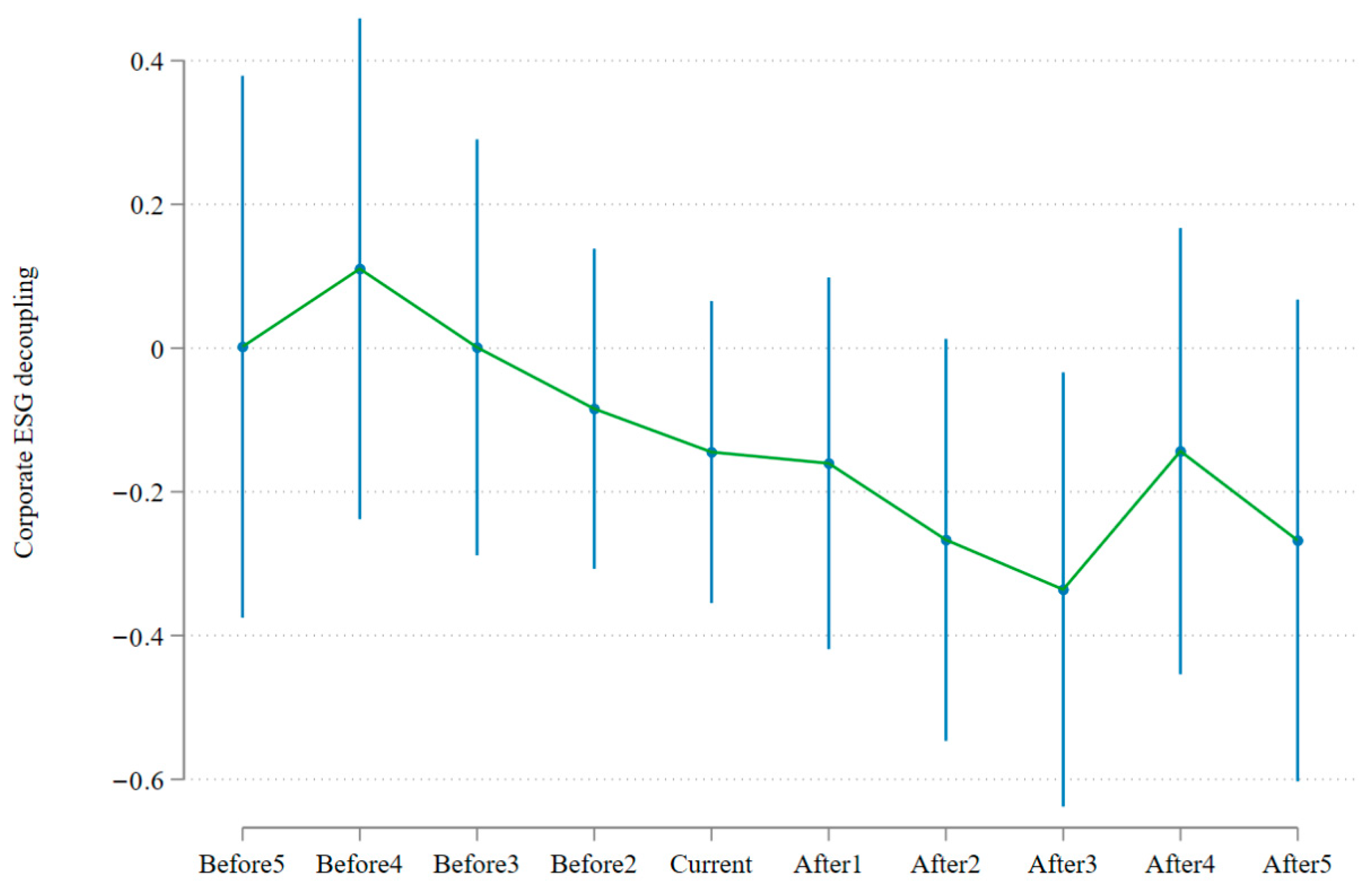
The identification of the DID model relies on the validity of the parallel trends assumption. In our setting, this requires that ESG decoupling evolves similarly for treated and control firms prior to the implementation of the CPCAC policy. To examine this assumption, we employ an event-study specification, which provides a more rigorous dynamic test [48]. Figure 1 reports the estimated coefficients, where the indicators Before5 to After5 correspond to the period from 2012 to 2022. The pre-treatment coefficients are statistically indistinguishable from zero, indicating no systematic differences between the treatment and control groups before the policy intervention and thus supporting the parallel trends assumption. Notably, the estimated coefficient becomes significantly negative in 2020 (After3), suggesting a lagged policy effect. Overall, the evidence lends strong support to the validity of the parallel trends assumption.

5.3.2. Placebo Test

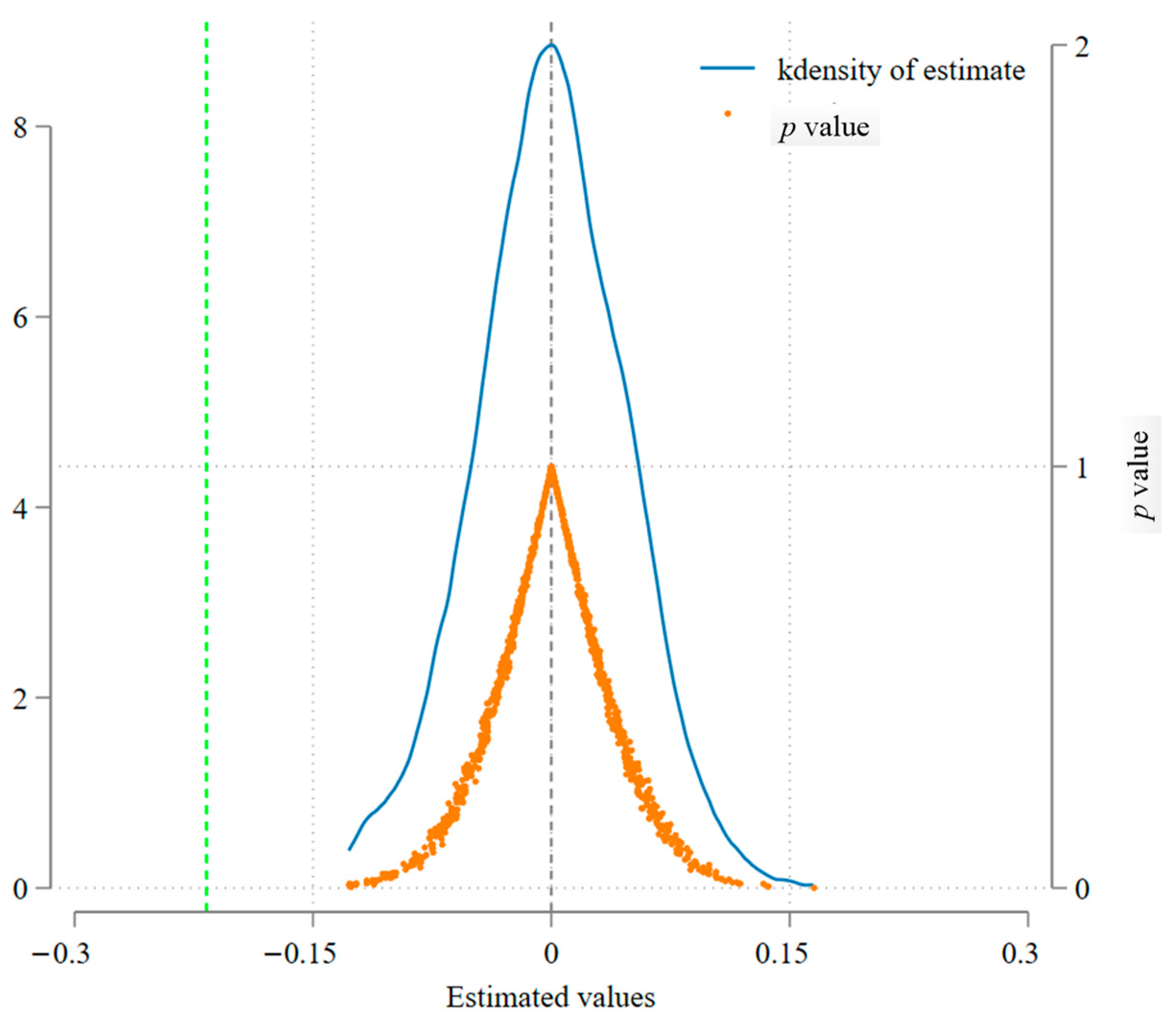
To further exclude the influence of other unobserved factors on the baseline result, we also perform a placebo test. Similar to Liu and Wang, we randomly assign the firms to the treatment and control groups, while keeping both the policy implementation time and the proportion of the treatment group constant, thereby creating a counterfactual dataset [49]. We then conduct regression analysis on this dataset according to the benchmark regression equation, repeating the steps 1000 times. Figure 2 reports the probability density distribution after 1000 regressions. It is clear that the mean of all the estimated coefficients of Action is almost 0, with most coefficients clustering around the zero point and exhibiting p-values exceeding 0.1. Also, the actual estimated value of our study (as shown by the green dashed vertical line in Figure 2) is a significant outlier. Hence, the benchmark result is able to pass the placebo test.

5.3.3. General Robustness Tests

We conduct a series of additional robustness checks to ensure the stability of our baseline results. In column (1) of Table 3, we exclude observations from 2020 onward to mitigate the potential confounding effects of the COVID-19 shock on firm behavior. Column (2) restricts the sample to manufacturing and heavily polluting firms. In column (3), we control for other major environmental policies implemented in China during 2012–2022, including the revised Environmental Protection Law. Column (4) further incorporates province-by-year fixed effects to absorb time-varying macro-level shocks. In column (5), we implement a k-nearest neighbor matching procedure (k = 8) prior to estimating the DID model [50]. Across all specifications, the results remain qualitatively unchanged, providing strong support for the robustness of our baseline findings.

5.4. Mechanism Analysis

We follow the approach of Chen to explore the mediating role of agency costs in the impact of the CPCAC on ESG decoupling [51]. We examine agency costs (Man) as a mediating channel. Column (1) of Table 4 shows that the CPCAC policy significantly reduces ESG decoupling by lowering firms’ agency costs. A large body of empirical evidence confirms the close association between agency costs and corporate ESG behavior [52]. Following the implementation of the pilot policy, firms face stricter environmental regulation and enhanced disclosure requirements, which strengthen both external monitoring and internal governance. These changes compress managerial discretion and limit opportunities for opportunistic behavior. At the same time, CPCAC reinforces the joint effects of government oversight and public scrutiny, increasing reputational discipline and compliance pressure. As a result, managers place greater emphasis on long-term value creation and substantive ESG engagement. The mitigation of agency conflicts thus shifts firms away from symbolic disclosure toward greater alignment between ESG reporting and actual practices, ultimately reducing ESG decoupling.

5.5. Further Analysis

5.5.1. Heterogeneity in Confucian Culture

Columns (1) and (2) of Table 5 report the heterogeneity results by Confucian cultural intensity. The effect of CPCAC is significantly negative in regions with a strong Confucian cultural presence, but insignificant in regions where such cultural influence is weak. In high-Confucian settings, norms emphasizing integrity, responsibility, and collectivism impose persistent moral discipline and reputational pressure on firms, encouraging a closer alignment between economic objectives and social and environmental responsibilities. Against this backdrop, CPCAC operates as an exogenous institutional shock that strengthens environmental governance requirements, improves resource allocation, and heightens climate-related constraints. These formal mechanisms complement existing cultural norms, inducing firms to shift from symbolic ESG engagement toward substantive compliance, thereby reducing ESG decoupling. By contrast, in regions with weaker Confucian influence, the absence of strong informal constraints reduces firms’ sensitivity to reputational and ethical considerations. As a result, firms are more likely to respond strategically to policy pressure, and the mitigating effect of CPCAC on ESG decoupling is correspondingly attenuated.

5.5.2. Heterogeneity in Managerial Myopia

Columns (3) and (4) of Table 5 present the heterogeneity results by managerial myopia. The effect of CPCAC is significantly negative for firms with high managerial myopia, but insignificant for those with low managerial myopia. In firms characterized by greater short-termism, managers are more likely to prioritize immediate performance and may rely on symbolic ESG investments or disclosures to obtain reputational benefits, thereby widening the gap between ESG representation and substantive performance. In this context, CPCAC strengthens regulatory constraints, enhances information transparency, and raises the cost of non-compliance, effectively limiting the scope for strategic responses. Meanwhile, the policy improves resource allocation and incentive structures, increasing the relative returns to substantive ESG investments and mitigating managerial short-term bias. As a result, ESG decoupling is significantly reduced. By contrast, in firms with lower managerial myopia, managers are inherently more oriented toward long-term value and sustainability, and ESG activities are more internally consistent, leaving limited room for further policy-induced improvements.

5.5.3. Heterogeneity in Political Connection

Columns (1) and (2) of Table 6 report the heterogeneity results by political connections. The effect of CPCAC on ESG decoupling is insignificant for politically connected firms, but significantly negative for firms without political ties. For politically connected firms, close relationships with the government often provide preferential access to financing, regulatory leniency, and informational advantages, which can attenuate the disciplinary force of external policy shocks. In this setting, even under the stricter environmental governance requirements imposed by CPCAC, firms are more likely to rely on established networks to engage in strategic responses, such as symbolic disclosure or superficial compliance, rather than undertaking substantive ESG improvements. By contrast, firms without political connections have limited scope to circumvent regulatory pressure through informal channels and must rely more heavily on formal institutional rules. As a result, the enhanced regulatory scrutiny and incentive mechanisms introduced by CPCAC directly shape firm behavior, inducing more credible and consistent ESG engagement and thereby significantly reducing ESG decoupling.

5.5.4. Heterogeneity in Corporate Digital Transformation

Columns (3) and (4) of Table 6 present the heterogeneity results by corporate digital transformation. The effect of the CPCAC is significantly negative for firms with higher levels of digitalization, but insignificant for those with lower levels. For highly digitalized firms, the deep integration of data and digital technologies enhances information acquisition, processing, and disclosure capabilities, thereby reducing internal information asymmetry and lowering the cost of external monitoring. As a result, it becomes more difficult for firms to rely on symbolic disclosure to obscure their actual ESG performance. In this context, the strengthened regulatory requirements and performance evaluation mechanisms introduced by the CPCAC can be more effectively identified and internalized, inducing firms to shift from formal compliance toward substantive ESG improvements, and thus significantly reducing ESG decoupling. By contrast, firms with lower levels of digitalization face constraints in information processing and governance capacity, limiting their ability to respond effectively to policy pressures and increasing the likelihood of low-cost, strategic responses, which attenuates the policy’s impact.

6. Conclusions, Implications and Limitations

6.1. Conclusions

Based on firm-level empirical evidence, this study systematically examines the impact of the CPCAC on corporate ESG decoupling, and explores its intermediary mechanism as well as heterogeneous effects across firm-level and regional characteristics.
The results indicate that the CPCAC significantly mitigates corporate ESG decoupling, with particularly pronounced effects in the environmental responsibility dimension, while the effects on the social and governance dimensions are small and statistically insignificant. These findings remain robust after parallel trend tests, placebo tests, and a battery of additional robustness checks. The evidence suggests that, as a regional climate governance mechanism, the CPCAC effectively reduces the gap between firms’ symbolic ESG disclosure and substantive practices, improves the credibility of ESG information, and curbs opportunistic behavior in which firms seek legitimacy merely through empty disclosure.
Further mechanism tests confirm that the CPCAC dampens ESG decoupling by lowering corporate agency costs. Strengthened external supervision and climate-oriented constraints alleviate principal-agent conflicts, restrain managerial opportunism and short-sighted behaviors, and prompt firms to devote more resources to actual ESG practices rather than symbolic communication. Such a channel reveals how external climate policy influences internal governance and thus improves the consistency of ESG performance and disclosure.
Heterogeneity analysis shows that the governance effect of the CPCAC differs significantly across contextual conditions. The restraining effect on ESG decoupling is more pronounced in firms with greater managerial myopia, non-political connection status, and higher digital transformation intensity. Meanwhile, the policy effect is also strengthened in regions with stronger Confucian culture, suggesting that the implementation of the CPCAC is jointly shaped by internal firm attributes and informal institutional environments.
Overall, this study provides systematic and rigorous empirical evidence on the micro-level policy consequences of the CPCAC in alleviating corporate ESG decoupling, and contributes to a deeper understanding of how climate adaptation governance policies influence corporate ESG behavior and its underlying mechanism. It also enriches the existing literature on corporate ESG decoupling and its interaction with the institutional environment, and clarifies the boundary conditions under which climate adaptation policies can effectively play their governance role. The findings offer valuable empirical insights for advancing the construction of China’s climate adaptation governance system and improving the ESG regulatory framework, and provide a practical reference for guiding enterprises to abandon symbolic ESG behavior and engage in substantive sustainable development practices, which is of great practical significance for China to further implement its national climate strategy and promote high-quality ecological civilization construction.

6.2. Implications

Based on the empirical findings, this study derives several policy implications aimed at curbing corporate ESG decoupling, improving the effectiveness of climate governance policies, and promoting enterprises to engage in substantive ESG practices.
First, the government should further advance the implementation and expansion of the CPCAC, and consolidate its institutional role in mitigating corporate ESG decoupling. On the one hand, policymakers may expand the scope of CPCAC pilot areas in an orderly manner based on the experience of existing pilot cities, and incorporate climate adaptation governance into regional economic and social development plans, industrial upgrading strategies and environmental regulatory systems to form a normalized and institutionalized policy constraint mechanism. On the other hand, appropriate policy incentives such as green credit preferences, environmental protection subsidies and tax relief can be introduced for enterprises in pilot areas that perform well in substantive environmental governance, so as to reduce the cost of enterprises’ substantive ESG practices and enhance their motivation to align ESG disclosure with actual performance. In addition, a dynamic evaluation and supervision mechanism for the CPCAC should be established to track the implementation effect of the policy in real time, rectify the problems of inadequate policy implementation and superficial implementation in a timely manner, and ensure that the policy can effectively play its role in curbing symbolic ESG behavior.
Second, the CPCAC should be closely integrated with the optimization of corporate internal governance to form a synergy between external climate governance and internal corporate governance in alleviating ESG decoupling. Policymakers should guide enterprises in pilot areas to take the CPCAC policy as an opportunity to improve their internal corporate governance structure, focus on solving the principal-agent problem that drives ESG decoupling. Specifically, enterprises should be required to incorporate the substantive performance of environmental responsibility into the performance appraisal and incentive and restraint system of senior management, so as to correct the short-sighted behavior of management and align the ESG decision-making of management with the long-term development goals of enterprises. At the same time, it is necessary to strengthen the supervision function of the board of directors and board of supervisors on the enterprise’s ESG investment and environmental governance decisions, improve the internal control system related to ESG information disclosure, and block the channel for management to carry out symbolic ESG disclosure through internal governance constraints.
Thirdly, the complementary role of informal institutions should not be overlooked. Policymakers should fully consider the influence of culture and social norms. For example, for regions with strong Confucian cultural influence, build joint ESG education bases with cultural institutions, and carry out themed training on “Confucian morality and corporate environmental responsibility” for corporate managers to internalize cultural values into ESG decision-making. In addition, the goverment can combine Confucian culture with substantive ESG practice to build a social atmosphere of “valuing integrity and substantive performance”. In regions with weak Confucian cultural influence, industry associations can gradually cultivate corporate social responsibility and use it to guide enterprises away from symbolic ESG behavior.
Fourth, differentiated climate governance and ESG supervision measures should be formulated according to the characteristics of enterprises to maximize the policy effect of the CPCAC. For enterprises with higher management myopia, targeted ESG concept training and long-term development guidance should be carried out, and the publicity and popularization of climate governance policies and sustainable development concepts should be strengthened to correct the short-sighted decision-making of management and enhance their awareness of substantive ESG practices. For enterprises with lower digital transformation levels, policy support such as digital transformation subsidies, technical guidance and talent training should be provided to help them improve the digital management capacity of ESG information disclosure and performance evaluation, and realize the accurate matching of ESG disclosure and substantive performance through digital means.
Fifth, the policy demonstration role of enterprises with strong political connections should be fully exerted to drive the whole industry to reduce ESG decoupling and form a good industry atmosphere of valuing substantive ESG performance. Policymakers should guide enterprises with strong political connections in pilot areas to take the lead in implementing the requirements of the CPCAC, increase investment in substantive environmental governance, and set an example for other enterprises in the industry with their own ESG development practices. On the one hand, the advanced experience of such enterprises in integrating climate adaptation into corporate development strategy, carrying out substantive environmental governance and realizing the consistency of ESG words and deeds should be summarized and promoted in a timely manner, so as to provide reference for other enterprises. On the other hand, a typical demonstration mechanism should be established to commend and reward enterprises with outstanding performance in substantive ESG practices, and guide the whole society to form a cognitive orientation that “substantive performance is more important than superficial disclosure”, so as to drive more enterprises to abandon symbolic ESG behavior and engage in substantive sustainable development practices.

6.3. Research Limitations and Future Research Directions

This study only assesses the independent impact of the CPCAC, without considering other climate and environmental policies implemented in the same period. As a result, the synergistic and substitution effects between different policies are overlooked, and the comprehensive institutional impact of the policy system on corporate ESG decoupling cannot be fully reflected. For future research, the interactive effects of multiple climate governance policies need to be further explored. We can introduce policy interaction terms to verify the synergistic or substitution effects between the CPCAC and other environmental policies, and analyze the optimal combination of climate governance policy tools. In addition, this study employs binary dummy variables to measure CPCAC policies, which excludes continuous variables reflecting implementation intensity such as fiscal funding and enforcement effectiveness in pilot cities, thereby limiting the depth of policy impact analysis. Future research could explore continuous indicators of corporate implementation intensity under policy conditions through textual analysis or corporate annual reports, enabling rigorous testing of these relationships and providing precise references for policy optimization. This will provide a more comprehensive empirical basis for the long-term implementation and optimization of climate adaptation governance policies.

Author Contributions

Conceptualization, J.L. and M.J.; methodology, M.J.; software, M.J.; validation, J.L.; formal analysis, J.L.; investigation, J.L.; resources, M.J.; data curation, M.J.; writing—original draft preparation, J.L. and M.J.; writing—review and editing, J.L. and M.J.; visualization, J.L.; supervision, J.L. and S.Y.; project administration, J.L.; funding acquisition, S.Y. All authors have read and agreed to the published version of the manuscript.

Funding

This work is supported by the National Social Science Foundation of China (grant number 20FGLB038).

Institutional Review Board Statement

Not applicable.

Informed Consent Statement

Not applicable.

Data Availability Statement

The raw data supporting the conclusions of this article will be made available by the authors on request.

Conflicts of Interest

The authors declare no conflicts of interest.

References

  1. Huang, C.; Ren, W. Are Climate Adaptation Policy Effective? Evidence from China’s Climate Adaptation City Pilot. Sustain. Cities Soc. 2025, 130, 106553. [Google Scholar] [CrossRef]
  2. Dong, H.; Liu, Y.; Zhao, Z.; Tan, X.; Managi, S. Carbon Neutrality Commitment for China: From Vision to Action. Sustain. Sci. 2022, 17, 1741–1755. [Google Scholar] [CrossRef]
  3. Ahmed, R.; Chen, X.H.; Hoang, Y.H.; Do-Linh, C. Climate Change Effects and Their Implications for the Financial Markets: Evidence from the United Kingdom. J. Environ. Manag. 2024, 366, 121782. [Google Scholar] [CrossRef]
  4. Pashanejad, E.; Liu, J.; Shrestha, B.; Hannam, K.; Bittman, S.; Desjardins, R.; Daneshfar, B.; Trishchenko, A. Climate Impacts of Radiative Forcing Driven by Agricultural Land-Use and Land-Cover Changes in Northern Canada. J. Environ. Manag. 2026, 397, 128201. [Google Scholar] [CrossRef]
  5. Xu, J.; Zhou, X. Climate Policy, Financial Constraints and Firm Greenwashing Behaviors: Evidence from China. J. Clean. Prod. 2026, 538, 147246. [Google Scholar] [CrossRef]
  6. Zhu, Y.; Li, S.; Niu, J.; Wang, Y. Pilot Policies for Climate-Adaptive Urban Development and Corporate Greenwashing Behavior. Int. Rev. Econ. Financ. 2025, 104, 104741. [Google Scholar] [CrossRef]
  7. Xie, Y.; Sun, Y.; Chen, Y.; Sun, S.; Qian, X.; Dong, L. Mapping Socio-Ecological Injustice in Tokyo: Insights for Land Use Management and Climate Adaptation for Urban Just Transition. Land Use Policy 2025, 158, 107772. [Google Scholar] [CrossRef]
  8. Dong, Q.; Zhong, C.; Geng, Y.; Dong, F.; Chen, W.; Zhang, Y. A Bibliometric Review of Carbon Footprint Research. Carbon Footpr. 2024, 3, 3. [Google Scholar] [CrossRef]
  9. Liu, Y.; Deng, L. Mapping Carbon Emission Networks in China: Insights from Province-Level Spatial Differentiation. Carbon Footpr. 2024, 3, 18. [Google Scholar] [CrossRef]
  10. Boumparis, P.; Florackis, C.; Guedhami, O.; Sainani, S. Backing Away from ESG? The Effect of Sovereign Rating Downgrades on Corporate Sustainability. J. Corp. Financ. 2025, 94, 102856. [Google Scholar] [CrossRef]
  11. Sun, Y.; Tao, Q.; Wang, D.; Zhang, W. Corporate ESG Decoupling and R&D Investment. N. Am. J. Econ. Financ. 2025, 75, 102278. [Google Scholar] [CrossRef]
  12. Wan, P.; Yang, Y.; Chen, X. Does Confucian Culture Restrain ESG Decoupling? Evidence from China. Int. Rev. Econ. Financ. 2025, 104, 104605. [Google Scholar] [CrossRef]
  13. Wang, C.; Duan, D.; Tang, P.; Yang, S. Greenwashing or Brownwashing? Green Bond Issuance and Corporate Environmental Decoupling. Appl. Econ. 2025, 1–17. [Google Scholar] [CrossRef]
  14. Tang, P.; Yang, S.; Fu, S. Do Political Incentive Affects China’s Land Transfer in Energy-Intensive Industries? Energy 2018, 164, 550–559. [Google Scholar] [CrossRef]
  15. Eliwa, Y.; Aboud, A.; Saleh, A. Board Gender Diversity and ESG Decoupling: Does Religiosity Matter? Bus. Strategy Environ. 2023, 32, 4046–4067. [Google Scholar] [CrossRef]
  16. Gull, A.A.; Hussain, N.; Khan, S.A.; Khan, Z.; Saeed, A. Governing Corporate Social Responsibility Decoupling: The Effect of the Governance Committee on Corporate Social Responsibility Decoupling. J. Bus. Ethics 2023, 185, 349–374. [Google Scholar] [CrossRef]
  17. Wang, Q.; Sun, T.; Li, R. Does Artificial Intelligence Promote Green Innovation? An Assessment Based on Direct, Indirect, Spillover, and Heterogeneity Effects. Energy Environ. 2025, 36, 1005–1037. [Google Scholar] [CrossRef]
  18. Wang, C.; Tang, P.; Yang, S.; Yi, Y.; Li, J. When Environmental Regulation Meets Corporate Strategic Behavior: New Environmental Protection Law and Corporate Greenhushing in China. Bus. Strategy Environ. 2026. [Google Scholar] [CrossRef]
  19. Liu, Y.; Zheng, Z.; Deng, N.; Li, T. Resilience and Efficiency: Assessing China’s Climate Adaptation Policy Impact on Urban Green Development. Sustain. Cities Soc. 2025, 134, 106923. [Google Scholar] [CrossRef]
  20. Ou, L.; Song, M. Climate Adaptation and Response: Progress of Research and Planning Strategies in China. Sustain. Futures 2025, 10, 101245. [Google Scholar] [CrossRef]
  21. Zhang, T.; Zhao, L.; Li, C. The Impact of Green Taxation on Climate Change Mitigation Under Fiscal Decentralization: Evidence from China. Economies 2025, 13, 265. [Google Scholar] [CrossRef]
  22. Ji, J.; Qiao, J.; Ren, X. Green Impact of Climate Resilient City Development: New Evidence from China. Cities 2026, 168, 106387. [Google Scholar] [CrossRef]
  23. Liu, S.; Feng, M.; Xie, L.; Chan, F.K.S. Challenges and Solutions for Achieving Carbon Neutrality through Urban Green Infrastructure in China’s Future Cities. Nat.-Based Solut. 2025, 8, 100263. [Google Scholar] [CrossRef]
  24. Bothello, J.; Ioannou, I.; Porumb, V.-A.; Zengin-Karaibrahimoglu, Y. CSR Decoupling within Business Groups and the Risk of Perceived Greenwashing. Strateg. Manag. J. 2023, 44, 3217–3251. [Google Scholar] [CrossRef]
  25. Zou, H.; Zhong, M.-R. Does Environmental Regulation Enhance Firm’s Position in Dual Value Chain? An Analysis Based on Environmental Information Disclosure. J. Environ. Manag. 2022, 321, 115918. [Google Scholar] [CrossRef] [PubMed]
  26. Zhang, W.; Yang, K.; Li, X. How Does Digital Transformation Affect Firms’ ESG Performance? The Evidence from China. J. Environ. Manag. 2025, 395, 128021. [Google Scholar] [CrossRef]
  27. Gao, M.; Liang, K. Fintech, Carbon Emissions, and Divergence in Corporate ESG Ratings. Financ. Res. Lett. 2025, 86, 108642. [Google Scholar] [CrossRef]
  28. Choi, D.; Gam, Y.K.; Kang, M.J.; Shin, H. The Effect of ESG-Motivated Turnover on Firm Financial Risk. Br. Account. Rev. 2025, 57, 101373. [Google Scholar] [CrossRef]
  29. Zhu, L.; Li, T.; Wang, C.; Huang, J. Corporate ESG Performance and Green Innovation: Moderating Effect of Shareholder Activism. J. Environ. Manag. 2025, 383, 125413. [Google Scholar] [CrossRef]
  30. Zou, J.; Zhong, X.; Gong, C.; Lu, X. Examining Institutional Investor Preferences: The Influence of ESG Ratings on Stock Holding in China’s Stock Market. Res. Int. Bus. Financ. 2025, 73, 102609. [Google Scholar] [CrossRef]
  31. Wu, K.; Zhang, Y.; Chen, Y.; Li, M. Impact of Digital Finance on Corporate ESG. Int. Rev. Financ. Anal. 2025, 104, 104259. [Google Scholar] [CrossRef]
  32. Zhang, D. Green Financial System Regulation Shock and Greenwashing Behaviors: Evidence from Chinese Firms. Energy Econ. 2022, 111, 106064. [Google Scholar] [CrossRef]
  33. Fu, K.; Liu, Y.; Lu, X.; Chen, B.; Chen, Y. Health Impacts of Climate Resilient City Development: Evidence from China. Sustain. Cities Soc. 2024, 116, 105914. [Google Scholar] [CrossRef]
  34. Uji, A.; Song, J.; Dolšak, N.; Prakash, A. Willingness to Incur Private Costs for Climate Adaptation? Public Support for Undergrounding Electricity Transmission Lines in California. Energy Policy 2024, 191, 114182. [Google Scholar] [CrossRef]
  35. Fan, M.; Shira, R.K.; Hunjra, A.I.; Zhao, S. Climate Governance Actions, Financing Constraints, and Green Transformation of Energy-Intensive Firms. Res. Int. Bus. Financ. 2025, 79, 103041. [Google Scholar] [CrossRef]
  36. Luo, C.; Cai, D.; Xu, J. Resilient Reserves: Climate Adaptive Pilot Cities Policy and Firms’ Cash Holdings. Econ. Anal. Policy 2025, 86, 510–527. [Google Scholar] [CrossRef]
  37. Tang, P.; Wang, G.; Wang, J.; Tian, H. Decoding Carbon Information Disclosure with NLP Techniques: Combating Carbonwashing for Energy and Climate Transition. Energy 2025, 335, 137930. [Google Scholar] [CrossRef]
  38. Maihaiti, G.; Hunjra, A.I.; Alharbi, S.S.; Zhao, S. Climate-Resilient Cities for Green Innovation in Enterprises: New Perspective Based on Fintech. Int. Rev. Econ. Financ. 2025, 101, 104251. [Google Scholar] [CrossRef]
  39. Yu, E.P.; Luu, B.V.; Chen, C.H. Greenwashing in Environmental, Social and Governance Disclosures. Res. Int. Bus. Financ. 2020, 52, 101192. [Google Scholar] [CrossRef]
  40. Li, M.; Chen, Q. Executive Pay Gap and Corporate ESG Greenwashing: Evidence from China. Int. Rev. Financ. Anal. 2024, 95, 103375. [Google Scholar] [CrossRef]
  41. He, G.; Li, A.Z. Does Media Coverage of Firms’ Environment, Social, and Governance (ESG) Incidents Affect Analyst Coverage and Forecasts? A Risk Perspective. Int. Rev. Financ. Anal. 2024, 94, 103289. [Google Scholar] [CrossRef]
  42. Zhao, X.; Huang, X.; Liu, F.; Pan, L. Executive Power Discrepancy and Corporate ESG Greenwashing. Int. Rev. Financ. Anal. 2024, 96, 103533. [Google Scholar] [CrossRef]
  43. Han, C.; Song, L.; Meng, L.; Liu, P. China’s Environmental Regulation and Corporate Transparency: How Green Productivity Enhances Disclosure Quality under the New Protection Law. J. Clean. Prod. 2025, 523, 146436. [Google Scholar] [CrossRef]
  44. Zhao, M.; Wang, X.; Zhang, S.; Cheng, L. Business Strategy and Environmental Information Disclosure from a Confucian Cultural Perspective: Evidence from China. Bus. Strategy Environ. 2024, 33, 1557–1577. [Google Scholar] [CrossRef]
  45. Zhao, J.; Wang, X. Managerial Myopia, Technological Innovation, and Greenwashing: Moderating Roles of Financing Constraints and Environmental Uncertainty. Technol. Forecast. Soc. Change 2025, 218, 124210. [Google Scholar] [CrossRef]
  46. Wei, Y.; Jia, N.; Bonardi, J.-P. Corporate Political Connections: A Multidisciplinary Review. J. Manag. 2023, 49, 1870–1910. [Google Scholar] [CrossRef]
  47. Zhang, J.; Yu, C.-H.; Zhao, J.; Lee, C.-C. How Does Corporate Digital Transformation Affect Green Innovation? Evidence from China’s Enterprise Data. Energy Econ. 2025, 142, 108217. [Google Scholar] [CrossRef]
  48. Chen, Z.; Jiang, X.; Liu, Z.; Serrato, J.C.S.; Xu, D.Y. Tax Policy and Lumpy Investment Behaviour: Evidence from China’s VAT Reform. Rev. Econ. Stud. 2023, 90, 634–674. [Google Scholar] [CrossRef]
  49. Liu, S.; Wang, Y. Green Innovation Effect of Pilot Zones for Green Finance Reform: Evidence of Quasi Natural Experiment. Technol. Forecast. Soc. Change 2023, 186, 122079. [Google Scholar] [CrossRef]
  50. Abadie, A.; Drukker, D.M.; Herr, J.L.; Imbens, G.W. Implementing Matching Estimators for Average Treatment Effects in Stata. Stata J. 2004. [Google Scholar] [CrossRef]
  51. Chen, Y.; Fan, Z.; Gu, X.; Zhou, L.-A. Arrival of Young Talent: The Send-Down Movement and Rural Education in China. Am. Econ. Rev. 2020, 110, 3393–3430. [Google Scholar] [CrossRef]
  52. Sharma, R.; Chawla, S.; Dagar, V.; Kagzi, M.; Rao, A. SDG Adoption and Firm Risk: The Impact of ESG Performance, Investor Confidence, and Agency Cost. Int. Rev. Econ. Financ. 2025, 101, 104205. [Google Scholar] [CrossRef]
Figure 1. Parallel trend test of the Impact of CPCAC on ESG decoupling.
Sustainability 18 03814 g001
Figure 2. Placebo test of the Impact of CPCAC on ESG decoupling.
Sustainability 18 03814 g002
Table 1. Descriptive Statistics.
VariablesCodeDefinitionsAverageSDMinMax
Dependent variablesDecouDifference between standardized Bloomberg ESG rating and Huazheng ESG rating−0.0041.183−2.5253.400
EnviDifference between standardized Bloomberg environmental performance rating and Huazheng environmental performance rating−0.0861.116−3.1012.982
SocialDifference between standardized Bloomberg social performance rating and Huazheng social performance rating−0.0061.209−2.6043.564
GovDifference between standardized Bloomberg governance performance rating and governance performance ESG rating0.0041.311−3.0193.494
Independent variableActionAction is 1 when the firm is located in a pilot area and the year is 2017 and later, and 0 otherwise.0.0430.20201
Mediating variableManThe ratio of administrative expenses to total assets0.0380.0260.0030.136
Moderating variablesConfDummy variable to measure the Confucian cultural climate, grouped by median number of urban academies0.5090.50001
MyopiaDummy variable, with the median of managerial myopia vocabulary as the grouping criterion0.5700.49501
PCA dummy variable equal to 1 if the chairman or CEO has political connections, and 0 otherwise0.3250.46801
DigitDummy variable, with the median of digital transformation vocabulary as the grouping criterion0.6670.47101
Control variablesSizeThe natural logarithm of corporate assets23.1521.20320.51126.537
LevCapital structure, measured using the asset-liability ratio0.4730.1980.0720.881
RoaEarnings on total assets4.2945.979−18.92721.837
RdR&D investment/total assets0.0180.02100.108
CashEnterprise free cash flow/total assets0.0120.092−0.3240.251
Shrcr1Shareholding ratio of the biggest shareholder36.35716.0018.13576.678
IndirProportion of independent directors0.3750.0640.2500.600
BsizeThe natural logarithm of the number of board members2.2400.2371.6092.890
AgeThe natural logarithm of firm age2.9670.3181.9463.526
FemaThe percentage of women executives0.1490.14700.600
SoeDummy variable, 1 means the state is the ultimate controller, 0 otherwise0.4930.50001
DualityDummy variable, 1 for duality of CEO and chair of the board, 0 otherwise0.2130.40901
PollDummy variable, 1 for heavily polluting firms, 0 for other firms0.4190.49301
N9636
Table 2. Baseline regression results.
(1)
Decoupling
(2)
Environment
(3)
Social
(4)
Governance
Action−0.217 *−0.348 ***−0.129−0.067
(−1.917)(−3.897)(−1.283)(−0.501)
Control variablesYesYesYesYes
Individual fixed effectYesYesYesYes
Time fixed effectYesYesYesYes
_cons3.479 ***1.170−0.1346.739 ***
(3.061)(1.197)(−0.126)(5.010)
N9636963696369636
R2_a0.4420.3740.5060.401
Note: *** p < 0.01, * p < 0.1. Firm-level clustering robust t-values are reported in parentheses.
Table 3. Other robustness tests.
(1)(2)(3)(4)(5)
Action−0.217 **−0.280 *−0.212 *−0.381 ***−0.221 *
(−2.138)(−1.800)(−1.894)(−2.914)(−1.940)
Control variablesYesYesYesYesYes
Individual fixed effectYesYesYesYesYes
Time fixed effectYesYesYesYesYes
Province*Year fixed effectNoNoNoYesNo
Other policiesNoNoYesNoNo
_cons3.700 ***2.784 *3.253 ***3.248 ***3.455 ***
(2.593)(1.900)(2.846)(2.751)(3.037)
N68286569963696369634
R2_a0.5140.4150.4440.4480.442
Note: *** p < 0.01, ** p < 0.05, * p < 0.1. Firm-level clustering robust t-values are reported in parentheses.
Table 4. Mechanism analysis results.
(1)
Action−0.004 *
(−1.775)
Control variablesYes
Individual fixed effectYes
Time fixed effectYes
_cons0.310 ***
(11.939)
N9636
R2_a0.787
Note: *** p < 0.01, * p < 0.1. Firm-level clustering robust t-values are reported in parentheses.
Table 5. Heterogeneity analysis I.
(1)
Stronger
(2)
Weaker
(3)
Higher
(4)
Lower
Action−0.290 **−0.127−0.264 *−0.176
(−2.180)(−0.612)(−1.919)(−1.213)
Control variablesYesYesYesYes
Individual fixed effectYesYesYesYes
Time fixed effectYesYesYesYes
_cons4.601 ***3.665 **2.861 *3.211 **
(3.117)(2.091)(1.842)(2.014)
N4906473054894147
R2_a0.4390.4490.4620.447
Note: *** p < 0.01, ** p < 0.05, * p < 0.1. Firm-level clustering robust t-values are reported in parentheses.
Table 6. Heterogeneity analysis II.
(1)
With
(2)
Without
(3)
Higher
(4)
Lower
Action−0.233−0.261 **−0.262 **−0.031
(−0.794)(−2.015)(−2.021)(−0.194)
Control variablesYesYesYesYes
Individual fixed effectYesYesYesYes
Time fixed effectYesYesYesYes
_cons2.4943.183 **3.828 ***0.819
(1.073)(2.202)(2.785)(0.389)
N3130650664293207
R2_a0.4950.4530.4610.516
Note: *** p < 0.01, ** p < 0.05. Firm-level clustering robust t-values are reported in parentheses.
Disclaimer/Publisher’s Note: The statements, opinions and data contained in all publications are solely those of the individual author(s) and contributor(s) and not of MDPI and/or the editor(s). MDPI and/or the editor(s) disclaim responsibility for any injury to people or property resulting from any ideas, methods, instructions or products referred to in the content.