1. Introduction
Decentralization has become one of the most influential governance reforms across Southeast Asia, redistributing authority from central ministries to subnational governments while reconfiguring the institutional architecture through which regulation is implemented. In principle, decentralization promises greater responsiveness, local adaptability, and administrative efficiency [
1]. In practice, however, it often produces more fragmented regulatory environments in which authority is dispersed across multiple organizations without a corresponding integration of procedures, information systems, or accountability mechanisms [
2,
3]. As a result, regulatory outcomes are frequently shaped not only by formal rules, but by the relationships among actors who interpret, verify, sequence, and enforce those rules in everyday administrative practice [
4].
This tension is especially visible in commodity sectors that depend on multiple layers of approval, technical inspection, and documentary verification. The edible bird’s nest (EBN) sector in Indonesia offers a particularly revealing case. Licensing, veterinary inspection, traceability requirements, certification procedures, and market access are formally intended to support product quality, hygiene, and export readiness. Yet these functions are distributed across different institutions operating with distinct mandates, procedural priorities, and resource bases. Under such conditions, the effectiveness of regulation depends not simply on whether rules exist, but on whether actors are able to coordinate across institutional boundaries.
Pulang Pisau was selected not because it is statistically representative of all EBN-producing regions in Indonesia, but because it offers an analytically revealing case of decentralized regulatory governance. The district makes visible the core dynamics examined in this study: overlapping authority, dependence on technical verification, fragmented procedural sequencing, and uneven compliance burdens across actors. As a site where local licensing, technical supervision, certification-related processes, and producer compliance intersect, Pulang Pisau provides a useful setting for examining how formally shared authority becomes translated into uneven regulatory practice.
Despite a growing body of literature on decentralization, policy capacity, and multi-level governance, much of the existing scholarship still treats administrative capacity primarily as an attribute of individual institutions, usually understood in terms of resources, formal authority, or organizational performance. This perspective is useful, but insufficient for explaining why coordination failures persist even when formal mandates are in place and broad regulatory objectives are widely shared [
5,
6,
7,
8]. In many decentralized settings, governance outcomes are shaped less by the internal strength of any single institution than by the uneven relational positions actors occupy within a broader implementation network [
9,
10].
This gap is particularly important in regulatory-intensive commodity systems, where licensing authorities, technical agencies, certification bodies, and producers operate within overlapping but weakly integrated chains of decision-making. Existing studies often describe duplication, inconsistency, and fragmentation as administrative symptoms, but they pay less attention to the relational mechanisms through which these outcomes are reproduced. In particular, the interplay of influence, dependence, and objective alignment among actors remains underexplained.
To address this limitation, this article introduces the concept of relational administrative capacity, defined as the capacity of a governance system to align authority, expertise, and procedural sequencing across interdependent actors. Rather than treating capacity as a property internal to organizations, the concept shifts attention to the relational structure of governance: who depends on whom, who can condition implementation, and whether shared objectives are supported by synchronized procedures. Using qualitative field research combined with MACTOR analysis, the study maps how influence–dependence relations, objective convergence, and coordination bottlenecks shape regulatory outcomes in the EBN governance system of Pulang Pisau.
The article makes three contributions. First, it extends decentralization research by showing that coordination failure is not simply the result of weak institutions or policy inconsistency, but of misaligned relational positions among actors within a governance network. Second, it advances the concept of administrative capacity by reframing it as relational rather than hierarchical, thereby connecting debates on governance capacity, interdependence, and actor-centered analysis. Third, it shows how fragmented authority generates regulatory inequality, in which those with the least influence over regulatory design often bear the greatest compliance burdens. Together, these contributions respond to recent calls for more relational and actor-centered approaches to governance analysis [
7,
8].
2. Literature Review and Theoretical Framework
From a theoretical perspective, this study draws on relational and network-based approaches to governance, which emphasize interdependence, negotiated authority, and distributed control across actors [
5,
6,
11,
12,
13,
14,
15]. This perspective departs from classical hierarchical models of administration, where authority is assumed to flow linearly through formal command structures. Instead, contemporary governance systems are increasingly characterized by relational positioning, where influence emerges from patterns of interaction, mutual dependence, and the control of critical resources such as information, expertise, and procedural validation.
Within this broader shift, decentralization has been widely promoted as a mechanism to improve responsiveness, accountability, and policy fit at the local level. However, a growing body of literature demonstrates that decentralization often produces fragmented governance arrangements in which authority is redistributed without corresponding integration of administrative routines or coordination mechanisms [
2,
3,
16]. In such contexts, the multiplication of actors does not necessarily enhance effectiveness. Instead, it frequently generates coordination challenges, especially when institutional mandates, technical responsibilities, and procedural requirements are dispersed across agencies operating with different priorities and organizational logics [
1,
17,
18].
These coordination challenges become particularly visible in regulatory systems that depend on sequential interdependence. In many commodity governance contexts, actors must move through linked stages of licensing, inspection, certification, and documentation. Even where actors share similar policy objectives, the fragmentation of responsibilities across institutions can produce delays, duplication, and inconsistency when coordination mechanisms remain weak or absent. As a result, regulatory performance depends not only on whether institutions possess authority, but on whether their authority can be aligned through workable procedural arrangements and synchronized administrative practices [
4,
19,
20,
21,
22,
23,
24].
To clarify the analytical foundations of this study, three related but distinct concepts must be differentiated. Institutional fragmentation refers to the structural dispersion of governance functions across multiple organizations with differing mandates and administrative logics. Coordination deficits refer to process-level failures in connecting these dispersed functions through shared procedures, information exchange, and sequencing mechanisms. Fragmented governance refers to the broader systemic condition that emerges when these structural and procedural misalignments persist over time, producing uneven and often inefficient regulatory outcomes. While these concepts are interrelated, they operate at different analytical levels and must be distinguished to avoid conceptual ambiguity [
4,
5,
6,
15,
18].
A second strand of literature relevant to this study focuses on power and interdependence within governance systems. In practice, formal authority does not always determine which actors exercise the greatest influence. Instead, influence is often derived from control over key points in the regulatory process, such as technical verification, certification procedures, and documentary validation. These “procedural chokepoints” create asymmetrical dependencies, where some actors become indispensable to the functioning of the system, while others must adapt to conditions they do not control. Such dynamics have been widely observed in collaborative and multi-actor governance settings, where authority is negotiated and enacted through relational positioning rather than formal hierarchy [
5,
6,
7,
8,
13,
14,
25].
These insights point to an important limitation in conventional understandings of administrative capacity. Much of the existing literature conceptualizes capacity as an internal attribute of organizations, defined by resources such as personnel, budget, legal mandate, and managerial competence. While these dimensions remain important, they are insufficient to explain performance in governance systems where implementation depends on multiple interdependent actors. In decentralized settings, an institution may possess formal authority yet remain operationally constrained if it depends on inputs controlled by other actors. Conversely, actors with relatively narrow mandates may exercise disproportionate influence when their role conditions the progression of the regulatory chain [
4,
15,
16,
17].
Building on this gap, this study advances the concept of relational administrative capacity. This concept refers to the ability of a governance system to generate coordinated action through the alignment of authority, expertise, and procedural sequencing across interdependent actors. Rather than focusing solely on the internal strength of individual institutions, it emphasizes the structure of relationships through which governance is enacted. From this perspective, coordination failures are not simply the result of weak organizations, but of asymmetrical influence–dependence relations, fragmented procedural arrangements, and the absence of mechanisms capable of translating shared objectives into synchronized implementation [
5,
6,
7,
8,
15,
26].
This conceptual approach also highlights the distinction between normative and operational alignment. Normative alignment refers to agreement on regulatory goals, such as hygiene standards, quality assurance, or traceability. Operational alignment, by contrast, concerns agreement on how these goals are implemented through procedures, sequencing, documentation, and institutional interaction. Governance systems may exhibit strong normative convergence while remaining operationally fragmented, leading to persistent coordination problems despite shared policy objectives. This distinction is crucial for understanding why regulatory systems often fail not because of disagreement over goals, but because of the absence of mechanisms that translate those goals into coherent practice [
4,
21,
24,
27].
To operationalize these relational dynamics, this study employs the MACTOR method. MACTOR provides a structured approach to analyzing actor relations in terms of influence, dependence, and convergence or divergence of objectives. It allows governance systems to be examined not merely as institutional arrangements, but as relational configurations in which actors occupy different strategic positions. In this study, MACTOR is used as a relational diagnostic tool embedded within qualitative field research, rather than as a purely quantitative modeling technique. This approach enables a more precise identification of how coordination bottlenecks emerge and how governance outcomes are shaped by the relational structure of decentralized regulatory systems [
28,
29].
3. Methods
This study employs an actor-centered qualitative research design combined with the MACTOR method to examine how coordination, power, and institutional interdependence shape regulatory governance in the EBN sector of Pulang Pisau. The design is appropriate because the research problem is not limited to the content of formal regulations, but concerns how different actors interpret, sequence, and operationalize those regulations across institutional boundaries. The aim is therefore explanatory rather than descriptive: to identify the relational mechanisms through which decentralized governance produces bottlenecks, uneven leverage, and asymmetrical compliance burdens [
5,
6,
7,
8,
30,
31].
Data were collected through semi-structured interviews, documentary review, field observation, and expert validation. The study draws on twenty-one semi-structured interviews covering the principal positions in the EBN governance system, including licensing authorities, technical and veterinary actors, certification-related actors, intermediary or trader positions, and producers. The adequacy of this number should be assessed in relation to the purpose of the research design. The study does not aim for statistical representativeness, but for relational coverage and analytical depth across the main nodes of the governance network. Interviews were therefore selected purposively to capture variation in authority, dependence, procedural responsibility, and exposure to regulatory burdens. The final number was considered sufficient once the major patterns of actor positioning and coordination difficulty became recurrent across interviews and could be triangulated with documentary and observational evidence [
16,
32,
33,
34].
Actors were identified through an iterative process combining document analysis, preliminary field inquiry, and subsequent validation. The initial list was derived from regulations, administrative documents, and early interviews that pointed to which organizations exercised formal authority, technical verification, certification functions, or practical brokerage roles within the EBN chain (see
Table 1). This list was then refined during the analytical process to ensure that the final actor set captured the main institutional positions shaping implementation. This iterative identification process is consistent with recent actor-centered and governance-network approaches that emphasize the importance of capturing relational positioning rather than formal institutional listings alone [
4,
25,
28,
29,
35].
To improve methodological transparency, the MACTOR procedure was used to translate grounded qualitative evidence into a structured map of influence, dependence, and objective alignment (see
Table 2). Direct influence was assessed using a 0–4 scale, where 0 indicates no influence and 4 indicates decisive influence. Dependence was inferred from the extent to which an actor required approval, verification, information, or procedural support from others to carry out its own role. Objective alignment was assessed by identifying the key regulatory goals that actors supported most strongly and examining the degree to which those goals converged or diverged across the network. This structured operationalization allows qualitative insights to be systematically organized without reducing their contextual richness, and reflects broader developments in relational and mixed-method governance analysis [
5,
6,
9,
28,
29].
The MACTOR scores were not generated mechanically from interviews alone. Rather, they emerged through iterative comparison across interview evidence, regulatory documents, implementation observations, and validation discussion. Preliminary actor mapping and scoring logic were further refined through expert validation workshops involving relevant institutional perspectives represented in the governance process. These workshops were used to assess the plausibility of actor selection, clarify disputed interpretations of role and influence, and test whether provisional relational scores were consistent with observed administrative practice. Where discrepancies emerged, these were resolved through cross-checking with documentary sources and the wider body of field evidence. This procedure strengthened the contextual reliability and internal consistency of the final interpretation [
5,
6,
7,
8,
24,
34].
The use of MACTOR in this study should be understood as a relational diagnostic tool rather than a purely quantitative model. Its purpose is to structure and clarify empirically grounded actor relations, not to generate statistically generalizable predictions. This approach aligns with recent developments in qualitative–relational and systems-oriented governance methodologies, which emphasize explanation through structured interpretation rather than statistical inference [
26,
28,
36].
The analytical strategy followed four steps. First, the study mapped the institutional composition of the governance system. Second, it identified influence–dependence relations among actors. Third, it examined the degree of convergence or divergence around key regulatory objectives. Fourth, it interpreted how these relational configurations generated coordination bottlenecks and shaped the uneven distribution of compliance burdens. To maintain readability in the main text, only the most substantively important outputs are presented in summarized form, while additional technical material can be provided in supplementary form if required. This stepwise analytical sequencing reflects standard practice in relational governance analysis, where complex actor interactions are progressively structured into interpretable analytical layers [
5,
6,
7,
8,
9,
21].
4. Results and Analysis
The results show that the EBN governance system in Pulang Pisau is composed of multiple actors whose responsibilities are formally complementary but only weakly integrated in practice. Licensing, technical inspection, documentary verification, and compliance support are distributed across different institutions, each operating with its own procedural priorities and administrative logic. The consequence is not a complete absence of regulation, but a governance system in which implementation depends on ad hoc sequencing, informal coordination, and repeated cross-institutional adjustment [
1,
4,
9,
16,
19,
20].
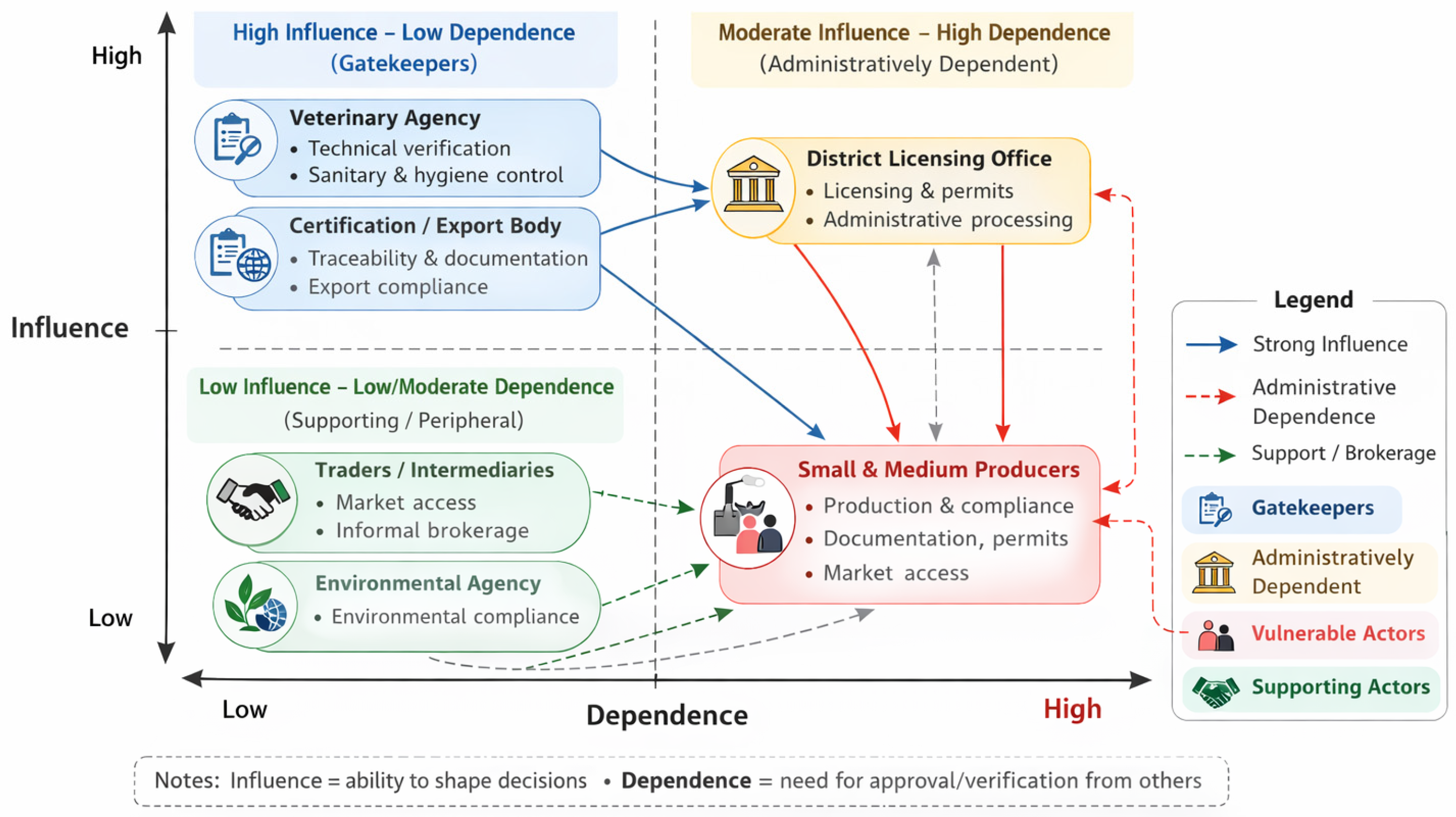
The relational structure of this system becomes clearest when actors are positioned in terms of relative influence and dependence.
Figure 1 visualizes this configuration. It shows that regulatory leverage is not concentrated in the institution with the strongest formal territorial mandate. Instead, the most influential positions are occupied by actors who control technical verification and documentary gateways. Veterinary and certification-related actors hold this leverage because their decisions condition whether other stages of the regulatory process can proceed. Their position in the high-influence, low-dependence quadrant reflects a gatekeeping role within the governance chain. This pattern is consistent with empirical findings in multi-actor governance systems where control over verification processes generates disproportionate influence across institutional arrangements [
5,
6,
7,
8,
25,
37].
To examine how decentralized regulatory governance is structured in practice,
Figure 1 visualizes the influence–dependence relationships among the main actors involved in the EBN sector. The map highlights how regulatory authority is not only defined by formal mandates, but also by the relational positioning of actors within a system of interdependence, where influence and dependence are unevenly distributed [
4,
5,
6,
18].
By contrast, the district licensing office occupies an intermediate but dependent position. Although it holds formal responsibility for issuing permits, it cannot exercise this authority autonomously because licensing decisions rely on technical and documentary inputs produced elsewhere. This reveals a central tension in decentralized governance: formal authority and operational control do not necessarily coincide. Similar patterns have been identified in decentralized governance systems where administrative authority is structurally separated from technical verification functions, producing coordination gaps and procedural delays [
2,
4,
16,
17].
The most exposed position in the system is occupied by small and medium producers.
Figure 1 places them in the low-influence, high-dependence quadrant, indicating that they depend on multiple institutions for approval, inspection, and compliance validation while exercising limited influence over how those procedures are designed or sequenced. This is analytically important because it shows that fragmented governance is not experienced equally across actors. In particular, similar findings in agri-food governance indicate that compliance burdens tend to accumulate among actors who are highly dependent on regulatory systems but lack influence over procedural design [
5,
6,
7,
8,
38,
39].
To avoid overloading the main text with multiple separate matrices,
Table 3 synthesizes the most policy-relevant MACTOR findings. It links actor position, relative influence and dependence, objective orientation, and the principal coordination problems generated or experienced by each actor cluster [
21,
24,
28].
This table summarizes how qualitative evidence was translated into MACTOR outputs. Its purpose is to make the analytical procedure more transparent by showing how actor identification, scoring, triangulation, and expert validation were conducted before the matrices were interpreted [
28,
34,
40].
Table 3 indicates that the governance problem in Pulang Pisau is not a simple absence of common purpose. Most actors support broad goals such as hygiene, quality assurance, and traceability. The difficulty lies in the fact that these objectives are pursued through different procedures, administrative rhythms, and evidentiary requirements. In other words, the system exhibits broad normative convergence without strong operational integration. This mismatch generates several recurring bottlenecks, including delayed sequencing between technical and administrative stages, overlapping documentary requirements, uneven information flows, and the absence of a shared mechanism for synchronizing responsibilities across institutions [
4,
16,
21,
41,
42].
These bottlenecks have clear distributional consequences. Actors with technical or documentary gatekeeping roles shape the sequence and conditions of compliance, while producers face repeated documentation requests, procedural duplication, and uncertainty over which requirements take precedence at different stages. The resulting problem is therefore not only one of coordination inefficiency, but also one of regulatory inequality. Compliance burdens accumulate most heavily among those actors who are most dependent on the system yet least able to influence how it operates. Similar dynamics have been documented in traceability-driven governance systems, where documentation complexity and fragmented data systems disproportionately affect smaller producers [
38,
39,
42].
In sum, the results show that coordination failure in the EBN governance system is not simply the result of institutional weakness or policy inconsistency. Rather, it emerges from the relational configuration of actors, where influence and dependence are unevenly distributed and where shared objectives are not matched by integrated procedures. This configuration confirms that regulatory performance in decentralized systems is relationally structured rather than hierarchically determined [
2,
4,
9].
5. Discussion
The findings of this study suggest that administrative capacity in decentralized governance cannot be understood solely as a resource held by individual organizations. What matters just as much is the relational configuration through which authority, expertise, and procedural roles are distributed across actors.
Figure 1 makes this visible by showing that the actors with the greatest leverage over regulatory outcomes are not necessarily those with the strongest formal mandate, but those who control technical verification and documentary gateways. In this sense, capacity under decentralization is relational: it depends on whether actors are positioned in ways that allow regulatory sequences to be aligned, information to circulate, and implementation to proceed without repeated interruption across institutional boundaries [
5,
6,
7,
8,
9,
15].
This interpretation extends existing debates on governance capacity by showing that coordination problems in decentralized systems often arise less from simple organizational weakness than from patterned interdependence. The district licensing office is formally central but operationally dependent. Veterinary and certification-related actors, by contrast, hold narrower mandates but stronger practical leverage because their approval conditions the movement of the regulatory chain. The problem is therefore not that one actor is simply weak and another strong. Rather, decentralized governance produces asymmetrical relational positions that shape whether authority can be translated into coordinated action. Similar dynamics have been observed in decentralized administrative systems where institutional fragmentation is reinforced by uneven technical authority and resource distribution [
1,
2,
16,
17].
The study also helps explain why shared objectives do not automatically produce coherent implementation. The MACTOR results show broad support across actors for hygiene, quality assurance, and traceability. Yet this normative alignment does not produce operational alignment. Actors may agree on what regulation is meant to achieve while differing in how procedures should be verified, sequenced, documented, and enforced. This distinction is crucial. It shows that coordination deficits do not necessarily stem from open disagreement over goals, but from the lack of mechanisms capable of translating convergent objectives into synchronized practice. This gap between normative convergence and operational fragmentation has also been identified in collaborative governance research, where shared goals often fail to translate into coordinated action without integrative mechanisms [
4,
21,
24,
27,
38].
The Pulang Pisau case also speaks to wider research on commodity governance and decentralized regulation in Southeast Asia. Similar studies have shown that overlapping mandates, documentary duplication, and uneven information flows are common in sectors where local administrative authority intersects with technical and market-oriented forms of oversight. These dynamics are particularly visible in Global South governance systems, where institutional layering and coordination deficits shape regulatory performance across sectors. What this study adds is a clearer specification of the relational mechanism through which these outcomes are reproduced. Rather than treating fragmentation as a descriptive condition alone, it demonstrates how asymmetries of influence and dependence shape which actors can condition the regulatory chain and which actors must absorb the costs of incoherence [
16,
18,
19,
20,
25].
This has important implications for how inequality is understood in regulatory governance. The findings show that fragmented authority does not distribute risk and burden evenly. Actors with gatekeeping authority influence how procedures unfold, while producers bear the cumulative effects of delay, duplication, and uncertainty. Coordination failure is therefore not only an administrative problem; it is also a distributional one. The concept of regulatory inequality is useful here because it captures the way institutional incoherence imposes disproportionate costs on actors with the least influence over rule interpretation and implementation. Comparable patterns have been identified in agri-food and traceability governance systems, where fragmented documentation requirements and verification processes disproportionately burden smaller and less powerful actors [
5,
6,
7,
8,
38,
39,
42].
Collectively, these findings support the argument that improving decentralized governance requires more than stronger rules or greater organizational resources. What is needed is relational capacity building: institutional arrangements that align mandates, reduce procedural duplication, improve data sharing, and create predictable coordination across actors. This does not eliminate the importance of formal authority, but it shows that authority alone is insufficient unless embedded in a relational architecture capable of producing coherent implementation. Recent work on collaborative and systems-based governance similarly emphasizes the importance of coordination platforms, shared information systems, and adaptive institutional learning as key components of effective governance reform [
4,
21,
24,
26,
43].
6. Policy Implications
The findings of this study suggest that policy reform in decentralized regulatory systems should focus less on adding further layers of regulation and more on redesigning the coordination architecture through which existing rules are implemented. Where authority is already distributed across multiple institutions, the central policy challenge is to align procedures, clarify sequencing, and reduce duplication across actors whose decisions are interdependent. This emphasis on coordination architecture is consistent with recent work highlighting that governance effectiveness depends on policy capacity and inter-organizational alignment rather than formal institutional expansion alone [
4,
9,
16,
39,
44,
45].
A first implication is the need for more integrated coordination platforms at the district level. Rather than requiring producers to move through disconnected institutional channels, decentralized regulatory systems would benefit from arrangements that bring licensing, technical verification, and documentary processing into a more predictable administrative sequence. Such platforms would not eliminate institutional specialization, but they could reduce the procedural fragmentation that currently shifts coordination burdens onto producers and local intermediaries. Similar institutional innovations have been identified in collaborative governance literature as key mechanisms for improving coordination and service integration in multi-actor systems [
15,
19,
20,
21,
24,
46].
A second implication concerns shared information systems. Many of the bottlenecks identified in this study are reinforced by fragmented documentation practices, repeated requests for similar evidence, and weak inter-agency visibility over previous stages of compliance. Shared databases or interoperable administrative records could help reduce duplication, improve consistency, and strengthen accountability across the regulatory chain. By making information more portable across institutions, such systems would also reduce the discretionary uncertainty that currently affects weaker actors most severely. This finding aligns with recent studies in agri-food and regulatory governance showing that data fragmentation and lack of interoperability are central drivers of inefficiency and compliance burdens [
16,
21,
38,
41,
42,
47].
A third implication is the value of periodic actor-based diagnostics. Because decentralized governance systems evolve over time, coordination problems cannot be assumed to remain fixed. Repeated relational analysis—using MACTOR or similar tools—could help local governments identify changes in influence, dependence, and bottlenecks before these become entrenched as routine administrative problems. In this sense, actor-based diagnostics should be understood not as one-off research exercises, but as tools for institutional learning and adaptive governance. This approach is consistent with recent developments in systems thinking and relational governance, which emphasize continuous feedback and iterative adjustment in complex policy environments [
4,
26,
28,
40,
48].
These reforms, however, should not be understood as frictionless. Integrated service platforms and shared databases may face resistance from agencies accustomed to procedural autonomy, uneven digital capacity across local offices, and disputes over data ownership or responsibility. Without clear leadership and agreed coordination protocols, new platforms may themselves become additional layers of administration rather than mechanisms for simplification. Similar challenges have been documented in digital governance and inter-agency coordination reforms, where institutional inertia and competing mandates often limit the effectiveness of integration efforts [
16,
21,
49].
6.1. Limitations
This study has several limitations. It focuses on a single case, prioritizing analytical depth over statistical generalization. While this allows for a detailed examination of relational dynamics, the findings may not fully capture variation across different regional or institutional contexts. In addition, the MACTOR approach necessarily simplifies complex and evolving actor relationships into structured categories. Actor positions and coordination patterns may shift over time as governance arrangements, regulatory priorities, and market conditions change. Such limitations are common in qualitative and relational governance research, where analytical depth is prioritized over generalizability [
30,
34,
50].
6.2. Boundary Conditions
The findings are most applicable to governance systems characterized by multi-actor regulatory chains, strong reliance on technical verification, and fragmented procedural authority. In contexts where regulatory authority is more centralized or where coordination mechanisms are already institutionalized, the relational dynamics identified here may take different forms. This reflects broader findings in governance literature that institutional configurations shape how coordination problems manifest across policy domains [
4,
18].
6.3. Future Research
Future research could extend this analysis through comparative and longitudinal designs, examining how relational configurations evolve across regions and over time. Integrating relational mapping approaches with quantitative performance indicators would also provide a more comprehensive understanding of how coordination structures affect regulatory outcomes. In particular, combining actor-based analysis with measurable indicators of efficiency, compliance cost, and regulatory performance could help bridge the gap between qualitative governance analysis and policy evaluation frameworks [
9,
38].
7. Conclusions
This article has examined how coordination, power, and interdependence shape regulatory outcomes in the decentralized governance of the edible bird’s nest sector in Pulang Pisau. The findings show that the core problem is not the absence of formal rules, nor simply the weakness of individual institutions. Rather, regulatory performance is shaped by the relational structure of governance: who controls technical verification, who depends on documentary approval, how procedures are sequenced, and whether shared objectives are supported by integrated administrative practice.
By introducing the concept of relational administrative capacity, the article argues that capacity under decentralization should be understood not only in organizational or hierarchical terms, but also in relational ones. Actors may hold formal authority yet remain operationally dependent, while others exercise disproportionate influence through their control over technical and documentary gateways. This helps explain why decentralized systems may fail to produce coherent implementation even where broad regulatory goals are widely shared.
The study also shows that fragmented authority has unequal effects. Coordination problems do not burden all actors in the same way. Producers and other weakly positioned actors bear the greatest costs of duplication, delay, and uncertainty, despite having the least influence over how the system operates. This makes regulatory fragmentation not only a question of efficiency, but also one of inequality.
More broadly, the Pulang Pisau case suggests that the future effectiveness of decentralized governance in Indonesia and comparable contexts will depend less on the proliferation of new rules than on the capacity to align existing institutions through more coherent relational design. Where authority remains fragmented but coordination mechanisms remain weak, decentralization is likely to continue falling short of its promises. Where relational capacity is strengthened, however, decentralized governance may move closer to delivering the responsiveness and coherence it was originally intended to achieve.
The main contribution of this study lies in shifting the analysis of decentralized governance from an institutional to a relational perspective, demonstrating that effective implementation depends on how authority is positioned, connected, and operationalized across interdependent actors.