Article

A Sustainability-Oriented Framework for Evaluating the “Hardcore Strength” of World-Class Ports: Multi-Dimensional Indicators and Game-Theoretic Weight Integration

1
Faculty of Maritime and Transportation, Ningbo University, Ningbo 315832, China
2
Barcelona School of Nautical Studies, Universitat Politècnica de Catalunya (UPC-BarcelonaTech), 08003 Barcelona, Spain
3
National Traffic Management Engineering & Technology Research Centre, Ningbo University Sub-Centre, Ningbo 315832, China
4
Collaborative Innovation Center of Modern Urban Traffic Technologies, Southeast University, Nanjing 211189, China
*
Authors to whom correspondence should be addressed.
Sustainability 2026, 18(8), 3751; https://doi.org/10.3390/su18083751
Submission received: 7 March 2026 / Revised: 26 March 2026 / Accepted: 8 April 2026 / Published: 10 April 2026
(This article belongs to the Section Sustainable Transportation)

Abstract

Building world-class ports requires not only scale expansion but also sustainable structural capability. However, the concept of port “hardcore strength” remains insufficiently clarified and operationalized in existing sustainability and port evaluation research. In this study, port hardcore strength is understood as an integrated capability framework covering infrastructure efficiency and logistics capability, connectivity and regional integration, maritime services and industrial clustering, strategic leadership and innovation capability, and sustainable governance and green port development. This study proposes a sustainability-oriented evaluation framework for assessing the “hardcore strength” of world-class ports through a multi-dimensional indicator system. Methodologically, the study integrates the EWM and CRITIC, and introduces Bland–Altman analysis to examine whether the EWM and CRITIC weight vectors exhibit an obvious systematic bias prior to game-theoretic integration. Using 18 representative global ports from 2019 to 2023 as a case study, the results show that the overall ranking structure remains broadly stable, with Singapore Port and Shanghai Port consistently ranking first and second, respectively, while some middle-ranked ports exhibit moderate positional changes. The findings suggest that differences in world-class port development are rooted not only in operational scale, but also in the coordination of multiple capability dimensions. The study enriches the understanding of world-class port evaluation from a sustainability-oriented perspective.

1. Introduction

World-class ports constitute critical infrastructure nodes within global trade and logistics systems [1]. Beyond their traditional role as cargo-handling facilities, modern ports have evolved into integrated platforms for logistics coordination, maritime service provision, industrial clustering, and regional economic development [2]. As global supply chains become increasingly complex and exposed to environmental, geopolitical, and technological uncertainties, port development is gradually shifting from scale-oriented expansion toward sustainability-oriented transformation. In this context, the evaluation of port performance can no longer rely solely on throughput or infrastructure indicators, but must incorporate broader dimensions such as connectivity, governance capability, innovation capacity, and environmental performance.
International organizations and policy frameworks increasingly emphasize the importance of sustainable and resilient port development. For example, the United Nations Conference on Trade and Development (UNCTAD) and the World Bank have highlighted the need for ports to enhance systemic robustness and long-term sustainability through improved infrastructure efficiency, digitalization, and environmental governance [3]. Similar strategic perspectives have been reflected in national development agendas. During an inspection of Zhejiang Province, President Xi Jinping emphasized the need to build “world-class strong ports” and strengthen their “hardcore strength” [4]. Although initially proposed in a policy context, the notion of port “hardcore strength” captures a deeper requirement in port systems, i.e., the ability of ports to maintain stable operations, coordinate resources efficiently, and provide high-level services under increasingly uncertain economic and environmental conditions.
From an academic perspective, port “hardcore strength” can be interpreted as an integrated structural capability reflecting a port’s capacity to sustain efficient operations and strategic development in the long term. This capability encompasses multiple dimensions including infrastructure efficiency and logistics capability, connectivity and regional integration, maritime services and industrial clustering, strategic leadership and innovation capability, and sustainable governance and green port development. Such a perspective aligns with existing theoretical frameworks in port competitiveness, global value chains, and port–city interaction. However, it extends these theories by emphasizing coordinated system performance and long-term sustainability rather than isolated operational metrics [5].
Although the concept of port “hardcore strength” overlaps with several established international constructs, it is not equivalent to any single one of them. Compared with port competitiveness, which mainly emphasizes market performance and comparative advantage, hardcore strength focuses more on the underlying capability base that supports long-term port development. Compared with port resilience, which is primarily concerned with disturbance response, recovery, and adaptation, hardcore strength captures a broader and more stable set of capacities that support both routine operations and adaptive adjustment under disruptions. Compared with sustainability, which mainly targets environmental, social, and governance outcomes, hardcore strength treats sustainable governance and green development as one essential dimension within a wider port capability framework. It also differs from strategic infrastructure capacity by extending beyond physical infrastructure and strategic assets to include connectivity and regional integration, maritime services and industrial clustering, strategic leadership and innovation capability, and sustainable governance. In this sense, “hardcore strength” is used in this study not as a rhetorical policy slogan, but as an integrated an d empirically operationalized framework for evaluating world-class port development.
Despite growing interest in evaluating port development capability, several limitations remain in existing studies. First, many evaluation frameworks focus primarily on operational performance indicators such as throughput, efficiency, or connectivity [6,7,8], while neglecting broader dimensions such as governance capability, innovation capacity, and environmental transformation. Second, commonly used weighting approaches often rely either on subjective expert judgement or on a single objective weighting method, which may introduce bias or instability into the evaluation results. Third, even when multiple objective weighting methods are employed, few studies verify the statistical compatibility of these weighting schemes before integrating them into a final evaluation framework.
To address these limitations, this study develops a sustainability-oriented evaluation framework for assessing the “hardcore strength” of world-class ports. The framework constructs a comprehensive indicator system covering five primary dimensions: infrastructure and operational efficiency, hub connectivity and hinterland control, shipping services and factor aggregation, strategic leadership and evolutionary capability, smart, green, and safety governance. To enhance methodological robustness, two objective weighting methods—the Entropy Weight Method (EWM) and the CRITIC method—are first applied to derive indicator weights from complementary statistical perspectives. Subsequently, Bland–Altman analysis is employed to examine the agreement between the EWM and CRITIC weight vectors prior to game-theoretic combination, with particular attention to whether an obvious systematic bias exists between the two sets of weights. This step provides an agreement-based diagnostic reference for subsequent integration, rather than being treated as a stand-alone proof of methodological validity.
Using nine representative Chinese ports as a case study, the proposed framework is applied to evaluate the dynamic evolution of port “hardcore strength” from 2019 to 2023. The analysis reveals distinct development trajectories among ports and highlights the increasing importance of smart governance, green transformation, and service capability in shaping sustainable port competitiveness.
The remainder of the paper is organized as follows. Section 2 reviews the relevant literature on port evaluation systems and multi-criteria decision-making methods. Section 3 constructs the evaluation indicator system for port “hardcore strength”. Section 4 presents the methodological framework, including the weighting procedures and game-theoretic integration approach. Section 5 applies the framework to a case study of 18 representative global ports and analyzes the evaluation results. Finally, Section 6 summarizes the main findings and discusses their implications for sustainable port development.

2. Literature Review

2.1. Port Evaluation Systems and Sustainable Port Development

The development of evaluation indicator systems plays a fundamental role in benchmarking port performance and guiding strategic development. Traditional port evaluation frameworks were largely centered on operational efficiency indicators such as cargo throughput, berth productivity, and turnaround time. While these indicators remain important, recent studies increasingly recognize that port competitiveness is shaped by broader structural factors including connectivity, governance capability, and service quality.
Early research primarily emphasized infrastructure capacity and operational performance as the core determinants of port competitiveness. For example, throughput, berth capacity, and logistics infrastructure have been widely used as proxies for port efficiency and economic contribution. However, such infrastructure-oriented approaches often exhibit a strong “hardware-dominant” bias, focusing heavily on physical assets while underestimating the importance of institutional and service capabilities.
In response to these limitations, recent research has expanded the scope of port evaluation frameworks to include service-oriented and governance-related dimensions. Ascencio et al. [5] proposed the Port Competitiveness Management Index (PCMI), highlighting the importance of supply chain coordination and institutional governance. Similarly, Nguyen et al. [9] emphasized that digitalization, smart technologies, and governance capacity have become essential components of modern port competitiveness.
Environmental sustainability has also become a critical dimension in port evaluation research. With increasing global attention to decarbonization and green shipping, ports are expected to reduce emissions, improve energy efficiency, and support low-carbon maritime transport systems. Scholars have therefore introduced various environmental performance indicators, including carbon emissions, energy consumption, and environmental governance mechanisms [10,11,12]. Ye et al. [13] further demonstrated that green performance can significantly influence port hinterland development and regional economic integration. In addition to environmental sustainability, resilience has emerged as another important dimension in port evaluation research. Ports operate within highly interconnected maritime networks and are therefore vulnerable to disruptions caused by geopolitical conflicts, pandemics, and climate-related events. To address these challenges, several studies have proposed resilience-oriented evaluation frameworks that consider pre-disruption preparedness, operational response capacity, and post-disruption recovery ability [14,15,16]. Bedoya-Maya et al. [17] further highlighted that in times of crisis, network centrality and cost adaptability become key determinants of port competitiveness.
Despite these advances, existing evaluation frameworks still exhibit several limitations. Many studies focus on individual aspects of port performance, such as efficiency, sustainability, or resilience, without integrating them into a comprehensive evaluation framework. Moreover, some frameworks treat environmental or smart indicators as supplementary “add-ons” rather than as core components of structural capability. Consequently, there remains a need for a systematic evaluation framework capable of capturing the integrated structural strength required for sustainable port development.
In this context, the concept of port “hardcore strength” provides a useful perspective for integrating multiple dimensions of port capability. Rather than focusing solely on operational performance, the concept emphasizes coordinated development across infrastructure, connectivity, services, governance, and innovation. By operationalizing this concept through a structured indicator system, the present study aims to provide a more comprehensive tool for evaluating sustainable port development.

2.2. Weighting Methods in Multi-Criteria Evaluation

The reliability of multi-criteria evaluation results depends heavily on the scientific determination of indicator weights. In general, weighting methods can be categorized into three main groups: subjective weighting methods, objective weighting methods, and hybrid combination approaches.
Subjective weighting methods rely on expert knowledge and decision-maker preferences to determine indicator importance. The Analytic Hierarchy Process (AHP) is one of the most widely used subjective weighting methods, allowing experts to perform pairwise comparisons among indicators. To address uncertainty in expert judgement, researchers have introduced extensions such as fuzzy AHP and the Consistent Fuzzy Preference Relation (CFPR) [18]. The Best–Worst Method (BWM) has also been proposed as an alternative approach that reduces the number of pairwise comparisons while improving consistency [15]. These methods are useful for incorporating expert knowledge but may still suffer from subjective bias.
To mitigate subjectivity, objective weighting methods derive indicator weights directly from statistical characteristics of the data. The Entropy Weight Method (EWM) is widely used because it measures the degree of information provided by each indicator based on its dispersion [9,19]. Similarly, the CRITIC method determines weights by considering both the variability of indicators and the correlation between them [20]. Principal Component Analysis (PCA) has also been applied to extract key components from multi-dimensional datasets [21]. Although objective methods improve data-driven rigor, relying on a single method may still produce biased results depending on the statistical properties of the dataset.
To overcome these limitations, recent studies have increasingly adopted hybrid weighting approaches that combine multiple methods. Game-theoretic models are often used to integrate different weighting results by minimizing the deviation between weight vectors [15]. Other studies employ Bayesian approaches or multi-criteria decision frameworks such as DEA-MORCOS or CPF-MPSI to balance multiple objectives [22,23,24].
In addition to weight determination, robustness testing has become an important component of multi-criteria evaluation research. Traditional sensitivity analyses often involve perturbing weights to examine the stability of ranking results [25]. More advanced methods incorporate parameter traversal, simulation techniques, and multi-dimensional validation frameworks to evaluate the robustness of decision-making models [26,27].
However, when multiple objective weighting methods are used, researchers often combine them directly without examining whether the resulting weight vectors display an obvious systematic deviation. Correlation analysis alone is insufficient for this purpose because correlation reflects association rather than agreement in magnitude. Bland–Altman analysis was originally developed for assessing agreement between two quantitative measurement methods and remains a standard tool for method-comparison studies [28,29,30].
In MCDA-related settings, Van Til et al. [31] used Bland–Altman plots to compare criteria weight estimates produced by alternative weighting techniques. Drawing on this limited but relevant precedent, the present study introduces Bland–Altman analysis to examine whether the EWM and CRITIC weight vectors exhibit an obvious systematic bias prior to game-theoretic combination. In this study, the method is used as an agreement-based diagnostic tool for subsequent integration, rather than as a strict prerequisite or a stand-alone proof of methodological validity.

3. Construction of the Evaluation Indicator System

3.1. Theoretical Foundations and Conceptual Mapping

Existing studies have examined port development mainly through the lenses of competitiveness, resilience, sustainability, and infrastructure capacity. Rather than replacing these established perspectives, this study treats port “hardcore strength” as an integrative capability-based construct that synthesizes them into a multidimensional framework for evaluating world-class port development. In this study, port hardcore strength refers to the comprehensive capability through which ports sustain efficient operations, strengthen connectivity and regional coordination, enhance maritime service provision, promote innovation-driven development, and advance sustainable governance.
The theoretical foundation of this construct draws on four complementary perspectives: Node–Place theory [32], global value chain theory [33], growth pole theory [34], and resilience systems theory [35]. Combined with the broader literature on sustainable port governance and industrial upgrading, these perspectives explain how ports function not only as physical logistics hubs, but also as economic platforms, innovation nodes, and governance systems embedded in global supply chains and regional development networks.
The five dimensions in this study are not derived from five separate theories in a one-to-one manner. Rather, they are jointly supported by these four complementary theoretical perspectives. In particular, Node–Place theory provides a dual foundation for both infrastructure efficiency and logistics capability, and connectivity and regional integration. Global value chain theory supports the dimension of maritime services and industrial clustering by explaining the upgrading trajectory of ports from cargo-handling gateways to high-value service platforms. Growth pole theory provides the interpretive basis for strategic leadership and innovation capability by emphasizing the role of ports in resource concentration, factor allocation, and regional development. Resilience systems theory underpins sustainable governance and green port development by highlighting the adaptive, restorative, and transformative capacities of ports under environmental constraints, energy transition pressures, and external risks.
Based on this theoretical grounding, the indicator system in this study follows a structured analytical logic linking theoretical foundations, literature synthesis, and dimension mapping. Therefore, the evaluation of port “hardcore strength” is not a simple aggregation of variables, but a systematic construction grounded in established theories of maritime economics, regional development, and infrastructure systems.
Accordingly, port hardcore strength is operationalized through five interrelated capability dimensions: (A1) infrastructure efficiency and logistics capability, (A2) connectivity and regional integration, (A3) maritime services and industrial clustering, (A4) strategic leadership and innovation capability, and (A5) sustainable governance and green port development. These five dimensions jointly represent the structural foundations of world-class port development and provide the conceptual basis for the indicator system developed in this study.

3.1.1. Infrastructure Efficiency and Logistics Capability

Infrastructure efficiency and logistics capability reflect the foundational carrying capacity and operational performance of ports as integrated transport hubs and logistics organization nodes, and therefore constitute the material basis of port hardcore strength. Port infrastructure conditions determine the upper boundary of a port’s ability to accommodate large vessels, organize cargo circulation, and support high-intensity production activities, while operational efficiency reflects the extent to which berth allocation, cargo handling, yard operations, customs coordination, and logistics turnover are effectively managed. For major global ports, large-scale facilities alone are insufficient to sustain long-term competitiveness. Only when infrastructure capacity is effectively matched with production and logistics efficiency can ports provide stable, efficient, and reliable logistics services.
From a theoretical perspective, Node–Place theory [32] emphasizes the coordination between the transport-node function and the spatial-carrier function of ports. Ports are not only key nodes for the concentration and transfer of cargo flows, vessel movements, and information flows, but also important spatial carriers that support regional industrial linkages and spatial organization. The more complete the infrastructure and the higher the operational efficiency, the stronger the node function of a port and the more stable its role in international logistics chains. Previous studies Wang and Wen [36] and Wang [37] have shown that infrastructure capacity and operational efficiency are key determinants of port logistics capability. Sufficient infrastructure enables ports to handle cargo flows effectively, while operational performance determines how efficiently these resources are utilized. Therefore, infrastructure efficiency and logistics capability constitute a fundamental dimension of port hardcore strength.

3.1.2. Connectivity and Regional Integration

Connectivity and regional integration reflect the ability of ports to connect with global shipping networks and their degree of coupling with hinterland economies, integrated transport systems, and regional spatial structures. This dimension represents the spatial hub function of port hardcore strength. As port functions continue to expand, ports are no longer merely cargo-handling gateways, but comprehensive platforms that organize international logistics, connect multimodal transport systems, allocate strategic resources, and support regional economic development. The stronger a port’s external connectivity, the more effectively it can attract international shipping routes and global cargo flows; the closer its connection with inland hinterlands, the stronger its capacity to integrate regional resources and generate broader economic spillover effects.
Theoretically, Node–Place theory highlights not only the nodal role of ports in transport networks, but also their embeddedness as regional spatial carriers. Growth pole theory further suggests that ports with strong agglomeration and diffusion capacities can stimulate wider regional development through transport and economic linkages. The competitiveness of world-class ports therefore depends not only on throughput scale or infrastructure quality, but also on their ability to embed themselves in global shipping networks, extend service reach into hinterlands, and form synergistic relationships with urban economies and regional development systems. González and González-Cancelas [38] emphasize that modern ports increasingly serve as critical nodes linking hinterland economies to global shipping routes. For this reason, connectivity and regional integration should be treated as an independent evaluation dimension, so as to move beyond a narrow internal-efficiency perspective and better capture the position of ports in the global–regional spatial system.
This dimension is therefore represented by indicators associated with shipping network connectivity, outward-oriented business scale, multimodal transport organization, hinterland linkage, and port-city economic interaction.

3.1.3. Maritime Services and Industrial Clustering

Maritime services and industrial clustering reflect the ability of ports to upgrade from traditional cargo-handling gateways to advanced maritime resource allocation platforms, and thus constitute the value-creation dimension of port hardcore strength. As global port competition shifts from a primary stage dominated by throughput scale and infrastructure expansion to a more advanced stage centered on high-end service provision, shipping-resource coordination, and industrial ecosystem development, port competitive advantage increasingly depends on the comprehensive capability to provide maritime logistics services, vessel support services, shipping intermediary services, information services, and specialized public services.
From the perspective of global value chain (GVC) theory, ports generate economic value not only through cargo circulation, but also through the coordination of logistics resources and the provision of high-value maritime services [33]. In this sense, ports are no longer merely physical transfer nodes, but are increasingly embedded in higher-value segments of global production, circulation, and service networks. Zhang et al. [39] further highlight that diversified maritime services play a critical role in shaping international shipping centers. Ports with strong service capabilities can attract maritime enterprises, foster service agglomeration, and gradually form port-related industrial clusters, thereby strengthening their position within global maritime value chains. Therefore, taking maritime services and industrial clustering as a key dimension helps reveal the internal logic through which world-class ports evolve beyond conventional cargo-handling functions into modern maritime service centers.
Accordingly, this dimension is measured through indicators reflecting maritime service provision, operational performance, specialized public service support, and shipping-related factor agglomeration.

3.1.4. Strategic Leadership and Innovation Capability

Strategic leadership and innovation capability reflect the comprehensive capacity of ports in strategic resource allocation, critical material transport support, technological upgrading, and organizational transformation, and thus form the dynamic support dimension of port hardcore strength. As key nodes in national transport systems and global supply chains, ports not only undertake essential responsibilities in securing the transport of energy and other strategic materials, but also need to continuously strengthen their competitiveness through technological innovation, talent accumulation, and institutional improvement. As global port competition enters a stage of high-quality development, port strength is no longer determined solely by traditional factor inputs, but increasingly by the coupling of strategic support capacity and innovation-driven capability.
From a theoretical perspective, growth pole theory suggests that major economic nodes can stimulate regional development by attracting resources, reallocating production factors, and promoting industrial upgrading [34]. As major regional and national infrastructure assets, ports play a dual role: on the one hand, they support the transport of strategic materials and the stability of key logistics corridors; on the other hand, they promote functional upgrading and service transformation through technological progress, organizational innovation, and knowledge accumulation. Sun [40] emphasizes that strategic resource allocation plays an important role in transforming ports into modern logistics hubs. Against this background, the inclusion of indicators related to strategic bulk cargo support helps capture the port’s role in handling critical commodities and safeguarding national supply chains. In addition, sustainable port development requires continuous technological upgrading and innovation. Yuan [41] points out that indicators such as profitability and innovation performance can reflect the maturity and development potential of ports. Therefore, treating strategic leadership and innovation capability as an independent dimension helps capture both the strategic support function and the long-term developmental momentum of world-class ports.
This dimension is operationalized through indicators associated with strategic transport support, innovation input intensity, technical talent concentration, and innovation output capacity.

3.1.5. Sustainable Governance and Green Port Development

Sustainable governance and green port development reflect the overall level of ports in digital transformation, low-carbon transition, and safety governance, and therefore represent the governance-resilience dimension of port hardcore strength. As the development logic of global ports shifts from scale expansion toward high-quality growth, the core criteria of port competitiveness have gradually expanded from throughput and operational efficiency to governance modernization, greening, decarbonization, and safety assurance. In the context of accelerating energy transition, stricter environmental regulation, the rise of green shipping, and growing supply-chain risks, the ability of ports to maintain production efficiency while reducing energy consumption and emissions, improving digital governance, and ensuring safe operations has become a critical basis for long-term competitiveness and sustainable development.
From the perspective of resilience theory, infrastructure systems must maintain core functions and adapt to external shocks such as environmental change, supply-chain disruptions, and technological transformation [35]. As complex socio-technical systems, ports face not only market volatility, trade restructuring, and technological change, but also governance challenges related to environmental regulation, safety risk prevention, and carbon constraints. Operational safety therefore represents a fundamental requirement for resilient port systems, while green transition and governance modernization have become essential conditions for sustaining port competitiveness over the long term. At the same time, environmental governance and digital transformation have become key drivers of sustainable port development. In line with the innovation-oriented perspective proposed by Yang et al. [42] and Wan et al. [10], the assessment of this dimension should capture the extent to which ports adopt digital technologies, strengthen governance effectiveness, reduce environmental impacts, and improve energy efficiency. Therefore, incorporating sustainable governance and green port development into the evaluation framework helps integrate green transformation and governance modernization into the assessment of world-class port hardcore strength.
This dimension is captured by indicators related to digital transformation, green infrastructure provision, energy efficiency, carbon performance, and safety governance outcomes.
Taken together, these five dimensions indicate that port “hardcore strength” in this study is not treated as a simple synonym for competitiveness, resilience, or sustainability. Instead, it is conceptualized as a broader capability framework that integrates operational efficiency, network connectivity, service and industrial support, strategic innovation, and sustainable governance into a unified analytical structure. In this sense, “hardcore strength” is used as an operationalized evaluative construct for world-class port development, rather than as a stand-alone concept detached from existing international scholarship. Its contribution lies in integrating these perspectives into a unified and empirically operationalized evaluative framework.

3.2. Indicator Construction Procedure

Following the conceptual framework established in Section 3.1, the evaluation indicator system was constructed through literature-based identification, principle-based screening, and expert consultation-based refinement.

3.2.1. Preliminary Screening of Indicators Based on Literature Review

The study first conducted a systematic review of research on port competitiveness, sustainable port development, global value chains, and port-city coordination to identify commonly used indicator types under different dimensions and to establish an initial indicator pool. Given that world-class port hardcore strength is a multidimensional capability system rather than a single attribute, the literature review was intended to identify potential indicator sources rather than directly determine the final indicators.
Existing studies suggest that infrastructure efficiency and logistics capability mainly involve infrastructural support, business scale, and operational efficiency; connectivity and regional integration relate to shipping network connectivity, multimodal transport organization, and hinterland economic support; maritime services and industrial clustering concern maritime service provision, high-end factor agglomeration, and industrial ecosystem support; strategic leadership and innovation capability involve strategic resource support, innovation input, and technological upgrading; and sustainable governance and green port development cover smart governance, green transition, and safety risk control. Based on this review, an initial indicator pool covering the five dimensions was established, as summarized in Table 1.

3.2.2. Principle-Based Screening of Candidate Indicators

The initial indicator pool was then screened according to four principles: relevance, measurability, inter-port comparability, and data availability. Priority was given to indicators that could effectively capture the core capabilities of world-class port hardcore strength, had relatively clear definitions, were suitable for cross-port comparison, and were supported by continuous data from authoritative public sources. By contrast, variables with substantial conceptual overlap, similar explanatory functions, or limited availability of continuous and comparable data were not treated as priority candidates.
Based on these principles, the initial indicator pool was screened in three main respects.
  • Removal of highly redundant infrastructure-related indicators. Berth length was not retained because it substantially overlaps with other infrastructure-related indicators such as berth quantity and the number of high-grade berths, and thus provides limited additional explanatory value.
  • Removal of indicators with insufficient statistical consistency or limited international data availability. Number of patents/software copyrights granted was not retained because comparable and continuously disclosed public data are difficult to obtain across international ports, especially for software copyright statistics, whose disclosure standards and statistical coverage vary substantially by country and port. Similarly, ocean shipping volume was excluded because its definition and statistical caliber are not sufficiently consistent across ports, while its public data continuity is also limited.
  • Removal of region-based indicators with only indirect relevance to port-specific capability. GDP of the port city mainly reflects the overall scale of the urban economy rather than the port’s own connectivity or port-city coordination capacity. Similarly, the number of maritime universities mainly captures regional educational resources rather than the port’s own innovation input or output. These indicators were therefore not retained in the candidate set.

3.2.3. Expert-Based Refinement of the Indicator System

The candidate indicators were further refined through expert consultation. The consultation focused not on redefining the evaluation dimensions, but on assessing whether the indicators adequately represented the connotation of each dimension, whether substantial redundancy existed among them, whether they were suitable for cross-port comparison, and whether their data could be obtained from relatively stable public sources. A total of six experts from academia, industry, and policy-related institutions were consulted, covering expertise in port economics and logistics, maritime technology and engineering, shipping market analysis, port infrastructure and transport planning, regional economic policy, and strategic planning.
Based on expert feedback, the candidate indicators were refined in three respects.
  • Removal of indicators with unclear conceptual boundaries or limited inter-port comparability. Channel water depth was excluded because it is strongly affected by natural conditions, port location, and dredging arrangements, and therefore cannot directly reflect infrastructure efficiency. The number of shipping companies was not retained because its conceptual boundary is not sufficiently clear and its public statistical caliber is not consistent across ports. The number of automated berths was also excluded because no globally unified definition currently exists, making cross-port comparison difficult.
  • Revision of indicator caliber to improve comparability. “CO2 emissions” was revised to “CO2 emissions per unit throughput,” since the original total-emission measure is strongly affected by port size and cannot directly reflect green governance efficiency.
  • Introduction of expert-based composite indicators for dimensions with limited comparable public data. Given the absence of globally standardized, continuous, and comparable public statistics for certain innovation- and governance-related dimensions across international ports, expert-based composite indicators were introduced to improve conceptual coverage and inter-port comparability. Specifically, under strategic leadership and innovation capability, technological innovation capability score was introduced to capture ports’ innovation platform development, technology application and transformation, innovation investment and talent support, and innovation output and demonstration effect. In addition, under sustainable governance and green port development, two expert-based indicators—smart port development score and green and low-carbon development score—were introduced to reflect governance transformation capacity.


3.3. Final Indicator System

Through literature-based identification, principle-based screening, and expert consultation-based refinement, this study ultimately developed an evaluation indicator system for world-class port hardcore strength consisting of five first-level dimensions and twenty-five second-level indicators, as presented in Table 2.
It should be noted that under the dimension of sustainable governance and green port development, two subjective indicators—smart port development score and green and low-carbon development score—were introduced because globally standardized, continuous, and comparable public statistics in these areas remain limited. The specific scoring procedure and data treatment for these indicators are described in the subsequent section.

4. Methodology

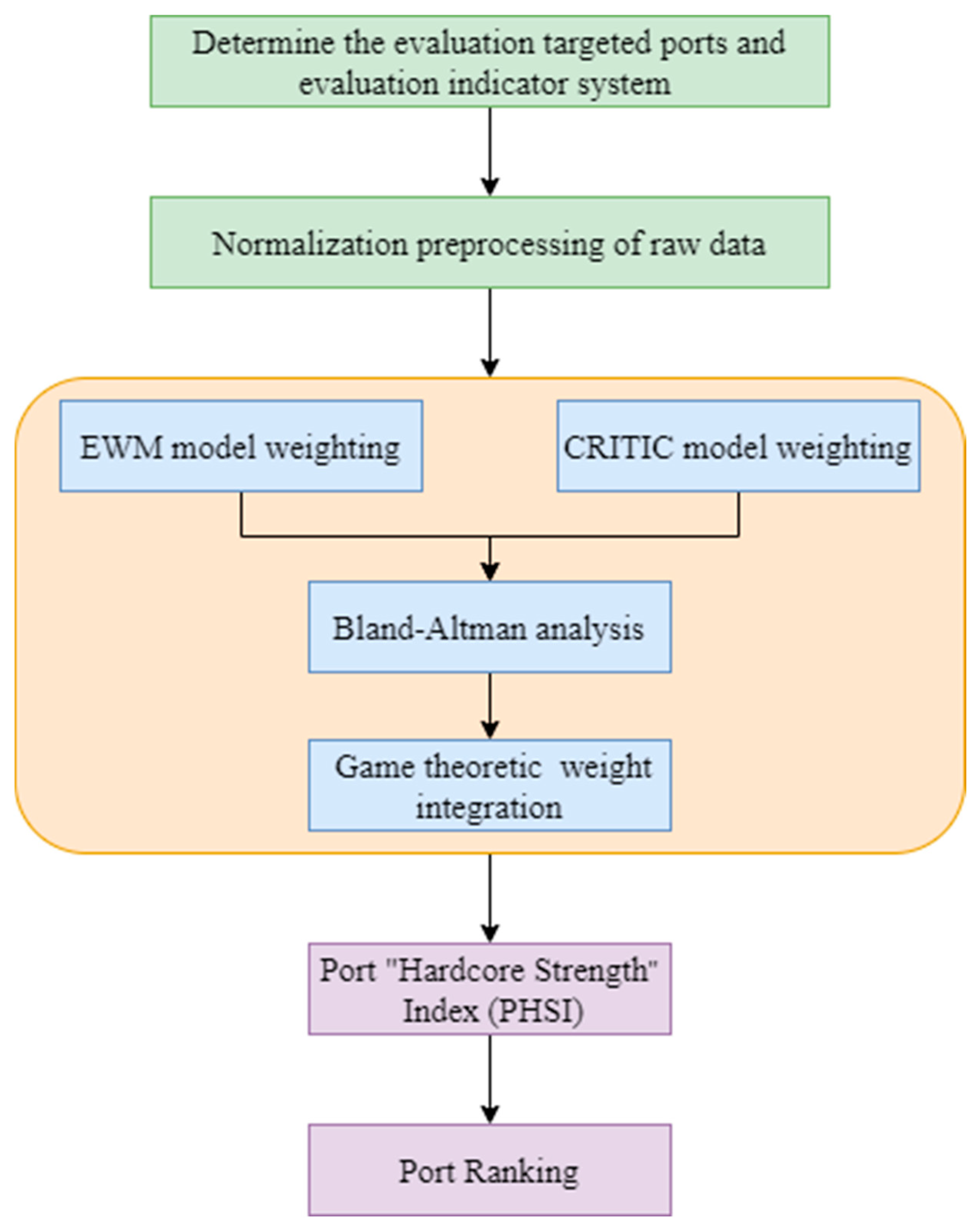
This study proposes a hybrid evaluation framework that systematically combines the Entropy Weight Method (EWM), Criteria Importance Through Intercriteria Correlation (CRITIC), and game theoretic weight integration. The framework is designed to integrate multiple sets of weights by minimizing the deviation among them, using game theory principles. Figure 1 provides a clear illustration of our approach in this study. Through a review of relevant policies and literature, this study thoroughly examines the scientific connotation of “hardcore strength” and constructs a scientific, comprehensive, and rational evaluation index system for assessing the “hardcore strength” of world-class ports.

4.1. Data Preprocessing

The indicators in the evaluation system of port “hardcore strength” constructed in this study involve different dimensions and scales. In order to eliminate the interference caused by different units and orders of magnitude, it is necessary to normalize the original indicators to ensure the comparability of data. The indicators in this study are primarily categorized into two types: Positive indicators: that is, the larger the indicator value, the better the performance. Negative indicators: that is, the smaller the indicator value, the better the performance.
The original matrix X = x i j n × m is constructed for m indicators of n ports, the original matrix is normalized to obtain the normalized matrix Y = y i j n × m , and the normalization formulae for positive and negative indicators are as follows.
1.
For the positive indicator,
y i j + = x i j x j m i n x j m a x x j m i n
2.
For the negative indicator,
y i j = x j m a x x i j x j m a x x j m i n
where y i j + and y i j respectively denote the standardized positive and negative indicators of the j -th j = 1,2 , , m evaluation item for the i -th i = 1,2 , , n port, x i j represents the j -th item indicator of the i -th port in the original matrix. x j m a x and x j m i n respectively represent the maximum and minimum values of the j -th j = 1,2 , , m indicator.

4.2. Objective Weighting Methods

The importance of each indicator to the evaluation results varies, so it is necessary to determine the weight of each indicator. In this paper, Entropy Weight Method (EWM) and Criteria Importance Through Intercriteria Correlation (CRITIC), which are widely used in the evaluation, was used to determine the objective weight of each evaluation indicator. And the game theoretic weight integration method is used to calculate the combination weight.

4.2.1. Entropy Weight Method (EWM) for Indicator Importance Measurement

Entropy Weight Method (EWM) is an objective empowerment method. Information entropy is a reference to the concept of entropy in thermodynamics, which is used to describe the magnitude of in formation of an event. According to the definition of information entropy, the entropy value can be used to judge the discrete degree of a certain indicator. The smaller the entropy value, the smaller the disorder of the indicator, the greater the amount of information contained in the indicator, and the greater the weight of the indicator. The EWM relies on the information itself and is an objective weight method.
Based on the normalized matrix Y = y i j n × m obtained in Section 4.1, the calculation steps for EWM are as follows:
Calculate the weight of the i -th port to all ports under the j -th indicator.
p i j = y i j i = 1 n y i j , i = 1,2 , , n ; j = 1,2 , , m
Calculate the entropy value of the j -th indicator.
e j = k i = 1 n p i j l n p i j , j = 1,2 , , m
where k = 1 l n n > 0 ,   e j 0 .
Calculate the information entropy redundancy.
d j = 1 e j , j = 1,2 , , m
Calculate the weight of each indicator.
ω j = d j j = 1 m d j , j = 1,2 , , m

4.2.2. Criteria Importance Through Intercriteria Correlation (CRITIC) Method for Inter-Indicator Conflict Analysis

The CRITIC method was proposed by Diakoulaki [47], who believed that the weight of the evaluation indicator is determined by two factors. One is the divergence, and the standard deviation is used to reflect the divergence of evaluation indicators. The other is the contradiction. If there is a strong positive correlation between two evaluation indicators, it means that the contradiction of two indicators is low; if there is a strong negative correlation, it means that the contradiction of two indicators is high. The calculation steps of CRITIC are as follows.
Normalization. The calculation process is consistent with Formulas (1) and (2).
Calculate divergence. The standard deviation S j is used to express the divergence of the j -th indicator.
S j = 1 n 1 i = 1 n y i j y ¯ j 2 , i = 1,2 , , n ; j = 1,2 , , m
Calculate contradiction. The contradiction reflects the degree of correlation between different indicators. If it shows a significant positive correlation, contradiction value is small. R j is used to represent the contradiction value between indicator j and the rest indicators.
r j k = i = 1 n y i j y ¯ j y i k y ¯ k i = 1 n y i j y ¯ j 2 i = 1 n y i k y ¯ k 2
R j = i = 1 n 1 r j k
where r j k denotes the correlation coefficient between indicator j and indicator k , using the Pearson correlation coefficient.
Calculate the information-carrying capacity.
C j = S j R j
Calculate the weight of each indicator.
W j = C j J = 1 m C j

4.2.3. Bland–Altman Analysis

To further examine whether an obvious systematic bias exists between the EWM and CRITIC weight vectors before game-theoretic combination, this study employs Bland–Altman analysis. In the present study, it is used to examine whether the two objective weighting methods produce an obvious mean bias or dispersion pattern when applied to the same indicator system. The purpose is to determine whether an obvious systematic bias exists between the two sets of weights, thereby providing an agreement-based diagnostic reference for subsequent integration.
The Bland–Altman analysis involves calculating the mean and the difference between the weights obtained by the two methods and constructing a difference–mean plot. The 95% limits of agreement (LoA) are defined as the mean difference ±1.96 times the standard deviation of the differences, as shown in Equations (13) and (14). According to the classical Bland–Altman framework, if the differences are approximately normally distributed, about 95% of the observations are expected to fall within the LoA. Following reporting recommendations for Bland–Altman analysis, the LoA are reported here to describe the central tendency and dispersion of the differences between the two weight vectors [29]. In this study, the LoA are used as descriptive evidence for judging whether an obvious systematic bias exists between the two sets of weights. When most points lie within the LoA and no obvious systematic trend is observed around the zero-bias line, this suggests that no obvious systematic bias exists between the two weight vectors and provides a diagnostic reference for subsequent game-theoretic integration. The calculation procedure is as follows:
The evaluation indicator system consists of m indicators, with the weights obtained by the EWM denoted as K 1 = p 1 , p 2 , , p m , and those obtained by the CRITIC method denoted as K 2 = q 1 , q 2 , , q m . According to the Bland–Altman analysis procedure, the mean and the difference in the weights assigned by the two methods for each indicator are calculated as follows:
K ¯ i = K 1 + K 2 2 , d i = K 1 K 2 , i = 1,2 , , m
Subsequently, calculate the mean of differences μ d and standard deviation σ d of all the differences. Based on these values, the Limits of Agreement (LoA) are determined as follows:
μ d = 1 m i = 1 m d i , σ d = 1 m 1 i = 1 m d i μ d 2
L o A ( l o w e r l i m i t ) = μ d 1.96 σ d , L o A ( u p p e r l i m i t ) = μ d + 1.96 σ d
For each indicator, the mean and difference in the EWM and CRITIC weights are calculated to examine bias and dispersion between the two weighting results.

4.2.4. Game-Theoretic Integration of Indicator Weights

To integrate multiple sets of weights by minimizing the deviation among them, using game theory principles. It treats Entropy Weight Method (EWM) and the CRITIC method as “player” in a cooperative game and determines the optimal combination that makes their combination as fair as possible. The final indicator weights are determined through the following process:
The weight vector obtained from the EWM is denoted as w 1 , and that from the CRITIC method as w 2 . The linear combination of comprehensive weights is expressed as W:
W = a 1 w 1 T + a 2 w 2 T
where a 1 and a 2 represent the weighting coefficients of the two methods in the combination.
To minimize the deviation among the weight sets, a game-theoretic optimization model is employed to determine the optimal combination coefficients a 1 and a 2 . By minimizing the Euclidean distance between the combined weight vector and the original weight vectors, the resulting optimal weights reflect the most balanced and ideal weighting outcome derived from both EWM and CRITIC methods. The optimization model is formulated as follows:
m i n i = 1 2 a i w i T w k T 2 k = 1,2
According to the differential properties of the matrix, the first-order derivative condition of the above formula optimization is as follows:
i = 1 2 a i w k w i T = w k w k T
The linear equations corresponding to the above formula are as follows:
w 1 w 1 T w 1 w 2 T w 2 w 1 T w 2 w 2 T a 1 a 2 = w 1 w 1 T w 2 w 2 T
Normalize the Linear combination coefficient:
a i = a i i = 1 2 a i
Calculate the combined weight:
W = a 1 w 1 T + a 2 w 2 T
The optimized coefficients reflect the relative contribution of EWM and CRITIC to the final weights, enhancing transparency and reproducibility.

4.3. Port Hardcore Strength Index (PHSI)

Based on the standardized indicator matrix and the combined weights obtained through the game-theoretic integration of the EWM and CRITIC methods, a composite index is constructed to evaluate the overall structural capability of ports. This index is defined as the Port Hardcore Strength Index (PHSI).
The PHSI represents the aggregated performance of each port across all evaluation indicators, reflecting its comprehensive capability in infrastructure efficiency, connectivity, maritime services, innovation capacity, and sustainable governance. By integrating these dimensions into a single metric, the index enables systematic comparison among ports and allows the dynamic evolution of port development capability to be examined over time.
Let x i j denote the standardized value of indicator j for port i, and let Wj represent the combined weight of indicator j. The PHSI for port i is calculated as the weighted sum of all indicators:
P H S I i = j = 1 m W j x i j
where m represents the total number of indicators in the evaluation system.
The resulting index value reflects the integrated structural strength of a port. Higher PHSI values indicate stronger performance across the multiple dimensions of port capability, suggesting a higher level of sustainable development and strategic competitiveness. Conversely, lower values indicate relatively weaker structural capacity in supporting long-term port development.
By applying this index to the sample ports over multiple years, the framework enables both cross-sectional comparison among ports and temporal analysis of their development trajectories, providing a comprehensive basis for evaluating the sustainability-oriented evolution of world-class port systems.

5. Case Study

5.1. Sample Overview and Data Sources

5.1.1. Sample Overview

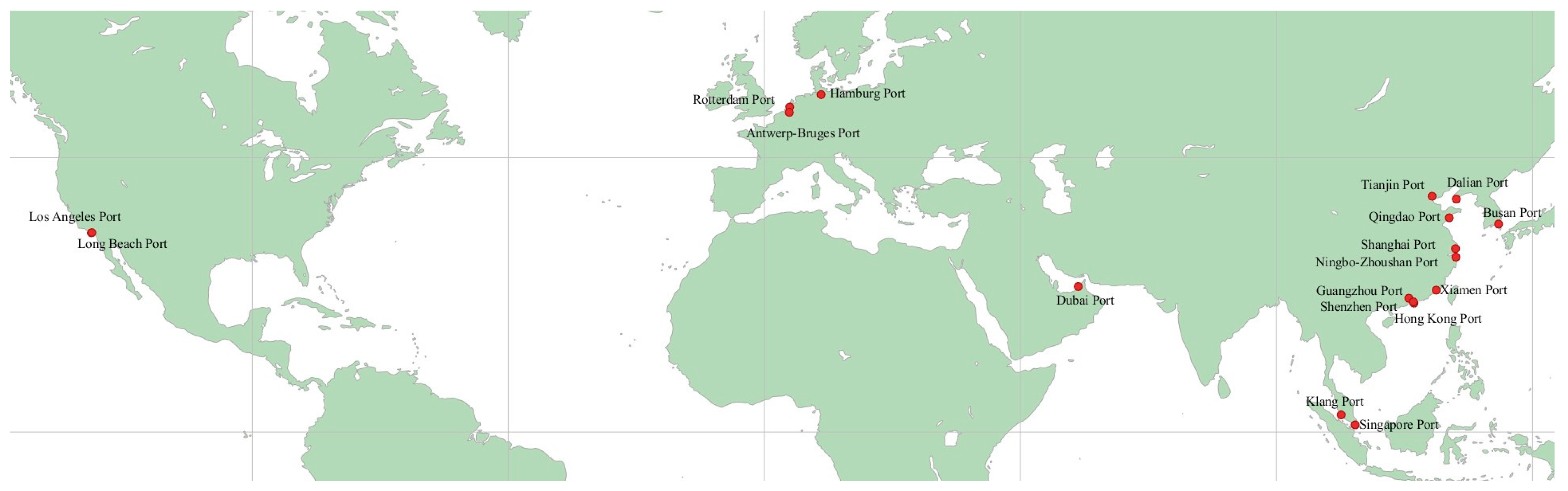
To examine the applicability of the proposed evaluation framework for world-class port hardcore strength, this study selected 18 representative ports as empirical samples: Singapore, Shanghai, Ningbo-Zhoushan, Rotterdam, Hamburg, Hong Kong, Antwerp, Busan, Guangzhou, Dubai, Shenzhen, Tianjin, Qingdao, Los Angeles, Dalian, Xiamen, Long Beach, and Port Klang. is shown in Figure 2. The sample selection was guided by four considerations: global representativeness, regional coverage, functional diversity, and data availability. These ports cover the major port regions of East Asia, Southeast Asia, Europe, the Middle East, and North America, and include both international transshipment hubs, such as Singapore, Hong Kong, Busan, and Dubai, and comprehensive gateway or industrial-supporting ports, such as Rotterdam, Antwerp, Hamburg, Shanghai, and Ningbo-Zhoushan. The sample therefore provides an appropriate empirical basis for capturing the multidimensional structure of world-class port hardcore strength.

5.1.2. Data Sources

The data used in this study comprise both quantitative and qualitative indicators. Quantitative data were collected primarily from official statistical yearbooks and statistical platforms, industry institutions and authoritative databases, as well as public documents released by sample ports and port authorities. The main sources included the China Port Yearbook, the China City Statistical Yearbook, the CNKI China Economic and Social Big Data Research Platform, the official websites of national and regional statistical authorities, the China Shipping Database, the Shanghai Shipping Exchange Data Center, the official website of the China Ports & Harbours Association, and international sources such as UNCTAD and Lloyd’s List. In addition, some port-level operational and governance data were compiled from official port websites, annual reports, and financial reports. Relevant data for the sample ports were collected for the period 2019–2023. To improve the reliability and inter-port comparability of the analysis, preference was given to publicly available data with relatively clear statistical calibers and continuous time-series coverage. For the small number of missing observations in individual years, linear interpolation was applied to preserve the continuity of the panel data. It should also be noted that the indicator system includes both positive and negative indicators. Specifically, B5, B6, B23, B24, and B25 were treated as negative indicators, for which lower values indicate better performance in port hardcore strength. In the subsequent data-processing stage, these negative indicators were reversely transformed according to a unified rule to ensure directional consistency across all indicators.
The qualitative indicators mainly refer to the technological innovation capability score (B18), smart port development score (B21) and the green and low-carbon development score (B22). These three indicators were measured using a structured expert-scoring approach because globally standardized, continuous, and comparable public statistics remain limited for port innovation capability, digital governance, and green transition. A panel of 10 experts participated in the scoring process, with backgrounds drawn from universities/research institutes, port enterprises, and government departments/industry associations. The research team first compiled a unified information package for each sample port based on official port websites, annual reports, ESG or sustainability reports, government or industry documents, and authoritative news materials. On this basis, the experts independently evaluated the sample ports according to predefined scoring criteria.
Specifically, B18 was assessed from four aspects—innovation platform development, technology application and transformation, innovation investment and talent support, and innovation output and demonstration effect. B21 was assessed from four aspects—digital platform integration, intelligent equipment deployment, data interoperability, and digital decision-support capability—whereas B22 was assessed from clean energy application, shore power implementation, energy-efficiency management, and low-carbon governance practices. Each sub-item was rated on a five-point anchored scale, where 1 indicates a weak level of development and 5 indicates a mature and highly demonstrative level. The final scores were obtained by averaging the expert ratings and converting them into the corresponding indicator values.
To strengthen the credibility of these expert-based indicators, additional validity and reliability assessments were conducted. Content validity was supported through literature review, expert consultation, and rubric design, while rating agreement was evaluated using Kendall’s W and the intraclass correlation coefficient (ICC), as shown in Table 3 and Table 4. The results show that the Kendall’s W values for B18, B21, and B22 were 0.764, 0.828, and 0.722, respectively, all significant at the 0.001 level, indicating a relatively high degree of coordination among experts. The corresponding ICC values were 0.738 (95% CI: 0.727–0.924) for B18, 0.751 (95% CI: 0.716–0.918) for B21, and 0.726 (95% CI: 0.612–0.877) for B22, suggesting acceptable-to-good inter-rater reliability for all three indicators. Therefore, B18, B21, and B22 can be regarded as reliable inputs for the subsequent evaluation analysis.

5.2. Indicator Weight Determination and Agreement Tanalysis

Based on the standardized data of 18 sample ports from 2019 to 2023, the objective weights were calculated using the Entropy Weight Method (EWM) and the CRITIC method respectively. The detailed weighting results for the 26 indicators are presented in Table 5.
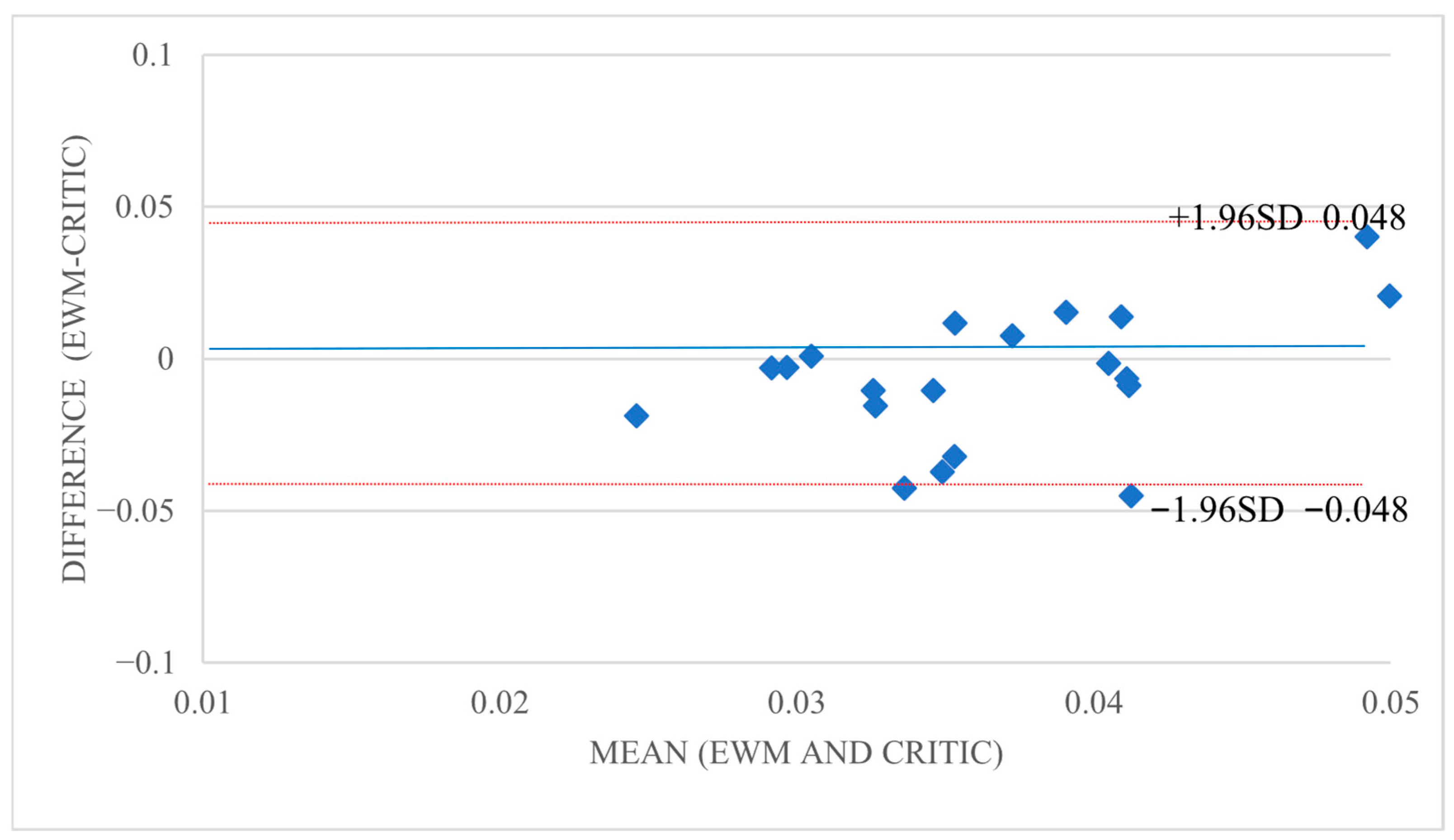
To examine the degree of agreement between these two weighting results, Bland–Altman analysis was conducted as an agreement-based diagnostic test before performing game-theoretic integration. The descriptive results are reported in Table 6, and in the Bland–Altman plot (Figure 3), the x-axis represents the mean of the weights obtained from the two methods, while the y-axis shows the differences between them. The central line indicates the mean difference, and the upper and lower lines indicate the 95% limits of agreement. The mean difference is close to zero, and the estimated 95% LoA are [−0.048, 0.048]. Most points are distributed around the zero-bias line and fall within this interval, suggesting that no obvious systematic bias is observed between the EWM and CRITIC weight vectors. This result provides agreement-based diagnostic support for their subsequent game-theoretic combination.
To minimize the bias of any single objective weighting method, a game theory combination weighting model was employed to determine the final weights. The final optimal weights for the 25 indicators are presented in Table 7.
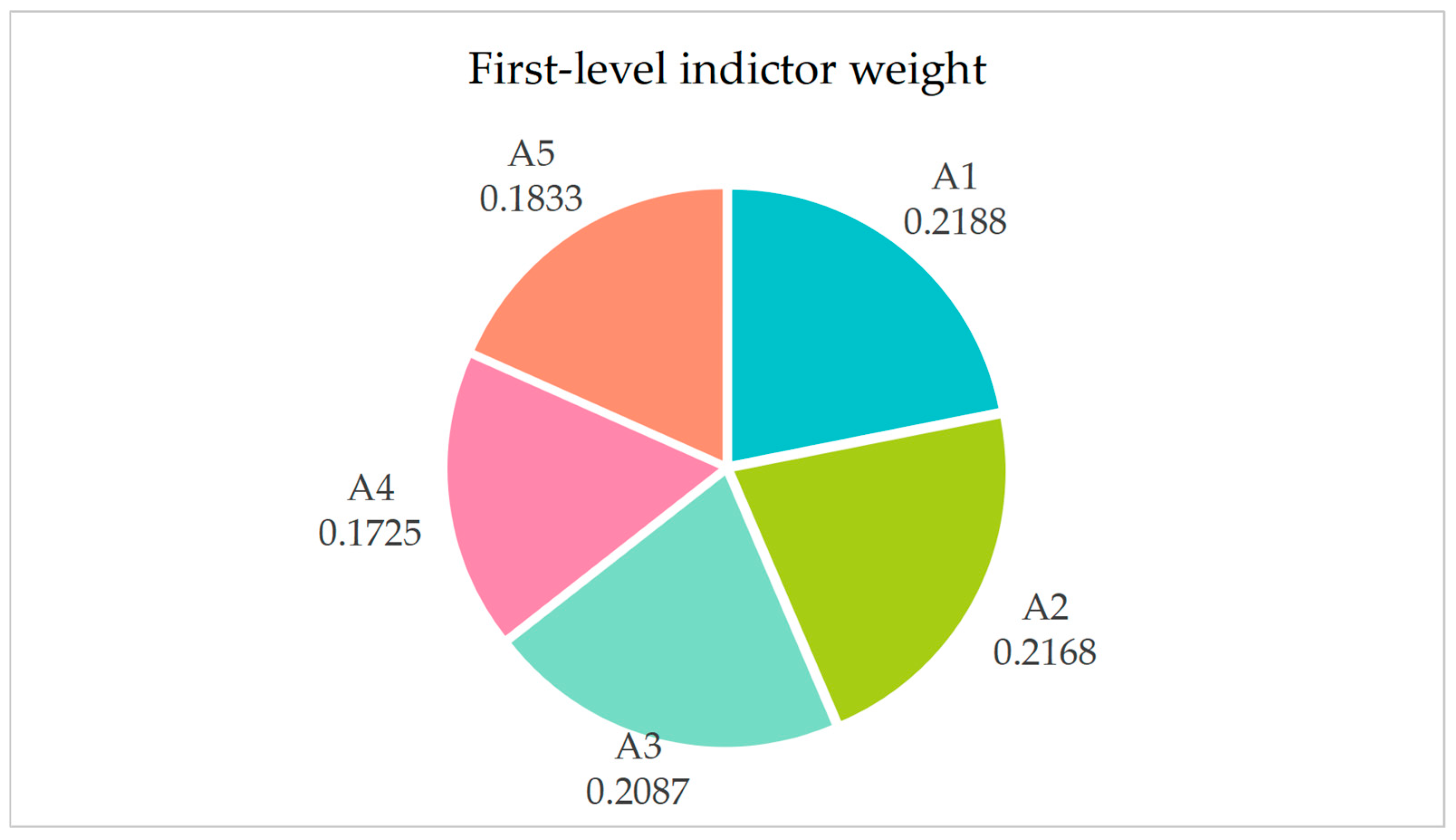
The weighting results indicate that the EWM and CRITIC methods generated broadly similar, though not identical, distributions of indicator importance, and the game-theoretic combination weighting further balanced the two sets of objective information. At the first-level dimension, infrastructure efficiency and logistics capability (A1, 0.2188) and connectivity and regional integration (A2, 0.2168) received the highest combined weights, followed by maritime services and industrial clustering (A3, 0.2087). By comparison, sustainable governance and green port development (A5, 0.1833) and strategic leadership and innovation capability (A4, 0.1725) accounted for relatively smaller shares. This suggests that the proposed framework places slightly greater emphasis on ports’ foundational support capacity, logistics efficiency, and network embeddedness, while still incorporating innovation and sustainability as indispensable components of hardcore strength. To visualize the first-level weighting structure more intuitively, a pie chart was further plotted, as shown in Figure 4.
At the second-level indicator level, relatively higher combined weights were assigned to sea–rail intermodal volume (B9, 0.0548), energy throughput (B17, 0.0501) and schedule reliability of mainline liner services (B16, 0.0497) These results imply that the framework gives greater importance to indicators reflecting multimodal transport organization, strategic resource support and service quality. By contrast, indicators such as foreign trade container throughput (B8, 0.0403), container yard area (B2, 0.0397), and CO2 emissions per unit throughput (B25, 0.0390) received moderate weights, indicating that conventional operational and infrastructural factors remain important but do not dominate the evaluation structure.
A comparison of the two objective weighting methods further reveals their complementary characteristics. EWM tends to assign relatively larger weights to indicators with greater dispersion, whereas CRITIC places more emphasis on indicators with stronger contrast and lower redundancy. The game-theoretic combination weighting therefore helps reduce the bias associated with either method alone and provides a more balanced representation of the multidimensional structure of world-class port hardcore strength.

5.3. Analysis of Evaluation Results

5.3.1. Overall Evaluation Result

Based on the final game-theoretic weights, the Port Hardcore Strength Index (PHSI) of the 18 sample ports was calculated for the period 2019–2023 (Table 8). The results show a relatively stable overall ranking structure, although the index values and positions of several ports changed moderately over time. Singapore Port remained the top-ranked port throughout the entire period, with its index increasing from 0.6237 in 2019 to 0.6406 in 2023. Shanghai Port consistently ranked second, and its index rose from 0.5637 to 0.5945 over the same period. Ningbo Zhoushan Port ranked fifth in 2019 and 2020, then moved up to fourth in 2021 and third in both 2022 and 2023, with its index increasing from 0.5182 to 0.5648. Rotterdam Port remained among the leading ports, ranking third from 2019 to 2021 and fourth in 2022 and 2023.
A second group of ports, including Hong Kong Port, Guangzhou Port, and Dubai Port, generally occupied the middle-upper positions. Hong Kong Port ranked fourth in 2019 and 2020 and fifth from 2021 to 2023, while Guangzhou Port remained seventh from 2019 to 2021 and rose to sixth in 2022 and 2023. Dubai Port stayed in sixth place from 2019 to 2021 and then declined slightly to seventh in 2022 and 2023. By contrast, Hamburg Port, Tianjin Port, and Qingdao Port formed a middle group with relatively stable rankings. Hamburg Port ranked eighth in 2019, ninth in 2020, and tenth from 2021 to 2023. Tianjin Port fluctuated between eighth and ninth place, while Qingdao Port remained between eighth and tenth.
The lower-ranked group mainly included Los Angeles Port, Dalian Port, Xiamen Port, Long Beach Port, and Klang Port. Los Angeles Port ranked thirteenth in 2019–2021 and fourteenth in 2022–2023. Dalian Port remained in the lower positions, ranking sixteenth in 2019, seventeenth from 2020 to 2022, and seventeenth again in 2023. Xiamen Port improved slightly from seventeenth in 2019 to fourteenth in 2021, before ranking fifteenth in 2022 and 2023. Long Beach Port ranked fifteenth from 2019 to 2021 and sixteenth in 2022 and 2023. Klang Port remained in last place throughout the whole period, with its index staying below 0.38.
From a temporal perspective, several Chinese ports showed a clear upward trend in their comprehensive indices. For example, Tianjin Port increased from 0.4404 in 2019 to 0.4734 in 2023, and Guangzhou Port rose from 0.4659 to 0.5003. Qingdao Port also improved from 0.4320 to 0.4637, although its ranking remained broadly stable. By contrast, some traditional international ports experienced relatively limited growth or slight decline in the later years. Hong Kong Port decreased from 0.5329 in 2019 to 0.5103 in 2023, and Dubai Port fell from 0.4920 in 2019 to 0.4834 in 2023. Overall, the results indicate that the hardcore strength of world-class ports exhibits clear inter-port differentiation and a relatively stable hierarchical structure, while the relative positions of some ports have gradually adjusted during 2019–2023.

5.3.2. Multi-Dimensonal Comparison Analysis

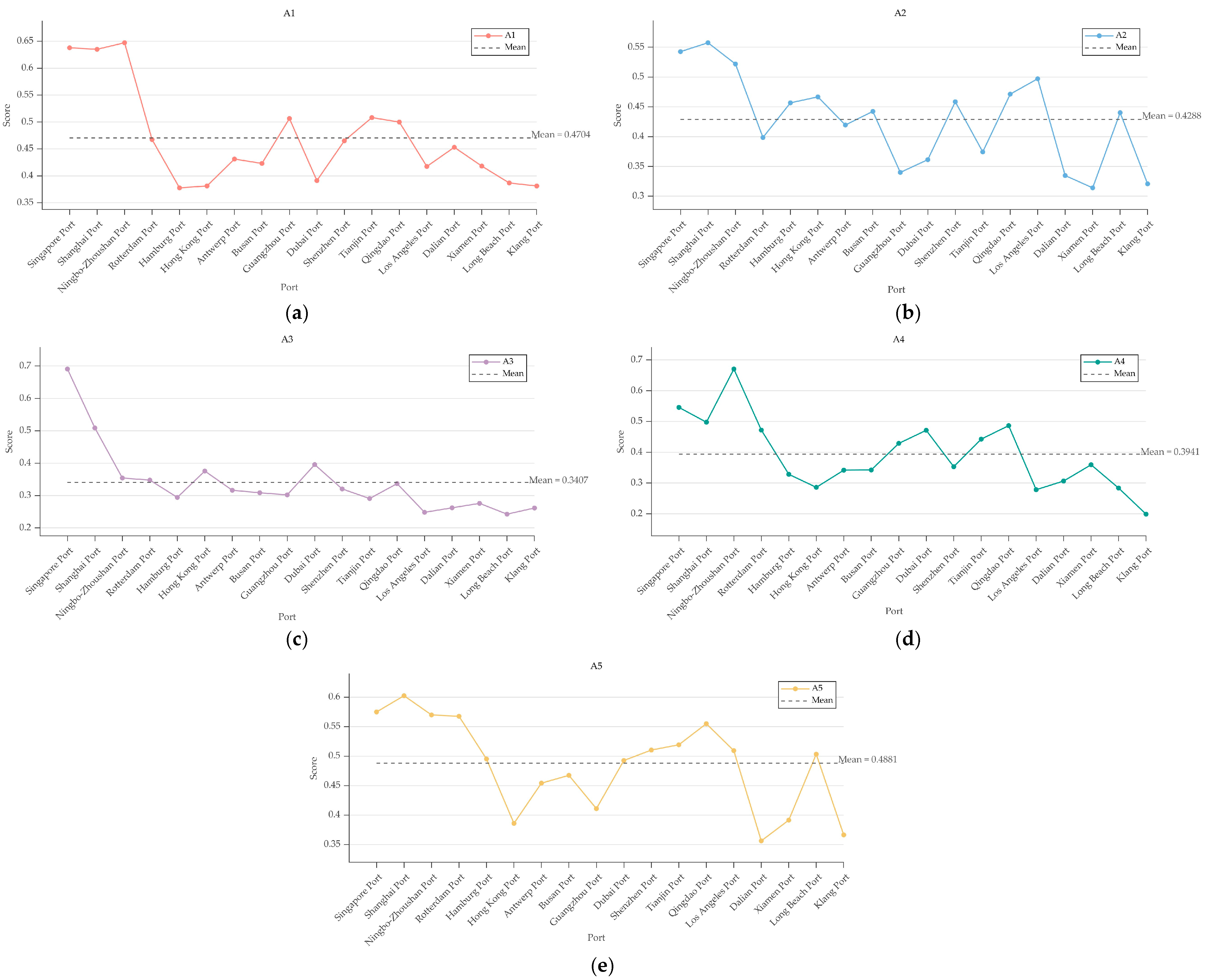
To further identify the structural strengths and weaknesses of the sample ports, a multi-dimensional comparison was conducted based on the five-dimensional average scores over 2019–2023 (Figure 5).
For infrastructure efficiency and logistics capability (A1), Ningbo Zhoushan Port (0.6472) ranked first, followed by Singapore Port (0.6378) and Shanghai Port (0.6349). These three ports showed a clear advantage over the rest of the sample, reflecting strong performance in infrastructure support, cargo organization, and operational efficiency. Guangzhou Port (0.5064), Tianjin Port (0.5082), and Qingdao Port (0.4999) also performed relatively well, whereas Hamburg Port (0.3777), Hong Kong Port (0.3812), Long Beach Port (0.3868), and Klang Port (0.3812) remained at relatively low levels.
In connectivity and regional integration (A2), Shanghai Port (0.5575) and Singapore Port (0.5425) again occupied the leading positions, followed by Ningbo Zhoushan Port (0.5218). Los Angeles Port (0.4971) also performed strongly in this dimension, indicating its continuing importance in global liner connectivity and hinterland linkage. By contrast, Guangzhou Port (0.3399), Dalian Port (0.3347), Xiamen Port (0.3141), and Klang Port (0.3207) were located in the lower range of A2, suggesting relatively weaker integration of external shipping networks and inland support systems.
For maritime services and industrial clustering (A3), Singapore Port (0.6908) displayed an overwhelming advantage, far exceeding all other ports. Shanghai Port (0.5087) ranked second, while Dubai Port (0.3956) and Hong Kong Port (0.3757) also showed relatively strong performance. This pattern suggests that A3 is highly discriminative and mainly reflects the extent to which ports have developed advanced maritime services and service-oriented industrial ecosystems beyond basic cargo-handling functions. In contrast, Los Angeles Port (0.2482), Long Beach Port (0.2426), Dalian Port (0.2621), and Klang Port (0.2615) were among the weakest ports in this dimension.
In strategic leadership and innovation capability (A4), Ningbo Zhoushan Port (0.6704) ranked first by a substantial margin, followed by Singapore Port (0.5458) and Shanghai Port (0.4976). Qingdao Port (0.4864), Rotterdam Port (0.4719), and Dubai Port (0.4713) also performed well, suggesting relatively strong capabilities in strategic resource support, innovation input, and technological upgrading. By contrast, Klang Port (0.1989), Los Angeles Port (0.2783), and Long Beach Port (0.2837) showed relatively weak performance in this dimension.
For sustainable governance and green port development (A5), Shanghai Port (0.6025) ranked first, followed by Singapore Port (0.5750), Ningbo Zhoushan Port (0.5699), Rotterdam Port (0.5676), and Qingdao Port (0.5550). Tianjin Port (0.5192), Shenzhen Port (0.5103), and Long Beach Port (0.5033) also performed relatively well. By contrast, Dalian Port (0.3562), Klang Port (0.3664), Hong Kong Port (0.3898), and Xiamen Port (0.3913) remained at the bottom of this dimension. These results indicate that smart governance, green transition, and safety- and efficiency-related management practices have become an important source of inter-port differentiation.
Taken together, the dimension-specific results reveal marked differences in the internal structure of port hardcore strength. Singapore Port and Shanghai Port showed the most balanced and consistently strong profiles across all five dimensions, which helps explain their stable top-two positions in the comprehensive ranking. Ningbo Zhoushan Port stood out particularly in A1 and A4, indicating strong infrastructure support and strategic innovation capacity. Shanghai Port performed especially well in A2, A3, and A5, reflecting its more comprehensive and balanced development pattern. Dubai Port showed a more service- and innovation-oriented profile, with relatively stronger performance in A3 and A4 than in A1 and A2. By contrast, Dalian Port, Xiamen Port, and Klang Port remained weak in most dimensions, suggesting limited multidimensional integration. Overall, these results confirm that world-class port hardcore strength is a multidimensional construct, and that differences in internal capability composition are an important source of divergence in overall port performance.

5.4. Comparison with Entropy–TOPSIS Method

To further examine the robustness of the evaluation framework proposed in this study, its results were compared with those obtained from the Entropy-TOPSIS method. As an objective-weighting and relative-closeness approach widely used in port evaluation research, Entropy-TOPSIS provides a meaningful benchmark for comparison. The comparison was conducted on an annual basis for the period 2019–2023, as shown in Table 9.
The comparison results show a high degree of consistency in the overall ranking patterns produced by the two methods. In particular, the ports at the top and bottom of the ranking remained generally stable under both methods, indicating that the basic pattern of differentiation in port hardcore strength was not substantially altered by the choice of method. This suggests that the overall distribution of world-class port hardcore strength is relatively robust. At the same time, however, some differences still appeared among ports in the middle of the ranking, and such differences became more evident in years when the comprehensive scores were relatively close. This implies that the proposed method and Entropy-TOPSIS still differ in their sensitivity to multidimensional capability structures.
More specifically, Entropy-TOPSIS determines the ranking of ports according to their relative closeness to the positive and negative ideal solutions, whereas the method proposed in this study places greater emphasis on the balanced integration of weights and the overall multidimensional capability profile of ports. As a result, ports with relatively balanced performance across multiple dimensions tend to obtain more stable ranking positions under the proposed framework, while ports characterized by coexisting strengths and weaknesses are more likely to show ranking fluctuations under Entropy-TOPSIS.
Overall, the comparison with Entropy-TOPSIS further supports the robustness of the evaluation framework proposed in this study. Although the two methods exhibit a high degree of consistency in the overall ranking structure, the local differences observed among middle-ranked ports indicate that method choice still matters when assessing the internal capability composition of world-class port hardcore strength.

5.5. Sensitivity Analysis

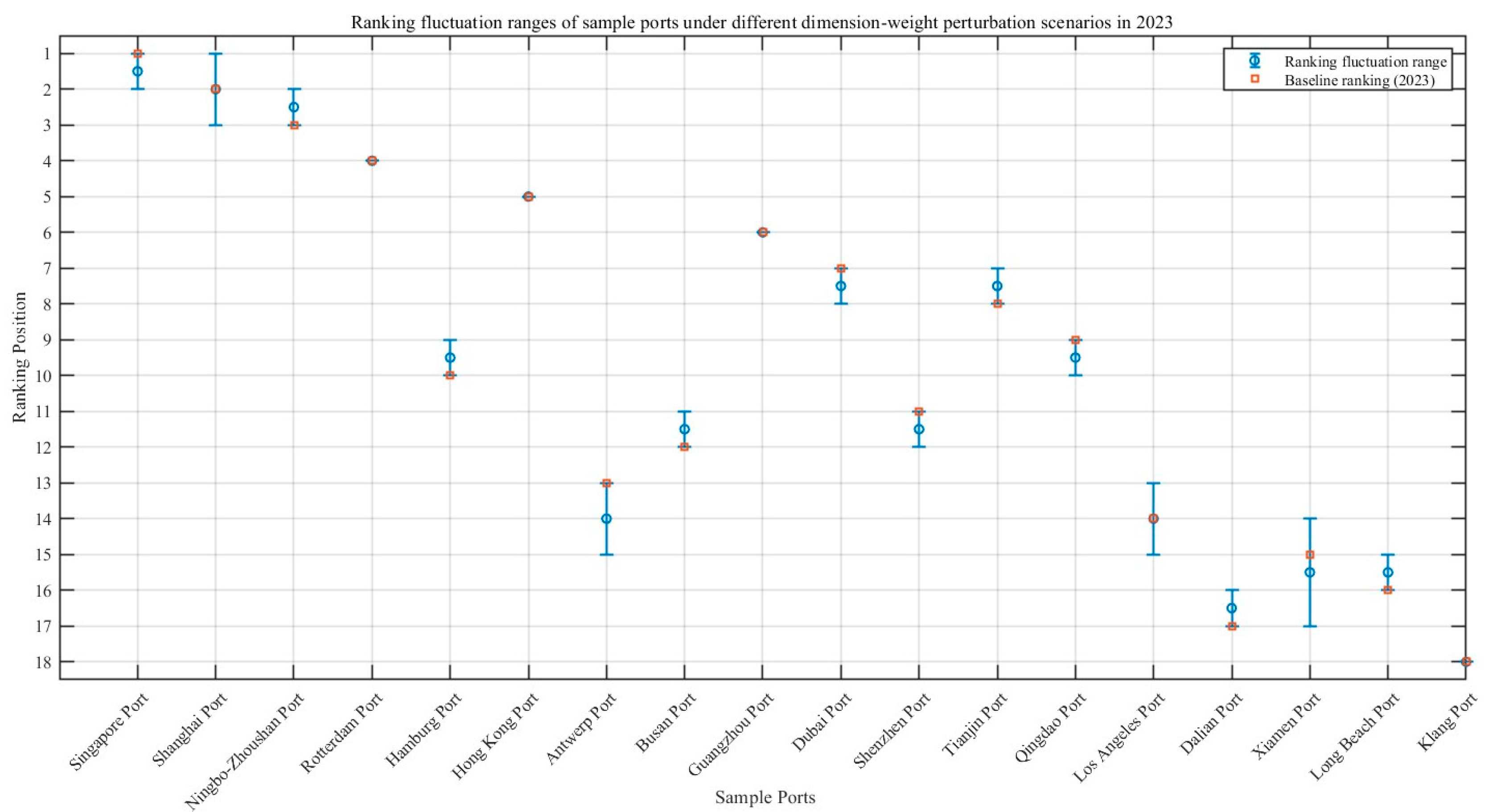
To further examine the robustness of the proposed evaluation framework, a sensitivity analysis was conducted using the 2023 dataset by perturbing the weights of the five first-level dimensions (A1–A5). In each scenario, the weight of one dimension was increased or decreased by 50%, while the remaining weights were proportionally adjusted to maintain the normalization constraint. Based on the perturbed weight sets, the PHSI values and ranking results of the 18 sample ports were recalculated. The detailed ranking changes are reported in Table 10, and the overall fluctuation ranges are shown in Figure 6.
The results indicate that the overall ranking pattern remained highly stable under all perturbation scenarios. Singapore Port, Shanghai Port, Ningbo-Zhoushan Port, and Rotterdam Port consistently remained within the top four, with only limited positional exchanges among the top three. Hong Kong Port and Guangzhou Port remained unchangedat fifth and sixth place, respectively. This suggests that the leading group was only marginally affected even under substantial weight perturbations.
Ranking changes were mainly concentrated among middle- and lower-middle-ranked ports, where performance gaps were relatively small. Hamburg Port, Tianjin Port, Qingdao Port, Shenzhen Port, Busan Port, and Antwerp Port showed only minor fluctuations, generally within adjacent positions. Similarly, Los Angeles Port, Dalian Port, Xiamen Port, and Long Beach Port remained within their original ranking tiers, although Xiamen Port exhibited a relatively wider fluctuation range. This indicates that ports with similar comprehensive performance were more likely to exchange positions when dimension weights were substantially adjusted. Nevertheless, the overall ranking structure remained stable, and the maximum observed rank change was limited.
Across dimensions, perturbations in infrastructure efficiency and logistics capability (A1) and maritime services and industrial clustering (A3) had relatively stronger effects on the leading ports, indicating that infrastructure efficiency, logistics capability, maritime services, and industrial clustering played a more prominent role in differentiating top-ranked ports. By contrast, changes in connectivity and regional integration (A2) and strategic leadership and innovation capability (A4) mainly affected the middle-ranked group, while sustainable governance and green port development (A5) had a relatively stronger influence on several lower-middle-ranked ports, particularly Xiamen Port. These results suggest that different capability domains contribute differently to ranking sensitivity, but none of them fundamentally altered the overall competitive hierarchy.
Overall, the sensitivity analysis confirms the robustness of the PHSI-based evaluation results. Even under the relatively extreme perturbation range of ±50% applied to the five first-level dimensions, the overall ranking pattern of the sample ports remained broadly unchanged, with only minor local adjustments among ports with similar comprehensive performance. Taken together, the evidence from Table 10 and Figure 6 indicates that the proposed framework provides a stable and reliable basis for assessing the hardcore strength of world-class ports.

6. Conclusions and Implications

From a sustainability-oriented perspective, this study constructed an evaluation framework for the “hardcore strength” of world-class ports and applied it to 18 representative global ports during 2019–2023. Drawing on spatial development theory, global value chain theory, growth pole theory, and resilience theory, port hardcore strength is conceptualized as an integrated capability combining structural, strategic, and governance dimensions, rather than a single performance outcome. On this basis, a five-dimensional indicator system was developed, covering infrastructure efficiency and logistics capability, connectivity and regional integration, maritime services and industrial clustering, strategic leadership and innovation capability, and sustainable governance and green port development. Methodologically, the study combines the EWM and CRITIC, introduces Bland–Altman analysis to examine whether the two objective weighting results exhibit obvious systematic bias, and then adopts game-theoretic integration to derive the final weights for measuring the Port Hardcore Strength Index (PHSI).
The results show that the overall ranking structure of port hardcore strength remained broadly stable during 2019–2023. Singapore Port and Shanghai Port consistently ranked first and second, indicating strong and relatively balanced advantages across the five dimensions. Ningbo-Zhoushan Port showed a clear upward trend, reflecting considerable development momentum, while Rotterdam Port remained in the leading group, demonstrating its sustained strengths in infrastructure support, resource allocation, and governance capacity. By contrast, several lower-ranked ports continued to face persistent shortboards across multiple dimensions, and their overall competitiveness improved only to a limited extent.
Further analysis indicates that the hardcore strength of world-class ports is inherently multidimensional. Differences in comprehensive performance depend not only on scale, but more importantly on the coordination among the five dimensions. Leading ports generally do not rely on a single dominant advantage; instead, they perform in a more balanced way across infrastructure efficiency, network connectivity, maritime service capability, strategic innovation, and governance performance. Singapore Port and Shanghai Port represent this coordinated development pattern most clearly. Ningbo-Zhoushan Port performs particularly well in infrastructure efficiency and strategic capability, but still has room for improvement in service-oriented functions and governance-related dimensions. This suggests that the core gap among world-class ports lies not only in how large they are, but also in how coordinated their capability structures are.
The sensitivity analysis further suggests that the proposed framework has acceptable stability in identifying the overall stratification and structural differences among ports. Although some middle-ranked ports showed moderate positional changes under alternative methods or weight perturbations, the overall grouping of leading, middle, and lower-ranked ports remained largely unchanged. This indicates that the evaluation results are not driven by any single indicator or dimension, but reflect the combined effect of multidimensional capability configurations.
Based on these findings, differentiated development paths are needed for world-class ports. For leading ports such as Singapore Port and Shanghai Port, the priority should be to consolidate their comprehensive advantages in high-end maritime services, resource integration, and governance coordination, thereby further strengthening their global allocation capacity and overall leadership. For ports such as Ningbo-Zhoushan Port, which are strong in infrastructure and operational performance, the key task is to transform scale advantages into stronger service and governance advantages by promoting modern maritime services, extending industrial chains, and improving governance capacity. For middle-ranked ports such as Guangzhou Port, Qingdao Port, Tianjin Port, and Shenzhen Port, greater emphasis should be placed on narrowing the gap between stronger and weaker dimensions, particularly in route connectivity, maritime services, innovation support, and governance efficiency. For ports with more obvious structural shortboards, such as Dalian Port, Xiamen Port, Long Beach Port, and Port Klang, policy efforts should focus first on identifying and addressing the most binding constraints rather than pursuing across-the-board improvement.
This study still has some limitations. Some governance- and innovation-related indicators remain difficult to measure through fully standardized international statistics, and the sample scope and time span may be further extended in future research. In addition, this study adopts a composite evaluation framework aimed at assessing port hardcore strength under real-world disturbances, rather than establishing a strict causal identification model. Therefore, the observed changes in port scores during 2019–2023 should not be interpreted as purely endogenous capability changes, since the effects of external shocks such as the COVID-19 pandemic, shipping network adjustments, and supply-chain disruptions cannot be fully separated. Moreover, the unified weight structure used in this study improves interannual comparability, but it may not fully capture possible year-specific shifts in the relative importance of different dimensions under exceptional global conditions. Subsequent studies may incorporate more ports, longer time series, and richer comparative evidence to further deepen the understanding of the structural characteristics and evolution of world-class port hardcore strength.

Author Contributions

Conceptualization, X.J., Z.H. and P.Z.; methodology, X.J., M.G., Z.H., G.L. and P.Z.; software, X.J., X.L. and P.Z.; validation, Z.H., G.L. and P.Z.; formal analysis, X.J., X.L., W.S., Z.H. and P.Z.; investigation, X.J., Z.H., G.L. and W.S.; resources, P.Z.; data curation, X.J., X.L. and W.S.; writing—original draft preparation, X.J., Z.H. and P.Z.; writing—review and editing, M.G., Z.H., M.G. and P.Z.; visualization, X.J.; supervision, Z.H. and P.Z.; project administration, P.Z.; funding acquisition, P.Z. All authors have read and agreed to the published version of the manuscript.

Funding

This research was supported in part by the National Natural Science Foundation of China (52272334, 61074142), Key R&D Program of Zhejiang Province (2024C01180), Ningbo Internation-al Science and Technology Cooperation Project (2023H020), EC H2020 Project (690713) and National Key Research and Development Program of China (2017YFE0194700).

Data Availability Statement

Data are contained within the article.

Acknowledgments

We would like to thank the National “111” Centre on Safety and Intelligent Operation of Sea Bridges (D21013), the Zhejiang 2011 Collaborative Innovation Center for Port Economy, and the Donghai Academy of Ningbo University for the financial support in publishing this paper. The authors would like to thank the K.C. Wong Magna Fund in Ningbo University for sponsorship.

Conflicts of Interest

The authors declare no conflicts of interest.

References

  1. Kalkschmied, K.; Stricker, P. Critical infrastructure, critical trade-offs: The growth effects of Chinese investments in European ports. Transp. Res. Part A Policy Pract. 2026, 203, 104704. [Google Scholar] [CrossRef]
  2. Ma, Q.; Jia, P.; She, X.; Haralambides, H.; Kuang, H. Port integration and regional economic development: Lessons from China. Transp. Policy 2021, 110, 430–439. [Google Scholar] [CrossRef]
  3. Zhou, Y.; Kundu, T.; Goh, M.; Sheu, J.-B. Beyond throughput: Incorporating air transport network topology in airport performance measurement. J. Air Transp. Manag. 2023, 112, 102458. [Google Scholar] [CrossRef]
  4. Xi, J. Xi Jinping inspects Zhejiang. Zhejiang Econ. 2020, 4, 5. [Google Scholar]
  5. Ascencio, L.M.; Arroyo, P.; González-Ramírez, R.G. From best practices to port competitiveness: An assessment of Latin America and Caribbean port logistics communities. Case Stud. Transp. Policy 2025, 22, 101589. [Google Scholar] [CrossRef]
  6. Wang, L.; Zhou, Z.; Yang, Y.; Wu, J. Green efficiency evaluation and improvement of Chinese ports: A cross-efficiency model. Transp. Res. Part D Transp. Environ. 2020, 88, 102590. [Google Scholar] [CrossRef]
  7. United Nations Conference on Trade and Development. Review of Maritime Transport 2023: Towards a Green and Just Transition; Stylus Publishing, LLC: Sterling, VA, USA, 2023. [Google Scholar]
  8. Liu, J.; Wu, J.; Gong, Y. Maritime supply chain resilience: From concept to practice. Comput. Ind. Eng. 2023, 182, 109366. [Google Scholar] [CrossRef]
  9. Nguyen, P.N.; Pham, T.Y.; Huong, G.N.T.; Do, C.H. An integrated framework for evaluating smart and sustainable port competitiveness: Evidence from Vietnam. Case Stud. Transp. Policy 2025, 23, 101670. [Google Scholar] [CrossRef]
  10. Wan, C.; Zhang, D.; Yan, X.; Yang, Z. A novel model for the quantitative evaluation of green port development—A case study of major ports in China. Transp. Res. Part D Transp. Environ. 2018, 61, 431–443. [Google Scholar] [CrossRef]
  11. Freitas, D.; Gervásio, H. The challenge of benchmarking carbon emissions in maritime ports. Environ. Pollut. 2024, 363, 125170. [Google Scholar] [CrossRef]
  12. Hua, C.; Chen, J.; Wan, Z.; Xu, L.; Bai, Y.; Zheng, T.; Fei, Y. Evaluation and governance of green development practice of port: A sea port case of China. J. Clean. Prod. 2020, 249, 119434. [Google Scholar] [CrossRef]
  13. Ye, C.; Cai, T.; Zhang, C.; Cao, W. Sustainability-based evolution of port hinterlands: Green performance and spatial impacts in the Bohai Rim. Ecol. Indic. 2025, 178, 114095. [Google Scholar] [CrossRef]
  14. Wan, C.; Yuan, J.; Cao, D.; Wang, T.; Ng, A.K. A fuzzy evidential reasoning-based model for evaluating resilience of ports to typhoons. Transp. Res. Part D Transp. Environ. 2024, 133, 104228. [Google Scholar] [CrossRef]
  15. Wu, Y.; Yang, J.; Tu, M.; Naseem, M.H. Comprehensive Assessment of Port Resilience: A Three-Stage Cycle Approach. Reg. Stud. Mar. Sci. 2025, 86, 104170. [Google Scholar] [CrossRef]
  16. Qin, Y.; Guo, J.; Liang, M.; Feng, T. Resilience characteristics of port nodes from the perspective of shipping network: Empirical evidence from China. Ocean Coast. Manag. 2023, 237, 106531. [Google Scholar] [CrossRef]
  17. Bedoya-Maya, F.; Beckers, J.; Cant, J.; Martínez-Moya, J.; van Hassel, E.; Vanelslander, T. Container port competitiveness amid disruptions: Insights from the European maritime network during the Red Sea crisis. J. Transp. Geogr. 2025, 128, 104304. [Google Scholar] [CrossRef]
  18. Song, Z.-Y.; Pettit, S.; Wang, Y.; Ye, G.; Lin, C.-W. Performance evaluation of major world container ports in the post-pandemic era: The 6th generation ports model with smart ports. Transp. Policy 2025, 179, 103950. [Google Scholar] [CrossRef]
  19. Liu, J.; Qi, Y.; Lyu, W. Port resilience in the post-COVID-19 era. Ocean Coast. Manag. 2023, 238, 106565. [Google Scholar] [CrossRef]
  20. Meng, H.; Xu, H.; Cui, Y.; Liu, J. International container intermodal competitiveness: An empirical study from Chinese hub ports. Ocean Coast. Manag. 2024, 254, 107178. [Google Scholar] [CrossRef]
  21. Liu, S.; Yu, B. Enhancing port performance and competitiveness through innovation, resilience, and strategic integration: A case study of Ningbo-Zhoushan Port. Res. Transp. Bus. Manag. 2025, 60, 101320. [Google Scholar] [CrossRef]
  22. Patel, H.; Chang, C.-T. Beyond throughput: Evaluating maritime port competitiveness using MABAC and Bayesian methods. Comput. Ind. Eng. 2024, 192, 110248. [Google Scholar] [CrossRef]
  23. Singh, S.; Emrouznejad, A.; Pratap, S. Achieving net zero: Enhancing maritime port efficiency through multi-objective integrated DEA-MORCOS. Case Stud. Transp. Policy 2025, 22, 101597. [Google Scholar] [CrossRef]
  24. Yalçın, G.C.; Kara, K.; Gürol, P.; Simic, V.; Pamucar, D. Enhancing operational efficiency and promoting best practices in the maritime industry: A decision support model for port authority performance evaluation. Res. Transp. Bus. Manag. 2025, 62, 101450. [Google Scholar] [CrossRef]
  25. Senthil, S.; Srirangacharyulu, B.; Ramesh, A. A robust hybrid multi-criteria decision making methodology for contractor evaluation and selection in third-party reverse logistics. Expert Syst. Appl. 2014, 41, 50–58. [Google Scholar] [CrossRef]
  26. Karczmarczyk, A.; Wątróbski, J.; Bączkiewicz, A.; Mróz-Malik, O.; Drożdż, W. New robust multi-criteria decision-making method for wind farm location problems. Appl. Energy 2025, 398, 126401. [Google Scholar] [CrossRef]
  27. Jangid, P.; Kumar, T.; Dhanuk, K.; Sharma, M. A stability and robustness analysis of multi-criteria decision methods in logistics. Decis. Anal. J. 2025, 16, 100618. [Google Scholar] [CrossRef]
  28. Bland, J.M.; Altman, D.G. Statistical methods for assessing agreement between two methods of clinical measurement. Lancet 1986, 327, 307–310. [Google Scholar] [CrossRef]
  29. Gerke, O. Reporting standards for a Bland–Altman agreement analysis: A review of methodological reviews. Diagnostics 2020, 10, 334. [Google Scholar] [CrossRef]
  30. Mansournia, M.A.; Waters, R.; Nazemipour, M.; Bland, M.; Altman, D.G. Bland-Altman methods for comparing methods of measurement and response to criticisms. Glob. Epidemiol. 2021, 3, 100045. [Google Scholar] [CrossRef]
  31. Van Til, J.; Groothuis-Oudshoorn, C.; Lieferink, M.; Dolan, J.; Goetghebeur, M. Does technique matter; a pilot study exploring weighting techniques for a multi-criteria decision support framework. Cost Eff. Resour. Alloc. 2014, 12, 22. [Google Scholar] [CrossRef] [PubMed]
  32. Bertolini, L. Spatial development patterns and public transport: The application of an analytical model in the Netherlands. Plan. Pract. Res. 1999, 14, 199–210. [Google Scholar] [CrossRef]
  33. Gereffi, G.; Korzeniewicz, M. Commodity Chains and Global Capitalism; Bloomsbury Publishing: New York, NY, USA, 1993. [Google Scholar]
  34. Perroux, F. Economic space: Theory and applications. Q. J. Econ. 1950, 64, 89–104. [Google Scholar] [CrossRef]
  35. Holling, C.S. Understanding the complexity of economic, ecological, and social systems. Ecosystems 2001, 4, 390–405. [Google Scholar] [CrossRef]
  36. Wang, D.; Wen, Y. Construction of a port logistics competitiveness evaluation model under the background of free trade zones. Mar. Econ. 2018, 8, 40–45. [Google Scholar]
  37. Wang, J. Research on Evaluation of Port Logistics Competitiveness in Bohai Rim Region. Master’s Thesis, Shandong University of Finance and Economics, Jinan, China, 2022. [Google Scholar]
  38. Rodrigo González, A.; González-Cancelas, N.; Molina Serrano, B.; Orive, A.C. Preparation of a Smart Port Indicator and Calculation of a Ranking for the Spanish Port System. Logistics 2020, 4, 9. [Google Scholar] [CrossRef]
  39. Zhang, X.; Sun, H.; Huang, C.; Shen, Y.; Bi, S.; Gao, T. Study on the mission connotation and evaluation system of China’s characteristic shipping center in the new era. Water Transp. Eng. 2024, 1, 15–21. [Google Scholar]
  40. Sun, W. A Study on the Development Countermeasures in Longkou Port. Master’s Thesis, Dalian Maritime University, Dalian, China, 2013. [Google Scholar]
  41. Yuan, Y. Research on the Effectiveness Evaluation of ‘First-class Port’ Construction Based on Comprehensive Weighting-WRSR in China. Master’s Thesis, Chongqing Jiaotong University, Chongqing, China, 2023. [Google Scholar]
  42. Yang, S.; Pan, Y.; Zeng, S. Decision making framework based Fermatean fuzzy integrated weighted distance and TOPSIS for green low-carbon port evaluation. Eng. Appl. Artif. Intell. 2022, 114, 105048. [Google Scholar] [CrossRef]
  43. Cabral, A.M.R.; de Sousa Ramos, F. Cluster analysis of the competitiveness of container ports in Brazil. Transp. Res. Part A Policy Pract. 2014, 69, 423–431. [Google Scholar] [CrossRef]
  44. Qu, Y.; Kong, Y.; Li, Z.; Zhu, E. Pursue the coordinated development of port-city economic construction and ecological environment: A case of the eight major ports in China. Ocean Coast. Manag. 2023, 242, 106694. [Google Scholar] [CrossRef]
  45. Xiao, Z.; Zhou, L.; Liang, J.; Li, H.; Hong, Z. Study on progress of developing strategy on ports cluster: Integration of port resources. J. Geogr. Geol. 2014, 6, 145–154. [Google Scholar] [CrossRef]
  46. Molavi, A.; Lim, G.J.; Race, B. A framework for building a smart port and smart port index. Int. J. Sustain. Transp. 2020, 14, 686–700. [Google Scholar] [CrossRef]
  47. Diakoulaki, D.; Mavrotas, G.; Papayannakis, L. Determining objective weights in multiple criteria problems: The critic method. Comput. Oper. Res. 1995, 22, 763–770. [Google Scholar] [CrossRef]
Figure 1. A proposed approach for evaluating port “hardcore strength”.
Sustainability 18 03751 g001
Figure 2. The geographical distribution of the ports.
Sustainability 18 03751 g002
Figure 3. Bland–Altman plot comparing EWM and CRITIC weights.
Sustainability 18 03751 g003
Figure 4. First-level indicator weights.
Sustainability 18 03751 g004
Figure 5. Cross-port comparison of five-dimensional: (a) A1 infrastructure efficiency and logistics capability; (b) A2 connectivity and regional integration; (c) A3 maritime services and industrial clustering; (d) A4 strategic leadership and innovation capability; (e) A5 sustainable governance and green port development.
Sustainability 18 03751 g005
Figure 6. Ranking fluctuation ranges of sample ports under different dimension-weight perturbation scenarios in 2023.
Sustainability 18 03751 g006
Table 1. Preliminary indicator pool identified from the literature review.
DimensionIndicatorReference
Infrastructure efficiency and logistics capabilityNumber of berths (10,000-ton class and above), Berth length, Channel water depth, Container yard area, Container throughput, Cargo throughput, Average time in port, Average time at berthCabral et al. [43], Wan et al. [14]
Connectivity and regional integrationLiner shipping connectivity index, Foreign trade container throughput, Sea–rail intermodal transport volume, Number of container shipping routes, Ocean shipping volume, GDP of the port city, Import and export trade value of the port cityMeng et al. [20], Qu et al. [44]
Maritime services and industrial clusteringAnnual operating profit of the port, Bonded marine fuel bunkering volume, Number of branches of global shipping brokerage firms, Number of shipping companies, Number of pilotage service calls, Punctuality rate of main shipping routesWan et al. [14], Xiao et al. [45]
Strategic leadership and innovation capabilityEnergy throughput, Number of patents/software copyrights granted, R&D investment intensity of the port, Number of maritime universities, Proportion of technical personnelXiao et al. [45]
Sustainable governance and green port developmentNumber of automated berths, Comprehensive energy consumption per unit throughput, Fatality rate per million tons of cargo throughput, CO2 emissions.Molavi et al. [46]
Table 2. Final evaluation indicator system of “hardcore strength” of ports.
First-Level IndictorSecond-Level IndictorUnitDescription
Infrastructure efficiency and capability
(A1)
Number of berths (10,000-ton class and above) (B1)UnitsNumber of productive berths with a docking capacity of 10,000 tons or more
Container yard area (B2) m 2 Total area of specialized container yards within the port area
Container throughput (B3)TEUTotal volume of containers handled at the port within the statistical year
Cargo throughput (B4)TonsTotal weight of all cargo handled at the port within the statistical year
Average time in port (B5)DaysAverage time vessels spend within port boundaries
Average time at berth (B6)DaysAverage duration vessels remain berthed
Connectivity and regional integration (A2)Liner shipping connectivity index (PLSCI) (B7)ScoreAnnual Port Liner Shipping Connectivity Index published by UNCTAD
Foreign trade container throughput (B8)TEUTotal container volume related to import/export and customs bonded business
Sea-rail intermodal volume (B9)TEUTotal container volume entering/leaving the port via rail transport
Number of container shipping routes (B10)UnitsTotal number of container shipping routes operated by the port during the statistical year
Import/export trade value of port city (B11)USDTotal annual value of import and export trade handled by customs in the port city
Maritime services and Industrial Clustering
(A3)
Annual operating profit of the port (B12)USDAnnual operating profit of the port, reflecting its operational performance and value-creation capacity
Bonded ship fuel bunkering volume (B13)TonsTotal weight of bonded fuel oil supplied to vessels during the statistical year
Number of branches of global shipping brokerage firms (B14)UnitsNumber of branches of global shipping brokerage firms located in the port city or port area
Number of pilotage calls (B15)UnitsTotal number of pilotage operations completed by the pilot station within the statistical year
Schedule reliability of mainline liner services (B16)%Percentage of mainline vessels arriving and departing on schedule
Strategic leadership and innovation capability
(A4)
Energy throughput (B17)TonsTotal annual volume of energy handled, representing strategic energy security
Technological innovation capability score (B18)ScoreComposite expert-based score reflecting innovation platform development, technology application and transformation, innovation investment and talent support, innovation output and demonstration effect
R&D investment intensity (B19)%R&D Expenditure divided by total operating revenue
Percentage of technical personnel (B20)%Total number of R&D and professional technical staff divided by total employees
Sustainable governance and green port development (A5)Smart port development score (B21)ScoreComposite expert-based score reflecting digital platform integration, intelligent equipment deployment, data interoperability, and digital decision-support capability
Green and low-carbon development score (B22)ScoreComposite expert-based score reflecting clean energy application, shore power implementation, energy efficiency management, and low-carbon governance practices
Comprehensive energy consumption per throughput (B23)Tce/10,000 tTotal energy consumption (tons of standard coal equivalent) divided by total cargo throughput
Fatality rate per million tons of throughput (B24)People/million tons Number of production safety-related deaths divided by total cargo throughput
CO2 emissions per unit throughput (B25)t CO2/10,000 tonsTotal CO2 emissions divided by total cargo throughput
Table 3. Kendall’s W test results for expert-based indicators.
IndicatorKendall’s W χ 2 dfp
B180.764129.89717<0.001
B210.828140.73717<0.001
B220.722122.65817<0.001
Table 4. Intraclass correlation coefficient (ICC) results for expert-based indicators.
IndicatorICC95% CIFDf1Df2p
B180.738[0.727, 0.924]35.27117153<0.001
B210.751[0.716, 0.918]48.91917153<0.001
B220.726[0.612, 0.877]31.30517153<0.001
Table 5. Indicator weights calculated by EWM and CRITIC methods.
Second-Level IndictorEWMCRITICSecond-Level IndictorEWMCRITIC
B10.02730.0378 B140.0368 0.0456
B20.04670.0315 B150.0412 0.0295
B30.02820.0311 B160.0123 0.0550
B40.0309 0.0301 B170.0806 0.0431
B50.0604 0.0378 B180.0602 0.0397
B60.0638 0.0374 B190.0152 0.0340
B70.0479 0.0340 B200.0410 0.0335
B80.0277 0.0307 B210.0378 0.0444
B90.0539 0.0549 B220.0294 0.0399
B100.0249 0.0404 B230.0187 0.0639
B110.0398 0.0413 B240.0192 0.0514
B120.0693 0.0291 B250.0163 0.0536
B130.0705 0.0302
Table 6. Descriptive results of the Bland–Altman analysis.
ItemValue
Effective sample size25
Mean (EWM)0.040
Mean (CRITIC)0.040
Mean (Difference)0.000
Standard deviation (Difference)0.024
95% Confidence Interval (Mean Difference)−0.010~0.010
95% Limits of agreement (LoA)−0.048~0.048
CR (Coefficient of Repeatability)0.047
Table 7. The weight calculated by game theory combination weighting model.
First-Level IndictorFirst-Level Indictor WeightSecond-Level IndictorGame Theoretic Weight
A10.2188B10.0366
B20.0397
B30.0308
B40.0302
B50.0409
B60.0407
A20.2168B70.0420
B80.0403
B90.0548
B100.0385
B110.0411
A30.2087B120.0441
B130.0394
B140.0445
B150.0309
B160.0497
A40.1725B170.0504
B180.0496
B190.0417
B200.0307
A50.1833B210.0324
B220.0361
B230.0383
B240.0375
B250.0390
Table 8. Port “hardcore strength“ index of sample ports (2019–2023).
Port20192020202120222023
PHSIRankPHSIRankPHSIRankPHSIRankPHSIRank
Singapore Port0.6237 10.6262 10.6293 10.6352 10.6406 1
Shanghai Port0.5637 20.5770 20.5795 20.5823 20.5945 2
Ningbo Zhoushan Port0.5182 50.5202 50.5375 40.5508 30.5648 3
Rotterdam Port0.5429 30.5449 30.5486 30.5433 40.5471 4
Hamburg Port0.4450 80.4476 90.4495 100.4482 100.4555 10
Hong Kong Port0.5329 40.5288 40.5242 50.5258 50.5103 5
Antwerp Port0.4164 140.4142 140.4094 160.4343 130.4283 13
Busan Port0.4290 110.4298 110.4448 110.4427 110.4322 12
Guangzhou Port0.4659 70.4700 70.4859 70.4978 60.5003 6
Dubai Port0.4920 60.5137 60.5192 60.4925 70.4834 7
Shenzhen Port0.4277 120.4290 120.4303 120.4382 120.4495 11
Tianjin Port0.4404 90.4652 80.4675 90.4825 80.4734 8
Qingdao Port0.4320 100.4420 100.4738 80.4671 90.4637 9
Los Angeles Port0.4271 130.4233 130.4215 130.4230 140.4194 14
Dalian Port0.4060 160.4025 170.4077 170.4103 170.4111 17
Xiamen Port0.4048 170.4108 160.4153 140.4176 150.4173 15
Long Beach Port0.4108 150.4125 150.4128 150.4141 160.4116 16
Klang Port0.3742 180.3747 180.3755 180.3735 180.3707 18
Table 9. Annual ranking comparison of sample ports between the proposed model and Entropy-TOPSIS (2019–2023).
PortRank (2019)Rank (2020)Rank (2021)Rank (2022)Rank (2023)
PHSIEntropy-TOPSISPHSIEntropy-TOPSISPHSIEntropy-TOPSISPHSIEntropy-TOPSISPHSIEntropy-TOPSIS
Singapore Port1111111111
Shanghai Port2222222222
Ningbo Zhoushan Port5455433434
Rotterdam Port3333344343
Hamburg Port89991091010109
Hong Kong Port4544555555
Antwerp Port14131414161413141314
Busan Port11111111111111111211
Guangzhou Port7676776766
Dubai Port6767667677
Shenzhen Port12141213121312121112
Tianjin Port98889888810
Qingdao Port101010108109998
Los Angeles Port13121312131214131413
Dalian Port17161715171717161716
Xiamen Port16171617141515151515
Long Beach Port15151516151616171617
Klang Port18181818181818181818
Table 10. Ranking changes for sample ports under dimension-weight perturbation scenarios in 2023.
PortRank (2023)A1A2A3A4A5
+50%−50%+50%−50%+50%−50%+50%−50%+50%−50%
Singapore Port11211211111
Shanghai Port22122133222
Ningbo Zhoushan Port33333322333
Rotterdam Port44444444444
Hamburg Port101091099109101010
Hong Kong Port55555555555
Antwerp Port1313141513131313131313
Busan Port1212111112121212121211
Guangzhou Port66666666666
Dubai Port77887777777
Shenzhen Port1111121211111111111112
Tianjin Port88778888888
Qingdao Port991091010910999
Los Angeles Port1414131314151414141415
Dalian Port1717171717171717171617
Xiamen Port1515161415141615151714
Long Beach Port1616151616161516161516
Klang Port1818181818181818181818
Disclaimer/Publisher’s Note: The statements, opinions and data contained in all publications are solely those of the individual author(s) and contributor(s) and not of MDPI and/or the editor(s). MDPI and/or the editor(s) disclaim responsibility for any injury to people or property resulting from any ideas, methods, instructions or products referred to in the content.