1. Introduction
Renewable energy sources (RESs) are environmentally friendly energy sources and constitute a fundamental component of sustainable development, while also contributing to the energy independence of countries and the better utilisation of natural resources. However, a critical issue for the development of these projects is the siting process because even if these projects are initially considered environmentally friendly, they do not entirely lack environmental impacts. These impacts vary and depend on the type of RES, and can extend to both the human-made environment (settlements, cities, etc.) and the natural environment (flora, fauna, landscape), as well as to activities within an area (agriculture, tourism). Therefore, the challenge is not only in energy production but also in achieving a balance between environmental protection (both natural and human-made) and energy sufficiency.
According to the World Energy Council, energy sustainability is defined by three dimensions: energy security, energy equity, and environmental sustainability. However, their simultaneous implementation in practice is rarely harmonious, as maximising one dimension often creates dilemmas and compromises regarding the implementation of the other two. The World Energy Council uses the term “energy trilemma” to describe this problem. The conflict between the three dimensions has now diminished, and they are increasingly perceived as a set of three principles rather than a “trilemma” [
1].
Greece’s case is a characteristic example of this imbalance. As reflected in the World Energy Trilemma Index [
2], the country ranks 29th worldwide, with an overall score of 70.5/100. Although its performance in energy equity is exceptionally high at 88.7/100 and its environmental sustainability is continuously improving (75.4/100), energy security remains the “weakest” link, with a score of just 53.6/100. This security deficit, linked to dependence on imports, makes the development of renewable energy sources, particularly wind energy, imperative. However, this effort faces siting challenges, as the large-scale installation of wind turbines to enhance energy security often conflicts with protecting the landscape and local communities.
Thus, within this context, the issue of siting new wind farms becomes particularly significant. The international literature offers numerous case studies using GIS-based techniques (notably from the last five years, e.g., [
3,
4,
5,
6,
7,
8]); however, only a handful of studies assess the viability and sustainability of existing wind farms that are in operation and integrated into landscapes and local societies [
9,
10]. GIS-based methodologies allow for the spatial overlay of technical, environmental, and regulatory criteria and help identify suitable or restricted areas for wind farm development. However, GIS-based approaches mainly focus on spatial suitability assessment and conflict screening; therefore, they do not independently assess the importance of environmental impacts or operational risks throughout the wind farms’ lifecycle.
The existing wind farms are now permanent features of the landscape of the installation area and the energy system, making it necessary to reassess their environmental and spatial acceptability. Systematic evaluation of the impacts and risks associated with their construction and operation is a prerequisite for improving energy planning and formulating well-founded policy decisions. Additionally, assessing their sustainability can contribute to improving future project planning and the development of evidence-based policy decisions. The necessity of this work arises from the increasing demand for integrated assessment tools that combine quantitative and qualitative data, considering both environmental impacts and risks of renewable energy projects within the framework of sustainable development.
This study aims to evaluate the sustainability of existing wind farms in the Thessaly Region of Greece through a combined examination of spatial and environmental parameters. The work focuses on assessing the sustainability of existing onshore wind farms, addressing a significant scientific and practical gap. The environmental performance of the projects is evaluated using the Rapid Impact Assessment Matrix (RIAM) methodology, and the risk level is estimated through the adapted application of the Operational Risk Management (ORM) methodology.
The Rapid Impact Assessment Matrix (RIAM) is a methodology developed in the late 1990s by Christopher Pastakia [
11,
12], motivated by the aim to enhance transparency in subjective judgments during the Environmental Impact Assessment (EIA) process. Based on the standardised definitions of EIA, the method allows for evaluating impacts based on specific criteria, each with its own rating scale. Through RIAM, qualitative assessments are converted into numerical data, making them comparable and verifiable by third-party, independent evaluators. The method treats the significance of impacts as a multi-criteria issue, analysing their complex nature into individual characteristics [
13]. RIAM has been utilised by some researchers to assess the environmental impacts of wind farm installations. More specifically, Philips [
14] quantitatively assessed the potential impacts of an onshore wind farm (the Grove Farm project) in the United Kingdom during the construction and operational phases. Based on the RIAM assessment, the study applied a mathematical model to the results to determine the indicative potential level and the nature of the proposed wind farm’s sustainability. The RIAM identified adverse effects, particularly regarding cultural heritage and visual amenity. Rasoulinezhad [
15] investigated how the Kahak wind farm project in Iran’s Qazvin province is affecting the environment. To determine the environmental impact of economic initiatives, the Riam method and the opinions of 10 experts in green projects were employed in this study as a flexible and acceptable approach. The project negatively impacts the ecosystem’s ecological and biological elements. Nonetheless, it has a good effect on climate, hydrological resources, air quality, and various environmental parameters. The RIAM was performed by Korozi and Vagiona [
16] to assess the sustainability of onshore wind farms in the Central Greece Region. The ground’s morphology, technical infrastructure, and the study area’s atmospheric conditions are the primary areas of negative effects during the WFPs’ construction phase. The socio-economic and atmospheric conditions of the research area are the factors on which the WFPs have the most significant positive effects during the operation phase. Finally, an Environmental Performance Grade (EPG) comparison of the current onshore wind farms was conducted. Therefore, RIAM was adopted in environmental assessment studies for its ability to facilitate transparent, structured, and semi-quantitative comparisons of project impacts across various environmental components and project phases. However, RIAM predominantly concentrates on the significance of environmental impacts and does not explicitly encompass operational vulnerability, safety concerns, or broader risk prioritisation.
Regarding risk assessment, ORM systematically integrates multiple risk aspects across the environmental, social, and economic pillars [
17]. The ORM method includes risk identification, risk assessment and measurement, risk mitigation, and monitoring and reporting. In addition, numerous studies emphasise the essential role of risk identification in developing an effective risk management process [
18]. In the field of wind energy, Skiniti et al. [
19] applied it to the deployment of offshore wind farms. Specifically, the researchers evaluated the risks and opportunities in the environment, economy, and society of a hypothetical offshore wind farm on the island of Paros, Greece, using a structured ORM approach that engaged various stakeholders in the assessment process. The most important issue is social acceptance. The following environmental concerns include seafloor disturbance, bird collisions, and noise and vibration impacts. In the economic sector, lost tourism and coastal business revenues are the most significant problems. Regarding the opportunities, environmental benefits are the top choice. The second aspect is economic, as offshore wind farm projects lead to job creation and contribute to a climate-neutral, circular economy. From the social perspective, advantages include improvements in public health, quality of life, and human safety. Therefore, ORM is especially effective in identifying and prioritising risks and opportunities across the environmental, social, and economic dimensions of sustainability. Consequently, it serves as a valuable tool for comprehending how wind farm construction and operation may generate various exposures, ranging from occupational safety hazards to biodiversity impacts and local socio-economic effects.
From the preceding discussion, it is clear that the current assessment methodologies used in wind energy research predominantly focus on a single aspect of sustainability. GIS-based techniques are widely used for site selection and spatial suitability assessments, owing to their effectiveness in delineating exclusion zones, land-use restrictions, and proximity to environmentally sensitive areas. In this way, GIS serves as a spatial screening instrument and does not assess the significance, persistence, reversibility, or cumulative effects of project impacts. Conversely, RIAM offers a structured, semi-quantitative framework for evaluating the extent and direction of environmental impacts across various components and project stages, thereby enhancing comparability across cases. However, RIAM does not thoroughly examine spatial–regulatory compatibility, nor does it sufficiently account for operational vulnerability or risk prioritisation. ORM, by contrast, facilitates the classification of risks and opportunities by severity and probability across environmental, social, and economic dimensions; yet it is not expressly designed to systematically evaluate the significance of environmental impacts or spatial siting compatibility. Consequently, when employed independently, these methodologies yield only partial perspectives on the sustainability of wind farms and are inadequate for comprehensively addressing the intricate conflicts associated with existing wind energy infrastructure.
In light of this context, the current research introduces an integrated assessment framework that integrates GIS-based spatial mapping and compliance screening, RIAM-based environmental impact evaluation, and ORM-based risk and opportunity analysis. The innovation of this proposed methodology lies in its ability to integrate spatial compatibility, environmental significance, and operational manageability within a unified analytical framework for existing onshore wind farms. This integration enables a more comprehensive and decision-focused understanding of sustainability conflicts compared with methods that rely on a single approach. The importance of this research is both methodological, as it demonstrates the complementary nature of the three tools, and practical, as it offers a reproducible framework for re-evaluating existing wind farms and supporting planning and policy-making decisions.
The combined framework is applied to a real case study (Region of Thessaly) and assesses the existing wind farms through spatial mapping, investigating compliance with the Specific Framework for Spatial Planning and Sustainable Development for Renewable Energy Sources (SFSPSD-RES) criteria [
20], RIAM throughout the main lifecycle phases and certain environmental components, and ORM risks and opportunities throughout the main lifecycle phases and by the three sustainability aspects. The rest of the work is structured as follows:
Section 2 presents the methodological framework and explains how the authors incorporate RIAM and ORM into the sustainability assessment of the existing wind farms in the study area;
Section 3 presents the results of applying the proposed methodology; and
Section 4 provides useful conclusions.
2. Materials and Methods
The methodological approach deployed to assess the sustainability of the existing wind farms in the study area combines Geographic Information System (GIS) tools for spatial analysis with environmental impact and risk assessment methods.
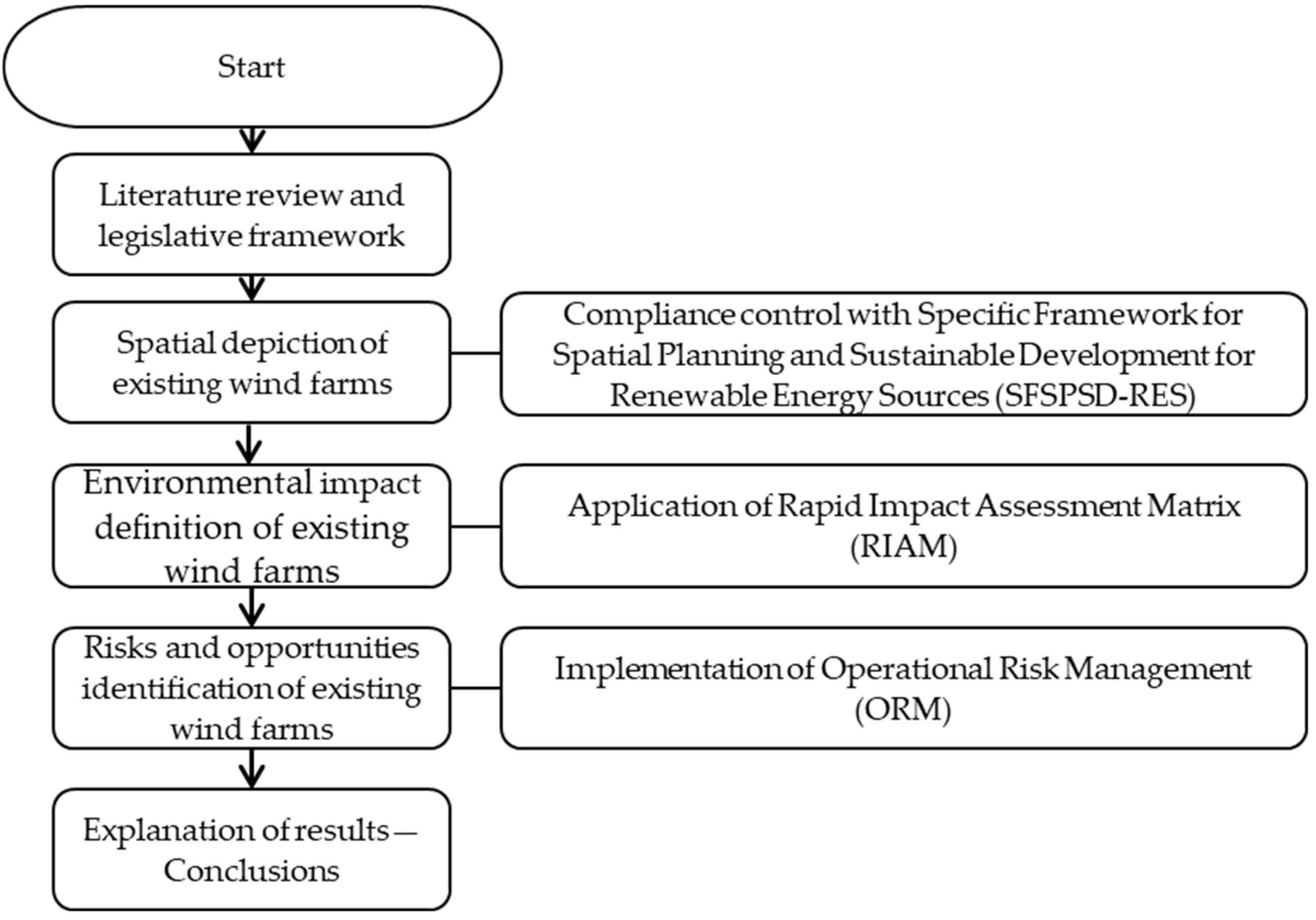
The assessment process comprises four main, distinct, yet interconnected steps (
Figure 1) and encompasses contemporary environmental impact assessment practices alongside operational risk evaluations.
The steps are described as follows:
Identification and spatial mapping of the existing onshore wind farm projects within the study area.
Verification of compliance with the national legislative framework, specifically the criteria included in the Specific Framework for Spatial Planning and Sustainable Development for Renewable Energy Sources (SFSPSD-RES) [
20].
Assessment of environmental performance employing the Rapid Impact Assessment Matrix (RIAM) method.
Evaluation of risk levels through a tailored application of the Operational Risk Management (ORM) methodology.
Initially, the existing onshore wind farms in the Region of Thessaly were identified and spatially mapped within a GIS environment (ArcGIS Pro 3.6.2). Subsequently, each wind farm was examined against the exclusion criteria established by SFSPSD-RES to determine its alignment with the current national siting framework. Additionally, the environmental performance of each project for specific environmental components was evaluated using RIAM, separately for the construction and operational phases. Furthermore, ORM was employed to assess the primary risks and opportunities associated with these phases across the sustainability dimensions (environmental, social, and economic). The integrated application of these methodologies facilitates a comprehensive assessment, progressing from spatial and regulatory compliance to the significance of environmental impacts, and ultimately to the prioritisation of operational risks. This approach enhances the overall sustainability evaluation of existing wind farms.
The above three methods were selected because they address different but complementary aspects of wind farm sustainability. The SFSPSD-RES served as the initial screening tool, as it reflects Greece’s official national framework for spatially compatible wind energy projects, offering a policy-relevant basis for assessing whether existing wind farms are situated in areas with exclusion or restriction criteria. Its key advantage lies in its regulatory relevance and capacity to enable consistent GIS-based spatial screening. However, its main limitation is that it mainly focuses on siting compatibility and does not assess the environmental impacts’ magnitude or operational risks.
RIAM was selected because it provides a transparent and semi-quantitative methodology for comparing environmental impacts across various projects, lifecycle phases, and environmental components. It is considered suitable for this research, as the same assessment framework can be consistently applied to all wind farms, thereby enhancing comparability. Moreover, RIAM combines qualitative and descriptive judgments with a standardised scoring system, facilitating the identification of both positive and negative effects. However, a weakness of this approach is that the final scores are based on the quality of the available documentation and subjective judgment, rendering the method somewhat dependent on the evaluator’s knowledge, expertise, and judgment.
ORM was selected to complement RIAM because environmental impact significance alone does not comprehensively encompass the operational vulnerabilities and safety-related concerns associated with wind farm construction and operation. ORM facilitates the classification of risks and opportunities based on severity and probability, enabling analysis across the environmental, social, and economic pillars of sustainability. Its primary advantage lies in its practical approach towards prioritisation and risk management. However, its limitation, similarly to RIAM, is its reliance on the evaluator’s interpretation and available project information, and the simplified matrix-based categorisation may not fully capture the complex, dynamic interactions of all real-world risks.
2.1. Compliance Control
According to the latest updated data from the Regulatory Authority for Energy, and based on the exclusion criteria established by the SFSPSD-RES, the necessary thematic maps were created to assess the compatibility of the existing wind farms in the study area with the restrictions and limitations imposed by the SFSPSD-RES. The assessment included all wind farms in the Region of Thessaly, regardless of their year of operation. Therefore, those licensed before 2008, when the SFSPSD-RES was established, also participated in the assessment. During the analysis, the exclusion criteria presented in
Table 1 were examined.
Specifically, thematic maps were generated for the exclusion criteria presented in
Table 1. These criteria include areas where the siting of wind farms is prohibited, as well as, in certain cases, surrounding incompatibility buffer zones. Under criterion EC1, the areas listed in
Table 1 are excluded, with additional setback distances imposed around historical sites (3 km) and archaeological sites/monuments (0.5 km) in accordance with the provisions of the SFSPSD. For criterion EC5, settlements are excluded together with a 0.5 km incompatibility buffer extending from their boundaries. For criterion EC6, the respective areas are excluded along with a 1 km incompatibility buffer zone. For criterion EC8, road networks and railway lines are excluded, together with an incompatibility buffer of 1.5 d, where d denotes the rotor diameter of the wind turbine. Likewise, for criterion EC9, high-productivity agricultural land is excluded along with an incompatibility buffer of 1.5 d. Subsequently, a spatial overlay analysis was conducted between the polygons of the existing wind farms and the thematic maps representing the exclusion criteria.
2.2. Environmental Impact Assessment Grade
To assess the environmental impacts of the existing wind farms in the study area, the RIAM method was applied to provide a systematic, comparable evaluation of impacts resulting from their development and operation.
The RIAM method integrates both quantitative and qualitative data by considering social, environmental, and economic factors. Its objective is to examine both the natural and anthropogenic environments simultaneously and, consequently, to clearly identify any potential conflicts. Furthermore, to implement a holistic approach, it is necessary to define specific assessment elements through a scope delineation process. These criteria fall into one of four categories, defined as follows:
- (i)
Physical/chemical component (PC): Includes all the physical and chemical parameters of the environment;
- (ii)
Biological/ecological component (BE): Concerns all biological aspects of the environment;
- (iii)
Sociological/cultural component (SC): Covering all human aspects of the environment, including cultural aspects;
- (iv)
Economic/operational component (EO): Qualitative assessment of the economic consequences of environmental changes, both temporary and permanent.
The assessment of impacts is carried out for each environmental component separately, and a score is assigned, corresponding to its significance, based on predefined criteria, as a measure of the expected impact.
According to Pastakia [
11] and Pastakia & Jensen [
12], the importance of assessment criteria are classified into two groups: (i) group (A) includes criteria that are significant for the condition and can individually alter the score obtained and (ii) group (B) includes criteria that are valuable for the condition but, individually, should not be capable of changing the score obtained.
The assessment criteria for the above two groups are as follows: (i) importance of condition (A1), with values ranging from 0 (no importance) to +4 (important to national/international interests); (ii) magnitude of change/effect (A2), with values ranging from −3 (major disbenefit or change) to +3 (major positive benefit); permanence (B1), with values ranging from +1 (no change/not applicable) to +3 (permanent); reversibility (B2), with values ranging from +1 (no change/not applicable) to +3 (irreversible); and cumulative (B3), with values ranging from +1 (no change/not applicable) to +3 (cumulative/synergistic) [
12].
Table 2 describes in detail the scales of the assessment criteria.
The assessment of these two categories is performed using a series of simple mathematical formulas that lay the foundation for calculating the individual components. Specifically, for group (A), the scoring system requires multiplying the individual values, ensuring the weight of each criterion, as shown in Equation (1). Regarding group (B), the individual scores are summed to produce a single overall score, as shown in Equation (2). This summation ensures that no single criterion dominates the result, but rather their collective significance is considered. Finally, the result of group (A) is multiplied by the result of group (B) to derive the final Environmental Score (ES), as shown in Equation (3).
where
(a1) and (a2) are the scores of the individual criteria for group (A);
(b1) to (b3) are the scores of the individual criteria for group (B);
aT is the result of multiplying all the scores (A);
bT is the result of the sum of all the grades (B).
The calculation of the final Environmental Score (ES) is derived from the formula:
For accuracy and comparability of the results, the calculated scores are grouped into range bands defined in
Table 3, which are determined based on the variations in the criteria of groups A and B and are overall divided into eleven (11) classes, with nominal values ranging from −4 to +4 (or −D to +D). This specific range covers all possible scores of the environmental rating, from −71 to +71. Through this classification, the magnitude and direction (positive or negative) of the impacts are clearly depicted. Finally, the scores are assigned to the appropriate range band and presented either individually or grouped by environmental component [
11,
12].
In this study, the analysis was carried out separately for each existing wind farm in the study area and covers the two main lifecycle phases of wind installations: construction and operation. This distinction is necessary, as these two phases are characterised by different levels of intervention, duration, and types of environmental impacts. Specifically, the construction phase is typically associated with earthworks, road construction, and temporary disturbances. During the construction phase of a wind farm, activities such as excavation and related roadwork may affect soil characteristics and the natural environment of the study area. The operation phase is characterised by more permanent or long-term effects, such as visual landscape alteration and interaction with the natural environment. Although wind farms have a relatively small environmental impact compared with conventional energy production facilities, their negative effects during operation primarily affect landscape features (landscape alteration), the acoustic environment (noise pollution), and fauna (bird collisions). High noise emissions are caused by large-scale wind turbines exceeding 100 metres in height and therefore do not affect humans or wildlife [
21]. Nevertheless, these projects may face strong social reactions from residents living near the proposed sites, due to concerns that noise from wind turbines will disrupt their quality of life [
22,
23,
24]. Regarding bird collisions, the likelihood of bird mortality associated with wind energy exploitation projects is significantly lower than that caused by other factors, such as collisions with tall buildings, infrastructure networks (electricity, telecommunications), cats, vehicles, pesticides, activities, and public utility projects [
25].
The decommissioning or dismantling phase of wind farm installations, although a critical stage in the overall lifecycle of the projects, is not examined in this work. This phase pertains to a future and temporally uncertain scenario, which depends on technological, institutional, and economic parameters that cannot be accurately assessed at present. Additionally, RIAM primarily focuses on assessing impacts arising from the ongoing operation of the projects, enabling a comparative evaluation across different installations at a common point in time. Including the decommissioning phase would require a different methodological framework, such as life-cycle analysis, which falls outside the scope and extent of this research. For each wind farm, eight (8) environmental components (
Table 4) were evaluated, covering critical environmental parameters affected during wind farm deployment. These components were selected from national EIA guidelines through a scoping process, based on the criterion of covering all aspects of abiotic, natural, and anthropogenic environments potentially affected by the construction and operation of a wind farm project. Using the same components and rating scales across all projects ensures methodological consistency and allows direct comparisons of results across different locations and project sizes.
The values provided for each RIAM assessment criterion were based on data from the approved environmental impact assessment studies, the corresponding approval decision of environmental terms, and the specific geographical, environmental, and technical characteristics of each project. The grading process was carried out by the authors of this research, who possess relevant academic and practical experience in environmental impact assessment (e.g., [
16,
26,
27,
28]) without the participation of external evaluators.
2.3. Operational Risk Management
Operational Risk Management (ORM) includes the identification, assessment, mitigation, and monitoring of risks in the daily operations of a unit [
19], in this case, a wind farm. Four main sources of operational risk are distinguished: people, systems, processes, and external factors [
29]. In this work, ORM is adopted to assess the risks and opportunities of an onshore wind installation, with a focus on the construction and operation phases of the wind farm’s life cycle.
Risk assessment is a process that describes the likelihood of adverse events and the potential severity of their consequences regarding probability and impact. These risks include internal factors, such as procedural deficiencies, human errors, and technological failures, as well as external factors, such as regulatory changes, natural disasters, and geopolitical uncertainties [
29]. Through a comprehensive approach, the method aims at proactively addressing vulnerabilities that could jeopardise the achievement of strategic objectives or the interests of stakeholders [
30].
Initially, each criterion is assessed regarding its level of severity, classified into four categories: A (catastrophic), B (critical), C (marginal), and D (negligible). Subsequently, a similar assessment is conducted regarding the level of probability of each criterion, allowing for selection from four predefined responses: I (expected to happen soon or in the near future), II (probably will occur in time), III (might occur in time), and IV (impossible to happen). The Risk Assessment Values (RAVs) are presented in
Table 5. Risks with RAV of 1 and 2 must be addressed immediately through specific measures or may even be deemed unacceptable, as all operations/tasks should be halted due to an imminent risk. Risks with RAV equal to 3 should be redesigned, monitored, and managed. Finally, risks with RAV of 4 and 5 only need to be documented and can sometimes be ignored, as they are considered negligible and therefore acceptable.
It is evident that a different approach is followed for the positive impacts, as each varies in nature and definition regarding the risk. In this study, the above framework was adapted to assess the positive effects of wind farms, such as contribution to climate change mitigation, energy security, and local economic support. Because beneficial effects are not considered risks in the strict sense, they were evaluated separately from adverse events. A distinct opportunity matrix served as a semi-quantitative scoring tool, applying the same probability and magnitude criteria while highlighting the positive nature of the effect. The resulting Opportunity Assessment Values (OAVs) are therefore used for comparative prioritisation of beneficial effects, rather than as direct equivalents of risk severity. Opportunities with OAV of 1 and 2 are considered vital benefits that support long-term sustainability and should therefore be enhanced and promoted. Opportunities with OAV equal to 3 and 4 are considered as advantages that are ranked lower than OAV 1 and 2, while OAV of 5 only need to be documented.
Table 6 can be used for the analysis of positive impacts.
Unlike participatory approaches based on stakeholder questionnaires, this analysis adopts a technical-scientific risk assessment approach, using data from approved environmental impact assessment studies and environmental approval decisions, as well as relevant literature. This provides an assessment based on real data and scientific knowledge, combined with the authors’ experience and expertise. The assessment was carried out across the two project phases (construction and operation) and the three sustainability pillars (environment, society, and economy), using the severity and probability scales proposed in the ORM methodology. The risks and positive impacts considered are described in
Table 7, and the final RAV or OAV was derived using the corresponding ORM matrices, enabling risk/opportunities prioritisation and conclusions regarding the operational sustainability of the wind farms.
3. Results and Discussion
3.1. Geographical Location and Siting of Existing Wind Farms
The Region of Thessaly is distinguished by its profound ecological and cultural value. With 16% of its total area integrated into protected area networks, alongside the presence of World Heritage monuments, prominent archaeological sites, and traditional settlements, Thessaly constitutes an optimal environment for evaluating the environmental compatibility of wind energy projects and their impacts on biodiversity. In addition, the local economy is highly reliant on the primary sector, particularly high-productivity agricultural land and livestock farming. Consequently, investigating the spatial conflicts or synergies between wind farm installations and existing land uses is considered crucial for the comprehensive assessment of the socio-economic sustainability of these infrastructures. In addition, regarding spatial planning and according to the Special Framework for Spatial Planning and Sustainable Development for Renewable Energy Sources (SFSPSD-RES), the region encompasses Wind Priority Areas (WPAs) in the western part of the Karditsa Regional Unit, characterised by high wind potential, as well as extensive mountain ranges (e.g., Pindus, Kissavos, Othrys) designated as Wind Suitability Areas (WSAs). According to the Geo-Spatial Map of Regular Authority of Energy [
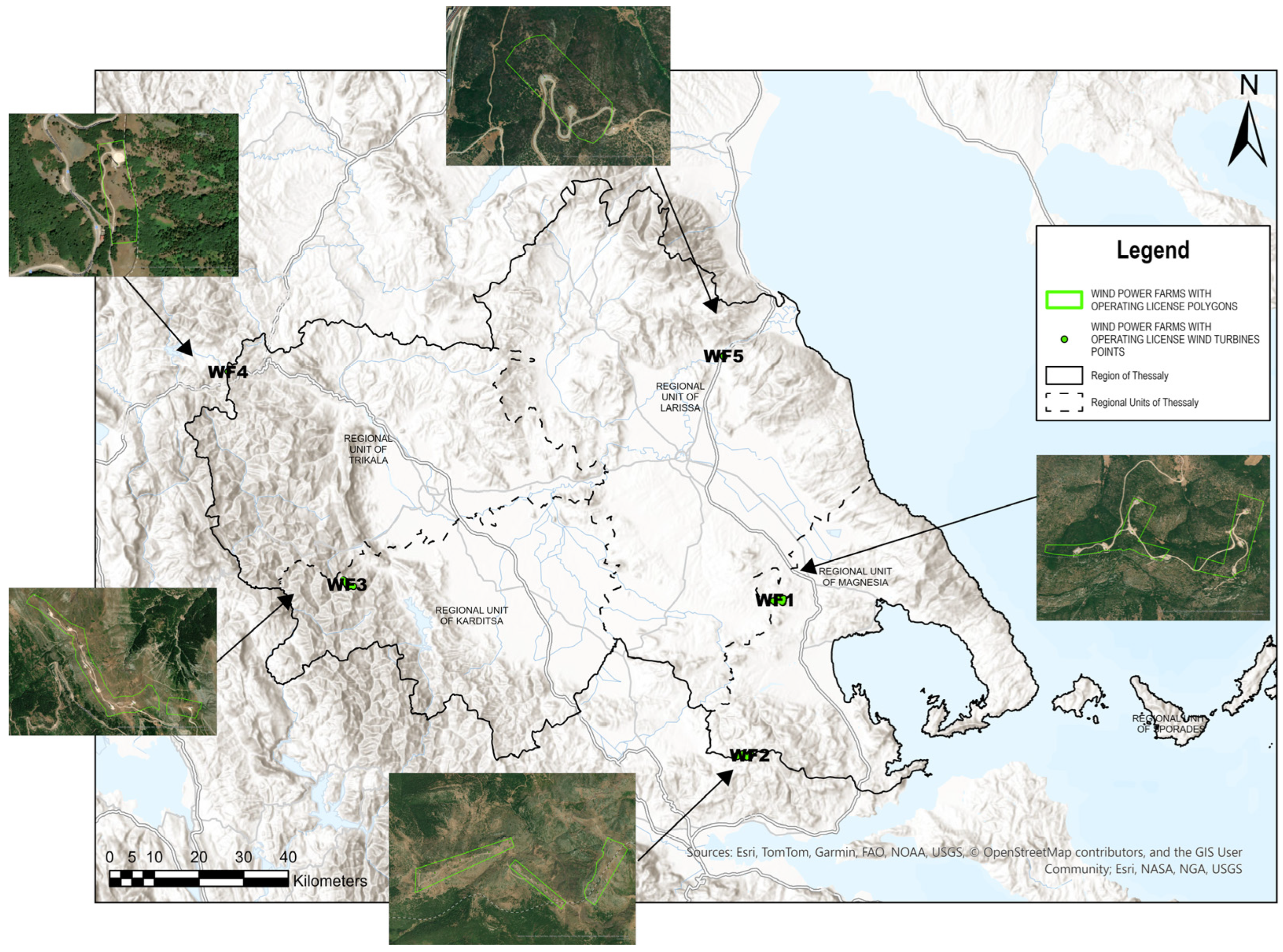
56], five licensed projects are located in the Region of Thessaly (
Figure 2). Their strategic placement on the highest ridges is clear, specifically within the main mountain massifs of Thessaly (Pindus, Othrys, Kissavos). The operation of these wind farms, with varying installed capacities and different licensing periods (prior to and following the implementation of the SFSPSD-RES), facilitates the transition from theoretical modelling to the analysis of empirical data. Therefore, the selection of the Thessaly Region as the study area is justified, as described above, by a combination of spatial, environmental, and socio-economic criteria.
3.2. Compatibility Check with the SFSPSD-RES
The application of SFSPSD-RES criteria to existing wind farms in the Region of Thessaly revealed an overall high level of spatial compatibility, despite some variations in proximity to sensitive areas.
Based on the review of the exclusion zones, none of the examined projects are located within the absolute exclusion zones specified by the SFSPSD-RES, such as the cores of national parks, priority habitats, strict protection zones, or designated Category A cultural zones. This finding indicates that at the level of fundamental spatial restrictions, the projects’ siting is compatible with the current legislative framework.
Of particular importance is that two of the five wind farms (WF2 and WF3) were licensed and operational before the SFSPSD-RES came into force in 2008 [
20]. Nevertheless, the retrospective application of the Framework’s criteria showed that even the earlier projects largely meet the basic spatial requirements established subsequently.
Regarding distances from settlements, all projects comply with the minimum distances. Even in cases of borderline proximity, such as WF5, adherence to the Framework’s specific provisions ensures the installation’s spatial acceptability.
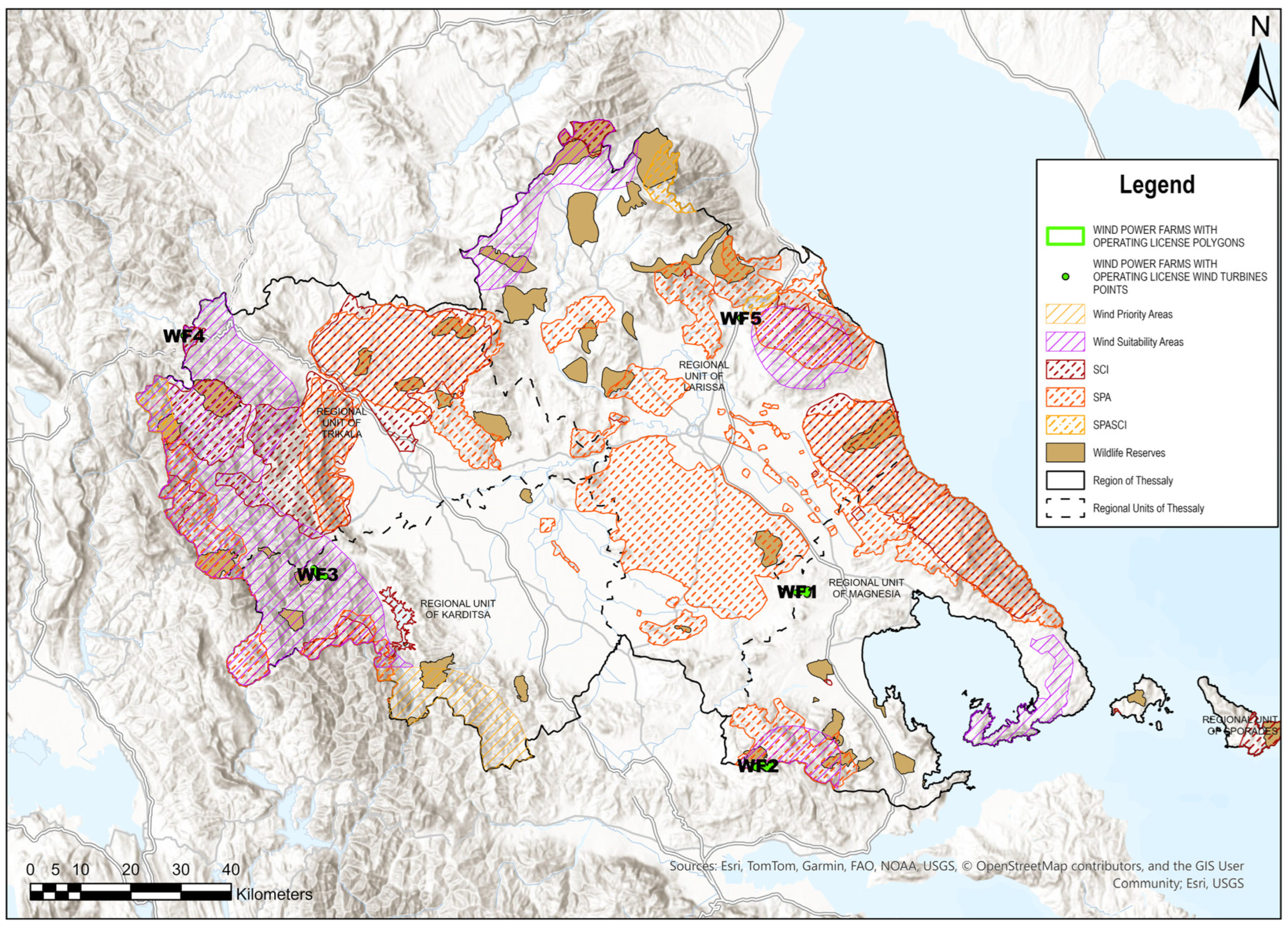
Regarding protected areas, the results indicate significant variation between the projects (
Figure 3). Some wind farms are located within or near Natura 2000 sites, which increases their spatial and ecological sensitivity. However, in cases where the permitting process preceded the establishment of protected areas, the habitats affected may not fall under strict protection categories or priority habitats. Consequently, there is no violation of the prohibitive provisions of the environmental impact assessment studies and renewable energy sources legislation, although an increased need for careful environmental management is highlighted.
Regarding the accompanying road works, the results show that intervention intensity varies significantly across the wind farms. In mountainous and extensive projects, increased road interventions are observed, affecting the geomorphology and the spatial continuity of the landscape. Conversely, in smaller-scale projects or on flat areas, interventions are mainly limited to improvements of existing roads, in accordance with the SFSPSD-RES’s directions to avoid extensive new road openings.
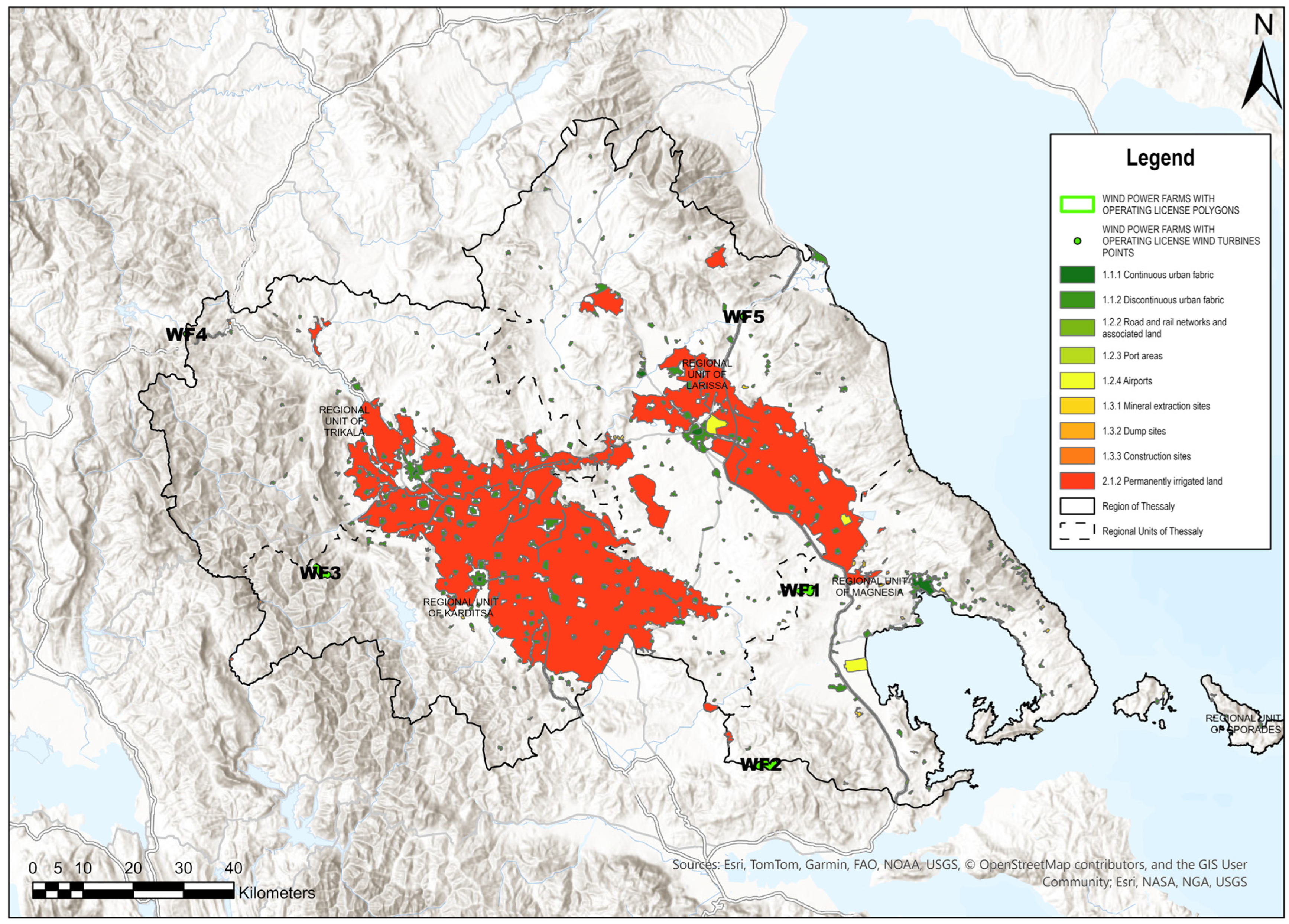
Spatial overlay of the wind farm polygons with the Corine Land Cover (CLC) data indicates that none of the examined projects are located within incompatible land-use categories (
Figure 4). No overlap was found with urban fabric (codes 1.1.1, 1.1.2), industrial, or commercial units (codes 1.2.2–1.2.4), nor with mine, dump, and construction sites (codes 1.3.1–1.3.3). This finding confirms that the projects’ siting does not conflict with existing high-intensity anthropogenic land uses. At the same time, it is particularly noteworthy that no overlaps with permanently irrigated land (2.1.2) were identified. These areas, characterised as high-productivity agricultural land, constitute a category of increased protection within the framework of the SFSPSD-RES. The absence of such overlaps suggests that the development of wind installations does not entail the loss or degradation of productive agricultural resources.
From the comprehensive compatibility check (
Table 8), it appears that, in general, the examined wind farms comply with the main criteria of the SFSPSD-RES. It should be noted that the (+) symbol indicates compliance with the SFSPSD-RES, whereas the (-) symbol indicates non-compliance. The main deviations or borderline compliance are primarily identified in parameters related to proximity to protected areas and the relationship with the existing road network, while no significant conflicts with archaeological sites or other elements of cultural heritage are evident. This outcome aligns with the research of [
57], which showed that several wind farms have been installed inside natural parks in Spain, Germany, and France. Additionally, Vlami et al. [
58] report that industrial wind farms are being developed within many protected areas, including “Natura 2000” sites, and examine a wind farm proposal within an island protected area (Samothraki, Greece). Karamountzou and Vagiona [
10] highlight that the highest percentage of improper siting in Greece is due to wind farm installation in places within the boundaries of the “Natura 2000” protected areas.
Overall, the results of the compatibility check with the SFSPSD-RES indicate that the examined wind farms generally exhibit a satisfactory level of spatial compatibility, with deviations mainly related to heightened environmental sensitivity rather than violations of established prohibitions. This finding provides a critical basis for the combined interpretation of the RIAM and ORM results, enabling a comprehensive assessment of the sustainability of the existing wind farm installations.
3.3. RIAM Analysis
The scoring process was based on a structured review of the approved environmental impact assessment studies for each wind farm, the related environmental approval decisions, and the specific geographical, environmental, and technical features of each project. For each wind farm and lifecycle phase, each environmental component was evaluated against the standard RIAM criteria (A1, A2, B1, B2, and B3) using the scales presented in
Table 2. To ensure consistency and comparability, the same environmental components, documentary sources, scoring scales, and calculation rules were applied to all cases. No stakeholder group was involved in the assessment; therefore, to minimise subjectivity, scoring was based on documented project information and a consistent interpretation of the RIAM criteria across all wind farms. This study should thus be understood as a structured, expert-based application of RIAM, with transparency ensured through the clear presentation of criteria, scales, and final scores.
Table 9 and
Table 10 are presented below for the WF1 wind farm during the construction and operation phases, respectively, while the tables for each wind farm, separately for each construction and operation phase, are provided in
Appendix A.
The RIAM scoring for the WF1 wind farm (installed capacity 33.6 MW) reflects how its specific technical specifications directly interact with the morphology of the study area. The project is located in a semi-mountainous forest area on Mount Chalkodonio (altitude 625–720 m) within the Municipal Unit of Feres. During the construction phase, the moderately negative score (−24, class −C) assigned to morphology/soil and flora/fauna results from the extensive earthworks needed. Specifically, the project involves constructing 6.08 km of new forest roads, creating large installation platforms (roughly 50 × 60 m per turbine), and trenching for the underground medium-voltage (33 kV) cables. Nevertheless, environmental disturbance is less severe because the relatively mild terrain allowed for the simultaneous improvement and use of 6.71 km of existing road networks, thereby avoiding the large-scale geometric interventions usually necessary in rugged mountainous wind farm sites.
During the operational phase, the variation in scores is due to the choice of technological equipment. WF1 includes only seven (7) NORDEX N149 wind turbines, which, despite their size, have substantial dimensions (tower height of 104.7 m, rotor diameter of 149.1 m, resulting in a total height of 179.25 m). These technical features explain the high negative score related to the permanent visual landscape change (−28, class −C) and the possible disturbance to birdlife (−C), since the project is located about 4.5 km from the Special Protection Area (Natura 2000) “Thessalian Plain”. Conversely, the aerodynamic efficiency of these turbines provides the project with significant energy output, estimated at 70,291.5 MWh annually. This justifies the highest positive score (+72, class +E) in the environmental assessment because it prevents over 70,291 tons of CO2 emissions each year, while also providing notable socio-economic benefits (+16, class +B) to the local community of Rigas Feraios Municipality.
The application of the Rapid Impact Assessment Matrix (RIAM) method to the examined wind farms in the Region of Thessaly enabled a quantitative and comparative assessment of environmental impacts during construction and operation, accounting for a unified set of environmental components.
During the construction phase, the main negative ratings are primarily related to morphology/soil due to extensive excavations and road construction works, and the natural environment, mainly from vegetation loss/fragmentation and faunal disturbance. These impacts are more pronounced in wind farms near areas of increased sensitivity, as reflected in higher negative values of the environmental index RIAM. Impacts concerning the landscape/aesthetics, acoustic environment, air quality, and aquatic environment during the construction phase are primarily assessed as slightly negative or neutral (−A to N). This indicates that the related burdens are generally localised, of limited intensity, and temporary in nature.
During the operational phase, the RIAM results reveal a clear shift towards neutral to positive assessment categories (N to +B) for the majority of environmental components. The reduction in greenhouse gas emissions and the contribution to clean energy production are systematically recorded as positive impacts, with values classified in the categories positive to quite positive (+B to +C). These results confirm the significant role of wind farms in the climate change mitigation strategy.
However, in most cases (WF1, WF2, WF3, and WF4), negative impacts during the operational phase remain clear, especially on landscape and biodiversity in projects located within or near environmentally sensitive areas. In certain wind farms, these effects are moderately to highly negative (−C to −D), indicating that, although they do not necessarily mean spatial conflicts under the SFSPSD-RES, they still require ongoing monitoring and targeted mitigation measures.
The results of this research clearly show differences both across project phases and between individual locations. This aligns with multiple independent studies from various regions that consistently indicate construction causes the most significant and widespread environmental impacts in soil and natural environment [
59], while operation results in more targeted yet lasting effects on soils [
59,
60], wildlife [
59], and visual amenity [
14,
59,
61].
In a comparative context of the examined wind farms, projects with limited ancillary interventions and less extensive roadworks generally demonstrate a more favourable environmental performance, as reflected in the final RIAM values. Conversely, projects with extensive geomorphological and landscape interventions show higher negative scores during the construction phase, although these impacts are not sustained to the same extent during operation.
Overall, the RIAM results indicate that, despite unavoidable localised and time-limited negative impacts during the construction phase, the examined wind farms exhibit a balanced to positive environmental footprint over time. This aligns with the findings on the spatial compatibility of the SFSPSD-RES and provides an additional foundation for assessing risks and opportunities.
3.4. Evaluation of Risks and Opportunities Through ORM Severity–Possibility Matrix
Table 11 and
Table 12 below present the risk assessment for WF1 during the construction and operation phases, respectively, while the tables for each wind farm separately, by construction and operation phase, are provided in
Appendix B.
The application of the Operational Risk Management (ORM) method to the examined wind farms enabled a qualitative and comparative assessment of key risks and positive impacts during the operation and construction phases. The results clearly highlight differences between the phases and the installation sites, reflecting the particularities at the technical, spatial, and environmental levels.
During the construction phase, the greatest risks are primarily related to work safety and technical interventions, especially in projects involving extensive earthworks and new excavations. This finding is in line with [
62,
63], which highlight worker safety risks during excavation/earthworks. These risks are assessed on a case-by-case basis as ranging from moderate to high, indicating increased requirements for planning, supervision, and the implementation of health and safety measures. Conversely, environmental risks associated with pollution or temporary disturbances are mainly recorded as low to moderate, suggesting their local and limited nature.
Overall, risks appear significantly reduced during the operational phase compared with the construction phase. Most technical and environmental risks are classified as low to moderate risk categories, with exceptions in specific cases related to proximity to sensitive ecosystems or the operation of wind turbines in mountainous environments exposed to increased extreme weather conditions. In these cases, risks remain manageable but require continuous monitoring and tailored management measures.
Documenting the positive operational impacts during the operational phase is particularly important, as these are assessed as low risk or opportunities. The contribution of wind energy to reducing greenhouse gas emissions and stabilising energy production is recorded as a critical positive aspect of operation. These findings reinforce the sustainability of the projects at an operational level.
In a comparative assessment of the examined existing wind farms, it is observed that those with limited ancillary works and clear spatial compatibility exhibit lower operational risk during both construction and operation. Conversely, projects located in areas of increased environmental sensitivity or requiring extensive technical interventions exhibit a higher risk concentration, although no unacceptable levels are recorded.
Overall, the ORM results indicate that the operational risks of the examined wind farms are manageable and clearly differentiated by phase. The construction phase notably carries the greatest share of risk, consistent with findings by Mohamed et al. [
64], who observed that the construction phase involves more risks and uncertainty than any other stage in the wind farm project’s lifecycle. The application of the Operational Risk Management (ORM) method to the examined wind farms enabled a qualitative and comparative assessment of key risks and positive impacts during the operation and construction phases. The results clearly highlight differences between the phases and the installation locations, reflecting the particularities at the technical, spatial, and environmental levels.
Based on the preceding analysis, it is evident that the integrated interpretation of the SFSPSD-RES, RIAM, and ORM results indicates that the sustainability performance of the examined wind farms relies on the interaction between spatial compatibility, environmental impact significance, and operational risk. The compliance of the examined wind farms with the SFSPSD-RES establishes the spatial–regulatory framework within which the findings of RIAM and ORM should be interpreted. Wind farms demonstrating partial compliance, primarily due to their proximity to protected areas or increased reliance on ancillary road interventions, are also associated with more negative RIAM scores concerning geomorphology, landscape, and biodiversity, as well as higher construction and operational risks identified by ORM. Conversely, projects with full compliance and minimal supplementary interventions generally exhibit more favourable environmental performance and lower operational risk. Accordingly, the three methodologies should be regarded as sequential and interconnected assessment methods: (i) the SFSPSD-RES identifies spatial sensitivity, (ii) RIAM assesses the significance of impacts within this context, and (iii) ORM determines the extent to which these impacts translate into priority management risks and opportunities.
4. Conclusions
This study focused on assessing the siting and sustainability of existing onshore wind farms in the Region of Thessaly, evaluating their compatibility with the SFSPSD-RES and applying the RIAM and ORM methods to achieve a multidimensional evaluation of the impacts and risks of the examined projects. The objective was to analyse existing wind farms from three complementary perspectives (spatial–regulatory compatibility, environmental impact significance, and operational risk and opportunity) and go beyond the existing single-method assessments. Therefore, the study offers an integrated assessment of the sustainability performance of existing wind farms.
The results show that the examined wind farms are generally compatible with the spatial-planning framework. More specifically, 40% of the assessed wind farms fully comply with all eleven exclusion criteria of the SFSPSD-RES, while the remaining 60% show partial compliance, failing to meet one (WF1), two (WF4), or even three criteria (WF3). Regarding the application of the RIAM method, it was highlighted that the main negative environmental impacts occur primarily during the construction phase, concerning geomorphology/soil (40% (−D), 20% (−C), 20% (−B), 20% (−A)) and natural environment (40% (−D), 20% (−C), 20% (−B), 20% (−A)) due to extensive excavations, road construction formations, and disturbance of flora and fauna, respectively. During the operational phase, the main negative effects relate to landscape/visual quality (60% (−D), 20% (−C), 20% (−B)) and continued disturbance to flora and fauna (40% (−D), 40% (−C), 20% (−B)). However, during the operational phase, most environmental components are assessed as neutral to positive, with wind farms’ dominant positive contribution to the atmospheric environment/air quality component (20% (+A),20% (+C), 60% (+E)) resulting from reduced greenhouse gas emissions and the generation of clean energy. The ORM analysis further indicates that the main risks for most wind farms occur during construction, especially from serious worker accidents involving lifting, roadworks, and foundation activities (ORM = 2 (60%), ORM = 3 (40%)). Clear operational impacts, such as mitigation of climate change (OAV = 4 (40%), OAV = 5 (60%)), are identified, supporting the projects’ overall operational sustainability. Based on the results of compatibility with the SFSPSD, RIAM, and ORM, it is concluded that the wind farms in Thessaly can be considered spatially acceptable, environmentally manageable, and operationally sustainable, within the construction and operational phases assessed in this study.
The value of the proposed methodology lies in its ability to integrate three complementary assessment dimensions into a unified framework. GIS-based compliance screening identifies spatial sensitivities and potential planning conflicts; RIAM appraises the significance of environmental impacts; and ORM assesses how these impacts translate into operational risks and opportunities across the environmental, social, and economic pillars. These approaches serve as valuable, practical tools to support decision-making at both the spatial planning level and in the environmental and operational management of wind farms. Furthermore, the proposed methodology provides a more decision-oriented and policy-relevant approach than assessments utilising a single method. It can facilitate the re-evaluation of existing wind farms, guide prioritisation of mitigation measures, and aid planning authorities and decision-makers in regions where the expansion of renewable energy resources must be balanced with environmental protection, land-use compatibility, and long-term operational sustainability.
A key limitation of this study is that its assessment framework only refers to the construction and operational phases of the examined wind farms, excluding the decommissioning stage. Although these two phases address the primary impacts and risks of functioning projects, the decommissioning phase may identify additional environmental issues, such as dismantling, waste management, transportation, material recovery or disposal, and site restoration. Consequently, the results of the present research should not be viewed as a comprehensive life-cycle sustainability analysis. Therefore, as a future research direction of this effort, the application of life cycle assessment to evaluate environmental impacts is proposed, along with integrating the decommissioning phase into the process. In addition, involving stakeholders in both the environmental impact assessment and the risk and opportunity evaluation processes could help extend the proposed framework towards a more comprehensive sustainability assessment. Finally, enhancing the proposed framework with measured monitoring datasets (e.g., biodiversity monitoring, noise measurements, air quality measurements) would reduce the influence of the assessments on document-based inputs and enable validation of the present results.