_Li.png)
Balancing Personalization and Sustainability in Hotel Recommendation: A Multi-Objective Reinforcement Learning Approach

Abstract
1. Introduction
- Static and single-scale modeling limitations: Traditional and sequential models often cannot distinguish long-term preferences from short-term situational intentions, such as shifts from business to holiday travel. They also lack a dual-scale architecture designed to capture the deep context dependency inherent in hotel consumption decisions;
- Opaque decision-making processes: Although deep neural network models achieve high accuracy, their complex nonlinear transformations reduce interpretability. This lack of transparency prevents the system from providing clear rationales for recommendations and reduces user trust;
- Insufficient integration of sustainability in multi-objective optimization: Although some advanced RL systems optimize for long-term value or diversity, they typically treat “sustainability” features as binary tags or secondary filters. They lack mechanisms to extract multidimensional sustainability metrics from genuine user interaction feedback and to fully integrate these metrics into the reward system, missing opportunities to promote sustainable tourism.
- (1)
- How can a state representation mechanism effectively separate users’ long-term preferences from short-term situational intentions and dynamically integrate them with real-time multidimensional contexts?
- (2)
- How can the decision-making process in recommendation systems be made transparent and context-adaptive to enhance interpretability without reducing accuracy?
- (3)
- How can multidimensional sustainability metrics derived from authentic user interaction feedback be effectively integrated into a sequential optimization framework to balance personalization, diversity, and tourism ecosystem sustainability?
- Context-specific dual-architecture fusion model: By integrating long-term preferences encoded by a Transformer, short-term memory captured by an LSTM, and multidimensional contextual features, we establish a state representation method tailored to describe the complex evolution of user trajectories in the hotel domain;
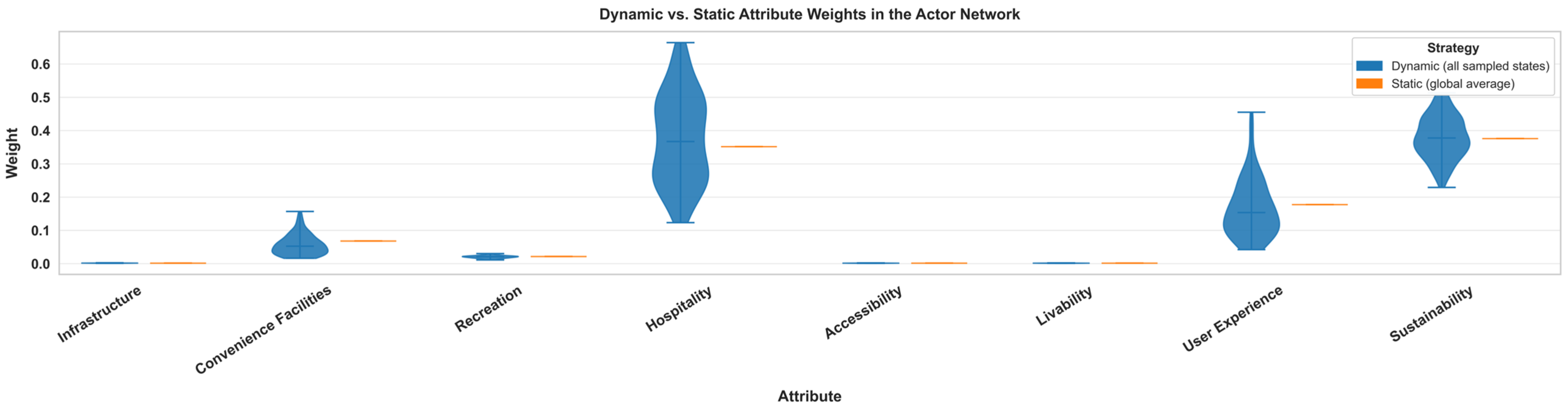
- Interpretable recommendation approach: Using an eight-dimensional feature system that explicitly includes a review-derived “sustainability” dimension, a dynamic feature weighting network automatically determines the importance of each attribute in different scenarios. This provides a transparent explanatory foundation for recommendations;
- Advanced multi-objective RL framework: The recommendation process is formulated as a Markov Decision Process (MDP) guided by a composite reward function. This function advances previous RL models by directly incorporating review-based sustainability incentives, diversity penalties, and matching rewards, effectively balancing immediate commercial value with sustainable tourism development.
- A dual-architecture fusion model that integrates Transformer and LSTM to accurately capture the dynamic evolution of user preferences;
- A personalized interpretation mechanism based on dynamic feature weighting, offering a transparent explanatory foundation for recommendations through attribute importance;
- A multi-objective sequential optimization framework that explicitly integrates a review-derived sustainability dimension into its reward system, balancing personalization with sustainable tourism objectives.
2. Literature Review
2.1. Sequential Recommendation Systems
2.2. Interpretable Recommendation Systems
2.3. Reinforcement Learning-Based Recommendation Systems
3. Materials and Methods
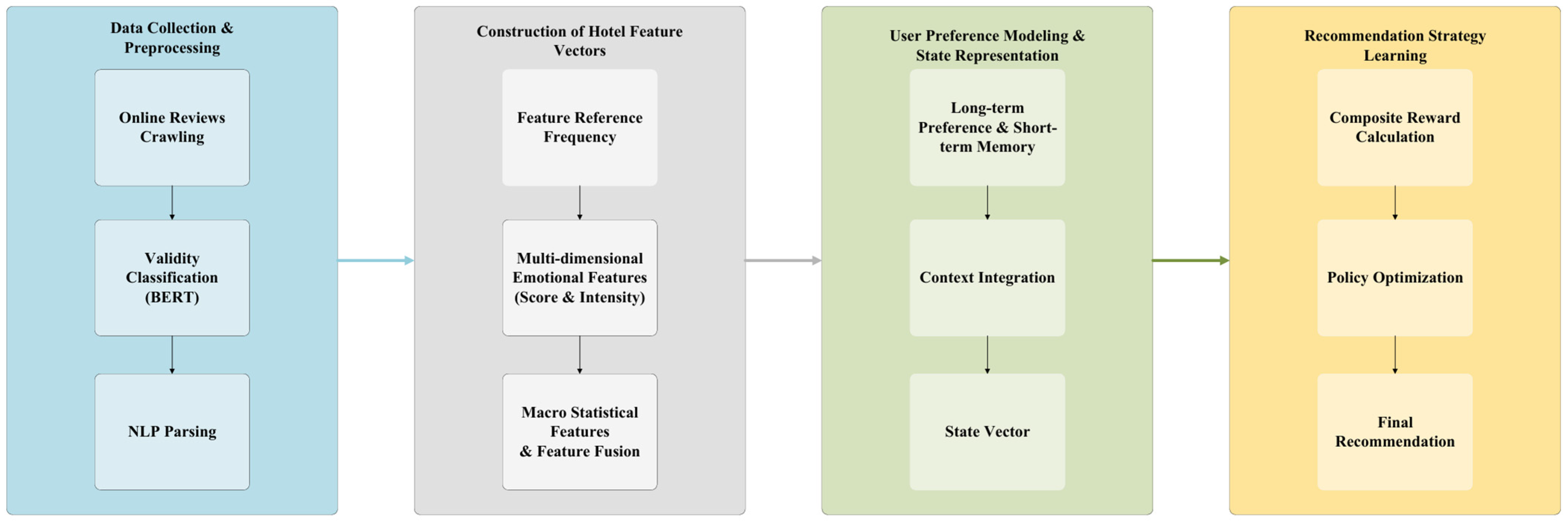
3.1. Collection and Preprocessing of Hotel Reviews
3.2. Construction of Hotel Feature Vectors
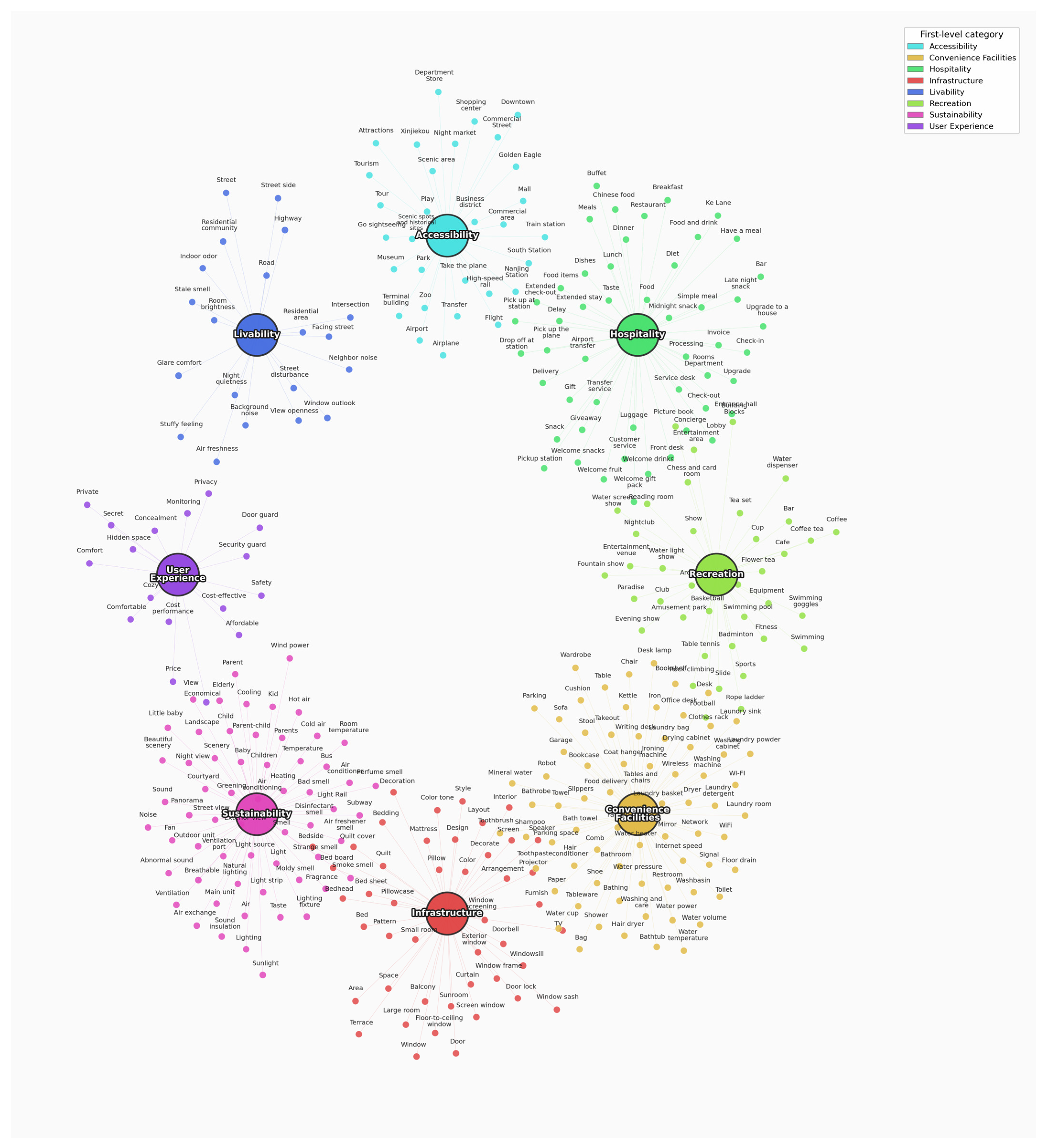
3.2.1. Extraction of Feature Reference Frequency
3.2.2. Extraction of Multi-Dimensional Emotional Features
3.2.3. Extraction of Statistical Features
| Algorithm 1. Text Mining and Multidimensional Feature Construction Pipeline |
| Input: Raw hotel review set , Pre-trained BERT-base-chinese model, Word2Vec model. Output: Structured hotel feature vectors for each hotel . Sentence Filtering 1: Segment reviews into sentences. 2: Use BERT classifier to identify valid evaluative content (label 1) and filter metadata-like noise (label 0). Linguistic Extraction 3: Perform structural-syntactic parsing with Stanford CoreNLP. 4: Extract nouns using a hybrid segmentation and dependency parsing. Semantic Mapping 5: Project refined nouns into a 200-dimensional semantic space via Word2Vec. 6: Group similar nouns into 51 fine-grained clusters using Affinity Propagation (AP). Attribute Set Construction 7: Map 51 clusters to 8 primary dimensions in set (e.g., Infrastructure, Sustainability). 8: Ensure alignment with GB/T 14308-2023 and ESG theoretical framework. Feature Quantification (for each hotel and attribute ): 9: Calculate using Equation (2). 10: Calculate average sentiment score using SnowNLP and Equation (3). 11: Calculate using Equation (5). Statistical Feature Extraction 12: Calculate (total reviews), (average sentiment), and (positive ratio) for hotel . Vector Finalization 13: Concatenate , , , and statistical vectors. 14: Ensure all metrics are calculated using reviews published before time to prevent data leakage. |
3.3. User Preference Modeling and State Representation
3.3.1. Encoding of Users’ Long-Term Preferences
3.3.2. Short-Term Memory
3.3.3. Contextual Information Fusion
3.3.4. State Vector Construction
3.4. Actor–Critic-Based Recommendation Strategy Learning
3.4.1. MDP Formalization
3.4.2. Actor Network
- Dynamic Weight Generation
- Matching Degree Calculation
- Policy Function
3.4.3. Critic Network
3.4.4. Reward Function Design
- Basic Matching Rewards
- Similarity Reward
- Diversity Penalty
- Sustainability Reward
| Algorithm 2. Reinforcement Learning-based Hotel Recommendation Strategy Learning |
| Input: User interaction dataset , discount factor , reward weights , , , coefficients , , . Output: Optimized Actor network parameters and Critic network parameters . Initialization and Warm-start 1: Initialize Actor network and Critic network with random weights. 2: Imitation Learning (Behavioral Cloning): Pre-train by minimizing the cross-entropy loss between the policy distribution and the actual historical hotel selections to mitigate initial high variance. Reinforcement Learning Training Loop 3: for each training epoch do 4:Sample a mini-batch of user sequences from . 5: for each time step in the sequence do 6: State Representation: Construct the fused state vector by integrating long-term preference (via Transformer), short-term memory (via LSTM), and temporal context : 7: Action Generation: The Actor network computes the probability distribution over candidate hotels using a Softmax strategy based on the hybrid Q-values : 8: Execute and Observe: Recommend hotel , observe the user interaction feedback, and calculate the composite reward : 9: Next State: Transition to by updating the user’s behavioral memory with the new interaction. 10: Value Assessment: Use the Critic network to estimate the Temporal Difference (TD) target and the advantage signal (TD error): 11: end for 12: Optimization: Update network parameters and by minimizing the multi-objective loss function : 13: end for |
4. Results
4.1. Dataset and Experimental Settings
4.1.1. Data Sources and Collection
4.1.2. Data Preprocessing and Sequence Partitioning
- Hotel Feature Vector Construction
- User Sequence Partitioning and Episode Construction
- Action Space Definition
4.1.3. Hyperparameter Setting and Training Process
- Hyperparameter Settings and Analysis
- Training and Evaluation Procedure
- (1)
- Policy Loss (): The policy loss is updated using the advantage-based policy gradient to encourage actions with positive advantages:
- (2)
- Critic Loss (): Fits the temporal difference (TD) target value by optimizing the Value network through minimization of the Mean Squared Error (MSE):
- (3)
- Entropy Regularization (): Adds an entropy regularization term to encourage the policy to maintain exploration and prevent premature convergence:
- (4)
- Margin Ranking Loss (): Enhances discrimination between positive and negative samples by enforcing a margin between the Q-values of the user-selected hotel and a randomly sampled unselected hotel:
4.2. Analysis of the Validity of User State Representation
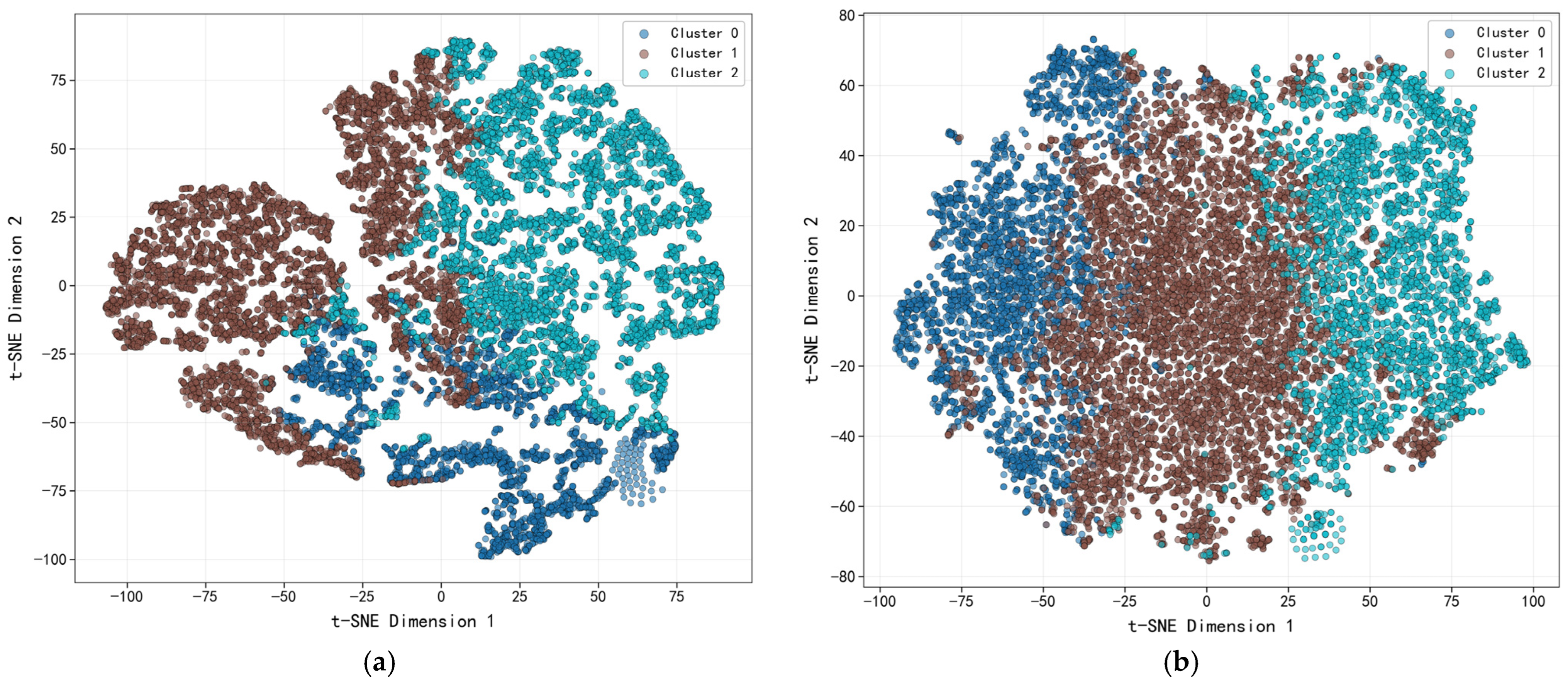
4.2.1. Comparative Analysis of Long-Term Preference Encoding Effectiveness
- 1.
- Cluster 1 (Economical and Low-Carbon Transportation Segment)
- 2.
- Cluster 2 (High-End and Sustainable Quality Segment)
- 3.
- Cluster 0 (Mid- to High-End Comprehensive Segment)
4.2.2. Comparative Analysis of Short-Term Memory Mechanism Effectiveness
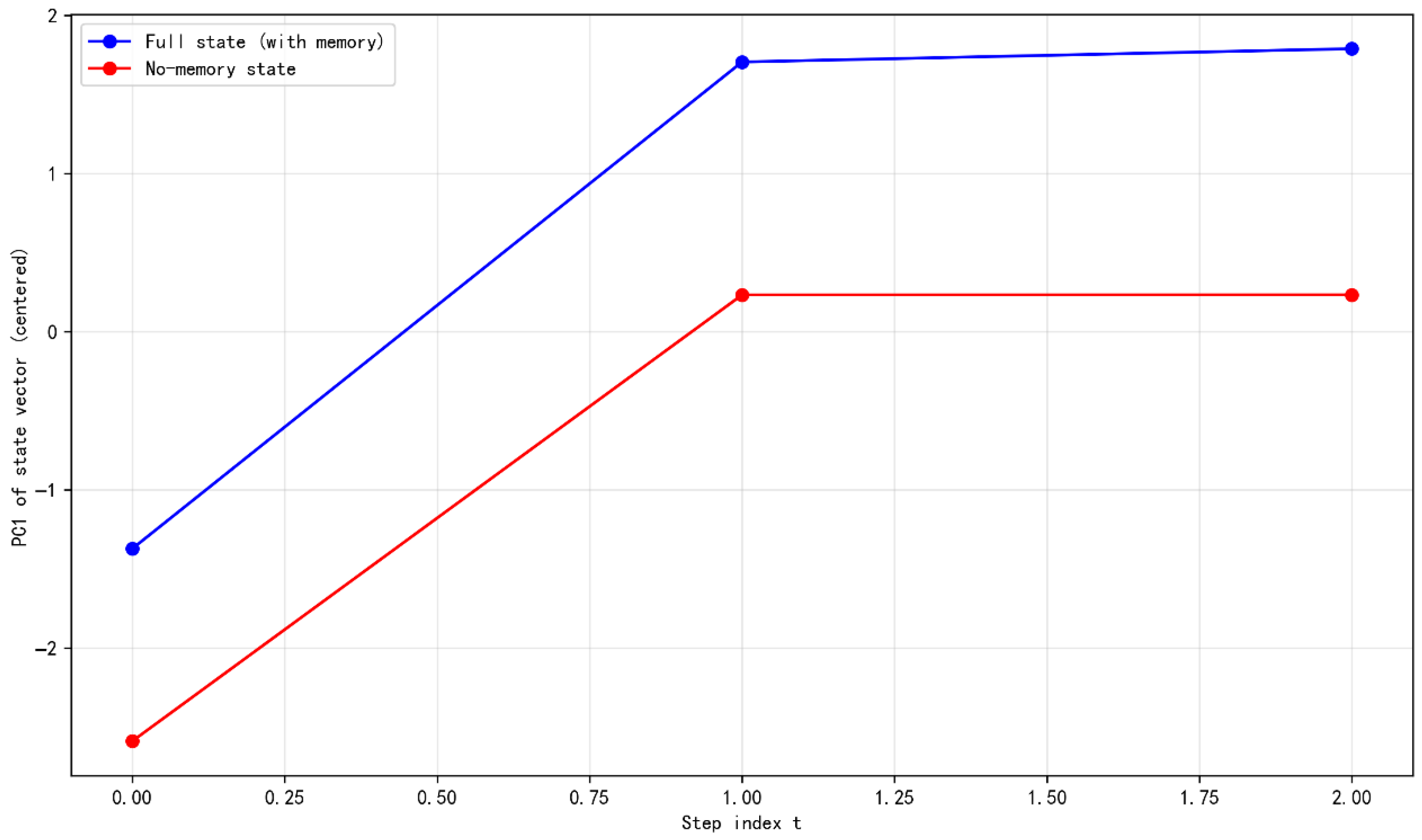
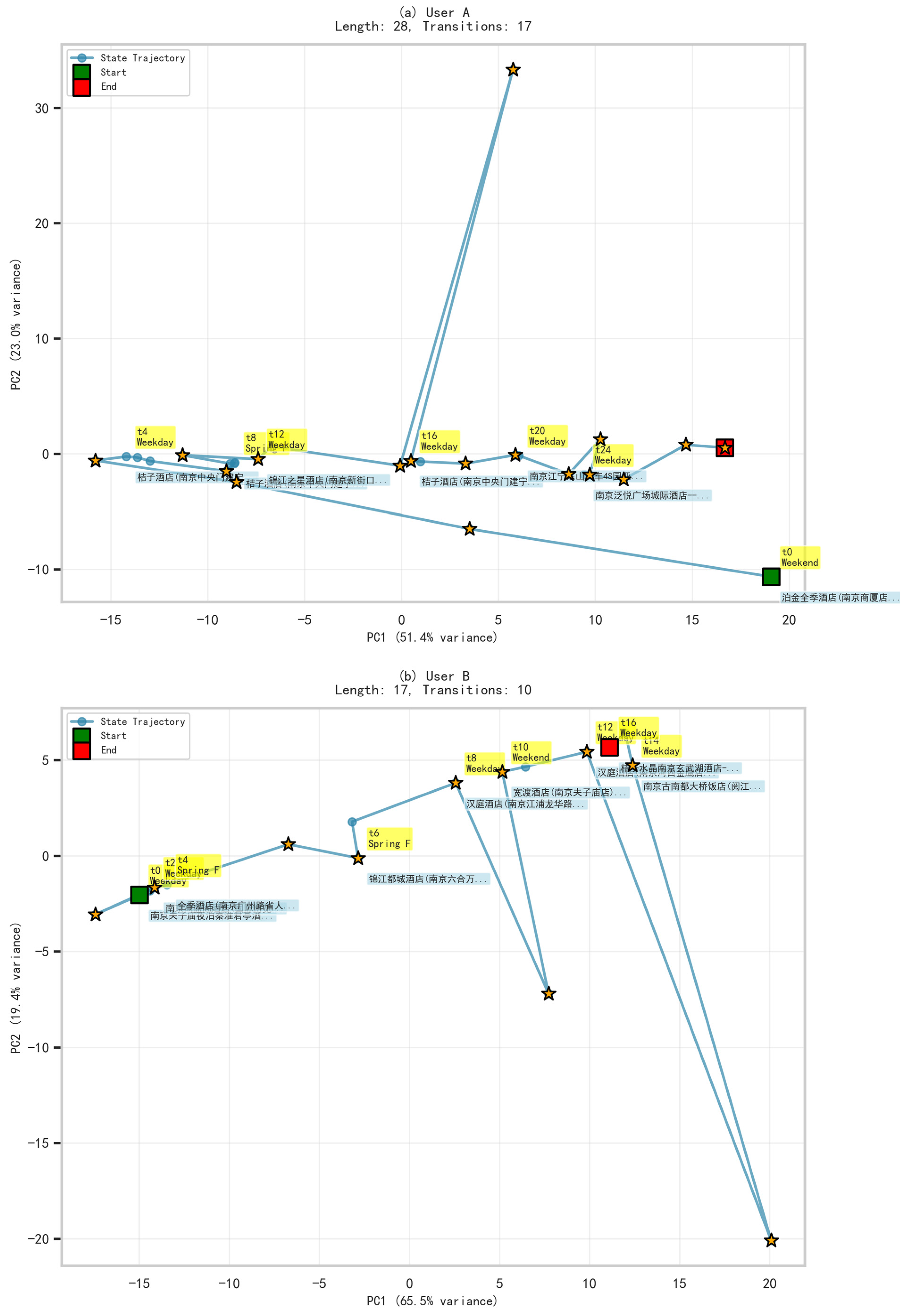
4.2.3. Analysis of the Dynamic Evolution Trajectories of State Vectors
4.3. Analysis of the Decision-Making Mechanism for the Recommendation Strategy
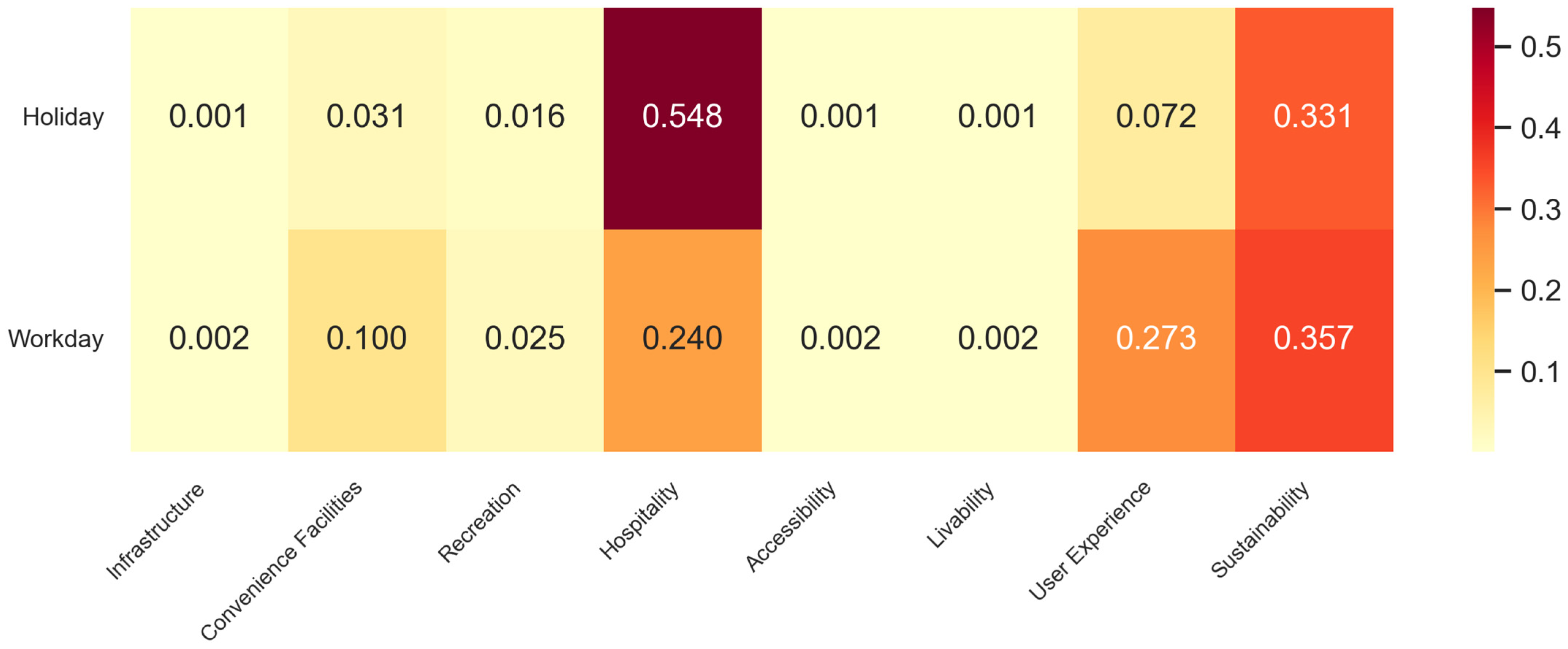
4.3.1. Necessity of Dynamic Weight Generation
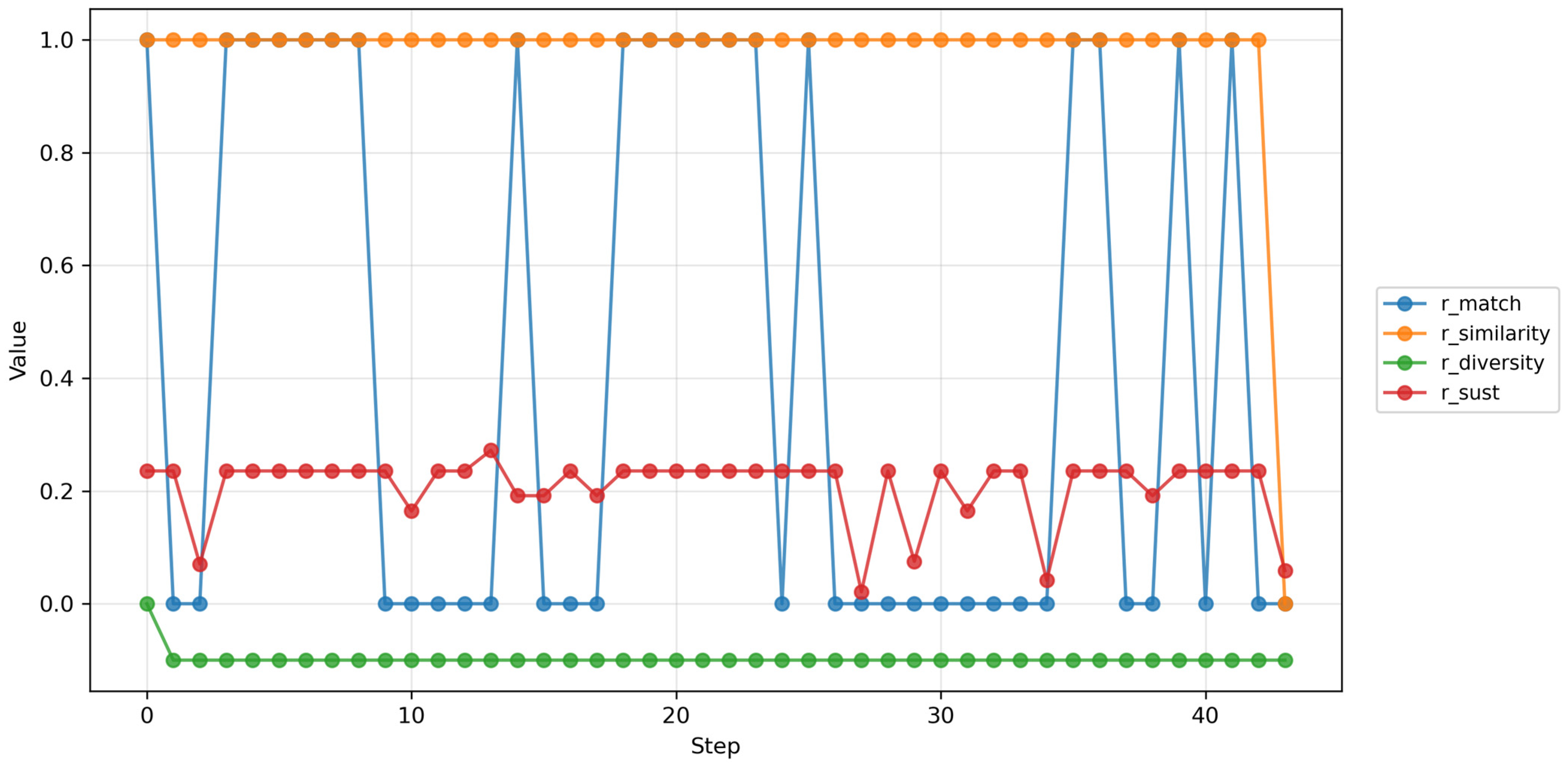
4.3.2. Necessity of Diversity and Sustainability Reward Mechanisms
4.4. Comparative Analysis of Recommendation Performance
4.5. Case Study: Recommendation List Comparison
5. Discussion
5.1. Operational Strategies for Hotels in Sustainable Tourism
5.2. Strategic Optimization for Online Travel Agencies (OTAs)
5.3. Empowering Eco-Conscious Consumer Decisions
6. Conclusions
Author Contributions
Funding
Institutional Review Board Statement
Informed Consent Statement
Data Availability Statement
Conflicts of Interest
References
- Tseng, S.-M.; Hori, N. What You See Isn’t Always What You Get: Investigating the Impact of the Information Disclosure Gap in Online Travel Agencies. J. Theor. Appl. Electron. Commer. Res. 2025, 20, 167. [Google Scholar] [CrossRef] [Scilit]
- Rehman Khan, H.U.; Lim, C.K.; Ahmed, M.F.; Tan, K.L.; Bin Mokhtar, M. Systematic Review of Contextual Suggestion and Recommendation Systems for Sustainable e-Tourism. Sustainability 2021, 13, 8141. [Google Scholar] [CrossRef] [Scilit]
- Alshamlan, H.; Alghofaili, G.; ALFulayj, N.; Aldawsari, S.; Alrubaiya, Y.; Alabduljabbar, R. Promoting Sustainable Travel Experiences: A Weighted Parallel Hybrid Approach for Personalized Tourism Recommendations and Enhanced User Satisfaction. Sustainability 2023, 15, 14447. [Google Scholar] [CrossRef] [Scilit]
- Lu, W.; Stepchenkova, S. User-generated content as a research mode in tourism and hospitality applications: Topics, methods, and software. J. Hosp. Mark. Manag. 2015, 24, 119–154. [Google Scholar] [CrossRef] [Scilit]
- Bhagat, Y. BERT-Based Multi-Task Learning for Aspect-Based Sentiment Analysis. Ph.D. Thesis, Laurentian University, Sudbury, ON, Canada, 2022. Available online: https://laurentian.scholaris.ca/handle/10219/4024 (accessed on 15 January 2026).
- Xu, X.; Wang, X.; Li, Y.; Haghighi, M. Business intelligence in online customer textual reviews: Understanding consumer perceptions and influential factors. Int. J. Inf. Manag. 2017, 37, 673–683. [Google Scholar] [CrossRef] [Scilit]
- Mikolov, T.; Chen, K.; Corrado, G.; Dean, J. Efficient estimation of word representations in vector space. arXiv 2013, arXiv:1301.3781. [Google Scholar] [CrossRef] [Scilit]
- Abbasi-Moud, Z.; Vahdat-Nejad, H.; Sadri, J. Tourism recommendation system based on semantic clustering and sentiment analysis. Expert Syst. Appl. 2021, 167, 114324. [Google Scholar] [CrossRef] [Scilit]
- Devlin, J.; Chang, M.W.; Lee, K.; Toutanova, K. BERT: Pre-training of deep bidirectional transformers for language understanding. In Proceedings of the 2019 Conference of the North American Chapter of the Association for Computational Linguistics: Human Language Technologies, Minneapolis, MN, USA, 2–7 June 2019; Association for Computational Linguistics: Stroudsburg, PA, USA, 2019; Volume 1, pp. 4171–4186. Available online: https://aclanthology.org/N19-1423/ (accessed on 10 January 2026).
- Rendle, S. Factorization Machines. In Proceedings of the 2010 IEEE International Conference on Data Mining, Sydney, Australia, 14–17 December 2010; pp. 995–1000. [Google Scholar] [CrossRef] [Scilit]
- Zhang, Y.; Lai, G.; Zhang, M.; Zhang, Y.; Liu, Y.; Ma, S. Explicit factor models for explainable recommendation based on phrase-level sentiment analysis. In Proceedings of the 37th International ACM SIGIR Conference on Research and Development in Information Retrieval, Gold Coast, Australia, 6–11 July 2014; pp. 83–92. [Google Scholar] [CrossRef] [Scilit]
- Catherine, R.; Cohen, W. Transnets: Learning to transform for recommendation. In Proceedings of the 11th ACM Conference on Recommender Systems, Como, Italy, 27–31 August 2017; pp. 288–296. Available online: https://dl.acm.org/doi/10.1145/3109859.3109878 (accessed on 22 January 2026).
- Kang, W.C.; McAuley, J. Self-attentive sequential recommendation. In Proceedings of the 2018 IEEE International Conference on Data Mining (ICDM), Singapore, 17–20 November 2018; pp. 197–206. [Google Scholar] [CrossRef] [Scilit]
- Flórez, M.; Carrillo, E.; Mendes, F.; Carreño, J. A Context-Aware Tourism Recommender System Using a Hybrid Method Combining Deep Learning and Ontology-Based Knowledge. J. Theor. Appl. Electron. Commer. Res. 2025, 20, 194. [Google Scholar] [CrossRef] [Scilit]
- Smirnova, E.; Vasile, F. Contextual sequence modeling for recommendation with recurrent neural networks. In Proceedings of the 2nd Workshop on Deep Learning for Recommender Systems, Como, Italy, 27 August 2017; pp. 2–9. [Google Scholar] [CrossRef] [Scilit]
- Wu, L.; Li, S.; Hsieh, C.J.; Sharpnack, J. SSE-PT: Sequential recommendation via personalized transformer. In Proceedings of the 14th ACM Conference on Recommender Systems, Virtual Event, 22–26 September 2020; pp. 328–337. [Google Scholar] [CrossRef] [Scilit]
- Sun, F.; Liu, J.; Wu, J.; Pei, C.; Lin, X.; Ou, W.; Jiang, P. BERT4Rec: Sequential recommendation with bidirectional encoder representations from transformer. In Proceedings of the 28th ACM International Conference on Information and Knowledge Management, Beijing, China, 3–7 November 2019; pp. 1441–1450. [Google Scholar] [CrossRef] [Scilit]
- Li, J.; Wang, Y.; McAuley, J. Time interval aware self-attention for sequential recommendation. In Proceedings of the 13th International Conference on Web Search and Data Mining, Houston, TX, USA, 3–7 February 2020; pp. 322–330. [Google Scholar] [CrossRef] [Scilit]
- Li, Y.; Chen, H.; Sun, X.; Sun, Z.; Li, L.; Cui, L.; Xu, G. Hyperbolic hypergraphs for sequential recommendation. In Proceedings of the 30th ACM International Conference on Information & Knowledge Management, Gold Coast, Australia, 1–5 October 2021; pp. 988–997. [Google Scholar] [CrossRef] [Scilit]
- Liu, Q.; Zeng, Y.; Mokhosi, R.; Zhang, H. STAMP: Short-term attention/memory priority model for session-based recommendation. In Proceedings of the 24th ACM SIGKDD International Conference on Knowledge Discovery & Data Mining, London, UK, 19–23 August 2018; pp. 1831–1839. [Google Scholar] [CrossRef] [Scilit]
- Zheng, Y.; Gao, C.; Chang, J.; Niu, Y.; Song, Y.; Jin, D.; Li, Y. Disentangling long and short-term interests for recommendation. In Proceedings of the ACM Web Conference 2022, Lyon, France, 25–29 April 2022; pp. 2256–2267. [Google Scholar] [CrossRef] [Scilit]
- Thaipisutikul, T.; Chen, Y.N. An improved deep sequential model for context-aware POI recommendation. Multimed. Tools Appl. 2024, 83, 1643–1668. [Google Scholar] [CrossRef] [Scilit]
- Liu, X.; Yuan, J.; Zhou, Y.; Li, J.; Huang, F.; Ai, W. CSRec: Rethinking Sequential Recommendation from A Causal Perspective. In Proceedings of the 48th International ACM SIGIR Conference on Research and Development in Information Retrieval, Padua Italy, 13–18 July 2025; pp. 1562–1571. [Google Scholar] [CrossRef] [Scilit]
- Zhou, K.; Yu, H.; Zhao, W.X.; Wen, J.R. Filter-enhanced MLP is all you need for sequential recommendation. In Proceedings of the ACM Web Conference 2022, Lyon, France, 25–29 April 2022; pp. 2388–2399. [Google Scholar] [CrossRef] [Scilit]
- Parraga, O.; More, M.D.; Oliveira, C.M.; Gavenski, N.S.; Kupssinskü, L.S.; Medronha, A.; Barros, R.C. Fairness in Deep Learning: A survey on vision and language research. ACM Comput. Surv. 2025, 57, 1–40. [Google Scholar] [CrossRef] [Scilit]
- Wang, N.; Wang, H.; Jia, Y.; Yin, Y. Explainable recommendation via multi-task learning in opinionated text data. In Proceedings of the 41st International ACM SIGIR Conference on Research & Development in Information Retrieval, Ann Arbor, MI, USA, 8–12 July 2018; pp. 165–174. [Google Scholar] [CrossRef] [Scilit]
- Chen, J.; Zhang, H.; He, X.; Nie, L.; Liu, W.; Chua, T.S. Attentive collaborative filtering: Multimedia recommendation with item-and component-level attention. In Proceedings of the 40th International ACM SIGIR Conference on Research and Development in Information Retrieval, Tokyo, Japan, 7–11 August 2017; pp. 335–344. [Google Scholar] [CrossRef] [Scilit]
- Li, Z.; Liu, F.; Wei, Y.; Cheng, Z.; Nie, L.; Kankanhalli, M. Attribute-driven disentangled representation learning for multimodal recommendation. In Proceedings of the 32nd ACM International Conference on Multimedia, Melbourne, Australia, 28 October–1 November 2024; pp. 9660–9669. [Google Scholar] [CrossRef] [Scilit]
- Hou, Y.; Yang, N.; Wu, Y.; Yu, P.S. Explainable recommendation with fusion of aspect information. World Wide Web 2019, 22, 221–240. [Google Scholar] [CrossRef] [Scilit]
- Li, Z.; Chen, H.; Lin, K.; Shakhov, V.; Shi, L.; Yu, J. From edge data to recommendation: A double attention-based deformable convolutional network. Peer-to-Peer Netw. Appl. 2021, 14, 3984–3997. [Google Scholar] [CrossRef] [Scilit]
- Liao, H.; Wang, S.; Cheng, H.; Zhang, W.; Zhang, J.; Zhou, M.; Xie, X. Aspect-enhanced explainable recommendation with multi-modal contrastive learning. ACM Trans. Intell. Syst. Technol. 2025, 16, 1–24. [Google Scholar] [CrossRef] [Scilit]
- Lundberg, S.M.; Lee, S.I. A unified approach to interpreting model predictions. In Proceedings of the Advances in Neural Information Processing Systems 30, Long Beach, CA, USA, 4–9 December 2017; Available online: https://dl.acm.org/doi/10.5555/3295222.3295230 (accessed on 5 January 2026).
- Zhang, Y.; Chen, X. Explainable recommendation: A survey and new perspectives. Found. Trends Inf. Retr. 2020, 14, 1–101. [Google Scholar] [CrossRef] [Scilit]
- Balog, K.; Radlinski, F. Measuring recommendation explanation quality: The conflicting goals of explanations. In Proceedings of the 43rd International ACM SIGIR Conference on Research and Development in Information Retrieval, Xi’an, China, 25–30 July 2020; pp. 329–338. [Google Scholar] [CrossRef] [Scilit]
- Abdollahi, B.; Nasraoui, O. Using explainability for constrained matrix factorization. In Proceedings of the 11th ACM Conference on Recommender Systems, Como, Italy, 27–31 August 2017; pp. 79–83. [Google Scholar] [CrossRef] [Scilit]
- Zhuang, H.; Zhang, W.; Chen, W.; Yang, J.; Sheng, Q.Z. Improving faithfulness and factuality with contrastive learning in explainable recommendation. ACM Trans. Intell. Syst. Technol. 2024, 16, 1–23. [Google Scholar] [CrossRef] [Scilit]
- Zhao, X.; Xia, L.; Zhang, L.; Ding, Z.; Yin, D.; Tang, J. Deep reinforcement learning for page-wise recommendations. In Proceedings of the 12th ACM Conference on Recommender Systems, Vancouver, BC, Canada, 2–7 October 2018; pp. 95–103. [Google Scholar] [CrossRef] [Scilit]
- Chen, M.; Beutel, A.; Covington, P.; Jain, S.; Belletti, F.; Chi, E.H. Top-k off-policy correction for a REINFORCE recommender system. In Proceedings of the 12th ACM International Conference on Web Search and Data Mining, Melbourne, Australia, 11–15 February 2019; pp. 456–464. [Google Scholar] [CrossRef] [Scilit]
- Zou, L.; Xia, L.; Ding, Z.; Song, J.; Liu, W.; Yin, D. Reinforcement learning to optimize long-term user engagement in recommender systems. In Proceedings of the 25th ACM SIGKDD International Conference on Knowledge Discovery & Data Mining, Anchorage, AK, USA, 4–8 August 2019; pp. 2810–2818. [Google Scholar] [CrossRef] [Scilit]
- Stamenkovic, D.; Karatzoglou, A.; Arapakis, I.; Xin, X.; Katevas, K. Choosing the best of both worlds: Diverse and novel recommendations through multi-objective reinforcement learning. In Proceedings of the 15th ACM International Conference on Web Search and Data Mining, Phoenix, AZ, USA, 21–25 February 2022; pp. 957–965. [Google Scholar] [CrossRef] [Scilit]
- Wang, T.; Shi, X.; Shang, M. Diversity-aware top-n recommendation: A deep reinforcement learning way. In Proceedings of the CCF Conference on Big Data, Singapore, 22–24 October 2020; Springer: Singapore, 2020; pp. 226–241. [Google Scholar] [CrossRef] [Scilit]
- Fatima Ezzahra, Z.; Sana, A.; Sara, Q.; Said, R. Multi-objective reinforcement learning for recommender systems: A comprehensive survey of methods, challenges, and future directions. Int. J. Multimed. Inf. Retr. 2025, 14, 33. [Google Scholar] [CrossRef] [Scilit]
- Zhao, K.; Liu, S.; Cai, Q.; Zhao, X.; Liu, Z.; Zheng, D.; Gai, K. KuaiSim: A comprehensive simulator for recommender systems. In Proceedings of the Advances in Neural Information Processing Systems 36, New Orleans, LA, USA, 10–16 December 2023; pp. 44880–44897. Available online: https://dl.acm.org/doi/10.5555/3666122.3668067 (accessed on 28 January 2026).
- Wu, Y.; Macdonald, C.; Ounis, I. Partially observable reinforcement learning for dialog-based interactive recommendation. In Proceedings of the 15th ACM Conference on Recommender Systems, Amsterdam, The Netherlands, 27 September–1 October 2021; pp. 241–251. [Google Scholar] [CrossRef] [Scilit]
- Padhye, V.; Lakshmanan, K.; Chaturvedi, A. Proximal policy optimization based hybrid recommender systems for large scale recommendations. Multimed. Tools Appl. 2023, 82, 20079–20100. [Google Scholar] [CrossRef] [Scilit]
- Ge, Y.; Liu, S.; Gao, R.; Xian, Y.; Li, Y.; Zhao, X.; Zhang, Y. Towards long-term fairness in recommendation. In Proceedings of the 14th ACM International Conference on Web Search and Data Mining, Virtual Event, 8–12 March 2021; pp. 445–453. [Google Scholar] [CrossRef] [Scilit]
- Manning, C.D.; Surdeanu, M.; Bauer, J.; Finkel, J.R.; Bethard, S.; McClosky, D. The Stanford CoreNLP natural language processing toolkit. In Proceedings of the 52nd Annual Meeting of the Association for Computational Linguistics: System Demonstrations, Baltimore, MD, USA, 23–24 June 2014; pp. 55–60. [Google Scholar] [CrossRef] [Scilit]
- Frey, B.J.; Dueck, D. Clustering by passing messages between data points. Science 2007, 315, 972–976. [Google Scholar] [CrossRef] [Scilit] [PubMed]
- GB/T 14308-2023; Classification and Accreditation for Star-Rated Tourist Hotels. Standards Press of China: Beijing, China, 2023.
- Shi, L.; Ou, S.S.; Zhou, Y.; Wu, Y.; Tan, X.; He, X.; Lin, Z. Assessing Chinese user satisfaction with electric vehicle battery performance from online reviews. Transp. Res. Part D Transp. Environ. 2025, 141, 104644. [Google Scholar] [CrossRef] [Scilit]
- Vaswani, A.; Shazeer, N.; Parmar, N.; Uszkoreit, J.; Jones, L.; Gomez, A.N.; Polosukhin, I. Attention is all you need. In Proceedings of the Advances in Neural Information Processing Systems 30, Long Beach, CA, USA, 4–9 December 2017; Available online: https://dl.acm.org/doi/10.5555/3295222.3295349 (accessed on 18 January 2026).
- Hochreiter, S.; Schmidhuber, J. Long short-term memory. Neural Comput. 1997, 9, 1735–1780. [Google Scholar] [CrossRef] [Scilit] [PubMed]




| Notation | Description |
|---|---|
| Set of candidate hotels, and a specific hotel | |
| Multidimensional comprehensive feature vector of hotel | |
| Long-term preference representation vector of user | |
| Short-term memory hidden state at time | |
| Temporal context vector (e.g., holiday, season) at time | |
| Fused comprehensive user state vector at decision time | |
| Action taken at time (i.e., the recommended hotel). | |
| Composite reward received after taking action | |
| Weighting coefficients for sub-rewards. | |
| Discount factor for long-term reward estimation. | |
| Dynamic attribute attention weights generated by the Actor. | |
| Hybrid action-value (matching degree) for hotel in state | |
| Temporal difference (TD) error serving as the advantage signal. | |
| Policy network (Actor) parameterized by and Value network (Critic) parameterized by |
| Statistic | Value |
|---|---|
| number of users | 14,522 |
| number of hotels | 806 |
| total number of interaction records | 94,634 |
| user average sequence length | 6.52 |
| time span | 2021/10–2024/11 |
| data sparsity | 0.9919 |
| minimum value of sequence length | 3 |
| maximum sequence length | 28 |
| median sequence length | 5 |
| Primary Dimension | Associated Sub-Clusters |
|---|---|
| Infrastructure | Door & Window; Balcony; Room Size; Bedding; Interior Decor & Furnishings; In-room Entertainment. |
| Convenience Facilities | Furniture; Wireless Network; Bathroom Facilities; Daily Necessities; Laundry Room; Parking Facility; Takeaway & Delivery Service. |
| Recreation | Swimming Facility; Gym; Other Sports; Amusement; Show; Leisure & Relaxation; Bar Service. |
| Hospitality | Front Desk Service; Luggage Handling; Gift & Complimentary Items; Airport Pick-up/Drop-off; Extended Stay/Late Service; Dining Service; Room Upgrade. |
| Accessibility | High-speed Rail Station; Airport; Scenic Attractions; Business District. |
| Livability | Basic Odor Perception; In-Room Brightness; Spatial Breathability; Auditory Quietness; Window View Quality; External Disturbance Perception. |
| User Experience | Value for Money; Safety & Security; Privacy; Comfort. |
| Sustainability | Low-Carbon Mobility; Energy Efficiency & Indoor Climate; Resource & Light Environment; Acoustic & Olfactory Health; Biophilic Environment; Social Inclusivity |
| Category | Keywords | Sustainability Rationale |
|---|---|---|
| Low-Carbon Mobility | Subway, light rail, public bus, shuttle bus | Encouraging public transport to reduce the carbon footprint of travel. |
| Energy Efficiency & Indoor Climate | Air conditioning, heating, thermal comfort, ventilation, air quality | Optimizing HVAC energy use while maintaining high indoor environmental quality. |
| Resource & Light Environment | Lighting, natural daylight, sunlight, LED fixtures | Leveraging natural light and energy-efficient lighting systems. |
| Acoustic & Olfactory Health | Noise control, sound insulation, air cleanliness, odor elimination | Ensuring a healthy, non-toxic, and quiet living environment for guests. |
| Biophilic Environment | Landscape, greenery, scenic views, courtyard, lakefront, eco-trails | Promoting mental well-being and biodiversity through natural integration. |
| Social Inclusivity | Child-friendly, elderly friendly, parental facilities, multi-generational accessibility | Enhancing social sustainability by catering to vulnerable and diverse age groups. |
| Raw Review Phrase (Translated) | Extracted Keyword(s) | Mapped Sustainability Category | Sentiment Score | Metric Impact |
|---|---|---|---|---|
| Public bus and subway nearby make travel extremely convenient. | Subway; Bus | Low-Carbon Mobility | 0.86 (Positive) | Frequency + 1; Positive sentiment aggregated |
| The advantage is that it gets plenty of sunlight in the afternoon. | Sunlight | Resource & Light Environment | 0.90 (Positive) | Frequency + 1; Positive sentiment aggregated |
| The hotel’s sound insulation is really poor. | Sound insulation | Acoustic & Olfactory Health | 0.22 (Negative) | Frequency + 1; Negative sentiment aggregated |
| The exhaust fan doesn’t work well, and the odor was not eliminated. | Odor elimination | Acoustic & Olfactory Health | 0.23 (Negative) | Frequency + 1; Negative sentiment aggregated |
| Parameter Category | Parameter Name (Symbol) | Value |
|---|---|---|
| Model structure parameters | number of features () | 8 |
| Transformer hide dimensions () | 128 | |
| LSTM hide state dimension () | 64 | |
| Total dimension of state vector () | 201 | |
| Dimensionality of the query and key vectors () | 32 | |
| Core parameters of reinforcement learning | discount factor () | training: 0.95 evaluate: 0.9 |
| Basic matching reward weight () | 1.0 | |
| Similarity reward weight () | 0.3 | |
| Sustainability reward weight () | 0.15 | |
| Depth adjustment item weight | 0.5 | |
| Diversity penalty coefficient () | 0.1 | |
| Emotional score weight () | 0.3 | |
| Critic loss weight () | 0.3 | |
| Margin ranking loss weight () | 0.2 | |
| Training optimization parameters | Actor network learning rate () | 0.0005 |
| Critic network learning rate () | 0.0002 | |
| Batch size (B) | 128 | |
| Entropy regularization coefficient () | 0.005 |
| Representation Method | Optimal Number of Clusters K | Silhouette Coefficient | Average Distance Within the Cluster |
|---|---|---|---|
| Transformer encoding | 3 | 0.2899 | 7.8616 |
| Historical mean encoding | 2 | 0.2044 | 4.0335 |
| Representation Method | Silhouette Coefficient | Average Distance Within the Cluster |
|---|---|---|
| Transformer encoding | 0.2899 | 7.8616 |
| Historical mean encoding | 0.1404 | 3.8337 |
| Status Representation | Average State Responsiveness | Proportion of High Responsiveness Events | NDCG@10 |
|---|---|---|---|
| Complete state | 2.869 | 50.0% | 0.754 |
| No memory state | 2.788 | 13.9% | 0.546 |
| Strategy | Attribute | Variance |
|---|---|---|
| dynamic weight | User Experience | 0.018 |
| dynamic weight | Hospitality | 0.028 |
| dynamic weight | Sustainability | 0.004 |
| Static weight | User Experience | 0.000 |
| Static weight | Hospitality | 0.000 |
| Static weight | Sustainability | 0.000 |
| Metric | This Research Method | Item-Based CF | TODIM | VIKOR | GRU4Rec |
|---|---|---|---|---|---|
| NDCG@10 | 0.7539 | 0.6282 | 0.6392 | 0.6988 | 0.6838 |
| Metrics | This Research Method | Item-Based CF | TODIM | VIKOR | GRU4Rec |
|---|---|---|---|---|---|
| 0.70 | 0.58 | 0.61 | 0.62 | 0.49 | |
| 71% | 40% | 50% | 20% | 6% |
| Rank | GRU4Rec Main Tag | GRU4Rec Sust. Score | This Research Main Tag | This Research Sust. Score |
|---|---|---|---|---|
| 1 | Sustainability | 0.7351 | Sustainability | 0.7649 |
| 2 | Hospitality | 0.6983 | Sustainability | 0.8523 |
| 3 | Hospitality | 0.6581 | Hospitality | 0.6602 |
| 4 | Hospitality | 0.6513 | Sustainability | 0.7485 |
| 5 | Sustainability | 0.5890 | Sustainability | 0.7400 |
| Average | 0.6664 | 0.7532 |
Disclaimer/Publisher’s Note: The statements, opinions and data contained in all publications are solely those of the individual author(s) and contributor(s) and not of MDPI and/or the editor(s). MDPI and/or the editor(s) disclaim responsibility for any injury to people or property resulting from any ideas, methods, instructions or products referred to in the content. |
© 2026 by the authors. Licensee MDPI, Basel, Switzerland. This article is an open access article distributed under the terms and conditions of the Creative Commons Attribution (CC BY) license.
Share and Cite
Meng, F.; Wang, Q. Balancing Personalization and Sustainability in Hotel Recommendation: A Multi-Objective Reinforcement Learning Approach. Sustainability 2026, 18, 3573. https://doi.org/10.3390/su18073573
Meng F, Wang Q. Balancing Personalization and Sustainability in Hotel Recommendation: A Multi-Objective Reinforcement Learning Approach. Sustainability. 2026; 18(7):3573. https://doi.org/10.3390/su18073573
Chicago/Turabian StyleMeng, Fanyong, and Qi Wang. 2026. "Balancing Personalization and Sustainability in Hotel Recommendation: A Multi-Objective Reinforcement Learning Approach" Sustainability 18, no. 7: 3573. https://doi.org/10.3390/su18073573
APA StyleMeng, F., & Wang, Q. (2026). Balancing Personalization and Sustainability in Hotel Recommendation: A Multi-Objective Reinforcement Learning Approach. Sustainability, 18(7), 3573. https://doi.org/10.3390/su18073573