The Attitude–Behaviour Gap in Young Adults’ Sustainable Consumption: The Case of Poland


Abstract
1. Introduction
2. Literature Review
3. Methodological Approach
3.1. Data Collection
3.2. Data Analysis
4. Results
4.1. Perception of Green Consumption as a Recognised Ideal Yet Distant Practice
People should buy as much as they need. And not that they just have money, they buy a full basket of food and throw out half of it.R2 (M, 22 y/o)
4.2. Determinants of Young Consumers’ Behaviour—What Really Matters at the Point of Purchase
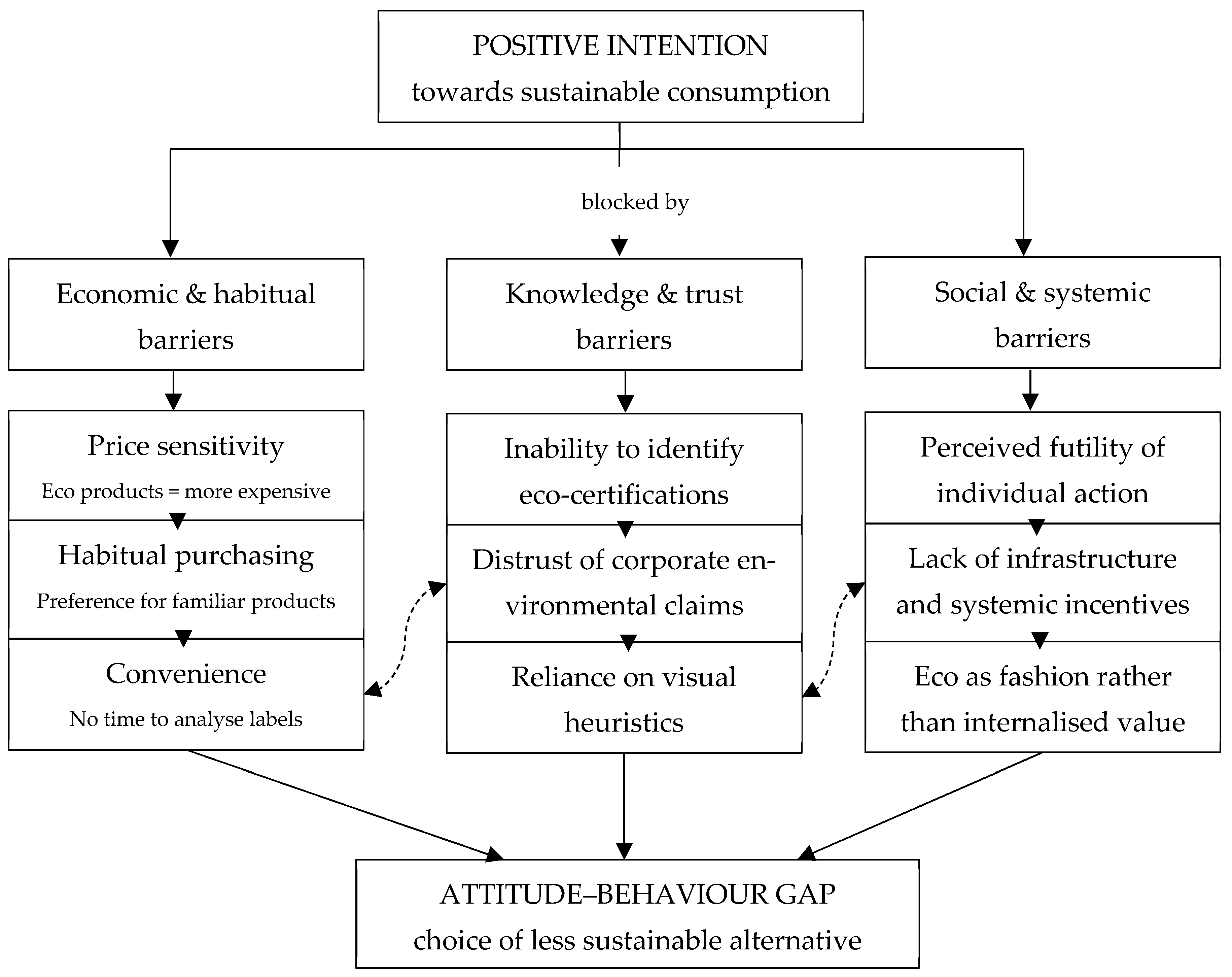
If I have a product that I like (…) I will buy it the next time, I will not look if there are any other products, because I am already satisfied.R4 (F, 21 y/o)
I am guided by the fact that when shopping, as a rule, I want to get in, buy, go out. (…) I do not sit, do not analyse (…) I do not have time for it.R1 (M, 21 y/o)
It means that I set myself these previous values a little higher. This means the price, quality or even recommendations from relatives and friends. On the other hand, if something is made in harmony with nature, it has some importance, but (…) it is not in the foreground.R3 (M, 22 y/o)
4.3. Barriers to Pro-Environmental Behaviour—The Gap Between Intention and Action
So what if I can sort the rubbish, the bin is shared anyway, so someone can sort it wrongly and throw it into the same bin, and all in all, the whole segregation does not make sense anymore.R9 (M, 22 y/o)
It’s also like this now (…) well that’s a bit stupid to say—fashion. Well, because in the past there was no such pressure on it all, and now, even on Instagram, everyone wants to be fit, everyone wants to be eco. It is very much promoted and publicised.R10 (F, 26 y/o)
A very large number of people do it to feel better, that they do not clutter the environment, that they are more socially acceptable, that they are part of a group that cares about this environment and that is why they do it.R5 (F, 25 y/o)
5. Discussion
Limitations
6. Conclusions
Author Contributions
Funding
Institutional Review Board Statement
Informed Consent Statement
Data Availability Statement
Acknowledgments
Conflicts of Interest
References
- Alzubaidi, H.; Slade, E.L.; Dwivedi, Y.K. Examining antecedents of consumers’ pro-environmental behaviours: TPB extended with materialism and innovativeness. J. Bus. Res. 2021, 122, 685–699. [Google Scholar] [CrossRef] [Scilit]
- Jahari, S.A.; Hass, A.; Idris, I.B.; Joseph, M. An integrated framework examining sustainable green behavior among young consumers. J. Consum. Mark. 2022, 39, 333–344. [Google Scholar] [CrossRef] [Scilit]
- Kadic-Maglajlic, S.; Arslanagic-Kalajdzic, M.; Micevski, M.; Dlacic, J.; Zabkar, V. Being engaged is a good thing: Understanding sustainable consumption behavior among young adults. J. Bus. Res. 2019, 104, 644–654. [Google Scholar] [CrossRef] [Scilit]
- Nguyen, T.N.; Lobo, A.; Nguyen, B.K. Young consumers’ green purchase behaviour in an emerging market. J. Strateg. Mark. 2018, 26, 583–600. [Google Scholar] [CrossRef] [Scilit]
- Schwartz, D.; Loewenstein, G.; Agüero-Gaete, L. Encouraging pro-environmental behaviour through green identity labelling. Nat. Sustain. 2020, 3, 746–752. [Google Scholar] [CrossRef] [Scilit]
- Haron, S.A.; Paim, L.; Yahaya, N. Towards sustainable consumption: An examination of environmental knowledge among Malaysians. Int. J. Consum. Stud. 2005, 29, 426–436. [Google Scholar] [CrossRef] [Scilit]
- Wang, C.; Ghadimi, P.; Lim, M.K.; Tseng, M.L. A literature review of sustainable consumption and production: A comparative analysis in developed and developing economies. J. Clean. Prod. 2019, 206, 741–754. [Google Scholar] [CrossRef] [Scilit]
- Mkono, M. Eco-hypocrisy and inauthenticity: Criticisms and confessions of the eco-conscious tourist/traveller. Ann. Tour. Res. 2020, 84, 102967. [Google Scholar] [CrossRef] [Scilit]
- Pilch, K. Consumer’s Social Responsibility Communication (CNSRC). In Encyclopedia of Sustainable Management; Springer: Cham, Germany, 2020; pp. 713–717. Available online: https://link.springer.com/rwe/10.1007/978-3-030-02006-4_32-1 (accessed on 30 December 2025).
- Pilch, K.; Miśniakiewicz, M. Determinants of consumer behaviour—Towards sustainable consumption. In Sustainable Products in the Circular Economy: Impact on Business and Society; Wojnarowska, M., Ćwiklicki, M., Ingrao, C., Eds.; Routledge: London, UK, 2022. [Google Scholar]
- Szczygieł, E.; Śliwa, R. Social economy entities as a place to develop green skills—Research findings. Soc. Entrep. Rev. 2023, 1, 44–56. [Google Scholar] [CrossRef] [Scilit]
- Caruana, R.; Carrington, M.J.; Chatzidakis, A. “Beyond the Attitude-Behaviour Gap: Novel Perspectives in Consumer Ethics”: Introduction to the Thematic Symposium. J. Bus. Ethics. 2016, 136, 215–218. [Google Scholar] [CrossRef] [Scilit]
- Montreuil Carmona, L.J.; Barretto, A.G.P.; Bacinello, E. Does intention translate into actual purchase? Analysis of inducers of sustainable consumption in higher education students. Young Consum. Insight Ideas Responsible Mark. 2023, 25, 45–64. [Google Scholar] [CrossRef] [Scilit]
- Papaoikonomou, E.; Ryan, G.; Valverde, M. Mapping Ethical Consumer Behavior: Integrating the Empirical Research and Identifying Future Directions. Ethics Behav. 2011, 21, 197–221. [Google Scholar] [CrossRef] [Scilit]
- Naderi, I.; Van Steenburg, E. Me first, then the environment: Young Millennials as green consumers. Young Consum. Insight Ideas Responsible Mark. 2018, 19, 280–295. [Google Scholar] [CrossRef] [Scilit]
- Bonera, M.; Codini, A.P.; Miniero, G. The great Millennials’ trouble: Leading or confused green generation? An Italian insight. Ital. J. Mark. 2020, 2020, 289–308. [Google Scholar] [CrossRef] [Scilit]
- Coşkun, A.; Yetkin Özbük, R.M. Environmental segmentation: Young millennials’ profile in an emerging economy. Young Consum. Insight Ideas Responsible Mark. 2019, 20, 359–379. [Google Scholar] [CrossRef] [Scilit]
- Fischer, D.; Böhme, T.; Geiger, S.M. Measuring young consumers’ sustainable consumption behavior: Development and validation of the YCSCB scale. Young Consum. Insight Ideas Responsible Mark. 2017, 18, 312–326. [Google Scholar] [CrossRef] [Scilit]
- Hume, M. Compassion without action: Examining the young consumers consumption and attitude to sustainable consumption. J. World Bus. 2010, 45, 385–394. [Google Scholar] [CrossRef] [Scilit]
- Smith, K.T.; Brower, T.R. Longitudinal study of green marketing strategies that influence Millennials. J. Strateg. Mark. 2012, 20, 535–551. [Google Scholar] [CrossRef] [Scilit]
- Moisander, J. Motivational complexity of green consumerism. Int. J. Consum. Stud. 2007, 31, 404–409. [Google Scholar] [CrossRef] [Scilit]
- Halaissi, M.E.; Benalla, O. Investigating the Phenomenon of Social Entrepreneurship. Soc. Entrep. Rev. 2024, 1, 108–122. [Google Scholar] [CrossRef] [Scilit]
- Ibbih, J.M.; Nyako, N.S. Decarbonization Efforts in Africa: Successes, Opportunities, and Challenges for Promoting the use of Renewable Energy by Social Economy. Soc. Entrep. Rev. 2024, 1, 83–107. [Google Scholar] [CrossRef] [Scilit]
- Stasik, A.; Dańkowska, A. Multiscalar Institutional Work of System-Building Sustainable Entrepreneurs in Transitioning Coal Regions: A Case of an Energy Cluster. Soc. Entrep. Rev. 2024, 1, 60–82. [Google Scholar] [CrossRef] [Scilit]
- Tunn, V.S.C.; Bocken, N.M.P.; van den Hende, E.A.; Schoormans, J.P.L. Business models for sustainable consumption in the circular economy: An expert study. J. Clean. Prod. 2019, 212, 324–333. [Google Scholar] [CrossRef] [Scilit]
- Haller, K.; Lee, J.; Cheung, J. Meet the 2020 Consumers Driving Change. Why Brands Must Deliver on Omnipresence, Agility, and Sustainability. IBM Corporation, 2020. Available online: www.ibm.com/downloads/cas/EXK4XKX8 (accessed on 23 June 2025).
- Yamoah, F.A.; Acquaye, A. Unravelling the attitude-behaviour gap paradox for sustainable food consumption: Insight from the UK apple market. J. Clean. Prod. 2019, 217, 172–184. [Google Scholar] [CrossRef] [Scilit]
- Cowe, R.; Williams, S. Who Are the Ethical Consumers? Ethical Consumerism Report; Cooperative Bank: England, UK, 2000. [Google Scholar]
- Uddin, S.F.; Khan, M.N. Exploring green purchasing behaviour of young urban consumers: Empirical evidences from India. South Asian J. Glob. Bus. Res. 2016, 5, 85–103. [Google Scholar] [CrossRef] [Scilit]
- Falcão, D.; Roseira, C. Mapping the socially responsible consumption gap research: Review and future research agenda. Int. J. Consum. Stud. 2022, 46, 1718–1760. [Google Scholar] [CrossRef] [Scilit]
- Laurisz, N.; Sanak-Kosmowska, K. Differences in Perceptions of the Quality of Education and Employment Effectiveness of Schools in a Non-Skills-Focused Education System. J. Public Gov. 2022, 61, 3. [Google Scholar] [CrossRef] [Scilit]
- Connolly, J.; Prothero, A. Sustainable consumption: Consumption, consumers and the commodity discourse. Consum. Mark. Cult. 2003, 6, 275–291. [Google Scholar] [CrossRef] [Scilit]
- Gupta, S.; Ogden, D.T. To buy or not to buy? A social dilemma perspective on green buying. J. Consum. Mark. 2009, 26, 376–391. [Google Scholar] [CrossRef] [Scilit]
- Phipps, M.; Ozanne, L.K.; Luchs, M.G.; Subrahmanyan, S.; Kapitan, S.; Catlin, J.R.; Gau, R.; Naylor, R.W.; Rose, R.L.; Simpson, B.; et al. Understanding the inherent complexity of sustainable consumption: A social cognitive framework. J. Bus. Res. 2013, 66, 1227–1234. [Google Scholar] [CrossRef] [Scilit]
- Bangsa, A.; Schlegelmilch, B. Linking sustainable product attributes and consumer decision-making: Insights from a systematic review. J. Clean. Prod. 2019, 245, 118902. [Google Scholar] [CrossRef] [Scilit]
- Green, T.; Peloza, J. How does corporate social responsibility create value for consumers? J. Consum. Mark. 2011, 28, 48–56. [Google Scholar] [CrossRef] [Scilit]
- Moser, A.K. Thinking green, buying green? Drivers of pro-environmental purchasing behavior. J. Consum. Mark. 2015, 32, 167–175. [Google Scholar] [CrossRef] [Scilit]
- Olsen, M.C.; Slotegraaf, R.J.; Chandukala, S.R. Green Claims and Message Frames: How Green New Products Change Brand Attitude. J. Mark. 2014, 78, 119–137. [Google Scholar] [CrossRef] [Scilit]
- ElHaffar, G.; Durif, F.; Dubé, L. Towards closing the attitude-intention-behavior gap in green consumption: A narrative review of the literature and an overview of future research directions. J. Clean. Prod. 2020, 275, 122556. [Google Scholar] [CrossRef] [Scilit]
- Moraes, C.; Carrigan, M.; Szmigin, I. The coherence of inconsistencies: Attitude–behaviour gaps and new consumption communities. J. Mark. Manag. 2012, 28, 103–128. [Google Scholar] [CrossRef] [Scilit]
- Durmaz, A.; Dursun, İ.; Kabadayı, E.T. Are They Actually Sustainable? The Social Desirability Bias in Sustainable Consumption Surveys. In Dealing with Socially Responsible Consumers: Studies in Marketing; Bhattacharyya, J., Ed.; Springer Nature: Singapore, 2022; pp. 533–560. [Google Scholar] [CrossRef] [Scilit]
- Laurisz, N.; Sanak-Kosmowska, K. Analysis of key factors influencing the development of students’ competencies and skills in a non-skills focused education system. Zesz. Nauk. Akad. Górnośląskiej 2025, 2, 44–56. [Google Scholar] [CrossRef]
- Antonetti, P.; Maklan, S. How Categorisation Shapes the Attitude–Behaviour Gap in Responsible Consumption. Int. J. Mark. Res. 2015, 57, 51–72. [Google Scholar] [CrossRef] [Scilit]
- Ajzen, I. The theory of planned behavior. Organ. Behav. Hum. Decis. Process. 1991, 50, 179–211. [Google Scholar] [CrossRef] [Scilit]
- Ajzen, I. Perceived Behavioral Control, Self-Efficacy, Locus of Control, and the Theory of Planned Behavior. J. Appl. Soc. Psychol. 2002, 32, 4. [Google Scholar] [CrossRef] [Scilit]
- Liobikienė, G.; Mandravickaitė, J.; Bernatonienė, J. Theory of planned behavior approach to understand the green purchasing behavior in the EU: A cross-cultural study. Ecol Econ. 2016, 125, 38–46. [Google Scholar] [CrossRef] [Scilit]
- Amoako, G.K.; Dzogbenuku, R.K.; Abubakari, A. Do green knowledge and attitude influence the youth’s green purchasing? Theory of planned behavior. Int. J. Product. Perform. Manag. 2020, 69, 1609–1626. [Google Scholar] [CrossRef] [Scilit]
- Zalega, T. Sustainable consumption in consumer behaviour of young Polish consumers. Stud. Ekon. 2019, 19, 82–107. [Google Scholar]
- Bryła, P. Organic food consumption in Poland: Motives and barriers. Appetite 2016, 105, 737–746. [Google Scholar] [CrossRef] [Scilit]
- Krueger, R.A.; Casey, M.A. Focus Groups: A Practical Guide for Applied Research; SAGE Publication: Thousand Oaks, CA, USA, 2014; 449p. [Google Scholar]
- Minichiello, V. In-Depth Interviewing: Principles, Techniques, Analysis; Pearson Education Australia: Sydney, Australia, 2008; 342p. [Google Scholar]
- Arnett, J.J. Emerging adulthood: A theory of development from the late teens through the twenties. Am. Psychol. 2000, 55, 469–480. [Google Scholar] [CrossRef]
- Guest, G.; Namey, E.; McKenna, K. How Many Focus Groups Are Enough? Building an Evidence Base for Nonprobability Sample Sizes. Field Methods 2017, 29, 3–22. [Google Scholar] [CrossRef] [Scilit]
- Hennink, M.; Kaiser, B.N. Sample sizes for saturation in qualitative research: A systematic review of empirical tests. Soc. Sci. Med. 2022, 292, 114523. [Google Scholar] [CrossRef] [Scilit]
- Patton, M.Q. How to Use Qualitative Methods in Evaluation; SAGE Publications Inc.: Thousand Oaks, CA, USA, 1987; 176p. [Google Scholar]
- Patton, M.Q. Qualitative Evaluation and Research Methods, 2nd ed.; Sage Publications, Inc.: Thousand Oaks, CA, USA, 1990; 532p. [Google Scholar]
- Bloor, M.; Frankland, J.; Thomas, M.; Robson, K. Focus Groups in Social Research; SAGE Publications Ltd.: Thousand Oaks, CA, USA, 2001; Available online: https://methods.sagepub.com/book/mono/focus-groups-in-social-research/toc (accessed on 29 December 2025). [CrossRef] [Scilit]
- Thompson, C.J.; Locander, W.B.; Pollio, H.R. Putting Consumer Experience Back into Consumer Research: The Philosophy and Method of Existential-Phenomenology. J. Consum. Res. 1989, 16, 133–146. [Google Scholar] [CrossRef] [Scilit]
- Wimpenny, P.; Gass, J. Interviewing in phenomenology and grounded theory: Is there a difference? J. Adv. Nurs. 2000, 31, 1485–1492. [Google Scholar] [CrossRef] [Scilit] [PubMed]
- Rabinovich, E.; Cheon, S. Expanding Horizons and Deepening Understanding via the Use of Secondary Data Sources. J. Bus. Logist. 2011, 32, 303–316. [Google Scholar] [CrossRef] [Scilit]
- Braun, V.; Clarke, V. Can I use TA? Should I use TA? Should I not use TA? Comparing reflexive thematic analysis and other pattern-based qualitative analytic approaches. Couns. Psychother. Res. 2021, 21, 37–47. [Google Scholar] [CrossRef] [Scilit]
- Braun, V.; Clarke, V. Using thematic analysis in psychology. Qual. Res. Psychol. 2006, 3, 77–101. [Google Scholar] [CrossRef] [Scilit]
- Braun, V.; Clarke, V. Reflecting on reflexive thematic analysis. Qual. Res. Sport. Exerc. Health 2019, 11, 589–597. [Google Scholar] [CrossRef] [Scilit]
- Braun, V.; Clarke, V. One size fits all? What counts as quality practice in (reflexive) thematic analysis? Qual. Res. Psychol. 2021, 18, 328–352. [Google Scholar] [CrossRef] [Scilit]
- Thompson, C.J. Interpreting Consumers: A Hermeneutical Framework for Deriving Marketing Insights from the Texts of Consumers’ Consumption Stories. J. Mark. Res. 1997, 34, 438–455. [Google Scholar] [CrossRef] [Scilit]
- Prasad, P. Crafting Qualitative Research: Beyond Positivist Traditions, 2nd ed.; Routledge: New York, NY, USA, 2017; 388p. [Google Scholar] [CrossRef] [Scilit]
- Arnould, E.J.; Wallendorf, M. Market-Oriented Ethnography: Interpretation Building and Marketing Strategy Formulation. J. Mark. Res. 1994, 31, 484–504. [Google Scholar] [CrossRef] [Scilit]
- Arnould, E.J.; Price, L.L. Market-Oriented Ethnography Revisited. J. Advert. Res. 2006, 46, 251–262. [Google Scholar] [CrossRef] [Scilit]
- Osborne, G.R. The Hermeneutical Spiral: A Comprehensive Introduction to Biblical Interpretation; IVP Academic: Lisle, IL, USA, 2006; 624p. [Google Scholar]
- Sekścińska, K.; Trzcińska, A.; Maison, D.A. The Influence of Different Social Roles Activation on Women’s Financial and Consumer Choices. Front. Psychol. 2016, 7, 365. [Google Scholar] [CrossRef] [Scilit] [PubMed]
- Paço Ado Shiel, C.; Alves, H. A new model for testing green consumer behaviour. J. Clean. Prod. 2019, 207, 998–1006. [Google Scholar] [CrossRef] [Scilit]
- Getzner, M.; Grabner-Kräuter, S. Consumer preferences and marketing strategies for “green shares”: Specifics of the Austrian market. Int. J. Bank. Mark. 2004, 22, 260–278. [Google Scholar] [CrossRef] [Scilit]
- Khan, N.A.; Hassan, S.; Pravdina, N.; Akhtar, M. Drivers of sustainability: Technological and relational factors influencing young consumers’ green buying intentions and green actual consumption behavior. Young Consum. Insight Ideas Responsible Mark. 2023, 24, 686–703. [Google Scholar] [CrossRef] [Scilit]
- Peattie, K. Green Consumption: Behavior and Norms. Annu. Rev. Environ. Resour. 2010, 35, 195–228. [Google Scholar] [CrossRef] [Scilit]
- Carrigan, M.; Attalla, A. The myth of the ethical consumer—Do ethics matter in purchase behaviour? J. Consum. Mark. 2001, 18, 560–578. [Google Scholar] [CrossRef] [Scilit]
- Kabaja, B.; Wojnarowska, M.; Ćwiklicki, M.; Buffagni, S.C.; Varese, E. Does environmental labelling still matter? Generation Z’s purchasing decisions. Sustainability 2023, 15, 13751. [Google Scholar] [CrossRef] [Scilit]
- Lam, S.P. Predicting Intention to Save Water: Theory of Planned Behavior, Response Efficacy, Vulnerability, and Perceived Efficiency of Alternative Solutions. J. Appl. Soc. Psychol. 2006, 36, 2803–2824. [Google Scholar] [CrossRef] [Scilit]
- Ćwiek, M.; Ćwiklicki, M.; Firszt, D.; Jabłoński, M.; Laurisz, N.; Pacut, A.; Sołtysik, M. Cyfryzacja i rynek pracy/Digitalisation and the Labour Market; Wydawnictwo MSAP UEK: Kraków, Poland, 2021. [Google Scholar]
- Wu, S.I.; Chen, J.Y. A Model of Green Consumption Behavior Constructed by the Theory of Planned Behavior. Int. J. Mark. Stud. 2014, 6, 119. [Google Scholar] [CrossRef] [Scilit]
- Laurisz, N.; Sanak-Kosmowska, K. Fostering Entrepreneurial Intentions in a Non-Skills-Focused Education System. Przegląd Badań Eduk. Educ. Stud. Rev. 2024, 1, 34–52. [Google Scholar] [CrossRef] [Scilit]
- Lee, K. Opportunities for green marketing: Young consumers. Mark. Intell. Plan. 2008, 26, 573–586. [Google Scholar] [CrossRef] [Scilit]
- Jaiswal, D.; Kant, R. Green purchasing behaviour: A conceptual framework and empirical investigation of Indian consumers. J. Retail. Consum. Serv. 2018, 41, 60–69. [Google Scholar] [CrossRef] [Scilit]
- Bruque Camara, S.; Cirillo, A.; Ćwiklicki, M.; Moyano-Fuentes, J.; Herold, D.; Kraus, K.; Kraus, N.; Laurisz, N.; Magliocca, P.; Maqueira Marin, J.M.; et al. Teaching Guidelines for Digital Entrepreneurship; Małopolska School of Public Administration, Krakow University of Economics: Krakow, Poland, 2021. [Google Scholar]
- Laurisz, N.; Gáspár, T.; Gałat, W.; Juhász, T. The other side of the coin: Expectations of Polish and Hungarian students on soft skills in the labour market—A futures perspective. Eur. J. Futur. Res. 2024, 12, 13. [Google Scholar] [CrossRef] [Scilit]
- Echegaray, F.; Hansstein, F.V. Assessing the intention-behavior gap in electronic waste recycling: The case of Brazil. J. Clean. Prod. 2017, 142, 180–190. [Google Scholar] [CrossRef] [Scilit]

Disclaimer/Publisher’s Note: The statements, opinions and data contained in all publications are solely those of the individual author(s) and contributor(s) and not of MDPI and/or the editor(s). MDPI and/or the editor(s) disclaim responsibility for any injury to people or property resulting from any ideas, methods, instructions or products referred to in the content. |
© 2026 by the authors. Licensee MDPI, Basel, Switzerland. This article is an open access article distributed under the terms and conditions of the Creative Commons Attribution (CC BY) license.
Share and Cite
Pilch, K.; Laurisz, N. The Attitude–Behaviour Gap in Young Adults’ Sustainable Consumption: The Case of Poland. Sustainability 2026, 18, 3548. https://doi.org/10.3390/su18073548
Pilch K, Laurisz N. The Attitude–Behaviour Gap in Young Adults’ Sustainable Consumption: The Case of Poland. Sustainability. 2026; 18(7):3548. https://doi.org/10.3390/su18073548
Chicago/Turabian StylePilch, Kamila, and Norbert Laurisz. 2026. "The Attitude–Behaviour Gap in Young Adults’ Sustainable Consumption: The Case of Poland" Sustainability 18, no. 7: 3548. https://doi.org/10.3390/su18073548
APA StylePilch, K., & Laurisz, N. (2026). The Attitude–Behaviour Gap in Young Adults’ Sustainable Consumption: The Case of Poland. Sustainability, 18(7), 3548. https://doi.org/10.3390/su18073548