Article

Climate Risk Attention and Value Chain Upgrading: A Multi-Network Embedding Perspective


1
Business School, University of International Business and Economics, Beijing 100029, China
2
School of Government, University of International Business and Economics, Beijing 100029, China
*
Author to whom correspondence should be addressed.
Sustainability 2026, 18(7), 3546; https://doi.org/10.3390/su18073546
Submission received: 1 March 2026 / Revised: 22 March 2026 / Accepted: 30 March 2026 / Published: 4 April 2026

Abstract

Firms’ attention to physical climate risks arising from extreme weather events and long-term climate change has become a crucial strategic orientation that shapes how firms perceive, interpret, and respond to climate-related uncertainties. However, despite growing scholarly interest in climate risk and corporate sustainability, limited research has systematically examined whether and how firms’ climate risk attention (CRA) translates into value chain upgrading (VCU). Using panel data on Chinese A-share listed companies from 2008 to 2024, this study investigates the relationship between CRA and VCU. The empirical results show that CRA significantly promotes firms’ VCU, and that this effect is more evident among firms in climate-sensitive industries. Mechanism analyses further reveal that CRA facilitates firms’ embedding into green R&D networks, green investor networks, and green governance networks, which in turn enhance VCU. Further analyses indicate that green governance capability, green subsidies, and green outcome transformation ability strengthen the positive effect of CRA on VCU. These findings deepen the understanding of how climate-related strategic attention shapes firms’ sustainable transformation and provide evidence that proactive attention to physical climate risks not only improves environmental governance, but also serves as an important catalyst for firms to move toward higher value-added segments of the value chain.

1. Introduction

With the increasing frequency of extreme weather events, the intensification of long-term climate change, and rising climate-related uncertainty, physical climate risk has become one of the most serious challenges facing firms worldwide and has fundamentally reshaped the environment in which firms operate [1,2,3]. Physical climate risk affects not only firms’ production conditions and operational stability, but also their supply chain resilience, investment decisions, technology choices, and long-term strategic planning [4,5]. Against this backdrop, climate risk attention (CRA) reflects the extent to which firms identify, interpret, and prioritize such risks in their decision-making processes. Firms with greater attention to physical climate risk are more likely to recognize the strategic implications of climate change, adjust resource allocation in a timely manner, and undertake organizational and technological changes toward sustainability [6,7]. Meanwhile, value chain upgrading (VCU) has become an important pathway through which firms enhance long-term competitiveness under climate transition pressures. VCU refers to the process by which firms move from low-value, resource-intensive activities toward higher value-added and knowledge-intensive segments through technological upgrading, capability enhancement, and strategic repositioning [8]. In the context of climate transition, firms are required not only to improve environmental performance, but also to transform their value creation logic more fundamentally by optimizing input-output structures, redesigning products, strengthening governance, and embedding themselves in more advanced and sustainable positions within the value chain [8].
Despite the growing scholarly interest in climate-related corporate behavior and sustainable transformation, limited research has systematically examined whether and how firms’ attention to physical climate risk promotes value chain upgrading. Existing studies have predominantly emphasized the effects of external pressures, such as environmental regulation, carbon constraints, stakeholder demands, and market incentives, on firms’ environmental strategies and performance outcomes [9,10,11]. Although these studies have offered valuable insights into how firms respond to environmental pressures, it tends to frame transformation primarily as a compliance-driven or externally induced process, thereby leaving insufficient room for understanding the role of firms’ internal strategic cognition. At the same time, a related body of research has examined the consequences of climate-related and environmental strategies in terms of green innovation, ESG disclosure, environmental performance, and financial outcomes [8,12,13]. Yet these studies generally focus on partial performance dimensions, rather than on whether firms achieve more fundamental upgrading in their value creation structure and strategic positioning. Furthermore, prior research has frequently treated green innovation collaboration, green finance, and environmental governance as analytically separate factors, which makes it difficult to explain how firms translate climate risk attention into sustained upgrading through interrelated external networks [9,14]. Consequently, the literature still falls short of clarifying whether attention to physical climate risk can induce broader value chain upgrading, how such an effect is transmitted, and why it may vary across firms and contexts.
These unresolved issues are especially important in the context of China. As the world’s largest developing economy and a major participant in global manufacturing and supply chains, China is not only facing the dual challenge of climate governance and industrial upgrading, but is also playing an increasingly important role in global green transformation [15,16]. In recent years, China has continuously advanced climate-related commitments and policy actions, including carbon peaking and carbon neutrality targets, large-scale equipment renewal, low-carbon transformation of traditional industries, and support for green technologies and emerging industries. These efforts have made China an especially meaningful setting for examining how firms respond to climate-related challenges while pursuing higher-quality development [17,18]. More importantly, China’s experience is not only relevant to its own transformation, but may also offer useful insights for other developing countries seeking to balance climate action, industrial competitiveness, and sustainable growth under resource and development constraints [19]. Moreover, Chinese firms operate under a common institutional push toward green development, while still differing substantially in their organizational capabilities, external linkages, and upgrading trajectories [20,21]. This combination of strong policy orientation, large-scale industrial transformation, and pronounced firm-level heterogeneity makes the Chinese context particularly suitable for exploring whether attention to physical climate risks promotes firms’ value chain upgrading, through which mechanisms such an effect operates, and under what conditions it becomes stronger. Accordingly, this study addresses the following three research questions in the context of China.
RQ1. Does climate risk attention promote firms’ value chain upgrading?
RQ2. Through which mechanisms does climate risk attention influence firms’ value chain upgrading?
RQ3. Under what conditions is the effect of climate risk attention on firms’ value chain upgrading strengthened?
To address these questions, this study explores the relationship between CRA and VCU. Firstly, this study investigates how CRA enhance VCU using panel data on Chinese A-share listed firms from 2008 to 2024. Secondly, this study explores the underlying mechanisms, including green R&D network embedding, green investor network embedding, and green governance network embedding. Meanwhile, this study examines how green governance capability, green subsidies, and green outcome transformation ability influence the relationship between CRA and VCU.
This study contributes to the existing literature in several respects. First, this study advances research on climate-related corporate behavior by shifting the focus from external environmental and climate-related pressures to firms’ internal CRA [9,22], thereby highlighting the proactive role of managerial cognition and strategic attention in sustainable transformation. Second, this study enriches the literature on VCU by identifying CRA as an important antecedent of firms’ movement toward higher value-added and more sustainable value chain positions, thus extending existing research beyond outcomes such as green innovation, ESG disclosure, and environmental performance [23,24]. Third, by introducing green network embeddedness as a mechanism framework, this study provides new insights into how firms translate proactive CRA into external network advantages and, ultimately, into VCU actions [21,25]. Finally, the analysis of moderating factors reveals the contextual complexity of climate strategies, suggesting that the effect of CRA depends on the alignment between firms’ climate risk cognition and their governance capability, policy support, and outcome transformation ability [4,24].
The remainder of this paper is structured as follows. Section 2 reviews the relevant literature. Section 3 presents the theoretical analysis and hypothesis development. Section 4 introduces the research design, including data and sample, variables, and models. Section 5 presents the results of descriptive statistics, correlation analysis, baseline regression, robustness checks, endogeneity tests, and mechanism analyses. Section 6 conducts the further analyses. Section 7 provides a detailed discussion of the research findings presented in this paper. Section 8 summarizes the research conclusions, discusses the policy and managerial implications, and points out the limitations and future research directions.

2. Literature Review

2.1. Research on Climate Risk

Climate risk has become an increasingly important topic in the literature on corporate sustainability, environmental governance, and strategic management [7,26]. In general, climate risk refers to the risks arising from climate change and its associated environmental, economic, and social consequences [1,27]. According to the framework proposed by the Task Force on Climate-related Financial Disclosures (TCFD), climate risk is commonly divided into two broad categories: transition risk and physical risk [27]. Transition risk mainly relates to policy adjustments, market restructuring, technological change, and legal or reputational pressures associated with the low-carbon transition, whereas physical risk refers to the direct and indirect losses caused by extreme weather events and long-term climate change [28]. Existing studies have shown that climate risk can influence firms’ operational stability, financing conditions, investment efficiency, innovation activities, and strategic planning, indicating that climate change is not merely an environmental issue but also an important source of managerial and economic uncertainty [26,29,30].
Current research has examined the economic and managerial consequences of climate risk [19]. One stream of literature focuses on how climate-related shocks affect firms’ real activities, such as production continuity, infrastructure safety, labor productivity, and supply chain stability [31,32]. In particular, physical climate risks associated with abnormal temperatures, floods, droughts, and other extreme weather events may impose significant costs on firms by disrupting operations, damaging fixed assets, increasing adjustment expenditures, and reducing organizational efficiency [25,32]. Another stream of research emphasizes the financial and governance implications of climate risk, showing that climate-related uncertainty may affect firms’ financing costs, capital allocation, disclosure behavior, and investor perceptions [7,33]. These studies suggest that firms increasingly need to incorporate climate-related considerations into both operational management and long-term strategic decision-making [22]. Meanwhile, some studies have begun to explore how firms perceive and respond to climate-related issues. Scholars have used concepts such as climate awareness, climate concern, climate attention, climate disclosure, and carbon-related strategic orientation to explain heterogeneity in firms’ sustainability practices [9,34,35]. This emerging literature has highlighted that firms differ substantially in the degree to which they recognize climate-related risks and opportunities, and in how they translate such recognition into organizational action [34,36]. In this sense, research has gradually moved beyond viewing firms as purely passive entities constrained by environmental pressure and has started to consider the role of managerial cognition in shaping climate-related strategy [37,38].
However, the existing literature still has several limitations. First, much of the prior research is dominated by an external-pressure perspective, focusing on how environmental regulation, stakeholder pressure, market incentives, or investor scrutiny shape firms’ environmental responses [39,40], while paying comparatively less attention to firms’ internal strategic cognition. Second, although some studies address climate-related attention, this concept is often embedded in broader discussions of ESG communication, environmental disclosure, or sustainability narratives, rather than being examined as a distinct strategic antecedent [12,41]. Third, compared with the growing literature on the consequences of climate risk for performance, disclosure, and finance [29,42,43], limited research has explored whether firms’ attention to climate risk can induce broader organizational and strategic transformation. This limitation is especially salient for physical climate risk, which is more directly reflected in firms’ production and operating environments and may therefore have more immediate implications for strategic adjustment [7,44]. Accordingly, current research still provides limited understanding of whether and how attention to physical climate risk influences higher-order transformation outcomes, particularly those related to value creation, strategic repositioning, and long-term upgrading.

2.2. Research on Value Chain Upgrading

Value chain upgrading is a central topic in the literature on industrial development, global value chains, and firm competitiveness [45,46]. In general, value chain upgrading refers to the process through which firms improve their position in the value chain by moving from low-value, resource-intensive, and less sophisticated activities toward higher value-added, knowledge-intensive, and more competitive segments [47]. Existing studies commonly distinguish among process upgrading, product upgrading, functional upgrading, and inter-sectoral upgrading [48], and emphasize that upgrading is not only a matter of productivity improvement but also a process of capability accumulation, strategic repositioning, and organizational transformation [23,49].
Early studies on value chain upgrading mainly examined how firms improve their competitiveness through technological learning, capability building, and integration into global production networks [50,51]. These studies have shown that factors such as innovation capability, absorptive capacity, foreign linkages, industrial clustering, and institutional support can significantly affect firms’ upgrading trajectories [49,52,53]. In particular, firms embedded in more advanced production and knowledge networks are often better positioned to access external resources, absorb new technologies, and move toward higher value-added activities [54]. These findings have contributed substantially to understanding the structural determinants of firm upgrading. More recently, the literature has increasingly linked value chain upgrading to sustainability and green transformation. Under the combined pressures of climate change, environmental regulation, and green competition, firms are expected not only to improve economic performance but also to reduce environmental costs and strengthen resilience. In this context, scholars have examined how environmental regulation, green innovation, digital transformation, low-carbon transition, and sustainable governance influence firms’ upgrading behavior [8,55,56]. This strand of research suggests that sustainable upgrading is becoming an increasingly important dimension of value chain advancement, especially for firms operating in resource-intensive and environmentally constrained sectors.
However, several limitations remain in the literature on value chain upgrading. First, many existing studies emphasize external drivers of upgrading, such as industrial policy, market competition, technological shocks, or lead-firm governance in global value chains [8,57], while paying less attention to the role of firms’ internal strategic attention and managerial cognition. Second, existing empirical research relies on relatively direct indicators, such as innovation output, productivity growth, export sophistication, or environmental efficiency, to reflect firm development [50,58]. However, these indicators do not necessarily capture whether firms have achieved broader structural upgrading in their value creation activities. Third, although sustainable transformation has become an important theme in the upgrading literature, the link between climate-related managerial attention and value chain upgrading remains underdeveloped [48,59]. Existing studies have typically examined green innovation, green finance, and environmental governance as separate channels of upgrading [7,26], but have paid less attention to how firms may respond to climate-related risks through multiple forms of external network embeddedness. As a result, the literature still does not fully explain how firms translate climate risk attention into concrete upgrading actions through external technological, financial, and governance linkages, even though such linkages or network relationships often constitute a primary means of responding to risk.
Taken together, the literature on climate risk and the literature on value chain upgrading provide an important foundation for this study, yet their integration remains limited. Existing research has not sufficiently clarified whether firms’ attention to physical climate risk can promote value chain upgrading, or under what conditions it becomes more pronounced. In particular, insufficient attention has been paid to the possibility that firms respond to climate risks not only through isolated organizational adjustments, but also through embedding in multiple external networks that help disperse risks and mobilize resources for upgrading. These gaps provide the basis for the present study, which examines the relationship between climate risk attention and value chain upgrading.

3. Theoretical Analysis and Hypothesis Development

3.1. Climate Risk Attention and Value Chain Upgrading

With the increasing frequency and intensity of climate-related events, the environment in which firms operate is undergoing profound transformation. This not only creates greater operational uncertainty, but also compels firms to reassess their production organization and value creation logic [60]. In this context, climate risk attention is not merely a passive response to external pressures, but also a forward-looking strategic orientation that may enhance firms’ adaptive awareness and long-term strategic flexibility [20]. As a form of strategic cognition, CRA may play an important role in shaping firms’ responses to climate-related challenges by encouraging them to optimize production processes and adjust resource allocation in ways that support sustainable competitiveness [22].
CRA may motivate firms to improve production processes and thereby enhance value creation efficiency [27,61]. Firms with greater attention to climate risk are more likely to recognize the potential losses and long-term constraints associated with production modes characterized by high energy consumption, high emissions, and vulnerability to extreme weather events [2,62]. Under such conditions, these firms may have stronger incentives to improve production techniques, increase energy efficiency, reduce material waste, and adopt greener production methods [53,63]. Such adjustments may not only reduce inefficient consumption and intermediate inputs in the production process, but also improve the stability and adaptability of production activities. As a result, firms may be able to generate greater value from a given level of output, reflecting a shift from low-end and extensive activities toward higher value-added segments within the value chain [12,64].
CRA may also improve firms’ resource allocation during the value chain upgrading. Value chain upgrading is not simply the result of improvements in a single production stage, but rather a process involving the reallocation of multiple resources, including capital, technology, labor, and inter-firm relationships [65]. Firms with stronger attention to climate risk may be more inclined to shift resources away from high-risk, low-efficiency, and low-value-added activities and toward activities that are more resilient, sustainable, and capable of generating higher value [11]. In practice, this may be reflected in greater investment in green technologies, environmental management, clean equipment, and sustainable supply chain cooperation, together with reduced dependence on outdated capacity and environmentally costly production modes [62,66]. Such resource reallocation may improve both resource utilization efficiency and organizational coordination, thereby strengthening firms’ ability to create value under conditions of external uncertainty [66]. When firms allocate limited resources more effectively to activities with greater value-creation potential, they are more likely to move toward higher-end positions in the value chain [53].
Based on above theoretical analyses, the following hypothesis 1 is proposed:
H1. 
CRA positively promotes firm’s VCU.

3.2. The Mechanisms of Climate Risk Attention on Value Chain Upgrading

When firms pay closer attention to climate risks, their responses are unlikely to be limited to symbolic awareness or isolated adjustments, such as merely introducing cleaner technologies, optimizing production processes, or upgrading equipment. Instead, CRA may prompt firms to adopt a broader set of substantive actions, among which deepening collaboration with external stakeholders is particularly important. Through such collaboration, firms may disperse risks, reduce climate-related vulnerability, enhance their ability to cope with uncertainty, and strengthen their long-term competitiveness, thereby creating conditions for moving toward higher value-added segments of the value chain. In this sense, the effect of CRA on VCU may not only depend on firms’ internal adjustments, but also on their ability to obtain external knowledge, financial support, and governance coordination. Accordingly, green R&D network embedding, green investor network embedding, and green governance network embedding can be understood as three common mechanisms through which firms acquire the technological, financial, and organizational resources needed to support VCU.

3.2.1. Green R&D Network Embedding

Among the substantive actions that firms may adopt in response to climate risk, technological improvement and green innovation are especially important. When firms pay greater attention to climate risks, they are more likely to recognize the need for low-carbon, energy-efficient, and circular technologies, and may therefore seek stronger collaboration with universities, research institutions, and other firms engaged in green research [67,68]. In this context, deeper embedding in green R&D networks can provide firms with access to external knowledge, complementary expertise, and collaborative innovation opportunities, thereby helping them translate climate risk attention into concrete upgrading actions.
Through green R&D collaboration, firms can broaden the boundaries of their knowledge base and integrate external scientific and technological resources [69]. Firms that are more attentive to climate-related risks may be more willing to participate in joint R&D projects targeting clean technologies and sustainable production processes. Such collaboration can facilitate the development of new green products, cleaner production methods, and more efficient environmental technologies, while also reducing the cost and uncertainty of innovation. In this way, firms are better positioned to transform climate-related pressures into opportunities for technological progress and industrial upgrading [70,71].
Moreover, embedding in green R&D networks may strengthen firms’ access to knowledge spillovers and accelerate the diffusion of innovation outcomes [72]. Firms that occupy more central positions in such networks can gain earlier access to emerging technologies, environmental management practices, and market information. These benefits can support process upgrading by improving production efficiency and reducing environmental impact [69], while also promoting functional upgrading by enabling firms to expand into higher value-added activities such as sustainable product design, environmental services, and green consulting [73]. Therefore, deeper embedding in green R&D networks may constitute an important mechanism through which firms convert climate risk attention into value chain upgrading.
Therefore, the following hypothesis 2 is proposed:
H2. 
CRA promotes VCU by enhancing firms’ green R&D network embedding.

3.2.2. Green Investor Network Embedding

Another important response to climate risk is the reallocation of financial resources toward sustainable transformation. When firms pay closer attention to climate risks, they may become more willing to upgrade production facilities, improve energy management systems, and develop greener products. However, such adjustments often require stable and long-term financial support. In this context, deeper embedding in green investor networks may help firms obtain capital, reduce financing constraints, and strengthen the implementation of climate-related upgrading strategies [74,75].
Firms that pay greater attention to climate risks are more likely to recognize the importance of aligning with environmentally responsible investors and financial institutions. This awareness may encourage them to participate more actively in networks that prioritize green credit, ESG investment, and sustainable finance [74,76]. Such financial linkages can provide firms with access to green financial instruments, such as green bonds and sustainability-linked loans, enabling them to channel more resources into upgrading equipment, developing green products, and improving environmental management systems. In this sense, green investor networks do not merely provide funding, but also support the material foundation for firms’ value chain upgrading.
In addition, firms that actively respond to climate-related challenges may send stronger signals of environmental responsibility and long-term strategic commitment to investors [77]. This can reduce perceived risk, enhance financial credibility, and attract more capital from environmentally oriented investors [76]. Green investors may also provide firms with professional knowledge related to environmental governance, carbon management, and ESG disclosure [78], thereby helping them integrate environmental objectives into strategic planning and managerial evaluation. Through these financial and informational supports, firms may be better able to convert climate risk attention into concrete upgrading actions and move from high-emission, resource-intensive production toward higher value-added and more sustainable operations [15,16].
Therefore, the following hypothesis 3 is proposed:
H3. 
CRA promotes VCU by enhancing firms’ green investor network embedding.

3.2.3. Green Governance Network Embedding

In addition to technological and financial adjustments, firms’ responses to climate-related risks often involve strengthening environmental governance and coordination across organizational boundaries. When firms pay closer attention to climate risks, they may become more aware that effective adaptation and sustainable transformation cannot rely solely on internal management, but also require cooperation with external stakeholders in areas such as information sharing, standard setting, and environmental coordination [79,80]. In this context, embedding in green governance networks may help firms build stable governance relationships with relevant partners, thereby supporting coordinated upgrading across the value chain.
Firms that pay close attention to climate risks may be more inclined to coordinate with suppliers, customers, industry associations, and other enterprises to share environmental information, co-manage emission reduction practices, and jointly develop standards for green production [81]. Through these collaborative governance arrangements, firms can improve the transparency, efficiency, and resilience of value chain operations [82]. Such network-based governance may help firms reduce uncertainty associated with climate-related disruptions and strengthen their ability to implement sustainability-oriented upgrading strategies.
Embedding in green governance networks can also facilitate mutual monitoring and collective learning among firms [83]. Within such networks, firms can observe and learn from their partners’ environmental governance experience, management systems, and technological practices, thereby improving their own governance capacity and risk response ability [84]. At the same time, repeated interaction within governance networks may foster relational trust and shared norms, helping firms reduce transaction costs and mitigate information asymmetries [83]. These features can support coordinated technological upgrading, supply chain greening, and resource reuse, while also enhancing firms’ legitimacy and reputation in the eyes of customers and investors [80,85]. Therefore, green governance network embedding may serve as an important organizational mechanism through which firms transform climate risk attention into collaborative upgrading across the value chain.
Therefore, the following hypothesis 4 is proposed:
H4. 
CRA promotes VCU by enhancing firms’ green governance network embedding.
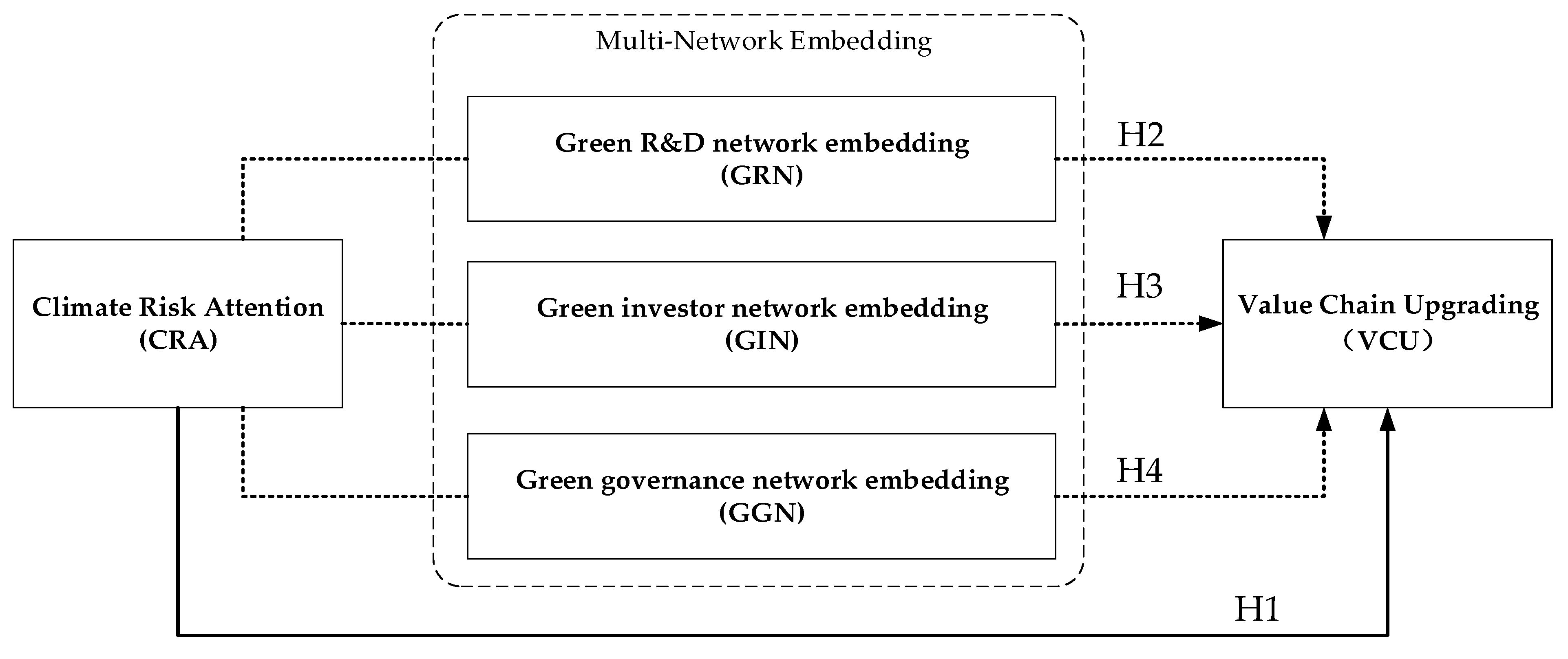
Figure 1 presents the research framework of this study, outlining the core concepts involved and the relationships among them, while also indicating the corresponding mechanisms and hypotheses. Specifically, CRA and VCU, shown on the left- and right-hand sides of the figure, represent the two core constructs of this study. The solid line denoted as H1 corresponds to the theoretical analysis developed in Section 3.1, which examines the direct effect of CRA on firms’ VCU. The dashed box in the middle represents the mechanisms through which CRA may influence VCU. More specifically, it indicates that CRA may promote firms’ VCU through three channels: green R&D network embedding, green investor network embedding, and green governance network embedding. The three dashed indirect paths, corresponding to H2, H3, and H4, are linked to the theoretical analyses and hypothesis development presented in Section 3.2.

4. Research Design

4.1. Data and Sample

This study uses panel data on Chinese A-share listed firms covering the period from 2008 to 2024. The analysis combines multiple types of data, including annual report texts, firm-level financial and governance information, patent data, fund investment data, shareholder relationship data, and macro-level statistical information. Specifically, the textual data used to construct climate risk attention are obtained from firms’ annual reports downloaded from the CNINF database (The CNINF database can be found at the website: https://www.cninfo.com.cn/new/index, although the homepage of the CNINF database is in Chinese, relevant data can also be accessed through CNINFO Data Service (https://webapi.cninfo.com.cn/#/home-en), which supports an English-language environment), which is a public information disclosure platform for Chinese listed companies. The data used to construct the dependent variable and mechanism variables are mainly drawn from the incoPat database, the China Stock Market & Accounting Research Database (CSMAR) (The CSMAR database can be found at the website: https://data.csmar.com, accessed on 30 August 2025), and the Chinese Research Data Services (CNRDS) platform (The CNRDS database can be found at the website: https://www.cnrds.com, accessed on 30 August 2025). In addition, some macro-level information is collected from the China Statistical Yearbook (The China Statistical Yearbook can be found at the website: https://www.stats.gov.cn/english/, accessed on 30 August 2025).
Since this study aims to examine generalized firm-level mechanisms across industries, the sample is constructed at the firm-year level and merged across different databases by firm code and year. During the sample cleaning process, following the common screening procedures adopted in related studies, we exclude firms from the financial industry as well as firms with abnormal financial or trading status, including those under ST, *ST, and PT status. We further delete observations with missing values for key variables and winsorize all continuous variables at the 1st and 99th percentiles to mitigate the influence of extreme outliers. After these procedures, the final sample consists of 5012 firms and 48,967 firm-year observations. The industry distribution of the sample is reported in the Appendix A.1.

4.2. Models

To examine the impact of CRA on VCU, this study uses following baseline model:
V C U i , t = β 0 + β 1 C R A i , t + β 2 C o n t r o l s + λ i + δ d + γ t + ε i , t
In model (1), VCUi,t denotes the value chain upgrading, CRAi,t represents the climate risk attention, Controlsi,t refers to control variables. λi, δd and γt represent firm, industry and year fixed effects, respectively. εi,t is error term.
For the mechanism analysis, we employ the following models:
M e d i a t o r i , t = β 0 + β 1 C R A i , t + β 2 C o n t r o l s i , t + λ i + δ d + γ t + ε i , t
In models (2), the Mediatori,t represents the mechanism variable, other variable setting are the same as the baseline model (1).

4.3. Variables

4.3.1. Dependent Variable

Value Chain Upgrading (VCU). Value chain upgrading can be evaluated from multiple dimensions, such as financial performance and operational efficiency. Existing studies have employed indicators including the industrial value-added rate, production efficiency, and the share of new product revenue to capture different aspects of upgrading. For large-sample analysis at the level of listed firms, however, a more direct and comparable indicator is whether a firm is able to create and retain a larger share of value within its production activities. In this sense, the value-added rate calculated from financial indicators is particularly appropriate, as it directly reflects a firm’s capability and outcome in moving from low-end production toward higher value-added activities.
Following prior studies [57,86,87], this study measures firms’ value chain upgrading by the industrial value-added rate, which captures the proportion of value created by the firm relative to total output-related inputs. Compared with indicators such as profitability or innovation output alone, the industrial value-added rate more directly reflects whether firms improve their value creation efficiency through process optimization, technological improvement, and organizational upgrading. A higher value-added rate suggests that firms generate more value from a given level of output, which is consistent with the essence of value chain upgrading.
Industrial value added for the current period is calculated as the sum of four components: total compensation (TC), corporate profits (CP), corporate taxes (CT), and corporate interest payable (CIP). Specifically, total compensation includes cash payments to employees and payable employee compensation (year-end balance minus beginning balance); corporate profits are calculated as net profit minus non-operating income, investment income, fair value gains, and exchange gains, and then plus non-operating expenses and asset impairment losses; corporate taxes are measured as the sum of business taxes, surcharges, and income taxes minus any tax rebates; and corporate interest payable is represented by interest payable. Accordingly, industrial value added (IVA) is calculated as follows:
I V A = T C + C P + C T + C I P
VCU is represented by the industrial value-added rate, defined as the ratio of industrial value added to the sum of industrial value added (IVA) and cash paid for goods and services (CGS):
V C U = I V A I V A + C G S
A higher value of VCU indicates that the firm creates and retains a larger proportion of value within its production process, reflecting a stronger capacity to move toward higher value-added positions in the value chain.

4.3.2. Independent Variable

Climate Risk Attention (CRA). Existing studies have increasingly used textual analysis to capture firms’ strategic attention and managerial cognition, arguing that corporate disclosures can reflect the issues that firms identify, interpret, and prioritize in their decision-making processes [12,41]. Given data availability, annual reports provide an important textual source because they contain management discussions of the firm’s operating environment, major risks, strategic responses, and future development plans. Therefore, this study uses textual information disclosed in firms’ annual reports to measure CRA.
Consistent with the focus of this study, CRA mainly refers to firms’ attention to physical climate risks arising from extreme weather events and long-term climate change. Compared with other types of climate-related risks, physical climate risks are more directly related to firms’ production and operating conditions, and are therefore more likely to be reflected in firms’ descriptions of environmental uncertainty, operational disruptions, and climate-related vulnerability [7,44].
On this basis, this study first constructs a climate risk keyword set by drawing on climate-related terms from the China Meteorological Data Service Centre and the Yearbook of Meteorological Disasters in China. The initial keyword list is then expanded using the Word2Vec algorithm, after which the final keyword set of climate risk is determined through manual screening. Next, annual reports of Chinese listed firms are collected from the CNINF database, and Chinese word segmentation is conducted using the Jieba package in Python 3.11. We then identify and count the frequency of all climate risk keywords in each annual report. To reduce the influence of report length, CRA is measured as the ratio of the number of climate risk-related keywords to the total number of words in the annual report. A higher value of CRA indicates that the firm places greater attention on climate-related physical risks in its corporate disclosures and managerial communication [88,89].

4.3.3. Mechanism Variables

Green R&D network (GRN). The green R&D network is constructed based on firms’ participation in joint green patent application relationships. Using the firm’s patent dataset, this study identifies green invention patents and green utility model patents jointly applied for by the focal firm and other firms. On this basis, a firm-level green R&D collaboration network is constructed for each year. Specifically, each firm i is treated as a node, and an edge is established between firm i and firm j if they jointly apply for at least one green patent in year t. Based on the resulting nodes and edges, the annual green R&D collaboration network is formed. Following prior study [90], this study calculates the degree of the focal firm in the green R&D network, defined as the number of edges directly connected to firm i, to capture the breadth of its green R&D collaboration relationships and thus reflect its level of embeddedness in the green R&D network. The natural logarithm of one plus the network degree is used as the proxy variable for GRN. A higher value of GRN indicates that the firm is more deeply embedded in the green R&D network.
Green investor network (GIN). The green investor network is constructed based on the investment relationships between firms and fund investors. First, we identify fund investors holding shares in listed firms by matching the fund entity information table and the stock investment details table from the CSMAR database. Second, this study uses keyword matching to identify investment records whose investment objectives and investment scopes are related to green development. The keywords include “environmental protection,” “ecology,” “green,” “new energy development,” “clean energy,” “low carbon,” “sustainability,” and “energy conservation.” Fund investors associated with such investment records are classified as green investors. On this basis, an annual network of firms and green investors is constructed. Specifically, each listed firm i is treated as a node, and an edge is established between firm i and green investor v if a green investment relationship exists between them in year t. Based on the nodes and edges, the annual green investor network is formed. Following prior study [91], this study calculates the degree of the focal firm i in the green investor network, defined as the number of edges directly connected to firm i, to capture the breadth of its relationships with green investors and thus reflect its level of embeddedness in the green investor network. The natural logarithm of one plus the network degree is used as the proxy variable for GIN. A higher value of GIN indicates that the firm is more deeply embedded in the green investor network.
Green governance network (GGN). The green governance network is constructed based on governance linkages between listed firms and green firms through major shareholders. First, drawing on the Top Ten Shareholder Relationship Network Table from the CSMAR database, this study identifies the detailed list of other firms held by the top ten shareholders of each focal firm. Second, we manually collect the business scope descriptions of these shareholder-linked firms and match them with the same green-related keywords used to identify green investors. Firms whose business scope descriptions contain green-related terms are classified as green firms. On this basis, an annual green governance network is constructed. Specifically, each listed firm i is treated as a node, and an edge is established between firm i and green firm g if they share at least one common major shareholder in year t. Based on the nodes and edges, the annual green governance network is formed. Following prior study [92], this study calculates the degree of the focal firm i in the green governance network, defined as the number of edges directly connected to firm i, to capture the breadth of its governance linkages with green enterprises and thus reflect its level of embeddedness in the green governance network. The natural logarithm of one plus the network degree is used as the proxy variable for GGN. A higher value of GGN indicates that the firm is more deeply embedded in the green governance network.

4.3.4. Control Variables

This study controls for the following variables that may potentially affect firms’ value chain upgrading [86,87]. Firm size (Size) is measured by the natural logarithm of total assets at year-end. Firm age (Firmage) is calculated as the natural logarithm of (current year—establishment year + 1). Larger and older firms typically possess stronger resource bases and more advanced production capabilities, which may influence their ability to create value added. The fixed asset ratio (Fixed) is defined as the ratio of net fixed assets to total assets, reflecting the firm’s asset structure and capital intensity, which may affect production efficiency and patterns of value creation. Asset turnover (ATO) is measured by the ratio of operating revenue to average total assets. It reflects operational efficiency and may directly affect a firm’s ability to generate more value from its existing assets. Growth capability (Growth) is measured by the annual growth rate of operating revenue, reflecting expansion potential and market dynamism, which may be associated with upgrading opportunities. The cash flow ratio (Cashflow) is calculated as the ratio of net operating cash flow to total assets, indicating the extent of internal financial support available for production adjustment and value creation. The management expense ratio (Mfee) is measured by the ratio of administrative expenses to operating revenue. The use of management expenses is closely related to the firm’s overall organizational efficiency and may ultimately affect value-added performance to some extent. Board size (Board) is measured as the natural logarithm of the number of board members. The proportion of independent directors (Indep) is defined as the ratio of independent directors to total board members. Ownership balance (Balance) is measured as the ratio of the shareholding of the second-largest shareholder to that of the largest shareholder. These governance variables may influence monitoring quality, decision-making efficiency, and resource allocation, all of which are closely related to firms’ value creation and upgrading processes. Finally, Tobin’s Q (TobinQ) is defined as the ratio of market value to total assets. It reflects firms’ growth expectations and market valuation, and may affect their incentives and capacity to move toward higher value-added activities.

5. Empirical Results

5.1. Descriptive Statistics

Table 1 presents the descriptive statistics of the variables used in this study. Specifically, the mean value of VCU is 0.2820, with a standard deviation of 0.2648 and a range from −0.8176 to 1.1645, suggesting that the degree of value chain upgrading differs substantially across firms. The mean value of CRA is 0.0267, with a standard deviation of 0.0315. The minimum value is 0, while the maximum reaches 0.2019, indicating that firms differ markedly in the extent to which they pay attention to physical climate risks in their annual report disclosures. This result is consistent with the expectation that climate-related attention remains uneven across listed firms. The descriptive statistics also show that the distributions of the mechanism variables and control variables are generally reasonable and consistent with the characteristics of Chinese A-share listed firms. Overall, the sample exhibits substantial variation across the core variables, providing an appropriate basis for subsequent empirical analysis.
Considering that firms may differ fundamentally in their climate sensitivity depending on the industries in which they operate, some firms may inherently exhibit higher levels of CRA. To provide preliminary evidence on differences in attention to climate-related issues across industries, this study draws on prior studies [93,94] and, with reference to the industry classification of Chinese listed firms, classifies firms in “agriculture, forestry, animal husbandry, and fishery” as well as several other sectors as climate-sensitive industries (the detailed industry list is reported in the Appendix A.2.). The sample is then divided into firms in climate-sensitive industries (CSI) and firms in non-climate-sensitive industries (NCSI), and a mean comparison t-test is conducted between the two groups. The results, reported in Table 2, show that the average level of CRA is significantly higher among firms in climate-sensitive industries than among firms in non-climate-sensitive industries. This finding is consistent with the expectation that firms in industries more exposed to climate-related shocks pay greater attention to physical climate risks, and it also provides supporting evidence for the validity of the CRA measure.
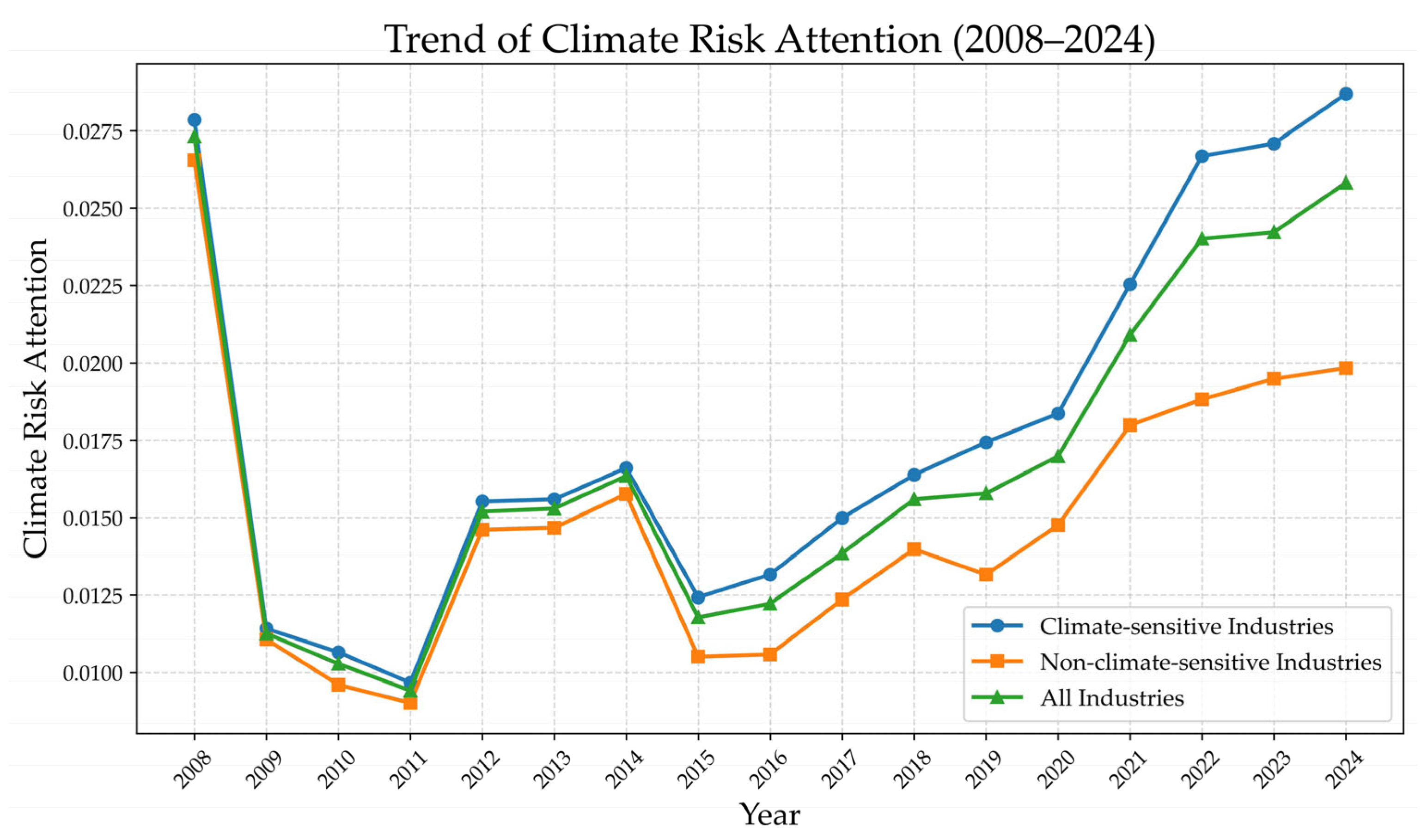
In addition, to further explore the dynamic characteristics of CRA, this study draws a line chart of the yearly median values of CRA for firms in climate-sensitive industries, firms in non-climate-sensitive industries, and the full sample, as shown in Figure 2. The figure shows that, throughout the sample period, the median level of CRA among firms in climate-sensitive industries is consistently higher than both the median CRA of the full sample and that of firms in non-climate-sensitive industries. This pattern provides further support for the finding that firms in climate-sensitive industries generally exhibit higher levels of climate risk attention. The relatively high level of CRA observed in 2008 may be attributed to the occurrence of multiple major natural disasters in China during that year, including the rare low-temperature rain, snow, and freezing disaster in southern China and the devastating Wenchuan earthquake in Sichuan Province in May 2008, both of which substantially heightened firms’ awareness of climate-related and disaster-related risks. Moreover, since 2015, CRA has shown a clear and sustained upward trend. This change may be associated with the increasing public and policy attention to global climate issues following the Paris Climate Conference and the subsequent signing of the Paris Agreement, which likely strengthened Chinese firms’ attention to climate-related physical risks.

5.2. Correlation Analysis

Table 3 reports the correlation matrix of the main variables. The results show that the pairwise correlation coefficients among the explanatory variables are all below 0.6, indicating that the main variables are not highly correlated with one another. This provides preliminary evidence that severe multicollinearity is unlikely to affect the subsequent regression analysis. To further assess potential multicollinearity, this study calculates the variance inflation factor (VIF) for the explanatory and control variables, and the results are reported in the Appendix A.3. All VIF values are far below 5, indicating that there is no obvious multicollinearity among the main variables in this study.

5.3. Baseline Regression

Table 4 reports the results of the baseline regression examining the impact of firm’s CRA on VCU. Columns (1)–(3) present the estimated results with progressively added fixed effects and control variables. Across all models, the coefficient of CRA is positive and statistically significant at the 1% level, indicating that firms with higher attention to climate risk achieve a higher degree of VCU. Therefore, the CRA can positively promote the firm’s VCU, the Hypothesis H1 is supported.
This study further examines whether the effect of CRA on VCU differs between firms in climate-sensitive industries and those in non-climate-sensitive industries. Specifically, the sample is divided according to whether firms belong to climate-sensitive industries, and subsample regressions are conducted. The results are reported in Table 5. For firms in climate-sensitive industries, the coefficient of CRA is significantly positive at the 1% level, indicating that climate risk attention significantly promotes value chain upgrading in these firms. In contrast, for firms in non-climate-sensitive industries, the coefficient of CRA is not statistically significant. Furthermore, the test of coefficient differences between the two groups confirms that the difference is statistically significant. These results suggest that the promoting effect of CRA on VCU is more pronounced in firms operating in climate-sensitive industries. A possible explanation is that firms in climate-sensitive industries are more directly exposed to climate-related shocks and therefore have stronger incentives to translate CRA into substantive upgrading actions.

5.4. Robustness Checks and Endogenous Tests

To ensure the reliability of the baseline results, several robustness tests were conducted, and the outcomes are reported in Table 6 and Table 7.

5.4.1. Robustness Checks

Replacing independent variable. In column (1) of Table 6, we replaced the independent variable with an alternative measure derived from corporate social responsibility (CSR) reports (CRA2) to capture firm’s climate attention from a different perspective. The CRA2 is calculated as the ratio of the frequency of climate risk–related keywords to the total number of words in the CSR report. The coefficient of CRA2 remains positive and significant at the 5% level (β = 0.0852, p < 0.05), supporting the validity of the main explanatory variable.
Adjusting period of dependent variable. In column (2) of Table 6, the dependent variable is lagged by one period to capture the lagged effect of CRA. The coefficient of the CRA remains positive and significant at the 1% level (β = 0.2543, p < 0.01), indicating that firm’s CRA has a sustained impact on subsequent VCU.
Adding fixed effect. In column (1) of Table 7, we further controlled for city fixed effects, to eliminate the potential influence of unobserved regional factors. The coefficients of CRA remain significant at the 1% level, confirming that the baseline results are not driven by omitted variable bias related to regional characteristics.
Removing abnormal years and samples from municipalities. Columns (2) and (3) of Table 7 report the regression results after excluding samples from abnormal years and from municipalities directly under the central government, respectively. In this study, abnormal years are defined as periods associated with unusually strong external shocks that may have had significant effects on firms’ value chain upgrading. Specifically, we exclude the year 2015, when the Chinese stock market crash caused substantial economic and financial volatility, and the years from 2020 onward, when the COVID-19 pandemic generated widespread disruptions to production and business operations. We also exclude samples from the four municipalities directly under the central government, namely Beijing, Tianjin, Shanghai, and Chongqing, because their special administrative affiliation, institutional environment, and policy support may make the determinants of value chain upgrading more complex. The regression coefficient of CRA remains significantly positive after these exclusions, indicating that the main conclusions are not driven by these abnormal periods or by the particular institutional characteristics of municipalities.

5.4.2. Endogenous Tests

Instrumental variable (IV). To address the potential endogeneity issue arising from reverse causality, this study employs the instrumental variable and two stage least square (2SLS) for testing and correction. We use the average proportion of extreme rainfall days in the regions where other firms within the same industry are located during the previous year as the instrumental variable PED. Table 8 reports the regression results of the instrumental variable method. Column (1) tests the relevance between the PED and CRA. The coefficient of PED is significantly positive at the 1% level (β = 0.0490, p < 0.01), indicating that the PED satisfies the relevance requirement. Meanwhile, the Kleibergen-Paap rk LM statistic and the Kleibergen-Paap rk Wald F statistic show that the instrumental variable passes both the underidentification and weak identification tests. Column (2) presents that the coefficient of CRA remains significantly positive at the 5% level (β = 5.1533, p < 0.05), indicating that the main conclusion of the baseline regression remains robust after addressing potential endogeneity using the instrumental variable method.
Propensity score matching (PSM). To further eliminate potential sample selection bias of the empirical results, we use the propensity score matching method. Specifically, we estimate each firm’s probability of CRA based on the climatic characteristics of its city and use this propensity score to construct a statistically comparable control group for the treatment group. All control variables included in the baseline regression are also incorporated as covariates in the matching process to minimize systematic differences between the two groups. We adopt the radius matching method with a caliper value of 0.005, which restricts matches to firms with very similar propensity scores, thereby improving matching precision and reducing bias. After implementing the PSM procedure, the results show that the standardized mean differences of all covariates between the treatment and control groups are substantially reduced and become statistically insignificant, confirming that the matching achieves a satisfactory balance. The regression results based on the matched sample are reported in Column (3) of Table 8. The coefficient of CRA remains significantly positive at the 1% level (β = 0.2580, p < 0.01), indicating that even after controlling for potential selection bias through PSM, the positive effect of CRA on firm’s VCU remains highly significant.

5.5. Mechanism Analyses

According to the theoretical framework, this section explores the mechanisms through which CRA promotes VCU. Based on the perspective of multiple networks embedding, including green R&D network, green investor network, and green governance network, this study empirically tests the potential channels using models (2).
Table 9 presents the results of the green R&D network mechanism analysis. In column (1), the coefficient of CRA is significantly positive at the 5% level (β = 0.4433, p < 0.05), indicating that firms with higher CRA are more likely to engage in green R&D collaborations. This suggests that climate-conscious firms actively participate in joint research projects, technology sharing, and innovation alliances focused on low-carbon and environmentally sustainable technologies. By fostering inter-organizational technological exchange and resource integration, CRA enables firms to accumulate green innovation knowledge, accelerate green technology breakthroughs, and achieve higher stages of VCU. These findings support the Hypothesis H2.
Table 9 presents the results of the green investor network mechanism analysis. The coefficient of CRA is significantly positive at the 1% level (β = 0.5591, p < 0.01), indicating that firms with greater attention to climate risks are more likely to attract and interact with green investors. Climate-conscious firms tend to disclose more comprehensive environmental information and demonstrate commitment to sustainable operations, which enhances their visibility and credibility in the green capital market. By improving firm’s access to green financing and investment support, these networks provide financial resources and market signals that encourage firms to adopt greener technologies and business models. Therefore, embedding in green investor networks helps firms achieve sustainable growth and climb toward higher segments of the value chain, supporting the Hypothesis H3.
Columns (3) of Table 9 shows the results of this mechanism analysis. The coefficient of CRA is significantly positive at the 5% level (β = 1.1654, p < 0.05), suggesting that CRA significantly increases firm’s participation in green governance networks. Climate-conscious firms tend to strengthen interactions with environmentally responsible firms, forming a governance network that emphasizes transparency, accountability, and sustainability. By enhancing stakeholder engagement, and sustainable governance practices, CRA facilitates the establishment of a coordinated governance structure conducive to long-term environmental performance and strategic upgrading. These results confirm that participation in green governance networks serves as an important channel through which CRA contributes to firm’s VCU, thereby supporting Hypothesis H4.

6. Further Analyses

To further examine the conditions under which CRA more effectively promotes firms’ VCU, this study conducts additional analyses focusing on the moderating roles of green governance capability, green subsidies, and green outcome transformation ability. Specifically, by introducing these three moderating variables and incorporating their interaction terms with CRA into the baseline regression model, this section investigates whether differences in governance capacity, policy support, and green outcome transformation lead to heterogeneous effects of climate risk attention on firms’ VCU.

6.1. Green Governance Capability

Green governance capability reflects a firm’s intrinsic willingness to align business operations with environmental goals and sustainable development principles [27]. When managers exhibit a strong sense of environmental responsibility and perceive climate response as a strategic opportunity rather than a regulatory burden, they tend to invest more resources in cleaner production, low-carbon technology, and sustainable supply chain practices [95]. This heightened environmental commitment enables firms to integrate climate concerns into strategic decision-making, which in turn amplifies the positive impact of CRA on VCU. To capture the level of green governance capability (GC), we construct an index based on whether firms possess environmental protection concepts, environmental objectives, environmental management systems, and the three simultaneous system; whether they have obtained ISO14001 [96] certification; and whether they have conducted environmental education, training, or special environmental actions. Each item is assigned a value of 1 if implemented and 0 otherwise, and the total score is used as the measure of green governance capability. The regression results in Column (1) of Table 10 shows that the interaction term CRA × GC is significantly positive at the 10% level (β = 0.0427, p < 0.1), indicating that firms with stronger green governance capability exhibit a more pronounced positive relationship between CRA and VCU.

6.2. Green Subsidies

Government-provided green subsidies create favorable external conditions for firms to act upon their CRA. Green subsidy support reduces investment costs and uncertainty associated with the adoption of eco-friendly technologies, thus facilitating firm’s green transformation and VCU [97]. Firms receiving substantial green subsidies have more financial flexibility to implement energy-saving technologies, develop circular production systems, and strengthen collaborations in green innovation [70]. These institutional incentives enhance the opportunity dimension of the climate–value relationship, allowing firms to leverage external policy advantages in their upgrading process. Green subsidies (GS) are measured by the total amount of green-related financial grants and incentives that a firm receives from government programs, reflecting the level of policy support available for environmental innovation [98]. As shown in column (2) of Table 10, the coefficient of the interaction term CRA × GS is significantly positive at the 1% level (β = 0.0160, p < 0.01), demonstrating that green subsidies significantly reinforce the positive effect of CRA on VCU.

6.3. Green Outcome Transformation Ability

Green outcome transformation ability determines whether firms can effectively convert green innovation inputs into tangible environmental and economic outcomes in response to CRA. Firms with strong outcome transformation ability are able to integrate technological innovation with environmental management, efficiently transform R&D resources into green patents, eco-friendly products, and low-carbon processes [97,99]. Such capability reflects a firm’s efficiency in linking climate awareness to real technological progress and value creation, ensuring that environmental strategies are not only conceptual but also produce measurable results [15]. Green outcome transformation ability (GT) is measured by the number of green innovation patents generated per unit of R&D investment, which captures the efficiency of converting green R&D inputs into actual outcomes. The regression results reported in column (3) of Table 10 show that the interaction term CRA × GT is significantly positive at the 5% level (β = 0.7623, p < 0.05), indicating that firms with higher green outcome transformation ability experience a more pronounced positive effect of CRA on VCU.

7. Discussions

7.1. Discussion of Baseline Regression

The baseline regression results show that firms’ CRA significantly promotes VCU. This finding suggests that attention to physical climate risks is not merely reflected in symbolic disclosure or short-term environmental responses, but may also induce deeper changes in firms’ value creation activities and strategic positioning. While existing studies have mainly linked climate-related attention to outcomes such as environmental disclosure, green innovation, and carbon performance, or have emphasized the role of external pressures such as environmental regulation, stakeholder demands, and market incentives [7,100], the present study highlights the proactive role of firms’ internal attention to physical climate risks. In this sense, CRA may serve as an important internal driver that encourages firms to adjust production processes, improve resource allocation, enhance value creation efficiency, and ultimately move toward higher value-added activities.
Furthermore, this promoting effect is found to be more pronounced among firms in climate-sensitive industries. This finding is consistent with the expectation that firms in industries more directly exposed to climate-related shocks face stronger incentives to respond to physical climate risks [101]. Compared with firms in non-climate-sensitive industries, firms in climate-sensitive industries are more likely to translate climate-related attention into substantive upgrading actions, because climate-related disruptions are more directly linked to their production continuity, operating conditions, and long-term competitiveness. This result not only strengthens the interpretation of the main effect, but also provides further support for the validity of the CRA measure.

7.2. Discussion of Mechanism Analyses

The mechanism analysis shows that the positive effect of CRA on VCU is transmitted through green R&D network embedding, green investor network embedding, and green governance network embedding. This finding is broadly consistent with the growing literature suggesting that firms’ responses to climate-related and sustainability challenges increasingly depend not only on relatively separate decisions such as green innovation, green finance, and environmental governance, but also on external technological, financial, and governance linkages that help disperse and mitigate risks [21,100]. In this sense, the present study further demonstrates the feasibility of understanding these channels more systematically as interrelated network mechanisms through which climate risk attention is translated into value chain upgrading.
More specifically, firms with greater attention to climate risks are more likely to rely on green R&D network embedding to support upgrading through collaborative innovation and external knowledge acquisition, which is in line with prior research emphasizing the role of green technological cooperation and knowledge spillovers in sustainable transformation. The significant role of green investor network embedding further suggests that climate risk attention may enhance firms’ ability to obtain financial support and external legitimacy, thereby easing resource constraints associated with green upgrading. In addition, the significance of green governance network embedding indicates that climate-related upgrading is not only a technological or financial issue, but also a governance issue that depends on coordination, trust, and information sharing across organizational boundaries.
Taken together, these results suggest that firms do not respond to climate-related risks solely through internal adjustments. Instead, they seek to embed themselves more deeply in external knowledge, capital, and governance networks in order to disperse risks, obtain complementary resources, and strengthen their upgrading capacity. In this sense, the present study provides a more integrated explanation of how climate risk attention can be converted into concrete value chain upgrading actions.

7.3. Discussion of Further Analyses

The further analyses show that the positive effect of CRA on VCU is stronger among firms with greater green governance capability, more green subsidies, and stronger green outcome transformation ability. These findings are consistent with existing studies emphasizing that the effectiveness of green and climate-related strategies depends not only on firms’ attention and awareness, but also on their internal capabilities and external support conditions [27,98].
More specifically, when firms possess stronger green governance capability, they are more likely to translate CRA into substantive upgrading outcomes. This finding supports the view that governance capability is a key condition for converting strategic attention into effective organizational action. At the same time, the results show that greater green subsidies help firms overcome the costs and uncertainty associated with green transformation, thereby strengthening the promoting effect of climate risk attention. In addition, the moderating role of green outcome transformation ability suggests that climate-related attention is more likely to generate upgrading benefits when firms are capable of converting green inputs into tangible economic and strategic value.
Overall, these findings highlight that the promoting effect of CRA on VCU is conditional rather than constant. They further enrich the literature by showing that the economic consequences of proactive climate risk attention depend not only on attention itself, but also on whether firms possess the organizational capability, policy support, and transformation efficiency needed to act on such attention effectively.

8. Conclusions, Implications and Limitations

8.1. Conclusions

Using panel data on Chinese A-share listed firms from 2008 to 2024, this study examines the impact of CRA on VCU and its underlying mechanisms. The preliminary analysis shows that the average level of CRA is significantly higher among firms in climate-sensitive industries than among firms in non-climate-sensitive industries. The empirical results further indicate that firms’ CRA significantly promotes VCU, and that this effect is more evident in climate-sensitive industries. The mechanism analyses reveal that the effect of CRA on VCU is transmitted through three forms of external network embedding, namely green R&D networks, green investor networks, and green governance networks. In addition, the further analyses show that the positive effect of CRA is stronger among firms with greater green governance capability, more green subsidies, and stronger green outcome transformation ability. Overall, these findings suggest that the effect of CRA on firms’ VCU depends on both firms’ internal capabilities and external support conditions.

8.2. Policy and Managerial Implications

Based on the main findings of this study, the following policy and managerial implications can be drawn.
From a policy perspective, the findings imply that governments should not treat firms’ CRA merely as an issue of environmental compliance, but should regard it as an important foundation for promoting sustainable industrial upgrading. Therefore, public authorities should further improve and standardize climate-related information disclosure and risk assessment systems, so that firms can identify and evaluate physical climate risks more effectively and in a timely manner. This may include issuing more unified disclosure guidelines, improving regional climate risk databases, and developing sector-oriented climate risk assessment tools that help firms better understand their exposure to extreme weather events and long-term climate change. At the same time, climate risk management should be more closely incorporated into industrial, innovation, and financial policies, thereby encouraging firms to translate climate-related attention into substantive upgrading actions rather than symbolic responses. Since the mechanism analysis shows that green R&D, green investor, and green governance network embedding play an important role in this process, policy support should also focus on strengthening firms’ access to external technological collaboration, green financial resources, and governance coordination platforms. For example, governments may support the establishment of green technology innovation alliances, expand green credit and green bond financing channels, and promote cross-regional and cross-industry coordination mechanisms for climate-related governance. Moreover, the significant promoting roles of green subsidies and green governance capability indicate that targeted policy support should not only encourage firms to pay attention to climate risks, but also enhance their capacity to act on such attention effectively. In this regard, a more precise subsidy allocation mechanism, stronger support for firms’ green governance system building, and more policy resources directed toward the transformation of green innovation outcomes may all help firms convert climate-related attention into sustained VCU.
From a managerial perspective, the findings suggest that firms should regard CRA as a strategic capability rather than a passive reaction to external pressure. Managers need to integrate physical climate risks into production planning, investment decisions, innovation strategies, and governance arrangements, so that such attention can be converted into improvements in value creation efficiency. More specifically, firms should actively optimize production processes, upgrade technologies and equipment, and reallocate resources toward greener and higher value-added activities. In practice, this may involve improving energy efficiency, reducing material waste, upgrading climate-resilient facilities, and increasing investment in low-carbon technologies and cleaner production systems. At the same time, firms should deepen their participation in green R&D, green investor, and green governance networks in order to reduce risk exposure, access complementary resources, and strengthen their upgrading capacity. For example, firms can establish long-term collaborative relationships with universities and research institutes, strengthen communication with green-oriented investors and financial institutions, and build closer governance coordination with suppliers, customers, and other stakeholders around environmental standards and climate-related management. In addition, because the effectiveness of climate risk attention depends on firms’ governance foundations and transformation capability, managers should further improve internal green governance capability and strengthen the ability to transform green investments and innovations into concrete economic value. This may include clarifying internal responsibilities for climate risk management, incorporating climate-related indicators into performance evaluation, and improving the commercialization and application of green innovation outcomes. Only when climate-related attention is supported by effective implementation and external collaboration can it be more successfully translated into sustained value chain upgrading and long-term competitiveness.

8.3. Limitations and Future Direction

This study still has several limitations. On one hand, due to the lack of publicly disclosed detailed financial data on firms’ dedicated investments in climate risk management, existing research on CRA mainly relies on text-based indicators constructed from listed firms’ annual reports. Although this approach is suitable for large-sample empirical analysis, it may not fully capture the depth of firms’ internal strategic responses to climate-related risks. Future research may combine textual analysis with surveys, interviews, or case studies, and conduct in-depth tracking of representative firms to gain a more nuanced understanding of how climate-related considerations are incorporated into firms’ routine operations and long-term planning. On the other hand, although this study identifies three important mechanisms, namely green R&D network embedding, green investor network embedding, and green governance network embedding, which are broadly consistent with the general logic through which firms respond to climate risks and pursue the VCU, future research should further explore whether these mechanisms vary across industries. In particular, more detailed analysis is needed to examine how firms in climate-sensitive and non-climate-sensitive industries may respond to climate risks through different pathways.

Author Contributions

Conceptualization, D.X. and Y.T.; methodology, D.X.; software, D.X.; validation, Y.T. and D.X.; formal analysis, D.X.; investigation, Y.T.; resources, D.X.; data curation, D.X.; writing—original draft preparation, D.X.; writing—review and editing, D.X.; supervision, Y.T.; project administration, Y.T.; funding acquisition, D.X. All authors have read and agreed to the published version of the manuscript.

Funding

This research received no external funding.

Institutional Review Board Statement

Not applicable.

Informed Consent Statement

Not applicable.

Data Availability Statement

The data presented in this study are available on request from all authors due to copyright restrictions on team data.

Conflicts of Interest

The authors declare no conflicts of interest.

Appendix A

Appendix A.1. The Industry Distribution of the Sample

Table A1 reports the industry distribution of the sample used in this study. The table presents the industry names and the corresponding numbers of firms in each industry.
Table A1. The industry distribution of the sample.
Industry NameNumber of FirmsIndustry NameNumber of Firms
Computer, Communication and Other Electronic Equipment Manufacturing611News and Publishing24
Special Equipment Manufacturing397Coal Mining and Washing23
Manufacture of Chemical Raw Materials and Chemical Products370Water Transportation22
Pharmaceutical Manufacturing299Agriculture20
Electrical Machinery and Equipment Manufacturing299Petroleum Processing, Coking and Nuclear Fuel Processing20
Software and Information Technology Services298Radio, Television, Film and Audio-Visual Production20
General Equipment Manufacturing208Animal Husbandry18
Automobile Manufacturing157Non-Ferrous Metal Ore Mining and Dressing18
Retail125Gas Production and Supply18
Rubber and Plastic Products Manufacturing124Leather, Fur, Feather and Related Products, and Footwear Manufacturing15
Non-Metallic Mineral Products Manufacturing120Road Transportation15
Metal Products Manufacturing105Mining Support Activities14
Real Estate102Printing and Reproduction of Recording Media14
Instrument and Meter Manufacturing93Water Production and Supply11
Railway, Ship, Aerospace and Other Transportation Equipment Manufacturing86Warehousing11
Professional Technical Services85Recycling and Comprehensive Utilization of Waste Resources10
Electricity and Heat Production and Supply81Wood Processing and Manufacture of Wood, Bamboo, Rattan, Palm and Straw Products9
Non-Ferrous Metal Smelting and Rolling Processing76Building Construction9
Textile Manufacturing73Air Transportation9
Food Manufacturing69Other Services9
Processing of Agricultural and Sideline Food Products63Health9
Internet and Related Services60Accommodation8
Civil Engineering Construction55Ferrous Metal Ore Mining and Dressing7
Other Manufacturing52Railway Transportation6
Comprehensive51Forestry5
Ecological Protection and Environmental Governance50Fishery5
Wholesale49Agriculture, Forestry, Animal Husbandry and Fishery Services5
Paper and Paper Products Manufacturing48Culture and Arts5
Business Services46Construction Installation4
Loading, Unloading, Handling and Transport Agency Services44Catering4
Manufacture of Wine, Beverages and Refined Tea43Leasing4
Textile, Garment and Apparel Manufacturing42Petroleum and Natural Gas Extraction3
Building Decoration and Other Construction38Technology Promotion and Application Services3
Ferrous Metal Smelting and Rolling Processing35Resident Services3
Chemical Fiber Manufacturing34Education3
Furniture Manufacturing30Non-Metallic Mineral Ore Mining and Dressing2
Telecommunications, Broadcasting, Television and Satellite Transmission Services28Repair of Metal Products, Machinery and Equipment1
Manufacture of Cultural, Educational, Arts, Crafts, Sports and Entertainment Goods27Postal Services1
Research and Experimental Development26Repair of Motor Vehicles, Electronic Products and Daily Products1
Public Facilities Management24Sports1

Appendix A.2. The List of Climate-Sensitive Industries

Based on prior studies and the characteristics of firms’ exposure to physical climate risks, this study classifies the following industries as climate-sensitive industries: Coal Mining and Washing; Petroleum and Natural Gas Extraction; Mining Support Activities; Petroleum Processing, Coking and Nuclear Fuel Processing; Ferrous Metal Ore Mining and Dressing; Non-Ferrous Metal Ore Mining and Dressing; Textile Manufacturing; Textile, Garment and Apparel Manufacturing; Paper and Paper Products Manufacturing; Manufacture of Chemical Raw Materials and Chemical Products; Pharmaceutical Manufacturing; Chemical Fiber Manufacturing; Rubber and Plastic Products Manufacturing; Non-Metallic Mineral Products Manufacturing; Ferrous Metal Smelting and Rolling Processing; Non-Ferrous Metal Smelting and Rolling Processing; Metal Products Manufacturing; General Equipment Manufacturing; Automobile Manufacturing; Railway, Ship, Aerospace and Other Transportation Equipment Manufacturing; Electrical Machinery and Equipment Manufacturing; Computer, Communication and Other Electronic Equipment Manufacturing; Civil Engineering Construction; Building Decoration and Other Construction; Real Estate; Electricity and Heat Production and Supply; Gas Production and Supply; Public Facilities Management; Railway Transportation; Road Transportation; Water Transportation; Air Transportation; Agriculture; Forestry; Animal Husbandry; Fishery; and Agriculture, Forestry, Animal Husbandry and Fishery Services.

Appendix A.3. VIF Results

The VIF results for this study is shown in Table A2.
Table A2. VIF results.
VariableVIF1/VIF
Board1.590.627775
Indep1.480.677466
Size1.360.735876
TobinQ1.20.830788
Fixed1.110.903433
Cashflow1.10.911167
Firmage1.080.922634
ATO1.060.946725
Growth1.050.951742
CRA1.040.964335
Mfee1.010.988342
Balance1.010.988686
Mean VIF1.17

References

  1. Hamim, M.T.; Mollah, S. Corporate climate risk governance and environmental innovation. Bus. Strateg. Environ. 2025, 34, 7112–7138. [Google Scholar]
  2. Ozkan, A.; Temiz, H.; Yildiz, Y. Climate risk, corporate social responsibility, and firm performance. Brit. J. Manag. 2023, 34, 1791–1810. [Google Scholar] [CrossRef]
  3. Albitar, K.; Al -Shaer, H.; Liu, Y.S. Corporate commitment to climate change: The effect of eco-innovation and climate governance. Res. Policy 2023, 52, 17. [Google Scholar] [CrossRef]
  4. Liu, X.X.; Wu, X.Y.; Kong, X.X. Do climate-related risks perception drive corporate green and low-carbon transformation? Evidence from listed companies in China. Emerg. Mark. Financ. Trade 2024, 60, 2938–2959. [Google Scholar] [CrossRef]
  5. Ren, X.H.; An, Y.N.; Jin, C.L.; Yan, C. Weathering the policy storm: How climate strategy volatility shapes corporate total factor productivity. Energy Econ. 2024, 134, 13. [Google Scholar] [CrossRef]
  6. Cao, Z.F.; Chen, S.X.; Lee, E.; Xie, S.J. Weathering the storm: Unravelling the influence of climate change risk exposure on firms’ human capital investment. Brit. J. Manag. 2025, 36, 633–649. [Google Scholar]
  7. Li, W.L.; Luo, D.; Cheng, T.Y. Strategy choices in strategic risk-taking: Does climate risk matter? Int. Rev. Financ. Anal. 2025, 97, 17. [Google Scholar] [CrossRef]
  8. De Marchi, V.; Di Maria, E.; Micelli, S. Environmental strategies, upgrading and competitive advantage in global value chains. Bus. Strateg. Environ. 2013, 22, 62–72. [Google Scholar]
  9. Tian, M.; Yan, Z.; Bao, Y.C.; Wei, Z.L. To adapt or to mitigate: Climate change cognition, green innovation and environmental-social performance. Corp. Soc. Responsib. Environ. Manag. 2025, 27, 1885–1911. [Google Scholar] [CrossRef]
  10. Krishnan, A.; De Marchi, V.; Ponte, S. Environmental upgrading and downgrading in global value chains: A framework for analysis. Econ. Geogr. 2023, 99, 25–50. [Google Scholar]
  11. Hochachka, G. Climate change and the transformative potential of value chains. Ecol. Econ. 2023, 206, 15. [Google Scholar] [CrossRef]
  12. Vestrelli, R.; Colladon, A.F.; Pisello, A.L. When attention to climate change matters: The impact of climate risk disclosure on firm market value. Energy Policy 2024, 185, 12. [Google Scholar] [CrossRef]
  13. Liu, R.; Zhu, X.H.; Chen, J.Y. Climate risk and green innovation-esg disconnect: Firm-level evidence from china. Risk Anal. 2025, 45, 2548–2579. [Google Scholar] [CrossRef]
  14. Zhai, Y.M.; Cai, Z.H.; Lin, H.; Yuan, M.; Mao, Y.; Yu, M.C. Does better environmental, social, and governance induce better corporate green innovation: The mediating role of financing constraints. Corp. Soc. Responsib. Environ. Manag. 2022, 29, 1513–1526. [Google Scholar] [CrossRef]
  15. Yang, Y.; Mukhopadhaya, P.; Yu, Z.X. How does enterprise digitalization affect corporate carbon emission in china: A firm-level study. China Econ. Rev. 2024, 88, 16. [Google Scholar] [CrossRef]
  16. Song, Y.Z.; Li, Y.; Liu, T.S. Carbon asset remolding and potential benefit measurement of machinery products in the light of lean production and low-carbon investment. Technol. Forecast. Soc. Chang. 2023, 186, 12. [Google Scholar] [CrossRef]
  17. Xie, R.H.; Teo, T.S.H. Green technology innovation, environmental externality, and the cleaner upgrading of industrial structure in china—Considering the moderating effect of environmental regulation. Technol. Forecast. Soc. Chang. 2022, 184, 15. [Google Scholar] [CrossRef]
  18. Sun, Y.Y.; Wang, D.M. Green finance and esg performance of enterprises: Evidence from green finance reform and innovation pilot zone. Appl. Econ. 2025, 57, 11204–11218. [Google Scholar] [CrossRef]
  19. Kling, G.; Volz, U.; Murinde, V.; Ayas, S. The impact of climate vulnerability on firms’ cost of capital and access to finance. World Dev. 2021, 137, 11. [Google Scholar] [CrossRef]
  20. Conesa, J.R.; Jiménez, D.J.; Costa, M.M. Dynamic knowledge management capabilities for successful product eco-innovation. Bus. Strateg. Environ. 2025, 34, 7349–7367. [Google Scholar]
  21. Sun, Q.Y.; Li, C.D.; Ma, X.W. The impact of network relationships on green innovation and industrial growth: Evidence from China’s production and technological interdependencies. Technol. Forecast. Soc. Chang. 2026, 222, 19. [Google Scholar] [CrossRef]
  22. Todaro, N.M.; Testa, F.; Daddi, T.; Iraldo, F. The influence of managers’ awareness of climate change, perceived climate risk exposure and risk tolerance on the adoption of corporate responses to climate change. Bus. Strateg. Environ. 2021, 30, 1232–1248. [Google Scholar] [CrossRef]
  23. Li, J.; Qamri, G.M.; Tang, M.Y.; Cheng, Y.J. Connecting the sustainability: How renewable energy and digitalization drive green global value chains. J. Environ. Manag. 2025, 380, 11. [Google Scholar] [CrossRef] [PubMed]
  24. Jin, C.F.; Monfort, A.; Chen, F.; Xia, N.; Wu, B. Institutional investor esg activism and corporate green innovation against climate change: Exploring differences between digital and non-digital firms. Technol. Forecast. Soc. Chang. 2024, 200, 20. [Google Scholar] [CrossRef]
  25. Ghadge, A.; Wurtmann, H.; Seuring, S. Managing climate change risks in global supply chains: A review and research agenda. Int. J. Prod. Res. 2020, 58, 44–64. [Google Scholar] [CrossRef]
  26. Huang, H.H.; Kerstein, J.; Wang, C.; Wu, F. Firm climate risk, risk management, and bank loan financing. Strateg. Manag. J. 2022, 43, 2849–2880. [Google Scholar]
  27. Ren, X.H.; Li, W.Q.; Li, Y.Y. Climate risk, digital transformation and corporate green innovation efficiency: Evidence from China. Technol. Forecast. Soc. Chang. 2024, 209, 19. [Google Scholar] [CrossRef]
  28. Ngo, T.; Le, T.; Ullah, S.; Trinh, H.H. Climate risk disclosures and global sustainability initiatives: A conceptual analysis and agenda for future research. Bus. Strateg. Environ. 2023, 32, 3705–3720. [Google Scholar] [CrossRef]
  29. Arian, A.; Naeem, M.A. Climate risk and corporate investment behavior in emerging economies. Emerg. Mark. Rev. 2025, 65, 21. [Google Scholar] [CrossRef]
  30. Zhang, J.Y. Mitigating climate risk in supply chains: Empirical insights from the bullwhip effect in chinese enterprises. Econ. Anal. Policy 2025, 88, 888–902. [Google Scholar] [CrossRef]
  31. Agoraki, K.K.; Giaka, M.; Konstantios, D.; Negkakis, I. The relationship between firm-level climate change exposure, financial integration, cost of capital and investment efficiency. J. Int. Money Finan. 2024, 141, 24. [Google Scholar]
  32. Kara, M.E.; Ghadge, A.; Bititci, U.S. Modelling the impact of climate change risk on supply chain performance. Int. J. Prod. Res. 2021, 59, 7317–7335. [Google Scholar]
  33. Kim, N.K.W.; Choi, S.; Jung, T.; Park, S. How does demand uncertainty from climate change exposure affect the firms’ cost structures? Examining the real effects of climate change on the firms’ operational decisions. Corp. Soc. Responsib. Environ. Manag. 2023, 30, 2969–2989. [Google Scholar] [CrossRef]
  34. Wade, B.; Griffiths, A. Exploring the cognitive foundations of managerial (climate) change decisions. J. Bus. Ethics 2022, 181, 15–40. [Google Scholar] [CrossRef]
  35. Dahlmann, F.; Branicki, L.; Brammer, S. Managing carbon aspirations: The influence of corporate climate change targets on environmental performance. J. Bus. Ethics 2019, 158, 1–24. [Google Scholar] [CrossRef]
  36. Arslan, A.; Haapanen, L.; Hurmelinna-Laukkanen, P.; Tarba, S.Y.; Alon, I. Climate change, consumer lifestyles and legitimation strategies of sustainability-oriented firms. Eur. Manag. J. 2021, 39, 720–730. [Google Scholar] [CrossRef]
  37. Kumar, L.; Aggarwal, A. Corporate awareness of climate change and its management: An indian perspective. Corp. Soc. Responsib. Environ. Manag. 2025, 32, 5779–5794. [Google Scholar] [CrossRef]
  38. Lei, L.; Zhang, D.Y.; Ji, Q.; Guo, K.; Wu, F. A text-based managerial climate attention index of listed firms in China. Financ. Res. Lett. 2023, 55, 7. [Google Scholar]
  39. Li, Q.; Cai, Y.C.; Qiao, Y.J.; Tan, H.L. Dual environmental regulation and corporate green transformation: How does digital leadership affect transformation effectiveness? Financ. Res. Lett. 2025, 86, 14. [Google Scholar]
  40. Jiang, Z.Y.; Wang, Z.J.; Lan, X. How environmental regulations affect corporate innovation? The coupling mechanism of mandatory rules and voluntary management. Technol. Soc. 2021, 65, 12. [Google Scholar] [CrossRef]
  41. Haarhaus, T.; Liening, A. Building dynamic capabilities to cope with environmental uncertainty: The role of strategic foresight. Technol. Forecast. Soc. Chang. 2020, 155, 15. [Google Scholar] [CrossRef]
  42. Lee, C.C.; Li, M.Y.; Zhang, J. How climate risk affects corporate green innovation: Fresh evidence from China’s listed companies. Emerg. Mark. Financ. Trade 2025, 61, 2302–2315. [Google Scholar]
  43. Zhao, F.; Liu, Y.X.; Dou, Y.; Su, B. Climate change risks and corporate financialization: Friend or foe? A theoretical and empirical analysis. Energy Econ. 2025, 149, 16. [Google Scholar] [CrossRef]
  44. Guo, X.; Li, R.X. Climate physical risks and corporate supply chain resilience: How do investor sentiment and risk-taking behaviors influence supply chain operations? Financ. Res. Lett. 2025, 85, 9. [Google Scholar]
  45. Ponte, S.; Ewert, J. Which way is “up” in upgrading? Trajectories of change in the value chain for south african wine. World Dev. 2009, 37, 1637–1650. [Google Scholar] [CrossRef]
  46. Pipkin, S.; Fuentes, A. Spurred to upgrade: A review of triggers and consequences of industrial upgrading in the global value chain literature. World Dev. 2017, 98, 536–554. [Google Scholar] [CrossRef]
  47. Kordalska, A.; Olczyk, M. Upgrading low value-added activities in global value chains: A functional specialisation approach. Econ. Syst. Res. 2023, 35, 265–291. [Google Scholar]
  48. Su, J.Q.; Ma, H.H.; Zhang, S. Developing innovation capabilities for upgrading in global value chains: Evidence from China. Int. J. Emerg. Mark. 2021, 16, 1654–1676. [Google Scholar]
  49. Hortovanyi, L.; Szepesi, B. Resilience and innovation: Sme responses in global value chains under uncertainty. J. Bus. Res. 2026, 209, 13. [Google Scholar] [CrossRef]
  50. Opazo-Basáez, M.; Vendrell-Herrero, F.; Bustinza, O.F.; Maric, J. Global value chain breadth and firm productivity: The enhancing effect of industry 4.0. J. Manuf. Technol. Manag. 2022, 33, 785–804. [Google Scholar]
  51. Mehta, S. Upgrading within global value chains: Backward linkages, forward linkages and technological capabilities. Asian J. Technol. Innov. 2022, 30, 581–600. [Google Scholar] [CrossRef]
  52. Yoruk, D.E. Dynamics of firm-level upgrading and the role of learning in networks in emerging markets. Technol. Forecast. Soc. Chang. 2019, 145, 341–369. [Google Scholar] [CrossRef]
  53. Wang, S.H.; Wang, X.Q.; Chen, S.S. Global value chains and carbon emission reduction in developing countries: Does industrial upgrading matter? Environ. Impact Assess. Rev. 2022, 97, 14. [Google Scholar] [CrossRef]
  54. Zhang, J.F.; Wu, W.P. Leveraging internal resources and external business networks for new product success: A dynamic capabilities perspective. Ind. Mark. Manag. 2017, 61, 170–181. [Google Scholar] [CrossRef]
  55. Zhang, F.; Li, S.D. Green innovation, executives’ environmental awareness, and corporate value chain upgrading. Financ. Res. Lett. 2025, 86, 12. [Google Scholar] [CrossRef]
  56. Wang, M.N.; Ma, X.C. Does green finance promote the transformation and upgrading of manufacturing enterprises? Empirical research based on micro survey data in China. Financ. Res. Lett. 2024, 69, 10. [Google Scholar] [CrossRef]
  57. Liu, Z.G.; Cheng, W.; He, M.; Duan, C.J.; Pan, X.C. Digital technology innovation, value chain reshaping and digital transformation. Financ. Res. Lett. 2025, 85, 8. [Google Scholar] [CrossRef]
  58. Ladeira, C.S.B.; Ferreira, J.J.M. Multinational enterprises in global value chains using mca approach: Mapping the field and future research. Int. Market. Rev. 2025; ahead-of-print. [CrossRef]
  59. Deng, Z.L.; Ma, X.F.; Zhu, Z.Y. Transactional dependence and technological upgrading in global value chains. J. Manag. Stud. 2022, 59, 390–416. [Google Scholar] [CrossRef]
  60. Davis, G.F.; DeWitt, T. Can strategy address the climate crisis without losing its essence? J. Manag. Stud. 2025, 62, 1003–1013. [Google Scholar] [CrossRef]
  61. Hoang, K.; Pham, L.; Ha, O.K.; Nghiem, H.X. Firm-level climate change exposure and firm efficiency. Int. Rev. Econ. Financ. 2025, 101, 19. [Google Scholar] [CrossRef]
  62. Guo, J.; Xie, J.; Liu, X.Y.; Yang, T.J. How do global value chains respond to climate change? A case study of chinese manufacturing firms. J. Environ. Manag. 2024, 368, 16. [Google Scholar] [CrossRef]
  63. Deng, W.Y.Y.; Zhang, Z.L.; Guo, B.R. Firm-level carbon risk awareness and green transformation: A research on the motivation and consequences from government regulation and regional development perspective. Int. Rev. Financ. Anal. 2024, 91, 21. [Google Scholar] [CrossRef]
  64. Akhtaruzzaman, M.; Boubaker, S.; Gamage, P.; Obeng, V. Environmental innovation and climate risk awareness: The moderating role of sdg13. Res. Int. Bus. Financ. 2025, 75, 14. [Google Scholar] [CrossRef]
  65. Che, S.; Tao, M.M.; Ren, X.H. Climate risk exposure of global energy companies: Green chain vulnerability and countermeasures. J. Environ. Manag. 2025, 378, 15. [Google Scholar] [CrossRef] [PubMed]
  66. Mao, Q.H.; Zhao, M.Z.; Sun, Q.L. How supply chain enterprises achieve coordination between green transition and profitability under the carbon trading framework. J. Environ. Manag. 2025, 377, 24. [Google Scholar] [CrossRef]
  67. Yin, S.; Zhang, N.; Li, B.Z.; Dong, H.M. Enhancing the effectiveness of multi-agent cooperation for green manufacturing: Dynamic co-evolution mechanism of a green technology innovation system based on the innovation value chain. Environ. Impact Assess. Rev. 2021, 86, 16. [Google Scholar] [CrossRef]
  68. Acebo, E.; Miguel-Dávila, J.A.; Nieto, M. External stakeholder engagement: Complementary and substitutive effects on firms’ eco-innovation. Bus. Strateg. Environ. 2021, 30, 2671–2687. [Google Scholar] [CrossRef]
  69. Li, M.Q.; Li, D.F.; Wei, L.X. Manufacturing platform’s pricing and green r&d with technology spillovers under supply chain co-opetition. IEEE Trans. Eng. Manag. 2025, 72, 3849–3863. [Google Scholar]
  70. Pattinson, S.; Damij, N.; El Maalouf, N.; Bazi, S.; Elsahn, Z.; Hilliard, R.; Cunningham, J.A. Building green innovation networks for people, planet, and profit: A multi-level, multi-value approach. Ind. Mark. Manag. 2023, 115, 408–420. [Google Scholar] [CrossRef]
  71. Wu, A.H. Collaborative eco-innovation and green knowledge acquisition: The role of specific investments in chinese new energy vehicle industry. Bus. Strateg. Environ. 2023, 32, 2245–2260. [Google Scholar] [CrossRef]
  72. Leal-Millán, A.; Roldán, J.L.; Leal-Rodríguez, A.L.; Ortega-Gutiérrez, J. It and relationship learning in networks as drivers of green innovation and customer capital: Evidence from the automobile sector. J. Knowl. Manag. 2016, 20, 444–464. [Google Scholar] [CrossRef]
  73. De Marchi, V.; Grandinetti, R. Knowledge strategies for environmental innovations: The case of italian manufacturing firms. J. Knowl. Manag. 2013, 17, 569–582. [Google Scholar] [CrossRef]
  74. De Angelis, T.; Tankov, P.; Zerbib, O.D. Climate impact investing. Manag. Sci. 2023, 69, 7669–7692. [Google Scholar] [CrossRef]
  75. Pástor, L.; Stambaugh, R.F.; Taylor, L.A. Sustainable investing in equilibrium. J. Financ. Econ. 2021, 142, 550–571. [Google Scholar]
  76. Jiang, J.T.; Pei, J.S.; Zhang, M. Green credit and firms’ span of global production stages. China Econ. Rev. 2024, 87, 17. [Google Scholar] [CrossRef]
  77. Mielke, J.; Steudle, G.A. Green investment and coordination failure: An investors’ perspective. Ecol. Econ. 2018, 150, 88–95. [Google Scholar] [CrossRef]
  78. Liang, X.Y.; Cao, P. Does corporate esg disclosure enhance investor relationship management? Evidence from China. Account Financ. 2024, 64, 2011–2035. [Google Scholar]
  79. Kano, L. Global value chain governance: A relational perspective. J. Int. Bus. Stud. 2018, 49, 684–705. [Google Scholar] [CrossRef]
  80. Vurro, C.; Russo, A.; Perrini, F. Shaping sustainable value chains: Network determinants of supply chain governance models. J. Bus. Ethics 2009, 90, 607–621. [Google Scholar] [CrossRef]
  81. Lee, H.L.; Tang, C.S. Socially and environmentally responsible value chain innovations: New operations management research opportunities. Manag. Sci. 2018, 64, 983–996. [Google Scholar] [CrossRef]
  82. Xu, C.H. Effect of cross-ownership on firm green innovation. Emerg. Mark. Financ. Trade 2025, 61, 2534–2555. [Google Scholar] [CrossRef]
  83. Shao, Y.M.; Xu, K.L. Corporate board network and green technological innovation: A view of guanxi culture in China. Ind. Innov. 2025, 32, 53–83. [Google Scholar] [CrossRef]
  84. Bush, S.R.; Oosterveer, P.; Bailey, M.; Mol, A.P.J. Sustainability governance of chains and networks: A review and future outlook. J. Clean Prod. 2015, 107, 8–19. [Google Scholar]
  85. Mani, V.; Gunasekaran, A. Upstream complex power relationships and firm’s reputation in global value chains. Int. J. Prod. Econ. 2021, 237, 16. [Google Scholar] [CrossRef]
  86. Yin, Y.; Zeng, X.; Zhong, S.; Liu, Y. How real estate shocks affect manufacturing value chain upgrading: Evidence from China. Buildings 2022, 12, 546. [Google Scholar] [CrossRef]
  87. Chai, J.M.; Meng, T.T. The impact of esg practices on value chain upgrading across lifecycle stages: Evidence from China’s capital market. Int. Rev. Econ. Financ. 2026, 105, 15. [Google Scholar] [CrossRef]
  88. Zhang, W.Z.; Kong, D.M. Climate risks and corporate leverage. Int. Rev. Financ. Anal. 2025, 106, 9. [Google Scholar] [CrossRef]
  89. Li, Y.H.; Wan, T.H. How does corporate climate risk exposure affect cash holdings? Appl. Econ. 2025, 57, 6148–6165. [Google Scholar] [CrossRef]
  90. Li, Y.Y.; Zhu, Z.; Guan, Y.F.; Kang, Y.F. Research on the structural features and influence mechanism of the green ict transnational cooperation network. Econ. Anal. Policy 2022, 75, 734–749. [Google Scholar] [CrossRef]
  91. Fan, Y.Y.; Ly, K.C.; Jiang, Y.X. Institutional investor networks and firm innovation: Evidence from China. Int. Rev. Financ. Anal. 2023, 89, 19. [Google Scholar] [CrossRef]
  92. Gu, W.T.; Yuan, W.Y. Research on the influence of chain shareholder network on enterprise green innovation. J. Bus. Res. 2024, 172, 14. [Google Scholar] [CrossRef]
  93. Battiston, S.; Mandel, A.; Monasterolo, I.; Schütze, F.; Visentin, G. A climate stress-test of the financial system. Nat. Clim. Chang. 2017, 7, 283–288. [Google Scholar] [CrossRef]
  94. Wang, H.; Li, S.W.; Ma, Y.Y. Climate policy and financial system stability: Evidence from Chinese fund markets. Clim. Policy 2023, 23, 395–408. [Google Scholar] [CrossRef]
  95. Muduli, K.K.; Luthra, S.; Mangla, S.K.; Jabbour, C.J.C.; Aich, S.; de Guimaraes, J.C.F. Environmental management and the “soft side” of organisations: Discovering the most relevant behavioural factors in green supply chains. Bus. Strateg. Environ. 2020, 29, 1647–1665. [Google Scholar] [CrossRef]
  96. ISO 14001:2015; Environmental Management Systems—Requirements with Guidance for Use. International Organization for Standardization: Geneva, Switzerland, 2015.
  97. Hu, D.; Qiu, L.; She, M.Y.; Wang, Y. Sustaining the sustainable development: How do firms turn government green subsidies into financial performance through green innovation? Bus. Strateg. Environ. 2021, 30, 2271–2292. [Google Scholar] [CrossRef]
  98. Li, M.; Zhang, J.; Leng, T.C. Extreme high temperatures and corporate green innovation: Evidence from China. Pac. Basin Financ. J. 2025, 93, 15. [Google Scholar] [CrossRef]
  99. Liboni, L.B.; Cezarino, L.O.; Alves, M.F.R.; Jabbour, C.J.C.; Venkatesh, V.G. Translating the environmental orientation of firms into sustainable outcomes: The role of sustainable dynamic capability. Rev. Manag. Sci. 2023, 17, 1125–1146. [Google Scholar] [CrossRef]
  100. Canevari-Luzardo, L.M.; Berkhout, F.; Pelling, M. A relational view of climate adaptation in the private sector: How do value chain interactions shape business perceptions of climate risk and adaptive behaviours? Bus. Strateg. Environ. 2020, 29, 432–444. [Google Scholar] [CrossRef]
  101. Zhang, W.L.; Li, H.R. How extreme weather affects stock pricing efficiency: A three-dimensional analysis based on information, corporate fundamentals, and investor behavior. Rev. Manag. Sci. 2025; ahead-of-print. [CrossRef]
Figure 1. Core Concept and Research Hypothesis Relationship Diagram.
Sustainability 18 03546 g001
Figure 2. Trend of Climate Risk Attention (2008–2024).
Sustainability 18 03546 g002
Table 1. Descriptive statistics of variables.
VariableNMeanStd. Dev.MinMax
VCU48,9670.28200.2648−0.81761.1645
CRA48,9670.02670.03150.00000.2019
GRN48,9670.20980.59900.00003.2189
GIN48,9670.35510.44560.00001.4819
GGN48,9672.11401.91690.00005.5334
Size48,96722.17581.288919.897526.2456
Firmage48,9672.91820.35671.79183.5835
Fixed48,9670.20750.15690.00210.6867
ATO48,9670.63920.43390.07432.6073
Board48,9672.11640.19851.60942.6391
Indep48,9670.37680.05330.33330.5714
Growth48,9670.14220.3560−0.56132.0284
Cashflow48,9670.04680.0689−0.15850.2421
Balance48,9670.36880.28690.01040.9963
TobinQ48,9671.98571.23240.83788.1098
Mfee48,9670.29581.28740.007511.2517
Table 2. The results of mean t-test.
VariableN (NCSI)Mean (NCSI)N (CSI)Mean (CSI)MeanDiff
CRA16,4130.025232,5540.0276−0.0024 ***
*** p < 0.01.
Table 3. The correlation matrix of main variables.
VCUCRAGRNGINGGNSizeFirmageFixed
VCU1
CRA0.0181
GRN−0.0370.1031
GIN0.1530.0660.1781
GGN0.0150.0630.2180.2441
Size−0.1070.1050.4020.3090.4931
Firmage−0.0540.0630.074−0.0570.1870.2171
Fixed−0.0640.1340.034−0.0460.0620.111−0.0021
ATO−0.247−0.061−0.0060.0650.0280.052−0.0540.013
Board−0.0030.0390.0890.0530.0980.243−0.0120.144
Indep−0.005−0.0200.0260.0120.0280.0040.023−0.046
Growth0.080−0.0170.0010.137−0.0390.032−0.109−0.042
Cashflow0.2430.0330.0260.1620.1390.0780.0130.218
Balance0.0430.003−0.0150.027−0.076−0.0680.003−0.056
TobinQ0.164−0.088−0.1180.1340.022−0.364−0.020−0.098
Mfee0.001−0.011−0.002−0.0140.0170.0520.067−0.034
ATOBoardIndepGrowthCashflowBalanceTobinQMfee
ATO1
Board0.0351
Indep−0.029−0.5481
Growth0.1580.013−0.0121
Cashflow0.1330.043−0.0120.0401
Balance−0.0450.005−0.0110.018−0.0071
TobinQ−0.020−0.1160.0390.0650.0930.0361
Mfee−0.0350.023−0.004−0.001−0.030−0.0180.0191
Table 4. Results of baseline regression.
(1)(2)(3)
VariableVCUVCUVCU
CRA0.2558 *** 0.2602 ***
(0.0654) (0.0622)
Size −0.0084 **−0.0089 **
(0.0035)(0.0035)
Firmage −0.1411 ***−0.1390 ***
(0.0219)(0.0219)
Fixed −0.1875 ***−0.1889 ***
(0.0199)(0.0199)
ATO −0.0491 ***−0.0491 ***
(0.0063)(0.0062)
Board 0.00960.0093
(0.0148)(0.0148)
Indep −0.0114−0.0130
(0.0445)(0.0444)
Growth 0.0441 ***0.0441 ***
(0.0037)(0.0037)
Cashflow 0.5189 ***0.5181 ***
(0.0214)(0.0214)
Balance 0.0157 *0.0157 *
(0.0092)(0.0092)
TobinQ 0.0069 ***0.0070 ***
(0.0016)(0.0016)
Mfee 0.00090.0009
(0.0010)(0.0010)
Constant0.2752 ***0.8835 ***0.8828 ***
(0.0018)(0.1052)(0.1051)
YearYesYesYes
IndustryYesYesYes
FirmYesYesYes
Adj R20.49530.51470.5150
N48,96748,96748,967
Note(s): Firm-clustered standard errors in parentheses. *** p < 0.01, ** p < 0.05, * p < 0.1. The Year, Industry and Firm indicate that the model controls for year fixed effects, industry fixed effects and firm fixed effects, respectively.
Table 5. Results of subgroup regression.
(1)(2)
Climate-Sensitive IndustriesNon-Climate-Sensitive Industries
VariableVCUVCU
CRA0.3067 ***0.1100
(0.0745)(0.1180)
Constant0.8346 ***0.8570 ***
(0.1302)(0.1865)
ControlsYesYes
YearYesYes
IndustryYesYes
FirmYesYes
Adj R20.48440.5816
N32,55416,413
Coefficient difference−0.239 **
Note(s): Firm-clustered standard errors in parentheses. *** p < 0.01, ** p < 0.05. Control variables were included but were not listed due to space limitations. The Year, Industry and Firm indicate that the model controls for year fixed effects, industry fixed effects and firm fixed effects, respectively.
Table 6. Replacing independent variable and adjusting period of dependent variable.
(1)(2)
Replacing Independent VariableAdjusting Period of Dependent Variable
VariableVCUVCUt+1
CRA20.0852 **
(0.0395)
CRA 0.2543 ***
(0.0674)
Constant0.7318 ***1.2018 ***
(0.2457)(0.1146)
ControlsYesYes
YearYesYes
IndustryYesYes
FirmYesYes
Adj R20.66340.4993
N14,68442,691
Note(s): Firm-clustered standard errors in parentheses. *** p < 0.01, ** p < 0.05. Control variables were included but were not listed due to space limitations. The Year, Industry and Firm indicate that the model controls for year fixed effects, industry fixed effects and firm fixed effects, respectively.
Table 7. Adding city fixed effect, removing abnormal years and samples from municipalities.
(1)(2)(3)
Adding City Fixed EffectRemoving Abnormal YearsRemoving Samples from Municipalities
VariableVCUVCUVCU
CRA0.2602 ***0.2282 ***0.2526 ***
(0.0625)(0.0843)(0.0692)
Constant0.8828 ***0.8025 ***0.7829 ***
(0.1056)(0.1274)(0.1186)
ControlsYesYesYes
YearYesYesYes
IndustryYesYesYes
CityYesNoNo
FirmYesYesYes
Adj R20.51030.62160.5107
N48,96725,26739,373
Note(s): Firm-clustered standard errors in parentheses. *** p < 0.01. Control variables were included but were not listed due to space limitations. The Year, Industry, City and Firm indicate that the model controls for year fixed effects, industry fixed effects, city fixed effects and firm fixed effects, respectively.
Table 8. Results of 2SLS regression and PSM.
(1)(2)(3)
First StageSecond StagePSM
VariableCRAVCUVCU
PED0.0490 ***
(0.0102)
CRA 5.1533 **0.2580 ***
(2.3280)(0.0623)
ControlsYesYesYes
YearYesYesYes
IndustryYesYesYes
FirmYesYesYes
Kleibergen-Paap rk LM22.675 ***
Kleibergen-Paap rk Wald F22.919
[16.38]
Adj R20.0025 0.5144
N48,89848,89848,755
Note(s): Firm-clustered standard errors in parentheses, *** p < 0.01, ** p < 0.05. Control variables were included but were not listed due to space limitations. The Year, Industry and Firm indicate that the model controls for year fixed effects, industry fixed effects and firm fixed effects, respectively. The values in brackets report the 10% maximal IV size critical values from the Stock-Yogo weak identification test.
Table 9. Results of mechanism analyses.
(1)(2)(3)
Green R&D NetworkGreen Investor NetworkGreen Governance Network
VariableGRNGINGGN
CRA0.4433 **0.5591 ***1.1654 **
(0.2118)(0.1181)(0.4705)
Constant−2.2557 ***−3.3278 ***−12.7097 ***
(0.2774)(0.1743)(0.7170)
ControlsYesYesYes
YearYesYesYes
IndustryYesYesYes
FirmYesYesYes
Adj R20.57340.49690.5230
N48,96748,96748,967
Note(s): Firm-clustered standard errors in parentheses. *** p < 0.01, ** p < 0.05. Control variables were included but were not listed due to space limitations. The Year, Industry and Firm indicate that the model controls for year fixed effects, industry fixed effects and firm fixed effects, respectively.
Table 10. Results of heterogeneity analyses.
(1)(2)(3)
VariableVCUVCUVCU
CRA0.2461 ***0.2561 ***0.3996 ***
(0.0650)(0.0622)(0.0841)
GC0.0028 ***
(0.0009)
CRA × GC0.0427 *
(0.0242)
GS −0.0003 *
(0.0002)
CRA × GS 0.0160 ***
(0.0061)
GT −0.0041
(0.0113)
CRA × GT 0.7623 **
(0.3240)
Constant0.8545 ***0.8763 ***0.8813 ***
(0.1063)(0.1053)(0.1052)
ControlsYesYesYes
YearYesYesYes
IndustryYesYesYes
FirmYesYesYes
Adj-R20.52190.51500.5150
N47,35748,95848,967
Note(s): Firm-clustered standard errors in parentheses. *** p < 0.01, ** p < 0.05, * p < 0.1. Control variables were included but were not listed due to space limitations. The Year, Industry and Firm indicate that the model controls for year fixed effects, industry fixed effects and firm fixed effects, respectively.
Disclaimer/Publisher’s Note: The statements, opinions and data contained in all publications are solely those of the individual author(s) and contributor(s) and not of MDPI and/or the editor(s). MDPI and/or the editor(s) disclaim responsibility for any injury to people or property resulting from any ideas, methods, instructions or products referred to in the content.