Article

A Comprehensive Analysis of Urban Agriculture Theories from an Urban Spatial Perspective

1
Department of Cultural Heritage, University of Bologna, 48121 Ravenna, Italy
2
School of Architecture, Tianjin University, Tianjin 300072, China
*
Author to whom correspondence should be addressed.
Sustainability 2026, 18(7), 3517; https://doi.org/10.3390/su18073517
Submission received: 22 January 2026 / Revised: 24 March 2026 / Accepted: 25 March 2026 / Published: 3 April 2026

Abstract

Urban agriculture (UA) is closely linked to urban development. It serves as an effective strategy for promoting sustainable urban development. However, existing research on urban agriculture theory offers only a limited multidimensional review of its theoretical development. This paper aims to trace the developmental trajectory of representative urban agriculture theories and provide subsequent researchers with a comprehensive theoretical foundation in the field. Methodologically, this study employs a literature review and structured qualitative comparative analysis, combined with a chronological approach, to analyse representative theories of UA. Concurrently, an analytical framework comprising four dimensions—ecological, socio-economic, technological and design, and spatial relations—has been established, with four evaluation indicators defined for each dimension. This study reviews and compares representative theories across different historical periods to address two research questions: the evolution of UA theories across different historical periods, and the commonalities and differences among various theories across the four dimensions. Through this analysis, the paper discusses the commonalities, differences, and practical implications of different UA theories across each dimension. The research indicates that the ecological dimension forms the foundation of most theories. The spatial relations dimension demonstrates the spatial value of different theories. The design and technological innovation dimension reflects the connection between theory and urban development. The socio-economic dimension highlights the growing attention to UA. Chronological analysis reveals the evolution of UA theories, from the 19th-century concept of integrating agriculture into cities to the mid-to-late 20th-century idea of urban-agricultural coexistence, and finally to the diverse theoretical approaches of the 21st century. This study not only provides a comprehensive review of the development of UA theories but also offers scientific guidance for future practice and research in UA.

1. Introduction

Today’s rapid urbanisation is attracting thousands of migrants, bringing with it ease of living, employment, and access to amenities and services. Cities have become the main form of human settlements. According to the World Urbanization Prospects Revision 2018 [1], more than half the global population lives in cities. Meanwhile, it is estimated that by 2050, two-thirds of the world’s population will live in cities [2]. In 1970, there were only two megacities in the world [3]. By 2018, there were 33 [1]. And according to the same reports, Asia has the largest urban proportion in the world [1]. But due to the lack of rational and systematic management in most cities, urban environmental issues are becoming increasingly severe. It endangers the lives and health of urban residents and even impacts human survival. However, as the heart of modern civilisation, cities are well-connected and have excellent infrastructure. Cities have become the best choice for most persons to work and live, and they play a huge role in economic prosperity. Urban managers are discussing urban environmental issues. Mitigating the urban crisis has become an important research goal for scholars in various fields today.
As a combined form of city and agriculture, urban agriculture (UA) integrates the characteristics of city and agriculture. Its value combines urban and agricultural elements, making it more complex and diverse. Research and specific statistical data demonstrate that UA has ecological, economic, and social value. In ecology, UA can form ecological corridors that provide habitats for animals and plants, thereby increasing urban biodiversity. According to Speak et al., a comparison of plots with spontaneously formed crops and plots with artificially grown crops reveals that the latter are richer and more diverse in species [4]. Bill Mollison’s Permaculture and Paolo Soleri’s Arcology theory further elucidate the ecological value of UA. Economically, UA improves land utilisation and effectively reduces residents’ basic living expenses. According to Despommier, a 30-story vertical farm covering an area equivalent to a New York City block can provide a food source for 50,000 people [5]. This practice resonates with Despommier’s concept of achieving high-efficiency production through vertical farming. In terms of society, UA alleviates food crises and improves the quality of life for low-income groups. Bill Mollison’s theory also clearly demonstrates that UA can promote the integration of agriculture, design, and society. In Cuba, domestic food production declined by 80% from 1989 to 1993, but through UA, the country achieved the World Food Summit’s goal of reducing undernourishment by half from 1990 to 2015 [6,7], attaining a high level of food security. UA produces 60% of Cuba’s food [8].
UA refers to an industry located within or on the periphery of cities through the cultivation, raising, processing and distribution of a variety of food and non-food products. It uses the human and material resources and products and services of the urban areas and their surrounding areas and provides them back to this region [9]. Currently, academic research on UA focuses on its interdisciplinary nature. This study emphasises the theoretical exploration of UA within the field of urban design. The urban design field addressed in this research encompasses urban landscape spaces, urban socio-economics, urban form, and ecosystems. Consequently, UA is treated not merely as a contemporary agricultural activity, but as a means to advance urban sustainability through spatial organisation, landscape form, and ecological function.
UA, as a time-honoured form of productive activity derived from agricultural societies, plays an important role in promoting sustainable urban development. The continuation of human development is closely related to agriculture. Agriculture and food were the initial drivers for the formation of early human settlements. As the vehicles for human habitation, the relationship between cities and agriculture is inseparable. Jane Jacobs in 1969 stated that agriculture originated in cities [10]. UA had already appeared in Europe in the 14th century, such as a UA community known as the “people’s garden” in the Netherlands [11] and small-scale allotment plots in the UK [12]. In contemporary times, UA, as one of the important means to improve the urban environment, has regained the attention of many fields worldwide. The Greater London area formulated and achieved a plan to build 2012 community food gardens [13]. By 2020, more than 300 UA gardens had been established in Bangkok [14]. In the metropolitan area of Marseille, the local authority formulated one of the most important UA projects in France, the Marseille Territorial Food Project. This project plans to invest 2.1 million euros in the construction of 40 hectares of UA and over 20 urban farms in the Marseille metropolis [15]. The development of UA practices has been closely tied to the emergence and refinement of UA theory. UA theory has a decisive and guiding role in the practical direction of UA.
As early as the 19th century, UA was conceived and explored by scholars in various fields. Currently, theoretical research related to UA is extensive and has gradually developed into a relatively mature system. However, research directions in UA theory still tend to be fragmented or one-dimensional, with most studies focusing on empirical research. There is a limited comprehensive review of UA theories from an urban design perspective, especially a lack of structured qualitative comparative analysis that examines both horizontal and vertical dimensions. These limitations hinder the comprehensive development of academic research on UA and, to some extent, affect the practical application of the theories.
This study aims to provide a systematic review of representative theories of UA. It employs a multidimensional evaluation framework to analyse the characteristics, differences and intrinsic connections between various theories. Furthermore, this paper seeks to establish a comprehensive theoretical foundation for future research and to introduce innovative analytical perspectives to the existing literature. To achieve these objectives, the study first identifies representative theoretical works on UA through a literature review. Subsequently, drawing on chronological analysis, it examines the historical evolution of these theories. Building upon this, a structured qualitative comparative analysis is employed to systematically discuss the relevant theories across four dimensions: ecology, socio-economics, technology and design, and spatial relations. On this basis, the paper focuses on addressing the following two research questions: (1) the development and evolution of UA theories across different historical periods; and (2) the commonalities and differences exhibited by various UA theories across the dimensions of ecology, socio-economics, technology and design, and spatial relations.

2. Materials and Methods

2.1. Research Methods

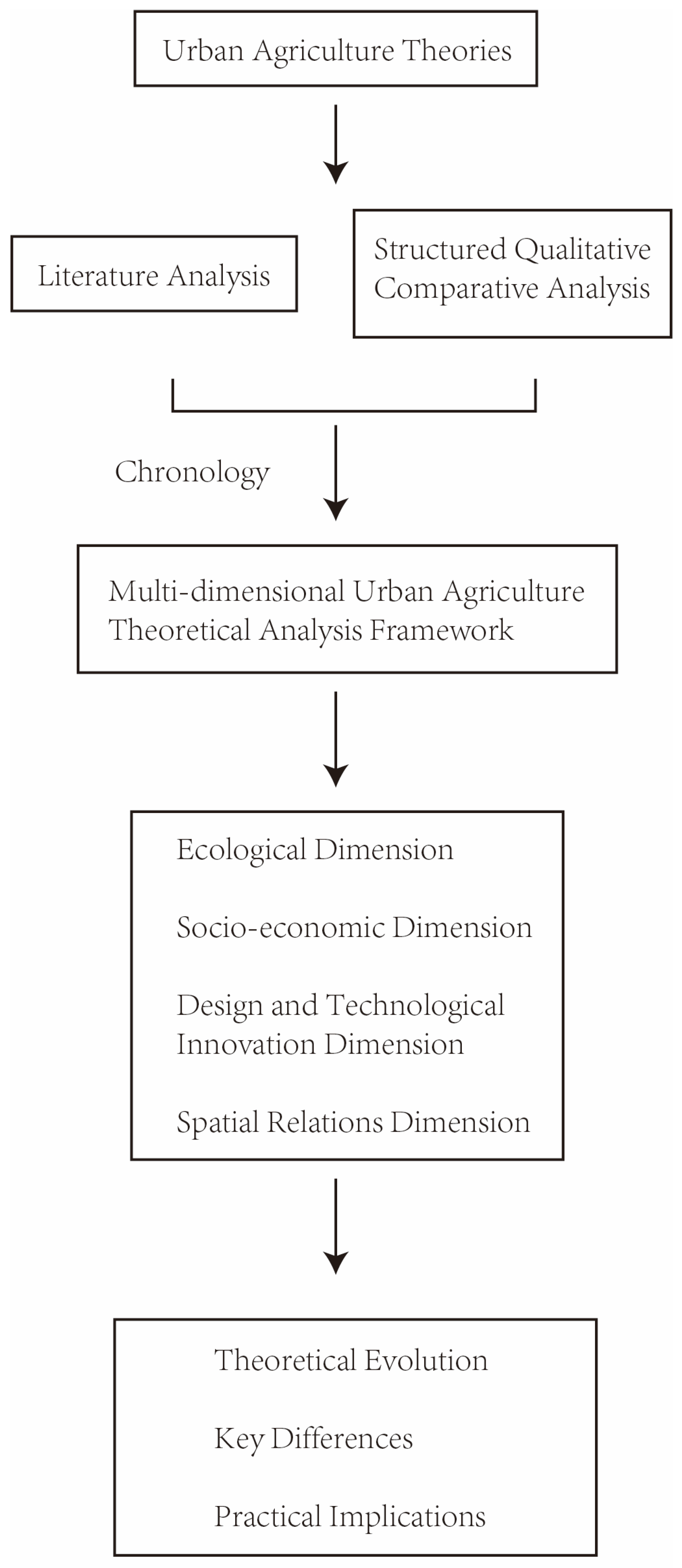
This study employs a methodology that combines comprehensive literature analysis and structured qualitative comparative analysis. Furthermore, this study utilises a chronological approach to organise the developmental process of UA theories. Given the diverse theoretical orientations of UA, including management, design and ecology, the literature on UA is both extensive and complex. This work focuses on the theoretical analysis of UA within its evaluation framework. This study collates representative theories and analyses their commonalities, differences and respective emphases through a multidimensional evaluation framework. Furthermore, this paper aims to provide a relatively systematic theoretical and literature foundation for subsequent research, whilst offering a new analytical perspective. Figure 1 shows the mechanism diagram of the multi-dimensional UA theoretical analysis framework.

2.1.1. Literature Analysis

This study adopts an integrative literature review to identify and summarise the development of UA theory. The integrative review method allows for the inclusion of diverse literature sources. Through screening, synthesising, and comparing various documents, it extracts theories relevant to this research. The scientific literature related to UA theory was collected, analysed, and summarised through multiple channels, including international academic databases, academic search engines, and government documents. Firstly, the ‘ProQuest™ Dissertations & Theses Citation Index database’ within ‘Web of Science’ was selected to examine theoretical frameworks within dissertations related to UA. Meanwhile, academic search engines, institutional reports, and policy documents from various countries were also consulted. Subsequently, this study analysed literature titles and abstracts and conducted an in-depth reading of selected documents to screen theories related to this research. Finally, by organising and comparing these theories, relevant scholars and their theoretical contributions were categorised and summarised. The integrative literature review emphasises comprehensiveness. It also expands the scope of literature collection and avoids limitations caused by relying on a single database. Although it does not follow the strict procedures of a systematic review, the multi-channel and multi-faceted cross-validation ensures the rationality and transparency of the research process.

2.1.2. Chronology

Building on a review of UA theory, this study presents the selected UA theories using a chronological approach. This is not a standalone research method, but rather an analytical approach to organising the literature. It aims to explore the evolution and developmental process of UA theory. Three distinct periods have been delineated: the 19th century to the 20th century, the mid-to-late 20th century, and the contemporary. This approach reveals the ideology and historical background of each period, while also helping to explain the theoretical framework, content, and developmental direction of UA theory. Furthermore, it clarifies the core theories and principal ideas of UA in each period and presents a comprehensive theoretical framework.

2.1.3. Structured Qualitative Comparative Analysis

This study employs structured qualitative comparative analysis to explore the differences and commonalities among various theories. A qualitative evaluation framework and set of indicators specific to UA theories applicable to this study have been developed. They aim to identify and summarise the core elements emphasised by different theories, whilst providing a unified analytical scale for theoretical comparison.
To enhance the scientific rigour and feasibility of the evaluation framework and indicator system, a review of the relevant literature has been conducted. The existing literature indicates that research on UA is not confined to a single dimension, but rather encompasses a wide range of fields, including ecology, socio-economics, spatial organisation, planning and design, and technological applications. Wang et al. utilised a questionnaire survey to explore the social functions of UA in China from the perspectives of industrialisation and commercialisation [16]. This study demonstrated the value of UA in enhancing public awareness, social participation and service functions. Furthermore, it emphasised the importance of the social and economic dimensions in UA research. The study by Song & Yang highlights the ongoing interactive relationship between UA and carbon effects [17]. It clarifies that the ecological dimension is a core element that cannot be overlooked in the evaluation of UA. Peng et al. designed ten indicators covering ecological, spatial, economic and social aspects to construct a UA evaluation system [18]. This study assessed UA in different areas of Beijing and noted that UA exhibits distinct spatial variations. It further clarified that the spatial relationship dimension is a critical aspect that cannot be ignored within the UA evaluation framework. Zhu et al. noted that planning, design and community collaboration can effectively promote the development of UA [19]. Ghandar et al. proposed an analytical framework for UA based on Chinese urban agricultural practices [20]. At the same time, it emphasised the importance of technical organisation and systemic synergy in enhancing UA. These studies affirmed the significant role of design and technological innovation in the development of UA. Building upon the above, this study further drew upon various comprehensive evaluation frameworks and indicators for UA. Li & Zhou discuss the multifunctional development of UA from a multidimensional evaluation perspective [21]. This study demonstrates that a unified analytical framework incorporating ecological, economic and social functions can more accurately identify the developmental characteristics of different types of UA. It provides an overarching conceptual framework for the multidimensional integrated analysis adopted in this study. Gullino et al. emphasise the crucial role of ecological conservation, landscape shaping and social services in realising the value and sustainability of UA [22]. John & Artmann constructed a comprehensive evaluation framework based on ecological, social and economic dimensions to compare the sustainability of different types of UA [23]. This provided a methodological foundation for the construction of a composite evaluation framework in this study. Teitel-Payne et al. developed an indicator system for UA based on ecological, health and economic dimensions, emphasising the universality and operability of indicator design [24]. This has provided guidance for the construction of a multidimensional research framework and indicator design in this study.
This study screens and integrates the dimensions and indicators that appear frequently in the aforementioned studies and are of analytical value. At the same time, taking into account the content and characteristics of the selected UA theories, this study adjusts and renames the various dimensions and indicators. Specifically, first, this paper compares the evaluation dimensions and indicators covered in the aforementioned studies. This study extracts content that is representative, observable and comparable. Secondly, elements with similar descriptions were consolidated to enhance the consistency of the framework structure. Finally, the number of indicators within each dimension was standardised to reduce analytical complexity and improve the comparability of the research. Based on the aforementioned literature review and analysis, this study constructs an evaluation framework for UA theory comprising four dimensions: ecological, socio-economic, design and technological innovation, and spatial relations. Each dimension comprises four indicators, totalling 16 indicators. Table 1 presents the UA evaluation framework used in this study, including the four analytical dimensions and their corresponding indicators.
The ecological dimension of this study emphasises the central role of agriculture in the circulation and conservation of urban resources, whilst also focusing on the impact of agriculture on the urban ecosystem. Its core objective is the construction of sustainable cities. This dimension comprises four indicators: ecological cycle integration, natural resource conservation, sustainable objectives, and ecological practice orientation. Ecological cycle integration is used to determine whether a theory addresses the relationship between UA and ecological cycles. Natural resource conservation is used to determine whether a theory explicitly addresses issues of natural resource conservation. Sustainable objectives are used to determine whether a theory incorporates UA into the framework of urban sustainable development. Ecological practice orientation is used to determine whether a theory explicitly proposes methods for improving the ecology through UA. The socio-economic dimension emphasises the social and economic value of UA. This dimension comprises four indicators: social participation, economic function, community integration, and governance mechanisms. Social participation is used to determine whether a theory emphasises the participatory role of diverse stakeholders. Economic function is used to determine whether the theory discusses the economic value of UA. Community integration is used to determine whether the theory explicitly addresses the role of UA in urban life. Governance mechanisms are used to determine whether the theory addresses UA management systems. The design and technological innovation dimension emphasises the spatial design and technological application of UA. It aims to integrate agriculture into the urban fabric, creating UA with aesthetic value. This dimension comprises four indicators: design innovation, production orientation, technological application, and scalability. Design innovation is used to determine whether the theory proposes new design concepts and strategies. Production orientation is used to assess whether the theory clarifies the productive role of UA. Technology application is used to assess whether the theory emphasises the adoption of technological support. Scalability is used to assess whether the theory has the potential for replication and dissemination. The spatial relations dimension emphasises the macro-level spatial layout of cities and agriculture. It primarily explores the spatial structure of UA. This dimension comprises four indicators: spatial organisation, spatial form, scale applicability, and practical applicability. Spatial organisation is used to assess whether a theory clearly defines the manifestations of UA within the urban space and its relationships with other urban spaces. Spatial form is used to assess whether a theory describes the spatial composition of UA, such as point, linear, areal or three-dimensional composite forms. Scale applicability is used to assess whether a theory clearly identifies the spatial scales to which UA is applicable. Practical applicability is used to assess whether a theory is linked to practice.
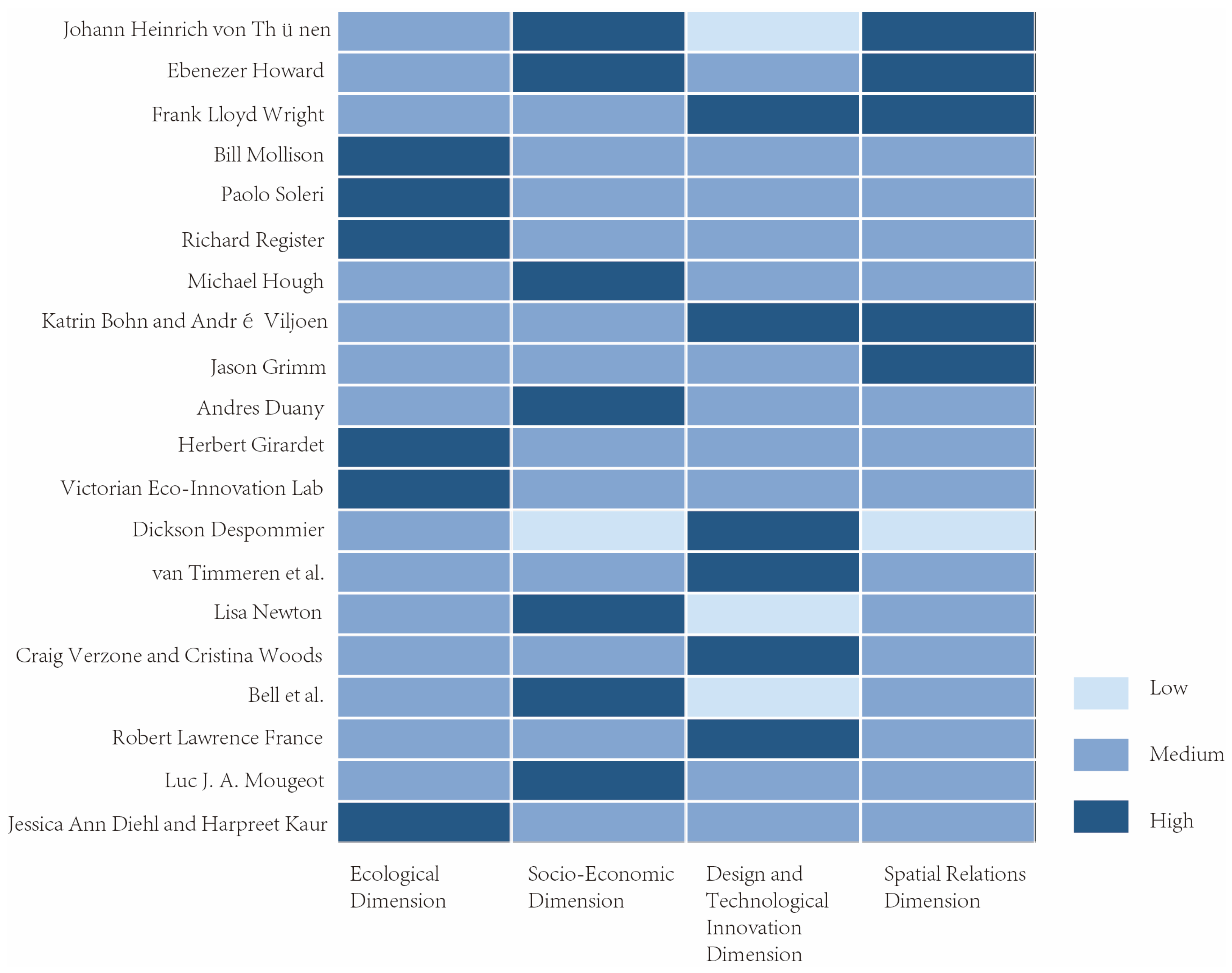
At the same time, this paper introduces a binary coding system to assess each indicator on the basis of qualitative comparison, with a view to enhancing the transparency and practicality of the research. If a theory provides a clear exposition regarding a given indicator, it is assigned a value of ‘1’. If a theory lacks content or has not developed a clear analysis for that indicator, it is assigned a value of ‘0’. Furthermore, this study aggregates the scores for each theory across all dimensions. This paper converts the total score for each dimension into three categories: low (0–1 points), medium (2 points) and high (3–4 points). This method facilitates the comparison of different theories across the four dimensions. It aims to present the extent of coverage and areas of focus of the theories within each dimension, rather than making value judgements on the theories themselves. Based on these results, this study constructs a heat matrix to visually present the characteristics of each theory across the four dimensions. The heat matrix features different UA theories as rows and the four dimensions as columns. It provides an intuitive representation of the core contributions of each theory. At the same time, it clearly illustrates the strengths and limitations, as well as the commonalities and distinctive features, of each theory.
Through literature analysis and structured qualitative comparative analysis, combined with a chronological approach, this study explores UA theory comprehensively, both historically and thematically. Historically, the study has collated the attitudes and perspectives of scholars from different periods, influenced by varying environmental factors. Thematically, the study examines the interplay of scholars’ ideas to analyse the developmental directions and focal points of UA theory. Furthermore, the structured discussion of UA theory has stimulated scholars across various disciplines to deepen their understanding of, expand upon, and refine the theory.

2.2. Chronological Classification of Representative UA Theories: 19th to Early 20th Century

In the late 19th century, the Industrial Revolution’s achievements accelerated the process of urban development. A city’s growth intensifies the existing contradictions within it. The great conflict between industrialised cities and the natural countryside gave rise to the utopian ideas of the society at that time. Exploring the relationship between urban forms and the countryside became the main research focus at that time [25]. Among these, Johann Heinrich von Thünen’s location theory on Agriculture, Ebenezer Howard’s Garden City and Frank Lloyd Wright’s Broadacre City were representative theories of the period. Together, these theories shaped the direction of UA theory during this era and laid the foundations for the emergence of future eco-cities. Table 2 summarises representative scholars and their theories from the 19th to the 20th century.
In “The Isolated State”, von Thünen proposed the location theory of agriculture. He argued that prices and costs were key factors in the distribution of agricultural land and, under the assumption of an idealised, self-sufficient state, proposed an agricultural ring centred on the city [26,27,28]. Although this model is difficult to apply directly to modern society, it provides an important economic foundation for research into the spatial relationship between cities and agriculture [26,29].
In contrast to von Thünen’s vision of separating agriculture from the city, Howard and Wright proposed an ecological UA theory that integrates agriculture with the city. Howard’s Garden City theory proposed mitigating and controlling the uncontrolled expansion of cities by establishing agriculture around their peripheries. In “To-morrow: A Peaceful Path to Real Reform”, he designed a self-sufficient ‘town-country’ social structure, integrating local production and consumption, sewage recycling, waste recycling, agricultural organisation and urban management into the urban framework [30,31,32,33]. Through these measures, the Garden City can not only become a survival strategy for residents but also help alleviate the city’s environmental problems.
Although Howard’s Garden City theory is utopian, it has a profound influence on the development and construction of ecological cities of the future. Its main legacies include the following: 1. In 1899, the “British Garden City Association” was established according to the theory [34]; 2. The British cities of Letchworth and Welwyn were built according to the theory [34,35]; 3. It provides the basis for the formation of concepts such as satellite towns, ecological corridors, and urban areas [36].
Wright’s Broadacre City bears similarities to the Garden City. In “The Disappearing City”, Wright proposed the concept of Broadacre City, a model of a low-density, functionally dispersed urban landscape. In this theory, each household possesses land for food production, whilst the boundaries between town and country are blurred to embody a vision of the city that is decentralised, self-sufficient and in harmony with nature [37,38,39]. Although both Howard and Wright advocated models of urban self-sufficiency and sustainability, the Broadacre City was a more idealised vision, eliminating urban structures to merge the city with nature [37,39].

2.3. Chronological Classification of Representative UA Theories: Mid-to-Late 20th Century

In the 20th century, most countries worldwide entered a stage of rapid urbanisation. However, excessive urbanisation has given rise to a series of urban environmental problems. Agriculture received renewed attention as a means of addressing urban problems effectively. The development of UA theories during this time was mainly focused on the exploration and research of ecological and organic concepts. The key contributions of this period were made primarily by Bill Mollison, Paolo Soleri, Richard Register and Michael Hough. Table 3 summarises representative scholars and their theories in the mid-to-late 20th century.
Mollison introduced the concept of Permaculture in “Permaculture: A Designer’s Manual”. He proposed a comprehensive sustainable system that mimics nature and integrates agriculture, architecture, land, animals and human activities [40,41]. This theory emphasises the cyclical nature and balance of ecosystems, as well as the interactions between ecological elements, and laid the foundations for research combining urban communities, food production and ecological design [40,41]. For example, in 1987, Crystal Waters Ecovillages was constructed in Australia based on the Permaculture theory.
In his book “Arcology: The City in the Image of Man”, Soleri put forward the theory of Arcology. Arcology is a combination of architecture and ecology [42]. The core of its concept is the integration of intensive agriculture into architecture [43]. At the same time, in the early 1970s, Soleri used the Arcology theory to conduct a practical study of an eco-architectural town known as “Arcosanti” in Arizona, which was designed as a futuristic compact town [43]. Soleri conceived the idea of combining greenhouses, orchards, and farmland with the building.
Register’s Eco-city theory builds upon and develops Soleri’s ideas regarding the creation of cities within natural environments [44,45]. In “Ecocity Berkeley: Building Cities for a Healthy Future”, he proposes incorporating agriculture as part of the ecological restructuring of cities and advocates for the development of compact, pedestrian-oriented urban communities [44,45]. These concepts are also reflected in relevant practices in Berkeley. For example, Register is involved in the “Slow Street” project of Berkeley with the non-governmental organisation (NGO). He proposed planting fruit trees in the streets, creating creeks, building solar greenhouses, and establishing bus lines instead of private cars to realise his vision of a decentralised Eco-city [46].
Building on Register’s concept, Hough further integrated ecology with the urban context. In “Cities and Natural Processes”, Hough introduced the concept of Productive Cities. He proposed that cities and ecology are interrelated processes [47]. Through discussions on UA, water systems, climate, habitats, and flora and fauna, he demonstrates that the interaction between productive landscapes and ecological processes forms the foundation of a sustainable urban environment [47].

2.4. Chronological Classification of Representative UA Theories: Contemporary Period

In the 21st century, due to the increasing environmental and social problems of urbanisation, UA research has been redeveloped. UA has tended to use diversified research to complement and improve the theory of UA, including exploring sustainable UA, the relationship between cities and agriculture, innovative models of urban agricultural practices and technologies, and the development of integrated UA. Among these, the study of sustainable UA has become the core and foundation of diversified research. Table 4 summarises representative scholars and their theories in the contemporary period.
In 2005, Katrin Bohn and André Viljoen first proposed the concept of a Continuous Productive Urban Landscape (CPUL) in their publication “Continuous Productive Urban Landscape: Designing Urban Agriculture for Sustainable Cities”. Bohn and Viljoen analysed cases of landscape design in the background of UA in the UK, while gathering and studying many UA spaces by discussing crop yields, urban life, and ecological approaches with the aim of building a resilient city [48]. CPUL refers to urban infrastructure that combines sustainability with urban space [38,48]. The core of CPUL is the use of sustainable production to reintegrate and connect urban open spaces, deriving continuous ecological corridors and creating composite urban infrastructure to create a new multifunctional urban landscape [48]. CPUL promotes an ecologically intensive development model that combines agriculture, renewable energy, and labour resources, and research case studies on various types of UA in the world [48]. CPUL follows a systemic design strategy that enables more resilient and sustainable food systems for UA [48]. It is the first theoretical work on UA design related to landscape architecture [49]. It makes clear that UA is an important element in the development of urban green infrastructure [48]. By establishing a relationship between “the developmental impact of UA on society” and “landscape architecture as an urban driver”, it confirms the virtuous link between UA, city, and sustainability [50]. Meanwhile, CPUL indirectly affects the rural landscape through the connection of landscape and production activities [48]. In 2009, Jason Grimm proposed the Food Urbanism theory on the basis of CPUL, which is based on a food system for the layout of urban space. The concept is designed to divide the food system into points, lines, and planes to construct urban space, forming a net-like model of urban food space [51]. In the same year, Andrés Duany proposed the Agrarian Urbanism theory. In contrast to Grimm’s theory of UA, Duany expanded the scope of agricultural production in cities and delineated the types of urban production spaces. The core of the theory is the integration of various types of agriculture into all levels of the urban structure. He explained the four modes of food-based urbanisation, namely agricultural retention, UA, agricultural urbanism, and agrarian urbanism [52]. According to Duany, the final development stage of UA is the involvement of all aspects of society in agricultural activities [52]. His book, although somewhat utopian, is more practical and pragmatic. In his Rural-Urban Transect, he proposes the use of different site transects to design a series of planting options to organise the space for agricultural production [53].
In contrast to several of the scholars mentioned above, who emphasise the idea of integrating urban open spaces through sustainable UA, Herbert Girardet and the Victorian Eco-Innovation Lab (VEIL) explore a new relationship between cities and agriculture.
In 2004, urbanist Girardet used the concept of the Ecological Footprint, developed by Bill Rees and Mathis Wackernagel, to illustrate urban issues. To build a recyclable, renewable, and sustainable urban environment, he proposed redesigning human settlement systems, using food, resources, and energy as the main framework for regenerating urban spaces [54]. The VEIL considers urban space from the perspective of the food cycle [55]. In 2008, the VEIL proposed the concept of Food Sensitive Planning and Urban Design (FSPUD). The VEIL is an interdisciplinary team working on more sustainable and resilient innovative cities of the future [56]. The VEIL describes the relationship between food security and the city [55]. At the same time, it proposes four stages that mainly affect the food system, namely producing food, processing and transporting food, consumer access and utilisation, and water, recycling, and post-use management. The theory emphasises the potential capacity of urban space to produce food and explains the demand for space and energy in the process of food processing and transportation [55]. It suggests that the influence of these factors should be considered in the design. It also focuses on the ability of consumers to purchase and use food and proposes the use of rational design methods for waste management. In addition, the VEIL has constructed an FSPUD matrix, a comprehensive tool for exploring design and food goals [55]. It is used to research the links between food issues relevant to urban design and the four stages of the broader food system.
In addition, the diversity of UA research is also reflected in innovations in UA techniques and modelling, as well as the development of comprehensive UA theories. Dickson Despommier published “The Vertical Farm: Feeding the World in the 21st Century” in 2010. It introduces the function and technology of vertical farming, proposing to address the problem of urban food supply through this approach [5]. Van Timmeren et al. focus on exploring agricultural models within new urban typologies. He proposed the concept of Sustainable Implant. It is an urban typology that integrates scattered infrastructures in cities and maintains the circulation of water and energy [57]. The Sustainable Implant embeds UA as a component into urban infrastructure systems to achieve polycentric development of agricultural clusters [57]. Lisa Newton, Craig Verzone and Cristina Woods supplement the theory of UA by exploring new UA models. Newton published “Urban Agriculture and Community Values: The Green Transformation of Cities” in 2020. It describes the origins and development of UA in Havana, Detroit, and Burlington [58]. Meanwhile, it explores the advantages, disadvantages, and development models of three types of UA: UA embedded in the full function of the city, commercial UA, and vertical UA [58]. Verzone and Woods published “Food Urbanism: Typologies, Case Studies, Strategies” in 2021, which brings together all components of edible landscape architecture. It explores and constructs new UA through a fusion of typologies, examples and strategies. The first part summarises the connections between production entities, urban spaces and human organisational systems by describing and classifying sites, growers, and production entities [25]. For example, it discusses 14 types of UA spaces, 13 types of growers, and different urban spaces. The second part proposes reflections on UA by introducing the cases. In the third part, it summarises and proposes solutions for the construction of diverse UA spaces by formulating 10 urban strategies [25]. Bell et al. and Robert Lawrence France enrich UA theory by integrating UA in multidisciplinary applications. Bell et al. published “Urban Allotment Gardens in Europe” in 2016. It describes the evolution process and characteristics of UA gardens in Europe in detail from the perspectives of policy, design, and ecology, and collates cases related to allotment gardens in Europe [12]. It discusses the links between UA and ecology, sociology, geography, and landscape architecture, while elaborating on the benefits and values of UA gardens in Europe [12]. France published “Integrated Urban Agriculture: Precedents, Practices, Prospects” in 2016, focusing on multidisciplinary, integrated UA. Linked by themes of design, science, and society, it summarises the research of 21 experts in various fields on UA, while exploring the production, distribution, and marketing of food in cities [59]. Luc J. A. Mougeot, Jessica Ann Diehl and Harpreet Kaur improved the theory of UA in terms of exploring the current situation and potential of UA. Mougeot published “Growing Better Cities: Urban Agriculture for Sustainable Development” in 2006. Mougeot introduced the UA programmes implemented by the International Development Research Center (IDRC) in low- and middle-income cities around the world in recent years [60]. Meanwhile, it explores the current status and research situation of UA in these cities, and summarises UA from the perspectives of territorial space, waste management, and health [60]. The IDRC is intended to contribute to global change by funding research and innovation in developing countries [61]. Diehl and Kaur published “New Forms of Urban Agriculture: An Urban Ecology Perspective” in 2021. It researches the multifunctionality and post-productivity of new forms of UA from an ecological perspective, aiming to explore its potential impact on cities [62]. Meanwhile, it explores the relationship between multifunctional forms of UA embedded in cities and their current status and development potential, through the themes of water resources, land, labour, and biodiversity, combined with specific cases in developing countries or developed countries [62]. These studies have contributed to the development of UA theory to some extent.

3. Results

This study uses a visual heat matrix to intuitively illustrate the characteristics of different UA theories from various periods. Figure 2 presents a visual heat matrix of UA theories. The results indicate that there are marked differences in the focal points of various urban agriculture theories across the four dimensions. However, most theories do not focus solely on a single dimension, but rather exhibit multidimensional and intersecting characteristics to varying degrees. Overall, the ecological and socio-economic dimensions feature prominently in the majority of theories. This indicates that sustainability, resource recycling, social functions and economic value are common focal points in the development of urban agriculture theories. The dimensions of design and technological innovation, as well as spatial relations, exhibit relatively marked variations across different theories. This reflects the differing emphases placed by various theories on the spatial organisation, technological pathways and modes of urban integration within urban agriculture. Through comparative analysis, scholars emphasising the ecological dimension of UA include Mollison, Soleri, Register, Girardet, Diehl and Kaur, and VEIL. Theorists emphasising the socio-economic dimension include von Thünen, Howard, Hough, Duany, Newton, Bell et al., and Mougeot. Theorists focusing on the design and technological innovation dimension include Wright, Despommier, van Timmeren et al., Bohn and Viljoen, Verzone and Woods, and France. Theorists emphasising spatial relationships include von Thünen, Howard, Wright, Bohn and Viljoen, and Grimm. These findings suggest that urban agriculture theories from different periods and with different orientations are not only comparable within a four-dimensional framework, but also demonstrate clear complementarity. The following sections provide a detailed analysis of overlap, differences, and theoretical and practical relevance of UA theories.

4. Discussion

4.1. Overlap

Through a comparison using a four-dimensional evaluation framework and a heat matrix, this study demonstrates that although UA theories from different periods emerged from distinct social contexts and urban challenges, they still share notable commonalities across certain dimensions. There is significant overlap among the theories in terms of the ecological aspects of UA. The ecological value of UA is a fundamental consensus among most theories. The majority of scholars regard UA as one of the key approaches to urban sustainability. From von Thünen and Howard in the 19th century, to Mollison, Register, and Girardet in the 20th century, and further to Bohn and Viljoen, Mougeot, and Despommier in the 21st century, they have all explicitly emphasised the significance of UA in urban food supply, ecological cycles, and natural restoration. Particularly in the late 20th century, due to severe environmental crises, improving ecology became central to UA theory. Though each theory adopts different expressions, they all aim to achieve urban sustainability and resource circulation, while proposing corresponding strategies. The cross-period nature of these theories reflects a long-term concern with urban ecological crises. Meanwhile, the high overlap in the ecological dimension is also clearly shown in the heat matrix. In the socio-economic dimension, the main commonality is that some theories address community integration and social equity. They emphasise the value of UA in reducing social inequality and enhancing social cohesion, such as Howard’s Garden City. Moreover, over time, the concept of social embedding in UA has continued to deepen. In the spatial relations dimension, theoretical discussions have focused on two aspects. On the one hand, some theories emphasise the spatial connections between urban and rural areas. For instance, the Garden City and Broadacre City proposed specific approaches to resolve conflicts between urban expansion and rural resources. On the other hand, some theories treat UA as an integral component of the urban space, to emphasise the systemic nature of spatial structures. For example, CPUL embedded productive landscapes within urban morphology to explore the landscape structure, scalability, and spatial form of UA. In the design and technological innovation dimension, due to continuous innovative breakthroughs, there is rarely an overlap among the theories. But this also indirectly reflects the close connection between UA theories across different periods.

4.2. Difference

Beyond these commonalities, the structured qualitative comparative analysis conducted in this study further demonstrates that the various theories still exhibit marked differences in terms of their focus on specific dimensions, core tenets and research methodologies. These differences reflect the developmental characteristics of UA theory. Based on an analysis of the evaluation framework, this paper goes on to discuss the focus of each theory across different dimensions and the variations between them. In the design and technological innovation dimension, the theoretical emphasis is different. The theories of Despommier and van Timmeren et al. focus on the significance and innovation of technical systems. They aim to enhance the productivity and scale of UA, but they are less focused on social integration and scalability. Mollison and Verzone et al., conversely, prioritise the socially driven practices and scalable design. Their theories have high social acceptance but lower technological innovation. In comparing the socio-economic and ecological dimensions, some theories emphasise ecological cycles and environmental conservation, such as Eco-City. Others focus more on social participation and governance, such as Agrarian Urbanism. The analysis of these characteristics indicates that different theories can complement each other across various dimensions, providing diverse guidance for the systematic development of UA.

4.3. Theoretical and Practical Relevance of UA Theories

Combining a chronological approach with structured qualitative comparative analysis, this paper further argues that the differences between various UA theories in terms of their core concepts, applicable contexts and limitations are not only related to their own research orientations, but are also influenced by the stage of urbanisation, regional development conditions and socio-economic contexts in which they are situated. Generally speaking, early theories primarily addressed issues of urban–rural relations and spatial organisation within an industrialised context. Theories from the mid-to-late 20th century primarily addressed ecological crises and urban environmental restoration. Contemporary theories, however, are more interdisciplinary in nature. They emphasise the integration of fields such as landscape design, urban ecology, food systems and social governance.
This study clarifies that the theoretical development of UA is closely linked to multiple disciplines and is deeply connected to urban development. Horizontally, the theories have had a broad influence. In the spatial relations and ecological dimensions, some theories provide a foundation for urban renewal and green city concepts. Meanwhile, they advance food security and sustainable urban development. In the socio-economic dimension, some theories promote the social value of UA as a public resource. For instance, Bell et al.’s study contributes to social cohesion and improves economic conditions. In the design and technological dimension, some theories improve the high-tech development in UA. For example, Sustainable Implant demonstrates the advantages and potential of UA in addressing crises within high-density cities. Furthermore, theories such as CPUL promote multidisciplinary and systemic innovation in UA.
Vertically, the development of these theories is closely related to the stages of urban transformation. In the 19th century, with the rapid rise of the Industrial Revolution, UA developed rapidly in most developed countries of the world while relieving the pressure on urban dwellers and supplementing the necessities of life. Due to the impact of the new urban form with obvious industrial characteristics and the influence of the traditional urban–rural model, the UA theory at this stage tended to realise the integration of industry and agriculture. For example, Howard designed the layout of water networks and improved agricultural systems, operations, and distribution methods. Wright proposed that the city’s industries, shopping centres, and transport be distributed in a landscape model. In the mid-to-late 20th century, global urbanisation was widespread, leading to the occupation of arable land by urban grey infrastructure. The progressively serious problem of urban pollution prompted UA to regain attention in many fields around the world as one of the most important means of improving the urban environment. The UA theory in this phase was influenced by urban reconstruction and expansion. The symbiosis between agriculture and the city became the core of the exploration of UA theory in this stage. For example, Hough’s Productive Cities explores water, climate, habitat, flora, and fauna as shared resources for both cities and agriculture to research innovative models of UA. In contemporary times, mature urban forms have contributed to the refinement of UA theories. High technology has further promoted the development of UA. The UA theories have expanded from focusing on production to discussing consumption, recycling, management, and circulation. At the same time, the increasing practice of UA provides the basis for the UA theory in this period. UA theories are rethought, inherited, and developed.

5. Conclusions

This study constructs a theoretical evaluation framework for UA comprising four dimensions and 16 indicators. Furthermore, through literature analysis, discussion of the evaluation framework and chronological review, this study examines the historical evolution, commonalities, differences and practical implications of these theories. Centring on the two research questions posed in this paper, the study demonstrates that urban agricultural theories do not develop in a linear fashion. In different periods, their focus has continually adjusted in response to changing urban issues. At the same time, they exhibit a trend of evolution from a singular focus towards multidimensional integration.
From the perspective of overall evolutionary patterns, UA theories generally exhibit a phased transition from a spatial organisation orientation to an ecological sustainability orientation, and finally to a systems integration orientation. This evolutionary process indicates that the development of UA theories is closely linked to urban development objectives. Their core focus has gradually expanded from early spatial organisation to diverse dimensions such as ecological restoration, social value and systems integration. A comparison across the four dimensions reveals that the ecological dimension has consistently run through the development of these theories. It serves as the common core foundation for the majority of UA theories. The socio-economic dimension has received increasing attention in contemporary theories. It has expanded from purely production-oriented needs to encompass social services and economic functions. The dimensions of design and technological innovation, as well as spatial relations, are more sensitive to the times. Each theory concentrates on reflecting changes in urban issues, technical conditions and practical needs across different periods. At the same time, they demonstrate the ongoing response of UA theory to real-world urban transformation challenges.
Overall, the development of UA theory is not a process of replacing a single theory. Rather, it is a process of continually enriching its analytical dimensions and functions in response to the urban challenges of different eras. This study not only re-examines and systematically traces the evolutionary trajectory of UA theory but also compares the core characteristics and differences of various theories through a multi-dimensional evaluation framework. Furthermore, this paper provides a comprehensive theoretical literature reference for future scholars and expands research in this field from a new perspective.
However, this study still has some shortcomings. Firstly, there are theoretical limitations in the literature. It fails to cover the full scope of theoretical discussions, and in particular, the systematic review of UA theories in regions such as Asia and Africa remains inadequate. At the same time, this study does not provide a sufficiently comprehensive overview of the latest research developments. Secondly, the analytical methods employed in this study are still subject to a degree of subjectivity. The evaluation framework proposed in this study is still at an exploratory stage, and the various indicators require further refinement. Furthermore, this study lacks direct evaluation and validation of specific practical case studies. As the focus of this study lies in the structured review and comparison of UA theories through a theoretical evaluation framework, the discussion at the practical level is primarily confined to an analysis of theoretical applicability and practical orientation. Additionally, the discussion regarding interdisciplinary integration methods for contemporary UA theories remains relatively limited.
Based on the aforementioned limitations, future research may be advanced in the following areas. Firstly, this study will broaden the scope of its literature analysis to enrich research on UA theory, with a particular emphasis on systematising theories from regions such as Asia and Africa. Secondly, this study will expand the discussion on interdisciplinary integration methods for contemporary UA theory. Furthermore, this study will refine the evaluation indicators. At the same time, this study will incorporate quantitative methods to enhance the scientific rigour of the analysis. Additionally, this paper will utilise representative case studies to validate and refine the proposed analytical framework.

Author Contributions

Conceptualization, X.X.; methodology, X.X. and L.Z.; validation, X.X. and L.Z.; formal analysis, X.X.; investigation, X.X.; data curation, L.Z.; writing—original draft preparation, X.X.; writing—review and editing, X.X. and L.Z.; visualization, X.X. All authors have read and agreed to the published version of the manuscript.

Funding

This research received no external funding.

Institutional Review Board Statement

Not applicable.

Informed Consent Statement

Not applicable.

Data Availability Statement

Data supporting the findings of this study are contained within the article.

Conflicts of Interest

The authors declare no conflicts of interest.

References

  1. United Nations, Department of Economic and Social Affairs, Population Division (UNDESA). World Urbanization Prospects: The 2018 Revision; (ST/ESA/SER.A/420); United Nations: New York, NY, USA, 2019. [Google Scholar]
  2. UN-HABITAT. World Cities Report 2022: Envisaging the Future of Cities; United Nations Digital Library: New York, NY, USA, 2022. [Google Scholar]
  3. United Nations, Department of Economic and Social Affairs, Population Division (UNDESA). World Urbanization Prospects: The 2011 Revision; (ST/ESA/SER.A/322); United Nations: New York, NY, USA, 2012. [Google Scholar]
  4. Speak, A.F.; Mizgajski, A.; Borysiak, J. Allotment gardens and parks: Provision of ecosystem services with an emphasis on biodiversity. Urban For. Urban Green. 2015, 14, 772–781. [Google Scholar] [CrossRef]
  5. Despommier, D. The Vertical Farm: Feeding the World in the 21st Century; Macmillan: New York, NY, USA, 2010. [Google Scholar]
  6. Pastor, M.; Zimbalist, A. Cuba’s economic conundrum. NACLA Rep. Am. 1995, 29, 7–12. [Google Scholar] [CrossRef]
  7. Food and Agriculture Organization (FAO). The State of Food Insecurity in the World 2006; Food and Agriculture Organization of The United Nations: Rome, Italy, 2006. [Google Scholar]
  8. Viljoen, A.; Bohn, K. Continuous productive urban landscape (CPUL): Essential infrastructure and edible ornament. Open House Int. 2009, 34, 50–60. [Google Scholar] [CrossRef]
  9. Mougeot, L.J. Urban agriculture: Definition, presence, potentials and risks, and policy challenges. In Growing Cities, Growing Food: Urban Agriculture on the Policy Agenda; Cities Feeding People Series, Report 31; International Development Research Centre (IDRC): Ottawa, ON, Canada, 2000. [Google Scholar]
  10. Ikeda, S. The Life and Death of Cities. In A City Cannot Be a Work of Art: Learning Economics and Social Theory from Jane Jacobs; Springer Nature: Singapore, 2023; pp. 179–212. [Google Scholar]
  11. Zeevat, C.; Berendsen, M.; Bolkestein, F.; Bot, M.; Fens, T.; Rob’t Hart Herfst, W. Tot Nut & Genoegen: Volkstuincultuur in Nederland; Uitgeverij 010: Rotterdam, The Netherlands, 2001. [Google Scholar]
  12. Bell, S. (Ed.) Urban Allotment Gardens in Europe; Routledge, Taylor & Francis Group: Oxfordshire, UK, 2016. [Google Scholar]
  13. Capital Growth. 2012. Available online: http://www.capitalgrowth.org/ (accessed on 24 March 2026).
  14. Food and Agriculture Organization of the United Nations (FAO). Bangkok City Farm Program: Promoting Urban Agriculture Through Networks. Available online: https://fscluster.org/sites/default/files/documents/food_system_planning_case_study_2_bangkok_promoting_urban_agriculture_through_networks_150321.pdf (accessed on 1 January 2026).
  15. Food Ideas. The Action Plan for Urban Agriculture in the Aix-Marseille Provence Metropolis. Available online: https://letsfoodideas.com/en/initiative/the-action-plan-for-urban-agriculture-in-the-aix-marseille-provence-metropolis/ (accessed on 1 January 2026).
  16. Wang, X.; Onychko, V.; Zubko, V.; Wu, Z.; Zhao, M. Sustainable production systems of urban agriculture in the future: A case study on the investigation and development countermeasures of the plant factory and vertical farm in China. Front. Sustain. Food Syst. 2023, 7, 973341. [Google Scholar] [CrossRef]
  17. Song, Z.; Yang, R. The Interaction and Its Evolution of the Urban Agricultural Multifunctionality and Carbon Effects in Guangzhou, China. Land 2022, 11, 1413. [Google Scholar] [CrossRef]
  18. Peng, J.; Liu, Z.C.; Liu, Y.X.; Hu, X.X.; Wang, A. Multifunctionality assessment of urban agriculture in Beijing City, China. Sci. Total Environ. 2015, 537, 343–351. [Google Scholar] [CrossRef]
  19. Zhu, Z.; Chan, F.K.S.; Li, G.; Xu, M.X.; Feng, M.L.; Zhu, Y.G. Implementing urban agriculture as nature-based solutions in China: Challenges and global lessons. Soil Environ. Health 2024, 2, 100063. [Google Scholar] [CrossRef]
  20. Ghandar, A.; Theodoropoulos, G.; Zhong, M.; Zhen, B.; Chen, S.; Gong, Y.; Ahmed, A. An Agent-Based Modelling Framework for Urban Agriculture. In Proceedings of the 2019 Winter Simulation Conference (WSC), National Harbor, MD, USA, 8–11 December 2019; pp. 1767–1778. [Google Scholar] [CrossRef]
  21. Li, M.T.; Zhou, Z.X. Research on Multifunctional Development Models for Urban Agriculture Based on a Multidimensional Evaluation Model. Chin. J. Ecol. Agric. 2016, 24, 1275–1284. [Google Scholar] [CrossRef]
  22. Gullino, P.; Battisti, L.; Larcher, F. Linking Multifunctionality and Sustainability for Valuing Peri-Urban Farming: A Case Study in the Turin Metropolitan Area (Italy). Sustainability 2018, 10, 1625. [Google Scholar] [CrossRef]
  23. John, H.; Artmann, M. Introducing an integrative evaluation framework for assessing the sustainability of different types of urban agriculture. Int. J. Urban Sustain. Dev. 2024, 16, 35–52. [Google Scholar] [CrossRef]
  24. Teitel-Payne, R.; Kuhns, J.; Nasr, J. Indicators for Urban Agriculture in Toronto: A Scoping Analysis. 2016. Available online: https://torontourbangrowers.org/wp-content/uploads/2025/12/ua-indicators-for-toronto-aoda.pdf (accessed on 10 November 2025).
  25. Verzone, C.; Woods, C. Food Urbanism: Typologies, Strategies, Case Studies; Birkhäuser: Berlin, Germany; Boston, MA, USA, 2021. [Google Scholar]
  26. von Thünen, J.H. The Isolated State in Relation to Agriculture and Political Economy; Wu, H.K., Translator; The Commercial Press: Beijing, China, 1986. [Google Scholar]
  27. Clark, J.K. The Repositioning of Farming in Newly Restructured, Consumptive Spaces: The Relational Geography of U.S. Peri-Urban Agriculture; The Ohio State University: Columbus, OH, USA, 2009. [Google Scholar]
  28. Wei, F. Three Essays on Economic Geography; University of Michigan: Ann Arbor, MI, USA, 2001. [Google Scholar]
  29. Baxter, R.E. Multi-Scalar Drivers and Patterns of Abandoned Cropland in the United States: Implications for Renewable Energy; The Pennsylvania State University: University Park, PA, USA, 2024. [Google Scholar]
  30. Howard, E. To-Morrow: A Peaceful Path to Real Reform; Cambridge University Press: Cambridge, UK, 1898. [Google Scholar]
  31. Zhao, S.Q. Multi-Objective Spatial Optimization for Ecological Planning: Shenzhen as a Case; The Chinese University of Hong Kong: Hong Kong, China, 2020. [Google Scholar]
  32. LaRocca, V.J. The Cook, the Farmer, His Wife, and Her Grocer: Plotting a New Urban/Rural Interface; Rice University: Houston, TX, USA, 2007. [Google Scholar]
  33. Carsjens, G.J. Supporting Strategic Spatial Planning: Planning Support Systems for the Spatial Planning of Metropolitan Landscapes; Wageningen University and Research: Wageningen, The Netherlands, 2009. [Google Scholar]
  34. Letchworth Garden City Heritage Foundation. Letchworth Garden City. 2023. Available online: https://www.letchworth.com/ (accessed on 24 March 2026).
  35. Pastor, A.B.; Canniffe, E.; Jiménez, C.J.R. Learning from Letchworth and Welwyn Garden City: Garden cities’ policies for the development of existing settlements in the contemporary world. Land Use Policy 2023, 132, 106759. [Google Scholar] [CrossRef]
  36. Irani, M. Experiences, characteristics, and features of developing new towns between 1898 and 1970. Eur. J. Geogr. 2022, 13, 75–96. [Google Scholar] [CrossRef]
  37. Wright, F.L. The Disappearing City; W.F. Payson: New York, NY, USA, 1932. [Google Scholar]
  38. Oskouei, S.A. The Role of Urban Agriculture in Enhancing Public Space: An Evaluation of Types; Middle East Technical University: Ankara, Turkey, 2019. [Google Scholar]
  39. Hall, P. Cities of Tomorrow: An Intellectual History of Urban Planning and Design Since 1880; John Wiley & Sons: Hoboken, NJ, USA, 2014. [Google Scholar]
  40. Mollison, B. Permaculture: A Designer’s Manual; Ten Speed Pr: Emeryville, CA, USA, 1988. [Google Scholar]
  41. Boniface, D. Productive Minescape: The Rehabilitative and Productive Relationship Between Architecture, an Open Cast Mining Landscape and the Subsistence Farming Communities, Mogalakwena, Limpopo; University of Johannesburg: Johannesburg, South Africa, 2013. [Google Scholar]
  42. The Cosanti Foundation. What is an Arcology? 2023. Available online: https://www.arcosanti.org/arcology/ (accessed on 24 March 2026).
  43. Grierson, D. Ecology, Sustainability and the City: Towards an Ecological Approach to Environmental Sustainability with a Case Study on Arconsanti in Arizona. Doctoral Dissertation, University of Strathclyde, Glasgow, UK, 2000. [Google Scholar]
  44. Holt, T. Richard Register Has Spent the Better Part of Three Decades Trying to Figure It Out Why It’s so Hard to Persuade Berkeley to Build Something Ecologically Sound. Is he Finally Getting Somewhere? SFGATE. 10 December 2006. Available online: https://www.sfgate.com/bayarea/article/ECOVISION-Green-Schemer-Richard-Register-has-2543611.php (accessed on 24 March 2026).
  45. Register, R. Ecocity Berkeley: Building Cities for a Healthy Future; North Atlantic Books: Berkeley, CA, USA, 1987. [Google Scholar]
  46. Roseland, M. Dimensions of the eco-city. Cities 1997, 14, 197–202. [Google Scholar] [CrossRef]
  47. Hough, M. Cities and Natural Process; Routledge: London, UK, 2004. [Google Scholar]
  48. Bohn, K.; Viljoen, A.; Howe, J. Continuous Productive Urban Landscape: Designing Urban Agriculture for Sustainable Cities; Architectural Press: New York, NY, USA, 2005. [Google Scholar]
  49. Lesher, C.W., Jr. Urban Agriculture: A Literature Review; United States Department of Agriculture: Beltsville, MD, USA, 2006.
  50. CPUL. History of the CPUL Concept. 2023. Available online: https://blogs.brighton.ac.uk/pulr/cpul-concept/history-of-the-cpul-concept/ (accessed on 24 March 2026).
  51. Grimm, J. Food Urbanism: A Sustainable Design Option for Urban Communities; Iowa State University: Ames, IA, USA, 2009. [Google Scholar]
  52. Duany, A. Garden Cities: Theory & Practice of Agrarian Urbanism; The Prince’s Foundation for the Built Environment: London, UK, 2011. [Google Scholar]
  53. Duany, A.; Talen, E. Transect planning. J. Am. Plan. Assoc. 2002, 68, 245. [Google Scholar] [CrossRef]
  54. Girardet, H. Cities People Planet: Liveable Cities for a Sustainable World; John Wiley & Sons: Hoboken, NJ, USA, 2004. [Google Scholar]
  55. National Heart Foundation of Australia (NHFA). Food Sensitive Planning and Urban Design. Available online: https://www.vichealth.vic.gov.au/sites/default/files/FoodSensitivePlanning_UrbanDesign_Summary.pdf (accessed on 1 January 2026).
  56. Designing Entangled Social Innovation in Asia-Pacific. VEIL–Victorian Eco-Innovation Lab. Available online: https://desiap.org/community/veil-victorian-eco-innovation-lab/#:~:text=The%20Victorian%20Eco-Innovation%20Lab%20%28VEIL%29%20seeks%20to%20identify,that%20could%20form%20part%20of%20future%20sustainable%20systems. (accessed on 24 March 2026).
  57. Van Timmeren, A.; Sidler, D.; Kaptein, M. Sustainable decentralized energy generation & sanitation: Case EVA lanxmeer, culemborg, The Netherlands. J. Green Build. 2007, 2, 137–150. [Google Scholar] [CrossRef]
  58. Newton, L. Urban Agriculture and Community Values; Springer International Publishing: Berlin/Heidelberg, Germany, 2020. [Google Scholar]
  59. France, R.L. Integrated Urban Agriculture: Precedents, Practices, Prospects; Green Frigate Books: Oxfordshire, UK, 2016. [Google Scholar]
  60. Mougeot, L.J. Growing Better Cities: Urban Agriculture for Sustainable Development; IDRC Books: Ottawa, ON, Canada, 2006. [Google Scholar]
  61. International Development Research Center (IDRC). About IDRC. Available online: https://idrc-crdi.ca/en/about-idrc (accessed on 1 January 2026).
  62. Diehl, J.A.; Kaur, H. (Eds.) New Forms of Urban Agriculture: An Urban Ecology Perspective; Springer: Singapore, 2021. [Google Scholar]
Figure 1. Mechanism diagram of the multi-dimensional UA theoretical analysis framework.
Sustainability 18 03517 g001
Figure 2. A visual heat matrix of UA theories.
Sustainability 18 03517 g002
Table 1. Four dimensions of UA theories and their corresponding evaluation indicators.
DimensionDescriptionIndicator
Ecological dimensionIt emphasises the importance of agriculture in recycling and protecting urban resources, and its impact on the urban ecology. It aims to build sustainable citiesEcological cycle integration
Natural resource conservation
Sustainable objectives
Ecological practice orientation
Socio-economic dimensionIt focuses on the social functions and economic value of urban agriculture. It plays an important role in improving community environments and boosting local economiesSocial participation
Economic function
Community integration
Governance mechanisms
Design and technological innovation dimensionIt aims to integrate urban areas and agriculture through design and technological innovationDesign innovation
Production orientation
Technology application
Scalability
Spatial relations dimensionIt focuses on the spatial relationship between agricultural land and urban development land. It explores the spatial scale, layout, and form of urban agricultural landSpatial organisation
Spatial form
Scale applicability
Practical applicability
Table 2. Representative scholars and their theories from the 19th to the 20th century.
PeriodCore Ideas and ContributionsScholarTheoretical Core
19th century to the 20th centuryExploring the relationship between cities and agricultureJohann Heinrich von ThünenAgricultural Location
Ebenezer HowardGarden City
Frank Lloyd WrightBroadacre City
Table 3. Representative scholars and their theories in the mid-to-late 20th century.
PeriodCore Ideas and ContributionsScholarTheoretical Core
Mid-to-late 20th centuryExploring the coexistence of cities and agricultureBill MollisonPermaculture
Paolo SoleriArcology
Richard RegisterEco-city
Michael HoughProductive Cities
Table 4. Representative scholars and their theories in the contemporary period.
PeriodCore Ideas and ContributionsScholarTheoretical Core
ContemporaryMultidisciplinary integration, food system integration, high technologyKatrin Bohn and André ViljoenContinuous Productive Urban Landscape
Jason GrimmFood Urbanism
Andrés DuanyAgrarian Urbanism
Herbert GirardetRegenerative Cities
The Victorian Eco-Innovation LabFood Sensitive Planning and Urban Design
Dickson DespommierVertical Farm
van Timmeren et al.Sustainable Implant
Lisa NewtonUrban Agriculture and Community Values: The Green Transformation of Cities
Craig Verzone and Cristina WoodsFood Urbanism: Typologies, Case Studies, Strategies
Bell et al.Urban Allotment Gardens in Europe
Robert Lawrence France Integrated Urban Agriculture: Precedents, Practices, Prospects
Luc J. A. MougeotGrowing Better Cities: Urban Agriculture for Sustainable Development
Jessica Ann Diehl and Harpreet KaurNew Forms of Urban Agriculture: An Urban Ecology Perspective
Disclaimer/Publisher’s Note: The statements, opinions and data contained in all publications are solely those of the individual author(s) and contributor(s) and not of MDPI and/or the editor(s). MDPI and/or the editor(s) disclaim responsibility for any injury to people or property resulting from any ideas, methods, instructions or products referred to in the content.