1. Introduction
Economic growth and low-carbon transition have always been core issues of global sustainable development. With the continuous expansion of the global economy, climate and environmental problems caused by rising carbon dioxide emissions have become increasingly severe, and green low-carbon development has become a global consensus. At the 2025 Global Climate Action Summit, 196 countries jointly signed the Accelerated Carbon Neutrality Agreement, advancing the global carbon neutrality target from 2060 to 2055. As the main producers of carbon emissions, the effectiveness of enterprises’ low-carbon transitions directly influences the process of achieving global carbon neutrality. Therefore, exploring the mechanism of corporate carbon emission reduction at the micro-level is of great practical significance.
Extensive research has been conducted on corporate carbon emissions and AI innovation, laying a solid foundation for this study. Scholars have revealed the mechanisms through which factors such as economic development, industrial structure, technological innovation, trade openness, environmental regulation, carbon emission trading, carbon taxes, and energy structure affect corporate carbon emissions from multiple dimensions [
1,
2,
3,
4,
5,
6,
7]. With the accelerated iteration of digital technologies represented by AI and the profound changes in technological innovation, scholars have paid increasing attention to the impact of AI innovation on carbon emission reduction. The existing literature has explored the impact mechanisms of industrial structure, factor allocation, energy utilization efficiency, and green innovation on carbon emissions at the macro-, urban, and regional levels [
8,
9,
10,
11].
In recent years, a growing number of scholars have begun to study the relationship between AI innovation and corporate carbon emissions from a micro-perspective. Scholars have confirmed that AI innovation can promote corporate carbon emission reduction through production processes, organizational management, and capital allocation. In terms of production processes, the relevant literature argues that AI innovation can affect corporate carbon emission reductions through mechanisms such as promoting energy structure transformation, improving energy efficiency, and enhancing production efficiency [
12,
13,
14,
15]. In terms of organizational management, it is believed that corporate carbon emissions can be reduced through mechanisms such as labor allocation optimization, green innovation promotion, and ESG performance improvement [
16,
17,
18,
19]. In terms of capital allocation, it is argued that AI can improve enterprises’ emission reduction investment capacity by improving indicators such as the total asset turnover rate and price-to-book ratio [
20,
21,
22,
23]. At the same time, a small number of scholars have considered multiple perspectives of corporate production and management, arguing that AI innovation reduces the carbon emission intensity of manufacturing enterprises through effects such as technological or informatization level improvement, management efficiency optimization, labor cost substitution, and financing constraint reduction [
24,
25,
26].
However, there is limited literature on the overall impact of AI innovation on the production and management of micro-subjects, especially on the internal structure related to corporate production and management, which remains to be explored. The existing literature [
24,
25,
26] primarily focuses on fragmented impacts—either solely on technological efficiency or individual management indicators—rather than the synergistic optimization of a firm’s internal functional architecture. Specifically, these studies often overlook the holistic “dimension of internal structure,” which we define as the organic integration of organizational governance, production processes, and investment structure. AI-driven optimization represents a qualitative advancement that builds upon traditional industrial computerization. While earlier digital phases were characterized by static data logging and the automation of predefined tasks, the AI-powered framework proposed in this study introduces a layer of dynamic sensing and autonomous decision-making. By leveraging machine learning and computer vision, firms can transition from passive data storage to active operational oversight, facilitating real-time fault detection and proactive maintenance. This high-precision coordination targets systemic variability (“Mura”) and operational waste (“Muda”), thereby guiding production systems more closely toward their theoretical carbon efficiency frontier [
27,
28]. In addition, corporate carbon emissions are highly affected by corporate managers’ decisions and regional carbon emission reduction policies, and few studies have considered both of these internal and external regulatory factors.
Therefore, this study starts from the micro-perspective of Chinese listed manufacturing enterprises; focuses on the optimization of internal structures such as organizational structure, production processes, and investment structure of corporate production and management affected by AI innovation; reveals the carbon emission reduction mechanism and effect of AI innovation; and considers the regulatory role of both internal executives’ green cognition and external government environmental attention. The contributions are as follows: First, this study explores the mechanism through which AI innovation affects carbon emission reduction by optimizing the corporate internal structure, enriching the theoretical research framework on the relationship between technological innovation and carbon emission reduction at the micro-level. Second, compared with studies focusing solely on the direct link between AI and emissions, this study incorporates upper echelons theory to explore the dual internal and external moderating mechanisms. Upper echelons theory posits that organizational strategic choices and performance levels are reflections of the values and cognitive bases of powerful actors within the organization. We argue that executives’ green cognition serves as a critical catalyst for channeling AI innovation toward sustainable goals. Combined with the external pressure of government environmental attention, this approach provides a more holistic understanding of the boundary conditions for AI-driven decarbonization [
29]. Third, this study explores the heterogeneous impact of AI innovation on corporate carbon emission reduction at different levels, such as the enterprise, industry, and region levels, providing evidence-based strategic insights for corporate decisionmakers and policymakers.
The remainder of this paper is organized as follows:
Section 2,
Section 3,
Section 4,
Section 5,
Section 6 and
Section 7 detail the theoretical framework, research design, and empirical results (including mechanism, moderating, and heterogeneity analyses).
Section 8 discusses the findings, while
Section 9 and
Section 10 provide conclusions, policy implications, and future research directions.
2. Theoretical Analysis and Research Hypotheses
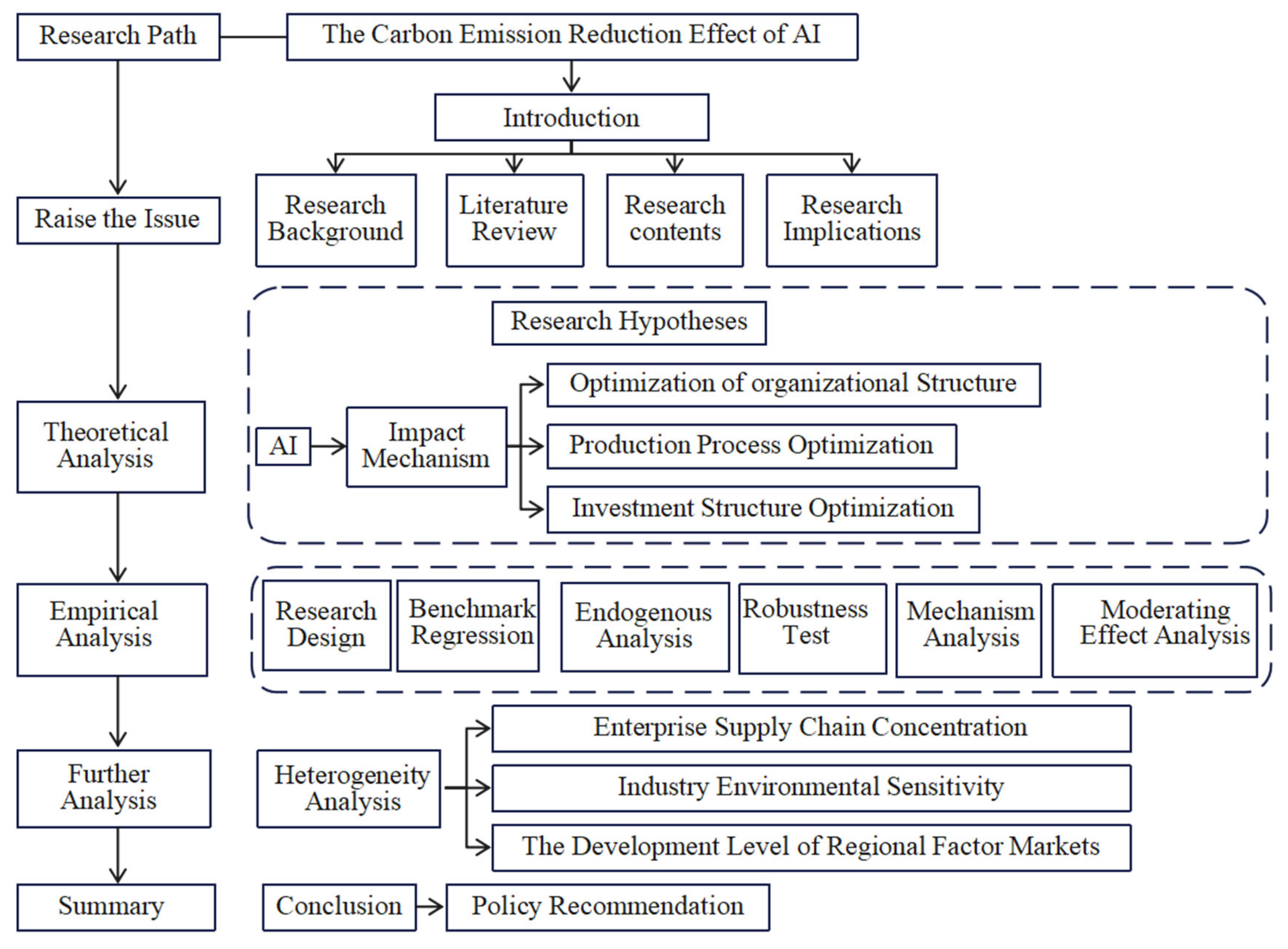
AI has entered a new stage of vigorous development, and achieving the goals of global carbon peaking and carbon neutrality has become critical; identifying the mechanism underlying the carbon emission reduction in corporate AI innovation can provide a new perspective for corporate green and low-carbon development at the micro-level and a new path for resolving the dilemma between economic development and environmental protection at the macro-level. This study argues that AI innovation can reduce carbon emission intensity and achieve corporate low-carbon development through the optimization of the organizational structure, production processes, and investment structure. The overall technical roadmap of this study is shown in
Figure 1. On the basis of verifying the core carbon emission reduction effect of AI innovation, this study decomposes the impact mechanism into three interrelated paths, namely, organizational structure optimization, production process optimization, and investment structure optimization, which correspond to Hypotheses 2, 3, and 4, respectively. The roadmap also systematically presents the full research process from theoretical analysis to empirical design, benchmark regression, mechanism testing, moderating effect analysis, heterogeneity analysis, and final conclusions and policy implications.
2.1. Direct Effects of Artificial Intelligence Innovation on Corporate Carbon Intensity
As the core carrier of the new generation of digital technology innovation, AI innovation can directly reduce corporate carbon emission intensity through multi-dimensional effects. On the one hand, AI technology can accurately identify high-energy-consuming and high-emission links by collecting data in real time such as production, energy consumption, and emission data, thereby providing data support for enterprises to formulate various emission reduction plans [
30]; on the other hand, intelligent algorithms can dynamically optimize the energy consumption of production equipment, and machine learning can assist in the research and development of green processes, reducing ineffective energy consumption and carbon emission redundancy [
31]. In addition, tools such as intelligent carbon accounting systems and carbon emission prediction models developed by AI can improve corporate carbon management efficiency, reduce accounting costs, and promote the normalization of low-carbon operations [
32,
33]. At the same time, the demand for highly skilled talents as a result of AI innovation can promote the in-depth integration of corporate intellectual capital and human capital, driving technological progress and production efficiency improvement, thereby indirectly reducing carbon emissions [
34,
35]. Based on the theory of technology bias, AI innovation, as a transformative technological process, guides enterprises to allocate their investments and resources to low-carbon fields. To further clarify this process, this study integrates the resource-based view (RBV), conceptualizing AI innovation not merely as a tool but as a high-order strategic resource. According to the RBV, AI assets are valuable, rare, and difficult to imitate, which allows firms to develop dynamic capabilities in environmental management. These dynamic capabilities enable enterprises to sense climate-related shifts and reconfigure their internal functional architecture—specifically organizational, production, and investment structures—to achieve sustainable emission reductions [
20,
36,
37,
38]. To sum up, the following research hypothesis is proposed:
Hypothesis 1. Artificial intelligence innovation can achieve corporate low-carbon development.
2.2. Organizational Structure Optimization
AI innovation optimizes the corporate organizational structure, providing organizational guarantee for carbon emission reduction. First, the substitution effect of AI on conventional low-skilled labor will motivate workers to improve their skill levels while creating demand for highly skilled talents, promoting the transformation toward a knowledge- and technology-driven organizational structure [
39,
40]. Second, the increase in the proportion of highly skilled talents can enhance human–machine collaboration efficiency and cross-departmental technical collaboration, laying an organizational foundation for enterprises to introduce low-carbon production technologies and optimize energy utilization processes, thereby directly reducing carbon emissions [
41]. Finally, the factor substitution bias of AI innovation can improve the R&D efficiency and market response capabilities of labor- and capital-intensive enterprises, thereby indirectly optimizing organizational resource allocation and reducing carbon emissions [
42]. Specifically, the shift toward a higher proportion of technical personnel does not merely cause an increase in fixed costs but is a strategic investment in “human-in-the-loop” capabilities [
43]. These technical experts possess the specialized knowledge required to deploy and manage complex AI-driven environmental tools, such as real-time CO
2 monitoring systems and intelligent carbon accounting models. They translate abstract algorithmic outputs into actionable operational adjustments, such as calibrating production equipment for optimal energy efficiency and identifying hidden emission redundancies, and, it is this human–machine alignment that prevents AI implementation from becoming a sunk cost, instead driving systemic efficiency and tangible emission reductions [
44]. Consequently, technical staff act as the critical catalysts that transform AI’s “innovation intent” into tangible carbon reduction performance. Therefore, the following research hypothesis is proposed:
Hypothesis 2. Artificial intelligence innovation achieves low-carbon development through the organizational structure optimization effect.
2.3. Production Process Optimization
AI innovation optimizes the entire production process, improves energy utilization and production efficiency, and reduces carbon emission intensity. Carbon emissions are produced across all corporate activities such as design, R&D, production, and sales. The traditional model faces difficulties in achieving real-time tracking and control [
45,
46], while AI innovation can improve the quality and transparency of carbon information, providing data support for reducing process carbonization. At the same time, AI innovation motivates enterprises to increase digital and informatization investment, build knowledge management systems, and promote management innovation and improve production efficiency [
37,
47]. The integration of AI serves to streamline manufacturing by synergizing with lean manufacturing (LM) principles. AI integration effectively eliminates “Mura” (variability/disparities) and “Muda” (non-value-added activity/waste), ensuring a production environment with zero waste and minimal resource redundancy. Through this human–machine collaboration, AI technology improves the efficiency of repetitive processes and equipment energy. In addition, AI technology can improve production technology levels, optimize the execution efficiency of repetitive processes, promote the energy-saving upgrading of equipment, and develop breakthrough green technologies, driving the shift toward low-carbon production processes [
31]. To this end, the following research hypothesis is proposed:
Hypothesis 3. Artificial intelligence innovation achieves corporate low-carbon development through the production process optimization effect.
2.4. Investment Structure Optimization
AI innovation guides capital allocation toward low-carbon fields, optimizes investment structures, and reduces carbon emissions. First, AI technology can integrate internal and external information resources, reduce information asymmetry and uncertainty in environmental investment, improve the priority of green investment [
48], and optimize operational efficiency and release liquidity, providing financial support for low-carbon investment [
20]. Second, AI innovation guides the allocation of capital to fields such as green technology R&D and energy-saving equipment upgrading [
19], and executives’ green cognition strengthens this effect, promoting the allocation of capital to low-carbon equipment [
49]. In the specific context of China’s “Intelligent Manufacturing” policy, the renewal of fixed assets is inherently a process of “greening” and “intelligentization”. AI innovation encourages firms to allocate capital to fields such as green technology R&D and energy-saving equipment upgrading, thereby allowing them to replace obsolete, high-emission legacy machinery with smarter, energy-efficient assets. Finally, the renewal of low-carbon equipment can break the dependence on high-carbon technology paths, improve production efficiency, and form a virtuous cycle of “investment optimization–efficiency improvement–emission reduction and carbon reduction”. Therefore, the following research hypothesis is proposed:
Hypothesis 4. Artificial intelligence innovation achieves low-carbon development through the investment structure optimization effect.
3. Research Design
3.1. Empirical Model
To examine the impact of AI innovation on carbon emission intensity, the following multi-way fixed effects model is constructed:
Here, i and t represent the firm where the enterprise is located and the year, respectively; CI denotes the corporate carbon emission intensity; AI denotes the level of corporate AI innovation; X denotes a series of control variables; λcity and γt denote the city and year fixed effects, respectively; and εit denotes the random disturbance term. β0 is the coefficient of the core explanatory variable examined in this study. If this value is significantly negative, it indicates that the AI innovation of manufacturing enterprises can significantly promote carbon emission reduction. Considering that the AI innovation level of manufacturing enterprises is deeply embedded in regional institutional environments and policy shocks, we employ city-level fixed effects to effectively filter out time-invariant regional unobservable factors, such as geographic location and initial resource endowments, while preserving the necessary cross-sectional variation to accurately identify the carbon reduction effect.
3.2. Variable Explanation
3.2.1. Dependent Variable
Carbon emission intensity (CI): The carbon emission intensity is calculated by dividing the total corporate carbon emissions by the main business income. As it is not mandatory for listed manufacturing companies to disclose their total carbon emissions and intensity in annual reports, such data are scarce. The data in this study are derived from calculations of corporate carbon emissions reported in the CSMAR database. The calculation method is adopted from [
50]. Although this method provides estimates, its logic is clear, it adopts recognized conversion coefficients, it is widely accepted in academic circles, and it provides a feasible solution to the data bottleneck. In addition, to ensure the ecological validity of the carbon emission proxy, we conduct an empirical validation by comparing our estimated CO
2 data with actual hand-collected emission data from 418 firm-year observations derived from ESG and CSR reports.The corresponding visual trend comparison is presented in
Figure S1 of the Supplementary Materials. After applying a logarithmic transformation to address unit inconsistencies and scale effects, the Pearson correlation coefficient between the estimated and actual values is 0.6852, which is statistically significant at the 1% level (
p < 0.01). This robust correlation demonstrates that the estimation method, based on [
50], effectively captures the actual emission levels and cross-sectional variations, minimizing systematic measurement errors. Specifically, the total carbon emissions (CO
2) and carbon emission intensity (CI) are indirectly measured through the total industrial energy consumption. The calculation methods are as follows:
Here, the CO2 conversion coefficient is 2.493, as measured by the Energy Conservation Center of Xiamen University.
3.2.2. Core Explanatory Variable
Artificial intelligence (AI) innovation: Based on the Reference Relationship Table between Strategic Emerging Industry Classification and International Patent Classification (2021) issued by the State Intellectual Property Office, AI-related invention patents from 1985 to 2023 are obtained through the Incopat patent search database. After deduplication and matching with listed companies and their subsidiaries, the logarithm of the annual number of AI patents of enterprises plus 1 is used as the proxy variable.
3.2.3. Control Variable
To control for the impact of relevant factors on corporate carbon emission intensity, this study draws on existing research while accounting for the operational characteristics of manufacturing enterprises. Key variables such as firm size, the total assets-to-net profit ratio, the debt-to-asset ratio, the current ratio, the revenue growth rate, the ownership status, the management shareholding ratio, and capital intensity are carefully controlled for. Specific definitions of these variables are provided in
Table 1.
3.3. Data Source
This study selects Chinese A-share listed manufacturing companies from 2010 to 2022 as the research sample. Basic enterprise information and financial data are obtained from the CSMAR database. Samples of ST, *ST, and PT listed enterprises during the study period are excluded; samples of financial listed enterprises during the study period are eliminated; samples with severe missing key variables are rejected; key continuous variables are winsorized at the 1% and 99% levels. Finally, 21,428 firm-year observations are obtained. Descriptive statistics of the main variables are shown in
Table 2.
4. Empirical Results
4.1. Benchmark Regression
The benchmark regression results reveal the core relationship between AI innovation and corporate carbon emission intensity, as shown in
Table 3. Column (1) does not include the control variables, and the estimated coefficient of the core explanatory variable AI is significantly negative at the 1% level, thus indicating that AI innovation can reduce corporate carbon emission intensity. Column (2) includes the control variables, and the estimated coefficient of AI is −0.079, which still passes the 1% significance test; additionally, the model fitting degree (R
2) increases to 0.389, confirming that, after controlling for the relevant variables, the emission reduction effect of AI innovation remains robust, and H1 is confirmed. Economically, a one-standard-deviation increase in AI innovation results in a 10.9% reduction in the CI relative to the sample mean, confirming its role as a “compensatory tool” for high-carbon models, as identified in previous studies [
8,
9]. This result confirms the core role of technological innovation in corporate carbon emission reduction.
4.2. Endogenous Analysis
Considering the possible two-way causal relationship between AI innovation and corporate carbon emission intensity and the problem of omitted variables, this study uses the instrumental variable method to handle endogeneity. Referring to existing studies, two instrumental variables are selected: IV1, which is the average AI innovation level of other enterprises in the same industry, and IV2, which is the average AI innovation level of other enterprises in the same region.
Table 4 reports the estimation results of these three instrumental variables. The coefficient for IAI is significantly positive (0.693,
p < 0.01), reflecting a strong “peer effect”, where firms increase AI investment to maintain competitive parity within their industry. In contrast, the coefficient for CAI is significantly negative (−0.442,
p < 0.01), which suggests a “factor competition” or crowding-out effect. In a specific city, limited resources such as highly skilled AI talent and digital infrastructure may lead to intensified competition, where higher innovation by neighbors constrains the target firm’s resource acquisition. The first-stage F-values (159.99 and 121.91) are both well above the critical threshold of 10, confirming the strength of the instruments. These meso-level technological trends represent the broader industrial and regional environment. While they influence a firm’s innovation path, they are unlikely to directly dictate an individual firm’s micro-level carbon emission intensity, which primarily depends on internal production and management decisions. As reported in
Table 4, after passing the Kleibergen–Paap rk LM test for underidentification and the Cragg–Donald Wald F test for weak identification, the impact of AI innovation on corporate carbon emission intensity remains significantly negative. This confirms that the decarbonization effect identified in this study reflects a robust causal relationship rather than endogenous bias.
4.3. Robustness Test
4.3.1. Exclusion of Carbon Trading Pilot Areas and Low-Carbon City Pilot Regions
Considering that the carbon trading pilot policy forces enterprises to reduce emissions through market-oriented means, and the low-carbon city pilot policy promotes regional green transformation through the combination of administrative and policy measures, the market environment and policy constraints of enterprises in such pilot regions significantly differ from those in non-pilot regions, which may interfere with the identification of core causal relationships. Therefore, this robustness test excludes enterprise samples from the above pilot regions. As shown in Column (1) of
Table 5, the regression coefficient for AI innovation remains significantly negative at the 1% level, with a value of −0.099, indicating that the decarbonization effect is primarily driven by technological innovation rather than purely by external regional policy constraints.
4.3.2. Exclusion of Special Years
As a sudden global event, the COVID-19 pandemic has had an exogenous impact on corporate production and operation, energy consumption, and carbon emission behaviors, which may affect the reliability of the regression results. To avoid this interference, this study excludes samples from 2019 to 2022 and only retains those from 2010 to 2018 for regression. The estimated coefficient remains robustly negative at the 1% level, with a value of −0.078 (Column 2), confirming that the long-term trend of AI-driven green transition is not distorted by temporary global disruptions.
4.3.3. Replacement of the Dependent Variable
For the measurement of the corporate carbon emission reduction effect, in addition to carbon intensity, which reflects the carbon emission efficiency per unit of revenue, this study replaces the core dependent variable with the total carbon emissions, which directly reflects the overall carbon emissions of enterprises, in order to test the robustness of the results. As reported in Column (3) of
Table 5, AI innovation continues to significantly reduce the overall carbon emissions at the 1% level, consistent with the baseline findings. This reinforces the conclusion that AI facilitates carbon intensity reduction.
4.3.4. Replacement of Cluster Standard Error
The benchmark regression uses robust standard errors to address heteroscedasticity. To further control for the clustered correlation of error terms at the city and enterprise levels, this study replaces the standard errors with double-clustered standard errors at the enterprise and provincial levels. The results in Column (4) show that the AI coefficient remains significantly negative at the 1% level, with a value of −0.079, demonstrating that our statistical inference is robust to the correlation structure of error terms.
4.3.5. Alternative Measures: Binary and Tobit
Considering the skewed distribution of the AI innovation level—characterized by a high frequency of zero-value observations—and potential data censoring, we re-estimate the model using a binary dummy variable (AI_dum) and a panel random-effects Tobit model. As reported in Columns (5) and (6) of
Table 5, the estimated coefficients remain significantly negative at the 1% level. The consistency of these two methods verifies that the research findings are not biased by the specific distributional characteristics of the data, ensuring the robustness of the conclusions.
5. Mechanism Analysis
To explore how AI innovation reduces corporate carbon emission intensity, based on the previous theoretical analysis, this study examines the optimization of organizational structures, production processes, and investment structures, and it constructs the following mediating effect models for testing:
In Equations (4) and (5), M is the mediating variable, including the proportion of technical personnel, investment in intelligent software, and fixed asset growth rate, which are used to characterize the optimization of organizational management, production processes, and investment structures, respectively. The specific characterization methods and test results are explained in the following analysis. The other variables are the same as those in Model (1). The mechanism test results are shown in
Table 6.
5.1. Optimization of Organizational Structure
The proportion of technical personnel (Tech_R) is used as a proxy variable for organizational structure optimization. The core logic is that the substitution effect of AI innovation on low-skilled labor will force enterprises to optimize their human capital structure and increase the proportion of highly skilled technical personnel. Technical personnel have stronger capabilities in low-carbon technology application and cross-departmental collaboration, which can promote the allocation of organizational resources toward emission reduction fields, providing organizational guarantee for carbon emission reduction [
24,
51]. Rather than being a mere fixed cost, these technical experts serve as the critical “translators” and “operational bridges” that transform AI’s technological potential into tangible environmental outcomes [
52]. Specifically, they possess the specialized skills required to deploy and operate AI-integrated CO2 monitoring and intelligent energy management systems [
43]. They interpret complex algorithmic energy-efficiency models and calibrate production parameters based on real-time data feedback. Through this human–machine collaboration, technical staff ensure that AI technology delivers immediate efficiency gains rather than administrative overhead [
44]. As shown in Column (1) of
Table 6, the estimated coefficient of AI is significantly positive at the 1% level (0.056), indicating that AI innovation can significantly increase the proportion of corporate technical personnel and promote transformation toward a technology-driven organizational structure. The results in Column (2) show that the estimated coefficient of Tech_R is significantly negative at the 1% level (−0.379), and the absolute value of the estimated coefficient of AI (−0.057) is smaller than that in the benchmark regression (−0.079) but still significantly negative. This indicates that organizational structure optimization plays a partial mediating role between AI innovation and corporate carbon emission reduction; thus, H2 is confirmed.
5.2. Optimization of Production Process
The final net amount of intangible assets such as software, technology, and systems (Soft_add) is used as a proxy variable for production process optimization. This indicator can reflect the degree of informatization and intelligent transformation of corporate production, and informatization transformation is the core starting point for achieving full-process carbon management [
53]. As shown in Column (3) of
Table 6, the estimated coefficient of AI is significantly positive at the 1% level (0.201), indicating that AI innovation can significantly motivate enterprises to increase investment in informatized intangible assets and accelerate the intelligent optimization of production processes. The results in Column (4) show that the estimated coefficient of Soft_add is significantly negative at the 1% level (−0.010), and the absolute value of the estimated coefficient of AI (−0.073) is smaller than that in the benchmark regression, indicating that production process optimization plays a partial mediating role. Unlike relatively static traditional informatization, AI innovation enables real-time fault detection and proactive maintenance, thereby optimizing production systems. By precisely coordinating complex operational parameters through human–machine collaboration, it eliminates “Mura” (variability) and “Muda” (waste). This process reduces resource redundancy and energy consumption, thereby significantly improving the carbon efficiency of production [
12,
54,
55]. Thus, H3 is confirmed.
5.3. Optimization of Investment Structure
The fixed asset growth rate (FC_A) is used as a proxy variable for investment structure optimization, representing the speed of the renewal and iteration of corporate fixed assets. The core idea is that AI innovation drives enterprises to direct their capital toward low-carbon and efficient equipment, eliminating old high-energy-consuming assets [
56]. As shown in Column (5) of
Table 6, the estimated coefficient of AI is significantly positive, indicating that AI innovation can accelerate the renewal of corporate fixed assets and promote transformation toward a low-carbon investment structure. The results in Column (6) show that the estimated coefficient of FC_A is significantly negative at the 1% level (−0.009), indicating that investment structure optimization plays a partial mediating role. We argue that AI innovation facilitates the greening of capital and reduces information asymmetry in environmental investments, encouraging enterprises to shift capital toward intelligent and energy-saving equipment. This renewal of fixed assets helps firms to break their “high-carbon path dependence” on legacy machinery, thereby achieving emission reduction effects while simultaneously enhancing productivity. Thus, H4 is confirmed.
6. Moderating Effect Analysis
This study tests the moderating roles of government environmental attention (external moderating variable) and executives’ green cognition (internal moderating variable) on the emission reduction effect of AI innovation by introducing interaction terms (AI × ER and AI × EGP) into the benchmark model. The results are shown in
Table 7.
The test results of the moderating effect of government environmental attention (ER) are shown in Column (2) of
Table 7. The estimated coefficient of the interaction term AI_ER is −0.028, which is significantly negative at the 5% level. Combined with the significant main effect of AI at the 1% level, this indicates that government environmental attention significantly strengthens the inhibitory effect of AI innovation on corporate carbon emission intensity. As an external institutional environment variable, government environmental attention regulates the emission reduction effect of AI innovation through the dual mechanisms of policy incentives and regulatory constraints. At the policy incentive level, regions with high environmental attention often introduce policies such as green innovation subsidies and carbon emission reduction tax exemptions, reducing the cost of corporate AI low-carbon innovation and encouraging companies to focus on emission reduction fields [
57]. At the regulatory constraint level, the increase in environmental inspection intensity and the tightening of carbon emission standards will increase the pressure on enterprises to comply with environmental regulations; this forces them to use AI technology to optimize production processes and strengthen carbon management, thereby enabling them to achieve the carbon emission reduction effect [
9]. On the contrary, insufficient policy support and loose regulation in regions with low environmental attention will weaken enterprises’ motivation to reduce emissions through AI innovation. In addition, governments in regions with high environmental attention will, on the one hand, force enterprises to accurately apply AI technology to emission reduction scenarios, such as carbon monitoring and energy consumption optimization, through strict environmental inspections, green innovation subsidies, and carbon emission standard upgrades and, on the other hand, reduce the cost of corporate AI low-carbon innovation, promoting the in-depth integration of intelligent technology and low-carbon production, thereby amplifying the emission reduction effect. In contrast, insufficient policy constraints and incentives in regions with low environmental attention will weaken the emission reduction orientation of AI innovation, leading to the weakening of the emission reduction effect [
58]. By providing strong “green policy signals,” high levels of government attention decrease the information asymmetry and investment uncertainty inherent in high-tech environmental projects. This creates a supportive institutional atmosphere, where providing subsidies and tax incentives lowers the cost barrier to AI adoption, thereby allowing intelligent technologies to be more effectively channeled into emission reduction scenarios.
The test results of the moderating effect of executives’ green cognition (EGP) are reported in Column (3) of
Table 7. The main effect coefficient of AI is −0.010 (
p < 0.05), while the estimated coefficient of the interaction term AI × EGP is −0.050 (
p < 0.01). This significantly negative interaction indicates that executives’ green cognition serves as a “critical catalyst” for the achievement of the emission reduction effect. Executives’ green cognition refers to executives’ judgment on the importance of environmental issues, the value of carbon emission reduction, and the potential of green technologies [
59]. Executives with high green cognition are better able to identify the low-carbon value of AI innovation; integrate low-carbon concepts into strategic planning; increase investment in AI low-carbon innovation; and promote the in-depth integration of technology with production, management, and investment processes [
49,
60]. At the same time, executives with high green cognition can guide the construction of green organizational culture, strengthen cross-departmental collaboration, and improve the efficiency of AI emission reduction applications. Based on upper echelons theory, executives’ cognition and values directly affect corporate strategic decisions [
29]. As a core internal variable, executives’ green cognition determines the application direction of AI innovation and the implementation effect of emission reduction value. On the contrary, executives with low green cognition focus more on short-term economic interests, which causes AI innovation resources to be directed toward non-low-carbon fields, thereby weakening the emission reduction effect [
61]. On the one hand, executives with high green cognition can accurately identify the low-carbon potential of AI; comprehensively integrate it with corporate green strategies; and achieve the emission reduction effect by optimizing production processes, upgrading organizational management, and guiding low-carbon investment. On the other hand, executives with low green cognition focus more on short-term economic interests and are prone to allocating AI innovation resources toward non-low-carbon fields, thereby failing to effectively achieve the emission reduction effect [
62].
7. Heterogeneity Analysis
7.1. Heterogeneity of Enterprise Supply Chain Concentration
Differences in supply chain structure may affect the carbon emission reduction effect of corporate AI innovation. In this study, the supply chain concentration of enterprises is measured via the proportion of sales to the top five customers, and they are divided into high- and low-supply-chain-concentration groups. The results are shown in Columns (1)-(2) of
Table 8. The estimated coefficient of AI in the low-supply-chain-concentration group is −0.081, which is significant at the 1% level, and that in the high-supply-chain-concentration group is −0.050, which is also significant at the 1% level. The results indicate that enterprises with a low supply chain concentration have a more scattered network of suppliers and customers. By using AI, enterprises can leverage its coordination and optimization advantages, effectively avoid the “carbon lock-in” effect of a single supplier, and achieve better optimization of resource allocation. In contrast, although enterprises with a high supply chain concentration can strengthen collaborative emission reduction with core partners through AI, the excessive dependence limits their optimization space in the entire supply chain, resulting in a relatively weaker marginal emission reduction effect of AI innovation [
27]. Finally, the carbon emission reduction effect of AI innovation is more significant in enterprises with scattered supply chains, which indicates that building a flexible supply chain network helps to enhance the environmental performance of AI.
7.2. Heterogeneity in Industry Environmental Sensitivity
Existing studies have shown that the environmental sensitivity of the industry in which enterprises are located varies, and the effect of AI innovation on corporate carbon emission reduction also varies. This study divides the enterprise samples into high- and low-environmental-sensitivity industries according to whether they belong to heavily polluting industries. The classification of heavily polluting industries is based on the Guidelines for Industry Classification of Listed Companies revised by the China Securities Regulatory Commission in 2012 and the Catalogue for Classification Management of Environmental Protection Verification of Listed Companies issued by the Ministry of Environmental Protection. The results show that the estimated coefficient of AI in the high-environmental-sensitivity group is −0.064, which is significant at the 1% level, and that in the low-environmental-sensitivity group is −0.036, which is significant at the 5% level. Enterprises with high environmental sensitivity face stronger environmental regulatory and social public opinion pressures, and they are more motivated to apply AI technology to reduce carbon emissions; thus, the emission reduction effect is more significant. In contrast, when enterprises in low-environmental-sensitivity industries apply AI, although they are subject to looser environmental constraints, their corresponding low-carbon strategies are not perfect; as a result, the carbon emission reduction effect is not as good as that of enterprises in high-environmental-sensitivity industries.
7.3. Heterogeneity in the Development Level of Regional Factor Markets
The carbon emission reduction effect of enterprises’ artificial intelligence innovation may exhibit significant heterogeneous characteristics due to differences in the development level of the factor markets in which they are located. This study is based on the ranking of the “factor market development level” index published in the “Report on Marketization Indexes of China’s Provinces (2018)”. Using the exponential median as the boundary, the 31 provinces are divided into two groups according to whether they have highly developed or underdeveloped factor markets, and then the enterprise samples are grouped based on their location. The results show that the estimated coefficient of AI in the underdeveloped factor market group is −0.110, which is significant at the 1% level, and that in the highly developed factor market group is 0.058, which is also significant at the 1% level. This may be because, in regions with underdeveloped factor markets, the marketization of the financial industry is incomplete, there is a shortage of highly skilled labor, and the effect of technological achievement transformation is insufficient. At this time, due to the characteristics of artificial intelligence innovation as a general-purpose technology, it can more significantly promote the optimization of enterprises’ internal structures. In enterprises in underdeveloped factor markets, the carbon emission reduction effect is more significant, and the carbon emission reduction benefits are greater.
8. Discussion
With the rapid development of a new generation of information technology and intelligent manufacturing, the application of artificial intelligence (AI) is quietly transforming corporate production, management, and even investment modes. This study investigates whether AI innovation can drive corporate carbon emission reduction and explores its internal structural driving pathways based on an in-depth investigation of Chinese manufacturing data. By comparing our findings with those in the literature, we find that AI innovation has a significant facilitating effect on corporate carbon reduction, which is consistent with the established literature regarding the positive environmental externalities of technological progress. Regarding the “organizational structure optimization” mechanism, this study confirms that the shift in labor structure toward technical personnel under AI’s influence is a critical driver for green transition. This confirms the global labor market theories proposed by Acemoglu and Restrepo (2019), who argued that, while automation replaces labor in low-skill tasks, it simultaneously reallocates it to more complex, high-skill tasks. It also aligns with international evidence provided by Jung and Lim (2020), which suggests that technological upgrades inevitably trigger shifts in internal labor composition, thereby maintaining operational efficiency. Furthermore, the synergy identified between AI and highly skilled labor in this study also drives the optimization and upgrading of production processes, echoing the findings of scholars in the context of lean manufacturing, where human–robot collaboration has been shown to reduce systemic waste and enhance productivity [
17,
36,
54].
Additionally, this study complements a study on emerging regions in Eastern Europe: both conclude that technical human capital is a universal mechanism of AI-driven decarbonization, confirming the foundational role of digital capabilities in optimizing resources and reducing pollution [
63]. In terms of investment efficiency, the literature suggests that SMEs often face an “IT productivity paradox” due to resource constraints [
64], while large enterprises utilize their “resource slack” to absorb the high risks and costs associated with AI [
54,
55]. The point where this study diverges is that, in the context of China’s “Intelligent Manufacturing” policy, AI innovation has become a key driver and incentive for firms to upgrade equipment. AI encourages firms to replace obsolete, high-emission machinery with new fixed assets that are inherently smarter and more energy-efficient. This mechanism, which achieves AI’s decarbonization effect through the “greening” and “intelligentization” of production line assets, serves as a supplement to existing theoretical frameworks. At the same time, our results align with the objectives of “green and digital twin transition” found in EU and US sustainability management models. However, while Western models typically prioritize factors such as ESG data transparency and software-driven efficiency, the Chinese context presented in this study emphasizes “intelligent manufacturing,” highlighting the optimization of a firm’s systemic and holistic “internal structure” via AI innovation. Finally, within a global framework, the AI-driven decarbonization mechanism explored in this study provides preliminary theoretical insights and practical evidence, offering an empirical reference for achieving “digital–green” synergy through industrial modernization.
9. Conclusions and Implications
This study takes Chinese A-share listed manufacturing companies from 2010 to 2022 as samples, focusing on the impact of artificial intelligence innovation on corporate carbon emission intensity. Through theoretical analysis and empirical testing, this study systematically explores its effect, internal mechanism, regulatory factors, and heterogeneous characteristics are systematically explored. The main research conclusions are as follows: (1) Artificial intelligence innovation can significantly reduce corporate carbon emission intensity and achieve low-carbon development of enterprises. This conclusion remains valid after endogenous treatment and various robustness tests; (2) The mediating effect test shows that the emission reduction effect of artificial intelligence innovation is achieved through three pathways—the optimization of the organizational structure (increase in the proportion of technical personnel), the optimization of production processes (increase in information technology investment), and the optimization of the investment structure (acceleration of fixed asset renewal)—and that all three pathways play partial mediating roles; (3) The regulatory effect test shows that both government attention to environmental protection and executives’ green cognition positively regulate the emission reduction effect of artificial intelligence innovation, with executives’ green cognition serving as a necessary condition for achieving the emission reduction effect; (4) Heterogeneity analysis shows that the emission reduction effect of artificial intelligence innovation is more significant for enterprises with disruptive innovation, those in high-environmental-sensitivity industries, those in regions with underdeveloped markets, and those with a low supply chain concentration.
Based on the above research conclusions, combined with China’s “dual-carbon“ goals and the need for high-quality development of the manufacturing industry, the following suggestions are put forward for three levels: government guidance, industry regulation, and enterprise development.
First, a three-pillar guidance framework of “assessment and evaluation + standard formulation + policy incentives” should be established. At the government level, efforts should be made toward the establishment of a guidance mechanism for artificial intelligence innovation to promote enterprises’ green and low-carbon development. By clarifying policy signals through standardized carbon accounting and AI innovation incentives, the government can encourage firms to proactively integrate AI into their low-carbon strategies. Targeted fiscal subsidies should be deployed as compensatory tools, particularly in regions where the high risk of green investment might otherwise deter technological upgrading. Importantly, given the stronger reduction effects found in regions with weak factor markets, the government should implement targeted fiscal subsidies for AI technology adoption in less developed areas. This strategy aligns with international evidence suggesting that the efficiency of government expenditures in environmental protection is key to achieving long-term sustainability goals. Chinese “dual carbon” policies can further learn from European reporting frameworks, such as the Classification of the Functions of Government (COFOG), by adopting standardized sustainable performance indicators that enhance the quality management and transparency of carbon governance outcomes. Simultaneously, supporting policies focusing on enterprises’ technological innovation, intelligentization, greenization, and low-carbonization should be introduced.
Second, the long-term and stable industry mechanism of “classified guidance + coordinated promotion + precise policy implementation” should be improved. In terms of control mechanisms, strengthening industry regulation is an important step in achieving both carbon emission control and the dual carbon goals. In terms of control mechanisms, regulatory authorities should prioritize high-environmental-sensitivity industries, where AI innovation demonstrates a more pronounced decarbonization effect. For these sectors, stricter carbon emission standards should be coupled with AI-driven monitoring to ensure compliance and active reduction. The integration and application of artificial intelligence innovation technologies should be promoted at all stages of the industrial and supply chains to achieve green and low-carbon development of the entire chain. By formulating policies related to low-carbon development for different industries based on their characteristics, the policy guidance role can be exerted from more professional perspectives such as technological innovation, digital intelligence, technological transformation, and green low-carbon development.
Third, a development mechanism that is driven by internal factors, which integrates “innovation promotion + management upgrading + production optimization + investment adjustment” should be established. As the core entity of carbon emission reductions, in addition to the impact of external driving forces, enterprises need to first address internal factors in order to achieve an internally driven green and low-carbon development mechanism. Through innovations in artificial intelligence, enterprises can continuously promote the upgrading of organizational management and optimize production processes. Logistics managers should prioritize building flexible, dispersed supply chain networks; unlike concentrated chains prone to “carbon lock-in,” dispersed structures offer the flexibility for AI to optimize multi-path resource allocation, thereby maximizing resource efficiency and emission reductions. This will help enterprises build a full-process and full-cycle green and low-carbon development model. Through disruptive and incremental innovations in artificial intelligence, enterprises can continuously promote the upgrading of organizational management, optimize production processes, and adjust investment structures. This will continuously improve production efficiency, energy utilization efficiency, and the resource output rate, helping enterprises build a full-process and full-cycle green and low-carbon development model.
10. Limitations and Future Research
Although this study provides theoretical and empirical insights, several limitations should be addressed in future research. First, regarding the measurement of AI, this study uses the number of AI-related invention patents as a proxy variable. While this reflects a firm’s AI innovation capacity and strategic intent, it may not fully capture the actual adoption and operational use of AI technologies in the production process. Future studies could employ textual analysis of annual reports to extract data on AI-related software spending to provide a more nuanced measure of AI application.
Second, the scope of this research is limited to the manufacturing sector. While manufacturing is a core source of carbon emissions, the decarbonization effect of AI in other sectors, such as services or agriculture, remains unexplored. Future research could expand the sample to diverse industries in order to enhance the generalizability of the findings.
Third, although this study utilizes the IV-2SLS method to address endogeneity, the quantitative approach lacks granular insights into how AI affects specific workflows on the factory floor. Future research should incorporate qualitative case studies or field interviews to observe the micro-level changes in production logic caused by AI implementation.
Finally, the measurement of the dependent variable, carbon emission intensity (CI), involves certain methodological approximations. Because of the current lack of mandatory carbon disclosure for manufacturing firms in China, this study uses an estimation approach consistent with that in [
50]. While this proxy assumes a relatively uniform energy structure within industries and may involve mathematical coupling between costs and revenues, preliminary validation against a sub-sample of 418 actual disclosures yielded a significant correlation of 0.6852 (
p < 0.01), confirming the reliability of our cross-sectional identification. Nevertheless, future research should gradually incorporate direct monitoring data or verified third-party ESG metrics as carbon reporting transparency continues to improve.
Author Contributions
Conceptualization, X.L. (Xingxing Lu); Methodology, X.L. (Xingxing Lu) and X.L. (Xiaojuan Luo); Software, L.L.; Validation, L.L. and B.Z.; Formal analysis, X.L. (Xiaojuan Luo) and B.Z.; Resources, L.L.; Data curation, X.L. (Xiaojuan Luo) and B.Z.; Writing—original draft, X.L. (Xingxing Lu) and L.L.; Writing—review & editing, X.L. (Xingxing Lu) and L.L.; Visualization, L.L.; Supervision, X.L. (Xiaojuan Luo) and B.Z.; Project administration, B.Z. All authors have read and agreed to the published version of the manuscript.
Funding
This research was funded by the Jiangxi Province Philosophy and Social Sciences Key Research Base Project, grant number “22SKJD12”.
Institutional Review Board Statement
Not applicable.
Informed Consent Statement
Informed consent was obtained from all subjects involved in this study.
Data Availability Statement
The data presented in this study are available on request from the corresponding author.
Conflicts of Interest
The authors declare no conflicts of interest.
References
- Lin, B.; Liu, X. Carbon emissions in the urbanization stage of China: Influencing factors and emission reduction strategies. Econ. Res. J. 2010, 45, 66–78. [Google Scholar]
- Wang, Q.; Zhou, P.; Zhou, D. Dynamic changes, regional differences, and influencing factors of China’s carbon dioxide emission performance. China Ind. Econ. 2010, 1, 45–54. [Google Scholar] [CrossRef]
- Mencaroni, A.; Leyman, P.; Raa, B.; Vuyst, S.D.; Claeys, D. Towards net-zero manufacturing: Carbon-aware scheduling for GHG emissions reduction. J. Clean. Prod. 2025, 529, 146787. [Google Scholar] [CrossRef] [Scilit]
- Lin, B.; Jia, Z. The impact of emission trading scheme (ETS) and the choice of coverage industry in ETS: A case study in China. Appl. Energy 2017, 205, 1512–1527. [Google Scholar] [CrossRef] [Scilit]
- Lambrecht, D.; Willeke, T. Which green path to follow: The development of green transportation technology under the EU ETS and its interplay with carbon emission reduction. J. Clean. Prod. 2025, 501, 145228. [Google Scholar] [CrossRef] [Scilit]
- Nguyen, T.T.; Pham, T.A.T.; Tram, H.T.X. Role of information and communication technologies and innovation in driving carbon emissions and economic growth in selected G-20 countries. J. Environ. Manag. 2020, 261, 110162. [Google Scholar] [CrossRef] [Scilit]
- Akerman, A.; Forslid, R.; Prane, O. Imports and the CO2 emissions of firms. J. Int. Econ. 2024, 152, 104004. [Google Scholar] [CrossRef] [Scilit]
- Cao, Q.; Chi, C.; Shan, J. Can artificial intelligence technology reduce carbon emissions? A global perspective. Energy Econ. 2025, 143, 108285. [Google Scholar] [CrossRef] [Scilit]
- Zhong, J.; Zhong, Y.; Han, M.; Yang, T.; Zhang, Q. The impact of AI on carbon emissions: Evidence from 66 countries. Appl. Econ. 2024, 56, 2975–2989. [Google Scholar] [CrossRef] [Scilit]
- Chen, P.; Gao, J.; Ji, Z.; Liang, H.; Peng, Y. Do artificial intelligence applications affect carbon emission performance?—Evidence from panel data analysis of Chinese cities. Energies 2022, 15, 5730. [Google Scholar] [CrossRef] [Scilit]
- Niu, X.; Lin, C.; He, S.; Yang, Y. Artificial intelligence and enterprise pollution emissions: From the perspective of energy transition. Energy Econ. 2025, 144, 108349. [Google Scholar] [CrossRef] [Scilit]
- Wang, J.; Wen, Y.; Long, H. Evaluating the mechanism of AI contribution to decarbonization for sustainable manufacturing in China. J. Clean. Prod. 2024, 472, 143505. [Google Scholar] [CrossRef] [Scilit]
- Fu, Y.; Shen, Y.; Song, M.; Wang, W. Does artificial intelligence reduce corporate energy consumption? New evidence from China. Econ. Anal. Policy 2024, 83, 548–561. [Google Scholar] [CrossRef] [Scilit]
- Yu, L.; Wang, Y.; Wei, X.; Zeng, C. Towards low-carbon development: The role of industrial robots in decarbonization in Chinese cities. J. Environ. Manag. 2023, 330, 117216. [Google Scholar] [CrossRef] [Scilit]
- Ding, T.; Li, J.; Shi, X.; Li, X.; Chen, Y. Is artificial intelligence associated with carbon emissions reduction? Case of China. Resour. Policy 2023, 85, 103892. [Google Scholar] [CrossRef] [Scilit]
- Behera, B.; Behera, P.; Pata, U.K.; Sethi, L.; Sethi, N. Artificial intelligence-driven green innovation for sustainable development: Empirical insights from India’s renewable energy transition. J. Environ. Manag. 2025, 389, 126285. [Google Scholar] [CrossRef] [Scilit]
- Jung, J.H.; Lim, D.G. Industrial robots, employment growth, and labor cost: A simultaneous equation analysis. Technol. Forecast. Soc. Change 2020, 159, 120202. [Google Scholar] [CrossRef] [Scilit]
- Song, Y.; Mi, L.; Bian, Z.; Tu, W.; He, J. How does artificial intelligence impact corporate ESG performance? The catching−up effect of digital technological innovation. J. Innov. Knowl. 2025, 10, 100843. [Google Scholar] [CrossRef] [Scilit]
- Wang, Y.; Wang, Y.; Yang, P. Does artificial intelligence impact corporate ESG performance? Evidence from a quasi-natural experiment in China. Energy Econ. 2025, 151, 108963. [Google Scholar] [CrossRef] [Scilit]
- Feng, B.; Chen, X.; Tang, H. AI-driven green governance: Assessing the impact of artificial intelligence on corporate sustainability performance. J. Innov. Knowl. 2026, 11, 100869. [Google Scholar] [CrossRef] [Scilit]
- World of Conferences. The modern vector of the development of science. In Proceedings of the XVI International Scientific Conference, Philadelphia, PA, USA, 3–4 October 2024. [Google Scholar] [CrossRef]
- Dong, Z.; Xin, Z.; Liu, D.; Yu, F. The impact of artificial intelligence application on company environmental investment in Chinese manufacturing companies. Int. Rev. Financ. Anal. 2024, 95, 103403. [Google Scholar] [CrossRef] [Scilit]
- Li, W.; Li, J.P.; Wang, Y.F.; Stan, S.E. Is artificial intelligence an impediment or an impetus to renewable energy investment? Evidence from China. Energy Econ. 2025, 147, 108550. [Google Scholar] [CrossRef] [Scilit]
- Liu, Y.; Deng, N.; Hu, Z. The impact effect and mechanism of intelligent manufacturing on corporate carbon emission reduction. China Popul. Resour. Environ. 2025, 35, 38–48. [Google Scholar]
- Li, J.; Gong, F.; Wang, Y. How does artificial intelligence technological innovation affect carbon emission reduction in manufacturing? China Popul. Resour. Environ. 2025, 35, 14–24. [Google Scholar]
- Zhang, A.; Danish; Chen, R. The paradox of artificial intelligence and environmental performance: The critical role of energy transition and institutional quality. J. Environ. Manag. 2025, 394, 127330. [Google Scholar] [CrossRef] [Scilit]
- Ren, B.; Qiu, Z.; Liu, B. Supply chain decarbonisation effects of artificial intelligence: Evidence from China. Int. Rev. Econ. Finance 2025, 101, 104198. [Google Scholar] [CrossRef] [Scilit]
- Benmamoun, Z.; Elkhechafi, M.; Abdo, A.A.; Jebbor, I. Optimization of carbon emissions in asphalt pavement construction. In Proceedings of the 2024 10th International Conference on Optimization and Applications (ICOA), Philadelphia, PA, USA, 3–4 October 2024; pp. 1–5. [Google Scholar] [CrossRef] [Scilit]
- Hambrick, D.C.; Mason, P.A. Upper echelons: The organization as a reflection of its top managers. Acad. Manag. Rev. 1984, 9, 193–206. [Google Scholar] [CrossRef] [Scilit]
- Popescu, I.S.; Hitaj, C.; Benetto, E. Measuring the sustainability of investment funds: A critical review of methods and frameworks in sustainable finance. J. Clean. Prod. 2021, 314, 128016. [Google Scholar] [CrossRef] [Scilit]
- Weng, M. Green innovation through artificial intelligence technology: Enhancing environmental, social, and governance performance. Finance Res. Lett. 2025, 75, 106921. [Google Scholar] [CrossRef] [Scilit]
- Tao, W.; Weng, S.; Chen, X.; Alhussan, F.B.; Song, M. Artificial intelligence-driven transformations in low-carbon energy structure: Evidence from China. Energy Econ. 2024, 136, 107719. [Google Scholar] [CrossRef] [Scilit]
- Wang, J.; Wang, A.; Luo, K.; Nie, Y. Can artificial intelligence improve enterprise environmental performance: Evidence from China. J. Environ. Manag. 2024, 370, 123079. [Google Scholar] [CrossRef] [Scilit] [PubMed]
- Di Vaio, A.; Zaffar, A.; Chhabra, M. Intellectual capital through decarbonization for achieving sustainable development goal 8: A systematic literature review and future research directions. J. Intellect. Cap. 2024, 25, 54–86. [Google Scholar] [CrossRef] [Scilit]
- Fonseca, T.; De Faria, P.; Lima, F. Human capital and innovation: The importance of the optimal organizational task structure. Res. Policy 2019, 48, 616–627. [Google Scholar] [CrossRef] [Scilit]
- Acemoglu, D.; Restrepo, P. Automation and new tasks: How technology displaces and reinstates labor. J. Econ. Perspect. 2019, 33, 3–30. [Google Scholar] [CrossRef] [Scilit]
- Jiao, A.; Lu, J.; Ren, H.; Wei, J. The role of AI capabilities in environmental management: Evidence from USA firms. Energy Econ. 2024, 134, 107653. [Google Scholar] [CrossRef] [Scilit]
- Barney, J.B. Firm resources and sustained competitive advantage. J. Manag. 1991, 17, 99–120. [Google Scholar] [CrossRef] [Scilit]
- Damioli, G.; Van Roy, V.; Vertesy, D. The impact of artificial intelligence on labor productivity. Eurasian Bus. Rev. 2021, 11, 1–25. [Google Scholar] [CrossRef] [Scilit]
- Zhou, G.; Chu, G.; Li, L.; Meng, L. The effect of artificial intelligence on China’s labor market. China Econ. J. 2020, 13, 24–41. [Google Scholar] [CrossRef] [Scilit]
- Luo, Q.; Wang, J. The impact of artificial intelligence development on embodied carbon emissions: Perspectives from the production and consumption sides. Energy Policy 2025, 199, 114535. [Google Scholar] [CrossRef] [Scilit]
- Agrawal, A.; Gans, J.S.; Goldfarb, A. Artificial intelligence: The ambiguous labor market impact of automating prediction. J. Econ. Perspect. 2019, 33, 31–50. [Google Scholar] [CrossRef] [Scilit]
- Li, H.; Chen, Y. Does artificial intelligence promote firms’ green technological innovation? Sustainability 2025, 17, 4900. [Google Scholar] [CrossRef] [Scilit]
- Wang, M.; Cui, R.; Zhao, X.; Zhang, Y.; Zhang, J. Leveraging AI-based organizational learning for sustainable performance in manufacturing. J. Manuf. Technol. Manag. 2024. ahead of print. [Google Scholar] [CrossRef] [Scilit]
- Jarrahi, M.H.; Askay, D.; Eshraghi, A.; Smith, P. Artificial intelligence and knowledge management: A partnership between human and AI. Bus. Horiz. 2023, 66, 87–99. [Google Scholar] [CrossRef] [Scilit]
- Chan, F.T.S.; Ding, K. Industrial intelligence-driven production and operations management. Int. J. Prod. Res. 2023, 61, 4215–4219. [Google Scholar] [CrossRef] [Scilit]
- Zhou, W.; Zhang, Y.; Li, X. Artificial intelligence, green technological progress, energy conservation, and carbon emission reduction in China: An examination based on dynamic spatial durbin modeling. J. Clean. Prod. 2024, 446, 141142. [Google Scholar] [CrossRef] [Scilit]
- Horbach, J.; Rammer, C.; Rennings, K. Determinants of eco-innovations by type of environmental impact—The role of regulatory push/pull, technology push and market pull. Ecol. Econ. 2012, 78, 112–122. [Google Scholar] [CrossRef] [Scilit]
- Tschang, F.T.; Almirall, E. Artificial intelligence as augmenting automation: Implications for employment. Acad. Manag. Perspect. 2021, 35, 642–659. [Google Scholar] [CrossRef] [Scilit]
- Shen, H.; Huang, N. Can the carbon emission trading mechanism enhance corporate value? Financ. Trade Econ. 2019, 40, 144–161. [Google Scholar]
- Yao, J.; Zhang, K.; Guo, L.; Feng, X. How does artificial intelligence enhance corporate production efficiency?—A perspective based on the adjustment of labor skill structure. Manag. World 2024, 40, 101–116, 133, 117–122. [Google Scholar] [CrossRef]
- Zhai, J.; Huang, J. How does artificial intelligence affect the environmental performance of enterprises? Evidence from China. Front. Environ. Econ. 2025, 4, 1607149. [Google Scholar] [CrossRef] [Scilit]
- Quan, X.; Li, C. Intelligent Manufacturing and Cost Stickiness: A Quasi-Natural Experiment from China’s Intelligent Manufacturing Demonstration Project. Econ. Res. J. 2022, 57, 68–84. [Google Scholar]
- Jebbor, I.; El-hmous, N.; Benmamoun, Z.; Hachimi, H. Artificial intelligence (AI) toward streamlining lean manufacturing approaches. In New Technologies, Artificial Intelligence and Smart Data, Proceedings of the 12th International Conference, INTIS 2024, Tangier, Morocco, 30 May–1 June 2024; Badir, H., Tabaa, M., Eds.; Springer Nature: Cham, Switzerland, 2026; Volume 2645, pp. 3–14. [Google Scholar] [CrossRef] [Scilit]
- Boufssasse, A.; Hssayni, E.H.; Joudar, N.E.; Ettaouil, M. A multi-objective optimization model for redundancy reduction in convolutional neural networks. Neural Process. Lett. 2023, 55, 9721–9741. [Google Scholar] [CrossRef] [Scilit]
- Shen, Y.; Zhang, X. Intelligent manufacturing, green technological innovation and environmental pollution. J. Innov. Knowl. 2023, 8, 100384. [Google Scholar] [CrossRef] [Scilit]
- Tong, Y.; Zhao, Z.; Li, X. Local Government’s Carbon Reduction Prioritization and Corporate Digital Transformation: Empirical Evidence from High-Energy-Consuming Listed Companies. Financ. Tribune 2023, 12, 82–91. [Google Scholar] [CrossRef]
- Chen, S.; Chen, D. Haze Pollution, Government Governance and High-Quality Economic Development. Econ. Res. J. 2018, 53, 20–34. [Google Scholar]
- Adria, V. Green 50: Top Business Moves That Helped the Planet. Available online: https://www.corporateknights.com/leadership/green-50/ (accessed on 20 April 2020).
- Zhang, D.; Li, B.; Fu, Q.; Tang, W.; Fatima, T. Impact of CEOs’ environmental experience on corporate green innovation. Corp. Soc. Responsib. Environ. Manag. 2025, 32, 3290–3312. [Google Scholar] [CrossRef] [Scilit]
- Qing, L.; Li, P.; Dagestani, A.A.; Woo, C.; Zhong, K. Does climate change exposure impact on corporate finance and energy performance? Unraveling the moderating role of CEOs’ green experience. J. Clean. Prod. 2024, 461, 142653. [Google Scholar] [CrossRef] [Scilit]
- Li, Y.; Xia, Y.; Zhao, Z. The impact of senior executives’ green cognition on corporate performance in heavily polluting industries: A moderated mediating effect model. Sci. Technol. Prog. Policy 2023, 40, 113–123. [Google Scholar]
- Stoenoiu, C.E.; Jäntschi, L. Connecting the computer skills with general performance of companies—An eastern european study. Sustainability 2024, 16, 10024. [Google Scholar] [CrossRef] [Scilit]
- Biadacz, R. Application of kaizen and kaizen costing in SMEs. Prod. Eng. Arch. 2024, 30, 17–35. [Google Scholar] [CrossRef] [Scilit]
| Disclaimer/Publisher’s Note: The statements, opinions and data contained in all publications are solely those of the individual author(s) and contributor(s) and not of MDPI and/or the editor(s). MDPI and/or the editor(s) disclaim responsibility for any injury to people or property resulting from any ideas, methods, instructions or products referred to in the content. |