Article

An (Un)Sustainable Business Model of a Mutual Fund in the EU Common Agricultural Policy—The Case of Croatia

1
Department of Management and Rural Entrepreneurship, University of Zagreb Faculty of Agriculture, 10000 Zagreb, Croatia
2
Department of Finance, University of Zagreb Faculty of Economics & Business, Trg J.F. Kennedy 6, 10000 Zagreb, Croatia
*
Author to whom correspondence should be addressed.
Sustainability 2026, 18(7), 3450; https://doi.org/10.3390/su18073450
Submission received: 20 February 2026 / Revised: 30 March 2026 / Accepted: 31 March 2026 / Published: 2 April 2026

Abstract

Agriculture faces climate change, price volatility, and policy uncertainty. Because traditional agricultural insurance instruments often prove insufficient to address these risks, the Common Agricultural Policy (CAP) has introduced additional risk-management instruments such as mutual funds. The paper applies the Business Model Stress Testing framework to assess the robustness and adaptability of a mutual fund business model. The sustainability of the mutual model depends on building trust, enabling legislation, ensuring transparent governance, diversifying funding sources, agri-tech and alignment with support measures are the most critical factors. Within the current institutional framework, the lack of cooperative tradition and management capacities, the application of mutuals is hardly feasible for Croatia. Instead of a collective risk-sharing instruments approach, the paper suggests supporting the cooperation of stakeholders from different risk layers in harnessing digital technology and AI in developing enhanced agricultural risk management. Even though such an approach could be fuzzy too, it could bring impact faster and even contribute to the relevancy of the mutual model. The paper contributes to the literature on sustainable business model innovation in agriculture that enhances farm resilience in high-risk environments. This exercise might have policy implications for transition economies seeking to operationalize innovative tools in climate risk management and rural development.

1. Introduction

The trends observed across EU agricultural insurance markets, such as raising premiums, coverage restrictions, and market withdrawals, indicate a systemic contraction in the availability of agricultural insurance [1,2]. This contraction is a direct response to the escalating losses from climate-related perils, which render traditional risk-pooling models financially unviable for insurers. Between 1980 and 2022, average annual losses from climate-related hazards in the EU amounted to EUR 28.3 billion, representing approximately 6% of the total value of agricultural output. Droughts, frost, hail, and excess precipitation collectively account for more than 80% of these losses, while the average insurance protection gap remains as high as 70–80%, indicating that only a fraction of losses are covered by public, private, or mutual mechanisms [1]. Croatia is among the Member States with higher vulnerability to climate risks. According to the Commission’s resilience dashboards, Croatia shows medium to low capacities in climate change mitigation and adaptation [3].
The situation is expected to worsen, implying that the agricultural sector will require more comprehensive risk management tools that go beyond traditional insurance and ad hoc government assistance. This has created a pressing need for a new framework for agricultural risk management in Europe, moving beyond a system that is showing clear signs of market failure in high-risk regions [4]. Despite this overall protection gap, there are many examples of effective insurance protection systems, as well as promising reforms and innovations, that can be shared and learnt from [1]. In response, European Union policymakers have introduced a set of risk management measures under the Common Agricultural Policy (CAP) [5,6]. These measures provide startup aid for newly established mutuals, designed to increase farmers’ resilience to systemic shocks. Mutuals can take two forms: mutual funds for compensation for production loss and mutuals as an income stabilisation tool [7,8]. Mutual funds spread risks collectively among farmers, foster solidarity, and can be tailored more closely to sector-specific needs compared to commercial insurance [9].
The concept of collective risk-sharing instruments is not new. Mutual societies primarily serve the interests of their members rather than external stakeholders [10]. In mutual insurance societies, policyholders are also owners; they provide capital and share the mutually distributed risk. These societies operate on principles of mutuality, solidarity, and democratic governance, have a significant social impact, and contribute to the communities in which they operate. Farmers, as a relatively homogeneous group, have proven to be a typical sector where mutual insurers realise business potential and their inherent advantages. At the beginning of the 20th century, mutual insurance societies began to play an important role in the agricultural sector across Europe.
Under CAP strategic plans, Croatia selected mutual funds as a policy intervention to be provided to farmers for the first time. The allocated funds are quite modest (2.3 million euros) compared with 70 million euros for another risk management intervention-insurance premium support, or 3.7 billion euro CAP budget for Croatia [11]. The establishment of mutual funds faces significant challenges, so such a cautious start is unsurprising. Challenges arise primarily from the underdeveloped crop and livestock insurance markets. Insurance supply is limited in both risk coverage and the range of products it protects [12]. In addition, historically low levels of cooperation and trust among farmers pose barriers to developing collective schemes, as mutuals inherently depend on close collaboration [13]. Moreover, Croatia lacks a dedicated regulatory category for agricultural mutual funds operating under CAP risk management measures. Furthermore, modern agricultural risk management is increasingly shaped by holistic approaches that integrate agri-tech solutions, digital monitoring, and management science [14], yet these elements are still insufficiently developed in the Croatian context.
Currently, no mutuals operate in Croatia [15]. Lessons learned from other EU member states, combined with the lack of tradition and internal challenges within Croatian agriculture, make a mutual fund a hardly feasible risk management strategy for Croatian farmers. The potential of mutuals, supported by available EU funding, should not be overlooked, but their introduction requires a structured, business model innovation-driven approach. As a mutual is a collective insurance startup governed, controlled and benefited by its members, we are seeking a feasible business model for collective risk management. An innovation-driven approach, based on the accumulated knowledge from the startup ecosystem [16], forms the backbone of these search efforts.
Despite policy support for mutual funds within the EU CAP framework, their feasibility in transition economies such as Croatia remains insufficiently explored. Although there is a growing body of literature on agricultural risk management, cooperative governance, and sustainable business model innovation, these areas remain largely disconnected, with limited integration in the design of agricultural mutual funds. This study addresses this gap by integrating sustainable business model innovation, cooperative governance, and risk management theory within the Business Model Stress Testing (BMST) framework. The study applies the Business Model Stress Testing framework to evaluate the robustness of a proposed agricultural mutual fund model under institutional and market constraints.
The paper examines how institutional and risk-related barriers shape the feasibility of mutual fund development in Croatian agriculture, and how a proposed business model performs under stress conditions. It also considers which adaptations are required to enhance the model’s robustness and feasibility, and which policy measures are necessary to enable its effective implementation and scaling within the Common Agricultural Policy context.
By combining the analytical power of the Business Model Canvas with stress testing techniques, this paper contributes to the growing literature on sustainable business model innovation in risk management. It provides practical insights for policymakers and farmer organisations seeking to establish pilot mutuals under the CAP framework. The study also contributes by conceptualising a broader innovative ecosystem that integrates insurance mechanisms, advisory services, and digital tools for enhanced transparency.
The paper is structured as follows. After Section 1, the Business Model Stress Test method is discussed in Section 3. Section 4 begins with findings from the BMST framework based on the case of a mutual fund in Croatia, aiming to analyse its resilience to change. The subsequent chapter presents a discussion on upgrades and adjustments of the collective risk management operational model that can complement agricultural risk governance. Section 5 at the end of the paper outlines policy recommendations, limitations of the study, and recommendations for future research.

2. Theoretical Background and Research Context

The conceptual foundation of this research integrates three complementary perspectives:
1. Cooperative and mutual governance theory, which emphasises democratic control, member participation, and the alignment of user-benefit, user-owner, and user-control principles [17],
2. Risk management theory and, accordingly, mutual funds as collective mechanisms for managing systemic and idiosyncratic agricultural risks [18,19], and
3. Sustainable business model innovation (SBMI), which positions business models as dynamic systems that create economic, social, and environmental value [20].

2.1. Mutuals, Cooperatives and Cooperation

Mutual societies or associations of legal or natural persons operate on the principles of mutuality and solidarity among members, who are also owners and participate in managing the organisation. The most common legal forms of mutual insurers include associations, cooperatives, and mutual societies [10,21]. Mutual insurers exist in most regions of the world in institutionalised forms, such as self-insurance groups, friendly and fraternal societies, mutual holding companies, mutual insurance societies, industrial and reserve funds, mutual or social benefit societies, cooperative insurers, Protection and Indemnity clubs, and Takaful insurers [10,22].
Numerous mutual insurance societies were established by agricultural unions to protect agricultural workers, farms, and crops from risks such as fire, hail, and livestock mortality. It is estimated that in France alone, around 40,000 mutual insurance societies were created over a period of 40 years [10,22].
In developed countries, mutuals and cooperatives have traditionally been established to serve specific niche segments, such as farming [23]. Customer-owned insurance companies (mutual and cooperative insurers) are prominent actors in the insurance industry and have significantly increased their market share in the relatively recent past [24]. Globally, the mutual market share stood at 26.3% of total premiums, 23.7% in life insurance and 29.0% in non-life insurance. The share of mutuals in developed insurance markets was 32.5%, while it was 2.7% in emerging markets. European mutuals’ market share of the European insurance market stood at 33.0% in 2022. European mutuals exceeded the total European insurance market’s 10-year premium growth in total, life, and non-life business by 13.0, 18.0, and 6.4 percentage points, respectively [22].
Examples of mutuals in EU agriculture exist. The occurrence of various extreme events and diseases in the Netherlands led to the introduction of mutual funds in the early 1990s. A mutual for the protection against contagious diseases (such as Salmonella risks) was followed by a mutual that covers risks such as brown rot and ring rot in potatoes [19]. In 1998, the Animal Health Fund (AHF), a public–private fund, was established in the Netherlands. This fund covers costs caused by epidemic animal diseases. In addition to the AHF, smaller mutual funds in the Netherlands include Avipol and Porcopol [25]. A similar mutual was established in Germany against losses caused by animal diseases (cattle, pigs, and poultry). When a loss occurs, farmers are compensated from the fund, which is financed by the state (25%), farmers’ contributions (25%) and up to 50% from EU contributions [25]. In France, a state fund named Fonds national agricole de Mutualisation Sanitaire et Environnementale (FMSE) was established to insure against risks such as plant and animal diseases and environmental incidents [18]. In Italy, there are five mutual funds for damage caused by animal and plant diseases, nine funds for severe income losses, and one public national fund (AGRICAT) for compensation for catastrophic damage (e.g., drought, ice, flood, etc.) [26]. Romania, as an EU member state, has initiated the development of legal frameworks for the establishment of mutual funds based on the French experience, but a mutual fund has not yet been established [8].
The advantages of a mutual fund are that it covers risks uninsurable in the commercial market. According to Meuwissen et al., to bring mutuals closer to farmers, emphasis should be placed on the size of the risk, affordability of premiums, financial robustness, and solidarity [26]. However, the main problems in the functioning of mutual funds are the lack of national legislation defining what a mutual fund is and under what conditions it operates, as well as insufficient guidelines and regulations from the European Union for the design of a mutual fund. Cordier concludes that the development of mutual funds at the EU level is postponed due to several constraints: lack of trust among farmers, a high threshold for compensation, the possibility of reinsurance of mutual funds, and the requirement that the fund must be representative (members must manage more than 20% of the total agricultural area and livestock recorded at the national level). In the first year of the fund, compensation is higher than the total premium paid. Further constraints include uncertainty about which production risks are insured and which are not, how many mutual funds should be formed, and whether the fund should be mandatory or voluntary. The most important constraint is that farmers must be members for three consecutive years to receive compensation [8]
Mutual funds primarily cover risks associated with greater uncertainty due to climate change and extreme events. The main reason mutual funds exist in the market is that they cover risks that are uninsurable in the commercial market [19]. A further characteristic of MF is that they are generally quite small compared with insurance companies, and are mostly intended for a homogeneous group of farmers who pay a lower initial premium than for commercial insurance. AMFs do not cover insurable risks, as these can be insured by insurance companies. Therefore, geographically and sectorally defined AMFs in the event of damage can expect that it will affect all or most of the farmers, and more serious damages may occur, which the fund might not be able to compensate.
Critical factors in establishing and running mutuals are balancing the size of risk, affordability of premiums, financial robustness and solidarity [19]. In the case of mutuals providing new EU CAP tools such as income stabilisation tools, these critical factors are even more important, as they have the added responsibility of managing data and (classified) market information management [27]. Kuliešis et al. [28] identify the following inhibiting factors for the creation of mutual funds: the need for detailed records and submission of farm expenses and incomes by participants; the dependence of insurance payments on the size of accumulated funds (with reduced benefits in the absence of resources); the same premium for all farmers participating in mutual funds; and a fixed maximum amount of insurance benefit per farmer. The mutual and cooperative business model poses a risk that, within their institutional context, managers may become powerful and entrenched in poorly performing social economy organisations unless countervailing measures are adopted [29].
Data from Bergevoet et al. [25] show that the mutual fund entry rate is low in the Netherlands, slightly higher in Germany, and highest in France. Currently, only seven EU member states include mutual funds in their strategic plans [30].
Research conducted in the Czech Republic shows a low level of familiarity with MFs [4]. Research in Croatia indicates that there is interest in mutual funds among baby beef producers, but there are limitations, such as insufficient information and, most importantly, a lack of trust [31]. Similarly, vine growers express interest in a mutual fund whose main aim is to insure against income risks, called IST [32].
Despite its benefits for value chain upgrading, shared responsibility, democracy in decision making, cost reduction, negotiation power, and advisory roles, cooperatives and mutual societies in Croatia that provide financial services exclusively to the agriculture sector, as an affinity group, have not been developed. Mutual insurers have not even been established in Croatia. This is also the case in other CEE countries. Due to limited competition in financial services, this problem is even more pronounced [33,34].
The legal framework may be an obstacle to the establishment and development of MFs in Croatia. The Croatian Insurance Act permits that an insurance undertaking may be established only as a joint-stock company, Societas Europea (SE), or a mutual undertaking. Membership in a mutual insurance undertaking is subject to the conclusion of an insurance contract with the mutual insurance undertaking, acceptance of the Articles of Association and aliquot payment of share capital. Members are not liable for the obligations of the mutual insurance undertakings. The share capital of a mutual insurance undertaking must be between 2.2 and 4 million euros [35], which makes it very demanding for small or sector-specific agricultural mutuals.

2.2. COOPs in Central and Eastern Europe (CEE)

CEE countries present an interesting case in the historical development and current state of cooperatives and mutuals in agriculture. Cooperatives face significant credibility problems due to their association with communist ideology. Farmers are often reluctant to form or join mutual assistance organisations, and a high level of distrust may be a key factor [36,37].
In most CEE countries, agricultural land was privatised during the transition, resulting in numerous small- and medium-sized farms and processing companies. This fragmented structure prevents the realisation of economies of scale, and small businesses lack sufficient capital to invest in new technologies and quality standards. The establishment of cooperatives in these countries is therefore a means to achieve critical mass and enable greater investments in the part of agriculture comprising (small) family farms [38].
The main causes of this situation in Croatia are the lack of public policy measures and inadequate legislation—a poorly adapted law on cooperatives and related laws relevant to the functioning of cooperative entrepreneurship. This has had an unfavourable impact on all cooperative sectors, particularly agricultural cooperatives, which are the most prominent. Instead of comprehensive solutions aligned with European cooperative practices, from the mid-1990s, Croatian cooperatives faced frequent changes in the legislation regulating their activities. Between 1995 and 2014, the general cooperative law was amended five times and the special law on savings and credit cooperatives, i.e., credit unions, three times [13]. There are two possible explanations for the existing obstacles to Croatian co-operatives: one concerns the immaturity of the Croatian institutional system, and the other relates to cronyism within the system. Bottom-up integration of the cooperative sector, based on the principle of cooperation among co-operatives, could be the best way forward [13].
The Croatian government provided substantial support for producer organisations (POs) through the EU Rural Development Fund (Rural Development Programme 2014–2022) but did not continue this support in the CAP Strategic Plan. At the end of 2024, there were 24 recognised POs in Croatia operating in eight different sectors [39]. POs include only about 700 members out of 170,000 farms, according to some sources [40].

2.3. Insurance

Limitations in the use of agricultural insurance exist on both the supply side (insurance companies) and the demand side (farmers and agricultural producers).
Research on farm income in the EU shows that the increased risk exposure of European farms affects their economic well-being, increases the demand for innovation in risk management instruments, and stimulates policy intervention in this area. However, the emergence of new insurance mechanisms in Europe is slow, and there is a lack of efficient insurance solutions addressing systemic but increasingly relevant climatic risks [14].
A significant factor influencing the adoption of insurance instruments is the structural design of the EU Common Agricultural Policy (CAP), which is not primarily oriented towards ex ante risk management instruments [14]. Instead, it remains predominantly based on fixed direct payments rather than market-based risk management tools. Direct payments do not enhance farm-level risk assessment and, in some cases, may even encourage higher risk-taking behaviour by providing a guaranteed income floor independent of actual risk exposure. Empirical evidence also suggests that greater reliance on direct payments is associated with lower demand for agricultural insurance products [41], while a higher share of direct payments in total farm income reduces farmers’ incentives to adopt insurance (Switzerland) [42].
Insurance as a strategy in Croatia is poorly accepted among farmers due to the complex procedure for contracting insurance policies and the lack of information on the types and possibilities of using insurance [43]. Research on livestock farms showed that farmers are reluctant to use insurance even when the entire premium is subsidised. Risks covered by insurance companies are not relevant for their farms or they simply try to avoid any additional administrative burden [44]. The insurance market in Croatia lags behind the EU market [45]. Most insurance companies are retail businesses, and only a few offer agricultural insurance on the Croatian market. Farmers in Croatia can insure against hail as single-peril insurance, with additional risks such as frost, storm, low temperature, and floods. Croatia implemented an insurance premium support measure from 2015, but not a mutual or income stabilisation tool support. The Ministry of Agriculture, through the European Fund for Rural Development, subsidises 70% of the insurance premium, which requires at least a 20% loss compared to the production average of the last three years. Implementing the CAP-subsidised crop insurance has positively influenced the increase in contracted insurance policies among farmers, but insurance penetration is still low, with about 18% of utilised agricultural land and 10% of farms using insurance [46].

2.4. Innovation, AI, Digital Technology and Risk Management in Agriculture

Innovations are a key driver of competitiveness. Artificial intelligence (AI) is reshaping firms’ competitive capacities and redefining the strategic playing field across industries. Startup ecosystems play a central role in strengthening innovation capacity, competitiveness, and the structural transformation of economies by accelerating the commercialisation of research outputs and mobilising entrepreneurial experimentation. The recent EU policy agenda emphasises improved valorisation of research and innovation into startups and scaleups, particularly in agriculture, forestry, and food systems. The EU Startup and Scaleup Strategy underlines the need to bridge the gap between research results and commercial deployment, ensuring a seamless investment journey from applied research to industrial scaling [47].
In agriculture, this transformation is institutionally embedded within the Agricultural Knowledge and Innovation System (AKIS), which promotes coordinated interaction among research institutions, advisory services, education providers, professional organisations, and public authorities. Under the CAP framework, AKIS is explicitly positioned as a governance mechanism to strengthen knowledge flows, innovation uptake, and systemic coordination across the sector [48]. CAP post-2028 is expected to position innovation as a core policy priority by integrating CAP, Horizon Europe, and the European Competitiveness Fund into a single investment architecture that connects research, digital development, pilot testing, and market deployment. A rebalanced budget—maintaining around EUR 293.7 billion for income support while unlocking roughly EUR 453 billion in flexible, non-ringfenced resources—will favour innovation-driven investments in digital farming, agri-biotech, climate-resilient production, and new agri-food business models, with a strong role for startups and scaleups [49]. Expanded competitiveness funding and closer links between EU research, finance, and territorial programming are expected to accelerate the diffusion of technologies such as data platforms, AI-based decision tools, precision agriculture, and digital risk analytics. These instruments can strengthen farm-level risk management.
Startup ecosystems are particularly important in agriculture due to structural fragmentation, technological gaps, and climate-related vulnerabilities. The agri-food sector, characterised by a high proportion of SMEs, requires innovation intermediaries capable of translating digital and biotechnological advances into market-ready solutions. By embedding startups and digital innovators within AKIS structures, knowledge exchange is institutionalised, advisory services act as transmission channels for AI-based solutions, and research outputs are more effectively transformed into farm-level applications. Strengthening startup ecosystems within the AKIS framework thus enhances value chain competitiveness, accelerates technology diffusion, and contributes to resilience in the face of environmental and market shocks [48].
AI, Internet of Things (IoT), blockchain, robotics, and advanced analytics are transforming global business models by enabling automation, predictive capabilities, and data-driven decision-making. In agribusiness and beyond, AI enhances operational efficiency, supply chain transparency, and strategic resource allocation [50]. AI-driven automation reduces labour dependency and optimises production systems, while predictive analytics improves forecasting accuracy and risk anticipation [50]. In supply chains, emerging technologies, such as blockchain and AI, increase traceability and quality control but require significant investment and skill development to achieve scalable impact [51].
In agriculture, AI applications span precision farming, decision-support systems, automation, climate modelling, and supply chain optimisation. Structured reviews show that AI improves productivity, sustainability, and profitability by integrating machine learning, robotics, and real-time data analytics into farm management. AI-powered decision support systems (DSS) enhance crop management, irrigation planning, and pest control, enabling data-driven farming practices. Precision agriculture technologies—combining sensors, UAVs, and predictive algorithms—reduce input use while maintaining yields [50].
Despite these benefits, adoption remains uneven. Smallholders in developing regions face infrastructural, financial, and institutional barriers that limit AI integration [52]. Therefore, integrating AI into agricultural risk management requires not only technological innovation but also ecosystem development—investment in digital infrastructure, human capital, startup financing, and supportive policy frameworks. When embedded within startup ecosystems and innovation hubs, AI-driven solutions can enhance the resilience, sustainability, and competitiveness of agricultural systems at scale.
Recent policy ideas encompassing AI and digital technologies offer transformative opportunities across three strategic pillars: Building and Sharing Knowledge and Better Risk Modelling, Managing and Financing Catastrophic Climate Risks, and Enhancing Agricultural Adaptation and Resilience [53]. AI and digital technologies are not merely operational tools; they are foundational enablers of modernised agricultural risk architecture. When embedded within shared knowledge platforms, layered financial instruments, and resilience-oriented policy frameworks, AI can significantly narrow the agricultural protection gap, enhance cross-border solidarity, and strengthen the long-term sustainability of EU agriculture. Advanced AI-based modelling frameworks can significantly enhance agricultural risk analytics. The study recommends establishing an EU Agriculture Insurance Technical Assistance Platform (AITAP) to enable shared access to modelling tools, technical expertise, and harmonised data standards [1].
The latest European experiences and thematic group initiatives indicate that innovation—technological, financial, organisational, and governance-related—can serve as a structural and preventive instrument for risk reduction. Rather than merely offsetting losses, innovation reshapes exposure, improves adaptive capacity, and lowers systemic vulnerability in farming systems. It reduces exposure to climatic and market shocks, lowers transaction costs, improves actuarial precision, enhances income stability, and strengthens adaptive capacity. Experiences and project outcomes show that innovation should not be seen as an auxiliary tool but as a structural component of agricultural risk governance. By shifting the focus from reactive compensation to preventive and systemic resilience-building, innovation contributes to the long-term sustainability and competitiveness of the agricultural sector. Big data analytics, satellite monitoring, climate modelling, and digital farm management systems enhance ex ante risk identification and forecasting. Digital tools support more accurate estimation of yield variability, weather-related hazards, pest outbreaks, and market fluctuations. Projects have demonstrated that data-driven solutions reduce information asymmetry between farmers, insurers, financial institutions, and policymakers, thereby improving pricing accuracy and lowering administrative costs [26,54].
Experiences indicate that diversified business models—such as value-added processing, short supply chains, and service-based activities—contribute to income smoothing and enhance the economic resilience of rural areas. Effective risk governance must incorporate advisory functions that strengthen adaptive capacity, soil buffering potential, diversification strategies, and ecological redundancy at the farm level [55].

2.5. Research Method—Business Model Innovation and the Business Model Canvas: Benefits and Bottlenecks

From a managerial perspective, the benefits of the business model and the BMC are numerous. They enhance strategic coherence by aligning operations, marketing, and financial design around a shared understanding of value creation [56]. They also foster innovation by providing a framework for identifying opportunities to modify or reinvent key elements of value delivery. In research, the BMC encourages experimentation and interdisciplinary dialogue, bridging analytical strategy tools and design thinking approaches [57]. Moreover, its simplicity enables benchmarking and learning across sectors, supporting SME innovation and policy options. However, several bottlenecks limit the analytical and practical usefulness of the BMC. First, the concept of a business model itself remains ambiguous, used variously to denote revenue mechanisms, organisational structures, or strategic positions [58]. Second, the BMC provides a largely static snapshot and struggles to represent the temporal dynamics of business model evolution, particularly in turbulent environments [56]. Third, it assumes a single-firm perspective, while modern value creation often occurs through networks or ecosystems involving multiple actors, such as in agriculture, health, or finance [57]. Finally, the traditional BMC focuses primarily on economic performance, underrepresenting social and environmental externalities, which are increasingly central to sustainable business models [20].
Despite these limitations, the BMC has proven particularly effective in service-oriented and knowledge-based sectors, where value creation is intangible and relational. It has been widely applied in digital entrepreneurship, education, agriculture, and public services [59]. In recent years, it has also gained traction in the financial sector, including banking, insurance, and cooperative finance. The BMC helps clarify how value is created through risk pooling, trust, and data analytics, redefining customer relationships and revenue streams in a digital environment [60].

2.6. Theoretical Integration and Analytical Framework

This study integrates three theoretical perspectives: risk management, cooperative governance, and sustainable business model innovation. The concept of resilience unites these perspectives. Resilience refers to a farming system’s ability to maintain its core functions amid increasingly complex and cumulative economic, social, environmental, and institutional shocks and stresses, through the capacities of robustness, adaptability, and transformability [61,62]. Risk management is primarily linked to robustness. For example, agricultural mutual funds (AMFs) involving multiple actors, such as farmers and cooperatives, can be seen as strategies that enhance robustness. However, resilience thinking emphasises that robustness alone is insufficient, especially in environments marked by rapid and unpredictable change, where systems must also develop the capacity to adapt and, when necessary, transform. This underscores the need to move beyond traditional risk management approaches and to consider how different resilience capacities can be strengthened simultaneously.
Mutual funds are one such collective response, relying on shared rules, trust, and coordination among actors. However, their effectiveness depends on institutional and organisational conditions, which may constrain their implementation. This reveals an important gap in existing resilience frameworks. While resilience has been widely studied across farms, supply chains, and socio-ecological systems, collective financial instruments such as mutual funds remain relatively underexplored in the literature.
The business model perspective addresses this gap by shifting focus from the existence of instruments to their practical functioning. Drawing on Blank, business models are viewed as hypotheses that require testing and validation rather than as fixed designs [63]. This is particularly relevant for agricultural risk management, where the success of an instrument depends not only on its conceptual design but also on its cost structure, governance, and stakeholder behaviour. Sustainable business model innovation builds on this by emphasising continuous testing and adjustment, ensuring that solutions remain viable under changing conditions.
The analytical contribution of this paper lies in linking these perspectives through Business Model Stress Testing (BMST) [64], which provides a practical ex ante approach to test how a business model performs under stress. Rather than implementing solutions directly, different configurations can be assessed in advance. This enables early identification of weaknesses and adjustment of the design accordingly. In this way, robustness becomes observable at the business model level, while the adjustment process supports adaptability and, where necessary, transformation.
The approach is intentionally heuristic and aligns with scenario-based business model analysis, where simplified representations are used to explore how different configurations perform under uncertainty [64]. Its value lies in providing clear and actionable insights without requiring complete information.
By embedding business model analysis within the broader context of risk management and cooperative governance, the framework contributes to a more operational understanding of resilience. It enables a shift from evaluating outcomes after implementation to testing design choices in advance, supporting the development of solutions that are not only theoretically sound but also practically viable under real-world conditions.

3. Materials and Methods

This study is based on the application of the Business Model Stress Testing (BMST) framework as the primary analytical approach for assessing the robustness and feasibility of the proposed mutual fund business model. BMST is used as a diagnostic tool that focuses on identifying critical behavioural patterns and structural vulnerabilities rather than estimating population parameters. The analysis follows a heuristic approach, using structured expert judgement and simplified decision rules to understand how different stress factors affect business model components under uncertainty.
To support this assessment, the study draws on multiple complementary sources of evidence, including the case underlying this research builds on prior studies conducted by the authors on the beef sector in Croatia, which has been identified as a particularly suitable context for the development of a mutual fund (MF) [12,31], a structured review of the relevant literature, and expert judgement.
These elements serve as inputs into the BMST-based risk assessment process, informing the identification of key risks and the evaluation of their effects across business model components. The scoring applied within the BMST framework reflects the intensity of impact on business model feasibility rather than statistical magnitude, thereby ensuring consistency with the diagnostic and interpretative nature of the method.

3.1. Business Model Stress Testing

This study adopts a qualitative, exploratory research design grounded in the Business Model Stress Testing (BMST) framework developed by Haaker et al. [64]. The rationale for selecting this approach lies in its ability to evaluate the robustness—that is, the capacity of a business model to remain feasible and viable under dynamic and uncertain conditions. As agricultural mutual funds operate at the intersection of economic, social, and environmental systems, their performance depends not only on financial parameters but also on behavioural, institutional, and policy factors. Stress testing, therefore, provides a suitable analytical lens to capture the interplay between these dimensions.
The approach is supported by an Excel-based stress testing tool provided by Haaker.
The BMST consists of six steps.

3.1.1. Describe Business Model

The analysis begins with the definition of the business model using the Business Model Canvas, which structures key components and their interrelations.
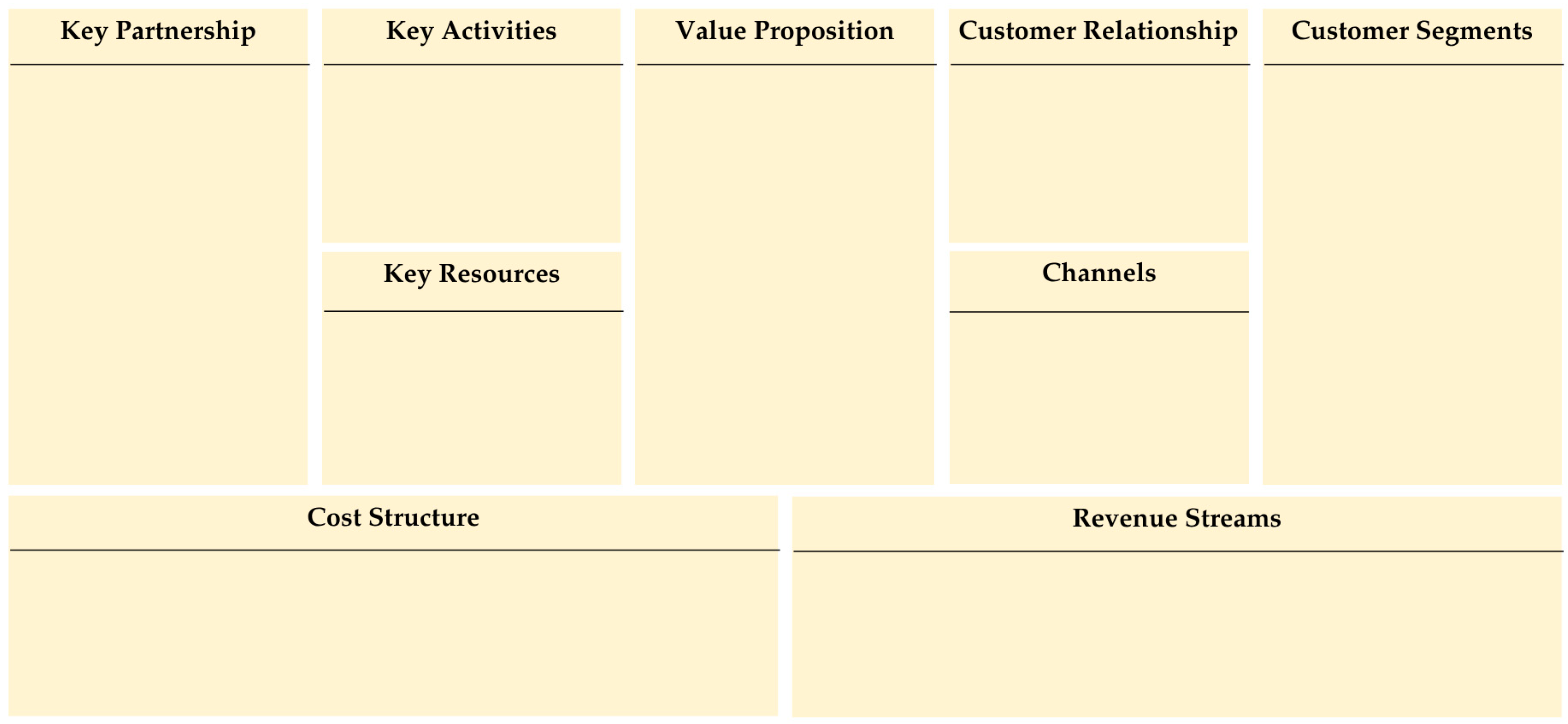
The Business Model Canvas (BMC) (Figure 1) provides a strategic management tool that allows organisations to describe, design, challenge, invent, and pivot their business models. The BMC consists of building blocks grouped under nine categories: Customer Segments, Customer Relationships, Channels, Value Proposition, Key Activities, Key Resources, Key Partnerships, Costs, and Revenues [65]. For a mutual fund serving Croatian beef producers, this framework reveals nine interconnected components that must work in harmony to create sustainable value.

3.1.2. Identify and Select Stress Factors

Building on BM, relevant stress factors are identified and linked to specific components of the business model. Using qualitative risk assessment, these stress factors are determined. The value of qualitative risk assessment lies in its ability to support risk management decision-making [66]. Qualitative risk assessment is a formal, organised, reproducible, and flexible method based on scientific principles and sound evidence. In this paper, the assessment has been derived through a gradual process that encompasses: (a) data collection, (b) structuring data systemically using the PESTL (Political, Economic, Social, Technological, and Legal factors) framework to ensure multiple perspectives and (c) recognising trends, uncertainties and outcomes using expert judgement. Identification and elaboration of stress factors using the risk narrative approach resulted in five stress factors, as suggested by the BMST approach.
The Excel tool also features sensitivity analysis. The Canvas View sheet offers a selection of two levels of risk exposure: progressive and regressive. Progressive risk refers to gradual, incremental changes in external or internal conditions, while regressive risk represents severe, disruptive shocks. This distinction allows assessment of both the adaptive capacity of the business model under manageable stress and its resilience under extreme conditions.

3.1.3. Map BM to Stress Factors

Stress factors (i.e., selected trends, uncertainties and outcomes from step 2) are compared with the components of the BM (step 1).

3.1.4. Create Heat Map

This step involves assessing how the stress factors affect the BM components. A heat map is a type of risk matrix where the intensity or heat of the risk is conveyed by colour. Each risk was evaluated by expert judgement and assigned a corresponding colour code reflecting its relative severity. The colour assignment was based on a structured combination of probability, impact, and systemic relevance, supported by risk narratives. The scale is intentionally simplified to ensure clarity and comparability across components.
The scoring is operationalised as follows:
1 (red)—Showstopper; critical risk and the BM component may not function under stress conditions,
2 (orange)—Requires attention; the BM component requires adaptation,
3 (green)—No negative effect; the BM component supports the business model,
0 (grey)—Not relevant,

3.1.5. Analyse Results

In the results analysis, we focus on two main directions. First, risk-focused analysis identifies which business model components are most vulnerable and which stress factors have the strongest negative impact. Second, holistic analysis examines the overall picture, identifying patterns, inconsistencies, and combinations of components that may not work together under different future scenarios.

3.1.6. Formulate Improvements and Actions

In the final step, actionable conclusions are defined and organised around the improvement of BM components and the BM as a system.

3.2. Data Sources for Risk Assessment

The risk assessment in BMST is based on a multi-source approach that integrates three complementary sources of data: empirical evidence from the case study, literature-based insights, and expert judgement.
The case study is composed of elements from several studies conducted by the authors on mutual funds and the beef cattle fattening sector [12,31,67]. Prior research by the authors identified the cattle fattening sector in Croatia as one of the agricultural branches with the highest potential for the development of mutual risk management instruments. This potential is evident in several structural characteristics of the sector, including export orientation, a relatively high level of producer organisation, and prior experience with risk management tools. In one of the mentioned works by the authors, farmers’ intentions regarding the AMF of livestock farmers were surveyed. The survey covered a sample of approximately 10% of the members of the Baby Beef Association, which is the oldest and largest association of beef cattle finishers in the Republic of Croatia. The association brings together around 300 members, both large and small producers, and represents approximately 90% of the beef fattening sector in the country, providing the sample with a high degree of representativeness [67]. Nevertheless, the purpose of this empirical analysis is not statistical generalisation, but rather to experiment with the feasibility of the AMF business by identifying behavioural patterns, constraints, and decisions under uncertainty and risk. The selection of this case is further justified by its exposure to key risk factors such as price volatility, production uncertainty, and capital intensity.
Expert assessment is based on the authors’ long-term experience in agricultural risk management. The interpretation of findings relies on a combination of inductive, deductive, and abductive reasoning, allowing for the synthesis of empirical insights with theoretical knowledge.

4. Results

4.1. Business Model Canvas and Agricultural Mutual Fund

A business model (BM) describes the logic of how a firm creates, delivers, and captures value [68]. It provides the guidelines for turning resources and capabilities into offerings that meet customer needs and generate profit. Unlike strategy, which focuses on positioning and competitive advantage, the business model emphasises the core functioning of an organisation—how value flows through it and how revenues and costs are structured [58]. Business Model Innovation (BMI) involves changing elements of the model or its architecture to create new value or capture it more effectively [68]. BMI can be incremental (for example, new revenue streams) or radical (such as reconfiguring the entire value chain). Importantly, technological breakthroughs often fail if not paired with appropriate business models to capture their potential [69]. In agriculture and food systems, BMI is particularly important due to climate change, shifting consumer demand, and policy pressures. Sustainable business model innovation (SBMI) integrates environmental and social objectives alongside profit [20]. Examples include circular bioeconomy models [70,71], agri-tech [72], or cooperative structures that spread risks and benefits [71]. These models demonstrate that innovation in “how business is done” is as critical as innovation in “what is produced.”
The key components of the AMF business model are first defined in the (BMC. To understand the business environment of AMF, it should be noted that the agricultural sector in Croatia is an important but structurally challenged part of the national economy. Within livestock production, the beef cattle sector stands out as a strategically relevant but vulnerable segment. It is characterised by declining herd sizes, relatively low productivity, high production costs, and weak market organisation, all of which constrain its development potential. At the same time, the beef fattening sector retains important structural advantages, including a tradition of cattle fattening, existing producer associations, and potential for export-oriented production. The beef fattening sector, therefore, represents a production system with high capital intensity, production and market risks, and strong dependence on price dynamics, which makes it particularly relevant for analysing the feasibility of mutuality.

4.1.1. Value Proposition

The value proposition focuses on collective risk pooling against climate shocks, disease outbreaks and income volatility, providing farmers with financial stability that complements insurance and is further supported by alignment with CAP subsidies for strategic viability.
A mutual fund is an insurance programme established by a group of farmers, enabling compensation for material losses caused by adverse climatic conditions, animal and plant diseases, pest infestations, environmental incidents, and significant drops in income (income stabilisation tool). Mutual funds also help reduce asymmetric information and moral hazard, though challenges include maintaining trust and solidarity among fund members [25]. Emphasis is placed on good farming practices and damage control.

4.1.2. Customer Segment and Key Partners

The primary customer segment comprised beef producers across Croatia, encompassing small family farms, medium-sized operations, and large commercial enterprises.
Secondary customers include cooperatives, producer groups, and potentially input suppliers or slaughterhouses that benefit from supply chain stability. Success requires collaboration among multiple stakeholder groups. Farmers and producer organisations facilitate membership mobilisation, while government agencies ensure policy alignment and access to subsidies. Insurance companies provide reinsurance coverage, and veterinary services support risk assessment and monitoring.
The fundamental principles of cooperative management—user-benefit, user-owner, and user-control—shape the distinctive logic of how cooperatives operate and are governed and should also apply to mutuals. These principles require management to maintain a high level of communication, coordination, and commitment to the common interest, which represents both the unique strength and a constant challenge of the cooperative model [17].

4.1.3. Channels: Reaching the Market

The distribution strategy utilises existing agricultural infrastructure through farmer associations, supported by digital platforms such as mobile applications for claims processing and contribution management. Agricultural chambers offer additional support through their services.

4.1.4. Customer Relationships: Trust as Currency and Strategic Partnership

Success fundamentally depends on establishing trust-based relationships characterised by transparent governance and clear payout rules. The participatory approach involves farmers in decision-making through regular assemblies, fostering ownership and accountability.
Customer relationships, an important responsibility for managers in mutuals and cooperative organisations, are designed to promote trust and transparency. This is achieved through participatory claim processing, farmer assemblies for governance, and IT systems for secure and transparent transactions.

4.1.5. Key Resources and Activities

Key resources include financial capital in the form of fund reserves, human capital comprising management teams, actuaries, and veterinary experts, and technological infrastructure for member registration and claims processing. Insufficient initial capitalisation is the most significant operational risk, as funds collapsing after the first major shock would permanently damage credibility. A phased approach to building reserves, combined with EU support mechanisms, can mitigate this risk.
Key activities include contribution collection, risk assessment and monitoring, claim processing, and farmer education campaigns. Administrative efficiency is critical under stress, requiring digitalisation and potentially outsourcing claim adjustment functions to prevent payment delays. Optimising administrative costs and ensuring rapid claims settlement are essential.

4.1.6. Revenues and Costs

Revenues primarily come from farmers’ premium contributions which are linked to herd size and from CAP subsidies that cover large portions of premiums, highlighting the reliance on participation rates and subsidies for financial sustainability. The cost structure is mainly composed of administration, payouts, reinsurance premiums, and educational activities, with economies of scale expected to lower unit costs as participation increases.
Premiums are paid in instalments. Farmers pay an initial small premium, and if a risk occurs and damage is sustained, the remaining amount is paid later in instalments. If collected premiums are insufficient to cover losses, compensation may be proportionally reduced. Any surplus in premiums is usually refunded or retained as a reserve. Financial support for the establishment of a mutual fund is currently available through the EU Agricultural Fund for Rural Development (EAFRD). According to EAFRD rules, a mutual fund is defined as financial support to a farmer in the event of a production loss exceeding 30%, providing compensation of up to 70% for losses caused by adverse climatic conditions, outbreaks of animal or plant diseases, pest infestations, or environmental incidents affecting farm yields, revenues, and income [5].
Table 1 briefly presents the business model of a mutual fund for beef producers, as previously discussed.

4.2. Identification of Key Risks

In the next step, risk sources were identified. We prioritised the following risks:
  • Participation risk,
  • Business risk,
  • Policy risk,
  • Administrative barriers, and
  • Management capacities.
The selection of these risks is based on the described approach, which combines the literature review, case study analysis, and expert judgement. The selected risks do not represent an exhaustive list; rather, they reflect the most relevant and critical risk factors. As such, they provide a basis for subsequent analysis within the BMST framework. This approach ensures both theoretical grounding and practical relevance, while maintaining analytical tractability in the BMST application.
One of the critical selected risks for the new agricultural mutual fund is “Participation Risk”, characterised by low adoption and weak participant engagement, which could cause the fund to fail to scale by attracting enough farmers. This risk arises primarily from a low level of trust among farmers, a lack of awareness regarding the benefits and functioning of mutual funds, and competition with other risk management tools and policy measures such as CAP (direct) payments. Low participation impedes the pooling effect essential for mutual funds, where risk-sharing depends on adequate membership to diversify and cover potential losses. This risk has been flagged as a showstopper (red) if not adequately addressed, highlighting the mutual fund’s dependence on farmer awareness and outreach mechanisms. In essence, participation risk captures the socio-behavioural and institutional challenges that are crucial for the resilience of a new MF.
Production risk is linked to and influenced by climate change and animal diseases. These factors increase the premium participation fee, leading to rapid depletion of the fund’s financial reserves and resulting in a loss of credibility among members. In worst-case scenarios, the fund could collapse after the first major shock if the risk is not properly mitigated. This risk threatens the fund’s value proposition and payout capabilities, especially since it is systemic and beyond the control of individual farmers.
Changes in agricultural policy, particularly regarding the CAP risk management subsidies, pose a significant threat. Withdrawal or reduction in these subsidies would drastically reduce funding support that complements farmer premiums, thereby impacting the financial sustainability of the fund. Such geopolitical or regulatory shifts could alter incentive structures for farmers to join the mutual fund and might require adaptation in the fund’s strategic planning to remain viable.
Under current Croatian law, initiating a mutual fund entails a high capital equity requirement between 2.2 and 4 million euros. This substantial financial barrier (administrative risk) discourages farmer interest, slows down fund adoption, and introduces challenges in securing sufficient upfront capital. The low adoption of the relevant mutual laws due to these administrative constraints translates into slow or negligible growth of the fund membership base, putting the entire business model at risk.
The challenge lies in balancing expertise in insurance, agricultural practices, and cooperative governance. The inability to attract and retain competent management personnel capable of navigating these domains undermines operational efficiency, transparency in governance, and timely claims processing. Poor management could become a showstopper due to the critical role it plays in building trust and ensuring sustainability.
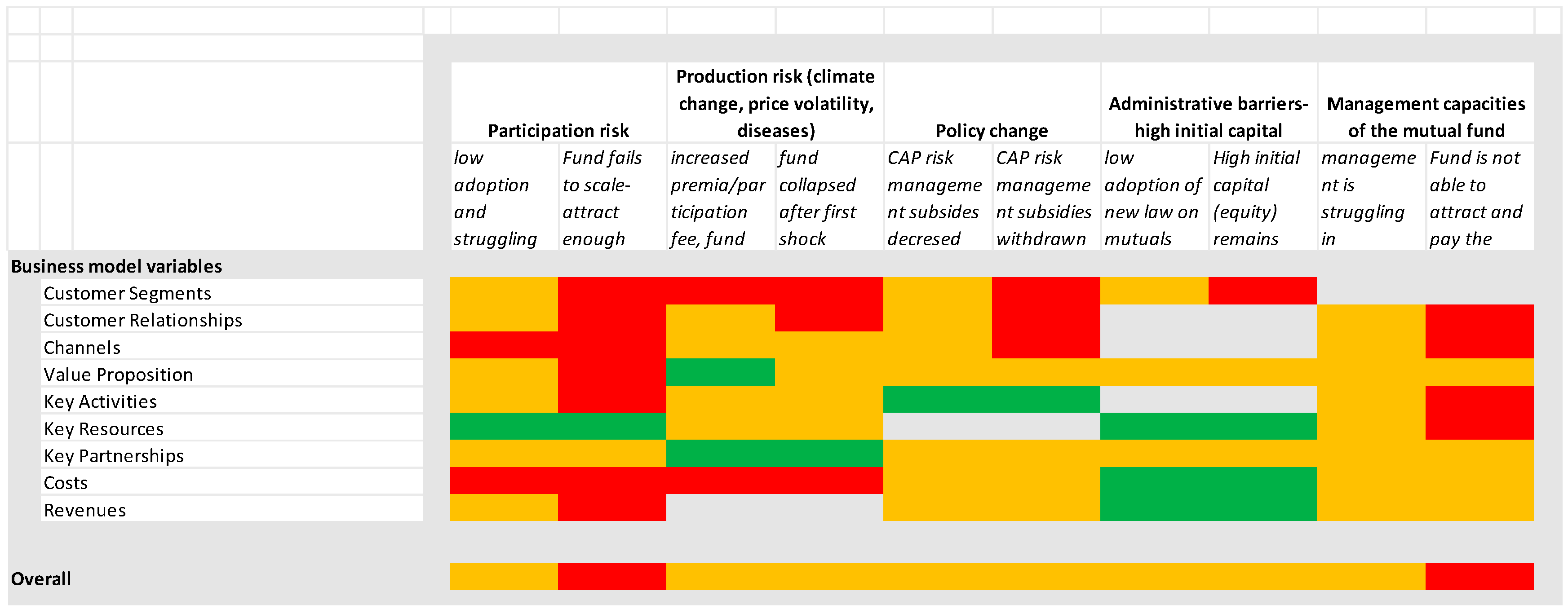
Each of these risks interacts with multiple business model components (Table 2). Together, these risks form the core challenges that must be carefully navigated to foster resilience and growth of the mutual fund within Croatia’s agricultural sector. Following the BMST methodology, risks are presented as either progressive—gradually affecting business model performance, or regressive—causing abrupt disruptions. This distinction can also be understood as a form of sensitivity analysis, where progressive risks reveal the business model’s sensitivity to incremental changes, while regressive risks test its vulnerability to sudden shocks.

4.3. Business Model Stress Test

The risk prioritisation enabled us to demonstrate the potential of the BMST and to understand the sources of differentiation, as well as the development paths, behaviours, and activity systems that can be applied or replicated. To visualise the impact of risk on business model components, the risks are indicated using a colour-coded matrix (1 = red = showstopper, 2 = orange = needs adjustment, 3 = green = positive, 0= grey = no impact). The lower and higher levels of each risk are determined and analysed.
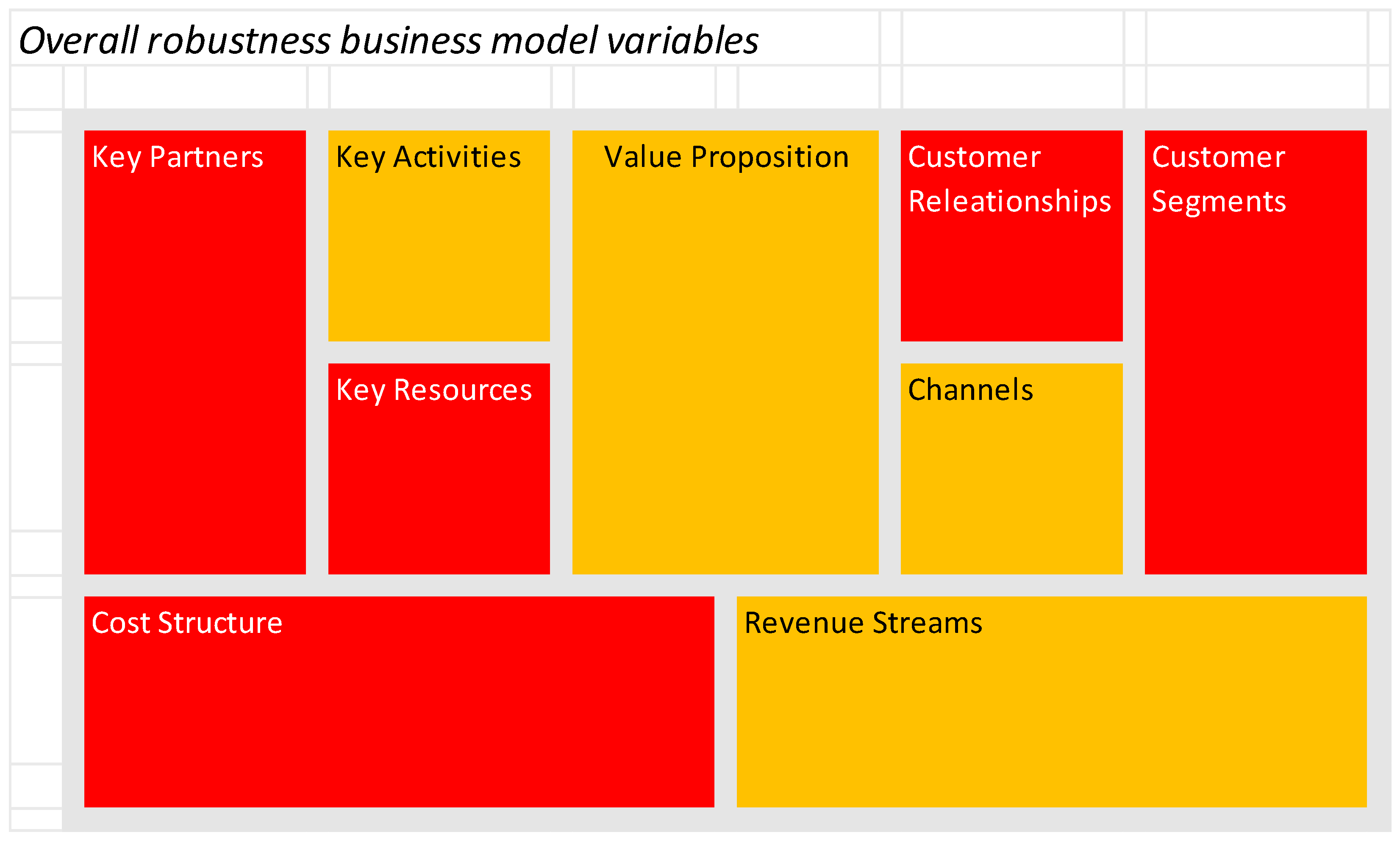
The “Resulting Views” sheet (Figure 2) generates default analytical perspectives based on the heat signature of the business model variables in relation to the selected uncertainties. These views assess the robustness of the AMF’s business model under stress scenarios and provide insights into the critical vulnerabilities and areas requiring attention.
The business model demonstrates significant fragility primarily due to participation and production risk factors. Participation risk acts as a showstopper for core components such as Customer Segments, Customer Relationships, Channels, and Costs, indicating that low farmer adoption fundamentally threatens the fund’s viability and sustainability. Participation risk as a showstopper relates to trust and behaviour but is also closely linked to high initial capital requirements. High initial capital represents an administrative risk and a showstopper for the main AMF customers—farmers. Production risks, including climate variability, disease outbreaks, and income volatility, are also showstoppers for multiple variables such as Costs and Revenues, signalling high financial vulnerability to external shocks. Customer Segments and Customer Relationships are most sensitive to participation and production risks. Channels and Cost Structure are also highly exposed to participation and production shocks. Management capacity risk is critical for governance and operational activities, acting as a showstopper in some cases (Figure 3). The worst-case scenario under production risk involves fund collapse after the first shock, highlighting the need for robust risk monitoring and reinsurance. The worst-case scenario for participation risk involves failures in scaling participation, which may not cause immediate collapse but pose a significant threat to future sustainability. The worst-case scenario for management capacity risk highlights operational inefficiencies and loss of trust due to poor governance.
Additionally, the BMST framework, supported by the Excel-based stress testing tool, enables structured sensitivity analysis through the Canvas View and Best Case/Worst Case scenario comparison. The Canvas View provides a heatmap of the business model, with each component evaluated under different levels of risk exposure (progressive and regressive), allowing identification of structurally vulnerable elements within the model.
In sensitivity analysis, participation risk emerges as a critical factor even under progressive conditions, where moderate declines in farmer engagement weaken the risk pooling mechanism and reduce the financial stability of the AMF. Under regressive conditions, this effect becomes more pronounced, potentially leading to a breakdown of the model due to insufficient scale and loss of trust.
Production risk becomes especially relevant under regressive scenarios, where severe shocks (such as price drops or yield losses) significantly increase payout pressure and expose the limits of the mutual’s financial resilience. While manageable under progressive conditions, such risks can quickly escalate beyond the model’s buffering capacity.
Management capacities play a moderating role across both levels of risk. Under progressive conditions, stronger managerial capabilities can partially offset emerging vulnerabilities through better coordination, communication, and financial planning. However, under regressive conditions, limited management capacity becomes a key constraint, reducing the ability to respond effectively to systemic stress and amplifying the overall fragility of the business model.
Successful implementation of an AMF should follow a step-by-step approach. First, a pilot fund can be launched with one MF to test the concept and demonstrate its effectiveness. Simultaneously, financial support (such as reinsurance) should be secured to ensure stability. In the next phase, the focus shifts to scaling up—raising awareness among farmers, building trust, and working with policymakers to ensure long-term support and alignment with agricultural policies. However, the analysis reveals several important weaknesses. The model relies heavily on subsidies, requires strong trust between participants, and needs sufficient financial resources and capable partners. These are key risk areas that must be addressed early.
Furthermore, the current situation in Croatia—particularly the weak tradition of cooperation and limited management capacity—makes implementation more challenging. Overall, the results suggest that the model is sensitive to several critical factors and requires careful design and support to succeed.

4.4. Overcoming Structural Constraints in Business Models and Risk Governance Systems

Traditional mutual funds in agriculture face many challenges, among which the complete lack of an institutional framework and cooperative tradition in Croatia stands out.
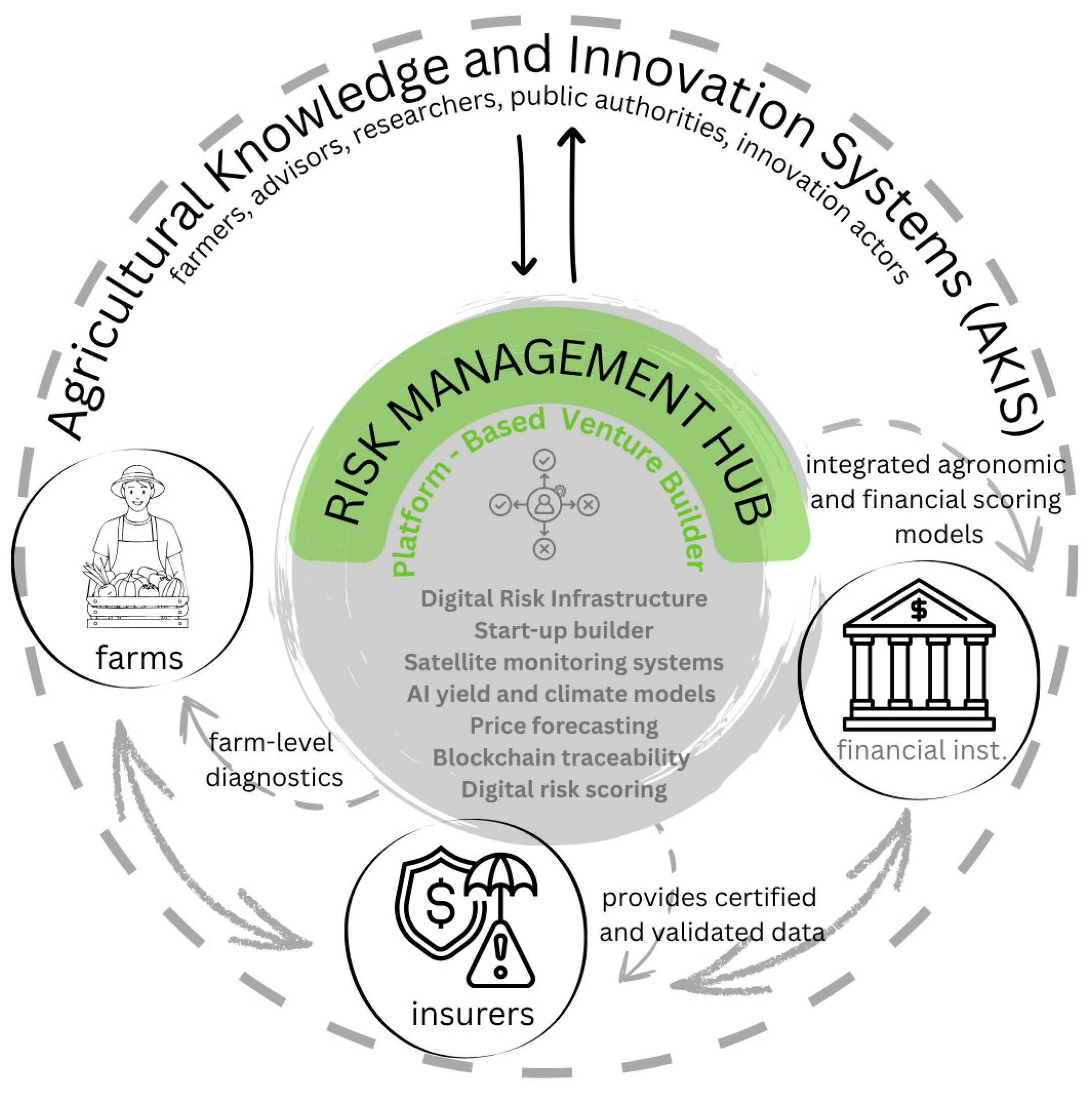
To address this structural gap, we propose an innovative approach that incorporates the startup ecosystem within AKIS. We call it the Risk Management Hub (RMH or the Hub). Its purpose is to reduce uncertainty, improve risk transparency, and enable more accurate pricing of agricultural risk. The Hub connects farmers, insurers, banks, and other stakeholders through a shared digital risk infrastructure. In doing so, it transforms fragmented risk practices into a coordinated system. This approach represents a broader innovation ecosystem for agricultural risk governance, designed not to replace mutuals, but to build the institutional, technological, and organisational capacities necessary for their eventual emergence and effective functioning
The RMH is conceived as a platform-based venture builder embedded within the Agricultural Knowledge and Innovation System (AKIS). AKIS aims to connect farmers, advisory services, research institutions, public authorities, and innovation actors to improve knowledge flows and foster innovation. However, digital agri-tech startups often remain weakly integrated into AKIS structures. The RMH strengthens this missing link by institutionalising startups as specialised risk analytics providers within the AKIS framework. In this configuration, the Hub acts as an intermediary platform that translates research outputs and digital technologies into operational risk management tools for farms, insurers, and financial institutions.
Organisationally, the Hub incubates and scales specialised agri-tech ventures. These ventures develop satellite-based monitoring systems, AI-driven yield and climate models, price forecasting tools, blockchain traceability systems, and digital risk-scoring mechanisms.
The Hub provides four core services. First, it delivers farm-level diagnostics covering climatic, yield, price, and financial risks. Second, it supplies certified and validated data to insurers, enabling tailored insurance contracts and index-based schemes. Third, it supports banks and investors with integrated agronomic and financial scoring models. Fourth, it facilitates collective access to price risk management instruments, including hedging strategies. Advisory services complement these tools by supporting farm-level adjustments that structurally reduce exposure to risk.
The economic logic of the Hub is performance-based. Revenues are linked to measurable improvements in risk outcomes. If insurers reduce claims ratios, banks lower default probabilities, or reinsurers improve portfolio pricing, the Hub captures a share of the value created. This aligns incentives across actors and reduces dependency on subsidies.
Conceptually, the RMH follows the terminology of Foss and Saebi [73] on business model innovation. It alters not only specific components, such as risk analytics, but also the linkages between value creation, value capture, and inter-organisational coordination. By embedding digital risk intelligence within AKIS, the Hub redefines how knowledge, finance, and insurance interact in agriculture (Figure 4). Stakeholders use the Hub because it reduces uncertainty in a transparent and measurable way. Farmers gain improved access to credit and insurance. Insurers enhance underwriting precision. Banks reduce information asymmetry. Public authorities limit fiscal exposure to systemic shocks. Trust is no longer based solely on solidarity within a mutual scheme, it is grounded in data, certification, and coordinated governance within the AKIS framework.
In physical terms, RMH is designed as a university-based spin-off that connects research with practical solutions for agricultural risk management, while attracting expertise from agriculture, economics, data science, and engineering.
The establishment of the RMH begins with defining the concept, roles, and organisation form. Basic infrastructure is then established, including digital tools, data systems, and a small interdisciplinary team. In the pilot phase, the RMH is tested in a limited number of sectors or regions. The aim is to trial the model in practice, work directly with users, and adjust the approach based on real feedback. In the next phase (acceleration), RMH builds visibility, increases its user base, and starts developing more stable sources of income. Finally, the RMH reaches full operational capacity, operating at a larger scale, with established partnerships, stable financing, and a clear role within the agricultural and innovation system.
From a financial perspective, the RMH is based on a mixed and adaptive model. Initial funding can be secured through public sources, including AKIS and other EU and national programmes. The ownership structure can follow a public–private model, involving the university, private partners, and potentially financial or insurance institutions. To further strengthen stakeholder engagement and trust, the RMH may also adopt cooperative elements or a hybrid ownership structure, enabling farmers and other users to participate directly. In the longer term, financial sustainability is achieved through a combination of public support and self-generated revenues, ensuring both operational viability and strategic independence.

5. Discussion and Conclusions

Agricultural producers are experiencing a widening gap in risk protection, caused by increasing risks such as climate change and market imbalances, and a declining supply of agricultural insurance due to the rising frequency and magnitude of losses and adverse financial performance of insurance companies, resulting in their withdrawal from the market. In response, agricultural policymakers within the EU CAP have introduced support for several risk management instruments, including premium subsidies for agricultural insurance, MFs compensating for losses in agriculture, and IST.
This paper assumes that introducing mutual funds in Croatian agriculture could improve risk protection for farmers. As MFs are included in Croatia’s CAP Strategic Plan, the paper aims to test and validate this assumption by applying a BMST to an MF using the beef cattle fattening system as a case study.
While the literature review highlights numerous advantages of MFs in agricultural risk management, the BMST confirms that the mutual fund business model is highly risky. These risks arise from the lack of tradition of mutual funds in Croatia and a generally weak culture of cooperation in farming. Furthermore, the existing legal framework and the level of equity required represent significant barriers to the establishment of MFs
The legal framework may be an obstacle to the establishment and development of MFs in Croatia. The Croatian insurance Act permits the establishment of an insurance undertaking only as a joint-stock company, Societas Europea (SE), or a mutual undertaking. Membership in a mutual insurance undertaking requires the conclusion of an insurance contract with the mutual insurance undertaking, acceptance of the Articles of Association, and aliquot payment of share capital. Members are not liable for the obligations of the mutual insurance undertakings. The share capital of a mutual insurance undertaking must be between 2.2 and 4 million euros [35].
The proportionality principle in the Solvency II Directive recognises very small insurance undertakings. The Directive does not apply to an insurance undertaking that fulfils all the following conditions: (a) the undertaking’s annual gross written premium income does not exceed EUR 5 million; (b) the total of the undertaking’s technical provisions, gross of the amounts recoverable from reinsurance contracts and special purpose vehicles, does not exceed EUR 25 million; and (c) the business of the undertaking does not include insurance activities covering liability, credit and suretyship insurance risks, unless they constitute ancillary risks [74].
High regulatory requirements for establishing a mutual insurance undertaking create a need for alternative regulatory and supervisory treatment, based on the experience of other insurance markets in EU countries [21] outside the insurance supervisory framework. An additional solution to high capital requirements for mutual undertakings could be the issuance of surplus notes, based on the US regulatory approach. Surplus notes, also referred to as surplus debentures, contributed certificates, or capital notes, are unsecured indentures that may be issued directly by insurance operating companies domiciled in the United States. Surplus notes are closely regulated and deeply subordinated to policyholder claims, and, therefore, are reported as part of policyholders’ surplus despite their debt-like features [75].
Another major challenge is the lack of managerial capacity, as fund managers must possess both advanced expertise in insurance mechanisms and strong competencies in cooperative governance. Climate change further increases the frequency and unpredictability of adverse weather events, which exhibit characteristics of systemic risk and may severely impact the liquidity of mutual funds, which typically pool farmers from limited geographical areas and similar production systems. Although co-financing for the establishment and operation of mutual funds is currently available, their long-term sustainability remains uncertain if such public support is withdrawn.

5.1. Policy Implications

The issues discussed above regarding mutuals, cooperatives and agricultural insurance revealed a surplus of potential solutions. It is worth considering to what extent public sector initiatives influence the development of mutual funds. This is particularly complex for mutuals, as they must comply with the regulatory requirements of the insurance regulatory framework in the EU [33]. A possible approach can be identified in five main areas of government involvement: (i) provision of a supportive legal framework that does not discriminate against these formal organisations of mutual assistance; (ii) exemption from anti-trust laws and regulations; (iii) beneficial tax treatment for business activities with members; (iv) access to favourable credit terms; and (v) technical assistance [76,77]. However, these would merely add to the state of limbo that has persisted after a decade of studies on risk management in EU agriculture. Therefore, the authors propose a slightly different approach, acknowledging and accepting a startup ecosystem-based business model innovation for risk management in EU agriculture. This is not opposed to the development of mutuals, but is faster, better-informed, less risky, and potentially a way to develop a system through business relationships and interests, and with less public support.
Agricultural risk management in many EU Member States remains structurally weak. Although mutual funds are formally promoted under the CAP framework, their practical uptake is limited. Policy appetite for developing new mutual schemes is currently low, and implementation capacity remains constrained. In several Member States, participation rates in mutual risk instruments are marginal. These figures indicate limited trust, weak institutional momentum, and low scalability of traditional collective schemes. On average, Member States spend about 2% of their total rural development budget on this measure, and it is usually less than 4%, except in Italy, where it is around 8% [77]. The proposed Risk Management Hub (RMH) offers an alternative pathway. Instead of building new mutual structures from scratch—an approach that is institutionally demanding and slow—the Hub can be implemented as a platform-based venture builder embedded within the Agricultural Knowledge and Innovation System (AKIS). While the concept may initially appear complex and difficult to communicate, it is operationally faster than establishing mutual funds. Mutuals require lengthy processes of trust-building, capital pooling, regulatory design, and governance consolidation. In contrast, the Hub builds on existing digital infrastructure, startup ecosystems, insurers, and financial institutions, and it does not require farmers to commit upfront capital into collective pools.
From a policy perspective, the RMH requires targeted but limited support. Initial public co-financing can focus on venture-building capacity, data governance standards, and interoperability protocols within AKIS. Over time, the Hub operates on a performance-based revenue model linked to measurable reductions in claims ratios, default probabilities, and transaction costs. This reduces long-term fiscal exposure compared to recurrent public compensation schemes.
While providing farmers with effective risk management solutions is essential, the authors suggest a new approach that embeds the startup ecosystem within AKIS to harness digital technology, entrepreneurship and public–private funding to enhance agricultural risk governance. By integrating digital analytics, sustainability transition tools, insurance mechanisms, financial intermediation, and policy intelligence, the model enhances systemic resilience. The authors believe that the proposed solutions are replicable and scalable for other transition countries.
Numerous efforts to support the development of cooperation between farmers (cooperatives and producers’ organisations) or to increase insurance penetration have had a limited impact in Croatia so far. The authors do not deny the need for such efforts. However, they believe that their proposal has greater potential for success, which, paradoxically, could create the basis for faster development of a collective risk-sharing instrument such as mutuals.

5.2. Limitations of Research and Improvement Pathways

The qualitative nature of the study imposes certain limitations. First, the absence of an operational mutual fund in Croatia means that findings are based on conceptual modelling and expert judgement rather than empirical financial data. Second, while stress testing captures interdependencies among business model components, it remains partly subjective, relying on the expertise and perceptions of participants. Third, the analysis focuses on the beef sector as a pilot; extrapolation to other agricultural subsectors requires contextual adaptation.
Nevertheless, these limitations are offset by the methodological framework’s capacity to identify critical design variables, offering a replicable model for future empirical validation once pilot mutual funds become operational.
Overall, the BMC and broader business model frameworks have substantially enhanced the understanding of how organisations operate and innovate. Their benefits lie in their clarity, communicative value, and capacity to support innovation and stakeholder engagement. Their limitations concern oversimplification, static design, and limited attention to sustainability and networks. In the risk management sector, and especially among mutuals, the BMC remains a valuable instrument for articulating and communicating a hybrid logic of value creation that combines efficiency, community benefit, and resilience—principles increasingly relevant in the evolving landscape of sustainable finance and cooperative insurance. Future research should empirically test the effectiveness of the authors’ proposal across different institutional contexts and assess its long-term impact on agricultural resilience, financial stability, and sustainability transitions.
Future research in this area, not only in Croatia but throughout the CEE region, should be encouraged. Recommendations for future research include a detailed analysis of innovative risk management platforms and products that could foster insurance coverage in the agriculture sector. In addition, InsurTech solutions in cooperation with Agri-tech could represent an important research, regulatory, and policy field for determining suitable regulatory and incentive frameworks. Furthermore, future studies could employ various economic experimental approaches (e.g., discrete choice experiments, lab-in-the-field experiments, public good games) to investigate how behavioural factors influence business model innovation (BMI), specifically within the context of agricultural mutual fund adoption. The COM-B model from behavioural sciences can also be used to assess limitations (capability, opportunity, or lack of motivation) that affect the development and enrolment in agricultural mutual funds. Additionally, researching the application of nudge interventions (such as default enrolment options, social norm messaging, simplified information nudges, or testimonial nudges) could help to understand how to shape farmers’ decision-making processes and the eventual adoption of AMFs.


Author Contributions

Conceptualization, M.N., J.K. and T.Č.; methodology, M.N., J.K. and T.Č.; software, M.N.; formal analysis, M.N. and T.Č.; investigation, M.N. and T.Č.; data curation, M.N.; writing—original draft preparation, M.N.; writing—review and editing, M.N., T.Č. and J.K.; visualisation, T.Č.; supervision, M.N. All authors have read and agreed to the published version of the manuscript.

Funding

This research received no external funding.

Institutional Review Board Statement

Not applicable.

Informed Consent Statement

Not applicable.

Data Availability Statement

The original contributions presented in this study are included in the article. Further inquiries can be directed to the corresponding author.

Conflicts of Interest

The authors declare no conflicts of interest.

Abbreviations

The following abbreviations are used in this manuscript:
Agri-techAgricultural technology
AGRICATNational Mutual Fund against catastrophic events
AHFAnimal Health Fund
AITAPAgriculture Insurance Technical Assistance Platform
AKISAgricultural Knowledge and Innovation System
AMFAgricultural Mutual Fund
BMBusiness Model
BMCBusiness Model Canvas
BMIBusiness Model Innovation
BMSTBusiness Model Stress Testing
CAPCommon Agricultural Policy
CEECentral and Eastern Europe
COOPCooperative
COM-B Capability, opportunity, motivation—behaviour
DSSDecision support system
EAFRDEuropean Agricultural Fund for Rural Development
EUEuropean Union
EUREuro
FMSE Fonds national agricole de Mutualisation Sanitaire et Environnemental
InsurTechInsurance technology
IoTInternet of Things
ISTIncome Stabilisation Tool
POProducer Organisation
RMHRisk Management Hub
SBMISustainable Business Model Innovation
SESocietas Europea
SMESmall- and Medium-sized Enterprise
UAVUnmanned Aerial Vehicle

References

  1. Gonzalez Pelaez, A.; Daniell, J.; Douglas, R. Insurance and Risk Management Tools for Agriculture in the EU 2025. Available online: https://www.fi-compass.eu/sites/default/files/publications/EAFRD_AGRI_Insurance_Risk_MA.pdf (accessed on 15 September 2025).
  2. Climate Resilience Dialogue-Final Report 2024. Available online: https://www.eiopa.europa.eu/leveraging-insurance-shore-europes-climate-resilience-2024-09-03_en?utm_source=chatgpt.com (accessed on 17 September 2025).
  3. European Commission. Commission Staff Working Document 2023 Country Report-Croatia Accompanying the Document Recommendation for a Council Recommendationon the 2023 National Reform Programme of Croatia and Delivering a Council Opinion on the 2023 Stability Programme of Croatia {COM(2023) 611 Final}; Publications Office of the European Union: Brussels, Belgium, 2023. [Google Scholar]
  4. Kislingerová, S.; Špička, J. Factors Influencing the Take-Up of Agricultural Insurance and the Entry into the Mutual Fund: A Case Study of the Czech Republic. J. Risk Financ. Manag. 2022, 15, 366. [Google Scholar] [CrossRef]
  5. EU. Regulation (EU) No 1305/2013 of the European Parliament and of the Council of 17 December 2013 on Support for Rural Development by the European Agricultural Fund for Rural Development (EAFRD) and Repealing Council Regulation (EC) No 1698/2005; 2013 OJ L; EU: Brussels, Belgium, 2013; Volume 347, pp. 487–548. [Google Scholar]
  6. Castañeda-Vera, A.; Garrido, A. Evaluation of risk management tools for stabilising farm income under CAP 2014–2020. Econ. Agrar. Recur. Nat. 2017, 17, 3–23. [Google Scholar] [CrossRef]
  7. Buckwell, A.; Matthews, A.; Baldock, D.; Mathijs, E. Thinking Out of the Box: Further Modernisation of the CAP-Why, What and How? Rise Foundation 2017. Available online: https://www.risefoundation.eu (accessed on 16 September 2025).
  8. Cordier, J.; Hurduzeu, G.; Santeramo, F. Study on Risk Management in EU Agriculture. In Annex 5—Case Study 5 Critical Issues for the Implementation of a Mutual Fund Compensating for Production Loss under Article 38 of Reg. (EU) No. 1305/2013; Publications Office of the European Union: Brussels, Belgium, 2017. [Google Scholar]
  9. Enjolras, G.; Sentis, P. Crop insurance policies and purchases in France. Agric. Econ. 2011, 42, 475–486. [Google Scholar] [CrossRef]
  10. Sigma. Mutual Insurance in the 21st Century: Back to the Future? 2016. Available online: https://www.swissre.com/sigma (accessed on 15 November 2025).
  11. Ministry of Agriculture Forestry and Fishery of the Republic of Croatia. Rural Development 2026. Available online: https://ruralnirazvoj.hr/ (accessed on 3 January 2026).
  12. Krišto, J.; Njavro, M.; Čop, T. Društva za uzajamno osiguranje kao oblik upravljanja rizicima u sektoru poljoprivrede—Iskustvo Europske Unije i lekcije za Republiku Hrvatsku. In Tradicionalno Savjetovanje Ekonomska Politika Hrvatske u 2021 Hrvatska Poslije Pandemije; Tica, J., Bačić, K., Eds.; Croatian Society of Economists: Zagreb, Croatia, 2021; Volume 28, pp. 254–290. [Google Scholar]
  13. Pejnović, D.; Radeljak Kaufmann, P.; Lukić, A. Development and Contemporary Characteristics of Agricultural Cooperatives in the Area of Croatia. Hrvat. Geogr. Glas. Croat. Geogr. Bull. 2017, 78, 5–48. [Google Scholar] [CrossRef]
  14. Finger, R. Digital innovations for sustainable and resilient agricultural systems. Eur. Rev. Agric. Econ. 2023, 50, 1277–1309. [Google Scholar] [CrossRef]
  15. HANFA, Croatian Financial Services Supervisory Agency. Available online: https://www.hanfa.hr (accessed on 17 January 2026).
  16. Logvinova, I.L.; Rubin, Y.B.; Lednev, M.V.; Mozhzhukhin, D.P. Mutual insurance in the entrepreneurial landscape. J. Innov. Entrep. 2022, 11, 35. [Google Scholar] [CrossRef]
  17. van Dijk, G.; Sergaki, P.; Baourakis, G. The Cooperative Enterprise; Springer International Publishing: Cham, Switzerland, 2019. [Google Scholar] [CrossRef]
  18. Cordier, J.; Santeramo, F. Mutual Funds and the Income Stabilisation Tool in the EU: Retrospect and Prospects. EuroChoices 2020, 19, 53–58. [Google Scholar] [CrossRef]
  19. Meuwissen, M.M.P.; Assefa, T.T.; van Asseldonk, M.A.P.M. Supporting Insurance in European Agriculture: Experience of Mutuals in the Netherlands. EuroChoices 2013, 12, 10–15. [Google Scholar] [CrossRef]
  20. Sinkovics, N.; Gunaratne, D.; Sinkovics, R.R.; Molina-Castillo, F.J. Sustainable business model innovation: An umbrella review. Sustainability 2021, 13, 7266. [Google Scholar] [CrossRef]
  21. Broek, S.; Buiskool, B.-J.; Vennekens, A.; Van Der Horst, R. Study on the Current Situation and Prospects of Mutuals—Final Report; Study on the Current Situation and Prospects of Mutuals—Final Report 2015. Available online: https://ec.europa.eu/docsroom/documents/10390/attachments/1/translations/en/renditions/pdf (accessed on 15 November 2025).
  22. Dwyer, N.; Compton, G. Global Mutual Market Share 2024—Measuring the Global Performance of Mutual and Cooperative Insurers 2024. Available online: https://www.icmif.org/wp-content/uploads/2024/04/ICMIF-Global-Mutual-Market-Share-2024-ENG.pdf (accessed on 21 October 2025).
  23. Talonen, A.; Talonen, H.; Stenvall, J.; Jussila, I. Communicating the economic value of customer ownership in insurance: A qualitative analysis of annual reports. Risk Manag. Insur. Rev. 2020, 23, 243–267. [Google Scholar] [CrossRef]
  24. Talonen, A. Systematic literature review of research on mutual insurance companies. J. Co-Oper. Organ. Manag. 2016, 4, 53–65. [Google Scholar] [CrossRef]
  25. Bergevoet, R.H.M.; van Asseldonk, M.A.P.M. Study on Risk Management in EU Agriculture: Annex 3—Case Study 3: Consequential Losses due to Sanitary Risks in The livestock Sector: From Insurance to Mutual Funds; Publications Office of the European Union: Brussels, Belgium, 2017. [Google Scholar]
  26. Thematic Group on Economic Vulnerability of Farming. CAP Implementation Contact Point. In Addressing the Economic Challenges Faced by Farm Businesses-Compedium of Practices; Thematic Group on Economic Vulnerability of Farming: Brussles, Belgium, 2025. [Google Scholar]
  27. El Benni, N.; Finger, R.; Meuwissen, M.P.M. Potential effects of the income stabilisation tool (IST) in Swiss agriculture. Eur. Rev. Agric. Econ. 2016, 43, 475–502. [Google Scholar] [CrossRef]
  28. Kuliešis, G.; Pareigienė, L.; Ribašauskienė, E.; Sablou, C. the Readiness of Farmers To Create Mutual Funds for Agricultural Risk Management in Lithuania. Manag. Theory Stud. Rural. Bus. Infrastruct. Dev. 2017, 39, 442–452. [Google Scholar] [CrossRef]
  29. Spear, R. Governance in Democratic Member-Based Organisations. Ann. Public Coop. Econ. 2004, 75, 33–60. [Google Scholar] [CrossRef]
  30. Insurance Mutual Funds for Farm Resilience Adaptation in the, E.U. Publication—Policy Insights 2025. Available online: https://eu-cap-network.ec.europa.eu/publications/insurance-and-mutual-funds-farm-resilience-and-adaptation-eu_en (accessed on 5 February 2026).
  31. Čop, T.; Pejazić, D.; Njavro, M. Uzajamni fond—Strategija za upravljanje rizikom u stočarstvu/ Mutual fund—Risk management strategy in livestock. In Zbornik Radova 59. Hrvatski i 19. Međunarodni Simpozija Agronoma/Proceedings; Carović-Stanko, K., Kljak, K., Eds.; Sveučilište u Zagrebu Agronomski Fakultet: Zagreb, Croatia, 2024; pp. 57–61. [Google Scholar]
  32. Čop, T.; Cerroni, S.; Njavro, M. Farmers’ acceptance of the income stabilisation tool: A discrete choice experiment application. Eur. Rev. Agric. Econ. 2023, 50, 1520–1546. [Google Scholar] [CrossRef]
  33. Krišto, J.; Talonen, A.; Pauković, H. Analysis of community-owned mutual insurers’ prospects of development in CEE countries: Outlining research agenda. Risk Manag. Insur. Rev. 2021, 24, 243–261. [Google Scholar] [CrossRef]
  34. Krišto, J.; Pauković, H. Perspektive razvoja uzajamnih društava za osiguranje u Republici Hrvatskoj. In Zbornik Radova s Međunarodne Znanstveno-Stručne Konferencije Hrvatski Dani Osiguranja; Hrvatski Ured Za Osiguranje: Zagreb, Croatia, 2017; pp. 61–75. [Google Scholar]
  35. Insurance Act. Official Gazette of the Republic Croatia/Narodne Novine. Available online: https://mvep.gov.hr/UserDocsImages/files/file/dokumenti/prevodenje/zakoni/22-Zakon-o-osiguranju-NN-30-15-ENG.pdf (accessed on 21 October 2025).
  36. Möllers, J.; Traikova, D.; Bîrhală, B.A.-M.; Wolz, A. Why (not) cooperate? A cognitive model of farmers’ intention to join producer groups in Romania. Post Communist Econ. 2018, 30, 56–77. [Google Scholar] [CrossRef]
  37. Wolz, A.; Möllers, J.; Micu, M.M. Options for agricultural service cooperatives in a postsocialist economy: Evidence from Romania. Outlook Agric. 2020, 49, 57–65. [Google Scholar] [CrossRef]
  38. Broz, T.; Svaljek, S. Mikrokozmos zadružnog gospodarstva: Gdje i kako posluju hrvatske zadruge? Sociol. Prost. 2019, 57, 107–138. [Google Scholar] [CrossRef]
  39. Vlajčić, D. Godišnje Izvješće o Stanju Poljoprivrede u 2024. Godini; Majdak, T., Ed.; Ministarstvo Poljoprivrede, Šumarstva i Ribarstva: Zagreb, Croatia, 2025. Available online: https://poljoprivreda.gov.hr/UserDocsImages/dokumenti/poljoprivredna_politika/zeleno_izvjesce/2025_09_17%20Zeleno%20izvje%C5%A1%C4%87e%202024_finalno.docx (accessed on 19 December 2025).
  40. Smarter. Hrvatska ima 17 Proizvođačkih Organizacija, al isa tek 700 Članova. Available online: https://smarter.hr/hrvatska-ima-17-proizvodackih-organizacija-ali-sa-tek-700-clanova/ (accessed on 19 February 2026).
  41. Möllmann, J.; Michels, M.; Musshoff, O. German farmers’ acceptance of subsidized insurance associated with reduced direct payments. Agric. Financ. Rev. 2019, 79, 408–424. [Google Scholar] [CrossRef]
  42. Finger, R.; Lehmann, N. The influence of direct payments on farmers’ hail insurance decisions. Agric. Econ. 2012, 43, 343–354. [Google Scholar] [CrossRef]
  43. Deže, J. Upravljanje kvalitetom usluga poljoprivrednog osiguranja primjenom višedimenzionalnog modela vrednovanja. Agroecon. Croat. 2015, 5, 32–40. [Google Scholar]
  44. Njavro, M.; Par, V.; Pleško, D. Livestock Insurance as a Risk Management Tool on Dairy Farms. Poljoprivreda 2007, 13, 78–82. [Google Scholar]
  45. Žigman, A. Trendovi na tržištu osiguranja i novosti u regulatornom okviru. In Proceedings of the Hrvatska Aktuarska Konferencije “U Društvu Umjetne Inteligencije”, Zagreb, Croatia, 11–12 December 2024. [Google Scholar]
  46. Pavlović, M. U Hrvatskoj usjeve osigurava ni 10 posto poljoprivrednika. Agroklub 2025. Available online: https://www.agroklub.com/poljoprivredne-vijesti/u-hrvatskoj-usjeve-osigurava-ni-10-posto-poljoprivrednika/107517/ (accessed on 22 January 2026).
  47. European Commission. Commission Staff Working Document Accompanying the Document Communication from the Commission to the European Parliament, the Council, the European Economic and Social Committee and the Committee of the Regions. In The EU Startup and Scaleup Strategy, Chose Europe to Start Andscale; European Commission: Brusseles, Belgium, 2025. [Google Scholar]
  48. Knierim, A.; Birke, F.M. Visualised AKIS Diagnosis—An Instrumental Approach to Support AKIS Appraisal. EuroChoices 2023, 22, 59–70. [Google Scholar] [CrossRef]
  49. Santeramo, F.G. Innovation in the Next Common Agricultural Policy. EUI, Florence School of Regulation 2026. Available online: https://fsr.eui.eu/innovation-as-a-cornerstone-of-the-next-common-agricultural-policy/ (accessed on 18 February 2026).
  50. Bhat, I.A.; Ansarullah, S.I.; Ahmad, F.; Amir, S.; Sidana, S.; Sinha, A.; Khalid, S.; Yazdani, G. Leveraging artificial intelligence in agribusiness: A structured review of strategic management practices and future prospects. Discov. Sustain. 2025, 6, 565. [Google Scholar] [CrossRef]
  51. Kumar, V. Emerging Factors Affecting Supply Chain Management of Horticulture Produce: A Systematic Literature Review. Researchsquare 2024. [Google Scholar] [CrossRef]
  52. Tzachor, A. Artificial Intelligence for Agricultural Supply Chain Risk Management: Constraints and Potentials. CGIAR 2020. Available online: https://www.cser.ac.uk/ (accessed on 18 February 2026).
  53. Gonzalez Pelaez, A.; Douglas, R. Insurance and Risk Management Tools for Agriculture in the EU—Findings of the Fi-Compass Study; Fi-Compass: Luxembourg, 2025. [Google Scholar]
  54. Members Report. Thematic Group on Economic Vulnerability of Farming Members Report. EU CAP Network 2025. Available online: https://eu-cap-network.ec.europa.eu/thematic-groups-cap-implementation/thematic-group-economic-vulnerability-farming_en (accessed on 18 December 2025).
  55. Sundstrom, S.M.; Awada, T.; Bennett, E.M.; Bestelmeyer, B.; Hodbod, J.; Pacheco, A.; Spiegal, S.; Allen, C.R. Addressing key issues and knowledge gaps in resilience science for agriculture. Agric. Syst. 2025, 227, 104335. [Google Scholar] [CrossRef]
  56. Daspit, J.J. D. Andreini and C. Bettinelli: Business model innovation: From systematic literature review to future research directions. J. Manag. Gov. 2017, 21, 785–792. [Google Scholar] [CrossRef]
  57. Knackstedt, R.; Bräuer, S.; Schoormann, T. Tool Support for Designing Innovative Sustainable Business Models. In The Art of Structuring; Springer International Publishing: Cham, Switzerland, 2019; pp. 87–100. [Google Scholar] [CrossRef]
  58. Ovans, A. What Is a Business Model? Harv. Bus. Rev. 2015, 23, 1–10. [Google Scholar]
  59. Strahonja, V.; Musulin, J. Business Model Grounds and Links. J. Inf. Organ. Sci. 2018, 42, 241–269. [Google Scholar] [CrossRef]
  60. Polinkevych, O.; Glonti, V.; Baranova, V.; Levchenko, V.; Yermoshenko, A. Change of business models of Ukrainian insurance companies in the conditions of COVID-19. Insur. Mark. Co. 2022, 12, 83–98. [Google Scholar] [CrossRef]
  61. Meuwissen, M.P.M.; Feindt, P.H.; Spiegel, A.; Termeer, C.J.A.M.; Mathijs, E.; De Mey, Y.; Finger, R.; Balmann, A.; Wauters, E.; Urquhart, J.; et al. A framework to assess the resilience of farming systems. Agric. Syst. 2019, 176, 102656. [Google Scholar] [CrossRef]
  62. Meuwissen, M.P.; Feindt, P.H.; Midmore, P.; Wauters, E.; Finger, R.; Appel, F.; Spiegel, A.; Mathijs, E.; Termeer, K.J.; Balmann, A.; et al. The Struggle of Farming Systems in Europe: Looking for Explanations through the Lens of Resilience. EuroChoices 2020, 19, 4–11. [Google Scholar] [CrossRef]
  63. Blank, S. Why the Lean Start-Up Changes Everything. Harv. Bus. Rev. 2013, 91, 63–72. [Google Scholar]
  64. Haaker, T.; Bouwman, H.; Janssen, W.; de Reuver, M. Business model stress testing: A practical approach to test the robustness of a business model. Futures 2017, 89, 14–25. [Google Scholar] [CrossRef]
  65. Osterwalder, A.; Pigneur, Y. Business model generation: A handbook for visionaries, game changers, and challengers. Available online: https://mymyeo.com/wp-content/uploads/2022/12/Business-model-generation-_-a-handbook-for-visionaries-game-changers-and-challengers-PDFDrive-1.pdf (accessed on 19 February 2026).
  66. Yoe, C.E. Principles of Risk Analysis: Decision Making Under Uncertainty; CRC Press: Boca Raton, FL, USA; Taylor & Francis Group: Abingdon, UK, 2019. [Google Scholar]
  67. Pejazić, D. Potencijal Uzajamnog Fonda za Upravljanje Rizikom u Stočarstvu. Master’s Thesis, University of Zagreb Faculty of Agriculture, Zagreb, Croatia, 2023. [Google Scholar]
  68. Teece, D.J. Business models and dynamic capabilities. Long Range Plan. 2018, 51, 40–49. [Google Scholar] [CrossRef]
  69. Christensen, C.M.; Bartman, T.; Van Bever, D. The Hard Truth About Business Model Innovation. MIT Sloan Manag. Rev. 2016. Available online: https://sloanreview.mit.edu/article/the-hard-truth-about-business-model-innovation/ (accessed on 18 February 2026).
  70. Donner, M.; Erraach, Y.; López-I-Gelats, F.; Manuel-I-Martin, J.; Yatribi, T.; Radić, I.; El Hadad-Gauthier, F. Circular bioeconomy for olive oil waste and by-product valorisation: Actors’ strategies and conditions in the Mediterranean area. J. Environ. Manag. 2022, 321, 115836. [Google Scholar] [CrossRef]
  71. Donner, M.; de Vries, H. How to innovate business models for a circular bio-economy? Bus. Strategy Environ. 2021, 30, 1932–1947. [Google Scholar] [CrossRef]
  72. Vlachopoulou, M.; Ziakis, C.; Vergidis, K.; Madas, M. Analyzing agrifood-tech e-business models. Sustainability 2021, 13, 5516. [Google Scholar] [CrossRef]
  73. Foss, N.J.; Saebi, T. Business Model Innovation; Oxford University Press: Oxford, UK, 2015. [Google Scholar] [CrossRef]
  74. European Parliament. Directive 2009/138/EC of the European Parliament and of the Council of 25 November 2009 on the Taking-up and Pursuit of the Business of Insurance and Reinsurance (Solvency II) (Recast) (Text with EEA Relevance); Directive; Directorate-General for Financial Stability, Financial Services and Capital Markets UnionForm: Brussels, Belgium, 2009. [Google Scholar]
  75. Williams, G.; Tuite, M.; Lynch, S.; Farrell, H. Evaluating US Surplus Notes; AM Best: Oldwick, NJ, USA, 2024. [Google Scholar]
  76. Iliopoulos, C. Public Policy Support for Agricultural Cooperatives: An Organizational Economics Approach. Ann. Public Coop. Econ. 2013, 84, 241–252. [Google Scholar] [CrossRef]
  77. Gassler, B.; Rehermann, R. Risk Preferences and the Adoption of Subsidised Crop Insurance: Evidence from Lithuania. Ger. J. Agric. Econ. 2022, 71. [Google Scholar] [CrossRef]
Figure 1. Business Model Canvas; source: Authors according to Osterwalder and Pigneur [65].
Sustainability 18 03450 g001
Figure 2. Business Model Stress Test for AMF (red colour—showstopper, critical risk and the BM component may not function under stress conditions, orange colour—the BM component requires adaptation, green colour—the BM component is robust and supports the business model, and grey colour—not relevant). Source: Authors based on BMST Excel-based tooling.
Sustainability 18 03450 g002
Figure 3. Overall robustness of AMF business model (red colour—showstopper, critical risk and the BM component may not function under stress conditions, orange colour—the BM component requires adaptation), Source: Authors based on BMST Excel-based tooling.
Sustainability 18 03450 g003
Figure 4. Proposed Risk Management Hub incorporated into AKIS. Source: Authors.
Sustainability 18 03450 g004
Table 1. Business model canvas for AMF.
BMC BlocksDescription
Customer SegmentsBeef producers in Croatia (small, medium, and large farms), cooperatives, and producer associations. Secondary: processors, slaughterhouses, and policymakers.
Customer RelationshipsTrust-based and participatory: transparent claim processing, farmer assemblies for decision-making, blockchain for transparency.
ChannelsFarmers’ associations, advisory services (agricultural chambers), digital platform (mobile/web for contributions and claims), supported by local “fund ambassadors.”
Value PropositionCollective risk pooling against climate shocks, disease outbreaks, and price volatility. Provides financial stability and complements insurance. CAP alignment ensures subsidy support.
Key ActivitiesCollection of contributions, risk monitoring (climate, disease, prices), claim management, payouts, awareness and training campaigns.
Key ResourcesFund reserves, management and actuarial expertise, IT platform for registration and claims, reinsurance contracts, veterinary and advisory services.
Key PartnershipsFarmer cooperatives, Ministry of Agriculture (CAP support), EU risk management measures, insurance companies and reinsurers, veterinary services, extension services.
CostsAdministration and IT costs, payouts, reinsurance premiums, education and awareness campaigns.
RevenuesFarmer contributions (premiums, linked to herd size), CAP subsidies covering up to 70% of premiums, and reinsurance support? Potential income from safe fund investments.
Source: Authors based on BMST Excel-based tooling.
Table 2. Risk assessment summary table.
UncertaintiesRegressionProgressionReason for Selection
Participation riskLow adoption and struggling with participantsFund fails to scale-attract enough participantsLow trust among farmers, funds fail to scale.
Production riskIncreased premia/participation fee, fund depleted quickly, credibility lostFund collapsed after first shockIncreasing production risk (climate change, price volatility, diseases)
Policy changesCAP risk management subsidies decreasedCAP risk management subsidies withdrawnGeopolitical situation and anticipated changes in EU policies,
Administrative barriers- high initial capitalLow adoption of new law on mutualsHigh initial capital (equity) remains, which blocks interest from farmersHigh requests for equity, which block establishment of AMF
Management capacities of the mutual fundManagement is struggling in balancing between knowledge on insurance, agriculture, and cooperative governanceFund cannot attract and pay the best candidates for managers on the marketFund sustainability due to inadequate management
Source: Authors based on BMST Excel-based tooling.
Disclaimer/Publisher’s Note: The statements, opinions and data contained in all publications are solely those of the individual author(s) and contributor(s) and not of MDPI and/or the editor(s). MDPI and/or the editor(s) disclaim responsibility for any injury to people or property resulting from any ideas, methods, instructions or products referred to in the content.