Has China’s Green Finance Reform Policy Promoted Sustainable Innovation? The Mediating Role of CSR Strategies

Abstract
1. Introduction
2. Theoretical Analysis and Research Hypotheses
2.1. Theoretical Framework
2.1.1. Institutional Theory
2.1.2. Stakeholder Theory
2.2. Green Financial Reform Policy and Corporate Sustainable Innovation
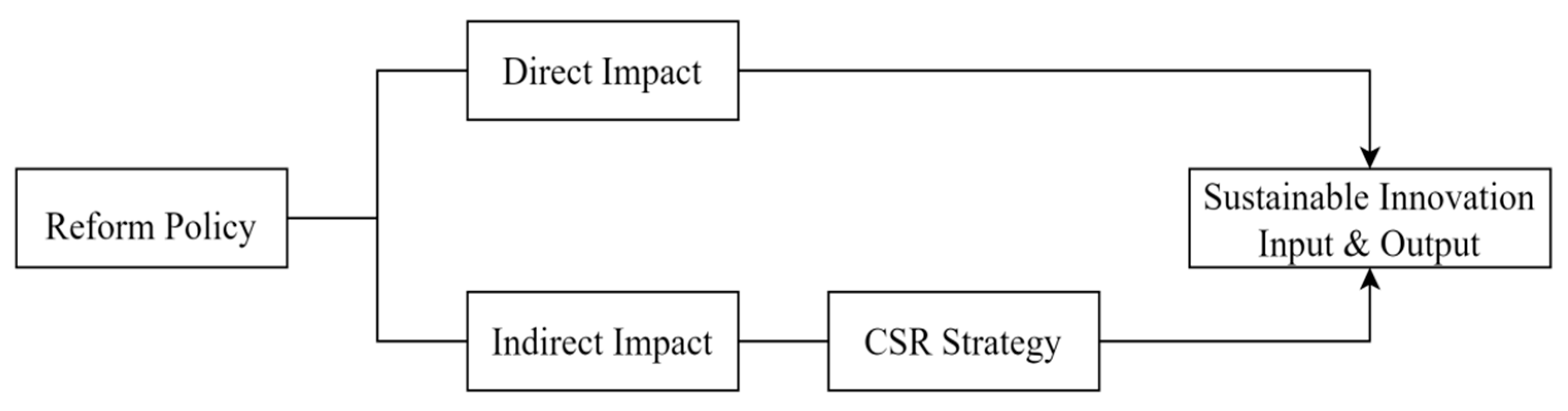
2.3. The Core Role of CSR Strategies
2.3.1. The Impact of Green Financial Reform Policies on CSR Strategies
2.3.2. The Driving Mechanism of CSR Strategies on Sustainable Innovation
3. Methodology
3.1. Sample Selection and Data Sources
3.2. Variables Design
3.3. Model Specifications
3.3.1. Benchmark Regression Model
3.3.2. Mediation Effect Model
4. Empirical Results and Analysis
4.1. Impacts of the Green Finance Reform Policies on Companies’ Sustainable Innovation
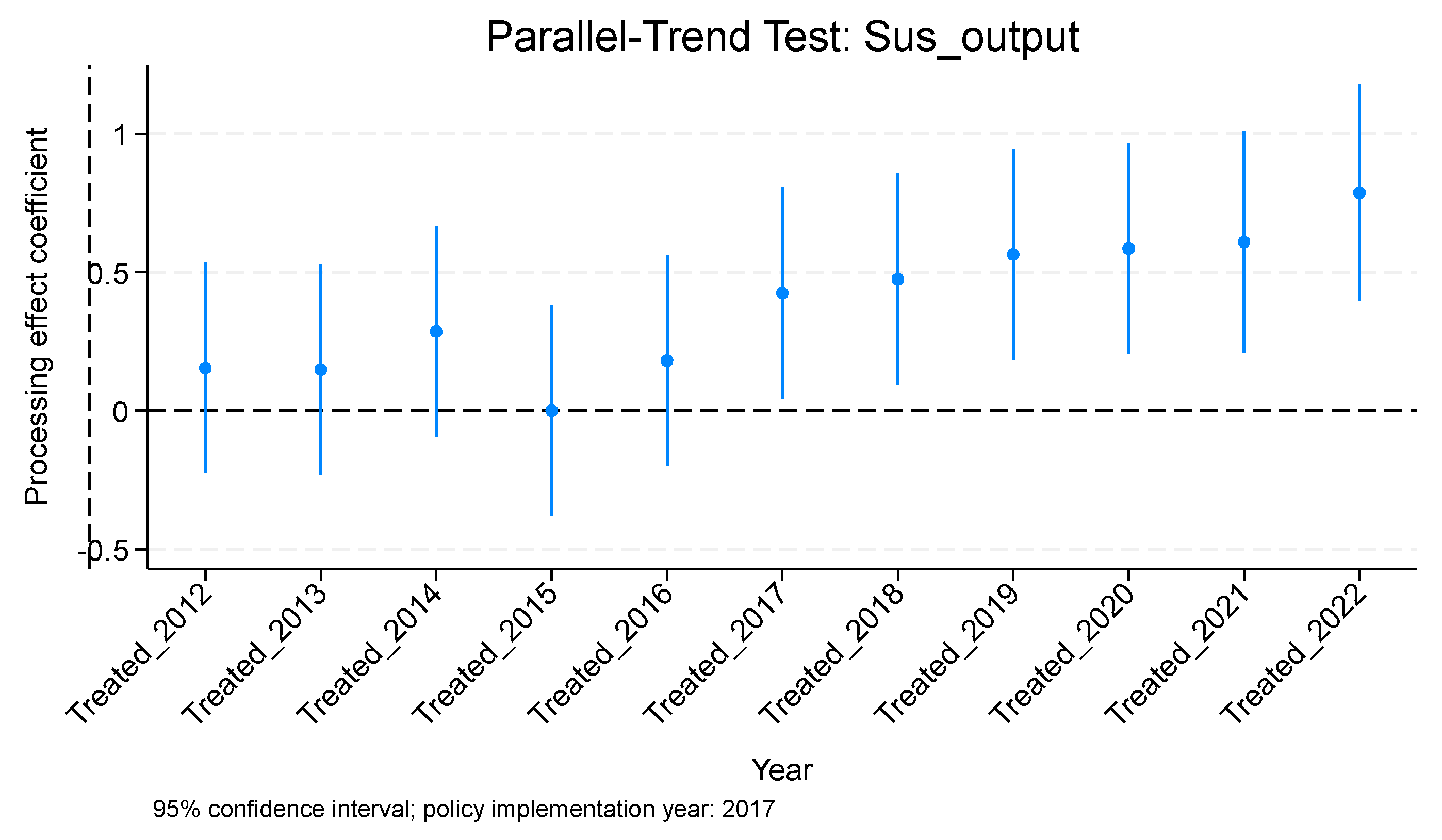
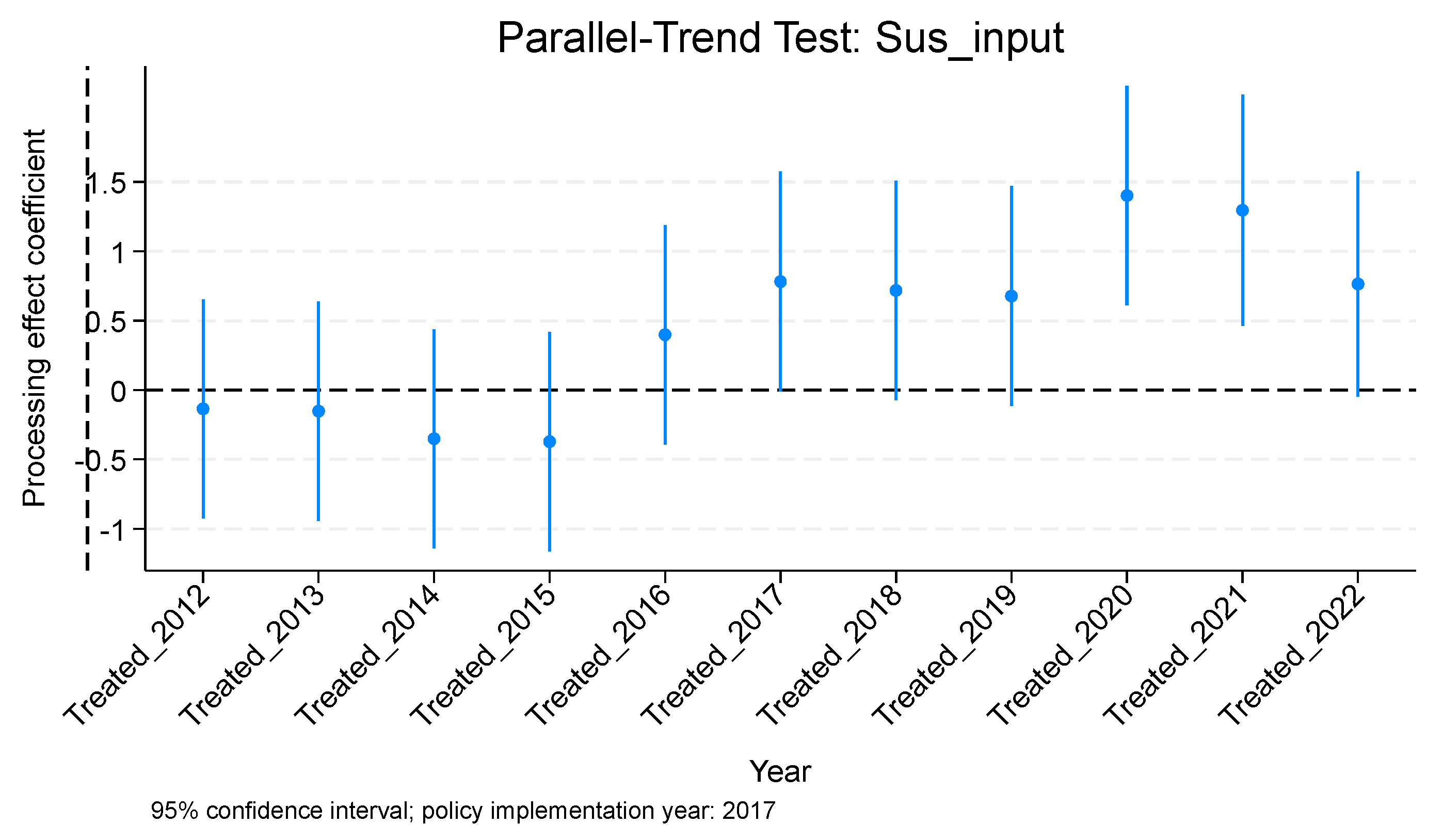
4.2. Parallel-Trend Test and Dynamic-Effect Analysis
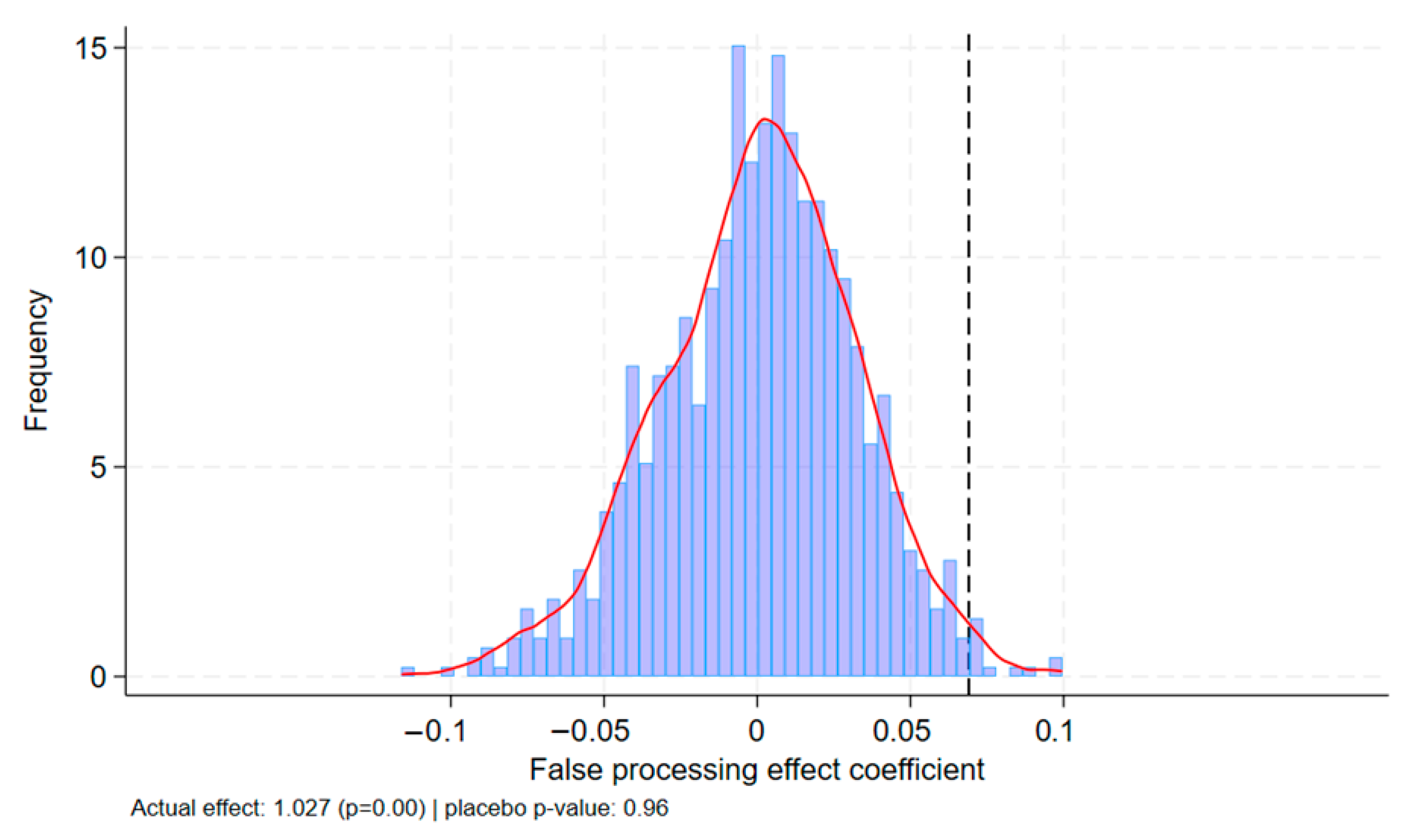
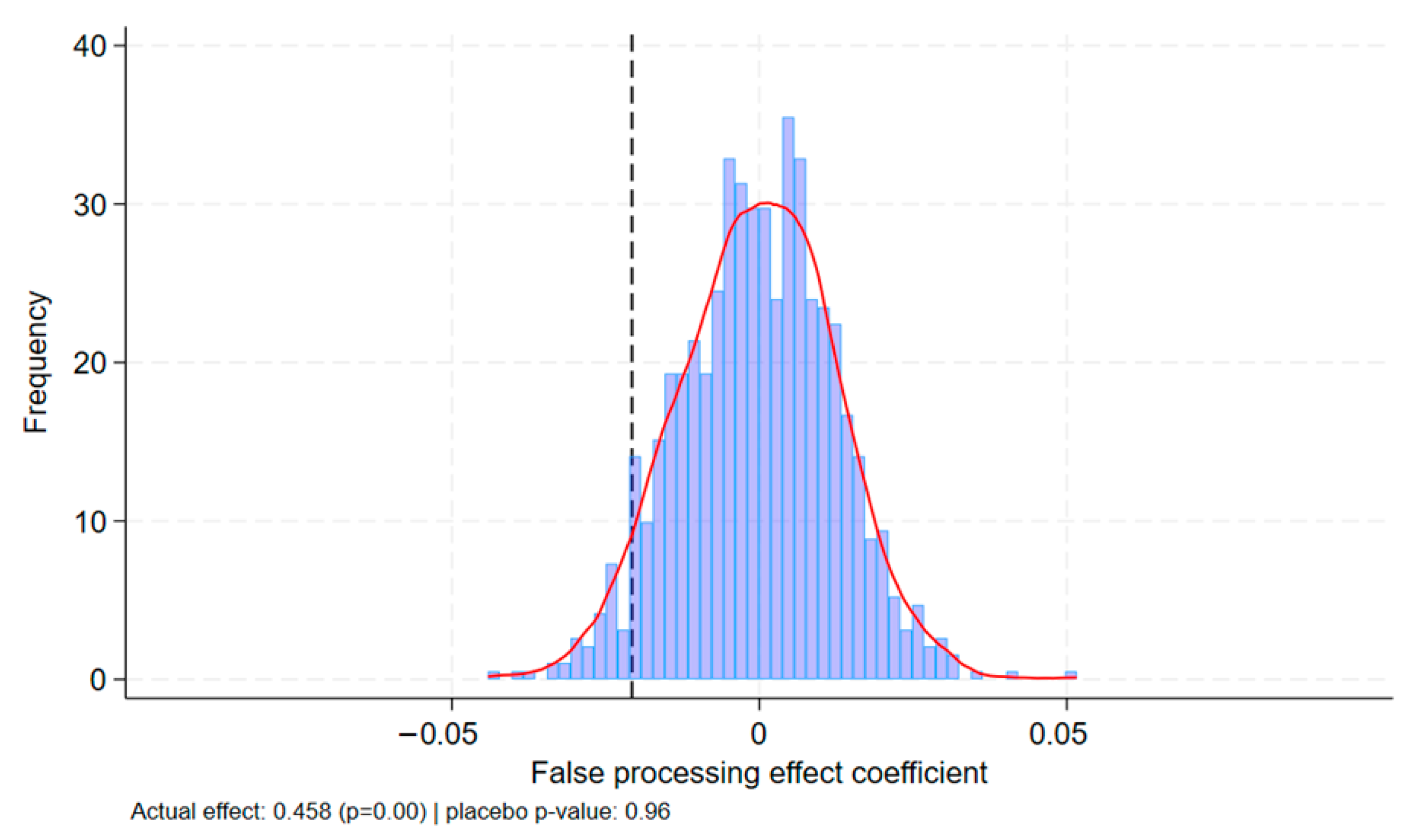
4.3. Placebo Test with Random Sampling
4.4. Robustness Tests
4.4.1. Min–Max Normalization
4.4.2. Shortening the Window Period
4.4.3. Interaction Fixed Effects
4.5. Mediating Effect of CSR on Green Finance Reform Policies
4.6. Heterogeneity Analysis
4.6.1. Industry Heterogeneity
4.6.2. Regional Heterogeneity
5. Discussion of the Results
5.1. The Moderating Role of Ownership Characteristics
5.2. The Threshold Effect of Companies’ Sustainable Innovations
6. Conclusions
6.1. Research Conclusions
- (1)
- CSR strategies have an innovation catalytic effect. Under the incentive of the green finance reform policy, CSR strategies not only improve firms’ social image, but also significantly promote both the input and output of their sustainable innovation. This finding highlights the core role of social responsibility in driving firms’ sustainable development.
- (2)
- The green finance reform policy has significant regional and industry heterogeneous effects. The policy has a stronger promotion effect on innovation input in heavily polluting industries, while it has a more significant impact on innovation output in non-heavily polluting industries. There are also significant differences in policy effects across different pilot regions.
- (3)
- Moderating effect of company ownership. State-owned enterprises (SOEs) show a negative impact on sustainable-innovation input (due to resource allocation and agency issues), but policy incentives offset this effect. For output, SOEs’ resource integration and policy synergy significantly enhance green finance policy effects, highlighting ownership’s asymmetric regulation (inhibiting input, promoting output), guiding targeted policy design for SOE innovation potential.
- (4)
- Threshold effect of policy support intensity. Green finance policy intensity has a significant single-threshold effect on sustainable-innovation input. When below the threshold, CSR’s promotion of input is not significant; when above, CSR’s effect is significantly positive. There is no threshold effect on output. Bootstrap resampling confirms the threshold’s stability, verifying the nonlinear relationship between CSR and innovation input dependent on policy intensity.
6.2. Theoretical Contributions and Generalizability of Conclusions
6.3. Management Recommendations
- (1)
- Build a comprehensive green finance support system. Integrate financial resources from banks, securities, insurance and other sectors, provide firms with a full range of green financial products and services, reduce the financing costs of sustainable innovation projects, and improve the accessibility of green funds.
- (2)
- Implement differentiated green finance incentive policies. Formulate personalized incentive measures, including tax reductions, fiscal subsidies, and preferential loans, according to regional economic development levels, firm size, industry characteristics, and pollution levels, to stimulate the sustainable-innovation potential of different types of firms.
- (3)
- Promote the integration of CSR and innovation. Encourage firms to integrate social responsibility into their strategic planning, enhance brand image and market competitiveness through CSR practices, and make CSR performance an important condition for firms to obtain green financial support.
- (4)
- Establish a dynamic evaluation and adjustment mechanism for green finance policies. Regularly evaluate the effects of existing policies and adjust policy design according to economic development, market demand, and technological progress, to ensure the adaptability and foresight of green finance policies.
- (5)
- Strengthen green finance education, international cooperation, and cross-border exchanges. Raise public awareness of green finance across all sectors of society, and improve professional capabilities through education and training. Actively participate in the formulation of international green finance standards, and introduce advanced technology and management experience from overseas. Establish multi-party cooperation platforms to promote knowledge sharing and technological innovation.
6.4. Research Limitations and Future Directions
Author Contributions
Funding
Institutional Review Board Statement
Informed Consent Statement
Data Availability Statement
Acknowledgments
Conflicts of Interest
References
- Grossman, G.M.; Krueger, A.B. Economic Growth and the Environment. Q. J. Econ. 1995, 110, 353–377. [Google Scholar] [CrossRef] [Scilit]
- Salazar, J. Environmental finance: Linking two world. Presented at the Workshop on Financial Innovations for Biodiversity Bratislava, Bratislava, Slovakia, 1–3 May 1998; pp. 2–18. Available online: https://www.cbd.int/financial/pes/switzerland-pes.pdf (accessed on 1 March 2026).
- Latapí Agudelo, M.A.; Jóhannsdóttir, L.; Davídsdóttir, B. A literature review of the history and evolution of corporate social responsibility. Int. J. Corp. Soc. Responsib. 2019, 4, 1. [Google Scholar] [CrossRef] [Scilit]
- Gillan, S.L.; Koch, A.; Starks, L.T. Firms and social responsibility: A review of ESG and CSR research in corporate finance. J. Corp. Financ. 2021, 66, 101889. [Google Scholar] [CrossRef] [Scilit]
- Chen, X.; Yi, N.; Zhang, L.; Li, D. Does institutional pressure foster corporate green innovation? Evidence from China’s top 100 companies. J. Clean. Prod. 2018, 188, 304–311. [Google Scholar] [CrossRef] [Scilit]
- Sun, D.; Zeng, S.; Chen, H.; Meng, X.; Jin, Z. Monitoring effect of transparency: How does government environmental disclosure facilitate corporate environmentalism? Bus. Strategy Environ. 2019, 28, 1594–1607. [Google Scholar] [CrossRef] [Scilit]
- Cui, W.; Chen, G.; Fu, Y. Competition order and innovation behaviors of enterprise in China. Discret. Dyn. Nat. Soc. 2020, 2020, 3869356. [Google Scholar] [CrossRef] [Scilit]
- Dacin, M.T.; Goodstein, J.; Scott, W.R. Institutional theory and institutional change: Introduction to the special research forum. Acad. Manag. J. 2002, 45, 45–56. [Google Scholar] [CrossRef] [Scilit]
- Berrone, P.; Gómez-Mejía, L.R.; Xu, K. The role of family ownership in norm-conforming environmental initiatives: Lessons from China. Entrep. Theory Pract. 2023, 47, 1915–1941. [Google Scholar] [CrossRef] [Scilit]
- Porter, M.E.; van der Linde, C. Toward a new conception of the environment-competitiveness relationship. J. Econ. Perspect. 1995, 9, 97–118. [Google Scholar] [CrossRef] [Scilit]
- Lv, C.; Fan, J.; Lee, C. Can green credit policies improve corporate green production efficiency? J. Clean. Prod. 2023, 397, 136573. [Google Scholar] [CrossRef] [Scilit]
- Delmas, M.A. The diffusion of environmental management standards in Europe and in the United States: An institutional perspective. Policy Sci. 2002, 35, 91–119. [Google Scholar] [CrossRef] [Scilit]
- Henriques, I.; Sadorsky, P. The relationship between environmental commitment and managerial perceptions of stakeholder importance. Acad. Manag. J. 1999, 41, 89–99. [Google Scholar] [CrossRef] [Scilit]
- Hoen, K.M.R.; Tan, T.; Fransoo, J.C.; van Houtum, G.J. Effect of carbon emission regulations on transport mode selection under stochastic demand. Flex. Serv. Manuf. J. 2014, 26, 170–195. [Google Scholar] [CrossRef] [Scilit]
- Sarkis, J.; González-Torre, P.; Adenso-Díaz, B. Stakeholder pressure and the adoption of environmental practices: The mediating effect of training. J. Oper. Manag. 2009, 28, 163–176. [Google Scholar] [CrossRef] [Scilit]
- Martin, R.P.; Moser, V.D. Managers’ green investment disclosures and investors’ reaction. J. Account. Econ. 2016, 61, 239–254. [Google Scholar] [CrossRef] [Scilit]
- Cheng, B.; Ioannou, I.; Serafeim, G. Corporate social responsibility and access to finance. Strateg. Manag. J. 2014, 35, 1–23. [Google Scholar] [CrossRef] [Scilit]
- Ambec, S.; Barla, P. A theoretical foundation of the Porter hypothesis. Econ. Lett. 2002, 7, 355–360. [Google Scholar] [CrossRef] [Scilit]
- Noailly, J.; Smeets, R. Directing technical change from fossil-fuel to renewable energy innovation: An application using firm-level patent data. J. Environ. Econ. Manag. 2015, 72, 15–37. [Google Scholar] [CrossRef] [Scilit]
- Xu, X.; Li, J. Asymmetric impacts of the policy and development of green credit on the debt financing cost and maturity of different types of enterprises in China. J. Clean. Prod. 2020, 264, 121574. [Google Scholar] [CrossRef] [Scilit]
- Cai, X.; Zhu, B.; Zhang, H.; Li, L.; Xie, M. Can direct environmental regulation promote green technology innovation in heavily polluting industries? Evidence from Chinese listed companies. Sci. Total Environ. 2020, 746, 140810. [Google Scholar] [CrossRef] [Scilit]
- Liu, J.; Xia, Y.; Fan, Y.; Lin, S.; Wu, J. Assessment of a green credit policy aimed at energy-intensive industries in China based on a financial CGE model. J. Clean. Prod. 2017, 163, 293–302. [Google Scholar] [CrossRef] [Scilit]
- Abel, A.B. Optimal investment under uncertainty. Am. Econ. Rev. 1983, 73, 228–233. [Google Scholar]
- Rennings, K. Redefining innovation—Eco-innovation research and the contribution from ecological economics. Ecol. Econ. 2000, 32, 319–332. [Google Scholar] [CrossRef] [Scilit]
- Sierzchula, W.; Bakker, S.; Maat, K.; Wee, B.V. The influence of financial incentives and other socio-economic factors on electric vehicle adoption. Energy Policy 2014, 68, 183–194. [Google Scholar] [CrossRef] [Scilit]
- Sharfman, M.P.; Fernando, C.S. Environmental risk management and the cost of capital. Strateg. Manag. J. 2008, 29, 569–592. [Google Scholar] [CrossRef] [Scilit]
- Hu, G.; Wang, X.; Wang, Y. Can the green credit policy stimulate green innovation in heavily polluting enterprises? Evidence from a quasi-natural experiment in China. Energy Econ. 2021, 98, 105134. [Google Scholar] [CrossRef] [Scilit]
- Klassen, R.; McLaughlin, C.P. The impact of environmental management on firm performance. Manag. Sci. 1996, 42, 1199–1214. [Google Scholar] [CrossRef] [Scilit]
- Wahba, H. Does the market value corporate environmental responsibility? An empirical examination. Corp. Soc. Responsib. Environ. Manag. 2008, 15, 89–99. [Google Scholar] [CrossRef] [Scilit]
- Zhang, K.; Li, Y.; Qi, Y.; Shao, S. Can green credit policy improve environmental quality? Evidence from China. J. Environ. Manag. 2021, 298, 113445. [Google Scholar] [CrossRef] [Scilit] [PubMed]
- Villiers, C.; Staden, C.J. Can less environmental disclosure have a legitimising effect? Evidence from Africa. Account. Organ. Soc. 2006, 31, 763–781. [Google Scholar] [CrossRef] [Scilit]
- Nguyen, P.; Kecskés, A.; Mansi, S. Does corporate social responsibility create shareholder value? The importance of long-term investors. J. Bank. Financ. 2020, 112, 105217. [Google Scholar] [CrossRef] [Scilit]
- Romero, J.P.; Jayme, F.G. Financial System, Innovation and Regional Development: The Relationship between Liquidity Preference and Innovation in Brazil. Rev. Political Econ. 2012, 24, 623–642. [Google Scholar] [CrossRef] [Scilit]
- Bhutta, U.S.; Tariq, A.; Farrukh, M.; Raza, A.; Iqba, M.K. Green bonds for sustainable development: Review of literature on development and impact of green bonds. Technol. Forecast. Soc. Change 2022, 175, 121378. [Google Scholar] [CrossRef] [Scilit]
- Flammer, C. Corporate green bonds. J. Financ. Econ. 2021, 142, 499–516. [Google Scholar] [CrossRef] [Scilit]
- Abdullah, M.; Zailani, S.; Iranmanesh, M.; Jayaraman, K. Barriers to green innovation initiatives among manufacturers: The Malaysian case. Rev. Manag. Sci. 2016, 10, 683–709. [Google Scholar] [CrossRef] [Scilit]
- Flammer, C. Competing for government procurement contracts: The role of corporate social responsibility. Strateg. Manag. J. 2018, 39, 1299–1324. [Google Scholar] [CrossRef] [Scilit]
- Suchman, M.C. Managing Legitimacy: Strategic and Institutional Approaches. Acad. Manag. Rev. 1995, 20, 571–610. [Google Scholar] [CrossRef] [Scilit]
- Milindi, C.B.; Inglesi-Lotz, R. The role of green technology on carbon emissions: Does it differ across countries’ income levels? Appl. Econ. 2022, 54, 3309–3339. [Google Scholar] [CrossRef] [Scilit]
- Castillo, M. From Corporate Social Responsibility to Global Conscious Innovation with Mandalah. Glob. Bus. Organ. Excell. 2015, 34, 42–49. [Google Scholar] [CrossRef] [Scilit]
- Achi, A.; Adeola, O.; Achi, F.C. CSR and green process innovation as antecedents of micro, small, and medium enterprise performance: Moderating role of perceived environmental volatility. J. Bus. Res. 2022, 139, 771–781. [Google Scholar] [CrossRef] [Scilit]
- Chang, C. Proactive and reactive corporate social responsibility: Antecedent and consequence. Manag. Decis. 2015, 53, 451–468. [Google Scholar] [CrossRef] [Scilit]
- Hamamoto, M. Environmental regulation and the productivity of Japanese manufacturing industries. Resour. Energy Econ. 2006, 28, 299–312. [Google Scholar] [CrossRef] [Scilit]
- Fang, V.W.; Tian, X.; Tice, S. Does stock liquidity enhance or impede firm innovation? J. Financ. 2014, 69, 2085–2125. [Google Scholar] [CrossRef] [Scilit]
- Levine, R.; Lin, C.; Wei, L. Insider Trading and Innovation. J. Law Econ. 2017, 60, 749–800. [Google Scholar] [CrossRef] [Scilit]
- Amore, M.D.; Bennedsen, M. Corporate governance and green innovation. J. Environ. Econ. Manag. 2016, 75, 54–72. [Google Scholar] [CrossRef] [Scilit]
- Beck, T.; Levine, R.; Levkov, A. Big bad banks? The winners and losers from bank deregulation in the United States. J. Financ. 2010, 65, 1637–1667. [Google Scholar] [CrossRef] [Scilit]
- Abadie, A.; Diamond, A.; Hainmueller, J. Synthetic control methods for comparative case studies: Estimating the effect of California’s tobacco control program. J. Am. Stat. Assoc. 2010, 105, 493–505. [Google Scholar] [CrossRef] [Scilit]
- Brunnermeier, S.B.; Cohen, M.A. Determinants of environmental innovation in US manufacturing industries. J. Environ. Econ. Manag. 2003, 45, 278–293. [Google Scholar] [CrossRef] [Scilit]
- Ramanathan, R.; Black, A.; Nath, P.; Muyldermans, L. Impact of environmental regulations on innovation and performance in the UK industrial sector. Manag. Decis. 2010, 48, 1493–1513. [Google Scholar] [CrossRef] [Scilit]
- Hansen, B.E. Sample Splitting and Threshold Estimation. Econometrica 2000, 68, 575–603. [Google Scholar] [CrossRef] [Scilit]




| Variable | Meaning | Calculation Method |
|---|---|---|
| Sus_input | Sustainable innovation input | The increase in R&D investment induced by each company to circumvent environmental regulations |
| Sus_output | Sustainable innovation output | ln(green utility model patents + 1) or ln(green invention patents + 1) |
| DID | Policy effect | The policy effect double-difference term |
| CSR | CSR strategy | Corporate social responsibility dimension score of Sino-Securities ESG rating |
| Size | Companies size | ln(total assets) |
| Roe | Return on equity | Net income/net assets |
| TobinQ | Tobin’s q | Market value/total assets |
| Lev | Asset–liability ratio | Total liabilities/total assets |
| Cashflow | Cash flow ratio | Assets from operations and investment activities/total assets of the companies |
| Fixed | Fixed-asset ratio | Fixed assets/total assets |
| Growth | Revenue growth rate | Operating revenue growth rate |
| Lnrgdp | Urban development level | ln(GDP per capita) |
| Fgv | Government fiscal intervention | Fiscal expenditure/GDP |
| Sus_input | Sus_output | |
|---|---|---|
| DID | 1.027 *** | 0.458 *** |
| (15.12) | (16.62) | |
| Controls | Yes | Yes |
| Constant | −0.250 | −12.10 *** |
| (−0.55) | (−28.57) | |
| Industry | Yes | Yes |
| Year | Yes | Yes |
| N | 21,541 | 21,541 |
| Adj. R2 | 0.352 | 0.207 |
| mmx_Sus_input | mmx_Sus_output | |
|---|---|---|
| mmx_DID | 0.081 *** | 0.067 *** |
| (15.12) | (15.83) | |
| mmx_Controls | Yes | Yes |
| Constant | 0.471 *** | −0.011 |
| (50.39) | (−1.48) | |
| Industry | Yes | Yes |
| Year | Yes | Yes |
| N | 21,541 | 21,541 |
| Adj. R2 | 0.352 | 0.210 |
| Sus_input | Sus_output | |
|---|---|---|
| DID | 1.019 *** | 0.458 *** |
| (13.89) | (11.61) | |
| Controls | Yes | Yes |
| Constant | −0.920 * | −4.415 *** |
| (−1.86) | (−16.58) | |
| Industry | Yes | Yes |
| Year | Yes | Yes |
| N | 13,237 | 13,237 |
| Adj. R2 | 0.516 | 0.213 |
| Sus_input | Sus_output | |
|---|---|---|
| DID | 1.024 *** | 0.468 *** |
| (15.14) | (15.47) | |
| Controls | Yes | Yes |
| Constant | −0.067 | −4.091 *** |
| (−0.15) | (−19.91) | |
| Industry | Yes | Yes |
| Year | Yes | Yes |
| N | 21,463 | 21,463 |
| Adj. R2 | 0.369 | 0.202 |
| CSR | Sus_input | Sus_output | |
|---|---|---|---|
| DID | 0.133 *** | 1.022 *** | 0.444 *** |
| (4.38) | (15.05) | (16.21) | |
| CSR | 0.034 ** | 0.106 *** | |
| (2.41) | (18.74) | ||
| Controls | Yes | Yes | Yes |
| Constant | 1.036 *** | −0.268 | −4.083 *** |
| (5.24) | (−0.59) | (−22.84) | |
| Industry | Yes | Yes | Yes |
| Year | Yes | Yes | Yes |
| N | 13,843 | 13,843 | 13,843 |
| Adj. R2 | 0.140 | 0.556 | 0.408 |
| Sus_input | Sus_output | |||
|---|---|---|---|---|
| Heavily Polluting | Non-Heavily Polluting | Heavily Polluting | Non-Heavily Polluting | |
| DID | 1.125 *** | 0.986 *** | 0.385 *** | 0.515 *** |
| (8.48) | (12.49) | (8.48) | (13.76) | |
| Controls | Yes | Yes | Yes | Yes |
| Constant | 0.977 | −0.739 | −3.709 *** | −4.134 *** |
| (1.14) | (−1.36) | (−12.65) | (−16.05) | |
| Industry | Yes | Yes | Yes | Yes |
| Year | Yes | Yes | Yes | Yes |
| N | 6340 | 15,201 | 6340 | 15,201 |
| Adj. R2 | 0.356 | 0.352 | 0.202 | 0.207 |
| Sus_input | ||||||
| Huzhou | Guangzhou | Quzhou | Ganjiang | Gui’an | Xinjiang | |
| DID | 1.504 *** | 0.905 *** | 2.147 *** | 0.311 | 0.847 *** | 0.007 |
| (9.14) | (10.58) | (5.77) | (0.82) | (4.53) | (0.02) | |
| Constant | −0.364 | −0.504 | −0.315 | −0.322 | −0.155 | −0.330 |
| (−0.79) | (−1.10) | (−0.69) | (−0.70) | (−0.34) | (−0.72) | |
| Adj. R2 | 0.347 | 0.348 | 0.346 | 0.345 | 0.345 | 0.345 |
| Sus_output | ||||||
| Huzhou | Guangzhou | Quzhou | Ganjiang | Gui’an | Xinjiang | |
| DID | 0.114 | 0.717 *** | 0.528 *** | 0.131 | −0.106 | −0.312 * |
| (1.57) | (19.18) | (3.23) | (0.78) | (−1.29) | (−1.81) | |
| Constant | −4.137 *** | −4.272 *** | −4.131 *** | −4.131 *** | −4.157 *** | −4.151 *** |
| (−20.49) | (−21.32) | (−20.46) | (−20.45) | (−20.51) | (−20.54) | |
| Adj. R2 | 0.201 | 0.215 | 0.202 | 0.201 | 0.205 | 0.201 |
| Controls | Yes | Yes | Yes | Yes | Yes | Yes |
| Industry | Yes | Yes | Yes | Yes | Yes | Yes |
| Year | Yes | Yes | Yes | Yes | Yes | Yes |
| N | 21,541 | 21,541 | 21,541 | 21,541 | 21,541 | 21,541 |
| Sus_input | Sus_output | |||
|---|---|---|---|---|
| (1) | (2) | (3) | (4) | |
| DID | 1.032 *** | 1.070 *** | 0.470 *** | 0.383 *** |
| (15.20) | (13.05) | (15.76) | (10.65) | |
| SOE | −0.123 *** | −0.119 *** | 0.058 *** | 0.047 *** |
| (−3.97) | (−3.75) | (4.25) | (3.39) | |
| DIDSOE | −0.119 | 0.269 *** | ||
| (−0.83) | (4.29) | |||
| Controls | Yes | Yes | Yes | Yes |
| Constant | −0.601 | −0.608 | −3.933 *** | −3.916 *** |
| (−1.29) | (−1.31) | (−19.24) | (−19.16) | |
| Industry | Yes | Yes | Yes | Yes |
| Year | Yes | Yes | Yes | Yes |
| N | 21,541 | 21,541 | 21,541 | 21,541 |
| Adj. R2 | 0.352 | 0.352 | 0.211 | 0.212 |
| Threshold Type | Threshold Value | Num of BS Repetitions | F-Statistic | p-Value | Critical Value | |||
|---|---|---|---|---|---|---|---|---|
| 10% | 5% | 1% | ||||||
| Sus_input | Single T. | 7.5697 | 300 | 393.01 *** | 0.000 | 85.747 | 90.541 | 95.487 |
| Double T. | 7.0620 | 300 | 160.32 | 0.253 | 196.319 | 205.099 | 217.868 | |
| Triple T. | 6.3476 | 300 | 253.22 *** | 0.003 | 110.894 | 112.864 | 126.354 | |
| Sus_output | Single T. | 6.146 | 300 | 8.59 | 0.607 | 19.528 | 24.729 | 31.219 |
| Double T. | 3.8038 | 300 | 12.85 | 0.287 | 19.853 | 23.476 | 27.461 | |
| Triple T. | 0.5069 | 300 | 8.94 | 0.790 | 24.708 | 30.128 | 40.658 | |
| Bootstrap Frequency | Coefficient | t-Value | p-Value |
|---|---|---|---|
| 300/500/1000 | 0.004 | 0.07 | 0.940 |
| 1.096 *** | 14.37 | 0.000 |
Disclaimer/Publisher’s Note: The statements, opinions and data contained in all publications are solely those of the individual author(s) and contributor(s) and not of MDPI and/or the editor(s). MDPI and/or the editor(s) disclaim responsibility for any injury to people or property resulting from any ideas, methods, instructions or products referred to in the content. |
© 2026 by the authors. Licensee MDPI, Basel, Switzerland. This article is an open access article distributed under the terms and conditions of the Creative Commons Attribution (CC BY) license.
Share and Cite
Zhang, Y.; Wu, J. Has China’s Green Finance Reform Policy Promoted Sustainable Innovation? The Mediating Role of CSR Strategies. Sustainability 2026, 18, 3448. https://doi.org/10.3390/su18073448
Zhang Y, Wu J. Has China’s Green Finance Reform Policy Promoted Sustainable Innovation? The Mediating Role of CSR Strategies. Sustainability. 2026; 18(7):3448. https://doi.org/10.3390/su18073448
Chicago/Turabian StyleZhang, Yunhua, and Jia Wu. 2026. "Has China’s Green Finance Reform Policy Promoted Sustainable Innovation? The Mediating Role of CSR Strategies" Sustainability 18, no. 7: 3448. https://doi.org/10.3390/su18073448
APA StyleZhang, Y., & Wu, J. (2026). Has China’s Green Finance Reform Policy Promoted Sustainable Innovation? The Mediating Role of CSR Strategies. Sustainability, 18(7), 3448. https://doi.org/10.3390/su18073448