Article

Has China’s Green Finance Reform Policy Promoted Sustainable Innovation? The Mediating Role of CSR Strategies

1
School of Business, Ningbo University, Ningbo 315211, China
2
School of Business Administration, Huaqiao University, Quanzhou 362021, China
*
Author to whom correspondence should be addressed.
These authors contributed equally to this work.
Sustainability 2026, 18(7), 3448; https://doi.org/10.3390/su18073448
Submission received: 2 March 2026 / Revised: 26 March 2026 / Accepted: 30 March 2026 / Published: 2 April 2026
(This article belongs to the Section Economic and Business Aspects of Sustainability)

Abstract

Aiming to clarify the impact of China’s green finance reform policy on corporate sustainable innovation, as well as its internal mechanism, this paper draws on institutional theory and stakeholder theory to examine whether the policy drives corporate sustainable innovation, as well as the mediating role of corporate social responsibility (CSR) strategies. Using data from Chinese A-share listed companies covering the period 2012 to 2022, we employ a difference-in-differences (DID) model to test the policy effects. The results show that the green finance reform policy significantly boosts both the input and output of corporate sustainable innovation. CSR strategies play a partial mediating role in this relationship: the policy drives firms to optimize CSR practices, which in turn enhances their sustainable innovation. Heterogeneity analysis reveals that the policy effects vary across industries and regions. Specifically, the policy has a stronger effect on innovation input in heavily polluting industries, while it has a more significant impact on innovation output in non-heavily polluting industries. State-owned enterprises (SOEs) amplify the policy’s promotion effect on innovation output. We also find a significant threshold effect: CSR only drives sustainable innovation input when the proportion of green credit exceeds a critical level. These findings provide theoretical and empirical support for optimizing green finance policies to advance the coordinated development of the economy and the environment.

1. Introduction

According to the Environmental Kuznets Curve, the initial stage of economic development often leads to a rapid increase in environmental burdens to meet the demands of economic growth [1]. Environmental pressures intensify with economic growth in the early stages of development, but technological advancement and institutional innovation will drive improvements in environmental quality after reaching a specific stage. As the world’s largest developing country, China is currently facing pollution challenges in the ascending phase of the Environmental Kuznets Curve (EKC) trajectory. For a long time, China’s rapid economic growth has been accompanied by ecological and environmental pollution issues. Breaking through the dilemma of the Environmental Kuznets Curve is an urgent and important practical issue to be resolved. Green financial reform policies, by guiding capital toward low-carbon industries and incentivizing corporate green innovation (as demonstrated by the evidence in this paper), may serve as a critical institutional innovation to accelerate the crossing of the curve’s inflection point.
In the year 2017, the Chinese government designated eight cities or regions as the first batch of green finance reform pilot zones, including Quzhou, Huzhou, Ganjiang, Guangzhou, Gui’an, Changji, Hami, and Karamay. By providing preferential tax policies, establishing special funds, issuing green bonds, and other methods, local governments aimed to promote development and technological innovation in industries related to low-carbon approaches, environmental protection, and renewable production. China’s green financial reform pilot policies take the dual “incentive & constraint” mechanism as the core. The incentive mechanism includes green credit interest rate subsidies (such as the loan interest rates for green projects), special financial subsidies for each authorized green patent, and green channels for green bond issuance. The constraint mechanism involves establishing an environmental risk “blacklist” system, adding companies’ pollution data into the PBOC’s credit information system, and implementing financing restrictions on environmentally non-compliant companies. These initiatives enhanced the market competitiveness and sustainable development of companies. As an important supplement to environmental regulations, green finance reform policies provide substantial financial support and policy guidance for companies’ green innovations, effectively reducing pollution and promoting sustainable economic development [2].
The green financial reform policy guides companies to adjust their strategic decisions through institutional designs like fiscal subsidies and green credit, especially CSR strategies. CSR strategies reflect the voluntary commitment of companies to focus on social, environmental, and overall welfare in their business activities. Through various practical measures, they aim to minimize negative impacts and assume responsibility for them [3,4]. These strategies motivate companies to pay attention to environmental protection, resource conservation, and sustainable development issues, and invest more funds and effort in the field of green innovation. In the green finance reform pilot zones, the implementation of CSR strategies supports sustainable innovation behaviors. The green innovative actions of companies play a significant role in balancing the contradictory relationship between economic growth and ecological and environmental protection. Compared to traditional investments, innovative investments have higher requirements for the institutional environment [5,6,7].
CSR strategies require companies to integrate environmental responsibilities into their operations, thereby driving them to increase investments in green sustainable innovation (such as research and development of environmental protection technologies) and enhance innovation outputs (such as green patents). This process involves not only the exogenous incentives of policies on corporate strategies but also the endogenous driving force of CSR on innovative behaviors, forming the core analytical framework of this paper. We researched the role of CSR strategies in green sustainable innovation under the green finance reform policy. We evaluated the effectiveness of the green finance reform policy and analyzed the impact of corporate strategic decision-making behaviors on their sustainable development inputs and outputs.
The marginal contributions of this paper are as follows. First, this paper makes up for the one-sidedness of existing research on the measurement of sustainable innovation. Most existing studies on green innovation only focus on the single dimension of patent output, ignoring the heterogeneity of enterprises’ innovation willingness and actual investment, which may lead to biased estimation of policy effects. We measure sustainable innovation from the dual dimensions of policy-induced green R&D input and WIPO-standard green patent output, which can more accurately and comprehensively capture the full impact of the policy on enterprises’ innovation behaviors, and avoid the one-sidedness of single-dimension measurement in existing studies. Second, this paper opens the black box of policy transmission by incorporating green finance reform policy, CSR strategies and sustainable innovation into a unified analytical framework. Existing studies mostly focus on the direct impact of green finance policies on corporate innovation, or the separate linear relationship between CSR and innovation, but few studies have verified the mediating role of CSR strategies as the core bridge between external policy shocks and internal innovation decisions. We clarify the complete transmission chain of “policy instruments → corporate strategic adjustment → innovation performance”, which fills the key research gap in the micro mechanism of green finance policies, and also expands the application boundary of institutional theory and stakeholder theory. Third, this paper enriches the nonlinear research on policy effects by introducing heterogeneity analysis, the moderating effect of property rights and the threshold effect of policy intensity. Existing studies mostly focus on the average linear effect of policies, while we find that the policy effect has significant industry and regional heterogeneity, and the promotion effect of CSR on innovation only exists when the policy intensity exceeds a critical threshold. These findings reveal the boundary conditions of policy effectiveness, provide a more nuanced empirical basis for the formulation of differentiated policies, and supplement the nonlinear research in this field.
The remaining structure of the paper is as follows. Section 2 conducts theoretical analysis and proposes research hypotheses. Based on the literature review, it puts forward the direct impact of green financial reform policies on companies’ sustainable innovation (Hypothesis 1) and the mediating role of corporate social responsibility (CSR) strategies (Hypothesis 2). Section 3 is the research design, constructing an empirical analysis framework based on the difference-in-differences (DID) model, including sample selection, variable design, and model specification, to solve the methodological problems. Section 4 presents empirical results and analysis, verifying the direct impact of policies on sustainable innovation through benchmark regression, testing the transmission mechanism of CSR strategies using a mediating-effect model, and conducting heterogeneity analysis on industry and regional dimensions. Section 5 further explores the moderating effect of property rights on policy effectiveness and the threshold effect of policy intensity on sustainable innovation, revealing nonlinear relationships. Section 6 summarizes research conclusions, discusses theoretical contributions, practical implications, and policy optimization, and proposes differentiated policy recommendations for different regions and industries.

2. Theoretical Analysis and Research Hypotheses

2.1. Theoretical Framework

This study constructs a dual-core theoretical framework that strictly aligns with our subsequent research hypotheses. We integrate institutional theory, stakeholder theory, the Porter Hypothesis, and resource dependence theory to explain how green finance policies affect corporate sustainable innovation through CSR strategies. All theories cited in this paper serve the logical derivation of our two core hypotheses, avoiding fragmented and redundant theoretical content.

2.1.1. Institutional Theory

Institutional theory provides the exclusive core logical support for the direct impact of green finance reform policy on corporate sustainable innovation. This theory holds that the formal policy system is the core factor shaping the behavioral incentives of microeconomic entities: organizations that comply with external institutional rules can obtain legitimacy and survival advantages, while non-compliant organizations will face regulatory penalties and market exclusion [8].
The green finance reform policy, as a formal institutional arrangement with the dual attributes of environmental regulation and financial resource allocation, brings two types of institutional pressure to enterprises. On the one hand, the constraint mechanism (such as the environmental-risk blacklist system and financing restrictions for environmentally non-compliant enterprises) forms mandatory legitimacy pressure, forcing enterprises to adjust their production and operation behaviors to meet environmental compliance requirements. On the other hand, the incentive mechanism (such as green credit interest rate subsidies and special financial subsidies for green patents) provides additional resource incentives for enterprises that actively respond to the policy. To acquire legitimacy and resources, companies will further respond to external institutional rules through substantive innovation behaviors [9].
Combined with the Porter Hypothesis, which supplements the endogenous innovation motivation of enterprises, reasonable environmental regulation can induce the innovation compensation effect. Not only can sustainable innovation help enterprises meet the legitimacy requirements of the policy, but it can also reduce long-term environmental governance costs, obtain policy dividends, and form long-term market competitive advantages [10]. Enterprises’ compliance with green finance regulatory rules can further enhance production efficiency and operational performance [11], and institutional pressure is also a crucial driver of companies’ green innovation behaviors [12]. This forms the complete logical chain of “institutional pressure → behavioral response → innovation incentive”.

2.1.2. Stakeholder Theory

Stakeholder theory argues that the survival and sustainable development of enterprises cannot be separated from the support of multiple stakeholders (including government, financial institutions, consumers, suppliers, communities, etc.), and enterprises must balance the interest demands of all stakeholders to obtain stable operating resources and market recognition [13]. As an environmental regulator, the government influences companies’ sustainable innovation through pollution taxes, innovation incentives, and guidance of green consumption [14], and investors, consumers, and other stakeholders also drive the improvement of corporate environmental performance through their respective behavioral logic.
The green finance reform policy has fundamentally reshaped the interest demands of core stakeholders: financial institutions have incorporated environmental and social performance into credit rating and loan approval systems; the government has linked policy support, fiscal subsidies and project approval to corporate environmental responsibility performance; consumers have shown higher willingness to pay for green products of enterprises with good reputations for social responsibility. In this context, CSR strategy, as a comprehensive strategic framework that integrates environmental, social and governance responsibilities of enterprises, has become the core carrier for enterprises to systematically respond to the demands of multiple stakeholders [3].
Combined with resource dependence theory, which supplements the innovation-driving mechanism of CSR, enterprises with excellent CSR performance can obtain key resources required for sustainable innovation. They are more likely to access low-cost green financing, government R&D subsidies, industry–university research cooperation opportunities, and a stable market share of green products [15]. A strong CSR reputation can also attract venture capital institutions to invest in green technology projects [16] and increase the likelihood of enterprises being included in the government’s green industry support list [17]. This forms a complete logical chain: “policy reshapes stakeholder demands → CSR strategic response → resource acquisition for innovation”.

2.2. Green Financial Reform Policy and Corporate Sustainable Innovation

Not only can corporate sustainable innovation behaviors rapidly promote regional economic development, but they can also drive the balance between economic growth and environmental protection. Environmental regulatory policies meet the funding compensation needs of corporate innovation [10] and effectively promote the diffusion of sustainable innovation by encouraging companies to assume social responsibilities and implement sustainable production plans [18]. As a new complement to environmental regulatory policies, the implementation of green financial reform policies has a multi-dimensional promoting effect on the execution of CSR strategies and sustainable innovation behaviors.
Green financial reform policies guide capital into the environmental protection sector through incentive and punishment mechanisms, provide targeted financial support for green projects, and address market failures in corporate sustainable innovation. Green sustainable innovation is characterized by high costs, long cycles, and high uncertainty, which makes it difficult for pure market mechanisms to operate efficiently [19]. Without policy support, firms often take a cautious attitude toward sustainable innovation, or even abandon it entirely, due to financing constraints. For example, Xu & Li (2020) [20] found that green bonds have a longer term than traditional financing instruments, providing stable long-term funds for R&D activities. Government subsidies and interest discounts further reduce firms’ financial burden, and the strict information disclosure requirements for green bonds create a binding effect that prompts firms to increase investment in sustainable innovation [21]. Meanwhile, green finance policies impose stricter financing conditions on firms with poor environmental performance or high environmental risks. After the launch of the green finance reform pilot zones, local governments gradually strengthened the supervision of firms’ environmental risks, restricting or even banning non-compliant firms from specific financial activities [22]. This policy orientation has changed investors’ decision-making and their valuation of firms [23], driving more capital into the field of sustainable innovation.
Green finance policies also reduce information asymmetry and promote technology diffusion. Green innovation has dual externalities of technology and the environment, which may lead to inefficient resource allocation [24]. By standardizing the accounting and disclosure of environmental data, green finance policies reduce information asymmetry between firms and investors [21]. This transparency facilitates knowledge integration between the environmental protection industry and other sectors, and promotes technology exchange and diffusion [25]. The pilot zones have also established an evaluation mechanism that links environmental performance to credit policies: firms with excellent environmental performance are more likely to access low-cost financing [26]. This mechanism not only lowers financing barriers for green firms, but also incentivizes cross-industry knowledge sharing and collaborative innovation.
Green finance policies have the dual attributes of environmental regulation and financial instruments, which align with the core logic of the Porter Hypothesis: appropriate regulation can induce an innovation compensation effect [10]. On the one hand, the policies impose compliance costs on polluting firms, such as higher loan interest rates or restricted credit, which may squeeze R&D budgets in the short term. On the other hand, the policies create strong innovation incentives: polluting firms facing environmental pressure are forced to adopt clean technologies to reduce pollution control costs, while green firms benefit from policy-driven financial support, forming an innovation compensation effect [27]. The pilot zones have also amplified the reputational risks for non-compliant firms [28]. Firms with outstanding environmental performance see an increase in market value and gain more trust from investors [29], which further strengthens their willingness to invest in green innovation.
Green finance reform policies can promote sustainable innovation in pilot zones through three channels: financial support, regulatory optimization, and institutional innovation. These channels together build a systematic external environment that incentivizes firms to prioritize long-term sustainable development [30]. Based on the above analysis, we propose Hypothesis 1:
Hypothesis 1. 
China’s green finance reform policy has a significant positive impact on enterprises’ sustainable innovation.

2.3. The Core Role of CSR Strategies

We first clarify the rationality of selecting CSR strategies as the core mediating variable, among other potential strategic variables such as green capability, environmental management systems, and environmental performance indicators. The core reasons are as follows:
First, from the perspective of policy transmission logic, the core of the green finance reform policy is the dual constraint of financial resource allocation and environmental legitimacy requirements. This external shock first affects firms’ overall strategic decision-making, rather than a single operational link. As a comprehensive strategic framework integrating environmental, social, and governance responsibilities, CSR strategy is the most direct carrier for firms to respond to policy shocks. In contrast, variables such as environmental management systems and green capability are only specific implementation tools or outcomes of CSR strategy, not the core strategic adjustment itself.
Second, from the perspective of theoretical logic, CSR strategy effectively links institutional theory and stakeholder theory. It is not only a tool for firms to respond to institutional pressure and obtain legitimacy, but also a core carrier for firms to balance the interests of multiple stakeholders. Other single-dimensional variables can only explain part of the policy transmission mechanism, but cannot fully cover the dual logic of legitimacy acquisition and resource integration in the process of policy affecting corporate innovation.
Third, from the perspective of filling research gaps, most existing studies focus on the direct impact of CSR on innovation, but ignore the mediating role of CSR in the transmission of macro policies to micro firm behaviors. Taking CSR as the core mediating variable can fill this research gap, and clarify the micro mechanism of how macro policies affect corporate innovation through strategic adjustment.

2.3.1. The Impact of Green Financial Reform Policies on CSR Strategies

Green financial reform policies guide companies to integrate environmental and social responsibility goals into their strategic frameworks through institutional design and market mechanisms, serving as the core driving force for companies to implement CSR strategies. Such policies promote capital to flow directly to environmentally friendly companies through external intervention means such as the construction of green financial markets and the improvement of green credit systems, forming institutional pressure that forces companies to take the initiative to fulfill social responsibilities [31]. For example, green credit policies set higher financing thresholds for high-pollution companies, forcing them to improve their environmental behaviors to obtain financial support by increasing their financing costs [32]. Meanwhile, green financial reform enhances the transparency of corporate environmental information disclosure, which not only strengthens stakeholders’ awareness of CSR [33], but also reduces the hidden dangers of financial crises caused by pollution problems by mitigating information asymmetry regarding environmental risks.
From the perspective of stakeholder theory, green financial reform deeply binds corporate social responsibility with capital market rules. After financial institutions incorporate environmental and social risks into their credit rating systems, companies need to proactively respond to the sustainable development demands of stakeholders such as shareholders, consumers, and communities to meet financing conditions [34]. For instance, issuers of green bonds are mandated to disclose environmental performance, prompting companies to maintain a good financing reputation through optimizing CSR practices [35]. This transmission mechanism has transformed CSR from a voluntary behavior into a rigid requirement integrated into strategic decision-making.

2.3.2. The Driving Mechanism of CSR Strategies on Sustainable Innovation

CSR strategies promote sustainable innovation through resource acquisition and policy adaptation effects. Sustainable innovation relies on the collaborative investment of substantial social resources, and the government’s resource allocation function within the green financial framework is particularly critical [36]. When companies are highly dependent on policy resources, proactively implementing CSR strategies becomes a necessary condition for acquiring key elements (such as government subsidies and project approval priorities). For example, companies in China’s green financial reform and innovation pilot zones can obtain policy dividends such as reduced financing costs and industrial chain collaborative support by strengthening environmental responsibility fulfillment, and then continuously invest resources in green technology R&D [37]. This cyclic mechanism of “CSR compliance → resource acquisition → innovation investment” enables companies to form endogenous motivation for sustainable innovation under policy-driven conditions.
CSR strategies buffer negative externalities and maintain stakeholder relationships. Behaviors such as pollution emissions in corporate production and operation can trigger reputational losses and stakeholder trust crises, while CSR strategies can alleviate such contradictions by constructing a sustainable development goal system [38]. Through CSR practices such as publicizing environmental governance achievements and participating in community environmental protection projects, not only can companies offset the impact of some negative events [39], but they can also establish long-term trust relationships with suppliers, consumers, research institutions, etc. This relationship network provides unique advantages for green innovation. Suppliers are willing to share low-carbon technology solutions, consumers’ willingness to pay for green products increases, and university research teams are more inclined to carry out industry–university research cooperation [40]. From the perspective of resource dependence theory, companies with excellent CSR performance are more likely to obtain key resources required for green innovation from non-market channels. In addition, CSR strategies reduce the market uncertainty of green innovation projects by shaping the image of “environmentally responsible” companies, making companies more motivated to break through traditional high-carbon technology paths [41].
CSR strategies promote sustainable innovation through two core channels: resource acquisition and policy adaptation. Sustainable innovation relies on the collaborative investment of extensive social resources. At the policy transmission layer, green finance policies such as green credit constraints and environmental information disclosure requirements force firms to integrate CSR into their core strategy through market rules and regulatory pressure. At the CSR implementation layer, firms obtain resources and legitimacy for innovation through CSR practices such as fulfilling environmental responsibilities and maintaining stakeholder relationships. At the innovation output layer, the social capital and resource advantages accumulated through CSR are finally transformed into sustainable innovation outcomes such as green technology R&D and low-carbon production models. This logical chain is consistent with existing research findings that CSR plays a bridging role between external policies and corporate sustainable behaviors [42]. Based on the above analysis, we propose Hypothesis 2:
Hypothesis 2. 
CSR strategies play a significant mediating role in the relationship between green finance reform policy and corporate sustainable innovation.

3. Methodology

3.1. Sample Selection and Data Sources

The primary data are sourced from the CSMAR database. (CSMAR is a widely used professional database in China’s financial and economic research. Its data reliability is generally recognized in academia and practice. The data sourced from official channels (CSRC, stock exchanges) are standardized and validated, and are widely used in top journals globally.) Data on R&D investment and government subsidies are obtained from the China Statistical Yearbook on Science and Technology. (The China Statistical Yearbook on Science and Technology is an important publication jointly edited by the Department of Social, Science, Technology and Culture Industry Statistics of the National Bureau of Statistics and the Department of Strategic Planning of the Ministry of Science and Technology. It details and records China’s statistical data and development in the field of science and technology.) Meanwhile, data on per capita GDP and industrial added value are derived from the National Bureau of Statistics of China. Taking the implementation year of the green financial reform and innovation policy (2017) as the baseline, this study selects a sample interval of five years before and after the policy (2012–2022), with listed companies on the Shanghai and Shenzhen A-share markets as the initial sample. The following screening procedures are conducted: (1) Excluding ST and *ST samples. (ST and *ST enterprises have financial abnormalities or delisting risks, and their innovation investment data may not reflect the policy effects under normal operating conditions.) (2) Excluding financial, insurance, and real estate industries. (The business models of the finance and insurance industries mainly focus on capital financing. The direct impact of green financial policies on them differs from the innovation behavior logic of real enterprises, and their special financial statement structures make them difficult to directly compare with industries such as manufacturing. The real estate industry is significantly influenced by land policies and macroeconomic regulation. Environmental innovation is not its core competitiveness, and its high-leverage characteristics may introduce additional endogeneity.) (3) Excluding samples with missing values in key variables. To eliminate the influence of extreme values, all continuous variables are winsorized at the 1% and 99% percentiles.
The proportion of companies in policy pilot cities is relatively small in this study, accounting for approximately 5% of all listed companies in China during the policy implementation year. However, the eight green financial reform pilot regions cover diverse geographic areas, including East China (Huzhou), Central China (Ganjiang), Southwest China (Gui’an), Northwest China (Changji), and South China (Guangzhou), ensuring regional diversity in the sample. The policy design also accommodates differences in economic development levels, including one of China’s most developed cities (Guangzhou) and one of its least developed cities (Hami), as well as ethnic-minority areas (Karamay). Following policy implementation, the pilot regions witnessed a notable increase in new listed companies: the number of new listings rose by 357 in the second year and 782 in the third year after policy adoption.

3.2. Variables Design

(1) Dependent variables. Companies’ innovation typically includes two aspects, the input and the output, each of them with advantages and disadvantages. The input reflects the companies’ focus and their willingness to invest in green, sustainable innovations. However, the input does not effectively measure the innovation efficiency. The output reflects the companies’ innovation level and competitiveness, but there may be cases of inconsistent statistical caliber. Therefore, we measured the sustainable innovation effect of CSR strategies in terms of two aspects: sustainable innovation input and sustainable innovation output. Specifically, this study defines sustainable innovation as being confined to the green technology domain, with inputs measured by green R&D investment and outputs gauged by green patents (utility models and invention patents), which is distinct from the broader category of sustainable development. This approach is consistent with China’s national context: against the macroeconomic backdrop of industrial transformation, the green transition represents a paramount priority in sustainable development. Meanwhile, this definition also stems from considerations of data availability, as authoritative data sources for green innovation exist.
Sustainable innovation input is characterized following Hamamoto (2005) [43], using the increase in R&D investment induced by each company to circumvent environmental regulations as a representation:
R d i t = γ + θ 1 R e g i , t 1 + θ 2 R d s i , t + θ 3 V a i , t + μ Y e a r + ε i , t
S u s _ i n p u t i , t = θ 1 × R e g i , t R e g i , t 1 / R e g i , t 1 × R d i , t
in which Rd represents the internal R&D investment by the companies; Reg represents the intensity of environmental regulations (using Python’s Jieba word segmentation tool (Python 3.10), we conduct text analysis on the annual government work reports, statistically calculating the occurrence frequencies of 18 keywords such as “pollution prevention and control”, “carbon peaking” and “ecological protection”), calculated based on the frequency of environmental protection terms in the government work reports; Rds represents the government R&D subsidies received by the companies; Va represents the net profit of the companies; μ Y e a r represents time-fixed effects; and ε i , t represents the random disturbance term.
The environmental regulation intensity (Reg) measured by the frequency of environmental protection keywords in prefecture-level municipal government work reports is a mainstream measurement method widely recognized in the field of environmental economics research [5]. The annual government work report is the most authoritative policy program document of local governments, and the frequency of environmental protection keywords directly reflects the importance local governments attach to environmental governance and the actual policy implementation orientation. This indicator is an ex ante policy orientation variable, which can effectively avoid the endogenous defects of budget-based environmental regulation indicators, and has been widely verified to have a significant positive correlation with the actual environmental law enforcement intensity and governance investment of local governments. We use Python’s Jieba word segmentation tool to count the occurrence frequency of 18 environmental protection keywords such as “pollution prevention and control”, “carbon peaking” and “ecological protection” in the annual government work reports of prefecture-level cities, to ensure the accuracy and stability of the Reg indicator.
The sustainable innovation output follows the approach of Fang et al. (2014) [44] and Levine et al. (2017) [45], measured using green patent output, including green utility model patents and green invention patents. Data related to green patents are sourced from the China National Intellectual Property Administration (CNIPA) and the CSMAR database. The identification of green patents strictly follows the International Patent Classification (IPC) Green List issued by the World Intellectual Property Organization (WIPO), which is a globally unified and authoritative classification standard for green technologies. We match the IPC number of each patent from the China National Intellectual Property Administration (CNIPA) with the WIPO IPC Green List one by one, to accurately screen green-invention patents and green-utility-model patents. This objective classification standard effectively avoids the subjective bias of manual classification, and the measurement method is fully consistent with the mainstream academic norms of green innovation research [44,45], which fully guarantees the accuracy of the “greenness” definition of sustainable innovation output.
(2) Explanatory variable. We constructed the difference-in-differences term to measure the net effect of the policy, defined as follows:
D I D i , t = P e r i o d t × T r e a t i
where i represents the individual listed enterprise, and t represents the year. T r e a t i is an enterprise-level time-invariant policy dummy variable: we match the registered location of each sample enterprise with the official list of the first batch of green finance reform pilot zones approved in 2017. If the enterprise’s registered city is within the pilot scope, T r e a t i is assigned 1 (treatment group); otherwise, it is assigned 0 (control group). P e r i o d t is a time dummy variable: it is assigned 1 for 2017 and later years (the year of policy implementation), and 0 for years before 2017. This design links the city-level exogenous policy shock to the enterprise-level innovation behavior. The policy is implemented at the city level, and enterprises registered in pilot cities are directly affected by the policy’s incentive and constraint mechanisms.
(3) Mediating variable. We employed the corporate social responsibility (CSR) Dimension Score from the Sino-Securities ESG Rating System to measure CSR strategy as a mediating variable. This index offers broad industry coverage (encompassing all A-share sectors) and integrates financial and non-financial data to provide a holistic evaluation of CSR performance across environmental, social, and governance dimensions. By transcending single-dimensional assessments, it ensures robust measurement validity, making it a reliable proxy for CSR strategy in empirical analysis. This score is widely used by domestic and foreign universities, research institutions, and financial institutions.
(4) Control variables. Refer to Amore & Bennedsen (2016) [46]; companies’ size, return on equity, cash flow ratio, Tobin’s Q, asset–liability ratio, fixed-asset ratio, revenue growth rate, urban development level, and government fiscal intervention were selected as the control variables. Detailed definitions of the variables are in Table 1.

3.3. Model Specifications

3.3.1. Benchmark Regression Model

Treating the pilot policy of the green finance reform experimental zones as a quasi-natural experiment, this study employed the difference-in-differences (DID) approach to assess the impact of green finance reform policies on enterprises’ sustainable innovation vitality. The benchmark model is set as Model (1):
S u s _ i n p u t i , t / S u s _ o u t p u t i , t = α 0 + α 1 D I D i , t + α 2 C o n t r o l i , t + η I n d u s t r y + μ Y e a r + ε i , t
where i represents the individual enterprise, and t represents the year. The coefficient α 1 measures the net effect of the green finance reform policy on the sustainable innovation of enterprises in pilot zones, compared with non-pilot zones, before and after the policy implementation. η I n d u s t r y and μ Y e a r represent industry-fixed effects and time-fixed effects; and ε i , t represents the random disturbance term.
The quasi-natural experiment design based on the 2017 first batch of green finance reform pilot zones has strong exogeneity and causal identification validity, which can effectively alleviate the endogeneity problems, including policy targeting and selection bias. On the one hand, the policy has inherent exogeneity at the macro level. This pilot policy is a top-down national institutional innovation launched by the central government, and the selection of pilot zones covers multiple regions with significantly different levels of economic development, industrial structure, and resource endowment across East, Central, Southwest and Northwest China. There is no directional selection bias in the pilot scope, and the policy implementation is completely exogenous for micro-level listed enterprises, which fundamentally eliminates the reverse-causality interference. On the other hand, the subsequent strict hypothesis tests have fully ruled out the selection bias caused by non-random pilot selection. The parallel-trend test results show that there is no significant difference in the innovation trend between the treatment group and the control group before the policy implementation, which meets the core identification hypothesis of the DID model. The 1000-time random sampling placebo test further verifies that the core conclusion is not affected by unobservable regional characteristics or random factors. Meanwhile, the two-way fixed effects of industry and year, as well as city-level control variables set in the regression, further absorb the interference of confounding factors that may affect pilot selection and enterprise innovation at the same time, ensuring the robustness of the causal identification results.

3.3.2. Mediation Effect Model

As postulated in Hypothesis 2, CSR strategies are influenced by green finance reform policies, and there exists a green sustainable innovation effect. To examine this potential mechanism, and in consideration of the sample characteristics, Model (2) and Model (3) are constructed to test for mediation effects:
C S R i , t = γ 0 + γ 1 D I D i , t + γ 2 C o n t r o l i , t + η I n d u s t r y + μ Y e a r + ε i , t
S u s _ i n p u t i , t \ S u s _ o u t p u t i , t γ 0 + γ 1 D I D + γ 2 C S R i , t + γ 3 C o n t r o l s i , t + η I n d u s t r y + μ Y e a r + ε i , t
In Model (2), if only γ 2 is significant, then a complete-mediation effect exists. If both γ 1 and γ 2 are significant in Model (2), and they have the same sign in both Model (2) and Model (3), then a partial-mediation effect exists.
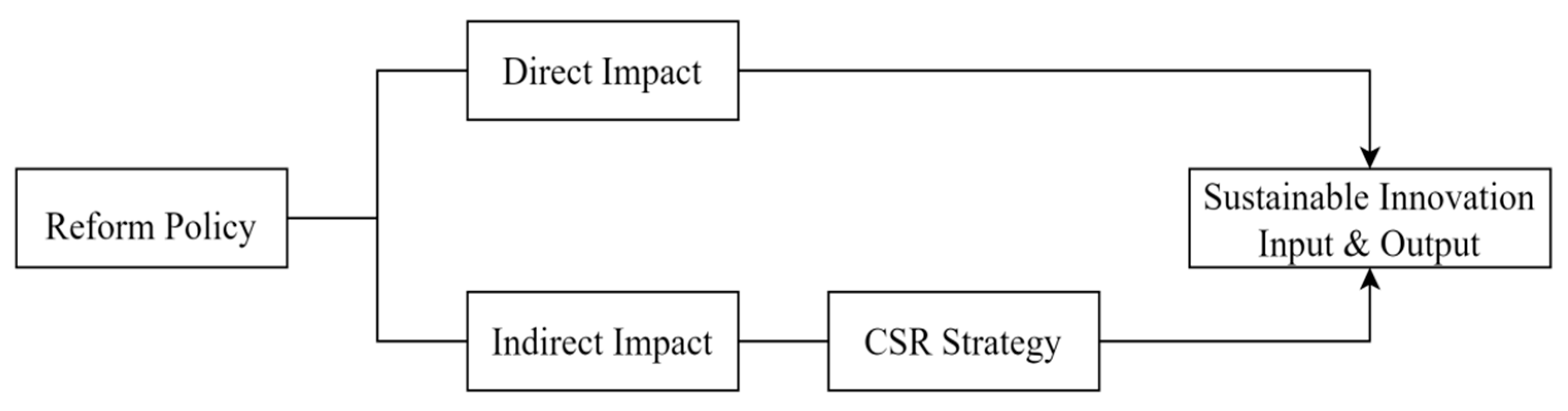
The influence pathway of this study is illustrated in Figure 1. On the one hand, the Green Finance Reform and Innovation Policy directly shapes companies’ sustainable innovation inputs and outputs. It funds environmentally friendly and sustainable projects, while alleviating information asymmetry between companies and their external partners. On the other hand, the policy exerts an indirect impact via companies’ corporate social responsibility (CSR) strategies. As supervision tightens and reputation effects intensify, companies proactively fulfill social responsibilities. In meeting policy requirements, they enhance corporate credibility, creating a positive cycle that further boosts innovation investment and ultimately strengthens the vitality of sustainable innovation.

4. Empirical Results and Analysis

4.1. Impacts of the Green Finance Reform Policies on Companies’ Sustainable Innovation

Based on the benchmark model, Table 2 reports the impact of the green finance reform pilot zone policy on the sustainable innovation of listed companies in the full sample. The results show that the estimated coefficients of the DID term are 0.103 and 0.140, significant at the 1% and 5% levels, respectively. This indicates that after the implementation of the green finance reform policy, firms located in the pilot zones have significantly higher levels of green sustainable innovation than those in non-pilot zones, when other factors are held constant. In other words, the green finance reform policy significantly promotes corporate sustainable innovation. Therefore, Hypothesis 1 is supported.

4.2. Parallel-Trend Test and Dynamic-Effect Analysis

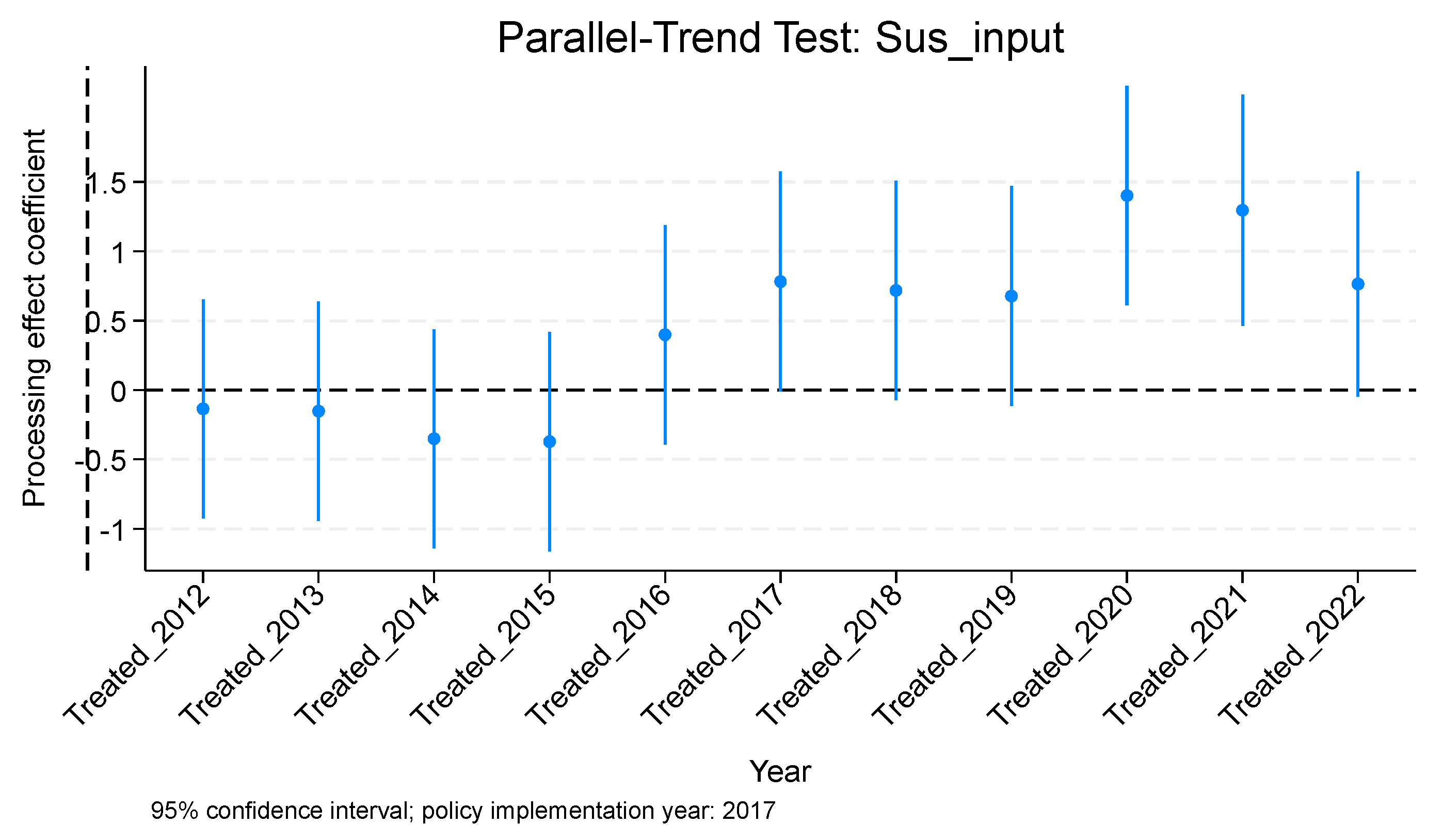
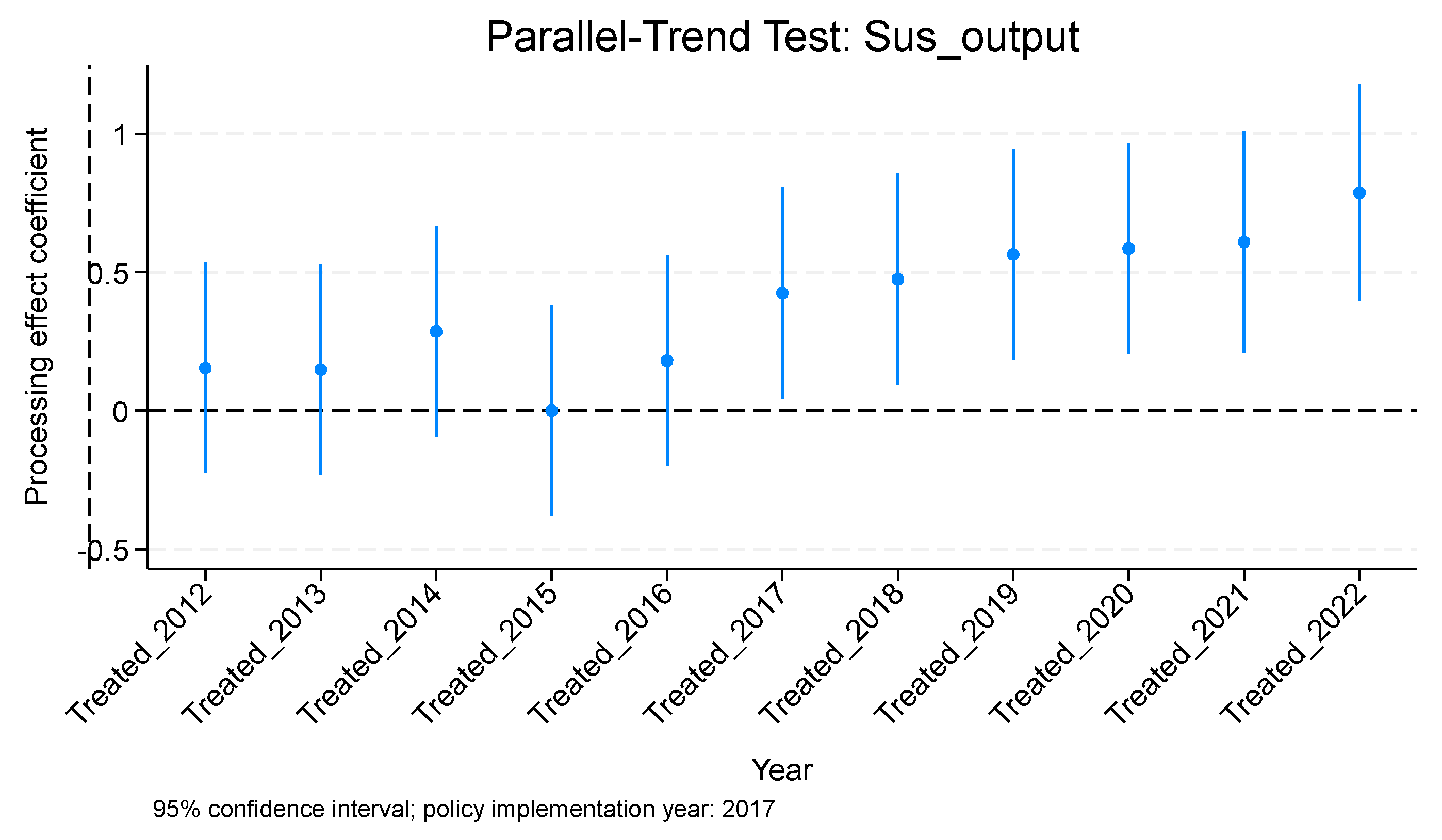
We selected listed companies within the experimental zones as the research subjects, which to some extent mitigates the non-parallelism between the treatment and control groups. Following the approach of Beck et al. (2010) [47], an event study method is employed for further testing, limiting the window period to five periods before and after the policy occurrence. As shown in the Model (4):
L s c x i , t / G r d i , t = ρ 0 + ρ 1 j = 4 4 D j + ρ 2 C o n t r o l i , t + η i + μ t + δ i + ε i , t
The model sets the first year as the base period, represented by dummy variables, and the j means the j-year before and after the policy for the treatment group. If the dummy variables before the policy are all insignificant, it indicates that the parallel-trend assumption holds.
Figure 2 and Figure 3 present the dynamic results of the regression coefficients for the parallel-trend test, along with the 95% confidence intervals. The estimated coefficients for green sustainable innovation input and output in the periods before policy implementation do not significantly differ from 0, indicating that the parallel-trend assumption holds. Looking at the performance of green sustainable innovation input, the estimated coefficient already shows a significant difference from 0 in 2017, when the policy was initially implemented. This suggests that, in the initial stages of the policy, the governments of the pilot areas had already achieved certain effectiveness in financially supporting companies’ green, sustainable innovations. The overall change over the next five years showed an upward trend, indicating that the governments of the green finance reform experimental zones continued to actively support green sustainable innovations.

4.3. Placebo Test with Random Sampling

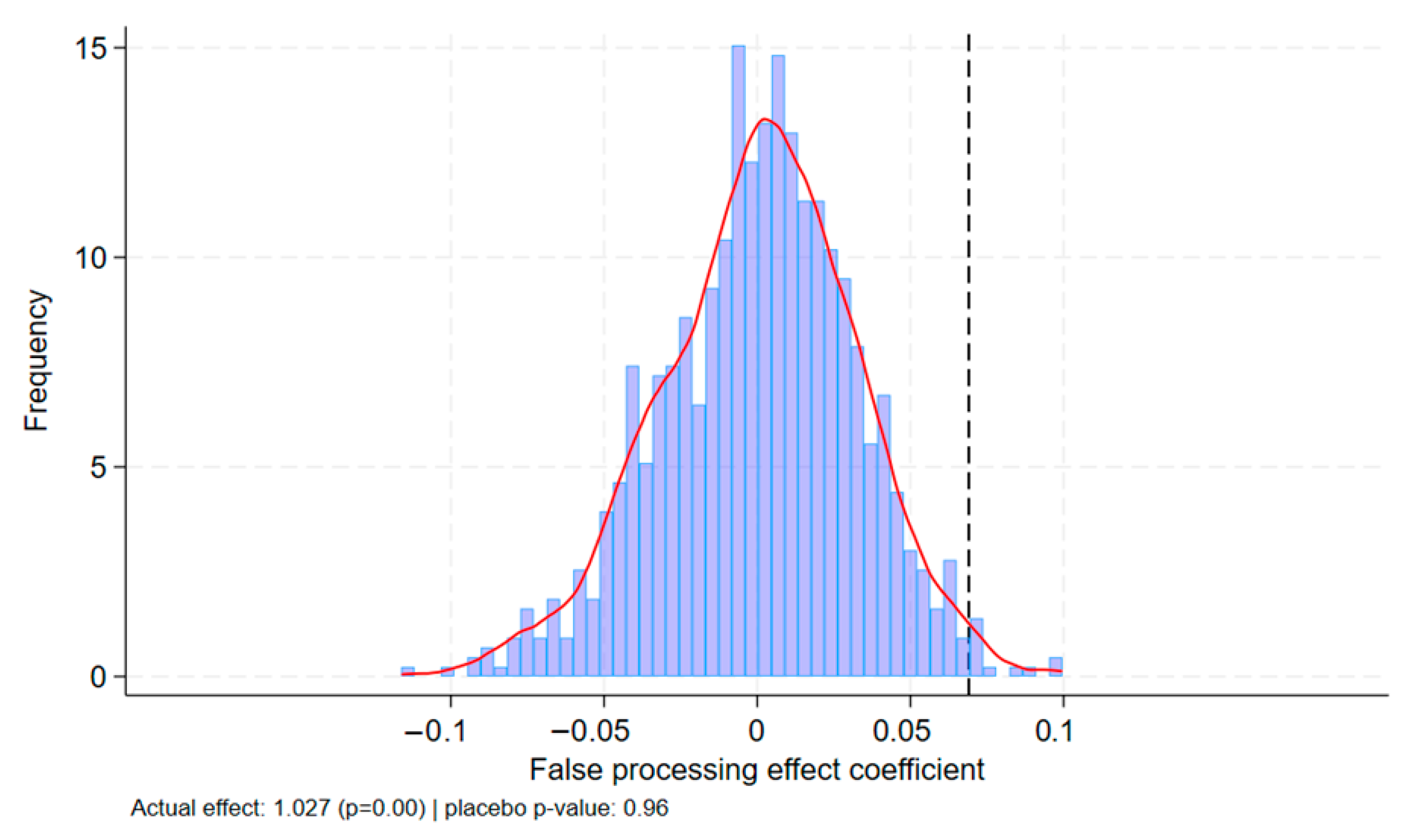
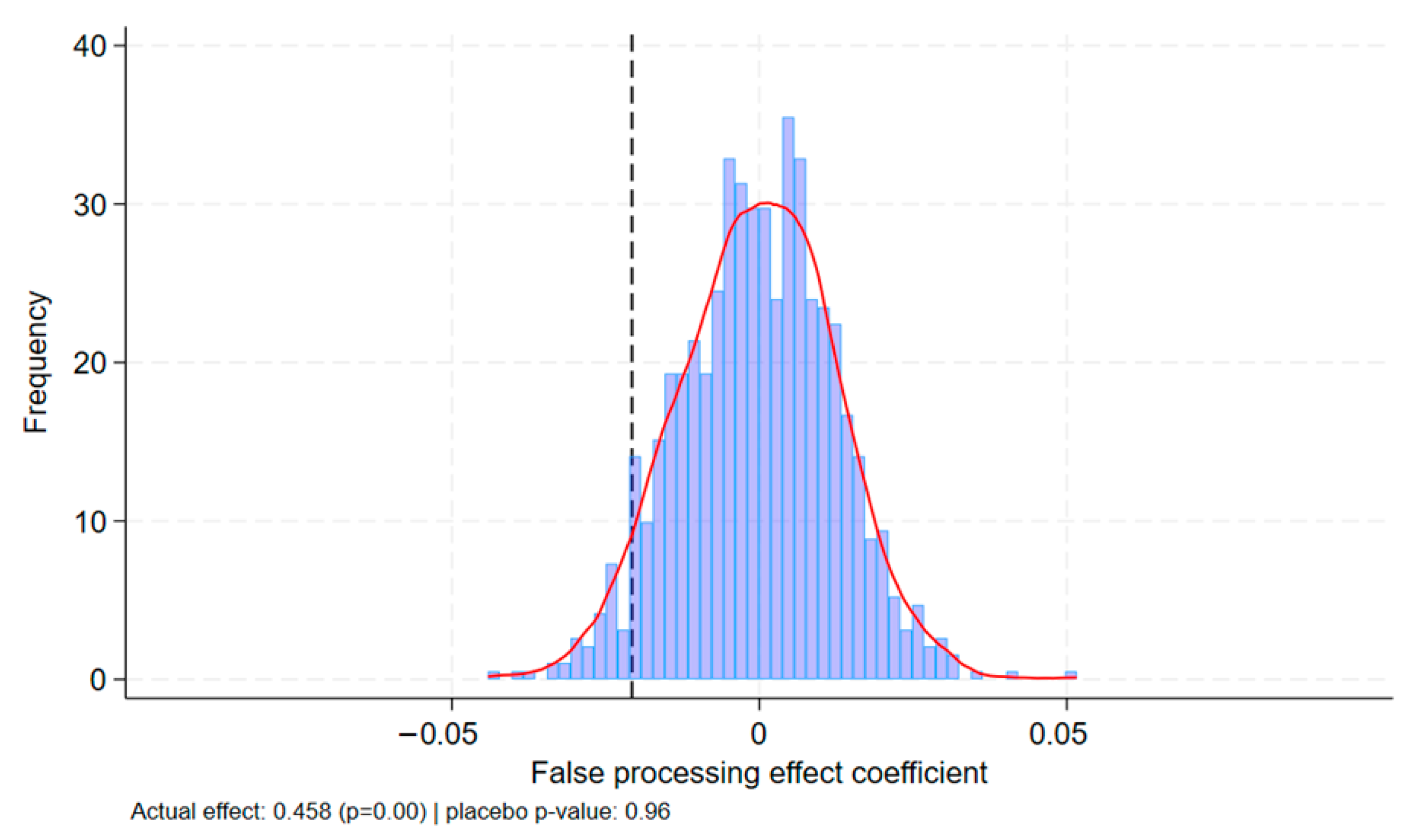
To avoid the influence of other external factors on the parameter estimation results, following the approach of Abadie et al. (2010) [48], fake green finance reform experimental zones were constructed for a placebo test. Companies equal in number to the original policy treatment group were randomly selected as the fake treatment group, with the remaining companies serving as the control group for indirect testing. The policy effect of the randomly selected companies was estimated and the experiment was repeated 1000 times. If the coefficient of the fake experimental zone dummy variable is not significant, it indicates that there is no significant interference from other factors.
Figure 4 and Figure 5 present the kernel density estimation map of the fake policy dummy variable estimation coefficients. The estimation coefficients for green sustainable innovations are mostly concentrated around 0, and the coefficients are all smaller than the actual estimated values. This indicates that the estimation results presented earlier are not significantly coincidental, ruling out the possibility of being affected by other policies or random factors.

4.4. Robustness Tests

4.4.1. Min–Max Normalization

To eliminate the influence of different variable dimensions on regression results, this study performed min–max normalization on the variables. The normalized regression results show that the impact of dimensions has been eliminated, and they are consistent with the findings in Table 2, as presented in Table 3.

4.4.2. Shortening the Window Period

As part of the robustness tests, this study adjusted the sample observation period to 2014–2020, covering three years before and after the policy implementation. The new regression results are presented in Table 4, and the core research conclusions remain unchanged.

4.4.3. Interaction Fixed Effects

While the baseline regression controlled for industry- and year-fixed effects, we further employed an industry–year interactive fixed effects model as part of the robustness checks to account for industry-specific time trends. As shown in Table 5, the green financial reform policy exhibits a significant positive impact on both the input and output of sustainable innovation for firms in pilot areas, significant at the 1% level, which is consistent with our baseline findings.

4.5. Mediating Effect of CSR on Green Finance Reform Policies

The above analysis confirms that the green finance reform policy significantly promotes both the input and output of corporate green innovation. Table 6 reports the test results of the mediating effect of CSR. The results show that the DID term has a significant positive impact on CSR performance. Both the DID term and CSR have significant positive effects on Sus_input and Sus_output, indicating that CSR strategies play a partial mediating role in the relationship. Specifically, under the green finance reform policy, firms can enhance their green sustainable-innovation input and output by improving CSR practices. This confirms the sustainable-innovation effect of CSR strategies. Therefore, Hypothesis 2 is supported. Compared with firms in non-pilot zones, firms in pilot zones actively fulfill social responsibilities to improve their social image and brand value, avoid penalties for regulatory violations, reduce negative evaluations from stakeholders, minimize reputational damage, and obtain preferential policy treatment. These effects further reduce firms’ costs and improve their operating performance.

4.6. Heterogeneity Analysis

4.6.1. Industry Heterogeneity

The impact of green finance reform policies varies across industries, affected by factors such as environmental pressure, first-mover advantages, internal and external innovation motivations, policy targeting, and support levels. Following Brunnermeier & Cohen (2003) [49] and Ramanathan et al. (2010) [50], we divide the full sample into a heavily polluting industry group and a non-heavily polluting industry group, to test the heterogeneous impact of the policy on firms with different pollution levels. The results are reported in Table 7.
For sustainable-innovation input, the green finance reform pilot policy has a positive impact on both heavily polluting and non-heavily polluting industries, with a stronger effect on the heavily polluting industry sample. For sustainable-innovation output, the policy effect is weaker for heavily polluting firms. The possible reasons are as follows: First, heavily polluting industries face stricter environmental pressure and regulatory requirements, which force firms to take active measures to reduce their environmental impact. The green finance reform pilot policy also sets targeted measures for polluting industries. Second, non-heavily polluting industries have first-mover advantages and earlier accumulation in green development, and may have carried out green, sustainable innovation earlier. This makes the marginal impact of the policy on these firms relatively smaller or insignificant. Third, the policy provides direct economic incentives for green, sustainable innovation, such as preferential loan interest rates, tax reductions, and R&D subsidies. As the key focus of environmental governance, heavily polluting industries receive more policy attention and external supervision. However, due to the characteristics of their industries, it is more difficult for them to transform green innovation into actual output, resulting in a smaller estimated coefficient.

4.6.2. Regional Heterogeneity

Although the pilot zones follow a similar policy framework, there are significant differences in economic and financial development levels, as well as institutional and policy environments across regions. These differences may lead to heterogeneous effects of the green finance reform policy in different pilot zones. Based on this, we conducted separate DID regressions for each pilot zone for horizontal comparison, with non-pilot regions as the control group. For sustainable innovation input, the green finance reform policy has a positive promotion effect in all pilot zones. The order of the magnitude of the policy effect, from highest to lowest, is Quzhou, Huzhou, Guangzhou, Gui’an, Ganjiang, and Xinjiang (Changji, Hami and Karamay). For sustainable innovation output, the policy has a positive promotion effect in Huzhou, Guangzhou, Quzhou and Ganjiang, but only the results for Guangzhou and Quzhou are statistically significant. In addition, the policy has a negative impact on firms in Ganjiang and Xinjiang. The results are reported in Table 8.

5. Discussion of the Results

5.1. The Moderating Role of Ownership Characteristics

From the perspective of institutional theory, firms’ ownership nature determines the allocation and control of resources, which has a heterogeneous impact on their innovation behaviors. Compared with private firms, state-owned enterprises (SOEs) are more affected by government decision-making, resource allocation, and policy orientation. Their innovation and investment decisions are more likely to take national strategies and long-term benefits into account. To promote green finance development, the government may also provide more policy support, preferential treatment, and guidance for SOEs, encouraging them to participate in green sustainable innovation, and thus enhancing the policy effects on innovation input and output. We use hierarchical moderated regression to test the moderating effect of ownership characteristics, and the results are reported in Table 9.
The results show that SOE ownership has a significant negative impact on corporate sustainable-innovation input. However, the interaction term between the policy effect and SOE ownership is not statistically significant for innovation input. This indicates that SOE ownership does not weaken the positive impact of the green finance reform policy on sustainable-innovation input. From the perspective of resource allocation, SOEs prioritize stable operation. Due to the long payback period and high risk of green innovation, their investment in sustainable innovation is lower than that of non-SOEs. From the perspective of agency problems, SOE executives tend to focus more on short-term performance indicators, which leads to a weaker willingness to invest in green sustainable innovation. Nevertheless, direct policy incentives partially offset the negative effects of SOE ownership, ensuring that the policy’s promotion effect on innovation input remains effective for both SOE and non-SOE samples.
For sustainable-innovation output, both the SOE ownership variable itself and the interaction term between the policy effect and SOE ownership have significantly positive coefficients at the 1% level. This indicates that SOE ownership amplifies the policy’s promotion effect on green-innovation output. Driven by their resource integration advantages, SOEs have superior technical, financial, and policy resources. Even with relatively lower innovation input, these resources enable them to efficiently convert investment into tangible innovation output. In addition, policy synergy plays a key role: green finance policies are more aligned with the compliance requirements and social-responsibility mandates of SOEs, making it easier for them to access policy resources. The scale effect of SOEs also accelerates the commercialization of green innovations, further enhancing the conversion of policy resources into actual innovation output.

5.2. The Threshold Effect of Companies’ Sustainable Innovations

As mentioned earlier, under the green finance reform policy, CSR strategies have a catalytic effect on sustainable innovation. This section further examines whether a higher intensity of green finance reform policies strengthens the promotion effect of CSR on sustainable innovation. Following Hansen (2000) [51], we construct a panel threshold regression model with the intensity of green finance reform policy as the threshold variable. We introduce an indicator function to analyze the nonlinear relationship between CSR strategies and green sustainable innovation under different levels of green finance policy intensity. The model specification is shown in Model (5):
S u s _ i n p u t i , t / S u s _ o u t p u t i , t = φ 0 + φ 1 C S R i , t I ( G f p i i , t λ 1 ) + φ 2 C S R i , t I ( λ 1 < G f p i , t λ 2 ) + φ 3 C S R i , t I ( λ 2 < G f p i , t λ 3 ) + φ 3 C S R i , t I ( G f p i i , t > λ 3 ) + φ 4 C o n t r o l s i , t + ε i , t
In which, I ( ) is the indicator function, which equals 1 if the condition in the brackets is satisfied, and 0 otherwise; Gfpi is the intensity of green finance policy support, measured using the proportion of green credit.
The Bootstrap resampling method was employed to perform 1000 repetitions, sequentially testing for single-, double-, and triple-threshold values to determine the appropriate threshold model. According to Table 10, there is a significant single-threshold effect of the intensity of green finance policy on sustainable-innovation input, while there is no significant threshold effect on sustainable-innovation output.
We further compared the coefficient of the CSR strategy on sustainable-innovation input before and after the threshold value. By conducting Bootstrap sampling 300, 500, and 1000 times respectively, we obtained consistent results (as shown in Table 11). When the proportion of green credit is below 7.57% (the threshold value), the coefficient of CSR is 0.004, which does not pass the significance test. When the proportion of green credit exceeds the threshold value, the coefficient of CSR is significantly positive, reaching 1.096. This indicates that the promoting effect of CSR on sustainable-innovation input is activated only when the intensity of green finance policy support exceeds a critical threshold. The stability of the threshold value is verified by the consistent results across different Bootstrap sampling frequencies, suggesting that the nonlinear relationship between CSR and sustainable-innovation input is statistically robust.

6. Conclusions

6.1. Research Conclusions

Using a sample of Chinese A-share listed companies from 2012 to 2022, this study examines the impact of China’s green finance reform policy on corporate sustainable innovation and analyzes the mediating role of CSR strategies. The results confirm that the policy has a significant positive effect on both corporate-innovation input and output, and reveal the critical role of CSR strategies in driving sustainable innovation. The main conclusions are as follows.
(1)
CSR strategies have an innovation catalytic effect. Under the incentive of the green finance reform policy, CSR strategies not only improve firms’ social image, but also significantly promote both the input and output of their sustainable innovation. This finding highlights the core role of social responsibility in driving firms’ sustainable development.
(2)
The green finance reform policy has significant regional and industry heterogeneous effects. The policy has a stronger promotion effect on innovation input in heavily polluting industries, while it has a more significant impact on innovation output in non-heavily polluting industries. There are also significant differences in policy effects across different pilot regions.
(3)
Moderating effect of company ownership. State-owned enterprises (SOEs) show a negative impact on sustainable-innovation input (due to resource allocation and agency issues), but policy incentives offset this effect. For output, SOEs’ resource integration and policy synergy significantly enhance green finance policy effects, highlighting ownership’s asymmetric regulation (inhibiting input, promoting output), guiding targeted policy design for SOE innovation potential.
(4)
Threshold effect of policy support intensity. Green finance policy intensity has a significant single-threshold effect on sustainable-innovation input. When below the threshold, CSR’s promotion of input is not significant; when above, CSR’s effect is significantly positive. There is no threshold effect on output. Bootstrap resampling confirms the threshold’s stability, verifying the nonlinear relationship between CSR and innovation input dependent on policy intensity.

6.2. Theoretical Contributions and Generalizability of Conclusions

Building on the existing literature, this study reveals the mechanism of policy-driven corporate sustainable innovation, using the quasi-natural experiment of China’s green finance reform pilot zones. Our findings expand the academic understanding of how green finance policies work. Most existing studies focus on the direct effects of environmental regulations on innovation [10,18], but few examine the mediating role of corporate strategic choices. Based on institutional theory, we find that the impact of green finance reform on sustainable innovation is partially transmitted through firms’ CSR strategies. The policy drives firms to integrate environmental responsibilities into strategic decision-making through regulatory pressure and reputational incentives, thereby enhancing sustainable-innovation input and output. This finding supplements the transmission chain of “policy instruments → corporate strategy → innovation performance”, and provides a new theoretical perspective for explaining the micro-level effects of environmental policies in developing countries.
In addition, the conclusions of this study have universal relevance for global emerging markets. As the world’s largest developing country, China’s green finance reform is implemented in a unique institutional context, but the revealed logic of “policy instruments → corporate strategy → innovation performance” has universal significance for other emerging economies. In particular, large developing economies such as Brazil and Malaysia, or economies with low regulatory transparency, can learn from China’s model of linking financial instruments to corporate social responsibility when promoting their green economic transition. Meanwhile, policies that strengthen environmental information disclosure requirements [31] can also mitigate the risks of corporate opportunism.

6.3. Management Recommendations

Although China’s green finance sector has achieved a breakthrough from scratch, there is still a long way to go to build a comprehensive and systematic green finance system that can effectively promote corporate green sustainable innovation. Based on the above research conclusions, this paper puts forward the following policy recommendations.
(1)
Build a comprehensive green finance support system. Integrate financial resources from banks, securities, insurance and other sectors, provide firms with a full range of green financial products and services, reduce the financing costs of sustainable innovation projects, and improve the accessibility of green funds.
(2)
Implement differentiated green finance incentive policies. Formulate personalized incentive measures, including tax reductions, fiscal subsidies, and preferential loans, according to regional economic development levels, firm size, industry characteristics, and pollution levels, to stimulate the sustainable-innovation potential of different types of firms.
(3)
Promote the integration of CSR and innovation. Encourage firms to integrate social responsibility into their strategic planning, enhance brand image and market competitiveness through CSR practices, and make CSR performance an important condition for firms to obtain green financial support.
(4)
Establish a dynamic evaluation and adjustment mechanism for green finance policies. Regularly evaluate the effects of existing policies and adjust policy design according to economic development, market demand, and technological progress, to ensure the adaptability and foresight of green finance policies.
(5)
Strengthen green finance education, international cooperation, and cross-border exchanges. Raise public awareness of green finance across all sectors of society, and improve professional capabilities through education and training. Actively participate in the formulation of international green finance standards, and introduce advanced technology and management experience from overseas. Establish multi-party cooperation platforms to promote knowledge sharing and technological innovation.
In short, this study provides a new starting point for subsequent research. Future studies can further explore the behavioral differences of firms in different industries and of different sizes under green finance policies, and examine how to improve the implementation effect of green finance policies through policy combinations.

6.4. Research Limitations and Future Directions

This study focuses on Chinese A-share listed companies and does not include small and medium-sized companies (SMEs). Although the latter are at a relative disadvantage in the financing market and have smaller scales of sustainable-innovation input and output, they occupy a significant position in the economies of developing countries. Future research could further explore differences in the mediating effects of CSR strategies across different company sizes to validate the applicability of the theoretical model across a broader range of companies. In terms of variable construction, some indicators rely on keyword frequency analysis of government work reports, which may not fully reflect policy implementation intensity, and do not incorporate the actual scale of local fiscal expenditures on green industries (this data has not been officially disclosed). Additionally, this study focuses on the single policy effect of the 2017 green financial pilot policy, whereas corporate green innovation may result from the superposition of multiple policies. Future research could construct a comprehensive policy index to systematically evaluate the synergistic effects of policy portfolios.
Future research can also be expanded in the following directions: First, consider sample expansion and contextual refinement by conducting cross-regional comparisons based on green financial practices in Belt and Road Initiative (BRI) countries, contrasting differences in the “policy instruments—corporate strategy—innovation performance” transmission mechanism across different institutional contexts to validate the replicability of the Chinese model. Second, adopt a case study methodology to conduct longitudinal tracking of typical companies in pilot areas, deeply analyzing the dynamic process of CSR strategy formulation and implementation to reveal micro-level corporate behavioral logic. Third, subdivide green financial reform policy tools into categories such as green credit, green bonds, and green funds to analyze their differentiated impact mechanisms on corporate sustainable innovation. Finally, the construction of international policy coordination mechanisms and their effects on green innovation of transnational companies is also worth exploring as an important research direction.

Author Contributions

Conceptualization, Y.Z. and J.W.; Data curation, Y.Z. and J.W.; Formal analysis, Y.Z. and J.W.; Funding acquisition, Y.Z.; Methodology, Y.Z. and J.W.; Project administration, J.W.; Software, J.W.; Supervision, Y.Z.; Validation, J.W.; Visualization, J.W.; Writing—original draft, J.W.; Writing—review and editing, Y.Z. and J.W. All authors have read and agreed to the published version of the manuscript.

Funding

Ningbo University Humanities and Social Sciences Special Project “Research on the Linkage Effect between China’s High-quality Economic Development and Optimization of Household Asset Allocation” (XPYQ24012).

Institutional Review Board Statement

Not applicable.

Informed Consent Statement

Not applicable.

Data Availability Statement

There is no public link to archived datasets analyzed or generated during the study. If necessary, please contact the authors.

Acknowledgments

Gratitude is extended to Doubao AI, an intelligent assistant developed by ByteDance Ltd., for its assistance in language polishing and expression optimization of this paper.

Conflicts of Interest

The authors declare no conflicts of interest.

References

  1. Grossman, G.M.; Krueger, A.B. Economic Growth and the Environment. Q. J. Econ. 1995, 110, 353–377. [Google Scholar] [CrossRef] [Scilit]
  2. Salazar, J. Environmental finance: Linking two world. Presented at the Workshop on Financial Innovations for Biodiversity Bratislava, Bratislava, Slovakia, 1–3 May 1998; pp. 2–18. Available online: https://www.cbd.int/financial/pes/switzerland-pes.pdf (accessed on 1 March 2026).
  3. Latapí Agudelo, M.A.; Jóhannsdóttir, L.; Davídsdóttir, B. A literature review of the history and evolution of corporate social responsibility. Int. J. Corp. Soc. Responsib. 2019, 4, 1. [Google Scholar] [CrossRef] [Scilit]
  4. Gillan, S.L.; Koch, A.; Starks, L.T. Firms and social responsibility: A review of ESG and CSR research in corporate finance. J. Corp. Financ. 2021, 66, 101889. [Google Scholar] [CrossRef] [Scilit]
  5. Chen, X.; Yi, N.; Zhang, L.; Li, D. Does institutional pressure foster corporate green innovation? Evidence from China’s top 100 companies. J. Clean. Prod. 2018, 188, 304–311. [Google Scholar] [CrossRef] [Scilit]
  6. Sun, D.; Zeng, S.; Chen, H.; Meng, X.; Jin, Z. Monitoring effect of transparency: How does government environmental disclosure facilitate corporate environmentalism? Bus. Strategy Environ. 2019, 28, 1594–1607. [Google Scholar] [CrossRef] [Scilit]
  7. Cui, W.; Chen, G.; Fu, Y. Competition order and innovation behaviors of enterprise in China. Discret. Dyn. Nat. Soc. 2020, 2020, 3869356. [Google Scholar] [CrossRef] [Scilit]
  8. Dacin, M.T.; Goodstein, J.; Scott, W.R. Institutional theory and institutional change: Introduction to the special research forum. Acad. Manag. J. 2002, 45, 45–56. [Google Scholar] [CrossRef] [Scilit]
  9. Berrone, P.; Gómez-Mejía, L.R.; Xu, K. The role of family ownership in norm-conforming environmental initiatives: Lessons from China. Entrep. Theory Pract. 2023, 47, 1915–1941. [Google Scholar] [CrossRef] [Scilit]
  10. Porter, M.E.; van der Linde, C. Toward a new conception of the environment-competitiveness relationship. J. Econ. Perspect. 1995, 9, 97–118. [Google Scholar] [CrossRef] [Scilit]
  11. Lv, C.; Fan, J.; Lee, C. Can green credit policies improve corporate green production efficiency? J. Clean. Prod. 2023, 397, 136573. [Google Scholar] [CrossRef] [Scilit]
  12. Delmas, M.A. The diffusion of environmental management standards in Europe and in the United States: An institutional perspective. Policy Sci. 2002, 35, 91–119. [Google Scholar] [CrossRef] [Scilit]
  13. Henriques, I.; Sadorsky, P. The relationship between environmental commitment and managerial perceptions of stakeholder importance. Acad. Manag. J. 1999, 41, 89–99. [Google Scholar] [CrossRef] [Scilit]
  14. Hoen, K.M.R.; Tan, T.; Fransoo, J.C.; van Houtum, G.J. Effect of carbon emission regulations on transport mode selection under stochastic demand. Flex. Serv. Manuf. J. 2014, 26, 170–195. [Google Scholar] [CrossRef] [Scilit]
  15. Sarkis, J.; González-Torre, P.; Adenso-Díaz, B. Stakeholder pressure and the adoption of environmental practices: The mediating effect of training. J. Oper. Manag. 2009, 28, 163–176. [Google Scholar] [CrossRef] [Scilit]
  16. Martin, R.P.; Moser, V.D. Managers’ green investment disclosures and investors’ reaction. J. Account. Econ. 2016, 61, 239–254. [Google Scholar] [CrossRef] [Scilit]
  17. Cheng, B.; Ioannou, I.; Serafeim, G. Corporate social responsibility and access to finance. Strateg. Manag. J. 2014, 35, 1–23. [Google Scholar] [CrossRef] [Scilit]
  18. Ambec, S.; Barla, P. A theoretical foundation of the Porter hypothesis. Econ. Lett. 2002, 7, 355–360. [Google Scholar] [CrossRef] [Scilit]
  19. Noailly, J.; Smeets, R. Directing technical change from fossil-fuel to renewable energy innovation: An application using firm-level patent data. J. Environ. Econ. Manag. 2015, 72, 15–37. [Google Scholar] [CrossRef] [Scilit]
  20. Xu, X.; Li, J. Asymmetric impacts of the policy and development of green credit on the debt financing cost and maturity of different types of enterprises in China. J. Clean. Prod. 2020, 264, 121574. [Google Scholar] [CrossRef] [Scilit]
  21. Cai, X.; Zhu, B.; Zhang, H.; Li, L.; Xie, M. Can direct environmental regulation promote green technology innovation in heavily polluting industries? Evidence from Chinese listed companies. Sci. Total Environ. 2020, 746, 140810. [Google Scholar] [CrossRef] [Scilit]
  22. Liu, J.; Xia, Y.; Fan, Y.; Lin, S.; Wu, J. Assessment of a green credit policy aimed at energy-intensive industries in China based on a financial CGE model. J. Clean. Prod. 2017, 163, 293–302. [Google Scholar] [CrossRef] [Scilit]
  23. Abel, A.B. Optimal investment under uncertainty. Am. Econ. Rev. 1983, 73, 228–233. [Google Scholar]
  24. Rennings, K. Redefining innovation—Eco-innovation research and the contribution from ecological economics. Ecol. Econ. 2000, 32, 319–332. [Google Scholar] [CrossRef] [Scilit]
  25. Sierzchula, W.; Bakker, S.; Maat, K.; Wee, B.V. The influence of financial incentives and other socio-economic factors on electric vehicle adoption. Energy Policy 2014, 68, 183–194. [Google Scholar] [CrossRef] [Scilit]
  26. Sharfman, M.P.; Fernando, C.S. Environmental risk management and the cost of capital. Strateg. Manag. J. 2008, 29, 569–592. [Google Scholar] [CrossRef] [Scilit]
  27. Hu, G.; Wang, X.; Wang, Y. Can the green credit policy stimulate green innovation in heavily polluting enterprises? Evidence from a quasi-natural experiment in China. Energy Econ. 2021, 98, 105134. [Google Scholar] [CrossRef] [Scilit]
  28. Klassen, R.; McLaughlin, C.P. The impact of environmental management on firm performance. Manag. Sci. 1996, 42, 1199–1214. [Google Scholar] [CrossRef] [Scilit]
  29. Wahba, H. Does the market value corporate environmental responsibility? An empirical examination. Corp. Soc. Responsib. Environ. Manag. 2008, 15, 89–99. [Google Scholar] [CrossRef] [Scilit]
  30. Zhang, K.; Li, Y.; Qi, Y.; Shao, S. Can green credit policy improve environmental quality? Evidence from China. J. Environ. Manag. 2021, 298, 113445. [Google Scholar] [CrossRef] [Scilit] [PubMed]
  31. Villiers, C.; Staden, C.J. Can less environmental disclosure have a legitimising effect? Evidence from Africa. Account. Organ. Soc. 2006, 31, 763–781. [Google Scholar] [CrossRef] [Scilit]
  32. Nguyen, P.; Kecskés, A.; Mansi, S. Does corporate social responsibility create shareholder value? The importance of long-term investors. J. Bank. Financ. 2020, 112, 105217. [Google Scholar] [CrossRef] [Scilit]
  33. Romero, J.P.; Jayme, F.G. Financial System, Innovation and Regional Development: The Relationship between Liquidity Preference and Innovation in Brazil. Rev. Political Econ. 2012, 24, 623–642. [Google Scholar] [CrossRef] [Scilit]
  34. Bhutta, U.S.; Tariq, A.; Farrukh, M.; Raza, A.; Iqba, M.K. Green bonds for sustainable development: Review of literature on development and impact of green bonds. Technol. Forecast. Soc. Change 2022, 175, 121378. [Google Scholar] [CrossRef] [Scilit]
  35. Flammer, C. Corporate green bonds. J. Financ. Econ. 2021, 142, 499–516. [Google Scholar] [CrossRef] [Scilit]
  36. Abdullah, M.; Zailani, S.; Iranmanesh, M.; Jayaraman, K. Barriers to green innovation initiatives among manufacturers: The Malaysian case. Rev. Manag. Sci. 2016, 10, 683–709. [Google Scholar] [CrossRef] [Scilit]
  37. Flammer, C. Competing for government procurement contracts: The role of corporate social responsibility. Strateg. Manag. J. 2018, 39, 1299–1324. [Google Scholar] [CrossRef] [Scilit]
  38. Suchman, M.C. Managing Legitimacy: Strategic and Institutional Approaches. Acad. Manag. Rev. 1995, 20, 571–610. [Google Scholar] [CrossRef] [Scilit]
  39. Milindi, C.B.; Inglesi-Lotz, R. The role of green technology on carbon emissions: Does it differ across countries’ income levels? Appl. Econ. 2022, 54, 3309–3339. [Google Scholar] [CrossRef] [Scilit]
  40. Castillo, M. From Corporate Social Responsibility to Global Conscious Innovation with Mandalah. Glob. Bus. Organ. Excell. 2015, 34, 42–49. [Google Scholar] [CrossRef] [Scilit]
  41. Achi, A.; Adeola, O.; Achi, F.C. CSR and green process innovation as antecedents of micro, small, and medium enterprise performance: Moderating role of perceived environmental volatility. J. Bus. Res. 2022, 139, 771–781. [Google Scholar] [CrossRef] [Scilit]
  42. Chang, C. Proactive and reactive corporate social responsibility: Antecedent and consequence. Manag. Decis. 2015, 53, 451–468. [Google Scholar] [CrossRef] [Scilit]
  43. Hamamoto, M. Environmental regulation and the productivity of Japanese manufacturing industries. Resour. Energy Econ. 2006, 28, 299–312. [Google Scholar] [CrossRef] [Scilit]
  44. Fang, V.W.; Tian, X.; Tice, S. Does stock liquidity enhance or impede firm innovation? J. Financ. 2014, 69, 2085–2125. [Google Scholar] [CrossRef] [Scilit]
  45. Levine, R.; Lin, C.; Wei, L. Insider Trading and Innovation. J. Law Econ. 2017, 60, 749–800. [Google Scholar] [CrossRef] [Scilit]
  46. Amore, M.D.; Bennedsen, M. Corporate governance and green innovation. J. Environ. Econ. Manag. 2016, 75, 54–72. [Google Scholar] [CrossRef] [Scilit]
  47. Beck, T.; Levine, R.; Levkov, A. Big bad banks? The winners and losers from bank deregulation in the United States. J. Financ. 2010, 65, 1637–1667. [Google Scholar] [CrossRef] [Scilit]
  48. Abadie, A.; Diamond, A.; Hainmueller, J. Synthetic control methods for comparative case studies: Estimating the effect of California’s tobacco control program. J. Am. Stat. Assoc. 2010, 105, 493–505. [Google Scholar] [CrossRef] [Scilit]
  49. Brunnermeier, S.B.; Cohen, M.A. Determinants of environmental innovation in US manufacturing industries. J. Environ. Econ. Manag. 2003, 45, 278–293. [Google Scholar] [CrossRef] [Scilit]
  50. Ramanathan, R.; Black, A.; Nath, P.; Muyldermans, L. Impact of environmental regulations on innovation and performance in the UK industrial sector. Manag. Decis. 2010, 48, 1493–1513. [Google Scholar] [CrossRef] [Scilit]
  51. Hansen, B.E. Sample Splitting and Threshold Estimation. Econometrica 2000, 68, 575–603. [Google Scholar] [CrossRef] [Scilit]
Figure 1. The influence pathway.
Sustainability 18 03448 g001
Figure 2. Dynamic changes in sustainable-innovation investment.
Sustainability 18 03448 g002
Figure 3. Dynamic changes in sustainable-innovation output.
Sustainability 18 03448 g003
Figure 4. Placebo test for sustainable-innovation input.
Sustainability 18 03448 g004
Figure 5. Placebo test for sustainable-innovation output.
Sustainability 18 03448 g005
Table 1. Definition of main variables.
VariableMeaningCalculation Method
Sus_inputSustainable innovation inputThe increase in R&D investment induced by each company to circumvent environmental regulations
Sus_outputSustainable innovation outputln(green utility model patents + 1) or ln(green invention patents + 1)
DIDPolicy effectThe policy effect double-difference term
CSRCSR strategyCorporate social responsibility dimension score of Sino-Securities ESG rating
SizeCompanies sizeln(total assets)
RoeReturn on equityNet income/net assets
TobinQTobin’s qMarket value/total assets
LevAsset–liability ratioTotal liabilities/total assets
CashflowCash flow ratioAssets from operations and investment activities/total assets of the companies
FixedFixed-asset ratioFixed assets/total assets
GrowthRevenue growth rateOperating revenue growth rate
LnrgdpUrban development levelln(GDP per capita)
FgvGovernment fiscal interventionFiscal expenditure/GDP
Table 2. Impacts of green finance reform policy on sustainable innovation.
Sus_inputSus_output
DID1.027 ***0.458 ***
(15.12)(16.62)
ControlsYesYes
Constant−0.250−12.10 ***
(−0.55)(−28.57)
IndustryYesYes
YearYesYes
N21,54121,541
Adj. R20.3520.207
The values in brackets are t-values under the robust standard error; *** indicates that the estimated coefficients are significant at the confidence level of 1%.
Table 3. Regression results of min–max normalization.
mmx_Sus_inputmmx_Sus_output
mmx_DID0.081 ***0.067 ***
(15.12)(15.83)
mmx_ControlsYesYes
Constant0.471 ***−0.011
(50.39)(−1.48)
IndustryYesYes
YearYesYes
N21,54121,541
Adj. R20.3520.210
The values in brackets are t-values under the robust standard error; *** indicates that the estimated coefficients are significant at the confidence level of 1%.
Table 4. Regression results after shortening the window period.
Sus_inputSus_output
DID1.019 ***0.458 ***
(13.89)(11.61)
ControlsYesYes
Constant−0.920 *−4.415 ***
(−1.86)(−16.58)
IndustryYesYes
YearYesYes
N13,23713,237
Adj. R20.5160.213
The values in brackets are t-values under the robust standard error; *** indicates that the estimated coefficients are significant at the confidence level of 1%; * indicates that the estimated coefficients are significant at the confidence level of 10%.
Table 5. Regression results of interaction fixed effects.
Sus_inputSus_output
DID1.024 ***0.468 ***
(15.14)(15.47)
ControlsYesYes
Constant−0.067−4.091 ***
(−0.15)(−19.91)
IndustryYesYes
YearYesYes
N21,46321,463
Adj. R20.3690.202
The values in brackets are t-values under the robust standard error; *** indicates that the estimated coefficients are significant at the confidence level of 1%.
Table 6. Test results of the mediation effect.
CSRSus_inputSus_output
DID0.133 ***1.022 ***0.444 ***
(4.38)(15.05)(16.21)
CSR 0.034 **0.106 ***
(2.41)(18.74)
ControlsYesYesYes
Constant1.036 ***−0.268−4.083 ***
(5.24)(−0.59)(−22.84)
IndustryYesYesYes
YearYesYesYes
N13,84313,84313,843
Adj. R20.1400.5560.408
The values in brackets are t-values under the robust standard error; *** indicates that the estimated coefficients are significant at the confidence level of 1%; ** indicates that the estimated coefficients are significant at the confidence level of 5%.
Table 7. Regression results by industry type.
Sus_inputSus_output
Heavily PollutingNon-Heavily PollutingHeavily PollutingNon-Heavily Polluting
DID1.125 ***0.986 ***0.385 ***0.515 ***
(8.48)(12.49)(8.48)(13.76)
ControlsYesYesYesYes
Constant0.977−0.739−3.709 ***−4.134 ***
(1.14)(−1.36)(−12.65)(−16.05)
IndustryYesYesYesYes
YearYesYesYesYes
N634015,201634015,201
Adj. R20.3560.3520.2020.207
The values in brackets are t-values under the robust standard error; *** indicates that the estimated coefficients are significant at the confidence level of 1%.
Table 8. Results of horizontal comparison across different pilot regions.
Sus_input
HuzhouGuangzhouQuzhouGanjiangGui’anXinjiang
DID1.504 ***0.905 ***2.147 ***0.3110.847 ***0.007
(9.14)(10.58)(5.77)(0.82)(4.53)(0.02)
Constant−0.364−0.504−0.315−0.322−0.155−0.330
(−0.79)(−1.10)(−0.69)(−0.70)(−0.34)(−0.72)
Adj. R20.3470.3480.3460.3450.3450.345
Sus_output
HuzhouGuangzhouQuzhouGanjiangGui’anXinjiang
DID0.1140.717 ***0.528 ***0.131−0.106−0.312 *
(1.57)(19.18)(3.23)(0.78)(−1.29)(−1.81)
Constant−4.137 ***−4.272 ***−4.131 ***−4.131 ***−4.157 ***−4.151 ***
(−20.49)(−21.32)(−20.46)(−20.45)(−20.51)(−20.54)
Adj. R20.2010.2150.2020.2010.2050.201
ControlsYesYesYesYesYesYes
IndustryYesYesYesYesYesYes
YearYesYesYesYesYesYes
N21,54121,54121,54121,54121,54121,541
The values in brackets are t-values under the robust standard error; *** indicates that the estimated coefficients are significant at the confidence level of 1%; * indicates that the estimated coefficients are significant at the confidence level of 10%.
Table 9. The moderating effect of ownership characteristics.
Sus_inputSus_output
(1)(2)(3)(4)
DID1.032 ***1.070 ***0.470 ***0.383 ***
(15.20)(13.05)(15.76)(10.65)
SOE−0.123 ***−0.119 ***0.058 ***0.047 ***
(−3.97)(−3.75)(4.25)(3.39)
DIDSOE −0.119 0.269 ***
(−0.83) (4.29)
ControlsYesYesYesYes
Constant−0.601−0.608−3.933 ***−3.916 ***
(−1.29)(−1.31)(−19.24)(−19.16)
IndustryYesYesYesYes
YearYesYesYesYes
N21,54121,54121,54121,541
Adj. R20.3520.3520.2110.212
The values in brackets are t-values under the robust standard error; *** indicates that the estimated coefficients are significant at the confidence level of 1%.
Table 10. Threshold estimate results.
Threshold TypeThreshold ValueNum of BS RepetitionsF-Statisticp-ValueCritical Value
10%5%1%
Sus_inputSingle T.7.5697300393.01 ***0.00085.74790.54195.487
Double T.7.0620300160.320.253196.319205.099217.868
Triple T.6.3476300253.22 ***0.003110.894112.864126.354
Sus_outputSingle T.6.1463008.590.60719.52824.72931.219
Double T.3.803830012.850.28719.85323.47627.461
Triple T.0.50693008.940.79024.70830.12840.658
*** indicates that the estimated coefficients are significant at the confidence level of 1%.
Table 11. Threshold model estimate results.
Bootstrap FrequencyCoefficientt-Valuep-Value
300/500/10000.0040.070.940
1.096 ***14.370.000
*** indicates that the estimated coefficients are significant at the confidence level of 1%.
Disclaimer/Publisher’s Note: The statements, opinions and data contained in all publications are solely those of the individual author(s) and contributor(s) and not of MDPI and/or the editor(s). MDPI and/or the editor(s) disclaim responsibility for any injury to people or property resulting from any ideas, methods, instructions or products referred to in the content.