1. Introduction
Urban–rural income disparity remains a persistent challenge worldwide, reflected in the enduring gaps between agricultural and industrial regions in advanced economies and the pronounced divides across Asia, Africa, and Latin America [
1,
2]. The digital economy (DE) has become an important driver of productivity and growth, yet its uneven diffusion through unequal access to infrastructure and disparities in digital skills risks widening the gap between urban and rural areas, particularly in regions where infrastructure is limited and human capital is weak [
3,
4,
5]. Understanding how digitalization shapes this inequality is therefore essential for addressing the challenges of balanced development in the digital era and for identifying effective policies that support inclusive growth.
China provides a particularly important case for examining these dynamics. Household incomes have risen rapidly, yet the urban–rural divide has widened and now constitutes the main source of overall inequality [
6], which is evident from the fact that in 2024 urban disposable income was about 2.5 times that of rural residents. The Third Plenary Session of the 20th CPC Central Committee in 2024 stressed the need to “improve institutional mechanisms for integrated urban–rural development.” This highlights the urgency of identifying new drivers to reduce the income disparity. Yet the expansion of DE in China has been highly unbalanced. In 2023, penetration rates were 45.63% in the tertiary sector and 25.03% in the secondary sector, but only 10.78% in the primary sector (China Digital Economy Development Report). Such disparities reveal significant imbalances across industries and within the urban–rural context. Extending digital technologies to rural regions is essential for transforming rural industries and promoting inclusive prosperity [
7].
Improving factor allocation and promoting two-way flows of production factors across urban and rural regions are considered effective strategies for narrowing income gaps and reducing structural divides [
8]. In China, this has translated into efforts to create more unified markets for land and labor, lower barriers to mobility, improve allocation efficiency, and reduce distortions that exacerbate urban–rural disparities. The rapid process of digitalization is reshaping patterns of factor mobility and is highly relevant to understanding the income divide. However, the mechanisms underlying this process remain insufficiently understood. More specifically, its impact on the allocation of land, labor, and capital requires further investigation. A systematic analysis of these mechanisms can help clarify the transmission pathways and provide a sounder theoretical and empirical basis for policies to reduce regional disparities and promote inclusive development. This study is guided by one multifaceted question: how does the digital economy affect urban–rural income disparity, and through what mechanisms, contextual conditions, and spatial interactions does this effect unfold? More specifically, the study examines whether the digital economy has a direct effect on urban–rural income disparity, whether urban–rural factor allocation serves as an important mediating mechanism, whether this effect varies across different urban agglomerations and stages of urbanization, and whether the digital economy generates significant spatial spillover effects on urban–rural income disparity across regions. This study contributes in several respects. By using prefecture-level data, it provides a more fine-grained analysis of the nonlinear relationship between DE and urban–rural income disparity, making it possible to identify regional variation in greater detail. It also incorporates urban–rural factor allocation into the analytical framework and examines both its mediating role and its threshold effect. This allows us to assess whether the impact of DE on income disparity varies across different levels of factor allocation efficiency. In addition, the study extends the analysis to regional heterogeneity and spatial spillover effects, thereby offering a more comprehensive understanding of how DE shapes urban–rural inequality across different development contexts. In doing so, it moves beyond a purely local perspective and provides additional evidence on the differentiated and interconnected effects of digitalization.
The rest of the paper is structured as follows:
Section 2 reviews the relevant literature.
Section 3 sets out the theoretical framework and examines the underlying mechanisms.
Section 4 describes the data and methodology.
Section 5 reports the empirical results and discussion, followed by
Section 6, which presents the spatial analysis. Finally,
Section 7 concludes with the main findings, theoretical contributions, research limitations and policy implications.
5. Estimation Results
5.1. Baseline Regression Results
Table 3 reports the baseline regression results for the impact of DE on urban–rural income disparity. Column (1) includes only the core explanatory variable (Dig), which shows a positive and significant coefficient (0.148,
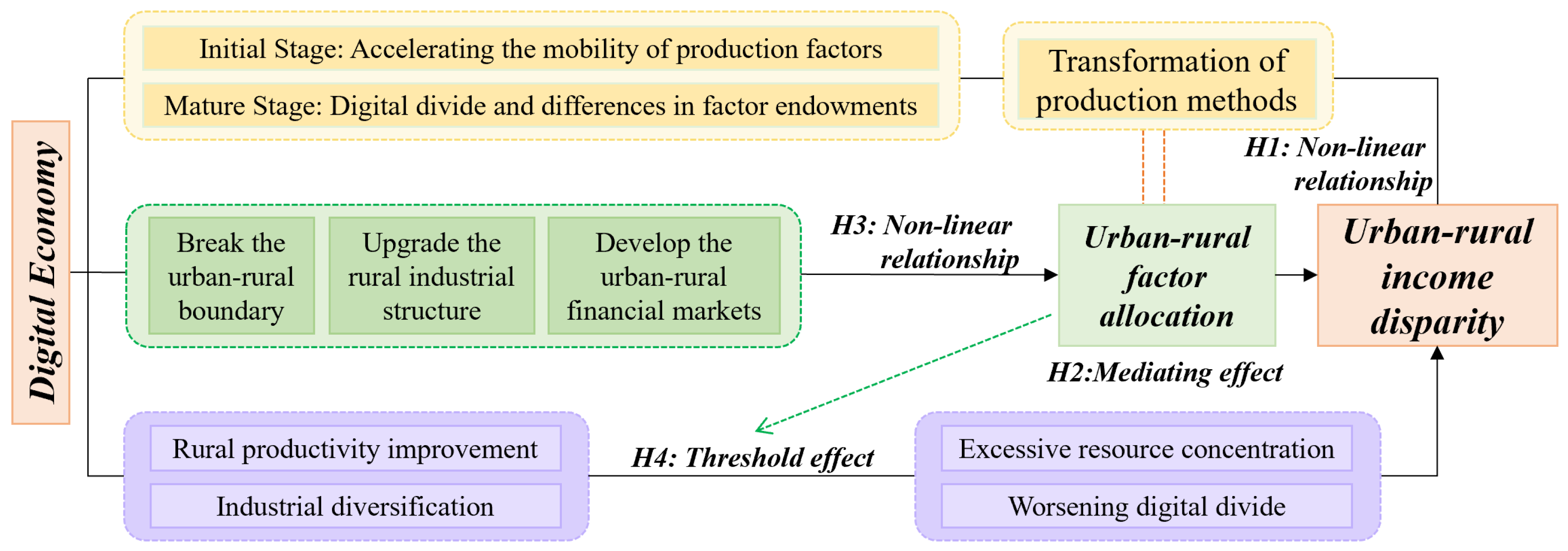
p < 0.01), suggesting a widening effect on income disparity. In Column (2), after the inclusion of control variables, the coefficient of Dig remains positive but loses significance, indicating that part of the effect operates through other socioeconomic factors. Columns (3) and (4) add the quadratic term (Dig2) to capture nonlinear dynamics. The coefficient of Dig turns significantly negative, while Dig2 is significantly positive, confirming a U-shaped relationship, with the turning point located at approximately 0.664. These findings lend support to Hypothesis 1.
This U-shaped pattern is broadly consistent with the theoretical expectations of this study. In the early stage, DE helps narrow urban–rural income disparity by reducing information costs, improving resource matching, and facilitating the flow of labor and capital between urban and rural areas. It also supports the digital upgrading of rural industries and creates new income opportunities for rural households. However, as DE continues to expand, digital resources, infrastructure, and skilled labor tend to become more concentrated in urban areas and more developed regions. Under these conditions, rural areas may face increasing difficulties in fully absorbing digital dividends because of weaker factor endowments and lower industrial adaptability. As a result, the equalizing effect of DE weakens over time, and the urban–rural income disparity may widen again.
Among the control variables, urbanization, economic development, and industrial structure rationalization are associated with lower urban–rural income disparity, whereas educational investment and human capital tend to show disparity-widening effects, likely reflecting the unequal spatial distribution of educational resources and skilled labor.
5.2. Robustness Test
5.2.1. Substitute the Dependent Variables
As a robustness check, the Gini coefficient is employed as a proxy indicator of income disparity. The Gini coefficient is calculated using Dagum’s method [
53], with the formula specified as follows:
where p
u and p
r denote the population shares of urban and rural areas, respectively; y
u and y
r represent the per capita incomes of urban and rural residents; and μ is the national average income.
Column (1) of
Table 4 reports the regression results, which confirm the robustness of the baseline findings. The estimates show that the nonlinear relationship between digitalization and urban–rural income disparity remains statistically significant.
5.2.2. Exclude Certain Samples
Since centrally administered municipalities vary significantly from other prefecture-level cities in terms of administrative hierarchy and economic development, they are excluded from the sample for re-estimation. The results, reported in Column (2) of
Table 4, remain consistent with the baseline findings, indicating that the main conclusions are robust even after excluding these municipalities.
5.2.3. Handle Outliers and Extreme Values
To mitigate potential bias from outliers and extreme observations, all variables are winsorized at the 5% level on both tails. The 5% threshold is adopted as a common and relatively conservative choice in empirical analysis to limit the effect of extreme observations without excessively distorting the sample. The regression results, presented in Column (3) of
Table 4, show that the coefficients of Dig and Dig2 remain statistically significant at the 5% level, and their signs are consistent with those in the baseline model.
5.2.4. Mitigate Endogeneity via 2SLS Estimation
To address potential endogeneity concerns, this study employs the one-period lag of DE variable (L. Dig) and its squared term (L. Dig2) as instrumental variables and conducts a two-stage least squares (2SLS) regression. The results of the relevance tests confirm that the instruments are valid and have strong explanatory power. The first-stage regression, reported in Columns (4) and (5) of
Table 4, shows a significant correlation between the instrumental variables and the endogenous regressors, supporting the validity of the estimation strategy. The second-stage regression results, presented in Column (6), indicate that the coefficients of Dig and Dig2 remain statistically significant at the 1% level, further reinforcing the robustness of the findings.
5.3. Mediation Effect Analysis
As reported in
Table 5, Column (1) shows the regression results of DE and its squared term on the level of factor allocation. The findings reveal a nonlinear effect. When the value of Factor is lower, allocation efficiency is higher and the income gap narrows. When the value of Factor is higher, allocation efficiency is lower and the income gap widens. These results provide empirical support for Hypotheses 2 and 3.
The relationship between factor allocation and income disparity can be understood through both prior studies and logical reasoning. When factor allocation efficiency is low, institutional barriers and market segmentation restrict the efficient flow of resources across regions. This leads to the concentration of resources in cities, constrained rural development, and an expansion of the income disparity [
54]. As allocation improves and crosses a critical threshold, however, institutional constraints are gradually relaxed, resource use becomes more efficient, and rural productivity and incomes rise, which in turn contributes to narrowing the urban–rural income disparity [
55].
Further analysis is conducted using the traditional mediation effect model. Column (3) reports the baseline regression results mentioned earlier. Column (2) presents the estimates after including the mediating variable, and the coefficients of Dig and Dig2 remain significant at the 1% level, consistent with that in Column (3). This suggests that factor allocation partially mediates the positive U-shaped relationship. The positive and significant coefficient of Factor suggests that greater factor misallocation is associated with a wider income gap, whereas improvements in allocation efficiency help narrow the disparity. These findings highlight that the distributive effect of digitalization does not operate only through technological expansion itself, but also through the extent to which digital development improves the movement and matching of labor and capital between urban and rural areas. In this sense, factor allocation serves as a key institutional and structural channel linking digital transformation to income distribution.
5.4. Threshold Effect Analysis
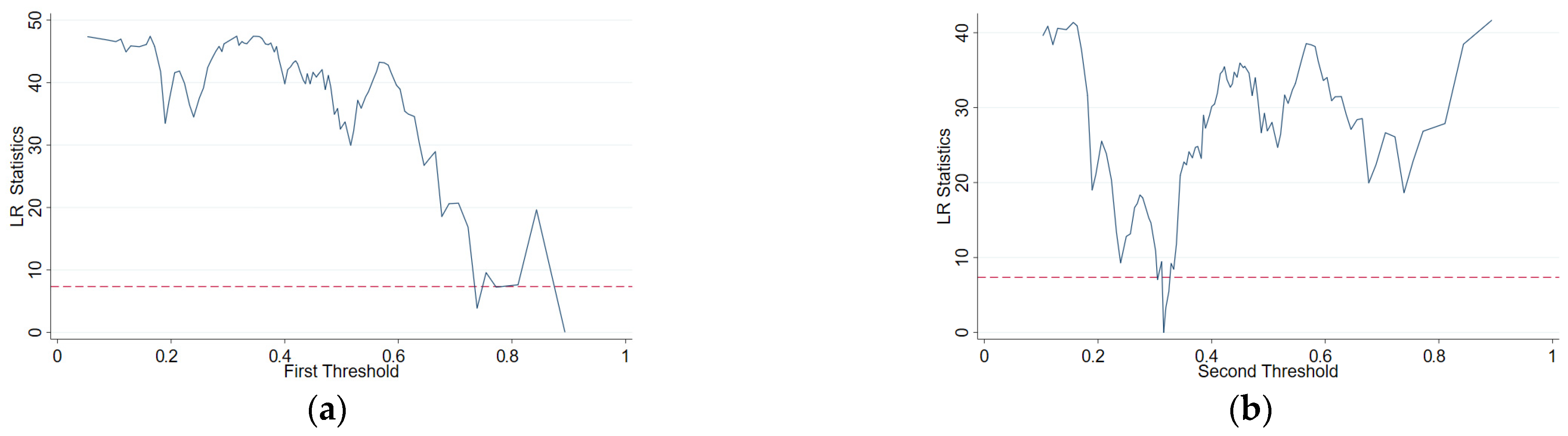
A bootstrap procedure with 500 replications is used to test the number of thresholds. As reported in
Table 6 and
Figure 2, the results support a double-threshold effect of factor allocation in the relationship between DE and urban–rural income disparity.
As shown in
Table 7, the model identifies two threshold values (γ
1 = 0.315 and γ
2 = 0.882), which divide the sample into three regimes of factor allocation imbalance. Lower values of factor indicate more coordinated allocation, whereas higher values indicate more severe imbalance. The findings suggest the following: within the two regimes where factor allocation is relatively efficient (Factor ≤ 0.315 and 0.315 < Factor ≤ 0.882), both DE variable (Dig) and its squared term (Dig2) display a statistically significant U-shaped relationship with income disparity. By contrast, when allocation efficiency is low (Factor > 0.882), this nonlinear relationship is no longer statistically well supported. These results demonstrate that as factor coordination improves, the influence of DE on the urban–rural income disparity becomes more stable and pronounced. This evidence confirms Hypothesis 4 and underscores that differences in factor allocation play a decisive role in shaping the marginal effect of DE on income disparity.
5.5. Heterogeneity Analysis
Based on economic development levels and national strategic priorities, China’s 19 major national urban agglomerations can be divided into three categories. The first-tier agglomerations (Ua1) are relatively mature, fall under the “optimization and upgrading” category, and function as a key component of the national economy. The second-tier agglomerations (Ua2) are in the process of consolidation and require further growth, representing areas with considerable potential. The third-tier agglomerations (Ua3) are less developed, concentrated mainly in the northeast and central-western regions, and remain in need of cultivation and development. The detailed classification of urban agglomerations is presented in
Table 8.
As reported in
Table 9, the U-shaped relationship is confirmed mainly in the more developed urban agglomerations, namely Ua1 and Ua2, whereas the coefficients for Ua3 are not statistically significant. This pattern suggests that the distributional consequences of digitalization are conditioned by regional development foundations. In more mature urban agglomerations, digital infrastructure, market integration, industrial upgrading capacity, and labor mobility are generally stronger, allowing the effects of digitalization on resource reallocation and income distribution to become more visible. By contrast, in less developed agglomerations, weaker infrastructure, thinner markets, and more limited absorptive capacity may constrain the transformation of digital inputs into sustained income effects, thereby weakening the estimated relationship.
As shown in Column (5), a similar logic applies to the urbanization-level results. In regions with higher urbanization (Urban ≥ 0.6) [
56], digitalization is embedded in a more advanced economic structure and therefore exerts a clearer nonlinear effect on the urban–rural income gap. In less urbanized regions, however, digital development may still be too limited or fragmented to systematically reshape the urban–rural distribution of opportunities and returns.
7. Conclusions and Discussions
7.1. Main Findings
The main conclusions are as follows:
The relationship between DE and urban–rural income disparity follows a significant U-shaped nonlinear pattern. In the early stages, DE development helps narrow the income disparity, but as development deepens, the gap gradually widens. This conclusion is supported by multiple robustness checks, underscoring the reliability of the result.
The allocation of urban and rural factors mediates the impact of DE on income disparities, and this relationship exhibits a clear dual-threshold effect. When factor allocation efficiency is low, the effect of DE on the income disparity is relatively weak. As allocation efficiency improves and surpasses threshold levels, however, the influence becomes increasingly significant.
The effects of DE on urban–rural income disparity vary across urban agglomeration types and stages of urbanization. In regions with higher levels of urbanization and stronger economic development, the impact of digitalization on income disparity is more pronounced.
Spatial analysis reveals a significant positive spatial correlation between DE and income disparity. The direct effect of digitalization follows a U-shaped pattern, initially reducing the gap but later contributing to its widening. The spatial spillover effect exhibits an inverted U-shape. The development of DE in neighboring regions at first intensifies local disparities, but over time helps to narrow them.
7.2. Policy Implications
The following policy recommendations are proposed:
Strengthen rural digital infrastructure and skills development. To prevent digitalization from exacerbating the urban–rural income gap, it is crucial to enhance digital infrastructure in rural areas. This can be achieved through targeted investments in broadband expansion, ensuring universal access to high-speed internet in underserved regions. Additionally, digital literacy programs should be rolled out for rural workers, alongside incentives for private companies to build and maintain digital infrastructure. Telecommunication regulations should be adapted to support equitable access, with a focus on providing affordable and reliable internet services to rural populations.
Facilitate the flow of labor, capital, and technology. To improve economic opportunities in rural areas, policies should encourage the two-way flow of labor, capital, and technology between urban and rural regions. Specifically, tax incentives could be provided to businesses that invest in rural areas or establish digital factories. Capital grants or low-interest loans for rural startups should be introduced to foster local entrepreneurship. Furthermore, government-led initiatives like digital platforms for remote work can connect rural labor with urban industries, providing access to new income sources.
Tailored policies for regional development stages. Given the varying stages of digital development across regions, it is essential to design differentiated policies. For less developed regions, investment in foundational digital infrastructure should be prioritized, including subsidies for broadband, mobile internet, and basic ICT services. In more developed areas, policies should focus on fostering innovation and high-tech industries, with measures such as subsidies for research and development and support for tech incubators. These region-specific policies would leverage the unique strengths of urban agglomerations and promote equitable growth across urban and rural areas.
Promote cross-regional collaboration for digital integration. To maximize the benefits of digitalization, cross-regional collaboration must be enhanced. This includes removing barriers to the flow of digital knowledge, technology, and skilled labor between regions. Specific measures could involve joint investment in digital clusters that bring together urban and rural players, focusing on sectors like agriculture technology or digital finance. Creating regional partnerships for shared technological resources, such as cloud computing services, can help narrow the digital divide and promote inclusive economic growth.
7.3. Discussion
This study offers several contributions to the understanding of digitalization and income distribution. Earlier studies relying on provincial data have yielded mixed evidence on whether DE narrows or widens the urban–rural income gap. Using prefecture-level data, this study provides a more granular assessment of this nonlinear relationship. More importantly, it introduces urban–rural factor allocation efficiency as a mediating variable for the first time, thereby deepening the understanding of the mechanisms through which digitalization affects income disparity. Furthermore, recognizing that urban–rural inequality is often intertwined with differences across cities, this study conducts heterogeneity tests at the level of national urban agglomerations. It also explores spatial dependence and spillover effects, providing a more comprehensive view of how DE shapes regional inequality through direct and indirect spatial channels.
Although this study is based on Chinese data, its findings still have broader relevance for other economies undergoing digital transformation. China provides a valuable setting because it combines rapid DE development with pronounced urban–rural disparities, allowing this study to examine how digitalization affects income distribution under conditions of regional heterogeneity and uneven development. In this respect, the main findings of this study, including the nonlinear impact of DE on urban–rural income disparity, the mediating role of factor allocation, and the existence of spatial spillover effects, may also offer useful insights for other countries facing similar urban–rural divides and regional imbalances. For emerging economies, these findings highlight the importance of improving access to digital infrastructure and strengthening the conditions for balanced factor allocation. For other countries with substantial regional inequality, the results also suggest that the effects of digitalization may vary across regions and development stages. Therefore, this study contributes to the broader discussion on inclusive growth in the digital era and offers policy implications for reducing territorial inequality through digital development. However, the applicability of these findings depends on differences in institutions, digital infrastructure, and governance across countries.
However, this study has certain limitations. Due to restrictions in the availability of factor allocation data, the sample period ends in 2022, which prevents the analysis from capturing more recent changes in DE development and urban–rural income disparity. In addition, high-quality data that accurately reflect the distribution of digital factors between urban and rural areas are still lacking, which limits the ability to represent factor allocation directly in the empirical analysis. In addition, although PCA helps reduce dimensionality and construct the digital economy index objectively, it is primarily variance-driven and may not fully capture the conceptual heterogeneity of different dimensions within the digital economy. As a result, some variables can only be measured through available proxy indicators, which may not fully capture the complexity of factor movements and digital resource distribution across regions. Moreover, because prefecture-level data are not equally complete for all cities and years, some missing observations had to be addressed through data processing methods, which may also affect the precision of the econometric estimates to some extent.
Future research could integrate micro-level survey data or other high-resolution data sources to provide a more precise depiction of digital factor distribution. Such efforts would improve the accuracy and reliability of analyses of factor allocation mechanisms. Additionally, the study focuses on income disparity, leaving other important dimensions of inequality such as education, health, and access to services for future research.


_Li.png)