1. Introduction
Achieving gender parity in leadership remains a persistent challenge in the fintech sector, a rapidly expanding industry positioned at the intersection of finance, technology, and digital innovation. Gender parity in organizational leadership refers to the balanced representation of men and women in top executive roles, such as the Chief Executive Officer (CEO), Chief Financial Officer (CFO), Chief Information Officer (CIO), and Chief Technical Officer (CTO). Fintech firms have transformed financial markets and business models, yet leadership structures within the industry remain highly imbalanced in terms of gender representation. Prior research documents the underrepresentation of women in senior roles, identifies structural barriers, including biased promotion practices, exclusionary professional networks, and limited access to venture capital and technical career pipelines. However, considerably less attention has been paid to how organizational systems and management practices can be intentionally designed to address these barriers and promote gender-inclusive leadership structures. This gap is significant because leadership composition influences not only organizational equity but also governance quality, strategic decision-making, and firms’ capacity to pursue sustainable outcomes.
Evidence from finance and economics further underscores the importance of gender composition in leadership and governance. Research shows that board gender diversity can influence monitoring intensity and firm governance outcomes [
1]. Studies examining executive transitions demonstrate that top executive gender shapes corporate decision-making, including acquisition behavior, financing choices, and investor reactions [
2]. Similarly, CEO gender has been linked to corporate risk-taking behavior and the efficiency of capital allocation [
3]. Beyond firm-level decision-making, broader social norms related to gender can also influence financial markets and investor responses [
4]. Together, these findings highlight that the gender composition of leadership has measurable implications for governance and strategic outcomes. However, while this literature demonstrates the consequences of gender representation, it provides less insight into the organizational mechanisms through which firms can actively improve gender parity in leadership.
This paper argues that sustainable HRM practices represent a critical mechanism through which organizations can address structural gender barriers and foster more inclusive leadership pipelines. Sustainable HRM extends traditional human resource management by integrating economic performance objectives with broader social and environmental responsibilities [
5]. In doing so, it encourages firms to develop organizational systems that simultaneously support employee well-being, long-term talent development, and societal value creation. Prior studies suggest that sustainable HRM practices can strengthen employee engagement, enhance organizational legitimacy, and promote inclusive cultures [
6]. However, the role of such practices in shaping gender parity in leadership remains underexplored, particularly in highly technical and capital-intensive industries such as fintech.
Existing gender-diversity models often emphasize specific mechanisms such as networking and mentorship programs. Networking initiatives facilitate knowledge exchange, professional visibility, and access to career opportunities by strengthening individuals’ social capital [
7]. Similarly, mentorship programs create structured relationships that support professional development, skill transfer, and career advancement [
8]. While these approaches provide valuable insights into individual-level career advancement, they typically focus on isolated practices rather than a comprehensive organizational system designed to overcome multiple structural barriers simultaneously. In fintech, women frequently encounter a ‘triple glass ceiling’ comprising financial, technological, and entrepreneurial barriers that limit access to leadership positions. Addressing such multifaceted barriers requires a broader framework that integrates multiple sustainable HRM practices and links them to leadership outcomes.
The primary contribution of this paper is the development of a conceptual framework that theorizes how sustainable HRM practices can foster gender parity in organizational leadership, thereby enhancing sustainability outcomes in fintech organizations. Building on insights from sustainable HRM, gender and leadership research, social role theory, and the resource-based view, the model integrates three key HRM mechanisms—inclusive networking structures, diversity training initiatives, and structured mentorship programs. These practices operate as complementary pathways through which organizations can reduce structural barriers such as the ‘broken rung,’ tokenism, and unequal access to capital and professional networks. By strengthening women’s representation in top executive roles, these HRM systems can improve governance quality, broaden strategic perspectives, and contribute to more sustainable environmental, social, and economic outcomes.
The remainder of the paper proceeds as follows. First, we introduce the theoretical foundations underlying the model and discuss the relationship between sustainable HRM, gender parity in leadership, and sustainability outcomes in fintech organizations. We then review the current state of gender representation in fintech leadership and examine the structural barriers that contribute to persistent disparities. Next, we present two illustrative case vignettes of fintech organizations that have successfully implemented practices supporting gender-inclusive leadership. The paper then develops a conceptual model and a set of propositions linking sustainable HRM practices to gender parity and sustainability outcomes. Finally, we discuss implications for managers, regulators, and future research on inclusive leadership and sustainable organizational systems.
2. Theoretical Foundations
The conceptual model advanced in this paper integrates social role theory and the resource-based view (RBV) to explain how firms’ sustainable HRM practices can foster gender parity in leadership and, in turn, contribute to sustainability outcomes in fintech organizations. While prior research on gender inequality in organizations has often focused either on structural barriers or on the performance benefits of diversity, combining these theoretical perspectives yields a more comprehensive understanding of both the origins of gender disparities and the organizational benefits of reducing them. Social role theory provides insight into why women continue to face obstacles in leadership advancement. At the same time, RBV explains how gender-diverse leadership can serve as a unique organizational resource, enhancing long-term performance and sustainability.
2.1. Social Role Theory and Gender Barriers in Leadership
Social role theory suggests that gender differences in organizational outcomes arise from culturally embedded expectations about the roles men and women should occupy in society [
9,
10]. These expectations shape perceptions of competence, leadership potential, and professional suitability, often leading to biased evaluations and unequal career opportunities for women. In organizational contexts, such stereotypes are particularly influential in leadership domains traditionally associated with masculine traits such as assertiveness, risk-taking, and technological expertise [
11].
These gendered expectations contribute to several structural barriers to women’s advancement. One such barrier is the ‘broken rung,’ which refers to the disproportionate difficulty women face in obtaining early managerial promotions that serve as gateways to senior leadership positions. Because promotion decisions often rely on subjective assessments of leadership potential, implicit gender biases can disadvantage women even when they possess comparable qualifications and performance records [
12]. Similarly, women who do attain leadership roles may experience tokenism, in which their presence is interpreted as symbolic representation rather than as evidence of merit. Tokenism can undermine perceptions of competence and reinforce stereotypes about women’s suitability for leadership roles [
13].
Social role theory also helps explain the exclusion of women from influential professional networks and investment ecosystems, particularly in sectors such as fintech, where informal networks and venture capital relationships play a central role in career advancement and entrepreneurial success. These dynamics limit women’s access to social capital, mentorship, and funding opportunities, thereby reinforcing gender disparity in leadership representation. In this context, sustainable HRM practices can help mitigate the effects of gender-role expectations by creating more equitable systems for evaluating and developing talent.
2.2. RBV and the Strategic Value of Gender-Diverse Leadership
RBV provides a complementary perspective on why overcoming gender disparity can generate organizational value. RBV posits that firms achieve sustained competitive advantage by developing unique resources that are valuable, rare, difficult to imitate, and hard to substitute [
14]. Human capital and leadership capabilities are widely recognized as critical strategic resources within this framework [
15].
From an RBV perspective, gender-diverse leadership teams represent a potentially unique organizational resource because they expand the range of knowledge, experiences, and perspectives available to decision-makers. Prior research suggests that diverse leadership teams are better equipped to process complex information, challenge dominant assumptions, and identify innovative solutions to strategic challenges [
16]. These benefits are particularly relevant in fintech, where firms operate in rapidly evolving technological and regulatory environments that require adaptive decision-making and creative problem-solving.
Gender-diverse leadership has also been linked to improvements in governance quality and long-term strategic orientation. For example, research on corporate boards has found that gender diversity is associated with stronger monitoring, enhanced ethical oversight, and greater attention to stakeholder concerns [
17]. Such governance improvements can contribute to broader sustainability outcomes, including responsible innovation, greater organizational legitimacy, and more inclusive economic growth.
Within this framework, sustainable HRM practices serve as mechanisms that enable organizations to unlock the strategic value of gender diversity. By promoting equitable promotion pathways, reducing bias in leadership evaluations, and expanding access to mentorship and professional networks, sustainable HRM helps organizations cultivate inclusive leadership pipelines and fully utilize their human capital resources. In doing so, these practices transform gender parity from a purely social objective into a resource that can enhance environmental, social, and economic sustainability outcomes. Sustainable HRM practices, therefore, play a critical intermediary role by mitigating structural barriers rooted in gender role expectations, while enabling firms to harness the benefits of diverse leadership as a strategic resource.
3. Gender Parity in Leadership and Sustainability
Gender parity has direct implications for sustainable development. Despite progress in education and workforce participation, women remain underrepresented in decision-making roles across sectors, from government to corporate boards. Persistent gaps in leadership positions worldwide persist, with women lagging significantly behind men in public- and private-sector roles due to early socialization and structural barriers that limit opportunities for career advancement [
18]. This pattern is consistent with broader evidence on gendered organizational hierarchies, where systemic biases and institutionalized norms constrain women’s access to leadership positions despite comparable human capital [
19].
This underrepresentation directly affects how societies approach environmental, social, and economic challenges central to sustainability. Studies consistently find that female leaders prioritize environmental and social goals more actively than their male counterparts. Among firms in China, female leadership mitigates disagreements in environmental, social, and governance (ESG) ratings by promoting effective environmental investment, customer protection, and internal governance [
20]. Higher gender disparity is associated with weaker ESG performance in governance outcomes, underscoring that inclusive leadership contributes to more sustainable governance frameworks [
21]. Complementary evidence shows that firms with greater female representation in leadership and board roles demonstrate stronger corporate social performance and stakeholder-oriented governance practices [
22,
23]. Moreover, gender diversity in leadership has been associated with improved monitoring and oversight, reinforcing the link between leadership composition and governance quality [
1].
Real-world examples reinforce these statistical patterns. In the corporate realm, firms with greater gender parity on boards and leadership teams have been linked to greater innovation, including green innovation, vital for transitioning to sustainable business models [
24]. Women leaders are also driving innovation and inclusive cultures in the energy sector, where women hold less than 12 percent of leadership roles [
25]. These findings indicate that bridging gender gaps in senior roles can strengthen policy coherence and accountability for sustainable development. Gender diversity in leadership teams contributes to improved decision-making, innovation capacity, and long-term firm performance, aligning with evidence that diversity enhances organizational adaptability and resilience [
16,
26]. Furthermore, research in finance demonstrates that leadership gender composition influences firm behavior, including risk-taking and investment decisions, which are central to sustainable value creation [
2,
3].
Beyond environmental and corporate contexts, gender parity in leadership affects social sustainability more broadly. In education, although women dominate the teaching profession in many countries, they are much less likely to hold school leadership roles. In fact, in some regions, only 16 percent of primary schools are led by women [
27]. Increasing female leadership in schools not only addresses parity but also fosters more inclusive policies that tackle issues disproportionately affecting girls, such as gender-based violence and health challenges. This ripple effect strengthens communities and supports social cohesion, which is a key component of sustainable societies. More broadly, gender-inclusive leadership structures enhance organizational legitimacy and trust, contributing to stronger stakeholder relationships and more inclusive social outcomes [
17,
28].
4. Fintech
Fintech’s technological intensity and growth dynamics pose unique challenges to leadership and sustainability within the industry. Fintech technologies influence how consumers accumulate, save, use, finance, move, pay, and secure money [
29]. Fintech will experience substantial growth from emerging technologies. Between 2023 and 2028, projections indicate a 15 percent growth rate for fintech, three times that of the traditional financial sector [
30]. To achieve this growth rate, investments in innovative technologies are essential. There are currently seven technologies that will influence the future of fintech. These technologies include Artificial Intelligence (AI), blockchain, cloud software, the Internet of Things (IoT), open-source software or Software as a Service, no- or low-code development platforms, and hyper-automation [
29]. Each of these technologies will be critical for future fintech growth, but will also pose multiple challenges for energy use, environmental practices, security, trust, inclusiveness, employment, and economic progress. Thus, finding solutions, such as gender parity in leadership, becomes increasingly important for achieving sustainability outcomes, especially given the predominance of male representation in fintech leadership.
5. Leadership at the C-Suite Level
The C-suite refers to the group of executives who lead a given corporation [
31]. Although there is a vast array of C-suite positions, this report focuses exclusively on four critical to fintech. These are the CEO, CFO, CIO, and CTO. In fintech, the CEO position requires economic expertise, technological foresight, and entrepreneurial acumen as the strategic decision-maker [
32]. CFOs are the CEO’s strategic allies, while the roles of CIO and CTO have become more mutually supportive. In fintech, the CIO supports the CEO by assessing the effects of implementing innovative technologies [
33]. The CTO role is vital due to its intersection with financial products, services, and technologies [
33]. These four C-suite positions are crucial to future growth in fintech. To sustain this growth, fintech organizations must prioritize reducing gender disparities in the C-suite.
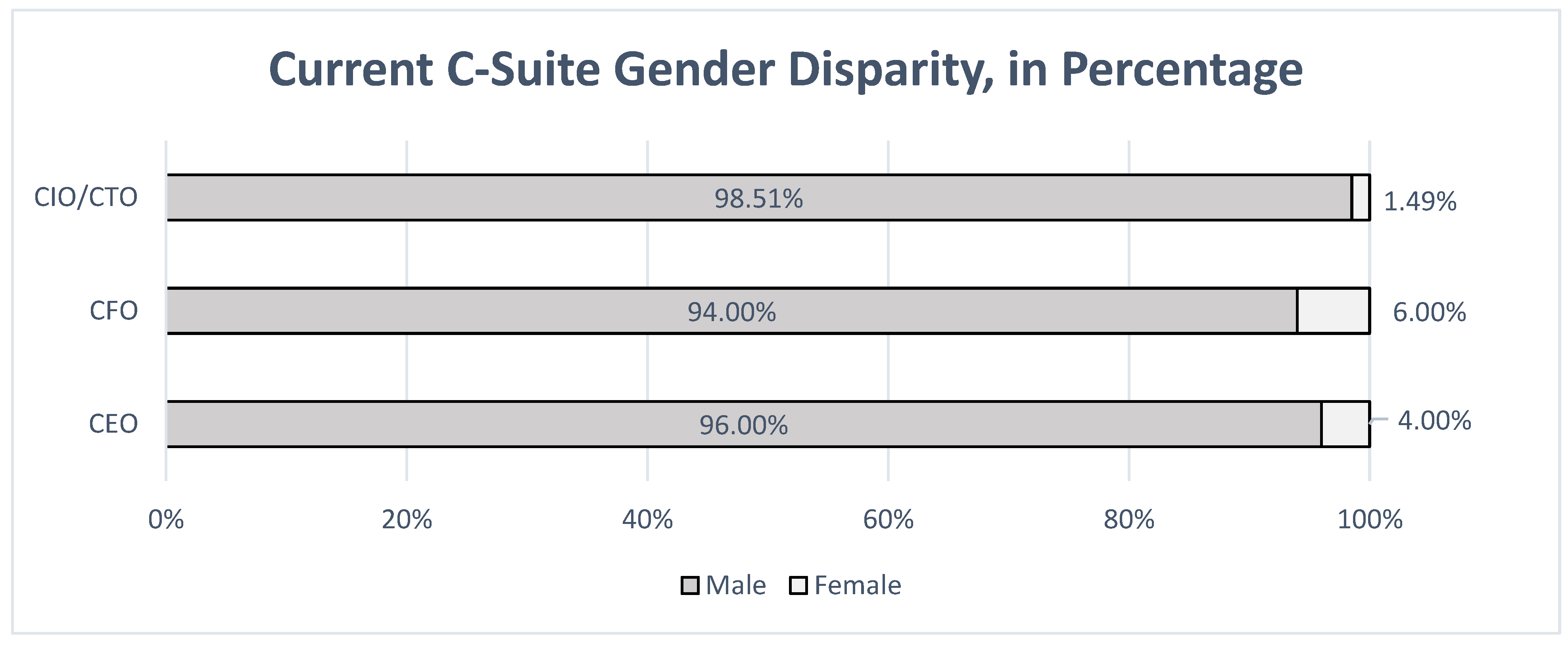
The current fintech gender disparity is in CEO, CFO, CIO, and CTO positions. There is a gender disparity across all four C-suite roles in fintech.
Figure 1 compiles data from two different sources to visualize the disparity across these positions. Based on data from Crunchbase, in 2021, women held only 4 percent of CEO positions and 1.49 percent of the combined CIO and CTO positions [
34]. Due to indicators of horizontal segregation of women outside technology into more stereotypical roles, the positions of CIO and CTO were combined. These data were global, as fintech firms were headquartered in different countries. Additionally, based on data from BoardEx, in 2021, women held only 6 percent of CFO positions among 107 US public financial services institutions [
35]. Fintech must address the underrepresentation of women in the C-suite. To achieve gender parity, it is essential to identify the barriers that women in fintech face to achieving C-suite status.
6. Sustainable HRM
Sustainable HRM consists of two perspectives. First, the belief is that organizations need employee support to achieve sustainable HRM. Second, the organization must support sustainable employee behavior [
36]. Organizations employ various methods to realize these perspectives. Recruitment is one of the most profound intervention methods [
36]. During recruitment, the objective is to select employees who are sustainability-conscious. Recruiters search for candidates whose individual norms align with corporate sustainability goals [
36]. Reducing barriers to sustainability is another element of intervention. The purpose is to motivate employees to engage in sustainable behavior [
36]. Increasing workers’ cognitive and behavioral skills is another intervention method. Employers can strengthen and activate worker norms by enhancing skills and behaviors. Employers achieve this by linking employee sustainability education to the company’s impact [
36]. Each of these intervention methods can help organizations achieve their sustainable HRM goals. In addition, sustainable HRM practices contribute to firm-level outcomes by aligning human capital development with long-term value creation and sustainability objectives, reinforcing their role as a strategic organizational capability [
15,
37].
Sustainable HRM practices consider non-discrimination, fairness, equality, and diversity. Diversity encompasses sociodemographic characteristics such as gender, race, age, and ethnicity [
36]. The procedure can be further strengthened by promoting a diverse workforce across all ranks of the hierarchy and by including diversity and non-discrimination training sessions. Organizations should ensure that their promotion policies are non-discriminatory [
36]. Diversity is a critical component of sustainable HRM practices. Though it should not be the only practice, organizations should also include intervention methods. Sustainable HRM is crucial to closing gender disparities in fintech’s C-suite. Prior research demonstrates that gender diversity in leadership is associated with stronger governance, improved monitoring, and enhanced sustainability performance, highlighting the importance of embedding diversity within HRM systems, rather than treating it as a standalone initiative [
1,
22,
28]. Moreover, sustainable HRM practices emphasizing equal opportunity and inclusion can help mitigate structural barriers rooted in gender bias, thereby strengthening leadership pipelines and organizational resilience [
19].
HR analytics are a critical tool of sustainable HRM used to collect, analyze, and interpret corporate data to ensure merit-based promotion rather than symbolic inclusion. This can be achieved through analyzing worker performance and developing tailored support systems and learning opportunities to address individual employee needs. Leveraging this information enables organizations to create policies that foster diversity through data-driven insights. Additionally, analytics can identify workforce imbalances by integrating AI to provide real-time identification of talent gaps and recommendations for personalized development plans. This allows organizations to make evidence-based decisions in alignment with corporate goals, worker well-being, and emphasis on long-term sustainability [
5]. Data-driven HRM systems enhance firms’ ability to allocate human capital efficiently and support inclusive decision-making, which is particularly critical in innovation-driven sectors such as fintech [
38,
39]. By reducing reliance on subjective evaluations, HR analytics can also help address unconscious bias and improve the credibility of leadership advancement processes, reinforcing the link between sustainable HRM practices and gender parity in leadership.
7. The Triple Glass Ceiling
Barriers impede women’s attainment of parity in the C-suite. The triple glass ceiling captures the threefold barrier for women. The three barriers applying to fintech are financial, entrepreneurial, and technological. Identifying and understanding the implications of each barrier is essential to achieving gender parity.
7.1. Financial Barrier
The financial glass ceiling impedes women from attaining C-suite status in fintech. Research finds that the financial sector influences the career progression of two-thirds of individuals in fintech. The boy’s club culture of the financial industry bleeds into fintech [
34]. According to Hofstede’s value dimensions, fintech is classified as highly masculine. A highly masculine culture is characterized by assertiveness, materialism, and a lack of empathy for others [
40]. Consider the language that fintech job descriptions use, such as “looking for a hunter” or “eating what you kill” [
34]. The high degree of masculinity negatively impacts women’s achievement of C-suite status. These dynamics are consistent with broader evidence that gendered organizational cultures shape leadership opportunities by reinforcing norms that align leadership with traditionally masculine traits, thereby disadvantaging women [
11,
12].
A highly masculine culture negatively impacts gender parity. The negative impact on the recruitment, hiring, and career development of female applicants and employees is visible. Utilizing masculine language in job descriptions reduces female participation in recruitment. Women do not identify with this type of social coding and often will not want to work in such an environment. During the hiring phase, the dominance of masculine culture is evident in female candidates’ perceptions. For example, a candidate may not move forward due to the likelihood of marriage, family expansion, or parental leave [
34]. Even when female candidates overcome recruitment and hiring barriers, they must contend with a broken rung in their career development. A broken rung refers to women’s reduced likelihood of career advancement from entry-level to management roles [
41]. A masculine culture prevents women from achieving representation in junior-level management positions. If women cannot reach junior positions, this further widens the gender disparity at the C-suite level. These patterns reflect systematic inefficiencies in talent allocation, where qualified human capital is underutilized due to biased evaluation processes, ultimately reducing organizational effectiveness and long-term performance [
15,
19].
Further exacerbating the broken rung is the masculine nature of fintech networking. Masculine networking systems exclude women. Whether intentional or personal, exclusion from networking events negatively affects women’s advancement to C-suite positions. Networking in fintech traditionally occurs outside the office and off the clock. These events often happen late at night, in men’s clubs, and consist of heavy drinking. A negative impact occurs when selecting venues and times that exclude women, thereby reducing access to roles and positions [
34]. If women cannot access professional networks for career development, the gender disparity will increase. This exclusion also limits access to critical financial and investment networks, which play a central role in career progression and entrepreneurial success within fintech [
42,
43]. Moreover, venture capital decision-making processes, which are often shaped by informal relationships, can reinforce gender bias and restrict women’s access to funding and leadership opportunities [
44]. Addressing the masculine culture of fintech is therefore critical not only for improving gender parity but also for enhancing the efficiency of capital allocation and innovation outcomes within the industry [
2,
3].
7.2. Technology Barrier
The technology glass ceiling inhibits gender parity in C-suite positions. The technology glass ceiling is more significant than in the financial industry. It will take one hundred years to reach gender parity in technology [
45]. Consider that women in CIO and CTO positions comprise only 1.49% [
34]. Horizontal segregation means the isolation of women into traditionally feminine roles outside of technology. This segregation reduces female participation in Science, Technology, Engineering, and Math (STEM). The lack of representation furthers discrimination and stereotyping. These patterns are consistent with broader evidence that gendered occupational segregation limits the development and deployment of technical human capital, thereby constraining leadership pipelines in innovation-driven sectors [
15,
19]. In fintech, technological expertise is central to strategic decision-making, and such disparities have particularly pronounced implications for leadership representation and firm performance [
38,
39].
Discrimination and stereotyping go hand in hand. Discrimination and stereotyping in the technology industry create a glass ceiling for women at the C-suite level. Women in STEM experience structural discrimination, leading to a lack of support or encouragement to pursue STEM careers [
34]. This discrimination is due to the industry’s stereotyping as masculine. By discouraging female participation in the technology sector, starting with education, masculine stereotyping will persist, creating an underrepresentation of women in the industry. These dynamics reflect social role expectations that associate technical competence and leadership with masculine traits, thereby biasing evaluation and advancement processes [
11,
12]. As a result, firms may fail to fully leverage available talent, leading to inefficiencies in human capital utilization and reduced innovative capacity [
16,
26].
Women in the technology sector experience positive discrimination. Positive discrimination refers to tokenism. Tokenism treats individuals belonging to a group as symbols representing a category rather than as individuals [
34]. Tokenism creates friction that arises from the duality between increased visibility among other women and a desire for acknowledgment of contributions, rather than gender. Women seek visibility for their accomplishments, perspectives, and philosophy rather than for their gender. Current women’s roles within the industry can perpetuate the belief that their contribution resides in gender identity, furthering tokenism [
34]. Such dynamics can undermine perceptions of leadership legitimacy and distort performance evaluations, limiting career progression despite demonstrated competence [
13,
19]. Moreover, tokenism may weaken organizational decision-making by constraining the effective integration of diverse perspectives, thereby reducing the potential benefits of diversity for innovation and governance [
17,
22]. Addressing discrimination and stereotyping in recruitment, hiring, and career development can help close gender disparities at the C-suite level. From a sustainable HRM perspective, implementing diversity training, inclusive recruitment, and merit-based evaluation systems can reduce bias and strengthen the development of inclusive leadership pipelines in technology-intensive industries.
7.3. Entrepreneurial Barrier
The entrepreneurial glass ceiling impedes women’s mobility to the C-suite. Women in entrepreneurship experience limited access to venture capital (VC) funding. Female entrepreneurs receive only 2 percent of VC funding, though they account for 38 percent of US businesses [
46]. Men often have access to 1000 percent more venture capital than their female counterparts [
34]. The disparity in access to capital begins with the investors. These patterns are consistent with broader evidence that gender bias in entrepreneurial finance constrains the allocation of capital to women-led ventures, limiting their growth potential and reducing their representation in leadership positions [
42,
43]. In fintech, such funding disparities significantly hinder women’s ability to build and lead firms at scale, thereby reinforcing gender gaps in executive leadership [
38].
Potential VC investors ask different questions depending on the founder’s gender. During Q&A sessions, investors are more likely to phrase questions to men in a positive manner [
46]. VC investors frame questions positively through optimism, accomplishments, progress, and principles. Male entrepreneurs field primarily promotional questions 67 percent of the time and receive an average of
$16.8 million in funding [
46]. In contrast, investors frame questions for women negatively. Investors adopt a preventive orientation by posing questions about safety, liability, defense, and caution. The difference in question type corresponds to different funding levels. Female entrepreneurs primarily field preventative questions 66 percent of the time and receive an average of
$2.3 million in funding. For every preventative question, entrepreneurs lose approximately
$3.8 million in funding [
46]. These differences reflect underlying cognitive and social biases in investment decision-making, in which evaluations are shaped by gendered expectations about risk, competence, and leadership potential [
11,
12]. Moreover, venture capital decision-making often relies on informal networks, which can further disadvantage women entrepreneurs who are less embedded in these networks [
44].
Beyond individual interactions, structural features of VC markets amplify these disparities. Access to funding is frequently mediated by social and professional networks, where women are underrepresented, limiting their exposure to investors and high-growth opportunities [
43]. This exclusion reduces not only access to funding but also to mentorship, strategic guidance, and legitimacy within the entrepreneurial ecosystem. From a resource-based perspective, such constraints lead to suboptimal allocation of financial and human capital, as high-potential ventures led by women may be overlooked, ultimately reducing innovation and long-term value creation [
15,
16]. Addressing disparity in access to venture capital can reduce the entrepreneurial glass ceiling. Specifically, sustainable HRM practices such as structured mentorship programs, inclusive networking initiatives, and leadership development pathways can help women entrepreneurs build the capabilities, networks, and credibility necessary to navigate VC environments and secure funding, thereby strengthening pathways to executive leadership.
8. Illustrative Cases
We use two case vignettes of fintech companies to provide illustrative rather than causal evidence of how the fintech industry has addressed the triple glass ceiling and how these achievements have improved firm sustainability outcomes. One case emphasizes the link between firm sustainable HRM practices and gender parity in organizational leadership. At the same time, the other underscores the positive implications of greater gender parity in firm leadership for various sustainability outcomes. The first case is Nubank, a fintech company that has effectively employed inclusive HRM practices to improve gender parity in leadership. Nubank has emerged as one of the world’s largest digital banks, serving tens of millions of customers across Latin America. Co-founded by Cristina Junqueira, the company has made strides toward gender inclusion in an industry dominated by men. Junqueira played a pivotal role in shaping the firm’s diversity and inclusion strategy, emphasizing equitable policies and recruiting practices informed by her own experiences overcoming gender barriers in finance. As part of its public commitments, Nubank pledged to achieve 50 percent women in leadership roles by 2025, demonstrating organizational accountability for gender parity in top positions. The firm has implemented targeted recruitment initiatives, such as the “Yes, She Codes!” program, designed to attract female technical talent, and mentoring and resource groups that support women’s career development. Internal policies such as extended parental leave, blind recruiting, and dedicated mentoring programs for women help reduce bias and foster advancement into managerial and leadership roles. As a result of these inclusive HRM practices, women constitute a substantial portion of Nubank’s workforce—nearly 43 percent overall and about 30 percent of senior positions. This is a marked contrast to traditional fintech firms, where women hold far fewer leadership roles [
47].
These efforts demonstrate how sustainable HRM interventions can expand women’s presence in leadership. Indeed, although broader industry statistics indicate that women still constitute a minority of fintech leadership globally, Nubank’s approach demonstrates that inclusive organizational practices can narrow this gap and reinforce the systemic value of gender diversity in executive teams [
48]. Nevertheless, a key factor in Nubank’s progress might be the presence of women from the organization’s very founding. Such factors at the time of founding could have profound and long-lasting effects on organizational behavior despite environmental and organizational change. Additionally, the company’s approach might be particularly successful in Latin America, which has a distinct cultural makeup. Some of Nubank’s practices might be transferable to other cultural contexts, while others could be more rigid. Additionally, although elevating women into decision-making roles positions Nubank to serve diverse customer needs better and strengthen its governance and strategic performance, more information is needed to confirm sustainability outcomes across all dimensions.
Another notable fintech company is Ellevest, a women-founded and women-led investment platform designed to close gender gaps in wealth accumulation and financial planning. Ellevest is a fintech organization that is currently achieving various sustainability outcomes as a women-led firm. Founded by former Wall Street executive Sallie Krawcheck, Ellevest has built its mission around gender-aware financial products and services that account for realities such as earlier peak earnings and longer lifespans for women investors. Among its achievements is managing over US
$1 billion in assets, most of which are held by women clients, reflecting how gender-centered leadership can drive both commercial and social value [
49]. Ellevest’s organizational culture emphasizes diversity at all levels, aligns product development with the lived financial experiences of women, and prioritizes empathetic, inclusive decision-making. As a women-led firm, Ellevest’s HR and leadership practices inherently support a culture that values diverse perspectives and professional advancement opportunities for women across roles.
Beyond product innovation, Ellevest’s leadership structure itself serves as a model of gender parity in fintech executive roles. The firm’s focus on embedding gender-aware thinking into organizational strategy highlights how women leaders can reshape traditional financial practices and broaden the scope of sustainability outcomes. By focusing on women’s financial needs, Ellevest contributes to economic sustainability through improved financial inclusion and empowerment [
49].
This case illustrates that when women are not only included but also positioned in strategic leadership roles, organizational outcomes can better align with equity, inclusion, and long-term value creation, which are key pillars of sustainable performance. Nevertheless, it is important to note that the leadership influence of women at Ellevest might dominate over conditions defined by greater parity. This raises the question of whether parity would further enhance Ellevest’s success in achieving sustainable outcomes. Additionally, similar to Nubank, a woman founded the company, and its culture could reflect the key values and behaviors instilled by the founder.
9. Promoting Gender Parity in Fintech
The triple glass ceiling creates gender disparity in fintech. Barriers to breaking the glass ceilings include a broken rung in career development, discrimination in the technology sector, and gender disparity in VC funding. Addressing the obstacles women face in securing CEO, CFO, CIO, and CTO roles in fintech is crucial to achieving greater gender parity in leadership.
9.1. Addressing the Broken Rung
Sustainable HRM practices are central to addressing the ‘broken rung,’ as early-career gender disparities in promotion undermine not only equity but also long-term organizational sustainability. Employees are more likely to engage with and support companies that demonstrate ethical behavior and a commitment to corporate social responsibility, as reflected in their alignment with social and environmental values [
5]. When women are excluded from initial leadership pathways, organizations lose diverse perspectives critical to ethical governance, innovation, and sustainable decision-making. This exclusion also represents a misallocation of human capital, where qualified talent is underutilized due to structural barriers, ultimately reducing firm performance and long-term value creation [
15,
19]. Prior research further shows that gender diversity in leadership is associated with stronger governance, improved monitoring, and more sustainable corporate outcomes, underscoring the importance of early pipeline development [
1,
22]. Networking, as a core HRM practice, provides a strategic mechanism for mitigating the broken rung by ensuring equal access to social capital, visibility, and career-development opportunities that support sustainable leadership pipelines.
In the fintech sector, women continue to face systemic exclusion from influential networking spaces, reinforcing gender disparities that limit advancement to senior and C-suite roles [
34]. This exclusion perpetuates unsustainable leadership structures characterized by homogeneity and short-term decision-making. In innovation-driven sectors such as fintech, where collaboration and information exchange are critical, limited access to networks can constrain both individual career progression and organizational adaptability [
38,
39]. A support network, defined as two or more individuals who meet to discuss progress and apply learning capabilities in the workplace, can counteract these dynamics by fostering inclusive knowledge sharing and leadership development [
50]. Employee networks built around shared goals and professional growth not only enhance individual career outcomes but also strengthen organizational learning and resilience. Moreover, access to professional networks is closely linked to access to opportunities, resources, and sponsorship, which are essential for advancement into leadership roles [
16].
To align networking practices with sustainability objectives, organizations must embed diversity and inclusion into HRM systems from the top down. In fintech, dismantling the entrenched ‘boys’ club’ culture is essential to closing the financial glass ceiling and creating leadership structures capable of addressing complex environmental, social, and governance (ESG) challenges. Sustainable HRM policies should actively counter overly masculine norms by formalizing inclusive networking opportunities rather than relying on informal, exclusionary systems. One effective strategy is to require all entry-level or newly hired employees to participate in structured networking programs. Institutionalizing networking at the earliest career stages ensures parity in access to developmental resources, promotes equitable leadership pipelines, and supports the long-term sustainability of organizations by cultivating diverse, future-ready leaders. Such practices enhance firms’ ability to develop and retain valuable human capital, reinforcing competitive advantage and enabling more effective responses to sustainability challenges [
26,
28].
9.2. Reducing Tokenism in Technology
Sustainable HRM practices can also reduce the negative impact of positive discrimination by addressing tokenism, which undermines both gender equity and organizational sustainability. While initiatives to increase women’s representation are often well-intended, superficial inclusion can reinforce gender stereotypes and undermine the legitimacy of women’s leadership, ultimately limiting the long-term benefits of diversity. From a sustainability perspective, leadership pipelines that rely on token representation rather than genuine inclusion fail to cultivate the diverse capabilities needed for ethical governance, innovation, and resilient decision-making. This dynamic is consistent with research showing that diversity yields performance and governance benefits only when it is meaningfully integrated into decision-making processes, rather than treated as symbolic compliance [
17,
22]. When tokenism persists, organizations risk underutilizing human capital and thereby weakening the potential advantages of diverse leadership [
15].
Diversity training represents a key HRM intervention for mitigating tokenism by addressing unconscious bias in organizational decision-making. Diversity training programs help managers and employees understand how to foster inclusion and an equitable work environment by increasing awareness of conscious and unconscious biases. Successful diversity training requires the organization to conduct evaluations and ongoing reviews to ensure that clearly defined outcomes are met [
51]. In the fintech sector, women frequently experience positive discrimination in the form of tokenism, in which visibility is mistaken for influence, thereby negatively affecting career development and perceptions of competence [
34]. Unconscious bias, defined as judgments made outside conscious awareness and shaped by cultural, social, and personal experiences, can distort performance evaluations and promotion decisions [
50]. These biases reflect broader social role expectations that associate leadership and technical competence with masculine traits, thereby influencing how women’s contributions are evaluated [
11,
12]. As a result, organizations may fail to leverage available talent fully, thereby reducing their capacity for innovation and effective decision-making [
16,
26]. These biases contribute to unsustainable leadership structures by privileging symbolic inclusion over merit-based advancement.
To align diversity initiatives with sustainability goals, organizations must implement diversity training that explicitly recognizes unconscious bias and its implications for career progression and leadership credibility. Effective training equips employees and managers with the tools to identify and challenge biased assumptions, ensuring that women’s achievements are evaluated on merit rather than attributed to token status. By reducing the perception that advancement is driven by symbolic representation rather than competence, sustainable HRM practices help build trust, improve governance quality, and support the development of inclusive leadership pipelines. Empirical evidence suggests that organizations with more inclusive leadership structures demonstrate stronger governance, improved stakeholder alignment, and enhanced sustainability performance [
23,
28]. In doing so, diversity training moves organizations beyond compliance-driven diversity efforts toward genuinely sustainable, high-performing, and equitable workplaces.
9.3. Reducing Gender Disparity in VC Funding
Sustainable HRM practices can play a crucial role in reducing gender disparities in access to venture capital. This persistent barrier limits women’s participation in innovative and high-growth sectors such as fintech. Unequal access to VC funding not only constrains individual entrepreneurial opportunities but also undermines economic sustainability by narrowing the pool of ideas, talent, and leadership shaping financial and technological systems. From a sustainability perspective, addressing funding disparities is essential for fostering inclusive economic growth and resilient innovation systems. Prior research demonstrates that capital allocation decisions significantly influence firm strategy, innovation trajectories, and long-term value creation, underscoring the broader economic implications of unequal access to financing [
2,
3]. When women-led ventures are systematically underfunded, markets may fail to allocate resources efficiently, leading to missed opportunities for innovation and growth [
42,
43].
Mentorship programs represent a key HRM strategy for addressing gender disparities in VC access by strengthening women’s human and social capital. Female fintech entrepreneurs continue to face significant gaps in access to venture funding, often due to limited exposure to investor networks and credibility signals valued by VC decision-makers [
34]. Mentorships, which involve developmental relationships across organizational levels regardless of formal position [
50], provide women with guidance, sponsorship, and industry-specific knowledge that are critical for navigating competitive funding environments. Research indicates that targeted mentorship helps develop the behaviors, strategic communication skills, and confidence necessary to secure VC investment in fintech [
52]. In addition, access to experienced mentors and sponsors can help entrepreneurs navigate investor expectations and overcome biases embedded in evaluation processes, which are often shaped by network-based decision-making [
44]. By strengthening both human and social capital, mentorship programs enhance women’s ability to signal competence and legitimacy in high-stakes funding environments.
To align mentorship initiatives with sustainability goals, organizations must institutionalize mentorship programs within their HRM frameworks rather than treat them as optional or informal supports. In highly competitive fintech and VC landscapes, structured mentorship enhances skill development, improves access to investor networks, and reduces systemic gender disparities in funding outcomes. From a resource-based perspective, such practices enable organizations to develop better and deploy entrepreneurial talent, transforming underutilized human capital into a source of competitive advantage [
15,
16]. By cultivating inclusive entrepreneurial pipelines and supporting women’s advancement into innovation and leadership roles, sustainable HRM practices contribute to more equitable capital allocation, stronger governance, and long-term economic sustainability. These outcomes are particularly important in fintech, where innovation-driven growth depends on the effective integration of diverse perspectives and equitable access to financial resources [
38].
10. Integrative Framework
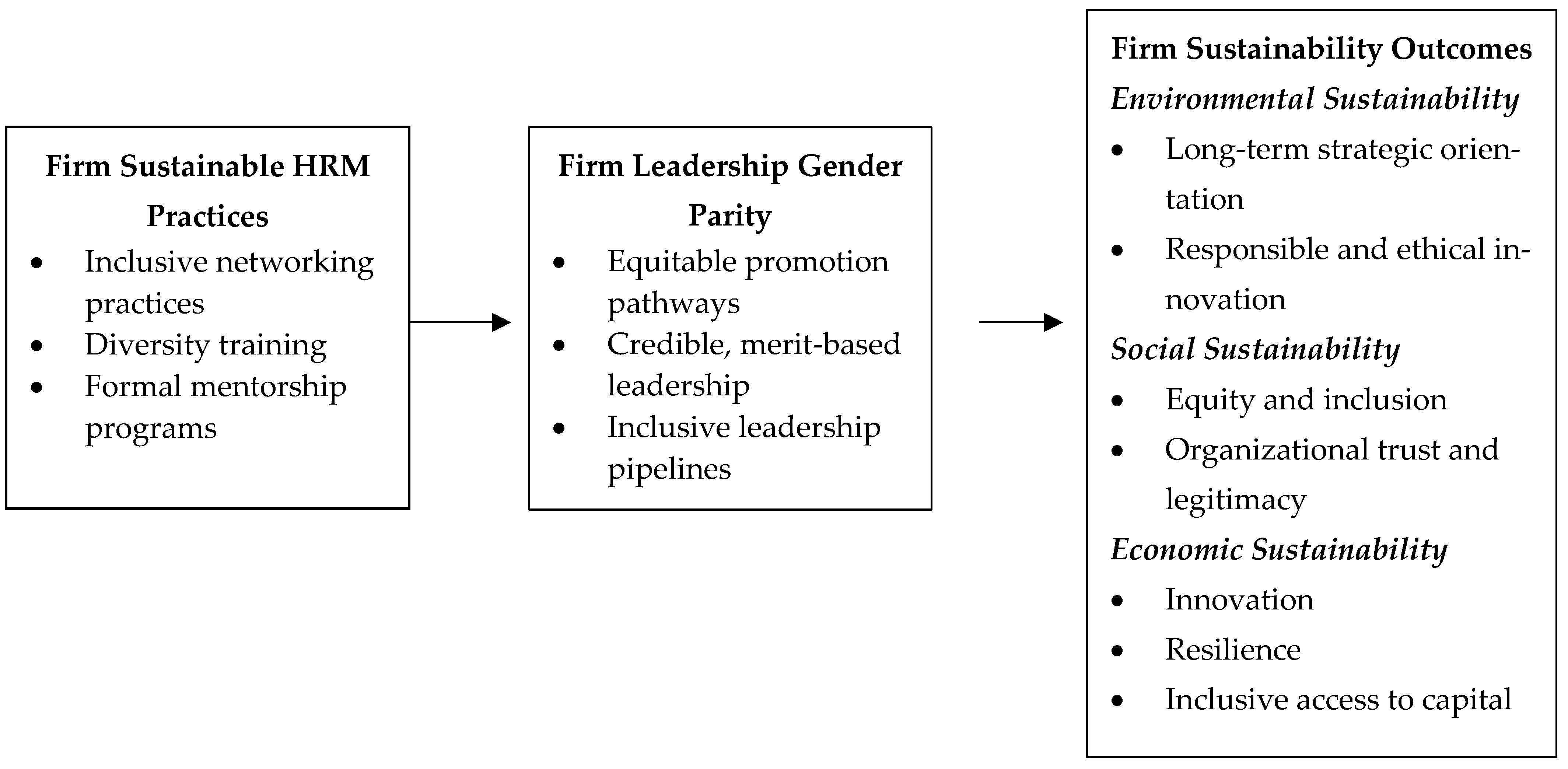
Integrating these insights, we develop a conceptual model outlined in
Figure 2 that positions firm sustainable HRM as a foundational mechanism for advancing gender parity in organizational leadership, thereby contributing to environmental, social, and economic sustainability outcomes. Sustainable HRM extends beyond traditional efficiency-oriented personnel practices by integrating long-term value creation, equity, and stakeholder well-being into human capital management. Within this framework, gender parity in leadership is not treated as an isolated diversity outcome but as a structurally embedded feature of sustainable organizations affecting the quality of decision-making, governance, and innovation.
The model proposes that specific dimensions of sustainable HRM—inclusive networking, diversity training, and mentorship programs directly address structural barriers that constrain women’s advancement, particularly in fintech and other male-dominated, innovation-driven sectors. By reducing early-career promotion gaps (the broken rung), minimizing tokenism driven by unconscious bias, and expanding access to social and financial capital, sustainable HRM practices foster more equitable, credible, and inclusive leadership pipelines. Leadership gender parity, in turn, is argued to enhance sustainability outcomes across environmental, social, and economic dimensions by broadening perspectives, strengthening governance, and supporting long-term strategic orientation. The model further allows the formulation of several general research propositions.
10.1. Inclusive Networking and Equitable Promotion Pathways
Networking is a critical source of social capital and career advancement, yet access to influential networks is often unevenly distributed by gender. In many organizations, particularly in fintech, informal and exclusionary networking practices reinforce the “broken rung,” whereby women are less likely than men to receive early promotions that serve as gateways to senior leadership. Women’s systematic disadvantage in networking-based selection processes creates a gendered status quo in which stereotypes shape corporate discourse [
53]. These patterns are consistent with social role theory, which suggests that gendered expectations influence access to opportunities and shape perceptions of leadership potential, often privileging individuals who conform to masculine norms [
11,
12]. Sustainable HRM reframes networking as an inclusive, institutionalized practice rather than an informal privilege, thereby ensuring equal access to developmental relationships and visibility.
Inclusive networking practices encourage greater gender parity in leadership by fostering equitable promotion pathways for women. Networking within the fintech community allows mentees to exchange ideas, collaborate on projects, and gain exposure to different perspectives and expertise [
8]. Networking practices that address the broken rung can improve employee morale and retention by creating more equitable advancement opportunities. Access to networks enhances the development and deployment of human and social capital, which are critical drivers of organizational performance and competitive advantage [
15,
16]. When networking opportunities are unevenly distributed, firms risk underutilizing valuable talent, thereby weakening leadership pipelines and long-term strategic capabilities. These individual-level outcomes are aggregated at the firm level to improve gender parity in leadership. By embedding inclusive networking into HRM systems, such as structured networking programs for new hires or cross-level collaboration initiatives, organizations can reduce disparities in early promotion outcomes and support more equitable leadership trajectories. In addition, inclusive networks facilitate knowledge sharing and collaboration, which are particularly important in innovation-driven sectors such as fintech, where access to information and relationships shapes both career advancement and firm performance [
38,
39]. Accordingly, inclusive networking is theorized to play a central role in advancing gender parity in leadership.
Proposition 1: Firm inclusive networking practices are associated with more equitable promotion pathways for women, thereby reducing the broken rung in the organization and advancing greater firm gender parity in leadership.
10.2. Diversity Training and Credible, Merit-Based Leadership
Efforts to increase women’s representation in leadership can inadvertently lead to tokenism when inclusion is symbolic rather than substantive. Tokenism, often driven by unconscious bias, undermines perceptions of women’s competence and leadership legitimacy, weakening both individual career outcomes and organizational governance. Sustainable HRM addresses this challenge through diversity training that explicitly targets unconscious bias in evaluation, promotion, and decision-making processes. These dynamics are consistent with social role theory, which posits that gendered expectations shape how leadership potential and performance are evaluated, often leading to biased attributions that disadvantage women [
11,
12]. When such biases go unaddressed, organizations risk reinforcing symbolic inclusion rather than fostering genuine leadership diversity.
Organizational diversity training programs reduce gender disparities in organizational leadership by promoting more merit-based, credible leadership opportunities for women. Successful implementation of diversity training enhances employee trust by prioritizing merit-based assessments over symbolic representation. These training programs have a strong effect on participants’ views of diversity, making them more receptive to alternative viewpoints. A top-down approach is necessary to address gender disparity through diversity training, which requires sustained leadership emphasis on inclusive behaviors, regular refresher training workshops, inclusion of diversity objectives in performance evaluations, and the integration of these ideals into daily routines [
51]. By educating managers and employees to recognize and challenge biased assumptions, firm diversity training supports more consistent, merit-based performance assessments. Reducing bias in evaluation processes enables firms to more effectively identify, develop, and deploy human capital, thereby enhancing organizational capability and long-term performance [
15,
19]. Moreover, organizations with more inclusive and merit-based leadership structures demonstrate stronger governance and improved sustainability outcomes, highlighting the broader strategic value of reducing tokenism [
23,
28]. This, in turn, reduces the likelihood that women’s advancement is attributed to symbolic representation rather than to capability, thereby strengthening the credibility of women leaders and reinforcing gender parity in organizational leadership.
Proposition 2: Firm diversity training is positively associated with merit-based leadership for women, thereby reducing tokenism within the organization and advancing greater firm gender parity in leadership.
10.3. Mentorship Programs and Inclusive Leadership Pipelines
Access to mentorship is a critical determinant of leadership development, particularly in sectors where advancement depends on tacit knowledge, sponsorship, and investor networks. Women in fintech and entrepreneurial contexts face persistent barriers to venture capital and growth opportunities, limiting their progression into senior leadership and innovation-driving roles. These barriers are consistent with social role theory, which suggests that gendered expectations shape access to opportunities, networks, and credibility signals, often disadvantaging women in high-growth and investment-driven environments [
11,
12]. Sustainable HRM positions mentorship as a formal, organization-wide practice that supports skill development, confidence building, and access to influential networks. By institutionalizing mentorship, firms can counteract structural inequalities in access to social and financial capital that constrain women’s advancement [
42,
43].
Organizational mentorship programs can effectively address gender disparity in organizational leadership by enhancing women’s access to social capital, skills development, and venture capital opportunities. Successful firm mentorship programs provide guidance, encourage skill development, and support professional advancement. Individuals benefit from skill development and advancement, which increases employee productivity and fosters retention. Determining the success of mentorship programs in fintech requires a multidimensional approach that evaluates mentor-mentee satisfaction, tracks mentee progress and outcomes, assesses career progression, and gauges skill development and application [
8]. As the fintech landscape evolves rapidly, firm mentorship programs are vital to developing talent and driving organizational success. This emphasis on development drives innovation and advancement in the fintech industry [
8]. Mentorship programs enhance the development and deployment of human and social capital, enabling firms to leverage talent better and build sustainable competitive advantage [
15,
16]. Moreover, mentorship and sponsorship relationships can help women navigate venture capital ecosystems, where decision-making is often influenced by networks, thereby improving access to funding and high-growth opportunities [
44]. Through structural support and guidance, firm mentorship programs help build the competencies necessary to build social capital, attain higher-level skills, and pursue VC opportunities, all of which are vital for career advancement. When aggregated at the organizational level, these outcomes contribute to greater gender parity in organizational leadership.
Proposition 3: Firm mentorship programs are associated with more inclusive leadership pipelines for women, thereby enhancing their access to opportunities in the organization and advancing greater firm gender parity in leadership.
By their nature, Propositions 1–3 specify longer-term temporal effects to enable networking, mentorship, and training to produce the expected outcomes in leadership pipelines and promotion pathways. Therefore, time lags of one or more years are needed to observe stronger effects.
10.4. Leadership Gender Parity and Environmental Sustainability
Firm leadership gender parity can influence firm environmental sustainability by enhancing governance quality and strategic orientation. Diverse leadership teams are more inclined to consider long-term environmental risks, support responsible innovation, and adopt precautionary resource management practices. Incorporating diverse perspectives into decision-making often yields more sustainable outcomes. From a resource-based perspective, gender diversity in leadership teams creates a valuable, heterogeneous pool of human capital that enhances firms’ ability to process complex information and respond to environmental challenges, thereby supporting sustained competitive advantage [
14,
15]. At the same time, gendered experiences and expectations shape leaders’ preferences and decision-making styles, often leading women to place greater emphasis on stakeholder welfare and long-term sustainability considerations [
11].
Fintech organizations that prioritize gender parity in the C-suite see improvements in firm-level outcomes. Research supports the association among female CEOs, board feminization, and the advancement of environmental innovation [
54]. The argument is that women are more concerned about ecological issues than men. Other perspectives suggest that leaders behave in accordance with societal expectations associated with their gender roles [
1]. Corporate eco-innovation often relies on women’s involvement, given their prioritization of others’ interests and demonstrated ecological sensitivity. This involvement improves group decision-making, enhances firm outcomes, and increases an organization’s competitive advantage [
54]. Empirical evidence further indicates that gender diversity on boards is associated with stronger monitoring, improved governance quality, and more effective oversight of sustainability initiatives [
1,
22]. In addition, leadership gender composition has been linked to differences in risk-taking and strategic decision-making, which can influence firms’ environmental investments and long-term orientation [
2,
3]. Greater gender diversity in organizational leadership enhances governance and strategic decision-making, facilitating a deeper understanding of the long-term impacts of business choices. Ultimately, these improvements strengthen a firm’s commitment to sustainable practices.
Proposition 4: Firm leadership gender parity is associated with improved firm environmental sustainability outcomes, such as (a) long-term strategic orientation and (b) responsible and ethical innovation.
10.5. Leadership Gender Parity and Social Sustainability
Firm social sustainability depends on equity, inclusion, and institutional trust. These outcomes are closely tied to those who hold decision-making power. Firm leadership gender parity signals an organization’s commitment to fairness and inclusion and can enhance employee engagement, legitimacy, and social cohesion. More inclusive leadership structures are therefore expected to contribute positively to social sustainability outcomes within organizations and their broader stakeholder environments. From a resource-based perspective, inclusive leadership enhances the quality of relational and human capital within firms, strengthening cooperation, trust, and knowledge sharing [
14,
15]. Additionally, gender diversity in leadership teams brings broader perspectives on stakeholder needs, often emphasizing fairness, collaboration, and social responsibility in decision-making [
11,
12].
Numerous empirical studies examine the link between women in organizational leadership and firm ESG performance [
55]. Greater gender parity in organizational leadership is associated with social outperformance relative to industry peers. The general argument is that psychological traits make women in leadership more likely to approach social issues with sensitivity while balancing stakeholders’ needs. Indeed, female social roles align with flexibility and sympathy, which are critical attributes for addressing controversial or ambiguous issues [
55]. Beyond these behavioral explanations, empirical research shows that gender diversity on boards is associated with improved stakeholder engagement, enhanced transparency, and stronger corporate social performance [
17,
22]. In addition, firms with greater gender diversity in leadership tend to adopt more inclusive workplace practices, which can improve employee satisfaction, reduce turnover, and strengthen organizational commitment [
19,
28]. These outcomes contribute directly to social sustainability by fostering equitable and inclusive organizational environments.
Moreover, gender parity in leadership can enhance organizational legitimacy in the eyes of external stakeholders, including customers, investors, and regulators. Firms that demonstrate inclusive leadership are more likely to be perceived as socially responsible and trustworthy, thereby strengthening stakeholder relationships and reinforcing long-term organizational resilience. In the context of fintech, where trust and transparency are critical to user adoption and regulatory compliance, socially sustainable leadership structures can provide a significant strategic advantage [
38]. Greater gender diversity in leadership also improves the firm’s ability to respond to diverse stakeholder needs, thereby enhancing social impact and reinforcing institutional trust. Overall, effective firm leadership gender parity is vital for achieving social sustainability within organizations.
Proposition 5: Firm leadership gender parity is associated with improved firm social sustainability outcomes, such as: (a) organizational equity and inclusion, and (b) organizational trust.
10.6. Leadership Gender Parity and Economic Sustainability
Finally, gender parity in organizational leadership is theorized to strengthen firm economic sustainability by fostering innovation, resilience, and inclusive access to capital. Diverse leadership teams are better equipped to navigate uncertainty, allocate resources effectively, and identify new market opportunities. In innovation-driven sectors such as fintech, gender-parity leadership structures also support more equitable access to capital and entrepreneurial opportunities, reinforcing long-term economic viability. From a resource-based perspective, gender diversity in leadership enhances the breadth of firm capabilities by combining heterogeneous knowledge, skills, and perspectives, thereby improving problem-solving, strategic flexibility, and adaptability in dynamic environments [
14,
15]. Additionally, diversity in leadership introduces complementary cognitive approaches to risk assessment and decision-making, thereby improving the strategic balance between growth and risk management [
11].
Organizations benefit from women in decision-making roles by gaining broader perspectives on business stakeholders. Research shows that organizations with gender-balanced leadership have a 20 percent higher likelihood of reporting improved economic outcomes [
56]. Beyond aggregate performance, empirical evidence indicates that gender diversity in leadership influences key financial and strategic decisions, including investment choices, acquisition behavior, and capital allocation efficiency [
2,
3]. Firms with more gender-diverse leadership teams tend to exhibit more disciplined investment behavior and improved resource allocation, which enhances long-term financial performance and resilience. Moreover, diversity has been linked to greater innovation output, including both incremental and breakthrough innovation, as diverse teams are more likely to challenge assumptions and generate novel ideas [
16,
26]. In fintech, these capabilities are particularly critical.
Gender parity in leadership also plays a crucial role in expanding inclusive access to capital. Firms led by diverse leadership teams are more likely to support inclusive investment strategies and reduce biases in funding allocation, thereby broadening access to financial resources for underrepresented entrepreneurs [
42,
43]. This contributes not only to firm-level performance but also to the development of more inclusive and efficient financial ecosystems. Furthermore, diverse leadership enhances organizational resilience by improving the firm’s ability to respond to external shocks, adapt to changing market conditions, and maintain stakeholder confidence during periods of uncertainty. In fintech, where firms operate in rapidly evolving regulatory and technological environments, such resilience is a key determinant of long-term success [
38]. Overall, gender parity in organizational leadership reduces barriers to access to VC funding and improves organizational innovation and resilience.
Proposition 6: Firm leadership gender parity is associated with improved firm economic sustainability outcomes, such as: (a) organizational innovation, (b) organizational resilience, and (c) inclusive access to capital.
Although our model implies a mediated relationship between firm sustainable HRM practices and firm sustainability outcomes, where gender parity in organizational leadership acts as the mediator, we refrain from advancing this argument and a corresponding proposition. While we agree that gender parity can perform a partial mediating function, we expect that sustainable HRM practices will induce multiple other organizational features related to internal controls that are important to the firm’s sustainability outcomes. Since uncovering these mediating factors depends on future theoretical developments and empirical examinations, we present our model as a two-step process, while leaving the possibility of mediation open to future research. Moreover, it is important to note that other internal (e.g., ownership structure) or external (e.g., regulation, labor market conditions) governance features may impact firm sustainability outcomes. Gender parity in firm leadership is only one possible manifestation of higher-quality governance. Lastly, the relationships specified in Propositions 4–6 are temporal, similar to those in Propositions 1–3, albeit less long-term in nature. This is important for empirical work on this topic to avoid selection or reverse causality biases, as firms with an existing sustainability orientation are more likely to adopt inclusive HRM practices or to recruit and retain women in leadership.
11. Conclusions
Ultimately, addressing gender disparities in fintech leadership is not a standalone equity objective but a strategic imperative for achieving sustainable development. The persistence of the broken rung, tokenism, and unequal access to venture capital reflects systemic failures in HRM that weaken leadership pipelines and limit the diversity of perspectives essential for long-term environmental, social, and economic sustainability. This paper advances a conceptual model that explicitly theorizes these relationships through six propositions, linking sustainable HRM practices to gender parity in leadership and, in turn, to firm-level sustainability outcomes. In doing so, it shifts the conversation from isolated diversity initiatives to an integrated, theory-driven understanding of how organizational systems shape both leadership composition and sustainability performance.
The first three propositions identify sustainable HRM as a foundational mechanism for advancing gender parity in leadership. Inclusive networking practices address the broken rung by expanding equitable access to social capital and early promotion opportunities. Diversity training reduces tokenism by mitigating unconscious bias and reinforcing merit-based evaluation, thereby strengthening the credibility of women in leadership roles. Mentorship programs enhance inclusive leadership pipelines by developing human and social capital and improving women’s access to venture capital and high-growth opportunities. Together, these mechanisms demonstrate how sustainable HRM can systematically dismantle the structural barriers embedded in the triple glass ceiling.
The latter three propositions establish gender parity in leadership as a critical driver of sustainability outcomes. Gender diversity in leadership enhances environmental sustainability by strengthening governance quality, long-term strategic orientation, and responsible innovation. It advances social sustainability by fostering inclusion, organizational trust, and stakeholder engagement. It also supports economic sustainability by improving innovation, resilience, and the efficiency and inclusiveness of capital allocation. By linking leadership composition to the triple bottom line, the model positions gender parity not merely as a representation outcome but as a core organizational asset with far-reaching implications for firm performance and societal impact.
By embedding these insights into a unified framework, this paper contributes to the literature by integrating sustainable HRM, gender diversity, and sustainability outcomes into a coherent and testable model. Rather than offering fragmented recommendations, it provides a structured explanation of how specific HRM practices translate into gender parity in leadership, and in turn, into measurable organizational outcomes. This integrative perspective responds to calls for greater engagement with governance, finance, and sustainability research by demonstrating how leadership composition shapes decision-making, resource allocation, and innovation in ways that are central to firm success.
11.1. Managerial Implications for Fintech Leaders
The paper underscores the importance of designing sustainable systems in which gender parity in leadership is central to achieving long-term environmental, social, and governance goals. The conceptual framework offers managerial implications for fintech leaders. One is that networking can be a strategic tool for growth. Networking programs are critical for career advancement, skill development, and improved collaboration, all of which are essential to the success of fintech projects. Organizations should foster environments that promote knowledge sharing and collaboration among colleagues, both within and outside the organization. Encouraging innovation and knowledge sharing allows employees to build strong networks, benefiting the organization and the individual. In fintech, managers should consider expanding existing networking partnerships to include banks and technology providers, such as those in the IoT, blockchain, distributed ledgers, and AI. Encouraging new partnerships can further foster collaboration and innovation.
Mentorship as a tool to reduce risk management. Managers can implement strategic mentorships to mitigate risks and challenges by pairing experienced industry leaders with emerging talent. These programs provide mentees with the skills, experience, and contacts vital to advancing their careers and contributing effectively to the fintech industry. Providing practical applications of innovative technologies is a vital component of mentorships. Understanding how emergent technologies apply in real-world settings enhances mentees’ comprehension of practical implications, reduces risks, and maximizes benefits.
11.2. Implications for Regulators and Investors
For regulators and investors, the conceptual framework highlights that gender parity in leadership is not only a social objective but also a mechanism to improve governance quality, risk management, and long-term sustainability outcomes. The model’s first set of propositions suggests that sustainable HRM practices can be actively shaped through policy incentives and governance standards. Regulators can encourage these practices by integrating diversity and human capital disclosure requirements into ESG reporting frameworks, thereby increasing transparency around promotion pathways, leadership composition, and talent development systems. Such measures can help ensure that firms move beyond symbolic compliance toward structurally embedded inclusion, strengthening accountability and aligning organizational practices with broader societal sustainability goals.
For investors, the framework provides a lens for evaluating firms’ long-term potential to create value. The propositions demonstrate that gender parity in leadership is associated with improved environmental, social, and economic outcomes, including stronger governance, greater innovation, and more efficient capital allocation. Thus, investors can view gender parity in leadership not merely as a compliance indicator but as a signal of organizational resilience and strategic capability. Incorporating metrics related to leadership diversity and sustainable HRM into investment analysis can improve the assessment of firm risk, adaptability, and growth potential. As a result, both regulators and investors play a critical role in reinforcing the adoption of sustainable HRM practices and advancing more inclusive and sustainable financial ecosystems.
11.3. Future Research Directions
This paper provides a foundation for future empirical research by advancing a conceptual model that links sustainable HRM practices to gender parity in leadership and, in turn, to firm-level sustainability outcomes. Building on the six propositions, future research can systematically examine the mechanisms and relationships outlined in the model using a variety of methodological approaches. Scholars can investigate how specific HRM interventions translate into measurable changes in leadership composition and organizational performance over time. Future research related to Propositions 1–3 could focus on testing the effectiveness of sustainable HRM practices in reducing structural barriers associated with the triple glass ceiling. For example, quantitative studies using HR analytics and longitudinal datasets could assess whether firms that implement structured networking programs experience measurable reductions in the broken rung and improved promotion rates for women. Similarly, experimental or quasi-experimental designs, such as difference-in-differences approaches, could evaluate the impact of diversity training on reducing tokenism and improving merit-based promotion outcomes. Research on mentorship programs could examine how access to mentors and sponsors influences women’s career trajectories, including their progression into leadership roles and their ability to secure venture capital funding. These studies could draw on survey data, firm records, and secondary datasets to capture both individual-level and organizational-level effects.
Future research on Propositions 4–6 could examine the effects of gender parity in leadership on environmental, social, and economic sustainability outcomes. For instance, scholars could investigate whether increases in gender diversity in leadership are associated with changes in ESG performance, innovation output, or capital allocation efficiency. Longitudinal and panel data analyses could be used to explore how shifts in leadership composition influence firm strategy, governance practices, and resilience over time. In addition, cross-country and cross-industry comparisons would help identify boundary conditions, such as institutional environments, regulatory frameworks, or cultural norms, that may moderate the relationship between leadership gender parity and sustainability outcomes.
Methodologically, future studies could benefit from mixed-method approaches. Surveys and interviews can provide a deeper understanding of employee experiences, perceptions of fairness, and the effectiveness of HRM interventions in shaping career advancement and well-being. Content analysis of corporate disclosures, diversity reports, and ESG metrics can further illuminate how firms communicate and operationalize their commitment to gender parity and sustainability. Moreover, advances in HR analytics and artificial intelligence enable researchers to analyze large-scale organizational data, allowing them to quantify patterns in hiring, promotion, performance evaluation, and compensation with greater precision. Overall, future research should aim to validate, refine, and extend the proposed model by examining both its internal mechanisms and external applicability. By empirically testing the six propositions across different organizational and institutional contexts, scholars can contribute to a more nuanced understanding of how sustainable HRM practices shape leadership diversity and, ultimately, the sustainability performance of firms.