A Structured Library of Local Climate and Energy Actions to Support Synergy-Oriented Sustainable Urban Planning



Abstract
1. Introduction
2. Materials and Methods
3. Results
3.1. Library Structure and Classification
3.2. The Library Clusters
3.3. Integration of Synergy Recognition
3.4. Operational Example: Estimating Potential Synergies Between Actions
- Temporal alignment of actions (e.g., sequencing infrastructure upgrades to maximise compatibility).
- Cost-efficiency gains, such as shared labour, materials, or administrative procedures.
- Systemic interactions, where one action enhances the effectiveness of another (e.g., stormwater capture improving insulation performance).
- Avoided costs, such as reduced vulnerability or deferred infrastructure investment.
- A reduction in total implementation costs (compared to sequential or stand-alone deployment);
- A decrease in project delivery time;
- Enhanced performance outcomes (e.g., energy savings and resilience);
- An increase in institutional or public support due to multi-benefit framing.
- Cost savings, which represents the reduction in cost when actions are implemented together rather than separately. It can also include qualitative factors, such as increased public acceptance, faster implementation, etc.;
- = Cost savings from joint implementation;
- = Cost of implementing action A independently;
- = Cost of implementing action B independently;
- = Cost of implementing actions A and B jointly (bundled).
- 2.
- Performance gain, which captures the added performance (e.g., efficiency, resilience, and emission reductions) resulting from the synergistic interaction.
- = Performance gain from synergy;
- = Performance score or impact value of action A, across all five dimensions;
- = Performance score or impact value of action B, across all five dimensions;
- = Performance score of joint implementation of A and B.
- 3.
- Total synergy savings, which is a combination of cost savings combined with performance gain multiplied by a coefficient converting performance gains to monetary value (based on valuation of energy saved, emissions reduced, resilience increased, etc.).
- = Total synergy savings (monetised);
- = Cost savings from joint implementation;
- = Performance gain from synergy;
- = A coefficient converting performance gains to monetary value (based on valuation of energy saved, emissions reduced, resilience increased, etc.).
4. Discussion
4.1. Interpretation of Results
4.2. Positioning the Findings Within Existing Literature
4.3. Policy Implications for Local Climate Planning
4.4. Limitations and Future Research
5. Conclusions
Supplementary Materials
Author Contributions
Funding
Institutional Review Board Statement
Informed Consent Statement
Data Availability Statement
Conflicts of Interest
Abbreviations
| CBA | Cost–Benefit Analysis |
| CDP | Carbon Disclosure Project |
| CLIMATE ADAPT | European Commission Climate Adaptation Platform |
| CLIMACT PRIO | CLIMACT Priority Actions Database |
| EU | European Union |
| HABITAT (UN-Habitat) | United Nations Human Settlements Programme |
| HIS | Institute for Housing and Urban Development Studies, Rotterdam, The Netherlands |
| ICLEI | Local Governments for Sustainability |
| MCDA | Multi-Criteria Decision Analysis |
| PROSPECT+ | Peer-to-Peer Learning Programme for Local and Regional Authorities on Sustainable Energy Policies |
| SECAP | Sustainable Energy and Climate Action Plan |
| SYNERGISE+ | Synergy-oriented Multi-Criteria Decision Framework, part of the PROSPECT+ project |
| UN | United Nations |
References
- Baldi, M.; Franco de Los Rios, C.; Melica, G.; Treville, A.; Bertoldi, P. GCoM—MyCovenant, 4th Release—March 2023. Available online: https://data.jrc.ec.europa.eu/dataset/b425918f-53a1-495c-8619-cd370c302eb0 (accessed on 28 January 2026).
- Balouktsi, M. Crafting Local Climate Action Plans: An Action Prioritisation Framework Using Multi-Criteria Decision Analysis. In Proceedings of the IOP Conference Series: Earth and Environmental Science; Institute of Physics Publishing: Bristol, UK, 2019; Volume 323. [Google Scholar]
- Rivas, S.; Urraca, R.; Bertoldi, P. Covenant of Mayors 2020 Achievements: A Two-Speed Climate Action Process. Sustainability 2022, 14, 15081. [Google Scholar] [CrossRef]
- Hutter, G. Strategic Planning for Long-Term Flood Risk Management: Some Suggestions for Learning How to Make Strategy at Regional and Local Level. Int. Plan. Stud. 2007, 12, 273–289. [Google Scholar] [CrossRef]
- Bai, X.; Surveyer, A.; Elmqvist, T.; Gatzweiler, F.W.; Güneralp, B.; Parnell, S.; Prieur-Richard, A.H.; Shrivastava, P.; Siri, J.G.; Stafford-Smith, M.; et al. Defining and Advancing a Systems Approach for Sustainable Cities. Curr. Opin. Environ. Sustain. 2016, 23, 69–78. [Google Scholar] [CrossRef]
- CDP and ICLEI. CDP-ICLEI Track Questionnaire 2023. CDP Worldwide. Available online: https://guidance.cdp.net/en/guidance?cid=46&ctype=theme&idtype=ThemeID&incchild=1µsite=0&otype=Questionnaire&tags=TAG-13071%2CTAG-605%2CTAG-599 (accessed on 28 January 2026).
- D’Onofrio, R.; Camaioni, C.; Mugnoz, S. Local Climate Adaptation and Governance: The Utility of Joint SECAP Plans for Networks of Small–Medium Italian Municipalities. Sustainability 2023, 15, 8738. [Google Scholar] [CrossRef]
- Massari, M. Powering Change: The Urban Scale of Energy, an Italian Overview. Sustainability 2025, 17, 7900. [Google Scholar] [CrossRef]
- Ibañez Iralde, N.S.; Lecocq, E.M.; Pascual, J.; Martí Audí, N.; Salom, J. Harmonising Indicators to Report Sustainable Development Goals and Sustainable Energy and Climate Action Plan: Systemic Analysis of Existing Regional and City Indicators Sets. Sustainability 2024, 16, 7943. [Google Scholar] [CrossRef]
- Grafakos, S.; Viero, G.; Reckien, D.; Trigg, K.; Viguie, V.; Sudmant, A.; Graves, C.; Foley, A.; Heidrich, O.; Mirailles, J.M.; et al. Integration of Mitigation and Adaptation in Urban Climate Change Action Plans in Europe: A Systematic Assessment. Renew. Sustain. Energy Rev. 2020, 121, 109623. [Google Scholar] [CrossRef]
- Reckien, D.; Buzási, A.; Olazabal, M.; Fokaides, P.; Pietrapertosa, F.; Eckersley, P.; Salvia, M. Explaining the Adaptation Gap in European Cities 2024. Available online: https://www.researchsquare.com/article/rs-4889351/v1 (accessed on 28 January 2026).
- Otto, A.; Kern, K.; Haupt, W.; Eckersley, P.; Thieken, A.H. Ranking Local Climate Policy: Assessing the Mitigation and Adaptation Activities of 104 German Cities. Clim. Change 2021, 167, 5. [Google Scholar] [CrossRef]
- Duarte Montes, A.; Sánchez-Rivero, M.V.; Fernández-Maroto, M.; De las Rivas Sanz, J.L. The Role of Sustainable Energy and Climate Action Plans (SECAPs) in Urban Energy Transition. Sci. Total Environ. 2025, 973, 179110. [Google Scholar] [CrossRef] [PubMed]
- Van Der Berg, A. Climate Adaptation Planning for Resilient and Sustainable Cities: Perspectives from the City of Rotterdam (Netherlands) and the City of Antwerp (Belgium). In Proceedings of the European Journal of Risk Regulation; Cambridge University Press: Cambridge, UK, 2023; Volume 14, pp. 564–582. [Google Scholar]
- Dragović Matosović, M. Framework for Optimising Urban Sustainability: A Guide for Prioritising SECAP Actions Based on Local Objectives and Preferences; PROSPECT+ Project (Horizon 2020): Brussels, Belgium, 2024; Available online: https://h2020prospect.eu/sites/default/files/tools/SYNERGISE%2B/PROSPECT%2B_D5.4_decision-making_guide_Final_v02.pdf (accessed on 17 January 2026).
- Global Covenant of Mayors Data-Based Solutions. Available online: https://www.globalcovenantofmayors.org/data-based-solutions/ (accessed on 17 January 2026).
- C40 Cities. Climate Action Planning Framework. Available online: https://www.c40knowledgehub.org/s/article/Climate-Action-Planning-Framework?language=en_US (accessed on 29 January 2026).
- Sharifi, A. Co-Benefits and Synergies between Urban Climate Change Mitigation and Adaptation Measures: A Literature Review. Sci. Total Environ. 2021, 750, 141642. [Google Scholar] [CrossRef] [PubMed]
- Klein, R.J.T.; Huq, S.; Denton, F.; Downing, T.E.; Richels, R.G.; Robinson, J.B.; Toth, F.L. Inter-relationships between adaptation and mitigation. In Climate Change 2007: Impacts, Adaptation and Vulnerability; Parry, M.L., Canziani, O.F., Palutikof, J.P., van der Linden, P.J., Hanson, C.E., Eds.; Contribution of Working Group II to the Fourth Assessment Report of the Intergovernmental Panel on Climate Change; Cambridge University Press: Cambridge, UK, 2007; pp. 745–777. [Google Scholar]
- Cajot, S.; Peter, M.; Bahu, J.M.; Guignet, F.; Koch, A.; Maréchal, F. Obstacles in Energy Planning at the Urban Scale. Sustain. Cities Soc. 2017, 30, 223–236. [Google Scholar] [CrossRef]
- Nordic Council of Ministers. Mitigation & Adaptation Synergies in the NDCs. 2017. Available online: https://www.norden.org/en/publication/mitigation-adaptation-synergies-ndcs (accessed on 28 January 2026).
- Landauer, M.; Juhola, S.; Söderholm, M. Inter-Relationships between Adaptation and Mitigation: A Systematic Literature Review. Clim. Change 2015, 131, 505–517. [Google Scholar] [CrossRef]
- European Environment Agency (EEA). Climate-ADAPT: European Climate Adaptation Platform. Available online: https://climate-adapt.eea.europa.eu/en (accessed on 29 January 2026).
- UN-Habitat; ICLEI. Training on Climate Actions Prioritization (CLIMACT Prio): Capacity Building and Decision Support Tool; Internal Training Material; Urban-LEDS Project: Nairobi, Kenya; Bonn, Germany, 2014; Available online: https://www.ihs.nl/en/advisory-and-training/tools-and-toolkits (accessed on 28 August 2025).
- Energetska Agencija za Podravje (Energap). Lokalni Energetsko Podnebni Koncept Mestne Občine Maribor; Energap: Maribor, Slovenia, 2021; Available online: https://maribor.si/mestna-obcina/strateski-dokumenti/lokalni-energetsko-podnebni-koncept-mestne-obcine-maribor/ (accessed on 28 January 2026).
- EIHP Akcijski Plan Energetske Učinkovitosti Grada Zagreba Za Razdoblje 2017–2019. 2017. Available online: https://eko.zagreb.hr/UserDocsImages/dokumenti/okoli%C5%A1/akti%20grada%20zagreba/akcijski%20plan%20en%20u%C4%8Dinkovitosti/Akcijski%20plan%20energetske%20u%C4%8Dinkovitosti%202017-2019.pdf (accessed on 28 January 2026).
- ENVIROS; PORSENNA. Ho Base Akční Plán Udržitelné Energetiky A Adaptace Města Litoměřice Na Klimatickou Změnu (Secap) Do Roku 2030. 2018. Available online: https://www.litomerice.cz/images/strategicke-dokumenty/SECAP_Litomerice_DEF.pdf (accessed on 28 January 2026).
- GIZ. Impact Evaluation Guidebook for Climate Change Adaptation Projects. 2015. Available online: https://www.adaptationcommunity.net/download/me/project-level-me/giz2015-Impact_Evaluation_Guidebook_for_Adaptation_to_Climate_Change.pdf (accessed on 28 January 2026).
- Riabacke, M.; Danielson, M.; Ekenberg, L. State-of-the-Art Prescriptive Criteria Weight Elicitation. Adv. Decis. Sci. 2012, 2012, 24. [Google Scholar] [CrossRef]
- Stern, N. The Economics of Climate Change. Am. Econ. Rev. Pap. Proc. 2008, 98, 1–37. [Google Scholar] [CrossRef]
- OECD. Climate Change Risks and Adaptation: Linking Policy and Economics; OECD Publishing: Paris, France, 2015; ISBN 9789264234604. [Google Scholar]
- Watkiss, P. A Review of the Economics of Adaptation and Climate-Resilient Development. 2015. Available online: https://www.cccep.ac.uk/wp-content/uploads/2015/10/Working-Paper-205-Watkiss.pdf (accessed on 28 January 2026).
- Araos, M.; Berrang-Ford, L.; Ford, J.D.; Austin, S.E.; Biesbroek, R.; Lesnikowski, A. Climate Change Adaptation Planning in Large Cities: A Systematic Global Assessment. Environ. Sci. Policy 2016, 66, 375–382. [Google Scholar] [CrossRef]
- Seddon, N.; Chausson, A.; Berry, P.; Girardin, C.A.J.; Smith, A.; Turner, B. Understanding the Value and Limits of Nature-Based Solutions to Climate Change and Other Global Challenges. Philos. Trans. R. Soc. B Biol. Sci. 2020, 375, 20190120. [Google Scholar] [CrossRef]
- Pörtner, H.-O.; Roberts, D.-C.; Adams, H.; Adler, C.; Aldunce, P.; Ali, E.; Ara Begum, R.; Betts, R.; Bezner Kerr, R.; Biesbroek, R.; et al. IPCC Working Group II Contribution to the Sixth Assessment Report—Summary for Policymakers. In Climate Change 2022—Impacts, Adaptation and Vulnerability; Cambridge University Press: Cambridge, UK, 2022; pp. 3–34. [Google Scholar]



| Type of Intervention | Affected Sectors | Climate Impacts |
|---|---|---|
| Awareness | Buildings (Buil) | Droughts (Dr) |
| Financial | DRR | Extreme Temperatures (ET) |
| Infrastructure | Energy (En) | Flooding (Fl) |
| Natural | Natural Ecosystem (Nat) | Ice & Snow (I&S) |
| Policy | Transport (Tr) | Sea Level Rise (SLR) |
| Technological | Water & Waste (WW) | Storms (St) |
| Water Scarcity (WS) |
| Bundle Name | Synergy Mechanisms Note: Empty Columns Indicate There Is No Direct Inter-Bundle Synergy Potential for That Group of Actions. |
|---|---|
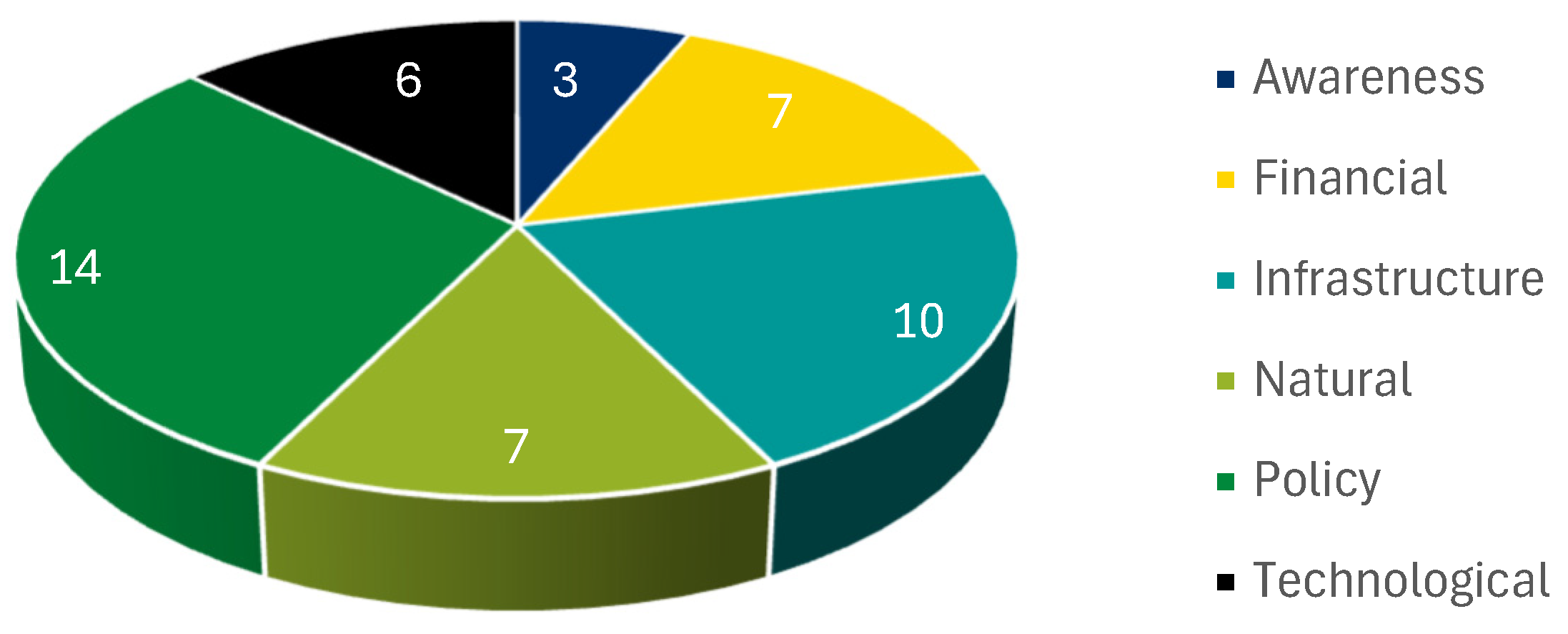
| Awareness raising actions (3 bundles): | |
| Awareness campaigns for behavioural change (M, A) | An enabling mechanism: Enables simultaneous promotion of mitigation and adaptation behaviours (energy, water, waste, greening). Synergies occur when behavioural measures are aligned with subsidised actions and targeted across sectors. |
| Capacity building on climate change adaptation and mitigation (M, A) | |
| Motivational campaigns about climate-smart urban agriculture (urban green actions, new green spaces incl. green roofs) (M, A) | |
| Financial interventions (7 bundles): | |
| Carbon tax of production, distribution, or consumption of non-renewable energy (M) | |
| Economic incentives for behavioural change or private sector’s climate innovation, adaptation and improved environmental quality (M, A) | |
| Feed-in-tariffs, subsidies, tax reductions and loans for renewable energy systems (RES) and purchasing energy saving (EE) equipment (M) | |
| Insurance as risk management tool (incl. weather derivatives) (A) | |
| Introducing congestion charges and pricing, road charges and tolls (M) | Synergies depend on alignment with urban energy and mobility planning and reinforcement through awareness measures targeting the same behaviours. |
| Subsidies for low-carbon transport (bike to work program, rail transport subsidies, carpooling) (M) | Synergies arise when embedded in integrated urban energy and infrastructure planning and when coordinated with large infrastructure adaptation and innovation uptake. |
| Subsidies to alleviate energy poverty (M, A, EPov) | |
| Infrastructural interventions (10 bundles): | |
| Bioenergy and hydrogen in transport (i.e., switching garbage collection vehicles to biofuels, or at farm level) (RES) (M) | |
| Building refurbishment incl. roof, solid walls and window insulation, and additional climate proofing against excessive heat (i.e., green rooftops, shade systems, roof albedo enhancement or cool roofs) (M, A) | High synergy potential through co-implementation of energy efficiency, renewable energy, and climate adaptation during renovation cycles, reducing costs and improving resilience. |
| Carbon capture, transport, utilisation and storage (CCS) in cities (M) | |
| Combined energy (other than RES)—co-firing of biomass and wastes, combined heat and power (CHP) systems, or district heating/cooling networks (M) | |
| Electric transport/mobility (EV charging stations at home and public, bicycle lanes and parking) (M) | |
| Improving adaptability of large infrastructure (i.e., airports, energy distribution and transmission infrastructure, groundwater management) (A) | Synergies arise when combined with carbon pricing, efficient energy systems (e.g., CHP, district heating/cooling), and integrated waste and wastewater infrastructure, supporting resource efficiency and system resilience. |
| Municipal street and traffic lighting retrofit programme (M) | |
| Retrofitting and replacing inefficient vehicle fleet (M) | |
| Waste and wastewater structural projects, incl. decentralised systems for water-sewerage–energy infrastructure and deployment of recycling and composting infrastructure (M) | Enables synergies across water, energy, and waste systems through resource recovery, improved distribution efficiency, and demand management integration. |
| Other large RES incl. hydropower, geothermal, wind power, ground mount solar, waste to energy biomass plants (electricity generation only) (M) | Synergies with urban agriculture and waste systems through use of organic residues and by-products, supporting local energy generation, decentralisation, and resource efficiency. |
 (Note: All nature conservation and protection actions offer synergies among one another. For example, coastal zone management can include sustainable soil and land management practices, or investing in climate-smart urban agriculture such as xeriscaping could be beneficial at dry coastal zones.) | |
| Coastal zone management (beach nourishment, flood barriers, cliff stabilisation, restoration of wetlands, retreat form high-risk areas) (A) | Synergies occur when integrated with land-use planning, density management, accessibility, and low-carbon mobility strategies. |
| Conservation/low-carbon agriculture (innovative crop management, manure spreading and storage, precision agriculture, nitrogen balance) (A, M) | Strong synergies with water management through reuse, efficiency improvements, and demand management, supporting resilience and resource optimisation. |
| Investing in climate-smart urban agriculture (urban green actions, new green spaces incl. green roofs, xeriscaping) (A, M) | Connects waste, energy, and water systems through biomass use, soil enrichment, urban cooling, water reuse, and integration into urban planning frameworks. |
| River and floodplain management (establishment/restoration of riparian buffers, flood barriers, dunes) (A) | Synergies arise through integration with other nature-based and land-use measures. Riparian buffers support soil management and water retention, while complementing coastal protection and enhancing ecosystem resilience. Links with climate-smart urban agriculture improve water efficiency and adaptation outcomes. |
| Sustainable soil and land management (afforestation, reforestation, agroforestry) (A, M) | Synergies arise when combined with land-use planning, density optimisation, accessibility, and low-carbon mobility integration. |
| Water reuse, restrictions and water rationing (A) | Enhances water efficiency and resilience through integration with reuse systems, urban planning, and behavioural measures. |
| Water-sensitive forest management (A) | Synergies arise through integration with land-use and water management measures. It enhances water retention, reduces runoff, and supports soil conservation, while reinforcing ecosystem resilience. When combined with river basin management and nature-based solutions, it contributes to flood regulation and drought mitigation. |
| Policy interventions (14 bundles): | |
| Adaptive management/functional connectivity of natural habitats & ecological networks (A) | |
| Crises and disaster management systems and plans (incl. fire and flood) (A) | |
| Developing greenhouse gas inventory (M) | |
| Establishment of early warning systems/plans (A) | |
| Heat health action plans and response to heatwaves (incl. heat mapping, thermal imaging, using water to cope with heatwaves) (A) | |
| Integrated urban energy systems—incl. traffic and road management plan (adaptation solutions such as floating or elevated roads) (M, A) | Enables cross-sectoral synergies across energy, transport, and buildings through demand management, decentralisation, and integrated system planning. |
| Integration of adaptation in nature-based plans (coastal zone management, land use, drought and water conservation plans) (A) | Synergies arise through integration with land-use planning, density, accessibility, and low-carbon mobility strategies. |
| Management plans for coastal areas and aquaculture (i.e., risk-based zoning/siting for marine aquaculture, diversification of fisheries and aquaculture products and systems) (A) | |
| Plan to alleviate energy poverty (M, EPov) | |
| Prescription of quota system for renewable energy production and renewable obligation for households/SMEs (M) | |
| Stricter standards and regulations for building new and refurbishing existing buildings (M, A) | High synergy potential through integrated implementation of energy efficiency, renewable energy, and climate adaptation in building design and renovation. |
| Sustainable urban waste management and recycling and composting initiatives (M) | Synergies depend on alignment with infrastructure planning and integration with decentralised waste and resource recovery systems. |
| Urban green infrastructure plans and nature-based solutions (i.e., tree planting and creation of green spaces) (M, A) | Enables cross-sectoral synergies across water, energy, and urban systems through integrated planning and resource management. |
| Water sensitive urban and building design (A) | Enhances synergies when integrated with broader urban planning, resource efficiency, and water management strategies. |
| Technological interventions (6 bundles): | |
| Enhanced Waste & Wastewater Resource Recovery (M, A) | |
| Meters/detectors for intelligent lighting systems (i.e., automatization of building lighting, or street lighting part-night operation, trimming and remote monitoring) (M) | |
| Reduction/savings of electricity and fuel—other than RES and structural refurbishment (i.e., EE, phasing out inefficient technologies, setting up a building management system) (M, A) | |
| RES in buildings—PV, solar thermal, energy for cooking/heating incl. condensing boilers, biomass briquettes, heat pumps, geothermal (M) | Synergies achieved when combined with energy-efficiency improvements, building management systems, and climate adaptation measures. |
| Technical innovation in transport and modal shift (electrified transport) (M) | Synergies depend on alignment with awareness measures, behavioural change, and financial incentives supporting adoption. |
| Use of remote sensing in climate change adaptation (A) | |
| Synergy Type | Definition | Example | Planning Implication |
|---|---|---|---|
| Intra-Bundle Synergy | Synergies occurring between actions grouped within the same action bundle in SYNERGISE+, often due to functional or sequential complementarity. | Building insulation and green roofs within the ‘Energy Efficiency in Buildings’ bundle. | Encourages holistic consideration of actions within a single intervention area to maximise returns. |
| Cross-Bundle Synergy | Synergies occurring between actions in different bundles, where coordinated implementation enhances performance, reduces costs, or improves feasibility. | Passive building design from one bundle and smart metering systems from another bundle. | Promotes cross-sector coordination and scheduling to capture system-wide efficiencies and shared benefits. |
| City | Country | Number of SECAP Actions | Share of Actions with Identified Synergy Potential (%) |
|---|---|---|---|
| Maribor | Slovenia | 57 | 81 |
| Zagreb | Croatia | 57 | 84 |
| Litoměřice | Czechia | 48 | 81 |
Disclaimer/Publisher’s Note: The statements, opinions and data contained in all publications are solely those of the individual author(s) and contributor(s) and not of MDPI and/or the editor(s). MDPI and/or the editor(s) disclaim responsibility for any injury to people or property resulting from any ideas, methods, instructions or products referred to in the content. |
© 2026 by the authors. Licensee MDPI, Basel, Switzerland. This article is an open access article distributed under the terms and conditions of the Creative Commons Attribution (CC BY) license.
Share and Cite
Dragović Matosović, M.; Pizzini, G. A Structured Library of Local Climate and Energy Actions to Support Synergy-Oriented Sustainable Urban Planning. Sustainability 2026, 18, 3397. https://doi.org/10.3390/su18073397
Dragović Matosović M, Pizzini G. A Structured Library of Local Climate and Energy Actions to Support Synergy-Oriented Sustainable Urban Planning. Sustainability. 2026; 18(7):3397. https://doi.org/10.3390/su18073397
Chicago/Turabian StyleDragović Matosović, Mia, and Giulia Pizzini. 2026. "A Structured Library of Local Climate and Energy Actions to Support Synergy-Oriented Sustainable Urban Planning" Sustainability 18, no. 7: 3397. https://doi.org/10.3390/su18073397
APA StyleDragović Matosović, M., & Pizzini, G. (2026). A Structured Library of Local Climate and Energy Actions to Support Synergy-Oriented Sustainable Urban Planning. Sustainability, 18(7), 3397. https://doi.org/10.3390/su18073397