Article

Analysis of Differences in User Requirements for Child-Friendly Pocket Parks Based on the KANO–QFD Model: A Case Study of Nanjing, China
School of Landscape Architecture, Nanjing Forestry University, Nanjing 210000, China
*
Authors to whom correspondence should be addressed.
Sustainability 2026, 18(7), 3392; https://doi.org/10.3390/su18073392
Submission received: 22 January 2026 / Revised: 7 March 2026 / Accepted: 25 March 2026 / Published: 31 March 2026
(This article belongs to the Special Issue Sustainable Urban Designs to Enhance Human Health and Well-Being)

Abstract

In the context of rapid urbanization, pocket parks have become an important component of urban green infrastructure, supporting residents’ daily recreation, health, and well-being. However, existing pocket park designs are largely shaped by adult designers’ perspectives, with children’s needs often inferred or assumed rather than directly investigated. From a sustainability and health-oriented perspective, this study aims to enhance the functionality and user satisfaction of pocket parks by incorporating child-friendly design elements grounded in actual user demands. Based on the KANO model—an approach used to classify user requirements according to their influence on satisfaction—and Quality Function Deployment (QFD), questionnaire data were collected from 97 children aged 6–12 and 87 parents through field investigations in multiple pocket parks in Nanjing, China. The analysis focused on key dimensions including safety, fun, comfort, and multifunctionality. The results revealed clear differences between children’s and parents’ requirements. Children’s satisfaction is mainly influenced by diverse play spaces and opportunities for interaction with natural elements, while parents place greater emphasis on environmental comfort and facility practicality. Safety was identified as a critical factor for children, whereas social interaction functions were considered relatively less important by both groups. Based on these findings, this study identifies key design priorities for child-friendly pocket parks and provides practical strategies to improve overall park quality and user satisfaction, contributing to healthier and more socially sustainable urban environments.

1. Introduction

In recent years, with the slowing of urbanization and environmental constraints, urban development strategies in China have shifted from expansion to optimizing existing resources. In this context, large-scale parks have become impractical, while pocket parks—small, scattered green spaces—have become an important focus in urban planning. These parks, typically ranging from 400 to 10,000 square meters, are strategically located in high-density urban areas to provide recreational spaces for local residents [1,2]. However, as urbanization accelerates and living standards rise, the gap between children’s needs and the urban environment has become more evident [3]. Despite frequent park use, children have fewer opportunities to access parks compared to the general population [4]. Therefore, the design of child-friendly pocket parks, aimed at increasing children’s usage frequency and engagement, has become a key issue in urban development [5]. From a sustainability perspective, child-friendly pocket parks are increasingly recognized as essential urban infrastructures that support children’s physical health, psychological well-being, and long-term social sustainability in high-density cities.
Family-based parent–child activities have become the primary form of children’s recreation in parks, playing an important role in promoting social interaction and well-being [6]. Scholars have suggested that park design should evolve from “child-friendly” to “child–family-friendly”, addressing not only children’s activity experiences but also the needs of parents who accompany them [7]. Parents tend to engage in diverse activities such as communication, childcare, and relaxation, while emphasizing the safety and maintenance of play equipment [8]. They also recognize the educational value of parks and their role in fostering parent–child interaction. However, in practice, some pocket parks fail to adequately consider parents’ needs for accompaniment, rest, and interaction, which may reduce their willingness to participate. As children’s guardians and companions, parents’ experiences in these spaces directly influence the continuity of children’s activities and the overall effectiveness of park use. Therefore, focusing solely on children’s perspectives is insufficient to fully improve the practical use and performance of pocket parks.
However, in practical design processes, some spaces are still dominated by adult perspectives, favoring structured and standardized play environments while overlooking children’s preference for dynamic and natural environments [9,10,11]. There are clear differences in priority between children and parents in the use of public spaces. Parents tend to prefer places with higher convenience and educational value, paying close attention to safety management and facility maintenance, whereas children are more concerned with opportunities for exploration, physical activity, rest, and interaction with nature. These differences are not merely a matter of differing interests, but reflect deeper intergenerational differences in cognitive patterns and value orientations. As children are at a critical stage of physical and psychological development, they are more sensitive to spatial scale, environmental quality, and opportunities for social interaction [12]. Therefore, when spatial design places excessive emphasis on standardization and management efficiency, children’s opportunities for autonomous exploration and interaction may be constrained, which may increase children’s reliance on electronic devices and weaken real-world social interaction and physical activity levels [13,14]. In addition, when planning decisions are primarily based on consultations with parents or other adults, children’s real experiences and expressions are often indirectly replaced or overlooked [15,16]. Therefore, relying solely on adult perspectives makes it difficult to respond effectively to children’s developmental needs, and promoting children’s direct participation in public space planning has become an important pathway for improving planning decisions [17].
The concept of child-friendly cities emphasizes child-centered principles of safety, inclusiveness, and participation, viewing children as active participants capable of expressing their needs in urban planning. Scholars have proposed models such as Roger Hart’s Ladder of Participation [18], which categorizes different levels of participation and encourages children to engage in urban planning through various approaches, including surveys, children’s councils, drawings [19], and images [20]. In recent years, advances in computer-assisted technologies, such as VR virtual experiences, have created additional opportunities for children’s participation [21]. In practice, Rome’s urban planning introduced a “Child Master Plan Office”, supported by children’s councils, to ensure that children’s needs were represented in planning processes [22]. In Kawasaki, Japan, children participated in playground construction throughout the entire process, from model creation to later site maintenance [23]. Although these international experiences provide valuable references for the design of child-friendly pocket parks in China, most existing studies remain qualitative and lack quantitative support. Moreover, they are largely concentrated in developed countries, which limits their broader applicability. In some practical contexts, children’s participation still remains largely symbolic, lacking stable feedback mechanisms and real influence on decision-making processes [24], making it difficult for children’s opinions to be effectively translated into concrete spatial strategies.
Overall, although existing research increasingly emphasizes the importance of children’s participation and continues to expand participation methods and technological approaches, several structural limitations remain in practice. Differences in the needs of children and parents as co-users are often discussed only at a conceptual level, lacking parallel and comparable quantitative analytical frameworks capable of revealing how different demand attributes influence satisfaction formation. At the same time, studies that treat children as independent survey participants in the identification of user needs remain relatively limited, particularly in small-scale public green spaces such as pocket parks in high-density urban contexts. In addition, existing research often focuses on participation mechanisms or evaluation outcomes, but has yet to establish a structured pathway that systematically translates user demand attributes into concrete spatial design elements and optimization priorities. Therefore, it is necessary to develop an integrated analytical framework under a dual-user perspective that combines demand classification with design translation, enabling systematic connections between demand identification, priority ranking, and spatial design transformation.
Various methods and models have been developed to analyze user demands for urban public spaces, each with its own focus and applicability. Post-Occupancy Evaluation (POE) assesses the use of completed spaces and provides empirical support for design improvement; however, it has limited capacity to guide early-stage design decisions [25]. The SERVQUAL model quantifies service quality across five dimensions—reliability, responsiveness, assurance, empathy, and tangibles—which helps identify user concerns. Nevertheless, this model mainly emphasizes service processes and is less effective in capturing differences in the attributes of latent user needs [26]. In addition, the Fuzzy Analytic Hierarchy Process (FAHP) has advantages in dealing with subjective uncertainty and hierarchical complexity; however, it relies heavily on subjective weighting and may be influenced by ambiguous evaluation criteria or bias in weight assignment [26]. Therefore, when addressing the optimization of urban micro-scale spaces that involve multiple user groups and complex demand attributes, traditional approaches still face limitations in refined demand classification and the systematic translation of user needs into spatial design strategies.
The KANO model classifies user needs into basic, expected, and excitement categories and effectively reveals how different types of needs influence user satisfaction [27]. However, as a qualitative analytical tool, the KANO model has certain limitations when used alone, particularly in terms of weight allocation and the translation of user needs into design elements. Quality Function Deployment (QFD) translates user requirements into design specifications through the House of Quality, but when applied independently it may be affected by subjective bias. To overcome the limitations of single methods, Matzler and Hinterhuber proposed the KANO–QFD integrated model [28], which was subsequently further refined and extended to different research fields by later scholars [29]. By combining the classification logic of the KANO model with the systematic analytical structure of QFD, the KANO–QFD integrated model assigns weights and clarifies priority relationships among user needs, enabling more precise and operational guidance for design optimization. In recent years, this approach has gradually been applied in studies on urban open spaces, comprehensive parks, and residential green space optimization [30,31,32,33,34], demonstrating its applicability and potential for complex spatial systems. However, in the field of child-friendly pocket parks—where both multi-user demand differences and the transformation of user needs into spatial elements are critical—the systematic application of the KANO–QFD integrated model remains relatively limited and requires further exploration.
To address the research gaps identified above, this study aims to establish a dual-user demand analysis framework to systematically identify differences in demand attributes between children and parents in the use of pocket parks, and to explore how these needs can be prioritized and translated into spatial design elements. Specifically, this study seeks to answer three research questions:
(1)
Are there significant differences in the demand attributes of children and parents in the use of pocket parks?
(2)
If such differences exist, how are different types of needs prioritized in the mechanism of satisfaction formation?
(3)
How can the needs of children and parents be balanced and effectively translated into specific spatial design elements and optimization strategies?
As a leading city in developing child-friendly urban environments, Nanjing, China, provides a representative case, supported by its policy framework (e.g., the Implementation Plan for Building a Child-Friendly City in Nanjing) and practical foundations. This context provides a practical basis for examining differences in the needs of children and parents in Chinese urban pocket parks. Methodologically, this study develops an integrated KANO–QFD analytical framework. First, the KANO model is used to identify differences in the demand attributes of children and parents. Second, the QFD is applied to systematically translate user needs into spatial design elements. Through weight assignment and priority ranking, the framework further coordinates the demand relationships between different user groups. Through this analytical approach, the study aims to provide methodological support for the quantitative comparison of multi-user needs and for spatial optimization decisions in the design of child-friendly pocket parks.

2. Materials and Methods

2.1. Construction of the Requirement Hierarchy for Child-Friendly Pocket Parks

To develop a systematic requirement hierarchy for child-friendly pocket parks, this study conducted a literature review using the China National Knowledge Infrastructure (CNKI, Beijing, China) database, focusing on studies published between 2000 and 2025. Although international databases such as Web of Science and Scopus contain a large number of studies related to children’s health and child-friendly environments, the research object of this study is pocket parks within the Chinese urban context. Therefore, the requirement indicators need to reflect local spatial conditions and policy backgrounds. For this reason, this study used CNKI as the primary literature source, aiming to construct a requirement indicator system that better reflects the practice of pocket parks in Chinese cities. The search language was Chinese, and keyword combinations such as “pocket park,” “micro green space,” “child-friendly,” “user demand,” “post-occupancy evaluation,” “parent–child space,” and “safety” were used.
The retrieved literature was classified into three categories. The first category included studies directly focusing on child-friendly pocket parks. The second category consisted of studies on other types of urban green spaces involving children’s usage needs, behavioral patterns, or satisfaction evaluation. The third category involved studies related to pocket park planning, design, and post-occupancy evaluation. The preliminary search identified 13 studies directly related to child-friendly pocket parks, 48 studies on child-friendly residential environments, 67 studies on streets and community public spaces, 23 studies on community parks, and 369 studies on pocket park evaluation indicators. After removing duplicate and weakly related studies, the literature was further screened based on three criteria:
(1)
Involving children or parent–child usage needs;
(2)
Containing identifiable spatial elements or evaluation dimensions;
(3)
Providing empirical research or systematic analysis.
Finally, 42 studies that clearly addressed children’s or parent–child usage needs and included spatial elements or evaluation indicators were selected as the basis for indicator extraction.
Based on the selected literature, keyword frequency statistics and classification were conducted to identify requirement indicators. High-frequency keywords were classified and merged into corresponding requirement items, while duplicated indicators were removed. Indicators with vague definitions, low frequencies, or weak relevance to the research objectives were either integrated into related indicators or excluded. This process improved the clarity and conciseness of the requirement hierarchy.
From the dual-user perspective of children and parents, this study ultimately constructed a requirement indicator system consisting of four primary dimensions—safety, fun, comfort, and multifunctionality—and 14 sub-indicators. This requirement hierarchy provides the basis for subsequent KANO classification and the transformation of user requirements into design characteristics through QFD. Table 1 summarizes the occurrence frequencies of the 14 requirement indicators identified from existing literature and their representative references. For convenience in subsequent tables and analyses, indicator codes (e.g., A1, B2) are used to represent individual requirement items.
1.
Safety requirements
Safety is paramount for children in pocket parks [52], and most studies emphasize it as the core criterion for evaluating child-friendliness. Ensuring safety begins with well-defined park boundaries, effectively separated from external traffic [37]. Additionally, the careful selection of plants and paving materials is crucial, along with a site layout that maintains clear, continuous pathways. Even if play areas are attractive, poorly designed paths may deter children from visiting [53]. Play facilities must meet safety standards, incorporating non-slip materials and undergoing regular maintenance checks [54]. Enhancing public safety can be achieved through surveillance systems, emergency equipment, and a robust public security management system. Clear sightlines are important not only to attract visitors but also to ensure sufficient “Street Eye” for monitoring children’s activities effectively [55].
2.
Fun requirements
A child-friendly park should be enjoyable while supporting children’s overall development. Although colour preferences may vary by age [56], children are generally attracted to colourful, bright, and aesthetically pleasing play materials that offer a variety of play experiences [57]. Physical activities like climbing, running, and jumping are critical for both the physical and cognitive growth of children [9]. Similarly, exposure to natural spaces plays a crucial role in their mental and physical well-being [58]. Thus, incorporating natural elements and creating terrain variety should be prioritized, with artificial substitutes used only when necessary. An overemphasis on artificial structures, such as swings and slides with strict game rules, can detract from the free play and exploration that natural spaces provide [46]. Research also shows that early exposure to nature fosters a lifelong appreciation for wildlife and a willingness to coexist with animals [59]. Establishing safe areas for nature exploration supports holistic child development. Studies further categorize children’s activities based on their psychological needs and the types of games they play [46], highlighting the importance of diverse play spaces to meet these varying requirements.
3.
Comfort requirements
In addition to safety and visual appeal, comfort is a key consideration in pocket parks. In cities like Nanjing, characterized by hot, humid summers and cold, dry winters, climate comfort is often low. Well-planned planting arrangements have been shown to enhance climate comfort significantly [60]. Essential natural features, including greenery, biodiversity, and varied topography, contribute to the child-friendliness of pocket parks [61]. Appropriately scaled spaces are particularly important for children aged 8 to 12, who need larger, open areas for group play [62,63]. Adjusting the proportion of activity spaces relative to the height of surrounding buildings creates a more relaxing, suitable environment for daily use [64]. A common complaint in children’s play areas is the lack of adequate and diverse facilities [65]. The comfort of facilities significantly influences the willingness of both children and parents to participate in park activities [66,67]. This includes whether the park provides structures for shade and rain shelter, whether benches are designed with appropriate materials and dimensions, and whether decorative or interactive landscape elements—such as small sculptures, art installations, or interactive play features—are incorporated. These spatial details directly affect users’ comfort and their willingness to stay and engage in activities. In addition, there is a close relationship between a child’s body size and physical performance, and facilities should therefore be designed according to the physical characteristics of different age groups to ensure both safety and comfort [68].
4.
Multifunctional requirements
Pocket parks should be designed to serve multiple functions, ensuring that play areas can adapt to the evolving needs of various user groups [50]. In addition to accommodating children’s diverse needs, parks should also cater to the activities of adults and the elderly, offering facilities like movable ping pong tables that are accessible to all. Meeting the needs of users with different physical conditions requires barrier-free facilities and thoughtful spatial separation [9,69]. Parent–child interaction and social engagement are crucial for children’s social development [70]. Finally, allowing children to participate in community decision-making processes ensures that their voices are heard, which is essential for achieving a truly child-friendly design.

2.2. Calculation of the Importance of Requirements

2.2.1. Initial Importance of Requirements

To evaluate user requirements, data from both children’s and parents’ samples are first processed using the Fuzzy Analytical Hierarchy Process (FAHP). The initial importance of each requirement is calculated separately for each sample. FAHP combines traditional hierarchical analysis with fuzzy theory. Unlike traditional methods, FAHP calculates the fuzzy weight of each element by employing symmetric triangular fuzzy numbers to construct a pairwise comparison matrix. Through two-by-two comparisons, the method assesses the relative importance of each factor. This approach effectively addresses the subjectivity, uncertainty, and ambiguity inherent in human judgment of requirements [71].
A scoring system, typically ranging from 0.1 to 0.9, is commonly used in questionnaires. If two requirements, i and j, are deemed equally important, they receive the same score (aij = 0.5). If requirement j is judged to be relatively more important, the score of aij falls between 0.1 and 0.5. Conversely, if requirement i is considered more important, its value ranges from 0.5 to 0.9. The specific scores of 0.5, 0.6, 0.7, 0.8, and 0.9 correspond to levels of equal, slightly important, important, extremely important, and critically important, respectively. Respondents are asked to choose a score within the 0.1 to 0.9 range to reflect the relative importance based on their value judgments, from which the initial importance of each requirement is calculated.

2.2.2. Final Importance of Requirements

To enhance the precision of requirement evaluation, this study incorporates the KANO Model & Importance–Satisfaction Questionnaire. The KANO model assesses user requirements through non-direct questioning, reducing the potential inaccuracies caused by user misjudgment [72]. This method complements the Analytic Hierarchy Process (AHP) by addressing its limitations in prioritizing single-factor optimization [73]. The questionnaire is structured into two parts: the first section categorizes each requirement using the KANO model, and the second utilizes a Likert scale to measure the importance and satisfaction of these requirements.
The KANO model, introduced by Japanese quality management expert Noriaki Kano, employs statistical methods to identify user requirements objectively, particularly highlighting differences in their importance [73]. Forward and reverse questions in the questionnaire elicit user responses regarding the presence or absence of a requirement, which reflect one of five attitudes: “like”, “must be”, “neutral”, “live with”, and “dislike”. These responses are then categorized into KANO attributes: must-be attributes (M), one-dimensional attributes (O), attractive attributes (A), indifferent attributes (I), reverse attributes (R), and questionable attributes (Q) (rare paradoxical results). Widely used in product and service design management [74,75], the KANO model is also useful for prioritizing user requirements when applied to pocket parks, which can be viewed as large service “products”. Recent applications in landscape architecture include evaluating nature education needs in forest parks [76], aging-friendly design features in urban parks [77], and requirements for renovating historic residential districts for aging populations [78].
This study uses the KANO Model & Importance–Satisfaction Questionnaire to categorize requirements and assess their importance and satisfaction levels. Requirements are categorized based on the maximum frequency principle, with importance indicated by corresponding k values [79]. The adjustment factor (f) is derived from the maximum of the Customer Satisfaction Index (CS) and Dissatisfaction Index (DS) [80], based on the frequency of a requirement being categorized as attractive (A), one-dimensional (O), must-be (M), or indifferent (I). Improvement ratios (R0 and R1) are calculated using the mean importance and satisfaction levels [81], and final importance is determined by multiplying the initial importance by the adjusted improvement ratio for both children’s and parents’ samples (see Appendix A) [82].

2.3. Quality Function Deployment Based on the Importance of the Requirement

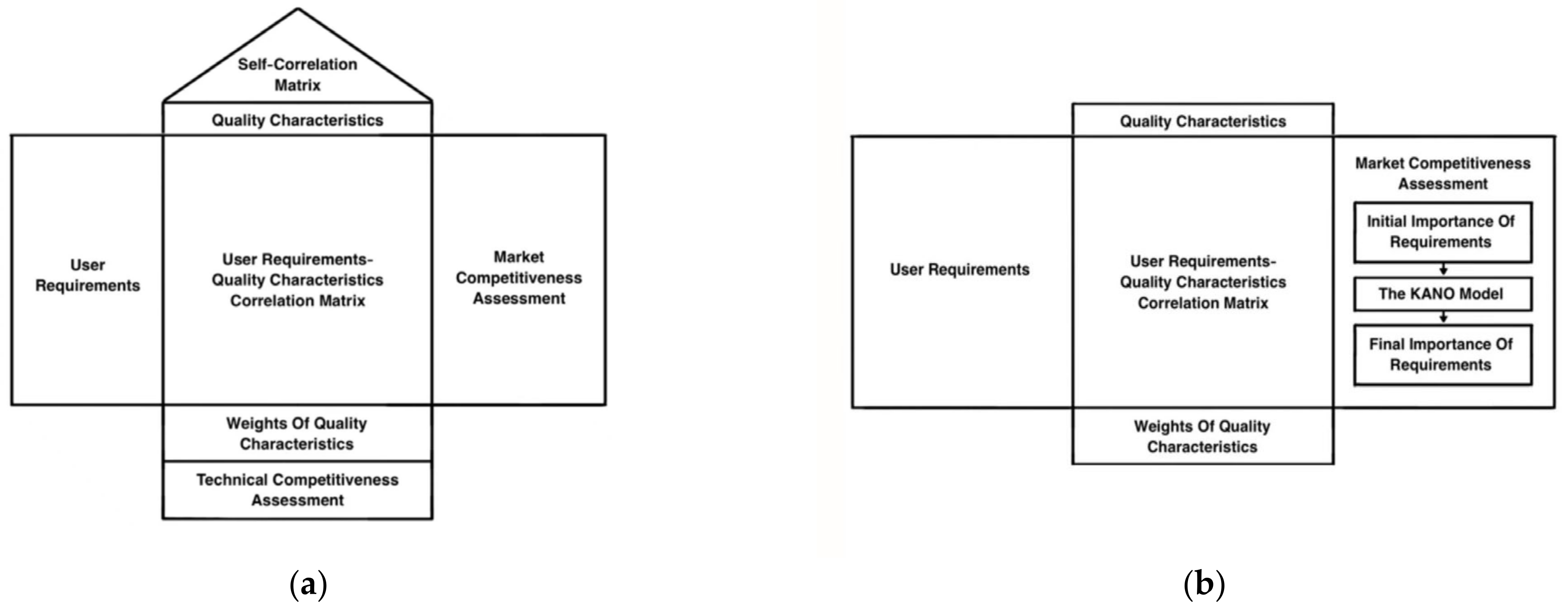
After obtaining the final importance values of the requirements for both children and parents, this study further introduces Quality Function Deployment (QFD) to systematically transform user requirements into operable spatial design elements. Quality Function Deployment (QFD) is a systematic method that transforms user requirements into actionable information for product design and development. Initially proposed by the Japanese scholar Yoji Akao in the 1970s, QFD constructs the “House of Quality,” which quantifies the relationship between user requirements and product quality characteristics, identifying the critical quality attributes that contribute to user satisfaction [83]. The components of the House of Quality include: user requirements (left wall), product quality characteristics derived from user needs (ceiling), self-correlation matrix of quality characteristics (roof), the correlation matrix between user requirements and quality characteristics (rooms), market competitiveness assessment (right wall), product quality characteristic weights (floor), and technological competitiveness assessment (basement).
  • User Requirements (left wall): The needs and expectations of users;
  • Product Quality Characteristics (ceiling): Attributes derived from user requirements;
  • Self-Correlation Matrix (roof): A matrix representing the interrelationships among quality characteristics;
  • Correlation Matrix (room): A matrix quantifying the relationships between user requirements and quality characteristics;
  • Market Competitiveness Assessment (right wall): Evaluation of how well the product meets market standards;
  • Weights of Product Quality Characteristics (floor): Prioritization of quality characteristics;
  • Technical Competitiveness Assessment (basement): Analysis of technical capabilities in relation to competitors.
Previous studies have shown that QFD implicitly assumes a linear relationship between user requirements and satisfaction, which may limit its ability to fully capture the nonlinear characteristics of different requirement attributes when applied independently [84,85]. Therefore, this study integrates the KANO classification results into the QFD framework so that the requirement weights on the left wall of the House of Quality can better reflect the differences and nonlinear characteristics among requirement attributes [86]. Through this integration, the analytical advantages of the QFD structure are retained while improving the accuracy of requirement prioritization.
This study focuses on enhancing user satisfaction in child-friendly pocket parks by identifying differentiated requirements between children and parents and translating them into design-oriented guidance. Unlike conventional QFD applications in industrial product development or manufacturing-oriented service systems, pocket park planning at this stage primarily involves conceptual design and demand translation rather than detailed technical implementation or cost optimization. Therefore, the technical competitiveness assessment (basement) was excluded, as it does not align with the objectives of this study. In addition, the self-correlation matrix (roof) was omitted to simplify the model structure and improve analytical efficiency. The quality characteristics identified in this study—such as spatial planning, landscape design, and management services—exhibit relatively weak interdependencies and do not constitute strong systemic constraints or conflicts. Accordingly, as illustrated in Figure 1, both the original and the modified KANO–QFD integrated House of Quality structures adopted in this study are presented.

2.3.1. Quality Characteristic Development

User initial requirements are often complex and abstract, necessitating their transformation into quantifiable quality characteristics, which is a key objective of QFD. The specific design elements derived from QFD act as critical guidelines for practitioners in the design and optimization of pocket parks. This study references a range of publications, literature, and regulations related to the construction of pocket parks and child-friendly spaces. The requirements identified within each dimension are translated into quality characteristics, with the corresponding indicator values and detailed development process provided in Table A1 of Appendix B.
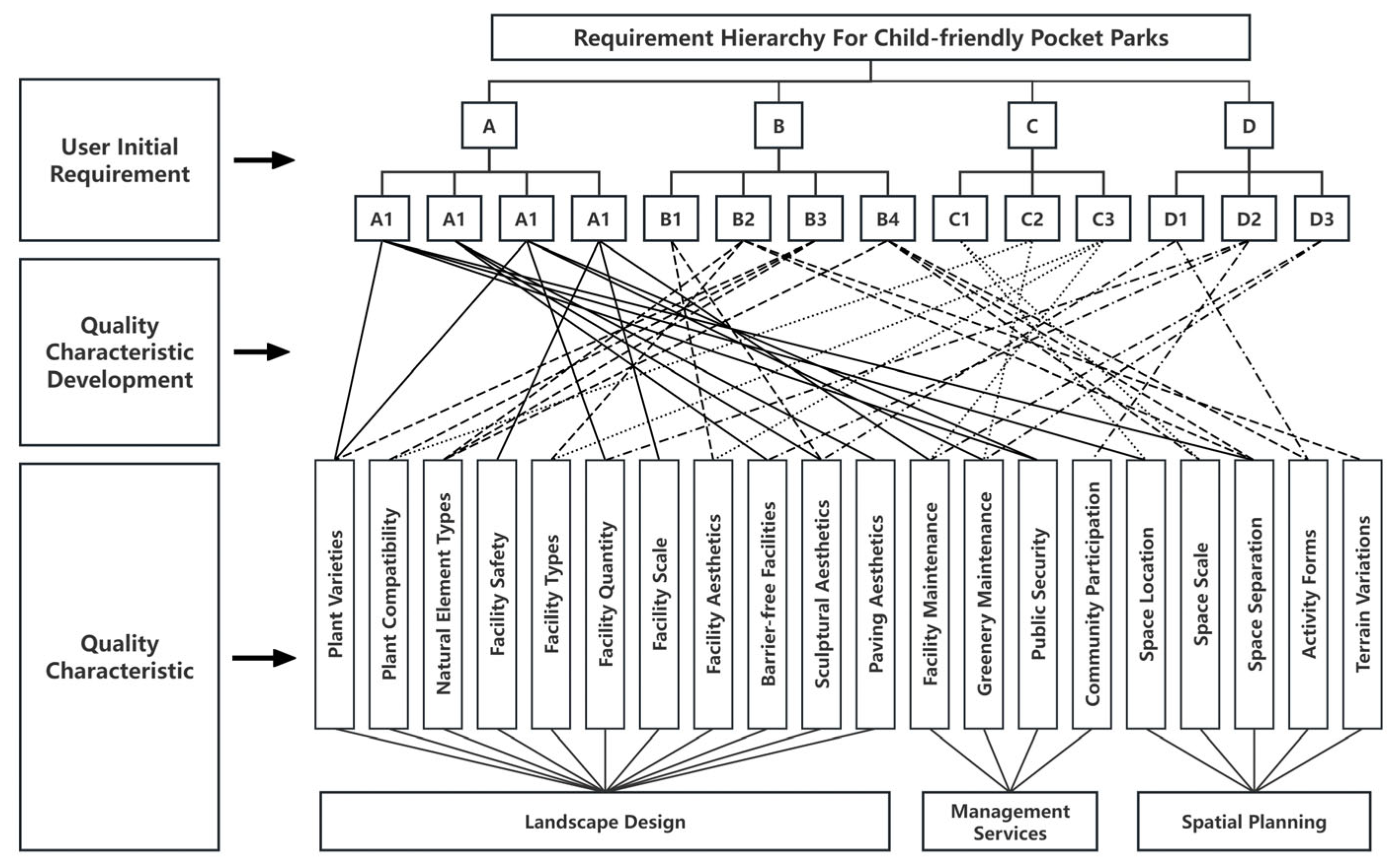
Through discussions with over 20 experts, graduate students, and designers in the fields of landscape architecture and urban planning, this study identified 20 quality attributes, categorized under three key dimensions: spatial planning, landscape design, and management services (Figure 2). These attributes form the hierarchy of quality characteristics for child-friendly pocket parks. A–D represent four requirement dimensions, while A1–D3 denote the corresponding sub-requirements. Different line styles indicate different types of relationships between requirement groups (A–D).

2.3.2. Constructing the House of Quality

The House of Quality in this study includes the following components: user requirements (left wall), quality characteristics derived from user requirements (roof), the user requirement–quality characteristic correlation matrix (room), the overall final importance of user requirements (right wall), and the prioritization of quality characteristics (floor). Since child-friendly pocket parks should equally address the needs of both children and parents, their requirements were each assigned a weight of 0.5, forming the overall importance of urban pocket park user requirements.
The relationship between user requirements and quality characteristics was quantified using symbols within the relationship matrix. These symbols—“◎,” “○,” and “△”—represent strong, moderate, and weak correlations, respectively, while non-correlated items remain unmarked. The numerical values assigned to these symbols followed a ratio of “◎”:“○”:“△” = 5:3:1 [87]. By multiplying these values with the overall final importance of the requirements, the summation of each column determined the importance and prioritization of each quality characteristic. This approach allows the House of Quality to translate user requirements into corresponding quality characteristics, effectively mapping user needs to design elements.

2.4. Study Area and Distribution of Pocket Parks

According to the seventh national census, Nanjing’s permanent population stands at 9.31 million, with children aged 0–14 accounting for approximately 12.75% of the population, or roughly 1.187 million. The substantial number of children in the city highlights their significant demand for public spaces. As an economically developed city with a high level of urbanization, Nanjing has experienced a growing need for high-quality public spaces, such as pocket parks, from both children and their families.
To address this demand, Nanjing has constructed numerous pocket parks in recent years, particularly in the main urban areas, densely populated communities, and zones undergoing urban renewal. Based on public data and preliminary field investigations, this study initially identified 16 relatively well-developed pocket parks within the main urban area of Nanjing as preliminary samples. Most of these parks range in size from 400 to 10,000 m2, with a certain level of green coverage and openness, which allows them to reflect the general development conditions of pocket parks in the city’s main urban districts.
The sample selection followed a stepwise screening process based on three criteria: basic conditions, usage activity, and case representativeness.
First, at the basic condition screening stage, the 16 parks were compared in terms of site scale, functional configuration, and basic accessibility. Parks that were relatively small or functionally limited, and therefore unsuitable for observing children’s activities, were excluded, leaving 10 parks as candidate samples.
Second, at the usage activity screening stage, field observations were conducted to examine the number of children and parents present, duration of stay, and activity types. Based on these observations, six parks with relatively active child use and longer stay durations were selected.
Finally, during the case representativeness and survey feasibility assessment, the following factors were considered:
(1)
Relatively high concentration of children in surrounding residential areas;
(2)
Representative spatial types and functional configurations of the parks;
(3)
Relatively stable activity patterns of children and parents, facilitating questionnaire distribution;
(4)
High accessibility and openness of the sites to ensure continuity of the survey.
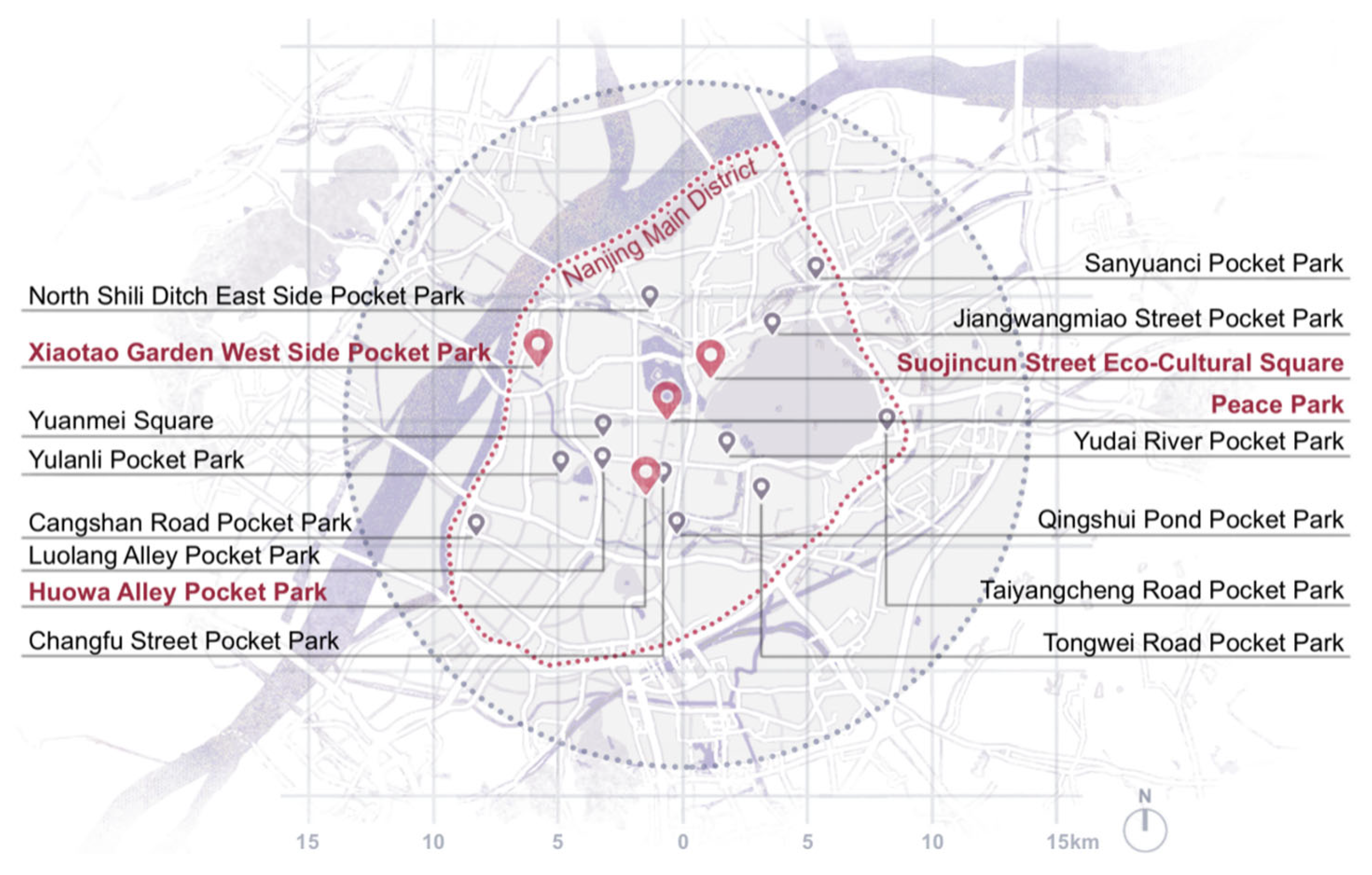
Based on these criteria, four parks were ultimately selected from the 16 preliminary samples for questionnaire distribution: Suojincun Street Eco-Cultural Square (Xuanwu District), Peace Park (Xuanwu District), Huowa Alley Pocket Park (Qinhuai District), and Xiaotao Garden West Side Pocket Park (Gulou District) (Figure 3). These parks are located in core urban areas with relatively concentrated child populations and active daily usage, where the presence of children and parents is clearly observable. Therefore, they provide representative cases for examining user behavior and spatial demands in pocket parks within the main urban area of Nanjing.
The study mainly focuses on children and parents using pocket parks. While Chinese law defines children as individuals under 18, psychology often defines childhood as ages 0 to 12. Children aged 6 to 12 are at a critical stage of exploring their surroundings, able to select preferred activities and spaces based on perception. They are also more independent and articulate in expressing needs [88]. Since the study relies on questionnaires from children, professional students assisted during interviews and maintained detailed records. This process, requiring professionalism, limited the sample size. Additionally, preschool children’s physical and cognitive development made the questionnaire challenging, so the study focused on children aged 6 to 12.

2.5. Questionnaire Design and Data Collection

2.5.1. Questionnaire Design

This study developed a questionnaire to assess requirements for a child-friendly pocket park based on the 14 specific requirements summarized earlier. The questionnaire consists of three sections: the first gathers demographic information, including identity, gender, age, and educational background; the second employs the FAHP for pairwise comparisons of users’ requirements; and the third utilizes the KANO Model & Importance–Satisfaction Questionnaire. Questionnaires were distributed separately to children aged 6 to 12 and their parents.
A pre-test was conducted in the questionnaire design process to verify the validity of the questions, ensuring they captured the needs of children and parents clearly while avoiding complex or abstract concepts. A random sample of children and parents aged 6 to 12 was selected for testing, and feedback was gathered on simplified language, visual aids, contextual questioning, gamified scales, and open-ended questions.
The pre-test indicated that children aged 6 to 12 are still developing vocabulary and comprehension skills [89,90] and tend to rely on concrete objects for reasoning [88]. Simplified questions, such as “Do you like this area?”, were easier for children to understand than abstract questions like “How do you feel about this area?” Furthermore, considering the short attention spans of children at this stage, the questionnaire was designed to be concise and clear. Emoticons and hand-drawn images helped children comprehend the satisfaction scale, and gamified elements enhanced interactivity [91]. Based on the feedback, the following adjustments were made to the children’s questionnaire:
  • Use straightforward language: Simplifying terms like “universal accessibility” to “suitable for everyone to play”.
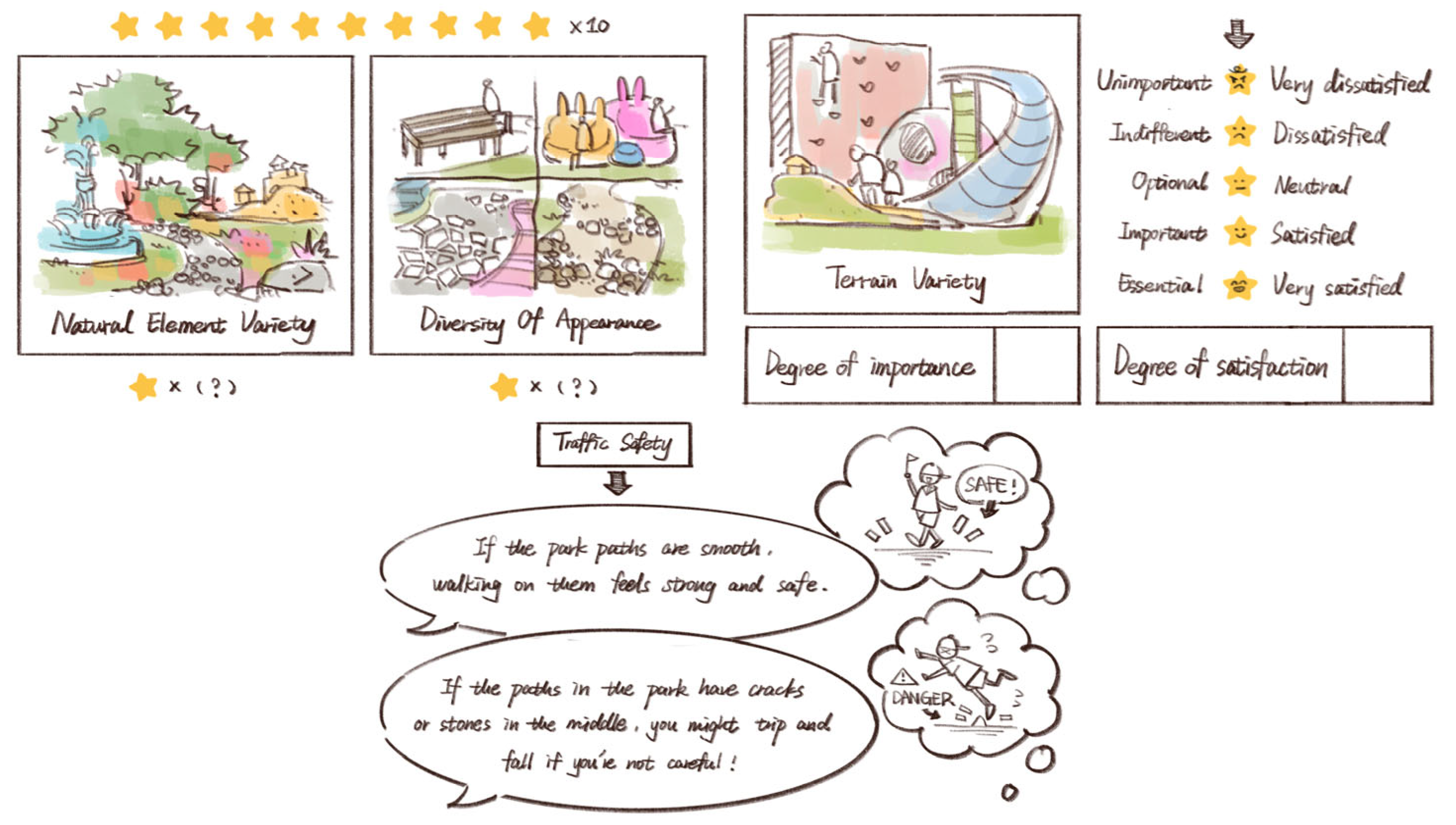
  • Introduce visual aids: Utilizing emoticons and hand-drawn images to assist comprehension and simplify the response scale (Figure 4).
  • Contextualize questions: Ensuring relevance to children’s life experiences (Figure 4).
  • Use gamified scales: Implementing star ratings [92]. In this system, participants assign a limited number of stars, where a higher number of stars indicates greater perceived importance or satisfaction, depending on the question context (Figure 4).
  • Include open-ended questions: Encouraging greater participation. Creating a relaxed atmosphere during interactions will help in better understanding children’s real needs.

2.5.2. Questionnaire Distribution and Data Collection

A total of 210 questionnaires were randomly distributed across the four selected pocket parks from 30 July to 15 August 2024 (during the summer vacation period), daily between 18:30 and 21:30. After data screening, 184 valid questionnaires were obtained, yielding an effective response rate of 87.6%. Among them, 45 questionnaires were collected at Suojincun Street Eco-Cultural Square, 45 at Peace Park, 48 at Huowa Alley Pocket Park, and 46 at Xiaotao Garden West Side Pocket Park. Of the valid responses, 97 were completed by children and 87 by parents, ensuring the adequacy and representativeness of the sample.
Parent questionnaires were primarily administered online via a QR code, prioritizing parents familiar with smartphone usage. For parents over 50, oral interviews were conducted to ensure diverse age representation. The children’s sample encompassed the entire 6–12 age range, with over 10% of respondents from each age group, effectively representing all cohorts. Additionally, over 90% of parents had a higher education background, indicating a high level of comprehension and response accuracy. The characteristics of the questionnaire sample are summarized in Table 2.

3. Results

3.1. Results of Initial Importance Analysis

The FAHP typically demands verifying the consistency ratio (CR) to ensure fuzzy consistency. In this study, all CR indicators for each dimension and requirement in both the children’s and parents’ samples were below 0.1, confirming that the consistency check was passed. The table below presents the CR indicators, initial importance, and priority ranking of the requirements, emphasizing the differing levels of importance placed on the same requirements by children and parents.

3.1.1. Initial Importance of Children’s Requirements

Based on Table 3, the initial importance and ranking of specific requirements for the children’s sample in pocket parks can be summarized as follows: the five most important requirements, in descending order, are site safety, comfortable play areas, public safety, interactive features, and traffic safety. This finding demonstrates that children aged 6 to 12 place substantially more emphasis on safety requirements compared to other dimensions. Furthermore, they prioritize comfortable play areas over comfortable green space environments and amenities, display a distinct preference for interactive features, and rank activity type variety as the least important requirement.

3.1.2. Initial Importance of Parents’ Requirements

From Table 4, the initial importance and ranking of specific requirements for the parent sample regarding pocket parks are as follows: the top five requirements, in descending order of importance, are comfortable green space environment, comfortable amenities, facility safety, comfortable play areas, and universal accessibility. Unlike the children’s sample, parents place a greater focus on comfort requirements. Among these, they prioritize the comfort of amenities and green space environment while considering the comfort of play areas to be less important. Additionally, the parent sample shows a strong focus on universal accessibility and interactive features. Regarding fun requirements, parents consider the variety of activity types for children particularly important, which stands in contrast to the lower emphasis placed on this requirement by the children.

3.2. Results of the KANO Model & Importance–Satisfaction Questionnaire

To enhance the assessment of user requirements, this study incorporates the third part of the questionnaire, the KANO Model & Importance–Satisfaction Questionnaire, facilitating a more comprehensive analysis. Ensuring the reliability and validity of the questionnaire is essential for maintaining research quality. The Cronbach’s alpha values for the KANO forward and reverse questionnaires are 0.861 and 0.863, while the values for the importance and user satisfaction questionnaires are 0.881 and 0.848. All values fall within the 0.80 to 0.90 range, indicating excellent reliability. Validity analysis shows that the validity for the forward questionnaires is 0.873, for the reverse questionnaires is 0.901, for the importance questionnaire is 0.892, and for the user satisfaction questionnaire is 0.831, all exceeding 0.8, demonstrating high validity. Furthermore, Bartlett’s test of sphericity reveals significant P values below 0.001, confirming statistical significance.

3.2.1. Results of the KANO Model & Importance–Satisfaction Questionnaire for Children

The results of the KANO Model & Importance–Satisfaction Questionnaire are presented in Table 5. The proportions of reverse requirements (R) (maximum 3.1%) and questionable requirements (Q) (maximum 2.1%) in the children’s questionnaire are exceptionally low, indicating that the questionnaire is well-designed and demonstrates high reliability.
Among the 14 requirements, site safety is categorized as a must-be attribute (M) for children. Although its presence does not considerably enhance children’s satisfaction, its absence leads to a notable decrease in satisfaction. Public safety and facility safety are categorized as one-dimensional attributes (O); the more adequately these conditions are met, the higher the children’s satisfaction, effectively preventing dissatisfaction. Attractive attributes (A) include traffic safety, diversity of appearance, terrain variety, natural element variety, activity type variety, comfortable play areas, comfortable green space environment, comfortable amenities, interactive features, and universal accessibility. Meeting these conditions can greatly enhance children’s satisfaction; however, their absence does not lead to dissatisfaction, as these are considered unexpected needs. Social engagement is regarded as an indifferent attribute (I), having minimal impact on children’s experiences.

3.2.2. Results of the KANO Model & Importance–Satisfaction Questionnaire for Parents

The results of the KANO evaluation and Importance–Satisfaction Questionnaire for the parents’ sample are presented in Table 6. The proportions of reverse requirements (R) (maximum 2.3%) and questionable requirements (Q) (maximum 3.4%) are extremely low, indicating that the questionnaire is well-designed and exhibits high reliability.
Among the 14 requirements, none fall under the must-be attribute (M) category. The requirements classified as one-dimensional attributes (O) include site safety, traffic safety, public safety, and facility safety. This classification indicates that as these safety-related conditions are fulfilled, parental satisfaction increases, effectively mitigating dissatisfaction; these represent the expectations that parents seek to have met. Attractive attributes (A) include a diversity of appearance, terrain variety, natural element variety, activity type variety, comfortable play areas, comfortable green space environment, comfortable amenities, interactive features, and universal accessibility. When these conditions are present in pocket parks, they significantly enhance parental satisfaction; however, their absence does not result in dissatisfaction, as they are perceived as unexpected needs. The social engagement requirement is classified as an indifferent attribute (I), suggesting that the presence or absence of social engagement features in pocket parks does not substantially influence parents’ experiences.

3.3. Results of Final Importance Analysis

Following the adjustment of the initial importance of these requirements (Appendix A), the final importance of each requirement for both the children’s and parents’ samples is presented in Table 7.

3.3.1. The Final Importance of Children’s Requirements

According to Table 7, the final importance ranking of requirements for pocket parks in the children’s sample is as follows: comfortable play areas (0.723) > terrain variety (0.718) > comfortable green space environment (0.640) > natural element variety (0.607) > activity type variety (0.563) > interactive features (0.527) > comfortable amenities (0.482) > diversity of appearance (0.442) > traffic safety (0.428) > universal accessibility (0.385) > public safety (0.264) > site safety (0.203) > facility safety (0.190) > social engagement (0.060).
The comparison between initial and final importance reveals that comfortable play areas and interactive features consistently rank highly. This indicates that children prioritize comfort in activity spaces and opportunities for social interaction within urban pocket parks. Notably, the rankings for activity type variety, natural element variety, and terrain variety have significantly increased, primarily due to children’s generally low satisfaction with these dimensions, along with their classification as attractive attributes characterized by higher k values. In contrast, site safety and public safety have declined in ranking, as children perceive these as must-be and one-dimensional attributes, which exhibit lower k values and higher satisfaction regarding their current status.

3.3.2. The Final Importance of Parents’ Requirements

Based on Table 7, the final importance ranking of parents’ requirements is as follows: comfortable green space environment (0.994) > comfortable play areas (0.713) > comfortable amenities (0.674) > interactive features (0.633) > natural element variety (0.560) > activity type variety (0.501) > universal accessibility (0.487) > terrain variety (0.434) > diversity of appearance (0.369) > facility safety (0.350) > site safety (0.240) > public safety (0.237) > traffic safety (0.205) > social engagement (0.067).
When comparing initial and final importance, it is evident that comfortable green space environment, comfortable amenities, and comfortable play areas consistently occupy top positions, underscoring parents’ emphasis on the recreational aspects of pocket parks, particularly comfort during activities. Conversely, elements such as diversity of appearance, natural element variety, and terrain variety have experienced substantial increases in rank. This shift can be attributed to lower parental satisfaction in these areas, along with their classification as attractive attributes with higher k values. On the other hand, facility safety and public safety have decreased in rank, as parents regard these as one-dimensional attributes with lower k values despite high satisfaction with their current condition.

3.3.3. Balancing the Final Importance of Requirements

To ensure a balanced consideration of the requirements of both children and parents in the design process, a weight of 0.5 was assigned to the final importance of requirements for each sample. By employing this average weighting method, the overall final importance of requirements for child-friendly pocket park users was derived, as presented in Table 7. This data will serve as the input for the subsequent construction of the House of Quality.

3.4. The House of Quality

As shown in Table 8, the House of Quality identifies the ten most prioritized quality characteristics for the development of child-friendly pocket parks in Nanjing. These characteristics, ranked by priority, are plant varieties, terrain variations, facility quantity, facility types, space scale, paving aesthetics, facility maintenance, facility scale, greenery maintenance, and natural element types.
Among these, plant varieties, terrain variations, facility quantity, facility types, space scale, and paving aesthetics each demonstrate a relative weight exceeding 9.5, indicating their considerable contribution to meeting user requirements compared to other characteristics. Notably, the highest-ranked quality characteristics are primarily associated with the dimensions of spatial planning and landscape design. This highlights the necessity of prioritizing internal planning and design elements in pocket parks rather than focusing on management services, such as community participation when formulating strategies for quality enhancement.

4. Discussion

4.1. Differences in Requirements Affecting the Satisfaction of Children and Parents with Pocket Parks

The results of the House of Quality analysis reveal clear differences in the requirement structures of children and parents in pocket parks, which directly influence their satisfaction levels. Overall, children’s satisfaction is strongly associated with play-related experiences and natural environmental features, whereas parents place greater emphasis on environmental comfort and the convenience of supervising their children.
Specifically, children show stronger preferences for spaces that provide diverse play areas, varied activities, terrain changes, and abundant natural elements. These preferences are closely related to their psychological characteristics and developmental stage. Children aged 6–12 are in a period of rapid development in exploration ability and spatial cognition, making them particularly sensitive to environmental variability and opportunities for exploration. According to the theory of environmental affordances, spatial forms and natural elements provide different action possibilities for users, such as climbing, running, or exploring. Environments that incorporate varied terrain and natural features therefore offer more opportunities for exploration and play, which can promote children’s physical activity levels and environmental interaction experiences [93]. Previous studies have also shown that activity spaces rich in natural elements and terrain variation can stimulate children’s exploratory behavior, enhance their interest in play, and support the development of physical activity, creativity, and environmental cognition [94,95]. In addition, such spaces often provide greater freedom and novelty, which can further enhance children’s participation and satisfaction in public environments [96].
In contrast, parents—who typically assume supervisory roles—pay more attention to the comfort of resting facilities and the ability to visually monitor their children’s activities. This difference reflects the distinct psychological characteristics and behavioral patterns of parents and children. From a health and well-being perspective, these findings suggest the need for coordinated yet differentiated design strategies that simultaneously support children’s physical activity and psychological development while providing restorative experiences for parents in urban pocket parks. Parents generally perceive pocket parks as places where their children can play safely while they themselves can relax. Consequently, the comfort of the green space environment, the convenience of amenities, and spatial accessibility become key factors influencing their satisfaction [97]. Studies in environmental psychology have shown that natural environments can help individuals recover from mental fatigue and reduce psychological stress [98,99]. Therefore, in well-vegetated and properly equipped pocket parks, parents can not only supervise their children effectively but also experience a certain degree of psychological relaxation and restoration [8,100]. Elements such as comfortable seating, shading facilities, and barrier-free design can enhance the parent experience, while open sightlines and logical spatial layouts facilitate effective supervision. In addition, parents’ satisfaction is also influenced by social aspects, such as opportunities for interaction with other parents and community engagement [101].
Overall, the differences in requirements between children and parents mainly stem from their distinct psychological characteristics and behavioral patterns. Driven by curiosity and exploration, children value natural elements, activity diversity, and spatial explorability, whereas parents prioritize comfort and practicality, often viewing pocket parks as spaces for both relaxation and social interaction.

4.2. Safety as the Primary Requirement for Children in Pocket Parks

Another notable finding is that children attach significantly greater importance to safety in pocket parks compared with other requirement dimensions. In contrast, parents tend to assign relatively balanced importance to safety, comfort, and play value.
This difference may be related to the developmental characteristics of children aged 6–12, who are gradually developing a stronger awareness of self-protection. At this stage, children already possess basic abilities to identify potential risks and may be particularly sensitive to possible dangers in their surroundings [12]. At the same time, safety education in families and schools further strengthens children’s awareness of safety issues [102]. As a result, children often regard safety as the fundamental condition for engaging in play and exploratory activities. Only when they perceive the environment as sufficiently safe are they more willing to participate in free play and spatial exploration. Field observations and conversations with children also indicate that many children consider safety to be an important prerequisite for participating in park activities. When environments provide clear activity boundaries, safe materials, and orderly spatial organization, children are more likely to develop a sense of psychological security, which encourages longer durations of physical activity and exploration. This sense of safety is therefore not only related to physical protection but also influences children’s psychological comfort and willingness to engage in outdoor activities.
In contrast, parents, who generally possess more life experience, tend to evaluate risks in a more rational and comprehensive manner. They are therefore more inclined to encourage their children to engage in exploratory activities once basic safety conditions are ensured [103]. Moreover, children’s experiences in parks are often immediate and short-term, focusing on current enjoyment, whereas parents are more concerned with their children’s long-term development. As a result, parents tend to evaluate park environments from a more holistic perspective, considering the balance between safety, fun, and comfort.

4.3. Generally Low Demand for the Social Engagement Function of Pocket Parks

Both children and parents assign relatively low importance to the social engagement function of pocket parks. Although respondents expressed some dissatisfaction with limited educational opportunities and insufficient interaction between users and designers, these issues did not significantly influence their decisions to use or avoid pocket parks.
This phenomenon may be related to the functional positioning of pocket parks within urban environments. Pocket parks primarily serve as spaces for relaxation, recreation, and everyday social interaction rather than as venues for education or public outreach [104]. As a result, users tend to focus more on whether their immediate needs for comfort and recreation are satisfied. In addition, this trend may also reflect children’s developmental stage in terms of social interaction. Although children have certain social needs, their interactions in public spaces are often characterized by spontaneous play and simple communication rather than deeper forms of civic participation or public engagement. Consequently, they are more concerned with whether the space offers interesting and interactive experiences, while paying less attention to educational displays or community participation opportunities [105,106].

4.4. Key Design Elements for Enhancing User Satisfaction in Pocket Parks

The KANO-QFD analysis results indicate that children and parents share certain needs while also demonstrating clear differences in their requirements. Therefore, in the planning and renovation of child-friendly pocket parks, it is important to balance children’s needs for play and exploration with parents’ needs for rest and supervision. From the perspective of promoting children’s physical activity and improving psychological well-being, the design of spatial environments, facility configurations, and natural elements plays a critical role. Based on the findings of this study, several key design elements are identified as particularly important for enhancing user satisfaction in pocket parks, including plant diversity, terrain variation, the quantity and types of facilities, appropriate spatial scale, and the aesthetic quality of paving. These elements collectively shape the overall user experience and contribute to the development of healthier and more inclusive urban public spaces.
  • Plant Varieties
The diversity and coverage of plant species contribute to a richer natural experience, providing shade, cleaner air, and visual stimulation, thereby enhancing visitors’ overall satisfaction [107]. Incorporating non-toxic, locally sourced plants with vibrant colors, such as Ginkgo biloba, Cinnamomum camphora, and Ficus microcarpa, while increasing green coverage, will better meet comfort needs and promote emotional and cognitive development in children [98].
2.
Terrain Variations
Terrain should be designed to integrate natural elements and offer varied exploration spaces that stimulate children’s curiosity. Research in child development highlights the cognitive and physical benefits of free exploration and climbing [103]. Parks like Shanghai Century Park, which feature undulating landscapes and water systems, provide diverse challenges, such as artificial hills and small streams, that encourage children’s exploration and physical development.
3.
Facility Quantity and Types
The quantity and diversity of facilities play a critical role in enhancing park experiences. A balance of sports, social, and creative spaces should be provided to cater to different age groups. The presence of varied facilities promotes longer and more engaged use, fostering positive social interaction and sustained participation in play [108,109].
4.
Space Scale
The spatial design should support collective activities while ensuring safety, especially in densely populated urban areas. Open spaces encourage social interaction and independent play, while secluded areas offer privacy and security. For instance, Xixi Wetland Park’s design, which balances open and secluded spaces, aligns with environmental behavior theory that emphasizes the benefits of both [96].
5.
Paving Aesthetics
Paving materials should prioritize safety, with anti-slip and shock-absorbing properties. Materials like decomposed granite, rubber mats, and soft ground coverings should be used, along with vibrant colors such as green, pink, blue, and orange to enhance visual appeal. The use of elastic materials in areas like playgrounds, as seen in Chengdu Tianfu Greenway, reduces injury risk and increases engagement.
Throughout the design process, children’s safety must remain the top priority, with adherence to strict safety standards in material selection, space planning, and terrain design. Given the relatively low demand for social engagement functions, resources should be focused on creating spaces that facilitate parent–child interaction rather than on educational or promotional areas.

5. Conclusions

This study analyzed user needs through interviews and questionnaires, addressing the current overemphasis on adult perspectives in the construction of child-friendly urban spaces. By examining differences in the requirements of children and parents, this research offers a more balanced approach to fulfilling the needs of both groups. The FAHP and KANO models were employed to quantify the importance of these requirements, while the integration of the KANO and QFD models extended their application scope. Focusing on Nanjing’s pocket parks, the House of Quality identified key quality characteristics such as plant varieties and terrain variation, providing practical design strategies. By foregrounding children’s and parents’ differentiated needs, this study contributes to the understanding of how small-scale urban green spaces can promote health, well-being, and social sustainability in high-density cities.
However, this study still has several limitations. The needs of children and parents may evolve with age and park usage frequency, whereas the data collected in this study reflect only a single time point. In addition, this study focuses on child-friendly pocket parks within the Chinese urban context. During the extraction of requirement indicators, the literature review relied primarily on studies from the CNKI database in order to better reflect Chinese urban planning practices and related research. As a result, the constructed requirement framework may be more closely aligned with research concerns in the Chinese urban context and may differ from the focus of international studies. Furthermore, the data from different pocket parks were integrated for analysis, and potential differences in requirement structures under varying spatial contexts were not examined in depth.
In terms of data collection, the questionnaires were mainly distributed on-site in pocket parks; therefore, respondents were primarily current park users, and the preferences of low-frequency or potential users may not have been fully captured. Future research may incorporate literature from multiple databases and adopt more diverse data collection approaches to further enhance the generalizability of the findings.

Author Contributions

Conceptualization, R.W. and J.C.; methodology, R.W.; software, R.W. and R.J.; validation, R.W., J.C. and R.J.; formal analysis, R.W. and R.J.; investigation, R.W.; data curation, R.W.; writing—original draft preparation, R.W.; writing—review and editing, R.W., J.C. and R.J.; visualization, R.W. and R.J.; supervision, J.C.; project administration, J.C.; funding acquisition, J.C. All authors have read and agreed to the published version of the manuscript.

Funding

This research was funded by the National Natural Science Foundation of China, grant number 32071832. The APC was funded by the National Natural Science Foundation of China.

Institutional Review Board Statement

The study was conducted in accordance with the Declaration of Helsinki and its later amendments. Ethical approval for this study was obtained from the Ethics Committee of Nanjing Forestry University. The research protocol complied with relevant national and institutional guidelines for studies involving human participants.

Informed Consent Statement

Written informed consent was obtained from all participants and their legal guardians prior to participation in the study. All participants were fully informed about the purpose of the research, the procedures involved, the use of the collected data, and their right to withdraw at any time. Participation was voluntary, and anonymity and confidentiality were guaranteed.

Data Availability Statement

The data presented in this study are available on request from the corresponding author due to privacy and ethical restrictions.

Acknowledgments

The authors gratefully acknowledge the institutional and academic support provided by Nanjing Forestry University.

Conflicts of Interest

The authors declare no conflicts of interest.

Abbreviations

The following abbreviations are used in this manuscript:
QFDQuality Function Deployment
POEPost-Occupancy Evaluation
CNKIChina National Knowledge Infrastructure
FAHPFuzzy Analytical Hierarchy Process
AHPAnalytic Hierarchy Process

Appendix A

Appendix A.1. KANO Categorization and K Value

Using the maximum frequency principle, the most frequent category is assigned as the KANO categorization of a requirement, with its importance indicated by the corresponding k value. K values are set as: 4 for attractive (A), 2 for one-dimensional (O), 1 for must-be (M), and 0 for indifferent (I) attributes.

Appendix A.2. KANO Adjustment Factor

The adjustment factor (f) is derived from the maximum absolute value of the Customer Satisfaction Index (CS) and Dissatisfaction Index (DS). The calculation is based on the frequencies of a requirement being categorized as attractive (A), one-dimensional (O), must-be (M), or indifferent (I).
C S = A + O A + O + M + I + R + Q ,
D S = O + M A + O + M + I ,
f = max { C S | , | D S | } ,

Appendix A.3. Improvement Ratio R 0

The improvement ratio is calculated using the mean importance and user satisfaction levels of the specified requirement.
R 0 = I U ,

Appendix A.4. Adjusted Improvement Ratio R 1

The adjusted improvement ratio is derived by integrating k into the Quality Function Deployment (QFD).
R 1 = ( 1 + f ) k × R 0 ,

Appendix A.5. Final Importance of Requirements

The final importance of each requirement is calculated by multiplying the initial importance by the adjusted improvement ratio for both children’s and parents’ samples.

Appendix B

Table A1. Detailed Quality Characteristics Derived from User Requirements.
User requirements DevelopmentQuality Characteristic
A. Security Requirements
A1
1.
Install isolation columns (60–80 cm high, 1.2–1.5 m apart) to prevent vehicle access [110].
Space Location
Space Separation
Public Security
Plant Varieties
2.
Maintain a buffer space of 3–5 m between the entrance and activity areas [111].
3.
Use non-toxic, thornless, drought-resistant plants.
A2
1.
Create a traffic knowledge system with bright colours and simple text.
Paving Aesthetics
Barrier-Free Facilities
Sculptural Aesthetics
2.
Use slip-resistant, impact-absorbing materials with at least 50% impact absorption [112].
3.
Set up accessible pathways: entrance width ≥1.8 m, slope ≤8%, and ≤4% for child-specific pathways [113].
A3
1.
Ensure full site coverage by surveillance cameras.
Public Security
Plant Varieties
Facility Maintenance
Greenery Maintenance
2.
Keep greenery below 1–1.2 m in corners; design lighting to avoid glare [114].
3.
Develop an emergency plan and conduct safety drills every six months.
A4
1.
Ensure facilities meet national safety standards—no sharp edges, toxic substances, or flammable materials.
Facility Safety
Facility Maintenance
Facility Scale
2.
Conduct monthly facility inspections and annual major maintenance.
B. Fun Requirements
B1
1.
Use bright colours (e.g., red, yellow, blue, green) to stimulate creativity.
Sculptural Aesthetics
Facility Aesthetics
2.
Feature geometric or bionic designs for interactivity.
B2
1.
Incorporate varied terrains like slides, climbing nets, water pools, and sandpits.
Terrain Variations
Facility Types
Natural Element Types
Space Separation
2.
Use natural terrain to create open and hidden spaces, promoting exploration.
3.
Design distinct activity zones through terrain variation.
B3
1.
Use natural elements (e.g., treehouses, climbing frames) in play equipment.
Natural Element Types
Plant Varieties
Plant Compatibility
2.
Create nature exploration areas with trees, rocks, water, and educational signage.
B4
1.
Include four basic play types: physical, design, creative, and sensory [46].
Activity Forms
Space Scale
Natural Element Types
Space Separation
2.
Provide open spaces for free play, along with structured play areas.
3.
Encourage interaction with the environment through touch, observation, and sound.
C. Comfort Requirements
C1
1.
Activity squares should be at least the height of surrounding buildings and no more than twice their height [64].
Space Scale
Space Location
2.
At least 50% of the children’s area should be shaded, and noise controlled below 55 decibels.
C2
1.
Green space should account for at least 50% of the park [115].
Plant Compatibility
Greenery Maintenance
2.
Arrange plants with 2–3 m spacing, ensuring 20–30% shade and ventilation.
C3
1.
Install misting systems, pavilions, or awnings for cooling.
Facility Quantity
Facility Aesthetics
Facility Maintenance
2.
Provide seating for 20–30% of user capacity [54].
3.
Ensure benches are comfortable and with stable temperatures; sculptures should use resin or composite materials.
D. Multifunctional Requirements
D1
1.
Install interactive facilities (e.g., musical instruments, group play areas) to encourage social interaction.
Activity Forms
Sculptural Aesthetics
D2
1.
Provide adjustable facilities for different ages and user groups.
Facility Types
Facility Scale
Barrier-Free Facilities
2.
Include low-level drinking fountains, accessible toilets, and specialized seating for children with disabilities.
D3
1.
Incorporate educational elements to encourage participation in park upkeep.
Community Participation
Facility Maintenance
Greenery Maintenance
2.
Conduct satisfaction surveys every three months, aiming for ≥80% satisfaction among children and parents.

References

  1. Zhang, W. Pocket parks—An oasis to escape the urban noise. China Landsc. 2007, 4, 47–53. [Google Scholar]
  2. Ministry of Housing and Urban-Rural Development of the People’s Republic of China. Notice on Promoting the Construction of “Pocket Parks”. Available online: https://www.gov.cn/zhengce/zhengceku/2022-08/09/content_5704766.html (accessed on 14 January 2026).
  3. Zhang, L.; Xu, X.; Guo, Y. The impact of a child-friendly design on children’s activities in urban community pocket parks. Sustainability 2023, 15, 10073. [Google Scholar] [CrossRef]
  4. Guo, Y.; Cao, Y.; Li, Y.; Wang, R.; Fang, Y. Establishment of an equity evaluation method for urban parkland layout under the process–outcome perspective. Humanit. Soc. Sci. Commun. 2024, 11, 627. [Google Scholar] [CrossRef]
  5. Nugroho, A.M. A child-friendly design for sustainable urban environment: A case study of Malang city parks. IOP Conf. Ser. Earth Environ. Sci. 2021, 881, 012060. [Google Scholar] [CrossRef]
  6. Xie, Y.; Zhu, H.; Chen, C. A study on recreational experiences in Guangzhou’s children’s park from the perspective of children. Tour. Trib. 2020, 35, 81–91. [Google Scholar] [CrossRef]
  7. Dong, N.N.; Chen, Y.X.; Zhang, S.H. Intergenerational evolution of children’s recreation in central parks of Shanghai. China Landsc. 2015, 31, 38–42. [Google Scholar]
  8. Liu, X.; Dai, Y. Renovation design research of children’s activity areas in urban parks under the concept of child-friendliness: A case study of Guangfulin Country Park in Shanghai. Design 2024, 9, 304–310. [Google Scholar] [CrossRef]
  9. Li, S. Discussion on the planning and design of child-friendly parks. China Landsc. 2021, 37, 80–84. [Google Scholar] [CrossRef]
  10. Norðdahl, K.; Einarsdóttir, J. Children’s views and preferences regarding their outdoor environment. J. Adventure Educ. Outdoor Learn. 2014, 15, 152–167. [Google Scholar] [CrossRef]
  11. Carroll, P.; Witten, K.; Kearns, R.; Donovan, P. Kids in the city: Children’s use and experiences of urban neighbourhoods in Auckland, New Zealand. J. Urban Des. 2015, 20, 417–436. [Google Scholar] [CrossRef]
  12. Frank, K.I. The potential of youth participation in planning. J. Plan. Lit. 2006, 20, 351–371. [Google Scholar] [CrossRef]
  13. Rigolon, A.; Flohr, T.L. Access to parks for youth as an environmental justice issue: Access inequalities and possible solutions. Buildings 2014, 4, 69–94. [Google Scholar] [CrossRef]
  14. Del Pulgar, C.P.; Anguelovski, I.; Connolly, J. Toward a green and playful city: Understanding the social and political production of children’s relational wellbeing in Barcelona. Cities 2020, 96, 102438. [Google Scholar] [CrossRef]
  15. Zhao, B.Y.; Qiao, D.H.; Zhang, X.B. Research on the renewal of outdoor public spaces in child-friendly old communities based on the SD method: A case study of the North Living Area of Tianjin University of Sport. J. Hebei Univ. Technol. (Soc. Sci. Ed.) 2023, 15, 87–94. [Google Scholar] [CrossRef]
  16. Loebach, J.E.; Gilliland, J.A. Free range kids? Using GPS-derived activity spaces to examine children’s neighbourhood activity and mobility. Environ. Behav. 2016, 48, 421–453. [Google Scholar] [CrossRef]
  17. UNICEF Innocenti Research Centre. Building a Child Friendly City: Guiding Principles. Available online: https://www.childfriendlycities.org/building-child-friendly-city (accessed on 14 January 2026).
  18. Hart, R.A. Children’s Participation: From Tokenism to Citizenship; UNICEF Innocenti Research Centre: Florence, Italy, 1992. [Google Scholar]
  19. Agarwal, M.K.; Sehgal, V.; Ogra, A. Creating a child-friendly environment: An interpretation of children’s drawings from planned neighborhood parks of Lucknow City. Societies 2021, 11, 80. [Google Scholar] [CrossRef]
  20. White, S.C. Depoliticising development: The uses and abuses of participation. Dev. Pract. 1996, 6, 6–15. [Google Scholar] [CrossRef]
  21. Bakr, A.F.; El Sayad, Z.T.; Thomas, S.M.S. Virtual reality as a tool for children’s participation in kindergarten design process. Alex. Eng. J. 2018, 57, 3851–3861. [Google Scholar] [CrossRef]
  22. Wilks, J. Child-friendly cities: A place for active citizenship in geographical and environmental education. Int. Res. Geogr. Environ. Educ. 2010, 19, 25–38. [Google Scholar] [CrossRef]
  23. Zhao, M.X. Research on the Community Public Space Renewal Strategy Based on Children’s Participation. Master’s Thesis, Hunan University, Changsha, China, 2020. [Google Scholar] [CrossRef]
  24. Ouyang, L.T. Research on Child-Friendly City Construction in Changsha. Master’s Thesis, Hunan University, Changsha, China, 2022. [Google Scholar]
  25. Yin, X.; Gong, S.T.; Sun, Y.M. Review of post-occupancy evaluation (POE) research on the built environment. J. Shandong Jianzhu Univ. 2018, 33, 62–69. [Google Scholar]
  26. Zuo, W.; Zhang, X.; Zeng, S.; Liu, L. A LINMAP method based on the bounded rationality of evaluators for property service quality evaluation. IEEE Access 2021, 9, 122668–122684. [Google Scholar] [CrossRef]
  27. Kano, N.; Seraku, N.; Takahashi, F.; Tsuji, S. Attractive quality and must-be quality. J. Jpn. Soc. Qual. Control 1984, 14, 39–48. [Google Scholar] [CrossRef]
  28. Bailom, F.; Hinterhuber, H.H.; Matzler, K.; Sauerwein, E. Das Kano-Modell der Kundenzufriedenheit. Mark. ZFP J. Res. Manag. 1996, 18, 117–126. [Google Scholar] [CrossRef]
  29. Shen, X.X.; Tan, K.C.; Xie, M. An integrated approach to innovative product development using Kano’s model and QFD. Eur. J. Innov. Manag. 2000, 3, 91–99. [Google Scholar] [CrossRef]
  30. Wu, D. Research on Optimization Strategies for External Spaces of Commercial Buildings in Cold Regions Based on the Integration of KANO-QFD. Master’s Thesis, Harbin Institute of Technology, Harbin, China, 2017. [Google Scholar]
  31. Li, J. Research on Environmental Quality Optimization of Residential Communities Based on KANO-QFD. Master’s Thesis, Guangzhou University, Guangzhou, China, 2019. [Google Scholar]
  32. Zhou, Y. Research on Optimization Strategies for Public Service Quality of Comprehensive Parks in Tianjin Based on the Integration of KANO-QFD. Master’s Thesis, Tianjin University of Commerce, Tianjin, China, 2020. [Google Scholar] [CrossRef]
  33. Hao, J.Q. Research on the Construction of Rest and Study Spaces in Universities in Chongqing Based on the Integration of KANO-QFD. Master’s Thesis, Southwest University, Chongqing, China, 2021. [Google Scholar]
  34. Liu, Z.Y. Research on Green Renovation and Improvement of Residential Buildings Based on the KANO-QFD Theory. Master’s Thesis, Jiangxi University of Finance and Economics, Nanchang, China, 2024. [Google Scholar] [CrossRef]
  35. Zhang, Y.R. Study on Safety Evaluation of Children’s Outdoor Recreation Sites in Residential Areas. Master’s Thesis, Shanghai Jiao Tong University, Shanghai, China, 2012. [Google Scholar]
  36. Bai, J. Study on Children’s Outdoor Recreation Spaces in Residential Areas. Master’s Thesis, Northeast Forestry University, Harbin, China, 2005. [Google Scholar]
  37. Li, A. Optimization Strategy of Community Public Space in Beilin District, Xi’an, Under Child-Friendly Orientation. Master’s Thesis, Xi’an University of Architecture and Technology, Xi’an, China, 2020. [Google Scholar] [CrossRef]
  38. Zhang, D.Y. Research on the Design of Child-Friendly Community Public Space. Master’s Thesis, Shenzhen University, Shenzhen, China, 2019. [Google Scholar]
  39. Zeng, P.; Xi, X.Q.; Cai, L.W. Comparative study on children’s safe travel routes in Tianjin’s old residential areas based on the concept of child-friendly city. Shanghai Urban Plan. Rev. 2020, 3, 38–46. [Google Scholar]
  40. Xu, N. Study on Child-Friendly Open Space in Residential Areas and the Evaluation System. Master’s Thesis, Zhejiang University, Hangzhou, China, 2013. [Google Scholar]
  41. Jin, K. Research on Evaluation System and Strategy of Child-Friendly Urban Street Pedestrian Space. Master’s Thesis, Fujian Agriculture and Forestry University, Fuzhou, China, 2019. [Google Scholar]
  42. Liang, X. Research on the Interestingness of Children’s Outdoor Playground in Residential Areas. Master’s Thesis, Shanghai Jiao Tong University, Shanghai, China, 2014. [Google Scholar]
  43. Zhang, Q. Study on the Evaluation of Child-Friendliness in the Public Activity Space of Residential Areas. Master’s Thesis, Shandong Jianzhu University, Jinan, China, 2019. [Google Scholar]
  44. Liu, Z.C. Study on the Design of Child-Friendly Community Space. Master’s Thesis, Southwest Jiaotong University, Chengdu, China, 2014. [Google Scholar]
  45. Wei, X.Y. Evaluation of Community Park Use from the Perspective of Child-Friendly Cities. Master’s Thesis, Northeast Forestry University, Harbin, China, 2020. [Google Scholar] [CrossRef]
  46. Tan, M.L.; Zhou, F.C. Parks and gardens suitable for children: Design and research of child-friendly parks. China Landsc. 2008, 9, 43–48. [Google Scholar]
  47. Ou, L.J.; Hu, J.Z. Comfort design of children’s outdoor activity sites in residential areas. Design 2020, 33, 123–125. [Google Scholar] [CrossRef]
  48. Li, X. Evaluation of Children’s Outdoor Recreation Spaces in Urban Residential Areas of Luoyang. Master’s Thesis, Henan University of Science and Technology, Luoyang, China, 2019. [Google Scholar] [CrossRef]
  49. Shao, W.S. Investigation and Evaluation of Children’s Play Spaces in Residential Areas from the Perspective of Child-Friendliness. Master’s Thesis, Nanjing Agricultural University, Nanjing, China, 2019. [Google Scholar] [CrossRef]
  50. Ou, T.T. Pocket park design from the perspective of a child-friendly city. Mod. Hortic. 2021, 9, 114–115, 118. [Google Scholar] [CrossRef]
  51. Sun, Y.P. Research on Child-Friendly Residential Outdoor Environment Design. Master’s Thesis, Yanshan University, Qinhuangdao, China, 2014. [Google Scholar]
  52. Jiang, X.C.; Qin, H. Discussion on the safety design of outdoor activity areas for children in urban parks. J. Southwest Univ. (Nat. Sci. Ed.) 2015, 40, 101–107. [Google Scholar] [CrossRef]
  53. Gao, G.; Zhang, D.H. Study on the design of residential road space in the context of child-friendly cities. Chin. Foreign Archit. 2020, 2, 117–119. [Google Scholar] [CrossRef]
  54. Ministry of Housing and Urban-Rural Development of the People’s Republic of China. Code for the Design of Public Park. Available online: https://www.mohurd.gov.cn/gongkai/zc/wjk/art/2024/art_17339_778803.html (accessed on 14 January 2026).
  55. Jacobs, J. The Death and Life of Great American Cities; Random House: New York, NY, USA, 1961. [Google Scholar]
  56. Marcus, C.C.; Francis, C. People Places: Design Guidelines for Urban Open Space; John Wiley & Sons: New York, NY, USA, 1997; pp. 321–322. [Google Scholar]
  57. Li, J.W. Design goals and creativity of children’s playgrounds. China Landsc. 2007, 10, 28–32. [Google Scholar]
  58. Lawson, B. Language of Space; Routledge: London, UK, 2007; pp. 93–98. [Google Scholar]
  59. Hosaka, T.; Sugimoto, K.; Numata, S. Childhood experience of nature influences the willingness to coexist with biodiversity in cities. Palgrave Commun. 2017, 3, 17071. [Google Scholar] [CrossRef]
  60. Bowler, D.E.; Buyung-Ali, L.; Knight, T.M.; Pullin, A.S. Urban greening to cool towns and cities: A systematic review of the empirical evidence. Landsc. Urban Plan. 2010, 97, 147–155. [Google Scholar] [CrossRef]
  61. He, X. Evaluation System and Design Strategies for Outdoor Activity Spaces in Kindergartens from a Child-Friendly Perspective. Master’s Thesis, Zhejiang A&F University, Hangzhou, China, 2021. [Google Scholar] [CrossRef]
  62. Piaget, J. The Origins of Intelligence in Children; International University Press: New York, NY, USA, 1952. [Google Scholar]
  63. Pellegrini, A.D.; Smith, P.K. Physical activity play: The nature and function of a neglected aspect of play. Child Dev. 1998, 69, 577–598. [Google Scholar] [CrossRef]
  64. Sitte, C. City Planning According to Artistic Principles; Rizzoli: New York, NY, USA, 1986. [Google Scholar]
  65. Aydemir, B.; Çetinkaya, G.; Güngör, A.; Ömüriş, E. Understanding the visitor complaints about urban green spaces: A thematic investigation of online reviews on nation gardens in Istanbul, Türkiye. Humanit. Soc. Sci. Commun. 2024, 11, 720. [Google Scholar] [CrossRef]
  66. Loukaitou-Sideris, A.; Sideris, A. What brings children to the park? Analysis and measurement of the variables affecting children’s use of parks. J. Am. Plan. Assoc. 2009, 76, 89–107. [Google Scholar] [CrossRef]
  67. Veitch, J.; Salmon, J.; Ball, K. Individual, social and physical environmental correlates of children’s active free-play: A cross-sectional study. Int. J. Behav. Nutr. Phys. Act. 2010, 7, 11. [Google Scholar] [CrossRef]
  68. Bustamante Valdivia, A.; Maia, J.; Nevill, A. Identifying the ideal body size and shape characteristics associated with children’s physical performance tests in Peru. Scand. J. Med. Sci. Sports 2015, 25, e155–e165. [Google Scholar] [CrossRef]
  69. Lei, X.J.; Li, G.L.; Li, Q.; Zhang, F. International and domestic experiences and implications for pocket park construction. Green Technol. 2021, 19, 14–17. [Google Scholar] [CrossRef]
  70. Serpell, Z.N.; Mashburn, A.J. Family–school connectedness and children’s early social development. Soc. Dev. 2012, 21, 21–46. [Google Scholar] [CrossRef]
  71. Hwang, K.P.; Chen, P.C.; Wang, M.K. An assistant evaluation model for strategic alliance partners selecting using fuzzy AHP on telecoms industry. J. E-Bus. 2008, 10, 545–571. [Google Scholar]
  72. Shen, J. A Study on the Walkability Evaluation of Built Environments in Urban Residential Areas from a Demand Perspective. Master’s Thesis, Wuhan University, Wuhan, China, 2019. [Google Scholar] [CrossRef]
  73. Tang, S.S.; Wu, X.H.; Tao, Y.Z.; Wang, Y.J. Research on environmental education needs of residential pocket parks based on the Kano model. Chin. For. Ind. 2022, 5, 104–109. [Google Scholar] [CrossRef]
  74. He, H.; Zhang, R.; Sun, W. Design of intelligent waste recycling system based on Kano model. In Proceedings of the 13th International Symposium on Computational Intelligence and Design (ISCID), Hangzhou, China, 12–13 December 2020; IEEE: Piscataway, NJ, USA, 2020; pp. 180–183. [Google Scholar] [CrossRef]
  75. Waly, G.Z.; Miranda, I.E.; Adelia, D.R.; Oktavia, W.D.; Aulia, M.A.; Wibowo, A.T.; Ulkhaq, M.M. Assessing customer satisfaction of airport train service: An application of the Kano model. IOP Conf. Ser. Earth Environ. Sci. 2021, 809, 012023. [Google Scholar] [CrossRef]
  76. Zhang, T. Research on Tourists’ Cognition and Demand for Nature Education. Master’s Thesis, Beijing Forestry University, Beijing, China, 2020. [Google Scholar] [CrossRef]
  77. Zhao, W.M.; Li, C.D.; You, J.Y. Clustering study on factors influencing age-friendly sports environments in urban parks. China Landsc. 2021, 5, 50–55. [Google Scholar] [CrossRef]
  78. Liu, S.; Yu, L.L. Analysis of renovation needs for elderly communities in residential historical and cultural districts based on the Kano model. Archit. Cult. 2022, 3, 147–148. [Google Scholar] [CrossRef]
  79. Tan, K.C.; Pawitra, T.A. Integrating SERVQUAL and Kano’s model into QFD for service excellence development. Manag. Serv. Qual. 2001, 11, 418–430. [Google Scholar] [CrossRef]
  80. Tontini, G. Integrating the Kano model and QFD for designing new products. Total Qual. Manag. 2007, 18, 599–612. [Google Scholar] [CrossRef]
  81. Chaudha, A.; Jain, R.; Singh, A.R.; Mishra, P.K. Integration of Kano’s model into quality function deployment (QFD). Int. J. Adv. Manuf. Technol. 2011, 53, 689–698. [Google Scholar] [CrossRef]
  82. Garibay, C.; Gutiérrez, H.; Figueroa, A. Evaluation of a digital library by means of quality function deployment (QFD) and the Kano model. J. Acad. Librariansh. 2010, 36, 125–132. [Google Scholar] [CrossRef]
  83. Hauser, J.R.; Clausing, D. The house of quality. Harv. Bus. Rev. 1988, 66, 63–73. [Google Scholar]
  84. Matzler, K.; Hinterhuber, H.H.; Bailom, F.; Sauerwein, E. How to delight your customers. J. Prod. Brand Manag. 1996, 5, 6–18. [Google Scholar] [CrossRef]
  85. Van de Poel, I. Methodological problems in QFD and directions for future development. Res. Eng. Des. 2007, 18, 21–36. [Google Scholar] [CrossRef]
  86. Tan, K.C.; Xie, M.; Shen, X.X. Development of innovative products using Kano’s model and quality function deployment. Int. J. Innov. Manag. 1999, 3, 271–286. [Google Scholar] [CrossRef]
  87. Shi, G.H.; Zhang, X.H.; Xia, Q.L. Research on user demand evaluation of mobile libraries based on QFD. Libr. Inf. Work 2014, 17, 46–51. [Google Scholar] [CrossRef]
  88. Piaget, J. The Construction of Reality in the Child; Routledge: New York, NY, USA, 2013. [Google Scholar]
  89. Karmiloff-Smith, A. Beyond Modularity: A Developmental Perspective on Cognitive Science; MIT Press: Cambridge, MA, USA, 1994. [Google Scholar]
  90. Nippold, M.A. Later Language Development: School-Age Children, Adolescents, and Young Adults; PRO-ED, Inc.: Austin, TX, USA, 2016. [Google Scholar]
  91. Barkley, R.A. Attention-Deficit Hyperactivity Disorder; Guilford Press: New York, NY, USA, 2003; pp. 75–143. [Google Scholar]
  92. Scott, J. Children as respondents: The challenge for quantitative methods. In Research with Children; Christensen, P., James, A., Eds.; Routledge: London, UK, 2008; pp. 103–124. [Google Scholar]
  93. Gibson, J.J. The Ecological Approach to Visual Perception: Classic Edition; Psychology Press: New York, NY, USA, 2014. [Google Scholar]
  94. Gill, T. The benefits of children’s engagement with nature: A systematic literature review. Child. Youth Environ. 2014, 24, 10–34. [Google Scholar] [CrossRef]
  95. Soga, M.; Gaston, K.J. Extinction of experience: The loss of human–nature interactions. Front. Ecol. Environ. 2016, 14, 94–101. [Google Scholar] [CrossRef]
  96. Fjørtoft, I. Landscape as playscape: The effects of natural environments on children’s play and motor development. Child. Youth Environ. 2004, 14, 21–44. [Google Scholar] [CrossRef]
  97. McCormick, R. Does access to green space impact the mental well-being of children: A systematic review. J. Pediatr. Nurs. 2017, 37, 3–7. [Google Scholar] [CrossRef]
  98. Kaplan, R.; Kaplan, S. The Experience of Nature: A Psychological Perspective; Cambridge University Press: Cambridge, UK, 1989. [Google Scholar]
  99. Ulrich, R.S. View through a window may influence recovery from surgery. Science 1984, 224, 420–421. [Google Scholar] [CrossRef]
  100. An, C. Renovation Design of Xiaogan Xiannvhu Park Under the Concept of Child-Friendliness. Master’s Thesis, Jingdezhen Ceramic University, Jingdezhen, China, 2023. [Google Scholar] [CrossRef]
  101. Woolley, H. Urban Open Spaces; Taylor & Francis: London, UK, 2003. [Google Scholar]
  102. Blakemore, S.J. Development of the adolescent brain: Implications for executive function and social cognition. Eur. Neuropsychopharmacol. 2018, 28, S1. [Google Scholar] [CrossRef]
  103. Ginsburg, K.R. Committee on Psychosocial Aspects of Child and Family Health. The importance of play in promoting healthy child development and maintaining strong parent–child bonds. Pediatrics 2007, 119, 182–191. [Google Scholar] [CrossRef]
  104. Gehl, J. Life Between Buildings; Island Press: Washington, DC, USA, 2011. [Google Scholar]
  105. Piaget, J.; Inhelder, B. The Psychology of the Child; Basic Books: New York, NY, USA, 2008. [Google Scholar]
  106. Arnstein, S. A ladder of citizen participation. In The City Reader; Routledge: London, UK, 2020; pp. 290–302. [Google Scholar]
  107. Hu, J.; Wu, J.; Sun, Y.; Zhao, X.; Hu, G. Spatiotemporal influence of urban park landscape features on visitor behavior. Sustainability 2023, 15, 5248. [Google Scholar] [CrossRef]
  108. Stewart, O.T.; Moudon, A.V.; Littman, A.; Seto, E.; Saelens, B.E. The association between park facilities and the occurrence of physical activity during park visits. J. Leis. Res. 2018, 49, 217–235. [Google Scholar] [CrossRef]
  109. Kuo, F.E.; Faber Taylor, A. A potential natural treatment for attention-deficit/hyperactivity disorder: Evidence from a national study. Am. J. Public Health 2004, 94, 1580–1586. [Google Scholar] [CrossRef]
  110. GB 51038-2015; Code for Layout of Urban Road Traffic Signs and Markings. Ministry of Housing and Urban-Rural Development of the People’s Republic of China: Beijing, China, 2015. Available online: https://www.mohurd.gov.cn/gongkai/zc/wjk/art/2015/art_17339_224050.html (accessed on 14 January 2026).
  111. Ministry of Housing and Urban-Rural Development of the People’s Republic of China. Urban Child-Friendly Space Construction Guidelines (Trial). Available online: https://www.mohurd.gov.cn/gongkai/zc/wjk/art/2023/art_17339_773739.html (accessed on 14 January 2026).
  112. GB 36246-2018; Sports Areas with Synthetic Surfaces for Primary and Middle School. National Standardization Administration: Beijing, China, 2018. Available online: https://std.samr.gov.cn/gb/search/gbDetailed?id=gvEFApFFO30%3D&mode=p (accessed on 14 January 2026).
  113. Nanjing Greening and Landscape Bureau. Nanjing Child-Friendly Park Construction Guidelines (Trial). Available online: https://ylj.nanjing.gov.cn/njslhylj/202312/t20231229_4135079.html (accessed on 14 January 2026).
  114. Ministry of Housing and Urban-Rural Development of the People’s Republic of China. Pocket Park Construction Guidelines (Trial). Available online: https://www.mohurd.gov.cn/gongkai/zc/wjk/art/2024/art_17339_778803.html (accessed on 14 January 2026).
  115. Jiangsu Province Department of Housing and Urban-Rural Development. Jiangsu Province Pocket Park Construction Guidelines (Trial). Available online: https://ncstatic-file.clewm.net/rsrc/2022/1101/20/ddc997285f4303e82fff72fbb614ba59.pdf (accessed on 14 January 2026).
Figure 1. (a) The House of Quality; (b) the KANO-QFD integrated House of Quality.
Sustainability 18 03392 g001
Figure 2. Framework of Quality Characteristic Development for child-friendly pocket parks.
Sustainability 18 03392 g002
Figure 3. Distribution map of pocket parks.
Sustainability 18 03392 g003
Figure 4. Children’s questionnaire with visual aids and contextualize questions.
Sustainability 18 03392 g004
Table 1. Requirement Indicators and Frequency Statistics for Child-Friendly Pocket Parks Based on the Literature.
DimensionsSpecific RequirementsDescriptionFrequency in LiteratureRepresentative References
A. Safety RequirementsA1. Site SafetySafe site layout and hazard-free activity environment for children.27[35,36,37]
A2. Traffic SafetySafe and accessible circulation routes for children’s park access.25[38,39]
A3. Public SafetyOverall spatial safety and emergency management capacity.17[38,40]
A4. Facility SafetyCompliance of facilities with safety standards and maintenance requirements.19[39,41]
B. Fun RequirementsB1. Diversity of AppearanceVisual and spatial features enhancing children’s attraction and engagement.23[42]
B2. Terrain VarietyDiverse terrain and spatial configurations supporting exploratory play.19[43]
B3. Natural Element VarietyAvailability of natural elements supporting nature-based play experiences.25[37,44]
B4. Activity Type VarietyDiversity of activity forms supporting physical, sensory, and creative play.17[45,46]
C. Comfort RequirementsC1. Comfortable Play AreasAppropriately scaled, quiet, and comfortable activity spaces.27[40,47]
C2. Comfortable Green Space EnvironmentVegetation and microclimate conditions supporting environmental comfort.23[48,49]
C3. Comfortable AmenitiesComfort and usability of facilities and small-scale amenities.21[37,38]
D. Multifunctionality RequirementsD1. Interactive FeaturesFacilities and spaces supporting parent–child and social interaction.19[37]
D2. Universal AccessibilityInclusiveness and accessibility for users of different ages and abilities.15[45,50]
D3. Social EngagementSupport for social participation and sense of belonging.10[51]
Table 2. Sample characteristics statistics.
CategoryOptionFrequencyPercentage (%)
IdentityChildren9752.7
Parents8747.3
GenderMale8646.7
Female9853.3
Children’s Age61010.3
71818.6
81616.5
91111.3
101111.3
111010.3
122121.7
Parents’ Age21–3066.9
31–405259.8
41–501921.8
51–6044.6
60 or more66.9
Parents’ Educational BackgroundPrimary school or below00.0
Middle school66.9
High school55.8
University or above7687.4
Table 3. Ranking of Initial Importance of Children’s Requirements.
DimensionCRWeightsRankRequirementCRWeightsRankInitial ImportanceRank
A0.08630.3201A10.08610.312210.09991
A20.233330.07475
A30.253320.08113
A40.201140.064410
B0.2542B10.07670.287810.07326
B20.265620.06768
B30.252230.064211
B40.194440.049514
C0.2363C10.05670.403310.09502
C20.310820.07327
C30.285830.06739
D0.1904D10.07580.413310.07854
D20.323320.061412
D30.263330.050013
Table 4. Ranking of Initial Importance of Parents’ Requirements.
DimensionCRWeightsRankRequirementCRWeightsRankInitial ImportanceRank
A0.06780.2931A10.07770.222420.06529
A20.219430.064410
A30.242840.07126
A40.315410.09253
B0.2393B10.05000.212840.050814
B20.241230.057613
B30.265520.063411
B40.280510.06708
C0.2692C10.03780.279730.07524
C20.361110.09711
C30.359220.09662
D0.1994D10.02920.350820.06987
D20.358310.07135
D30.290830.057812
Table 5. Detailed Results of KANO Classification and Importance–Satisfaction Analysis for children.
DimensionSpecific RequirementCategory TotalsImportance (I)User Satisfaction (U)
AOMIRQAverageRankAverageRank
AA119283614004.6313.772
A229212225004.2443.901
A329311621004.5723.676
A423322121004.4233.676
BB14111738003.69143.4011
B25618220103.94103.5810
B35515917014.0293.735
B45519319103.81133.2413
CC14020926024.1963.772
C24025923004.2353.764
C339161230003.85113.2413
DD13819629323.84123.638
D23715836014.0583.609
D33214742204.0673.3712
Bold values indicate the highest frequency within each requirement category.
Table 6. Detailed Results of KANO Classification and Importance–Satisfaction Analysis for parents.
DimensionSpecific RequirementCategory TotalsImportance (I)User Satisfaction (U)
AOMIRQAverageRankAverageRank
AA115342610024.55913.7593
A219321716034.46133.8511
A314371914214.45543.6905
A410402313104.50123.7593
BB13612434104.20793.43711
B2428530204.057133.35614
B34016623024.25373.5987
B44110430114.25373.36813
CC13918722104.28763.5069
C24120323004.33353.8162
C33515631004.149113.5298
DD14513128004.161103.42512
D23611730124.149113.6096
D3327345004.023143.46010
Bold values indicate the highest frequency within each requirement category.
Table 7. Improvement of initial importance requirements.
Children’s SampleParents’ SampleOverall
Initial ImportanceRankKANO CategoryK ValueAdjusted Improvement RatioFinal ImportanceRankInitial ImportanceRankKANO CategoryK ValueAdjusted Improvement RatioFinal ImportanceRankFinal ImportanceRank
A10.09991M12.0360.203120.06529O23.5290.230110.22213
A20.07475A45.7350.42890.064410O23.0520.196130.31710
A30.08113O23.2600.264110.07126O23.2180.229120.25112
A40.064410O22.9590.190130.09253O23.6250.335100.27011
B10.07326A46.0400.44280.050814A46.9430.35390.4059
B20.06768A410.6320.71820.057613A47.5270.43480.5766
B30.064211A49.4650.60740.063411A48.8240.56050.5843
B40.049514A411.3810.56350.06708A47.4830.50160.5327
C10.09502A47.6130.72310.07524A49.4780.71320.7182
C20.07327A48.7390.64030.09711A410.2420.99410.8171
C30.06739A47.1630.48270.09662A46.9820.67430.5785
D10.07854A46.7140.52760.06987A49.0730.63340.5804
D20.061412A46.2690.385100.07135A46.8370.48770.4368
D30.050013I01.2050.060140.057812I01.1500.067140.06314
Table 8. House of Quality.
Spatial PlanningLandscape DesignManagement ServicesImportance
Space LocationSpace ScaleSpace SeparationActivity FormsTerrain VariationsPlant VarietiesPlant CompatibilityNatural Element TypesFacility SafetyFacility TypesFacility QuantityFacility ScaleFacility AestheticsBarrier-Free FacilitiesSculptural AestheticsPaving AestheticsFacility MaintenanceGreenery MaintenancePublic SecurityCommunity Participation
AA1 0.217
A2 0.312
A3 0.247
A4 0.263
BB1 0.398
B2 0.576
B3 0.584
B4 0.532
CC1 0.718
C2 0.817
C3 0.578
DD1 0.580
D2 0.436
D3 0.063
Importance4.7339.6188.9007.17110.25610.4528.8529.0327.4399.7189.7889.2146.2497.2137.5809.5189.4419.0715.7346.082
Rank2051116211210144381715136791918
In the relationship matrix, ◎, 〇, and △ represent strong, moderate, and weak correlations between user requirements and quality characteristics, respectively. Unmarked cells indicate no correlation. The numerical weights assigned to these correlations follow the ratio 5:3:1.
Disclaimer/Publisher’s Note: The statements, opinions and data contained in all publications are solely those of the individual author(s) and contributor(s) and not of MDPI and/or the editor(s). MDPI and/or the editor(s) disclaim responsibility for any injury to people or property resulting from any ideas, methods, instructions or products referred to in the content.