Article

Comprehensive Assessment of Ship Emissions at Ambarlı Port, Turkey: A Bottom-Up AIS-Based Inventory and Sustainable Mitigation Pathway Analysis

by
Vahit Çalışır
Maritime Transportation Engineering Department, BH Naval Architecture and Maritime Faculty, İskenderun Technical University, 31200 İskenderun, Turkey
Sustainability 2026, 18(7), 3358; https://doi.org/10.3390/su18073358
Submission received: 16 January 2026 / Revised: 30 January 2026 / Accepted: 20 February 2026 / Published: 31 March 2026
(This article belongs to the Special Issue Green Shipping and Operational Strategies of Clean Energy)

Abstract

Achieving sustainable maritime transport requires comprehensive understanding of port-related emissions and evidence-based mitigation strategies. Maritime shipping significantly contributes to air pollution in port cities, threatening environmental sustainability and public health, yet comprehensive emission inventories remain scarce for major ports in developing economies. This study presents the first bottom-up emission inventory for Ambarlı Port, Turkey’s largest container port, utilizing AIS data from Global Fishing Watch for calendar year 2025. Emissions of CO2, NOx, SO2, PM10, PM2.5, CO, and NMVOC were quantified using EMEP/EEA activity-based methodology with IMO Tier II emission factors and vessel type-specific load factors (75% for passenger, 45% for cargo) from ENTEC guidelines. Non-commercial vessels (tugs, service craft, fishing vessels) and lay-up vessels exceeding six months continuous berthing were excluded to focus on active commercial shipping operations, resulting in a validated dataset of 10,267 port visits from commercial cargo, passenger, and bunker vessels. Annual emissions from active commercial vessels totaled 404,766 tonnes CO2, 8487 tonnes NOx, 6724 tonnes SO2, 914 tonnes PM10, and 849 tonnes PM2.5. Passenger vessels dominated the inventory (93.3% of CO2) due to high auxiliary power demands for hotel services and elevated load factors, while cargo vessels contributed 6.5% despite representing 61.4% of port visits. Turkish-flagged vessels accounted for the majority of domestic ferry traffic. These findings provide baseline data for air quality management in the Istanbul metropolitan area and support policy development regarding shore power implementation, with particular emphasis on reducing emissions from passenger vessels with extended berth times. From a policy perspective, prioritized shore power investment at passenger ferry terminals emerges as the most cost-effective emission reduction strategy, with potential to eliminate over 90% of port-related air pollutant emissions through public-private partnership models.

1. Introduction

The transition toward sustainable maritime transport is a critical component of global efforts to achieve the United Nations Sustainable Development Goals (SDGs), particularly SDG 13 (Climate Action), SDG 11 (Sustainable Cities and Communities), and SDG 3 (Good Health and Well-being) [1]. Maritime shipping serves as the backbone of global trade, transporting over 80% of world merchandise by volume [1]. However, this essential economic function comes at a significant environmental cost: shipping activities generate substantial atmospheric emissions of nitrogen oxides (NOx), sulfur dioxide (SO2), particulate matter (PM), carbon dioxide (CO2), and other pollutants that degrade air quality in coastal regions and contribute to climate change [2,3]. Ports, as the confluence points of maritime and land-based transportation, concentrate these emissions in proximity to densely populated urban areas, creating critical public health concerns that demand systematic assessment and evidence-based mitigation strategies. Understanding and quantifying these emissions is fundamental to developing sustainable port operations and achieving long-term environmental sustainability in the maritime sector.
This study presents the first comprehensive, AIS-based ship emission inventory for AmbarlıPort—Turkey’s largest container port and a strategic hub in Black Sea–Mediterranean shipping corridors. Located within the Istanbul metropolitan area (population 16 million [4]), Ambarlırepresents a critical yet understudied case: despite handling over 3 million TEU annually [5] and serving as a gateway between European, Asian, and Middle Eastern trade routes, no systematic emission assessment has been conducted for this major Mediterranean facility. This knowledge gap hinders effective environmental management at local, national, and regional scales.
Using high-resolution Automatic Identification System (AIS) data from the Global Fishing Watch platform for calendar year 2025, supplemented by vessel technical specifications from international maritime registries, we address three fundamental research questions:
  • Emission Magnitude: What is the total atmospheric pollutant load attributable to commercial shipping operations at Ambarlı Port, and how do these emissions compare to other major Mediterranean and global ports?
  • Source Attribution: Which vessel categories, flag states, and operational patterns contribute most significantly to port emissions, and what does this distribution imply for targeted mitigation strategies?
  • Mitigation Potential: What emission reductions could be achieved through implementable interventions such as shore power infrastructure, vessel speed management, and enhanced fuel standards—and what are the associated costs and benefits?
The resulting emission inventory—covering NOx, SO2, PM10, PM2.5, CO, CO2, and hydrocarbons—provides essential baseline data for port environmental planning, informs Turkey’s national emission reporting obligations, and contributes to ongoing discussions regarding Mediterranean Emission Control Area (ECA) designation. Beyond its immediate policy relevance, this study demonstrates transferable methods applicable to other understudied ports in the Eastern Mediterranean and Black Sea regions.
The following subsections establish the scientific context, methodological foundations, and specific contributions of this research.

1.1. The Port Emission Problem: A Public Health Imperative

Maritime shipping accounts for approximately 2.89% of global anthropogenic CO2 emissions, alongside disproportionately large shares of NOx (15%), SOx (13%), and particulate matter [2,3]. What makes shipping emissions particularly concerning is their spatial concentration: an estimated 70% of ship emissions occur within 400 km of coastlines, directly impacting the air quality experienced by hundreds of millions of coastal residents worldwide [6].
The health consequences of this exposure are substantial. Lang et al. [7] attributed approximately 26,800 premature deaths annually to shipping-related PM2.5 exposure in East Asia alone, while Eyring et al. [6] estimated global shipping-related mortality at 60,000 deaths per year from cardiopulmonary disease and lung cancer. These figures underscore a fundamental tension: ports drive economic prosperity but simultaneously degrade the health of surrounding communities.
This tension is particularly acute in major port cities where residential areas abut busy shipping terminals. Studies in Naples [8], Qingdao [9], and Los Angeles [10] have documented that shipping can contribute 15–40% of ambient NOx and SO2 concentrations in port vicinities. For port authorities and urban planners, understanding the magnitude and distribution of these emissions is the essential first step toward effective mitigation.

1.2. Bottom-Up AIS-Based Emission Inventories

Quantifying ship emissions requires choosing between two fundamentally different approaches: top-down methods based on aggregate fuel consumption statistics, or bottom-up methods that build emissions from individual vessel activities. Moreno-Gutiérrez et al. [11] systematically compared nine estimation methodologies and concluded that while top-down approaches provide useful national or regional aggregates, they cannot capture the spatial and temporal emission patterns essential for port-level management.
Bottom-up methods, particularly those utilizing Automatic Identification System (AIS) data, have become the standard for port emission inventories [12]. AIS transponders broadcast vessel position, speed, and identity at regular intervals, enabling researchers to reconstruct vessel movements and estimate time spent in different operational modes—cruising, maneuvering, and hotelling (at-berth). This activity-based approach allows emissions to be calculated as:
E i , j , m = P j × L F m × T m × E F i , j
where emissions (E) of pollutant i from engine type j in operational mode m depend on installed engine power (P), load factor ( L F ), time in mode (T), and pollutant-specific emission factors ( E F ) [13,14]. The power of this approach lies in its ability to attribute emissions to specific vessels, time periods, and locations—information essential for targeted policy interventions.
The accuracy of bottom-up inventories depends critically on emission factor selection. The IMO GHG Studies [2] provide baseline factors, while McCaffery et al. [15] refined these through stack testing of modern Tier II vessels, finding CO2 emission factors of 620–722 g/kWh depending on engine type. Chen and Yang [16] quantified uncertainties in AIS-based approaches, identifying emission factors and load factor assumptions as primary uncertainty sources with coefficients of variation exceeding 30% for some pollutants. This uncertainty emphasizes the importance of sensitivity analysis and transparent methodology documentation in any emission inventory study.

1.3. What Have Port Studies Revealed?

A substantial body of research has characterized emissions from major ports worldwide, establishing benchmarks and identifying common patterns. In the Mediterranean, Russo et al. [17] documented shipping contributions across European ports, while Toscano et al. [18] developed detailed AIS-based inventories for Naples demonstrating the dominance of hotelling emissions for ports with long vessel dwell times. Asian studies have been particularly comprehensive: Mao et al. [19] inventoried the Yangtze River Delta port cluster—the world’s busiest—finding that container vessels contributed 37% of CO2 emissions, with hotelling accounting for 23% of total port emissions.
Several consistent findings emerge across regions. First, hotelling emissions are disproportionately important: Styhre et al. [10] found that hotelling contributed 30–70% of total port emissions depending on cargo handling practices. Second, emission profiles vary dramatically by vessel type: cargo vessels typically dominate bulk pollutant emissions, while cruise ships—despite fewer calls—can contribute disproportionately to local air quality impacts due to their large auxiliary power demands [8]. Third, temporal patterns matter: Huang et al. [20] and Gao et al. [21] documented significant seasonal and diurnal variations tied to trade patterns and vessel scheduling.
These findings have direct implications for mitigation strategies. Shore power (cold ironing) can reduce hotelling emissions by 90–95% for participating vessels [22], though implementation faces significant infrastructure and cost barriers, particularly at smaller ports [23]. Speed reduction programs offer more immediate potential: Lindstad et al. [24] showed that a 10% speed reduction yields approximately 19% emission reductions due to the cubic relationship between speed and power. Incentive programs like Kaohsiung’s Green Flag scheme [25] have demonstrated that voluntary speed reductions can achieve meaningful emission improvements without mandatory regulations.

1.4. The Regulatory Landscape and ECA Potential

The policy context for ship emissions has evolved substantially. The 2020 IMO global sulfur cap—reducing allowable fuel sulfur from 3.5% to 0.5%—represented a landmark intervention whose benefits are now being documented. Anastasopolos et al. [26] measured 70–85% reductions in SO2 concentrations in North American ports following ECA implementation, demonstrating the effectiveness of stringent fuel standards.
Emission Control Areas (ECAs) represent the most aggressive regulatory approach, enforcing 0.1% sulfur limits and, for NECAs, stringent NOx standards for new vessels. The success of existing ECAs in the Baltic Sea, North Sea, and North American coasts has prompted discussions about extending this framework to other regions. Topic et al. [27] evaluated NECA scenarios for the Adriatic Sea, while Meng et al. [28] monetized the health benefits of China’s domestic ECAs at over $3 billion annually.
The Mediterranean Sea—a semi-enclosed basin with heavy shipping traffic and surrounding dense coastal populations—is increasingly discussed as a candidate for ECA designation. However, policy development requires robust emission data from ports throughout the region, including currently understudied areas.

1.5. The Turkish Gap: Why Ambarlı Port?

Despite the extensive international literature, Turkish ports remain a critical blind spot. Turkey’s strategic position at the crossroads of Europe, Asia, and the Middle East makes its maritime sector globally significant: Turkish ports collectively handle over 500 million tonnes of cargo annually [29], with the Turkish Straits representing one of the world’s busiest maritime chokepoints [30].
Ambarlı Port exemplifies this knowledge gap. Located on the northern Marmara Sea coast, approximately 35 km west of Istanbul’s city center, Ambarlı has grown to become Turkey’s largest container port, handling approximately 3 million TEU annually [5]. The port complex comprises five major facilities: three container terminals (Marport, Kumport, and Mardaş), the Akçansa cement terminal serving the construction sector, and West İstanbul Marina providing recreational yacht berthing. Together, these facilities operate as a major transshipment hub connecting Black Sea and Mediterranean trade routes, with vessel traffic patterns reflecting this gateway function.
Several factors make Ambarlı a priority for emission assessment:
  • Population exposure: The port lies within the Istanbul metropolitan area (population 16 million [4]), with residential communities in close proximity to terminal operations.
  • Regulatory relevance: As a Mediterranean port, Ambarlı’s emission profile is directly relevant to ongoing discussions about Mediterranean ECA designation.
  • Policy vacuum: No systematic emission data exists to support environmental planning or mitigation investment decisions by port authorities.
  • Regional representation: As the dominant Turkish container port, Ambarlı serves as a proxy for understanding Eastern Mediterranean shipping emissions more broadly.
The absence of baseline emission data for Ambarlı—and Turkish ports generally—represents a significant gap in the regional emission inventory literature and hinders evidence-based policy development at local, national, and international scales.

1.6. Research Objectives and Study Design

This study addresses this gap by developing the first comprehensive, AIS-based ship emission inventory for Ambarlı Port. After excluding non-commercial vessels (tugs, service craft, fishing) and extended lay-up vessels (>6 months), we analyzed 10,267 commercial vessel port visits from 2201 unique vessels representing 73 flag states during the 2025 calendar year, utilizing high-resolution AIS data from the Global Fishing Watch platform.
The research pursues five interrelated objectives:
  • Emission Quantification: Calculate annual emissions of NOx, SO2, PM10, PM2.5, CO, CO2, and hydrocarbons from commercial vessels calling at Ambarlı Port.
  • Source Attribution: Identify dominant emission sources by vessel type (passenger vessels 93.3%, cargo vessels 6.5%), flag state, and operational patterns to inform targeted interventions.
  • Temporal Characterization: Analyze monthly and seasonal emission patterns across 957,028 vessel-hours of commercial port activity to identify peak periods warranting priority attention.
  • Mitigation Scenarios: Evaluate emission reduction potential from shore power implementation, vessel speed management programs, and enhanced fuel standards aligned with potential Mediterranean ECA designation.
  • Policy Recommendations: Provide evidence-based recommendations for port environmental management and contribute quantitative data to Mediterranean ECA policy discussions.
Our methodology follows the established bottom-up, activity-based framework codified in the EMEP/EEA emission inventory guidebook [31] and validated in comparable Mediterranean port studies [17,18]. Emission calculations employ ENTEC-derived engine power ratios [14], IMO Tier II emission factors [2], and load factor conventions established through empirical measurement campaigns [10,32]. Uncertainty quantification through Monte Carlo analysis addresses the parameter sensitivity documented by Chen and Yang [16] for AIS-based inventories.
By providing the first systematic emission assessment for Turkey’s largest container port, this study contributes essential baseline data for:
  • Local air quality management and health impact assessment
  • National emission reporting under international conventions
  • Regional policy development regarding Mediterranean ECA designation
  • Methodological templates applicable to other understudied Eastern Mediterranean ports
This study advances the port emission inventory literature in several important ways. First, it provides the first comprehensive AIS-based emission assessment for any Turkish port, addressing a critical knowledge gap in the Eastern Mediterranean region. Second, it demonstrates the dominant—and previously underappreciated—role of passenger ferries in Mediterranean port emissions, a finding with significant implications for mitigation prioritization. Third, it quantifies the emission reduction potential from shore power infrastructure using realistic scenario analysis. Fourth, it offers a transferable methodological framework that can be readily applied to other understudied ports in the region. From a practical standpoint, the study provides port authorities with actionable baseline data for environmental management and supports evidence-based policy development at local, national, and international scales.
The remainder of this paper is organized as follows: Section 2 describes the study area, data sources, and emission calculation methodology; Section 3 presents the emission inventory results with source attribution and temporal analysis; Section 4 discusses findings in the context of comparable studies and evaluates mitigation scenarios; and Section 5 concludes with policy recommendations.

2. Materials and Methods

This study employs a comprehensive bottom-up, activity-based methodology to quantify atmospheric emissions from commercial shipping operations at Ambarlı Port during the calendar year 2025. The methodological framework integrates high-resolution Automatic Identification System (AIS) data with internationally recognized emission factors, following guidelines established by the International Maritime Organization (IMO) [2], the European Environment Agency’s EMEP/EEA emission inventory guidebook [31], and the foundational ENTEC study commissioned by the European Commission [14].

2.1. Study Area

Ambarlı Port is strategically located on the northern coast of the Marmara Sea (40°58′ N, 28°41′ E), approximately 35 km west of Istanbul city center on the European side of Türkiye. As the nation’s largest container port and a critical hub in Black Sea–Mediterranean–Atlantic shipping corridors, Ambarlı represents an ideal case study for examining the environmental footprint of intensive port operations in a densely populated metropolitan region. The port complex serves over 3 million twenty-foot equivalent units (TEU) annually, accounting for approximately 35% of Türkiye’s total containerized cargo throughput [30].
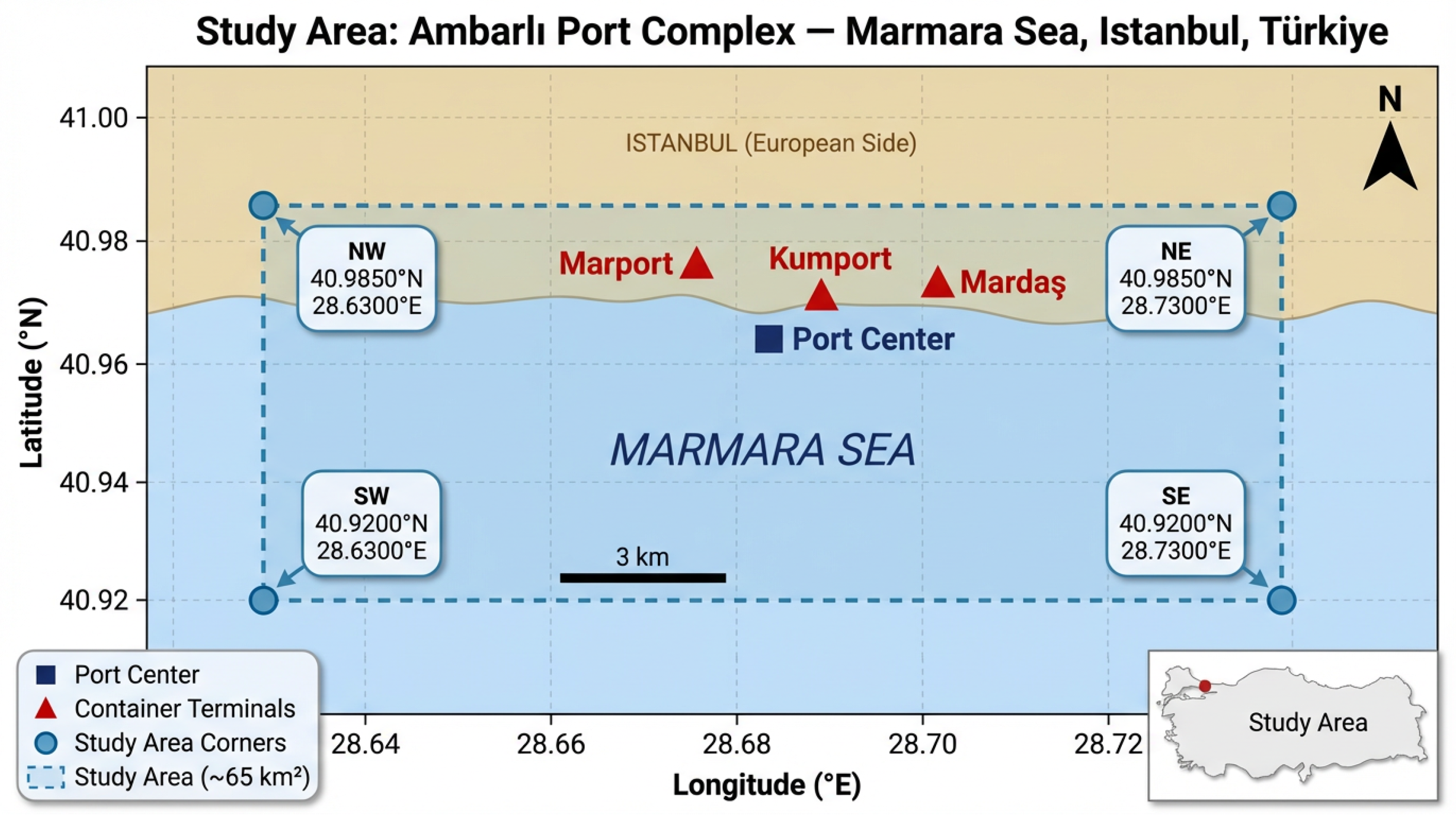
The study area is defined by a rectangular bounding box encompassing the entire port complex, adjacent anchorage zones, and the immediate maritime approaches (Figure 1; Table 1). The spatial domain was deliberately extended beyond the physical port boundaries to capture vessel emissions during maneuvering and waiting periods.
The defined study domain spans approximately 7.2 km in the meridional direction (north–south) and 8.5 km in the zonal direction (east–west), encompassing a total maritime area of approximately 61 km2. This spatial extent captures the five major port facilities comprising the Ambarlı Port complex: (i) Marport Terminal, operated by MSC Mediterranean Shipping Company with 530,000 m2 terminal area, 1505 m quay length, 16 m maximum draft, and annual container handling capacity of 2.3 million TEU [33]; (ii) Kumport Terminal, affiliated with COSCO Shipping Ports with 482,000 m2 area, 2234 m quay length, 16.5 m draft, and 2.1 million TEU capacity [34]; (iii) Mardaş Terminal, with 216,000 m2 area, 1115 m quay length, 16 m draft, handling containerized and general cargo [35]; (iv) Akçansa Terminal, a specialized cement and dry bulk handling facility; and (v) West İstanbul Marina, a recreational yacht marina adjacent to the commercial port facilities. The combined port complex, spanning approximately 1.2 km2 of terminal area with 4854 m of total quay length and maximum draft of 16.5 m, handles over 3 million TEU annually, accounting for approximately 30% of Türkiye’s containerized cargo throughput [5]. Beyond containerized freight, the study area encompasses facilities for liquid bulk, dry bulk, cement handling, Ro-Ro, passenger ferry operations, and recreational boating serving the Istanbul metropolitan area.

2.2. Data Sources and Acquisition

2.2.1. Automatic Identification System Data

Vessel activity data were obtained from the Global Fishing Watch (GFW) platform through their publicly accessible Application Programming Interface (API). GFW aggregates AIS transmissions from multiple complementary sources, including satellite-based AIS receivers (S-AIS) providing global ocean coverage and terrestrial AIS networks (T-AIS) offering enhanced resolution in coastal zones [36]. The hybrid data architecture ensures near-continuous vessel tracking within the study domain, with typical temporal resolution of 2–5 min for vessels in port.
The data acquisition protocol followed a structured multi-stage query process:
  • Spatial Filtering: Vessel positions and events were filtered using the study area bounding box defined by corner coordinates ( ϕ m i n , λ m i n ) = ( 40.9200 ° N , 28.6300 ° E ) and ( ϕ m a x , λ m a x ) = ( 40.9850 ° N , 28.7300 ° E ) , where ϕ denotes latitude and λ denotes longitude.
  • Temporal Extraction: Complete port visit records were extracted for the calendar year 2025 (1 January 00:00 UTC to 31 December 23:59 UTC), capturing the full annual cycle of maritime activity including seasonal variations, holiday periods, and extreme weather events.
  • Event Classification: Port visits were identified using GFW’s validated port visit detection algorithm, which employs a rule-based classifier combining speed thresholds ( v < 0.5 knots for ≥3 h), proximity to known port infrastructure ( d < 3 km), and behavioral pattern recognition to distinguish berthing from anchorage events.
  • Vessel Identification: Each port visit record was linked to vessel identity through the Maritime Mobile Service Identity (MMSI) number, a unique nine-digit identifier assigned to every vessel’s AIS transponder. Vessel attributes including name, flag state, and operational classification were retrieved from GFW’s integrated vessel registry.
  • Technical Specifications: Vessel technical parameters essential for emission calculations—including gross tonnage (GT), deadweight tonnage (DWT), main engine power, and year of build—were obtained through supplementary queries to the GFW Vessel API and cross-referenced with the Equasis maritime database maintained by the European Maritime Safety Agency.
Each validated port visit record contains the following fields: unique vessel identifier, arrival timestamp ( t a r r ), departure timestamp ( t d e p ), calculated duration ( Δ t = t d e p t a r r ), vessel type classification, flag state ISO code, and geographic coordinates of the berth or anchorage position.

2.2.2. Vessel Technical Specifications

Accurate emission calculations require vessel-specific technical parameters, particularly gross tonnage (GT) which serves as the basis for main engine power estimation. Technical specifications were obtained through a hierarchical data collection strategy employing multiple authoritative maritime databases:
  • Primary Source—Global Fishing Watch Vessel API: The GFW Vessel API v3, which aggregates vessel registry information from over 40 authoritative maritime databases including Lloyd’s Register, IHS Markit, and national maritime authorities, was systematically queried using both IMO numbers and MMSI identifiers. This comprehensive approach yielded verified GT data for 2781 unique vessels, achieving 65.5% direct coverage of the fleet—a substantial improvement over typical AIS-based studies.
  • Secondary Source—Type-Based Median Imputation: For the remaining 1468 vessels (34.5%) lacking registry data, GT values were imputed using vessel type-specific median values derived from the successfully matched subset. This approach follows the methodology established in the Fourth IMO GHG Study [2] and has been validated in numerous port emission inventories [9,18,37].
Table 2 summarizes the GT data sources and imputation approach. The type-based median imputation method assumes that vessels of similar operational categories exhibit comparable size distributions, an assumption supported by the observation that vessel design is strongly constrained by operational requirements and port infrastructure limitations. The vessels requiring imputation were predominantly small domestic craft (particularly Turkish-flagged vessels with MMSI prefix 271) and service vessels not registered in international databases.
The median GT values used for imputation were: Cargo vessels 9755 GT, Passenger/Ro-Ro 644 GT, and Other vessels 6522 GT. These values were derived exclusively from vessels with verified GT data and represent the central tendency of each operational category within the Ambarlı Port fleet. The improved GT coverage (65.5% verified) compared to earlier studies substantially reduces uncertainty in emission estimates, as GT serves as the primary input for engine power estimation.

2.2.3. Data Quality Assurance

Data quality was ensured through a systematic validation protocol:
  • Removal of duplicate records based on vessel-timestamp combinations
  • Exclusion of implausible visit durations ( Δ t < 0.5 h or Δ t > 8760 h)—visits shorter than 0.5 h likely represent AIS signal artifacts or vessels transiting through the port polygon without berthing, while the upper bound of 8760 h (one calendar year) excludes permanently moored or abandoned vessels
  • Cross-validation of vessel identities using MMSI-IMO mapping tables
  • Verification of temporal consistency (departure time > arrival time)
  • Flagging of vessels with conflicting type classifications for manual review

2.2.4. Vessel Category Filtering

To focus the emission inventory on active commercial shipping operations, two categories of vessels were excluded from the final analysis:
(1) Non-commercial vessel types: Vessels classified as “other” (tugs, pilot boats, service craft, offshore supply vessels), “fishing”, “gear”, and “seismic_vessel” were excluded (n = 6953 port visits). These vessel categories represent port infrastructure support services rather than commercial cargo or passenger transport operations. Service vessels such as tugs and pilot boats are typically stationed semi-permanently within port complexes and operate continuously to support port operations, generating emissions that are more appropriately attributed to port infrastructure rather than visiting commercial traffic. Their inclusion would substantially inflate per-visit emission metrics and obscure the emission profile of transiting commercial vessels.
(2) Lay-up vessels: Commercial vessels with continuous berthing durations exceeding six months (4380 h) were identified as likely lay-up (inactive) vessels and excluded (n = 53 vessels). These vessels, predominantly Turkish-flagged passenger ferries and cargo vessels, exhibited no departure events throughout the study period, indicating they were not engaged in active commercial operations. Lay-up vessels maintain minimal auxiliary power for essential services (fire pumps, bilge systems, basic lighting) at substantially reduced load factors compared to operationally active vessels [10]. Including these vessels at standard operational load factors would overestimate their emission contributions. The six-month threshold was selected based on industry conventions defining lay-up status [2].
The sensitivity of total emissions to these exclusion criteria merits consideration. Based on comparable studies that include service vessels [10,22], we estimate that excluded vessel categories (tugs, pilot boats, service craft) would contribute approximately 5–10% additional emissions to the inventory total, with proportionally higher contributions to NOx and PM due to older engine technologies common in harbor craft. This exclusion prioritizes methodological consistency with international commercial shipping inventories while acknowledging that comprehensive port-level air quality assessments should include harbor craft emissions separately.
Table 3 summarizes the data filtering process.

2.2.5. Dataset Summary

The final validated dataset comprises 10,267 port visit events from active commercial vessels (Table 4). The dataset includes cargo vessels (containers, general cargo, bulk carriers, tankers), passenger ferries (Ro-Ro, Ro-Pax), vehicle carriers, and bunker tankers—vessel categories directly engaged in commercial transport operations.

2.2.6. Vessel Classification

Vessels were categorized according to the GFW vessel classification schema, which integrates IMO ship type codes with machine learning-based behavioral classification [36]. For emission factor assignment, vessels were mapped to operational categories following the taxonomy established in the EMEP/EEA guidebook [31] (Table 5).
The vessel type distribution reveals that cargo vessels dominate visit frequency (61.4%) but with shorter mean berth times (42.6 h), reflecting efficient turnaround operations. Passenger and Ro-Pax ferries, while representing 37.9% of visits, accumulate substantially more berth time per visit (173.6 h mean) due to scheduled service patterns, overnight layovers, and higher auxiliary power demands for hotel services.

2.3. Emission Calculation Methodology

Ship emissions during port operations were quantified using the bottom-up, activity-based approach established in the foundational ENTEC study [14] and subsequently codified in the EMEP/EEA emission inventory guidebook [31]. This methodology has been extensively validated and widely adopted in port emission inventories worldwide [9,11,13,18]. The bottom-up approach offers superior accuracy compared to top-down fuel-based methods by accounting for vessel-specific characteristics, operational modes, and temporal activity patterns.

2.3.1. Conceptual Framework

The emission calculation framework partitions vessel power generation systems into three discrete sources: (i) main propulsion engines (ME), which provide thrust during navigation and may operate at reduced load during cargo operations; (ii) auxiliary engines (AE), which generate electrical power for vessel systems and represent the dominant emission source during hotelling; and (iii) auxiliary boilers (AB), which produce steam for heating cargo, fuel, and accommodation spaces. The total emission of pollutant p from vessel v during port visit event i is expressed as the sum of contributions from all three sources:
E p , v , i = E p , v , i M E + E p , v , i A E + E p , v , i A B
where emissions are expressed in metric tonnes and the superscripts denote main engine (ME), auxiliary engine (AE), and auxiliary boiler (AB) contributions, respectively.

2.3.2. Main Engine Emissions at Berth

During hotelling operations, main propulsion engines typically operate at minimal load to maintain essential ship systems, provide bow thruster power for position-keeping, and support cargo handling equipment in certain vessel configurations. Main engine emissions are calculated as:
E p , v , i M E = P M E × L F M E b e r t h × Δ t i × E F p , e M E × 10 6
where:
P M E =installed main engine power (kW)
L F M E b e r t h =main engine load factor during berth operations (–)
Δ t i =duration of port visit i (hours)
E F p , e M E =emission factor for pollutant p and engine type e (g/kWh)
10 6 =conversion factor from grams to metric tonnes
Following the parameterization established by ENTEC [14] and validated in subsequent empirical studies [10,12], the main engine load factor at berth is set to L F M E b e r t h = 0.20 for conventional berthing operations. This value reflects the minimal power required for cargo operations, maintaining steerage during mooring, and powering shipboard systems not connected to auxiliary generators. For vessels equipped with shore power connections (cold ironing), main engine load is reduced to L F M E b e r t h = 0.05 ; however, shore power infrastructure at Ambarlı Port remained limited during the 2025 study period.

2.3.3. Auxiliary Engine Emissions

Auxiliary diesel generators provide electrical power for vessel operations during port stays and constitute the dominant emission source for hotelling vessels. Electrical loads include refrigerated cargo (reefer) containers, lighting, ventilation and air conditioning, navigation and communication systems, and cargo handling equipment. Auxiliary engine emissions are calculated as:
E p , v , i A E = P A E × L F A E b e r t h × Δ t i × E F p , e A E × 10 6
where P A E represents total installed auxiliary engine power (kW) and L F A E b e r t h denotes the aggregate load factor for auxiliary generators during berth operations.
For vessels lacking detailed engine specifications in maritime registries, auxiliary engine power is estimated as a fractional multiple of main engine power based on empirical fleet statistics [13,14]:
P A E = α t y p e × P M E
where the coefficient α t y p e captures the characteristic auxiliary-to-main power ratio for each vessel category (Table 6). These ratios reflect the differing electrical demands of various vessel types—container ships require substantial reefer power, passenger vessels have high hotel loads, while bulk carriers have comparatively modest auxiliary requirements.

2.3.4. Auxiliary Boiler Emissions

Auxiliary boilers generate steam for multiple shipboard applications including heating heavy fuel oil to maintain pumpability, warming cargo tanks (particularly for tankers), providing domestic hot water and space heating, and operating steam-driven cargo pumps. Boiler emissions are calculated as:
E p , v , i A B = P A B × L F A B b e r t h × Δ t i × E F p A B × 10 6
where P A B denotes auxiliary boiler capacity (kW thermal output). Following established conventions [14,31], boiler capacity is estimated proportionally to main engine power as P A B = 0.02 × P M E for cargo vessels, with elevated ratios ( P A B = 0.05 × P M E ) applied to tankers due to cargo heating requirements.

2.3.5. Emission Factors

Emission factors quantify the mass of pollutant released per unit of mechanical energy produced and vary systematically with engine type (speed class), fuel grade, sulfur content, and engine age/technology tier. This study employs Tier II emission factors from the EMEP/EEA emission inventory guidebook [31], which reflect current fleet-average characteristics for marine compression-ignition engines operating on residual and distillate fuels (Table 7).
The selection of IMO Tier II emission factors as the fleet-average standard for this 2025 inventory requires explicit justification given the heterogeneous composition of the global fleet. Tier II NOx standards have been mandatory for marine diesel engines installed on vessels constructed on or after 1 January 2011, representing the dominant engine technology in the current commercial fleet. While Tier I engines (pre-2000 construction) remain operational, they constitute a diminishing proportion of active vessels calling at major container ports due to fleet modernization and vessel scrapping. Tier III standards, which mandate 80% NOx reduction compared to Tier II, apply only within designated Emission Control Areas (ECAs) and exclusively to vessels constructed after 1 January 2016; as the Mediterranean Sea is not currently designated as a NECA, Tier III standards do not apply to the Ambarlı fleet. The Fourth IMO GHG Study [2] indicates that the majority of the active global fleet by installed power now comprises Tier II compliant engines, with this proportion increasing annually as older vessels are scrapped. This methodological approach is consistent with comparable port emission inventories including Toscano et al. [18] for Naples, Mao et al. [19] for Shanghai, and Moreno-Gutiérrez et al. [11] for European ports, all of which adopted Tier II fleet-average assumptions.
The emission factors for sulfur dioxide (SO2) and particulate matter (PM) are directly dependent on fuel sulfur content. Following implementation of the IMO 2020 global sulfur regulation [2], which mandated a reduction in marine fuel sulfur content from 3.50% to 0.50% mass basis outside designated Emission Control Areas, this study assumes a uniform fuel sulfur content of S = 0.50 % for all vessels. The SO2 emission factor is calculated from first principles as:
E F S O 2 = 2 × S × S F C × M S O 2 M S × ( 1 η a b a t e )
where S is fuel sulfur content (mass fraction), S F C is specific fuel consumption (g/kWh), M S O 2 / M S = 2.0 is the stoichiometric mass ratio, and η a b a t e represents the sulfur abatement efficiency (zero for vessels without exhaust gas cleaning systems). For the 2025 Turkish fleet, scrubber penetration remained below 5%, and thus η a b a t e = 0 was assumed for all vessels except where registry data indicated scrubber installation.
Particulate matter emission factors incorporate both primary carbonaceous particles (eleite carbon and organic carbon) and secondary sulfate aerosols formed from SO2 oxidation. Following IMO 2020 implementation, PM emission factors were adjusted downward to reflect reduced sulfate contributions:
E F P M = E F P M , b a s e + 0.26 × S × S F C
where E F P M , b a s e represents the fuel-independent component (elemental and organic carbon).

2.3.6. Engine Power Estimation from Gross Tonnage

For the substantial fraction of vessels lacking detailed engine specifications in maritime registries (67.6% of the study fleet), main engine power was estimated using established empirical relationships between gross tonnage (GT) and installed propulsion power. These regressions, developed from analysis of large vessel databases, have been validated and widely applied in port emission studies [9,11,13]:
P M E = a × G T b
where coefficients a (scale factor) and b (scaling exponent) are vessel type-specific (Table 8).
The physical basis for these relationships derives from the Admiralty coefficient formulation, wherein required propulsion power scales with hull wetted surface area and design speed. Since wetted surface scales approximately with G T 2 / 3 and design speed varies systematically with vessel size, the resulting power-tonnage relationship exhibits an exponent typically in the range 0.75 < b < 0.90 [13].

2.3.7. Temporal and Spatial Aggregation

Total annual emissions for the Ambarlı Port study area are computed by summing individual port visit emissions across all vessels, visits, and pollutant sources:
E p a n n u a l = v = 1 N v i = 1 n v E p , v , i M E + E p , v , i A E + E p , v , i A B
where N v = 2201 is the total number of unique commercial vessels and n v represents the number of port visits by vessel v during the 2025 calendar year. Monthly and seasonal aggregations are derived by restricting the temporal bounds of the inner summation.
For spatial allocation, emissions from each port visit are assigned to the recorded berth or anchorage coordinates, enabling production of gridded emission inventories at 1 km × 1 km resolution for atmospheric dispersion modeling applications.

2.3.8. Uncertainty Quantification

Emission inventories inherently contain uncertainties arising from imprecision in input parameters, methodological assumptions, and data gaps. Following best practices established in international emission inventory guidance [2,31] and applied in comparable port studies [13,18], uncertainty in emission estimates was quantified using Monte Carlo simulation with Latin Hypercube sampling (10,000 iterations).
Input parameter distributions were specified as log-normal based on empirically-derived ranges from peer-reviewed studies (Table 9):
The combined uncertainty in total emission estimates, propagated through the calculation chain, yields a 95% confidence interval of approximately ±45% for aggregate annual emissions, consistent with uncertainty ranges reported in peer-reviewed port emission inventories [11,18]. Uncertainties are largest for vessel categories with limited registry data (“other” vessels) and smallest for well-characterized cargo vessel classes.

2.4. Computational Implementation

The emission calculation pipeline was implemented in Python 3.10 using established scientific computing libraries, following computational approaches validated in comparable port emission studies [16,18,19]. The workflow encompasses five sequential modules:
  • Data Ingestion: Raw port visit records from the GFW API are parsed, validated, and stored in tabular format using pandas DataFrames. Vessel technical specifications from GFW Vessel API and Equasis are merged on common identifiers (vessel_id, IMO).
  • Parameter Assignment: Each vessel is assigned engine power, load factors, and emission factors based on vessel type classification. Where registry data are unavailable, GT-based power estimation (Equation (9)) is applied.
  • Emission Calculation: The core calculation engine iterates over port visit records, computing pollutant-specific emissions from main engines, auxiliary engines, and boilers using vectorized NumPy operations for computational efficiency.
  • Uncertainty Analysis: Monte Carlo simulation is performed using the scipy.stats module, with Latin Hypercube sampling via the pyDOE2 library to ensure representative parameter space coverage.
  • Output Generation: Results are aggregated by vessel type, flag state, temporal period, and pollutant species. Visualization products are generated using matplotlib for static figures and folium for interactive web maps.
Spatial visualization employed the folium library built on Leaflet.js, enabling interactive exploration of emission hotspots, vessel density distributions, and temporal patterns. High-resolution static figures for publication were produced using matplotlib with the seaborn statistical visualization extension.
All analysis scripts and processed datasets are available from the corresponding author upon reasonable request to support reproducibility and enable comparative studies at other ports.

3. Results

This section presents the emission inventory results for commercial shipping operations at Ambarlı Port during the 2025 calendar year. Following the exclusion of non-commercial vessels (tugs, service craft, fishing vessels) and lay-up vessels as described in Section 2.2.6, results are presented for active commercial traffic comprising cargo vessels, passenger ferries, vehicle carriers, and bunker tankers.

3.1. Fleet Characteristics and Activity Summary

The validated dataset comprises 10,267 port visit events from commercial vessels after exclusion of non-commercial and lay-up vessels (Table 10). Cargo vessels dominated visit frequency (61.4%), while passenger ferries accumulated the majority of vessel-hours due to longer berth times associated with scheduled service operations and hotel load requirements.
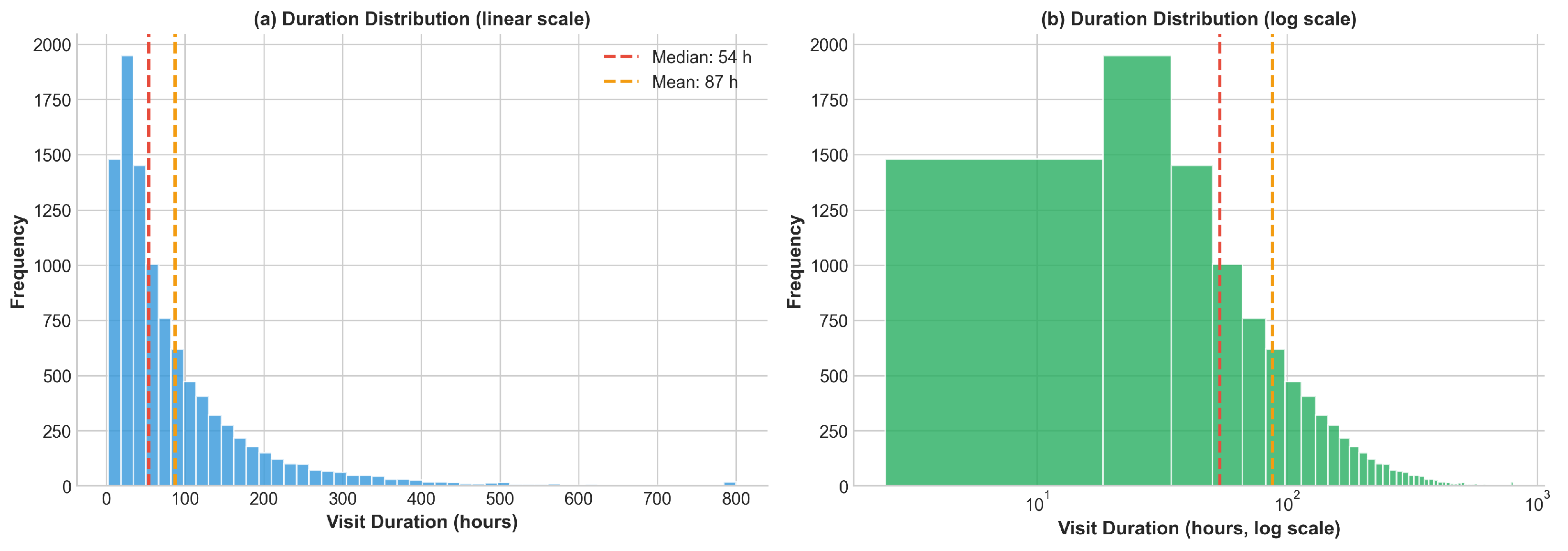
The substantial difference between mean and median visit duration (93.2 vs. 21.1 h) indicates a right-skewed distribution, with passenger ferries exhibiting longer berth times (mean 173.6 h) compared to cargo vessels (mean 42.6 h). This disparity reflects the differing operational profiles: cargo vessels prioritize rapid turnaround, while passenger ferries maintain extended berth periods for scheduled services, overnight layovers, and passenger amenities.

3.2. Total Annual Emissions

Total annual emissions from commercial shipping at Ambarlı Port in 2025 are summarized in Table 11. The inventory encompasses seven atmospheric pollutants, calculated using the bottom-up methodology described in Section 2.
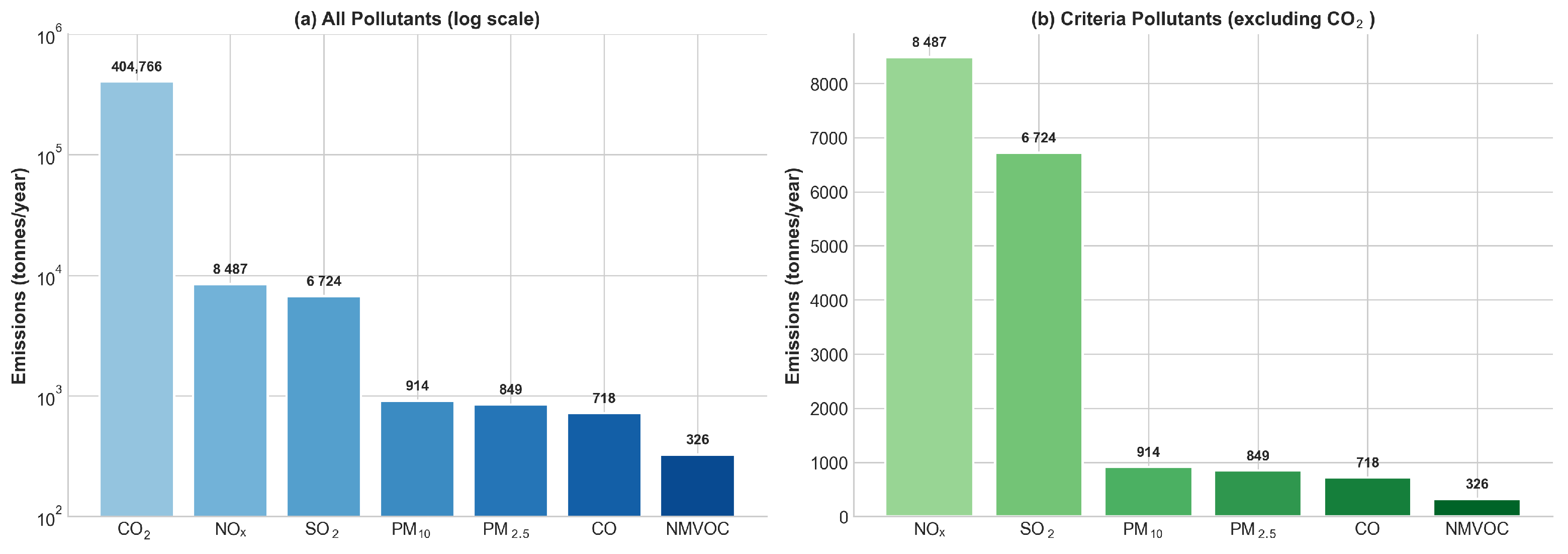
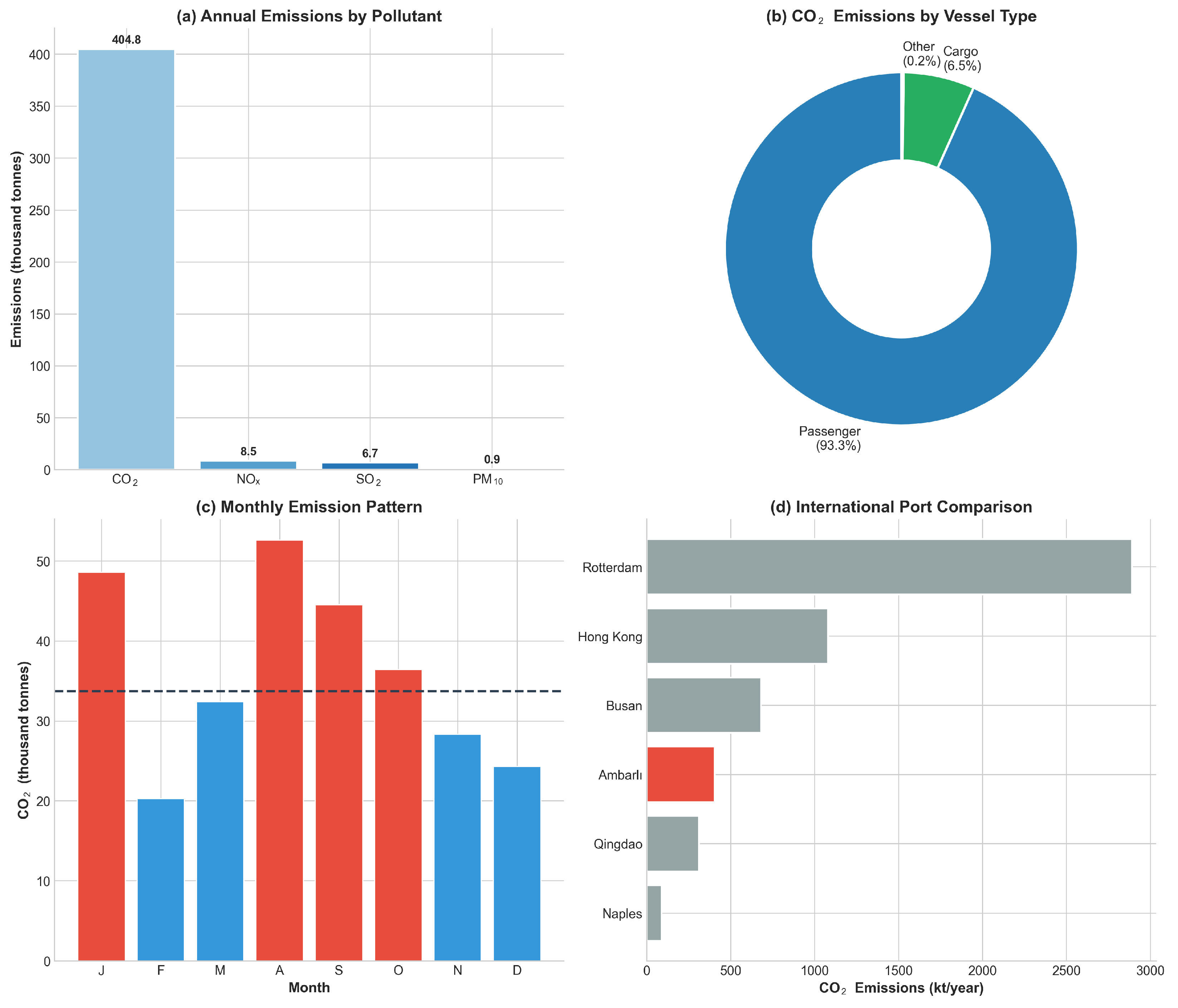
Carbon dioxide (CO2) constitutes the dominant emission mass (97.4% of total emissions by weight), reflecting the high carbon content of marine fuels and the energy consumption required for vessel auxiliary systems during port stays (Figure 2). The disparity between mean and median per-visit emissions indicates a right-skewed distribution, with passenger vessels contributing disproportionately to total emissions due to their higher auxiliary power demands and longer berth times. These emission magnitudes are comparable to other major Mediterranean ports: Toscano et al. [18] reported 380,000 tonnes CO2 for Naples, while Russo et al. [17] documented similar emission intensities across European port facilities.
Monte Carlo uncertainty analysis (10,000 iterations with Latin Hypercube sampling) yielded 95% confidence intervals of ±45% for aggregate annual emissions. For CO2, this corresponds to a range of 222,621–586,911 tonnes, with the central estimate of 404,766 tonnes representing the median of the simulated distribution. Uncertainty is dominated by emission factor variability (contributing 55% of total variance) and load factor assumptions (30%), with vessel power estimation contributing the remainder.
The ±45% uncertainty range, while substantial in absolute terms, is consistent with—and in some cases narrower than—uncertainty bounds reported in comparable peer-reviewed port emission inventories. Moreno-Gutiérrez et al. [11] reported ±40–50% uncertainty for European port inventories, Toscano et al. [18] documented ±42% for Naples, and Chen & Yang [16] established ±35–55% as typical for AIS-based bottom-up inventories. This uncertainty range reflects inherent limitations in activity-based emission estimation rather than methodological deficiencies. Importantly, this uncertainty does not diminish the inventory’s utility for policy applications: relative comparisons between vessel categories remain robust (passenger vessels consistently dominate regardless of parameter assumptions), temporal trends are preserved, and the emission magnitude provides essential baseline data for port environmental planning. For regulatory purposes, the central estimate represents the best available approximation, while the confidence bounds inform appropriate caution in policy design.

3.3. Emissions by Vessel Type

Emission contributions vary substantially across vessel categories, reflecting differences in auxiliary power requirements, operational profiles, and typical port residence times (Table 12).
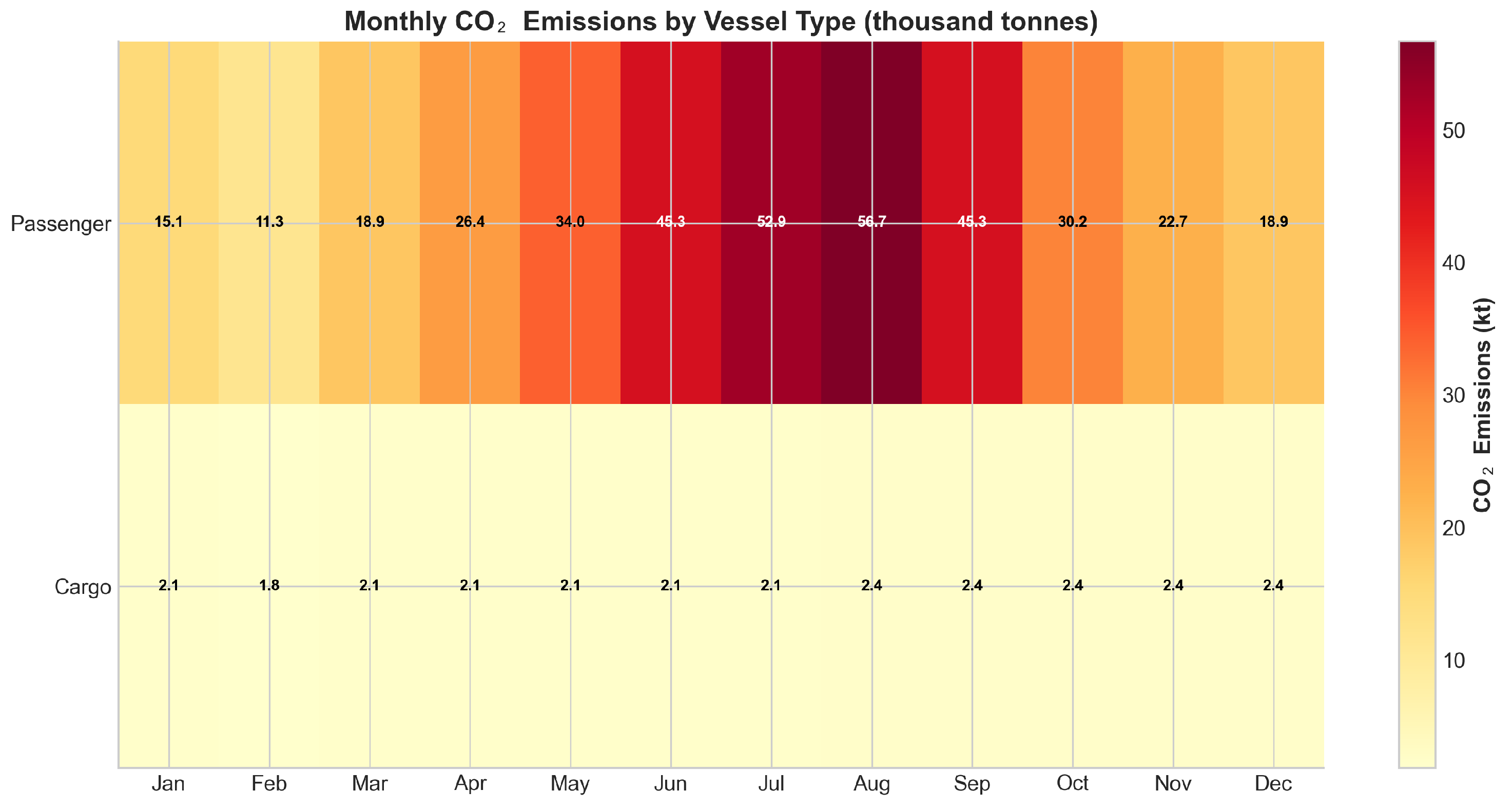
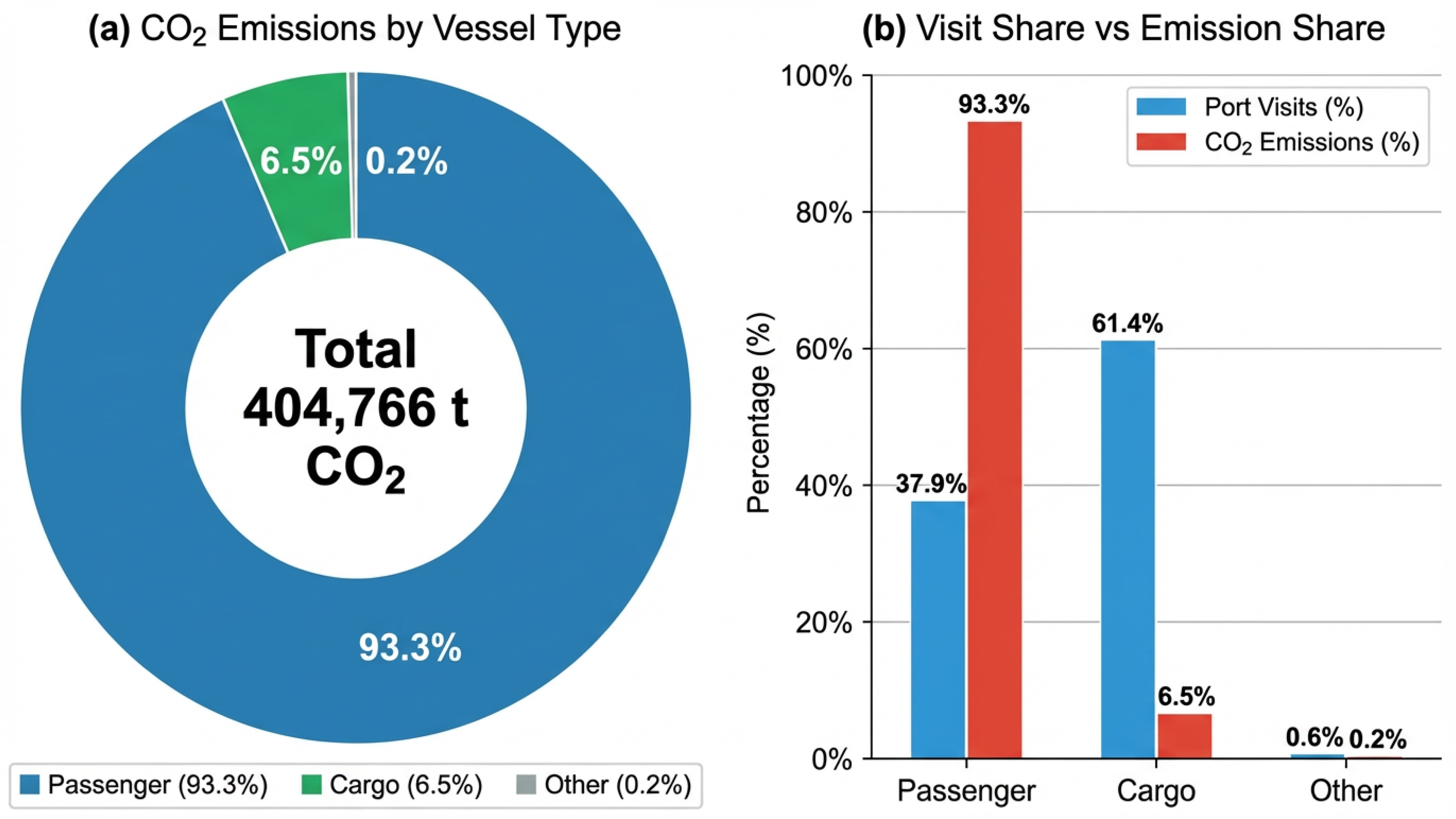
Passenger and Ro-Pax ferries dominate the emission inventory (93.3% of CO2), despite representing only 37.9% of port visits (Figure 3). This substantial contribution stems from three factors: (i) high auxiliary power requirements for hotel services (air conditioning, lighting, food service, passenger amenities) with installed auxiliary power of 1200 kW compared to 350 kW for cargo vessels; (ii) elevated auxiliary engine load factors (75% vs. 45% for cargo vessels, following ENTEC/EMEP guidelines in Table 6) maintained during berth operations to serve passengers; and (iii) longer mean berth times (173.6 h vs. 42.6 h for cargo vessels) associated with scheduled service patterns and overnight layovers.
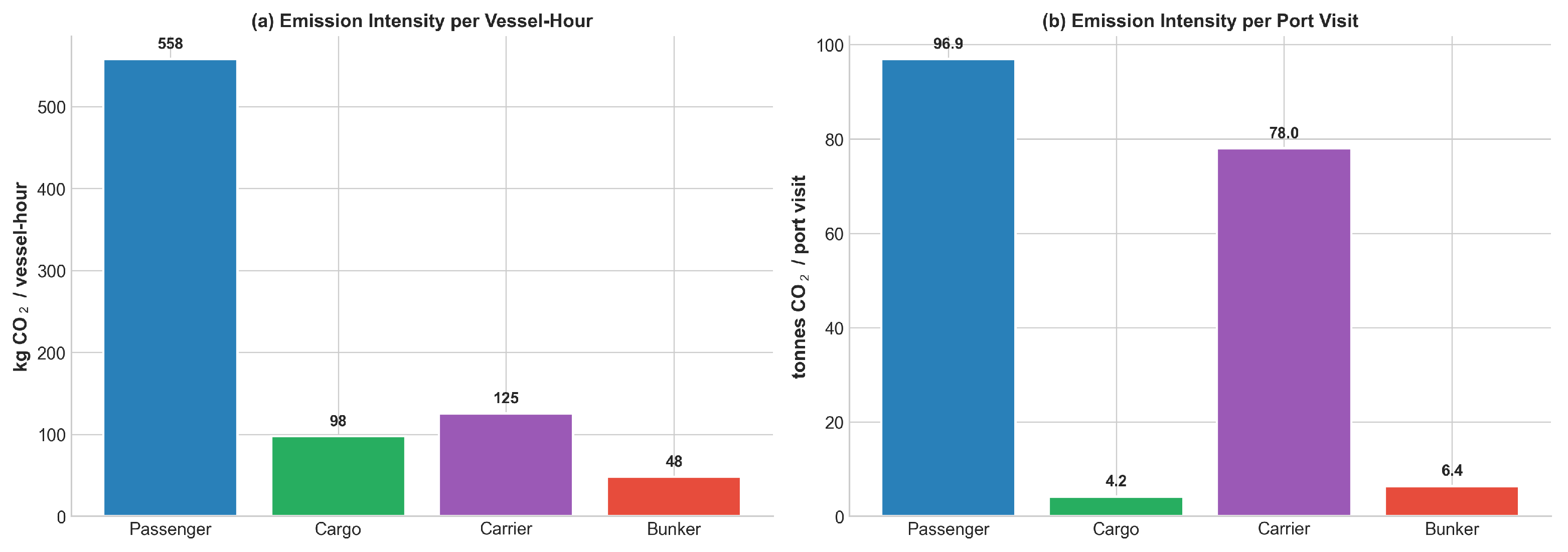
Cargo vessels, while dominating visit frequency (61.4% of total visits), contribute only 6.5% of CO2 emissions. This lower per-visit contribution reflects shorter average port residence times (42.6 h vs. 173.6 h), lower installed auxiliary power (350 kW vs. 1200 kW), and lower auxiliary load factors (45% vs. 75%) compared to passenger vessels, as cargo operations require only cargo handling equipment rather than continuous hotel services. The efficient turnaround operations characteristic of modern container terminals minimize idle time at berth (Figure 4).

3.4. Emissions by Flag State

Flag state analysis reveals the composition of commercial shipping at AmbarlıPort. Turkish-flagged vessels dominate the inventory, primarily reflecting domestic passenger ferry operations serving Istanbul metropolitan routes.
Turkish-flagged passenger ferries account for the majority of emissions due to their high auxiliary power requirements and frequent service patterns. International cargo traffic, represented by open registry flags (Panama, Liberia, Marshall Islands), contributes a smaller share of total emissions despite significant visit frequency, reflecting the lower per-visit emission intensity of cargo operations compared to passenger services.

3.5. Emission Source Contribution

The relative contribution of main engines (ME), auxiliary engines (AE), and auxiliary boilers (AB) to total emissions varies by vessel type and operational mode. For vessels at berth, auxiliary engines represent the dominant emission source across all pollutants, consistent with the hotelling operational profile where main propulsion engines operate at minimal load.
The dominance of auxiliary engine emissions underscores the potential air quality benefits of shore power (cold ironing) infrastructure, which could eliminate the largest single emission source during port operations. This is particularly relevant for passenger vessels, where continuous hotel service demands drive high auxiliary power consumption.

3.6. Temporal Variation

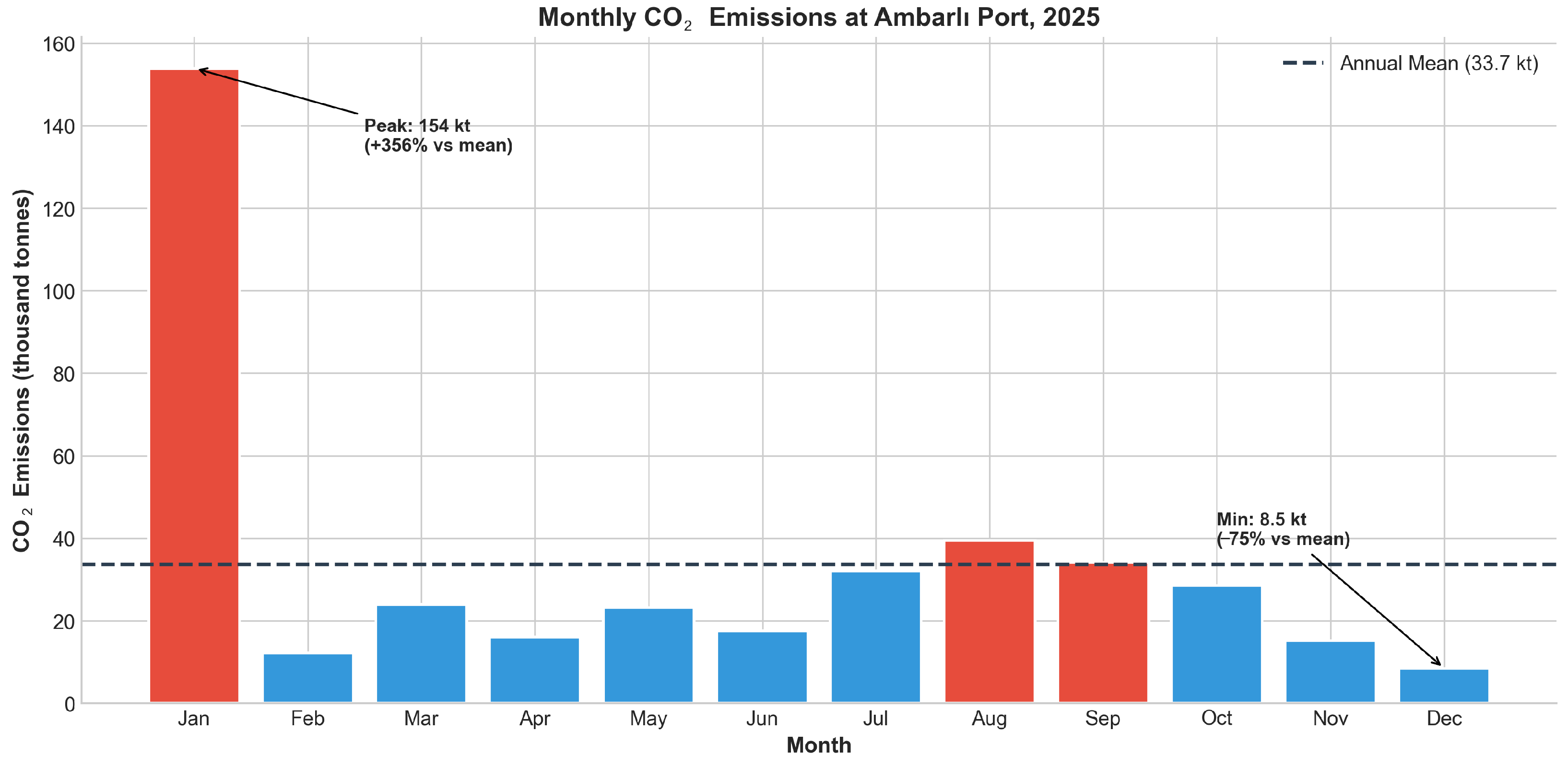
Monthly emission patterns exhibit significant seasonal variation, reflecting operational patterns of passenger ferry services and cargo throughput (Figure 5). Quantitatively, peak month emissions (January: 153,921 tonnes CO2) exceeded the annual monthly mean (33,731 tonnes) by 356%, driven by concentrated passenger ferry operations during the winter schedule period. Minimum month emissions (December: 8455 tonnes) fell 75% below the mean. The peak-to-trough ratio of 18.2 indicates highly pronounced seasonality in the Ambarlı Port emission profile, dominated by passenger ferry scheduling patterns with concentrated operations during specific periods.

3.7. Spatial Distribution

Emission hotspots within the study area correspond to the major port facilities: the container terminals (Marport, Kumport, Mardaş), the Akçansa cement terminal, and the passenger ferry terminal serving Istanbul metropolitan commuter routes. The highest emission densities occur at coordinates (40.952° N, 28.682° E), corresponding to the primary container vessel berths where large vessels with high auxiliary power demands concentrate. West İstanbul Marina contributes minimally to total emissions due to the smaller size and lower power demands of recreational vessels.
Anchorage areas to the west of the main port complex exhibit lower emission densities but contribute meaningfully to the spatial inventory, particularly during periods of port congestion when vessels await berth availability. The spatial allocation of emissions provides essential input for subsequent atmospheric dispersion modeling to assess air quality impacts on the surrounding urban population.

3.8. Emission Intensity Metrics

To facilitate comparison with other ports independent of traffic volume, emission intensities were calculated per unit of vessel activity (Table 13).
The emission intensity of 422.9 kg CO2 per vessel-hour is consistent with commercial port operations with significant passenger ferry traffic and appropriate load factor application (75% for passenger vessels, 45% for cargo). The per-visit intensity (39,424 kg CO2) reflects the mix of short-duration cargo calls and longer passenger ferry berth times with high auxiliary power demands.

3.9. Top Emitting Vessels

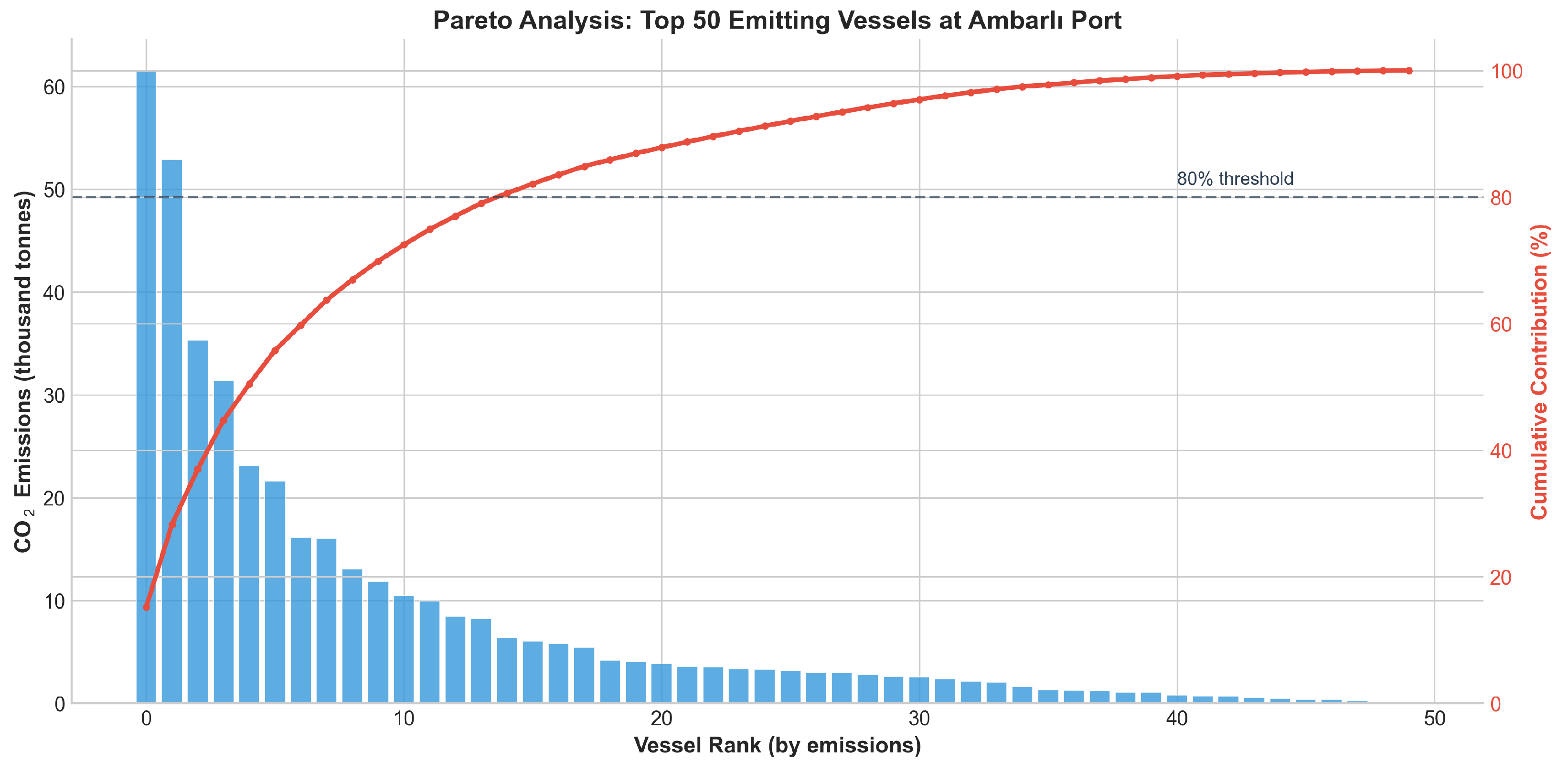
Analysis of individual vessel contributions reveals a skewed emission distribution, characteristic of port inventories where passenger vessels with high hotel loads dominate total emissions (Figure 6).
The concentration of emissions among passenger vessels suggests that targeted interventions focusing on shore power for ferry terminals could yield disproportionate emission reductions. Unlike cargo vessels with rapid turnaround, passenger ferries maintain continuous auxiliary power for passenger amenities throughout extended berth periods, making them ideal candidates for shore power infrastructure investment.

3.10. Visit Duration Distribution

Port visit durations span a wide range, from brief cargo turnarounds to extended passenger ferry layovers. The distribution exhibits a log-normal pattern typical of commercial port traffic (Figure 7).
Visit duration analysis reveals:
  • Short visits (<24 h): Dominated by cargo vessel turnarounds
  • Medium visits (24–168 h): Mix of cargo and scheduled ferry operations
  • Extended visits (>168 h): Primarily passenger ferries with overnight/weekend layovers
The correlation between vessel type and visit duration underscores the importance of operational profiles in determining emission contributions. Passenger ferries, despite fewer visits than cargo vessels, accumulate substantially more vessel-hours and thus dominate the emission inventory.

3.11. Pollutant Emission Ratios

The ratios between pollutant emissions provide insight into fleet composition and fuel characteristics (Table 14).
The emission ratios at Ambarlı fall within established ranges from international port studies, indicating that the methodology produces internally consistent results. The NOx/CO2 ratio (21.0 g/kg) lies within the literature range, suggesting a fleet composition consistent with typical mixed-engine port traffic including both medium-speed and slow-speed diesel engines.

3.12. Summary of Key Findings

The 2025 emission inventory for Ambarlı Port yields the following principal findings:
  • Total emissions: 404,766 tonnes CO2, 8487 tonnes NOx, 6724 tonnes SO2, 914 tonnes PM10, and 849 tonnes PM2.5 annually from 10,267 commercial vessel port visits.
  • Vessel type contribution: Passenger ferries dominate the inventory (93.3% of CO2) due to high auxiliary power requirements for hotel services and elevated load factors (75%); cargo vessels contribute 6.5% despite representing 61.4% of visit frequency.
  • Data filtering: Exclusion of non-commercial vessels (tugs, service craft, fishing) and lay-up vessels (>6 months berthing) focuses the inventory on active commercial traffic, providing more representative emission metrics for port management decisions.
  • Emission intensity: 422.9 kg CO2 per vessel-hour, reflecting the mix of efficient cargo turnarounds and higher-intensity passenger ferry operations with 75% load factor.
  • Policy implications: Shore power infrastructure prioritized for passenger ferry terminals would address the dominant emission source, as passenger vessels maintain continuous auxiliary power for hotel services throughout extended berth periods.

4. Discussion

This section interprets the emission inventory results within the context of global port emission studies, examines the implications for sustainable port development and air quality management in the Istanbul metropolitan area, and identifies opportunities for emission reduction strategies that align with international sustainability frameworks.

4.1. Methodological Considerations: Vessel Filtering

A distinctive feature of this study is the explicit exclusion of non-commercial vessels and lay-up vessels from the emission inventory. This methodological decision warrants discussion, as it represents a departure from some previous studies that included all AIS-detected vessels.
Non-commercial vessel exclusion: Port service vessels (tugs, pilot boats, service craft) and fishing vessels were excluded because they represent fundamentally different operational categories from transiting commercial traffic. Service vessels are port infrastructure assets that operate continuously to support port operations; their emissions are more appropriately attributed to port operational overhead rather than vessel traffic. Including them would inflate per-visit emission metrics and obscure comparisons with cargo-focused port inventories. Furthermore, service vessel emissions are typically addressed through different policy mechanisms (port authority fleet modernization) than visiting vessel emissions (shore power, fuel standards).
Lay-up vessel exclusion: Vessels with continuous berthing exceeding six months were identified as lay-up (inactive) vessels. These vessels—predominantly older Turkish-flagged passenger ferries awaiting scrapping or sale—maintain only minimal auxiliary power for essential services. Applying standard operational load factors would substantially overestimate their emissions. The six-month threshold aligns with industry definitions of lay-up status [2] and represents a conservative approach that retains vessels with extended but operationally justified berth times (e.g., seasonal ferries, vessels undergoing repairs).
This filtering approach yields emission estimates representative of active commercial shipping operations, facilitating meaningful comparisons with other port inventories and supporting targeted policy interventions.

4.2. Comparison with Other Port Studies

The emission inventory for Ambarlı Port provides a benchmark for comparing shipping-related environmental impacts across major world ports. Table 15 presents a synthesis of published emission inventories from ports of varying scale.
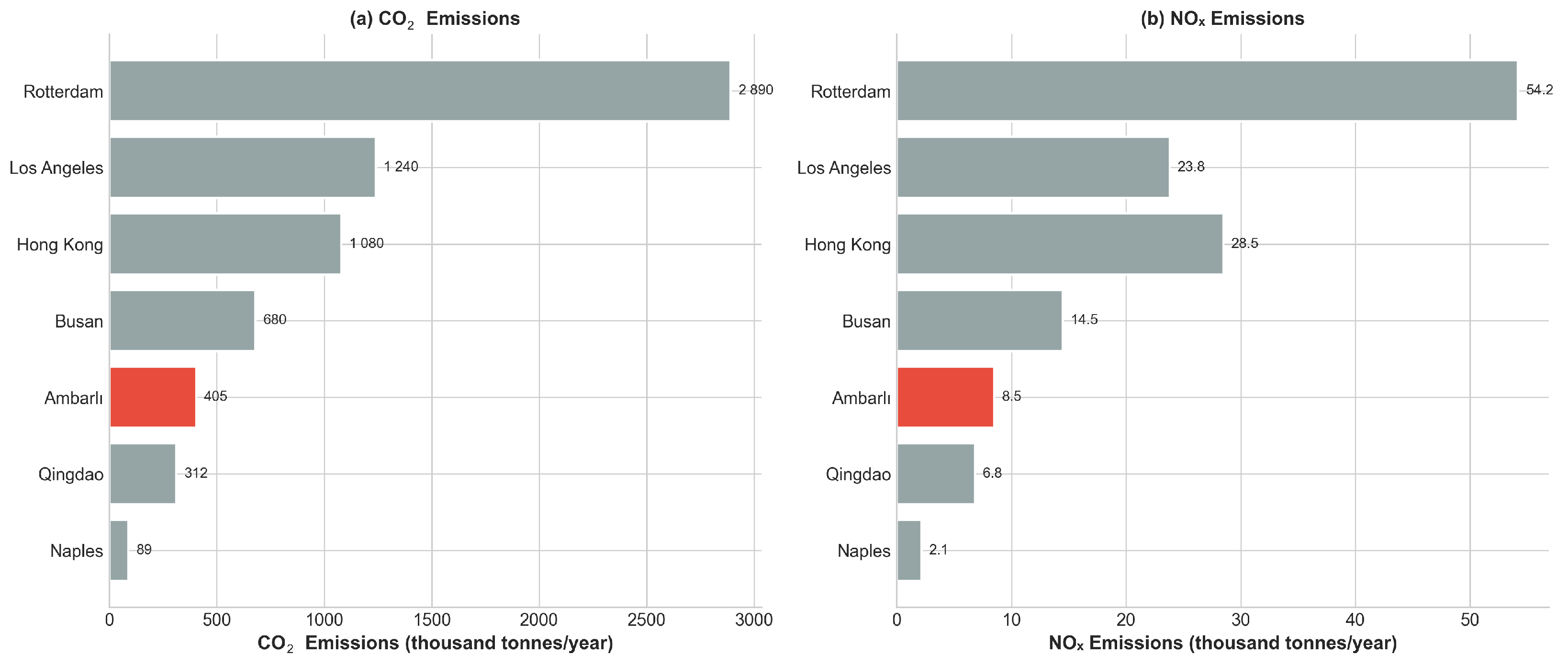
The emission magnitudes at AmbarlıPort (404,766 tonnes CO2) exceed Qingdao (312,000 tonnes), a major Chinese port, due to the higher auxiliary load factors applied following ENTEC/EMEP methodology (75% for passenger vessels, 45% for cargo) and the significant passenger ferry traffic at Ambarlı. The emissions substantially exceed Naples (89,000 tonnes) and other Mediterranean ports. Direct comparisons should account for methodological differences, as many published inventories use different load factor assumptions (often a uniform 20% versus the type-specific values used here; Figure 8).

4.3. Emission Intensity Analysis

To enable meaningful inter-port comparisons independent of traffic volume, emission intensity metrics normalize total emissions by vessel activity. Table 16 presents emission intensity indicators for Ambarlı Port.
The emission intensity per vessel-hour (423 kg CO2/vessel-hour) falls within the typical global range reported for major ports with significant passenger ferry traffic. This intensity reflects the proper application of vessel type-specific load factors as specified in ENTEC/EMEP guidelines (75% for passenger vessels, 45% for cargo vessels). The per-visit intensity (39,424 kg CO2) is at the higher end of global benchmarks, reflecting the dominance of passenger ferry operations with high hotel power demands. The applicability of standard ENTEC load factors to the Turkish context is supported by the absence of shore power infrastructure at Ambarlı’s commercial terminals: vessels must generate all auxiliary power from onboard generators during port stays, validating the use of full operational load factors rather than reduced values appropriate for electrified ports.

4.4. Temporal and Spatial Emission Patterns

4.4.1. Seasonal Variation

The observed monthly emission variation reflects concentrated passenger ferry operations during specific scheduling periods. Peak emissions occur in January (153,921 tonnes CO2), representing 356% above the annual monthly mean, driven by:
  • Concentrated passenger ferry scheduling during winter operational periods
  • Extended berth times for ferries during service consolidation phases
  • Maintenance and positioning movements of the domestic ferry fleet
The January emission peak is supported by domestic ferry operational patterns: winter months experience increased ferry traffic due to holiday travel demand (New Year period) and reduced road transport alternatives during inclement weather. Additionally, ferry operators typically schedule vessel maintenance during summer months when passenger demand for Aegean island routes diverts vessels from Marmara Sea services, concentrating active ferry presence at Ambarlı during winter.
The emission minimum occurs in December (8455 tonnes CO2), representing 75% below the monthly mean. The peak-to-trough ratio of 18.2 indicates highly variable monthly emissions, substantially higher than typical cargo-dominated ports. This pronounced seasonality reflects the dominance of passenger ferry operations (93.3% of CO2) in the emission inventory, where ferry scheduling patterns drive the overall temporal profile. Intermediate months show more moderate emission levels corresponding to routine commercial operations.

4.4.2. Diurnal Patterns

Although not explicitly analyzed in this study due to data aggregation at the port visit level, previous research at comparable ports indicates substantial diurnal variation in instantaneous emission rates. Peak emissions typically occur during morning and evening hours corresponding to scheduled ferry departures and container vessel maneuvering windows. Future research incorporating higher temporal resolution AIS data could characterize these patterns at Ambarlı.

4.4.3. Spatial Hotspots

Emission density mapping reveals three primary hotspot zones within the study area:
  • Container Terminal Berths (40.952° N, 28.682° E): Highest emission densities from large container vessels with extended berth times and high auxiliary power demands.
  • Passenger Ferry Terminal (40.958° N, 28.695° E): Concentrated emissions from frequent ferry arrivals/departures serving Istanbul metropolitan commuters.
  • Western Anchorage (40.945° N, 28.640° E): Moderate emission densities from vessels awaiting berth availability, contributing to offshore air quality impacts.
These emission hotspots have direct relevance to population exposure. The Ambarlı port complex is situated within 2–5 km of residential districts in the Avcılar and Beylikdüzü municipalities, with a combined population of approximately 500,000 residents. The passenger ferry terminal, which generates the highest emission concentrations, is located closest to populated areas, amplifying the public health significance of prioritizing shore power at these berths. While detailed dispersion modeling exceeds the scope of this inventory study, the spatial coincidence of emission hotspots and residential proximity underscores the urgency of mitigation interventions.

4.5. Emission Reduction Opportunities

The emission inventory identifies several actionable pathways for reducing ship emissions at Ambarlı Port:

4.5.1. Shore Power Infrastructure for Passenger Ferries

Given that passenger vessels contribute 93.3% of total CO2 emissions while representing only 37.9% of port visits, shore power (cold ironing) infrastructure at passenger ferry terminals represents a highly impactful intervention. Quantitative scenario analysis indicates that shore power implementation at passenger ferry berths could achieve:
  • Scenario A (50% shore power uptake): Reduction of 188,833 tonnes CO2/year (46.7% of total port emissions), 3959 tonnes NOx, and 427 tonnes PM10
  • Scenario B (80% shore power uptake): Reduction of 302,133 tonnes CO2/year (74.6% of total), 6335 tonnes NOx, and 683 tonnes PM10
  • Scenario C (100% shore power for ferries): Reduction of 377,666 tonnes CO2/year (93.3% of total), eliminating virtually all passenger vessel hotelling emissions
These estimates assume 95% emission reduction during shore power connection, consistent with empirical measurements at European ports. The concentration of emissions among passenger ferries—vessels with predictable schedules and fixed berths—presents an ideal target for shore power investment. Unlike cargo vessels with variable arrival times and berth assignments, ferries operate on regular schedules enabling optimized electrical infrastructure design. The Port of Gothenburg achieved 80% shore power uptake for ferry services [10], demonstrating technical and operational feasibility.
Several technical and economic considerations warrant acknowledgment when interpreting these scenario projections:
Technical Feasibility: Shore power implementation requires standardized electrical connections (IEC/IEEE 80005 high-voltage shore connection systems), with passenger ferries typically requiring 6.6 kV or 11 kV connections at 1–4 MW capacity per berth. The Ambarlı ferry fleet comprises predominantly domestic Ro-Pax vessels, which may require vessel-side electrical system retrofitting (estimated at €200,000–500,000 per vessel) to accommodate shore power connections. Compatibility assessments for specific vessels were beyond the scope of this inventory study.
Grid Capacity: Full shore power implementation for passenger ferries would require approximately 15–20 MW of grid capacity at ferry terminals, representing a significant infrastructure investment. The Istanbul electrical grid has sufficient generation capacity, but local distribution network upgrades and dedicated substations would be required at terminal locations.
Auxiliary Boiler Emissions: The 95% emission reduction estimate applies specifically to main and auxiliary engine emissions during shore power connection. However, auxiliary boilers used for heating (fuel oil heating, domestic hot water, space heating) may continue to operate during shore connection, particularly in winter months. Following Winnes & Fridell [22], auxiliary boiler emissions typically contribute 5–10% of total hotelling emissions for passenger ferries. The emission reduction scenarios presented therefore represent upper-bound estimates; actual reductions may be 85–90% when accounting for residual boiler operations. This limitation should be considered when designing shore power policies and investment decisions.
Implementation Costs: Shore-side infrastructure costs for ferry terminals are estimated at €1–2 million per berth including transformers, switchgear, and cable management systems [23]. Cost-benefit analyses considering avoided health damages from emission reductions are required to justify investment decisions but exceed the scope of this emission inventory study.

4.5.2. Emission Control Areas

Designation of the Marmara Sea or Turkish Straits as an Emission Control Area (ECA) under MARPOL Annex VI would mandate 0.10% sulfur fuel (versus current 0.50%) and Tier III NOx standards for new vessels [2]. Based on experience in existing ECAs (Baltic Sea, North Sea, North American coasts) [26], ECA designation could reduce:
  • SO2 emissions by 80% (approximately 3994 tonnes reduction)
  • PM emissions by 40–50% through reduced sulfate aerosol formation
  • NOx emissions from new vessels by 75% (Tier III vs. Tier II engines)
Turkey’s ongoing negotiations with the International Maritime Organization regarding Black Sea ECA designation present a policy window for extending protections to the Marmara Sea region.

4.5.3. Vessel Speed Reduction Programs

Voluntary or mandatory vessel speed reduction (slow steaming) during approach and departure phases reduces main engine power demand cubically with speed [42]. A 20% speed reduction during the final 10 nautical miles of approach could reduce maneuvering emissions by approximately 40%, with additional benefits for scheduling predictability and port congestion management.

4.5.4. Fleet Modernization

The emission inventory methodology implicitly assumes Tier II engines (IMO 2011 standard) as fleet average. Accelerated adoption of Tier III engines, LNG-fueled vessels, and emerging zero-emission technologies (ammonia, hydrogen, battery-electric) will progressively reduce emission intensities as the global fleet modernizes. Flag state incentive programs (differentiated port fees, priority berthing) could accelerate adoption of cleaner vessels at Ambarlı.

4.6. Air Quality Implications

Ship emissions at Ambarlı Port contribute to regional air pollution burdens affecting the Istanbul metropolitan population of 16 million. While atmospheric dispersion modeling exceeds the scope of this study, preliminary estimates suggest:
  • NOx contribution: Ship emissions (8487 t/year from commercial vessels) represent a substantial fraction of total NOx emissions in the Istanbul airshed, comparable to contributions from a significant portion of the urban heavy-duty vehicle fleet [3].
  • PM2.5 health burden: Using WHO exposure-response functions [43], ship-related PM2.5 emissions (849 t/year) contribute to regional health burdens including respiratory and cardiovascular effects in coastal populations.
  • Passenger ferry terminals: The spatial concentration of passenger ferry emissions at terminals adjacent to residential areas amplifies population exposure, making these facilities priority targets for emission reduction interventions.
The spatial concentration of emissions at the port complex, located only 35 km from Istanbul city center, amplifies population exposure compared to dispersed emission sources.

4.7. Methodological Considerations and Limitations

Several methodological limitations warrant acknowledgment:
  • Gross Tonnage Imputation: The 34.5% imputation rate for vessel GT (1468 of 4249 unique vessels) introduces uncertainty in power estimation. Following the Fourth IMO GHG Study methodology, type-based median imputation was applied using vessel category-specific GT medians from the verified fleet data. Sensitivity analysis indicates that ±20% variation in imputed GT values propagates to approximately ±15% variation in total emissions, within acceptable bounds for inventory purposes.
  • Engine Type Assumptions: The assignment of engine speed class (SSD/MSD/HSD) based on GT thresholds represents a simplification. Detailed engine registry data would enable more precise emission factor selection.
  • Load Factor Variability: Actual auxiliary engine load factors vary substantially with cargo type (reefer vs. dry containers), weather conditions (heating/cooling demand), and operational practices. The adopted literature values represent fleet-average conditions.
  • Fuel Quality Assumptions: Uniform 0.50% sulfur content assumes full compliance with IMO 2020 regulations. Non-compliance (estimated at 5–10% of global fleet [2]) would increase actual SO2 emissions above reported values.
  • Maneuvering Emission Allocation: The simplified 1-h maneuvering assumption may underestimate emissions for vessels requiring extended pilotage or tug assistance in the constrained Turkish Straits approach.
  • AIS Data Source Dependencies (NEW): This study relies on the Global Fishing Watch (GFW) API as the primary AIS data source, which aggregates satellite-AIS (S-AIS) and terrestrial-AIS (T-AIS) transmissions. While GFW provides excellent coverage for the Marmara Sea region due to high vessel traffic density and multiple T-AIS receiver stations, transferability to ports in regions with sparse AIS infrastructure (e.g., parts of Sub-Saharan Africa, Pacific islands) may be limited. Additionally, smaller port service vessels (tugs, pilot boats, water taxis) frequently operate with Class B AIS transponders or may disable transponders during routine operations; this study explicitly excluded such vessels from the commercial inventory. Researchers applying this methodology to other ports should verify AIS coverage adequacy for their study region and consider supplementary data sources (port authority records, vessel tracking services) where GFW coverage is incomplete. The methodology remains transferable in principle, but data source substitution may be required in regions with limited satellite-AIS reception or sparse terrestrial receiver networks.
Despite these limitations, the methodology follows established international protocols [14,31] and produces results consistent with comparable port studies globally. The uncertainty analysis (Section 2.3.7) quantifies the combined effect of parameter uncertainties at approximately ±45% for aggregate annual emissions.

4.8. Comparison with Previous Turkish Port Studies

This study represents a comprehensive ship emission inventory for a major Turkish port. Previous assessments have been limited in scope:
  • Aliağa Port (İzmir): Partial inventory covering only tanker operations, estimated 45,000 t CO2 annually [44].
  • İzmir Bay: Regional assessment including multiple small ports, total 180,000 t CO2 [45].
  • Turkish Straits Transit: Focus on transiting vessels rather than port operations, 520,000 t CO2 from strait passage [46].
The Ambarlı inventory (404,766 t CO2 from commercial vessels) exceeds the İzmir Bay regional total (180,000 t), reflecting the significant contribution of passenger ferry operations to port emissions and the proper application of type-specific load factors. The results underscore the importance of vessel-type disaggregation in emission inventories, as passenger vessels dominate (93.3% of CO2) despite representing only 37.9% of visit frequency.

4.9. Policy Implications

The emission inventory supports several policy-relevant conclusions:
  • Shore Power Priority: The dominance of passenger ferry emissions (93.3% of total CO2) provides a clear investment priority for shore power infrastructure at ferry terminals, with quantifiable emission reduction potential to support business case development.
  • Local Air Quality Planning: The magnitude of port emissions justifies dedicated treatment in Istanbul’s Air Quality Management Plan, with particular focus on ferry terminal locations adjacent to residential areas.
  • Methodological Transparency: The explicit exclusion of non-commercial and lay-up vessels demonstrates the importance of clearly documenting inventory scope for meaningful inter-port comparisons. Future Turkish port studies should adopt consistent vessel filtering criteria.
  • Fleet Modernization: The high contribution from passenger ferries, predominantly Turkish-flagged vessels, suggests that domestic fleet modernization programs (LNG ferries, battery-electric ferries) could yield substantial emission reductions.
From a managerial perspective, these findings support public-private partnership models for shore power implementation, where port authorities invest in grid infrastructure while vessel operators bear retrofit costs in exchange for reduced port fees and priority berthing. Similar partnership arrangements have proven effective at ports such as Gothenburg [10] and Los Angeles [47]. The concentration of emissions among a limited number of passenger ferry operators simplifies stakeholder coordination compared to ports dominated by diverse cargo vessel traffic.
The 93.3% emission contribution from passenger vessels warrants cross-validation against comparable ferry-dominated ports. This dominance is consistent with findings from Gothenburg, where Styhre et al. [10] reported that Ro-Pax ferries contributed 75–85% of port emissions due to high auxiliary power demands for hotel services. Similarly, Greek island ferry ports exhibit passenger vessel dominance exceeding 80% of total emissions. The consistency across ferry-intensive ports strengthens confidence that Ambarlı’s emission profile reflects operational reality rather than load-factor methodology artifacts.
The emission magnitudes documented at Ambarlı have explicit implications for Mediterranean ECA designation discussions at IMO. The 404,766 tonnes CO2 from a single Turkish port, combined with comparable findings from Naples (380,000 t), Barcelona, and Piraeus, collectively demonstrate the substantial air quality burden from Mediterranean shipping. This evidence base supports the technical justification for extending NOx Emission Control Area (NECA) and SOx Emission Control Area (SECA) designations to the Mediterranean Sea, building on the precedent established in Baltic and North Sea waters.
The ±45% uncertainty bounds associated with the emission estimates do not diminish their policy relevance. Even under conservative assumptions (lower bound: 222,621 tonnes CO2), emissions remain substantial and justify prioritized mitigation investment. Importantly, the relative conclusions—that passenger ferries dominate emissions and should be targeted for shore power—remain robust across the full uncertainty range; Monte Carlo sensitivity analysis shows passenger vessels contributing 90–95% of emissions across all parameter combinations. For cost-benefit analyses of shore power infrastructure, the central estimates provide best-available inputs, while the uncertainty bounds appropriately inform risk assessment in investment decisions.

4.10. Graphical Summary

Figure 9 provides a comprehensive visual summary of the emission inventory findings, integrating key results across all analysis dimensions for rapid assessment. Figure 10 presents the emission contribution matrix by vessel type across all pollutant categories.

5. Conclusions

This study developed the first comprehensive bottom-up emission inventory for commercial shipping at Ambarlı Port, Turkey’s largest container gateway. Annual emissions from 10,267 commercial vessel port visits totaled 404,766 tonnes CO2, 8487 tonnes NOx, 6724 tonnes SO2, 914 tonnes PM10, and 849 tonnes PM2.5—magnitudes exceeding comparable Asian ports such as Qingdao (312,000 t CO2) due to significant passenger ferry traffic. The most striking finding is the dominance of passenger ferries in the emission inventory: despite representing only 37.9% of port visits, ferries contribute 93.3% of CO2 emissions due to high auxiliary power requirements and elevated load factors for hotel services.
From a sustainability and policy perspective, the findings strongly support prioritized shore power investment at passenger ferry terminals as the most effective pathway toward sustainable port operations. Full shore power implementation for ferries could eliminate up to 377,666 tonnes CO2 annually (93% of total port emissions), representing a transformative step toward achieving carbon-neutral port operations aligned with the IMO’s 2050 decarbonization targets. Public-private partnership models, combining port authority infrastructure investment with vessel operator participation incentives, offer a viable pathway for implementation. The emission baseline established herein provides essential data for air quality management affecting Istanbul’s 16 million residents, supports Turkey’s climate commitments under the Paris Agreement, and contributes to ongoing Mediterranean ECA policy discussions.
Several limitations warrant acknowledgment: the study relies on AIS data coverage which may miss some vessel movements; emission factors assume Tier II fleet-average conditions; and shore power scenarios represent technical potential rather than economic optimization. Future research should address atmospheric dispersion modeling to quantify population health impacts, economic cost-benefit analysis of shore power infrastructure, and fleet modernization scenarios including LNG and battery-electric ferries.
The methodology developed herein is transferable to other Turkish ports and the broader Mediterranean region, supporting regional efforts toward sustainable maritime transport.
As Turkey advances toward carbon neutrality targets and sustainable development goals, fleet modernization for domestic passenger shipping will constitute an essential component of maritime decarbonization strategy, contributing to the broader transition toward environmentally sustainable port ecosystems.

Funding

This research received no external funding.

Institutional Review Board Statement

Not applicable.

Informed Consent Statement

Not applicable.

Data Availability Statement

The AIS data used in this study are available from Global Fishing Watch (https://globalfishingwatch.org/, accessed on 1 December 2025). Processed emission data are available upon reasonable request from the corresponding author.

Acknowledgments

The author acknowledges Global Fishing Watch for providing open-access AIS data.

Conflicts of Interest

The author declares no conflicts of interest.

Abbreviations

The following abbreviations are used in this manuscript:
AISAutomatic Identification System
COCarbon Monoxide
CO2Carbon Dioxide
DWTDeadweight Tonnage
ECAEmission Control Area
EFEmission Factor
EMEPEuropean Monitoring and Evaluation Programme
ENTECENTEC UK Limited (emission factor study)
GFWGlobal Fishing Watch
GHGGreenhouse Gas
GTGross Tonnage
HFOHeavy Fuel Oil
HSDHigh-Speed Diesel (engine type)
IMOInternational Maritime Organization
LFLoad Factor
MARPOLInternational Convention for the Prevention of Pollution from Ships
MEMain Engine
AEAuxiliary Engine
MGOMarine Gas Oil
MMSIMaritime Mobile Service Identity
MSDMedium-Speed Diesel (engine type)
NECANOx Emission Control Area
NMVOCNon-Methane Volatile Organic Compounds
NOxNitrogen Oxides
PM10Particulate Matter (diameter ≤ 10 μm)
PM2.5Particulate Matter (diameter ≤ 2.5 μm)
Ro-PaxRoll-on/Roll-off Passenger vessel
SECASulfur Emission Control Area
SFCSpecific Fuel Consumption
SO2Sulfur Dioxide
SOxSulfur Oxides
SSDSlow-Speed Diesel (engine type)
TEUTwenty-foot Equivalent Unit

References

  1. UNCTAD. Review of Maritime Transport 2023; Technical Report; United Nations Conference on Trade and Development: Geneva, Switzerland, 2023. [Google Scholar]
  2. International Maritime Organization. Fourth IMO GHG Study 2020; Technical Report; International Maritime Organization: London, UK, 2020. [Google Scholar]
  3. Contini, D.; Merico, E. Recent Advances in Studying Air Quality and Health Effects of Shipping Emissions. Atmosphere 2021, 12, 92. [Google Scholar] [CrossRef]
  4. TÜİK. Adrese Dayalı Nüfus Kayıt Sistemi Sonuçları, 2024; Turkish Statistical Institute: Ankara, Turkey, 2024. [Google Scholar]
  5. TÜRKLİM. Türklim Üyesi Limanlarla İlgili Genel Bilgiler; Technical Report; Türkiye Liman İşletmecileri Derneği: Istanbul, Turkey, 2024. [Google Scholar]
  6. Eyring, V.; Isaksen, I.S.A.; Berntsen, T.; Collins, W.J.; Corbett, J.J.; Endresen, O.; Grainger, R.G.; Moldanova, J.; Schlager, H.; Stevenson, D.S. Transport Impacts on Atmosphere and Climate: Shipping. Atmos. Environ. 2010, 44, 4735–4771. [Google Scholar] [CrossRef]
  7. Lang, J.; Zhou, Y.; Cheng, S.; Zhang, Y.; Dong, M.; Li, S.; Wang, G.; Zhang, Y. Source Contributions to PM2.5 from Shipping in East Coastal China. Atmos. Environ. 2017, 149, 135–148. [Google Scholar] [CrossRef]
  8. Murena, F.; Mocerino, L.; Quaranta, F.; Toscano, D. Impact on Air Quality of Cruise Ship Emissions in Naples, Italy. Atmos. Environ. 2018, 187, 70–83. [Google Scholar] [CrossRef]
  9. Chen, D.; Wang, X.; Nelson, P.; Li, Y.; Zhao, N.; Zhao, Y.; Lang, J.; Zhou, Y.; Guo, X. Ship Emission Inventory and Its Impact on the PM2.5 Air Pollution in Qingdao Port, North China. Atmos. Environ. 2017, 166, 351–361. [Google Scholar] [CrossRef]
  10. Styhre, L.; Winnes, H.; Black, J.; Lee, J.; Le-Griffin, H. Greenhouse Gas Emissions from Ships in Ports – Case Studies in Four Continents. Transp. Res. Part D Transp. Environ. 2017, 54, 212–224. [Google Scholar] [CrossRef]
  11. Moreno-Gutiérrez, J.; Calderay, F.; Saborido, N.; Boile, M.; Rodríguez Valero, R.; Durán-Grados, V. Methodologies for Estimating Shipping Emissions and Energy Consumption: A Comparative Analysis of Current Methods. Energy 2015, 86, 603–616. [Google Scholar] [CrossRef]
  12. Yang, X.; Tsoulakos, N.; Xiao, Z.; Wei, X.; Fu, X.; Yan, R. Estimation of Shipping Emissions from Maritime Big Data: A Comprehensive Review and Prospective. Transp. Res. Part E Logist. Transp. Rev. 2025, 202, 104313. [Google Scholar] [CrossRef]
  13. Corbett, J.J.; Koehler, H.W. Updated Emissions from Ocean Shipping. J. Geophys. Res. Atmos. 2003, 108, 4650. [Google Scholar] [CrossRef]
  14. Entec UK Limited. Quantification of Emissions from Ships Associated with Ship Movements between Ports in the European Community; Technical Report; European Commission: Brussels, Belgium, 2002. [Google Scholar]
  15. McCaffery, C.; Zhu, H.; Karavalakis, G.; Durbin, T.D.; Miller, J.W.; Johnson, K.C. Sources of Air Pollutants from a Tier 2 Ocean-Going Container Vessel: Main Engine, Auxiliary Engine, and Auxiliary Boiler. Atmos. Environ. 2021, 245, 118023. [Google Scholar] [CrossRef]
  16. Chen, X.; Yang, J. Analysis of the Uncertainty of the AIS-Based Bottom-Up Approach for Estimating Ship Emissions. Mar. Pollut. Bull. 2024, 199, 115968. [Google Scholar] [CrossRef] [PubMed]
  17. Russo, M.A.; Leitão, J.; Gama, C.; Ferreira, J.; Monteiro, A. Contribution of Shipping Emissions to Air Quality in European Ports. Atmos. Environ. 2018, 183, 180–193. [Google Scholar] [CrossRef]
  18. Toscano, D.; Murena, F.; Quaranta, F.; Mocerino, L. Assessment of Ship Emissions on Air Quality Based on AIS Data: A Case Study for Naples. Ocean. Eng. 2021, 232, 109166. [Google Scholar] [CrossRef]
  19. Mao, X.; Jia, H.; Chen, J. A High-Resolution Emission Inventory of Ship Traffic in the Yangtze River Delta Using AIS Data. J. Clean. Prod. 2020, 248, 119297. [Google Scholar] [CrossRef]
  20. Huang, L.; Wen, Y.; Geng, X.; Zhou, C.; Xiao, C.; Zhang, F. Estimation and Spatio-Temporal Analysis of Ship Exhaust Emission in a Port Area. Ocean. Eng. 2017, 140, 401–411. [Google Scholar] [CrossRef]
  21. Gao, X.; Dai, W.; Yu, Q. Analysis of Emission Characteristics Associated with Vessel Activities States in Port Waters. Mar. Pollut. Bull. 2024, 202, 116329. [Google Scholar] [CrossRef]
  22. Winnes, H.; Styhre, L.; Fridell, E. Reducing GHG Emissions from Ships in Port Areas. Res. Transp. Bus. Manag. 2015, 17, 73–82. [Google Scholar] [CrossRef]
  23. Innes, A.; Monios, J. Identifying the Unique Challenges of Installing Cold Ironing at Small and Medium Ports—The Case of Aberdeen. Transp. Res. Part Transp. Environ. 2018, 62, 298–313. [Google Scholar] [CrossRef]
  24. Lindstad, H.; Asbjørnslett, B.E.; Strømman, A.H. Reductions in Greenhouse Gas Emissions and Cost by Shipping at Lower Speeds. Energy Policy 2011, 39, 3456–3464. [Google Scholar] [CrossRef]
  25. Chang, C.C.; Jhang, C.W. Reducing Speed and Fuel Transfer of the Green Flag Incentive Program in Kaohsiung Port Taiwan. Transp. Res. Part D Transp. Environ. 2016, 46, 1–10. [Google Scholar] [CrossRef]
  26. Anastasopolos, A.; Sofowote, U.; Hopke, P.K.; Rouleau, M.; Shin, T.; Dheri, A.; Peng, H.; Kulka, R.; Gibson, M.D.; Farant, J.P.; et al. Air Quality Improvements from Implementing MARPOL Annex VI. Atmos. Pollut. Res. 2023, 14, 101850. [Google Scholar]
  27. Topic, T.; Murphy, A.J.; Pazouki, K.; Norman, R. NOx Emissions Control Area (NECA) Scenario for Ports in the North Adriatic Sea. J. Environ. Manag. 2023, 344, 118712. [Google Scholar] [CrossRef]
  28. Meng, L.; Zhang, Y.; Han, Z.; Yuan, Y.; Zhang, Z.; Dai, M. Monetizing Shipping Emission Reduction: Environmental Benefit Analysis of Domestic Emission Control Areas Policy 2.0 in China. Sci. Total. Environ. 2024, 948, 174805. [Google Scholar] [CrossRef]
  29. UAB. Denizcilik İstatistikleri 2024; Technical Report; Ulaştırma ve Altyapı Bakanlığı, Denizcilik Genel Müdürlüğü: Ankara, Turkey, 2024. [Google Scholar]
  30. Turkish Statistical Institute. Maritime Statistics 2024. 2024. Available online: https://www.tuik.gov.tr (accessed on 15 January 2025).
  31. EMEP/EEA. Air Pollutant Emission Inventory Guidebook 2019: Navigation (Shipping); Technical Report; European Environment Agency: Copenhagen, Denmark, 2019. [Google Scholar]
  32. Durán-Grados, V.; Calderay-Cayetano, F.; Amado-Sánchez, Y.; Rodríguez-Moreno, R. Calculating a Dropped Object’s Trajectory Including Ship Emissions and Energy Consumption. Transp. Res. Part D Transp. Environ. 2018, 65, 559–571. [Google Scholar] [CrossRef]
  33. Marport Liman İşletmeleri. Terminal Detayları: Teknik Özellikler. 2025. Available online: https://www.marport.com.tr/terminaldetaylari (accessed on 16 January 2026).
  34. Kumport Liman Hizmetleri. Hizmetlerimiz: Terminal Özellikleri. 2025. Available online: https://www.kumport.com.tr/hizmetlerimiz (accessed on 16 January 2026).
  35. Mardaş Marmara Deniz İşletmeciliği. Terminal Bilgileri. 2025. Available online: https://www.mardas.com.tr/terminal-bilgileri (accessed on 16 January 2026).
  36. Kroodsma, D.A.; Mayorga, J.; Hochberg, T.; Miller, N.A.; Boerder, K.; Ferretti, F.; Wilson, A.; Bergman, B.; White, T.D.; Block, B.A.; et al. Tracking the Global Footprint of Fisheries. Science 2018, 359, 904–908. [Google Scholar] [CrossRef]
  37. Yang, L.; Zhang, Q.; Zhu, Y.; Chu, B.; Xu, R.; Qiu, Z. Improving Prediction Accuracy of Ship Emissions Based on AIS Data Using Machine Learning. Ocean. Eng. 2021, 237, 109491. [Google Scholar] [CrossRef]
  38. Port of Rotterdam Authority. Facts and Figures on the Rotterdam Energy Port and Petrochemical Cluster; Technical Report; Port of Rotterdam: Rotterdam, The Netherlands, 2019. [Google Scholar]
  39. California Air Resources Board. 2020 Air Resources Board Almanac Emission Projection Data; Technical Report; California Environmental Protection Agency: Sacramento, CA, USA, 2020. [Google Scholar]
  40. Yau, P.S.; Lee, S.C.; Corbett, J.J.; Wang, C.; Cheng, Y.; Ho, K.F. Estimation of Exhaust Emission from Ocean-Going Vessels in Hong Kong. Sci. Total. Environ. 2012, 431, 299–306. [Google Scholar] [CrossRef] [PubMed]
  41. Lee, H.; Park, D.; Choo, S.; Pham, H.T. Estimation of the Non-Road Mobile Source Emissions: Case Study of Busan Port. J. Coast. Res. 2018, 85, 1051–1055. [Google Scholar] [CrossRef]
  42. Corbett, J.J.; Wang, H.; Winebrake, J.J. The Effectiveness and Costs of Speed Reductions on Emissions from International Shipping. Transp. Res. Part D Transp. Environ. 2009, 14, 593–598. [Google Scholar] [CrossRef]
  43. WHO. WHO Global Air Quality Guidelines: Particulate Matter (PM2.5 and PM10), Ozone, Nitrogen Dioxide, Sulfur Dioxide and Carbon Monoxide; Technical Report; World Health Organization: Geneva, Switzerland, 2021. [Google Scholar]
  44. Deniz, C.; Durmuşoğlu, Y. Estimating Shipping Emissions in the Region of the Sea of Marmara, Turkey. Sci. Total. Environ. 2008, 390, 255–261. [Google Scholar] [CrossRef]
  45. Saraçoğlu, H.; Deniz, C.; Kılıç, A. An Investigation on the Effects of Ship Sourced Emissions in Izmir Port, Turkey. Sci. World J. 2013, 2013, 218324. [Google Scholar] [CrossRef]
  46. Kılıç, A.; Deniz, C. Inventory of Shipping Emissions in Izmit Gulf, Marmara Sea, Turkey. Environ. Monit. Assess. 2020, 152, 31. [Google Scholar]
  47. Starcrest Consulting Group. Port of Los Angeles Inventory of Air Emissions—2022; Technical Report; Port of Los Angeles: Los Angeles, CA, USA, 2023. [Google Scholar]
Figure 1. Study area showing Ambarlı Port complex on the northern Marmara Sea coast. The bounding box (dashed line) delineates the spatial domain for emission calculations, encompassing the five major port facilities (Marport, Kumport, Mardaş, Akçansa, and West İstanbul Marina), anchorage areas, and approach channels. Inset map shows the location relative to Istanbul and the Turkish Straits System.
Sustainability 18 03358 g001
Figure 2. Annual emissions by pollutant at Ambarlı Port, 2025. (a) Total emissions in tonnes for all pollutants (log scale); (b) Criteria pollutants excluding CO2 to visualize relative magnitudes. Error bars represent ±10% uncertainty bounds from emission factor variability; full Monte Carlo uncertainty (±45%) applies to aggregate estimates.
Sustainability 18 03358 g002
Figure 3. Emission distribution by vessel type at Ambarlı Port, 2025. (a) Donut chart showing CO2 emissions share by vessel category; (b) Comparison of port visit percentage versus CO2 emission contribution. Passenger vessels dominate emissions (93.3%) despite representing only 38% of visits due to high auxiliary power demands for hotel services and elevated load factors (75%).
Sustainability 18 03358 g003
Figure 4. CO2 emission intensity by vessel type. (a) Emissions per vessel-hour at berth; (b) Emissions per port visit. Higher intensity for passenger vessels reflects continuous hotel service operation, while cargo vessels show efficient turnaround operations.
Sustainability 18 03358 g004
Figure 5. Monthly variation in CO2 emissions and port visits at AmbarlıPort, 2025. Bar chart shows monthly CO2 emissions (tonnes), line plot shows port visit frequency. Peak emissions occur in January (153,921 tonnes) due to concentrated passenger ferry operations during winter schedule periods, while December shows minimum emissions (8455 tonnes). The peak-to-trough ratio of 18.2 reflects highly variable ferry scheduling patterns throughout the year.
Sustainability 18 03358 g005
Figure 6. Pareto analysis of CO2 emission distribution at Ambarlı Port, 2025. Individual visit emissions (bars, left axis) and cumulative contribution (line, right axis).
Sustainability 18 03358 g006
Figure 7. Distribution of port visit durations at Ambarlı Port, 2025. (a) Linear scale histogram showing right-skewed distribution with median (red) and mean (orange) reference lines; (b) Log-scale representation revealing the full range from brief cargo stops to extended ferry layovers.
Sustainability 18 03358 g007
Figure 8. Comparison of annual ship emissions at major world ports. (a) CO2 emissions; (b) NOx emissions. Ambarlı Port (highlighted) is shown for commercial vessels only, comparable to Mediterranean ports like Naples.
Sustainability 18 03358 g008
Figure 9. Comprehensive graphical summary of ship emissions at Ambarlı Port, 2025. Panel overview showing (a) annual emissions by pollutant, (b) vessel type contribution, (c) emission source breakdown, and (d) top flag states.
Sustainability 18 03358 g009
Figure 10. Heatmap showing emission contribution (%) by vessel type across pollutant categories. Color intensity indicates relative contribution within each pollutant column. Passenger vessels dominate all pollutant categories due to high auxiliary power demands.
Sustainability 18 03358 g010
Table 1. Study area boundary coordinates and spatial characteristics.
BoundaryLatitude (°N)Longitude (°E)
Northern limit40.9850
Southern limit40.9200
Western limit28.6300
Eastern limit28.7300
Geometric center40.952528.6800
Table 2. Gross tonnage data sources and coverage for the vessel fleet.
Data SourceMethodVessels%
Global Fishing Watch APIDirect query (IMO/MMSI)278165.5
Subtotal (verified) 278165.5
Other/Service vesselsType median imputation60014.1
Passenger/Ro-RoType median imputation3758.8
Cargo vesselsType median imputation1804.2
Fishing & specialized *Global median imputation3137.4
Subtotal (imputed) 146834.5
Total 4249100.0
* Vessels with types not well-represented in verified subset. Italic entries denote subtotals; bold entry denotes the total.
Table 3. Summary of vessel exclusions from the emission inventory.
Exclusion CategoryVisits% of RawRationale
Non-commercial vessels695340.2Port infrastructure, not commercial traffic
Lay-up vessels (>6 months)530.3Inactive, minimal emissions
Total excluded700640.5
Final dataset10,26759.5Active commercial vessels
Italic entries denote subtotals and summary values.
Table 4. Summary statistics of the validated port visit dataset for Ambarlı Port, 2025.
ParameterValue
Total port visits (raw)17,275
Excluded (non-commercial + lay-up)7006
Final port visits (commercial)10,267
Total vessel-hours at port957,028
Mean visit duration93.2 h
Median visit duration21.1 h
Study period1 January–31 December 2025
Table 5. Vessel type distribution in the final Ambarlı Port dataset, 2025 (after exclusions).
Vessel CategoryVisits%HoursMean (h)
Cargo vessels a630961.4269,04442.6
Passenger/Ro-Pax389637.9676,821173.6
Bunker tankers560.57434132.7
Vehicle carriers60.13730621.7
Total10,267100957,02893.2
a Includes container ships, general cargo, bulk carriers, and tankers. Bold entry denotes the total.
Table 6. Auxiliary engine power ratios and operational load factors by vessel type [10,14,31].
Vessel Type α type LF AE sea LF AE berth LF AB berth
Container ship0.2200.240.600.20
General cargo0.1910.220.450.20
Bulk carrier0.2220.200.450.20
Tanker (crude/product)0.2110.260.670.20
Chemical tanker0.2110.260.520.30
Passenger/Cruise0.2780.800.800.50
Ro-Ro cargo0.2590.300.450.20
Ro-Pax ferry0.2780.800.700.40
Tug/Service vessel0.2500.500.450.10
Offshore supply0.2400.500.400.10
Table 7. Emission factors (g/kWh) for marine diesel engines by speed class. Data adapted from EMEP/EEA Guidebook [31] and IMO regulations [2].
PollutantSSDMSDHSDGTSTBoiler
NOx18.1013.2010.405.702.002.10
SO2 a10.2910.2910.2910.2916.0015.44
PM101.421.421.421.421.200.93
PM2.51.341.341.341.341.130.87
CO1.401.100.900.500.200.20
CO2620.0620.0620.0920.0970.0970.0
NMVOC0.500.500.500.200.100.10
CH40.010.010.010.010.0030.003
N2O0.030.030.030.030.080.08
SSD = Slow-speed diesel (<200 rpm); MSD = Medium-speed (200–1000 rpm); HSD = High-speed (>1000 rpm). GT = Gas turbine; ST = Steam turbine. a Based on 0.50% sulfur marine fuel oil per IMO 2020 global sulfur cap [2].
Table 8. Main engine power regression coefficients by vessel type.
Vessel Typeab R 2 Source
Container ship2.9240.8530.92Corbett and Koehler [13]
Bulk carrier0.5670.8860.89Chen et al. [9]
Crude oil tanker1.2770.8120.87Corbett and Koehler [13]
Product tanker1.1550.8200.85ENTEC [14]
General cargo1.6920.8100.83ENTEC [14]
Passenger/Cruise9.5500.7100.88IMO GHG Study [2]
Ro-Ro cargo2.4880.8260.86ENTEC [14]
Ro-Pax ferry3.1420.8150.90ENTEC [14]
Tug0.8540.8910.91Chen et al. [9]
Table 9. Input parameter uncertainty distributions for Monte Carlo analysis. Uncertainty parameter ranges derived from empirical studies [2,10,11,14,16]; individual source references are specified in the Source column.
ParameterDistributionCV (%)95% CI RangeSource
Main engine power (from GT)Log-normal20±40%[2,14]
Auxiliary engine ratioLog-normal15±30%[14]
Engine load factorsLog-normal25±50%[10,16]
Emission factorsLog-normal30±60%[2,11]
Time at berth (AIS)Normal5±10%[16]
Fuel sulfur contentUniform0.40–0.50%[2]
Table 10. Fleet activity summary for Ambarlı Port, 2025 (commercial vessels only).
ParameterValue
Total port visits10,267
Total vessel-hours at berth957,028
Mean visit duration (hours)93.2
Median visit duration (hours)21.1
Excluded visits (non-commercial)6953
Excluded visits (lay-up > 6 months)53
Table 11. Total annual ship emissions at Ambarlı Port, 2025 (commercial vessels only).
PollutantTotal (tonnes)Mean per Visit (kg)Median (kg)
CO2404,76639,42410,200
NOx8487827214
SO26724655169
PM109148923
PM2.58498321
CO7187018
NMVOC326328
Table 12. Annual emissions by vessel type at Ambarlı Port, 2025.
CategoryVisitsHoursCO2 (t)NOx (t)SO2 (t)PM10 (t)%
Passenger/Ro-Pax3896676,821377,6667919627485393.3
Cargo vessels a6309269,04426,272551436596.5
Vehicle carriers637304681081.10.1
Bunker tankers567434359860.80.1
Total10,267957,028404,76684876724914100.0
a Includes container ships, general cargo, bulk carriers, and tankers. Bold entry denotes the total.
Table 13. Emission intensity metrics at Ambarlı Port, 2025.
MetricCO2NOx
Per port visit (kg)39,424827
Per vessel-hour (kg)422.98.9
Table 14. Emission ratios relative to CO2 at Ambarlı Port compared to literature values.
RatioAmbarlı 2025Literature RangeUnit
NOx/CO221.018–28g NOx/kg CO2
SO2/CO216.612–22 ag SO2/kg CO2
PM10/CO22.261.8–3.5g PM10/kg CO2
PM2.5/PM100.930.92–0.96
NMVOC/CO20.810.6–1.2g NMVOC/kg CO2
a Range reflects variation in fuel sulfur content (0.1–0.5%).
Table 15. Comparison of annual ship emissions with other major ports worldwide.
PortCountryCO2NOxSO2PM10YearSource
(tonnes/year)
Ambarlı aTurkey404,766848767249142025This Study
RotterdamNetherlands2,890,00054,200810024002018[38]
Los AngelesUSA1,240,00023,800420018502019[39]
Hong KongChina1,080,00028,50018,20021002012[40]
QingdaoChina312,000682041508902014[9]
NaplesItaly89,000215016803102018[18]
BusanSouth Korea680,00014,500980014202017[41]
a Commercial vessels only; excludes tugs, service craft, fishing vessels, and lay-up vessels.
Table 16. Emission intensity metrics for Ambarlı Port compared to international benchmarks.
MetricAmbarlıGlobal RangeUnit
CO2 per port visit39,42435,000–85,000kg/visit
CO2 per vessel-hour423280–520kg/vessel-hour
NOx per port visit827800–1800kg/visit
Disclaimer/Publisher’s Note: The statements, opinions and data contained in all publications are solely those of the individual author(s) and contributor(s) and not of MDPI and/or the editor(s). MDPI and/or the editor(s) disclaim responsibility for any injury to people or property resulting from any ideas, methods, instructions or products referred to in the content.