1. Introduction
The transition toward sustainable mobility represents one of the key strategic priorities of both the European Union and Italy, with the objective of achieving climate neutrality by 2050. In this context, the electrification of transport systems plays a crucial role in supporting broader sustainability objectives, including the reduction in greenhouse gas emissions and the transition toward more sustainable energy consumption patterns. Electric vehicles (EVs) are widely regarded as a crucial component of this transition, as they contribute to the decarbonization of the transport sector, which accounts for approximately 27% of total greenhouse gas emissions in Europe [
1]. However, the large-scale diffusion of EVs also poses significant challenges for electricity systems, particularly with respect to peak demand management and grid stability [
2].
In recent years, Italy has experienced rapid growth in the number of electric vehicles, increasing from approximately 4000 EVs in 2013 to more than 1 million in 2024 [
3]. In parallel, public charging infrastructure has expanded substantially, reaching over 64,000 charging points by December 2025, according to the National Unified Platform (Piattaforma Unica Nazionale, PUN) managed by the Italian Energy Services Operator (GSE) [
4].
The existing literature on electric mobility and charging infrastructure has primarily developed along three main lines of inquiry. A first strand focuses on location optimization, aiming to identify the optimal placement of charging stations in order to maximize geographic coverage and minimize access time [
5,
6]. A second body of research examines the relationship between public charging infrastructure and electricity grid conditions, with particular attention to peak electricity loads and the consequent need for grid reinforcement and infrastructure investments [
7]. Finally, a third stream investigates the determinants of electric vehicle adoption, analyzing the factors associated with consumers’ decisions to purchase electric vehicles, including the availability and accessibility of charging infrastructure [
5].
While prior studies have examined EV diffusion and charging accessibility, relatively limited attention has been devoted to the spatial association between public charging infrastructure density and residential electricity demand at the municipal level. The study explores whether greater availability of public charging infrastructure is associated with higher aggregate residential electricity demand, possibly through signaling, adoption, and spatial diffusion mechanisms. This interpretation is consistent with the literature on indirect network effects, according to which infrastructure availability acts as a market signal that accelerates technology adoption even beyond its direct use [
6].
This article examines the spatial distribution of electricity consumption associated with EVs in urban contexts within the Italian market, which is currently experiencing a growing diffusion of EVs and their associated charging infrastructure. This exploratory study aims to investigate how the growth in electricity demand may inform potential adaptation or efficiency improvements of power distribution networks in municipalities preparing for the electric transition. This represents a partially unexplored field of research when considered in relation to potential changes in consumer behavior, particularly with respect to vehicle choice and evolving consumption patterns. In summary, is there evidence to date of a positive association between EV-related charging infrastructure and residential electricity demand? Does this relationship also exhibit a spatial dimension across neighboring municipalities? This paper contributes to the literature by providing municipality-level evidence on the association between public charging infrastructure density and residential electricity demand in Italy, while explicitly accounting for spatial interdependencies across municipalities. Methodologically, the study applies spatial econometric models, including the Spatial Durbin Model (SDM), in order to capture potential spillover patterns between neighboring municipalities. From a policy perspective, the analysis provides empirical insights that may support energy and urban planning strategies related to the expansion of electric mobility infrastructure. More broadly, the results contribute to the growing literature on energy sustainability by examining how infrastructure deployment and electricity demand may evolve during the transition toward sustainable mobility systems.
Given the cross-sectional nature of the dataset, the findings should be interpreted as statistical associations rather than causal effects.
Against this background, the following review situates the study within the existing empirical and methodological literature on charging infrastructure, electricity systems, and spatial analysis.
A first stream of literature investigates the relationship between charging infrastructure availability and the adoption of electric vehicles.
Empirical evidence shows that, beyond vehicle characteristics, the diffusion of electric vehicles is strongly influenced by the availability of charging infrastructure and by indirect network effects, which reduce perceived range anxiety and increase consumers’ confidence in electric mobility [
5,
6,
7]. Hardman et al. [
8] show that the density of charging stations is positively correlated with the probability of purchasing an EV, particularly in urban contexts. Similarly, Wolbertus et al. [
9] find that “range anxiety” is significantly reduced when consumers perceive a high level of availability of public charging infrastructure.
Overall, this strand of the literature highlights the critical role of charging infrastructure in shaping consumers’ adoption decisions, suggesting that infrastructure deployment is not only a technical requirement but also a behavioral and perceptual driver of electric mobility diffusion.
A second strand of literature focuses on the implications of transport electrification for electricity demand and power system management.
A substantial body of research has examined the impacts of public and private EV charging on electricity networks. Several studies highlight that uncoordinated EV charging can significantly increase residential electricity demand and peak loads, particularly in urban areas with high EV penetration [
10,
11,
12]. Clement-Nyns et al. [
13], for example, simulate the effects of different EV penetration scenarios on peak electricity demand, concluding that without smart charging management, grid loads could increase substantially.
However, most of these studies focus primarily on the direct effects of EV charging on electricity demand and grid congestion, paying limited attention to broader induced effects on residential electricity consumption that may arise through behavioral, technological, or spatial channels. In contrast, empirical evidence on the induced and spatially mediated effects of public charging infrastructure on aggregate residential electricity consumption remains scarce, particularly at the municipal level.
A third body of literature emphasizes the importance of spatial diffusion processes and spatial econometric methods in the analysis of energy transitions and infrastructure deployment.
Spatial econometrics has been widely applied in environmental and urban economics to account for spatial dependence and geographic spillover effects. Spatial econometric models have been extensively applied to energy consumption, environmental externalities, and technology diffusion, as they allow for the explicit identification of spatial spillover effects and interdependencies across neighboring units [
14,
15,
16].
LeSage and Pace [
16] provide a comprehensive overview of spatial econometric models, including the Spatial Autoregressive Model (SAR), the Spatial Error Model (SEM), and the Spatial Durbin Model (SDM). These models allow researchers to explicitly capture spatial autocorrelation and spillover effects, which are particularly relevant in geographically interconnected contexts.
Recent applications of spatial econometrics include, for example, studies on air pollution [
17], energy consumption [
18], and the adoption of sustainable technologies [
19]. Nevertheless, the application of spatial econometric approaches to the relationship between EV charging infrastructure and residential electricity demand remains relatively limited.
Despite these advances, relatively limited attention has been devoted to the spatial relationship between public charging infrastructure density and aggregate residential electricity consumption at the municipal level.
The use of a spatial econometric framework is also theoretically motivated by several mechanisms that may generate spatial interdependencies across municipalities. First, commuting and inter-municipal mobility patterns imply that electric vehicles frequently circulate across municipal boundaries. As a result, the location where EVs are charged does not necessarily coincide with the municipality of residence of vehicle owners, potentially linking electricity demand patterns across neighboring municipalities. Second, the diffusion of electric vehicle adoption often exhibits spatial clustering due to social interactions, imitation processes, and the visibility of charging infrastructure in nearby areas. The presence of charging stations in neighboring municipalities may therefore influence perceptions of accessibility and reduce range anxiety, indirectly affecting EV adoption and electricity demand. Third, infrastructure deployment and energy planning decisions are frequently coordinated at regional or metropolitan levels, implying that neighboring municipalities may share similar infrastructure strategies and electricity network conditions. These mechanisms suggest that electricity consumption related to electric mobility may display spatial interdependencies, supporting the adoption of spatial econometric models in the empirical analysis. These mechanisms are consistent with the literature on spatial externalities and technological diffusion [
15,
16].
2. Materials and Methods
2.1. Data
This study relies on a municipality-level dataset for Italy, combining data from multiple official public sources. Understanding these dynamics is particularly relevant in the context of sustainability-oriented energy planning, as the expansion of electric mobility infrastructure may influence residential electricity demand patterns and the long-term sustainability of urban energy systems. The key explanatory variable is charging infrastructure density, measured as the number of public charging points per square kilometer in each municipality. The measure refers exclusively to publicly accessible charging points and does not include private residential charging devices installed in households.
The variables used in the analysis and their source are summarized in
Table 1.
The dataset includes 40 Italian municipalities, selected to be representative of different geographic areas and levels of socio-economic development. This selection ensures a balanced national coverage while maintaining data consistency and comparability across municipalities.
The sample includes 40 provincial capitals, selected because they represent major urban electricity demand centers and offer relatively comparable administrative and infrastructural characteristics. While the sample size is limited, it captures a relevant segment of Italian urban municipalities where EV-related infrastructure expansion is most salient.
All variables are measured at the municipal level and refer to the most recent year for which consistent data were available across all sources.
2.2. Descriptive Statistics
Table 2 reports the descriptive statistics of the main variables used in the empirical analysis.
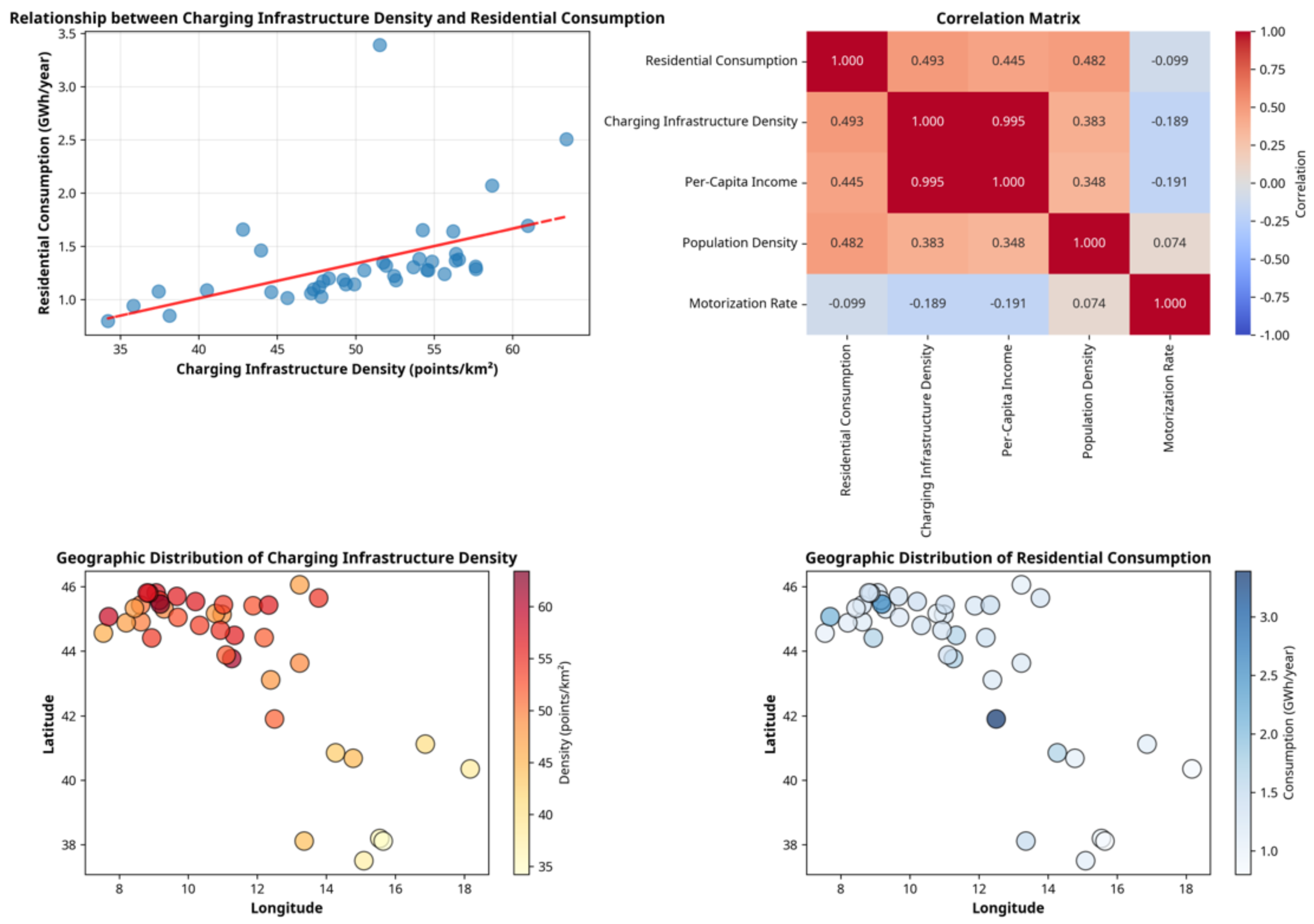
Figure 1 provides a preliminary descriptive overview of the relationship between public charging infrastructure density and residential electricity consumption, as well as their geographic distribution across the sampled Italian municipalities. The scatter plot suggests a positive association between charging station density and residential electricity demand, while the correlation matrix highlights moderate correlations among key socio-economic variables. The spatial maps further reveal a clear geographic clustering of charging infrastructure density, particularly in Northern and Central Italy, supporting the relevance of a spatial econometric approach.
2.2.1. Moran’s I Index
Moran’s I is a global measure of spatial autocorrelation, defined as:
where
denotes the number of observations,
are the elements of the spatial weights matrix
(row-standardized),
represents the standardized variable, and
.
The ESDA results reveal the following patterns:
The Moran’s I Index applied to residential electricity consumption indicates weak and statistically insignificant spatial autocorrelation in the dependent variable. The index calculated for charging infrastructure density reveals positive and statistically significant spatial autocorrelation in the key explanatory variable, indicating that municipalities with a high density of charging stations tend to be geographically clustered with municipalities exhibiting similarly high densities. These findings provide preliminary empirical support for the use of spatial econometric models.
2.2.2. Spatial Weights Matrix
The spatial weights matrix W was constructed using a k-nearest neighbors criterion with k = 5, based on the Euclidean geographic distance between municipalities. The matrix was subsequently row-standardized, such that each row sums to one. This approach is standard in spatial econometrics and allows the estimated coefficients to be interpreted as average effects on neighboring municipalities.
2.3. Econometric Models
Our empirical strategy follows a progressive modeling approach designed to test for and account for spatial dependence in the data. We begin with a standard Ordinary Least Squares (OLS) regression as a baseline specification, which assumes that observations are independent across municipalities. We then extend the analysis to spatial econometric models that explicitly incorporate geographic interdependence, allowing us to assess whether and how the relationship between charging infrastructure and residential electricity consumption is shaped by spatial proximity. Three main econometric models were estimated in order to compare results and assess the role of spatial dependence.
The adoption of spatial econometric methods in this study is motivated by several theoretical mechanisms that suggest geographic interdependence among municipalities in the context of EV charging and electricity consumption.
First, inter-municipal commuting patterns imply that EV users may charge their vehicles in municipalities other than their place of residence, creating cross-boundary effects on electricity demand.
Second, the spatial diffusion of EV adoption follows well-documented patterns of technology diffusion [
20], whereby municipalities with higher EV penetration tend to cluster geographically due to peer effects, shared information networks, and regional marketing campaigns.
Third, regional infrastructure planning by provincial and regional authorities often leads to coordinated deployment of charging stations across neighboring municipalities, generating spatial correlation in the independent variable.
Fourth, electricity grid interconnections mean that consumption patterns in one municipality may be influenced by grid capacity and load balancing considerations that extend beyond municipal boundaries.
These theoretical considerations provide an a priori justification for spatial models, independent of statistical tests. Nevertheless, we also report Moran’s I statistics to empirically confirm the presence of spatial autocorrelation in the data.
We estimate three models in sequence:
The standard linear regression model serves as a benchmark:
where
is the vector of residential electricity consumption across municipalities,
is the matrix of explanatory variables (charging infrastructure density, per capita income, population density, and motorization rate), and
is the error term.
- 2.
Spatial Autoregressive Model (SAR)
The SAR model adds a spatially lagged dependent variable to capture the possibility that electricity consumption in one municipality is directly associated with consumption levels in neighboring municipalities:
where
is a row-standardized spatial weight matrix based on k-nearest neighbors (
k = 5 in the baseline specification), and
is the spatial autoregressive parameter.
- 3.
Spatial Durbin Model (SDM)
The SDM extends the SAR by also including spatially lagged explanatory variables, allowing us to decompose the association between each explanatory variable and the dependent variable into direct and indirect (spillover) components:
where
captures the indirect (spillover) associations. The SDM is our preferred specification because it allows for the most flexible spatial structure and avoids the omitted variable bias that can arise when spatial lags of the explanatory variables are excluded [
16].
The baseline spatial weight matrix
is constructed using k = 5 nearest neighbors, identified by Euclidean distance between municipal centroids. The matrix is row-standardized so that the spatial lag of any variable represents a weighted average of neighboring values. To verify that our results are not sensitive to this choice, we conduct robustness checks using alternative specifications: k = 3, k = 7, and an inverse-distance weight matrix (see
Section 3.4).
We emphasize that our cross-sectional design does not support causal identification. The spatial models are employed to account for spatial dependence in the data and to decompose associations into direct and indirect components, not to establish causality. All coefficients should be interpreted as partial correlations conditional on the included covariates and the spatial structure.
3. Results
3.1. OLS Model Results
Table 3 reports the OLS regression results.
Charging infrastructure density is positively and significantly associated with residential electricity consumption (β = 4.758, p < 0.01). A one-standard-deviation increase in charging infrastructure density is associated with a sizable increase in residential electricity consumption in the standardized specification, holding other variables constant. Per capita income exhibits a negative and significant association (β = −4.364, p < 0.01), suggesting that municipalities with higher income levels tend to display lower residential electricity consumption, which is consistent with greater energy efficiency in wealthier areas. Population density and motorization rate do not show statistically significant associations with the dependent variable at conventional levels. The model explains approximately 49.4% of the variation in residential electricity consumption (R-squared = 0.494). Moran’s I test on OLS residuals indicates the presence of spatial autocorrelation (I = 0.617, p < 0.05), providing empirical support for the use of spatial econometric models.
3.2. SAR Model Results
The Spatial Autoregressive Model results are presented in
Table 4.
The spatial autoregressive parameter () is negative but not statistically significant, suggesting that, after controlling for the explanatory variables, there is limited evidence of direct spatial dependence in consumption levels across neighboring municipalities. The coefficients on the explanatory variables remain qualitatively similar to the OLS estimates, with charging infrastructure density maintaining its positive and significant association with residential electricity consumption.
3.3. SDM Results
Table 5 presents the results of the Spatial Durbin Model, which is our preferred specification.
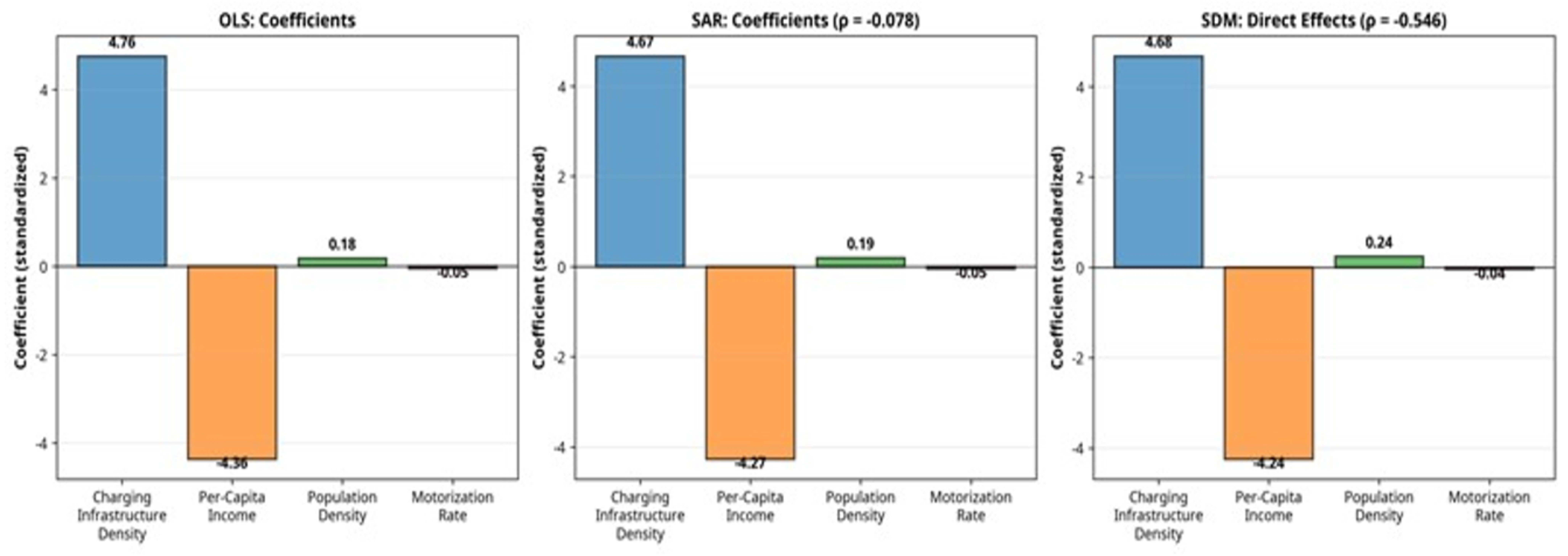
Figure 2 illustrates the standardized direct effect estimates across the OLS, SAR, and SDM specifications.
The SDM allows us to decompose the association between each explanatory variable and residential electricity consumption into direct and indirect (spillover) components.
Direct effects.
Charging infrastructure density is positively and significantly associated with residential electricity consumption in the direct effect (β = 4.676, p < 0.01). These results are consistent with the hypothesis that municipalities with denser charging networks tend to exhibit higher residential electricity demand, likely reflecting the energy requirements of local EV charging activity. Per capita income maintains its negative and significant direct association (β = −4.2446, p < 0.01).
Indirect (spillover) effects.
The indirect effect of charging infrastructure density is positive (
θ = 3.650), suggesting that higher charging infrastructure density in neighboring municipalities tends to be associated with higher residential electricity consumption in the focal municipality. This pattern is consistent with several theoretical mechanisms discussed in
Section 2.3. First, inter-municipal commuting may lead EV users to charge at home after using charging infrastructure in neighboring municipalities, thereby increasing residential electricity demand. Second, the spatial clustering of EV adoption implies that municipalities surrounded by areas with dense charging networks are likely to have higher EV penetration rates themselves, leading to increased home-charging demand. Third, regional network effects may create complementarities: as the charging network becomes denser across a region, range anxiety decreases and EV adoption accelerates throughout the area, with consequent effects on residential electricity consumption.
The spatial autoregressive parameter ( = −0.546) is negative, indicating that, after accounting for both direct and indirect effects of the explanatory variables, there is a negative residual spatial association in consumption levels. This result is consistent with the interpretation that the SDM’s spatially lagged explanatory variables capture the substantive spatial processes, leaving a compensatory pattern in the residual spatial structure.
3.4. Model Comparison
Table 6 provides a comparison of the three estimated models in terms of goodness of fit.
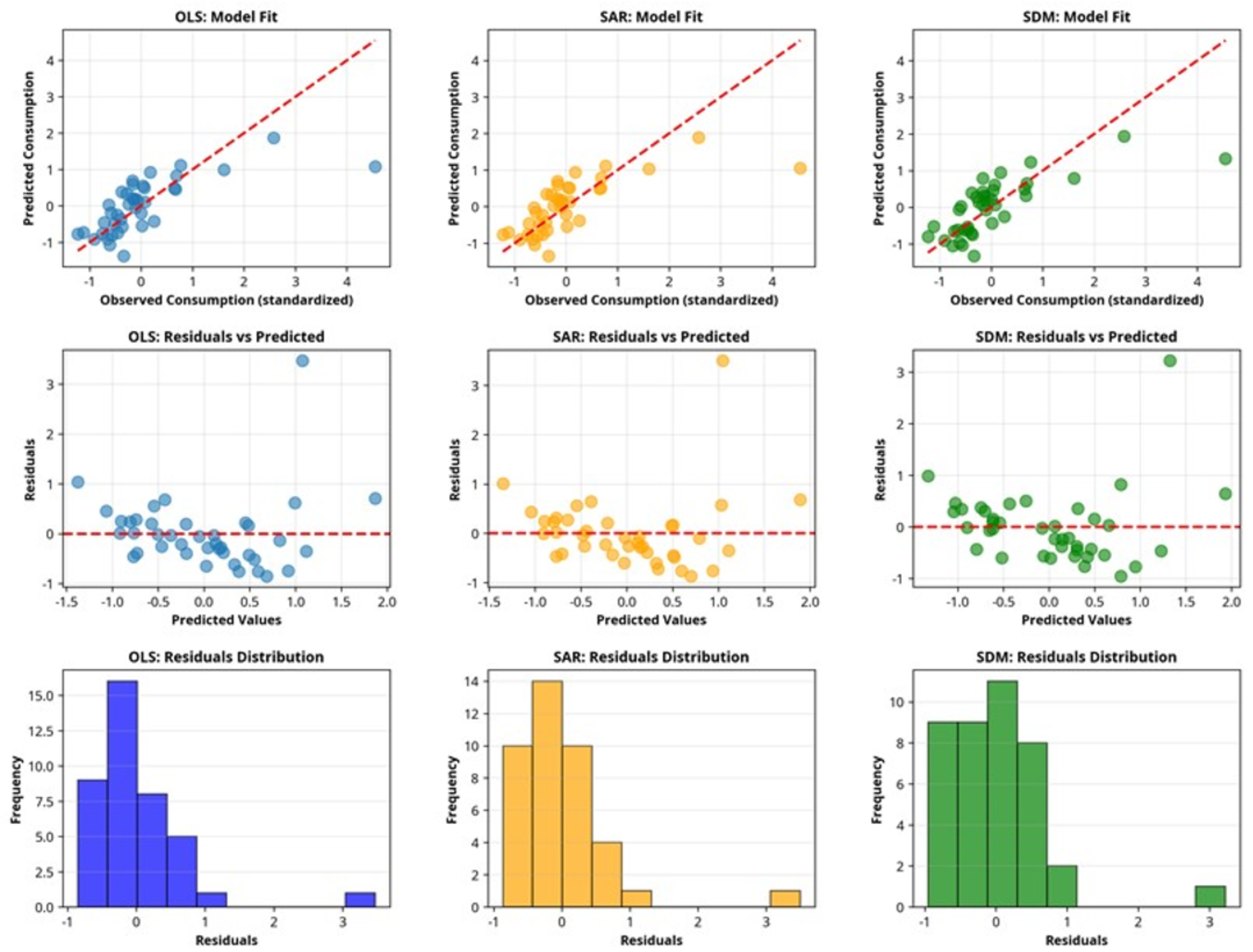
Figure 3 visually confirms the superior goodness of fit of the SDM, showing a tighter alignment between observed and predicted values and a more regular residual pattern compared to OLS and SAR.
Overall, the SDM exhibits the highest R2 value (0.5226), indicating a better fit to the data compared to the OLS and SAR specifications. Although the OLS model reports a slightly lower AIC value, the SDM is preferred for several reasons.
First, the SDM explicitly captures spatial spillover effects, which are found to be statistically significant in the empirical analysis. Second, it allows for the separate estimation of direct and indirect effects, which is crucial for understanding the mechanisms through which charging infrastructure density may be associated with residential electricity consumption. Finally, the SDM is consistent with economic and urban theory, which suggests that infrastructure investment decisions in one area are likely to generate external effects in neighboring areas.
3.5. Robustness Checks
To verify the stability of our findings, we conduct two sets of robustness checks addressing concerns raised about the sensitivity of spatial econometric results to modeling choices. Sensitivity to the spatial weight matrix.
Table 7 reports SDM estimates obtained using four alternative spatial weight matrices: k = 5 (baseline), k = 3, k = 7, and inverse-distance weights. The direct effect of charging infrastructure density on residential electricity consumption remains positive and statistically significant (
p < 0.01) across all specifications. The magnitude of the coefficient varies moderately (ranging from 1.445 to 1.894 in the standardized specification), but the qualitative conclusion is unchanged. We note that the k = 7 specification produces a spatial autoregressive parameter outside the theoretical boundary, which is a known issue in spatial econometrics with small samples (N = 40) and does not affect the interpretation of the direct effects. Sensitivity to functional form.
Table 8 compares results across three functional form specifications: standardized variables (baseline), variables in levels, and a log–log transformation. The positive and significant association between charging infrastructure density and residential electricity consumption is confirmed in all three specifications. In the log–log model, the estimated elasticity of 1.616 indicates that a 1% increase in charging infrastructure density is associated with approximately a 1.6% increase in residential electricity consumption. These results demonstrate that the main finding is not an artifact of variable standardization or a particular functional form assumption.
The direct effect of charging infrastructure density on residential electricity consumption remains positive and statistically significant (
p < 0.01) across all four spatial weight matrix specifications. The sign and statistical significance of per capita income (negative) are also stable across specifications. These results indicate that the main findings are not driven by the specific choice of spatial weight matrix. When using a larger neighborhood structure (k = 7), the estimated spatial autoregressive parameter (ρ = 3.150) falls outside the theoretical boundary (−1, 1), indicating potential model instability when the number of neighbors is large relative to the sample size (N = 40). This issue is well documented in spatial econometric applications with small samples [
16]. Importantly, the estimated direct effects remain correctly signed and statistically significant even under this specification.
The results are also robust to alternative functional form specifications. The positive and statistically significant association between charging infrastructure density and residential electricity consumption remains consistent across all three model specifications, including standardized variables, variables in levels, and the log–log specification.
In the log–log model (Column 3), the estimated coefficient of 1.616 can be interpreted as an elasticity, indicating that a 1% increase in charging infrastructure density is associated with approximately a 1.6% increase in residential electricity consumption.
The negative association with per capita income is also stable across specifications. Overall, these findings suggest that the main empirical results are not driven by the choice of variable standardization or functional form.
4. Discussion
4.1. Interpretation of the Main Findings
The results of this study reveal a positive and statistically significant relationship between public charging infrastructure density and residential electricity consumption, both within municipalities and across neighboring areas.
These findings are also relevant from a sustainability perspective, as they highlight how the transition toward electric mobility may generate broader changes in urban electricity demand patterns and energy system planning.
4.1.1. Direct Effect
The positive estimated direct association suggests that greater availability of public charging infrastructure is linked to higher residential electricity consumption within a municipality. This result can be interpreted from two complementary perspectives.
One possible interpretation is that the availability of charging infrastructure is associated with greater electric vehicle adoption, which may in turn be linked to higher residential electricity demand, both through home charging and complementary electricity uses. Second, a correlational interpretation is also plausible, whereby charging infrastructure density is associated with higher levels of urban development and income, which may affect residential electricity consumption through other channels, such as higher access to efficient technologies but also higher overall consumption of energy-intensive goods and services.
It is important to emphasize that the results of this study are correlational rather than causal, given the observational nature of the data. Nevertheless, the findings are consistent with economic theory and provide relevant empirical insights for urban and energy planning.
4.1.2. Indirect (Spillover) Effect
The positive indirect effect of charging infrastructure density on residential electricity consumption in neighboring municipalities deserves careful interpretation. Rather than implying a causal mechanism, this association is consistent with several interconnected spatial processes that operate across municipal boundaries. The most plausible channel is inter-municipal mobility. In the Italian context, daily commuting patterns frequently cross municipal boundaries, particularly in metropolitan areas and along major transportation corridors. EV users who access public charging infrastructure in their workplace municipality may subsequently charge their vehicles at home, creating a spatial pattern whereby charging infrastructure density in one municipality is associated with residential electricity consumption in neighboring municipalities. This mechanism is particularly relevant given that home charging remains the predominant mode of EV charging in Italy, accounting for an estimated 60–80% of total charging events [
21]. A second channel involves the spatial diffusion of EV adoption. The literature on technology diffusion [
20,
22] documents that adoption decisions are influenced by social networks and geographic proximity. Municipalities with denser charging networks may serve as “demonstration areas” that reduce range anxiety and increase EV visibility, thereby accelerating adoption in neighboring municipalities. As EV adoption increases in these neighboring areas, so does residential electricity consumption from home charging. A third channel relates to regional infrastructure complementarities. The value of a charging network exhibits positive externalities: a denser network in one municipality increases the utility of owning an EV for residents of neighboring municipalities, who can rely on a broader regional network for their charging needs. This network effect may stimulate EV adoption and, consequently, home-charging demand across the region. We acknowledge that our cross-sectional design cannot disentangle these channels or establish their relative importance. Future research using panel data and instrumental variable approaches would be valuable for identifying the causal mechanisms underlying these spatial associations.
4.2. Policy Implications
To the best of our knowledge, the results of this exploratory study, within the specific research question focused on the Italian case, suggest the development of potentially relevant policy actions, which may be compared and, if necessary, reshaped in order to generalize their relevance.
4.2.1. Energy Planning
The positive relationship between charging infrastructure density and residential electricity consumption suggests that areas with denser charging networks may require more careful electricity network capacity planning. Grid operators should account for the possibility that charging infrastructure expansion is associated with higher residential electricity demand both locally and in neighboring municipalities through spatial spillover mechanisms.
However, these implications should be interpreted cautiously, and further longitudinal evidence would be needed before drawing strong causal conclusions about the effects of charging infrastructure expansion on electricity demand.
4.2.2. Infrastructure Investment Strategies
From an urban and regional planning perspective, public infrastructure investments are a core component of smart city strategies, as they generate positive externalities and spatial spillover effects that extend beyond municipal boundaries [
23].
In this context, the presence of significant spillover associations suggests that charging infrastructure investments may be linked to benefits not only at the local level but also across neighboring municipalities. This evidence supports the adoption of a regional or metropolitan planning approach, rather than a strictly municipal one. Policymakers should therefore consider coordinating charging infrastructure investments across adjacent municipalities in order to maximize positive spillovers and avoid fragmented or inefficient planning outcomes.
4.2.3. Peak Demand Management
The positive association between charging infrastructure expansion and residential electricity demand highlights the need for effective peak demand management strategies. These may include:
Dynamic pricing schemes, aimed at incentivizing EV charging during off-peak hours through lower electricity tariffs;
Vehicles as storage resources, through the implementation of Vehicle-to-Grid (V2G) programs that allow EV batteries to function as distributed storage units;
Integration with renewable energy sources, by aligning EV charging with periods of high renewable energy availability in order to enhance overall system efficiency.
4.3. Study Limitations
Several limitations of this study should be acknowledged when interpreting the results. The analysis identifies statistically significant associations, but does not allow strong causal claims due to the cross-sectional design and the possible presence of endogeneity and omitted variables.
First, the observational nature of the data limits the ability to draw causal inferences. Although the SDM mitigates the risk of omitted variable bias, reverse causality and unobserved confounding factors cannot be fully ruled out.
Second, the sample size, consisting of 40 municipalities, is relatively small, which may limit the statistical power of the analysis and the generalizability of the findings. Nevertheless, the use of provincial capitals ensures a relatively high degree of economic, demographic, and infrastructural heterogeneity, which partially mitigates concerns related to sample size. The limited sample size reduces external validity and suggests caution in generalizing the findings to smaller municipalities or rural areas.
Third, omitted variables may still be present, such as characteristics of the housing stock, local energy policies, or the penetration of residential renewable energy technologies. Fourth, the use of cross-sectional data prevents the analysis from capturing dynamic effects over time. Finally, the specification of the spatial weights matrix, based on a k-nearest neighbors approach with k = 5, is partly arbitrary, and results may be sensitive to alternative specifications.
Finally, the analysis focuses on publicly available charging infrastructure and does not capture the diffusion of private residential charging devices, which may also play an important role in shaping residential electricity demand patterns.
5. Conclusions
This study provides empirical evidence on the spatial association between public charging infrastructure density and residential electricity demand at the municipal level in Italy using a spatial econometric approach. The main findings can be summarized as follows.
First, a positive direct association was identified: municipalities with higher charging infrastructure density tend to exhibit higher residential electricity consumption within the municipality itself. Second, a positive spillover effect was detected: charging infrastructure density is also positively associated with residential electricity consumption in neighboring municipalities, indicating that the benefits of infrastructure investments extend beyond local administrative boundaries. Third, the overall estimated association between charging infrastructure density and residential electricity demand appears stronger once spatial spillover patterns are taken into account, highlighting the importance of regional and metropolitan coordination in infrastructure planning.
These findings have important implications for energy and urban planning in the context of the transition toward sustainable mobility. More generally, the results contribute to the empirical understanding of sustainability transitions in the transport and energy sectors, highlighting the importance of considering spatial interactions when planning infrastructure for electric mobility. Policymakers should account for spatial interactions when designing charging infrastructure strategies, while recognizing that denser charging networks may be associated with changing residential electricity demand patterns.
Future research could address the limitations of this study by adopting panel data approaches that allow for the analysis of temporal dynamics and the identification of changes over time. In addition, the inclusion of a broader set of explanatory variables—such as housing characteristics, local energy policies, or the diffusion of residential renewable energy technologies—could help reduce potential omitted variable bias. To further strengthen causal inference, future studies may also consider the application of quasi-experimental methods, including regression discontinuity designs or other identification strategies. Finally, extending the analysis to a national or European scale would enhance the generalizability of the findings and provide a more comprehensive understanding of the relationship between charging infrastructure deployment and residential electricity demand.




 ,
,