Article

Laboratory Diagnostics of Engine Oils as a Tool for Identifying Mechanical Faults and Supporting Sustainable Vehicle Maintenance


1
Department of Quality and Safety of Industrial Products, Krakow University of Economics, Sienkiewicza 4 Str., 30-033 Krakow, Poland
2
Department of Statistics, College of Economics, Finance and Law, Krakow University of Economics, 27 Rakowicka St., 31-510 Krakow, Poland
*
Author to whom correspondence should be addressed.
Sustainability 2026, 18(7), 3355; https://doi.org/10.3390/su18073355
Submission received: 17 February 2026 / Revised: 20 March 2026 / Accepted: 27 March 2026 / Published: 31 March 2026

Abstract

This study presents a comparative laboratory analysis of seven engine oil samples collected from passenger vehicles exhibiting significant viscosity deviations after operation. The aim was to demonstrate the diagnostic value of physicochemical testing in identifying mechanical or operational malfunctions that may not be detectable through routine vehicle servicing. Each oil sample was characterized by measurements of kinematic viscosity at 40 °C and 100 °C and Fourier-transform infrared (FTIR) spectra. The combination of these methods enabled the assessment of oxidation, fuel dilution, additive depletion, and contamination levels. The findings reveal consistent patterns linking abnormal viscosity reduction or increase with distinct spectral changes, particularly in the regions associated with oxidation (1710–1740 cm−1), sulfation (1150–1250 cm−1), and nitration (1600–1650 cm−1). The study highlights that in cases of pronounced physicochemical anomalies, the use of alternative oil brands or viscosities cannot compensate for underlying mechanical issues. Laboratory diagnostics, combining viscosity testing and FTIR spectroscopy, provide an effective approach to pinpointing such faults, thus supporting preventive maintenance and informed decision-making in engine servicing. The proposed approach contributes to sustainability by enabling condition-based maintenance, reducing unnecessary oil replacement, and minimizing environmental impact associated with lubricant waste.

1. Introduction

The operational reliability and environmental performance of internal combustion engines depend directly on the physicochemical stability of the lubricant during service. Motor oil provides wear protection, thermal management, and corrosion inhibition functions that are essential for engine performance and longevity. Regardless of the oil type used, the quality declines during use because of degradation and/or contamination. The use and disposal of a large amount of motor oil as a consumed resource have increased preventive maintenance costs and necessitated stringent measures to ensure environmental protection [1]. Engine oil serves not only as a friction-reducing and wear-protective medium but also as a diagnostic fluid that reflects the actual technical condition of the engine [2]. Condition-based maintenance can maximize vehicle availability, reduce the costs of maintenance, and provide an additional guarantee of reliability. Monitoring the condition of oil can improve fault prevention by allowing early intervention in degradation [3]. Many advanced approaches to lubrication condition monitoring are available in the literature; however, the rate of implementation in maintenance decision support is lacking. Among the reasons for such could be slow technological adaptation, costly installation, coupled with high software cost [4]. Furthermore, aging and wear are closely correlated with failure propagation [5]. However changes in the properties of lubricating oil are dynamic and non-linear [6]; therefore, periodic monitoring during operation is more informative than a single-point assessment conducted after replacement [7]. Regular observation of the lubricant’s condition makes it possible to detect early symptoms of abnormal operation and to adjust maintenance strategies to the real state of the engine rather than fixed intervals [8], which can be achieved, for example, by utilizing sensors to provide input for on-board diagnosis systems that determine the current oil condition inside an engine. However this approach has its own challenges as it may be highly dependent on oil type and application characteristics, possibly necessitating separate methods for each application [9]. Alternatively, many spectroscopic strategies have been proposed for lubricating oil analysis [10].
Degradation of engine oil is driven by a combination of thermal, mechanical, and chemical factors that lead to oxidation, nitration, sulfonation, and depletion of functional additives [11,12,13]. The progression of these reactions depends not only on the oil formulation but also on the engine’s working environment, including load profile, temperature fluctuations, combustion efficiency, and exposure to contaminants such as fuel, soot, or water [14,15]. Urban driving, characterized by short trips and frequent start–stop cycles, tends to accelerate oxidation and nitration due to incomplete combustion and insufficient oil temperature stabilization [1,16,17].
Among all measurable indicators of lubricant condition, viscosity remains one of the most important diagnostic parameters [18,19,20]. A reduction in viscosity is typically associated with fuel dilution or mechanical shear, while an increase is often caused by oxidation, soot accumulation, or polymerization processes. Measuring viscosity at both 40 °C and 100 °C provides complementary information about the lubricant’s shear stability and thermal resistance. Significant deviations from the nominal values usually indicate exceeded replacement intervals or potential mechanical irregularities that influence oil degradation [21].
While viscosity describes macroscopic functional behavior, Fourier-transform infrared (FTIR) spectroscopy enables molecular-level insight into chemical transformations within the oil [22,23,24]. Specific absorbance bands corresponding to oxidation (around 1730 cm−1), nitration (around 1630 cm−1), and sulfonation (around 1150 cm−1) provide valuable information about the dominant degradation pathways. The use of differential spectra—obtained by subtracting the spectrum of fresh oil from that of the used sample—allows for distinguishing additive depletion from base-oil oxidation and evaluating the relative contribution of various degradation processes. When combined with viscosity data, FTIR spectroscopy forms a robust analytical toolset capable of revealing the mechanisms underlying oil deterioration during real operation [25,26].
Recent experimental observations have shown that the degradation profile of an oil depends more on actual engine behavior than on mileage or time in service [27]. Even vehicles of the same model and using identical lubricants may exhibit different patterns of oxidation and viscosity change, reflecting differences in temperature profiles, combustion conditions, or additive stability. These findings suggest that oil monitoring should be viewed not merely as a method for assessing lubricant quality but as an indirect diagnostic technique capable of identifying early signs of engine malfunction [28,29].
In this study, the pronounced physicochemical degradation served as the selection criterion. Seven gasoline engine oils from a database of over 300 previously analyzed oil samples met the inclusion criteria defined as a reduction in viscosity exceeding 30% of the nominal value at 40 °C and use in spark-ignition engines. Such a threshold was adopted because viscosity reductions in this magnitude are typically associated with severe lubricant degradation processes, including fuel dilution, mechanical shear of viscosity-index improvers, or thermal instability of the base oil. Therefore, the 30% reduction level was treated as an indicator of abnormal operating conditions rather than normal lubricant aging, allowing the study to focus on cases potentially related to mechanical or operational irregularities in the engine. The research focuses on analyzing the relationship between changes in viscosity and FTIR spectral features to identify characteristic degradation patterns under real-world operating conditions. The findings are discussed in the broader context of sustainable maintenance practices and predictive diagnostics, emphasizing the potential of laboratory oil analysis as a decision-support tool for detecting early mechanical irregularities and optimizing lubricant replacement strategies. From a sustainability perspective, improving the accuracy of engine oil diagnostics enables a shift from time-based to condition-based maintenance strategies, reducing unnecessary lubricant consumption, lowering waste generation, and minimizing environmental impact associated with premature oil replacement.

2. Materials

For the analysis, engine oil samples were selected from passenger vehicles that exhibited pronounced viscosity changes during operation. Each oil was identified and classified according to the manufacturer’s declaration, including its brand name, viscosity grade (SAE), API and ACEA quality classifications. The oils represent a diverse group of commonly available lubricants from different producers, covering both mid-SAPS and full-SAPS formulations and various performance levels intended for gasoline engines. Their detailed specifications are listed in Table 1.
From the total database of 320 available oil samples, seven cases were selected for detailed examination. The selection criteria included a reduction in kinematic viscosity at 40 °C exceeding 30% of the nominal value and the presence of a gasoline engine in the vehicle. All selected samples originated from passenger cars of different makes, model years, and mileage levels, reflecting a variety of engine designs and operational conditions. The detailed specifications of these vehicles and their power units are presented in Table 2.
Table 3 summarizes the operational characteristics of the vehicles from which the oil samples were collected. Most of them were used predominantly in urban conditions, with a city driving share reaching 80–95%, combined with short-distance routes below 10 km, which are known to accelerate oil degradation due to frequent cold starts and incomplete thermal stabilization of the engine. Only two vehicles—samples 3 and 7—were operated mainly on longer routes, with a low share of city driving (20% and 10%, respectively). The mileage on oil varied considerably, from 3200 km to 10,518 km, and the service duration ranged from 6 to 22 months. In two cases (samples 1 and 5), small top-ups of fresh oil were recorded.
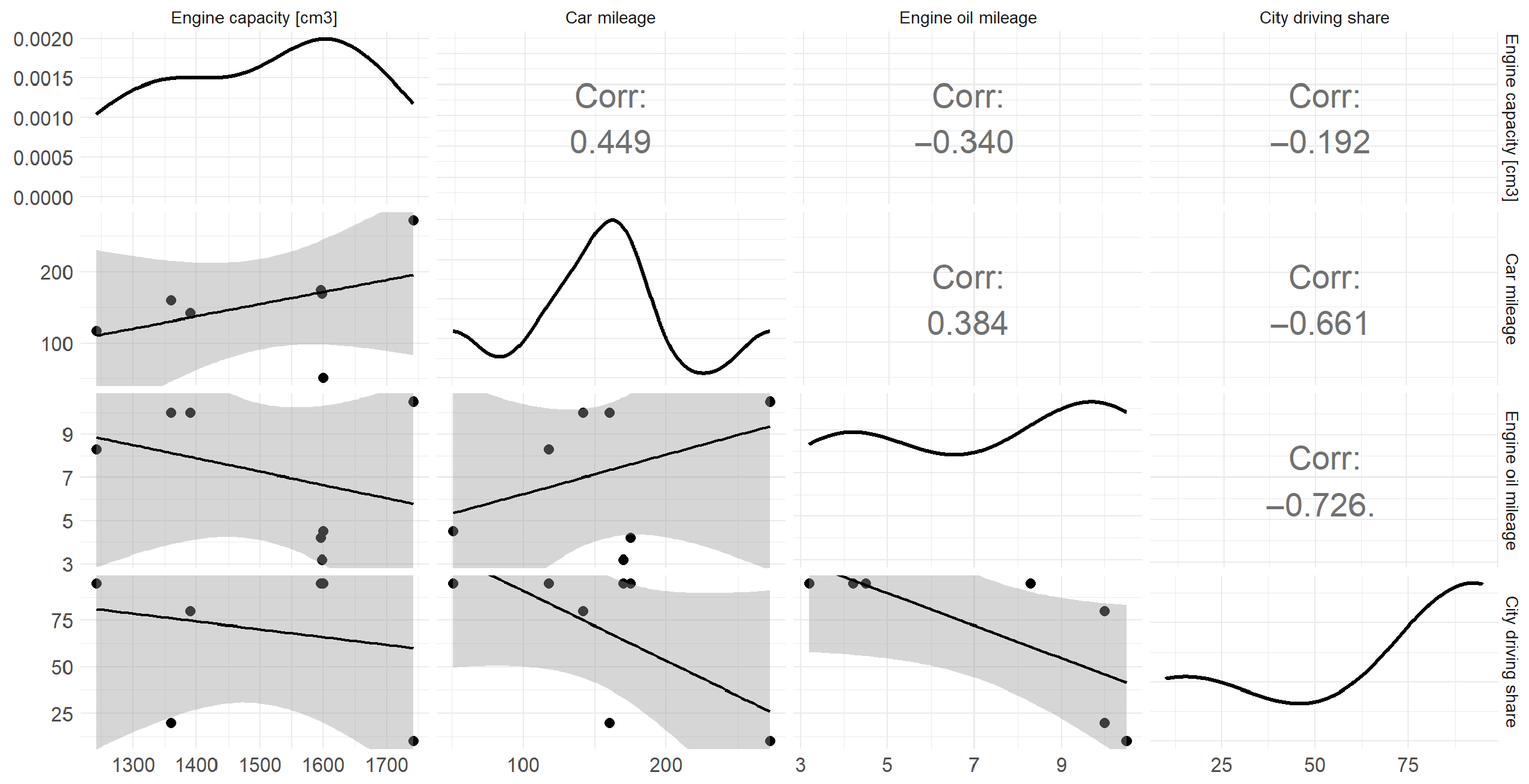
Figure 1 presents matrix plots of the operation characteristics of the engine oils used in the tests. It is based on the data presented in Table 2 and Table 3 and focuses on a selected group of variables. The correlations did not reach statistical significance; however, the direction and magnitude are of expected levels, which confirms the internal consistency and validity of the data.

3. Methods

The variations in kinematic viscosity at 40 °C and 100 °C were determined using an SVM Stabinger Viscometer model 3001 (Anton Paar GmbH, Graz, Austria) in accordance with the ASTM D7042-21A standard [30]. These measurements made it possible to assess both the direction and the magnitude of viscosity changes relative to the reference values obtained for fresh oils of the same specification. The chemical transformation processes occurring in the used oils were examined using Fourier-transform infrared (FTIR) spectroscopy, which allowed for the evaluation of oxidation, nitration, sulfation, soot contamination, and fuel dilution. The analyses were performed with a Thermo Nicolet iS5 spectrometer (Thermo Fisher Scientific, Waltham, MA, USA) following the ASTM E2412-23A procedure [31]. A ZnSe transmission cell with an optical path length of 0.1 mm was employed, and the differential spectra were obtained by subtracting the spectrum of the fresh oil from that of the corresponding used sample. The 0.1 mm optical path length was selected in accordance with common FTIR practice for in-service lubricant analysis and ASTM E2412 recommendations for transmission measurements. For engine oils, this path length provides a suitable compromise between analytical sensitivity and the avoidance of excessive absorbance in the strongly absorbing hydrocarbon matrix. Prior to measurement, oil samples were homogenized and introduced directly into the measurement cell without additional preparation. Spectra were collected at room temperature (approximately 20–25 °C) with a spectral resolution of 4 cm−1 and 64 scans to improve the signal-to-noise ratio. Background spectra were recorded before each measurement series under identical conditions.
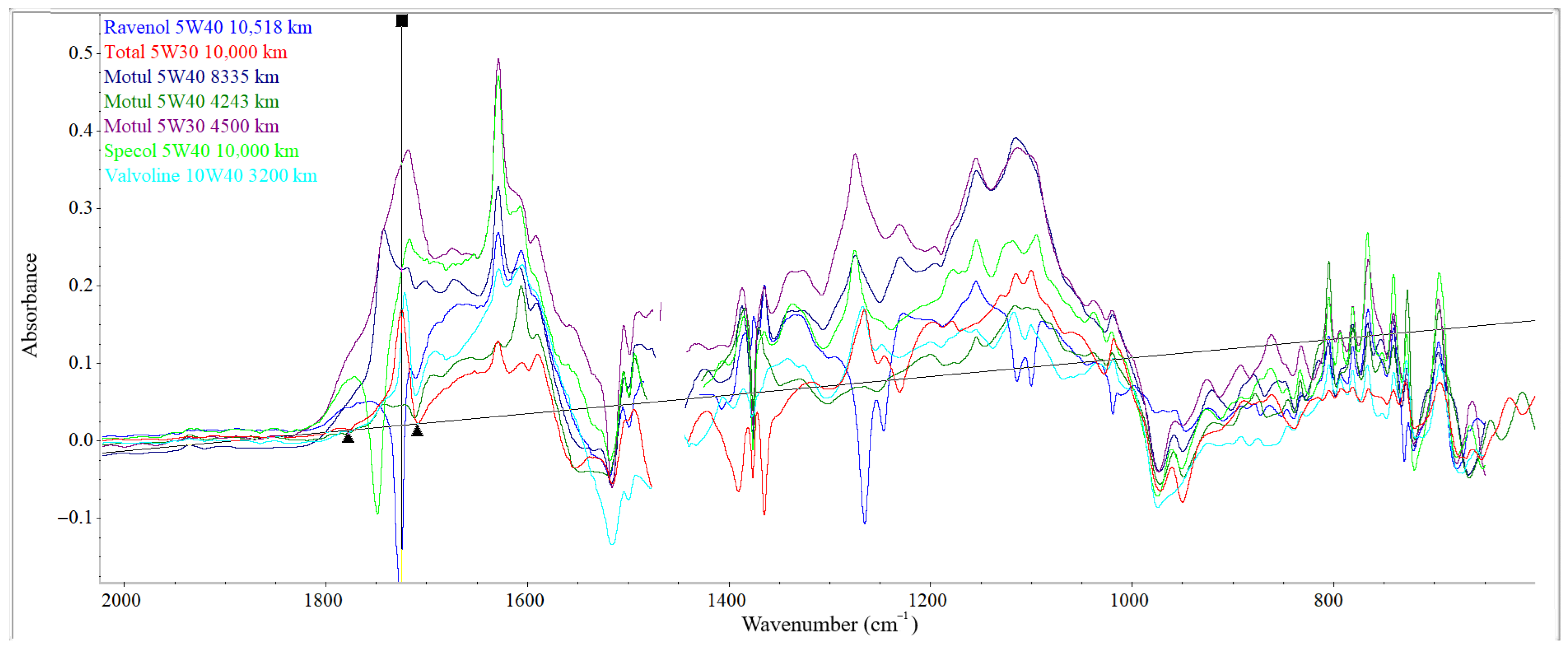
The most diagnostically relevant regions of the spectra were interpreted with respect to the chemical structure and degradation mechanisms of the oils. The range of 1800–1670 cm−1 included absorption bands of carbonyl and carboxyl groups (C=O, COOH) and was used to determine the oxidation level. In this region, negative bands near 1745 cm−1 were attributed to the depletion of ester-type additives or the degradation of base-oil esters. The band around 1630 cm−1 was related to nitration processes and the formation of –O–NO2 groups resulting from reactions between nitrogen oxides and oxidized hydrocarbons. The range between 1300 and 1000 cm−1 was associated with vibrations of C–O and S–O bonds, providing information about oxidation and sulfation processes, with the most characteristic sulfonyl group absorption appearing at 1180–1120 cm−1. The region 4000–3100 cm−1 was connected with hydroxyl groups and absorbed water, reflecting both oxidation by-products and environmental contamination, whereas negative bands near 3650 cm−1 were indicative of the depletion of phenolic antioxidants. In the lower frequency range of 1000–900 cm−1, negative bands were linked to the transformation of extreme-pressure additives, particularly zinc dithiophosphates. The region between 890 and 700 cm−1 contained signals associated with fuel dilution, where aromatic hydrocarbon bands appeared around 890–740 cm−1 and aliphatic C–H vibrations were observed near 720 cm−1. Highly intense aliphatic absorption bands in the regions 3000–2850 cm−1 and 1510–1320 cm−1 were excluded from interpretation due to spectral overlap. Quantitative evaluation of oxidation, nitration, and sulfonation levels was performed using a single-point baseline in the 2000–1900 cm−1 region in the difference spectrum, consistent with common FTIR practice for in-service lubricant analysis (ASTM E2412). The depletion of antioxidants was evaluated using the minima adjacent to 3650 cm−1. Fuel dilution was assessed qualitatively by observing characteristic aromatic and aliphatic absorption features, whereas the presence of soot was identified through a uniform elevation of the differential spectrum baseline proportional to the wavenumber. All absorbance values were normalized to an optical path length of 0.1 mm to ensure comparability between samples.

4. Results and Discussion

Table 4 presents the kinematic viscosity values of the fresh and used oils. All analyzed samples belong to similar viscosity classes—5W30, 5W40, and 10W40—which results in relatively close viscosity parameters for the fresh oils. The lowest viscosity was recorded for sample 4, while the highest was recorded for sample 5. After operation, each oil showed a clear reduction in viscosity, typically ranging from one-third to two-thirds of the initial value, confirming the pronounced physicochemical degradation that served as the selection criterion for this group of samples.
Table 5 presents the percentage changes in kinematic viscosity observed for the used oil samples. All analyzed cases revealed a significant reduction in viscosity, with decreases at 40 °C ranging from −32% to −64% and at 100 °C from −22% to −50%. The most pronounced decline was recorded for sample 5, while the smallest change occurred for sample 6. Considering the extent of these reductions, all viscosity changes should be classified as critical, confirming severe physicochemical degradation of the oils during operation.
When considering the operational data summarized in Table 3, no direct correlation can be established between the degree of viscosity reduction and the declared driving conditions or oil service intervals. Samples 3 and 7, characterized by a low share of city driving (20% and 10%, respectively) and predominantly longer distance routes, did not exhibit noticeably smaller viscosity losses compared with the other cases. Similarly, minor top-ups of fresh oil recorded for samples 1 and 5 failed to mitigate the degradation effects. The analyzed oils also differed in total mileage, ranging from 3200 to 10,518 km, yet all showed comparable trends of viscosity decline. These observations indicate that the strong reductions detected through laboratory measurements are unlikely to result solely from the length of operation or driving style.
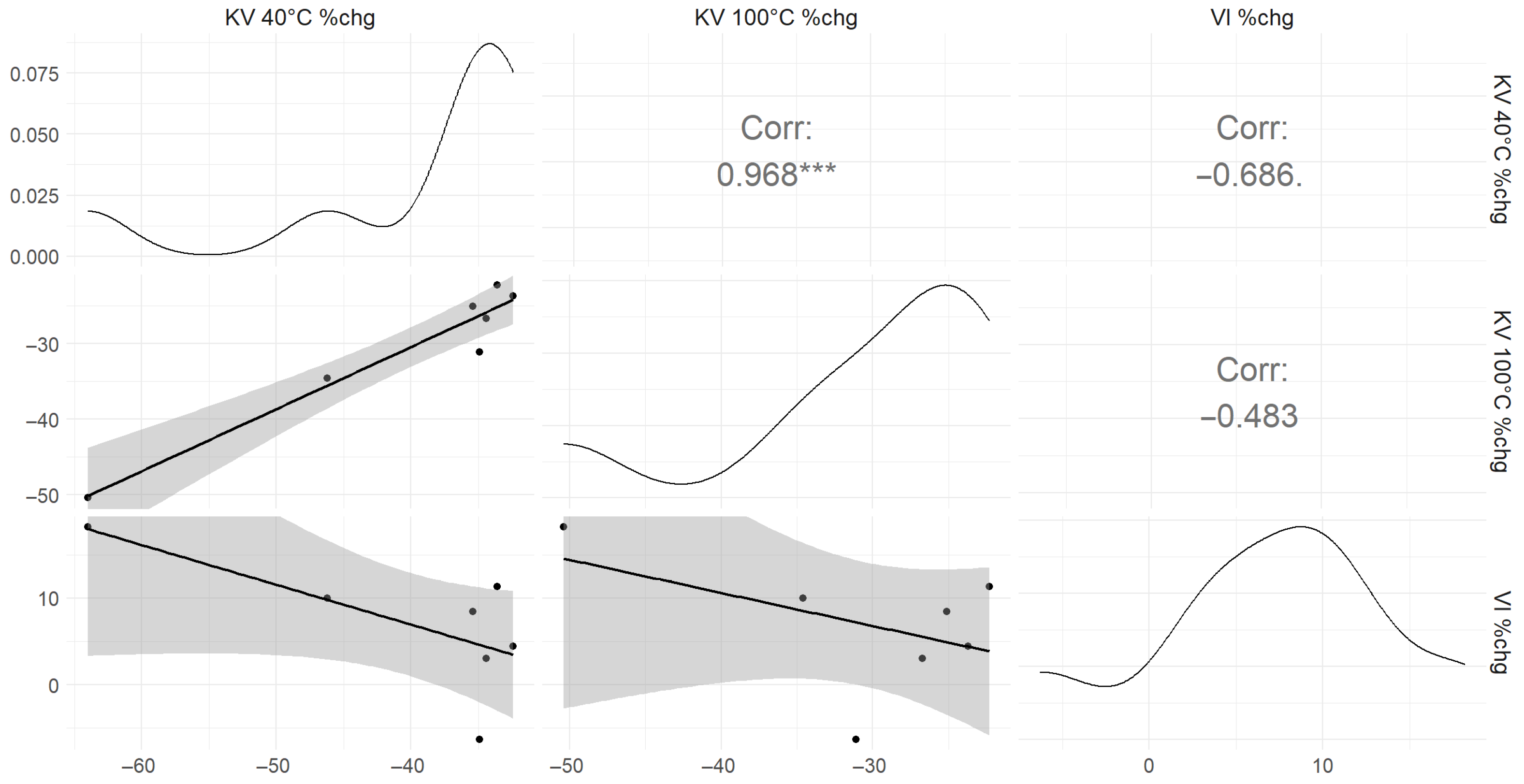
Figure 2 shows the relationships between the data presented in Table 5. It can be seen that the reduction in viscosity at 40 °C correlated strongly with the reduction in viscosity at 100 °C. Both of them also negatively correlated with the reduction in the Viscosity Index; however, these correlations did not reach statistical significance. These findings may suggest a level of redundancy between measurements, possibly allowing for the reliance on only a part of them in a routine engine maintenance.
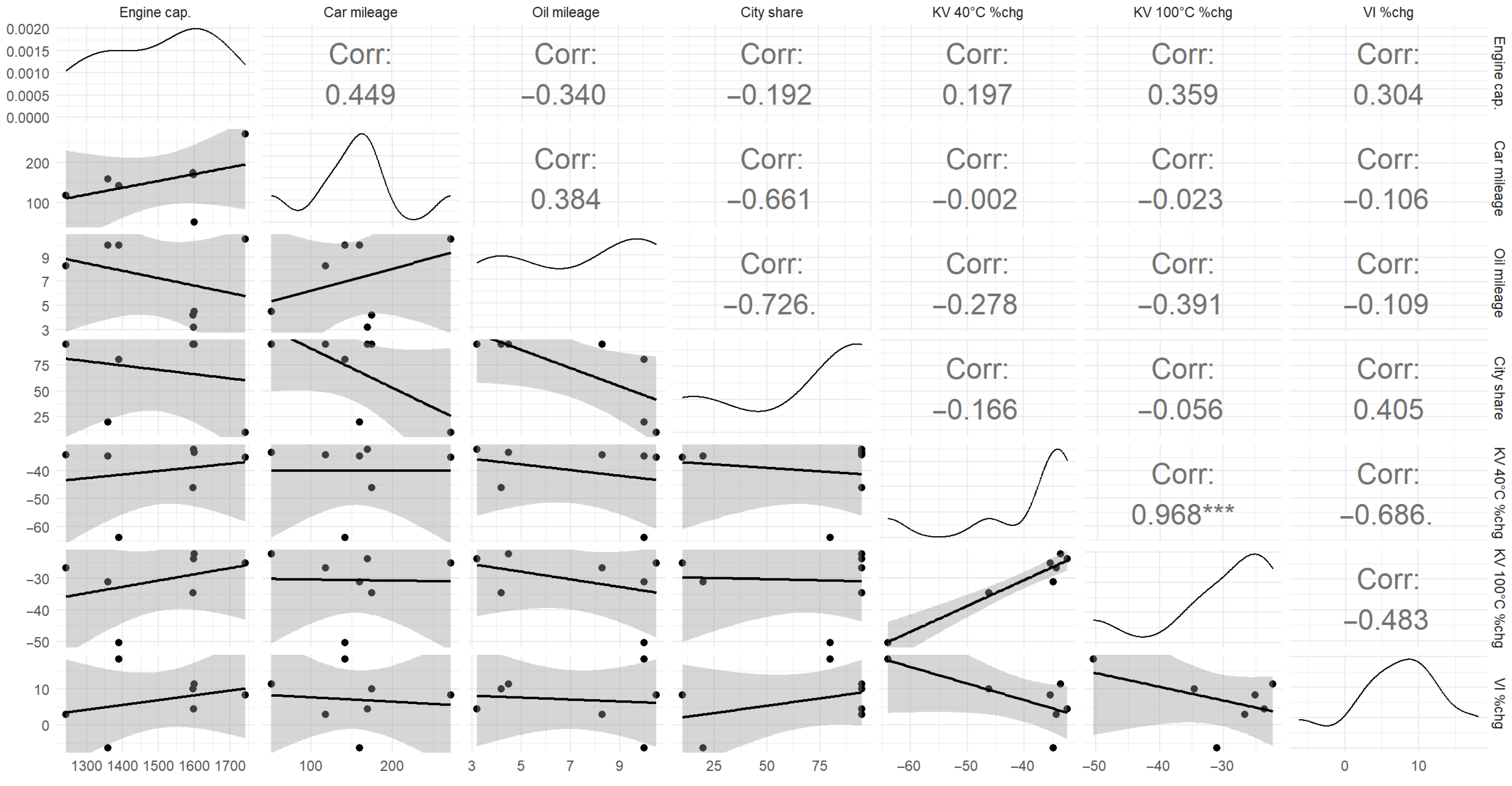
Figure 3 expands the analysis and ties it back to the operation characteristics of the engine oils used in the tests explored more deeply earlier in the article. As mentioned above, none of these correlations reached statistical significance. However, engine capacity showed a mild positive correlation with percentage change in all three viscosity parameters. Car mileage consistently showed a close to zero correlation with all three viscosity parameters. Oil mileage showed a mild negative correlation with percentage change in all three viscosity parameters. City driving share was the least consistent and showed varying levels of correlation, both positive and negative, with three viscosity parameters.
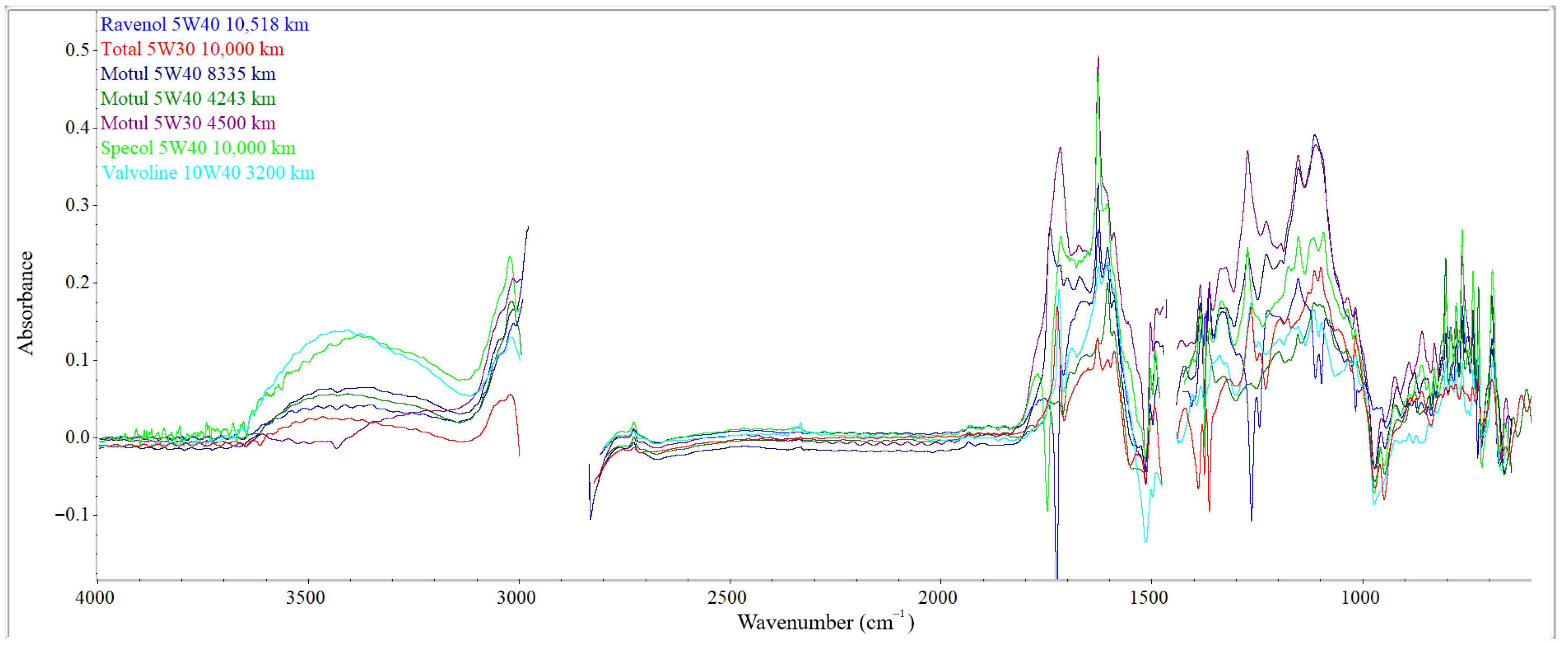
Figure 4 and Figure 5 present the differential spectra for all the oils examined.
The FTIR differential spectra presented in Figure 4 and Figure 5, together with the data summarized in Table 6 and Table 7, confirm that the chemical transformations occurring in the tested oils correspond closely with the viscosity data. The strongest viscosity reductions, exceeding −45% at 40 °C, were recorded for samples 2 and 5, indicating intense degradation processes. In the infrared spectra, however, the most distinct changes are observed for samples 4 (Motul 8100 X-clean EFE 5W30) and 5 (Specol Gold 5W40), particularly in the regions 1747–1695 cm−1 (oxidation), 1630 cm−1 (nitration), and 950–975 cm−1 (EP additive degradation). These bands show the highest absorbance deviations, suggesting simultaneous oxidation of the base oil and depletion of antiwear and antioxidant components.
Notably, the sample 5 oil was used for nearly twice the mileage of sample 4 (10,000 km versus 4500 km), yet the oxidation and nitration levels increased in a comparable manner. This finding implies that the progression of degradation is not strictly proportional to mileage but rather depends on engine-specific mechanical or thermal malfunctions, such as blow-by, local overheating, or abnormal fuel dilution.
The oxidation band for sample 4 (Motul 8100 X-clean EFE 5W30) is approximately twice as intense as that for sample 1 (Motul 8100 X-clean 5W40), which may suggest a more advanced oxidative process in the former. Both oils exhibit clear nitration features near ~1630 cm−1, although the intensity is slightly lower in sample 1. Given that both vehicles were operated predominantly under urban, short-distance conditions (≈95% city driving), these results could be consistent with the effects of frequent start–stop cycles, low engine temperatures, and incomplete combustion. However, the observed difference in oxidation intensity indicates that engine-specific factors or differences in thermal stability of the lubricants may also contribute to the rate of degradation.
In contrast, samples 3 (Total Quartz Ineo ECS 5W30) and 7 (Ravenol VMO 5W40), obtained from vehicles used primarily on extra-urban routes (≤20% city driving), exhibit lower oxidation band intensities. In the 3100–3600 cm−1 range, sample 3 shows the lowest level of polar contamination among all analyzed oils, while sample 7 also demonstrates a relatively low absorbance in this region. Nevertheless, sample 7 displays a slightly stronger nitro-oxidation response than sample 3. Based on the authors’ experience, this may be a result of local combustion irregularities or incomplete sealing which might promote the formation of nitrated oxidation products. However, no direct proof of this was collected. Consequently, while oxidation tends to increase with urban operation, this relationship is not uniform across all cases, indicating that degradation mechanisms may vary significantly between engines.
Additional complexity arises from the use of aftermarket additives in samples 2, 5, 6, and 7. Although the differential spectra were obtained by subtracting the spectra of fresh oils already containing the additives, the observed bands may still reflect degradation and transformation of additive components during service. This effect complicates the distinction between additive depletion and base oil oxidation, making the interpretation of these spectra less straightforward.
Negative features in the 950–975 cm−1 region, corresponding to EP additive (ZDDP) degradation, are observed across all samples, indicating at least partial consumption of antiwear agents. This degradation likely contributes to the increased oxidation and nitration levels, particularly in samples 4 and 5, which also display the most significant viscosity reductions. Overall, while a general correspondence between viscosity loss and FTIR-based degradation indicators can be observed, the variability among samples suggests that chemical deterioration of engine oil progresses in a non-linear and engine-dependent manner, requiring individualized laboratory diagnostics rather than relying solely on standard service intervals or operating profiles.
From a sustainability standpoint, the ability to identify abnormal oil degradation patterns at an early stage enables more precise maintenance interventions. This reduces the risk of unnecessary oil replacement and prevents secondary damage to engine components, thereby lowering material consumption and extending the service life of both lubricants and mechanical systems.

5. Conclusions

The obtained results indicate that the combined use of viscosity testing and FTIR spectroscopy can provide a sensitive diagnostic framework for assessing the technical condition of passenger car engines. The analysis of seven selected oils, each exhibiting a viscosity decrease exceeding 30% of the nominal value, revealed distinct yet non-linear degradation patterns. Although oxidation and nitration levels generally increased under urban driving conditions, several deviations from this tendency suggest that degradation pathways are influenced by specific engine configurations, additive chemistry, and local thermal or mechanical irregularities.
These findings imply that oil condition monitoring should not be limited to fixed mileage or time intervals but rather be integrated into a broader diagnostic approach aimed at early detection of engine malfunction. In practical maintenance scenarios, this approach could be implemented through periodic laboratory analysis of oil samples collected during routine vehicle servicing. Service workshops or fleet operators could integrate viscosity measurements and FTIR diagnostics into preventive maintenance programs, allowing abnormal degradation patterns to be detected before mechanical faults become critical. In such a framework, oil analysis would serve not only as a lubricant condition assessment tool but also as an early diagnostic indicator of engine malfunction, supporting more informed maintenance decisions and reducing the risk of unexpected failures. From a sustainability perspective, this method may help reduce unnecessary oil replacements, extend component life, and optimize resource use by linking laboratory data to real operational behavior. In this context, the proposed diagnostic approach supports the transition toward more sustainable and resource-efficient vehicle maintenance systems.

Limitations

Although this study provides valuable insight into the physicochemical degradation of engine oils and their diagnostic significance, several limitations should be noted. The analysis was based on seven selected samples, which, while representative of different operating profiles, cannot fully capture the diversity of driving conditions, engine designs, and lubricant formulations. Despite using differential FTIR spectra obtained from fresh oils containing additives, the complete separation of additive transformation effects from base-oil oxidation remains uncertain. Moreover, variations in real-world operating conditions—such as engine temperature, combustion efficiency, and fuel quality—may have influenced the observed results. Future research should integrate laboratory oil analysis with real-time monitoring of engine parameters and expand the dataset using advanced statistical or machine learning methods to strengthen the predictive capability of this diagnostic approach.

Author Contributions

Conceptualization, A.W.; methodology, A.W. and K.F.; software, A.W. and K.F.; validation, A.W. and K.F.; formal analysis, A.W. and K.F.; investigation, A.W. and K.F.; resources, A.W.; data curation, A.W.; writing—original draft preparation, A.W. and K.F.; writing—review and editing, A.W. and K.F.; visualization, A.W. and K.F.; supervision, A.W.; project administration, A.W.; funding acquisition, A.W. All authors have read and agreed to the published version of the manuscript.

Funding

The publication was financed from the subsidy granted to the Krakow University of Economics.

Institutional Review Board Statement

Not applicable.

Informed Consent Statement

Not applicable.

Data Availability Statement

The original contributions presented in this study are included in the article. Further inquiries can be directed to the corresponding author.

Conflicts of Interest

The authors declare no conflicts of interest.

References

  1. Wei, L.; Duan, H.; Jin, Y.; Jia, D.; Cheng, B.; Liu, J.; Li, J. Motor Oil Degradation during Urban Cycle Road Tests. Friction 2021, 9, 1002–1011. [Google Scholar] [CrossRef]
  2. Tič, V.; Lovrec, D. On-Line Condition Monitoring and Evaluation of Remaining Useful Lifetimes for Mineral Hydraulic and Turbine Oils; University of Maribor Press: Maribor, Slovenia, 2017; ISBN 9789612861308. [Google Scholar]
  3. Raposo, H.; Farinha, J.T.; Fonseca, I.; Galar, D. Predicting Condition Based on Oil Analysis—A Case Study. Tribol. Int. 2019, 135, 65–74. [Google Scholar] [CrossRef]
  4. Wakiru, J.M.; Pintelon, L.; Muchiri, P.N.; Chemweno, P.K. A Review on Lubricant Condition Monitoring Information Analysis for Maintenance Decision Support Mechanical Systems and Signal Processing. Mech. Syst. Signal Process. 2019, 118, 108–132. [Google Scholar] [CrossRef]
  5. Wakiru, J.; Pintelon, L.; Muchiri, P.N.; Chemweno, P.K.; Mburu, S. Towards an Innovative Lubricant Condition Monitoring Strategy for Maintenance of Ageing Multi-Unit Systems. Reliab. Eng. Syst. Saf. 2020, 204, 107200. [Google Scholar] [CrossRef]
  6. Kral, J.; Konecny, B.; Madac, K.; Fedorko, G.; Molnar, V. Degradation and Chemical Change of Longlife Oils Following Intensive Use in Automobile Engines. Measurement 2014, 50, 34–42. [Google Scholar] [CrossRef]
  7. Kaleli, H.; Sandalci, T. Condition Monitoring of Optimum Oil Drain Interval for Five Diesel Light Duty Commercial Vehicles Servicing for a Parcel Servicing for a Parcel Service Firm in Turkey. J. Balk. Tribol. Assoc. 2011, 17, 289–304. [Google Scholar]
  8. Agocs, A.; Budnyk, S.; Frauscher, M.; Ronai, B.; Besser, C.; Dörr, N. Comparing Oil Condition in Diesel and Gasoline Engines. Ind. Lubr. Tribol. 2020, 72, 1033–1039. [Google Scholar] [CrossRef]
  9. Sun, H.; Liu, Y.; Tan, J. Research on Testing Method of Oil Characteristic Based on Quartz Tuning Fork Sensor. Appl. Sci. 2021, 11, 5642. [Google Scholar] [CrossRef]
  10. Gong, Y.; Guan, L.; Feng, X.; Wang, L.; Yu, X. In-Situ Lubricating Oil Condition Sensoring Method Based on Two-Channel and Differential Dielectric Spectroscopy Combined with Supervised Hierarchical Clustering Analysis. Chemom. Intell. Lab. Syst. 2016, 158, 155–164. [Google Scholar] [CrossRef]
  11. Rammohan, A. Engine’s Lubrication Oil Degradation Reasons and Detection Methods: A Review. J. Chem. Pharm. Sci. 2016, 9, 3363–3366. [Google Scholar]
  12. Dörr, N.; Agocs, A.; Besser, C.; Ristić, A.; Frauscher, M. Engine Oils in the Field: A Comprehensive Chemical Assessment of Engine Oil Degradation in a Passenger Car. Tribol. Lett. 2019, 67, 68. [Google Scholar] [CrossRef]
  13. Zzeyani, S.; Mikou, M.; Naja, J. Physicochemical Characterization of the Synthetic Lubricating Oils Degradation under the Effect of Vehicle Engine Operation. Eurasian J. Anal. Chem. 2018, 13, em34. [Google Scholar] [CrossRef]
  14. Agocs, A.; Besser, C.; Brenner, J.; Budnyk, S.; Frauscher, M.; Dörr, N. Engine Oils in the Field: A Comprehensive Tribological Assessment of Engine Oil Degradation in a Passenger Car. Tribol. Lett. 2022, 70, 28. [Google Scholar] [CrossRef]
  15. Yadav, G.; Tiwari, S.; Jain, M.L. Tribological Analysis of Extreme Pressure and Anti-Wear Properties of Engine Lubricating Oil Using Four Ball Tester. Mater. Today Proc. 2018, 5, 248–253. [Google Scholar] [CrossRef]
  16. Wolak, A.; Zając, G.; Kumbár, W. Evaluation of Engine Oil Foaming Tendency under Urban Driving Conditions. Eksploat. Niezawodn. Maint. Reliab. 2018, 20, 229–235. [Google Scholar] [CrossRef]
  17. Raposo, H.; Farinha, J.; Fonseca, I.; Ferreira, L. Condition Monitoring with Prediction Based on Diesel Engine Oil Analysis: A Case Study for Urban Buses. Actuators 2019, 8, 14. [Google Scholar] [CrossRef]
  18. Brouwer, M.D.; Gupta, L.A.; Sadeghi, F.; Peroulis, D.; Adams, D. High Temperature Dynamic Viscosity Sensor for Engine Oil Applications. Sens. Actuators A Phys. 2012, 173, 102–107. [Google Scholar] [CrossRef]
  19. Sharma, G.; Kotia, A.; Ghosh, S.K.; Rana, P.S.; Bawa, S.; Ali, M.K.A. Kinematic Viscosity Prediction of Nanolubricants Employed in Heavy Earth Moving Machinery Using Machine Learning Techniques. Int. J. Precis. Eng. Manuf. 2020, 21, 1921–1932. [Google Scholar] [CrossRef]
  20. Dayawantha, A.J.M.; Premaratne, I.A. Vehicle Service Date Prediction System Using Lubricant Viscosity Degradation Pattern. In Proceedings of the International Conference on Computer, Communications and Electronics (Comptelix), Jaipur, India, 1–2 July 2017. [Google Scholar]
  21. Wolak, A.; Zając, G. The Kinetics of Changes in Kinematic Viscosity of Engine Oils under Similar Operating Conditions. Eksploat. Niezawodn. Maint. Reliab. 2017, 19, 260–267. [Google Scholar] [CrossRef]
  22. Macián, V.; Tormos, B.; García-Barberá, A.; Tsolakis, A. Applying Chemometric Procedures for Correlation the FTIR Spectroscopy with the New Thermometric Evaluation of Total Acid Number and Total Basic Number in Engine Oils. Chemom. Intell. Lab. Syst. 2021, 208, 104215. [Google Scholar] [CrossRef]
  23. Sejkorová, M.; Šarkan, B.; Veselík, P.; Hurtová, I. FTIR Spectrometry with PLS Regression for Rapid TBN Determination of Worn Mineral Engine Oils. Energies 2020, 13, 6438. [Google Scholar] [CrossRef]
  24. Macián, V.; Tormos, B.; Gómez, Y.A.; Salavert, J.M. Proposal of an FTIR Methodology to Monitor Oxidation Level in Used Engine Oils: Effects of Thermal Degradation and Fuel Dilution. Tribol. Trans. 2012, 55, 872–882. [Google Scholar] [CrossRef]
  25. Pinheiro, C.T.; Ascensão, V.R.; Cardoso, C.M.; Quina, M.J.; Gando-Ferreira, L.M. An Overview of Waste Lubricant Oil Management System: Physicochemical Characterization Contribution for Its Improvement. J. Clean. Prod. 2017, 150, 301–308. [Google Scholar] [CrossRef]
  26. Sejkorova, M.; Hurtova, I. Engine Oil Analysis—Effective Instrument to Evaluate Reliability of Tractor Engines. Eng. Rural Dev. 2019, 18, 971–976. [Google Scholar] [CrossRef]
  27. Rodrigues, J.; Costa, I.; Farinha, J.T.; Mendes, M.; Margalho, L. Predicting Motor Oil Condition Using Artificial Neural Networks and Principal Component Analysis. Eksploat. Niezawodn. 2020, 22, 440–448. [Google Scholar] [CrossRef]
  28. Vališ, D.; Žák, L.; Pokora, O. Failure Prediction of Diesel Engine Based on Occurrence of Selected Wear Particles in Oil. Eng. Fail. Anal. 2015, 56, 501–511. [Google Scholar] [CrossRef]
  29. Vališ, D.; Žák, L.; Pokora, O. Perspective Approach in Using Anti-Oxidation and Anti-Wear Particles from Oil to Estimate Residual Technical Life of a System. Tribol. Int. 2018, 118, 46–59. [Google Scholar] [CrossRef]
  30. ASTM D7042-21a; Standard Test Method for Dynamic Viscosity and Density of Liquids by Stabinger Viscometer (and the Calculation of Kinematic Viscosity). ASTM International: West Conshohocken, PA, USA, 2021.
  31. ASTM E2412-23a; Standard Practice for Condition Monitoring of In-Service Lubricants by Trend Analysis Using Fourier Transform Infrared (FT-IR) Spectrometry. ASTM International: West Conshohocken, PA, USA, 2023.
Figure 1. Matrix plots of the operation characteristics of the engine oils used in the tests.
Sustainability 18 03355 g001
Figure 2. Matrix plots of the percentage change in viscosity parameters resulting from actual operation.
Sustainability 18 03355 g002
Figure 3. Matrix plots of the operation characteristics of the engine oils used in the tests and the percentage change in viscosity parameters resulting from actual operation.
Sustainability 18 03355 g003
Figure 4. The differential spectra for the examined oils cover the range of 600–4000 cm−1.
Sustainability 18 03355 g004
Figure 5. The differential spectra for the examined oils cover the range of 2000–600 cm−1.
Sustainability 18 03355 g005
Table 1. Manufacturer-specified properties for the engine oils used in the study.
No.Oil
Producer/Brand
Marketing Name of the OilSAE
Classification
API
Classification
ACEA
Classification
1.Motul, Aubervilliers, France8100 X-clean5W40SNC3
2.Motul8100 X-cess5W40SNA3/B3
3.TotalEnergies, Courbevoie, FranceQuartz Ineo ECS5W30SNC2
4.Motul8100 X-clean EFE5W30SNC2/C3
5.Specol, Chorzów, PolandGold 5W405W40SNA3/B4
6.Valvoline, Lexington, USAMaxLife10W40SNA3/B4
7.Ravenol, Werther (Westphalia), GermanyVMO5W40SNC3
Table 2. Specification of power units used.
No.The Car BrandCar ModelYear of
Production
Engine
Capacity [cm3]
Engine Power [HP/kW]Engine TypeCar
Mileage
[km]
1.FordKa mk22009124268/50SI (spark ignition)117,735
2.BMWE36 316i19971596102/75SI174,786
3.CitroenC32012136075/55SI160,000
4.HyundaiIX3520151600135/99SI50,840
5.AudiA3 8P20101390125/92SI142,000
6.Alfa Romeo14720081598105/77SI169,600
7.Alfa Romeo15920111742200/147SI272,178
Source: vehicle documentation and user-reported operational data.
Table 3. Operation characteristics of engine oils used in the tests.
No.Engine Oil MileageCity Driving Share
(0–100%)
Dominant Route LengthOil Pan Capacity [mL]Amount of Top-Ups Since the Last Oil Change [mL]Number of Months Since the Last Oil Change
1.833595%<10 km280010022
2.424395%<10 km4300013
3.10,00020%>20 km340008
4.450095%<10 km3600012
5.10,00080%<10 km390010013
6.320095%<10 km440006
7.10,51810%>20 km460006
Source: vehicle documentation and user-reported operational data.
Table 4. The values of viscosity parameters for both new and used oils.
No.Kinematic Viscosity of Fresh Oil
[mm2/s]
Kinematic Viscosity of Used Oil
[mm2/s]
40 °C100 °CViscosity
Index
40 °C100 °CViscosity
Index
1.88.514.617358.110.7178
2.87.214.317146.99.4188
3.9014.717258.610.1161
4.72.112.016447.99.3182
5.93.715.417433.77.6206
6.91.113.815560.510.4162
7.79.513.417251.410.0186
Table 5. The percentage change in viscosity parameters resulting from actual operation.
No.The Percentage Change
KV 40 °CKV 100 °CViscosity Index
1.−34.4%−26.7%3.0%
2.−46.2%−34.6%10.0%
3.−34.9%−31.1%−6.3%
4.−33.6%−22.3%11.3%
5.−64.0%−50.4%18.2%
6.−32.4%−23.7%4.4%
7.−35.4%−25.1%8.4%
Table 6. FTIR differential spectra analysis (oxidation, nitration, sulfonation level).
No.Oxidation LevelNitration LevelSulfonation Level
cm−1abs/0.1 mmcm−1abs/0.1 mmcm−1abs/0.1 mm
1.1695
1747
0.21
0.27 (FAME)
16310.3311510.35
2.1695
1747
0.09
0.05 (FAME)
16310.1211500.12
3.17270.1716310.1311290.18
4.17190.3816310.4911540.37
5.1747
1719
−0.26
0.26
16310.4611500.25
6.1695
1719
0.12
0.19
16300.2211510.16
7.1695
1727
0.14
−0.31
16310.2311500.21
Table 7. FTIR differential spectra analysis (EP degradation, antioxidant degradation).
No.EP DegradationContamination
cm−1abs/0.1 mmcm−1(abs·cm−1)/0.1 mm
1.974−0.023000–3100
3100–3600
11.84
17.59
2.976−0.133000–3100
3100–3600
9.12
15.11
3.950−0.133000–3100
3100–3600
3.68
10.09
4.974−0.153000–3100
3100–3600
16.18
10.65
5.974−0.163000–3100
3100–3600
16.09
48.62
6.974−0.133000–3100
3100–3600
9.17
48.66
7.954−0.123000–3100
3100–3600
9.95
15.74
Disclaimer/Publisher’s Note: The statements, opinions and data contained in all publications are solely those of the individual author(s) and contributor(s) and not of MDPI and/or the editor(s). MDPI and/or the editor(s) disclaim responsibility for any injury to people or property resulting from any ideas, methods, instructions or products referred to in the content.