Study on Multi-Objective Optimal Allocation of Agricultural Water and Soil Resources from the Perspective of Water, Carbon and Economic Coupling in the Tailan River Irrigation District of Xinjiang


Abstract
1. Introduction
2. Materials and Methods
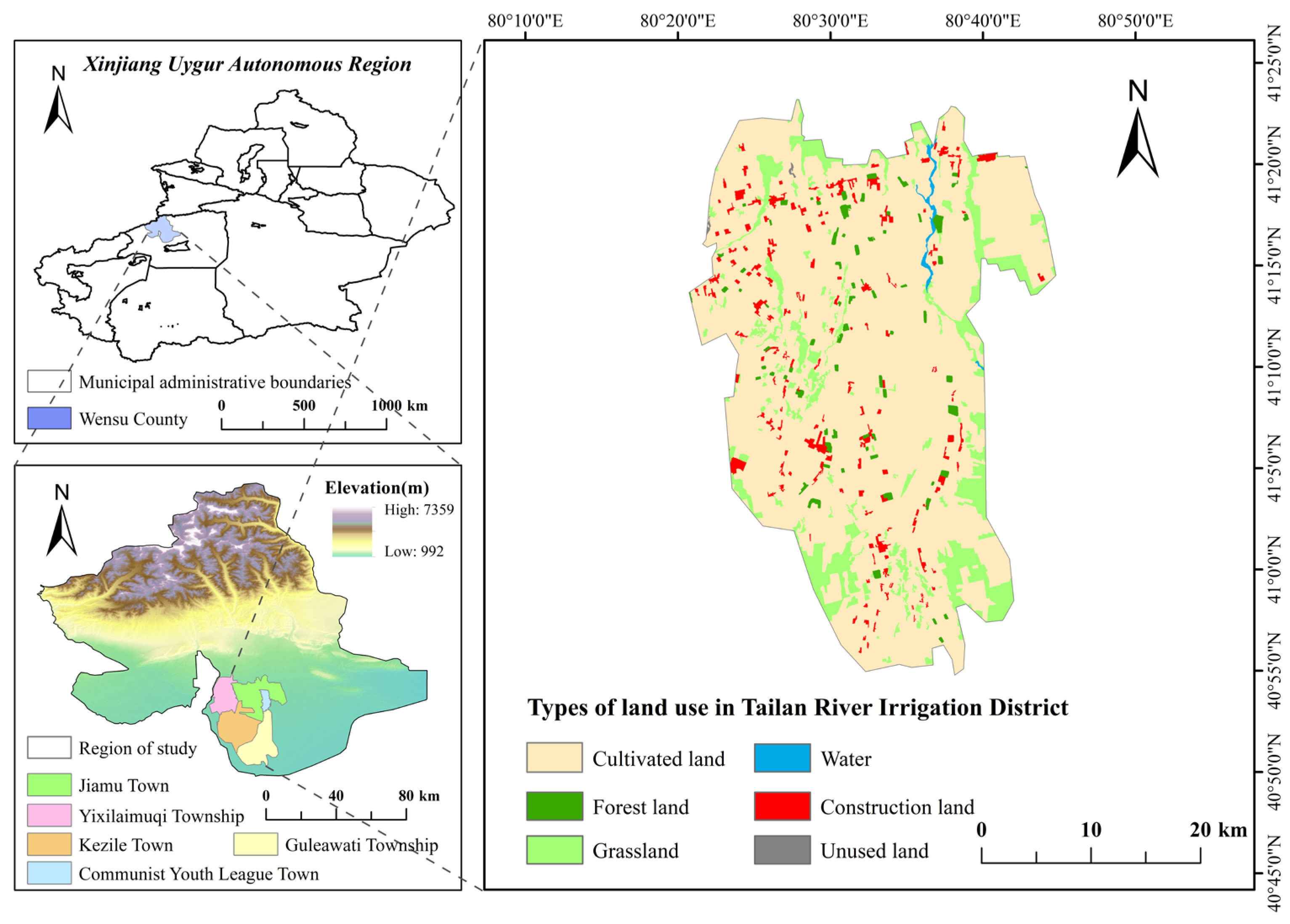
2.1. Study Area
2.2. Data Source
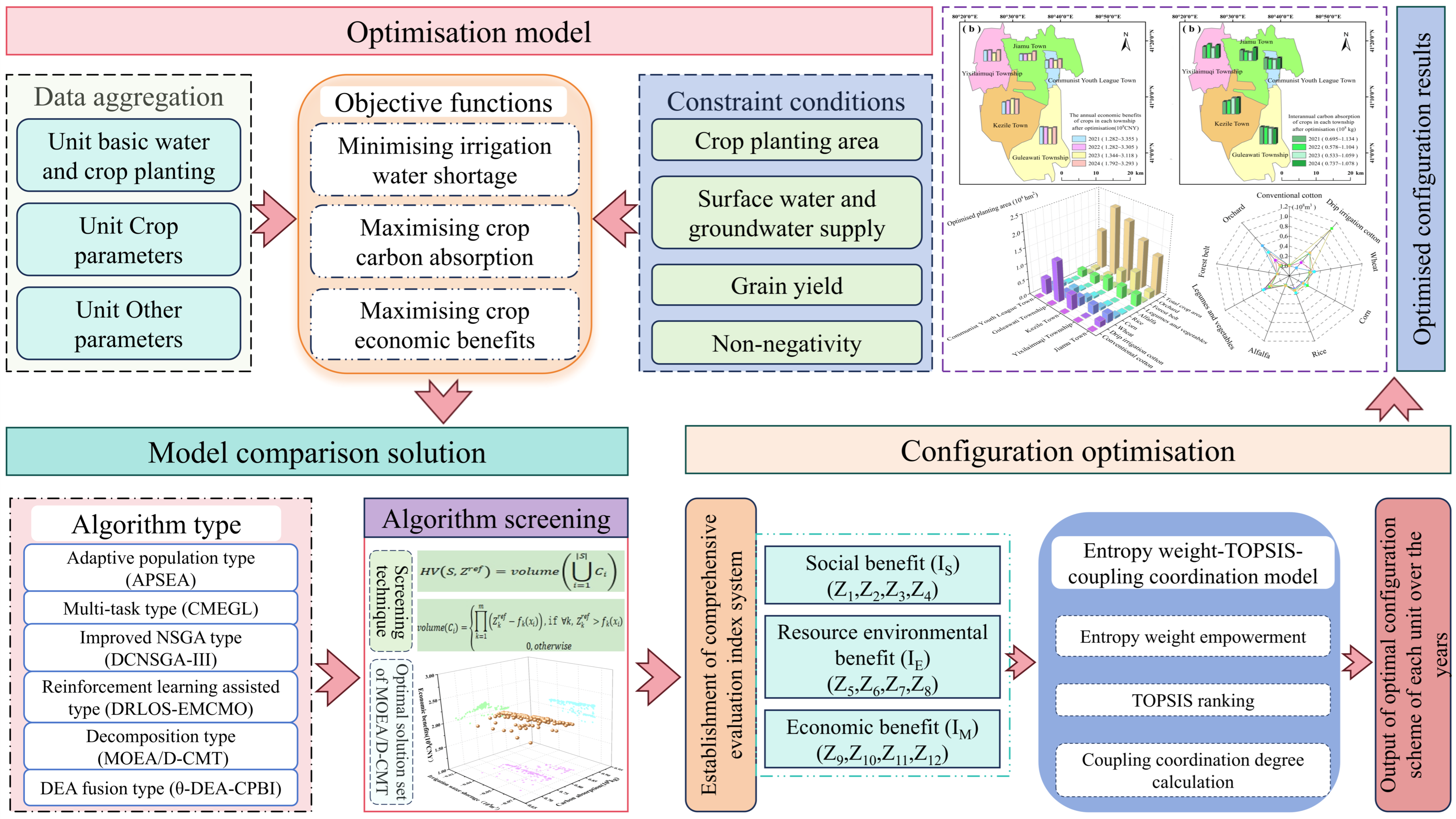
2.3. Model Introduction
2.3.1. Optimise the Objective Function of the Model
- (1)
- The irrigation water shortage is the smallest.
- (2)
- The carbon absorption of the crops in the ecosystem of the irrigation district is the largest.
- (3)
- The economic benefit of crops in the irrigation district is the largest.
2.3.2. Constraint Condition
- (1)
- Crop planting area constraint
- (2)
- Water supply constraints of surface water and groundwater
- (3)
- Food production constraints
- (4)
- Non-negativity constraints
2.3.3. Decision Variables
2.4. Model Multi-Algorithm Comparison Solution
2.5. Entropy Weight–TOPSIS Coupling-Coordination Scheme Optimisation
2.5.1. Entropy Weight–TOPSIS Coupling-Coordination Calculation Steps
- (1)
- Data normalisation and standardisation
- (2)
- Entropy value and weight calculation
- (3)
- Construction of a weighted standardised matrix and determination of positive and negative ideal solutions
- (4)
- Calculation of ideal solution distance and relative closeness
- (5)
- The calculation of the comprehensive evaluation value of each system
- (6)
- Improved coupling coordination calculation
2.5.2. Establishment of Comprehensive Evaluation Index System
3. Results and Analysis
3.1. Algorithm Selection for Optimal Allocation of Water and Soil Resources in an Irrigation District
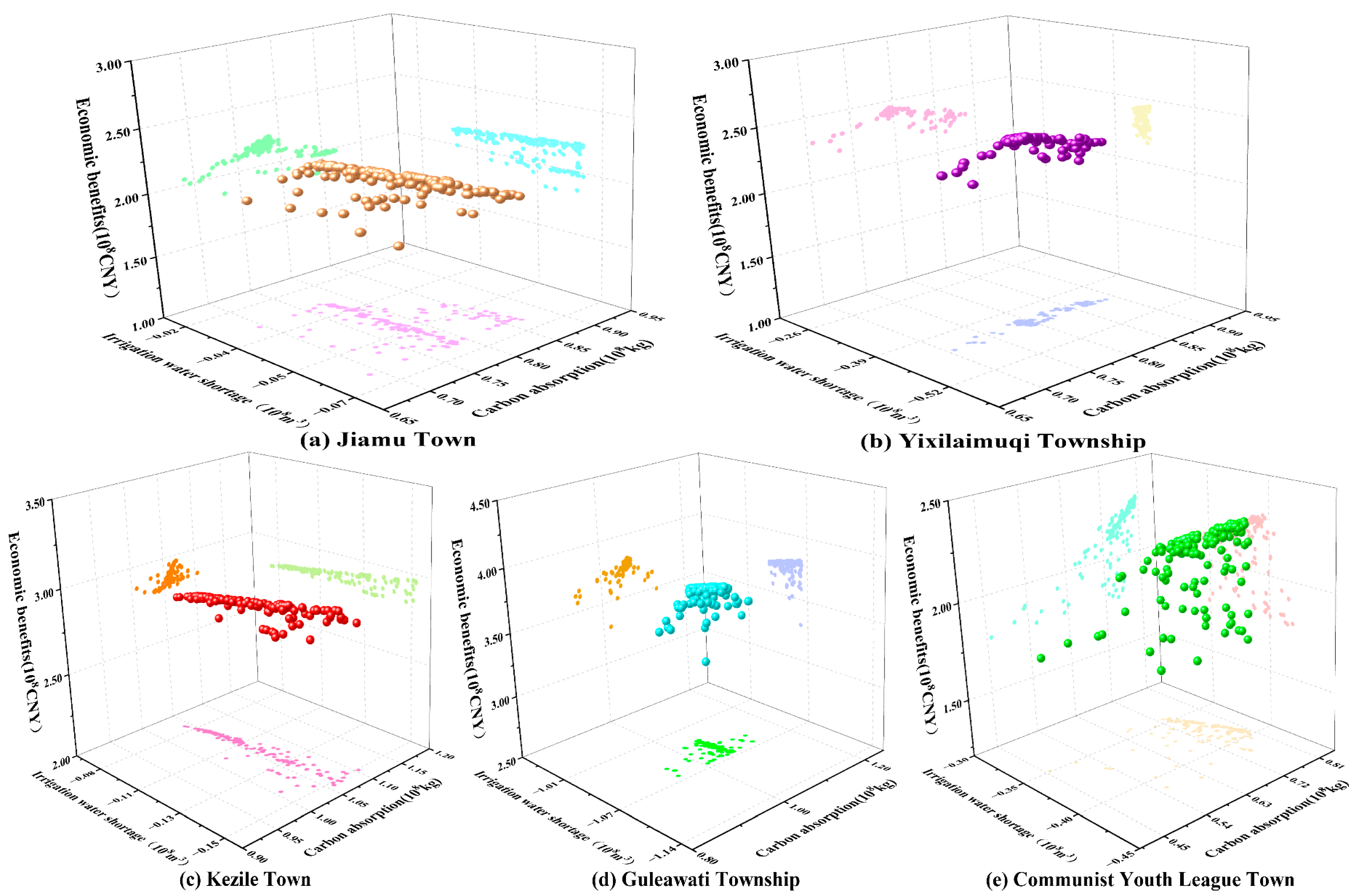
3.2. Selection of Water and Soil Resources Allocation Scheme in the Irrigation District
3.3. Results of Water and Soil Resources Allocation Under the Optimal Scheme
3.3.1. Optimisation Results of Irrigation Amount and Water Shortage
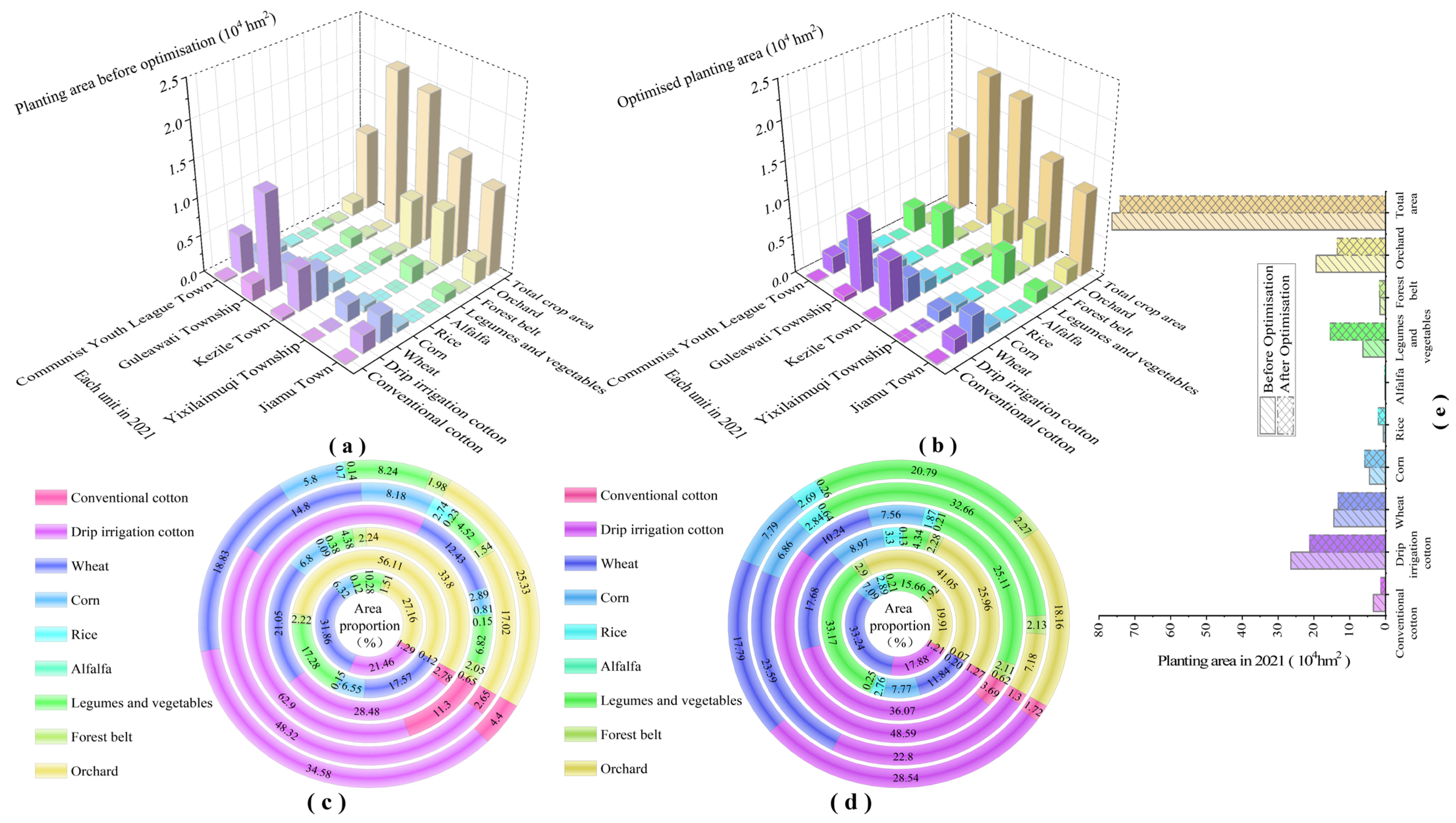
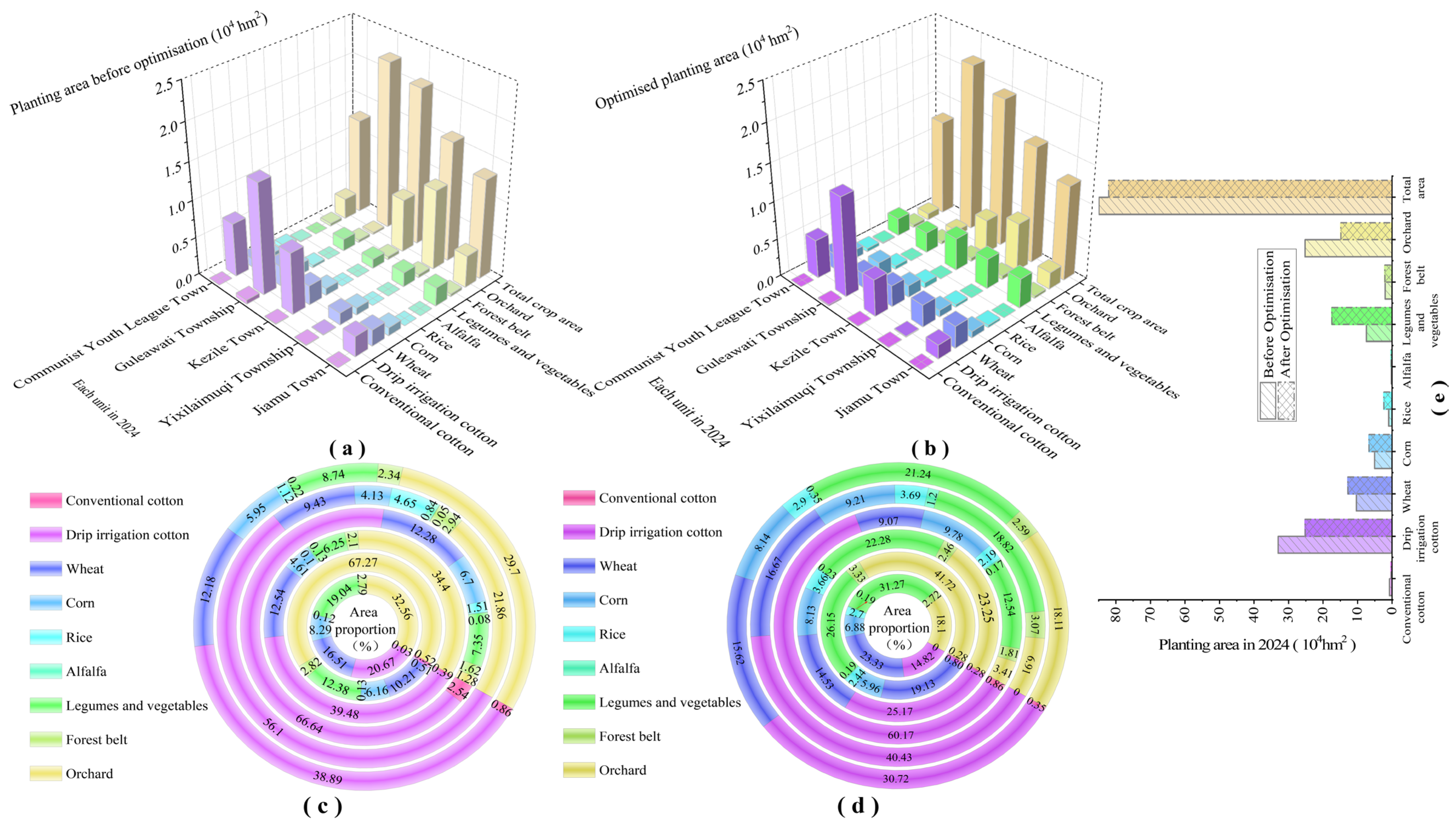
3.3.2. Soil Resource Optimisation Results
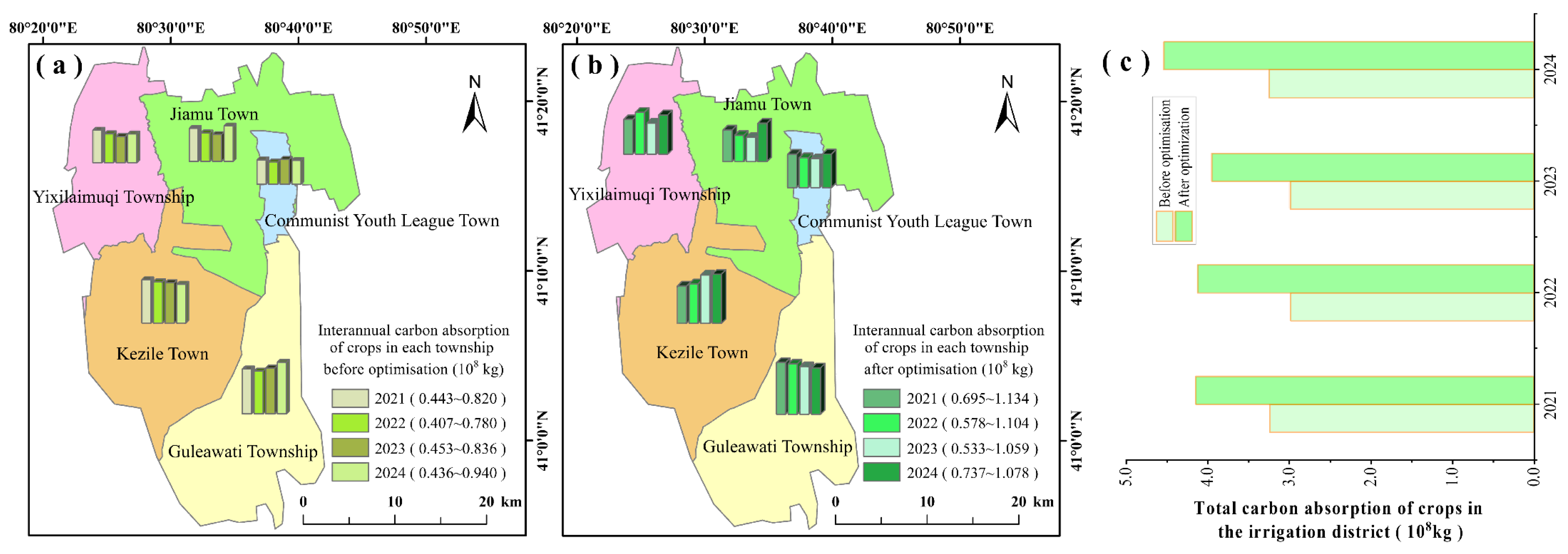
3.3.3. Optimisation Results of Crop Carbon Uptake
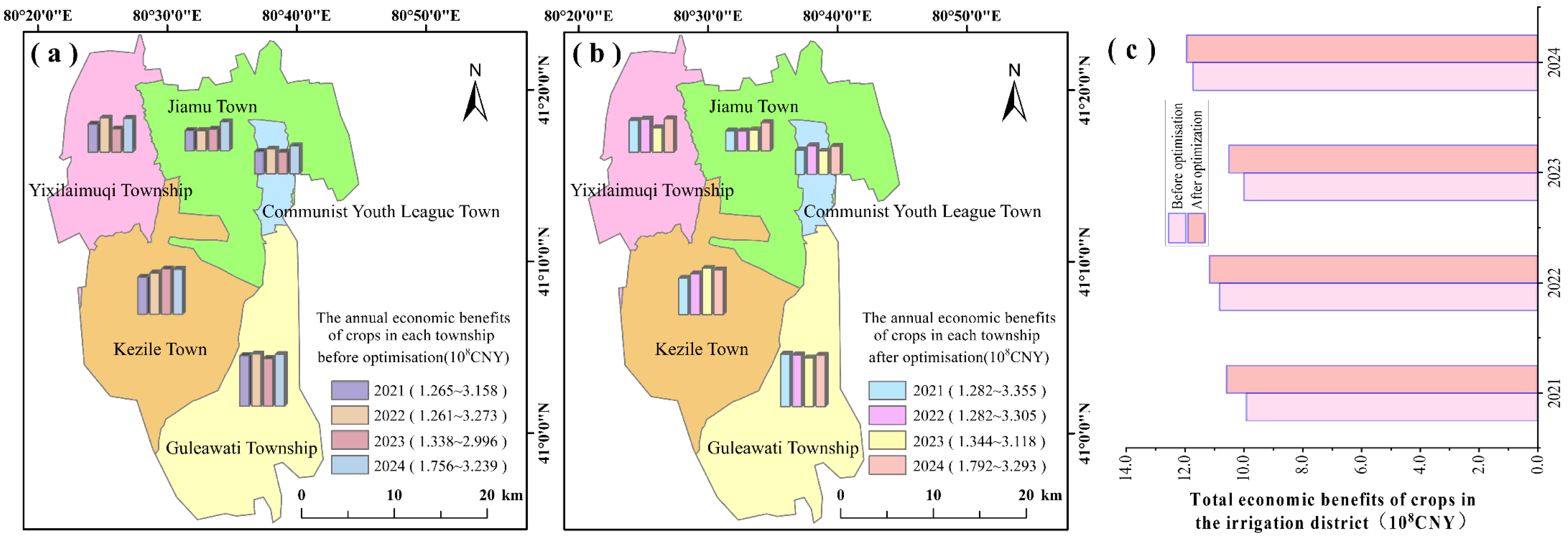
3.3.4. Optimisation Results of Crop Economic Benefits
4. Discussion
4.1. Algorithm Selection and Optimisation Model Versatility
4.2. Coordination and Conflict in Scheme Selection
4.3. The Ecological and Economic Connotation of the Optimisation Results
4.4. Data Dependence and Uncertainty of the Model
4.5. Model Reality Generalisation and Restriction
5. Conclusions
- (1)
- The MOEA/D-CMT algorithm shows significantly better comprehensive performance than other algorithms, such as DCNSGA-III and θ-DEA-CPBI, for the high-dimensional multi-constrained regional water and soil resource optimisation problem in this paper. The algorithm achieves the highest HV value in each unit over the years, demonstrating that it balances convergence and diversity better and is the best algorithm for solving the model in this paper.
- (2)
- Based on the entropy weight–TOPSIS coupling-coordination scheme optimisation model, the optimisation results of each unit configuration scheme over the years show that there is no unique optimal solution suitable for all spatio-temporal units. The comprehensive score and coupling coordination degree of the optimal scheme for each unit fluctuate from year to year, and the differences between units are significant.
- (3)
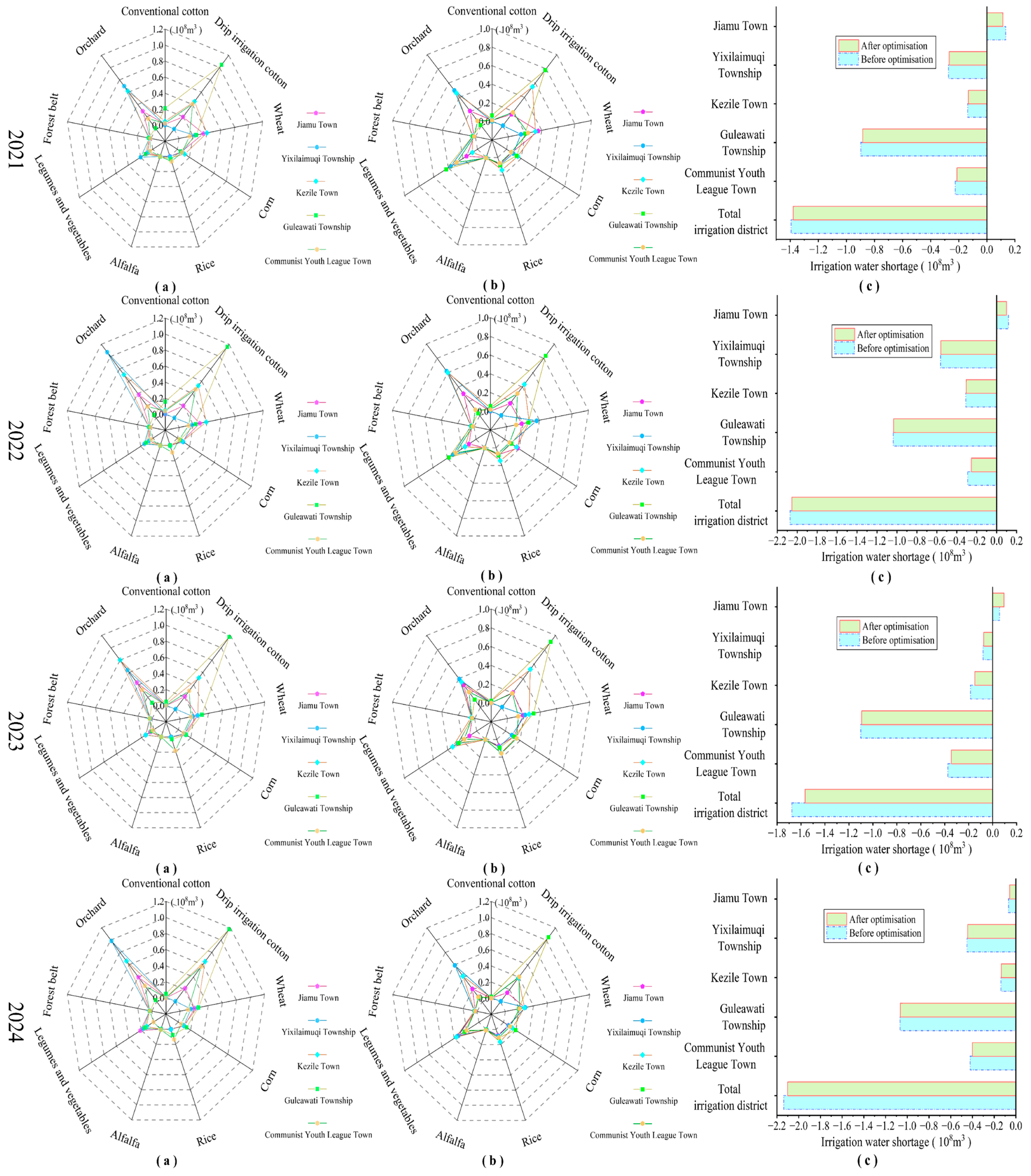
- In terms of soil resources, after the optimisation of each unit from 2021 to 2024, its planting structure will transform in the direction of ‘intensive and diversified.’ The total planting area of the irrigation district was moderately reduced, with reduction rates of 2.93%, 3.3%, 4.1%, and 3.31%, respectively. The area of high-water-consuming crops (conventional cotton and drip-irrigated cotton) and orchards was significantly reduced. In contrast, the area of food crops such as rice and corn, as well as high-value-added crops such as legumes, vegetables, melons, and fruits, was greatly increased. The area of the ecological forest belt was also steadily increased, forming an optimised pattern of ‘cotton pressure, grain expansion, economic increase and strong forest.’
- (4)
- In terms of water resource utilisation, the optimisation scheme achieves the goal of ‘water saving and efficiency increasing.’ Under the premise that the total amount of irrigation water across the region remains stable or only slightly decreases, the irrigation water shortage situation in most units has been significantly improved through adjustments to crop structure and the pressure of water shortage has been effectively alleviated. Although the water consumption of local units has increased slightly due to the expansion of high-efficiency crops, the overall water resource allocation efficiency and economic output per unit of water have improved.
- (5)
- In terms of ecological and environmental benefits, the optimisation scheme significantly enhanced the crop carbon absorption function of the agricultural ecosystem. From 2021 to 2024, the total carbon uptake of crops in the irrigation district increased by 27.87~39.67% after optimisation, compared with before optimisation. This effect is mainly due to the expansion of crops with strong carbon sequestration capacities, such as legumes, vegetables, fruits, and rice, which fully demonstrates the positive effect of optimising planting structure on improving ecosystem services.
- (6)
- In terms of economic benefits, the optimisation scheme has achieved sustained economic growth under the constraints of resources and environment. Even with a slight reduction in total area, the irrigation district’s total economic benefits have continued to grow for four consecutive years. Among them, legumes and vegetables have become the primary drivers of economic growth, and their economic benefits have multiplied, effectively offsetting the loss of income from the compression of cotton area, highlighting the importance of developing high-value-added crops to ensure farmers’ incomes and promote the sustainable development of the regional economy.
Supplementary Materials
Author Contributions
Funding
Institutional Review Board Statement
Informed Consent Statement
Data Availability Statement
Acknowledgments
Conflicts of Interest
Abbreviations
| CNY | Chinese Yuan |
| MOAWCE | Multi-Objective Agricultural Water and Soil Resource Optimal Allocation Model from the perspective of water–carbon–economy coupling |
References
- Disasa, K.N.; Yan, H.; Zhang, J.; Wang, G.; Zhang, C.; Zhang, D.; Wang, B.; Hao, B. Comprehensive review of drought characteristics and intensification under climate change: Implications for agriculture and water resources. J. Hydrol. 2025, 664, 134571. [Google Scholar] [CrossRef]
- Wu, F.; Huang, D.; He, Z.; Liu, S. Water competition and drivers for energy-food production in the Yellow River Basin under rigid water resource constraints. Agric. Water Manag. 2025, 322, 109961. [Google Scholar] [CrossRef]
- Zhang, Y.; Li, Y.; Huang, G.; Ma, Y.; Zhou, Y. Optimising sustainable development in arid river basins: A multi-objective approach to balancing water, energy, economy, carbon and ecology nexus. Environ. Sci. Ecotechnol. 2024, 23, 100481. [Google Scholar] [CrossRef] [PubMed]
- Li, J.; Cui, D.; Bilal, I. Revealing the spatiotemporal dynamics and coupling coordination between urbanisation and ecological environment quality in the Aksu Region, Xinjiang. Ecol. Indic. 2025, 179, 114163. [Google Scholar] [CrossRef]
- Zhang, Y.; Wei, N.; Luo, P.; Chen, J.; Sun, B.; Zhang, Y.; Zhao, X.; Wang, Z.; Zhao, W. Integrated evaluation and forecasting of water resource spatial equilibrium in arid Xinjiang using machine learning and multi-dimensional indicators. J. Hydrol. Reg. Stud. 2025, 62, 102846. [Google Scholar] [CrossRef]
- Guo, P.; Shan, B.; Guo, S. A Multi-Objective Programming Model for Irrigation Water and Planting Structure Optimization Based on Pareto Set. J. Tianjin Univ. (Sci. Technol.) 2019, 52, 1008–1016. [Google Scholar]
- Zhang, Q.; Wu, Y.; Zhang, G.; Xu, Y.J.; Hu, B.; Sun, J.; Yu, Y.; Guo, Y. Optimising the balance among water use, food production, and ecosystem integrity at the regional scale. Agric. Water Manag. 2025, 317, 109670. [Google Scholar] [CrossRef]
- Zhang, Z.; Si, H.; Feng, B.; Hu, C.; Lu, M. An optimal model for agriculture water and soil resources configuration in water shortage irrigation area. J. Hydraul. Eng. 2014, 45, 403–409. [Google Scholar]
- Li, Z.; Cheng, H.; Li, J.; Xiang, S.; Teng, L. Water shortage and countermeasures of irrigation area around Lake Poyang in dry sea-sons. J. Lake Sci. 2022, 34, 601–618. [Google Scholar]
- Guo, P.; Pan, Q.; Yue, Q.; Wang, Y.; Zhang, H. Multi-objective Modelling for Optimal Allocation of Agricultural- Ecological Water and Land Resources Based on Type-2 Fuzzy Sets. Trans. Chin. Soc. Agric. Mach. 2022, 53, 353–365. [Google Scholar]
- Li, M. Methods and Models for Agricultural Water-Land ResourcesMulti-Scale Optimal Allocation Based on Wncertainty Analysis; China Agricultural University: Beijing, China, 2017. [Google Scholar]
- Wang, Y. Based on the Carrying Capacity of Water Resources Optimal Allocation of Agricultural Water and Land Resources in Aksu River Basin; Huazhong University of Science & Technology: Beijing, China, 2021. [Google Scholar]
- Wang, Z. Optimal Allocation of Soil and WaterResources and Spatial Pattern Optimisation of Planting Structure in Aksu River Basin; Northwest A&F University: Shaanxi, China, 2021. [Google Scholar]
- Lang, Y.; Chao, H.; Xiao, J. The Relationship Between Carbon Emissions and Ecosystem Services in Guangdong Province, China: The Perspective of Ecological Function Zones. Land 2024, 13, 2227. [Google Scholar] [CrossRef]
- Wan, Z.; Li, H.; Liu, X.; Huo, L.; Chen, Y.; Wang, L.; Li, M. Synergistic Regulation of Water–Land–Energy–Food–Carbon Nexus in Large Agricultural Irrigation Areas. Agronomy 2025, 15, 2776. [Google Scholar] [CrossRef]
- Parween, S.; Sinha, R.C. An Analytical Hierarchy Process Approach for Prioritization of Objectives and Parameters for an Integrated Urban Water Management. KSCE J. Civ. Eng. 2024, 28, 1566–1579. [Google Scholar] [CrossRef]
- Li, J.; Yang, N.; Shen, Z. Evaluation of the water quality monitoring network layout based on the driving-pressure-state-response framework and entropy weight TOPSIS model: A case study of Liao River, China. J. Environ. Manag. 2024, 361, 121267. [Google Scholar] [CrossRef] [PubMed]
- He, Y.; Tang, X.; Peng, L.; Ju, J. Optimised selection of the solution for multi-objective optimal allocation of water resources in Fengshou Irrigation Areas of South Xinjiang. Trans. Chin. Soc. Agric. Eng. 2021, 37, 117–126. [Google Scholar]
- Chen, J.; Tang, D. An evaluation of the water demand of Tailan Irrigation project based on the ANP-FCE. China Rural. Water Hydropower 2014, 3, 159–161+165. [Google Scholar]
- Ruan, Y.; He, Y.; Qiu, Y.; Ma, L. Study on the Trade-Off and Synergy Between Agricultural Water–Soil Matching and Ecosystem Service Value in the Tailan River Irrigation District of Xinjiang. Sustainability 2025, 17, 4173. [Google Scholar] [CrossRef]
- Ding, Y.; Zhao, N.; Li, M.; Liang, M.; Gao, X.; Wang, J.; Zhao, X. Carbon source/sink and carbon footprint estimation for field crop production andspatial characterisation in northern Shaanxi Province. Acta Ecol. Sin. 2024, 44, 4574–4583. [Google Scholar]
- Li, Q.; Chen, Y.; Gesang, Z.; Zhaxi, L.; Gan, Y.; Zhuang, D.; Yao, X.; Tang, T.; Sun, X.; Pan, K.; et al. Temporal and spatial variations of carbon footprints in the agricultural ecosystems of the Qinghai-Xizang Plateau from 1988 to 2018 and theirinfluencing factors. Chin. J. Appl. Environ. Biol. 2024, 30, 1263–1274. [Google Scholar]
- Zhang, L.; He, Y.; Chen, T.; Yang, T.; Zhang, B.; Jin, J. The spatial and temporal pattern evolution of carbon footprint of farmland ecosystem in Fenwei Plain from 2011 to 2020. Ecol. Environ. Sci. 2023, 32, 1149–1162. [Google Scholar]
- Tang, X. Multi-Objective Optimal and Optimised Selection of the Solution for Water Resources in Awati Irrigation Areas of Xinjiang; Xinjiang Agricultural University: Ürümqi, China, 2021. [Google Scholar]
- Hao, X. Spatiotemporal variation of carbon source/sink in agricultural ecosystem based on carbon footprint in Heilongjiang land reclamation areas. Chin. J. Agric. Resour. Reg. Plan. 2022, 43, 64–73. [Google Scholar]
- Li, M.; Liu, S.; Wu, X.; Sun, Y.; Hou, X.; Zhao, S. Temporal and spatial dynamics in the carbon footprint and its influencing factors of farmland ecosystems in Yunnan Province. Acta Ecol. Sin. 2018, 38, 8822–8834. [Google Scholar] [CrossRef]
- Sun, J. Study on the Optimal Allocation of Agricultural Water and Land Resources Based on Water-Carbon-Economy Coupling Model; Heilongjiang University: Harbin, China, 2023. [Google Scholar]
- Tian, Y.; Wang, R.; Zhang, Y.; Zhang, X. Adaptive Population sizing for multi-population based constrained multi-objective optimisation. Neurocomputing 2025, 621, 129296. [Google Scholar] [CrossRef]
- Qiao, K.; Liang, J.; Liu, Z.; Yu, K.; Yue, C.; Qu, B. Evolutionary multi-tasking with global and local auxiliary tasks for constrained multi-objective optimisation. IEEE/CAA J. Autom. Sin. 2023, 10, 1951–1964. [Google Scholar] [CrossRef]
- Jiao, R.; Zeng, S.; Li, C.; Yang, S.; Ong, Y.S. Handling constrained many-objective optimisation problems via problem transformation. IEEE Trans. Cybern. 2020, 51, 4834–4847. [Google Scholar] [CrossRef]
- Ming, F.; Gong, W.; Wang, L.; Jin, Y. Constrained multi-objective optimisation with deep reinforcement learning assisted operator selection. IEEE/CAA J. Autom. Sin. 2024, 11, 919–931. [Google Scholar] [CrossRef]
- Chu, X.; Ming, F.; Gong, W. Competitive multi-tasking for computational resource allocation in evolutionary constrained multi-objective optimisation. IEEE Trans. Evol. Comput. 2024, 29, 809–821. [Google Scholar] [CrossRef]
- Ming, F.; Gong, W.; Wang, L.; Gao, L. A constraint-handling technique for decomposition-based constrained many-objective evolutionary algorithms. IEEE Trans. Syst. Man Cybern. Syst. 2023, 53, 7783–7793. [Google Scholar] [CrossRef]
- Bures, M.; Ahmed, B.S. Employment of multiple algorithms for optimal path-based test selection strategy. Inf. Softw. Technol. 2019, 114, 21–36. [Google Scholar] [CrossRef]
- Ren, X.; Wang, M.; Dai, G.; Peng, L.; Chen, X.; Song, Z. Balancing convergence and diversity: Gaussian mixture models in adaptive weight vector strategies for multi-objective algorithms. Inf. Sci. 2025, 700, 121858. [Google Scholar] [CrossRef]
- Wang, L.; Ren, Y.; Qiu, Q.; Qiu, F. Survey on Performance Indicators for Multi-0bjective Evolutionary Algorithms. Chin. J. Comput. 2021, 44, 1590–1619. [Google Scholar]
- Tian, Y.; Cheng, R.; Zhang, X.; Li, M.; Jin, Y. Diversity assessment of multi-objective evolutionary algorithms: Performance metric and benchmark problems [research frontier]. IEEE Comput. Intell. Mag. 2019, 14, 61–74. [Google Scholar] [CrossRef]
- Lu, H.; Li, H.; Wang, J.; Zheng, H.; Cao, X.; Tong, C. Optimal water and land resource allocation in pastoral areas based on a water–land forage–livestock balance: A case study of Otog Front Banner, Inner Mongolia, China. Environ. Sci. Pollut. Res. 2020, 27, 10328–10341. [Google Scholar] [CrossRef]
- Zou, L.; Liu, H.; Wang, F.; Chen, T.; Dong, Y. Regional difference and influencing factors of the green development level in the urban agglomeration in the middle reaches of the Yangtze River. Sci. China Earth Sci. 2022, 65, 1449–1462. [Google Scholar] [CrossRef]
- Zou, T.; Guo, P.; Wu, Q. Applying an entropy-weighted TOPSIS method to evaluate energy green consumption revolution progressing of China. Environ. Sci. Pollut. Res. 2023, 30, 42267–42281. [Google Scholar] [CrossRef] [PubMed]
- Chen, Y. Study on Evaluation and Optimal Allocation of Soil and Water Resources Carrying Capacity in Jiaokou Irrigation Area. Master’s Thesis, Chang’an University, Xi’an, China, 2024. [Google Scholar]
- Zhu, Y.; Chen, D.; Wang, Z.; Zhao, X.; Feng, F. Optimised selection of water resources optimum allocation planin Dashagou Irrigation District of Lanzhou City. J. Gansu Agric. Univ. 2025, 60, 243–253. [Google Scholar]
- Li, X.; Zuo, Q.; Han, S.; Li, D.; Ma, J. Evaluation of adaptive utilisation capacity of water resources in Tarim River and its regulation. Water Resour. Prot. 2021, 37, 63–68. [Google Scholar]
- Hou, Y.; Zhang, D.; Nie, Y.; Xu, T. Comprehensive benefits evaluation and coupling coordination mechanism of regional water network development. South-North Water Transf. Water Sci. Technol. 2025, 23, 312–322. [Google Scholar]
- Cao, L.; Liu, X.; Zhang, Z.; Huang, J. Evaluation on agricultural water and soil resources in Xuchang City based on CRITIC-TOPSIS. J. North China Univ. Water Resour. Electr. Power (Nat. Sci. Ed.) 2023, 44, 56–61. [Google Scholar]
- Dang, Q.; Feng, X.; Xie, L.; Sun, X.; Wu, W. Attention mechanism based adaptive auxiliary task selection for constrained multi-objective optimisation and engineering design problems. Memetic Comput. 2026, 18, 5. [Google Scholar] [CrossRef]
- Dong, T.; Wang, P.; Xue, F.; Geng, Y.; Cui, Z. Adaptive hybrid response mechanism for dynamic multi-objective optimisation and its application in multi-robot task allocation. Swarm Evol. Comput. 2025, 98, 102123. [Google Scholar] [CrossRef]
- Wang, J.; Han, Q.; Du, Y. Coordinated development of the economy, society and environment in urban China: A case study of 285 cities. Environ. Dev. Sustain. 2022, 24, 12917–12935. [Google Scholar] [CrossRef]
- Chen, L.; Fernando, H.; Ying, Y.; Chen, T. Three-way trade-off in multi-objective learning: Optimisation, generalisation and conflict-avoidance. Adv. Neural Inf. Process. Syst. 2023, 36, 70045–70093. [Google Scholar]
- Garcia, L.D.; Lozoya, C.; Favela-Contreras, A.; Giorgi, E. A Comparative Analysis between heuristic and data-driven water management control for precision agriculture irrigation. Sustainability 2023, 15, 11337. [Google Scholar] [CrossRef]
- Jiang, L.; Chen, X.; Meng, L.; Zhang, G.; Pan, Z.; An, P. Increased grain production of cultivated land by closing the existing cropping intensity gap in Southern China. Food Secur. 2021, 13, 385–398. [Google Scholar] [CrossRef]
- Xue, S.; Fang, Z.; van Riper, C.; He, W.; Li, X.; Zhang, F.; Wang, T.; Cheng, C.; Zhou, Q.; Huang, Z.; et al. Ensuring China’s food security in a geographical shift of its grain production: Driving factors, threats, and solutions. Resour. Conserv. Recycl. 2024, 210, 107845. [Google Scholar] [CrossRef]
- Pareja-Sánchez, E.; García-Ruiz, R.; Sanchez, G.; Cerdá, X.; Angulo, E.; Soriguer, R.C.; Cobos, J. Soil Respiration in Traditional Mediterranean Olive Groves: Seasonal Dynamics, Spatial Variability, and Controlling Factors. Agriculture 2025, 15, 2610. [Google Scholar] [CrossRef]
- Huang, Q.; Katayanagi, N.; Komatsuzaki, M.; Fumoto, T. Field Validation of the DNDC-Rice Model for Crop Yield, Nitrous Oxide Emissions and Carbon Sequestration in a Soybean System with Rye Cover Crop Management. Agriculture 2025, 15, 1525. [Google Scholar] [CrossRef]
- Shrestha, D.; Brown, J.F.; Benedict, T.D.; Howard, D.M. Exploring the regional dynamics of US irrigated agriculture from 2002 to 2017. Land 2021, 10, 394. [Google Scholar] [CrossRef]
- Li, J.; Lin, Q. Can the adjustment of China’s grain purchase and storage policy improve its green productivity? Int. J. Environ. Res. Public Health 2022, 19, 6310. [Google Scholar] [CrossRef]
- Zhang, C.; Guo, P.; Huo, Z. Irrigation water resources management under uncertainty: An interval nonlinear double-sided fuzzy chance-constrained programming approach. Agric. Water Manag. 2021, 245, 106658. [Google Scholar] [CrossRef]
- Archibald, T.W.; Marshall, S.E. Review of mathematical programming applications in water resource management under uncertainty. Environ. Model. Assess. 2018, 23, 753–777. [Google Scholar] [CrossRef]
- Hassani, A.; Azapagic, A.; Shokri, N. Global predictions of primary soil salinization under changing climate in the 21st century. Nat. Commun. 2021, 12, 6663. [Google Scholar] [CrossRef] [PubMed]
- Yang, T.; Siddique, K.H.; Liu, K. Cropping systems in agriculture and their impact on soil health-A review. Glob. Ecol. Conserv. 2020, 23, e01118. [Google Scholar] [CrossRef]
- Sheng, Y.; Song, L. Agricultural production and food consumption in China: A long-term projection. China Econ. Rev. 2019, 53, 15–29. [Google Scholar] [CrossRef]
- Liu, W.; Fan, Y.; Yu, T.E. Optimizing Crop Planting Structures for Water Savings and Grain Revenue in China Considering Different Spatial Scales. Resour. Environ. Sustain. 2026, 24, 100323. [Google Scholar] [CrossRef]
- Mgendi, G.; Mao, S.; Qiao, F. Does agricultural training and demonstration matter in technology adoption? The empirical evidence from small rice farmers in Tanzania. Technol. Soc. 2022, 70, 102024. [Google Scholar] [CrossRef]
- Wang, X.; Zhao, X. The moderating effect of training, subsidies and propaganda on the relationship between psychological factors and farmers’ willingness to reduce chemical fertilizer application: Evidence from dryland farming areas of China. Agric. Syst. 2025, 224, 104257. [Google Scholar] [CrossRef]
- Camici, S.; Dari, J.; Filippucci, P.; Massari, C.; Mantovani, S.; Avanzi, F.; Delogu, F.; Baez-Villanueva, O.M.; Vreugdenhil, M.; Volden, E.; et al. High-resolution satellite observations for developing advanced decision support systems for water resources management in the Po River. J. Hydrol. 2025, 662, 134047. [Google Scholar] [CrossRef]
- Zheng, Q.; Song, P.; Wang, X.; Sun, B.; Hou, P. Irrigation management for sustainable intensification of faba bean production: Synergizing yield, soil health, and water use efficiency. Agric. Water Manag. 2026, 325, 110208. [Google Scholar] [CrossRef]
- Teng, K.; Meng, S.; Liu, Y. Can alternating irrigation technology drive water saving in agricultural irrigation? Evidence from China. Agric. Water Manag. 2025, 320, 109867. [Google Scholar] [CrossRef]
- Qin, M.; Zhang, C.; Ma, G.; Ma, Y.; Feng, X.; Li, P.; Feng, K. Digital twin-enabled intelligent irrigation-drainage system for precision water-salt management in saline agroecosystems. Agric. Water Manag. 2025, 322, 109957. [Google Scholar] [CrossRef]
- Nzira, J.E.; Chegere, M.J. Diversify and thrive: Panel data evidence on crop portfolio effects on farmer income and farm output market supply. J. Agric. Food Res. 2025, 24, 102339. [Google Scholar] [CrossRef]
- Li, J.F.; Wang, Z.X. Research on coordination of multi-product “agricultural super-docking” supply chain. Procedia Manuf. 2019, 30, 560–566. [Google Scholar] [CrossRef]
- Cui, X.; Yu, C.; Zhou, J. Does agricultural insurance promote the new-quality productivity? Evidence from double machine learning. Int. Rev. Econ. Financ. 2025, 105, 104797. [Google Scholar] [CrossRef]
- Ishibuchi, H.; Imada, R.; Setoguchi, Y.; Nojima, Y. Reference point specification in hypervolume calculation for fair comparison and efficient search. In Proceedings of the Genetic and Evolutionary Computation Conference, Berlin, Germany, 15–19 July 2017; pp. 585–592. [Google Scholar]
- Morales-Paredes, A.I.; Falcón-Cardona, J.G.; Juárez, J.; Terashima-Marín, H.; Coello Coello, C.A. Reference point specification in greedy inclusion hypervolume-based subset selection: A study on two objectives. In Proceedings of the Genetic and Evolutionary Computation Conference, Berlin, Germany, 15–19 July 2017; pp. 618–626. [Google Scholar]
- Bader, J.; Zitzler, E. HypE: An algorithm for fast hypervolume-based many-objective optimization. Evol. Comput. 2011, 19, 45–76. [Google Scholar] [CrossRef] [PubMed]
- Auger, A.; Bader, J.; Brockhoff, D.; Zitzler, E. Hypervolume-based multiobjective optimization: Theoretical foundations and practical implications. Theor. Comput. Sci. 2012, 425, 75–103. [Google Scholar] [CrossRef]
- Cao, Y.; Smucker, B.J.; Robinson, T.J. On using the hypervolume indicator to compare Pareto fronts: Applications to multi-criteria optimal experimental design. J. Stat. Plan. Inference 2015, 160, 60–74. [Google Scholar] [CrossRef]
- Friedman, M. A comparison of alternative tests of significance for the problem of m rankings. Ann. Math. Stat. 1940, 11, 86–92. [Google Scholar] [CrossRef]
- Iman, R.L.; Davenport, J.M. Approximations of the critical region of the fbietkan statistic. Commun. Stat.-Theory Methods 1980, 9, 571–595. [Google Scholar] [CrossRef]
- Wilcoxon, F. Probability tables for individual comparisons by ranking methods. Biometrics 1947, 3, 119–122. [Google Scholar] [CrossRef]
- Dunn, O.J. Multiple comparisons among means. J. Am. Stat. Assoc. 1961, 56, 52–64. [Google Scholar] [CrossRef]
- Derrac, J.; García, S.; Molina, D.; Herrera, F. A practical tutorial on the use of nonparametric statistical tests as a methodology for comparing evolutionary and swarm intelligence algorithms. Swarm Evol. Comput. 2011, 1, 3–18. [Google Scholar] [CrossRef]



| Data Type | Name | Unit | Data Source | Time Range | Specific Value | Missing Value Processing |
|---|---|---|---|---|---|---|
| Basic water and crop cultivation | annual surface water and groundwater withdrawal in each sub-region | m3 | ① | 2021~2024 | Table S1 | - |
| annual crop planting area of each district | hm2 | ② | 2021~2024 | Tables S2–S5 | - | |
| Crop parameters | unit yield | kg/hm2 | ③ | 2021~2024 average | Table S6 | ⑦ |
| unit price | CNY/kg | ③ | 2021~2024 average | Table S6 | ⑦ | |
| materialised cost | CNY/hm2 | ④ | 2021~2024 average | Table S6 | - | |
| irrigation quota | m3/hm2 | ⑤ | 2021~2024 average | Table S6 | - | |
| carbon absorption rate | - | References [21,22,23] | - | Table S7 | - | |
| moisture content | - | References [21,22,23] | - | Table S7 | - | |
| economic coefficient | - | References [21,22,23] | - | Table S7 | - | |
| Other parameters | population of each district | people | ⑥ | 2019 | Table S8 | - |
| per capita food possession | kg/person | ③ | 2021~2024 | Table S6 | - |
| Unit | Reference Point (Z1, Z2, Z3) | ||
|---|---|---|---|
| Jiamu Town | 8.677 × 10⁶ | −9.103 × 10⁷ | −2.365 × 10⁸ |
| Yixilaimuqi Township | 6.169 × 10⁷ | −9.694 × 10⁷ | −2.582 × 10⁸ |
| Kezile Town | 3.957 × 10⁷ | −1.191 × 10⁸ | −3.237 × 10⁸ |
| Guleawati Township | 1.169 × 10⁸ | −1.267 × 10⁸ | −4.001 × 10⁸ |
| Communist Youth League Town | 4.389 × 10⁷ | −8.437 × 10⁷ | −2.411 × 10⁸ |
| Target Layer | System Criterion Layer | Evaluation Index Layer | Index Definition | Attribute |
|---|---|---|---|---|
| Comprehensive Evaluation of Water and Soil Resource Allocation Schemes of Each Unit in the Irrigation District (A) | Social Benefit (IS) | Agricultural water productivity (Z1) | Crop yield/Crop irrigation amount | Positive |
| Total crop proportion (Z2) | Total crop area/Total soil area of each unit | Positive | ||
| Grain crop proportion (Z3) | Grain crop area/Total crop area | Positive | ||
| Irrigation water shortage rate (Z4) | Formula (1)/Irrigation water shortage before optimisation | Negative * | ||
| Resource Environmental Benefit (IE) | Amount of fertiliser used per unit area (Z5) | Total fertiliser use/Total crop area | Negative | |
| Rate of irrigation guarantee (Z6) | Average irrigation quota after optimisation/Average irrigation quota before optimisation | Positive | ||
| Proportion of crop carbon absorption (Z7) | Formula (2)/Carbon absorption before optimisation | Positive | ||
| Amount of pesticide used per unit area (Z8) | Pesticide usage/Total crop area | Negative | ||
| Economic Benefit (IM) | Net economic benefit per unit area (Z9) | Formula (3)/Total crop area | Positive | |
| Ratio of output to input (Z10) | (Crop yield × Crop unit price)/Input funds | Positive | ||
| Proportion of cash crops (Z11) | Economic crop area/Total crop area | Positive | ||
| Proportion of total area (Z12) | Total crop area after optimisation/Total crop area before optimisation | Positive |
| Unit | Year | APSEA | CMEGL | DCNSGA-III | DRLOS-EMCMO | MOEA/D-CMT | θ-DEA-CPBI |
|---|---|---|---|---|---|---|---|
| Jiamu Town | 2021 | 1.41 | 1.408 | 1.476 | 1.368 | 1.883 | 1.43 |
| 2022 | 1.039 | 1.19 | 1.189 | 1.391 | 1.933 | 1.286 | |
| 2023 | 1.334 | 1.541 | 1.331 | 1.558 | 1.905 | 1.302 | |
| 2024 | 0.399 | 0.957 | 0.203 | 1.274 | 9.281 | 0.418 | |
| Average | 1.046 | 1.274 | 1.05 | 1.398 | 3.751 | 1.109 | |
| Yixilaimuqi Township | 2021 | 0.672 | 0.755 | 0.586 | 0.781 | 1.167 | 0.628 |
| 2022 | 0.197 | 0.84 | 0.166 | 0.826 | 3.095 | 0.216 | |
| 2023 | 1.157 | 1.092 | 0.894 | 1.139 | 1.546 | 0.933 | |
| 2024 | 0.407 | 1.294 | 0.361 | 0.558 | 3.107 | 0.656 | |
| Average | 0.608 | 0.995 | 0.502 | 0.826 | 2.229 | 0.608 | |
| Kezile Town | 2021 | 0.795 | 0.758 | 0.654 | 1.248 | 1.82 | 0.748 |
| 2022 | 0.336 | 0.405 | 0.188 | 0.409 | 0.564 | 0.375 | |
| 2023 | 0.786 | 1.202 | 1.142 | 2.257 | 7.029 | 1.076 | |
| 2024 | 0.994 | 0.982 | 0.863 | 1.438 | 2.388 | 0.849 | |
| Average | 0.728 | 0.837 | 0.712 | 1.338 | 2.95 | 0.762 | |
| Guleawati Township | 2021 | 0.346 | 0.706 | 0.427 | 0.693 | 1.61 | 0.755 |
| 2022 | 0.209 | 0.423 | 0.216 | 0.341 | 0.698 | 0.222 | |
| 2023 | 0.597 | 0.534 | 0.179 | 0.704 | 2.99 | 0.417 | |
| 2024 | 0.206 | 0.406 | 0.325 | 0.919 | 1.328 | 0.214 | |
| Average | 0.34 | 0.517 | 0.287 | 0.664 | 1.657 | 0.402 | |
| Communist Youth League Town | 2021 | 1.969 | 1.901 | 0.852 | 2.06 | 3.916 | 0.983 |
| 2022 | 0.893 | 1.558 | 0.575 | 1.177 | 1.683 | 1.16 | |
| 2023 | 2.135 | 1.908 | 0.753 | 2.101 | 3.104 | 1.014 | |
| 2024 | 1.506 | 2.189 | 3.161 | 3.06 | 12.643 | 1.005 | |
| Average | 1.626 | 1.889 | 1.335 | 2.1 | 5.337 | 1.041 |
| Unit | Year | Social Benefit | Resource Environmental Benefit | Economic Benefit | |||||||||
|---|---|---|---|---|---|---|---|---|---|---|---|---|---|
| Z1 | Z2 | Z3 | Z4 | Z5 | Z6 | Z7 | Z8 | Z9 | Z10 | Z11 | Z12 | ||
| Jiamu Town | 2021 | 0.013 | 0.056 | 0.095 | 0.19 | 0.07 | 0.077 | 0.193 | 0.07 | 0.069 | 0.036 | 0.076 | 0.056 |
| 2022 | 0.047 | 0.028 | 0.079 | 0.13 | 0.15 | 0.064 | 0.144 | 0.15 | 0.071 | 0.042 | 0.069 | 0.028 | |
| 2023 | 0.071 | 0.021 | 0.147 | 0.105 | 0.138 | 0.12 | 0.162 | 0.138 | 0.034 | 0.012 | 0.03 | 0.021 | |
| 2024 | 0.011 | 0.104 | 0.26 | 0.095 | 0.106 | 0.143 | 0.022 | 0.106 | 0.018 | 0.008 | 0.024 | 0.104 | |
| Yixilaimuqi Township | 2021 | 0.009 | 0.075 | 0.165 | 0.049 | 0.272 | 0.056 | 0.006 | 0.272 | 0.008 | 0.007 | 0.006 | 0.075 |
| 2022 | 0.029 | 0.051 | 0.283 | 0.068 | 0.166 | 0.044 | 0.073 | 0.166 | 0.031 | 0.006 | 0.032 | 0.051 | |
| 2023 | 0.016 | 0.049 | 0.243 | 0.075 | 0.193 | 0.125 | 0.014 | 0.193 | 0.015 | 0.003 | 0.024 | 0.049 | |
| 2024 | 0.014 | 0.063 | 0.274 | 0.049 | 0.154 | 0.169 | 0.015 | 0.154 | 0.016 | 0.005 | 0.024 | 0.063 | |
| Kezile Town | 2021 | 0.012 | 0.084 | 0.249 | 0.074 | 0.22 | 0.016 | 0.015 | 0.22 | 0.008 | 0.011 | 0.007 | 0.084 |
| 2022 | 0.014 | 0.155 | 0.158 | 0.123 | 0.135 | 0.022 | 0.019 | 0.135 | 0.025 | 0.034 | 0.025 | 0.155 | |
| 2023 | 0.034 | 0.095 | 0.168 | 0.077 | 0.184 | 0.055 | 0.039 | 0.184 | 0.04 | 0.012 | 0.018 | 0.095 | |
| 2024 | 0.015 | 0.168 | 0.083 | 0.09 | 0.16 | 0.067 | 0.019 | 0.16 | 0.027 | 0.023 | 0.021 | 0.168 | |
| Guleawati Township | 2021 | 0.024 | 0.111 | 0.258 | 0.081 | 0.121 | 0.052 | 0.027 | 0.121 | 0.032 | 0.025 | 0.037 | 0.111 |
| 2022 | 0.021 | 0.088 | 0.317 | 0.121 | 0.095 | 0.054 | 0.025 | 0.095 | 0.044 | 0.02 | 0.032 | 0.088 | |
| 2023 | 0.018 | 0.074 | 0.332 | 0.084 | 0.147 | 0.063 | 0.021 | 0.147 | 0.017 | 0.011 | 0.013 | 0.074 | |
| 2024 | 0.01 | 0.09 | 0.301 | 0.083 | 0.18 | 0.037 | 0.011 | 0.18 | 0.005 | 0.007 | 0.006 | 0.09 | |
| Communist Youth League Town | 2021 | 0.009 | 0.088 | 0.269 | 0.094 | 0.152 | 0.046 | 0.017 | 0.152 | 0.024 | 0.022 | 0.04 | 0.088 |
| 2022 | 0.012 | 0.106 | 0.181 | 0.107 | 0.199 | 0.035 | 0.013 | 0.199 | 0.017 | 0.008 | 0.017 | 0.106 | |
| 2023 | 0.01 | 0.074 | 0.343 | 0.015 | 0.146 | 0.125 | 0.013 | 0.146 | 0.018 | 0.018 | 0.016 | 0.074 | |
| 2024 | 0.01 | 0.069 | 0.388 | 0.04 | 0.133 | 0.069 | 0.011 | 0.133 | 0.034 | 0.018 | 0.025 | 0.069 | |
| Unit | Year | Optimal Scheme | Comprehensive Evaluation Value of Subsystem | Comprehensive Evaluation Score (Hi) | Coupling Coordination Degree (Di) | ||
|---|---|---|---|---|---|---|---|
| Social Benefit (U1i) | Environmental Resource Benefit (U2i) | Economic Benefit (U3i) | |||||
| Jiamu Town | 2021 | Scheme104 | 0.157 | 0.335 | 0.068 | 0.537 | 0.677 |
| 2022 | Scheme45 | 0.142 | 0.436 | 0.040 | 0.624 | 0.638 | |
| 2023 | Scheme17 | 0.226 | 0.408 | 0.021 | 0.666 | 0.612 | |
| 2024 | Scheme141 | 0.293 | 0.273 | 0.012 | 0.641 | 0.544 | |
| Yixilaimuqi Township | 2021 | Scheme13 | 0.094 | 0.555 | 0.045 | 0.715 | 0.631 |
| 2022 | Scheme166 | 0.292 | 0.440 | 0.017 | 0.786 | 0.624 | |
| 2023 | Scheme31 | 0.204 | 0.433 | 0.043 | 0.691 | 0.683 | |
| 2024 | Scheme17 | 0.301 | 0.424 | 0.021 | 0.783 | 0.647 | |
| Kezile Town | 2021 | Scheme2 | 0.304 | 0.275 | 0.036 | 0.669 | 0.659 |
| 2022 | Scheme115 | 0.283 | 0.175 | 0.126 | 0.591 | 0.743 | |
| 2023 | Scheme129 | 0.124 | 0.415 | 0.092 | 0.613 | 0.709 | |
| 2024 | Scheme4 | 0.199 | 0.245 | 0.202 | 0.663 | 0.802 | |
| Guleawati Township | 2021 | Scheme105 | 0.320 | 0.165 | 0.058 | 0.610 | 0.661 |
| 2022 | Scheme147 | 0.368 | 0.208 | 0.041 | 0.680 | 0.663 | |
| 2023 | Scheme11 | 0.282 | 0.362 | 0.007 | 0.697 | 0.520 | |
| 2024 | Scheme2 | 0.313 | 0.302 | 0.005 | 0.690 | 0.486 | |
| Communist Youth League Town | 2021 | Scheme44 | 0.271 | 0.351 | 0.035 | 0.684 | 0.669 |
| 2022 | Scheme90 | 0.150 | 0.419 | 0.049 | 0.605 | 0.660 | |
| 2023 | Scheme9 | 0.346 | 0.309 | 0.020 | 0.752 | 0.622 | |
| 2024 | Scheme142 | 0.394 | 0.215 | 0.037 | 0.761 | 0.662 | |
Disclaimer/Publisher’s Note: The statements, opinions and data contained in all publications are solely those of the individual author(s) and contributor(s) and not of MDPI and/or the editor(s). MDPI and/or the editor(s) disclaim responsibility for any injury to people or property resulting from any ideas, methods, instructions or products referred to in the content. |
© 2026 by the authors. Licensee MDPI, Basel, Switzerland. This article is an open access article distributed under the terms and conditions of the Creative Commons Attribution (CC BY) license.
Share and Cite
Ruan, Y.; He, Y.; Qiu, Y.; Ma, L. Study on Multi-Objective Optimal Allocation of Agricultural Water and Soil Resources from the Perspective of Water, Carbon and Economic Coupling in the Tailan River Irrigation District of Xinjiang. Sustainability 2026, 18, 3343. https://doi.org/10.3390/su18073343
Ruan Y, He Y, Qiu Y, Ma L. Study on Multi-Objective Optimal Allocation of Agricultural Water and Soil Resources from the Perspective of Water, Carbon and Economic Coupling in the Tailan River Irrigation District of Xinjiang. Sustainability. 2026; 18(7):3343. https://doi.org/10.3390/su18073343
Chicago/Turabian StyleRuan, Yufan, Ying He, Yue Qiu, and Le Ma. 2026. "Study on Multi-Objective Optimal Allocation of Agricultural Water and Soil Resources from the Perspective of Water, Carbon and Economic Coupling in the Tailan River Irrigation District of Xinjiang" Sustainability 18, no. 7: 3343. https://doi.org/10.3390/su18073343
APA StyleRuan, Y., He, Y., Qiu, Y., & Ma, L. (2026). Study on Multi-Objective Optimal Allocation of Agricultural Water and Soil Resources from the Perspective of Water, Carbon and Economic Coupling in the Tailan River Irrigation District of Xinjiang. Sustainability, 18(7), 3343. https://doi.org/10.3390/su18073343