Urban Green Space and Mental Health: Mechanisms, Methodological Advances, and Governance Pathways for Sustainable Cities


Abstract
1. Introduction
2. Theoretical Framework and Mechanistic Pathways
2.1. Cognitive and Emotional Mechanisms
2.2. Physiological Mechanisms
2.3. Social Pathways, Heterogeneity, and Contextual Moderation
3. Methods
3.1. Research Design and Overall Framework
3.2. Data Sources and Search Strategy
3.3. Study Selection and Eligibility Criteria
3.4. Bibliometric Analysis and Tool Application
3.5. Evidence Synthesis and Analytic Framework
3.6. Methodological Reliability and Quality Control
4. Research Results and Thematic Evolution
4.1. Global Distribution and Temporal Trends
4.2. Geographical Patterns and International Collaboration
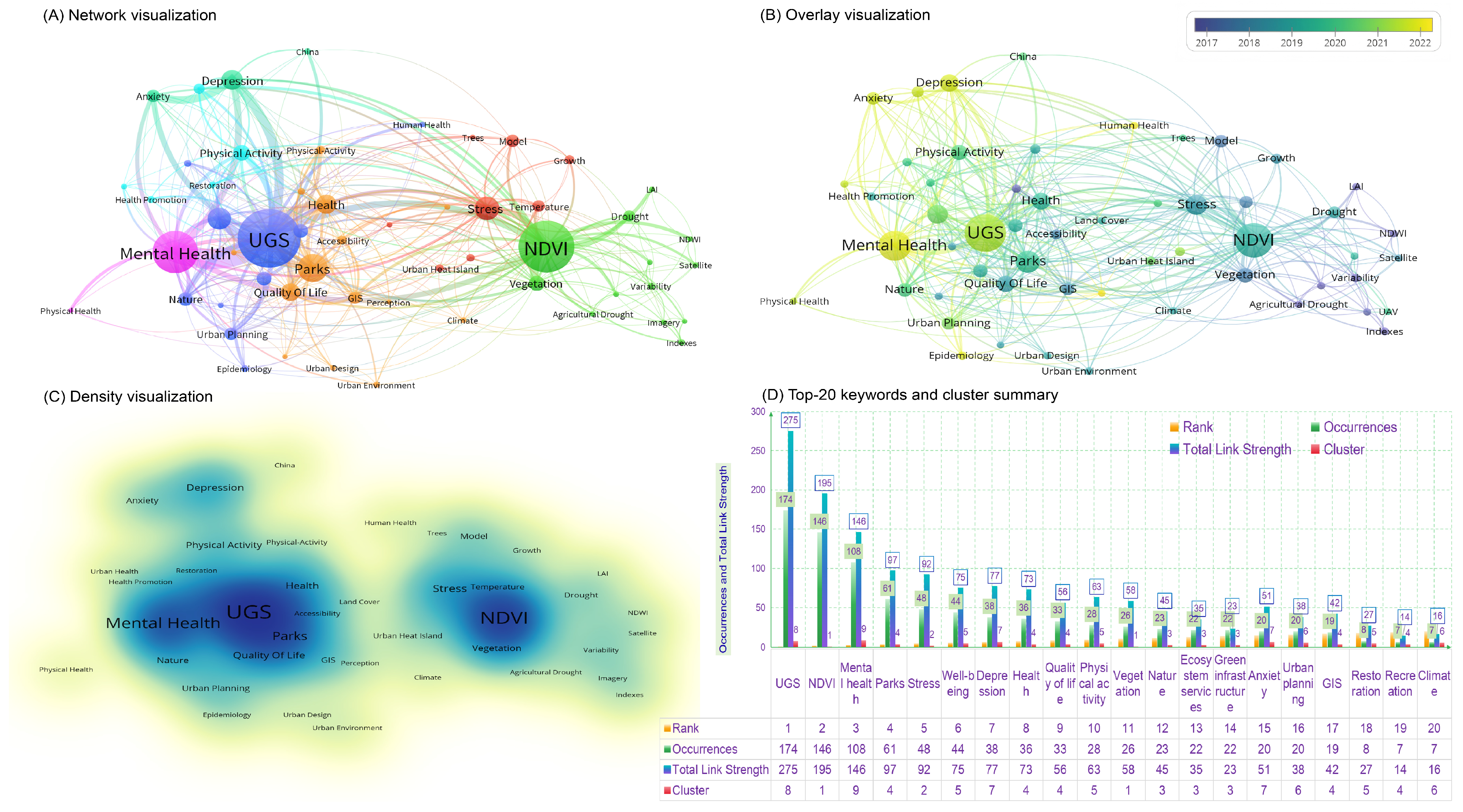
4.3. Research Hotspots and Network Structure
4.4. Methodological Evolution and AI Modeling Trends
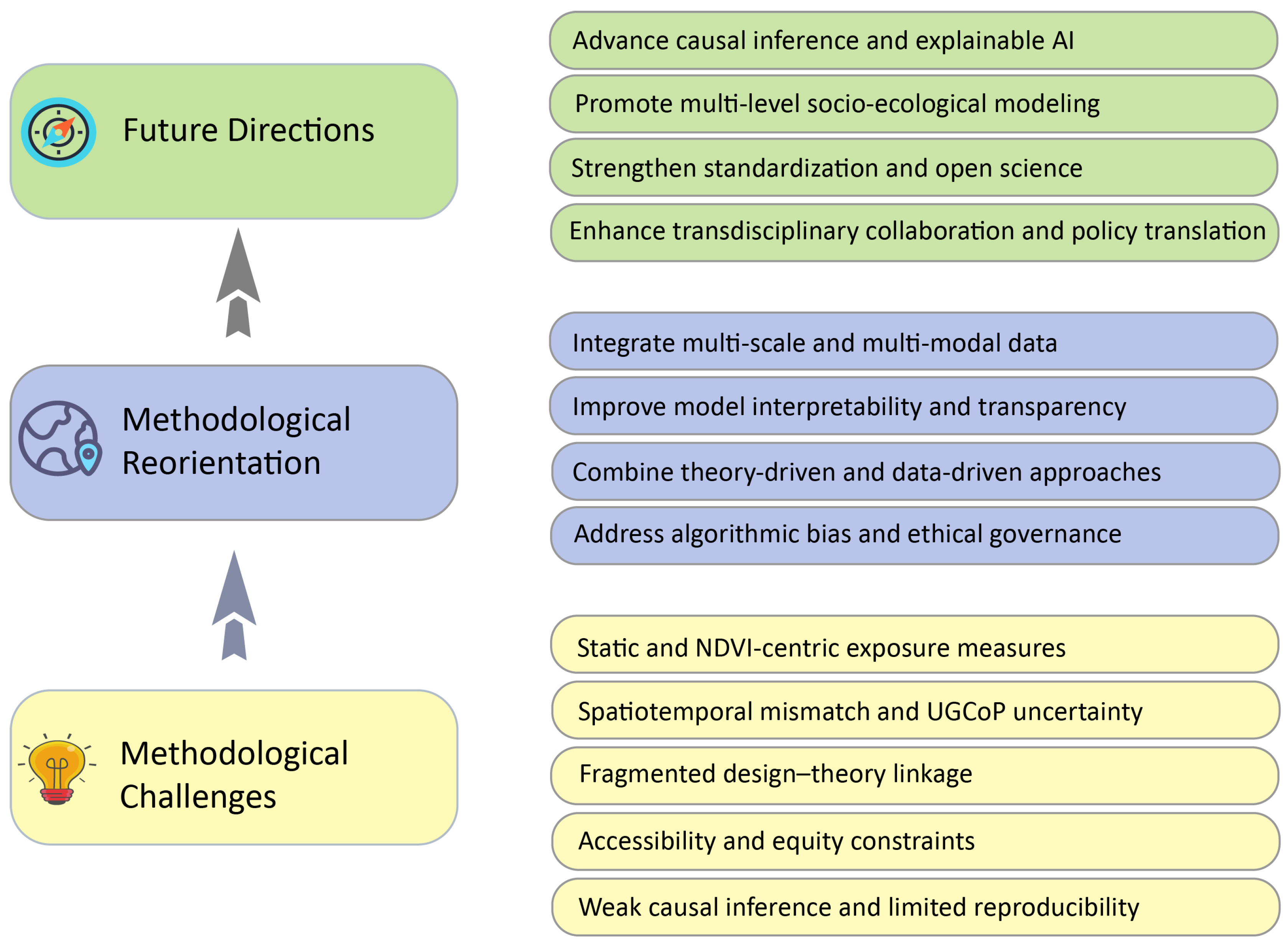
5. Research Challenges and Methodological Reflections
5.1. Root Causes of the Methodological Pitfalls
5.2. Spatial and Temporal Uncertainty
5.3. The Paradox of Intelligent Analytics
5.4. Pathways Toward Integration and Standardization
5.5. Areas of Inconsistency and Unresolved Debate
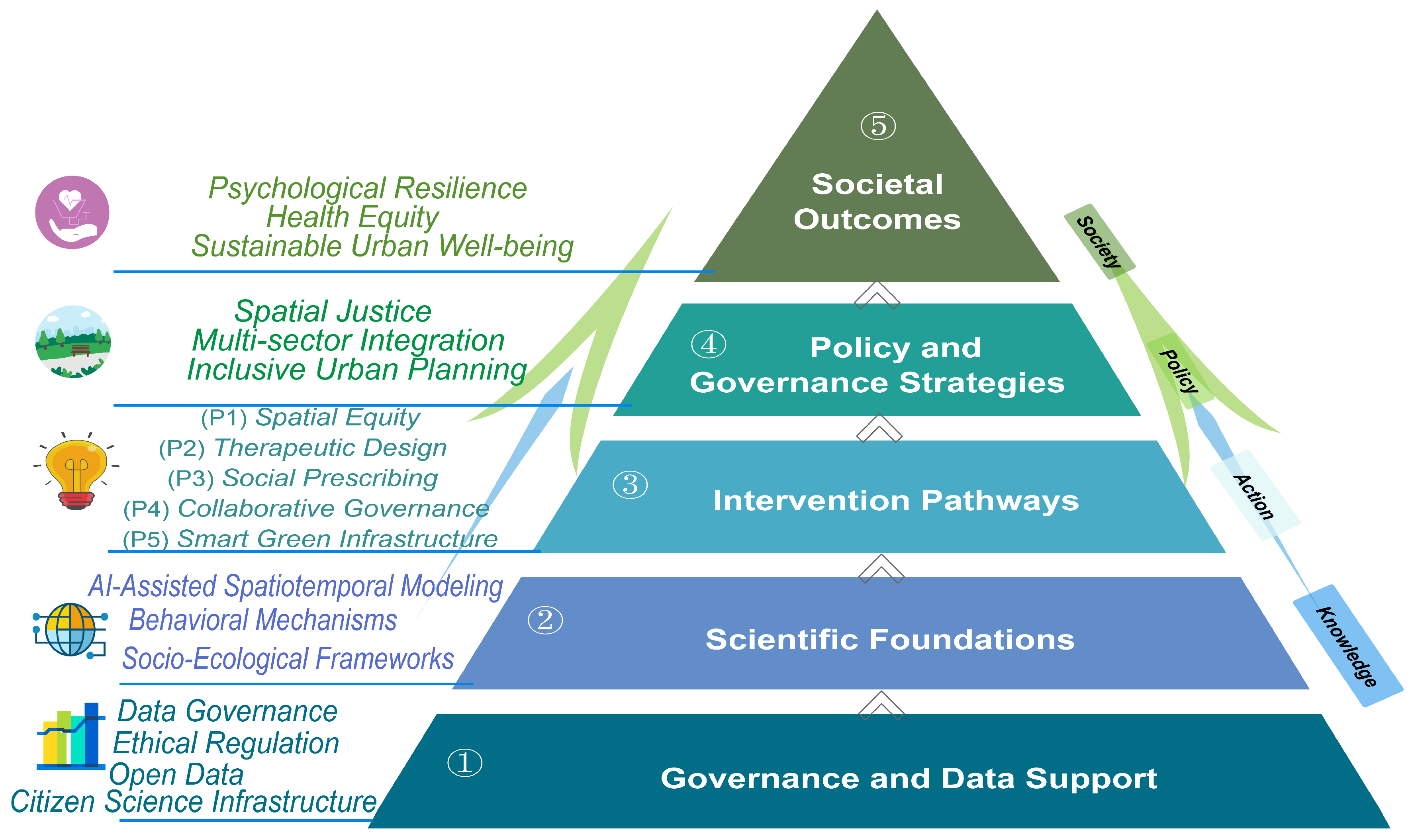
6. Strategic Pathways for Green Interventions and Policy Implications
6.1. Spatially Equitable Provision
6.2. Therapeutic Design Functions
6.3. Prioritizing Vulnerable Populations
6.4. Integrating Governance Systems
6.5. Intelligent Intervention Tools
7. Conclusions and Scholarly Outlook
Supplementary Materials
Author Contributions
Funding
Institutional Review Board Statement
Informed Consent Statement
Data Availability Statement
Acknowledgments
Conflicts of Interest
Abbreviations
| AI | Artificial Intelligence |
| ART | Attention Restoration Theory |
| CNN | Convolutional Neural Network |
| CRP | C-reactive Protein |
| EMA | Ecological Momentary Assessment |
| GCN | Graph Convolutional Network |
| GIS | Geographic Information Systems |
| GPS–EMA | Global Positioning System–Ecological Momentary Assessment |
| GSP | Green Social Prescribing |
| GVI | Green View Index |
| GWR | Geographically Weighted Regression |
| HRV | Heart Rate Variability |
| IL-6 | Interleukin-6 |
| IoT | Internet of Things |
| LISA | Local Indicators of Spatial Association |
| MGWR | Multiscale Geographically Weighted Regression |
| MH | Mental Health |
| NDVI | Normalized Difference Vegetation Index |
| NHS | National Health Service |
| OLS | Ordinary Least Squares |
| RF | Random Forest |
| SEM | Structural Equation Modeling |
| SES | Socioeconomic Status |
| SRT | Stress Reduction Theory |
| TWCE | Time-Weighted Cumulative Exposure |
| UGCoP | Uncertain Geographic Context Problem |
| UGS | Urban Green Space |
| UGS–MH | Urban Green Space–Mental Health |
| WCE | Weighted Cumulative Exposure |
| WoSCC | Web of Science Core Collection |
References
- Collaborators, G.M.D. Global, regional, and national burden of 12 mental disorders in 204 countries and territories, 1990–2019: A systematic analysis for the Global Burden of Disease Study 2019. Lancet Psychiatry 2022, 9, 137–150. [Google Scholar] [CrossRef] [Scilit] [PubMed]
- Haywood, A.; Dayson, C.; Garside, R.; Foster, A.; Lovell, R.; Husk, K.; Holding, E.; Thompson, J.; Shearn, K.; Hunt, H.A.; et al. National Evaluation of the Preventing and Tackling Mental Ill Health Through Green Social Prescribing Project: Final Report–March 2021 to June 2023; Department for Environment, Food & Rural Affairs (Defra): London, UK, 2024.
- World Health Organization. World Mental Health Report: Transforming Mental Health for All; World Health Organization: Geneva, Switzerland, 2022. [Google Scholar]
- Vigo, D.; Thornicroft, G.; Atun, R. Estimating the true global burden of mental illness. Lancet Psychiatry 2016, 3, 171–178. [Google Scholar] [CrossRef] [Scilit] [PubMed]
- Baker, E.; Barlow, C.F.; Daniel, L.; Morey, C.; Bentley, R.; Taylor, M.P. Mental health impacts of environmental exposures: A scoping review of evaluative instruments. Sci. Total Environ. 2024, 912, 169063. [Google Scholar] [CrossRef] [Scilit] [PubMed]
- Job, S.; Tao, X.; Cai, T.; Xie, H.; Li, L.; Li, Q.; Yong, J. Exploring Causal Learning Through Graph Neural Networks: An In-Depth Review. Wires Data Min. Knowl. Discov. 2025, 15, e70024. [Google Scholar] [CrossRef] [Scilit]
- Gianfredi, V.; Buffoli, M.; Rebecchi, A.; Croci, R.; Oradini-Alacreu, A.; Stirparo, G.; Marino, A.; Odone, A.; Capolongo, S.; Signorelli, C. Association between Urban Greenspace and Health: A Systematic Review of Literature. Int. J. Environ. Res. Public Health 2021, 18, 5137. [Google Scholar] [CrossRef] [Scilit]
- Huang, W.; Lin, G. The relationship between urban green space and social health of individuals: A scoping review. Urban For. Urban Green. 2023, 85, 127969. [Google Scholar] [CrossRef] [Scilit]
- Nguyen, P.; Astell-Burt, T.; Rahimi-Ardabili, H.; Feng, X. Green Space Quality and Health: A Systematic Review. Int. J. Environ. Res. Public Health 2021, 18, 11028. [Google Scholar] [CrossRef] [Scilit]
- Jones, K.R. Green Lungs and Green Liberty: The Modern City Park and Public Health in an Urban Metabolic Landscape. Soc. Hist. Med. J. Soc. Soc. Hist. 2022, 35, 1200–1222. [Google Scholar] [CrossRef] [Scilit]
- Kingsley, J.; Foenander, E.; Bailey, A. “It’s about community”: Exploring social capital in community gardens across Melbourne, Australia. Urban For. Urban Green. 2020, 49, 126640. [Google Scholar] [CrossRef] [Scilit]
- Rigolon, A.; Browning, M.H.E.M.; McAnirlin, O.; Yoon, H.V. Green Space and Health Equity: A Systematic Review on the Potential of Green Space to Reduce Health Disparities. Int. J. Environ. Res. Public Health 2021, 18, 2563. [Google Scholar] [CrossRef] [Scilit]
- Barton, J.; Rogerson, M. The importance of greenspace for mental health. BJPsych Int. 2017, 14, 79–81. [Google Scholar] [CrossRef] [Scilit]
- Grigoletto, A.; Toselli, S.; Zijlema, W.; Marquez, S.; Triguero-Mas, M.; Gidlow, C.; Grazuleviciene, R.; Van de Berg, M.; Kruize, H.; Maas, J.; et al. Restoration in mental health after visiting urban green spaces, who is most affected? Comparison between good/poor mental health in four European cities. Environ. Res. 2023, 223, 115397. [Google Scholar] [CrossRef] [Scilit]
- Chen, C.; Wang, J.; Li, D.; Sun, X.; Zhang, J.; Yang, C.; Zhang, B. Unraveling nonlinear effects of environment features on green view index using multiple data sources and explainable machine learning. Sci. Rep. 2024, 14, 30189. [Google Scholar] [CrossRef] [Scilit] [PubMed]
- Yu, C.; Kwan, M. Dynamic greenspace exposure, individual mental health status and momentary stress level: A study using multiple greenspace measurements. Health Place 2024, 86, 103213. [Google Scholar] [CrossRef] [Scilit]
- Freymueller, J.; Schmid, H.; Senkler, B.; Lopez Lumbi, S.; Zerbe, S.; Hornberg, C.; McCall, T. Current methodologies of greenspace exposure and mental health research-a scoping review. Front. Public Health 2024, 12, 1360134. [Google Scholar] [CrossRef] [Scilit]
- Markevych, I.; Schoierer, J.; Hartig, T.; Chudnovsky, A.; Hystad, P.; Dzhambov, A.M.; de Vries, S.; Triguero-Mas, M.; Brauer, M.; Nieuwenhuijsen, M.J.; et al. Exploring pathways linking greenspace to health: Theoretical and methodological guidance. Environ. Res. 2017, 158, 301–317. [Google Scholar] [CrossRef] [Scilit]
- Helbich, M. Toward dynamic urban environmental exposure assessments in mental health research. Environ. Res. 2018, 161, 129–135. [Google Scholar] [CrossRef] [Scilit] [PubMed]
- Kleinschroth, F.; Savilaakso, S.; Kowarik, I.; Martinez, P.J.; Chang, Y.; Jakstis, K.; Schneider, J.; Fischer, L.K. Global disparities in urban green space use during the COVID-19 pandemic from a systematic review. Nat. Cities 2024, 1, 136–149. [Google Scholar] [CrossRef] [Scilit]
- Kaplan, S. The restorative benefits of nature: Toward an integrative framework. J. Environ. Psychol. 1995, 15, 169–182. [Google Scholar] [CrossRef] [Scilit]
- Ulrich, R.S.; Simons, R.F.; Losito, B.D.; Fiorito, E.; Miles, M.A.; Zelson, M. Stress recovery during exposure to natural and urban environments. J. Environ. Psychol. 1991, 11, 201–230. [Google Scholar] [CrossRef] [Scilit]
- Bratman, G.N.; Daily, G.C.; Levy, B.J.; Gross, J.J. The benefits of nature experience: Improved affect and cognition. Landsc. Urban Plan. 2015, 138, 41–50. [Google Scholar] [CrossRef] [Scilit]
- Twohig-Bennett, C.; Jones, A. The health benefits of the great outdoors: A systematic review and meta-analysis of greenspace exposure and health outcomes. Environ. Res. 2018, 166, 628–637. [Google Scholar] [CrossRef] [Scilit] [PubMed]
- Jennings, V.; Larson, L.; Yun, J. Advancing Sustainability through Urban Green Space: Cultural Ecosystem Services, Equity, and Social Determinants of Health. Int. J. Environ. Res. Public Health 2016, 13, 196. [Google Scholar] [CrossRef] [Scilit] [PubMed]
- Kellert, S.R.; Wilson, E.O. The Biophilia Hypothesis; Island Press: Washington, DC, USA, 1993; pp. 1–484. [Google Scholar]
- Rook, G.A. Regulation of the immune system by biodiversity from the natural environment: An ecosystem service essential to health. Proc. Natl. Acad. Sci. USA 2013, 110, 18360–18367. [Google Scholar] [CrossRef] [Scilit]
- Grassini, S.; Revonsuo, A.; Castellotti, S.; Petrizzo, I.; Benedetti, V.; Koivisto, M. Processing of natural scenery is associated with lower attentional and cognitive load compared with urban ones. J. Environ. Psychol. 2019, 62, 1–11. [Google Scholar] [CrossRef] [Scilit]
- Jiang, X.; Hu, Y.; Larsen, L.; Chang, C.; Sullivan, W.C. Impacts of urban green infrastructure on attentional functioning: Insights from an fMRI study. Front. Psychol. 2023, 14, 1047993. [Google Scholar] [CrossRef] [Scilit]
- Chen, K.; Zhang, T.; Liu, F.; Zhang, Y.; Song, Y. How Does Urban Green Space Impact Residents’ Mental Health: A Literature Review of Mediators. Int. J. Environ. Res. Public Health 2021, 18, 11746. [Google Scholar] [CrossRef] [Scilit] [PubMed]
- Wang, R.; Feng, Z.; Pearce, J.; Liu, Y.; Dong, G. Are greenspace quantity and quality associated with mental health through different mechanisms in Guangzhou, China: A comparison study using street view data. Environ. Pollut. 2021, 290, 117976. [Google Scholar] [CrossRef] [Scilit]
- Bratman, G.N.; Hamilton, J.P.; Hahn, K.S.; Daily, G.C.; Gross, J.J. Nature experience reduces rumination and subgenual prefrontal cortex activation. Proc. Natl. Acad. Sci. USA 2015, 112, 8567–8572. [Google Scholar] [CrossRef] [Scilit]
- Kim, G.; Jeong, G.; Kim, T.; Baek, H.; Oh, S.; Kang, H.; Lee, S.; Kim, Y.S.; Song, J. Functional Neuroanatomy Associated with Natural and Urban Scenic Views in the Human Brain: 3.0T Functional MR Imaging. Korean J. Radiol. 2010, 11, 507–513. [Google Scholar] [CrossRef] [Scilit]
- Sudimac, S.; Sale, V.; Kühn, S. How nature nurtures: Amygdala activity decreases as the result of a one-hour walk in nature. Mol. Psychiatry 2022, 27, 4446–4452. [Google Scholar] [CrossRef] [Scilit]
- Kühn, S.; Forlim, C.G.; Lender, A.; Wirtz, J.; Gallinat, J. Brain functional connectivity differs when viewing pictures from natural and built environments using fMRI resting state analysis. Sci. Rep. 2021, 11, 4110. [Google Scholar] [CrossRef] [Scilit] [PubMed]
- Bratman, G.N.; Anderson, C.B.; Berman, M.G.; Cochran, B.; de Vries, S.; Flanders, J.; Folke, C.; Frumkin, H.; Gross, J.J.; Hartig, T.; et al. Nature and mental health: An ecosystem service perspective. Sci. Adv. 2019, 5, eaax903. [Google Scholar] [CrossRef] [Scilit]
- Hansen, M.M.; Jones, R.; Tocchini, K. Shinrin-Yoku (Forest Bathing) and Nature Therapy: A State-of-the-Art Review. Int. J. Environ. Res. Public Health 2017, 14, 851. [Google Scholar] [CrossRef] [Scilit]
- Song, S.; Tu, R.; Lu, Y.; Yin, S.; Lin, H.; Xiao, Y. Restorative Effects from Green Exposure: A Systematic Review and Meta-Analysis of Randomized Control Trials. Int. J. Environ. Res. Public Health 2022, 19, 14506. [Google Scholar] [CrossRef] [Scilit]
- Bikomeye, J.C.; Beyer, A.M.; Kwarteng, J.L.; Beyer, K.M.M. Greenspace, Inflammation, Cardiovascular Health, and Cancer: A Review and Conceptual Framework for Greenspace in Cardio-Oncology Research. Int. J. Environ. Res. Public Health 2022, 19, 2426. [Google Scholar] [CrossRef] [Scilit] [PubMed]
- Yang, L.; Chan, K.L.; Yuen, J.W.M.; Wong, F.K.Y.; Han, L.; Ho, H.C.; Chang, K.K.P.; Ho, Y.S.; Siu, J.Y.; Tian, L.; et al. Effects of Urban Green Space on Cardiovascular and Respiratory Biomarkers in Chinese Adults: Panel Study Using Digital Tracking Devices. JMIR Cardio 2021, 5, e31316. [Google Scholar] [CrossRef] [Scilit]
- Farrow, M.R.; Washburn, K. A Review of Field Experiments on the Effect of Forest Bathing on Anxiety and Heart Rate Variability. Glob. Adv. Health Med. 2019, 8, 544888526. [Google Scholar] [CrossRef] [Scilit] [PubMed]
- Zhang, Y.; Wu, T.; Yu, H.; Fu, J.; Xu, J.; Liu, L.; Tang, C.; Li, Z. Green spaces exposure and the risk of common psychiatric disorders: A meta-analysis. SSM Popul. Health 2024, 25, 101630. [Google Scholar] [CrossRef] [Scilit]
- Shanahan, D.F.; Bush, R.; Gaston, K.J.; Lin, B.B.; Dean, J.; Barber, E.; Fuller, R.A. Health benefits from nature experiences depend on dose. Sci. Rep. 2016, 6, 28551. [Google Scholar] [CrossRef] [Scilit]
- Struthers, N.A.; Guluzade, N.A.; Zecevic, A.A.; Walton, D.M.; Gunz, A. Nature-based interventions for physical health conditions: A systematic review and meta-analysis. Environ. Res. 2024, 258, 119421. [Google Scholar] [CrossRef] [Scilit]
- Frumkin, H.; Bratman, G.N.; Breslow, S.J.; Cochran, B.; Kahn, P.H.J.; Lawler, J.J.; Levin, P.S.; Tandon, P.S.; Varanasi, U.; Wolf, K.L.; et al. Nature Contact and Human Health: A Research Agenda. Environ. Health Perspect. 2017, 125, 75001. [Google Scholar] [CrossRef] [Scilit]
- Marselle, M.R.; Hartig, T.; Cox, D.T.C.; de Bell, S.; Knapp, S.; Lindley, S.; Triguero-Mas, M.; Böhning-Gaese, K.; Braubach, M.; Cook, P.A.; et al. Pathways linking biodiversity to human health: A conceptual framework. Environ. Int. 2021, 150, 106420. [Google Scholar] [CrossRef] [Scilit]
- Xian, Z.; Nakaya, T.; Liu, K.; Zhao, B.; Zhang, J.; Zhang, J.; Lin, Y.; Zhang, J. The effects of neighbourhood green spaces on mental health of disadvantaged groups: A systematic review. Humanit. Soc. Sci. Commun. 2024, 11, 488. [Google Scholar] [CrossRef] [Scilit]
- Lin, X.; Martin, D.; Chen, B. Towards cultural landscapes of care. Health Place 2022, 78, 102909. [Google Scholar] [CrossRef] [Scilit]
- Zuo, W.; Cheng, B.; Feng, X.; Zhuang, X. Relationship between urban green space and mental health in older adults: Mediating role of relative deprivation, physical activity, and social trust. Front. Public Health 2024, 12, 1442560. [Google Scholar] [CrossRef] [Scilit]
- Rigolon, A.; Osei Owusu, R.; Becerra, M.; Cheng, Y.D.; Christensen, J.; Connolly, J.J.T.; Corbin, C.N.E.; Douglas, J.A.; Fernandez, M.; Jennings, V.; et al. Advancing green space equity via policy change: A scoping review and research agenda. Environ. Sci. Policy 2024, 157, 103765. [Google Scholar] [CrossRef] [Scilit]
- Van den Berg, A.E.; Jorgensen, A.; Wilson, E.R. Evaluating restoration in urban green spaces: Does setting type make a difference? Landsc. Urban Plan. 2014, 127, 173–181. [Google Scholar] [CrossRef] [Scilit]
- Peschardt, K.K.; Stigsdotter, U.K. Associations between park characteristics and perceived restorativeness of small public urban green spaces. Landsc. Urban Plan. 2013, 112, 26–39. [Google Scholar] [CrossRef] [Scilit]
- Wang, P.; Han, L.; Hao, R.; Mei, R. Understanding the relationship between small urban parks and mental health: A case study in Shanghai, China. Urban For. Urban Green. 2022, 78, 127784. [Google Scholar] [CrossRef] [Scilit]
- Browning, M.H.E.M.; Rigolon, A.; McAnirlin, O.; Yoon, H.V. Where greenspace matters most: A systematic review of urbanicity, greenspace, and physical health. Landsc. Urban Plan. 2022, 217, 104233. [Google Scholar] [CrossRef] [Scilit]
- Beute, F.; Marselle, M.R.; Olszewska Guizzo, A.; Andreucci, M.B.; Lammel, A.; Davies, Z.G.; Glanville, J.; Keune, H.; O’Brien, L.; Remmen, R. How do different types and characteristics of green space impact mental health? A scoping review. People Nat. 2023, 5, 1839–1876. [Google Scholar] [CrossRef] [Scilit]
- Pasanen, T.P.; White, M.P.; Elliott, L.R.; van den Bosch, M.; Bratman, G.N.; Ojala, A.; Korpela, K.; Fleming, L.E. Urban green space and mental health among people living alone: The mediating roles of relational and collective restoration in an 18-country sample. Environ. Res. 2023, 232, 116324. [Google Scholar] [CrossRef] [Scilit]
- Wilson, B.; Neale, C.; Roe, J. Urban green space access, social cohesion, and mental health outcomes before and during COVID-19. Cities 2024, 152, 105173. [Google Scholar] [CrossRef] [Scilit]
- Clark, H.; Vanclay, J.; Brymer, E. Forest features and mental health and wellbeing: A scoping review. J. Environ. Psychol. 2023, 89, 102040. [Google Scholar] [CrossRef] [Scilit]
- Ha, J.; Kim, H.J.; With, K.A. Urban green space alone is not enough: A landscape analysis linking the spatial distribution of urban green space to mental health in the city of Chicago. Landsc. Urban Plan. 2022, 218, 104309. [Google Scholar] [CrossRef] [Scilit]
- Cheng, H.; Li, Z.; Gou, F.; Wang, Z.; Zhai, W. Urban green space, perceived everyday discrimination and mental health among rural-to-urban migrants: A multilevel analysis in Wuhan, China. BMC Public Health 2024, 24, 2788. [Google Scholar] [CrossRef] [Scilit] [PubMed]
- Xu, Z.; Marini, S.; Mauro, M.; Maietta Latessa, P.; Grigoletto, A.; Toselli, S. Associations between urban green space quality and mental wellbeing: Systematic review. Land 2025, 14, 381. [Google Scholar] [CrossRef] [Scilit]
- Page, M.J.; McKenzie, J.E.; Bossuyt, P.M.; Boutron, I.; Hoffmann, T.C.; Mulrow, C.D.; Shamseer, L.; Tetzlaff, J.M.; Akl, E.A.; Brennan, S.E.; et al. The PRISMA 2020 statement: An updated guideline for reporting systematic reviews. BMJ 2021, 372, n71. [Google Scholar] [CrossRef] [Scilit]
- Page, M.J.; Moher, D.; Bossuyt, P.M.; Boutron, I.; Hoffmann, T.C.; Mulrow, C.D.; Shamseer, L.; Tetzlaff, J.M.; Akl, E.A.; Brennan, S.E.; et al. PRISMA 2020 explanation and elaboration: Updated guidance and exemplars for reporting systematic reviews. BMJ 2021, 372, n160. [Google Scholar] [CrossRef]
- Higgins, J.P.T.; Thomas, J.; Chandler, J.; Cumpston, M.; Li, T.; Page, M.J.; Welch, V.A. Cochrane Handbook for Systematic Reviews of Interventions|Cochrane; Version 6.3 (updated February 2022) ed.; Wiley-Blackwell: Hoboken, NJ, USA, 2019. [Google Scholar]
- Page, M.J.; Moher, D.; Bossuyt, P.M.; Boutron, I.; Hoffmann, T.C.; Mulrow, C.D.; Shamseer, L.; Tetzlaff, J.M.; Akl, E.A.; Brennan, S.E.; et al. PRISMA 2020 Flow Diagram—PRISMA Statement. Available online: https://www.prisma-statement.org/prisma-2020-flow-diagram (accessed on 22 October 2025).
- Chen, C. CiteSpace II: Detecting and visualizing emerging trends and transient patterns in scientific literature. J. Am. Soc. Inf. Sci. Technol. 2006, 57, 359–377. [Google Scholar] [CrossRef] [Scilit]
- Van Eck, N.; Waltman, L. Software survey: VOSviewer, a computer program for bibliometric mapping. Scientometrics 2010, 84, 523–538. [Google Scholar] [CrossRef] [Scilit]
- Zhang, Y.; Hu, Y.; Wei, Y.; Xie, Y. Can pocket parks be compared to community parks in the restoration effect of physical and mental health for young adults? A comparative experiment in high-density urban Green spaces. Front. Public Health 2025, 13, 1610497. [Google Scholar] [CrossRef] [Scilit]
- Zhang, T.; Wang, L.; Zhang, Y.; Hu, Y.; Zhang, W. Assessing the nonlinear impact of green space exposure on psychological stress perception using machine learning and street view images. Front. Public Health 2024, 12, 1402536. [Google Scholar] [CrossRef] [Scilit]
- Zhang, S.; Zhao, X.; Zeng, Z.; Qiu, X. The Influence of Audio-Visual Interactions on Psychological Responses of Young People in Urban Green Areas: A Case Study in Two Parks in China. Int. J. Environ. Res. Public Health 2019, 16, 1845. [Google Scholar] [CrossRef] [Scilit]
- Zhang, L.; Zhou, S.; Kwan, M.; Shen, M. Assessing individual environmental exposure derived from the spatiotemporal behavior context and its impacts on mental health. Health Place 2021, 71, 102655. [Google Scholar] [CrossRef] [Scilit]
- Zewdie, H.Y.; Whetten, K.; Dubie, M.E.; Kenea, B.; Bekele, T.; Temesgen, C.; Molla, W.; Puffer, E.S.; Ostermann, J.; Hobbie, A.M.; et al. The association between urban greenspace and psychological health among young adults in Addis Ababa, Ethiopia. Environ. Res. 2022, 215, 114258. [Google Scholar] [CrossRef] [Scilit]
- Yuen, H.K.; Jenkins, G.R. Factors associated with changes in subjective well-being immediately after urban park visit. Int. J. Environ. Health Res. 2020, 30, 134–145. [Google Scholar] [CrossRef] [Scilit] [PubMed]
- Yue, Y.; Yang, D.; Van Dyck, D. Urban greenspace and mental health in Chinese older adults: Associations across different greenspace measures and mediating effects of environmental perceptions. Health Place 2022, 76, 102856. [Google Scholar] [CrossRef] [Scilit] [PubMed]
- Yu, C.; Kwan, M.; Liu, Y. Assessing momentary stress responses to dynamic real-time greenspace exposure: Unveiling algorithmic uncertainty and the temporality of exposure context. Soc. Sci. Med. 2024, 363, 117411. [Google Scholar] [CrossRef] [Scilit] [PubMed]
- Yoo, E.; Roberts, J.E.; Eum, Y.; Li, X.; Konty, K. Exposure to urban green space may both promote and harm mental health in socially vulnerable neighborhoods: A neighborhood-scale analysis in New York City. Environ. Res. 2022, 204, 112292. [Google Scholar] [CrossRef] [Scilit]
- Yoo, E.; Min, J.; Choi, B.; Ryoo, S.; Min, K.; Roberts, J.E. Spatiotemporal variability of the association between greenspace exposure and depression in older adults in South Korea. BMC Public Health 2024, 24, 2556. [Google Scholar] [CrossRef] [Scilit]
- Yen, H.; Huang, H. Actual and Virtual Parks Benefit Quality of Life and Physical Activity: A Cluster Trial. J. Urban Health 2024, 101, 782–791. [Google Scholar] [CrossRef] [Scilit]
- Yang, T.; Barnett, R.; Fan, Y.; Li, L. The effect of urban green space on uncertainty stress and life stress: A nationwide study of university students in China. Health Place 2019, 59, 102199. [Google Scholar] [CrossRef] [Scilit]
- Xu, W.; Zheng, D.; Huang, P.; Yu, J.; Chen, Z.; Zhu, Z.; Dong, J.; Fu, W. Does Bird Diversity Affect Public Mental Health in Urban Mountain Parks?—A Case Study in Fuzhou City, China. Int. J. Env. Res. Public Health 2022, 19, 7029. [Google Scholar] [CrossRef] [Scilit] [PubMed]
- Xu, T.; Aini, A.M.; Nordin, N.A. Utilizing regression model to characterize the impact of urban green space features on the subjective well-being of older adults. Heliyon 2024, 10, e35567. [Google Scholar] [CrossRef] [Scilit]
- Wood, L.; Hooper, P.; Foster, S.; Bull, F. Public green spaces and positive mental health—Investigating the relationship between access, quantity and types of parks and mental wellbeing. Health Place 2017, 48, 63–71. [Google Scholar] [CrossRef] [Scilit] [PubMed]
- Wood, E.; Harsant, A.; Dallimer, M.; Cronin De Chavez, A.; McEachan, R.R.C.; Hassall, C. Not All Green Space Is Created Equal: Biodiversity Predicts Psychological Restorative Benefits from Urban Green Space. Front. Psychol. 2018, 9, 2320. [Google Scholar] [CrossRef] [Scilit]
- Wang, T.; Tang, T.; Ma, S.; Lin, T.; Tsai, C. Effects of the green view index on anxiety reduction and perceived exertion during cycling in older adults. Exp. Gerontol. 2025, 208, 112820. [Google Scholar] [CrossRef] [Scilit]
- Vidal Yañez, D.; Pereira Barboza, E.; Cirach, M.; Daher, C.; Nieuwenhuijsen, M.; Mueller, N. An urban green space intervention with benefits for mental health: A health impact assessment of the Barcelona “Eixos Verds” Plan. Environ. Int. 2023, 174, 107880. [Google Scholar] [CrossRef] [Scilit] [PubMed]
- Torres Toda, M.; Anabitarte Riol, A.; Cirach, M.; Estarlich, M.; Fernández-Somoano, A.; González-Safont, L.; Guxens, M.; Julvez, J.; Riaño-Galán, I.; Sunyer, J.; et al. Residential Surrounding Greenspace and Mental Health in Three Spanish Areas. Int. J. Env. Res. Public Health 2020, 17, 5670. [Google Scholar] [CrossRef] [Scilit]
- Thompson, R.L.; Wyka, K.E.; Evenson, K.R.; Thorpe, L.E.; Johnson, G.D.; Pavilonis, B.T.; Huang, T.T. Citywide park renovations and changes in perceived stress: A quasi-experimental study among low-income communities in New York City. BMC Public Health 2025, 25, 2515. [Google Scholar] [CrossRef] [Scilit] [PubMed]
- Taheri, E.; Faramarziniya, A.; Khosrorad, R.; Najafi, M.L.; Joveini, H.; Khamirchi, M.; Heydari, H.; Kaffash, L.H.; Ghorbani, A.; Niko, F.; et al. The Association of Exposure to Urban Greenspace and Depression in Women. J. Urban Health 2025, 102, 576–592. [Google Scholar] [CrossRef] [Scilit]
- Stopforth, C.; Simpson, A.; Willis, S.; Smith, T.; Bhatnagar, A.; Keith, R. Urban Greenspace Exposure, Stress, and Cardiovascular Function. Circulation 2024, 150, A4145256. [Google Scholar] [CrossRef] [Scilit]
- Song, C.; Joung, D.; Ikei, H.; Igarashi, M.; Aga, M.; Park, B.; Miwa, M.; Takagaki, M.; Miyazaki, Y. Physiological and psychological effects of walking on young males in urban parks in winter. J. Physiol. Anthropol. 2013, 32, 18. [Google Scholar] [CrossRef] [Scilit]
- Song, C.; Ikei, H.; Igarashi, M.; Takagaki, M.; Miyazaki, Y. Physiological and Psychological Effects of a Walk in Urban Parks in Fall. Int. J. Env. Res. Public Health 2015, 12, 14216–14228. [Google Scholar] [CrossRef] [Scilit]
- Shen, H.; Flouri, E.; Cheng, Y.; Li, Y.; Wei, G. Greenspace use and anxiety in young adults: The role of interoception. Environ. Res. 2024, 263, 120232. [Google Scholar] [CrossRef] [Scilit]
- Ryan, S.C.; Sugg, M.M.; Runkle, J.D.; Matthews, J.L. Spatial Analysis of Greenspace and Mental Health in North Carolina: Consideration of Rural and Urban Communities. Fam. Community Health 2023, 46, 181–191. [Google Scholar] [CrossRef] [Scilit]
- Roe, J. Ethnicity and children’s mental health: Making the case for access to urban parks. Lancet Planet. Health 2018, 2, e234–e235. [Google Scholar] [CrossRef] [Scilit] [PubMed]
- Ricciardi, E.; Spano, G.; Tinella, L.; Lopez, A.; Clemente, C.; Bosco, A.; Caffò, A.O. Perceived Social Support Mediates the Relationship between Use of Greenspace and Geriatric Depression: A Cross-Sectional Study in a Sample of South-Italian Older Adults. Int. J. Env. Res. Public Health 2023, 20, 5540. [Google Scholar] [CrossRef] [Scilit]
- Reimer, C.J.; Willis, M.D.; Wesselink, A.K.; Hystad, P.; Campbell, E.J.; Hatch, E.E.; Kirwa, K.; Gradus, J.L.; Vinceti, M.; Wise, L.A.; et al. Exposure to residential greenness, perceived stress, and depressive symptoms in a North American preconception cohort. Environ. Res. 2024, 260, 119438. [Google Scholar] [CrossRef] [Scilit]
- Razani, N.; Morshed, S.; Kohn, M.A.; Wells, N.M.; Thompson, D.; Alqassari, M.; Agodi, A.; Rutherford, G.W. Effect of park prescriptions with and without group visits to parks on stress reduction in low-income parents: SHINE randomized trial. PLoS ONE 2018, 13, e192921. [Google Scholar] [CrossRef] [Scilit] [PubMed]
- Petrunoff, N.; Yao, J.; Sia, A.; Ng, A.; Ramiah, A.; Wong, M.; Han, J.; Tai, B.C.; Uijtdewilligen, L.; Müller-Riemenschneider, F. Activity in nature mediates a park prescription intervention’s effects on physical activity, park use and quality of life: A mixed-methods process evaluation. BMC Public Health 2021, 21, 204. [Google Scholar] [CrossRef] [Scilit] [PubMed]
- Patwary, M.M.; Bardhan, M.; İnan, H.E.; Browning, M.H.; Disha, A.S.; Haque, M.Z.; Helmy, M.; Ashraf, S.; Dzhambov, A.M.; Shuvo, F.K. Exposure to urban green spaces and mental health during the COVID-19 pandemic: Evidence from two low and lower-middle-income countries. Front. Public Health 2024, 12, 1334425. [Google Scholar] [CrossRef] [Scilit]
- Orstad, S.L.; Szuhany, K.; Tamura, K.; Thorpe, L.E.; Jay, M. Park Proximity and Use for Physical Activity among Urban Residents: Associations with Mental Health. Int. J. Env. Res. Public Health 2020, 17, 4885. [Google Scholar] [CrossRef] [Scilit] [PubMed]
- Nutsford, D.; Pearson, A.L.; Kingham, S.; Reitsma, F. Residential exposure to visible blue space (but not green space) associated with lower psychological distress in a capital city. Health Place 2016, 39, 70–78. [Google Scholar] [CrossRef] [Scilit]
- Nishigaki, M.; Hanazato, M.; Koga, C.; Kondo, K. What Types of Greenspaces Are Associated with Depression in Urban and Rural Older Adults? A Multilevel Cross-Sectional Study from JAGES. Int. J. Env. Res. Public Health 2020, 17, 9276. [Google Scholar] [CrossRef] [Scilit]
- Nawrath, M.; Guenat, S.; Elsey, H.; Dallimer, M. Exploring uncharted territory: Do urban greenspaces support mental health in low- and middle-income countries? Environ. Res. 2021, 194, 110625. [Google Scholar] [CrossRef] [Scilit]
- Naghibi, M.; Farrokhi, A.; Faizi, M. Small Urban Green Spaces: Insights into Perception, Preference, and Psychological Well-being in a Densely Populated Areas of Tehran, Iran. Environ. Health Insig 2024, 18, 1447957562. [Google Scholar] [CrossRef] [Scilit]
- Murphy, L.F.; Kalpakjian, C.; Charlifue, S.; Heinemann, A.W.; Slavin, M.; Rohrbach, T.; Tulsky, D.S.; Botticello, A.L. Greener on the other side? an analysis of the association between residential greenspace and psychological well-being among people living with spinal cord injury in the United States. Spinal Cord 2022, 60, 170–176. [Google Scholar] [CrossRef] [Scilit]
- Mukherjee, D.; Safraj, S.; Tayyab, M.; Shivashankar, R.; Patel, S.A.; Narayanan, G.; Ajay, V.S.; Ali, M.K.; Narayan, K.V.; Tandon, N.; et al. Park availability and major depression in individuals with chronic conditions: Is there an association in urban India? Health Place 2017, 47, 54–62. [Google Scholar] [CrossRef] [Scilit]
- Mouly, T.A.; Mishra, G.D.; Hystad, P.; Nieuwenhuijsen, M.; Knibbs, L.D. Residential greenspace and anxiety symptoms among Australian women living in major cities: A longitudinal analysis. Environ. Int. 2023, 179, 108110. [Google Scholar] [CrossRef] [Scilit]
- Mollaesmaeili, M.; Hakimian, P.; Lak, A. Perceived urban green spaces and youth mental health in the post-COVID-19 era. Front. Public Health 2024, 12, 1265682. [Google Scholar] [CrossRef] [Scilit]
- Min, K.; Kim, H.; Kim, H.; Min, J. Parks and green areas and the risk for depression and suicidal indicators. Int. J. Public Health 2017, 62, 647–656. [Google Scholar] [CrossRef] [Scilit]
- Mayen Huerta, C.; Utomo, A. Evaluating the association between urban green spaces and subjective well-being in Mexico city during the COVID-19 pandemic. Health Place 2021, 70, 102606. [Google Scholar] [CrossRef] [Scilit] [PubMed]
- Ma, K.; Wu, L. Perceived biodiversity of public greenspace and mental well-being. Environ. Res. 2025, 269, 120878. [Google Scholar] [CrossRef] [Scilit]
- Liu, M.; Timmermans, E.J.; Zou, D.; Grobbee, D.E.; Zhou, S.; Vaartjes, I. Impact of green space exposure on blood pressure in Guangzhou, China: Mediation by air pollution, mental health, physical activity, and weight status. Environ. Pollut. 2024, 356, 124251. [Google Scholar] [CrossRef] [Scilit] [PubMed]
- Li, Y.; Zhao, B.; Jiang, B.; Jia, X.; Li, H.; Zhang, J. Beyond visits: Investigating the restorative pathways and cumulative effects of park engagement and sustained exposure on psychological well-being with park type as a moderator. Environ. Res. 2025, 276, 121520. [Google Scholar] [CrossRef] [Scilit]
- Li, R.; Liu, M.; Song, J.; Xu, Y.; He, A.; Hu, X.; Yang, S.; Ding, G.; Chen, M.; Jin, C. Association between residential greenspace and mental health among cancer survivors in Shanghai, China. Environ. Res. 2023, 238, 117155. [Google Scholar] [CrossRef] [Scilit] [PubMed]
- Li, H.; Li, Y.; Wang, Z.; Zhang, G. Green physical activity for leisure connects perceived residential greenspace and mental well-being. Front. Public. Health 2023, 11, 1254185. [Google Scholar] [CrossRef] [Scilit]
- Lee, H.J.; Lee, D.K. Do Sociodemographic Factors and Urban Green Space Affect Mental Health Outcomes Among the Urban Elderly Population? Int. J. Env. Res. Public Health 2019, 16, 789. [Google Scholar] [CrossRef] [Scilit]
- Kothencz, G.; Kolcsár, R.; Cabrera-Barona, P.; Szilassi, P. Urban Green Space Perception and Its Contribution to Well-Being. Int. J. Env. Res. Public Health 2017, 14, 766. [Google Scholar] [CrossRef] [Scilit]
- Kondo, M.C.; McIntire, R.K.; Bilal, U.; Schinasi, L.H. Reduction in socioeconomic inequalities in self-reported mental health conditions with increasing greenspace exposure. Health Place 2022, 78, 102908. [Google Scholar] [CrossRef] [Scilit]
- Kodali, H.P.; Ferris, E.B.; Wyka, K.; Evenson, K.R.; Dorn, J.M.; Thorpe, L.E.; Huang, T.T. The association of park use and park perception with quality of life using structural equation modeling. Front. Public Health 2023, 11, 1038288. [Google Scholar] [CrossRef] [Scilit] [PubMed]
- Klompmaker, J.O.; Hoek, G.; Bloemsma, L.D.; Wijga, A.H.; van den Brink, C.; Brunekreef, B.; Lebret, E.; Gehring, U.; Janssen, N.A.H. Associations of combined exposures to surrounding green, air pollution and traffic noise on mental health. Environ. Int. 2019, 129, 525–537. [Google Scholar] [CrossRef] [Scilit]
- Huang, S.; Qi, J.; Li, W.; Dong, J.; van den Bosch, C.K. The Contribution to Stress Recovery and Attention Restoration Potential of Exposure to Urban Green Spaces in Low-Density Residential Areas. Int. J. Env. Res. Public Health 2021, 18, 8713. [Google Scholar] [CrossRef] [Scilit]
- Heo, S.; Desai, M.U.; Lowe, S.R.; Bell, M.L. Impact of Changed Use of Greenspace during COVID-19 Pandemic on Depression and Anxiety. Int. J. Env. Res. Public Health 2021, 18, 5842. [Google Scholar] [CrossRef] [Scilit]
- Helbich, M.; Browning, M.H.E.M.; Voets, D.; Dadvand, P. Adherence to the 3+30+300 urban green space rule and mental health, physical activity, and overweight: A population-based study in the Netherlands. Environ. Int. 2025, 202, 109643. [Google Scholar] [CrossRef] [Scilit]
- He, Q.; Liu, L.; Zhang, H.; Chen, R.; Dong, G.; Yan, L.L.; Zeng, Y.; Kim, Y.; Ji, J.S. Environmental greenspace, subjective well-being, and all-cause mortality in elderly Chinese: Association and mediation study in a prospective cohort. Environ. Res. 2023, 227, 115732. [Google Scholar] [CrossRef] [Scilit] [PubMed]
- Gascon, M.; Sánchez-Benavides, G.; Dadvand, P.; Martínez, D.; Gramunt, N.; Gotsens, X.; Cirach, M.; Vert, C.; Molinuevo, J.L.; Crous-Bou, M.; et al. Long-term exposure to residential green and blue spaces and anxiety and depression in adults: A cross-sectional study. Environ. Res. 2018, 162, 231–239. [Google Scholar] [CrossRef] [Scilit] [PubMed]
- Gao, T.; Song, R.; Zhu, L.; Qiu, L. What Characteristics of Urban Green Spaces and Recreational Activities Do Self-Reported Stressed Individuals Like? A Case Study of Baoji, China. Int. J. Env. Res. Public Health 2019, 16, 1348. [Google Scholar] [CrossRef] [Scilit]
- Fossa, A.J.; D’Souza, J.; Bergmans, R.; Zivin, K.; Adar, S.D. Residential greenspace and major depression among older adults living in urban and suburban areas with different climates across the United States. Environ. Res. 2024, 243, 117844. [Google Scholar] [CrossRef] [Scilit]
- Feng, X.; Toms, R.; Astell-Burt, T. The nexus between urban green space, housing type, and mental health. Soc. Psych. Psych. Epidemiol. 2022, 57, 1917–1923. [Google Scholar] [CrossRef] [Scilit] [PubMed]
- Felappi, J.F.; Sommer, J.H.; Falkenberg, T.; Terlau, W.; Kötter, T. Urban park qualities driving visitors mental well-being and wildlife conservation in a Neotropical megacity. Sci. Rep. 2024, 14, 4856. [Google Scholar] [CrossRef] [Scilit]
- Dzhambov, A.; Hartig, T.; Markevych, I.; Tilov, B.; Dimitrova, D. Urban residential greenspace and mental health in youth: Different approaches to testing multiple pathways yield different conclusions. Environ. Res. 2018, 160, 47–59. [Google Scholar] [CrossRef] [Scilit]
- Dzhambov, A.M.; Hartig, T.; Tilov, B.; Atanasova, V.; Makakova, D.R.; Dimitrova, D.D. Residential greenspace is associated with mental health via intertwined capacity-building and capacity-restoring pathways. Environ. Res. 2019, 178, 108708. [Google Scholar] [CrossRef] [Scilit]
- Duan, Y.; Bai, H.; Yang, L.; Li, S.; Zhu, Q. Impact of seasonal changes in urban green spaces with diverse vegetation structures on college students’ physical and mental health. Sci. Rep. 2024, 14, 16277. [Google Scholar] [CrossRef] [Scilit] [PubMed]
- Deng, B.; Boden, J.; Ye, N.; Morgenroth, J.; Campbell, M.; Eggleton, P.; McLeod, G.; Hobbs, M. Life in green: Associations between greenspace availability and mental health over the lifecourse—A 40-year prospective birth cohort study. Environ. Int. 2025, 195, 109223. [Google Scholar] [CrossRef] [Scilit] [PubMed]
- Dang, J.; Wang, Y.; Ma, N.; Cai, S.; Guo, J.; Liu, Y.; Zhou, H.; Lian, X.; Shi, D.; Chen, Z.; et al. The impact of long-term exposure to NO2, O3, and their oxidative potential on adolescents’ mental health, and the protective role of school-based greenness. Environ. Int. 2025, 195, 109212. [Google Scholar] [CrossRef] [Scilit] [PubMed]
- Cronshaw, G.; Midouhas, E.; Murage, P.; Flouri, E. The role of neighbourhood greenspace quantity on mental health and cognitive development in early to middle childhood: A multilevel growth curve analysis of the UK Millennium Cohort Study. Child Adolesc. Ment. Health 2025, 30, 159–167. [Google Scholar] [CrossRef] [Scilit]
- Cleary, A.; Roiko, A.; Burton, N.W.; Fielding, K.S.; Murray, Z.; Turrell, G. Changes in perceptions of urban green space are related to changes in psychological well-being: Cross-sectional and longitudinal study of mid-aged urban residents. Health Place 2019, 59, 102201. [Google Scholar] [CrossRef] [Scilit] [PubMed]
- Chu, Y.; Li, D.; Chang, P. Effects of Urban Park Quality, Environmental Perception, and Leisure Activity on Well-Being among the Older Population. Int. J. Env. Res. Public Health 2021, 18, 11402. [Google Scholar] [CrossRef] [Scilit]
- Chen, Z.; Wu, F.; Shi, Y.; Guo, Y.; Xu, J.; Liang, S.; Huang, Z.; He, G.; Hu, J.; Zhu, Q.; et al. Association of Residential Greenness Exposure with Depression Incidence in Adults 50 Years of Age and Older: Findings from the Cohort Study on Global AGEing and Adult Health (SAGE) in China. Environ. Health Persp. 2024, 132, 67004. [Google Scholar] [CrossRef] [Scilit]
- Cao, S.; Shang, Z.; Li, X.; Luo, H.; Sun, L.; Jiang, M.; Du, J.; Fu, E.; Ma, J.; Li, N.; et al. Cloudy or sunny? Effects of different environmental types of urban green spaces on public physiological and psychological health under two weather conditions. Front. Public Health 2023, 11, 1258848. [Google Scholar] [CrossRef] [Scilit]
- Camargo, D.M.; Ramírez, P.C.; Fermino, R.C. Individual and Environmental Correlates to Quality of Life in Park Users in Colombia. Int. J. Env. Res. Public Health 2017, 14, 1250. [Google Scholar] [CrossRef] [Scilit]
- Bustamante, G.; Guzman, V.; Kobayashi, L.C.; Finlay, J. Mental health and well-being in times of COVID-19: A mixed-methods study of the role of neighborhood parks, outdoor spaces, and nature among US older adults. Health Place 2022, 76, 102813. [Google Scholar] [CrossRef] [Scilit]
- Bu, F.; Mak, H.W.; Steptoe, A.; Wheeler, B.W.; Fancourt, D. Urban greenspace and anxiety symptoms during the COVID-19 pandemic: A 20-month follow up of 19,848 participants in England. Health Place 2022, 77, 102897. [Google Scholar] [CrossRef] [Scilit]
- Bray, I.; Reece, R.; Sinnett, D.; Martin, F.; Hayward, R. Exploring the role of exposure to green and blue spaces in preventing anxiety and depression among young people aged 14-24 years living in urban settings: A systematic review and conceptual framework. Environ. Res. 2022, 214, 114081. [Google Scholar] [CrossRef] [Scilit] [PubMed]
- Boudier, A.; Markevych, I.; Jacquemin, B.; Abramson, M.J.; Accordini, S.; Forsberg, B.; Fuertes, E.; Garcia-Aymerich, J.; Heinrich, J.; Johannessen, A.; et al. Long-term air pollution exposure, greenspace and health-related quality of life in the ECRHS study. Sci. Total Environ. 2022, 849, 157693. [Google Scholar] [CrossRef] [Scilit] [PubMed]
- Bojorquez, I.; Ojeda-Revah, L. Urban public parks and mental health in adult women: Mediating and moderating factors. Int. J. Soc. Psychiatr. 2018, 64, 637–646. [Google Scholar] [CrossRef] [Scilit]
- Boakye, S.K.; Danquah, L.; Antwi, M. Maternal mental health improvement in Ghana: Role of green spaces exposure. BMC Womens Health 2025, 25, 328. [Google Scholar] [CrossRef] [Scilit]
- Barry, F.; Riis, V.; Ncube, L.; Elovitz, M.A.; South, E.C.; Burris, H.H. Self-reported greenspace exposure and perceived stress in a Black pregnancy cohort. Am. J. Obstet. Gynecol. 2023, 228, S484–S485. [Google Scholar] [CrossRef] [Scilit]
- Bao, Y.; Gao, M.; Luo, D.; Zhou, X. The influence of outdoor play spaces in urban parks on children’s social anxiety. Front. Public Health 2022, 10, 1046399. [Google Scholar] [CrossRef] [Scilit]
- Bai, Z.; Zhang, S.; He, H.; Xu, M. Nature perception and positive emotions in urban forest parks enhance subjective well-being. Sci. Rep. 2025, 15, 31457. [Google Scholar] [CrossRef] [Scilit]
- Astell-Burt, T.; Feng, X. Association of Urban Green Space with Mental Health and General Health Among Adults in Australia. JAMA Netw. Open 2019, 2, e198209. [Google Scholar] [CrossRef] [Scilit]
- Arifwidodo, S.D.; Chandrasiri, O. Urban green space visitation and mental health wellbeing during COVID-19 in Bangkok, Thailand. Front. Public Health 2023, 11, 1292154. [Google Scholar] [CrossRef] [Scilit]
- Allaouat, S.; Yli-Tuomi, T.; Tiittanen, P.; Turunen, A.W.; Siponen, T.; Kukkonen, J.; Kangas, L.; Kauhaniemi, M.; Aarnio, M.; Ngandu, T.; et al. Long-term exposure to ambient fine particulate matter originating from traffic and residential wood combustion and the prevalence of depression. J. Epidemiol. Community Health 2021, 75, 1111–1116. [Google Scholar] [CrossRef] [Scilit] [PubMed]
- Ahmed, S.M.; Mishra, G.D.; Moss, K.M.; Mouly, T.A.; Yang, I.A.; Knibbs, L.D. Association between residential greenspace and health-related quality of life in children aged 0–12 years. Environ. Res. 2022, 214, 113759. [Google Scholar] [CrossRef] [Scilit]
- Afrad, A.; Kawazoe, Y. Can interaction with informal urban green space reduce depression levels? An analysis of potted street gardens in Tangier, Morocco. Public Health 2020, 186, 83–86. [Google Scholar] [CrossRef] [Scilit]
- Alcock, I.; White, M.P.; Wheeler, B.W.; Fleming, L.E.; Depledge, M.H. Longitudinal Effects on Mental Health of Moving to Greener and Less Green Urban Areas. Environ. Sci. Technol. 2014, 48, 1247–1255. [Google Scholar] [CrossRef] [Scilit] [PubMed]
- Triguero-Mas, M.; Dadvand, P.; Cirach, M.; Martínez, D.; Medina, A.; Mompart, A.; Basagaña, X.; Gražulevičienė, R.; Nieuwenhuijsen, M.J. Natural outdoor environments and mental and physical health: Relationships and mechanisms. Environ. Int. 2015, 77, 35–41. [Google Scholar] [CrossRef] [Scilit]
- Kelly, T.; Salter, A.; Pratt, N.L. The weighted cumulative exposure method and its application to pharmacoepidemiology: A narrative review. Pharmacoepidemiol. Drug Saf. 2024, 33, e5701. [Google Scholar] [CrossRef] [Scilit] [PubMed]
- Yoo, E.; Roberts, J.E. Static home-based versus dynamic mobility-based assessments of exposure to urban green space. Urban For. Urban Green. 2022, 70, 127528. [Google Scholar] [CrossRef] [Scilit]
- NHS England. Green Social Prescribing. Available online: https://www.england.nhs.uk/personalisedcare/social-prescribing/green-social-prescribing/ (accessed on 23 October 2025).
- Bragg, R. Green Social Prescribing Test and Learn Pilots National Evaluation Final Report Published. Available online: https://beyondgreenspace.net/2024/09/04/green-social-prescribing-test-and-learn-pilots-national-evaluation-final-report-published/ (accessed on 23 October 2025).
- European Centre for Environment Human Health ECEHH, University of Exeter. Evaluating Green Social Prescribing Pilot Schemes. Available online: https://www.ecehh.org/research/evaluating-the-green-social-prescribing-test-and-learn-pilots/ (accessed on 23 October 2025).
- van den Bosch, M.; Ode Sang, Å. Urban natural environments as nature-based solutions for improved public health—A systematic review of reviews. Environ. Res. 2017, 158, 373–384. [Google Scholar] [CrossRef] [Scilit]
- World Health Organization. Green and blue spaces and mental health: New evidence and perspectives for action. In Green and Blue Spaces and Mental Health: New Evidence and Perspectives for Action; Braubach, M., Kendrovski, V., Jarosinska, D., Eds.; World Health Organization Regional Office for Europe: Copenhagen, Denmark, 2021; p. 55. [Google Scholar]
- Lusseau, D.; Baillie, R. Disparities in greenspace access during COVID-19 mobility restrictions. Environ. Res. 2023, 225, 115551. [Google Scholar] [CrossRef] [Scilit]
- Fotheringham, A.S.; Brunsdon, C.; Charlton, M. Geographically weighted regression. In The Sage Handbook of Spatial Analysis; SAGE Publications Ltd.: Sauzende Oaks, CA, USA, 2009; Volume 1, pp. 243–254. [Google Scholar]
- Greco, S.; Figueira, J.; Ehrgott, M. Multiple Criteria Decision Analysis: State of the Art Surveys, 2nd ed.; Springer: New York, NY, USA, 2016; Volume 37, p. 1346. [Google Scholar]
- Sterman, J.D. System Dynamics: Systems Thinking and Modeling for a Complex World; McGraw-Hill Education: Boston, MA, USA, 2002; p. 982. [Google Scholar]
- Railsback, S.F.; Grimm, V. Agent-Based and Individual-Based Modeling: A Practical Introduction; Princeton University Press: Princeton, NJ, USA, 2019; pp. 1–358. [Google Scholar]
- Kline, R.B. Principles and Practice of Structural Equation Modeling; The Guilford Press: New York, NY, USA, 2016; p. 534. [Google Scholar]
- Kwan, M. The Uncertain Geographic Context Problem. Ann. Assoc. Am. Geogr. 2012, 102, 958–968. [Google Scholar] [CrossRef] [Scilit]
- Mehrabi, N.; Morstatter, F.; Saxena, N.; Lerman, K.; Galstyan, A. A survey on bias and fairness in machine learning. ACM Comput. Surv. (CSUR) 2021, 54, 1–35. [Google Scholar] [CrossRef] [Scilit]
- Ribeiro, M.T.; Singh, S.; Guestrin, C. “Why should I trust you?” Explaining the predictions of any classifier. In Proceedings of the 22nd ACM SIGKDD International Conference on Knowledge Discovery and Data Mining, San Francisco, CA, USA, 13–17 August 2016; Krishnapuram, B., Shah, M.M., Smola, A.J., Aggarwal, C.C., Shen, D., Rastogi, R., Eds.; Association for Computing Machinery (ACM): San Francisco, CA, USA, 2016; pp. 1135–1144. [Google Scholar]
- Nosek, B.A.; Alter, G.; Banks, G.C.; Borsboom, D.; Bowman, S.D.; Breckler, S.J.; Buck, S.; Chambers, C.D.; Chin, G.; Christensen, G. Promoting an open research culture. Science 2015, 348, 1422–1425. [Google Scholar] [CrossRef] [Scilit]
- Wilkinson, M.D.; Dumontier, M.; Aalbersberg, I.J.; Appleton, G.; Axton, M.; Baak, A.; Blomberg, N.; Boiten, J.; Da Silva Santos, L.B.; Bourne, P.E. The FAIR Guiding Principles for scientific data management and stewardship. Sci. Data 2016, 3, 160018. [Google Scholar] [CrossRef] [Scilit] [PubMed]
- Hunter, R.F.; Nieuwenhuijsen, M.; Fabian, C.; Murphy, N.; O’Hara, K.; Rappe, E.; Sallis, J.F.; Lambert, E.V.; Duenas, O.L.S.; Sugiyama, T. Advancing urban green and blue space contributions to public health. Lancet Public Health 2023, 8, e735–e742. [Google Scholar] [CrossRef] [Scilit]
- Goldberg, D.W.; Ballard, M.; Boyd, J.H.; Mullan, N.; Garfield, C.; Rosman, D.; Ferrante, A.M.; Semmens, J.B. An evaluation framework for comparing geocoding systems. Int. J. Health Geogr. 2013, 12, 50. [Google Scholar] [CrossRef] [Scilit] [PubMed]
- Lundberg, S.M.; Lee, S. A unified approach to interpreting model predictions. Adv. Neural Inf. Process. Syst. 2017, 30, 4765–4774. [Google Scholar]
- Diez-Roux, A.V. Multilevel analysis in public health research. Annu. Rev. Public Health 2000, 21, 171–192. [Google Scholar] [CrossRef] [Scilit]
- Gesler, W.M. Therapeutic landscapes: Medical issues in light of the new cultural geography. Soc. Sci. Med. 1992, 34, 735–746. [Google Scholar] [CrossRef] [Scilit]
- Park, B.J.; Tsunetsugu, Y.; Kasetani, T.; Kagawa, T.; Miyazaki, Y. The physiological effects of Shinrin-yoku (taking in the forest atmosphere or forest bathing): Evidence from field experiments in 24 forests across Japan. Environ. Health Prev. Med. 2010, 15, 18–26. [Google Scholar] [CrossRef] [Scilit] [PubMed]
- National Academy for Social Prescribing. The Cross-Government Green Social Prescribing Programme. Available online: https://socialprescribingacademy.org.uk/what-is-social-prescribing/green-social-prescribing/the-cross-government-green-social-prescribing-programme/ (accessed on 24 October 2025).
- Baker, J.R.; Bissett, M.; Freak-Poli, R.; Dingle, G.A.; Zurynski, Y.; Astell-Burt, T.; Brymer, E.; Prassos, T.; Thomas, T.; Tognarini, C.; et al. Australian link worker social prescribing programs: An integrative review. PLoS ONE 2024, 19, e309783. [Google Scholar] [CrossRef] [Scilit] [PubMed]
- Ganbaatar, G.; Ohashi, M.; Zaman, M.K.; Azahar, N.M.; Yamawaki, K.; Matsuo, H.; Pileap, S.; Nishiyama, A.; Inoue, S.; Yano, Y. Space Prescription: Initiative to Improve Health and Well-being in Tokyo. J. Atheroscler. Thromb. 2025, 32, 1–10. [Google Scholar] [CrossRef] [Scilit]
- World Health Organization Regional Office for Europe. Nature-Based Solutions and Health; WHO: Copenhagen, Denmark, 2025. [Google Scholar]
- McPhearson, T.; Cook, E.M.; Berbés-Blázquez, M.; Cheng, C.; Grimm, N.B.; Andersson, E.; Barbosa, O.; Chandler, D.G.; Chang, H.; Chester, M.V. A social-ecological-technological systems framework for urban ecosystem services. One Earth 2022, 5, 505–518. [Google Scholar] [CrossRef] [Scilit]
- Zamani, S.; Nguyen, M.; Sinha, R. Integrating Environmental Data for Mental Health Monitoring: A Data-Driven IoT-Based Approach. Appl. Sci. 2025, 15, 912. [Google Scholar] [CrossRef] [Scilit]
- Geary, R.S.; Thompson, D.; Mizen, A.; Akbari, A.; Garrett, J.K.; Rowney, F.M.; Watkins, A.; Lyons, R.A.; Stratton, G.; Lovell, R. Ambient greenness, access to local green spaces, and subsequent mental health: A 10-year longitudinal dynamic panel study of 2·3 million adults in Wales. Lancet Planet. Health 2023, 7, e809–e818. [Google Scholar] [CrossRef] [Scilit]
- Zhang, R.; Zhang, C.; Rhodes, R.E. The pathways linking objectively-measured greenspace exposure and mental health: A systematic review of observational studies. Environ. Res. 2021, 198, 111233. [Google Scholar] [CrossRef] [Scilit]





| Study | Country/Region | Design | Population/Sample | Mental Health Outcome(s) | UGS Exposure Measure (s) | Key Finding |
|---|---|---|---|---|---|---|
| Zuo (2024) [49] | China | Cross-sectional | Older adults aged ≥60 years in urban China (n = 2465; 119 cities) | Depressive symptoms/mental health | City-level urban green space coverage rate in built-up areas | Positive association; relative deprivation and physical activity mediated the association, whereas social trust was not a significant direct mediator |
| Zhang (2025) [68] | Nanjing, China | Comparative experiment/intervention study | Young adults aged 18–28 years, primarily students and a small number of early-career workers (n = 80) | Positive and negative affect; mood states; perceived restoration; restoration outcomes | Experimental exposure to pocket parks versus community parks with differing vegetation richness, hardscape activity space, and recreational facilities | Pocket parks can achieve restorative effects comparable to community parks; park quality mattered more than size, with activity space and vegetation richness as key restorative factors |
| Zhang (2024) [69] | Shanghai, China | Cross-sectional observational study | Urban residents in central Shanghai; stress-perception model trained on volunteer ratings (32 volunteers) and applied to large-scale street-view samples | Psychological stress perception | Street view–based green space exposure derived from Baidu street view images using semantic segmentation | Higher GS exposure was linked to lower stress; the association was nonlinear, with a diminishing stress-relief effect beyond an exposure threshold of about 0.35 |
| Zhang (2019) [70] | Harbin, China | Field experiment/cross-sectional observational study | Young adults (graduate students aged 22–33 years; n = 36) | Emotional responses; cognitive responses; psychological restoration | In-park audio-visual exposure assessed via AV-walk, including acoustic comfort, visual comfort, visual green rate, sky visibility, paving visibility, and soundscape characteristics | Audio-visual comfort was strongly associated with better emotional and cognitive responses; acoustic comfort was more influential for emotion-related outcomes, whereas visual comfort was more influential for… |
| Zhang (2021) [71] | Guangzhou, China | Cross-sectional observational study | Urban adults in Guangzhou (n = 1003) | Mental well-being (WHO-5) | Green space coverage derived from home buffer (HB) and time-weighted activity and travel buffer (TATB); also included blue space coverage and built-environment exposures | Dynamic activity-space exposure (TATB) explained mental health better than static residential exposure (HB); green and blue space exposure and fitness/recreational facility density were linked to well-being… |
| Zewdie (2022) [72] | Addis Ababa, Ethiopia | Cross-sectional observational study | Young adults in Addis Ababa from the POFO cohort (n = 210) | Psychological health; emotional and behavioral difficulties (SDQ); depressive symptoms (PHQ-8) | Residential-area greenspace exposure measured by NDVI derived from Landsat 8 imagery and assigned at kebele/sub-city level | Higher greenspace exposure was linked to fewer emotional and behavioral difficulties, but not clearly linked to depressive symptoms; associations were stronger among males and participants with… |
| Yuen (2020) [73] | Alabama, United States | Pre–post field study/observational study | Park visitors from three urban parks (n = 94) | Subjective well-being; affect; life satisfaction | Short-term urban park visit exposure; visit duration; in-park physical activity tracked by accelerometer | Subjective well-being improved immediately after park visits; longer visit duration was linked to greater gains in life satisfaction, with ~20.5 min identified as the optimal threshold |
| Yue (2022) [74] | Dalian, China | Cross-sectional observational study | Older adults aged ≥60 years living in urban Dalian (n = 879) | Mental well-being | NDVI, vegetation coverage, park coverage, streetscape greenness, streetscape trees, and streetscape grasses measured within 300 m/500 m buffers and neighborhood boundaries | Multiple greenspace measures were linked to older adults’ well-being; overhead-view measures showed stronger associations than street-view measures, streetscape grasses were more strongly associated than streetscape trees… |
| Yu (2024) [75] | Hong Kong, China | Repeated-measures observational study | Adult residents from two Hong Kong communities (n = 210; 1408 EMA responses) | Momentary stress | Dynamic real-time greenspace exposure measured using NDVI, Green Space Area Ratio (GSAR), and eye-level Green View Index (GVI) based on GPS trajectories | Greenspace–stress associations varied by exposure metric and cumulative time frame; eye-level greenness (GVI) showed the most robust stress-reducing association, and cumulative exposure exerted stronger effects than… |
| Yu (2024) [16] | Hong Kong, China | Repeated-measures observational study | Adult residents from two Hong Kong communities (n = 221) | Overall mental well-being (WHO-5); momentary stress | Dynamic greenspace exposure measured using NDVI and eye-level Green View Index (GVI) across residential, workplace, and mobility contexts; total, distance-weighted, and time-weighted exposure metrics | Eye-level greenspace exposure was linked to lower momentary stress, whereas NDVI was not; distance-weighted dynamic greenspace exposure showed a stronger association with overall well-being than total… |
| Yoo (2022) [76] | New York City, United States | Ecological cross-sectional study | Census tracts across New York City; neighborhood-level counts of mental disorder-related ER visits (2010–2016) | Mental disorder-related emergency room visits; substance abuse; anxiety disorders; mood disorders; psychotic disorders; dementia | Proximity to nearest park, green space coverage (NDVI), and visibility of greenness (Green View Index) aggregated at census-tract level | Associations between greenspace exposure and mental disorder-related ER visits were evident in socially vulnerable neighborhoods but not in low-vulnerability neighborhoods; social vulnerability modified the mental health… |
| Yoo (2024) [77] | South Korea | Cross-sectional observational study | Older adults aged ≥60 years in South Korea (n = 617) | Depressive symptoms (CES-D-10) | Residential greenspace and blue-greenspace exposure measured using annual and monthly NDVI and land use/land cover–based blue-greenspace metrics across 250 m, 500 m, 1000 m, and 2000 m buffers around home addresses | Higher residential greenspace and blue-greenspace exposure were linked to lower odds of depressive symptoms, especially at smaller buffers near the home (250–500 m); associations were stronger… |
| Yen (2024) [78] | Taiwan | Cluster trial/intervention study | Healthy adults aged 20–50 years recruited from three college campuses (n = 92 randomized; n = 84 completed) | Quality of life; self-rated health | Actual park exposure and virtual park exposure delivered as 30-min sessions once weekly for 12 weeks | Actual park exposure improved social quality of life and light-intensity physical activity, while virtual park exposure improved mental quality of life; both intervention groups improved self-rated… |
| Yang (2019) [79] | China | Cross-sectional observational study | University students from 50 universities in 42 Chinese cities (n = 11,954) | Uncertainty stress; life stress | City-level green space measured by per capita public green land area and green land area as a proportion of built-up city area | Greater city-level green space was linked to lower uncertainty stress and, to a lesser extent, lower life stress among university students; associations remained after adjusting for… |
| Xu (2022) [80] | Fuzhou, China | Cross-sectional field study/observational study | Adult visitors to urban mountain parks in Fuzhou (593 valid questionnaires across 30 sampling sites) | Momentary positive affect; negative affect; anxiety | Urban mountain park exposure across low-, moderate-, and high-disturbance parks; site-level bird diversity metrics including richness, abundance, Shannon diversity, and Simpson diversity | Low-disturbance parks showed better momentary mental health and higher bird diversity, but bird diversity itself was not clearly linked to positive affect, negative affect, or anxiety… |
| Xu (2024) [81] | Nanjing, China | Cross-sectional observational study | Older urban green space users aged ≥60 years in Nanjing (n = 536) | Subjective well-being | Perceived satisfaction with spatial, green, and grey features of urban green spaces; overall satisfaction with urban green spaces; visit frequency | Spatial, green, and grey feature satisfaction were all associated with well-being; grey features showed the strongest association with older adults’ well-being, and overall satisfaction with urban… |
| Wood (2017) [82] | Perth, Western Australia, Australia | Cross-sectional observational study | Adults living in 73 new housing developments in Perth, Western Australia (n = 492) | Positive mental health/mental well-being (WEMWBS) | Number, total area, access, and types of public green spaces/parks within a 1.6 km road-network neighborhood around home | Greater number and total area of public green spaces were linked to better well-being, showing a dose–response relationship; both nature-focused parks and recreational/sporting green spaces were… |
| Wood (2018) [83] | Bradford, United Kingdom | Cross-sectional field study/observational study | Adult urban park users in Bradford (n = 128 survey participants across 11 analyzed parks; 12 parks assessed overall) | Psychological restoration/restorative benefit | Urban park biodiversity and site quality, including plant, bird, and bee/butterfly species richness, habitat number/diversity, tree cover, and site facilities | Biodiversity predicted psychological restorative benefit, whereas site facilities did not; restorative benefit was largely independent of age, gender, and ethnicity |
| Wang (2025) [84] | Tainan City, Taiwan, China | Randomized controlled trial (RCT) | Older adults aged 50–75 years (n = 90 completed) | State anxiety; perceived exertion; environmental preference | Cycling exposure under different Green View Index (GVI) levels: high GVI (60%), medium GVI (35%), and control (0%) in an urban park setting | Medium-to-high visible greenery (GVI ≥ 35%) enhanced psychophysiological benefits during cycling; medium GVI appeared optimal for balancing anxiety reduction and perceived exertion, whereas both very low… |
| Wang (2021) [31] | Guangzhou, China | Cross-sectional observational study | Adult residents from 26 inner-city neighborhoods in Guangzhou (n = 1003) | Mental well-being (WHO-5) | Greenspace quantity measured by NDVI and Street View Greenness-quantity (SVG-quantity); greenspace quality measured by Street View Greenness-quality (SVG-quality) and self-reported greenspace quality | Greenspace quantity and quality influenced well-being through different mechanisms: NDVI operated mainly through pollution mitigation (especially NO2), SVG-quantity through NO2, perceived pollution, and social cohesion, whereas… |
| Diana Vidal Yañez (2023) [85] | Barcelona, Spain | Quantitative health impact assessment/scenario modeling study | Adult residents of Barcelona aged ≥20 years (n = 1,235,375) across 1096 grid cells | Self-perceived poor mental health; visits to mental health specialists; antidepressant use; tranquilliser/sedative use | Grid-cell green space exposure measured by percentage green area (%GA) and NDVI under baseline (2015) and counterfactual Eixos Verds greening scenarios | Implementation of the Eixos Verds Plan was estimated to substantially increase urban greenness and prevent large numbers of adverse mental health annually, indicating that city-scale street-greening… |
| Torres Toda (2020) [86] | Spain (Valencia, Sabadell, and Gipuzkoa) | Cross-sectional observational study | Mothers from a Spanish birth cohort across three study areas (n = 1171) | Somatization; anxiety; broader psychopathological and psychosomatic symptoms assessed by SCL-90-R | Residential surrounding greenspace measured by satellite-based NDVI within 100 m, 300 m, and 500 m buffers around home addresses | Higher residential surrounding greenspace was linked to lower odds of somatization and anxiety symptoms; protective associations for other symptom dimensions were generally observed but were not… |
| Thompson (2025) [87] | New York City, United States | Quasi-experimental longitudinal study/difference-in-difference study | Low-income adults living within 0.3 miles of 31 renovated parks and 21 matched control parks in New York City (n = 313) | Perceived stress (PSS) | Exposure to renovated versus matched control neighborhood parks; post-renovation park use frequency | Overall perceived stress changes did not differ significantly between intervention and control groups, but park renovation was linked to lower perceived stress among divorced/separated/widowed adults and… |
| Taheri (2025) [88] | Sabzevar, Iran | Cross-sectional observational study | Women aged 15–45 years in Sabzevar, Iran (n = 741) | Depressive symptoms (CESD-20 total and subscales) | Residential greenspace exposure measured by distance to nearest green space, distance to nearest green space ≥ 5000 m2, NDVI, and MSAVI2 within 100 m, 300 m, and 500 m buffers | Higher residential greenness (especially NDVI/MSAVI2 at 300–500 m) was linked to lower depressive symptom scores, particularly somatic complaints and adverse social interaction components; greater distance to… |
| Stopforth (2024) [89] | Not specified | Randomized cross-over panel study | Healthy adults aged 25–70 years (n = 41) | Distress; state anxiety (STAI) | Short-term exposure to an urban park versus an adjacent built urban space during sitting and walking sessions | Visiting an urban park reduced self-reported distress and state anxiety compared with a built urban space; park exposure was also associated with higher HRV (SDNN) and… |
| Song (2013) [90] | Chiba, Japan | Cross-over field experiment | Young male university students (n = 13) | State anxiety; mood states; subjective psychological responses | Short-term walking exposure in an urban park versus a city area (15-min predetermined walking course) | Walking in the urban park reduced anxiety and negative mood and improved comfort, relaxation, and vigor relative to the city area; physiological responses also suggested greater… |
| Song (2015) [91] | Kashiwa, Chiba, Japan | Cross-over field experiment/within-subject study | Japanese male university students (n = 23; physiological analyses n = 20) | State anxiety; mood states; subjective psychological responses | Short-term walking exposure in an urban park versus a nearby city area during fall (15-min walk) | Walking in the urban park during fall reduced anxiety and negative mood and improved comfort, relaxation, naturalness, and vigor relative to the city area |
| Shen (2024) [92] | China | Cross-sectional observational study | University students/young adults from four Chinese universities (n = 27,755) | Anxiety (GAD-7) | Self-reported greenspace use frequency in the past 4 weeks | More frequent greenspace use was linked to lower odds of anxiety; interoception mediated a substantial part of the greenspace use–anxiety association |
| Ryan (2023) [93] | North Carolina, United States | Ecological spatial study | County- or area-level communities in North Carolina, including rural and urban areas (2009–2018) | Emergency department visits for six mental health conditions; suicide mortality | Public and private greenspace quantity | Greenspace was linked to better mental health in both rural and urban communities, but the strength and pattern of associations varied by rurality and by public… |
| Roe (2018) [94] | Kashiwa, Chiba, Japan | Cross-over field experiment/within-subject study | Japanese male university students (n = 23; physiological analyses n = 20) | State anxiety; mood states; subjective psychological responses | Short-term walking exposure in an urban park versus a nearby city area during fall (15-min walk) | Walking in the urban park during fall reduced anxiety and negative mood and improved comfort, relaxation, naturalness, and vigor relative to the city area |
| Ricciardi (2023) [95] | Bari, Italy | Cross-sectional observational study | Older adults aged 60–90 years in the metropolitan area of Bari, Southern Italy (n = 454) | Geriatric depression (GDS-15) | Self-reported greenspace use, measured by visit frequency and time spent in greenspace | Greenspace use was indirectly associated with lower geriatric depression through perceived social support; the direct path was not significant, but the indirect and total effects were… |
| Reimer (2024) [96] | United States and Canada | Cross-sectional observational study | Female-identified pregnancy planners aged 21–45 years in a North American preconception cohort (n = 9718) | Perceived stress (PSS-10); depressive symptoms (MDI) | Residential greenness measured by NDVI within 50 m, 100 m, 250 m, and 500 m buffers around home addresses | Higher residential greenness was linked to lower perceived stress and depressive symptoms, with stronger associations among women living in lower-SES urban neighborhoods |
| Razani (2018) [97] | United States | Randomized trial | Low-income parents of pediatric patients aged 4–18 years (n = 78) | Perceived stress; loneliness | Park prescription intervention with or without facilitated group park visits; park visits per week | Overall parental stress decreased over follow-up, and more park visits per week were linked to greater stress reduction; however, supported group park visits did not confer… |
| Petrunoff (2021) [98] | Singapore | Randomized controlled trial process evaluation/mixed-methods study | Community-dwelling middle-aged adults aged 40–65 years in Singapore (n = 160 randomized; 145 completed 6-month follow-up) | Psychological quality of life | Park prescription intervention promoting physical activity in parks, including counselling, park prescription materials, follow-up counselling, and weekly group exercise in parks | Activity in parks mediated the intervention’s beneficial effects on psychological quality of life, recreational physical activity, and park use; interactive components and social support facilitated participation… |
| Patwary (2024) [99] | Bangladesh and Egypt | Retrospective cross-sectional survey with repeated self-reported time points | Adults aged ≥18 years in Bangladesh (n = 556) and Egypt (n = 660); total n = 1216 | Anxiety (GAD-2); depression (PHQ-2) | Changes in indoor plants, window views of nature, time spent outdoors, and residential greenness (NDVI within a 500 m buffer) from lockdown to post-lockdown | Mental health improved after lockdowns in both countries; increased time spent outdoors was linked to lower anxiety and depression in Bangladesh, whereas changes in indoor plants… |
| Pasanen (2023) [56] | 18 countries/territories (international urban sample) | Cross-sectional observational study | Urban adults from 18 countries/territories; people living alone (n = 2062) and living with a partner (n = 6218) | Mental well-being (WHO-5); anxiety/depression medication use | Neighborhood greenspace coverage within a 1-km buffer around home; greenspace visits | Greenspace visits were indirectly associated with better well-being and marginally lower anxiety/depression medication use through relationship satisfaction and community satisfaction; these indirect associations were similarly strong… |
| Orstad (2020) [100] | New York City, United States | Cross-sectional observational study | Adult New York City residents from the Physical Activity and Transit Survey (n = 3652) | Mental distress/number of poor mental health days in the past month | Perceived walking time to the nearest park from home; frequency of using the nearest park for physical activity | Closer park proximity was indirectly associated with fewer poor mental health days through more frequent park-based physical activity, but only among residents not concerned about park… |
| Nutsford (2016) [101] | Wellington, New Zealand | Cross-sectional observational study | Adult residents aged ≥15 years in Wellington, New Zealand (n = 442) | Psychological distress (K10) | Residential visibility of blue space and green space measured using the Vertical Visibility Index (VVI) | Greater visibility of blue space, but not green space, was linked to lower psychological distress; the association appeared specific rather than a general socioeconomic artifact, as… |
| Nishigaki (2020) [102] | Japan | Multilevel cross-sectional study | Older adults aged ≥65 years in Japan (n = 126,878; 881 neighborhoods) | Depression (GDS ≥ 5) | Neighborhood proportions of trees, grasslands, and fields derived from high-resolution land-use/land-cover data | Greater neighborhood greenspace was linked to lower odds of depression overall; in urban areas, higher tree density was linked to lower odds of depression, whereas in… |
| Nawrath (2021) [103] | Kathmandu, Nepal | Sequential mixed-methods study (participatory video, focus groups, and Q-methodology) | Urban residents in Kathmandu, Nepal; participatory video involved 20 residents from two socioeconomically contrasting neighborhoods, and Q-methodology included 40 participants from diverse stakeholder groups across Kathmandu. | Perceived mental health pathways and outcomes, including stress reduction, attention restoration, relaxation, reduced anxiety, social cohesion, child development, and perceived harms such as fear, disease risk, and gender-related safety concerns. | Perceived exposure to and interactions with urban greenspaces, including parks, open green spaces, trees, biodiversity/wildlife, and culturally or spiritually significant green features and related ecosystem services/disservices. | Urban greenspaces were perceived to influence mental health through multiple pathways, including reducing harm, restoring capacities, building capacities, and in some cases causing harm |
| Naghibi (2024) [104] | Tehran, Iran | Experimental visual-stimulation study | Adult participants exposed to visual stimuli of transformed and untransformed urban spaces (sample size not provided in the abstract) | Psychological well-being; comfort; relaxation; mood | Visual exposure to small urban green spaces (SUGS) versus leftover/untransformed urban spaces | Viewing SUGS elicited more favorable psychological responses and stronger preference than untransformed spaces; EEG results showed significant gamma-wave changes consistent with emotional restoration |
| Murphy (2022) [105] | United States | Cross-sectional secondary analysis | Community-dwelling adults with chronic spinal cord injury in the United States (n = 313) | Positive affect; depressive symptoms | Residential natural greenspace and developed open space within 0.5-mile and 5-mile buffers around home addresses | Contrary to expectations, moderate levels of community natural greenspace and neighborhood developed open space were linked to lower positive affect and higher depressive symptoms, suggesting accessibility-related… |
| Mukherjee (2017) [106] | Delhi, India | Cross-sectional observational study | Adults with pre-existing chronic conditions in Delhi, India (n = 1208) | Major depression (MINI) | Park availability measured as distance to nearest park, area of nearest park, number of parks within 1 km, and total park area within 1 km | Greater area of the nearest park was linked to lower odds of major depression, whereas other park availability measures were not significantly associated; mediation through walking… |
| Mouly (2023) [107] | Australia | Longitudinal observational study | Women born 1973–1978 living in major Australian cities (n = 3938) | Anxiety symptoms | Residential NDVI and fractional non-photosynthesising vegetation (fNPV) within a 500 m buffer around home addresses | Higher residential NDVI was linked to lower odds of anxiety symptoms over time, while higher fNPV tended to be associated with higher anxiety; moving to areas… |
| Mollaesmaeili (2024) [108] | Isfahan, Iran | Cross-sectional observational study | Youth aged 15–24 years from 12 socioeconomically similar neighborhoods in Isfahan (n = 273) | Anxiety (GAD-7); depression (PHQ-9) | Perceived urban green space in residential neighborhoods; with perceived pollution, aesthetics, and fear of COVID-19 infection as mediating variables | Perceived UGS was inversely associated with youth anxiety and had an indirect inverse association with depression; perceived pollution, perceived aesthetics, and fear of COVID-19 infection mediated… |
| Min (2017) [109] | South Korea | Cross-sectional observational study | Adults from the 2009 Korean Community Health Survey (n = 169,029) | Self-reported depression; suicidal ideation; suicide attempt | Amount of parks and green areas per capita at the administrative-district level | Lower district-level park and green-area provision was linked to higher odds of depression and suicidal indicators; moderate physical activity was also associated with lower odds of… |
| Mayen Huerta (2021) [110] | Mexico City, Mexico | Cross-sectional observational study | Adult residents of Mexico City surveyed online during COVID-19 (n = 1954) | Subjective well-being (short Warwick–Edinburgh Mental Well-being Scale) | Frequency of urban green space use; perceived neighborhood UGS quality; walking time to nearest UGS | Using UGS once or more per week during the pandemic was linked to higher well-being than no use; perceived UGS quality and accessibility were also important… |
| Ma [111] (2025) | Beijing and Shanghai, China | Cross-sectional observational study | Adult residents of Beijing and Shanghai (n = 5895) | Depressive symptoms/mental well-being (CESD-10) | Perceived biodiversity of natural outdoor environment and nearest park; empirically measured biodiversity index derived from NDVI-based metrics and park characteristics | Perceived biodiversity was linked to better mental health through perceived psychological restoration, physiological restoration, and satisfaction with greenspace, whereas empirically measured biodiversity showed no significant association… |
| Liu (2024) [112] | Guangzhou, China | Cross-sectional observational study | Adults in Guangzhou (n = 719) | Mental well-being (WHO-5) as mediator | Network distance to nearest park; % green space; NDVI around residence/workplace | Greenspace was linked to lower blood pressure and hypertension risk, and mental health partly mediated the association |
| Li (2025) [113] | Nanjing, China | Cross-sectional observational study | Park visitors in 51 parks in central Nanjing (n = 1562) | Psychological health and well-being (PWB) | Park engagement, perceived restorativeness, sustained exposure, and park type (comprehensive, community, specialized, pocket parks) | Park engagement had a stronger total effect on PWB than perceived restorativeness; restoration experience and sustained exposure significantly mediated the associations |
| Li (2023) [114] | Shanghai, China | Cross-sectional observational study | Cancer survivors residing in Shanghai (n = 4195) | Anxiety symptoms (GAD-2); depressive symptoms (PHQ-2) | Residential greenness measured by NDVI and EVI within 250 m, 500 m, and 1000 m buffers around home | Higher residential greenspace, especially NDVI within 250 m, was linked to lower anxiety and depressive symptom scores; stronger associations were observed among adults aged 18–65 years… |
| Li (2023) [115] | China | Cross-sectional observational study | Urban residents recruited online (n = 668) | Mental well-being (WHO-5) | Perceived residential greenspace; residential NDVI within 500 m; green physical activity for leisure, transportation walking, and transportation cycling | Both perceived greenspace and NDVI-500 m were linked to well-being, but only perceived greenspace was linked to green physical activity; only leisure green physical activity mediated… |
| Lee (2019) [116] | South Korea | Cross-sectional observational study | Elderly urban residents aged ≥65 years from seven Korean metropolitan areas (n = 11,408) | Subjective stress; depressive symptoms | Proportion of urban green area per administrative area | Higher community green-space proportion was linked to lower prevalence of stress and depressive symptoms among urban older adults |
| Kothencz (2017) [117] | Szeged, Hungary | Cross-sectional observational study | Visitors of five urban green spaces in Szeged; city residents with valid questionnaires (n = 227) | Satisfaction with urban green space; self-reported quality of life | Perceived green space characteristics (nature, noise abatement, recreation capacity, microclimate regulation, habitat, air purification, visual appearance); crowd-sourced running trajectories and green-space aesthetic photographs | Perceived green space characteristics with direct well-being benefits were strong predictors of both satisfaction and quality of life, whereas regulating ecosystem service perceptions had weaker effects |
| Kondo (2022) [118] | Philadelphia metropolitan area, United States | Cross-sectional observational study | Non-institutionalized adults from the 2015 and 2018 Southeastern Pennsylvania Household Health Survey (n = 11,601) | Self-reported diagnosed mental health condition | Residential tree canopy cover within 250 m, 500 m, and 1000 m of home; perceived access to a comfortable local park or outdoor space | Greater greenspace exposure was linked to reduced socioeconomic inequalities in self-reported mental health conditions; both objective tree canopy and perceived park access showed equity-relevant associations |
| Kodali (2023) [119] | New York City, United States | Cross-sectional observational study | Adults living in low-income communities near 54 neighborhood parks in New York City (complete-case n = 650; sensitivity sample n = 1354) | Quality of life (QoL) | Park use frequency; park perception | Park perception had a stronger association with quality of life than park use; the park perception–QoL relationship was partly mediated by perceived stress and, to a… |
| Klompmaker (2019) [120] | The Netherlands | Cross-sectional observational study | Adults from the 2012 Dutch national health survey (n = 387,195; analytic sample after exclusions n = 354,827 for greenness analyses) | Severe psychological distress (K10); prescriptions of anxiolytics, hypnotics/sedatives, and antidepressants | Residential surrounding greenness/green space measured by NDVI and land-use data within 300 m and 1000 m buffers | Surrounding green was inversely associated with poor mental health, while air pollution was positively associated and traffic noise showed weaker outcome-specific associations; in multi-exposure models, greenspace… |
| Huang (2021) [121] | Fuzhou, China | Field experimental study | Young adults aged 22–28 years visiting 13 green-space sites in a low-density residential area (n = 33) | Perceived restorativeness/attention restoration; stress recovery | Exposure to different urban green-space sites varying by plant richness, water features, topography, road presence, and cultural landscape | Exposure to urban green spaces significantly improved perceived restorativeness and multiple physiological stress-related indicators; sites with high plant species richness, water features, uneven topography, cultural landscape… |
| Heo (2021) [122] | South Korea | Cross-sectional observational study | Adults living in South Korea recruited online during COVID-19 (analytic sample n = 322) | Probable major depression (PHQ-9); probable generalized anxiety disorder (GAD-2) | Self-reported change in greenspace visits after the COVID-19 outbreak compared with 2019; ZIP-code level greenness (EVI) | Decreased visits to greenspace during the pandemic were linked to higher odds of depression, but not significantly with generalized anxiety; barriers to greenspace use during outbreaks… |
| Helbich [123] (2025) | The Netherlands | Cross-sectional observational study | Adults in at least moderately urbanized Dutch municipalities from the 2022 Dutch Public Health Monitor (n = 180,949) | Psychological complaints (MHI-5); anxiety and depression symptoms (K10-based severe distress); psychological resilience | Adherence to the 3+30+300 urban green space rule and its components: ≥3 visible mature trees, ≥30% neighborhood tree canopy cover, and ≤300 m to a public green space | Meeting the 3+30+300 rule was linked to higher physical activity and lower odds of overweight, but showed no clear association with psychological complaints, anxiety/depression symptoms, or… |
| He (2023) [124] | China | Prospective cohort study | Older adults aged ≥65 years from the Chinese Longitudinal Healthy Longevity Survey (baseline n = 13,133) | Subjective well-being (8-item SWB scale) | Residential greenness measured by NDVI within 250 m around home | Higher residential greenness was linked to better well-being, and well-being partially mediated the protective association between greenness and all-cause mortality; stronger benefits were observed among cognitively… |
| Grigoletto (2023) [14] | Barcelona (Spain), Doetinchem (the Netherlands), Kaunas (Lithuania), and Stoke-on-Trent (UK) | Cross-sectional observational study | Adult residents from four European cities (n = 3134) | Restoration outcomes (ROS); baseline mental health measured by SF-36 mental health subscale | Self-reported use of the most frequently visited urban green space and frequency of activities performed there (e.g., walking/sport, tranquility, personal relaxation, meeting family/friends) | Visiting urban green spaces was linked to restorative outcomes, with stronger restoration among people with poorer baseline mental health; activity-related restoration patterns were broadly similar across… |
| Gascon (2018) [125] | Barcelona, Spain | Cross-sectional observational study | Adults aged 45–74 years from the ALFA cohort residing in Barcelona (n = 958) | Self-reported doctor-diagnosed anxiety and depression; history of benzodiazepine and antidepressant use | Residential greenness measured by NDVI, amount of green space, access to major green spaces, and access to blue spaces | Higher surrounding greenness and access to major green spaces were linked to lower odds of some mental health, particularly benzodiazepine use and depression |
| Gao (2019) [126] | Baoji, China | Cross-sectional observational study | Urban park visitors in People’s Park, Baoji (n = 827) | Self-reported stress level; stress-recovery preference/restorative experience | Perceived sensory dimensions of urban green space (e.g., serene, nature, culture, social, prospect) and habitat types within the park | Highly stressed individuals preferred multi-layered woodland areas adjacent to water with stronger serene and nature dimensions and weaker prospect, culture, and social dimensions; sports/leisure and quiet… |
| Fossa (2024) [127] | United States | Repeated cross-sectional analysis within a longitudinal cohort | Urban and suburban older adults from the Health and Retirement Study, 2008–2016 (n = 21,611) | Major depression (CIDI-SF, 12-month major depressive episode) | Residential greenness measured by annual maximum NDVI within a 1 km buffer around home | Higher residential greenspace was linked to lower prevalence of major depression among older adults; associations appeared stronger in tropical and cold climates than in arid and… |
| Feng (2022) [128] | Australia (Sydney, Newcastle, Wollongong) | Cross-sectional observational study | Adults aged >45 years from the 45 and Up Study living in houses (n = 66,453) or apartments (n = 13,196) in three NSW cities | Psychological distress (Kessler-10, high-risk distress) | Percentage total green space, tree canopy, and open grass within 1.6 km road-network buffers around residence | Tree canopy was linked to lower odds of psychological distress for both house- and apartment-dwellers, whereas open grass was linked to higher odds of distress |
| Felappi (2024) [129] | São Paulo, Brazil | Cross-sectional observational study | Urban park users in a Neotropical megacity | Perceived restorativeness/mental well-being | Urban park quality characteristics, including safety, naturalness, water bodies, tree canopy, habitat heterogeneity, maintenance, vegetation structure, and perceived biodiversity | Perceived restorativeness varied across parks and was mainly driven by safety and naturalness; water bodies benefited both well-being and wildlife, whereas high tree canopy favored restoration… |
| Dzhambov (2018) [130] | Plovdiv, Bulgaria | Cross-sectional observational study | Youth aged 15–25 years living in Plovdiv (analytic sample n = 399) | Mental health (GHQ-12) | Objective residential greenspace (NDVI, SAVI, tree cover density, distance to nearest greenspace) and self-reported greenspace (greenness, visible greenery, walking time, time in greenspace, perceived greenspace quality) | No direct association was found between objectively measured greenspace and mental health, but serial mediation models suggested that restorative quality contributed to better mental health through… |
| Dzhambov (2019) [131] | Plovdiv, Bulgaria | Cross-sectional observational study | University students aged 18–35 years residing in Plovdiv (n = 529) | Anxiety symptoms (GAD-7); depressive symptoms (PHQ-9) | Residential greenness measured by NDVI and tree cover density in multiple buffers (main analyses at 500 m), plus perceived greenspace | Higher residential greenspace was linked to lower anxiety and depression scores; This association was partially mediated through perceived greenspace, restorative quality, greater mindfulness, lower rumination, and… |
| Duan (2024) [132] | Xi’an, China | Experimental field study | College students (n = 400) | Perceived restorativeness/mental fatigue recovery; physiological stress response | Visual exposure to urban green spaces with different vegetation structures across winter and summer (single-layer woodland, tree-shrub-grass woodland, tree-grass woodland, single-layer grassland, and non-green concrete control) | Seasonal differences significantly affected perceived restorativeness but not skin conductance level; single-layer woodland showed the strongest restorative effect overall, with tree-shrub-grass woodland also performing well in… |
| Deng (2025) [133] | Christchurch, New Zealand | Prospective birth cohort/lifecourse study | Christchurch Health and Development Study birth cohort (original n = 1265; analytic samples varied by model) | Depressive symptoms, anxiety disorders, suicidal ideation | Greenspace availability measured as proportion of vegetated area within 100 m–3000 m buffers around geocoded residential addresses across birth to age 40 | No clear associations were found between childhood greenspace and adolescent mental health, but higher greenspace availability in adulthood—especially within 1500 m and 2000 m buffers—was linked… |
| Dang (2025) [134] | China | National cross-sectional study | Adolescents aged 10–18 years from the 2019 Chinese National Survey on Students’ Constitution and Health (n = 149,697) | Mental well-being, psychological distress, and Dual-Factor Model mental health categories (vulnerable, symptomatic but content, troubled) | School-based greenness measured by 3-year mean NDVI within a 3000 m buffer around school | Higher NO2, O3, and especially oxidative potential (OX) were linked to worse mental health profiles; these adverse associations were significantly stronger among adolescents in low-greenness school… |
| Cronshaw (2025) [135] | England, UK | Longitudinal cohort study | Millennium Cohort Study children continuously residing in England, ages 3–11 years (analytic sample n = 6946) | Conduct problems, hyperactivity/inattention, peer problems, emotional symptoms (SDQ), and cognitive ability | Neighbourhood greenspace quantity at ward level (MEDIx greenspace deciles based on GLUD and CORINE data) | Greenspace quantity was not associated with child outcomes at the intercept (~age 7), but was linked to the slope of conduct problems and cognitive ability trajectories… |
| Cleary (2019) [136] | Brisbane, Australia | Longitudinal observational study | Mid-aged urban residents from the HABITAT study who remained at the same address across two waves (n = 5014) | Psychological well-being (short Warwick–Edinburgh Mental Well-being Scale) | Perceived quantity of urban green space in the suburb (greenery and tree cover along footpaths) | Higher perceived quantity of urban green space was linked to better psychological well-being cross-sectionally, and within-person increases in perceived green space over two years were linked… |
| Chu (2021) [137] | Taipei, Taiwan | Cross-sectional multilevel study | Park users aged ≥55 years in 19 neighborhood parks (n = 380) | Well-being and depression | Urban park quality assessed with the Neighborhood Green Space Tool; environmental perception; leisure activity frequency | Associations of environmental perception and leisure activity with well-being and depression were moderated by park quality dimensions, especially accessibility, amenities, and incivilities, indicating that park quality… |
| Cheng (2024) [60] | Wuhan, China | Cross-sectional multilevel study | Rural-to-urban migrants in Wuhan from 60 neighborhoods (n = 716) | General mental health (GHQ-12) | UGS quality (satisfaction, park social-media ratings, greenspace disorder, plaza-type parks) and quantity (park density, park area ratio, green view index) within neighborhood buffers | Both UGS quality and quantity were linked to migrants’ mental health, with quantity showing a stronger overall association; Park density and green view index were linked… |
| Chen (2024) [138] | China | Prospective cohort study | Adults aged ≥50 years from the Chinese WHO SAGE cohort (n = 8481) | Incident depression | Residential greenness measured by annual maximum NDVI averaged over 2 years within 100 m, 250 m, 500 m, and 1000 m buffers around home addresses | Higher residential greenness was linked to lower depression incidence; Each IQR increase in NDVI within 500 m was linked to a 40% lower hazard of incident… |
| Cao (2023) [139] | Chengdu, China | Experimental repeated-exposure study | Healthy adult participants (n = 50) | Positive affect, negative affect, perceived restorativeness, pulse/blood pressure | Different UGS environmental types varying by naturalness, water presence, and sky-view factor under sunny vs. cloudy weather | Restorative benefits of UGS were stronger on sunny than cloudy days; Spaces with greater sky exposure showed stronger physiological restoration on sunny days, while spaces with… |
| Camargo (2017) [140] | Bucaramanga, Colombia | Cross-sectional study | Urban park users aged >12 years from 10 parks (n = 1392) | Quality of life (EUROHIS-QOL-8) | Park accessibility, active vs passive park use, companionship, perceived safety, perceived quality of green areas, trees, and walking paths | Better QoL was linked to years of schooling, visiting parks with a companion, active park use, higher perceived quality of trees and walking paths, and perceived… |
| Bustamante (2022) [141] | United States | Longitudinal mixed-methods study (baseline cross-sectional quantitative analysis + qualitative thematic analysis) | Adults aged ≥55 years from the COVID-19 Coping Study; quantitative sample n = 6913 with valid ZIP code | Depressive symptoms (CES-D-8), anxiety symptoms (BAI-5), loneliness (UCLA 3-item) | Number of neighborhood parks within ZIP Code Tabulation Area; sensitivity analysis using park area | Among urban residents, higher neighborhood park availability was linked to lower prevalence of depression and anxiety; Qualitative findings showed that engagement with parks and outdoor spaces… |
| Bu (2022) [142] | England, United Kingdom | Longitudinal panel study during COVID-19 | 19,848 urban adult participants from the UCL COVID-19 Social Study, followed for 20 months (March 2020–October 2021) | Anxiety symptoms measured repeatedly using GAD-7 | Area-level greenspace coverage (%) within residential LSOAs based on the 2019 UKCEH Land Cover Map; sensitivity analyses used proximity to nearest public parks/playing fields and subjective satisfaction with local greenspace | Higher residential greenspace coverage was linked to fewer anxiety symptoms during the pandemic, independent of major confounders; There was limited evidence that greenspace influenced the trajectory… |
| Bray (2022) [143] | Multiple countries/international systematic review (studies published 2000–2020) | Systematic review with narrative synthesis and conceptual framework development | 48 included sources on young people aged 14–24 years living in urban settings; studies covered multiple countries, exposure types, and study designs | Anxiety, depression, and related psychological outcomes/mechanisms including mood, wellbeing, life satisfaction, quality of life, mindfulness, physical activity, social cohesion, self-esteem, and stress | Broad green/blue space exposure measures, including access to and contact with urban green space, forests and blue spaces accessed by urban youth, street trees, sensory components of nature, and green-space-based activities/interventions | Experimental studies suggested that being in or walking through green space can improve mood and reduce state anxiety immediately; Observational and non-randomized studies suggested that physical… |
| Boudier (2022) [144] | Europe (19 centres in 8 countries: Belgium, England, France, Italy, Norway, Spain, Sweden, Switzerland) | Longitudinal cohort analysis using repeated measures from ECRHS-II (2000–2002) and ECRHS-III (2011–2013) | 6542 participants at ECRHS-II and 3686 at ECRHS-III; repeated data available for a multicentre adult population; mean follow-up 11.3 years | Health-related quality of life (HRQOL), specifically SF-36 Mental Component Summary (MCS) and Physical Component Summary (PCS) | Residential greenness by mean NDVI within 300 m buffer; presence of green spaces within 300 m buffer, including urban green spaces, forests, and agricultural land (binary indicators for subset) | Higher residential greenspace was linked to better mental HRQOL, while no consistent association was found for physical HRQOL; Higher NDVI and presence of forests were linked… |
| Bojorquez (2018) [145] | Tijuana, Mexico | Cross-sectional study combining adult women survey data (2014) with public-space data (2013) | Adult women living in Tijuana, Mexico (female community sample; exact sample size not provided in the excerpt) | Depressive symptoms measured by the Center for Epidemiologic Studies-Depression scale (CES-D) | Urban public park coverage within 400 m and 800 m buffers around participants’ homes; park use considered as mediator; park and personal characteristics considered as moderators | Higher urban public park coverage was linked to lower CES-D scores; The 400 m effect was moderated by age and was significant mainly for younger women… |
| Boakye (2025) [146] | Sunyani Municipality, Ghana | Hospital-based cross-sectional study | 420 mothers attending post-natal clinic at Sunyani Teaching Hospital; eligible if child aged 0–24 months | Perceived stress, anxiety, and depression (measured using adapted PSS-9, HAM-A, and CES-D-based scales) | Self-reported green space exposure only: perceived amount of neighborhood greenery, visibility of vegetation from residence, ease of access to closest park/green space, frequency of spending time in natural vegetation, perceived quality of nearby green spaces, use of green spaces for leisure/physical exercise, feelings after spending time in green spaces, and belief that green spaces improve well-being | Higher stress, anxiety, and depression were common in the sample; Use of green spaces for leisure and physical exercise was significantly associated with lower perceived stress |
| Barry (2023) [147] | Metro-Philadelphia, United States | Secondary analysis of an ongoing prospective pregnancy cohort | 283 Black pregnant patients in the MOMENTUM cohort; greenspace survey at <16 weeks’ gestation | Perceived stress measured by Perceived Stress Scores at 16–20 weeks’ gestation; analyzed as continuous score and dichotomized high stress (≥30) vs. low stress (<30) | Self-reported greenspace exposure/use: hours per week in greenspace, analyzed continuously and categorically as none, moderate, and high (median split among exposed at 1.125 h/week); also included neighborhood cohesion as a contextual social variable | In adjusted models, each additional hour of self-reported greenspace exposure per week was linked to 0.48 points lower perceived stress (95% CI: −0.92, −0.04) |
| Bao (2022) [148] | Changchun, China | Cross-sectional field survey conducted in community parks during summer weekends | 254 valid questionnaires from children aged 4–15 years in 15 community parks; 300 distributed, 83% valid response rate; younger children (4–7 years) completed with guardians | Children’s social anxiety measured using the Social Anxiety Scale for Children-Revised (SASC-R), including fear of negative evaluation (SAD-FNE), social avoidance/distress to novelty (SAD-NEW), and general social avoidance/distress (SAD-GEN) | UGS metrics included NDVI, 10-min walk accessibility/service area, and park-scale indicators; children’s play-space qualities assessed using the Woolley and Lowe play-space assessment tool, including service facility diversity, surfacing materials, attractiveness, challenge, and environmental/play-space characteristics | Higher NDVI and better 10-min accessibility were significantly associated with lower children’s social anxiety; Greater diversity of service facilities, better surfacing materials, and more attractive and… |
| Bai (2025) [149] | Hunan Province, China (Tianjiling National Forest Park/Hunan Provincial Botanical Garden) | Cross-sectional questionnaire study in an urban forest park | 504 valid respondents from 530 distributed questionnaires; surveyed visitors in July 2024 in an urban forest park/botanical garden setting | Subjective well-being (primary), plus related psychological constructs including mental recovery, restorative environment perception, and positive emotions | Primarily subjective exposure/perception measures rather than GIS greenness metrics: natural environment perception (including natural attribute/form perception), restorative environment perception (fascination/charm, compatibility, being away/distance, extent/expansiveness), and visit frequency to the urban forest park | Natural environment perception had significant positive effects on both mental recovery and restorative environment perception; Mental recovery significantly improved well-being as a mediating variable |
| Astell-Burt (2019) [150] | Australia (Sydney, Wollongong, Newcastle) | Prospective cohort study using baseline (2006–2009) and follow-up (2012–2015) data from the Sax Institute’s 45 and Up Study | 46,786 residentially stable, city-dwelling adults; mean age 61.0 ± 10.2 years; 53.8% female | (1) Psychological distress measured by Kessler-10 (K10); (2) self-reported physician-diagnosed depression or anxiety; (3) fair to poor self-rated general health | Percentage of total green space, tree canopy, grass, and other low-lying vegetation within a 1.6-km road network buffer around residential address/mesh block centroid at baseline | Greater total green space (≥30%) and especially tree canopy (≥30%) were linked to lower incidence of psychological distress; higher tree canopy was also associated with lower… |
| Arifwidodo (2023) [151] | Bangkok, Thailand | Cross-sectional study conducted during the COVID-19 lockdown (March–May 2020) using a telephone survey | 579 adults in Bangkok; respondents were drawn from a 2019 survey on park visits and physical activity | Mental health well-being measured by the WHO-5 Well-Being Index; dichotomized with <50 indicating poor well-being | Self-reported urban green space visitation within the last 2 weeks during lockdown; exposure defined as visiting accessible/open urban green spaces such as neighborhood parks, gardens, community plazas, closed streets, and other non-government-managed green areas | Visiting urban green spaces during lockdown was significantly associated with higher mental health well-being; Socioeconomic characteristics and healthy behaviors were also related to better WHO-5 scores |
| Allaouat (2021) [152] | Helsinki region, Finland | Cross-sectional study based on the Helsinki Capital Region Environmental Health Survey 2015–2016 | 5895 adults living in the Helsinki region; 377 reported doctor-diagnosed or treated depression | Prevalence of depression, defined as self-reported doctor-diagnosed or treated depression | Not a UGS-focused exposure study. UGS was treated as an adjustment covariate in the models; the main environmental exposures were long-term ambient PM2.5 from road traffic and PM2.5 from residential wood combustion, linked to home addresses via high-resolution urban-scale emission and dispersion modeling | No convincing evidence that long-term exposure to traffic-related PM2.5 or wood-combustion-related PM2.5 was linked to depression prevalence; Estimates for traffic PM2.5 were elevated but non-significant, especially… |
| Ahmed (2022) [153] | Australia | Cross-sectional analysis within the 2016/17 MatCH sub-study of the Australian Longitudinal Study on Women’s Health; exposure history reconstructed prospectively across pregnancy and childhood | 3048 mothers reporting on 5799 children aged 0–12 years (mean age 7.0 ± 3.2 years) | Health-related quality of life (HRQoL) assessed by PedsQL: total score, psychological health summary score, and physical health summary score | Residential greenspace around maternal/child home addresses using NDVI (green vegetation) and fractional non-photosynthetic vegetation, fNPV; calculated within 100 m and 500 m buffers. Multiple exposure windows: during pregnancy, first year of life, lifetime average, maternal long-term exposure before birth, and year preceding survey; sensitivity analysis also used parkland percentage | In crude models, higher NDVI at 500 m during early life/childhood showed some positive association with total and psychological HRQoL, but associations disappeared after adjustment |
| Afrad (2020) [154] | Tangier, Morocco | Cross-sectional study | 388 participants from three densely populated neighborhoods in the Beni-Makada district, Tangier; face-to-face survey, systematic random sampling | Depression level measured by PHQ-9 (score 0–27) | Informal urban green space exposure operationalized as ownership of a potted street garden (PSG); additional PSG attributes among owners included PSG publicness (whether seen as a public amenity), daily care duration, weekly care frequency, PSG size (number of pots), PSG age, and recreational activity near PSG | PSG ownership was linked to higher depression scores in this disadvantaged, dense neighborhood context; However, among owners, perceiving the PSG as a public amenity was linked… |
| Theme | Analytical Approach | Representative Techniques/Models | Typical Use Context/Application Focus |
|---|---|---|---|
| Spatial Distribution and Clustering [88,89,90,91,92,93] | Spatial statistics and spatial autocorrelation | Global/Local Moran’s I; LISA; Getis-Ord Gi * | Best suited for city-/regional-scale disparity detection and equity-oriented spatial planning |
| Exposure–Outcome Relationships [91,92,93,94,95] | Regression and spatial regression | OLS; GWR; MGWR; SEM | Best suited for estimating average and spatially varying exposure–outcome associations |
| Temporal Dynamics and Trends [83,91,92,93,96] | Time-series and trend analysis | Mann–Kendall; Sen’s slope; AutoRegressive Integrated Moving Average | Best suited for temporal pattern detection and trend estimation in exposure–mental health relationships |
| Mechanisms and Mediation Effects [76,77,91,92,93] | Structural-equation and path analysis | SEM; Partial Least Squares–SEM; multilevel models | Best suited for testing mediators, pathway structure, and subgroup differences |
| AI and Methodological Innovation [91,92,93] | Machine and deep learning | RF; XGBoost; CNN; GCN | Best suited for nonlinear exposure characterization, individualized profiling, and predictive modeling |
| Policy Simulation and Scenario Modeling [78,79,80,91,92,93] | Multi-criteria and system-dynamics modeling | Multi-Criteria Decision Analysis; System Dynamics; agent-based modeling | Best suited for intervention comparison, planning trade-offs, and scenario-based governance evaluation |
| Stage | Data and Exposure Metrics | Methods and Theoretical Orientation | Key Outcomes/Findings | Illustrative Studies |
|---|---|---|---|---|
| Stage I (2013–2016): Macro-level Exposure Identification | Vegetation indices (NDVI); cross-sectional population and health surveys | Correlation and regression; macro-spatial description | Established macro-level associations between “green-space and mental health”; limited causal mechanisms | [155,156] |
| Stage II (2017–2020): Mechanism Integration | Street-view greenness (GVI); accessibility; social/psychological covariates | SEM and multilevel models; mediation/moderation analysis; pathway identification | Identified pathways such as stress buffering, attention restoration, social cohesion, and physical activity | [155,156] |
| Stage III (2021–2025): Intelligent Modeling | Dynamic exposure (GPS-EMA, TWCE); multimodal data (remote sensing, street view, wearable, social) | Machine learning/deep learning (RF, XGBoost, CNN, GCN); toward stronger causal inference; policy scenario modeling | Individualized exposure characterization and mental-state prediction; progress toward causal inference and planning translation | [19,157,158] |
| Mechanistic/Empirical Basis | Methodological Support | Governance Implication |
|---|---|---|
| Daily accessibility and stress buffering | Dynamic exposure and local-access evidence | Pocket parks, walkable greening, accessibility-oriented provision |
| Restorative quality and therapeutic design | Therapeutic-landscape and intervention evidence | Psychologically informed green-space design |
| Vulnerability, inequity, and uneven benefit | Subgroup, equity, and GSP evidence | Priority targeting for high-need populations |
| Cross-sector dependence on intervention effects | Socio-ecological and multi-actor governance evidence | Integrated governance across planning, health, and community systems |
| Precision targeting with ethical constraints | AI, IoT, and spatiotemporal modeling evidence | Adaptive intervention with transparency and fairness safeguards |
| No. | Country/Region | Core Features | Target Outcomes |
|---|---|---|---|
| (P1) Spatial equity | US; China; EU | Pocket parks; walkable green corridors; rooftop greening; high-resolution exposure assessment | Improved accessibility; reduced spatial disparities; more equitable mental-health benefits |
| (P2) Therapeutic design | Japan; Korea; EU | Diverse tree species; immersive sensory experience; zoned healing spaces | Stress reduction; better sleep; enhanced well-being |
| (P3) Social prescribing | UK (NHS) | Healthcare referral pathways; link-worker model; community nature activities | Improved mental health; reduced inequalities |
| (P4) Collaborative governance | Australia; China | NGO–health department collaboration; community–health service integration | Stronger social support; enhanced community cohesion |
| (P5) Smart green infrastructure | Korea | AI- and IoT-enabled green monitoring; spatiotemporal hotspot detection; intervention prioritization | Targeted interventions; optimized policy design |
Disclaimer/Publisher’s Note: The statements, opinions and data contained in all publications are solely those of the individual author(s) and contributor(s) and not of MDPI and/or the editor(s). MDPI and/or the editor(s) disclaim responsibility for any injury to people or property resulting from any ideas, methods, instructions or products referred to in the content. |
© 2026 by the authors. Licensee MDPI, Basel, Switzerland. This article is an open access article distributed under the terms and conditions of the Creative Commons Attribution (CC BY) license.
Share and Cite
Wang, J.; Fu, Z.; Wang, L.; Byun, H. Urban Green Space and Mental Health: Mechanisms, Methodological Advances, and Governance Pathways for Sustainable Cities. Sustainability 2026, 18, 3341. https://doi.org/10.3390/su18073341
Wang J, Fu Z, Wang L, Byun H. Urban Green Space and Mental Health: Mechanisms, Methodological Advances, and Governance Pathways for Sustainable Cities. Sustainability. 2026; 18(7):3341. https://doi.org/10.3390/su18073341
Chicago/Turabian StyleWang, Jianying, Zunwei Fu, Liang Wang, and Heejung Byun. 2026. "Urban Green Space and Mental Health: Mechanisms, Methodological Advances, and Governance Pathways for Sustainable Cities" Sustainability 18, no. 7: 3341. https://doi.org/10.3390/su18073341
APA StyleWang, J., Fu, Z., Wang, L., & Byun, H. (2026). Urban Green Space and Mental Health: Mechanisms, Methodological Advances, and Governance Pathways for Sustainable Cities. Sustainability, 18(7), 3341. https://doi.org/10.3390/su18073341