1. Introduction
International trade is still an important factor in economic change in Southern Africa. It ensures market development, regional economic integration, and foreign direct investment and technology transfer [
1,
2]. On the other hand, economic integration into global markets is marked by asymmetry, as Southern Africa’s overall orientation in international markets is based on the export of unrefined primary materials, while most materials and high-tech products feature large imports [
3]. On the other hand, while overall openness is known to be an important factor in economic growth for any region or country, its impact on the environment is rather controversial. Overall market development associated with global economic integration reflects increasing ecological pressures in Southern Africa. This is due to an important, though insufficiently explored, connection between economic integration into global markets and environmental sustainability.
The orientation of exports towards resource-intensive sectors such as mining, petroleum, and agriculture has progressively exacerbated environmental externalities, including deforestation, biodiversity loss, and greenhouse gas emissions [
4]. A lack of proper regulatory capacity and environmental monitoring to supplement the added emphasis on mining and extractive industries makes the region susceptible to what can be referred to as the ‘pollution haven phenomenon,’ in which industries are known to move to destinations with less stringent pollution control standards [
5,
6]. Despite its endowment with resources such as diamonds and coal, platinum, and agricultural land, Africa still contributes only 3% to world trade [
7,
8], indicating continued marginalisation [
9]. The environmental degradation emanating from these patterns remains inadequately represented both empirically and theoretically regarding how trade patterns might differently affect Southern Africa.
Moreover, world and regional trading systems have been characterised by a long-standing conflict between economic liberalisation and output growth, on the one hand, and environmental management and sustainability goals, on the other [
7,
9]. Indeed, increased urbanisation and population growth in Southern Africa are leading to greater energy use, land use, and carbon emissions [
10]. Yet, exports do not generate sufficient revenue to offset the associated costs of environmental waste [
11]. Empirical research is ambivalent about whether trade liberalisation exacerbates environmental degradation or improves environmental conditions through technology transfer and economies of scale [
2,
12]. Yet, attention is lacking in the dispersed effects of trade policies and agreements, which vary across regional development levels and institutions. This further emphasises the importance of undertaking thorough country-level empirical analysis and applying cutting-edge econometric methods capable of identifying both long- and short-term effects of trade policies and agreements on regional and global sustainability conditions. Also, recent studies have highlighted the differential impact of trade and energy consumption on carbon emissions across income groups [
10], underscoring the need to examine these dynamics in regional contexts such as Southern Africa.
In view of the foregoing background, the role of trade relationships and carbon dioxide emissions in the concerned SADC member states is analysed to provide quantitative measures of the short- and long-term relationships between trade openness and carbon dioxide emissions. In this regard, the approach combines two estimation methods: FMOLS and quantile regression analysis. The loophole in the modern literature is that there is a paucity of empirical evidence on how international trade interacts with environmental sustainability in structurally resource-dependent regional blocs such as the Southern African Development Community (SADC). Though more recent research demonstrates that trade openness may alter the quality of the environment via scale, composition, and technological effects, these effects are quite context-specific [
13,
14]. Empirical observations in sub-Saharan Africa indicate the possibility of growth in CO
2 emissions with the rise in trade because of the prevalence of resource-intensive export organisations, with better institutional settings potentially alleviating these environmental stresses. However, most of the available literature is based on traditional panel methods where homogeneous relationships are assumed across nations and hence fails to acknowledge the distributional heterogeneity in emission dynamics that defines SADC economies [
15]. This is especially important because the region is diverse in its governance capability, urbanisation, energy consumption, and production structures [
16]. In addition, there is a lack of literature that combines structural drivers and institutional quality to the trade–environment nexus to analyse them through sophisticated econometric techniques. This research fills this gap by implementing panel cointegration and quantile regression models using a sample of sixteen SADC countries, therefore offering new empirical evidence on heterogeneous trade–environment dynamics and expanding the existing literature on Environmental Kuznets Curve and Pollution Haven Hypothesis in a regional African setting.
The rest of the paper is organised as follows.
Section 2 reviewed the theoretical and empirical literature on the trade–environment relationship, highlighting conceptual connections and knowledge gaps.
Section 3 provides data sources, variable descriptions, and the econometric methodology, hence explaining the rationale for using FMOLS and quantile regression techniques.
Section 4 focuses on the findings and implications of the empirical results within the region’s environment and trade policies. Finally,
Section 5 presents conclusions and recommendations for future directions in trade and sustainable economic transformation for Southern Africa.
3. Methodology
3.1. Research Design
The study adopts a quantitative longitudinal panel research design to answer the research question, which is to examine how international trade affects carbon emissions (CO2) in the member countries that make up the Southern African Development Community (SADC) between 2000 and 2024. The research design is in line with a positivist research paradigm where secondary quantitative data and econometric methods are utilised to test the existence of objective relationships between the investigated variables. The panel data are especially suitable in this analysis as they involve both cross-sectional and time-series dimensions, which allow the study to address the country-specific heterogeneity and the temporal dynamics. This model offers better and more effective parameter estimates in comparison to either a cross-sectional or a time-series design.
The empirical study is structured in a four-stage estimation model. To guarantee that data is in line with the requirements of long-run econometric modelling, first, the stationarity properties of all variables are checked by using the panel unit root tests. Second, the panel cointegration tests are done to establish the presence of a long-run equilibrium relationship between the variables. Third, the long-run elasticities are estimated using the Panel Fully Modified Ordinary Least Squares (FMOLS) estimator. FMOLS is used to address the problem of possible endogeneity and serial correlation in the case of cointegrated panel regressions, which is why it is especially appropriate when it comes to analysing the long-run relationships between the environment and the economy. Fourth, the quantile regression (QR) is used to evaluate the fact that the effects of trade openness and other explanatory variables differ by the various points of the conditional distribution of CO2 emissions. This multi-methodology approach acknowledges that the trade–environment relationship might not be the same among the countries of different levels of development, institutional capacity and intensity of emissions. The use of the long-run analysis and distributional analysis of quantile estimation combines both average and heterogeneous effects, which helps the study to attain a more in-depth insight into the environmental dynamics in the SADC region.
3.2. Justification of the Sample Size and Robustness
The research utilised annual panel data from the 16 SADC member states between 2000 and 2024. These nations are collectively an embodiment of the regional economy and have a significant difference in terms of the level of income, trade pattern, endowment of various natural resources, level of energy consumption, and the quality of institutions. This variation is critical in determining dissimilar environmental as well as trade depth relationships among nations as it affects the environmental outcomes. The period of study is driven by both historical and data considerations. The time dimension considered in this study has yielded enough observations from these countries for dynamic panel estimation and long-run econometric modelling. The resulting dataset is an unbalanced panel of 399 country-years of observations used in descriptive and correlation analysis and 335 observations used in FMOLS estimation having adjusted lag structures and estimation conditions. The study uses FMOLS to estimate the relationship between the dependent and the explanatory variables while the quantile regression estimator is further used for robustness. Also, panel unit root tests and Pedroni cointegration statistics are used to minimise the chance of inference errors when the econometric test is used.
3.3. Description of Variables and Data Sources
All the variables examined in this study are sourced from two internationally recognised databases, the World Bank World Development Indicators (WDI) and the Worldwide Governance Indicators (WGI). The sources offer valid and up to date (yearly) cross-country statistics that are popular in the empirical research of trade, governance, and environmental performance. They are wide in coverage, and their methodological consistency assures them of data comparability across countries and across time.
Table 1 shows an overview of the variables that are used in the research, their measurement scales, the anticipated correlation with CO
2 emissions, and the data sources.
To capture the environmental burden that is caused by combustion of fossil fuels, industrial activities, and change in land use, carbon dioxide (CO2) emission per capita is utilised in metric tons. It is one of the indicators that is commonly used in cross-country empirical studies as a good proxy of environmental degradation. The level of integration into the global markets is captured by trade openness (TRADE), which is a ratio of the total exports and imports to the GDP. It has an ambiguous impact on emissions in theory where the bigger the trade, the bigger the production and energy demand, which can raise the emissions (scale effect) and conversely, with greater technological diffusion and changes in production structure, can lower the emissions (technique and composition effects). Energy use (ENGUSE), which is expressed in kilograms of oil equivalent per capita, is a direct cause of emissions since fossil fuels are burnt to generate energy, transport, and industry, and all of this leads to the production of carbon dioxide. GDP per Capita (GDP) can be used to capture income-based changes in the outcome of the environment and is coherent with the Environmental Kuznets Curve hypothesis. Government effectiveness (GOVEF) is a measure of institutional quality and environmental regulatory capacity, and Natural resource rents (NATRES) are a measure of reliance on the extractive industries. Lastly, urban population share (UBPOP) is the effect of urbanisation about increased energy need and resultant emissions.
3.4. Model Specifications
3.4.1. Long-Run Estimation: Panel FMOLS
Having established cointegration, the long-run coefficients of the variables are obtained using the Fully Modified OLS (FMOLS) estimator proposed by Phillips and Hansen (1990) and its panel-data extension by [
44]. The FMOLS procedure improves on the OLS estimator by accounting for two issues that arise in the context of cointegrating regressions. First, endogeneity arises because the regressors on the right-hand side of the regression may not be strictly exogenous with respect to the cointegrating error. Second, serial correlations in the residuals of the long-run regression are present. The corrections are performed using the nonparametric Bartlett kernel and the Newey–West fixed bandwidth method.
The long-run baseline regression takes the following form:
where i = 1–16 denotes cross-sections and t = 2000–2024 represents the time dimension; α
i represents country-specific fixed effects; β
1 to β
6 represent homogeneous long-run slopes; and ε
it is a stationary cointegrating error.
The FMOLS estimator is a modified version of the OLS estimator and is given by
where ỹ
it are the semi-parametrically corrected dependent variable values, X
it are the demeaned regressors, and TΛ̂
21 is the endogeneity bias correction term where Λ̂
21 is the (2,1) element of the partitioned long-run covariance matrix Λ estimated from the regression residuals.
3.4.2. Distributional Analysis: Quantile Regression
Quantile regression (QR) is used to analyse the heterogeneous effects of trade and the other determinants on the conditional distribution of CO
2 emissions, as suggested by [
40,
45]. Unlike OLS, which focuses on the conditional mean, QR focuses on the conditional quantile distribution at any point τ ∈ (0,1). This allows for the estimation of the model at the 10th, 25th, 50th, 75th, and 90th percentiles, i.e., τ = 0.10, 0.25, 0.50, 0.75, 0.90. This is a valuable methodology for the analysis because the large cross-country variation in emission intensity in the panel used implies that the average treatment effect of the FMOLS results may mask fundamentally different mechanisms operating in low-emitting economies compared to high-emitting ones.
The quantile regression minimises an asymmetrically weighted sum of absolute deviations:
where the check function ρτ(u) = u(τ − 𝟙{u < 0}) gives weight τ to positive residuals and weight (1 − τ) to negative residuals, thus tilting the minimisation problem towards the τ-th quantile.
The quantile regression model estimated in this study is given by
where Qτ(·|X
it) is the τ-th conditional quantile of CO
2 emissions conditioned on the co-variate vector X
it; and β
k(τ) are Q-specific slope coefficients, which are estimated freely at each level of t and can vary significantly across τ. All quantile coefficients have standard errors which are obtained through bootstrapping due to non-standard error distributions.
The fact that the β1(τ) coefficient of TRADE goes negative or negative changing in magnitude significantly (across) quantiles is a finding of distributional heterogeneity in the trade–emissions nexus. In this case, trade should reduce emissions at high quantiles (τ = 0.75, 0.90) and have no effect at low quantiles; this would be in accordance with the effects of technology transfer and scale efficiency acting only in more industrial advanced and higher-emitting economies in the SADC region, but with no immediate environmental dividend to less-industrialised member states.
Equations (1)–(4) formulated together constitute the entire empirical framework. It is expected that the triangulation of the results between the FMOLS long-run estimator (Equation (2)) and the quantile process (Equation (4)) will generate findings that are robust to individual estimator assumptions and provide policy insights that are differentiated by the country-level emissions across the SADC region.
3.5. Diagnostics Test
3.5.1. Panel Unit Root Tests
Unit root tests are also conducted on panels before estimating the long-run relationships to avoid spurious results. Three panel unit root tests are carried out: the Levin–Lin–Chu (LLC) test, which assumes that the common unit root process is shared by all units in the cross section, the Im–Pesaran–Shin (IPS) test where the autoregressive coefficient in individual units may be different and the ADF–Fisher Chi-square test which is based on ADF unit root tests. The tests permit adopting the individual effects and time trends. The choice of lag length is based on Schwarz Information Criterion and Newey–West automatic bandwidth. The null hypothesis of all the three tests is the existence of a unit root.
3.5.2. Panel Cointegration Analysis
Since most of the series are found to be of order one-integrated, the residual-based cointegration test developed by Pedroni is used to examine the long-run relationships among the variables.
4. Empirical Findings and Discussion
Table 2 presents the descriptive statistics for all variables, based on 399 observations. The mean CO
2 per capita is 0.43 metric tons with a standard deviation of 0.07 to 1.68, which means that there is a big difference in emission levels among the SADC member countries.
The average value of trade openness varies as it is 75.02 percent of GDP, with a considerable spread between 222.18 and the minimum close to zero. The mean energy consumption is 100.57 kg of oil equivalent per head, with a wide range (standard deviation of 103.94), as is expected of various levels of industrialisation. The mean GDP per capita is USD 3409.69, but the standard deviation is relatively large (USD 3756.86), which underscores the high-income inequality in the panel. As for government effectiveness, the coefficient is negative but insignificant. This means that government effectiveness has little impact on the relationship between CARB and TRADE. This could imply that trade is affecting emissions independently. The natural resource rent averages are 7.22 percent of GDP, and the urban population share is 38.5 percent. The skew of all variables except GOVEF (moderately non-normal skewness) is very high, and the Jarque–Bera values indicate that normality has not yet been achieved at traditional levels of significance. These distributional properties (of CARB, NATRES and ENGUSE) move the use of quantile regression models that do not assume a normal error distribution.
Table 3 presents the Pearson pairwise correlation matrix. The correlation results offer some preliminary insights into the nature and strength of the associations between the study variables before the econometric results.
The correlation analysis shows significant relationships between CO2 emissions and major economic and institutional variables. There is a positive correlation between CO2 emissions and GDP per capita (r = 0.331, p < 0.01), government effectiveness (r = 0.372, p < 0.01), and the share of the urban population (r = 0.348, p < 0.01). These findings indicate that higher income levels, greater institutional capacity, and rapid urbanisation are correlated with higher carbon emissions. In most of the developing economies, their economic growth tends to be related to increasing industrial output, underdevelopment of infrastructure, and increasing energy consumption, which in turn results in a strain on the environment. On the same note, urbanisation is more likely to boost the transportation demand, housing that is energy-intensive, and concentration in industries, thus leading to high degrees of emissions. The correlation between the government’s performance and the emissions is positive, which might also indicate that the countries that have better developed institutions also have a better economic structure and higher production level, which could also raise the demand for energy without necessary strict environmental control policies.
It is also evident that there is a negative, statistically significant relationship between natural resource rents and CO2 emissions (r = 0.191, p < 0.01). This result shows that the economies that are resource-dependent can achieve a lower domestic emission per capita, perhaps due to their specialisation in extracting and exporting primary commodities as opposed to the manufacturing of energy-intensive products. As a result, some of the emissions associated with the processing of these resources could be incurred in other nations. Moreover, trade openness has a positive correlation with GDP per capita and government effectiveness and a negative correlation with energy use, so that more globally related economies can take up comparatively more energy-efficient production systems or must be dependent on imports of energy-intensive products. The high correlation between GDP per capita and government effectiveness creates the potential for multicollinearity, which is addressed by applying robust econometric methods such as FMOLS and quantile regression. Also, the absence of any meaningful interaction between energy use and urban population indicates that urbanisation and energy intensity operate through distinct processes in determining environmental outcomes. Overall, the findings on correlation provide preliminary support for the study’s theoretical framework and for the inclusion of the chosen variables in further econometric research.
Prior to estimating the models, panel unit root tests were carried out to examine the stationarity properties of the variables as presented in
Table 4.
The results of the panel unit root test are presented in
Table 4 above. The results for the levels (Panel A) are mixed for CARB, TRADE, and UBPOP, which are found to be either stationary or almost stationary at times. However, the results for ENGUSE, GDP, GOVEF, and NATRES reject the null hypothesis of the presence of a unit root only under some test procedures. The results clearly indicate that ENGUSE and GDP are non-stationary at their levels or I(1). Panel B indicates that after first differencing, all the variables have rejected the null hypothesis of unit roots at the 1% significance level, as supported by the three applied tests. However, the independence of the cross-sections is rejected by the M. Hashem Pesaran CD test, implying that the data have significant cross-section dependence. Therefore, it is not appropriate to use first-generation unit root tests. In this case, the cross-section IPS test, as proposed by M. Hashem Pesaran, is used. From the results, it is clear that the variables are integrated of order one, as required by the Peter Pedroni approach to panel cointegration. This confirms that all the variables are I(1) or achieve stationarity at first differences. This is the pre-requisite for the application of cointegration analysis and estimation of long-run relationships via FMOLS.
4.1. Pedroni Panel Cointegration Tests
Given the respective I(1) properties of the data series, Pedroni’s residual cointegration test is employed to ascertain the presence of a cointegrating relationship in the data.
Table 5 reports on the Pedroni panel cointegration tests.
The within-dimension tests in Panel A are mixed: whereas the Panel v-Statistic and Panel rho-Statistic do not reject the null of no cointegration, both the Panel PP-Statistic (−4.388, p < 0.001) and Panel ADF-Statistic (−4.474, p < 0.001) reject the null hypothesis of no cointegration decisively, as do their weighted versions. The between-dimension tests in Panel B lend strong support to these findings: Group PP-Statistic (−3.184, p = 0.0007) and Group ADF-Statistic (−3.288, p = 0.0005) are highly significant.
According to the cointegration literature, a majority of Pedroni’s test statistics are sufficient to establish that a cointegrating relationship is present in the data. The overall evidence supports the presence of a cointegrating relationship between CO2 emissions, trade openness, energy use, GDP per capita, government effectiveness, natural resource rents, and urbanisation in the SADC. This supports the validity of the FMOLS estimator for estimating the long-run relationship between these variables.
4.2. FMOLS Long-Run Estimates
Table 6 presents the Panel FMOLS estimates of the long-run coefficient. The value of R-squared shows that the model explains about 95 percent of the variation on the CO
2 emissions across the panel, which gives a high explanatory power to the long-run specification.
Trade openness (TRADE) has a statistically significant positive long-run coefficient (β = 0.000283, p = 0.0014), indicating that a one percentage point increase in the trade-to-GDP ratio is associated with a marginally higher CO2 emission per capita. Although this would seem to conflict with the technology transfer hypothesis initially, the coefficient is small and this has a positive value in the FMOLS pooled estimate, which needs to be interpreted together with the heterogeneous quantile results below.
The coefficient of GDP per capita has a large and highly significant negative value (β = 6.64 × 10⁻⁵, p < 0.0001), which is also in line with the upper region of the Environmental Kuznets Curve since sufficiently high levels of income are also related to a decrease in emission intensity. This confirms the fact that economic growth, at the income levels that exist, facilitates environmental enhancement because of composition and technique effects.
Government effectiveness (GOVEF) comes in with a positive and significant (β = 0.020, p = 0.0083) finding that is worth paying keen attention to. As opposed to suggesting that more effective governments lead to more emissions, this result is probably more because more economically successful and industrially developed countries are being governed in the SADC sample more effectively—a compositional effect. The coefficient of natural re-resource rents (NATRES) is also positive and significant (β = 0.001352, p = 0.0027), as it has been postulated that the activities of extracting resources have environmental externalities. The best and best-estimated predictor of emissions is urbanisation (UBPOP), with a coefficient of β = 0.004655 (p < 0.0001), which confirms that the growth of urban population directly converts into increased energy demand, transport emission, and industry. Energy use (ENGUSE) fails to achieve standard relevance (p = 0.281) perhaps because of the multicollinearity with GDP and UBPOP.
4.3. Quantile Regression Results
Table 7 gives quantile regression estimates at the 10th, 25th, 50th, 75th and 90th percentiles to capture the heterogeneous effects within the conditional distribution of CO
2 emissions. This strategy is quite educative to the SADC setting considering the broad spread on the levels of emissions among the member states.
Distributional heterogeneity is a clear pattern in trade openness (TRADE). The estimates of the quantile process show that the determinants of CO2 emissions are highly heterogeneous in the Southern African Development Community (SADC). The quantile framework, which goes beyond mean-based estimators like Fully Modified Ordinary Least Squares (FMOLS), shows that environmental drivers do not act the same throughout the distribution of emissions. This strategy reveals the weakness of using average effects only and the necessity to consider structural diversity between SADC economies.
There is a threshold-based environmental relationship of trade openness. The coefficients at the lower and median quantile are statistically insignificant, and it suggests that trade integration does not either raise or lower the emissions of lower-emitting economies. This is indicative of the structural features in most SADC nations, where the export set up is predominantly primary commodity and the industrial capacity is low. In the absence of advanced manufacturing or high levels of technological absorption, trade openness has no significant throughput on emission intensity. The relationship however varies at the upper quantiles. Trade openness at the 70th and 95th percentile becomes a strong negative predictor at the 75th percentile and 90th percentile with the strength moving near the upper side. This trend sustains the technique effect, which states that the greater the trade integration, the easier it becomes to achieve cleaner technologies, efficient capital goods, and international environmental standards. In more industrialised economies of the SADC, trade thus leads to emission curbing as opposed to pollution resettlement.
There is a non-linear trend in energy use throughout the distribution. At the lowest quantile of energy use, it has a negative correlation with CO2 emissions, presumably due to measurement problems in the low-income economies where traditional biomass consumption is underrepresented in official CO2 figures. Within this context, growth in measured commercial energy consumption can signal a shift to electricity or cleaner fuels with lower overall emission intensity. Testing heterogeneity of national energy mixes across the middle quantiles makes energy use statistically insignificant. In the first quantile, the coefficient becomes positive and slightly significant, indicating that in the most carbon-intensive economies, an increase in energy consumption is a direct indicator of fossil fuel burning.
GDP per capita also shows a steadily positive increase across all quantiles, but statistical significance is observed only at the upper and lower ends. The growing value of the coefficient moving towards the high quantile indicates that the income–emissions relationship intensifies in economies with higher emission levels, where economic growth is still strongly related to the use of fossil fuels. The effectiveness of government presents a bimodal distribution with a high positive impact at the lowest and highest quantiles. This suggests that the higher the institutional strength, the more formal economic activity and infrastructure growth, which lead to measurably greater emissions.
Natural resource rents have a negative relationship with emissions consistently, and this is especially noticeable in the top quantile, as it indicates that the extraction is export-oriented, and the processing is done in a country where there is intensive carbon processing. Urbanisation is identified as the most uniform source of emissions including higher rates in the economies with greater emission levels. On the whole, the findings support the idea that varying environmental and trade policies should be developed based on the specific features of the structure of certain SADC nations.
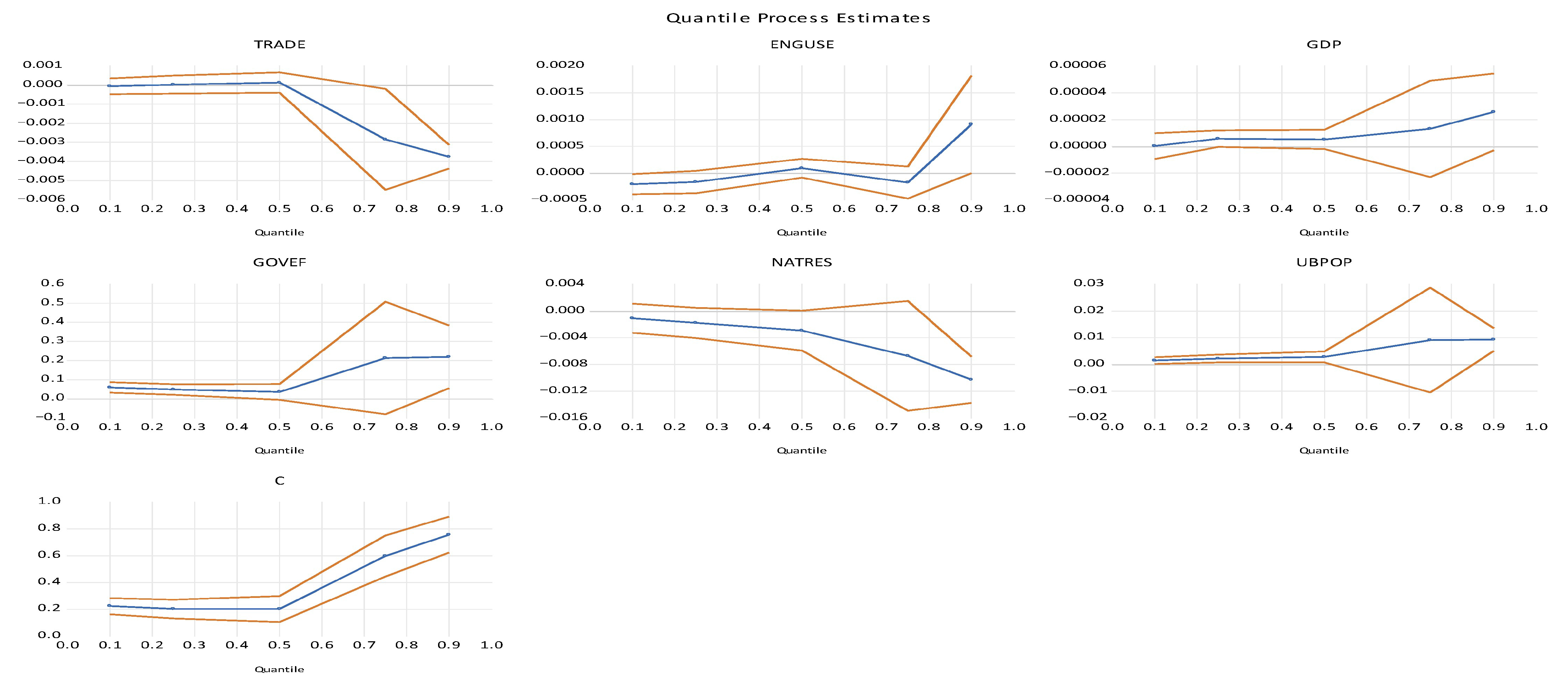
4.4. Quantile Process Estimate
The quantile process estimates give a good idea of the non-homogeneous relationship between international trade and environmental sustainability among the economies that form the Southern African Development Community (SADC). Compared to traditional mean-based estimators, the quantile regression model can estimate the effect of trade openness as well as other determinants on different levels of CO2 emissions.
The findings captured in
Figure 1 indicate that at lower quantiles of emissions, there is no statistically significant effect of trade openness, but at higher quantiles, it significantly reduces emissions. This trend demonstrates that the environmental advantages of trade integration are agglomerated in more industrialised and more carbon-intensive economies where access to cleaner technology, enhanced production efficiency and environmental standards by global trade networks are more common. The results confirm the technique effect viewpoint, as the idea implies that trade openness may stimulate the use of environmentally friendly technologies in production once nations arrive at a specific stage of industrialisation [
36,
46,
47]. Conversely, the fact that the effect of trade in less-industrialised economies is not significant indicates that those countries are still dependent on primary commodity exports and have not undergone much technological modernisation. This imbalance highlights why countries in the SADC bloc should have different trade and environmental policies.
Other than trade openness, the findings also underline the significance of structural factors in the determination of environmental sustainability within the region. Urbanisation becomes the most predictable and the biggest contributor to the emissions across all quantiles, reflecting the growth of energy-demanding infrastructure, transportation systems, and industrial processes related to the rapid urbanisation [
48,
49]. The consumption of power also leads to higher emissions at the upper end of the distribution, in line with the strong association of fossil fuel energy systems with carbon emissions in developing economies [
43]. Interestingly, the effectiveness of governments tends to have a positive correlation with emissions, as it can be supposed that the institutions of stronger strength usually presuppose the existence of more industrialisation and trade integration in place of more serious environmental control [
23]. Also, the negative correlation between emissions and the natural resource rent at higher quantiles implies that carbon-intensive production is externalised through commodity trade, with processing occurring in a different region [
35]. All in all, these results reveal that trade integration, urbanisation, energy use, and institutional capacity interrelate to bring about environmental sustainability in the SADC in a diverse regional development environment.
The empirical findings give a detailed account of the trade–environmental nexus in Southern Africa. The long-run FMOLS estimates verify that there is a stable cointegrating relationship between the variables of trade openness, economic growth, energy use, urbanisation and CO
2 emissions. The evidence collected in the long run is polled, indicating that an increased level of trade is matched with a marginal increase in emissions in the case of asymmetric treatment of the countries. Yet, the outcome of quantile regression shows that the low-to-medium emitting nations drive this effect, whereas high-emitting economies in fact have the gain of trade-induced emission reductions, as already known in the classic literature [
50,
51].
The high place of urbanisation as a source of emissions of all quantiles highlights the importance of urban planning, investment in green infrastructure, and implementation of clean energy in the rapidly developing cities in Southern Africa, as also alluded by [
52]. The high negative impact of GDP per capita in the long run is supportive of an EKC reading at higher incomes, but the quantile results indicate that this relationship is hardly homogeneous [
53]. The continued presence of the quality of governance that is important at both ends of the distribution suggests that trade liberalisation requires institutional reform as a complement to attain sustainable growth objectives. This is similar to the findings of Ref [
54], who averred that environmental regulating agencies in SSA host countries should strictly enforce environmental laws to ensure investors’ compliance. The foregoing heterogeneous impacts provide a challenge to generalising a single prescription of trade and environmental policy to the SADC region. The differences between countries with varying emission levels are fundamentally related to the reaction of countries to the variables of trade, energy and governance, which indicates the necessity of country-specific policy tuning [
55].
5. Conclusions and Recommendations
This paper examined the nexus between international trade and CO2 emissions in the 16 SADC member states between 2000 and 2024 using panel cointegration analysis, FMOLS long-run estimation and quantile regression. The key conclusions include the following:
The findings revealed that there is a strong long-run cointegrating link between CO2 emissions, trade openness, energy consumption, GDP per capita, quality of governance, natural resource rents and urbanisation in the SADC panel. Second, the long-run FMOLS estimates point to the importance of urbanisation and natural resource rents as positive long-run causes of emissions, and the importance of GDP per capita as a negative long-run cause of emissions in an EKC interpretation at high-income levels. Third, and most importantly, quantile regression shows that there is very strong distributional heterogeneity in the relationship between trade openness and emissions: trade openness is a major factor in reducing emissions in high-emitting countries (75th–90th percentiles) but has no significant impact in low-emitting countries. This observation validates the transference of cleaner technologies and efficiency benefits in the trade of developing countries like South Africa, with the understanding that the environmental payoff of trade is not automatic in the case of smaller and less-industrialised SADC economies.
In line with the study’s findings, several policy recommendations are proposed. In high-emitting economies, greater incorporation into global value chains and preferential treatment for imports of clean technologies should be made a priority through intended trade agreements and green procurement guidelines. In the case of low-emitting, resource-dependent economies, trade liberalisation should be graded with the tightening of environmental control lest a pollution haven may become established. Investments in renewable energy infrastructure, urban public transport, and clean cooking technologies are necessary across the region to decouple urbanisation from emissions. One condition for the realisation of the environmental benefits of trade-led growth is institutional reform, especially by enhancing the effectiveness of environmental enforcement and governance.
Although the study contributes to existing knowledge of the trade–environment nexus in the SADC, several considerations outline the prospects for further research. The environmental proxy of the CO2 emissions (per capita) is only a part of the environmental operation; a more comprehensive view may be achieved by adding other indicators such as the ecological footprint or the environmental performance index. The homogeneous slopes of the long run used in FMOLS could not account for heterogeneity across countries, so estimators such as Mean Group or Pooled Mean Group might help. Aggregate trade openness does not account for sectoral composition, bilateral trade, or differences in energy sources. Also, examining the moderating role of the African Continental Free Trade Area agreement and the use of governance policies focused on environmental regulatory capacity would help to enhance understanding and improve policy applicability in the SADC region.