Article

Resilience Assessment of Freight Multimodal Transportation Network in Coastal Area Urban Agglomerations Under Typhoon Disturbances

School of Modern Post, Xi’an University of Posts and Telecommunications, Xi’an 710061, China
*
Author to whom correspondence should be addressed.
Sustainability 2026, 18(7), 3271; https://doi.org/10.3390/su18073271
Submission received: 12 February 2026 / Revised: 14 March 2026 / Accepted: 24 March 2026 / Published: 27 March 2026

Abstract

As typical natural disasters in coastal areas, node failure and link interruption caused by typhoons directly threaten the operation stability of the freight multimodal transportation network (FMTN) in urban agglomerations. Such disruptions, in turn, restrict the sustainable development of the regional transportation and logistics system. In order to scientifically assess the FMTN resilience level in coastal area urban agglomerations under typhoon disturbances, this study constructs a resilience assessment method that integrates structural performance and functional performance. The Spatial Local Failure model and the Monte Carlo method, combined with fragility curves, are used to dynamically simulate the damage process of FMTN nodes and links by different typhoons intensities. By constructing FMTN resilience performance function, the resilience ratio is used to quantitatively assess the damage resistance and resilience maintenance level of FMTN under disturbances. This study also analyzes the resilience difference between FMTN and its sub-networks. The Typhoon Bebinca case is applied to validate the application of FMTN assessment method. The results show that FMTN exhibits stronger invulnerability and robustness under typhoon disturbances, and its resilience is significantly better than that of sub-networks. Specifically, when a strong typhoon hits, the FMTN resilience ratio only decreases by 0.13, while the resilience ratio of each sub-network decreases significantly by 0.21, 0.42, 0.46 and 0.57, respectively. FMTN resilience under typhoon disturbances is further assessed through an example analysis. And it verifies not only the comprehensive advantage of FMTN under typhoon disturbances but also the rationality and practicability of the assessment method. The findings can provide an important theoretical basis and technical support for resilience assessment, disaster prevention, mitigation planning, and the sustainable development of FMTN in coastal area urban agglomerations. It is of great practical significance to promote the efficient operation of China’s FMTN.

1. Introduction

The traditional transportation network typically refers to independent transportation system comprising a single transportation mode, which lacks cross-mode coordination. The freight multimodal transportation network (FMTN) is a network formed by connecting two or more transportation modes [1]. FMTN can not only greatly improve logistics efficiency and service quality but also disperse the risk and improve the safety of freight transportation by combining multiple transportation modes. The classic concept of resilience refers to the comprehensive ability of the system to resist, maintain, adapt and restore functions when dealing with external disturbances, and usually contains four attributes, namely robustness, redundancy, resourcefulness and rapidity [2]. This study focuses on the immediate impact process of disasters, reflecting the performance maintenance and anti-disturbance ability of the network during the disturbances. The FMTN with high-robustness means that the network has strong resistance and stability under the impact of disasters, which can effectively suppress the significant attenuation of functions. Therefore, from the perspective of robustness, this study defines FMTN resilience, focusing on its ability to resist failures and maintain overall functional stability when subjected to external disturbances, which falls within narrow resilience.
Typhoons, as a common natural disaster, cause huge economic losses to the coastal areas of China every year. According to the National Natural Disasters in 2025 report released by the Ministry of Emergency Management of the People’s Republic of China in January 2026, typhoon disasters throughout the year affected 11.0701 million people, caused the collapse of 0.07 thousand houses and damage to 2.01 thousand houses, and resulted in a direct economic loss of 40.586 billion yuan [3]. Data from the China Meteorological Administration indicates that typhoons make landfall in China 7–8 times annually on average, primarily along the southeastern coastline, and their effects often extend northward along coastal regions. These storms frequently cause significant transportation network disruptions, including road closures, train time-delays, and flight cancelations [4].
Transportation infrastructure in coastal areas is a key component of FMTN in urban agglomerations. When a typhoon strikes, its powerful destructive force has a serious impact on all types of transportation infrastructure. Adverse meteorological conditions, such as strong storms and heavy rainfall caused by typhoons, frequently lead to flight delays and cancelations. Storm surges generated by typhoons frequently cause wharf inundation and quay crane collapses, resulting in waterway transportation disruptions. Concurrently, strong winds often damage critical railway infrastructure, particularly overhead catenary systems. Heavy rainfall weakens highway and railway subgrades, potentially leading to collapse in extreme cases. Such damage to transportation infrastructure inevitably severs connections between different transportation modes. Simultaneously, such damage can be transmitted along the transportation corridors, inducing multiple nodes and links in FMTN of urban agglomerations to fail, thereby affecting the entire network’s normal operation. Against the backdrop of global economic integration and regional coordinated development, coastal area urban agglomerations serve as vital nodes of international trade and regional economies. Its high-performance FMTN resilience is crucial to ensure supply chain stability and promote economic prosperity. Accurately assessing FMTN resilience in coastal areas under typhoon disturbances has significant practical value. It enables an efficient emergency logistics deployment and helps mitigate disaster impacts on socioeconomic systems. Furthermore, it contributes to maintaining social stability and supports sustainable national development.
The resilience concept has its roots in the Latin word “resilio”, initially denoting mechanical properties. Holling’s ecosystem resilience theory has gained international recognition. Holling [5] defines resilience as a system’s capability to effectively cope with perturbations. Contemporary scholarship characterizes it as a system’s ability to withstand, absorb and recover from disturbance events [6,7]. With the deepening of research, network resilience has been gradually extended to many fields, especially engineering and transportation fields [8]. Tang et al. [9] found that resilience can effectively assess the self-recovery ability of public transportation systems to resist external impacts.
Regarding network resilience assessment metrics, the existing literature has extensively investigated individual network, demonstrating multiplicity in research approaches. From the perspective of network topology characteristics, many studies are based on complex network theory, and select network efficiency, network connectivity, etc., as assessment metrics [10,11,12,13,14,15,16]. Otherwise, Ip and Wang [17] quantified railway system resilience using a weighted sum of reliable channels, while Poo et al. [18] developed a freight network resilience metric by weighing the degree centrality, betweenness centrality and eigenvector centrality. Both methodologies represent topology-based quantitative approaches. From the perspective of network operation status, Verschuur et al. [19] used the number of affected days and recovery days to analyze port network resilience, focusing on time-dimensional operational impacts of network damage. From the perspective of the resilience dynamic assessment process, scholars based on resilience triangle theory have proposed a four-phase assessment framework: initial stage, failure stage, recovery stage and stability stage. This methodology incorporates metrics such as the resilience cost ratio for quantitative assessment [20,21,22,23]. Additionally, Qin et al. [24] innovatively combined structural resilience, functional resilience and location resilience to evaluate port node network resilience.
Some researchers have also evaluated multi-modal transportation network (MTN) resilience. Chen et al. [25] used the complex network theory to investigate MTN resilience, and also evaluated the resilience based on topological indices. Several scholars have adopted a dual-perspective approach in evaluating MTN resilience, incorporating both structural and functional performance metrics. Typical metrics include network connectivity, global efficiency, service capacity, and operational efficiency [26,27]. Other scholars have chosen metrics such as network connectivity and network centrality to study FMTN resilience using the network topological characteristics [28,29,30]. Aparicio et al. [31] proposed a methodology to assess FMTN resilience: static resilience assessment employing centrality and connectivity metrics, and dynamic resilience analysis integrating throughput measures with resilience triangle theory.
With global climate change driving an increase in the frequency and intensity of natural disasters, it is necessary and valuable to study the impact of natural disasters on transportation systems. In network resilience analysis, most studies have employed natural disasters including typhoons, rainstorms, and earthquakes as simulated disruption scenarios to assess transportation network resilience. In analyzing network resilience under typhoon disasters, several scholars have employed the Spatial Localized Failure model coupled with the Monte Carlo simulation to generate typhoon impact scenarios. Based on the simulated scenarios of typhoon disturbances, they assess the resilience levels of both unimodal and multimodal networks [32,33,34]. Wan et al. [35] conducted a systematic review of prevailing port resilience assessment methodologies. They developed a typhoon-specific quantitative evaluation model grounded in the 4R framework: reliability, redundancy, robustness, and recoverability. Qiang and Xu [36] employed Winter Storm Harper as a simulated disruption scenario to analyze road network resilience. Their study adopted a functional resilience perspective, incorporating transportation service supply and demand metrics. Regarding the analysis of network resilience under rainstorm disasters, Dong et al. [37] focused on resilience through changes in connection reliability and stability under flooding conditions, with residual performance ratios, recoverability, and rapidity of functional restoration as resilience metrics. They focused on the road network as a case study during Hurricane Harvey. Chen et al. [38] conducted a study on the resilience of complementary highway-railway network during heavy rainfall events. They employed a resilience assessment model that considered the intensity, as well as the spatial and temporal distribution, of rainfall. Other scholars have constructed resilience assessment models for urban bus and metro networks under flood scenarios, adopting demand satisfaction rates or measuring network resilience from the dual dimensions of topological characteristics and functional performance [39,40]. Other scholars have deeply analyzed the network resilience performance by simulating disruptions on the road network by using structural or functional resilience metrics with earthquake disasters as the research background [41,42,43].
Although the current research on network resilience under disasters has investigated diverse disturbances such as typhoons, rainstorms, earthquakes, etc., they have formed diversified analysis approaches such as scenario simulation and framework construction; however, there are still the following limitations. Regarding research objects, extant studies focus on a single network or MTN in the field of passenger transportation [37,38]; there is a serious lack of discussion on the resilience of freight-oriented MTN. Regarding disaster types, typhoons have entered the research field as high-frequency coastal hazards. However, the existing results are either limited to the resilience assessment of the single-mode system or single ports [32,35], or do not go deep into the specific spatial scale of coastal area urban agglomerations, and they struggle to reflect the cross-regional linkage resilience of FMTN among urban agglomerations. Regarding assessment dimensions, while a limited number of studies have addressed FMTN resilience in disaster contexts, these predominantly focus on structural performance [44,45]. The research comprehensively considering structural performance and functional performance on FMTN resilience assessment in coastal area urban agglomerations under typhoon disturbances is extremely scarce.
The purpose of this study is to evaluate FMTN resilience from the perspective of typhoon disturbances. Compared with previous studies, the main research contributions are as follows:
(1)
This study breaks through the limitation that the existing research focuses more on the passenger transportation network and the majority of the research subjects are from one urban agglomeration. It takes FMTN in coastal area urban agglomerations as the research object and proposes a metric method for assessing FMTN resilience. It fills the gap in the targeted research on the resilience assessment of FMTN within and between urban agglomerations.
(2)
This study breaks through the limitation that most studies only consider the network structural performance or functional performance. It selects corresponding metrics from structural and functional perspectives. A scientific and reasonable method is used to assign weights to each metric, and then a comprehensive resilience performance function integrating structural performance and functional performance is constructed, so as to assess the FMTN resilience more comprehensive.
(3)
Focusing on the characteristics of typhoon randomness and regional spatial disasters, the whole process of damage assessment and performance degradation of FMTN under different intensity typhoon disturbances are analyzed. Compared with the traditional static assessment method, the dynamic influence mechanism of typhoon disturbances on network resilience is more truly characterized. And it provides a new analytical perspective and quantitative basis for disaster prevention and mitigation of FMTN in typhoon-prone areas.
These methodological advancements enrich the theoretical framework of the FMTN resilience assessment. Through rational and effective assessment, the findings can provide evidence-based foundations for improving the adaptability and stability of FMTN in coastal area urban agglomerations in response to typhoons and other disasters. Furthermore, this study offers decision support tools for authorities to formulate targeted protection and recovery strategies, contributing to the development of safer and more efficient modern integrated transportation systems. Ultimately, it provides valuable references for coastal nations and regions worldwide to address similar challenges, while contributing strategic insights for enhancing the resilience and sustainability of regional transportation industry.

2. Materials and Methods

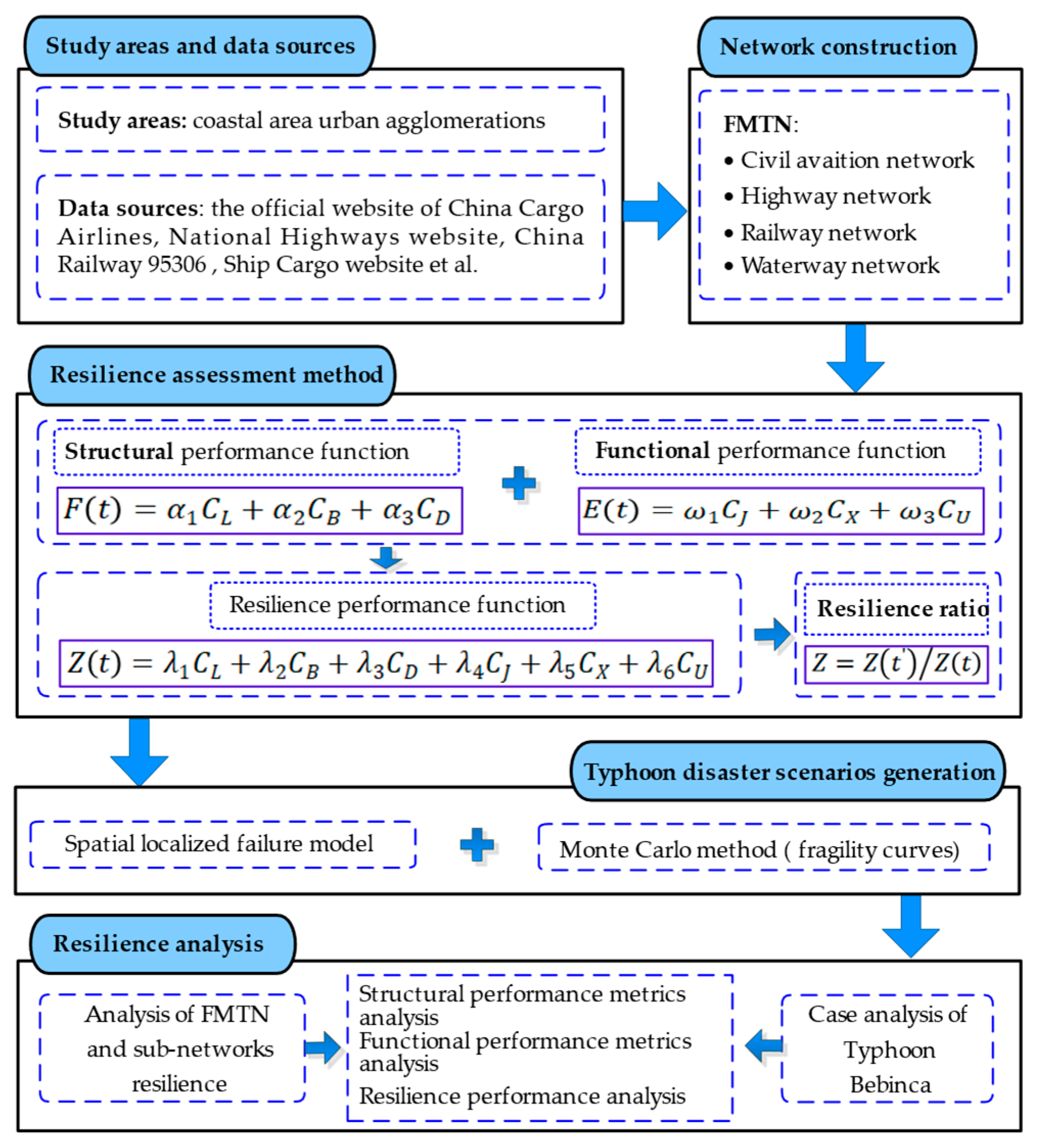
Figure 1 presents the framework for assessing FMTN resilience under typhoon disturbances. First, FMTN and sub-networks are constructed based on the study areas and data. Second, structural and functional performance metrics are proposed to formulate the resilience performance function and establish the resilience assessment method. Subsequently, typhoon scenarios are generated based on historical typhoon data. Finally, FMTN and its sub-networks under typhoon disturbances are assessed in terms of structural performance, functional performance, and resilience performance, respectively.

2.1. FMTN Construction

In this study, the Yangtze River Delta urban agglomeration, the Guangdong-Hong Kong-Macao Greater Bay Area, the middle reaches of the Yangtze River urban agglomeration, the Western Taiwan Straits Economic Zone, the Beibu Gulf urban agglomeration, the Shandong Peninsula urban agglomeration, and the mid-southern Liaoning urban agglomeration are selected as the study areas. The middle reaches of the Yangtze River urban agglomeration, as an important link between inland and coastal areas, are closely related to the coastal areas’ development. Therefore, this study incorporates both coastal urban agglomerations and this zone, providing a more comprehensive assessment of the whole coastal and related regions’ FMTN resilience against typhoon threats.

2.1.1. Network Construction Description and Assumptions

(1)
Nodes. The research focuses on the overall response of the inter-city FMTN under typhoon disturbances, so the four heterogeneous nodes of airports, highway toll stations, train stations and ports in FMTN are merged. Similar nodes located in the same city are merged to abstract the nodes to the city level.
(2)
Edges. FMTN includes intra-layer and inter-layer edges.
(3)
Network composite. Nodes of different network layers in the same city are coupled, and inter-layer connections are added between these nodes.
(4)
Undirected network. Multimodal transportation usually allows for bi-directional intermodal transportation. Therefore, regardless of the intermodal routes’ direction, they are abstracted as undirected network.

2.1.2. Network Modeling

To visually characterize the physical structure of FMTN and facilitate the subsequent simulation of typhoon disturbance scenarios, this study constructs an FMTN model for coastal area urban agglomerations based on the Space L modeling method for complex networks. The urban agglomeration FMTN consists of four sub-networks—civil aviation, highway, railway, and waterway networks, each of which consists of nodes at different levels and connecting edges between points. The stations of the four transportation modes in each prefecture-level city within the coastal area urban agglomerations are abstracted as network nodes, and network connecting edges are generated by inter-station adjacency relationships.
The civil aviation network (CAN) is represented as G 0 = N 0 , E 0 , the highway network (HN) is expressed as G 1 = N 1 , E 1 , the railway network (RN) is denoted as G 2 = N 2 , E 2 , the waterway network (WN) is represented as G 3 = N 3 , E 3 , N represents the aggregation of all nodes within sub-networks and E is the matrix of connection states between nodes in sub-networks. e i , j is the connection state of an undirected line starting at node i and ending at node j , and E can be expressed as E = e i , j e i , j = 0 or 1 , i , j N , e E . e i , j = 1 denotes the existence of connected edges from node i to node j . If e i , j = 0 , then it means that there is no connecting edge from node i to node j . This study defines an FMTN as G = G 0 , G 1 , G 2 , G 3 , A , and A is the inter-layer connecting edges of FMTN.
In this study, based on the gravity model [46], combined with the strength of logistics linkages, the city’s freight volume (ten thousand tons), transportation time and transportation distance are considered to obtain the intra-layer edge weight, as in Equation (1):
F i j = G H i H j D i j T i j
where F i j denotes the weight of the connecting edge between two nodes in the layer; G is the gravitational coefficient, usually taken as 1; H i   and   H j indicate the amount of freight transported at city node i and city node j , respectively; D i j represents the distance of cargo transportation between nodes i and j ; and T i j represents the cargo transportation time between nodes i and j .
Similarly, the inter-layer edge weight is as in Equation (2):
F m q = G H m H q D m q T m q
where F m q indicates the weight of the connecting edge between two nodes between layers; G is the gravitational coefficient, usually taken as 1; H m and H q represent the freight turnover at node m and node q , respectively, for different modes of transportation in the same city; D m q represents the transit transportation distance between nodes m and q ; and T m q represents the transportation time between node m and q .
The external connection of an urban agglomeration mainly refers to the relationship network formed by the aviation, highway, railway and waterway freight volumes between intra-agglomeration cities and external urban nodes. Based on the research of Tu et al. [47], this study quantifies inter-city connectivity through daily freight service frequencies with different transportation modes, constructing an extra-agglomeration linkage strength model. This serves as a weight between intra-agglomeration cities and external urban agglomeration as in Equations (3) and (4):
E i = z = 1 M E i z + E z i
e i = E i / M
where E i and e i are the total number of out-group linkages and the intensity of linkages for city i in a given urban agglomeration, respectively; E i z is the number of daily runs from city i to city z outside the agglomeration; E z i is the number of daily runs from city z to city i outside the agglomeration; z for all cities in urban agglomerations other than the one in which city i is located; and M is the number of connections between city i in the agglomeration and all cities outside the agglomeration.

2.1.3. Basic Topological Characteristics

(1)
Degree and degree distribution
In a complex network, node degree refers to the total number of edges that connect a specific node to other nodes. The degree distribution of the network is obtained by sorting nodal degrees in ascending order and calculating the proportion P k of nodes with degree k relative to the total number of network nodes, as in Equation (5):
P k = n k / n
where n k is the number of nodes with degree value k , and n is the total number of nodes in the network.
(2)
Clustering coefficient
A node’s clustering coefficient represents the proportion of existing edges between its adjacent nodes relative to all possible edges among them. It can describe the network density. The clustering coefficient of node i is p i , and the network average clustering coefficient is P , as in Equations (6) and (7):
p i = 2 l i k i k i 1
  P = i n p i / n
where l i indicates the number of connected edges between the neighbors of node i , n is the total number of nodes, and k i is the degree of node i .
(3)
Path length
Path length is defined as the shortest path that connects two nodes with the minimal number of edges. The average path length represents the mean distance across all node pairs, indicating how closely nodes are positioned relative to each other. This reflects the proximity of node associations within multi-layer network systems. It is calculated in Equation (8):
  D = 1 n n 1 i j d i j
where D denotes the average path length, n is the total number of nodes, and d i j is the shortest path length between nodes i and j .

2.1.4. Data Sources

Aviation network layer data were obtained from the official website of China Cargo Airlines, the official website of China Southern Airlines Logistics and the Global Air Logistics Intelligence Platform; highway network layer data from the Gaode Map and National Highway website; railway network layer data from the China Railway 95306 website, the China Railway 12306 website and the China Railway Map; and waterway network layer data from the Ship Cargo website and the Ship News website.
The freight volume and freight turnover of each prefecture-level city in the weighting formula are derived from the statistical yearbook of each prefecture-level city. Transportation distance and transportation time are from China City Distance, Baidu Map, Gaode Map and Ship News website. Daily frequency data are from Global Air Logistics Intelligence Platform, Green Ant Logistics Search Platform, Freight Service Platform of China Railway 12306 website and Ship News website.
All research data were manually collected, verified, and organized from publicly available sources during the period from September to October 2024. The network structure was abstracted and constructed based on the actual operational routes during this period. In this process, duplicate information, such as daily schedules, was recorded only once to ensure the reliability of data for subsequent simulation.

2.2. FMTN Resilience Assessment Method

Structural performance metrics focus on network topological characteristics, while functional performance metrics focus on transportation network’s capacity and efficiency. The multi-dimensional assessment method formed by the combination of the two can provide comprehensive assessment direction for enhancing FMTN resilience under the impact of typhoons. The structural and functional assessment of FMTN involved in this study covers multiple metrics. Since assessment metrics corresponding to each performance are not a single parameter, determining their respective weight coefficients becomes essential for constructing a comprehensive network performance function. It should be emphasized that in the process of a comprehensive multi-dimensional metrics evaluation, different metrics weight allocation schemes will inevitably yield different assessment outcomes. Current methodologies for determining composite evaluation weights are primarily categorized into subjective and objective approaches. Given the inherent subjectivity bias in expert-based weighting method, this study uses the coefficient of variation method in the objective weighting method to comprehensively assess FMTN structural and functional performance. The coefficient of variation method assigns weights to metrics based on the relative dispersion degree of their observed values across evaluated objects [48]. In this study, the coefficient of variation for each metric is normalized as its weight. In addition, the entropy weight method uses information entropy to measure the information content of metrics while indirectly reflecting the correlations among them. In this study, the entropy weight method is adopted to calculate the weights, and the coefficient of variation method is utilized for weight comparison.

2.2.1. FMTN Structural Performance Metrics

The structural performance metrics are selected based on the complex network theory and resilience-related theory and quantify the network’s inherent resistance to disturbances and its post-disaster recovery potential by topological characteristics. When studying structural performance, the characteristics of a node or edge should be placed in the whole network for comprehensive consideration. To thoroughly assess the structural performance of a network, it is necessary to introduce a series of quantitative metrics. Network efficiency condenses global performance into a single scalar. In contrast, although the metric selected in this study is also based on the shortest path topology, it offers a more deconstructed perspective. Similarly, network connectivity typically focuses on the critical threshold of connectivity collapse and is insensitive to early-stage performance degradation. So, this study comprehensively considers the whole network accessibility, pivotal node significance, and connection efficiency of the network, and selects metrics such as tightness, betweenness centrality, and the shortest path length to characterize the FMTN structural performance.
Tightness refers to the connectivity degree between nodes within a network, indicating how smoothly they are linked. It is calculated as the reciprocal of the total distance sum from a given node to all other nodes in the network [49]. The node tightness in the network is shown in Equation (9):
c l i = j = 1 n d i j 1
where d i j denotes the distance between nodes. The network average tightness is calculated as in Equation (10):
C L = n 1 n i = 1 n c l i
Betweenness centrality is a key metric in network analysis that measures how times a node appears on the shortest paths between other nodes in a network. This metric can accurately reflect a node’s ability to control other nodes. Additionally, it measures the node’s intermediary role in logistic transmission paths between other nodes [49], as shown in Equation (11):
c b i = i I K I g j k i / g j k
where i j k and j < k , c B i represents betweenness centrality; g j k represents the number of shortest paths between two points j , k , which are interconnected; and g j k i represents the number of shortest paths that exist between two points j , k , which must pass through node i in order to be connected. When considering a network with n nodes, the betweenness centrality for the entire network is calculated as the average of the betweenness centrality values for all individual nodes, as in Equation (12):
C B = 1 n i = 1 n c b i
A network has good connectivity if the shortest paths between all node pairs are short [50]. In FMTN, the shortest path length between nodes i and j refers to the minimum distance between all modes of transportation. The length calculation needs to include intermodal transfer between different transportation modes. The average shortest path length refers to the average of the shortest path length between all node pairs in the network, as in Equation (13):
C D = 2 n n 1 i = 1 n 1 j = i + 1 n l i j
where l i j is the length of the shortest path connecting nodes i and j . It is specified that l i j = 0 for i = j .
In this study, the weighted combination of tightness, betweenness centrality, and the shortest path length is defined as the network structural performance. The coefficient of variation method is employed to determine the tightness, betweenness centrality, and the shortest path length metrics accounting for the weight and the phase weighting to get the FMTN structural performance function, such as Equation (14):
  F t = α 1 C L + α 2 C B + α 3 C D
where F t is a network structural performance function and α 1 , α 2 , α 3 are the weights of tightness, betweenness centrality and shortest path length, respectively, determined by the coefficient of variation method.

2.2.2. FMTN Functional Performance Metrics

FMTN organically combines various transportation modes, such as road, rail, water and air transportation, to realize the continuous transport of goods from the starting point to the ending point. The functional performance metrics focus on the network operational efficiency, which directly reflects the actual service capacity of the network during disasters from cargo circulation perspective. This study considers the three dimensions of node load, operational efficiency and temporal reliability, and selects node saturation, transportation efficiency and service timeliness as network functional performance metrics.
Node saturation refers to the ratio between the actual freight volume moving through a node and the node’s maximum carrying capacity. The more uniform the freight flow and saturation distribution of all nodes and edges in the network, the better the network functional performance. Node saturation is shown in Equation (15):
c j i = H i / H i
where c j i is node saturation; H i is actual freight volume at the node; and the maximum carrying capacity of a node is represented by H i . The average node saturation of the whole network is Equation (16):
C J = 1 n i = 1 n c j i
where C J is the average node saturation and n denotes the total number of nodes.
The recovery speed of transportation efficiency is an important metric to assess FMTN resilience [51]. In this study, transportation efficiency is determined by taking the inverse of the average shortest transportation time for goods, as outlined in Equation (17). The average shortest transportation time is calculated as transportation distance divided by the vehicle’s speed, as in Equation (18):
x i j = 1 / t i j
t i j = D i j / V
where t i j is the average minimum transportation time; D i j is the transportation distance from node i to node j ; and V indicates the speed for different transportation modes. Equation (19) illustrates the average transportation efficiency across the entire network.
C X = 1 n x i j
FMTN resilience is not only reflected in its ability to resist external interference, but also in the time it takes to recover from the interference and return to a stable state. This study employs the average shortest transportation time to assess expected delivery duration. Service timeliness is quantified through the time compliance rate, which measures the completion status of the transportation task within stipulated time. Then, the service timeliness is the ratio of the actual transportation time to the expected transportation time, as in Equation (20):
u i j = t i j / t i j
where t i j is the actual transportation time from node i to j . Equation (21) demonstrates the average service timeliness across the entire network.
C U = 1 n u i j
Similarly, the weights of node saturation, transportation efficiency and service timeliness are determined using the coefficient of variation method to obtain the FMTN functional performance function as in Equation (22):
  E t = ω 1 C J + ω 2 C X + ω 3 C U
where E t is a network functional performance function and ω 1 , ω 2 , ω 3 are the weights of node saturation, transportation efficiency, and service timeliness, respectively, determined by the coefficient of variation method.

2.2.3. FMTN Resilience Assessment Metrics

The weights of each metric in the resilience function of the sub-networks and FMTN are determined based on the coefficient of variation method, thereby determining the overall resilience performance function of the sub-networks and FMTN, as in Equation (23):
  Z t = λ 1 C L + λ 2 C B + λ 3 C D + λ 4 C J + λ 5 C X + λ 6 C U
where Z t is the network resilience performance function and λ 1 , λ 2 , λ 3 , λ 4 , λ 5 , λ 6 are the weights of tightness, betweenness centrality, the shortest path length, node saturation, transportation efficiency, and service timeliness, respectively. In this study, the ratio of network resilience after the typhoon disturbances to the original network resilience, i.e., the resilience ratio, is used to measure FMTN resilience [52].
  Z = Z t / Z t
where Z is the resilience ratio; Z t represents the network resilience after disturbance.

2.3. Typhoon Disaster Scenarios Generation

Typhoons are one of the essential factors triggering large-scale disruptions of FMTN in coastal area urban agglomerations, and typhoons have high uncertainty and suddenness, which leads to the local areas of multiple nodes or edges being interrupted. Their occurrence time, the scope of influence, and the degree of destruction often break the original transportation order and stability of FMTN. They are difficult to accurately estimate and effectively predict through conventional means. The Spatial Localized Failure (SLF) model can be used to simulate randomly originated, deterministic-scope disasters [53]. In the SLF model, every component of the network within the localized area of a natural disaster experiences an impact, while external components do not [54]. Given that typhoons typically affect limited geographical areas, their impact on FMTN, including structural damage, route disruptions, and node functionality failures, predominantly exhibits localized characteristics when analyzed from a macroscopic network perspective. Therefore, this study uses the SLF model to effectively describe various typhoon disturbance scenarios.
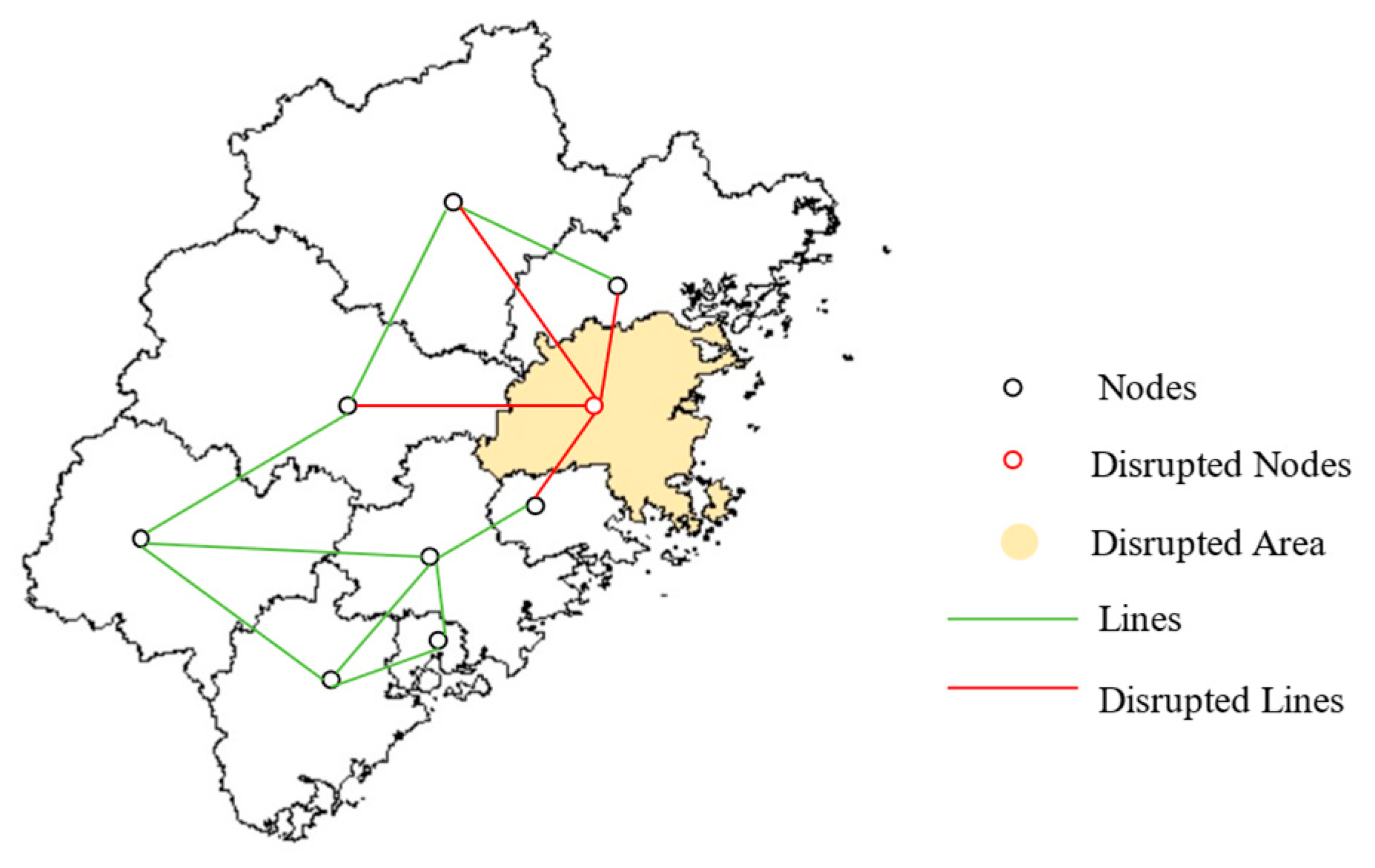
Using the SLF model, a spatially localized affected region is first defined. Due to the extensive coverage of the national transportation network and municipal-level operations in practice, this study uses a region-based model [55], as shown in Figure 2. In this model, each prefecture-level city is considered as a region, and typhoons primarily impact the operations of affected regions, while others continue to function normally. The hazard scenario can be expressed as S = s 1 , s 2 , , s k , where s k indicates the state of area k . If a typhoon strikes area k , then s k = 1 , otherwise it is 0. Failure states of all components are indicated by Y = y 1 , y 2 , , y i , and Y k is set to be the state of all components in region k . Components are the nodes and connecting edges of air, highway, railway and waterway networks. Component failures are the inability of a flight/truck/train/ship or an airport/truck stop/train station/port to operate.
The Monte Carlo method and the probabilistic model are utilized to create random typhoon scenarios. The specific process of generating dangerous scenarios is shown in Algorithm 1.
In Step 1, define the total number of iterations N and set the number of iterations n to 1. Set the state vector of the initial area S = 0 and the state vector of the component Y = 0 . In Step 2, firstly, a uniformly distributed random number δ k ~ U 0,1 is generated for each region k , and another random number θ i ~ U 0,1 is generated for each component i . Secondly, the disaster occurrence probability p k of region k is compared with δ k , and the value of p k is obtained by the historical typhoon occurrence probability. If δ k < p k , the region k is affected by the disaster, s k = 1 ; otherwise, s k = 0 . Finally, if an area is hit by a natural disaster, then the failure probability f i of component i is compared with a uniformly distributed random number θ i . If θ i < f i , then component i stops running, y k , i = 1 . If an area is set to be affected and all components in the area are not damaged, the component state in the area will be redistributed. In Step 3, it is determined whether the iteration number n is less than or equal to the total number of iterations N to decide whether the algorithm ends. If n > N , the algorithm ends.
Algorithm 1: Simulating typhoon generation
Inputs: total number of iterations N , historical typhoons occurrence probability, typhoons
occurrence probability p k for each region, failure probability f i for each component.
Output: final region state s k , final component state y i .
1 Initialization n = 1 , S = 0 , Y = 0 .
2 Generating region and component failure random numbers δ k , θ i ~ 0,1 .
3 where δ k < p k do
4 Region k affected by disasters and s k = 1 ;
5 if s k = 1 and θ i < f i then
6 Component Failure and y k , i = 1 ;
7 otherwise y k , i = 0
8 Update Y ;
9 n = n + 1 ;
10 end if
11 end where

3. Modeling of FMTN in Coastal Area Urban Agglomerations Under Typhoon Disturbances

3.1. FMTN Model and Basic Topological Characteristics Analysis of Coastal Area Urban Agglomerations

3.1.1. Modeling of FMTN in Coastal Area Urban Agglomerations

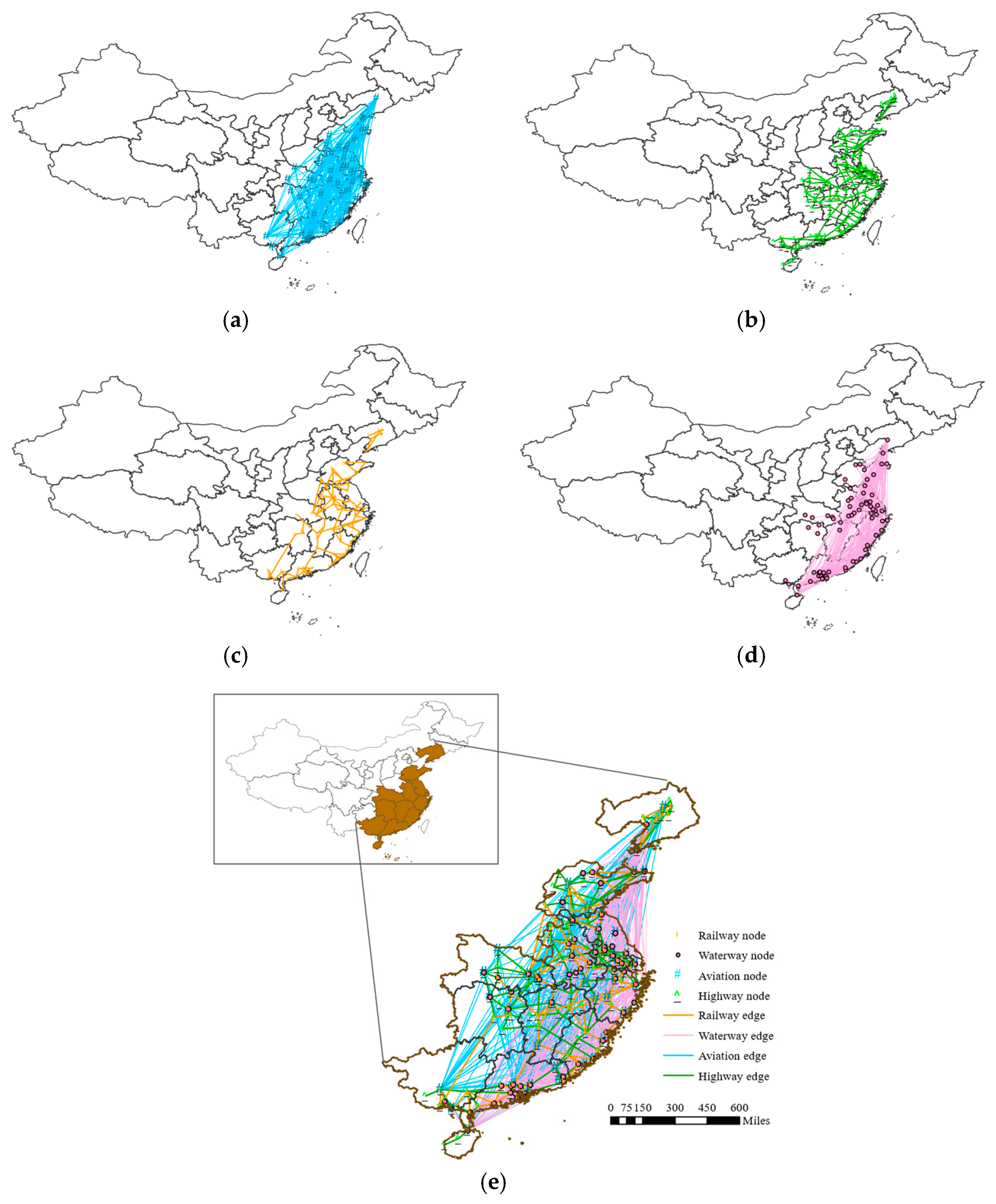
The constructed FMTN and sub-networks diagrams are shown in Figure 3.

3.1.2. Basic Topological Characteristics Analysis

The basic topological characteristics of FMTN and the sub-networks are shown in Table 1.
As can be seen from Table 1, FMTN exhibits a significantly higher number of nodes, edges, and maximum degree compared to its sub-networks. This indicates that the FMTN scale is larger, the connection is more complex, and it can provide more transportation modes and routes for cargo transportation.
FMTN has a higher maximum degree than the sub-networks, indicating higher complexity and connectivity. Compared to the other two sub-networks, CAN and WN have higher average and maximum degrees, reflecting the high connectivity of CAN and WN. This benefits fast and convenient long-distance transportation, as well as enhances network connection and transmission accessibility. The network diameter indicates the maximum number of transmissions across the entire network. A larger network diameter, as seen in HN and RN, signifies that the nodes are relatively far apart from each other. These nodes need to go through more intermediate nodes to establish connections, reflecting an extensive network coverage area but the topology exhibits low clustering. The lower average clustering coefficient of FMTN indicates that it is less locally connected and that nodes tend to form fewer local clusters among themselves. This characteristic is associated with multi-modal integration, the role of hub nodes, and large network scale. The average path length measures the number of nodes traversed in the shortest path within a network. Given the significant average path lengths of both HNs and RNs, the average distance between nodes is moderate for FMTN. The accessibility between nodes is better through rational transportation organizations in spite of the large network scale. In summary, by integrating multiple transportation modes, FMTN gives full play to its topological advantages and performs well in terms of connectivity and transportation efficiency.

3.2. Typhoon Scenarios and Component Failures

From 2001 to 2024, 114 typical typhoons have made landfall in China. In this study, the data of the above typhoons are collected from the official “China Meteorological Station Typhoon Network” website.
This study’s analysis of the historical dataset reveals the classifications of typhoons and their corresponding impacts, as outlined in Table 2.
In Table 2, typhoons are classified into three categories: T1, T2, and T3. In a T1-grade typhoon scenario, flight operations are dependent on actual conditions, with minor disruptions for small and medium-sized aircraft unable to take off normally in downwind conditions. Meanwhile, under a typhoon of this magnitude, speed limits may be imposed on vehicles traveling on highway, with only minor impacts on its operation. For the railway, there is no damage to facilities and train services can be provided normally. The ship’s navigation, mooring, port operation and the condition of the waterway are affected to varying degrees, bringing a lot of safety and efficiency problems, known as serious disruption, to waterway transportation. In a T2-grade typhoon scenario, for aviation, most flights are prohibited from providing transportation services. For highway transportation, vehicle maneuverability, safe sight distance for travelers, and the integrity of the highway facilities are severely affected, vehicle speeds are usually restricted, portions of the highway are closed, or certain types of vehicles are prohibited from passing through the highway. For railway transportation, speed restrictions are established or shutdowns of some trains in windy areas occur, and waterway transportation completely suspends operational plans. Under a T3-grade typhoon scenario, all flights, most trucks, trains and all ships in typhoon-affected areas are delayed.
In this study, the probability of an area being affected by a typhoon is calculated using data from typhoons that made landfall in China between 2001 and 2024. For accuracy, the maximum wind speed observed at the prefecture level is used to determine the wind speed in these scenarios. It is worth noting that FMTN components have different failure probabilities for different destructive intensities of the typhoon (i.e., wind speeds in this study’s model). The failure probability of an independent component in a network is usually described by a fragility curve [56], which usually has a lognormal form, as in Equation (25):
  f x = φ 1 β ln x k
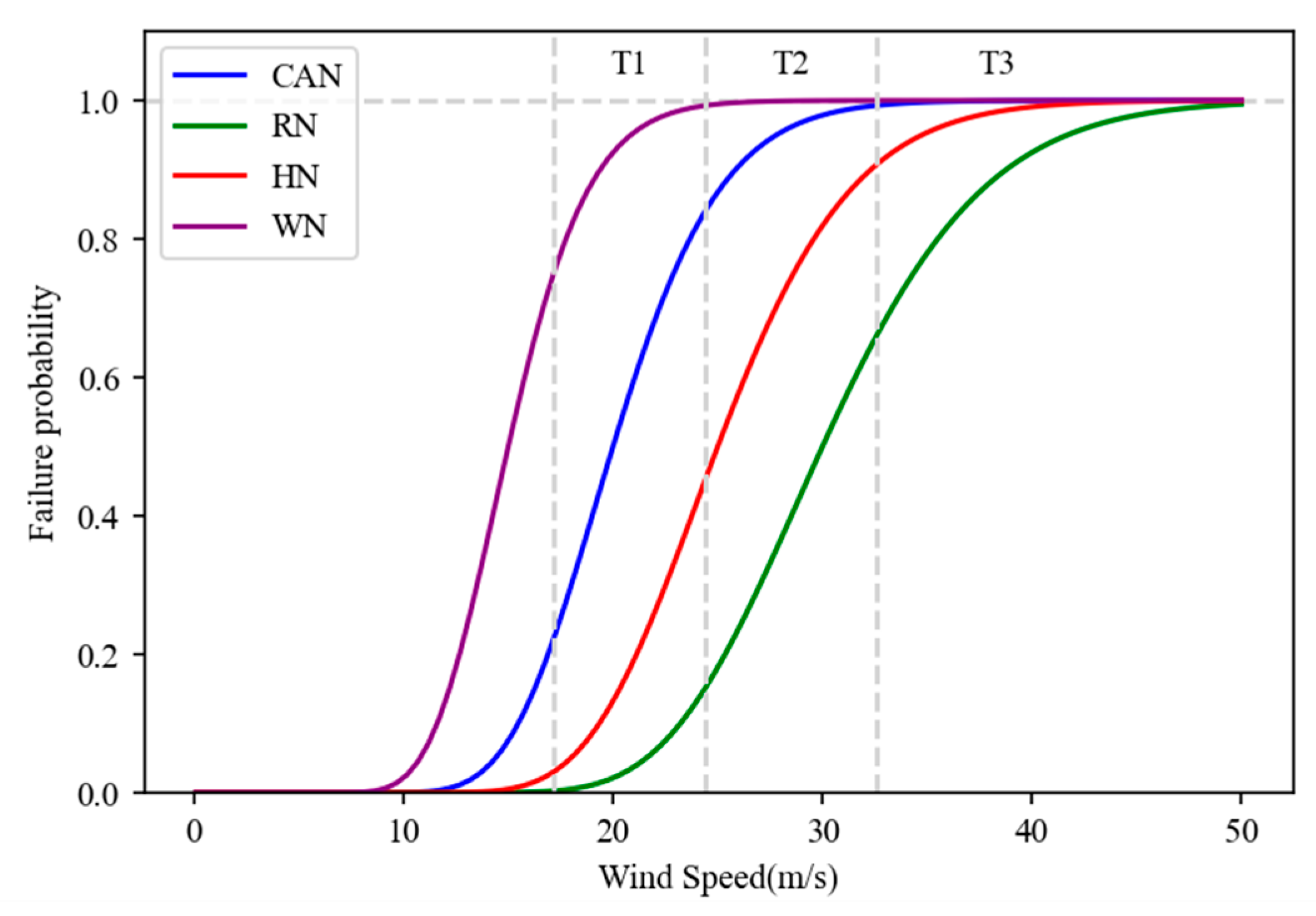
where φ x is the cumulative distribution function of the normal distribution. Given the current lack of detailed information at the component level, this study assumes that every individual component receives an equal level of maintenance, resulting in each one having the same fragility curve. The corresponding impacts of different typhoons are referenced from the Civil Aviation Industry Standard of China (MH/T 3011.18-2006) [57], the Specification for Emergency Management of Expressway Traffic (JT/T 916-2014) [58], the Regulations on Railway Technical Management (p. 104), and the Regulations of the People’s Republic of China on the Administration of Inland Waterway Traffic Safety and its implementing rules. Please note that the typhoon impacts used here are approximate references in policy implementation and will be represented by specific parameters in the subsequent model. The study sets the parameter β to 0.2 and k to 20 for CAN, β = 0.2 ,   k = 25 for HN, β = 0.2 ,   k = 30 for RN, and β = 0.2 ,   k = 15 for WN. The value of β is obtained by several simulation experiments. Parameter β is determined based on the existing literature and empirical research on typhoon disasters. By referring to the failure law and failure probability model of Fang et al. [32] typhoon disaster, this study selects the parameters that match the typhoon grade, structural type and disaster characteristics. These four functions determine the failure probability of components for a given typhoon wind speed. The component fragility curves of CAN, HN, RN, and WN in this study are shown in Figure 4. The dashed line perpendicular to the horizontal axis is used to distinguish the typhoon level.
As can be seen in Figure 4, with the increase in wind speed, the failure probability of each network component shows an increasing trend. When the wind speed reaches a certain threshold, the failure probability of each component gradually converges to 1 and stabilizes. Specifically, under T1-grade typhoon disturbances, waterway components begin to fail at relatively low wind speed, followed by aviation, highway, and railway components in this order. When wind speed reaches 20 m/s, the failure risk for waterway components becomes significantly high. In comparison, the failure probability for aviation components is approximately 0.5. Meanwhile, the failure probabilities for both highway and railway components remain relatively low. The failure probabilities for waterway and aviation components continue to increase under T2-grade typhoon disturbances. When the wind speed rises to 30 m/s, the failure probabilities for waterway and aviation components basically converge to 1, and the failure probability for highway components also increases significantly, while the failure probability for railway components remains relatively low. The failure probability of each component reaches a high level under T3-grade typhoon disturbances. When the wind speed is further increased to 40 m/s, the failure probability of each component is basically close to 1. It can be seen that the waterway and aviation modes of transportation are more significantly affected by typhoons, while highway and railway modes of transportation are relatively less affected by typhoons.
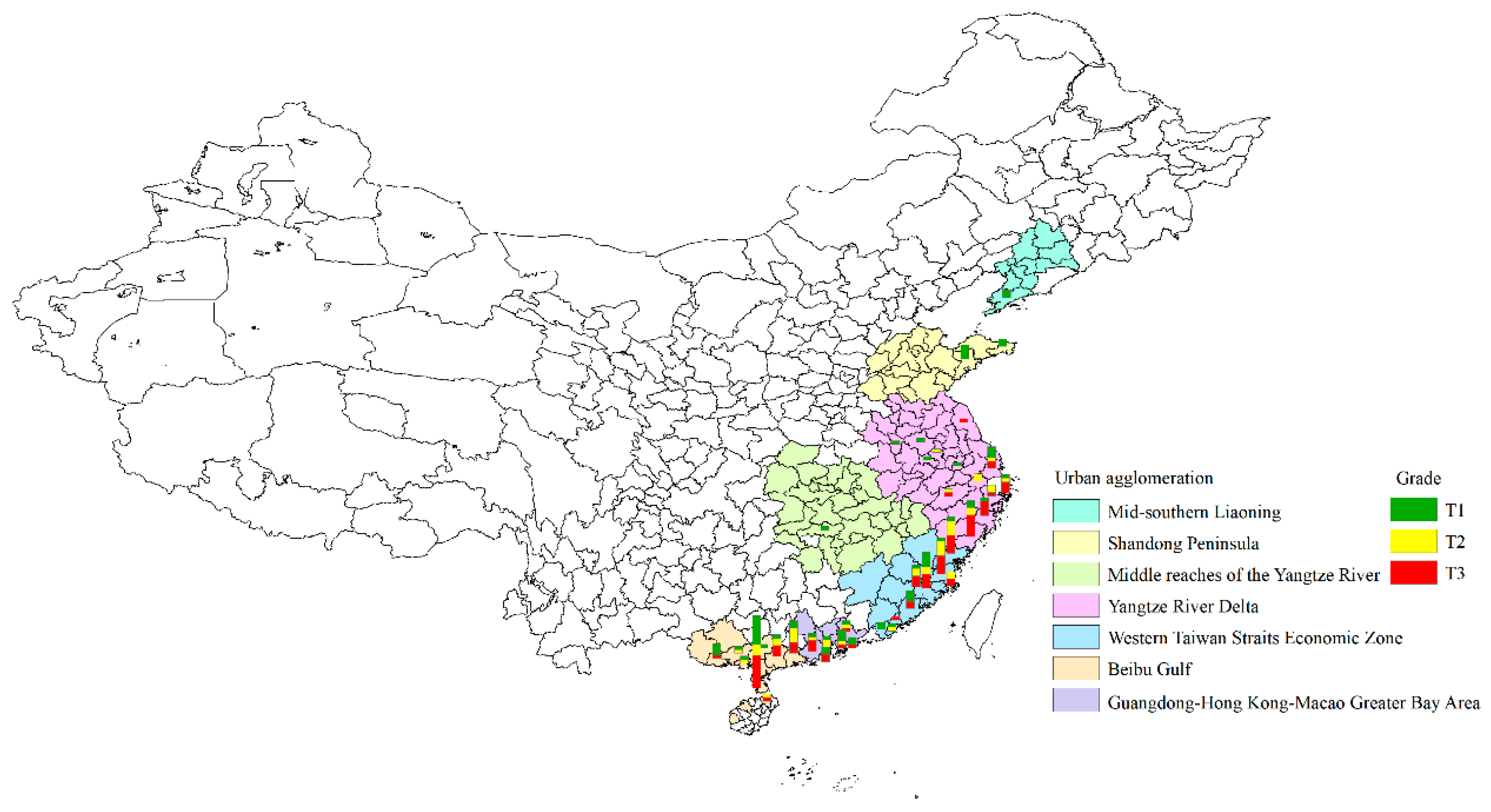
Based on the typhoon grades in Table 1, the historical geographic distribution of typhoon landfalls and major impacted cities in coastal area urban agglomerations is illustrated in Figure 5.
As can be seen from Figure 5, the Guangdong–Hong Kong–Macao Greater Bay Area and the Western Taiwan Straits Economic Zone are typhoon-prone areas, and the impact of a typhoon varies depending on its intensity. The influence range of T1-grade typhoons is small, but the distribution range is wide, and all urban agglomerations have been affected by typhoons of this magnitude. T2-grade typhoons are mainly distributed in cities such as Fuzhou and Ningde within the Western Taiwan Straits Economic Zone and Zhanjiang, Maoming and Yangjiang within the Beibu Gulf urban agglomeration. T3-grade typhoons are strongly destructive and widely distributed, and transportation facilities in several prefecture-level cities need to take typhoon precautions, especially in Zhanjiang, which is also one of the cities with more typhoon disturbances.
The higher the typhoon hazard grade, the larger the impact areas. Typhoon disturbance scenarios can be generated based on the above information. From the simulation results, it can be seen that under T1-grade typhoon disturbances, relatively fewer nodal cities were damaged, and cities with more frequent typhoon landfalls, such as Zhanjiang, Yangjiang, Fuzhou, Quanzhou, Wenzhou and Shanghai, suffered damage. Under T2-grade typhoon disturbances, the number of failed nodal cities increased, such as Xiamen, Ningde, Zhoushan, Ningbo, Nanjing, Haikou, Shenzhen and Hong Kong. Under T3-grade typhoon disturbances, cities like Changsha, Qingdao and Dalian were also affected due to the typhoon’s relatively high speed at the time of landfall and the wider range of its impact.

4. Research Results

4.1. Resilience Analysis of FMTN in Coastal Area Urban Agglomerations Under Typhoon Disturbances

Based on the resilience assessment metrics in Section 2.2, this study simulates different grades of typhoon disturbance scenarios based on Section 3.2, and calculates the structural performance, functional performance and resilience metrics of the sub-networks and FMTN, respectively. This study aims to reveal FMTN resilience under typhoon disturbances and provide a scientific basis for the formulation of disaster response strategies.

4.1.1. FMTN Structural Performance Metrics Analysis

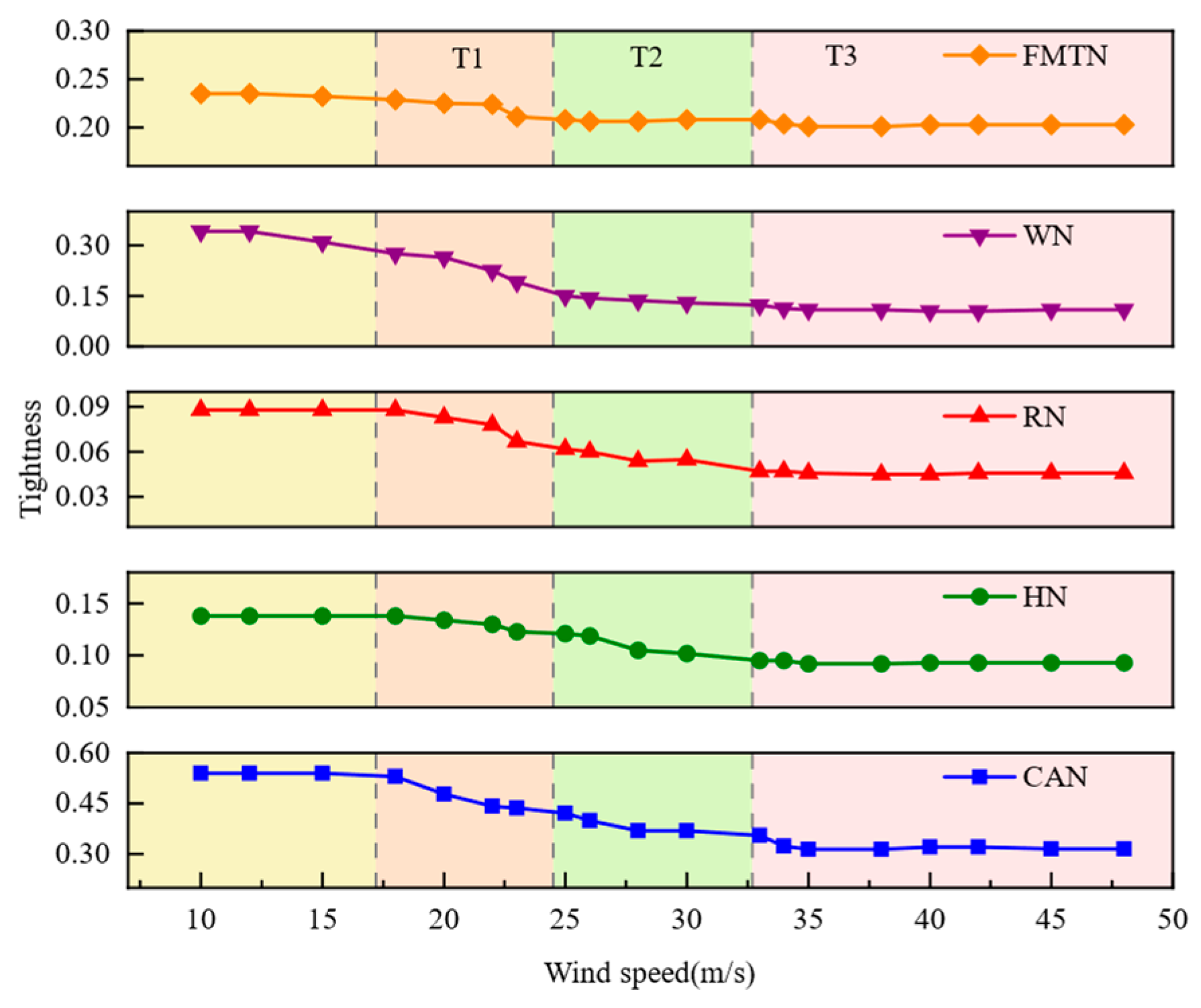
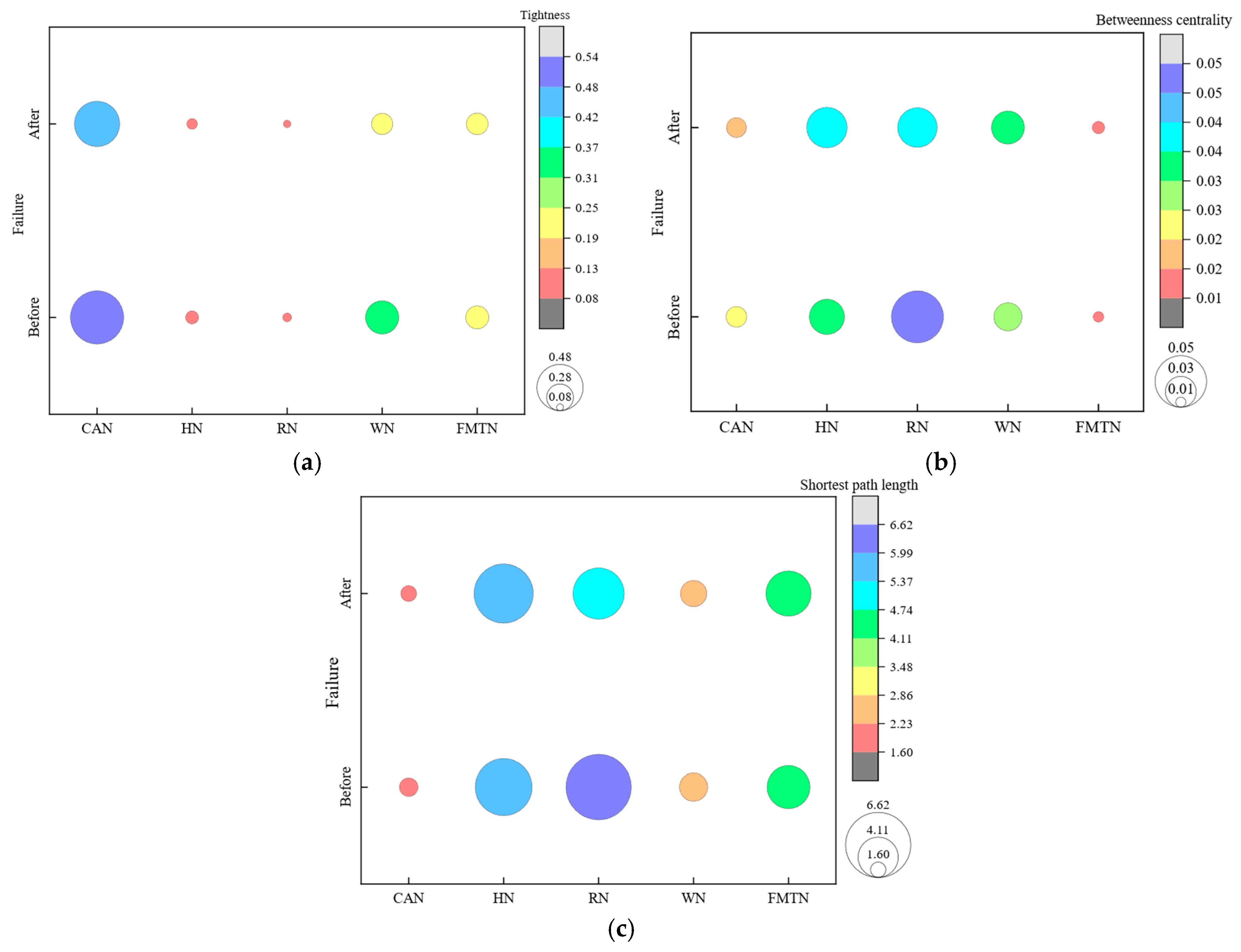
Figure 6, Figure 7 and Figure 8 show the variation in each structural performance metric for the sub-networks and FMTN under different grades of typhoon disturbance scenarios.
As can be seen in Figure 6, tightness metric values of CAN and WN decrease significantly under T1-grade typhoon disturbances. The phenomenon is consistent with the typhoon grades and their impacts in Table 1. This may be due to the fact that important node cities such as Fuzhou and Shanghai undertake a large number of long-distance transportation connections. Their failures directly cut off multiple key paths, severely affecting the local connectivity and overall accessibility of the network. CAN is highly dependent on a few hub airports, which are extremely sensitive to wind speed. Once they are closed, there is no alternative way to replace them without causing a sharp drop in tightness. WN also highly relies on coastal ports. Typhoons cause disruptions in port operations, affecting the continuity of waterway transportation. In contrast, the tightness metric values of the other networks show only a slight decrease. This indicates that network structures are characterized by more parallel pathways and greater stability in ground transportation. Such structural features enable the maintenance of overall connectivity through detour routes. Among them, FMTN shows the most gradual decline, demonstrating its advantage of integrating multiple transportation modes. When air and water transportation routes are disrupted, road and railway transportation can still assume partial transportation functions. This preserves the overall connectivity of the network. Such a scenario reflects the inherent redundancy and diversity of FMTN. Under T2-grade typhoon disturbances, the decline rates of tightness metrics in both CAN and WN exhibit deceleration. They have already lost their most critical nodes in the T1-level. The relative importance of subsequent failed nodes decreases; thus, the decline slows down, while the tightness values of other networks show a slight decrease, indicating that the network structure can still maintain relative stability as the typhoon intensity increases. Under T3-grade typhoon disturbances, both the sub-networks and FMTN exhibit limited fluctuations in tightness metrics, indicating that the networks have reached a relatively stable state of damage. The network can achieve a new balanced state through path adjustment and resource reallocation. From the tightness metric variations under different wind speeds, FMTN shows the smoothest decline compared to sub-networks, with minimal overall change, further demonstrating its resilience advantage in withstanding external disturbances.
In Figure 7, under T1-grade typhoon disturbances, betweenness centrality metrics of RN and WN are increasing. This may be because the failures of node cities like Quanzhou and Shanghai lead to the redistribution of the shortest path in the networks, consequently, other nodes assume bridging roles within the network topology. The increase in betweenness centrality reflects the network’s ability to maintain connectivity through topological redundancy after being damaged. Under T2-grade typhoon disturbances, the betweenness centrality metric values of HN, WN and FMTN show an upward trend. This indicates that there are certain redundant nodes and paths in these networks. When a critical node fails, other nodes can take over its transit function, thereby maintaining network connectivity. However, the decrease in the betweenness centrality metric value for RN may stem from damages to multiple hub nodes like Nanjing and Ningbo within the network. Their failure may cause direct disruption of numerous paths. With insufficient alternative routes, the shortest paths through these nodes are interrupted or detoured, and their intermediary roles could not be effectively replaced. This reveals insufficient modularity of RN, as the failure of key nodes easily causes network fragmentation. Under T3-grade typhoon disturbances, the betweenness centrality metric values of each network show small fluctuations. This indicates that the network core structure remains relatively stable, and the mediating role of the nodes does not change significantly despite typhoon disturbances. The networks reached a stable post-disaster state under high-intensity disturbances. Overall, the betweenness centrality metric values for CAN and FMTN vary less, further indicating a strong stability in the connectivity relationships and shortest path distributions among their nodes.
In Figure 8, the shortest path length metric values of each sub-network show a slow decreasing trend under T1-grade typhoon disturbances. This might be because after some edge nodes fail, the network calculates the shortest path by excluding unreachable node pairs, resulting in a reduction in the average distance between the remaining reachable nodes. This does not imply an improvement in network efficiency but rather indicates network damage. In contrast, the shortest path length value of FMTN increases slowly, indicating that the network maintains high connectivity and transportation efficiency under typhoon disturbances. FMTN relies on redundant paths to maintain connectivity between nodes, so the path length increases slightly but no connectivity break occurs. The shortest path length values of sub-networks continue to decrease under T2-grade typhoon disturbances. This may be due to the fact that the path reconstruction caused by node failure removes some of the edge nodes, which improves the network efficiency. It is worth noting that the metric value of RN drops significantly. This may be due to the failure of the node cities like Nanjing and Ningbo, which are in key positions in the network, resulting in the network being split into several isolated sub-networks, while the shortest path length metric value of FMTN rises with the increase in typhoon wind speed, and the change is small. Since FMTN consists of four sub-networks, relatively more nodes or connecting edges are destroyed during disturbances. However, owing to its highly redundant network structure and diversified transportation modes, the minimal increase in the shortest path length occurs and the overall network performance is not significantly affected. This ability to maintain connectivity through redundant paths is the core mechanism of the anti-disturbance ability of FMTN. The metric values for both sub-networks and FMTN are at a less-fluctuating level under T3-grade typhoon disturbances. It shows that typhoon intrusions have a certain regionality, the cities in the unaffected area can still be transported through the existing path, and the network enters the stable stage after the disaster.
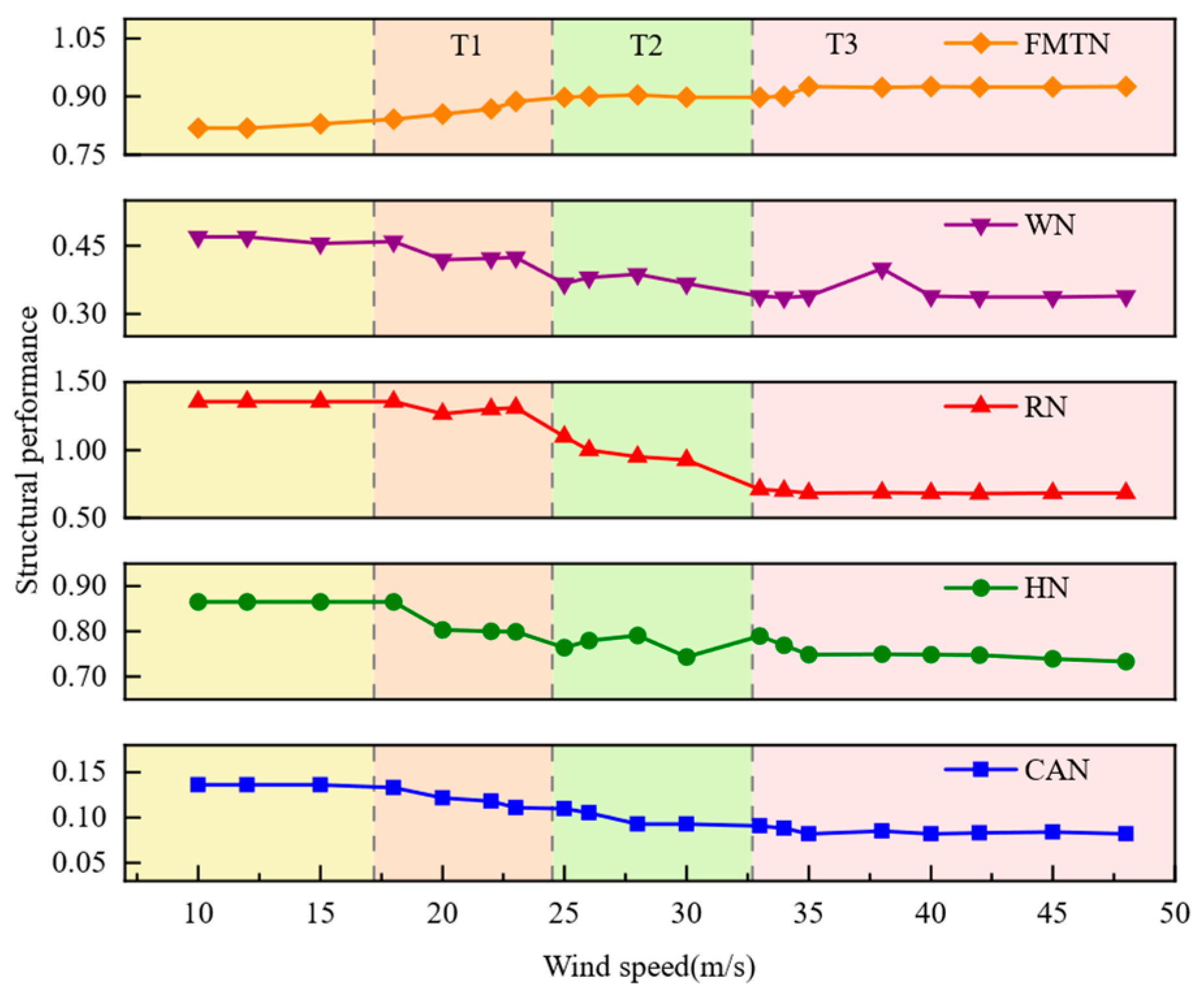
Figure 9 shows the variation in the structural performance of each network under different grades of typhoon disturbance scenarios.
In Figure 9, the structural performance of the sub-networks shows a decreasing trend under T1-grade typhoon disturbances, while the FMTN structural performance is slowly increasing. This phenomenon reveals the fundamental difference in the anti-disturbance ability between FMTN and sub-networks. The sub-networks rely on a single transportation mode and lack redundant paths. When critical nodes fail, their connectivity drops directly. In contrast, FMTN integrates multiple transportation modes, which can quickly switch to other modes when one mode fails. This diversity and redundancy make it exhibit stronger resilience. Under T2-grade typhoon disturbances, RN experiences significant structural performance degradation. This primarily stems from track damage and station closures disrupting critical paths, ultimately reducing network connectivity. In contrast, the changes in other networks are relatively gentle, indicating that the node cities that fail under equivalent disturbance conditions are not hub nodes in the networks. Or the networks have enough redundant paths to absorb disturbances. The structural performance of each network basically remains stable under T3-grade typhoon disturbances. This indicates that FMTN and its sub-networks have adapted to the higher-intensity disturbance through the path adjustment and resource optimization in the early stage and are able to maintain a relatively stable structural performance.
In summary, all structural metric values of FMTN change more gently than those of sub-networks, indicating that it has better network structural stability and anti-disturbance capability under typhoon disturbances. This advantage stems from the redundancy, diversity and modularity brought by their multi-mode coupling. Redundancy provides alternative paths, diversity allows for mode switching, and modularity limits the spread of local failures.

4.1.2. FMTN Functional Performance Metrics Analysis

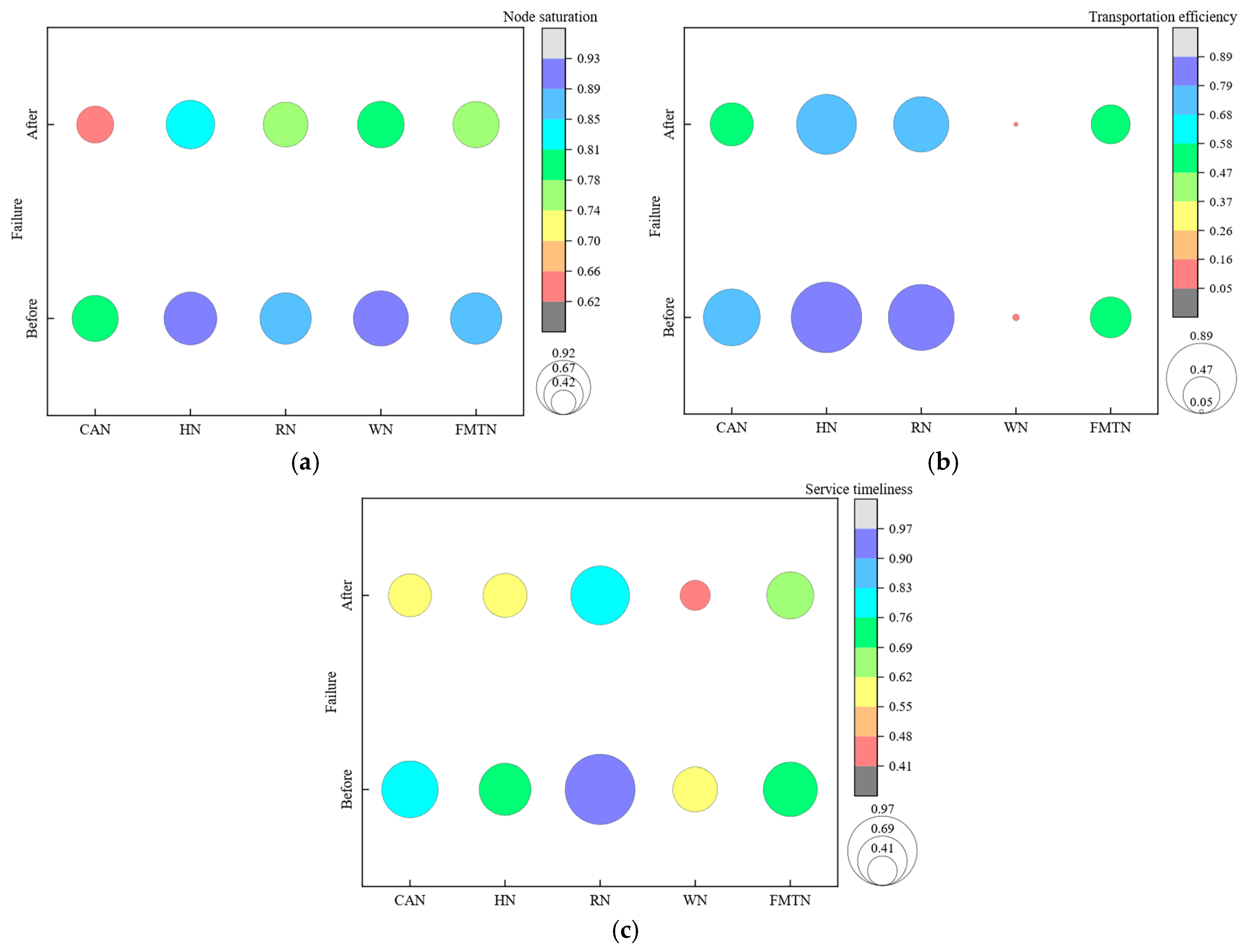
Figure 10, Figure 11 and Figure 12 show the variation in each functional performance metric for the sub-networks and FMTN under different grades of typhoon disturbance scenarios.
As can be seen in Figure 10, both the sub-networks and FMTN exhibit significant reductions in node saturation metric under T1-grade typhoon disturbances. This suggests that the node cities of Zhanjiang, Fuzhou, and Wenzhou may have originally taken higher cargo transportation loads, and their failures directly reduce the overall transportation capacity of the networks, leading to a decrease in the node saturation. Under T2-grade typhoon disturbances, the declining rates of the performance metric in both the sub-networks and FMTN exhibit deceleration. This may imply that the networks are beginning to adapt to the impact of typhoons, and the losses can be mitigated by adjusting the operation strategy and resource allocation. Under T3-grade typhoon disturbances, due to the relatively high speed of the typhoon at landfall and its wide range of impacts, cities like Changsha, Qingdao, and Dalian are also affected, resulting in the node saturation metric value continuing to drop slightly within a certain wind speed range. However, as the spatial extent of the affected cities stabilizes, the node saturation metric also converges to steady-state value. It indicates that the network achieved a new functional balance through load redistribution. Overall, the node saturation values for both CAN and WN decrease by more than 0.3. This suggests that the freight load in these two networks is highly concentrated at a few key nodes and lacks alternative nodes to share the load. Once the hubs fail, the overall transportation capacity will drop sharply. FMTN is neither highly dependent on a small number of key nodes, as in the case of CAN and WN, nor highly decentralized, as in the case of HN and RN nodes. Therefore, the node saturation decline in FMTN exhibits an intermediate value between these two extremes. This indicates that FMTN has both important nodes and dispersed nodes. The load can be redistributed through other nodes, demonstrating the functional redundancy of FMTN.
In Figure 11, all networks are in a downward trend under T1-grade typhoon disturbances, and the most significant decrease occurs in the transportation efficiency of CAN; this phenomenon indicates that the node cities of Fuzhou, Wenzhou, and Shanghai are in key positions in the network, assuming important hubs function. Air transportation is highly sensitive to weather conditions. Typhoons directly cause flight cancelations or delays, and CAN lacks alternative transportation modes, resulting in a substantial drop in transportation efficiency. Under T2-grade typhoon disturbances, all networks exhibit decelerating decline trends in their performance metrics, indicating that the failed nodes do not have high node degrees in the networks. Under T3-grade typhoon disturbances, CAN and WN exhibit significantly greater reductions in performance metrics compared to other transportation modes, indicating that node cities like Qingdao and Dalian play key roles in the networks with more connecting edges. Their failure imposes significant impacts on transport efficiency. As a whole, FMTN has the smallest decrease in transportation efficiency of 0.2, while other networks are above 0.2, and CAN is even above 0.4. This demonstrates that FMTN achieves functional complementarity through diverse transportation modes and maintains high transportation efficiency under complex disturbances. When one mode is disrupted, freight can be rapidly shifted to alternative modes such as air cargo being rerouted via rail or road transportation.
In Figure 12, under T1-grade typhoon disturbances, the service timeliness values of CAN and WN decrease more than those of other networks. Since nodes in HN and RN generally exhibit lower degree values, and their failed nodes connect to fewer transportation routes, resulting in a slower decline in service timeliness metrics. It is demonstrated that the node degree distribution in HN and RN is relatively uniform, such that the failure of a single node exerts a limited impact on the overall service timeliness. Under T2-grade typhoon disturbances, RN exhibits the maximum service timeliness reduction of 0.2. It indicates that node cities such as Nanjing and Ningbo have more connecting edges in the network, and these nodes failure may lead to the deterioration of the network service timeliness. WN, however, has a decrease of less than 0.02, indicating that the failed nodes have fewer connected edges and more path redundancy in the network, and are able to maintain high service timeliness in the event of node failure. It demonstrates the protective effect of redundant paths on the service timeliness. Under T3-grede typhoon disturbances, the service timeliness values of the networks do not change significantly, indicating that the networks are in a relatively stable state at this time. Overall, the magnitude of change in FMTN service timeliness is in the middle of these networks, suggesting that it is both resistant and resilient to typhoon disturbances and affected by the failure of some key nodes.
Figure 13 shows the variation in functional performance of each network under different grades of typhoon disturbance scenarios.
As can be seen in Figure 13, the functional performance of each network decreases significantly under T1-grade typhoon disturbances; among them, CAN demonstrates the most significant performance decline, with a reduction magnitude of 0.46. This indicates that typhoons have a great effect on the transportation efficiency, service timeliness and other functional performance of each network. As CAN is highly sensitive to weather conditions, typhoons may lead to the cancelation or delay of flights, which may significantly reduce its functional performance. Under T2-grade typhoon disturbances, the decrease range of network functional performance is gradually reduced. This indicates that the failed node cities have fewer connecting edges in the network and have limited impact on the overall functional performance. Meanwhile, the network may have made path selection adjustment and load redistribution. WN has the minimal reduction of 0.03, indicating that WN has already been greatly affected by T1-grade typhoon disturbances, with some paths interrupted or closed. Consequently, its functional performance changes less under T2-grade typhoon disturbances. This reflects the characteristics of functional performance entering the platform period after damage. The functional performance of the networks is basically stable under T3-grade typhoon disturbances, indicating that they can adapt to the higher intensity of the disturbances. Overall, HN has the smallest variation in functional performance of 0.25, followed by FMTN, which decreases by 0.26. This result suggests that HN is able to quickly adjust its transportation path under typhoon disturbances, thus maintaining a higher functional performance, while FMTN further enhances its risk resistance by integrating multiple modes of transportation. The overall performance remains superior to that of sub-networks, despite experiencing a slightly higher decline compared to HN. This is attributed to the high robustness brought about by its diversity and redundancy.
In summary, the structural and functional performances of the coastal area urban agglomerations FMTN are affected to varying degrees as the intensity of the typhoon increases, but the structural performance of the networks shows greater stability. From an intrinsic mechanism perspective, such differences mainly stem from the irreplaceable core role of key hub nodes in network connectivity and transportation efficiency. When critical nodes such as hub airports and ports suffer service degradation or failure due to typhoon disturbances, it will directly trigger chain reactions, including regional transportation link disruption and insufficient system redundancy. This leads to rapid attenuation of network function performance. Therefore, considering the structural and functional performance of FMTN comprehensively, it can strengthen the anti-risk ability, standby channel and redundancy design of key hubs, and optimize the efficiency of transportation organization. It is an important way to reduce the impact of typhoon disturbances and ensure the safe and efficient operation of FMTN in urban agglomerations.

4.1.3. FMTN Resilience Performance Analysis

Using the FMTN resilience assessment method proposed in Section 2.2, the coefficient of variation method is used to calculate the CAN resilience performance function as
Z t 0 = 0.037 C L + 0.644 C B + 0.035 C D + 0.066 C J + 0.173 C X + 0.045 C U
HN resilience performance function is
Z t 1 = 0.093 C L + 0.473 C B + 0.094 C D + 0.047 C J + 0.226 C X + 0.067 C U
RN resilience performance function is
Z t 2 = 0.092 C L + 0.391 C B + 0.119 C D + 0.067 C J + 0.246 C X + 0.085 C U
WN resilience performance function is
Z t 3 = 0.071 C L + 0.405 C B + 0.080 C D + 0.029 C J + 0.321 C X + 0.094 C U
FMTN resilience performance function is
Z t = 0.041 C L + 0.375 C B + 0.093 C D + 0.059 C J + 0.326 C X + 0.106 C U
Figure 14 is the difference in the weight value of each metric of FMTN and its sub-networks using the coefficient of variation (CV) method and the entropy weight (EW) method.
It can be seen from this that, under the two calculation methods, the between centrality and transportation efficiency both have a greater weight in the resilience metrics. The weight allocation structures of the two methods exhibit a high degree of overall consistency, with differences limited to numerical fine-tuning. This does not alter the fundamental roles of each metric in the assessment method nor their ranking of relative importance. This shows that the weight determined based on the coefficient of variation method and its core conclusions have sufficient rationality and reliability.
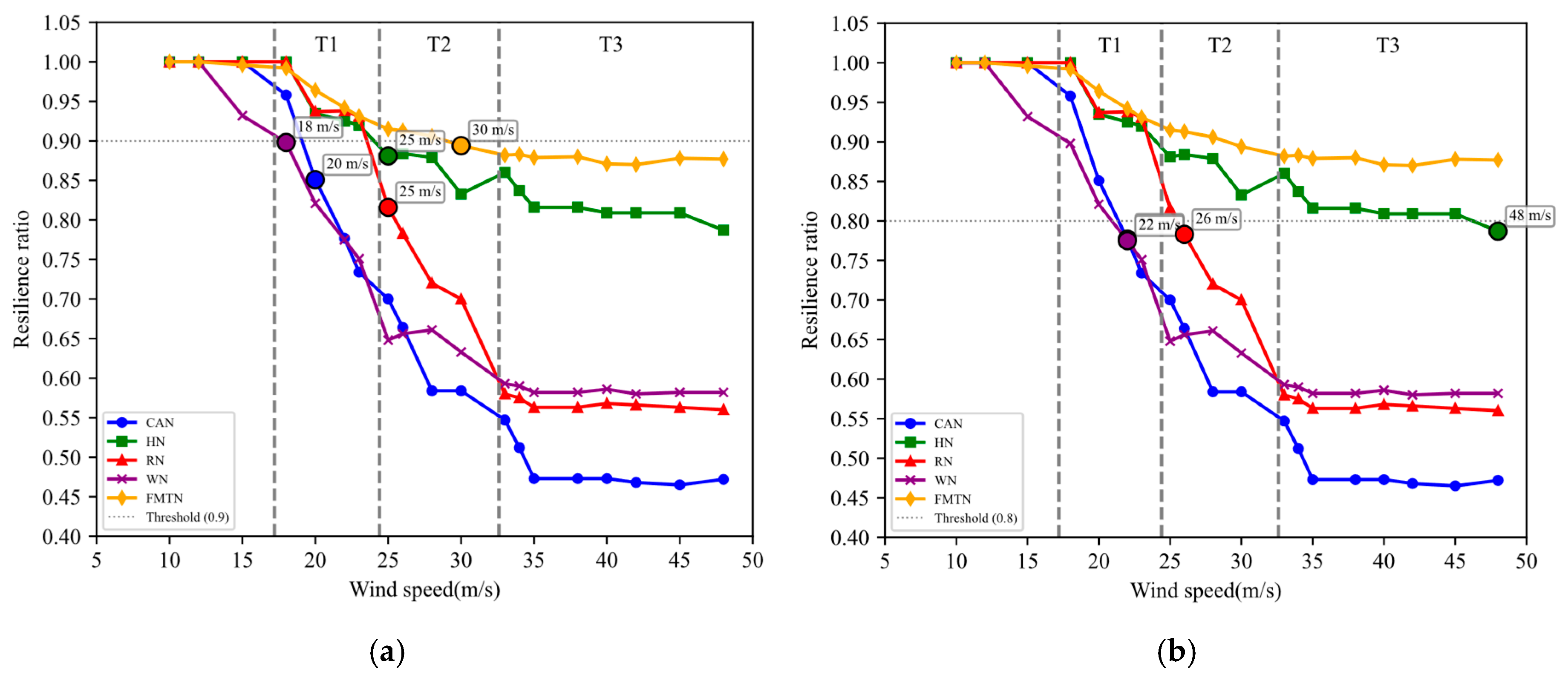
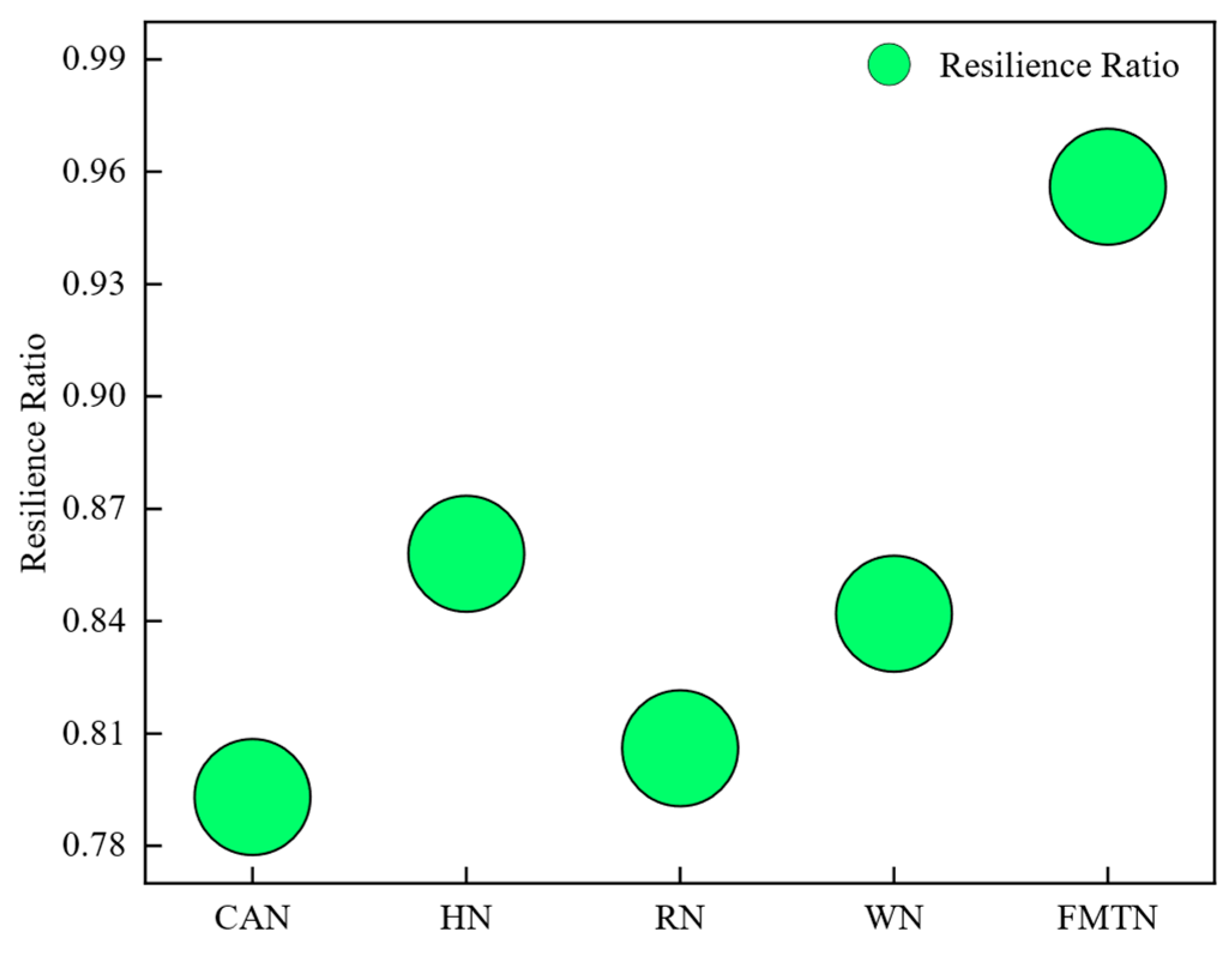
An indicator for measuring resilience according to Section 2.2.3, Figure 15 illustrates the critical points at which the resilience ratio of each network varies with wind speed under different resilience ratio thresholds.
Figure 15a shows the critical point of each network resilience ratio under the threshold of 0.90. Under the threshold of 0.90, WN first breaks through the critical value at 18 m/s, and CAN followed at 19 m/s, both of which are most sensitive to wind speed disturbances. Both HN and RN fall below the threshold at about 25 m/s, while FMTN does not reach the critical point until 30 m/s, showing stronger anti-disturbance ability. Figure 15b shows the critical point of each network resilience ratio under the threshold of 0.80. At the threshold of 0.80, CAN and WN still quickly fall through the threshold at about 21 m/s, RN breaks through the threshold at 26 m/s, and HN delays to 48 m/s before a significant decrease. FMTN is stable above 0.85 throughout the process, not falling into the threshold range. Even if the typhoon intensity increases, FMTN resilience performance is still higher than sub-networks. Specifically, the resilience ratios of CAN and WN decrease faster under T1-grade typhoon disturbance scenarios, which is related to the operation of the transportation modes under high wind conditions and the lack of alternative paths for a single mode of transportation. As a result, they have poor resistance to disturbances. FMTN exhibits the minimal resilience ratio decline at this intensity level because FMTN integrates multiple modes of transportation. When one transportation mode is blocked, others can partially compensate for the loss of transportation capacity. Thus, it can maintain the whole network resilience. In T2-grade typhoon disturbance scenarios, both the sub-networks and FMTN are degraded to varying degrees as the number of cities impacted by typhoons continues to rise significantly, such as Ningbo, Xiamen, Nanjing, and Haikou. They establish connections with more network nodes, and the failures of these nodes may lead to the disruption of multiple critical paths, which drastically weakens the connectivity and the overall resilience of the networks. Even in this case, FMTN resilience ratio is still decreasing slowly, indicating that FMTN usually relies on multiple hub nodes. And even if some key nodes fail, such as Ningbo and Nanjing, other hub nodes can still bear some transportation functions. This reflects the modularity of FMTN; that is, different network modules are relatively independent, and the damage of one module does not affect the normal operation of other modules. In T3-grade typhoon disturbance scenarios, the networks resilience is at the limit of damage, and the resilience ratios do not fluctuate on a large scale as there is no significant increase in the number of affected cities. At this time, the network has reached a new balance through the previous adjustment, which can maintain basic operation under extreme conditions.
In summary, due to the coordination degree and interdependent relationships among various transportation modes, FMTN resilience exhibits significant advantages. This ability stems from the redundancy of the network structure and the redistribution of functions. Its advantages come from redundancy, diversity and modularity. Multi-mode coexistence provides sufficient alternative paths. The sensitivity differences in different transportation modes to typhoon can achieve functional complementarity. And each network module is relatively independent, which can effectively block the diffusion of local failure to the global. RN and HN have more balanced node connectivity and local redundancy, the performance degradation is relatively gentle, and the critical point wind speed is higher. Therefore, they show relatively good resilience. The link connectivity between CAN and WN depends on a few critical paths, the betweenness centrality is unevenly distributed, and the redundancy is low. Therefore, the performance plummets in the low wind speed range, and the resilience ratio curve is steep. And then the overall resilience is weak. The compressive strength of all networks shows a decreasing trend with increasing wind speed, but there are differences in the rate and magnitude of the decrease. This could be linked to the topological structure of the networks and their ability to adapt under external pressure.

4.2. Example Analysis of Typhoon Bebinca

To validate the effectiveness of the resilience assessment method used in this study, Typhoon Bebinca is also selected for example analysis.
Bebinca landed on the coast of Lingang New Town, Pudong, Shanghai, China on 16 September 2024, with a strong typhoon level (42 m/s), becoming the strongest typhoon to land in Shanghai since 1949. After making landfall, Bebinca’s intensity slowly weakened, and it continued to penetrate deep inland. After crossing Shanghai and damaging local infrastructure, the typhoon advanced inland through Jiangsu, Zhejiang, and Anhui, sustaining severe prolonged winds and torrential rainfall.
Since the landfall trajectory of Bebinca mainly affects the 13 cities within the study areas of this paper, these nodes are not in the key positions in the network. So, the changes in the resilience values of the networks are not as large as those of the T3-grade typhoon in Section 4.1. The variation in the values of structural and functional metrics of the affected cities FMTN and sub-networks in the coastal areas is shown in Figure 16 and Figure 17.
As can be seen in Figure 16, the structural performance metric values of FMTN change relatively gently under typhoon disturbance. Specifically, the tightness metric value only decreases by 0.01, which is due to the redundancy of FMTN. Even if the aviation and waterway hubs are damaged, the roads and railways can still maintain regional connectivity and avoid a rapid decline in overall accessibility. WN, however, shows a decrease of up to 0.1 in tightness metric, indicating that the links between the originally tightly connected transportation nodes have become loose, and the network’s connectivity and accessibility have been greatly affected. The value of the FMTN betweenness centrality metric increases slightly by 0.002, indicating that the role of some nodes in the network as bridges has slightly increased, but the magnitude of the change is small. However, the increase in the value of HN is 0.005, indicating that partial nodes in HN have assumed more transit functions under typhoon disturbances. The FMTN shortest path length increases by 0.2, which is the same minimum increase as that of HN. It is further verified that FMTN can maintain efficient connectivity when key nodes fail through mode diversity and redundancy.
In Figure 17, the functional performance metric values of FMTN under typhoon disturbance also change more gently. The minimum decrease in node saturation in FMTN is 0.07, which is lower than that of HN. This indicates that FMTN has a certain degree of self-adjustment ability under typhoon disturbance and maintains the equilibrium of the network operation, whereas the node loading level of HN is slightly more affected by typhoon disturbance, and it is difficult to transfer the loads efficiently after the nodes fail. FMTN has a decrease in transportation efficiency of less than 0.03, indicating that it is able to quickly adjust transportation paths and modes under disturbance. Relay transportation by different transportation modes can significantly weaken the impact of the typhoon on the overall efficiency. CAN has the largest decline, indicating that CAN is most sensitive to typhoon disturbance and has strong hub dependence, resulting in a decline in transportation efficiency. The service timeliness of FMTN declines by 0.1, indicating that the network is able to better meet the basic requirements of customers for cargo delivery time under typhoon disturbance, even though the service timeliness is affected to a certain extent. The maximum decline in WN is 0.2, indicating that the critical path in WN is interrupted, and the goods need to be transported through a longer path or an alternative mode.
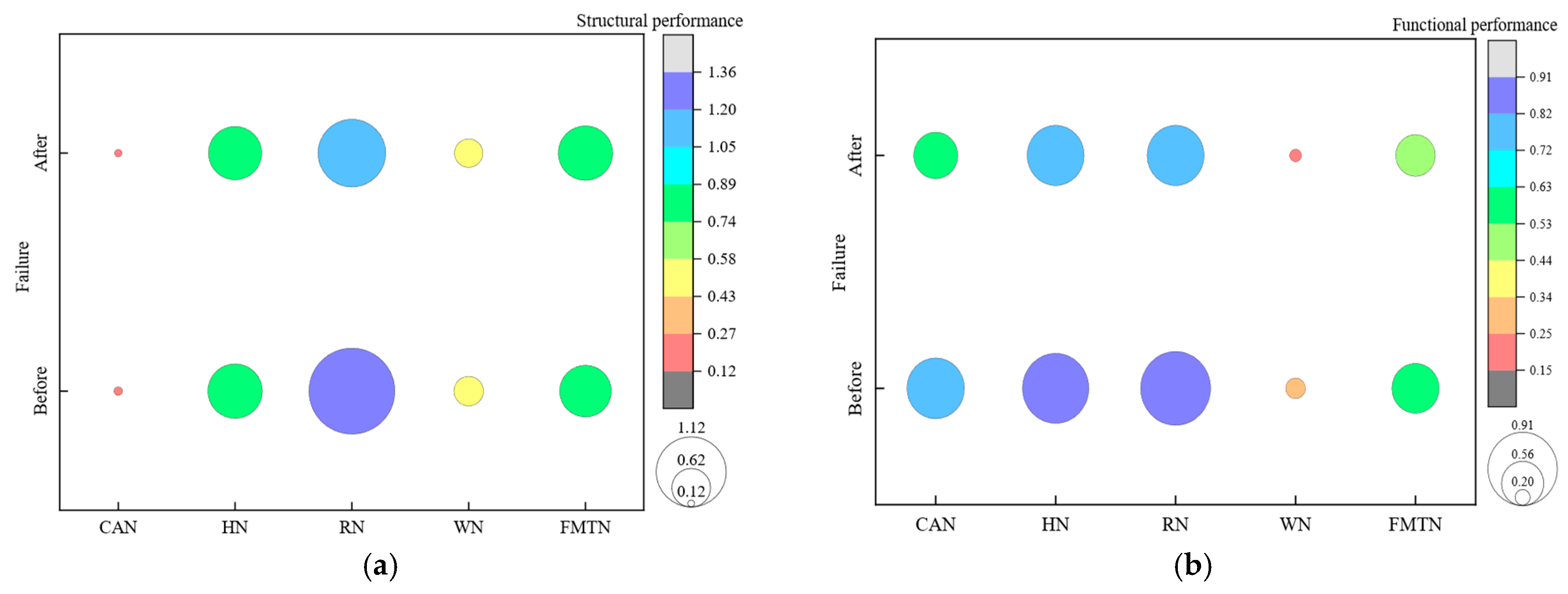
Figure 18 shows the structural and functional performance of FMTN and sub-networks.
As can be seen in Figure 18a, the structural performance of sub-networks shows a decreasing trend, especially that of RN, which is more significant, with a decrease of 0.3. This phenomenon suggests that RN, due to its network decentralized structure, is more susceptible to path disruption under typhoon disturbance, which leads to a significant decrease in its connectivity. In contrast, the FMTN structural performance shows a marginal rise. This indicates that it is able to quickly adjust paths under disturbance by integrating multiple transportation modes and maintain network connectivity using redundant paths, thus showing greater resistance capacity. In Figure 18b, the functional performance of both FMTN and the sub-networks shows a decreasing trend, while the FMTN functional performance shows the smallest decrease of 0.1. It shows that its functional performance is significantly better than the sub-networks. Multiple transportation modes enhance the functional buffering capacity of the network. The failure of key nodes or lines will not directly lead to the paralysis of the overall function, reflecting stronger resistance and stability.
The variation in the resilience ratio of FMTN and sub-networks are shown in Figure 19. As can be seen in Figure 19, FMTN shows a significant resilience advantage under typhoon disturbance, with a resilience ratio of 0.95 and a decrease of only 0.05, which is much lower than that of the sub-networks (which are all above 0.14). This phenomenon indicates that FMTN has a strong resilience and recovery ability in the face of typhoon disturbances. The connection points between sub-networks provide nodes for mode conversion so that the network can quickly adapt to disturbances. CAN has the largest decrease in the resilience ratio, reaching 0.21, indicating that it is the most significantly affected by typhoon. The decline in RN is close to 0.2, suggesting that, among the node cities affected by Typhoon Bebinca, some occupy critical positions in the network, and the typhoon may have caused damage to rail lines, rendering some paths in the network unusable. WN has a decrease of 0.16, indicating that it is also sensitive to typhoon disturbance, particularly when it comes to increased vulnerability to path disruptions and the ability to recover effectively. The decrease in HN is 0.14, indicating that although HN has certain redundancy, it is still greatly affected by ground traffic congestion and node failure.
The variation in the values of the resilience metrics mentioned above further validate the comprehensive advantages of FMTN under typhoon disturbances. By integrating multiple transportation modes, FMTN effectively disperses the risks posed by typhoons, thereby demonstrating greater resistance and performance stability in terms of structure and function. This result is highly consistent with the conclusion of the simulated typhoon scenarios in Section 4.1, which further confirms the important value of FMTN under disaster weather conditions. At the same time, it also reveals the potential direction of resilience improvement, that is, to enhance network redundancy by building alternative channels, to develop multimodal transportation hubs to promote diversification, and to optimize network structure to enhance modularity.

5. Conclusions and Recommendations

Typhoons are the main natural disaster disturbance sources for FMTN operation in coastal area urban agglomerations. The node failures and link interruptions caused by typhoon directly affect the stability and sustainability of regional logistics transportation. Scientifically assessing the anti-disturbance ability of the network is the core issue to ensure the sustainable development of the comprehensive regional transportation system. To this purpose, a resilience assessment method for coastal area urban agglomerations, FMTN, is proposed under typhoon disturbances by comprehensively considering the network structural performance and functional performance metrics. The Spatial Local Failure model combined with the Monte Carlo method is employed to simulate typhoon disturbance scenarios of varying intensities, and the model’s validity is confirmed through the empirical case of Typhoon Bebinca. This analysis systematically reveals the differences in resilience performance between FMTN and its sub-networks under typhoon disturbances, as well as the underlying mechanisms. The key findings of this study are summarized below.
(1)
The resilience assessment method introduced in this study effectively captures and assesses the operational status of the network. From the two dimensions of structure and function, the tightness, betweenness centrality, shortest path length, node saturation, transportation efficiency and service timeliness metrics are selected, respectively, and a scientific and reasonable method is used to assign weights to each metric and construct resilience function. The resilience ratio metric is also used to assess network resilience. Under the simulated typhoon disturbance scenarios, this metric uniformly quantifies the network resilience against such disturbances and can reveal the overall failure pattern of the network that is difficult to reflect on by a single-dimensional analysis. It can provide a more practical theoretical basis and evaluation method for disaster prevention and mitigation of FMTN.
(2)
FMTN in coastal area urban agglomerations serves as the core carrier for ensuring the sustainable operation of regional transportation and logistics systems, and its resilience is significantly better than sub-networks. Under typhoon disturbances of varying intensities, the structural performance, functional performance, and resilience metrics of FMTN vary significantly less than its sub-networks. Its resilience advantage stems from the synergistic effect of redundancy, diversity, and modularity. Due to the lack of synergy of the above characteristics, the sub-networks are more sensitive to typhoon disturbances, especially CAN and WN, and their resilience decreases sharply with the increase in wind speed. Therefore, particular attention should be devoted to the resilience of CAN and WN when addressing typhoon impacts.
(3)
The empirical findings from Typhoon Bebinca closely align with this study simulation results. Specifically, under T3-grade typhoon disturbances, the simulation data show that the FMTN resilience ratio is 0.87 (a 0.13 decrease), showing markedly better performance than the sub-networks, whose decrease exceeds 0.20. In the typhoon case, the FMTN resilience ratio only decreases by 0.05, which is also significantly lower than the decreases of more than 0.14 in the sub-networks. This result fully shows that FMTN has stronger anti-disturbance ability under disasters. The accuracy and practicability of the resilience assessment method proposed in this study are further verified so as to provide a scientific basis for improving FMTN resilience.
To enhance the typhoon disturbance resistance of FMTN in coastal area urban agglomerations and ensure the sustainable development of regional transportation and logistics systems, this study proposes the following recommendations based on mechanisms such as redundancy and diversity.
Firstly, priority should be given to upgrading the wind resistance ratings of typhoon-sensitive hub airports and ports in cities such as Fuzhou, Shanghai, and Ningbo. Planning backup distribution nodes around core hubs and equipping them with redundant operational facilities is recommended, while optimizing transportation connection facilities at transfer hubs such as Quanzhou and Nanjing. Secondly, by integrating the regional characteristics of typhoons, short-distance road-rail alternative corridors should be established in typhoon-prone areas such as the Western Taiwan Straits Economic Zone. In the Yangtze River Delta, a three-dimensional backup route network involving water, land, and air transportation can be constructed. Furthermore, using the resilience assessment method developed in this study as a tool, regular network robustness assessment should be conducted. The results can be integrated into the decision-making system for transportation infrastructure planning and investment. This enables the precise and scientific advancement of disaster prevention and mitigation efforts.
However, there are some shortcomings in this study. This provides directions for improvements in future work.
First of all, this study has some simplifications in network modeling and failure rules. In this study, if multiple nodes of the same type exist within a city, the failure of a single city-level node in the model is equivalent to the failure of all such nodes in that city. This approach overestimates the vulnerability of the network to some extent. Subsequent research can further refine the internal node structure of the city. At the same time, the component failure model can be further refined to distinguish the failure modes of nodes and edges in the same region.
Secondly, the typhoon disturbance scenarios and the resilience assessment dimension still need to be improved. The current simulation takes wind speed as the core factor, without considering the spatial attenuation effect of the typhoon path. There is a gap between the spatial and temporal distribution of the disturbance and the actual typhoon disaster. Moreover, this study focuses on the damage and resistance stage of network resilience, and does not involve the post-disaster recovery stage. Future research should include constraints such as repair resources, establish a recovery model, and apply intelligent optimization algorithms to solve the model.
Overall, this study provides a basic framework for the typhoon resilience assessment of FMTN. By refining the node structure, optimizing the failure mechanism, restoring the disaster scene, and improving the recovery process, the authenticity and evaluation reliability of the model can be further improved. Furthermore, it provides stronger support for disaster prevention and mitigation and emergency decision-making, steering regional transportation systems towards greater sustainability.


Author Contributions

Conceptualization, X.Z., R.B., F.X. and C.R.; methodology, X.Z., R.B. and F.X.; data curation, X.Z. and R.B.; writing—original draft preparation, X.Z. and R.B.; writing—review and editing, X.Z., R.B., F.X. and C.R.; visualization, R.B.; supervision, X.Z. and F.X.; funding acquisition, X.Z. All authors have read and agreed to the published version of the manuscript.

Funding

This research was funded by the Shaanxi Provincial Social Science Foundation Program (2024D029).

Institutional Review Board Statement

Not applicable.

Informed Consent Statement

Not applicable.

Data Availability Statement

The data that support the findings of this study are available from the corresponding author upon reasonable request.

Conflicts of Interest

The authors declare no conflicts of interest.

References

  1. Guo, J.; Du, Q.; He, Z. A method to improve the resilience of multimodal transport network: Location selection strategy of emergency rescue facilities. Comput. Ind. Eng. 2021, 161, 107678. [Google Scholar] [CrossRef]
  2. Gonçalves, L.; Ribeiro, P.J.G. Resilience of urban transportation systems. Concept, characteristics, and methods. J. Transp. Geogr. 2020, 85, 102727. [Google Scholar] [CrossRef]
  3. Ministry of Emergency Management of China. Release of the National Natural Disasters in 2025 Report. 16 January 2026. Available online: https://www.mem.gov.cn/xw/yjglbgzdt/202601/t20260116_592135.shtml (accessed on 10 February 2026).
  4. Takagi, H.; Yi, X.; Fan, J. Public perception of typhoon signals and response in Macau: Did disaster response improve between the 2017 Hato and 2018 Mangkhut typhoons? Georisk Assess. Manag. Risk Eng. Syst. Geohazards 2021, 15, 76–82. [Google Scholar] [CrossRef]
  5. Holling, C.S. Resilience and stability of ecological systems. Annu. Rev. Ecol. Syst. 1973, 4, 1–23. [Google Scholar] [CrossRef]
  6. Azolin, L.G.; Silva, A.N.R.d.; Pinto, N. Incorporating public transport in a methodology for assessing resilience in urban mobility. Transp. Res. Part D 2020, 85, 102386. [Google Scholar] [CrossRef]
  7. Martin, B.; Ortega, E.; Cuevas-wizner, R.; Ledda, A.; De Montis, A. Assessing Road network resilience: An accessibility comparative analysis. Transp. Res. Part D 2021, 95, 102851. [Google Scholar] [CrossRef]
  8. Xiao, Y.; Zhao, X.; Wu, Y.; Chen, Z.; Gong, H.; Zhu, L.; Liu, Y. Seismic resilience assessment of urban interdependent lifeline networks. Reliab. Eng. Syst. Saf. 2022, 218, 108164. [Google Scholar] [CrossRef]
  9. Tang, J.; Heinimann, H.; Han, K.; Luo, H.; Zhong, B. Evaluating resilience in urban transportation systems for sustainability: A systems-based Bayesian network model. Transp. Res. Part C 2020, 121, 102840. [Google Scholar] [CrossRef]
  10. Bai, X.; Ma, Z.; Zhou, Y. Data-driven static and dynamic resilience assessment of the global liner shipping network. Transp. Res. Part E 2023, 170, 103016. [Google Scholar] [CrossRef]
  11. Di Gangi, M.; Belcore, O.M.; Polimeni, A. Resilience Indicators for a Road Transport Network to Access Emergency Health Services. Sustainability 2026, 18, 27. [Google Scholar] [CrossRef]
  12. Liu, H.; Tian, Z.; Huang, A.; Yang, Z. Analysis of vulnerabilities in maritime supply chains. Reliab. Eng. Syst. Saf. 2018, 169, 475–484. [Google Scholar] [CrossRef]
  13. Wu, D.; Wang, N.; Yu, A.; Wu, N. Vulnerability analysis of global container shipping liner network based on main channel disruption. Marit. Policy Manag. 2019, 46, 394–409. [Google Scholar] [CrossRef]
  14. Xu, X.; Zhu, Y.; Xu, M.; Deng, W.; Zuo, Y. Vulnerability analysis of the global liner shipping network: From static structure to cascading failure dynamics. Ocean Coast. Manag. 2022, 229, 106325. [Google Scholar] [CrossRef]
  15. Liu, Q.; Yang, Y.; Ng, A.K.Y.; Jang, C. An analysis on the resilience of the European port network. Transp. Res. Part A 2023, 175, 103778. [Google Scholar] [CrossRef]
  16. Adjetey-Bahun, K.; Birregah, B.; Châtelet, E.; Planchet, J.L. A model to quantify the resilience of mass railway transportation systems. Reliab. Eng. Syst. Saf. 2016, 153, 1–14. [Google Scholar] [CrossRef]
  17. Ip, W.H.; Wang, D. Resilience and friability of transportation networks: Evaluation, analysis and optimization. IEEE Syst. J. 2011, 5, 189–198. [Google Scholar] [CrossRef]
  18. Poo, M.C.P.; Yang, Z. Optimising the resilience of shipping networks to climate vulnerability. Marit. Policy Manag. 2022, 51, 15–34. [Google Scholar] [CrossRef] [PubMed]
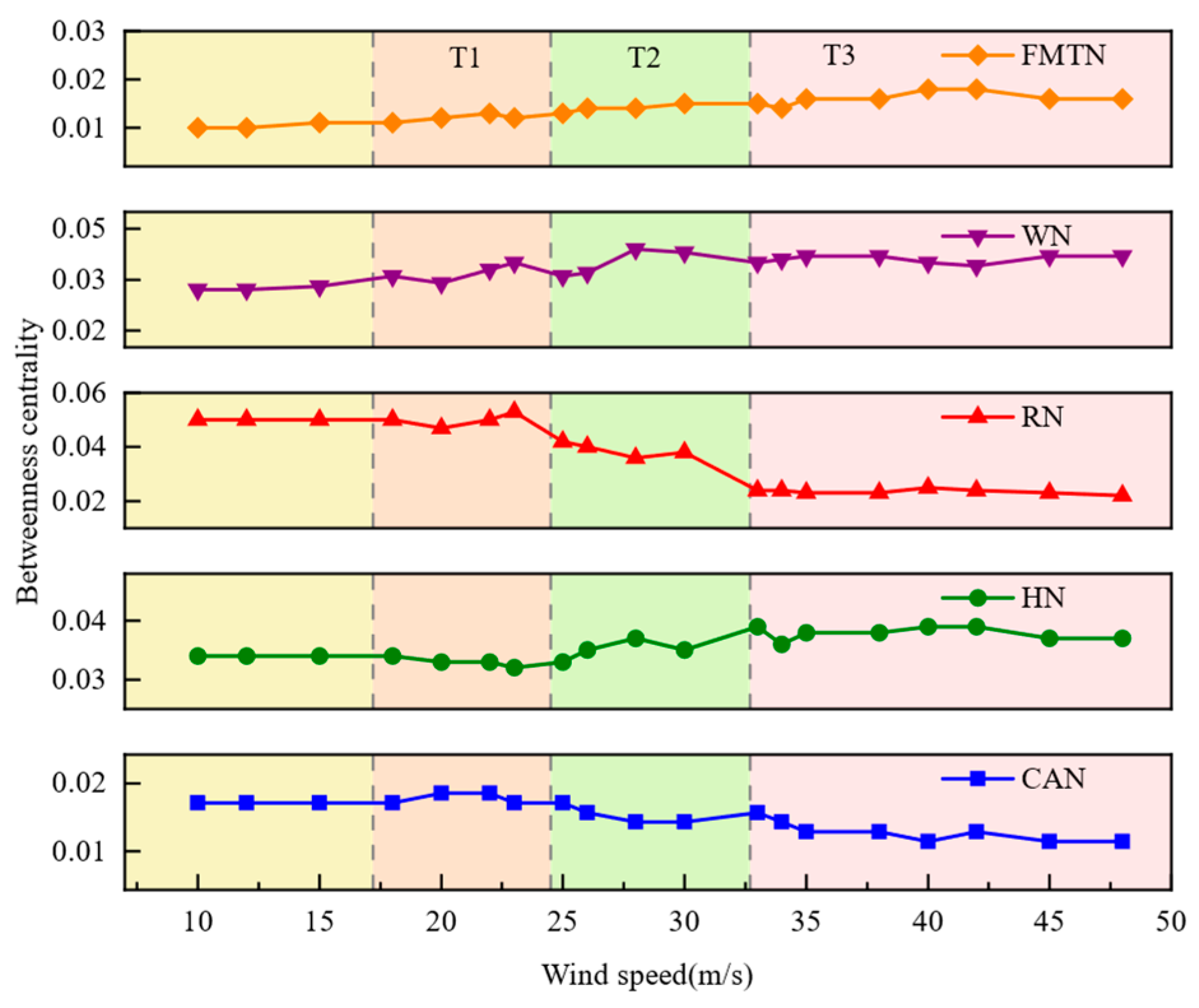
  19. Verschuur, J.; Koks, E.; Hall, J. Port disruptions due to natural disasters: Insights into port and logistics resilience. Transp. Res. Part D 2020, 85, 102393. [Google Scholar] [CrossRef]
  20. Wan, C.; Tao, J.; Yang, Z.; Zhang, L. Evaluating recovery strategies for the disruptions in liner shipping networks: A resilience approach. Int. J. Logist. Manag. 2022, 33, 389–409. [Google Scholar] [CrossRef]
  21. Shao, Z.G.; Wang, A.Q.; Li, C.; Li, Z.H.; Liu, K.X. Evaluation of the Structural Resilience of Multi-Mode Transportation Networks in Metropolitan Areas: A Case Study of the Jinan Metropolitan Area, China. Sustainability 2025, 17, 10528. [Google Scholar] [CrossRef]
  22. Wang, J.; Liao, F.; Wu, J.; Sun, H.; Wang, W.; Gao, Z. Measurement of functional resilience of transport network: The case of the Beijing subway network. Transp. Policy 2023, 140, 54–67. [Google Scholar] [CrossRef]
  23. Tang, J.; Xu, L.; Luo, C.; Ng, T.S.A. Multi-disruption resilience assessment of rail transit systems with optimized commuter flows. Reliab. Eng. Syst. Saf. 2021, 214, 107715. [Google Scholar] [CrossRef]
  24. Qin, Y.; Guo, J.; Liang, M.; Feng, T. Resilience characteristics of port nodes from the perspective of shipping network: Empirical evidence from China. Ocean Coast. Manag. 2023, 237, 106531. [Google Scholar] [CrossRef]
  25. Chen, Y.; Wang, X.; Song, X.; Jia, J.; Chen, Y.; Shang, W. Resilience Assessment of Multimodal Urban Transport Networks. J. Circuits. Syst. Comput. 2022, 31, 2250310. [Google Scholar] [CrossRef]
  26. Chen, X.; Ma, S.; Chen, L.; Yang, L. Resilience measurement and analysis of intercity public transportation network. Transp. Res. Part D 2024, 131, 104202. [Google Scholar] [CrossRef]
  27. Liu, Z.; Chen, H.; Liu, E.; Zhang, Q. Evaluating the dynamic resilience of the multimode public transit network for sustainable transport. J. Clean. Prod. 2022, 348, 131350. [Google Scholar] [CrossRef]
  28. Chen, L.; Miller-Hooks, E. Resilience: A metric of recovery capability in intermodal freight transport. Transp. Sci. 2012, 46, 109–123. [Google Scholar] [CrossRef]
  29. Fan, D.; Sun, B.; Dui, H.; Zhong, J.; Wang, Z.; Ren, Y.; Wang, Z. A modified connectivity link addition strategy to improve the resilience of multiplex networks against attacks. Reliab. Eng. Syst. Saf. 2022, 221, 108294. [Google Scholar] [CrossRef]
  30. Calatayud, A.; Mangan, J.; Palacin, R. Vulnerability of international freight flows to shipping network disruptions: A multiplex network perspective. Transp. Res. Part E 2017, 108, 195–208. [Google Scholar] [CrossRef]
  31. Aparicio, J.T.; Arsenio, E.; Santos, F.C.; Henriques, R. Lines: Multimodal transportation resilience analysis. Sustainability 2022, 14, 7891. [Google Scholar] [CrossRef]
  32. Fang, C.; Chu, Y.; Fu, H.; Fang, Y. On the resilience assessment of complementary transportation networks under natural hazards. Transp. Res. Part D 2022, 109, 103331. [Google Scholar] [CrossRef]
  33. Zhang, H.; Xu, M.; Ouyang, M. A multi-perspective functionality loss assessment of coupled railway and airline systems under extreme events. Reliab. Eng. Syst. Saf. 2024, 243, 109831. [Google Scholar] [CrossRef]
  34. Chen, D.; Cai, Z.H.; Wu, H.; Guo, C. Review of distribution network’s resilience based on typhoon disaster. Sci. Direct 2022, 8, 876–888. [Google Scholar] [CrossRef]
  35. Wan, C.; Yuan, J.; Gao, D.; Wang, T.; Ng, A.K.Y. A fuzzy evidential reasoning-based model for evaluating resilience of ports to typhoons. Transp. Res. Part D 2024, 133, 104228. [Google Scholar] [CrossRef]
  36. Qiang, Y.; Xu, J. Empirical assessment of road network resilience in natural hazards using crowd sourced traffic data. Int. J. Geogr. Inf. Sci. 2020, 34, 2434–2450. [Google Scholar] [CrossRef]
  37. Dong, S.; Gao, X.; Mostafavi, A.; Gao, J.; Utkarsh, G. Characterizing resilience of flood-disrupted dynamic transportation network through the lens of link reliability and stability. Reliab. Eng. Syst. Saf. 2023, 232, 109071. [Google Scholar] [CrossRef]
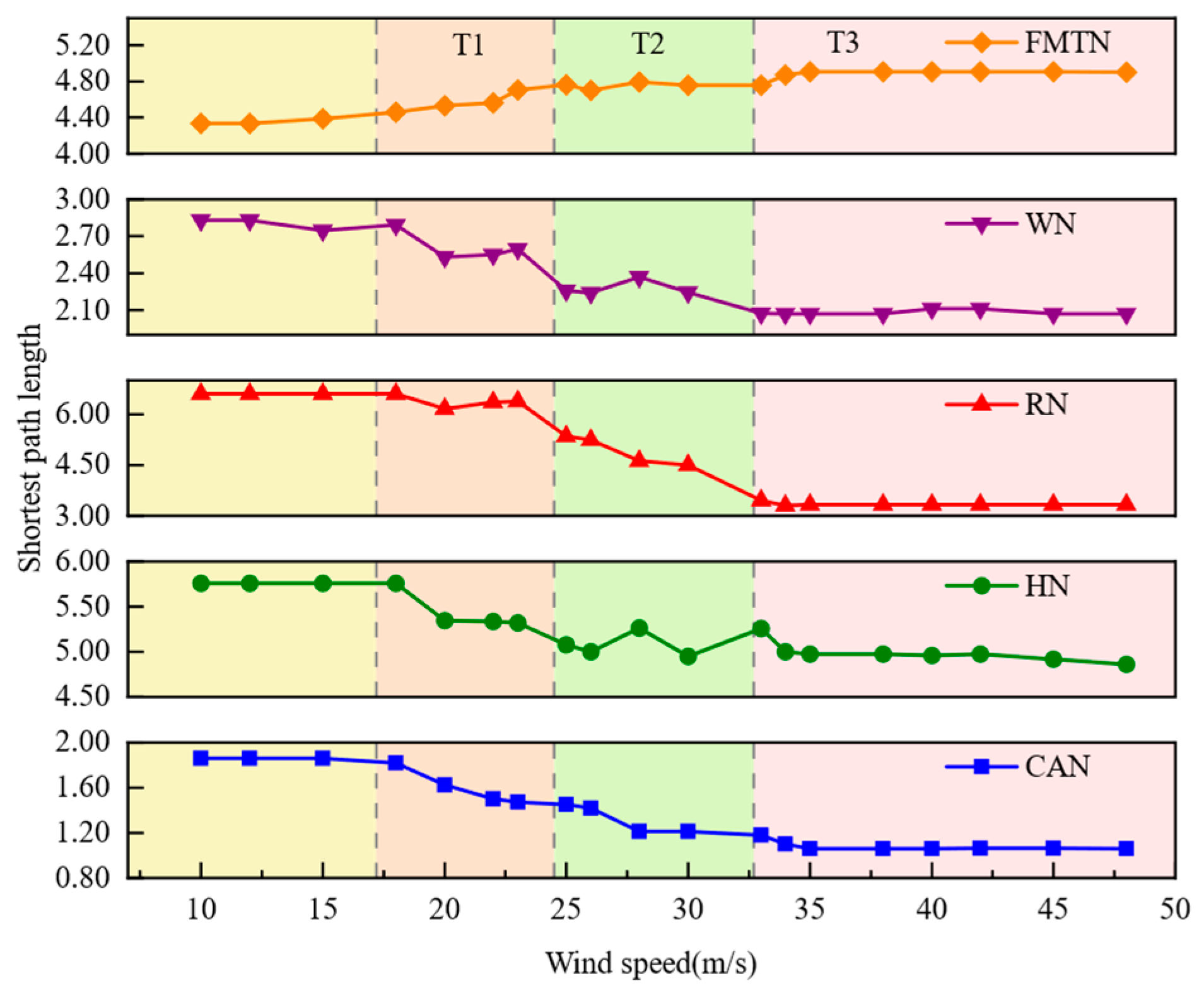
  38. Chen, J.; Liang, C.; Liu, J.; Du, B.; Yin, Y.; Peng, Q. Resilience assessment of a highway-railway complementary network under rainstorms. Transp. Res. Part D 2023, 121, 103841. [Google Scholar] [CrossRef]
  39. Huang, L.; Liu, Z.G.; Yu, C.C.; Yan, B. Resilience-Oriented Recovery Optimization of Metro Systems Under Extreme Rainfall-Induced Urban Flooding Disruptions. Sustainability 2026, 18, 2597. [Google Scholar] [CrossRef]
  40. Zhu, T.L.; Li, H.; Wu, Y.X.; Jiang, Y.Z.; Pan, J.; Dai, Z.H. Resilience Assessment of Urban Bus–Metro Hybrid Networks in Flood Disasters: A Case Study of Zhengzhou, China. Sustainability 2025, 17, 4591. [Google Scholar] [CrossRef]
  41. Der Sarkissian, R.; Abdallah, C.; Zaninetti, J.M.; Najem, S. Modelling intra-dependencies to assess road network resilience to natural hazards. Nat. Hazards 2020, 103, 121–137. [Google Scholar] [CrossRef]
  42. Aghababaei, M.T.S.; Costello, S.B.; Ranjitkar, P. Measures to evaluate post-disaster trip resilience on road networks. J. Transp. Geogr. 2021, 95, 103154. [Google Scholar] [CrossRef]
  43. Misra, S.; Padgett, J.E. Estimating extreme event resilience of rail-truck intermodal freight networks: Methods, models, and case study application. J. Infrastruct. Syst. 2022, 28, 04022013. [Google Scholar] [CrossRef]
  44. Misra, S. Seismic Resilience of Rail-Truck Intermodal Freight Transportation Networks. Ph.D. Thesis, Department of Civil and Environmental Engineering, Rice University, Houston, TX, USA, 2020. [Google Scholar]
  45. Alkhaldi, T. Modeling the Resilience of Multimodal Rural Freight Corridors: An Integrated Area-Based and Link-Based Framework. Master’s Thesis, University of Idaho, Moscow, ID, USA, 2023. [Google Scholar]
  46. Ma, X. Evolution of Urban Logistics Network Structure Based on Complex Network Theory Research—Take the Yangtze River Delta as an Example. Master’s Thesis, Beijing University of Civil Engineering and Architecture, Beijing, China, 2022. [Google Scholar]
  47. Tu, J.; Wang, J.; Wang, S. The internal and external relations and spatial structure heterogeneity of the three major urban agglomerations in the Yangtze River Economic Belt: From the perspective of railway passenger transport big data. World Reg. Stud. 2024, 33, 89–102. [Google Scholar]
  48. Mu, N.; Kang, Q. Measurement of urban express network invulnerability based on node importance network structure entropy. China Transp. Rev. 2020, 42, 108–113. [Google Scholar] [CrossRef]
  49. Wang, N.; Wu, M.; Yuen, K. A novel method to assess urban multimodal transportation system resilience considering passenger demand and infrastructure supply. Reliab. Eng. Syst. Saf. 2023, 238, 109478. [Google Scholar] [CrossRef]
  50. Testa, A.C.; Furtado, M.N.; Alipour, A. Resilience of coastal transportation networks faced with extreme climatic events. Transp. Res. Rec. 2015, 2532, 29–36. [Google Scholar] [CrossRef]
  51. Cao, Y.; Xin, X.; Pisit, J.; Li, H.; Feng, Y.; Wang, J.; Wang, X.; Pyne, R.; Yang, Z. Data-driven resilience analysis of the global container shipping network against two cascading failures. Transp. Res. Part E 2025, 193, 103857. [Google Scholar] [CrossRef]
  52. Ma, W.; Lin, S.; Ci, Y.; Li, R. Resilience evaluation and improvement of post-disaster multimodal transportation networks. Transp. Res. Part A 2024, 189, 104243. [Google Scholar] [CrossRef]
  53. Li, T.; Qin, Y.; Xu, M.; Zhou, Y.; Rong, L. Spatio-temporal vulnerability of high-speed rail line network in China. Transp. Res. Part D 2024, 134, 104338. [Google Scholar] [CrossRef]
  54. Fang, Y.; Fang, C.; Zio, E.; Xie, M. Resilient critical infrastructure planning under disruptions considering recovery scheduling. IEEE Trans. Eng. Manag. 2019, 68, 452–466. [Google Scholar] [CrossRef]
  55. Ouyang, M.; Tian, H.; Wang, Z.; Hong, L.; Mao, Z. Critical infrastructure vulnerability to spatially localized failures with applications to Chinese railway system. Risk Anal. 2019, 39, 180–194. [Google Scholar] [CrossRef]
  56. Panteli, M.; Mancarella, P. Modeling and evaluating the resilience of critical electrical power infrastructure to extreme weather events. IEEE Syst. J. 2015, 11, 1733–1742. [Google Scholar] [CrossRef]
  57. MH/T 3011.18-2006; The Civil Aviation Industry Standard of China. Civil Aviation Administration of China: Beijing, China, 2006.
  58. JT/T 916-2014; The Specification for Emergency Management of Expressway Traffic. Ministry of Transport of the People’s Republic of China: Beijing, China, 2014.
Figure 1. Framework for assessing FMTN resilience under typhoon disturbances.
Sustainability 18 03271 g001
Figure 2. District-based SLF.
Sustainability 18 03271 g002
Figure 3. FMTN and sub-networks. (a) Civil aviation network; (b) highway network; (c) railway network; (d) waterway network; (e) freight multimodal transportation network.
Sustainability 18 03271 g003
Figure 4. Fragility curves of components under typhoons.
Sustainability 18 03271 g004
Figure 5. Distribution of typhoon hazards in coastal area urban agglomerations, 2001–2024.
Sustainability 18 03271 g005
Figure 6. Tightness.
Sustainability 18 03271 g006
Figure 7. Betweenness centrality.
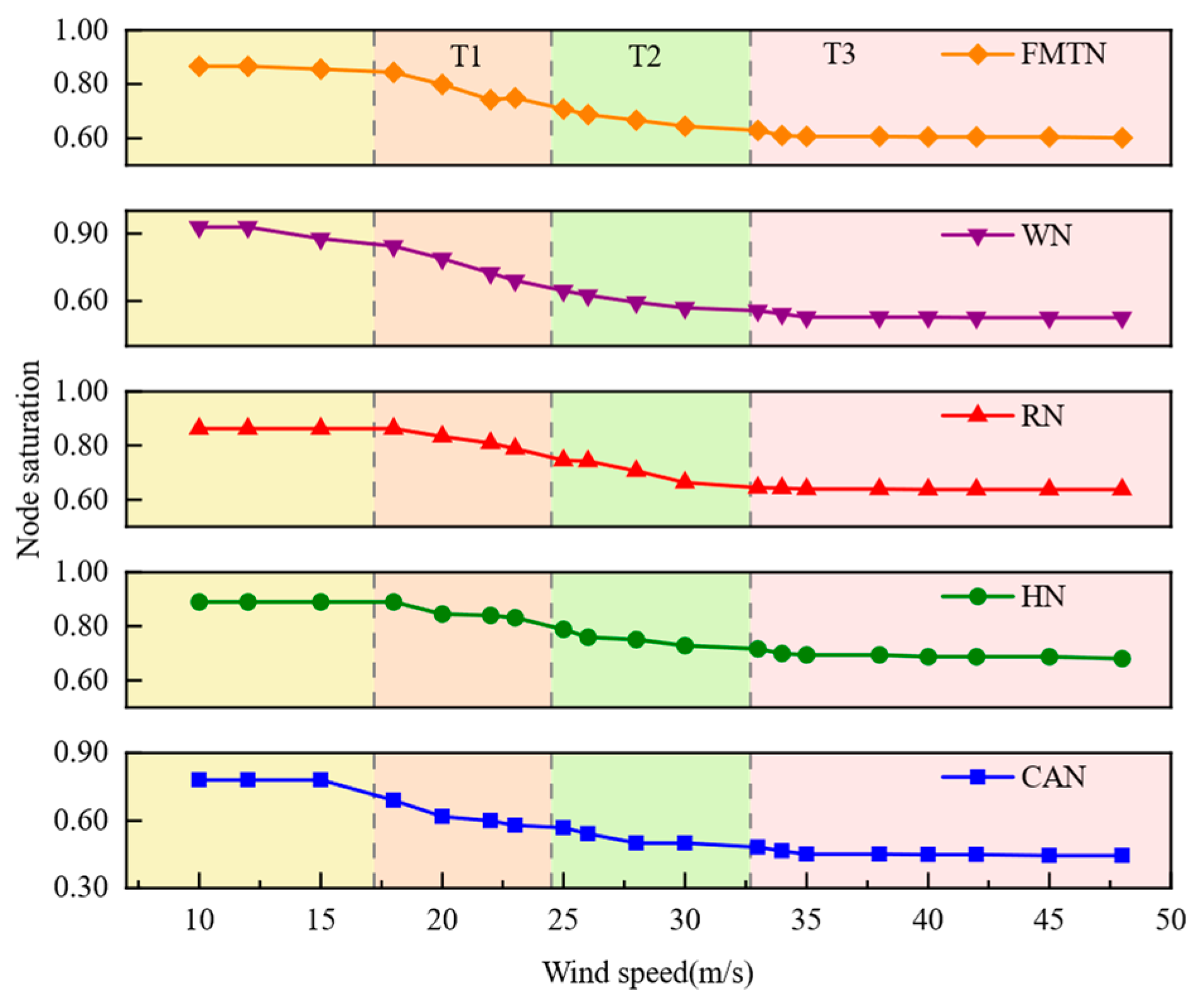
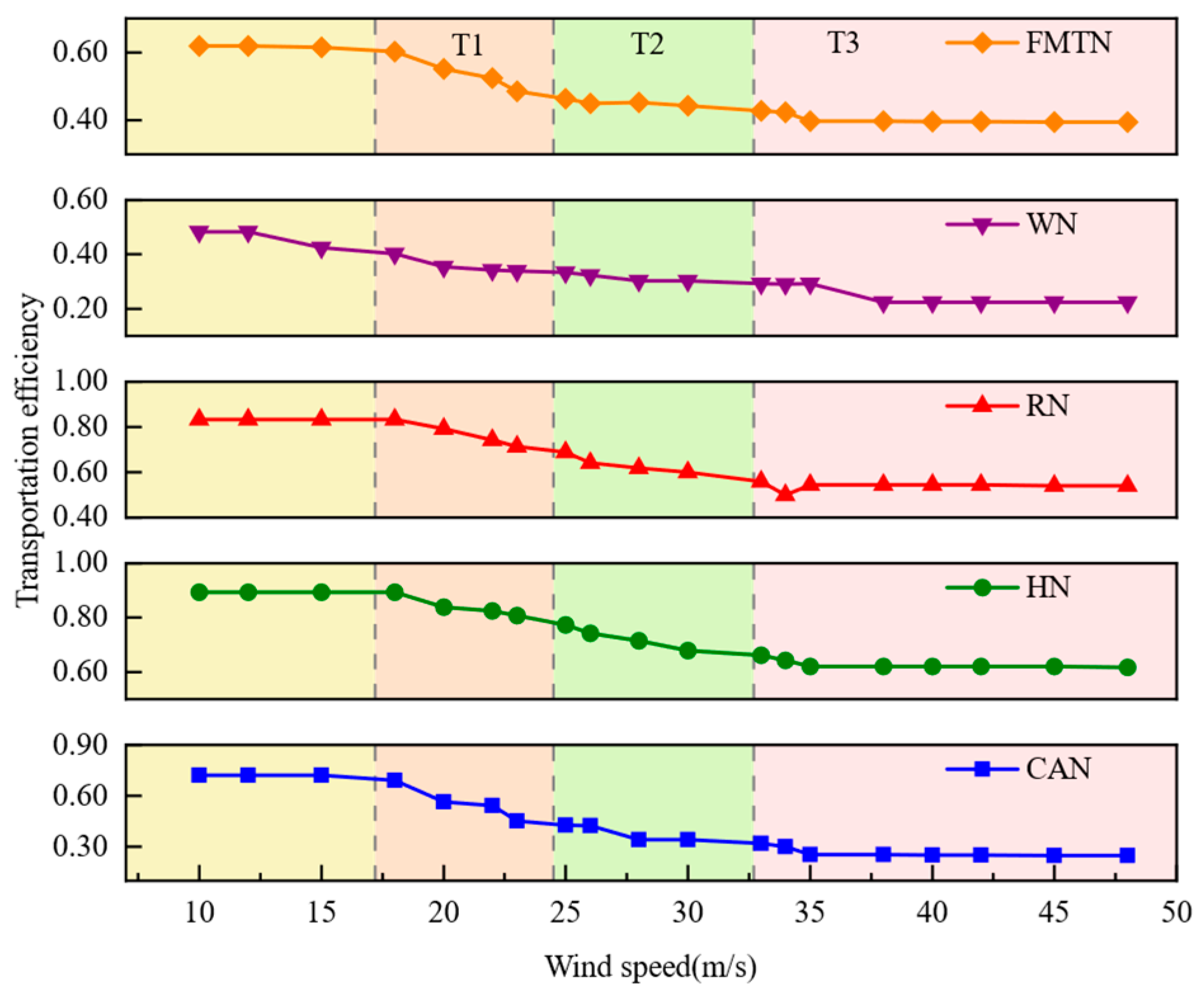
Sustainability 18 03271 g007
Figure 8. Shortest path length.
Sustainability 18 03271 g008
Figure 9. Structural performance.
Sustainability 18 03271 g009
Figure 10. Node saturation.
Sustainability 18 03271 g010
Figure 11. Transportation efficiency.
Sustainability 18 03271 g011
Figure 12. Service timeliness.
Sustainability 18 03271 g012
Figure 13. Functional performance.
Sustainability 18 03271 g013
Figure 14. The different weight values of each metric under CV and EW methods.
Sustainability 18 03271 g014
Figure 15. Resilience ratio. (a) The threshold of 0.90. (b) The threshold of 0.80.
Sustainability 18 03271 g015
Figure 16. Structural performance metric. (a) Tightness. (b) Betweenness centrality. (c) Shortest path length.
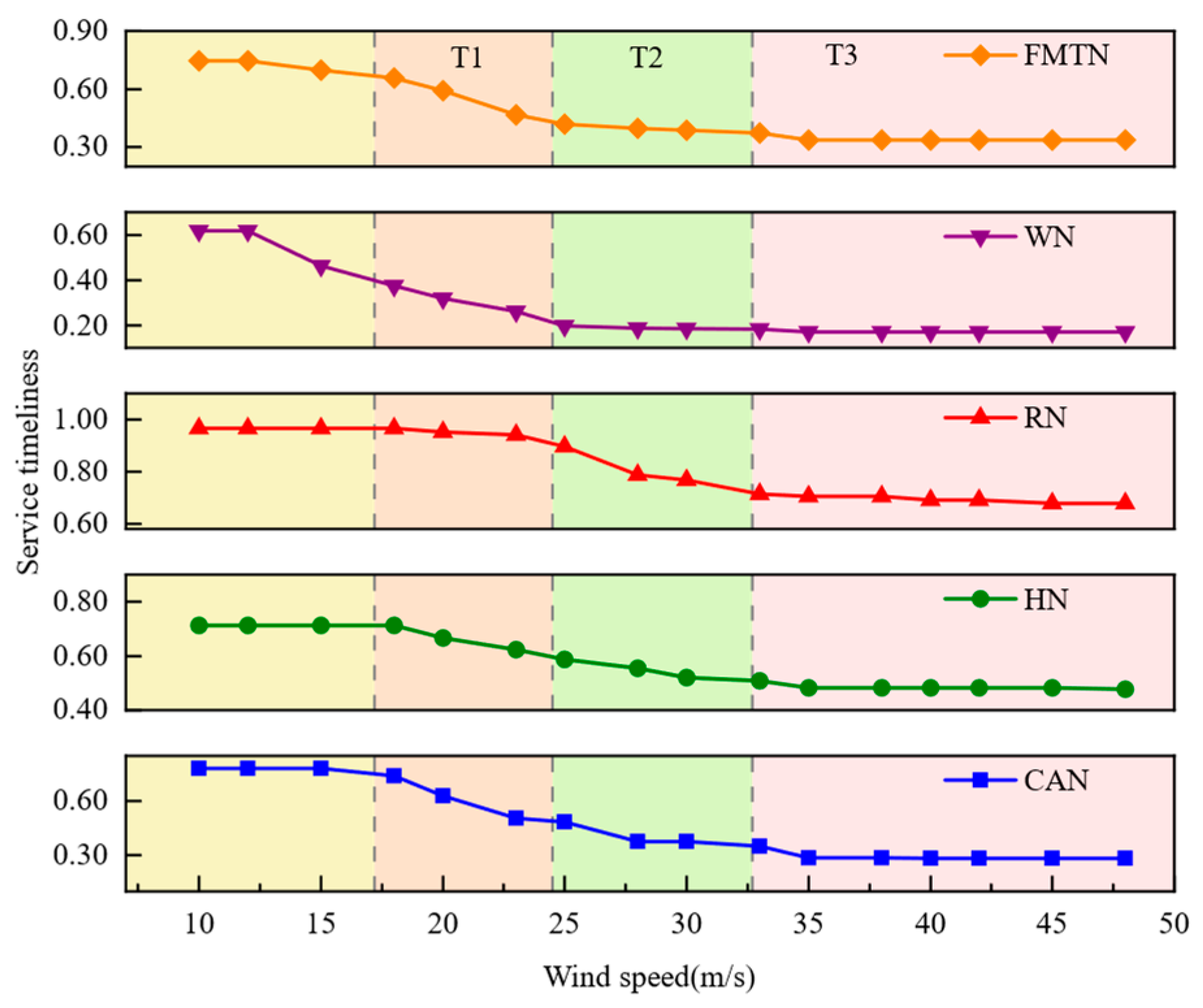
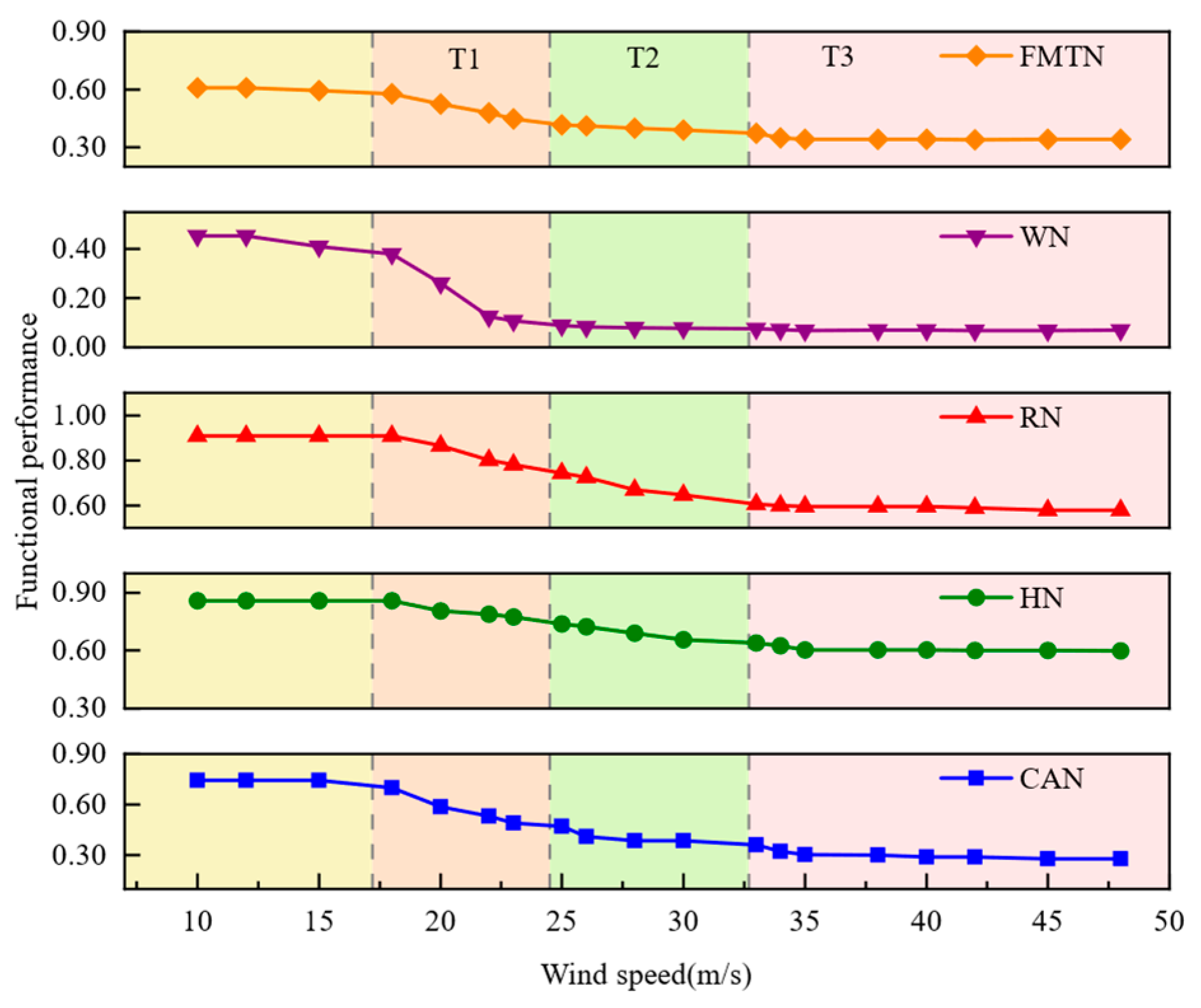
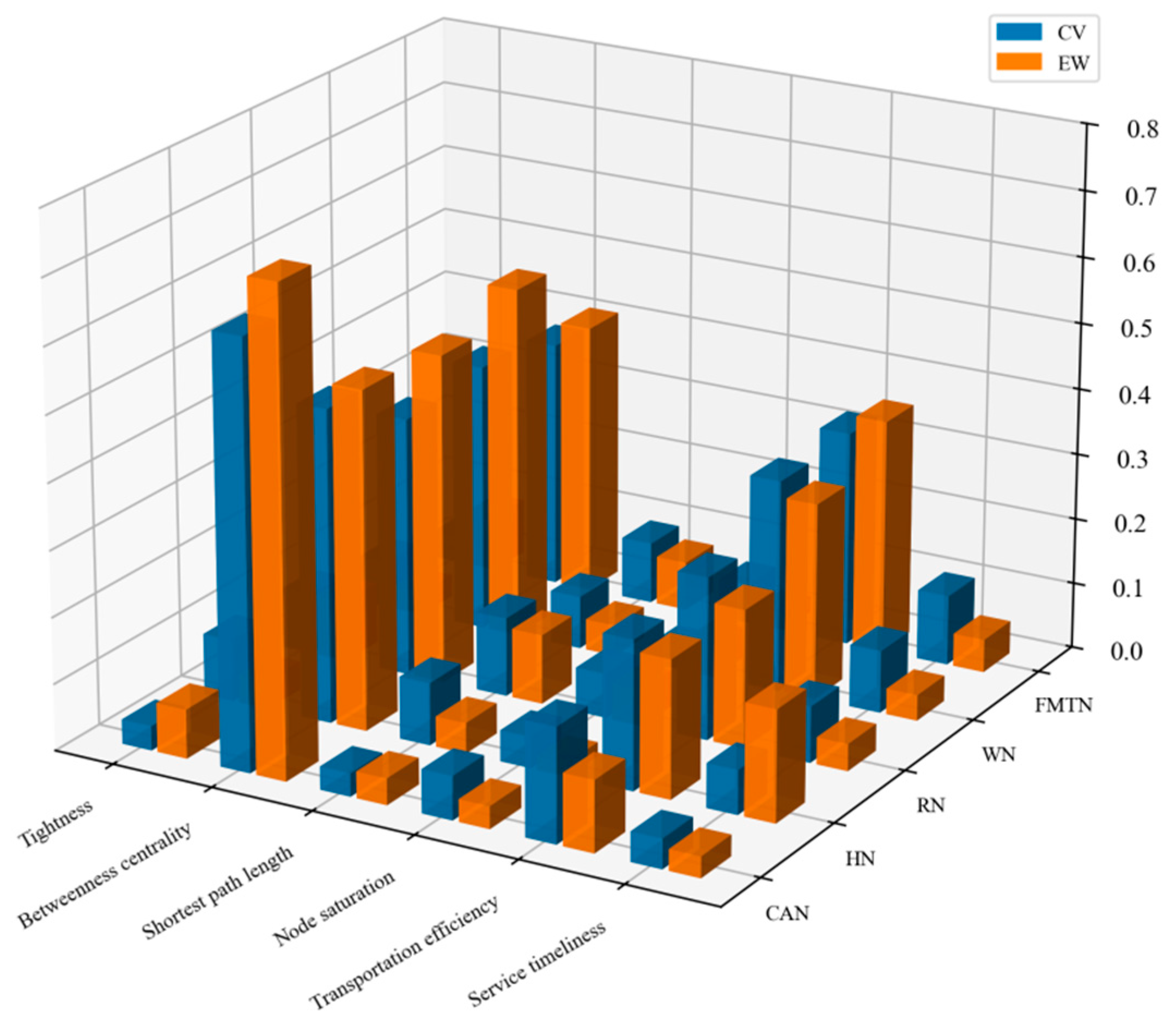
Sustainability 18 03271 g016
Figure 17. Functional performance metric. (a) Node saturation. (b) Transportation efficiency. (c) Service timeliness.
Sustainability 18 03271 g017
Figure 18. Structural and functional performance. (a) Structural performance. (b) Functional performance.
Sustainability 18 03271 g018
Figure 19. Resilience ratio.
Sustainability 18 03271 g019
Table 1. Basic topological characteristics of FMTN and sub-networks.
G G 0 G 1 G 2 G 3
Number of nodes337.0050.00129.0088.0070.00
Number of edges1163.00260.00222.00111.00364.00
Average degree6.9010.403.442.5210.40
Maximum degree78.0042.0011.007.0034.00
Average weighted degree0.130.100.160.090.04
Network diameter9.004.0016.0018.007.00
Map density0.020.210.030.030.15
Average clustering coefficient0.180.650.180.320.42
Average path length4.341.906.247.772.94
Table 2. Typhoon grades and impacts.
GradeWind Speed (m/s)AviationHighwayRailwayWaterway
T117.2–24.4Minor disruptionMinor disruptionNo significant effectSevere disruption
T224.5–32.6Severe disruptionSevere disruptionSpeed limit-StoppingComplete disruption
T3≥32.7Complete disruptionComplete disruptionComplete disruptionComplete disruption
Disclaimer/Publisher’s Note: The statements, opinions and data contained in all publications are solely those of the individual author(s) and contributor(s) and not of MDPI and/or the editor(s). MDPI and/or the editor(s) disclaim responsibility for any injury to people or property resulting from any ideas, methods, instructions or products referred to in the content.