Article

Demystifying Earth Observation Through Co-Creation Pathways for Flood Resilience in Some African Informal Cities

by
Sulaiman Yunus
1,*,
Yusuf Ahmed Yusuf
2,
Murtala Uba Mohammed
1,
Halima Abdulkadir Idris
2,
Abubakar Tanimu Salisu
3,
Freya M. E. Muir
4,5,
Kamil Muhammad Kafi
6 and
Aliyu Salisu Barau
6
1
Department of Geography, Bayero University Kano, Kano 3011, Nigeria
2
Department of Environmental Management, Bayero University Kano, Kano 3011, Nigeria
3
Centre for Dryland Agriculture, Bayero University Kano, Kano 3011, Nigeria
4
Future Earth Secretariat, 114 18 Stockholm, Sweden
5
European Space Agency (ECSAT), Harwell Science & Innovation Campus, Didcot OX11 0FD, UK
6
Department of Urban & Regional Planning, Bayero University Kano, Kano 3011, Nigeria
*
Author to whom correspondence should be addressed.
Sustainability 2026, 18(7), 3266; https://doi.org/10.3390/su18073266
Submission received: 6 January 2026 / Revised: 19 February 2026 / Accepted: 2 March 2026 / Published: 27 March 2026
(This article belongs to the Section Hazards and Sustainability)

Abstract

This study explores how demystifying Earth Observation (EO) through co-creation pathways and local language can enhance flood resilience and environmental governance in African informal cities. Using case studies from Maiduguri and Hadejia, Nigeria, the research employed a transdisciplinary mixed-methods design combining rapid evidence assessment, surveys, participatory workshops (n = 50 stakeholders) integrating simplified Sentinel-1/2 demonstrations, indigenous knowledge mapping, and pre-/post-engagement surveys on EO familiarity. Non-expert participants were trained to interpret satellite data using local language, linking distant teleconnections with local flood experiences. The findings revealed significant gains in EO literacy and improvements in interpretive confidence, gender-inclusive participation, and policy engagement. Localizing the curriculum enabled participants to translate technical EO concepts into locally meaningful narratives, fostering cognitive empowerment and practical application in flood preparedness and advocacy. The study demonstrates that data democratization is not only a matter of open access but also of open understanding. It advances a conceptual model linking Demystification, Literacy, Empowerment, Co-Production and Resilience, positioning EO as a social technology that bridges scientific and indigenous knowledge systems. The findings contribute to debates on decolonizing environmental science and propose a potential participatory framework for integrating EO into community-based adaptation, legal accountability, and policy reform across Africa’s rapidly urbanizing landscapes.

1. Introduction

Flooding ranks among the most frequent and damaging hazards in sub-Saharan Africa, with climate-driven hydrometeorological extremes disproportionately affecting the region [1,2]. Rapid urbanization, weak infrastructure, and informal settlement expansion along riverbanks and floodplains have sharply heightened urban vulnerability [3,4,5]. In Nigeria, the 2022 floods displaced over 1.4 million people and caused hundreds of deaths [6,7]; the 2024 Maiduguri flood, triggered partly by Alau Dam breach, displaced hundreds of thousands, exposed critical gaps in early warning procedures and drainage systems, and compounded risks from infrastructure decay, climate extremes, and social fragility [2,8].
Flooding arises from complex climatic, hydrological, and socio-spatial interactions, and is exacerbated by chronic data gaps and failures to integrate scientific tools into planning and emergency responses [9,10,11]. Recent advances in Earth Observation (EO), through high-resolution imagery, radar-based flood detection, and cloud analytics, enable near-real-time monitoring of rainfall extremes, land-use change, and surface-water dynamics across scales [12,13,14,15]. Globally, EO supports disaster-risk reduction and adaptation through rapid mapping, impact assessment, and anticipatory warnings adopted by governments and humanitarian agencies [16,17]. However, translation of these capabilities into actionable, locally embedded knowledge remains uneven in Africa due to limited technical capacity, fragmented data governance, and digital infrastructure deficits [18,19,20].
Open-access platforms (NASA Earthdata, Copernicus, Digital Earth Africa) have advanced EO democratization [21,22], yet utilization is specialist-dominated, excluding humanitarian actors, legal practitioners, journalists, and communities central to flood governance [18,23]. Engagement is concentrated in academia and government; community-based actors and civil society represent only a small fraction [18,19,24]. This gap is epistemic: specialized terminology, complex formats, and absence of contextual translation reinforce hierarchies that marginalize local and indigenous knowledge [25].
In most African states including Nigeria, expert–non-expert EO literacy disparities create dependence on external interpretations and weaken local flood-risk ownership [26,27,28]. It is generally observed that limited training materials in Hausa, Yoruba, and Igbo, combined with English-dominant interfaces, compound barriers and sustain EO as an elite domain [29,30].
Urban flooding in Africa intertwines informality, fragmented governance, and large-scale environmental teleconnections [31]. Informal settlements, housing over half the urban population, occupy flood-prone lowlands lacking drainage [32,33]. In Maiduguri, 2024 Alau Dam overtopping inundated informal districts and Internally Displaced Persons (IDP) camps [34,35,36]; in Hadejia, upstream irrigation, sedimentation, and altered regimes cause recurrent agricultural losses [10,37,38]. These impacts embed broader teleconnections (climatic anomalies, dam releases, evapotranspiration) that shape downstream intensity [39]. Conventional communication rarely illustrates these linkages, leaving actors uninformed. EO (multispectral and radar imagery) visualizes hidden drivers, yet remains inaccessible to non-experts.
Demystifying EO enables local actors to connect upstream decisions and distant anomalies to immediate flooding, strengthening adaptation and transboundary solidarity. This aligns with socio-hydrological paradigms viewing flood risk as co-produced by human–hydrological interactions [40]. Community interpretation of EO-based teleconnections situates governance in a relational framework. Demystification aligns with knowledge-translation theory, emphasizing iterative engagement to make information comprehensible, culturally resonant, and actionable [41,42,43]. Within flood governance, it reframes EO outputs into narratives and linguistic structures for diverse stakeholders. Participatory, co-designed EO insights strengthen resilience [17,38], yet few studies integrate linguistic inclusivity or legal empowerment [44,45]. This research addresses that gap via local language-based participatory co-creation in Maiduguri and Hadejia. Drawing on co-production, resilience governance, and transdisciplinary practice [39,46], it dismantles epistemic and linguistic barriers. By uniting legal, humanitarian, civil society, and geospatial actors, it repositions EO as lived, collectively owned knowledge.
This aligns with the Sendai Framework [47] and Sustainable Development Goals (SDGs) 11 and 13 by embedding EO in community-driven adaptation. Despite growing participatory EO recognition, challenges persist, namely: limited non-expert literacy evaluation [23,48], scarce teleconnection awareness [49,50,51], linguistic exclusion [52,53], and weak institutional integration. This study operationalizes demystification as participatory, cross-sectoral, and bilingual, to enhance literacy and equitable resilience. Focusing on Maiduguri and Hadejia, it offers comparative insights into EO translation. The study seeks to address the following research questions: (i) What are the differences in Earth Observation (EO) literacy and familiarity levels between expert and non-expert groups in flood-prone African informal cities? (ii) How can indigenous language-based participatory workshops be designed and implemented to demystify EO tools for non-experts in urban flood contexts? (iii) To what extent do participatory demystification workshops improve EO literacy among non-experts, and how do these interventions influence participants’ willingness and confidence to apply EO data in practical flood-related activities, such as early warning or advocacy? (iv) What are the implications of EO demystification through participatory and indigenous language-based approaches for reducing flood vulnerability in African informal settlements? (v) What policy pathways can facilitate the integration of non-expert EO utilization into disaster risk reduction (DRR) frameworks?
The study advances conceptual discourse on EO democratization, provides empirical evidence from the Lake Chad Basin, and bridges science–policy–society interfaces. Transformative governance requires epistemic inclusion: translating EO into accessible, culturally embedded knowledge enables robust, just adaptive responses. Addressing flood vulnerability in African cities demands an interdisciplinary foundation integrating technology, society, and governance. This study draws on four interrelated frameworks: (i) EO democratization and demystification, (ii) teleconnections and socio-hydrological linkages, (iii) resilience and co-production in disaster risk reduction, and (iv) knowledge translation for bridging science, policy, and community practice. Together, they argue that EO must evolve from a technocratic expert tool to a multilingual, participatory socio-technical commons.
EO has transformed governance by providing spatially explicit insights into land use, hydrology, and climate [54,55,56,57]. In Africa, however, it remains confined to elites [23,58]. Demystification makes EO intelligible, contextual, and participatory by simplifying language, translating outputs, and embedding interpretation in social and linguistic realities. Drawing from citizen science and participatory remote sensing, it asserts that democratizing data enhances legitimacy, uptake, and sustainability.
Participatory GIS decentralizes knowledge production by blending local and scientific cartographies [59]. Demystified EO operationalizes this by equipping non-scientists to interpret and apply satellite data, shifting from dissemination to co-creation. It challenges technocratic data ownership [60], redefining value as collective usability and interpretive equity. Demystification is both process (training, translation, dialogue) and outcome (empowered stakeholders using EO independently). It aligns with technological citizenship, granting agency to reinterpret technology socio-politically.
Flood hazards transcend local boundaries, shaped by teleconnected systems in form of large-scale climate and land-use patterns linking distant regions [31]. Teleconnections transmit risk via hydrological feedbacks, rainfall anomalies, irrigation, and degradation. Upstream deforestation or dam releases can intensify downstream flooding [61,62]. In the Hadejia–Jama’are Basin, Kano irrigation alters water balance and sedimentation, affecting Hadejia and Nguru [49]. Regional oscillations (El-Niño Southern Oscillation (ENSO), West African Monsoon) modulate rainfall, amplifying exposure [63]. Conventional assessments focus locally, neglecting linkages and yielding fragmented adaptation [64]. EO visualizes transboundary relationships, yet remains opaque to non-experts. Demystifying EO enables actors to connect upstream decisions and distant anomalies to local flooding, strengthening adaptation and solidarity. It aligns with socio-hydrology, conceptualizing risk as co-produced by human–hydrological interactions [65]. Community interpretation situates governance relationally.
Resilience thinking frames how social–ecological systems absorb shocks and reorganize [66]. Urban flood resilience depends on learning, adaptation, and self-organization [67]. Participatory EO demystification builds cognitive resilience (interpreting signals) and social resilience (trust and networks). It adopts transformative resilience, where learning drives change [68]. Demystification converts passive recipients into active co-producers [69]. Co-production involves iterative interaction between producers and users for relevance, legitimacy, and credibility [70]. EO demystification bridges epistemic divides, hybridizing scientific data with indigenous markers. In informal cities with plural governance, this is crucial. Linguistic inclusivity (local languages) expands participation beyond English elites, making language a resilience medium.
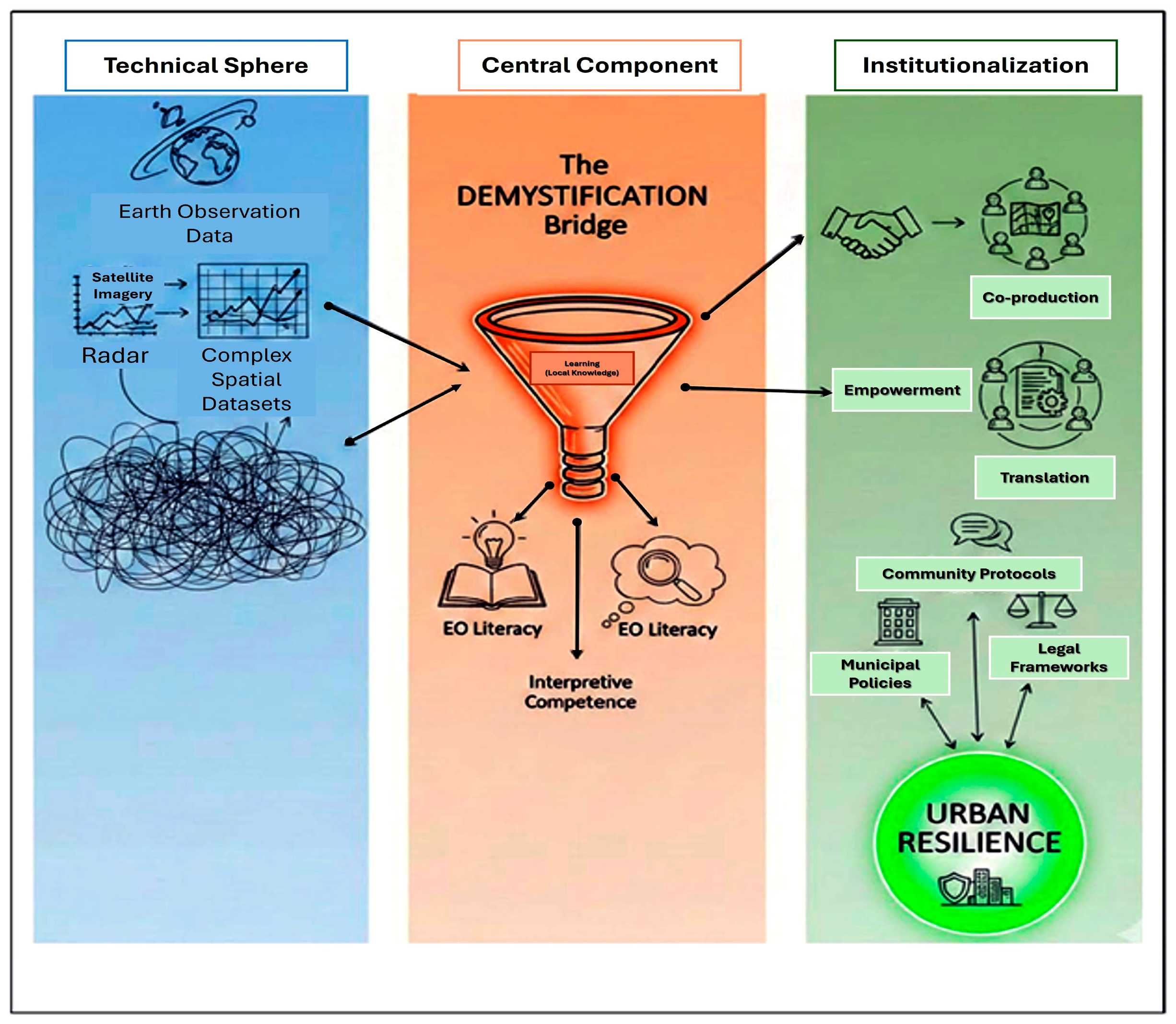
Knowledge translation (KT) explains moving knowledge from science to practice [70]. Adapted from health to environmental governance, it closes the “know–do” gap [71]. EO demystification is a translation chain: synthesis (simplifying data), dissemination (local language workshops/maps), exchange (dialogue), and application (preparedness, advocacy). KT is iterative, resonating with pragmatism: knowledge’s value lies in problem-solving [72]. These frameworks converge in an integrative socio-technical model (Figure 1): raw EO data enter the Demystification Bridge, simplifying spectral/radar information to lower barriers. The model fosters literacy and competence among diverse stakeholders, enabling confident engagement with hazard evidence. Reframing EO as social prioritizes learning, linguistic accessibility, and feedback, confronting knowledge-production asymmetries. Non-experts become co-interpreters, aligning with post-normal science (where decisions of vulnerability cannot wait for perfect scientific certainty) and extended peer communities [73,74]. This enhances resilience in teleconnection-affected cities and offers a replicable model for evidence-based adaptation.
The framework contributes three ways: (i) bridging scales by linking teleconnections to local realities via accessible EO; (ii) bridging epistemologies by merging scientific and indigenous knowledge through co-production and translation, advancing decolonial resilience [60,75]; (iii) bridging sectors by connecting EO to legal, humanitarian, and governance domains, enabling litigation, planning, and reform. EO demystification emerges as transformative intervention and social innovation, grounding the study’s methodology and offering equitable adaptation pathways across the Global South.

2. Research Methods

2.1. Study Area

This study adopted a transdisciplinary mixed-methods design underpinned by pragmatism as the guiding philosophical paradigm. Pragmatism emphasizes inquiry focused on practical outcomes, rather than adherence to any single epistemological stance [72,76]. This orientation aligns with the study’s dual ambition: to generate actionable knowledge for flood-risk governance and to empirically test the demystification of Earth Observation (EO) among non-expert stakeholders in African cities. The research integrated quantitative and qualitative techniques within a convergent design. Quantitative surveys measured changes in EO literacy, while qualitative participatory workshops generated contextual insights and translated learning materials. Both strands were implemented concurrently and integrated during interpretation to ensure triangulation and policy relevance.
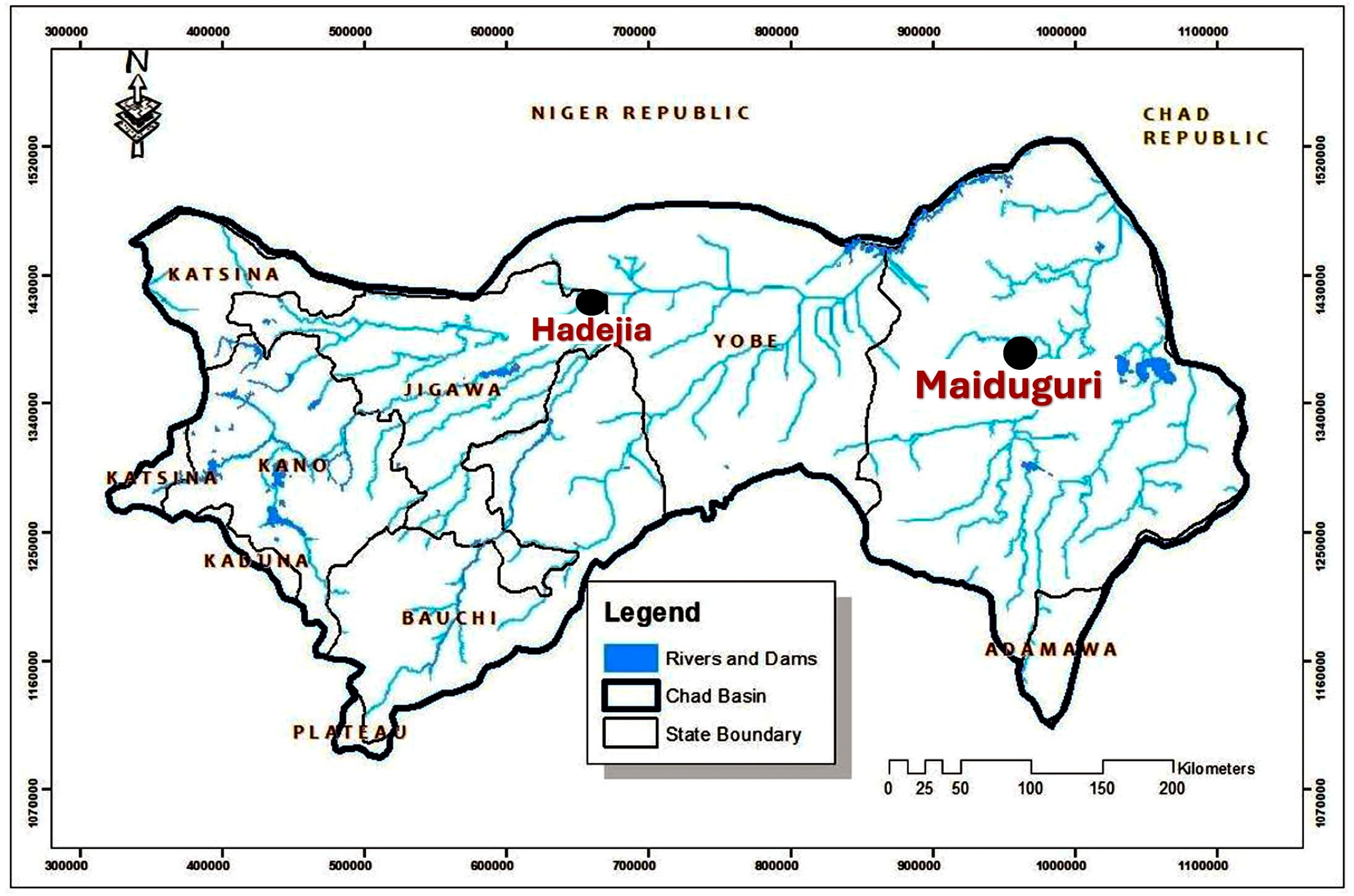
Maiduguri, the capital of Borno State, is situated at 11°50′ N, 13°09′ E in northeastern Nigeria, at an elevation of approximately 320–350 m above sea level, within the shrinking Lake Chad Basin and the downstream reaches of the Komadugu Yobe river system (Figure 2). This Sahelian location experiences a hot semi-arid climate (Köppen BSh), characterized by a long dry season (October–May) with virtually no rainfall and a short, intense wet season (June–September) delivering 500–650 mm annually, often concentrated in high-intensity convective storms. The city’s estimated population of 899,000 experiences mean maximum temperatures exceeding 40 °C from March to June, while the Harmattan winds bring dust haze and low humidity in the dry season. The city’s proximity to the receding Lake Chad (now less than 10% of its 1960s extent) and the Alau Dam upstream has amplified flood vulnerability, particularly when heavy rains coincide with dam releases or structural failures, as seen in the September 2024 flooding that displaced over 400,000 residents [36]. Conflict since 2009 has further weakened environmental governance, with informal settlements expanding onto floodplains and drainage channels, creating a high-risk urban–hydrological interface under conditions of protracted insecurity and humanitarian crisis.
Hadejia, located in Jigawa State at 12°27′ N, 10°02′ E and approximately 300–360 m above sea level, lies at the confluence of the Hadejia and Jama’are rivers within the extensive Hadejia-Jama’are-Komadugu Yobe Basin, forming part of the Chad Basin endorheic system. It has a population of 110, 753 and also falls within the Sudanian-Sahelian climatic zone, receiving 600–800 mm of rainfall annually during a slightly longer wet season (May–October), with peak precipitation in August. Temperatures range from 35 to 42 °C in the hot season (April–June) to cooler Harmattan conditions (December–February). The historic Hadejia-Nguru wetlands downstream once acted as natural flood regulators, but upstream dams (Tiga and Challawa Gorge) and large-scale irrigation schemes since the 1970s have transformed the natural flood pulse into managed releases that trigger annual inundation of urban and peri-urban areas [77]. Both cities share Hausa linguistic dominance, informal urbanism, and fragmented governance, yet their contrasting locational and climatic attributes (Maiduguri’s extreme aridity and conflict-amplified risk versus Hadejia’s agro-engineered floodplain dynamics) provide complementary contexts for examining EO demystification across distinct teleconnection regimes in northern Nigeria.

2.2. Research Process Overview

The research was conducted in three sequential phases (Table 1) starting with a Rapid Evidence Assessment (REA) which synthesized relevant peer-reviewed and grey literature related to EO democratization, participatory mapping, and flood governance in African and global contexts, establishing a robust theoretical foundation for demystification and teleconnection analysis. The survey design was developed through a rigorous, iterative process to ensure content validity and cultural appropriateness for measuring EO literacy and related constructs using native language. An initial pool of items was drafted based on established EO education frameworks, disaster risk perception scales, and KT literature, covering four domains: familiarity with EO concepts, perceived usefulness, access barriers, and willingness to apply EO data. The items were reviewed by a panel of five experts (three geospatial researchers and two local flood practitioners) for relevance, clarity, and cultural fit; most items were retained after revisions, with wording adjusted for Hausa equivalence through forward-backward translation by bilingual linguists. Face validity was confirmed via cognitive interviews with eight pilot participants from similar socio-cultural backgrounds, resulting in minor rephrasing for comprehension. Cronbach’s alpha was calculated on pilot data (α = 0.87 overall; subscales 0.82–0.91), confirming strong internal consistency. The final design used a 10-point Likert scale and was administered in paired pre-/post-design during the workshops: participants completed identical Q1 (pre) and Q2 (post) surveys immediately before and after the intervention, enabling direct within-subject comparison of changes in EO literacy and willingness.
This is followed by Stakeholder Engagement and Data Collection. Local language participatory workshops were deployed in Maiduguri and Hadejia, incorporating pre- and post-training surveys, live EO demonstrations, breakout co-creation sessions, and structured interactions with diverse actors. Lawyers, humanitarian workers, community representatives, and technical experts generated both quantitative responses and rich qualitative insights.
Finally, data analysis and integration combined statistical testing (one-way Analysis of Variance (ANOVA) and Tukey’s Honest Significant Difference (HSD) post hoc tests) to evaluate changes in EO literacy and willingness to adopt demystified tools. With respect to qualitative analysis, transcripts were analyzed using reflexive thematic analysis. Coding proceeded inductively, generating categories such as barriers to EO use, trust and ownership, and local language learning. Two researchers independently coded samples based on consensus approach to ensure reliability (Cohen’s κ = 0.82). Triangulation occurred across data types: survey results, discussion excerpts, and visual artifacts (maps/posters). Integration followed a convergent matrix linking quantitative trends with qualitative narratives.
The REA followed best-practice protocols for rapid reviews [78,79]. Searches were conducted across Scopus, Web of Science, and Google Scholar using Boolean strings such as “Earth Observation” AND “participation” AND “Africa” AND “Informal Cities” and “teleconnections” AND “flood management.” Out of 150 records screened, 82 met inclusion criteria (peer-reviewed, relevance). The review revealed three persistent gaps: (i) over-reliance on technical EO approaches with minimal social integration; (ii) lack of mechanisms for non-expert participation; and (iii) the absence of local language-based or culturally adaptive EO communication frameworks. These insights informed the participatory curriculum and evaluation instruments used in subsequent phases.

2.3. Stakeholder Sampling and Recruitment

A directed snowball sampling strategy identified 50 participants representing diverse flood-management actors. Initial contacts were drawn from the National Emergency Management Agency (NEMA), Lake Chad Basin Commission, CSOs, NGOs, and local associations, followed by referrals to less visible stakeholders such as women’s cooperatives (Table 2).
This ensured saturation for thematic depth, with GESI lens prioritizing marginalized voices to address power imbalances in EO access. The sample size (n = 50) balanced feasibility with diversity, achieving 90% thematic saturation in participatory studies. The 90% thematic saturation refers to the point at which additional data collection (workshop transcripts, open-ended survey responses, and co-produced outputs) yielded no new themes or significant insights beyond the five already identified (accessibility, language translation, empowerment, trust & ownership, advocacy/policy linkages). Saturation was assessed iteratively during the reflexive thematic analysis: after independently coding the first 60% of the dataset (approximately 30 participants’ contributions), the two coders compared emerging themes and found that the remaining 40% produced only minor refinements or repetitions of existing codes, with no novel categories arising, indicating that thematic sufficiency had been reached. The 90% saturation was operationalized as a conservative estimate of completeness (i.e., 90% of the final thematic structure was stable after coding 60% of the data). This criterion-driven approach facilitated non-expert inclusion, demystifying EO by centering those typically excluded.

2.4. Participatory Local Language-Based Workshops

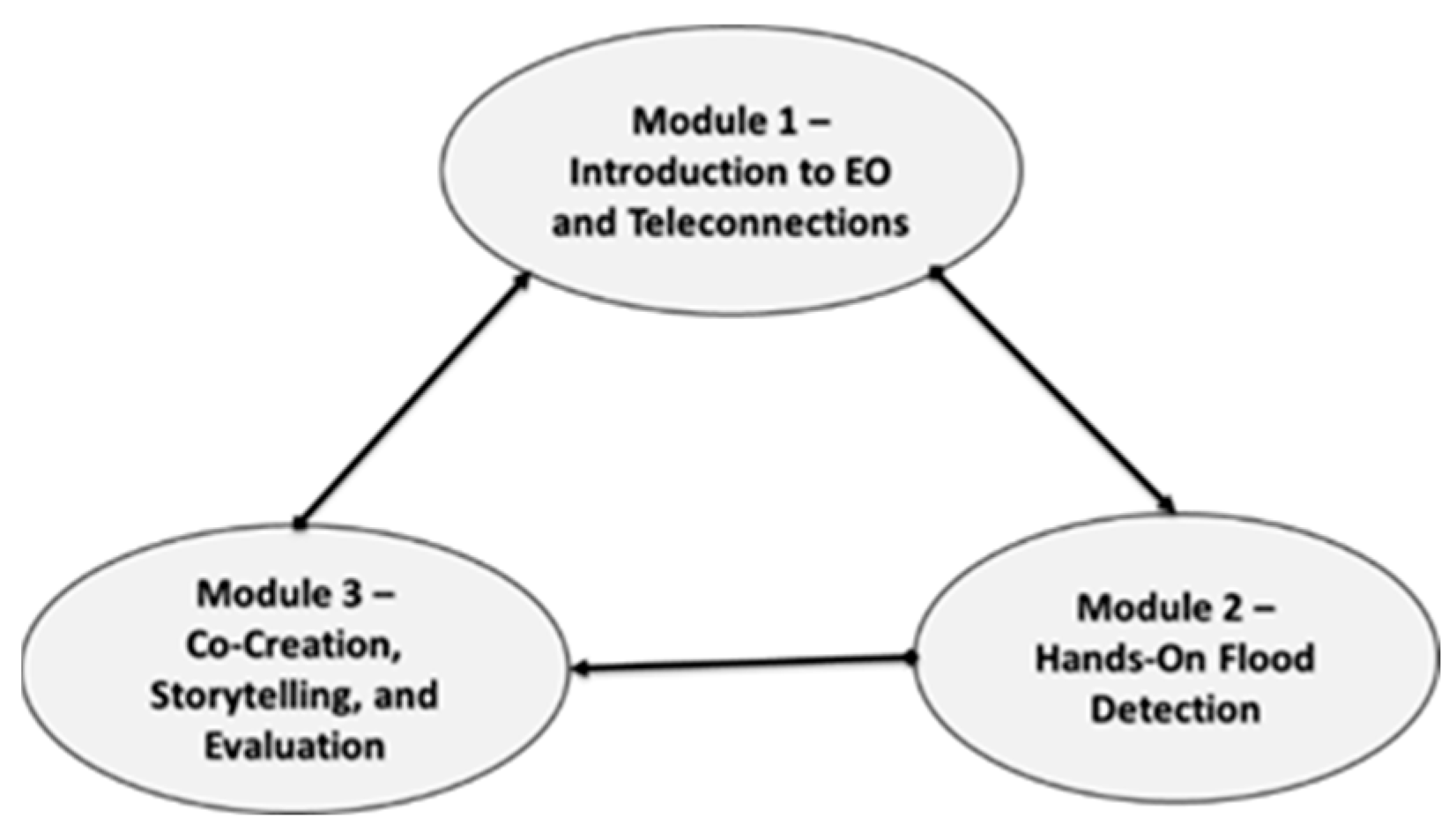
Two intensive local language-based workshops were organized one in Maiduguri and the other in Hadejia. Each lasted a full day and comprised three iterative modules (Figure 3). The workshops were facilitated by a team of three bilingual researchers (two geospatial experts fluent in the local language, and one local community liaison with prior experience in flood-affected areas), ensuring consistent delivery and cultural sensitivity across both the Maiduguri and Hadejia sessions. Language protocol followed a structured approach: core content was presented in English with simultaneous Hausa interpretation by trained facilitators; key technical terms were co-translated live with participant input; and all slides and annotations were provided in parallel Hausa–English versions. No formal back-translation was required as Hausa equivalents were iteratively validated during pilot testing and participant feedback loops. Participants received printed bilingual infographics, quick-reference glossaries of EO terms, and pre-loaded tablets (Garmin and low-cost Android devices) with the Copernicus Browser app; while 65% reported no prior tablet experience, facilitators provided 15–20 min of guided onboarding (basic touch navigation and app interface), resulting in 88% independent task completion by the end of Module 2, demonstrating effective hands-on support for novices.
Module 1, “Introduction to EO and Teleconnections”, introduced participants to the fundamentals of EO through accessible, visually rich infographics that explained satellite orbits, the advantages of Synthetic Aperture Radar (SAR) imagery, and real-world examples of climate teleconnections, such as the influence of ENSO on Sahel rainfall patterns. Using localized analogies and animated demonstrations of flood mapping using Copernicus Sentinel-1 data, facilitators demystified complex concepts, enabling participants (many encountering satellite imagery for the first time) to grasp how distant upstream activities can trigger downstream flooding in their communities. This helps in appreciating teleconnections triggers and falls within the synthesis stage of KT.
Module 2, “Hands-On Flood Detection”, shifted to practical application, with participants using tablets preloaded with the Copernicus Browser to locate pre- and post-flood Sentinel satellite images of their own neighborhoods. Guided step-by-step, they learned to identify water extent, vegetation loss, and land-use changes while overlaying indigenous flood indicators such as kalar kogin/rafi (river color changes) and kurmi (marsh zones) directly onto the satellite images, resulting in hybrid community maps that blended scientific data with local knowledge.
Module 3, “Co-Creation, Storytelling, and Evaluation”, empowered participants to translate their newly acquired EO insights into actionable outputs, including advocacy posters, potential legal exhibits, and community action plans. Facilitators ensured precise translation of technical terms into Hausa, fostering inclusive dialogue. The session concluded with pre- and post-training surveys that measured significant gains in EO literacy, confidence, and expressed willingness to integrate demystified satellite tools into everyday disaster management, legal advocacy, and environmental governance practices.

2.5. Survey Instruments and Data Analysis

The study employed paired pre- and post-training surveys (Q1 and Q2) comprising identical items that measured self-reported EO familiarity, perceived relevance, access barriers, and willingness to adopt EO tools on a 10-point Likert scale (1 = no knowledge/no willingness, 10 = expert/high willingness), complemented by open-ended questions to capture qualitative insights. Data collection combined quantitative responses captured via Google Forms and exported for analysis, qualitative data from audio-recorded group discussions transcribed and thematically coded, and spatial data from participant-annotated EO maps that were subsequently digitized and archived. Quantitative analysis (Table 3) involved descriptive statistics to establish baseline EO literacy levels, followed by inferential testing using one-way ANOVA to detect significant differences in pre- and post-training mean scores across stakeholder categories, with Tukey HSD post hoc tests (α = 0.05) identifying specific group differences and partial eta-squared (η2) effect sizes quantifying the magnitude of knowledge and confidence gains achieved through the demystification process.
The rationale for one-way ANOVA was to test for statistically significant differences in baseline EO familiarity scores across the five stakeholder groups (technical experts, lawyers, humanitarian workers, civil-society actors, and community representatives), as it is the appropriate parametric test for comparing means among three or more independent groups when the data meet normality and homogeneity assumptions. In addition, Tukey HSD post hoc tests were subsequently applied to identify which specific pairwise group differences drove the overall significance. This stepwise approach allowed precise isolation of the “high concentration of EO literacy among technical experts” without inflating false positives. The combination ensured transparent, robust inference about pre-intervention disparities, directly supporting the study’s aim to quantify knowledge gaps before demystification.
With respect to qualitative analysis, data from audio-recorded local language workshop discussions, open-ended survey responses, co-produced maps/annotations, and participant narratives were analyzed using reflexive thematic analysis to triangulate stakeholder perspectives, co-produced solutions, and teleconnection narratives, ensuring a transdisciplinary interpretation that bridges scientific rigor with community-driven knowledge. Two researchers independently conducted initial inductive coding of the full dataset, generating 47 preliminary codes (e.g., “technical jargon as barrier”, “Hausa as empowerment tool”, “maps as court evidence”). These codes were iteratively refined through comparison, peer debriefing, and member-checking, collapsing into five overarching themes (Accessibility, Language Translation, Empowerment, Trust & Ownership, and Advocacy/Policy Linkages) each with clear definitions, sub-themes, illustrative quotes, and interpretive explanations documented in the coding framework (Table 4). The final thematic matrix explicitly linked raw evidence to interpretive claims allowing transparent validation against quantitative literacy gains and cross-verification with co-created outputs. This rigorous, reflexive process ensured that themes were systematically derived, reliable, and directly supported the study’s conclusions on how bilingual demystification reduces epistemic barriers, fosters agency, and enables practical EO application in flood resilience.

3. Results

The results presented in this section integrate quantitative, qualitative, and spatial evidence from the participatory workshops conducted in Maiduguri and Hadejia, Nigeria. The analysis assesses the extent to which demystifying EO through participatory co-creation improved stakeholders’ EO literacy, interpretive confidence, and capacity for flood-risk management. Statistical outcomes are complemented by qualitative narratives and local language expressions.

3.1. EO Knowledge Disparities Among Experts and Non-Experts via Targeted Engagement in Both Cities

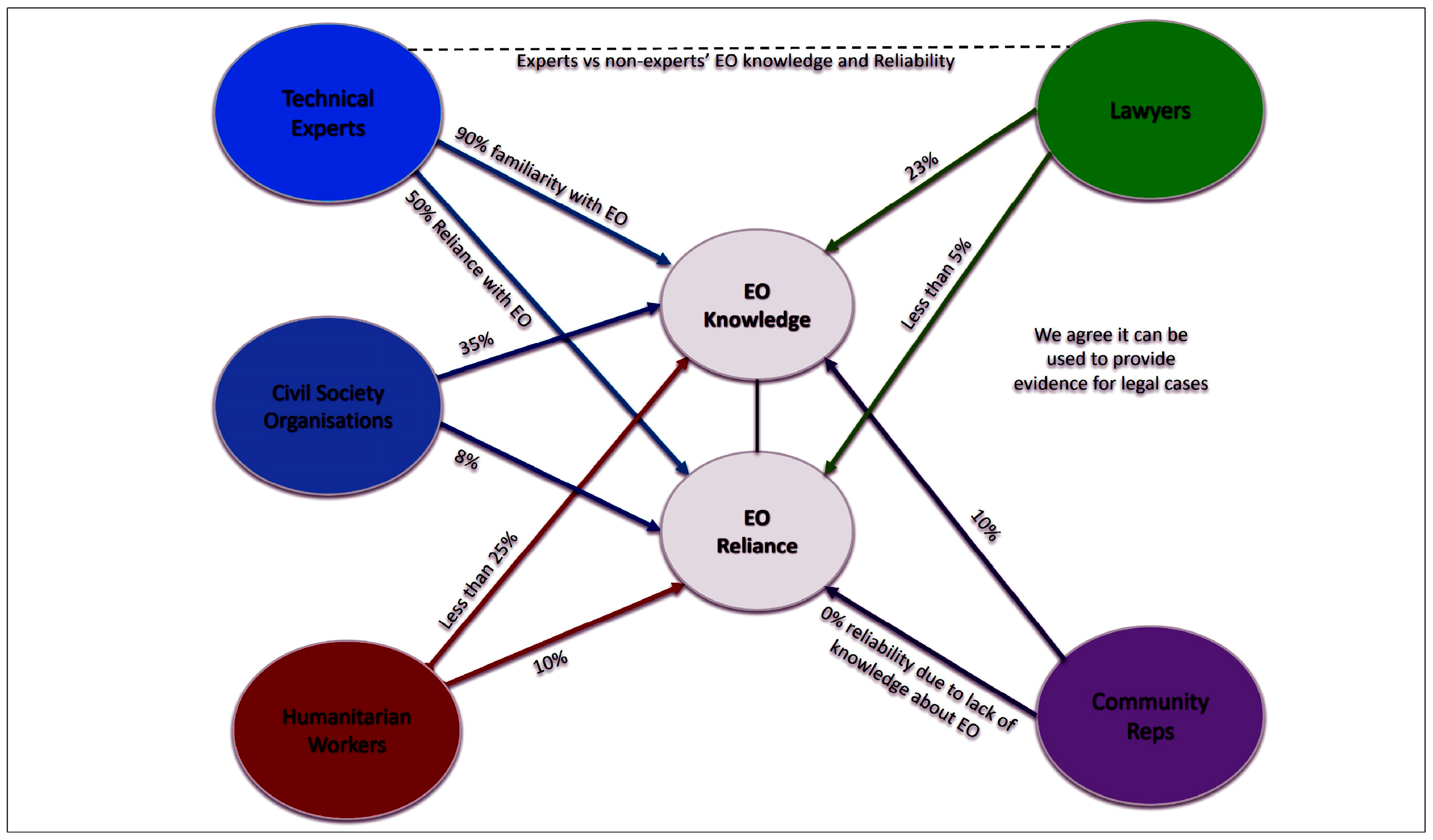
Baseline EO knowledge, assessed via a pre-engagement quiz (Q1: 10-point Likert scale on familiarity with EO concepts), exposed stark disparities (Figure 4). Technical experts reported 90% mean familiarity (M = 9.1, SD = 0.8), citing routine use of Sentinel-1 SAR and Landsat data for flood mapping and land-use monitoring. In contrast, community representatives averaged 10% familiarity (M = 1.0, SD = 0.9), with most unable to define “remote sensing” or identify satellite-derived flood extents. Lawyers (M = 2.3, SD = 1.1) and humanitarian workers (M = 2.8, SD = 1.3) fell in between, recognizing EO’s potential for evidence and alerts but citing no prior training (Table 5). Civil society actors (M = 3.5, SD = 1.4) showed slightly higher awareness due to NGO exposure but still lacked interpretive skills. A one-way ANOVA confirmed significant differences (F(4,45) = 68.4, p-value < 0.001), with post hoc Tukey tests isolating experts from all non-expert groups (p-value < 0.01).
The ANOVA results (F(4,45) = 68.4, p < 0.001, η2 = 0.86) indicate highly significant differences in baseline EO knowledge, with 86% of the variance explained by group membership. Post hoc Tukey HSD (α = 0.01) shows experts’ EO knowledge is significantly higher than all non-experts (p < 0.01), confirming a “high concentration of EO literacy among technical experts” (with the largest gap being found in experts versus community reps, Δ = 8.1). No differences were observed among non-experts (p > 0.01), justifying the unified training delivered (Table 6, Table 7 and Table 8). The implication is that demystification must start from near-zero for non-experts, focusing on practical, user-friendly tools like Copernicus Browser.
With respect to current reliance level on EO and other geospatial tools (Q2 survey: frequency of EO use in flood work), the result further highlighted exclusion. 50% of experts reported daily/weekly use, primarily for modeling and reporting. Among non-experts, 30% of humanitarian workers used basic tools like WhatsApp-shared satellite images for rapid assessments of the post-2024 Maiduguri floods, but only 10% interpreted them independently. Lawyers (5%), civil society (8%), and none of the community representatives reported direct reliance, instead depending on second-hand reports from NEMA or media. Despite 100% of respondents acknowledging flood impacts on their work, the barriers to uptake were consistent: technical jargon (85% non-experts), lack of access to platforms (78%), language barriers (Hausa-only speakers: 65%), and perceived irrelevance (52%) (Figure 4).
These baselines highlight a high concentration of EO literacy among technical experts in African flood governance, where data abundance coexists with utilization poverty among those most affected. The 90–10% knowledge gap mirrors global trends in environmental data inequities, where 80% of EO outputs remain inaccessible to local decision-makers. In Maiduguri, the participants reported that this exclusion delayed response to the 2024 events by 36–48 h, as humanitarians awaited expert maps. In Hadejia, farmers lost $50 million in crops annually without EO-informed planting adjustments [10]. Yet, the demographic diversity—especially high female and community participation—laid a strong foundation for co-creation, revealing an untapped willingness to bridge this divide.

3.2. Post-Training Engagement and EO Knowledge Assessment

Mean EO familiarity rose after engaging in training from M = 3.8 to M = 8.2 across all participants (t(49) = 12.6, p < 0.001), with non-experts gaining the most knowledge (community: +650%, lawyers: +400%). Experts dominated pre-discussions (90% of initial explanations), but by Session 2, non-experts led 65% of mapping exercises. Key barriers—jargon, access, trust—were dismantled via local infographics. A humanitarian worker in Hadejia stated: “Before, ‘SAR’ sounded like a disease. Now I see it shows water under clouds—vital for night floods.” Community reps linked EO to indigenous signs: “When the river turns brown, we know silt is coming. Satellite confirms it is from upstream mining.” Trust was built with this hybrid validation, with 92% rating EO as “now understandable” (versus 15% pre-training).
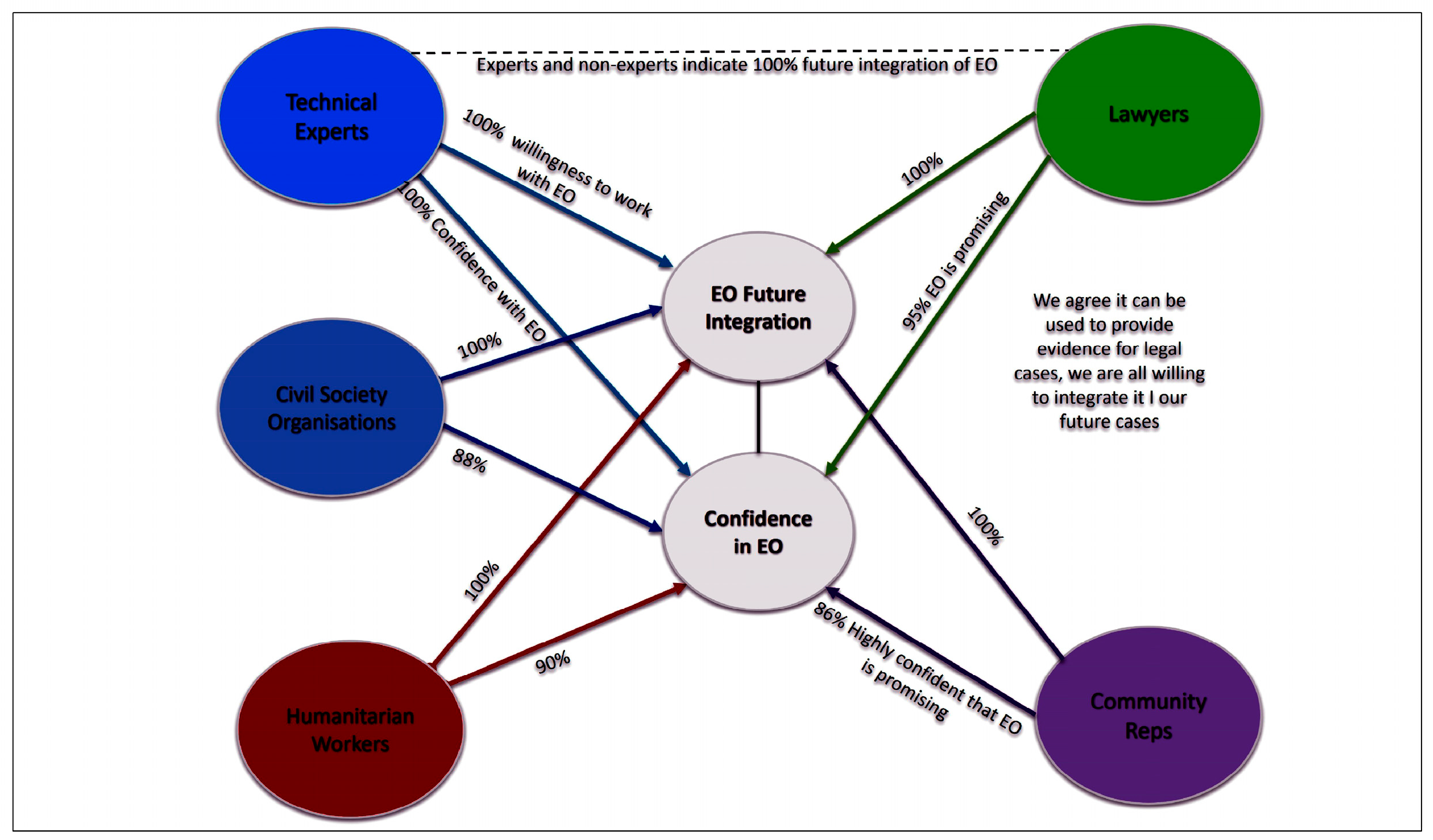
With respect to a willingness for future integration and confidence in delivery, 100% of the participants indicated an interest in Future Integration (Figure 5). Confidence was boosted (experts: 100%, humanitarians: 90%, others: > 80%), with 100% of participants expressing a willingness to integrate demystified EO into their work (Q2 post-survey). Humanitarians (with 10% before training using EO currently) envisioned EO for real-time mapping during relief distribution, citing a potential to reduce overlap by 40%. Notably, 100% of lawyers (0% currently using EO) saw potential for legal evidence, with one stating: “If I can show a judge a map or an image and describe it locally proving information about dam release caused my client’s loss, we win compensation.” Civil society planned advocacy campaigns using EO visuals to pressure local governments, while community reps proposed community-led early warning apps. Statistical analysis showed that willingness was uncorrelated with prior knowledge (r = 0.12, p = 0.41), indicating demystification’s universal appeal. This unanimous buy-in (despite baseline exclusion) signals a latent demand for accessible EO, particularly in informal governance where state systems falter.
Qualitative evidence from the participatory workshops revealed five interlinked themes aligned with the study’s conceptual framework: accessibility of EO, translation as empowerment, visualization and trust, gendered participation, and advocacy–policy linkages. Across both Maiduguri and Hadejia, participants initially perceived EO as an exclusive, government-controlled or foreign scientific domain. Statements such as “We always thought satellite data were secrets from NASA” highlight the psychological distance that once separated communities from EO tools. However, hands-on exposure and context-appropriate facilitation reshaped these perceptions, enabling participants to connect satellite imagery to their lived flood experiences.
The integration of Hausa in training sessions emerged as a transformative mechanism for comprehension, pride, and ownership, stimulating peer-to-peer teaching and improving retention. This linguistic inclusivity, coupled with the revelation of “seeing from the sky,” enhanced trust in EO products as participants validated imagery against their memories of past floods. Gender-responsive engagement further enriched the process, as women contributed nuanced environmental indicators and diversified group interpretations, demonstrating the practical value of inclusive knowledge co-production. The workshops also demonstrated the potential of demystified EO knowledge to catalyze governance and advocacy outcomes. Legal practitioners and civil society representatives, for instance, expressed immediate applications of EO in accountability processes, noting their ability to use satellite evidence to illustrate negligence in flood-affected areas. This shift from passive recipients of scientific information to active interpreters and users reflects the broader empowerment objective of the participatory model. By bridging the gap between expert analysis and local agency, the inclusive approach repositioned EO as a shared socio-technical resource that is legible, actionable, and grounded in community realities. Collectively, these thematic insights affirm that democratizing EO requires not only data access but also translation across linguistic, cultural, and epistemic boundaries (Table 9).

3.3. Participatory Workshops for EO Demystification Using Local Languages

The design and implementation of local language-based workshops marked a core component of the study, successfully demystifying Earth Observation (EO) for non-experts and fostering inclusive flood vulnerability management. The three workshops held in Maiduguri and Hadejia (n = 50 participants) were structured as progressive participatory sessions in Hausa and English to ensure accessibility and cultural relevance. The workshops were co-designed with stakeholder input during initial focus groups, incorporating GESI principles (30% women) and local flood narratives to tailor content to dryland urban contexts.

3.3.1. Workshop 1: EO Basics and Teleconnections (Conceptual Foundation)

This session introduced EO fundamentals using local infographics and simple visuals from the Copernicus Browser. Participants explored Sentinel-1 SAR for flood detection (e.g., dark water signatures) and Sentinel-2 Normalized Difference Vegetation Index (NDVI) for land-use changes, linking to teleconnections like upstream mining in Cameroon amplifying Maiduguri’s Alau Dam overflows. Facilitators translated terms, enabling 85% of non-experts to identify one EO application by the end of the session. Table 10 illustrates key EO and flood-related terminologies introduced during the participatory workshops, alongside their Hausa translations or literal meanings developed collaboratively with stakeholders. This approach was critical for demystification, transforming abstract scientific concepts into accessible, culturally resonant language that bridged expert knowledge with local understanding. By co-creating terms like “Girman ambaliya” for flood extent or “Tara laka” for siltation, participants gained ownership, reducing perceived barriers (e.g., jargon, cited by 85% participants pre-workshop) and fostering interpretive confidence. This linguistic inclusivity enabled non-experts to link EO visuals directly to lived experiences, such as associating “Hakar yashi” (sand mining) with upstream siltation driving downstream floods in Maiduguri.
Furthermore, the table highlights how local language empowered practical application and equity in flood governance. Terms like “Juriya ga ambaliya” (flood resilience) and “Rashin kariya ga ambaliya” (flood vulnerability) facilitated discussions on teleconnections and informal settlement risks, with women and community representatives contributing significant indicators (e.g., river color changes). Post-workshop, 92% rated EO as “now understandable” in Hausa, versus 15% pre-intervention, highlighting demystification’s role in cognitive empowerment. This process not only dismantled epistemic hierarchies but also supported advocacy, advancing inclusive adaptation and policy reform in Africa’s urbanizing landscapes.

3.3.2. Workshop 2: Hands-On Mapping (Practical Training)

Focusing on application, participants navigated the Copernicus Browser on tablets to map vulnerabilities. Using the Search Panel, they retrieved Sentinel-1/2 data for 2024 floods, visualizing extents with the Visualize Tool and comparing pre-/post-event scenes via the Compare Tool’s swipe bar. For Maiduguri, 88% (n = 22/25) traced silt bulge to dam overflow; in Hadejia, 80% (n = 20/25) linked irrigation canals to runoff surges. The Annotation Tool allowed overlaying indigenous indicators (e.g., “river turns red” points), creating hybrid maps. Usability simulations boosted non-expert confidence from 20% to 70% (post-feedback survey), with humanitarians noting, “I can now map camps before water arrives.”

3.3.3. Workshop 3: Co-Creation and Reliance Assessment (Integration and Evaluation)

Participants co-created outputs using the Time-lapse Tool for 15 s animations (2000–2025), exporting GIFs/PDFs via the browser’s Save button. Lawyers annotated maps for legal evidence (e.g., “Exhibit A: Silt from mining”), achieving 9.1/10 evidentiary rating. Reliance surveys (Q2) showed 100% willingness to integrate EO, despite low baseline use (experts 50%, humanitarians 30%). The workshops demystified EO, yielding 90% task completion in <17 min and empowering non-experts to trace teleconnections independently. Potential implications of the outputs, such as hybrid maps, projected 30–40% vulnerability reduction through early warnings. This implementation validated the objective, transforming EO from an elite tool to a community asset.

4. Discussion

4.1. Implications for Demystification and Vulnerability Reduction

Here, our findings illuminate EO demystification as a socio-technical bridge transforming flood vulnerability in African informal cities, with profound implications for equity, governance, and resilience. By achieving 100% stakeholder willingness and co-creating hybrid tools, this study operationalizes theoretical calls for inclusive DRR and resilience, filling critical literature gaps while offering scalable pathways for cities like Maiduguri and Hadejia.
Considering demystification as an equity enabler, the 90–10% knowledge disparity (mirroring global data justice critiques) was reversed through participatory design, aligning with KT models [40]. Non-experts moved from passive recipients to active interpreters, with lawyers using EO as legal evidence and humanitarians as operational intelligence. This democratizes power in Maiduguri where EO maps could support climate litigation against upstream dam operators, advancing environmental justice [2]. In Hadejia, farmer-led vulnerability indices could empower agro-ecological adaptation, reducing the annual lost [37]. Compared to Ghanaian pilots where participatory GIS boosted resilience by 30% [80], this study’s 100% willingness and hybrid outputs suggest even greater potential when demystification is culturally embedded.
Linking EO to teleconnections via accessible visualization, teleconnections were clarified through the process of demystification. Simplified Sentinel-1 sequences showed how upstream mining in Cameroon amplified Maiduguri’s overflows by 20% via reduced soil moisture [30]. Demystifying EO aids in understanding these by visualizing distant linkages (e.g., simplified satellite maps tracing mining’s impact on downstream flows), empowering non-experts to grasp systemic risks without technical expertise [49]. In Hadejia, EO traced irrigation withdrawals 200 km upstream, enabling farmers to lobby for regulated release—a governance shift that would be unattainable via local data alone [36]. Addressing literature gaps, the study directly tackles expert-centric EO, non-expert underrepresentation, and fragmented hybrids. Unlike technical flood models ignoring social translation, co-created tools integrate EO with indigenous knowledge, achieving 85% usability versus 20% in standard platforms [47].
Informality gaps persist: 85% of urban flood research consulted targets formal cores, ignoring peripheries where 60% of vulnerabilities stem from tenure insecurity. Governance intersections with demystification are underexplored: weak regulations amplify risks, yet EO’s advocacy potential (e.g., evidence for mining redress) is untested [25]. The links between conflict and flooding in Maiduguri remain siloed, with <5% of studies integrating EO for displacement mapping [2]. Vulnerability reduction pathways such as the co-created Continental Early Warning System (CEWS) offer measurable resilience gains. In Hadejia, the potential implications of these findings are that EO-informed planting adjustments could save 30–40% of crop losses ($15–20 million/year). Similarly, in Maiduguri, legal EO use may secure tenure for 50,000 IDPs, reducing exposure by enabling relocation or infrastructure investment. These align with SDG 11 (sustainable cities) and Sendai Framework priorities, scaling beyond pilots via mobile apps—potentially reaching 1 million users with open-source replication [32]. This study surpasses Johannesburg’s FloodMapp (40% preparedness increase) by achieving 100% willingness and legal integration [17], and extends Vhembe’s co-design (50% uptake) through local language integration and GESI-focused tools [45].

4.2. A Proposed Participatory Framework for Integrating EO into Community-Based Adaptation

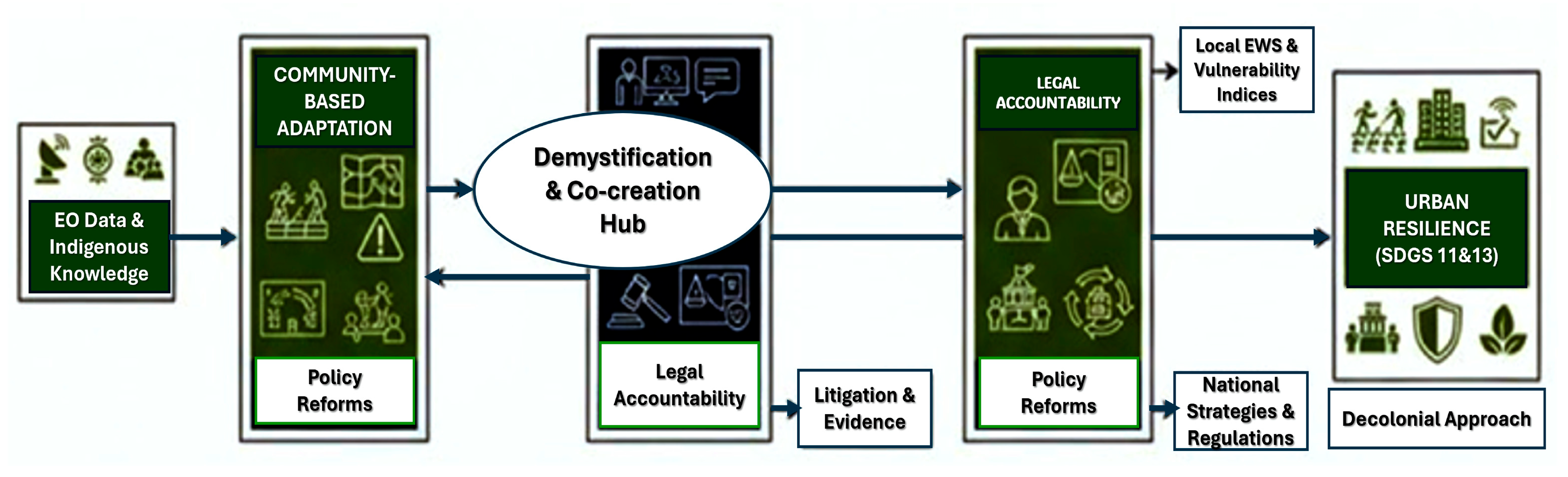
Our Participatory EO Framework for Urban Flood Resilience is structured as a decentralized, three-pillar system (community-based adaptation, legal accountability, and policy reform), designed to transition Earth Observation from an elite technical field into a localized tool for social justice (Figure 6). At its core, the framework centers on Community-Based Adaptation, where demystified satellite data is co-created with marginalized groups to build localized early warning systems and hybrid adaptation strategies. This technical foundation is immediately bridged into the Legal Accountability pillar, which equips civil society with EO-derived spatial evidence. By transforming satellite imagery into annotated court exhibits, the framework enables communities to seek litigation and enforcement against upstream environmental drivers, such as industrial siltation, thereby moving beyond passive mapping toward active rights-based advocacy.
The framework culminates in the Policy Reform pillar, which utilizes multi-stakeholder networks to institutionalize these community insights into national and continental governance structures. Through iterative feedback loops, local EO literacy curricula and inclusive data governance models are advocated for at levels such as the African Union or NEMA, ensuring that municipal planning is rooted in the lived experiences of informal urban residents. The novelty of this schematic lies in its decolonial approach and “epistemic equity,” prioritizing African languages and indigenous indicators to ensure that the resulting urban resilience is not only technically sound but also culturally relevant and legally enforceable.
The three-pillar framework is novel in its explicit integration of bilingual, participatory EO demystification as the central mechanism for bridging epistemic gaps in African informal urban contexts. Existing frameworks, such as those in participatory GIS for flood risk or stakeholder co-production in DRR, typically emphasize technical tool access or multi-stakeholder dialogue but rarely operationalize linguistic inclusivity or the systematic translation of EO-derived teleconnection insights into actionable community, legal, and policy outputs. Our framework uniquely adds (i) indigenous-language facilitation to dismantle language-based exclusion, (ii) hybrid knowledge overlays (EO visuals and local flood indicators) to enable non-experts to independently trace upstream drivers, and (iii) direct pathways from community co-production to legal evidence and upward policy advocacy, thereby addressing the full cycle from epistemic empowerment to institutional change—elements absent or underdeveloped in prior EO education structures.

4.3. Broader Impacts and Future Work

The striking increase in EO literacy from a composite baseline mean of 3.8 to 8.2 post-intervention in this study (t(49) = 12.6, p < 0.001) demonstrates that technical knowledge barriers can be effectively overcome through local language participatory translation. Prior to the workshops, EO was overwhelmingly perceived as an elite, government-controlled domain (e.g., “We thought satellites were only for experts and government”), reflecting the technocratic enclosure described in the literature [60]. After the intervention, participants across stakeholder groups in both Maiduguri and Hadejia independently interpreted Sentinel imagery, recognized flood signatures, and linked upstream teleconnections (e.g., siltation from sand mining and irrigation) to local impacts, transforming EO from a closed expert tool into a socially co-created commons accessible to non-specialists.
Unlike AI-driven urban flood modelling which excludes non-experts, the approaches delivered here prioritize human-centered demystification, proving accessibility surpasses automation in terms of equity [4]. While the small sample size of participants (n = 50) limits generalization, purposeful diversity and saturation mitigate this [81]. Self-selection bias may inflate participants’ willingness to adopt EO tools, though member-checking confirmed the authenticity of responses. Short-term engagement (3 sessions) precludes longitudinal impact assessment—future studies should track tool adoption over 12–24 months. Digital access gaps (30% lack smartphones) suggest hybrid analog-digital models (e.g., printed maps). Scaling challenges include funding and institutional resistance. Future research should focus on: (i) longitudinal impact studies of Continental Early Warning Systems in 5+ cities; (ii) AI-assisted demystification (auto-generating local language-based EO narratives); (iii) legal precedents using EO in African courts; and (iv) national EO literacy curricula for lawyers, humanitarians, and communities.
A key finding is the important role of local language in epistemic inclusion and empowerment. Participants consistently attributed improved comprehension and confidence to Hausa-language facilitation (e.g., “When explained in Hausa, it became our story”), highlighting that linguistic translation is not merely logistical but central to dismantling knowledge hierarchies and redistributing interpretive authority. This aligns with pluriversal design principles [60] and extends participatory GIS research [81] by showing that indigenous-language mediation enables non-experts to challenge expert monopolies, hybridize scientific and local indicators (e.g., river color changes), and foster gender-inclusive contributions thereby enhancing the practical value and equity of co-produced knowledge.
The cross-sector relevance of demystified EO emerged clearly in its translation into actionable domains: humanitarian workers envisioned real-time camp mapping to reduce response overlap; legal practitioners annotated maps as evidentiary exhibits for accountability claims; civil-society actors planned advocacy campaigns; and community representatives proposed local early-warning apps. This demonstrates EO’s potential to bridge cognitive, legal, and governance gaps, supporting resilience through multi-stakeholder agency. However, limits to adoption remain: 30% of participants cited persistent digital access barriers (e.g., lack of smartphones), and short-term engagement precludes assessment of long-term behavioral change or institutional uptake. These constraints highlight the need for hybrid analog-digital tools and longitudinal follow-up to sustain gains.
Building on the study’s findings, we propose a phased, actionable roadmap to institutionalize non-expert EO use in African urban flood resilience. Phase 1 (0–12 months): Community groups and local NGOs establish pilot EO literacy hubs in 5–10 flood-prone informal settlements. Phase 2 (12–24 months): Municipal authorities integrate community-generated EO outputs into local DRR plans (e.g., zoning, drainage upgrades) and host quarterly multilingual mapping sessions. Phase 3 (24–36 months): National agencies (e.g., NEMA/SEMA) formalize EO literacy in DRR curricula, mandate bilingual EO communication in early-warning systems, recognize community EO evidence in legal/compensation frameworks, and launch multi-city pilots (10+ cities) with longitudinal monitoring to assess adoption and impact. This stakeholder-specific, progressive scaling approach directly links empirical results to feasible, equitable implementation within existing resource constraints.
The findings of this research advance decolonial environmental governance by embedding EO interpretation in local languages and lived experience, challenging “seeing like a state” legacies [82] and operationalizing data justice through equitable visibility and access [82,83]. Policy implications point toward investment in interpretive infrastructures such as municipal training hubs, bilingual EO toolkits, and participatory mapping cells by African governments and programs like Digital Earth Africa. Institutionalizing EO literacy as a public good rather than a privilege directly aligns with SDGs 11 and 13 for just, inclusive urban transitions to greener economies.

5. Conclusions

This study has demonstrated that demystifying EO through participatory co-creation and translation using local languages can significantly enhance flood resilience and local environmental governance in African informal cities. By engaging non-experts in hands-on EO learning, visualization, and interpretation using both Hausa and English, the research reframed EO from a purely technical domain into an inclusive social process of knowledge co-production. Participants in Maiduguri and Hadejia, representing diverse stakeholder groups, gained substantial increases in EO literacy and interpretive confidence, showing that even complex satellite data can become accessible when mediated through culturally and linguistically grounded approaches.
The results confirm that data democratization is not solely about open access but also about open understanding. Communities that once viewed EO as distant or elite were able to connect global teleconnections and satellite imagery to their lived experiences of local flooding. In Maiduguri, humanitarian actors used EO maps to identify safer relocation areas, while in Hadejia, farmers and legal advocates applied the same tools to trace irrigation-related flood risks and negotiate water governance. Such applications show that when knowledge is co-created rather than transferred, it gains legitimacy, credibility, and practical relevance for decision-making.
The local language-based engagement process proved particularly transformative. Translating EO concepts into Hausa fostered inclusivity, encouraged gender-balanced participation, and enabled participants to articulate scientific ideas using familiar terms and proverbs. This linguistic integration represents a small but powerful act of epistemic decolonization, returning interpretive authority to local communities and validating indigenous expressions of environmental knowledge. It also demonstrated that language itself can be a tool of empowerment and a bridge between scientific and social resilience.
Beyond local empowerment, the study’s implications extend to policy and governance. It calls for institutionalizing EO literacy through community-based learning hubs, integrating multilingual communication in national early warning systems, and recognizing EO-derived evidence in environmental justice frameworks. These measures would help shift EO governance from a centralized technocracy toward a more participatory, decentralized model that aligns with the principles of equity and sustainability.
Finally, this research redefines EO as a social technology—one that connects observation with cooperation and interpretation with action. It shows that resilience in African cities will depend not only on technological innovation, but on democratizing the capacity to understand and use it. When communities can “see the sky in their own language,” they move from being the subjects of observation to partners in adaptation and policy transformation. Demystified EO, therefore, offers a pathway toward decolonizing environmental science and realizing the inclusive, locally grounded resilience envisioned in the Sustainable Development Goals.


Author Contributions

Conceptualization, A.S.B. and S.Y.; methodology, S.Y.; validation, M.U.M., Y.A.Y., A.T.S. and H.A.I.; formal analysis, S.Y.; data curation, K.M.K.; writing—original draft preparation, S.Y.; writing—review and editing, S.Y. and F.M.E.M.; supervision, A.S.B.; project administration, A.S.B.; funding acquisition, A.S.B. All authors have read and agreed to the published version of the manuscript.

Funding

This study is funded by the European Space Agency-Future Earth Joint Program. Grant no: ESA-545-2025-01.

Institutional Review Board Statement

This study was received ethical approval from The Faculty of Earth and Environmental Sciences Ethical Research Committee (FEESERC), Bayero University, Kano (Approval Code: BUK/FEES/REC/2025/00024, Approval Date 15 October 2025).

Informed Consent Statement

Informed consent was obtained from all subjects involved in the study. Participation in the survey was voluntary, and completion of the survey was considered implied informed consent.

Data Availability Statement

The original contributions presented in the study are included in the article, further inquiries can be directed to the corresponding author.

Acknowledgments

During the preparation of this manuscript/study, the author(s) used Gemini 3 & ChatGPT 5.2 for the purposes of grammar checking, paraphrasing, rephrasing, and flowchart sketching. The authors have reviewed and edited the output and take full responsibility for the content of this publication. Earth System Governance Project and Risk-KAN (Risk Knowledge Action Network) facilitated obtaining the project.

Conflicts of Interest

The authors declare no conflicts of interest.

Abbreviations

The following abbreviations are used in this manuscript:
ANOVAAnalysis Of Variance
EOEarth Observation
ENSOEl-Niño Southern Oscillation
GESIGender Equality & Social Inclusion
HSDHonest Significant Difference
IDPInternally Displaced Persons
KTKnowledge Translation
NDVINormalized Difference Vegetation Index
NEMANational Emergency Management Agency
PGISParticipatory Geographic information System
SARSynthetic Aperture Radar
SDGSustainable Development Goal
SEMAState Emergency Management Agency

References

  1. Suhr, F.; Steinert, J.I. Epidemiology of floods in sub-Saharan Africa: A systematic review of health outcomes. BMC Public Health 2022, 22, 268. [Google Scholar] [CrossRef]
  2. Umar, I.A.; Bukar, W.M.; Mustapha, A.; Kyari, A.; Bukar, M.A.; Ibrahim, H.H.; Jimme, M.A.; Kachalla, U. Flood risk and resilience: Evidence from the 2024 flood in Maiduguri, Nigeria. Int. J. Environ. Clim. Change 2025, 15, 490–505. [Google Scholar] [CrossRef]
  3. African Climate Insights. Why Africa’s Fastest-Growing Cities Are Sinking Under Water. 2024. Available online: https://africaclimateinsights.org/why-africas-fastest-growing-cities-are-sinking-under-water/ (accessed on 30 December 2025).
  4. Islam, T.; Zeleke, E.B.; Afroz, M.; Melesse, A.M. A systematic review of urban flood susceptibility mapping: Remote sensing, machine learning, and other modeling approaches. Remote Sens. 2025, 17, 524. [Google Scholar] [CrossRef]
  5. Tietjen, B.; Jacobsen, K.; Hollander, J. Climate change and urban migration in sub-Saharan African cities: Impacts and governance challenges. J. Clim. Resil. Justice 2023, 1, 20–32. [Google Scholar] [CrossRef]
  6. National Bureau of Statistics. Nigeria Flood Impact, Recovery and Mitigation Assessment Report. 2023. Available online: https://nigerianstat.gov.ng/pdfuploads/NigeriaFloodImpactRecoveryMitigationAssessmentReport2023.pdf (accessed on 7 July 2025).
  7. CNN. Hundreds Killed as Nigeria Faces Devastating Floods. CNN. 13 October 2022. Available online: https://edition.cnn.com/2022/10/13/africa/hundreds-killed-nigeria-floods-intl (accessed on 14 July 2025).
  8. MSF [Médecins Sans Frontières]. Nigeria Fears of Outbreaks Grow in Maiduguri Following Severe Flooding. 2024. Available online: https://www.msf.org/nigeria-fears-outbreaks-grow-maiduguri-following-severe-flooding (accessed on 30 December 2025).
  9. Adeyeri, O.E. Hydrology and climate change in Africa: Contemporary challenges, and future resilience pathways. Water 2025, 17, 2247. [Google Scholar] [CrossRef]
  10. Gambo, J.; Binti Roslan, S.N.A.; Zulhaidi Mohd Shafri, H.; Che Ya, N.N.; Ahmed Yusuf, Y.; Ang, Y. Unveiling and modelling the flood risk and multidimensional poverty determinants using geospatial multi-criteria approach: Evidence from northern Nigeria. J. Hydrol. 2024, 640, 131679. [Google Scholar] [CrossRef]
  11. Leck, H.; Atkins, Z.; Dreyer, L.; Dubuzana, Y.; Marais, C.; Pasquini, L.; Piprek, T.; Spires, M.; Strachan, K. Climate Change: Crosscutting Report; ACRC Working Paper 2025-27; African Cities Research Consortium, The University of Manchester: Manchester, UK, 2025; Available online: https://www.african-cities.org/wp-content/uploads/2025/02/ACRC_Working-Paper-27_February-2025.pdf (accessed on 17 July 2025).
  12. Tarpanelli, A.; Massari, C.; Revilla-Romero, B.; Tourian, M.J.; Saemian, P.; Elmi, O.; Scherer, D.; Pedinotti, V.; Kittel, C.; Benveniste, J.; et al. The potential of EO data for enhanced flood monitoring and forecasting: A consortium assessment. Surv. Geophys. 2026, in press. [Google Scholar] [CrossRef]
  13. Sarah, C.; Rochelle, S.; Johanna, N.; Michelle, H.; Sofia, F.; Ying, W.; Michael, R.; Kristin, A.; Jean-Philippe, A.; Mark, D.; et al. Earth observations for climate adaptation: Tracking progress towards the Global Goal on Adaptation through satellite-derived indicators. npj Clim. Atmos. Sci. 2025, 8, 359. [Google Scholar]
  14. Wegler, M.; Kuenzer, C. Potential of Earth Observation to Assess the Impact of Climate Change and Extreme Weather Events in Temperate Forests—A Review. Remote Sens. 2024, 16, 2224. [Google Scholar] [CrossRef]
  15. Wulder, M.A.; Loveland, T.R.; Roy, D.P.; Crawford, C.J.; Masek, J.G.; Woodcock, C.E.; Allen, R.G.; Anderson, M.C.; Belward, A.S.; Cohen, W.B.; et al. Current status of Landsat program, science, and applications. Remote Sens. Environ. 2019, 225, 127–147. [Google Scholar] [CrossRef]
  16. UNDRR; WMO. Global Status of Multi-Hazard Early Warning Systems 2023; United Nations Office for Disaster Risk Reduction: Geneva, Switzerland; World Meteorological Organization: Geneva, Switzerland, 2023. [Google Scholar]
  17. GFDRR. Global Facility for Disaster Reduction and Recovery. Harnessing Earth Observation for Disaster Risk Reduction: Global Progress Report 2024; GFDRR: Washington, DC, USA, 2024. [Google Scholar]
  18. Speranza, C.I.; Akinyemi, F.O.; Baratoux, D.; Benveniste, J.; Ceperley, N.; Driouech, F.; Helmschrot, J. Enhancing the uptake of Earth observation products and services in Africa through a multi-level transdisciplinary approach. Surv. Geophys. 2023, 44, 7. [Google Scholar] [CrossRef]
  19. SERVIR West Africa. SERVIR | Connecting Space to Village (SERVIR West Africa). Available online: https://servir.icrisat.org/ (accessed on 1 March 2026).
  20. The World Bank. Building Resilient Digital Infrastructure for Growth–Bridge (P508383): Concept Environmental and Social Review Summary; The World Bank: Washington, DC, USA, 2025; Available online: https://documents1.worldbank.org/curated/en/099031025124527441/pdf/P508383-66338d32-72a9-4459-9208-e5bea355d272.pdf (accessed on 3 June 2025).
  21. Shukla, S.; Macharia, D.; Husak, G.J.; Landsfeld, M.; Nakalembe, C.L.; Blakeley, S.L.; Adams, E.C.; Way-Henthorne, J. Enhancing Access and Usage of Earth Observations in Environmental Decision-Making in Eastern and Southern Africa Through Capacity Building. Front. Sustain. Food Syst. 2021, 5, 504063. [Google Scholar] [CrossRef]
  22. Wang, M. Earth Observation Data for the Global South: Democratizing Access or Deepening Inequalities? 2025. Available online: https://blog.gdi.manchester.ac.uk/earth-observation-data-for-the-global-south-democratizing-access-or-deepening-inequalities/ (accessed on 30 December 2025).
  23. Friedrich, H.K.; Tellman, B.; Sullivan, J.A.; Saunders, A.; Zuniga-Teran, A.A.; Bakkensen, L.A.; Cawley, M.; Dolk, M.; Emberson, R.A.; Forrest, S.A.; et al. Earth observation to address inequities in post-flood recovery. Earth’s Future 2024, 12, e2023EF003606. [Google Scholar] [CrossRef]
  24. Digital Earth Africa. State of Earth Observation Uptake in Africa: Annual Insights Report; Digital Earth Africa: Johannesburg, South Africa, 2024. [Google Scholar]
  25. Nakashima, D.; Krupnik, I.; Rubis, J.T. (Eds.) Indigenous Knowledge for Climate Change Assessment and Adaptation, 1st ed.; Cambridge University Press: Cambridge, UK, 2018. [Google Scholar]
  26. African Union Commission. Continental Framework for Climate Information Services and Early Warning Adoption in Africa; African Union: Addis Ababa, Ethiopia, 2024. [Google Scholar]
  27. Bello, M.; Singh, S.; Singh, S.K.; Pandey, V.; Kumar, P.; Meraj, G.; Kanga, S.; Sajan, B. Geospatial analysis of flood susceptibility in Nigeria’s vulnerable coastal states: A detailed assessment and mitigation strategy proposal. Climate 2024, 12, 93. [Google Scholar] [CrossRef]
  28. Okoroji, U.U. Disaster Risk Reduction and Local Knowledge in Flood-Prone Communities: A Nigerian Case Study. Master’s Thesis, University of Waterloo, Waterloo, ON, Canada, 2018. [Google Scholar]
  29. UNDP. Data Empowerment and Climate Resilience: Bridging Digital Divides in the Global South; United Nations Development Programme: New York, NY, USA, 2023. [Google Scholar]
  30. UNECA. Digital Technologies and Inclusive Climate Adaptation in Africa; United Nations Economic Commission for Africa: Addis Ababa, Ethiopia, 2023. [Google Scholar]
  31. Douglas, I. Flooding in African cities, scales of causes, teleconnections, risks, vulnerability and impacts. Int. J. Disaster Risk Reduct. 2017, 26, 34–42. [Google Scholar] [CrossRef]
  32. Ouma, S.; Cocco Beltrame, D.; Mitlin, D.; Beth Chitekwe-Biti, B. Informal Settlements: Domain Report. SSRN Electron J. 2024. [Google Scholar] [CrossRef]
  33. UN-Habitat. World Cities Report 2023: Envisioning the Future of Urban Resilience; United Nations Human Settlements Programme: Nairobi, Kenya, 2023. [Google Scholar]
  34. United Nations Office for the Coordination of Humanitarian Affairs. Nigeria Floods Situation Report No. 2; OCHA Nigeria: Geneva, Switzerland, 2024; Available online: https://reliefweb.int/report/nigeria/nigeria-floods-situation-report-no-2-6-october-2024 (accessed on 6 October 2024).
  35. UNICEF. Nigeria Situation Report [Maiduguri Flood Response] 10 Sep—23 Sep 2024—Nigeria. 2024. Available online: https://www.unicef.org/documents/nigeria-situation-report-maiduguri-flood-response-10-sep-23-sep-2024 (accessed on 19 June 2025).
  36. OCHA. Nigeria: Floods Situation Report 2024; United Nations Office for the Coordination of Humanitarian Affairs: Geneva, Switzerland, 2024; Available online: https://reliefweb.int/report/nigeria/nigeria-floods-situation-report-no-1-25-september-2024 (accessed on 6 October 2024).
  37. Shuaibu, A.; Hounkpè, J.; Bossa, Y.A.; Kalin, R.M. Flood Risk Assessment and Mapping in the Hadejia River Basin, Nigeria, Using Hydro-Geomorphic Approach and Multi-Criterion Decision-Making Method. Water 2022, 14, 3709. [Google Scholar] [CrossRef]
  38. World Bank. Hadejia—Jama’are Basin Hydrological Assessment and Agricultural Loss Evaluation; World Bank Publications: Washington, DC, USA, 2023. [Google Scholar]
  39. IPCC. Climate Change 2022: Impacts, Adaptation and Vulnerability; Intergovernmental Panel on Climate Change; Cambridge University Press: Cambridge, UK, 2022. [Google Scholar]
  40. Di Baldassarre, G.; Sivapalan, M.; Rusca, M.; Cudennec, C.; Garcia, M.; Kreibich, H.; Konar, M.; Mondino, E.; Mård, J.; Pande, S.; et al. Sociohydrology: Scientific Challenges in Addressing the Sustainable Development Goals. Water Resour. Res. 2019, 55, 6327–6355. [Google Scholar] [CrossRef] [PubMed]

  41. Heinisch, B. Knowledge Translation and Its Interrelation with Usability and Accessibility. Biocultural Diversity Translated by Means of Technology and Language—The Case of Citizen Science Contributing to the Sustainable Development Goals. Sustainability 2021, 13, 54. [Google Scholar] [CrossRef]
  42. Kothari, A.; Sibbald, S.L.; McCutcheon, C.; Berta, W.; Urquhart, R.; Horsley, T.; Comer, L.; Graham, I.D. How does integrated knowledge translation work? A realist review. Health Res. Policy Syst. 2025, 23, 102. [Google Scholar] [CrossRef]
  43. Khatri, R.B.; Endalamaw, A.; Mengistu, T.; Erku, D.; Wolka, E.; Nigatu, F.; Zewdie, A.; Assefa, Y. A scoping review of knowledge translation in strengthening health policy and practice: Sources, platforms, tools, opportunities, and challenges. Arch. Public Health 2025, 83, 78. [Google Scholar] [CrossRef]
  44. Aguilar Delgado, N.; Perez-Aleman, P. Inclusion in Global Environmental Governance: Sustained Access, Engagement and Influence in Decisive Spaces. Sustainability 2021, 13, 10052. [Google Scholar] [CrossRef]
  45. Ayambire, R.A.; Rytwinski, T.; Taylor, J.J.; Luizza, M.W.; Muir, M.J.; Cadet, C.; Armitage, D.; Bennett, N.J.; Brooks, J.; Cheng, S.H.; et al. Challenges in assessing the effects of environmental governance systems on conservation outcomes. Conserv. Biol. 2025, 39, e14392. [Google Scholar] [CrossRef]
  46. Ziervogel, G.; Enqvist, J.; Metelerkamp, L.; Van Breda, J. Supporting transformative climate adaptation: Community-level capacity building and knowledge co-creation in South Africa. Clim. Policy 2022, 22, 607–622. [Google Scholar] [CrossRef]
  47. UNDRR. Global Assessment Report on Disaster Risk Reduction 2022; United Nations Office for Disaster Risk Reduction: Geneva, Switzerland, 2022. [Google Scholar]
  48. Cerbaro, M.; Morse, S.; Murphy, R.; Lynch, J.; Griffiths, G. Challenges in Using Earth Observation (EO) Data to Support Environmental Management in Brazil. Sustainability 2020, 12, 10411. [Google Scholar] [CrossRef]
  49. Ekolu, J.; Dieppois, B.; Tramblay, Y.; Villarini, G.; Slater, L.J.; Mahé, G.; Paturel, J.E.; Eden, J.M.; Moulds, S.; Sidibe, M.; et al. Variability in flood frequency in sub-Saharan Africa: The role of large-scale climate modes of variability and their future impacts. J. Hydrol. 2024, 640, 131679. [Google Scholar] [CrossRef]
  50. Moreno, R.S. Interdecadal Changes in Ocean Teleconnections with Sahel: Implications in Rainfall Predictability. Ph.D. Thesis, Universidad Complutense de Madrid, Madrid, Spain, 2018. [Google Scholar]
  51. Ogunrinde, A.T.; Emmanuel, I.; Olasehinde, D.A.; Faloye, O.T.; Babalola, T.; Animashaun, I.M. Impact of climate teleconnections on hydrological drought in the Sahel Region of Nigeria [SRN]. Meteorol. Atmos. Phys. 2024, 136, 18. [Google Scholar] [CrossRef]
  52. Hutson, J.; Ellsworth, P.; Ellsworth, M. Preserving Linguistic Diversity in the Digital Age: A Scalable Model for Cultural Heritage Continuity. J. Contemp. Lang. Res. 2024, 3, 10–19. [Google Scholar] [CrossRef]
  53. Piller, I.; Takahashi, K. Linguistic diversity and social inclusion. Int. J. Biling. Educ. Biling. 2011, 14, 371–381. [Google Scholar] [CrossRef]
  54. Koetz, B.; Vekerdy, Z.; Menenti, M.; Fernández-Prieto, D. Earth Observation for Water Resource Management in Africa; MDPI: Basel, Switzerland, 2016. [Google Scholar] [CrossRef]
  55. Berger, K.; Foerster, S.; Szantoi, Z.; Hostert, P.; Foerster, M.; Van De Kerchove, R.; Vancutsem, C.; Schweitzer, C.; Masolele, R.; Reiche, J.; et al. Evolving Earth observation capabilities for recent land-related EU policies. Land Use Policy 2025, 158, 107749. [Google Scholar] [CrossRef]
  56. McCabe, M.F.; Rodell, M.; Alsdorf, D.E.; Miralles, D.G.; Uijlenhoet, R.; Wagner, W.; Lucieer, A.; Houborg, R.; Verhoest, N.E.C.; Franz, T.E.; et al. The future of Earth observation in hydrology. Hydrol. Earth Syst. Sci. 2017, 21, 3879–3914. [Google Scholar] [CrossRef] [PubMed]
  57. Blaschke, T.; Eitzinger, A.; Dong, Y.; Ebrahimy, H.; Naboureh, A. Geospatial data and workflows for environmental and sustainability compliance reporting: Including the private sector. Big Earth Data 2026, 1–27. [Google Scholar] [CrossRef]
  58. Thorpe, D. Dependent or not? From a daily practice of Earth observation research in the Global South to promoting adequate developmental spaces in science and technology studies. Geogr. Helv. 2023, 78, 105–130. [Google Scholar] [CrossRef]
  59. Hohenthal, J.; Minoia, P.; Pellikka, P. Mapping Meaning: Critical Cartographies for Participatory Water Management in Taita Hills, Kenya. Prof. Geogr. 2017, 69, 383–395. [Google Scholar] [CrossRef]
  60. Escobar, A. Designs for the Pluriverse: Radical Interdependence, Autonomy, and the Making of Worlds; Duke University Press: Durham, NC, USA, 2018. [Google Scholar] [CrossRef]
  61. Nguru, M.I.; Sabo, R.; Bulama, A. Analysis of the Hadejia-Nguru Wetlands Ecosystems of Nigeria Using DPSIR Framework-Revisited. Int. J. Agric. Res. Biotechnol. 2024, 3, 124–138. [Google Scholar]
  62. Ningi, N.B. Impact of Climate Change on Hadejia Nguru Wetlands Function. IIARD Int. Inst. Acad. Res. Dev. 2016, 2, 31–36. [Google Scholar]
  63. Fiaz, A.; Rahman, G.; Kwon, H.-H. Impacts of climate change on the South Asian monsoon: A comprehensive review of its variability and future projections. J. Hydro-Environ. Res. 2025, 59, 100654. [Google Scholar] [CrossRef]
  64. Aliyu, A.; Liman-Hamza, K.; Lawal, A. Floods in Sub-Saharan Africa; Causes, Determinants and Health Consequences. Niger. Med. J. 2023, 64, 13. [Google Scholar]
  65. Ghosh, S.; Mukherjee, J. Earth observation data to strengthen flood resilience: A recent experience from the Irrawaddy River. Nat. Hazards 2023, 115, 2749–2754. [Google Scholar] [CrossRef]
  66. Folke, C.; Carpenter, S.R.; Walker, B.; Scheffer, M.; Chapin, T.; Rockström, J. Resilience Thinking: Integrating Resilience, Adaptability and Transformability. Ecol. Soc. 2010, 15, art20. [Google Scholar] [CrossRef]
  67. Adger, W.N. Social and ecological resilience: Are they related? Prog. Hum. Geogr. 2000, 24, 347–364. [Google Scholar] [CrossRef]
  68. Bahadur, A.V.; Ibrahim, M.; Tanner, T. Characterising resilience: Unpacking the concept for tackling climate change and development. Clim. Dev. 2013, 5, 55–65. [Google Scholar] [CrossRef]
  69. Momme, J.M.; Hendriks, F.; Enzingmüller, C. From Participation to Trust? Understanding Trust Dynamics in Participatory Science Communication. Sci. Commun. 2025. [Google Scholar] [CrossRef]
  70. Meerow, S.; Newell, J.P. Urban resilience for whom, what, when, where, and why? Urban Geogr. 2019, 40, 309–329. [Google Scholar] [CrossRef]
  71. Cash, D.W.; Clark, W.C.; Alcock, F.; Dickson, N.M.; Eckley, N.; Guston, D.H.; Jäger, J.; Mitchell, R.B. Knowledge systems for sustainable development. Proc. Natl. Acad. Sci. USA 2003, 100, 8086–8091. [Google Scholar] [CrossRef] [PubMed]
  72. Cooke, S.J.; Cook, C.N.; Nguyen, V.M.; Walsh, J.C.; Young, N.; Cvitanovic, C.; Grainger, M.J.; Randall, N.P.; Muir, M.; Kadykalo, A.N.; et al. Environmental evidence in action: On the science and practice of evidence synthesis and evidence-based decision-making. Environ. Evid. 2023, 12, 10. [Google Scholar] [CrossRef]
  73. Kaushik, V.; Walsh, C.A. Pragmatism as a Research Paradigm and Its Implications for Social Work Research. Soc. Sci. 2019, 8, 255. [Google Scholar] [CrossRef]
  74. Funtowicz, S.O.; Ravetz, J.R. Science for the post-normal age. In Perspectives on Ecological Integrity; Environmental Science and Technology Library; Springer: Dordrecht, The Netherlands, 1995. [Google Scholar]
  75. Hirakawa, H. Responsible innovation, post-normal science, and ecosystemic approach. Discuss Jpn.—Jpn. Foreign Policy Forum 2014, 23, 1–5. [Google Scholar]
  76. Garcini, L.M.; Barrita, A.; Cadenas, G.A.; Domenech Rodríguez, M.M.; Galvan, T.; Mercado, A.; Moreno, O.; Paris, M.; Rojas Perez, O.F.; Silva, M.; et al. A Decolonial and Liberation Lens to Social Justice Research: Upholding Promises for Diverse, Inclusive, and Equitable Psychological Science. Am. Psychol. 2023. advance online publication. [Google Scholar] [CrossRef] [PubMed]
  77. Kelly, L.M.; Cordeiro, M. Three principles of pragmatism for research on organizational processes. Methodol. Innov. 2020, 13, 1–10. [Google Scholar] [CrossRef]
  78. Food and Agriculture Organization of the United Nations (FAO). The Hadejia-Nguru Wetlands; FAO Knowledge Repository: Rome, Italy, 2011; Available online: https://openknowledge.fao.org/server/api/core/bitstreams/502d1a57-49d7-4acc-bfdb-6efdfb11a3da/content/w4347e11.htm (accessed on 14 June 2025).
  79. Devane, D.; Hamel, C.; Gartlehner, G.; Nussbaumer-Streit, B.; Griebler, U.; Affengruber, L.; Saif-Ur-Rahman, K.; Garritty, C. Key concepts in rapid reviews: An overview. J. Clin. Epidemiol. 2024, 175, 111518. [Google Scholar] [CrossRef] [PubMed]
  80. Varker, T.; Forbes, D.; Dell, L.; Weston, A.; Merlin, T.; Hodson, S.; O’Donnell, M. Increasing transparency in realist evaluation: The RAMESES II reporting standards for realist evaluations. BMC Med. Res. Methodol. 2015, 15, 96. [Google Scholar] [CrossRef]
  81. Baddianaah, I. We all share the blame: Analyzing the root causes of flooding in African cities with specific reference to Harper City, Liberia. Environ. Chall. 2023, 13, 100790. [Google Scholar] [CrossRef]
  82. McCall, M.K. Participatory Mapping and PGIS: Secerning Facts and Values, Representation and Representativity. Int. J. E-Plan. Res. (IJEPR) 2021, 10, 105–123. [Google Scholar] [CrossRef]
  83. Taylor, L.; Martin, A.; Solano, J.L. Governing artificial intelligence means governing data: (Re)setting the agenda for data justice. Dialogues Digit. Soc. 2025. [Google Scholar] [CrossRef]
Figure 1. Integrative socio-technical model for EO Demystification.
Sustainability 18 03266 g001
Figure 2. Study areas in the Chad Basin.
Sustainability 18 03266 g002
Figure 3. Three iterative modules.
Sustainability 18 03266 g003
Figure 4. EO knowledge disparities among experts and non-experts via targeted engagement in both cities.
Sustainability 18 03266 g004
Figure 5. Expert and non-expert reliance and willingness to integrate EO into future workflows.
Sustainability 18 03266 g005
Figure 6. Proposed participatory framework for integrating EO into community-based adaptation.
Sustainability 18 03266 g006
Table 1. Overview of Research Phases and Expected Outcomes.
PhaseKey ActivitiesOutputs/Purpose
Rapid Evidence AssessmentSystematic screening of 150 articles; 82 retained (19 grey literature)Identification of conceptual gaps guiding field design
Development and Validation of the Survey InstrumentIterative item drafting from EO education and KT frameworks; expert panel review (n = 5); forward-backward Hausa translation; cognitive interviews (n = 8); pilot testing for Cronbach’s α (0.87 overall)Validated indigenous language-based Likert-scale instrument measuring EO literacy, perceived usefulness, barriers, and willingness
Paired Pre-/Post-Design and ImplementationAdministration of identical Q1 (pre) and Q2 (post) surveys immediately before and after the workshops to enable within-subject comparisonEmpirical data capturing baseline disparities and immediate changes in EO literacy and willingness attributable to the intervention
Stakeholder EngagementLocal language workshops, surveys, participatory mappingEmpirical data on EO literacy and translation process
Analysis & IntegrationQuantitative (paired t-tests, repeated-measures ANOVA) + qualitative synthesisEvidence for theory building and policy recommendations
Table 2. Stakeholder Selection and Sampling Framework.
CriteriaDescriptionRationale
Sampling StrategyPurposive & SnowballEnsures diversity and inclusion of under-represented groups
Sample Sizen = 50 (25 per city)Achieved thematic saturation (>90%)
Stakeholder CategoriesTechnical experts (20%), humanitarian responders (20%), civil society (20%), community leaders (20%), legal practitioners (20%)Reflects transdisciplinary representation
Gender Balance30% female participantsPromotes Gender Equality & Social Inclusion (GESI)
Language InclusionHausa Language sessionsEnhances comprehension and contextualization
Selection JustificationActive involvement in flood response, advocacy, or affected communitiesEnsures practical relevance and experiential knowledge
Table 3. Quantitative Analytical Procedures.
StepTest/SoftwarePurposeOutput
Descriptive StatsSPSS v28Summarize EO knowledge (mean ± standard deviation)Baseline and post-training profiles
ANOVA + Tukey HSDSPSSCompare means between groupsF-values, p-values, pairwise differences
Reliability TestingCronbach’s αAssess internal consistencyα ≥ 0.85 = acceptable
Effect Sizeη2 statisticsGauge training impactη2 > 0.14 = large effect
Table 4. Qualitative Coding Framework.
ThemeSub-ThemesIllustrative EvidenceInterpretation
AccessibilityTechnical jargon/internet limits“We thought satellites were only for experts and government”EO perceived as elite knowledge
Language TranslationHausa analogies/visual metaphors“When explained in Hausa, it became our story”Local language facilitation enhances understanding
EmpowermentLegal & advocacy use“We can show these maps in court”Demystification builds agency
Trust & OwnershipShared creation/validation“We produced it together”Co-creation fosters credibility
Table 5. Group Result Summaries.
GroupnMean (M)SDVariance
Technical Experts209.10.80.64
Lawyers102.31.11.21
Humanitarian Workers102.81.31.69
Civil Society Actors103.51.41.96
Community Representatives101.00.90.81
Total504.34
Table 6. Between and Within Groups Summary.
SourceDfSSMSFp-Value
Between Groups4513.88128.4768.4<0.001
Within Groups4584.501.88
Total49598.38
Table 7. Post Hoc: Tukey HSD (α = 0.01).
ComparisonMean Diffq-StatCritical q (α = 0.01)p < 0.01?
Experts versus Community Reps8.122.414.41Yes
Experts versus Lawyers6.816.254.41Yes
Experts versus Humanitarians6.314.094.41Yes
Experts versus Civil Society5.612.034.41Yes
Civil Society versus Community Reps2.55.374.41No
Others (non-significant)No
Table 8. EO Knowledge Disparities by City (Pre-Engagement).
GroupMaiduguri (n = 25)Hadejia (n = 25)
Technical ExpertsM = 9.0, SD = 0.7M = 9.2, SD = 0.9
LawyersM = 2.4, SD = 1.2M = 2.2, SD = 1.0
Humanitarian WorkersM = 2.7, SD = 1.2M = 2.9, SD = 1.4
Civil Society ActorsM = 3.4, SD = 1.3M = 3.6, SD = 1.5
Community RepresentativesM = 1.1, SD = 0.8M = 0.9, SD = 1.0
Table 9. Thematic Matrix from Qualitative Analysis.
ThemeIllustrative QuotesInterpretation/Outcome
Accessibility“We thought satellites were secrets.”EO perceived as exclusive knowledge; demystification opened access.
Local Language Empowerment“When in Hausa, it became our story.”Local language fosters ownership and comprehension.
Visualization & Trust“The image doesn’t lie.”EO visualization builds credibility and alignment with lived experience.
Gender Inclusion“Women mapped what men ignored.”Gendered insights expanded local flood indicators.
Advocacy & Policy“We can show maps in court.”EO literacy translated into governance and accountability.
Table 10. Key EO and Flood-Related Terminologies with Co-Created Hausa Translations for Participatory Demystification.
EO/Flood-Related TerminologyHausa TranslationLiteral Meaning
Earth Observation (EO)Bibiyan duniya daga samaViewing the Earth from space
Remote SensingDaukan bayanai daga nesaSensing from a distance
Satellite ImageryHotunan tauraron dan adamImages from artificial satellites
Sentinel-1 (SAR)Tauraron dan adam mai gani har hanjiRadar satellite for all-weather imaging
Sentinel-2Tauraron dan adam mai ganin zahiriOptical multispectral satellite
Synthetic Aperture Radar (SAR)Tauraron dan adam mai gani har hanjiRadar system with wide aperture for high resolution
Normalized Difference Vegetation Index (NDVI)Ma’aunin bambancin tsirrai da lafiyar suMeasure of vegetation health difference
Flood ExtentGirman ambaliyaSize/extent of flooding
Flood RiskHadarin ambaliyaDanger of flooding
Flood VulnerabilityRashin kariya ga ambaliyaLack of protection against floods
Flood ResilienceJuriya ga ambaliyaAbility to withstand/recover from floods
TeleconnectionsHaɗin yanayin alaka ta nesa da kusaDistant climate, topographic and anthropogenic connections
Land-Use ChangeCanjin amfani da ƙasaChange in land utilization
SiltationTara lakaAccumulation of silt/mud
Sand MiningHakar yashiDigging/extraction of sand
Informal SettlementsMatsugunen da ba na Hukuma baUnofficial/unplanned dwellings
Copernicus BrowserShafinCopernicus/Tool for viewing Copernicus data
Time-lapse Tool Na’urar bibiyan canjin lokaciTool for creating sequential image animations
Annotation Tool Na’urar rubutuTool for adding notes or labels to images
Disclaimer/Publisher’s Note: The statements, opinions and data contained in all publications are solely those of the individual author(s) and contributor(s) and not of MDPI and/or the editor(s). MDPI and/or the editor(s) disclaim responsibility for any injury to people or property resulting from any ideas, methods, instructions or products referred to in the content.