Review

Technological Advances in Energy Storage: Environmental and Cyber Challenges, Opportunities and Threats—A Review

Department of Bioenergetics, Food Analysis and Microbiology, Institute of Food Technology and Nutrition, Faculty of Technology and Life Sciences, Rzeszów University, Ćwiklińskiej 2D, 35-601 Rzeszów, Poland
*
Author to whom correspondence should be addressed.
Sustainability 2026, 18(7), 3230; https://doi.org/10.3390/su18073230
Submission received: 17 February 2026 / Revised: 18 March 2026 / Accepted: 20 March 2026 / Published: 26 March 2026

Abstract

Energy storage plays a key role in the energy transition by enabling the effective integration of variable renewable energy sources such as solar and wind power and by supporting the stability and flexibility of modern energy systems. The rapid development of energy storage technologies has become one of the pillars of sustainable energy management; however, it simultaneously raises environmental, material, and systemic challenges. This review analyses the environmental implications of energy storage development using an integrative perspective that combines technological, environmental, and system-level analysis. The paper examines major classes of energy storage technologies, including electrochemical, mechanical and physical, thermal energy storage, and chemical pathways within Power-to-X, with particular emphasis on their technical characteristics, maturity, and life cycle environmental performance. Lithium-ion battery systems typically achieve round-trip efficiencies of 85–92% and cycle lifetimes exceeding 5000 cycles, while flow batteries may exceed 10,000 cycles under stationary operating conditions. Mechanical storage technologies such as pumped hydro provide efficiencies of approximately 70–85% with operational lifetimes exceeding several decades. Key challenges related to critical raw material availability, recycling, end-of-life management, and ecosystem impacts are discussed, highlighting the importance of sustainable production and recovery strategies in supporting the circular economy. In addition, the review addresses the consequences of insufficient reuse of secondary materials and the growing relevance of digitisation and cyber resilience of energy storage systems as indirect contributors to environmental risk. The review also considers geopolitical aspects related to critical material supply chains and the cyber security of energy storage infrastructure, emphasising their growing importance for the resilience and environmental sustainability of future energy systems. The analysis indicates that further development of energy storage technologies will significantly influence not only power systems but also transport, industry, and heat sectors. The results emphasise that sustainable deployment of energy storage requires hybrid system architectures and policy frameworks that account for environmental performance, system flexibility, and long-term resilience in line with the principles of sustainable development.

1. Introduction

The energy transition is one of the most important economic and technological processes of the 21st century.
Its aim is not only to replace fossil fuels with renewable energy sources (RES), but also to ensure the stability and security of its supply. In the last decade, global installed RES capacity has increased from around 1400 GW in 2013 to more than 3100 GW in 2023 [1]. However, the development of photovoltaics and wind power is inextricably linked to the problem of production instability, weather dependency and seasonality. In this context, energy storage facilities have begun to play a key role in the energy transition [2]. Energy storage systems (ESS) play a crucial role in enabling large-scale integration of renewable energy sources by compensating for their inherent variability and intermittency and improving grid stability and flexibility [3].
Energy storage facilities allow surplus energy to be stored during periods of low demand and used during peak hours. In this way, they stabilise grid operation, improve energy efficiency and reduce the need for power reserves in conventional power plants [4]. According to the International Energy Agency (IEA), total energy storage capacity worldwide (excluding pumped-storage power stations) has increased from 9 GWh in 2017 to more than 170 GWh in 2024 [5]. The fastest growth is observed in China, the USA and the EU countries. In addition to its technological significance, the development of energy storage also has environmental implications. The production of lithium-ion batteries requires large quantities of critical raw materials such as lithium, cobalt, nickel and graphite. Extraction of these elements is associated with soil degradation, water pollution and greenhouse gas emissions [6]. Alternatives include sodium-ion, flow and thermal storage technologies, which can significantly reduce negative environmental impacts. Environmental risks are not the only aspect of the sector’s development. The security of energy storage infrastructure is becoming equally important. The increasing digitalisation of BESS increases the risk of cyber attacks, which can lead to failures, power outages and, in extreme cases, environmental disasters [7,8]. For this reason, modern sustainability strategies must include not only energy efficiency and recycling, but also cyber resilience and data security.
The aim of this paper is to provide a comprehensive and critical overview of technological advances in the field of energy storage, with a particular focus on its environmental implications and the growing role of cyber threats in increasingly digital systems. The work goes beyond the classic techno-economic view, integrating the perspectives of technology life cycle assessment, resource security and system resilience to show energy storage as part of a complex techno-environmental ecosystem. The analysis is based on a synthetic compilation of the results of reports from international institutions, peer-reviewed academic studies and industry review analyses, covering the period from 2017 to 2025. This approach enables the identification of both long-term developmental trends and the most recent shifts in research and regulation. This comprehensive approach, which is absent in the current literature, facilitates the identification of key challenges and research gaps, as well as highlights areas where further development of energy storage technologies will be critical for achieving the objectives of sustainable energy transformation.
Existing reviews on energy storage typically focus on individual technologies or selected dimensions such as technical performance, economic feasibility, or environmental impacts. Much less attention has been paid to integrative analyses that simultaneously address life-cycle environmental burdens, critical raw material dependence, geopolitical supply chain risks, and cyber security vulnerabilities of digitalised storage systems. Therefore, the novelty of this review lies in its combined sustainability-oriented perspective, linking technological development with environmental assessment, resource security, and cyber resilience within a single analytical framework.
The remainder of this paper is organised as follows. Section 2 outlines the methodology of the literature review and explains the criteria used for the selection of sources. Section 3 presents the evolution of energy storage technologies from simple physical systems to complex, digitally integrated solutions. Section 4 provides a detailed overview and comparison of major energy storage technologies, including electrochemical, mechanical, thermal and Power-to-X systems, together with their technological characteristics, development prospects and economic value. Section 5 discusses the environmental challenges of energy storage, including life-cycle impacts, carbon footprint and water use. Section 6 addresses recycling and disposal in the context of a circular economy. Section 7 examines geopolitical aspects related to critical raw material supply chains, while Section 8 focuses on the cyber security of storage infrastructure and its environmental implications. Section 9 discusses social acceptance, policy frameworks and regulatory barriers. Finally, Section 10 synthesises the main findings in the discussion, and Section 11 presents the conclusions of the study.

2. Methodology of Literature Review

This study applies a structured narrative literature review aimed at synthesising recent developments in energy storage technologies and their environmental and cyber security implications. The objective of the review was not to perform a formal systematic review or meta-analysis, but rather to provide an integrative overview of technological, environmental and system-level challenges associated with energy storage systems.
The literature search was conducted using the Scopus and Web of Science databases, which represent the main sources of peer-reviewed publications in the fields of energy systems and sustainability research. The analysis focused primarily on publications from 2017 to 2025, reflecting the period of the most dynamic development of energy storage technologies and their increasing integration with renewable energy systems.
The search strategy used combinations of the following keywords: energy storage systems, battery energy storage systems (BESS), thermal energy storage, Power-to-X technologies, life cycle assessment, renewable energy integration, cyber security of energy infrastructure.
Boolean operators were used to combine search terms and identify relevant publications.
Only peer-reviewed journal articles and review papers written in English were included. Additional reports from international organisations such as the International Energy Agency (IEA) and REN21 were also considered, where they provided relevant system-level data.
The selection of the literature was based on the following criteria: relevance to energy storage technologies, analysis of environmental or sustainability aspects, discussion of system integration with renewable energy sources, and examination of resource security or cyber security issues.
Studies that focused solely on highly specialised laboratory-scale material research without system relevance were generally excluded.
This approach allowed the identification of the main research directions, technological developments and sustainability challenges associated with energy storage systems.
Selected figures were generated and refined using AI-based tools. The authors defined the scientific content of the figures, reviewed all generated outputs, and manually edited them where necessary to ensure accuracy, consistency, and relevance to the manuscript.

3. Evolution of Energy Storage Technologies: From Simple Physical Systems to Complex Systems

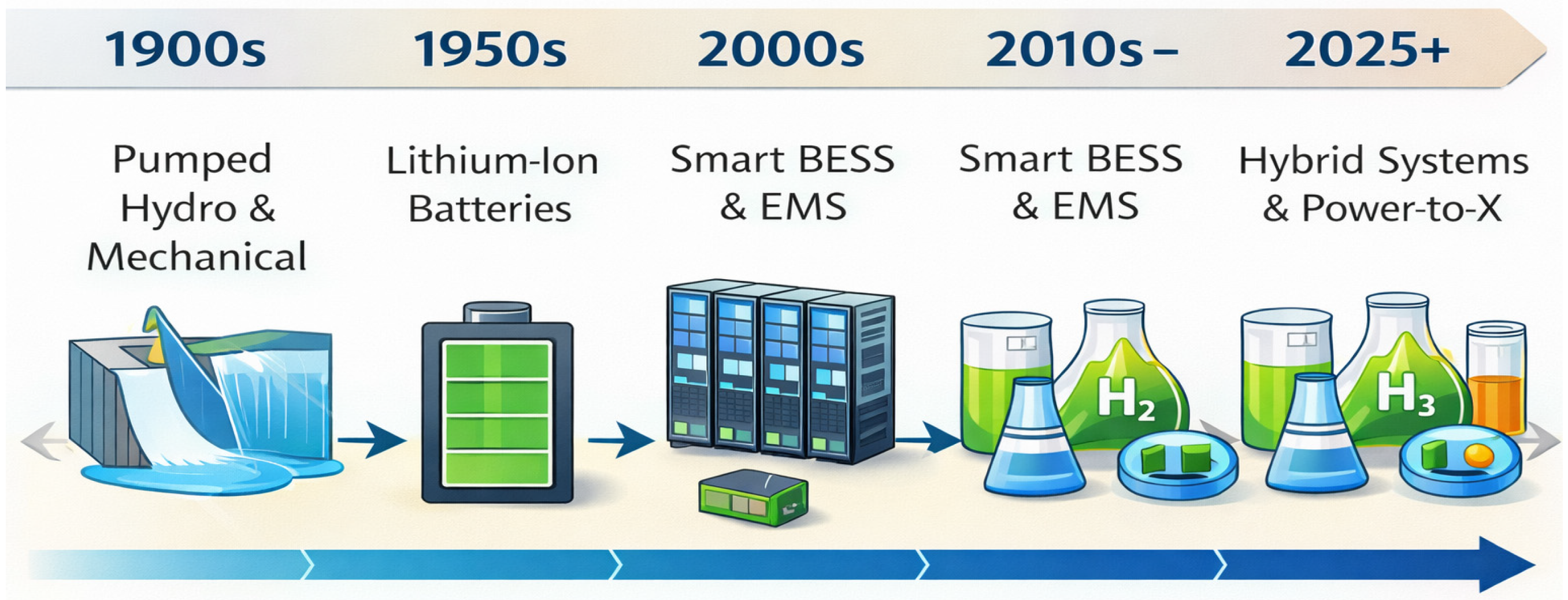
The concept of energy storage has evolved significantly over the last century, reflecting the changing structure of energy systems and technological progress in materials science and power engineering. Early electricity systems relied mainly on mechanical storage solutions such as pumped hydro energy storage (PHS), which became widely deployed during the twentieth century as a means of balancing large thermal power plants. The rapid development of electrochemical batteries in the late twentieth and early twenty-first centuries enabled decentralised and modular storage applications. More recently, the digitalisation of power systems and the integration of renewable energy sources have transformed energy storage into a critical infrastructure element that combines power electronics, advanced control systems, and data-driven optimisation algorithms [2,9,10].
The growing importance of energy storage technologies is also reflected in the rapidly increasing number of scientific publications devoted to this topic. Over the past decade, research activity in this field has intensified significantly, covering a wide range of issues including the development of novel storage materials, improvements in system performance, and the integration of storage technologies with renewable energy systems. This expanding body of literature highlights the critical role of energy storage in facilitating the energy transition, enhancing grid flexibility, and supporting the large-scale deployment of variable renewable energy sources.
The number of publications on the topic has increased more than fivefold in eight years, indicating a surge in energy storage research, especially after 2020, when climate neutrality strategies were introduced in the EU and China (Table 1) [1,2].
Geographically, Asian countries, in particular China, Japan and the Republic of Korea, have the largest share of scientific publications on energy storage. Europe leads the field of research in recycling and life cycle assessment (LCA), whereas the United States is at the forefront of analyses related to grid safety and battery energy storage systems (BESS) (Table 2) [2,11].
These regional differences are not accidental, but reflect different industrial structures, policy priorities and research traditions. In Asia, especially in China, Japan and the Republic of Korea, the strong concentration of battery manufacturing, materials processing and cell production naturally drives research towards electrochemical materials, performance optimisation and manufacturing efficiency [2,11]. In Europe, the stronger focus on life cycle assessment, recycling and environmental policy is closely linked to the regulatory orientation of the energy transition, the circular economy agenda and stricter sustainability requirements for batteries and critical materials [2,6,11,13]. In North America, the stronger presence of studies on BESS safety, grid services and cyber resilience is associated with the rapid deployment of utility-scale storage and the growing importance of grid reliability, resilience and digital system security. These regional specialisations may influence future technology pathways and standard-setting processes, because regions are not only developing different technologies, but are also prioritising different performance criteria, such as efficiency, circularity, safety and system resilience. In the longer term, such differences may also affect supply chain resilience by reinforcing regional dependencies in manufacturing, recycling capacity, digital infrastructure and critical materials governance [2,6,7,8,11,12].
The advancement of energy storage technologies (Figure 1) can be viewed as a progressive evolution from basic, passive solutions rooted in fundamental principles of physics to highly integrated systems of critical importance. The earliest energy storage technologies used potential and kinetic energy, with pumped hydro energy storage and other mechanical forms of storage being classic examples. These solutions are distinguished by their extended lifespans, high reliability, and reduced control complexity. Their environmental impact primarily arises from infrastructural interference with the landscape and local ecosystems [9,10].
The next stage of development was the spread of electrochemical technologies, which enabled significant improvements in the flexibility of location, scalability and speed of response of energy storage. Batteries, particularly lithium-ion batteries, have allowed energy storage to be actively integrated into the operation of the electricity system, enabling the balancing of variable renewable generation, the provision of regulation services and improved grid stability. At the same time, the material complexity of these systems and the importance of their life cycle management, including issues related to raw material availability, recycling and environmental impact, have increased [9,10,14].
In the last decade, energy storage has begun to function as an integral part of complex energy systems, closely linked to power electronics, automation and digital energy management systems. This development has enabled increased system efficiency, better matching of supply and demand and sectoral integration, including power engineering, district heating sector, transport and industry. At the same time, the increasing technical complexity of energy storage facilities means that their assessment in the context of sustainability requires a system approach, taking into account the full life cycle of the technology and its role in the stability and flexibility of the entire energy system [1,12,15].
In this view, modern energy storage technologies are no longer mere technical devices, but key components of the energy transition infrastructure. Their further development should be assessed not only in terms of technical and economic performance, but also in terms of their ability to reduce environmental pressure, promote the integration of renewable energy sources and ensure the long-term resilience of energy systems [1,12].

4. Energy Storage Technologies

4.1. Introduction to Energy Storage Technology

Energy storage has become one of the key pillars of the RES-based energy transition. The variability of photovoltaic and wind production necessitates energy buffering and flexibility on both the demand and supply sides to ensure the stability of frequency, voltage, and power quality. Current literature reviews indicate that storage technologies have undergone rapid progression in the last decade: from small-scale designs to commercial solutions at the grid (BESS), industrial, building and microgrid levels [2]. In parallel, market and status reports (IEA, REN21) show accelerating investment in RES and increasing demand for flexibility, which directly translates into demand for energy storage in the 2030 horizon [1,2].
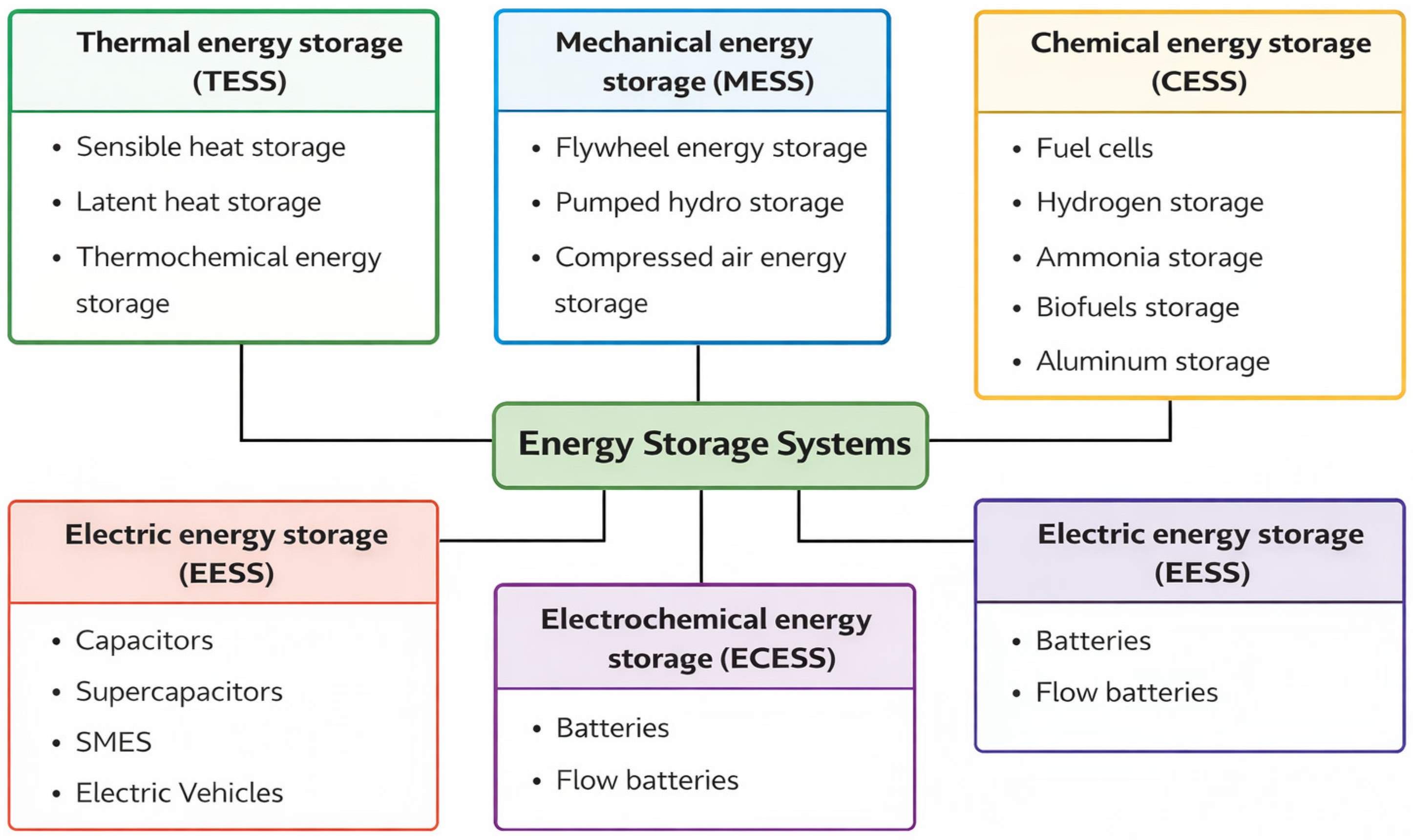
In the literature, energy storage technologies are most often classified according to the function performed and the dominant energy accumulation mechanism. In this view, there are five main classes of solutions (Figure 2). The first group is electrochemical technologies, encompassing different battery types such as lithium-ion batteries, lithium-iron-phosphate batteries, systems based on NMC/NCA chemistries, sodium-ion batteries, flow batteries and solid-state solutions, which are being developed intensively. The second category is made up of mechanical and physical technologies, which include pumped hydro energy storage, compressed air energy storage (CAES), flywheels and gravity systems. The subsequent group comprises thermal energy storage technologies (TES), which encompass the accumulation of sensible, latent, and chemical heat. A separate class is formed by chemical technologies, most often incorporated within the Power-to-X concept, in which electricity is converted to carriers such as hydrogen, ammonia, synthetic methane or liquid fuels. Complementing this classification are electrical technologies, including super capacitors and superconducting magnetic energy storage systems (SMES), characterised by very fast response times but limited energy capacity. Each class has a specific system function: from fast power regulation and smoothing services (super capacitors, Li-ion), to multi-hour RES profile balancing (Li-ion/LFP, Na-ion, flow, TES, PHS/CAES), to seasonal storage and sector coupling (Power-to-X). In system practice, it is crucial to match the technology to the scale and time horizon of the service: seconds, minutes (stabilisation), hours (peak-shaving), days (time-shift), weeks/months (long-term storage) [2,10,16].
From the perspective of Figure 2, the five technology classes also differ in the type of system problem they are designed to solve. Electrochemical systems are primarily used for fast and medium-duration balancing, high-quality ancillary services and modular deployment at distribution and behind-the-metre level. Mechanical and physical systems, especially PHS and CAES, are more suitable for bulk storage and longer discharge durations, while flywheels occupy a niche in ultra-fast dynamic services. Thermal energy storage is particularly important where electricity and heat sectors interact, including district heating, industrial heat recovery and CSP systems. By contrast, Power-to-X technologies form a distinct category because they do not merely store energy, but convert electricity into alternative carriers such as hydrogen, synthetic methane, liquid e-fuels or ammonia, thereby enabling sector coupling and long-duration or seasonal balancing. Electrical storage technologies such as supercapacitors and SMES remain important mainly for very short response times and power-quality support rather than for energy shifting.
Energy Strategy Reviews highlights a strong increase in publications and implementations after 2017, which coincides with a reduction in the cost intensity of battery components and the maturity of power control on the inverter/PCS and EMS side [2]. The IEA’s projections for RES by 2030 (tripling capacity post-COP28) remain ambitious, but still insufficient without a leap in flexibility and grid modernisation, which, in terms of energy storage, is a necessary component (both in the power industry and in the heating sector/process heating) [1]. REN21 reports historically record increases in RES capacity but also points to gaps in integration and system infrastructure that inhibit the full use of volatile sources, so it can be inferred that the role of storage will therefore grow not only for technical, but also for regulatory and market reasons [12].
At the same time, the effective integration of storage into modern distribution networks depends not only on storage chemistry or rated capacity, but also on the quality of inverter-side coordination and control. In storage-rich and distributed-resource-rich grids, voltage fluctuations, power imbalances and mode-switching complexity increasingly become limiting factors for practical deployment. Recent work on voltage–power self-coordinated control for load-side storage and distributed generation inverters shows that advanced control strategies can improve local power balance and voltage regulation while reducing the operational complexity of multi-mode inverter systems. This indicates that future storage deployment should be analysed not only in terms of storage medium characteristics, but also in conjunction with the development of intelligent inverter control, EMS logic and distribution-grid coordination architectures [17].
The central criterion for assessing energy storage technologies in this review is their contribution to the principles of sustainable development, understood in a multidimensional perspective. The core element of this assessment is the environmental footprint analysed over the entire life cycle of the technology (life cycle assessment, LCA), which includes the raw material extraction phase, the production processes, the exploitation phase and recycling or end-of-life disposal. Of equal importance is operational safety, including thermal and fire risks, the toxicity of the components used and potential emissions and environmental pollution in the event of an accident. The systemic impact of the technology, understood as the ability of energy storage to reduce greenhouse gas emissions by better matching generation from renewable energy sources with actual demand, is also an important criterion. Complementing this perspective is system resilience, which also includes cyber resilience of control and energy management systems (BMS, EMS, SCADA), as digital incidents can lead to material failures, losses of resources, and indirect but significant environmental impacts (Table 3).

4.2. Electrochemical Technologies (Batteries)

Contemporary research on electrochemical energy storage technologies focuses on simultaneously improving battery performance, reducing raw material pressures and increasing operational safety, which is crucial in the context of the rapid growth of stationary applications. Recent studies emphasise that the next generation of lithium-ion and lithium-metal batteries aims to combine high energy density with long cycle life and improved safety through advanced electrode architectures and electrolyte design. Dominant material developments include, in particular, modification of electrode chemistry, including cathodes with reduced or completely eliminated cobalt content, such as lithium-iron-phosphate (LFP) and high-nickel cathode materials with significant reduction in Co. In parallel, new anode concepts are being intensively developed, including silicon and composite anodes in lithium-ion systems and hard carbon anodes in sodium-ion batteries, which enable increased capacity and operational stability using more available raw materials. Solid and gel electrolytes in solid-state technologies, seen as a potential breakthrough in safety and energy density, also remain an important area of research. Material development is enhanced by advanced battery management system (BMS) algorithms aimed at reducing cell degradation through precise management of temperature, charge and discharge profiles [2,6].
In parallel with material development, recycling processes for electrochemical battery systems and end-of-life management strategies are being intensively researched. In the case of lithium-ion batteries, hydrometallurgical processes enabling the recovery of lithium, nickel, cobalt and manganese are growing in importance, as well as the concept of direct recycling, which involves preserving the structure of the cathode materials and reusing them. These approaches have the potential to significantly improve the environmental balance throughout the battery life cycle and reduce the need for critical raw materials. Sodium-ion technologies, on the other hand, are seen as solutions with lower raw material pressure and potentially less material toxicity, although effective methods for their recycling are still under development [2,18,22,23,24].
The operational safety of electrochemical energy storage is the third key area of research and implementation. The LFP chemistry has significantly better thermal stability compared to NMC/NCA cathodes, which translates into a reduced risk of thermal runaway in BESS. Solid-state technologies, on the other hand, seek to eliminate liquid, flammable electrolytes, which, in the long term, can provide significant benefits in terms of both operational safety and life cycle analysis results, assuming that adequate technological maturity and production scalability are achieved [2,9,21].
Such focused development of electrochemical battery technologies indicates that their future role in energy systems will be determined not only by technical performance, but also by their ability to reduce environmental pressures, improve safety and integrate the principles of a circular economy, making them one of the key pillars of a sustainable energy transition. For better illustration, a comparison of the above technologies is summarised in a table below (Table 4).

4.3. Mechanical and Physical Energy Storage Technologies: Operating Principle and System Role

Mechanical–physical energy storage technologies encompass pumped hydro energy storage (PHS), compressed air energy storage (CAES) systems, flywheel-based energy storage systems (FESSs), and gravity-based solutions that utilise the lifting and lowering of masses. The common feature of these technologies is the conversion of electrical energy into mechanical or potential energy and its subsequent recovery, which is done without chemical reactions. As a result, these systems have a very long operating life, high cyclic load resistance and short response times, making them a natural complement to variable generation renewable energy sources (Table 5) [2,9,25,26].
Pumped hydro energy storage (PHS) remains the most mature and widespread system-scale energy storage technology. Their operating principle is based on a two-tank water system, in which electricity is stored by pumping water into the upper tank and then recovered in generation mode using water turbines. PHSs are characterised by high specific power outputs of up to hundreds of megawatts, high cycle efficiencies of 70–85% and a very long plant life. These systems play a key role in shifting energy over time, dampening fluctuations in generation energy from RES and providing regulatory services, including primary and secondary regulation and black-start capabilities. Their main constraints remain topographical and hydrological requirements and potential environmental impacts, necessitating detailed environmental impact assessments and compensation activities [9,10,26]. In contrast, research on micro-PHS confirms the usefulness of this technology on a local scale and in stabilising frequency and power balance in islanded microgrids [27].
Compressed air energy storage (CAES) provides an alternative for locations where PHS construction is difficult. The technology involves compressing air and storing it in salt caverns, pore structures or aboveground tanks, and then using the energy of the compressed air to drive turbines or expanders. There are diabatic, adiabatic and isothermal variants, which differ in the way the heat of compression is managed. CAES technology enables energy storage on the megawatt-hour to gigawatt-hour scale, with very low self-discharge and long operating times, but its use is limited by the availability of suitable geological structures and, in diabatic variants, by the additional emissions associated with reheating the air. Reliability analyses of power systems indicate that the integration of CAES with wind farms significantly improves power adequacy and system stability, especially at high RES shares [2,16,28].
Flywheels (FESS) represent mechanical energy storage systems with very short reaction times, in which energy is accumulated in the form of kinetic energy of a rotating mass. Modern FESSs use magnetic bearings, a vacuum environment and advanced power electronics to achieve cycle efficiencies of 85–95% and cycle counts in excess of 105. Their main advantage is their ability to respond instantly to load changes, making them particularly useful for frequency control, improving power quality and smoothing short-term fluctuations in renewable generation output. However, a limitation remains in the short storage time, usually counted in seconds or minutes, which narrows the scope of their applications to system services of a dynamic nature [9,10].
Classic mechanical solutions are supplemented by gravity storage systems other than pumped hydro energy storage (PHS), wherein energy is stored by elevating and lowering masses such as concrete blocks, rock spoil, or transport platforms. These systems can be implemented in the form of towers, shafts, pits or rail solutions and are characterised by simple operating physics, long lifetimes and potentially low life-cycle costs. However, their efficiency is highly dependent on the mechanical and drive systems used, and implementation requires suitable spatial and location conditions. Literature reviews indicate that these technologies can play a complementary role to PHS, especially in regions lacking adequate water resources [2,16].
Taken together, mechanical–physical energy storage technologies play a key role in stabilising electricity systems with a high proportion of renewable energy sources. They provide both short-term synthetic inertia and power quality improvement, as well as long-term energy shifting and power reserve building. Development projections to 2030 indicate that PHS technology will remain the “anchor” of large-scale storage, CAES will gain importance in locations with suitable geology, flywheels will maintain their role in dynamic services, and gravity storage will be developed as a niche but promising solution in specific local conditions [2,16,29].

4.4. Thermal Energy Storage (TES)

TES (Thermal Energy Storage) technologies are an important part of the energy transition, particularly in the district heating, industrial and solar energy sectors. Their importance stems from the possibility of temporarily decoupling the production and consumption of thermal energy, allowing for greater flexibility in energy systems and better integration of renewable energy sources. In the literature, TES technologies are usually classified into three main groups: sensible heat storage (SHS), latent heat storage (LHS) using phase change materials (PCM) and thermochemical storage (TCS), in which energy is stored in the form of chemical reaction potentials or sorption processes [9,16,30,31,32].
Phase change materials (PCM) are increasingly investigated as effective thermal energy storage media due to their high latent heat capacity and ability to stabilise operating temperatures in energy systems. Recent studies also highlight their potential for improving thermal management of lithium-ion batteries, where PCM-based structures can significantly enhance heat dissipation and reduce temperature gradients within battery packs [33,34].
SHS facilities are based on heating a medium with a known heat capacity, such as water, glycols, concrete, stone deposits or molten salts. These are technologically mature solutions, characterised by a low unit cost per thermal output unit (e.g., kWh) and a wide range of applications, from the construction industry and district heating networks to concentrated solar power (CSP) plants. Systems based on molten nitrate salts (NaNO3/KNO3) play a particularly important role here, enabling operation in the temperature range up to 500–600 °C and achieving cycle efficiencies of 70–90% [16,31,32,35].
LHS technologies use the phenomenon of phase transformation, which allows for a much higher energy storage density with a nearly constant operating temperature. The most commonly used PCMs include paraffins, salt hydrates and nitrates. These solutions have found applications in buildings, HVAC systems, the refrigeration industry and selected industrial processes. Their main limitations are the low thermal conductivity of paraffins and the cyclic stability problems of salt hydrates, such as overcooling and phase separation. In response to these challenges, intensive research is being conducted on PCM composites, micro-encapsulation and additives that increase thermal conductivity, such as graphite or aluminium [9,31,36,37,38,39,40].
The most advanced but least mature groups are the TCSs, where energy is stored in the form of chemical bond energy or sorption processes. These systems, based inter alia on CaO/Ca(OH)2 or MgO/Mg(OH)2 reaction pairs and porous materials such as zeolites or silica gel, enable long-term thermal energy storage with virtually no standstill losses, achieving energy densities in excess of 250 kWh/m3. Despite their high potential, TCS technologies remain mainly at the research and demonstration stage and their further development depends on improved cyclic stability and integration with efficient heat exchangers [9,16,31,32].
A summary of the key technical and environmental characteristics of the three classes of TES is presented in a table that illustrates the differences in operating temperatures, energy density, level of technological maturity and potential environmental impacts (Table 6).
Applications of TES technology cover a broad spectrum of sectors. In the industry, these systems facilitate the stabilisation of thermal profiles in technological processes and promote the efficient utilisation of waste heat. This advancement, particularly within the food and chemical sectors, leads to a reduction in CO2 emissions by 10–25%. In buildings, the integration of PCM into structural elements and HVAC systems leads to a reduction in peak energy demand and improved thermal comfort. In CSP technology, molten salt-based SHS systems enable power generation for 6–10 h after sunset, increasing the turbine capacity factor to more than 60%. Consequently, in heating networks, large water tanks with a capacity of GWhth facilitate the integration of energy from renewable sources and industrial surpluses, leading to a reduction in fossil fuel consumption by up to 20–30% on a system-wide scale [9,16,31,32,35].
Examples of TES configurations and their application areas are summarised in Table 7, maintaining the distinction between SHS, LHS and TCS systems.
Current research trends in the TES area focus on improving the thermal conductivity of PCMs through the use of nanostructured additives and metallic foams, the development of stable salt eutectics for CSP systems with temperatures above 600 °C, as well as on enhancing cycling durability and reaction kinetics in TCS systems. Pilot test results indicate that TCS parameters can remain stable even after 1000 cycles of operation, confirming the potential of these technologies for long-term thermal energy storage [9,16,31,32,41].
From a systemic perspective, TES technologies play a key role in decarbonising the district heating, industrial and power engineering sectors. They make it possible to increase auto-consumption of energy from RES, reduce the use of fossil fuels and reduce the need for gas reserves in power engineering systems. With the right choice of materials (non-toxic PCMs), closed-loop salts or regenerated sorbents, TES technologies have a favourable environmental balance and improved life cycle analysis results compared to conventional heat sources [9,16,32,35,36,37,40,41].
Thermal energy storage technologies, particularly those based on phase change materials (PCM), have attracted growing attention due to their ability to store and release heat at nearly constant temperature, which makes them suitable for thermal management applications in energy systems and electronic devices (e.g., hybrid PCM heat sinks) [44].

4.5. Power-to-X (PtX) Technologies: Idea, Conversion Chains, Sectoral Integration and Determinants of Emission Reductions

Power-to-X (PtX) refers to the conversion of electricity (optimally from renewable energy sources) into chemical carriers and energy products, such as hydrogen (Power-to-Hydrogen, PtH2), synthetic methane (Power-to-Gas, PtG), liquid fuels (Power-to-Liquid, PtL) and ammonia (NH3), which acts as both an industrial product and an energy carrier (Table 8) [2,10,20]. The core of the PtX chains is the electrolysis of water realised in alkaline medium (AEL, alkaline electrolysis), proton exchange membrane (PEM) and high temperature (SOEC, solid oxide electrolysis cell) variants. The hydrogen (H2) produced is a key intermediate, which can then be utilised in several complementary pathways: stored compressed, liquid, in salt caverns, converted into synthetic methane with CO2, used for the synthesis of ammonia using the Haber-Bosch method or, together with CO2, converted to liquid fuels (e.g., methanol, e-diesel) [9,25,45,46,47,48,49,50,51,52,53,54].
However, the efficiency and environmental sense of the entire PtX chain are strongly determined by three systemic factors: (I) the availability and nature of the CO2 source (process, biogenic or DAC—Direct Air Capture), (II) the profile and variability of RES generation, and (III) the degree of process integration, including the use of waste heat, process steam and cooling [2,9,25,30,46,50,51,53,54].
In technological practice, the selection of the type of electrolyser and its operation within the energy system is of paramount importance. Alkaline electrolysis (AEL) remains a mature and stable solution in continuous operation but is less flexible in the situation of rapid load changes. PEM electrolysers have higher dynamics and better interaction with RES but involve greater material and cost pressures. In turn, SOECs utilise high-temperature steam and present the potential for the highest efficiency at the cell stage, particularly when integrated with industrial applications or concentrating solar energy. However, they remain a technology that is currently in the process of development and gradual implementation [2,9,30,47,48,50,52,53,54]. The integration of electrolysers with RES requires power buffering, management of operating profiles and (in practice) partial hybridisation with the electricity grid to reduce downtime and increase the utilisation of installed capacity [2,9,30,50,54].
The hydrogen produced can be stored and transported as gas (200–700 bar) or liquid (LH2, Liquid Hydrogen), and the choice of technology depends on the scale of the system, the storage horizon and logistics. This is complemented by liquid organic hydrogen carriers (LOHCs), allowing the use of liquid fuel-like infrastructure at the expense of hydrogenation and dehydrogenation steps, and seasonal storage in salt caverns; these solutions are considered crucial in a systems perspective [47,50,55,56,57,58]. At the same time, the integration of hydrogen into the gas network is limited by acceptable doping levels and material compatibility of the transmission and distribution infrastructure [50,56].
Hydrogen produced in Power-to-X systems can also be converted back into electricity through fuel cells, especially proton exchange membrane fuel cells (PEMFCs). PEMFCs are characterised by high efficiency, low operating temperature, fast dynamic response and zero direct carbon emissions at the point of use. For this reason, they are considered one of the most promising technologies for transport applications and flexible hydrogen-based power systems. Their integration with electrolysis-based hydrogen production closes the conversion loop within the broader PtX framework [59].
In the Power-to-Gas pathway, hydrogen reacts with carbon dioxide, leading to the production of SNG (synthetic natural gas) methane via Sabatier catalytic methanation or biomethanation. The advantage of this approach is the compatibility of the product with existing gas infrastructure and the possibility of long-term energy storage, while the provision of CO2 sources, thermal integration of the reactors and control of residual methane emissions (“methane slip”) remain critical [9,46,50,53,54,56,60]. Alternatively, the Power-to-Liquid pathway involves the synthesis of methanol and synthetic fuels using the Fischer-Tropsch process, including e-diesel and sustainable aviation fuels (SAF). It requires stable process conditions, high purity of reactants and access to CO2 (including from DAC). Furthermore, the integration and utilisation of waste heat significantly enhances the outcomes of the life cycle assessment for the entire chain [48,49,50,51,52,53,54]. A particular role is played by ammonia (NH3) produced from “green” H2, which can act as a fuel, energy carrier and intermediate hydrogen storage; however, limitations to the development of this pathway relate to nitrogen oxide (NOx) emissions, toxicity, safety requirements and the energy intensity of cracking at the point of use [49,50,53,55].
The added value of PtX is the ability to couple sectors and decouple generation and energy consumption over time, which is crucial with a high proportion of PV and wind [2,9,30,50,54]. The most promising integration directions include refineries and chemistry (H2, methanol, NH3), metallurgy (replacing fossil reducers with green hydrogen), fertiliser industry (green ammonia), power generation (SNG as seasonal storage, gas turbines and hybrid systems) and transport (SAF, e-diesel, e-methanol, NH3 in shipping) [9,25,46,48,49,50,51,52,53,54,56,57]. Process integration can additionally include the use of waste heat (e.g., in SOEC and methanation), the provision of system services by controlling the operation of electrolysers and the linking of CO2 streams between sources and receivers [2,9,30,46,50,56,57].
An important complementary dimension of sector coupling is the role of electric vehicles as distributed and mobile storage resources in vehicle-to-grid (V2G) and vehicle-to-home (V2H) schemes. However, the practical system value of EV fleets cannot be assessed only from nominal battery capacity, because it depends strongly on behavioural factors such as arrival and departure times, charging preferences, state-of-charge trajectories, daily mobility patterns and users’ willingness to participate in grid services. Recent review evidence indicates that behavioural modelling remains one of the key methodological challenges in V2G analysis, because simplified assumptions about vehicle availability may substantially overestimate realistic flexibility potential. Therefore, EV-based storage should be treated as a promising but behaviour-constrained flexibility resource whose system contribution depends on both technical integration and robust user-centred modelling frameworks [61].
The potential to reduce greenhouse gases (GHG) in PtX chains is conditional. The primary factors include the emission intensity of the electricity used for electrolysis (gCO2/kWh), the source of CO2 utilised in the synthesis (biogenic, process or DAC versus fossil CO2), the efficiency of the conversion stages, and the extent of thermal integration and waste heat utilisation [2,9,30,48,50,51,52,53,54]. In PtG, SNG production can replace fossil gas and support seasonal storage as long as the “methane slip” is controlled; with the use of biogenic CO2, the balance of the chain can approach climate neutrality [46,50,51,53,56,57,60]. PtL is particularly relevant for transport segments that are difficult to electrify (aviation and shipping), and the use of green H2 and biogenic CO2 or CO2 from DAC allows for a significant reduction in life-cycle emissions (LCA, Life Cycle Assessment) [48,51,53,54,56]. In the case of NH3, real emission benefits require green H2 and control of NOx emissions, including selective catalytic reduction (SCR) systems, while meeting high safety standards [50,51,53,55].
The economic determinants of PtX are dominated by the cost of electricity from RES, often described by the levelised cost of electricity (LCOE), as well as the capital and operating expenditures (CAPEX/OPEX) of electrolysers and synthesis plants, economies of scale and technology learning, as well as the possibility to monetise and utilise waste heat [2,9,30,48,50,52,53,54]. By 2030, the primary challenges will include AEL and PEM scaling, enhancing their dynamic operational capabilities in alignment with RES, and implementing SOEC in locations where high-temperature steam or process heat streams are accessible [2,9,30,50,52,53,54]. Simultaneously, integrated PtG and PtL systems with heat recovery and adaptation to local CO2 streams, along with H2/NH3/LOHC logistics and seasonal storage in salt caverns, will be developed [9,25,47,50,55,57,58]. Ultimately, however, the pace of implementation and financial credibility of PtX projects will be determined by the regulatory and market framework, including certification of “greenness”, definitions and support for RFNBO (Renewable Fuels of Non-Biological Origin) and recognition in the ETS (Emissions Trading System) and CBAM (Carbon Border Adjustment Mechanism) mechanisms [50,62,63,64,65].

4.6. Technology Comparison and Development Prospects

In the review literature and reports from international institutions, a functional division of energy storage technologies into five main classes has become established: electrochemical, mechanical/physical, thermal (TES), chemical (Power-to-X) and electrical (super capacitors and SMES) (Table 9) [1,2,5]. This classification reflects not only the technological differences, but above all the different system roles of the different solutions, resulting from the trade-offs between round-trip efficiency, storage time, investment and operating costs, durability and life-cycle environmental impact [1,2,12].
For short to medium time horizons (minutes to a few hours), battery-based electrochemical systems, particularly lithium-ion technologies, currently play a dominant role. Their high efficiency, fast response and market maturity make them an essential tool for services such as peak-shaving, energy arbitrage and frequency regulation. At the same time, numerous reviews have highlighted that the environmental profile of Li-ion batteries remains heavily dependent on cathode chemistry and the raw material supply chain. The transition from NMC/NCA technology towards LFP and the development of sodium-ion batteries and recycling significantly reduce material pressures and carbon footprints. Within the same time segment, with a focus on durability and energy scalability, flow batteries (VRFB, Fe-Cr) are gaining significant importance. They allow for the independent scaling of power and capacity and are distinguished by their exceptionally long lifespans, albeit with the trade-off of lower energy density and greater spatial requirements [2,66,67,68]. An additional feature of many aqueous redox flow batteries is the relatively slow electrochemical kinetics of redox reactions in aqueous electrolytes. Therefore, electrode modification and catalytic activation are often applied to improve reaction rates, reduce overpotentials and enhance the overall performance of RFB systems [69].
In daily and multi-day horizons, mechanical–physical technologies play a crucial role, particularly pumped hydro energy storage (PHS) and compressed air energy storage (CAES) systems. PHS remains the most mature large-scale technology, offering high efficiency and multi-decade durability, but its development is strongly constrained by topographical considerations and hydrological impacts. CAES is an alternative to sites without hydrological conditions, with the important environmental distinction between diabatic and adiabatic options. The latter, through the integration of compression heat storage, makes it possible to significantly reduce emissions [2,16,28,30]. Flywheels (FESS) occupy a niche but critical position in this landscape in terms of system stability, providing millisecond-scale response and a very high number of cycles, albeit with short hold times [10,21].
In parallel, thermal energy storage (TES) technologies, whose importance goes beyond the electricity sector, play an important role in the energy transition. SHS based on water and molten salts offers low cost and high maturity, especially in district heating and CSP systems. Meanwhile, phase change materials (PCM) and thermochemical systems (TCS) enhance energy density and facilitate extended storage periods, accompanied by progressively improving material stability [1,16,31,35,41]. TES technology acts as a key element in the decarbonisation of the heat sector; its importance in the emissions balance remains comparable to that of the electricity sector [41,70].
The longest storage horizons (weeks to seasons) are achieved by Power-to-X technologies, in which RES electricity is converted to chemical carriers such as hydrogen, synthetic methane, liquid fuels or ammonia. These solutions enable the coupling of the electricity, gas, fuel and industrial sectors, but their environmental and economic efficiency remains strongly dependent on the emission level of the energy feeding the electrolysis, the CO2 source and the specific emissions in the conversion chain (e.g., “methane slip” or NOx) [2,12,51,53]. For this reason, PtX is regarded not as a substitute for short-term energy storage but as a complementary system for seasonal balancing and the decarbonization of sectors that are challenging to electrify [56,57,60,71].
Forecasts until 2030 suggest that the growing share of RES will necessitate the concurrent advancement of a comprehensive range of storage technologies, with the likelihood of any single solution prevailing being low. BESS, especially in LFP chemistry, will remain the primary tool for short-term flexibility, while longer-term technologies such as flow, PHS, CAES and TES will become increasingly important as the demand for energy shifting increases on a daily and multi-day scale [1,2,12]. PtX, on the other hand, will be developed selectively, in close connection with climate policies, the availability of low-cost renewable energy and the regulatory framework for RFNBO (Renewable Fuels of Non-Biological Origin) as well as with mechanisms such as ETS (Emissions Trading System) or CBAM (Carbon Border Adjustment Mechanism) [2,62,63,64,65].
From a systems perspective, it is becoming increasingly clear that the highest technical, economic and environmental value is offered by hybrid architectures, combining different storage technologies depending on the time horizon required and the type of system service (Table 10).
Combining BESS with TES, PHS, CAES, FESS or PtX separates the functions of fast control, energy shifting and seasonal storage, while reducing component degradation and improving the results of LCA analyses. Consequently, the future of energy storage lies not in the competition of single technologies, but in their complementary coexistence, supported by policies and market models that price not only energy, but also flexibility, sustainability and environmental benefits over the entire life cycle (Table 11) [1,2,12,15,72].
The comparison presented in Table 10 and Table 11 indicates that no single storage technology can simultaneously optimise response speed, discharge duration, material sustainability, cycling stability and system-level flexibility. This reinforces the rationale for hybrid storage configurations based on complementary functional roles of different technologies. Such a perspective provides an important bridge between the technology-specific review and the broader system-level recommendations presented in the concluding section.
Due to the wide diversity of energy storage technologies, their technical and operational characteristics vary significantly depending on the underlying storage principle and intended application. Key parameters commonly used to compare storage technologies include energy density, round-trip efficiency, lifetime, technological maturity, and typical application domains. Table 12 summarises the main characteristics of major energy storage technologies discussed in this study.
Battery storage primarily supports short-duration grid flexibility, while thermal energy storage contributes to the decarbonization of heating systems and Power-to-X technologies enable long-duration storage and sector coupling. Therefore, the environmental performance of energy storage technologies should be evaluated in relation to the system services they provide [71].

4.7. Economic Value and Revenue Models of Energy Storage Systems

Energy storage systems generate economic value through a diversified portfolio of revenue streams, the relative importance of which depends on market design, regulatory frameworks and the range of system services provided. The most common revenue mechanisms include energy arbitrage, frequency regulation, balancing and reserve services, participation in capacity markets, and congestion management in transmission and distribution networks. In parallel, storage systems integrated with renewable energy sources can improve self-consumption, reduce curtailment losses and increase the effective utilisation of variable renewable generation. From a broader system perspective, energy storage may also defer network reinforcement investments, enhance reliability and support more efficient operation of power systems with a high share of RES. Consequently, the economic viability of storage projects is rarely determined by a single function alone, but rather by the ability to combine multiple value streams within one coordinated operational strategy [2,16,29].

5. The Environmental Challenges of Energy Storage

Life cycle assessment (LCA) is commonly used to evaluate the environmental impacts of energy storage technologies across their entire life cycle. In this study, environmental impacts are interpreted based on a functional unit defined as 1 kWh of electricity delivered over the operational lifetime of the system. The system boundaries correspond to a cradle-to-grave perspective, including raw material extraction, manufacturing, operation, and end-of-life treatment [66,74,75].
The energy transition towards a low-carbon economy requires the development of technologies that enable a stable and flexible energy supply from renewable energy sources (RES). Due to the variability of energy production from wind and solar radiation, energy storage plays a key role in modern energy systems. Storage systems make it possible not only to balance the operation of the electricity grid, but also to increase the use of RES and reduce greenhouse gas (GHG) emissions. At the same time, these technologies, particularly electrochemical batteries and hydroelectric storage, generate significant environmental burdens in the production, operation and end-of-life phases that must be taken into account in sustainability analyses [67,76,77].
Assessing the environmental impact of energy storage systems requires a holistic approach, including an analysis of the full life cycle of the technology—from raw material acquisition, manufacturing and use to recycling and disposal. To this end, the life cycle assessment (LCA) method is commonly used to identify the key stages that generate emissions and other environmental pressures [20,66]. The results of the LCA analyses indicate that the largest environmental burdens of energy storage typically occur during the production phase, while the operation phase (when powered by renewable energy) remains relatively carbon neutral. The energy mix of the producing country is an important factor in differentiating LCA results, as confirmed by studies showing significantly lower emissions in regions with a high RES share [60,74,76,78].
Lithium-ion batteries remain the dominant energy storage technology, used in both transport and stationary storage. However, their high energy density and efficiency come at the price of a significant environmental footprint due to energy-intensive production processes and the exploitation of critical elements such as lithium, cobalt and nickel, with associated ecosystem degradation and high water consumption [32,79]. In this context, lithium-iron-phosphate (LFP) batteries are becoming increasingly important, which (thanks to the elimination of cobalt and nickel) have lower toxicity, longer life and better recyclability, making them a more environmentally sustainable solution [67].
Quantitative life-cycle studies indicate that the carbon footprint of lithium-ion battery systems typically ranges between 60 and 120 kg CO2-eq per kWh of battery capacity, depending on the production energy mix and cathode chemistry. For comparison, pumped hydro energy storage systems show significantly lower life-cycle emissions, typically between 5 and 30 g CO2-eq per kWh of electricity delivered over the system lifetime. Flow battery systems generally fall between these ranges, although their environmental performance strongly depends on vanadium production processes and recycling rates [68,74,80,81,82].
In addition to carbon emissions, water consumption represents an important environmental indicator for energy storage technologies. Lithium extraction from brine deposits requires significant water resources, with estimates indicating that approximately 500–2000 L of water may be consumed per kilogram of lithium carbonate produced. Such water demands may create environmental pressure in arid regions where lithium mining is concentrated, particularly in South American salt-flat ecosystems [19,83,84].
An alternative to lithium technology is sodium-ion batteries, which use commonly available raw materials such as sodium, iron and carbon. life cycle analyses indicate a significantly lower impact of these systems on the depletion of mineral resources and less toxicity to the aquatic environment with a greenhouse effect potential comparable to Li-ion batteries [74,85]. Another direction of development is lithium-sulfur (Li-S) batteries, which, due to their high energy density, can reduce the consumption of raw materials per unit of capacity. However, their actual environmental impact is significantly influenced by the electrolyte technology, the energy source utilised in the production process, and the recycling strategy implemented [74,75].
The rapid development of battery markets also requires that environmental interpretations be linked to the most recent industrial context. According to the IEA, global EV battery demand reached around 1 TWh in 2024 and is expected to exceed 3 TWh by 2030 under stated policies, which means that the environmental significance of battery chemistry choices is increasing rapidly rather than remaining a marginal design issue. In this context, sodium-ion batteries are gaining attention not only because of their lower dependence on lithium, nickel and cobalt, but also because they may reduce exposure to concentrated mineral supply chains and material-criticality risks. Nevertheless, the environmental advantage of sodium-ion systems should still be interpreted cautiously, as the technology remains less mature than Li-ion in large-scale deployment and its full life-cycle profile depends on manufacturing routes, electricity mix and end-of-life management [74,85,86]. Given the rapid pace of change in battery chemistries, manufacturing scale and recycling systems, the environmental interpretation of these technologies should be treated as dynamic rather than static.
In the stationary storage segment, redox-flow systems, in particular vanadium flow batteries (VRFBs), which are characterised by a very long service life and the possibility of almost full electrolyte recycling, also play an important role. LCA studies indicate that the production of vanadium pentoxide is the main source of environmental burden in its life cycle, but the use of recycled materials can significantly reduce CO2 emissions [20,68,74].
Electrochemical storage technologies are supplemented by mechanical and hydroelectric systems, including flywheels and pumped hydro energy storage. They are characterised by long lifetimes and low emissions during the operation phase, while their main environmental impacts are concentrated in the infrastructure construction phase. LCA analyses indicate that hydroelectric storage, including low-head pumped hydro storage offshore solutions, has a relatively low carbon footprint per unit of energy [78]. At the same time, the literature highlights the potential negative ecological impacts of hydropower plants, such as river fragmentation and disturbance of aquatic ecosystems, which calls for the implementation of minimising measures, including turbine upgrades, stream restoration and advanced management systems [26,73].
The environmental footprint of battery production also varies significantly between regions due to differences in electricity generation mixes and industrial processes. Studies show that lithium-ion batteries produced in China, where coal still represents a significant share of electricity generation, may exhibit life-cycle emissions approximately 50% higher than batteries produced in Europe using a lower-carbon electricity mix. As battery manufacturing capacity expands globally, regional differences in energy systems and environmental regulations will play an increasingly important role in determining the overall sustainability of energy storage technologies [60,72,82,87].

6. Recycling and Disposal of Energy Storage in the Context of a Circular Economy

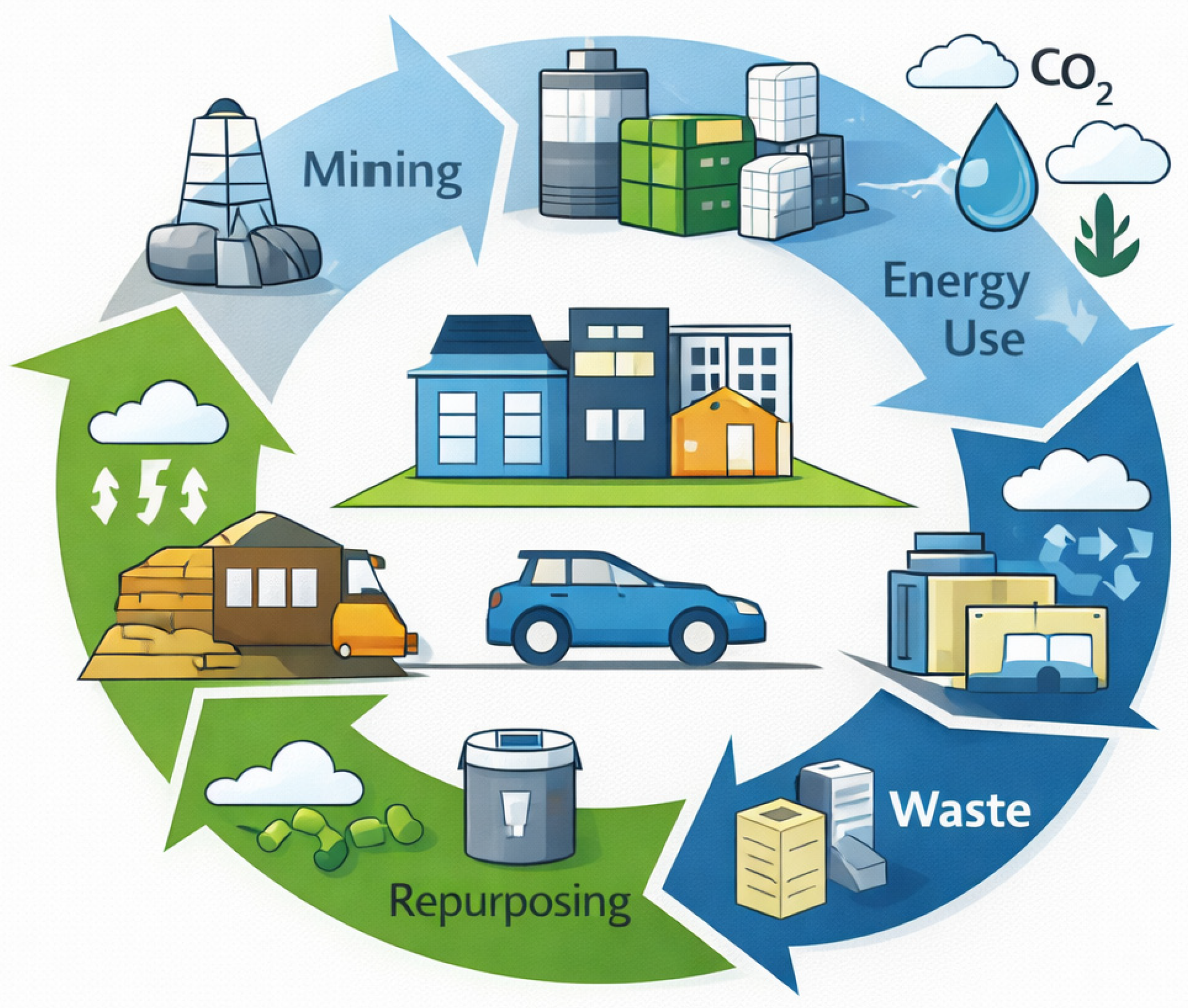
Recycling and reuse of materials from energy storage facilities is a key element in implementing the principles of a circular economy and reducing the environmental pressures associated with the energy transition. The importance of this issue has been reinforced by EU Regulation 2023/1542 [13], which makes it mandatory to report the carbon footprint of batteries and to achieve minimum recovery levels for critical raw materials such as lithium, nickel and cobalt. These regulations clearly shift the focus from the use phase of energy storage technologies to their entire life cycle (Figure 3), including the end-of-life and material recovery phase [13,20,22].
At this point, it is important to distinguish between three different categories of indicators that are often conflated in the literature: process-level recovery efficiencies reported for specific recycling technologies, regulatory material recovery targets, and actual system-level recovery performance under market conditions. Hydrometallurgical studies may report recovery efficiencies of up to 95% for selected metals under controlled process conditions, but these values should not be interpreted as current average market-wide recovery rates [22,23]. This distinction is particularly important because values reported in the literature may refer either to controlled process performance, policy targets, or actual market outcomes, and these categories should not be interpreted as interchangeable. By contrast, EU battery regulation defines material-specific regulatory targets, including lithium recovery targets of 50% by the end of 2027 and 80% by the end of 2031, which describe minimum policy requirements rather than current industrial performance [13]. Therefore, whenever recovery values are cited, their status as laboratory/process data, regulatory targets or real-world industrial averages should be made explicit, because their representativeness differs significantly [13,88].
The recycling of lithium-ion batteries, including lithium-iron-phosphate (LFP) batteries, is currently the most developed area for the recovery of materials from energy storage. The predominant hydrometallurgical technologies enable up to 95% of metals to be recovered but remain energy-intensive processes and generate liquid waste streams containing heavy metals. Obtaining cathode materials of comparable quality to virgin raw materials remains a significant challenge, which limits their direct reuse in the production of new cells. In response to these barriers, the so-called direct recycling concepts are being developed to regenerate active materials without full chemical degradation, thus reducing the use of energy and virgin raw materials [22,23,66].
Recent international assessments further confirm that recycling is becoming a strategic rather than purely end-of-life issue. The IEA indicates that scaling up critical-mineral recycling can simultaneously improve supply security, reduce dependence on primary extraction and lower environmental pressures associated with mining and refining. However, the representativeness of current recycling statistics remains limited by the still-emerging scale of end-of-life battery flows, uneven regional collection systems and differences in battery chemistry. For this reason, present recovery results should be interpreted as a rapidly evolving baseline rather than a mature and globally harmonised performance benchmark [88].
In addition to material recycling, increasing attention is being paid to the concept of second-life applications for batteries retired from electric vehicles. Batteries that no longer meet the performance requirements of mobility applications may still retain 70–90% of their original capacity and can therefore be reused in stationary energy storage systems. Such second-life applications may significantly extend battery service life, reduce the demand for primary raw materials, and improve the overall environmental balance of battery technologies within a circular economy framework [89].
In the case of redox-flow systems, particularly for vanadium flow batteries (VRFBs), recycling is one of the key environmental advantages of this technology. The vanadium electrolyte can be repeatedly regenerated and reused without significant loss of electrochemical properties. Research indicates that utilising recycled electrolyte can decrease CO2 emissions by up to an order of magnitude in comparison to primary production, thereby positioning VRFB as a leading example of the application of circular economy principles within the energy storage sector. However, the expenses associated with waste stream treatment and the necessity for further scaling of chemical processes continue to pose limitations [68,72].
Mechanical and hydroelectric storage facilities, such as pumped hydro energy storage, do not generate the typical hazardous waste characteristic for electrochemical technologies; however, their decommissioning and remediation phases have a considerable environmental impact. Upon decommissioning, hydrotechnical infrastructure may be repurposed for various new functions, such as retention reservoirs, recreational areas, or environmental monitoring facilities. This adaptation contributes to minimising long-term ecological and social impacts. This approach reinforces the multifunctionality of energy investments and fits in with the concept of sustainable land use [26,81,90].
The integration of recycling processes into the sustainability assessment of energy storage technologies requires a systems approach, including not only the classic life cycle analysis (LCA), but also an extended life cycle sustainability assessment (LCSA), taking into account environmental, economic and social aspects. This means that batteries need to be designed according to the “design for recycling” principle, right from the stage of material selection and cell architecture. The development of efficient recovery technologies not only reduces emissions and resource consumption but also strengthens Europe’s raw material security by reducing imports of critical elements [19,67].
The increasing deployment of electrochemical energy storage systems requires efficient recycling solutions to recover valuable materials and minimise environmental impacts. Different recycling approaches have been developed, including hydrometallurgical, pyrometallurgical, and direct recycling processes (Table 13).
Despite significant technological progress, the economic viability of battery recycling remains highly dependent on battery chemistry, metal prices and process scale. In particular, recycling routes are more economically attractive for batteries containing cobalt and nickel, whereas the transition towards lithium-iron-phosphate (LFP) chemistries reduces the intrinsic material value of end-of-life batteries and weakens direct financial incentives for recycling. As a result, the net environmental benefits of recycling increasingly depend not only on recovery efficiency but also on policy support, collection systems and the development of cost-effective processing technologies [22,23].
In summary, a comparison of energy storage technologies shows significant differences in the ability to close the material cycle. Lithium-ion batteries offer high energy efficiency but generate a significant environmental burden during the production phase, which can be reduced by developing advanced recycling methods. Flow systems, especially VRFBs, are distinguished by their high potential for full material recovery and long life, while hydroelectric storage has low emissions during the use phase, requiring compensation for hydrological impacts. Sustainable development of the energy storage sector requires a life-cycle approach to technology, integration of LCA and LCSA analyses and consistent implementation of the principles of circular economy, which is consistent with the objectives of the European Green Deal [13,67,68,81].

7. Geopolitical Aspects of Energy Storage Infrastructure

Recent studies emphasise that the transition towards renewable energy systems has important geopolitical implications related to resource distribution, technological leadership and international cooperation. The growing role of renewable energy technologies may reshape global power relations and influence the strategic position of countries involved in the energy transition [91].
The development of energy storage in the form of battery energy storage systems (BESS) is strongly dependent on access to critical raw materials, in particular, graphite used in anodes and lithium, nickel, and cobalt used in cathode materials. The global value chain for these raw materials is characterised by a high degree of concentration, especially at the processing and refining stage, which includes the production of anode and cathode precursors. The dominant role of East Asia, and China in particular, in refining lithium, spheronised graphite and cathode precursors, generates significant geopolitical risks related to, among other things, export regulations, licensing restrictions and trade tensions, while compounding environmental pressures arising from global supply chains (Table 14) [2,11,91].
Lithium, cobalt, nickel, and graphite represent critical materials for modern battery technologies due to their high supply chain concentration and rapidly increasing demand driven by the global electrification of energy systems. The geographic concentration of mining and refining capacity may create supply risks for large-scale deployment of battery energy storage systems [14,19,83].
Market analyses and sector reviews indicate that graphite, both natural and processed into the spheronised form used in anodes, remains the most concentrated raw material in terms of mining and processing locations. Similarly, lithium refining and the production of advanced cathode materials are largely dominated by China, while cobalt mining is mainly concentrated in the Democratic Republic of Congo, with refining shifting to Asian countries [2,19,91]. This supply chain structure increases the vulnerability of the energy storage sector to political and logistical disruptions and makes it more difficult to diversify raw material sources.
The environmental implications of this concentration are twofold. First, there is an outsourcing of environmental pressures to extractive countries, involving intensive water use, waste generation, soil degradation, and local environmental and social conflicts. Second, the risk of disruptions in supply chains can lead to sudden and hard-to-control environmental burdens in other regions of the world, resulting from the urgent mobilisation of alternative sources of raw materials and an increase in the carbon footprint of international transport. Consequently, the global concentration of production and processing of critical raw materials is not only a geopolitical challenge, but also a significant environmental issue that should be taken into account when assessing the sustainability of energy storage systems [2,11,83].
China maintains dominance in processing (anodes, cathodes, graphite) and a growing role in recycling; Australia dominates in lithium mining (spodumene), Chile/Argentina in lithium brines, DR of Congo in cobalt mining (high ESG risks).
The EU and the US are implementing diversification strategies (mining projects, refineries, recycling, raw material alliances) but remain dependent on imported components and processing in the short term. Environmental consequences: pressure for rapid “localisation” of processing (local impact on water and air quality) and, on the other hand, reduction in the logistics footprint and greater control of environmental standards in the value chain [2,11,83,91].

8. Cyber Security of Storage Infrastructure: Physical and Digital Aspects (OT/IT)

The BESS infrastructure connects OT (BMS, PCS/inverters, EMS, SCADA/DCS, HVAC, fire systems) with IT/cloud (remote monitoring, updates, integrations with power markets). This creates an extensive attack surface: poor network segmentation, lack of authentication in industrial protocols (e.g., Modbus/DNP3), inadequate access management (VPN/RDP), vulnerabilities in firmware and errors in API integrations (network service aggregators). Industry recommendations (insurance practice, integrators) and academic reviews emphasise: “layered” security architecture (7 layers), IEC 62443-2-1:2024 [92], MFA, DMZ IT/OT, OT monitoring (IDS/IPS) and penetration testing targeting BMS/PCS [93,94,95,96,97]. Key technical position: Sandia National Laboratories—need for anomaly monitoring (including CUSUM algorithms) and FDIA (False Data Injection Attacks) detection in BMS/EMS; modified voltage/temperature/SoC readings can prevent protections from tripping and lead to thermal overloads [95,98]. Sensitive system components are summarised in the table (Table 15).
While digitalisation improves monitoring, control accuracy, and operational efficiency of energy storage systems, it also introduces additional environmental burdens associated with information and communication technologies. The operation of digital infrastructures such as data centres, communication networks, and cloud-based monitoring platforms requires significant electricity consumption and contributes to indirect greenhouse gas emissions. Therefore, a comprehensive sustainability assessment of energy storage technologies should consider not only the physical storage devices but also the digital infrastructure supporting system monitoring, optimisation, and cyber security functions [15,100,101].

8.1. A Taxonomy of Cyber Threats and Their Environmental Impact Pathways

Digitalized battery energy storage systems rely on several interconnected control layers, including battery management systems (BMS), power conversion systems, and energy management platforms. These digital interfaces introduce potential cyber attack surfaces such as false data injection attacks, denial-of-service attacks, and manipulation of charge–discharge commands [96,97,98].
The increasing digitalisation of battery energy storage systems (BESS), involving the integration of IT (Information Technology) and OT (Operational Technology) layers, HMI/SCADA systems and advanced EMS algorithms, is making cyber security an important risk factor not only for operations, but also for the environment. Indeed, cyber attacks can initiate or escalate technical events leading to failures, fires and accelerated degradation of components, resulting in increased emissions, material losses and environmental pollution. One of the most dangerous scenarios are false data injection attacks (FDIAs), which involve the deliberate modification of measurement data frames, such as voltage, current, temperature or battery state of charge and health (SoC/SoH) indicators. Falsification of these signals can mask exceedances of limit states and block the activation of safety systems, leading to prolonged operation outside the safe operating area. As a consequence, there is an increased risk of excessive heating of the cells and the occurrence of thermal runaway, the environmental consequences of which include the emission of toxic gases and the generation of difficult-to-manage post-fire waste [7,33,95,97].
Another category is DoS/DDoS attacks targeting HMI, SCADA or EMS systems, which can lead to loss of control availability, system response delays or uncontrolled transitions into emergency modes. Situations where disruption involves HVAC systems or firefighting systems are particularly critical, as prolonged heat exposure promotes escalation of fires and increases the scale of environmental damage [93,95].
Ransomware attacks, in which a so-called pivot from the IT layer to the OT segment takes place, are also a significant threat. The blockage of operator interfaces and the loss of remote diagnostics and monitoring result in extended plant downtime and reduced incident response capability. In the event of technical failures, this can lead to post-fire waste and contamination of the water used for firefighting, generating additional environmental burdens [93]. Manipulation of system settings, such as power, voltage or temperature limits, is another pathway for cyber threats to impact the environment. Deliberate or covert setpoint changes can destabilise network nodes and force unscheduled charge and discharge cycles, accelerating cell degradation. The result is an increase in the carbon footprint during the operational phase and a reduction in battery life, leading to earlier recycling or disposal [93,96,97].
Supply chain threats involving the compromise of firmware or software updates are particularly difficult to detect. Malicious “backdoors” can maintain a persistent vulnerability of a system for a long period of time, generating a chronic risk of failure. Although the probability of single events may be low, their accumulation over a long-time horizon increases the risk of serious environmental incidents, especially for large-scale BESS installations [92,96].
In summary, cyber threats to energy storage systems create complex and often indirect pathways to environmental impact. These include both the immediate effects of technical failures and the long-term effects associated with component degradation, increased resource consumption and waste generation. The inclusion of cyber security as part of the BESS sustainability assessment is therefore becoming essential to mitigate environmental risks in increasingly digital energy systems (Table 16).

8.2. Incidents, Defence Strategies and the Link Between Cyber Security and Environmental Security of BESS

Publicly available and peer-reviewed reports do not conclusively confirm instances of direct remote triggering of battery energy storage system (BESS) fires solely as a result of a cyber attack. At the same time, they document numerous incidents in the energy sector and realistic attack paths that can lead to serious operational and environmental consequences. Industry analyses point, for example, to an April 2022 attack on three German wind companies that disrupted remote control of thousands of turbines, numerous ransomware incidents at energy suppliers in India and Luxembourg, and a 2020 incident in the US where an intruder made the transition from the IT to OT layer, forcing the shutdown of a gas plant [7,93]. Scientific reviews published in MDPI Batteries, Processes and Energy Informatics, among others, indicate that analogous attack vectors, including data manipulation, battery management system (BMS) compromise or cloud dependencies, are technically feasible for BESSs as well, although the effects depend on the system architecture and security level [95,96,97]. Although publicly available evidence does not conclusively confirm a cyber attack as the sole direct cause of a publicly documented BESS fire, reported incidents clearly demonstrate that cyber-induced disruption of control, monitoring or communication layers can create conditions conducive to operational instability and safety incidents. In this sense, the environmental relevance of cyber risk lies not only in direct physical damage, but also in its ability to trigger cascading failures that increase the probability of thermal events, toxic releases and hazardous post-incident waste.
In parallel, scientific literature and reports from research institutions, including Sandia National Laboratories, document the development of anomaly detection and defence methods dedicated to energy storage systems and DC microgrids. These range from classical statistical techniques such as CUSUM algorithms to advanced approaches based on artificial intelligence and machine learning. Methods using generative adversarial networks (GANs), autoencoders and the operational characteristics of the signals (e.g., voltage, dU/dt, changes in capacitance ΔQ) show high performance in detecting FDIA-type attacks and subtle deviations from normal cell operation, enabling the protection of state estimation and control stability in BESS-integrated microgrids [7,95,98,99].
However, the effectiveness of technical defence measures is closely linked to system architecture and operational practices. Recommendations include the implementation of industry cyber security standards, in particular IEC 62443-2-1:2024, network segmentation (security zones and DMZ), multi-component authentication, the principle of least privilege and control of the software supply chain, including SBOM management and firmware updates. This is complemented by dedicated security monitoring centres (SOC/IDS) for OT environments, regular penetration testing and incident response exercises, which are consistently recommended in the review literature and institutional materials [7,92,95,96,97]. The implementation approach is sometimes structured in the form of multi-layered security models, such as the “seven layers” concept, including policies and governance, identity and access management, segmentation, perimeter security, monitoring, incident response and system recovery, with mapping to IT and OT components [94].
However, the importance of cyber security goes beyond the technical and operational dimensions to include financial and environmental aspects as well. Insurance analyses indicate gaps in coverage for physical damage caused by cyber attacks, including events leading to fires or prolonged plant downtime, with direct implications for environmental risk management and remediation costs [93,97].
The environmental impact of cyber attacks on BESS is most often indirect, but remains real and measurable. It includes fire scenarios and thermal runaway phenomena, accompanied by the emission of toxic gases such as HF, metallic aerosols and the generation of waste and contaminated firefighting sewage. FDIA, disruption of HVAC systems as a result of DoS/DDoS or manipulation of operating settings can lead to such events [7,93,96,98]. Another impact pathway is accelerated cell degradation due to sub-optimal charge and discharge profiles, which shortens cell life and increases the environmental footprint over the life cycle through earlier recycling or disposal [96,97]. Finally, cyber incidents can cause secondary systemic effects, such as grid instabilities or unplanned power discharges, affecting other critical infrastructure elements, including waste water treatment plants, refrigeration systems or healthcare facilities [8,93].
Although publicly documented cases of cyber attacks directly causing a confirmed BESS fire remain limited, representative incidents from the wider energy sector illustrate realistic attack pathways and their environmental relevance [8]. One widely reported example is the 2022 cyber attack that disrupted the remote control of thousands of German wind turbines after a satellite communication failure linked to the compromise of networked control infrastructure [102,103]. While this event did not target BESS specifically, it demonstrated how digital disruption can affect the controllability of distributed energy assets at scale [8,102]. Another relevant case is the 2020 cyber intrusion into a U.S. natural gas facility, where adversarial activity in IT systems propagated into operational disruption and forced shutdown procedures [104]. In the context of BESS, analogous pathways are environmentally important because malicious manipulation of operating parameters, HVAC systems or protection logic could contribute to overheating, thermal runaway and toxic emissions [8]. These examples, therefore, strengthen the argument that cyber resilience is directly linked to environmental safety, not only to data protection or operational continuity.
In this view, BESS cyber resilience, understood as the ability to detect anomalies, system architecture resilience, effective segmentation and continuous monitoring, becomes an integral part of environmental protection. It reduces the likelihood of environmentally intensive events, reduces the risk of material losses and emergency emissions, and improves the performance of life cycle analyses (LCA) during the operational phase of energy storage. Cyber security thus ceases to be a purely technological issue and becomes an essential component of the sustainability of modern energy systems.

8.3. Technical Standards and Regulatory Frameworks for Energy Storage Systems

The rapid expansion of energy storage systems requires the parallel development and harmonisation of technical standards addressing not only operational safety, but also interoperability, digital resilience and cyber security. In this context, the IEC 62933-1:2024 [105] framework plays a key role by establishing a common technical basis for the definition, planning, installation and operation of electrical energy storage systems, including aspects related to safety and environmental performance. At the same time, the growing digitalisation of storage infrastructure, including remote monitoring, automated control, communication interfaces and integration with smart grids, makes cyber security a critical component of system reliability and continuity of operation. This challenge is particularly relevant for grid-connected and hybrid storage installations, where failures or cyber incidents may affect not only individual assets but also the broader stability of interconnected energy networks. For this reason, the IEC 62443-2-1:2024 framework provides an important reference for security governance in industrial automation and control systems, including requirements for security programmes, procedures and asset-owner responsibilities. However, despite the existence of these international frameworks, standardisation often progresses more slowly than technological innovation. The rapid emergence of new battery chemistries, hybrid storage architectures, power–electronic interfaces and increasingly data-driven control systems creates regulatory and technical gaps that are not always fully addressed by existing standards. Consequently, the continued deployment of energy storage technologies should be accompanied by more adaptive, regularly updated and better integrated regulatory frameworks capable of addressing evolving operational, interoperability and cyber risk challenges [8,92,105,106].

9. Social Acceptance, Policy Frameworks and Regulatory Barriers in Energy Storage Deployment

The large-scale deployment of energy storage technologies is influenced not only by technological performance and environmental considerations but also by social acceptance, policy frameworks and regulatory conditions [29,107,108]. Energy storage systems increasingly represent a critical component of modern power systems, supporting renewable energy integration and system flexibility [29,92,108]. However, the implementation of storage infrastructure may raise concerns related to safety, land use, environmental impacts and visual intrusion, particularly in the case of large battery installations or pumped hydro energy storage facilities [73,77]. Public perception and local community acceptance, therefore, play an important role in determining the pace of deployment of new energy infrastructure [77,107,108].
Several studies indicate that public acceptance of energy storage technologies is strongly linked to perceived safety risks, especially in relation to lithium-ion battery installations [77,107,108]. High-profile incidents involving battery fires have increased public awareness of safety issues, highlighting the need for transparent risk communication and robust safety standards [77,92,107]. At the same time, pumped hydro energy storage projects may face opposition due to landscape transformation, potential ecological disturbances and water management concerns [73,78,90]. Effective stakeholder engagement and participatory planning processes are therefore increasingly recognised as key elements of sustainable energy infrastructure development [77,108,109].
Policy frameworks and regulatory incentives also play a crucial role in enabling the economic viability of energy storage projects. In many electricity markets, storage systems historically faced regulatory barriers because they were not clearly classified as either generation, transmission or consumption assets [29,107,108]. Recent policy developments in several regions, including the European Union and the United States, aim to remove these barriers by introducing dedicated regulatory frameworks that recognise the multifunctional role of energy storage in providing grid flexibility, ancillary services and capacity support. Market mechanisms such as capacity markets, ancillary service markets and flexibility services are increasingly important for creating stable revenue streams for storage operators [29,109].
Despite these policy developments, regulatory challenges remain significant. Grid connection procedures, permitting processes and unclear market rules can delay or discourage energy storage investments. In addition, differences between national regulatory frameworks may create barriers for cross-border integration of energy storage technologies within interconnected electricity systems [29,108]. Consequently, the development of harmonised policy frameworks, transparent permitting procedures and dedicated support mechanisms is considered essential for accelerating the deployment of energy storage technologies and supporting the broader energy transition [29,107,108].

10. Discussion

The rapid development of energy storage technologies represents one of the key enabling factors of the global energy transition. As demonstrated in previous sections, the increasing penetration of renewable energy sources, particularly wind and photovoltaic systems, requires flexible system solutions capable of balancing variability and ensuring grid stability. Energy storage technologies fulfil this role by enabling temporal decoupling between electricity generation and consumption while improving the reliability and resilience of modern energy systems [1,2,3,12].
The comparative analysis of energy storage technologies indicates that individual solutions differ significantly in terms of operational characteristics, technological maturity and environmental performance. Electrochemical batteries, especially lithium-ion systems, currently dominate short-duration storage applications due to their high efficiency, modularity and fast response times. However, their environmental footprint is strongly influenced by the extraction and processing of critical raw materials such as lithium, cobalt and nickel, which are associated with significant environmental pressures and geopolitical risks in global supply chains [6,14,19]. In contrast, mechanical technologies such as pumped hydro storage remain the most mature large-scale storage solutions, offering long lifetimes and relatively low life-cycle emissions, although their deployment is constrained by geographical and hydrological conditions [2,16,73,81].
Thermal energy storage technologies play an important complementary role in the decarbonisation of heating and industrial sectors. Systems based on sensible heat storage, phase change materials and thermochemical processes allow the temporary decoupling of heat production and consumption, increasing system flexibility and improving the integration of renewable heat sources. From a life-cycle perspective, TES technologies often demonstrate favourable environmental performance due to the use of relatively abundant materials and long operational lifetimes, although their efficiency and scalability depend strongly on system design and operating conditions [31,32,41,70].
Power-to-X technologies represent another important pathway for long-duration and seasonal energy storage. By converting renewable electricity into chemical energy carriers such as hydrogen, synthetic methane, ammonia or liquid fuels, PtX technologies enable sector coupling between electricity, industry, transport and heating systems. However, their overall environmental performance depends strongly on the carbon intensity of the electricity used for electrolysis, the source of carbon dioxide and the efficiency of the conversion chain. Consequently, PtX solutions are generally considered complementary to short-term storage technologies rather than direct substitutes for battery-based systems [2,9,45,46,49].
Environmental sustainability remains one of the most critical challenges for the large-scale deployment of energy storage systems. Life cycle assessment studies show that the largest environmental burdens of many storage technologies occur during the production phase, particularly in the case of electrochemical batteries. At the same time, recycling and circular economy strategies can significantly reduce material demand and environmental impacts by enabling the recovery of valuable metals and the reuse of battery components [22,23,60,67]. The integration of recycling processes into the sustainability assessment of energy storage technologies, therefore, represents a key direction for future research and industrial development.
In addition to environmental considerations, the increasing digitalisation of energy systems introduces new systemic risks associated with cyber security. Battery energy storage systems are increasingly integrated with advanced control systems, cloud platforms and energy management software, which creates new attack surfaces within both IT and OT environments. Cyber attacks targeting monitoring systems, control interfaces or battery management systems may lead to operational disruptions, accelerated degradation of storage systems or, in extreme cases, thermal incidents and environmental hazards [7,8,95,97]. Consequently, cyber resilience should be considered an integral element of sustainability assessments for modern energy infrastructures.
Another important dimension highlighted in this review is the geopolitical structure of global supply chains for critical raw materials. The strong geographic concentration of lithium, cobalt, nickel and graphite production and processing creates strategic dependencies that may influence the pace of energy storage deployment. At the same time, environmental pressures associated with mining activities and long-distance transport contribute to the overall environmental footprint of energy storage technologies. Diversification of supply chains, development of recycling infrastructure and the implementation of circular economy principles therefore represent key elements of sustainable development of the energy storage sector [2,11,18,22,23].
Beyond the technological comparison presented in previous sections, several broader patterns emerge from the reviewed literature. First, research activity in the field of energy storage appears to be unevenly distributed across regions, with particularly strong contributions from China, the United States and Europe in several major subfields. This concentration may influence both technological development priorities and the framing of environmental assessments, especially where regional resource availability, electricity mixes and policy conditions differ [5,11,31].
Second, considerable methodological divergence exists in life cycle assessment studies of energy storage technologies. Differences in system boundaries, functional units and electricity mixes used during battery manufacturing can significantly affect reported environmental impacts. Consequently, comparisons between technologies across different studies should be interpreted with caution [67,74,76].
Third, the literature reveals an increasing trade-off between technological performance and resource sustainability. Technologies characterised by high energy density often rely on critical raw materials with geographically concentrated supply chains, which introduces geopolitical risks and environmental pressures associated with mining and refining [11,14,19,83,91].
Finally, the growing digitalisation of energy systems introduces cyber security as an emerging sustainability dimension. Although this issue has received increasing attention in engineering research, its environmental implications remain relatively underexplored in sustainability-oriented analyses of energy storage systems [7,8,15,97].
The reviewed literature suggests that no single energy storage technology is capable of meeting all functional requirements of future energy systems. Instead, the role of storage should be considered in a systemic context, where different technologies fulfil complementary functions depending on discharge duration, response time, spatial scale and sectoral application. In this perspective, hybrid configurations combining electrochemical, mechanical, thermal and Power-to-X-based storage pathways appear particularly relevant, as they may improve operational flexibility and strengthen system resilience under variable renewable energy supply. This also indicates that the assessment of storage technologies should move beyond isolated technical parameters and increasingly account for cross-sector integration, infrastructure interdependencies and the growing digital complexity of energy systems [2,11,20,49,57].

11. Conclusions

The analysis of energy storage technologies shows that the sector is undergoing a profound transition, in which storage is no longer viewed solely as an individual technical solution, but increasingly as a multifunctional infrastructure element supporting renewable energy integration, improving power system flexibility and stability, and facilitating sector coupling across electricity, heat, transport and industry. From a sustainability perspective, a key finding of the reviewed literature is that there is no single “best” energy storage technology. Each group of technologies (electrochemical, mechanical–physical, thermal and chemical (Power-to-X)) demonstrates a distinct profile of advantages and environmental burdens depending on the scale of application, storage duration and system configuration. Consequently, the decarbonisation of the energy sector will most likely rely on hybrid architectures combining multiple storage technologies operating at different temporal and spatial scales. In practical terms, such hybrid architectures may include combinations such as LFP or sodium-ion batteries with flow batteries for short-duration efficiency combined with longer-duration cycling stability, batteries coupled with thermal energy storage in buildings, district heating or industrial systems, and BESS integrated with hydrogen-based PtX pathways where fast balancing and seasonal storage must coexist. These combinations are attractive because they separate functions that are difficult to optimise simultaneously in a single technology, such as millisecond-scale response, daily shifting, seasonal balancing, low degradation and low material pressure. The sustainability of energy storage should therefore be assessed from a system-level and life-cycle perspective rather than through isolated technical or cost parameters.
The reviewed studies also highlight the growing importance of raw material availability and material management. Increasing demand for critical metals such as lithium, cobalt and nickel creates new environmental and geopolitical challenges related to resource extraction, supply chain concentration and material processing. As a result, recycling technologies, circular economy strategies and improved material recovery systems are becoming key conditions for the long-term sustainability of the energy storage sector.
At the technological level, lithium-ion batteries currently dominate short-duration energy storage applications due to high round-trip efficiencies exceeding 85% and cycle lifetimes often above 5000 cycles. At the same time, large-scale technologies such as pumped hydro storage or hydrogen-based systems provide longer storage durations, although typically with lower overall system efficiencies. This confirms that future energy systems will likely depend on diversified portfolios of complementary storage technologies rather than a single dominant solution.
Another important dimension identified in the literature is the growing role of cyber security as a component of environmental and operational safety. As energy storage systems become increasingly integrated with digital control platforms, energy management systems and cloud-based infrastructures, new vulnerabilities emerge within both IT and operational technology environments. Cyber incidents affecting battery management systems or control platforms may lead to operational disruptions, accelerated equipment degradation or, in extreme cases, environmental hazards. Therefore, cyber resilience should be considered an integral element of sustainable energy storage system design.
Effective policy support for energy storage should combine short-term innovation incentives with long-term market mechanisms, but it should also include clearer sustainability and resilience requirements. In practice, this means not only coupling demonstration support and investment subsidies with capacity markets, flexibility services and carbon-pricing instruments, but also strengthening minimum recycling and material recovery requirements, standards for cyber resilience and OT security, and policy instruments that reduce dependence on highly concentrated critical-mineral supply chains. From a sustainability perspective, future regulatory frameworks should therefore integrate technical performance, circularity, digital security and resource diversification rather than treating them as separate policy domains. Such a framework should explicitly combine minimum recycling and recovery requirements, cyber security and OT-protection standards, and measures supporting diversification of critical material supply chains.
Future research should focus on improving the comparability of life cycle assessment across different energy storage technologies and developing effective recycling systems for critical battery materials. In addition, increasing digitalisation of energy infrastructure suggests that cyber security considerations should be more systematically integrated into sustainability-oriented analyses of energy storage systems.

Author Contributions

Conceptualization, B.S., P.F. and M.D.; methodology, B.S., P.F. and M.D.; formal analysis, B.S., P.F. and M.D.; data curation, B.S., P.F. and M.D.; writing—original draft preparation, P.F. and M.D.; writing—review and editing, B.S.; supervision, B.S.; project administration, B.S. All authors have read and agreed to the published version of the manuscript.

Funding

This research received no external funding.

Institutional Review Board Statement

Not applicable.

Informed Consent Statement

Not applicable.

Data Availability Statement

The data are contained within the article.

Acknowledgments

Artificial intelligence-based tools were used to generate and refine selected figures in this manuscript. The authors reviewed, validated, and, where necessary, modified the generated content and take full responsibility for the accuracy and integrity of all figures.

Conflicts of Interest

The authors declare no conflicts of interest.

Abbreviations

The following abbreviations are used in this manuscript:
AELAlkaline Electrolysis
AIArtificial Intelligence
BESSBattery Energy Storage System
BMSBattery Management System
CAESCompressed Energy Storage
CAPEXCapital Expenditure
CBAMCarbon Border Adjustment Mechanism
CECircular Economy
CHPCombined Heat and Power
CO2Carbon Dioxide
CSPConcentrated Solar Power
DACDirect Air Capture
DODDepth of Discharge
DSRDemand-Side Response
EIAEnvironmental Impact Assessment
EMSEnergy Management System
ESSEnergy Storage System
ETSEmissions Trading System
EVElectric Vehicle
FESSFlywheel Energy Storage System
GHGGreenhouse Gases
H2Hydrogen
HVACHeating, Ventilation and Air Conditioning
IEAInternational Energy Agency
IoTInternet of Things
IRENAInternational Renewable Energy Agency
LCALife Cycle Assessment
LCOELevelized Cost of Energy
LDESLong-Duration Energy Storage
Li-ionLithium-ion Battery
LFPLithium Iron Phosphate
LOHCLiquid Organic Hydrogen Carrier
Na-ionSodium-ion Battery
NCANickel-Cobalt-Aluminium Battery
NMCNickel-Manganese-Cobalt Battery
NH3Ammonia
OPEXOperational Expenditure
RESRenewable Energy Sources
PCMPhase Change Material
PEMProton Exchange Membrane
PHSPumped Hydro Energy Storage
PLCProgrammable Logic Controller
PtXPower-to-X
PtH2Power-to-Hydrogen
PtGPower-to-Gas
PtLPower-to-Liquid
PVPhotovoltaics
RFNBORenewable Fuels of Non-Biological Origin
SAFSustainable Aviation Fuel
SCADASupervisory Control and Data Acquisition
SHSSensible Heat Storage
SOECSolid Oxide Electrolysis Cell
SNGSynthetic Natural Gas
TESThermal Energy Storage
TCSThermochemical Storage
VRFBVanadium Redox Flow Battery
ZEBZero-Energy Building

References

  1. International Energy Agency (IEA). Renewables 2024—Analysis and Forecast to 2030; IEA: Paris, France, 2024; Available online: https://www.iea.org/reports/renewables-2024 (accessed on 25 January 2026).
  2. Elalfy, D.A.; Gouda, E.; Kotb, M.F.; Bureš, V.; Sedhom, B.E. Comprehensive Review of Energy Storage Systems Technologies, Objectives, Challenges, and Future Trends. Energy Strategy Rev. 2024, 54, 101482. [Google Scholar] [CrossRef]
  3. Jafarizadeh, H.; Yamini, E.; Zolfaghari, S.M.; Esmaeilion, F.; Assad, M.E.H.; Soltani, M. Navigating Challenges in Large-Scale Renewable Energy Storage: Barriers, solutions, and innovations. Energy Rep. 2024, 12, 2179–2192. [Google Scholar] [CrossRef]
  4. Rana, M.M.; Uddin, M.; Sarkar, M.R.; Meraj, S.T.; Shafiullah, G.M.; Muyeen, S.M.; Islam, M.A.; Jamal, T. Applications of energy storage systems in power grids with and without renewable energy integration—A comprehensive review. J. Energy Storage 2023, 68, 107811. [Google Scholar] [CrossRef]
  5. Kikuma, I. Global Energy Storage Boom: Three Things to Know; BloombergNEF: London, UK, 2025; Available online: https://about.bnef.com/insights/clean-energy/global-energy-storage-boom-three-things-to-know/ (accessed on 25 January 2026).
  6. Ahmed, M.M.S.; Hasan, M.J.; Chowdhury, M.S.; Rahman, M.K.; Islam, M.S.; Hossain, M.H.; Islam, M.A.; Hossain, N.; Mobarak, M.H. Prospects and Challenges of Energy Storage Materials: A Comprehensive Review. Chem. Eng. J. Adv. 2024, 20, 100657. [Google Scholar] [CrossRef]
  7. Trevizan, R.D.; Obert, J.; De Angelis, V.; Nguyen, T.A.; Rao, V.S.; Chalamala, B.R. Cyberphysical Security of Grid Battery Energy Storage Systems. IEEE Access 2022, 10, 59675–59722. [Google Scholar] [CrossRef]
  8. Abraham, D.; Houmb, S.H.; Erdodi, L. Cyber-Attacks on Energy Infrastructure—A Literature Overview and Perspectives on the Current Situation. Appl. Sci. 2025, 15, 9233. [Google Scholar] [CrossRef]
  9. Hossain, E.; Faruque, H.M.R.; Sunny, M.S.H.; Mohammad, N.; Nawar, N. A Comprehensive Review on Energy Storage Systems: Types, Comparison, Current Scenario, Applications, Barriers, and Potential Solutions, Policies, and Future Prospects. Energies 2020, 13, 3651. [Google Scholar] [CrossRef]
  10. Luo, X.; Wang, J.; Dooner, M.; Clarke, J. Overview of Current Development in Electrical Energy Storage Technologies and the Application Potential in Power System Operation. Appl. Energy 2015, 137, 511–536. [Google Scholar] [CrossRef]
  11. Amir, M.; Deshmukh, R.G.; Khalid, H.M.; Said, Z.; Raza, A.; Muyeen, S.M.; Nizami, A.S.; Elavarasan, R.M.; Saidur, R.; Sopian, K. Energy Storage Technologies: An Integrated Survey of Developments, Global Economical/Environmental Effects, Optimal Scheduling Model, and Sustainable Adaption Policies. J. Energy Storage 2023, 72, 108694. [Google Scholar] [CrossRef]
  12. REN21. Renewables 2024 Global Status Report (GSR 2024); REN21 Secretariat: Paris, France, 2024; Available online: https://www.ren21.net/gsr-2024/ (accessed on 25 January 2026).
  13. European Union. Regulation (EU) 2023/1542 of the European Parliament and of the Council of 12 July 2023 concerning batteries and waste batteries, amending Directive 2008/98/EC and Regulation (EU) 2019/1020 and repealing Directive 2006/66/EC. Off. J. Eur. Union 2023, L 191, 1–130. [Google Scholar]
  14. US Geological Survey. Mineral Commodity Summaries 2024; U.S. Geological Survey: Reston, VA, USA, 2024. [CrossRef]
  15. Ersoy, H.; Baumann, M.; Erakca, M.; Jasper, F.; Ferraro, M.; Pechancov’a, V.; Stuhm, P.; Cellura, M.; Longo, S.; Picciotto Maniscalco, M.; et al. Empowering sustainability assessment of energy storage. Sustain. Energy Fuels 2025, 9, 5749. [Google Scholar] [CrossRef]
  16. Shaqsi, A.Z.A.L.; Sopian, K.; Al-Hinai, A. Review of Energy Storage Services, Applications, Limitations and Benefits. Energy Rep. 2020, 6, 288–306. [Google Scholar] [CrossRef]
  17. Zhang, W.; Sun, C.; Alharbi, M.; Hasanien, H.M.; Song, K. A Voltage-Power Self-Coordinated Control System on the Load-Side of Storage and Distributed Generation Inverters in Distribution Grid. Ain Shams Eng. J. 2025, 16, 103480. [Google Scholar] [CrossRef]
  18. Chen, H.; Cong, T.N.; Yang, W.; Tan, C.; Li, Y.; Ding, Y. Progress in Electrical Energy Storage System: A Critical Review. Prog. Nat. Sci. 2009, 19, 291–312. [Google Scholar] [CrossRef]
  19. International Energy Agency (IEA). The Role of Critical Minerals in Clean Energy Transitions; World Energy Outlook Special Report; IEA: Paris, France, 2021; Available online: https://www.iea.org/reports/the-role-of-critical-minerals-in-clean-energy-transitions (accessed on 25 January 2026).
  20. Heigl, E.-M.; Schaffer, M.; Zeilerbauer, L.; Zauner, A.; Lindorfer, J.; Ott, J.; Fischer, P. Life Cycle Assessment of a Novel Hybrid Energy Storage System: Environmental Hotspots and Sustainability Options Based on Experimental Insights. J. Energy Storage 2025, 132, 117705. [Google Scholar] [CrossRef]
  21. Beaudin, M.; Zareipour, H.; Schellenberglabe, A.; Rosehart, W. Energy Storage for Mitigating the Variability of Renewable Electricity Sources: An Updated Review. Energy Sustain. Dev. 2010, 14, 302–314. [Google Scholar] [CrossRef]
  22. Harper, G.; Sommerville, R.; Kendrick, E.; Driscoll, L.; Slater, P.; Stolkin, R.; Anderson, P.; Flowers, P.; Hyde, J.; Heelan, J.; et al. Recycling Lithium-Ion Batteries from Electric Vehicles. Nature 2019, 575, 75–86. [Google Scholar] [CrossRef]
  23. Xu, J.; Thomas, H.R.; Francis, R.W.; Lum, K.R.; Wang, J.; Liang, B. A Review of Processes and Technologies for the Recycling of Lithium-Ion Secondary Batteries. J. Power Sources 2008, 177, 512–527. [Google Scholar] [CrossRef]
  24. Zheng, X.; Zhu, Z.; Lin, X.; Zhang, Y.; He, Y.; Cao, H.; Sun, Z. A mini-review on metal recycling from spent lithium ion batteries. Engineering 2018, 4, 361–370. [Google Scholar] [CrossRef]
  25. Achkari, O.; El Fadar, A. Renewable Energy Storage Technologies—A Review. In Engineering and Technology—PET, Proceedings of the 6ème Conférence Internationale en Automatique & Traitement de Signal (ATS-2018), Hammamet, Tunisia, 21–23 December 2018; IPCO: Sandviken, Sweden, 2018; Volume 35, pp. 69–79. Available online: https://d1wqtxts1xzle7.cloudfront.net/57112002/32-libre.pdf (accessed on 25 January 2026).
  26. Gemechu, E.; Kumar, A. A Review of How Life Cycle Assessment Has Been Used to Assess the Environmental Impacts of Hydropower Energy. Renew. Sustain. Energy Rev. 2022, 167, 112684. [Google Scholar] [CrossRef]
  27. Dhundhara, S.; Verma, Y.P. Application of Micro Pumped Hydro Energy Storage for Reliable Operation of Microgrid System. IET Renew. Power Gener. 2020, 14, 1368–1378. [Google Scholar] [CrossRef]
  28. Bhattarai, S.; Karki, R.; Piya, P. Reliability Modelling of Compressed Air Energy Storage for Adequacy Assessment of Wind Integrated Power System. IET Gener. Transm. Distrib. 2019, 13, 4443–4450. [Google Scholar] [CrossRef]
  29. Energy Storage TCP Annual Report 2023. International Energy Agency Technology Collaboration Programme on Energy Storage (ES TCP). 2024. Available online: https://iea-es.org/wp-content/uploads/public/ES_TCP_Annual_Report_2023.pdf (accessed on 7 March 2026).
  30. Kampouris, K.P.; Drosou, V.; Karytsas, C.; Karagiorgas, M. Energy Storage Systems for Renewable Energy Power Sector Integration and Distributed Generation. IOP Conf. Ser. Earth Environ. Sci. 2019, 410, 012033. [Google Scholar] [CrossRef]
  31. Borri, E.; Zsembinszki, G.; Cabeza, L.F. Recent developments of thermal energy storage applications in the built environment: A bibliometric analysis and systematic review. Appl. Therm. Eng. 2021, 189, 116666. [Google Scholar] [CrossRef]
  32. Lin, Y.; Jia, Y.; Alva, G.; Fang, G. Review on thermal conductivity enhancement, thermal properties and applications of phase change materials in thermal energy storage. Renew. Sustain. Energy Rev. 2018, 82, 2730–2742. [Google Scholar] [CrossRef]
  33. Es-Satte, M.; Afaynou, I.; Faraji, H.; Choukairy, K.; Regragui, I.; Amghar, K.; Boucetta, M.; Saadeddine, S.; Bourich, M. Phase change materials, bionic structures and artificial intelligence for lithium-ion battery thermal management: A comprehensive review. Int. Commun. Heat Mass Transf. 2026, 173, 110870. [Google Scholar] [CrossRef]
  34. Khateeb, S.; Amiruddin, S.; Farid, M.; Selman, J.R.; Al-Hallaj, S. Design and simulation of a lithium-ion battery with a phase change material thermal management system for an electric scooter. J. Power Sources 2004, 128, 292–307. [Google Scholar] [CrossRef]
  35. Palacios, A.; Barreneche, C.; Navarro, M.E.; Ding, Y. Thermal energy storage technologies for concentrated solar power—A review from a materials perspective. Renew. Energy 2020, 156, 1244–1265. [Google Scholar] [CrossRef]
  36. Radouane, N. A Comprehensive Review of Composite Phase Change Materials (cPCMs) for Thermal Management Applications, Including Manufacturing Processes, Performance, and Applications. Energies 2022, 15, 8271. [Google Scholar] [CrossRef]
  37. Zalba, B.; Marín, J.M.; Cabeza, L.F.; Mehling, H. Review on Thermal Energy Storage with Phase Change Materials. Appl. Therm. Eng. 2002, 23, 251–283. [Google Scholar] [CrossRef]
  38. Martínez, F.R.; Borri, E.; Mani Kala, S.; Ushak, S.; Cabeza, L.F. Phase change materials for thermal energy storage in industrial applications. Heliyon 2025, 11, e41025. [Google Scholar] [CrossRef]
  39. Ren, F.; Meng, F.; Liu, H.; Yu, H.; Xu, L.; Ren, X. Molten-Salt-Based Thermal Storage for Thermal Power Unit Plant Peaking. Energies 2025, 18, 2522. [Google Scholar] [CrossRef]
  40. Kottala, R.K.; Chigilipalli, B.K.; Mukuloth, S.; Shanmugam, R.; Kantumuchu, V.C.; Ainapurapu, S.B.; Cheepu, M. Thermal Degradation Studies and Machine Learning Modelling of Nano-Enhanced Sugar Alcohol-Based Phase Change Materials for Medium Temperature Applications. Energies 2023, 16, 2187. [Google Scholar] [CrossRef]
  41. Airò Farulla, G.; Cellura, M.; Guarino, F.; Ferraro, M. A Review of Thermochemical Energy Storage Systems for Power Grid Support. Appl. Sci. 2020, 10, 3142. [Google Scholar] [CrossRef]
  42. Alva, G.; Liu, L.; Huang, X.; Fang, G. Thermal Energy Storage Materials and Systems for Solar Energy Applications. Renew. Sustain. Energy Rev. 2017, 68, 693–706. [Google Scholar] [CrossRef]
  43. Caraballo, A.; Galán-Casado, S.; Caballero, Á.; Serena, S. Molten Salts for Sensible Thermal Energy Storage: A Review and an Energy Performance Analysis. Energies 2021, 14, 1197. [Google Scholar] [CrossRef]
  44. Afaynou, I.; Hamza, F.; Choukairy, K.; Ridha, D.; Hegazy, R. Comprehensive Analysis and Thermo-Economic Optimization of a Hybrid Phase Change Material-Based Heat Sink for Electronics Cooling. Heat Transf. 2025, 54, 3754–3774. [Google Scholar] [CrossRef]
  45. Acar, C.; Dincer, I. Review and Evaluation of Hydrogen Production Options for Better Environment. J. Clean. Prod. 2019, 218, 835–849. [Google Scholar] [CrossRef]
  46. Götz, M.; Lefebvre, J.; Mörs, F.; McDaniel Koch, A.; Graf, F.; Bajohr, S.; Reimert, R.; Kolb, T. Renewable Power-to-Gas: A Technological and Economic Review. Renew. Energy 2016, 85, 1371–1390. [Google Scholar] [CrossRef]
  47. Buttler, A.; Spliethoff, H. Current status of water electrolysis for energy storage, grid balancing and sector coupling via power-to-gas and power-to-liquids: A review. Renew. Sustain. Energy Rev. 2018, 82, 2440–2454. [Google Scholar] [CrossRef]
  48. Brynolf, S.; Taljegård, M.; Grahn, M.; Hansson, J. Electrofuels for the Transport Sector: A Review of Production Costs. Renew. Sustain. Energy Rev. 2018, 81, 1887–1905. [Google Scholar] [CrossRef]
  49. Palys, M.J.; Daoutidis, P. Power-to-X: A review and perspective. Comput. Chem. Eng. 2022, 165, 107948. [Google Scholar] [CrossRef]
  50. Samsatli, S.; Samsatli, N.J. A general spatio-temporal model of energy systems with a detailed account of transport and storage. Comput. Chem. Eng. 2015, 80, 155–176. [Google Scholar] [CrossRef]
  51. Zhang, X.; Bauer, C.; Mutel, C.L.; Volkart, K. Life Cycle Assessment of Power-to-Gas: Approaches, system variations and their environmental implications. Appl. Energy 2017, 190, 326–338. [Google Scholar] [CrossRef]
  52. Glenk, G.; Reichelstein, S. Economics of converting renewable power to hydrogen. Nat. Energy 2019, 4, 216–222. [Google Scholar] [CrossRef]
  53. Maniscalco, M.P.; Longo, S.; Cellura, M.; Miccichè, G.; Ferraro, M. Critical Review of Life Cycle Assessment of Hydrogen Production Pathways. Environments 2024, 11, 108. [Google Scholar] [CrossRef]
  54. Schmidt, O.; Gambhir, A.; Staffell, I.; Hawkes, A.; Nelson, J.; Few, S. Future cost and performance of water electrolysis: An expert elicitation study. Int. J. Hydrogen Energy 2017, 42, 30470–30492. [Google Scholar] [CrossRef]
  55. Trangwachirachai, K.; Rouwenhorst, K.H.R.; Lefferts, L.; Faria Albanese, J.A. Recent Progress on Ammonia Cracking Technologies for Scalable Hydrogen Production. Curr. Opin. Green Sustain. Chem. 2024, 49, 100945. [Google Scholar] [CrossRef]
  56. Melaina, M.W.; Antonia, O.; Penev, M. Blending Hydrogen into Natural Gas Pipeline Networks: A Review of Key Issues; National Renewable Energy Laboratory (NREL): Golden, CO, USA, 2013. [CrossRef]
  57. Schmeling, L.; Buchholz, A.A.I.; Heineke, H.; Klement, P.; Hanke, B.; von Maydell, K. Planning, optimisation and evaluation of small Power-to-Gas-to-Power (PtGtP) systems in hybrid energy systems. Sustainability 2022, 14, 6050. [Google Scholar] [CrossRef]
  58. Clark, W.W., II; Rifkin, J. A green hydrogen economy. Energy Policy 2006, 34, 2630–2639. [Google Scholar] [CrossRef]
  59. Wang, Y.; Chen, K.S.; Mishler, J.; Cho, S.C.; Adroher, X.C. A review of polymer electrolyte membrane fuel cells: Technology, applications, and needs on fundamental research. Appl. Energy 2011, 88, 981–1007. [Google Scholar] [CrossRef]
  60. Peters, R.; Baltruweit, M.; Grube, T.; Samsun, R.C.; Stolten, D. A techno-economic analysis of the power-to-gas route. J. CO2 Util. 2019, 34, 616–634. [Google Scholar] [CrossRef]
  61. Zhao, C.; Fan, F.; Tian, Y.; Jiang, J.; Sun, C.; Xue, R.; Yang, G.; Song, K. Electric Vehicle Behavior Modeling for Vehicle-to-Grid Integration: Methods, Challenges, and Perspectives. Energies 2026, 19, 871. [Google Scholar] [CrossRef]
  62. European Commission. Commission Delegated Regulation (EU) 2023/1184 of 10 February 2023 Supplementing Directive (EU) 2018/2001 of the European Parliament and of the Council by Establishing a Union Methodology Setting Out Detailed Rules for the Production of Renewable Liquid and Gaseous Transport Fuels of Non-Biological Origin. Off. J. Eur. Union 2023, L 157, 11–19. [Google Scholar]
  63. European Commission. Commission Delegated Regulation (EU) 2023/1185 of 10 February 2023 Supplementing Directive (EU) 2018/2001 of the European Parliament and of the Council by Establishing a Minimum Threshold for Greenhouse Gas Emissions Savings of Recycled Carbon Fuels and by Specifying a Methodology for Assessing Greenhouse Gas Emissions Savings from Renewable Liquid and Gaseous Transport Fuels of Non-Biological Origin and from Recycled Carbon Fuels. Off. J. Eur. Union 2023, L 157, 20–33. [Google Scholar]
  64. European Union. Regulation (EU) 2023/956 of the European Parliament and of the Council of 10 May 2023 Establishing a Carbon Border Adjustment Mechanism. Off. J. Eur. Union 2023, L 130, 52–104. [Google Scholar]
  65. European Parliament; Council of the European Union. Directive 2003/87/EC of the European Parliament and of the Council of 13 October 2003 Establishing a Scheme for Greenhouse Gas Emission Allowance Trading within the Community and Amending Council Directive 96/61/EC. Off. J. Eur. Union 2003, L 275, 32–46. [Google Scholar]
  66. Barbosa, J.C.; Pinto, R.S.; Serra, J.P.; Gonçalves, R.; Lizundia, E.; Costa, C.M.; Lanceros-Méndez, S. Batteries and sustainability: The relevance of life cycle assessment. Sustain. Energy Technol. Assess. 2025, 82, 104488. [Google Scholar] [CrossRef]
  67. Paul, D.; Pechancová, V.; Saha, N.; Pavelková, D.; Saha, N.; Motiei, M.; Jamatia, T.; Chaudhuri, M.; Ivanichenko, A.; Venher, M.; et al. Life Cycle Assessment of Lithium-Based Batteries: Review of Sustainability Dimensions. Renew. Sustain. Energy Rev. 2024, 206, 114860. [Google Scholar] [CrossRef]
  68. Blume, N.; Zielinski, O.; Becker, M.; Minke, C. Prospective Life Cycle Assessment of Chemical Electrolyte Recycling for Vanadium Flow Batteries: A Comprehensive Study. Energy Technol. 2024, 12, 2300750. [Google Scholar] [CrossRef]
  69. Chen, S.; Sun, C.; Zhang, H.; Yu, H.; Wang, W. Electrochemical deposition of bismuth on graphite felt electrodes: Influence on negative half-cell reactions in vanadium redox flow batteries. Appl. Sci. 2024, 14, 3316. [Google Scholar] [CrossRef]
  70. Dincer, I.; Rosen, M.A. Thermal Energy Storage: Systems and Applications, 2nd ed.; Wiley: Chichester, UK, 2011. [Google Scholar]
  71. Alves, E.; Bindi, J.; Garelli, F.; Carbone, C.; Agostini, A.; Pellegrini-Masini, G.; Padovan, D.; Baricco, M.; Rizzi, P. Life Cycle Assessments in Hydrogen-Based Energy Storage Systems. J. Energy Storage 2025, 133, 118008. [Google Scholar] [CrossRef]
  72. Weber, A.Z.; Mench, M.M.; Meyers, J.P.; Ross, P.N.; Gostick, J.T.; Liu, Q. Redox Flow Batteries: A Review. J. Appl. Electrochem. 2011, 41, 1137–1164. [Google Scholar] [CrossRef]
  73. European Commission, Joint Research Centre; Quaranta, E.; Georgakaki, A.; Letout, S.; Mountraki, A.; Ince, E.; Gea Bermudez, J. Clean Energy Technology Observatory: Hydropower and Pumped-Storage Hydropower in the European Union—2024 Status Report on Technology Development, Trends, Value Chains and Markets; Publications Office of the European Union: Luxembourg, 2024. [Google Scholar] [CrossRef]
  74. Nemova, D.V.; Rao, D.S.; Dubey, V.A.; Prasad, R.; Kumar, A.; Kundra, D.; Khan, R. Life Cycle Analysis of Energy Storage Technologies: A Comparative Study. E3S Web Conf. 2024, 511, 01040. [Google Scholar] [CrossRef]
  75. Wickerts, S.; Arvidsson, R.; Nordelöf, A.; Svanström, M.; Johansson, P. Prospective Life Cycle Assessment of Lithium-Sulfur Batteries for Stationary Energy Storage. ACS Sustain. Chem. Eng. 2023, 11, 9553–9563. [Google Scholar] [CrossRef]
  76. Clemente, M.; Maharjan, P.; Salazar, M.; Hofman, T. Meta-Analysis of Life Cycle Assessments for Li-Ion Batteries Production Emissions. arXiv 2025, arXiv:2506.05531. [Google Scholar] [CrossRef]
  77. Anastasovski, A.; Andreucci, M.B.; Kádár, J.; Delli Paoli, M. Energy Storage in Urban Areas: The Role of Energy Storage Facilities—A Review. Energies 2024, 17, 1117. [Google Scholar] [CrossRef]
  78. Du, Y.; Pei, W.; Hao, Y.; Zhang, P.; Wang, C.; Yang, Y.; Pang, M.; Zhang, L. Life cycle assessment of the pumped hydro energy storage system in China. Energy 2025, 331, 137102. [Google Scholar] [CrossRef]
  79. Lin, X.; Meng, W.; Yu, M.; Yang, Z.; Luo, Q.; Rao, Z.; Zhang, T.; Cao, Y. Environmental Impact Analysis of Lithium Iron Phosphate Batteries for Energy Storage in China. Front. Energy Res. 2024, 12, 1361720. [Google Scholar] [CrossRef]
  80. Hemmati, M.; Bayati, N.; Ebel, T. Life Cycle Assessment and Costing of Large-Scale Battery Energy Storage Integration in Lombok’s Power Grid. Batteries 2024, 10, 295. [Google Scholar] [CrossRef]
  81. Fadul-Bonamusa, M.; Jarquin Laguna, A.; Steubing, B. Life cycle assessment of offshore low-head pumped hydro storage and its comparison with other energy storage technologies. Int. J. Life Cycle Assess. 2025, 30, 1781–1796. [Google Scholar] [CrossRef]
  82. Ellingsen, L.A.-W.; Majeau-Bettez, G.; Singh, B.; Srivastava, A.; Valøen, L.O.; Strømman, A.H. Life Cycle Assessment of a Lithium-Ion Battery Vehicle Pack. J. Ind. Ecol. 2014, 18, 113–124. [Google Scholar] [CrossRef]
  83. Ali, S.H.; Giurco, D.; Arndt, N.; Nickless, E.; Brown, G.; Demetriades, A.; Durrheim, R.; Enriquez, M.A.; Kinnaird, J.; Littleboy, A.; et al. Mineral supply for sustainable development requires resource governance. Nature 2017, 543, 367–372. [Google Scholar] [CrossRef]
  84. Flexer, V.; Baspineiro, C.F.; Galli, C.I. Lithium Recovery from Brines: A Vital Raw Material for Green Energies with a Potential Environmental Impact in Its Mining and Processing. Sci. Total Environ. 2018, 639, 1188–1204. [Google Scholar] [CrossRef] [PubMed]
  85. Wickerts, S.; Arvidsson, R.; Nordelöf, A.; Svanström, M.; Johansson, P. Prospective Life Cycle Assessment of Sodium-Ion Batteries Made from Abundant Elements. J. Ind. Ecol. 2024, 28, 116–129. [Google Scholar] [CrossRef]
  86. International Energy Agency (IEA). Global EV Outlook 2025; IEA: Paris, France, 2025; Available online: https://www.iea.org/reports/global-ev-outlook-2025 (accessed on 18 March 2026).
  87. Dunn, J.B.; Gaines, L.; Kelly, J.C.; James, C.; Gallagher, K.G. The Significance of Li-Ion Batteries in Electric Vehicle Life-Cycle Energy and Emissions and Recycling’s Role in Its Reduction. Energy Environ. Sci. 2015, 8, 158–168. [Google Scholar] [CrossRef]
  88. International Energy Agency (IEA). Recycling of Critical Minerals; IEA: Paris, France, 2024; Available online: https://www.iea.org/reports/recycling-of-critical-minerals (accessed on 18 March 2026).
  89. Bobba, S.; Mathieux, F.; Ardente, F.; Blengini, G.A.; Cusenza, M.A.; Podias, A.; Pfrang, A. Life cycle assessment of repurposed electric vehicle batteries: An adapted method based on modelling energy flows. J. Energy Storage 2018, 19, 213–225. [Google Scholar] [CrossRef]
  90. Zhang, K.; Zheng, M.; Mo, J. Life Cycle Environmental Impact of Pumped Hydro Energy Storage. E3S Web Conf. 2023, 441, 02004. [Google Scholar] [CrossRef]
  91. Hashemizadeh, A.; Abadi, M.M.; Karimi, B.; Ahmadi, A.; Zhang, L. Geopolitical Perspective on Global Renewable Energy Development Considering China’s Technological and Strategic Role. Renew. Energy 2025, 236, 124106. [Google Scholar] [CrossRef]
  92. IEC 62443-2-1:2024; Security for Industrial Automation and Control Systems—Part 2-1: Security Program Requirements for IACS Asset Owners. International Electrotechnical Commission: Geneva, Switzerland, 2024.
  93. Aon. Battery Energy Storage Systems (BESS) Asset Owners Must Prepare for Cyber Threats; Aon plc: London, UK, 2024; Available online: https://www.aon.com/unitedkingdom/insights/bess-asset-owners-must-prepare-for-cyber-threats (accessed on 26 January 2026).
  94. Etica, A.G. Cybersecurity in Battery Energy Storage: 7 Layers of Protection; Etica AG: Greensburg, PA, USA, 2025; Available online: https://eticaag.com/cybersecurity-in-battery-energy-storage/ (accessed on 26 January 2026).
  95. O’Brien, V. Cybersecurity of Battery Energy Storage Systems; Sandia National Laboratories: Albuquerque, NM, USA, 2024. Available online: https://www.sandia.gov/app/uploads/sites/82/2024/08/PR2024_405_Obrien_Victoria_Regulatory.pdf (accessed on 26 January 2026).
  96. Naseri, F.; Kazemi, Z.; Larsen, P.G.; Arefi, M.M.; Schaltz, E. Cyber-Physical Cloud Battery Management Systems: Review of Security Aspects. Batteries 2023, 9, 382. [Google Scholar] [CrossRef]
  97. Öhrström, F.; Oscarsson, J.; Afzal, Z.; Dani, J.; Asplund, M. From Balance to Breach: Cyber Threats to Battery Energy Storage Systems. Energy Inform. 2025, 8, 39. [Google Scholar] [CrossRef]
  98. Wei, H.; Zhu, M.; Guan, L.; Yuan, T. Generative Adversarial Network-Based Detection and Defence of FDIAs: State Estimation for Battery Energy Storage Systems in DC Microgrids. Processes 2025, 13, 2837. [Google Scholar] [CrossRef]
  99. Srinath, S.; Dey, S. A Machine Learning Approach toward Cyber-Physical Security of Battery Systems. J. Dyn. Syst. Meas. Control 2024, 146, 064503. [Google Scholar] [CrossRef]
  100. Hintemann, R.; Hinterholzer, S. Energy consumption of data centers worldwide—How will the internet become green? In Proceedings of the 6th International Conference on ICT for Sustainability (ICT4S 2019), Lappeenranta, Finland, 10–14 June 2019. [Google Scholar]
  101. Andrae, A.; Edler, T. On global electricity usage of communication technology: Trends to 2030. Challenges 2015, 6, 117–157. [Google Scholar] [CrossRef]
  102. Reuters. Satellite Outage Knocks Out Control of Enercon’s Wind Turbines; Reuters: London, UK, 2022; Available online: https://www.reuters.com/business/energy/satellite-outage-knocks-out-control-enercon-wind-turbines-2022-02-28/ (accessed on 18 March 2026).
  103. Alert AA22-057A; Destructive Malware Targeting Organizations in Ukraine. Cybersecurity and Infrastructure Security Agency (CISA): Washington, DC, USA, 2022. Available online: https://www.cisa.gov/news-events/cybersecurity-advisories/aa22-057a (accessed on 18 March 2026).
  104. Alert AA20-049A; Ransomware Impacting Pipeline Operations. Cybersecurity and Infrastructure Security Agency (CISA): Washington, DC, USA, 2020. Available online: https://www.cisa.gov/news-events/cybersecurity-advisories/aa20-049a (accessed on 18 March 2026).
  105. IEC 62933-1:2024; Electrical Energy Storage (EES) Systems—Part 1: Vocabulary. International Electrotechnical Commission: Geneva, Switzerland, 2024.
  106. ENISA (European Union Agency for Cybersecurity). Information Sharing and Analysis in the Energy Sector; ENISA: Athens, Greece, 2017; Available online: https://www.enisa.europa.eu/publications/information-sharing-in-the-energy-sector (accessed on 7 March 2026).
  107. International Renewable Energy Agency. Electricity Storage and Renewables: Costs and Markets to 2030; International Renewable Energy Agency: Abu Dhabi, United Arab Emirates, 2017. [Google Scholar]
  108. International Renewable Energy Agency. Innovation Landscape for a Renewable-Powered Future: Solutions to Integrate Variable Renewables; International Renewable Energy Agency: Abu Dhabi, United Arab Emirates, 2019. [Google Scholar]
  109. Sovacool, B.K.; Axsen, J.; Kempton, W. The Future Promise of Vehicle-to-Grid (V2G) Integration: A Sociotechnical Review and Research Agenda. Annu. Rev. Environ. Resour. 2017, 42, 377–406. [Google Scholar] [CrossRef]
Figure 1. Evolution of energy storage technologies from simple physical systems to digitally integrated system-level solutions.
Sustainability 18 03230 g001
Figure 2. Division of energy storage technologies.
Sustainability 18 03230 g002
Figure 3. Life cycle stages of electrochemical energy storage systems and associated environmental pressure points.
Sustainability 18 03230 g003
Table 1. Increase in scientific publications on energy storage between 2017 and 2025.
YearNumber of Publications (Scopus)Number of Publications (WoS)Change y/y [%]Refs.
201713201110-[1,2]
201816401385+23.5
201922501940+36.0
202034702880+48.3
202149204310+41.5
202258605040+22.0
202362105520+7.4
202467806130+10.9
2025 *3420 (up to VI)3180 (up to VI)forecast +12
* Number of publications that appeared until June 2025.
Table 2. Share of world regions in the number of energy storage publications between 2017 and 2024.
RegionShare in Publications (%)Dominant CountriesAreas of ResearchRefs.
Asia48China, Japan, Republic of Korea.Materials research, cells, efficiency[2,11]
Europe28Germany, Spain, PolandLCA, recycling, environmental policy[2,6,11]
North America.18USA, CanadaCyber security, BESS[2,7,8]
Other regions6Australia, Brazil, IndiaOff-grid technologies, integration of RES[2,12]
Table 3. Raw materials used in energy storage technologies and their environmental impact.
TechnologyCritical Raw MaterialsShare in Global Extraction (%)Main Countries of OriginMain Environmental RisksRefs.
Li-ionLithium, cobalt, nickel, graphiteLi—67, Co—71,
Ni—49
Chile, DR of Congo, Indonesia, AustraliaSoil degradation, water pollution, CO2 emissions[6,14]
Na-ionSodium, iron, copper-Globally availableLower environmental impact, copper recovery issue[2,18]
FlowVanadium, iron, zincV—86China, South Africa, RussiaLow energy density, large electrolyte volume, end-of-life electrolyte management[2,11,19,20]
Solid-stateLithium, sulphur, tantalumLi—67, Ta—23Australia, Brazil, RwandaDifficult recycling, fluorine emissions[10,21]
Thermal (TES)Salt, steel, PCM-Globally availableProcess emissions, metal consumption[9,16]
Table 4. Comparison of electrochemical technologies for BESS (parameters and environmental conclusions).
TechnologyMain Advantages at BESSLimitationsTypical ParametersEnvironmental ConclusionsRefs.
Li-ion (LFP)thermal stability, durability, cost/TCOlower density vs. NMC120–180 Wh/kg; 85–92%; 5–9 thousand cyclesno Co/Ni; good safety profiles; wide recycling[2,9,10]
Li-ion (NMC/NCA)high energy density, efficiencygreater thermal risk; Co/Ni150–250 Wh/kg; 90–95%; 3–7 thousand cycleshigher raw material pressure; greater BMS/HVAC requirements
Na-ionlower raw material pressure, costlower density, younger technology90–140 Wh/kg; 80–90%; 2.5–6 thousand cyclesbeneficial for LCA in stationary implementations; simple EoL (developed)[2,6,9]
Flow (VRFB/Fe-Cr)long time, MWh scalability, durabilitylow density; higher volume20–40 Wh/kg; 70–85%; >10 thousand cyclesrecyclable electrolytes; larger material footprint of the development[2,9,10]
Solid-statesafety (no liquid), densityR&D phase/pilots>300 Wh/kg (cell); >90%potential for significant improvements in safety and LCA[2,9]
Table 5. Mechanical/physical energy storage systems—technical and environmental comparison.
TechnologyOperating PrincipleTypical HorizonEfficiency (Approximate)StrengthsLimitationsEnvironmental ConclusionsRefs.
PHSpumping water into the upper tank, turbine at dischargehours-days~70–85%maturity, large capacities, numerous system servicesterrain requirements, hydrological impactslong life; OOS and nature compensation required[2,9,27]
CAEScompressed air in caverns/tanks + turbineshours-daysdiabatic < adiabatic + TEShigh energy scale, low standstill lossesgeology, in the diabatic variant—fuel and emissionsemission reduction potential of adiabatic systems; reliability benefits[2,16,28]
FESSkinetic energy of the rotating mass (mag. bearings, vacuum)ms-minutes~85–95%very fast response, ≥105 cycles, no chemical reactionshort holding time, housing requirementslow consumables footprint; important safety engineering[9,10]
Gravity (without water)lifting/lowering of masses (towers/rails)minutes-hoursdependent on the mechanics of the drivesimple physics, long lifeefficiency and scale dependent on project/locationalternative to location without water; spatial footprint[2,16]
Table 6. TES classes—technical and environmental characteristics.
ClassMediumTypical T-RangeEnergy Density (kWh/m3)MaturityApplication AreaEnvironmental ConclusionsRefs.
SHSWater, concrete, NaNO3/KNO3 salts 0–600 °C30–100matureDistrict heating, CSPNon-toxic media; corrosion risk for salt[9,16,31,35]
LHS (PCM)Paraffins, salt hydrates−20–400 °C80–200developedBuildings, refrigeration, industrial processesRequirement for phase stabilisation and λ increase [9,31,36,37,38]
TCSCaO/Ca(OH)2, MgO/Mg(OH)2100–500 °C100–300+pilotCSP, high-temperature industryNo standstill losses; material requirements[9,16,31,41,42]
Table 7. Examples of TES systems and areas of application.
ClassExample Medium/SystemTemperature RangeApplication AreaNotesRefs.
SHSWater in steel/concrete tanks5–95 °CDistrict heating, HVACLow cost and long life[9,16,31]
SHS (salts)NaNO3/KNO3250–600 °CCSPProven technology; requires corrosion protection[16,31,35]
LHS (PCM)RT paraffins, microcapsules20–60 °CBuildings, refrigerationLow conductivity—metallic additives required[36,37,38]
TCSCaO/Ca(OH)2400–550 °CIndustry, CSP-NGHigh density; the durability of material is essential[32,41,42,43]
Table 8. Comparative characteristics of major Power-to-X pathways, functions, integration and environmental risks.
PathwayMain StagesKey IntegrationApplication AreaEnvironmental Risks/ConcernsRefs.
PtH2 (H2)Electrolysis (AEL/PEM/SOEC) → storage (compressed, LH2, LOHC, caverns)PV/wind + grid; heat recovery (SOEC)industry (refineries, steel), transport, powerprocess water; H2 leaks; materials/safety[2,9,25,50]
PtG (SNG)H2 + CO2 → methanation (Sabatier/biomethane)heat recovery; CO2 sourcesseasonal storage, turbines/CHP, gas network“Methane slip”; CO2 source; LCA dependent on current mix[9,46,50,54]
PtL (e-fuels)H2 + CO/CO2 → methanol/FT/SAFstable CO2, heat integrationaviation/sea, chemicalsCO2 footprint dependent on DAC/biogenic; purity of streams[48,49,51,52,53]
NH3H2 → Haber-Bosch → NH3; (optional: cracking → H2)shipping, fertilisers, process heatfuel/H2 carrier, chemistryNOx on combustion; toxicity; energy cracking [49,50,53,55]
Table 9. Comparison of selected technology classes (indicative ranges, stationary applications).
ClassRound-Trip Efficiency (Approximate)Durability/Cycles (Approximate)Storage TimeMarket MaturityEnvironmental Issues (LCA, Materials)Refs.
Li-ion (LFP/NMC)~85–95%~3–9 thousandh (2–6)highraw material pressure decreases in LFP/Na-ion; development of recycling[1,2,21]
Na-ion~80–90%~2.5–6 thousandh (2–8)growingless dependence on critical metals[2,18,21]
Flow (VRFB/Fe-Cr)~70–85%>10 thousand.h (4–12+)mediumrecyclable electrolytes; larger spatial footprint[2,10,12]
PHS~70–85%very high (decades)h-daysvery highhydrological impacts, environmental requirements[1,2,16]
CAESdiabatic < adiabaticmatureh-daysmediumin adiabatic—emission reduction; geological requirements[2,16,28]
Table 10. Hybrid energy storage configurations and system benefits.
Hybrid SystemFunctionAdvantageRefs.
BESS + TESelectricity-heat couplingimproved utilisation of RES[2,20,31,41]
BESS + PHSshort + medium storageincreased grid stability
BESS + hydrogen (PtX)short + seasonal storagesector coupling
Flow battery + TESdaily + heat storageimproved cycle lifetime
Table 11. Areas of technological advantage and opportunities for system integration.
Service/HorizonDominant TechnologySynergy PartnerMain System BenefitRefs.
Milliseconds—seconds (f stabilisation, PQ)FESSBESSbattery protection, power quality[2,10]
0.5–6 h (peak-shaving, arbitration)BESS (LFP/Na-ion)Flow/TESefficiency + durability vs. longer horizons[1,2,12]
4–12 h (daily time-shift)Flow/BESSTES/PHSindependent scaling of MWh, lower cycle costs[1,2,10,12,16]
days-weeksPHS/CAES/TESPtX (collection of surpluses)balancing of RES and reserves[1,2,12,16,30]
Table 12. Comparative characteristics of major energy storage technologies.
TechnologyEnergy DensityRound-Trip EfficiencyLifetimeMaturityMain ApplicationRefs.
Li-ion batteries120–250 Wh/kg85–92%5000–9000 cyclesHighGrid balancing[2,10,67]
Flow batteries20–50 Wh/kg70–85%>10,000 cyclesMediumLong duration[72]
Pumped hydro70–85%40–80 yearsVery highBulk storage[10,73]
CAES45–70%>30 yearsMediumGrid reserve[16,28]
TESup to 250 kWh/m350–90%decadesMediumHeating/cooling[41,42]
Hydrogen (PtX)very high gravimetric30–45%long-termEmergingSeasonal storage[47,49,53]
Table 13. Recycling pathways for battery materials.
ProcessRecovered MaterialsEfficiencyRefs.
Hydrometallurgical recyclingLi, Co, Niup to 95%[22,23,24]
Pyrometallurgical recyclingCo, Ni, Cu60–80%
Direct recyclingcathode materialshigh potential
Table 14. Global supply chain concentration and its implications for BESS and the environment.
Raw MaterialHighly Concentrated StageGeopolitical RisksEnvironmental RisksRisks for BESS ProjectsRefs.
GraphiteAnodes (spherical graphite)Export restrictions, single-point-of-failureWater consumption, waste, dust emissionsDelays, increased costs[14,19]
LithiumRefining of Li2CO3/LiOHCustoms duties, trade warsSaline waters, water balance of the regionsPrice uncertainty, CAPEX
CobaltExtraction (DRK), refiningPolitical instability, ESGWaste, social issuesReputation/ESG, financial risk
Nickel (cl.1)Sulphates for cathodesRaw materials policy, NPI/HPALProcess waste, acidic waste waterQuality/compliance, costs
Table 15. Critical components of battery energy storage systems (BESS) and the associated environmental impacts of cyber attacks.
ComponentAttack VectorsTechnical EffectEnvironmental EffectRefs.
BMSFDIA (sensors, telemetry), malware/firmwareunresponsive protection, overloadingThermal runaway, fire, HF/smoke emissions[7,8,93,95,96,97,99]
PCS/Invertermanipulation of setpoints, exploitation of protocolsovervoltage, frequency fluctuationsrisk of network failure, secondary losses[7,8,95,97]
EMS/SCADAphishing/VPN, authorisation escalationfaulty control, loss of redundancyuncontrolled cycles, cell degradation[7,8,95,96,97]
Cloud/edgetoken theft, API abuseloss of control, sabotage of commandslong-term shutdowns, post-fire waste[7,8,94,95,96,97]
Table 16. Types of attacks on BESS and their impact on the environment and public safety.
Type of AttackMain LayerMain Operational ImpactsEnvironmental EffectsRefs.
FDIABMS/EMSloss of reliability of the measurements, failure of the protections to be triggeredfire/thermics, toxic emissions, post-fire waste[7,95,97,98]
DoS/DDoSSCADA/HVAClack of control/cooling, response delaysescalation of fire, increased amount of post-fire sewage[7,95,97]
RansomwareIT→OTHMI blockage, limited connectivityextended shutdown time, cell degradation (sub-optimal cycles)[7,93,95,97]
Manipulation of setpointsPCS/EMSovervoltage, local instabilityrisk of network failure (secondary environmental damage)[7,8,95,97,98]
Disclaimer/Publisher’s Note: The statements, opinions and data contained in all publications are solely those of the individual author(s) and contributor(s) and not of MDPI and/or the editor(s). MDPI and/or the editor(s) disclaim responsibility for any injury to people or property resulting from any ideas, methods, instructions or products referred to in the content.