1. Introduction
Individuals living in communities within the boundaries of a WHS are defined as local residents who are directly affected by the status of the site [
1]. CP is crucial for achieving sustainable protection and tourism development of a WHS [
2]. In recent years, there has been a growing academic interest in CP in the conservation of WHSs, and attention to SMI has also continued to rise [
3]. Social media represents one of the most pivotal advancements in information and communication technology of the 21st century, fundamentally revolutionizing modes of communication [
4]. Social media not only enables broad channels of communication and the promotion of cultural heritage conservation but also provides new spaces for members of a community to more directly engage in conversations and activities related to the conservation of cultural heritage [
5].
“Quanzhou: Emporium of the World Maritime Trade in Song-Yuan China” was added to the World Heritage List by UNESCO in 2021, which acknowledges Quanzhou as the point of origin of the Maritime Silk Road during the Song and Yuan Dynasties [
6]. However, it is unclear how much local communities are involved in preserving and developing their cultural heritage, which is why there has been a call to assess this for sustainable management and development purposes.
This study examines which factors influence a community’s engagement with preserving China’s cultural heritage through the application of the MOA theory. The MOA theory is a robust theoretical framework for studying behaviors and the mechanisms underlying them. By combining key components (psychological motivation, external opportunities, and individual capability), the MOA framework displays high explanatory power when it comes to analyzing the outcome of cultural heritage conservation behaviors. Previous studies have utilized the MOA framework to analyze the underlying mechanisms by which community participation relates to heritage preservation. The moderating impacts of ability [
7], place attachment [
8], and environmental knowledge [
9] on the tourism sector have been the focus of previous studies. However, the moderating roles of contextual variables remain largely neglected in the digital age. In particular, within the MOA framework, SMI, as a core variable in information dissemination, has not yet been empirically examined for its potential moderating effect on the relationships between motivation, opportunity, ability, and CP. Noteworthy examples of the positive moderating role of social media use in relation to tourism are found in [
10,
11]. However, we believe that there is a research gap regarding the process by which social media use acts as a moderator as individuals transform each dimension of motivation, opportunity, and ability into CP behaviors in China’s WHS context.
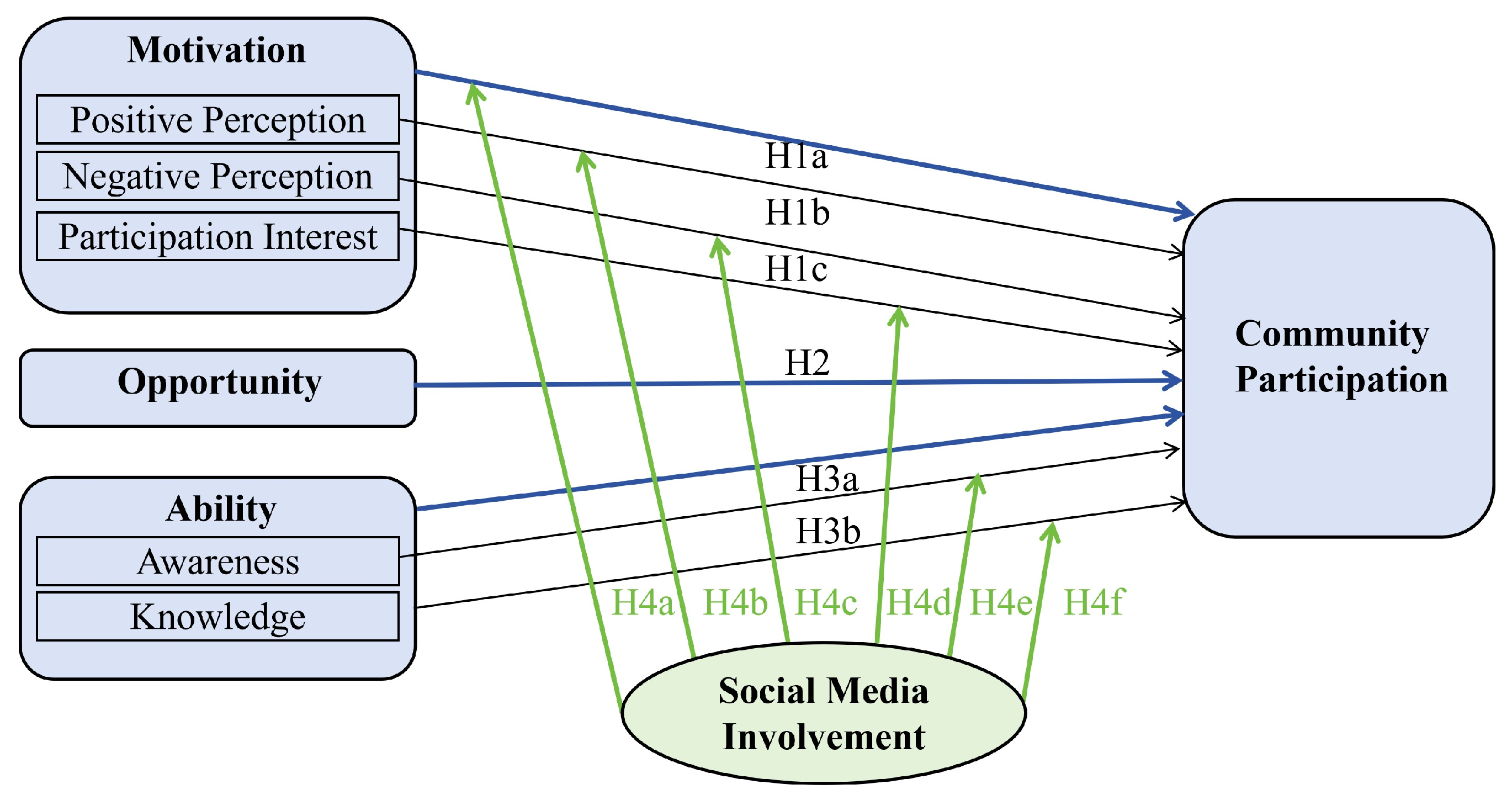
With this study, we aim to address the aforementioned gap by developing and empirically testing a moderation model based on the MOA framework. Specifically, this research (1) examines the influence of motivation (MPP, MNP, MINT), opportunity, and ability (AAW and AKN) on CP at the WHS in Quanzhou, China, and, crucially, (2) investigates whether SMI moderates the relationships between the aforementioned MOA factors and CP and to what extent such moderating effects influence the overall mechanism. By elucidating these complex interactional relationships, we hope to contribute to the way in which CP-related social media use shapes the conservation of cultural heritage and tourism development, while at the same time providing theoretical insights and guidance for how to design more effective and evidence-based promotion strategies of online cultural heritage preservation initiatives.
2. Literature Review
2.1. The Application of MOA Theory in the Conservation of World Heritage Sites
MacInnis and Jaworski [
12] initially proposed the MOA theory in 1989. However, Ölander and Thøgersen [
13] made a major contribution to this theory by integrating the TRA (Theory of Reasoned Action), which focuses on motivational components (motivation). Thus, Ölander and Thøgersen were the first to operationalize the MOA constructs in an empirical manner and clarify both the theoretical background and application of this model. As time passed, the evolution of the MOA theory allowed for it to be applied differently and in various fields.
Tourism studies started to make use of the MOA theory in the early 2000s, thanks to the study by Kam et al. [
14], which showed how motivation, ability, and opportunity for residents’ involvement in tourism development impact their decision to participate. The study also provided evidence that CP in tourism planning was based on the MOA model, which was used by Hung et al. [
15] and Jepson et al. [
16] to develop the antecedent variables. The MOA model has been used to develop sustainable CH management models.
CH management in WHS governance shows how each of the three MOA dimensions impacts community participation to varying degrees [
17]. Kunasekaran et al. [
18] supported the predictive validity of the MOA model and found that perceived sociocultural benefits and the availability of participation channels significantly correlate with CP levels, while Verma et al. [
19] argued that motivation is not always a significant predictor of participation intention, suggesting that enabling environments and capacity-building initiatives could be more pivotal than motivation per se.
Over the course of 36+ years, the MOA theory has evolved into a robust platform for rationalizing participatory behavior. By combining psychological, situational, and structural dimensions, it provides a framework for analyzing CP in the conservancy and tourism development context.
2.2. Types of Community Participation
CP refers to community members participating and working together on different levels to achieve common goals, enhancing the relationships between community members and benefiting individuals of the community [
20].
There are several academic classification systems for CP in tourism development and heritage management. These include Arnstein [
21], Pretty [
22], and Tosun [
23]’s typology for participation, which has been used extensively in tourism research. As indicated by Tosun’s framework, CP can be classified according to the level at which communities become involved: high (spontaneous), moderate (induced), and low (coerced) [
8].
According to Kunasekaran et al. [
18], spontaneous participation, where the local resident can solve his/her own issues with a level of independence and without the assistance from either the government or external agencies, is the most coveted method of participation. In developing nations, we see the greatest amount of ‘induced’ participation. CP enables the local citizen to contribute to decision-making processes in terms of managing their cultural heritage and developing local tourism. However, this does not equate to an equitable level of decision-making power [
24]. ‘Coercive’ participation is the lowest form of community engagement; it enables community members to contribute towards the implementation of tourism-related initiatives without necessarily being able to benefit from them [
17].
2.3. The Relationship Between Motivation and Community Participation
The level of motivation determines how ready, willing, and able a citizen is to process information and change behavior. Through different studies, it has been demonstrated that motivation is the primary factor influencing the amount and intensity of participation in community tourism [
25].
WHS designation and subsequent tourism development provide positive impacts on various aspects of community development at the local level [
26]. The development of tourism provides new recreation facilities as well as improvements to public infrastructures such as roads and railways, which allows for the greater conservation of both natural and cultural resources in the surrounding area, resulting in an increase in the quality of life for the residents. Additionally, the branding effect created by a heritage site leads to greater global recognition of the region, which results in increased visitor numbers to the area and promotes continuing growth of the tourism industry while simultaneously promoting and maintaining traditional craftsmanship and cultural identity, as well as the transmission of indigenous culture. The promotion of tourism, therefore, results in new job opportunities and an increase in household incomes and subsequently improves the level of living for the local community [
27].
The extent to which local communities support the development of tourism and the sustainable management of WHSs depends on how they perceive the impacts associated with the development [
17]. The communities that primarily see the benefits of tourism development will be more likely to support additional efforts to conserve and develop those sites in the future. Conversely, communities that expect negative impacts from tourism development are likely to show less support for efforts to conserve and develop these sites than those communities that do not expect negative impacts [
28].
As per the Theory of Self-Interest by Rothschild [
29], it is the residents’ own self-interest that motivates their participation in CH conservation. Residents will be motivated to participate in CH conservation because they see how tourism development can benefit their self-interest, including their community’s reputation or aspects such as the economy [
30]. People’s motivations to utilize cognitive functions and make decisions about how to act are primarily influenced by aspects like their self-interest and personal relevance. Thus, a key motivator for citizens deciding to participate in tourism development and/or heritage management is their interest [
8].
Thus, the objective of this current study is to examine three different categories of motivation that influence an individual’s decision-making for CH conservation and tourism: (1) MPP, (2) MNP, (3) MINT. The following hypotheses are presented based upon these categories:
H1a. MPP has a positive impact on CP.
H1b. MNP has a negative impact on CP.
H1c. MINT has a positive impact on CP.
2.4. The Relationship Between Opportunity and Community Participation
The MOA framework identifies opportunity as the number of external objectives and situational factors influencing how well or poorly an individual can perform a specific behavior [
12]. This opportunity can include political will, legal structures, and communication mechanisms [
17,
18].
Governance systems are typically centralized in many developing countries; therefore, meaningful community involvement in tourism development is dependent on the establishment of participatory processes with the governmental body’s endorsement and the establishment of a legal framework to support participatory approaches [
18,
31]. The establishment of open channels for communication between the local authority and members of the local community is required to encourage stakeholders to participate in heritage conservation and heritage tourism development [
32]. Therefore, the opportunity for local CP can be assessed through the following hypothesis:
H2. OPP has a positive impact on CP.
2.5. The Relationship Between Ability and Community Participation
CP in CH conservation and tourism activities is influenced positively and negatively by social factors including knowledge, skills, experience, accessibility to information, and financial resources. Many researchers (e.g., Abdelazim et al. [
8]; Kunasekaran et al. [
18]; Abdul Aziz et al. [
33]; Chan et al. [
34]) suggest that limitations to residents’ participation in local CH conservation and tourism development are due to the limited amount of information available on conservation and tourism in their communities. In addition, they also indicate that residents’ ability to obtain the necessary techniques, or knowledge, for undertaking conservation activities has a direct relationship to their level of participation. Therefore, residents need to prepare and acquire new techniques to enable them to engage effectively [
35]. Abdul Aziz et al. [
33] and Lansiwi et al. [
36] have suggested that through community educational initiatives combined with properly developed communication efforts, improved resident learning about CH and increased awareness of conservation will enhance residents’ opportunities for active involvement in tourism development.
This study intends to investigate how raising AAW and obtaining AKN through education will influence community members to participate in preserving their local heritage and supporting tourism development. As mentioned above, awareness is how familiar citizens are with information regarding heritage conservation initiatives and how much they understand about their benefits and consequences. Knowledge gives citizens an in-depth understanding of what is being done to preserve their heritage and manage tourism within the community, enabling them to actively participate. Based on this, the following hypotheses are proposed:
H3a. AAW has a positive impact on CP.
H3b. AKN has a positive impact on CP.
2.6. Moderating Role of Social Media Involvement on Community Participation in Cultural Heritage Conservation
The rapid development of the internet and social media via major platforms such as WeChat, Xiaohongshu and Instagram has changed the modes of information production and sharing in contemporary society. This has had a significant effect on how individuals go about their daily lives, interact with others, and think, thereby changing how they connect socially to a multitude of areas in their lives [
37].
Communities have become increasingly connected through social media. Through social media, members of communities have become exposed to CH preservation content, values, and practices; this has greatly impacted their motivation/opportunity/ability to participate in preventive activity [
3].
SMI indicates how engaged people are in using and interacting with social media, which could be through consuming information, sharing content, and participating in interactive exchanges. Those with high SMI tend to be exposed to heritage-related narratives, community-driven initiatives, and content generated by peers. This exposure to these forms of knowledge not only enhances individual intrinsic motivation but also builds emotional attachments and forms the cultural identity of individuals through their increased sense of responsibility to heritage conservation. Furthermore, via ongoing exposure to peers or experts talking about heritage and the success stories they have experienced, SMI can strengthen the motivational effect of intrinsic motivation towards individual participation in community-driven CH conservation.
Social media represents a space for increased public engagement, more accessible information, easier communication, and a more direct avenue for individuals to connect to one another and cultural institutions and experts. Through social media, the public can hear about conservation activities, volunteer opportunities, and collaborative projects much earlier and with less effort than might be accomplished via traditional means. The added benefit of social media is that sharing and participating in group activities is easy because of different platforms and tools, thus amplifying community voices and, again, encouraging ordinary people to join heritage preservation activities [
38,
39].
Moreover, SMI assists individuals in developing the skills necessary for the preservation of CH through access to educational resources and by providing opportunities for members of society to witness traditional practices and participate in cultural events [
40]. By increasing their engagement with social media and viewing other users’ posts about preservation activities, users are more likely to observe, learn from, and imitate the preservation-related behavior of their social networks, thus reinforcing the connection between perceived ability and active participation in community heritage preservation efforts. The combination of crowdsourced content and the expertise of professionals on social media platforms helps users feel empowered to take action on behalf of heritage by providing resources, a greater sense of control over their actions, and the confidence to make a positive impact on heritage preservation [
41].
Within the MOA framework, SMI serves as a contextual factor that modulates the strength of the relationships between motivation, opportunity, ability, and CP in CH preservation. Therefore, the following hypotheses are put forward:
H4a. SMI has a moderating effect on MPP and CP.
H4b. SMI has a moderating effect on MNP and CP.
H4c. SMI has a moderating effect on MINT and CP.
H4d. SMI has a moderating effect on OPP and CP.
H4e. SMI has a moderating effect on AAW and CP.
H4f. SMI has a moderating effect on AKN and CP.
Figure 1 illustrates the conceptual model of this study.
3. Methodology
3.1. Study Area
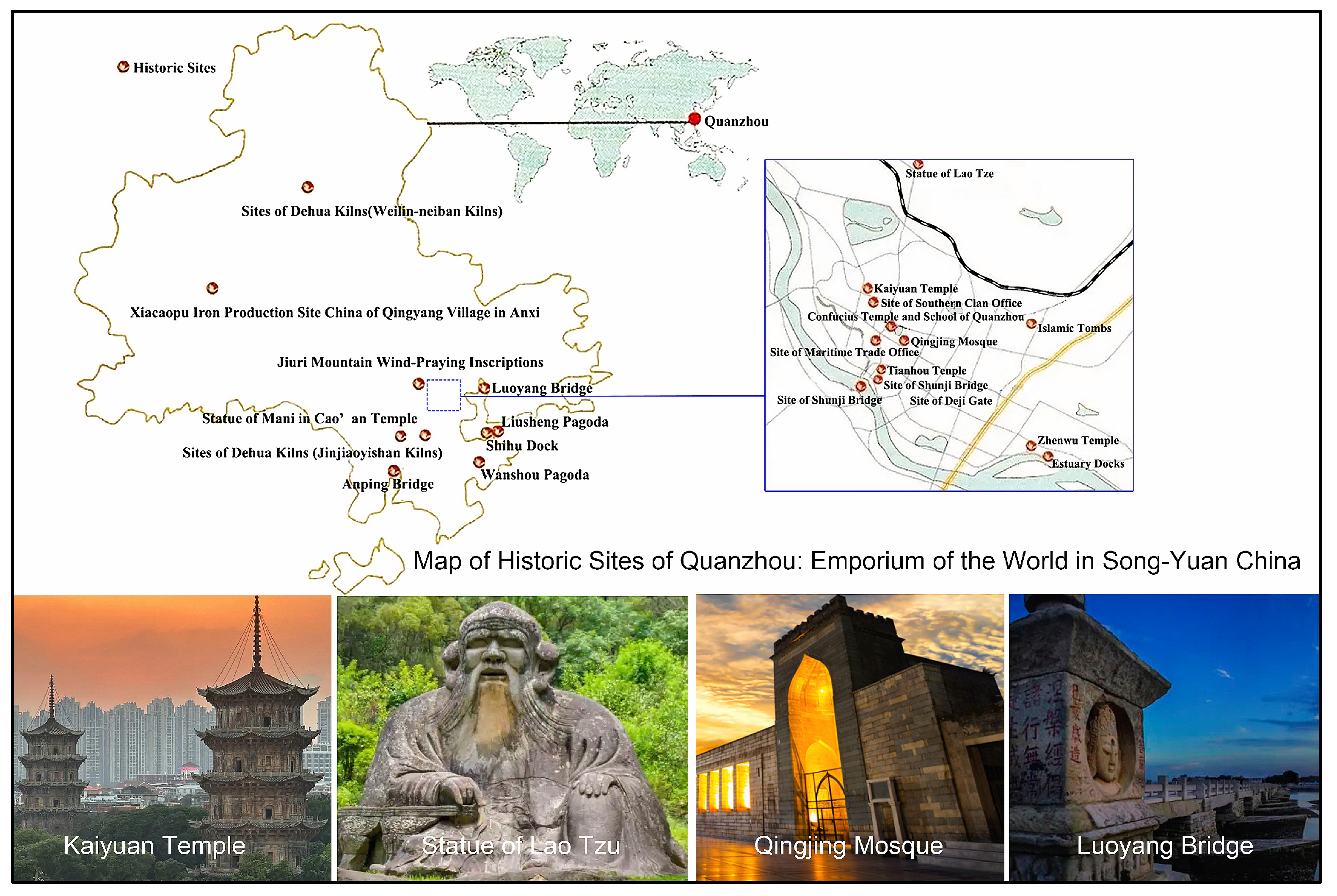
Quanzhou: Emporium of the World in Song-Yuan China, a location situated in southeastern Fujian Province, China, was added to the UNESCO World Heritage List in July 2021 and is recognized as a WHS. The city of Quanzhou became one of the most important trade hubs connecting East and West during the Song and Yuan Dynasties (10th–14th centuries CE). Due to its advanced shipbuilding technologies and maritime trade administration systems, Quanzhou developed into a world-class trading port during this time [
42]. The Quanzhou WHS is made up of 22 components that were preserved in the core structure of the site and include harbors, commercial districts, religious structures, and artisanal remains, which illustrate the various ways that ancient China interacted with other global civilizations [
43].
Although the total area of the Quanzhou WHS designated by UNESCO spans nearly 200 km
2, the core protected heritage zone, the ancient city of Quanzhou, covers only 6.41 km
2. An adjacent buffer zone and landscape control area, extending approximately 190 km
2, have been delineated around it (see
Figure 2) [
44]. According to the data from the “Quanzhou Ancient City Coffee Consumption Index,” the permanent resident population of Quanzhou Ancient City reached 139,500 as of August 2021 [
45].
3.2. Sampling and Data Collection
All residents within the core heritage conservation area of Quanzhou Ancient City were defined as the target population for this study. A quantitative research approach was adopted, and data were collected from the study sample using a Chinese-language questionnaire. The questionnaire was pretested by three academic experts. Based on their feedback, minor adjustments were made to improve the clarity and relevance of the questionnaire. Survey participants were recruited through multiple platforms, including WeChat official accounts, WeChat groups, QQ groups, and email. To guarantee that the questions were understandable, a pilot survey was conducted with 30 respondents before the formal study.
Data collection occurred from 1 August to 1 November 2025. A simple convenience sampling method was used to distribute questionnaires to local residents. According to the study by Krejcie and Morgan [
46], the required sample size was determined to be 382 participants. In this study, 466 local residents responded to the 500 distributed questionnaires, resulting in a response rate of 93%. After eliminating 61 invalid questionnaires using lie detection questions, a total of 405 questionnaires were considered appropriate for further analysis.
3.3. Measurement Instruments and Procedures
The questionnaire was structured into two core parts for the present study. The first part was intended to gather data on the respondents’ fundamental socio-demographic characteristics, namely gender, age, education, etc.
Based on the results of previous studies, the second part of the questionnaire consisted of five sections: motivation, opportunity, ability, SMI, and CP. The 41 questions in the questionnaire were adapted from the instruments used in previous related studies. The questions were answered on a 5-point Likert scale, where 1 indicates strong disagreement and 5 indicates strong agreement. The items for motivation, opportunity, ability, and CP were adapted from the literature. Meanwhile, the items for SMI were adapted from the literature [
8,
18].
3.4. Data Analysis
The data analysis for this study consisted of four stages. First, Harman’s single-factor test was used to assess common method bias (CMB) for the single-source cross-sectional survey data. Unrotated exploratory factor analysis of all scale items revealed that the first principal component explained 29.542% of the variance (below the 40% threshold), indicating no serious CMB and credible research results. Then, a measurement model was used to assess the validity and reliability of each concept in the model. The measurement model met the recommended requirements, followed by the structural model, which underwent evaluations of goodness-of-fit, effect size, predictive relevance, and coefficient of determination. The hypotheses were evaluated using a bootstrapping technique at a 95 percent confidence interval (CI). The third stage employed PLS-SEM to assess the proposed model (see
Figure 1) and its related hypotheses. In this study, PLS-SEM was the technique selected because of its versatility and appropriateness for exploratory analysis. The PLS algorithm and the bootstrapping method were conducted using SmartPLS 4.0 software.
4. Results
4.1. Profile of Participants
Table 1 details the preliminary data on the profile of the sample. First, 466 residents who live permanently in the ancient city of Quanzhou were screened by setting yes-or-no questions. Second, the sample of respondents contained slightly more females than males. The majority of respondents (75.7%) were aged 18–45. More than two-thirds (72.3%) of respondents graduated from high school or obtained certificates, diplomas or higher levels of education. The largest number of respondents (42.9%) were employed in the private sector, with government employees comprising 29.6%. The survey results indicate that the overwhelming majority of respondents (87.2%) reported having an annual income greater than 30,000 yuan. Finally, the largest proportion of respondents (34.8%) indicated that they spend between 40% and 60% of their household income on tourism consumption.
4.2. Means and Standard Deviation
In
Table 2, the relevant summary statistics of eight variables are presented that are relevant, including the standard deviation and mean. The means for the eight variables were between 3.521 (for MINT) and 3.770 (for MNP), showing that collectively they had an overall moderately high average. The standard deviation ranged from 0.773 (for MNP) to 1.101 (for SMI), which indicates variability in how much of the data are dispersed among the variables.
4.3. Measurement Model
To assess structural validity, assessments were made of the reliability of the measurement model was assessed using a number of quantitative methods, including composite reliability (CR), Cronbach’s alpha, average variance extracted (AVE), and outer loadings. Specifically, both the CR and Cronbach’s coefficient results fell at or above the corresponding criterion limit of 0.7 to 0.95, indicating a substantial correlation between the variables being measured. Further, Hair [
47] suggests that for reliable results, each item in the
Table 3 should have a loading value of at least 0.7 from external measures. All loading values indicated in
Table 3 exceed the 0.7 threshold required by the measurement model developed for this study and thus support a valid measurement model.
More than 50% of the variance in the indicator is explained by the constructs, and thus, there is a strong correlation between the constructs and their measures as indicated by this finding. Convergent validity is measured by the average variance extracted (AVE), where an AVE value of 0.5 or higher is considered acceptable (see
Table 3).
4.4. Discriminant Validity
Discriminant validity was evaluated through the Fornell–Larcker criterion and the heterotrait–monotrait (HTMT) ratio of correlations. As noted by Henseler et al., an HTMT value that is below 0.85 demonstrates an adequate level of discriminant validity; all HTMT estimates provided in this study fall below the threshold of 0.85 (see
Table 4). In addition,
Table 5 provides the results of the Fornell–Larcker method; this method states that each construct’s average variance extracted (AVE) must exceed the highest correlation that exists with any of the other constructs. The results confirm that all constructs meet this criterion, with cross-loadings lower than their respective AVEs. Furthermore, all HTMT ratios remain under the conservative cutoff of 0.9.
4.5. Assessment of Structural Model
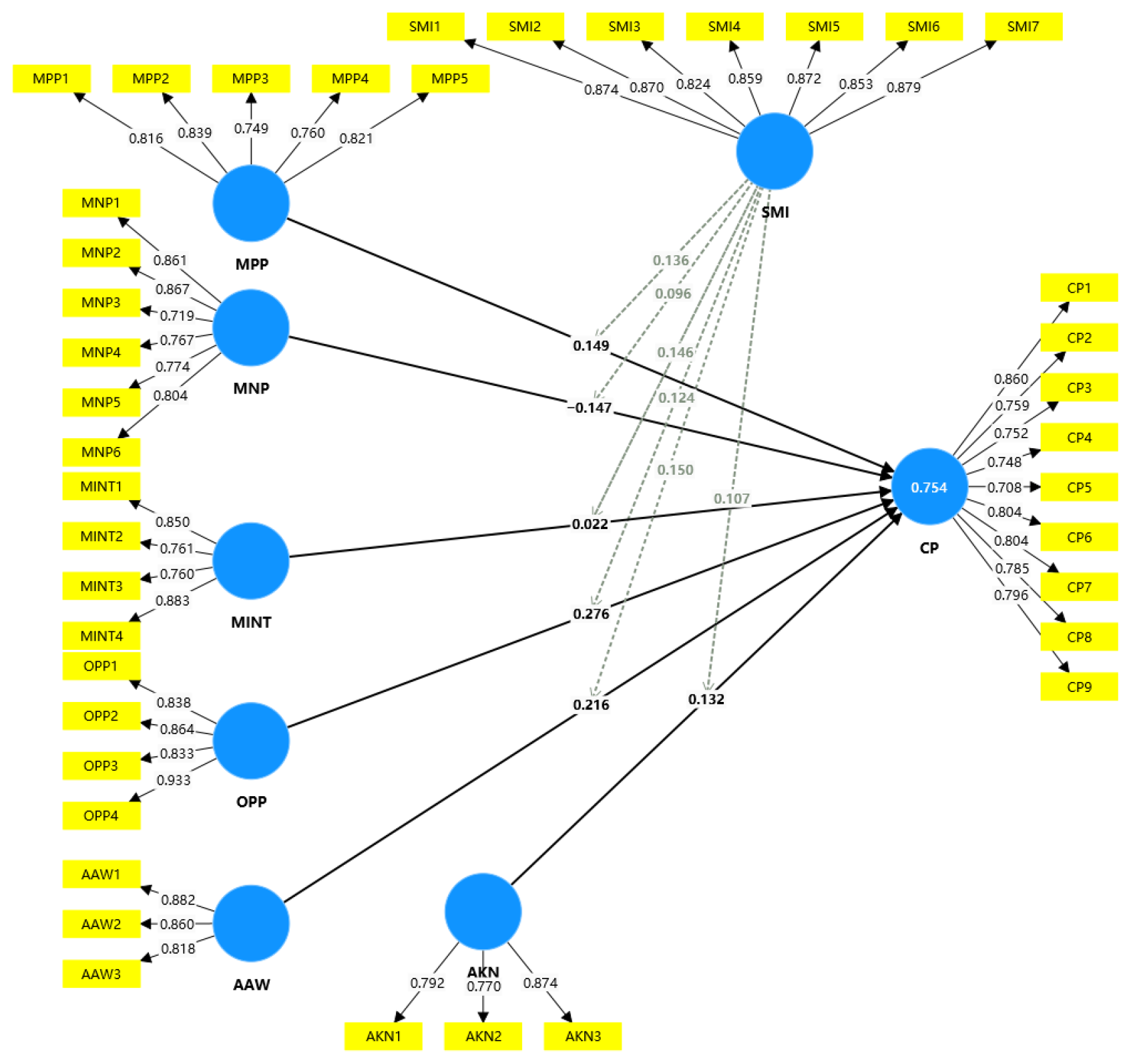
This study employed Smart PLS 4 to conduct a PLS analysis (see
Figure 3) using the bootstrapping method (5000 resamples) to determine the significance of the path coefficients in the constructed model. The assessment of the structural model encompasses path coefficient estimation as well as the values of R
2 and Q
2.
The coefficient of determination R2 is a core indicator for measuring the explanatory power of a model, reflecting the proportion of variance in endogenous latent variables that can be explained by exogenous latent variables. The R2 value of the endogenous variable CP in this study reached 0.745, demonstrating that the model has a good level of explanatory power.
The standardized root mean square residual (SRMR) was used to assess model fit, with a value of 0.045 (≤0.08) indicating a good fit of the theoretical model to empirical data.
Predictive relevance, Q2, is an indicator used to evaluate the predictive validity of the model. A Q2 value greater than 0 indicates that the study model has strong predictive relevance. As shown in the table above, the Q2 value of CP was 0.434, which is greater than 0; thus, the study model exhibits a favorable level of predictive relevance.
The variance inflation factor (VIF) was used to test for multicollinearity, with the criterion that VIF < 5. All VIF values in this study were below 5, indicating the absence of multicollinearity issues.
For the seven proposed paths, the path coefficients of AAW→CP, AKN→CP, MNP→CP, MPP→CP, OPP→CP, and SMI→CP all met the requirements of the significance test, as their
p-values were ≤0.013 and t-values were above 2, and the corresponding hypotheses were supported (notably, MNP exerted a negative effect on CP, while the others exerted positive effects). Only the path coefficient of MINT→CP failed to reach statistical significance (
p = 0.542 > 0.05), and thus the corresponding hypothesis is refuted (see
Table 6).
Effect size,
f2, was used to assess the relative influence of exogenous variables on endogenous latent variables. Values of ~0.35, ~0.15, and ~0.02 indicate significant, moderate, and small effects, respectively. All
f2 values exceed 0.02 except for the insignificant path MINT→CP, confirming that the model meets the relevant criteria (see
Table 6).
4.6. Moderation Analysis
Table 7 reports the results of the moderation analysis, which primarily examines the effects of the interaction terms between SMI and the six variables OPP, MINT, AKN, AAW, MPPsMPP and MNP on CP. From the data, all interaction terms exhibit positive β coefficients (ranging from 0.096 to 0.150), with t-values all exceeding 2.0 and
p-values all below the 0.05 significance level. The findings indicate that all of the interaction terms have moderate, yet statistically significant, positive effects on modulating the relationship between the SMI and CP. Therefore, the hypotheses that all of the interaction terms moderate the relationship were supported.
5. Discussion
We used the MOA framework to examine what motivates and provides the opportunity and ability to the residents of Quanzhou’s World Heritage Site (WHS) to participate in cultural heritage (CH) conservation and in the future tourism development of the site. Additionally, the authors examined how Social Media Involvement (SMI) moderates MOA. The results validate the MOA framework’s applicability to Chinese WHSs and demonstrate that digital involvement significantly impacts a community’s participation behavior.
According to this study’s results, residents’ positive perceptions (MPP) of world heritage status and tourism development have a positive influence on community participation (CP). This finding is consistent with other studies’ findings, which indicate that when residents view tourism as a means to attain economic growth, improved infrastructure, enhanced perceptions of their community, and increased pride in their culture, they will be more likely to support and participate in the preservation of their heritage and other related governance actions [
48,
49]. In Quanzhou, a city that has greatly improved its international reputation and tourism attractiveness as a result of its World Heritage Site status, its residents’ sense of these positive impacts is likely to manifest in behaviors of participation.
The results indicate that negative perceptions (MNP) exert a significant adverse effect on CP. This finding corroborates the perspectives of Wang et al. [
20] and Rasoolimanesh et al. [
18], demonstrating that residents’ negative sentiments, including those arising from an increased cost of living, traffic congestion, environmental degradation, and social conflicts attributable to tourism development, diminish their willingness to support conservation and development initiatives.
Furthermore, this study reveals that the interest factor (MINT) had no significant impact on CP in heritage preservation activities in the ancient city of Quanzhou. Local residents have indicated a preference for delegating decision-making and implementation to third parties rather than actively engaging in participatory processes themselves. As a WHS city, Quanzhou’s CH conservation efforts have long been government-led, with implementation carried out by professional institutions or third-party entities. Local people demonstrate greater trust in such formal governance systems and are inclined to delegate decision-making and execution to external professional bodies, rather than engaging based on their own personal interest. Thus, within this structured, top-down, and well-established heritage management framework, the motivational effect of personal interest on public participation remains relatively limited. Previous research indicates that there has been limited to predominantly passive involvement of communities in tourism development in low- and middle-income or developing countries [
18,
50]. This finding is consistent with this study’s observations of Quanzhou.
Meanwhile, the findings indicate that opportunity (OPP) exerts a positive and significant impact on CP. The findings also suggest that when residents feel that local governments and other organizations have made arrangements and platforms for them to participate in cultural heritage conservation and tourism development, they will be more likely to engage in relevant initiatives and processes [
51]. The results of this study were consistent with many other studies and provide further evidence that local political will, open communication, and resident-led conservation are key factors that enable communities to be actively involved in preserving their heritage and/or developing new tourist opportunities.
The awareness (AAW) and knowledge (AKN) dimensions of ability in this study strongly influenced residents’ level of CP. The residents who had a greater ability to acquire information, understand policies, and think about the value of their cultural heritage were found to participate more often in activities that helped to preserve their cultural heritage and develop a tourism industry. In Quanzhou, community announcements and local media, as well as the internet, are some of the sources of information used by residents to help them participate in the community.
To conclude, this research provides evidence for how the level of involvement in social media moderates the relationship between the multiple dimensions of MOA and participation in community-based actions. The findings show that as the level of engagement with social media increased, the likelihood of individuals converting their motivation, opportunity, and ability into actual participation also increased. Beyond this, in the context of Quanzhou’s WHS, social media may enable individuals to access information more easily, create opportunities for individuals and organizations to communicate with each other, and reinforce the social norms and collective identity people have towards conserving heritage [
52], offering initial empirical support for the value of digital media in heritage management.
6. Conclusions
In summary, guided by the MOA framework and incorporating SMI as a moderating variable, this study explores and provides preliminary empirical evidence for the factors influencing CP in the sustainable conservation and tourism development of Quanzhou’s World Heritage Site (WHS) in China. The findings indicate that motivation, positive perceptions, opportunity, awareness, and knowledge all have significant positive associations with CP, whereas motivation negative perceptions are significantly and negatively associated with such engagement; however, the impact of motivational interest did not reach statistical significance. Meanwhile, SMI reveals a notable positive moderating role in the relationships between all MOA factors and CP in this study context, providing supportive evidence for the moderating effect of digital media involvement in sustainable heritage conservation participation.
Based on the empirical analysis of a single Chinese WHS context, this study has made three initial theoretical contributions to the areas of CP and the preservation of CH. The first is the exploratory application of the MOA framework to WHS preservation. Using empirical data from Quanzhou, the authors elucidate how motivation, opportunity, and ability may jointly shape residents’ level of actual participation in WHS preservation. The findings exceed previous qualitative analyses of participation motivation to provide preliminary evidence for the influence of structural and informational resources on converting willingness to participate into actual participation. Secondly, this study introduces a new exploratory dimension to the academic discussion on social media and CH management by introducing SMI as a moderating variable; the results suggest that social media does more than just facilitate information transfer, but also may enhance the public’s awareness of heritage, expand perceived participation channels, and increase the public’s capacity to engage in community-based CH management decisions. Thirdly, through investigating a Chinese WHS, this research provides preliminary empirical data from a non-Western society, which may help add to the global CH sustainable governance literature’s contextual diversity and offer a novel angle for addressing geographical constraints that have characterized a significant portion of this body of literature.
Meanwhile, this study provides several preliminary practical implications and referential insights for authorities responsible for the management of the Quanzhou WHS, as well as for CH professionals, policymakers, and local administrative agencies involved in decision-making processes for sustainable heritage conservation and tourism development. The primary finding that enhanced resident participation capacity is associated with more active community engagement suggests that providing better public awareness of heritage, an improved understanding of heritage-related policies, and enhanced access to heritage information communication channels may create more opportunities for CP to support sustainable heritage governance. Accordingly, relevant authorities may consider capacity building for organizations as well as the establishment of open, transparent, and efficient information-sharing systems. In addition, the role of social media in guiding user engagement also indicates that digital platforms have considerable untapped potential to encourage community involvement in various aspects of sustainable heritage conservation. Administrative departments can use social media as a potentially effective tool to promote the concept of sustainable heritage conservation, encourage residents to participate in heritage conservation initiatives, and facilitate two-way communication between administrative departments and the public, which may help reduce engagement barriers and improve the efficiency of intergroup communication for sustainable heritage and tourism development.
However, there are several limitations to this study that need to be acknowledged when interpreting its findings and contributions. One limitation is that the results were derived solely from one WHS and therefore may not be applicable to other sites. Future studies could increase external validity by utilizing a cross-site comparison and/or a cross-cultural analysis as well. Another limitation of the current research is that it is based on cross-sectional survey data, which limits the ability to make causal inferences with confidence. Future research will likely use a longitudinal design or a mixed-methods approach (qualitative and quantitative) to demonstrate how CP and SMI are interrelated and dynamic. Finally, researchers could extend the MOA framework to consider other mediating or moderating variables, such as trust in governance, place attachment, and the perceived effectiveness of governance, to enhance the theoretical model and provide more targeted insights for the sustainable governance of global cultural heritage sites.
Author Contributions
Conceptualization, F.H. and T.C.L.; methodology, F.H.; software, F.H.; validation, F.H. and T.C.L.; formal analysis, F.H.; investigation, F.H.; resources, F.H.; data curation, F.H.; writing—original draft preparation, F.H.; writing—review and editing, F.H. and T.C.L.; visualization, F.H.; supervision, T.C.L.; project administration, T.C.L.; funding acquisition, T.C.L. All authors have read and agreed to the published version of the manuscript.
Funding
This research was funded by the 2023 General Project of Liming Vocational University, Grant No. LR202317.
Institutional Review Board Statement
This study was conducted in accordance with the Declaration of Helsinki and the Ethical Guidelines for Research with Human Subjects of the People’s Republic of China. The study involved minimal risk and employed survey methodologies with adult participants. Written informed consent was obtained from all participants prior to their participation, and participation was entirely voluntary.
Informed Consent Statement
Written informed consent was obtained from all participants involved in this study.
Data Availability Statement
Data supporting this study are available upon reasonable request from the authors.
Acknowledgments
The author would like to thank the anonymous reviewers for their valuable comments and suggestions, which have helped to improve the quality of this manuscript. During the preparation of this manuscript, the authors used ChatGPT 5.3, DouBao 2.0, and Youdao Translate v10.1.2 for language editing and clarity improvement. The author has reviewed and edited the output content and takes full responsibility for the content of this publication.
Conflicts of Interest
The authors declare no conflicts of interest. The funders had no role in the design of the study; in the collection, analyses, or interpretation of data; in the writing of the manuscript; or in the decision to publish the results.
Abbreviations
The following abbreviations are used in this manuscript:
| MOA | Motivation-Opportunity-Ability |
| SMI | Social Media Involvement |
| CP | Community Participation |
| MPP | Motivation Positive Perceptions |
| MNP | Motivation Negative Perceptions |
| MINT | Motivation Interest |
| OPP | Opportunity |
| AAW | Awareness |
| AKN | Knowledge |
| WHS | World Heritage Site |
| CH | Cultural Heritage |
| PLS-SEM | Partial Least Squares Structural Equation Modeling |
| CR | Composite Reliability |
| AVE | Average Variance Extracted |
| HTMT | Heterotrait-Monotrait ratio |
| SRMR | Standardized Root Mean Square Residual |
| VIF | Variance Inflation Factor |
| CI | Confidence Interval |
References
- Marshall, Y. What is community archaeology? World Archaeol. 2002, 34, 211–219. [Google Scholar] [CrossRef]
- Vinodan, A.; Meera, S.; Mishra, S. 21 Community Engagement and Destination Safety. In Tourism Safety, Security and Resilience: Integrated Community-Based Approaches; Isaac, R.K., Maingi, S.W., Gowresunkaar, V.G.B., Eds.; Routledge, Taylor & Francis Group: Abingdon, UK, 2024. [Google Scholar]
- Liang, X.; Lu, Y.; John, M. A review of the role of social media for the cultural heritage sustainability. Sustainability 2021, 13, 1055. [Google Scholar] [CrossRef]
- Siliutina, I.; Tytar, O.; Barbash, M.; Petrenko, N.; Yepyk, L. Cultural preservation and digital heritage: Challenges and opportunities. Amazon. Investig. 2024, 13, 262–273. [Google Scholar] [CrossRef]
- Baitalik, A. Can Social Media Pave the Way for the Preservation and Promotion of Heritage Sites? Preserv. Digit. Technol. Cult. 2025, 54, 51–64. [Google Scholar] [CrossRef]
- UNESCO. Quanzhou: Emporium of the World Inscribed onto UNESCO World Heritage List. 2021. Available online: https://en.unesco.org/silkroad/content/quanzhou-emporium-world-inscribed-unesco-world-heritage-list (accessed on 1 June 2025).
- Tong, J.; Li, Y.; Yang, Y. System construction, tourism empowerment, and community participation: The sustainable way of rural tourism development. Sustainability 2024, 16, 422. [Google Scholar] [CrossRef]
- Abdelazim, T.; Alfraidi, Y.; Tueaiman, A.; Alhamli, F.; Elhassan, A.; Nassr, A. Local people’s participation in Jubbah Heritage Site conservation: Extending the motivation, opportunity, and ability (MOA) theory. npj Herit. Sci. 2025, 13, 7. [Google Scholar] [CrossRef]
- Tang, H.; Ma, Y.; Ren, J. Influencing factors and mechanism of tourists’ pro-environmental behavior–Empirical analysis of the CAC-MOA integration model. Front. Psychol. 2022, 13, 1060404. [Google Scholar] [CrossRef]
- Ambara, R.D.; Arifin, Z.; Mawardi, M.K. The Moderating Impact of Social Media Use on Culturally Sustainable Tourism from the Perspective of the Theory of Planned Behaviour. J. Indones. Tour. Dev. Stud. 2025, 13, 1–11. [Google Scholar] [CrossRef]
- Hoang, S.D.; Tučková, Z.; Pham, N.T.; Tran, T.H.; Nguyen, D.T.N. Moderating effect of social media in shaping ecotourism loyalty: A two-stage-cross-sectional study. Sage Open 2024, 14, 21582440241247700. [Google Scholar] [CrossRef]
- MacInnis, D.; Jaworski, B. Information processing from advertisements: Toward an integrative framework. J. Mark. 1989, 53, 1–23. [Google Scholar] [CrossRef]
- Ölander, F.; Thøgersen, J. Understanding of consumer behaviour as a prerequisite for environmental protection. J. Consum. Policy 1995, 18, 345–385. [Google Scholar] [CrossRef]
- Hung, K.; Ingram, L.J.; Sirakaya-Turk, E. Motivation-Opportunity-Ability (MOA) Model for Community Participation in Tourism Development. In Proceedings of the Northeastern Recreation Research (NERR) Symposium, New York, NY, USA, 15–17 April 2007. [Google Scholar]
- Hung, K.; Sirakaya-Turk, E.; Ingram, L.J. Testing the efficacy of an integrative model for community participation. J. Travel Res. 2011, 50, 276–288. [Google Scholar] [CrossRef]
- Jepson, A.; Clarke, A.; Ragsdell, G. Investigating the Application of the Motivation–Opportunity–Ability Model to Reveal Factors Which Facilitate or Inhibit Inclusive Engagement Within Local Community Festivals. Scand. J. Hosp. Tour. 2014, 14, 331–348. [Google Scholar] [CrossRef]
- Rasoolimanesh, S.M.; Jaafar, M.; Ahmad, A.G.; Barghi, R. Community participation in World Heritage Site conservation and tourism development. Tour. Manag. 2017, 58, 142–153. [Google Scholar] [CrossRef]
- Kunasekaran, P.; Mostafa Rasoolimanesh, S.; Wang, M.; Ragavan, N.A.; Hamid, Z.A. Enhancing local community participation towards heritage tourism in Taiping, Malaysia: Application of the Motivation-Opportunity-Ability (MOA) model. J. Herit. Tour. 2022, 17, 465–484. [Google Scholar] [CrossRef]
- Verma, K.; Rawat, A.; Dhodi, R.K.; Dhodi, R. Community participation in sustainable tourism development: An application of the MOA model in the Garhwal Himalayas of Uttarakhand, India. Int. J. Tour. Policy 2024, 14, 545–561. [Google Scholar] [CrossRef]
- Wang, M.; Jiang, J.; Xu, S.; Guo, Y. Community participation and residents’ support for tourism development in ancient villages: The mediating role of perceptions of conflicts in the tourism community. Sustainability 2021, 13, 2455. [Google Scholar] [CrossRef]
- Arnstein, S.R. A ladder of citizen participation. J. Am. Inst. Plan. 1969, 35, 216–224. [Google Scholar] [CrossRef]
- Pretty, J. The many interpretations of participation. Focus 1995, 16, 4–5. [Google Scholar]
- Tosun, C. Expected nature of community participation in tourism development. Tour. Manag. 2006, 27, 493–504. [Google Scholar] [CrossRef]
- Tosun, C. Towards a typology of community participation in the tourism development process. Anatolia 1999, 10, 113–134. [Google Scholar] [CrossRef]
- Duval, D.T. Tourism in the Caribbean; Taylor & Francis: Abingdon, UK, 2004. [Google Scholar]
- Brooks, C.; Waterton, E.; Saul, H.; Renzaho, A. Exploring the relationships between heritage tourism, sustainable community development and host communities’ health and wellbeing: A systematic review. PLoS ONE 2023, 18, e0282319. [Google Scholar] [CrossRef] [PubMed]
- Yang, Y.; Wang, Z.; Shen, H.; Jiang, N. The impact of emotional experience on tourists’ cultural identity and behavior in the cultural heritage tourism context: An empirical study on Dunhuang Mogao Grottoes. Sustainability 2023, 15, 8823. [Google Scholar] [CrossRef]
- Alamineh, G.A.; Hussein, J.W.; Endaweke, Y.; Taddesse, B. The local communities’ perceptions on the social impact of tourism and its implication for sustainable development in Amhara regional state. Heliyon 2023, 9, e17088. [Google Scholar] [CrossRef]
- Rothschild, M.L. Carrots, sticks, and promises: A conceptual framework for the management of public health and social issue behaviors. J. Mark. 1999, 63, 24–37. [Google Scholar] [CrossRef]
- Gursoy, D.; Chi, C.G.; Dyer, P. Locals’ attitudes toward mass and alternative tourism: The case of Sunshine Coast, Australia. J. Travel Res. 2010, 49, 381–394. [Google Scholar] [CrossRef]
- Tosun, C. Stages in the emergence of a participatory tourism development approach in the developing world. Geoforum 2005, 36, 333–352. [Google Scholar] [CrossRef]
- Esichaikul, R.; Chansawang, R. Community participation in heritage tourism management of Sukhothai historical park. Int. J. Tour. Cities 2022, 8, 897–911. [Google Scholar] [CrossRef]
- Abdul Aziz, N.A.; Mohd Ariffin, N.F.; Ismail, N.A.; Alias, A. Community participation in the importance of living heritage conservation and its relationships with the community-based education model towards creating a sustainable community in Melaka UNESCO world heritage site. Sustainability 2023, 15, 1935. [Google Scholar] [CrossRef]
- Chan, J.K.L.; Marzuki, K.M.; Mohtar, T.M. Local community participation and responsible tourism practices in ecotourism destination: A case of lower Kinabatangan, Sabah. Sustainability 2021, 13, 13302. [Google Scholar] [CrossRef]
- Najib, N.N.M.; Rahman, M.A.A. Community Willingness and Readiness for Cultural Heritage Tourism: The Case of Kampung Chitty, Malacca Historic City, Malaysia. J. Contemp. Tour. Hosp. Res. 2025, 1, 268–293. [Google Scholar]
- Lansiwi, M.A.; Studyanto, A.B.; Gymnastiar, I.A.; Gymnastiar, I.A.; Amin, F. Cultural heritage preservation through community engagement: A new paradigm for social sustainability. Indones. J. Stud. Humanit. Soc. Sci. Educ. 2024, 1, 50–59. [Google Scholar] [CrossRef]
- Ogbonnaya, U.I.; Loubser, N.; Lessing, M.-J. In the Twenty-First Century. Soc. Media Chang. Math. Classr. 2025, 27, 27–33. [Google Scholar]
- Chakma, K. A Review of the Role of Social Media in Shaping Social Movements. SSRN 5083142. Available online: https://api.semanticscholar.org/CorpusID:276665051 (accessed on 10 May 2025).
- Omar, A.S.; Ondimu, K.O. The impact of social media on society: A systematic literature review. Int. J. Eng. Sci. 2024, 13, 96–106. [Google Scholar]
- Hu, J.; Lai, Y.; Yi, X. Effectiveness of social media-assisted course on learning self-efficacy. Sci. Rep. 2024, 14, 10112. [Google Scholar] [CrossRef]
- Ullah, I.; Asghar, M.Z.; Barbera, E.; Cimen, M. Integrating social media-based community of inquiry with theory of planned behavior to promote equitable educational intentions among pre-service teachers in Gilgit Baltistan, Pakistan. Front. Psychol. 2024, 14, 1150421. [Google Scholar] [CrossRef]
- UNESCO. Quanzhou: Emporium of the World in Song-Yuan China. 2021. Available online: https://whc.unesco.org/en/list/1561/ (accessed on 3 May 2025).
- Xu, X.; Zhao, Y. Quanzhou: Unswerving in Pursuing the Goal with One Blueprint, Unceasing in Striving for Progress After the Success of World Heritage Application; National Cultural Heritage Administration. 2021. Available online: http://www.ncha.gov.cn/art/2021/7/26/art_1019_170206.html (accessed on 10 May 2025).
- Huang, Q.; Wang, M. Quanzhou Is Dedicated to Establishing Itself as a Model City for the Preservation and Utilization of World Cultural Heritage, Pioneering New Pathways for the In-Depth Integration of Cultural and Tourism Development—A Shining Pearl of the Maritime Silk Road; Fujian Provincial Bureau of Cultural Heritage. 2024. Available online: http://wwj.wlt.fujian.gov.cn/xwzx/wbyw/202408/t20240821_6504949.htm (accessed on 20 May 2025).
- Quanzhou Evening Paper. The ‘Quanzhou Ancient City Coffee Consumption Index’ Has Been Released. Within an Area of 6.41 Square Kilometers, There Are 131 Coffee-Related Business Outlets; Quanzhou Evening Paper. 2021. Available online: https://www.toutiao.com/article/7000522285387874824/?upstream_biz=doubao&source=m_redirect (accessed on 20 May 2025).
- Krejcie, R.V.; Morgan, D.W. Determining sample size for research activities. Educ. Psychol. Meas. 1970, 30, 607–610. [Google Scholar] [CrossRef]
- Hair, J.F.; Hult, G.T.M.; Ringle, C.M.; Sarstedt, M.; Danks, N.P.; Ray, S. Partial Least Squares Structural Equation Modeling (PLS-SEM) Using R: A Workbook; Springer: Berlin/Heidelberg, Germany, 2021. [Google Scholar]
- Nian, S.; Liu, F.; Chen, M.; Cheng, G. Satisfaction of tourism communities in World Heritage sites based on residents’ perceptions—Study area of Mount Sanqingshan National Park, PRC. Sustainability 2023, 15, 533. [Google Scholar] [CrossRef]
- Li, Y.C.; Zhang, J.; Liu, Z.H.; Xiong, Z.L.; Xiong, J. Structural relationship of residents’ perception of tourism impacts: A case study in world natural heritage Mount Sanqingshan. Prog. Geogr. 2014, 33, 584–592. [Google Scholar] [CrossRef]
- Grcheva, O.; Oktay, V.B. From public participation to co-creation in the cultural heritage management decision-making process. Sustainability 2021, 13, 9321. [Google Scholar] [CrossRef]
- Dong, F.; Zhang, Y.; Wang, Z. Activation and Inheritance: Farmers’ Willingness to Participate in Agricultural Heritage Tourism Development—A Case Study on the Nanguo Pear Cultivation System in Anshan, China. Sustainability 2024, 16, 10500. [Google Scholar] [CrossRef]
- Ginzarly, M.; Teller, J. Leveraging social media for resilient cultural heritage: A people-centred conceptual framework for community engagement and crisis response. Built Herit. 2025, 9, 40. [Google Scholar] [CrossRef]
| Disclaimer/Publisher’s Note: The statements, opinions and data contained in all publications are solely those of the individual author(s) and contributor(s) and not of MDPI and/or the editor(s). MDPI and/or the editor(s) disclaim responsibility for any injury to people or property resulting from any ideas, methods, instructions or products referred to in the content. |