Article

Street Orientation, Aspect Ratio, and Tree Species Interactions on Heat Exposure in Temperate Monsoon Climate

1
School of Architecture and Urban Planning, Jilin Jianzhu University, Changchun 130118, China
2
College of Architecture and Urban Planning, Shenyang Jianzhu University, Shenyang 110168, China
3
Interdisciplinary Program in Landscape Architecture, Seoul National University, Seoul 08826, Republic of Korea
4
Trabsduscuolinary Program in Smart City Global Convergence, Seoul National University, Seoul 08826, Republic of Korea
5
School of Architecture and Fine Art, Dalian University of Technology, Dalian 116023, China
6
Key Laboratory of Architectural Cold Climate Energy Management, Ministry of Education, Jilin Jianzhu University, Changchun 130118, China
*
Author to whom correspondence should be addressed.
These authors contributed equally to this work.
Sustainability 2026, 18(7), 3177; https://doi.org/10.3390/su18073177
Submission received: 4 February 2026 / Revised: 3 March 2026 / Accepted: 14 March 2026 / Published: 24 March 2026
(This article belongs to the Section Environmental Sustainability and Applications)

Abstract

Rapid urbanization has intensified microclimatic deterioration in temperate monsoon cities, directly affecting human thermal comfort. This study investigates the regulatory effects of common street tree species under varying street aspect ratios (H/W) and orientations in Shenyang, China, a representative temperate monsoon city characterized by cold winters. Field surveys and questionnaire data were combined with ENVI-met simulations to quantify thermal comfort responses using the Universal Thermal Climate Index (UTCI). Results demonstrate that street geometry strongly constrains microclimate regulation: streets with H/W = 1.2 and a SE–NW orientation achieved the most favorable balance between shading and ventilation, yielding the lowest UTCI values. Significant interspecies variability was observed: Golden Elm and Chinese Willow provided the greatest cooling benefits, whereas Ginkgo exhibited limited adaptability, particularly in enclosed or highly open canyons. A comparison with subjective thermal comfort votes confirmed strong model reliability, though discrepancies emerged in dense commercial areas due to non-meteorological factors. Based on these findings, a spatially driven, species-adaptive, and human-centered framework is proposed to optimize street greening strategies in a temperate monsoon city characterized by cold winters. This research provides quantitative evidence for urban greening design, highlights the necessity of integrating spatial form with tree-species selection, and offers practical guidance for resilient thermal comfort management in rapidly urbanizing cold-region cities.

1. Introduction

Urban microclimate issues, primarily driven by anthropogenic activities, have emerged as a critical challenge for sustainable urban development. With global economic growth and accelerated urbanization, the proportion of people living in cities is projected to reach 66% by 2050 [1,2]. Various urban elements—including buildings, roads, traffic, industries, and green infrastructure—exert complex influences on local microclimatic conditions. For instance, inappropriate street density can reduce urban ventilation efficiency, leading to excessive daytime heat accumulation and further deterioration of the thermal environment [3,4]. Microclimate refers to small-scale climatic conditions formed within a specific area, strongly affected by surrounding factors such as urban design, building morphology, and vegetation. Among these, street trees represent one of the most effective interventions for improving urban microclimates and have attracted increasing scholarly attention [5,6]. However, the inappropriate selection of tree species may exacerbate the adverse effects of solar radiation on outdoor thermal environments [7]. Such issues directly contribute to the worsening of urban microclimates, ultimately undermining the quality of the residential environment.
Street trees refer to arbor landscapes planted at regular intervals along both sides of roads or within median greenbelts. They play important roles in regulating the microclimate of streets and enhancing outdoor thermal environments through processes such as transpiration, evapotranspiration, shading, and reflecting solar radiation, thereby improving pedestrians’ thermal comfort [8,9]. A well-planned distribution of street trees has significant positive impacts on improving the urban climatic environment, mitigating the urban heat island effect, providing shade, and reducing wind speed, thus creating a more comfortable outdoor environment for citizens [10]. Among these factors, the tree species selected for street planting is a key determinant in addressing urban environmental issues and enhancing human thermal comfort. The design of street tree species should carefully consider various environmental conditions, while fully reflecting the dual function of environmental protection and landscape beautification [10]. Some of the research conducted in Utrecht, the Netherlands, involving microclimatic measurements and analyses of nine streets with similar geometries, demonstrated that shading by street trees has a substantial effect on thermal comfort. An increase of 10% in vegetation coverage within streets can significantly reduce the mean radiant temperature (MRT) [11,12]. Similar conclusions have been drawn through simulation studies. For example, Aminipouri et al., using the ENVI-met model in six local climate zones of Vancouver, Canada, found that when street tree coverage increased by just 1% of the total area, the daytime MRT decreased by 15.5–17.3 °C [13]. Likewise, Huang et al., through field measurements in Wuhan, China, reported that in summer at midday, areas with high canopy coverage provided greater microclimatic benefits compared with areas of medium or low canopy coverage, reducing air temperature by 3.3 °C and MRT by 13.9 °C [14]. Research by E. S. Krayenhoff et al. highlighted that street trees play a critical role in driving microclimatic variations within streets, improving air temperature conditions, enhancing resilience to extreme heat events, and contributing to human thermal comfort. However, the magnitude of these benefits depends on multiple influencing factors [15]. Furthermore, Vesna Stojakovic and colleagues, based on microclimate measurements and simulations in both summer and winter, found that the cooling effect of trees during sunny and hot days was twice as strong as during cloudy and cold days, with some degree of air temperature reduction also observed in winter. During peak heat periods, trees lowered thermal sensation by up to 16%. In summer, the maximum daily air temperature difference between shaded and unshaded areas reached 2.5 °C, while in winter, trees reduced mean air temperatures by 0.5 °C. These findings suggest that trees play a vital role in regulating microclimates and enhancing human comfort across different seasons [16].
As a carrier through which people directly perceive and experience the urban environment, livable streets play a crucial role in residents’ daily experiences and social life. Functioning as linear spaces that meet people’s everyday needs, these streets not only serve transportation functions but are also equipped with cultural, recreational, and leisure services to support daily activities and social interactions. As such, they represent one of the most frequently used and closely connected types of outdoor public spaces for urban residents [17]. In the relationship between livable streets and the urban microclimate, factors such as street aspect ratio and orientation significantly influence variations in the thermal environment. In a study on the effects of street orientation on solar radiation, Mohajeri et al. selected Geneva, Switzerland—located in a temperate oceanic climate zone—as the study area. Their findings at the urban scale revealed that street orientation is one of the most critical factors affecting solar radiation reception [18]. Similarly, Shareef et al., focusing on Dubai in the United Arab Emirates (tropical desert climate), demonstrated that appropriate street orientations could lower outdoor temperatures by up to 1.8 °C, while higher building diversity within the same block orientation could further reduce outdoor temperatures by up to 1.1 °C [19]. In tropical Singapore, Acero et al. examined the effects of public outdoor urban spaces associated with human activities on thermal comfort at the city scale and identified street orientation as one of the most influential factors [20]. Furthermore, Narimani et al., using Isfahan, Iran (temperate continental climate) as their case study, investigated the influence of vegetation coverage in urban streets on outdoor thermal comfort. Their results indicate that although vegetation coverage contributes positively to thermal comfort improvement, the effect of proper street orientation was more significant than vegetation coverage in enhancing the thermal comfort of urban streets [6].
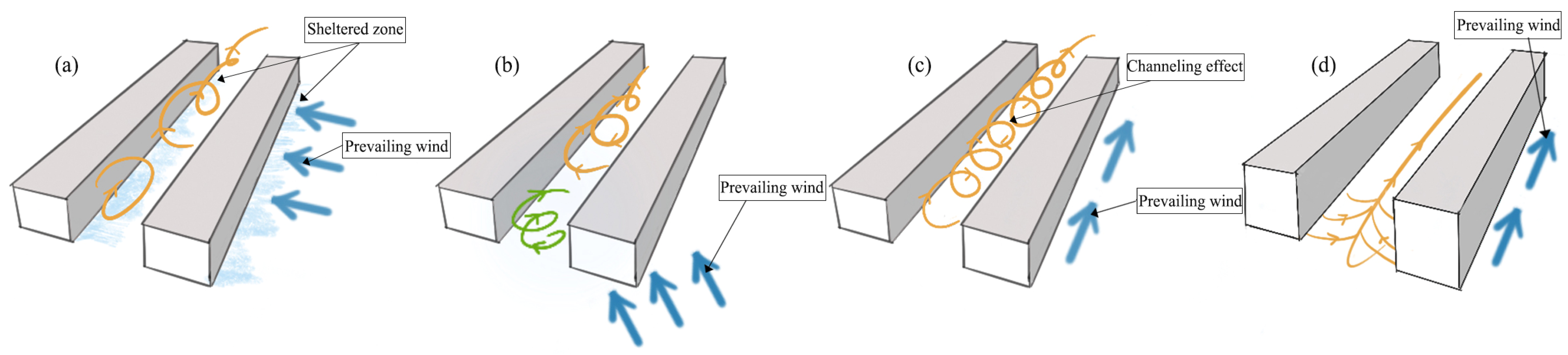
Urban morphology has a significant influence on microclimatic conditions and outdoor thermal comfort. Building on extensive previous research, this study selects street aspect ratio (H/W) and street orientation as key spatial parameters, while incorporating tree canopy coverage as a dynamic input variable within the simulation framework. Geometric characteristics of typical livable streets were extracted through field inventory to provide baseline data for model development and comparative analysis. According to the Street Design Guidelines, “typical livable streets” are defined as streets located within residential communities, where adjacent land uses are predominantly residential, and the road hierarchy mainly comprises urban secondary roads and local streets [21]. Aspect ratio (H/W), defined as the ratio of the average building height on both sides of the street to the street width, is an important indicator of spatial enclosure [22]. Streets with a high H/W value are prone to forming urban canyon effects, where ventilation is hindered and heat becomes trapped, thereby intensifying heat stress in summer. In contrast, low H/W values promote air circulation and heat dissipation, which enhance pedestrian-level thermal comfort [23,24]. Street orientation, typically expressed as the angle between the street axis and true north, is a critical factor in regulating solar radiation exposure and alignment with prevailing wind directions [25]. When street orientation is parallel to the prevailing wind, high-H/W streets may enhance internal airflow, while low-H/W streets may experience a “venturi effect,” reducing wind speed. Conversely, if streets are oriented perpendicular to prevailing winds, building-induced wind shadows can obstruct air exchange. At oblique angles, bidirectional airflow often occurs within the street, forming a more balanced ventilation pattern [26]; the related mechanisms are illustrated in Figure 1.
Urban microclimate issues are directly related to the quality of life of city residents. Among the key factors influencing microclimate improvement, street trees, street orientation, and street aspect ratio play a significant role in enhancing thermal comfort along urban streets. However, most existing studies have focused on hot-summer/warm-winter [27,28] or hot-summer/cold-winter regions [17,29], while evidence on species selection and its thermal-comfort impacts for livable streets in cold-region cities remains limited. In addition, many cold-region studies rely on simplified modeling approaches (e.g., RayMan) or short-term field observations, which may constrain the comparability and transferability of findings [30,31]. Therefore, this study adopts UTCI and employs ENVI-met for street-scale simulations to improve the applicability of the results for microclimate optimization and species selection. Notably, although Shenyang is located in a cold region, pedestrians can still experience substantial heat exposure during summer [32]. Therefore, the selection of street tree species for livable streets in temperate monsoon cities should not only consider their effectiveness in improving thermal comfort but also account for variations in street spatial morphology and the adaptability of vegetation configuration strategies.
  • How do different street spatial morphologies (e.g., street orientation and aspect ratio) influence human thermal comfort in livable streets during summer?
  • What are the mechanisms and differences in the effects of common street tree species on thermal comfort improvement under varying street spatial conditions?
  • How can an optimized strategy for street tree species selection and configuration be developed for livable streets in temperate monsoon cities?
This research employs the ENVI-met simulation tool to investigate the impacts of different street spatial characteristics (such as orientation and aspect ratio) and common street tree species on human thermal comfort. This study aims to fill the existing research gap in this field, providing both theoretical foundations and practical data support for the scientific selection of street trees in livable streets, while also offering insights into thermal environment improvement in urban design within temperate monsoon cities.

2. Materials and Methods

2.1. Study Framework

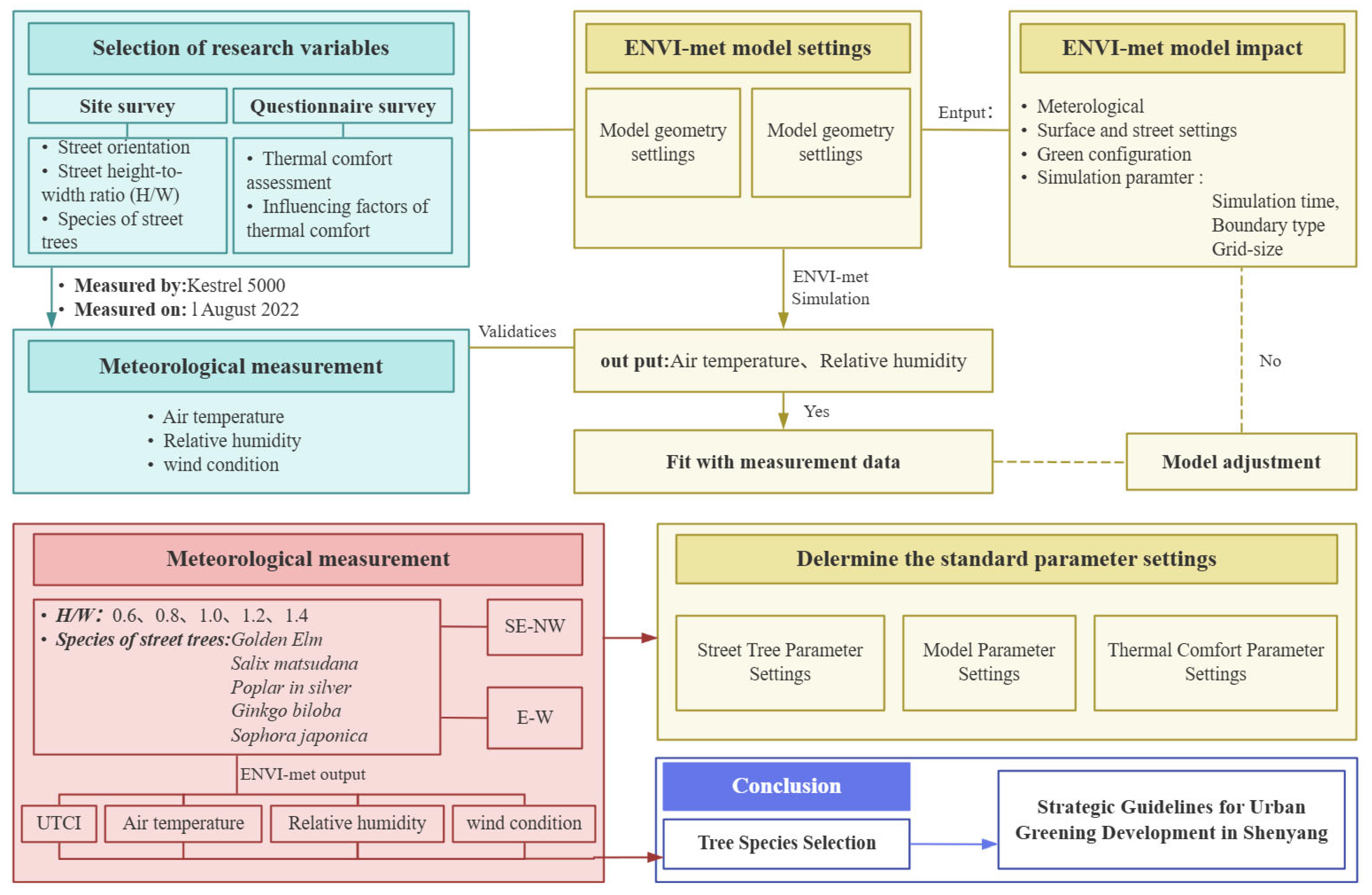
This study focuses on the impact of different street tree species on summer thermal comfort in livable streets of cold regions and establishes a research framework consisting of four main components: (1) selection of representative streets and common street tree species based on typical livable streets in the urban area of Shenyang; (2) identification of key meteorological factors influencing thermal comfort and their perceived weights through questionnaire surveys; (3) thermal comfort simulations of different street–tree combinations using the ENVI-met numerical model and the BIO-met tool; and (4) comparative analysis of thermal comfort improvement effects under various tree species configurations based on the three factors of temperature, humidity, and wind, as well as the UTCI index, followed by the proposal of optimized tree species configuration strategies. An overview of the research framework is illustrated in Figure 2.

2.2. Study Area

2.2.1. Selected Area

This study selects Shenyang, a typical cold city in northeastern China, as the research area [33]. Shenyang is located between 122°25′–123°48′ E and 41°12′–42°17′ N, characterized by a temperate monsoon climate with four distinct seasons, a long and cold winter, and a short but hot summer. The hottest month is July, with an average daily maximum temperature of 28 °C and a minimum of approximately 21 °C [34].
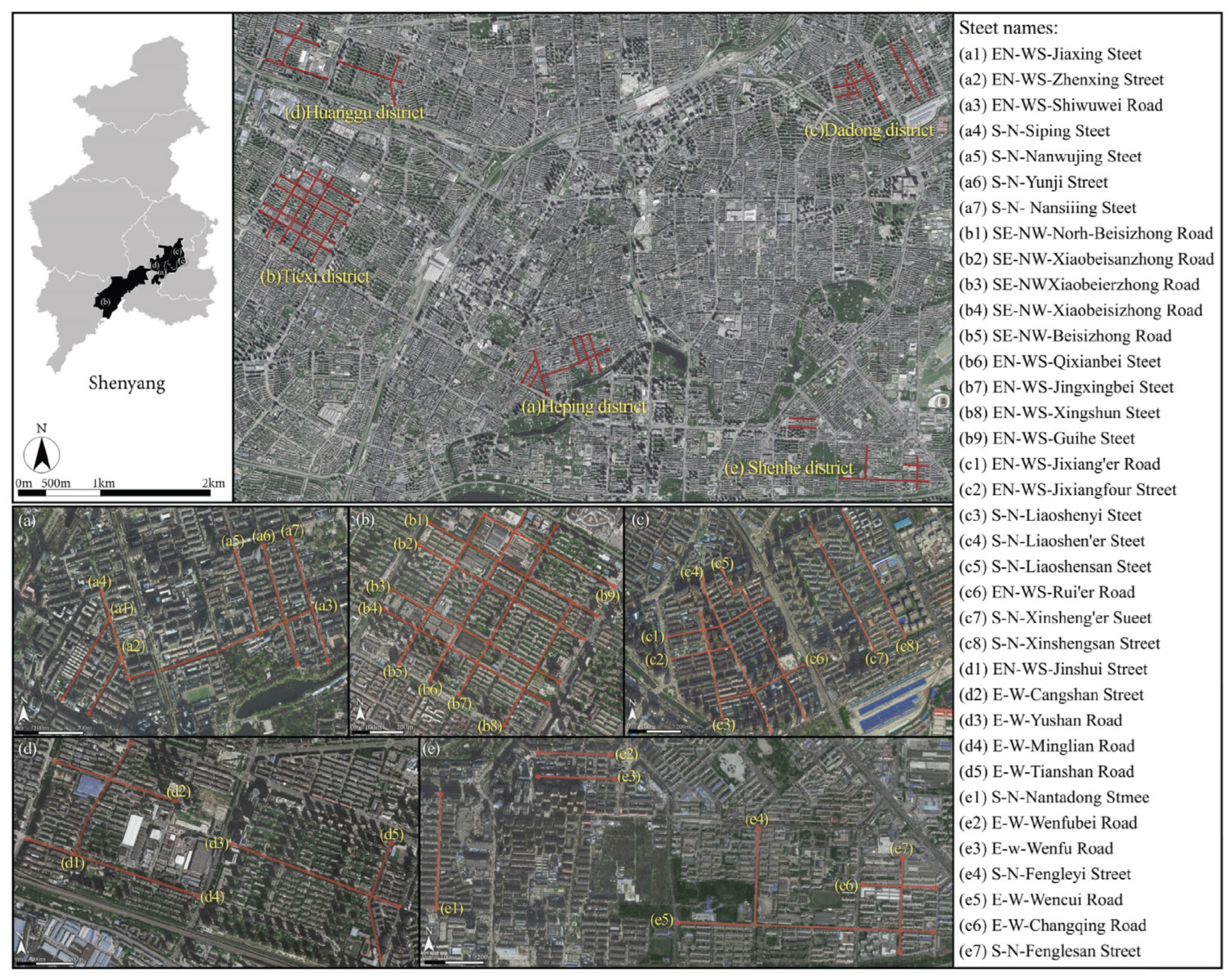
To ensure both data representativeness and systematic investigation, typical livable streets were selected within Shenyang’s old urban districts for field inventory. The study area covers Heping, Tiexi, Shenhe, Huanggu, and Dadong Districts. Based on the definition of livable streets, 36 representative street samples were initially selected (Figure 3). Field measurements were conducted to record key spatial elements, including roadway width, sidewalk width, building height, and street tree species. These data provide essential support for identifying the spatial morphological characteristics of streets in the study area and serve as a foundation for subsequent simulations and analyses.

2.2.2. Data Collection and Processing

To construct thermal comfort simulation scenarios suitable for livable streets in temperate monsoon cities, this study systematically collected and processed data from three perspectives: street spatial morphology, meteorological parameters, and street tree structure.
First, based on field surveys of 36 representative livable streets in the old urban districts of Shenyang, geometric parameters of streets were obtained. The results indicate that street widths generally range from 15 to 30 m, with building heights concentrated between 21 and 24 m, and an average street width of 22 m (Table 1). Sidewalk widths typically fall between 4 and 6 m, while roadway widths mostly range from 8 to 14 m. Building height estimates were derived from the Residential Design Code, which specifies a standard floor height of 2.8 m for ordinary residential buildings. For consistency with actual façade designs, a uniform value of 3 m per floor was adopted for estimation [35]. Street widths were measured using an infrared rangefinder. Statistical analysis revealed that the aspect ratios (H/W) of sampled streets were primarily distributed between 0.6 and 1.4, with orientations dominated by south–north (S–N) and east-northeast–west-southwest (ENE–WSW). These findings provide the baseline data for defining typical street morphologies and azimuth angles in the simulations.
Second, to obtain the microclimatic boundary conditions of streets, this study conducted meteorological monitoring using a Kestrel 5000 portable weather station (Kestrel Instruments, Nielsen-Kellerman, Boothwyn, PA, USA). This instrument offers high accuracy and durability, capable of real-time recording of key climatic variables such as wind speed, air temperature, relative humidity, atmospheric pressure, and altitude (technical specifications are provided in Table 2). The monitoring was carried out on 1 August 2022, from 9:00 to 17:00, with data collected at 30 min intervals. Measurement points were set at a height of 1.5 m above ground level to correspond to human thermal perception height. On the survey day, air temperature ranged from 22 to 32 °C, with prevailing southerly winds at Beaufort force 3–4, consistent with typical hot-weather conditions in Shenyang (Figure 4).
Finally, to simulate the microclimatic regulation effects of greening configurations, structural parameters of street trees were collected. Field inventory showed that most livable streets in Shenyang’s old districts adopt single-tree pit planting, with common species including Yinzhong Poplar and the Pagoda Tree, with an average spacing of approximately 5 m. Previous studies have demonstrated that morphological characteristics such as tree height, crown width, clear bole height, and canopy density are closely related to changes in the street thermal environment [36]. Accordingly, this study conducted on-site measurements of these structural indicators for the major street tree species: crown width, clear bole height, and tree spacing were measured directly, while tree height was obtained using a laser rangefinder. Considering adaptability, representativeness, and data integrity, five common species were ultimately selected as simulation objects: the Pagoda Tree, Ginkgo, Golden Elm, Yinzhong Poplar, Chinese Willow (Table 3 and Table 4). These species are widely applied in cities of cold regions and have been validated in previous studies, such as those conducted in Harbin, for their strong capacity to regulate microclimates and improve thermal comfort [37].

2.2.3. Human Thermal Comfort

This study adopts the Universal Thermal Climate Index (UTCI) as the primary indicator for assessing thermal comfort to reflect the thermal environmental effects of different street morphologies and street tree configurations. UTCI is currently one of the most widely applied comprehensive indices in outdoor thermal comfort research worldwide and is particularly suitable for urban microclimate analysis [38].
UTCI is defined as the equivalent air temperature under reference environmental conditions that would elicit the same human thermal stress response as the actual environment. The reference environmental conditions were defined such that the mean radiant temperature was equal to the air temperature, with a wind speed of 0.5 m s−1 at a 10 m height and 50% relative humidity (with water vapor pressure capped at 20 hPa when Ta > 29 °C) [39]. UTCI employs a multi-node dynamic model that can simulate human physiological responses under varying thermal stress conditions, including sweating, shivering, and vasoconstriction/vasodilation. This makes UTCI more accurate in reflecting human thermal load under complex climatic conditions [40].
UTCI comprehensively integrates meteorological parameters such as air temperature, mean radiant temperature, wind speed, and relative humidity, while also accounting for human activity levels and clothing insulation. It thus offers stronger climatic adaptability and cross-regional applicability [39]. The UTCI values in this study were obtained using the BIO-met module in ENVI-met based on microclimate simulation outputs. Considering that the study area is a cold-region urban street environment subject to significant climatic variation, UTCI provides a more comprehensive means of evaluating the impacts of summer thermal environments on human thermal comfort.
According to the classification proposed by Bröde et al., thermal stress levels in UTCI are defined as follows: 9–26 °C, “no thermal stress”; 26–32 °C, “moderate heat stress”; 32–38 °C, “strong heat stress”; and above 38 °C, “extreme heat stress” [39]. The UTCI settings and classification standards adopted for the summer simulations in this study are presented in Table 5.
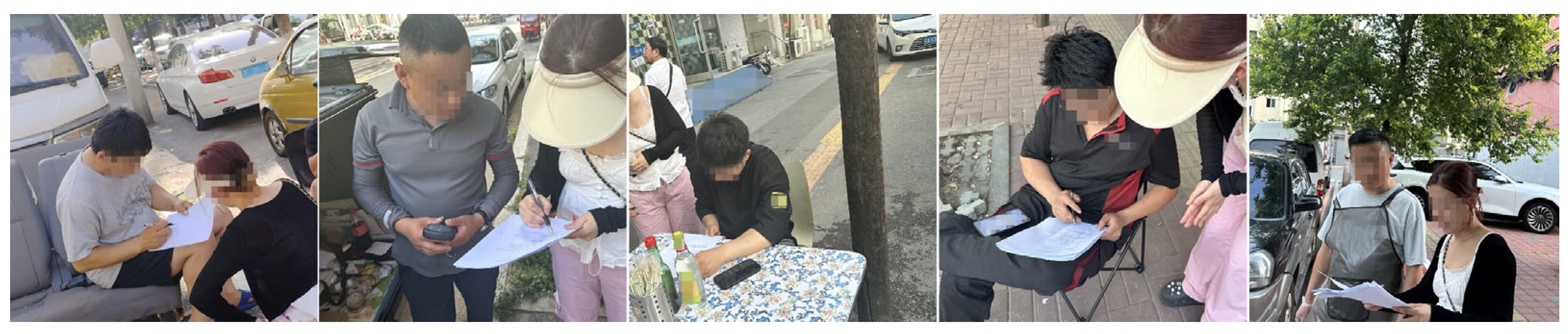
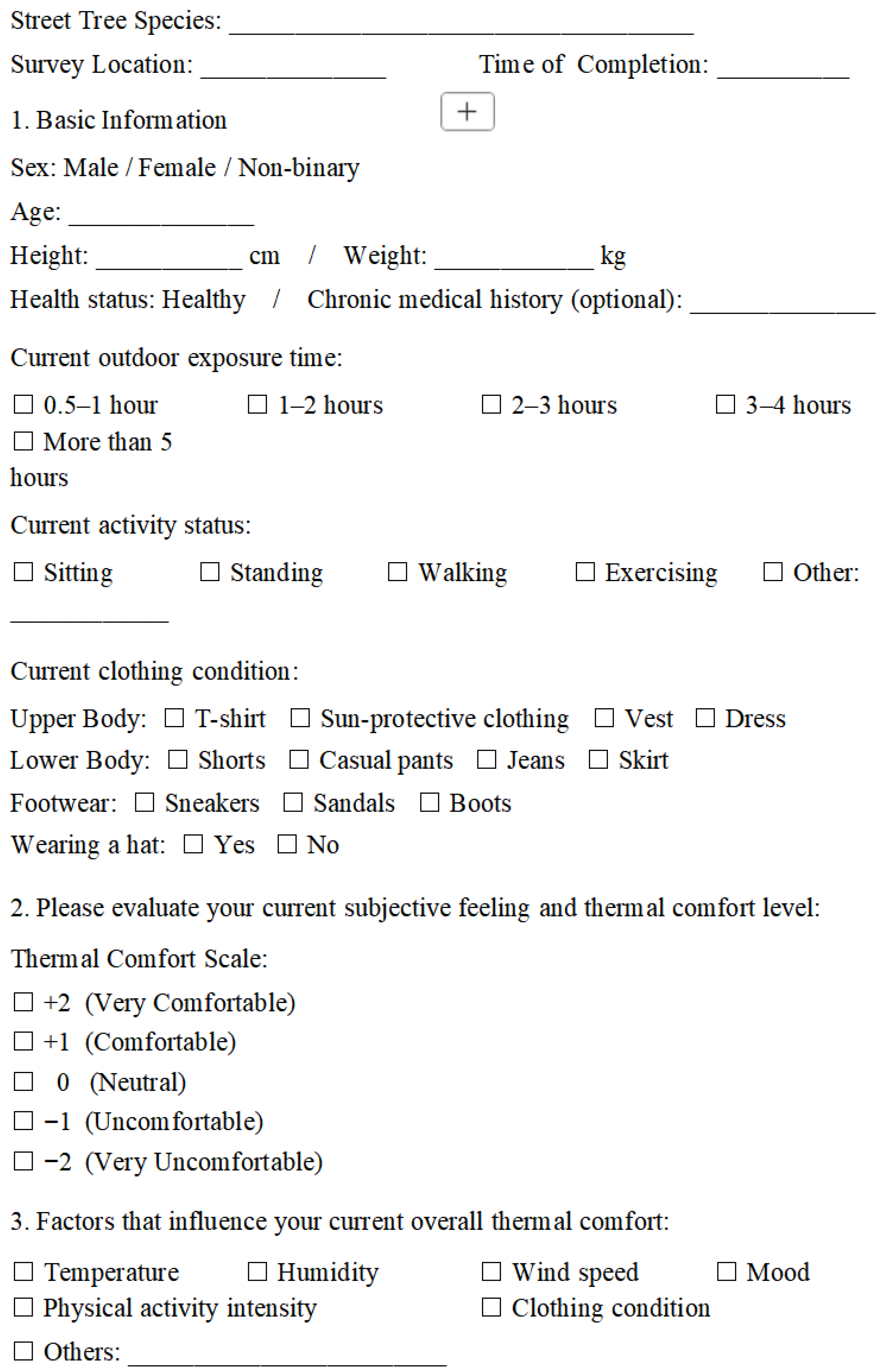
To verify the consistency between model evaluation results and residents’ actual perceptions, a subjective thermal comfort questionnaire survey was conducted in parallel. Five streets with similar aspect ratios but different street tree species were selected as survey sites, namely Ruyi 2nd Road, Jixiang 2nd Road, Fengle 3rd Street, Fengle 1st Street, and Wenfu Road. The survey was carried out from 1 to 2 August 2022, during the period of 14:00–17:00, under stable environmental conditions. The mean daily temperature was 26.9 °C, relative humidity was 82.7%, average wind speed was 2 m/s, and the prevailing wind direction was southerly. Thirty questionnaires were collected per street, yielding a total of 150 responses. Field questionnaire survey scenes are shown in Figure 4, while the questionnaire design and detailed survey results are provided in Appendix B (Figure A1).
The questionnaire, designed with reference to previous studies on thermal environment surveys, consisted of two parts. The first part gathered personal information of respondents, including time, location, clothing, activity type, and duration of outdoor exposure. To match UTCI model parameters, the sample screening was standardized to male subjects aged 35 years (height: 1.75 m, weight: 75 kg). The second part assessed thermal comfort perception, including a five-point Thermal Comfort Vote (TCV): +2 (very comfortable), +1 (comfortable), 0 (neutral), −1 (uncomfortable), and −2 (very uncomfortable). Respondents were also asked to indicate the subjective factors they perceived as influencing their current thermal sensation [41] (Table 6 and Table 7).

2.3. Numerical Model Construction

To quantitatively evaluate the impacts of different street morphologies and street tree configurations on human thermal comfort, a three-dimensional urban microclimate numerical model was developed using ENVI-met v5.7. ENVI-met is a multi-scale urban climate simulation system based on non-hydrostatic computational fluid dynamics (CFD) principles. It dynamically couples processes of aerodynamics, heat transport, shortwave and longwave radiation exchange, and soil–vegetation–atmosphere interactions. The model has been widely applied in studies of urban heat island analysis, green infrastructure assessment, and microclimate interventions at the street scale [42,43].

2.3.1. Simulation Domain Parameters

A typical livable street in Shenyang was selected as the simulation object. The model domain was set to 100 m × 100 m × 50 m, with a grid resolution of 1 m in both horizontal and vertical directions, meeting the spatial resolution requirements for thermal comfort simulations. Model construction incorporated parameters such as street aspect ratio, orientation, ground surface materials, building density, and street tree configurations. To ensure consistency between simulations and field conditions, boundary meteorological inputs were derived from hourly observational data recorded on 1 August 2022, including air temperature, wind speed, and relative humidity, while solar radiation was obtained from ENVI-met outputs [44,45]. The simulation was initialized at 00:00 and ran for 24 h (Table 8).
Based on the combinations of two street orientations (S–N and ENE–WSW) and five aspect ratio categories (0.6–1.4), together with five representative street tree species, a total of 50 models were constructed to represent different spatial–vegetation configurations (Table 9). In all scenarios, both sides of the street were uniformly set as single-row tree-pit plantings with a fixed spacing of 5 m.

2.3.2. 3D Plant Modeling and Structural Parameter Setting

The default plant library (Albero) provided by ENVI-met is largely derived from temperate European species [17], whose leaf area index (LAI), crown base height, crown width, and photosynthetic parameters are not suitable for cold-climate regions in northeastern China. To ensure the regional adaptability of plant responses in the model, this study reconstructed three-dimensional plant models for five representative local street tree species based on field measurements and the characteristics of urban forestry in northern cold regions of China.
For each tree species, the following parameters were explicitly defined in the model: tree height, crown width, crown base height (CBH), LAI, and leaf area density (LAD) distribution functions across vertical layers. Because the ENVI-met modeling framework is based on a regular cubic grid system, crown dimensions must be set to odd numbers to align with grid cells and avoid spatial mismatches. Accordingly, the structural parameters of all selected tree species were standardized and are summarized in Table 10.

2.3.3. LAD Distribution Function and LAI Calibration

In ENVI-met, the thermal regulation capacity of tree canopies is determined by the vertical distribution of LAD. To represent realistic canopy structures while maintaining consistency in total LAI, this study adopted the empirical LAD vertical distribution function proposed by Fahmy [43], expressed as follows:
LAI = 0 h LAD ( z ) dz =   0 h L m ( h z m h z ) n exp [ n ( 1 h z m h z ) ] dz
where h is tree height, z is any given height, z m is the height at which LAD reaches its maximum, L m is the maximum LAD value, and n is an exponential term controlling the rate of change in leaf distribution. The parameter n was segmented according to height as follows:
n = { 6 ,         0 z z m 0.5 ,         z m z h
This function effectively simulates the gradient of leaf area density within the canopy, thereby accurately representing the capacity of different canopy structures to regulate solar radiation and aerodynamic properties. The total LAI values were determined by integrating field measurements from urban forestry studies in Beijing, Tianjin, and Harbin [46], calibrated for individual species and subsequently incorporated into the ENVI-met vegetation module (see Appendix A (Table A1)).
Through this modeling procedure, the ENVI-met microclimate model developed in this study achieves strong regional adaptability in terms of structural hierarchy, spatial resolution, and physiological parameterization, providing a robust basis for quantitative simulations and visualization of the thermal comfort contributions of different street tree species.

2.3.4. Model Validation

To evaluate the accuracy and reliability of the ENVI-met microclimate simulation results, this study employed the root mean square error (RMSE) and the coefficient of determination (R2) as the primary statistical validation indices, comparing simulated data with field measurements. RMSE is commonly used to quantify the deviation between predicted and observed values; a smaller RMSE indicates a closer agreement between simulation outputs and actual measurements, and hence a higher model accuracy [47,48]. The formula for RMSE is expressed as follows:
RMSE = 1 n i = 1 n ( y i * y i ) 2
where y i * is the simulated value, y i is the observed value, and n is the sample size.
R2 is a statistical indicator that evaluates the goodness of fit between predicted and observed values, ranging from 0 to 1, with values closer to 1 indicating better model performance. It is typically calculated based on the least-squares linear regression model, as expressed below:
R 2 = 1 SSE SST = 1 Σ ( yi y - ) ^ 2 Σ ( yi y ^ i ) ^ 2
where, y i is the observed value, y - is the mean of observations, and y ^ i is the predicted value. To avoid spurious improvements in model performance caused by the inclusion of multiple independent variables, this study further adopted the adjusted coefficient of determination (Adjusted R2) for correction [47], defined as follows:
Adjusted   R 2 = 1 [ ( 1 R 2 ) * ( n 1 ) ( n k 1 ) ]
where k is the number of independent variables in the model, and n is the total sample size.

2.4. Field Validation Design and Instrument Calibration

2.4.1. Field Validation Site and Measurement Layout

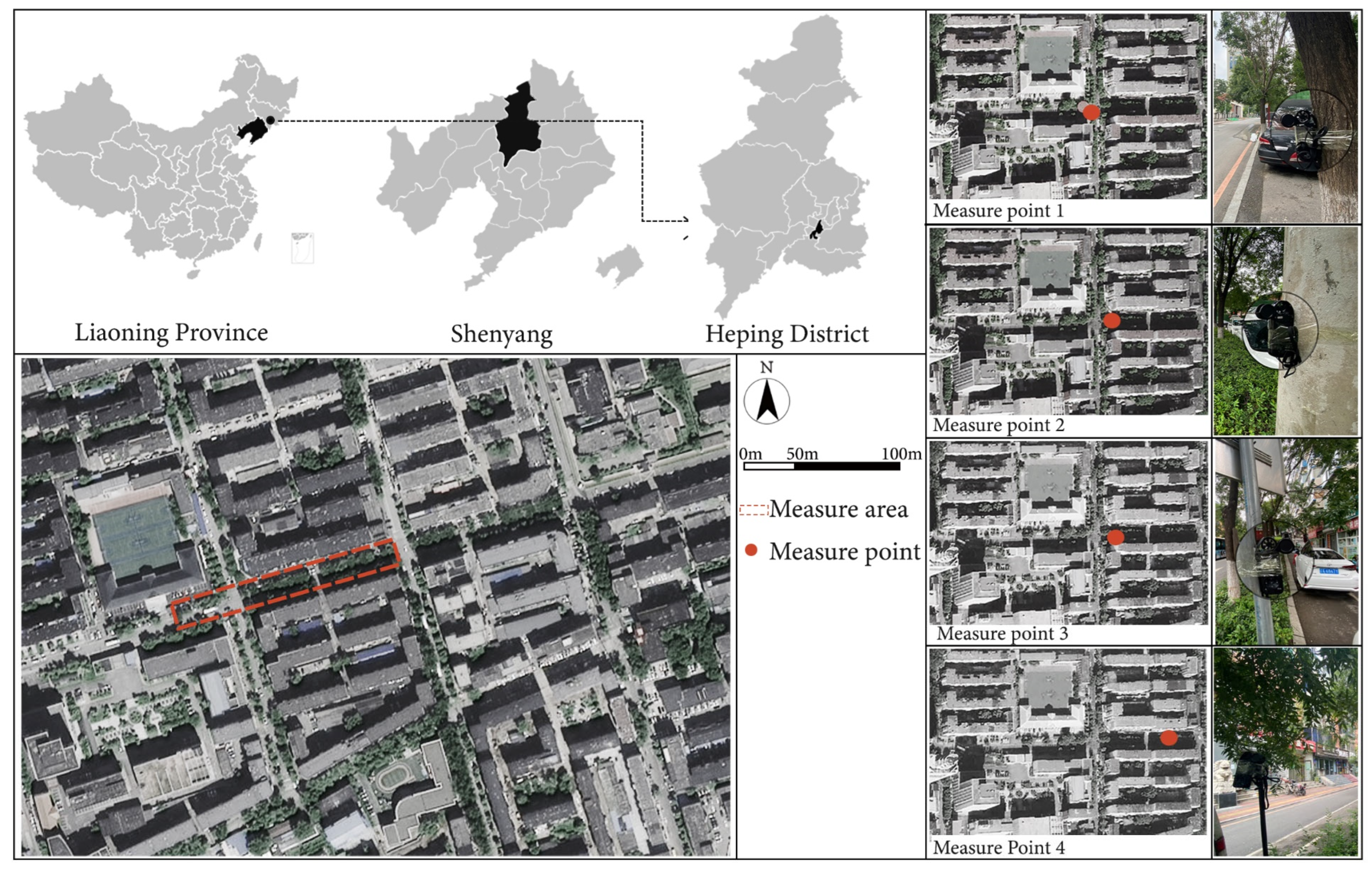
For model validation, Shisiwei Road in Heping District, Shenyang, was selected as the field measurement site. The street has an aspect ratio of 1.0 and a spatial layout characterized by a “one-plate–two-belt” structure, with relatively rich greening features. Most segments employ a belt-style street tree configuration, while some sections adopt a tree-pit layout. The dominant tree species is the Pagoda Tree, with a smaller presence of Chinese Willow. Buildings along both sides of the street are predominantly residential, with well-developed supporting facilities. The street experiences high pedestrian density, with approximately 80% of users being residents (Figure 5).
To ensure representativeness and diversity in sampling, four measurement points were established along Shisiwei Road, located within sidewalks and roadside greenbelts. Measurement Point 1 was placed at the center of the sidewalk, while Points 2–4 were in the greenbelt areas on both sides of the street. These points primarily record microclimatic variables such as temperature, humidity, and wind speed, providing essential data for validating the ENVI-met simulations against field measurements.

2.4.2. Instrument Calibration and Data Consistency Control

To guarantee the accuracy of field measurements, this study adopted the instrument calibration procedure applied by Zhang et al. in their field campaign in Nanjing [4,49]. Prior to monitoring, all instruments were calibrated under uniform conditions. As illustrated in Figure 6, instruments were operated in parallel in the same environment, and minor adjustments were made according to deviations in air temperature and relative humidity. Calibration was completed once the inter-instrument temperature differences were within 0.3 °C and relative humidity differences within 5%.
Finally, the field measurements were compared with ENVI-met simulation outputs using RMSE and R2 to evaluate the model’s goodness of fit, thereby assessing the applicability and accuracy of the model in simulating thermal environments along urban livable streets.

2.5. Statistical Analysis

To enhance the robustness of the results, paired difference tests were applied to the simulated outputs. First, under the same street morphology, interspecies differences were quantified by calculating paired differences:
UTCI   =   UTCI speciesA   UTCI speciesB
When the paired differences were approximately normally distributed, a paired-sample t-test was used to test the null hypothesis that the mean difference equals zero; the Wilcoxon signed-rank test was additionally applied as a robustness check.
To evaluate street-morphology effects, orientations were compared under the same species and the same H/W using the following:
UTCI   =   UTCI SE - NW     UTCI E - W
In addition, within each orientation, H/W effects were assessed relative to the reference condition, H/W = 1.2, by calculating the following:
UTCI   =   UTCI H / W UTCI 1 . 2
All tests were two-sided, with a significance level of α = 0.05.

3. Results

3.1. ENVI-Met Model Validation

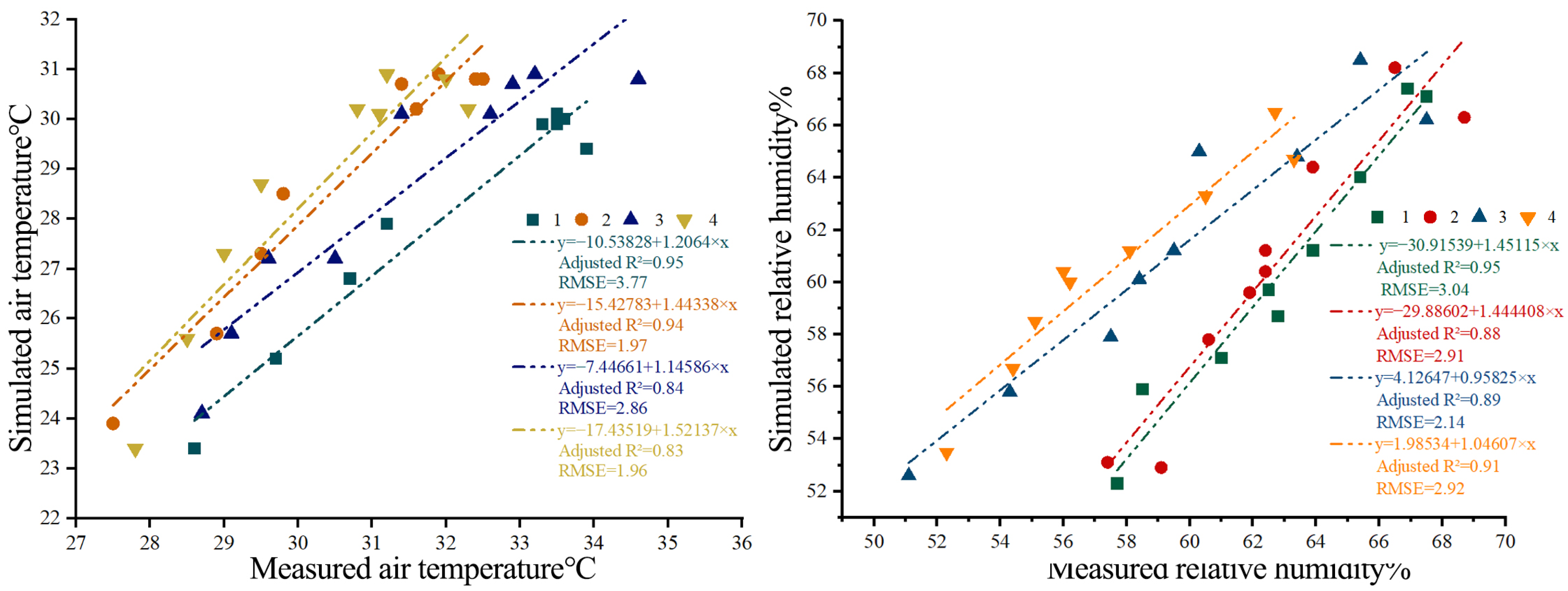
To validate the accuracy of the simulation results, correlation analyses were conducted between ENVI-met outputs and field measurements. Figure 7 presents the scatter plots of simulated versus observed air temperature and relative humidity, where the X-axis represents measured values, and the Y-axis represents model outputs. The results indicate that simulated values increased consistently with observed values, showing an overall linear positive correlation.
For temperature simulations, R2 values ranged from 0.83 to 0.95, with root mean square error (RMSE) values between 1.96 °C and 3.77 °C. For humidity simulations, R2 values ranged from 0.88 to 0.95, with RMSE values between 2.14% and 3.04%. The distribution of data across measurement points demonstrates a strong agreement between simulated and observed values, with particularly stable prediction performance in the moderate thermal load range.
It is noteworthy that during extreme high-temperature periods (>30 °C), simulated values at certain points were slightly higher than the observations, which may be related to thermal inertia assumptions in the model under high-temperature boundary conditions. Overall, ENVI-met exhibited strong responsiveness to variations in air temperature and relative humidity at the street scale. Its outputs showed high consistency with field data in both spatial distribution and numerical accuracy, confirming that ENVI-met can effectively simulate the microclimatic characteristics of livable streets under typical summer conditions and is therefore suitable for subsequent quantitative analyses of the thermal comfort regulation effects of street tree species.

3.2. Street Morphology and Thermal Comfort Simulation Results

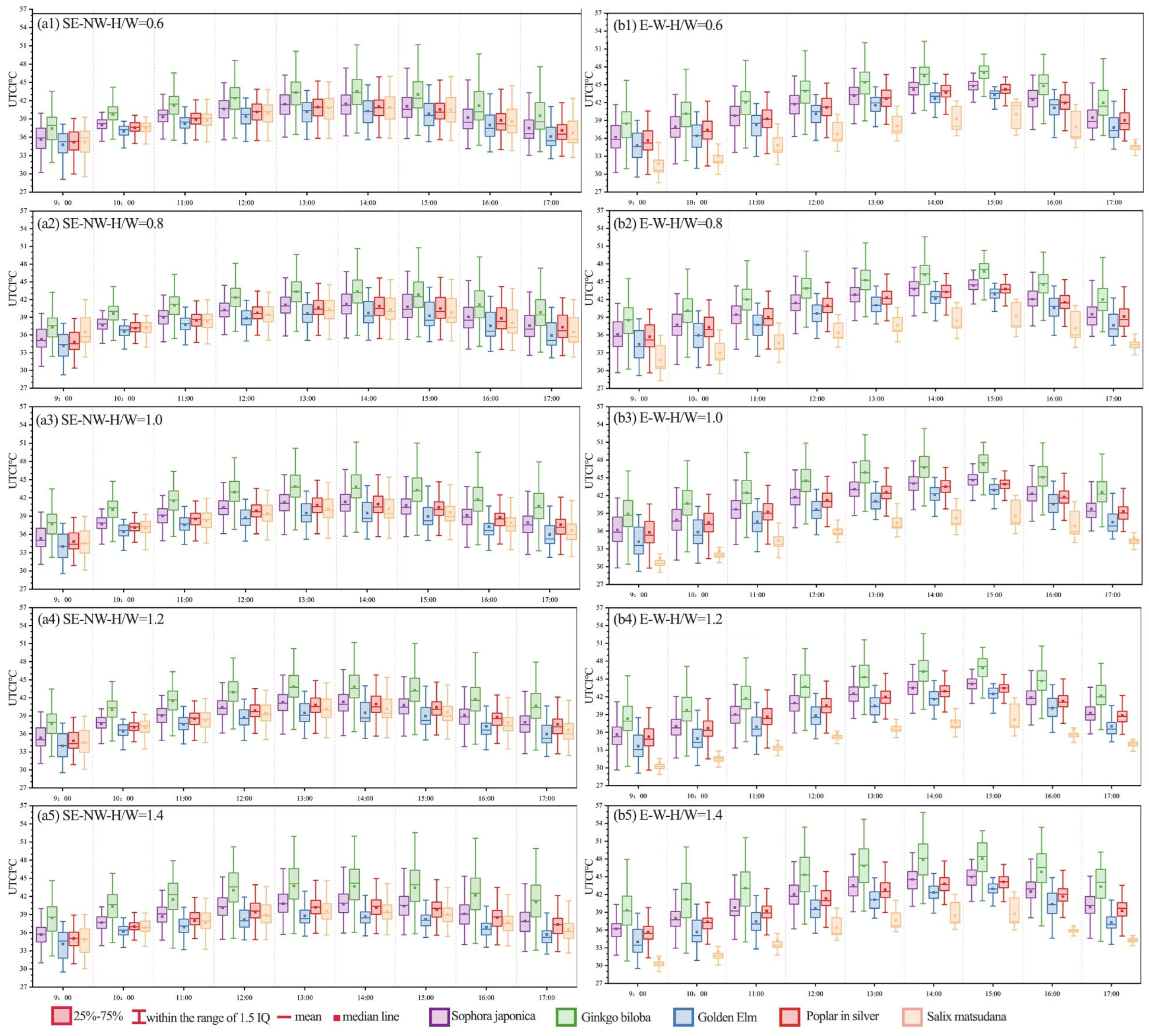
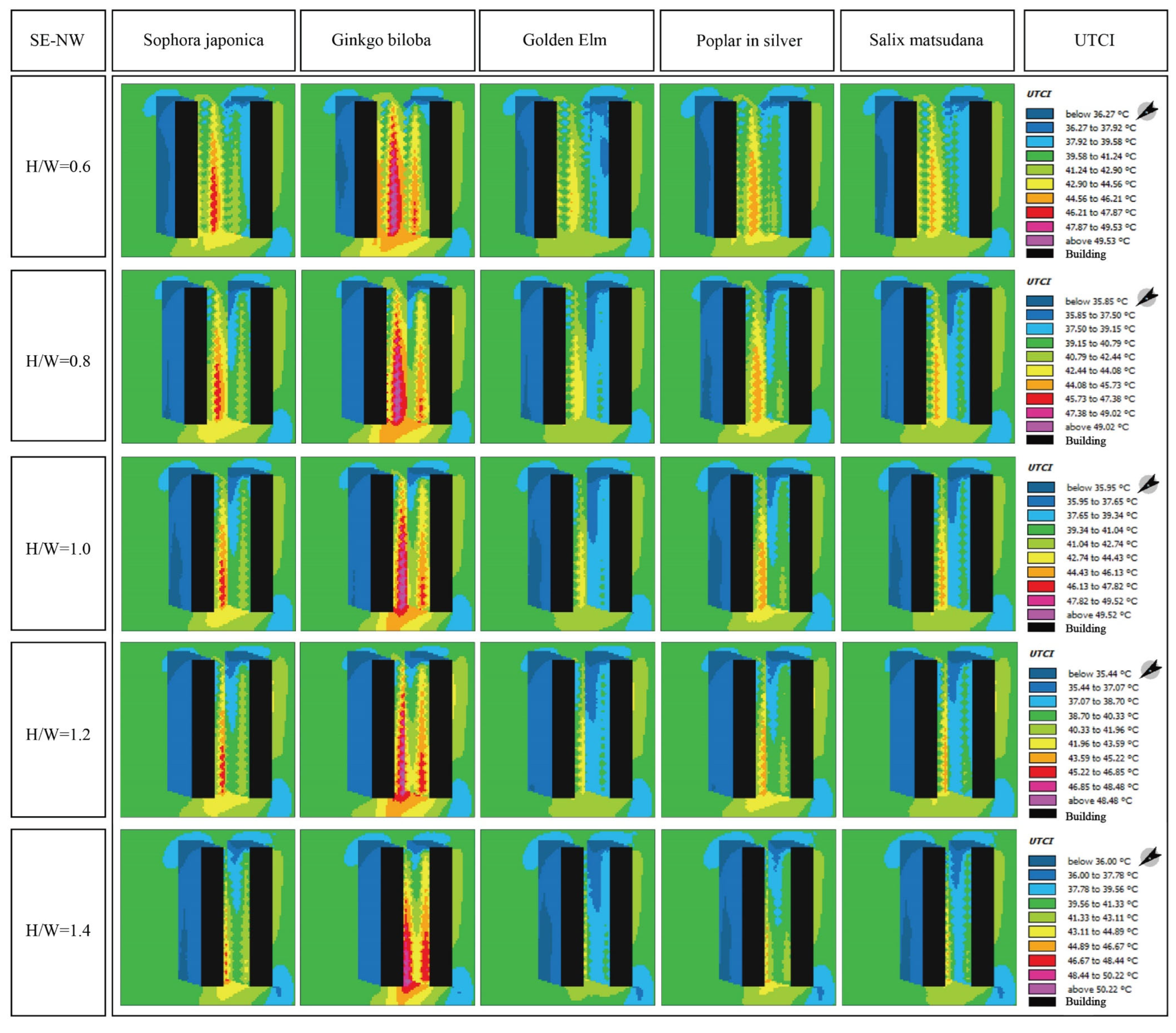
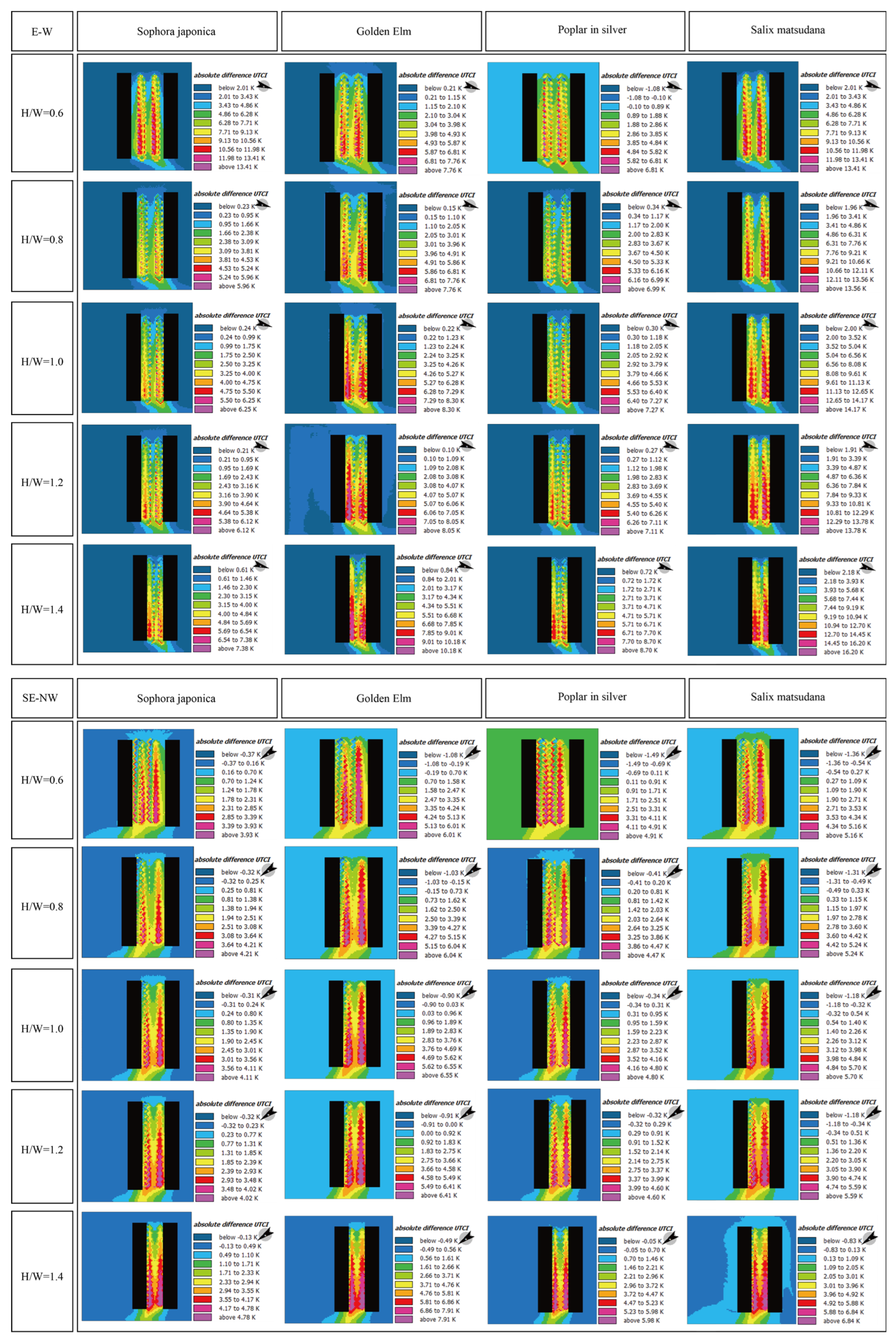
The simulation results indicate that street aspect ratio and orientation exert significant effects on human thermal comfort (Figure 8). Across all aspect ratio combinations, streets oriented southeast–northwest (SE–NW) exhibited overall higher thermal comfort levels compared with those oriented east–west (E–W). Under the SE–NW orientation, the ranking of aspect ratios in terms of thermal comfort improvement was: 1.2 > 1.4 > 0.8 > 1.0 > 0.6. For the E–W orientation, the order was: 1.2 > 0.8 > 1.0 > 0.6 > 1.4. Streets with an aspect ratio of 1.2 consistently demonstrated the best thermal comfort in both orientations, yielding the lowest UTCI values and the most stable comfort range (Table 11). Paired tests further confirmed the above findings, as shown in Appendix A (Table A2).
For example, with Golden Elm, the simulated UTCI under the SE–NW orientation with an H/W = 1.2 was 25.4 °C, representing an improvement of 1.7 °C compared with H/W = 0.6 (27.1 °C) for the same species. Under the E–W orientation, Chinese Willow at H/W = 1.2 achieved a UTCI of 25.9 °C, 1.4 °C lower than at H/W = 1.4 (27.3 °C). Similarly, for Yinzhong Poplar, H/W = 1.2 consistently yielded superior results, with temperature improvements ranging from 0.7 to 1.2 °C across different scenarios.

3.3. Comparison Between Tree Species Thermal Comfort Simulations and Subjective Questionnaire Results

To further validate the reliability of the simulations, UTCI outputs from ENVI-met were compared with residents’ TCVs obtained from the field questionnaire survey. The results reveal significant differences in the thermal comfort regulation capacity among different street tree species, with subjective evaluations showing strong consistency with simulation trends (Figure 4).
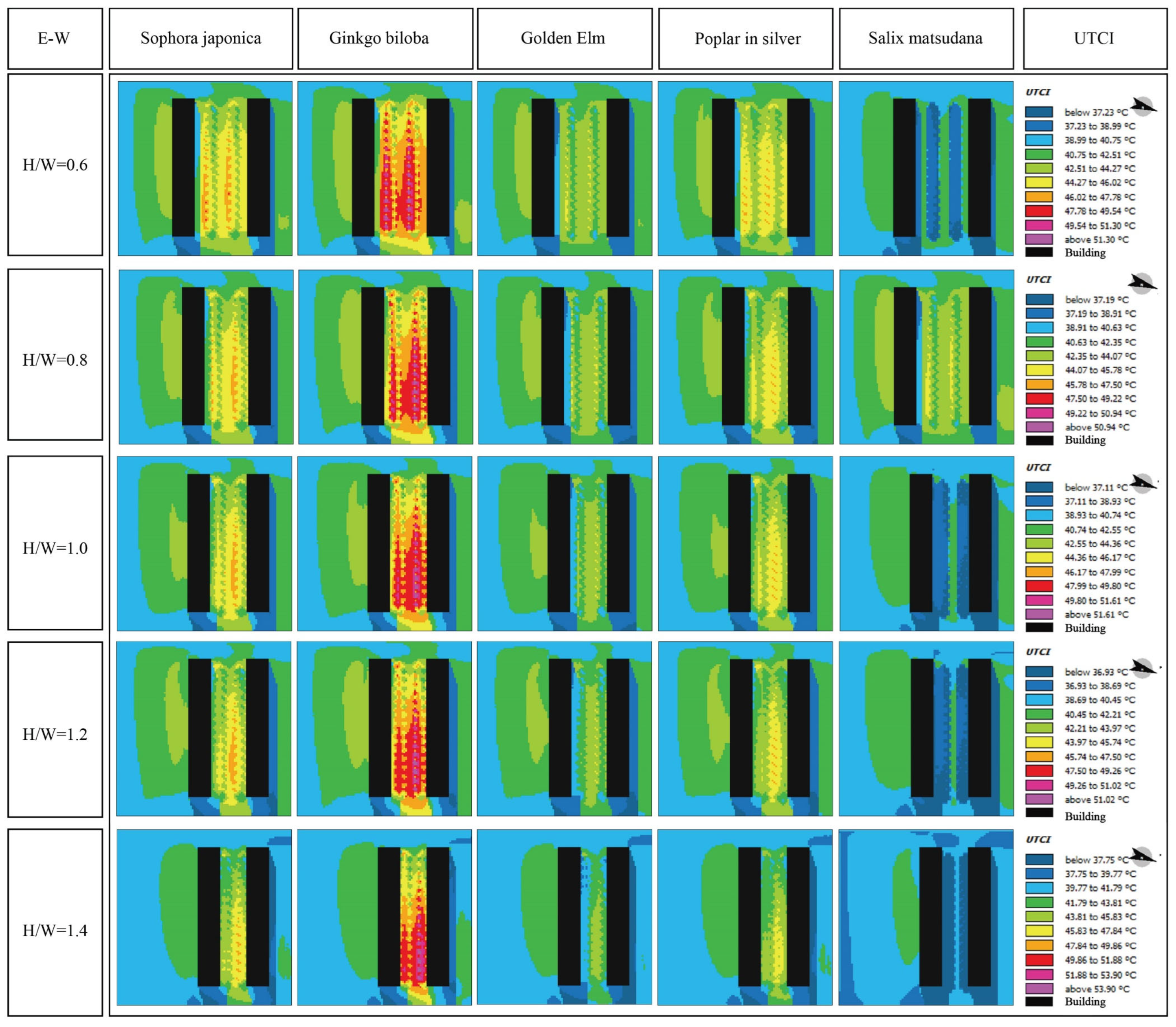
Streets planted with Ginkgo were rated as “uncomfortable” by most respondents, consistent with simulation results showing that their UTCI values were generally higher than those of other species. By contrast, streets with Golden Elm and Chinese Willow exhibited lower simulated UTCI values (25.4 °C and 25.9 °C, respectively) and correspondingly received a higher proportion of “comfortable” and “very comfortable” ratings. Streets with the Pagoda Tree and Yinzhong Poplar were predominantly rated as “neutral”, with simulated UTCI values in the range of 26.5–27.5 °C, suggesting a moderate regulation capacity for these species (Figure 9).
In addition, an analysis of influencing factors reported by respondents indicated that wind speed, air temperature, and relative humidity were the three most critical variables, with wind speed identified as the most significant regulatory factor. This finding aligns with the simulation results: in SE–NW-oriented streets with relatively favorable ventilation conditions, subjective thermal comfort ratings were clearly higher than those in E–W-oriented streets.
It is noteworthy that some respondents also reported that commercial activity density and building enclosure influenced their thermal experiences. In street segments with high concentrations of commercial functions and pedestrian flows, even well-designed tree configurations were sometimes offset by localized heat sources and reduced air circulation, leading to discrepancies in subjective thermal perception. This suggests that relying solely on physical microclimatic parameters in simulations may overlook thermal disturbances introduced by human activities and socio-spatial structures.

4. Discussion

4.1. Effects of Street Morphology on Microclimate Regulation Mechanisms

The geometric characteristics of urban streets, particularly aspect ratio (H/W) and orientation, are fundamental physical variables that shape street-level microclimates. Previous studies have shown that street morphology profoundly influences the spatial distribution of thermal environments and human thermal comfort responses by regulating the angle of solar radiation entry, local airflow dynamics, and pathways of heat release from building thermal mass [49,50].
Under typical summer conditions, this study shows that the optimal street morphology for cities in a severe-cold climate zone is achieved through a balance between radiative control and ventilation (Table 12). In particular, streets with H/W = 1.2 exhibit thermal-comfort advantages across multiple spatial scales and demonstrate the strongest UTCI reduction in the simulations. This finding differs from the “low H/W first, ventilation-dominated” strategy emphasized in some studies of tropical cities [24] and also from conclusions in hot–dry environments that highlight deeper street canyons for reducing radiative load through shading [23,49]. These results indicate that under Shenyang-like mid-latitude monsoonal conditions, a more effective configuration should simultaneously constrain excessive solar/radiative exposure while avoiding substantial ventilation weakening.
Comfort: We quantitatively evaluated the relationship between street-axis direction and the solar path, and the results show that an SE–NW axis can reduce direct solar exposure at pedestrian height from noon to mid-afternoon. Consequently, MRT is markedly lower than that of an E–W orientation, reflecting a reduced radiative burden; thus, street orientation acts as a first-order control factor governing solar exposure and thermal comfort. This conclusion is consistent with related studies across different climates and urban scales [18,19,20], suggesting a coupled relationship between spatial orientation and pathways of heat-load transmission. In addition, the relative alignment of the SE–NW axis with the prevailing summer wind direction may strengthen the wind-corridor effect, thereby jointly determining the transport and dissipation efficiency of thermal loads, together with the radiative pathway.
In our results, the UTCI difference for the same tree species across different spatial configurations reaches up to 1.5 °C, confirming that street structure can amplify or attenuate vegetation effects associated with shading, ventilation, and evapotranspiration. Therefore, street morphology should be treated as a primary parameter within the thermal-environment intervention framework, and its roles in shading, ventilation, and thermal-inertia regulation should be reconceptualized and designed within a coupled “space–climate–vegetation” mechanism.

4.2. Structural Differences of Street Tree Species and Their Multidimensional Regulatory Capacity

Previous studies have generally acknowledged that different tree species exhibit significant variation in their ability to regulate the thermal environment of streets. Such differences are primarily determined by key parameters including crown width, LAD distribution, transpiration potential, and crown base height [36,51]. However, most existing research has focused on tropical or subtropical regions, while structural analyses of species-specific regulation mechanisms under cold-climate conditions remain limited.
Based on ENVI-met simulations, this study evaluated the thermal comfort regulation performance of five common street tree species in temperate monsoon cities under various combinations of aspect ratio and street orientation (Figure 10). The results demonstrate that UTCI improvement effects differ markedly across species and exhibit strong spatial dependency. For example, Golden Elm reduced UTCI by 1.38 °C in SE–NW-oriented streets with H/W = 1.2, whereas its improvement effect was less than 0.5 °C in E–W-oriented streets with H/W = 0.6. This indicates that spatial configuration may amplify or suppress the regulatory capacity of specific tree species, extending the “right tree for the right place” principle proposed in street-canyon optimization research [52]. It further suggests that street morphology, as a boundary framework, determines the extent to which canopy-structure parameters of a given species can be translated into thermal-comfort benefits [26].
Further analysis revealed that tree species with compact crowns, stable LAD distributions, and moderate crown base heights were better adapted to street spaces characterized by medium ventilation and higher solar altitude angles. In contrast, species with convergent crown forms or excessively low crown base heights, for example, Ginkgo, showed limited thermal regulation performance in both highly open and highly enclosed streets. This finding is consistent with Li’s conclusion from field experiments in Nanjing that “greater leaf mass ≠ greater comfort” and extends the theoretical framework of “species–space adaptability” to cold-climate contexts [48].
Moreover, certain high-transpiration species performed poorly in enclosed streets, suggesting that transpiration potential alone is insufficient to overcome heat retention effects. Instead, the matching between tree structural traits and street morphology is confirmed as a prerequisite for enhancing thermal comfort [7]. While most existing studies have focused on single-variable species optimization [8,52,53,54], this study established a multidimensional evaluation logic dominated by spatial parameters, emphasizing a structure-first pathway in which vegetation responses are constrained by the spatial framework. Consequently, species selection should not be considered in isolation from street geometry but incorporated into an integrated space–vegetation coupling regulation model. By addressing the specific conditions of cold regions, this study proposes tree species adaptation strategies tailored to different combinations of H/W and street orientation, thereby providing an operational theoretical foundation for structurally informed urban greening design.

4.3. Consistency Between Subjective Thermal Perception and Simulation Results, and Sources of Deviation

In urban thermal comfort research, the degree of consistency between simulated indices and subjective perceptions is a key criterion for evaluating model reliability and practical applicability. Previous studies have shown that widely used thermal comfort indices such as UTCI can quantify the combined effects of radiation, air temperature, humidity, and wind speed; however, they remain limited in their capacity to capture subjective dimensions such as psychological expectations, behavioral adaptation, and socio-spatial factors [47,55,56].
In this study, UTCI distributions simulated by ENVI-met for five tree species under different spatial configurations were compared with residents’ TCVs, collected under the same temporal and spatial conditions. The comparison revealed a high degree of consistency in trend judgments, particularly when UTCI < 26 °C, where TCV scores were concentrated in the “comfortable” and “very comfortable” categories, showing good agreement. For example, in the configurations of Golden Elm (SE–NW and H/W = 1.2) and Chinese Willow (E–W and H/W = 1.2), deviations between UTCI and TCVs were less than 0.5 °C or within one score level, indicating strong explanatory power of the model under thermal comfort optimization scenarios.
However, discrepancies emerged in borderline cases within the “moderate heat stress” range (26–29 °C). In some street segments, especially in commercial zones or high pedestrian density areas, respondents reported feeling “slightly hot” or “uncomfortable” despite relatively low UTCI values. This suggests that non-meteorological factors such as crowding, noise, and traffic disturbance interfered with thermal perception, consistent with the concept of behavioral thermal adaptation and expectation bias [57]. It is worth noting that this study did not incorporate individual thermal adaptation variables like gender, age, and clothing insulation or behavioral parameters like activity intensity and exposure duration, which may have contributed to localized prediction errors. Future work could improve subjective alignment by incorporating individual correction factors into the UTCI framework [58,59]. The ENVI-met simulation results demonstrated a high level of consistency with subjective survey data, particularly in structurally optimized scenarios where predictive performance was strong. Nonetheless, in human-activity-intensive environments, subjective perception biases must be carefully considered, highlighting the need for future thermal comfort modeling to evolve from single meteorological responses toward integrated meteorology, society and behavior frameworks [3].
In addition, the survey results indicate that respondents perceived wind speed as the most influential factor affecting thermal sensation. This suggests that under humid monsoonal summer conditions, wind is critical for convective and evaporative heat dissipation at the pedestrian level, and that a street orientation aligned with the prevailing wind direction can still yield stronger perceived-comfort benefits [26].

4.4. Integrated Strategy Recommendations for Greening Optimization in Cold-Region Streets

Based on the findings regarding street spatial configuration, species-specific microclimate regulation mechanisms, and the consistency between subjective thermal perception and simulation outputs, this study proposes an optimization framework for street-scale greening temperate monsoon cities. The framework emphasizes structure–function matching between spatial morphology and vegetation configuration, with simulation-driven analysis and human-centered feedback as the core strategy for enhancing the systemic regulation capacity of greening interventions on an urban thermal environment.
It is recommended that the street aspect ratio be maintained within the range of 1.0–1.2 to balance shading coverage with ventilation accessibility. Street orientations forming a 15–45° angle with prevailing summer wind directions can effectively enhance wind-driven air exchange and synergize with vegetation transpiration potential. Extreme openness or excessive enclosure should be avoided, as both may exacerbate thermal stress through either heat accumulation or loss of cooling capacity. In streets with moderate aspect ratios and balanced ventilation–radiation characteristics, priority should be given to tree species with high LAD, moderate crown spread, and relatively high CBH, such as Golden Elm and Chinese Willow. These species demonstrated superior UTCI cooling effects in simulations, supported by efficient transpiration and stable shading performance. Conversely, species with convergent crown forms, such as Ginkgo, performed poorly under most spatial conditions, and their use should be limited in high-thermal-load street segments to avoid reduced microclimate benefits. Greening strategies should move beyond relying on canopy coverage as a single proxy for thermal regulation capacity. Instead, a tripartite coupling mechanism—“spatial morphology–canopy structure–microclimate response”—should guide the development of a species parameter database. Early design stages are encouraged to integrate three-dimensional simulation tools such as ENVI-met or SOLWEIG for rapid iterative evaluations of space–species combinations, thereby generating ranking-based recommendations for species selection and planting layouts under thermal comfort optimization targets [60].
Resident behavioral characteristics like daily duration of stay, activity frequency, and temporal patterns should be incorporated into thermal regulation frameworks, advancing toward an integrated “meteorology–structure–behavior” configuration model. While consistency between model results and TCVs has been validated, caution is warranted in commercial zones and high-footfall nodes where subjective thermal biases may arise. Real-time correction through dynamic monitoring and multi-variable modeling is necessary to ensure adaptive local regulation.

4.5. Limitations and Further Study

Although this study systematically developed a coupled simulation framework linking street morphology, vegetation structure, and thermal comfort responses for cold-region urban streets and validated the street tree–street morphology adaptation mechanisms across multiple spatial scenarios, several limitations remain that constrain the generalizability of the results and the universality of the model.
First, regarding model inputs, the vegetation parameters in ENVI-met rely on static three-dimensional structures and simplified LAD settings, which do not capture the dynamic canopy evolution across seasons, growth stages, and pruning conditions. This limitation reduces the model’s ability to reflect physiological changes in tree species. Future studies are encouraged to incorporate high-resolution LiDAR data or multi-temporal UAV remote sensing imagery to construct dynamically updated vegetation structure models, thereby improving spatial–physiological consistency [61,62,63].
Second, the meteorological boundary conditions in this study were selected to represent an extremely hot summer day. While representative, this approach does not reveal the complete seasonal variability of street-level microclimate responses. Future research should establish sequential simulations based on multi-period meteorological datasets covering the entire year, enabling the identification and modeling of annual thermal comfort patterns, critical transition thresholds, and intra-annual spatial heterogeneity [51,64].
Third, in terms of subjective thermal validation, questionnaire sampling was limited by temporal and spatial constraints, with relatively narrow respondent coverage [65]. Individual attributes such as gender, age, clothing insulation, and activity intensity were not incorporated, which restricted multidimensional identification of subjective–objective discrepancies in thermal perception. Future studies should combine wearable sensors with multi-source behavioral data to develop integrated datasets linking behavior, physiology, and environment [38,66].
In addition, the model has not yet incorporated non-vegetation thermal environment variables such as surface albedo, the thermal storage capacity of building envelopes, and plant evapotranspiration potential [67]. Nor has it conducted multi-objective trade-off analyses of greening strategies in terms of construction cost, lifecycle carbon balance, and management feasibility [68,69]. Future research should therefore establish a multi-variable-driven integrated evaluation framework linking urban microclimate, ecology, and economics to enhance policy relevance and cross-sector applicability. As an exploratory attempt to simulate street greening and thermal comfort in a cold-climate context, this study has preliminarily constructed an integrative framework combining mechanistic logic with spatial structure. Future work should further advance cross-scale modeling of street-level microclimate regulation, temporal tracking of structural parameters, and integration of non-meteorological factors, thereby supporting the scientific deployment and efficient management of green infrastructure within complex urban climate systems [70].

5. Conclusions

Based on the livable street environment of Shenyang, a representative cold-climate city, this study developed a multidimensional evaluation framework integrating street morphology, street tree structural parameters, and UTCI. Using the ENVI-met model, 50 space–species scenarios were constructed, and field questionnaire survey data were incorporated to systematically assess the thermal comfort regulation capacity of different street tree species under varying aspect ratios and orientations.
Street morphology imposes fundamental constraints on microclimate regulation. Streets with an aspect ratio of 1.2 and SE–NW orientation achieved the optimal balance between ventilation and shading, yielding the lowest simulated UTCI values. Street tree species exhibited significant spatially dependent differences. Golden Elm and Chinese Willow showed the strongest regulatory performance in structurally compatible street contexts, while Ginkgo displayed limited regulation capacity, reflecting spatial maladaptation. High consistency was observed between simulated indices and subjective perceptions. UTCI simulations closely matched TCVs in most scenarios, confirming the applicability of ENVI-met for cold-region street thermal studies. Nonetheless, perceptual deviations occurred in high-density or mixed-use street segments. An integrated optimization strategy was proposed. The “spatial dominance–species adaptability–human-centered feedback” framework provides an operational system of greening configuration guidelines for cold-climate urban streets.
This study offers quantitative theoretical support and empirical simulation evidence for understanding the thermal regulation mechanisms of street greening in temperate monsoon cities. Future research should extend to multi-seasonal, long-term, and cross-scale modeling; strengthen integration of subjective and objective datasets; and incorporate economic and carbon trade-off analyses to support more resilient and precise deployment of urban green infrastructure.

Author Contributions

Conceptualization, methodology, formal analysis, visualization, and writing—original draft, X.C.; supervision, validation, writing—review and editing, and funding acquisition, Y.Z.; data curation, investigation, software, and visualization, Z.S.; data curation, validation and manuscript checking, Z.W., H.L., T.L. (Tianxiao Lan), J.S., R.J., J.L. and T.L. (Tongtong Lei). All authors have read and agreed to the published version of the manuscript.

Funding

This work was supported by the Think Tank Fund Project of Philosophy and Social Sciences of Jilin Province (Grant No. 2025JLSKZKZB045).

Institutional Review Board Statement

The study was conducted in accordance with the Declaration of Helsinki and approved by the Ethics Committee of the School of Architecture and Urban Planning, Shenyang Jianzhu University (protocol code: SJZU202206022; date of approval: 22 June 2022).

Informed Consent Statement

Informed consent was obtained from all participants prior to the survey.

Data Availability Statement

The datasets generated during and/or analyzed during the current study are available from the corresponding author upon reasonable request.

Acknowledgments

The authors thank the editor and anonymous reviewers for their helpful comments and suggestions.

Conflicts of Interest

The authors declare no conflicts of interest.

Abbreviations

The following abbreviations are used in this manuscript:
CBHCrown base height
CFDComputational fluid dynamics
CHCrown height
CWCrown diameter width
HTHeight of the tree
LAILeaf area index
LADLeaf area density
LCZsLocal climate zones
LiDARLight detection and ranging
MAEMean absolute error
MRTMean radiation temperature
RHRelative humidity
RMSERoot mean square error
SVFSky view factor
SOLWEIGSolar and longwave environmental irradiance geometry model
TaAir temperature
TCVsThermal comfort votes
THTrunk height
TMTransmissivity of downward radiation (%)
UTCIUniversal thermal climate index
WSWind speed

Appendix A

Table A1. Parameter settings of leaf area of roadway in ENVI-met software.
Plant NameHeightCrown WidthLAD
1
LAD
2
LAD
3
LAD
4
LAD
5
LAD
6
LAD
7
LAD
8
LAD
9
LAD
10
Pagoda Tree1270.000.000.240.320.400.440.410.350.310.22
Ginkgo1170.000.420.560.770.901.160.980.920.740.30
Golden Elm1350.000.000.120.190.240.280.230.190.130.10
Yinzhong Poplar1490.000.000.160.230.280.320.270.230.170.14
Chinese Willow1150.000.210.320.410.460.540.480.330.260.15
Table A2. Paired statistical comparisons of street orientation and aspect ratio effects on mean UTCI.
EffectGroupingΔUTCI Definitionn
(Paired Units)
Mean ΔUTCI
(°C)
95% CI
(°C)
p-Value
OrientationAll H/W (0.6–1.4) × all speciesSE–NW − E–W25−2.41−3.14 to −1.69<0.001
Aspect ratio (vs 1.2)SE–NWH/W = 0.6 − H/W = 1.251.10.53 to 1.680.006
Aspect ratio (vs 1.2)SE–NWH/W = 0.8 − H/W = 1.250.570.20 to 0.940.013
Aspect ratio (vs 1.2)SE–NWH/W = 1.0 − H/W = 1.250.580.52 to 0.65<0.001
Aspect ratio (vs 1.2)SE–NWH/W = 1.4 − H/W = 1.250.450.12 to 0.780.020
Aspect ratio (vs 1.2)E–WH/W = 0.6 − H/W = 1.250.70.10 to 1.310.032
Aspect ratio (vs 1.2)E–WH/W = 0.8 − H/W = 1.250.33−0.08 to 0.750.090
Aspect ratio (vs 1.2)E–WH/W = 1.0 − H/W = 1.250.460.41 to 0.50<0.001
Aspect ratio (vs 1.2)E–WH/W = 1.4 − H/W = 1.250.70.26 to 1.140.011
Notes: Orientation effect is ΔUTCI = UTCI(SE–NW) − UTCI(E–W), computed from paired comparisons across all species × H/W (n = 25). Aspect ratio effect is ΔUTCI = UTCI(H/W) − UTCI(1.2) within each orientation, paired by species (n = 5). Positive ΔUTCI indicates warmer conditions (worse thermal comfort). p-values are from two-sided paired t-tests.

Appendix B

Figure A1. Questionnaire used in the field survey.
Sustainability 18 03177 g0a1

References

  1. Biljecki, F.; Arroyo Ohori, K.; Ledoux, H.; Peters, R.; Stoter, J. Population Estimation Using a 3D City Model: A Multi-Scale Country-Wide Study in the Netherlands. PLoS ONE 2016, 11, e0156808. [Google Scholar] [CrossRef]
  2. Jin, M.; Sun, R.; Yang, X.; Yan, M.; Chen, L. Remote sensing-based morphological analysis of core city growth across the globe. Cities 2022, 131, 103982. [Google Scholar] [CrossRef]
  3. Chen, C.; Ding, L.; Zhang, Y.; Qiu, H.; Li, Y.; Liu, A. The Impacts of Morphology of Traditional Alleys on Thermal comfort: A case study of Da Long Wang Xiang in Zhenjiang, China. E3S Web Conf. 2021, 283, 02045. [Google Scholar] [CrossRef]
  4. Zhang, Y.; Kong, Y.; Chen, C.; Lin, J.; Lin, D.; Zhang, Y.; Li, Y. The impact of urban morphology on thermal environment under extreme heat: A case study in Nanjing, China. Urban Clim. 2024, 58, 102178. [Google Scholar] [CrossRef]
  5. Rahman, M.A.; Hartmann, C.; Moser-Reischl, A.; von Strachwitz, M.F.; Paeth, H.; Pretzsch, H.; Pauleit, S.; Rötzer, T. Tree cooling effects and human thermal comfort under contrasting species and sites. Agric. For. Meteorol. 2020, 287, 107947. [Google Scholar] [CrossRef]
  6. Rahman, M.A.; Moser, A.; Gold, A.; Rotzer, T.; Pauleit, S. Vertical air temperature gradients under the shade of two contrasting urban tree species during different types of summer days. Sci. Total Environ. 2018, 633, 100–111. [Google Scholar] [CrossRef]
  7. Narimani, N.; Karimi, A.; Brown, R.D. Effects of street orientation and tree species thermal comfort within urban canyons in a hot, dry climate. Ecol. Inform. 2022, 69, 101671. [Google Scholar] [CrossRef]
  8. de Abreu-Harbich, L.V.; Labaki, L.C.; Matzarakis, A. Effect of tree planting design and tree species on human thermal comfort in the tropics. Landsc. Urban Plan. 2015, 138, 99–109. [Google Scholar] [CrossRef]
  9. Smithers, R.J.; Doick, K.J.; Burton, A.; Sibille, R.; Steinbach, D.; Harris, R.; Groves, L.; Blicharska, M. Comparing the relative abilities of tree species to cool the urban environment. Urban Ecosyst. 2018, 21, 851–862. [Google Scholar] [CrossRef]
  10. Zheng, S.; Guldmann, J.-M.; Liu, Z.; Zhao, L. Influence of trees on the outdoor thermal environment in subtropical areas: An experimental study in Guangzhou, China. Sustain. Cities Soc. 2018, 42, 482–497. [Google Scholar] [CrossRef]
  11. Klemm, W.; Heusinkveld, B.G.; Lenzholzer, S.; van Hove, B. Street greenery and its physical and psychological impact on thermal comfort. Landsc. Urban Plan. 2015, 138, 87–98. [Google Scholar] [CrossRef]
  12. Park, C.Y.; Lee, D.K.; Krayenhoff, E.S.; Heo, H.K.; Ahn, S.; Asawa, T.; Murakami, A.; Kim, H.G. A multilayer mean radiant temperature model for pedestrians in a street canyon with trees. Build. Environ. 2018, 141, 298–309. [Google Scholar] [CrossRef]
  13. Aminipouri, M.; Knudby, A.J.; Krayenhoff, E.S.; Zickfeld, K.; Middel, A. Modelling the impact of increased street tree cover on mean radiant temperature across Vancouver’s local climate zones. Urban For. Urban Green. 2019, 39, 9–17. [Google Scholar] [CrossRef]
  14. Huang, Z.; Wu, C.; Teng, M.; Lin, Y. Impacts of Tree Canopy Cover on Microclimate and Human Thermal Comfort in a Shallow Street Canyon in Wuhan, China. Atmosphere 2020, 11, 588. [Google Scholar] [CrossRef]
  15. Krayenhoff, E.S.; Jiang, T.; Christen, A.; Martilli, A.; Oke, T.R.; Bailey, B.N.; Nazarian, N.; Voogt, J.A.; Giometto, M.G.; Stastny, A.; et al. A multi-layer urban canopy meteorological model with trees (BEP-Tree): Street tree impacts on pedestrian-level climate. Urban Clim. 2020, 32, 100590. [Google Scholar] [CrossRef]
  16. Stojakovic, V.; Bajsanski, I.; Savic, S.; Milosevic, D.; Tepavcevic, B. The influence of changing location of trees in urban green spaces on insolation mitigation. Urban For. Urban Green. 2020, 53, 126721. [Google Scholar] [CrossRef]
  17. Xiao, Q.; Fan, X.; Guo, Y.; Li, S.; He, W.; Deng, Y.; Xiao, Z.; Wang, P.; Wu, C. Tree form characteristics as criteria for tree species selection to improve pedestrian thermal comfort in street canyons: Case study of a humid subtropical city. Sustain. Cities Soc. 2024, 105, 105339. [Google Scholar] [CrossRef]
  18. Mohajeri, N.; Gudmundsson, A.; Kunckler, T.; Upadhyay, G.; Assouline, D.; Kämpf, J.H.; Scartezzini, J.L. A solar-based sustainable urban design: The effects of city-scale street-canyon geometry on solar access in Geneva, Switzerland. Appl. Energy 2019, 240, 173–190. [Google Scholar] [CrossRef]
  19. Shareef, S.; Abu-Hijleh, B. The effect of building height diversity on outdoor microclimate conditions in hot climate. A case study of Dubai-UAE. Urban Clim. 2020, 32, 100611. [Google Scholar] [CrossRef]
  20. Acero, J.A.; Koh, E.J.Y.; Ruefenacht, L.A.; Norford, L.K. Modelling the influence of high-rise urban geometry on outdoor thermal comfort in Singapore. Urban Clim. 2021, 36, 100775. [Google Scholar] [CrossRef]
  21. T/UPSC 0013-2023; Street Design Guidelines. Urban Planning Society of China (UPSC): Beijing, China, 2023. Available online: https://en.planning.org.cn/upsc/ (accessed on 1 May 2022).
  22. Yang, X.; Li, Y.; Luo, Z.; Chan, P.W. The urban cool island phenomenon in a high-rise high-density city and its mechanisms. Int. J. Climatol. 2016, 37, 890–904. [Google Scholar] [CrossRef]
  23. Achour-Younsi, S.; Kharrat, F. Outdoor Thermal Comfort: Impact of the Geometry of an Urban Street Canyon in a Mediterranean Subtropical Climate—Case Study Tunis, Tunisia. Procedia-Soc. Behav. Sci. 2016, 216, 689–700. [Google Scholar] [CrossRef]
  24. Muniz-Gäal, L.P.; Pezzuto, C.C.; Carvalho, M.F.H.d.; Mota, L.T.M. Urban geometry and the microclimate of street canyons in tropical climate. Build. Environ. 2020, 169, 106547. [Google Scholar] [CrossRef]
  25. Yun, S.H.; Lee, D.K.; Piao, Z.G.; Park, C.Y.; Kim, S.H.; Kim, E.S. Developing a three-dimensional urban surface model for spatiotemporal analysis of thermal comfort with respect to street direction. Sustain. Cities Soc. 2023, 97, 104721. [Google Scholar] [CrossRef]
  26. Ali-Toudert, F.; Mayer, H. Numerical study on the effects of aspect ratio and orientation of an urban street canyon on outdoor thermal comfort in hot and dry climate. Build. Environ. 2006, 41, 94–108. [Google Scholar] [CrossRef]
  27. Miao, C.; He, X.; Gao, Z.; Chen, W.; He, B.J. Assessing the vertical synergies between outdoor thermal comfort and air quality in an urban street canyon based on field measurements. Build. Environ. 2023, 227, 109810. [Google Scholar] [CrossRef]
  28. Ng, E.; Cheng, V. Urban human thermal comfort in hot and humid Hong Kong. Energy Build. 2012, 55, 51–65. [Google Scholar] [CrossRef]
  29. Zhong, D.; Gao, Y.; Wei, L.; Gu, X.; Li, T.; Xu, J.; Yao, L.; Liu, Z. Street canyon microclimate effect on thermal comfort at entrances and exits of underground commercial streets: Measured and ENVI-met simulation. Buildings 2025, 15, 4147. [Google Scholar] [CrossRef]
  30. Jin, H.; Wang, B.; Han, B. Study on environment regulation of residential in severe cold area of China in winter: Base on outdoor thermal comfort of the elderly. Sustainability 2019, 11, 6509. [Google Scholar] [CrossRef]
  31. Sun, C.; Lian, W.; Liu, L.; Dong, Q.; Han, Y. The impact of street geometry on outdoor thermal comfort within three different urban forms in severe cold region of China. Build. Environ. 2022, 222, 109342. [Google Scholar] [CrossRef]
  32. Miao, C.; Li, P.; Huang, Y.; Sun, Y.; Chen, W.; Yu, S. Coupling outdoor air quality with thermal comfort in the presence of street trees: A pilot investigation in shenyang, northeast China. J. For. Res. 2023, 34, 831–839. [Google Scholar] [CrossRef]
  33. Bo, R.; Chang, W.-S.; Yu, Y.; Xu, Y.; Guo, H. Overheating of residential buildings in the severe cold and cold regions of China: The gap between building policy and performance. Build. Environ. 2022, 225, 109601. [Google Scholar] [CrossRef]
  34. Shenyang-Meteorological-Bureau. Precipitation-Related Geological Hazard Meteorological Risk Warning Results for Shenyang 2020. Available online: https://zrzyj.shenyang.gov.cn/zwgkzdgz/fdzdgknr/yjya/index_22.html (accessed on 1 May 2022).
  35. GB50096; Residential Design Code. China Architecture & Building Press: Beijing, China, 2011.
  36. Morakinyo, T.E.; Kong, L.; Lau, K.K.-L.; Yuan, C.; Ng, E. A study on the impact of shadow-cast and tree species on in-canyon and neighborhood’s thermal comfort. Build. Environ. 2017, 115, 1–17. [Google Scholar] [CrossRef]
  37. Zhao, X.; Li, G.; Gao, T. Summer Thermal Comfort Effects of Typical Street Trees in Harbin and the Regulation Mechanism of Morphological Characteristics. Landsc. Archit. 2016, 12, 74–80. [Google Scholar] [CrossRef]
  38. Havenith, G.; Fiala, D.; Blazejczyk, K.; Richards, M.; Brode, P.; Holmer, I.; Rintamaki, H.; Benshabat, Y.; Jendritzky, G. The UTCI-clothing model. Int. J. Biometeorol. 2012, 56, 461–470. [Google Scholar] [CrossRef] [PubMed]
  39. Brode, P.; Fiala, D.; Blazejczyk, K.; Holmer, I.; Jendritzky, G.; Kampmann, B.; Tinz, B.; Havenith, G. Deriving the operational procedure for the Universal Thermal Climate Index (UTCI). Int. J. Biometeorol. 2012, 56, 481–494. [Google Scholar] [CrossRef]
  40. Fiala, D.; Havenith, G.; Brode, P.; Kampmann, B.; Jendritzky, G. UTCI-Fiala multi-node model of human heat transfer and temperature regulation. Int. J. Biometeorol. 2012, 56, 429–441. [Google Scholar] [CrossRef]
  41. Bruse, M.; Fleer, H. Simulating surface–plant–air interactions inside urban environments with a three dimensional numerical model. Environ. Model. Softw. 1998, 13, 373–384. [Google Scholar] [CrossRef]
  42. Simon, H.; Lindén, J.; Hoffmann, D.; Braun, P.; Bruse, M.; Esper, J. Modeling transpiration and leaf temperature of urban trees–a case study evaluating the microclimate model ENVI-met against measurement data. Landsc. Urban Plan. 2018, 174, 33–40. [Google Scholar] [CrossRef]
  43. Fahmy, M.; Sharples, S. On the development of an urban passive thermal comfort system in Cairo, Egypt. Build. Environ. 2009, 44, 1907–1916. [Google Scholar] [CrossRef]
  44. Aleksandrowicz, O.; Saroglou, T.; Pearlmutter, D. Evaluation of summer mean radiant temperature simulation in ENVI-met in a hot mediterranean climate. Build. Environ. 2023, 245, 110881. [Google Scholar] [CrossRef]
  45. Dinić Branković, M.; Igić, M.; Đekić, J.; Ljubenović, M. Impact of urban densification on outdoor microclimate and design of sustainable public open space in residential neighborhoods: A study of niš, serbia. Sustainability 2025, 17, 1573. [Google Scholar] [CrossRef]
  46. Chai, T.; Draxler, R.R. Root mean square error (RMSE) or mean absolute error (MAE)?–Arguments against avoiding RMSE in the literature. Geosci. Model Dev. 2014, 7, 1247–1250. [Google Scholar] [CrossRef]
  47. Salata, F.; Golasi, I.; de Lieto Vollaro, R.; de Lieto Vollaro, A. Urban microclimate and outdoor thermal comfort. A proper procedure to fit ENVI-met simulation outputs to experimental data. Sustain. Cities Soc. 2016, 26, 318–343. [Google Scholar] [CrossRef]
  48. Li, Y.; Lin, D.; Zhang, Y.; Song, Z.; Sha, X.; Zhou, S.; Chen, C.; Yu, Z. Quantifying tree canopy coverage threshold of typical residential quarters considering human thermal comfort and heat dynamics under extreme heat. Build. Environ. 2023, 233, 110100. [Google Scholar] [CrossRef]
  49. Johansson, E. Influence of urban geometry on outdoor thermal comfort in a hot dry climate: A study in Fez, Morocco. Build. Environ. 2006, 41, 1326–1338. [Google Scholar] [CrossRef]
  50. Oke, T.R. Street design and urban canopy layer climate. Energy Build. 1988, 11, 103–113. [Google Scholar] [CrossRef]
  51. Raymond, C.; Matthews, T.; Horton, R.M. The emergence of heat and humidity too severe for human tolerance. Sci. Adv. 2020, 6, eaaw1838. [Google Scholar] [CrossRef]
  52. Morakinyo, T.E.; Lau, K.K.-L.; Ren, C.; Ng, E. Performance of Hong Kong’s common trees species for outdoor temperature regulation, thermal comfort and energy saving. Build. Environ. 2018, 137, 157–170. [Google Scholar] [CrossRef]
  53. Chen, H.; Liu, R.; Wang, Y.; Peng, Z. Assessing seasonal thermal environment of two tree species: Integrating modeling and in-situ data in hot-summer and cold-winter climates. Build. Environ. 2025, 269, 112394. [Google Scholar] [CrossRef]
  54. Morakinyo, T.E.; Ouyang, W.; Lau, K.K.-L.; Ren, C.; Ng, E. Right tree, right place (urban canyon): Tree species selection approach for optimum urban heat mitigation-development and evaluation. Sci. Total Environ. 2020, 719, 137461. [Google Scholar] [CrossRef]
  55. Cheng, V.; Ng, E.; Chan, C.; Givoni, B. Outdoor thermal comfort study in a sub-tropical climate: A longitudinal study based in Hong Kong. Int. J. Biometeorol. 2012, 56, 43–56. [Google Scholar] [CrossRef]
  56. Yang, X.; Zhao, L.; Bruse, M.; Meng, Q. Evaluation of a microclimate model for predicting the thermal behavior of different ground surfaces. Build. Environ. 2013, 60, 93–104. [Google Scholar] [CrossRef]
  57. Kántor, N.; Unger, J. The most problematic variable in the course of human-biometeorological comfort assessment—The mean radiant temperature. Cent. Eur. J. Geosci. 2011, 3, 90–100. [Google Scholar] [CrossRef]
  58. Li, J.; Sun, R.; Chen, L. Identifying sensitive population associated with summer extreme heat in Beijing. Sustain. Cities Soc. 2022, 83, 103925. [Google Scholar] [CrossRef]
  59. Park, S.; Tuller, S.E.; Jo, M. Application of Universal Thermal Climate Index (UTCI) for microclimatic analysis in urban thermal environments. Landsc. Urban Plan. 2014, 125, 146–155. [Google Scholar] [CrossRef]
  60. Gál, C.V.; Kántor, N. Modeling mean radiant temperature in outdoor spaces, A comparative numerical simulation and validation study. Urban Clim. 2020, 32, 100571. [Google Scholar] [CrossRef]
  61. Bizjak, M.; Žalik, B.; Štumberger, G.; Lukač, N. Large-scale estimation of buildings’ thermal load using LiDAR data. Energy Build. 2021, 231, 110626. [Google Scholar] [CrossRef]
  62. Li, J.; Yu, X. LiDAR technology for wind energy potential assessment: Demonstration and validation at a site around Lake Erie. Energy Convers. Manag. 2017, 144, 252–261. [Google Scholar] [CrossRef]
  63. Zheng, Y.; Weng, Q.; Zheng, Y. A Hybrid Approach for Three-Dimensional Building Reconstruction in Indianapolis from LiDAR Data. Remote Sens. 2017, 9, 310. [Google Scholar] [CrossRef]
  64. Voogt, J.A.; Oke, T.R. Effects of urban surface geometry on remotely-sensed surface temperature. Int. J. Remote Sens. 2010, 19, 895–920. [Google Scholar] [CrossRef]
  65. Liu, Z.; Xu, W.; Hu, C.; Zhao, C.; Yang, T.; Xi, T.; Wang, Q. Differences in outdoor thermal comfort between local and non-local tourists in winter in tourist attractions in a city in a severely cold region. Atmosphere 2023, 14, 1306. [Google Scholar] [CrossRef]
  66. Broede, P.; Blazejczyk, K.; Fiala, D.; Havenith, G.; Holmer, I.; Jendritzky, G.; Kuklane, K.; Kampmann, B. The Universal Thermal Climate Index UTCI compared to ergonomics standards for assessing the thermal environment. Ind. Health 2013, 51, 16–24. [Google Scholar] [CrossRef]
  67. Chatzidimitriou, A.; Yannas, S. Microclimate development in open urban spaces: The influence of form and materials. Energy Build. 2015, 108, 156–174. [Google Scholar] [CrossRef]
  68. Holscher, M.; Ignell, D.; Lewis, M.; Stiroh, K. Climate Change and the Role of Regulatory Capital: A Stylized Framework for Policy Assessment; Finance and Economics Discussion Series; Board of Governors of the Federal Reserve System: Washington, DC, USA, 2022; pp. 1–31. [Google Scholar] [CrossRef]
  69. Teshnehdel, S.; Akbari, H.; Di Giuseppe, E.; Brown, R.D. Effect of tree cover and tree species on microclimate and pedestrian comfort in a residential district in Iran. Build. Environ. 2020, 178, 106899. [Google Scholar] [CrossRef]
  70. Elwy, I.; Ibrahim, Y.; Fahmy, M.; Mahdy, M. Outdoor microclimatic validation for hybrid simulation workflow in hot arid climates against ENVI-met and field measurements. Energy Procedia 2018, 153, 29–34. [Google Scholar] [CrossRef]
Figure 1. The form of wind speed flows in the relationship between different street orientations and wind directions. (a) Perpendicular to the street. (b) Diagonally with the street. (c) Parallel to the street trend (H/W < 2). (d) Parallel to the street trend (H/W > 2). Blue arrows: prevailing wind direction; orange arrows: airflow streamlines and vortices within the street canyon; green arrows: local secondary recirculation.
Sustainability 18 03177 g001
Figure 2. Research framework and methodological workflow for evaluating the thermal comfort regulation of street trees in Shenyang. The framework integrates field inventory, questionnaire surveys, meteorological measurements, and ENVI-met simulations. Model validation was performed by comparing measured and simulated meteorological parameters (air temperature, relative humidity, and wind condition). Standardized parameter settings for street geometry, tree species, and thermal comfort indices were established, leading to conclusions on optimal tree species selection and strategic guidelines for urban greening in temperate monsoon cities.
Sustainability 18 03177 g002
Figure 3. Spatial distribution of the 36 selected residential streets across five central districts of Shenyang: (a) Heping District, (b) Tiexi District, (c) Dadong District, (d) Huanggu District, and (e) Shenhe District. The selected streets represent different street orientations (e.g., EN–WS, SE–NW, and N–S) and aspect ratios (H/W), and were used as representative samples for subsequent microclimate and outdoor thermal comfort simulations.
Sustainability 18 03177 g003
Figure 4. Field questionnaire survey scenes.
Sustainability 18 03177 g004
Figure 5. Location of the field measurement site in Heping District, Shenyang, Liaoning Province, China. The left panel shows the nested location from the provincial to the district scale. The bottom map highlights the selected street section (red dashed box) and four measurement points (red dots). The right panel presents the on-site conditions and instrumentation setups at each measurement point.
Sustainability 18 03177 g005
Figure 6. Flow chart of the instrument calibration process.
Sustainability 18 03177 g006
Figure 7. Validation of ENVI-met model performance against field measurements in Shenyang. (Left) Scatter plots comparing simulated and measured air temperature (°C). (Right) Scatter plots comparing simulated and measured relative humidity (%). Regression equations, adjusted R2, and RMSE values are shown for each measurement point.
Sustainability 18 03177 g007
Figure 8. Boxplots of UTCI variation across different tree species under SE–NW- and E–W-oriented streets with varying aspect ratios (H/W = 0.6–1.4). (a1) SE–NW: H/W = 0.6, (a2) SE–NW: H/W = 0.8, (a3) SE–NW: H/W = 1.0, (a4) SE–NW: H/W = 1.2, (a5) SE–NW: H/W = 1.4, (b1) E–W: H/W = 0.6, (b2) E–W: H/W = 0.8, (b3) E–W: H/W = 1.0, (b4) E–W: H/W = 1.2, (b5) E–W: H/W = 1.4.
Sustainability 18 03177 g008
Figure 9. Spatial distribution of simulated UTCI in two types of oriented street canyons under different aspect ratios (H/W = 0.6, 0.8, 1.0, 1.2, and 1.4) and tree species (Pagoda Tree, Ginkgo, Golden Elm, Yinzhong Poplar, and Chinese Willow).
Sustainability 18 03177 g009aSustainability 18 03177 g009b
Figure 10. Spatial distribution of UTCI differences between the reference species (Ginkgo, identified as the least effective in thermal comfort regulation) and other tree species across varying aspect ratios (H/W) in two types of oriented street canyons. Warmer colors indicate greater cooling advantages compared to Ginkgo, while cooler colors reflect smaller improvements.
Sustainability 18 03177 g010
Table 1. Basic information of living street space in the main urban districts of Shenyang city.
Administrative RegionStreet NameStreet Height (m)Street Width (m)Street Aspect RatioStreet Orientation
Heping DistrictShiwuwei Road24201.2E–W
Siping Street21181.2S–N
Nansijing Street18200.9S–N
Nanwujing Street24181.3S–N
Zhenxing Street21151.4EN–WS
Jiaxing Street21151.4EN–WS
Yunji Street21181.2S–N
Tiexi DistrictGuihe Street21250.8EN–WS
Beisizhong Road21250.8SE–NW
Jingxing North Street20320.6EN–WS
Xingshun Street18220.8EN–WS
Beisanzhong Road18260.7SE–NW
Xiaobeisanzhong Road18310.6SE–NW
Xiaobeisizhong Road18220.8SE–NW
Xiaobeierzhong Road18300.6SE–NW
Qixianbei Street18340.5EN–WS
Shenhe DistrictChangqing Road18260.7E–W
Fengle Third Street21230.9S–N
Fengle First Street21230.9S–N
Wenfu Road24231.0S–N
Wencui Road21260.8E–W
Nanta East Street21201.1S–N
Wenfu North Road21211.0E–W
Huanggu DistrictTianshan Road21300.7E–W
Yushan Road21240.9E–W
Cangshan Road21181.2E–W
Jinshui Street18240.8EN–WS
Minglian Road18300.6E–W
Dadong DistrictLiaoshen Third Street24201.2EN–WS
Ruyi Second Road18210.9EN–WS
Liaoshen 1st Street18200.9S–N
Jixiang 4th Road24221.1EN–WS
Xinsheng 2nd Street24270.9S–N
Xinsheng 3rd Street15250.6S–N
Liaoshen 2nd Street18200.9S–N
Jixiang 2nd Road24211.1EN–WS
Table 2. Table of instrument technical parameters.
Instrument PhotosMeasurement ParametersMeasuring RangeAccuracyResolution
Sustainability 18 03177 i001Wind speed0.6–40 m/s±3%0.1 m/s
Air temperature−29–70 °C1 °C0.1 °C
Relative humidity5–95%3%0.1%
Table 3. Basic information on street tree species in the typical livable streets of Shenyang.
Street NameTypes of Roadside TreesStreet Tree Spacing (M)Average Crown Size (M)Average Tree Height (M)Average Height Below Branches (M)
Heping DistrictShiwuwei RoadPagoda Tree56.812.32.9
Siping StreetPagoda Tree57.113.02.9
Nansijing StreetYinzhong Poplar510.015.05.6
Nanwujing StreetPagoda Tree56.311.72.6
Zhenxing StreetPagoda Tree56.411.92.8
Jiaxing StreetYinzhong Poplar66.512.02.8
Yunji StreetYinzhong Poplar510.215.15.7
Tiexi DistrictGuihe StreetYinzhong Poplar58.613.83.8
Beisizhong RoadYinzhong Poplar59.014.14.2
Jingxingbei StreetYinzhong Poplar59.214.24.1
Xingshun StreetYinzhong Poplar48.413.63.5
Beisanzhong RoadGinkgo48.213.23.4
Xiaobeisanzhong RoadYinzhong Poplar56.211.33.3
Xiaobeisizhong RoadYinzhong Poplar58.413.73.6
Xiaobeierzhong RoadPagoda Tree78.213.33.5
Qixianbei StreetGinkgo48.413.73.5
Shenhe DistrictChangqing RoadChinese Willow47.313.23.1
Fengle 3rd StreetGolden elm56.511.83.6
Fengle 1st StreetChinese Willow55.511.42.5
Wenfu RoadPagoda Tree56.212.82.5
Wencui RoadYinzhong Poplar55.411.22.4
Nantadong StreetYinzhong Poplar56.812.22.8
Wenfubei RoadPagoda Tree59.314.34.2
Huanggu DistrictTianshan RoadChinese Willow58.713.83.8
Yushan RoadPagoda Tree66.612.02.8
Cangshan RoadChinese Willow66.412.12.7
Jinshui StreetPagoda Tree68.613.83.9
Minglian RoadPagoda Tree67.213.23.0
Dadong DistrictLiaoshen 3rd StreetYinzhong Poplar55.812.02.6
Ruyi 2nd RoadPagoda Tree56.712.32.8
Liaoshen 1st StreetPagoda Tree510.014.95.5
Jixiang 4th RoadYinzhong Poplar59.114.24.0
Xinsheng 2nd StreetYinzhong Poplar510.215.35.7
Xinsheng 3rd StreetYinzhong Poplar55.411.32.5
Liaoshen 2nd StreetYinzhong Poplar47.213.33.2
Jixiang 2nd RoadYinzhong Poplar59.514.64.7
Table 4. Information on commonly used street tree species in northern China.
Tree SpeciesAverage Crown Width
(m)
Average Height
(m)
Average Crown Base Height
(m)
Sophora japonica (Pagoda Tree)6.812.42.9
Ginkgo biloba (Ginkgo)6.511.43.5
Ulmus pumila ‘Iinye’ (Golden Elm)6.212.82.5
Populus alba × P. berolinensis (Yinzhong Poplar silver)9.114.24.3
Salix matsudana (Chinese Willow)5.711.32.5
Table 5. Table showing UTCI parameter setting information and the classification of UTCI.
Simulation ParameterAssigned ValueUTCI Range (°C)Thermal PerceptionPhysiological Stress Level
GenderMale<9Very ColdStrong Cold Stress
Age35 years9–26ComfortableNo Thermal Stress
Height1.75 m26–32WarmModerate Heat Stress
Weight75 kg32–38HotStrong Heat Stress
Body Surface Area1.91 m2>38Very HotExtreme Heat Stress
Walking Speed1.34 m/s
Metabolic Rate (Met)164.49 W/m2
Table 6. Average thermal comfort votes for streets with different tree species.
IndicatorGolden ElmChinese WillowPagoda TreeYinzhong PoplarGinkgo
Average thermal comfort score00−1−1−2
Table 7. Distribution of perceived factors influencing outdoor thermal sensation.
Air TemperatureHumidityWind SpeedOthers
Proportion of perceived factors (%)28%16%52%4%
No. of questionnaires4224786
Table 8. The initial parameters of the ENVI-met calibration model simulations.
Parameter SettingsValue Setting
Simulation date1 August 2022
Start time00:00
Simulation duration/h24
Wind speed at 10 m/s2.0
Wind direction at 10 mSouth wind
Initial temperature/°C28.7
Parameter settingsValue setting
Initial humidity/%60.6
2500 m relative humidity/(g.kg)8
Cloud coverNone
Table 9. 3D model construction information.
Street Aspect RatioPagoda TreeGinkgoGolden ElmYinzhong PoplarChinese Willow
0.6Sustainability 18 03177 i002Sustainability 18 03177 i003Sustainability 18 03177 i004Sustainability 18 03177 i005Sustainability 18 03177 i006
0.8Sustainability 18 03177 i007Sustainability 18 03177 i008Sustainability 18 03177 i009Sustainability 18 03177 i010Sustainability 18 03177 i011
1.0Sustainability 18 03177 i012Sustainability 18 03177 i013Sustainability 18 03177 i014Sustainability 18 03177 i015Sustainability 18 03177 i016
1.2Sustainability 18 03177 i017Sustainability 18 03177 i018Sustainability 18 03177 i019Sustainability 18 03177 i020Sustainability 18 03177 i021
1.4Sustainability 18 03177 i022Sustainability 18 03177 i023Sustainability 18 03177 i024Sustainability 18 03177 i025Sustainability 18 03177 i026
Table 10. ENVI-met model of street tree species.
Plant NameFiled PhotographPlant ModelAdjusted Crown Width Adjusted HeightAdjusted Clear Trunk Height
Pagoda TreeSustainability 18 03177 i027Sustainability 18 03177 i0287 m12 m3 m
GinkgoSustainability 18 03177 i029Sustainability 18 03177 i0307 m11 m4 m
Golden ElmSustainability 18 03177 i031Sustainability 18 03177 i0325 m13 m3 m
Yinzhong PoplarSustainability 18 03177 i033Sustainability 18 03177 i0349 m14 m4 m
Chinese WillowSustainability 18 03177 i035Sustainability 18 03177 i0365 m11 m3 m
Table 11. Statistical table of street aspect ratio recommended for planting various tree species.
Tree SpeciesSE–NW OrientationE–W Orientation
Pagoda Tree0.81.0
Ginkgo0.60.6
Golden Elm1.21.4
Yinzhong Poplar1.00.8
Chinese Willow1.41.2
Table 12. Comparison of thermal comfort adjustment ability of different tree species under different street orientations and different street aspect ratios.
Tree SpeciesSE–NW Orientation
(Ranking of H/W)
E–W Orientation
(Ranking of H/W)
Pagoda Tree1.2 > 1.4 > 0.8 > 1 > 0.61.2 > 0.8 > 1.0 > 0.6 > 1.4
Ginkgo1.2 > 0.8 > 0.6 > 1 > 1.41.2 > 0.8 > 0.6 > 1.0 > 1.4
Golden Elm1.2 > 1.4 > 1 > 0.8 > 0.61.2 > 1.4 > 1.0 > 0.8 > 0.6
Yinzhong Poplar1.2 > 1.4 > 1 > 0.8 > 0.61.2 > 0.8 > 1.0 > 0.6 > 1.4
Chinese Willow1.2 > 1.4 > 1 > 0.8 > 0.61.2 > 1.4 > 1.0 > 0.8 > 0.6
Disclaimer/Publisher’s Note: The statements, opinions and data contained in all publications are solely those of the individual author(s) and contributor(s) and not of MDPI and/or the editor(s). MDPI and/or the editor(s) disclaim responsibility for any injury to people or property resulting from any ideas, methods, instructions or products referred to in the content.