1. Introduction
Rapid economic development has led to the continuous depletion of natural resources and increasingly severe environmental pollution. It has gradually become a major global issue. The international community has strengthened environmental protection systems. Public awareness of environmental issues has grown, and market competition has become fiercer. These factors push firms to change. They abandon traditional production models and turn to green production, and green supply chains. Green supply chains reduce negative environmental impacts and also bring new opportunities to firms. For example, the green supply chain can enhance brand image, improve product quality and improve operational efficiency [
1]. In recent years, the application of green supply chain practices has been more and more extensive, covering various industries. Research shows that Industry 4.0 technology has been applied to the automobile supply chain, which can significantly improve the economic benefits of firms and improve environmental and operational performance [
2]. In green logistics, green packaging, transportation and warehousing practices have been widely applied. These practices help reduce pollution and carbon emissions, thus improving environmental performance [
3]. Digital transformation plays an important role in supporting sustainable and resilient green supply chains. It helps firms achieve carbon neutrality and circular economy goals [
4].
The green supply chain is beneficial to the environment and can improve the performance of firms. There are many practical difficulties in the implementation. Green production requires additional costs and investment in green technology. The return of these investments is unpredictable, and this uncertainty makes it more difficult for enterprises to make decisions. Governments want to promote green production and have adopted a variety of policy tools, such as subsidies and tax incentives. These policies are mainly aimed at green research and development (R&D), and also pay attention to production costs or environmental protection activities [
5]. These policies and measures are generally effective. They encourage firms to carry out green production and participate more actively in sustainable development practices. This supports economic growth while advancing environmental protection goals [
6].
Markets are competitive. Green production can improve the sustainability of products, enhance consumers’ awareness of products, and enhance brand value. Firms can use this to improve their competitiveness and increase their revenue. However, improving the greening of products requires additional costs and investment in related technologies. The fiercely competitive green supply chain has special requirements, and firms need to make cautious strategic decisions. These decisions involve product pricing, green investment levels and cost-sharing mechanisms. The goal is to expand market demand and maximize profits [
7]. The green supply chain has become an important direction for firms to pursue sustainable development. Different supply chain members may play a leading role in green investment, and this leadership structure will have a significant impact on supply chain decision-making. Therefore, understanding how different green R&D leadership affects decision-making in a competitive environment is crucial for theoretical research and green economic development.
Our study explores several key issues. In the competitive green supply chain, how do different green R&D leadership structures—manufacturer-led and retailer-led—affect equilibrium decisions, such as wholesale prices w, retail prices p, product greenness e and the profits of supply chain members? When there is a green cost-sharing ratio in the supply chain, how does this internal coordination interact with government subsidies and jointly affect pricing, green investment and profit distribution? In addition, under different market conditions—mainly characterized by consumer green awareness k, product competition intensity b and production cost c—which leadership structure performs better in wholesale price w, retail price p and product greenness e?
To answer these questions, we construct a game-theoretic model of a competitive green supply chain with one manufacturer and two competing retailers. This study considers two different green R&D leadership structures. In the manufacturer-led mode, green investment is initiated by the manufacturer, whereas in the retailer-led mode, it is mainly driven by retailers. We have also introduced a green cost-sharing among retailers to reflect the internal coordination in green R&D decision-making. Based on this framework, we have derived equilibrium pricing decisions, green investment levels and revenue results under different scenarios. Through comparative analysis and social welfare evaluation, we further examined how market environmental factors affect supply chain decisions. The main research results are summarized as follows:
When manufacturer-led R&D, optimal wholesale price w, retail price p, and product greenness e all increase with the subsidy rate s when consumer green awareness k is low. Manufacturer’s revenue shows a U-shaped change with the increase in the subsidy rate s. When consumers’ green awareness is high, the trend is the opposite. Retailer revenues are not affected by the subsidy rate s, but it rises and then falls with the increase in the subsidy rate s.
When retailer-led R&D, wholesale price w rises monotonically with subsidy rate s. Under low green awareness, higher (s) will increase the p and e, while the revenues of manufacturers and retailers show U-shaped changes. Under intermediate green awareness, these trends of change have been reversed. Under high green awareness, p and e still increase with the increase in s, but the revenue adjustment methods of manufacturers and retailers are completely different.
Under different market conditions, key decision variables such as wholesale and retail prices show significant differences between the two subsidy strategies due to the intensity of competition, consumers’ green awareness and production costs.
The remainder of our paper is organized as follows:
Section 2 reviews the related literature.
Section 3 analyzes equilibrium results under manufacturer-led R&D scenario.
Section 4 examines the equilibrium results under retailer-led green R&D scenario.
Section 5 compares key parameters across the two scenarios.
Section 6 compares the social welfare of the two scenarios.
Section 7 concludes and discusses managerial insights. All proofs are provided in the
Appendix A.
2. Literature Review
2.1. Government Subsidies
Government subsidies are widely regarded as an important policy tool for promoting the green transformation of firms. The subsidy distribution mechanism and the selection of subsidy targets have become key topics in green supply chain research. Early studies examine policy intervention from the perspective of government supervision, showing that moderate financial tools (such as green taxes and subsidies) can improve supply chain competitiveness and social welfare [
8]. When policy support is insufficient, firms do not have enough motivation to carry out green production, and subsidies can improve the level of green investment [
9]. The effectiveness of such policies also depends on the distribution of market structure and channel power. Yang and Xiao [
10] found that stronger government intervention may change competitive advantages under different dominant structures. Mahmoudi and Rasti-Barzoki [
11] compared subsidies and tariff policies, proving that the government can influence the pollution decision-making of firms through different policy combinations.
With the development of relevant literature, researchers gradually shifted their focus from the intensity of subsidies to the comparison of subsidy distribution schemes. Fan and Dong [
12] compared several subsidy strategies and analyzed their impact on firm profits and social welfare. Different subsidy forms, such as consumption subsidies, replacement subsidies and production subsidies, can reshape the channel competition pattern, affect firm profits, and improve environmental performance [
13,
14]. However, most of these studies only examine a single subsidy scheme or make comparisons under a fixed market structure. We introduce different subsidy beneficiaries into a game theory framework that includes retail competition. Through the interaction between price competition and green investment, analyze how subsidy distribution strategies affect equilibrium results.
Recent research has further extended the analysis to more complex policy combinations and market environments, such as emission taxes, various subsidy tools (cost subsidies, R&D subsidies and sales subsidies), carbon trading and risk avoidance factors [
15,
16]. Xu et al. [
17] compared subsidizing manufacturers and retailers in a dual-channel model with green quality and channel preferences. The results showed that manufacturers’ subsidies were more effective when direct channels were dominant. Barman and Sana [
18] incorporated carbon trading and risk avoidance into the dual-channel closed-loop supply chain model and found that subsidies can reduce wholesale prices while improving product greenness. Wang et al. [
19] found that the impact of product subsidies and technology subsidies on prices is different when consumers have green preferences. Unlike these studies, we do not simply compare different subsidy types. We focus on how the choice of subsidy recipients changes firms’ strategic interactions and profit rankings when competitive pricing and green investment decisions are considered simultaneously.
The existing literature has deeply discussed many aspects such as the necessity of government intervention, the comparison of subsidy forms and the complex policy environment. However, most of these discussions analyze subsidy policies and corporate competitive behavior separately. By embedding subsidy distribution into the competitive game structure, this paper reveals the endogenous correlation mechanism between subsidy recipient selection, price competition and green investment decisions.
2.2. Competitive Pricing
In competitive green supply chains, price competition is a key driver of equilibrium outcomes. Early research focused on the competitive structure and power allocation, revealing how price competition affects green decisions. Existing literature shows that the motivation of firms to adopt green technology is determined by consumers’ willingness to pay green and production costs [
20]. In addition, different competitive structures (such as vertical competition and horizontal competition) will change the comparative advantage of green strategy [
21]. The intensity of competition and the structure of the channel have significant influences. Increased competition usually narrows the profit margin, thus weakening the enthusiasm of firms to make green investment [
22]. Channel power distribution and decision-making sequence (such as Bertrand competition and Stackberg competition) can also significantly affect price and environmental performance [
23]. At the same time, the coordination mechanism can partially offset the negative effects of power imbalance [
24], and horizontal competition can even improve the overall level of sustainable development while reducing individual profits [
25].
Recent research focuses on policy constraints and competitive pricing under complex markets. Mondal and Giri [
26] found that Nash competition enhances green levels under subsidies and carbon trading. Yu et al. [
27] showed significant interactions between competition intensity and carbon taxes. Some scholars have also compared the mechanisms of subsidy policies and consumer environmental awareness under the Cournot and Bertrand competition models, emphasizing the impact of product substitution and competitive forms on social welfare and green levels [
28,
29]. Zhang and Wu [
30] analyzed wholesale price information disclosure and found that it differently affects member profits under demand uncertainty.
Despite these advances, most of the existing literature analyzes competition, subsidy policies and green decision-making separately, and its comprehensive strategic effects still need to be further explored. To address this limitation, this paper integrates the choice of green R&D leadership choice, price competition, and green investment decisions into a unified Bertrand game framework, and internalizes these key elements, thus revealing how the interaction between them jointly determines the equilibrium price, product greenness, and revenue allocation. This integrated approach provides a more comprehensive understanding of competitive behavior in green supply chains and extends the literature on competitive pricing under environmental considerations.
2.3. Green Supply Chains
Green investment is crucial to the sustainable development of the supply chain. It determines the greenness and market demand. Early research explores the incentive mechanism of green investment from the perspective of supply chain structure. Existing literature shows that the combination of green investment with operational decisions such as pricing and marketing can significantly both environmental performance and profitability [
31]. In particular, the coordination mechanism and supply chain integration help firms absorb green costs, while factors such as technical cooperation, revenue structure design and information transparency can further enhance incentives for green investment [
32,
33]. Furthermore, Cai et al. [
34] showed that blockchain increases demand for green products through transparency, but its coordination effect depends on information sharing and gain distribution. Shang et al. [
35] found that under subsidy and carbon tax policies, independent competition between green supply chains and non-green supply chains can be better than vertical cooperation, and consumers’ acceptance of green products as a key driver.
The follow-up research explores the way to realize the coordination mechanism through contracts. Existing literature shows that different types of contracts can effectively support green R&D and improve environmental performance. For example, Li et al. [
36] compared centralized and decentralized decision-making in the dual-channel supply chain, and the results showed that the channel structure would affect green strategy and pricing. Dai et al. [
37] found that upstream firms tend to cooperate in R&D, while downstream firms favor non-cooperate, although cost-sharing contracts usually maximize supply chain profits. Hong and Guo [
38] pointed out that cost sharing can improve environmental performance, but may lead to uneven profit distribution. Chen et al. [
39] showed that under different power structures, two-part tariff contracts can support green R&D. Liao et al. [
40] proved that revenue-sharing contracts and cost-sharing contracts can coordinate green production, but there are differences in the income of different members. Xu et al. [
41] found that cost-sharing contracts and mixed contracts can continuously improve the greenness. Zhao et al. [
42] emphasized that active green action can promote demand and profit growth more than passive compliance, highlighting the importance of the coordination mechanism. However, these coordination mechanisms often involve trade-offs in profit distribution among supply chain members. The effectiveness of contracts also depends on the channel structure, power allocation and firms’ strategic preferences. There may be differences in the willingness of firms at different levels to cooperate. Although contract coordination can promote green investment, its effect is highly sensitive to structural and strategic factors.
Most previous studies have focused on vertical coordination within a single supply chain, with limited attention to the competitive environment. We incorporate green cost-sharing and government subsidies into the competitive retail structure, revealing how the cost-sharing ratio interacts with price competition and subsidy incentives. Jointly shape green investment and equilibrium results, to expand the analysis of supply chain coordination to competitive markets.
3. Scenario 1: Manufacturer-Led R&D (SM)
With rapid technological progress and economic growth, large-scale resource use has intensified environmental pressures, making pollution a growing concern. Against this background, the development of green technology and the promotion of green products have become the key to sustainable development. Green R&D often requires high upfront investment, and production costs are typically higher, which can reduce firms’ incentives to innovate under competitive conditions. Therefore, policy incentives are crucial to encourage firms to assume the responsibility of green development.
In the green supply chain, the decision-making power of green investment may be different. In the manufacturer-led R&D scenario (SM), manufacturers control the greenness of their products through investment and environmental protection initiatives. Government subsidies to manufacturers can strengthen their leadership in the field of green innovation and support the upstream green transformation. Manufacturers set both the wholesale price and the green level of the product. Unit subsidies linked to green degrees help offset R&D costs, encourage long-term green investment, and enable manufacturers to promote the sustainable development of the supply chain.
3.1. Manufacturer Revenue
Under manufacturer-led R&D scenario, let
denote the per-unit wholesale price at which the manufacturer supplies green products to retailer
i,
c is the manufacturer’s marginal cost of producing a unit product,
is the retail price set by retailer
i,
k is the consumer green awareness coefficient,
e is the greenness level of the product,
b is the product substitutability coefficient, reflecting the degree of market competition between the two products, with
, and
s is the government subsidy rate per unit of product greenness. Based on a Bertrand competition framework, the demand function faced by retailer
i is specified as:
indicating that the demand for retailer
i depends simultaneously on its own price, the product’s greenness, and the competitor’s price. Accordingly, the manufacturer’s revenue function is composed as follows: the first two terms,
, represent the net revenue obtained from selling products through retailer
i; the third term,
, captures the quadratic cost of improving product greenness, reflecting the increasing marginal cost of green investment; and the final term,
, represents the direct government subsidy provided based on the product’s greenness, intended to incentivize green production. The manufacturer’s revenue function can be expressed as
3.2. Retailer Rrevenue
Retailer
i’s revenue is given by its gross margin
multiplied by the quantity demanded
. Under Bertrand competition, retailers set retail prices strategically. The cross-price term
in the demand function captures direct competitive interaction: an increase in the rival’s retail price raises the demand for retailer
i. Although the retailer’s revenue function does not directly include the subsidy, the government subsidy indirectly influences the retailer’s pricing and revenue by affecting the wholesale price and product greenness set by the manufacturer. Each retailer chooses its retail price
to maximize revenue, taking the manufacturer’s wholesale prices and greenness level as given. The revenue functions of the two retailers are therefore:
3.3. Decision Sequence
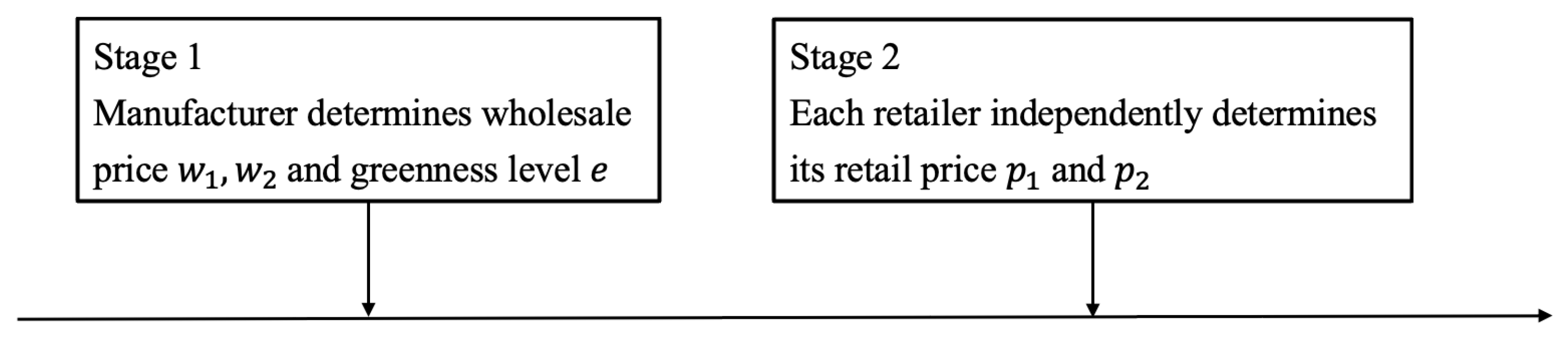
We analyze strategic interactions among supply chain members using a two-stage Stackelberg game. The decision-sequence is shown in
Figure 1. In this model, the manufacturer acts as the leader by moving first. Given the exogenous subsidy rate
s, the manufacturer determines the wholesale prices
and
for the two retailers, as well as the product greenness level
e. The manufacturer chooses
to maximize its revenue
, anticipating how retailers will subsequently compete.
Acting as followers, the two retailers observe the manufacturer’s decisions and then move simultaneously. They engage in Bertrand competition in the downstream market by setting retail prices and to maximize their respective revenues and , taking wholesale prices and product greenness as given.
We solve the model via backward induction. First, we analyze the second-stage retail price competition to derive the retailers’ reaction functions . These functions are then substituted into the manufacturer’s first-stage revenue problem, allowing us to solve for the optimal decisions , , and . This procedure yields the subgame perfect equilibrium of the entire game.
3.4. Equilibrium Solution
We solve the two-stage game by backward induction. First, we analyze the retailers’ second-stage pricing decisions, then solve backward for the manufacturer’s first-stage wholesale prices and product greenness level. In the second stage, having observed the manufacturer’s choices of
,
, and
e, the two retailers simultaneously compete on price to maximize their revenues:
In the first stage, the manufacturer acts as the leader and anticipates the retailers’ equilibrium responses. Substituting these into its revenue function, the manufacturer chooses
to solve
Finally, substituting the resulting optimal solutions , , and into the retailers’ best-response functions yields the equilibrium retail prices and . These equilibrium outcomes are formally stated in Lemma 1.
Lemma 1. - (1)
The equilibrium prices is The equilibrium retail price is The equilibrium product greenness is - (2)
The manufacturer’s revenue function is while each retailer’s revenue functions is
We solve the first-order conditions of the retailers’ and manufacturer’s revenue functions and substitute the resulting expressions to obtain the equilibrium solutions in Lemma 1(1), including wholesale prices , retail prices and product greenness e. Based on these equilibrium decisions, we then derive the optimal revenue functions of the manufacturer and the two retailers, as shown in Lemma 1(2).
We further conduct a parameter analysis on the key exogenous policy variable s, the government subsidy rate per unit of product greenness, to examine how government subsidies affect equilibrium outcomes—including wholesale prices, retail prices, product greenness, and each member’s revenues.
Because the equilibrium under the SM strategy is symmetric (i.e., and ). Our analysis focuses on how changes in the subsidy rate s alter the manufacturer’s cost and revenue structure, and how these adjustments propagate to wholesale prices, product greenness, and retail prices, ultimately affecting the revenues of both the manufacturer and the retailers.
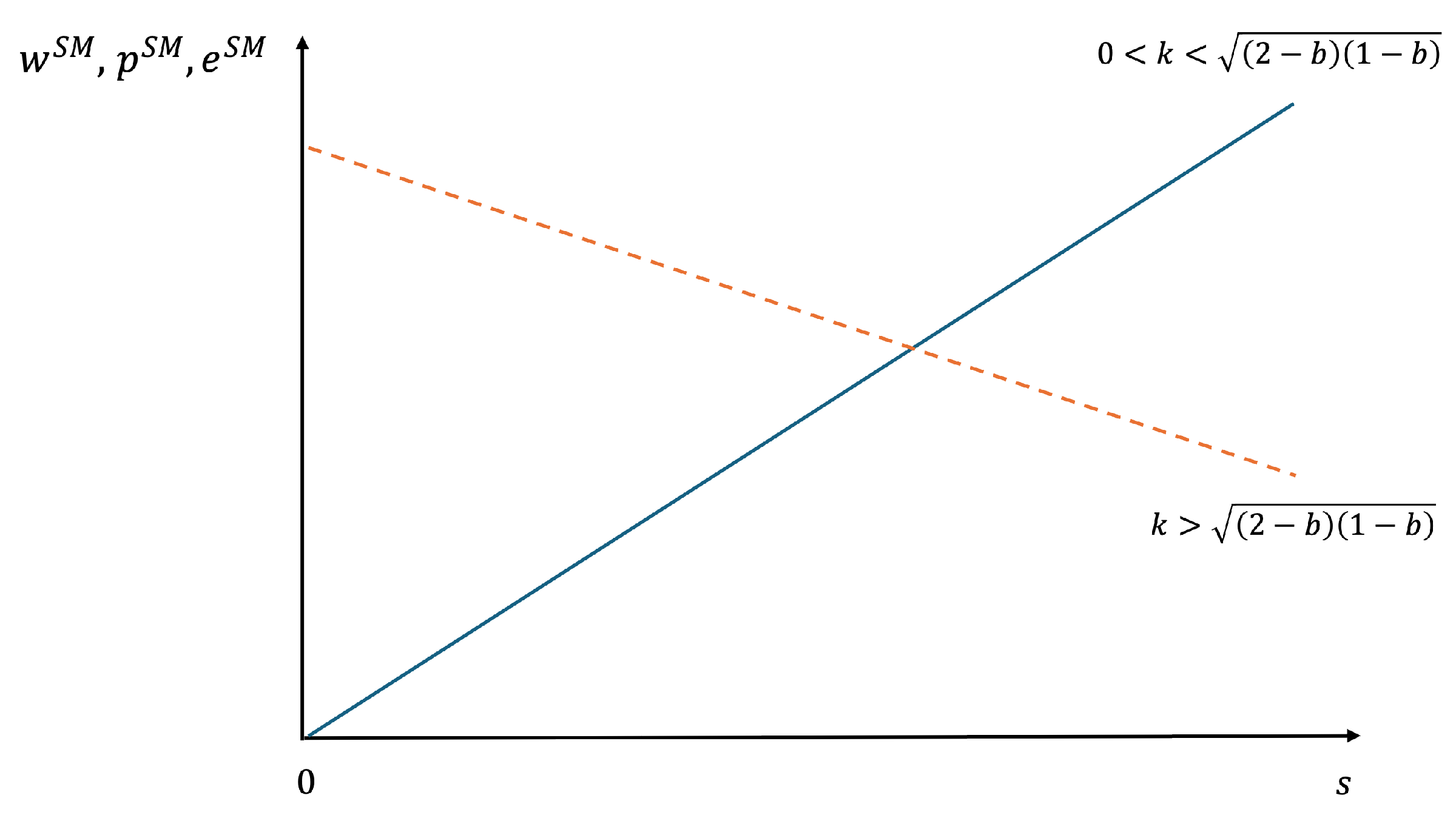
Government subsidies to manufacturers not only reduce the cost of green production but also affect retail prices and the greenness of products through the cost transmission of the supply chain. The effect of subsidies depends on consumers’ green preferences. When green awareness is low, subsidies mainly encourage green investment and push up prices. When green awareness is high, subsidies can help reduce prices, expand market share, and improve the greenness of products. Based on this analysis, we draw the following proposition:
Proposition 1. - (1)
The equilibrium wholesale prices , the equilibrium retail prices , and the equilibrium product greenness are strictly increasing in s when , but strictly decreasing in s when .
- (2)
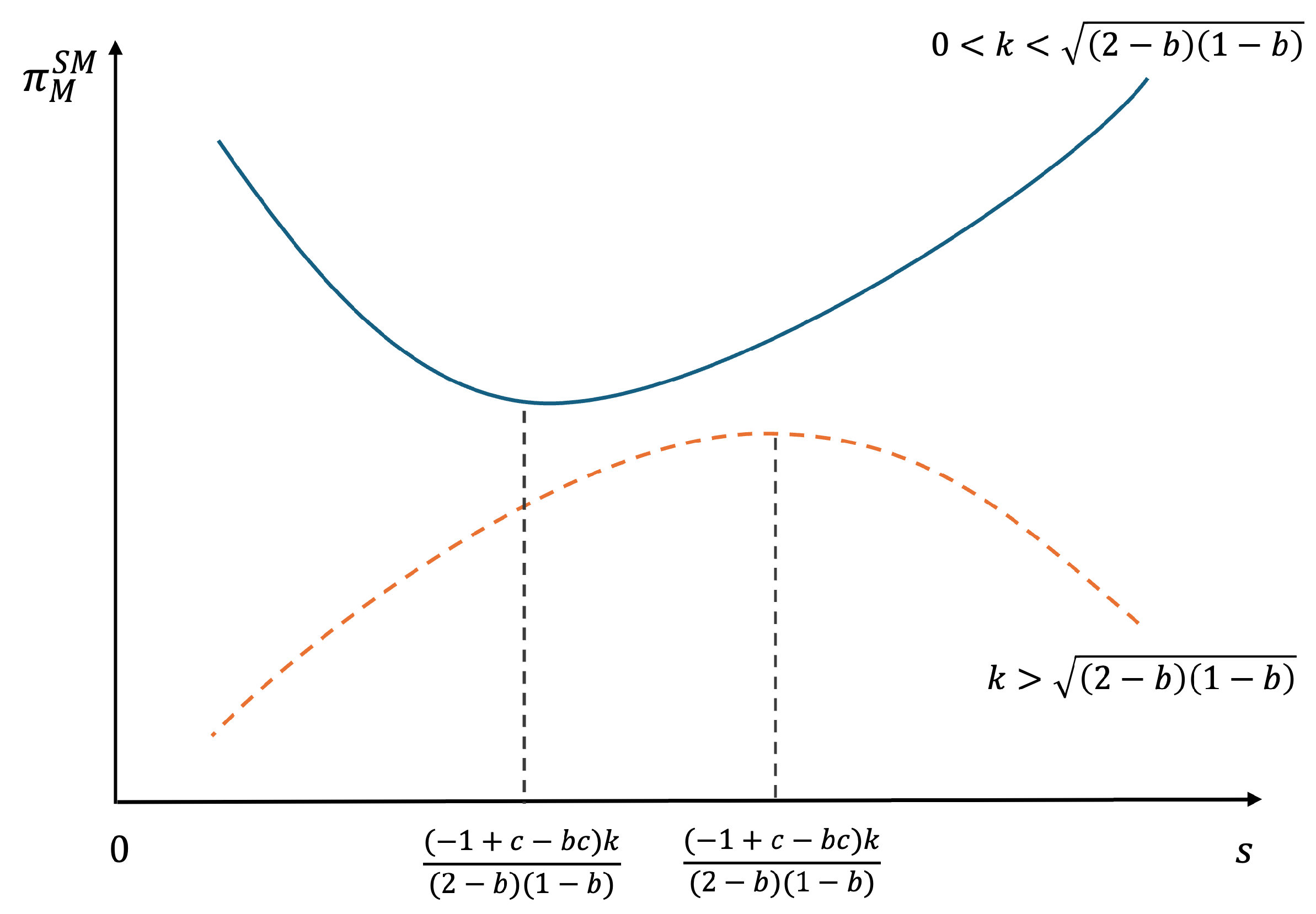
The equilibrium manufacturer’s revenue is decreasing and then increasing in s when , but increasing and then decreasing in s when , with the threshold at .
- (3)
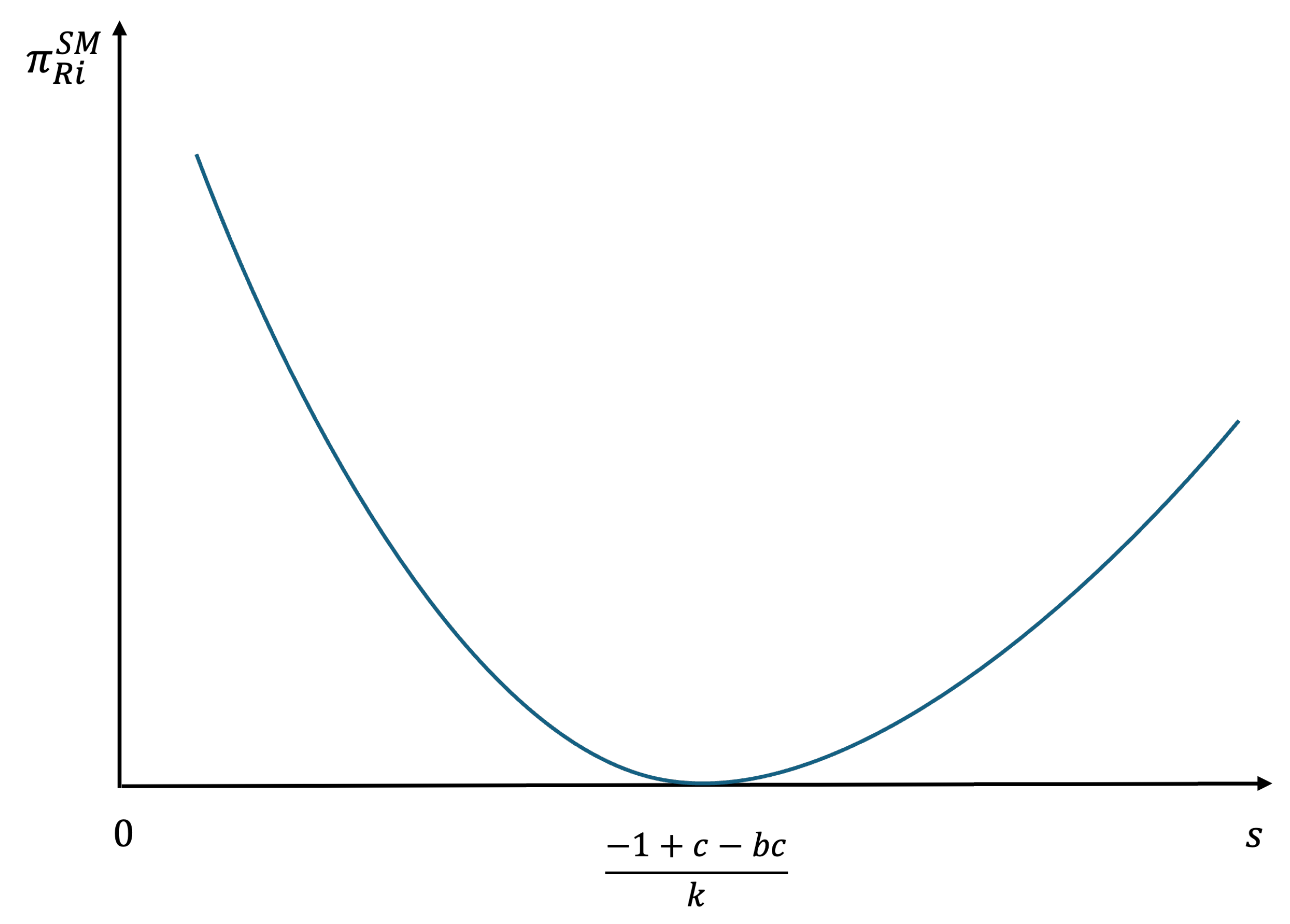
The equilibrium revenue of retailer is decreasing and then increasing in s, with the threshold at .
The consumer green awareness coefficient
k measures how strongly consumers value a product’s environmental features, see
Figure 2. A higher
k means consumers care more about green attributes in their purchase decisions. We can roughly divide the market into three stages based on
k: when
k is low, consumers focus mainly on traditional factors like price, representing an early-stage green market; when
k is moderate, consumers start considering environmental features, reflecting a growth-stage market; and when
k is high, consumers are willing to pay a premium for green products, indicating a mature market. This classification provides the basis for analyzing how government subsidies affect market outcomes across different levels of consumer green awareness.
When consumer green awareness k is low and in the early stages of green market development, consumers show limited preference for green products. A higher government subsidy rate s leads to higher equilibrium wholesale prices , retail prices , and product greenness . In this situation, subsidies mainly reduce the manufacturer’s cost of green investment and encourage higher greenness. However, due to the lack of a strong response from market demand to the improvement of green environmental protection measures. Manufacturers and retailers can pass on the additional environmental costs to consumers by raising prices. This reflects a cost-driven price transmission mechanism.
On the contrary, when consumers’ green awareness k is high, the green market is relatively mature. Consumers are more willing to pay for green products. The increase in the subsidy rate s will lead to an equilibrium wholesale price, retail price, and a decrease in product greenness. In this case, the subsidy significantly reduces the marginal cost of greenness for manufacturers. In order to maintain competitiveness and expand market share, manufacturers will reduce wholesale prices. Retailers will further reduce retail prices to stimulate demand. Therefore, subsidies work through the transmission mechanism driven by demand expansion.
The manufacturer’s revenue
shows a non-linear response to the subsidy rate
s, see
Figure 3. This response depends on the level of consumer green awareness
k. In the early stage of market development, when
k is low, subsidies must exceed a critical threshold to offset the cost of green investment and generate positive revenues. On the contrary, in a mature green market, when
k is higher, excessive subsidies will distort market competition and lead to a decrease in revenues.
When consumers’ green awareness is low, the market has not yet formed a stable demand for green products. The manufacturer’s revenue and subsidy rates are U-shaped. At the low level of subsidy, the increase in s will initially reduce revenues. Because demand is not sensitive to the improvement of product environmental performance, the cost of green investment will rise with the increase in environmental investment. When the subsidy rate exceeds a certain threshold, the increase in s will improve the environmental performance of the product, stimulate additional demand, and exceed the relevant costs.
Conversely, when consumers’ green awareness is high and the green market is mature. The manufacturer’s revenue has an inverted U-shaped relationship with the subsidy rate. When s is low, subsidies can effectively reduce the marginal cost of green investment, stimulate demand, and thus increase revenues. When s exceeds a certain limit, excessive subsidies will intensify price competition and reduce the marginal benefits of further green investment. This decline in price revenue margins and reduced earnings will eventually lead to a decline in manufacturers’ revenues.
Retailer revenue also exhibits a nonlinear relationship with the government subsidy rate
s, see
Figure 4. In low-subsidy areas, retailers’ revenues decline with the increase in
s. But when the subsidy rate is high, the retailer’s revenue rises with the increase in
s. When the subsidy rate is low, the subsidy has a limited effect on product greenness and is not enough to stimulate the growth of market demand. At the same time, manufacturers will cope with higher green production costs by raising wholesale prices. Part of the cost burden will be transferred downstream, causing retailers’ revenues to decline with the increase in the subsidy rate. On the contrary, when the subsidy rate enters the high subsidy area, continuous subsidies will improve the product greenness and significantly increase consumers’ willingness to buy green products. Although wholesale prices may still be high, the resulting growth in market demand is enough to offset the cost pressure on retailers.
4. Scenario 2: Retailer-Led R&D (SR)
In addition to the manufacturer-led green R&D model, the supply chain can also adopt a retailer-led green R&D (SR) structure. Downstream retailers determine the green grade of the product and bear the relevant green investment costs. Upstream manufacturers produce according to the standards of retailers. Government subsidies are still linked to the greenness of products, strengthening the role of retailers in setting standards, rather than directly reducing manufacturing costs. Compared with scenario SM, scenario SR shares the green costs of retailers and creates a demand-driven mechanism that indirectly encourages manufacturers to upgrade green production.
We assume that competing retailers coordinate on setting green standards but remain in Bertrand competition for pricing. Green investments have positive externalities: if one retailer alone raises standards, it bears the costs, while competitors may benefit from increased market awareness. Coordinating standards helps internalize these externalities. In practice, retailers often work together on eco-labels and green procurement systems, such as the EU Ecolabel, Japan’s Green Purchasing Network, or sustainability alliances by Walmart, Carrefour, and Tesco. Such coordination targets environmental standards and certification, not pricing.
Green cooperation is not the same as price collusion. Green R&D investment is a long-term investment and rule-making behavior. Price decision-making directly affects market share and revenue distribution, which is a highly observable competitive behavior and subject to strict antitrust supervision. In most legal environments, the coordination of environmental standards is regarded as a compliant and even encouraged industry self-discipline behavior, while price collusion is explicitly prohibited. Therefore, maintaining non-cooperative Bertrand competition at the price level is a governance structure that can be institutionally separated and observed in practice. The higher green level under the SR scenario does not come from the “manipulation of cooperation results”, but from the rational equilibrium results after the internalization of green externality.
In industries traditionally dominated by manufacturer-led R&D, decision-making power and investment can shift downstream under retailer-led structures. Large retailers, especially with private-label products, control design and market access, guiding manufacturers as contract producers. Through procurement contracts or cost-sharing mechanisms, retailers can encourage green upgrades, though this raises coordination costs and market risks. Overall, the retailer-led model is most applicable in markets with concentrated retail power and significant private-label shares, and its outcomes should be viewed as comparative to manufacturer-led governance rather than universally applicable.
4.1. Manufacturer Revenue
In contrast to the SM scenario, the manufacturer’s revenue function now consists solely of sales revenue—i.e., the net revenue from selling products to the two retailers. Because the subsidy is shifted to retailers, the manufacturer no longer receives direct government subsidies tied to green production (the
term disappears) and no longer bears the green investment cost (the
term is also removed). As a result, the manufacturer’s revenue depends entirely on its wholesale price and market demand. Its only incentive to improve product greenness stems from the positive effect of green quality on demand
, without direct subsidy incentives. The manufacturer’s revenue function is, therefore,
4.2. Retailer Revenue
Here,
and
denote the proportions of the green cost
sharing (and correspondingly subsidized) by retailer 1 and retailer 2, respectively. Compared to the SM case, retailers must now share the green investment cost, meaning their decisions must explicitly account for this burden. At the same time, they directly receive the government subsidy
, which depends on both their share of green costs and the product’s greenness level. A retailer’s revenue thus consists of three components: sales margin, allocated green cost, and received subsidy. Retailers’ pricing decisions must balance not only conventional price competition but also the dual effect of greenness on their cost burden and subsidy income. The revenue functions of the two retailers are
The total retailer revenue function is as follows:
4.3. Decision Sequence
Under retailer-led R&D scenario, we model the strategic interaction as a three-stage Stackelberg game, see
Figure 5. In the first stage, the manufacturer, as the leader, sets the wholesale prices
and
for the two retailers. In the second stage, having observed the wholesale prices, the retailers jointly determine the product’s green level
e to maximize their total revenue. In the third stage, given the green level, the two retailers engage in non-cooperative Bertrand competition by simultaneously choosing their retail prices
and
in the consumer market. The equilibrium is derived through backward induction.
4.4. Equilibrium Solution
Under retailer-led R&D scenario, we solve the game using backward induction. In the third stage, after observing the manufacturer’s wholesale prices
and
, the two retailers engage in price competition and independently determine their retail prices
and
to maximize their respective revenues.
In the second stage, the two retailers jointly determine the product’s green level
e in a cooperative manner so as to maximize their total revenue.
In the first stage, anticipating the retailers’ subsequent decisions, the manufacturer chooses wholesale prices
to maximize its revenue, incorporating the retailers’ response functions:
Substituting the resulting optimal wholesale prices and into the retailers’ optimal response functions in the second and third stages yields the equilibrium retail prices , and the equilibrium green level . These results are summarized in Lemma 2.
Lemma 2. - (1)
The equilibrium wholesale price is The equilibrium retail price is The equilibrium product greenness is - (2)
The manufacturer’s revenue function is while the two retailers’ revenue functions are Retailer’s total revenue is
This lemma shows that although the solution procedure remains unchanged, shifting the subsidy recipient alters the cost and revenue structures of supply chain members. As a result, the equilibrium outcomes and strategic interactions differ markedly from those under Scenario 1, laying the groundwork for the comparative analysis and policy discussion that follow. We next perform a parameter analysis on the government’s per-unit green subsidy rate s to examine how subsidy intensity influences equilibrium supply-chain decisions—including wholesale prices, retail prices, product greenness, and each member’s optimal revenue. Since the equilibrium under the SR strategy is also symmetric (i.e., and ).
Based on the equilibrium results, we further explore how key parameters affect supply chain decision-making. Consumers’ green awareness and the intensity of government subsidies play a crucial role. They will change market demand and corporate incentives, resulting in different results in terms of product greenness, pricing and revenues. We analyzed how the changes in these parameters affect the balance of the system and came up with the following proposition:
Proposition 2. - (1)
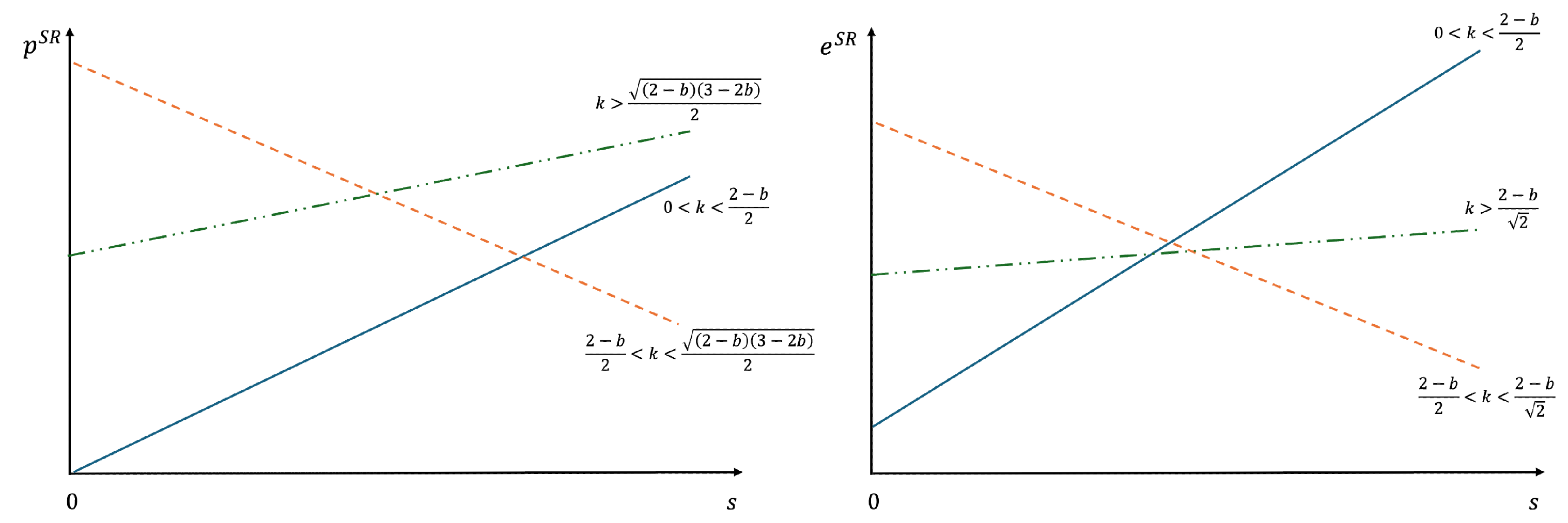
The equilibrium wholesale price is strictly increasing in s. The equilibrium retail price and the equilibrium product greenness are strictly increasing in s when k is sufficiently small or sufficiently large, but strictly decreasing in s when k takes an intermediate value.
- (2)
When , the equilibrium manufacturer’s revenue is decreasing and then increasing in s; when , is increasing and then decreasing in s, with the threshold at .
- (3)
When or , the equilibrium retailer’s revenue is decreasing and then increasing in s; when , is increasing and then decreasing in s, with the threshold at .
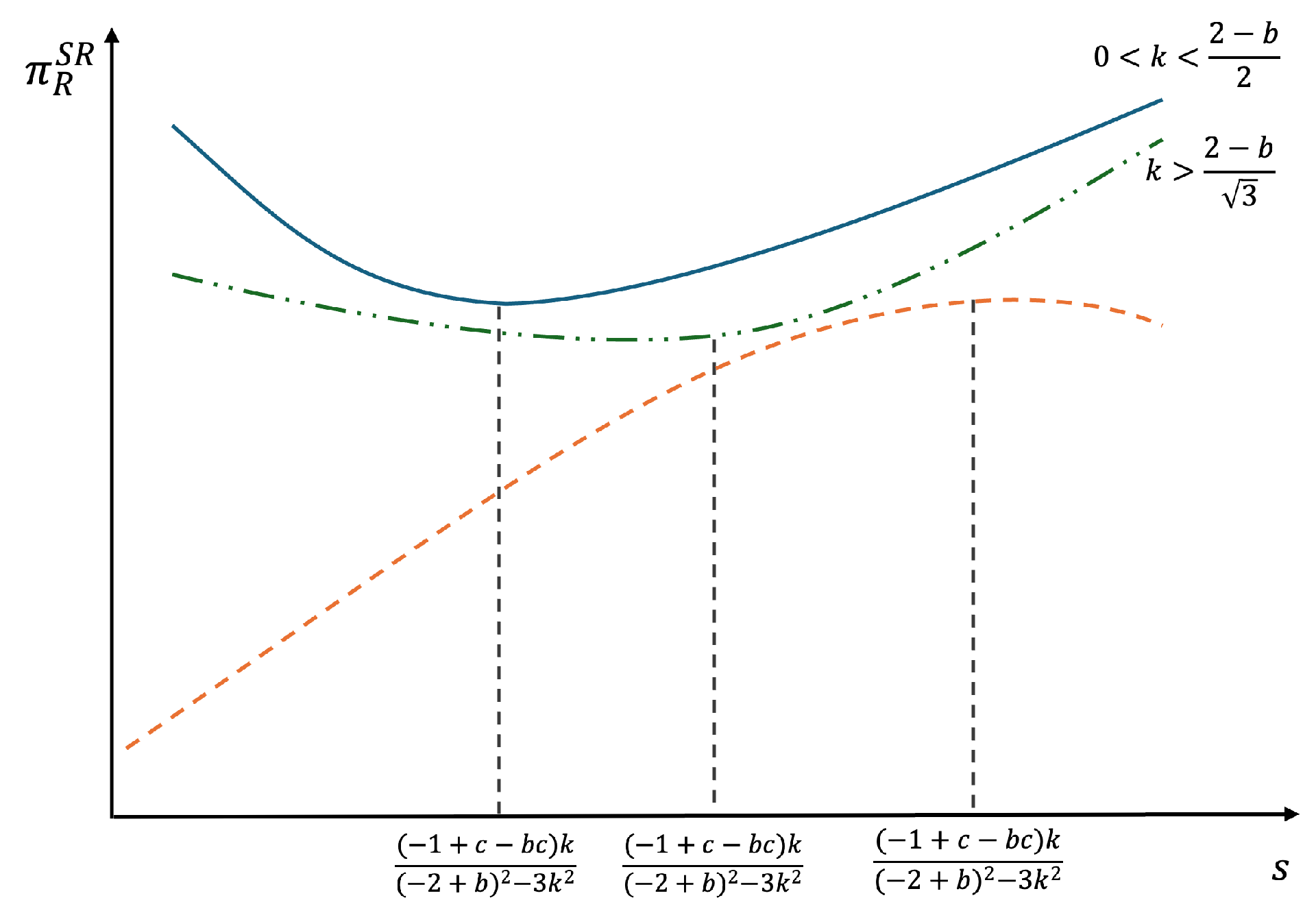
Figure 6 shows that, when consumer green awareness is low, the green market is in its early development stage, and both
and
increase with the subsidy rate. In this case, demand is relatively insensitive to product greenness. Subsidies mainly reduce retailers’ green-related costs and encourage them to accept higher greenness levels. However, higher greenness raises total supply chain costs, which cannot be fully offset by demand expansion. As a result, both manufacturers and retailers pass these additional costs on to consumers, leading to higher prices. This reflects a clear cost-pass-through effect.
At intermediate levels of green awareness, the green market transitions from the incubation stage to the growth stage. Higher subsidies may reduce both the retail price and product greenness. Although subsidies lower retailers’ effective costs, they also intensify price competition for market share. Retailers tend to use the subsidy advantage to cut prices rather than further improve greenness. Anticipating weaker downstream incentives for greening, manufacturers correspondingly restrain green investment. This leads to a competitive expansion effect.
When consumer green awareness is high, the green market is relatively mature, consumers have a strong willingness to pay for green products, both and increase again with the subsidy rate. In a mature green market, consumers exhibit a strong willingness to pay for greener products. Subsidies push the supply chain toward higher greenness, which involves sharply rising marginal costs. Because consumers are less price-sensitive, these costs can be passed on through higher prices, generating a pronounced quality-premium effect.
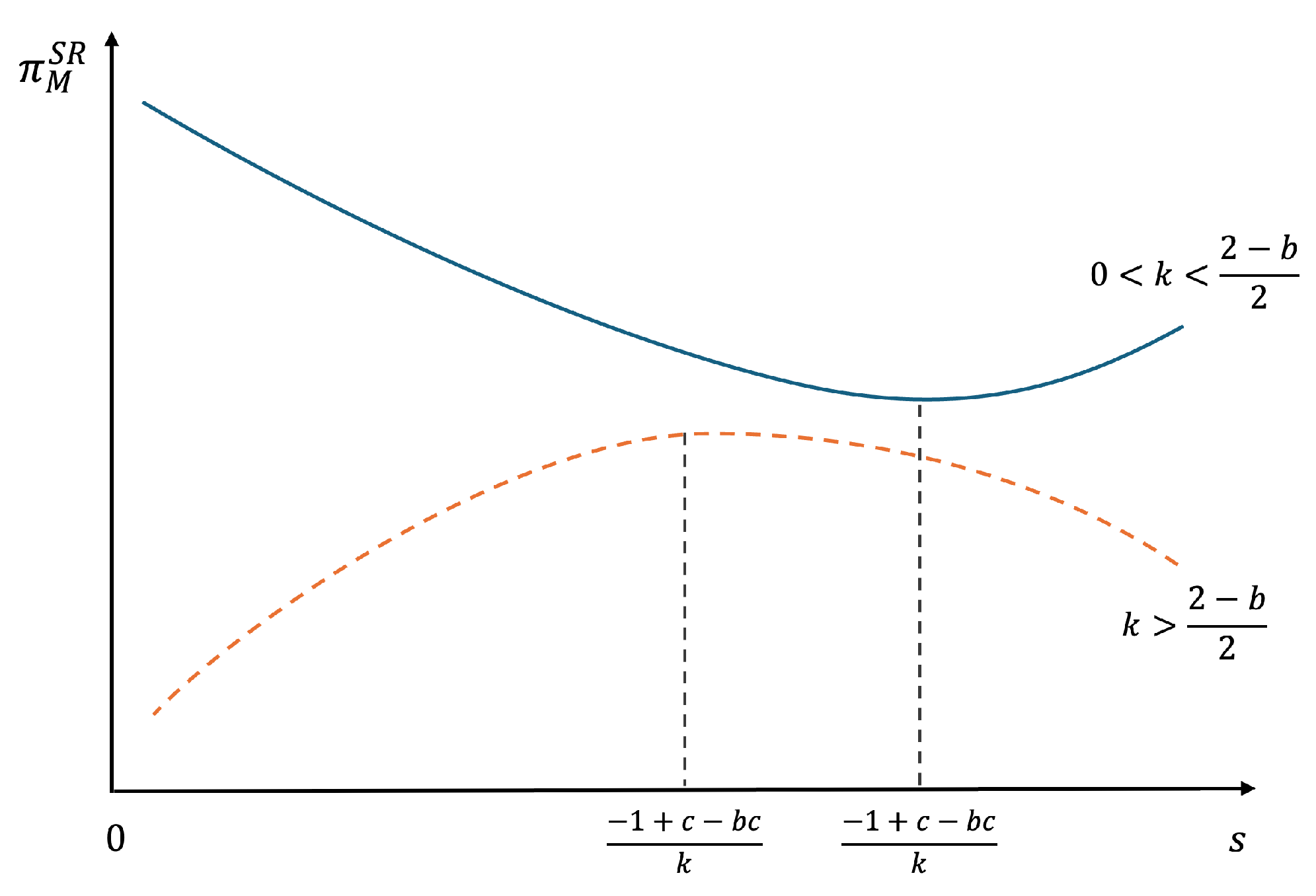
Figure 7 shows that, when consumer green awareness is low, the green market is in its early development stage, manufacturer revenue follows a U-shaped relationship with the subsidy rate. At low levels of
s, increasing subsidies will reduce revenues, because subsidies are not enough to stimulate demand. It will prompt retailers to demand that products be more environmentally friendly. Once the subsidy rate exceeds the critical threshold, higher environmental standards will significantly expand market demand. The resulting revenue growth exceeds the cost increase, allowing manufacturers to make higher revenues in high-subsidy areas.
When consumer green awareness is high, the green market is relatively mature. There is an inverted U-shaped relationship between the manufacturer’s revenue and the subsidy rate. At a low subsidy level, subsidies increase revenues by reducing effective costs and expanding demand. After exceeding the optimal subsidy level, retailers will pursue excessive greenness, causing manufacturers’ marginal green costs to rise sharply. Intensified price competition will erode revenue margins, causing manufacturers’ revenues to decline under excessive subsidies.
It can be seen from
Figure 8 that when consumer green awareness is either very low or very high, the revenue of retailers and the subsidy rate are U-shaped. At the low level of subsidy, increasing subsidies will reduce revenues. Because the demand for green products is either weak or relatively saturated. And subsidies will still push up the costs related to environmental protection. Once the subsidy rate exceeds a certain turning point, higher subsidies will either help activate the demand of the low environmental awareness market or help support the quality premium of the high environmental awareness market, resulting in an increase in revenues.
When consumer green awareness is moderate, retailers’ revenues and subsidy rates have an inverted U-shaped relationship. At the low level of subsidy, subsidies can effectively stimulate demand, while offsetting the additional environmental protection costs and increasing revenues. After exceeding the optimal subsidy level, excessive investment in environmental protection and increased price competition will reduce marginal returns and lead to a decline in revenues.
4.5. Impact of Cost-Sharing
Under the retailer-led R&D, introducing the green cost-sharing ratio does not change the equilibrium wholesale price, retail price, or product greenness. However, it significantly affects the revenue distribution between retailers. This suggests that when retailers jointly determine the level of green investment, the overall scale of investment is driven by market demand and government subsidies, while the cost-sharing determines how revenues and risks are allocated.
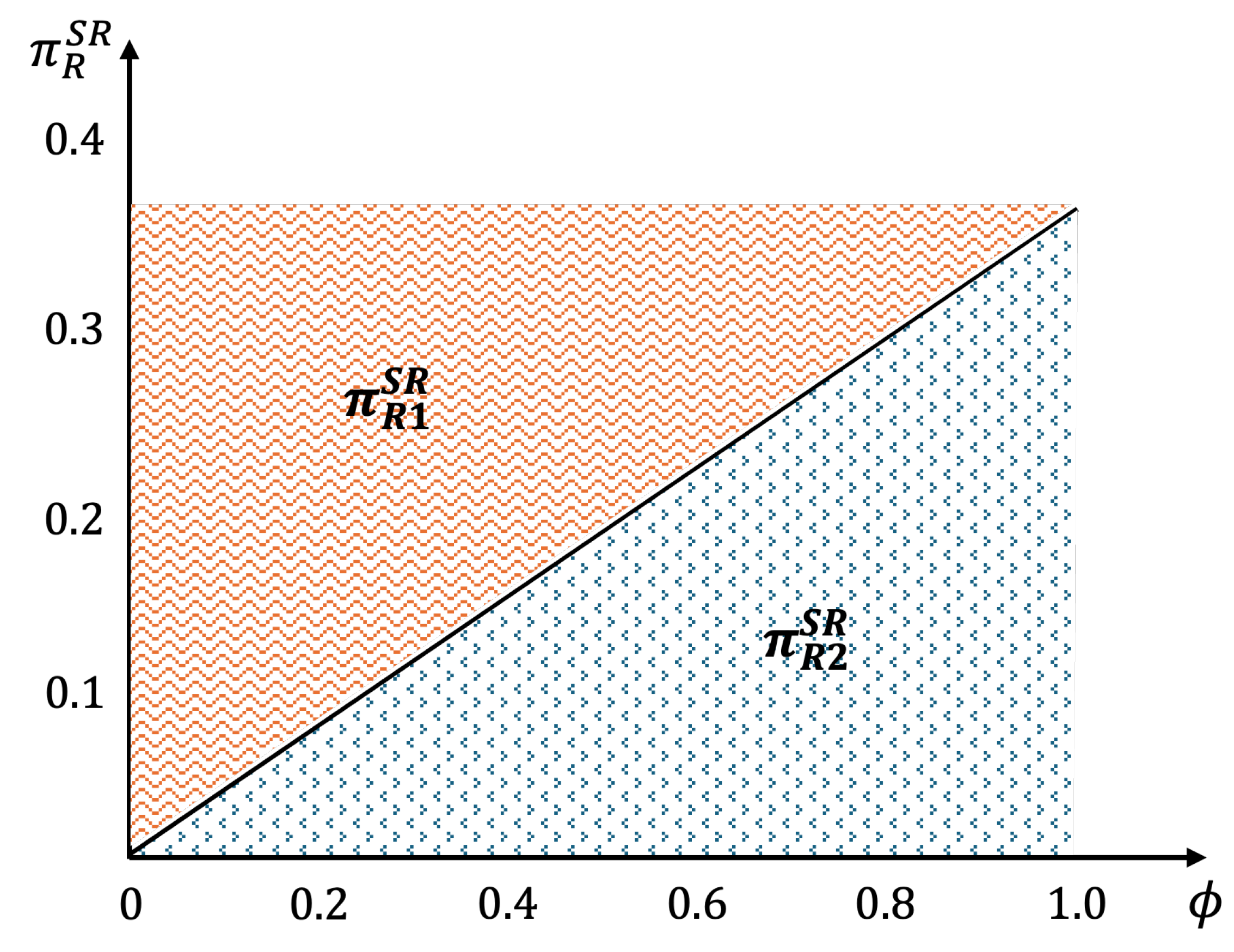
To illustrate the effect of the cost-sharing ratio on retailer revenues, we conduct a numerical analysis with parameter values
and
, see
Figure 9. The results show that with the increase in
, the revenue of one retailer increases, while the revenue of another retailer decreases, showing a clear trade-off. Because the total scale of green investment has been jointly decided by retailers, changing
will not affect the scale of investment, but only redistribute the cost burden. When a retailer bears a larger proportion of investment costs, its net revenue will decrease, while another retailer benefits from a smaller proportion of investment costs.
From an institutional perspective, this result highlights a key feature of the retailer-led structure: decision-making at the level of green investment can be separated from its cost distribution. Government subsidies mainly affect the level of investment, while the cost-sharing ratio determines how the benefits and risks of cooperation are distributed among retailers. Although this mechanism does not change product greenness, it plays an important role in maintaining alliance stability and supporting long-term cooperation.
5. Comparative Analysis
This section compares equilibrium outcomes—wholesale prices
w, retail prices
p, and product greenness
e—under the two subsidy scenarios: manufacturer-led R&D and retailer-led R&D. The summarized results are presented in the
Table 1. Depending on market conditions such as competition intensity
b, consumer green awareness
k, and production cost
c, the relative levels of these variables can differ substantially and may even reverse systematically. These patterns are captured in three propositions (Propositions 3–5), which specify the conditions under which each subsidy strategy has an advantage.
Upon obtaining the equilibrium solutions for each scenario, we examine the impact of the two green R&D leadership structures on market retail prices. Within the Bertrand pricing framework, retailers set prices based on the given wholesale prices and product greenness. Therefore, different green R&D leadership structures may affect equilibrium retail prices by altering cost structures and green investment incentives. The resulting comparison of equilibrium retail prices across the two scenarios leads to the following proposition.
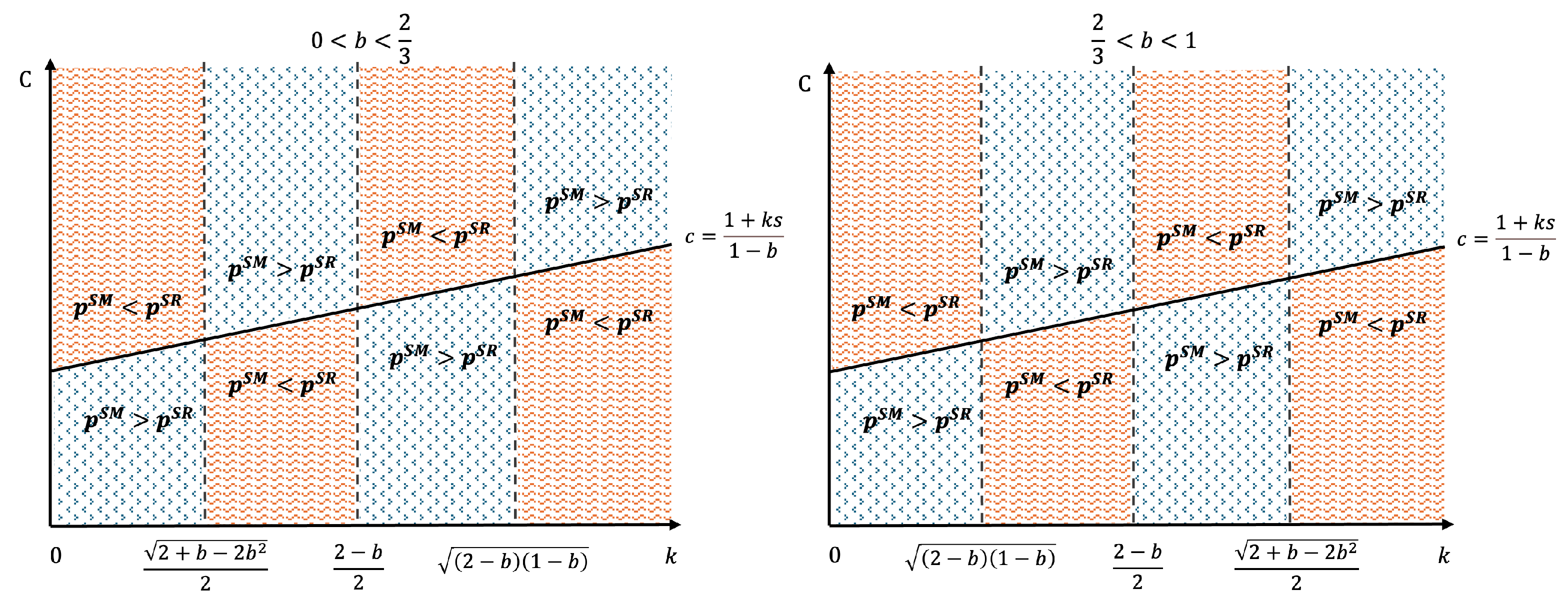
Proposition 3. When k is low or relatively high, if , then , otherwise, ; when k is relatively low or high, if , then , otherwise, .
The comparison between
and
depends on consumer green awareness
k, unit production cost
c and market competition intensity
b. The relative ranking of retail prices depends on whether the production cost exceeds the threshold
. The specific threshold of
k will change with the intensity of market competition
b, see
Figure 10.
When the market competition is relatively weak, if the production cost is high, SR tends to generate higher retail prices. Because the manufacturer has less incentive to control costs, the wholesale price is higher and eventually transferred to the retail market. Conversely, when the production cost is relatively low, manufacturers under SM are more motivated to adopt positive pricing to expand their market share, resulting in lower retail prices. When consumer green awareness increases, firms will pay attention to green differentiation, causing manufacturers under SM to raise prices to recover green investment, while retailers under SR will reduce prices due to subsidy support and competitive pressure.
When market competition intensifies, the key interval k will change. Fierce price competition will strengthen the motivation of firms to use subsidies and pricing strategies to gain market share. When demand–competition dominates, firms tend to reduce prices to attract consumers. When green differentiation becomes more important, firms will adjust price balance market competition and green investment recovery. Therefore, although the potential mechanism is consistent with the weaker competition, as the intensity of competition increases, the threshold for distinguishing different pricing results will move outward.
After analyzing the retail price difference, we further studied the wholesale pricing decisions of manufacturers in different scenarios. Differences in green investment responsibility and subsidy allocation in R&D leadership may change the cost pressure and bargaining power of manufacturers, thus affecting their wholesale pricing decisions. Based on this analysis, we draw the following proposition.
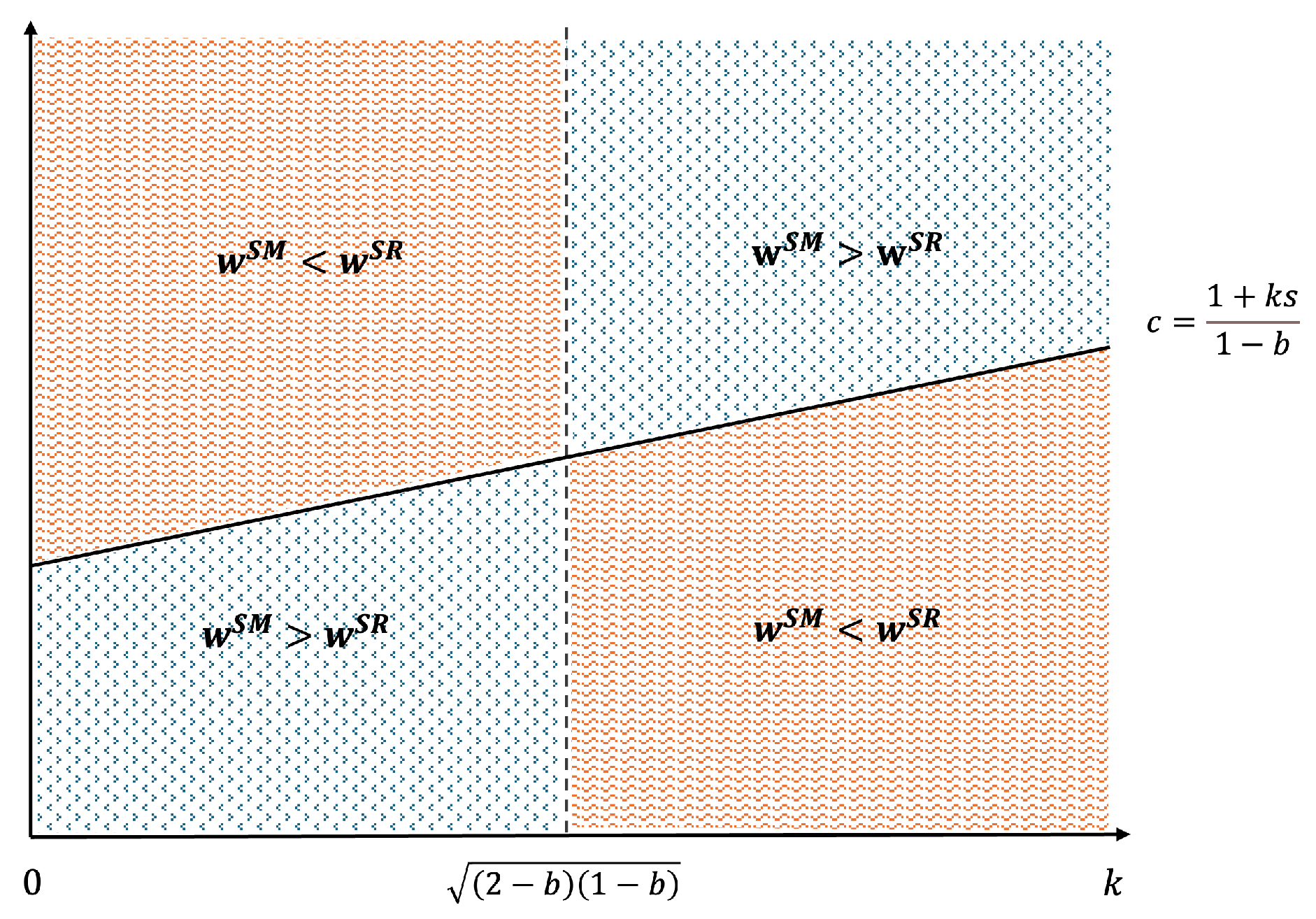
Proposition 4. When , if then , otherwise, ; when , if then , otherwise, .
As can be seen from
Figure 11, when consumer green awareness
k is low, in the early stages of green market development, higher production costs
c lead to
, whereas lower costs reverse the ranking
. In this case, market demand is relatively insensitive to product greenness, so subsidies primarily serve as cost-compensation tools. Under high
c, manufacturers under the SR strategy bear the full burden of production and green investment costs, leading them to set higher wholesale prices to pass costs upstream. Under SM, direct subsidies partially offset these costs, resulting in relatively lower wholesale prices. When production costs are low, manufacturers under SM are more strongly motivated by subsidies to compete for market share, which can push
above
. When
k is high, the pattern reverses.
Overall, the effect of subsidy strategies on wholesale pricing is closely linked to both cost structures and market demand. Policymakers should therefore consider industry cost levels and the stage of consumer green awareness when evaluating how different subsidy recipients influence upstream pricing in the supply chain.
We further study the impact of two green research and development leadership structures on product greenness. Product greenness is a key indicator of the performance of the green supply chain, reflecting the investment level of enterprises in green technology and environmental investment. The dominant party in green R&D can alter investment incentives, which in turn affects the achieved level of greenness. This consideration gives rise to the following proposition.
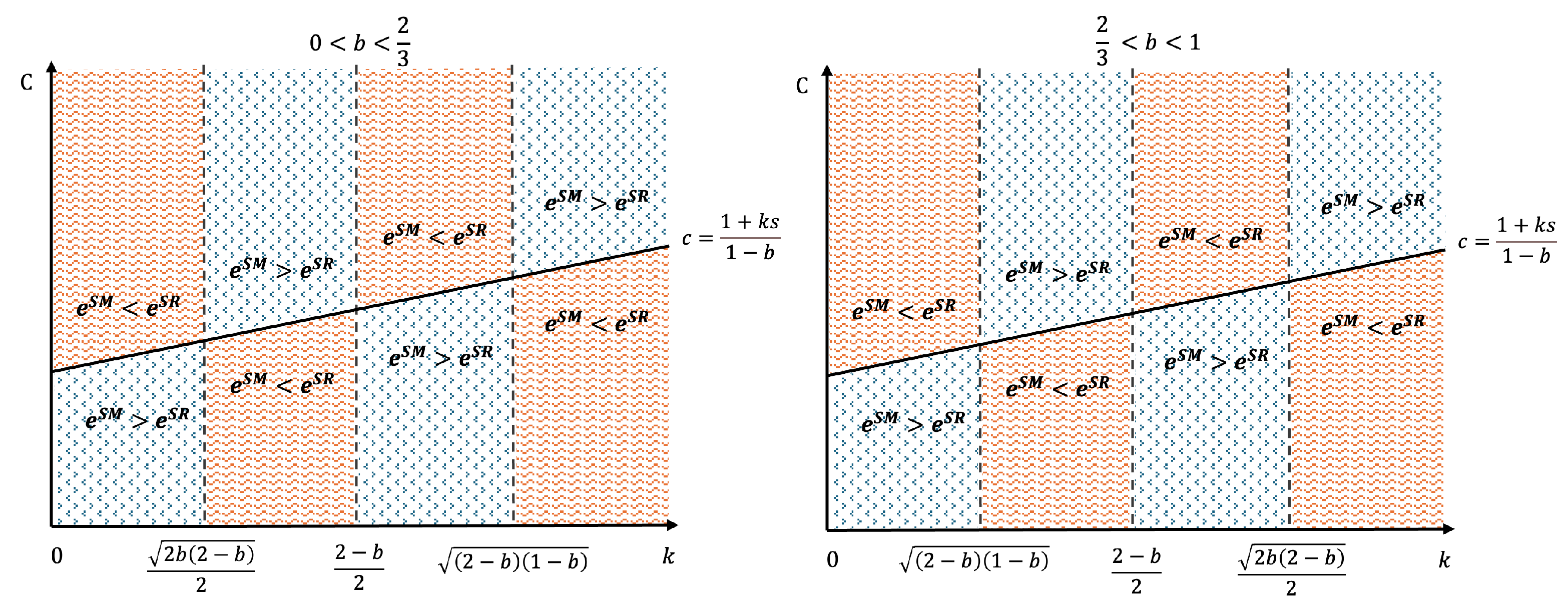
Proposition 5. When k is low or relatively high, if , then , otherwise, ; when k is relatively low or high, if , then , otherwise, .
In the very low or moderately high
k ranges, demand for greenness is either weak or nearly saturated, so production costs strongly influence manufacturers’ and retailers’ green investment incentives, see
Figure 12. When costs are high, the SR strategy is more effective because direct subsidies motivate retailers to demand higher greenness. When costs are low, SM provides manufacturers with stronger direct incentives to enhance product greenness. In the low-to-moderate or very high
k ranges, demand is more sensitive to greenness.
When the market is fiercely competitive, the scope of key parameters is different from that of a weakly competitive market. As the intensity of competition b increases, the threshold moves outward. The increase in the intensity of competition b changes the trade-off between the cost effect and the demand effect, thus affecting the effective scope of subsidy policies. Market competition is a key factor in determining how subsidies affect the greenness of products.
In a fiercely competitive market, when the k value is very low or moderately high, competition will amplify the impact of production costs. In a high-cost scenario, SR can stimulate downstream demand and improve environmental sustainability. In a low-cost scenario, SM can help manufacturers improve product environmental performance and achieve differentiation. When the k value is low to medium or very high, the focus of competition is on green innovation. Under high-cost scenarios, SM can provide stronger financial support for manufacturers’ green research and development projects, thus improving environmental sustainability. Under the low-cost scenario, SR can more effectively transform green attributes into market demand and promote a higher level of greening.
6. Social Welfare
The previous sections compared the equilibrium results under different green R&D scenarios from the perspective of firm revenues. Focusing only on corporate revenues does not fully reflect the overall efficiency of different decision-making structures. From the perspective of policy design and social resource allocation, it is also crucial to examine its impact on social welfare. This section will further compare the two models of manufacturer-led and retailer-led from the perspective of social welfare as a whole.
Social welfare is usually measured by the total revenue of supply chain members, that is, the sum of the revenues of manufacturers and retailers. When externality and government financial transfer payments are not clearly considered, corporate revenues can reflect the economic surplus generated by market transactions. Summarizing the revenues of all supply chain participants can be an effective indicator for evaluating the overall efficiency of the supply chain system. This method enables us to analyze the differences in resource allocation under different decision-making structures and provide a reference for the design of green supply chain policies and the selection of industrial organizations.
Social welfare analysis helps to assess the comparative advantages of different green R&D leadership structures. The decision-making structure that can improve the revenues of a specific firm may not improve the efficiency of the entire supply chain. By comparing the total amount of social welfare in different situations, we can better understand how the allocation of green research and development decision-making power affects the overall performance of the supply chain.
The total social welfare under the manufacturer-led R&D scenario is
The total social welfare under the retailer-led R&D scenario is
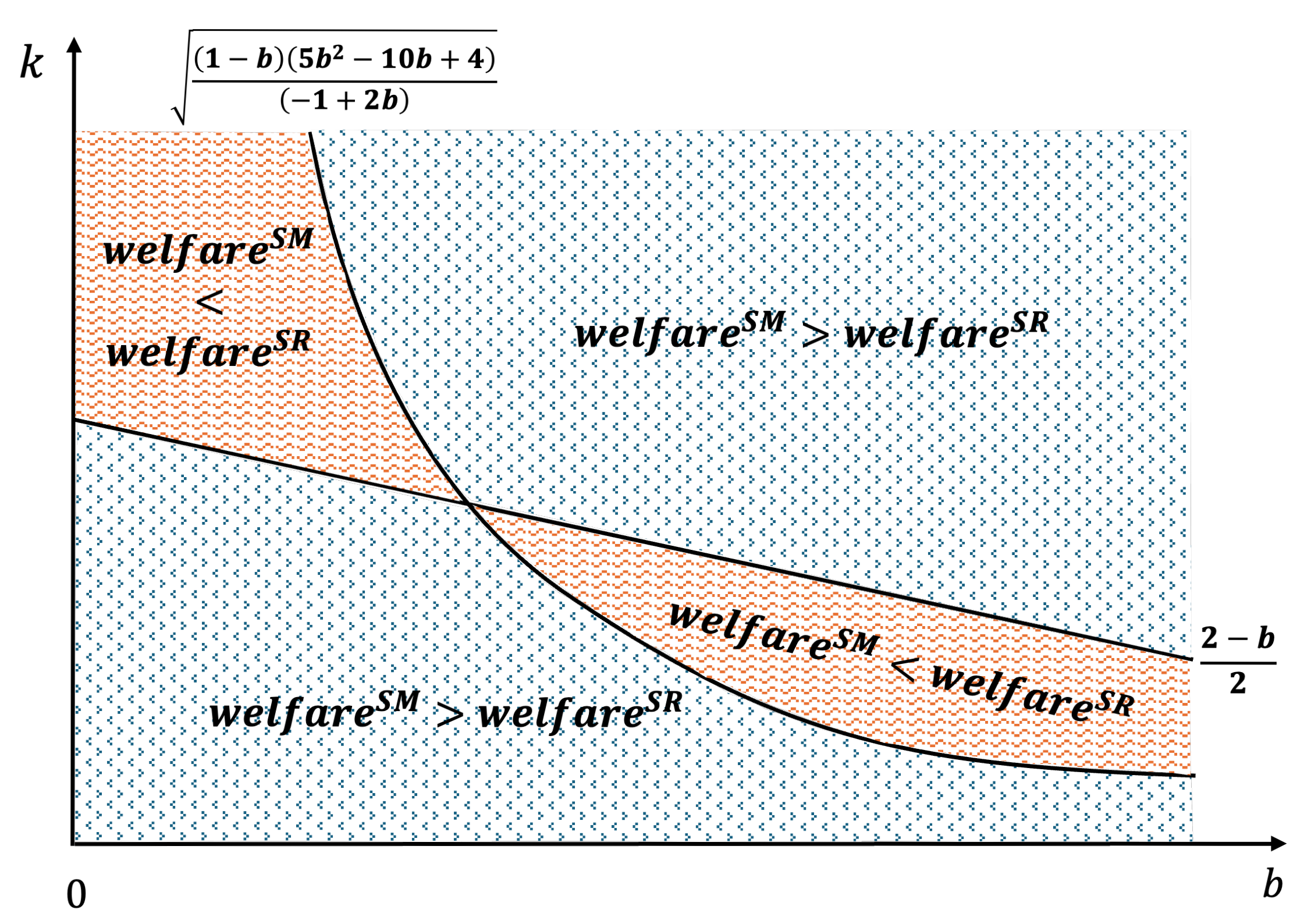
By comparing the total social welfare in the two scenarios, we obtain the following proposition:
Proposition 6. - (1)
When , or , , .
- (2)
When or , .
Proposition 6 shows that when consumers’ green awareness is low or high, the total social welfare in the manufacturer-led R&D model is higher than that in the retailer-led model. When consumers’ green awareness is at a moderate level, the retailer-led R&D model may generate higher social welfare.
This result reflects the differences in information advantages and decision-making incentives among supply chain members under different market conditions, see
Figure 13. When consumers’ green awareness is low, the market’s demand for green attributes is limited. Retailers dominate research and development, and they may overinvest, increase supply chain costs and reduce overall efficiency. In contrast, manufacturers are closer to the production process and have a deeper understanding of the cost of green technology. Therefore, manufacturer-led research and development can control costs more effectively and bring higher social welfare.
When consumer green awareness is high, the demand for green products will also increase. Manufacturer-led R&D is more advantageous. They reduce the cost of green production through economies of scale and technology accumulation. Therefore, the supply chain can better meet market demand and improve operational efficiency, thus improving social welfare.
When consumers’ green awareness is at a medium level, the market demand for green products is constantly changing. Retailers interact directly with consumers and can better observe changes in demand. Therefore, the retailer-led R&D scenario enables firms to adjust the green degree of products more flexibly according to market demand. This optimizes the allocation of resources within the supply chain and can bring higher social welfare.
7. Conclusions
This paper examines the design of government subsidy policies in competitive green supply chains and analyzes how such policies influence supply chain decisions and performance under different green R&D leadership structures. We develop a game-theoretic model of a green supply chain consisting of one manufacturer and two competing retailers. Considering key factors such as consumer environmental awareness, product competition intensity, and green production costs, the model characterizes two scenarios: manufacturer-led and retailer-led R&D. By comparing different market structures and parameter settings, we identify the conditions under which each structure dominates in terms of wholesale prices, retail prices, product greenness, and supply chain revenues. The analysis reveals the mechanisms through which subsidy policies influence supply chain decisions through cost reduction, price transmission, and incentives for green investment.
Research results show that different green R&D leadership structures have a significant and phased impact on balanced decision-making in the supply chain. In the manufacturer-led R&D, green investment directly affects the production link. Through the downstream transmission of wholesale prices, it affects retail prices and product greenness. When consumers’ awareness of environmental protection is low, firms tend to make up for the cost by raising prices and increasing green investment. With the enhancement of consumers’ awareness of environmental protection, green investment has gradually become a demand-driven competitive means, prompting enterprises to expand their market share through price adjustment and upgrading green products.
Under retailer-led R&D, green investment influences manufacturers mainly through terminal market competition. Changes in retail competition intensity significantly affect manufacturers’ wholesale pricing and green investment incentives. As a result, retail prices and product greenness exhibit stage-dependent responses to changes in consumer environmental awareness.
Further comparative analysis shows that the comparative advantages of the two leadership structures show obvious threshold effects in different market environments. When the production cost is high, the leadership structure mainly affects the distribution of cost pressure in the supply chain. When production costs are low, green investment is more likely to be transformed into a competitive advantage, thus supporting more aggressive pricing strategies or higher product greenness. Although the intensity of market competition will not fundamentally change these mechanisms, it will change the threshold of different results.
From the perspective of social welfare, the results reveal that different leadership structures exhibit heterogeneous efficiency across different levels of consumer environmental awareness. When consumer environmental awareness is relatively low or high, the manufacturer-led green R&D structure generally achieves higher total social welfare. However, when consumer environmental awareness is at a moderate level, the retailer-led structure becomes more effective in improving social welfare.
These research results provide management and policy inspiration for promoting the transformation to a green supply chain. For policymakers, the design of green industry policies should not only consider the scale of subsidies, but also the degree of matching between the leading structure of green research and development and the market conditions. In the early stage of green market development, consumers’ awareness of environmental protection is relatively weak. At this time, green research and development led by manufacturers is more conducive to the accumulation of green production technology and the consolidation of the foundation of the green manufacturing industry. Therefore, policy support at this stage should focus more on technological innovation and production upgrading in the manufacturing industry.
As green consumption demand matures and market competition intensifies, retailer-led green R&D can more effectively align green product attributes with market demand and promote the diffusion of green products through terminal market competition. The government should dynamically adjust the policy priorities according to the market maturity. Guide the construction of an appropriate R&D leadership structure at different stages of development to improve policy efficiency and overall social welfare.
For manufacturers, the strategic focus of the green supply chain should evolve with the changes in market demand. When consumers’ awareness of environmental protection is low, manufacturers should focus on accumulating green technology and controlling costs. With the growth of green demand, firms should pay more attention to product differentiation and the improvement of green quality to enhance market competitiveness.
For retailers, under the retail-led R&D, their role is no longer limited to simple product distribution, but extends to the coordination of green demand. Retailers can use their close links with consumers to improve the market awareness of green products through green marketing, environmental certification and transparent information disclosure. In a fiercely competitive market, retailers should avoid translating policy incentives into short-term price competition. We should focus on enhancing the long-term value of green products through brand building, differentiated services and a green product portfolio.
Overall, the effective operation of green supply chains depends on the alignment between policy incentives and market demand. Manufacturer-led and retail-led scenarios have their own advantages at different stages of green market development. Reasonably coordinating the incentive mechanism among supply chain participants can promote green innovation and accelerate the promotion of green products, to achieve the dual goals of environment and economy.
Despite these contributions, several limitations remain and provide directions for future research. We adopt a static deterministic game theory framework. Future research can be incorporated into dynamic decision-making processes, such as green technology accumulation or long-term investment behavior. We assume that the demand function is linear and the cost structure is relatively simple. Future research can consider more general demand functions or nonlinear green cost structures to test the robustness of the results. In addition, we assume that retailers are symmetrical. Introducing the heterogeneity of retailers in terms of market size, channel capacity or green investment capacity may better reflect the real market situation. Finally, future research can examine other supply chain governance structures, such as platform-based retail channels or supply chain alliances, and analyze their impact on green investment and market competition.