Sustainable Destination Marketing in Saudi Arabia: Effects of Sustainability Storytelling and Smart Tourism Interactivity on Responsible Visit Intention via Destination Trust



Abstract
1. Introduction
2. Underpinned Theories
2.1. Stimulus-Organism-Response (S-O-R) Framework
2.2. Signaling Theory and Uncertainty Reduction Logic for Trust Formation
2.3. Theory of Planned Behavior and Responsible Visit Intention
2.4. Integrative Logic and the Mediating Role of Destination Trust
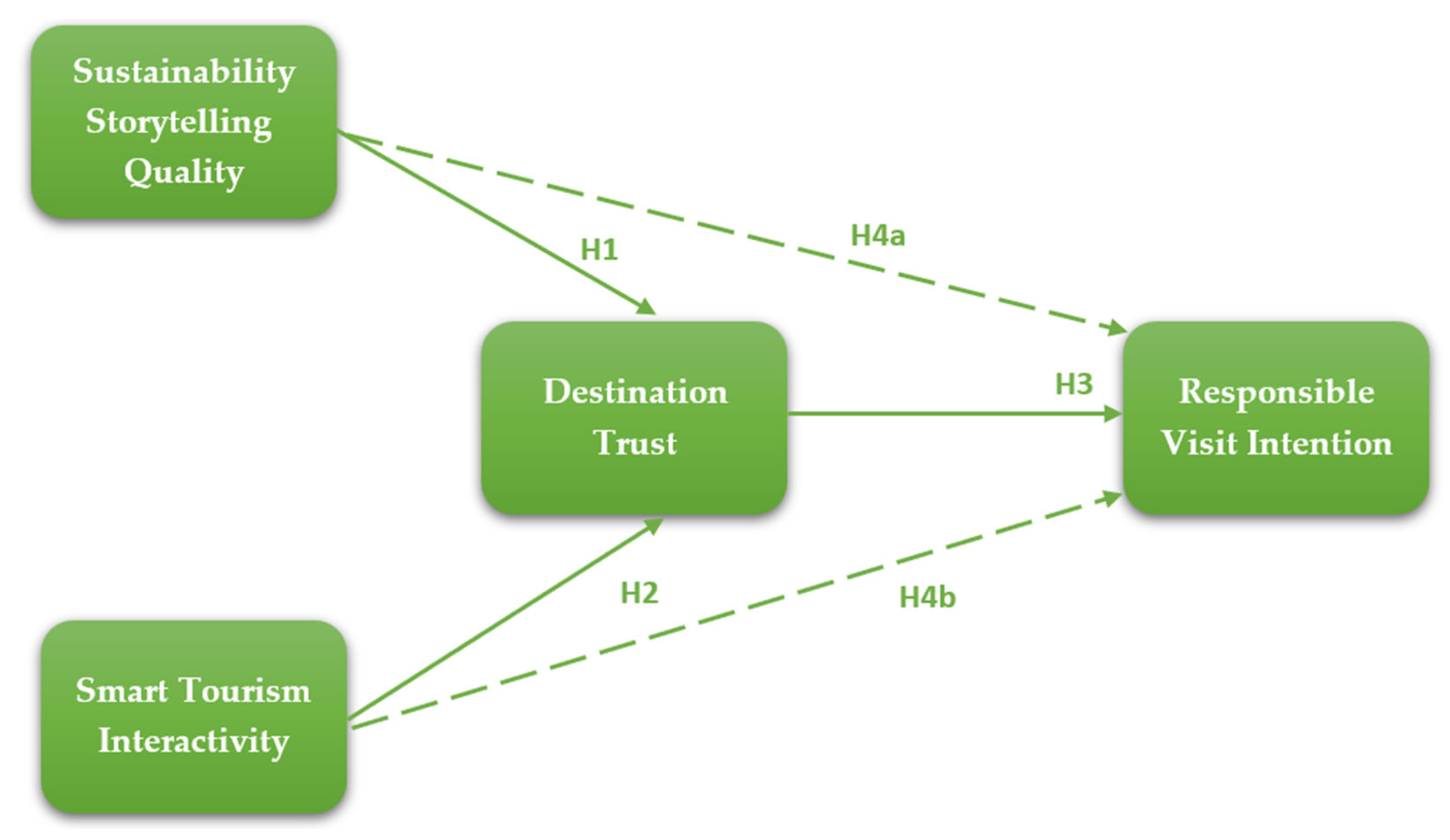
3. The Hypotheses’ Development
3.1. Sustainability Storytelling Quality and Destination Trust
3.2. Smart Tourism Interactivity and Destination Trust
3.3. Destination Trust and Responsible Visit Intention
3.4. Mediating Role of Destination Trust
4. Methods
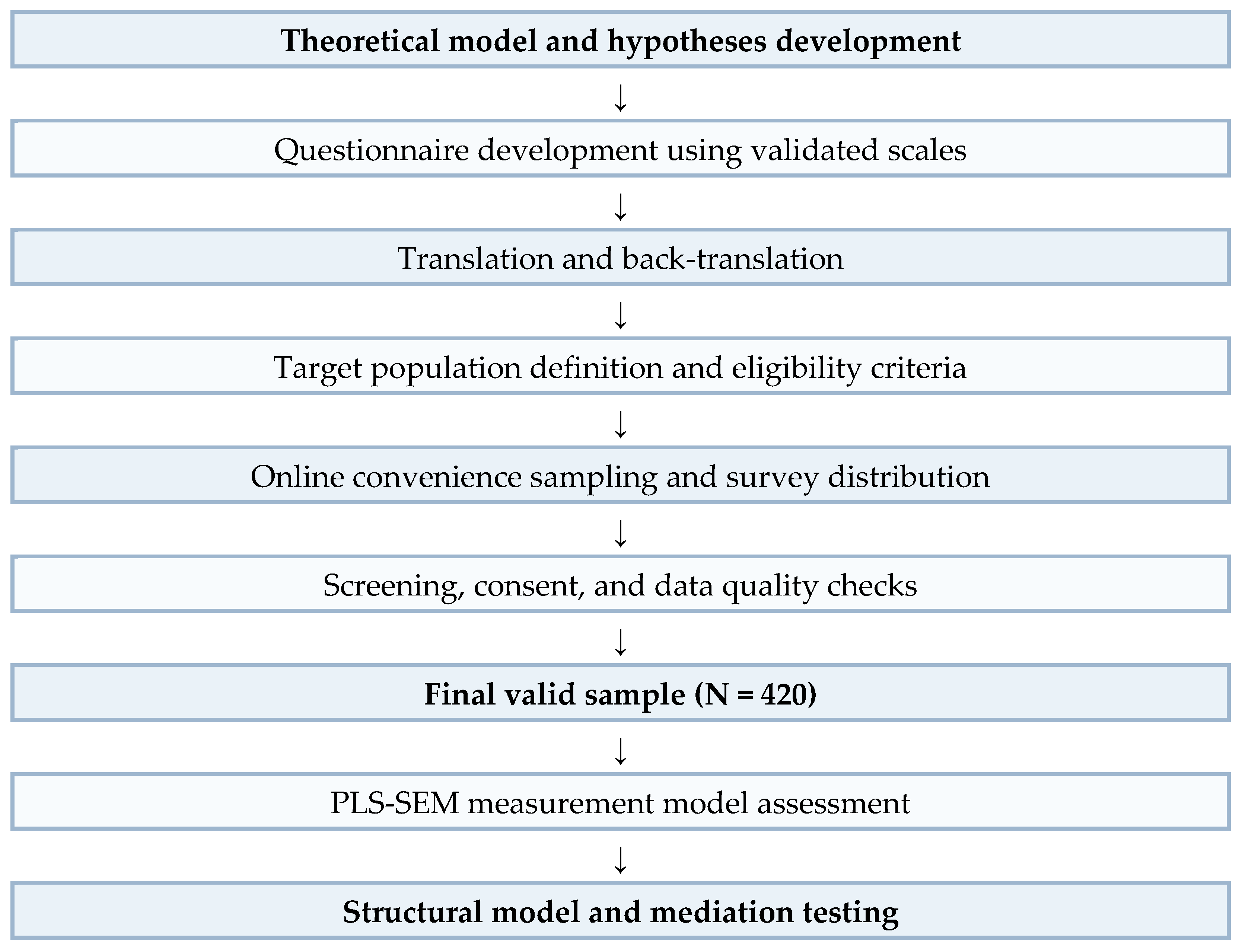
4.1. Research Design and Methodological Workflow
4.2. Instrument Development and Measures
4.3. Target Population, Sampling, and Data Collection
4.4. Ethics, Screening, Data Quality, and Sample Profile
4.5. Data Analysis
5. Result
5.1. Common Method Bias (CMB) and Data Normality
5.2. Outer Model Evaluation
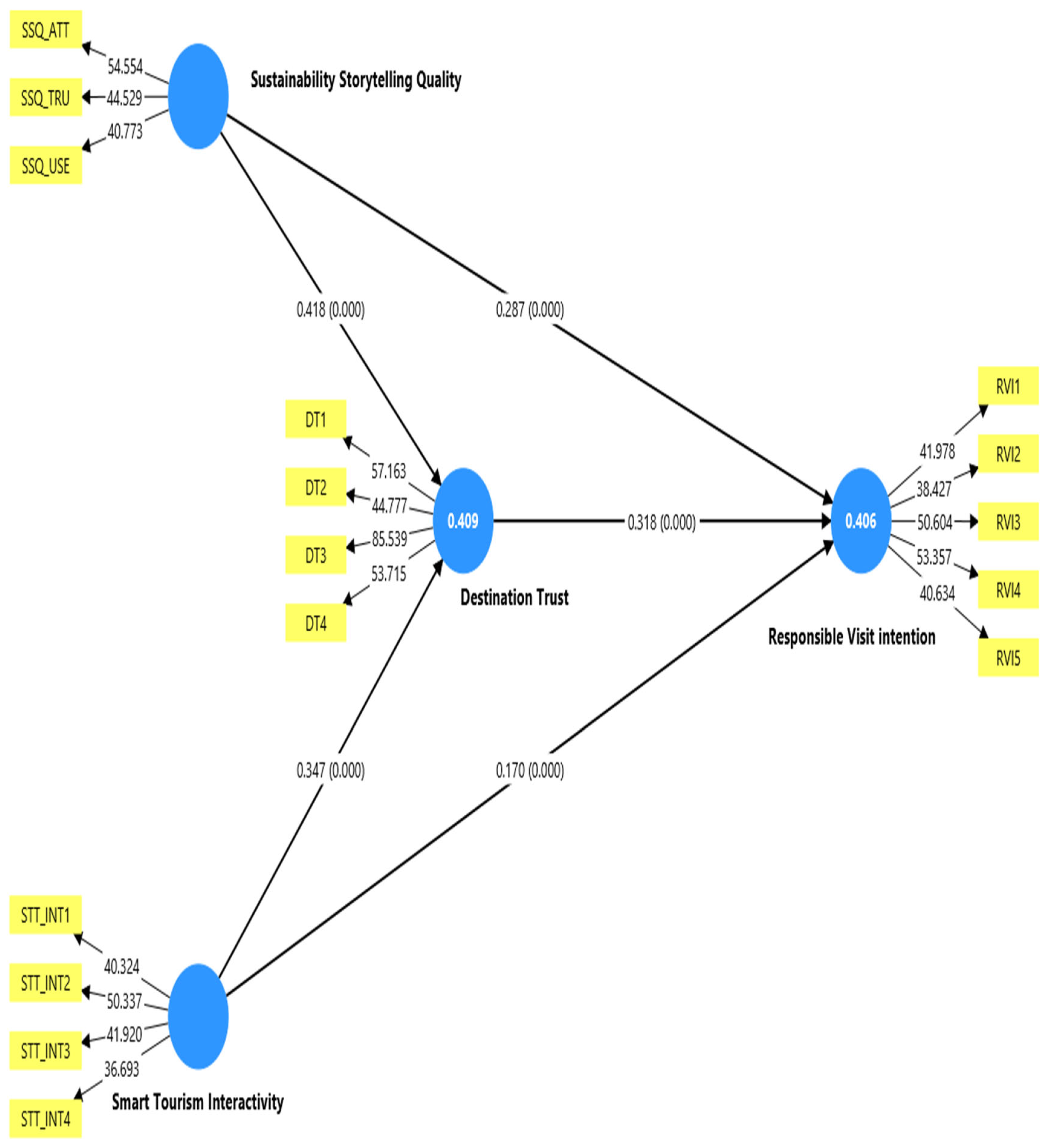
5.3. Structural Model Assessment and Hypotheses Testing
6. Discussion
7. Conclusions
7.1. Theoretical Implications
7.2. Practical Implications
7.3. Study Limitations and Future Research
Author Contributions
Funding
Institutional Review Board Statement
Informed Consent Statement
Data Availability Statement
Conflicts of Interest
Appendix A

| Sustainability storytelling quality [5] |
| Sustainability Storytelling Usefulness |
| SSQ_USE1: I believe the story of Saudi Destination promoting sustainability is a stronger message compared to advertising for destinations. |
| SSQ_USE2: I think the story of Saudi Destination sustainable is more informative than traditional destination marketing. |
| SSQ_USE3: The message of sustainability from Saudi Destination gives me more useful information than the standard destination promotion. |
| Sustainability Storytelling Attractiveness |
| SSQ_ATT1: I think the sustainability story of Saudi Destination looks better than most destination ads. |
| SSQ_ATT2: I think that the way the sustainability story of Saudi Destination is presented is pretty new compared to other destination promotions. |
| SSQ_ATT3: I believe that the sustainability story content of Saudi Destination is more interesting and vivid than most destination marketing messages. |
| SSQ_ATT4: After reading the sustainability story about Saudi Destination, I am more interested in learning more about it than I am in most destination promotions. |
| SSQ_ATT5: I think that the sustainability story of Saudi Destination is more interesting than most destination ads. |
| Sustainability Storytelling Truthfulness |
| SSQ_TRU1: I think the story of Saudi Destination’s sustainability claims are not too far off from what you would see in most destination marketing messages. |
| SSQ_TRU2: I think the information about sustainability in the story of Saudi Destination is true and fair, unlike most destination marketing messages. |
| SSQ_TRU3: I believe the information about sustainability in the story of Saudi Destination is true, unlike most destination ads. |
| SSQ_TRU4: I think the information about sustainability in the story of Saudi Destination is true and trustworthy, unlike most destination marketing messages. |
| Smart tourism interactivity [12] |
| STT_INT1: I make use of my destination’s smart tourism platforms so I can see the questions and answers from many other travellers when travelling in Saudi Destination. |
| STT_INT2: The destination’s smart tourism platforms respond promptly to my questions/requests. |
| STT_INT3: Two-way engagement (not unidirectional one-way flow of information) is possible through the destination’s smart tourism platforms. |
| STT_INT4: Destination-related information/content can be shared easily through the destination’s smart tourism platforms. |
| Destination Trust [39] |
| DT1: I believe that Saudi Destination will satisfy me. |
| DT2: I believe that Saudi Destination will meet my needs. |
| DT3: I believe that Saudi Destination will not disappoint me. |
| DT4: I believe that local people in Saudi Destination are welcoming to visitors. |
| Responsible Visit Intention [39] |
| RVI1: During my visit to Saudi Destination, I will respect local culture and traditions. |
| RVI2: During my visit to Saudi Destination, I will buy locally made products. |
| RVI3: During my visit to Saudi Destination, I will protect wildlife (animals and plants). |
| RVI4: During my visit to Saudi Destination, I will follow local rules and regulations. |
| RVI5: During my visit to Saudi Destination, I will conserve water and electricity. |
References
- Ajzen, I. The Theory of Planned Behavior. Organ. Behav. Hum. Decis. Process. 1991, 50, 179–211. [Google Scholar] [CrossRef]
- Mohaidin, Z.; Wei, K.T.; Ali Murshid, M. Factors Influencing the Tourists’ Intention to Select Sustainable Tourism Destination: A Case Study of Penang, Malaysia. Int. J. Tour. Cities 2017, 3, 442–465. [Google Scholar] [CrossRef]
- De Sio, S.; Zamagni, A.; Casu, G.; Gremigni, P. Green Trust as a Mediator in the Relationship between Green Advertising Skepticism, Environmental Knowledge, and Intention to Buy Green Food. J. Environ. Res. Public Health 2022, 19, 16757. [Google Scholar] [CrossRef]
- Khan, U.; Ali, F.; Ali, L.; Parvez, M.O.; Alotaibi, S. The Effectiveness of Sustainability Badges in Hospitality: Examining Credibility and Its Impact on Booking Intentions. J. Tour. Res. 2025, 27, e70142. [Google Scholar] [CrossRef]
- Wang, J.; Li, A. The Impact of Green Advertising Information Quality Perception on Consumers’ Response: An Empirical Analysis. Sustainability 2022, 14, 13248. [Google Scholar] [CrossRef]
- Verleye, G.; De Ruyck, A.; Vermeulen, W.; Schoenaers, I. Credibility of Green Advertising: Six Elements That Drive Credibility in Green Advertising. Front. Commun. 2023, 8, 1056020. [Google Scholar] [CrossRef]
- Akerlof, G.A. The Market for “Lemons”: Quality Uncertainty and the Market Mechanism. Q. J. Econ. 1970, 84, 488. [Google Scholar] [CrossRef]
- Spence, M. Job Market Signaling. Q. J. Econ. 1973, 87, 355. [Google Scholar] [CrossRef]
- Berger, C.R.; Calabrese, R.J. Some Explorations in Initial Interaction and Beyond: Toward a Developmental Theory of Interpersonal Communication. Hum. Commun. Res. 1975, 1, 99–112. [Google Scholar] [CrossRef]
- Afolabi, O.O.; Ozturen, A.; Ilkan, M. Effects of Privacy Concern, Risk, and Information Control in a Smart Tourism Destination. Econ. Res. Ekon. Istraž. 2021, 34, 3119–3138. [Google Scholar] [CrossRef]
- Lee, T.-H.; Jan, F.-H. Development and Validation of the Smart Tourism Experience Scale. Sustainability 2022, 14, 16421. [Google Scholar] [CrossRef]
- Pai, C.-K.; Liu, Y.; Kang, S.; Dai, A. The Role of Perceived Smart Tourism Technology Experience for Tourist Satisfaction, Happiness and Revisit Intention. Sustainability 2020, 12, 6592. [Google Scholar] [CrossRef]
- Zhang, H.; Gordon, S.; Buhalis, D.; Ding, X. Experience Value Cocreation on Destination Online Platforms. J. Travel Res. 2018, 57, 1093–1107. [Google Scholar] [CrossRef]
- Zhang, W.; Wang, Y.; Zhang, T. Can “Live Streaming” Really Drive Visitors to the Destination? From the Aspect of “Social Presence”. Sage Open 2021, 11, 21582440211006691. [Google Scholar] [CrossRef]
- Mehrabian, A.; Russell, J.A. An Approach to Environmental Psychology; The MIT Press: Cambridge, MA, USA, 1974; ISBN 0-262-13090-4. [Google Scholar]
- Mercadé Melé, P.; Molina Gómez, J.; Sousa, M.J. Influence of Sustainability Practices and Green Image on the Re-Visit Intention of Small and Medium-Size Towns. Sustainability 2020, 12, 930. [Google Scholar] [CrossRef]
- Omeish, F.; Sharabati, A.-A.A.; Abuhashesh, M.; Al-Haddad, S.; Nasereddin, A.Y.; Alghizzawi, M.; Badran, O.N. The Role of Social Media Influencers in Shaping Destination Image and Intention to Visit Jordan: The Moderating Impact of Social Media Usage Intensity. Int. J. Data Netw. Sci. 2024, 8, 1701–1714. [Google Scholar] [CrossRef]
- Veasna, S.; Wu, W.-Y.; Huang, C.-H. The Impact of Destination Source Credibility on Destination Satisfaction: The Mediating Effects of Destination Attachment and Destination Image. Tour. Manag. 2013, 36, 511–526. [Google Scholar] [CrossRef]
- Liu, J.; Wang, C.; Fang, S.; Zhang, T. Scale Development for Tourist Trust toward a Tourism Destination. Tour. Manag. Perspect. 2019, 31, 383–397. [Google Scholar] [CrossRef]
- Abubakar, A.M.; Ilkan, M. Impact of Online WOM on Destination Trust and Intention to Travel: A Medical Tourism Perspective. J. Destin. Mark. Manag. 2016, 5, 192–201. [Google Scholar] [CrossRef]
- Shang, Z.; Luo, J.M. Modeling of the Impact of the Credibility of the Destination Endorser on the Place Attachment of Potential Tourists. Front. Psychol. 2021, 12, 759207. [Google Scholar] [CrossRef]
- Cheung, C.; Song, H. Exploring Tourism Marketing Message Authenticity and Destination Trust: The Role of Benefit Appeal, Framing Strategy, and Tourist Attributes. J. Vacat. Mark. 2025, 13567667251385259. [Google Scholar] [CrossRef]
- Ryu, K.; Lehto, X.Y.; Gordon, S.E.; Fu, X. Effect of a Brand Story Structure on Narrative Transportation and Perceived Brand Image of Luxury Hotels. Tour. Manag. 2019, 71, 348–363. [Google Scholar] [CrossRef]
- Jo, M.; Cha, J.; Kim, J. The Effects of Tourism Storytelling on Tourism Destination Brand Value, Lovemarks and Relationship Strength in South Korea. Sustainability 2022, 14, 16495. [Google Scholar] [CrossRef]
- Chang, W.; Li, H.; Khamarudin, M.; Khan, W.A. Influencing Eco-Conscious Travelers: The Role of Green Marketing in Promoting Sustainable Destinations. Acta Psychol. 2025, 260, 105506. [Google Scholar] [CrossRef]
- Japutra, A.; Can, A.S.; Alphun, C. Environmental or Personal Benefit? The Role of Message Appeal and Information Type in Destination Social Media Advertisements. J. Travel Res. 2025, 64, 1537–1555. [Google Scholar] [CrossRef]
- Ben Arbia, M.; Bouzaabia, R.; Beck, M. Trusting the Virtual, Traveling the Real: How Destination Trust in Video Games Shapes Real-World Travel Willingness Through Player Type Differences. Adm. Sci. 2025, 15, 470. [Google Scholar] [CrossRef]
- Yamagishi, K.; Bitong, C.A.; Badilla, M.C. How Does AI Chatbot-Generated Information Influence Destination Trust and Purchase Decisions in Tourism? J. Hosp. Tour. Insights 2025, 1–22. [Google Scholar] [CrossRef]
- Goeltom, A.D.L.; Hurriyati, R. Destination Attractiveness and Visit Intention: Integrating Image, Cultural Experience, and Sustainable Practices in Tourist Decision-Making. J. Tour. Hosp. Travel Manag. 2024, 2, 43–57. [Google Scholar] [CrossRef]
- Celep, E. Destinasyon Marka Değerinin Destinasyon Güveni ve Tekrar Ziyaret Niyeti Üzerine Etkisi: Ziyaret Sıklığının Moderatör Rolü. Bus. Manag. Stud. Int. J. 2025, 13, 357–378. [Google Scholar] [CrossRef]
- Kusumawati, A.; Utomo, H.S. Perceived Sustainability and Its Effects on Trust and WOM Intention: A Study in Nature and Cultural Tourism. Int. J. Innov. Creat. Change 2019, 8, 279–295. [Google Scholar]
- Nurhidayati, S.; Brahmasari, I.A.; Ratih, I.A.B. Influence of Destination Image, Augmented Reality and Destination Social Responsibility on Destination Beliefs, Motivation and Intention to Visit of Tourists Which Are Moderate by Digital Wom in Berau District, East Kalimantan. Edelweiss Appl. Sci. Technol. 2024, 8, 3267–3278. [Google Scholar] [CrossRef]
- Wibawa, D.P.; Yanto, Y.; Zulkarnain, A. How Destination Image and Trust Mediate E-WOM’s Impact on Halal Tourism Intentions. J. Eko. Keu. Isl. 2025, 11, 29–46. [Google Scholar] [CrossRef]
- De Nisco, A.; Mainolfi, G.; Marino, V.; Napolitano, M.R. Tourism Satisfaction Effect on General Country Image, Destination Image, and Post-Visit Intentions. J. Vacat. Mark. 2015, 21, 305–317. [Google Scholar] [CrossRef]
- Nguyen, T.T.T.; Duong, T.D.H. The Role of Nostalgic Emotion in Shaping Destination Image and Behavioral Intentions—An Empirical Study. J. Hosp. Tour. Insights 2025, 8, 735–752. [Google Scholar] [CrossRef]
- Apidana, Y.H.; Prasetyo, A.; Kholifah, K. User Generated Content and Generation Z Tourists’ Visit Intention: Evidence from the Newly Inaugurated Kebumen Geopark, Indonesia. Amkop Manag. Account. Rev. (AMAR) 2025, 5, 1133–1153. [Google Scholar] [CrossRef]
- Fajri, M.R.I.; Suhud, U.; Wolor, C.W. Examining Tourists’ Intention to Visit Karimunjawa National Park: The Role of Social Media. J. Glob. Econ. Manag. Bus. Res. 2024, 16, 22–33. [Google Scholar] [CrossRef]
- Sodawan, A.; Hsu, R.L.-W. Halal-Friendly Attributes and Muslims’ Visit Intention: Exploring the Roles of Perceived Value and Destination Trust. Sustainability 2022, 14, 12002. [Google Scholar] [CrossRef]
- Ko, E.E.; Cho, M. Exploring Determinants of Tourists’ Ethical Behavior Intention for Sustainable Tourism: The Role of Both Pursuit of Happiness and Normative Goal Framing. Sustainability 2022, 14, 9384. [Google Scholar] [CrossRef]
- Sousa, V.D.; Rojjanasrirat, W. Translation, Adaptation and Validation of Instruments or Scales for Use in Cross-cultural Health Care Research: A Clear and User-friendly Guideline. Eval. Clin. Pract. 2011, 17, 268–274. [Google Scholar] [CrossRef]
- Tsang, S.; Royse, C.; Terkawi, A. Guidelines for Developing, Translating, and Validating a Questionnaire in Perioperative and Pain Medicine. Saudi J. Anaesth. 2017, 11, 80. [Google Scholar] [CrossRef]
- Hair, J.F.; Hauff, S.; Hult, G.T.M.; Richter, N.F.; Ringle, C.M.; Sarstedt, M. Partial Least Squares Strukturgleichungsmodellierung: Eine Anwendungsorientierte Einführung; Verlag Franz Vahlen GmbH: Munich, Germany, 2017; ISBN 978-3-8006-5361-4. [Google Scholar]
- Hair, J.F.; Risher, J.J.; Sarstedt, M.; Ringle, C.M. When to Use and How to Report the Results of PLS-SEM. Eur. Bus. Rev. 2019, 31, 2–24. [Google Scholar] [CrossRef]
- Cohen, J. Statistical Power Analysis for the Behavioral Sciences, 2nd ed.; Routledge: Oxfordshire, UK, 2013; ISBN 978-1-134-74270-7. [Google Scholar]
- Henseler, J.; Ringle, C.M.; Sarstedt, M. A New Criterion for Assessing Discriminant Validity in Variance-Based Structural Equation Modeling. J. Acad. Mark. Sci. 2015, 43, 115–135. [Google Scholar] [CrossRef]
- Podsakoff, P.M.; MacKenzie, S.B.; Lee, J.-Y.; Podsakoff, N.P. Common Method Biases in Behavioral Research: A Critical Review of the Literature and Recommended Remedies. J. Appl. Psychol. 2003, 88, 879–903. [Google Scholar] [CrossRef]
- Curran, P.J.; West, S.G.; Finch, J.F. The Robustness of Test Statistics to Nonnormality and Specification Error in Confirmatory Factor Analysis. Psychol. Methods 1996, 1, 16–29. [Google Scholar] [CrossRef]
- Fornell, C.; Larcker, D.F. Evaluating Structural Equation Models with Unobservable Variables and Measurement Error. J. Mark. Res. 1981, 18, 39–50. [Google Scholar] [CrossRef]


| Category | Group | Frequency | % |
|---|---|---|---|
| Gender | Male | 225 | 53.6 |
| Female | 195 | 46.5 | |
| Age (years) | 18–24 | 118 | 28.1 |
| 25–34 | 165 | 39.3 | |
| 35–44 | 86 | 20.5 | |
| 45–54 | 33 | 7.9 | |
| 55+ | 18 | 4.3 | |
| Status | Saudi citizen | 235 | 56.0 |
| Resident | 142 | 33.8 | |
| International visitor | 43 | 10.2 | |
| Visited Saudi before | Yes | 193 | 46.0 |
| No | 227 | 54.0 |
| Construct and Items | λ (>0.7) | VIF (<5) | M | SD | SK | KU |
|---|---|---|---|---|---|---|
| Measurement Items of the First-Order Constructs | ||||||
| Attractiveness (α = 0.869, CR = 0.905, AVE = 0.657) | ||||||
| SSQ_ATT1 | 0.776 | 1.720 | 2.912 | 1.373 | 0.104 | −1.236 |
| SSQ_ATT2 | 0.834 | 2.110 | 2.962 | 1.405 | 0.032 | −1.249 |
| SSQ_ATT3 | 0.790 | 1.833 | 3.005 | 1.354 | −0.043 | −1.170 |
| SSQ_ATT4 | 0.851 | 2.217 | 2.912 | 1.366 | 0.126 | −1.166 |
| SSQ_ATT5 | 0.801 | 1.955 | 2.907 | 1.353 | 0.088 | −1.187 |
| Truthfulness (α = 0.826, CR = 0.885, AVE = 0.657) | ||||||
| SSQ_TRU1 | 0.760 | 1.548 | 3.010 | 1.333 | −0.011 | −1.240 |
| SSQ_TRU2 | 0.814 | 1.789 | 3.000 | 1.343 | −0.018 | −1.258 |
| SSQ_TRU3 | 0.821 | 1.825 | 2.974 | 1.338 | 0.005 | −1.266 |
| SSQ_TRU4 | 0.846 | 1.931 | 2.981 | 1.349 | −0.005 | −1.244 |
| Usefulness (α = 0.846, CR = 0.907, AVE = 0.764) | ||||||
| SSQ_USE1 | 0.851 | 1.915 | 3.057 | 1.345 | −0.067 | −1.228 |
| SSQ_USE2 | 0.901 | 2.220 | 3.002 | 1.371 | −0.012 | −1.290 |
| SSQ_USE3 | 0.869 | 2.034 | 3.002 | 1.370 | −0.012 | −1.284 |
| Smart Tourism Interactivity (α = 0.828, CR = 0.886, AVE = 0.660) | ||||||
| STT_INT1 | 0.806 | 1.682 | 3.026 | 1.333 | −0.042 | −1.246 |
| STT_INT2 | 0.845 | 2.006 | 2.986 | 1.353 | 0.008 | −1.243 |
| STT_INT3 | 0.805 | 1.726 | 3.002 | 1.344 | −0.021 | −1.262 |
| STT_INT4 | 0.792 | 1.687 | 3.010 | 1.333 | −0.030 | −1.246 |
| Destination Trust (α = 0.872, CR = 0.912, AVE = 0.723) | ||||||
| DT1 | 0.843 | 2.101 | 2.998 | 1.352 | −0.009 | −1.246 |
| DT2 | 0.827 | 2.001 | 3.010 | 1.338 | −0.011 | −1.241 |
| DT3 | 0.884 | 2.401 | 3.010 | 1.357 | −0.010 | −1.279 |
| DT4 | 0.846 | 2.126 | 2.981 | 1.364 | 0.024 | −1.255 |
| Responsible Visit Intention (α = 0.865, CR = 0.902, AVE = 0.649) | ||||||
| RVI1 | 0.797 | 1.847 | 3.005 | 1.349 | −0.023 | −1.249 |
| RVI2 | 0.778 | 1.769 | 2.995 | 1.346 | −0.007 | −1.261 |
| RVI3 | 0.823 | 1.978 | 2.995 | 1.344 | −0.007 | −1.255 |
| RVI4 | 0.829 | 2.080 | 2.983 | 1.356 | 0.006 | −1.254 |
| RVI5 | 0.799 | 1.849 | 2.986 | 1.347 | 0.009 | −1.258 |
| Measurement Items of the Second-Order Constructs | ||||||
| Sustainability Storytelling Quality (α = 0.765, CR = 0.864, AVE = 0.680) | ||||||
| Attractiveness | 0.842 | 1.576 | 2.940 | 1.109 | −1.023 | 0.147 |
| Truthfulness | 0.821 | 1.532 | 3.005 | 1.107 | −0.972 | 0.013 |
| Usefulness | 0.810 | 1.555 | 2.993 | 1.205 | −1.055 | 0.016 |
| Construct | 1 | 2 | 3 | 4 | 5 | 6 |
| First-order constructs | ||||||
| 1. Attractiveness | 0.811 | 0.538 | 0.524 | 0.381 | 0.484 | 0.478 |
| 2. Usefulness | 0.619 | 0.874 | 0.509 | 0.280 | 0.428 | 0.402 |
| 3. Truthfulness | 0.614 | 0.611 | 0.811 | 0.313 | 0.462 | 0.431 |
| 4. Smart Tourism Interactivity | 0.447 | 0.330 | 0.377 | 0.812 | 0.511 | 0.445 |
| 5. Destination Trust | 0.554 | 0.493 | 0.540 | 0.598 | 0.850 | 0.563 |
| 6. Responsible Visit Intention | 0.547 | 0.467 | 0.508 | 0.526 | 0.644 | 0.806 |
| Construct | 1 | 2 | 3 | 4 | ||
| Second-order constructs | ||||||
| 1. Sustainability Storytelling Quality | 0.825 | 0.491 | 0.674 | 0.647 | ||
| 2. Smart Tourism Interactivity | 0.393 | 0.812 | 0.598 | 0.526 | ||
| 3. Destination Trust | 0.554 | 0.511 | 0.850 | 0.644 | ||
| 4. Responsible Visit Intention | 0.530 | 0.445 | 0.563 | 0.806 | ||
| Path (Hypothesis) | β | S.T (STDEV) | T Value | Sig. (p) | Result |
|---|---|---|---|---|---|
| Direct Effects | |||||
| H1: SSQ → DT | 0.418 | 0.041 | 10.164 | <0.001 | Supported |
| H2: STI → DT | 0.347 | 0.041 | 8.402 | <0.001 | Supported |
| H3: DT → RVI | 0.318 | 0.049 | 6.440 | <0.001 | Supported |
| Indirect Mediating Effect | |||||
| H4a: SSQ → DT → RVI | 0.133 | 0.025 | 5.272 | <0.001 | Partial mediation |
| H4b: STI → DT → RVI | 0.110 | 0.022 | 5.078 | <0.001 | Partial mediation |
Disclaimer/Publisher’s Note: The statements, opinions and data contained in all publications are solely those of the individual author(s) and contributor(s) and not of MDPI and/or the editor(s). MDPI and/or the editor(s) disclaim responsibility for any injury to people or property resulting from any ideas, methods, instructions or products referred to in the content. |
© 2026 by the authors. Licensee MDPI, Basel, Switzerland. This article is an open access article distributed under the terms and conditions of the Creative Commons Attribution (CC BY) license.
Share and Cite
Alkhofaily, F.; Noureldin, A. Sustainable Destination Marketing in Saudi Arabia: Effects of Sustainability Storytelling and Smart Tourism Interactivity on Responsible Visit Intention via Destination Trust. Sustainability 2026, 18, 3124. https://doi.org/10.3390/su18063124
Alkhofaily F, Noureldin A. Sustainable Destination Marketing in Saudi Arabia: Effects of Sustainability Storytelling and Smart Tourism Interactivity on Responsible Visit Intention via Destination Trust. Sustainability. 2026; 18(6):3124. https://doi.org/10.3390/su18063124
Chicago/Turabian StyleAlkhofaily, Fatma, and Amr Noureldin. 2026. "Sustainable Destination Marketing in Saudi Arabia: Effects of Sustainability Storytelling and Smart Tourism Interactivity on Responsible Visit Intention via Destination Trust" Sustainability 18, no. 6: 3124. https://doi.org/10.3390/su18063124
APA StyleAlkhofaily, F., & Noureldin, A. (2026). Sustainable Destination Marketing in Saudi Arabia: Effects of Sustainability Storytelling and Smart Tourism Interactivity on Responsible Visit Intention via Destination Trust. Sustainability, 18(6), 3124. https://doi.org/10.3390/su18063124